






Archive for the 'Actors: Lloyd' Category
Is there a blog in this class? 2018
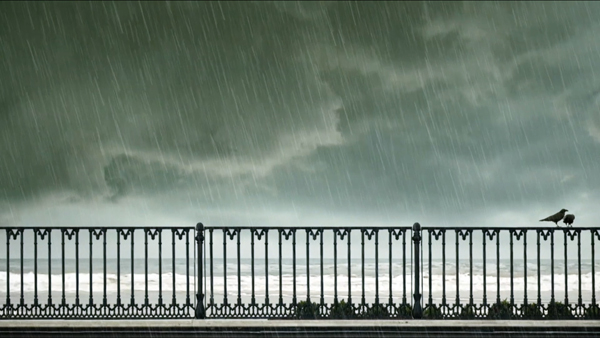
24 Frames (2017)
Kristin here:
David and I started this blog way back in 2006 largely as a way to offer teachers who use Film Art: An Introduction supplementary material that might tie in with the book. It immediately became something more informal, as we wrote about topics that interested us and events in our lives, like campus visits by filmmakers and festivals we attended. Few of the entries actually relate explicitly to the content of Film Art, and yet many of them might be relevant.
Every year shortly before the autumn semester begins, we offer this list of suggestions of posts that might be useful in classes, either as assignments or recommendations. Those who aren’t teaching or being taught might find the following round-up a handy way of catching up with entries they might have missed. After all, we are pushing 900 posts, and despite our excellent search engine and many categories of tags, a little guidance through this flood of texts and images might be useful to some.
This list starts after last August’s post. For past lists, see 2007, 2008, 2009, 2010, 2011, 2012, 2013, 2014, 2015, 2016, and 2017.
This year for the first time I’ll be including the video pieces that our collaborator Jeff Smith and we have since November, 2016, been posting monthly on the Criterion Channel of the streaming service FilmStruck. In them we briefly discuss (most run around 10 to 14 minutes) topics relating to movies streaming on FilmStruck. For teachers whose school subscribes to FilmStruck there is the possibility of showing them in classes. The series of videos is also called “Observations on Film Art,” because it was in a way conceived as an extension of this blog, though it’s more closely keyed to topics discussed in Film Art. As of now there are 21 videos available, with more in the can. I won’t put in a link for each individual entry, but you can find a complete index of our videos here. Since I didn’t include our early entries in my 2017 round-up, I’ll do so here.
As always, I’ll go chapter by chapter, with a few items at the end that don’t fit in but might be useful.
[July 21, 2019: In late November, 2018, the Filmstruck streaming service ceased operation. On April 8, 2019, it was replaced by The Criterion Channel, the streaming service of The Criterion Collection. All the Filmstruck videos listed below appear, with the same titles and numbers, in the “Observations on Film Art” series on the new service. Teachers are welcome to stream these for their classes with a subscription.]
Chapter 3 Narrative Form
David writes on the persistence of classical Hollywood storytelling in contemporary films: “Everything new is old again: Stories from 2017.”
In FilmStruck #5, I look at the effects of using a child as one of the main point-of-view figures in Victor Erice’s masterpiece: “The Spirit of the Beehive–A Child’s Point of View”
In FilmStruck #13, I deal with “Flashbacks in The Phantom Carriage.”
FilmStruck #14 features David discussing classical narrative structure in “Girl Shy—Harold Lloyd Meets Classical Hollywood.” His blog entry, “The Boy’s life: Harold Lloyd’s GIRL SHY on the Criterion Channel” elaborates on Lloyd’s move from simple slapstick into classical filmmaking in his early features. (It could also be used in relation to acting in Chapter 4.)
In FilmStruck #17, David examines “Narrative Symmetry in Chungking Express.”
Chapter 4 The Shot: Mise-en-Scene
In choosing films for our FilmStruck videos, we try occasionally to highlight little-known titles that deserve a lot more attention. In FilmStruck #16 I looks at the unusual lighting in Raymond Bernard’s early 1930s classic: “The Darkness of War in Wooden Crosses.”
FilmStruck #3: Abbas Kiarostami is noted for his expressive use of landscapes. I examine that aspect of his style in Where Is My Friend’s Home? and The Taste of Cherry: “Abbas Kiarostami–The Character of Landscape, the Landscape of Character.”
Teachers often request more on acting. Performances are difficult to analyze, but being able to use multiple clips helps lot. David has taken advantage of that three times so far.
In FilmStruck #4, “The Restrain of L’avventura,” he looks at how staging helps create the enigmatic quality of Antonionni’s narrative.
In FilmStruck #7, I deal with Renoir’s complex orchestration of action in depth: “Staging in The Rules of the Game.”
FilmStruck #10, features David on details of acting: “Performance in Brute Force.”
In Filmstruck #18, David analyses performance style: “Staging and Performance in Ivan the Terrible Part II.” He expands on it in “Eisenstein makes a scene: IVAN THE TERRIBLE Part 2 on the Criterion Channel.”
FilmStruck #19, by me, examines the narrative functions of “Color Motifs in Black Narcissus.”
Chapter 5 The Shot: Cinematography
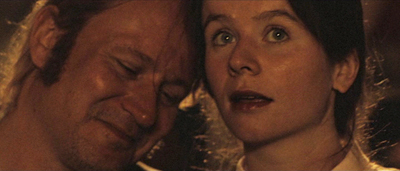
A basic function of cinematography is framing–choosing a camera setup, deciding what to include or exclude from the shot. David discusses Lubitsch’s cunning play with framing in Rosita and Lady Windermere’s Fan in “Lubitsch redoes Lubitsch.”
In FilmStruck #6, Jeff shows how cinematography creates parallelism: “Camera Movement in Three Colors: Red.”
In FilmStruck 21 Jeff looks at a very different use of the camera: “The Restless Cinematography of Breaking the Waves.”
Chapter 6 The Relation of Shot to Shot: Editing
David on multiple-camera shooting and its effects on editing in an early Frank Capra sound film: “The quietest talkie: THE DONOVAN AFFAIR (1929).”
In Filmstruck #2, David discusses Kurosawa’s fast cutting in “Quicker Than the Eye—Editing in Sanjuro Sugata.”
In FilmStruck #20 Jeff lays out “Continuity Editing in The Devil and Daniel Webster.” He follows up on it with a blog entry: “FilmStruck goes to THE DEVIL”,
Chapter 7 Sound in the Cinema
In 2017, we were lucky enough to see the premiere of the restored print of Ernst Lubitsch’s Rosita (1923) at the Venice International Film Festival in 2017. My entry “Lubitsch and Pickford, finally together again,” gives some sense of the complexities of reconstructing the original musical score for the film.
In FilmStruck #1, Jeff Smith discusses “Musical Motifs in Foreign Correspondent.”
Filmstruck #8 features Jeff explaining Chabrol’s use of “Offscreen Sound in La cérémonie.”
In FilmStruck #11, I discuss Fritz Lang’s extraordinary facility with the new sound technology in his first talkie: “Mastering a New Medium—Sound in M.”
Chapter 8 Summary: Style and Film Form
David analyzes narrative patterning and lighting Casablanca in “You must remember this, even though I sort of didn’t.”
In FilmStruck #10, Jeff examines how Fassbender’s style helps accentuate social divisions: “The Stripped-Down Style of Ali Fear Eats the Soul.”
Chapter 9 Film Genres
David tackles a subset of the crime genre in “One last big job: How heist movies tell their stories.”
He also discusses a subset of the thriller genre in “The eyewitness plot and the drama of doubt.”
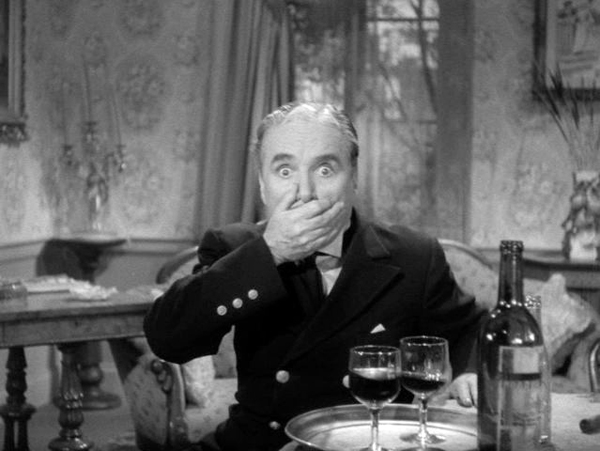
FilmStruck #9 has David exploring Chaplin’s departures from the conventions of his familiar comedies of the past to get serious in Monsieur Verdoux: “Chaplin’s Comedy of Murders.” He followed up with a blog entry, “MONSIEUR VERDOUX: Lethal Lothario.”
In Filmstruck entry #15, “Genre Play in The Player,” Jeff discusses the conventions of two genres, the crime thriller and movies about Hollywood filmmaking, in Robert Altman’s film. He elaborates on his analysis in his blog entry, “Who got played?”
Chapter 10 Documentary, Experimental, and Animated Films
I analyse Bill Morrison’s documentary on the history of Dawson City, where a cache of lost silent films was discovered, in “Bill Morrison’s lyrical tale of loss, destruction and (sometimes) recovery.”
David takes a close look at Abbas Kiarostami’s experimental final film in “Barely moving pictures: Kiarostami’s 24 FRAMES.”
Chapter 11 Film Criticism: Sample Analyses
We blogged from the Venice International Film Festival last year, offering analyses of some of the films we saw. These are much shorter than the ones in Chapter 11, but they show how even a brief report (of the type students might be assigned to write) can go beyond description and quick evaluation.
The first entry deals with the world premieres of The Shape of Water and Three Billboards outside Ebbing, Missouri and is based on single viewings. The second was based on two viewings of Argentine director Lucretia Martel’s marvelous and complex Zama. The third covers films by three major Asian directors: Kore-eda Hirokazu, John Woo, and Takeshi Kitano.
Chapter 12 Historical Changes in Film Art: Conventions and Choices, Traditions and Trends
My usual list of the ten best films of 90 years ago deals with great classics from 1927, some famous, some not so much so.
David discusses stylistic conventions and inventions in some rare 1910s American films in “Something familiar, something peculiar, something for everyone: The 1910s tonight.”
I give a rundown on the restoration of a silent Hollywood classic long available only in a truncated version: The Lost World (1925).
In teaching modern Hollywood and especially superhero blockbusters like Thor Ragnarok, my “Taika Waititi: The very model of a modern movie-maker” might prove useful.
Etc.
If you’re planning to show a film by Damien Chazelle in your class, for whatever chapter, David provides a run-down of his career and comments on his feature films in “New colors to sing: Damien Chazelle on films and filmmaking.” This complements entries from last year on La La Land: “How LA LA LAND is made” and “Singin’ in the sun,” a guest post featuring discussion by Kelley Conway, Eric Dienstfrey, and Amanda McQueen.
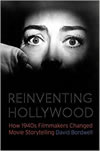
Our blog is not just of use for Film Art, of course. It contains a lot about film history that could be useful in teaching with our other textbook. In particular, this past year saw the publication of David’s Reinventing Hollywood: How 1940s Filmmakers Changed Hollywood Storytelling. His entry “REINVENTING HOLLYWOOD: Out of the past” discusses how it was written, and several entries, recent and older, bear on the book’s arguments. See the category “1940s Hollywood.”
Finally, we don’t deal with Virtual Reality artworks in Film Art, but if you include it in your class or are just interested in the subject, our entry “Venice 2017: Sensory Saturday; or what puts the Virtual in VR” might be of interest. It reports on four VR pieces shown at the Venice International Film Festival, the first major film festival to include VR and award prizes.
Monsieur Verdoux (1947)
The ten best films of … 1927
Underworld.
Kristin here:
Once again it’s time for our ten-best list with a difference. I choose ten films from ninety years ago as the best of their year. Some are well-known classics, while others are gems I have found while doing research for various projects–though I have to admit that most of the films on this year’s list are pretty familiar.
One purpose of this yearly exercise is to call attention to great films of the past, for those who are interested in exploring classic cinema but aren’t sure where to start. (Previous lists are 1917, 1918, 1919, 1920, 1921, 1922, 1923, 1924, 1925, and 1926.)
Hollywood dominates this year, with half the list being American-made.
There are reasons for the lack of international titles. This year was was the tenth anniversary of the Russian Revolution, but although Vsevolod Pudovkin’s celebratory film The End of St. Petersburg is here, Sergei Eisenstein did not finish October in time and it came out in 1928. (I remember the third anniversary film, Boris Barnet’s Moscow in October, as good but not necessarily top-ten material.) Some major directors didn’t release a film or made a lesser work. Dreyer was at work on The Passion of Joan of Arc, but it, too, wasn’t released until 1928. Lubitsch made The Student Prince in Old Heidelberg, a good but not great entry in his oeuvre. Japan’s output is largely lost. Yasujiro Ozu made his first film in 1927, but his earliest surviving one comes from 1929. Most of Kenji Mizoguchi’s 1920s films are gone, including those from 1927.
1927 was the year when Hollywood dipped its toe in sound filmmaking, but we need not worry about the talkies for now. Instead, all ten titles are examples of the state of sophistication that the silent cinema had achieved by the eve of its slow demise. (Sunrise‘s recorded musical track does not a talkie make.)
Hollywood, comic
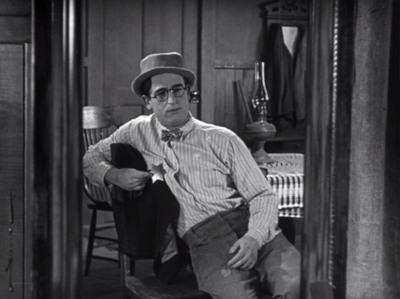
The General is often listed as a 1926 film. This is technically true, in a sense, but I choose not to count its world premiere in Tokyo on December 31, 1926. Its American premiere was scheduled for January 22, 1927 but was delayed until February 5 by the popularity of Flesh and the Devil, which was held over in the theater where Keaton’s film was eventually to launch.
David recently posted an entry on how the great silent comics moved from shorts in the 1910s to features in the 1920s. His example was Harold Lloyd’s Girl Shy, one of our ten best for 1924. Keaton moved into features slightly later than Lloyd, excepting The Saphead (1920), an adaptation of a play, in which Keaton was cast in the lead but over which he had no creative control. Once he did tackle features, he soon became adept at tightly woven plots with motifs and sustained gags. The General, based on a real series of events during the Civil War, has a solid dramatic structure that is more than just an excuse for a bunch of humorous bits. (A dramatic film, The Great Locomotive Chase, was produced by Disney in 1956 and based on the same events.)
The French title of The General is Le Mécano de la General. One might call Keaton that, since The General‘s comedy is essentially a long set of variations on the humor to be gotten out of the physical characteristics of a Civil-War-era train and its interactions with tracks and ties. Keaton had always been fascinated by modes of transportation and other mechanical sources of gags: an earlier train in Our Hospitality, boats in The Boat and The Navigator, a DIY house (One Week), film projection in Sherlock Jr., and so on.
At the beginning, Keaton’s character, Johnny Gray, tries to enlist in the Confederate army, but he is rejected without explanation. The officers consider him more valuable as a train engineer. Later, when Johnny is taking troops up to the front, a group of disguised Union soldiers steal his beloved engine, “The General.” Pursuing the thieves, he ends up deep in Union-occupied territory and takes his engine home, just in time to participate in a battle and prove his worth as a soldier.
The perfection of Keaton’s construction of gags is evident in one famous scene where Johnny’s engine is towing a cannon pointed up at an angle that would clear the cab if it were fired. Johnny has just loaded it with a cannon-ball and lit the fuse; he is returning to the engine when he foot becomes caught in the hitch attaching the cannon to the fuel car. The hitch drops, jolting against the ties so that the cannon slowly sinks to point straight ahead. A cut to a side view shows Johnny noticing this and panicking.
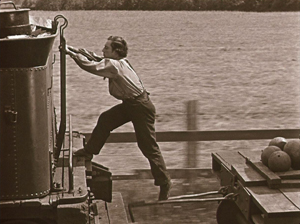
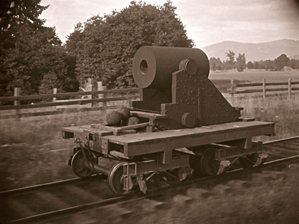
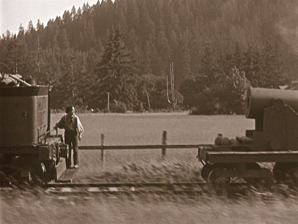
A view from behind the cannon emphasizes his danger as he starts to climb into the fuel car but gets his foot caught in the chain, a situation made clear by a cut-in. Once he is atop the wood-pile, he throws a log which fails to shift the cannon’s aim.
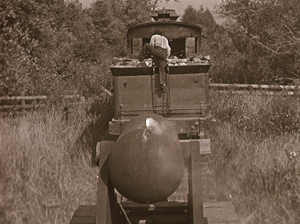
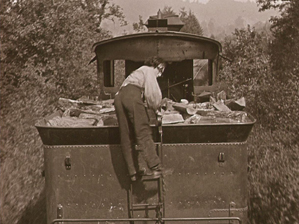
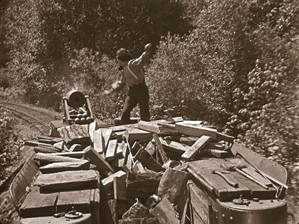
A cutaway establishes the Union soldiers who have stolen the General, approaching a lake in the background. Back at the pursuing engine, Johnny gets onto the cowcatcher, as far from the cannon as he can get. A return to the previous framing shows Johnny’s engine starting to turn on a curving stretch of track with the lake in the distance. The cannon follows.
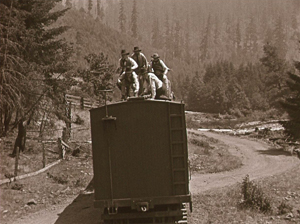
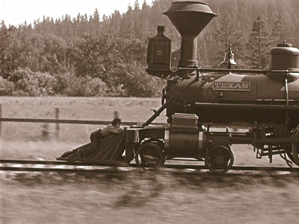
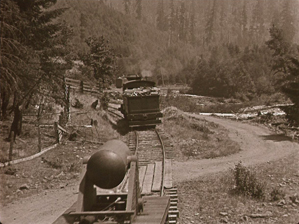
As Johnny’s engine moves just out of the cannon’s trajectory, it fires. This would be enough for the pay-off of this elaborate gag, but the smoke quickly blows aside (possibly a wind machine offscreen left?) and we see the explosion in the distance near the General. As so often happens with Keaton’s gags, we are likely to gasp in amazement at the moment’s sheer physical complexity and ingenuity, as well as Keaton’s dexterity, before we start laughing.
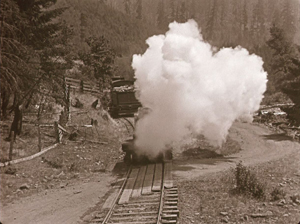
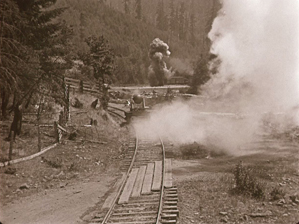
The consensus among most critics and historians is that The General is Keaton’s finest film. In my opinion it goes beyond the top ten for a year to the top ten, period. Participating in the 2012 Sight & Sound poll of scholars and filmmakers, I put it in my list of ten films. It only made it to number 34 among voters, but then, my opinions didn’t coincide too well with the “winners.” Only two of the top ten were on my list. Such exercises are hardly definitive, given how difficult it is to choose among films at the highest levels of brilliance. That’s why David and I tend to stay away from them–except for films made ninety years ago.
Harold Lloyd’s The Kid Brother is similarly one of his finest, along with Girl Shy (featured on my 1924 list and discussed by David in a FilmStruck introduction and his entry linked above). As David points out, Lloyd’s features usually give his character a flaw to overcome. Here, as a country boy overshadowed by his tough father and two older brothers, he believes himself to be timid and not worth much. He eventually proves himself, of course, partly from a desire to save his father, who is wrongly accused of stealing some money, and partly through the encouragement of Mary, owner of a medicine show passing through town, with whom he falls in love.
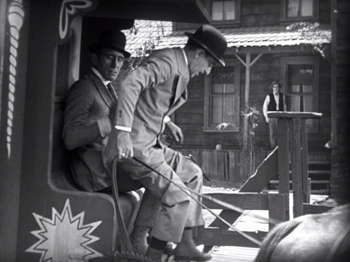
Harold Hickory is quickly set up as fantasizing that he is as capable as his father, the local sheriff, when he holds his father’s badge against his chest (see the top of this section). Not just a prop for character exposition, however, the badge leads him to be mistaken for the real sheriff. In trying to pass himself off as a convincing sheriff, he sets in motion a series of events that lead to the accusation of theft against his father and his attempts to recover the money from the real thieves.
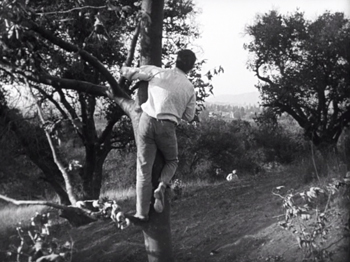
As with Keaton, one of Lloyd’s strengths was an ability to plan a gag to use the whole frame, whether in depth or from side to side. The film stages several scenes in depth, as when the dishonest medicine-show men who will eventually steal the money arrive to try to get a permit to perform in town. As they arrive, Harold is seen in depth, wearing his father’s hat and badge, thus setting up the idea that they will believe that he is actually the sheriff. A more extended example occurs later, when he meets and is attracted to Mary, he climbs a tree to call after her as she leaves him, disappearing again and again behind a hill in the distance, and reappearing each time he climbs higher.
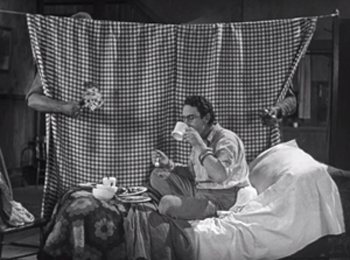
Lloyd skillfully employed shallow space equally well. When the medicine-wagon is destroyed by fire, Harold invites Mary to spend the night at his house. A disapproving neighbor lady soon takes her away, and Harold sleeps on the couch he had made up for Mary, complete with a tablecloth hung to give her privacy. Believing Mary still to be in bed, the two brothers separately sneak in to court her by primly handing her breakfast and gifts around the edge of the cloth. A shot from the other side shows Harold pretending to be Mary and enjoying being served food by the brothers when it is usually he who does the cooking.
Like The General, The Kid Brother demonstrates the sophistication that the great silent comedians had achieved by the late silent period.
As with the Lloyd films included in previous lists, The Kid Brother was released in the 2005 New Line boxed set, “The Harold Lloyd Comedy Collection,” now out of print and available only from third-party sellers. Sold separately, Volume 2 is still in print; it contains The Kid Brother and The Freshman, as well as other important Lloyd films. Volume 3 is still available new from third-party sellers. Volume 1 is available from third-party sellers, mainly in used (and higher-priced copies).
Hollywood, serious
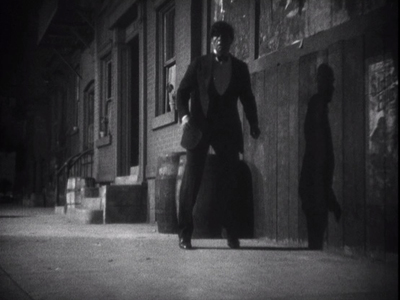
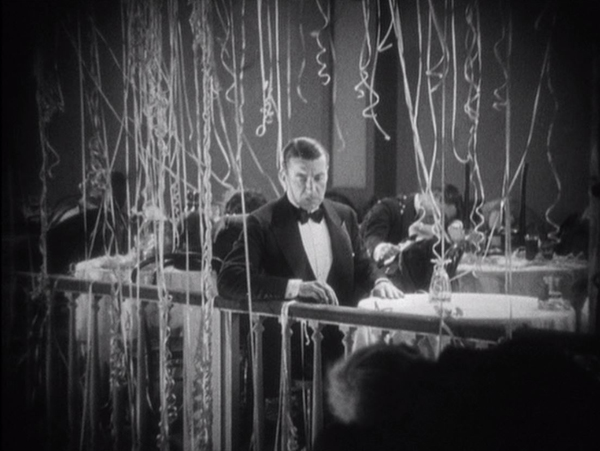
The popular impression seems to be that the gangster genre originated in the early sound period. Wikipedia’s entry on the subject treats Public Enemy (1931), Little Caesar (1931), and Scarface (1932) as the first gangster films. There had been occasional silent films that could fit into that category, notably The Musketeers of Pig Alley (1912, D. W. Griffith) and Alias Jimmy Valentine (1915, Maurice Tourneur). In 1927, however, Josef von Sternberg made Underworld, which basically defined the genre that would soon become more prominent.
It has the gangster’s little mannerism, with “Bull” Weed bending coins to show off his strength (possibly the source of the cliché of the gangster flipping a coin). There’s the emblematic and ironic death, as when Bull’s nemesis “Buck” Mulligan is shot and falls at the foot of a cross-shaped memorial arrangement of flowers in the shop he uses as a front. There’s the thug with a heart of gold redeemed by the loyalty of a friend.
Von Sternberg is most often associated with Marlene Dietrich, whom he directed in seven films in the 1930s. He built three of his last four films of the late 1920s, however, around the burly star George Bancroft (below left). (We will encounter the second in next year’s list.) He’s also associated with beautiful design and cinematography, and the look of Underworld often anticipates the films noir of the 1930s (above, top, and below right).
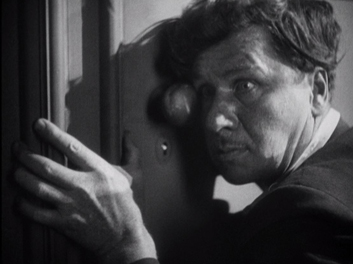
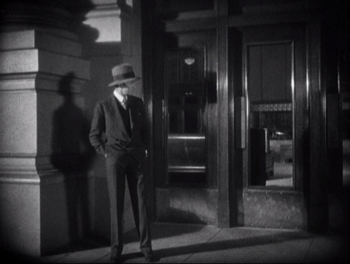
I’ve already written about Underworld in greater detail than I have room for here–with additional pretty pictures. That was on the occasion of Criterion’s release of a set containing von Sternberg’s last three silents. Still indispensable but out of print and selling for high prices when you can find it. (Time for a Blu-ray?)
Late in her life, I asked my mother (born in 1922) what the earliest film she could remember seeing was. She replied that she couldn’t give me the title but recalled an image: a woman floating on a lake supported by reeds. I was quite astonished, partly because of all possible late 1920s films she had mentioned one which I could identify instantly from that brief description and partly because her memory had retained an impression of one of the great classics of the silent cinema. Living on a farm in Ohio, my mother probably saw it in a late run and so probably was six or seven at the time.
The presence of Sunrise on this list will hardly come as a surprise to anyone. Murnau has been a regular, appearing in our 1922, 1924, 1925, and 1926 entries. His first Hollywood film was thoroughly Murnauesque in style. It’s story of village versus country with a lingering touch of Expressionism in the rural scenes (below left) and modern design on ample display in the city (below right). The action could be set equally plausibly in Germany or the USA, except for the English-language signs in the city.
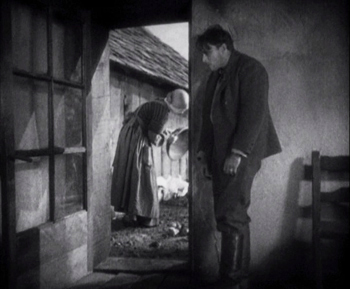
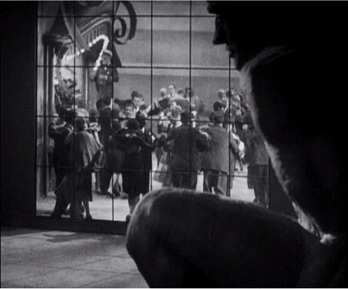
The plot is simplicity itself, with none of the characters even given a name. A Man is seduced by a Woman from the City, who convinces him to drown his Wife “accidentally” and flee with her to the gaiety of urban life. He nearly pushes his Wife into the lake while rowing across to the mainland but relents and tries to gain her forgiveness. This all occupies less than half the film, and most of the rest consists of the couple going forlornly to the city, with the Wife heartsick and the Man pathetically trying to reassure her. Once they reconcile, there is a long stretch of them having a good time in the city before heading home.
Yes, a good time. One might expect the city to be a hotbed of decadence that contrasts with their virtuous country life, but apart from an aggressively flirtatious gentleman, most of the people they meet are kind to them. A friendly photographer thinks they are a newly married couple and takes their portrait, sophisticated patrons at the dance-hall appreciate their performance of a country dance (below), and so on.
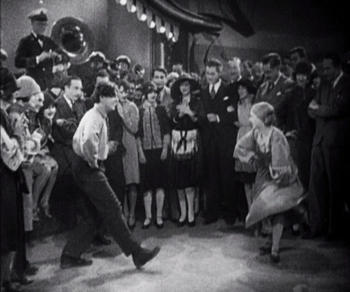
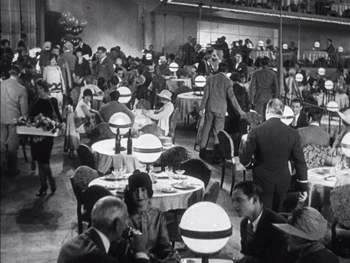
This meandering little set of unconnected vignettes does not conform to the Hollywood ideal. It presumably aims to guarantee that we believe in the husband’s redemption and the couple’s future happiness after their symbolic “re-marriage.” It holds our attention partly because of the charm of the two lead actors, George O’Brien and Janet Gaynor, and partly because the visual style always gives us something to look at. Murnau uses his “unfastened” German-style camera movements, not only in the famous track to the marsh early on but in a movement over diners’ heads accomplished by placing a camera on a support suspended from a track on the ceiling. (This technique was being widely adopted in Hollywood during the second half of the 1920s.)
Plus there’s that memorable scene of the Wife drifting on the lake, supported by reeds.
Sunrise is available in the elaborate 2008 12-disc boxed-set “Murnau, Borzage and Fox,” though the print is the usual soft, rather dark one available elsewhere. (The main gems of the box are the rare Borzage silents, including Lazybones, one of my 1925 picks.) Eureka! put out an edition of Sunrise as the first entry in its “Masters of Cinema” series. It contains not only the same print but a second print, a Czech release with distinctly better visual quality. (The image of the restaurant directly above was taken from it, while the others are from the “Fox Box.” I have not made a comparison between the two, but apparently the Czech version has significant differences from the American one.) This edition is out of print. Eureka! now offers the same two prints and supplements as a DVD/Blu-ray combination. Note that (despite what the Amazon.uk page says), this is a region 2 DVD and region B Blu-ray; both would require a multi-standard player in the USA and other regions.
The same “Fox Box” set contains Frank Borzage’s 7th Heaven, one of his best-loved films. By rights it should not be a great film. It is intensely sentimental, depends on huge coincidences, and has a thoroughly implausible ending, not to mention a saccharine religious theme that runs through it. Yet somehow it manages to be the greatest hypersentimental, coincidence-ridden, implausible, pious film ever. I cannot explain how or why.
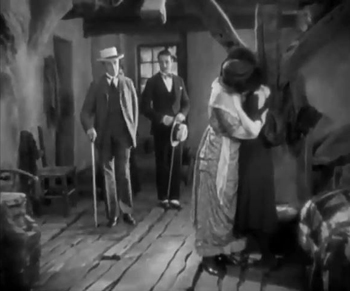
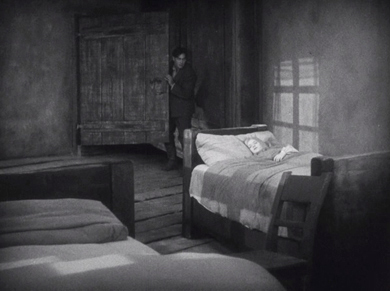
Borzage’s film looks a lot like Sunrise, and it is often assumed that the resemblance arises from a straightforward influence of Murnau upon Borzage (e.g., his Wikipedia entry states that Borzage was “Absorbing visual influences from the German director F. W. Murnau, who was also resident at Fox at this time”), even though 7th Heaven was released four months earlier. There is something more complex at work here. The two films’ resemblances are not surprising, since German films had been drawing excited attention among American filmmakers for the past two years or so. The Last Laugh wasn’t a popular success, but its US distributor, Universal, showed it privately for cinematographers and others in the industry interested in studying it. Variety had been a hit. Its techniques of false perspective in sets and cameras moving freely through space soon caught on. For example, the sordid flat that the heroine Diane shares with her sister in 7th Heaven has a rough wooden floor sloping up toward the back (left). A similarly sloping floor appears in the bedroom in Sunrise (right)
German producer Erich Pommer’s first American film, Hotel Imperial (released by Paramount at the beginning of 1927), used a camera elevator, hanging sometimes from a track in the ceiling and sometimes from an improvised support on a dolly (see here for an image of it attached to the latter). The famous vertical elevator shot in 7th Heaven, following Chico and Diane as they ascend to his garret apartment at the top of the building was probably the most flamboyant use of the unfastened camera to that point. Below, in a later shot, the camera follows Chico back down as he goes to fetch water.
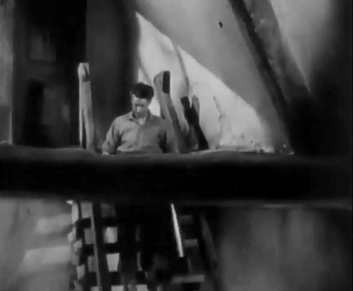
German style alone does not explain the film’s status as a great classic, though the slightly exotic look perhaps helped to make the garret romantic enough to be called “heaven” by its inhabitants as they fall in love. As with Sunrise, the Germanic look lends a certain fairy-tale quality that helps smooth over the plausibility issues.
Beyond this, there is again the charisma of the main actors. Janet Gaynor (who was in two of this year’s greatest films) and Charles Farrell (a slightly awkward but appealing actor) became the ideal couple of the late 1920s, co-starring eleven more times between 1927 and 1934. Equally, there is the ineffable directorial sincerity that comes across in Borzage’s best films, a trait often summarized as “romantic” or “naive.”
Unfortunately the print of 7th Heaven in the “Fox Box” is virtually unwatchable. Apparently the French DVD is from a better source than the Fox release; this DVD may be the source of a version which has been posted on YouTube with bright yellow Greek subtitles. The two frames above were extracted from that online copy. Another film calling out for restoration.
Germany: farewell to Expressionism
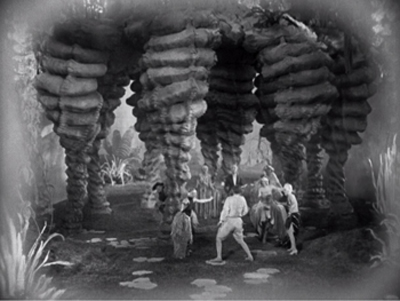
Expressionism probably would have ended in Germany in 1926, with the releases of Murnau’s Faust and Fritz Lang’s Metropolis. Both films went over budget and schedule, with Lang’s being late enough to be released on January 10, 1927. Both films contributed to the decline of the large production company, UFA, which had to rely on loans from Hollywood to keep going. Murnau was by this point in America, and he never worked again in Germany. Lang had to produce his next film, Spione (destined for our 1928 list), himself, and he opted for a more streamlined modern look.
Metropolis mixes Expressionism with the sets representing the futuristic science-fiction city. The pleasure garden of the wealthiest class (above), as well as the catacombs and chapel of Maria far under the city are Expressionist, and even in the city sets the crowds often move in the choreographed fashion typical of the style.
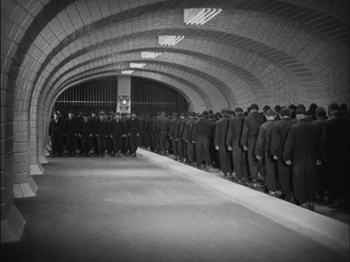
Expressionism remained thereafter as a minor stylistic option. (Alexandre Volkoff’s 1928 French-German co-production Geheimnisse des Orients used Expressionist sets to create a fairy-tale Middle-East, rather like The Thief of Bagdad [1924].)
Metropolis has received so much attention that there is no need to plug it again as a great classic. In fact, it has been hyped to the point of being over-valued. Any of Lang’s other films from 1922 to 1928 is arguably better. It has a mawkish main premise (the heart must mediate between head and hands in labor disputes) and plot flaws (why would Fredersen destroy the substructure of his city when his power and dominance depend on maintaining it?), neither of which is a problem in Lang’s other films of this period. It deserves to be called a masterpiece for its audacity of vision, technical innovation, and many great moments.
Fans of the film will be aware that the long-lost scenes of the film were discovered in South America and restored to the film, rendering it nearly complete (running 148 minutes in Kino Lorber’s Blu-ray release). The recovered footage was unfortunately in very worn condition, and restoration can only do so much. The film is, however, much improved by having it.
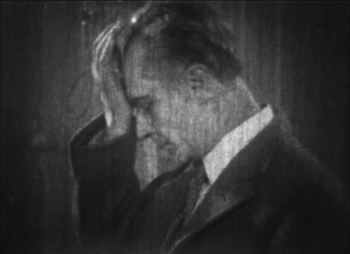
David has already written on the strengths and weakness of this “great sacred monster of the cinema,” including a discussion of how the restored footage enhances it.
Back in 1970, when I was an undergraduate and first dipping a toe into film studies, G. W. Pabst was considered one of the major figures of German cinema, close to if not quite as great as Lang or Murnau. In my first film course the incomplete version of The Joyless Street was shown. (I liked it much better when it was restored.) I saw The Love of Jeanne Ney shortly thereafter. By now, however, The Joyless Street and Pandora’s Box have become the Pabst classics upon which his reputation is largely based. Whether Jeanne Ney‘s gradual fall into relative obscurity is the cause or the effect of its being difficult to see is hard to say. (I could only find it as a 2001 DVD by Kino, so-so but acceptable in quality.) Either way it’s a pity, since it deserves to be better known.
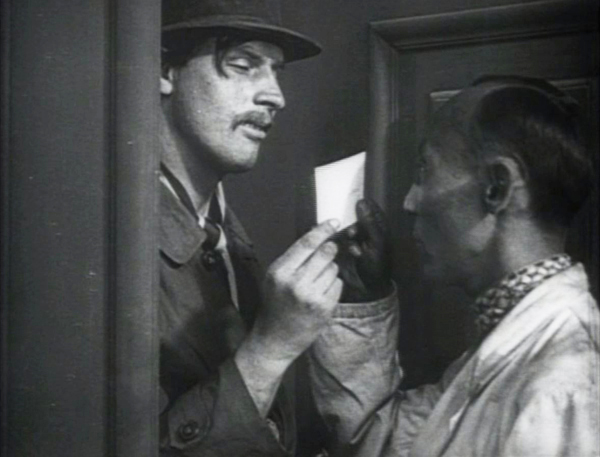
An adaptation of Ilya Ehrenburg’s novel of the same name, Jeanne Ney is set in the Civil War period that followed the Russian Revolution of 1917. The story begins in the Crimea, where Jeanne’s anti-Bolshevik father is a political observer. During the capture of the town by the Red forces, Jeanne’s lover, Labov, kills her father in self-defense. She forgives him and flees to Paris. Jeanne gets a job as a secretary in her miserly uncle’s detective agency, primarily to be a companion to her blind cousin. (Gabriele is played by Brigitte Helm, who was also Maria in Metropolis, thus making her our second actress appearing in two of this year’s top ten films.) A rascally opportunist, Khalibiev (played with sleazy relish by Fritz Rasp, see bottom) tries to marry Gabriele for her money, even though he actually lusts after Jeanne. Killing and robbing the uncle, he pins the murder on Labov.
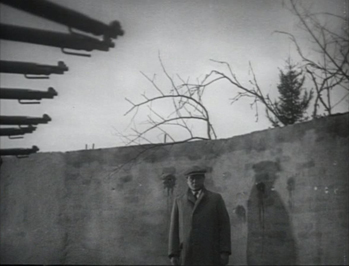
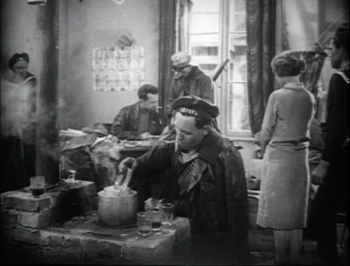
Stylistically the film is a fascinating mix typical of the late 1920s, when influences were passing rapidly among European countries. It strives for a certain degree of the realism characteristic of the Neue Sachlichkeit movement that Pabst had helped to establish with The Joyless Street. The first part is influenced by the Soviet films that had become popular in Germany only the year before, and the Crimea-set portion could pass for a Soviet film, though not one of the more daring ones. The execution scene (below left), with the rifles sticking into the frame dramatically, was already calling upon a composition typical of the Montage movement. The interrogation of Jeanne takes place in a cluttered headquarters just set up by the conquering Reds (complete with authentic costumes and “typage” casting); the framing emphasizes both Bolshevik ideals and realism, placing in the foreground a soldier trying to make tea.
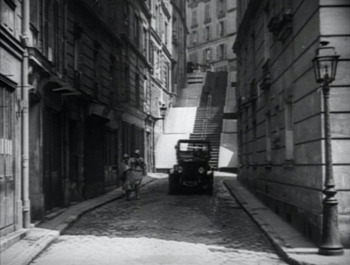
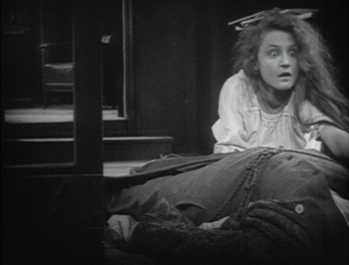
For the longer Parisian portion of the film, Pabst shot on location, as the French Impressionists were doing. He mixed this sense of realism (below left) with subjective scenes, including Jeanne’s superimposed vision of her wrongly-accused lover being executed. The film has one great set-piece, the cousin’s gradual discovery of her father’s murder as Khalibiev stands watching, thoroughly spooked by her blind staring face (below right).
Time to bring this film back into the canon.
Much more familiar is Berlin, die Sinfonie der Grossstadt, with which Walter Ruttmann brought the city symphony into the mainstream and solidified a growing strain of realism in German cinema. There had been short films and features that wove together visual motifs from urban life (e.g., Charles Sheeler and Paul Strand’s Manhatta, 1921), mostly captured on the fly though occasionally staged.
Ruttmann has been mentioned on previous ten-best lists for his abstract animation. Berlin begins with some moving abstract shapes that gradually give way to a train journey. During this real objects create abstract patterns, as when the girders of a bridge create a flicker effect as they flash by (below left).
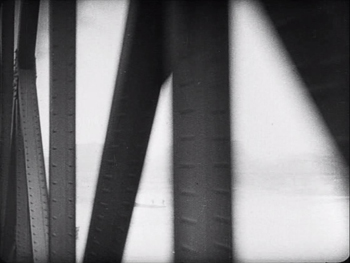
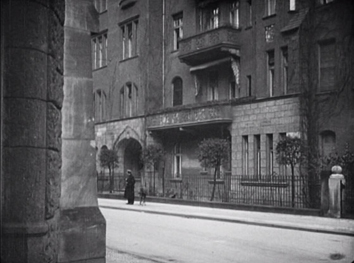
The journey ends in a major station in the city. From there on, Ruttmann cuts together scenes to create what was to become a familiar city-symphony time-frame, a day in the life of a metropolis. Empty, silent streets lead to an early-morning dog-walker (above right) and then the bustle of the workday, lunch, and finally nightlife.
To this point most experimental films had been short and either abstract or surrealist. That experimentation could emerge from the documentary mode was a new concept, and Berlin, though it may not seem very radical to us today, helped to establish this new approach. The fact that it was co-produced by Fox Europa gave it distribution in mainstream theaters, and it has had a great influence on subsequent filmmaking, right up to the present. Coincidentally, that influence is demonstrated by the recent release of Alex Barratt’s London Symphony: A Poetic Journey through the Life of a City (2017). Flicker Alley’s liner notes include:
The release of this Blu-ray coincides with the 90th anniversary of Walter Ruttmann’s Berlin, Symphony of a Great City (1927), one of the most important examples of the original city symphonies. Ruttmann was one of the great pioneers of experimental film, and Barrett and [James] McWilliam [composer] have worked hard to bring a similar sense of poetic playfulness to London Symphony, while also updating the form for the 21st Century.
Berlin is available in several DVD editions, but the definitive one is in a two-disc set including Ruttmann’s Die Melodie der Welt, the first German sound film, both in restored versions from the Filmmuseum series, as well as Ruttmann’s short abstract films. I note that this is available on Amazon in the USA, but be aware that it’s PAL and so requires a multi-standard player.
The essence of French Impressionism in 38 minutes
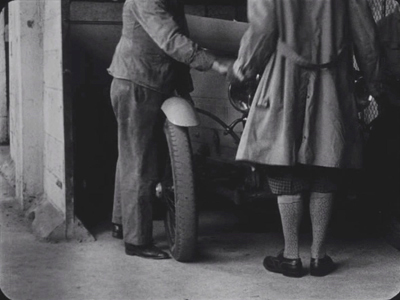
I know most readers will expect a much, much longer French film about Napoléon to be in this spot, but I’m opting for Jean Epstein’s modest but brilliant short feature, La Glace à trois faces (“The three-sided mirror”). Perhaps no other film of the Impressionist movement managed to create a plot that combines the subjective techniques that delve into character psychology with the presentation of events through fleeting impressions rather than linear causality. Most Impressionist films today seem a bit old-fashioned, adhering to the modernism of the era. La Glace seems familiar to aficionados of Resnais or Antonioni.
Epstein divides his brief tale of his protagonist, an unnamed playboy, into three parts devoted to the women–a wealthy society woman, a modern sculptor, and a modest working-class woman–who are all having affairs with him at the same time. Each tells her tale of his callousness and neglect to a sympathetic listener, and each presents a very different view of him. Intercut with their stories are scenes of the protagonist taking a solo ride in his sports car (above), speeding through the countryside and stopping at a local fair. Throughout he seems happier than he had with any of his lovers.
The individual scenes are brief, with quick cutting presenting glances and gestures, often from angles that prevent our getting a good look at what is happening, as with this moment in a restaurant.
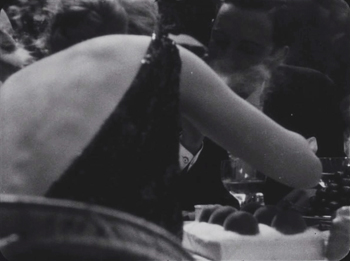
We grasp what is going on primarily because the events are extremely simple. In each case the protagonist is with one of the women and abruptly walks out on her. The third tale, told by the working-class Lucie, is cut together in nearly random chronological order and with parts of the action missing. Lucie has prepared a romantic dinner at her home, but the man arrives, greets her, looks over the table, and leaves. In this snippet, however, his looking over the table is followed immediately by a shot of him just after his arrival, as Lucie embraces him and removes his hat.
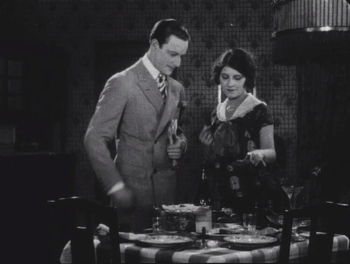
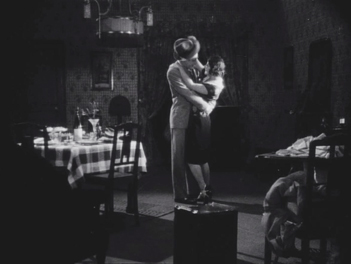
The narrative achieves closure, but the film ends with an emblematic shot of the hero superimposed over a three-sided mirror, emphasizing the differences in the three women’s perceptions of him. La Glace à trois faces goes perhaps as far as any silent film does in using challenging modernist tactics, frustrating the viewer with a lack of clarity about causes and traits. It was a new form of narration that had little immediate impact on the cinema. The film was barely seen at the time. It would not be until decades later that similar techniques became common.
La Glace is available in the boxed-set of several of Epstein’s films, which I described and linked here. It is also included in Kino’s “Avant Garde” set on the 1920s and 1930s.
Tracing the birth of a Bolshevik
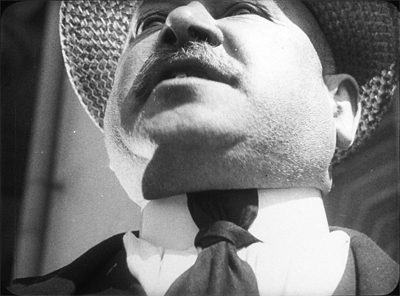
One can see why the Soviet government liked Pudovkin best among the major Montage directors. His films, while employing the fast cutting, dynamic angles, and other stylistic traits of the movement, are fairly straightforward and comprehensible compared to, say, Eisenstein’s pyrotechnics in October.
While the latter concentrates on the events of the Revolution proper, with no single character singled out for us to identify with, Pudovkin works up to the Revolution by following the radicalization of a peasant. The unnamed “Village Lad” sets out from his impoverished rural home to find work at a factory in the big city. We see the fomenting of a strike over dangerous working conditions and extended work hours, which begins as the Lad arrives. Ignorant of politics and the class struggle, he seizes his chance to join the scabs replacing the workers. Even worse, he betrays some of the strike’s leaders to police.
The story moves away from the Lad, who really is not very prominent in the narrative and is never characterized enough to gain much sympathy. As World War I begins, the film focuses on stock-market manipulation and war profiteering. Using typical typage casting, Pudovkin caricatures the capitalists as fat cats out for themselves (above). Eventually we see the Lad again, now wiser in the ways of the world and ready to serve the Bolshevik cause. By the end, the Reds attack the Winter Palace in a suspenseful scene, though one much shorter than the one in October.
Pudovkin featured on our list last year, for his best-known film, Mother. There the hero and his mother gain a good deal more sympathy than the Lad does, and The End of St. Petersburg is as a result perhaps a less entertaining film than Mother. Still, it is a masterly film and one of the gems of Soviet Montage.
While rewatching End on DVD, I realized that the main editions available used the same version of the film, a sonorized “restoration” done by Mosfilm in 1969. What other changes might have been made are not apparent (some films “restored” in that period were recut), but the images are severely cropped. The left side of the frame is missing, more than what one would expect would be necessary to add a sound track. The top and bottom, too, are missing portions. Only the right edge seems more or less intact.
Take this famous image. The film has set up a motif of statues that come to stand for the imperial-era city. At one point there is a depth shot past an equestrian statue looming in the foreground while the Lad and his companion are seen as tiny figures walking across the square in the background. Compare the DVD image with one taken from an archival 35mm print.
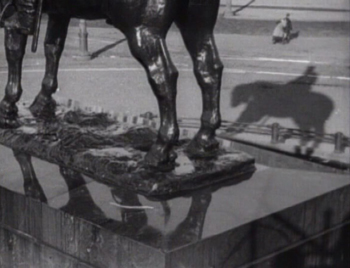
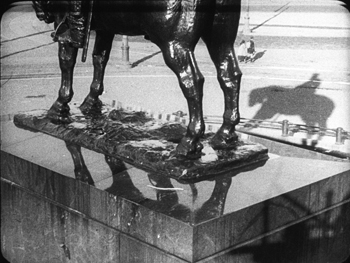
This is bad enough, but when Pudovkin starts using the edges of the frame to make ideological points, the result nearly negates the his meaning. A famous shot shows a row of seated military officials with their heads offscreen. The 35mm image cuts them off precisely at the collar. The DVD print goes down to mid-chest, while losing much of the fourth man on the left. One might say that the same simple metaphor is being presented, but it’s not as instantly apparent what Pudovkin is implying here.
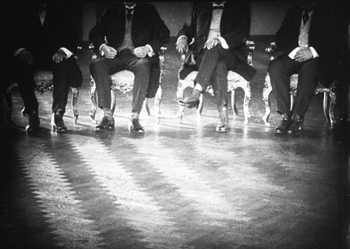
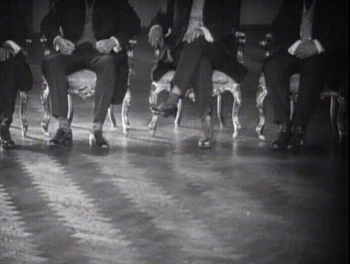
So while I recommend this film, I have to caution readers that it is not currently easy to see it in an acceptable print. An older 16mm copy or a 35mm screening in an archive would be ideal but not accessible to very many. If you want to see it, even in this faulty version, the Image and Kino releases both contain the Mosfilm print. The Image DVD has End paired with Pudovkin’s very worthwhile first sound film, Deserter (1933). Since it was a sound film to begin with, Deserter is not significantly cropped here and is quite good visually. Unfortunately this version is long out of print. The Kino DVD includes Dovzhenko’s Earth (1930) and Pudovkin’s short comedy Chess Fever (1925). It is available for sale and streaming on Amazon. Perhaps our friends at one of the home-video companies dedicated to putting out restorations on DVD and Blu-ray might consider tackling this key title.
For readers who prefer streaming, The Kid Brother, Sunrise, and Metropolis are currently available at FilmStruck on The Criterion Channel. Underworld, The General, The Love of Jeanne Ney, Berlin: Symphony of a Great City, La Glace à trois faces, and The End of St. Petersburg are held in MUBI‘s library, but none is currently playing there. We haven’t checked any of these versions.
Flicker Alley’s London Symphony is available for streaming here and on MOD Blu-ray.
Our colleague Vance Kepley has written a book in the Taurus Film Companion series on The End of St. Petersburg. It seems to be slipping out of availability on amazon.com, can still be had at amazon.co.uk, and is available directly from the publisher. Malcolm Turvey discusses some of the films on our list in his The Filming of Modern Life: European Avant-Garde Film of the 1920s.
December 28, 2017: Our thanks to Manfred Polak, who sends some good news about a restoration and possible upcoming availability of one of our films: “A restored version of “The Love of Jeanne Ney” was shown in an open-air event in Berlin last August. This version also aired on German-French TV station Arte, and it was available for legal download and streaming in HD for three months. I think there might be a DVD or Blu-ray of this version in a few months.”
The Love of Jeanne Ney
The ten best films of … 1926
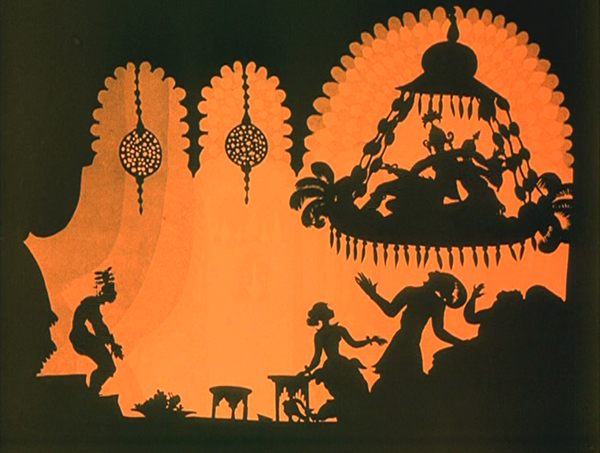
The Adventures of Prince Achmed.
Kristin (with some help from David) here:
David and I have been offering this greatest-of-90-years-ago series almost as long as this blog has existed. For earlier annual entries, see 1917, 1918, 1919, 1920, 1921, 1922, 1923, 1924, and 1925.
I approached 1926 with the assumption that it would present a crowded field of masterpieces; surely it would be difficult to choose ten best films. Instead it turned out that some of the greatest directors of the era somehow managed to skip this year or turn in lesser films. Eisenstein had two masterpieces in 1925 but no film in 1926. Dreyer made a film that is a candidate for his least interesting silent feature, The Bride of Gromdal. Chaplin did not release a film, and Keaton’s Battling Butler, while a charming comedy, is not a plausible ten-best entry. The production of Lang’s Metropolis went over schedule, and it will appear on next year’s list, for certain.
Still, the Soviet directors were going full-tilt by this time and contribute three of the ten films on this year’s list. French directors on the margins of filmmaking created two avant-garde masterpieces. Two comic geniuses of Hollywood already represented on past lists made wonderful films in 1926. A female German animator made her most famous work early in a long career. I was pleased to reevaluate a German classic thanks to a sparkling new print. Finally, Japan figures for the first time on our year-end list, thanks to a daring experimental work that still has the power to dazzle.
The Russians are coming
Vsevolod Pudovkin’s Mother was a full-fledged contribution to the new Montage movement in the Soviet Union. By the 1930s, that movement would be criticized for being too “formalist,” too complex and obscure for peasants and workers to understand. Nevertheless, being based upon a revered 1906 novel of the same name by Maksim Gorky, Mother was among the most officially lauded of all Montage films. It tells the story of a young man who is gradually drawn into the Russian revolutionary movement of 1905. His mother, the protagonist of the novel, initially resists his participation but eventually herself joins the rebellion.
Along with Potemkin, Mother was one of the key founding films of the Montage movement. Its daring style is no less impressive now than it must have been at the time. One brief scene demonstrates why. Fifteen years before Mother, D. W. Griffith was experimenting in films like Enoch Arden (1911) with cutting between two characters widely separated in space, hinting that they were thinking of each other. By 1926, Pudovkin could suggest thoughts through editing that challenged the viewer with a flurry of quick mental impressions.
As the Mother sits beside her husband’s dead body, her son, a participant in the 1905 failed revolution, comes in. He is about to bend down and open a trap-door in the floor (73 frames). A cut-in shows her horrified reaction (12 frames), and there follows a brief close shot of some guns she had seen him hide under the floor in an earlier scene (11 frames). Even shorter views of a man clutching his chest (8 frames), two jump-cut views of the dead husband (3 frames and 2 frames), and a tight framing of the son being shot follow (8 frames). We return to her face, registering even greater horror (15 frames). A return to the initial long shot shows her leaping up to try and stop her son from taking the guns out to participate in a seditious act (31 frames).
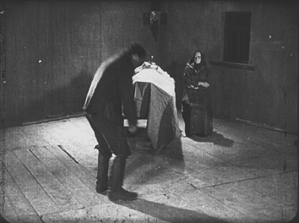
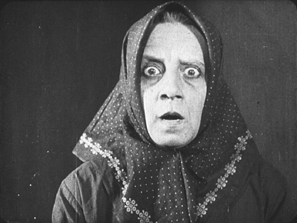
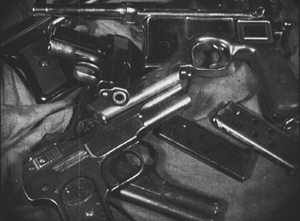
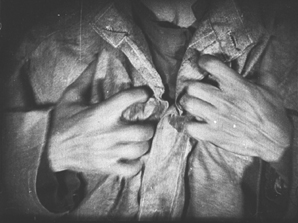
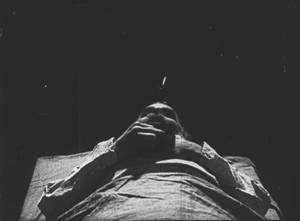
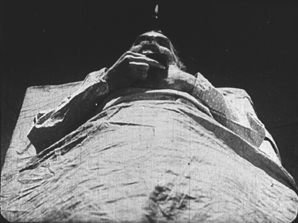
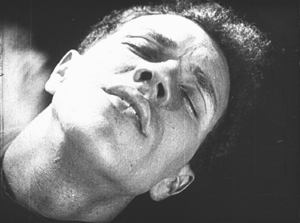
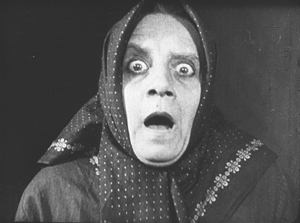
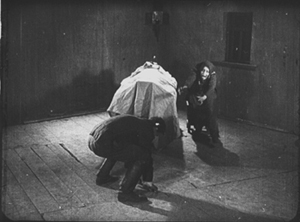
The series of five shots goes by in a few seconds, and we are challenged to grasp that the guns are a real memory, while the shots of the man’s chest and her son’s anguished face are visions of what might happen. The shots of her husband’s body suggest that she could soon end up sitting by her son’s corpse as well. The jumble of recollection, imagination, and reality are remarkably bold for this relatively early era.
Mother also contains two of Pudovkin’s most memorable scenes, the breaking up of ice in the spring as a symbol of the Revolution and the final violent attack on the demonstrators, including the heroine.
Mother was released on DVD by Image Entertainment in 1999, but it seems to be very rare. An Asian disc, perhaps a pirated edition of the Image version, is sold on eBay. I’ve never seen the film on DVD and can’t opine on these. The time is ripe for a new edition.
Pudovkin was one of the filmmakers who had studied with Lev Kuleshov during the early 1920s, when Kuleshov made the famous experiments that bear his name. Pudovkin played the head of the gang of thieves in The Adventures of Mr. West in the Land of the Bolsheviks, which I included in the ten-best list of 1924.
Kuleshov had moved on as well to direct his most famous film and probably his best silent, By the Law, based on Jack London’s story “The Unexpected.” Set in the Yukon during the gold rush, it involves five people who are cooperatively working a small claim and discover gold. Taking advantage of a warm autumn, they stay too long and are trapped for the winter. One of the men kills two of the others, and the heroine, Edith and her husband Hans are left to determine the fate of the killer, Dennin. Edith insists on treating him strictly according to the law. After enduring the harsh winter and a spring flood, the couple finally act as judge, jury, witnesses, and, after finding Dennin guilty, executioners.
The great literary critic and theorist Viktor Shklovsky (one of the key figures of the Russian Formalist school) adapted the short story, condensing it by eliminating the opening section of Edith’s backstory and a few scenes in which a group of Indians appear occasionally to help the prospectors. The result is a concentration on the tense drama of a three people trapped together in a tiny cabin.
In the 1924 entry, I mentioned that Kuleshov’s team emphasized biomechanical acting and that Alexandra Kokhlova was adept at eccentric acting. She delivers a bravura performance here, as Edith moves closer to a breakdown as the months go by.
Kuleshov also puts into practice the experiments in imaginary geography that his classes had made. Although in this film he didn’t unite shots made in widely separate spaces, he did favor scenes built up of a considerable number of detail shots before finally revealing the entire space in an establishing shot. Edith, for example, though glimpsed briefly asleep early on, is introduced in a later scene by a shot of her boots and Bible, followed by a shot of her head as she read the Bible. The scene also contains close shots of the other characters before a general view of the cabin interior shows where each of them is.
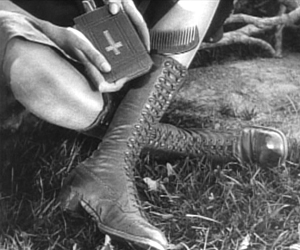
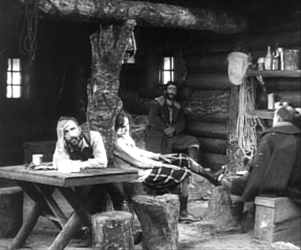
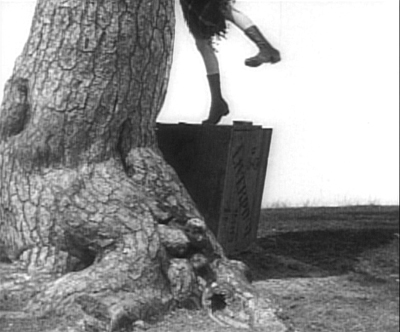
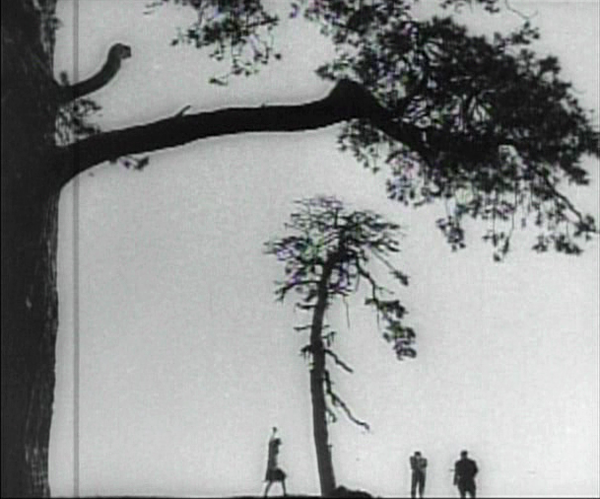
The scene of the execution includes one of the most famous images of the Monage movement, a framing with the horizon line at the bottom edge of the frame and the sky dominated by trees (see bottom). Any number of framings of tall features such as trees and telephone poles against a huge sky appeared in Montage and non-Montage films, and this device became so common as to be a trait of the Soviet cinema of the late 1920s and early 1930s.
The desire to hide the actual hanging led Kuleshov to stage is behind the larger of the two trees, as Edith and Hans struggle to carry out their sentence on Dennin. This leads to some eccentric framings, such as our view only of Edith’s legs as she teeters on the box where Dennin stands, presumably adjusting the noose (see top of this section).
A beautiful print of By the Law is available on DVD from Edition-Filmmuseum.
Grigori Kozintzev and co-director Leonid Trauberg did not study with Kuleshov, but they shared a passion for eccentricity. Having started out in the theater, in 1921 both contributed to the “Manifesto for an Eccentric Theater,” a dramatic approach based on popular forms like circus and music-hall. In 1922 they founded the “Factory of the Eccentric Actor” group and two years later transformed it into FEKS, devoted to making films.
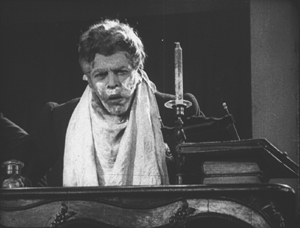
The Overcoat (also known in English as The Coat), their second feature, was based on a combination of two short stories by Gogol, an author whose grotesque creations were very much in tune with their own tastes. It tells the story of a poor, middle-aged low-level government clerk, Akaky Akakievich, who is bullied over his shabbiness, particularly his worn-out overcoat. Scrimping to buy a new one, he finally purchases a magnificent new coat and finds his status suddenly raised–until the coat is stolen.
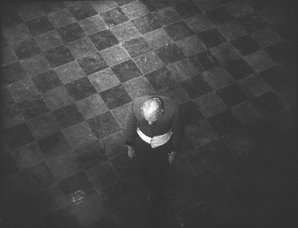
Andrei Kostrichkin was a mere twenty-five years old when he played the fiftyish clerk, but he was highly effective and provided another model of the eccentric actor. As Akakievich he stands with bent legs and twisted torso, as if flinching away from a blow, and walks in tiny steps along perfectly straight lines through the hallways in his office building. When he applies to a Person of Consequence for help in recovering his stolen coat, the official leans over his desk to look downward, with a high-angle point-of-view framing of Akakievich appearing dwarfed by the other’s superiority.
The script of The Overcoat was adapted by another Russian Formalist critic and theorist, Yuri Tynjanov.
Unfortunately The Overcoat does not seem to be available on any form of home video.
Petit mais grand
The IMDb lists 23 directing credits for Dimitri Kirsanoff from 1923 to the year of his death, 1957. He is largely remembered, however, for one film, the 37-minute Ménilmontant, a melodrama about the travails of two sisters orphaned as children by a violent crime. Each is later seduced by a callous young man who leaves the heroine a single mother and her sister reduced to prostitution. It belongs to the French Impressionist moment. (We deal with Impressionist films in other entries: La roue, L’inhumaine, L’affiche, Coeur fidèle, The Smiling Madame Beudet, Le brasier ardent, Crainquebille, and El Dorado, as well as DVD sets of Impressionist films by the Albatros company and by director Jean Epstein.)
The story itself is simple and indeed might be thought clichéd were it not for two factors. First, there’s the performance of the delicately beautiful Nadia Sibirskaïa as the protagonist. There’s also the lyrical, melancholy use of the settings, initially in the countryside and later in the desolate working-class Parisian district whose name gives the film its title. The simplicity of the narrative also makes it one of the most successful of the attempts to tell a story visually, eschewing intertitles.
The film’s most famous scene is its abrupt, shocking opening. With no establishing shot, there is a series of rapid shots of details of faces, hands, a window, and an ax, during which we can barely discern that a man has committed a double murder. The spectator cannot possibly know who these people are and why the murders occur.
Instead of offering an explanation, the action then shifts to two little girls playing in the woods. As they return home, the camera begins to concentrate on one of them, apparently the younger, as she arrives at the murder scene and reacts in horror. Kirsanoff presents her expression in a series of five shots, linked by what David has termed axial cuts, from medium shot to extreme close-up as she gradually realizes what has happened.
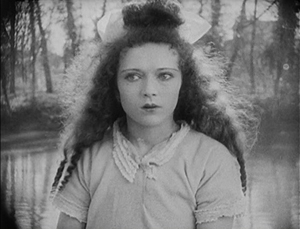

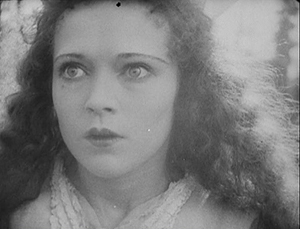
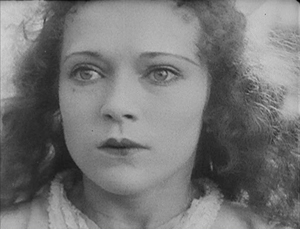
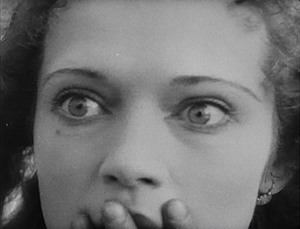
There had certainly been axial cuts before this, including in Potemkin, but Kirsanoff probably went further than anyone of the era by including so many shots, by making each so short, and by moving his camera forward in such small increments. It is difficult to notice every cut, particularly the one from the third to the fourth shot, and the effect adds an unsettling quality to an already intense moment.
After this opening, a funeral scene reveals through labels on the grave that the murdered man and woman are the children’s parents. We might have suspected that the killer was a jealous husband discovering his wife with her lover. As it is, we never learn whether the crime was the result of a love triangle or the random act of a madman.
The rest of the film establishes the sisters now grown up, working in a workshop making artificial flowers and sharing a small flat in Menilmontant. The heroine’s brief romance leads to a baby, and superimpositions and other Impressionist techniques depict her despair and contemplation of suicide. Beautifully melancholy atmospheric shots of the streets of the neighborhood punctuate the action and underscore the dreariness and hopelessness that the heroine faces. The ending, though an improvement in the heroine’s lot, does little to dispel the overall grimness of the story.
Menilmontant is included in the out-of-print set “Avant-garde – Experimental cinema of the 1920s & 1930s.” It has been posted twice on YouTube in a low-rez format.
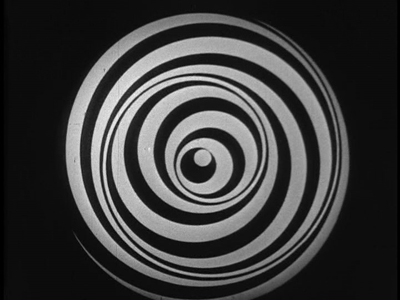
Even shorter is Anémic cinéma, the only venture into film directing by the great French Dadaist, Marcel Duchamp. It’s hard to compare a roughly seven-minute abstract film with narrative features, but this short is so innovative and influential that it’s also hard to leave it off the list.
Duchamp went through a phase of spinning artworks, including some “Rotoreliefs” that he attempted to sell as toys. These were similar to some Victorian optical toys, such as the Phenakistopscope and the bottom disks of Zoetropes. See Richard Balzer’s website for a collection of such devices, as well as “The Richard Balzer Collection” on tumblr, which contains gifs that animate some of the disks, done by Brian Duffy. Some of these resemble the spinning spirals and embedded circles that Duchamp used for his short. (See the top of this section.)
These spinning abstract circular images alternate with slowly spinning disks with sentences laid out as spirals. These involve either alliteration or puns or both. Unfortunately the English subtitles cannot render these in a way that conveys the original intent. For example, “Esquivons les ecchymoses des esquimaux aux mots exquis” becomes “Let us dodge the bruises of Eskimos in exquisite words.” The meaning is the same, and even the echo of the first syllables of “Eskimos” and “exquisite” is retained. Nevertheless, the similar syllables in two other words in the original are lost, as are the echoes of “moses,” “maux,” and “mots.” It is rather as though someone attempted to render “Peter Piper picked a peck of pickled peppers” into another language quite literally. (The Wikipedia entry includes a complete list of the sentences in French.)
Duchamp’s purpose was presumably to create an artwork with minimal means, including quasi-found objects, the disks he had made for another purpose. His idea is clearly reflected in the title, Anémic cinéma, which suggests a weakness or thinness of means. “Anémic” is also an anagram for “cinéma.”
Anémic cinéma is available in the same collection as Menilmontant, linked above. it is also available in the similarly out-of-print set, “Unseen Cinema.” There are numerous versions on YouTube, varying in quality. Some of these have been manipulated by other artists.
Lloyd and Lubitsch
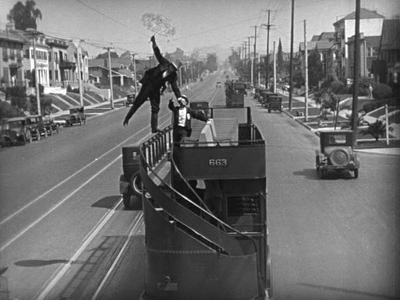
Though Chaplin and Keaton might have had off-years in 1926, Harold Lloyd did not. Over the past several years, Lloyd has gradually been gaining the admiration he deserves. He used to be known largely for Safety Last (1923) and The Freshman (1925), two excellent films which, however, are not his finest. Girl Shy (1924) and The Kid Brother (1927) are better known now for the masterpieces they are. For Heaven’s Sake (directed by Sam Taylor), which clocks in at a mere 58 minutes, is just as good.
Lloyd plays a breezy millionaire, J. Harold Manners, who unintentionally helps Brother Paul found a mission in the downtown slums of Manhattan. He falls in love with Hope, the missionary’s daughter, and decides to help out around the place. By this time Lloyd was known for his spectacular chase scenes, and there are two here. Initially he puts a twist on the chase, luring a growing crowd of criminals into racing after him, ending in the mission. Gaining their respect, Harold makes the mission a happy social center.
The romance provides one of my favorite comic intertitles, leading into a love scene: “During the days that passed, just what the man with a mansion told the miss with a mission–is nobody’s business.” The love scene in turn includes a visual joke that emphasizes the rich boy – poor girl contrast.
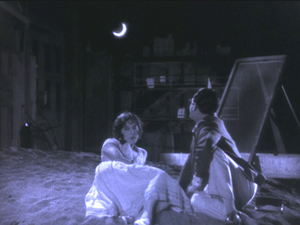
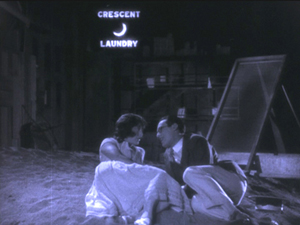
Harold’s rich friends hear that the pair are to be married and determine to kidnap him to prevent the inappropriate match. The result is a lengthy chase through the streets of Manhattan, with the drunken thugs rescuing Harold and using a variety of means to get him back to the mission in time for the wedding–as when the drunken leader of the group demonstrates his tightrope-walking abilities on the upper railing of a double-decker bus (see above).
Two years ago, when I put Girl Shy on my list, the New Line Cinema boxed set of Lloyd films was out of print and hard to find, and the separate volumes appeared to be going out of print as well, with Volume 1 not being available at the time. The situation has changed, and the boxed set, though apparently still out of print, is now available at reasonable prices from various third-party sellers on Amazon and Barnes & Noble. The set contains a “bonus disc” with extras, including interviews and home movies. The same is true for the three individual volumes (here, here, and here). For Heaven’s Sake is in Volume 3.
Inevitably, coming directly after Lady Windermere’s Fan, probably Ernst Lubitsch’s greatest silent film, So This Is Paris does not quite live up to its predecessor. Still, it’s a very fine, clever, and funny film, and it marks Lubitsch’s last appearance in these lists until sound arrives.
The opening scene, running nearly twenty-five minutes, is as good as anything Lubitsch did in this era. Set in Paris, it’s a slow build-up of misunderstandings and deceptions involving two affluent couples in apartments across the street from each other. One couple, Maurice and Georgette Lalle, are practicing a melodramatic dance in Arabian costumes. Their marriage seems to be a rocky one. Across the street, Suzanne Giraud is reading one of the lurid “Sheik” novels that were popular at the time, involving “burning kisses” in its final scene. Put into a romantic mood by this, she looks out her window and sees the head of a man in a turban at the window opposite–Maurice relaxing after his strenuous rehearsal.
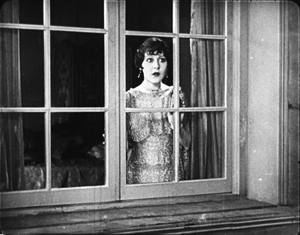
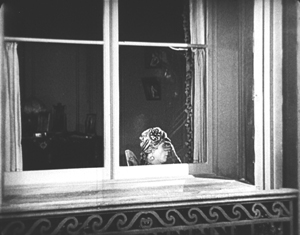
Her husband Paul arrives home, and she kisses him passionately. Apparently not used to such affectionate greetings, he is puzzled until he, too, looks out the window. By now Maurice has doffed his turban and necklaces and appears to be not only naked but also examining a piece of his anatomy.
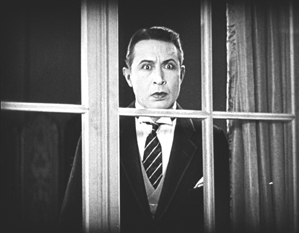
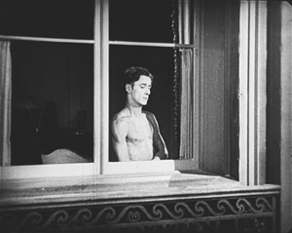
Paul jumps to the conclusion that this sight is what caused Suzanne’s unaccustomed display of passion. He calls her to the window, and we see Maurice in depth through the two windows.
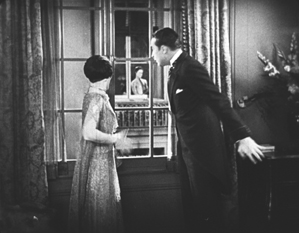
Suzanne then asks if Paul is going to stand for such a thing, and he goes to the other apartment to confront Maurice. Instead he finds Georgette, who turns out to be an ex-lover of his. She introduces him to Maurice, who is very friendly and charms Paul. The latter who returns home and claims that he has beaten Maurice and even broken his cane on him, though in fact he had simply forgotten it. Shortly thereafter Maurice visits Suzanne to return the undamaged cane and takes the occasion to flirt with her. It’s a beautifully plotted and developed farcical scene. The film is based on a French play and could easily have become stagey in its adapted form. Yet the byplay between the two apartments via the windows allows Lubitsch to avoid any such impression; the misunderstandings based on optical POV recall the racetrack scene of Lady Windermere.
The rest of the film develops the two potentially adulterous affairs, primarily with Paul secretly taking Georgette to the Artists’ Ball. Here Lubitsch uses an elaborate montage sequence to convey the wild party, with superimpositions and shots taken through prismatic lenses.
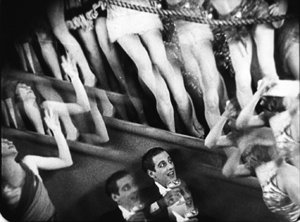
Such sequences were primarily developed in German films and were still fairly rare in American ones in 1926. Similar techniques convey Paul getting drunk on the champagne he and Georgette are awarded when they win a dance contest–the announcement of which on the radio broadcast of the ball alerts Suzanne to her husband’s presence there with another woman.
So This Is Paris is less famous than Lubitsch’s earlier American comedies primarily because it has never appeared on DVD. Marilyn Ferdinand, in a blog entry that gives a detailed description of the film, writes that Warner Bros. claims not to own the rights to the film anymore and therefore has made no effort to bring it out on home video. On the other hand, a four-minute excerpt of the dance montage sequence was included in the Unseen Cinema set (disc 3, number 18), and the credit there is “Courtesy: Warner Bros., Turner Entertainment Company.” Whatever the rights situation is, a home-video version of this film is in order. A beautiful 35mm print is owned by the Library of Congress, so there is hope.
Two German flights of fancy
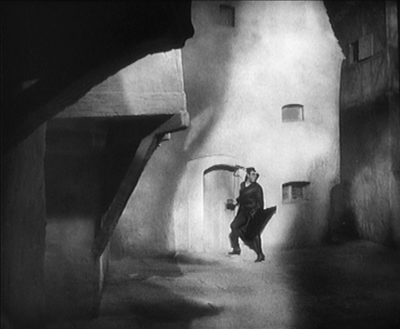
I must confess that I was disappointed the first time I saw F. W. Murnau’s Faust, and I have never warmed up to it in later viewings. I am delighted at having occasion to look at it again for this 1926 list, since a recently discovered and restored print reveals that the main problem before was the poor visual quality of the print formerly in circulation.
Different local release prints survived in a number of countries, but there were basically two original versions made: the domestic negative for German release and the export negative. These were shot using two camera side-by-side on the set, as was the standard practice in much of the silent era, given the lack of an acceptable negative-duplicating stock. The primary camera contributed most of the shots to the domestic negative, though in some cases where the second camera yielded a superior take, that was used in the domestic negative. Conversely, inferior takes from the primary camera sometimes made their way into the export negative. The result, as we now know, was that both the visual quality and in many cases the editing of the scenes was markedly different in the two negatives.
The version familiar for decades originated from the export negative. Recently the domestic negative was rediscovered, and the Friedrich Wilhelm Murnau Stiftung restored the that version using the that negative, supplemented with material from a variety of other prints. The result closely approaches the original German release version, including the original decorated intertitles. The contrast in quality between this restoration and the old, familiar Faust is remarkable.
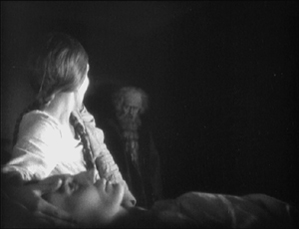
Given how dark the film is, details in the backgrounds could easily be lost. The scene in which Faust is called to help a woman dying of the plague is revealed to have dramatic staging in depth against a very dark room contrasted with the stark foreground underlighting of the woman’s haggard face. Faust enters from behind the daughter and comes forward to her, after which his movement is balanced by the daughter retreating into that same dark background.
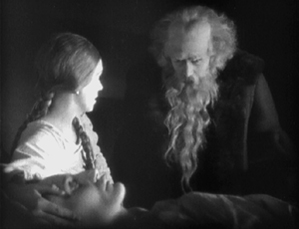
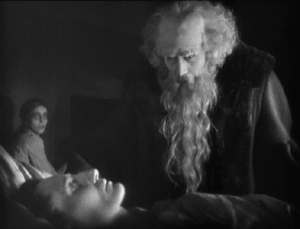
The famous aerial journey of Mephisto and Faust from Germany to Italy (below left) always looked rather hokey, but the detail revealed in the extraordinarily extensive model makes it far more impressive. Similarly, when one can actually see the sets, visual echoes become apparent. For example, Faust first encounters Gretchen and follows her into the church, where he finds himself barred from entering by his pact with Mephisto. Later, when Gretchen has been abandoned, she laments when not permitted to enter there.
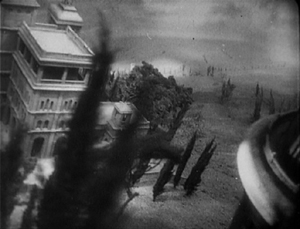
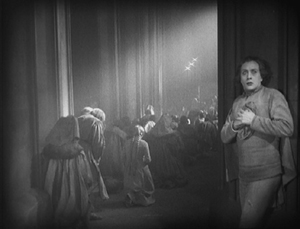
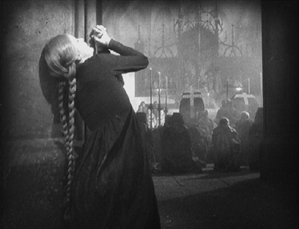
No doubt some motifs of this sort were visible in the earlier print, but their clarity here enhances both the beauty and the craft of Murnau’s film.
Faust is available in several editions on DVD and Blu-ray. DVDBeaver ran a detailed comparison among seven of these, including a selection of frame grabs. To my eye, the 2006 DVD “Masters of Cinema” version of the domestic print, released by Eureka!, looked the best. (The two-disc set also includes the export version.) The Blu-ray from the same source, released in 2014, looked slightly darker. The box for the Blu-ray also includes the DVD, however. These releases are Region 2. The film is available on Blu-ray in the USA from Kino.
Both Eureka! releases’ supplements include a booklet, a commentary track, a Tony Rayns interview, and a lengthy comparison of the domestic and export versions. One particularly striking example is drawn from the scene in which Mephisto talks with Gretchen’s brother in a beer hall, with the domestic version on the left.
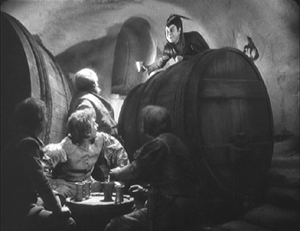
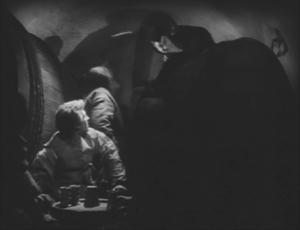
While watching Faust, I kept grabbing frames, far too many to be used in this entry. They were simply too beautiful or impressive to be passed over, and they made my final selection of illustrations difficult. The only other film for which this was true this year is Lotte Reiniger’s silhouette-animated feature, The Adventures of Prince Achmed. The restored, tinted print that is currently available is even lovelier than the older black-and-white version.
Reiniger seems to have invented the use of jointed silhouette puppets, and she still is the first artist one thinks of in relation to this form of animation. She continued to practice it until the 1970s. (See the link below to a collection of many of her short films.) Her one feature film remains her most famous and is probably her masterpiece.
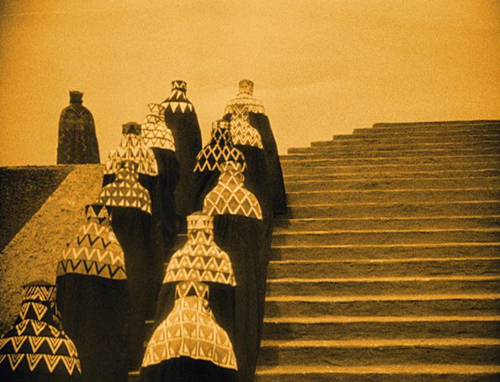
It involves far more than simple black figures moving against a light background. As the frame at the top of this entry shows, her characters, furnishings, and locations, all rendered in paper with scissors, were often elaborate indeed. Characters wore feathers, jewelry, fancy wigs, and other decorative elements. The hanging platform has many little tassels, and the lamps are rendered in delicate filigree. The backgrounds are not blank but have varying layers of saturation that suggest a depth effect, the equivalent of atmospheric perspective. At the left in the top image, a series of identical curtains start out a dusky orange and in three stages lighten until there is a bright, solid glow at the center.
In the frame at the left below, the same sort of shading creates the depth of a cavern, setting off the tracery of the foliage and the kiosk in which the hero finds the magic lamp. On the right, very simple shading suggests a vast and elaborate palace in the background, while Reiniger fills the foreground with many small figures, all marching out to surround the procession of the caliph.
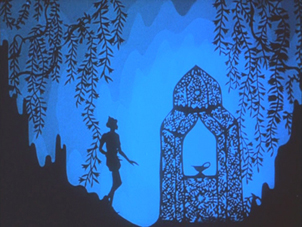
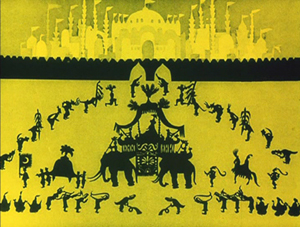
By choosing a classical fantastic tale, Reiniger found the perfect subject matter to fit the technique that she invented. Both the subject matter and the sophistication of the animation give her films a timeless look. Her reputation remains high today as a result. One scene in Harry Potter and the Deathly Hallows Part 1, “The Tale of the Three Brothers,” was made in a style inspired by Reiniger’s work. (I discuss it here.)
A restored, tinted version of The Adventures of Princes Achmed is available from Milestone. A combination Blu-ray/DVD release of the film is available from the BFI. (I have not seen this version.) Note that these have somewhat different content. The BFI version has five Reiniger shorts from across her career along with a booklet. The Milestone version has only one of the shorts, but it includes a documentary about Reiniger. (This documentary was on the 2001 BFI release of the film on DVD but is not listed among the extras on its Blu-ray.) See also the BFI’s collection of many of her shorts, “Lotte Reiniger: The Fairy Tale Films,” which I discussed here.
[Dec 27: Thanks to Paul Taberham for pointing out that Prince Achmed also has no intertitles and gets along without them very well.]
Into the asylum
David here:
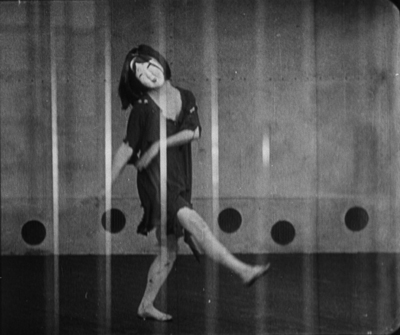
Few western viewers of 1926 saw any Japanese films, but Japanese audiences had been watching imported films for a long time. Hollywood films could easily be seen in the big cities, and The Cabinet of Dr. Caligari (released in 1922), La Roue (released in early 1926), and other films from Europe had made a strong impression on local filmmakers. One fruit of this influence was the wild Page of Madness (Kurutta ichipeiji, aka “A Crazy Page”).
Directed by Kinugasa Teinosuke and based on a story by the renowned experimental writer Kawabata Yasunari, the film bore the influence of German Expressionist and particularly French Impressionist cinema. Page of Madness set out to be a bold exercise in subjective filmmaking. But it wasn’t widely seen at the time, and wasn’t revived until 1971, when Kinugasa discovered a print in his house (reportedly, among cans of rice). Apparently the version we have is slightly edited.
A woman has been confined to a madhouse, and her husband has taken a job as a janitor there to stay in touch with her. Many of the scenes are presented as the hallucinations of the wife and other inmates, while abrupt flashbacks attached to the husband fill in the past. But this story is terribly difficult to grasp. There are no intertitles (perhaps an influence of The Last Laugh, shown in Japan earlier in 1926), and the film is a blizzard of images, choppily cut or dissolving away almost subliminally.
Viewers of the period had the advantage of a synopsis printed in the program, and there was a benshi commentator accompanying the screening to explain the action. Because we lack those aids, the film seems more cryptic than it did at the time. Even when you know the story, though, Page of Madness often surpasses its foreign counterparts in its free, unsignalled jumps from mind to mind and time to time. It remains a powerful example of narrative and stylistic experiment, from its canted framings and single-frame cutting to its frenzied camera movements and abstract planes of depth (thanks to scrims à la Foolish Wives, 1922).
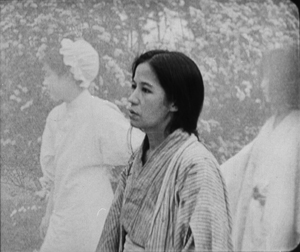
For nearly fifty years it has remained a milestone, a grab-bag of advanced techniques and likely the closest Japan came to a silent avant-garde film.
Page of Madness is not commercially available on home video. It is occasionally shown on TCM, and a reasonably good print is on YouTube. Aaron Gerow’s A Page of Madness: Cinema and Modernity in 1920s Japan is an indispensable guide to Kinugasa’s eccentric masterpiece.
By the Law.
The ten best films of … 1924
Die Nibelungen: Siegfried
Kristin here:
For a seventh year running, we skip ranking the current year’s films and instead hark back 90 years.
We started out with a list that was essentially an appendix to an entry, but soon we were dedicating whole entries just to the list. Our entries for past years are here: 1917, 1918, 1919, 1920, 1921, 1922, and 1923.
These lists are our way of calling attention to important silent films that some readers may have overlooked. In one case here we point out a largely forgotten film that deserves to be better known, in the hope that an archive will take the hint. With the proliferation of silent-film festivals, of DVD and Blu-ray releases with restored prints and supplemental material, and of TCM’s eclectic screenings of foreign and silent titles, there seems to be considerably more interest in these early classics. Herewith our choices for 1924.
For the last few years I’ve struggled to fill out the full list of ten films with truly deserving items. But as I’ve been predicting, the 1924 choices fell easily into place. As usual, some of these are obvious picks, already famous to most readers. Others are less obvious, and a few are unknown except to specialists. Some, though very important historically and artistically, are not currently available on DVD, which is a real shame.
At last, the USSR
Films in the Soviet Montage style make up one of the most important cinema movements of all times. The key filmmakers of the movement, Eisenstein, Pukovkin, Dovzhenko, Kuleshov, Kozintzev and Trauberg, and others began their work later than the German Expressionist and French Impressionist directors. But at last one joins our list, with Lev Kuleshov’s The Extraordinary Adventures of Mr. West in the Land of the Bolsheviks.
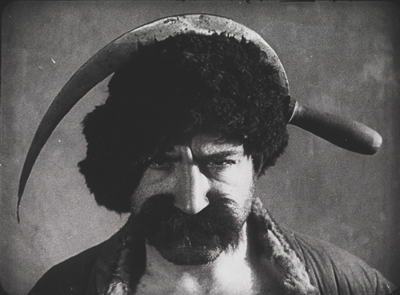
Although Kuleshov’s work has become more widely available, his most familiar work is still By the Law (1926), a grim tale of two members of a gold-prospecting team agonizing over how to bring to justice a colleague who has committed a terrible crime. Mr. West couldn’t be more different. This hilarious and grotesque comedy satirizes American perceptions of the new Soviet Union, as Mr. West, president of the YMCA, comes to for a visit, his faithful cowboy friend Jeddie in tow. They’re terrified of the barbaric land they expect to encounter, and a gang of thieves dupe Mr. West by dressing up in outfits that caricature West’s images of Bolsheviks (above).
In making the film, Kuleshov and his team drew upon the experiments they had been doing in his classes he ran of the early 1920s. Film stock was scarce and all he and his students could do was practice staging scenes and make short editing experiments. They explored the possibilities of “biomechanical acting,” a style based more on gymnastic control and energy than on psychological subtleties of facial expression.
Once the group did get the resources to make a feature, their delight is evident in the lively editing and the exuberant performances. Alexandra Khokhlova, a gangly woman who was married to Kuleshov and starred in most of his films, plays a vamp who tries to lure Mr. West into her toils. Pudovkin, who studied with Kuleshov before going into directing himself, is the well-dressed gang leader who pretends to guide Mr. West away from danger. Boris Barnet, also to become a major director, performs feats of derring-do as Jeddie tries to save Mr. West.
Mr. West is not only a satire on Western fears of post-Revolutionary Russia but also a parody of American serials. (The latter was something Barnet soon tried in an actual serial, his 1926 Miss Mend.)
Mr. West is available on DVD in Flicker Alley’s set, “Landmarks of Early Soviet Film.”
German Expressionism begins to wind down
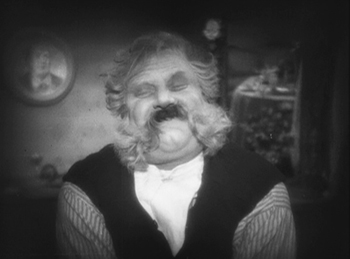
Last year I was hard put to pick a film to represent the German Expressionist movement in the top ten. I chose Erdgeist but mentioned Schatten and Raskolnikow as runners-up. By 1924 there were fewer Expressionist films released, though the movement would linger on until 1927, mainly carried on by the two greatest directors who had worked in the Expressionist movement: F. W. Murnau and Fritz Lang. Each of these contributed a classic film in 1924: Murnau’s The Last Laugh and Lang’s two-part epic: Die Nibelungen: Siegfried and Kriemhild’s Revenge).
The Last Laugh isn’t really Expressionist. The sets are mildly in the style, but what really fascinated Murnau at this point was the freedom of camera movement introduced by French Impressionism. He set out to make a character study. Emil Jannings plays a doorman in a large hotel (none of the characters’ names are given). His regal bearing and fancy uniform bring him respect among his fellow employees and from relatives and neighbors in the lower-middle-class neighborhood where he lives. He has aged to the point where he carry large luggage and is abruptly demoted to work as a rest-room attendant.
Murnau introduced what came to be known in Germany as the entfesselte Kamera, the “unfastened camera,” beginning in the opening shot where an elevator with a grill descends, carrying the camera and dramatically revealing the lobby. Murnau may have been directly influenced by one of last year’s top-10, Cœur fidèle, where Epstein put his camera on a spinning-swings carnival ride. Murnau saw other uses for the device. Like the Impressionists, he conveyed drunkenness through moving camera, though in this case he put the actor and camera on a turntable, so that the room spins past behind Jannings, conveying the dizzy happiness of the doorman at a party (above).
Using more imagination, Murnau follows sound with his camera. As the party ends, musicians exit to the apartment-block courtyard, and one plays a final tune under the window. Starting with a close-up, the camera “cranes” diagonally up and backward until the men are in long shot. A cut takes us to the doorman inside, happily listening.
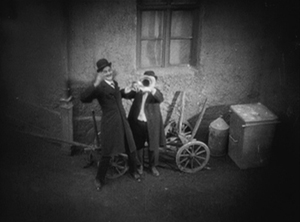
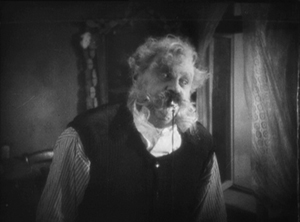
Actually the camera was not on a crane. Murnau and cinematographer Karl Freund affixed a track over the courtyard with a small metal elevator underneath, so that the camera could move both back and forth and up and down. The camera was not literally unfastened in these cases, but it looked like it was.
Murnau wanted to end the film on a grim note with the protagonist seated alone in the hotel rest room. Commercial considerations led to a happier ending, however, with him unexpectedly becoming wealthy. The twist was so outrageous that Carl Mayer, the scenarist, considered it a comment on Hollywood’s insistence on happy outcomes. Hence the English title The Last Laugh. The original German means “The Last Man.”
The Last Laugh got distribution in the USA, but it was not a success. Hollywood practitioners studied it, though, and started hanging cameras from tracks themselves and trying other tricks. The track backward above a long, laden banqueting table soon became a cliché of Hollywood cinema.
Murnau would make two more mildly Expressionist films, Tartuffe (1925) and Faust (1926) before heading to Hollywood to make the ultimate hanging-camera film, Sunrise (1927)
The Last Laugh is available from Kino in the USA and Eureka! in the UK.
One of my favorite films of the 1920s is Lang’s two-parter, Die Nibelungen: Siegfried and Die Nibelungen: Kriemhilds Rache (Kriemhild’s Revenge). An adaptation of the ancient German myth, it mostly proceeds at a stately pace until the final battle scene. Some may find it slow, especially when compared with the lively, suspenseful Dr. Mabuse der Spieler (1922) and Spione (1928). Yet its leisurely presentation is appropriate to the subject matter. Equally important, lingering over images allows us to notice the details of the extraordinary settings and costumes, with their busy decorated surfaces and their startling arrangements within the shot.
Take the image at the top of this entry. Brunhilde, having been forced to marry King Gunther against her will, envies her sister-in-law Kriemhild, who has married Siegfried, the man Brunhilde loves. In this shot, Brunhilde mounts the steps of Worms Cathedral to confront Kriemhild and assert her right to enter the cathedral first. We see her from behind and then at the upper left as her ladies follow her, wrapped in their patterned hoods and black cloaks, creating an almost abstract composition. Lang build the enormous stairway outside the cathedral in two stages and then used the set imaginatively to stage several ceremonies and dramatic conflicts.
What makes this film Expressionist, I would argue, is the way the actors and settings interact, as in this moment when Brunhilde pauses by her window and then comes forward through the slightly parted curtain, exiting left. She pauses in the opening, her dress seemingly becoming part of the curtains for a moment.
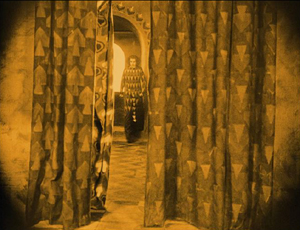
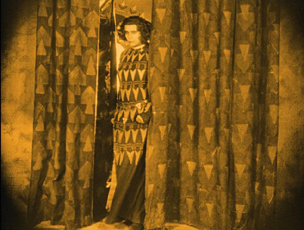
The similarity and the pause have no narrative function, but it’s a very Expressionist composition. Insistent symmetry and acting also contribute to the style. In the second plot, the Hunnish King Etzel asks for Krienhild’s hand in marriage. She agrees on the condition that he will aid her in exacting her revenge on Siegfried’s killers. Upon her move to the land of the Huns, the style becomes a more familiar sort of Expressionism, with distorted trees and buildings that looks like they were built of mud that settled oddly before drying:
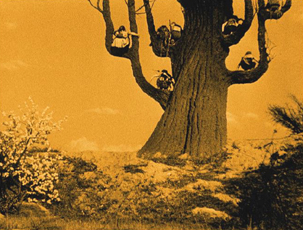
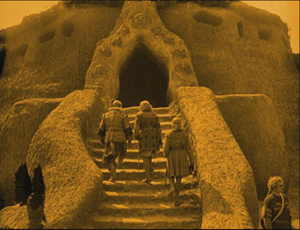
The elements of the German tales are all here: love, betrayal, suicide, revenge, presented in images worth savoring.
Lang was inspired in his approach to the film’s visuals by some illustrations by Carl Otto Czeschka for a 1909 retelling of Die Nibelungen published in 1909. The heavy decoration on the knight’s shields and many other surfaces in the film somewhat resemble this image, for example:
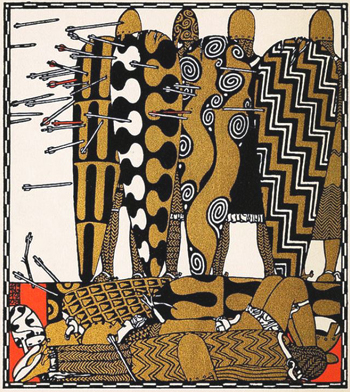
Yet the resemblance is far from exact. Clearly Lang used elements from these illustrations and took them off in his own direction.
The film has recently been restored and looks great on Blu-ray. Kino in the US and Eureka! in England have brought it out. Both have DVD editions as well.
Scandinavia’s golden age drawing to a close
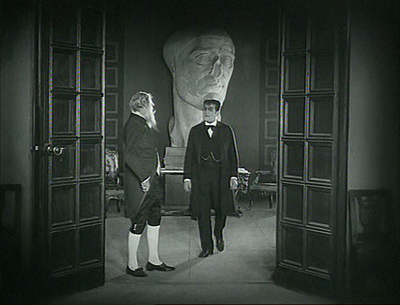
During the first half of the 1920s, the Swedish cinema was a victim of its own success. Victor Sjöstrom (who has figured in these lists in 1918 and 1921, as well as in our “Lucky ’13” entry), had headed to MGM, becoming Victor Seastrom. In 1924 he released his first two films in 1924: Name the Man and He Who Gets Slapped. The latter was the newly formed MGM’s first in-house production to be released. It was a huge success, no doubt in large part due to the growing stardom of Lon Chaney, and it put the studio on the map and allowed Seastrom to stay in Hollywood, notably for The Scarlet Letter (1926) and The Wind (1928).
Mauritz Stiller (also a previous top-10 choice) was about to head for Hollywood as well, but his final Swedish film is one of his finest. Gösta Berlings Saga, a epic adaptation of Selma Lagerlöf’s novel, was made in two parts lasting over three hours. Many people will know it as the debut film of Greta Garbo. Fans should be forewarned that she is an important character and appears in the early and late scenes but disappears for a long stretch in the middle.
[December 30: As our friend Antti Alanen points out, Garbo had already acted in a comedy, Luffar-Petter (Peter the Tramp, 1922) and in some short advertisements.]
The film begins with Berling, a drunken pastor in a small town, being relieved of his duties. He ends up being taken in the “Chevaliers” at Ekeby the country estate of Margaretha Samzelius, a tough middle-aged woman who runs a group of foundries she has inherited from a lover. The Chevaliers are a group of hangers-0n, men who can drink and laze about most of the time but who must be charming and entertaining at Samzelius’ many dinner parties. Berling has a number of chances to redeem himself but ends up harming the people around him and sinking lower into despair. He is finally redeemed by the love of the Garbo character, Elizabeth, the new bride of a wealthy neighbor, to whom, it turns out through a technicality–and happy coincidence–she is not actually married.
Hansen and Garbo make a gorgeous couple (below left), but they are upstaged by the great Swedish stage actress Gerde Lundequist as Samzelius:
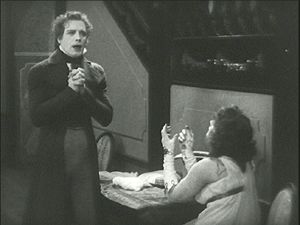
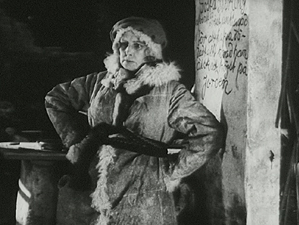
As usual, the film contains lovely scenes in the Swedish landscapes. There are some impressive night sleigh rides, including a famous scene in which Berling and Elizabeth are chased across a frozen lake by wolves. There is also one of the most impressive fire scenes I can recall from the silent era, as Samzelius’ efforts to smoke the Chevaliers out of the guest house where they live and inadvertently sets fire to the big main house as well.
Unfortunately the film was cut down into a single feature for its release outside Scandinavia. The Story of Gosta Berling was the main version that circulated for many years. The Swedish Film Institute restored it in stages as more footage was found, but the current print, at 183 minutes, is still missing some footage.
Beware picking up an older video release with the truncated film. The restored version was released on DVD in the USA by Kino. The original Svensk Filmindustri release (with English, French, Portuguese, German, and Spanish subtitles), is available here. The same DVD comes in a box set of six Swedish silent classics, which is widely available from the usual online sources.
Carl Dreyer has popped up on this blog several times, usually in passing. Not surprising, since David wrote a book about him way back 1981. Here he makes his second appearance on our ten-best lists (the first having been for his first feature, The President, in 1919) with Michael.
The film centers around a wealthy, aging artist, Claude Zoret. The main room of his house is decorated with several eye-catching pieces of sculpture, notably a mysterious battered head that looms in the background of many shots. Is it one of Zoret’s own works? Is it part of a collection of ancient statues? Much of the action takes place here, which has led some historians to place Michael in the tradition of the Kammerspiel. David calls it a borderline case. There are certainly scenes that leave Zoret’s studio, most notably one in a large theater set.
The film has been hailed as an early treatment of homosexuality. Although there is nothing overtly expressed, it is hard not to read such a subtext into the action. Zoret, wonderfully played by Danish director Benjamin Christensen, has many guests and admirers visit him, creating a little all-male coterie. He has taken in a young protegé, a very beautiful and very young Walter Slezak. Zoret refers figuratively to Michael as his son, but there seems to be another tie between the two. Moreover, there may be a hint that Charles Switt, a journalist apparently writing a biography of Zoret (at the center of the frame above), feels some jealousy toward the young man.
Trouble begins when a princess comes to commission a portrait from Zoret. Although he usually doesn’t do commissions, he is intrigued by her face and agrees. During her visits to the studio to pose, she meet Michael, who is immediately smitten. The affair continues as Michael becomes increasingly inconsiderate to Zoret,borrowing money to continue the affair and missing an important showing of his work. In contrast, Zoret shows unwavering generosity to Michael, despite being devastated by his desertion.
Ultimately Zoret paints his last work, showing an elderly, lonely man against a barren seascape. It is hailed as a masterpiece at a party which Michael does not attend.
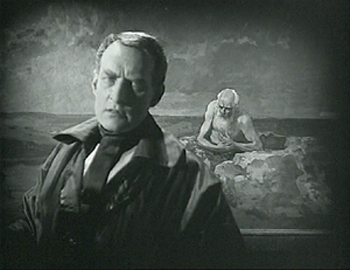
The character study proceeds at Dreyer’s usual formal pace, and yet it is never dull. As much as any of his silent films, it looks forward in tone to his later sound ones.
A very nice print of Michael is available in the UK from Eureka! (not deliverable to the USA); Kino released what I assume is the same print in the USA.
She was nothing but a poor flower-maker
Every now and then I want to put a film on the list which is impossible to see unless you happen to live near one of the archives that has a print and they happen to program it. Still, in the hope of inspiring someone to restore it and make it available, I proceed.
The film is Jean Epstein’s L’Affiche (“The Poster”). Epstein first made our list last year for the much better known Cœur fidèle. L’Affiche is a bit like the earlier film, a simple melodrama made in the French Impressionist style. Its situation is highly conventional, and its plot depends on a massive coincidence.
The heroine is introduced as Marie, one of several women making artificial flowers. On her lunch break she thinks back to a romantic day she spent in the country. There she meets a young man, Richard. The couple go to an expensive restaurant, and Richard seduces Marie, and then abandons her, driving away alone the next morning.
Three years pass, and Marie has a small child, also named Richard. She enters him in a contest for the most beautiful child, with a cash prize, offered by an insurance company that wants to put the winner on their advertising posters. The boy wins, and Marie signs a 10-year contract for the rights to use little Richard’s image.
The child dies, however, and Marie visits his grave. As she leaves, she sees a huge poster with his image. The campaign has begun. Everywhere in Paris she goes, she sees the poster and finally begs the insurance company to end the campaign. The boss, however, refuses. Marie begins tearing down the posters, and she is soon arrested. Epstein handles the arrest scene without an establishing shot but builds it up through close-ups.
Initially we see only the back of Marie’s head and her arms tearing down a poster. There a cut-in to slightly closer framing as a policeman’s hand comes into the shot and touches her shoulder. A third shot shows her turning to the officer and staring in a way that suggests she is becoming mentally unbalanced. Finally a long shot establishes the scene as a second policemen enters to help arrest her.
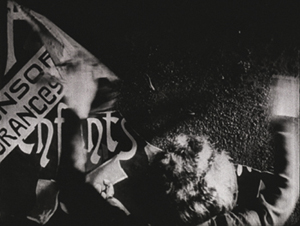
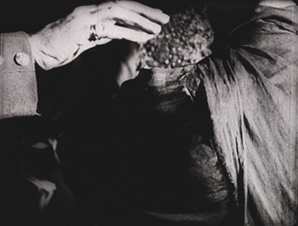

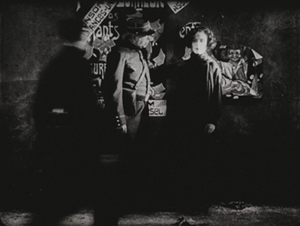
It’s the sort of gradual revelation of space that Kuleshov was working with at the same time.
The boss of the insurance company is informed of this and sends his son to file a complaint against her. New copies of the poster are being put up all over town. The son is none other than the Richard who seduced Marie years before. Hearing her tale, he asks her forgiveness and takes her home to his parents. The father forbids their marriage, they marry anyway, and eventually (after his own younger child dies!), the boss blesses the marriage and agrees to take down the posters.
Summarized baldly, it sounds like an impossible plot to take seriously, but Epstein’s delicate, understated approach in presenting it and Nathalie Lissenko’s affecting performance as Marie manage to make it a great film. It’s full of Impressionist moments: Marie’s memory of her romantic day with Richard, a dance scene with rhythmic editing, a dream sequence, and plenty of gauzy shots and fancy wipes at transitions.
Earlier this year I complained because L’Affiche was not included in the big new box set of Epstein’s work, despite almost everything else from the period being there. It’s also not on the box set of films made at the Russian emigré studio, Albatros, even though Epstein’s other three Albatros films are there. I don’t whether there are rights problems or there simply isn’t a good enough print.
At least one streaming service claims to have L’Affiche available, but a search turns up numerous complaints about the site.
I should make mention of one other Impressionist film that came out in 1924. Perhaps it should be on the list rather than L’Affiche. It’s Marcel L’Herbier’s L’Inhumaine. L’Herbier appeared on our 1921 list for El Dorado, and even then I expressed reservations. Most of his films seem cold and by-the-numbers to me, not to mention a bit pretentious. But his films were historically important, and L’Inhumaine was influential in its use of art deco sets. At one time the film was available on DVD, but it seems to be out of print.
Three funny men …
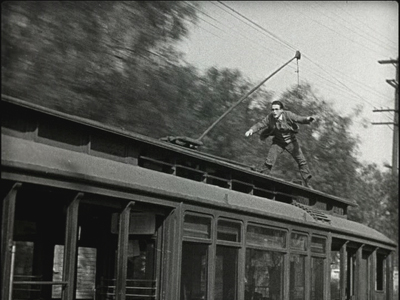
And no, it’s not Chaplin, Keaton, and Lloyd this time. Chaplin didn’t release a film in 1924. His next would be what many would consider his funniest feature, The Gold Rush.
Over the years I’ve stressed that during the 1910s, the three great comics were working in shorts, honing their filmmaking and working up to their great series of features. By 1923 they had fully made the transition: Lloyd made Safety Last and Keaton Our Hospitality. Safety Last had a simpler plot, structured mainly by the stages of the hero’s climb up a building. Keaton went further with a complex story of a romance blooming between members of feuding families, using multiple locations, a developing causal line, and clever motifs. (We analyze it in Chapter 4 of Film Art: An Introduction.)
In 1924, Lloyd achieved a similar complexity with Girl Shy, one of his greatest films. He plays a bashful young tailor’s assistant who is terrified of women. Yet in secret he writes a guide for seducers, taking on the narrational persona of a jaded man of the world. Clearly he has taken his inspiration from movies of the day. The imaginary scenes from his book dramatize his success in gaining the love of a vamp (see bottom) and a flapper. The publishers decide that the book is so over the top that they will publish it as a comic story. During all this Harold develops a relationship with Mary, a quiet young woman from a wealthy family. When her father tries to buy Harold off, he pretends to spurn Mary. She is about to marry a rich man, but Harold determines to stop the wedding.
There develops one of the most epic chase scenes in all silent comedy, and indeed all cinema, as Harold commandeers all manner of vehicles, from cars and wagons to a firetruck and a speeding trolley (above).
Even Keaton never outdid that one. But from 1923 to 1927, these two each created a string of innovative, carefully crafted, hilarious films.
Girl Shy used to be available in a 3-DVD set from New Line, but that is no longer available–though one optimistic third-party seller offers it, still sealed in plastic, for $399.99). Now the individual releases of each DVD seem to be slipping out of print as well. Volume 1, which contains Girl Shy, is definitely out of print. Be forewarned: Volume 2, which includes the wonderful 1927 film The Kid Brother (look for it on a future list) seems like it’s not long for this world, and the same is true of Volume 3, with For Heaven’s Sake (1926).
It was difficult to choose between Keaton’s two major releases of 1924, Sherlock Jr. and The Navigator. I chose the former mainly because of its perpetually astonishing transition from the frame story of a small-town projectionist unlucky in love to his dream of himself as a sophisticated detective. His dream takes the form of a movie, and the sleeping projectionist walks through the theater and into the onscreen action. With extraordinary precision, Keaton maintains a long-take framing of the pianist and audience in the auditorium while the hero onscreen undergoes a series of unexpected shot changes. In each he is in the same pose and position within the screen, but the backgrounds change arbitrarily, as when he begins to dive from a rock into the ocean and finds himself landing in a snowdrift:
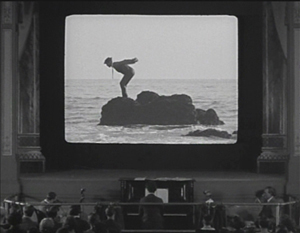
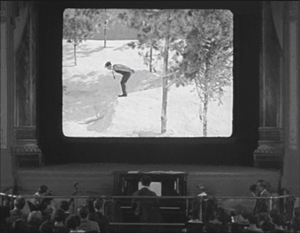
The result is a marvelously convincing technical feat, giving the illusion of being a single shot as far as the theater is concerned and on the movie screen a character wandering through an appropriately dream-like series of edited shots. In general, Keaton was the most adept of the three great comics at using cinema technology to create gags, and this is his most elaborate attempt. (Though see also his short, The Playhouse, in which multiple exposures, flawlessly managed in-camera, create Keaton clones that play all the roles.)
The plot of the dream emerges after this virtuoso transition, and it remains hilarious throughout. The chase, while not quite as dazzling as the one in Girl Shy, has considerable variety of vehicles (one wonders if the two comics were consciously trying to best each other), including a passage where the hero rides the handlebars of a speeding motorcycle, unaware that the driver has fallen off.
Kino has packaged Sherlock Jr. together with Keaton’s early feature, The Three Ages (1923), and released them both on DVD and Blu-ray.
The third funny man was Ernst Lubitsch. The Marriage Circle was his second Hollywood film, and one of his best. Lubitsch had started out as a comic in silent shorts in Germany, but unlike the famous Americans, he entirely gave up acting to direct. Not that he directed only comedies, but his best films, including Lady Windermere’s Fan, Trouble in Paradise, and The Shop around the Corner, fall into that category.
The Marriage Circle is a light romantic comedy, following a chain of flirtations and misunderstandings. Prof. Stock has realized that his pretty young wife Mizzi has begun to neglect and nag him. She is soon attracted a newlywed, Dr. Braun. Mizzi happens to be an old friend of Braun’s wife Charlotte, which gives her opportunities to flirt aggressively with Braun. Charlotte is in turn admired by Braun’s medical partner, Dr. Mueller, though she laughs off his attempts to woo her.
It has often been pointed out that Lubitsch is a director of doorways. That’s not always true, but The Marriage Circle is built around visits. The five characters visit each other in various combinations, and the string of attempted seductions and jealousies builds. Stock encourages Mizzi’s pursuit of Braun, since he wants an excuse for a divorce. Charlotte naively pushes Braun into visiting Mizzi at home when she plays sick.
The sets and especially the doorways play a big role. Characters pause in doorways to take in a compromising situation they have interrupted. At one point Mizzi comes to Braun’s office. Mueller spots them in an embrace, but Braun claims he’s hugging his wife. Eager to alienate Charlotte from her husband, he opens the office door to reveal Charlotte in the waiting room:
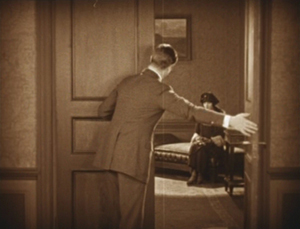
This is the first film where one can see the “Lubitsch touch” in action. It’s an ability to use film techniques to hint at something naughty. Here the innuendos are aimed at the characters. We know more than any of them does, and the humor arises from watching them misinterpret what they see and hear. When they finally learn of their mistakes, they end the “circle” of the title.
The Marriage Circle is available to rent or buy in digital form on Amazon. I know nothing about the source or the quality. The only DVD easily available is a region 2 French one under the rather blah title Comédiennes. The print is distinctly soft (as the frame above suggests) but acceptable until a better one becomes available.
… and one not so funny
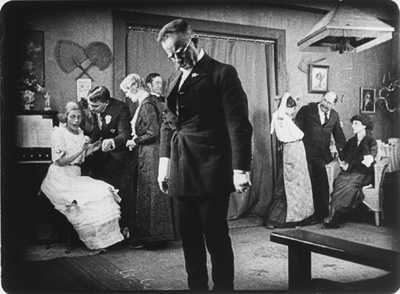
Greed is often spoken of as the film that historians and buffs would most like to see rediscovered. Part of it survives, of course–about two hours out of the original eight or so. Its producer, MGM, had it was edited down into a reasonably coherent feature, mainly by cutting out a number of characters and their subplots. I won’t say much about the film here, since it is already quite well-known.
The film is an adaptation of Frank Norris’ novel McTeague done in a naturalistic style, which was unusual for Hollywood films of that or any other day. It follows McTeague, an unlicensed dentist, who steals his friend Marcus’ girlfriend, Trina, and marries her. Their luck fluctuates, as Trina wins a lottery and McTeague is thrown out of work for not having a license. Trina becomes an obsessive miser, and McTeague, by now an alcoholic, murders her and flees to Death Valley with her money.
I find a lot of Greed heavy-handed and obvious. (I prefer the simpler Blind Husbands, which made our ten-best list for 1919.) It has an interesting style, however, with a lot of proto-Wellesian deep focus and low angles, complete with, in the case of the frame above, a hint of a ceiling. The final sequence in Death Valley is also very effective.
Apart from being 75% lost, Greed has never been released on DVD. (See Indiewire for comments on this.) In 1999 Turner Classic Movies edited a four-hour version, inserting production stills to suggest the missing scenes. This was reasonably effective, but it seems impossible to find a print of it that is not washed out and fuzzy. We’ve tried taping off TCM, as well as buying the VHS and laserdisc releases of that version. They all verge on unwatchable. I hope that the situation is not left where it is and that a true restoration is eventually done. My frame above comes from an archival 35mm print, so clearly better material exists.
The lost film that I would most like to see discovered is Lubitsch’s Kiss Me Again (1925). Given that it was made right before Lady Windermere’s Fan, there’s a good chance that it’s a masterpiece.
One of a kind
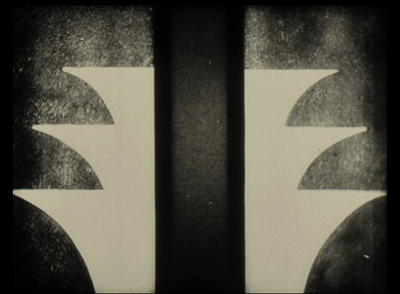
Last year I put Man Ray’s experimental short, La retour à la raison, on the list. Comparing experimental shorts to fiction features, though, seems unfair. This year I’m separating out the experimental category and will try to choose at least one film each year.
This year it’s Walter Ruttmann’s Opus 3, the third of his four films done with abstract animation.
All of the Opus films plus other Ruttmann shorts are available on a DVD set with Berlin, die Sinfonie der Grossstadt and Melodie der Welt. If you want to sample just Opus 3, which is about four minutes long, it has been posted multiple times on YouTube. Although a bit dark, this is the best copy I’ve found, and it has a nice, appropriate score by Hanns Eisler.
Bernard Eisenschitz made the connection between Lang and Czeschka in his massive Fritz Lang au travail (Cahiers du Cinéma, 2012) , pp. 38 and 42. Czeschka’s Nibelungen illustrations can be see along with the entire book on the Museum of Modern Art’s website, with a page-turning feature and the ability to enlarge the pages considerably. Individual illustrations can be found with a Google Images search on “Czeschka” and “Nibelungen.”
Thanks to Jonah Horwitz for a correction.
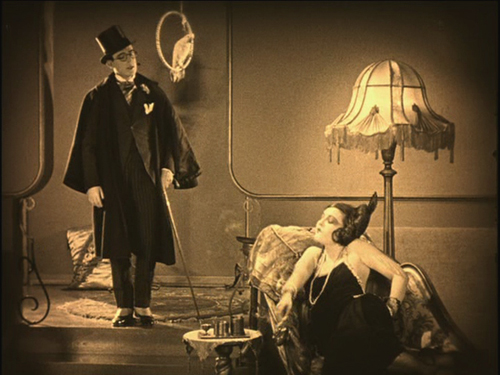
Girl Shy