







Archive for the 'Film comments' Category
Venice 2018: First impressions, FIRST MAN
DB here:
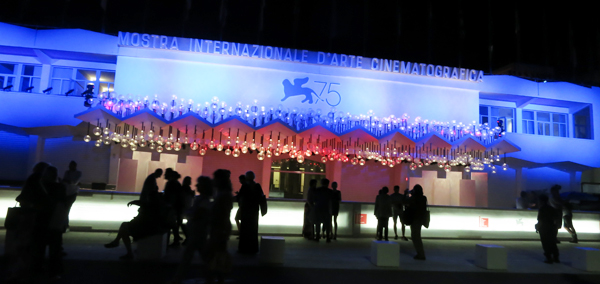
Kristin and I are back at the Venice International Film Festival, because once more I’m on the panel for the festival’s Biennale College Cinema projects. A future post will take up those films, as well as Kristin’s comments on the restored Der Golem (1920), which screened the night before the festival’s official opening. For now, a quick report while we’re between screenings. And feel free to check in with our new Instagram page for rolling photo updates as the days go by.
First man, fourth feature
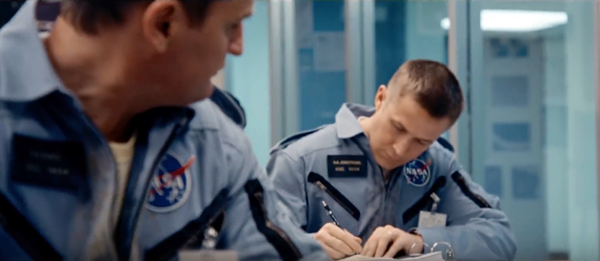
Kristin and I are admirers of Damien Chazelle’s work, so you’d expect that we were keen to see First Man, his Neil Armstrong film. It’s not exactly a biopic, as it concentrates on a fairly brief period of his life. It treats his career as an astronaut as partly a mechanism for coping with the death of his young daughter. The familiar Hollywood double plot–personal life versus professional life–is filled out by ongoing tensions with Armstrong’s wife Janet (Claire Foy) and by NASA’s efforts to beat the Russians to the moon.
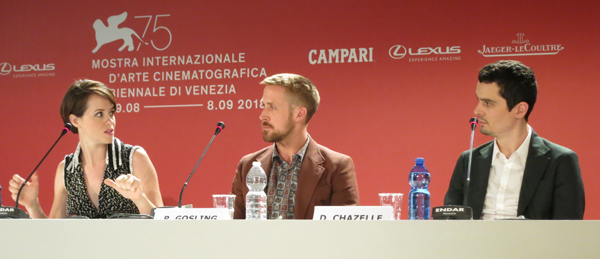
The domestic scenes are steeped in mild melancholy, as the workaholic, buttoned-up Armstrong seems a good candidate for clinical depression. One powerful moment involves Janet’s insistence that he open up to his sons and admit that he might not return from the moon launch. His deep affection for his daughter, sketched quickly in the opening portions, suggests why he’s more stiff and distant with his sons later; it’s as if he doesn’t want to risk strong love again. Ryan Gosling’s performance handles this well, I think; after we’ve seen him caress his daughter’s hair early on, we watch his fingers closely. Even in long shots, his hands betray him, as when he nervously twists his wedding ring. (Below, Foy, Gosling, and Chazelle at the press conference.)
The moon mission becomes a kind of catharsis that lets Armstrong regain a dimension of his humanity. The professional plot, crystallized around a series of subgoals leading to the moon shot, renders him as tenacious and dedicated. Pointedly contrasted to showboating Buzz Aldrin, Armstrong’s laconic manner reflects not only a confidence in his abilities but a quiet, stubborn professionalism. This too is shaken by death; the incineration of his friends in a test not only stresses the danger of space flight but the fact that he is increasingly alone. Throughout his adversities, Armstrong must show both physical endurance and resourceful intelligence. He’s admirably swottish, but he uses it as a shield for emotions.
From its very opening frames First Man has a galvanizing immediacy. Chazelle has given up the smooth, locked-down camera technique of La La Land in favor of a looser handheld approach that recalls Guy and Madeline on a Park Bench. The film’s over 2000 shots create an impressionistic nervousness that suits not only the suspense of the NASA mission but the anxieties of the protagonist. DP Linus Sandgren filmed many of the tighter shots in Super-16mm, and the same gauge, applied to flashback images of Armstrong’s daughter, yield almost Kodachrome bursts of color. By contrast, the culminating scenes on the lunar surface, shot in Imax, contrast with the rest of the film’s texture by being rigorously stable, awe-inspiring framings.
In filming Armstrong’s tests and missions, Chazelle tackles what we might call the Raging Bull problem. Scorsese sought to distinguish each of Jake LaMotta’s prizefights through different techniques (slow-motion, optical POV, and the like). Chazelle does much the same. The film’s harrowing opening sequence is rendered in convulsive imagery from Armstrong’s point of view, trapping us in the cockpit with him as he manages to salvage a test flight. Later aerial sequences take us briefly outside spacecraft in varying angles, but I think the most majestic external views are saved for the climactic moon shot.
Paralleling this pattern, in the most claustrophobic passages thrashing grinding sounds rip through the theatre. By contrast, the moon landing is accompanied by Justin Hurwitz’s quietly triumphant waltz. This is definitely a film to be seen and heard on the biggest screen you can find.
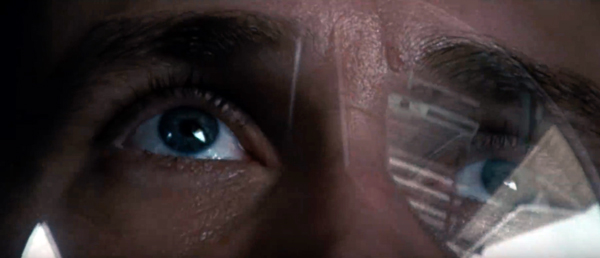
As one measure of Chazelle’s interest in fine-grain detail, consider his powerful use of reflections. The astronauts’ helmets become both distorting windows and reflecting masks that capture the world outside. There’s striking imagery in the opening sequence of the horizon’s curvature bouncing off Armstrong’s helmet, while when we get to the moon, the landscape becomes a wraparound image blotting out the First Man’s face. At one point earlier in the film, I swear I saw the reflection of the moon in the iris of Armstrong’s eye. In any case, the final shot (no spoilers here) takes this pictorial motif to a new emotional pitch.
I want to write more about First Man, after I’ve seen it again and thought about it more; I hope as well to bring you information from Linus Sandgren about the cinematography. Still, I hope these notes convey my immediate appreciation for what Chazelle and his team have accomplished. First Man seems to me another exciting achievement by one of the most ambitious directors working today.
Revisit us for more blogging, We’ll be writing about Cuarón’s Roma, which we saw this morning, and The Other Side of the Wind, which we’re seeing in a few hours. I make these promises as partly a way to ensure that we actually do it!
Thanks to Paolo Baratta, Alberto Barbera, Peter Cowie, Michela Lazzarin, and all their colleagues for their warm welcome of us to this year’s Biennale.
Earlier entries devoted to Chazelle are here.
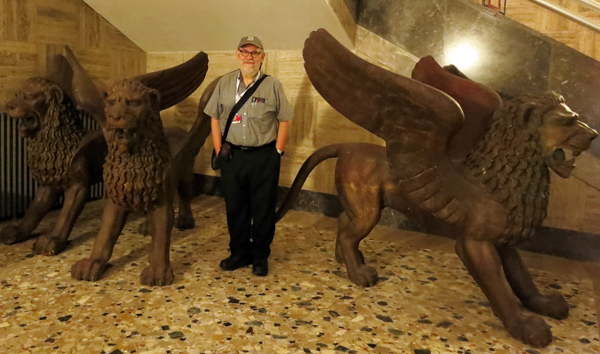
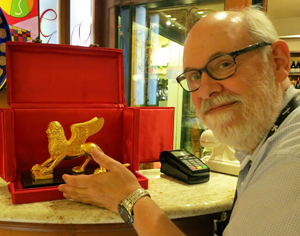
Grrr! DB in the wingéd lions’ den: They have several of these beasts on hand. This and press conference photo by Kristin.
Is there a blog in this class? 2018
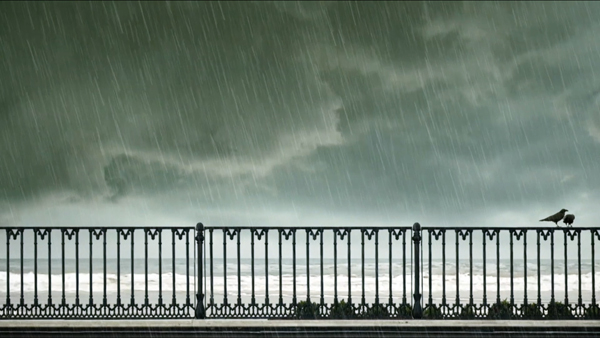
24 Frames (2017)
Kristin here:
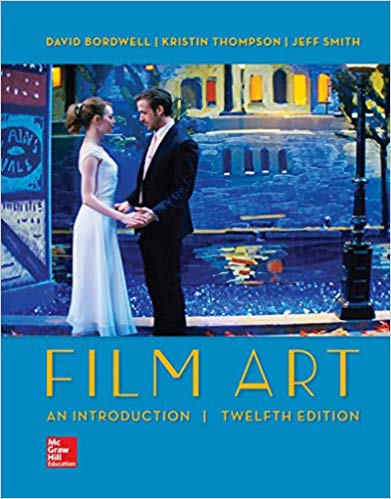
David and I started this blog way back in 2006 largely as a way to offer teachers who use Film Art: An Introduction supplementary material that might tie in with the book. It immediately became something more informal, as we wrote about topics that interested us and events in our lives, like campus visits by filmmakers and festivals we attended. Few of the entries actually relate explicitly to the content of Film Art, and yet many of them might be relevant.
Every year shortly before the autumn semester begins, we offer this list of suggestions of posts that might be useful in classes, either as assignments or recommendations. Those who aren’t teaching or being taught might find the following round-up a handy way of catching up with entries they might have missed. After all, we are pushing 900 posts, and despite our excellent search engine and many categories of tags, a little guidance through this flood of texts and images might be useful to some.
This list starts after last August’s post. For past lists, see 2007, 2008, 2009, 2010, 2011, 2012, 2013, 2014, 2015, 2016, and 2017.
This year for the first time I’ll be including the video pieces that our collaborator Jeff Smith and we have since November, 2016, been posting monthly on the Criterion Channel of the streaming service FilmStruck. In them we briefly discuss (most run around 10 to 14 minutes) topics relating to movies streaming on FilmStruck. For teachers whose school subscribes to FilmStruck there is the possibility of showing them in classes. The series of videos is also called “Observations on Film Art,” because it was in a way conceived as an extension of this blog, though it’s more closely keyed to topics discussed in Film Art. As of now there are 21 videos available, with more in the can. I won’t put in a link for each individual entry, but you can find a complete index of our videos here. Since I didn’t include our early entries in my 2017 round-up, I’ll do so here.
As always, I’ll go chapter by chapter, with a few items at the end that don’t fit in but might be useful.
[July 21, 2019: In late November, 2018, the Filmstruck streaming service ceased operation. On April 8, 2019, it was replaced by The Criterion Channel, the streaming service of The Criterion Collection. All the Filmstruck videos listed below appear, with the same titles and numbers, in the “Observations on Film Art” series on the new service. Teachers are welcome to stream these for their classes with a subscription.]
Chapter 3 Narrative Form
David writes on the persistence of classical Hollywood storytelling in contemporary films: “Everything new is old again: Stories from 2017.”
In FilmStruck #5, I look at the effects of using a child as one of the main point-of-view figures in Victor Erice’s masterpiece: “The Spirit of the Beehive–A Child’s Point of View”
In FilmStruck #13, I deal with “Flashbacks in The Phantom Carriage.”
FilmStruck #14 features David discussing classical narrative structure in “Girl Shy—Harold Lloyd Meets Classical Hollywood.” His blog entry, “The Boy’s life: Harold Lloyd’s GIRL SHY on the Criterion Channel” elaborates on Lloyd’s move from simple slapstick into classical filmmaking in his early features. (It could also be used in relation to acting in Chapter 4.)
In FilmStruck #17, David examines “Narrative Symmetry in Chungking Express.”
Chapter 4 The Shot: Mise-en-Scene
In choosing films for our FilmStruck videos, we try occasionally to highlight little-known titles that deserve a lot more attention. In FilmStruck #16 I looks at the unusual lighting in Raymond Bernard’s early 1930s classic: “The Darkness of War in Wooden Crosses.”
FilmStruck #3: Abbas Kiarostami is noted for his expressive use of landscapes. I examine that aspect of his style in Where Is My Friend’s Home? and The Taste of Cherry: “Abbas Kiarostami–The Character of Landscape, the Landscape of Character.”
Teachers often request more on acting. Performances are difficult to analyze, but being able to use multiple clips helps lot. David has taken advantage of that three times so far.
In FilmStruck #4, “The Restrain of L’avventura,” he looks at how staging helps create the enigmatic quality of Antonionni’s narrative.
In FilmStruck #7, I deal with Renoir’s complex orchestration of action in depth: “Staging in The Rules of the Game.”
FilmStruck #10, features David on details of acting: “Performance in Brute Force.”
In Filmstruck #18, David analyses performance style: “Staging and Performance in Ivan the Terrible Part II.” He expands on it in “Eisenstein makes a scene: IVAN THE TERRIBLE Part 2 on the Criterion Channel.”
FilmStruck #19, by me, examines the narrative functions of “Color Motifs in Black Narcissus.”
Chapter 5 The Shot: Cinematography
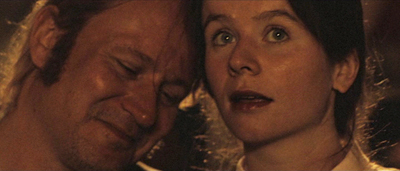
A basic function of cinematography is framing–choosing a camera setup, deciding what to include or exclude from the shot. David discusses Lubitsch’s cunning play with framing in Rosita and Lady Windermere’s Fan in “Lubitsch redoes Lubitsch.”
In FilmStruck #6, Jeff shows how cinematography creates parallelism: “Camera Movement in Three Colors: Red.”
In FilmStruck 21 Jeff looks at a very different use of the camera: “The Restless Cinematography of Breaking the Waves.”
Chapter 6 The Relation of Shot to Shot: Editing
David on multiple-camera shooting and its effects on editing in an early Frank Capra sound film: “The quietest talkie: THE DONOVAN AFFAIR (1929).”
In Filmstruck #2, David discusses Kurosawa’s fast cutting in “Quicker Than the Eye—Editing in Sanjuro Sugata.”
In FilmStruck #20 Jeff lays out “Continuity Editing in The Devil and Daniel Webster.” He follows up on it with a blog entry: “FilmStruck goes to THE DEVIL”,
Chapter 7 Sound in the Cinema
In 2017, we were lucky enough to see the premiere of the restored print of Ernst Lubitsch’s Rosita (1923) at the Venice International Film Festival in 2017. My entry “Lubitsch and Pickford, finally together again,” gives some sense of the complexities of reconstructing the original musical score for the film.
In FilmStruck #1, Jeff Smith discusses “Musical Motifs in Foreign Correspondent.”
Filmstruck #8 features Jeff explaining Chabrol’s use of “Offscreen Sound in La cérémonie.”
In FilmStruck #11, I discuss Fritz Lang’s extraordinary facility with the new sound technology in his first talkie: “Mastering a New Medium—Sound in M.”
Chapter 8 Summary: Style and Film Form
David analyzes narrative patterning and lighting Casablanca in “You must remember this, even though I sort of didn’t.”
In FilmStruck #10, Jeff examines how Fassbender’s style helps accentuate social divisions: “The Stripped-Down Style of Ali Fear Eats the Soul.”
Chapter 9 Film Genres
David tackles a subset of the crime genre in “One last big job: How heist movies tell their stories.”
He also discusses a subset of the thriller genre in “The eyewitness plot and the drama of doubt.”
FilmStruck #9 has David exploring Chaplin’s departures from the conventions of his familiar comedies of the past to get serious in Monsieur Verdoux: “Chaplin’s Comedy of Murders.” He followed up with a blog entry, “MONSIEUR VERDOUX: Lethal Lothario.”
In Filmstruck entry #15, “Genre Play in The Player,” Jeff discusses the conventions of two genres, the crime thriller and movies about Hollywood filmmaking, in Robert Altman’s film. He elaborates on his analysis in his blog entry, “Who got played?”
Chapter 10 Documentary, Experimental, and Animated Films
I analyse Bill Morrison’s documentary on the history of Dawson City, where a cache of lost silent films was discovered, in “Bill Morrison’s lyrical tale of loss, destruction and (sometimes) recovery.”
David takes a close look at Abbas Kiarostami’s experimental final film in “Barely moving pictures: Kiarostami’s 24 FRAMES.”
Chapter 11 Film Criticism: Sample Analyses
We blogged from the Venice International Film Festival last year, offering analyses of some of the films we saw. These are much shorter than the ones in Chapter 11, but they show how even a brief report (of the type students might be assigned to write) can go beyond description and quick evaluation.
The first entry deals with the world premieres of The Shape of Water and Three Billboards outside Ebbing, Missouri and is based on single viewings. The second was based on two viewings of Argentine director Lucretia Martel’s marvelous and complex Zama. The third covers films by three major Asian directors: Kore-eda Hirokazu, John Woo, and Takeshi Kitano.
Chapter 12 Historical Changes in Film Art: Conventions and Choices, Traditions and Trends
My usual list of the ten best films of 90 years ago deals with great classics from 1927, some famous, some not so much so.
David discusses stylistic conventions and inventions in some rare 1910s American films in “Something familiar, something peculiar, something for everyone: The 1910s tonight.”
I give a rundown on the restoration of a silent Hollywood classic long available only in a truncated version: The Lost World (1925).
In teaching modern Hollywood and especially superhero blockbusters like Thor Ragnarok, my “Taika Waititi: The very model of a modern movie-maker” might prove useful.
Etc.
If you’re planning to show a film by Damien Chazelle in your class, for whatever chapter, David provides a run-down of his career and comments on his feature films in “New colors to sing: Damien Chazelle on films and filmmaking.” This complements entries from last year on La La Land: “How LA LA LAND is made” and “Singin’ in the sun,” a guest post featuring discussion by Kelley Conway, Eric Dienstfrey, and Amanda McQueen.
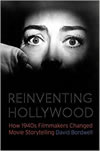
Our blog is not just of use for Film Art, of course. It contains a lot about film history that could be useful in teaching with our other textbook. In particular, this past year saw the publication of David’s Reinventing Hollywood: How 1940s Filmmakers Changed Hollywood Storytelling. His entry “REINVENTING HOLLYWOOD: Out of the past” discusses how it was written, and several entries, recent and older, bear on the book’s arguments. See the category “1940s Hollywood.”
Finally, we don’t deal with Virtual Reality artworks in Film Art, but if you include it in your class or are just interested in the subject, our entry “Venice 2017: Sensory Saturday; or what puts the Virtual in VR” might be of interest. It reports on four VR pieces shown at the Venice International Film Festival, the first major film festival to include VR and award prizes.
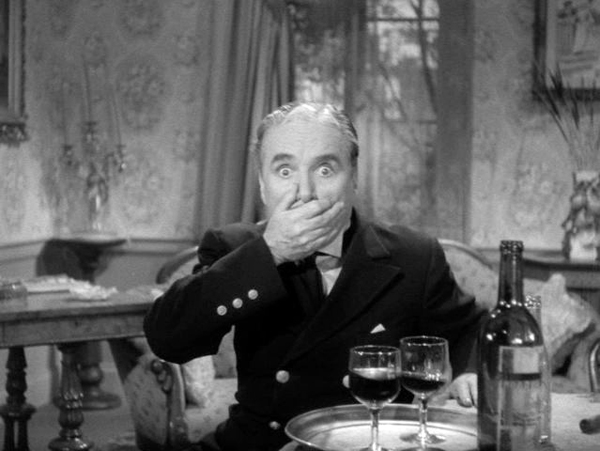
Monsieur Verdoux (1947)
10 million thanks

DB here:
On Tuesday 7 August, at some point midway through the morning (CST), somebody–in Key West, or Singapore, or Yale, I can’t be sure–logged onto this site and executed our ten millionth pageload.
No, prizes are not involved.
This site began counting pageloads, along with visits and other data, on 26 September 2006, when we started the blog. Those first entries were embarrassingly basic affairs. It would be months before we figured out how to include pictures, and years before we started to embed clips.
Since 2006 we have posted 876 entries (including this one) and run up many millions of words. We’ve hosted some roundtables and several guest posters: Tim Smith, Leslie Midkiff DeBauche, Rory Kelly, Nicola Mazzanti, Matthew Bernstein, Kelley Conway, Eric Dienstfrey, Amanda McQueen, Jim Udden, and our collaborator Jeff Smith. We’ve recorded encounters with Nina Paley, David Koepp, Joe Dante, Damien Chazelle, Phil Solomon, and other filmmakers. Mostly, though, this stuff has been churned out by Kristin and me.
We thought of the site as a supplement to Film Art, but it’s gone far beyond that. We’ve used it to provide access to published essays and books (Ozu and the Poetics of Cinema, Exporting Entertainment), to report on film festivals and conferences, to support other writers’ work, to jump into some current flaps both academic and journalistic, and to revisit research questions that obsess us. We’ve used it to set up video lectures, and to announce new books, by us and by others. Hell, some entries became books (Minding Movies, The Rhapsodes, Pandora’s Digital Box, Christopher Nolan: A Labyrinth of Linkages).
We’ve commented on trends in the film industry, such as 3D and global marketing. We’ve also tried to stir up enthusiasm for activities we think worthwhile, such as cognitive film studies, ambitious DVD publishing initiatives, and the FilmStruck streaming service.
It has been a ton of fun, and we don’t expect to stop any time soon. We busy ourselves with other things as well–writing for print publication, lecturing and visiting festivals, mounting our monthly Criterion Channel installments (which bear the same title as the blog). But the website has been a uniquely rewarding part of our lives. Through it we’ve made dozens of new friends and been exposed to fresh opinions and ideas.
I’m still surprised that we’ve drawn so many readers, since we decided at the start not to include Comments. We didn’t, and don’t, have time to monitor them. We’re stubbornly stuck in Web 1.5, treating this as essentially a personal, self-published magazine. But email responses, including corrections, are welcome.
We can’t yet imagine stopping. We’re delighted that in the age of Twitter, which oversimplifies every scrap of human affairs, and faced with the decline of blogs in general, thousands of people remain willing to click on, and maybe read, longish, para-academic efforts in film criticism and history.
So thanks to all our readers for encouraging us. And watch for our coverage of the upcoming Venice International Film Festival starting the end of the month!
We remain eternally grateful to our web tsarina Meg Hamel and our stalwart IT caballero Peter Sengstock.
The illustration up top comes, of course, from that exhilarating chronicle of human folly FailArmy.
P.S. 3 March 2019: This entry has been corrected. Originally it claimed ten million visits, not pageloads. Actually there were about seven million visits. I apologize for the error.

KT and DB, Venice International Film Festival, 2017.
Catching up with the past: Recent DVD and Blu-ray releases
Behind the Door (1919).
Kristin here:
David and I have moved house recently, which has caused a long lag in my getting around to doing a DVD/Blu-ray roundup of recent releases. Some are not so recent anymore, but I shall call attention to them nonetheless.
Behind the Door (1919)
Our friends at Flicker Alley have been busy, as usual.
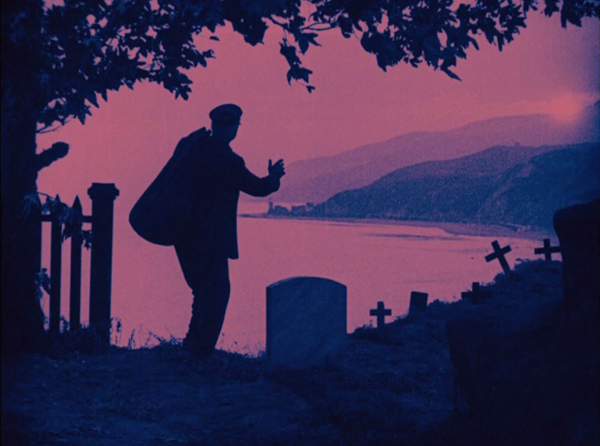
Way back in February of last year, they released Behind the Door, a notoriously grim and brutal drama of World War I that long survived only in incomplete form. Using tinting rolls from the Library of Congress, some scenes from star Hobart Bosworth’s collection, and a re-edited Russian distribution print, as well as a copy of the continuity script, the restoration by the San Francisco Silent Film Festival, the Library of Congress, and Gosfilmofond approximates the original American release version fairly closely. (Two brief missing sections are filled in by photos and the texts of the original titles.) The tinting and toning, based on the Library of Congress material, is authentic and effective (see top), as is the new score by Stephen Horne.
The Russian version is included in the two-disc set, so we have one of those rare cases where it is possible to compare the foreign and domestic versions–to a degree. Most of the shots, of course, were made with a second camera, and there are inevitably differences of framings and even takes between those versions. Given that the new restoration depends heavily on the Russian print, the comparison must be made primarily on the basis of the differences in the order of the scenes and the other narrative changes made by the Russian editors.
Behind the Door tied for Best Single Release in Il Cinema Ritrovato’s DVD Awards, announced just last month. Congratulations to Flicker Alley and to other organizations we have ties to, which also won awards. The Criterion Collection tied for Best Box Set for its 100 Years of Olympic Films: 1912-2012. This massive set (32 discs on Blu-ray, 43 on DVD) contains 53 films, including those by Leni Riefenstahl, Kon Ichikawa, Claude Lelouch, Carlos Saura, and Miloš Forman. Belgium’s Cinematek won Best Discovery of a Forgotten Film for its Marquis de Wavrin (1924-1937), actually a series of films shot in South America by this major anthropologist and filmmaker. German Concentration Camps Factual Survey (from the BFI and the Imperial War Museum), which David commented on last year, won Best Special Features.
Das alte Gesetz (1923)
I have a particular interest in German silent cinema of the post-World War I era, so I was happy to see Flicker Alley’s release of Ewald André Dupont’s Das alte Gesetz (“The Ancient Law”). Most people know Dupont only from his most famous and successful film, Variety (1925), known for its spectacular camera movements taken from trapezes.
Dupont had a long career, however, starting as a scriptwriter in the 1910s and becoming a director as well in 1918. Das alte Gesetz is mainly known as one of a small group of Jewish-themed films made in Germany in the period 1919-1924. More familiar to most would be Der Golem:Wie er in der Welt kam, co-directed by Paul Wegener and Carl Boese (1920) and to some, Die Gezeichneten, Carl Dreyer’s first German film (aka Love One Another, 1922). A helpful essay in the accompanying booklet by Cynthia Walk gives the political context of die Judenfrage (“the Jewish question) as it was being debated in Europe at the time.
Set in the 1860s, the film concerns Barush, the son of a rabbi in a shtetl in western Russia. He suddenly and somewhat implausibly conceives a desire to leave home and become a famous actor. Naturally his father disowns him. Joining a small traveling troupe, Barush ends up in Vienna, where an archduchess, played by Henny Porten, is impressed by his performance as Romeo and attracted to him as well. She arranges for him to join her court-theatre troupe, where he becomes a star as a classical actor.
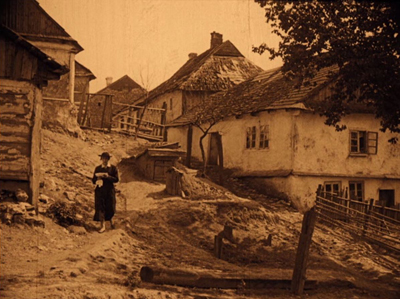
The scenes in the shtetl (above) are done with considerable attention to authenticity and without the sort of ethnic humor that one might expect. Although Barush encounters prejudice in Europe, he does not evenually learn a lesson about assimilation and go back to his home with his tail between his legs. Far from it; his father is induced to read Shakespeare and suddenly realizes that there are indeed more things in heaven and earth than he had dreamed of in his philosophy. A happy reunion results, and Barush continues his career.
Das alte Gesetz was clearly a big-budget period piece, with several large sets. Moreover, the influence of classical Hollywood films, which began to be shown in Germany in 1921, is quite apparent. Dupont has mastered three-point lighting and analytical editing, including shot/reverse shot, as this scene between Barush and his father demonstrates.
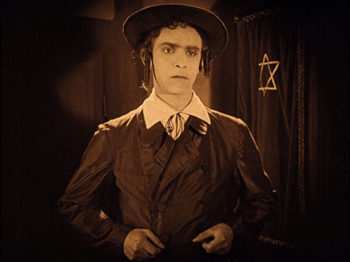
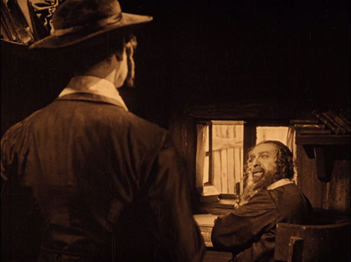
Barush is played by Ernst Deutsch, a major actor of the day, including in Expressionist films. He’s the rabbi’s son in Der Golem as well, and he plays the bank-cashier protagonist in Karl-Heinz Martin’s From Morn to Midnight.
MOD
Flicker Alley has also developed a healthy list of manufactured-on-demand titles. Many of these are out-of-print films from the Blackhawk Collection. The 51 titles currently on the list include many silent classics, some of them difficult to see on disc otherwise, such as Lubitsch’s The Marriage Circle and Abram Room’s Bed and Sofa.
The new offerings lately have branched out somewhat to include more recent films. On September 3 of last year, the company released Alex Barrett’s London Symphony (2017) for its home-video debut. In the press release for the disc, the director describes it as “a love letter to a city, but it is also a film about life in the modern era.” As the title indicates, Barrett places his film in the city symphony genre, and its release was timed to coincide with the 90th anniversary of the premiere of Berlin: Symphony of a City. City symphonies tend to be associated with the 1920s, when the genre originated and its most famous exemplars, Berlin and Vertov’s Man with a Movie Camera, were made. The genre has never disappeared, but Barrett has written that he chose “to make the film in a style associated with the filmmakers of the 1920s.”
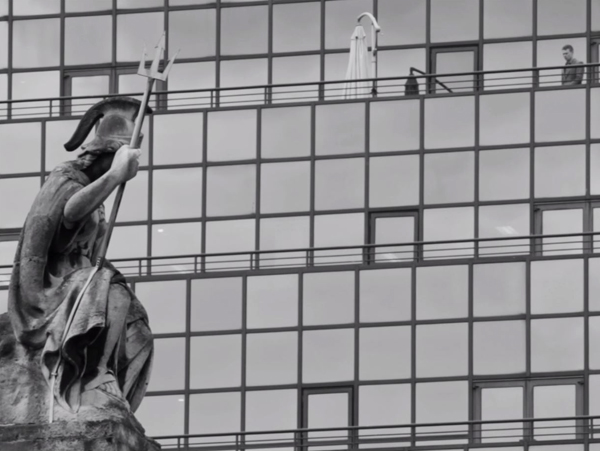
For me, it captures well the style of the 1920s, and particularly Berlin. Shot in black-and-white, London Symphony falls into four movements, following a day in the life of the city–with, as in Berlin, pauses for lunch and dinner particularly dwelt upon. The opening section concentrates on buildings, and there are the inevitable juxtapositions of old and new (see bottom). Multiple cinematographers filmed the footage, but their work blends into a unified visual whole with many striking compositions.
Ruttmann injects occasional implicit political commentary, as when he juxtaposes shots of beggars in the streets with the well-fed Berliners in restaurants. Barratt concentrates on the beautiful and peaceful side of London–historic buildings, quiet parks, pleasant markets, and river scenes. The rather grubby and crowded atmosphere of, say, the West End of London is nowhere to be seen, which befits “a love letter.”
In January The Indomitable Teddy Roosevelt joined the MOD catalog. This is a reissue of a 1983 television documentary that mixes documentary footage (Roosevelt was the first president to be filmed) and staged scenes.
Edition Filmmuseum
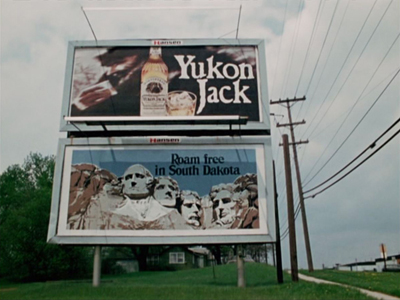
This series continues its steady release of experimental filmmaker James Benning’s works with a sixth two-disc set (DVD only) that goes back to his earliest features, films that solidified his international reputation. The new two-disc set contains two films from the late 1970s, 11 x 14 (1977) and One Way Boogie Woogie (1978). Jim followed up the latter, a series of sixty shots of Milwaukee cityscapes, with 27 Years Later (2005), which presents the same series of locations, and One Way Boogie Woogie 2012, which further documents the changes in the filmmaker’s hometown. All three films are included in this set.
11 x 14 flirts with presenting a narrative without ever really concentrating on it. We see some of the same people at intervals, but no causal events link them, and their actions create situations rather than developing stories. Instead, the film’s shots, some quite lengthy, others brief, explore the urban and rural landscapes of Chicago and Milwaukee, as well as rural roads and fields in the surrounding area. (A familiar highway sign pointing the way to Madison is glimpsed at one point.)
For the most part the urban images concentrate on run-down areas, with motifs of travel (billboards, airplanes) and drinking (bars and more billboards) hinting at contrasting modes of escape. The shot above captures both motifs at once.
Given that Jim’s films seldom play outside festivals and museum venues, the Filmmuseum series is vital–though many of the images in these films are long or even extreme long-shots and benefit from being seen on a big screen. The last time we had a chance to do so was when RR (2007) was shown at the 2008 Vancouver International Film Festival. The Austrian Filmmuseum also published a book on Jim’s work, which David discusses here.
London Symphony (2017)



