















Archive for the 'Film comments' Category
Edgy color, trial testimony, and the world in unison: More movies at Ritrovato
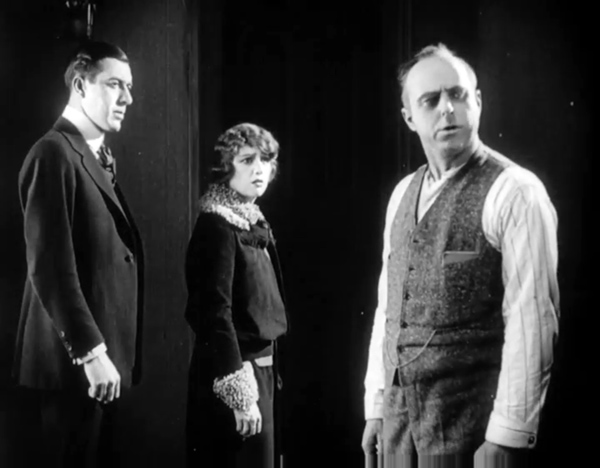
The Woman under Oath (1919).
DB here:
Hard to keep up. Herewith, some highlights as Cinema Ritrovato, the Cannes of classic cinema, winds down.
Grease, still the word
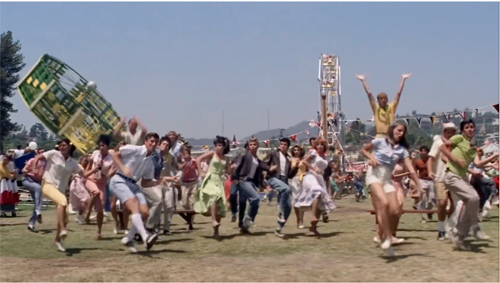
Patricia Birch was a dancer with Martha Graham and Agnes De Mille. She went on to participate in West Side Story and to choreograph The Wild Party (1975) and both stage and film versions of A Little Night Music (1973, 1977). What brought her to Bologna was the restored version of Grease (1978). She choreographed that on both stage and screen, and she talked about it at a stimulating panel with Ehsan Khoshbakht and her son Peter Becker, of Criterion Films.
I had thought that Grease followed the vogue for boomer high-school nostalgia triggered by American Graffiti (1973), but it was actually ahead of that. The original Chicago version, reportedly raunchier than the New York version, premiered in 1971. It opened on Broadway in 1972 and ran until 1980. The film modified the stage show and added some songs.
Ms. Birch was a font of information about how she conceived the numbers. She says she thinks of dance as “timed behavior,” not set steps but patterns of motion. This idea allows her to choreograph actors who didn’t have dance training but who could “move well.” Peter ran a clip showing a passage of cascading hallway mischief that was as rhythmic as a dance number. This was one of several group-action scenes that Ms. Birch coordinated.
The Grease ensemble was huge, and Ms Birch organized it in a quasi-military way. There was a core of twenty proficient dancers, ten male-female couples. They supervised and coached the less skilled performers. For “We Go Together,” set in a carnival, each couple found business and steps for thirty other dancers.
“We Go Together” was the sort of big showstopper she called “Paramount numbers.” There were also the smaller-scaled “semi-Paramount numbers” and the intimate, character-driven “Internal numbers.” Ms Birch pointed out how the Paramounts built their power on unison steps and, eventually, massive kicklines. “People like to see the world in unison. Gets ’em every time.”
I learned a lot from Patricia Birch’s spirited discussion. Watch for a version of the panel to show up online.
Cutting edges

Film curator Olaf Müller set a new Ritrovato record: the shortest retrospective to date. Three films running less than twenty minutes introduced us to the oeuvre of Franz Schömbs.
Schömbs was a painter who became, according to Olaf, “probably the only avant-garde filmmaker of 1950s West Germany.” He started in the thirties by mounting paintings in rows, inviting viewers to walk along and sense the changes among them. After the war Schömbs tried to revive the experimentation of the Weimar period, principally through abstract films rich in color and design.
The films on the program were dense. Opuscula (1946-1952) consists of patches of color that slide to and fro “on top” of one another thanks to panning and tilting movements. The superimpositions create some striking visual hallucinations, as when blocks of white refuse to change color while other forms around them do. Die Geburt des Lichts (“The Birth of Light,” 1957, above), my favorite, transposes that constant movement to the patches of color themselves. These patches, as crisp as paper cutouts, have thrusting edges that keep slicing into the mates around them. Apparently Schömbs achieved the effect by applying paint to layers of glass and adjusting them frame by frame. Den Eisamen Allen (“To All the Lonely Ones,” 1962) uses what seemed to me traveling mattes, again enlivened by rich color.
Once more, Bologna proves a showcase for films that would otherwise go missing from film history.
Trial, with error
The courtroom drama was a mainstay of early twentieth-century theatre, but in 1915, playwright Elmer Rice gave it a twist. On Trial presented a murder trial by dramatizing the witnesses’ testimony in flashbacks. Rice offered another innovation as well: his flashbacks are non-chronological, starting with the most recent incident and reserving the climax for the earliest piece of action. Using the courtroom drama to play with time and viewpoint became a staple of American theatre and cinema.
Popular culture is a teeming mass of copies and near-copies–the switcheroo principle–so it didn’t take long for other storytellers to vary and complicate the trial format. One of the neatest examples was on display in Bologna. In the John Stahl silent drama The Woman under Oath (1919), flashbacks replay key actions according to what different witnesses know. We get no fewer than five flashbacks, some presenting incidents leading up to the crime, others recounting the murder itself. The later ones fill gaps in the earlier ones and culminate in a full, accurate version of the killing.
Proving once more that 1910s cinema can be pretty intricate, the same pieces of action get redeployed in different witnesses’ testimony. Sometimes the camera setups are varied to differentiate the versions.
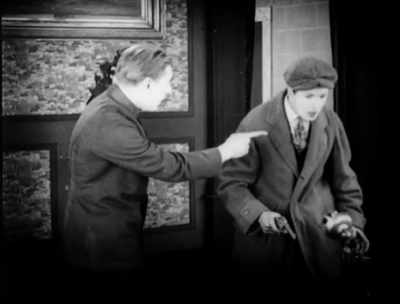
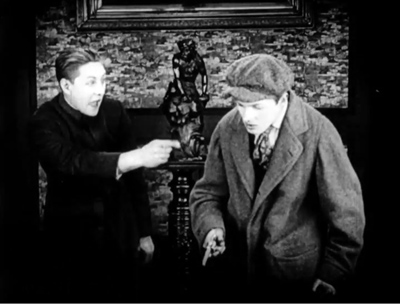
At other moments, nearly identical framings mislead us by concealing important information. The young man accused of the murder is shown near the victim in three pieces of testimony, with the first two instances being essentially identical but the last presentation providing different information. (To avoid a spoiler, I don’t show the portion of the third shot that yields that information.)
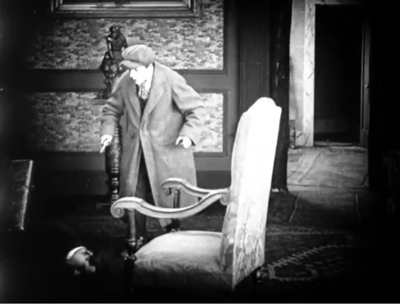
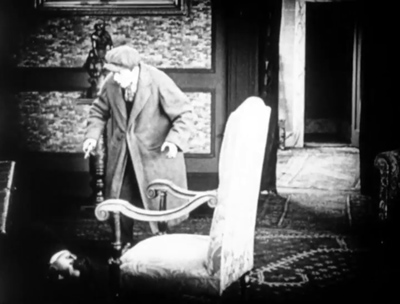
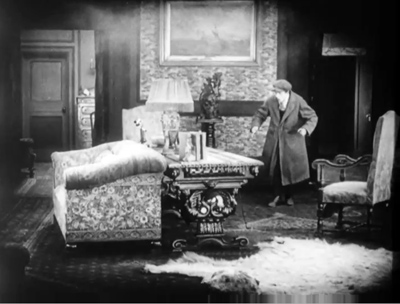
The Woman under Oath shows a sophisticated understanding of how framing can conceal information without our being aware of it. And in retrospect what seems a colossal coincidence during the first presentation of the killing turns out to be a perfectly motivated key to the solution.
Switcheroos on the trial-testimony format showed up in other Ritrovato films. By 1928, the idea of conflicting testimony enacted in “lying” flashbacks was conventional enough to be parodied in René Clair’s Les Deux timides (“Two Timid Souls”). Here the disparities are wildly comic, accentuated by split-screen and freeze frame. Albert Valentin’s La Vie de Plaisir (1944), made under the German occupation of France, is an elegant social comedy pitting a couple against one another in divorce court. The spiteful witnesses offer testimony damning the husband only to get refuted in replays that reveal extra information. Throughout world cinema, the flashback trial film seems to have been one way oblique narrative strategies were made understandable for a wide audience.
Thanks as ever to Guy Borlée for assistance, and to the Ritrovato programmers for supplying so many treats. Thanks also to Kelley Conway for discussion of the courtroom movies. We should also be grateful to the BFI for providing Bologna with the copy of The Woman under Oath.
One rough precedent for Rice’s play is Browning’s verse novel The Ring and the Book (1868-1869). The lingering awareness of Rice’s play is evident in Variety‘s review of The Woman under Oath, which the critic labeled “a sort of ‘On Trial’ affair” (20 June 1919, 52). In the same year there was an interesting parallel in the flashback testimony in Dreyer’s The President (1919).
You can find more about the switcheroo premise in my Reinventing Hollywood, which also discusses the trial format. For more on flashbacks see this entry. A series of entries on complex 1910s cinema start with this one.
P.S. 3 July 2018: Thanks to Peter Becker for a correction.
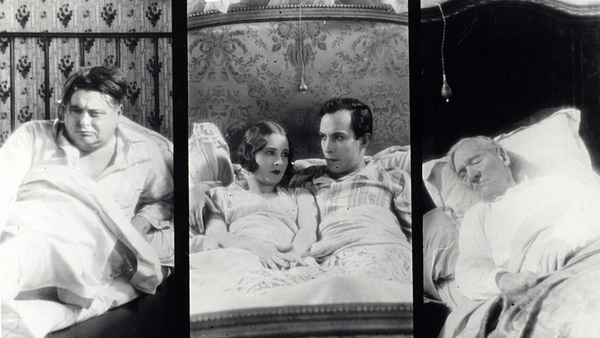
Les Deux timides (1928).
More Bologna bounty
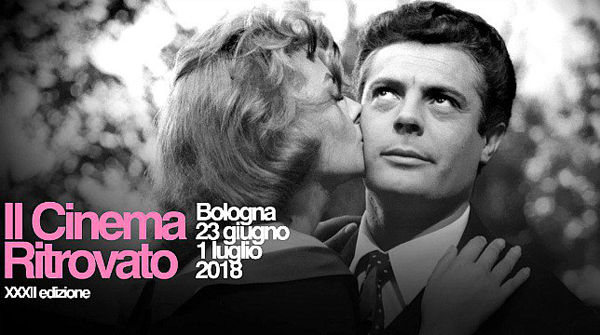
I think this has become my favorite Ritrovato key image.
DB here:
Cinema Ritrovato rolls on, leaving your obedient servant little time to blog. Herewith some quick impressions on a thin slice of all that’s going on. For a full schedule of this incredible event, go here.
IB or not IB
“Not all IB Tech prints are created equal,” explained Academy Film Archivist (and UW–Madison grad) Mike Pogorzelski. In his last of his annual Technicolor Reference Print shows, he pointed out that Technicolor sent its best-balanced prints to big-city venues and circulated them widely. As a result, they got worn out. The prints most likely to survive were less-than-perfect ones sent to the hinterlands or just kept as backups. Hence the need to preserve the Reference Prints selected by the filmmakers as defining the Technicolor timbre of each film.
With clips ranging from The Godfather and Let It Be to Sssss and Billy Jack, the sample gave a good sense of what Tech looked like a few years before the imbibition (IB) process was abandoned in 1974. Mike and Emily Carman introduced the extracts with informative commentary. I had always thought that Gordon Willis’s cinematography on the Godfather films and The Parallax View increased graininess, and this show seemed to confirm that sense.
Those naughty pre-Code pictures, again
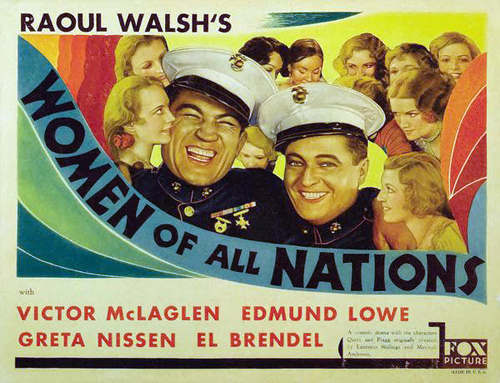
The John Stahl and William Fox retrospectives brought some spicy material. Women of All Nations (1931), Raoul Walsh’s episodic sequel to What Price Glory?, had Quirt and Flagg on the verge of all-out cussing in nearly every scene. A monkey wriggling inside El Brendel’s trousers created moments of good dirty fun. Bachelor’s Affairs (tee-hee, 1932) had Adolph Menjou peering down a golddigger’s front and praising her virtues: “What a charming combination.” She asks if it’s showing. Likewise this repartee: “Were you out last night?” “Not completely.”
William Dieterle’s Germanic Six Hours to Live (1932) begins as a political thriller and devolves into a Twilight Zone fantasy. A representative of a small country passionately protests worldwide tariff legislation. To keep his vote from vetoing the action, spies target him for elimination. Soon enough, he’s throttled to death. But an enterprising scientist takes the opportunity to try out his resuscitation ray, which gives the hero a few more hours to make his mark.
John Seitz photographed the whole farrago in glowing imagery shot through with shafts of blackness, alternately soft-focus and crisply edged. Here’s the magic machine.
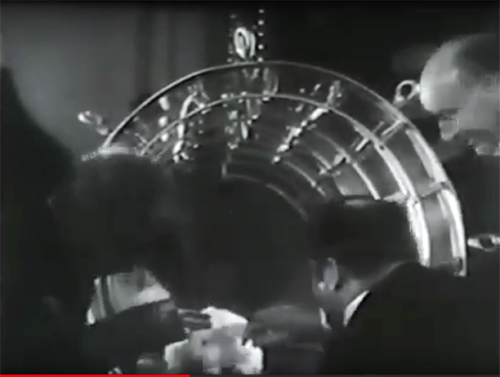
The film’s look is an example, I suppose, of what Andrew Sarris once called “Foxphorescence”–the signature of a studio that, from Murnau and Borzage to Ford and 1940s noirs, played host to dazzling pictorial effects.
Not completely naughty, but certainly a film about sexual jealousy, was Seed (1931), one of the most anticipated films of the Stahl cycle. It lived up to its reputation as a masterly orchestration of sympathies. At the center is a love triangle based on two women’s roles: the mother and the businesswoman.
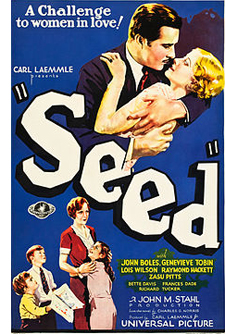 Aspiring author Bart Carter has given up his novel, and he lives–he thinks–happily with his wife Peggy and five rambunctious kids. When his old flame Mildred returns to the publishing firm Bart works for, she encourages him to keep writing and to stray from the household Peggy has made for him.
As often happens in Hollywood, the plot works only if the man is a jerk, and the action will set up things to make the woman take the blame. Mildred may not have schemed to pull Bart away from the start, but the shift in our sympathy to Peggy is pretty decisive. The film’s patient pace and stringently objective presentation lets contrasting feelings get developed gradually. The kids, particularly the whining runt of the litter, are annoying and troublesome. Mildred is no obvious predator, Peggy is trying valiantly to accommodate Bart’s ambition, and he’s enjoying his vacation from fatherhood while still struggling, albeit weakly, to stay loyal to his family.
Stahl was one of the major long-take directors of 1930s Hollywood, and Seed is exemplary in this respect. (The average shot lasts about twenty seconds.) His back-to-basics two shots, facing off characters in profile, become the default setting; there are scarcely any reverse angles or eyeline matches. This apparently simple creative choice, anticipating Preminger’s method of the 1940s and 1950s, puts all characters on an equal footing. The framings force us to concentrate on their conversation, avoiding the customary cuts that punch up particular lines or reactions. A similar steady observation is at work in Stahl’s fine Imitation of Life (1934) and Magnificent Obsession (1936).
1918 and all that
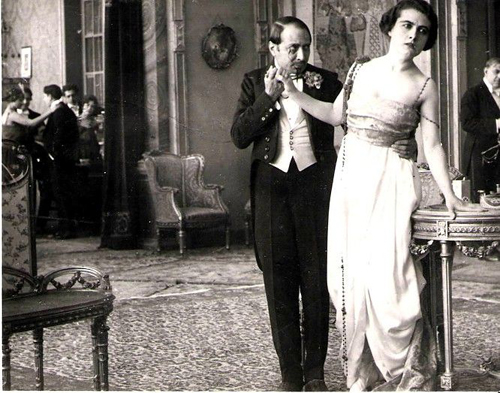
L’avarizia (1918). Production still.
Regular readers of this blog know that one area of my research is the stylistics of 1910s cinema in various countries. (Check the category tableau staging for a sample.) Naturally I dropped obsessively in on the 100-years-ago strands at this year’s Bologna. While there are more films to come, I found plenty to enjoy and think about in the first few days.
There was, for instance, Der Fall Rosentopf, a fragment of a farcical Lubitsch feature. Ernst plays his Sally character, now a detective investigating a flower-pot mystery. Lively enough, the surviving nineteen minutes from early scenes didn’t give me much sense of the whole.
Alongside it were two other comedies. Gräfin Küchenfee featured Henny Porten in a dual role, both countess and kitchenmaid. When the countess goes off to have fun, the maid assumes her identity. Eventually, the two women switch roles when the countess tries to evade police charges by pretending to be the maid. No less predictable in its comic situation was Puppchen, in which a young woman working in a fashion salon breaks a lifelike mannequin and must take its place. It may have been a model for Lubitsch’s Die Puppe (1919).
Stylistically, all these films were fairly staid, with little intricate staging, and they lacked analytical editing apart from axial cuts in and out. Their reliance on longish takes probably reflected the fact that US films, with their bold continuity editing, weren’t available in Germany until somewhat later.
One American film also rejected the emerging Hollywood style, in the name of naivete and fancy. That was Prunella by Maurice Tourneur. It doesn’t survive complete, and it’s been known for many years as a failed venture into artiness. The flat sets resemble children’s book illustrations, and the performance style is wilfully arch. I’ve never found Prunella very interesting, but it does offer further evidence that the 1910s harbored some eccentric and ambitious experiments.
Gustavo Serena’s L’Avarizia impressed me more. It too relies on frontal acting and axial cutting, but as a vehicle for the great diva Francesca Bertini it seemed to me completely engrossing.
As part of a series illustrating the Seven Deadly Sins, it offers a starkly symmetrical plot. Maria and Luigi love each other, but each is dominated by an old miser. Her aunt and his father each amass a fortune in secret while manipulating the young people. Through a series of conspiracies and misunderstandings, the lovers are flung apart. Maria, friendless and illiterate, sinks down, down into the bottom of society.
Each step of the way is given powerful expression by Bertini’s face, gestures, and bearing. She grabs her hair to yank her head back; she blows cigarette smoke in Luigi’s face to show her contempt for his abandonment of her. At one high point, when Luigi falsely accuses her of infidelity, she wrestles with him on a tabletop, giving no quarter. In a tavern fight she pulls a knife before falling to the floor, writhing feverishly in what appears to be her last moments on earth. This is silent opera, with the soaring melody carried by the body.
Up against the fourth wall
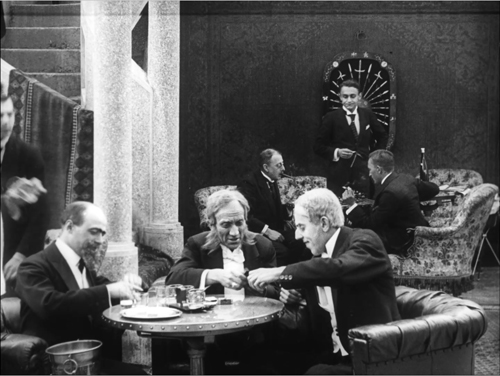
A meeting of the Antifeminist Club (The Oriental Language Teacher).
I wasn’t surprised to find a diva film full of sensuous appeals, but the big revelation of the 1918 cycle so far was the Czech comedy The Oriental Language Teacher (Učitel Orientálních Jazykû). It showed what you could do with a small cast, a few sets, and a cut-and-dried situation.
Sylva secretly falls in love with Algeri, who’s tutoring her in Turkish. After her father is being considered for a diplomatic post in Turkey, he decides to learn the language. He arrives during one of Sylva’s lessons, so she quickly disguises herself as an odalisque. Needless to say, Father is smitten with this exotic beauty. Add in his membership in the Antifeminist Club, led by a comic geezer who enjoys snapping clandestine photos of passing women, and insert deceptions involving a pianola roll, and you have some substantial complications.
Most striking from a pictorial standpoint were the very deep sets–modeled, stylistic historian Radomir Kokes tells me, on the Danish cinema of the period. The co-directors Olga Rautenkransovå and Jan S. Kolár present Sylva’s parlor in an unusual way. Most films of the period put foreground desks and tables at a diagonal bias. But here the father’s desk is thrust very close to us, perpendicular to the camera, and it runs the entire length of the frame.
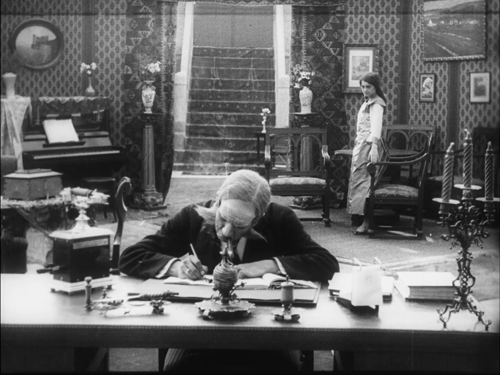
Moreover, the father is centered at his desk, when the more normal placement would set him to left or right and clear a space in the other half of the frame for other characters. The depth, that is, is typically horizontal. Here, though, it’s also vertical. A character must descend the stair directly above the other, in a maniacally centered composition that’s mildly beguiling in itself.
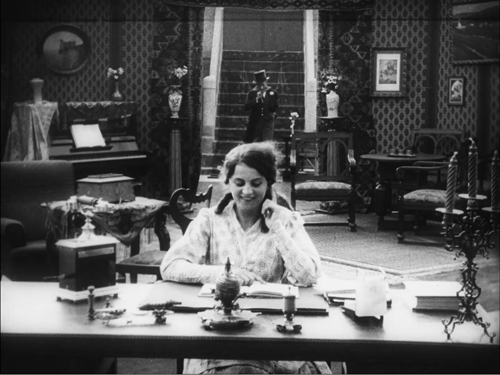
The set depicting Algeri’s studio is a little more typical of the period, since his desk is placed off to one side, but every shot of this setup makes the foreground area curiously out of focus.
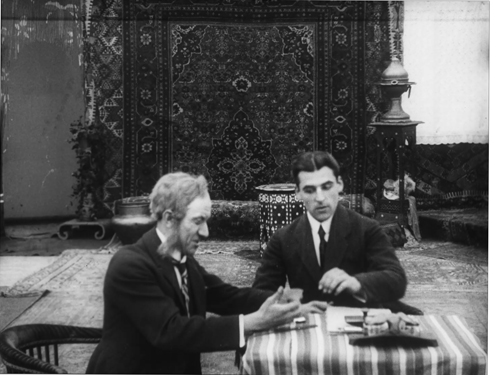
Given that the control of focus is precise in the parlor shots, the slightly fuzzy foreground of the studio set remains anomalous–an error, or a decision to differentiate the two spaces more sharply. In any case, here’s another example of how 1910s movies, from all corners of the world, can set you thinking about the possibilities of pictorial design.
More to come in the next entry, with a special focus on trial films.
Special thanks to Radomir Kokes for help with this entry. More generally, thanks to the Bologna leaders and staff for a tightly-run and ever-exciting event, along with the archivists who made these films available. In particular we owe a lot to Marianne Lewinsky, who curates the Cento Anni Fa series, and to Dave Kehr who, grinning, shares what he called on the first day MoMA’s “mildly obscure” treats. And Imogen Sara Smith gave an exceptionally lucid introduction to Seed.
For more on diva acting, see Ben Brewster and Lea Jacobs, Theatre to Cinema, a book available here, and this entry by Lea on Bertini. Kristin wrote about Prunella and other mildly experimental Hollywood films in Jan-Christopher Horak’s Lovers of Cinema collection.
For more on-the-spot pictures, check our new Instagram page.
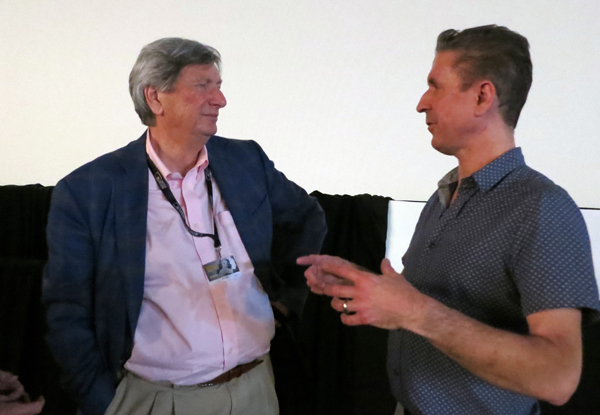
John Bailey, President of the Academy of Motion Picture Arts and Sciences, and Michael Pogorzelski.
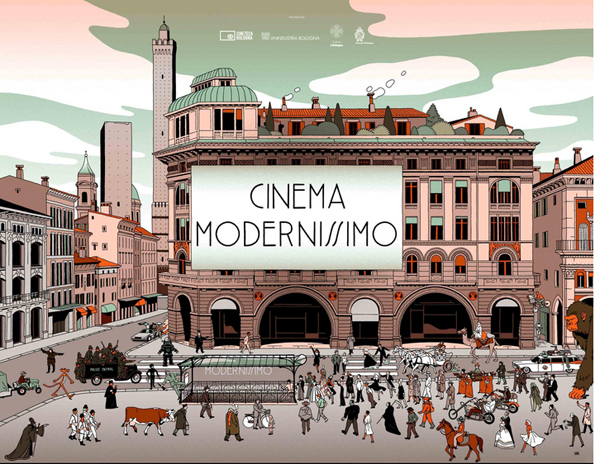
The very most modern classic film festival in the world
DB here:
Cinema Ritrovato of Bologna got off to a roaring start on Saturday. Or rather, Friday. Or maybe the previous Monday. It’s hard to keep up; the event sprawls beyond its official boundaries.
For five days before the official opening, there were one-off screenings on the vast Piazza Maggiore and in the more intimate Cineteca. Those evenings you could have seen Gilda or Raging Bull or Madame de… or an Ingmar Bergman documentary or Sacco and Vanzetti (1971), the last in the presence of director Giuliano Montaldo. On what may be final night (who knows?), next Sunday, the Piazza hosts a restored version of Grease. Did you know it needed restoration? Me neither.
The festival’s motto might be Too much is never enough. Over 500 titles now grace seven venues, if you count the Maggiore, a little piazza featuring carbon-arc projection, and an underground warren I’ll tell you about shortly. The fact that the latter is still under construction didn’t stop the newly established programming team from, of course, showing films there.
I’m here solo because household matters kept Kristin home in Madison. I’ll try to post some blog entries that suggest the sweep and depth of this festival, now more than ever the Cannes of classic cinema.
Under the sign of Scorsese

The Raging Bull screening was a tribute to a filmmaker who has always mattered to Ritrovato. One of the two auditoriums in the Cineteca is named for him, and under his auspices The Film Foundation has for years provided restored, often overlooked classics from outside the Western canon. Scorsese received a hero’s welcome yesterday, with an interview in the city’s biggest venue, the Teatro Communale and a Maggiore screening of Enamorada by Emilio Fernandez. Interestingly, the Foundation has provided restorations of Enamorada in both digital and photochemical formats.
I couldn’t cover either event; tickets to the conversation had long been sold out, and I was logy from jet lag well before Enamorada got going. I did, however, grab a few shots of the Piazza crowd before the screening. After twenty-plus years, I had never seen that huge space so jammed with people. An official shot of the event is at the bottom of today’s entry, and it shows only a fraction of the people assembled. A video record of Scorsese’s opening remarks is on the Cineteca Facebook page. It starts with a Mariachi band.
My day before the Scorsese blowout was more sedate than usual. I caught up with several friends in these early hours so as to have time before the big crunch comes later in the week. (There are now more evening screenings than ever before.) I went to The Brat, a 1931 John Ford I’d seen before in a so-so copy. The film is minor Ford but enjoyable for its comic vignettes in a night court, a wild sequence on a swing reminiscent of Wings, and an ingratiatingly scratchy-voiced performance by Sally O’Neill. Helping the film along was the newly refitted venue, the Jolly, now cooler and more comfortable.
I had time as well to re-see another 1931 title, the restored Jean Grémillon short feature Daïnah la métisse (1931). It’s a stunningly shot drama of a black couple traveling on a swanky French liner. Recut after production for reasons not altogether clear, it still retains enormous power. The gleaming cinematography sets off three areas of the ship: the lavish dining room with its big dance floor, the dark, cavernous engine room, and the misty deck where sexual teasing leads to murder. The film’s bold use of sound–a song track, pulsing engine noises, and passages of dead silence–remind us of how adventurous early talkies could be.
Movies under the Piazza
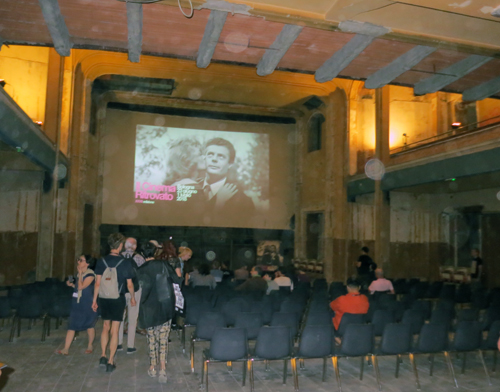
The Modernissimo cinema was built in 1915 and underwent renovation in the 1950s and 1960s. It was split into two parts, and the underground section is the one that is being renovated for contemporary use. The Ritrovato team has found funding to create it as another venue for festival screenings, and on Saturday they admitted a batch of us to check on progress and see a serial.
It’s a very big, raw space, with a balcony and side boxes. The seating isn’t ramped; we’re all on the same level, but the high screen compensates for sightlines. Naturally I sat in the front, so no problem there.
The film, the first installment of Wolves of Kultur (1918, Joseph A. Golden) was nothing to write home about artistically–plotters steal the plans for a supertorpedo–but it was fun and well preserved, with nice tinting. Marianne Lewinsky’s program notes promise that later episodes will be more enticing; she calls it a Kama Sutra of serial conventions.
Some of the design plans for the cinema can be found here. Here are two of my shots from Saturday.
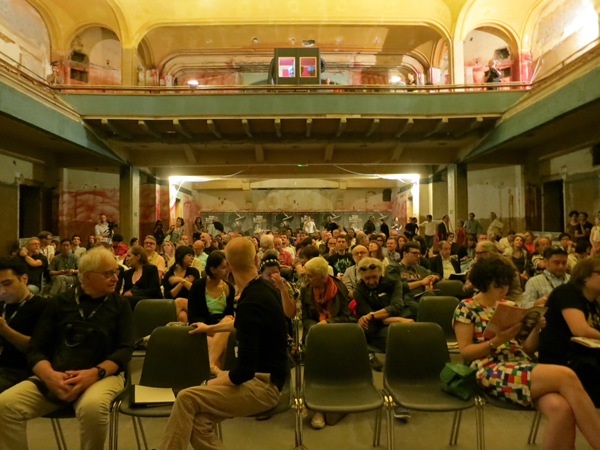
I have more to report, but I’ll save that stuff for entries later in the week. In addition, thanks to digital whiz Erica Moulton we’ve just set up an Instagram site here. It already has shots I haven’t included in this entry. I’ll try to post pix throughout this wild and crazy event.
A special thanks to the Directors of this year’s Ritrovato–Cecilia Cenciarelli, Gian Luca Farinelli, Ehsan Khoshbakht, and Marianne Lewinsky–and festival Coordinator Guy Borlée, as well as to all their programmers, consultants, and staff. They pull off a magnificent, epic event every year.
The Scorsese and Piazza Maggiore photos are by Lorenzo Berlando.
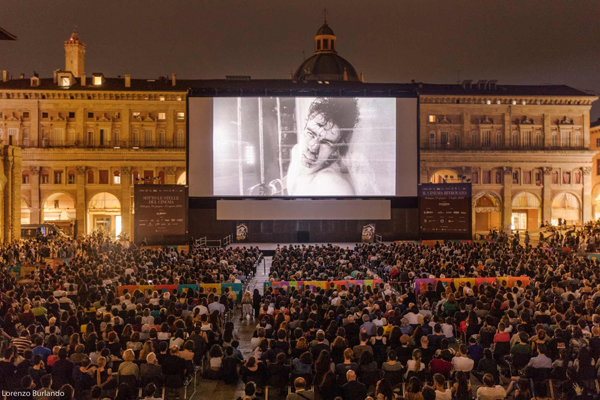
Piazza Maggiore Saturday night for the Scorsese presentation.
The pawns

Photo: JERRY LARA / San Antonio Express-News.
David here:
Should there be any doubts that the US is moving toward a fascist coup, events of the last two weeks should have dispelled them. Trump broke with our European and North American allies. He reconfirmed his loyalty to Putin and Kim. He launched an international tariff war. And now he and his Gauleiters Jeff Sessions and Stephen Miller have created, more or less in the open, concentration camps for children.
(Let’s remember that “concentration camps” were not necessarily conceived as “death camps.” They were areas in which a rounded-up population were “concentrated” for further state-imposed processing.)
What has held back the tide of full-blown fascism? The media, elite or grassroots, have done their duty with surprising vigor. I noted last year that reporters were starting to spotlight the lies of the Trump administration, and now even the gray old Times ventures a “falsely” or two. Without the leaks, analyses, and exposés, we wouldn’t know about the camps, the scandals, the moral vacuity of Congressional Republicans, the dissolution of regulations on corporations, the palace intrigues of corrupt advisers, and the depredations of a president™ elected by a margin of 77,000 imbeciles’ votes.
The courts, at least those not yet supervised by Trump appointees, have pushed back as well. In tandem, the Mueller investigation plows methodically on, bringing to light a cast of characters whose intellectual endowment makes the wise guys in Gotti look like particle physicists.
Still, the Base (well-named) is getting a new reality show. Trump campaigned by winning every day’s news cycle; he provoked coverage and reaction, which allowed him to holler back, raise the stakes, and keep everything going. The immigration drama is the new main attraction. Many will glory in watching the stupendous power of the US being inflicted on toddlers and mothers in blazing heat.
The Base embraced Trump for “telling it like it is”–that is, venting the vileness that minimal civil courtesy kept in check. But they’re not deep thinkers. One could tell the Base that there’s a difference between asylum and illegal immigration, and that crossing the border without permission, legally speaking, is a misdemeanor comparable to a traffic ticket. One wonders if the Base even recognize the difference between legal and illegal immigration. In addition, huge sectors of the economy (agribusiness, construction, meat packing, hoteliery) depend on immigrant workers, including illegals, willing to perform jobs that the Base prefers to avoid, at least at the wages offered by cynical employers. But informing the Base about such nuances would run against the grand plan to homogenize our country–and expand the Base.
This coup is proceeding fairly quickly. Hopes that November 2018 could turn things around seem to me overoptimistic. A lot can be wrecked in a few months. And if Trump and his party can do anything, they can win elections, somehow. The Democrats, as usual, fumble and flounder and dissipate their energy through internecine quarrels. Maybe they should devote less energy to asking me for money and more to explosive, top-of-the-voice outrage on any forum they can seize. Trump provokes emergencies; his opponents should go ballistic. Call it the Alan Grayson tactic. (Remember his summary of the Republican health-care plan: “Die quickly.” We remember it because it hit home, and proved prophetic.)
Trump is the culmination of Republican conservatism from Goldwater to Reagan to Gingrich, intensified by the Tea Party franchise. The proof lies in Trump’s easy victory over his rivals and his swift takeover of Congress. Similarly, the dithering of the Democrats is a direct result of their shift toward defending the urban meritocracy of Wall Street and Silicon Valley. (On this, Thomas Frank’s Listen Liberal is the essential text.) That bias found its initial focus in the Clinton regime, and it was continued by Obama. One beguiling sideshow of recent weeks was the reappearance of Bill, talking about the Lewinsky affair and revealing himself, once again, as devoid of any scrap of personal honor.
I’d like to be more hopeful. It’s possible that Sessions, Miller, and Trump have overplayed their hand. Even some Bible thumpers have drawn the line at wailing children, and the hicks are starting to notice that they need immigrant labor and that tax cuts don’t offset trade wars. Some voters may realize that Trump and the Republicans want to take away favored stretches of the Affordable Care Act. Trump has counterpunched on the immigrant issue, but he may well find a way to back down while declaring victory. As I type this, Senate Republicans are engaged in damage control.…at the very moment that they propose cutting Social Security, Medicare, and Medicaid to pay for the income tax cuts. Perhaps the base will notice.
But don’t bet on it. Overall support for Trump is solid, perhaps swelling, and not just among his core, the gun fondlers and the white supremacists. CEOs like the deregulation, the holy rollers favor humans in fetus form, the exurbanites savor the punishing of the people who were the reason they feared the city, and the peckerwoods just like to chortle at liberal outrage. Quite a coalition. Indeed, you could treat the border crisis as a massive get-out-the-vote effort aimed at that mob. Like what you see? Vote Republican!
Moreover, the increasing authoritarianism of Trump’s demeanor suggests that each day brings a new power grab. He will likely be boosted by a passive Republican congress and Democrats who are perpetually concerned, disturbed, and brow-furrowed but never, somehow, furious. So we can’t assume that he won’t keep trying to expand on his brutal impulses.

Two last thoughts.
(1) Trump continues to show himself a coward. When he met with Mexico’s president during the campaign, he didn’t dare to raise the demand for a wall. Meeting dictators in the Middle East and Asia, he bowed and scraped. Now, flexing his muscle on kids, he and his minions tell half-a-dozen different stories about the HHS policy rationale and deploy John Kelly’s puppet Homeland Security Secretary Kirstjen Nielsen (above) to fend off the press with smirking lies. Trump himself will not confront his critics, playing only to Fox News toadies and multitudes of simpletons jammed into rallies.
(2) 2016 was, we now realize, an outsider election. Bernie could have won. But even if he had lost, wouldn’t it have been worth the risk?
The crematorium is no longer in use. The devices of the Nazis are out of date. Nine million dead haunt this landscape. Who is on the lookout from this strange tower to warn us of the coming of new executioners? Are their faces really different from our own? Somewhere among us, there are lucky Kapos, reinstated officers, and unknown informers. There are those who refused to believe this, or believed it only from time to time. And there are those of us who sincerely look upon the ruins today, as if the old concentration camp monster were dead and buried beneath them. Those who pretend to take hope again as the image fades, as though there were a cure for the plague of these camps. Those of us who pretend to believe that all this happened only once, at a certain time and in a certain place, and those who refuse to see, who do not hear the cry to the end of time.
Jean Cayrol’s text for Night and Fog (1955)
P.S. 20 June: Odd that people who decry Big Government would undertake a massive enterprise like setting up a refugee camp. But the point is to do it badly, like the Katrina debacle and the tragedy of Puerto Rico. The bureaucratic failures to track parents and children who are separated are not only predictable but part of the package, a feature not a bug. Remember the Republican slogan: “Government doesn’t work. Elect us, and we’ll prove it.”
Some anecdotal confirmation that this round-the-clock spectacle is exactly what the White House wants comes in this Vanity Fair piece. Predictably, Stephen Miller is having the most fun of all.
Meanwhile, as the border crisis spirals, the absence of a coordinated policy process has allowed the most extreme administration voices to fill the vacuum. White House senior policy adviser Stephen Miller has all but become the face of the issue, a development that even supporters of Trump’s “zero-tolerance” position say is damaging the White House. “Stephen actually enjoys seeing those pictures at the border,” an outside White House adviser said. “He’s a twisted guy, the way he was raised and picked on. There’s always been a way he’s gone about this. He’s Waffen-SS.”
What pimply pre-teen would have imagined that de-pantsing little Stevie on the playground would have had such consequences?

Newlyweds Donald Trump Sr. and Melania Trump with Hillary Rodham Clinton and Bill Clinton at their reception held at The Mar-a-Lago Club in January 22, 2005 in Palm Beach, Florida. (Photo by Maring Photography/Getty Images/Contour by Getty Images)



