




Archive for the 'Film comments' Category
The Oscars’ Best Picture and other Best Picture
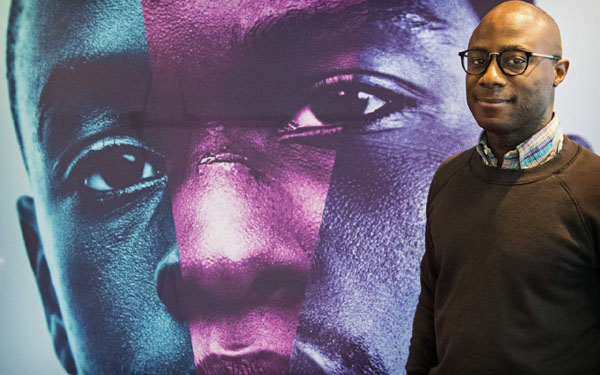
Barry Jenkins
Kristin here:
No, I’m not referring to the mistake that led to two different titles being read out as Best Picture recipients in the chaotic final minutes of this year’s broadcast of the Academy Awards. That error has drawn huge amounts of attention from the media. But other more interesting aspects of the pattern of winners have been largely ignored.
The explanation for the mess-up has turned out to be that there are two duplicate stacks of those sealed and highly guarded envelopes, one on either side of the stage, so that presenters can be handed whichever envelope they are supposed to have, with the duplicate one on the other side being discarded. Apparently one of the PwC (formerly known as PricewaterhouseCooper) partners was so gobsmacked by seeing Emma Stone backstage at the ceremony that he was more concerned to tweet a photo of her than to make sure that the duplicate envelope for her category got removed from the stack on the side of the stage he was tending. Still being atop the stack, it ended up being given to Warren Beatty and Faye Dunaway, who were to announce the Best Picture winner.
This image is deleted but not forgotten.
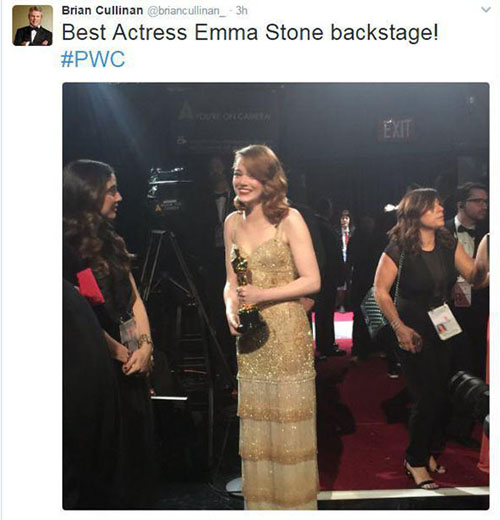
Well, there’s a simple remedy for the problem. Have all the presenters enter from the same side (the winners all exit toward the same side, after all) and have just one set of envelopes with two people keeping track of them in case one gets starstruck.
Beyond the kerfuffle
But more interesting to me was the rather odd imbalance in the awards for the top winners. La La Land was widely expected to garner Best Picture, and it won in six of its potential thirteen categories. (Two of its songs were nominated and competing against each other, so the film could not have won on all fourteen nominations.) Those included some pretty important categories: Best Actress, Director, Cinematography, Score, Song, and Production Design. Moonlight won three out of its eight nominations: Best Picture, Supporting Actor, and Adapted Script.
It seemed to me that we have seen other similar results in recent years, and the reason is clearly political. For decades the assumption was the the Academy consisted of members of the filmmaking profession awarding each other statuettes on the basis of technical and artistic excellence. Aesthetic criteria ruled, though the middlebrow tastes of a lot of the Academy members tended to fasten on quite conventional sorts of mainstream films.
The movies that won Best Picture were typically serious items made by the big studios. Historical epics (Gladiator, Titanic), biopics (A Beautiful Mind), dramas (The English Patient, American Beauty), auteur pictures (No Country for Old Men, The Departed), and the occasional relatively lightweight item somehow steamrollered through by Harvey Weinstein (Shakespeare in Love, The King’s Speech). Genre films might get nominated but they seldom won. The Lord of the Rings astonished fans by actually receiving seventeen Oscars over three annual parts, including Best Picture for The Return of the King.
Most of the nominated films were noted neither for their diversity of characters and cast nor for their progressive politics.
In recent years, however, the political implications of filmmaking and the Oscars have become far more high-profile. The country has paid the price for electing its first black president by witnessing the surfacing of a racist backlash so extreme that few would have believed it possible. The shooting of Michael Brown by police in Ferguson, Missouri in 2014 and the events that followed called attention to a blight that has stayed with us, the needless killing of black men and boys and women, with the officers involved seldom being charged with any crime. The hugely unfair incarceration rate of black people. The horrendous rise in attacks against virtually any non-white, non-Christian group in this country unleashed by the “election” of T***p. And the concealment of widespread domestic terrorism, which in body counts (including those of peace officers) far outweigh the purported threats from the Middle East.
The result, I think, is a greater consciousness of political content, and specifically progressive content, among the Academy members. Three times in the past four Oscar presentations, there have in a sense been two winners. One film is judged more on the technical and artistic grounds and given a larger number of awards but not Best Picture. Another film with an important political theme at its core receives a distinctly smaller number, including Best Picture. The practice seems to imply that the voters want to give the top award to two films, and they have somehow collectively found a way to do so.
Three recent examples
The first of the three split decisions was for the 2013 releases, when Gravity was up against 12 Years a Slave. Despite being in the science-fiction genre, Gravity (here and here) was so innovative and sophisticated in the technology that created such a perfect illusion of outer space that it won seven of the ten categories in which it was nominated. These were Director, Cinematography, Editing, Score, Sound Editing, Sound Mixing, and Visual Effects.
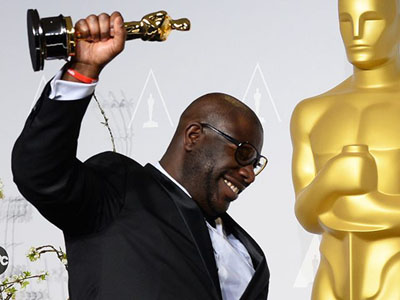
12 Years a Slave, made by an established and respected black director, Steve McQueen (above with his producer’s Oscar), was nominated for eight Oscars and took three: Best Picture, Adapted Screenplay, and Supporting Actress, for Lupita Nyong’o. The implication seemed clear. A film could be best because it was so well made or best because its content was so politically important. Which is not to say that a single film could not be both, and that may well happen.
It’s also not to say that 12 Years a Slave and the other politically oriented films I mention in this entry are not well made. Any film that achieves the rarefied heights of Oscar nominations is likely to be very well made. The politically daring films, however, tend to be indies with relatively small budgets and hence less access to complex technology and fancy sets and costumes. The big studios that do have such access are not exactly noted for the daring ideology of their releases. (The recent fuss over the fact that a Disney film, the upcoming live-action Beauty and the Beast, has a gay character in it is testimony to that.)
The same thing did not happen in 2014, when Birdman won Best Picture, as well as Director (for a Latino, Alejandro Iñárritu), Original Screenplay, and Cinematography. The main politically oriented film nominated for Best Picture was Ava DuVernay’s Selma, which won only in its one other category, Best Song. One might also want to put The Imitation Game, with its gay protagonist, into the political category. It was nominated in eight categories, winning only Adapted Screenplay. This was the year when the paucity of black nominees led BroadwayBlack.com managing editor April Reign to launch #OscarsSoWhite. The protest and its hashtag became more prominent in response to the lack of African American nominees from 2015 films. The Academy responded with some changes to its membership and rules.
The 2015 Oscars made the divide between the two “best pictures” clearer. The action film Mad Max: Fury Road was both widely praised and popular, and surprisingly enough, it won in six of its ten nominated categories. These were Costumes, Editing, Makeup/Hairstyling, Production Design, Sound Editing and Sound Mixing. It lost Best Picture, Director, Cinematography, and Special Effects.
Spotlight, with its focus on sexual abuse by Catholic priests, was nominated for six Oscars and won only two: Best Picture and, as inevitably happens in the cases of political films, Original Screenplay. It lost Director, Supporting Actor, Supporting Actress, and Film Editing. With a genre film and a political one both rewarded, the Academy also honored a more traditional prestigious drama and gave The Revenant Best Director, Actor, and Cinematography.
Then came Moonlight in 2016, with its combination of black and gay subject matter, to broaden the Oscars’ horizons even further. (The other film directed by a black actor, Denzel Washington, who was not nominated in that category, won Best Supporting Actress for Viola Davis.)
How did we get here?
This pattern is not entirely new. It’s just happening more frequently and obviously. It has been creeping up on us for a little over a decade now. The prominence of a politically based set of awards began to emerge, I suspect, in 2005 with Brokeback Mountain (bottom). It received eight nominations, including Best Picture, and won Director, Score, and Adapted Screenplay. It was widely perceived to have lost the top award to Crash because of opposition to its gay subject matter. Crash, which dealt with race relations in a way that divided critics and audiences, won Best Picture, Original Screenplay, and Film Editing.
To some extent Juno, nominated in 2007 for Best Picture, Original Screenplay (its only win), and Actress, fits into the political pattern, with its focus on abortion. It straddled the liberal line, with the heroine deciding against abortion but the film treating this as a matter of choice. No Country for Old Men won Best Picture as well as three other awards among its eight nominations: Director, Adapted Screenplay, and Supporting Actor (a Spanish actor, Javier Bardem playing a character who might be Mexican).
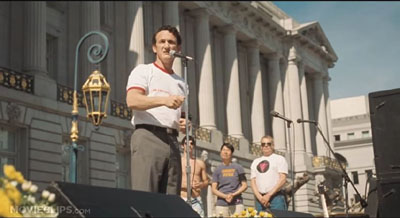
The political nominee in 2008 was Milk (above), with its sympathetic gay theme. Of its eight nominations, it won Best Original Screenplay and Actor. By then the association of a best-screenplay award with a liberal (or semi-liberal) film was firmly in place. Slumdog Millionaire took Best Picture and eight other Oscars.
2009 was the year when the Academy extended the Best Picture category to a potential ten, the idea being to boost the ratings of the television broadcast of the awards ceremony. Supposedly, now blockbusters would be nominated alongside the more prestigious dramas, biopics, and indie breakout films. (In practice, only 2009 and 2010 saw ten nominations. There were nine in 2011, 2012, 2013, and 2016, and eight in 2014 and 2015.) To some extent that plan worked, with Avatar gaining a nomination. There was also room for animated films, with Up being nominated in both Best Picture and Animated Feature categories (as Toy Story 3 was in 2010).
But as one would expect, small indie films, some of them politically oriented, filled out the list. One of them, The Hurt Locker, had grossed just under $50 million worldwide, compared with Avatar‘s nearly $2.8 billion (still the highest-grossing film of all time). The Hurt Locker was an anti-war film, but the main political punch to the broadcast was the question of whether Kathryn Bigelow would become the first female director of a Best Picture winner–with the added spice of her most obvious competitor, James Cameron, being her ex-husband. She did.
That same year, however, another film more closely fitting the political pattern was nominated: Precious, with six nominations including Best Picture. It was the first of these socially-conscious films to deal primarily with African American characters, and although it did not win Best Picture, it received the by-then-familiar consolation prizes of Best Adapted Screenplay and Supporting Actress (with a standing ovation for Mo’Nique when she took the stage to pick up her Oscar). Would Precious have been nominated for Best Picture without the newly capacious category? It’s anyone’s guess.
The pattern did not continue for the next few years. The Kids Are All Right, with its lesbian central couple, was the closest that the 2010 Best Picture nominees had to a political contender. It was nominated for the established categories: Best Picture, Original Screenplay, Supporting Actor, and Supporting Actress. It won none of them. 2011 saw The Help, with a mixed black and white cast, get nominated for Best Picture, as well as Actress (Viola Davis’ first nomination) and two competing Supporting Actress nods (Octavia Spencer won the film’s only Oscar over Jessica Chastain). Harvey Weinstein again triumphed with The Artist, which won Best Picture, as well as Director, Actor, Costume, and Original Score of its original ten nominations.
For 2012, two black-themed films were nominated for Best Picture. Beasts of the Southern Wild garnered three additional nominations with no wins: Director, Original Screenplay, and Actress. Django Unchained got four other nominations, winning Original Screenplay and Supporting Actor. Argo won Best Picture, Adapted Screenplay, and Film Editing out of its seven nominations.
Then 2013 brought the win for 12 Years a Slave.
Perhaps it’s just a coincidence that in recent years we have seen three politically daring films win Best Picture while only gaining one or two other awards. As with political films from Brokeback Mountain on, those awards tend to include one for the screenplay, adapted or original, as if the voters are trying to emphasize that the film is important primarily because of its subject. There is usually an acting award as well, more often in a supporting role. Interestingly Hidden Figures, which didn’t win any Oscars, was nominated in those same three categories: Best Picture, Adapted Screenplay, and Supporting Actress.
Will Academy voters continue delicately dividing the awards in order to stress the importance of two films? The tactic tends to give a bunch of awards to a very popular film and a few–including the most prestigious one–to a film that the voters are in effect encouraging more people to see. There’s something to be said for doing so.
Politics and the foreign-language Oscar

For a long time it was assumed that this year the German comedy Toni Erdmann had this category sewn up. Then, T***p signed his first anti-Muslim immigration ban just a few days after the Oscar nominations were announced. Iranian director Asghar Farhadi’s The Salesman was in the list of foreign-language nominees. (He had previously won in the same category for A Separation in 2011.) Farhadi announced that in protest of the ban, and probably through legitimate concerns that he would not be admitted to the country, he would not attend the Academy’s ceremony. Speculation began to circulate that Academy members might vote for his film in solidarity. The Salesman won the Oscar, though to what extent this was a move by those members against the ban is unclear. I personally enjoyed and admired Toni Erdmann, but I consider The Salesman a better film.
As film critic Bilge Ebiri has pointed out, strongly political foreign films have not typically won in this category. Still, voting rules have changed:
Academy members get screeners in the mail, and they need not prove that they’ve seen all, or in fact any, of the nominees before they send their ballots. That could mean a surge of people voting for The Salesman simply because they’re looking to stick it to Trump.
But there might be more far-reaching implications for a Farhadi win. The Muslim world has undergone a filmmaking renaissance in recent decades. Much of this began with the work of Iranian directors in the 1980s and ’90s, but it has since expanded to the rest of the Middle East and North Africa. For many years, Oscar failed to recognize these works. Abbas Kiarostami, who died in July, was the most important figure of the New Iranian Cinema and an undisputed giant of international film but notably was never nominated.
Slowly, however, the Academy has been noticing. Last year, Turkish director Deniz Gamze Erguven’s Mustang, about the plight of young women in Turkey, was a nominee (albeit as a French submission) alongside Jordanian director Naji Abu Nowar’s gripping World War I drama Theeb. During the past decade, directors including Palestine’s Abu-Assad and Algeria’s Rachid Bouchareb have vied for statuettes multiple times. And the more visible people are, the harder they become to demonize.
In that sense, a win for Farhadi would mean more than just a repudiation of a specific presidential decree. It would help to push further into the spotlight a cultural revolution that has been happening for years now. In doing so, it would be the ultimate assertion of a people’s humanity. And sadly, we now live in a world where that indeed is a political act.
The fact that for a time Iran had one of the most exciting national cinemas in the world has remained largely overlooked, even by many admirers of foreign cinema. I don’t have much hope that that tradition and the more recent films of directors like Farhadi and Jafar Panahi will become widely known. Still, some people will take note. Watching the great Iranian films of the past few decades would reveal the humane, touching stories that their makers tell–and watching Middle Eastern films in general could, as Ebiri says, remove the knee-jerk demonizing of people from that region. After all, the vast majority of Muslims fear and hate the extremists and terrorists as much as anyone else does.
The Oscars are not all that important in the larger scheme of things. In recent years they have been increasingly hyped, and media chatter about them has become a year-round phenomenon that drives out a lot of serious news about the film industry. (It’s cheaper to have an employee watch some films and go on and on about their Oscar prospects than to finance them going out and reporting on things.) Only the naive think that the actual best films made in the world in any given year get the Oscars.
But clearly the Oscars do matter to people who are trying to use them as a tool to pressure the industry into introducing more diversity into the kinds of subjects that provide stories and into the range of people who work in front of and behind Hollywood’s cameras. It seems to be affecting the industry to some extent, at least for African Americans. Now, can it work for other under-represented groups? For discussions of that question, see Variety‘s post-Oscars coverage here and here.
March 13: Thanks for Ivan Nunes for a factual correction.
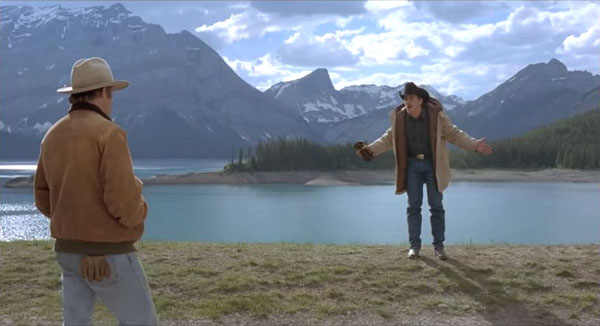
Brokeback Mountain
Waldo Lydecker, James Schamus, and 1910s movie storytelling
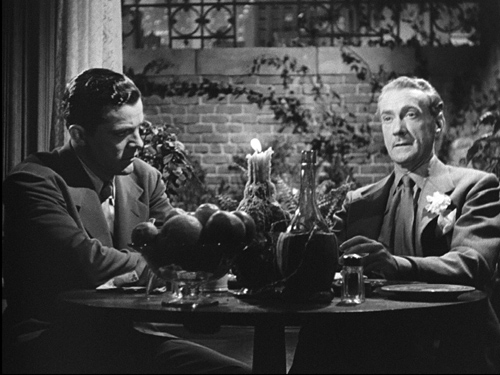
Laura (1944).
DB here (in DC):
Over the next two weeks I’m involved with several events during my stay at the John W. Kluge Center of the Library of Congress. If you’re near Washington, do consider coming to one or all of these doings.
First up is a screening of a sparkling restored print of Otto Preminger’s Laura (1944), at the gorgeous Packard Campus Theater in Culpeper, Virginia on 8 March. The show, a new addition to the Theater’s spring schedule, starts at 7:00 pm, a half-hour earlier than the customary time. I’ll be giving a brief introduction.
On the following Monday, 13 March, the Kluge Center will host “James Schamus on Philip Roth and the Art of Adaptation.” After a screening of James’s directorial debut Indignation, he will participate in a discussion with the audience. I’ll play moderator. The event will take place at 3:00 pm in the Pickford Theater, on the third floor of the Library’s Madison Building, 101 Independence Ave. S.E.

James, professor at Columbia and producer and writer of many important American and Chinese films, needs no introduction to this blog’s readership. (Above, he’s with frequent collaborator Ang Lee.) We’ve celebrated his work here, and I discussed the admirable Indignation just last summer. This upcoming session should be an exhilarating afternoon.
Lastly, I’m giving a talk, “Studying Early Hollywood: The Search for a Storytelling Style.” It develops some of the issues I’ve floated in my books, other lectures, this video lecture, and most recently this blog entry. The talk is set for 4 pm. on Thursday, 16 March. It takes place in room 119, a magnificent venue on the first floor of the Library’s Thomas Jefferson Building, 10 First St. S.E.
All these events are free and open to the public, and you don’t need tickets.
Being at the Kluge Center has been very stimulating, and my research into 1910s visual style has benefited hugely from access to the LoC’s film collections. These three events are wonderful ways to wrap up a stay that has gone by all too fast. If you’re in the vicinity, come by and say hello.
Thanks to the many people who have made these events happen: At the Kluge Center Ted Widmer, Mary Lou Reker, Dan Turello, Travis Hensley, and Emily Coccia; at the Packard Campus Greg Lukow, Mike Mashon (initiator of many things), and David Pierce.
More information on the Packard Campus Theater is here. A summary of James’s vast career is here.
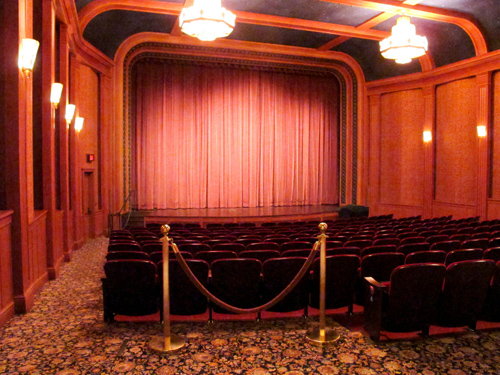
The Packard Campus Theatre. Photo by Glenn Fleishman.
Anybody but Griffith
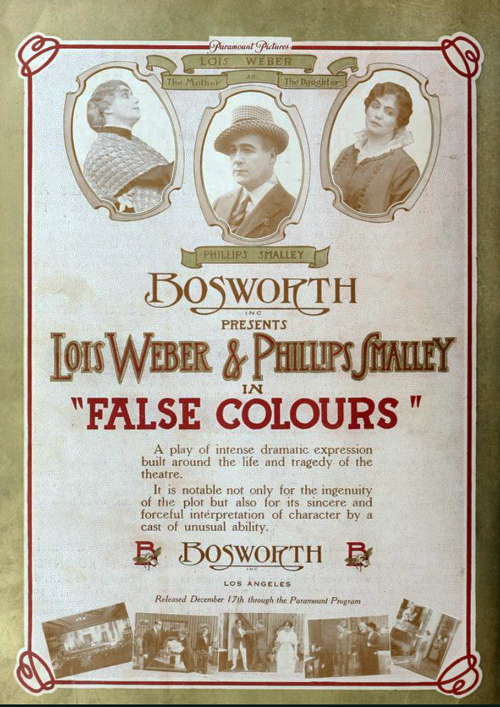
Motion Picture News (19 December 1914), 148.
DB here:
For almost two months, I’ve been in Washington, DC at the Library of Congress. The John W. Kluge Center generously appointed me Kluge Chair in Modern Culture. This honor has enabled me to work with the enormous collection of the Motion Picture, Broadcasting and Recorded Sound Division to sustain my research in American narrative cinema of the 1910s.
I wanted to go more deeply into an area I mapped out in the video lecture, “How Motion Pictures Became the Movies” and in the books On the History of Film Style and Figures Traced in Light. The general question was: How did the norms of storytelling technique develop between 1908 and 1920? More specifically, I hoped to trace out an array of stylistic options emerging for the feature film. What range of choice governed staging, framing, editing, and kindred film techniques?
Theatre, but through a lens; painting, but with movement
If you’ve seen that lecture, or just followed this blog from time to time, you know that I’ve sketched out two broad stylistic trends operating at the period. One, celebrated as a breakthrough for a hundred years, involves the development of continuity editing. That trend was explored by several historians of early film, including Kristin in the book we did with Janet Staiger, The Classical Hollywood Cinema: Film Style and Mode of Production to 1960.
Critics and historians who saw editing as the essence of cinematic technique called the second trend “theatrical” and regressive. Directors in that trend supposedly simply planted the camera in one spot and let it run, recording performances and not bothering to cut up the scene into closer views. This “tableau” tradition was superseded by an editing-based style–and, many thought, a good thing too.
Over the last twenty years, however, scholars have reappraised that apparently static and passive camera. Lea Jacobs and Ben Brewster’s trailblazing book, Theatre to Cinema: Stage Pictorialism and the Early Feature Film (1997) traced film’s many debts to theatrical plotting, set design, and especially performance. In a parallel series of articles, Yuri Tsivian proposed that the “precision staging” of the 1910s had deep affinities with traditions of painting and visual culture. Lea, Ben, and Yuri showed that the tableau tradition offered rich creative choices to filmmakers.
For my part, I was concerned to explore how ensemble staging worked in a moment-by-moment fashion to call the viewer’s attention to key aspects of the action. Editing does that by cutting to closer views. In the tableau method, emphasis arises from composition, movement, and other pictorial strategies.
In light of all this research, it seems clear that during the 1910s the tableau strategy developed into a powerful expressive resource. After Figures Traced in Light (which found the tradition still alive in directors like Angelopoulos and Hou), I continued to collect examples of creative staging at this early period. The results led me to analyze films by Yevgenii Bauer, Danish directors, and other Europeans.
 Evidently the tableau persisted until 1920 or so in Europe, especially Germany, but the editing-centered option had already become dominant in America. But how long, and in what ways, did tableau methods hang on in the US? Or was the switchover quite quick? By 1917, Kristin had posited, continuity editing had crystallized as the primary storytelling style. I thought I’d try some depth soundings of the period.
Since my time was limited, I had to focus. Charlie Keil’s superb Early American Cinema in Transition: Story, Style, and Filmmaking 1907-1913 (2001) analyzed a great many films of that phase in depth, particularly with respect to editing techniques. So I thought I’d start with 1914 and simply try to see as many features from that year as I could. I then would sample items from later years. My only rule was to watch films that aren’t part of the canon–no Griffith, Chaplin, Fairbanks, Pickford, Fatty et al. I did, however, try to see rare things by Lois Weber, Reginald Barker, and other well-regarded filmmakers.
What did I come up with? I’m still watching and thinking, but let me share a few items that excite me. Clearly, despite plenty of audacious editing, the tableau technique was alive and well in America in 1914-1915. And the more I see, the more I’m inclined to rethink the terms under which I value Mr. D. W. Griffith.
Tableau trickery
A simple illustration of how a fairly distant tableau can vividly guide our attention shows up in The Case of Becky (1915), directed by Frank Reicher.
Before an audience, the sinister hypnotist Balsamo hypnotizes Becky. From a deck of cards he has selected the ace of hearts, and in her trance she has to find it. There’s almost no movement in the frame: Balsamo stays frozen, as does Becky, except for her one hand flipping over the cards.

No need for a close-up: With Balsamo as still as a statue, every viewer will be watching that tiny area of the screen occupied by her hands, and we wait for her to find the ace. When she does, Balsamo accentuates her minimal gesture by twisting his arm and freezing into another pose.

Is this, then, simply filmed theatre? Not really. First, many tableau framings, like the Case of Becky instance, put the actors closer to us than stage performers would be.
Just as important, the perspective view of the camera yields a chunk of space very different from that of proscenium theatre. In cinema, for instance, depth is more pronounced, and actors can be shifted around the frame to block or reveal key information. This isn’t pronounced in the Case of Becky example because the two characters are more or less on the same plane and the background is covered by curtains. But consider this shot from The Circus Man (1914), by Oscar C. Apfel.
The circus owner Braddock has been sent to prison for murder and attempted robbery, a plot engineered by Colonel Grand. Now Braddock has served his sentence, and in a scene too complex to trace entirely here (but maybe in a later entry), he bursts in past the butler to confront Grand. Here’s what we see.

Such a scene would be inconceivable on the stage because of the audience’s sightlines. People sitting in the left side of the auditorium couldn’t see Braddock’s entrance, because he’d be concealed by Grand, who’s standing in the foreground left. Audience members on the right side of the auditorium couldn’t see Braddock either, because Mrs. Braddock and David are standing on the right foreground.
The shot makes sense from only a very limited number of points, only one of which is occupied by the camera. Maybe a few people in the center of the theatre would have a fairly clear view of such an action, but as we’ve seen with The Case of Becky, they wouldn’t be so close to the players.
The sheer fact of optical projection means that cinematic space is narrow and deep, while stage space is broad and (usually) fairly shallow. On the stage, players tend to be spread out laterally, allowing for many sightlines. Cinematic staging can be deep and diagonal.
On the other hand, the tableau shot isn’t perfectly analogous to a painting. While the lens chops out a perspectival pyramid in three dimensions, the movement in the frame creates a two-dimensional flow–a cascade of planes and edges very different from what we’d get in a painting. This flow can be used to reveal or conceal bits of space as the action develops.
You can see this compositional flow clearly in an earlier phase of the Circus Man sequence. Before Braddock bursts in, David has been arguing with Colonel Grand in the foreground. David’s and Grand’s heads occupy the area that Braddock will soon claim. Just before that entrance, Mrs. Braddock pulls David back a bit to the right, and Grand recoils fractionally to the left. This creates a hole that Braddock can come into (as above).



This sort of slight shifting is akin to what we see in the astonishing poorhouse sequence of Victor Sjöström’s Ingeborg Holm (1913), analyzed here. Clearly the Americans were executing the same sort of choreography as the Europeans, which turns the static image of a painting into something more dynamic, a sort of micro-dance.
Flo and flow
The married couple Lois Weber and Phillips Smalley are responsible for a little masterpiece of early cinema, Suspense (1913), which I’ve discussed here. It’s become a classic largely because its audacious close-ups and cutting seem to anticipate classic Hollywood style. But seeing, or sort of seeing, two other films by Weber and Smalley suggest that they were no less adept at the tableau method.
I say “sort of seeing” because the copy of Sunshine Molly (1915) was so deteriorated that in long stretches only faint outlines of the people and locales were visible. The plot was pretty clear, but the images were so blotchy that only a few furnish clear frames. Still, it would seem to have been quite a good film. With False Colours (aka False Colors, 1914), two or three reels were missing. But what was there was pretty spectacular, and one scene is really striking if you’re interested in staging.
As with The Circus Man, at first glance things look stagebound. Dixie’s long-separated father comes to the foreground where she stands waiting with the theatrical manager. He abandoned her as a baby, and now that she’s found success as an actress she spurns him.

But no stage arrangement could yield the layout we get in this shot. While father and daughter and manager occupy the “forestage,” we see Flo, who has impersonated Dixie in an effort to get the father’s money, step into the gap. (Flo is played by Lois Weber.)

Thanks to the depth of the “cinematic stage,” we get what Charles Barr calls “gradation of emphasis”–not just two layers of space, as in The Circus Man, but action and reaction in depth, as we wait for the foreground action to develop. That action hits its high point when the father touches Dixie’s chin.
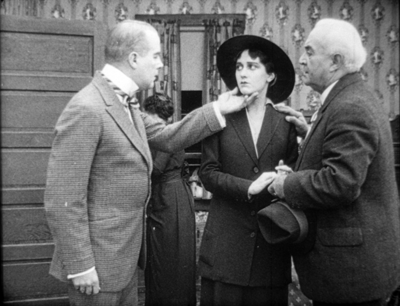
This gesture partly masks Flo, who briefly turns away as well. The emphasis falls firmly on the father’s contrition. Dixie still refuses him, and so he says farewell, re-exposing Flo turning in the background.

As he departs, so that we get the full force of his encounter with Flo, Dixie turns from the camera. We must concentrate on the moment in the background when the imposter shows remorse for having won the love of the man she deceived.

At the door
You might object: “But David! Those examples are still very stagebound. The Case of Becky shot is itself on a stage, and the others, despite all their depth, show boxlike rooms from straight on. They seem firmly tied to a proscenium concept. Shouldn’t we expect something more natural?”
Fair enough, so I submit this earlier phase of the False Colours scene. This time we have a doorway, framed diagonally, that cuts off a lot of playing space. And we see obliquely into a corner of a room, not straight on to a back wall. Yet you still get an interplay of faces and bodies, carrying to a daring extreme the blocking-and-revealing tactics we’ve seen in The Circus Man and in the later phase of the False Colours scene.
Dixie comes to Flo with Flo’s mother. At this point Flo recognizes Dixie as the daughter she’s been impersonating and is deeply ashamed. You won’t be surprised by the dazzling precision of the frontal placement of Flo, no matter how far she is from the camera.



Flo is consoled by her mother, and Dixie shuts the door discreetly.


But why so much empty space on the left of the door? Because now the theatre manager is coming, and the framing shows us what Dixie doesn’t know: Her father is standing there alongside the manager.

There’s a moment of suspense before the father hesitantly steps to the doorway and Dixie sees him for the first time in seventeen years.


He blots out everything but her reaction, until Flo’s face slides into visibility. Cornered, she’s terrified to be confronting the man she has deceived.

The father’s valet has obligingly slid into the left to balance the frame, but he stands as frozen as the hypnotist Balsamo had been, looking patiently downward, to make sure we concentrate on the pitch of drama taking place in the distance. This is as purely “cinematic” a scene as anything involving editing.
And who needs close-ups?
Griffith is a great director, but other filmmakers of his period were exploring cinematic possibilities he didn’t consider. Their editing is often more subtle and careful, and the exponents of the tableau style achieve a pictorial delicacy mostly at variance with his work.
More and more, this Founding Father of Hollywood seems to me an outlier–an eccentric, raw, occasionally clumsy filmmaker who went his own way while others refined a range of stylistic practices. I’m starting to think he favors a brute-force approach, in both physical action and the evocation of sentiment. The result is powerful, but… Well, I’m reluctant to say it, but after my two months of immersion in Anybody But Griffith, he’s starting to seem somewhat crude.
I’m tremendously grateful to the John W. Kluge Center, and particularly its director Ted Widmer, for enabling me to conduct this research under its auspices. A special thanks to Mike Mashon of the Motion Picture Division, and all the colleagues who have been helping me in the Motion Picture and Television Reading Room: Karen Fishman, Rosemary Hanes, Dorinda Hartmann, Zoran Sinobad, and Josie Walters-Johnston.
Ben Brewster and Lea Jacobs’ Theatre to Cinema is available for download here.
For our blog entries relevant to the tableau tradition, go here. Lois Weber made many other important films, notably Hypocrites (1915), Where Are My Children? (1916), Shoes (1916), and The Blot (1921). See the exceptionally detailed Wikipedia entry for more information.
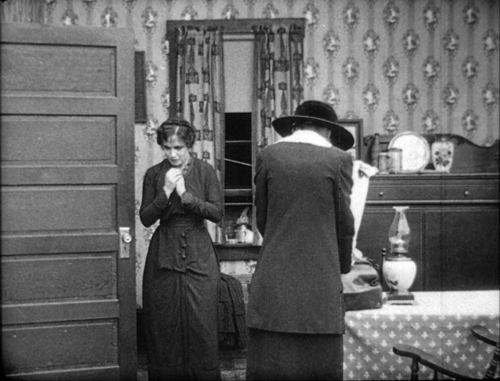
False Colours (1914).
Oscar’s Siren song 3: A guest post by Jeff Smith
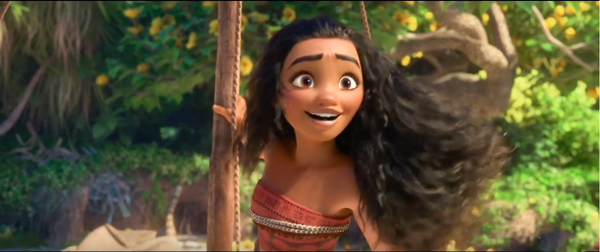
Moana (2016).
DB here:
Our colleague and Film Art collaborator Jeff Smith is an expert on film sound, particularly music. He’s contributed several items to our site over the years (for example, here and here and here). Today he’s back with his annual survey of Oscar’s musical categories. He offers in-depth analysis of how the films’ scores and songs enhance the movies’ impact.
As I’ve done in the last two years, I’m offering another preview of this year’s nominees in Oscar’s two music categories: Best Original Song and Best Original Score.
This year, La La Land’s Justin Hurwitz is nominated in both categories. He is poised to join a small group of composers who won awards in each. Leigh Harline and Ned Washington first accomplished the feat in 1941 for Pinocchio. A.R. Rahman was the most recent. He won Best Original Score for Slumdog Millionaire and Best Original Song for its Bollywood inspired closer, “Jai Ho.” Remarkably, Alan Menken was a two-fister four separate times. His eight Oscar wins came from four of Disney’s animated musicals: The Little Mermaid (1989), Beauty and the Beast (1991), Aladdin (1992), and Pocahontas (1995). (And I’ll bet you’re humming “Under the Sea” or “A Whole New World” to yourself just now.)
Will Hurwitz join this august group of composers? Hard to say, but I suspect he will since I am picking against him in one of these two categories.
Based on my track record, this likely bodes well for Hurwitz. As faithful readers know, in the past two years, I’ve gotten two right and two wrong as a prognosticator. A 50% success rate is not too good. But then again, in recent ceremonies, one of these two categories has reliably produced a surprise win. Two years ago, Alexandre Desplat’s The Grand Budapest Hotel upset Jóhann Jóhannsson’s The Theory of Everything for Best Original Score. A year later, Lady Gaga and Diane Warren came in as clear favorites for Best Original Song. But the award went to Sam Smith and Jimmy Napes for Spectre’s “Writing on the Wall.” Both of these awards confounded the conventional wisdom, and I suspect I was not alone in having a music award wreck my entry in the office Oscar pool.
Given my past struggles, I even considered taking an approach inspired by Seinfeld’s George Costanza: just pick the opposite of my natural preferences. Yet, even this only gets me back to a 50% success rate. So for better or worse, the predictions offered below are genuinely my best guess as to which nominee ultimately wins each award.
Best Original Score: Will fourteen be Thomas Newman’s lucky number?
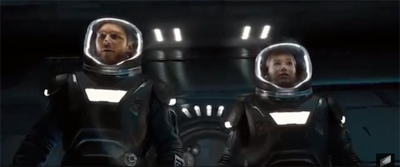
Perhaps the most striking thing about this year’s nominees is the number of first-timers. Of the six people recognized in this category, only Thomas Newman has been nominated before. But Newman is very unusual in this regard. He has accumulated more than a baker’s dozen of nominations over the past twenty-two years and still has yet to win. Newman’s cousin Randy experienced a similar drought, but eventually won for Best Original Song for Monsters, Inc. on his fifteenth try.
Thomas Newman’s nomination this year is for Passengers and it represents the composer’s second foray into science fiction scoring. (His first was in Pixar’s 2008 film WALL-E, for which he received two nominations.)
When film composers say their goal is to fulfill the director’s vision, it reminds us that they do not write music for the sake of music. Their contributions are never meant to stand alone. Their theme writing, their selection of instruments, and the placement of their music are always dictated by the material they read in a script or that they see on screen.
And myriad choices typically flow from the composer’s first encounter with the work.
Do I strive for a big orchestral sound? Or do I go for something more intimate in the style of salon or chamber music?
Do I write a big theme that will carry through the entirety of the film? Or do I adopt a textural approach that emphasizes rhythm, harmony, and tone color more than melody?
Do I capture the varied moods and tones of individual scenes — a skill at which classical Hollywood composers excelled? Or do I try to envelop the drama in a single, sustained emotional color, one that endows even simple or ordinary actions with affective significance?
These questions are not easy ones. But Newman’s ability to consistently answer them has made him one of the most reliable and versatile composers in Hollywood.
In a Variety interview, Newman noted that he initially considered a common tactic for scoring science fiction films – that is, writing futuristic music for a futuristic setting. Newman opted instead “to play to the conventions of what a space movie would sound like.” And ever since John Williams’ score for Star Wars, space movies tend to feature a big orchestral sound.
Newman’s score features more than sixty string parts and thirteen brass. It also adds hefty doses of electronics and piano to these more traditional orchestral sounds. According to the composer, this lent the score a more contemporary edge.
Passengers’ music, though, functions “bigly” both in size and scope. Covering 96 minutes of the film’s 116 minute running time, Newman’s score also plays a wide range of moods and tones. Newman aimed to highlight the elements of loneliness, humor, and action that he felt were already present in Morten Tyldum’s “Adam and Eve in space” conceit.
Newman’s main title offers a window into his compositional techniques in Passengers. The cue begins fairly quietly with an electronic instrument playing a busy arpeggio figure. In another context, it might sound like a loop in an EDM track. Over time, though, the arpeggiated figure is subtly varied in rhythm and pitch with additional instruments thickening the music’s overall texture. The timbres at the start are rather light and airy, combining the “bell-y” sound of a Fender Rhodes with electronics imitating the sounds of strings and winds. After about two minutes, bass voices enter adding a sort of pulsing pedal tone that further grounds the cue’s minor key harmonies. A horn blast comes in about thirty seconds later, followed by a rising furioso string figure that briefly builds tension before suddenly peaking in volume and intensity. As the reverb and echo of this climactic chord fade out, the music returns to the light, airy sounds and arpeggios heard at the start.
Newman’s score and Guy Hendrix Dyas’s impressive production design (also nominated) are undoubtedly the best things about Passengers. But that likely won’t cut any ice with Oscar voters. Given the film’s tepid critical reception, it seems unlikely that Passengers will break Newman’s current losing streak.
Jackie: Dig the New Breed
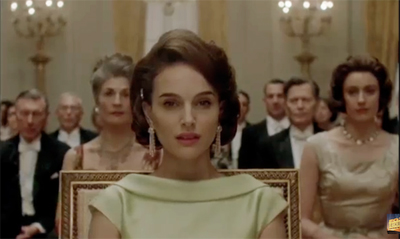
Compared with Newman’s veteran experience, Mica Levi is positively a babe in the woods. Her only feature film experience prior to Jackie was on Jonathan Glazer’s Under the Skin (2013). Yet, thanks to her brooding score for Pablo Larrain’s unusual biopic, Levi is now one of only five women to receive a nomination for either Best Original Score or Best Original Song Score.
Levi’s approach to the compositional process on Jackie was unusual. She relied on her historical knowledge of the former First Lady and on Noah Oppenheim’s script. She submitted her score to Larrain without actually seeing footage of the film. Larrain himself ultimately decided on the music’s placement.
Levi’s score is largely built out of sustained chords, dissonances, and orchestral glissandi that, in the composer’s words, give you “this glooping and distortion and morphing…” These glissandi are particularly striking and unusual, but they work beautifully within the film’s dramatic context. Lots of film music has been written to capture a character’s sense of loss. What these glissandi add, though, is a sense of trauma to Larrain’s dramatic conception of the character. Jackie invites the audience to consider what it’s like to be a public figure and to have your beloved husband killed in the most shocking and bloody manner imaginable. The film dramatizes Jackie’s fight for Jack’s memory despite this numbing, almost crippling sadness. Levi’s music nicely reflects these feelings of psychic dislocation, even as Jackie struggles to scale a wall of government bureaucracy and protocol that stands in the way of her plans for the president’s funeral.
Aside from a couple of cues that Levi describes as “vapid,” the score sustains a mood that highlights the post-traumatic stress that lay just beneath Jackie’s public expressions of grief. This proves important insofar as the music provides a unifying thread to Jackie’s temporally fragmented structure. Larrain’s time scheme is bracketed by two interviews. The first is a television broadcast where Jackie gives viewers at home a tour of the White House. The second is a Time magazine interview with journalist Theodore H. White in which Jackie works to protect the JFK’s “Camelot” legacy. In between are several scenes situated either just days before or days after Kennedy’s fateful trip to Dallas. The structure is further stretched to accommodate flashforwards to Jackie talking with a priest and burying her two dead infants.
Larrain cuts freely between these points in time, creating a mosaic portrait of Jacqueline Kennedy as a figure of strength and grace. And Levi’s score not only supplies continuity, but also adds a consistent emotional undertone to the abrupt changes in cinematographic style apparent in individual scenes.
With music that is strikingly different from her earlier work on Under the Skin, Levi shows that, although Jackie is her first Oscar nomination, it will not be her last.
Moonlight: Mr. Mozart meets DJ Screw
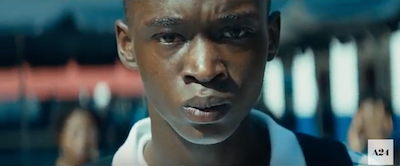
Like Mica Levi, Moonlight composer Nicholas Britell is a relative newbie when it comes to the world of feature film scoring. Britell’s opportunity on Moonlight came thanks to his work with Brad Pitt’s production company, Plan B Entertainment. He scored two of the company’s most high-profile projects: 12 Years a Slave and The Big Short. When Plan B decided to put Barry Jenkins’ script into development, the company’s co-president, Jeremy Kleiner, sent a copy to Britell in order to gauge the composer’s interest.
Britell was struck by the “poetry” of Jenkins’s vision, which he believed was already evident on the printed page. In a follow-up meeting, the composer and director spent hours talking about films, music, and life. According to Jon Burlingame, Britell then sent a tape to Jenkins that contained an eclectic mix of styles “ranging from the Isley Brothers to Mozart.”
To my knowledge, Britell’s playlist was not used as a temp track, but it played much the same function as a vehicle of communication between composer and director. For Britell, these sample tracks gave Jenkins an impression of what he thought the film should sound like.
Britell arranged some cues for solo violin and piano as a correlate to the intimate mood established in Moonlight. Both instruments were closely miked, and these chamber-styled cues, thus, add a character-centric, arthouse ambiance to this tale of “boy n the hood.” Britell’s choice is quite fitting insofar as Jenkins acknowledges Claire Denis’s Beau travail and Hou Hsiao-Hsien’s Three Times as major influences on his coming-of-age story.
Yet Britell also applied hip-hop production techniques to some of these tracks in order to reflect both the protagonist’s character change and Jenkins’s own interest in the genre. Some cues were remixed using a “chopped and screwed” approach. This technique was innovated Houston hip-hop artist DJ Screw and it involves slowing the music’s tempo to almost half its normal speed. An example of this is heard when Kevin punches Chiron to impress his friends. Here “Chiron’s Theme” is slowed down, dropping the pitch of couple of octaves, and then layered atop itself. One hears the mournful piano chords of Britell’s central musical theme intertwined with its own pulsing echoes, the latter sounding as though they’ve risen from the bottom of an abyss.
Britell supplements “Chiron’s Theme” with cues that take shape either as swirls of static, harmonic resonance or as shards of Ivesian dissonance. All of it is in keeping with the composer’s mostly minimalist approach. Britell’s great achievement on Moonlight comes from the way the music’s small, spare style nonetheless yields moments with outsized emotional impact.
Lion: Finding the ghost of John Cage in a shantytown in India
Dustin O’Halloran and Hauschka also earned their first nominations for their music for Lion. Unlike Jackie, though, where Mica Levi began work on the basis of the script, director Garth Davis didn’t even begin looking for composers until he locked picture. He approached O’Halloran and Hauschka with the idea that they would work as a team. Hauschka would compose for the first half of the film and O’Halloran would handle the second.
Davis eventually dropped this idea, though. Instead he opted for a more unified approach in which each composer’s contributions would be blended together. O’Halloran and Hauschka then spent three weeks sending ideas back and forth between their respective studios. Having progressed in this initial idea stage, the pair met up in Los Angeles and worked together to finish the score over the next eight weeks. As O’Halloran noted in an interview, “We had spent a lot of time in each other’s world, and the thought of us making music together was pretty exciting because we’d been friends for so long.”
Initially, Davis was drawn to Hauschka’s music based on the latter’s cutting edge work with the prepared piano. A prepared piano is one in which foreign objects are placed atop or wedged between the strings attached to the instrument’s soundboard. The presence of these unusual objects alters the piano’s usual timbre, often giving it a more percussive sound when its hammers strike the strings.
The prepared piano is usually associated with American avant-garde composer John Cage. As the story goes, Cage’s use of the prepared piano solved a problem that arose from his commission to write music to accompany Sylvilla Fort’s dance piece, “Bacchanale.” Cage initially planned to write for a percussion ensemble, but then substituted the prepared piano when he realized that the performance space was too small to accommodate a large group. In interviews, Hauschka notes that he was unaware of Cage’s precedent when he first began to play prepared piano. But when people kept asking about Cage after hearing him perform, Hauschka went back to the latter’s pioneering work and now counts himself a fan.
Davis had already envisioned the use of prepared piano for the scenes set in India. His idea was that the unusual tone colors of the prepared piano would supply a sound that is comparable to Indian music without duplicating the idiom wholesale. A good example of this balance between western and eastern musical elements is evident in the scene where young Saroo gets lost in a train station. In Hauschka’s own words, the prepared piano adds a repeated “tat-tat-tat” sound that conveys the character’s panic, particular when authorities round up all the homeless children.
For some of the film’s other scenes, O’Halloran provides a melancholy theme first introduced over the film’s opening images. It features a repeated arpeggio figure in the piano accompanied by rising and falling string harmonies patterned to cyclically fold back on itself.
As with Moonlight, Davis, O’Halloran, and Hauschka opted for a smaller, more intimate sound. They recognized that the film’s potentially melodramatic story of maternal separation didn’t need additional hype from the music. Such parsimony allows Lion to unfold with subtlety and grace, its strongest moments underplayed by O’Halloran and Hauschka’s quietly affective score. The music also reflects the protagonist’s complex motivations, balancing his drive to know with his desire to spare his adopted family from feeling rejected.
La La Land: Justin Hurwitz, revivalist
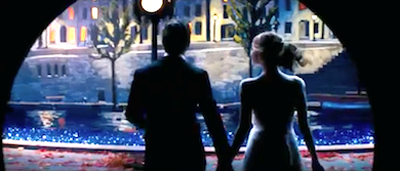
Damien Chazelle’s La La Land has already received ample coverage on this blog here, here, and here. To a certain extent, I have little to add to the excellent contributions made already by David (here and here), Amanda, Eric, and Kelley. Since much ink has already been spilled regarding composer Justin Hurwitz’s considerable contributions to the film, I’ll provide a few bits of historical perspective.
Hurwitz’s prime achievement, and the source of a lot of critical praise, is his skill in integrating the melodies of the numbers into score cues that perform more traditional dramatic functions. In this respect, Hurwitz is a throwback to an earlier period of film music history, one that emphasized theme writing over more texture-and-timbre oriented “sound beds” approach so common today.
For me, the role models for Hurwitz’s approach are not the studio composers sometimes associated with the musical as a genre, such as Lionel Newman or Andre Previn. He’s closer to early sixties composers who applied this integration of songs and scores in different genres. Henry Mancini is an exemplar of these techniques. He often began by writing the specific themes for his scores, and then adapted them to the verse-chorus-bridge patterns found in standard 16-bar and 32-bar song forms.
These skills are also evident in the music of Michel Legrand, whose scores for Jacques Demy are an acknowledged influence on La La Land. This “theme song and variations” strategy has become something of a lost art. In Legrand’s and Mancini’s work, one finds it not only in The Umbrellas of Cherbourg and Darling Lili, but also in dramas, comedies, and capers like Summer of ‘42, The Pink Panther, and The Thomas Crown Affair.
Yet, although Mancini and Legrand are obvious role models, Hurwitz pushes this strategy even further than his predecessors. Not only is the score integrated with the songs, but the songs themselves are integrated with one another. After the lounge performance of “Mia & Sebastian’s Theme,” each new song they perform sounds like a subtle variation of its predecessor. The tempo and meter of the songs differ quite considerably. But they nonetheless seem to spring from the same Schenkerian ursatz, working through the same harmonic shifts, cadential patterns, and delicate shifts from minor to major.
Once La La Land’s concluding “dream ballet” begins, Hurwitz’s themes flow seamlessly into and out of one another. The recapitulation of motifs – both dramatic and melodious – feels completely cohesive and whole. This music’s organic unity is felt even despite the fact that it accompanies a time-shifting, synoptic, happily-ever-after fantasy.
All of Hurwitz’s tunes are cunningly effective earworms. By reprising all six of them in a final stylized depiction of the characters’ emotional journey, the dream ballet provides La La Land with the kind of musical climax that most film composers can only dream about.
And if you were one of Hurwitz’s Oscar competitors wanting to cry, “Foul!” I think you’d have a point. At various points in its history, the Academy has bracketed off music scores and song scores into separate categories. Their earlier existence is almost a tacit admission that voters are being asked to make apples-vs.-oranges comparisons.
For this year, at least, Hurwitz is likely to benefit from the fact that La La Land is something of a unicorn. During the past twenty years, lots of musicals have received recognition from the Academy. But in almost all cases, these have been either adaptations of successful Broadway musicals or weird pastiches of preexisting popular music. Consequently, they’ve always been excluded from consideration for Best Original Score. La La Land is, thus, not only an original screen musical, but one in which every cue and every tune is both new and infused with Hurwitz’s singular vision.
None of this would matter if the film didn’t deliver the goods. But La La Land does so in spades. You’ll find few films that combine its emotional heft, its topline production values, its formal sophistication, and its intricate relation to its generic heritage. As both a valentine to the City of Angels and perhaps the meta-musical to end all meta-musicals, La La Land is clearly the front-runner for Best Picture. And I expect Chazelle and company will collect an armful of hardware long before that final award is announced next Sunday night.
Prediction: Need you ask? It’s Justin Hurwitz all the way!
This is a very strong field and I admire the way all of these composers have experimented with technology and compositional techniques to defy convention. Yet they’ve also created work firmly tethered to important aspects of Hollywood tradition, especially in the ways their scores convey mood and character subjectivity.
Yet, although the piano plays a prominent role in the orchestrations and central musical concepts of all these scores, I’m picking the one that features an actual pianist as protagonist. Hurwitz’s expected win in this category is as close to a lock as these things get.
Best Original Song: Docs and tuners and toons, oh my!
As my header suggests, one of the most striking things about this year’s field is the fact that the songs represent particular niche markets within the industry. Documentaries and animated films occupy opposite ends of the spectrum in terms of their budgets and box office returns. But they are both aimed at demographic segments that are either a little or a lot narrower than the mainstream audience for the biz’s more traditional tentpoles.
And as we’ve already seen on this blog, musicals are one of those “they don’t make ‘em like they used to” genres that caters to more specialized tastes. This seems to be a change from, say, twenty to thirty years ago when Original Song nominees came from a variety of genres, including studio-produced action films, comedies, dramas, and fantasy films, in addition to those featured in Disney’s animated musicals.
Moreover, there is also plenty of star power in this year’s field. Justin Timberlake, Lin-Manuel Miranda, and Sting are among this year’s nominees.
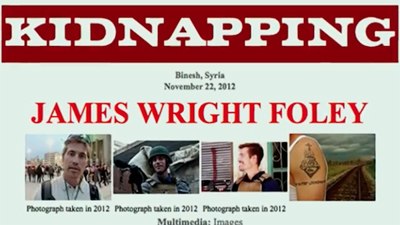
“The Empty Chair” was written by J. Ralph and Sting for Jim: The James Foley Story, a portrait of the journalist kidnapped and executed by ISIS terrorists. It continues the recent trend toward recognizing songwriters’ contributions to contemporary documentaries. Last year saw nominations for The Hunting Ground and Racing Extinction, the latter featuring another track co-written by J. Ralph. Two years ago, “I’m Not Gonna Miss You” was nominated from the music doc, Glen Campbell: I’ll Be Me. This trend is likely to continue. According to Variety’s Jon Burlingame, seventeen of the ninety-one songs eligible for this year’s award came from documentary films.
In composing the lyrics, Sting drew lines from Foley’s letters home and from from reminiscences of his colleagues. Placed in the end credits, the song sums up what we’ve just seen. The empty chair is, of course, the place at the family table to which Foley will never return. As an encomium to the fallen journalist, the song reminds that Foley’s death leaves an empty place both in his family and in his profession.
The film’s subject matter is weighty and the song’s plaintive melody and spare arrangement nicely encapsulate its gravity. Yet the fact that the film is little-seen makes it an uphill climb in terms of collecting Oscar votes. All of the other nominees have received much greater exposure and are also more clearly integrated into the narratives of their films. This is a case where the nomination itself is the real award. Although “The Empty Chair” gave Sting his fourth nomination, he’ll have to content himself with the sixteen Grammy awards he’s already won.
Islanders and trolls (and not the Internet variety)

Justin Timberlake, Max Martin, and Shellback all received nominations for “Can’t Stop the Feeling!” from Dreamworks Animation’s Trolls. The film dramatizes the conflict that ensues when a group of ever-cheerful Trolls is kidnapped by the dour Bergen. The latter it seems only achieve happiness one day a year on Trollstice, an annual holiday where the Bergen feast on Trolls. Poppy and Branch, two trolls that survived the Bergen’s raid, set out to rescue their friends before it is too late.
“Can’t Stop the Feeling!” appears toward the climax in a scene where Poppy and Branch transform the Bergen’s holiday banquet into a big dance party. The song helps the Bergen realize that they can be happy every day of the year, not just on Trollstice.
Timberlake released “Can’t Stop the Feeling!” in May, about six months before the film’s debut. It went on to become the top selling song of 2016 racking up more than two million downloads. In writing it, Timberlake set out to create a modern disco song that would recall the ebullience and effervescence of the best dance music of the seventies. This proved important in matching its vibe to some of the older classics featured in Trolls, such as Donna Summer’s “I Feel Love” and Earth, Wind, & Fire’s “September.”
In another year, the track’s enormous popularity and mad beats might easily carry the day. Yet, as a rule of thumb, feel-good songs haven’t fared too well in Oscar voting. There are exceptions, to be sure. In fact, the aforementioned “Under the Sea” and “Jai Ho” likely come to mind as fairly obvious examples. But, although feel-good songs are often nominated, the winners much more commonly are either love songs (“Take My Breath Away”, “Can You Feel the Love Tonight”) or “I Want” songs of the type David described as a typical element in Broadway musical song plots (“Fame”, “Glory”).
Indeed, Lin-Manuel Miranda’s “How Far I’ll Go” from Moana is an almost textbook example of the latter. The song is featured in an early scene where the protagonist expresses her desire to explore the world beyond her Polynesian island, even though her duty to her tribe prevents Moana from sailing beyond the reef that her father’s decree establishes as a boundary.
Beyond its plot function, the song’s soaring chorus and uplifting key change beautifully express Moana’s hope and wonder about a distant world that she feels is her destiny. Miranda himself has said he went Method to connect to the character’s aspirations. He went back to his childhood bedroom to write the song. There Miranda recalled sensing a similar gulf in his own life between his love of home and family, on the one hand, and the inexplicable pull of a larger world beyond it, on the other.
With Moana conceived as the latest in a long line of Disney princesses, one could easily be cynical about the kinds of synergistic tie-ins that fuel the studio’s bottom line. But the film is tightly constructed and beautifully animated. Moreover, Miranda’s songs have the sort of wit and verve that makes him a worthy recipient of the torch passed on by Alan Menken, Howard Ashman, Tim Rice, Elton John, Stephen Schwartz, and Phil Collins. These songwriters spearheaded the resurgence of the animated musical and helped the Walt Disney Company rebuild itself from the ground up. With Miranda signed on to Disney’s reboot of The Little Mermaid, it appears that this is both the beginning of a beautiful friendship and the burnishing of an important legacy.
L. A. plays with itself: La La Land
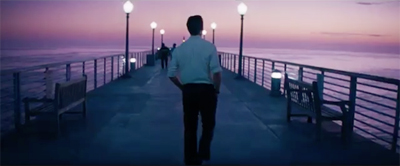
The final two nominees come from La La Land. “City of Stars” is first heard when Sebastian is walking the boardwalk. It expresses his doubt about whether his budding relationship with Mia will end as yet another failed dream. This version of the song is low-key and a bit of a trifle. The song begins with a long, repeated piano vamp. The vibes and guitar then play its main motif before Sebastian eventually begins whistling its tune. And after one verse, the song comes to a tentative, softly longing cadence.
“City of Stars” returns, though, in a duet staged in Sebastian’s apartment. This is the version that Oscar voters likely will remember because it contains a more fully fleshed-out structure with verse, chorus, and bridge. Sung live on set by Ryan Gosling and Emma Stone, this rendition is a bit faster and contains a bigger emotional arc than the waterfront ersion. The lyrics begin just as they were when Sebastian sang them on the boardwalk. But lyricists Benj Pasek and Justin Paul add a new verse in which Mia refers to the couple’s first meeting in the club.
At this point in the story, the song appears to fulfill two functions. First, it takes stock of the couple’s relationship, encouraging the audience to revisit earlier scenes of the film. Secondly, and more importantly, the song encapsulates the intertwined dual plotlines so commonly found in classical Hollywood narratives. Here Mia and Sebastian seek the fulfillment of their professional ambitions in a way that matches the happiness they’ve found in their personal lives.
As Jenelle Riley notes in Variety, “City of Stars” has “become an anthem of sorts for the film.” And the big reason for this, I think, is that it best captures the film’s bittersweet tone. If you wanted to show someone a clip to give a sense of what the film is like, you’d probably pick the planetarium scene or perhaps the duet on “A Lovely Night.” But if you wanted to play something from the soundtrack to accomplish the same task, I suspect “City of Stars” is what you’d choose. The song won the Golden Globe a little over a month ago, and the fact that it’s been taken up as a stand-in for the film is a big reason why.
La La Land‘s second nominated song, “Audition (The Fools Who Dream)” is by contrast an iconic big number. As David pointed out in an earlier entry, in the Broadway musical song plot, this is usually a second-act showpiece that sets up the play’s final resolution. “Audition” serves a similar role in La La Land. It provides the key plot point that initiates the climax.
Furthermore, “Audition” evokes other “big numbers” from recent musicals. As an “actorly” moment for Emma Stone, it resembles Jennifer Hudson’s showstopper, “And I Am Telling You I’m Not Going” from Dreamgirls (2016), and Anne Hathaway’s heart-render, “I Dreamed a Dream” from Les Misérables (2013). As Kelley and Eric pointed out in last week’s blog, Stone’s performance was shot live just as Hathaway’s was a couple of years ago. The references to dreams in Stone’s and Hathaway’s songs offer a further connection..
Given its late appearance in La La Land, it doesn’t quite carry the same resonance that “City of Stars” has. Still, I think “Audition” will nonetheless play a part in Oscar voting by giving Stone a boost for Best Actress. Jennifer Hudson and Anne Hathaway both won Oscars for their roles. No doubt their “big numbers” helped their campaigns. Emma Stone seems poised to follow in their footsteps.
Prediction: I’m going out on a limb here, even though I definitely hear it creaking. “City of Stars” is the clear favorite, having already won awards at the Golden Globes and from several regional critics’ organizations. I think, though, there is a chance that “Audition (The Fools Who Dream)” acts like a third party candidate here, siphoning off just enough votes from “City of Stars” to allow a dark horse to win.
The dark horse? Lin-Manuel Miranda’s “How Far I’ll Go.” Given the potential for a La La Land sweep, this may not seem like the most rational choice. But I’ve stuck with the clear favorites the past two years without much success.
And there is an intuitive logic to support a surprise win for Miranda. Songs from Disney musicals have dominated the category, chalking up eleven wins since 1989. And Miranda has conquered all the other entertainment fields he’s entered. Why not the Oscars as well?
As I noted at the outset, Justin Hurwitz has a chance to join a small group of film composers who’ve taken home two or more Academy Awards in the same year. But Miranda has the opportunity to join an even more elite club, namely the EGOTs. (The term is an acronym for individuals who have won a Emmy, a Grammy, a Tony, and an Oscar.) After his extraordinary success with Hamilton, I predict that Miranda will add another trophy to his case.
But then again, maybe I’m just a fool who dreams of actually getting his Oscar picks right.
Very special thanks to Jon Burlingame, whose reportage has been extraordinarily insightful over the years. He has not only helped me in the writing of this blog, but his work also has informed my scholarly work on film music and film songs more generally. Burlingame’s own overview of the Oscar music nominees can be found here and here.
A hearty thank you as well to Eric Dienstfrey, who allowed me to bounce ideas off him and made some terrific suggestions in his own right.
Articles about the nominated composers abound on the internet. You can check an interview with Thomas Newman discussing his score for Passengers; an interview with Mica Levi on Jackie; two stories (here and here) about Nicholas Britell and Moonlight; two conversations (here and here) with Hauschka and Dustin O’Halloran about Lion. The Independent offers a track by track overview of La La Land’s soundtrack album. Justin Hurwitz also provides a summary of La La Land’s songs in this article from Variety.
Want to sample some of the nominated scores? YouTube offers the Passengers soundtrack, as well as an excerpt from the Moonlight soundtrack and a track from the Lion score. To get a sense of Mica Levi’s unusual glissandi technique, listen to the “Intro” of Jackie.
The coverage of the nominees for Best Original Song is almost as voluminous as that for Best Original Score. For a discussion of J. Ralph and Sting’s “The Empty Chair,” see this Variety article by Jon Burlingam, which also considers the increasing popularity of songs within the documentary format. This Los Angeles Times article discusses Justin Timberlake’s songs for Trolls, including “Can’t Stop the Feeling!”
On Indiewire Moana’s directors, John Musker and Ron Clements, discuss their collaboration with Lin-Manuel Miranda. Miranda’s own comments about his process on “How Far I’ll Go” can be found on the Trippin’ With Tara website.
For more on the development of “City of Stars,” see this Variety interview with Benj Pasek and Justin Paul.
Many of the nominated songs are featured in Youtube videos. “Can’t Stop the Feeling!” is here, and the scene from Moana featuring “How Far I’ll Go” is here. Lionsgate also has issued an official clip promoting “City of Stars.” It combines footage from both of the scenes in which it appears. “Audition (The Fools Who Dream)” is featured in a teaser trailer for La La Land.
For Jeff’s earlier Oscar music entries, go here and here.
P.S. 21 February 2017: Thanks to Fiona Pleasance for corrections! You can read her and her colleagues’ stimulating thoughts on La La Land at MostlyFilm. Their entry nicely fits with the discussions on our site.

Trolls (2016).