







Archive for the 'Film comments' Category
Wisconsin Fim Festival: An unexpected gem, a Zucchini, and a farewell
Clash (2016)
Kristin here:
Three more films from this year’s Wisconsin Film Festival.
Clash (Eshtebak, 2016)
David and I were intrigued by the festival’s program notes describing Egyptian director Mohamed Diab’s second feature, Clash, as taking place with the camera entirely confined to the interior of a police paddy-wagon. This kind of limitation can be a fruitful device, as it was in the Israeli film Lebanon; there the action took place inside a military tank. Clash turned out to be a real discovery, the best film I saw at the Festival (putting aside A Quiet Passion, which we had already seen at the Vancouver International Film Festival.).
Diab’s paddy-wagon has the advantage of rows of barred windows and a door, so that we can frequently see what’s happening outside. The film is set in the summer of 2013, when there were protests, often turning violent, in the wake of the ouster of President Mohamed Morsi and his replacement by the current president, Abdel Fattah el-Sisi. The truck moves through Cairo, encountering waves of such protests, and it gradually fills with a collection of people with various religions, beliefs, and cultures–supporters of Morsi’s party, the Muslim Brotherhood; others who oppose him; Christians; a homeless man; a nurse; and two journalists–with arguments and violence erupting inside the vehicle as well as outside.
Diab had to tread a fine line in his depiction of these people, since his basic theme is that they all must learn to cooperate to some extent if they hope to survive the baking heat, tear gas, gunfire, police bullying, and the anger of the mobs outside the truck. Officially the Muslim Brotherhood is considered a terrorist organization in Egypt, though Diab manages a fairly even-handed treatment of its members and supporters. Remarkably the censors did not require any changes to the film.
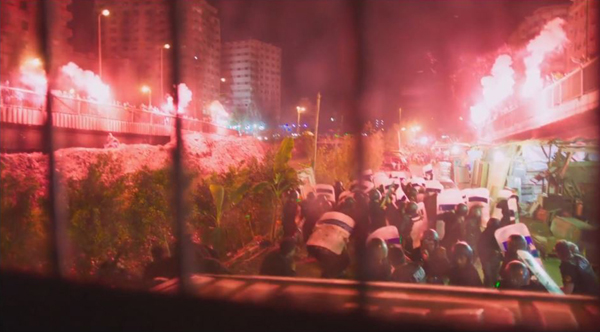
Just as remarkably, Diab was able to stage huge, convincingly terrifying riots in Cairo’s streets and highways (above). In a brief interview at Cannes last year, where Clash was shown in the Un Certain Regard section, he was asked if the shoot was difficult.
Very. You are risking your life because people might mistake the shoot for a protest, or might mistake you for the police. And there are haters of both, who can shoot you. It took us months of preparation. Egyptians to whom I’ve shown the film are blown away because they know that what we did is almost impossible.
He makes similar remarks in a question-and-answer session at the London Film Festival; his discussion of the film’s techniques comes from about 9:30 to 13:50.
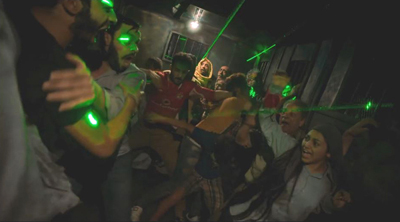
The characters in the truck are constantly in danger, both from each other and from the rioters, and the action is absolutely riveting. There are a few lulls to vary the pace and to allow the prisoners to deal with their wounds and try to work out a strategy to protect themselves, but otherwise the suspense is maintained at a high level. A climactic scene in which rioters attack the truck, flashing laser pointers into it and trying to tip it over is handled, as Variety‘s review put it, with “brilliantly choreographed pandemonium.”
Clash was a huge success in Egypt. It was released in France in September and is already out on region 2 DVD (French subtitles only) there. Its festival life seems to be drawing to a close. It’s due for theatrical release in the UK and Ireland on April 21 and presumably will come out on Blu-ray and/or DVD. You can get a good sense of the film from the online trailers, the European one and especially the Egyptian one, though the film is not nearly so fast-cut.
My Life as a Zucchini (Ma vie de courgette, 2016)

2016 was a good year for animation. Kubo and the Two Strings, The Red Turtle, Moana, and Finding Dory were excellent as well. (I thought Zootopia was overrated.) Add My Life as a Zucchini to that list. This being Madison and the Wisconsin Film Festival being a university-sponsored event, we saw it with French subtitles rather than dubbed.
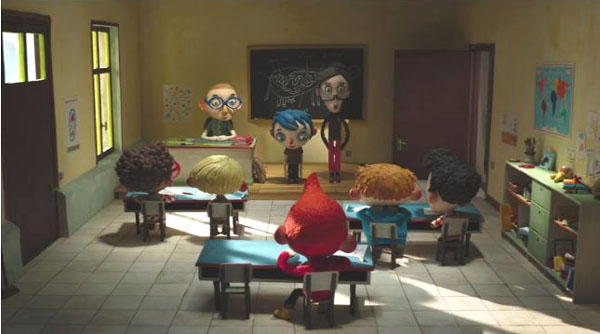
The style of the film, with its bright colors and cute, big-headed characters (above and at the bottom), makes it seem aimed at children, and the story is presented almost entirely through the viewpoints of Zucchini and the other children he meets. Yet children younger than teenagers would probably find parts of it incomprehensible or disturbing. The boys indulge in naïve but somewhat explicit speculation about sex. Zucchini’s beer-swilling mother apparently dies in an accident that he inadvertently causes, though this happens offscreen. He is taken by a sympathetic policeman to a small home for young children in the countryside. Not all are orphans, as it is made clear that one girl was taken away from her sexually abusive father and some of the others come from homes ruined by addiction or violence. Zucchini gets bullied and teased before finally being accepted.
All this makes for a strain of melancholy running through the film, but there is considerable humor to counter it, and the ending is happy.
Like Kubo, My Life as a Zucchini is puppet animation. Clearly it was done on a much lower budget, without the laser-printed changeable faces that make Laika’s characters so expressive. Charmingly, if distractingly, the clothes of the puppets occasionally shift positions, betraying the handling by the animators between frames–as when the red star on Zucchini’s T-shirt inadvertently takes on a life of its own. But on the whole, the filmmakers have used simple means to give their figures considerable expressivity.
The nomination of My Life as a Zucchini for the Best Animated Feature Oscar came as something of a surprise. Foreign films do show up in that category, but this one had its widest American release in a mere 53 theaters. It came out on February 24 and is still in 22 theaters, having grossed $286,154 as of April 6. (Presumably that does not count the two WFF screenings; the one we went to was sold out.) The DVD and Blu-ray versions are available for pre-orders on Amazon. The description says that both the original French-language soundtrack and the English-dubbed one are included.
Afterimage (Powidoki, 2016)
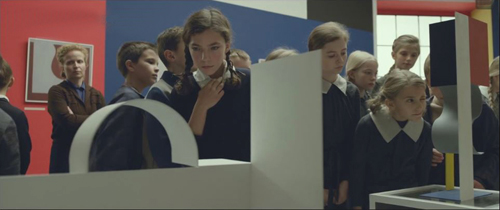
Afterimage premiered at the Toronto Film Festical almost exactly a month before the death of director Andrzej Wajda. It deals with the co-founder of Polish Constructivism, Wladyslaw Strzeminski, who helped create the Blok group in Warsaw in 1923. The plot covers only Strzeminski’s last years, but we get a strong sense of his entire career through gallery scenes displaying his work.
Socialist Realism was imposed upon Polish artists after the country came under the sway of the USSR in the wake of World War II. The film’s action starts with Strzeminski’s being fired in 1950 by the Ministry of Culture and Art because he refused to adhere to the doctrine. We see his stubborn resistance and the attempts by his adoring students to help him find respect and other work. Up to his death in 1952, he is oppressed by intransigent officials bent on denying him even the most demeaning jobs.
Reviewers have treated Afterimage with the respect due a veteran auteur late in a six-decade-plus career, but they deem it to lack the energy and appeal of his earlier work. Certainly compared with Wajda’s films of the 1950s and 1960s (we’ve commented briefly on two from the 1960s), Afterimage is a fairly conventional film. It’s beautifully made, as Wajda clearly had a considerable budget to recreate the historical look of Soviet-era buildings and streets of the early 1950s. To anyone unfamiliar with the impact that Socialist Realism could have on the avant-garde artists in the USSR and elsewhere starting in the 1930s, the film provides a vivid example. The film also contains an excellent performance by Boguslaw Linda, perhaps best known as the lead in Kieslowski’s Blind Chance.
Strzeminski, being the victim of persecution from almost the beginning, automatically becomes a sympathetic character. He also lost an arm and a leg in 1916 during World War I. (The budget is on display again in the fact that undetectable special effects removed Linda’s own arm and leg.) It is hinted that if he had been grievously injured in World War II, some allowances might be made, but having it happen during the Tsarist war of the pre-revolutionary era earns him no credit with the officials.
Yet Strzeminski loses some of our sympathy through his treatment of his teenage daughter Nika. She is interested in his art, closely examining the “Neoplastic Room” he helped create in the Lodz Museum–just before it is dismantled and put into storage as part of Strzeminski’s punishement. Nika also tries to help her father, cooking for him and trying to get him to cut back on smoking, but his ingracious rejection of her efforts helps drive her to live in a girls’ dormitory near her school. He remarks matter-of-factly after Nika leaves, “She will have a hard life.”
Our thanks to Graham Swindoll of Kino Lorber for help with this entry. As well, of course we owe a debt of gratitude to the WFF programmers Jim Healy, Mike King, and Ben Reiser.
My Life as a Zucchini (2016)
Wisconsin Film Festival: Sometimes a camera movement . . . .
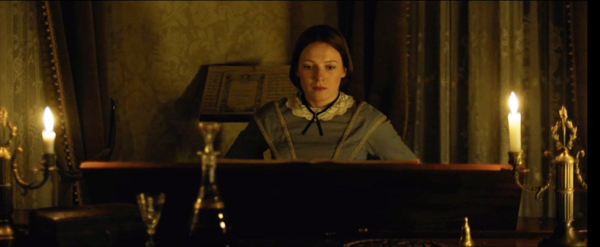
A Quiet Passion (2016).
DB here:
. . . . sums up what has happened and hints at what’s to come.
Seeing Terence Davies’ splendid A Quiet Passion again at our Wisconsin Film Festival brought out several subtleties I hadn’t registered on my first pass last year at Vancouver. Among the things I appreciated was a poignant 360-degree-plus tracking shot in the Dickinsons’ parlor.
This poet’s passion isn’t always so quiet. Davies’ earliest films are notably light on dialogue, but this one contains plenty of talk, both bantering and brutal. Perhaps most surprisingly, the supposedly withdrawn Emily Dickinson engages in snappy and snappish exchanges with friends, family, neighbors, and one awkwardly sincere suitor. All the more striking, then, when Davies halts the talk and gives us a suite of images accompanied by discreet sound effects, music, and voice-over portions of Dickinson verse.
Fairly early in the film, we get a spirited exchange between the censorious Aunt Elizabeth and the Dickinson family. After her indignant reply to their mock-heathen teasing, she gulps down some currant wine. Next we see the family quietly sharing an evening. That’s when we get this ripe circular camera movement.
It starts framing Emily, reading by firelight. She looks left.
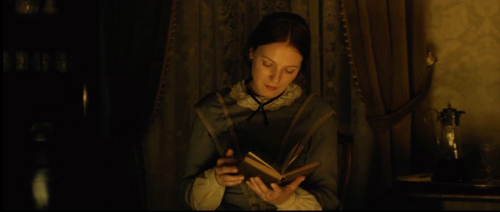
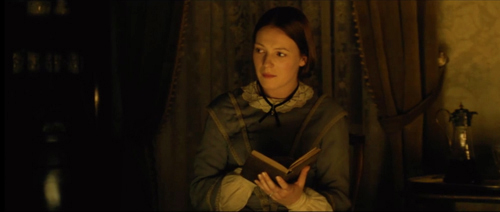
As the camera coasts past Emily we get a glimpse of a fond smile. The moving frame reveals Aunt Elizabeth, struggling to keep her eyes open.
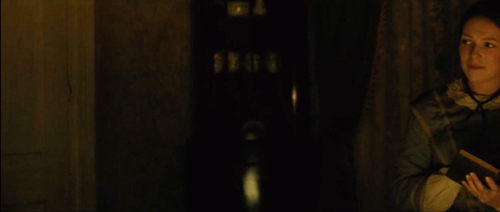
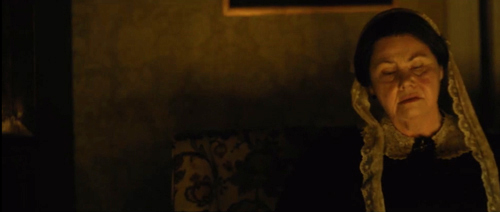
In the course of this movement, over the soft crackling of the fire and a ticking clock, we hear the older Emily’s voice-over reciting.
The heart asks pleasure first,/ And then, excuse from pain;/ And then, those little anodynes/ That deaden suffering.
The poem is a famously puzzling one. Is the speaker suggesting a bargain–if not pleasure, then no pain, please? Or is it a description of the course of a life: youth seeking pleasure, old age willing to accept absence of pain, and in the end a plea for something that simply ends suffering? The juxtaposition of young Emily and aged Elizabeth suggests two phases of woman’s life: Is Emily still pledged to pleasure (of a bookish kind) while her aunt is already seeking an anodyne, like the brandy she greedily gulped and the sleep that seems to be stealing over her?
As the camera passes Aunt Elizabeth, the poem is completed.
And then, to go to sleep;/ And then, if it should be/ The will of its Inquisitor,/ The liberty to die.
Elizabeth’s drowsiness comes to prefigure the death that will haunt the rest of the film. And the poem’s grim acceptance of physical decline, lifted by the mercies of death, sketches what will be all too vivid in scenes to come.
The camera continues its leftward survey of the family circle, settling next on Emily’s father Edward. He’s thoughtfully reading. So is brother Austin, at the rear table. Sister Vinnie, though, is sewing at the same table.
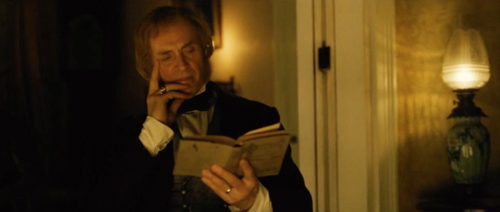
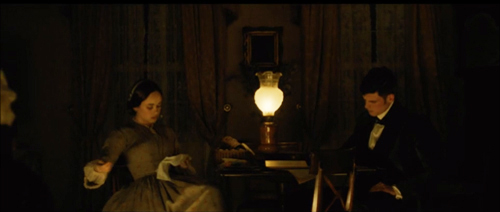
This survey of the immediate family shows Emily, like the men, gone all literary, while good-hearted Vinnie does no reading, instead attending to women’s tasks. The shot identifies Emily as, if not unfeminine by the standards of the day, at least not sunk in domesticity. She may be searching for that literary spark she will so often identify with glimpses of Eternity.
The view of Edward has been accompanied by clock chimes, and under the image of Austin and Vinnie we hear the clock start to strike the hour of nine. As the camera moves leftward, we see the mother, Emily Norcross Dickinson.
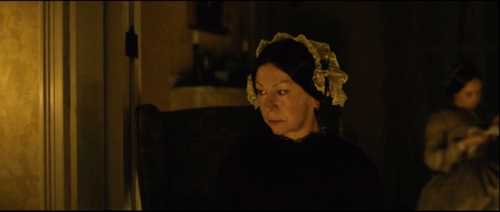
Neither reading nor tending to domestic tasks, Mrs. Dickinson is staring raptly into the fire. Everyone is in a kind of reverie, but hers is inward and melancholy. In the previous scene she has told Aunt Elizabeth “I prefer to listen and remain silent.” Later in the film we’ll learn that she has gradually withdrawn from the family, as if feeling ill-adjusted to these intellectuals, or through some private unhappiness. Later in the scene we’ll get another hint, but after briefly lingering on her, now the camera moves to the fire and then passes beyond.
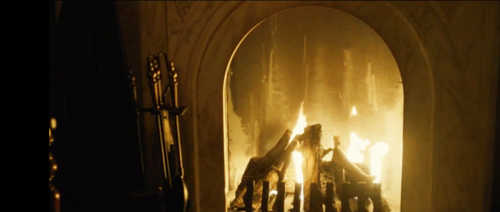
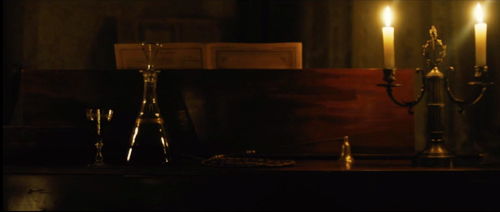
The piano will be the site of a crucial conflict to come, and the wine decanter, already featured in the scene before, will later be one index of the self-righteousness of the new clergyman’s wife. This “empty” stretch becomes a caesura before we get to the simple, devastating final image of the shot.
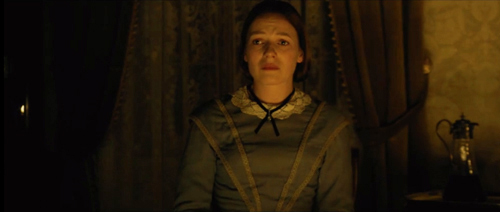
So much for books. Emily’s plaintive look, not clearly fastened on any family member, is ambivalent. Has the camera traced her eyes around the family circle, as her sidewise smile at Aunt Elizabeth suggested earlier? If so, what has moved her? Her mother’s solitude? Her siblings’ and fathers’ obliviousness to the older woman? Or is it something more self-centered? Locked within the family circle, has she surveyed the perimeter of her life to come?
The question is partly, teasingly answered, when we hear the offscreen voice of Mrs. Dickinson. She asks Emily to play one of the old hymns. Emily rises and goes to the piano, and we get a cut to the shot surmounting today’s blog entry. After Emily starts playing, the rest of the family is forgotten, and Davies cuts to a closer view of her mother.
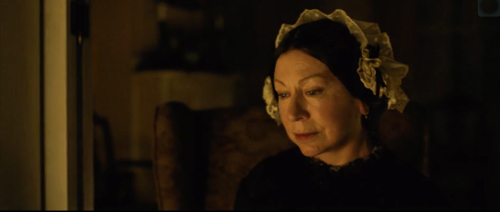
Still staring into the fire, she speaks of hearing the hymn sung by a young man with a beautiful voice. He was only nineteen when he died, she tells us, or maybe just herself. The softly delivered memory carries more than mere nostalgia. Are the others even noticing? We never find out.
Unlike her husband and children and Aunt Elizabeth, the mother ponders the past and its losses. We’re invited to imagine an alternative life for her, perhaps with the beautiful young man. Is he kin to the young woman in white with the parasol recalled by Bernstein in Citizen Kane, as he stands before his roaring fire? At the least, this warm parlor is now haunted by death.
Davies is too tactful to push this moment, leaving the character to keep her own counsel. But I can’t resist another probe. The Magnificent Ambersons is one of Terence’s favorite films, he told us during his visit (“better than Kane“). It’s not a stretch to let the image of Mrs. Dickinson remind us of the somber shot of Major Amberson before another fireplace. Deprived of his fortune, baffled by all around him, he ponders the origins of life as the narrator muses that even an Amberson might not get a leg up in the Hereafter.
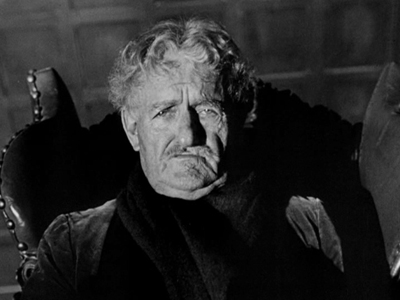
Terence pointed out to us that the great American films are often about families, because in that setting passions are both aroused and contained. The Dickinson family, tightly bonded by love and respect, ruled by a tender but iron-willed patriarch, harboring a mother and daughter withdrawn from the world, split by failed marriages and angry reproaches, prey to death and broken pledges, is no perfect haven. Perhaps Emily’s stabbing epiphany is a realization of all of that, and what it might mean for her art. All this takes two minutes and ten seconds.
Nowadays the circling camera is a cliché; characters sitting around a table or even just standing in the street seem to be spinning on a turntable. Davies is far more discreet and precise. Step lightly on this narrow spot, a Dickinson poem advises us, and that’s what his camera has done here.
Thanks to Bianca Costello and Music Box Films, which is distributing A Quiet Passion. Its US rollout starts 14 April. Thanks as ever to the Wisconsin Film Festival and its plucky programmers Jim Healy, Mike King, and Ben Reiser.
And many thanks to Terence Davies for coming to town and providing fine conversation about George Butterworth, Meet Me in St. Louis, and the making of A Quiet Passion. As he told our audience: “I hope you enjoy it, and if you don’t, complain to Mr. Trump.”
Other entries in the intermittent Sometimes. . . . series are here (I Topi Grigi), here (The Mormon’s Victim), here (A Touch of Zen), here (Side Street), and here (Frisco Sally Levy).
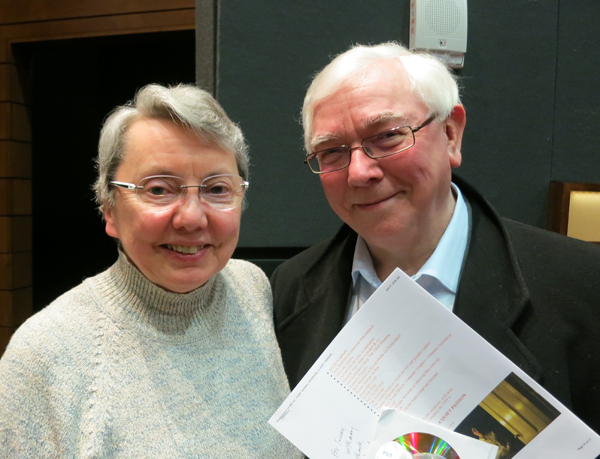
Kristin and Terence Davies.
Wisconsin Film Festival: Retro-mania
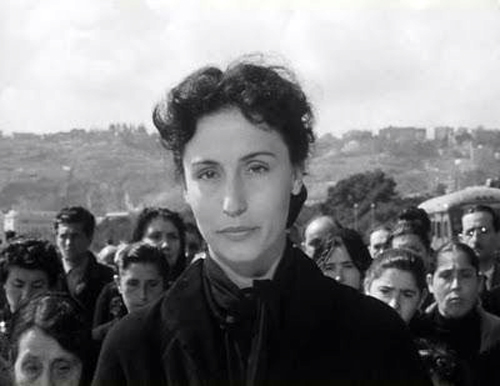
The Gold of Naples (L’oro di Napoli, 1954).
DB here:
With the growing popularity of subscription streaming services, I suspect that film festivals will need to amp up their retrospective offerings. I was very surprised that a good film like I Don’t Feel at Home in This World Anymore, which would in earlier years have played arthouses, had no theatrical release. Despite its acclaim at Sundance, it went straight to Netflix online. True, Amazon has shown great willingness to port its high-profile titles to big screens. But by and large, as Netflix, Amazon, and other services produce and buy up new films, I suspect that festival premieres of indie titles will become more and more a display case for streaming. See it this week at our festival, and next month online!
It must be dispiriting for filmmakers hoping for theatrical play. Yet this crunch may oblige festival programmers to emphasize archival and studio restorations. These rarities are unlikely to show up on streaming any time soon, and festival screenings can build a public for them—so that they may eventually come to DVD or subscription services.
Case in point: Several restored titles at our Wisconsin Film Festival drew sellout crowds.
AMPAS comes through
 To my regret, I didn’t catch the Academy Film Archive restoration Across the World and Back, a collection of global adventures of “the world’s most traveled girl,” the self-named Aloha Wanderwell. Her 1920s and 1930s footage, which included record of the Taj Mahal and the Valley of the Kings, was introduced and commented on by Academy archivist Heather Linville. Everybody I talked to loved it. Go to AMPAS for many clips and pictures.
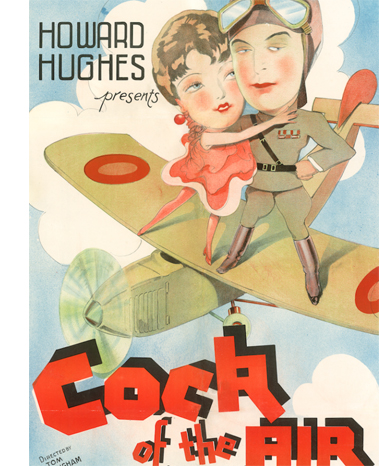
I did manage to squeeze into another Academy restoration, Howard Hughes’ Cock of the Air (1932). The film amply showcases Hughes’ two principal concerns, aviation and the female mammary glands. (I guess technically that makes three concerns.) It’s a minor-key Lubitsch switch in which priapic flyboy Chester Morris pursues sexy Billie Dove, who’s resolved to bring his ego crashing to earth. We get lots of nuzzling, murmured double entendres, and scenes of passion quickly doused by the woman’s coquettish withdrawal. I thought the plot thin, needing a romantic rival or two, but the leering pre-Code stuff is good dirty fun. The high point comes when Billie encases herself in a suit of armor and Chester arms himself with a can opener.
The direction is credited to Tom Buckingham, a lower-tier artisan, but it seems possible that parts of the film were handled by Lewis Milestone, who contributed the original story. The first couple of reels are very flashy, with odd angles, complicated tracking shots, and bursts of rhythmic editing. They’re typical of Milestone’s showy, sometimes showoffish, style in All Quiet on the Western Front (1930) and The Front Page (1931; also shown at WFF).
Cock of the Air encountered heavy censorship, with the can-opener episode entirely snipped from the release version. The Hays Office even provided local censor boards with guidance for further cutting. When Heather discovered a pre-censorship print at the Academy—an exciting find—she discovered that the offending footage was there, but the soundtrack portions were lost.
Heather proceeded to hire actors to voice the parts in accord with the script and the onscreen lip movements. The results are sonically smooth, but in the spirit of fair dealing, the bits of replacement are marked with a discreet bug in the lower right corner of the frame. This is a nice piece of archival integrity. Heather also showed an informative short on the restoration of this engaging piece of naughty early sound cinema.
Of incidents and non-incidents
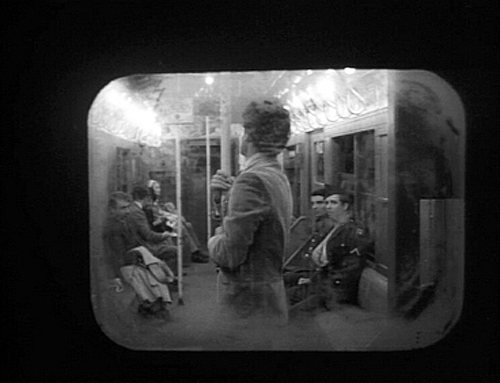
The Incident (1967).
Two other pieces of film history got fitted into place with the revival of Larry Peerce’s One Potato, Two Potato (1964), a classic of American social-problem cinema, and the rarer The Incident (1967). This latter glimpse of mean streets creates what screenwriter David Koepp calls a Bottle, a tightly constrained space in which the drama plays out. Here the Bottle is a subway car in which several people, a cross-section of New York life, become the playthings of two young thugs, played by Tony Musante and Martin Sheen.
Starting by gay-bashing and culminating in a charged racial confrontation, the subway conflicts sought to show how the solid citizens can’t summon the will to respond collectively—even when they take their turn under the thugs’ lash. It was intended as a response to the infamous murder of Kitty Genovese, whose screams were mostly ignored by her Queens neighbors. (A recent documentary, The Witness, revisits the case.)
 The plot is provocative enough, but the manner of filming, evocative of cinéma-vérité, drives every moment home. Forbidden to film on the subway system, director Larry Peerce and ace cinematographer Gerald Hirschfeld (Cotton Comes to Harlem, Young Frankenstein) had to rely on sets, except for shots snatched with hidden cameras. But what a set they had for the subway car. Peerce explained in an energetic Q & A that the car was built to five-sixth scale, with no wild walls. It forced the players to interact in a cramped, pressurized atmosphere.
A believer in improvisation, Peerce rehearsed different groups of actors separately, then brought them together to let some natural friction emerge. He encouraged them to add to the script and build immediate reactions—so immediate that Thelma Ritter, a veteran unused to improv methods, responded to Musante’s goadings by slapping him. All this is captured in a superheated style of fast cuts, big close-ups, and screeching sound. It’s a white-knuckle ride that retains its power. I hadn’t seen it since 1970, but the violent climax, utterly earned, is disturbingly contemporary. The film’s final moments are being replayed, in reality, all over America as you read this.
The nicest surprise of my retrospective viewing was The Gold of Naples (1954). Studded with big names (Ponti and De Laurentiis, Totó and de Sica, Silvana Mangano and Sophia Loren), it has sometimes been thought to be one of those lightweight Italian comedies that represent a quiet refusal of the Neorealist impulse. On the contrary, it proves to be a bold contribution to block construction, here in the omnibus genre. Several stories are laid end to end, exemplifying the vivacity and poignancy of life in Naples’ back alleys.
One story has a tight, shocking arc: the tale of a prostitute (Mangano) who thinks she’s marrying for love until she learns her new husband’s guilt-ridden sadomasochistic motives. The finale is a scrappy anecdote, in which The People give a local plutocrat the ultimate vocalization of disrespect.
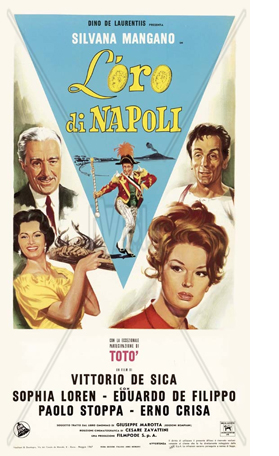 But some episodes, taken as conventional stories, are oddly off-center. A wife (Loren, bursting out of her blouse and skirt) has lost a ring in a torrid encounter with her lover. She finds it again, and no harm done. The search for it is a pretext for sampling other lives. Or: A penniless count addicted to gambling is reduced to playing cards with an exceptionally lucky neighborhood kid. He learns no lesson, the kid is bored with winning, and all is as before. More disquieting: A family bullied by a rich man who has moved in with them finds a way to kick him out, but there’s little sense of triumph. He remains unbowed, and manages to spoil their celebration of his eviction. Most scripts would let us enjoy his comeuppance, but here we’re left with the cowering family, which has become so unused to freedom that they may not know what to do next.
Above all, in an episode cut from the original American release (and missing from this poster, though at the top of today’s entry), a mother follows her son’s coffin driven through the street. She throws wrapped candies for children to pick up. That’s it. No flashbacks to life with her boy, no dialogue telling us how he died, no colorful secondary characters to provide that life-goes-on final note. It could be called “The Incident,” though nothing more unlike the fever-pitch drama of Larry Peerce’s film could be imagined.
According to screenwriter Cesare Zavattini, a Hollywood producer once told him:
“This is how we would imagine a scene with an aeroplane. The plane passes by. . . a machine gun fires . . . the plane crashes. And this is how you would imagine it. The plane passes by. . . The plane passes by again… The plane passes by once more…”
He was right. But we have still not gone far enough. It is not enough to make the aeroplane pass by three times; we must make it pass by twenty times.
And, Zavattini seems to suggest, the machine gun should never fire.
The lack of a dramatic peak, to which a normal scene would build, can force our attention to downshift to the minutiae of moment-by-moment action, or rather micro-action. That’s what happens in this sequence of The Gold of Naples, which Zavattini helped write. Every gesture and glance becomes potentially, but ambiguously, significant. De Sica’s patient recording of a very thin slice of life is as radiantly unpretentious a model of “pure Neorealism” as anything to come from the 1940s.
This is just a glimpse of the delights among the 150 screenings that are gracing our eight-day film festival. (We’re now the largest university-sponsored festival in the country, though probably not in budget.) Details of this magnificently programmed affair are here. We’ll blog again soon.
Thanks to the programmers Jim Healy, Ben Reiser, and Mike King, along with all the institutions, wise elders, community supporters, and volunteers that make WFF fun. You can browse earlier reportage from this event here.
You can also see the restored Front Page (1931) in Criterion’s new His Girl Friday DVD release. On Cock of the Air’s censorship travails, see the AFI site. It will be screened very soon at the TCM Festival. Also set for the TCM festival is The Incident, which will screen later in April at Film Forum. Mike Mashon gives more information on Aloha Wanderwell in his LoC blog.
How wrong I was to miss booking The Gold of Naples when I ran a film club in college and good old Audio-Brandon offered it. Even without the funeral scene and the up-yours finale, it would be worth seeing. Now no version seems available in the US; WFF director Jim Healy brought a print from Italy. It would be perfect for FilmStruck.
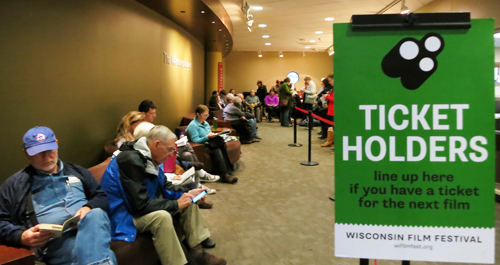
Read…watch movie…grab food…read…watch movie…
Movies in the mountain, and on the machine

DB here:
I’m back in Madison from 2 1/2 months in Washington, DC. under the auspices of the John M. Kluge Center, where I was this year’s Chair of Modern Culture. This kind appointment allowed me to pursue my research into 1910s American film style, than which nothing could be more fun. Along with that were some extramural activities. The most spectacular one was our Kluge field trip into the most overwhelming media archive in the world–the bulging-biceps caped crusader of film, TV, and sound preservation.
Treasures under Mount Pony
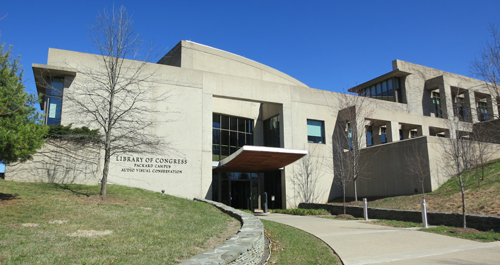
Dr. Strangelove could have come up with the idea. If the Russians attack the US, better have a deep underground vault for storing a few billion dollars to replenish currency supplies on the East Coast. So in the Culpeper, Virginia countryside build a gigantic secret bunker. Include facilities for housing 500 or so personnel to keep the government, or what was left of it, running for a month. Add amenities like a pistol range and refrigeration units to cool cadavers that couldn’t be buried outside. Getting assigned here in nuclear winter would definitely count as subterranean homesick blues.
This super-secret complex was completed in 1969. It boasted foot-thick concrete walls and was surrounded by barbed wire and machine-gun nests. By 1992, the bombs had failed to fall, so the complex was decommissioned and eventually offered for sale. After a major grant to the Library from the David and Lucille Packard Foundation, a long-time friend of American film history, the building was transferred to the Packard Humanities Institute . The facility was renovated thanks to over $260 million of Packard and Congressional funding. A lot, yes, but in 2017 dollars that comes to about $402 million, and Beauty and the Beast has scared up about twice that over the last couple weeks.
The renovation turned this vast bank vault/bomb shelter into the world’s most colossal and up-to-date media storage and preservation facility. Opened in 2007, the National Audio-Visual Center is also known as the Packard Campus. Its collection of films, videos, and audio records, along with posters and documents, come to over six million items sitting on ninety miles of shelving. With 80 per cent of it sunk below ground, it was designed to be an exemplary green building, with a vast gardened roof.
Thanks to the energy of Kluge Center director Ted Widmer and his colleagues, we had a chance to visit the place. Greg Lukow, Chief, NAVCC–Packard Campus, and Mike Mashon, head of the Moving Image section, led us in a labyrinthine, carefully organized three-hour tour of the dazzling facility.
I can’t convey all that we learned about conservation of film, TV, sound recordings, and digital media. Rest assured that the hundred-plus people working away here in state-of-the-art conditions are striving mightily to save media artifacts for you and me and our heirs. Here are some high points.
Mike introduced the visitors to the moving-image formats of the media conserved at the facility, everything from film and videotape to Digital Cinema Packages. Spike Lee’s first film, as a copyright deposit, is there too, on Ampex tape.
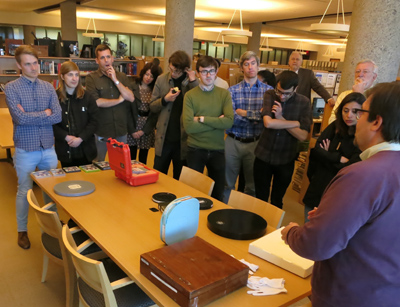
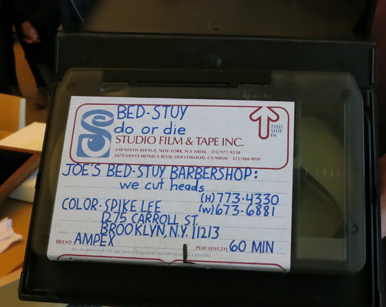
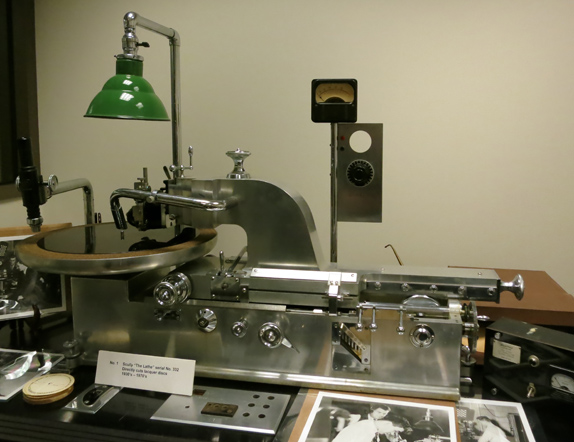
Sound isn’t neglected, as Greg offered a comparable overview of all the audio formats, including cylinder and wire recording. Yes, 8-tracks are also involved. On the right you see the Scully Lathe, a gleaming bad boy that cut disks. Used from the 1930s into the 70s it’s being brought back with the new interest in vinyl records.
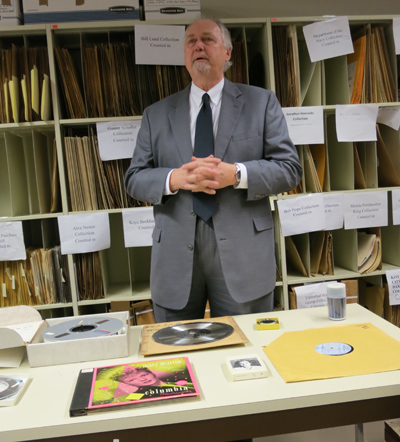
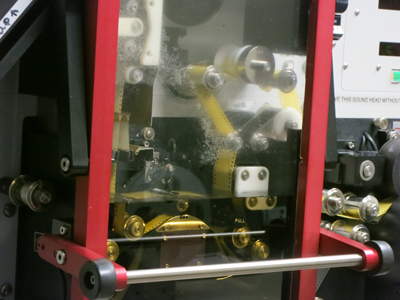
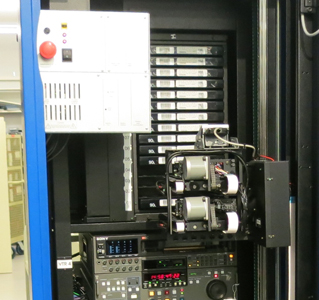
We visited several lab and restoration rooms, including one for wet-gate printing and another for migrating VHS tapes to digital files. Since the latter has to be done in real time, robots are recruited for the job, busily gliding up and down ranks of cassettes.
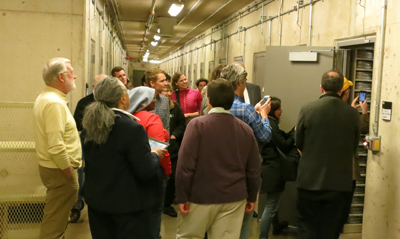
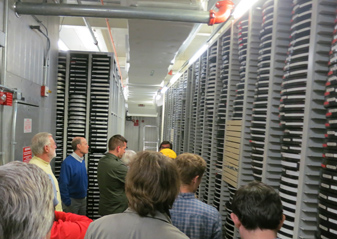
Of course we had to stop by film vaults, kept a chilly 39 degrees. On the left we see some of the holiest of holies, nitrate vaults. It looks like a Spanish Civil War prison, rows and rows of heavy doors. The vault on the right contains master safety film elements, on both acetate and polyester stock.
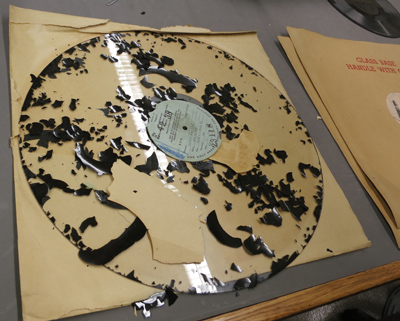
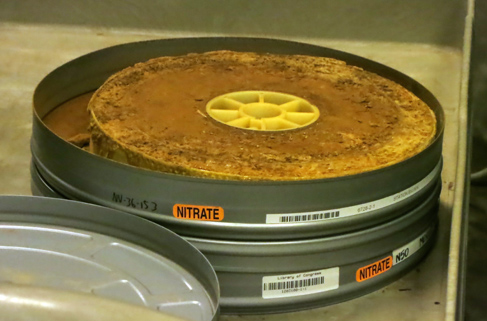
What’s a trip to an archive without despoiled artifacts? On the left, a flaking glass-based 16-inch lacquer instantaneous disc from the NBC radio collection. “Instantaneous” means that it was a recording of a live broadcast, and so was probably unique. On the right, we have decomposed nitrate film.
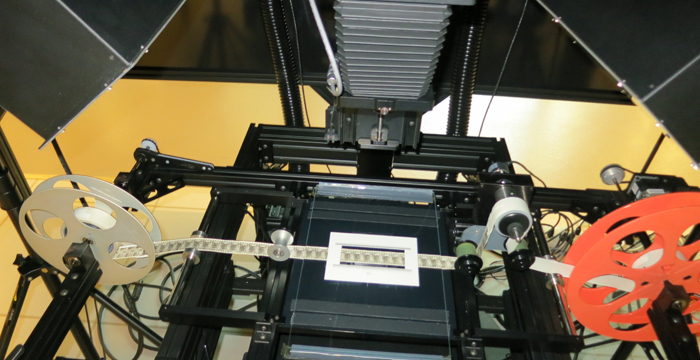
Of enduring interest to cinephiles is the famous paper print collection. Film companies of the earliest years submitted to the Library movies on rolls of paper, to be copyrighted in the manner of still photographs.To be preserved and screened, those had to be turned back into films. During the 1950s that task was fulfilled by Kemp R. Niver in a home-made rig.
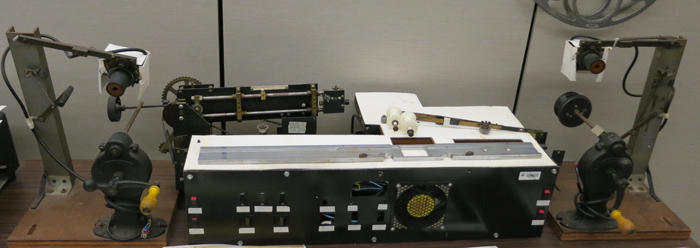
He transferred some 3,000 titles to 16mm–not the ideal format, but better than nothing. Some results were fuzzy and jumpy, but many came out okay. I watched several during my stay, including The Hoosier Schoolmaster (1914).
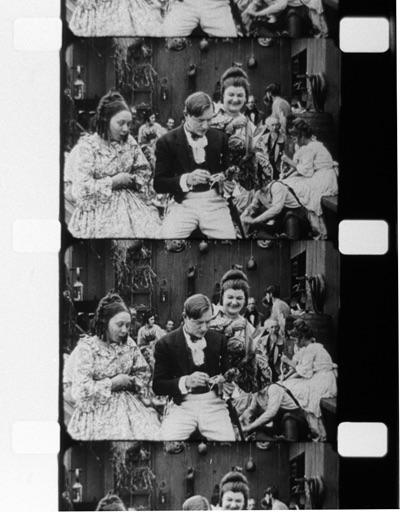
Since then, some excellent 35mm prints have been made from the paper prints, and still more success has been found with digital remastering, which can correct for misaligned frames on the original paper copies.
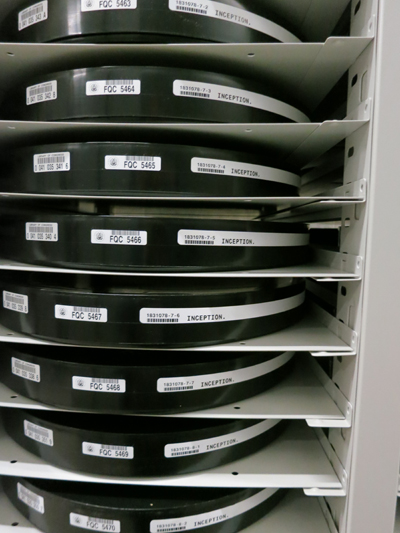
It was good to learn that film copies of new releases are still being submitted for copyright deposit. An impeccable print of Get Out arrived while I was there, and of course 35mm advocate Christopher Nolan wouldn’t miss a chance to save Inception and other of his works.
But I was dismayed to learn that a great many companies, taking advantage of a loose requirement about what counts as a deposit copy, are submitting DVDs, Blu-rays, and even DVD-R versions of their films. If they can’t submit a print, they should at least provide an unencrypted DCP. Otherwise, scholars and audiences of the future will encounter the digital equivalent of the crawling, scraped deterioration we see with film.
101 movies

Fortunately for me, 1910s films are still available on film. Viewing prints of films stored at Culpeper are shipped to the James Madison Building in the District. There, in the Moving Image Research Center, they may be viewed on my old friend, the flatbed machine known as a Steenbeck. Every day a Steenbeck patiently awaited my depredations.
The staff of the Reading Room were just superb in helping me order titles and dig up information about them. Above you see the team I worked with: Dorinda Hartmann, Rosemary Hanes, Josie Walters-Johnston, and Zoran Sinobad.
I learned an enormous amount from them, and I enjoyed talking movies with them during our breaks. Others who helped me greatly were Karen Fishman, Research Center Supervisor, MBRS Division; Alan Gevinson, curator of the American Archive of Public Broadcasting; and David Pierce, Assistant Chief, NAVCC–Packard Campus.
My mission was to see as many American fiction features from the 1910s as I could. This was the period when a five-reel film (ca. 60-70 min.) became a dominant format, though shorts and longer films were also being made. I’ve spent about a decade watching largely European films of the period in various archives and in Bologna’s Cinema Ritrovato, with results I’ve occasionally discussed on this blog. A visit to the LoC nicely complemented my Continental and Nordic explorations. Although several American films from the period are available on DVD, I’ve tried to see even those in film copies. (Why? Tell you later.)
For a time I was joined by James Cutting, perceptual psychologist extraordinaire, who enthusiastically wanted to watch these old movies. His presence helped me a lot, sharpening my attention to things in the images. Here’s James, skewed, during our nighttime trip to Chinatown for food and Get Out.

In all, across 42 business days (had to take days off for holidays and inauguration), I saw 101 films, 98 from my period and three others for other projects.
Not all the films survive complete. Some lacked one or more reels. That’s a great pity in the case of Lois Weber/ Phillips Smalley’s False Colours (1914), Sunshine Molly (1915), and Idle Wives (1916); William deMille’s The Sowers (1916); William Desmond Taylor’s Ben Blair (1916); and many other stunning projects I got a glimpse of. But a little is better than nothing, as I’ve tried to show in an earlier entry and hope to show in later ones.
A few portions that remained were plagued by deterioration. Usually, that consists of ameba-like creatures swarming over the image. Some decadents wallow in these miasmas, especially on tinted prints. (See Lyrical Nitrate and Decasia.) Me, I can’t romanticize turning a 1910s drama or comedy into a 1960s abstract film. I want to see the story and the style, dammit.
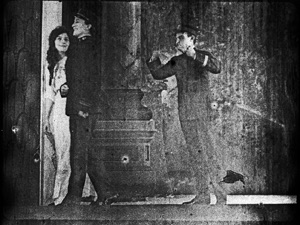
Another form of deterioration yields a ghostly, scraped-off image. Sometimes the decay changes from shot to shot, presumably because at some points the shots were segregated for tinting and toning. Here’s The Caprices of Kitty (Smalley, 1915), with Elsie Janis watching a play. In a gag on celebrity, she’s also an actor on stage (and in drag). After the nice shot of her and her father in the audience, the stage shot makes you shudder.
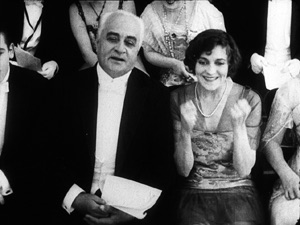
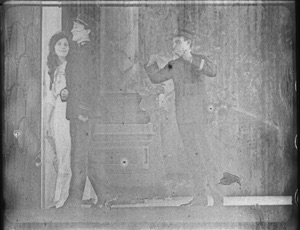
A first effort to clean it up with Photoshop helps, but still…Makes you remember why all that effort on the Packard Campus is necessary.
Of course a great many copies I watched were gorgeous. Orthochromatic film, with a ton of light dumped on the sets, yields images with incredibly rich gray scales. (My Ilford photochemical black and white couldn’t capture that range.) When we saw this parlor shot from By Right of Purchase, a 1918 Norma Talmadge melodrama, James blurted out, “Clutter!” A connoisseur of dense images, James later ran it through his algorithms and found that it had a spectacular degree of clutter.
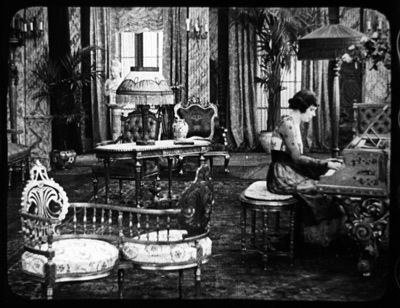
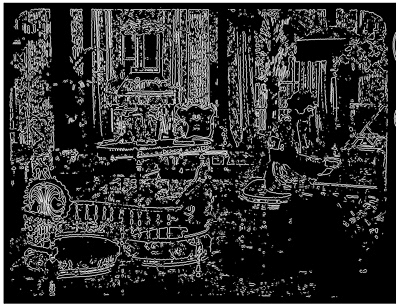
Filigreed clutter is another big reason to like the 1910s, and archives like the LoC team are keeping it visible for us.
Deterioration isn’t the only insult these movies suffer. There’s the degradation of them in oft-copied versions. Compare this shot, from Reginald Barker’s splendid William S. Hart film The Bargain (1914), with the image you get if you buy the bootleg DVD.
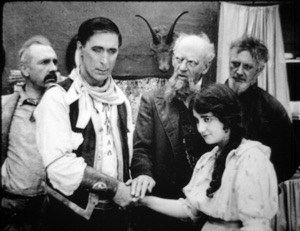
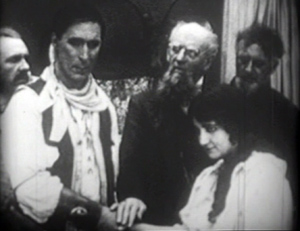
Shot scale changes because of video cropping, facial expressions become unreadable, the eyes go dark, and that mounted trophy in the back just disappears. Of course things go a lot better with a video version of a film restored by the Culpeper crew (Moving Image Curator Rob Stone in particular). Olive Films has just released Wagon Tracks (1919), a fine William S. Hart film, on a very pretty Blu-ray derived from a tinted Library of Congress restoration.
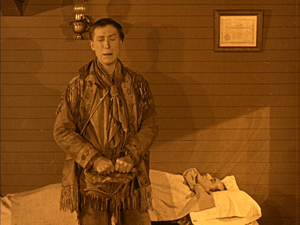
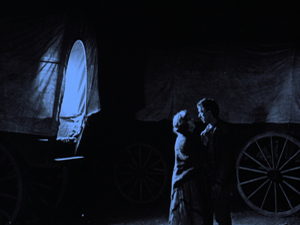
So it can be done well, though I still prefer to study a 35 print, preferably untinted. Call me cranky.
The Packard Campus visit brought home to me how much effort is spent saving our film heritage. That heritage includes films that are little-known, but deserve better recognition. Watching with me, astonished by the technical ingenuity and wide-ranging experimentation rushing past us, James was reminded of the Cambrian Explosion, that period of origin and rapid diversification among earthly organisms.
It’s an intriguing analogy. A mere dozen years yielded “our cinema,” as I’ve argued in this video lecture–the sturdy prototypes of moviemaking today. Yet along with enduring models of story and style came a cascade of ingenious novelties that weren’t taken up much. The 1920s, for all their innovations, tended to prune away some of the more eccentric but intriguing tendencies that burst out in the 1910s. In my next entry on the subject, I’ll offer some examples.
I owe a tremendous debt to the John W. Kluge Center for supporting my stay at the Library of Congress. Thanks especially to Ted Widmer, Director of the Center, and his colleagues Emily Coccia, Travis Hensley, Callie Mosley, Mary Lou Reker, and Dan Turello. Also I enjoyed enlightening conversations with Peter Brooks, in residency at the Center, and the other Kluge Chairs Timothy Breen, Jose Casanova, and Wayne Wiegand, all embarked on fascinating projects.
Thanks also to all the staff at the Packard Campus, who enthusiastically shared information about their work habits. We’re grateful to Greg and Mike for spending so much time with us.
The digital spoor on the Packard Campus leads far and wide; a Google search will yield you many nifty items. The 2007 plans for the facility are reviewed in this information-packed presentation by Greg Lukow. For something more recent, try the Wired visit by Brian Gardiner. On the digitizing side, see Boing Boing’s extensive coverage, including an interview with Greg. There’s a good half-hour C-span documentary tour led by Mike Mashon. Mike’s blog Now See Hear! offers updates on current Campus events.
Tony Slide’s Nitrate Won’t Wait (McFarland, 2000) remains the essential source on U.S. film preservation. It has some good anecdotes about Kemp Niver, including one involving a pistol and Raymond Rohauer. Criterion has a nifty little film on wet-gate restoration of The Man Who Knew Too Much (1935).
If you’re interested in film research, you need to read James Cutting’s sweeping big-data studies on film. A good summing up of part of it is “Narrative Theory and the Dynamics of Popular Movies.” There’s interesting commentary on it here from a psychologist and here from a screenwriter (who clings to the three-act model). James’s book on the formation of the canon of Impressionist painting has been invoked in Derek Thompson’s book Hit Makers: The Science of Popularity in an Age of Distraction (Penguin, 2017), 23-26.
For more on visual clutter, see this paper on clutter and visual search, of which Tim Smith, master of eye movements, is a co-author; and two papers specifically on movies, by James, one with Kacie Armstrong: here and here.
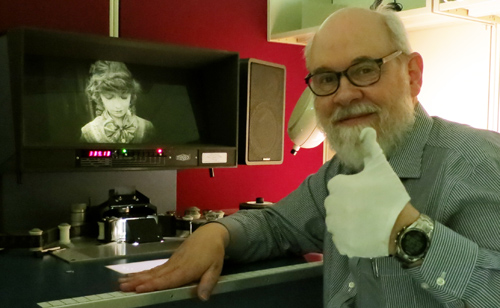
DB makes Lillian bashful in The Lily and the Rose (1915).



