Sunday | August 19, 2012
DB here:
Paul Thomas Anderson, the Wachowskis, David Fincher, Darren Aronofsky, and other directors who made breakthrough films at the end of the 1990s have managed to win either popular or critical success, and sometimes both. None, though, has had as meteoric a career as Christopher Nolan.
His films have earned $3.3 billion at the global box office, and the total is still swelling. On IMDB’s Top 250 list, as populist a measure as we can find, The Dark Knight (2008) is ranked number 8 with over 750,000 votes, while Inception (2010), at number 14, earned nearly 600,000. The Dark Knight Rises (2012), on release for less than a month, is already ranked at number 18. Remarkably, many critics have lined up as well, embracing both Nolan’s more offbeat productions, like Memento (2000) and The Prestige (2006), and his blockbusters. Nolan is now routinely considered one of the most accomplished living filmmakers.
Yet many critics fiercely dislike his work. They regard it as intellectually shallow, dramatically clumsy, and technically inept. As far as I can tell, no popular filmmaker’s work of recent years has received the sort of harsh, meticulous dissection Jim Emerson and A. D. Jameson have applied to Nolan’s films. (See the codicil for numerous links.) People who shrug at continuity errors and patchy plots in ordinary productions have dwelt on them in Nolan’s movies. The attack is probably a response to his elevated reputation. Having been raised so high, he has farther to fall.
I have only a welterweight dog in this fight, because I admire some of Nolan’s films, for reasons I hope to make clear later. Nolan is, I think all parties will agree, an innovative filmmaker. Some will argue that his innovations are feeble, but that’s beside my point here. His career offers us an occasion to think through some issues about creativity and innovation in popular cinema.
Four dimensions, at least
First, let’s ask: How can a filmmaker innovate? I see four primary ways.
You can innovate by tackling new subject matter. This is a common strategy of documentary cinema, which often shows us a slice of our world we haven’t seen or even known about before—from Spellbound to Vernon, Florida.
You can also innovate by developing new themes. The 1950s “liberal Westerns” substituted a brotherhood-of-man theme for the Manifest-Destiny theme that had driven earlier Western movies. The subject matter, the conquest of the West by white settlers and a national government, was given a different thematic coloring (which of course varied from film to film). Science fiction films were once dominated by conceptions of future technology as sleek and clean, but after Alien, we saw that the future might be just as dilapidated as the present.
Apart from subject or theme, you can innovate by trying out new formal strategies. This option is evident in fictional narrative cinema, where plot structure or narration can be treated in fresh ways. Many entries on this blog have charted possible formal innovations, such as having a house narrate the story action, or arranging the plot so as to create contradictory chains of events. Documentaries have experimented with a film’s overall form as well, of course, as The Thin Blue Line and Man with a Movie Camera. Stan Brakhage’s creation of “lyrical cinema” would be an example of formal innovation in avant-garde cinema.
Finally, you can innovate at the level of style—the patterning of film technique, the audiovisual texture of the movie. A clear example would be Godard’s jump cuts in A Bout de souffle, but new techniques of shooting, staging, framing, lighting, color design, and sound work would also count. In Cloverfield and Chronicle, the first-person camera technique is applied, in different ways, to a science-fiction tale. Often, technological changes trigger stylistic innovation, as with the Dolby ATMOS system now encouraging filmmakers to create sound effects that seem to be occurring above our heads.
I see other means of innovation—for instance, stunt casting, or new marketing strategies—but these four offer an initial point of departure. How then might we capture Nolan’s cinematic innovations?
Style without style
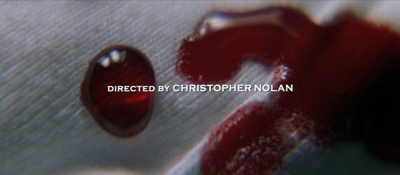
Well, on the whole they aren’t stylistic. Those who consider him a weak stylist can find evidence in Insomnia (2002), his first studio film. Spoilers ahead.
A Los Angeles detective and his partner come to an Alaskan town to investigate the murder of a teenage girl. While chasing a suspect in the fog, Dormer shoots his partner Hap and then lies about it, trying to pin the killing on the suspect. But the suspect, a famous author who did kill the girl, knows what really happened. He pressures Dormer to cover for both of them by framing the girl’s boyfriend. Meanwhile, Dormer is undergoing scrutiny by Ellie, a young officer who idolizes him but who must investigate Hap’s death. And throughout it all, Dormer becomes bleary and disoriented because, the twenty-four-hour daylight won’t let him sleep. (His name seems a screenwriter’s conceit, invoking dormir, to sleep.)
Nolan said at the time that what interested him in the script—already bought by Warners and offered to him after Memento—was the prospect of character subjectivity.
A big part of my interest in filmmaking is an interest in showing the audience a story through a character’s point of view. It’s interesting to try and do that and maintain a relatively natural look.
He wanted, as he says on the DVD commentary, to keep the audience in Dormer’s head. Having already done that to an extent in Memento, he saw it as a logical way of presenting Dormer’s slow crackup.
But how to go subjective? Nolan chose to break up scenes with fragmentary flashes of the crime and of clues—painted nails, a necklace. Early in the film, Dormer is studying Kay Connell’s corpse, and we get flashes of the murder and its grisly aftermath, the killer sprucing up the corpse.
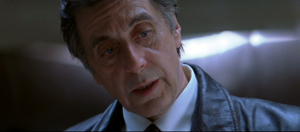 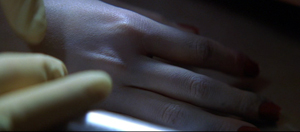 
At first it seems that Dormer intuits what happened by noticing clues on Kay’s body. But the film’s credits started with similar glimpses of the killing, as if from the killer’s point of view, and there’s an ambiguity about whether the interpolated images later are Dormer’s imaginative reconstruction, or reminders of the killer’s vision—establishing that uneasy link of cop and crook that is a staple of the crime film.
Similarly, abrupt cutting is used to introduce a cluster of images that gets clarified in the course of the film. At the start, we see blood seeping through threads, and then shots of hands carefully depositing blood on a fabric (above). Then we see shots of Dormer, awaking jerkily while flying in to the crime scene. Are these enigmatic images more extracts from the crime, or are they something else? We’ll learn in the course of the film that these are flashbacks to Dormer’s framing of another suspect back in Los Angeles. Once again, these images get anchored as more or less subjective, and they echo the killer’s patient tidying up.
Nolan’s reliance on rapid cutting in these passages is typical of his style generally. Insomia has over 3400 shots in its 111 minutes, making the average shot just under two seconds long. Rapid editing like this can suit bursts of mental imagery, but it’s hard to sustain in meat-and-potatoes dialogue scenes. Yet Nolan tries.
In lectures I’ve used the scene in which Dormer and Hap arrive at the Alaskan police station as an example of the over-busy tempo that can come along with a style based in “intensified continuity.” In a seventy-second scene, there are 39 shots, so the average is about 1.8 seconds—a pace typical of the film and of the intensified approach generally.
Apart from one exterior long-shot of the police station and four inserts of hands, the characters’ interplay is captured almost entirely in singles—that is, shots of only one actor. Out of the 34 shots of actors’ faces and upper bodies, 24 are singles. Most of these serve to pick up individual lines of dialogue or characters’ reactions to other lines. The singles are shot with telephoto lenses, a choice exemplifying what I called the tendency toward “bipolar” lens lengths in intensified continuity–that is, either very long lenses or fairly wide-angle ones.
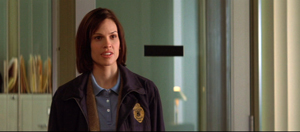 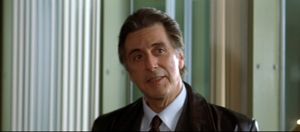 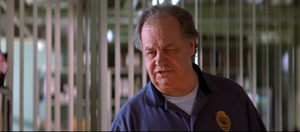 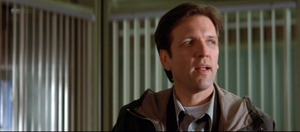
Fast cutting like this need not break up traditional spatial orientation. In this scene, there are a couple of bumps in the eyeline-matching, but basically continuity principles are respected. As Nolan explains on the DVD commentary, he tried to anchor the axis of action, or 180-degree line, around Dormer/Pacino, so the eyelines were consistent with his position, and that’s usually the case here.
The scene’s development and the actors’ line readings are emphasized by the cutting; the lighting and framing remain almost unvarying (though there’s also an occasional slight push-in during an establishing framing). These aren’t innovative choices, having become conventional, gradually but firmly, since the 1970s.
I can’t illustrate all the shots here, but despite its more or less cogent continuity, the scene seems to me choppy, uneconomical, and fairly perfunctory in its stylistic handling. Nolan makes no effort to move the actors around the set in a way that would underscore the dramatic development. Because of the rapid editing, characters’ lines and gestures are cut off or unprepared for. There is no effort to design each shot, à la Hitchcock, to fit the line or reaction of the actor. Most shots are excerpted from full takes, all from the same setup. The most obvious example is the setup that pans to show Dormer as he comes in, stops, and reacts to the conversation. Thirteen shots are taken from that setup (not necessarily the same full take, of course, as the last frame here shows).
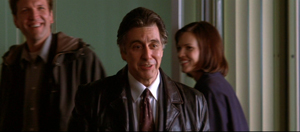 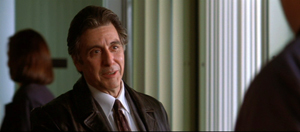 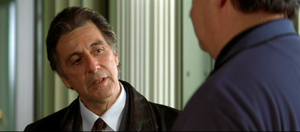 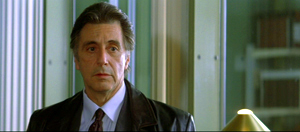
In Nolan’s recent films, this avoidance of tightly designed compositions may be encouraged further because he’s shooting in both the 1.43 Imax ratio and the 2.40 anamorphic one. There remains a general tendency toward loose, roughly centered framings.
Somebody is sure to reply that the nervous editing is aiming to express Dormer’s anxiety about the investigation into his career. But that would be too broad an explanation. On the same grounds, every awkwardly-edited film could be said to be expressing dramatic tensions within or among the characters. Moreover, even when Dormer’s not present, the same choppy cutting is on display.
Consider the 23 shots showing Ellie greeting Dormer and Hap as they get off the plane. Again we have full production takes broken up into brief phases of action (it takes five shots to get Dormer out of the plane), with an almost arbitrarily succession of shot scales. When Ellie leaves her vehicle to go out on the pier, the action is presented in nine shots.
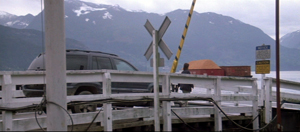   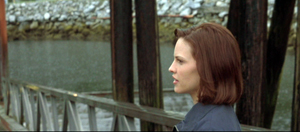  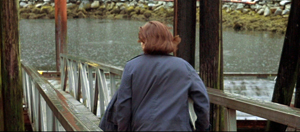 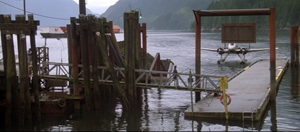 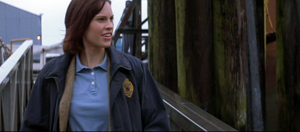 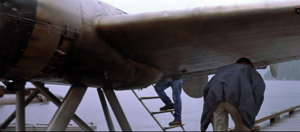
We can imagine a simpler presentation—perhaps after an establishing shot, we track with Ellie down along the dock (so we can see her smiling anticipation), then pan with her walking leftward into a framing that prepares for the plane hatch to open. Arguably, the need to show off production values—the vast natural landscape, the swooping plane descending—pressed Nolan to include some of the extra shots. They don’t do much dramatically, and the strange cut back to an extreme long-shot (to cover the change to a new angle on Ellie?) may negate whatever affinity with her that the closer shots aim to build up.
Swedish sleeplessness

Magic Mike.
Want an up-to-date comparison? Steven Soderbergh’s Magic Mike has a quiet, clean style that conveys each story point without fanfare. Soderbergh saves his singles for major moments and drops back for long-running master shots when character interaction counts. His cuts are just that; they trim fat. He doesn’t resort to those short-lived push-in camera movements that Nolan seems addicted to. He doesn’t waste time with filler shots of people going in and out of buildings, or aerial views of a cityscape. Soderbergh can provide an unfussy 70s-ish telephoto long take of Mike and Brooke walking along a pier and settling down at a picnic table in front of a Go-Kart track while her brother Adam materializes in the distance. In a single year, with Contagion, Haywire, and Magic Mike, Soderbergh has confirmed himself as our master of the intelligent midrange picture. To anyone who cares to watch, these movies give lessons in discreet, compact direction.
For a more pertinent contrast case, we can go back Insomnia’s source, the 1997 Norwegian film of the same name written and directed by Erik Skjoldbjaerg. Here a Swedish detective, vaguely under suspicion for an infraction of duty, comes to a town on the Arctic Circle for a murder investigation. The plot is roughly similar in its premise, but the working out is quite different, and I can’t do justice to it here. Let me mention just two points of contrast.
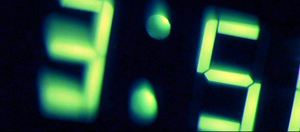
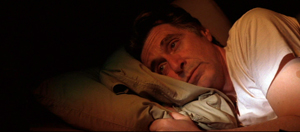
First, the cutting is less jagged. Skjoldbjaerg’s film comes in at ninety-seven minutes, about fifteen minutes shorter than Nolan’s, and its cutting rate is much slower, around 5.4 seconds. That means that many passages are built out of sustained shots, particularly ones showing the detective Jonas Engström walking or sitting in a brooding, self-contained silence. Also, this version finds ways to convey several bits of information concisely, in carefully designed shots. For a straightforward example: We see Engstrom’s eyes open, as he’s unable to sleep, and then he lifts his head. Rack focus to the clock behind him.
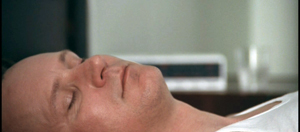 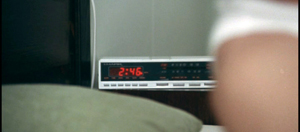
Nolan uses several shots to get across a comparable point.
As for subjectivity, Skoldbjaerg is just as keen to get us inside his detective’s head as Nolan is. At times he uses the sort of flash-cutting Nolan employs, so we get fragmentary reminders of the fog-clouded shooting. But Skoldbjaerg doesn’t tease us with unattributed inserts (Nolan’s flashbacks to Dormer’s framing of a suspect), and he never suggests, via images of the murder and its cleanup, that his detective can imagine the crime concretely. Instead, Skoldbjaerg often evokes his character’s unease through camera movements that upset our sense of his spatial location. The camera shows Engstrom striding into a room…and then swivels rightward to show him in his original location, as if he’s sneaked around behind our back.
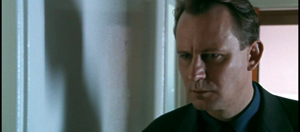 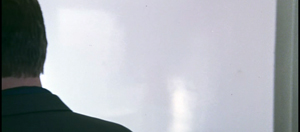 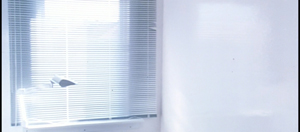 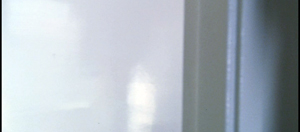 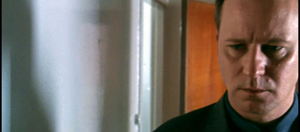
Then Engstrom turns, and we hear a footstep. Cut to a shot showing that the sound is made by him, walking in another room.
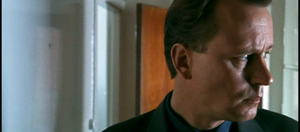 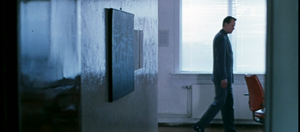
I’m not going to suggest that Skoldbaerg innovates more radically than Nolan does, though most viewers probably are more startled by these devices than by Nolan’s. I think that the original Insomnia’s stylistic gamesmanship owes something to other precedents, going back to Dreyer’s Vampyr. What I find more interesting is that Nolan had available the prior example of these strategies from his Nordic source, and he still chose to go with the more conventional, cutting-based options.
The editing-driven, somewhat catch-as-catch-can approach to staging and shooting is clearly Nolan’s preference for many projects. He doesn’t prepare shot lists, and he storyboards only the big action sequences. As his DP Wally Pfister remarks, “What I do is not complicated.” Comparing their production method to documentary filming, he adds: “A lot of the spirit of it is: How fast can we shoot this?”
Throwing it against the wall
We can find this loose shooting and brusque editing in most of Nolan’s films, and so they don’t seem to me to display innovative, or particularly skilful, visual style. I’m going to assume that his strengths aren’t in the choice of subjects either, since genre considerations have kept him to superheroics and psychological crime and mystery. I think his chief areas of innovation lie in theme and form.
The thematic dimension is easy to see. There’s the issue of uncertain identity, which becomes explicit in Memento and the Batman films. The lost-woman motif, from Leonard’s wife in Memento to Rachel in the two late Batman movies, gives Nolan’s films the recurring theme of vengeance, as well as the romantic one of the man doomed to solitude and unhappiness, always grieving. If this almost obsessive circling around personal identity and the loss of wife or lover carries emotional conviction, it owes a good deal to the performances of Guy Pearce, Hugh Jackman, Christian Bale, and Leonardo DiCaprio, who put some flesh on Nolan’s somewhat schematic situations.
You can argue that these psychological themes aren’t especially original, especially in mystery-based plots, but the Batman films offer something fresher. The Dark Knight trilogy has attracted attention for its willingness to suggest real-world resonance in comic-book material. Umberto Eco once objected that Superman, who has the power to redirect rivers, prevent asteroid collisions, and expose political corruption, devotes too much of his time to thwarting bank robbers. Nolan and his colleagues have sought to answer Eco’s charge by imbuing the usual string of heists, fights, chases, explosions, kidnappings, ticking bombs, and pistols-to-the-head with sociopolitical gravitas. The Dark Knight invokes ideas about terrorism, torture, surveillance, and the need to keep the public in the dark about its heroes. Something similar has happened with The Dark Knight Rises, leaving commentators to puzzle out what it’s saying about financial manipulation, class inequities, and the 99 percent/ 1 percent debate.
Nolan and his collaborators are doubtless doing something ambitious in giving the superhero genre a new weightiness. Yet I found The Dark Knight Rises, like its predecessor, unable to bear the burden. It seemed to me at once pretentious and confused in a manner typical of Hollywood’s traditional handling of topical themes.
The confusion comes into focus when journalists, needing an angle on this week’s release, look for a coherent reflection of that elusive, probably imaginary zeitgeist. I think that most popular films don’t capture the spirit of the time, assuming such a thing exists, but simply opportunistically stitch together whatever lies to hand. Let me recycle what I wrote four years ago.
I remember walking out of Patton (1970) with a hippie friend who loved it. He claimed that it showed how vicious the military was, by portraying a hero as an egotistical nutcase. That wasn’t the reading offered by a veteran I once talked to, who considered the film a tribute to a great warrior.
It was then I began to suspect that Hollywood movies are usually strategically ambiguous about politics. You can read them in a lot of different ways, and that ambivalence is more or less deliberate.
A Hollywood film tends to pose sharp moral polarities and then fuzz or fudge or rush past settling them. For instance, take The Bourne Ultimatum: Yes, the espionage system is corrupt, but there is one honorable agent who will leak the information, and the press will expose it all, and the malefactors will be jailed. This tactic hasn’t had a great track record in real life.
The constitutive ambiguity of Hollywood movies helpfully disarms criticisms from interest groups (“Look at the positive points we put in”). It also gives the film an air of moral seriousness (“See, things aren’t simple; there are gray areas”). . . .
I’m not saying that films can’t carry an intentional message. Bryan Singer and Ian McKellen claim the X-Men series criticizes prejudice against gays and minorities. Nor am I saying that an ambivalent film comes from its makers delicately implanting counterbalancing clues. Sometimes they probably do that. More often, I think, filmmakers pluck out bits of cultural flotsam opportunistically, stirring it all together and offering it up to see if we like the taste. It’s in filmmakers’ interests to push a lot of our buttons without worrying whether what comes out is a coherent intellectual position. Patton grabbed people and got them talking, and that was enough to create a cultural event. Ditto The Dark Knight.
Since I wrote that, Nolan has confirmed my hunch. He says of the new Batman movie:
We throw a lot of things against the wall to see if it sticks. We put a lot of interesting questions in the air, but that’s simply a backdrop for the story. . . . We’re going to get wildly different interpretations of what the film is supporting and not supporting, but it’s not doing any of those things. It’s just telling a story.
Just to be clear, I don’t think the just-telling-a-story alibi is bulletproof. The cultural mix on display in a movie can still exclude certain ideological possibilities, or frame the materials in ways that slant how spectators take them up. My point is only that we ought not to expect popular movies, or indeed many movies, to offer crisp, transparent visions of politics or society. Thematic murkiness and confusion are the norm, and the movie’s inconsistencies may reflect nothing more than the makers’ adroit scavenging.
Subjectivity and crosscutting
Nolan’s innovations seem strongest in the realm of narrative form. He’s fascinated by unusual storytelling strategies. Those aren’t developed at full stretch in Insomnia or the Dark Knight trilogy, but other films put them on display.
One way to capture his formal ambitions, I think, is to see them as an effort to reconcile character subjectivity with large-scale crosscutting. Nolan has pointed out his keen interest in both strategies. But on the face of it, they’re opposed. Techniques of subjectivity plunge us into what one character perceives or feels or thinks. Crosscutting typically creates much more unrestricted field of view, shifting us from person to person, place to place. One is intensive, the other expansive; one is a local effect, the other becomes the basis of the film’s enveloping architecture.
The Batman trilogy has plenty of crosscutting, but as far as I can tell, subjectivity takes a back seat. Nolan’s first two films reconcile subjectivity and crosscutting in more unusual ways. Following takes a linear story, breaks it into four stretches, and then intercuts them. But instead of expanding our range of knowledge to many characters, nearly all the sections are confined to what happens to one protagonist, and they’re presented as his recounted memories in a Q & A situation.
Likewise, Memento confines us to a single protagonist and skips between his memories and immediate experiences. Again what might be a single, linear timeline is split, but then one series of incidents is presented as moving chronologically while another is presented in reverse order. Again, the competing time trajectories aren’t presented as large blocks but are fairly swiftly crosscut.
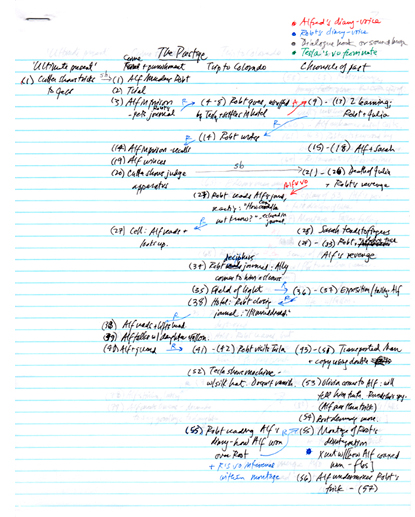 In The Prestige, dual protagonists, both with a secret, take over the story, but the presentation remains steeped in subjectivity. Now much of the action is filtered through each magician’s notebook of jottings and recollections, translated into voice-over commentary. One character may be reading another’s notebook in which the writer reports reading the first character’s notebook! And of course these tales-within-tales are intercut, with one man’s frame story alternating with the other’s past experience. You can work it all out diagrammatically, as I tried to do in my notes (on right). In The Prestige, dual protagonists, both with a secret, take over the story, but the presentation remains steeped in subjectivity. Now much of the action is filtered through each magician’s notebook of jottings and recollections, translated into voice-over commentary. One character may be reading another’s notebook in which the writer reports reading the first character’s notebook! And of course these tales-within-tales are intercut, with one man’s frame story alternating with the other’s past experience. You can work it all out diagrammatically, as I tried to do in my notes (on right).
With Inception, subjectivity takes the shape of dreaming, and the crosscutting is now among layers of dreams. The embedding that we find in The Prestige is now carried to an extreme; in the long, climactic final sequence a group dream frames another dream which frames another, and so on, to five levels. Once again, these all get intercut (although Nolan wisely refrains from reminding us of the outermost frame too often, so that our eventual return to it can be sensed more strongly).
Kristin and I have written at length about these strategies in earlier entries (here and here). To recapitulate, Kristin found Inception‘s reliance on continuous exposition a worthwhile experiment, and I argued that the lucid-dreaming gimmick was simply a motivational strategy, a pretext for connecting multiple plotlines through embedding rather than parallel action. My point in the first essay is summed up here:
As ambitious artists compete to engineer clockwork narratives and puzzle films, Nolan raises the stakes by reviving a very old tradition, that of the embedded story. He motivates it through dreams and modernizes it with a blend of science fiction, fantasy, action pictures, and male masochism. Above all, the dream motivation allows him to crosscut four embedded stories, all built on classic Hollywood plot arcs. In the process he creates a virtuoso stretch of cinematic storytelling.
My later thoughts tried to survey the breadth of Nolan’s development of formal strategies. Here’s my conclusion:
From this perspective, Inception marks a step forward in Nolan’s exploration of telling a story by crosscutting different time frames. You can even measure the changes quantitatively. Following contains four timelines and intercuts (for the most part) three. Memento intercuts two timelines, but one moves backward. Like Following, The Prestige contains four timelines and intercuts three, but it opens the way toward intercutting embedded stories. The climax of Inception intercuts four embedded timelines, all of them framed by a fifth, the plane trip in the present. For reasons I mentioned in the previous post, it’s possible that Nolan has hit a recursive limit. Any more timelines and most viewers will get lost.
The Dark Knight Rises hasn’t dulled my respect for Nolan’s ambitions. Very few contemporary American filmmakers have pursued complex storytelling with such thoroughness and ingenuity.
Nolan has made his innovations accessible, I argued, by the way he has motivated them. First, he appeals to genre conventions. Following and Memento are neo-noirs, and we expect that mode to traffic in complex, perhaps nearly incomprehensible plotting and presentation. He has called Inception a heist film, and what many viewers objected to—its constant explanation of the rules of dream invasion—is not so far from the steady flow of information we get in a caper movie. In the heist genre, Nolan remarks, exposition is entertainment. Further, the separate dreams rely on familiar action-movie conventions: the car chase that ends with a plunge into space, the fight in a hotel corridor, the assault on a fortress, and so on.
But I should have mentioned another method of motivation–one that helps make the films comprehensible to a broad audience. In some cases the formal trickery is justified by the very subjectivity the film embraces. It’s one thing to tell a story in reverse chronology, as Pinter does in Betrayal; but Memento’s broken timeline gets extra motivation from the protagonist’s purported (not clinically realistic) anterograde memory loss. (We’ve already seen a lot of amnesia in film noirs.) Subjectivity is enhanced by the almost constant voice-over narration, reiterating not only Leonard’s thoughts but what he writes incessantly on his Polaroids and his flesh.
In The Prestige, each magician’s journal records not only his trade secrets but his awareness that his rival might be reading his words, so we ought to expect traps and false trails. And in Inception, the notion of plunging into a character’s mind becomes literalized as a dream state. Once we accept the conceit of controlled dreaming, we can buy all the spatial and temporal constraints the dream-master Cobb sets forth. As with Memento, Nolan creates a set of rules that allow him to crosscut many different time lines. In each film, the subject matter—memory failure, magicians’ enigmas, controlled dreaming—serves as an alibi for both subjectivity and broken timelines.
Synching story and style
Can you be a good writer without writing particularly well? I think so. James Fenimore Cooper, Theodore Dreiser, Sherwood Anderson, Sinclair Lewis, and other significant novelists had many virtues, but elegant prose was not among them. In popular fiction we treasure flawless wordsmiths like P. G. Wodehouse and Rex Stout and Patricia Highsmith, but we tolerate bland or clumsy style if a gripping plot and vivid characters keep us turning the pages. From Burroughs and Doyle to Stieg Larsson and Michael Crichton, we forgive a lot.
Similarly, Nolan’s work deserves attention even though some of it lacks elegance and cohesion at the shot-to-shot level. The stylistic faults I pointed to above and that echo other writers’ critiques are offset by his innovative approach to overarching form. And sometimes he does exercise a stylistic control that suits his broader ambitions. When he mobilizes visual technique to sharpen and nuance his architectural ambitions, we find a solid integration of texture and structure, fine grain and large pattern.
Here’s a one-off example. Nolan has remarked that he’s mostly not fond of slow-motion simply to accentuate a physical action, or to suggest some mental state like dream or memory. Inception motivates slow-motion by another of its arbitrary rules, the idea that at each level of dreaming time moves at a different rate. Here a stylistic cliché is transformed by its role in a larger structure, as Sean Weitner pointed out in a message to us.
Memento displays a more thoroughgoing recruitment of style to the purposes of guiding us through its labyrinth. The jigsaw joins of the plot require that the head and tail of each reverse-chronology segment be carefully shaped, because they will be reiterated in other segments. Within the scenes as well, Nolan displays a solid craftsmanship, with mostly tight shot connections and an absence of stylistic bumps.
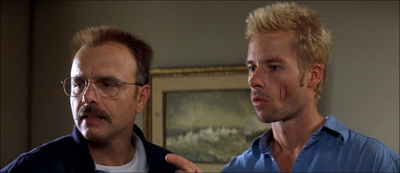
He can even slow things down enough for a fifty-second two-shot that develops both drama and humor. Leonard has just shown Teddy the man bound and gagged in his closet, and Teddy wonders how they can get him out. In a nice little gag, Leonard produces a gun from below the frameline (we’ve seen him hide it in a drawer) and then reflects that it must be his prisoner’s piece. This sort of use of off-frame space to build and pay off audience expectations seems rare in Nolan’s scenes.
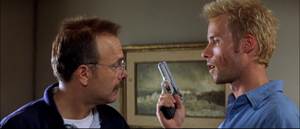
The moment is capped when Leonard adds, “I don’t think they let someone like me carry a gun,” as he darts out of the frame.
The straightforward stylistic treatment of Memento‘s more-or-less present-time scenes, both chronological and reversed, is counterbalanced by the rapid, impressionistic handheld work that characterizes Leonard’s flashbacks to his domestic life and his wife’s death (in color) and his flashbacks to the life of Sammy Jankis (in black-and-white). Nolan shrewdly segregates his techniques according to time zone.
If anything, The Prestige displays even more exactitude. Facing two protagonists and many flashbacks and replayed events, we could easily become lost. Here Nolan doesn’t use black-and-white to mark off a separate zone. Instead he relies more on us to keep all the strands straight, but he helps us with voice-overs and repeated and varied setups that quietly orient us to recurrent spaces and circumstances. Here Nolan’s preference for cutting together singles is subjected to a simple but crisp logic that relies on our memory to grasp the developing drama.
I’ve discussed these stylistic strategies in another entry and in Chapter 7 of Film Art. More generally, they serve the larger dynamic of the plot, which creates a mystery around Alfred Borden, hides crucial information while hinting at it, invites us to sympathize with Borden’s adversary Robert Angier (another widower by violence), and then shifts our sympathies back to Borden when we learn how the thirst for revenge has unhinged Robert. To achieve the unreliable, oscillating narration of The Prestige, Nolan has polished his film’s stylistic surface with considerable care.
Midcult auteur?
Trying to specify Nolan’s innovations, I’m aware that one response might be this: Those innovations are too cautious. He not only motivates his formal experiments, he over-motivates them. Poor Leonard, telling everyone he meets about his memory deficit, is also telling us again and again, while the continuous exposition of Inception would seem to apologize too much. Films like Resnais’ La Guerre est finie and Ruiz’s Mysteries of Lisbon play with subjectivity, crosscutting, and embedded stories, but they don’t need to spell out and keep providing alibis for their formal strategies. In these films, it takes a while for us to figure out the shape of the game we’re playing.
We seem to be on that ground identified by Dwight Macdonald long ago as Midcult: that form of vulgarized modernism that makes formal experiment too easy for the audience. One of Macdonald’s examples is Our Town, a folksy, ingratiating dilution of Asian and Brechtian dramaturgy. Nolan’s narrative tricks, some might say, take only one step beyond what is normal in commercial cinema. They make things a little more difficult, but you can quickly get comfortable with them. To put it unkindly, we might say it’s storytelling for Humanities majors.
Much as I respect Macdonald, I think that not all artistic experiments need to be difficult. There’s “light modernism” too: Satie and Prokofiev as well as Schoenberg, Marianne Moore as well as T. S. Eliot, Borges as well as Joyce. Approached from the Masscult side, comic strips have given us Krazy Kat and Polly and Her Pals and, more recently, Chris Ware. Nolan’s work isn’t perfect, but it joins a tradition, not finished yet, of showing that the bounds of popular art are remarkably flexible, and imaginative creators can find new ways to stretch them.
Box-office figures for Nolan’s films are compiled from Box Office Mojo. For detailed critiques of Nolan’s style, see Jim Emerson’s entries archived here; Jim’s video essay dissecting one Dark Knight action scene is here. A. D. Jameson’s essays on Inception are here and here.
Nolan discusses the background to Insomnia in John Pavlus, “Sleepless in Alaska,” American Cinematographer 83, 5 (May 2002), 34-45. My quotation about subjectivity comes from pp. 35-36. By the way, Insomnia does create a moment of tense quiet during the longish dialogue between Dormer and the killer Finch (Robin Williams) on the ferry: some sustained two shots give the adversaries time to size each other up (and Pacino gets an occasion to execute some business with an iron pole). Although the setup is broken by some irrelevant cutaways to the passing vistas, perhaps to cover faults in the takes, the sequence shows something of the sustained calm that we find in moments in Memento and The Prestige.
Thanks to Jonah Horwitz for the Wally Pfister link.
Umberto Eco’s 1972 essay, “The Myth of Superman,” appears in his book, The Role of the Reader. Portions are available here. One relevant passage is this: “He is busy by preference, not against black-market drugs nor, obviously, against corrupt administrators or politicians, but against bank and mail-truck robbers. In other words, the only visible form that evil assumes is an attempt on private property” (p. 123; italics in original).
Dwight Macdonald’s 1960 essay is available in Masscult and Midcult. A pdf is online here. Macdonald seems to have softened his demands a bit in later years. He praised 8 1/2, softcore modernism for sure, as Shakespearean in its vivacity. “The general structure–a montage of tenses, a mosaic of time blocks–recalls Intolerance, Kane, and Marienbad, but in Fellini’s hands it becomes light, fluid, evanescent. And delightfully obvious.” The essay is reprinted in Dwight Macdonald on Movies, pp. 15-31.
J. J. Murphy has a detailed analysis of Memento in his book Me and You and Memento and Fargo. I discuss the film’s contribution to complex storytelling trends in The Way Hollywood Tells It, pp. 74-82, where I also discuss the notion of intensified continuity editing. We analyze The Prestige‘s narrative, narration, and sound techniques in Film Art: An Introduction (ninth ed., pp. 298-307; tenth ed., pp. 298-306).
P.S. 19 August: Thanks to Guillaume Campreau-Dupras for correcting a film title.

PS 27 August: Thanks to the many bloggers and tweeters who linked to this entry!
The tireless A. D. Jameson has posted another probing critique of Nolan’s Bat-saga, this one concentrating on TDKR, here. While making serious points about Nolan’s use of expository dialogue and the confused politics of the film, the essay also contains some good jokes.
Posted in Directors: Nolan, Directors: Soderbergh, Film technique: Editing, Hollywood: Artistic traditions, Narrative strategies, Readers' Favorite Entries |  open printable version
| No Comments » open printable version
| No Comments »
Monday | August 13, 2012
From the xkcd webcomic
Kristin here:
August is here, and many film teachers are back from summer research trips and starting to prepare syllabi for the fall. Those who are using the new tenth edition of Film Art will have noticed that tucked away in its margins are references to blog entries relevant to the topics of each chapter. But since the new edition went to press, we’ve kept blogging. As has become our tradition, we offer an update on blogs from the past year that teachers might want to consult as they work on their lectures or assign their classes to read. Even if you’re not a teacher, perhaps you’d be interested in seeing some threads that tie together some recent entries.
For past entries in this series, see 2007, 2008, 2009, 2010, and 2011.
First, some general entries about the blog itself and the new edition of Film Art. On our blog’s fifth anniversary last year, we posted a brief historical overview of it. That entry contains some links to some of our most popular items. If you’re new to the blog and want some orientation, it could prove useful. Maybe students would be interested as well. At least the photos reveal our penchant for Polynesian adventure and shameless pursuit of celebrities.
In case you haven’t heard about the changes we made for the new Film Art, including our groundbreaking new partnership with the Criterion Collection to provide online examples with clips from classic movies, there’s a summary post available.
And here’s another entry on the new edition, discussing a new emphasis on filmmakers’ decisions and choices.
Now for chapter-by-chapter links.
Chapter 1
Understanding the movie business often means being skeptical of broad claims about supposed trends. We explained why the widespread “slump” of the movies in 2011 was no such thing in “One summer does not a slump make.”
Trying to keep one step ahead of students (or just keep up with them, period) on the conversion to digital projection and its many implications? Our series “Pandora’s Digital Box” explores many aspects:
In multiplexes: “Pandora’s digital box: In the multiplex”
In small-town theaters: “Pandora’s digital box: The last 35 picture show”
At film festivals: “Pandora’s digital box: At the festival”
On home video: “Pandora’s digital box: From the periphery to the center or the one of many centers”
In art-houses: “Pandora’s digital box: Art house, smart house”
Challenges to film archives: “Pandora’s digital box: Pix and pixels”
How projection is controlled from afar: “Pandora’s digital box: Notes on NOCs”
Problems introduced by digital: “Pandora’s digital box: From films to files”
Another case study of a small-town theater: “Pandora’s digital box: Harmony”
Or you can pay $3.99 and get the whole series, updated and with more information and illustrations, as a pdf file.
3D is a technological aspect of cinematography, but it’s also a business strategy. We explore how powerful forces within the industry used it as a stalking horse for digital projection in “It’s good to be the King of the World” and “The Gearheads.”
Independent films can be the basis for blockbuster franchises. “Indie” doesn’t always equal “small,” as we show in “Indie blockbuster franchise is not an oxymoron.”
One of the top American producers and screenwriters of independent films is James Schamus, head of Focus Features. We profile him in “A man and his focus.”
3D is probably here to stay, but it may have already passed its peak of popularity, as we suggest in “As the summer winds down, is 3D doing the same?”
The late Andrew Sarris played a crucial role in shaping the “auteur” theory of cinema. We talk about his work in “Octave’s hop.”
Chapter 2 The Significance of Film Form
“You are my density” is an analysis of motifs in Hollywood cinema, including a detailed look at a scene from Fritz Lang’s Hangmen Also Die.
Chapter 3 Narrative Form
We offer a narrative analysis of a Tinker Tailor Soldier Spy, a film many viewers found difficult to follow on first viewing, “TINKER TAILOR: A guide for the perplexed.” A follow-up, “TINKER TAILOR once more: Tradecraft,” concentrates on the adaptation of Le Carré’s novel.
A tricky narrative structure in Johnnie To’s Life without Principle called forth our entry, “Principle, with interest.”
In “John Ford and the Citizen Kane assumption,” we consider the possibility that Kane, analyzed in this chapter, might not be the greatest movie ever made.
Chapter 4 The Shot: Mise-en-scene
For some reason teachers (and apparently students) always want more, more, more on acting, the most difficult technique of mise-en-scene to pin down. “Hand jive” talks about hand gestures, which in the past were used a lot more than they are now. “Bette Davis eyelids” takes a close look at the subtleties of Bette Davis’ use of her eyes.
“You are my density,” already mentioned, offers several examples of dynamic staging in depth.
Chapter 8 Summary: Style as a Formal System
We have posted two entries dealing with form and style, specifically experimental artifice in 1940s Hollywood. These could be of interest to advanced students. “Puppetry and ventriloquism” deals in general with the topic, while “Play it again, Joan” looks at scenes that replay the same action or situation. The latter contains an analysis of a lengthy scene of Joan Crawford performing that could be useful in discussing staging and acting for Chapter 4.
Chapter 9 Film Genres
If you teach a unit on genre and choose to focus on mysteries, “I love a mystery: Extra-credit reading” gives some historical background information on the genre in popular literature and cinema.
Chapter 10 Documentary, Experimental, and Animated Films
“Solomonic judgments” centers on the gorgeous experimental films of Phil Solomon.
Chapter 11 Film Criticism: Sample Analyses
Our discussion of Tokyo Story in Film Art could be supplemented by this brief birthday tribute: “A modest extravagance: Four looks at Ozu.”
Chapter 12 Historical Change in Film Art: Conventions and Choices, Traditions and Trends
Last September I found an extraordinary little piece of formal and stylistic analysis using video, Variation: The Sunbeam, David W. Griffith, 1912. A Spanish film student, Aitor Gametxo, had displayed the staging and cutting patterns of Griffith’s Biograph short, The Sunbeam, by laying out the shots in a grid reflecting the actual spatial relations among the sets and running the action in real time. If you teach a history unit or just want an elegant, clear example of how editing of contiguous spaces works, this is a wonderful teaching tool. Classes may be particularly intrigued that a student was able to put together something this insightful. Plus The Sunbeam is a charming film that would probably appeal to students more than a lot of early cinema would. See “Variations on a Sunbeam: Exploring a Griffith Biograph film.” Gametxo’s film also provides an elegant example of how editing of adjacent spaces works and could be a useful teaching tool for Chapter 6.
Teachers showing a Georges Méliès film might have their students read “HUGO: Scorsese’s birthday present to George Méliès,” which has some background information on the career of this cinematic conjurer.
German silent film was the focus of “Not-quite-lost shadows.”
Not strictly on the blog, but alongside it, is a survey of how developments in film history generated changes in film theory. The essay is “The Viewer’s Share: Models of Mind in Explaining Film.”
Further general suggestions
Looking for some new and interesting films to add to your syllabus? We cover quite a few in our dispatches from the Vancouver International Film Festival 2011: “Reasons for cinephile optimism,” “Son of seduced by structure,” “Ponds and performers: Two experimental documentaries,” “Middle-Eastern crowd-pleasers in Vancouver,” and “More VIFF vitality, plain and fancy.”
Or if you seek information on historical films newly available on DVD, we occasionally post wrap-ups of recent releases, including a cornucopia of international silent films. See “Silents nights: DVD stocking-stuffers for those long winter evenings.”
We have also carried on our tradition of a year-end ten-best list—but of films from 90 years ago. Not all the films on our list for 1921 are on DVD, but most are: “The ten best films of … 1921.”
Every now and then we post an entry pointing to informative DVD supplements that might be useful teaching tools. It’s surprising how few of them go beyond a superficial level where the actors and filmmakers sit around praising each other: “Beyond praise 5: Still more supplements that really tell you something.”
Posted in FILM ART (the book), Film history, Film industry, Film technique, Narrative strategies | open printable version
| No Comments »
Thursday | August 9, 2012
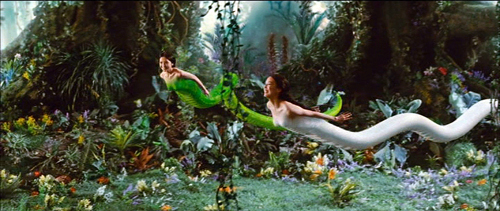
The Sorceror and the White Snake.
DB here:
For days, debates about the new Sight and Sound Poll have been saturating the Net ecosystem. The reach of the Web allowed editor Nick James to launch what may be a month-long striptease. (Well played, sir.) And likely you, reader, were weighing lists of masterworks.
But not me. I was watching Japanese space warriors blasting phosphorescent aliens to bits. I saw an amiable cannibal provide gory inspiration for a creatively blocked painter. I saw Dutch layabouts in mullets who made sponging off the system a death sport while calling each other “homo” and kut. I saw an ode to women’s armpit hair, moments of man-on-mule lust, and sexy female snake-demons writhing their way through two movies.
No candidates for the 2022 S & S poll here, but all in all, pretty diverting.
No hecklers, please
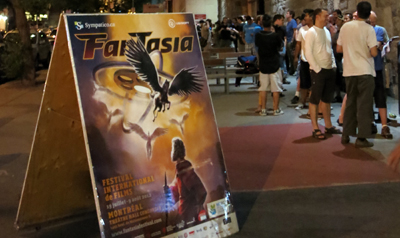
Montréal’s annual FanTasia is a three-week tribute to the world’s genre cinema. You get horror, SF, fantasy, martial arts, crime, and tasteless comedy. These movies are bloody, horrifying, outrageous, and hilarious. Nothing says entertainment quite like a wholesome family, complete with babe in arms, being plowed down by a delivery truck.
The name packs in a lot. I think it was first called FantAsia, as befit its early emphasis on Far Eastern imports, but the newer version shifts a little more emphasis to “fan,” which captures the tenor of the audience. Old folks worry that that the young avoid subtitled cinema. They should visit FanTasia, where teens and twentysomethings are happily watching movies from Iceland, Vietnam, Japan, Denmark, Hong Kong, South Korea, Thailand, and Holland. The brains behind this festival know what the kids want.
Don’t confuse this with Camp or Hecklevision. The multititudes come not to mock but admire. I suppose that’s partly because for decades smart genre pictures have woven moments of self-mockery into their texture, so as to mesh with that knowing, ironic attitude that characterizes our consumption of much popular culture. A closed loop: Genre connoisseurs make these movies, and other connoisseurs applaud them. Once you learn that Inglourious Basterds, Shaun of the Dead, Perfect Blue, Killer Joe, and Visitor Q have had premieres of one sort or another here, you get it: This is head-banging, but strictly quality head-banging.
The proof came with DJ XL5 Italian Zappin’ Party. This two-hour mélange of b-movie trailers and clips is a FanTasia tradition, having been preceded by Mexican and Bollywood editions. This year’s brew mixed snippets from fairly famous movies with glimpses of little-known items like Zorro contra Maciste, Spasmo, and The Three Fantastic Supermen. But the result isn’t exactly Camp, and it doesn’t attempt to mimic the media spew we see in Joe Dante’s Movie Orgy. Instead, typical trailers and scenes are tidily arranged in genres–peplum, spaghetti Westerns, giallo, and so on–and left to run at considerable length. Often the clips point up a recurring gesture or bit of iconography (decapitation, musclemen manhandling boulders). It’s less like zapping, more like an otaku assembling clips on a disc or in a file and inviting us over for an evening. Cheesy as many of these items are, we’re invited to appreciate the unpredictable energy of cinema that strives to shock.
The FanTasia tribe has its customs. At each screening, as the lights go down, you hear meowing, sometimes answered by barks or growls. One film started with bleating and clucking on the soundtrack, and this triggered a felicitous barnyard call-and-response; talk about surround sound. Nobody could explain to me the logic behind this FanTasia tradition–like streaking in the 70s, does it mean anything?–but its discreet silliness, perhaps distinctively Canadian, won me over. By the end I was joining in with a cracked miaou of my own. Yet once the movie starts, utter respect rules. Attentive silence is broken by appreciative laughter and whoops at those moments fans call OTT.
The festival’s ambitions are matched by the venues: raked Concordia University auditoriums with enormous screens and sound systems that envelop you. I sat in my favorite spot and didn’t regret it. Both film and digital projection looked sharp and bright. The staff get the audience in and out with dispatch, and everybody I met behaved with courtesy and good humor. Filmmaker Q & As are energetic and pointed. The movies are wild and sometimes abrasive, but the packaging is a model of civilized cine-festivity.
Never gonna grow up
You Are the Apple of My Eye.
The festival made its name with Asian popular cinema, and this year’s schedule didn’t disappoint. I could attend only the last week of screenings, so I missed some of the biggest titles, such as Peter Chan’s Wuxia, to be released in some markets as Dragon (innovative titling, eh? As we say in Canada.) But I did catch several entries.
You Are the Apple of My Eye, a Taiwanese rom-com, provides the now-standard mix of adolescent loutishness, romantic longing, and comic-book special effects. It starts with a twentysomething setting out for a wedding, and through flashbacks and voice-over, we learn of his high-school pranks and his surly affection for a charming girl in his class.
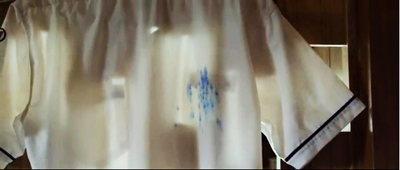
There’s always something touching about a gang of pals going their separate ways after school (viz., American Graffiti), so the film becomes more melancholy as the kids graduate and pass on to college and jobs; the only one who finds worldly success is a girl largely ignored by everyone. The plot shambles along, expecting us to be curious about whether the hero gets the girl he can’t quite learn to woo. The wedding culminates in a gag I found both clever and touching, a prolonged kiss–but not between the bride and our protagonist. And the motif of the ink-stained shirt, shown at beginning and end in a way that suggests a blue-bleeding heart, shows sophisticated sentiment.
School relationships are also character-defining in South Korean comedies, but their impact is more sub rosa in Love Fiction. Joo-wol is blocked after his first novel and is glumly working as a bartender. Attracted to a mysterious young woman, he pours all his literary talent into a Werther/ Cyrano effort to woo her. He even rhapsodizes about, and to, her armpit hair. Once they become a couple, however, he starts to write a murder thriller with her as a femme fatale. But his fiction leads him to investigate Hee-jin’s past, with disturbing results.

I thought this somewhat overlong movie tried to keep too many balls in the air–sequences dramatizing Joo-wol’s detective serial, flashbacks to his childhood, rumors about his girlfriend’s college sex life, and an excursion to Alaska. Again, though, it’s somewhat saved by a feel-good ending featuring Joo-wol’s friends in a scruffy band performing a karaoke video (above). As so often in the genre, stirring music redeems a meandering plot.
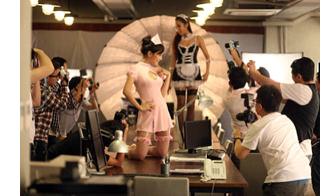 You Are the Apple and Love Fiction center on young men who grow up painfully, bruising others in the process, but Vulgaria keeps us firmly planted in adolescence. Pang Ho-cheung, who has done interesting work in You Shoot, I Shoot (a hitman hires a filmmaker to document his killings) and other projects, gives us what is being packaged as Hong Kong’s dirtiest comedy ever. Reliable sources report that no film has ever before contained such filthy Cantonese. It’s not quite as raunchy as it’s billed, though, and it has a predictably soft center. You Are the Apple and Love Fiction center on young men who grow up painfully, bruising others in the process, but Vulgaria keeps us firmly planted in adolescence. Pang Ho-cheung, who has done interesting work in You Shoot, I Shoot (a hitman hires a filmmaker to document his killings) and other projects, gives us what is being packaged as Hong Kong’s dirtiest comedy ever. Reliable sources report that no film has ever before contained such filthy Cantonese. It’s not quite as raunchy as it’s billed, though, and it has a predictably soft center.
Chapman To plays a bottom-feeding movie producer who is drafted by a triad investor to make a sequel to the classic Confessions of a Concubine. The investor also insists on casting. He demands a part for the mule with which he seems to have an intensely physical relationship, and more centrally a role for Yum Yum Shaw, a decrepit beauty whom he remembers from the old days. Producer To agrees to all this while trying to keep the love of the daughter he shares with his divorced wife, and to continue a romance with a starlet with quality fellatio stylings. (Her secret weapon is Pop Rocks.) After an engaging setup, the plot gets thrown out of joint in typical Hong Kong fashion. To is knocked into a coma and recovers only to find the film finished and the patron displeased, not least because the director has redone the script with references to Al-Quaeda.
Not bad for a film shot in twelve days and made up as they went along. Still, I think that Pang made a capital mistake in not letting us see any of this bungled project. In particular, he set up the expectation that Yum Yum’s now sagging and plasticine face would be pasted on the starlet’s voluptuous body, and even cheap and clumsy CGI would have added to the fun. In any event, Vulgaria gets off some good-natured satire on the film industry in its financing crisis, and it provides many naughty laughs, not least in the sound effects that continue under the final credits.
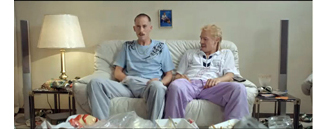 Vulgarity was also the watchword in the Dutch comedy New Kids Turbo (2010). I was unaware of the TV comedy team New Kids, but their brand of politically incorrect slapstick is a little edgier than what we’d find in Hollywood. The aforementioned family-flattening gag and a passage in which policemen are amusingly shot probably wouldn’t make it past the producer notes in America. Vulgarity was also the watchword in the Dutch comedy New Kids Turbo (2010). I was unaware of the TV comedy team New Kids, but their brand of politically incorrect slapstick is a little edgier than what we’d find in Hollywood. The aforementioned family-flattening gag and a passage in which policemen are amusingly shot probably wouldn’t make it past the producer notes in America.
Funny in small doses, this Five Stooges comedy of stupidity and aggression seemed to me to grow thin as it tried for more scale: the posse of dumb spongers refusing to pay for anything purportedly sets a model for the rest of Holland and calls forth repression from the authorities. I did learn that the planimetric framing on display in Napoleon Dynamite and Wes Anderson movies has become one default for harebrained humor in other countries. Or is it just an easier way to shoot groups of people?
Wuxia, fancy, plain, and very fancy
Painted Skin: The Resurrection.
Action cinema is a mainstay of FanTasia, and I caught several instances. Space Battleship Yamato is a live-action remake of the final installment in the anime series. As befits its origins, this version is rather classically directed, with prolonged medium shots and depth staging, as well as a soft texture that came through nicely on the 35mm print. It’s pure space-opera stuff, with a patriarchal captain passing authority to the young hothead and the emergence of romance between the hothead and the loyal young woman cadet. She turns out to be the secret source of energy that will turn the parched Earth into a green land again, but not without sacrifice in the long-established Japanese tradition.
To a large extent, the popular Chinese films of today are recycling tales and styles established by Hong Kong film in the 1980s and 1990s. Ching Siu-tung signed some of the best fantasy action films of those years (e.g., Duel to the Death, A Chinese Ghost Story, The East Is Red). Borrowing heavily from Tsui Hark’s 1993 Green Snake, The Sorceror and the White Snake offers your basic tale of the yearning and vengefulness of a woman-turned-demon. The main plot centers on White Snake, who falls in love with a herbalist and tries to pass for human. But Jet Li, looking like he’s suffered a few too many punches over the last three decades, is an abbot searching for demons to capture and imprison in his monastery. In a symmetrical subplot, the abbot’s young assistant turns into a bat demon but gains a friendship with White Snake’s counterpart Green Snake. When Li shows the herbalist his wife’s true nature, he breaks the marriage and unleashes White Snake’s fury.
Cue the video-game special effects for whirlwinds, floods, exploding temples, and soaring leaps. The airy effortlessness of all this comic-book spectacle made me yearn for the days of wirework; at least then gravitational heft limited the actors’ aerobatics. And cue a romantically inflated ending that pulls the couple apart to the tune of a duet sung by the pop-singer players on screen. A graceful, sinuous introduction of the two heroines (see the frame up top) and some interesting cutting in dialogue scenes (e.g., various scales of two-shots breaking up lines) couldn’t wipe away my sense that this has all been better done before–not least by Ching himself.
I did get my wire-work wish in Reign of Assassins, a pan-Asian project drawing on HK, PRC, Taiwanese, and Korean talent. Here Michelle Yeoh is given more to do than Jet Li was as the Sorceror. This film is engagingly old-fashioned, avoiding CGI for the most part and scaling the action to the everyday and the earth, not the sky. Michelle foreswears her past as an outlaw, undergoes the equivalent of plastic surgery, and tries to start fresh with a humble husband. But her old team’s search for the monk Bodhi’s corpse brings her back into action. In a plot twist reminiscent of the Shaw Bros. era, the husband reveals himself to be not all that she thought.
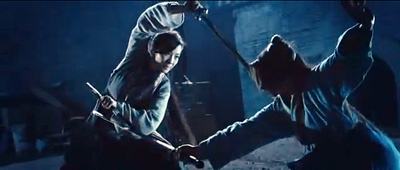
The fights are ingeniously staged by veteran Stephen Tung, but many are presented in that abrupt, disorienting framing and cutting that seems de rigueur these days. Taiwanese director Su Chao-pin is credited with story and direction, though a title on this print claimed the “co-director” to be John Woo, who was also a producer. On the whole, I respected Reign of Assassins more than I liked it. But nearly everybody thinks better of it than I do, as witness Justin Chang’s Variety review, the Hong Kong Movie Database reviews, and the customary detailed appraisal provided by Derek Elley in Film Business Asia. So maybe I should see it again.
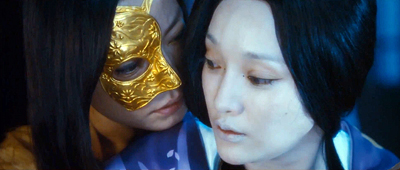
The most elegant wuxia exercise I saw was Painted Skin: The Resurrection, fresh from its premiere at the Shanghai Film Festival (and in superb 35mm). King Hu made a version of the original tale in 1993, but this project has little relation to that, and only a tenuous one to the 2008 Hong Kong Painted Skin. That was a confused enterprise whose only redeeming feature seemed to me to be Donnie Yen. This installment more or less abandons the plot material of the 2008 film, while keeping many of the performers. It’s a solid, confident achievement, blending pathos, romance, and fantasy with an unhurried restraint largely missing from The Sorcerer and the White Snake.
Like that film, there’s a double plot centering on two female demons. A fox demon offers to swap her body for that of a disfigured princess, while in a minor-key subplot a bird demon develops affection for a demon hunter. Director Wuershan, fresh off his success with The Butcher, the Chef, and the Swordsman (2010), treats both the magic scenes and the erotic encounters with a grave warmth that elevates them above the genre standard. If you can have dignified eye candy, this movie offers it: sumptuous costumes and sets, striking but not go-for-broke special effects, combats that discreetly exploit the stammering ramping effects of 300. But the oscillating relations of the two central woman, tracing rivalry, complicity, envy, and loss, remain firmly at the action’s center.
Hong Kong filmmakers developed these mythic formulas in the 1980s and 1990s, when such “feudal” and “superstitious” subjects were forbidden on mainland screens. The slick assurance with which new mainland filmmakers have mastered this material suggests that in the new liberalization of the mainland market, they now own this genre. Painted Skin: The Resurrection has quickly become the biggest box-office hit in PRC history.
Crossovers
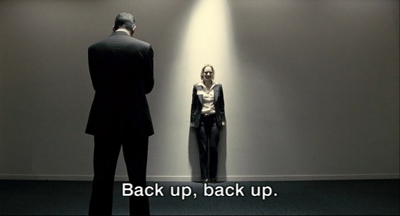
Carré blanc.
Everyone has noticed that genre pictures are getting artier, or art films are getting more genre-fied. Crossover efforts can yield strong results, as shown by movies as different as Let the Right One In and Drive. The title Eddie the Sleepwalking Cannibal would seem to signal B-movie giggles and gasps, but it turns out to be a tight, restrained study of the sadism driving artistic creativity….and a certain number of giggles and gasps.
A painter in a career slump, and following an unspecified “accident,” accepts a teaching post in a Canadian art school in hopes of calming down. He takes in a mentally deficient young man who grabs and eats animals while he’s sleepwalking, or sometimes sleeprunning. 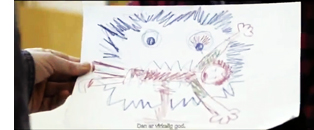 When you learn that the painter’s neighbor is an obnoxious oaf with a perpetually barking dog, you begin to think that Eddie will be the painter’s means of securing peace and quiet. Actually, Eddie’s depredations unlock the painter’s creativity, inspiring a new burst of excellent work. Thereafter, he’ll need to keep Eddie on the prowl. When you learn that the painter’s neighbor is an obnoxious oaf with a perpetually barking dog, you begin to think that Eddie will be the painter’s means of securing peace and quiet. Actually, Eddie’s depredations unlock the painter’s creativity, inspiring a new burst of excellent work. Thereafter, he’ll need to keep Eddie on the prowl.
The film balances gore, comedy, pathos, and satire of the art world. When the painter realizes that the young woman he’s slept with is a good sculptor, his efforts to deflate her using CritiqueSpeak reveal that his apparent humility covers an angry competitiveness. Eddie isn’t exactly Henry James on the creative process, I admit, but it’s not A Bucket of Blood either. The movie looks very trim and polished, with excellent sound work; I regret only the tendency to treat every dialogue scene in a fusillade of tight close-ups, which leads to a fairly unvarying pace. There’s a reason Coen brothers cut fairly slowly and stay far back; this sort of queasy deadpan tension benefits from steadiness and silence.
The screening of Carré blanc was preceded by La Jetée, as a tribute to Chris Marker. It was completely appropriate. For one thing, La Jetée hinges on one of the paradoxes of time travel: Can a man witness his own death? This sort of mind-bending was amusingly dealt with in Aleksey Fedorchenko’s “Chrono Eye,” one of three shorts in the portmanteau movie The Fourth Dimension. A scientist clamps a camera to his head and tries to tune himself to the future or the past, with the results transmitted to a beat-up TV receiver. The film makes clever use of the fallen-camera convention, and it ends with a rejection of past and future in the name of a vivacious present.
La Jetée was prophetic in another way. Before Marker’s film, most science fiction movies, from Metropolis and Things to Come to The Time Machine, used fanciful sets to conjure up the future. But Marker realized that one could film today’s cities in ways that suggested that the future was already here. This opened up a rich vein of exploration in Alphaville, THX 1138, Le Dernière combat, and their successors. And if you haven’t noticed: That future-tense present is always bleak, totalitarian, and something to escape from.
No wonder, then, that Carré blanc becomes an arty dystopian fable about a boy and girl brought up in a totally administered society. Philippe’s mother commits suicide so that he can be taken into an orphanage. There he will be turned into “a normal monster,” thus assuring his survival. Grown-up, he’s a high-level bureaucrat administering childish tests that his victims never seem to pass. But his marriage to Marie is withering. They can’t have a child, and she spends her days wandering the city. Eventually things come to a crisis and the couple must decide whether to stay or try to flee.
The plot is pretty formulaic and some of the absurd touches seem forced (the national sport is croquet). But the pictorial handling engages your interest from the start. Call it “1984 meets Red Desert,” except that there’s not much red here: bronze, black, and amber dominate. Simple techniques, like lighting that hollows out people’s faces to the point of blankness, become very evocative.
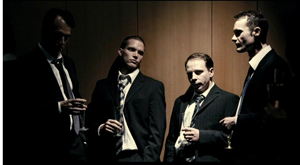 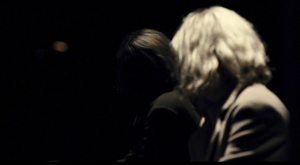
As in Alphaville, actual locations are made sinister by the dry public-address announcements saturating the soundtrack. The vast net stretched outside the couple’s apartment complex recalls the harrowing images of suicide-prevention nets at Chinese factory complexes. What a pleasure to see a movie designed shot by shot; the fixed camera yields one startling composition after another. Familiar as the story and themes are, the style grows organically from them. Carré blanc was the most impressive piece of atmospheric cinema I saw in my FanTasia visit.
So why was I here?
To see the movies. To catch up with old friends like Peter Rist and King Wei-chun and to make new ones. To present a talk on the Hong Kong action tradition. And to get an award for “Career Excellence.” Say hello to my lee’l (actually not so lee’l) frien’.

I’m very grateful to the coordinators of FanTasia for inviting me and honoring me with this magnificent award. It was an unforgettable week.
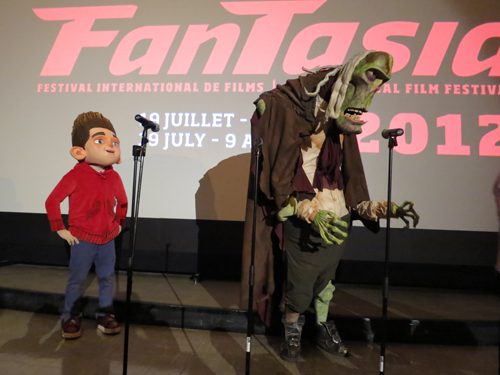
In addition to all this, FanTasia held an avant-premiere of the exhilarating ParaNorman (below). After I’ve seen it again, preferably with Kristin, I hope to write about it here.
Jason Seaver has blogged loyally about the festival on a daily basis. Liz Ferguson has a series of articles in the Montreal Gazette. A short interview with me appears on the FanTasia YouTube channel. Juan Llamas Rodriguez offers a two-part commentary on it starting here.
P. S. 11 August 2012: Daniel Kasman of MUBI has provided a link to Chris Marker’s little-known site Gorgomancy, which includes viewing copies of some of his little-known films.
P. P. S. 13 August 2012: Marc Lamothe–film director, co-director of FanTasia, and creator of DJ XL5’s Italian Dance Party–writes to explain the origin of the meowing.
Besides my national genre cinema tribute, every year since 2004 I’ve edited a short film program for FanTasia. It’s constructed the same way the Italian zappin’ was. I put static between films and include old vintage videos, ads and obscure film trailer in between films to simulate an evening of zappin’. This brings an energy and rhythm to short film presentations.
In 2008, I had a screening entitled DJ XL5’s DJ XL5’s Hellzapoppin Zappin’ Party. The program was constructed in 2 parts, with each part on a 60-min beta tape. Both part one and two contained episodes of Simon Tofield’s Simon’s Cat. To switch from beta one to beta two meant some 30 seconds of blackness and silence in the room. As Simon’s Cat made a strong and loving impression on the crowd, during the short intermission for chaning from tape 1 to 2 some people started meowing to break the silence. That made the others laugh and signaled their affection for the character.
This inside joke spilled over into more serious film presentations and has became a staple of our audience. Here’s the film responsible for the phenomena: http://www.youtube.com/watch?v=w0ffwDYo00Q.
Thanks to Marc for the information, and for a fine festival. Thanks also for his kind words about our work; he read the second edition of Film Art back in the early 1980s!
Posted in Festivals, Film genres, National cinemas: Denmark, National cinemas: France, National cinemas: Hong Kong, National cinemas: Japan, National cinemas: South Korea | open printable version
| No Comments »
Tuesday | July 31, 2012
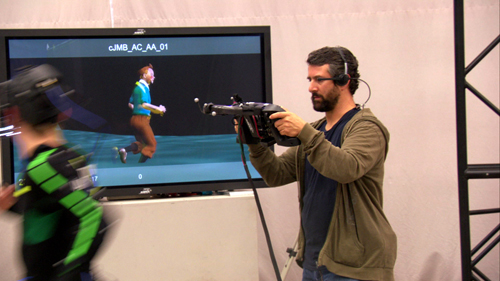
Real-time performance-capture images for The Adventures of Tintin.
Kristin here:
The Extraordinary Voyage (2011, Serge Bromberg and Eric Lange)
I had expected to follow up my entry on Hugo when the DVD was released. I anticipated that its supplements would explore the flashy technical and artistic aspects in detail. But the lengthy first chapter proved to be largely the cast and crew presenting variations on how lucky they were to have worked with Martin Scorsese (and each other) and how much they learned from him.
That wasn’t promising, and I turned instead to Georges Méliès himself. Flicker Alley, which has served the filmmaker so well in the past (see here), has recently released the restored color version of A Trip to the Moon in a Blu-ray/DVD combination set. It is accompanied by a 65-minute documentary on the Méliès, the film, and the restoration. It’s odd to call a 65-minute film that accompanies a fifteen-minute “feature” a supplement, but I recommend it anyway.
I suspect that The Extraordinary Voyage would be quite effective in easing students into very early silent cinema and intriguing them about an era that must seem hopelessly remote to them. It begins with a charming introduction to the context of the turn of the previous century and then moves quickly into the director’s young-adult life. When it comes to the famous incident in which Méliès’ camera jammed while he was filming, creating an inadvertent magical transformation, the filmmakers have an actual 1937 recording of Méliès himself describing the event. Presumably this was the original source of this oft-repeated anecdote. He specifies that it happened on the Place de l’Opéra and involved a bus turning into a hearse. I still wonder if it all happened so neatly, but hearing it directly from Méliès makes it a little more plausible. If it wasn’t true, it should have been.
The film includes as talking heads several filmmakers who admire Méliès’ work: Costa-Gavras, Jean-Pierre Jeunet, Michael Gondry, Tom Hanks, and Michel Hazanavicius. There is a good summary of the fascination with the moon in popular culture of the day, 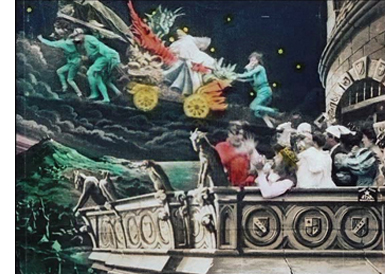 including works by Jules Verne, Jacques Offenbach, and H. G. Wells. including works by Jules Verne, Jacques Offenbach, and H. G. Wells.
The documentary touches on issues relevant to early silent cinema in general. One of these is the frequent pirating of films, with Méliès starting an American branch of his Star Films in New York, under the direction of his brother Gaston, to help protect his intellectual property. A clip from the Segundo de Chomon version of the film, An Excursion to the Moon, is included.
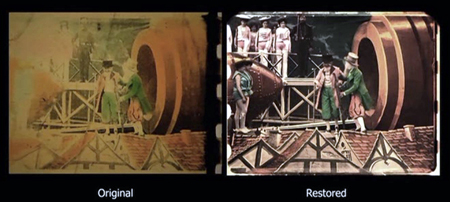
At about 23 minutes in, a short overview of early movie music is given, followed by a helpful explanation of how the hand-coloring of Méliès’ films was handled by a local workshop run by women. At 30 minutes in there are several dazzling examples of hand-colored scenes (right).
After a quick summary of Méliès’ decline and death, the film moves to the restoration of the only known hand-colored copy of A Trip to the Moon, found in the film archive in Barcelona. Here the hero is Tom Burton, the Director of Technicolor Creative Services, who gives a brief indication of how computers have transformed restoration:
We have a palette of digital tools to work from that are a collection of maybe five or six of the main commercially available restoration platforms, but then we also bring into the mix all of the approaches that you would use if you were doing visual effects for a modern movie.
The comparison of visual effects with restoration is in some ways an apt one and might lead students to look upon early films in a new light.
The Girl with the Dragon Tattoo (Blu-ray/DVD/Ultraviolet set, Sony Pictures Home Entertainment)
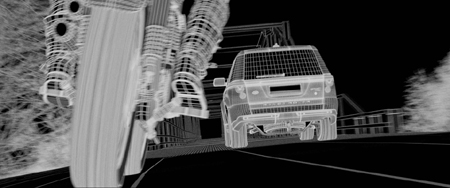
It’s probably a good idea to supply both Blu-ray and DVD discs in one package, but including the supplements only in Blu-ray is annoying and increasingly common. That’s the way the Girl with the Dragon Tattoo discs have been handled. Teachers without access to a Blu-ray player have fewer options when trying to use supplements in teaching. It also makes it much more difficult to make frame grabs from the supplements to, say, illustrate a blog entry on useful supplements.
I decided to check out the supplements for this film because the ones for Zodiac and The Social Network were so good. I figured David Fincher was particularly concerned about his films’ bonus materials. Unfortunately this set of supplements is quite uneven. The cast and crew seem to be obsessed with the character of the heroine and with the delights of shooting in Sweden. I confess that I stopped watching some of the chapters as the talking heads went on and on about these subjects. Some of the tracks also consisted of a lot of candid behind-the-scenes footage, which is all very well, but there was little structure to this and only occasional comments to explain what was going on.
Fortunately the “Post-Production” section is very informative and interesting. “In the Cutting Room” is fairly technical but makes some fascinating points. I particularly liked the description of how Fincher eliminates reframings and unsteady shots by using the extra image space allowed by newer capture media. (Earlier digital film frames allowed no extra image area outside what would show up on the screen; as the image below indicates, the final frame can be selected from a larger picture.) This desire for a stable image in an era where the “queasi-cam” so often rules points to one distinctive trait in Fincher’s style. It indicates a willingness to actually think through the framing of each individual shot and the purpose for choosing that framing. Steven Spielberg does the same thing. Many don’t.
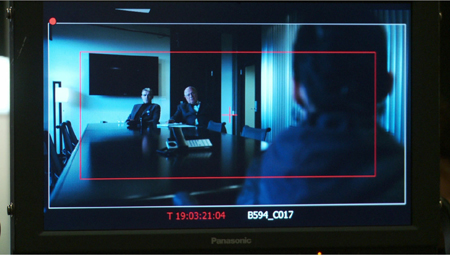
Editor Angus Wall talks about this advantage of the extra size of the image and how Fincher uses it to stabilize unsteady images. It’s worth quoting at length, and it demonstrates the thoughtful commentary in this particular supplement:
I’ve never seen a movie that was sort of “re-operated” to the extent that this one was. Which I think has an effect on the viewing of the movie. David is really type-A in terms of making the shots very specific. They start in a certain way, they end in a certain way. And the framing, he’s very precise in terms of his composition. He doesn’t like a lot of what you see in 99% of movies, which is very subtle moves where the operator will actually reframe according to how the actor’s moving. David doesn’t like that. Even if there were a lot of those in this film, and before, some of those takes we would have thrown out, because we just wouldn’t have been able to stabilize them to the degree that he likes it. With this, because you have this full raster, this big area around the image, you can take those images and stabilize them, really lock them down. So the movie is really locked down in terms of camera operating. More than any other movie that I can think of.
The smooth glide as the car initially approaches the country house is one example of that utter stability, used to ominous effect in that particular scene.
There’s also some interesting discussion about how the two main characters don’t meet each other until well into the film and how that affected decisions about editing. Rather than frequently intercutting between Mikael Blomkvist and Lisbeth Salander, the filmmakers decided to create longer self-contained scenes involving each, thus switching back and forth less frequently. The idea was that the exposition set forth in each scene would be too difficult to absorb if it was chopped into smaller segments. Form, style, and function, neatly explained.
Fincher also points to an interesting underlying anxiety the spectator might feel because the narrative progress gives little sense of how much action is still to come:
You don’t know where you are in the narrative. You don’t know if you’re at the beginning of the third act or … I don’t think it’s bad, because we have a five-act movie. I think that’s what’s causing everybody’s anxieties, that it doesn’t feel like, OK, here’s where we are, we’re entering the third act now. Now it feels like, fuck, this movie could go on … indefinitely. That’s the part that’s bothering me. If we told them it was going on for another forty-five minutes, they wouldn’t have a problem. It’s the indefinite part.
Since I’ve written a book claiming that classical films usually don’t have three acts, I was intrigued by this statement. (See also my earlier blog entry here and David’s essay here.) I posit instead that classical films typically create acts that run about 25 to 30 minutes, and that the film’s length determines how many acts it has. Four acts is the most common throughout Hollywood’s history, but a 158-minute film would be likely to have five acts. (Has David Fincher read my book?!) His point about the audience feeling a bit lost in an unconventional narrative structure is a rare instance of a director talking about form in such an abstract way, and it seems quite valid for The Girl with the Dragon Tattoo.
It’s also rare to get a supplement on ADR (automated [or additional] dialogue replacement), but there’s a six-minute one in the “Post-Production” section. This consists of a behind-the-scenes session with Rooney Mara supplying not just dialogue but breathing, grunts, and other noises. It’s clearly a real session, not a staged one, though the actress does seem a bit self-conscious with the documentarian’s camera turned on her. Fincher’s and Mara’s banter between takes gives a sense of what I suspect really goes on during this phase of production.
There’s a brief supplement called “Main Titles,” which deals with the form and inspiration for the CGI under the titles. Fincher wanted to tell the story of the whole trilogy in two and a half minutes, “and it has to be spectacular.” Apart from the discussion of form, there’s a good look at unrendered CGI footage compared to the finished images.
Finally, an eight-minute “Visual Effects Montage” displays a variety of special effects in a clever way. There is a section at the beginning where we are shown the image without added effects, then the same image with the areas to be altered highlighted in various superimposed colors, and finally the finished images with the effects added. This is particularly good for showing the sorts of mundane effects that are used to enhance shots unnoticeably, adding cars’ headlight beams, reflections in glass, falling snow, and the like. There is a shot with a section of a building on location blotted out with a greenscreen and the final shot showing the use of alterations in the building:
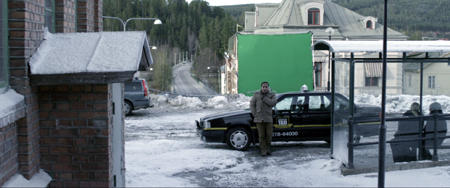
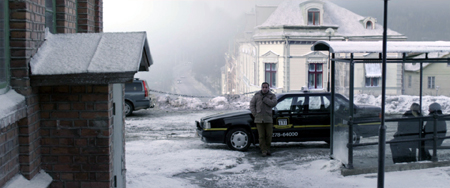
Obviously here the fog was also added with CGI.
This montage goes very quickly. If you’re using it in a class, best to prepare ahead and be ready to pause and point out what’s going on in the many short shots used in the demonstrations.
The second half of the effects montage moves to splashier scenes of the type the public associates with “special effects”: wire-frame vehicles for a chase (see image at the top of this section), head-replacement to add Mara’s head to her stunt-double’s body, and explosions.
Don’t bother with the “Stockholm Syndrome” section. Basically all we learn is that when a scene is shot on location, sheep can unexpectedly wander in and interfere.
The Adventures of Tintin (Blu-ray/DVD/Digital Copy combo, Paramount Pictures)
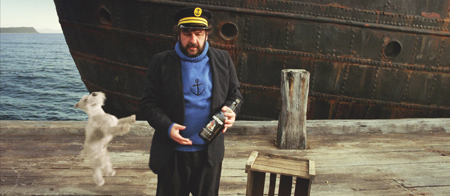
Again, the supplements for this release are available only in Blu-ray.
Steven Spielberg and Peter Jackson decided some years ago to collaborate on what was announced to be a three-film series adapted from Hergé’s Tintin comic books. The notion was that each of them would direct one film, with an as-yet-unspecified director doing the third. Spielberg’s initiatory film did not do as well at the domestic box-office as had been hoped, though it fared better in Europe and other non-North American markets, where the comics are highly popular. Jackson has announced that after he finishes both parts of The Hobbit, he will launch into the next Tintin film. (At least, that’s what he said originally. After yesterday’s announcement that there will be three Hobbit films, his start on the Tintin film will presumably be delayed.)
The supplements form a narrative of the film’s making, bookended by “Toasting Tintin” and “Toasting Tintin Part 2,” brief episodes set at the launch and wrap parties. The tale is pleasant and generally worth watching, though they are far from as entertaining and informative as the supplements that Michael Pellerin produced and directed for Jackson’s The Lord of the Rings and King Kong DVD sets. But this is Spielberg’s show, since he did the first film and indeed originated the project. At first he envisioned the film as live-action, with the dog Snowy the only major CGI character. Spielberg asked Jackson’s effects house Weta Digital to do some tests animating Snowy. To his (apparent) surprise, Jackson himself, as a fan of the comics since childhood, played Captain Haddock in the test. That fact was well known to fans, and the inclusion of the test footage (above) is no doubt a crowd-pleaser.
The decision to use cutting-edge performance-capture techniques led to the film being entirely animated.
“The World of Tintin” gives background on Hergé and deals briefly with the screenwriting process. This leads into “The Who’s Who of Tintin,” dealing with characters and acting, with some good material on performance capture near the end. The next section, “Tintin: Conceptual Design” has good material on the visual style of the characters and near the end includes some pre-viz material.
The outstanding supplement, however, is “Tintin: In the Volume,” nearly 18 minutes of footage concerning performance capture. Spielberg’s role as director was primarily concentrated into a remarkably short 31-day shoot with the actors. This was done in a state-of-the-art performance-capture facility called “The Volume” and located at Giant Studios. The Volume is a large space with about 160 cameras built into the ceiling and pointing down into the performance space. These capture the space from multiple angles. Additional cameras on the stage level follow the actors’ movements, which are inserted into the space. Moreover, hand-held monitors similar to portable gaming devices allow the filmmakers to see simple versions of the settings and the partially rendered characters while pointing the device at the actors in their performance-capture rigs.
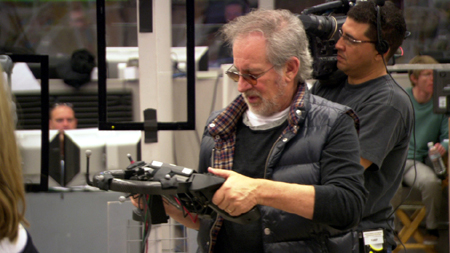
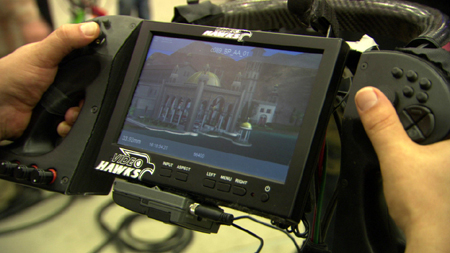
There are also larger monitors that show the actors their own performances translated into the characters (top of entry). Whatever one thinks of the look of contemporary animation of this type, the technology has evolved to a remarkable level, and this supplement provides an excellent explanation of the practicalities of performance capture. We see the motion-capture suits being put on and the dots painted onto the actors’ skin. There is also information on how the set elements and props need to be transparent so that the cameras can capture the dots on the actors’ faces and costumes through them. The image at the bottom shows Jamie Bell as Tintin looking at a mock-up of the model ship. It’s made of little metal rods and rendered into a ship on the monitors.
“Snowy: From Beginning to End” is less cutesy than it sounds. It discussed the digital tool developed for modeling the dog’s fur. There’s also good stuff on how several dogs were recorded to provide different-sounding barks depending on the type of action in a scene.
The biggest tasks on the film came after the performance capture and editing. Weta Digital spent two years creating the final images. “Animating Tintin” is an excellent eleven-minute account of that process.
The sections “Tintin: The Score” and “Collecting Tintin” (on Weta Workshop’s designs for the collectible figures) are rather thin and could be skipped unless a teacher wants to show the whole set of supplements as a single “making-of” documentary.
It’s become apparent that many of the best supplements on Blu-ray and/or DVD releases are devoted to special effects, especially performance capture. The Adventures of Tintin does genuinely involve innovations in this technology, and the “In the Volume” chapter is very informative. Supplements are getting repetitive, though, and I would like to see the producers of such documentaries pay more attention to techniques and choices in other areas. Comparing final cuts of scenes with earlier cuts, or showing story conferences where real debates about scripts occur (as was done in the first Pirates of the Caribbean film’s supplements), or displaying how decisions about digital-intermediate grading are made–a bit of imagination could spice up the offerings. That and a realization that film fans are interested in just about any aspect of production (or distribution, for that matter). Supplements risk falling into conventional patterns, and that won’t make them the appealing bonus material that they used to be.
While I was gearing up to write this entry, we received Mark Parker and Deborah Parker’s book, The DVD and the Study of Film: The Attainable Text (Palgrave, 2011). Based on a great deal of research, including many interviews, the authors include a summary history of DVDs and supplements; there is a detailed chapter on The Criterion Collection, interviews with directors and scholars who have recorded commentary tracks, and a case study of Atom Egoyan.
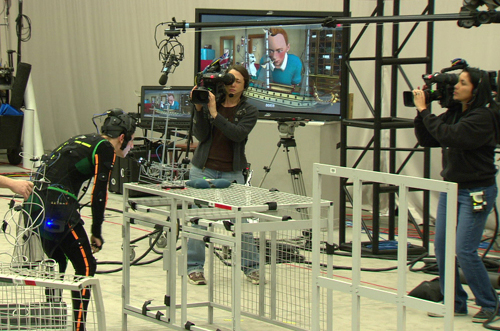
Posted in Animation, Digital cinema, Directors: Fincher, Directors: Jackson, Directors: Méliès, Directors: Spielberg, Film history, Film technique, Special effects and CGI | open printable version
| No Comments »
|