Wednesday | July 25, 2012

I Topi Grigi, Chapter 6: Aristocrazia Canaglia.
DB here:
… just knocks you out.
In wrapping up my stay at the Royal Film Archive of Belgium, where I concentrated mostly on German films of the late 1910s and early 1920s, I watched a copy of I Topi Grigi (“The Gray Rats”), a 1918 Italian serial. It’s part of an immense series devoted to the adventures of the cadaverous rogue Za La Mort. Directed by and starring the fascinating Emilio Ghione, it’s in the vein of Fantômas and Les Vampires, though I don’t find it as ingenious or funny or as skillfully directed as Feuillade’s masterpieces.
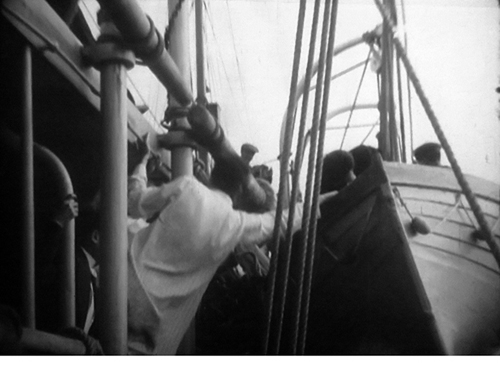
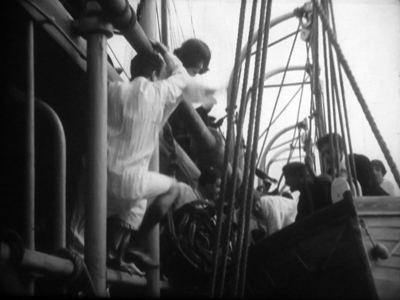
But then you get those moments. Za La Mort and his young charge Leo are aboard an ocean liner when it’s struck by a torpedo. The passengers panic and make for the lifeboats. It ought to be a spectacular scene reminiscent of Atlantis (1913), but there aren’t many shots devoted to this climax. We see only a few images of people rushing up to the deck from their cabins. The central shot showing the crisis is an image slung along the side of the ship, down the row of lifeboats as people scramble into them. The shot is interrupted by glimpses of men climbing the masts and survivors in the water, but this camera setup is the only one concentrating on the process of getting people offboard.
At first we’re looking down the row of boats, but, as you can tell from my top image, we can’t see much of anything–mostly a man in a nightshirt grabbing the hull of a lifeboat. Then, as the boat is lowered and he has to pull back, we get to see a lot more. Into the slot formed by the lifeboat supports, crisscrossed by ropes and rigging, slip faces and bits of bodies. A woman stoops, a man in silhouette shouts. Meanwhile, a dark-haired woman leans over the railing.

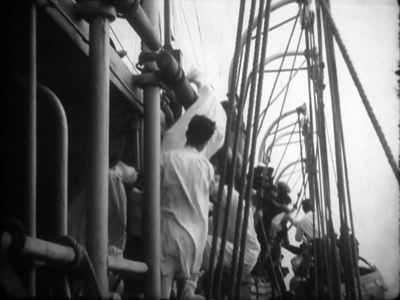
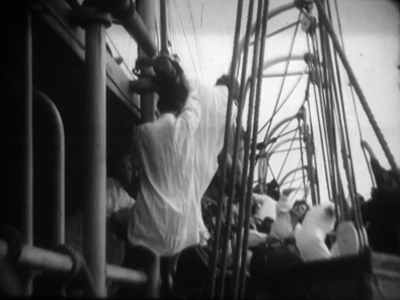
While our young man in the nightshirt sways precariously, the boat continues to descend and we can see even further down the row of lifeboats. A woman in the middle distance calls out. The woman at the railing has started to crawl down the side of the ship.

Now, in the depth of the shot, people are seen trying in vain to pile into the boats. Abruptly, a man on a rope swings into the shot.

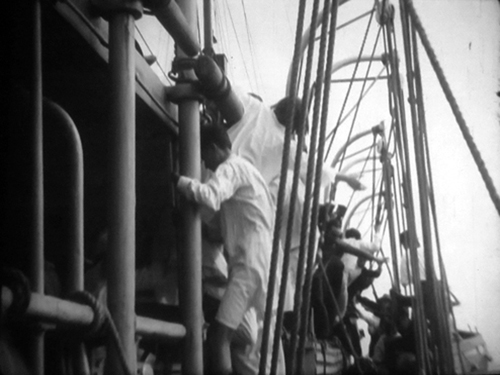
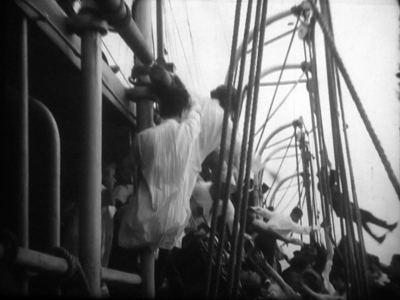
The boats are edging away from the ship’s hull–a slight gap emerges in the distance–but we can see passengers still shoving to try to board them.

It’s over for these people. The lifeboats descend, the boy in the nightshirt is still stranded on the side, and the woman who has climbed down beside him vainly stretches out her arm. (See below.)
A new video essay from Flavorpill offers you “135 shots that restore your faith in cinema.” It’s mostly a collection of purty pitchers laced with emblematic moments from classics. But probably you, like me the day before yesterday, haven’t seen Topi Grigi, so my images offer no cosy film-nerd nostalgia. And compared to the Hallmark-Cards aesthetic on display in most of the video essay’s clips, this shot is pretty messy.
But it engages your vision in a dynamic way. It coaxes you to watch a process, in all its scrambling disorder, along a line of sight that emerges, gradually, as uncannily precise. Desperate faces and gestures cascade through a rigid geometry–frames within frames, receding arches like ribbing in a vault, taut diagonals slicing across the frame. Would I trade this concise, rousing, remorseless stream of images for the last forty minutes of Titanic? Yes.
Joseph North offers an admirably detailed chronology and contextualization of the series in his 2011 Masters Thesis, Emilio Ghione and the Mask of Za La Mort. It’s available as a pdf here. Thanks as well to Edward Branigan for alerting me to the Flavorpill video.

Posted in 1910s cinema, Film comments, National cinemas: Italy, Silent film, Sometimes . . . | open printable version
| No Comments »
Sunday | July 22, 2012

I.N.R.I.: The Catastrophe of the People (1920).
DB here:
One way to write the history of film as an art is to chart firsts. When was the first close-up, the first moving camera, the first use of cutting? Asking such questions was a common strategy of the earliest film historians, and it has persisted to this day in pop histories. Civilian readers can be excused for thinking that Griffith invented the close-up and Welles originated ceilings on sets. These myths have been recycled for decades.
The “revisionist” historians of the 1970s, mostly academics who aimed to do primary research, pointed out that talking about first times is risky. Too often the official account is wrong, and earlier instances can be found. In most cases, we can’t really know about first times. Too many films have vanished, and nobody can see everything that has survived. Innovation is always worth studying, but, the revisionists argued, it’s best understood within a context.
So they set themselves to figuring out not when certain cinematic techniques began but when they became common practice–when most filmmakers in a given time or place adopted them. That way we can discover innovations more reliably; they’ll stand out against the background of more orthodox choices. But of course, to build up a sense of these norms, it’s not enough to focus on the masterpieces cited in the official histories. You need bulk viewing.
Studying norms of storytelling and visual style is a large part of what Kristin and I have done since the 1970s. One section of our 1985 book The Classical Hollywood Cinema tried to chart when certain fundamental techniques of Hollywood storytelling coalesced into common practice. Kristin argued that the late 1910s are the key years, with 1917 as a plausible tipping point. By then, continuity editing and goal-oriented plotting, among other creative options, became dominant practices in American features. If you’re interested in blog posts touching on this, see the codicil.
Yet it’s reasonable to ask: But what happened in other countries? Was Hollywood unique, or were there comparable norms emerging in Russia, France, Germany, Denmark, Sweden, and elsewhere?
Several years ago, I began trying to watch as many US and overseas features from the period 1908-1920 just to see what I might find. Doing this led me to make arguments about the development of staging-driven cinema (often, but not only, European), as opposed to editing-driven cinema (usually, but not invariably, American).
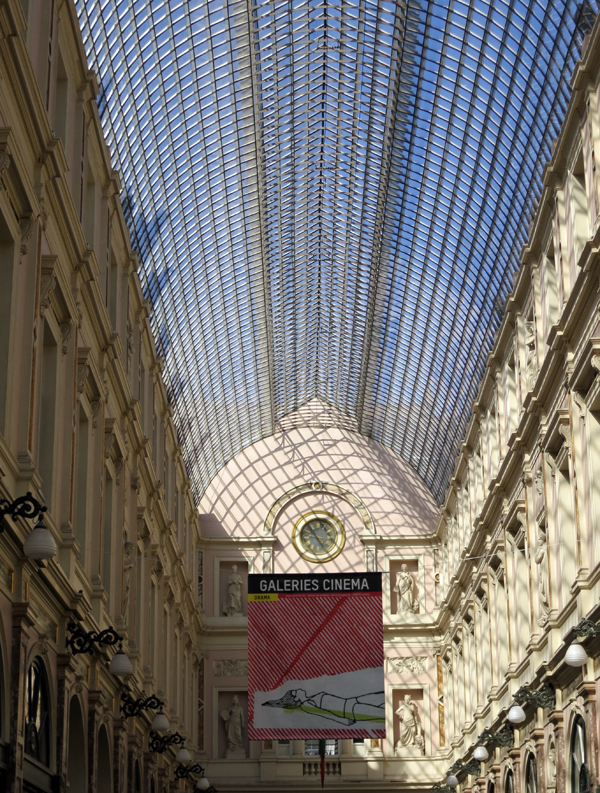
A vast resource for my bulk viewing of 1910s cinema has been the Royal Film Archive here in Brussels. While the collection houses virtually every classic, it also includes films that haven’t been discussed by many historians–obscurities, if not downright rarities. Films from many countries passed through Brussels, and the archive was able to acquire copies from many distributors going back to the 1910s. Although I had watched several German films in the collection on earlier visits, this year I had a pretty concentrated dose. So as in previous years (see that codicil again), I offer you some chips from the workbench.
Cinematic scarcity
I.N.R.I.
German films of this period are of special interest for my research questions because of an unusual situation. From 1916, films from the US and nearly all of Europe were banned from Germany, and this ban held good until 31 December 1920. As Kristin puts it in her book Herr Lubitsch Goes to Hollywood (available as a pdf here):
Foreign films appeared only gradually on the German market. In 1921, German cinema emerged from years of artificially created isolation. . . .Because of the ban on imports, German filmmakers had missed the crucial period when Hollywood’s film style was changing rapidly and becoming standard practice. . . . The continuity editing system, with its efficient methods of laying out a clear space for the action, had already been formulated by 1917. The three-point system of lighting was also taking shape. In contrast, German film style had developed relatively little during this era.
Kristin was again exploring craft norms, the creative choices favored by Lubitsch’s contemporaries. She drew some of her evidence from films she saw here at the Cinematheque, but I wanted to revisit those and see some others. What exactly did German films look like at this point? Not the official classics like Caligari and Nosferatu, but more ordinary, maybe even bad movies?
The basic assumption: Since the German directors weren’t seeing American movies, they’d be less likely to imitate them. Some hypotheses follow from this. German directors would presumably rely less on cutting, especially within scenes, than Americans did. They might incline toward staging complicated action in a single shot. The cutting is likely to be what Kristin calls “rough continuity” or “proto-continuity”–essentially, long shots of the whole action broken by occasional axial cuts that enlarge something for emphasis. We wouldn’t expect to find sustained passages of close-up or medium-shot framings.
To give myself some reference points, on each visit I’ve watched European films in conjunction with American films of the same era. This mental trick helped differences pop out more easily.
Fortunately for peace in our household, I’ve found Kristin’s claims about German cinema well-founded. As in other years, I also stumbled across some gratifyingly strange movies.
Blocking, tackled
Throughout the period 1908-1920, we find many scenes staged in a single fixed shot. In many other blog entries, and in books like On the History of Film Style and Figures Traced in Light, I’ve tried to show that this wasn’t simply a passive recording of a “theatrical” scene. Drawing on capacities specific to the film medium, directors used composition, lighting, setting, and figure movement to shape the perceptual and emotional flow of the scene.
Here’s a late example from The Brothers Karamazov (1920) directed by Carl Froelich and Dmitri Buchowetzki. Starring Fritz Kortner, Emil Jannings, Werner Krauss, and other heavyweights, it has perhaps more ham per square inch than any other film I saw on this pass. Yet its tableau moments subordinate the performers’ charisma to an overall expressive dynamic.
Old Fyodor Karamazov has been murdered, and his son Dmitri is accused of the crime. Protesting his innocence, he’s about to be arrested when Grushenka bursts out. “I’m the guilty one!”
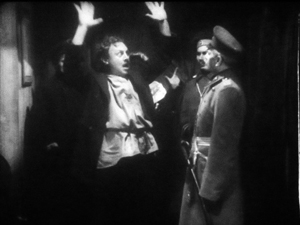
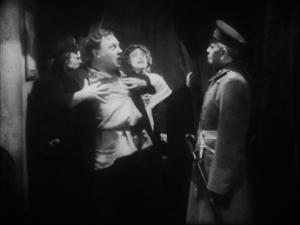
In the tableau tradition, “blocking” takes on a double meaning–not only arranging actors in the shot, but also judiciously using them to mask or reveal areas of space. Thus Dmitri at first blocks Grushenka, but when he lowers his hands, she pops into visibility–frontal and centered, so we can’t miss her. Dmitri sinks to the lower half of the shot when her dialogue title comes up, leaving her to command the frame. Meanwhile the police official has pivoted slightly, making sure that we pay attention to her outburst. Not incidentally, he blocks another policeman behind him, keeping the frame dominated by Grushenka.
This scene goes on quite a bit longer, with some careful balancing and rebalancing of points of interest in the lower part of the frame. The action ends with a nice touch: the embracing Dmitri and Grushenka are separated, and she’s pulled away, one arm flailing.
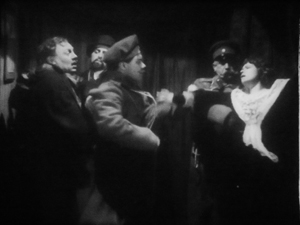
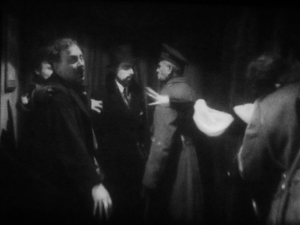
Without benefit of cutting, then, techniques of tableau construction guide our attention smoothly in the frame by using movement, centering, advance to the camera, character looks, blocking and revealing, and other tactics.
The Germans had embraced this tableau option in the earliest 1910s. The films of Franz Hofer and others show how an entire scene could be covered in a single camera position, with staging providing a continuous flow of interest. Go here for an amusing example from The Boss of the Firm, a 1914 comedy starring Lubitsch.
The commitment persisted into later years. The earliest film I watched in this cycle, Hilde Warren and Death (1917), by the quite interesting director Joe May, had several passages of tableau staging. In the most elaborate one, the mistress of Hilde’s dissolute son tells him that now he’s out of money, she has switched her affections to a rival. It plays out without a cut or intertitle for about a minute at 18 frames per second. When Fernande spurns him, he grovels, just as the salon door opens. (Whenever there’s a rear door like this, we’re likely to get a tableau scene.) His rival shows up to take her to the opera.
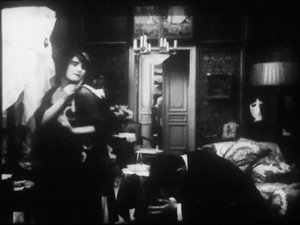
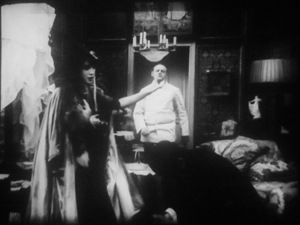
Fernande asks him to stay outside, but the son demands that he stay, waving his hand. In a staging tactic that should be familiar to us now, the son rises, blocking the rival for an instant.
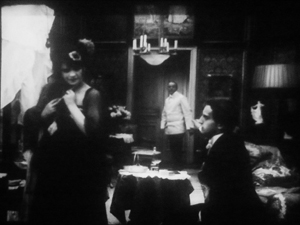
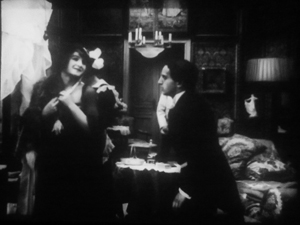
The rival rebalances the composition, and makes himself visible, by moving to the right background. This switching of characters’ position in the frame is known as the Cross. But when the son gets angry, the rival crosses again, easing himself toward the area of conflict. Note that the son’s bodily attitude, tensing up, actually shifts him rightward a little, opening up a space for the other actor to be seen.
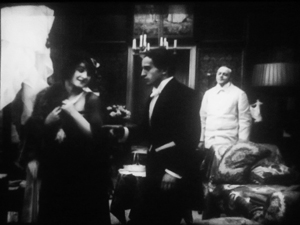
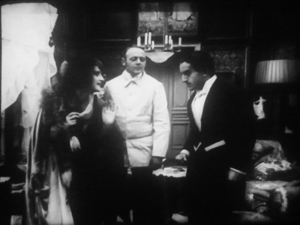
Now the rival steps to the forefront and wedges himself in between Fernande and the son. He invites the young man to leave, with a gesture that occupies the dead center of the frame: Who could miss its assured insolence? And now the maid, previously in the background and blocked by Fernande, makes herself known. Seeing how things are developing, she fetches the son’s hat.
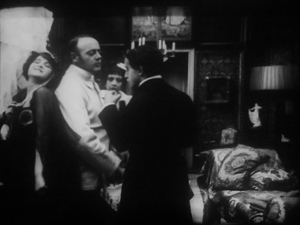
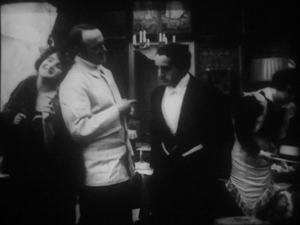
The son gets off one last grimace, front and center, before departing. As he walks back, the rival swivels to blot him out, leading the ladies in mocking laughter. (It’s clear the rival belongs to the 1%.)
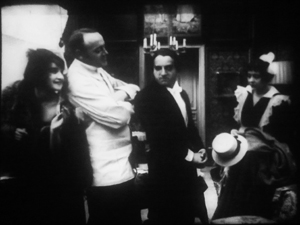
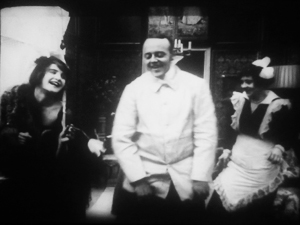
One good Cross deserves another: Now the rival settles in where the son was at the start of the scene, and the son is retreating in shame along the rival’s path.
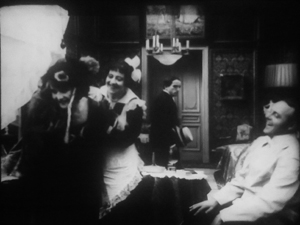
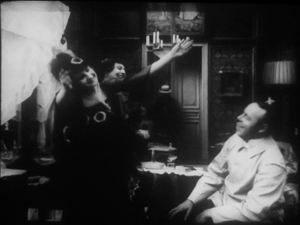
This tableau technique, constantly calculating points of interest from the standpoint of monocular projection–that is, what the camera lens takes in–is far from theatrical. Well-timed blocking and revealing wouldn’t work given the multiple sightlines of a theatre stage. The action is staged for the only eye that matters: the camera’s.
Once we grant that theatrical playing space is quite different from that provided by the camera, we can see more exactly what the tableau tradition owes to the stage. Silent cinema’s “precision staging,” as Yuri Tsivian has called it, is close to choreography. If we want to appreciate what directors of this period accomplished we need to look at the scenes as varieties of pictorialized dance, designed around the axis of the camera lens.
Along the lens axis
To return to the first question: Yes, German films seem to have clung to the tableau tradition after 1917, when Americans had abandoned it. Yet shots like those in The Brothers Karamazov and Hilde Warren are fairly rare; most scenes in most German films of the period use a fair amount of editing. What do we make of that?
The trend is fairly general. Some staging-driven films, like Ingeborg Holm (1913) and the early serials of Feuillade, are built entirely out of one setup per scene, occasionally broken by cut-ins of printed matter or other details. This period constituted a brief golden age of this “tableau” tradition–visible in American cinema, but more pervasive in European cinema. But by the late 1910s, most directors around the world were cutting up their dialogue scenes at least a little. Gradually, the tight choreography of the tableau gave way to the easier method of using close-ups to pick out key instants.
The European default seems to have been what Americans called the “scene-insert” method. A long shot (called the “scene”) is interrupted by a cut to some part of it (the “insert”). Then we go back to the orienting view. The cuts are typically straight in and back along the lens axis.
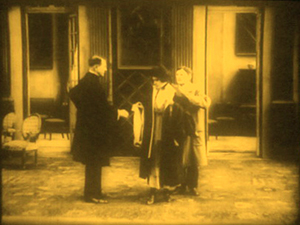
Here’s a straightforward German example from The Devil’s Marionettes (Marionetten des Teufels, 1920). A fake medium has been brought to a rich man’s home to read the fortune of his daughter. As she leaves he pays her, and from his ring she’s able to identify him as a Duke.
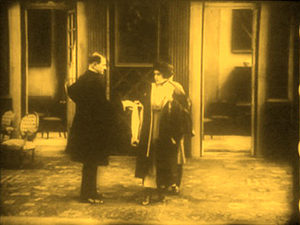
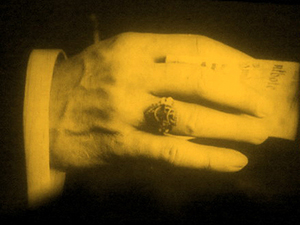
Note that the first setup is much farther back than the tableau scenes in Brothers Karamazov and Hilde Warren. There’s not much to be done with such a distant shot except cut in.
The Devil’s Marionettes scene has two inserts, but it’s conservative by American standards. By 1917, Hollywood directors were increasing the number of “inserts” considerably and making them the dominant source of the ongoing action. Some European directors took this option; notable instances are Abel Gance and Victor Sjöström. Others, though, relied on the scene-insert approach, not building the action out of a lot of closer views. The post-1917 German films I’ve seen, most recently and on other occasions, favor a moderate scene-insert approach like the one in Marionettes. Accordingly, the “pure” tableau option waned.
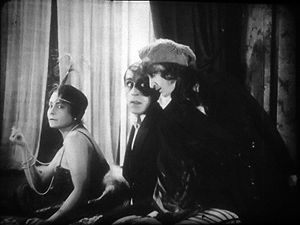
Yet one basic idea of the tableau strategy persisted. We can see this in directors’ use of the axial cut, which provides a constant orientation to the setting. While American directors were often building up a scene from many angles, German directors seemed reluctant to show the action, at least in interior sets, from distinctly varied viewpoints. So when they broke a dialogue scene into many shots, they stuck to the camera axis, cutting in and out along that. You can see that in the Marionettes scene. Consider as well this moment in I.N.R.I.: The Catastrophe of the People (1920). Within a single overall orientation, the editing enlarges or de-enlarges the three characters in the boudoir.
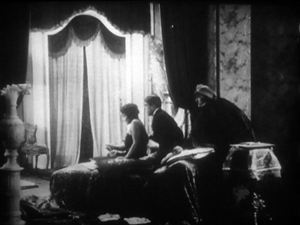
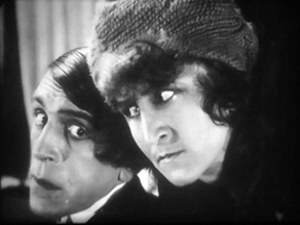
Even with the drastic enlargement from the first shot to the second, or from the third to the fourth, our orientation is basically the same. The staging cooperates with this strategy, making sure that all three players’ faces turn to the camera, even if their bodies are angled away from it. They’re playing to the lens axis, we might say.
When directors try to shift the angle more drastically, the consequences can be strange. In Rose Bernd (1919), an adaptation of a famous Gerhardt Hauptmann play, an axial cut has brought the bullying Streckmann striding toward the camera to meet his wife and Rose, chatting in his garden.
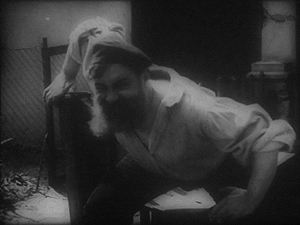
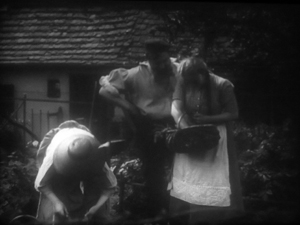
As he flirts with Rose, director Alfred Halm provides another axial cut, from farther back, as a neighbor woman passes in the foreground. Rose turns to look.
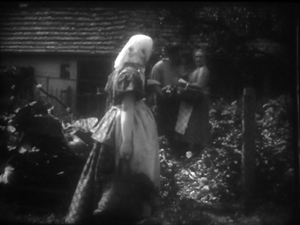
The print is missing dialogue titles, but there evidently was one here, as Rose comments on the woman passing. The dialogue title provides some cover for the extraordinary cut to the next shot.
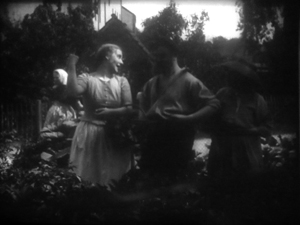
The time is clearly continuous, as the woman is still walking past the garden gate, now in the distance. But Rose, Streckmann, and his wife have been completely rearranged in the frame. They’re positioned frontally, as in the I.N.R.I. boudoir example, and they create the sort of foreground/ background dynamic characteristic of 1910s cinema generally. Halm could have shown Rose’s comment and the others’ reaction by cutting back in along the axis, to a closer shot of the group in the garden (like the second one above). Instead, he shifted his camera position sharply. The new shot does highlight Rose and her gesture, but at the price of spatial coherence.
Aliens, missing shadows, and lustful monks
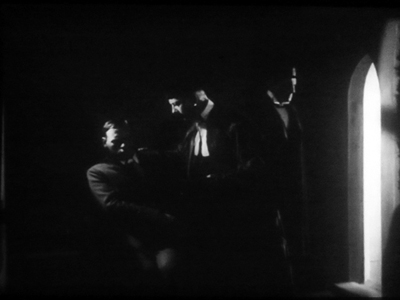
Tötet nicht Mehr!: Misericordia (To Kill No More!: Misericordia, 1919).
So some of our hypotheses seem borne out. Many German directors apparently adopted a conservative position toward American-style analytical editing until the ban relaxed in 1921. After that, as Kristin documents in her Lubitsch book, films by Murnau, Lang, and others employ more varied angles and less frontal staging. It seems likely that the Germans learned about this approach from the new availability of films from America and European countries (some of which were adopting the American approach).
My latest plunge into Weimar cinema yielded other enjoyments. It’s commonly said, for instance, that Germans experimented with expressive lighting effects. So did directors in many other countries, but I did find some striking uses of sparse, stark illumination. One example is the prison cell from Tötet nicht Mehr!: Misericordia (1919), above. Even more daring is this double close-up from I.N.R.I.
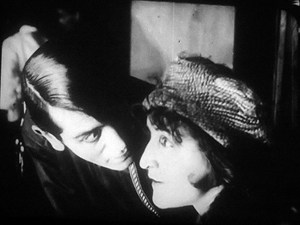
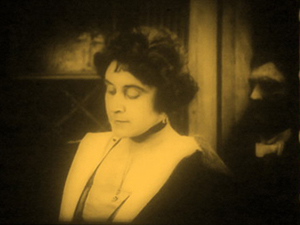
Harvey Dent has nothing on the conniving Russian student Alexei, half of whose face seems just scooped away by shadow. The faint shadow cast on the wall tempts us, in a weird Gestalt illusion, to see his head as partly transparent.
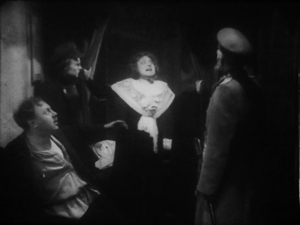
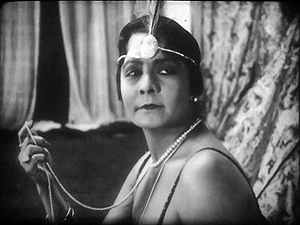
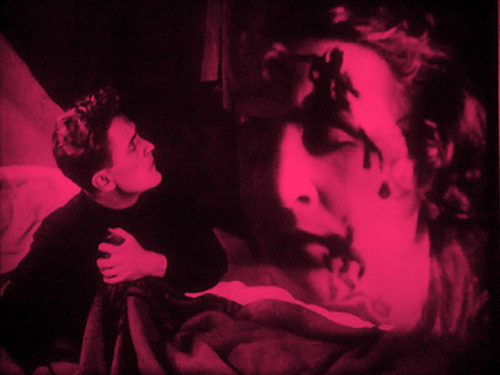
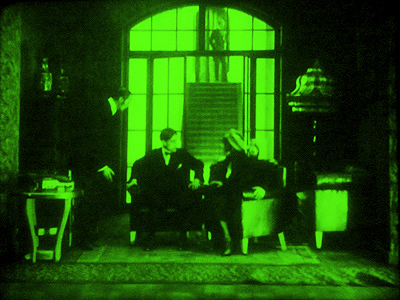
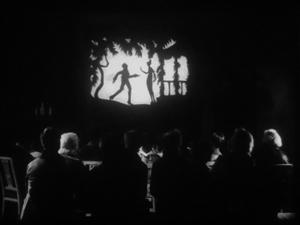
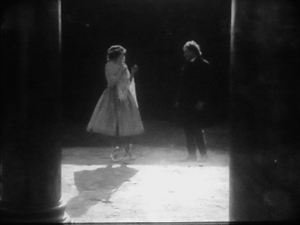
Another area of German expertise was special effects, and I saw plenty of sophisticated double exposures, matte shots, and split-screen tricks. As you’d expect, some of these were used to suggest hallucinations or the supernatural. At the very top of today’s entry is another image from I.N.R.I., which presents the student Dmitri’s fever dream. Below are a couple of nice ones from Lost Shadows (Verlorene Schatten, 1921). A Satanic traveling showman puts on shadow plays, but his cast is drawn from real life: He bargains with people for their shadows, and eventually leaves the hero without one.
What, finally, about what we all yearn for: an extravagantly nutty film? Nothing in this foray matches the work of Robert Reinert (Opium, Nerven), about which I’ve written in Poetics of Cinema and on the DVD restoration of Nerven. Reinert is on another plane of delirium, as mentioned in an earlier entry. Nonetheless, apart from moments in many of those movies already discussed, I found two pervasively peculiar items.
The more well-known is Algol (1920), directed by Hans Werckmeister. The sets, although designed by Walter Reimann of Caligari fame, aren’t cramped and contorted but are instead vast, geometrical, and a bit reminiscent of the Monster-Machine aesthetic of Expressionist theatre.
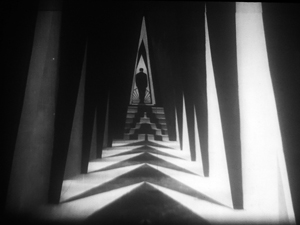
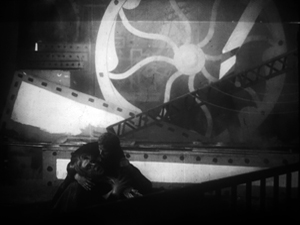
The plot is your everyday visit from another planet. An alien from Algol visits a coal mine and gives a loutish miner a machine that generates endless energy. (Today the Algolian could take a bribe from an oil company to head back home.) The miner becomes a tycoon controlling the world’s energy supply. This monumental fantasy (big sets, big crowds) is enacted with maniacal gusto by Emil Jannings, who spends his wealth, like all good plutocrats, on bacchanals featuring crazy dancing.
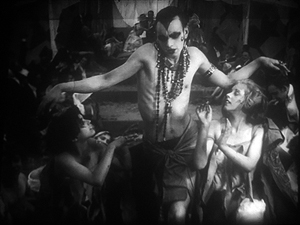
Algol is forthcoming in the Filmmuseum DVD series.
The Plague in Florence (Die Pest in Florenz, 1919) is less famous, although the script is by Fritz Lang. Directed by Otto Rippert (Homunculus, 1916; Totentanz, 1919), this tells of Julia, a woman whose all-powerful sexuality wreaks havoc on the city. Even churchmen lust for her, and eventually Florence sinks into debauchery. What redeems, if that’s the right word, the city is the appearance of a plague that strikes citizens dead in their tracks. Personified as a gaunt woman rising up from the marshes and mournfully playing a violin, the plague eventually kills Julia and her umpteenth lover.
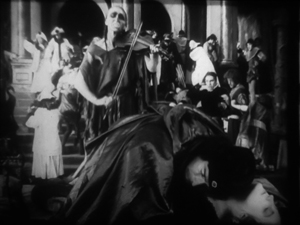
Before this, we’ve had everything I’ve mentioned and more: a couple of fancy tableau sequences, axial cuts, wild mismatches between shots, spectacular lighting effects (e.g., catacombs, below), and hallucinatory sequences. At one point, the mad monk vouchsafes Julia a glimpse of the horrors to come by showing her a river of corpses calmly flowing underground.
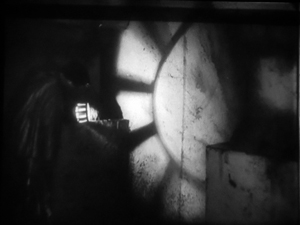
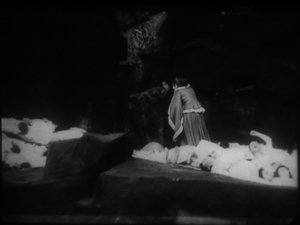
Of course the monk isn’t invulnerable to Julia’s charms. Trying to pray away the impulses she arouses in him, he sees her as his Savior. Herr Rippert, Señor Buñuel is on the other line.
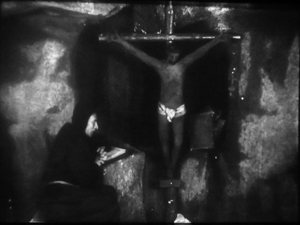
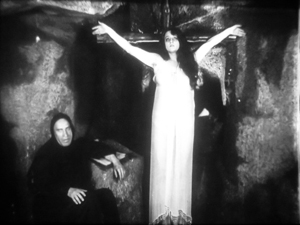
Who knew film history could be so surprising? You don’t get this stuff in your usual pop history. But maybe it’s better we don’t share this with the civilians.
My usual heartfelt thanks to the Royal Film Archive of Belgium, its staff (particularly Francis, Bruno, and Vico), and especially its Director, Nicola Mazzanti. Thanks also to Sabine Gross for a translation.
My previous Brussels research visits are chronicled in this blog over the years. A 2007 entry talks about my viewing method and concentrates on Yevgenii Bauer. The following year’s entry is devoted to William S. Hart. An eclectic 2009 one surveys films from Germany, France, Denmark, and even Belgium. In 2010 I went twice, once in January (watching mostly Italian diva films) and as usual in July (but no entry for that visit, consumed as I was with writing about Tintin). The 2011 entry is diverse, covering many national cinemas, and, implausibly, runs even longer than the others.
We have many other entries on film style in the 1910s. One considers how the Hollywood style coalesced in 1917; another talks about Doug Fairbanks. There’s also an entry on 1913, which discusses both Suspense and Ingeborg Holm, and there are discussions of Sjostrom as a master of both the tableau approach and continuity editing. And of course there’s plenty on Feuillade’s staging; you might start here, and perhaps pause over the mini-essay here, which talks about the director’s eventual experiments with editing. Elsewhere on the site there’s an essay on Danish cinema that echoes some points made in today’s entry. (Unlike other countries, neutral Denmark was able to send its films to Germany during the war, so there may have been some influence there.) Broader comparative arguments about this material have been sketched in a lecture I’ve given in various places, “How Motion Pictures Became the Movies.”
Interest in German cinema of the period grew after Pordenone’s Giornate del cinema muto held its trailblazing program published as Before Caligari, ed. Paolo Cherchi Usai and Lorenzo Codelli (University of Wisconsin Press, 1991; now, alas, very rare). See also the valuable collection edited by Thomas Elsaesser, A Second Life: German Cinema’s First Decades (Amsterdam University Press, 1996). Kristin has an essay here on Die Landstrasse (1913), a remarkable instance of the tableau style.
As my research on the 1910s draws to a close, I’m thinking of how to synthesize and present my arguments. Originally I was considering a book, but the number of stills, and the specialized nature of the project, would probably make publishers shudder. At the moment, I’m thinking about creating a series of PowerPoint lectures, with voice-over. These would be freely available for people to use in courses if they wanted. That initiative would be another experiment in using the Web to get information and ideas out there to interested readers.
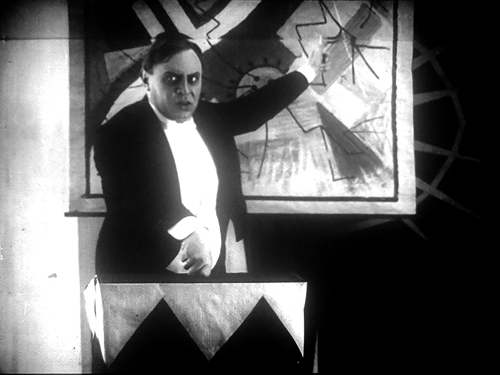
Professor Bordwell illustrates his views on visual storytelling (Algol).

Posted in Film comments, Film technique: Editing, Film technique: Staging, National cinemas: Germany, Silent film, Tableau staging | open printable version
| No Comments »
Wednesday | July 18, 2012

DB here:
A bad back kept me from Cinema Ritrovato, as Kristin explained in her Bologna blog entry. So I spent that week at home fiddling with the Film Art entry, and starting another one that I posted most recently, on the swirl of controversy around the Orpheum Theatre here in Madison.
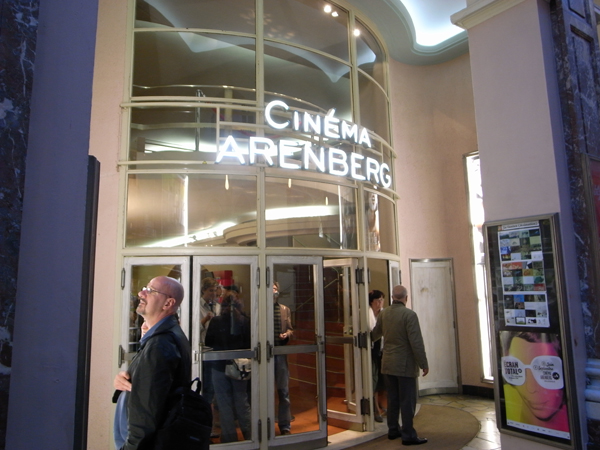
Thanks to some exercise, chiropractic, and a nice dose of painkilling medication, I was able to embark on the second phase of the trip: My annual visit to Brussels for its Cinédecouvertes festival and for some research in the Royal Film Archive. But this visit was different from earlier ones because I took time off to visit colleagues in Germany.

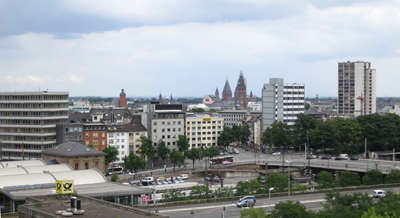
My first stop was Mainz, a lovely cathedral town that’s also the capital of its state. My hosts were Andreas Rauscher and Oksana Bulgakowa of the University’s Department of Film, Media, and Empirical Cultural Studies.
Andreas has with two colleagues written a book on The Simpsons (Subversion in Prime Time). Once very controversial (because of its many pictures from the series), it’s now headed into its third edition. Andreas also works extensively on narrative theory in film and media. Oksana, Chair of the Department, is an old friend of ours who has done a great deal of work in classic Soviet cinema. She has written a comprehensive biography of Eisenstein and has launched an ambitious program studying gesture in cinema and culture. It was a pleasure as well to re-meet Norbert Grob, a key player in a recent collection devoted to “minimal cinema” (you know I like the cover), and to meet Armin Jäger, who has written us with corrections and suggestions for Film History: An Introduction.
My talk was the last in a series on the future of film studies. I usually hesitate to participate in exercises like these, which tend toward the gaseous. But when Andreas assured me he wanted me to discuss how modern digital culture, particularly the Web, affected my research, I felt more able to say something. So I did, drawing together what I’ve learned through and about the online world. The results were recorded on video and will be posted online.

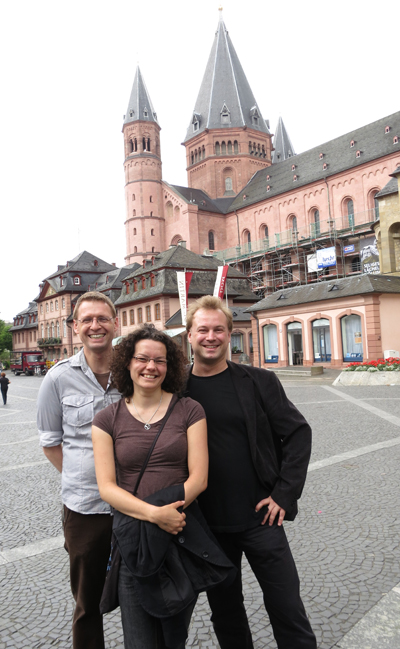
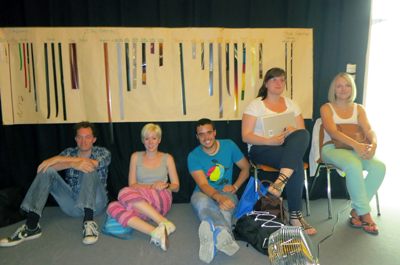
Before the talk I enjoyed ambling around Mainz with Andreas and his colleagues Bernd Zywietz (left, above) and Renate Kochenrath. Renate made me feel old: She had attended my 2003 lecture at the University as an undergraduate. But she compensated by (a) giving me a spare umbrella; and (b) showing me the devil’s dung in a corner of the beautiful cathedral.
I even got to meet a fan, Alexander Gajic, who had reviewed my Pandora e-book. Like me, he stalks autographs, but how do you autograph an e-book? He found a digital-to-analog solution.
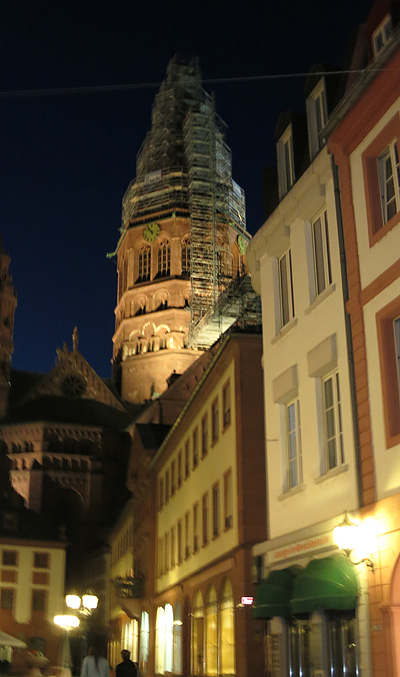
The night before, I had walked a bit around town with Andreas, Oksana, and Dietmar Hochmuth. I had the sense of being in a Murnau film: winding streets overseen by magnificent towers half-medieval and vaguely futuristic.

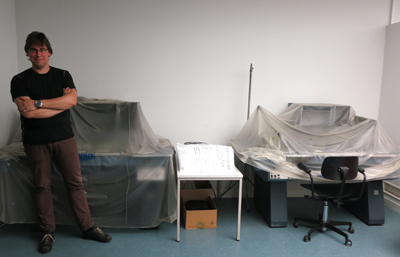
After my 1 ½ days in Mainz, I had only a day in Frankfurt. My host was Vinzenz Hediger, who explores the intersection of film history and media history. (He knows, in particular, a lot about the history of the Hollywood industry.) Here he is with two sterling Steenbecks his department retains.

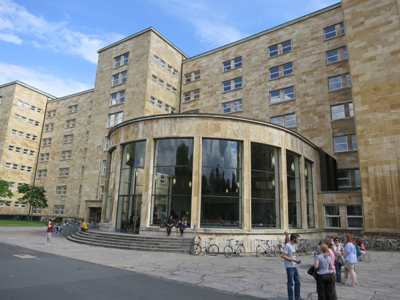
The film department at Goethe University is housed in a stunning complex, now known as Poelzig-Bau or the IG Farben Hochhaus.

It has quite a history. The great architect and set designer Hans Poelzig (the Grosses Schauspielhaus in Berlin, sets for The Golem) created it for the IG Farben chemical trust at the end of the 1920s. The largest office building in Europe, it became a center of Nazi technology, including the development of the Zyklon-B gas used in concentration camps. The complex housed the US armed forces HQ from 1945 to 1995. According to Colin Powell’s autobiography, he first met Dick Cheney in these halls.
At Frankfurt, I gave two talks. The first was a variant of a party piece I’ve worked up, on narrative innovation in Hollywood during the 1940s. I was happy to see so many students turn up on a very pleasant day. I was also happy to see that Heide Schlüpmann, now retired, had arranged for a display of film, actual film, to be a permanent part of the lecture room.

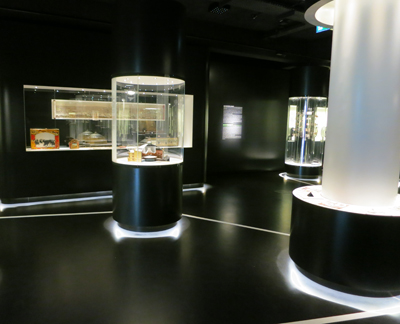
My other Frankfurt talk was at the Deutsches Filminstitut Filmmuseum, recently redone as a dazzling modern facility. Walk in, and you’re in a dark box, in which the displays glow enticingly, like pods in a space station.

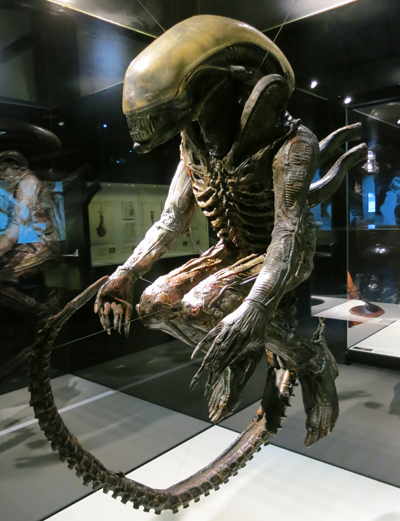
The first floor is devoted to pre-cinema, with many hands-on toys and gadgets. It culminates in a Lumiere display. The second floor roams across film history, with an emphasis on storytelling. Eras mingle: Next to a velvet dress from Visconti’s Leopard you might see a Giger Alien design. And it’s big.

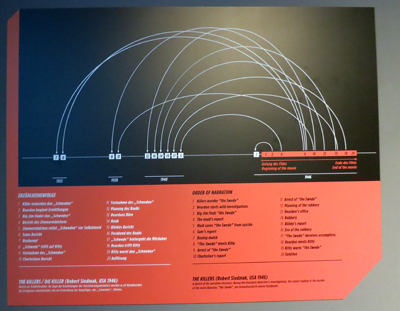
There are many interactive displays, letting you recut a sequence or remix a soundtrack. The third floor is for touring exhibitions, this time one devoted to Film Noir. Close to my heart was a diagram of the time shifts in the plot of The Killers.

Like New York’s Museum of the Moving Image (which we visited here), the Frankfurt museum has acknowledged the need to educate a new generation of movie lovers. What once were temples drawing aging cinephiles to worship are now filmic Exploratoriums, invitations to play with the curious thing we call movies.
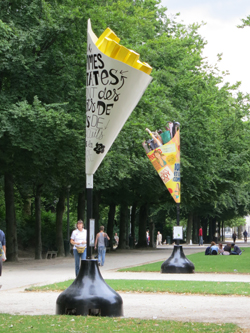
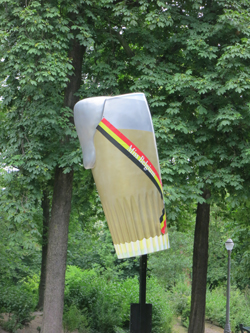
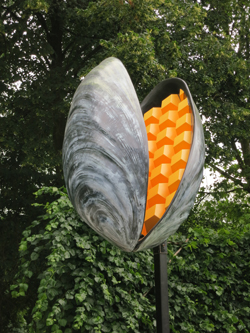
More on Germany–well, the obscure German silent movies I’ve been watching in Brussels–in an upcoming post. For now, back to work in Belgium. And to the tasty snack treats portrayed below, although in somewhat smaller portions.
Thanks to Andreas Rauscher, Vinzenz Hediger, and Michael Kinzer for background information on their institutions.
Kristin has just published her own account of our experiences going digital, here.

Summer art displays in Parc de Bruxelles/ Warandepark, Brussels.
P.S. 22 July: Renate Kochenrath and her colleagues have created a striking site documenting art cinemas in the Rhineland-Palatinate region. The photos are quite beautiful.
Posted in Film comments, Film scholarship, People we like | open printable version
| No Comments »
Sunday | July 15, 2012

State Street, Madison, Wisconsin, 1927.
DB:
When it comes to film culture, Wisconsin yields to no one in weird-assery. I’ve chronicled Mad City Movie Mania on other occasions (here and here), and a current flap has just added to the annals of the addled.
It revolves around Madison’s Orpheum Theatre, a 1927 movie palace that has gone through many incarnations. In recent years it’s become mainly a music venue, but it was also fitted out with a restaurant and still showed the occasional art movie. Until it was shut down last month.
The problem is that after several years of confusion, feuding, moving money around, petty spite, and general dodginess, nobody knows exactly who owns the Orpheum. Is the owner Henry Doane, local restauranteur, who for years was publicly considered the purchaser? Is it Eric Fleming, Doane partner who became anything but silent? Is it Gus Paras, wealthy landlord and restauranteur, who bid a couple of million for it at auction last month? What of the woman who acquired Fleming’s share of the building? And the shadowy figure who made off with a plastic bag holding $175,000—how does he fit in?
“I’ve never done anything to deserve the negative treatment that I’ve been getting. I’m very compromising. I’m willing to do whatever it takes to make things work—as long as it’s profitable.” Eric Fleming
“I’ve gone through every kind of humiliation known to mankind, so I’m kind of immune to it at this point.” By 2007 the partnership had gone so sour that Doane keyed Fleming’s car in broad daylight.
Please visit the story by Steven Elbow at the Capital Times for all the details. My account will be drawing on Elbow’s patient sleuthing, but I also want to recall the glorious, not to mention the inglorious, days of this old house.
Marbles

Orpheum Theatre, 1927. Photo by Angus B. McVicar. Collection, Wisconsin Historical Society.
Designed by Rapp and Rapp, premiere theatre architects, the New Orpheum opened in 1927. (It was initially called that because it superseded the Orpheum, a vaudeville house in another part of town, which was soon renamed the Garrick and specialized in live theatre.) The New Orpheum’s lavish French Renaissance foyer swept up to a staircase leading to the balcony. The auditorium held over 2400 seats, making it the biggest theatre in town until the slightly larger Capitol was built across the street a year later, also by Rapp and Rapp.
The New Orpheum (hereafter, the Orpheum) was one of those picture palaces that aimed to elevate the filmgoing experience while also being a good community citizen. It had a corps of ushers, a smoking lounge, and a reputation for punctilious service. The theatre sponsored community events too. When the local newspaper launched a marbles tournament, the Orpheum held a screening for 2000 kids.
The kids came early and jammed the State street side of the New Orpheum, so it was necessary to call extra policemen to handle the traffic. Once inside the theatre they yelled and applauded the two comedy features which were shown for them, and practically jumped out of their seats during the showing of “Why Sailors Go Wrong.”
Six months before the 1929 stock market crash, the Orpheum was reportedly selling 20,000-25,000 tickets per week, in a town of about 55,000 souls.
An RKO town

View from the Orpheum stage, Halloween, 1930. Photo by Angus B. McVicar. Collection, Wisconsin Historical Society.
The New Orpheum and the Capitol weren’t in competition, since the Keith-Albee vaudeville circuit owned both. Both houses showed movies, but they seem to have been secondary at the Orpheum. Sometimes Orpheum ads from the late 1920s don’t even mention the titles of what’s playing. (This ad on the right is from 1928.) When talkies came in and the circuit became part of Radio-Keith-Orpheum, films became the central attraction, with live performances as filler. A 1930 kids’ party at the theatre shows the banner flying, “These Madison Boys and Girls Are on their Way to an RKO Theatre.”
Despite the Great Depression, RKO moved quickly to monopolize the Madison movie scene. In 1931, the Parkway (capacity 1100) was acquired by the chain, and soon afterward RKO cut a deal with the Fox Film Corporation to take over the Strand (1400 seats). The swap permitted Fox to dominate Milwaukee in exchange for making Madison an RKO town for first-run films. Of course, in good oligopolistic fashion the RKO theatres showed films from all the studios, as did the second-run houses.
I’ve been unable to determine at what point RKO lost control of its Madison screens. [But see the P. S. below.] Presumably it was after the 1948 divorcement decrees severed Hollywood studios from control of theatres. At some point the Milwaukee entrepreneur Dean Fitzgerald acquired seven local houses, including the Orpheum, under the rubric of the Madison Twentieth Century Theater Corporation.
In 1969, a second screen was carved out of the backstage area of the Orpheum and the minuscule theatre that resulted was called the Stage Door. The contrast with the imposing classic house was startling: the Stage Door was almost certainly the worst theatre in town. Then it declined even more. By the end, with its spidery movable chairs and dank atmosphere, it was reminiscent of the storefront theatres of the nickelodeon era, except that they were surely more comfortable.
Less than heavy traffic

Capital Times advertisement, September 1973.
When Kristin and I came to Madison in 1973, we saw a sort of Sargasso Sea of old movie houses. The Majestic, a decrepit vaudeville house built on a plan as cockeyed as an Escher drawing, was showing X-rated fare, kung-fu, and double-bill repertory. It became a Landmark calendar house. A neighborhood house, the Atwood (aka the Eastwood and the Cinema), built in 1930, screened porn and kiddie shows , though not together. The Esquire also offered sex: arty (The Story of O) or not (Dr. Feelgood, with Harry Reems). The mammoth Strand was still functioning as a first-run house; Star Wars played there for months. The Middleton (seating 500 or so) was designed as a Quonset hut in 1946, and was said to have been built in a week. By our day it was playing second run. The Capitol, where I saw The Exorcist, was still operating too. Every year one theatre or another seemed to run the endlessly popular Eastwood Dollars trilogy.
The mall cinemas were emerging as single-screeners or duplexes. They got the premiere first-run pictures like The Sting, often leaving the downtown houses with lesser items. The most obvious options were counterculture movies and sexploitation.
The Orpheum went along. “Entertainment for the Entire Family!” trumpeted a 1965 Orpheum ad, but by 1969 there were revivals of Bullitt and Bonnie and Clyde. Sometimes classier items like The Godfather would show up in second run, but Orpheum fare in the early seventies was more likely to be Heavy Traffic, Enter the Dragon, The Filthiest Show in Town, revivals of headflix (see above), and a double-bill of Russ Meyer’s Vixen and Up! This was the period when the movie page of the papers included ads for This Is Heaven Sauna Massage, The Rising Sun Counseling Clinic (Adults Only), Photographic Arts Do It Yourself Nude Photography (Camera and Film Supplied), Ms. Brews Lounge (Nude Dancing Daily), and The Dangle strip club.
One by one the theatres were closed or converted to other uses. The Capitol became part of an arts complex. The Orpheum remained the only more or less intact movie house from the old days. By 1998, Dean Fitzgerald was ready to sell it.
Two forces were contending for the property. As part of a plan to revitalize the downtown area, the Madison Idea Foundation proposed putting in an IMAX facility. But preservationists objected that an IMAX setup would wreck the layout of the house. By contrast, restaurant owner Henry Doane (right) favored restoration. He proposed to rehabilitate the old place respectfully and use it for art films, film festivals, and live music. He also wanted to install an upscale café and bar.
Doane won the City Council’s approval and in 1999 he purchased the Orpheum. Throughout the 2000s, thanks to some clever programmers, it played remarkably eclectic fare, from Arnaud Depleschin ‘s A Christmas Tale to Matthew Barney’s Cremaster cycle (running two weeks, no less). In addition, Doane’s plan to revive the Orpheum as a live music venue, with booze, was finding some success. The grand house that had hosted Gene Krupa, Frank Sinatra, Bob Marley, and Journey now had popular indie bands. When local critic Rob Thomas drew up his list of ten-best shows for the decade, Orpheum concerts took five places. Most memorably, Bela Fleck and the Flecktones played to a packed house the night after the World Trade Tower attacks, highlighted by a version of “God Bless America.”
Drinks plus dining plus music kept the Orpheum doors open, but by the late 2000s the place was obviously not flourishing. There were rumors that distributors, long unpaid, were withholding films. The place was becoming disheveled, with seats broken, that stratospheric ceiling ominously peeling, and the sound system a fog of distortion.
Worse, even though most Madisonians had an affection for the old house, nobody much went there to watch a film. Things had started promisingly: Doane’s introduction to the movie business was the blistering summer of Star Wars: Episode I—The Phantom Menace and The Blair Witch Project. But that was an atypical season. During the 2000s, most of the biggest audiences showed up during the Wisconsin Film Festival. It was indeed thrilling to see the place packed out for classics like A Hard Day’s Night (introduced by Roger Ebert) and imports like The Foul King and Wilbur Wants to Kill Himself (both shown in the presence of the directors).
At some point, accommodations were made to favor the concerts: front rows were ripped out to provide dance space.

It became a wretched place to watch movies. Lobby dance parties during screenings could drown out the soundtrack. District 13 was projected within a rectangle framed by a scaffolding erected for an upcoming show. As the decade wore on, you might go to the Orpheum for music, but you didn’t go for the films.
Orpheum vs. Orpheum

Now we know a bit more about what happened behind the scenes in the 2000s. At some point Doane split ownership of the Orpheum Theatre Co. of Madison 50-50 with Eric Fleming, a real-estate and restaurant operator.
Fleming (right) is the sort of fellow who gets called “colorful.” He first made it into the Madison press when he opened Crave, a self-consciously hip restaurant noted for its martinis. “People come here to be out and get a little dressed up,” he told one reporter. “Kind of like a ‘Sex and the City’ place.” Maybe a little too much so: A year later Fleming was charged with disorderly conduct for pouring a drink over a Crave customer and groping a female patron. In December 2008, after an altercation that started in the restaurant, one customer was killed on the street by another in the presence of a Crave bouncer.
Fleming’s business style is traced in Elbow’s article. After Fleming became co-owner of the Orpheum, a busted real-estate investment required him to pay creditors $1.5 million. Seeking to dislodge Doane, he created a new company, Orpheum of Madison, claiming that entity as the functioning business arm. He folded that into a package of assets he transferred to Ms. Olesya Kuzmenko for $175,000. “This is what I do for a living,” Fleming explains in Elbow’s article. “I create things and I sell them.”
Who is Kuzmenko, who wound up with a mammoth downtown theatre for the price of a small house on the outskirts of town? She is believed to be Fleming’s girlfriend, but beyond that little is known. She is listed on a license application as President, Vice-President, Secretary, Treasurer, Director, and sole stockholder in Orpheum of Madison. A few years before, Fleming had sold Crave to Christina Bishop, his secretary and girlfriend at the time, under the rubric of a new company Evarc (Crave spelled backward).
There were some curious incidents over these years. There were three fires at the Orpheum, at least two considered by the police to be arson. So far no arrests have been made in the cases. There was also reportedly a break-in, during which a computer was stolen. Perhaps the strangest incident involves the fate of Kuzmenko’s payment. Elbow’s article reports Fleming’s account:
He withdrew the $175,000 he got from Kuzmenko in $100 bills from his bank account, put the cash in a plastic bag and handed it over to a guy identified in court records as Marcus DaMarko, and never saw it again.
“I loaned somebody money,” says Fleming. “I loaned him some money to invest in something. I haven’t talked to him since so I don’t have the money currently.”
So, a reporter asks, you were taken?
“Essentially.”
One more for the road

Because of these maneuvers, Fleming has been running the Orpheum for over a year without input from Doane. The newest issue involves alcohol.
Wisconsin, you must understand, has a frenzied drinking culture. We lead the nation in binge drinking, drinkers per capita, heavy drinkers per capita, and drunk driving. Madison’s main downtown artery, State Street, is packed with bars and restaurants, and the UW’s reputation as a party school attracts an endless supply of youths eager to get wasted. Consequently, what state law calls “alcohol beverages” have been central to the revival of the Orpheum. To establish the lobby restaurant (above) Doane needed to serve beer, wine, and spirits. And Fleming’s cash flow in recent years has been boosted by numerous weddings, which demand booze.
But over the years, the Orpheum’s state vendor’s permit and its liquor license have become problematic. Just during the fall of 2006, the venue under Fleming’s management accumulated some 200 points of alcohol-related violations, and there was a demand that its license be suspended. Across the spring months of 2011, things became more dramatic.
In a series of appeals to the Alcohol License Review Committee of the Common Council, Fleming began to press for the Orpheum’s liquor license to be transferred to his company, Orpheum of Madison. He assured the ALRC that Doane’s original company, Orpheum Theatre Co. of Madison, would be evicted from the premises. Doane replied he knew nothing about this, and indeed he was not evicted. Moreover, he argued that Fleming was making purchases for his own company but billing their original one. And Fleming, he claimed, had changed the door locks. The ALRC, declining to step into the middle of the feud, decided to let Doane’s original company hold the license until ownership was clarified.
Auction fever
That fracas took place a year ago, but things really got going this spring. While Doane was suing Fleming to regain control of the building, the Orpheum faced foreclosure because of unpaid bills. In April it went on the auction block.
Enter Gus Paras (right), once Fleming friend and now Fleming foe. “He sued me and cost me a lot of money,” Paras explained. “The other thing is I watched people he screwed so bad he put them on their knees.”
Gus Paras had had many dealings with Fleming when both sought to buy property in the area. Now Paras wanted the Orpheum as well. But when the property went to auction, along with the 300 block that had also been part of the Fleming/ Kuzmenko package, Olesya Kuzmenko showed up and began bidding against Paras. In a scene reminiscent of the auction in North By Northwest, she bid the price for the Orpheum up to $1.9 million, but Paras won it for $2.25 million. She bid again on the 300 block properties, but Paras bid her up and then folded, leaving her stuck with her $2.25 million bid. But she couldn’t make the down payment, so the court gave both the Orpheum and the 300 block to Paras for $1.9 million each. However, as of this writing, the sale has not yet been consummated. A court will need to determine who actually owns the building.
In the meantime new alcohol problems resurfaced. Doane requested that the Orpheum’s state seller’s permit not be reactivated. It expired. But the Orpheum continued to sell booze. For a time it seemed that every drink poured since April 2011 had been in violation. A June 2012 story explained:
[Assistant City Attorney Jennifer] Zilavy said the Orpheum should not have served alcohol at concerts and other events. She isn’t sure if the city will pursue civil charges, which could result in a $1,000 fine for each infraction, or refer the matter for criminal charges, which could result in a fine of up to $10,000 or nine months in jail per offense.
As a result, last month the Common Council of the city declined to renew the Orpheum’s liquor license. When the police tried to serve notice of non-renewal, they were unable to rouse anyone. “It is locked up, lights out, nobody there,” reported the officer. Now, however, it seems that Fleming managed to re-activate the license fairly soon after Doane deactivated it, so it’s unclear how long, if at all, the Orpheum was serving drinks illegally.
The city later discovered that Fleming, nothing if not tenacious, was at some point granted a state seller’s permit for his new company. But as of early July the sort-of-partners remained at loggerheads. Doane’s company had a liquor license but no seller’s permit. Fleming’s company now has a seller’s permit but no liquor license. And Doane’s company’s liquor license expired last Saturday. The Madison Common Council has sent the matter to the ALRC for a public hearing. possibly as soon as next week.
I wish I could answer every question that’s come up. Who is Mr. DaMarko, and what became of the 1750 $100 bills? If Paras finally acquires the building, what status does Fleming’s operation have with respect to it? What about Doane’s stake in the theatre he originally bought?
One thing seems certain: If the old place resumes operations, it will be as a venue for weddings and live music, with a bar and perhaps a café. As movies evicted vaudeville from the Orpheum in the 1930s, so now live performance has replaced movies. The drama and comedy have moved off the screen into the streets, the Common Council, and the halls of justice.
Steven Elbow follows up his main story here. If anything develops, he will probably report on it in his blog.
The Orpheum website reflects the chaotic state of its circumstances. Videos of the ALRC hearings, from which my three portraits of the protagonists are taken, may be streamed here and here. In late June, Eric Fleming conducted a brief video tour of the Orpheum’s restorations. The most recent application from Kuzmenko’s company requests that the liquor license begin on 1 July 2012 and end on 30 June 2012. Will the fun never stop?
Some accounts date the Orpheum from 1926, but it opened in March 1927. (See, for example, “New Orpheum’s First Birthday Cake,” The Capital Times, 3 April 1928, 3.) To view more magnificent Orpheum photos from the Wisconsin Historical Society collection, go here. The color shot of the Lobby Restaurant is from the Onion. (The Onion originated–where else?–in Madison.) The color shot of the missing front rows is from the 2010 Wisconsin Film Festival. For a sense of what a wedding looks like in the Orpheum, go to Valo Photography.
Wisconsin’s mad flight from sobriety is documented in the Milwaukee Journal-Sentinel‘s award-winning series. As far as I know, nothing much has changed since that 2008 survey.
This has been my Year of Living Exhibitionistically; see the Pandora posts and the e-book for accounts of different movie theatres. Older entries are here and here.
P.S. 15 July 2012: Douglas Gomery writes that RKO probably lost its grip on the Orpheum and other theatres much earlier than I speculated:
The Film Daily Yearbook of 1931 lists RKO holdings in Wisconsin: Madison, the Capitol & Orpheum; Milwaukee, the Riverside; and Racine, the Downtown (literally). In 1932 RKO goes into bankruptcy, and all its Wisconsin holdings disappear from FDY. My guess is that the Orpheum and other houses became locally owned.
Douglas wrote the definitive book on American exhibition, Shared Pleasures, and I thank him for the correction.
P.P.S. 16 July: My original post indicated that Kuzmenko won the Orpheum temporarily before she proved unable to make the down payment. Steve Elbow corrected my claim on this: what she acquired at auction was actually the 300 block property, which had been folded with the Orpheum into the overall property Fleming sold her for $175,000. Gus Paras bid successfully on the Orpheum itself.
The blog has been revised to reflect another piece of information Steve provided me: that Fleming may have reactivated the Orpheum’s liquor license quite soon after Doane deactivated it. Thanks to Steve for these corrections.
P.P.P.S. 27 May 2013: A query from Laura Ursin has led me to correct the date in the caption of the top photo, which I had dated from 1938.

The Orpheum Theatre under construction, 1926. Photo by Angus B. McVicar. Collection, Wisconsin Historical Society.
Posted in Film history, Film industry, Movie theatres | open printable version
| No Comments »
|