Wednesday | September 18, 2013
Kristin here:
Going into the summer movie season this year, I wasn’t particularly excited about most of the upcoming films. I was looking forward to Monsters University, which I thoroughly enjoyed, though it didn’t return to the dazzling levels of Pixar’s films before Cars 2. Right now I’m assembling my viewing list from the impressive array of offerings at the Vancouver International Film Festival. (The new Oliveira! Godard in 3D! Mohsen Makhmalbaf’s long-awaited return to filmmaking!)
But I’m also aware that during the festival, another film that I’m really excited to see will be released in North America: Alfonso Cuarón’s Gravity. I didn’t see the 17-minute opening shot shown at Comic-Con, but I watched one of the trailers, and it was the most exciting new piece of filmmaking I’ve seen this year. If you haven’t seen one of the four trailers, you can watch them on Warner Bros.’s site, or on any number of video and infotainment sites. The one called “Drifting” reminded me of Michael Snow’s brilliant Central Region, but with narrative, with the earth and stars spinning past a close-up of Sandra Bullock as the marooned, panicky astronaut protagonist.
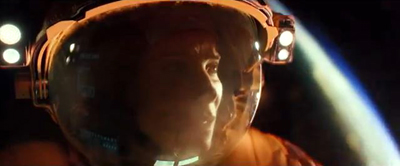
Unfortunately a still frame conveys almost nothing of the dazzling effect of this image. You’ll just have to follow the link above and look for yourself.
Judging by the ecstatic reviews and descriptions of audience responses that came out after Gravity was screened as the opening-night gala at the Venice Film Festival, the movie lives up to the expectations generated by the clip and trailers. One of the most insightful reviews is by Todd McCarthy, who combines giddy enthusiasm (mentioning twice that people will want to see the film repeatedly) with some solid analytical comments on the soundtrack, camerawork, and special effects. After Cuarón screened the film for James Cameron, the latter enthused: “I was stunned, absolutely floored. I think it’s the best space photography ever done, I think it’s the best space film ever done, and it’s the movie I’ve been hungry to see for an awful long time.” Indiewire’s Steve Greene has compiled a selections of excerpts from reviews from the Venice opening.
Cuarón’s previous film had been Children of Men, released way back in 2006. After such a gap, authors of articles and reviews have felt the need to summarize his career briefly. Most frequently they mention Children of Men and the 2001 Mexican comedy Y tu mamá también, which was a breakthrough film for the director. Less frequently there is a reference to Harry Potter and the Prisoner of Azkaban (2004) and A Little Princess (1995).
Harry Potter and the Prisoner of Azkaban in Cuarón’s career
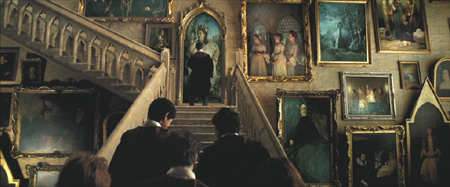
Living paintings in Harry Potter and the Prisoner of Azakaban
As that line-up of titles suggests, Cuarón has had a career that makes him difficult to characterize. Although he is perceived as a Mexican director, he has done relatively little work there. Apart from shorts and TV projects, his Mexican features consist only of Love in the Time of Hysteria (Sólo con tu pareja, 1991) and Y tu mamá también. He’s also perceived as an art-film director. Variety′s cover story on Gravity was entitled “An Auteur’s Re-entry” in the September 3 print edition (though it was “Alfonso Cuaron Returns to the Bigscreen after Seven Years with ‘Gravity’ online). This impression obviously arose from the success of Y tu mamá también (distributed in the USA by Good Machine, now Focus Features) but also from the fact that the grim Children of Men was a financial flop and succès d’estime. Yet Children was produced and distributed within the Hollywood mainstream by Universal.
Instead of pursuing his career in Mexico, Cuarón headed for Hollywood immediately after his first feature. He described this career move in a 2006 interview:
After coming up the ranks as a cable operator on a movie set and an assistant director, he made his first feature, “Sólo con tu pareja,” in 1991, and it won several awards at the Toronto Film Festival. However, the Mexican Film Commission, which had subsidized it, wasn’t happy with the movie.
“I basically burned my bridges with the commission,” says Cuarón, who moved to Los Angeles with no contract to do another film. Director-producer Sydney Pollack gave him a chance to shoot an episode on the cable TV series, “Fallen Angels.”
“Tom Cruise had directed one episode and Tom Hanks another. But mine was the one that won a cable award,” Cuarón says. “It was one of those things that led to the next.”
That turned out to be the sublime children’s movie “A Little Princess.”
“I never watch my movies after I’m done with them, but in my memory that’s the one I love the most,” he says.
Cuarón’s next experience directing a modern-day version of “Great Expectations” [1998] starring Gwyneth Paltrow and Ethan Hawke, wasn’t so great.
“My instinct always told me not to do it, and I ended up doing it anyway,” he says. “So I learned to trust my instinct.”
Also in this interview, Cuarón describes himself as lucky in his Hollywood work:
That a major studio (Universal) was willing to underwrite such a downbeat story [as Children of Men] is a credit to Cuarón’s reputation. Unlike many foreign directors used to having enormous latitude in their native countries, Cuarón has learned to work within the Hollywood system.
“There is a tendency to see Hollywood like Darth Vader trying to destroy filmmakers,” he says. “And I’m sure that’s sometimes true. I have been very lucky to be able to create my own stuff without studio interference.”
The perception of Cuarón as an art-film director has perhaps led to a tendency to dismiss his one venture into the Harry Potter series as an aberration. In his excellent analysis of the long takes in Children of Men (which focuses on the fact that they were created by digitally blending multiple takes), James Udden remarks on how, after first using long takes in Y tu mamá también, “Next, Cuaron takes a ‘step back’ in a sense with Prisoner of Azkaban, paying yet more ‘dues’ to the system.” Justin Chang’s brief but informative survey of long takes in Cuarón’s work does mention that the technique “even reared its head in 2004’s ‘Harry Potter and the Prisoner of Azkaban,’ in which the director boldly imprinted his personality onto one of Hollywood’s most successfull–and most risk-averse–franchises,” though he does not mention how the technique “reared its head.”
Yet Cuarón evidently loved his experience working on Prisoner of Azkaban. The interview just quoted was one of several in 2006 where he expressed keen interest in making another film in the series: “If I’m invited, I would be very tempted to direct it. The idea of revisiting that beautiful universe is irresistible [….] Everything that happens around a J. K. Rowling creation is enveloped in this beautiful, beneficial energy.” Maybe he will have a chance to work on a Rowling film again, given the recent announcement that she will write the script for a franchise-starter for a new film series based in her wizarding world.
Setting aside Cuarón’s feelings about his experience making the film, we should not dismiss it as a minor part of his career, something he supposedly made so that he would be able to make other, more personal projects. For a start, it does have a style distinctly different from the other Harry Potter films. It’s not always recognizable as a Cuarón style, but then, Cuarón’s films are so different from each other that that is hardly surprising. Udden points out that while Children of Men has an average shot length of slightly over sixteen seconds, Prisoner of Azkaban′s ASL is about 5.5 seconds. Still, it contains three long takes, each of considerable interest. Moreover, the introduction to cutting-edge CGI would leave Cuarón with valuable experience that he could apply to his two subsequent features.
Prisoner of Azkaban has a reputation as one of the best, if not the best, of the Harry Potter films. Its quality is not solely due to Cuarón’s direction. The book is arguably also the best of Rowling’s series. While the first two books (Harry Potter and the Sorcerer’s Stone and Harry Potter and the Chamber of Secrets) are pleasant, entertaining children’s stories, Prisoner of Azkaban marks a leap in the complexity and depth of the plotting. It adds two major new characters, the sympathetic professor (and werewolf) Remius Lupin and the apparently threatening Sirius Black, who turns out to be Harry’s parents’ best friend and his godfather. It also adds a third character, the dotty Prof. Trelawney, who seems just to offer a source of comedy but will eventually prove to have affected Harry’s life in unsuspected ways.
New villains also appear, notably the soul-sucking Dementors and the literal and figurative rat, Peter Pettigrew, another old friend turned traitor who has become Voldemort’s main helper. Lupin introduces the technique of casting a “patronus,” a protective figure of light that repels the Dementors–something that will continue to be crucial for the rest of the series. Finally, there is the ingenious episode of the time-turner, a device Hermione has been employing to take multiple classes at once but which she ultimately uses to allow her and Harry to go back in time and manipulate a series of tragic events and make them end happily. This lengthy scene, one of the high points of Rowling’s series, is even better in the film, where we can see the doubled characters on the screen.
Apart from drawing on the book’s strengths, the film also has the advantage of being the one that replaced Richard Harris with Michael Gambon as Dumbledore. Apparently some viewers were fond of Harris’ portrayal, but the casting seems to me a real mistake and no kindness to an actor clearly in failing health. I found him disturbingly feeble, stiff in his movements and expressions, and barely able to get a whole line out without gasping for breath. How the producers thought he could last through the series is a mystery, and Gambon’s livelier and funnier performance came as a relief.
Prisoner of Azkaban also quickly gained a reputation as being much darker in tone than the two films that preceded it. I doubt there was a single reviewer who failed to make this claim. The Washington Post’s critic called it “everything the first two films were not: complex, frightening, nuanced.” For Roger Ebert, “Harry’s world has grown a little darker and more menacing.” In a later survey of the first four Harry Potter directors, Manohla Dargis and A. O. Scott wrote of Prisoner of Azkaban, “the tone and color palette have shifted, the bright, flat lighting giving way to a somber and dangerous feel, evocative of horror films.”
Perhaps such comments had something to do with the fact that Prisoner of Azkaban earned less at the box office than any other film in the series: a mere $797 million. (The second lowest earner, Chamber of Secrets, made $879 million; the highest, Death Hallows Part 2, $1.3 billion.) It’s hard to believe that fewer people would go to the film based on a change of directors. How many, after all, would be likely to know who Cuarón was? More likely parents kept younger children away for fear that the action would be too intense.
The book version of Prisoner of Azkaban also takes a much darker turn. If that was the reason for the downturn, it didn’t last long. The trend toward darker, scarier content continued through the later books, with the return of Voldemort in the fourth and the deaths of major characters in each subsequent book. Similarly, the later films are distinctly more grisly and frightening than Prisoner of Azkaban. None of this kept people from buying books and movie tickets.
One might assume that studio executives decided on Cuarón as an appropriate director for a darker entry in the series, but he had not yet gained a reputation for grim subject matter. That came with Children of Men. In fact, Cuarón was not the first or even second choice as the film’s director. A retrospective article on Den of Geek! gives this account:
The studio’s choices included Guillermo del Toro, who baulked at how the film was “so bright and happy and full of light”, and Marc Forster, who didn’t want to direct children again so soon after making Finding Neverland.
It came down to a final short-list of Kenneth Branagh (who had co-starred in the previous instalment as Gilderoy Lockhart), Alfonso Cuarón (A Little Princess) and Callie Khouri (Divine Secrets Of The Ya-Ya Sisterhood and screenwriter of Thelma And Louise). Eventually, Cuarón was appointed, and the director is largely credited with energising the series.
Let’s examine some of what Cuarón brought to Harry Potter by looking at his signature device, long takes.
Three long takes and some flashy effects
Unlike in Children of Men, the long takes in Prisoner of Azkaban are not used primarily for action scenes. Unlike in more conventional Hollywood films, they are not used at the opening as a flashy way of presenting exposition. Rather, they function to emphasize transitional points in the plot and to create motivic parallels. Not surprisingly for Cuarón, all involve camera movements. Two of the three involve conversations, one with an impressive but not flashy tracking movement to follow the characters, the other with a more subtle, slow push-in and out.
The first and lengthiest of the long takes comes in the Leaky Cauldron inn when Harry encounters the Weasley family and Mr. Weasley takes him aside to warn him about Sirius Black’s escape from Azkaban prison. It lasts for one minute and 53 seconds.
The setting is bustling, and the camera movement serves in part to gradually pull attention away from the crowded dining room and to focus on the conversation. The shot opens on the busy table, with a large tea kettle floating on its own through the air. (In Prisoner of Azkaban, Cuarón frequently uses this tactic of having objects floating in the foreground to suggest a magical environment; he will repeat the device in Gravity to depict weightlessness in space). Mrs. Weasley effusively greets Harry:
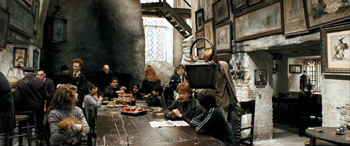 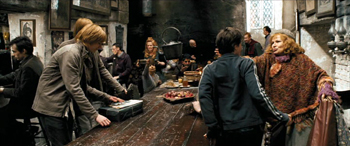
Mr. Weasley asks to have a word with the boy, and they move toward a squared-off opening near the back of the set. A wanted poster for Black, visible to the right of center from the opening of the shot, becomes more prominent at the frame edge. Since photographs in this magical world move, we cannot help but notice it:
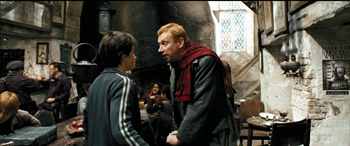 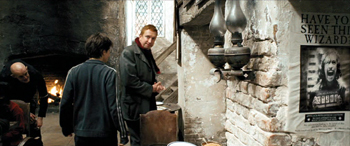
The camera tracks past the poster through a second opening closer to the camera and stops once the characters are centered. Mr. Weasley tells Harry about Black, and the camera moves back to accommodate them when they come forward to look at the poster:
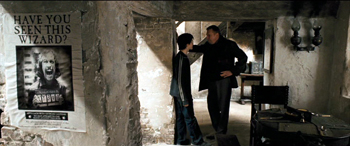 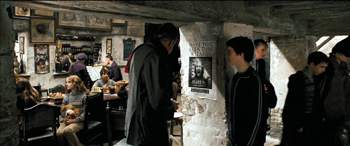
As they continue to talk, the camera again moves backward as Mr. Weasley steers Harry to a third opening into the main dining room. They pause beside a second poster of Black, and Mr. Weasley explains that Black had betrayed Harry’s parents to Voldemort, who had killed them and tried to kill him. As a man in a bowler sits at the table near them, Mr. Weasley again guides Harry into a more private area:
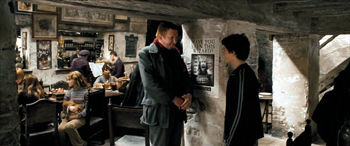 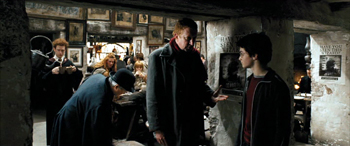
He says Black is going to try and kill Harry and urges Harry not to go looking for him. The shot ends on a push in toward Harry, who replies, “Mr. Weasley, why would I go looking for someone who wants to kill me?” and the scene ends.
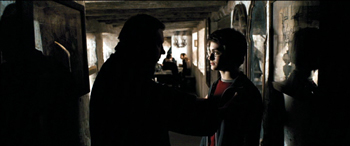 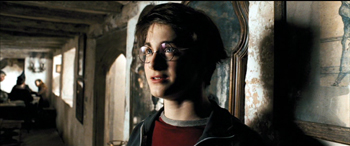
This moment marks a crucial change in the narrative tone. The film started with two comic scenes: Harry’s use of magic to inflate his obnoxious Aunt Marge into a human blimp and then the antics of the fantastical Knight Bus that rescues Harry and transports him to the Leaky Cauldron. Now for the first time the theme of grave danger is introduced, with the insane-looking Black screaming silently in the wanted poster. A darker storyline takes over, though there are many moments of humor to come. This conversation leads into the scene on the train to Hogwarts, which, for the first time in the series, has a heavy rainfall occurring throughout. During this scene the first Dementor appears, and Lupin explains what Dementors are.
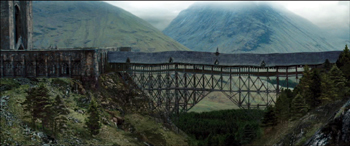
The second long take (one minute and thirty seconds) comes in a much quieter scene at Hogwarts. Harry has been unable to accompany the other students on a day’s outing to Hogsmeade, the local village, and he is depressed and lonely. He has a conversation with Lupin, set on a long elevated bridge that was added to the Hogwarts setting for this film. The scene begins with an extreme long shot tracking slowly toward the bridge as Harry discusses his fear of Dementors with Lupin, followed by a cut-in to them:
 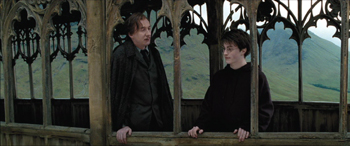
The camera moves in slowly as Lupin turns away and recalls his friendship with Harry’s mother. As he says, “Well, your father James, on the other hand, he … he had a certain, shall we say, talent for trouble,” Harry smiles:
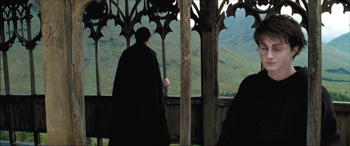 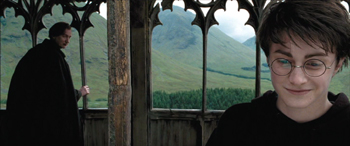
Lupin walks back to Harry, concluding, “A talent, rumor has it, he passed on to you. You’re more like them than you know, Harry. In time you’ll come to see just how much”:
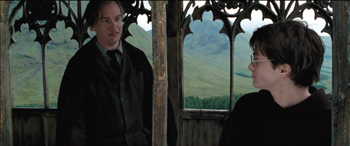 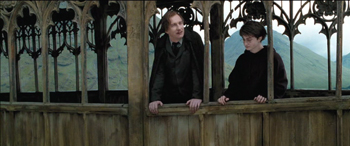
The scene ends with a cut to a shot of the bridge from the original distant framing:
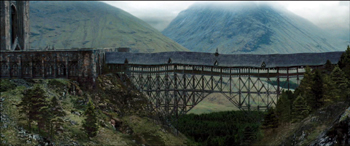
The two scenes are parallel but contrasting, as Harry receives information from two father figures. Initially he speaks to Mr. Weasley, the head of a large, boisterous family that has semi-adopted Harry; we are reminded of them (including Ginny, whom Harry will eventually marry) at intervals in the background of the Leaky Cauldron long take. The two rooms are divided by a series of square openings in a thick wall, which the pair move through as Mr. Weasley prepares to deliver threatening news. The melancholy Lupin, on the other hand, has no family, and here he comforts Harry in a setting with airy, intricate archways framing a vast, empty mountain vista beyond. The quiet atmosphere is appropriate, since Lupin is the first of three classmates and close friends of his dead parents that Harry meets in this film.
The film’s third long take is the only one that could be said to involve an action scene, though it is really just the prelude to a lengthy segment of the film stringing together several brief action scenes. (It is the shortest of the three long takes, at one minute and eight seconds.) This shot marks another transition, introducing the film’s climax. Everything has just gone wrong. Gamekeeper Hagrid’s pet hippogriff Buckbeak has been executed as too dangerous to be around the students. Sirius, whom the children now know to be innocent of the crime for which he was imprisoned, has been captured and is about to be turned over to the Dementors. Pettigrew, having been revealed as the true traitor to Harry’s parents, has escaped in rat form. In the hospital dormitory where Ron has ended up, Dumbledore hints that Hermione should use the time-turner so that she and Harry can return to the beginning of these events and try to reverse them.
The camera circles around Hermione as she turns away from Ron’s bed and pulls the time-turner on its chain from inside her jacket. She lifts it and places the chain around Harry’s neck, so that they are both wearing it:
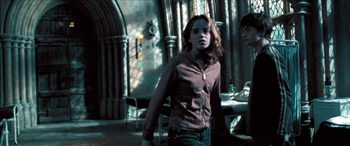 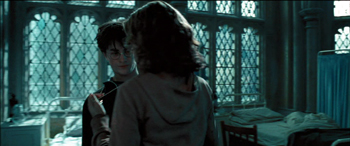
He looks on uncomprehendingly as she twirls the time-turner to send them back to a point shortly before the scheduled execution of Buckbeak:
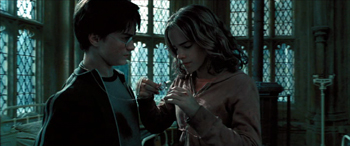 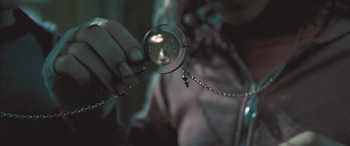
Startled, Harry watches rapid changes in lighting and blurred figures moving backward in fast motion as Hermione keeps track of how far they have traveled. During all this, Ron disappears from the bed at the right rear:
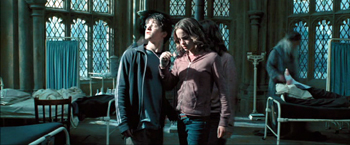 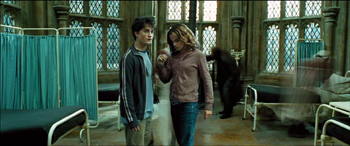
The camera moves in as she hides the time-turner and circles as they run out of the room:
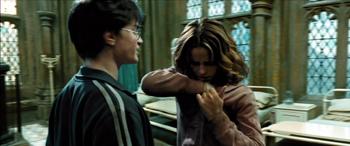 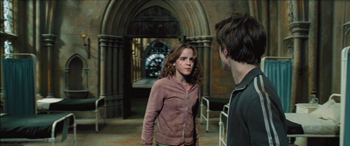
They run along a corridor, the camera following until they turn and exit left:
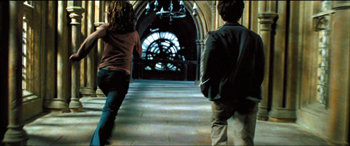 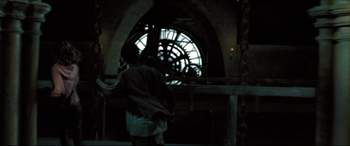
The camera continues straight ahead, through the large clock wheels, and reveals the school grounds far below:
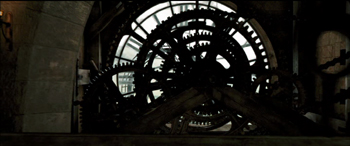 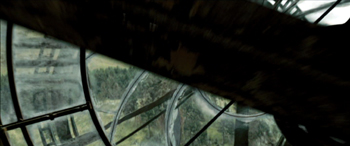
The camera moves through the glass of the clock window and tilts down to the courtyard, where Hermione and Harry emerge and run out through the doorway at the top of the screen:
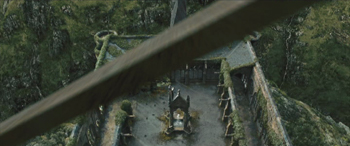 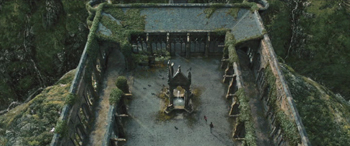
Later, after the pair has accomplished their goals, a somewhat similar shot moves with them through this same courtyard and cranes up and through the clock again, joining them at the same point as they run in and away down the corridor to the hospital wing.
On a more modest scale, there is a somewhat similar technique used in Y tu mamá también. The heroine, Luisa, waits in her apartment for Tenoch and Julio to pick her up for a trip to the beach. Once they call to let her know they have arrived, she exits through the front door; the camera tracks rightward to a window and tilts down to reveal the car waiting below and pulling away from the curb as the three depart. Although not a particularly lengthy shot, it functions, as in the third one from Prisoner of Azkaban, to mark a narrative transition, in this case the end of the film’s first portion and move into the long car trip that will occupy most of the rest of the film:
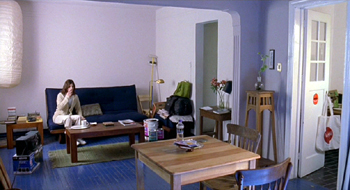 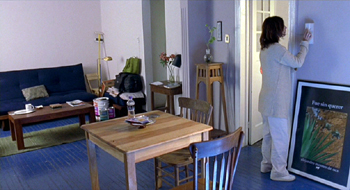
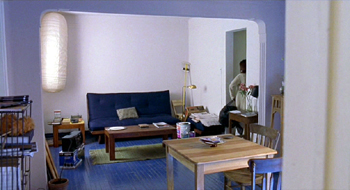 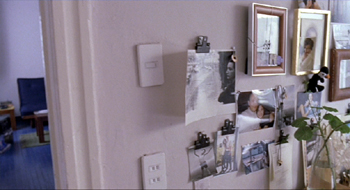
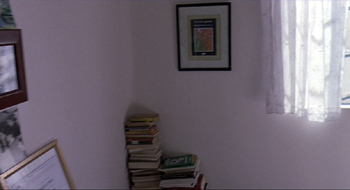 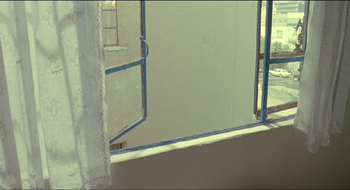
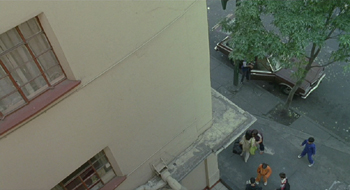 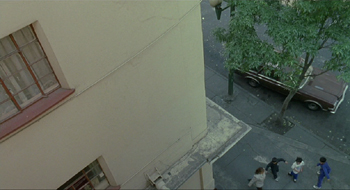
This is a far simpler shot and was accomplished by moving the handheld camera through the room to an open window, sticking it through, and tilting down. The Prisoner of Azkaban “shot” was in fact an elaborate manipulation of images, with the segment where time runs in reverse around Harry and Hermione shot against a green screen; the portion going through the clock’s works and its window was done with CGI elements. (See American Cinematographer‘s article on the film for an explication of the technology involved.)
Admirers of the elaborate “camera movements” in Children of Men and Gravity, some of which were done by stitching together several elements into apparently continuous shots, might take note that Cuarón’s experiences on Prisoner of Azkaban made them possible. A 2006 interview on SFGate describes the director’s progress:
One benefit was a crash course in computer-generated visual effects. Cuarón used “maybe a shot or two in “Y Tu Mamá También”–the 2001 Mexican indie that got him an Oscar nomination for best original screenplay–and in his earlier Hollywood movies, “A Little Princess” and “Great Expectations.”
On the Harry Potter sequel, working with computer effects was “like speaking Russian,” he says. The hardest part was figuring out how to shoot an object such as a plate, knowing that later it would be substituted by some wild effect.
“The important thing was not to be shackled by these effects, to shoot as you would your normal scene. There’s a tendency I witness in movies and completely dislike in which the narrative is kind of forced because of the visual effects. You have to try to keep your character and the visual-effect character as separate as possible.”
By the time he started “Children of Men,” all of this was “like second nature.”
In a more recent (undated) interview given at the time when Gravity‘s principal photography was beginning, Cuarón stressed its connection to the things he had learned about special effects on Prisoner of Azkaban: “Well, Potter was my kindergarten and grammar school and high school and college education of visual effects. It is coming in handy with Gravity which is so, so visual-effects savvy [that] we’re inventing new technologies. Now it’s just second nature.” He also mentions that his work with David Heyman, who produced all the Harry Potter films, was what led him to invite Heyman to produce Gravity.
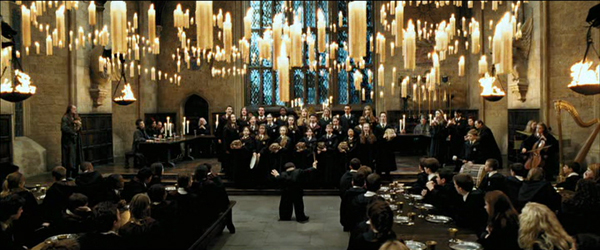
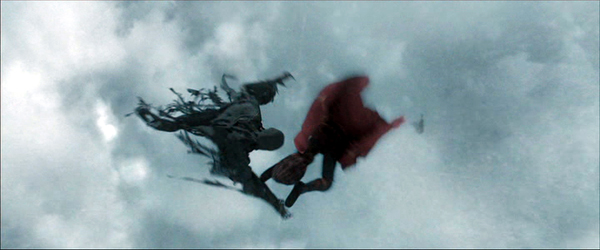
Apart from the CG-compiled long takes, there were effects like the hundreds of candles floating in the air above the great dining hall of Hogwarts (see top) and the living paintings crowding the walls (above left). It seems remarkable that Cuarón’s third film after his modest Mexican sex comedy could draw such high praise from James Cameron, one of the top directors of effects-heavy films, but working on a Harry Potter movie for a couple of years made that possible. And, as the frame below demonstrates, directing Quidditch matches is a good preparation for showing people drifting weightlessly in space.
The quotation from James Udden comes from his article, “Child of the Long Take: Alfonso Cuaron’s film Aesthetics in the Shadow of Globilization,” Style 43, 1 [Spring 2009]: 40. For those with access to a research library, this issue is available on ProQuest and other online archives.
Posted in Directors: Cuarón, Film comments, Film technique: Cinematography, Special effects and CGI |  open printable version
| No Comments » open printable version
| No Comments »
Tuesday | September 10, 2013
DB here:
The old drama is being reenacted before our eyes, and as often happens, Harvey Weinstein plays the villain. The American release version of Wong Kar-wai’s The Grandmaster, which has cut and changed the original, is being decried as a travesty, the dilution of an artist’s original conception in the name of what somebody thinks will sell.
I take up The Grandmaster in another entry. For now, I just want to point out the archetype goes back long before Harvey came on the scene. A screenwriter or director comes up with a fresh approach to telling the story. But a producer rules it out as something the audience won’t buy, or even understand. Moral: In Hollywood, the creative force is stifled by a money person who insists on doing things as usual.
The 1940s in Hollywood was an era of narrative innovation. It gave us weird dream sequences and insane protagonists and subjective point of view and byzantine flashbacks and talking houses and complicated replays of action we thought we understood. While working on a book on this era, I’ve begun to wonder what the limits of innovation might be. What could make the boss tell the filmmaker that a particular narrative choice just went too far?
Fasten your seatbelts, it’s going to be a bumpy production
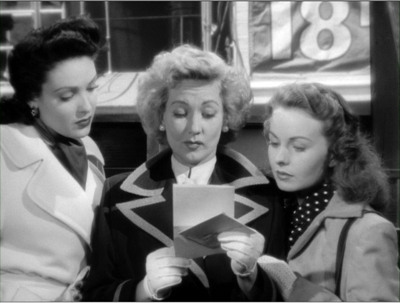
A Letter to Three Wives (1949).
One example I found was purely anecdotal, but nifty nonetheless. In preparing the screenplay for Out of the Past (1947; aka Build My Gallows High), screenwriter Daniel Mainwaring wanted to have the story told by a deaf-mute boy. Apart from the fact that the boy plays a minor role in the opening of the film as it was finished, the idea of someone who cannot hear or speak serving as narrator proved to be something of a stretch for the time. Mainwaring reports that the idea was rejected.
That’s the kind of thing I wanted to find. Yet my searches sometimes came up with cases where the producer’s notes actually resulted in improvements. Take A Letter to Three Wives (1949), justly praised as one of the best films of the 1940s.
John Klempner’s original novella (published in 1945) and novel (1946), both titled A Letter to Five Wives, obviously involved two more couples. After some other writers had drafted versions, Vera Caspary was assigned to prepare a treatment. Probably with the input of producer Sol Siegel, she eliminated one couple. Her adaptation already contains much of what is distinctive about the movie as we have it. Instead of the many distributed flashbacks in the originals, the treatment consolidated them into three lengthy ones. At Siegel’s suggestion, Caspary brought the three women together on the boat. To Fox studio chief Darryl F. Zanuck we apparently owe the idea that one woman, Deborah, would be the primary vehicle of our sympathy and would initiate and resolve the mystery of whose husband has defected. Above all, Caspary’s treatment includes the unforgettable voice-over of the never-seen Addie Ross.
When director Joseph L. Mankiewicz saw Caspary’s final adaptation, in effect “A Letter to Four Wives,” he declared he “looked upon the Promised Land” and quickly turned it into a screenplay. After reading Mankiewicz’s screenplay, Zanuck intervened again , demanding that another wife be lopped off. Mankieiwicz called this “an almost bloodless operation.”
It’s probably irrelevant that A Letter to Three Wives won that year’s Academy Awards for best screenplay and best direction. Even if it hadn’t been honored, after reading the original tales and Caspary’s adaptation, I have to conclude that the film is the best version of the lot. I suppose it partly goes to show the old rule that bad or so-so books can make very good movies. (Exibit A: The Birth of a Nation; Exhibit B: The Magnificent Ambersons; Exhibit C: The Godfather. Defense rests.) But clearly, the cuts and changes demanded by Siegel and Zanuck improved the property. The “creatives”–Klempner, Caspary, Mankiewicz–were by force majeure steered toward good results.
You can argue, though, that no written version of the film tried to be innovative, except perhaps for the device of Addie’s spectral presence. And Mankiewicz declared himself happy to make the adjustments. What about cases in which genuinely bold ideas were curtailed by the powers above? So I looked into two titles that, when released in the producers’ cuts, were denounced by their writer-directors.
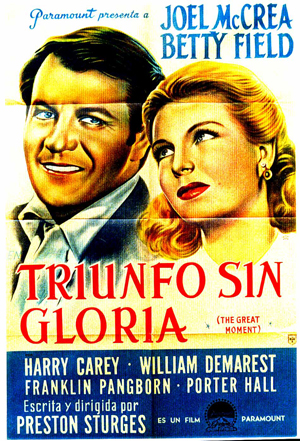
Two years after Preston Sturges finished and cut his film about the discovery of ether anesthesia, Paramount producer B. G. “Buddy” DeSylva supervised and released a reedited version called The Great Moment (1944). Sturges noted of the film:
It is coming out in its present form over my dead body. The decision to cut this picture for comedy and leave out the bitter side was the beginning of my rupture with Paramount. . . The dignity, the mood, the important parts of the picture are in the ash can.
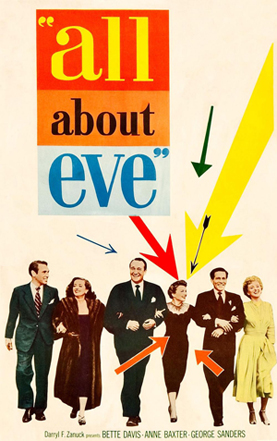
A second example is a more famous release, Twentieth Century-Fox’s All About Eve (1950). After the success of A Letter to Three Wives, Zanuck allowed Joseph L. Mankiewicz to film his three-hour screenplay as a “shooting draft.” When Zanuck saw the result, he insisted on cutting it to 138 minutes.
Throughout his life Mankiewicz was an angry man. His interviews and writings excoriate mothers, film festivals, doctors and nurses, Michelangelo Antonioni, television, the American male, theatre operators, Graham Greene, the AFI, PBS, Richard Nixon, Dennis Hopper, The Untouchables (film version), British craft unions, and other malefactors. High on the list was Darryl F. Zanuck. Long before the Cleopatra debacle, Mankiewicz was already carrying a grudge because Zanuck removed a replayed scene from All About Eve. He definitely didn’t consider that a bloodless operation.
Zanuck had final cut and he got bored with the same scene shot from different points of view.
Here, I thought, were sterling examples of creators bumping up against what was impermissible. Yet the more I looked, the more I found that the situation couldn’t be reduced to the daring director versus the philistine producer. I was forced to consider the possibility that the producers’ changes yielded not timid conformity but instead some unpredictable results–things that were themselves novel, in intriguing ways. The suits hadn’t intended to do something bold, yet in revising and patching up the films shot by two venturesome directors, they actually found themselves pulled in new directions.
Call it inadvertent innovation. Not surprisingly (this is the 1940s), it involved flashbacks.
Which great moment?
Kitty Foyle (1940).
By the early 1940s, movie flashbacks adhered to several conventions that we still recognize. Typically, we’re given a situation, the narrative Now, in which a character is recounting or simply remembering past events. We then move to those events, a shift often signaled by a track-in, a musical cue, a dissolve or other optical effect, and/or sounds from the next sequence mingling with the spoken transition. We may hear the voice-over remarks of the lead-in character at times during the action we see. Once the flashback action is complete, we return to the present, with the character who launched the flashback finishing the testimony or closing off the memory. And if the film includes several flashbacks, they are typically presented chronologically, so that the earliest events from the past are shown before later ones.
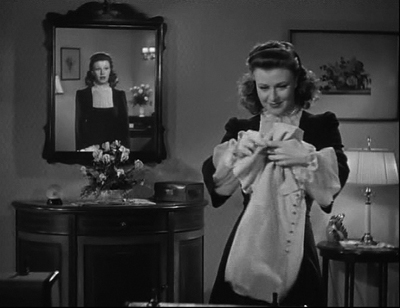
Kitty Foyle (1940) offers a clear example. In the present, Kitty recalls her romances. As they develop, we return to the present at key moments to gauge her reactions. For the sake of clarity, the romances themselves are shown to us in 1-2-3 order, tracing the events that lead up to the crisis that launched her memory journey.
Not all flashbacks respect chronology, though. Citizen Kane’s first flashback traces Kane’s career as the banker Thatcher knew it. His recollections show us Kane as a child, a young man, and then a much older man forced to sell his newspaper empire. The next flashback, as recounted by Kane’s business manager Bernstein, takes us back to show Kane as a young man assuming control of his first newspaper. Several years before Kane, Sturges had composed a script based on similarly shuffled chronology. The Power and the Glory (1933), directed by William K. Howard, presents an old man recalling episodes in the life of tycoon Thomas Garner, and those are presented out of 1-2-3 order. (I analyze that film here.)
Sturges was confronted by the problem of order in preparing Triumph over Pain. This project would tell the story of Dr. W. T. G. Morton, the popularizer of surgical anesthetic. Biographical films about scientists and inventors had become a successful cycle in the late 1930s, but Sturges wanted to stay fairly close to the facts. The problem was that Morton’s story couldn’t lead easily to a triumphant finale. Sturges noted dryly:
Dr. Morton’s life, as lived, was a very bad piece of dramatic construction. He had a few months of excitement ending in triumph and twenty years of disillusionment, boredom, and increasing bitterness. . . . To have a play you must have a climax and it is better not to have the climax right at the beginning.
Accordingly, Sturges had somehow to rearrange portions of Morton’s life.
Since [the writer] cannot change the chronology of events, he can only change the order of their presentation.
The title Sturges gave to his final version, Great without Glory, indicates its tone. A quasi-documentary prologue hails the modern benefits of anesthesia. We move to the late 1800s, when Morton’s friend Eben Frost finds a medal given to Morton now sitting in a pawnshop. He brings the medal to Morton’s widow Elizabeth, and as they sit in her parlor, the film’s first long flashback starts. It presents the public celebration of Morton’s triumph, as he and Eben are driven through the crowded streets.
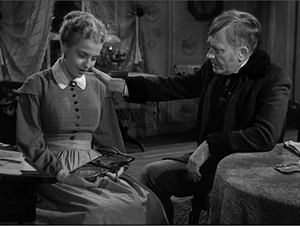 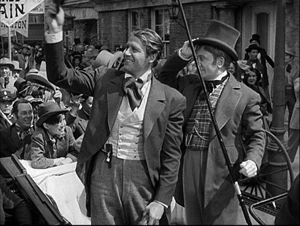
The ensuing scenes trace the aftermath of his discovery—the fact that he could not patent it, his efforts to build a business on sale of ether bottles, a bout of illness, and then his receiving the medal while he is plowing on his farm.
Sturges’ version returns to the narrating frame, as Eben examines some more personal memoirs that Elizabeth has written. The second flashback initiates the play with chronology. It traces events leading up to the action we saw completed at the start of the first one. The plot takes us back to the couple’s courtship, the first years of Morton’s dentistry practice, and his arduous experiments with ether. He finds prosperity using it on his patients. Challenged to demonstrate his invention in a public surgical operation, he realizes that his demonstration will show his rivals his trade secret. He is about to leave the operating theatre when he sees the patient: a girl about to have her leg amputated. Unable to let her face agony, he turns back to reveal his discovery to his peers.
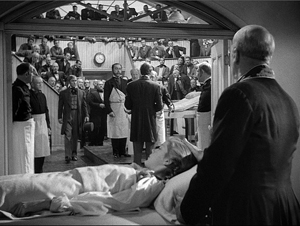
The plot’s true climax is Morton’s gesture of sacrifice. Sturges encourages us to see it as a contrast to the way the press and his profession vilified him. During the first flashback, a newspaper cartoon shows Morton preying on innocent patients, as typified by a girl on a gurney.
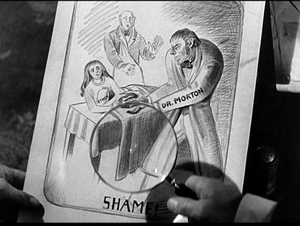 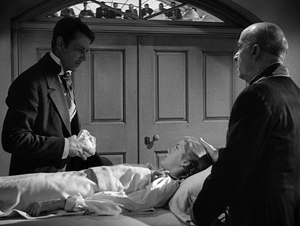
Sturges expected us, I think, to recall this image when Morton decides to help the girl. In his life, the cartoon came later, but showing it early in the film lets Morton’s gesture serve as a rebuke to those who are going to hound him.
After revealing Morton’s sacrifice, Great without Glory provides a bitter epilogue. The film ends with a return to the framing situation in Elizabeth’s parlor. Eben rises sadly, leaving Elizabeth alone.
Sturges could simply have built his film around Morton’s early life and his successful discovery, ending before the decades of poverty that followed. Instead, by focusing his biopic around our failure to appreciate and reward selfless research, he wanted to praise a man who achieved greatness but not the long-lived veneration accorded Edison or Pasteur. Yet showing Morton’s fall from grace after the crowd’s acclaim meant that the high point of a science biopic would be accomplished far too early in the plot. What we today call the “darkest moment”—Morton’s rejection by his public and his poverty—would come too soon. When Sturges showed his cut to his friend John Seitz, a great cinematographer, Seitz asked: “Why did you end the picture in the second act?”
According to Sturges, Buddy DeSylva said the same thing. He was already hostile to Sturges, and after some mixed preview results he set about reshaping the picture. The result is a good example, I think, of unintended innovation.
DeSylva did, as Sturges indicated, “leave out the bitter side” in certain respects. He lopped off the final scene showing the mourning of Eben and Elizabeth. The Great Moment doesn’t return to the narrating frame set up from the start of the picture. This is a little disconcerting structurally, but it wasn’t unknown at the period. Guest in the House (1944), Dillinger (1945), and other films “forget” the fact that they began with a character recalling the past.
Nor did DeSylva start the plot with Sturges’ prologue and narrating frame. He offered something immediately upbeat: Morton and Eben descending to the cheering crowd and riding through the streets to acclaim. This action, surprisingly, takes place during the credit sequence.
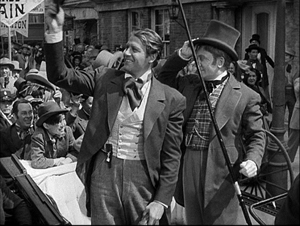 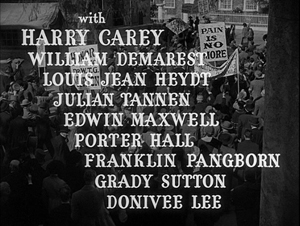
By inserting the moment of Morton’s triumph at the very start of the movie, before we have even seen a flashback to it, or indeed even know who these people are, DeSylva seems to illustrate the film’s title. Our first impression is that Morton’s great moment is the public recognition of what the crowds’ placards announce is his conquest of pain.
Only after this “flashforward” does the release version settle down to something roughly like Sturges’ structure. Eben discovers the medal, brings it to Elizabeth, and elicits her recollections. Some of the scenes are rearranged from Sturges’ version; the placement of one, showing Morton sick in bed, seems calculated to lead in to his death (as it doesn’t in the Sturges cut). The newspaper cartoon is there, ready to form a parallel with the climax. As in the Sturges version, a return to the narrating frame shows Eben and Elizabeth in the present launching the second big flashback. With other alterations, we go through the couple’s romance and marriage, culminating in the discovery of ether and the prosperity of Morton’s practice.
DeSylva retains Sturges’ climax: the scene when Morton must choose whether or not to reveal his trade secret to his competitors in the public demonstration. Seeing the girl praying on the gurney, he decides to do it. The film ends with him striding into the operating theatre, about to share his discovery. It is here that DeSylva halts the film, without, as we’ve seen, returning to the frame featuring Eben and Elizabeth.
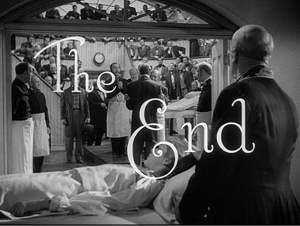
Both locally and more broadly, the effect is curious. Now Morton’s great moment is revealed, as Sturges wished, as the moment of his self-sacrifice, not the moment of his celebrity. But more strangely, without the final frame situation, the film ends just before the opening credits sequence. We could easily imagine the credits as an epilogue, with Morton’s entry to his colleagues dissolving to the parade in his honor before the final fade-out. Instead, the film halts and wraps back around itself like a Möbius strip: the last thing we see immediately precedes the first thing we saw.
I’m not trying to make this movie Memento or Primer, but there is something uncanny about the release cut’s looped structure. Sturges created a story that was depressing but tidy (prologue, carefully framed flashbacks, epilogue). DeSylva, unable to rewrite Morton’s history and apparently reluctant to junk the project, made the story more upbeat but also more untidy. Trapped by Sturges’ design, he re-carved it in a uniquely peculiar shape.
Sturges’ bold stroke was to switch the two chronological blocks of Morton’s life and to make us sense the injustice of Morton’s fleeting fame. DeSylva wanted to avoid the grim epilogue in the present and end on an upbeat note. But he did retain the split chronology, so that the contrast between obscurity and fame remains. He inadvertently innovated by making the opening credits preview a scene far ahead in the plot, and then letting the ending twist back to it. By playing the title over the parade, the release version shifts us across two moments, and meanings, of greatness: celebrity and self-sacrifice.
Did Buddy set out to be daring? I don’t think so. He faced constrained solutions whichever way he turned, just like us most of the time. More on this matter at the end.
As easy as C-A-C-B-C-B-C
As I mentioned, flashbacks usually sit comfortably in a frame, a well-established present situation that we depart from and return to. The shifts in and out of the past can be eased by various devices, one of which is a voice-over representing the character. The voice-over may be objective, as when a trial witness is testifying, or subjective, representing the “inner voice” of the person remembering what we have in the flashback.
Again, however, a film built out of flashbacks has many options. Coming to direction in the mid-1940s, Joseph L. Mankiewicz was in a position to try his own riffs on current experiments in storytelling.
So, for instance, in House of Strangers (1949), he frames a flashback without a voice-over. The camera coasts up a stairway to a window at night; dissolve to the window in daytime, and pull away to reveal the earlier scene. Our understanding of the time shift is aided by the comparison on the musical track: a phonograph record of a passage from the opera Martha fades out, and in the flashback, the Monetti family patriarch, now alive, is singing it.
Similarly, A Letter to Three Wives (1949) supplies the symmetrical structure in shifting from Deborah to her anxious memories and then back again.
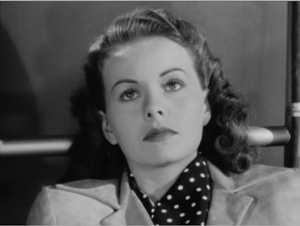 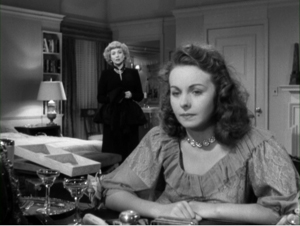 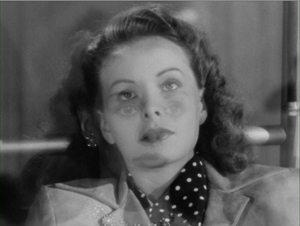
But the voice-over varies from the usual. Instead of hearing her voice asking herself, “Is it Brad?” we hear the voice of Addie Joss, who also narrates the film. The suburban wives’ obsession with their rival, who may have run off with one husband, has allowed her to burrow into each woman’s consciousness. (In addition, her voice merges with the chugging of the ship to create distortions courtesy of Sonovox.)
House of Strangers is built around one long flashback; A Letter to Three Wives gives us three parallel ones. All About Eve yields yet another variant. Three characters at a banquet recall their experiences with Eve, the dazzling young actress to be given an award. There will be several flashbacks following Eve’s career chronologically and skipping from one remembering character to another. Given this plan, Mankiewicz’s long version planned for one moderate experiment and one fairly daring one.
The moderate experiment was to eventually eliminate the visual anchoring of the frames. He had planned to start with very clear bookends around the flashbacks and then gradually discard framing scenes. For instance, after Addison DeWitt’s voice-over introduces the other characters, including Margo and Karen sitting at his table, Karen’s voice-over intervenes. We leave the banquet to flash back to her meeting Eve.
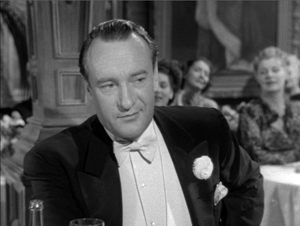 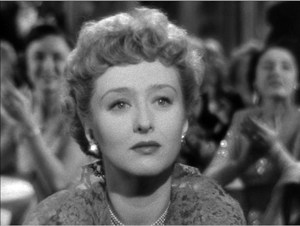 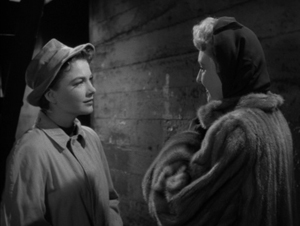
In Mankiewicz’s “shooting draft” of the film, we then return to the banquet in the standard bookend fashion. Karen looks over at Margo much as Addison had looked at her. We hear Margo’s voice-over, and then her flashback is launched. Mankiewicz planned, in all, three of these base-touching intervals in the banquet. The later flashbacks are simply signaled by voice-overs only, interweaving the memories of Karen, Margo, and Addison as Eve rises in the theatre world. In short, Mankiewicz wanted to replace block flashbacks with “polyphonic” ones, but only after careful preparation.
The more daring experiment, and the one whose loss rankled for years, was the idea of replaying Eve’s famous “applause” monologue. We’re at Margo’s party, and several characters are perched informally on the staircase. Addison and Bill, Eve’s fiancé, have argued about the nature of the theatre. Then Eve launches on a brief but impassioned ode to the joys of acting. Applause amounts to “waves of love coming across the footlights and wrapping you up.” Mankiewicz wanted this to follow a scene between Karen and Eve in Margo’s bedroom. Introduced by Karen’s voice-over, this scene shows Eve pressing Karen to help her become Margo’s understudy. Following this, Eve’s monologue can be seen as a warm testimony to her dedication to the theatre—a confession that Karen watches dotingly from a higher step.
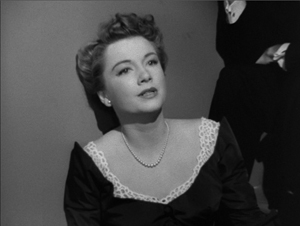 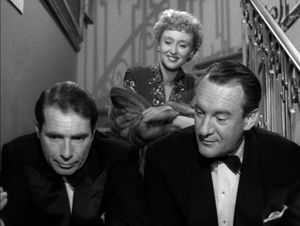
At this point, Margo enters from the kitchen and confronts Eve before insulting the other guests and flouncing off to bed.
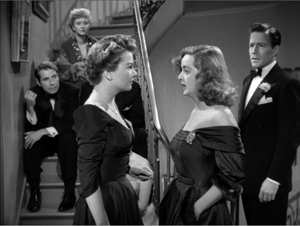 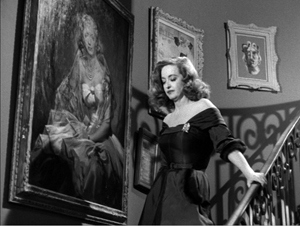
Instead of showing this scene’s aftermath, Mankiewicz wanted to break chronology and skip back to the beginning of the party, with Margo’s voice-over now introducing things. After some scenes showing her efforts to get Eve out of her life, she was to stalk out of the kitchen and hear in the hallway the end of Eve’s monologue.
They [Margo and Lloyd] exit into the dining room. As they open the swinging door, the CAMERA REMAINS in the doorway. Margo and Lloyd walk toward the stairs. In the b.g., Eve is talking to the group.
How much she says is dependent on how long it takes Margo and Lloyd to reach her.
EVE (in the b.g.): Imagine,,, to know, every night, that different hundreds of people love you… They smile, their eyes shine—you’ve pleased them, they want you, you belong. Anything’s worth that.
Just as before, she becomes aware of Margo’s approach with Lloyd. She scrambles to her feet….
MARGO: Don’t get up. And please stop acting as if I were the queen mother.
And as Margo speaks—or before—we FADE OUT.
By following Margo’s efforts to cast Eve out, the effect of hearing part of the monologue is to confirm Margo’s suspicions that Eve’s demure obedience conceals her desire to compete on the stage.
What Mankiewicz wanted, it seems, was to use a replay for a new purpose. In Mildred Pierce and other 1940s films, the replaying of an action fills in missing material, usually with the purpose of dispelling a mystery or providing a surprise. Here the replay contrasts two characters’ reactions: Karen finds Eve’s speech touching, Margo finds it threatening. Most replays enhanced plot, whereas this emphasized characterization (which in turn advanced the plot).
Or might have. Zanuck, as we saw, cut it out. The incisions left some little scars, as you can see from the discontinuities in the final version. Eve, her trance broken, glances up and sets her expression into standard Alert-and-Deferential Eve mode, as if Margo were coming right at her. Then she gets to her feet. All this apparently happens well before Margo rounds the corner of the doorway.
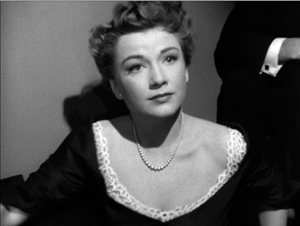 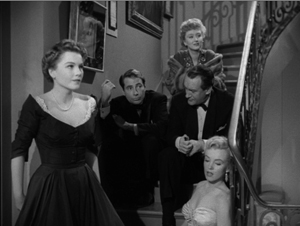 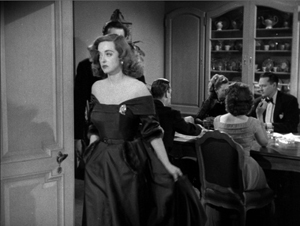
So Zanuck eliminated Mankiewicz’s boldest step. But, in a reciprocal movement, he found Mankiewicz’s flashback anchorings over-cautious. Zanuck’s version simply cut out all the returns to the banquet except for the very last one.
One consequence is to give greater saliency to the final portion of the banquet ceremony, which has been halted, as if by magic, during Addison’s address to us. Other effects of Zanuck’s excisions waft through the whole film. The floating voice-overs that Mankiewicz had painstakingly prepared (according to the Rule of Three) now emerge at the very start. Voices slip in and out of scenes, more or less tied to what each speaker could have known at that point but never given the sharp boundaries of the standard blocked-and-framed flashbacks.
These floating voice-overs point ahead to the freedom our filmmakers have enjoyed since the 1990s. We no longer demand that explanatory voice-overs be anchored in any Now; they can braid together as ongoing commentaries on the action. From Hollywood to Wong Kar-wai, filmmakers take for granted that they can discard bookended narration in the way Zanuck did. Mankiewicz objected to Zanuck’s habit of cutting scenes “from peak to peak to peak.” But the boss, who always liked his movies fast-paced, explained: “I am way ahead of you and so will the audience be.”
The choice cascade
There’s a lot more to be said about these films and filmmakers, and I hope to develop some of those ideas in my book. For now, there are some interesting lessons.
First, in filmmaking, once you’ve made certain choices, others follow and some become forced on you. What historians of technology call “path dependence” comes into play. Just as computers use fundamentally the same QWERTY keyboard that came into being with early typewriters, initial choices about a project set limits to what you can do. A trajectory makes certain outcomes more likely than others, and it’s hard to reverse.
Once Paramount committed to releasing some version of Sturges’ Pain project, DeSylva had to work with the split chronology somehow. But Hollywood tradition demanded an uplifting ending, so one had to be salvaged, even if that meant snipping off the return to the frame story. Similarly, once Mankiewicz commits to presenting Eve’s ascent from the perspective of three outside observers, certain narrational processes didn’t need as much redundancy as he loaded in. Likewise, Mankiewicz’s prized replay didn’t create path dependency. It was a branch off the main line and could, as Zanuck saw, be lopped off.
Second, in a routinized film industry, we ought to expect that conflicting demands and changes of plan will yield not only well-wrought plots and narration, but also partial, fractured, even discordant narrative patterns. Snafus and compromises are part of the process.
Finally, film techniques seem innovative only in relation to the norms of a period. Most of the narrative strategies employed by Sturges, DeSylva, Mankiewicz, and Zanuck would have probably seemed startling in the 1930s. By the 1940s, such experiments seemed fresh but comfortable additions to a growing repertoire of storytelling techniques. The studios’ solutions were feasible because some flexibility had already emerged in handling frame stories and voice-over transitions.
The history of film forms springs from creative choices made by individuals within institutions. Those decisions have consequences, intended or not. Sometimes the producers don’t suffocate new things; sometimes they create them. If only by accident.
Don’t worry, though. I won’t be making such arguments about The Magnificent Ambersons.
Daniel Mainwaring mentions his plans for Out of the Past in Backstory 2: Interviews with Screenwriters of the 1940s and 1950s, ed. Patrick McGilligan (University of California Press, 1988), 199.
On A Letter to Three Wives, my comparison of Caspary’s adaptation with Mankiewicz’s shooting script was enabled by the Caspary collection at the Wisconsin State Historical Society. Thanks to Mary Huelsbeck and the staff of the SHS for helping me access Caspary’s papers. Mankiewicz’s remarks about the process and Zanuck’s request to delete one wife are quoted from Robert Coughlan, “15 Authors in Search of a Character Named Joseph L. Mankiewicz,” a 1951 Life magazine article available in Joseph Mankiewicz Interviews, ed. Brian Daugh (University Press, of Mississippi Press, 2003), 17. Caspary was inclined toward modular plotting, as is shown in detail in A. B. Emrys’ Wilkie Collins, Vera Caspary and the Evolution of the Casebook Novel (McFarland, 2011).
Brian Henderson provides painstaking comparisons among various versions of Sturges’ scripts and the final version of The Great Moment in Four More Screenplays by Preston Sturges (University of California Press, 1995), 241-360. My quotations from Sturges come from James Curtis, Between Flops: A Biography of Preston Sturges (Harcourt Brace Jovanovich, 1982), pp. 171-172. Another robust biography is Diane Jacobs, Christmas in July: The Life and Art of Preston Sturges (University of California Press, 1994). Essential as well is the autobiography Preston Sturges by Preston Sturges, ed. Sandy Sturges (Simon & Schuster, 1990).
Mankiewicz’s “shooting draft” of All About Eve has never, to my knowledge, been published. It is available on the Internet, God knows how, here. My extract is from p. 74. A screenplay closer to the finished film was published in 1951 by Random House. It is reprinted in More About All About Eve: A Colloquy by Gary Carey with Joseph L. Mankiewicz (Random House, 1972). Mankiewicz’s regrets over Zanuck’s deleting the replay are expressed in Andrew Sarris, “Mankiewicz of the Movies [1970],” in Dauth’s Mankiewicz Interviews, 31. The characterization of Zanuck’s “peak to peak to peak” cutting can be found in Sam Stagg, All About “All About Eve” (St. Martin’s, 2001), 171. Zanuck’s remarks about being ahead of his director’s screenplay are quoted in Mel Gussow, “The Lasting Allure of ‘All About Eve,'” New York Times (1 October 2000), AR13.
Two lively and careful critical studies are Kenneth L. Geist, Pictures Will Talk: The Life and Films of Joseph L. Mankiewicz (Scribners, 1978) and Bernard F. Dick, Joseph L. Mankiewicz (Twayne, 1983). Charyl Bray Lower and R. Barton Palmer’s Joseph L. Mankiewicz (McFarland, 2001) is an indispensable guide to the director’s work and writings about it. Both Sturges and Mankiewicz are discussed with polemical relish in Richard Corliss, Talking Pictures:Screenwriters in the American Cinema (Penguin, 1995).
I’m grateful to Laura Russo and particularly John C. Johnson of the Howard Gotlieb Archival Research Center of Boston University. Mr. Johnson kindly supplied valuable information about the version of the All About Eve screenplay held in the Bette Davis collection there.
Another case of the suits’ laying down demands to which a director responds creatively involves the final shot in Bill Forsyth’s wonderful Local Hero. Details here.
Finally, this entry is one in a series of spinoffs of my ongoing work on narrative in 1940s and early 1950s Hollywood. A gathering point for related blog entries is here, and a relevant web essay is here. As a coda to these 1940s films, it’s worth noting that in The Barefoot Contessa (1954) Mankiewicz did get to mount a replayed flashback scene, and in the 1960s he prepared a screenplay of Lawrence Durrell’s Alexandria Quartet that would have presented several characters’ perspectives on the central action.
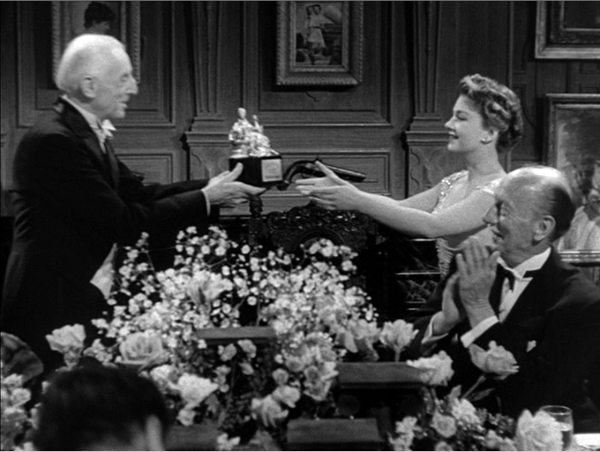
All About Eve.
Posted in 1940s Hollywood, Directors: Mankiewicz, Directors: Sturges, Hollywood: Artistic traditions, Narrative strategies | open printable version
| No Comments »
Tuesday | September 3, 2013
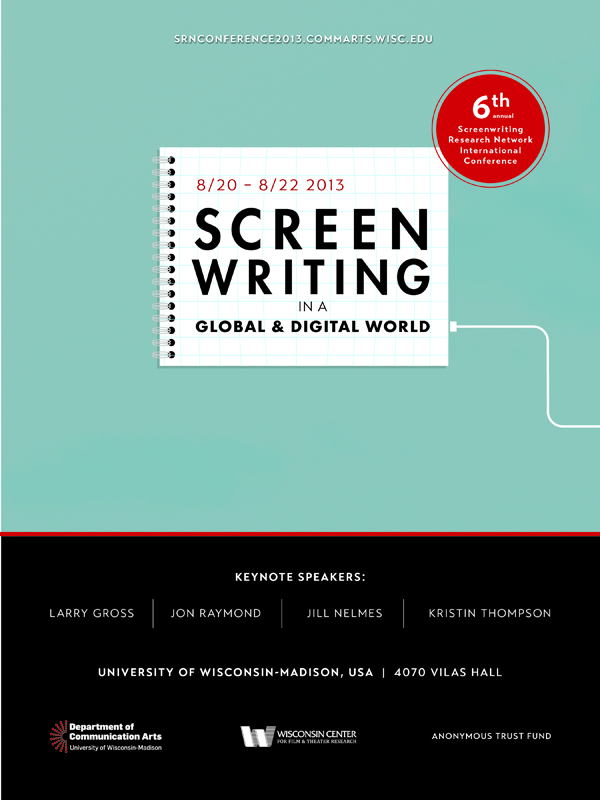
Design by Christina King.
DB and Kristin here:
Two years ago DB reported on the gathering in Brussels of the Screenwriting Research Network (here and here). This year, thanks to our colleagues J. J. Murphy and Kelley Conway, our department hosted the conference. Again, it was chock-a-block with stimulating papers. We also introduced our visitors to the Wisconsin Center for Film and Theater Research, which houses thousands of screenplays. It wasn’t all work, either. Participants were spotted lingering at our lakeside terrace or making their way through the cafes and saloons lining State Street. We believe it’s fair to say that a hell of a time was had by all.
Since there were simultaneous sessions, nobody could attend everything, and we can’t run through all the papers we heard. (So do consult the program for more information.) Herewith, some highlights that set us thinking.
In the key of keynote
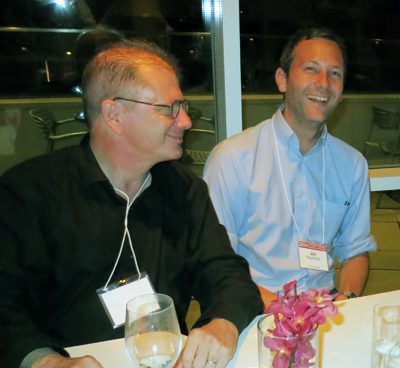
Larry Gross and Jon Raymond.
The four keynoters encapsulated the conference’s very wide range. In a workshop keynote Jill Nelmes, Editor of the Journal of Screenwriting, offered a historical survey of screenwriting research in all media, with special emphasis on television. The Big Hollywood Movie was covered by Kristin, whose paper, “Extended How?” examined the ways in which directors’ cuts and extended editions handle the multi-part structure she posits as a foundation of contemporary Hollywood. We won’t say more here, since she may turn it into a blog for this site.
Larry Gross had already started off the conference with a bang by taking us to Japan. Larry has written 48 HRS, Streets of Fire, Geronimo, True Crime, and other mainstream studio pictures, as well as television episodes, TV mini-series, and independent films like Prozac Nation and We Don’t Live Here Anymore. He also writes outstanding film criticism for Sight and Sound, Film Comment, and other journals, and he teaches screenwriting at New York University. Scott Macauley’s informative March interview with Larry is at Filmmaker Magazine.
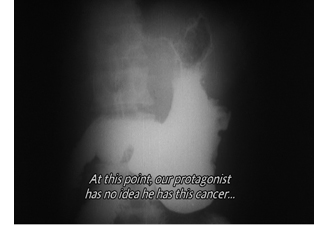 Larry’s keynote, “The Watergate Theory of Screenwriting,” tackled the question of how filmmakers decide to share story information with the audience. What do the characters know and when do they know it? What does the audience know, and when? Storytelling, Larry suggested, develops out of the interplay of these two sets of questions. He added, perhaps hoping to provoke purists who consider film to be sheer self-expression: “Thinking about the audience is not always reactionary.” Larry’s keynote, “The Watergate Theory of Screenwriting,” tackled the question of how filmmakers decide to share story information with the audience. What do the characters know and when do they know it? What does the audience know, and when? Storytelling, Larry suggested, develops out of the interplay of these two sets of questions. He added, perhaps hoping to provoke purists who consider film to be sheer self-expression: “Thinking about the audience is not always reactionary.”
He illustrated his ideas with an in-depth examination of Kurosawa’s Ikiru. He had long thought the film “an official liberal-humanist classic,” until a course with Annette Michelson at NYU showed him that there was a lot to ponder there. Specifically, Kurosawa starts by telling the audience the end of the story: Watanabe will die of cancer. But he doesn’t know that, and neither do all the people he encounters. The strategy denies us a lot of suspense, so to hold our interest Kurosawa must engross us by delineating his relations with his colleagues, with the mothers petitioning for the neighborhood sump to be drained, and with the stray people he meets casually on his night out.
Larry showed how carefully Kurosawa played off the characters’ indifference, misunderstanding, and lack of awareness. In particular, the neighborhood wives display to Watanabe what Maurice Blanchot called “the ignorance and spontaneity of true affection.” Ikiru’s refusal to explain what it means typifies a kind of cinema that asks the audience to share the burden of understanding. “Ikiru understands how a screenplay can be composed with the audience.”
Jon Raymond’s keynote carried things to independent US film. Jon has become famous for a novel (The Half-Life) and short stories (Livability), as well as for his screenplays for Kelly Reichardt’s features. The most recent, the forthcoming Night Moves, is currently in competition at Venice. The teaser title of Jon’s address, “Screenwriting as Earth Art,” turned out to be a reference to the fact that most of his stories take place in the vicinity of his home. He has found satisfaction by composing on familiar ground.

In younger days Jon tried painting and filmmaking; a Public Access feature based on the comic strip Crock turned out to be “a movie best experienced in fast forward.” But he found that writing offered the most creative satisfaction. At the same time, while assisting Todd Haynes on Far from Heaven, he met Kelly Reichardt, who was looking for a property to adapt on a small budget. The result was Old Joy, “a New Age western,” in which two men display the violence latent in the new passive-aggressive masculinity flourishing on the Coast. Jon believes that Reichardt’s handling created a cinematic parallel to the dense intricacy of a short story.
In later collaborations, Jon mapped his patch of Portland in other ways. Seeing the annual migration of workers to Alaskan canneries, and hearing the train whistles wafting through his neighborhood, he created the story that became Reichardt’s Wendy and Lucy (above). Reichardt began adapting the story to film before he had finished writing it. Similarly, Jon merged the booming housing market of the 2000s and the history of the Oregon Trail into a project that paralleled today’s gentrification with nineteenth-century colonization. Reichardt turned his screenplay into Meek’s Cutoff, a “desert poem” that completed what some have called their Oregon Trilogy. For Jon, the trilogy constitutes an alternative regional history, one that traces the process of “sowing the land with failure, betrayal, and humiliation.”
Plots and no plots
The Adventures of André and Wally B (1984).
More than most areas of filmmaking, screenwriting reminds us of the institutional framework surrounding most creative work cinema. Scholars studying the screenplay are naturally often pursuing the endless revisions, refusals, and rethinks that a film goes through in the preparation phase. It’s easy to see this as a one-versus-one struggle, but in many cases the process takes place within a social environment possessing its own roles and rules.
Ian MacDonald offered an excellent example in his study of the work processes behind the UK television soap opera Emmerdale. He proposed that we replace model of industrial film production as an auto factory with that of a carpet factory. Instead of the TV episode being seen as a discrete unit, like a car, it should be conceived as an ongoing fabric woven of many threads. In Emmerdale and other series, the unit of production isn’t the episode but rather the story line. Each episode is sliced out of a much bigger stretch of ongoing patterns. Ian illustrated this with the writers’ planning chart that was mounted on the wall.
The vertical column represents scenes, marked off as episodes. The characters are color-coded cards connected by solid liness that weave their way through the scenes. These waves are the melodies; the scenes are the bar-lines. In each episode, two or three characters are given prominence, while the subordinate ones contribute their harmonies. Ian’s discussion reminded me of how Hong Kong filmmakers did much the same thing in the 1980s: plotting films reel by reel and color-coding certain elements—gags, fights, and chases—to make sure that each reel had its share of attractions. This is the sort of insight into structure that institutional research can yield: Structure is these people’s business.
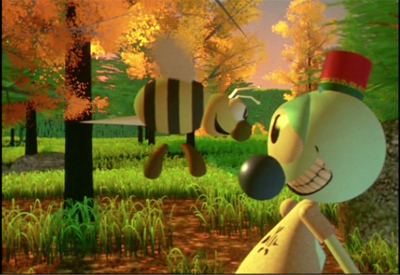
Other Hollywood studios envy Pixar for to its appealing, carefully structured stories. Richard Neupert showed how that tradition goes back to the earliest years at Pixar. Even in demo films which were made to show off technological innovations, the makers tried to reveal how computer animation, even in its early, simple form, could create engaging tales. At a period when computer animation could only render smooth, simple shapes, the Pixar team found appropriate subject matter, with highly stylized characters in The Adventures of André and Wally B and Luxo, Jr.
Remarkably, these tiny films have balanced “acts.” Each is 80 seconds long and has a key action at exactly 40 seconds in: the entrance of Wally B and the moment when the little Luxo lamp jumps on a ball. Similarly, Red’s Dream‘s parts run 50-100-50 seconds. This care in timing continued with the features: Toy Story’s midpoint comes when Woody finally shifts strategies, realizing he has to work with Buzz. And what about Pixar’s perceived slump in recent years? someone asked during the question session. Neupert pointed out that Pixar’s founders have aged, and there may no longer be quite the sense of excitement and discovery pushing the team to surpass others and themselves.
Sometimes institutional traditions come into conflict. Petr Szczepanik’s talk traced in meticulous detail how screenplay development in Czechoslovakia was altered in the years from 1930 to the 1950s. Czech filmmakers developed their own system of moving from theme and story germ to final screenplay. But with the Communist takeover there came the demand to add the Soviet model of the “literary screenplay,” a detailed specification of scenes, dialogue, and the like. Filmmakers resisted this, preferring the customary and more flexible “technical screenplay” that was largely the province of the director. Petr mentioned new screenwriting trends pioneered by Frank Daniel that gave directors the authority to modify the literary format. By the late 1950s, filmmakers had found ways to make the literary screenplay a less rigid blueprint for filming.
Back in the USSR, the screenwriting institution found even the literary screenplay a difficult basis for mass output. Maria Belodubrovskaya’s talk focused on “plotlessness” as a rallying cry and term of abuse in the 1930s-1940s Soviet film. There were long debates about whether “themes” sufficed to make a film or whether you needed strong plots in the Hollywood vein. Film-policy supervisor Boris Shumyatsky urged the latter course, and the popular success of Chapayev (1934) seemed to support his case. By the late 1930s, though, Shumyatsky was purged and the tide turned against strong plots. Film executives found a concern with plot too “Western” and “cosmopolitan,” and annual film production became based on themes rather than stories. Most provocatively, Masha suggested a lingering influence of Soviet Montage storytelling, which based films on vivid but loosely linked episodes. She illustrated her case with an analysis of Pudovkin’s In the Name of the Motherland (1943), with its diffuse lines of action and sudden reversals and omissions.
Back we go
Scarface (1932).
Naturally, Madison wouldn’t be Madison without strong papers on the history of cinema, and many conference presentations suited the tenor of the joint.
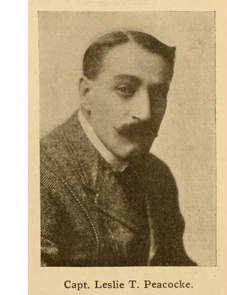 Stephen Curran offered an enlightening study of one of the least-known but most colorful figures in early American screenwriting, a man with the dashing name of Captain Leslie T. Peacocke. He was credited with over 300 screenplays, including Neptune’s Daughter (1914). He acted, directed, and wrote novels too. He was one of the first script gurus, writing magazine columns on the craft and eventually the early manual Hints on Photoplay Writing (1916). Stephen Curran offered an enlightening study of one of the least-known but most colorful figures in early American screenwriting, a man with the dashing name of Captain Leslie T. Peacocke. He was credited with over 300 screenplays, including Neptune’s Daughter (1914). He acted, directed, and wrote novels too. He was one of the first script gurus, writing magazine columns on the craft and eventually the early manual Hints on Photoplay Writing (1916).
Stephen surveyed Peacocke’s contribution to the emerging scenario market. Peacocke believed that successful screenwriting couldn’t be taught, but he could give hints about developing original stories, thinking in visual terms, and practical craft maneuvers like snappy names for characters. During the Q & A, Stephen added that a great deal of Peacocke’s rhetoric was aiming to raise his own profile in the industry. In conversation afterward, Stephen praised the Media History Digital Library and Lantern (flagged in an earlier blog) for immensely helping research into early film. Here, for example, is Peacocke’s 216-item dossier on Lantern.
Andrea Comiskey argued that for the same period, we can study scripts and extrapolate craft practices that otherwise go undocumented. Her focus was the disparity between what manuals like Peacocke’s said and what actually got jotted down in working scenarios. Studying several screenplays from the American Film Company of Santa Barbara, she found that the manuals’ recommended stylistic approach was revised in the course of shooting.
The manuals proposed that each scene would be built out of a lengthy single shot (called, confusingly, a “scene”) which could at judicious moments be interrupted by an “insert.” An insert was usually a letter or piece of printed matter read by the characters, but it might also be a detail shot of a prop, hands, or an actor’s face.
In preparing scenarios, the writers assigned numbers to each “scene,” as the manuals recommended. But Andrea found that in the filming, the director and cameraman added shots, breaking down the action into more bits. This was, in effect, a move away from the strict scene/insert method and a shift toward what would become the classical continuity system. To maintain a paper record for the editor, the interpolated shots would be recorded and labeled in fractions. Instead of a straight cut from 6 to 7, the filmmakers might wedge in 6 ½, 6 ¾, and so on. Here’s an extract from Armed Intervention (1913), courtesy Andrea.
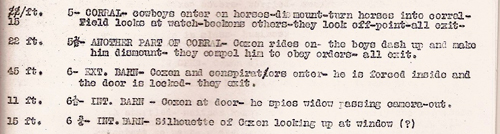
Strange as this sounds to us today, it was preferable to renumbering the shots, which could cause confusion. (Is shot 17 the original 17 or the later one?) The fractions kept the footage consistent with the scenario across the production process. So it turns out that (as usual?) filmmakers were a bit ahead of the screenplay gurus, even back in the 1910s.
Lea Jacobs asked a question about the transition from silent to sound film: How did filmmakers manage the pacing of dialogue? Silent movies had great freedom of pacing, while the shift to talkies seemed to many filmmakers to slow things down. Lea’s research indicated that two strategies for speeding things up emerged: creating shorter scenes and shortening dialogue passages within them. She reviewed how these ideas emerged in Hollywood’s own discourse in the 1930s and in certain films. In the first years of sound, scenes were rather long (often because they were derived from stage plays) and speeches were similarly extended. But in the 1931-1932 season, she argued, short scenes and quicker repartee became more common.
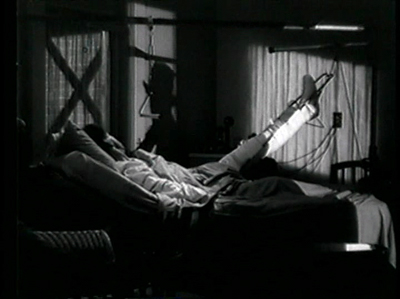
She traced the process in three films of Howard Hawks, from the stagy Dawn Patrol (1930) through The Criminal Code (1931), which opens in the new style but then turns to longer sequences, and then to Scarface (1932). The gangster film shifted toward shorter scenes and more laconic dialogue than did other genres, and Scarface displays this in full flower. Tony Camonte’s takeover of the South Side beer trade is presented in six harsh, violent scenes that add up to little more than three minutes. Workers in the sound cinema, it seems, were soon pushing toward that rapid tempo we identify with the 1930s.
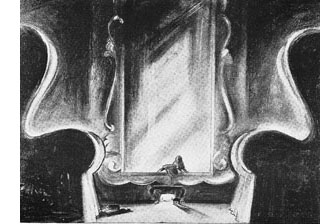 Storyboards have now entered academic studies. Chris Pallant and Steven Price offered some historical insights by comparing some early storyboards by William Cameron Menzie with those of early Spielberg films. When Menzies was storyboarding Gone with the Wind, he called it “a complete script in sketch form” and “a pre-cut picture.” Selznick’s publicity director characterized it: “The process might be called the ‘blue-printing’ in advance of a motion picture.” The striking revelation was that the storyboarding was not done after the script was finished. Menzies worked from the book, and the storyboard and script were created in parallel. Menzies’ storyboard for the 1933 Alice in Wonderland revealed a similarly elaborate process. It was 624 pages long, with one page per intended shot. Each page contained a sketch at the top, a paragraph describing the planned technological traits of the shot (such as lens length), and the traditional screenplay dialogue at the bottom. It’s hard to imagine many people other than a genius like Menzies being able to provide such a comprehensive plan for a film. (A sketch for Alice is on the right here. DB has written about Menzies here and here.) Storyboards have now entered academic studies. Chris Pallant and Steven Price offered some historical insights by comparing some early storyboards by William Cameron Menzie with those of early Spielberg films. When Menzies was storyboarding Gone with the Wind, he called it “a complete script in sketch form” and “a pre-cut picture.” Selznick’s publicity director characterized it: “The process might be called the ‘blue-printing’ in advance of a motion picture.” The striking revelation was that the storyboarding was not done after the script was finished. Menzies worked from the book, and the storyboard and script were created in parallel. Menzies’ storyboard for the 1933 Alice in Wonderland revealed a similarly elaborate process. It was 624 pages long, with one page per intended shot. Each page contained a sketch at the top, a paragraph describing the planned technological traits of the shot (such as lens length), and the traditional screenplay dialogue at the bottom. It’s hard to imagine many people other than a genius like Menzies being able to provide such a comprehensive plan for a film. (A sketch for Alice is on the right here. DB has written about Menzies here and here.)
Spielberg used sketches in addition to a screenplay from the start. Duel, surprisingly enough, was supposed to be shot in a studio, but the director insisted on working on location. The sketches he made for it do not resemble a traditional storyboard but instead are like pictorial maps framed from an extremely high angle. He also plotted out the paths of the vehicles with overhead views of the roads. The storyboards for Jaws were done from the novel at the same time that the script was being written, just as Menzies had done with Gone with the Wind. (The same thing happened with Jurassic Park.) Storyboards were vital, among other things, for telling the crew which of the four versions of the shark would be used. One fake shark had only a right side, another a left, and which one was needed depended on the direction the shark was crossing the screen. The speakers distinguished between the “working” storyboard and the “public” one. The public one is what sometimes get published, but it usually has each image cropped to remove the information about the shot (e.g., who will work on it) noted underneath.
Brad Schauer contributed to a roundtable on the American B film back when The Blog was in its infancy. He has been researching the role of B’s in the industry for many years, and he brought to our event some new ideas about them in the postwar period. His paper, “First-Run and Cut-Rate” showed that there were still plenty of theatres showing double bills in the 1950s and 1960s (DB can confirm it), and the market needed solid, 70-90 minute fillers. One answer was the “programmer,” or the “shaky A” that featured somewhat well-known talent, color, location shooting, and familiar genres (Westerns, swashbucklers, horror, crime, comedy, and science fiction). Shot in half the time of an A, with budgets in the $500,000-$750,000 range, programmers fleshed out double bills and sometimes broke into the A market.
What does this have to do with screenwriting? Brad decided to test whether Kristin’s ideas about four-part structure (here and here) held good with programmers. Looking at several, he came up with a plausible account that films like Battle at Apache Pass and Against All Flags simply compressed the four parts into short chunks, typically running fifteen to twenty minutes. In The Golden Blade, Rock Hudson formulates his goal (revenge) two and a half minutes into the movie.
Too few things happen?
La Pointe Courte (1955).
In most films, Agnes Varda said, “I find that too many things happen.” How can screenplay studies move beyond Hollywood’s jammed dramaturgy to consider the more spacious sort of storytelling we find in “art cinema”?
Colin Burnett offered a general overview of art-cinema norms that is somewhat parallel to our and Janet Staiger’s The Classical Hollywood Cinema. To a great extent, of course, “art films” differ from classically constructed films. They can be more ambiguous, more reflexive, more stylized and at the same time more naturalistic. They often replace a tight causal chain with episodic construction and nuances of characterization. The protagonists may have complex mental states; they may have inconsistent goals, or no goals at all; they may be passive; they may have shifting identities.
Yet Colin argued against claims that art films lack narrative altogether. “Art films offer reduced scene dramaturgy, rarely its complete absence.” They possess structuring devices comparable to Hollywood acts. A film’s large-scale parts may be based on a character’s development, on changes in space or time, or on variations of action and/or reaction. A question was raised as to whether such a broad category as art cinema could be characterized in such ways. Given the enormous range of types of films made in the Hollywood tradition, however, it seems possible that the art cinema could be described in a similar fashion. (For our thoughts on the matter, go here and here.)
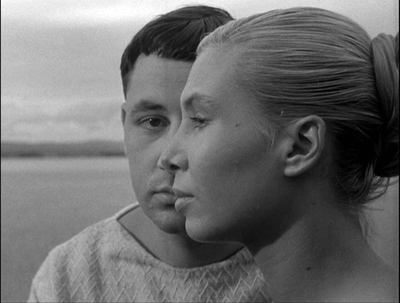
A great many art-film strategies can be seen as stemming from modernism in literature and the other arts. As if offering a case study illustrating Colin’s argument, Kelley Conway focused on La Pointe Courte. Varda’s first film is now coming to be considered the earliest New Wave feature. But Varda wasn’t the prototypical New Waver. She wasn’t a man, she wasn’t a cinephile, and she took her inspiration from high art, not popular culture. A professional photographer who loved painting and literature, she brought to this film (made at age 26) a bold awareness of twentieth-century modernism. The result was a striking juxtaposition of stylization and realism, personal drama and community routine. In La Pointe Courte, we might say, neorealism meets the second half of Hiroshima mon amour.
Inspired by Faulkner’s Wild Palms, Varda braided together two stories. While families in a fishing village live their everyday lives, an educated couple work through their marriage problems in a long walk. Remarkably, Varda had not seen Rossellini’s Voyage to Italy. After supplying background on the production process, Kelley focused on matters of performance. She explained how Varda, well aware of Brechtian “distanciation,” made the couple’s dialogue deliberately flat. By contrast, the villagers’ lines, through scripted, were treated more naturalistically. La Pointe Courte emerges as an anomie-drenched demonstration of how little you need to make an engrossing movie.
To script or not to script (or to pretend not to script)
Maidstone (1970).
The SRN embraces research into the absence of a script as well. At one limit is the work of avant-gardists like Stan Brakhage. John Powers’ “A Pony, Not to Be Ridden” discussed how non-narrative filmmakers used paper and pencil to organize their work, much as a poet might make notes on a draft. John’s examples were three films by Brakhage, each developed out of sketches and jottings assembled after shooting but before editing. Unconstrained by any script format, Brakhage had to invent his own version of storyboarding and screenplay notes.
Compilation filmmakers also discover their structure in the process of collecting and sifting material. Documentarist Emile de Antonio, whose collection resides in our WCFTR, had to build his screenplay up after he had assembled some material. “A script won’t be ready,” he remarked, “until the film is finished.” Vance Kepley’s paper showed that In the Year of the Pig was the result of a massive effort of “information management.” De Antonio sought out press clippings, sound recordings, and news footage and then had to create an archive with its own system of labeling, cross-references, and easy access.
De Antonio started with the soundtrack, which was itself a montage of found material, and then created a “paper film,” cutting and pasting vocal passages and descriptions of images. At the limit, he charted his film’s structure with magic-marker notations on large strips of corrugated cardboard, as Vance illustrated.
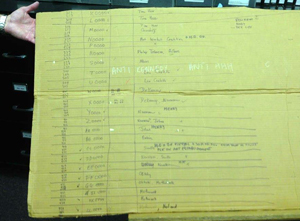
One panel session took a close look at improvisation in fiction features. Line Langebek and Spencer Parsons gave a lively paper with the innocuous title “Cassavetes’ Screenwriting Practice.” Explaining that Cassavetes did use scripts (“sometimes overwritten”), and he relied on actors to help create them in workshop sessions, they proposed thinking of his work as exemplifying the “spacious screenplay.” Their ten principles characterizing this sort of construction include:
Write with specific actors in mind. Use a “situational” dramaturgy rather than a rise-and-fall one. The work is modeled on free jazz, with moments set aside for specific actors. Even minor actors get their solos. Shoot in sequence, so that emotional development can be modulated across the performances.
Line and Spencer’s precise discussions cast a lot of light on the specific nature of Cassavetes’ creative process and pointed paths for other directors. They added that the spacious screenplay is really for the actors and the director; the financiers should be given something more traditional.
Norman Mailer called Cassavetes’ films “semi-improvised.” He tried to go further, J. J. Murphy explained in “Cinema as Provocation.” Mailer wanted his three films Wild 90, Beyond the Law, and Maidstone to be completely improvised, utterly in the moment. “The moment,” he proclaimed, “is a mystery.” Mailer opposed the “femininity” he claimed to find in Warhol’s films, so he encouraged his male players to indulge their machismo playing gangsters, cops, and aggressive entrepreneurs. J. J., whose book on Warhol stressed the psychodrama component of the films, finds Mailer no less devoted to having his players work out their problems through unrestrained behavior. The climax of Maidstone, in which an enraged Rip Torn begins to strangle Mailer, becomes the logical outcome of Mailer’s needling provocation of his actors. How ya like the mystery of this moment, Norman?
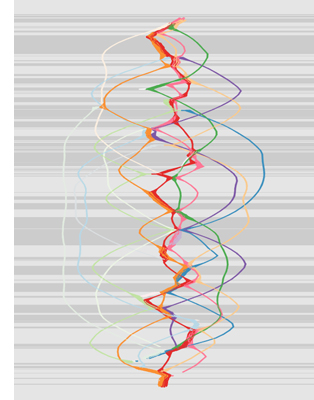
Within the Hollywood industry, improvisation is identified strongly with Robert Altman’s films, but Mark Minnett‘s “Altman Unscripted?” shows another side to his work. Focusing on The Long Goodbye, Mark finds that the film doesn’t vary wildly from the script. The principle plot arcs aren’t changed, although Altman decorates them by letting minor characters inject some novelty. He encouraged the guard who does impressions of Hollywood stars, and he gave latitude to Elliott Gould, whose improvisation elaborates on the issues of trust and bonding that are embedded in the script. Some scenes are condensed or altered, as often happens on any production, but the Altman mystique of freewheeling, anything-goes creativity isn’t borne out by the film. Altman’s characteristic touches are built around what’s “narratively essential,” as laid out in the screenplay.
We learned a lot more at the conference than we can cover here. For example, Jule Selbo brought to our attention Sakane Tazuko, a woman screenwriter-director in 1930s Japan. Rosamund Davies explored the ways in which transmedia storytelling could enhance historical dramas. Carmen Sofia Brenes traced out how different senses of verisimilitude in Aristotle’s Poetics might apply to screenwriting. We learned of a planned encyclopedia of screenwriting edited by Paolo Russo and a book on the history of American screenwriting edited by Andy Horton. Not least, there was Eric Hoyt, whose “From Narrative to Nodes” showed how digitized screenplays could be used to graph character action and interaction over time. (A nice moment: When asked if his analytic could be rendered in real time, he clicked a button, and the thing moved.) Once more we’re in the x-y axes of Emmerdale and In the Year of the Pig, but now in cyberspace. Eric’s results on Kasdan’s Grand Canyon appears here on the right, but only as an enigmatic tease; he will be contributing a guest blog here later this fall.
In other words, you should have been here. Next time: October in Potsdam, under the auspices of Kerstin Stutterheim at the Hochshule für Film und Fernsehen “Konrad Wolf.” DB was at this magnificent facility last year for another event, and we’re sure–to coin a phrase–a hell of a time will be had by all.
Thanks very much to J. J. and Kelley, as well as to Vance Kepley, Mary Huelsbeck, and Maxine Fleckner Ducey of the WCFTR. Special thanks to Erik Gunneson, Mike King, Linda Lucey, Jason Quist, Janice Richard, Peter Sengstock, Michael Trevis, and all the other departmental staff that helped make this conference a big success.
Thanks also to Noah Ollendick, age 12, who asked a smart question.
P.S. 4 Sept: Thanks to Ben Brewster for a correction!
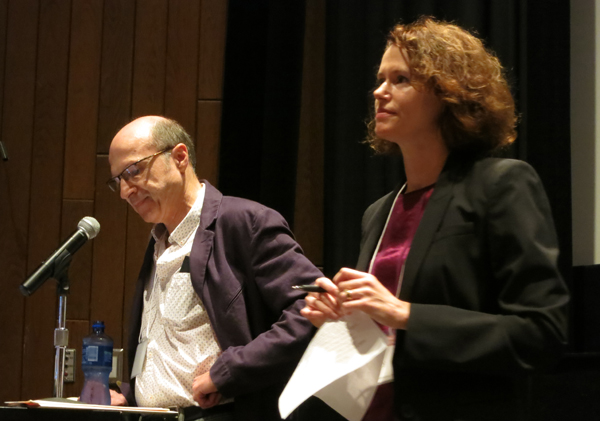
J.J. Murphy and Kelley Conway, conference coordinators.
Posted in Animation: Pixar, Art cinema, B films, Film comments, Film technique: Sound, Hollywood: Artistic traditions, Independent American film, People we like, Screenwriting, Silent film, UW Film Studies | open printable version
| No Comments »
Monday | August 26, 2013
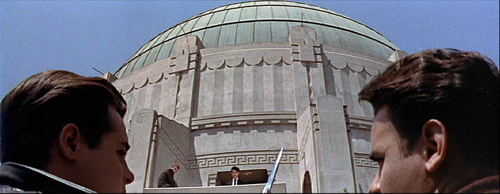
Rebel without a Cause (1955).
KT here:
It’s time for our annual scan of the past year’s entries, pointing particularly to ones that might be useful to teachers and students using Film Art: An Introduction. For occasional readers of the blog, this post might be useful in catching up on items you might have missed.
This year we’ve added four video essays and lectures to our site. These have entailed a lot of effort, but David has enjoyed making them as free complements to the briefer, walled-garden video essays accompanying our latest edition of Film Art.
We’re also delighted to include some entries based around encounters we have had with filmmakers (some of whom we met as a result of our blog) and two contributions from guest experts. Looking back, we are as usual surprised at how much material has accumulated in one year. The summer’s new movies may on the whole have disappointed, but obviously there are a lot of other interesting topics to explore outside the multiplex.
For earlier blog-roundups, see 2007, 2008, 2009, 2010, 2011, and 2012.
I’ll go through Film Art chapter by chapter, suggesting relevant entries for each, and end with a couple of entries on new DVDs that teachers might want to add to their personal or departmental libraries.
Chapter 1 Film Art and Filmmaking
Last year, David’s “Pandora’s Digital Box” series dealt with the transition from film-based to digital-based production and distribution. (That series was revised and expanded into a book.) The original series is updated in “Pandora’s Digital Box: End times.”
This year, David looked back on some historical formats. In “The wayward charms of Cinerama,” he reviewed Flicker Alley’s DVD release of This is Cinerama and took the occasion to analyze the peculiar perspective relations created by the triple-camera system. How the West Was Won and The Wonderful World of the Brothers Grimm receive some stylistic scrutiny.
Super 16mm is still a significant gauge for independent filmmaking, but regular 16mm as has largely been replaced by DVD and Blu-ray for classroom and film-buff viewing. David waxes nostalgic concerning the charms of 16mm and its importance in our own film-watching careers in “Sweet 16” and “16, still super.” For those too young to have seen 16mm on a screen, these recollections might make it a bit more vivid.
Nothing conveys the tangible work of film production like a visit to a working set. Our colleague James Udden, expert on Taiwanese cinema, had an opportunity to watch a major contemporary director in action and reports for us in “Master shots: On the set of Hou Hsiaeo-hsien’s THE ASSASSIN.”
Publicity is a big part of the distribution of a modern blockbuster. In “Jack and the Bean-counters,” I examine the missteps in the campaign for Jack the Giant-Slayer and talk about how the studios avoid cooperating with fans eager to provide valuable free online publicity for their favorite films.
Chapter 3 Narrative Form
Films often use repetition in an obvious way to help us easily follow a story. But what about filmmakers who introduce more subtle similarities that challenge our memories? We examine two such films made in South Korea, In Another Country and Romance Joe, in “Memories are unmade by this.”
Repetition is also central to Mildred Pierce, where a murder that happens at the beginning of the film is seen again, with different shots and timings, near the end. We look at how the film fools us without our noticing it. The sequences are here:
“Twice-told tales: MILDRED PIERCE” analyzes the different functions and effects of the two sequences.
Art films and classics are not the only films with intriguing storytelling. “Clocked doing 50 in the Dead Zone” is an analysis of David Koepp’s Premium Rush as a short film that packs a lot of action and clever narrative tactics into its running time. That entry led to a meeting with Koepp and a follow-up entry on his approach as screenwriter and director. See the Chapter 8 section.
Chapter 5 The Shot: Cinematography
Seeing some recent Asian films at the 2012 Vancouver International Film Festival led to “Stretching the shot,” some thoughts on functions for the long take.
A lot of the films we see in theaters today are made in anamorphic widescreen processes, and by now letterboxing for home-video is familiar to all. David has often lectured on the history and aesthetics of the first successful anamorphic process, CinemaScope. Now that PowerPoint lecture is available on his Vimeo site. See “Scoping things out: A new video lecture” for an introduction and link. (It’s about 53 minutes long, so perhaps something to assign your students to watch on their own.)
Chapter 6 The Relation of Shot to shot: Editing
“News! A video essay on constructive editing” introduces the additionof an analysis of editing in Robert Bresson’s Pickpocket to Vimeo. It’s about 12 minutes long, suitable for classroom use or assignment for students to watch outside of class. Our thanks to our friends at the Criterion Collection for their permission to use the excerpts from Pickpocket.
How much can a single cut reveal about the power of editing? “Sometimes two shots …” takes a close look at a brief passage from August Blom’s The Mormon’s Victim, a 1911 Danish one-reel film and finds a lot going on in it.
Some students might have trouble recognizing jump cuts. “Sometimes a jump cut …” looks at some examples from the martial-arts action scenes from two of King Hu’s masterpieces, A Touch of Zen and Dragon Gate Inn. These are quite different in look and function from the Breathless examples given in Film Art–and you can clearly see the splices.
Chapter 7 Sound in the Cinema
Faced with innovations in sound technology, we turned to our friend and colleague Jeff Smith. His “Atmos all around” is an excellent introduction to the new system. Unlike most surveys of technology, his piece analyzes in considerable detail how artists use it–here, in Pixar’s Brave.
Chapter 8 Summary: Style and Film Form
Alfred Hitchcock is undoubtedly one of the most frequently taught filmmakers, since his work is not only stylistically elegant, but it’s easy for students to pick up on. One reason for this is that he is fond of flashy set pieces, scenes that are skillfully composed to be the high points of a film. We examine his skill in this regard in “Sir Alfred simply must have his set pieces: THE MAN WHO KNEW TOO MUCH.”
On the other hand, Hitchcock is equally good at subtle touches. Some might consider his 3-D film, Dial M for Murder, to be a bit theatrical, since much of its action is confined to a single set. Yet as we argue in “DIAL M FOR MURDER: Hitchcock frets not at his narrow room,” the director finds many small, creative ways to frame and edit his shots in ways that are purely cinematic.
As we emphasize in Film Art, filmmaking is based on a huge number of creative decisions. During this past year, encounters with two practitioners gave us a chance to learn how they went about making some of these choices. Tim Hunter, director of River’s Edge (1987) and numerous episodes of television series like Twin Peaks and Breaking Bad, visited Madison. “Auteurist on the sound stage” discusses how Hunter plans ahead where he will place his camera, since the fast pace of television production allows little time for such decisions on the set. He also talks about tailoring his style to that of the specific television series he is working on.
In June David visited screenwriter and director David Koepp in his New York office. Koepp is best known for his work with Steven Spielberg, including the scripts for Jurassic Park and War of the Worlds, but he has also directed films. “David Koepp: Making the world movie-sized” discusses how Koepp finds the “Gizmo,” or basic premise, for big blockbusters and how he compresses the plots of best-sellers for the screen. He also talks about narrowing down the many choices available to a filmmaker, creating constraints that will allow him to find the best choices for a given situation–with camera placement again being a basic consideration.
This past year two major contemporary directors died: Tony Scott, director of flashy, violent Hollywood action films, and Theo Angelopoulos, maker of austere, stately dramas about Greek history and politics. We find some surprising stylistic parallels between their work, despite their obvious differences, in “Tony and Theo.”
Chapter 9 Film Genres
Since The Blair Witch Project appeared in 1999, there has developed a sub-genre of horror films masquerading as found-footage documentaries. “Return to Paranormalcy” focuses on the successful series of films that began in 2007 with Paranormal Activity and explores how each successive film has managed to vary the point-of-view conventions in order to maintain audience interest.
This chapter of Film Art contains a “Closer Look” box examining “Creative Decisions in a Contemporary Genre: The Crime Thriller as Subgenre.” Our entry “SIDE EFFECTS and SAFE HAVEN: Out of the past” looks at two more recent examples of this genre, focusing on how their conventions revive and vary conventions that had been introduced in 1940s Hollywood films in this same genre. Here’s a good example of genre conventions coming and going in cycles.
For most people, the name “Kurosawa” conjures up only the venerated Akira Kurosawa, director of classics like Seven Samurai and Red Beard. But there is a younger Kurosawa, Kiyoshi, a contemporary filmmaker. While in Brussels in July, David had a chance to attend a screening of his Shokuzai. In “The other Kurosawa: SHOKUZAI,” David puts Kiyoshi Kurosawa in his historical context and analyzes the film as a combination horror film and crime thriller, as well as including some stylistic analysis.
Chapter 10 Documentary, Experimental, and Animated Films
Shirley Clarke was a major director of experimental and documentary films. Portrait of Jason, her feature-length recording of the recollections and comments of a gay black man was re-released in a restored version last year. “I’ll never tell: JASON reborn” discusses its avant-garde approach to recording its subject’s account of what may or may not be the truth. The entry also details the restoration process, which involved material Clarke deposited at the University of Wisconsin-Madison’s archive, the Wisconsin Center for Film and Theater Research.
Of the five animated features from 2012 nominated for Oscars this year, three were made using the traditional stop-motion technique with puppets: Frankenweenie, The Pirates! Band of Misfits, and Paranorman. “Annies to Oscars: this year’s animated features” discusses them, as well as the computer-generated features, Brave and Wreck-It Ralph.
Chapter 11 Critical Analysis of Films
During the past year we’ve written quite a lot about film analysis. These entries might give some encouragement and suggestions to students embarking on their own critical studies of films.
In June the new online film journal, The Cine-Files, interviewed Kristin about her approach to film analysis. The editors kindly allowed us to post the interview, “Good, old-fashioned love (i.e., close analysis” of film” on our site as well. The interview includes discussions as such topics as, “Please tell us about something that couldn’t be understood without a frame-by-frame attention to detail.” It also discusses our recent forays into online video and PowerPoint analysis.
A lot of interpretation of films gets done, by professional critics and students, by fans, and by anyone who gets an idea about a film and offers it to the world. In Film Art, we suggest that valid interpretations of films tend to be based on close analysis of all aspects of the film. Needless to say, not every interpreter does the work of analysis before expounding their ideas. The feature documentary about amateur interpretations of Stanley Kubrick’s The Shining gave us an opportunity to discuss this tendency in “All play and no work? ROOM 237.” Surprisingly, some ideas offered by the subjects of the documentary aren’t necessarily that different from those propounded by professionals.
Christopher Nolan is one of the most admired filmmakers in contemporary Hollywood. What sets him apart? We discuss some of his innovatory tactics in “Nolan vs. Nolan.” The focus is on Insomnia, but with mentions of Magic Mike, Memento, Inception, and The Prestige. The latter is our primary example in Film Art‘s chapter on sound, and this entry might offer useful background material for teachers who show The Prestige to their classes.
For many students, non-Hollywood films can be intimidating to watch and even more so to analyze. “How to watch an art movie, reel 1” offers hints for understanding and discussing art films. The film in question is Jaime Rosales’ Spanish film Sueño y silencio (2013). It hasn’t been widely seen, but one need not have seen the film to understand the analysis of its first twenty minutes. This entry discusses conventions of the art film that might help students in writing their own essays.
Chapter 12 Historical Changes in Film Art: Conventions and Choices, Tradition and Trends
One section of this chapter deals with “The Development of the Classical Hollywood Cinema (1908-1927).” In another new video lecture, “How Motion Pictures Became the Movies 1908-1920,” we deal with the same period on an international level. The lecture traces many of the basic techniques of cinematic storytelling in use in modern cinema back to their origins in this crucial early period. For an introduction to the video, see “What next? A video lecture, I suppose. Well, actually, yeah …”
Of the three major European stylistic movements of the 1920s discussed in Chapter 12, French Impressionism, German Expressionism, and Soviet Montage, Impressionism has traditionally been the most difficult to teach, due largely to a scarcity of prints of films from the movement. Now a group of major Impressionist films have become available on DVD, those made by the Soviet-emigré Albatros production company. In “Albatros soars,” we describe the films and their release in a prize-winning box set from Flicker Alley. We think students would find La brasier ardent intriguing, if puzzling.
David is at work on a book on 1940s Hollywood cinema. Left-over ideas from that project end up as blog entries now and then. These could fit in with the section, “The Classical Hollywood Cinema after the Coming of Sound, 1930s -1940s.” One such entry, “A dose of DOS: Trade secrets from Selznick,” looks at the hands-on approach of David O. Selznick, arguably the most important independent producer of the era. His guidance affected the style of Gone with the Wind, Rebecca, Spellbound, Duel in the Sun, and other classics of the Hollywood system. Another entry considers in-jokes planted in 1940s films.
David has also posted a related essay in the main section of his website, “Murder Culture: Adventures in 1940s Suspense,” dealing with the influence of mystery and detective fiction on films of the 1940s. For an introduction and link to this essay and to several other blog entries on filmmaking of the decade, see “The 1940s, mon amour.”
The final section of Chapter 12 deals with “Hong Kong Cinema, 1980s-1990s.” The recent death of Lau Kar-leung, one of the major martial-arts choreographers and directors of the 1970s and 1980s, led us to post an appreciation of his style and films in “Lion, dancing: Lau Kar-leung.” The final section provides many bibliographical sources and other information on Hong Kong cinema, as well as links to earlier entries on the subject.
Johnnie To is one of the few directors still successfully maintaining the tradition of Hong Kong action films. The latest of our entries on him deals with a recent release: “Mixing business with pleasure: Johnnie To’s DRUG WAR.”
DVDs to consider
At intervals we post round-ups of recent DVD and Blu-ray releases. The titles usually aren’t the big, recent, popular films, but more specialized items put out by companies like Flicker Alley, Eureka!, and Kino that specialize in issuing classic films, often in beautifully restored versions. A lot of these films have never been available on home video before, and they open up new possibilities for teachers who want to broaden their students’ viewing experiences. They’re also titles to recommend to those enthusiastic students who want recommendations for films they can view on their own.
“Classics on DVD and Blu-ray, for a fröliche Weihnachten!” deals mostly with German silent films, including a set of four starring the early superstar Asta Nielsen, and two films by G. W. Pabst: the first release of his debut film, an Expressionist-style work called Der Schatz, and the most complete restoration so far available of The Joyless Street. A new and longer version of Ernst Lubitsch’s Das Weib des Pharao is included, as is a charming Technicolor version of Gilbert and Sullivan’s The Mikado from 1939.
Regular readers are familiar with our annual tradition of naming the ten-best films of the current year but of 90 years ago. For once all the films on our list of “The ten best films of … 1922” are all available on DVD, including a stunning print of Fritz Lang’s Dr. Mabuse der Spieler and the Criterion Collection’s release of the Svenska Filminstitutet’s restoration of Benjamin Christensen’s Häxan (better known in the USA as Witchcraft through the Ages).
As of September 28, Observations on Film Art will be seven years old.
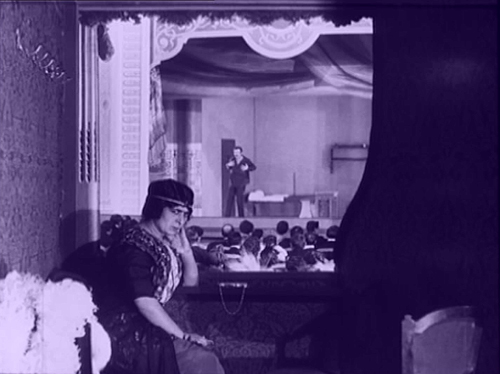
Fantomas (1913).
Posted in FILM ART (the book) | open printable version
| No Comments »
|