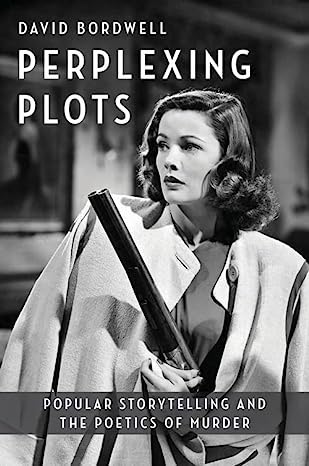
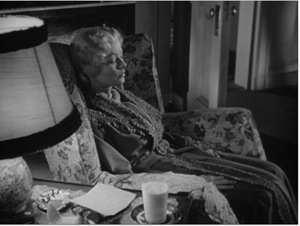
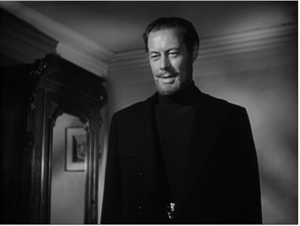
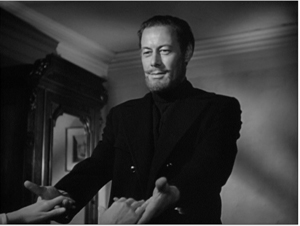
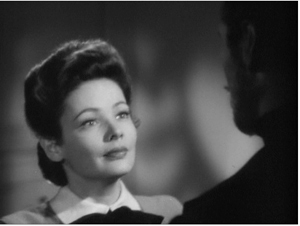
by Kristin Thompson. Berkeley: University of California
Press, 2007.
400 pages, 6 × 9 inches, 12 color illustrations;
36 b/w illustrations.
[go
to Amazon | go to The Frodo Franchise blog]
Continuity editing was one of the great collective inventions of filmmakers. In the ten years after it crystallized in Hollywood around 1917, it was adopted around the world. The technique has hung on a surprisingly long time, rather like geometrical perspective in pictorial art. It’s so powerful that it’s hard to escape.
It’s powerful partly because it’s adaptable to a lot of narrative situations. It provides filmmakers what we can call a set of stylistic schemas, or routine patterns, that can be adjusted in various ways. Analytical cuts that take us into or back from the action, shot/reverse shots and eyeline matches, over-the-shoulder framings (OTS), and slight camera movements that set up reestablishing shots: these straightforward schemas can be used in an indefinitely large number of ways.
I‘ve been noticing this flexibility while writing (still!) my book on narrative strategies in 1940s Hollywood. In particular, I was looking at fantasy tales and the peculiar problems they pose for filmmakers. First, how do we represent ghosts, angels, and other visitors from the Afterlife? And how do we make sure that audiences understand that what we see isn’t necessarily what some of the characters onscreen are seeing?
Angels unawares
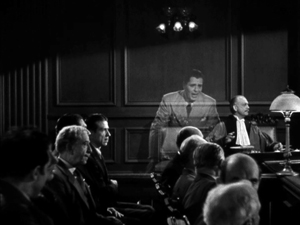
Our Town (1940).
On the first problem: Today we have CGI resources that allow Afterlifers to move freely among the living characters. These effects were much harder to achieve back then. The supernatural-fantasy genre developed its own conventions (yep, schemas). Most films resorted to presenting the Afterlifer in double exposure.
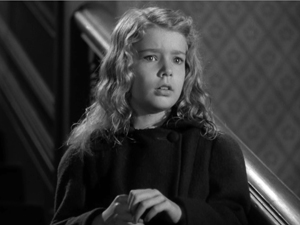
But superimposed characters can’t move easily among the clutter of furniture in a set. A supered ghost can’t go behind a sofa; the sofa will always be visible through it. You might resort to a traveling matte shot, as William Cameron Menzies did in Our Town (1940), when Emily revisits her family after her death. The shot (just above) is particularly flashy because the younger Emily is also in it.
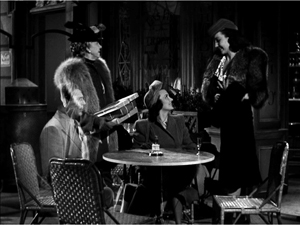
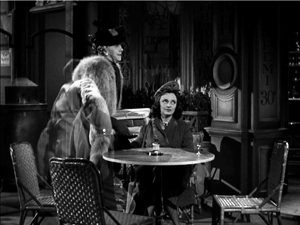
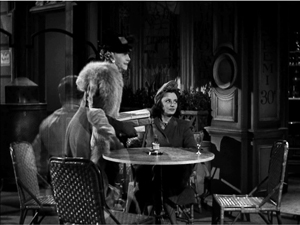
Or you could pull off the remarkable trick in Earthbound (1940). Here a ghostly Warner Baxter settles comfortably into the middle ground and strides around behind furniture and other actors.
He can even give up his seat to an old lady and shift to another.
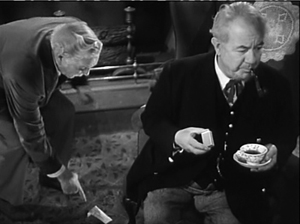
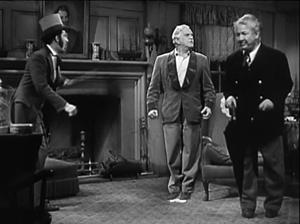
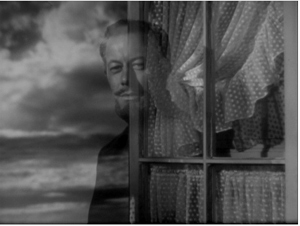
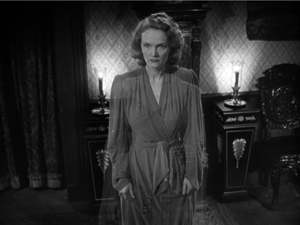
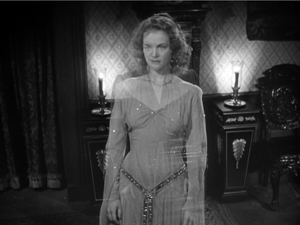
These effects were achieved by a technical feat that I don’t fully understand. (See the codicil.) But the trick wasn’t widely adopted, and most filmmakers opted for a simple expedient. Typically the Afterlifer shows up as a superimposition, but he or she gradually materializes and becomes a solid presence like all the other actors. This is from The Canterville Ghost (1945).
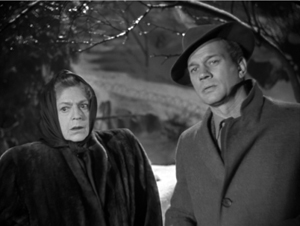
Then comes the second problem. Sometimes the living can see the spectre, but sometimes not. In Here Comes Mr. Jordan, the angel Jordan and Joe the prizefighter arrive from the Beyond and watch the murderous couple from behind. They aren’t visible to the living, but they’re just as tangible.
If a living character seems oblivious to the otherworldly guest, we’re to assume that the guest is invisible. Each film has to inform us of who can see what, and most films do—redundantly. The spook or divine messenger will explain that the living can’t see them, or that only certain characters can. (Sometimes children and animals can see them while grownup humans can’t.)
These conventions can get tweaked. Once we know the Afterlifers aren’t visible to the living, they can comment on the action from the sidelines, as when the dead pilot in A Guy Named Joe (1944) slips in wisecracks while his girlfriend is wooed by a young aviator. In the comic The Man in the Trunk (1942), an all-too-tangible ghost can’t follow a character leaving a room. He explains, “I failed my examination on how to walk through walls.” In The Remarkable Andrew (1941), the ghosts of US founding fathers can ransack offices for evidence in an utterly unconstitutional search and seizure. Most ghosts can pick up objects, but the ones in The Cockeyed Miracle (1946) can’t, a fact redundantly explained to us. This generates suspense when they try to grab a fallen bank check. (Incidentally, this is a long, skillfully directed scene, and it does have recourse to a matte shot when one ghost tries. unsuccessfully, to hide the check by standing on it.)
All of these tweaks rely on continuity editing. But in the course of the 1940s, I’ve noticed, filmmakers played a little more ambitiously with the Afterlife conventions, and continuity style allowed them to do it. The results are sometimes provocative.
Ghosts coming and going
Consider the arrival/departure of the Afterlifer. The default is the special-effects twinkling that lets him or her materialize into the scene and fade out of it. But some filmmakers tried more natural options. In Alias Nick Beale, the title character, aka Satan, strolls in from offscreen, or, thanks to John Cromwell’s staging, is masked by other players before being revealed on the scene. He’s presented to all the characters as a real person, but the staging gives him arrivals of relaxed abruptness.
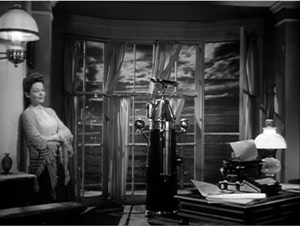
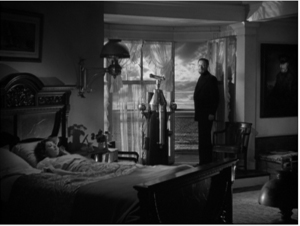
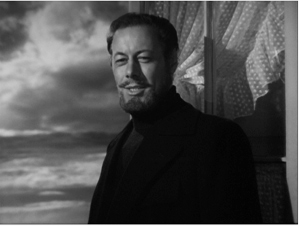
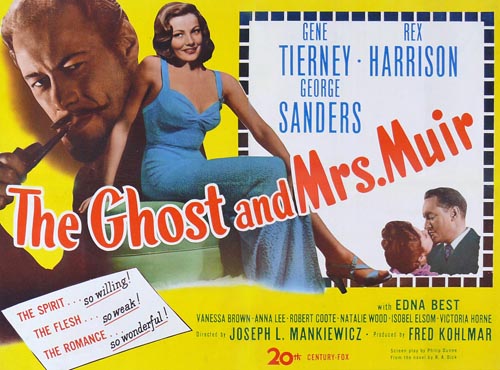
Joseph Mankiewicz’s The Ghost and Mrs. Muir (1947) finds other ways to avoid the hugger-mugger of transparency and melting departures. Captain Gregg assures Mrs. Muir that to her he is “like a blasted lantern slide,” but for us he just steps into the frame and stays on as a solid presence. He disappears just as simply: Mrs. Muir turns away, then a new shot shows that Gregg has gone. Good old shot/reverse shot does the trick.
It’s neat that the second reverse shot on Mrs. Muir reaffirms Gregg’s absence by making her seem more isolated than the earlier mid-shot does. This cut-back to show her isolation after his departure is stressed even more in a later scene, when a medium shot shows her turned slightly away from him; in that interval, he disappears again.
Only after the captain has decided to leave her forever does he resort to the standard spook trick of dissolving away. But in this melancholy context, the familiar device takes on a forbidding finality. He leaves her sleeping and has magically made her forget all about their year together.
In the epilogue, when the elderly Mrs. Muir dies, the captain returns, sturdy as ever, and again the film avoids the cliché. The default schema is to let the dead person’s spirit float up in superimposition from the corpse. Instead, Mankiewicz presents Gregg standing over the lady in a tight shot and simply lifting the now eternally young Mrs. Muir into the frame. Again, all we need is shot/reverse shot, this time with the extra intimacy of an OTS.
These uncommon options take us a little by surprise, refreshing the genre conventions, while also suggesting that the films drive a little deeper into the heart than the usual spook story. The simplicity of presentation helps us take their spectral affair more seriously.
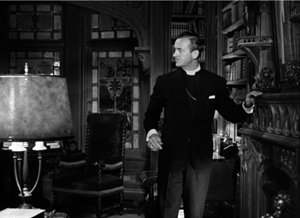
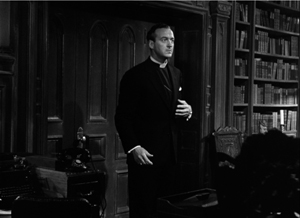
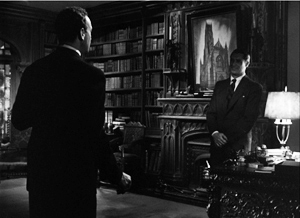
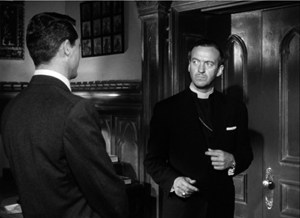
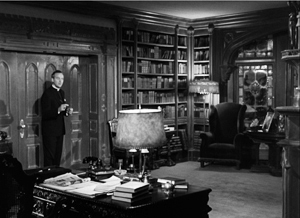
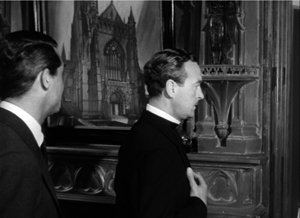
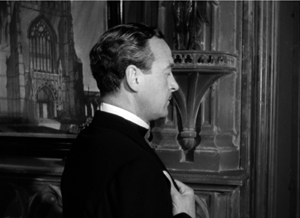
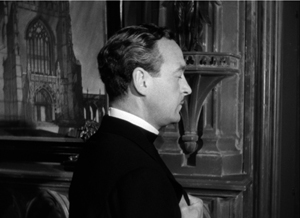
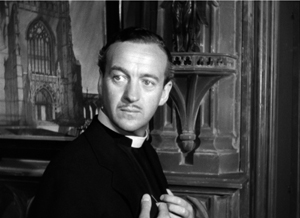
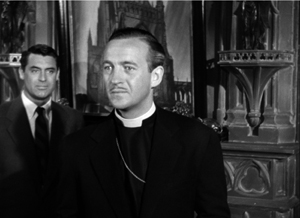
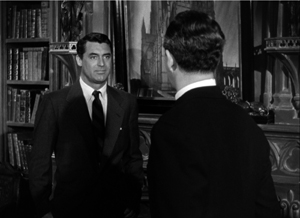
In The Bishop’s Wife (1947) the angel Dudley, like Gregg, comes and goes via offscreen space. A pan follows Henry the bishop, who hears a noise outside his study. The shot pays off with a reverse-angle cut to Dudley, now magically present at the fireplace where Henry was.
At other points, as in The Ghost and Mrs. Muir, the framing excludes Dudley, and when we cut to the long shot Dudley is gone.
Soon, though, there’s a gag on the device. Henry, furious with Dudley, turns away and prays that Dudley will leave him. As earlier, the camera tracks in.
At first it seems that the prayer has been answered, when the camera tracks back from Henry and we see his slightly surprised expression, implying that Dudley has vanished.
But it’s then revealed to us, before Henry knows, that Dudley has changed position and is still in the room.
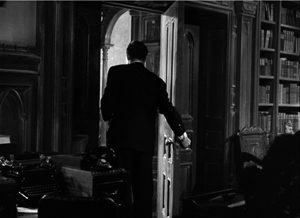
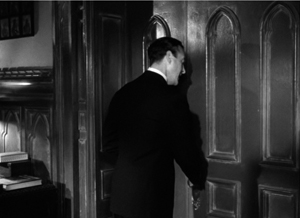
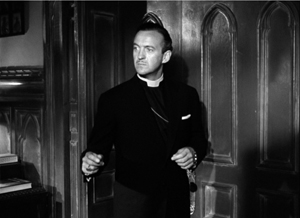
This quiet revision of the schema is in keeping with the film’s other jabs at Afterlifer conventions. At another point, Henry demands that Dudley execute a miracle. He locks the study door, evidently expecting Dudley to stalk through it in the usual phantom fashion. Instead, Dudley just twists the knob, magically opens it, and exits, closing it behind him and leaving Henry to bang against the relocked door.
Re-turning the screw
In general, supernatural romances play down the magical side of the Afterlifers’ visits. This is partly because they rely on a certain ambiguity about who can see what.
Henry James’ brilliant tale “The Turn of the Screw” provides an instance that people have argued about for generations. The unnamed governess, sent to take care of little Miles and Flora, starts to see dead people: the servant Peter Quint and the governess Miss Jessel. Most of her encounters with the ghosts take place when she’s alone, or with the children. Since the story is narrated from her viewpoint, and in the first person, we have no other testimony about the apparitions. The children seem to spot the spooks, but we can’t be sure. And we can’t be sure that they aren’t simply figments of the governess’s imagination. In the one scene that brings in another witness, the housekeeper Mrs. Grose declares that she can’t see Quint or Miss Jessup. Is the governess mad, or are the children really haunted by the corrupt couple?
The tension exemplifies what narrative theories Tzvetan Todorov called the “fantastic,” the tale of uncertain explanation. The fantastic hovers between scientific, or at least real-world explanations, and supernatural ones. Either the ghosts exist, as in most ghost stories, or they can be explained psychologically, as the narrator’s hallucinations.
Actually, in film, and I think in “The Turn of the Screw,” there’s a third possibility: that the Afterlifers exist as beings who can be seen only by the select few. In “The Turn of the Screw,” Flora definitely seems to see Miss Jessel on one occasion, so perhaps we can posit that the governess sees the ghosts when Mrs. Grose can’t.
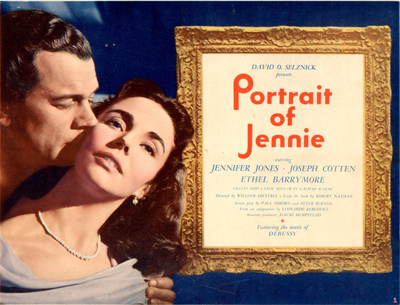
This possibility is of course the premise for The Sixth Sense, and we find it as well in The Ghost and Mrs. Muir, in which Gregg is visible only to Mrs. M. The situation is more equivocal in Portrait of Jennie (1949). In this film, David O. Selznick inflated the fantasy-romance genre as he had pumped up the historical drama (Gone with the Wind), the home-front film (Since You Went Away), and the western (Duel in the Sun).
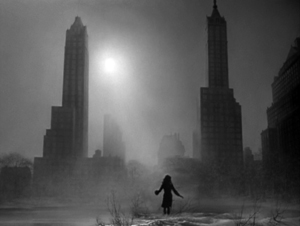
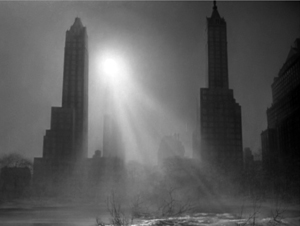
During the winter and spring of a single year, the luckless painter Eben Adams encounters Jennie at different points in her life: as a little girl, a teenager, a college student, and a mature woman. He falls in love with her. Their penultimate encounter takes place when she comes to his apartment and allows him to paint her portrait. Then she disappears.
Is Jennie a time traveler or a ghost or an illusion, or even a supernatural muse? A bit of each. After each brief visit she withdraws, leaving Eben yearning for her. The art dealer Miss Spinney suggests that in order to paint well, Eben must love someone, so perhaps he has conjured up Jennie to inspire his art. It’s true that he sketches, draws, and paints several Jennies. (The final version, the portrait, won’t be shown us until the film’s last image, in blazing Technicolor.) And it’s true that, in a scene much like that featuring Mrs. Grose in James’ tale, we get a hint that Eben is hallucinating Jennie.
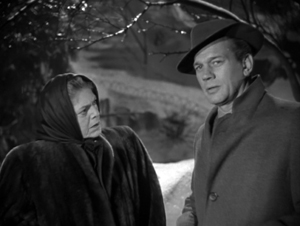
He has just spoken with the adolescent Jennie in Central Park when Spinney comes up to him. He watches Jennie go off, in a standard passage of continuity editing.
But then, thanks again to continuity eyeline technique, Spinney doesn’t see her.
Normally this cutting pattern would suggest that Jennie is purely Eben’s vision. (For a modern example, see Johnnie To’s The Mad Detective.) Yet we will soon learn that Jennie did exist. Playing detective, Eben discovers that she was orphaned, taken care of in a convent, and left for college—all things her apparition told him. Worse, he learns how she died: on a rocky seacoast he has already depicted in some paintings.
Selznick was concerned to make Jennie neither a real person nor a pure product of Eben’s imagination. In an early story conference he remarked that Jennie is both in Eben’s mind and in some really existing realm. “We must convince the audience that this story may be strange and odd, but it’s true. All the other characters may say, “Poor Adams, he must be nuts,’ but we know it is true.” The fact that only Eben can see Jennie doesn’t make her a figment of his imagination. Eben may have conjured her up, but she also chose to visit him, predicting that some day he will paint her portrait. The man has, somehow, met a woman from a spiritual world who has been seeking him. Eurydice-like, she will be pulled back into it.
Too few fancies, one powerful friend
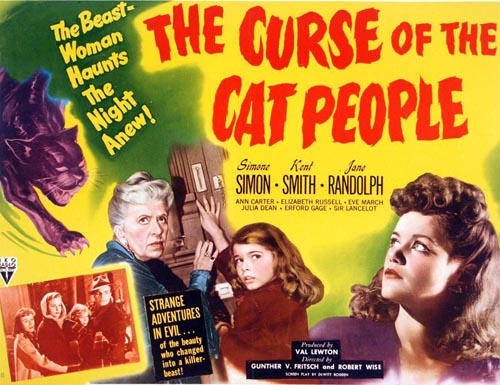
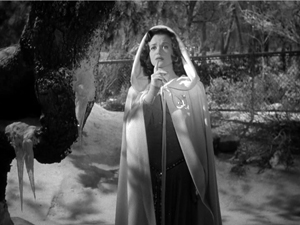
Recognizing that spirits can become selectively visible to the living helps explain the delicate power of another supernatural fantasy of the period. The Curse of the Cat People (1944) uses hyper-judicious framing and editing to create perhaps the most mysterious 1940s Afterlifer.
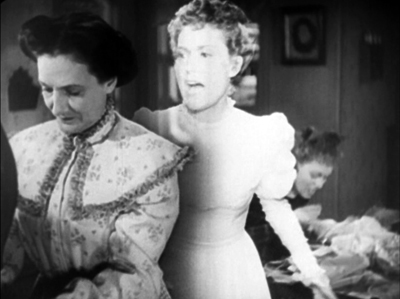
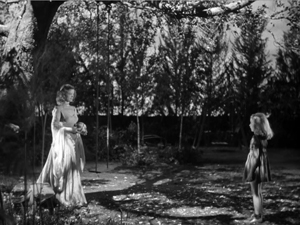
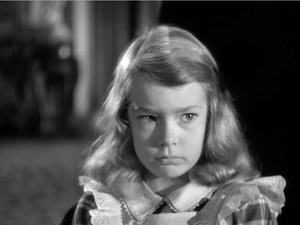
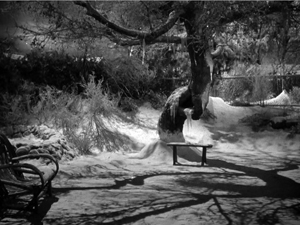
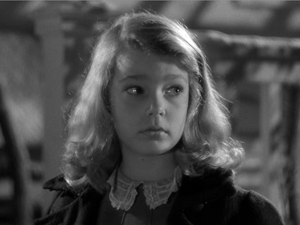
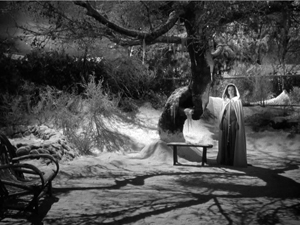
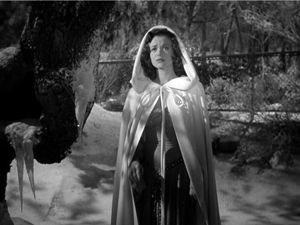
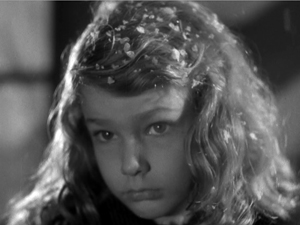
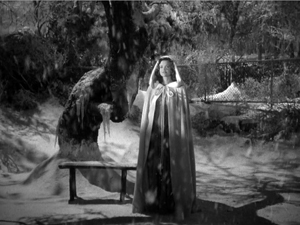
Irena, the woman who can change into a panther, has died in The Cat People (1943). Her widowed husband Oliver has married Alice, and their child Amy, dreamy and unpopular, wishes for a friend. Near the start of the film we’re led to think that Irena is that imaginary friend, wholly a product of Amy’s mind. Irena comes to her in the garb of a traditional princess or fairy godmother, a bit like the fairy of Pinocchio (1940), so we might take her as Amy’s imagining. And the teacher Miss Callahan, who might seem to be playing the raisonneur, says that the little girl has “too many fancies, too few friends.” But that doesn’t seem to me quite right. I don’t think that ultimately Irena is Amy’s projection. Nor are we exactly in the realm of Todorov’s fantastic, hesitating between subjective and objective explanations.
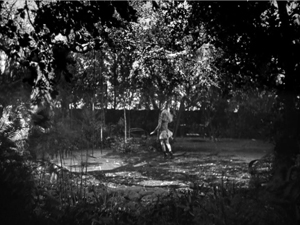
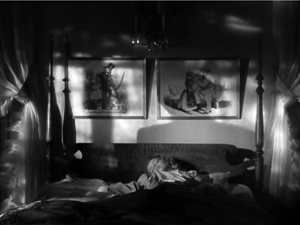
Consider the progression in the film’s depiction of Irena. At first, Amy is shown playing in the garden, purportedly with her friend but alone in the frame.
Later she says that her friend taught her a song, but she can’t recall the words. This suggests that that encounter, kept offscreen, is a vague one. That night, as Amy awakes from a nightmare, she is soothed back to sleep by her friend, whom we hear softly singing but see as only a shadow. Her lullaby continues as Amy sleeps.
Still later, Irena appears to Amy in the garden only after Amy sees a picture of her. Irena appears un-magically, entering the shot as casually as Dudley or Captain Gregg and holding the ball that Amy has tossed out of frame.
Amy asks her who she is. “I’m your friend.” The fact that Amy doesn’t recognize her from earlier friend-encounters, suggests that the friend wasn’t yet defined in bodily form. She had magical powers, such as darkening or lightening the garden or teaching Amy a song, but she assumed no particular shape. We, however, saw her female silhouette while Amy slept. Now Irena is fully embodied, and we can see her along with Amy.
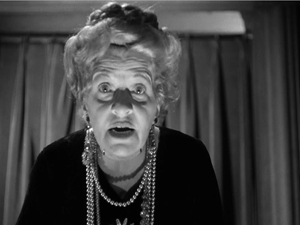
Apart from the Irena scenes, we do get into Amy’s mind. But the techniques used in those scenes are ones that are never applied to Irena. When a deranged neighbor lady recites the tale of the Headless Horseman, we get exaggerated optical POV shots from Amy’s perspective and the subjective sound of wind and horses’ hooves.
The sounds are repeated as auditory flashbacks in Amy’s nightmare and while she is hiding in the forest during the climactic snowstorm. Later, Amy will calm the old woman’s homicidal daughter by envisioning her as Irena (in a superimposition) and embracing her as “My friend.”
From a storytelling standpoint, such images and sounds are sharply distinguished from Irena’s scenes with Amy. Those are treated in quite a neutral, objective manner.
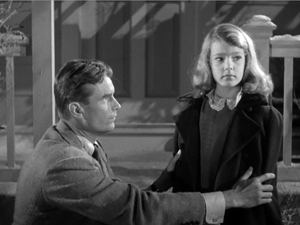
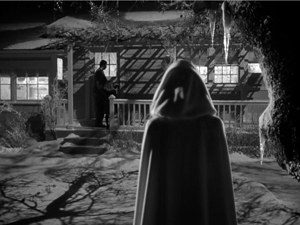
There’s more. At the midpoint of the plot, in a crucial scene, Oliver learns that Amy considers the dead Irena as her playmate. He’s convinced she’s imagining it all. Anxious and angry, he takes her out into the garden and demands to know if Irena is there. Amy sees Irena under the tree, but Oliver doesn’t. As in Portrait of Jennie, reverse-angle cutting conveys each character’s vision.
In cinema, we assume objective (fictional) reality to be the default value. So the incompatible viewpoints of Amy and Oliver in the garden might suggest that Irena exists only in Amy’s mind. But in The Ghost and Mrs. Muir and Portrait of Jennie, the protagonist can see the ghost when no one else can. Nothing in this garden encounter denies the possibility that Irena is a ghost visible only to Amy and us.
We get some immediate backing for this. When Amy looks at Irena a second time, at Oliver’s insistence, Irena puts her finger to her lips, as if urging Amy not to acknowledge her.
This, to put it stiffly, is the action of an independent agent. Amy is unlikely to conjure up an imaginary friend who warns her to keep quiet. And by telling Oliver that of course she sees her friend, she disobeys just as briskly as if Irena were of flesh and blood.
We have a clincher at the very end of the scene. Oliver and Amy go in, turning away. Neither sees the garden, but we get two shots of Irena watching them and reacting unhappily.
Again, it’s hard to reconcile this image with Irena being a pure projection. She’s behaving like an ectoplasmic free agent. In addition, Alice and Oliver, despite their skepticism about Amy’s friend, don’t rule out supernatural goings-on completely. At various points both mention they sense Irena’s presence in the house. Irena has become in the course of the action a full-fledged ghost, but one with benefits.
The epilogue confirms Irena’s otherworldly mission. As Oliver takes Amy into the house, he asks if she can see Irena. She looks and sees her, smiling.
Can Oliver see Irena? Now that he’s decided to trust Amy, he says yes—without even looking.
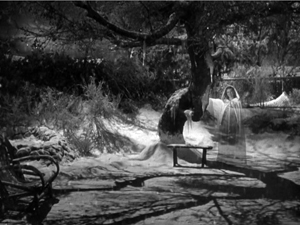
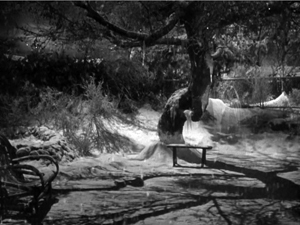
As in the earlier garden scene, once father and daughter have gone inside, we’re treated to an independent shot of Irena under the tree. And now she melts away, in the conventional disappearing act of an Afterlifer. As with Captain Gregg’s withdrawal from Mrs. Muir, by saving this well-worn option for this moment the filmmakers invest it with an air of permanent departure.
The Curse of the Cat People cleverly invokes the possibility that Irena is purely imaginary, then dispels it. For once, nobody redundantly explains to us who can and who can’t see the ghost; we have to figure things out. Instead, the vague role of imaginary playmate gets gradually defined as Irena, the ghost. Continuity editing is recruited to suggest that Irena is coalescing into the friend Amy wishes for. At first only an atmosphere, then a shadow, and finally a properly solid spirit, Irena is a shape-shifter, more elusive than other apparitions of the period. The plot creates a sympathetic spirit seeking to console a lonely child and correct her father’s harsh, plodding common sense. Perhaps making amends for her effort to destroy Oliver’s romance with Alice in the previous film, the dead cat-woman fills out the role of imaginary playmate and saves a family.
There are other ingenious ways that the conventions of 1940s supernatural films are tweaked by the resources of continuity style, and I’ll be considering them in the book. The general point is that even schemas as commonplace as eyeline matching, or conventions as hoary as having a ghost dissolve out of the scene, can take on new force when filmmakers practice their craft with discreet intelligence.
Earthbound‘s ghost effect derives from a prism set in front of the camera. Warner Baxter is located in an adjacent set, and one face of the prism was silvered to reflect him onto the primary set. The best description I’ve found is here, thanks to good old Lantern. But we need more information. How can Baxter move so precisely around “our” set if he’s offscreen? Presumably, he’s in either a black set or one with furnishings laid out like ours. In that case, the furniture would need to be draped in black, so parts of his body will be blocked to the right extent. But in either case, we need to explain how he manages to synchronize his movements so exactly with the actors in front of the camera. If you know more, please correspond!
My quotation from Selznick comes from “Portrait of Jennie Conference notes (1/20/47),” David O. Selznick collection, Box 1123, file 11, Harry Ransom Research Center. Thanks to Emilio Banda and to Steve Wilson, Curator of Film at the Harry Ransom Center.
I’m using the concept of an artistic schema as E. H. Gombrich does in Art and Illusion (2000). For more about it on this site, see these entries.
You probably know that “The Turn of the Screw” was filmed as The Innocents (1961). It’s also the basis of a strong Benjamin Britten opera.
For more on my still-in-progress book on 1940s Hollywood, go here and here. If you’re keen on the Forties generally, you might be interested in The Rhapsodes, my study of film criticism of the period, to be published in March by the University of Chicago Press.
After nine years, over 700 entries, and many essays and other stuff, this contraption of a website has started to intimidate us.
If we’re intimidated, you might be flabbergasted. Although a set of categories sits on the right to guide your exploration of this tangled databank, those too loom large and discouraging. So we’ve decided to tidy up by–how else?–adding another entry.
We’ll occasionally offer a stripped-down guide to our writing on certain topics. We’ll steer you to entries that we think represent the core of our thinking on a problem, and then add some that probe more deeply, for those who want to go beyond the basics. Since one of our areas is narrative theory and analysis, a good first effort, we thought, would be to produce a sort of DIY syllabus that systematically surveys the topic as we’ve explored it. And since we’ve often written about classical Hollywood storytelling, and since many of our readers are interested in that…well, the syllabus sort of wrote itself.
We call these ideas open secrets of storytelling because by and large they aren’t acknowledged in the screenplay manuals that aspiring writers read. In most cases, we’ve had to devise our own concepts and terms, based on watching hundreds of movies. Yet these observations are wide open, available in our books and on this site.
Now comes our chance to pull them together. The result isn’t an utterly comprehensive theory of classical Hollywood narrative, but it does give a fair sampling of the range of questions we’ve tried to answer about it. The topics, linked to essays and blog entries, are arranged in three layers.
The most basic layer is an array of key ideas about story worlds, plot structures, and strategies of narration. These ideas are introduced in the first entry, “Understanding film narrative: The trailer.” Discussions of other basic concepts follow. Just reading the entries pegged to those topics, you could get a solid sense of what we’re aiming at. For most of those, we also propose a film you might view to test how the ideas work.
At a second level, for some topics we include some entries that dig deeper. They’re either more complex and advanced, or they provide some historical background.
Finally, after we’ve reviewed the key topics, we add a batch of case studies that use several of the tools we’ve laid out. These are usually very deep dives into particular films. They aim to show how the analytical ideas can bring out distinctive features of particular movies. The case studies are pretty wide-ranging, but they tend to hover around specific problems, such as adaptation or the creation of fantasy worlds.
How could you use this resource? A teacher in high school or college could draw on it as a partial syllabus or just a thumbnail list of supplementary material for a course. Teachers using Film Art: An Introduction could treat it as a supplement to our section of Chapter 3 on classical narrative. Or a student might find an idea for a paper in this vicinity.
Since we’ve always tried to link film studies and filmmaking, we hope that practitioners might be interested too. For example, an aspiring screenwriter could take this as a weekly reading/viewing agenda, treating it as a free course in story analysis. General readers who simply want to know more about the mechanics of cinematic storytelling should find something provocative here too. For everybody: Feel free to use it as Narrative Analysis 101.
We thank our many loyal readers of this blog, as well as the many more who have just dropped by once or twice. Your continued interest has helped us keep going.
As we write more entries relevant to narrative, we’ll revisit this DIY syllabus.
Needless to say, we consider these matters more closely in several of our books. See The Classical Hollywood Cinema: Film Style and Mode of Production to 1960, by Kristin, Janet Staiger, and me, and Kristin’s Storytelling in the New Hollywood and Storytelling in Film and Television. For my part, there’s Narration in the Fiction Film and The Way Hollywood Tells It: Story and Style in Modern Movies. I’m at work on a book on narrative innovations in 1940s Hollywood, the central source of much that we encounter in today’s films.
We’re used to sorting movies by periods, genres, and the individuals associated with them (stars and directors especially). But we can also distinguish films by their styles and narrative forms. So there’s not only a “film noir” style but other group styles, like the tableau approach seen in the silent cinema, or the deep-focus one of Hollywood in the 1940s-1950s. Similarly, we can think about types of storytelling strategies.
Someone might object that at least genre and other categories are in filmmakers’ minds, whereas it’s unlikely that any American in the 1940s set out to make a film noir as we understand it. (That term, and category, came from France, and somewhat after the fact.) Similarly, Ford probably didn’t think he was making a “classically constructed” Western in My Darling Clementine; he was just making a Western.
One reason we might construct these categories is to bring out the principles that filmmakers seem to follow intuitively. Perhaps no screenwriter ever thought explicitly about scene hooks, but the device is common enough to suggest that they believed the device was a useful tool.
Besides bringing out the regularities of filmmakers’ craft in certain times and places, constructing categories allows us to understand the creative choices they face. Maybe you handle a scene in a two-shot or in several reverse-angled singles. Both are permitted, each has certain advantages, and filmmakers spontaneously choose among these alternatives.
In effect, we’re reconstructing the menu of options available to filmmakers in certain times and places. If we do it carefully, we gain understanding of what each option can yield, and what certain filmmakers can achieve if they try something new.
Kristin and I have been in this game for decades, and our work on norms of film form and style has surfaced in our books, lectures, and blog entries. One set of analytical categories we’ve proposed is based on how movies use their protagonists. I was struck by how many films at end of 2015 and the start of 2016 illustrate a range of options currently available.
It turns out that these options are of long standing; they’re another example of how even recent movies owe a lot to the classical Hollywood tradition. That’s not to say, though, that they might not revise or tweak that tradition. Some filmmakers are innovative by temperament, and besides, there are career rewards when innovations come off. (Just ask the maker of Pulp Fiction.)
The categories depend on determining which character(s) can function as protagonist(s). That depends on the goals, the obstacles to the goals, and the relationship between the goal-striving character and other characters and story lines. Traditionally, in a two-hour Hollywood feature, a principal goal is articulated in the first half-hour or so. Kristin has argued that after this “Setup” portion comes others: a “Complicating Action” (also lasting about half an hour) that changes the goal and in effect creates a new setup; a “Development” which consists of delays, backstory, and fresh obstacles to the goal; a climax that resolves the issue; and an epilogue (screenwriters called it a “tag”) that confirms a certain stability in the situation. The major parts roughly divide the film into quarters, contrary to three-act accounts.
So today I look over the protagonist menu, based on some current offerings. Of course there are spoilers.
One, with benefits
Daddy’s Home.
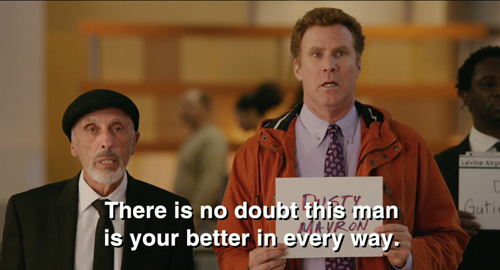
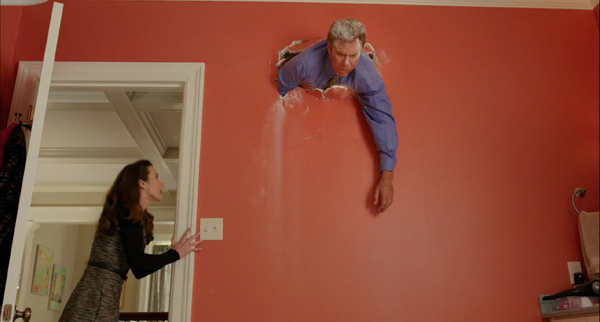
Take as a baseline the movie organized around one protagonist. A clear example from this holiday season is Daddy’s Home. Stepdad Brad (Will Ferrell) has read all the touchy-feely parenting books and applies their lessons to raising the kids he has inherited by marrying Sara. But Dusty (Mark Wahlberg), Sara’s charming and macho ex, returns from his mysterious life in espionage and rapidly takes over the household. In an escalating series of mishaps, Brad proves unable to live up to the hip and edgy things that Dusty dreams up for the kids.
The climax comes when Brad, after showering Megan and Dylan with presents, gets drunk at a basketball game and humiliates them all with a public confession of inadequacy and a pair of unguided free throws. Eventually the battle of the two parenting styles—comforting versus edgy—is resolved when at a father/daughter dance Ward’s nonviolent, somewhat goofy, approach to conflict tamps down an explosive confrontation with a father spoiling for a fight.
The classic situation is established: our protagonist has an antagonist. Dusty is an infighter who seizes control of every situation. As you’d expect, Dusty is winning the race for the kids’ affection during most of the film; even Sara seems to be feeling some of her old attraction to him. As the antagonist, Dusty makes his intentions clear about two-thirds through the film: He will not give in. This precipitates Brad’s suicidally expensive efforts to shower his kids with presents. Deeply shamed, he moves out. Dusty seems to have won.
But Dusty has a weakness. He can’t manage the drab daily responsibilities of parenting—making the kids’ lunches, driving them to school—that Brad enjoys shouldering. At the climax, Dusty has gained respect for Brad and soon remarries, becoming the devoted father of a stepchild. In a traditional comic reversal, he must confront the kid’s birth father, who is a bigger thug than he ever was.
Daddy’s Home reinforces our alignment with the protagonist Ward through his voice-over narration, though at the end the integration of the two families is given by letting Dusty and Sara chime in too. The emphasis on Ward, his confrontations with Dusty and his kids, and the hilariously bad advice offered by Ward’s boss (a classic sidekick role) fulfill a common template for one kind of classical plotting. The protagonist comes to the plot with his goal already decided on, and he has to defend it against a tangible threat.
There’s another option: letting the protagonist discover the goal in the setup. And there’s the possibility of presenting not a single powerful antagonist like Dusty but several. These forces in various ways take on the task of blocking the protagonist’s goal.
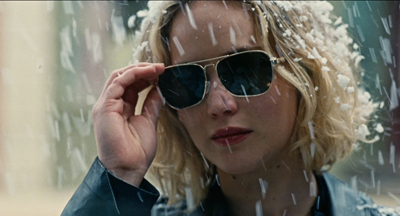
Some critics have thought David O. Russell’s Joy somewhat messy, but I think that’s partly because the film spreads the antagonist function across many vivid secondary characters. In my view, as Bernie Sanders might say, the plot remains pretty classical.
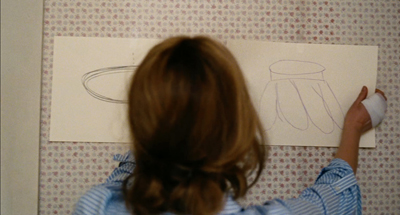
The Setup establishes Joy’s life as a disaster. Her childhood dreams of creativity have been forgotten after years with her dysfunctional family and the demands of her children and job. Around the half-hour mark, Joy’s wounds from cleaning up a broken wine glass send her into a dream in which she rebukes herself for her passive life. She wakes up and starts designing a miraculous mop. If her initial goal was simply muddling through, her new goal revolves around transforming her life by creating and marketing this product. This new goal sets the key for the Complicating Action.
At the film’s midpoint, Joy convinces the producer overseeing the Quality Value Channel to add her mop to the offerings. The Development section consists of more obstacles and some triumphs, so that eventually sales take off. But her family butts into her business and plunges her into bankruptcy. This, her darkest moment, is overcome when she confronts her Texan partner and threatens to take him to court for the fraud she has discovered. She pays off her debts. In the epilogue, we see her as a successful businesswoman helping other struggling inventors.
This, of course, is just the film’s spine. In the course of this plot, Joy discovers she has reserves of courage, determination, and a sense of her own worth. Weaving through it all is the voice-over narration of her grandmother who not only fills in information for us (even from beyond the grave) but also serves as a prod for Joy to persist in her desire to make things of value. There’s also a clever opening showing a soap-opera performance in the manner of Straub/Huillet; it’s later replayed in normal TV terms.
Joy has allies—her ex-husband and a loyal friend—but she faces many antagonists, an array of family and predatory business people. Where Joy most alters the traditional plot layout, I think, is in its refusal to include a story line involving romance.
Most Hollywood plots are double-stranded: a line of action about romantic love, and another line, usually about work. Joy doesn’t revive her marriage and instead concentrates on her fulfillment of her dream. Having seen Silver Linings Playbook and American Hustle, we might expect Joy (played by Jennifer Lawrence) to hook up with the QVC producer played by Bradley Cooper, but it doesn’t happen. Still, Joy remains a nice example of the plot focused on one protagonist who struggles against a range of antagonists, each contributing particular obstacles. A comparable example from recent releases would be Bridge of Spies.
It takes two
Carol.
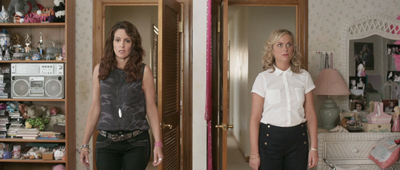
Alternatively, there’s the dual-protagonist plot. Two characters share a goal, or have complementary ones, and they work together. They may also come into conflict about it or about other matters. Often they’re a male/female romantic pair, as in the classic His Girl Friday, but they may also be male/male (The Other Guys) or female/female (The Heat). I’m told that Star Wars: The Force Awakens eventually settles into a dual-protagonist plot, but one example I’ve seen is Sisters.
At the start our protagonists are characterized as unhappy and incomplete. Maura (Amy Poehler), a divorcée, is oversolicitous and lonely; Kate (Tina Fey), a single mother, is irresponsible and frequently jobless. Neither sets out deliberately to improve her life, but they are put out on that path after learning that their parents have sold the family home. Screenplay manuals call this the “inciting incident.”
An encounter with the house’s snobbish purchasers convince the sisters to relive their wild high school days by inviting their old classmates to a wide-open party. They switch roles: Maura vows to become the wild girl she always hoped to be, and Kate agrees to become, for that night, the prudent one keeping an eye on things. At first the party is a boring affair, as their Gen-Xer friends have become staid parents, but at the midpoint, with the arrival of some serious drugs and a tattooed side of beef named Pazuzu, things explode.
The Development section is woven out of running gags, including a would-be party animal, a mean-girl rival crashing the event, a hunk attracted to Maura, and Kate’s efforts to keep in cellphone communication with her daughter Haley, who has nothing but disdain for her scatterbrained mom. The climax is precipitated when, having utterly trashed the house, Kate learns that actually she was to get the money from the sale. More seriously, Maura has secretly acted as a surrogate parent for the elusive Haley. The denouement presents a series of resolutions whereby the parents forgive their daughters, the house is rehabbed, and the sisters accept the need to sell the place and grow up. A tag shows the family united at—when else?—Christmas.
In Sisters, the intertwined lines of action yield goals around one the house-based line of action (preserving the house, trashing it, rehabbing it), but other goals emerge around love. Maura gets a boyfriend, Kate wins her daughter’s love, and both reconcile with their parents.
Sisters exemplifies how dual-protagonist films can show characters sharing a goal and still clashing with one another. Here, as in most such films, one of the pair may help the other, work against the other, or keep the other in the dark. Accordingly, so that we can appreciate all the schemes, misunderstandings, and screw-ups, dual-protagonist films tend to supply a wide range of knowledge. In Sisters, for instance, we know, as Maura and Haley and the parents do not, that Kate has lied about getting a new job.
By contrast, a single-protagonist film can restrict our knowledge to the hero or heroine, so that we share the suspense and surprise coming their way. Daddy’s Home restricts us almost completely to what Ward knows; Dusty is constantly surprising him with new subterfuges to win the kids’ love. Similarly, Joy is the center of consciousness in her film. True, we have the Grandmother’s voice-over supplying information, but it doesn’t really break with Joy’s range of knowledge. Grandma could have tipped us off early that about the Texan’s scam, but we learn of it only when Joy does.
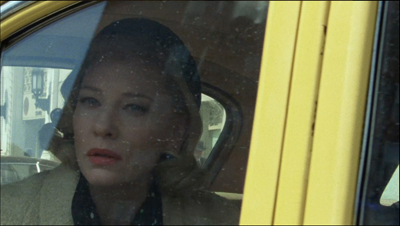
In this way, plot structure interacts with what in literature is called point of view, or narration in the broad sense. Carol provides a striking example.
Patricia Highsmith’s original novel presents a single-protagonist plot. Therese, vaguely dissatisfied with the men in her down-at-heel bohemian milieu, falls abruptly in love with a wealthy wife and mother. Highsmith rigorously retains our attachment to Therese, so that we never know more than she does. She gets glimpses of Carol’s unhappy life with her husband Harge, her love for her daughter Riddy, and her struggle to obtain a divorce that will let her share custody of the girl. After Therese and Carol’s compromising road trip to Middle America, Carol returns to New York and the legal proceedings Harge is conducting. He has proof of Carol’s lesbian affair and intends to use it against her. But Therese learns of the progress of the case through letters and phone calls. Several chapters showing Therese simply waiting in Sioux Falls for news furnish some of the dread-filled suspense that Highsmith would generate in her crime novels.
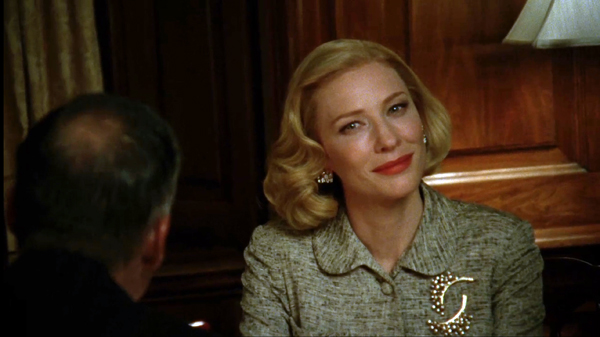
The film displays the traditional four-part structure. The drive west is launched at the midpoint, just when Therese’s boyfriend Richard denounces her as infatuated with Carol. The couple’s trip, trailed by a detective tape-recording their lovemaking, serves as the Development. Interestingly, the book has a similar array of incidents, with the same plot point serving as the pivot to the second half. As I’ve argued before, popular fiction sometimes displays the same plot architecture we find in cinema.
But just following the four-part template doesn’t mean that the film and the novel are congruent. Carol shows how choices about narration can reshape plot structure. Apart from some changes in the original situation (e.g., Therese is now an amateur photographer rather than a set designer for stage productions), screenwriters Phyllis Nagy and Todd Haynes have made a crucial decision. They have expanding our access to Carol’s story line.
Events that are “off-page” in the novel are fully dramatized in the film, and we witness action that Therese never learns of. Harge, a vaguely pathetic presence in the book, is more fully characterized, and as an angry patriarch at that. We get scenes of Carol with Riddy, with her former lover Abby, with her in-laws, and particularly with her lawyer, who’s helping her fight for custody. Crucially, the screenplay supplies a climactic scene not in the book, when Carol yields to Harge’s demands and refuses to condemn her affair with Therese. Something like this must have occurred in the book too, but it’s presented sketchily and at a remove, recounted to Therese by Carol and Abby.
By creating a wider-ranging narration, Carol turns a single-protagonist book into a dual-protagonist film. The two women share the same goal, romantic union, and the narrational patterns balance their individual efforts to achieve it.
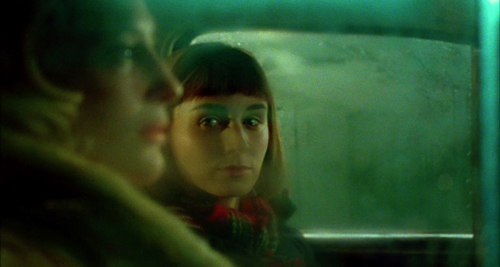
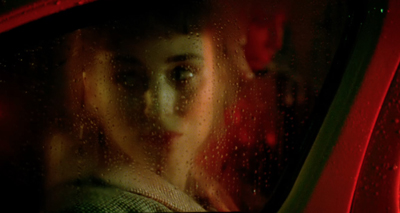
But wait, someone might say. Nagy and Haynes have added a flashback structure to the book, triggered by the early scene showing Therese leaving Carol after their meeting at tea. We watch Therese go to a party in a cab, and her morose face behind the rain-streaked window suggests that she’s recalling how she met Carol. Doesn’t this device respect the restricted narration of the book?
Actually, no. In classically constructed films, extended flashback passages are seldom restricted to the character doing the remembering. Against all realism, flashbacks include material that the recollecting character doesn’t or couldn’t witness. In line with this convention, Therese’s flashback includes a lot of scenes she doesn’t know about. The memory-flashback’s main purpose in a Hollywood film isn’t to represent character memory but to justify shifting the order of events. There’s more discussion here.
Perhaps one aim in showing rather than telling Carol’s story was to give Cate Blanchett a bigger part, but it has an important function for us as viewers. It avoids a climax portion that would show, almost Bresson-style, Therese simply killing time and waiting. Instead, by being transported to Manhattan and seeing what Carol is struggling against, we can appreciate Carol’s profound sacrifice for Therese. Carol is a somewhat remote and mysterious character in the book, but she’s delineated far more precisely in the film, largely because of these scenes.
Because Carol’s story line is fleshed out, we have a stronger sense of Therese’s mistake when, returning to New York, she declines Carol’s offer to resume their affair. (In the book, other factors shape Therese’s choice, including an ominous portrait that she seems to recognize from her childhood.) We know Carol to be more courageous than Therese believes she is, which makes the young woman’s decision not to reignite their affair more regrettable. This choice doesn’t block the screenplay from offering, when the flashback has ended and looped back to the present, a modified form of the book’s somewhat hopeful conclusion.
Multiple choices: Men (and women) on a mission
Spotlight.
There can be more than two protagonists, of course, so it’s convenient to have the general category of multiple-protagonist films too. Two common sorts show up in our year-end Hollywood releases.
One is what we might call the mission-team movie. Again, goals define the options. A group of characters, all more or less equal in importance, devote themselves to achieving a single goal. This is a common feature of combat films, though we find it in peacetime too. Classic examples are heist films like The Asphalt Jungle, sports films like A League of Their Own, crime films like Johnnie To’s The Mission, and numberless road-trip films.
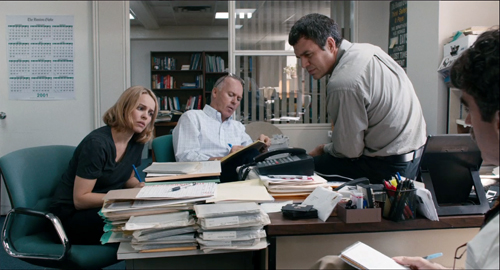
Spotlight exemplifies the mission-team plot. As in a combat film, there’s a hierarchy: the chain of command runs from publisher to editor in chief to managing editor to section editor, and then to the grunts. The Boston Globe’s new editor Marty Baron puts an investigative team, called Spotlight, on a story about pedophile priests. Three reporters under Robby Robinson (Michael Keaton) unravel a story that ultimately implicates nearly a hundred priests and reveals many more victims.
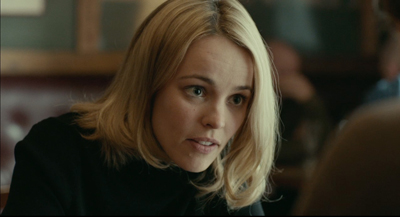
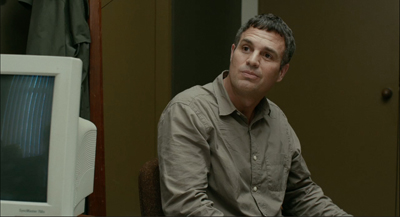
As in a heist film, each reporter is given a specialty. Mike Rezendes (Mark Ruffalo) concentrates on getting information from the no-nonsense lawyer who is suing the Church on behalf of dozens of victims. Matt Carroll (Brian d’Arcy) scans the record and discovers a telltale pattern of priests’ assignment to parishes. Sacha Pfeiffer (Rachel McAdams) focuses on finding and interviewing victims. Robby runs interference with their superior Ben Bradlee Jr. and pursues his own hunches, including the role played by a retired attorney who’s one of his golfing buddies.
Through our old friend crosscutting, each protagonist is given separate scenes in which their skills are revealed and new information emerges. What’s common to the team members is tenacity and dedication to work (they put in long days and weekends). In addition, all were raised Catholic and feel with greater force the ways in which lawyers and the Church have covered up these crimes. In particular, the interpersonal style of Sacha, warm and empathetic, is contrasted with that of Mike, who tends to be more truculent and easily provoked.
The progress of the investigation falls neatly into the four-part structure, bracketed by a prologue (a 1976 incident in which a priest’s crime is covered up) and an epilogue that celebrates the success of the project and reminds the audience of the ongoing problem with priestly pedophilia. In the Setup, the reporters believe that the story is fairly limited until the spokesman for a victims’ organization provides them some evidence of wider criminality.
The Complicating Action consists of the discovery of over a dozen pedophiles, which raises the prospect of many more. Robby also senses a deep story here, based on the conspiracy of silence he’s confronting in the Church’s social circle. A complicating action often resets the initial goal, and this one does just that. Now Baron tasks the team with not merely exposing individual priests, but showing that the Church officials knew of the crimes, covered them up, and created a mechanism for perpetuating them.
The Development uses the paper trail discovered by Matt to pinpoint likely offenders, so now the team seeks out priests rather than victims. More obstacles pile up, including the unwillingness of victims to testify and the 9/11 attack, which slows the release of the story. All the while, the Spotlight team has been waiting for a court decision to unseal crucial documents that would prove the Church’s full knowledge of events. Mike learns that the lawyer Garabedian has used a counter-suit to bring some of those documents to light, but they are mysteriously missing from the court archives.
Delay, a common feature of Development sections, stretches things out. Finally Mike finds the court documents and they support the story. The climax consists of the team deciding on when to reveal the story so as to maintain their scoop and, to seal the deal, Robby getting his attorney friend to confirm their list of names. As in All the President’s Men, the press has to be characterized as taking every opportunity to back up its exposé with an abundance of evidence. The epilogue shows the Spotlight team, back at work on a Sunday, fielding phone calls from yet other victims—and Robby feeling contrite because back in 1993, he could have followed up a lead and did not. Again, the effort is to portray the press as both idealistic and fallible.
I said that the characters in a mission-team plot are “more or less equal in importance” because we often find that some are more prominent than others—they become “first among equals.” You could argue that the Ocean’s Double-Digit films, though dependent on teamwork, give primary emphasis to Danny, Rusty, and Linus. Still, there’s considerable time spent on the secondary members of the team, and often they turn out to be more central to the main action than they might appear. In Spotlight, the characters Robby, Mike, and Sacha are the most prominent (given the stars, no surprise), with Matt getting slightly less screen time and featuring in fewer dramatic confrontations. As we’d expect, though, Matt plays a crucial role in advancing the mission. The editor Baron, also downplayed compared to the others, not only launches the investigation but also serves as the wise leader who guides their strategy.
Again, the double line of action is less visible here. Mission-team plots often eliminate romance (combat films again) or introduce some love interest when a spouse or lover finds a protagonist too dedicated to the mission, or when the romance is part of the mission (as in Ocean’s Eleven and Twelve). Here there’s a hint that Mike’s dedication to investigative reporting has led to separation from his wife, but those circumstances aren’t worked out to create a love-related story line. It’s as if the journalistic crusade is proceeding on enough fronts not to need distracting subplots.
It’s the end of capitalism
The Big Short.
If the mission-team movie is characterized by a rigorous focus on the group’s common goal, another sort of multiple-protagonist movie is more diffuse and tangled. I’ve called it a network narrative. It features several more or less equal protagonists pursuing different goals, but connected through kinship, friendship, employment, or coincidence in ways that affect their individual fates. The film aims to trace out the links and nodes in the network, all the while pushing forward to create new connections.
Nashville, Pulp Fiction, and TV series like The Wire exemplify this method of construction, but these sprawling networks are only one option. The groups linked can be more limited. Consider The Big Short (based on a book that’s itself a network narrative).
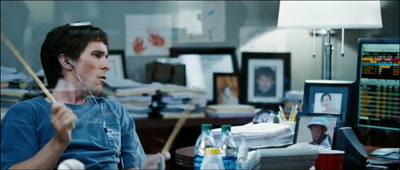
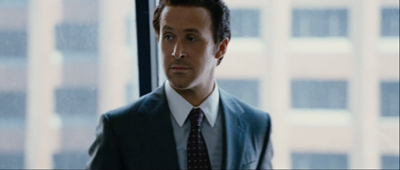
When the film starts, you might think that the awkward hedge-fund manager Michael Burry (Christian Bale) is the protagonist. In the first ten minutes he cryptically outlines his hypothesis that the US mortgage system is fundamentally flawed, and he formulates a plan to exploit it. But then the narration switches to Mark Baum, a hedge-fund manager deeply critical of the banking system.
For several minutes, the narration alternates scenes of each man’s activities, with an emphasis on Burry’s plan to bet against housing bonds and Baum’s inability to come to terms with his brother’s suicide. At the 25-minute mark, Baum’s team gets a misdirected call from stock trader Jared Vennett (Ryan Gosling) and they learn from him that Vennett’s bank is selling collateralized debt obligations.
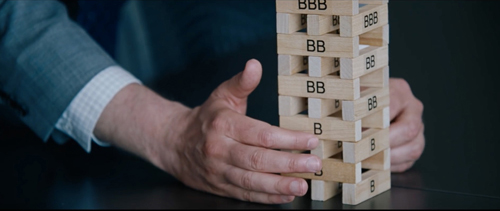
Through a vivid demonstration with building blocks, Vennett illustrates how the rating agencies have overvalued poor housing risks.
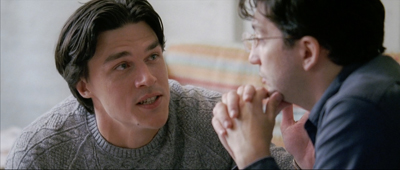
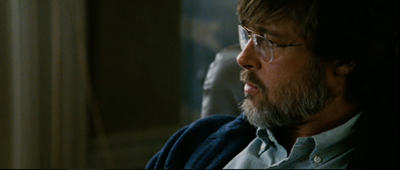
The Complicating Action starts by introducing two more protagonists, Charlie Geller (John Magaro) and Jamie Shipley (Finn Wittrock), who run a small investment company. By chance they find Jared’s presentation and decide to check out its strategy of shorting the housing market. Aided by the retired banker Ben Rickert (Brad Pitt), they get the credentials to buy in.
Their efforts are intercut with Burry’s tracking the market and with Baum’s team visiting Florida, where they discover that indeed house values are under water and mortgage brokers are snapping up unqualified buyers en masse. And the men learn that the rating agencies are routinely lying about the quality of the packages on the market. In the meantime, as mortgage defaults grow, mortgage bonds puzzlingly rise in assigned value.
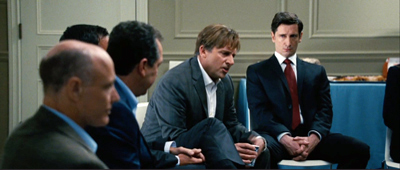
The next turning point, launching the Development, is triggered by the decision of several protagonists to visit a Los Vegas forum on securitization. Baum’s team is instructed by Vennett to simply watch, and they learn about CDOs, though Baum can’t resist challenging the complacency of the banksters he meets. Meanwhile, guided by Rickert, the inexperienced Geller and Shipley hit on a new angle: to bet upon not just the low-rated packages but the A and AA ones. The men leave Vegas convinced that the market will collapse. Soon, though, we get the ups and downs characteristic of a Development, as it seems that our protagonists are all going to lose their shirts.
But their efforts to bet against the US economy pay off when mortgage companies start failing. This initiates the climax. The banks and investment houses struggle to contain the damage, chiefly by shifting the losses to their customers, and soon everyone wants the default swaps our protagonists have bought so cheaply. All wind up rich but disillusioned with the system. As in Spotlight, The Big Short’s epilogue concludes with texts indicating what happened to the protagonists afterward, and hinting that the system could topple once more.
You could imagine The Big Short as a different film, focused around one protagonist and making the others helpers, rivals, or walk-ons. But as a network narrative, it suggests the sheer sweep of financial corruption, as well as a range of response to it, from cynical acceptance (Vennett) to boiling outrage (Baum).
What enlivens the film, and makes it look and feel quite different from Spotlight, is its narrational texture. First, it’s recounted in voice-over by the least emphasized character, Vennett. Second, the film allows characters to address the camera occasionally, like Jordan Belfort in The Wolf of Wall Street, and they sometimes explain that what we’re seeing in the film wasn’t exactly what happened in real life (below left). Third, there are capsule sequences in which unlikely experts like Margot Robbie and Anthony Bourdain explain esoteric financial concepts.
One insert comes from Selena Gomez and economist Richard Thaler. (Get his fine book Misbehaving!)
Throughout, the dramatic scenes are interrupted by flash montages of musical numbers, TV commercials, and glimpses of cheerleaders, overpriced houses, and people living under bridges. This gonzo style, reminiscent of the fragmentary montages of Oliver Stone’s JFK and Harmony Korine’s Spring Breakers, matches the “glum exuberance” of the heroes. They’re simultaneously pumped and appalled. Like the reporters in Spotlight, they keep thinking they’ve hit the bottom of the cesspool only to learn that it’s muck all the way down. This style extends the cross-sectional aspect of the protagonists’ network by suggesting the ripple effects of the subprime crisis.
There are other classical narrative models on display in recent releases. Steve Jobs is a single-protagonist film, but one rendered through block construction. The Hateful Eight seems to me a network narrative in the Grand Hotel mold: several major characters, with initially unrelated goals, converge on a limited space. There conflicts and alliances develop. In addition, more nodes and links in the network are revealed through a flashback. One pattern I haven’t seen this season is what Kristin calls the parallel-protagonist plot, as in The Hunt for Red October and Amadeus. Here two characters with different goals come to learn of one another, chiefly because one becomes fascinated with the counterpart.
I offer these sketches in a descriptive, analytical spirit. Nothing in what I’ve said indicates whether the movies are good or bad. This is like analyzing a fugue or a sonnet: the form is more or less fixed, but each work will handle it somewhat differently. Some will handle it skillfully, some not. And a fuller analysis of even the weakest of these films would show how the classical format encourages filmmakers to devise parallel scenes to show character change (such as the tea-time meeting in Carol), find motifs that develop and pay off (like Mike Burry’s increasingly maniacal drumming), and create call-backs to details that seemed unimportant earlier but that take on bigger roles in the action later (like the dance-fight in Daddy’s Home). It’s also pretty remarkable that the four-part format can be adapted to different roles for protagonists.
What advantages flow from sorting films by narrative strategy instead of by genre or director or period? We can see unexpected continuities between current filmmaking and older traditions. We can show how different principles of plot architecture allow different opportunities for characterization and thematic implication. We can trace how commitment to one sort of plot can open up further choices about point of view and other narrational matters. And once we’ve detected the basic similarity between certain storytelling strategies, we can go on to appreciate the differences film by film.
This is a project in what I’ve called the poetics of cinema. You can learn more about it in the book of that title. A chapter from the book, on the theory of film narrative I propose, is on this site, and there’s a blog entry introducing it. In each of these I consider three major dimensions of cinematic storytelling: narration, plot structure, and the story world. Today’s entry suggests that one feature of the story world, the protagonist, can be shaped by a tradition of plot structure and some features of narration.
Naturally, thinking about protagonists and plot structure isn’t the only way we can analyze movie storytelling. For other tools, see the category Narrative strategies.
As all about us in the blogosphere are listing their top ten films for 2015, we do the same for ninety years ago. Our eighth edition of this surprisingly popular series reaches 1925, when some of the major classics of world cinema appeared. Soviet Montage cinema got its real start with not one but two releases by one of the greatest of all directors, Sergei Eisenstein. Ernst Lubitsch made what is arguably his finest silent film. Charles Chaplin created his most beloved feature. Scandinavian cinema was in decline, having lost its most important directors to Hollywood, but Carl Dreyer made one of his most powerful silents.
The lingering traces of Expressionism vs the New Objectivity
The Joyless Street (1925).
Last year I suggested that German Expressionism was winding down in 1924. It continued to do so in 1925. Indeed, no Expressionist films as such came out that year. What I would consider to be the last films in the movement, Murnau’s Faust and Lang’s Metropolis, both went over budget and over schedule, with Faust appearing in 1926 and Metropolis at the beginning of 1927.
Murnau made a more modest film that premiered in Vienna in late 1925, Tartuffe, a loose adaptation of the Molière play. The script adds a frame story in which an old man’s housekeeper plots to swindle and murder him. The man’s grandson disguises himself as a traveling film exhibitor and shows the pair a simplified version of the play, emphasizing the parallels between the hypocritical Tartuffe and the scheming housekeeper.
The film has some touches of Expressionism but cannot really be considered a full-fledged member of that movement. The lingering Expressionism is not surprising, considering that some of the talent involved had worked on Robert Wiene’s Das Cabinet des Dr.Caligari: screenwriter Carl Mayer, designers Walter Röhrig and Robert Herlth, and actors Werner Krauss and Lil Dagover.
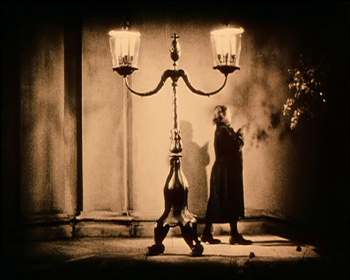
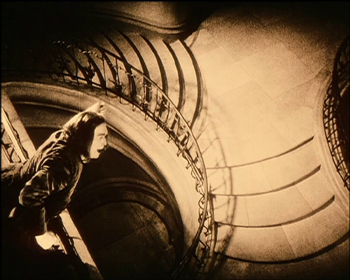
The visuals include characteristically Expressionist moments when the actors and settings are juxtaposed to create strongly pictorial compositions. These might be comic, as when the pompous Tartuffe strides past a squat lamp that seems to mock him, or beautifully abstract, as when Orgon is seen in a high angle against a stairway that swirls around him:
A restored version is available in the USA from Kino and in the UK in Eureka!‘s Masters of Cinema series. (DVD Beaver compares the two versions.) The restoration was prepared from the only surviving print, the American release version; it runs about one hour.
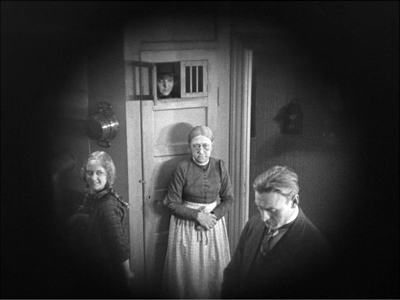
The other German film on this year’s list, G. W. Pabst’s The Joyless Street, contrasts considerably with Tartuffe. It was arguably the first major film of the Neue Sachlichkeit or New Objectivity trends in German cinema. I have already dealt with it in a DVD review entry shortly after its 2012 release. The restoration incorporated a good deal more footage than had been seen in previous modern prints, but it remains incomplete.
Once more the comic greats
The Gold Rush(1925).
For several years now these year-end lists have mentioned Charles Chaplin, Buster Keaton, and Harold Lloyd, in various combinations. Early on it would was Chaplin alone (Easy Street and The Immigrant for 1917) or Lloyd and Keaton alone (High and Dizzy and Neighbors for 1920). In a way most of these films were placeholders, signalling that these three were working up to the silent features that were among the most glorious products of the Hollywood studios in the 1920s. In our 1923 list, each found a place with a masterpiece: Chaplin’s A Woman of Paris, Keaton’s Our Hospitality, and Lloyd’s Safety Last.
This year we may surprise some by giving Lloyd a miss. For years The Freshman was thought of as his main claim to fame, perhaps alongside Safety Last. I think this was largely because The Freshman was the one of the few Lloyd films that was relatively easy to see. (Perhaps also because Preston Sturges dubbed it an official classic by making a sequel to it (The Sin of Harold Diddlebock, aka Mad Wednesday, 1947.) Now that we have the full set of Lloyd’s silent features available, it emerges as a rather tame entry compared to Safety Last, Girl Shy, or our already-determined entries for 1926, For Heaven’s Sake, and 1927,The Kid Brother. Let’s just call The Freshman a runner up.
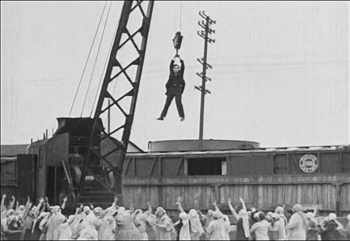
Keaton’s Seven Chances takes one of the most familiar of melodramatic premises and literally runs with it. James Shannon discovers from his lawyer than he stands to inherit a great deal of money if he is married by 7 pm on his 27th birthday–which happens to be the day when he receives this news. A misunderstanding with the woman he loves leads to a split, and in order to save himself and his partner from bankruptcy, Shannon determines to marry any woman who will volunteer in time. Hundreds turn up.
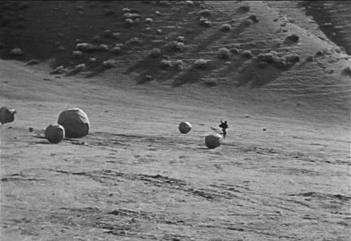
The result is another of the extended, intricate chase sequences that tend to grace Lloyd’s and Keaton’s features, and to a lesser extent Chaplin’s. In fact Seven Chances has a double chase. The first and longer part involves a huge crowd of women gradually assembling behind Shannon as he unwittingly walks along the street. This accelerates and keeps building, exploiting various situations and locales, as when the chase passes through a rail yard and Shannon escapes by dangling from a rolling crane above the women’s heads. Eventually the action moves into the countryside, where the brides temporarily disappear, taking a short cut to cut Shannon off, and he ends up in the middle of a gradually growing avalanche.
Seven Chances is available on Blu-ray and DVD from Kino.
Of all the films on this year’s list, Chaplin’s The Gold Rush is probably the most widely familiar. The Little Tramp character, here known only as a “Lone Prospector,” blends hilarity with pathos in a fashion that is actually typical of relatively few of the director/performer’s films overall. It is, however, how many people think of him.
The Gold Rush looks rather old-fashioned compared with Seven Chances. Although the opening extreme long shots of an endless line of prospectors struggling up over a mountain pass are impressive, much of the action takes place in studio sets, sometimes standing in for alpine locations. Both the cabins, Black Larsen’s and Hank Curtis’, are like little proscenium stages, with the action captured from the front. Yet the film depends on its brilliant succession of gags and on the Prospector’s status as the underdog who is also the resilient and eternal optimist.
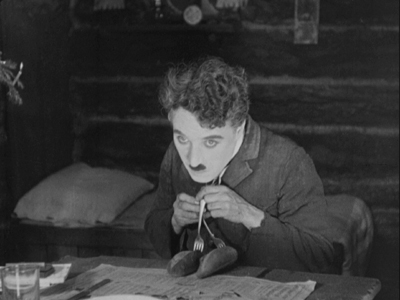
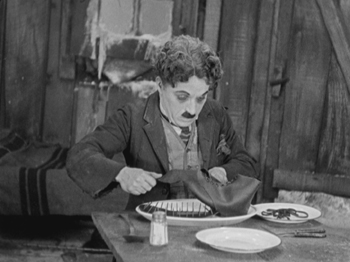
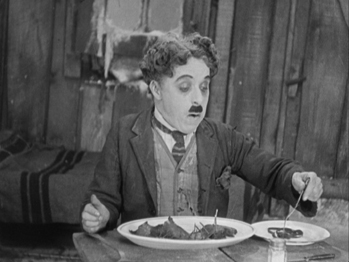
The best bits of humor arise from Chaplin’s ability to create funny but lyrical moments by transforming objects metaphorically. Given the plot, some of the best-known gags arise from meals. One is the dance of the rolls, part of a fantasy sequence in which the Prospector dreams of entertaining a group of beautiful women at dinner (above), when in fact the women stand him up. Trapped by a storm in a remote cabin, the Prospector and his partner cook one of his shoes. He serves it on a platter and carefully “carves it, with the leather becoming the meat, the nails bones, and the laces spaghetti.
Many home-video versions of The Gold Rush have been released, but the definitive restoration of the 1925 version is available from the Criterion Collection.
The Golden Age in full swing
Lazybones (1925).
When people speak of the “Golden Age” of the Hollywood studio system, they usually seem to mean the 1930s and 1940s (and the lingering effects of the system in the 1950s). A look at Hollywood films of the 1920s shows that it was already functioning at full steam. Three features of 1925 display the utter mastery of continuity storytelling and style and a sophistication that matches films of subsequent decades.
Lady Windermere’s Fan may be the best silent made by Ernst Lubitsch, who has appeared on these lists before. It arguably ranks alongside Trouble in Paradise and The Shop around the Corner as one of the best films of his entire career. It’s a loose adaptation of the Oscar Wilde play, but it’s pure Lubitsch throughout.
Anyone who thinks that the classical Hollywood system was merely a set of conventions that allowed films to be cranked out with minimal originality could learn a lot from Lady Windermere’s Fan. Its completely correct use of continuity editing, three-point lighting, and the like does not preclude imaginative touches and methods of handling whole scenes. There’s the sequence when Lord Windermere visits the mysteriously shady lady Mrs. Erlynne in her drawing-room. The camera is planted in the center of the action, with frequents cuts as the two characters move in and out of the frame and even cross behind the camera. There’s not a hint of a mismatched glance or entrance across this complex and unusual series of shots. There’s the racetrack scene, as everyone present watches and gossips about Mrs Erlynne in a virtuoso string of point-of-view shots.
The racetrack scene ends with a wealthy bachelor following Mrs Erlynne out of the track. The camera moves left to follow her, keeping her in the same spot in the frame. As the man gradually catches up, Lubitsch uses a moving matte to hint at their meeting without showing it or cutting in toward the action.
A good-quality transfer of Lady Windermere’s Fan is only available on DVD as part of the More Treasures from American Film Archives 1894-1931. (Beware the copy offered by Synergy, which according to comments on Amazon.com is from a poor-quality, incomplete print.)
The one title on this list whose inclusion might surprise readers is Frank Borzage’s Lazybones. I remember being bowled over by this film during the 1992 Le Gionate del Cinema Muto festival in Pordenone, which included a Borzage retrospective. I found the more famous Humoresque (1920) a disappointment, but Lazybones was a revelation. This is another case of a film that was simply unknown when film historians started writing about the Hollywood studio era. It was not discovered until 1970, when it was found in the 20th Century-Fox archives. As a result, Lazybones was, as Swiss film historian Hervé Dumont put it in his magisterial book on the director, “revealed as the most poignant–and the most accomplished–of Borzage’s works before Seventh Heaven.”
Year by year since we started this annual list, I looked forward to recommending Lazybones, and now we arrive there. I rewatched it for the first time to see if it really deserved to make one of the top ten. The answer is yes. For me, this is as good as 7th Heaven, or as near as makes no difference.
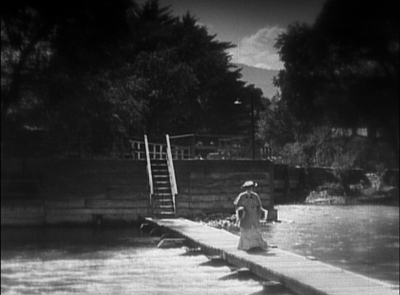
It’s difficult to describe the plot of Lazybones, since it doesn’t have much of one. Steve (played by the amiable Buck Jones) is a very lazy young man living in a rural village. He has a girlfriend, Agnes, whose mother scorns him. The girlfriend has a sister, Ruth, who returns home with a baby in tow. In despair, Ruth leaves the baby on a riverbank and tries to drown herself (image at top of section). Steve rescues her, and she explains that unknown to her family, while she was away she married a sailor who subsequently went down with his ship. She has no proof of this and knows her tyrannical mother will assume that the baby is illegitimate. Steve decides to keep her secret and adopt the apparent foundling himself.
All this happens during the initial setup. Then the little girl, Kit, grows up into a young lady. Along the way, not all that much happens. Steve, lacking any goals, stays lazy, which sets him apart from the energetic, ambitious protagonists of most Hollywood films. Kit is shunned by her classmates and the townspeople, and Steve tries to shelter her from all this. He loves Agnes but quickly loses her to a richer, more respectable man. He goes off to fight in World War I, becomes an accidental hero, and returns home after perhaps the shortest battlefront scene in any feature of the period. Kit finds a boyfriend.
What makes all this riveting viewing is its mixture of quiet comedy and poignancy. Steve is so amiably and unrepentantly loath to work that he is scorned by nearly everyone, and yet he commits an act of great kindness for which he gets no credit at all, except from his devoted mother. It is clear that these snobbish townspeople would scorn him even if they knew how he has kept Kit out of the orphanage and made a happy life for her.
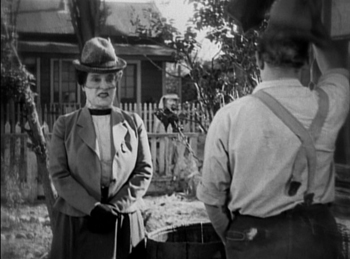
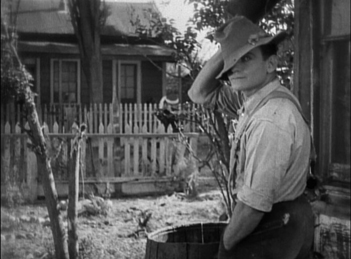
The film is beautifully shot, and Borzage displays such an easy mastery of constructing a scene, particularly in depth, that it is easy to miss the underlying sophistication. Early on, Agnes and her mother arrive at Steve’s house. As Agnes waits outside the fence in the foreground, Steve tips his hat to her, in the foreground with his back to the camera. The mother passes by him toward the house, her mouth fixed in a sneer. We may think that Steve is oblivious to this, but once she passes out of the frame in the foreground, he puts his hat back on and slips it down over his face rather cheekily as he glances at her, his gesture suggesting his indifference to her opinion of him. (Note also the subtle touch of his lazily fastened suspenders.)
Borzage has mastered the use of motifs that are so characteristic of Hollywood cinema. There’s a running gag about the dilapidated gate of the picket fence around Steve’s and his mother’s house, with each person remarking “Darn that gate!” as they struggle through it. The repetition becomes cumulatively funnier because about two decades pass in the course of the film without the thing being fixed. The acting, particularly of Buck Jones and Zasu Pitts (as Ruth), is affecting.
It’s difficult to convey the charms of such an unconventional film, but give it a try and you may be bowled over, too.
A superb DVD transfer of Lazybones was included in the lavish Murnau, Borzage and Fox box (2008). The 20th Century-Fox Cinema Archives series offers it separately as a print-on-demand DVD-R. I’ve not seen it but suspect that there would be some loss of quality in this format. Besides, every serious lover of cinema should have that big black box sitting on their shelves next to the Ford at Fox one.
Returning to the more familiar classics, my final Hollywood film of the year is King Vidor’s The Big Parade.
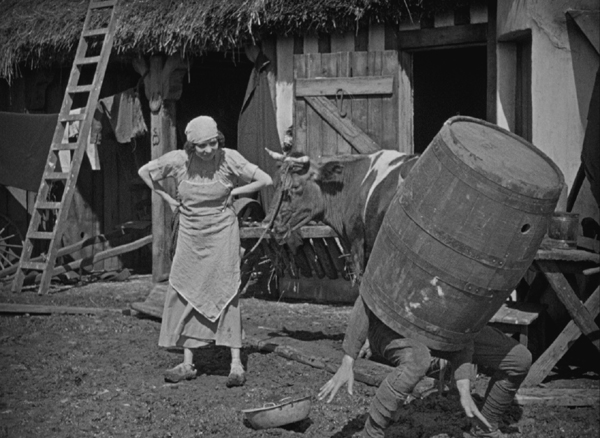
Apart from its success and influence, however, The Big Parade remains an entertaining, funny, and moving film. Vidor’s scenes often run a remarkably long time, suggesting the rhythms of everyday life. One such action involves James fetching a barrel back to where he and his mates are staying so that he can turn it into an outdoor shower. When nearly back, he encounters Melisande, whom he initially can’t see. His stumbling about and her increasing laughter at his antics are played out at length (see top), as is a supposedly improvised scene shortly thereafter where James tries to teach Melisande how to chew gum.
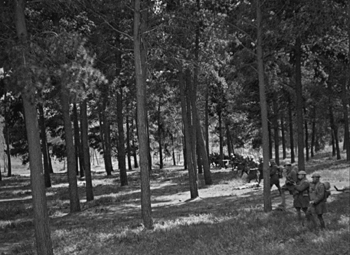
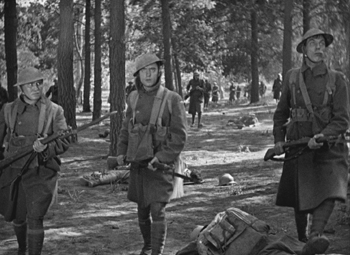
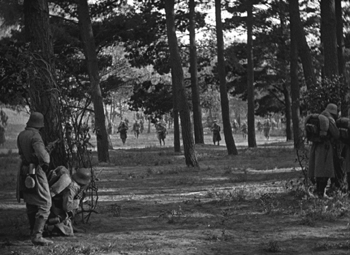
A very different sort of prolonged scene is the long march of James and his comrades through a forest full of German snipers in trees and machine-gunners in nests. They begin by walking through an idyllic-looking forest, then increasingly encounter fallen comrades, and finally reach the Germans.
For years the prints of The Big Parade available were less than optimum, with some based on the 1931 re-release version, where the left side of the image had to be cropped to make room for the soundtrack. A 35mm negative was discovered relatively recently, however, and is the basis for the superb DVD and Blu-ray versions released in 2013.
Finally, I turn you over to David for some comments on films that fall within his specialties.
Eisenstein, action director
Watch this. Maybe a few times.
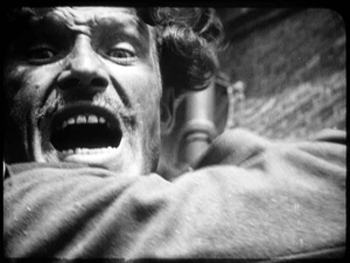
These two seconds, violent in both what they show and the way they show it, seem to me a turning point in film history. Here extreme action meets extreme technique. The spasms of the woman’s head, given in brief jump cuts (7 frames/5/8/10), create a sort of pictorial fusillade before we get the real thing: a line of riflemen robotically advancing into a crowd.
It’s not usually recognized how often changes in film art are driven by showing violence. Griffith’s last-minute rescues usually take place in scenes of massive bloodshed; not only The Birth of a Nation but the equally inventive Battle at Elderbush Gulch use rapid crosscutting to treat a boiling burst of action. The Friendless One’s pistol attack in Intolerance is rendered in flash frames that Sam Fuller might approve of. Later, the Hollywood Western, the Japanese swordplay film, the 1940s crime melodrama, the Hong Kong action picture, and many other genres pushed the stylistic envelope in scenes of violence. Hitchcock’s vaunted technical polish often depended on shock and bloodletting, from a bullet to the face (Foreign Correspondent) to stabbing in the shower (Psycho). The free-fire zone of Bonnie and Clyde and Peckinpah’s Westerns took up the slow-motion choreography of death pioneered by Kurosawa. Extreme action seems to call for aggressive technique, and intense action scenes can become clipbait and film-school models.
Sergei Eisenstein is celebrated as the theorist and practitioner of montage, whatever that is; but he insisted that what he called expressive movement was no less important. Just as montage for him came to mean the forceful juxtaposition of virtually any two stimuli (frames, shots, elements inside shots, musical motifs), so he thought that expressive movement ranged from a haughty tsar stretching his stork neck (Ivan the Terrible) to peons buried up to their shoulders, squirming to avoid horses’ hooves (Que viva Mexico!). In Eisenstein, psychology is always externalized, crowds move as gigantic organisms, and any action can turn brutal. (I fight the temptation to call him S & M Eisenstein.) We can trace influences—Constructivist theatre, the chase comedies coming from America, his interest in kabuki performance—but when he moved into cinema from the stage, Eisenstein became an action director, in a wholly modern sense.
Eisenstein’s first two features bracket the year 1925. Strike was premiered in January, The Battleship Potemkin in December. The first was apparently not widely seen outside Russia until the 1970s, but the second quickly won praise around the world. Potemkin’s centerpiece, the Odessa Steps sequence, became an instant critical chestnut, proof that cinema had achieved maturity as an art. Owing nothing to theatre, this massive spectacle was as pure a piece of filmmaking as a Fairbanks stunt or a Hart shootout. But of course Eisenstein went farther.
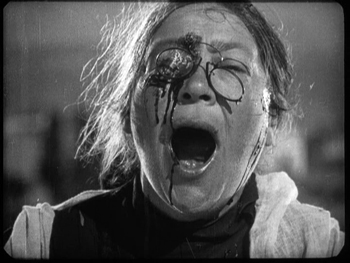
The Steps sequence was probably the most violent thing that anybody had ever seen in a movie. A line of soldiers stalks down the crowded staircase. A little boy is shot; after he falls, skull bloodied, his body is trampled by people fleeing the troops. Another man falls, caught in a handheld shot. A mother is blasted in the gut, and her baby carriage, jouncing down the steps, falls under a cossack’s sword. A schoolmistress who has been watching in horror gets a bullet in the eye–or is it a saber slash? The sequence ends as abstractly as it began, if “abstractly” can sum up the horrific punch of these images.
The film is much more than this sequence, of course, but every one of its five sections arcs toward violence, and each payoff is shot and cut with punitive force. The mutiny itself is a pulsating rush of stunts, unexpected angles, and cuts that are at once harsh and smooth. The whole thing starts with a rebellious sailor smashing a plate (in inconsistently matched shots) and ends with the ship confronting the fleet, a challenge rendered by percussive treatment of the men and their machines.
In Strike, Eisenstein rehearsed his poetry of massacre, along with a lot of other things. Instead of rendering an actual incident, as in Potemkin, here he portrays the typical phases any strike can go through. The plot starts with injustices on the shop floor, escalates to a walkout, and then—of course—turns violent, as provocateurs make a peaceful demonstration into a pretext for harsh reprisals. Throughout, Eisenstein experiments with grotesque satire and caricature. The workers are down-to-earth heroic; the capitalists are straight out of propaganda cartoons; the spies are beastly, the provocateurs are clowns. Every sequence tries something new and bold, and weird.
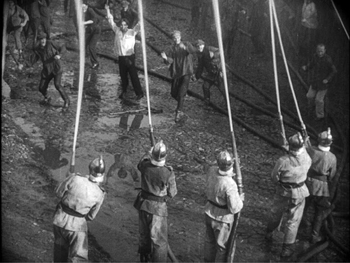
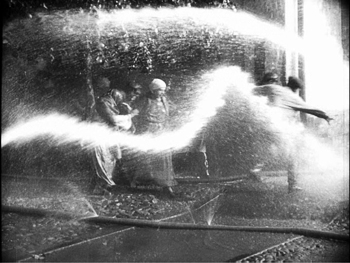
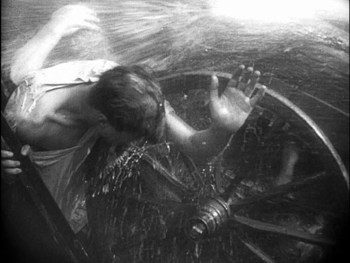
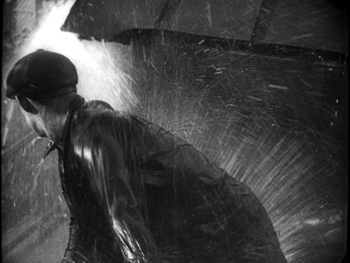
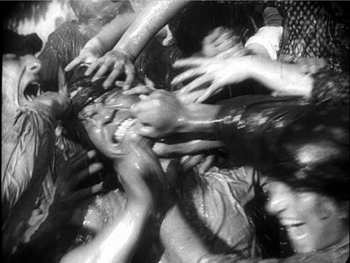
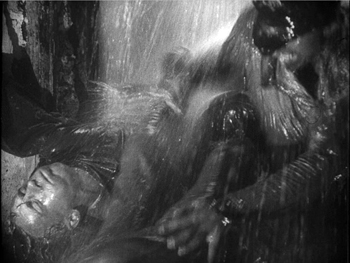
The most famous passage, well-known from his writings if not from actual viewing, is the climax. Here a raid upon workers in their tenements is intercut with the slaughter of a bull. Montage again, of course, but what isn’t usually noticed is the remarkable staging of that police riot, with horsemen riding along catwalks and fastidiously dropping children over the railings. For my money, more impressive than this finale is the earlier episode in which firemen turn their hoses on the workers’ demonstration. The workers scatter, pursued by the blasts of water, until they are scrambling over one another and pounded against alley walls. This is Strike’s Odessa Steps sequence, and for throbbing dynamism and pictorial expressiveness–you can feel the soaking thrust of the water–it has few equals in silent film.
For Eisenstein, the bobbing, screaming head in my clip was the “blasting cap” that launched the Odessa massacre. Is the woman the first victim of the troops, or is her rag-doll convulsion a kind of abstract prophecy of the brutality to come? Yanked out of the actual space of the action, it hits us with a perceptual force that goes beyond straightforward storytelling. Kinetic aggression, making you feel the blow, is one legitimate function of cinema. Eisenstein is our first master of in-your-face filmmaking.
After many tries, archives have given us superb video editions of Potemkin and Strike, both available from Kino Lorber. Potemkin’s original score captures the film’s combustible restlessness. Strike seems to have been shot at so many different frame rates that it’s hard to smooth out, but the new disc makes a very good try, and it’s far superior to the draggy Soviet step-printed version that plagued us for decades.
Chamber cinema
Every so often a filmmaker decides to accept severe spatial constraints, creating what David Koepp calls “bottle” plots. Make a movie in a lifeboat (Lifeboat) or around a phone booth (Phone Booth) or in a motel room (Tape) or in a Manhattan house (Panic Room) or in a remote cabin plagued by horrors (name your favorite). In the 1940s several filmmakers were trying out a “theatrical” approach that welcomed confinement like this; Cocteau’s Les Parents terribles, H. C. Potter’s The Time of Your Life, and of course Rope are examples. Today’s filmmakers are still exploring “chamber cinema.” The Hateful Eight is the most recent instance, with most of its chapters set in Minnie’s Haberdashery.
Typically, the chamber films in any period aren’t “canned theatre” like the PBS or English National Theatre broadcasts. Chamber films push the camera into the space, often showing all four walls and letting us get familiar with the rooms the characters inhabit. But this requires not only a carefully planned setting but also a good deal of cinematic skill in smoothly taking us to the primary zones of action.
Carl Dreyer was one of the earliest exponents of chamber cinema. He had seen initial examples in German Kammerspiel (chamber-play) films like Sylvester (1924) and had made a mild version himself in Michael (1924). Dreyer took the aesthetic to new heights in The Master of the House (1925).
Long before Akerman’s Jeanne Dielmann, Dreyer gave us a film about housework. Ida’s husband Victor is unemployed, so while he loafs and drifts around town, she struggles to keep things going. He pays her back with scorn and abuse. The plot is structured around two days, which yield a before-and-after pattern. At the end of the first, Ida leaves Victor, and a month later, his realization of his mistakes is revealed by his behavior in the household. The drama comes not only from the characters’ conflicts but from the way they handle everyday things like butter knives and laundry lines.
Rendering the household in all its specificity obliges Dreyer to rethink continuity filmmaking. He lays out the geography of the home by shooting “in the round” and cutting on the basis of eyelines and frame entrances. (He displays the same confidence in the “immersive camera” that Lubitsch displays in Lady Windermere’s Fan.) He trains us to notice landmarks, to associate bits of action with particular areas of the apartment, and to sense the characters’ changing emotions in relation to small adjustments in composition. The film is an exceptionally fluid, assured one, and it prepares for more daring Dreyer experiments to come: the fragmented interior spaces of La Passion de Jeanne d’Arc, the creeping camera of Vampyr, and the intensely theatricalized late films Day of Wrath, Ordet, and Gertrud. Little-known at the time, The Master of the House has come to be regarded as one of the most quietly perfect of silent films.
The most lustrous edition of The Master of the House is the Criterion release. It contains an in-depth interview with Danish film historian Casper Tybjerg and a visual essay that Abbey Lustgarten and I prepared. Criterion has posted an extract from the essay. More about this release is here.
In connection with the eleventh edition of Film Art: An Introduction, to be published in mid-January, we have added ten new online Connect video examples. These include one based on clips from the Blu-ray of The Gold Rush, which the Criterion Collection has kindly allowed us to use. We discuss two contrasting styles of staging used for comedy effects in the isolated cabin set.
Lea Jacobs and Andrea Comiskey have examined the complicated early distribution of The Big Parade in their “Hollywood’s Conception of Its Audience in the 1920s,” The Classical Hollywood Reader, Steve Neale, ed. (Routledge, 2012), p. 97.
Eisenstein’s aesthetic of expressive movement, and its relation to montage, is discussed in David’s The Cinema of Eisenstein. On Dreyer’s “theatricalized” cinema see his The Films of Carl Theodor Dreyer, and this essay on its sources in 1910s tableau filmmaking. Eisenstein’s exactitude in matching gesture to sound and cutting is demonstrated in Lea Jacobs’ Film Rhythm after Sound, reviewed here.
Lev Kuleshov’s second feature, The Death Ray, doesn’t make our top-ten list for 1925, but as a bonus we include its poster (by Anton Lavinsky), which must rank among the most beautiful of that year.