






Archive for the 'Film comments' Category
Vancouver: First sightings

Big Tech as Pac-Man: The New Corporation: The Unfortunately Necessary Sequel (2020).
DB here:
Every festival has had to adjust to COVID-19. This year the venerated Vancover International Film Festival continues with some in-person events at the VIFF Centre and the Cinematheque, but most of the screenings are done remotely. The streaming resource is available only in British Columbia and is a wonderful option for regional cinephiles.
Over the next two weeks, we’ll continue our annual tradition of covering some of the outstanding films mounted by this superb festival. As usual, we hope to guide local viewers while the event is in progress and to signal readers about upcoming releases in their territories.
Deep dives
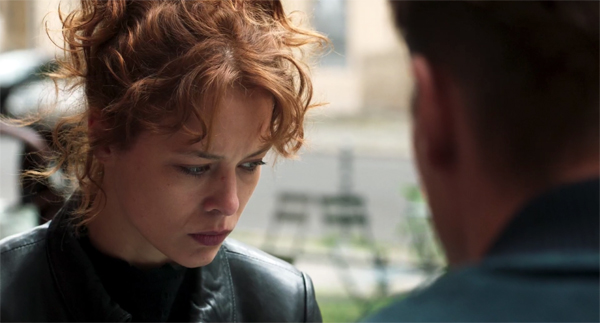
Undine (2020).
No lyrical drone vistas, no establishing shot, no title telling us where and when we are, no voice-over trying to lure us in. Just bam, here it is, deal with it. Any movie that starts with a reaction shot in OTS (over the shoulder) of a fiercely downcast woman gets points automatically. The fact that she goes on to threaten to kill the man she’s talking to is just a bonus.
That threat, made by the protagonist of Christian Petzold’s Undine, is about the only hint that she’s capable of homicide. She seems otherwise a well-adjusted young woman free-lancing as a guide in Berlin’s Urban Development Center. As in other Petzold films, thriller conventions are invoked but suspended while a deepening personal drama emerges. At first, we tag along with Undine in her rebound-affair with Christophe, an engineer specializing in repairing underwater equipment. All is going well enough, but there are signs of trouble, particularly a near-death experience in a lake. Then, after the midpoint, tension ratchets up with two quick twists that put new pressure on Undine to take violent action.
Sorry to be so oblique, but this is one of those movies with a real plot, and since it’s eventually coming to the US, I’m avoiding spoilers. Admittedly, the last twenty minutes take off into new territory, and I found myself unable to know what to expect next. (It’s one of those movies that seems to end several times. That is often a good thing.) But the unruffled precision of Petzold’s direction, the thriftily paid-out backstory, and his gift for suspenseful storytelling mitigate the quasi-supernatural tint of the twists. I tend to see them as GOFAC (Good Old-Fashioned Art Cinema), ambiguous moments that may flow from the characters’ imaginations.
An undine is a water nymph, the heroine’s lover is a diver, her job is to lecture on the rebuilding of Berlin over the years, and his job is to explore a submerged city (which hosts a slab bearing her name). All this was for me a reminder that ambitious directors can invest genre conventions with poetic lyricism. Admirers of Barbara (2012), Phoenix (2014), and Transit (2018) will need no urging to visit a film I found completely absorbing.
A film from two billion years from now
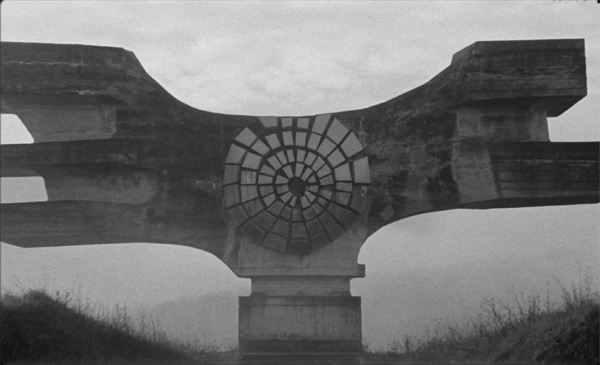
Last and First Men (2020).
On the visual level, Jóhann Jóhannsson’s Last and First Men is a good example of what we call “abstract form” in our book Film Art. The filmmaker builds a film out of patterns of sensuous visual qualities. Everyday objects can yield these qualities (our example is Ballet Mécanique), but abstract form can also be found in unusual, even unidentifiable sources.
That’s what we get here. The shots reveal structures and textures in immense, brutal constructions of metal, stone, and cement. Are they sculptures? Totems of some bizarre religion? Remnants of blasted modernist buildings? Fragments of space ships crashed to earth? The moving camera reveals their shapes, textures, and off-kilter strains for symmetry. You lose all sense of scale: these might be the size of dinner tables or tabernacles. Most are set against the sky, alternately misty or searingly bright.
No story connects our views of these strange monuments. On the soundtrack, though, a woman’s voice recounts the history of the future. After two billion years, the narrator represents the “eighteenth species” of humans, and via telepathy she informs us of the impending end of human life on Neptune.
We never see any of those events, just the ruins calmly surveyed by the camera. Almost never does the commentary sync up with the shots. The woman’s account of future humans might at first seem to match the carved, staring blocks we see, but she goes on describe them as furry or translucent.
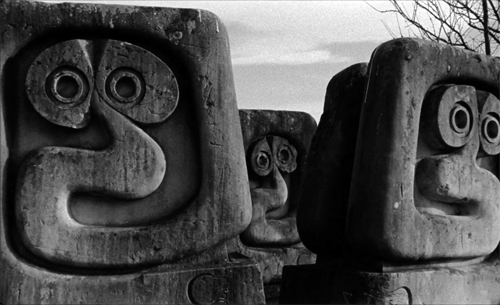
The disparity between description and depiction emphasizes the gap between tracks.
For most of the film, then, we have a split. The image track explores abstract, nonnarrative form. The soundtrack supplies a narrative, actually a Very Grand Narrative. The text, it’s revealed in the credits, comes from Olaf Stapledon’s 1930 science-fiction novel, Last and First Men.
There’s yet a third layer. Jóhannsson, a brilliant composer who died in 2018, gave us memorable concert music and film scores (Sicario, Arrival, The Miners’ Hymns). Along with the voice-over we hear a sometimes radiant, sometimes jarring orchestral accompaniment created by Jóhansson and electronic composer Yair Elazar Glotman. The music doesn’t cooperate much with the voice-over. As the commentary proceeds with a businesslike dryness, the music often flows and eddies on its own course.
The fact that the three channels of picture, voice, and music seldom converge actually sets your imagination free. There’s no need to see the images as illustrating the text, or the music as operatically enhancing either one. We’re allowed to keep the realms separate, or to test obscure correspondences. We can, for instance, see the expressive qualities of the shots as enduring remnants of human will–eccentric, obstinate, and obscure as it can be. The music’s alternation of drone passages, scraps of choral lyricism, and ominous rumbles might seem to chart humans’ up-and-down fate in the late Anthropocene. The narration, recited by Tilda Swinton, adds a quality of stoic dignity to the mix. And you’re invited to try out metaphors, as when cavities in what seems to be an elongated cathedral suggest eyeholes for staring across space.
The disparity of channels is enhanced by another mystery I haven’t seen mentioned in reviews. The images betray their origins on 16mm film. There are light leaks on the frame edges, specks of white suggesting dust on the negative, and even bits of grit and hair in the aperture. Perhaps you can see the hair snagged in the upper right of the image below.
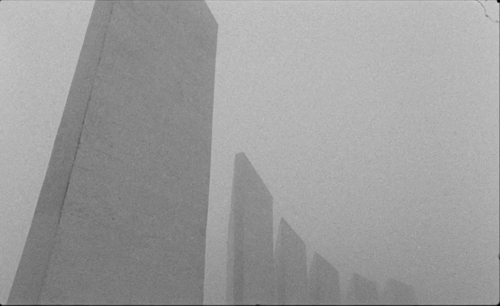
These flaws have not been digitally removed. Indeed, the film’s opening moments linger on black frames flecked with white dust, priming us to watch for faults in these images.
The effect is to add an archaic quality, as if this is all found footage from long before the end recounted on the soundtrack. Since the narrator tells us that humankind goes through many near-extinctions until the big one, these relics may be from one of those future collapses–or, perhaps, from our own past, remnants of a calamity we’ve forgotten. The text speaks of “the debased rites of your religions long ago,” and those big-eyed humanoids are reminiscent of Australian aboriginal art.
In all, it’s a bleakly beautiful experiment. The film premiered with live orchestral accompaniment in the 2017 Manchester International Festival, and it must have been hypnotic. The film and soundtrack are now available on a CD/Blu-ray combination, as well as on vinyl.
Meet the New New Boss, same as the Old New Boss

The New Corporation: The Unfortunately Necessary Sequel (2020).
The scathing 2003 documentary The Corporation took seriously the idea that corporations were persons. Their behavior, considered clinically, is that of a sociopath. Now Joel Bakan and Jennifer Abbott’s followup shows how the 2008 financial crisis provoked corporations to rehabilitate. Hip CEOs admit the existence of racial bigotry, income inequality and the failures of conservative government. The solution? More corporate power. Did this make them any less dangerous?
Nope. Multinationals shape government policy as vigorously as ever, especially in the era of Trump and other demagogues. But the corporations’ new message is soft power. Posing as socially committed, emphasizing stakeholders as well as shareholders, Big Business is (a) trying to convince consumers that it’s on their side; and (b) arguing that the New Corporation will correct the shortcomings of government policy through privatization. In other words: We’ve learned our lesson. We get it. So let us run things. Besides, what choice do you have?
Bakan and Abbott shrewdly show that this ploy neatly fits an updated clinical symptom of the sociopath: “Use of seduction, charm, glibness, or ingratiation to achieve one’s ends.”
The film begins with a fascinating visit to the Davos Forum, where air-kissing one-percenters solemnly assure us that everybody wins when a corporation acknowledges the public good. The star player is Jamie Dimon, CEO of JP Morgan Chase. Having helped crush American cities in the financial crisis (and paying a derisory $13 billion fine), he is now playing rescuer by supporting the rebuilding of Detroit, to the benefit of his company’s image. The film goes on to trace how the public face of caring executives is belied by business as usual, most savagely British Petroleum’s catastrophes in Texas City and at Deep Water Horizon.
Bakan and Abbott marshall a great deal of evidence to show how the plutocracy, and especially those in the digital technology sector, have turned a market economy into a market society. For us, the role of worker-consumer redefines the other dimensions of civic life. You work without union protections and scramble to keep up. You give your personal information to Facebook, Google, and Amazon in exchange for convenience and lower costs. (The old adage holds: If something is free, the product is you.) Schools, postal delivery, war, water, and relationships are all ripe to be rendered as private enterprise. With AI algorithms, the customer-customized milieu of Minority Report is already here.

Talking heads, from Chomsky and Robert Reich to Diane Ravitch and Vandana Shiva, offer pithy critiques, and footage garnered from around the world illuminates each of the points in the Corporate Playbook. As a counterweight, later portions of The New Corporation show some pushback. Katie Porter poleaxes Mr. Dimon in a House hearing, and we glimpse AOC in her usual passionate eloquence. Still, the emphasis falls less on pols and more on citizens who struggle against corporate power.
Occupy Wall Street and the Bernie Sanders campaign are shown to be as important to the left as the Tea Party was to the right. The filmmakers give special attention to the efforts of many tough, idealistic people to run for public office. As one commenter puts it, “Even in the worst situations, people always fight.” In a remarkable passage, a dopy prankster from The Corporation is shown to have become a proud progressive after seeing the first film and joining the Sanders campaign.
The film is startlingly up-to-date, incorporating events around the George Floyd atrocity and the Black Lives Matter street actions. Some will say that the late sections drift a bit from the film’s core message of analyzing the fake social concerns of the New Corporation. But income inequality and environmental destruction, central drivers of new social movements, are invoked in corporate PR as vital concerns for companies’ new image, so the final sequences don’t seem to me tacked on. They show what real social engagement, as opposed to panting coverage in Forbes, looks like.
Where do you start? someone asks in Tout va bien. The answer: Everywhere at once. I think The New Corporation indicates that this might just work.
The three films I’ve discussed are exemplary of the strengths that have characterized the Vancouver festival for its 39 years. Here you can plunge into international auteur cinema, unusual experimental work, and documentaries committed to our noblest aspirations. Programmers Alan Franey, PoChu AuYeung, and their colleagues scour the world for provocative films, and the results have taught Kristin and me lessons about cinema we wouldn’t have learned otherwise. It’s worth noting that VIFF’s welcome to Canadian cinema has always been fruitful: The New Corporation, like its predecessor, is a British Columbia production and is featured in the festival’s ongoing True North series.
Fourteen years ago I wrote that Vancouver was the very model of a regional festival, at once deeply local and unpretentiously cosmopolitan. It still is. Take that, corornavirus! Nothing stops dedicated film lovers.
Thanks to Alan Franey, Jane Harrison, and their colleagues for their help during the festival.
A sensitive review of Undine is offered by David Hudson at the Criterion Daily.
A note on Last and First Men: In watching the film, I found myself constantly asking if these structures really existed, or whether they were CGI creations or miniatures or objects purpose-built for the film. Some reviews have revealed their secret identity, and knowing what they are does raise some interesting thematic implications. But I’m refraining from telling you because I think your first encounter with the film ought to include that mystery about what exactly you are seeing. If you want to know what they are, Google is at your service. There’s also this spoiler-filled behind-the-scenes video.
Jennifer Abbott has another documentary in this year’s festival: The Magnitude of All Things. I look forward to it.
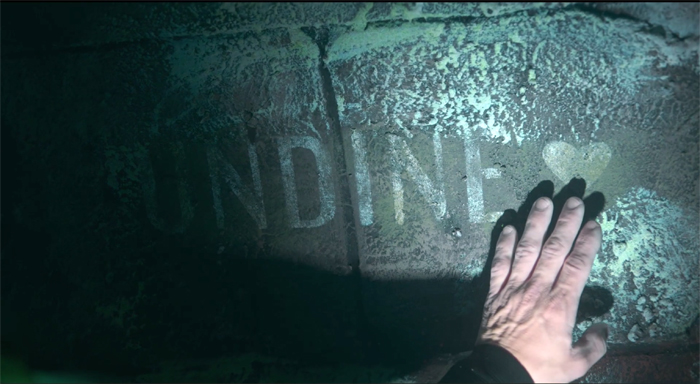
Undine (2020).
Welcoming Jews as heroes in an alternate 1924 Vienna
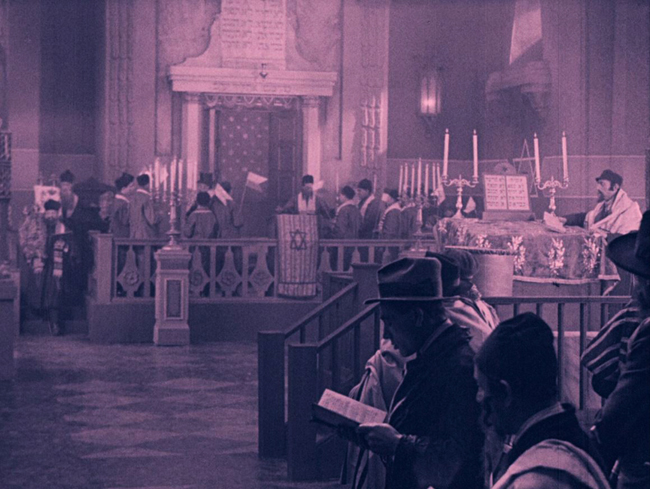
The City without Jews (1924).
Kristin here:
Once again Flicker Alley has released a restoration of a film that few have ever heard of. But we all should have heard about this one. And we should have wanted to see it. Now we can.
The City without Jews (Die Stadt ohne Juden) is an Austrian silent film released in 1924 and directed by H. K. Breslauer. It falls into the brief cycle of films about Jews released in the first half of the 1920s. I’ve written about this briefly in regard to Flicker Alley’s earlier Blu-ray of another film in this cycle, E. A. Dupont’s Das alte Gesetz (1923). The other notable Jewish-themed films are the Expressionist classic Der Golem: Wie er in der Welt kam (Paul Wegener and Carl Boese, 1920) and Carl Dreyer’s first German film, Die Gezeichneten (“The Stigmatized Ones,” called in Danish Elsker hverandre, or “Love One Another,” 1922). Thus The City without Jews is, as far as I know, the last entry in this cycle.
The Russian Revolution and civil war had driven many “Eastern Jews” into Europe, and they, created an anti-immigrant sentiment that grew into a more generalized intolerance toward the more assimilated Jews already in these countries. The earlier films had made little reference to the current growth of antisemitism in Europe and particularly in Germany and Austria. Der Golem was a period fantasy, Dreyer’s film dealt with pogroms in 1905 Russia, and Das alte Gesetz was a drama largely about conservative attitudes toward assimilation within the Jewish community.
Beslauer’s film was based on a satirical novel of the same name (1922) by Hugo Bettauer. It has proven his most famous novel, though undoubtedly in film circles he is best known as the author of Der freudlose Gasse, the source for G. W. Pabst’s 1925 classic of New Objectivity. Bettauer was a controversial figure, given the rising right-wing extremism in the mid-1920s. Perhaps spurred by the release of the film, a dental technician and member of the National Socialist Party assassinated Bettauer in early 1925; the assassin was sentenced to 18 months in a mental clinic and then walked free.
Despite an initial success in Vienna, The City without Jews was shown only a few times abroad, in various censored or abridged versions. The last known screening was in the Netherlands in 1933, as a anti-Nazi film. Portions of an incomplete print of that version, added to reels found in 2015 in a Parisian flea market, formed the basis of the current restoration. Given its sources, the result can hardly be identical to the original, but it plays very smoothly, and there are no noticeable remnants of gaps or re-editing. An account of the restoration is offered by Anna Dobringer as one of several brief essays in the booklet accompanying the dual DVD/Blu-ray release by Flicker Alley.
A satirical, serious picture of antisemitism
Of the four Jewish-themed films mentioned above, The City without Jews is the only overtly political one. Beslauer’s film, the action takes place in “Utopia,” a thinly disguised Vienna (where the film was shot), and many of the main characters are the Councillors and Chancellor.
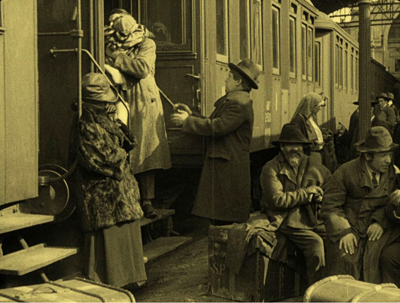
The film starts by emphasizing that assimilated Jews already established in Utopia worship alongside the recent Eastern Jews, as suggested by the two foreground figures in the opening synagogue scene (see top). The government finds it convenient to blame various problems, such as rising prices and unemployment, as well as the fall of the country’s currency, on the Jewish population. With mounting popular unrest, the Chancellor accedes to the idea of expelling all Jews from the city.
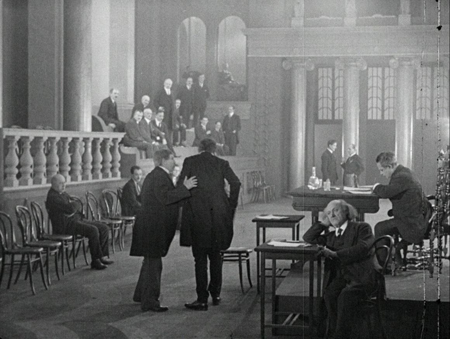
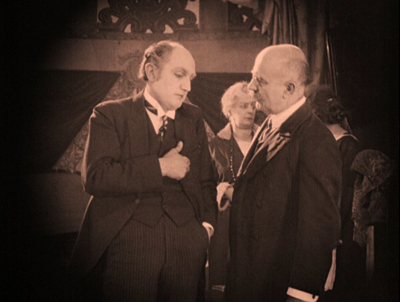
The result is a rather uneasy balance in the early portions of the film between satirical views of the local politicians, officials, and businessmen, and the very real sufferings of the Jews and their Christian supporters and spouses. (The film is a quite polished and expensive production, as the legislative chamber, above, shows.) The Christian officials are treated as caricatures, rather similar to the way officials are portrayed in Soviet films of the second half of the 1920s–which Breslauer, of course, could not have seen.
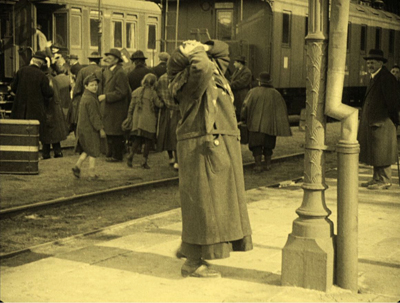
The scenes of the entire Jewish population being expelled, on the other hand, is treated quite seriously and fairly realistically. Scenes of families being dragged out of their homes are not at all humorous, and the departure en masse by train calls to mind methods that were to be used in reality little over a decade later–though here the trains are ordinary passenger ones rather than cattle-cars.
A rather odd premise which the film emphasizes is the impact that the expulsion has on marriages between Jews and Christians. No fewer than five mixed couples of various classes are made prominent, and all are ripped apart. One involves a rabid anti-Semite, portrayed as a drunken dolt. His daughter has married a Jewish man, and they have a daughter. The scene of the husband’s departure shows the anti-Semite (in dark coat at the center below) grieving along with his daughter as they watch the little girl saying good-bye to her father.
The author and filmmakers seem to understand well the familiar phenomenon of the bigot who is only brought to sympathize when people who are discriminated against turn out to be members of their own family.
Pure satire takes over
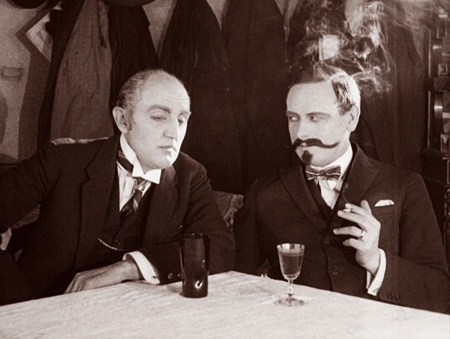
Once the Jews are gone, the satirical approach fully takes over. It turns out that the Jews had been the foundation of everything good and strong in the Utopian society. Businesses collapse, the currency falls, foreign countries boycott Utopia, and foreign banks (being controlled by Jews) refuse to loan the failing government money. The Chancellor and his allies lament that they no longer can blame the Jews for these problems.
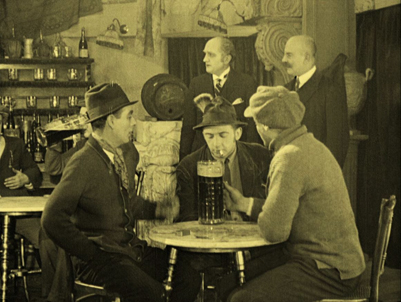
More amusingly, the culture falls apart. High society people who had only dressed elegantly because Jews did decide that they don’t need to buy the latest fashions. One powerful businessman who runs an expensive ladies’ clothes emporium discovers that his establishment is no longer profitable (below left). Austrian men abandon their dignified suits and revert to their casual clothes and giant tankards of beer (right). The sophistication associated with the Jews has disappeared. (All this forgets the recently arrived Eastern Jews, with the action concentrating on the very much assimilated ones.)
Among the five Jewish-Christian couples separated by the expulsion is Leo Strakosch, who is engaged to the daughter of one of the local Councillors. He emerges as the film’s protagonist, returning to Utopia in the persona of a Parisian painter and Roman Catholic. His disguise makes him look like a thinner version of Dr. Mabuse (top of this section), and one suspects that Lang’s two-part film, released in 1922, had not gone unnoticed.
Like Mabuse, Leo manipulates the dire political situation, campaigning for a repeal of the expulsion order and a return of the Jews as the only way to save Utopia’s situation. He does so, of course, in a good cause. Ultimately the decision concerning the repeal hangs on a single vote lacking for the two-thirds majority needed to rescind the order.
Leo gets one of the Councillors drunk and sends him away during the vote, thus causing the repeal to succeed.
The result is a huge success. Jews return, sales and the currency rise, mixed couples are re-united, and the government now credits the returning Jews with the restoration of the country’s health. Strakosch, now out of his disguise, is greeted as the first returnee by cheering crowds and bouquets.
Expressionism as revenge
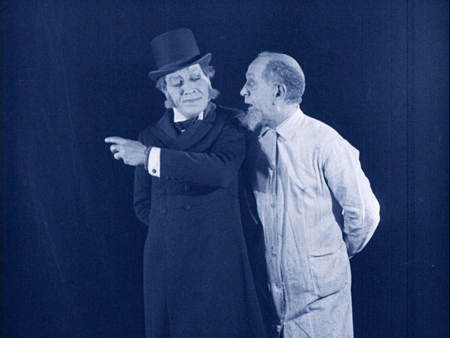
The drunken Councillor whose lacking vote caused the return of the Jews ends up in a scene that quite explicitly imitates the end of The Cabinet of Dr. Caligari. He dreams of being imprisoned in a cell with Jewish stars built into the scenery (see bottom). He recoils in horror at the sight. This is followed by a shot of a doctor (above) who declares, “A strange case of delirium, my dear colleague. The man imagines himself to be a Zionist.” I dearly hoped that he would go on to say, “I think I know how to cure him now,” but it was not to be. Obviously the diagnosis is completely wrong, since the Councillor is terrified by the Jewish imagery in his cell. But of course, Dr. Caligari’s diagnosis may have been wrong as well.
The film is accompanied by a charming score, provided by pianist Donald Sosin and violinist Alicia Svigals. For a list of bonus materials, click on the link at the top of this post.
The City without Jews has fallen into the state of an obscure film, no doubt, but it deserves more attention now than it received at the time of its release. It has become a cliché to point out that a film of the past speaks to our current world situation. Still, this film does.
Thanks to Jeffery Massino and the team at Flicker Alley!

PLANET HONG KONG comes to . . . Hong Kong
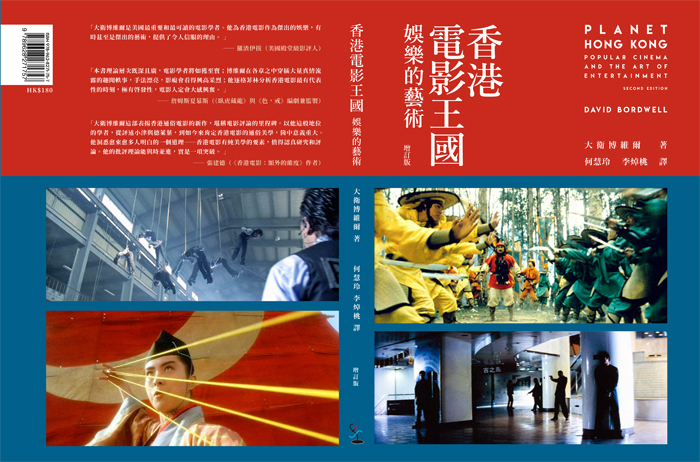
The Hong Kong Film Critics Society has just published a Chinese long-form translation of the second edition of my Planet Hong Kong: Popular Cinema and the Art of Entertainment. It can be ordered from the HKFCS bookshop. Sample pages and further information can be found here. I’m grateful to Li Cheuk To, Alvin Tse, and their colleagues for preparing and checking the text and finding nice pictures.
That second English-language edition dates back to 2011–a distant past in terms of the rapid changes in world cinema. So for this translation, I wrote a postscript last year, and at the suggestion of Cheuk To I’m posting it here. The book is dedicated to Ho Waileng.
Revisiting Planet Hong Kong

Raymond Chow Man-Wai and Louis Cha Jin Yong both died in 2018. Journalists seeking a strong hook might take these unhappy departures as emblematic of changes in Hong Kong film culture—marking the “end of an era,” as we say. But Chow retired from the scene in 2007, and Cha finished revising his classics at about the same time. They stand, of course, as towering figures in Chinese cinema, but from my perspective today’s Hong Kong film is for the most part continuing processes that started quite far back. In other words, and much to my regret, the golden era ended some time ago.
I wrote the first edition of Planet Hong Kong in the late 1990s. As I explain in the book, I had been watching some Hong Kong films since the 1970s and got interested in the 1980s creative developments. By 1995, when I first visited the territory, those developments were already fading, though that wasn’t obvious to me. The local market was becoming unstable, regional tastes and investment sources were shifting, and the mainland economy was expanding. That age, undeniably golden, was ending.
When I interviewed local executives for the book, some said that they thought Hong Kong could become the “Hollywood of China.” Perhaps, they thought, all the experienced talents and financial and technical resources of the territory would be much sought after as China opened up its market.
By the time I came to revise the book in the early 2000s, such idealism had waned. As you’ll see in the pages that follow, it became obvious that Chinese authorities had shrewdly manipulated the market and the infrastructure to build up a powerful domestic industry. The rise of that industry, along with the waning of Hong Kong film, led to the biggest growth of a national film business ever seen in history. And those processes would assimilate Hong Kong creative talent on the mainland’s terms.
Now, as the 2010s come to an end, it seems that all the trends that I traced in the 2011 edition have continued, even accelerated. From 263.8 million viewers in 2010, mainland attendance has risen to over 1.6 billion in 2017. In 2010, the mainland claimed theatrical revenue of US$1.5 billion; in 2017 those were $8.27 billion. According to official figures, 970 feature films were produced in 2017. Although most of those were not released theatrically, it still remains a colossal achievement.
Over the same period, Hong Kong cinema continued in stasis. Production hovered between 42 and 64 annual releases. Theatrical admissions were likewise fairly flat, at an average of 25 million a year. Box-office revenues in 2010 came to US$179.4 million, and moved to $237.9 million in 2017. This is a substantial increase, but rising ticket prices (seen in every film culture) is likely one cause. Part of the rise, which occurred in the mid-2000s, is probably due to the emergence of 3D exhibition, which yields premium ticket pricing. And the greater part of that box office did not accrue to local films.
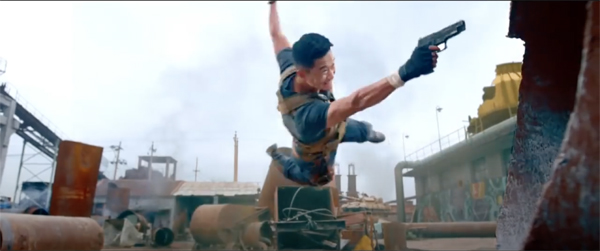
Certainly Hong Kong professionals at all levels were important resources for the growing mainland industry. Stars were and still are sought for major roles, and figures from decades ago, such as Chow Yun-fat, Tony Leung Chiu-wai, Shu Qi, and Andy Lau Tak-wah, can still draw audiences. Directors Tsui Hark, Jackie Chan, Stephen Chow Sing-chee, Peter Chan Ho-sun, Chang Pou-soi, Wong Jing, Johnnie To Kei-fung, and Stanley Tong Gwai-Lai found success in China, mostly with coproductions. The biggest coup of the era, Wolf Warrior 2 (2017; above) with its 154 million admissions, came from Wu Jing, a veteran actor and martial artist in Hong Kong films. Just as important, Edko, Emperor Motion Picture Group, and other local companies gained from producing movies for the mainland audience.
More broadly, the mainland box office was keeping Hong Kong film alive. A “local” film was likely to have mainland investment, and when it played there it had a good chance of making much more money than at home. SPL 2: A Time for Consequences (2015) took in less than US$2 million in Hong Kong but won over $90 million in China. Wong Jing’s From Vegas to Macau 2 of the same year captured $154 million there, as opposed to $3.6 million in Hong Kong. Through the 2010s, even a moderate success on the mainland could recoup far more money than it could in the tiny local market. To some extent the growing market to the north replaced the regional South Asian market that had sustained Hong Kong film in earlier decades. (How that market was lost is traced in Chapter 3.)
China cultivated homegrown directors as well, especially those who adapted conventions of Hong Kong and South Korean romantic drama and comedy to the local milieu. For any year, then, the top twenty films at the Chinese box office typically consisted of a mix. There would be imports (nearly all from Hollywood), domestic films by prestige directors (Zhang Yimou, Feng Xiaogang et al.), local genre films by younger hands, and two or three big box-office attractions steered by Hong Kong directors.
Coproductions that found mega-success in China didn’t register as strongly in Hong Kong. Tsui’s Flying Swords of Dragon Gate (2011), Jackie Chan’s CZ12 (2012), Peter Chan’s American Dreams in China (2013), Raman Hui’s Monster Hunt (2015), and Tsui’s Journey to the West: The Demons Strike Back (2017) all failed to crack the local top ten. Stephen Chow seems to have lost his hometown following: Journey to the West: Conquering the Demons (2013) failed to score big there, while The Mermaid (2016) did, but in seventh place, below Marvel superheroes and the local thriller Cold War 2.
Not that the territory’s audience was particularly loyal to locally-sourced product either. The waning attendance I noted in Chapter 10 persisted. For the period 2010 to 2018, no more than two local films won a place in any year’s top ten. For three of those years, none did. In 2018, Project Gutenberg ranked number 12, the only local film to appear among the top thirty contenders.
Granted, in most countries, especially small ones, domestic films don’t get big box-office returns. Hollywood films dominate, with only one or two local productions finding a place on the year’s top ten. Still, those of us who remember when Hong Kong films ruled the local market have to see the stagnation as saddening. Nonetheless, with China offering many more opportunities for investment and rewards, it’s remarkable that there remains a local industry at all—and one turning out four or five dozen features a year.
Those films have tended to follow the templates established decades ago: romantic comedies, domestic dramas, films of social comment, and urban action pictures. Filmmakers have updated those genres with digital production and mostly skillful use of modern technologies of color control, computer effects, and elaborate camera movements, including the use of drones for aerial shots. But anyone familiar with classic Hong Kong film will recognize the persistence of traditional plots and story premises. Golden Job (2018) brings back the rascals from the Young and Dangerous series to execute a heist, under circumstances that strain their brotherhood. Project Gutenberg (2018) revisits the Chow Yun-fat mythos with a counterfeiting story (shades of A Better Tomorrow) that allows him to wear white suits, brandish guns in both fists, and participate in a twisty plot that owes something to the 1990s narrative stratagems I discuss in Chapter 9.
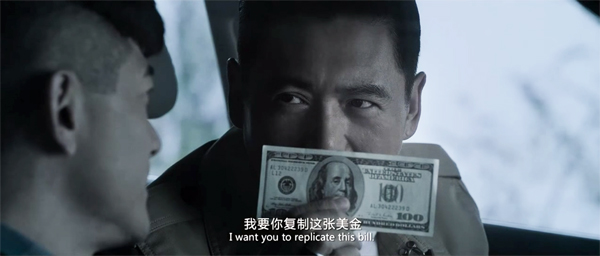
The continuity should hardly be surprising, because a great many veteran creators are still active. Producer Raymond Wong Pak-ming, who co-founded Cinema City and went on to create Mandarin Films and Pegasus Motion Pictures, continues to release films. Yuen Woo-ping was a choreographer and director in the 1970s and achieved worldwide fame with The Matrix (1999) and Crouching Tiger, Hidden Dragon (2000); he recently directed Master Z: The Ip Man Legacy (2018). Ann Hui, Tsui Hark, and many other directors from the 1970s remain top figures in a film culture that offers many opportunities to venerated talents.
Although I’ve long admired Hong Kong films in many genres, readers of of Planet Hong Kong know that I believe that the action film—as wuxia pian, kung-fu movie, or cops-and-robbers thriller—was the area of its most long-lasting contribution. The tradition of powerful physical action, gracefully executed and forcefully staged and cut, was a genuine contribution to the history of film as an art form.
For that reason it’s a pleasure to report that the “ordinary” action pictures of the last decade have by and large maintained that tradition. Donnie Yen Ji-dan, an actor who chooses intelligent projects, endowed films like Kung Fu Jungle (2014), the Ip Man vehicles (2008-2019), and Chasing the Dragon (2017) with vivid, exciting sequences. He and other filmmakers seem to have abandoned the looser camerawork of the early 2000s and returned to precision shooting: fixed camera, instantly legible compositions, and a flow of movement across shots that can accelerate, slow, or halt, all in the service of impact on the viewer.
Still, in the hands of a skillful craftsman any technique can work. Benny Chan Muk-sing’s White Storm (2013), a full-bore male melodrama in the John Woo manner, mixes run-and-gun handheld style with a revival of the forceful compositions and crisp editing of the heroic-bloodshed days. Cheang Pou-soi’s Motorway (2012) invests a simple plot with excitement through nearly abstract shots of cars gliding through streets and alleys, augmented by stretches of ominous silence.
Similarly, I see the positive legacy of the Infernal Affairs series (2002-2003) in franchises like Overheard (2009-2014) and Cold War (2012, 2016). While not as tightly contained as the trilogy, these films benefit from plotting that is less episodic and more finely woven than we find in the policiers of the 1980s. They also judiciously insert florid action sequences, creating a sort of middle ground between the bureaucratic intrigue of Infernal Affairs and the more extroverted spectacle of something like Police Story (1985)—or, come to think of it, any of Jackie Chan’s Police Story titles.

There’s much to be said about Tsui Hark’s PRC adventure sagas as well, particularly in their use of 3D. (The Taking of Tiger Mountain, 2014 above, is a mind-bending use of that technology.) But for my purposes here I’d like to focus on two other major talents that I analyzed in the second edition. Both made outstanding contributions to the action picture in the years since the second edition was published.
Wong Kar-wai’s The Grandmaster (2013), despite being circulated in varying versions, remains for me a powerful achievement. It carries on Wong’s persistent experimentation with decentered narrative, following not only Master Ip Man but also his chief rival Razor and Gong Er, daughter of Ip’s one-time adversary. As I suggest in a blog entry this diffuse treatment of the major characters may bear the traces of a multiple-protagonist plot reminiscent of Days of Being Wild. In addition, through strategic flashbacks and shifts from character to character, this “chaptered” film evokes the interrupted and embedded story lines of other Wong films.
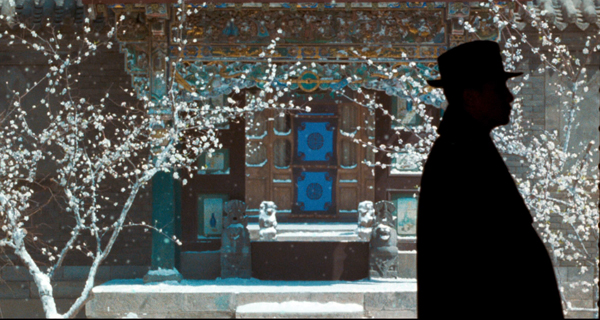
Stylistically, The Grandmaster makes fresh use of distended time and slow-motion imagery; these are conventions of the kung-fu genre as well as a signature of Wong’s work. More unusual is what I call in the blog entry the “mosaic” texture he builds up through close-ups that can be put in various places in one scene or another, or even one version or another. In general, I think that Wong alters the thematics of the martial-arts film by emphasizing Gong Er’s tragic dilemma: defeating the man who killed her father both sustains and erases her family’s legacy. And, as we might expect with Wong, the film strikingly parallels martial-arts prowess with impulses toward romantic love.
Another major film of 2013, Johnnie To Kei-Fung’s Drug War, is no less characteristic of its creator. (I analyze it in another blog entry.) A cat-and-mouse intrigue between crooks and cops, it depends heavily on our filling in gaps and reading characters’ minds. Police officer Zhang tries to penetrate a drug-smuggling outfit, and he devises a perfect To/Wai Ka-fai strategy: He sets up two meetings with two kingpins who don’t know each other. At each meeting Zhang impersonates the other guy. This game of shifting identities, of symmetry and doubling among roles, is a common narrative device of the Milkyway films, but in Drug War it’s given new urgency and a great deal of suspense. One economical shot brings the two unsuspecting gangsters together in the same frame as they leave and enter elevators.
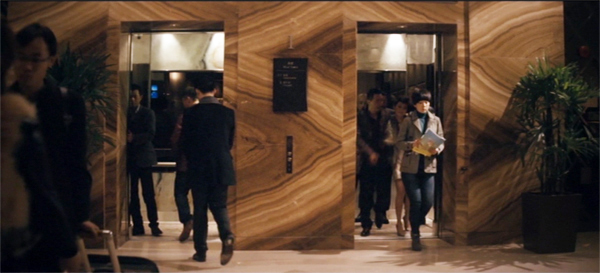
At the same time, the informant Timmy is playing his own game—one that it may take a couple of viewings to decipher. As in The Mission (1999), many scenes of Drug War consist of men looking at each other, trying to divine hidden intentions—here, framed in the simplest possible shots, mere faces seen inside adjacent cars. Timmy’s eventual double-cross culminates in one of the cruelest shootouts to be found anywhere in To’s work; its bleakness recalls the end of Expect the Unexpected (1998). Throughout his career, To’s originality and craftsmanship in this rich genre have made him one of the great contemporary directors.
Wong completed only The Grandmaster in the years I’m considering, but To remained quite productive. Romancing in Thin Air (2011) and Don’t Go Breaking My Heart 2 (2013) returned to the mode of white-collar romance that Milkyway had made its own, while The Blind Detective (2013) combined that eccentric tone with an off-center cop premise recalling Mad Detective (2007). Life without Principle (2011; discussed in this entry) was a striking use of multiple-character plotting to make incisive points about the financial crisis.
Office (2015), an adaptation of Sylvia Chang’s popular play, was at once a flamboyant musical and an experiment in 3D. In Three (2016) To took up the challenge of a tightly circumscribed time and space, tracing the raid on a hospital ordered by a triad who’s there in police custody. Milkyway produced films by others, notably Motorway and Trivisa (2016), an opportunity for three first-time filmmakers to collaborate on a feature with three intersecting story lines. This last effort was in keeping with To’s dedication to creating programs and award competitions for newcomers to the industry. He remained one of Hong Kong’s most imaginative and tireless creators.
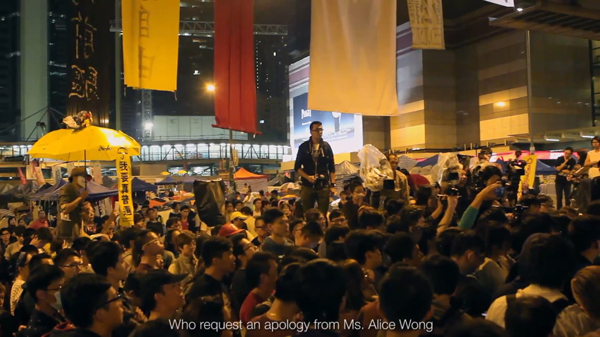
I should mention one more tendency, and it’s an encouraging one. Both editions of Planet Hong Kong pointed out that the Hong Kong people, contrary to the stereotype, actually cared a great deal about politics, especially after 1989. Recent years have seen a resurgence in films explicitly about activism in the territory. An early example is Matthew Tome’s documentary Lessons in Dissent (2014), a stirring account of struggles over educational policy and voting rights, featuring the most heroic 15-year-old I’ve ever seen. The 2014 Umbrella Revolution brought forth Evans Chan’s Raise the Umbrellas (2016) and Yellowing (2016; below) by Chan Tse Woon of Ying e chi There was also the ambitious speculative fiction Ten Years (2015), an ensemble of stories forecasting political repression in 2025. It’s very encouraging to see these efforts to insist on free speech and social criticism.
Finally, it’s worth pointing out how much classic Hong Kong film anticipated developments in Hollywood. The comic-book franchises that found new popularity with X-Men (2000) and Spider-Man (2002) and the Dark Knight trilogy (2005-2012) feature chivalric warriors with extraordinary fighting skills and weaponry. Like the knights-errant of wuxia fiction and film, these superheroes can leap high in the air and subdue villains with secret fighting techniques. Some, like Iron Man, have an equivalent of “palm power.”
Sometimes the American films have acknowledged their sources in Asian martial arts traditions, as when Batman trains as a ninja (Batman Begins, 2005) and Doctor Strange studies under a sifu in his 2016 film. The combat scenes, full of flips and somersaults, owe a great deal to the acrobatic traditions on display in Hong Kong cinema. If the result lacks the precision and visceral punch we find in classic Hong Kong films, it’s still worth noting that Westerners have learned that kung-fu, fights in mid-air, and elegant swordplay look cool on the screen. Hollywood should thank Hong Kong for helping invigorate the American action film.
A few words about what the original book tried to accomplish. At the most basic level, I wanted to understand Hong Kong cinema as an industry, an artistic tradition, and a cultural force. At the same time, I wanted to study it as an example of a popular cinema, one that developed strategies of storytelling and style and emotional appeal that were accessible to millions of people around the world. I wanted to analyze its unique contributions to the development of film art, so that meant I had to do some comparative work, situating Hong Kong film in relation to other traditions—most notably, that of Hollywood. At another level, I was interested in particular genres, especially the action film, and directors. As a result, parts of the book—mostly the “interludes”—are devoted to a particular filmmaker or group of filmmakers. And while I expected that many readers would already be Hong Kong film fans, I wanted to persuade skeptical readers that this national cinema was worth respect. This overall project I tried to amplify in the second edition you’re now reading.
Since the last edition, I have not followed Hong Kong cinema as intensively as I would have liked. Other projects have diverted me. But I have never lost my admiration for this cinema, this culture, and this citizenry. Watching Hong Kong films and visiting the territory have added a new dimension to my life.
From my first stay in 1995, when Li Cheuk-to introduced himself to me during the festival, through many visits over the decades, I have always treasured my friends there. So many people helped me in my research—people attached to the festival, to the archive, to the industry—that to list them all would add too much to this already overlong postscript. But they are mentioned throughout the book, and I hope they know how much I appreciate their generosity over the years. I’ll be happy if anything I’ve done here and elsewhere, in other writing and teaching, have helped film lovers better appreciate the astonishing contributions of Hong Kong film to world cinema artistry.
Among those valued friends was the kind and dedicated Ho Waileng. A tireless worker for the festival, she also translated the first version of Planet Hong Kong into Chinese. She remains in the hearts of everyone who knew her.
P.S. 10 August 2020: We in the US are now accustomed to being shocked but not surprised. I woke up to learn that Jimmy Lai, maverick mogul and publisher of Apple Daily, and many of his colleagues were arrested under the new “national security” law. It’s ironic that President Trump, who has reportedly sought to jail our journalists, moved quickly to place sanctions on Hong Kong earlier this year. The latest crackdown may be a response to the U.S. condemnation of the bill’s restrictions on free speech. (I discussed them here.) An arrest warrant is out for an American citizen living in the U.S. because he advocates democracy for Hong Kong. A coalition of Democratic and Republican senators and representatives have sponsored legislation to widen refugee status for Hong Kongers. Another irony: It’s called the Hong Kong Safe Harbor Act.

Ho Waileng at Angkor Wat, 2006. Photo by Li Cheuk To.
Is there a blog in this class? 2020

Picnic at Hanging Rock (1975).
Kristin here:
Recently our blog reached its 1000th entry, a fact we celebrated with a retrospective entry. That’s a lot of entries. How to find something that might be of interest or use to you? If you know what you’re looking for, the site’s search engine works quite well, I find. We’ve added categories at the right to guide people with specific interests.
“Is there a blog in this class?” is designed to assist teachers who might want to consult the blog or assign entries to the students. I started it the year after we posted the first entry and has continued annually, with entries posted roughly a month before university and college semesters begin. We do have some readers who have followed “Observations on Film Art” from that point, but most have come later to it. We hope this series might also be useful in guiding them to interesting content from from the past year. The series can be found here: 2007, 2008, 2009, 2010, 2011, 2012, 2013, 2014, 2015, 2016, 2017, 2018, and 2019.
Last year I started listing new entries in our video-essay series on The Criterion Channel, which is in a sense an extension of this blog and has the same title.
I’ll go chapter by chapter through Film Art: An Introduction, though some chapters have no relevant entry this year.
Chapter 1 Film as Art: Creativity, Technology, and Business
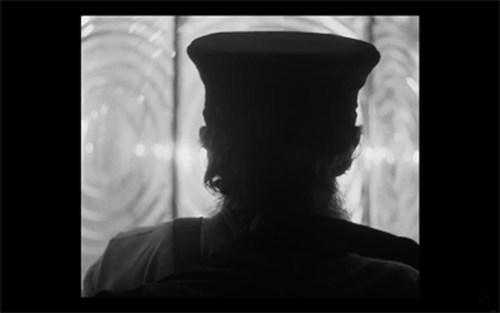
In this chapter we emphasize how technological choices affect film style. My entry “THE LIGHTHOUSE: A period film with period style” (above) discusses how the filmmakers uses lenses, film-stock, and lighting equipment to simulate the look of a silent-era film.
We also discuss the film industry in this chapter of Film Art. I wrote on how annual box-office figures can be deceptive about trends in studios’ income: “So was there an actual box-office slump in 2019?”
David commented on how the move to streaming films has affected viewing habits and film scholarship: “When media become manageable. Streaming, film research, and the Celestial Multiplex.”
Chapter 2 The Concept of Form in Film
This is the chapter where we discuss different levels of meaning. David’s entry “Hunting Deplorables, gathering themes” deals with interpretation, using The Hunt as its main example.
Chapter 3 Narrative Form
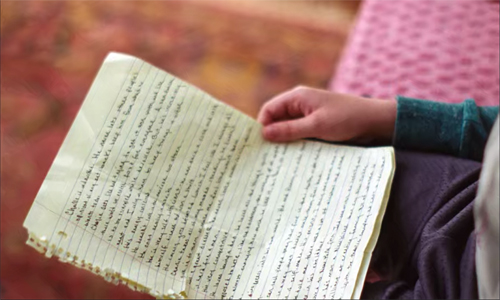
David wrote some analytical essays on individual films this year: “Not just a Christmas movie: DIE HARD on the big screen,” “Un-Marry me a little: MARRIAGE STORY and LITTLE WOMEN,” and “When Hollywood ruminates: Calm after THE MORTAL STORM.” Above, a scene from Marriage Story that would nicely illustrate the functions of a motif and the ways narration can use it for a revelation.
Chapter 4 The Shot: Mise-en-Scene
Criterion Channel #31 Here I examine the subtleties of the three-point lighting system in “Comedy, Suspense, and Three-Point Lighting in TO BE OR NOT TO BE.”
Criterion Channel #33 Jeff Smith on how different aspects of mise-en-scene are used to create a woman’s viewpoint: “Feminist Mise-en-scène in MY BRILLIANT CAREER.”
Chapter 5 The Shot: Cinematography
Criterion Channel #35 I look at how camera techniques turn a horror-story adaptation into an art film: “In the Service of Horror–The Lyrical Cinematography of PICNIC AT HANGING ROCK.”
Criterion Channel #32 In relation to this chapter’s section on framing, I discuss the functions of offscreen space at the beginnings of scenes in “Withholding and Revealing in AN ANGEL AT MY TABLE.”
In Criterion Channel #30, Jeff Smith analyzes “The Long Take in SHOCK CORRIDOR.”
If you’re teaching a film noir or the whole noir trend, have a look at David’s piece on cinematography in Trapped: “TRAPPED: Low-budget flash is good for you.”
Chapter 6 The Shot: Editing
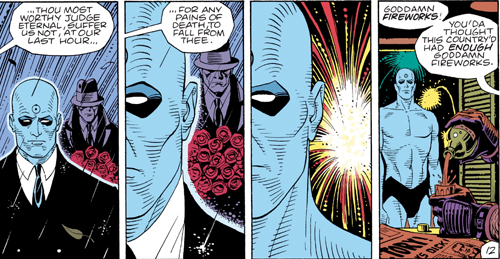
In “Who will match the Watchmen?” David examines editing strategies in the HBO series, The Watchmen. He traces how the filmmakers used match cutting to mimic the time-jumping transitions in the graphic novel.
David analyzes a sneaky technique combining editing, framing, and figure movement in King Hu’s The Valiant Ones: “Sometimes a swordfight …”
Criterion Channel #37 Yasujiro Ozu created his own unique style of editing; David analyzes how he uses it in a poignant silent comedy: “Ozu’s Space Adventures: Editing in PASSING FANCY.”
Chapter 7 Sound in the Cinema
On the occasion of the prolific and beloved composer Ennio Morricone’s death, Jeff Smith provides an in-depth analysis of Morricone’s approach and style, with many excerpts that let you revisit some of his classic themes: “The poet of dynamic immobility: Ennio Morricone: A guest blog by Jeff Smith.”
Criterion Channel #36 Focusing on a single Morricone film, Jeff picks out “Musical Motifs in THE BATTLE OF ALGIERS.”
Chapter 9 Film Genres
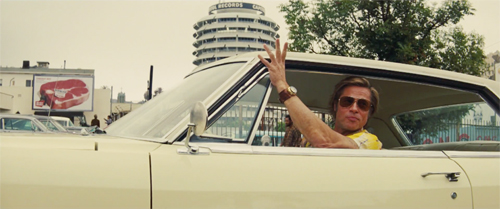
Jeff Smith has explored Tarantino’s genre-mixing strategies in “When worlds collide: Mixing the show-biz tale with true crime in ONCE UPON A TIME IN . . . HOLLYWOOD.” This was our most popular entry of 2019. Jeff shows how Once Upon a Time. . . in Hollywood is tied to 1960s film and music cultures here and in his follow-up entry “Twice upon a time in . . . Hollywood: Jeff Smith revisits Tarantino’s retro opus.” These pieces could also be used in teaching Chapter 12’s section on contemporary Hollywood.
Criterion Channel #34 David examines how an unconventional use of style can transform a familiar genre like the horror film: “VAMPYR: The Genre Film as Experimental Film.”
Ch 12 Historical Changes in Film Art: Conventions and Choices, Traditions and Trends
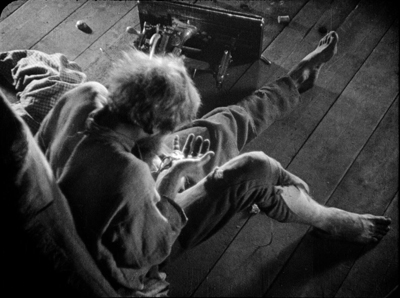
My annual look at the famous and lesser-known classics of ninety years ago: “The ten best films of … 1929.”
David analyzes the sophisticated classical style of the 1917 adaptation of Wilkie Collins’ mystery thriller The Woman in White in “Hollywood starts here, or hereabouts.”
In the last year Flicker Alley has continued to release Blu-rays of crucial classics of the silent cinema. I review releases of Fridrikh Ermler’s Fragment of an Empire (above) and Marcel L’Herbier’s L’Argent, important late entries in the Soviet Montage and French Impressionist movements, in “Two more classics from Flicker Alley.” The company has also at last made Pudovkin’s “Bolshevik Trilogy,” Mother, The End of St. Petersburg, and Storm over Asia, available in decent copies: “Flicker Alley fills the Pudovkin gap.”
We tend to slant these annual updates to Film Art, since that’s where the blog started. Certainly many of the entries listed above are also relevant to Film History: An Introduction. Here are some further possibilities.
Joe Anderson’s Spring Night Summer Night is a hard film to classify, but it could be something to consider in teaching the indie section of Chapter 22 of Film History. See my analysis with some background production information in “‘Student Film,’ exploitation film, indie classic.”
David’s analysis of Roy Andersson’s About Endlessness (2019, below) fits into the category of “The Arresting Image” in Chapter 25: “The raptures of rigor: Roy Andersson’s ABOUT ENDLESSNESS in Venice 2019.” Andersson won the Silver Lion as best director at the festival.
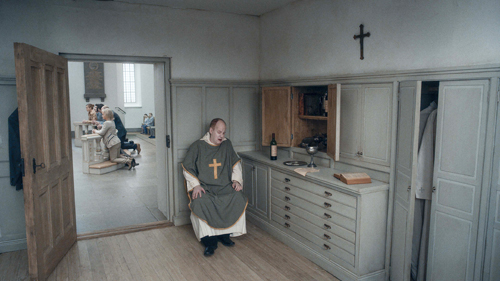
You no doubt recall the controversy that erupted when Scorsese complained about blockbusters dominating American distribution and exhibition. David’s remarks on it in “Captain Cinephilia: Scorsese strikes back,” could work into either Chapter 28 or 30–or both.

I haven’t included all of our film-festival reports. Last year we attended five festivals, a record for us, little dreaming that the following year we would not be able to visit any. For brief comments on the films we saw or just a vicarious experience of a festival in these locked-down days, see these links, in chronological order: Wisconsin, Il Cinema Ritrovato in Bologna ( here, here, and here), Venice (here, here, here, here, here, and here), Vancouver (here, here, and here), and Torino (here, here, and here).
Finally, all teachers and lovers of cinema should be aware of the riches offered by The Walker Art Center Dialogues, a collection of recorded interviews with major filmmakers. These include a conversation between David and Robert Altman.
Thanks to everyone who enabled us to write these entries over the last year: the teams at the Wisconsin Film Festival, Il Cinema Ritrovato of Bologna, the Venice International Film Festival. the Vancouver International Film Festival, the Torino Film Festival, Jeff Masino and the staff at Flicker Alley, and of course the dedicated team at Criterion, especially Peter Becker, Kim Hendrickson, Grant Delin, and their colleagues. And thanks to our readers for staying with us through a year of cinematic discoveries.
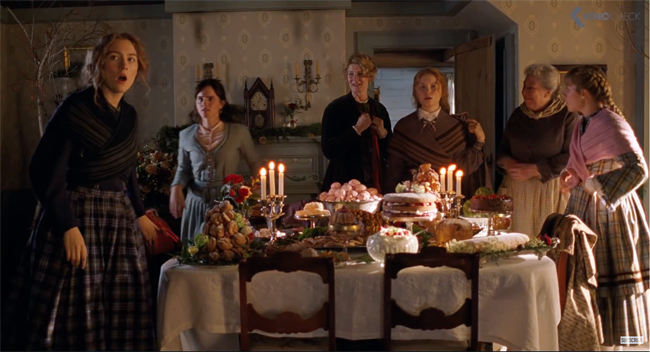
Little Women (2019).