

Archive for the 'Film comments' Category
THE GRAND BUDAPEST HOTEL: Wes Anderson takes the 4:3 challenge
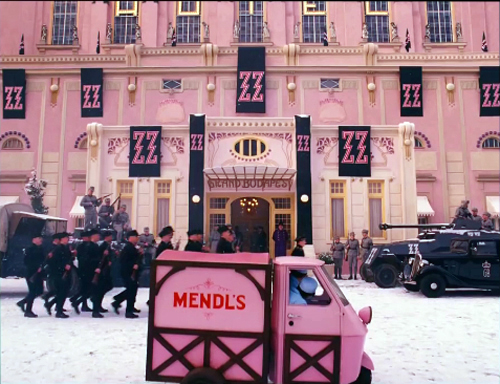
The Grand Budapest Hotel (2014).
DB here:
Be shot-conscious! I urged in a blog entry some years ago. I illustrated the point with a tradition of staging and shooting that seemed simple and modest but was actually quite flashy, and even fashionable. Although many filmmakers resorted to it, either often or occasionally, critics hadn’t attended to it. Wes Anderson’s work yielded one of many examples of what I called (swiping from art historian Heinrich Wölfflin) a “planimetric” style.
Ideally, you should look at that entry before reading this one. (To encourage you, I link it again. Not for the last time.) Very briefly, this style involves a frontal presentation of the action. You frame people against a perpendicular background, as if they were in a police line-up. Usually you face them to camera, as in this shot from Godard’s Made in USA.
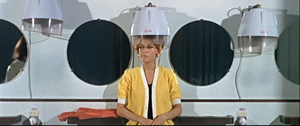
As we’ll see, sometimes you can frame the characters at right angles to the camera, or turned directly away from the camera. Here are examples from Napoleon Dynamite and from Angelopoulos’ The Traveling Players. (Is this the first time these two movies have been mentioned together?)
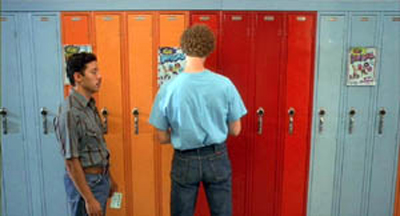
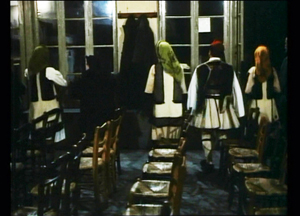
The key idea is that the people and the setting aren’t observed from an oblique angle; if the background is perpendicular, the people will stand or sit at 90 or 180 degrees to that.
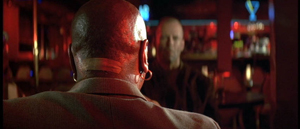
You can arrange them in some depth too, but again, they are stacked in perpendicular fashion, making each area a pretty strict plane. Here’s an example from Pulp Fiction.
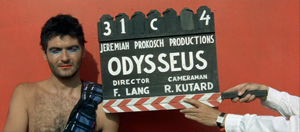
One point of my earlier entry is that this is a surprisingly old strategy; Keaton used it occasionally, and Godard was using it heavily fifty years ago. Here are two shots from Contempt (Le Mépris, 1963).
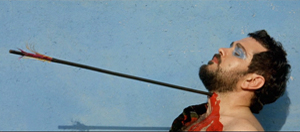
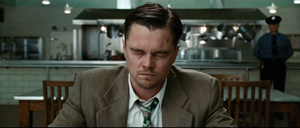
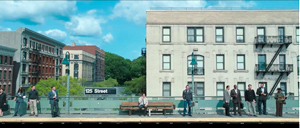
It has endured in some surprising places. It’s now a go-to option for one-off effects in mainstream cinema. Here are examples from Shutter Island and The Secret Life of Walter Mitty (2013 version).
A few filmmakers make it the basis of an entire film, as I indicate in this entry on Oliveira’s Gebo and the Shadow. And since I wrote the original entry, I’ve drawn on other examples from time to time, particularly from directors who are pastiching Ozu to some degree or another.
Still, Anderson is today the most widely visible example of the style, partly because while others use it sporadically, he is single-minded about it. He has made people shot-conscious (at least when they watch his movies). So after seeing his newest film, I thought it would be fun to think about what distinguishes his approach.
Playing with planes
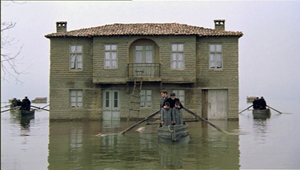
With the release of The Grand Budapest Hotel, several bloggers have pointed to recurring compositional features, most obviously bilateral symmetry. I’d just add that such symmetry is often used by practitioners of the planimetric approach, with results that sometimes exceed Anderson’s. Here are two shots from Angelopoulos’ Weeping Meadow.
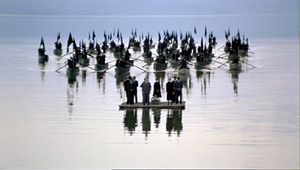
When you think about it, it takes a brave filmmaker (e.g., Godard) to use this approach and not deploy symmetry.
Anderson has used the planimetric approach more extensively in recent years, and he modifies it some distinctive ways. I think particularly of his habit of crowding people together in layers rather than stretching them along a single line. He makes some images look like group portraits or over-posed highschool yearbook shots (The Royal Tenenbaums; Fantastic Mr. Fox).
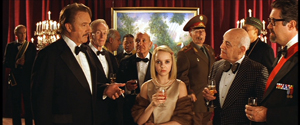
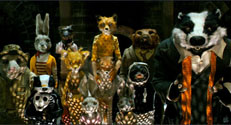
By employing the planimetric strategy, Anderson gains a somewhat awkward formality, a sense that we are looking from a distance into an enclosed world that sometimes looks back at us. There are as well the sort of comic possibilities that Keaton recognized in Neighbors and The General. A rigid perpendicular angle can endow action with an absurd geometry.
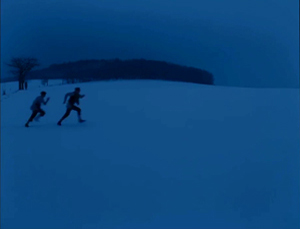
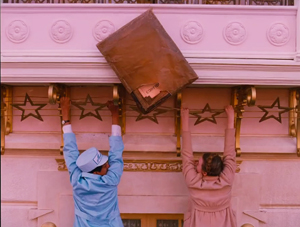
These apparently simple framings often evoke a world of childhood. Just as Kitano Takeshi shows us gangsters behaving like little boys, Anderson’s dollhouse-room frames make adults seem to be toy people arranged just so–like items laid out in a Joseph Cornell box. It’s a style suitable for magical-realist premises like The Life Aquatic with Steve Zissou, and in Moonrise Kingdom it finds its echo in children’s illustrated books.
All in all, then, I have to salute an American filmmaker who thinks about his images carefully and has incited sensitive viewers to notice them. I think we should go further, though. We can ask: How does Anderson, staying loyal to this tradition, vary the look of the shots? And how does he cut them together?
Cutting around
Consider the editing option first. Unless every scene is to consist of only one shot, the question comes up: How do you maintain the style while cutting? Either you make all your cuts axial, straight in or straight back.; or you create a sort of compass-point editing. This can involve cutting 180 degrees, to what’s “behind” the camera in the initial shot. So if characters are confronting one another, the camera is in effect sitting between them as each looks over or through the lens at the other (Ozu’s Late Autumn).
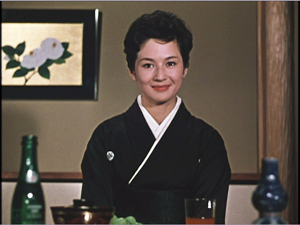
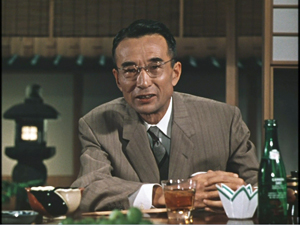
In effect, this option respects the classic 180-degree line, or axis of action, between the characters. It’s just that the camera sits right on that line. Parking the camera on the axis is a common tactic for subjective cutting, showing us first a person looking, more or less at the camera, then what she or he sees from their vantage point. Our example in Film Art: An Introduction comes from Rear Window.
Ozu used this 180-degree reversal often, but not absolutely; he had a more complicated way of conceiving space, and the 180-degree frontal cuts were only part of it. Kitano made a simpler variant central to his early films.
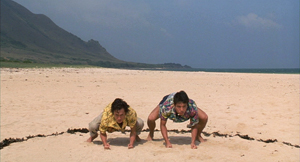

When I asked Kitano why he did it, he explained that it was exactly the way people saw each other in ordinary life. We face each other. He then added that he was such a naive director when he started that it was the only way he knew to set up scenes. We get kindred images in Terence Davies’ work; his frontality may owe something to the Hollywood musical.
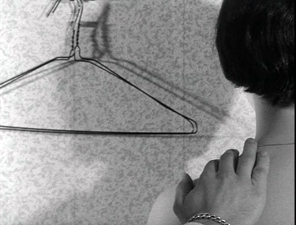
Compass-point editing offers another possibility, that of cutting at 90-degree angles to the background plane or the figures’ position. Chantal Akerman does it throughout Jeanne Dielman 23 Quai du Commerce 1080 Bruxelles (1975).
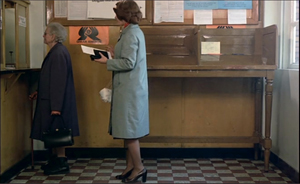
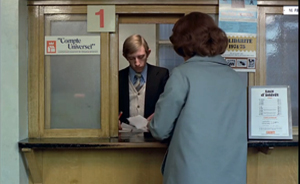
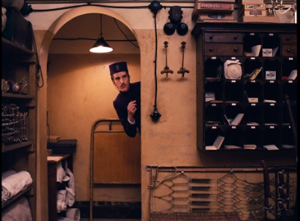
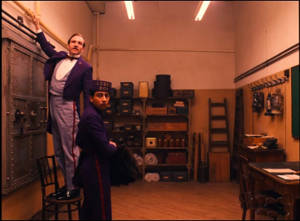
Anderson exercises all these cutting options inThe Grand Budapest Hotel. Here a planimetric profile 2-shot yields two frontal shots; we shift 90 degrees and then 180 degrees.
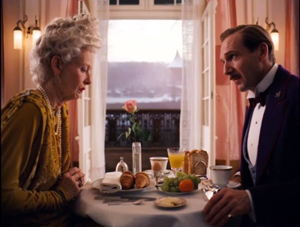
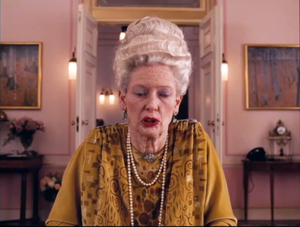
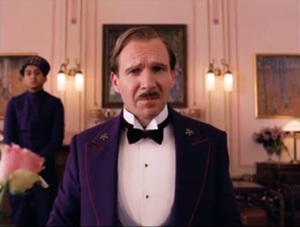
Now here’s a 90-degree shift for the reverse shot.
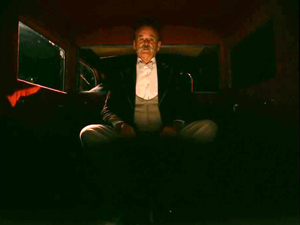
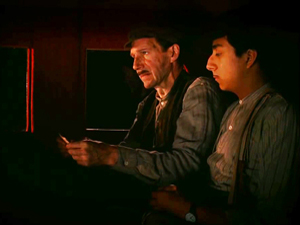
In the passage below, the first cut rotates 90 degrees, and the second cuts in right on the lens axis. In this tradition, an axial cut respects the perpendicular layout of the space.
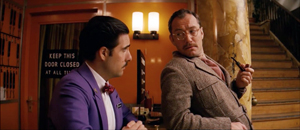
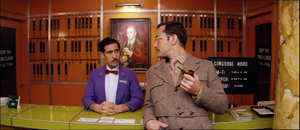
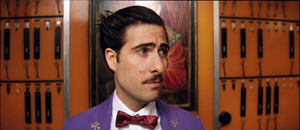
In such cutting patterns, the compositions keep the action in the same upper zone of the frame from shot to shot. As a result, our eye doesn’t wander much. In long shots, Anderson sometimes follows the classic Hollywood practice of allowing some decentering, as long as the cuts balance one off-center composition against another. Here the changing angles obey the compass-point principle across three shots, and they crisply shift the emphasis from the right side of the frame to the center to the left.
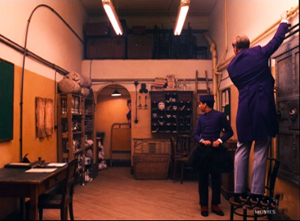
Someone who wanted to deflate Anderson’s visual ambitions could say that his shots are monotonous. Having imposed a big constraint on himself, he’s now obliged to show us that this approach can be varied–in obvious or subtle ways.
One way is through lens length. Most planimetric filmmakers use long lenses, which flatten the space even more. The figures can look like clothes hanging on a line. But Anderson favors quite wide-angle lenses (often 40mm). These make horizontal lines bulge, as in early CinemaScope films (Rushmore, The Life Aquatic).
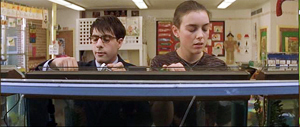
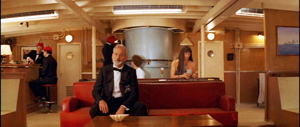
You can see similar distortions in the straight-on shots of the hotel desk in Grand Budapest, above.
Another way Anderson varies his images is by departing from straight-on angles. As long as the framing maintains a planimetric geometry, we can look down or up at the action. In this passage, again the camera makes 180-degree reverses. This contrasts with the more orthodox shot/reverse shot framings in a comparable scene in The Little Foxes.
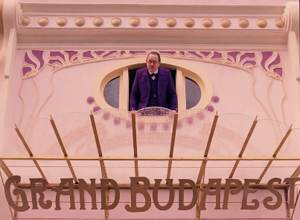
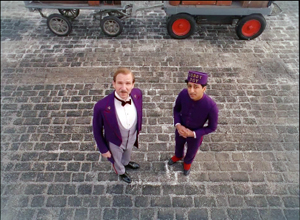
In this spirit, Anderson can give us bird’s-eye views, as Matt Zoller Seitz points out in his sumptuous book-length interview with the director. It’s rare, but there are precedents, as in the work of the Coens. In one shot of The Hudsucker Proxy, a movie with an inordinate number of straight-down angles, the inflexible framing creates a joke.
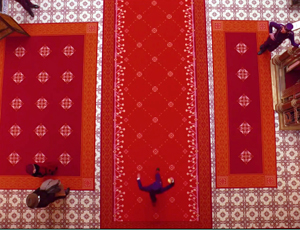
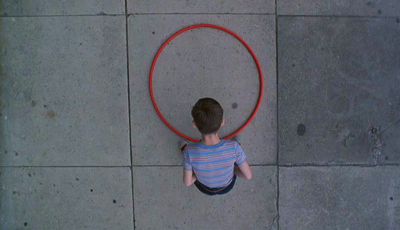
Grand Budapest Hotel has room for some classically funny framings. If you want somebody to look lonely, common practice says, frame the figure off center in a long shot. Here Anderson seems to be having a joke on the convention. He presents it as a POV, although presumably if the Writer were looking at the mysterious man he would put the object of attention in the center of his field of vision.
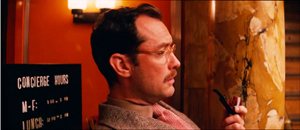
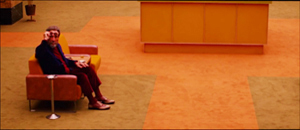
I think that Anderson’s earliest films weren’t quite so strict in obeying the planimetric and compass-point strategies. Those options were often slipped in as alternatives to more orthodox framing and cutting. But as he’s become more rigorous about using them, he has found ways to put his stamp on some common techniques. Like Ozu incorporating devices of classical continuity into his unique stylistic system, Anderson can recruit certain conventions while staying faithful to his basic approach.
For instance, Anderson sneakily brings in the OTS–the over-the-shoulder framing standard in shot/ reverse-shot dialogue scenes. In one prison scene, Harvey Keitel’s Ludwig is granted an OTS that varies subtly from the more purely straight-on views.
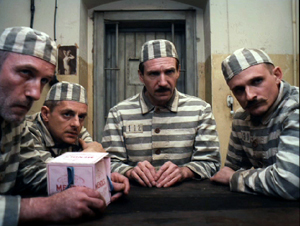
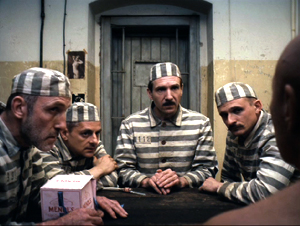
Much the same thing happens with in the punching scene at the reading of the will, when frontal characters are assaulted by fists coming in as if in reverse angles.
Anderson has figured out another way to vary his compositions. I learned this before I saw the movie, thanks to some comments by the cinematographer Robert Yeoman (great name).
High or wide, and handsome
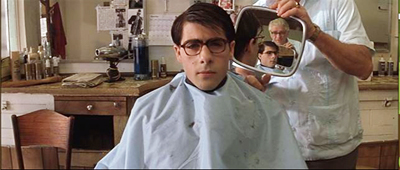
Rushmore (1998).
To get the criticky part of this entry out of the way: The Grand Budapest Hotel has all the charm, fussiness, and intricate whimsy typical of Anderson’s work. As often in his films, it cuts its preciosity with moments of offhand brutality (sliced-off fingers) and flashes of naughty sexuality (fellatio, the lesbian painting). With its ensemble cast, sometimes deployed in cameos, it suggests a PoMo remake of those sprawling, self-congratulatory spoofs of the 1960s like The Great Race, Those Magnificent Men in Their Flying Machines, and It’s a Mad, Mad, Mad, Mad World. (The film’s title evokes those all-star films set in hotels, like Grand Hotel and Hotel Berlin.) It’s much better than those, partly because it engages in an oblique way with history, creating a comic-pathetic alternative account of Nazi imperialism. It imagines the collapse of Europe in operetta terms, filtered through Anderson’s pawky humor and distinctive style. I admired the film but don’t feel able to analyze it much after only one viewing. Fortunately for me if not you, its stylistic aspects fit today’s sermonette.
The Grand Budapest Hotel is set in several time periods, and they’re presented via The Blog’s old friend, the device of flashbacks within flashbacks. One character recalls the past or tells a story, and inside that line of action another character recalls or recounts a story, and so on. In Grand Budapest Hotel we move from the present, more or less, to events in the 1980s, then the 1960s, and eventually the 1930s, which constitute the central episodes.
Anderson has shot the frame stories in different aspect ratios. It’s 1.85 for the near present and the 1980s, when the Author recounts meeting the hotel owner. That meeting, set in the 1960s, is shown in 2.40, the anamorphic aspect ratio. The central story, taking place in the 1930s, is presented in classic 1.37, or 4:3 imagery. With typical Anderson butterfly-collector wit, each era gets a ratio that could have been used in a movie at the time. It’s remarkable that Anderson could persuade Fox Searchlight to let him do this.
Most commercial releases in the 1950s and afterward were filmed in some widescreen ratio. In the early days, a popular option was a sort of clothesline staging, centering a single character or balancing others around the central axis: two side by side, three across, four as a pair of pairs, and so on. These shots are from Demetrius and the Gladiators and How to Marry a Millionaire.
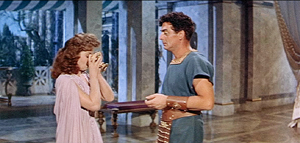
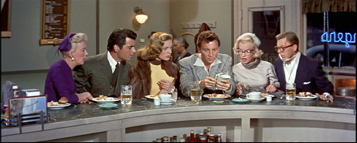
Thanks to the widening of the frame, there is less air above the characters and less ground below them. The empty spaces are typically on the sides, particularly in the anamorphic 2.40 ratio. The problem of filling that up was solved, at least for some directors, by moving the camera very close to the actors. Spielberg remarked that he began shooting more close-ups when he filmed in anamorphic.
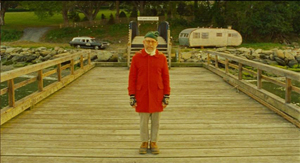
If you’re inclined to the planimetric approach, it fits the wider format nicely. Anderson wasn’t worried by the extra acreage; he just used the set or empty areas to balance one side against the other. Shots of only one character could be centered, as if posed, and shots of groups could be arranged more or less symmetrically, as in this passage from Moonrise Kingdom. Central perspective helps drive your eye to the main items.
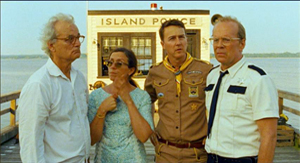
In Grand Budapest, Anderson’s signature framings fit snugly into the scenes shot in 1.85 and 2.40. (The latter has been his favored ratio over the years.) But what about the 1.37 scenes? This brings me to Mr. Yeoman’s remark.
Explaining why he and Anderson watched a lot of films from the 1930s, especially by Lubitsch, Yeoman notes:
We looked at those more to familiarize ourselves with the 1.37:1 aspect ratio, which Wes wanted to use for the 1930s sequences. This aspect ratio opens up some interesting compositional possibilities; we often gave people a lot more headroom than is customary. A two-shot tends to be a little wider than the same shot in anamorphic. It was a format I’d never used before on a movie, and it was a fun departure. You can get accustomed to 1.85 or 2.40 to the point that the shots become more predictable.
Put it another way: Anderson’s penchant for centering and symmetry inclines him toward widescreen compositions that could be simply cropped right and left to fit the 1.37 ratio. His single characters and huddled groups could remain much as before. But in more distant framings you might get a lot of extra space at top and bottom–areas that simply aren’t there in the wide ratios. In other words, Anderson’s multi-format strategy gave him a new problem in maintaining his signature style.
How did he solve it? Many Budapest Hotel shots do leave considerable headroom, as you see in most of the 1.37 examples above. But other shots show Anderson filling his 4:3 frame in varied and engaging ways.
As Ozu showed, for instance, the planimetric option can fill the frame’s upper area when the camera height is below eye level. During the conversation in the car, above, Anderson gets the head of M. Ivan (Bill Murray) in the top of the frame thanks to a low angle. Here are two more examples of filling the upper reaches of the format by use of a lowish camera position.
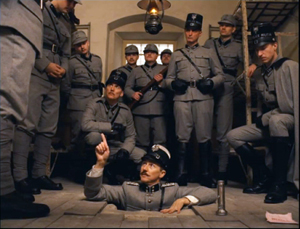
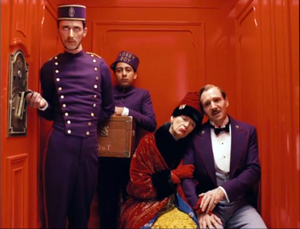
In the elevator shot, the headroom becomes comic, with M. Gustave and Madame D. seated on the right, the morose bellboy filling the vertical area on the left, and Zero in the middle. The empty space above the couple creates a lively imbalance emphasizing them in a way different from the very balanced framing that centers Henckel among his men.
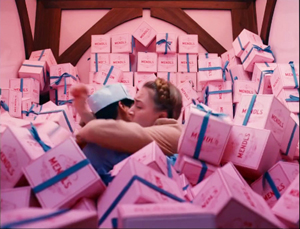
The set can cooperate. In the first shot below, Zero’s and Agatha’s centered embrace leaves lots of headroom, but the slightly disheveled stack of pastry boxes in the upper background contributes to the sense that they’re engulfed. In the second shot below, part of its humor comes from the rigid geometry of the grid and the way M. Gustave and his colleagues fill in the matrix with their intent faces and busy hands.
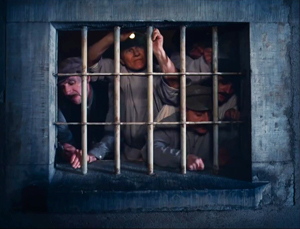
In all, Anderson seems to me to find intringuing ways to create visual interest in the 4:3 format. But as with any severe style, you wonder about what’s been lost.
Most obviously, Anderson loses some of the intimacy that comes with more angular and less strict approaches to the classic ratio. We like to see people from 3/4 views too. We also like depth shots that plunge us into a dynamic, diagonal playing space. Here’s a shot from John Huston’s In This Our Life, as precious in its own way as Anderson’s imagery.
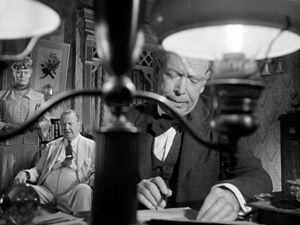
As Hogarth pointed out, with the serpentine line in painting and drawing, such shots can lead our eye on “a wanton kind of chase.”
Because directors of the 1920s-1940s accepted a wider range of compositional options than Anderson embraces, headroom simply wasn’t an important problem, as in the Huston shot. Even in simpler shots, classical uses of the 4:3 ratio permitted a flexible organization of figures.
Centered symmetry against a flat ground is a fairly easy compositional strategy, after all. It wasn’t used much in the mainstream tradition because it looks artificial; perhaps only with the rise of art cinema was this sort of self-conscious composition welcomed. In any case, sticking with symmetry sacrifices the more delicate spotting of figures and faces around the frame.
A lot of visual art tries for more supple and subtle twists, torsions, and counterbalancing. Apart from organizing your space along the horizontal and vertical axes, you can try to set figures in delicate array along diagonals. This is why some old-time cinematographers argued that the 4:3 ratio was the best suited to the human body: it can flatter it from any angle.
To get a sense of these possibilities, I’ve compiled a little collection of images from a film that doesn’t boast any outrageously pretty shots: Otto Preminger’s Angel Face (1953). It’s typical of the unassertive approach we find in Preminger’s work of the 1940s and 1950s. He avoids the flashy depth of the post-Kane directors and offers something less aggressive but no less fascinating. Composition and staging integrate expressions, posture, glances, and gestures to create a smooth flow of action. My samples also indicate how rare straight-on views of faces and bodies are in American studio cinema. The 3/4 angle rules.
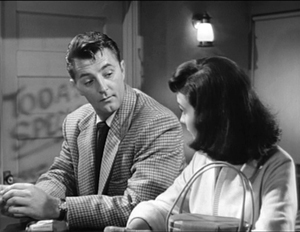
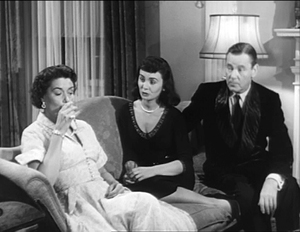
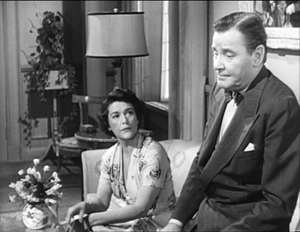
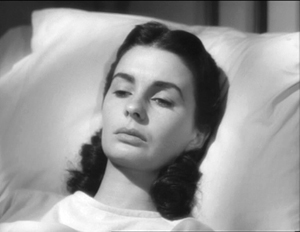
As with the American films of Lang, Preminger’s work displays a style that’s tough to analyze because the technique isn’t obvious. There’s a marvelous variety in the ways that the 4:3 ratio can render a single figure or two figures, or three, shifting them not around the perfect center of the picture format but around curves and diagonal axes–that yield interest in their own right.
This last comparison isn’t a slam on Anderson. I think well of many of his films, particularly the most recent ones, and I appreciate anyone who takes on a challenge of narrowing his range of creative choices. Once you narrow that range, it turns out there’s a host of new possibilities that pop out. Call it the Ozu strategy: refine your means and you discover nuances nobody else notices.
Still, in art as in life, every choice is a trade-off. It’s worth remembering what one loses by pursuing a particular path. By sticking to his signature look in working with 4:3, Anderson gave himself a problem that didn’t exist for directors of an earlier time, the problem of maintaining a frontal style in a squarish format. I’m glad he faced it and solved it. But I’m also glad that classical filmmakers, quite intuitively, showed how much you could do with an alternative option.
Without any conspiring between us, Matt Zoller Seitz, top expert on Wes Anderson, has just urged critics to write more about film form–to be, among other things, shot-conscious.
Iain Stasukevich’s American Cinematographer article on the making of The Grand Budapest Hotel is well worth your attention beyond the technical matter I latched onto.
The Huston image came to hand because of the previous entry. Go there for more instances of the sort of framing and staging that Anderson and his planimetric colleagues don’t aim at.
I survey the planimetric style in On the History of Film Style and in Figures Traced in Light. A search of this blog’s archive will bring other instances to light. I analyze Ozu’s style in Ozu and the Poetics of Cinema, available as a pdf here. For more on CinemaScope, you can visit my online lecture.
P.S. 27 March (Hong Kong time): Jonah Horwitz writes with a useful point:
One thing I would add to your summary is that as early as Rushmore, most notably in The Darjeeling Limited, Anderson purposely inserts into his limited stylistic palette selected, isolated “foreign” devices like loose framings, handheld camera, and relatively aimless zooms (as opposed to his more common precise shock-zooms). In some cases, as in the drama-club staging of “Serpico” in Rushmore, these devices serve as citations, in that case to “realist” New Hollywood cinematography. But they also feel very much like the exceptions that prove the rule: they stand out from his usual stylistic register so much that they effectively reinforce the latter. I’m looking forward to seeing Grand Budapest to see if this continues, or if he emphasizes instead a further refinement of his typical gestures.
I agree with Jonah that importing foreign devices often throws into relief a filmmaker’s signature style–a matter of a film’s intrinsic norm getting reinforced by some marked deviation from it. I think of Ozu’s pans or tracking shots, which occur in all his black and white films, and which often just remind us how narrow the style is in the rest of the movie. And sometimes, as in The Flavor of Green Tea over Rice, those camera movements are hybrids or compromises with with his static style. Thanks to Jonah for corresponding.
P.P.S. 27 March: This entry has been revised to eliminate an error. Originally I had said that the play with aspect ratios in the film wouldn’t have been possible before digital projection. Bryce Utting wrote to point out that it was indeed possible on film, since Peter Greenaway’s Pillow Book used both 1.85 and anamorphic widescreen. I had even seen the film and forgotten that! Thanks to Bryce for the correction.
P.P.P.S. 30 March (Hong Kong time): Jim Healy, impresario of our Wisconsin Cinematheque, writes to point out several other films that mix aspect ratios:
The first hour of Redford’s The Horse Whisperer, the urban-set part, is in 1.85. When the characters make it to the open horse country, the image widens to ‘scope. . . . The 2002 Disney animated feature Brother Bear (which isn’t so bad) is 1.85 for about the first 20 minutes and when the principal Inuit character (voiced by Joaquin Phoenix) is transformed into a bear, the picture goes to Scope.
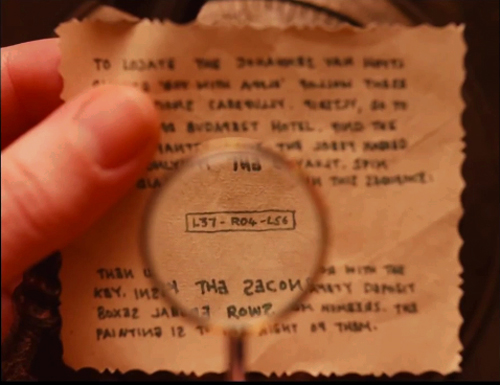
The Grand Budapest Hotel (2014).
Somewhere it’s always GROUNDHOG DAY
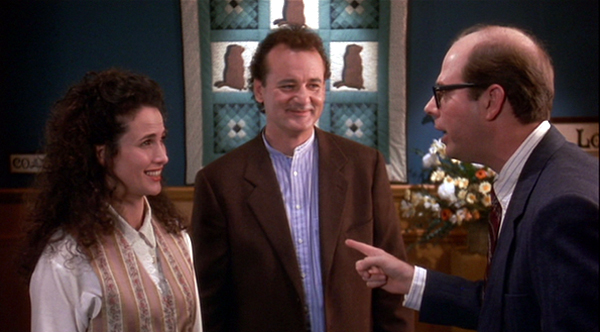
Phil earns his groundhog halo.
Kristin here–
Back in 1999, my book Storytelling in the New Hollywood (Harvard University Press) was about to be published. It was an attempt to suggest that, contrary to the talk of “post-classical” or “post-Hollywood” norms having taken over American filmmaking, the most important classical principles that had been at work since the 1910s were still going strong.
I outlined those principles in the opening chapter, discussing character goals, deadlines, dialogue hooks, unity, and the like. I also argued that, based on my analysis of many films from the 1910s to the 1990s, the vast majority of features followed a structure involving four large-scale parts, or acts–not three, as the popular Syd Field model would have it.
To do that, I analyzed the techniques of ten films usually considered to be models of unified, sophisticated narrative structure: Tootsie, Back to the Future, The Silence of the Lambs, Groundhog Day, Desperately Seeking Susan, Amadeus, The Hunt for Red October, Parenthood, Alien, and Hannah and Her Sisters.
The book was not intended to be a screenplay manual as such, though I know it has been used in some classes and by some aspiring screenwriters.
Ordinarily the press would have asked me to name some prominent film scholars who could be asked to write blurbs for the cover. It occurred to me, though, that it might be better in this case to take each chapter and send it to its director and to its main screenwriter and ask them for blurbs instead.
That turned out to work pretty well. Several didn’t answer, and other answered too late to be included. I ended up with three blurbs of which I am very proud, from Ted Tally for The Silence of the Lambs, Susan Seidelman for Desperately Seeking Susan, and from Harold Ramis for Groundhog Day.
Ramis’ recent death prompted me to dig out that old file. He had written back to my editor not with a sentence or two to use as a blurb, but with a page-and-a-half letter on the subject; it included a blurb down toward the bottom. It’s a letter that reflects how kind and smart Ramis was, and how much he had thought about writing and narrative–even though the process of writing screenplays was probably largely an intuitive one. It shows that he knew something about academic film studies, even if he had some “quibbles” with them. I certainly never meant to suggest that everything I pointed out in the films I analyzed was intended by the director and/or screenwriter. I would say that everything I pointed out was a result of their skill and experience. Even when something happens by accident during filming, someone has to decide whether or not to keep it in.
Rather than just sticking the letter back in the file, I thought I would share it with you. Having a little more of Ramis available can’t be a bad thing.
Dear Lindsay,
Thanks for sending the chapters of Kristin Thompson’s book Storytelling in the New Hollywood and please convey my thanks to Ms. Thompson for including Groundhog Day among the “modern classics.” My only quibble with scholarly film analysis is the occasional tendency to read more significance into certain details than was actually intended, or to think that certain accidents of production, on-set discoveries, or improvisational dialogues were planned and scripted. I realize, from a Deconstructionist point of view, it hardly matters what I think anyway, so let me set aside my minor quibbles and congratulate Ms. Thompson on her new book. If you would, please pass this letter along to her.
I am not a student of screenwriting so I’m afraid I can’t comment intelligently on Ms. Thompson’s theoretical model. Certainly, the fact that most movies are about two hours long will determine to a large extent the length of the set-up, the placement of the crisis, the climax, and the denouement, but rather than look at films in terms of “acts,” I prefer to think in terms of “actions,” as if the narrative line were a string of pearls, dramatically linked, each taking the audience forward to the next point. If any particular action doesn’t advance the plot or contain some new information, it doesn’t belong in the narrative. As a writer I generally proceed more intuitively than structurally. As Ms. Thompson suggests, I suspect that most of us have simply absorbed the classical film structure during our formative years as members of the audience.
When I was hired to write my first Hollywood screenplay, Animal House, the producer handed my collaborators and I paperback copies of Butch Cassidy and the Sundance Kid, and said, “This is what a good screenplay looks like. Just do that.” More than twenty years later, my only useful conclusion about structure is that nothing will work if you don’t have interesting characters and a good story to tell. One can argue for or against the three-action structure, but, whether or not there are consistent rules about the :well-made” screenplay, it’s already true that there are more well-constructed, formulaic screenplays than there are good ones. Also, one must always keep in mind that Hollywood films are almost invariably rewritten by additional (though not always credits) writers. One writer may be thought of as strong on structure, good for a solid first draft, another may be known for his dialogue, others for punching up action or comedy. Also , the Hollywood writer is always responding to script notes from studio executives, story departments, his producers, the director, and from his principal actors. In this convoluted and often tortured process, it’s sometimes impossible to attribute the final screenplay to the calculated intentions of one writer or team, and it’s often left up to a panel of Writers Guild arbiters to determine screen credit.
I didn’t intend to write such an inflated letter but there’s a lot to say on the subject and I have a considerable amount of experience.
If it’s useful to you, you may quote me as saying that Ms. Thompson’s insightful analysis of Groundhog Day and of the screenwriting process in general should be fascinating to both writers and audience alike. More thoughtful writing and more discerning audiences can’t help but lead to better movies, and this informative and provocative book is a step in that direction.
Best of luck on the publication of Storytelling in the New Hollywood and please feel free to contact me if you need any further comments.
Sincerely,
Harold Ramis
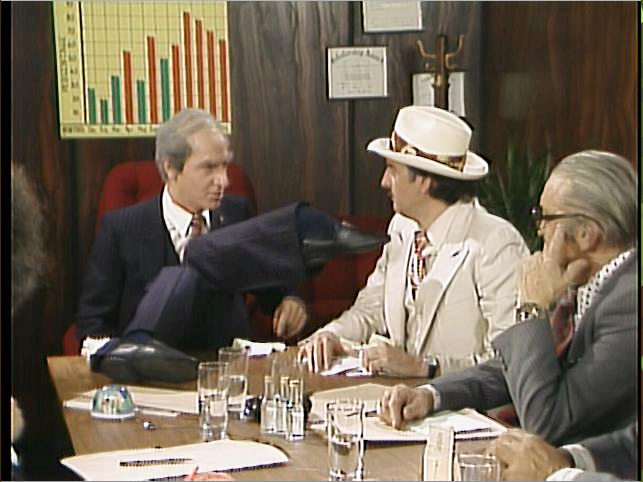
Harold Ramis as Allan “Crazy Legs” Hirschman (SCTV, “Indecent Exposure,” 1982).
Is Tauriel more powerful than Eowyn? and other questions we shouldn’t have to ask
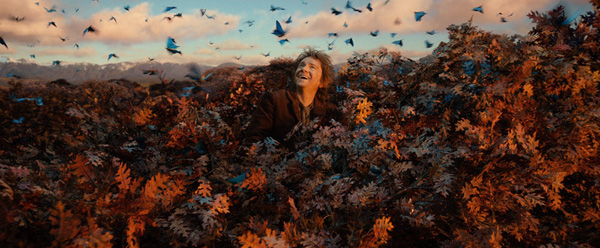
Kristin here:
Film franchises now make up a significant portion of Hollywood’s output, and that situation that is likely to linger, at least until we see even more blockbuster flops than in 2013. Prequels are one way of extending a franchise. They’re a risky proposition, though. These days, who ever thinks about Butch and Sundance: The Early Days or Hannibal Rising? How many would defend the idea that the second Star Wars trilogy (now Episodes I, II, and III) are equal to or better than the first (now Episodes IV, V, and VI)?
Quite often the original entry is an adaptation of an existing work, and there is no additional source material for a prequel. The filmmakers have to make up the story, and the risk is that the prequel will end up being an imitation of the original or take the premises of the original too far. This is especially true of literary properties, even if the original author pens the prequel, as Thomas Harris did with Hannibal Rising.
Peter Jackson and company would seem to have been in the ideal situation. They adapted a beloved literary classic, The Lord of the Rings, and it became a popular and critical success. There was already a potential prequel in the form of a second classic by the same author, J. R. R. Tolkien. Of course, The Hobbit was published first, and The Lord of the Rings was a sequel to it. Through sheer chance, however, the fact that the distribution rights for The Hobbit had not been sold along with the other film rights to the two novels, the filmmakers were not able to begin with it. Only after LOTR was out did MGM, owner of those distribution rights, come on board as co-producer, and the film Hobbit became a prequel.
Now Jackson had a book written by the same author and access to considerable material in Tolkien’s appendices. He was working with a team consisting of many of the same writers, designers, and technical experts. They were in a strong position to create a film that had the same look and feel as LOTR. With the added material, the dramatic weight and the length of The Hobbit could balance that of the LOTR trilogy. The two stories could blend seamlessly. Possibly more seamlessly than the original novels, which had some gaps and inconsistencies arising from the fact that The Hobbit was a children’s story published in 1937 and The Lord of the Rings was a longer, more serious novel that came out nearly twenty years later.
Now that The Hobbit: The Desolation of Smaug, the second of three parts of The Hobbit, has been released, perhaps it’s time to check in on how the filmmakers are maintaining it as a lead-in to their LOTR trilogy. Unfortunately, I think some serious problems have arisen that were not present in the The Hobbit: An Unexpected Journey. Some of these problems arise from departures from the novel that don’t make sense in relation to the original trilogy; some arise from unclear or unmotivated actions invented by the screenwriters; and worst of all, some result from new characters and situations that too closely resemble those in the original trilogy. Whatever is added to the extended version of Desolation and whatever happens in the third part, There and Back Again, the prequel is now flawed.
The Extended Edition of An Unexpected Journey
But first, some unfinished business concerning the first part of the prequel. Almost exactly a year ago, I posted an entry on the theatrical version of Journey. Having already pointed out that there was plenty of material in the Lord of the Rings appendices to extend the two-part Hobbit adaptation to three parts, I defended certain additions to the plot. These were notably the White Council scene at Rivendell and the inclusion of Radagast the Brown, a wizard only referred to in J. R. R. Tolkien’s novel (though he does appear briefly in LOTR). After all, the appendices are really for both The Hobbit and The Lord of the Rings, containing additional material for each of the novels.
I was far less keen on the Azog the Defiler plotline, entirely invented by the filmmakers. Yes, there is a scene in the appendices where Azog briefly appears in the battle at Moria, but he dies in that battle. The notion of him chasing down Thorin from motives of revenge is wholly new. I argued that the Azog-related scenes overburdened Journey with extra action that disturbed the balance of the narrative, adding an unnecessary battle at the end that came too soon after what should have been the highlight and climax of the film, the underground escape from the goblins and the Riddles in the Dark scene.
I speculated at the time that some specific scenes eliminated to make room for Azog would be added to the extended edition, perhaps helping to redress the imbalance. Were they, and did they?
The main scenes that I anticipated did get added to the extended-edition DVD/Blu-ray release. I think almost everything added to it is a plus. Most of the new scenes are quiet ones of exposition and characterization rather than frantic action, which the later portions of Journey were sadly lacking. Yet this doesn’t help much to balance the narrative any better, since most of the added bits come in the first half of the film, the half that was already quieter and less jammed with action than the later portions. Still, given how much violent action there is late in the film, any quiet action helps counter it to some degree.
As seemed very likely, early on there is a flashback to Gandalf setting off fireworks at a Hobbit party where he meets young Bilbo for the first time. It’s charming and all too short, zipping by, but at least we see a rambunctious young hobbit very different from the staid, middle-aged Bilbo of Bag End. The contrast helps motivate Gandalf’s disappointment in the adult Bilbo and his remarks about how he has changed. The moment also helps motivate the notion that there is a suppressed Took side to Bilbo’s nature, just waiting to be summoned forth by a pushy wizard.
Another extra early scene shows Bilbo, nervous after the visit from Gandalf, shopping for the ingredients for his supper (including the fish later consumed so thoroughly by Dwalin). The brief scene doesn’t add much to the plot, but it serves to introduce the Shire and Hobbiton to those who may not have seen LOTR, and it provides some humor after the tense ending to the initial conversation with Gandalf.
As I anticipated, the Rivendell interlude is expanded. In fact, the bulk of the new and extended scenes occur here. Bilbo wanders around Rivendell, clearly overwhelmed by its beauty. He not only sees the shards of Narsil but stares at the nearby mural of Isildur cutting the Ring from Sauron’s hand. Thus Bilbo sees the Ring shortly before he finds it himself, though there is no one present to tell him what he’s looking at. He also chats with Elrond, who says he is welcome to stay in Rivendell. He presumably means that Bilbo need not accompany the Dwarves when they continue on their journey, but a bit over sixty years later Bilbo will end up living there.
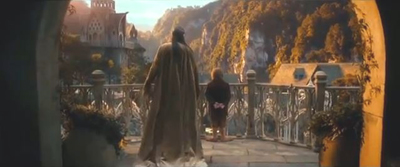
The extra comic bits with the Dwarves, including Bofur’s song, are perhaps entertaining enough, though they continue to film’s general tendency to make them overly boorish.
The White Council scene is extended mainly by Gandalf’s exposition about the Seven Rings of the Dwarves, which Saruman dismisses as irrelevant. The Seven Rings are not referred to in the theatrical version of The Desolation of Smaug, though presumably they were put into Journey for a reason and will return at some point, if only in future extended versions.
The scene with the Great Goblin is stretched out, as he is allowed to sing the Goblintown song from the original book. I think Barry Humphries was an inspired choice to provide the Great Goblin’s voice, so having a little more of him is welcome.
Luckily, there are no extra scenes involving the Azog plotline.
Caution: From here on there are major SPOILERS for the concluding part, The Hobbit: There and Back Again as well as for Desolation.
A better film–if you don’t think too much about it
The reaction to Desolation has been strangely split. On the whole, the critical establishment has heralded it as an improvement on Journey. No long setup of thirteen Dwarves and their quest–just a long series of exciting action scenes culminating in an extraordinary special-effects achievement with the dragon Smaug. The Dwarves’ escape from Thranduil’s realm in barrels rushing down a river with a running battle involving Orcs and Elves has been compared, in the usual reviewers’ cliché, to a thrilling theme-park ride. The battle with the large spiders has also been lauded.
Many fans of Peter Jackson’s other films in the series love Desolation as well and have been going to see it multiple times. Yet fans who know Tolkien’s books really well, while often enjoying the film, have been far more grudging and selective in their praise.
This is largely because Desolation departs far more radically from the novel than any of the previous four films have. New characters have been invented, most notably the female Elf Tauriel, and new scenes fabricated, as with Gandalf’s disastrous solo visit to Dol Guldur, where he ends up imprisoned, or the hectic string of suspense and action scenes at Lake-town. Thranduil briefly appears in the book, but his role as an enemy to the Dwarves has been expanded. The scene of the Dwarves entering Erebor and trying to kill Smaug with molten gold has no parallel in the book.
Inventing scenes needn’t be a problem. Many have complained about the made-up warg attack that ends in Aragorn’s apparent death in The Two Towers, but it is integrated fairly well into the plot. Departures from the original Hobbit novel may be annoying to some, but one should ask how well they fit into the cause-and-effect flow of the plot and into the film as a whole. More specifically, the filmmakers were trying to make The Hobbit into a more substantial film than simply following the book would have allowed. They had to do so in order to blend smoothly into the same world as the LOTR film. The question, then, is really whether the changes 1) are logical in themselves and in relation to the other trilogy, and 2) are an improvement on what the filmmakers could have accomplished had they stuck closer to the story.
Unfortunately, I think that in many cases the new and extended characters and scenes are not as strong as they could have been. More problematically, certain choices steal inspiration from the LOTR film trilogy and in the process undermine the dramatic impact of some of its scenes. This would seem to be something to avoid at all costs in creating a prequel: making the original seem less fresh and dramatic.
Back when I wrote about the decision to split The Hobbit into three parts, I defended Jackson from the accusation that he was clinging to this franchise because he had lost some of his inspiration and didn’t know where to go once the Tolkien adaptations were finished. I don’t know whether it’s true that such a lack of inspiration led to Jackson’s choice to direct the film that he originally wanted to assign to someone else. My point was simply that there was enough material in the novel and in the appendices to expand the film to three parts, if the screenwriters took advantage of that material and fitted it into the plot skillfully. The addition of the White Council/Dol Guldur plot line, largely based on brief statements in the appendices, suggested that Journey was following that path. I don’t think Desolation continues that pattern of relying on snippets from the original books–and there are some that go unused–to flesh out into new story material. This change is to its detriment.
There have been some thoughtful essays suggesting that the film falls down in its invented portions. Timothy R. Furnish, a long-time columnist for TheOneRing.net, has contributed an essay criticizing the main changes from the book. Furnish admits to being a purist, but his claims about the changes suggest that they do not benefit the film. For example, he points out that the plot line involving Gandalf’s and Radagast’s visit to investigate the tombs of the Nazgûl is “rather confusing” and “seems forced and, frankly, unnecessary.” I don’t completely understand that plot line myself, given that it’s not in Tolkien and not explained very well in the film. Elrond said at the White Council meeting that the spells holding the Nazgûl in their tombs were unbreakable. So far there’s no explanation as to how they escaped. Are most viewers able to connect those empty tombs to the Black Riders we had first met early in Fellowship? I doubt it.
The inclusion of this tangential plot line also means that Gandalf is lured away from his commitment to the Dwarves’ quest not once, but twice, which isn’t very effective dramatically. Galadriel goads Gandalf into investigating the tombs, and Radagast persuades him to explore Dol Guldur. Thus the two of them end up being responsible for his defeat by Sauron while themselves not offering much help. Gandalf also looks weak and indecisive, capable of being talked into an unwise course of action.
How could this have been handled better? Stick to the book. Tolkien never tells us what happened to the Nazgûl in the centuries immediately following Sauron’s defeat and Isildur’s taking of the Ring. It just doesn’t matter. Why drag it into the film? (Possibly extra material in the extended version will better explain this minor plot line, but I doubt there will be anything new relating to it.)
Furnish points out something that has been universally criticized among fans of the books. The episode at the home of Beorn, the large man who can change into a bear, has been so truncated as to be rendered almost pointless. Sure, the design of his house is nice, but why bother? Yes, it offers a brief refuge from the pursuit by Azog’s band–but that just raises the unanswered question as to how Azog found them again after they had been carried so very far by the eagles. The filmmakers needed to include Beorn, since he should return to play a major role in the third part. At least his presence strongly hints that they haven’t eliminated him from that major role. Jackson has assured fans that there will be “a couple more scenes in the extended cut of this film, and some more of him, which I won’t be describing, in the third movie!”
A better approach? In the book, the company have lost all their ponies and supplies in the goblin-caves adventure and are in need of rest and assistance, not rescuing from Orcs. They stay with Beorn for a few days. He’s a fascinating figure in the book, with his giant bees and animal servants. He’s also not the defeatist, lonely figure of the film but a pugnacious guardian who keeps a small region east of the Anduin River free of goblins and wargs. Presumably the extended edition will at least give him a little more screen time. This could have been a chance to add some of the charm and humor of the book to a film that sorely lacks them, in its second installment at least.
As Furnish writes, Bard is a “grim-voiced and grim-faced” leaders of Lake-town’s archers in the book, not a ferryman and smuggler with children to feed. Yet, as Furnish says, “making Bard less of a recalcitrant loner is defensible.” I’d say more than defensible. It may be the only major change that improves on Tolkien, at least in one way. Tolkien’s decision to have Smaug killed by a very minor character was probably a mistake, and fleshing Bard out into a significant figure works reasonably well–though it also is encumbered by the whole conceit that the Dwarves and Bilbo have to be smuggled into Lake-town and that Bard is at odds with the Master of Lake-town and his assistant Alfrid (the latter an invention of the filmmakers). In the book, the Dwarves are welcomed to the town from the start, as potential slayers of the dragon and sources of future prosperity. The chapter about Lake-town is titled “A Warm Welcome.”
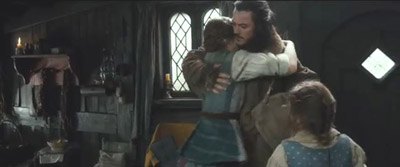
Furnish also makes a more general point: that both parts of The Hobbit far are short on sympathetic characters. LOTR is full of heroes–and even Boromir, after trying to take the Ring from Frodo late in Fellowship, redeems himself by trying to save Merry and Pippin. But in Jackson’s Hobbit, few of the characters beyond Gandalf, Bilbo, a few of the Dwarves, and Tauriel are particularly admirable. Dwalin, ever suspicious, even suggests killing Bard and taking his boat. Not nice.
Whether or not audiences perceive the characters as Furnish suggests, there is no doubt that LOTR involves characters fighting for the common good and making considerable sacrifices to do so, while most of The Hobbit‘s characters are in contention over the wealth they would gain if Smaug can be killed. There’s also a prominent revenge motif. (Again, Gandalf, Bilbo, Galadriel, and Elrond excepted, and the latter two essentially don’t appear in Desolation.) The Dwarves are a greedy bunch in Tolkien’s novel as well, but The Hobbit is a more comic, more conventional fairy tale than is LOTR, and besides, none of his Dwarves ever behave as callously or as crudely as the film versions do.
This problem of unpleasant characters is particularly noticeable with Legolas. He has been made so intolerant, so offensive, and so callous that many fans would rather he had been left out altogether. Certainly the Tauriel-Kili romance could have worked without him. Perhaps he will improve a bit by the end of the third part, but he is far from the sympathetic Elf that became the idol of fangirls in LOTR. He even looks different, as if Orlando Bloom’s entire face has been Botoxed and too light a shade of blue has been used for his contacts. Here’s a case where purely financial considerations may have played a prominent role in the decision to insert him into The Hobbit.
How could all this have been avoided? In part by trying to achieve something of the sense of fellowship that made LOTR so appealing. Avoid overloading the film with characters who act through motives of revenge and distrust. The invention of the Orc-pursuit subplot is largely to blame for this, as is the caricatured depiction of the Master of Lake-town. The focus should really be on Thorin’s growing obsession with the Dwarves’ lost treasure, which eventually will lead to his break with Bilbo, despite all the latter’s heroic rescues. That obsession is brought up a few times, but it’s obscured by the general emphasis on revenge and greed.
Once more on the issue of padding
Another insightful piece, written by Michael Martinez, takes on the question as to whether Desolation‘s story has been padded out. He points out that in fact a great deal has been cut out of the book, trimming what was already supposedly too short to form the basis for two or three lengthy films. As Martinez writes, the crossing of Mirkwood has been compressed from weeks into what apparently are two or three days. The passage where they wander, dazed, in the woods is the only point at which much time can have passed, and we’re given no sense of how long they are lost before Bilbo climbs the tree–a moment that at least keeps the book’s scene of him delighting at the butterflies he encounters. In the novel, there are other adventures in the woods, and the Dwarves apparently spend about two weeks locked in their cells in Thranduil’s realm, during which time Bilbo, wearing the Ring explores the caverns and finally figures out a way to free them.
The filmmakers then add all sort of things that are not in the book. Is this new material, Martinez asks, padding? He seems not to think so, but I’m not so sure. If the new material is, like the whole Azog subplot, unnecessary and even detrimental to the balance of the narrative, doesn’t it count as padding–especially since it crowds out such things as a more satisfying episode involving Beorn?
Take whole running battle as the Orcs chase the fleeing Dwarves in their barrels down the river and the Elves chase the Orcs. (In the book, the barrels are sent down the chute into the river and simply drift downstream until some Elves steer them along to Lake-town, which is on the near side of the lake.) Yes, the river escape and battle are exciting and fun to watch, if overlong, but they point up yet another problem of balance in this and other action scenes. The barrels chase make the Orcs look remarkably ineffectual. Tauriel and Legolas pick them off at a great rate, both in this scene and in the Lake-town skirmishes. In the river scene, the Orcs do manage to kill some anonymous Elven guards at the sluice gate, and they wound Kili, but they ultimately create more delays than damage and eventually lose their quarry. Such efficient killing of Orcs happens to some extent in Journey as well, but as the Dwarves’ bowman Kili does not have the athletic virtuosity of Legolas and Tauriel, the cannon-fodder nature of the Orcs is less obvious. By the end of Desolation, though, can we really take them that seriously?
The messiness of the Azog/Bolg revenge plot line culminates (at least for now) in the Lake-town scenes, with sinister forces multiplying to a confusing extent. As Martinez puts it, “But with Orcs, elves, dwarves, and the Master’s spies all sneaking around Lake-town I really felt like we had left The Hobbit behind and entered the world of ‘Dungeons and Dragons’ or something.” New or not, I would say that such antics constitute padding, in this case via Jackson’s penchant for extending and multiplying dangers and fights.
Certainly all these invented characters and scenes aren’t necessary because there really turns out not to be enough material in The Hobbit and the LOTR appendices to make up three parts. One puzzling aspect of Desolation is that it fails to pick up plot lines the filmmakers themselves had set up in Journey. The latter, despite its awkward concentration of slower sequences early on and rampant, almost continuous fighting in the second half, had established a pretty good set of plot lines (excepting the superfluous Azog one). They’ve all but disappeared.
I speculated in my entry on Journey that we might discover in part 2 that Saruman was already corrupted by desire for the Ring and wants to prevent an attack on Dol Guldur because he’s already looking for the lost Ring himself. That would have been interesting and true to the information in the appendices. Instead, Saruman doesn’t appear in Desolation. Was bringing Saruman into The Hobbit (where he doesn’t appear, given that Tolkien didn’t invent him until well into the drafting of LOTR) just a little salute to a popular actor? Or will he return in the third part to take part in the attack on Dol Guldur? In which case, will he actually be helping the other White Council members, or doing something devious? (In the appendices, we learn that he did help, mainly to get Sauron away from the area near Dol Guldur where the Ring slipped off Isildur’s finger and sank to the bottom of the Anduin; Saruman himself has been searching the river.) The filmmakers created Saruman’s scenes in The Two Towers so skillfully that his absence here is disappointing. If he is going to reappear in the concluding part, it would seem a good idea to at least mention him. If he isn’t, some way of motivating his absence would have been helpful.
Similarly Radagast, whose insertion into the first film I defended, is barely in this one. He doesn’t do much when he is present, either, mainly pressing Gandalf to investigate Dol Guldur and then, once they reach it, going off to take a message from Gandalf to Galadriel. Will Radagast play a significant role in the final part? One would think so, but at this point I’m not betting on it.
That reminds me
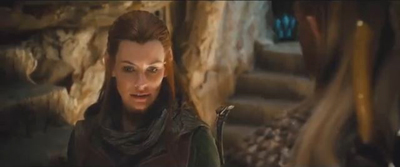
Most crucially, I think, instead of using these already established characters in Desolation or just sticking more closely to the book, the filmmakers have introduced many new elements that are essentially diminished versions of characters and events in LOTR. That strikes me as a bad idea and perhaps really does betray a lack of inspiration. Already fans of the LOTR films have complained that so many echoes of LOTR appear in Desolation. Worse is to come, though. When people view LOTR as part of a series of six parts beginning with The Hobbit, they will end up seeing things in LOTR as echoes of Desolation. The result will be to rob LOTR of some of its originality and effectiveness.
Take Tauriel. She’s a pleasant, admirable character, with a stubborn, headstrong streak that keeps her from being bland. Evangeline Lilly’s performance strikes me as excellent. A lot of fans worried about her inclusion in the film but came to like her. They seem to see her as blending well into the world of the film. But there’s a reason for that. She does come from the world of LOTR.
Was it really a good idea to add a major character who’s basically a blend of Arwen and Eowyn? Doesn’t she make both of those characters less distinctive?
If a lowly Sylvan Elf like Tauriel can rescue Kili from a giant spider and later use the herb athelas (“Kingsfoil”) to heal his wound, are LOTR’s similar rescues of Frodo by Aragorn, Arwen, and even Sam not rendered a bit less impressive? (In the book, Bilbo does all the saving of the Dwarves from the spiders; no Elves appear.) Later, the arrow that strikes Kili is referred to as a “Morgul” weapon that will kill him. Thus it resemble Frodo’s wounding by a Morgul blade by the Witch King at Weathertop in Fellowship. Again, Frodo’s wounding, which seems unique and bound up with the Ring’s evil influence, is cheapened. How can just any random Orc be carrying a weapon with a Morgul spell on it, something we were led to think is unique to the Nazgûl (and in the book, such weapons are). In Bard’s house, Kili’s vision of Tauriel surrounded by glowing light recalls Frodo’s vision of Arwen when she approaches him in Fellowship. Arwen’s stature is lessened by the suggestion that all Elven women can appear this way to mortals. (There’s a reason why Thrandruil doesn’t want his son to fall for Tauriel, though I’m sure he would be thrilled were Arwen to agree to marry Legolas.)
With Tauriel’s limitless athleticism and fighting capabilities, won’t she steal some of the thunder from one of the LOTR film’s most beloved characters, Eowyn? Across Tolkien’s two novels, Eowyn as a female warrior of Rohan was unique. She was unique in the films, too, until now, when Tauriel popped up to dispatch dozens of Orcs with the same aplomb that Legolas does. Did the writers never consider this problem? Was there no other way of creating a “strong” female character besides making her a fighter?
For that matter, why not do something more with the strong female character they already have, Galadriel? Why does she send Gandalf off alone to do the dirty work of investigating the tombs and Dol Guldur? After the White Council scene Galadriel assures Gandalf that she’ll come and help him if need be. Why not just give him a hand to begin with and not wait until Gandalf nearly gets himself killed. In the book Galadriel is ultimately the one who destroys Dol Guldur at the same time the Fellowship and other characters are down south attacking the Black Gate and destroying the Ring. It’s not as though she’s a shrinking violet.
Beyond being the strong female, Tauriel is also there partly to create the love triangle between her, Legolas, and Kili. That romance, though, is sketched out in terribly conventional terms. Tauriel’s interest in Kili is expressed through her remark that he’s tall for a Dwarf, and the final moments between them after she has healed his wound turn distinctly maudlin, with him failing to recognize her and asking weakly if she thinks Tauriel could have loved him.
One of the fans on the TORn Message Boards, ec1988, has started a thread called “The inclusion of Tauriel diminished Legolas.” There simplyaven argues that the Tauriel-Kili romance to some extent presages Legolas’ friendship with Gimli and undercuts its presentation in LOTR as an unusual, even unique overcoming of racial hatreds. That seems right. Her “Aren’t we part of this world?” also echoes Merry’s question to Treebeard when the Ents resist the idea of attacking Saruman. (This isn’t the only line repeated almost verbatim from LOTR.)
Another distinct echo of LOTR results from Gandalf’s fight with Sauron in Dol Guldur. It looks remarkably like his duel with Saruman in another tower, Orthanc, in Fellowship. Saruman takes Gandalf’s staff during that one, while Sauron seemingly dissolves Gandalf’s staff into dust:
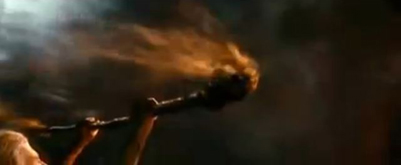
This moment also echoes the scene in Return of the King where the Witch King knocks Gandalf the White off Shadowfax and dissolves his staff (in the extended edition only).
By now Gandalf has lost a number of staves across the five parts of the epic tale. It has become a sort of unintentional running joke on discussion sites as fans tot up how many staves Gandalf has lost and where he might be getting the replacements. Posts include photos to demonstrate the slight differences among them. One relatively brief example from the Message Boards on TORn comes from 2008–years before The Hobbit included at least one more destroyed staff. As moderator Ataahua remarked, “Back in the day, someone on TORN wondered if Gandalf had a locker of spare robes and staffs at Rivendell, as if it were a handy bus station. :)” Whether Radagast will give Gandalf his to replace the one destroyed by Sauron is a current topic of discussion.
But getting back to the Dol Guldur battle. Sauron slams Gandalf to the ground, then tosses him up so that he’s “velcroed” to the wall–pretty much as Saruman had done:
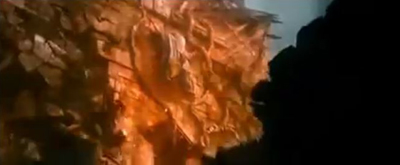
In Fellowship, Saruman imprisoned Gandalf on a tiny space at the top of Orthanc. Sauron suspends him in a small cage. I wonder if someone watching all six parts straight through might not find the Saruman-Gandalf battle a bit ludicrous because it is so similar to the “earlier” one. (To me, the wizard-duel was already somewhat ludicrous–and of course, it didn’t happen in the book.)
There are other signs of Desolation cannibalizing ideas from LOTR. The invented character of Alfrid, assistant to the Master of Lake-town, is a lot like Theoden’s slimy, treacherous adviser Grima. Thranduil is like Denethor in his refusal to consider the welfare of anyone beyond the boundaries of his own realm. Furnish calls the Master of Lake-town “the Goblin-King with a comb-over and more clothes,” suggesting a cannibalization from within The Hobbit as well.
Gandalf the Wimp
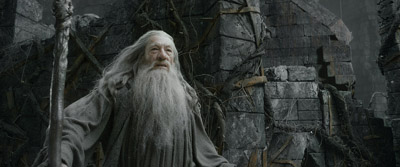
In this film, the writers don’t seem to know what to do with Gandalf. Midway through the book, he simply leaves the Dwarves and Bilbo at the edge of Mirkwood to take care of “some pressing business away south”–as he had planned from the start to do, so there he isn’t suddenly abandoning them. He returns in time to participate in the Battle of Five Armies, near the end of the novel.
Tolkien was smart enough to know that Gandalf was simply too powerful to keep around all the time. Where’s the suspense if you’ve got a wizard along to solve problems like capture by trolls or goblins? So he invented various devices to take him away from the action for stretches of time. (These became more complicated in LOTR; I devote part of a chapter of my book-in-progress to these tactics.) Only near the end of The Hobbit novel do we learn that Gandalf and the White Council have driven the Necromancer out of Dol Guldur. Indeed, Tolkien invented the “Necromancer” simply as an excuse to leave Bilbo and the Dwarves alone, forced to defend themselves. It was only by happy accident that this sinister figure, barely mentioned in the novel, was available to become the source of LOTR’s supreme villain.
So why doesn’t Desolation have Gandalf go off to do his “pressing business” and then concentrate instead on Mirkwood, Thranduil’s imprisonment of the Dwarves, the trip by barrel to Lake-town, and above all on Bilbo’s maturation? I have to believe it’s because Ian McKellen is arguably the biggest star involved in these films. True, others have also become famous as a result of appearing in The Hobbit, but back when the film was being written and shot, Ian was central. In the credits his name appears before that of Martin Freeman.
The problem confronting the filmmakers was that Gandalf is a supporting character in The Hobbit, albeit a major one. (I would argue that he and Frodo are the two protagonists of LOTR, the novel.) It would be appropriate for him to be absent for most of the second half of Desolation, but clearly the filmmakers felt they couldn’t afford to give up their top star for so long. Hence they invented scenes to give him something to do. The obscure mission to the tombs in the High Fells is one such scene. In terms of the plot as a whole, however, it could easily be done without.
More crucial, though, is Gandalf’s invasion of Dol Guldur, his challenge to the hidden forces there, and his losing battle with the Necromancer, now revealed as Sauron. The fact that he ends up helpless and in need of rescue raises yet another question: Why does he do such an idiotic thing? No reason is provided. He is certain that he’s going into a trap, and he has no idea what’s waiting inside for him. What could he possibly hope to accomplish? (If he were going in to try and rescue someone held prisoner inside, that would be another matter.) I think we’re to take it as a brave move on his part, and he does manage to hold his own against Sauron for a short time. But basically it’s a huge mistake on the part of a wizard we’re supposed to consider wise.
The sensible thing for Gandalf to do would be to go and alert Galadriel, who presumably has returned to her home in Lothlorien. That realm is situated relatively close to Dol Guldur, almost directly across the Anduin. Gandalf and Galadriel could summon the White Council and gather Elvish troops to lead an attack on the tower. In the book, that’s what Gandalf’s “pressing business to the south” is.
In general the Gandalf of the films is a far weaker, more vulnerable figure than the one in the books. I cannot imagine the Gandalf of the books would say that he’s afraid and that having Bilbo along on the quest gives him courage, or that he would need such reassurance and guidance from Galadriel. The Witch King could hardly knock him off his horse. In Fellowship (the book) Gandalf manages to hold off the nine Black Riders all night when they attack him on Weathertop. He doesn’t kill any of them, but he manages to escape unscathed.
Moreover, in the book Gandalf has been to Dol Guldur twice before, long before the action of The Hobbit. The first time, nearly 900 years earlier, Sauron is hiding there, slowly regaining physical form. Tolkien’s summary of the event in Appendix B is terse: “Gandalf goes to Dol Guldur. Sauron retreats and hides in the East. The Watchful Peace begins. The Nazgûl remain quiet in Minas Morgul.” Later Gandalf sneaks into Dol Guldur to as a spy and discovers that Sauron has returned. He also finds Thrain, Thorin’s father, dying, and receives from him the key and map that he later gives to Thorin in Bag End. (One would think that a flashback to that scene would have been dramatic and suspenseful.)
Tolkien never tells us what Gandalf did to make Sauron retreat. Maybe just the wizard’s presence frightened him away. Similarly, how he managed to spy inside Dol Guldur remains unexplained. The point, though, is that the filmmakers have made Gandalf weaker primarily to generate even more suspense and violent action and to set up a rescue of the hapless wizard that will surely involve an attack on Dol Guldur in the final part. Never mind that Gandalf’s invasion of Sauron’s stronghold in Desolation makes no sense.
Gandalf isn’t the only one who is made less powerful and dangerous in order to generate a grand action set-piece. Even the villain of the title is made to look rather foolish.
Smaug the Clueless
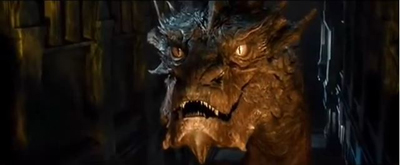
There is no question that Smaug as a CGI creation is a marvel, and Benedict Cumberbatch provides his voice, as manipulated by the sound crew, very effectively. Throughout his initial scene with Bilbo, which sticks pretty closely to the book, he seems appropriately menacing, sly, and playful in the manner of a cat toying with its prey.
As soon as the Dwarves join Bilbo inside Erebor, however, Smaug is revealed to be strangely ineffectual.
Once the Dwarves decide on their strategy of flooding Samug with molten gold, they split up to take separate routes to the forges. Time and again they manage to elude the beast as he searches for them. At once point he passes right above Thorin’s group and fails to notice them. Wouldn’t Smaug be glancing in all directions as he moved? And so much for his vaunted sense of smell. At one point Thorin leaps into space to avoid a blast of fire (below) and manages to catch hold of a chain hanging conveniently in his trajectory. Smaug follows him, curling around the dangling Dwarf but makes no real attempt to kill him. At one point, Thorin even ends up standing astride the creature’s mouth for a few moments. Now that he has found Thorin, Smaug doesn’t do the obvious–open his mouth and take a bite of him. Later, when Thorin stands exposed on the giant mold full of molten gold, he and Smaug are face to face. The dragon, instead of incinerating him, trades insults. (Of course, movie villains often miss their chance to vanquish their foes, in a convention termed by Roger Ebert “The Fallacy of the Talking Killer.”)
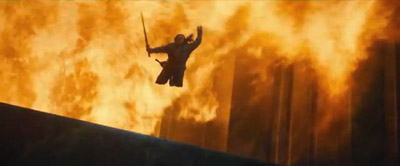
There is so much in the sequence of the Dwarves’ attempt to kill Smaug that is distractingly implausible. Just as the lengthy falls in the Goblintown scene of Journey never seemed to cause so much as a broken bone, in Smaug’s domain the dragon breathes great sheets of fire repeatedly and never seems to singe the Dwarves. When Thorin’s jacket is set afire, he simply takes it off and keeps running.
How could this vast quantity of gold be melted so quickly? How could Thorin ride a river of molten gold in a metal wheelbarrow and survive? Why does the giant Dwarf king’s statue, when the mold is pulled away, stand for several seconds as Smaug admires it before suddenly gushing into a golden lake that momentarily overwhelms the dragon? And why, if Dwarves know so much about dragons, does it not occur to them that a creature full of fire couldn’t be killed in this fashion? Why would Smaug keep bashing down columns and other parts of the “building” which he considers his and where he plays to spend the rest of his life?
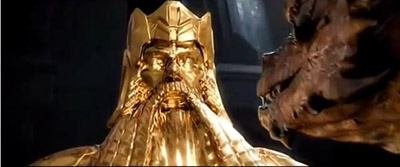
As with Gandalf, the filmmakers have robbed Smaug of much of his power in order to concoct a big action scene as a climactic lead-in to the cliffhanger. Admittedly, the shot of Smaug shaking off the coating of gold into tiny fragments is spectacular, and with that he regains something of his original menace. Yet the cliffhanger works mainly because we assume that the men, women, and children of Laketown, in their wooden houses, will be easier for the dragon to kill.
Mistakes, confusion, and omissions
There are a lot of unexplained, unmotivated things about Desolation. Some are relatively minor, such as how Smaug, who has been alone with his treasure ever since attacking Erebor, could know that Thorin had in the interval before returning gained the sobriquet “Oakenshield”? Or why does Lake-town, which seems to station guards and customs official at every possible entry into the city and spies everywhere, not keep a single guard on the broad, long bridge that links it to the shore?
As in parts of LOTR, there is some jiggery-pokery with time and space. Azog is summoned from a forest near Beorn’s house back to Dol Guldur, which he reaches during the same single night that the Thorin and company spend in the house. Gandalf remarks later that to go around Mirkwood would involve hiking 200 miles north and twice as far south (one fact that does come from the book). Dol Guldur is near the southern end of Mirkwood, so we are to believe that Azog’s warg is speedy enough to cover perhaps 350 miles in several hours. Of course, films play with compression of time quite frequently, but this case is very obvious, since there is an immediate return to the Dwarves’ group still at Beorn’s house.
There are other noticeable causal inconsistencies that make a greater difference in the plot. It was set up in The Two Towers that Galadriel and Elrond could communicate telepathically from a considerable distance. Galadriel and Gandalf speak mentally to each other in the White Council scene. Galadriel seemingly disappears instantly at the end of her talk with Gandalf after the White Council.
Now it turns out that Gandalf apparently can disappear, as he does during his battle with Azog, just before he meets Sauron. Why doesn’t he just stay invisible until he has escaped? Moreover, Galadriel speaks mentally to Gandalf from somewhere, presumably fairly far away. Yet he can’t speak to her that way and must send Radagast with a message to her.
What are the rules here? Why does Galadriel seem more powerful than Gandalf? Who are the wizards and how do they as a group relate to the Elves? The filmmakers could have dramatized a major passage in the appendices that explains who the wizards are, messengers sent by the “gods” of Arda to aid and advise the peoples of Middle-earth in their struggle against Sauron. Then we might be left with fewer crucial questions about these powerful figures, and some reliable premises could be established. LOTR does end with the subtle revelation that Gandalf, Galadriel, and Elrond have the Three Rings of the Elves. (Look quick or you’ll miss them.) The fact that Gandalf has one of the Three comes from that passage on the wizards that I just mentioned. Why ignore that passage, one of the precious few that do relate directly to the action of the White Council plot line?
Again, I think this happens partly because the filmmakers have adopted a tactic of weakening powerful figures like Gandalf and Smaug in order to generate more suspense and big action scenes.
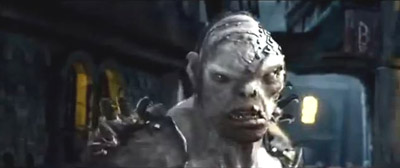
There’s another decision that I think creates confusion. Yes, Azog, the character I dislike both in himself and for his revenge plot line’s unbalancing the film’s scenes, continues to intrude at intervals. As I had speculated, he turns out to be a minion of Sauron. There is still no explanation as to how Sauron could know that Thorin and company have set out from Hobbiton to Erebor and thus direct Azog as to where to hunt for him. For some reason, Bolg, another uber-Orc (above), shows up and summons Azog to Dol Guldur to consult with Sauron–presumably to help prepare his army for a big attack on … something. Then Azog sends Bolg off to take his place and continue the hunt for Thorin. Given that the two seem interchangeable, this whole replacement of Azog by Bolg makes little sense, except presumably to try and inject a little variety into the repetitious revenge plot. Little is the operative word.
One final point. In my previous entry, I mentioned that in Journey the filmmakers did a good job of planting links to LOTR: Saruman’s obstructionism, Galadriel as a powerful figure, Bilbo’s immediate love for Rivendell, the stone trolls seen in Fellowship, the frame story involving birthday-party preparations, and Bilbo’s wealth from the trolls’ hoard. Desolation has far less of this. There’s the picture of young Gimli that Legolas sneers at. There’s also Bilbo’s reaction to the corrupting power of his newly acquired Ring. I think his reaction is overdone. Only a short time after finding it, he seems at least as obsessed with it as we see him sixty years later, at the beginning of Fellowship. Good thing it’s a giant spider that he thinks is trying to take it from him, not one of the Dwarves. Shades of Smeagol! Apart from those added elements, there is little attempt to stitch Desolation a little closer together with LOTR.
Despite everything I’ve laid out here, I enjoy much of Desolation, and it has many good things in it. As usual, the sets, costumes, makeup, and all technical elements have been achieved with the utmost care and imagination. Quite apart from the complex movements of Smaug, with his long body and tail looping through the enclosed spaces of Erebor, there is much to admire. The big action sequences are quite fun. The acting continues to be excellent in most cases, particularly Martin Freeman as Bilbo. Although the hobbit no longer seems the center of his own story, Freeman manages to make every scene he is in a delight and to capture something of the feeling of the book.
Taken as an autonomous film, and despite its lapses in motivation and logic, it offers considerable entertainment and enjoyment. But as the second part of a series, it has gone off the rails, much as the Dwarves lose the Elvish path in Mirkwood. I suspect it will turn out to be the weakest of the six parts. At this point there is little if anything to be done to remedy this. (I cannot imagine that the extended version of Desolation will ameliorate the problems much, though I hope it will do so a little.) We are stuck with Tauriel, Bolg, and a weakened Gandalf for the third film. Still, I hope that There and Back Again will steer more directly toward links to LOTR. We shall see the Battle of Five Armies, and Jackson is nothing if not adept at big battle scenes.
What we can take away about prequels here is simply that filmmakers must not only make an original film in itself but must take utmost care to make it serve the franchise as a whole. Through the insistence that there must be a strong female character no matter what or Jackson’s frequently expressed justification that he added something simply because it would be fun, The Hobbit no longer fits well with The Lord of the Rings. That’s a pity, because up to now the filmmakers had been doing so well.
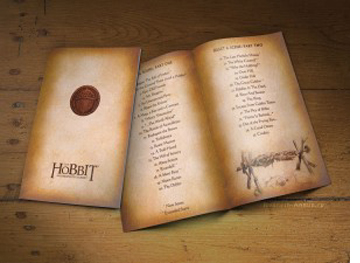 Purchasers of the extended version of AUJ will note that the packaging is not quite as impressive as that for the LOTR EEs. There is no booklet with John Howe and Alan Lee illustrations, nor one of the very helpful indices indicating which chapters are new or expanded and offering a map through the supplements. Fortunately a dedicated Russian fan, TheHutt (editor of the website Henneth Annun), has created one (left), with a remarkably accurate simulation of the design and contents of the LOTR booklets. The pages can be downloaded here. (Scroll down for the English-language version.) Kudos to him!
For those interested in the saga of Gandalf’s loss of staves. The Dol Guldur duel is chronologically the first time Gandalf loses a staff. Saruman takes the next one in Fellowship. The replacement is lost when Gandalf strikes the Bridge of Khazad-dûm with it, and bridge and staff both shatter. In his new incarnation revealed in Towers, Gandalf gets a white staff, which is destroyed by the Witch King in Return (extended edition). He has a duplicate of it in the Grey Havens scene at the end. Five staves–four of them destroyed–and counting. In the book the only loss of a staff comes at the breaking of the Bridge.
Understanding film narrative: The trailer
The Wolf of Wall Street.
DB here:
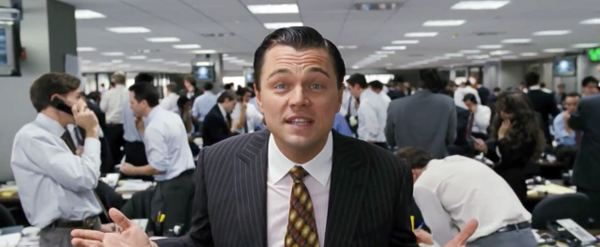
At many points in The Wolf of Wall Street, we hear the voice of Jordan Belfort chronicling his exploits in building up a rapacious investment company. A few times he even addresses the camera.
What’s he doing? Well, he’s telling us a story, obviously. Stories are what many (not all) films present to us. But how, exactly, can we understand the storytelling process in film? What do the filmmakers do, and what do we do?
For my book Poetics of Cinema, I wrote a chapter called “Three Dimensions of Film Narrative.” This 2007 essay tries to come to grips with several questions. Some are pretty general. What makes a film a narrative? How does a narrative film shape our response? What roles do visual and auditory techniques play? What are the roles of emotional responses and broad cultural factors? How does characterization work in a movie?
Other questions are narrower. How revelatory is Hollywood’s three-act model of plot? How do we pick out a story’s protagonist? Do literary concepts like “narrator” and “implied author” apply to films?
Since the chapter is part of a larger book, some of these matters are dealt with at greater length in other chapters. Some are developed in other books, notably Narration in the Fiction Film, and elsewhere on this site. This essay was my attempt to boil down my thinking about filmic storytelling into one convenient, if sometimes sketchy, form.
Today I’m posting a corrected, slightly revised version of that chapter as a downloadable pdf file. Thanks to our web tsarina Meg Hamel, it has links as well. Students, teachers, researchers, and casual or ardent cinephiles: Make use of this as you like.
The essay is here.
This blog entry is a guide to the essay, or maybe just a trailer. As with a trailer, my use of The Wolf of Wall Street is illustrative; I’m not offering anything like a full analysis or even a review. And like most trailers, mine has spoilers.
The three dimensions I explore in the essay are narration, plot structure, and story world.
Dimension 1: Pushy narration
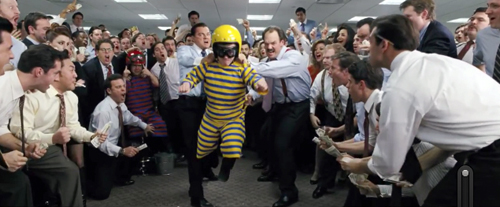
A film’s narration I take to be unfolding and organization of story information as the viewer encounters it, moment by moment. . (This is distinct from the term “voice-over narration,” like Jordan’s in The Wolf of Wall Street, though voice-over commentary is part of the overall narration.) Narration is designed to shape our itinerary through the film. It’s a complex array of cues that guide us in building up the story.
In The Wolf of Wall Street, the first dose of information we get is a TV commercial for the Stratton Oakmont investment company. We see busy, efficient brokers bent over their desks in a vast office as a lion paces the aisles. But then we get another view of the office, as partying staff prepare to launch a little man in a Velcro suit toward a target. The man is hurled, and one of the men who tosses him identifies himself as Jordan Belfort. We’re then launched into a sequence laying out Jordan’s lifestyle.
One thing this portion of the narration does is to peel back the staid, solid image of the brokering house and show the orgiastic self-indulgence behind it. What if Scorsese and his screenwriter Terrence Winter hadn’t included the commercial? Our sense of the contrast between public image and internal debauchery wouldn’t be so strong.
The quick scenes of Jordan’s lifestyle, driven by drugs, sex, and high living constitute a block of concentrated exposition. The narration could have introduced Jordan’s debauchery gradually through hints, but instead we’re told of it bluntly and swiftly. Jordan boasts that at age 26 he made nearly fifty million dollars a year. We’re coaxed to ask: How did he get so far?
This is, we might say, a curiosity question—a question about what in the past led up to the present. A film’s narration is often prodding us to ask just this question. A piece of narration may also provoke effects of surprise, as when the Velcro-target episode undercuts the corporate image. Surprise is central to narrative because knowledge is distributed unequally among characters and spectators; any character may have a secret.
There’s also suspense, which we can consider broadly as a sharpened anticipation of what might happen next. In The Wolf, I’d argue that there’s some suspense when Jordan, zonked on Quaaludes, must save Donnie from choking on a piece of ham. Curiosity, surprise, and suspense aren’t of course the only effects of storytelling, but they function as “master-effects,” in Meir Sternberg’s phrase. They are central to our comprehension of the story.
Style as narration
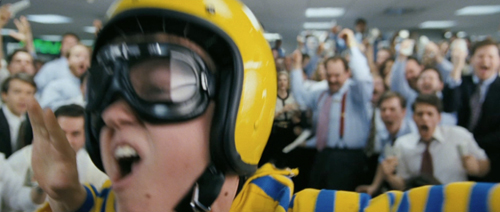
At the same time, narration is shaping our experience through film style. The staid tracking shot along the desks in the commercial, with the firm’s trademark lion prowling the aisles, clashes with the abrupt editing and freeze-frame that introduces Jordan. The actors’ performances, centrally the swaggering performance of DiCaprio, are part of narration as well. The soundtrack’s stylistic texture contributes a lot too, with Jordan’s voice-over and the music and effects creating a rousing, exhilarating effect. The narration’s use of film technique, I think, aims to summon up a shocked but fascinated and amused awareness of the decadent world that Jordan rules.
Throughout Wolf, Scorese’s stylistic choices serve narrational purposes. There are rapid montage sequences, commenting musical tunes, and dialogue hooks (“I won’t call him”/shot of Denham, called, approaching Jordan’s yacht). Scorsese’s fondness for rendering psychological states—here, druggy ones—is presented through classic “impressionist” techniques. As the film goes on, he starts to take us into characters’ minds through inner monologues and misperceptions (the smashed Ferarri). Stylistic patterning also contributes to the film’s tone of grotesque comedy, not just through the dialogue, delivery, and music but through editing. The potentially dramatic moment of Jordan rescuing Donnie with CPR is intercut with a Popeye cartoon: Jordan’s miraculous spinach is coke.
By shaping our knowledge, the narration also throttles the film’s emotional appeal up or down. For example, in one scene Jordan punches his second wife Naomi. Scorsese presents the action in a distant shot, in which a doorway allows us merely to glimpse the violence.
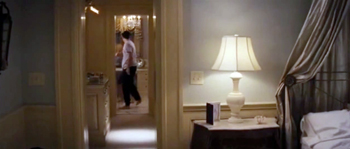
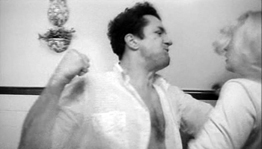
This choice lessens the impact of Jordan’s aggression. It gives us important information about the story action, but not nearly as forcefully as the tight close-ups of sexual and drug-fueled escapades in other scenes do. You could argue that closer and more visceral views (of the sort we get during Raging Bull’s domestic violence, as above) would make it harder to treat Jordan’s bad-boy high-jinks as entertaining.
A more detailed analysis would trace the overall development of the film’s narration. We’d consider, for instance, how it restricts our information at key points. Although the narration breaks with its attachment to Jordan to show Denham’s investigation, it doesn’t reveal Naomi’s scheme to divorce him. We learn of that only when he does. As we indicate in Film Art: An Introduction, “Who knows what when?” is a central question for understanding film narration.
Narration as inference-making
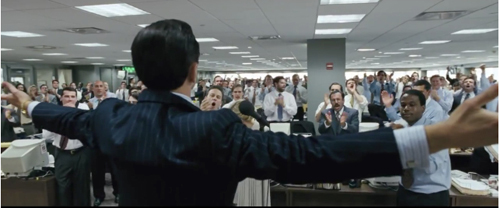
More generally, the essay develops in some detail a notion that’s central to understanding narration. I offer a mentalistic account of narrative understanding.
I think that a storytelling movie, through its narration, impels us to draw inferences. To follow a movie story is to turn the images and sounds into characters, actions, events, causes, and the like. This happens partly through fast, automatic inferences of the kind we make constantly in perceiving the world, and partly and more evidently through the inferences we make in building up that construct we call the movie’s story.
Everything I’ve been describing so far asks us to fill in, extrapolate, and draw conclusions at the level of comprehension. We take the Stratton Oakmont commercial as indicating trustworthiness. We’re encouraged to see the little-person-tossing scene as outrageous and boisterous but cruel, the amusement of people charged with a reckless energy. Jordan’s bragging montage sequence invites us see him as powerful, arrogant, and materialistic.
By saying that narration pushes us to make inferences I’m not suggesting that the inferences are models of deep thinking. They are, we say, commonsensical. In the multiplex, we’re not logicians. Understanding and responding to a story are processes based largely on folk psychology. In that respect, the chapter argues a point I’ve made elsewhere on the site.
Of course not all our inferences will be correct. It would be possible to knock down our first impressions of Jordan with information suggesting that beneath the sharkskin is a likable idealist. (That happens in Jerry Maguire.) Here, other sorts of moments steer our inferences astray. We’re led to think that Jordan drives his Lamborghini home safely, but that impression gets recalibrated the next morning. Earlier, when Denham visits Jordan on his yacht, the rather long, tense scene leads us to consider the possibility that the FBI agent is susceptible to bribery. His questions and facial expressions suggest that he’s weighing Jordan’s offer to help him with some investments. This interchange is conveyed in fairly tight shot/ reverse shots.
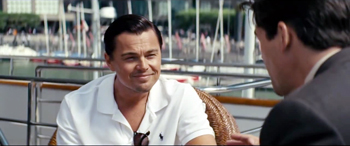
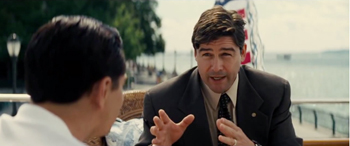
Only when Denham asks Jordan to repeat his offer does Scorsese cut to an angle showing that Denham’s colleague has, offscreen, quietly stepped close enough to bear witness to the bribe Jordan might offer.
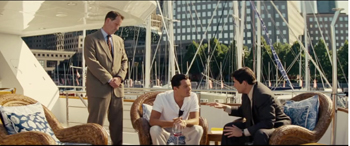
Scorsese has choked off some information about the scene in order to yield a surprise, one that corrects the impression we were building up. One of cinema’s great pleasures is catching up with a narration that has been designed to lead us astray. Hitchcock fans, take note.
Dimension 2: Plot as pattern
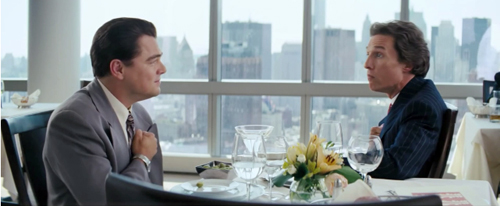
You can also think about the narrative as having a more abstract, geometrical structure: that’s given to us as the plot. Narration creates on-line, moment-by-moment pickup; as viewers we go with the flow. The plot is more architectural, a sort of static anatomy of the film as a whole. We can think of it in a couple of ways.
As a map of a particular film, the plot consists of the overall arrangement of incidents. It lays out the story actions in time. It can proceed chronologically, as plots do most of the time, or it can rearrange incidents out of linear order. The Wolf of Wall Street follows the Stratton Oakmont commercial with the Velcro-target scene, and then presents Jordan at the height of his powers. But after the quick exposition of his lifestyle, the plot flashes back to his first day on Wall Street in 1987.
Now the film presents a mostly chronological layout. Jordan gets his broker’s license, loses his job, picks up a low-end one, and then rises to the spot running his company. This trajectory is sometimes interrupted by quick flashbacks filling in background on a character or a situation; we even get flashbacks within flashbacks. The overall time scheme is hazy, since we’re never shown exactly what point in time is “now.” There’s the suggestion that the initial flashback is rounded off when Jordan’s cohorts meet to plan the Velcro-tossing stunt, but that opening scene isn’t replayed, so we can’t be sure exactly when the opening flashback ends. The flashback must be finished at some indeterminate time late in the film, when Jordan’s fortunes decline and Naomi is alienated from him. But the narration whisks us along without establishing the firm framing devices of traditional flashback plotting.
From this perspective, every film establishes its own plot structure, based on the overall “geometry” of its scenes and sequences. There’d be a lot to say about this in The Wolf, such as the introduction of Denham (and the brief alternating scenes of his investigation) and the various lines of action that fill out the plot: Jordan’s addictions, his plan for an IPO, his two marriages, the SEC inquiry, his Swiss money-laundering schemes, and the like. The craft of screenwriting consists in large part of developing and braiding lines of action in this way. Several entries on this site, as well as many chapters of Narration in the Fiction Film and Poetics of Cinema, analyze how such plot patterns work in tandem with the narration’s unfolding.
Caught in the act(s)
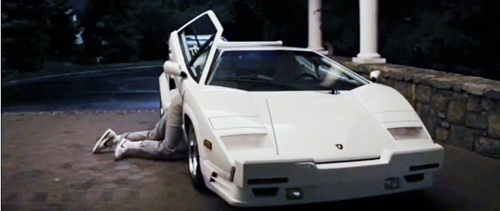
Another way to think about plot structure is to consider how the particular film obeys broader principles of construction. Tragedy, comedy, melodrama, mystery stories, and other genres have distinct, widely-known conventions of plot geometry. There are as well traditions of plotting that cross genres.
In modern commercial cinema, the most famous structural convention is the three-act pattern. Kristin has proposed that Hollywood feature filmmaking is better thought of as adhering to a multiple-part principle based on characters’ goals. The film might have two, three, four, or more parts, depending on its running time and the ways it shows character goals created, reformulated, blocked, delayed, and fulfilled (or not). We’ve tested Kristin’s proposal in books (Storytelling in the New Hollywood, The Way Hollywood Tells it) and on this site (here and here and here and here).
The essay considers the matter more theoretically, but just to illustrate, I’ll hazard a layout of The Wolf of Wall Street’s plot structure. It’s nothing but spoilers, so I’ve flagged it all in olive green if you want to skip it.
Since Wolf runs about 173 minutes without credits, I think it can be usefully laid out in five large-scale parts. These are framed by a brief prologue (the commercial and the Velcro-target scene) and an epilogue summing up Jordan’s court sentence, his stay in a country-club prison, and his new career as “the World’s Greatest Sales Trainer.”
The Setup shifts from Jordan’s life at the pinnacle to his beginnings in the business and his rise as an entrepreneur. In the course of this portion he meets Donnie and the two assemble their team of eccentric, grotesque staff. After establishing Stratton Oakmont, Jordan demonstrates his sales technique and the script his salespeople will follow. This section consumes the first thirty-five minutes of the film.
What Kristin calls the Complicating Action, which resets the protagonist’s goals, centers on Jordan’s plan for an IPO and his affair with Naomi. Around the hour mark, Jordan is divorced and free to pursue the IPO, but now Denham of the FBI is following the company and the SEC is getting curious.
The Development section, which typically expands and delays the fulfillment of the goals set earlier, shows Jordan marrying Naomi, the firm’s frenzied launch of the IPO, and Jordan’s botched effort to bribe Denham. By about 96 minutes into the film, the two antagonists, Jordan and Denham, have faced off in a preliminary conflict. What remains is to see how Jordan will evade capture.
I’m inclined to see the fourth part as a second Complicating Action, because Jordan recalibrates his goal. Stratton Oakmont is making so much money he needs to find an offshore place for it. He decides on Switzerland, and the bulk of this section of Wolf focuses on whether he’ll be successful. But the SEC is breathing down his neck, and he momentarily considers quitting his firm. During a pep talk to his staff, his resolve weakens (he’s sold by his own rhetoric), and he decides to fight the regulatory battle. This is a turning point: now both the SEC and the FBI are on his tail with renewed vigor.
This section, a bit longer than the others, runs about forty minutes. I attribute that mostly to a wedged-in scene that’s almost pure delay: Jordan’s and Donnie’s wild night on Quaaludes, which ends with Jordan crawling toward his car, smashing it up, and saving Donnie from choking. Nearly all of this has no effect on the plot’s forward movement; Donnie survives and Jordan isn’t charged for the road mishaps. The only plot causality here is the fact that a wacked-out Donnie makes an incriminating call on Jordan’s home phone, which is tapped. This bit of action could have been handled much more briefly, but the Quaalude gluttony is so inherently funny, and forms such a plausible topper to the ‘lude motif throughout the film, that it’s expanded to a remarkable twelve minutes. This sort of delay is usually seen in Development sections, but because Jordan resets his goals in this section I’m considering it a Complicating Action.
The Climax (25 minutes) arrives when Jordan, hiding in Italy with Donnie and their wives, learns that Aunt Emma, his front for the Swiss money-laundering, has died. He must race back to Zurich to shift the money to a new account, and in the process the yacht is wrecked in a storm. He’s arrested and agrees to rat on his friends. Naomi divorces him. He tries to protect Donnie but fails and is sent to jail. In the epilogue he’s shown bouncing back, playing to an audience of suckers who share his dream of getting very rich.
Winter’s screenplay, with its parallelled and intertwined lines of goal-driven action and its reiteration of one large-scale component, a second Complicating Action, shows how the classical pattern can be expanded to fill out a longer-than-average running time.
Dimension 3: The story and its world
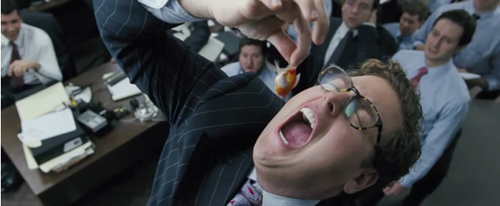
There’s a tendency to think of the story action as existing virtually before it becomes a plot and is presented through narration. It’s as if the story was already there, waiting to be turned into a film. To some extent, this can happen with documentary narratives and adaptations of novels, plays, and comic books. Nonetheless, as viewers we access a movie’s world only through narration and plot structures. In fact, “access” isn’t quite right. As I’ve indicated, I think that we construct the story inferentially, on the basis of the cues given by those other dimensions.
If every viewer has to build up the story herself, shouldn’t we have widely different senses of what happens? To some extent we do. People might fill in certain gaps differently, or draw divergent conclusions about what made something happen. Certain films, not typically Hollywood ones, do encourage more open explorations of the story situations. Here plot construction and narration may follow other conventions, such as those I’ve tried to chart in Narration in the Fiction Film and elsewhere.
Mostly, though, even in “independent films,” there’s a great deal of convergence among viewers’ inference-making. Sooner or later, we arrive at a common understanding of most of what happened and why. As we leave the shared realms of perception and comprehension, of course, viewers’ construals can diverge a lot. Once we get to abstract interpretations—such as whether The Wolf of Wall Street celebrates or condemns the anything-for-a-buck culture—we should expect a lot of variations. (I try to explain why this happens elsewhere in the book, in the essay “Poetics of Cinema.”)
“Three Dimensions of Film Narrative” considers the story and its world broadly, in terms of cues for causation and characterization. It focuses particularly on characters and how we understand them. Again I argue for an inferential model. This means that, as in real life, we’re practicing “mind-reading”—trying to figure out characters’ traits and temperaments on the basis of their behavior, trying to grasp their motives and goals. We build them up as persons on the basis of cues, and we ascribe to them many of the qualities we expect persons in the real world to exhibit. Again, folk psychology provides the ground: the film is likely to streamline and simplify the complexities of real-world personhood.
As viewers we don’t understand a character in isolation. Characters interact, and the narration and plot structure prompt us to compare them, rank them, sort them in different ways. In The Wolf, Jordan is handsome, brazen, and suave; Donnie, a classic weak friend, is awkward and homely, but he has a primal energy that matches Jordan’s slick élan.
Jordan’s father and most of his elders are more prudent and cautious than his crew, who are uninhibited. The guys are a bevy of misfits, distinguished from one another by looks and one or two tricks of demeanor.
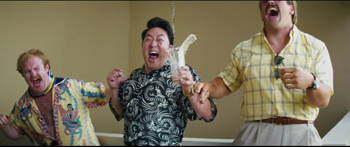
Jordan’s first wife is a brunette hair stylist who voices doubts about his schemes; his second wife is a gorgeous blonde party girl who happily plunges into his lifestyle. In each case, the narration and the plot structure give us the necessary cues, usually redundantly. Jordan’s voice-over commentary reinforces the character information we get from the actors’ appearance and performance.
The essay also considers how films present character change. Sometimes characters come to learn more; they may not vary their distinguishing traits but they realize they have made a mistake. More deeply, characters may decide to get in touch with a suppressed side of themselves. That’s what happens, I think, in Jerry Maguire; he becomes the man his wife thinks he could be.
But very often characters don’t change. Jordan, in The Wolf of Wall Street, has an opportunity to confess, return the money he fleeced from his clients, and take his punishment. Instead, he insists that everything he’s done has been for his friends—the staff of the firm—and they deserve to succeed as he has. (Even though he is deceiving them too; he buys shares in his own IPO and orders the salespeople to push that stock.) What shocks many viewers about the film, I suspect, is that Jordan doesn’t become a better person in the course of his adventures. His punishment is light, he learns nothing, and by the end of the film he’s as amoral as he was when he started the company. (“Sell me this pen.”) As sometimes happens, the interest of the plot comes from watching a gifted, resourceful scoundrel adapt his techniques to changing situations.
But wait, there’s more
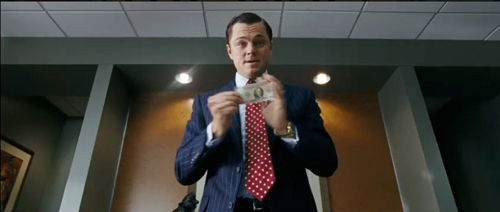
Okay, you may be asking impatiently. But why? Why offer these categories, carve things up, make supersubtle distinctions, concoct new terminology? Why not just do film criticism?
Well, partly because I want to articulate more than my response to a particular movie. I want to understand the more general ways in which films work and work upon us. I think we can usefully look for explanations of movies’ functions and effects, and these are things that ordinary film criticism doesn’t typically offer. For example, noticing how a film’s elements function with respect to narration, plot, style, and story world can do more than sensitize us to this or that movie. This sort of analysis can make us aware of broad norms of moviemaking and how particular films relate to those norms, currently and historically.
At the same time, the line of thinking I’m proposing casts light on the skills we deploy, mostly unawares, in experiencing films. No matter how simple-minded the movie, I think that we do things in following it; we exercise our narrative competence. On the other side, sorting things out this way can explain the range of choice and control open to the filmmaker. I think that the poetics of cinema I propose can help filmmakers become aware of the tools they are using–and perhaps encourage them to try other ones. My categories are derived from filmmaking craft, and perhaps they can in turn illuminate the practical tasks facing filmmakers.
A couple of final points. In the chapter I draw examples from a variety of films, many American (Cellular, Boyz N the Hood, You’ve Got Mail, etc.). Despite my consideration of Ashes of Time, Claire Dolan, Memento, and other films, some readers will ask why I don’t consider more non-Hollywood examples. The choice was strategic: Hollywood films throw the areas I’m charting into sharp relief. They provide clear-cut (not necessarily simple) examples of my points. And historically, the dominance of Hollywood film in the world’s theatrical market have given them a lot of influence. Much of what we think of as non-Hollywood is based on attempts to revise or reject those norms.
At the same time, I’m counting on readers cutting me some slack because I’ve written a lot about alternatives to Hollywood. My books on Eisenstein, Ozu, Dreyer, and Hong Kong cinema try to analyze diverse storytelling options. Elsewhere in Poetics of Cinema I discuss various narrative traditions, including varieties of network narratives and forking-path plots. Narration in the Fiction Film explores still other storytelling modes. And on this site I’ve had a lot to say about non-Hollywood constructive principles (for example, here and here).
The last section of the essay considers what is probably inside-baseball for many readers. Yet the underlying question is important. How adequately can film narrative can be understood on a model of literary narrative? Some theorists think that the basic principles of narrative are to be found in verbal storytelling, and narratives in other media must find equivalents for them. My own view is that narrative as a phenomenon gets mapped onto different media in varying ways. There may not be a single model that will be valid for plays, novels, dance, comic strips, radio drama, film, digital fiction, and so on.
For example, if Jordan Belfort were a character in a novel, certain weird things wouldn’t be happening onscreen. A first-person narrator in the novel can tell us only things that she or he knows about. But “inside” Jordan’s tale we get all kinds of scenes that he didn’t witness. True, he knew that FBI agent Denham was on his trail, but he couldn’t know the color of Denham’s office, or what Denham said to his colleagues. Nor could Jordan know exactly how the quarrel between his partner Donnie Azoff and his ally Brad Bodnik went down, even though we see the entire scene embedded in “his” telling.
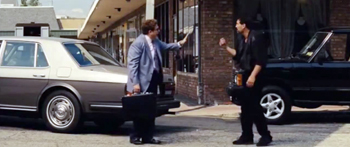
Of course we can say that these scenes are just movie conventions. We accept that in film, first-person voice-over often includes scenes that the speaker didn’t witness, or maybe didn’t even know about. But that convention points to the limits of importing models of storytelling from literature to the study of cinema. A novel can’t wedge those things in without raising the question of how the narrator knows this. We just don’t ask such a question about Jordan.
By a path too winding to summarize here, these and other observations lead me to a counterintuitive conclusion: Narrative, at least in film, isn’t best understood as an act of communication from an author-like entity to a reader-like one. Why do I say that? How can film not be communication? Answer, too brief: What most people call communication I call converging inferences.
And to end my trailer, I suggest that we think of narrative in all media, most especially film, as inherently promiscuous. It will pull in anything that gets the immediate job done. That includes grabbing one element of ordinary conversation–a guy telling a story–without keeping the other bits of the communicative chain, such as feedback from a listener. Jordan is talking to us, but he doesn’t know we’re here, and we can’t interrupt him.
One more time: You can get the essay here. Thanks for reading!
In a way this post is a sequel to the previous entry; background on Meir Sternberg’s account of curiosity, suspense, and surprise can be found there. For more on the subject, see our category “Narrative strategies” and the essay “Common Sense + Film Theory = Common-Sense Film Theory?”
Many of the everyday terms we apply to stories are ambiguous or vague, so sometimes we need to define our terms or invent new ones. Take “narration.” In ordinary talk, can mean “voice-over commentary,” such as Jordan Belfort’s in The Wolf of Wall Street. But if we restrict our usage to just this form of sound, we don’t have a good term for the general flow of narrative presentation in the film, let alone films that don’t have voice-overs. So it’s useful to reserve “narration” for that general process and use “voice-over” in some form to describe the soundtrack’s role in that.
The same problem comes up with the term “point of view,” which has many different meanings. It might refer to first-person reportage, or what a character thinks and feels, or what she believes. (Obama is a good president from her point of view.) If we want to be precise in talking about these qualities of storytelling, we need to explain the terms we’re using.
And sometimes it’s just easier to introduce new terms. In the essay, I’ll sometimes call the plot the syuzhet and the story the fabula. Why the fancy terminology? Won’t “plot” and “story” do? Well, yes, up to a point. In this entry I did use those terms, and our textbook Film Art: An Introduction has done that ever since its first edition of 1979. Still, when we’re working within a research community, it helps to have terms, even unusual ones, which say exactly what we mean. The original readership for the “Three Dimensions” chapter knows that “plot” and “story” have different meanings in our culture, and so I tried to use terms that were less ambiguous. Not incidentally, I wanted as well to signal my debt to the Russian Formalist literary critics, perhaps our first modern narratologists.
Other chapters of Poetics of Cinema are posted online here.
P.S. 14 January 2014: Thanks to Steve Hilby for correcting me: I originally mis-identified Jordan’s car as a Ferrari.
P.S.S. 14 January 2014: My old friend Brian Rose signals his Academy interview with the filmmakers, in which Scorsese and Schoonmaker declare a lack of interest in “plot.” Pfui, says I.