

Archive for the 'Film comments' Category
Is Tauriel more powerful than Eowyn? and other questions we shouldn’t have to ask
Kristin here:
Film franchises now make up a significant portion of Hollywood’s output, and that situation that is likely to linger, at least until we see even more blockbuster flops than in 2013. Prequels are one way of extending a franchise. They’re a risky proposition, though. These days, who ever thinks about Butch and Sundance: The Early Days or Hannibal Rising? How many would defend the idea that the second Star Wars trilogy (now Episodes I, II, and III) are equal to or better than the first (now Episodes IV, V, and VI)?
Quite often the original entry is an adaptation of an existing work, and there is no additional source material for a prequel. The filmmakers have to make up the story, and the risk is that the prequel will end up being an imitation of the original or take the premises of the original too far. This is especially true of literary properties, even if the original author pens the prequel, as Thomas Harris did with Hannibal Rising.
Peter Jackson and company would seem to have been in the ideal situation. They adapted a beloved literary classic, The Lord of the Rings, and it became a popular and critical success. There was already a potential prequel in the form of a second classic by the same author, J. R. R. Tolkien. Of course, The Hobbit was published first, and The Lord of the Rings was a sequel to it. Through sheer chance, however, the fact that the distribution rights for The Hobbit had not been sold along with the other film rights to the two novels, the filmmakers were not able to begin with it. Only after LOTR was out did MGM, owner of those distribution rights, come on board as co-producer, and the film Hobbit became a prequel.
Now Jackson had a book written by the same author and access to considerable material in Tolkien’s appendices. He was working with a team consisting of many of the same writers, designers, and technical experts. They were in a strong position to create a film that had the same look and feel as LOTR. With the added material, the dramatic weight and the length of The Hobbit could balance that of the LOTR trilogy. The two stories could blend seamlessly. Possibly more seamlessly than the original novels, which had some gaps and inconsistencies arising from the fact that The Hobbit was a children’s story published in 1937 and The Lord of the Rings was a longer, more serious novel that came out nearly twenty years later.
Now that The Hobbit: The Desolation of Smaug, the second of three parts of The Hobbit, has been released, perhaps it’s time to check in on how the filmmakers are maintaining it as a lead-in to their LOTR trilogy. Unfortunately, I think some serious problems have arisen that were not present in the The Hobbit: An Unexpected Journey. Some of these problems arise from departures from the novel that don’t make sense in relation to the original trilogy; some arise from unclear or unmotivated actions invented by the screenwriters; and worst of all, some result from new characters and situations that too closely resemble those in the original trilogy. Whatever is added to the extended version of Desolation and whatever happens in the third part, There and Back Again, the prequel is now flawed.
The Extended Edition of An Unexpected Journey
But first, some unfinished business concerning the first part of the prequel. Almost exactly a year ago, I posted an entry on the theatrical version of Journey. Having already pointed out that there was plenty of material in the Lord of the Rings appendices to extend the two-part Hobbit adaptation to three parts, I defended certain additions to the plot. These were notably the White Council scene at Rivendell and the inclusion of Radagast the Brown, a wizard only referred to in J. R. R. Tolkien’s novel (though he does appear briefly in LOTR). After all, the appendices are really for both The Hobbit and The Lord of the Rings, containing additional material for each of the novels.
I was far less keen on the Azog the Defiler plotline, entirely invented by the filmmakers. Yes, there is a scene in the appendices where Azog briefly appears in the battle at Moria, but he dies in that battle. The notion of him chasing down Thorin from motives of revenge is wholly new. I argued that the Azog-related scenes overburdened Journey with extra action that disturbed the balance of the narrative, adding an unnecessary battle at the end that came too soon after what should have been the highlight and climax of the film, the underground escape from the goblins and the Riddles in the Dark scene.
I speculated at the time that some specific scenes eliminated to make room for Azog would be added to the extended edition, perhaps helping to redress the imbalance. Were they, and did they?
The main scenes that I anticipated did get added to the extended-edition DVD/Blu-ray release. I think almost everything added to it is a plus. Most of the new scenes are quiet ones of exposition and characterization rather than frantic action, which the later portions of Journey were sadly lacking. Yet this doesn’t help much to balance the narrative any better, since most of the added bits come in the first half of the film, the half that was already quieter and less jammed with action than the later portions. Still, given how much violent action there is late in the film, any quiet action helps counter it to some degree.
As seemed very likely, early on there is a flashback to Gandalf setting off fireworks at a Hobbit party where he meets young Bilbo for the first time. It’s charming and all too short, zipping by, but at least we see a rambunctious young hobbit very different from the staid, middle-aged Bilbo of Bag End. The contrast helps motivate Gandalf’s disappointment in the adult Bilbo and his remarks about how he has changed. The moment also helps motivate the notion that there is a suppressed Took side to Bilbo’s nature, just waiting to be summoned forth by a pushy wizard.
Another extra early scene shows Bilbo, nervous after the visit from Gandalf, shopping for the ingredients for his supper (including the fish later consumed so thoroughly by Dwalin). The brief scene doesn’t add much to the plot, but it serves to introduce the Shire and Hobbiton to those who may not have seen LOTR, and it provides some humor after the tense ending to the initial conversation with Gandalf.
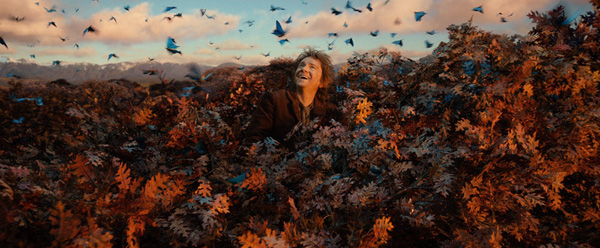
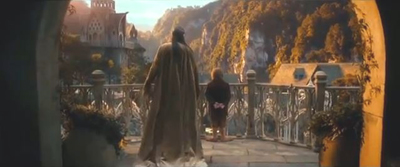
As I anticipated, the Rivendell interlude is expanded. In fact, the bulk of the new and extended scenes occur here. Bilbo wanders around Rivendell, clearly overwhelmed by its beauty. He not only sees the shards of Narsil but stares at the nearby mural of Isildur cutting the Ring from Sauron’s hand. Thus Bilbo sees the Ring shortly before he finds it himself, though there is no one present to tell him what he’s looking at. He also chats with Elrond, who says he is welcome to stay in Rivendell. He presumably means that Bilbo need not accompany the Dwarves when they continue on their journey, but a bit over sixty years later Bilbo will end up living there.
The extra comic bits with the Dwarves, including Bofur’s song, are perhaps entertaining enough, though they continue to film’s general tendency to make them overly boorish.
The White Council scene is extended mainly by Gandalf’s exposition about the Seven Rings of the Dwarves, which Saruman dismisses as irrelevant. The Seven Rings are not referred to in the theatrical version of The Desolation of Smaug, though presumably they were put into Journey for a reason and will return at some point, if only in future extended versions.
The scene with the Great Goblin is stretched out, as he is allowed to sing the Goblintown song from the original book. I think Barry Humphries was an inspired choice to provide the Great Goblin’s voice, so having a little more of him is welcome.
Luckily, there are no extra scenes involving the Azog plotline.
Caution: From here on there are major SPOILERS for the concluding part, The Hobbit: There and Back Again as well as for Desolation.
A better film–if you don’t think too much about it
The reaction to Desolation has been strangely split. On the whole, the critical establishment has heralded it as an improvement on Journey. No long setup of thirteen Dwarves and their quest–just a long series of exciting action scenes culminating in an extraordinary special-effects achievement with the dragon Smaug. The Dwarves’ escape from Thranduil’s realm in barrels rushing down a river with a running battle involving Orcs and Elves has been compared, in the usual reviewers’ cliché, to a thrilling theme-park ride. The battle with the large spiders has also been lauded.
Many fans of Peter Jackson’s other films in the series love Desolation as well and have been going to see it multiple times. Yet fans who know Tolkien’s books really well, while often enjoying the film, have been far more grudging and selective in their praise.
This is largely because Desolation departs far more radically from the novel than any of the previous four films have. New characters have been invented, most notably the female Elf Tauriel, and new scenes fabricated, as with Gandalf’s disastrous solo visit to Dol Guldur, where he ends up imprisoned, or the hectic string of suspense and action scenes at Lake-town. Thranduil briefly appears in the book, but his role as an enemy to the Dwarves has been expanded. The scene of the Dwarves entering Erebor and trying to kill Smaug with molten gold has no parallel in the book.
Inventing scenes needn’t be a problem. Many have complained about the made-up warg attack that ends in Aragorn’s apparent death in The Two Towers, but it is integrated fairly well into the plot. Departures from the original Hobbit novel may be annoying to some, but one should ask how well they fit into the cause-and-effect flow of the plot and into the film as a whole. More specifically, the filmmakers were trying to make The Hobbit into a more substantial film than simply following the book would have allowed. They had to do so in order to blend smoothly into the same world as the LOTR film. The question, then, is really whether the changes 1) are logical in themselves and in relation to the other trilogy, and 2) are an improvement on what the filmmakers could have accomplished had they stuck closer to the story.
Unfortunately, I think that in many cases the new and extended characters and scenes are not as strong as they could have been. More problematically, certain choices steal inspiration from the LOTR film trilogy and in the process undermine the dramatic impact of some of its scenes. This would seem to be something to avoid at all costs in creating a prequel: making the original seem less fresh and dramatic.
Back when I wrote about the decision to split The Hobbit into three parts, I defended Jackson from the accusation that he was clinging to this franchise because he had lost some of his inspiration and didn’t know where to go once the Tolkien adaptations were finished. I don’t know whether it’s true that such a lack of inspiration led to Jackson’s choice to direct the film that he originally wanted to assign to someone else. My point was simply that there was enough material in the novel and in the appendices to expand the film to three parts, if the screenwriters took advantage of that material and fitted it into the plot skillfully. The addition of the White Council/Dol Guldur plot line, largely based on brief statements in the appendices, suggested that Journey was following that path. I don’t think Desolation continues that pattern of relying on snippets from the original books–and there are some that go unused–to flesh out into new story material. This change is to its detriment.
There have been some thoughtful essays suggesting that the film falls down in its invented portions. Timothy R. Furnish, a long-time columnist for TheOneRing.net, has contributed an essay criticizing the main changes from the book. Furnish admits to being a purist, but his claims about the changes suggest that they do not benefit the film. For example, he points out that the plot line involving Gandalf’s and Radagast’s visit to investigate the tombs of the Nazgûl is “rather confusing” and “seems forced and, frankly, unnecessary.” I don’t completely understand that plot line myself, given that it’s not in Tolkien and not explained very well in the film. Elrond said at the White Council meeting that the spells holding the Nazgûl in their tombs were unbreakable. So far there’s no explanation as to how they escaped. Are most viewers able to connect those empty tombs to the Black Riders we had first met early in Fellowship? I doubt it.
The inclusion of this tangential plot line also means that Gandalf is lured away from his commitment to the Dwarves’ quest not once, but twice, which isn’t very effective dramatically. Galadriel goads Gandalf into investigating the tombs, and Radagast persuades him to explore Dol Guldur. Thus the two of them end up being responsible for his defeat by Sauron while themselves not offering much help. Gandalf also looks weak and indecisive, capable of being talked into an unwise course of action.
How could this have been handled better? Stick to the book. Tolkien never tells us what happened to the Nazgûl in the centuries immediately following Sauron’s defeat and Isildur’s taking of the Ring. It just doesn’t matter. Why drag it into the film? (Possibly extra material in the extended version will better explain this minor plot line, but I doubt there will be anything new relating to it.)
Furnish points out something that has been universally criticized among fans of the books. The episode at the home of Beorn, the large man who can change into a bear, has been so truncated as to be rendered almost pointless. Sure, the design of his house is nice, but why bother? Yes, it offers a brief refuge from the pursuit by Azog’s band–but that just raises the unanswered question as to how Azog found them again after they had been carried so very far by the eagles. The filmmakers needed to include Beorn, since he should return to play a major role in the third part. At least his presence strongly hints that they haven’t eliminated him from that major role. Jackson has assured fans that there will be “a couple more scenes in the extended cut of this film, and some more of him, which I won’t be describing, in the third movie!”
A better approach? In the book, the company have lost all their ponies and supplies in the goblin-caves adventure and are in need of rest and assistance, not rescuing from Orcs. They stay with Beorn for a few days. He’s a fascinating figure in the book, with his giant bees and animal servants. He’s also not the defeatist, lonely figure of the film but a pugnacious guardian who keeps a small region east of the Anduin River free of goblins and wargs. Presumably the extended edition will at least give him a little more screen time. This could have been a chance to add some of the charm and humor of the book to a film that sorely lacks them, in its second installment at least.
As Furnish writes, Bard is a “grim-voiced and grim-faced” leaders of Lake-town’s archers in the book, not a ferryman and smuggler with children to feed. Yet, as Furnish says, “making Bard less of a recalcitrant loner is defensible.” I’d say more than defensible. It may be the only major change that improves on Tolkien, at least in one way. Tolkien’s decision to have Smaug killed by a very minor character was probably a mistake, and fleshing Bard out into a significant figure works reasonably well–though it also is encumbered by the whole conceit that the Dwarves and Bilbo have to be smuggled into Lake-town and that Bard is at odds with the Master of Lake-town and his assistant Alfrid (the latter an invention of the filmmakers). In the book, the Dwarves are welcomed to the town from the start, as potential slayers of the dragon and sources of future prosperity. The chapter about Lake-town is titled “A Warm Welcome.”
Furnish also makes a more general point: that both parts of The Hobbit far are short on sympathetic characters. LOTR is full of heroes–and even Boromir, after trying to take the Ring from Frodo late in Fellowship, redeems himself by trying to save Merry and Pippin. But in Jackson’s Hobbit, few of the characters beyond Gandalf, Bilbo, a few of the Dwarves, and Tauriel are particularly admirable. Dwalin, ever suspicious, even suggests killing Bard and taking his boat. Not nice.
Whether or not audiences perceive the characters as Furnish suggests, there is no doubt that LOTR involves characters fighting for the common good and making considerable sacrifices to do so, while most of The Hobbit‘s characters are in contention over the wealth they would gain if Smaug can be killed. There’s also a prominent revenge motif. (Again, Gandalf, Bilbo, Galadriel, and Elrond excepted, and the latter two essentially don’t appear in Desolation.) The Dwarves are a greedy bunch in Tolkien’s novel as well, but The Hobbit is a more comic, more conventional fairy tale than is LOTR, and besides, none of his Dwarves ever behave as callously or as crudely as the film versions do.
This problem of unpleasant characters is particularly noticeable with Legolas. He has been made so intolerant, so offensive, and so callous that many fans would rather he had been left out altogether. Certainly the Tauriel-Kili romance could have worked without him. Perhaps he will improve a bit by the end of the third part, but he is far from the sympathetic Elf that became the idol of fangirls in LOTR. He even looks different, as if Orlando Bloom’s entire face has been Botoxed and too light a shade of blue has been used for his contacts. Here’s a case where purely financial considerations may have played a prominent role in the decision to insert him into The Hobbit.
How could all this have been avoided? In part by trying to achieve something of the sense of fellowship that made LOTR so appealing. Avoid overloading the film with characters who act through motives of revenge and distrust. The invention of the Orc-pursuit subplot is largely to blame for this, as is the caricatured depiction of the Master of Lake-town. The focus should really be on Thorin’s growing obsession with the Dwarves’ lost treasure, which eventually will lead to his break with Bilbo, despite all the latter’s heroic rescues. That obsession is brought up a few times, but it’s obscured by the general emphasis on revenge and greed.
Once more on the issue of padding
Another insightful piece, written by Michael Martinez, takes on the question as to whether Desolation‘s story has been padded out. He points out that in fact a great deal has been cut out of the book, trimming what was already supposedly too short to form the basis for two or three lengthy films. As Martinez writes, the crossing of Mirkwood has been compressed from weeks into what apparently are two or three days. The passage where they wander, dazed, in the woods is the only point at which much time can have passed, and we’re given no sense of how long they are lost before Bilbo climbs the tree–a moment that at least keeps the book’s scene of him delighting at the butterflies he encounters. In the novel, there are other adventures in the woods, and the Dwarves apparently spend about two weeks locked in their cells in Thranduil’s realm, during which time Bilbo, wearing the Ring explores the caverns and finally figures out a way to free them.
The filmmakers then add all sort of things that are not in the book. Is this new material, Martinez asks, padding? He seems not to think so, but I’m not so sure. If the new material is, like the whole Azog subplot, unnecessary and even detrimental to the balance of the narrative, doesn’t it count as padding–especially since it crowds out such things as a more satisfying episode involving Beorn?
Take whole running battle as the Orcs chase the fleeing Dwarves in their barrels down the river and the Elves chase the Orcs. (In the book, the barrels are sent down the chute into the river and simply drift downstream until some Elves steer them along to Lake-town, which is on the near side of the lake.) Yes, the river escape and battle are exciting and fun to watch, if overlong, but they point up yet another problem of balance in this and other action scenes. The barrels chase make the Orcs look remarkably ineffectual. Tauriel and Legolas pick them off at a great rate, both in this scene and in the Lake-town skirmishes. In the river scene, the Orcs do manage to kill some anonymous Elven guards at the sluice gate, and they wound Kili, but they ultimately create more delays than damage and eventually lose their quarry. Such efficient killing of Orcs happens to some extent in Journey as well, but as the Dwarves’ bowman Kili does not have the athletic virtuosity of Legolas and Tauriel, the cannon-fodder nature of the Orcs is less obvious. By the end of Desolation, though, can we really take them that seriously?
The messiness of the Azog/Bolg revenge plot line culminates (at least for now) in the Lake-town scenes, with sinister forces multiplying to a confusing extent. As Martinez puts it, “But with Orcs, elves, dwarves, and the Master’s spies all sneaking around Lake-town I really felt like we had left The Hobbit behind and entered the world of ‘Dungeons and Dragons’ or something.” New or not, I would say that such antics constitute padding, in this case via Jackson’s penchant for extending and multiplying dangers and fights.
Certainly all these invented characters and scenes aren’t necessary because there really turns out not to be enough material in The Hobbit and the LOTR appendices to make up three parts. One puzzling aspect of Desolation is that it fails to pick up plot lines the filmmakers themselves had set up in Journey. The latter, despite its awkward concentration of slower sequences early on and rampant, almost continuous fighting in the second half, had established a pretty good set of plot lines (excepting the superfluous Azog one). They’ve all but disappeared.
I speculated in my entry on Journey that we might discover in part 2 that Saruman was already corrupted by desire for the Ring and wants to prevent an attack on Dol Guldur because he’s already looking for the lost Ring himself. That would have been interesting and true to the information in the appendices. Instead, Saruman doesn’t appear in Desolation. Was bringing Saruman into The Hobbit (where he doesn’t appear, given that Tolkien didn’t invent him until well into the drafting of LOTR) just a little salute to a popular actor? Or will he return in the third part to take part in the attack on Dol Guldur? In which case, will he actually be helping the other White Council members, or doing something devious? (In the appendices, we learn that he did help, mainly to get Sauron away from the area near Dol Guldur where the Ring slipped off Isildur’s finger and sank to the bottom of the Anduin; Saruman himself has been searching the river.) The filmmakers created Saruman’s scenes in The Two Towers so skillfully that his absence here is disappointing. If he is going to reappear in the concluding part, it would seem a good idea to at least mention him. If he isn’t, some way of motivating his absence would have been helpful.
Similarly Radagast, whose insertion into the first film I defended, is barely in this one. He doesn’t do much when he is present, either, mainly pressing Gandalf to investigate Dol Guldur and then, once they reach it, going off to take a message from Gandalf to Galadriel. Will Radagast play a significant role in the final part? One would think so, but at this point I’m not betting on it.
That reminds me
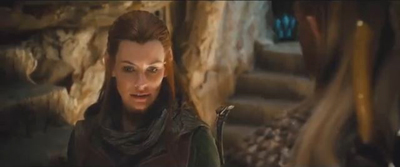
Most crucially, I think, instead of using these already established characters in Desolation or just sticking more closely to the book, the filmmakers have introduced many new elements that are essentially diminished versions of characters and events in LOTR. That strikes me as a bad idea and perhaps really does betray a lack of inspiration. Already fans of the LOTR films have complained that so many echoes of LOTR appear in Desolation. Worse is to come, though. When people view LOTR as part of a series of six parts beginning with The Hobbit, they will end up seeing things in LOTR as echoes of Desolation. The result will be to rob LOTR of some of its originality and effectiveness.
Take Tauriel. She’s a pleasant, admirable character, with a stubborn, headstrong streak that keeps her from being bland. Evangeline Lilly’s performance strikes me as excellent. A lot of fans worried about her inclusion in the film but came to like her. They seem to see her as blending well into the world of the film. But there’s a reason for that. She does come from the world of LOTR.
Was it really a good idea to add a major character who’s basically a blend of Arwen and Eowyn? Doesn’t she make both of those characters less distinctive?
If a lowly Sylvan Elf like Tauriel can rescue Kili from a giant spider and later use the herb athelas (“Kingsfoil”) to heal his wound, are LOTR’s similar rescues of Frodo by Aragorn, Arwen, and even Sam not rendered a bit less impressive? (In the book, Bilbo does all the saving of the Dwarves from the spiders; no Elves appear.) Later, the arrow that strikes Kili is referred to as a “Morgul” weapon that will kill him. Thus it resemble Frodo’s wounding by a Morgul blade by the Witch King at Weathertop in Fellowship. Again, Frodo’s wounding, which seems unique and bound up with the Ring’s evil influence, is cheapened. How can just any random Orc be carrying a weapon with a Morgul spell on it, something we were led to think is unique to the Nazgûl (and in the book, such weapons are). In Bard’s house, Kili’s vision of Tauriel surrounded by glowing light recalls Frodo’s vision of Arwen when she approaches him in Fellowship. Arwen’s stature is lessened by the suggestion that all Elven women can appear this way to mortals. (There’s a reason why Thrandruil doesn’t want his son to fall for Tauriel, though I’m sure he would be thrilled were Arwen to agree to marry Legolas.)
With Tauriel’s limitless athleticism and fighting capabilities, won’t she steal some of the thunder from one of the LOTR film’s most beloved characters, Eowyn? Across Tolkien’s two novels, Eowyn as a female warrior of Rohan was unique. She was unique in the films, too, until now, when Tauriel popped up to dispatch dozens of Orcs with the same aplomb that Legolas does. Did the writers never consider this problem? Was there no other way of creating a “strong” female character besides making her a fighter?
For that matter, why not do something more with the strong female character they already have, Galadriel? Why does she send Gandalf off alone to do the dirty work of investigating the tombs and Dol Guldur? After the White Council scene Galadriel assures Gandalf that she’ll come and help him if need be. Why not just give him a hand to begin with and not wait until Gandalf nearly gets himself killed. In the book Galadriel is ultimately the one who destroys Dol Guldur at the same time the Fellowship and other characters are down south attacking the Black Gate and destroying the Ring. It’s not as though she’s a shrinking violet.
Beyond being the strong female, Tauriel is also there partly to create the love triangle between her, Legolas, and Kili. That romance, though, is sketched out in terribly conventional terms. Tauriel’s interest in Kili is expressed through her remark that he’s tall for a Dwarf, and the final moments between them after she has healed his wound turn distinctly maudlin, with him failing to recognize her and asking weakly if she thinks Tauriel could have loved him.
One of the fans on the TORn Message Boards, ec1988, has started a thread called “The inclusion of Tauriel diminished Legolas.” There simplyaven argues that the Tauriel-Kili romance to some extent presages Legolas’ friendship with Gimli and undercuts its presentation in LOTR as an unusual, even unique overcoming of racial hatreds. That seems right. Her “Aren’t we part of this world?” also echoes Merry’s question to Treebeard when the Ents resist the idea of attacking Saruman. (This isn’t the only line repeated almost verbatim from LOTR.)
Another distinct echo of LOTR results from Gandalf’s fight with Sauron in Dol Guldur. It looks remarkably like his duel with Saruman in another tower, Orthanc, in Fellowship. Saruman takes Gandalf’s staff during that one, while Sauron seemingly dissolves Gandalf’s staff into dust:
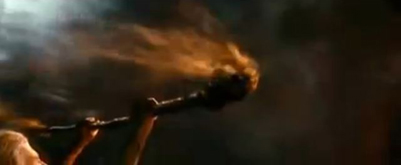
This moment also echoes the scene in Return of the King where the Witch King knocks Gandalf the White off Shadowfax and dissolves his staff (in the extended edition only).
By now Gandalf has lost a number of staves across the five parts of the epic tale. It has become a sort of unintentional running joke on discussion sites as fans tot up how many staves Gandalf has lost and where he might be getting the replacements. Posts include photos to demonstrate the slight differences among them. One relatively brief example from the Message Boards on TORn comes from 2008–years before The Hobbit included at least one more destroyed staff. As moderator Ataahua remarked, “Back in the day, someone on TORN wondered if Gandalf had a locker of spare robes and staffs at Rivendell, as if it were a handy bus station. :)” Whether Radagast will give Gandalf his to replace the one destroyed by Sauron is a current topic of discussion.
But getting back to the Dol Guldur battle. Sauron slams Gandalf to the ground, then tosses him up so that he’s “velcroed” to the wall–pretty much as Saruman had done:
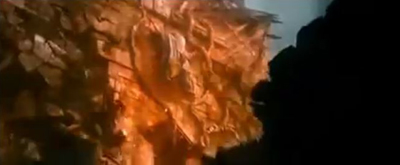
In Fellowship, Saruman imprisoned Gandalf on a tiny space at the top of Orthanc. Sauron suspends him in a small cage. I wonder if someone watching all six parts straight through might not find the Saruman-Gandalf battle a bit ludicrous because it is so similar to the “earlier” one. (To me, the wizard-duel was already somewhat ludicrous–and of course, it didn’t happen in the book.)
There are other signs of Desolation cannibalizing ideas from LOTR. The invented character of Alfrid, assistant to the Master of Lake-town, is a lot like Theoden’s slimy, treacherous adviser Grima. Thranduil is like Denethor in his refusal to consider the welfare of anyone beyond the boundaries of his own realm. Furnish calls the Master of Lake-town “the Goblin-King with a comb-over and more clothes,” suggesting a cannibalization from within The Hobbit as well.
Gandalf the Wimp
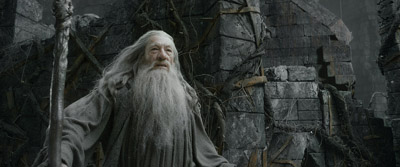
In this film, the writers don’t seem to know what to do with Gandalf. Midway through the book, he simply leaves the Dwarves and Bilbo at the edge of Mirkwood to take care of “some pressing business away south”–as he had planned from the start to do, so there he isn’t suddenly abandoning them. He returns in time to participate in the Battle of Five Armies, near the end of the novel.
Tolkien was smart enough to know that Gandalf was simply too powerful to keep around all the time. Where’s the suspense if you’ve got a wizard along to solve problems like capture by trolls or goblins? So he invented various devices to take him away from the action for stretches of time. (These became more complicated in LOTR; I devote part of a chapter of my book-in-progress to these tactics.) Only near the end of The Hobbit novel do we learn that Gandalf and the White Council have driven the Necromancer out of Dol Guldur. Indeed, Tolkien invented the “Necromancer” simply as an excuse to leave Bilbo and the Dwarves alone, forced to defend themselves. It was only by happy accident that this sinister figure, barely mentioned in the novel, was available to become the source of LOTR’s supreme villain.
So why doesn’t Desolation have Gandalf go off to do his “pressing business” and then concentrate instead on Mirkwood, Thranduil’s imprisonment of the Dwarves, the trip by barrel to Lake-town, and above all on Bilbo’s maturation? I have to believe it’s because Ian McKellen is arguably the biggest star involved in these films. True, others have also become famous as a result of appearing in The Hobbit, but back when the film was being written and shot, Ian was central. In the credits his name appears before that of Martin Freeman.
The problem confronting the filmmakers was that Gandalf is a supporting character in The Hobbit, albeit a major one. (I would argue that he and Frodo are the two protagonists of LOTR, the novel.) It would be appropriate for him to be absent for most of the second half of Desolation, but clearly the filmmakers felt they couldn’t afford to give up their top star for so long. Hence they invented scenes to give him something to do. The obscure mission to the tombs in the High Fells is one such scene. In terms of the plot as a whole, however, it could easily be done without.
More crucial, though, is Gandalf’s invasion of Dol Guldur, his challenge to the hidden forces there, and his losing battle with the Necromancer, now revealed as Sauron. The fact that he ends up helpless and in need of rescue raises yet another question: Why does he do such an idiotic thing? No reason is provided. He is certain that he’s going into a trap, and he has no idea what’s waiting inside for him. What could he possibly hope to accomplish? (If he were going in to try and rescue someone held prisoner inside, that would be another matter.) I think we’re to take it as a brave move on his part, and he does manage to hold his own against Sauron for a short time. But basically it’s a huge mistake on the part of a wizard we’re supposed to consider wise.
The sensible thing for Gandalf to do would be to go and alert Galadriel, who presumably has returned to her home in Lothlorien. That realm is situated relatively close to Dol Guldur, almost directly across the Anduin. Gandalf and Galadriel could summon the White Council and gather Elvish troops to lead an attack on the tower. In the book, that’s what Gandalf’s “pressing business to the south” is.
In general the Gandalf of the films is a far weaker, more vulnerable figure than the one in the books. I cannot imagine the Gandalf of the books would say that he’s afraid and that having Bilbo along on the quest gives him courage, or that he would need such reassurance and guidance from Galadriel. The Witch King could hardly knock him off his horse. In Fellowship (the book) Gandalf manages to hold off the nine Black Riders all night when they attack him on Weathertop. He doesn’t kill any of them, but he manages to escape unscathed.
Moreover, in the book Gandalf has been to Dol Guldur twice before, long before the action of The Hobbit. The first time, nearly 900 years earlier, Sauron is hiding there, slowly regaining physical form. Tolkien’s summary of the event in Appendix B is terse: “Gandalf goes to Dol Guldur. Sauron retreats and hides in the East. The Watchful Peace begins. The Nazgûl remain quiet in Minas Morgul.” Later Gandalf sneaks into Dol Guldur to as a spy and discovers that Sauron has returned. He also finds Thrain, Thorin’s father, dying, and receives from him the key and map that he later gives to Thorin in Bag End. (One would think that a flashback to that scene would have been dramatic and suspenseful.)
Tolkien never tells us what Gandalf did to make Sauron retreat. Maybe just the wizard’s presence frightened him away. Similarly, how he managed to spy inside Dol Guldur remains unexplained. The point, though, is that the filmmakers have made Gandalf weaker primarily to generate even more suspense and violent action and to set up a rescue of the hapless wizard that will surely involve an attack on Dol Guldur in the final part. Never mind that Gandalf’s invasion of Sauron’s stronghold in Desolation makes no sense.
Gandalf isn’t the only one who is made less powerful and dangerous in order to generate a grand action set-piece. Even the villain of the title is made to look rather foolish.
Smaug the Clueless
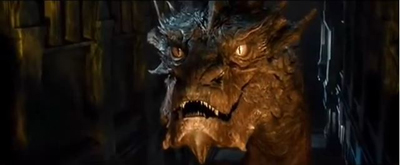
There is no question that Smaug as a CGI creation is a marvel, and Benedict Cumberbatch provides his voice, as manipulated by the sound crew, very effectively. Throughout his initial scene with Bilbo, which sticks pretty closely to the book, he seems appropriately menacing, sly, and playful in the manner of a cat toying with its prey.
As soon as the Dwarves join Bilbo inside Erebor, however, Smaug is revealed to be strangely ineffectual.
Once the Dwarves decide on their strategy of flooding Samug with molten gold, they split up to take separate routes to the forges. Time and again they manage to elude the beast as he searches for them. At once point he passes right above Thorin’s group and fails to notice them. Wouldn’t Smaug be glancing in all directions as he moved? And so much for his vaunted sense of smell. At one point Thorin leaps into space to avoid a blast of fire (below) and manages to catch hold of a chain hanging conveniently in his trajectory. Smaug follows him, curling around the dangling Dwarf but makes no real attempt to kill him. At one point, Thorin even ends up standing astride the creature’s mouth for a few moments. Now that he has found Thorin, Smaug doesn’t do the obvious–open his mouth and take a bite of him. Later, when Thorin stands exposed on the giant mold full of molten gold, he and Smaug are face to face. The dragon, instead of incinerating him, trades insults. (Of course, movie villains often miss their chance to vanquish their foes, in a convention termed by Roger Ebert “The Fallacy of the Talking Killer.”)
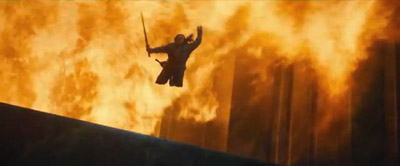
There is so much in the sequence of the Dwarves’ attempt to kill Smaug that is distractingly implausible. Just as the lengthy falls in the Goblintown scene of Journey never seemed to cause so much as a broken bone, in Smaug’s domain the dragon breathes great sheets of fire repeatedly and never seems to singe the Dwarves. When Thorin’s jacket is set afire, he simply takes it off and keeps running.
How could this vast quantity of gold be melted so quickly? How could Thorin ride a river of molten gold in a metal wheelbarrow and survive? Why does the giant Dwarf king’s statue, when the mold is pulled away, stand for several seconds as Smaug admires it before suddenly gushing into a golden lake that momentarily overwhelms the dragon? And why, if Dwarves know so much about dragons, does it not occur to them that a creature full of fire couldn’t be killed in this fashion? Why would Smaug keep bashing down columns and other parts of the “building” which he considers his and where he plays to spend the rest of his life?
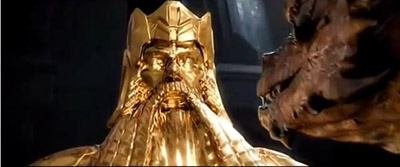
As with Gandalf, the filmmakers have robbed Smaug of much of his power in order to concoct a big action scene as a climactic lead-in to the cliffhanger. Admittedly, the shot of Smaug shaking off the coating of gold into tiny fragments is spectacular, and with that he regains something of his original menace. Yet the cliffhanger works mainly because we assume that the men, women, and children of Laketown, in their wooden houses, will be easier for the dragon to kill.
Mistakes, confusion, and omissions
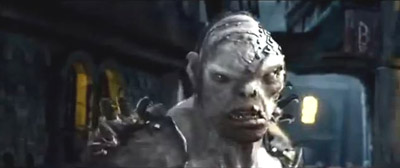
There are a lot of unexplained, unmotivated things about Desolation. Some are relatively minor, such as how Smaug, who has been alone with his treasure ever since attacking Erebor, could know that Thorin had in the interval before returning gained the sobriquet “Oakenshield”? Or why does Lake-town, which seems to station guards and customs official at every possible entry into the city and spies everywhere, not keep a single guard on the broad, long bridge that links it to the shore?
As in parts of LOTR, there is some jiggery-pokery with time and space. Azog is summoned from a forest near Beorn’s house back to Dol Guldur, which he reaches during the same single night that the Thorin and company spend in the house. Gandalf remarks later that to go around Mirkwood would involve hiking 200 miles north and twice as far south (one fact that does come from the book). Dol Guldur is near the southern end of Mirkwood, so we are to believe that Azog’s warg is speedy enough to cover perhaps 350 miles in several hours. Of course, films play with compression of time quite frequently, but this case is very obvious, since there is an immediate return to the Dwarves’ group still at Beorn’s house.
There are other noticeable causal inconsistencies that make a greater difference in the plot. It was set up in The Two Towers that Galadriel and Elrond could communicate telepathically from a considerable distance. Galadriel and Gandalf speak mentally to each other in the White Council scene. Galadriel seemingly disappears instantly at the end of her talk with Gandalf after the White Council.
Now it turns out that Gandalf apparently can disappear, as he does during his battle with Azog, just before he meets Sauron. Why doesn’t he just stay invisible until he has escaped? Moreover, Galadriel speaks mentally to Gandalf from somewhere, presumably fairly far away. Yet he can’t speak to her that way and must send Radagast with a message to her.
What are the rules here? Why does Galadriel seem more powerful than Gandalf? Who are the wizards and how do they as a group relate to the Elves? The filmmakers could have dramatized a major passage in the appendices that explains who the wizards are, messengers sent by the “gods” of Arda to aid and advise the peoples of Middle-earth in their struggle against Sauron. Then we might be left with fewer crucial questions about these powerful figures, and some reliable premises could be established. LOTR does end with the subtle revelation that Gandalf, Galadriel, and Elrond have the Three Rings of the Elves. (Look quick or you’ll miss them.) The fact that Gandalf has one of the Three comes from that passage on the wizards that I just mentioned. Why ignore that passage, one of the precious few that do relate directly to the action of the White Council plot line?
Again, I think this happens partly because the filmmakers have adopted a tactic of weakening powerful figures like Gandalf and Smaug in order to generate more suspense and big action scenes.
There’s another decision that I think creates confusion. Yes, Azog, the character I dislike both in himself and for his revenge plot line’s unbalancing the film’s scenes, continues to intrude at intervals. As I had speculated, he turns out to be a minion of Sauron. There is still no explanation as to how Sauron could know that Thorin and company have set out from Hobbiton to Erebor and thus direct Azog as to where to hunt for him. For some reason, Bolg, another uber-Orc (above), shows up and summons Azog to Dol Guldur to consult with Sauron–presumably to help prepare his army for a big attack on … something. Then Azog sends Bolg off to take his place and continue the hunt for Thorin. Given that the two seem interchangeable, this whole replacement of Azog by Bolg makes little sense, except presumably to try and inject a little variety into the repetitious revenge plot. Little is the operative word.
One final point. In my previous entry, I mentioned that in Journey the filmmakers did a good job of planting links to LOTR: Saruman’s obstructionism, Galadriel as a powerful figure, Bilbo’s immediate love for Rivendell, the stone trolls seen in Fellowship, the frame story involving birthday-party preparations, and Bilbo’s wealth from the trolls’ hoard. Desolation has far less of this. There’s the picture of young Gimli that Legolas sneers at. There’s also Bilbo’s reaction to the corrupting power of his newly acquired Ring. I think his reaction is overdone. Only a short time after finding it, he seems at least as obsessed with it as we see him sixty years later, at the beginning of Fellowship. Good thing it’s a giant spider that he thinks is trying to take it from him, not one of the Dwarves. Shades of Smeagol! Apart from those added elements, there is little attempt to stitch Desolation a little closer together with LOTR.
Despite everything I’ve laid out here, I enjoy much of Desolation, and it has many good things in it. As usual, the sets, costumes, makeup, and all technical elements have been achieved with the utmost care and imagination. Quite apart from the complex movements of Smaug, with his long body and tail looping through the enclosed spaces of Erebor, there is much to admire. The big action sequences are quite fun. The acting continues to be excellent in most cases, particularly Martin Freeman as Bilbo. Although the hobbit no longer seems the center of his own story, Freeman manages to make every scene he is in a delight and to capture something of the feeling of the book.
Taken as an autonomous film, and despite its lapses in motivation and logic, it offers considerable entertainment and enjoyment. But as the second part of a series, it has gone off the rails, much as the Dwarves lose the Elvish path in Mirkwood. I suspect it will turn out to be the weakest of the six parts. At this point there is little if anything to be done to remedy this. (I cannot imagine that the extended version of Desolation will ameliorate the problems much, though I hope it will do so a little.) We are stuck with Tauriel, Bolg, and a weakened Gandalf for the third film. Still, I hope that There and Back Again will steer more directly toward links to LOTR. We shall see the Battle of Five Armies, and Jackson is nothing if not adept at big battle scenes.
What we can take away about prequels here is simply that filmmakers must not only make an original film in itself but must take utmost care to make it serve the franchise as a whole. Through the insistence that there must be a strong female character no matter what or Jackson’s frequently expressed justification that he added something simply because it would be fun, The Hobbit no longer fits well with The Lord of the Rings. That’s a pity, because up to now the filmmakers had been doing so well.
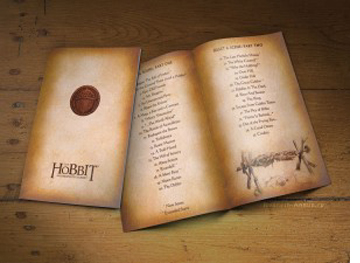 Purchasers of the extended version of AUJ will note that the packaging is not quite as impressive as that for the LOTR EEs. There is no booklet with John Howe and Alan Lee illustrations, nor one of the very helpful indices indicating which chapters are new or expanded and offering a map through the supplements. Fortunately a dedicated Russian fan, TheHutt (editor of the website Henneth Annun), has created one (left), with a remarkably accurate simulation of the design and contents of the LOTR booklets. The pages can be downloaded here. (Scroll down for the English-language version.) Kudos to him!
For those interested in the saga of Gandalf’s loss of staves. The Dol Guldur duel is chronologically the first time Gandalf loses a staff. Saruman takes the next one in Fellowship. The replacement is lost when Gandalf strikes the Bridge of Khazad-dûm with it, and bridge and staff both shatter. In his new incarnation revealed in Towers, Gandalf gets a white staff, which is destroyed by the Witch King in Return (extended edition). He has a duplicate of it in the Grey Havens scene at the end. Five staves–four of them destroyed–and counting. In the book the only loss of a staff comes at the breaking of the Bridge.
Understanding film narrative: The trailer
The Wolf of Wall Street.
DB here:
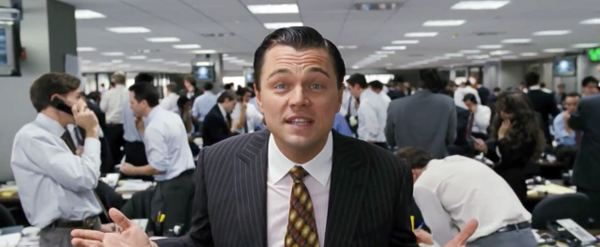
At many points in The Wolf of Wall Street, we hear the voice of Jordan Belfort chronicling his exploits in building up a rapacious investment company. A few times he even addresses the camera.
What’s he doing? Well, he’s telling us a story, obviously. Stories are what many (not all) films present to us. But how, exactly, can we understand the storytelling process in film? What do the filmmakers do, and what do we do?
For my book Poetics of Cinema, I wrote a chapter called “Three Dimensions of Film Narrative.” This 2007 essay tries to come to grips with several questions. Some are pretty general. What makes a film a narrative? How does a narrative film shape our response? What roles do visual and auditory techniques play? What are the roles of emotional responses and broad cultural factors? How does characterization work in a movie?
Other questions are narrower. How revelatory is Hollywood’s three-act model of plot? How do we pick out a story’s protagonist? Do literary concepts like “narrator” and “implied author” apply to films?
Since the chapter is part of a larger book, some of these matters are dealt with at greater length in other chapters. Some are developed in other books, notably Narration in the Fiction Film, and elsewhere on this site. This essay was my attempt to boil down my thinking about filmic storytelling into one convenient, if sometimes sketchy, form.
Today I’m posting a corrected, slightly revised version of that chapter as a downloadable pdf file. Thanks to our web tsarina Meg Hamel, it has links as well. Students, teachers, researchers, and casual or ardent cinephiles: Make use of this as you like.
The essay is here.
This blog entry is a guide to the essay, or maybe just a trailer. As with a trailer, my use of The Wolf of Wall Street is illustrative; I’m not offering anything like a full analysis or even a review. And like most trailers, mine has spoilers.
The three dimensions I explore in the essay are narration, plot structure, and story world.
Dimension 1: Pushy narration
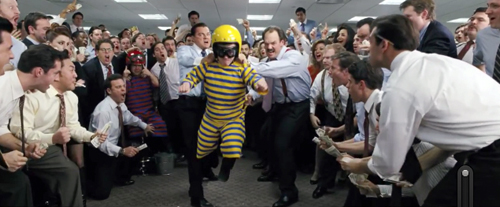
A film’s narration I take to be unfolding and organization of story information as the viewer encounters it, moment by moment. . (This is distinct from the term “voice-over narration,” like Jordan’s in The Wolf of Wall Street, though voice-over commentary is part of the overall narration.) Narration is designed to shape our itinerary through the film. It’s a complex array of cues that guide us in building up the story.
In The Wolf of Wall Street, the first dose of information we get is a TV commercial for the Stratton Oakmont investment company. We see busy, efficient brokers bent over their desks in a vast office as a lion paces the aisles. But then we get another view of the office, as partying staff prepare to launch a little man in a Velcro suit toward a target. The man is hurled, and one of the men who tosses him identifies himself as Jordan Belfort. We’re then launched into a sequence laying out Jordan’s lifestyle.
One thing this portion of the narration does is to peel back the staid, solid image of the brokering house and show the orgiastic self-indulgence behind it. What if Scorsese and his screenwriter Terrence Winter hadn’t included the commercial? Our sense of the contrast between public image and internal debauchery wouldn’t be so strong.
The quick scenes of Jordan’s lifestyle, driven by drugs, sex, and high living constitute a block of concentrated exposition. The narration could have introduced Jordan’s debauchery gradually through hints, but instead we’re told of it bluntly and swiftly. Jordan boasts that at age 26 he made nearly fifty million dollars a year. We’re coaxed to ask: How did he get so far?
This is, we might say, a curiosity question—a question about what in the past led up to the present. A film’s narration is often prodding us to ask just this question. A piece of narration may also provoke effects of surprise, as when the Velcro-target episode undercuts the corporate image. Surprise is central to narrative because knowledge is distributed unequally among characters and spectators; any character may have a secret.
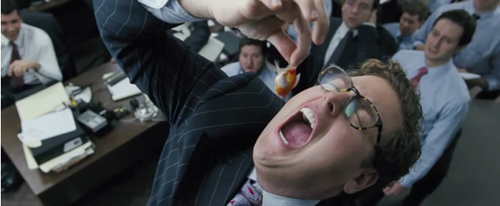
There’s also suspense, which we can consider broadly as a sharpened anticipation of what might happen next. In The Wolf, I’d argue that there’s some suspense when Jordan, zonked on Quaaludes, must save Donnie from choking on a piece of ham. Curiosity, surprise, and suspense aren’t of course the only effects of storytelling, but they function as “master-effects,” in Meir Sternberg’s phrase. They are central to our comprehension of the story.
Style as narration
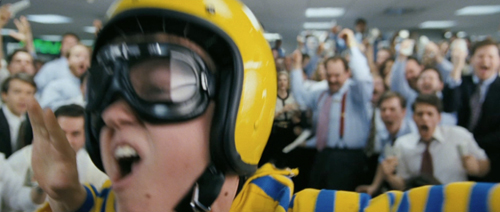
At the same time, narration is shaping our experience through film style. The staid tracking shot along the desks in the commercial, with the firm’s trademark lion prowling the aisles, clashes with the abrupt editing and freeze-frame that introduces Jordan. The actors’ performances, centrally the swaggering performance of DiCaprio, are part of narration as well. The soundtrack’s stylistic texture contributes a lot too, with Jordan’s voice-over and the music and effects creating a rousing, exhilarating effect. The narration’s use of film technique, I think, aims to summon up a shocked but fascinated and amused awareness of the decadent world that Jordan rules.
Throughout Wolf, Scorese’s stylistic choices serve narrational purposes. There are rapid montage sequences, commenting musical tunes, and dialogue hooks (“I won’t call him”/shot of Denham, called, approaching Jordan’s yacht). Scorsese’s fondness for rendering psychological states—here, druggy ones—is presented through classic “impressionist” techniques. As the film goes on, he starts to take us into characters’ minds through inner monologues and misperceptions (the smashed Ferarri). Stylistic patterning also contributes to the film’s tone of grotesque comedy, not just through the dialogue, delivery, and music but through editing. The potentially dramatic moment of Jordan rescuing Donnie with CPR is intercut with a Popeye cartoon: Jordan’s miraculous spinach is coke.
By shaping our knowledge, the narration also throttles the film’s emotional appeal up or down. For example, in one scene Jordan punches his second wife Naomi. Scorsese presents the action in a distant shot, in which a doorway allows us merely to glimpse the violence.
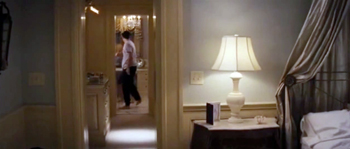
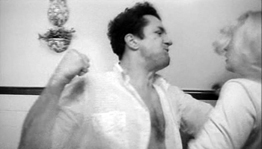
This choice lessens the impact of Jordan’s aggression. It gives us important information about the story action, but not nearly as forcefully as the tight close-ups of sexual and drug-fueled escapades in other scenes do. You could argue that closer and more visceral views (of the sort we get during Raging Bull’s domestic violence, as above) would make it harder to treat Jordan’s bad-boy high-jinks as entertaining.
A more detailed analysis would trace the overall development of the film’s narration. We’d consider, for instance, how it restricts our information at key points. Although the narration breaks with its attachment to Jordan to show Denham’s investigation, it doesn’t reveal Naomi’s scheme to divorce him. We learn of that only when he does. As we indicate in Film Art: An Introduction, “Who knows what when?” is a central question for understanding film narration.
Narration as inference-making
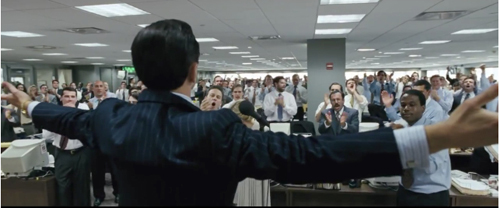
More generally, the essay develops in some detail a notion that’s central to understanding narration. I offer a mentalistic account of narrative understanding.
I think that a storytelling movie, through its narration, impels us to draw inferences. To follow a movie story is to turn the images and sounds into characters, actions, events, causes, and the like. This happens partly through fast, automatic inferences of the kind we make constantly in perceiving the world, and partly and more evidently through the inferences we make in building up that construct we call the movie’s story.
Everything I’ve been describing so far asks us to fill in, extrapolate, and draw conclusions at the level of comprehension. We take the Stratton Oakmont commercial as indicating trustworthiness. We’re encouraged to see the little-person-tossing scene as outrageous and boisterous but cruel, the amusement of people charged with a reckless energy. Jordan’s bragging montage sequence invites us see him as powerful, arrogant, and materialistic.
By saying that narration pushes us to make inferences I’m not suggesting that the inferences are models of deep thinking. They are, we say, commonsensical. In the multiplex, we’re not logicians. Understanding and responding to a story are processes based largely on folk psychology. In that respect, the chapter argues a point I’ve made elsewhere on the site.
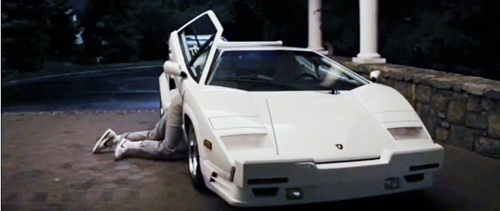
Of course not all our inferences will be correct. It would be possible to knock down our first impressions of Jordan with information suggesting that beneath the sharkskin is a likable idealist. (That happens in Jerry Maguire.) Here, other sorts of moments steer our inferences astray. We’re led to think that Jordan drives his Lamborghini home safely, but that impression gets recalibrated the next morning. Earlier, when Denham visits Jordan on his yacht, the rather long, tense scene leads us to consider the possibility that the FBI agent is susceptible to bribery. His questions and facial expressions suggest that he’s weighing Jordan’s offer to help him with some investments. This interchange is conveyed in fairly tight shot/ reverse shots.
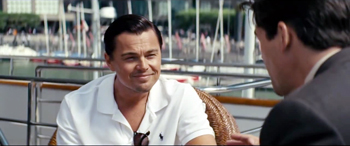
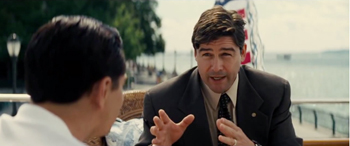
Only when Denham asks Jordan to repeat his offer does Scorsese cut to an angle showing that Denham’s colleague has, offscreen, quietly stepped close enough to bear witness to the bribe Jordan might offer.
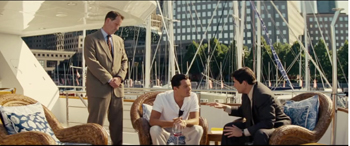
Scorsese has choked off some information about the scene in order to yield a surprise, one that corrects the impression we were building up. One of cinema’s great pleasures is catching up with a narration that has been designed to lead us astray. Hitchcock fans, take note.
Dimension 2: Plot as pattern
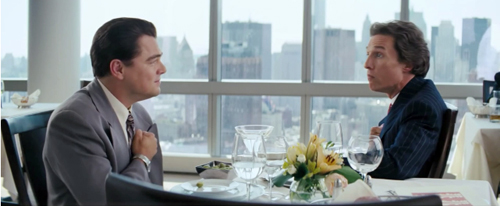
You can also think about the narrative as having a more abstract, geometrical structure: that’s given to us as the plot. Narration creates on-line, moment-by-moment pickup; as viewers we go with the flow. The plot is more architectural, a sort of static anatomy of the film as a whole. We can think of it in a couple of ways.
As a map of a particular film, the plot consists of the overall arrangement of incidents. It lays out the story actions in time. It can proceed chronologically, as plots do most of the time, or it can rearrange incidents out of linear order. The Wolf of Wall Street follows the Stratton Oakmont commercial with the Velcro-target scene, and then presents Jordan at the height of his powers. But after the quick exposition of his lifestyle, the plot flashes back to his first day on Wall Street in 1987.
Now the film presents a mostly chronological layout. Jordan gets his broker’s license, loses his job, picks up a low-end one, and then rises to the spot running his company. This trajectory is sometimes interrupted by quick flashbacks filling in background on a character or a situation; we even get flashbacks within flashbacks. The overall time scheme is hazy, since we’re never shown exactly what point in time is “now.” There’s the suggestion that the initial flashback is rounded off when Jordan’s cohorts meet to plan the Velcro-tossing stunt, but that opening scene isn’t replayed, so we can’t be sure exactly when the opening flashback ends. The flashback must be finished at some indeterminate time late in the film, when Jordan’s fortunes decline and Naomi is alienated from him. But the narration whisks us along without establishing the firm framing devices of traditional flashback plotting.
From this perspective, every film establishes its own plot structure, based on the overall “geometry” of its scenes and sequences. There’d be a lot to say about this in The Wolf, such as the introduction of Denham (and the brief alternating scenes of his investigation) and the various lines of action that fill out the plot: Jordan’s addictions, his plan for an IPO, his two marriages, the SEC inquiry, his Swiss money-laundering schemes, and the like. The craft of screenwriting consists in large part of developing and braiding lines of action in this way. Several entries on this site, as well as many chapters of Narration in the Fiction Film and Poetics of Cinema, analyze how such plot patterns work in tandem with the narration’s unfolding.
Caught in the act(s)
Another way to think about plot structure is to consider how the particular film obeys broader principles of construction. Tragedy, comedy, melodrama, mystery stories, and other genres have distinct, widely-known conventions of plot geometry. There are as well traditions of plotting that cross genres.
In modern commercial cinema, the most famous structural convention is the three-act pattern. Kristin has proposed that Hollywood feature filmmaking is better thought of as adhering to a multiple-part principle based on characters’ goals. The film might have two, three, four, or more parts, depending on its running time and the ways it shows character goals created, reformulated, blocked, delayed, and fulfilled (or not). We’ve tested Kristin’s proposal in books (Storytelling in the New Hollywood, The Way Hollywood Tells it) and on this site (here and here and here and here).
The essay considers the matter more theoretically, but just to illustrate, I’ll hazard a layout of The Wolf of Wall Street’s plot structure. It’s nothing but spoilers, so I’ve flagged it all in olive green if you want to skip it.
Since Wolf runs about 173 minutes without credits, I think it can be usefully laid out in five large-scale parts. These are framed by a brief prologue (the commercial and the Velcro-target scene) and an epilogue summing up Jordan’s court sentence, his stay in a country-club prison, and his new career as “the World’s Greatest Sales Trainer.”
The Setup shifts from Jordan’s life at the pinnacle to his beginnings in the business and his rise as an entrepreneur. In the course of this portion he meets Donnie and the two assemble their team of eccentric, grotesque staff. After establishing Stratton Oakmont, Jordan demonstrates his sales technique and the script his salespeople will follow. This section consumes the first thirty-five minutes of the film.
What Kristin calls the Complicating Action, which resets the protagonist’s goals, centers on Jordan’s plan for an IPO and his affair with Naomi. Around the hour mark, Jordan is divorced and free to pursue the IPO, but now Denham of the FBI is following the company and the SEC is getting curious.
The Development section, which typically expands and delays the fulfillment of the goals set earlier, shows Jordan marrying Naomi, the firm’s frenzied launch of the IPO, and Jordan’s botched effort to bribe Denham. By about 96 minutes into the film, the two antagonists, Jordan and Denham, have faced off in a preliminary conflict. What remains is to see how Jordan will evade capture.
I’m inclined to see the fourth part as a second Complicating Action, because Jordan recalibrates his goal. Stratton Oakmont is making so much money he needs to find an offshore place for it. He decides on Switzerland, and the bulk of this section of Wolf focuses on whether he’ll be successful. But the SEC is breathing down his neck, and he momentarily considers quitting his firm. During a pep talk to his staff, his resolve weakens (he’s sold by his own rhetoric), and he decides to fight the regulatory battle. This is a turning point: now both the SEC and the FBI are on his tail with renewed vigor.
This section, a bit longer than the others, runs about forty minutes. I attribute that mostly to a wedged-in scene that’s almost pure delay: Jordan’s and Donnie’s wild night on Quaaludes, which ends with Jordan crawling toward his car, smashing it up, and saving Donnie from choking. Nearly all of this has no effect on the plot’s forward movement; Donnie survives and Jordan isn’t charged for the road mishaps. The only plot causality here is the fact that a wacked-out Donnie makes an incriminating call on Jordan’s home phone, which is tapped. This bit of action could have been handled much more briefly, but the Quaalude gluttony is so inherently funny, and forms such a plausible topper to the ‘lude motif throughout the film, that it’s expanded to a remarkable twelve minutes. This sort of delay is usually seen in Development sections, but because Jordan resets his goals in this section I’m considering it a Complicating Action.
The Climax (25 minutes) arrives when Jordan, hiding in Italy with Donnie and their wives, learns that Aunt Emma, his front for the Swiss money-laundering, has died. He must race back to Zurich to shift the money to a new account, and in the process the yacht is wrecked in a storm. He’s arrested and agrees to rat on his friends. Naomi divorces him. He tries to protect Donnie but fails and is sent to jail. In the epilogue he’s shown bouncing back, playing to an audience of suckers who share his dream of getting very rich.
Winter’s screenplay, with its parallelled and intertwined lines of goal-driven action and its reiteration of one large-scale component, a second Complicating Action, shows how the classical pattern can be expanded to fill out a longer-than-average running time.
Dimension 3: The story and its world
There’s a tendency to think of the story action as existing virtually before it becomes a plot and is presented through narration. It’s as if the story was already there, waiting to be turned into a film. To some extent, this can happen with documentary narratives and adaptations of novels, plays, and comic books. Nonetheless, as viewers we access a movie’s world only through narration and plot structures. In fact, “access” isn’t quite right. As I’ve indicated, I think that we construct the story inferentially, on the basis of the cues given by those other dimensions.
If every viewer has to build up the story herself, shouldn’t we have widely different senses of what happens? To some extent we do. People might fill in certain gaps differently, or draw divergent conclusions about what made something happen. Certain films, not typically Hollywood ones, do encourage more open explorations of the story situations. Here plot construction and narration may follow other conventions, such as those I’ve tried to chart in Narration in the Fiction Film and elsewhere.
Mostly, though, even in “independent films,” there’s a great deal of convergence among viewers’ inference-making. Sooner or later, we arrive at a common understanding of most of what happened and why. As we leave the shared realms of perception and comprehension, of course, viewers’ construals can diverge a lot. Once we get to abstract interpretations—such as whether The Wolf of Wall Street celebrates or condemns the anything-for-a-buck culture—we should expect a lot of variations. (I try to explain why this happens elsewhere in the book, in the essay “Poetics of Cinema.”)
“Three Dimensions of Film Narrative” considers the story and its world broadly, in terms of cues for causation and characterization. It focuses particularly on characters and how we understand them. Again I argue for an inferential model. This means that, as in real life, we’re practicing “mind-reading”—trying to figure out characters’ traits and temperaments on the basis of their behavior, trying to grasp their motives and goals. We build them up as persons on the basis of cues, and we ascribe to them many of the qualities we expect persons in the real world to exhibit. Again, folk psychology provides the ground: the film is likely to streamline and simplify the complexities of real-world personhood.
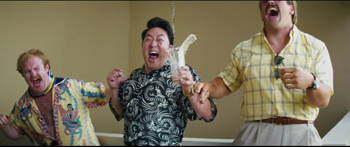
As viewers we don’t understand a character in isolation. Characters interact, and the narration and plot structure prompt us to compare them, rank them, sort them in different ways. In The Wolf, Jordan is handsome, brazen, and suave; Donnie, a classic weak friend, is awkward and homely, but he has a primal energy that matches Jordan’s slick élan.
Jordan’s father and most of his elders are more prudent and cautious than his crew, who are uninhibited. The guys are a bevy of misfits, distinguished from one another by looks and one or two tricks of demeanor.
Jordan’s first wife is a brunette hair stylist who voices doubts about his schemes; his second wife is a gorgeous blonde party girl who happily plunges into his lifestyle. In each case, the narration and the plot structure give us the necessary cues, usually redundantly. Jordan’s voice-over commentary reinforces the character information we get from the actors’ appearance and performance.
The essay also considers how films present character change. Sometimes characters come to learn more; they may not vary their distinguishing traits but they realize they have made a mistake. More deeply, characters may decide to get in touch with a suppressed side of themselves. That’s what happens, I think, in Jerry Maguire; he becomes the man his wife thinks he could be.
But very often characters don’t change. Jordan, in The Wolf of Wall Street, has an opportunity to confess, return the money he fleeced from his clients, and take his punishment. Instead, he insists that everything he’s done has been for his friends—the staff of the firm—and they deserve to succeed as he has. (Even though he is deceiving them too; he buys shares in his own IPO and orders the salespeople to push that stock.) What shocks many viewers about the film, I suspect, is that Jordan doesn’t become a better person in the course of his adventures. His punishment is light, he learns nothing, and by the end of the film he’s as amoral as he was when he started the company. (“Sell me this pen.”) As sometimes happens, the interest of the plot comes from watching a gifted, resourceful scoundrel adapt his techniques to changing situations.
But wait, there’s more
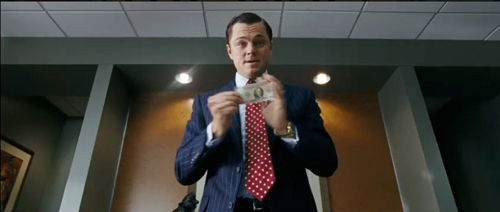
Okay, you may be asking impatiently. But why? Why offer these categories, carve things up, make supersubtle distinctions, concoct new terminology? Why not just do film criticism?
Well, partly because I want to articulate more than my response to a particular movie. I want to understand the more general ways in which films work and work upon us. I think we can usefully look for explanations of movies’ functions and effects, and these are things that ordinary film criticism doesn’t typically offer. For example, noticing how a film’s elements function with respect to narration, plot, style, and story world can do more than sensitize us to this or that movie. This sort of analysis can make us aware of broad norms of moviemaking and how particular films relate to those norms, currently and historically.
At the same time, the line of thinking I’m proposing casts light on the skills we deploy, mostly unawares, in experiencing films. No matter how simple-minded the movie, I think that we do things in following it; we exercise our narrative competence. On the other side, sorting things out this way can explain the range of choice and control open to the filmmaker. I think that the poetics of cinema I propose can help filmmakers become aware of the tools they are using–and perhaps encourage them to try other ones. My categories are derived from filmmaking craft, and perhaps they can in turn illuminate the practical tasks facing filmmakers.
A couple of final points. In the chapter I draw examples from a variety of films, many American (Cellular, Boyz N the Hood, You’ve Got Mail, etc.). Despite my consideration of Ashes of Time, Claire Dolan, Memento, and other films, some readers will ask why I don’t consider more non-Hollywood examples. The choice was strategic: Hollywood films throw the areas I’m charting into sharp relief. They provide clear-cut (not necessarily simple) examples of my points. And historically, the dominance of Hollywood film in the world’s theatrical market have given them a lot of influence. Much of what we think of as non-Hollywood is based on attempts to revise or reject those norms.
At the same time, I’m counting on readers cutting me some slack because I’ve written a lot about alternatives to Hollywood. My books on Eisenstein, Ozu, Dreyer, and Hong Kong cinema try to analyze diverse storytelling options. Elsewhere in Poetics of Cinema I discuss various narrative traditions, including varieties of network narratives and forking-path plots. Narration in the Fiction Film explores still other storytelling modes. And on this site I’ve had a lot to say about non-Hollywood constructive principles (for example, here and here).
The last section of the essay considers what is probably inside-baseball for many readers. Yet the underlying question is important. How adequately can film narrative can be understood on a model of literary narrative? Some theorists think that the basic principles of narrative are to be found in verbal storytelling, and narratives in other media must find equivalents for them. My own view is that narrative as a phenomenon gets mapped onto different media in varying ways. There may not be a single model that will be valid for plays, novels, dance, comic strips, radio drama, film, digital fiction, and so on.
For example, if Jordan Belfort were a character in a novel, certain weird things wouldn’t be happening onscreen. A first-person narrator in the novel can tell us only things that she or he knows about. But “inside” Jordan’s tale we get all kinds of scenes that he didn’t witness. True, he knew that FBI agent Denham was on his trail, but he couldn’t know the color of Denham’s office, or what Denham said to his colleagues. Nor could Jordan know exactly how the quarrel between his partner Donnie Azoff and his ally Brad Bodnik went down, even though we see the entire scene embedded in “his” telling.
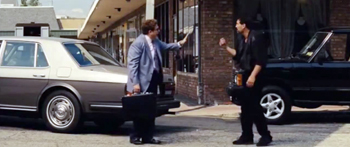
Of course we can say that these scenes are just movie conventions. We accept that in film, first-person voice-over often includes scenes that the speaker didn’t witness, or maybe didn’t even know about. But that convention points to the limits of importing models of storytelling from literature to the study of cinema. A novel can’t wedge those things in without raising the question of how the narrator knows this. We just don’t ask such a question about Jordan.
By a path too winding to summarize here, these and other observations lead me to a counterintuitive conclusion: Narrative, at least in film, isn’t best understood as an act of communication from an author-like entity to a reader-like one. Why do I say that? How can film not be communication? Answer, too brief: What most people call communication I call converging inferences.
And to end my trailer, I suggest that we think of narrative in all media, most especially film, as inherently promiscuous. It will pull in anything that gets the immediate job done. That includes grabbing one element of ordinary conversation–a guy telling a story–without keeping the other bits of the communicative chain, such as feedback from a listener. Jordan is talking to us, but he doesn’t know we’re here, and we can’t interrupt him.
One more time: You can get the essay here. Thanks for reading!
In a way this post is a sequel to the previous entry; background on Meir Sternberg’s account of curiosity, suspense, and surprise can be found there. For more on the subject, see our category “Narrative strategies” and the essay “Common Sense + Film Theory = Common-Sense Film Theory?”
Many of the everyday terms we apply to stories are ambiguous or vague, so sometimes we need to define our terms or invent new ones. Take “narration.” In ordinary talk, can mean “voice-over commentary,” such as Jordan Belfort’s in The Wolf of Wall Street. But if we restrict our usage to just this form of sound, we don’t have a good term for the general flow of narrative presentation in the film, let alone films that don’t have voice-overs. So it’s useful to reserve “narration” for that general process and use “voice-over” in some form to describe the soundtrack’s role in that.
The same problem comes up with the term “point of view,” which has many different meanings. It might refer to first-person reportage, or what a character thinks and feels, or what she believes. (Obama is a good president from her point of view.) If we want to be precise in talking about these qualities of storytelling, we need to explain the terms we’re using.
And sometimes it’s just easier to introduce new terms. In the essay, I’ll sometimes call the plot the syuzhet and the story the fabula. Why the fancy terminology? Won’t “plot” and “story” do? Well, yes, up to a point. In this entry I did use those terms, and our textbook Film Art: An Introduction has done that ever since its first edition of 1979. Still, when we’re working within a research community, it helps to have terms, even unusual ones, which say exactly what we mean. The original readership for the “Three Dimensions” chapter knows that “plot” and “story” have different meanings in our culture, and so I tried to use terms that were less ambiguous. Not incidentally, I wanted as well to signal my debt to the Russian Formalist literary critics, perhaps our first modern narratologists.
Other chapters of Poetics of Cinema are posted online here.
P.S. 14 January 2014: Thanks to Steve Hilby for correcting me: I originally mis-identified Jordan’s car as a Ferrari.
P.S.S. 14 January 2014: My old friend Brian Rose signals his Academy interview with the filmmakers, in which Scorsese and Schoonmaker declare a lack of interest in “plot.” Pfui, says I.
The ten best films of … 1923
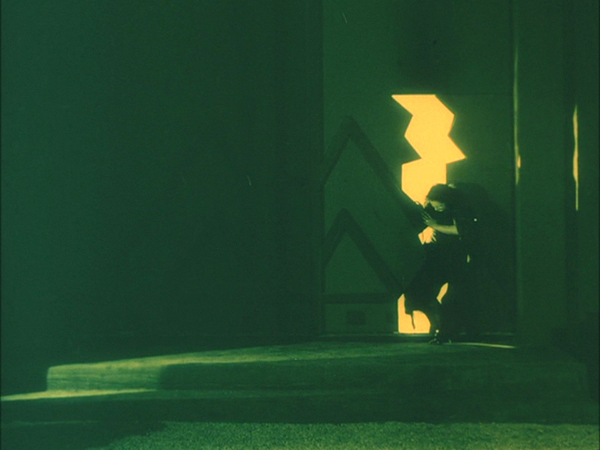
Le brasier ardent.
Kristin here:
Six years ago David and I celebrated the 90th birthday of the classical Hollywood cinema with a post that included a list of what we considered the ten greatest (surviving) films of 1917. Choosing the ten best films of 90 years ago has become a custom, one which helps us avoid doing a ten-best list for the current year. It’s a way of drawing attention to some wonderful but often little-known films, for those who are interested in exploring the treasures of silent cinema.
For previous entries, click here: 1917, 1918, 1919, 1920, 1921, and 1922.
For some reason, that 1917 list was pretty easy to put together. In recent years, I’ve had more trouble. As I wrote last year, “For the past two years, I’ve noted that it was difficult to fill out the list of ten masterpieces. I keep thinking that I’ll get to a year where I won’t have to say that, but 1922 turns out not to be that year. Some titles were obvious, but the last one or two took some hunting.” Well, 1923 still isn’t that year. I’ve again had some trouble filling out the top ten.
Why? 1923 should be packed with worthy candidates. But oddly, some of the most significant directors of the era didn’t make films that year. This seems to have been partly because success brought greater ambitions. In 1923 Fritz Lang was preparing his epic two-part Die Nibelungen, guaranteed to show up in next year’s list. Abel Gance had embarked the long road to the release of Napoléon, four years later.
Carl Dreyer, who had made three films in 1919 and two each in 1920 and 1921, was bouncing around among companies and countries in the mid-1920s, and didn’t again release anything until his 1924 German-produced film, Michael.
Others made relatively unremarkable films. F. W. Murnau’s surviving film from 1923, Die Finanzen des Grossherzogs, serves mainly to prove that comedy was not his strong suit. Victor Sjöström’s Eld ombord (The Hell Ship) doesn’t match the masterpieces we find elsewhere in his career. Louis Feuillade’s 1923 feature Le Gamin de Paris is likewise unexceptional, though it’s of interest for showing his abandonment of complex staging and his conversion to American-style cutting, including angled shot/reverse-shots. (Of Feuillade’s 1923 installment film Vindicta, we can’t speak; we haven’t been able to see it.)
Other films are lost. John Ford made four films that year, only one of which survives: an incomplete, beat-up version of Cameo Kirby that doesn’t make it look like anything special. Murnau’s first 1923 film, Die Austreibung, seems to be gone. Mauritz Stiller’s The Blizzard is lost, and he, too, was probably already involved in his own 1924 two-part epic, The Saga of Gösta Berling.
[December 29: Brian Darr tweets that The Blizzard is not lost, which I am glad to learn. Its Wikipedia entry confirms that it is only partially lost, with about two-thirds of the film known to be preserved.]
Finally, the Soviet cinema, which was to make such major contributions to 1920s cinema, had not yet gotten off the ground.
Still, with some help from David, I’ve concocted a list with some great films and some near-great ones. The place to start was obvious.
From the ridiculous to the sublime
Some years now we’ve been watching the careers of Charles Chaplin, Harold Lloyd, and Buster Keaton delivering wonderful short films and inching toward even greater things. This was the year they blossomed.
Chaplin made a charming short feature, The Pilgrim, this year, but he also surprised everyone by making a sophisticated sex comedy (appearing only in an unrecognizable cameo as a porter). The title role of A Woman of Paris features Chaplin’s regular leading lady, Edna Purviance, as a village girl, Marie, who loses her young boyfriend Jean through a misunderstanding. She runs off to the city to become a rich man’s mistress and realizes too late what she has lost.
The plot centers largely around this romantic triangle and Marie’s indecision about whether to return to her boyfriend, who has become an impoverished artist in Paris, or to stay in the luxurious life that Pierre provides her. The affair between Marie and Pierre is handled in a sophisticated and yet subtle way. There are no love scenes, but at one point Pierre finds himself without a handkerchief and goes into the bedroom to pluck one casually out of drawer. Clearly he spends a lot of time in their love nest.
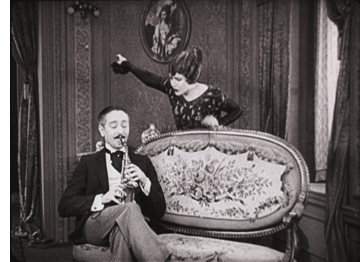 At the same time, the film deals more generally with the gulf between the very wealthy and the working-class people who who serve them. In one well-known scene, a woman gives Marie a massage, and the camera stays mainly on the masseuse as she tries to maintain a neutral expression while obviously being shocked by the lurid gossip between Marie and a friend. In another, a kitchen assistant in a swanky restaurant cannot bear the odor of the aging game bird he has to fetch for the chef, but the chef and Pierre consider it a prime delicacy.
One of the strengths of the film is that it does not take the obvious approach of making Pierre into a fat, obnoxious oaf. On the contrary, Adolphe Menjou plays him as a witty, unflappable figure. He thinks nothing of arranging a marriage with a rich woman while planning to carry on his affair with Marie, but he puts up with her shifting moods and does genuinely seem to love her. The touch of having him play his saxophone while Marie has a tantrum and orders him out (right) typifies the light touch Chaplin applies to what is ultimately a tragic story.
A Woman of Paris was not well received upon its release, at least by the ticket-buying public, who expected a Chaplin film to star the Little Tramp and to be straightforwardly funny. The title at the beginning, where Chaplin explains that he does not appear in the film undoubtedly did little to appease them. Many critics were respectful, however, and other filmmakers recognized the new type of sophisticated comedy that he had introduced. Lubitsch, who was working on Rosita at the same studio, United Artists, was definitely influenced by it–as we shall see next year when his The Marriage Circle figures in the top ten of 1924. That film includes Menjou, playing a similar role, and in fact after playing minor roles for nearly ten years, he became a star with Chaplin’s film.
[February 10, 2014: Paul Duncan, Film Book Editor for Taschen, has kindly supplied figures showing that A Woman of Paris was profitable, if not as much as Chaplin’s other films: “It earned United Artists $634,000, of which $608,868.91 went to Regent Film (the company Chaplin formed to produce films for Edna Purviance). So with a production cost of $351,853.03, A Woman of Paris made a healthy profit, though, as you write, obviously it would have been more if it had been a comedy starring Chaplin.” Paul also informs me that Taschen’s The Charlie Chaplin Archives, which he is editing, will be published later this year.]
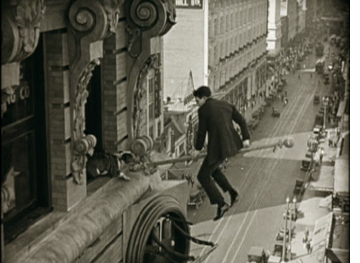 By 1923, Harold Lloyd had already done some shorts featuring nail-biting but hilarious comedy high up on skyscrapers. (See High and Dizzy in our 1920 entry.) In 1923 he took the same sort of premise into the feature-length Safety Last and created an indelible image: a brash young man hanging from a tilting clock. The gags go on story by story. After surviving the clock, Harold manages to get to the next level, only to be chased out a flagpole by a dog (left). Looking back, people tend to remember the vertiginous climb as the whole film, though remarkably, it takes place only over the last third. Earlier scenes involve a romance and misunderstandings that arise from the hero’s job at a department store.
Safety Last wasn’t Lloyd’s greatest film, but it launched the greatest period of his career. He’ll probably be joining us for these nostalgic lists every year now until 1927. The film is still available as part of New Line’s big box set of Lloyd’s films on DVD. (Buy that one, and you’ll be a step ahead of those future lists.) This summer the Criterion Collection brought Safety Last out on DVD and Blu-ray. There’s only that one feature on the disc, but it includes several supplements, including three newly restored Lloyd shorts and Kevin Brownlow’s 104-minute documentary, The Third Genius.
Keaton, too, entered a hugely creative streak in 1923. He made an amusing satire on Intolerance, the feature-length The Three Ages, in which Buster traces love through the stone age, the Roman era, and the Roaring Twenties. As Keaton himself acknowledged, “Cut the film apart and then splice up the three periods, and you will have three complete two-reel films.” He followed it up, however, with a masterpiece that displayed a complete command of story structure in the classical Hollywood mold: Our Hospitality. It’s arguably as fine as anything he ever made, except The General, which just edges it out.
Interestingly, Our Hospitality and The General are Keaton’s only two period pieces. (that is, if one excepts The Three Ages, which is far more farcical and does not attempt to recreate a realistic period atmosphere.) Both also take place in the South, and outdoors to a considerable extent. The milieu seems to have inspired him. Dealing with old-fashioned trains and other technology generated a lot of clever gags, and the fields, forests, and rivers helped give these two films a pictorial beauty that separates them from the Keaton’s other films.
Way back in 1978, when David and I were working on the first edition of Film Art: An Introduction, we wanted to include an extended analysis of a single film in each of the chapters on film technique. For mise-en-scene we chose Our Hospitality, which contains numerous uses of setting, costume, acting, and lighting brilliant enough to inspire a teacher and straightforward enough for students to notice and understand. Plus what better way to win over students who think that old black-and-white silent movies aren’t worth watching?
The story is simple. Willie McKay, the hero, travels from New York to the deep South, under the impression that he has inherited a mansion. The trip south on a very old-fashioned train supplies a long string of marvelous sight gags. There Willie meets the heroine, who shares his coach. Upon arrival, Willie discovers that his “mansion” is really a decaying house. Since the heroine has invited Willie to dinner, he wanders around to pass the time, unaware that he has inherited something else: a feud. The heroine’s family has a longstanding grudge against the McKays, and the father and two brothers are determined to shoot Willie. The only catch is that Southern hospitality dictates that they cannot kill him while he’s in their home.
In our analysis in Film Art, we pointed to the many motifs Keaton uses in service of the narrative, such as the moment of the hero’s rescue of the heroine as an echo of the earlier fishing pole/waterfall gag. One stylistic motif of staging comes back several times: Keaton using foreground doors or walls to create depth staging of moments when people spy or eavesdrop on others. In the frame on the left below, one of the brothers waits to ambush Willie, who is unaware of his presence (or indeed of the feud itself). In the one on the right, Willie eavesdrops on the brothers in their house, learning that they intend to kill him but that he is safe inside the house. Now Willie learns what’s going on, while the brothers don’t realize that he’s overhearing their plan. Such compositions are a motif in the film, forming a way of manipulating the narration–usually giving us more information than the characters onscreen have.
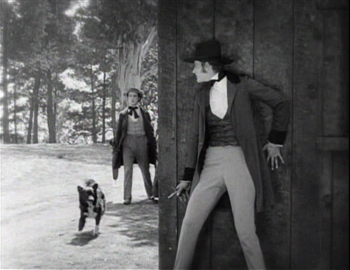
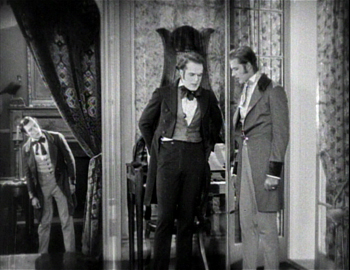
Like Safety Last, Our Hospitality ushered in the prime of the comedian’s career. Keaton made a string of marvelous features that lasted until The Cameraman in 1928. He didn’t always sign the films as director (he’s listed as co-director of Our Hospitality, along with John Blystone), but his unerring sense of how to compose images for the entire frame, both its surface composition and in depth, suffuses all his films of this period.
I’ve mentioned that Lubitsch was working at United Artists in 1923. Rosita was his first American film, starring Mary Pickford. It’s certainly not a masterpiece on the level of The Marriage Circle or Lady Windermere’s Fan, but Rosita is a charming and impressive film, certainly at least as good as Lubitsch’s other lesser films of the decade, Forbidden Paradise and Three Women.
As I discuss in my book, Herr Lubitsch Goes to Hollywood, the director had already been tentatively using classical Hollywood style in his last two German films, Das Weib des Pharao and Die Flamme. In Rosita, he managed to balance a typical historical epic from his German period (Madame Dubarry, Anna Boleyn) with the light, vivacious appeal of his star. She plays the title character, a cheerful street musician who is in love with Don Diego, an impoverished nobleman and military officer. Rosita catches the eye of the lecherous king. Don Diego ends up condemned to death, and Rosita plots to save him.
The sets were built on the enormous backlot of United Artists, where Douglas Fairbanks’ castle for Robin Hood had stood. The day after Rosita wrapped, the construction of the sets for The Thief of Bagdad began on the same lot. Indeed, one can detect a distinct similarity between Rosita’s big sets–city streets and a large prison–and those of the two Fairbanks films. This frame is a shot of the prison interior emphasizing a gallows in the background:
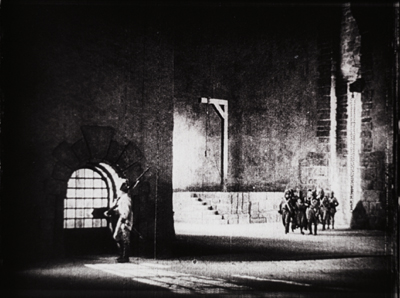
Given that this giant set was built in the open air, Lubitsch must have filmed this and other scenes at night, using the giant arc spotlights that had recently become a standard tool of Hollywood filmmaking to throw great swathes of illumination across the scene. In general, Rosita‘s style demonstrates that by 1923, Lubitsch had come fully to understand the American approach.
As a vehicle for Pickford, the film also is skillfully done, permitting her numerous intimate scenes that show off her charm. Given her star persona, the dramatic situation is leavened with humor in the interior scenes. Rosita’s poor family, a large, rowdy bunch, provides much of this, as when Rosita brings home a perfumed handkerchief and the impressed parents and children in turn bury their noses in it and sniff deeply. Rosita’s reactions to the King’s attempts to seduce her are also somewhat comic, though there is definitely a threat hanging over the situation.
Unfortunately, like all too many of the films on this year’s list, Rosita is difficult to see. It seems to have survived only in a Russian print, and a rather contrasty, worn one at that, as the frame above demonstrates. As long as that is the sole available material, a restoration might be too daunting. Still, in this day of digital manipulation, perhaps something could be done to improve the image quality. I hope at some point it will become available on home video. That also goes for Lubitsch’s other somewhat lesser films of the mid-1920s, Forbidden Paradise and Three Women.
Rosita’s reputation has suffered from strange statements Pickford much later made to Kevin Brownlow and which he published in The Parade’s Gone By. There she claims she and Lubitsch did not get along and that the resulting film was bad and a commercial failure. With the film itself unavailable for viewing, Pickford’s condemnation was accepted at face value. In fact, documents in the United Artists archive at the Wisconsin Center for Film and Theater Research overturn Pickford’s supposed dislike for Lubitsch. For years she tried to find financing to make another film with him, and in 1926 she called upon him for help in editing Sparrows. With the discovery of the Soviet print, it becomes apparent that Rosita was far from the disaster Pickford later claimed. Why her memories of her work with Lubitsch became so distorted late in her life we shall probably never know.
Overshadowed masters of French Impressionism
Abel Gance’s flashy La roue (on last year’s list) gets a lot of attention these days. He’s the high-profile representative of Impressionism. Yet 1923 saw the first fiction films from the director who was the movement’s modest heart: Jean Epstein. The very first, L’auberge rouge (“The Red Inn”) is a lovely film, but Cœur fidèle (“Faithful Heart”) epitomizes the quiet side of Impressionism. It’s story is as simple as they get: Marie is a barmaid whose foster parents try to force her to marry a thug, Petit Paul, while she is in love with the sensitive dock-worker Jean. The scenes around the waterside and the famous sequence in a carnival are all done with a realism blended with the subjective camera techniques that convey the characters’ thoughts, perceptions, and feelings in a way that was fresh at the time.
The exteriors were shot around the docks of Marseille, and Epstein uses superimpositions of the ocean to convey the lovers’ longing. Waves are sometimes superimposed over their figures, or one will look into the water and see the other’s face there, as when Jean envisions multiple images of Marie:
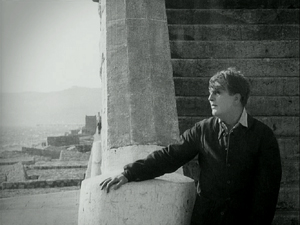
Shooting into a distorting mirror, Epstein uses the conventional Impressionist indicator of drunkenness as Petit Paul looks at a woman next to him in a bar:
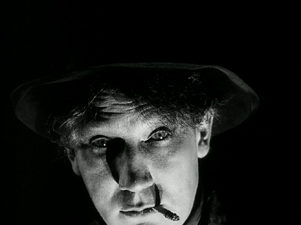
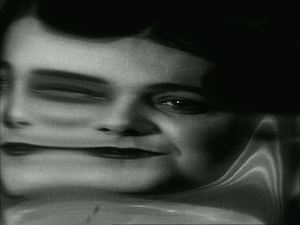
Coeur fidèle has been released in the UK (Region 2) as a DVD/Blu-ray combo in Eureka!’s Masters of Cinema series. (This includes a helpful little booklet with excerpt from Epstein’s writings and a review of Cœur fidèle by René Clair.) It is also available as a Region 2 French DVD without English subtitles. As these frames indicate, the film survives in beautiful condition.
Along with La roue, Cœur fidèle proved hugely influential. It used the “unfastened camera” that later was credited to Murnau in The Last Laugh. Like Murnau, Hitchcock picked up Impressionist style, as reflected most obviously in his 1927 boxing film, The Ring. Hitchcock’s penchant for moving camera and subjectivity never went away. Hollywood, too, picked up the subjective techniques of Impressionism, especially in the 1940s films that David is studying now.
Unlike Cœur fidèle, Le brasier ardent (“The Burning Crucible”) was sophisticated, convoluted, and perplexing. It was one of two films directed in France by the Russian actor Ivan Mosjoukine for the émigré film company Albatros. (The earlier one is L’Enfant du carnaval, 1921; as far as I know, no print survives.) Earlier this year, upon the release of Flicker Alley’s box set of five Albatros films, I described Le brasier ardent:
It has a reputation as an audacious, surrealist, and almost incomprehensible film. This may be due to the fact that prints available in archives during the 1970s and 1980s lacked intertitles. The opening nightmare sequence is indeed disturbing, but at least with intertitles, we understand that it is only a dream. It begins with a wild-eyed man tied to a stake where he is about to be burned. The heroine stands looking on, resisting as the man pulls on her long hair, apparently intent on dragging her into the fatal flames to accompany him in death. Subsequent scenes of the nightmare show the heroine encountering different men, all played by Mosjoukine, culminating in a man in evening dress stalking her along a vaguely Expressionist street until she escapes and wakes up in bed.
This nightmarish opening must have established vivid expectations in the spectators of 1923 as to what sort of film they were in for. After the heroine wakes up, however, what follows is quite different. The main plot is a stylized but quite amusing comedy. The heroine is a pampered wife, married to a rich man whom she does not love. She is faithful, but he is unreasonably jealous. He goes to a distinctly odd detective agency, one department of which is “Recovery of Lost Wives” (above), with “Success guaranteed!” and “Nothing to pay in advance!” Juxtaposed with the bizarre opening, this quirky humor might have eluded puzzled audiences of the day. Certainly the film itself was a failure, and Mosjoukine stuck to acting thereafter.
Unfortunately for the husband, Detective Z, whom he picks from the eccentric group pictured above, is the very man, again played by Mosjoukine, whom his wife has dreamed about. What follows is an odd tale with the detective and wife gradually falling love. Mosjoukine, known for his tragic, intense characters in the Russian cinema, plays such figures in the fantasy sequences–but in the main story he is allowed to play for laughs, gamboling and rolling on the floor like a puppy when the wife finally appears at his mother’s apartment and declares her love for him.
Mosjoukine should not, however, be allowed to overshadow his co-stars, Ermolieff actors who were also were to make their way into the wider French production of the day, including Impressionism. The wife is played by Nathalie Lissenko, one of the stars of the pre-Revolutionary cinema, who had acted opposite Mosjoukine in Russia. Among her 1920s roles was the protagonist of one of Epstein’s finest films, the largely unknown L’Affiche (1924). The husband is Nicolas Koline, who started his career with Ermolieff only after the company had left the Soviet Union. He will be familiar to silent-film fans from his performance as Tristan Fleury in Gance’s Napoléon.
By this point, stylistic influences were beginning to pass back and forth between France and Germany. Le brasier ardent shows distinct touches of Expressionism in its decor, as when the heroine flees through a distorted door. (See top.)
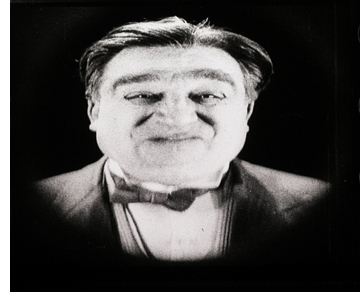 I have to admit that the third Impressionist film on our top-ten list, Germaine Dulac’s La souriante Madame Beudet (The Smiling Madame Beudet) is not one of my favorites. It hasn’t got much of a plot. A sensitive woman in a provincial town finds her husband crass and unpleasant until a final crisis brings them–at least temporarily–together. It’s not so much the simplicity of the story, however, as the rather heavy-handed use of subjective camera tricks to convey Mme. Beudet’s thoughts about her husband, as when a distorting mirror conveys her grotesque view of him (at right).
We’ve just seen a similar distortion in Cœur fidèle, above, to show a drunkard’s point of view. In Marcel L’Herbier’s El Dorado, from 1921, another distorted-mirror close-up suggests drunkenness without using a character’s point of view (see Film History: An Introduction, 3rd edition, p. 79).
The film has decided virtues, such as the lovely shots of the small provincial town in which the film’s exteriors were made, as well as the genuinely surprising and touching ending, which pulls back somewhat from the simplistic characterization of M. Beudet.
As with some of our choices from previous years, The Smiling Madame Beudet goes on the list partly because of its historical importance. Dulac was one of the early women directors to make a career in the cinema. Back in the days of 16mm, prints of this film were among the few Impressionist classics available for film club and classroom use, and the film became a staple in feminist-film courses.
Ironically, nowadays teaching the film is more difficult. Oddly enough, none of the mainstream labels has brought out a DVD with English subtitles. A German DVD, which includes two other short Dulac films, Invitation au voyage (1927) and the surrealist classic La coquille et le clergyman (1928), is available. The copy on this DVD is probably the same as the fairly good-quality Swiss archive print on YouTube, with bilingual French and German intertitles. For anyone with even an elementary knowledge of either language, the titles are not very challenging.
Caligarisme spreads
Caligarisme was the French word for cinematic Expressionism, which, as the example from Le brasier ardent shows, fascinating many French filmmakers.
Despite the lack of major contributions from Murnau and Lang, in 1923 the country’s cinema was going strong. Several films that fall slightly short of being masterpieces appeared. By this point the Expressionist film movement was well established, having begun in 1920 with Das Cabinet des Dr. Caligari. Some of its greatest films–Der müde Tod, Nosferatu and Dr. Mabuse der Spieler–had already appeared.
Three very good Expressionist films came out in 1923: Erdgeist (“Earth Spirit,” directed by Leopold Jessner), Schatten (“Shadows,” released abroad as Warning Shadows; Arthur Robison), and Raskolnikow (adapted from Crime and Punishment; Robert Wiene).
It’s really a toss-up as to which film should represent Expressionism on this year’s list. I give the edge to Erdgeist, largely because it and Von Morgens bis Mitternachts (“From Morn to Midnight”) are the two films from the movement that push the style the furthest. They come the closest to Expressionism as it existed in drama and the other arts. Most Expressionist cinema “tamed” the style a bit by applying it to genre tales: horror (Caligari, Nosferatu), fantasy (Der müde Tod), historical myth (Die Nibelungen), and science fiction (Algol, Metropolis). These two films, in contrast, depended on dramas where elemental human passions are released and taken to extremes, with the costumes, decor, makeup, and acting reflecting the characters’ inner states.
The film was based on the first of the two “Lulu” plays by Frank Wedekind: Erdgeist (1895) and its sequel Die Büchse der Pandora (Pandora’s Box, 1904). G. W. Pabst’s much better-known Pandora’s Box (1929) combines the two plays, which tell a continuous story about an amoral young woman who lives by exploiting wealthy men but drives them to extreme jealousy by flirting with other men.
In Pabst’s film, Louise Brooks plays Lulu as a vivacious young woman, seemingly unaware of her disastrous effect on the men around her. Asta Nielsen plays the character in Jessner’s film as a ruthless, mature woman. The plot concerns Dr. Schön, a rich man who found Lulu on the streets when she was a child and has raised her with the intent of having her become his mistress. At the beginning, she is married to Dr. Goll but immediately begins seducing Schwartz, an artist hired to paint her portrait. In the image below, Goll bursts in on them in Schwartz’s studio and Lulu collapses at the right. The distorted stairway, the streaks of light painted on the set, and the jagged shadows all create the Expressionist look–as does the eerie blank glow of Goll’s glasses.
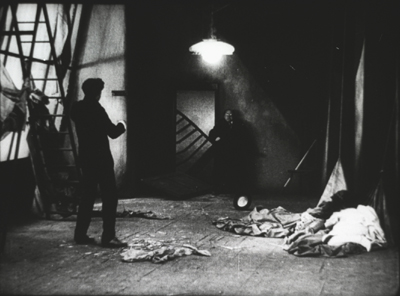
The acting is exaggerated and unnatural. Nielsen, foregoing all glamor, frequently holds a grimace on her face to the point where she almost looks like she is wearing a mask. In an early scene Goll moves his cane about, and she dances like a marionette attached to it by strings. (Puppet-like acting was a convention of Expressionist drama.)
Overall, the style is so grotesque and the characters so unpleasant as to make it clear why Erdgeist is one of the least remembered of the major Expressionist films. It is not available on home video. The print I saw about 16 years ago had Dutch intertitles and was somewhat dark. Perhaps, like Von Morgens bis Mitternachts, it will eventually be restored and released on DVD.
Two Expressionist films deserve brief mention as well.
Robert Wiene, the director of The Cabinet of Dr. Caligari, launched the Expressionist movement in cinema but never made another film that gained nearly as much attention. That’s a pity, because Raskolnikow is quite a good film–of all the Wiene films I’ve seen, probably his second best (though The Hands of Orlac, 1924, has its virtues). I found it difficult to decide between it and Erdgeist.
Crime and Punishment turns out to be, not surprisingly, a good fit for the style, with the hero’s increasingly bizarre view of the world literalized in the settings. The film seems to have had a higher budget than Caligari, and the sets are sturdier looking and more three-dimensional. (See bottom.) Wiene also had the good fortune to work with a group of Russian emigré theatrical actors who had trained under Stanislawski and worked at the Moscow Art Theater. Clearly they had to adapt their approach distinctly to achieve Expressionist performances, but they managed well. The lead, Gregori Chmara, makes a haggard and mercurial Raskolnikow.
Back in the 1970s, when I became intrigued by German Expressionist cinema, Schatten was considered one of the main classics. That was no doubt partly due to the limited number of Expressionist titles available for viewing at the time. It’s a good film, but its prominence in film history has declined a bit in the intervening decades, especially as the full surviving work of Murnau and Lang has been discovered and restored.
Schatten is an atypical Expressionist film. Not that many of its sets are distorted or simplified in the usual ways. (This is also true to some extent of designer Albin Grau’s other notable Expressionist film, Nosferatu.) Its few exterior shots, including the opening, show the most strongly Expressionist decor (below left). Part of the action consists of a shadow-puppet show put on by a wandering entertainer (below right). Its plot seems to magically unleash the passions of the onlookers, who begin to behave in odd ways. The male guests (and a servant) try to seduce their hostess, driving the master of the house into a jealous rage.
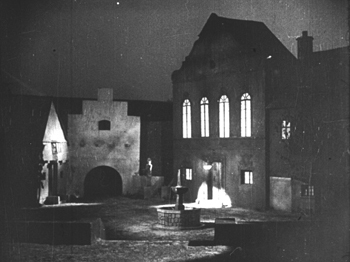
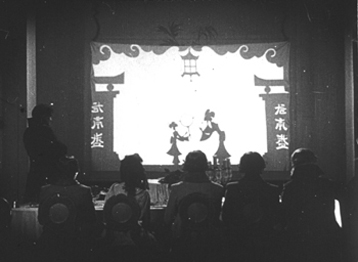
The shadow play creates its own distortions and stark, black and white imagery. Once the show is over, Robison often frames the distorted shadows of the characters more prominently than their actual bodies (again echoing some of the scene with the vampire in Nosferatu). In this corridor scene one of the servants slyly creates cuckold’s horns on another man’s head:
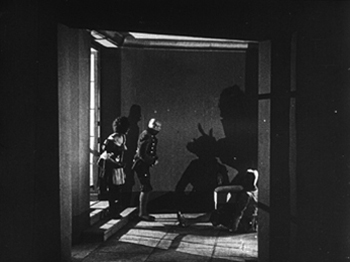
Shadows, with their natural capacity for distortion, not surprisingly appeared in many Expressionist films, though never so pervasively as in this one.
Raskolnikow is unfortunately not available on home video, at least in an acceptable copy. (The reviews for the Alpha release on Amazon deem it “unwatchable.”) Warning Shadows is available on DVD from Kino or to stream on Amazon (free to Prime customers).
Returning to our top-ten list, I yield the floor briefly to David, who has been studying Sylvester for another project.
German silent cinema is more varied than a litany of the official classics, from Caligari to Metropolis, would suggest. One of the most intriguing trends of the period involved what was called the Kammerspiel, or chamber-play, film. Kammerspiel films were far more naturalistic than Expressionist films. They concentrate on a very few characters in a drastically limited number of locales. Performance is often slow and understated, though action may freeze into somewhat contorted poses. The action typically takes place in a short time span, and it is built up out of everyday activities in working-class households—chores, job routines, the habits of family life. Eventually, however, the mundane milieu is likely to explode into violence.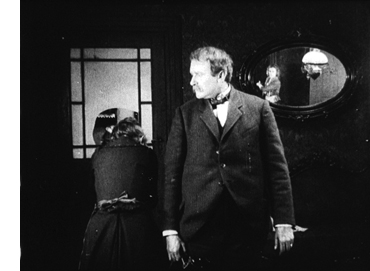
The versatile Carl Mayer (who worked on the script of Caligari) conceived of the early Kammerspiel film Scherben (Shattered, 1921), which defined the trend. In the same year the stage director Leopold Jessner released the remarkable Hintertreppe (Backstairs), which Kristin mentioned as a runner-up in her Best of 1921 list. Mayer also wrote the script for Sylvester (1923). Named for the feast day of St. Sylvester, 31 December, it’s known in English as New Year’s Eve. It’s not available on home video, but it’s worth seeking out in screenings. It remains a striking study in tabloid tragedy.
A café owner and his wife are busily serving crowds on New Year’s Eve. After a big meal and too many drinks, the wife and the mother-in-law fall to quarreling. The tensions around the table are constantly crosscut with the increasingly wild revelry in the café and the upper-class nightclub across the street. As midnight draws near, the women struggle for the husband’s loyalty. This petty quarrel will end in death.
Director Lupu Pick explores the limited space of the action by shooting the parlor from many angles, including ones that make daring use of a mirror (right). The street shots feature extravagant camera movements that look forward to the “unchained camera” made famous in Der letzte Mann (The Last Laugh, 1925), directed by F. W. Murnau and scripted by Mayer. With its strict limitation to a single night and its focus on domestic space, along with suggestions of the husband’s Freudian dependence on his mother, Sylvester showed how a fait divers could yield psychological drama.
The Kammerspiel film wasn’t a dead end. After Carl Dreyer’s borderline contribution to the trend, the Ufa production Michael (1924), back in Denmark he created probably the best of the lot: The Master of the House (Du Skal Aere Din Hustru, 1925). He later returned to the aesthetic in Two People (1945), and he continued to exploit its possibilities in his last features. Over the years after World War II, other directors were rediscovering Kammerspiel principles. We see fresh applications of the approach in Les Parents Terribles (Cocteau, 1948), Les Enfants Terribles (Melville, 1949), and of course Hitchcock’s Rope (1948) and Dial M for Murder (1954). As often happens, ambitious films of the sound cinema owe a good deal to innovative impulses of the silent era.
Welcome, experimental cinema!
One of the most remarkable films of 1923 is a mere three minutes long. Man Ray, an American painter and photographer who moved to Paris in 1921 and became involved in the Dadaist and Surrealist movements. He soon acquired a film 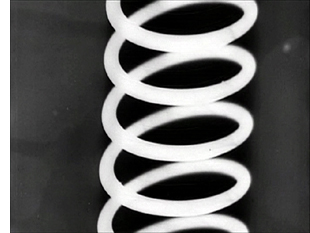 camera and later described how he shot bits of footage with it:
a few sporadic shots, unrelated to each other, as a field of daisies, a nude torso moving in front of a striped curtain with the sunlight coming through, one of [his] paper spirals hanging in the studio, a carton from an egg crate revolving on a string–mobiles before the invention of the word, but without any aesthetic implications nor as a preparation for future development: the true Dada spirit.
In 1923 Tristan Tzara advertised a Dadaist program in a Parisian theatre to be held the following evening, including a film by Man Ray as part of the entertainment. Ray had only a very small amount of footage ready. Faced with an overnight deadline, he supplemented it by using a technique he had already employed in still photography (the “rayograph”): placing small objects on a sheet of photographic paper in the dark, turning on the light briefly, and developing the image. The result was a series of sharply focused silhouette images of the objects against a plain background. This time Ray unrolled some raw negative film in a dark room, scattered nails, tacks, and other objects on it, exposed it to light, and developed the negative (right). Combined with the shots Ray had previously made, the result was a perfect Dada film, with randomly juxtaposed imagery that defied the audience to make any sense of what they were seeing. He titled it in ironic Dada fashion: Le retour à la raison (“The Return to Reason”).
Despite being cobbled together overnight, Ray’s film offers a broad exploration of the possibilities of abstract filmmaking. The opening, a rapidly shifting stippled screen, resembles the later flicker films of the 1960s avant-garde. The rayograph shots introduce an alien, high-contrast look–not surprising, given that these may have been the first cinema images produced without using a camera.
Ray also shifted between positive and negative imagery. This was not entirely new. Murnau had used short stretches of negative footage in Nosferatu the year before. But Murnau’s negative shots had a narrative function, to convey the eeriness of the environs of the vampire’s castle. In Le retour à la raison, Ray used negative imagery in an abstract way, to create startling juxtapositions of imagery that looked both similar and yet strikingly different. The tacks, nails, and springs in the rayograph stretches could be either stark white against black, as in the image to the right above, or the same shot repeated, but this time in black against white. The film ends with another positive/negative passage. The “nude torso moving in front of a striped curtain” is initially shown in a positive image, then in the same image flipped and shown in negative:
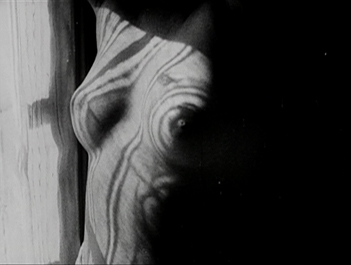
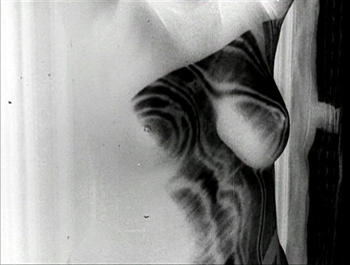
Ray was not the first to create an abstract film. In 1921 German filmmaker Walter Ruttmann probably made that conceptual leap in 1921 with Opus 1, a one-reeler with painted shapes moving around against a dark background. He followed this up with three further films, Opus 2 (1923), Opus 3 (1924), and Opus 4 (1925). (Good-quality prints with toning and appropriate musical accompaniment are available on YouTube: Opus 1 here, Opus 2 here, Opus 3 here, and Opus 4 here.)
I must confess that I probably should have at least mentioned Opus 1 in my entry on the best films of 1921. Still, Ruttmann’s films are far less daring than Le retour à la raison. It and its successors are basically efforts to do what so many filmmakers have tried since: to create the equivalent of a painting, but with motion. Ray’s film went much further, pushing the limits of the young art form in ways that had little precedent in the other arts, apart from Ray’s own highly experimental approach to still photography. There are even two fleeting stretches of film leader with illegible writing on them–a tactic one thinks of more in relation to, say, Bruce Conner’s A Movie (1958) than to the silent era. Much of the experimental cinema to come decades later was briefly probed here.
There are several copies of Le retour à la raison on YouTube. The best was posted by Dimitri Shubin, who also provides a piano score. The film is also available on disc 3 of the Unseen Cinema set of American experimental cinema. Unfortunately this copy has a considerable amount of breakup, particularly in the early flicker portions. (An HD version would perhaps help.) The version on Kino’s “Avant-Garde: Experimental Cinema of the 1920s and ’30s” set has the same problem and is distinctly shorter, apparently because it is running at sound speed. The copy provided by Shubin has the clearest, steadiest video image of the film I have seen. Ideally, of course, Ray’s film should be viewed on 35mm.
I regret that so many of our choices for this year’s list are not available on home video or even, except in very rare circumstances, for viewing on 35mm in archive screenings. Still, part of the purpose of this ongoing series is to call attention to obscure but worthy and important films. Perhaps an archivist or an enterprising DVD publisher will be inspired to restore some of the ones described here.
The quotation concerning The Three Ages comes from p. 217 of Rudi Blesh’s biography, Keaton (New York: Collier, 1966).
Mary Pickford’s strangely distorted claims about Rosita and her relationship with Lubitsch are expressed on pp. 129-34 of Brownlow’s The Parade’s Gone By (New York: Knopf, 1968). I go into more detail about the continuing Pickford-Lubitsch collegiality in the 1920s in Herr Lubitsch Goes to Hollywood, pp. 24-26.
For more examples of unusual German silent films, go elsewhere on this site here and here and here and here and here and here and here and here. Criterion has a new, authentic version of Dreyer’s Kammerspiel-influenced Master of the House forthcoming.
The Man Ray quotation comes from a detailed study of Le retour à la raison by Deke Dusinberre in the collection Unseen Cinema: Early American Avant-Garde Film 1893-1941 (New York: Anthology Film Archives, 2001), published to coincide with the release of the DVD set mentioned above.
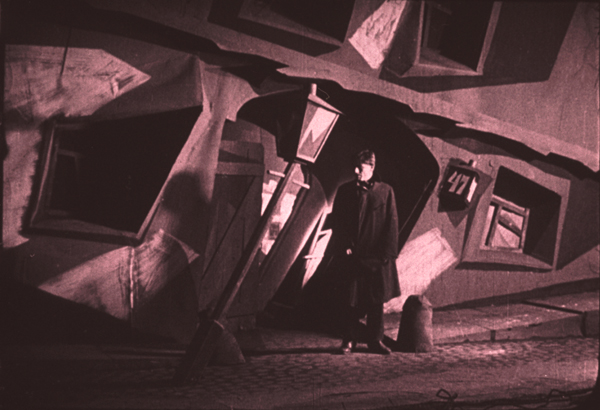
Raskolnikow.
GRAVITY, Part 2: Thinking inside the Box
Kristin here:
In my previous entry, I described Gravity as an experimental film. I had thought of it that way ever since seeing trailers for it online back in mid-September. I described it as reminding me “of Michael Snow’s brilliant Central Region, but with narrative.”
Last time I developed that notion in more detail and analyzed the narrative structure of the film. Now I’ll analyze the experimental aspects of the film’s style and the dazzling means by which they were created. I don’t have the technical expertise to explain the inventions and ingenuity that went into creating Gravity, so I have sought to pluck out the best quotations from the many interviews and articles on the film and organize them into a coherent layout of how its most striking aspects were achieved.
As in that entry, SPOILER ALERT. This is not a review but an analysis of the film. Gravity does depend crucially upon suspense and surprise, and I would suggest not reading further without having seen the film.
Screaming on the set
I’ve written about Cuarón’s use of long takes, a stylistic device that has drawn a huge amount of attention in the press. Here the editing is so subtly done that even someone like me, who typically notices every cut, missed a lot of them during early viewings. There are bursts of rapid editing, as when the ISS is struck by debris and is destroyed, or more conventional cutting, as when the camera follows the Chinese pod and surrounding remnants of the station as they heat up in the atmosphere.
The long takes go beyond what Cuarón has done before. In Variety, Justin Chang describes one major difference: “As the movie continues, the filmmakers even add a new wrinkle, which Lubezki calls ‘elastic shots’: Takes that go from very wide shots to medium closeups, then segue seamlessly into a point-of-view shot, so the viewer is seeing the action through the character’s eyes, right down to the glare and reflections on a helmet visor.” Such moments are rare in Gravity, but one occurs in the “drifting” portion, shortly after the segment laid out above:
As Cuarón has pointed out, his long takes eliminate the need to cut in to closer views: “The language I have been working on with Chivo in these recent films is not one based on close-ups. We include close-ups as part of a longer continuous shot. So this all becomes choreography.” Another point he makes in this and other interviews is the influence of Imax documentaries on Gravity: “My process of exploring long takes fits in with that IMAX documentary notion, because when they capture nature it isn’t like they can go back and pick up the close-up afterward. There isn’t that luxury in space either. So then it falls to us to find a way to deliver that objective view, but then transform it into a more subjective experience.” Hence the “elastic shots.”
The long takes often dictate a refusal to cut in to reveal significant action. There is the moment in the epic opening shot, for example, when Shariff is suddenly killed in the background while in the foreground Kowalski tries to help Stone detach from her mechnical arm and into the shuttle. Did you see the flying piece of debris that struck his head? I didn’t, not until the fourth time I watched the film, knowing that it was coming and determined to spot it. It’s there, a little white dot that flashes through the frame in a split second. Shariff’s abrupt movement to the side, stopped with a jerk by his tether, is what we spot, since his bright white suit moves so suddenly and quickly, ending up against the pitch black of space:

A great deal happens in such moments of action, and we are left to spot what we can.
If these long takes are dazzling on the screen, think what they must have been like to witness being made. Lubezki has suggested how complicated the long takes in Gravity and earlier films were to shoot:
There are very few director/cinematographer teams working today as well known for a certain aspect of filmmaking as you and Alfonso are, which is that long extended take, or the seamlessly edited take. What it is like actually shooting those scenes?
I’m going to tell you something, the reality is that the movie was so new that when we finished a shot we would get so excited people would scream on set—probably me before anybody else. There were moments when we were shooting and Alfonso said ‘cut’ we would all just jump and scream out of happiness because we’d achieved something that we knew was very special.
In Children of Men, we also had moments like that. When we finished the first shot inside that car [the aforementioned ambush scene], the focus puller started crying. There was so much pressure that, when he realized he had done a great job, he just started crying.
There is something breathtaking about the achievement of complex long takes that seems not to arise from any other cinematic technique. I have seen Russian Ark three times now, and each time I feel an inexplicable tension, wondering whether the camera team will make it through the entire one-shot film without a mistake. I’ve already seen it happen, and yet it still seems unbelievable that they did.
In Gravity, of course, the “long takes” were not actual lengthy runs of the camera. Nor were they, as in Children of Men, several camera takes stitched together digitally to create lengthy single shots. Rather, they were created in the special-effects animation, with the faces of the actors being jigsawed into them through a complex combination of rotoscoping and geometry builds. (See this Creative Cow article for an example.)
The choice to present the action in long takes was crucial to the look of the film. Most films set in space rely heavily on editing, since for decades the special effects needed to convey space walking were best handled in a series of shots. In Star Trek Into Darkness, Kirk flies through space toward a spaceship breaking up and surrounded by debris, a situation somewhat comparable to that in Gravity. The sequence is built up of many short shots of Kirk against shots of dark space, point-of-view shots through his helmet, and cutaways to characters inside the Enterprise conversing with him via radio. Here’s a brief sample of four contiguous shots:
The sequence conveys little sense of weightlessness, partly because the actor adopts a traditional superhero-style flying pose. With no air in space, there would be no need to compact oneself into a streamlined shape. The fast cutting keeps repeating similar compositions, as with frames 2 and 4 above, with the fast editing presumably intended to generate excitement. (Star Trek Into Darkness has at least 2200 shots in a little over two hours, while Gravity has about 200 in 83 minutes.) Gravity‘s success in creating a realistic environment in space is dramatically evident when contrasted with this film’s more traditional outer-space conventions.
But it turns out that the commitment to the long take led Cuarón toward less common choices about editing, staging, and lighting.
Follow the bouncing axis
For much of the film, there is minimal spatial stability for the characters or for our viewpoint into the diegetic world. There is no ground, so we cannot imagine the camera resting on anything. When outside the space vehicles, the camera moves nearly all the time. In an interview with ICG Magazine, director Alfonso Cuarón was asked, “So with the camera and characters in constant motion and changing perspective, how did you figure up from down?” He replied:
There is no point of departure because there is no up or down; nobody is sitting in a chair to orient your eye. It took the animators three months to learn how to think this way. They have been taught to draw based on horizon and weight, and here we stripped them of both.
Undoubtedly many scenes contain an axis of action running between the characters, but it is not of a traditional kind. Unlike in a classically edited film, in Gravity‘s action scenes in space, the axis is in constant, fleeting motion, and any given center line between two characters must in quick succession run not only left and right but also up and down, diagonally, in almost any direction. Any given screen direction set up by the axis is ephemeral and offers little to help orient us spatially. Eyeline directions mean very little, since there are few cuts to things that the characters have seen offscreen. (True, when characters look offscreen, they establish eyelines, and the camera sometimes pans from Stone or Kowalski to some object they have been looking at. But a pan from a person to an object automatically establishes the spatial relations between them, whether or not the character is looking at the object.)
As a result, the spatial cues used in continuity editing system are not so much eliminated as made irrelevant for long stretches. That system is meant, after all, to guide our understanding of the story space across cuts. There are exceptions, such as a brief shot/reverse-shot exchange: Stone, loosely attached to the International Space Station (ISS) by ropes, pleads with Kowalski not to untether himself from her and float away to die in space, and he insists that it is the only way to allow her to live. When Kowalski and Stone, tethered together, travel toward the ISS, he is always at screen left, she at screen right, with the strap joining them stretched out as a sort of visible axis of action; straight cut-ins to close views of each character, and even at one point Kowalski’s point of view, obey the 180-degree rule and create an almost conventional scene. Actions inside the spacecrafts are more oriented as well. In the ISS Stone moves weightlessly through a series of pods, all the while maintaining screen direction. Similarly, inside the vehicles, especially late in the film when Stone is strapped into seats, she is usually upright, her head oriented toward the top of the frame. Some sustained actions in space also keep her right-side up, as when she removes the bolts holding the parachute cords to the Soyuz landing vehicle.
In part because of such orienting devices, we are seldom seriously confused about where the characters are, or at least not for long. Otherwise we would not be able to comprehend the story action. Still, compared to typical classical films, Gravity conveys little sense of spatial stability. The disorienting simulation of weightlessness for characters and camera dominates the scenes outside the vehicles and creates a style that can truly be called experimental.
Take the brief segment (about 14 seconds) below, from the 13-minute opening shot. Stone has been standing at the end of a large mechanical arm which gets knocked off the space shuttle by a piece of hurtling debris. It spins rapidly, with the camera framing it from long-shot distance. The camera is not entirely static, reframing slightly, but we can see the earth in the background fairly clearly. Stark sunlight comes from offscreen left, and as Stone’s body whips through space, the shadows move accordingly around her, with the back of her body in deep shadow in the first frame and then her front shadowed in the second:
The fact that the light source, the sun, is offscreen left during this spinning segment suggests that the camera and hence our viewpoint are in a stable position. Yet that position is maintained for only a short time. At this point in the shot, the camera is essentially waiting for her to draw near in order for it to execute a change that will govern the penultimate part of the lengthy shot.
That happens when, after she has spun wildly toward and away from us several times, the camera “attaches” to her, so that we are now seeing her in medium shot and spinning with her. Instead of seeing the earth clearly, we see her while the blurred surface of the earth and the blackness of space alternate rapidly. This was the technique that led me, when I first saw the film’s trailers, to compare Gravity to Michael Snow’s Central Region:
Being closer to Stone, we can see more clearly the shadows coming and going; her face is sometimes illuminated brightly by the sun and sometimes in near darkness:
The function of the attachment to Stone, apart from allowing us to see her fear and confusion, is to show us that her hands are working to detach her from the arm, as a tilt down reveals:
As she soars off the arm and tumbles into the black depths of space, the camera leaves its “attachment” to her, and she spins away from it:
Cuarón’s commitment to the long take thus made him rely more than usual on events taking place within the frame–camera movement and figure movement in particular. Yet these movements had to occur in a microgravity environment radically different from the earthbound surroundings of Children of Men and Harry Potter and the Prisoner of Azkaban. This new constraint led to some technological innovations of remarkable originality.
The LED Light Box
Early on it became clear that moving the actors through space on wires would not create the desired realism of weightlessness, and obviously they could not be whipped about and tumbled in ways that the film ultimately achieved. The actors would have to be relatively static, with the illusion of movement created through other means. One of the main challenges was to have the lighting on their stationery faces support that illusion. And it would have to be done perfectly in order to achieve the photorealistic depiction of space that the filmmakers were after.
Usually in watching a film heavily dependent on CGI, one notices elements that have been assembled into a single composition but don’t quite match each other. A matte painting that isn’t lit from precisely the same angle as all the other components stands out from the rest (as, it has to be admitted, happens in the best of CGI scenes, including those in The Lord of the Rings). The problem was solved for Gravity using the LED Light Box, a device frequently mentioned in the press coverage of the film but seldom explained. (See image at the top.) The concept is truly revolutionary, although I am not sure to what extent it would work for other films that did not present such peculiar challenges.
In American Cinematographer‘s article on Gravity, “Facing the Void,” cinematographer Emmanuel Lubezki explains why consistency of lighting is crucial and how he came up with his solution:
Lubezki emphasizes that Gravity‘s blending of real faces with virtual environments posed a tremendous challenge. “The biggest conundrum in trying to integrate live action with animation has always been the lighting,” he says. “The actors are often lit differently than the animation, and if the lighting is not right, the composite doesn’t work. It can look eerie and take you to a place animators call ‘the uncanny valley,’ that place where everything is very close to real, but your subconscious knows something is wrong. That takes you out of the movie. The only way to avoid the uncanny valley was to use a naturalistic light on the faces, and to find a way to match the light between the faces and surroundings as closely as possible.”
This challenge led Lubezki to imagine a unique lighting space that was ultimately dubbed the “LED Box.” He recalls, “It was like a revelation. I had the idea to build a set out of LED panels and to light the actors’ faces inside it with the previs animation.” Lubezki conducted extensive LED tests and then turned to [special effects head Tim] Webber and his team to build the 20′ cube and generate footage of the virtual environments, as seen from the actor’s viewpoint, to display inside it. While constructing the LED Box, the crew also solved problems involving LED flicker and inconsistencies.
Inside the LED Box, the CG environment played across the walls and ceiling, simulating the bounce light from Earth on the faces of Clooney or Bullock, and providing the actors with visual references as they pretended to float through space. This elegant solution enabled the real faces to be lit by the very environments into which they would be inserted, ensuring a match between the real and virtual elements in the frame.
This ingenious approach largely did away with traditional three-point lighting in the exteriors. As Lubezki explains in the AC article,
When you put a gel on a 20K or an HMI [Hydrargyrum medium-arc iodide], you’re working with one tone, one color. Because they LEDs were showing our animation, we were projecting light onto the actors’ faces that could have darkness on one side, light on another, a hot spot in the middle and different colors. It was always complex, and that was the reason to have the Box.
The crucial point here is that the lighting was being created by playing the previs animation of the earth, space, the moon, and the large reflecting objects like the space shuttle on the sides of this 20′ by 10′ box. In other words, the moving images from the nearly finished special effects were used to light the faces of the actors, and those faces were later joined to those very same special effects, in a more polished form, to create the final images.
Lubezki gives an excellent description of the Box in his interview with Bryan Abrams, a series of responses which is worth quoting at length. Note that Lubezki refers to the Box as an LED monitor–essentially a giant television screen turned inside out and surrounding the actor:
Can you touch upon some of the pieces of technology and equipment that were created to make Gravity possible?
To make this movie we used many different methodologies. For one of them, we invented this LED box that you’ve probably read about, which is basically this very large LED monitor that is folded into a cube. So all the information and images that you input into this monitor lights the actors, and you can input all of the scenes that were pre-visualized to create the movie—all the environments that we had created—and you can input them into this large cube so space itself is moving around the actors.
So it’s not Sandra Bullock spinning around like crazy, it’s your cameras.
Yes, instead of having Sandra turning in 360s and hanging from cables, what’s happening is she’s standing in the middle of this cube and the environment and the lighting is moving around her. The lighting on the movie is very complex—it’s changing all the time from day to night, all the color temperatures are changing and the contrast is changing. There were a lot of subtleties that you can capture with the box, subtleties that make the integration of the virtual cinematography and the live-action much better than ever before.
The effects of the LED projections are visible in the changes on Stone’s face in the extended example above. Here’s a brief example of changes on Kowalski’s face in the opening shot:
The harsh light in the right frame above is a real lamp. The LEDs could not produce a local, hard light intense enough to simulate the sun. The team placed “a small dolly and jib arm alongside the actors” with a lightweight spotlight. This was moved “according to the progression of the virtual sun.” Such harsh light was necessary because outside the atmosphere there is nothing to filter bright sunlight. Several moments where the actors’ faces and suits are severely overexposed reflect this technique:


The Box also contained a large video monitor, visible to the actor, which displayed the previs animation. Lubezki explains: “This was wonderful in a couple of different ways. The actor sees the environment and how objects are moving in that environment, and at the same time we can see the interaction of that light on the actor. We capture true reflections of the environment in the actor’s eyes, which makes the face sit that much better within the animation.”
Previs as environment
The fact that almost everything in the film was created digitally–including the space suits in which the actors bob and spin in the exteriors–necessitated an extraordinary amount of planning and pre-production. “Pretty much we had to finish post-production before we could even start pre-production, because of all the programming,” Cuarón says. This was one reason why there was such a long gap between Children of Men (2006) and Gravity. Four and a half years were spent in developing the new technology and preparing to shoot.
The team started with geography:
The filmmakers began their prep by charting a precise global trajectory for the characters over the story’s time-frame, so that Webber and his team could start creating the corresponding Earth imagery. Cuarón chose to begin the story with the astronauts above his native Mexico. From there, the precise orbit provided Lubezki with specific lighting and coloring cues. The cinematographer recalls, “I would say, ‘In this scene, Stone is going to be above the African desert when the sun comes out, so the Earth is going to be warm, and the bounce on her face is going to be warm light.’ We were able to use our map to keep changing the lighting.”
Next, the filmmakers defined the camera and character positions throughout the story so that animators at Framestore could create a simple previs animation of the entire movie. [“Facing the Void”]
Lubezki was completely involved in planning the digital lighting. He recalls, “I would wake up at 4 a.m., turn on my computer, I’d say good morning to my gaffer and start working on a scene. I would say, ‘Move the sun 60,000 kilometers to the north.’ That way I could put the lighting anywhere I wanted.”
The reference material for the earth imagery came in part from NASA reference footage and photos. You can get a sense of these from the NASA films posted online, although these are mostly done in fast motion, unlike the ones the filmmakers would have used. One good example is “Earth HD.” There, at 2:25 and again at 2:41, one of the most recognizable locations on earth, the Nile Valley and Delta, are visible:
A similar image of the Nile appears on earth as Kowalski and Stone slowly make their way from the space shuttle to the ISS, with him asking her about her hometown and any family she might have waiting for her. (I was also happy to see the area of the site where I work in Egypt, Tell el-Amarna, which lies about midway between the Delta at the upper left and the large bend in the river.)
This geographical plotting included some ellipses. Although commentators have suggested that the film takes place in real time, or nearly so, there are temporal gaps. Shortly after the first pass of the speeding debris field, Kowalski tells Stone to set her watch’s timer for 90 minutes, since he calculates that is when they will encounter the orbiting debris again. That happens when she exits the Soyuz vehicle to detach its parachute. She again sets her timer for 90 minutes, and the debris field shows up at the Chinese station, battering it to the point where it sinks into the atmosphere and breaks up into chunks melting from the friction of reentry. Thus a little over three hours should be passing in the 83 minutes of screen duration.
Cuarón more or less confirms this timetable when he describes the creation of the previs: “The screenplay describes a journey that takes place mostly in real time, with only a couple of time transitions. We travel around Earth three times, so in previs we planned out visuals with specific knowledge of where we’d be in orbit at any given point in the story, whether it was in sunlight or darkness.”
In the film there are very few places where we can assume a significant ellipsis occurs. After Stone enters the ISS, sheds her helmet and suit, and drifts in a fœtal position, there is a gap. It’s probably not long, since she still holds some hope of going to rescue Kowalski, but she pauses to recover after her trying experience. Later, there is a cut from her inside the landing module, not in the suit, to her emerging from the hatch fully suited up–a gap we might assume to be ten minutes or so. Most notably, the cut from the nighttime shot of the earth that includes the aurora borealis at the right to the extreme close-up of frost on the window ellides a longer stretch of time. Stone has become hoarse in the interval as she tries to send a mayday message via radio. In other cases, such as Stone and Kowalski’s slow journey toward the ISS, time seems to be somewhat compressed though not ellided.
Staging without a stage
A lack of depth cues hampered the animators charged with creating the previs. The absence of one major depth cue, aerial perspective (the tendency of layers of space in the distance to turn successively bluer and blurrier due to the filtering quality of the atmosphere), caused problems. Visual-effects supervisor Tim Webber, of the effects house Framestore, remarks:
You can’t rely on aerial perspective because without atmosphere there is no attenuation of image due to distance. And the lack of reference points [in space] can get you into trouble, like not being able to tell if the character is coming toward you or the camera is moving toward him. Even though we played it straight with respect to science and realism, we did put in more stars than you’d be able to see in daylight, just so there’d be some frame of reference to gauge movement.
Presumably Webber is referring here to the movement of the characters and objects through space, not the camera movement. (The lack of any “frame of reference” against which to sense movement is part of what makes the Star Trek scene illustrated above seem so unsophisticated.)
Naturally, since the actors were not standing on a floor or solid ground, the blocking was difficult, but it also had to be planned completely in advance:
Cuarón laughs as he recalls the surprises inherent in blocking characters in a zero-gravity environment. “The complications are really something because you have characters that are spinning. Say you want o start your shot with George’s face and move the camera to Sandra, who is spinning at a different rate. You start moving around her, and then you start to go back to George, only to realize that if you go back to George at that moment, you will be shooting his feet! So then you have to start from scratch. Sometimes you find amazing things accidentally, but sometimes you have to reconceive the whole scene.” [“Facing the Void”]
Finally, after all the planning, the previs animations were made. These had to be refined considerably so that they could adequately serve in the Light Box to illuminate the actors’ faces. According to Bill Desowitz, “The previs was so good, in fact, that the daughter of cinematographer Emmanuel (“Chivo”) Lubezki thought it was the real movie.”
The previs became so sophisticated because it evolved during preproduction. Cuarón recalled that Lubezki’s inspiration to create the LED Light Box changed the planning tactics:
Then that kind of had a ripple effect back into the previz, because originally they were going to just be a model that we could look back at, but we realized that the previz was more than that. That was something that [James] Cameron kept on talking about. He would say “I don’t use previz anymore, I use it as if it is the first painting on a canvas.” In other words it was the stuff that you kept on painting on top of and the thing with that is that it became very clear that in order to use these technologies, we needed to program stuff and the previz was going to have to be precise in terms of camera movements, choreography, timing and light.
As a result, the movie changed very little during principal photography. Senior visual-effects producer Charles Howell told American Cinematographer: “I think there were only about 200 cuts in the previs animation, [whereas] an average film has about 2,000 cuts. Because these shots had to be mapped out from day one, many of the lengthy shots didn’t really change in the three years of shot production. Because we did a virtual prelight of the entire film with, the whole film was essentially locked before we even started shooting.” [“Facing the Void”]
David counted 206 shots in Gravity, not including the two opening titles about life in space being impossible. This suggests that Howell is right, and that the film underwent little revision after the planning phase.
Several years ago I suggested on this blog that animated films, notably those of Pixar and Aardman, were on average better than mainstream live-action films because they had to be planned so carefully and thoughtfully. Gravity, being very close to an animated film, provides more evidence for that claim. Not that thought, time, and money can guarantee quality, but they certainly narrow the odds.
Iris in
The Light Box technology is astonishing enough, but within its confined space there also had to be a way to photograph the actors. In Lubezki’s interview with Bryan Abrams, he explains:
So we built the box, but that wasn’t it. To be able to shoot inside the box, we had to build a special rig that holds the camera and moves with motion control. So we had people build a very narrow, lightweight but sturdy rig to control the camera. If you imagine the big box of LEDs, it has a gap that is almost a foot and a half or two feet wide, and the camera has to go into the box and make all these moves to make the audience believe that Sandra is turning and turning, but it’s really the camera and the environment in the box that is moving. So we built the box, the rig, and then used a company called Bot & Dolly. These guys are from San Francisco, and they use robots from the automotive industry. They redid all the software for us, so we were able to use these robots to move the cameras and the lights around the actors. It was just a big ballet of gadgets and new technology for the film.
Bot & Dolly is a San Francisco company specializing in robots for the automobile industry. It built or perhaps modified an elaborate rolling, multiply-jointed camera mount called Iris especially for Gravity. It has been used in other features and in ads since then. (See image at the bottom.) An impressive demo film shows the Iris gracefully writhing about, quickly pointing the camera in many directions. (The camera in the film is a Red, though Gravity used an Alexa.) According to ICG Magazine, “The firm devised a Maya-based series of commands that allowed Framestore animators to direct the robots in ways that matched previs action in precise detail.” (Maya is the industry standard computer animation program.)
Typically this camera was inserted through an opening in the Light Box and swooped around the actor, who stood in a gyroscopic basket, seen in the production photo below. The photo shows one side of the Box open, though this would not be the case during shooting:
The combination of the Light Box and Iris made it possible to blend the special-effects shots and the live-action photography of the actors so smoothly that there is no “uncanny valley” effect, no sense of an obvious matte painting stuck into the middle of an image. The shots in Gravity are all photorealistic to a degree that is rare, if not unique, in recent effects-heavy films.
Iris brings us back to the comparison with Central Region. Snow built a special camera mount (below) designed to allow his images to rotate freely in almost any direction. During the three-hour film the camera never repeated any of its trajectories. Some images were close views of the pebbles on the ground; others were upside views of the bleak Canadian mountains in the distance. A nighttime segment was completely black except when the moon occasionally swept through the frame. The one area that the camera didn’t survey was the camera support itself, the “central region” of the title.
The vital difference between Snow’s machine and Iris is that the new system has no fixed anchor. Not only does it slide on a track, but everything it photographs can be digitally altered to erase any traces of the machine. It moves with entire freedom through a constructed space that has no central region, no fixed point around which everything else revolves.
Puppeteers and eyes
Gravity‘s utterly spherical space, beyond anything we normally find in commercial cinema, placed unusual demands not only on camera movement but also upon the actors’ blocking and performances. Our first entry on Gravity begins with a quotation from Sandra Bullock, which included the statement, “No character was like Stone, no film set was ever like these sets, not one member of this crew had ever done this before.” That may seem an exaggeration until one grasps how Bullock and Cuarón’s team built her character.
We all know from infotainment coverage that Bullock was isolated in the Light Box through entire days and that it was a trying experience. What doesn’t come through in such accounts is that she was often enclosed in the gyroscopic basket, visible in the photo of the Iris rig and Light Box above, as well as in the same setup visible behind Cuarón in this photo:
That was only the start of it. Anne Thompson’s interview with Cuarón and producer David Heyman reveals some of the details of blocking a character who is unrestricted by gravity:
AC: The physical aspect, not anybody can do what she did. On the one hand the physical discipline she went through to make this film, the training and the workouts. She also has an amazing capability for abstraction. Those emotional performances, it was as if they were an exercise in abstraction, like she was bonded to very precise cues. And physically that was very difficult: she trained and practiced like crazy, together with the stunt people and special effects. And the puppeteers from “War Horse” were helping her, supporting a leg or an arm, all the floating elements, they were creating approaching objects toward her in perfect timing. Then after she practiced so much her whole concern was only about emotions and performance.
Imagine a ballet dancer with really strict physical discipline in terms of what a body has to do, positions and precise choreography, who goes through months of training for one choreography so when they are performing they have expressiveness and emotion.
What was the most challenging scene to realize?
David Heyman: When Sandy comes into the ISS for the first time. She takes off her suit, then goes into fetal position, all in one shot. It was the most difficult. All the objects, getting the suit off, and into fetal position in such a way that it felt effortless, not as it was–she was sitting on a bicycle with one leg tied down leaning back in a 12-wire rig, with puppeteers. One of the things you forget about Sandy’s performance, which seems so truthful, is all the effort and physical exertion that went into making it, the precision of the technical aspects. She had to move her hands at a third of speed — zero G –while talking. Each shot connects with the next at very precise points where her head began and end and begin and end. She’s on a bicycle stringing uncomfortable with people moving around on 12 wires, through it all, with no gravity. Physically the body must not show the tension, so it looks effortless. What I loved about it is the performance behind the visor shines through, her eyes. You can’t slouch your shoulders to show sadness or weight, it’s just the eyes.
Bullock did all this with four 10′ by 20′ walls of LEDs projecting moving images of the earth and of exploding space stations around her. I think it is safe to say that this was a unique kind of performance.
The sounds of silence
As the film’s ominous opening titles point out, there is no sound in space. In keeping with the overall attempt to duplicate the effects of weightlessness immersively, Cuarón’s team limited the track to two types of sound: diegetic sounds heard by the characters and a non-diegetic, modernist musical track. In an interview with Cuarón, Wired‘s Caitlin Roper pointed out that there was an explosion in one of the trailers. Cuarón replied:
Yes, but that’s just the trailer. I honor silence. The only sound you hear in space in the film is if, say, one of the characters is using a drill. Sandra’s character would hear the drill through the vibrations through her hand. But vibration itself doesn’t transmit in space—you can only hear what our characters are interacting with. I thought about keeping everything in absolute silence. And then I realized I was just going to annoy the audience. I knew we needed music to convey a certain energy, and while I’m sure there would be five people that would love nothingness, I want the film to be enjoyed by the entire audience.
As in other areas of the film, we see the compromise between an experimental technique–an attempt to suggest the silence of space–and the desire to provide something more familiar for the broad audience. In this case, music acquires an expanded role, substituting for sound effects and conveying the rapidly shifting emotions of the scenes.
Sound effects are not entirely eliminated. Many sounds that the astronauts would hear via vibrations of things they come into contact with are included. In some cases these are fairly clear, as with the voices heard within their helmets–their own voices or others’ via radio. Other effects are heard in a distorted fashion. Glenn Freemantle, the supervising sound designer and editor, describes the process:
“When [Bullock] is in the suit, you hear her voice and her breathing, and you hear through her suit when she is in contact with things,” he explains. His team captured sounds by recording with contact mics at car plants and hospitals. “We even recorded through water with a [submerged] guitar,” he recalls.
One obvious example of distortion comes in the opening scene, when Stone is unscrewing bolts and sliding a panel out of the transmitting device she is working on. The sounds of the bolts and the sliding metal are audible but muffled, as though they were recorded under water or electronically manipulated.
Yet other sound effects not heard by the characters were relegated to musical expression. As Angela Watercutter put it in a Wired article based on interviews with Cuarón and composer Steven Price,
Every time there’s a collision in the movie the audience doesn’t hear a bang – they hear a sonic boom. The same goes for the characters’ — and, by extension, the audience’s — feelings of anxiety, claustrophobia, and agoraphobia. Much of what is seen in Gravity is terrifying, and when the audience can’t hear the horror of a space shuttle breaking apart or an airlock flying open, Price had to fill the void with his nerve-wracking score.
Cuarón dictated that one of the rules for the film’s score was the eliminating of percussion, to avoid the “cliché of action scoring.” Watercutter continues:
As a result the score for Gravity serves as more than just musical accompaniment – it also provides the movie’s sound effects. There are some non-music sounds that would be space audible, like the ones transmitted by vibrations characters feel in their spacesuits, but for the most part everything that happens in open space is accompanied only by Price’s music and the voices of Stone and astronaut Matt Kowalski (George Clooney), which “freed up the rest of the frequency spectrum for me,” Price noted.
Price used a mix of organic and electronic sounds to meld the natural world of space with the mechanical world one of the space exploration. There are also moments where he took an analog instrument – a cello, for example, or even a human voice – and ran its notes through a synthesizer or processor in order to create a whole new sound. And for the opening song on the score, “Above Earth,” Price took a track he was already working on and slowed it to about 1/60th its original speed. “Basically,” Price said, “what you’re hearing is the space between the notes.”
In an interview with Rolling Stone, Price discussed some of the aesthetic principles and functions he aimed for with his score:
Really it was all very much led by the character of Ryan. I tried to be with her all the time. The idea was that the music was up there in space and we made it very immersive and used a lot of elements and a lot of layering so that things would move around you all the time. The writing of those elements and what they were, were always influenced by what Ryan was feeling and where she was emotionally in the whole thing. And also where the camera was, where things were moving and what point of view the camera was facing, whether it was looking at them or kind of looking through their eyes. Some of it was melodic and some of it was intended to underscore a kind of emotional journey, and then there were a lot of sounds that were there to express real terror. It was those two extremes, really, expressing the beautiful nature of where they were but also absolutely a massively terrifying situation.
With little expertise in musical analysis, I can simply say that I hear the score as a combination of traditional instrumental music and electronically synthesized instrumental music. Under this, typically in tense passages, there are abrupt or charging percussive emphases, not using percussion instruments but, in some cases, deep string chords. Scenes of damage or tension are sometimes accompanied by sounds like stressed, grinding metal. Other sounds like distorted, high-pitched radio waves (in the “ISS” and “Fire” tracks) are included, reminiscent of electronic music of the 1960s.
Other critics have offered suggestive descriptions. Justin Chang’s review refers to “Steven Price’s richly ominous score, playing like an extension of the jolts and tremors that accompany the action onscreen.” David S. Cohen and Dave McNary’s Venice festival coverage characterizes the track: “Much of the action, even the debris storms, plays out against eerie silence, broken only by the score. The silence is more startling after the score builds to deafening crescendos, then stops abruptly. But during the interior scenes, the rumbles and groans of failing space gear are as frightening as the roars of any classic movie monster — even more so because their source is unseen.”
Price has contributed a remarkable score, one which is highly original and yet completely motivated by the story situation it accompanies.
The space between
The immersive, 360-degree surrounding and sound fields made Gravity a natural for 3D exhibition, but they also posed unique problems. Given the long takes, the need for complex camera movements, the demands of the LED Box, and the complicated acting conditions, it would have been very difficult to shoot the film in 3D. In most scenes, of course, there were no real objects juxtaposed in different layers of depth in front of the camera. Even the actors’ placements in long shots would have be created digitally. So the project had to be converted to 3D. But this forced choice actually yielded strong results.
The press coverage of popular cinema has come to treat films shot in 3D (“native” 3D) as pure and admirable and films converted to 3D after shooting as crass and compromised. But is there all that much difference? Even Avatar, the film made with an intention of promoting the universal use of 3D, had some converted footage. With conversion technology improving, the notion of waiting until after filming to create a movie’s 3D is becoming less onerous. As Variety‘s David S. Cohen pointed out earlier this year, Iron Man 3, Man of Steel, Star Trek into Darkness, and Pacific Rim have been post-converted with little objection from the public or press.
That conversion techniques for generating 3D images are not inferior became much more evident during the early decision-making process for shooting Gravity. Nikki Penny, the film’s executive producer, took some test footage shot by in 3D to Prime Focus World, a conversion house that ended up doing 27 minutes of Gravity. The filmmakers were trying to decide whether to shoot the live action portions in 3D or use conversion. In an article on Creative Cow, Debra Kaufman explains what happened:
The production had done a test shoot in 3D, which involved placing the cumbersome 3D rigs inside the cramped space capsule. When Penny brought the 3D live action footage to Prime Focus World, she asked that they test 3D conversion by utilizing a single eye from the same footage. The results convinced Cuarón and producer David Heyman that conversion would not only look as good as shooting in native 3D, and would be much easier and more efficient to accomplish.
That is, the footage shot by one of the two lenses in the 3D setup was separated out. It was then treated as if it were native 2D footage and put through a conversion process to create a 3D image. The result resulted in 3D that was not inferior to the original native-shot 3D. The lesson, I think, is that the question is not usually whether a film is shot in 2D and converted; it’s whether it was planned to be completed as a 3D film (and has sufficient budgets and skills invested in it) .
Gravity couldn’t be shot in native 3D, since in most scenes there were not real objects juxtaposed in different layers of depth in front of the camera. Also, the camera was too cumbersome to fit into the space-capsule sets. With so much of the characters’ surroundings done as CGI, however, the conversion to 3D could be done concurrently with the filming. Kaufman describes the process at Prime Focus World, one of the firms that handled the conversion:
Unlike the more typical post-production 3D conversion, Gravity involved PFW working on the 3D conversion during production. The work on 3D conversion began with six months of pre-production, during which the production’s Stereo Supervisor Chris Parks worked closely with the PFW team to explain his carefully plotted depth map, which contrasted the vast emptiness of space with the tight, nearly claustrophobic quarters of the space capsules.
From the beginning, the challenge for Prime Focus World would be to make sure that the 3D converted footage integrated seamlessly with the extensive 3D CGI. Both the live action footage and CGI would be 3D, but 3D from two different worlds, conversion and visual effects – and they would both be active or “live” during the production process. At the same time, the PFW team wanted to retain the creative flexibility of its View-D conversion process, while integrating the stereo VFX universe. What made it trickier was that, unlike a completed film, Prime Focus would be working with work-in-progress shots and an open edit.
For more on the technical aspects of the integration of converted footage and CGI, along with an example of the stages that went into creating a single shot, see the Kaufman article.
In an essay on ICG Magazine, Vision3 stereo supervisor Chris Parks describes some of the narrative functions of the film’s 3D:
We had a virtual camera at Framestore that let us control depth functions. When Sandra floated off in space, we separated her slightly from the starfield, using 3D to make her feel very small. At another point we went very deep, when we see her POV as her hands reach out to those of another astronaut coming to camera. At the point when they make contact, we increased the interaxial to five times normal, then scaled it back down as they separate and drift apart.
Parks also comments on the scene where Stone and Kowalski look through the shattered windows of the space shuttle and a crew member’s dead body suddenly falls into the shot:
Alfonso asked how the 3D could make this more powerful, but without just throwing something out into the audience to make them duck. We decided to float a little Marvin the Martian doll out into the audience, which is a kind of fun, lighthearted tension-breaker, and then we whip-pan right off that to the dead astronaut, which makes the emotional revelation more jarring.
In fact the Marvin doll (derived from Chuck Jones’s Warner Bros. cartoons) comes diagonally forward from the depths of the shuttle interior, and the camera pans with it as it moves out of the ship past Stone, who watches it and then turns back to look inside again. The corpse falls into the shot from above left, but not out toward the audience. It bumps Stone’s helmet, and the camera pans to reveal it more fully and continue almost nonchalantly onward to show another dead astronaut further back in the shuttle interior.
Finally, Parks points out an expressionist distortion of space for subjective purposes in the dream sequence where Kowalski joins Stone in the Soyuz landing vehicle:
It’s a dream sequence that doesn’t reveal itself as such right away. To give a subconscious impression that something different was happening, we pushed the top right corner into the set while pulling the bottom left corner ahead, skewing the whole view. That sense of unease represents, to me, how 3D can be expanded beyond just giant VFX movies. It’s a tool that can be most effective in very small spaces, as this one shot reveals.
Outside the dream scene, we see the wall panel of instrument controls at an angle to the camera, with Stone in her seat at the left. During the dream, the panel is suddenly turned so that it is almost straight into depth, so that we are pressed up obliquely against it. Stone’s seat at the left is further away from it. The result is that the space is strangely skewed during the dream.
In all, shooting in long takes, building each shot with CGI yet including complex camera and figure movement, canceling the sense of horizons and ground planes, and enhancing all these choices through 3D, has resulted in a film in which stylistic patterning becomes an object of fascination in its own right.
Despite the occasional joke about a Gravity sequel, it seems unlikely that Cuarón will tackle similar subject matter and formal strategies in his next film. Dealing with space without horizons and characters without weight was a formidable task. At the end of his Wired interview, asked what his next film will be, he replied, “Any movie in which the characters walk on the floor.” Welcome back, axis of action.
Most of the frames used here and in Part 1 were taken from a New York Times article containing a clip from the opening shot with commentary by Cuarón.
Thanks to Stewart Fyfe, who shared links to some of the sources cited in this entry.