






Archive for the 'Film comments' Category
Alexander Payne’s vividly shot reality
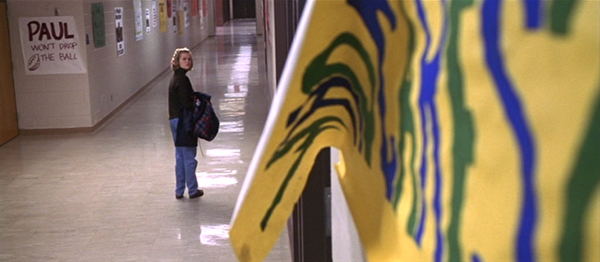
Election.
Kristin here:
Both David and I missed almost all of this year’s Wisconsin Film Festival. I was in Egypt wearing my archaeologist’s hat and working on ancient statuary, and David was attending the Hong Kong International Film Festival. (See his reports, here and here.) Luckily we made it back just in time for Alexander Payne’s spring visit to Madison.
 I first met Alexander at last year’s Il Cinema Ritrovato festival in Bologna. He already knew who I was from having read Film Art: An Introduction, and we started chatting. We were in a small crowd outside the Arlecchino cinema, where a screening was running late. I asked Alexander what he had seen at the festival that he liked. He said he had come from a screening of Sjöström’s Ingeborg Holm and thought it was a masterpiece. Right away I knew that this man has impeccable taste in movies. (Alexander further proved this during his recent visit, saying that his favorite three films of Il Cinema Ritrovato were Ingeborg Holm, Naruse’s Wife, Be Like a Rose, and Rossellini’s Il Generale Della Rovere.)
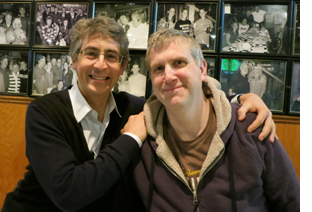
Alexander is a friend of Jim Healy, head programmer for the University of Wisconsin-Madison’s Cinematheque screening series and of the Wisconsin Film Festival. Jim seems to know half the people in the film industry as well as in the festival and archival spheres; he has already brought Tim Hunter and Joe Dante to campus. I knew he hoped to bring Alexander as well, so I put in a pitch for the idea, mentioning how enthusiastic the film students and buffs are in Madison and how he would enjoy speaking with audiences here, who would ask interesting questions. Luckily for me that turned out to be true, a mere nine months later. (Left, Alexander and Jim in a local Madison burger joint.)
Alexander Payne, cinephile
Alexander participated in a number of events here in Madison, some associated with the Wisconsin Film Festival and others with the Department of Communication Arts. The first was a session of our divisional film colloquium, which 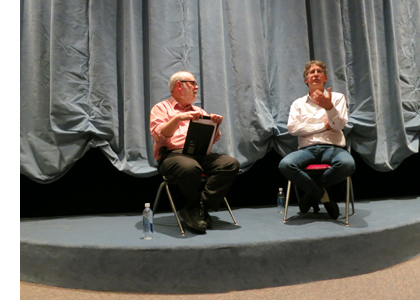 began with David and Alexander in discussion onstage (right) and then opened for questions from the faculty and graduate students.
The conversation began with Alexander recalling how he fell in love with movies, which he reckons happened at about the age of four. He watched mainly older movies. In those days there were rival houses in his hometown of Omaha. His father owned a restaurant in Omaha, and for some reason one of his suppliers, Kraft, gave him a regular-8mm movie projector. Alexander started collecting films, buying prints initially from the now defunct Castle company and later from the still functioning Blackhawk Films.
These included all twelve Chaplin shorts made at Mutual. Many years later, Alexander supported the restoration of the last of that set, The Adventurer. That’s what had brought him to Bologna. He introduced the film, which was shone as one of several new restorations in the Essanay/Mutual Project of the Fondazione Cineteca Di Bologna and Lobster Films. (See here for information on the project and program notes for this year’s screenings.) It was screened at one of the 10 pm programs in the Piazza Maggiore, with Sjöström’s The Outlaw and His Wife, also newly restored.
Jumping back to Alexander’s progress as a cinephile, he became an undergraduate at Stanford, studying history and Spanish. From there he moved on to UCLA for an education in filmmaking, and “thought it was heaven.” He loved it so much that he delayed starting his filmmaking career and stayed on to see more film’s in the famous Melnitz Hall screening room. In those days, 35mm prints were regularly shown, including nitrate originals. (Probably around ten years ago I saw a nitrate print of Trouble in Paradise there, being shown for a class. It definitely was heaven.)
There he recalls seeing such things as an Antonioni retrospective and Double Indemnity. When he was in his 30s, he fell in love with Italian and Japanese cinema. Now that he has reached his 50s, he has broadened his interests to study the films of Hollywood directors like Michael Curtiz and Raoul Walsh. He admires the conciseness of their films: “Film,” he says, “is a constant search for economy.”
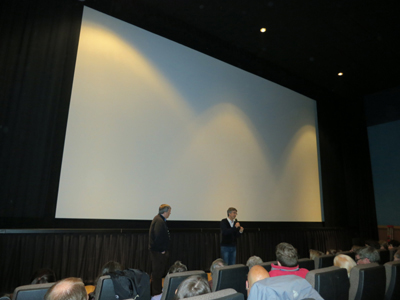 Alexander’s love of Italian films was in evidence at one of the final events of the Wisconsin Film Festival. He had been asked to choose an older film that he could introduce and answer questions about afterward. His choice was Il Sorpasso (1961, Dino Risi). The auditorium at our local arthouse multiplex, Sundance 608, was packed with a very enthusiastic audience indeed. (Left, Alexander after being introduced by Jim Healey.)
The next evening, Alexander did the same for a screening of Nebraska at Union South. Again a full house, and again an audience eager to ask questions.
In between such events, we shared some restaurant meals. Alexander, Jim, and David sounded like some contrapuntal version of the Internet Movie Database, tossing titles, directors, and other film credits back and forth.
During these conversations, and indeed every other conversation we had with him, Alexander would pull out a small pocket notebook (though paper napkins sometimes substituted) and write down any intriguing-sounding title of a film he hadn’t seen. Not only a cinephile, but a systematic one.
Not surprisingly, during the colloquium discussion the issue of Nebraska being shot in black-and-white came up. David mentioned that Bong Joon-ho had said to him (while they were both jury members at this year’s Hong Kong Film Festival) that every director wants to make a black-and-white movie.
Given his love for older films, Alexander considers that “Our great film heritage is black and white.” Inevitably, during the press junkets for Nebraska, reporters asked him why he made the film in black and white. What he wants to know is, “Why is that the first question?”
Alexander agrees with Bong: “I don’t think a director is really a director until he or she has made a film in black and white.” He approached Paramount with the idea of making Nebraska as a black-and-white film and argued that it would be viable because it had a low budget of $12 million. He adds that directors have faced the same arguments against black and white since the 1970s, as when Peter Bogdanovich was making Paper Moon. The TV contracts specify color.
Alexander wanted to shoot Nebraska on film, but the only black-and-white stock available had an ASA of 200, which would not be effective for night shooting. He had to shoot digitally and add contrast and grain afterward to get a film look.
He definitely regrets the loss of film, which he considers superior to video: “I think flicker will always be superior to glow.”
Alexander says he is a big fan of the 1970s because he was a teenager at the time. He thinks that a lot of films made then and released into regular theaters could not be shown today outside arthouses. Films then were judged by their closeness to reality, not their distance from it. For him, “There’s just a consistently fine product being turned out between The Graduate [1967] and Raging Bull [1980].”
It was the period when a generation of filmmakers came to prominence, filmmakers who today are the grand old men of Hollywood. David pointed out that Alexander has often been mentioned as part of a later generation that included such directors as Quentin Tarantino and Paul Thomas Anderson. Alexander agreed that there was the “Class of 1999” that included films like Election and Fight Club (putting David Fincher in the same group). He says of these directors, “We’re friendly enough.” But he envies the Spielberg, Coppola, Scorsese, Lucas generation because they were able to help each other out in filmmaking. His generation doesn’t socialize much, though he said he had seen Soderbergh recently.
The Milos Forman of Nebraska
For anyone who had been unaware that Payne comes from the vast territory in the middle of the USA that encompasses the Midwest and Great Plains and is generally known as Flyover Territory, his latest film makes that point clear. He was born and raised in Omaha, and still lives part of the year there. As he explained in the colloquium discussion, “I’m one of those people in the arts who are interested in exploring where they’re from.” This is not to say that all of his films are set in Nebraska, but four of the six features take place there, explicitly or implicitly.
Citizen Ruth has no identifiable setting, as far as I could tell, though its milieu is clearly centered in small-town life in the country’s midsection. It was shot in Council Bluffs, Iowa, and Omaha. Election doesn’t stress the fact, but close shots of newspaper stories reveal that its story is set in Omaha. Warren Schmidt lives there as well, and his road trip to his daughter’s wedding takes him to Denver and brings him back home. Payne’s next two films were set in quite different parts of America: Sideways in San Diego and California wine country and The Descendants in Hawaii. Nebraska chronicled David Grant’s journey with his father Woody from Billings, Montana, to Lincoln, taking in several rural and small-town locations along the way.
Each story mixes humor and pathos, including both satirical swipes at locals and great affection for them. It’s hard to pin down their genres. (The Internet Movie Database classifies About Schmidt as a comedy/drama and Nebraska as an adventure/drama.) In the colloquium, Payne remarked of Nebraska, “I call it my own Czech Republic. I get to make Milos Forman films about it.”
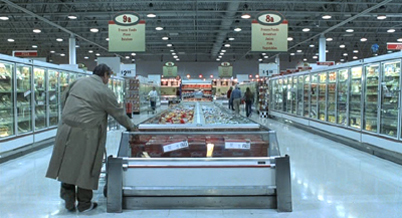
It is a cliché to say that the settings in which a film’s action takes place become a character in the drama, but Payne’s films really do manage to keep us aware of the surroundings to surprising extent. Payne says that when he discusses a film with his cinematographer and production designer, he says he wants “Vividly shot reality.”
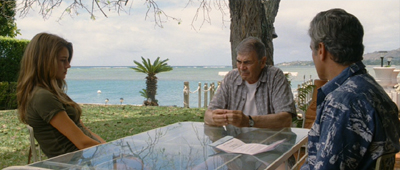
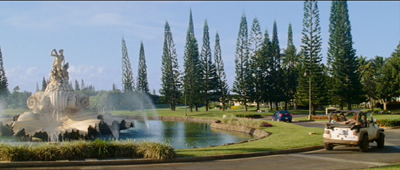
Vivid can simply mean beautiful, and there are many such landscapes, as in The Descendants:
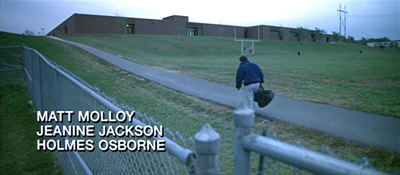
But it need not mean that. The choice of framing in the opening scene of Election, with the fence in the foreground and the school crouched ominously high on the hill tend to make it look like a prison:
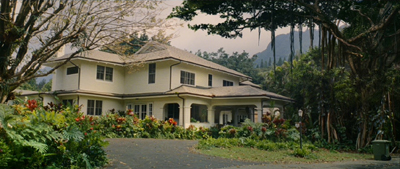
Emphasis on locales can be created by something as simple as a slight wide-angle lens that adds dimension to a house, making it more prominent within its surroundings, as in The Descendants, About Schmidt, and Nebraska, where the vegetation framing the building, ranging from lush to ordinary to sparse, help define the homes of the main characters:
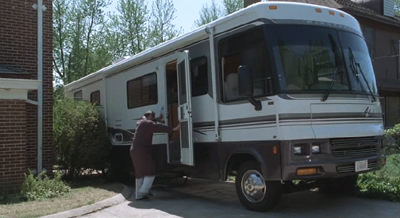
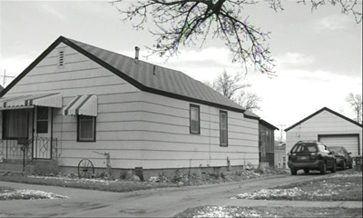
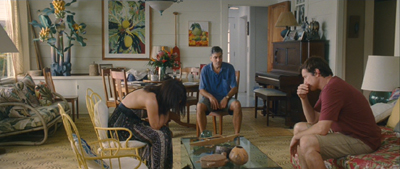
To achieve the desired vividness, Payne often chooses to use real interiors, even if that limits the types of set-ups he can make. The result can be busy but spacious and attractive, as in The Descendants:
Or the constraint can turn to an advantage, as in the confined arrangement filmed from a television’s point of view for the “That Impala you used to have …” long take in Nebraska:
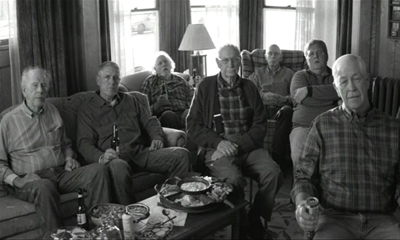
This latter scene exemplifies something else that Payne considers crucial for achieving realism: the addition of extras and small roles, often played by non-actors found in the area where location filming is occurring.
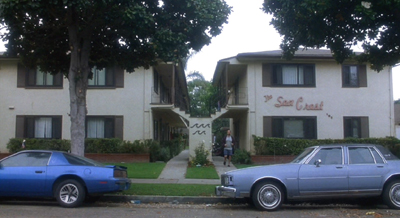
Alexander sometimes uses symmetry to make a fairly ordinary locale more vivid, as in these planimetric shots from Sideways and About Schmidt:
Vivid shots can make a thematic point, as in The Descendants. Shots of Matt and his daughters being driven through their unspoiled ancestral land lead to a view of them being driven up to the sort of elegant resort that could be built on that land if they sell it. The second shot is pretty and well composed, but the juxtaposition with the series of shots that preceded it should make us sense it as slightly menacing as well:

I’ve stuck mainly to long shots here, since that’s where the vivid realism tends to come. There are many unusually close views of characters as well, which contrast with these long shots. There we tend to get the psychological side of these films, which are basically character studies. This contrast may be what gives Alexander’s films a sense both of place and of intense concentration on characters.
Alexander Payne, storyteller
We all know that Oscar wins and nominations don’t always go to the actual best films of the year. But they do reflect something about the reputation of a filmmaker within the industry. Alexander has had two films nominated for best picture: The Descendants and Nebraska. That these nominations are not simply the result of the Academy of Motion Picture Arts and Science’s switch to a ten-nominee best-picture category is reflected in the fact that he has been nominated for best director three times: Sideways, The Descendants, and Nebraska. He and his co-writers have also been nominated three times for best adapted screenplay: Election, Sideways, and The Descendants. The only film which Payne did not co-write, Nebraska, received an nomination for best original screenplay, by Bob Nelson. All these nominations produced two wins, for the screenplays of Sideways and The Descendants. Clearly Alexander is recognized in Hollywood as a fine storyteller.
Apart from Citizen Ruth and Nebraska, all of Alexander’s films are based on novels. In the colloquium discussion with David, he said he prefers adapting novels, which are ready-made stories. He doesn’t have the original ideas, but he can deal with them almost like a documentarian filming an imagined reality. Most of the novels have been based on the authors’ own experiences, and most of them are regional. “You can find a world and have a dialogue with it.”
His sources are generally not well-known novels. None of the Jane Austen-style prestigious literary property here. Neither Election nor Sideways had been published at the point where he decided to adapt them. The Descendants was not a well-known book. As his first project out of film school, Alexander and Jim Taylor, who would collaborate on several scripts, wrote an original one about a retired man in Omaha. When no one in Hollywood was interested, they went on and made Citizen Ruth and Election. Once Election became a critical, if not a commercial, success, they were able to move on to a more ambitious project. In the late 1990s, Louis Begley’s novel, About Schmidt, was suggested to them as a possible vehicle for Jack Nicholson. They derived some elements from it, combining them with their earlier script. It was, by the way, Alexander’s most expensive film at $32 million, half of which went for Jack Nicholson’s fee.
[Thanks to Jim Healey for clarifying About Schmidt‘s origins; this paragraph has been re-written to incorporate the information he provided.]
Clearly he values the tight unity and narrative economy that are characteristic of the studio age of Hollywood filmmaking: “You want your screenplay as streamlined as possible.” That doesn’t mean following a formula, however. He considers that the screenplay manuals that have been so influential, like those of Syd Field and Robert McKee, “destructive.” He dislikes their blanket generalizations. David pointed out that Matt’s voiceover narration in The Descendants is used to provide exposition, but then tapers off at about the midway point. Alexander responds that manuals claims that voiceover should not be used, but that if it is, it should either be used throughout or only at the beginning and end. These strictures he considers absurd. (Interestingly, many classic studios films start with a voiceover that doesn’t return at the end.)
During the colloquium discussion, Alexander remarked, “I like films which are entertaining and charming.” It’s a generalization that could apply to classical studio filmmaking, and it applies to his films as well. These are well-made films made on the whole along classical lines. Their main characters have goals, struggle toward them, meet obstacles, and usually follow an arc at the end of which they have a sudden realization.
Those goals, struggles, and growth also follow a pattern that one could point to in making a case for a thematic consistency in Alexander’s work. These are mostly films where characters struggle against some misfortune or obsessive hatred and eventually come to some sort of reconciliation with their situation.
Warren Schmidt deals with retirements, the death of his wife, and the marriage of his daughter into a family that disgusts him. He concludes that his life has been an utter waste, and yet a sudden realization that a casual act of kindness has made a difference to another person (a six-year-old orphan in Africa whom he has “adopted” through a charity) rescues him from his despair.
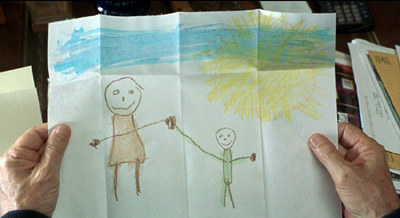
In Sideways, Miles cannot accept that his ex-wife has left him and is about to remarry, and he also hopes to find a publisher for his unwieldy, long novel. Only after he accepts both the failure of his marriage and the impossibility of publication can he move on to a possible new romance. In The Descendants, Matt overcomes his rage over his comatose wife’s infidelity in time to bid her a sincere, grief-filled farewell before she dies. In Nebraska, David Grant struggles to convince his father Woody that his delusions, perhaps brought on by increasing dementia, are absurd, but he finally realizes that humoring the old man is a kinder approach for all concerned.
Election, being an early work, largely avoids this pattern. Jim conceives a hatred for Tracy that he never overcomes. He manages to pull himself together after the failure of his marriage and his firing from his high-school teaching post, finding a new romance and a modest job as a guide in a New York museum. Still, his last glimpse of Tracy as an apparently successful assistant to a major politician is resentful and dismissive, as he continues to view her as he had during her candidacy for student president. Here there is no reconciliation in the main plotline.
The films also tend to follow a well-balanced structure that at least sometimes conforms to the four-part structure I have outlined in Storytelling in the New Hollywood and in this blog entry. Election, for example, has a major turning point that comes halfway through: Tracy notices that one of her posters has begun to peel off the wall (see top), and her struggle to re-attach it leads her to lose control for once and destroy her opponent’s posters. It’s a moment that Jim could legitimately use to disqualify her as a candidate, but his own incompetence and her cleverness and ruthless resistance of his accusations ultimately lead to his failure and her success. The Descendants has a well-balanced four-part structure as well.
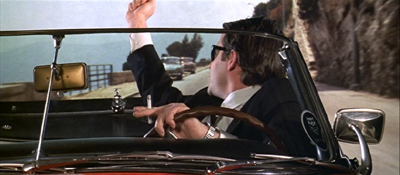
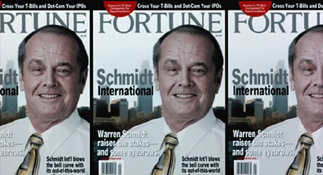
There is also a playfulness about these films that fits Alexander’s “entertaining and charming” description of classical films. Both Election and About Schmidt, for example, contain inserts showing the protagonists’ absurd visions of themselves as wildly successful, Jim as a Marcello Mastroianni-like sophisticate and Schmidt as a business tycoon:
What about the future? Alexander revealed that after Sideways, he and Taylor embarked on an original screenplay, which now has been revived as a current project. It would be a big-budget, effects-driven film. If the project comes to fruition, he dreads the prospect of doing storyboards for the first time. His devotion to historic films remains unchanged, however. He plans to be at this year’s Il Cinema Ritrovato, where we hope to catch a meal with him and go on throwing favorite titles back and forth.
Why do reporters start by asking why Nebraska is in black and white? Having studied press junkets for The Frodo Franchise (see the section on frequently asked questions, pp. 123-132), I suspect that the studio is behind it. Basically publicity departments plant a small number of subjects they want reporters to talk about in the press releases, EPKs, and other items they use to guide the press. Reporters batten onto these as the things their readers would be most interested in, and they ask about them and write about them ad nauseum. All this means that filmmakers have to suffer through this same limited repertory of questions dozens, perhaps hundreds of times, struggling each time to say the same thing in a different way. The price of fame.
We have long included an example from Election in Film Art, where we quoted Alexander as a way of showing that directors deliberately set up patterns of motifs.
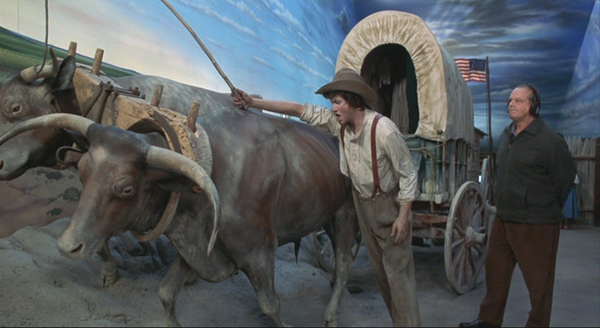
About Schmidt.
Unveiling Ebertfest 2014
Kristin here:
In the early days of Ebertfest, Roger personally introduced every film at this five-day event, which took place this year from April 23 to 27. He would be onstage for the discussions and question sessions after each screening, often joined by directors, actors, or friends in the industry.
In the summer of 2006, there began the long battle with cancer that Roger fought so determinedly. He withdrew gradually from full participation in the festival that he had founded in his hometown of Champaign-Urbana sixteen years ago. He struggled to immerse himself in the festival, even though repeated surgeries had robbed him of his voice. He introduced fewer films, doing so with his computer’s artificial voice, and when even that became too taxing, he sat in his lounge chair at the back of the Virginia Theater, enjoying the event and occasionally appearing onstage with a cheery thumbs-up. Finally, last year on April 4, less than three weeks before the fifteenth Ebertfest, he passed away. That year’s festival became a celebration of his life.
The celebration continued this year, though on a more upbeat note. Some films were chosen from a list that Roger had left to his wife Chaz and festival organizer Nate Kohn, and they selected others in the same indie spirit. The tradition of showing a silent film with musical accompaniment was maintained. As always, the festival passes sold out, and the crowd, including many long-time regulars, enthusiastically cheered both films and filmmakers.
The tributes
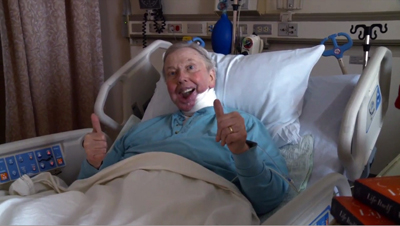
Roger did not live to see the documentary devoted to his life and based on his popular memoir of the same name, Life Itself. It premiered in January at this year’s Sundance Film Festival. He participated in its making, however, encouraging director Steve James (whose 1994 documentary Hoop Dreams Roger had championed) to film him during the final four months of his life. Some of this candid footage reveals the painful and exhausting treatments Roger underwent, but much of it stresses his resilience and the support of Chaz and the rest of his family.
Life Itself was the opening night film. James has done a wonderful job of capturing the spirit of the book and in assembling archival footage and photographs, interspersed with new interviews. The result is anything but maudlin, with a candid treatment of Roger’s early struggles with alcoholism and an amusing summary of Roger’s prickly but affectionate relationship with his TV partner Gene Siskel.
Life Itself was picked up for theatrical distribution by Magnolia Pictures and will receive a summer release, followed by a showing on CNN. (Scott Foundas reviewed the film favorably for Variety, as did Todd McCarthy for The Hollywood Reporter.)
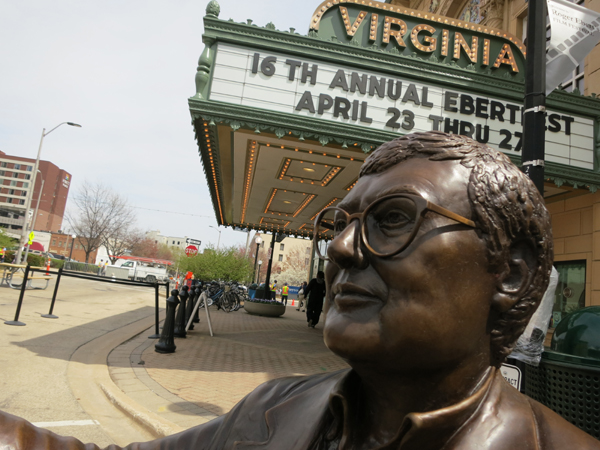
Another tribute followed the next day, when a life-size bronze statue of Roger by sculptor Rick Harney was unveiled outside the Virginia Theater (above). Harney portrays Roger in his most famous pose, sitting in a movie-theater seat and giving a thumbs-up gesture. There is an empty seat on either side of him, so that people can sit beside the statue and have their photos taken. (See the image of Barry C. Allen in the section “Of Paramount importance,” below.)
Far from silent
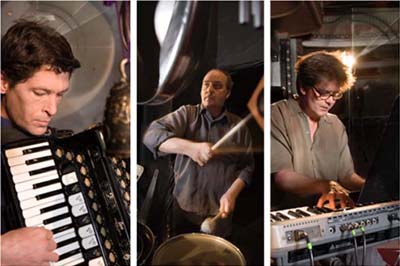
Roger was a big fan of the Alloy Orchestra, consisting of (L to R above) Terry Donahue, Ken Winokur, and Roger Miller, who specialize in accompanying silent films. They have appeared several times at Ebertfest, playing original music for such films as Metropolis and Underworld. Rather than taking a traditional approach to silent-film music, using piano, organ, or small chamber ensemble, they compose modern scores, played on electronic keyboard combined with their well-known “rack of junk” percussion section, including a variety of found objects, supplemented with musical saw, banjo, accordion, clarinet, and other instruments. The result is surprisingly unified and provides a rousingly appropriate accompaniment to the silents shown at Ebertfest over the years.
I have had the privilege of introducing the film and leading the post-film Q&A on some of these occasions, including for this year’s feature, Victor Seastrom’s 1924 classic, He Who Gets Slapped. (Swedish director Victor Sjöström used the Americanized version during his career in Hollywood.) I put the film in context by pointing out three important historical aspects of the film. First, it was the first film made from script to screen by the newly formed MGM studio, formed in 1924 from the merger of Goldwyn Productions, Metro, and Louis B. Mayer Pictures. (Two earlier releases by MGM were Norma Shearer vehicles which originated at Mayer.) Second, it was probably the film that cemented Lon Chaney’s stardom, after his breakthrough role as Quasimodo in the 1922 Hunchback of Notre Dame. Starting in 1912, Chaney had been in well over 100 films before Hunchback, many of them shorts and nearly all of them supporting roles. Third, He Who Gets Slapped was Seastrom’s second American film after Name the Man in 1923, and a distinct improvement on that first effort.
Naturally MGM wanted a big, prestigious hit for its first production, and He Who Gets Slapped came through, being both a critical and popular success–and also boosted Norma Shearer to major stardom. Seastrom and Chaney both stayed on at MGM, though the former returned to European filmmaking after the coming of sound and Chaney died in 1930.
I was joined for the post-film discussion by Michael Phillips of the Chicago Tribune, and we talked with Donahue and Winokur while Miller sold the group’s CDs and DVDs in the festival shop. They revealed that this new score had been commissioned by the Telluride Film Festival and that it was a project that appealed to their taste for off-beat films. There were many questions from the audience, and we suspect that the Alloy Orchestra will continue to be a regular feature of the festival.
A cornerstone of indie cinema
Although Roger was occasionally criticized for supposedly lowering the tone of film reviewing by participating in a television series, he and partner Gene Siskel regularly tried to promote indie and foreign films that didn’t get wide attention. Roger did the same in his written reviews, and Ebertfest was originally known as the “Overlooked Film Festival.” Inevitably it was shortened by many attendees to “Ebertfest,” and eventually that name became official. It reflects the wider range of films that came to be included, with the silent-film screening and frequent showings of 70mm prints of films like My Fair Lady that were hardly overlooked.
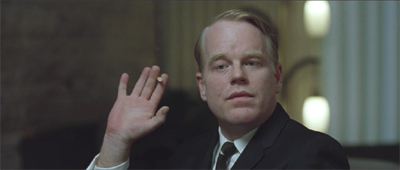
Among Roger’s friends was Michael Barker, co-founder and co-president of Sony Pictures Classics, one of the most important of the small number of American companies still specializing in independent and foreign releases. A long-time Ebertfest regular, Barker usually brings a current or recent release to show, along with filmmakers or actors. This year he was doubly generous, bringing Capote (2005, above), to which Roger had given a four-star review, and the current release Wadjda (2012).
Roger never reviewed the latter, but it is certainly the sort of film that he loved: a glimpse into a little-known culture by a first-time filmmaker with a progressive viewpoint. Wadjda is remarkable as the first feature film made in Saudi Arabia, where there are no movie theaters. Moreover, it was made by a woman, Haifaa Al-Monsour, and tells the story of a little girl who defies tradition by aspiring to buy and ride a bicycle in a country where this, like women driving cars, was illegal. (Below, Wadjda learns to ride a bicycle on a rooftop, hidden from public view.)
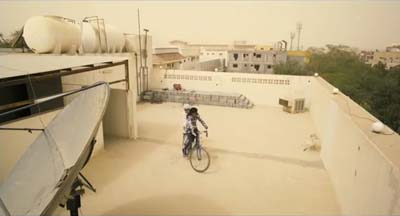
Both the film and Al-Monsour thoroughly charmed the audience. Barker interviewed her afterward, and she revealed that, not surprisingly, the making of the film was touched by the same sort of repression that it portrays. Women are not allowed to work alongside men in Saudi Arabia, so Al-Monsour had to hide in a van while shooting on location. Given that there is no cinema infrastructure in the country, the film was a Saudi Arabian-German co-production, with Arabic and German names mingling in the credits. We also learned that it has since become legal for Saudi girls to ride bicycles. Perhaps someday filmmaking will become more common there, and male and female crew members can work openly together.
Naturally Wadjda was made with a digital camera, since this new technology is crucial to the spread of filmmaking in places like the Middle East where there is little money or equipment for production. In contrast, Capote was shown in a beautiful widescreen 35mm print that looked great spread across the entire width of the Virginia’s huge screen. Naturally the screening became a tribute to the late Phillip Seymour Hoffman, giving his only Oscar-winning performance (out of four nominations) in the lead role.
Barker had brought with him a surprise guest, Capote‘s director, Bennett Miller, whose appearance had not been announced in advance. He discussed how he and scriptwriter Dan Futterman learned that there was a second, rival Capote film in the works, Infamous (2006), which also dealt with the period when the author was researching In Cold Blood. Miller and Futterman decided to press ahead, a wise move in that their film drew more attention than did Infamous. Much of the discussion was devoted to Hoffman’s performance and his acting style in general.
Capote was Miller’s first fiction feature. He had come to public attention with his documentary The Cruise (1998), which Roger had given a brief three-star review. Roger continued his support for Miller with a four-star review for Moneyball (2011). It’s a pity he did not live to see Miller’s latest, Foxcatcher, which will be playing in competition at Cannes in May.
Overlooked no longer
Perhaps no young filmmaker better demonstrates the impact that Roger’s support can have on a career than Ramin Bahrani. Roger saw his first feature, Man Push Cart, at Sundance in 2006 and invited it and the filmmaker to the 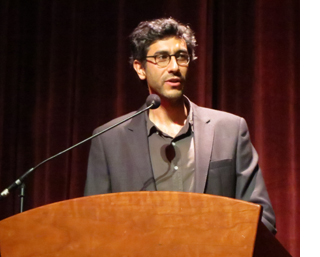 “Overlooked Film Festival” that April. (Roger’s Sundance review is here.) The film then played other festivals, notably Venice and our own Madison-based Wisconsin Film Festival. It won several awards, including an Independent Spirit Award for best first feature. In October Roger gave the film a more formal review, awarding it four stars. Man Push Cart never got a wide release, and it certainly didn’t make much money. Still, quite possibly the high profile provided by Roger’s attention allowed Bahrani to move ahead with his career.
His second film, Chop Shop, brought him to Ebertfest a second time, in 2009. (Roger’s program notes are here, and his four-star review here.) At about that time, Bahrani’s third film, Goodbye Solo, was released. Given its modest budget, it did reasonably well at the box office, grossing nearly a million dollars worldwide (in contrast to Man Push Cart‘s roughly $56 thousand). Bahrani inched toward mainstream filmmaking with At Any Price (2012), starring Dennis Quaid and Zac Efron, and he is currently in post-production on 99 Homes, with Andrew Garfield, Michael Shannon, and Laura Dern. During the onstage discussion, he spoke of struggling to maintain a balance between the indie spirit of his earlier films and the more popularly oriented films he has recently made.
Bahrani visited Ebertfest for a third time this year, belatedly showing Goodbye Solo. We had enjoyed this film when it came out, and it holds up very well on a second viewing. It’s a simple story of opposites coming together by chance. An irrepressibly talkative, friendly immigrant cab driver, Solo (a nickname for Souléymane), becomes concerned when a dour elderly man engages him for a one-way trip to a regional park whose main feature is a windy cliff. He fears that William is planning suicide. Solo arranges to drive William whenever he calls for a cab and even becomes his roommate in a cheap hotel. Gradually, with the help of his young stepdaughter Alex, he seems to draw William out of his defensive shell.
As in Bahrani’s earlier films the main character is an immigrant and played by one, using his own first name (Souléymane Sy Savané). He’s the main character in that we are with him almost constantly, seeing William only as he does. William is a vital counterpart to him, however. He is perfectly embodied by Red West, an actor who worked for Elvis Presley and did stunt work and bit parts in films and television since the late 1950s. He may look vaguely familiar to some viewers, but he’s not really recognizable as a star and comes across convincingly as an aging man buffeted by life’s misfortunes.
Most of the film takes place in Winston-Salem, North Carolina, Bahrani’s hometown, with many moody, atmospheric shots of the cityscape at night. One crucial scene involves a drive into the woods and mountains, however, and much of it is filmed in a dense fog. One questioner from the audience asked if Bahrani had planned to shoot in such weather or if, given his short shooting schedule, the fog turned out to be a hindrance to him. He responded that he had dreamed of being able to shoot in fog and that the weather cooperated on the three days planned for that locale. In fact, he re-shot some images as the fog became denser, to keep the scene fairly consistent.
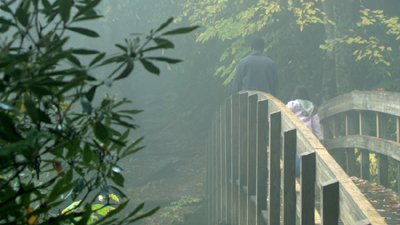
Bahrani’s presence at Ebertfest spans half its existence, from 2006 to 2014. As the festival becomes more diverse in its offerings, it is good to have him back as a reminder of the Ebertfest’s early emphasis on the “overlooked.”
Of Paramount importance
Logo for National Telefilm Associates, TV syndication arm of Republic Pictures.
DB here:
Among the guests at this year’s E-fest was Barry C. Allen. For over a decade Barry was Executive Director of Film Preservation and Archival Resources for Paramount. That meant that he had to find, protect, and preserve the film and television assets of the company—including not just the Paramount-labeled product but libraries that Paramount acquired. Most notable among the latter was the Republic Pictures collection.
We may think of Republic as primarily a B studio, but it produced several significant films in the 1940s and 1950s—The Red Pony, The Great Flammarion, Macbeth, Moonrise, and Johnny Guitar. John Wayne became the most famous Republic star in films like Dark Command, Angel and the Badman, and Sands of Iwo Jima. John Ford’s The Quiet Man was Wayne’s last for the studio, which folded in 1959. Next time you see one of the gorgeous prints or digital copies of that classic, thank Barry for his deep background work that underlies the ongoing work of his dedicated colleagues.
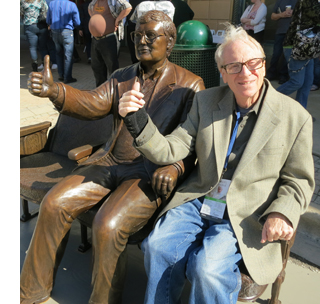 Barry told me quite a lot about conservation and restoration, but just as fascinating was his account of his earlier career. A lover of opera, literature, and painting since his teenage years, he was as well a passionate movie lover. An Indianapolis native, he thinks he saw his first movie in 1949 at the Vogue, now a nightclub. He projected films in his high school and explored still photography. He was impressed when a teacher told him: “If you want to make film, learn editing.” Soon he was in a local TV station editing syndicated movies.
Hard as it may seem for young people today to believe, in the 1950s TV stations routinely cut the films they showed. Packages of 16mm prints circulated to local stations, and these showings were sponsored by local businesses. Commercials had to be inserted (usually eight per show), and the films had to be fitted to specific lengths.
WISH-TV ran three movies a day, and two of those would be trimmed to 90-minute air slots. That meant reducing the film, regardless of length, to 67-68 minutes. Barry’s job was to look for scenes to omit—usually the opening portions—and smoothly remove them. Fortunately for purists, the late movie, running at 11:30, was usually shown uncut, and then the station would sign off.
By coincidence I recently saw a TV print of Union Depot (Warners, 1932) that had several minutes of the opening exposition lopped off. We who have Turner Classic Movies don’t realize how lucky we are. Fortunately for film collectors, some stations, like Barry’s, retained the trims and put them back into the prints.
While working at WISH-TV, Barry began booking films part-time. He programmed some art cinemas in the Indianapolis area during the early 1970s, mixing classic fare (Marx Brothers), current cult movies (Night of the Living Dead), and arthouse releases like Discreet Charm of the Bourgeoisie—a bigger hit than anyone had anticipated. He also helped arrange a visit of Gloria Swanson with Queen Kelly; she carried the nitrate reels in her baggage.
At the same time, Barry was learning the new world of video editing, with ¾” tape and telecine. Because of his experience in television, Barry was contacted by Paramount to become Director of Domestic Syndication Operations. His chief duty was to deliver films to TV stations via tape, satellite, and prints. From that position, he moved to the preservation role he held until 2010, when he retired.
Barry is a true film fan. He has reread Brownlow’s The Parade’s Gone By many times and retains his love for classic cinema. The film that converted him to foreign-language cinema was, as for many of his generation, Children of Paradise, but he retains a fondness for Juliet of the Spirits, The Lady Killers, and other mainstays of the arthouse circuit of his (and my) day. He’s proudest of his work preserving John Wayne’s pre-Stagecoach films.
It was a great pleasure to hang out with Barry at Ebertfest. Talking with him reminded me that The Industry has long housed many sophisticated intellectuals and cinephiles. Not every suit is a crass bureaucrat.
Young-ish adult
Patton Oswalt had planned to come to Ebertfest in an earlier year, to accompany Big Fan and to show Kind Hearts and Coronets to an undergrad audience. He had to withdraw, but he showed up this year. On Wednesday night he screened The Taking of Pelham 123 to an enthusiastic campus crowd, and the following night, after getting his Golden Thumb, he talked about Young Adult. (Roger’s review is here.)
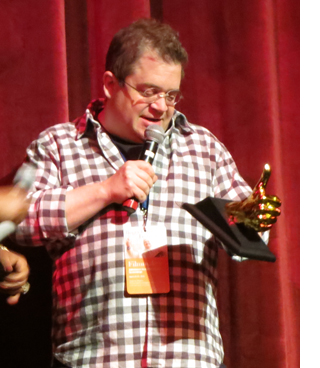 As you might expect from someone who has mastered stand-up, writing (the excellent Zombie Spaceship Wasteland), TV acting, and film acting, Oswalt stressed the need for young people to grab every opportunity to work. He enjoys doing stand-up; with no need to adjust to anybody else, it’s “the last fascist post in entertainment.” But he also likes working with other actors in the collaborative milieu of shooting film. He insists on not improvising: “Do all the work before you get on camera.” I was surprised at how quickly Young Adult was shot—one month, no sets. Oswalt explained that one aspect of his character in the film, a guy who customizes peculiar action figures, was based on Sillof, a hobbyist who does the same thing and sells the results. Oswalt talks about Sillof and Roger Ebert here.
It’s common for viewers to notice that Mavis Gary, the malevolent, disturbed main character of Young Adult, doesn’t change or learn. “Anti-arc and anti-growth,” Oswalt called the movie. I found the film intriguing because structurally, it seems to be that rare romantic comedy centered on the antagonist.
Mavis returns to her home town to seduce her old boyfriend, who’s now a happy husband and father. A more conventional plot would be organized around Buddy and his family. In that version we’d share their perspective on the action and we’d see Mavis as a disruptive force menacing their happiness.
What screenwriter Diablo Cody has done, I think, is built the film around what most plots would consider the villain. So it’s not surprising that there’s no change; villains often persist in their wickedness to the point of death. Attaching our viewpoint to the traditional antagonist not only creates new comic possibilities, mostly based on Mavis’s growing desperation and her obliviousness to her social gaffes. The movie comes off as more sour and outrageous than it would if Buddy and Beth had been the center of the plot.
Making us side with the villain also allows Oswalt, as Matt Freehauf, to play a more active role as Mavis’s counselor. In a more traditional film, he’d probably be rewritten to be a friend of Buddy’s. Here he’s the wisecracking voice of sanity, reminding Mavis of her selfishness while still being enough in thrall to high-school values to find her fascinating. As in Shakespearean comedy, though, the spoiler is expelled from the green world that she threatens. It’s just that here, we go in and out of it with her and see that her illusions remain intact. Maybe we also share her sense that the good people can be fairly boring.
All you can eat
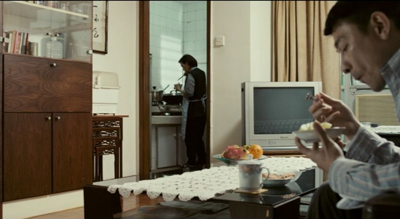
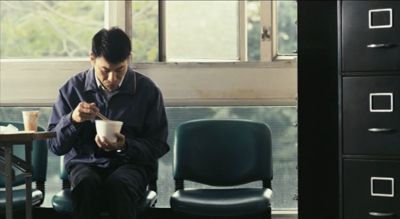
There aren’t any villains in Ann Hui’s A Simple Life, a film we first saw in Vancouver back in 2011. Roger had hoped to bring it last year, but Ann couldn’t come, as she was working on her upcoming release, The Golden Era. This year she was free to accompany the film that had a special meaning for Roger at that point in his life.
The quietness of the film is exemplary. It’s an effort to make a drama out of everyday happenings—people working, eating, sharing a home, getting sick, worrying about money, helping friends, and all the other stuff that fills most of our time. The two central characters are, as Roger’s review puts it, “two inward people” who are simple and decent. Yet Ann’s script and direction, and the playing of Deanie Yip Tak-han and Andy Lau Tak-wah, give us a full-length portrait of a relationship in which each depends on the other.
Roger Leung takes Ah-Tao, his amah, or all-purpose servant, pretty much for granted. She feeds him, watches out for his health, cleans the apartment, even packs for his business trips. When he’s not loping to and from his film shoot, he’s impassively chowing down her cooking and staring at the TV. A sudden stroke incapacitates her, and now comes the first surprise. A conventional plot would show her resisting being sent to a nursing home, but she insists on going. Having worked for Roger’s family for sixty years, Ah-Tao can’t accept being waited upon in the apartment. So she moves to a home, where most of the film takes place.
A Simple Life resists the chance to play up dramas in the facility. Thanks to a mixture of amateur actors and non-actors, the film has a documentary quality. It captures in a matter-of-fact way the grim side of the place—slack jaws, staring eyes, pervasive smells. (A small touch: Ah-Tao stuffs tissue into her nostrils when she heads to the toilet.) Mostly, however, we get a sense of the facility’s everyday routines as the seasons change. The dramas are minuscule. Occasionally the old folks snap at one another, and one visitor gets testy with her mother-in-law. One woman dies (in a bit of cinematic trickery, Ann suggests that it’s Ah-Tao), and an old man who keeps borrowing money is revealed to have a bit of a secret. It’s suggested that a pleasant young woman working at the care facility will become Roger’s new amah, but that seems not to happen. The prospect of a romance with her is evoked only to be dispelled.
Ah-Tao’s health crisis has made Roger more self-reliant, but his life has become much emptier. He seems to realize this in a late scene, when he stands in the hospital deciding how to handle Ah-Tao’s final illness. Throughout the film, food has been a multifaceted image of caring, community, friendship, childhood (Roger’s friends recall Ah-Tao cooking for them), and even the afterlife. Ah-Tao and Roger rewrite the Ecclesiastes line about what’s proper to every season by filling in favorite dishes. As he mulls over Ah-Tao’s fate, Roger is, of course, eating. But it’s cheap takeaway noodles and soda pop. This silent scene measures his, and her, loss better than any dialogue could.
The art of American agitprop
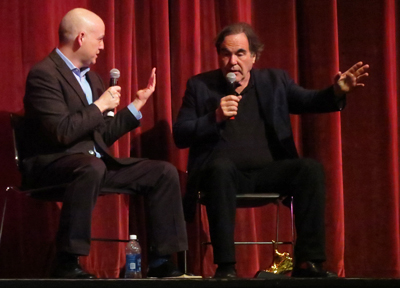
Matt Zoller Seitz and Oliver Stone on stage at the Virginia Theatre.
A Simple Life is a very quiet film. Ebertfest’s highest-profile visitors brought along two of the noisiest movies of 1989. It’s the twenty-fifth anniversary of Do The Right Thing (Roger’s review) and Born on the Fourth of July (Roger’s review), and seen in successive nights they seemed to me to put the “agitation” into agitprop.
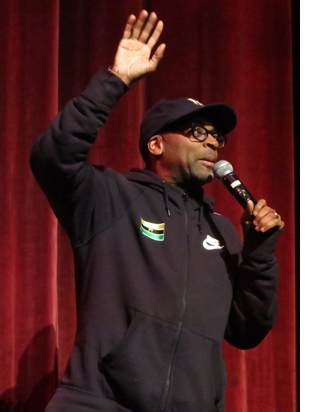 During the Q & A, Spike Lee reminded us that some initial reviews of the film (here shown in a gorgeous 35mm print) had warned that the film could arouse racial tensions. Odie Henderson has charted the alarmist tone of many critiques. Lee insisted, as he has for years, that he was asking questions rather than positing solutions. “We wanted the audience to determine who did the right thing.” He added that the film was, at least, true to the tensions of New York at the time, which were–and still are–unresolved.
The ending has become the most controversial part of the film. It’s here that Lee was, I think, especially forceful. The crowd in the street is aghast at the killing of Radio Raheem by a ferocious cop, but what really triggers the riot is Mookie’s act of smashing the pizzeria window. I’ve always taken this as Mookie finally choosing sides. He has sat the fence throughout–befriending one of Sal’s sons and quarreling with the other, supporting Sal in some moments but ragging him in others. Now he focuses the issue: Are property rights (Sal’s sovereignty over his business) more important than human life? Moreover, in a crisis, Mookie must ally himself with the people he lives with, not the Italian-Americans who drive in every day. It’s a courageous scene because it risks making viewers, especially white viewers, turn against that charming character, but I can’t imagine the action concluding any other way. Lee had to move the project to Universal from Paramount, where the suits wanted Mookie and Sal to hug at the end.
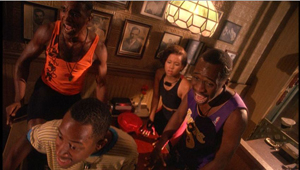
Staking so much on social allegory, the film sacrifices characterization. Characters tend to stand for social roles and attitudes rather than stand on their own as individuals. The actors’ performances, especially their line readings, keep the roles fresh, though, and the film still looks magnificent. I was struck this time by the extravagance of its visual style. In almost every scene Lee tweaks things pictorially through angles, color saturation, slow-motion, short and long lenses, and the like–extravagant noodlings that may be the filmic equivalent of street graffiti.
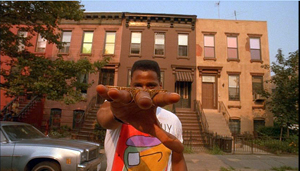
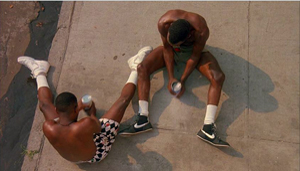
By the end, in order to underscore the confrontation of Radio Raheem and Sal, Lee and DP Ernest Dickerson go all out with clashing, steeply canted wide-angle shots. (We’ve seen a few before, but not so many together and usually not so close.) Having dialed things up pretty far, the movie has to go to 10.
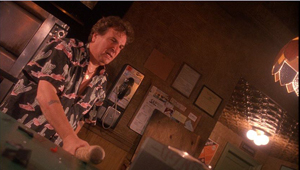
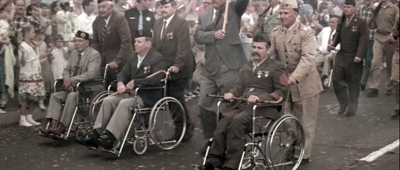
In Born on the Fourth of July, Stone more or less starts at 11 and dials up from there. Beginning with boys playing soldier and shifting to an Independence Day parade that for scale and pomp would do justice to V-J Day, the movie announces itself as larger than life. The storyline is pretty straightforward, much simpler than that of Do The Right Thing. A keen young patriot fired up with JFK’s anti-Communist fervor plunges into the savage inferno of Viet Nam. Coming back haunted and paralyzed, Ron Kovic is still a fervent America-firster until he sees college kids pounded by cops during a demonstration. This sets him thinking, and eventually, after finding no solace in the fleshpots of Mexico, he returns to join the anti-war movement.
Even more than Lee, Stone sacrifices characterization and plot density to a larger message. The Kovic character arc suits Cruise, who built his early career on playing overconfident striplings who get whacked by reality. But again characterization is played down in favor of symbolic typicality. While there’s a suggestion that Ron Kovic joins the Marines partly to prove his manhood after losing a crucial wrestling match, the plot also insists that his hectoring mother and community pressure force him to live up to the model of patriotic young America. He becomes an emblem of every young man who went to prove his loyalty to Mom and apple pie.
Likewise, Ron’s almost-girlfriend in high school becomes a college activist and so their reunion–and her indifference to his concern for her–is subsumed to a larger political point. (The hippies forget the vets.) We learn almost nothing about the friend who also goes into service; when they reunite back home, their exchanges consist mostly of more reflections on the awfulness of the war. Later Cruise is betrayed, almost casually, by an activist who turns out to be a narc. But this man is scarcely identified, let alone given motives: he’s there to remind us that the cops planted moles among the movement.
What fills in for characterization is spectacle. I don’t mean vast action; Stone explained that he had quite a limited budget, and crowds were at a premium. Instead, what’s showcased, as in Do The Right Thing, is a dazzling cinematic technique.
Visiting the UW-Madison campus just before coming to Urbana for Ebertfest, Stone offered some filmmaking advice: “Tell it fast, tell it excitingly.” The excitement here comes from slamming whip pans, thunderous sound, various degrees of slow-motion, silhouettes, jerky cuts, Steadicam trailing, handheld shots, all jammed into the wide, wide frame. Every crack is filled with icons and noises–flags, whirring choppers, kids with toy guns, prancing blondes, commentative music. “Soldier Boy” plays on the supermarket Muzak when Ron is telling Donna about his plans.
By the time Ron visits the family of the comrade he accidentally killed, Stone finds another method of visual italicization: the split-focus diopter that creates slightly surreal depth.
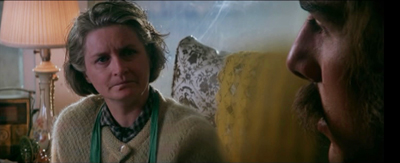
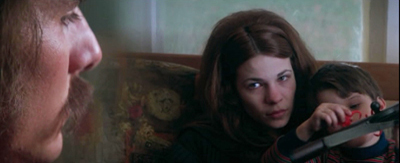
Since so many scenes have consisted of a flurry of intensified techniques, simple over-the-shoulder reverse shots might let the excitement level drop. So a new optical device aims to deliver fresh impact in one of the film’s quietest moments.
Like Lee, Stone took the Virginia Theatre audience behind the scenes. He agreed with William Friedkin, who was originally slated to do the film: “This is as close as you’ll every come to Frank Capra.” Instead of using the shuffled time scheme of Kovic’s autobiography, Friedkin advised that “This is good corn. Write it straight through.” Hence the film breaks into distinct chapters, each about half an hour long and sometimes tagged with dates. They operate as blocks measuring phases of Ron’s conversion. Like many filmmakers of his period, Stone deliberately made each chapter pictorially distinct–the low-contrast Life-magazine colors of the opening parade versus the lava-like orange of the beachfront battle.
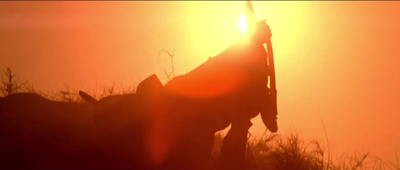
Stone pointed out that this film marked the beginning of his career as a figure of public controversy. Like Lee, he was attacked from many sides, and from then on he was a lightning rod. Matt Zoller Seitz (who’s preparing a book on Stone) pointed out that at the period, he was astonishingly prolific. From 1986 (Salvador, Platoon) to 1999 (Any Given Sunday), he directed twelve features, about one a year.
Lee was hyperactive as well over the same years, releasing fourteen films. And neither has stopped. Lee’s new film is the Kickstarter-funded Da Sweet Blood of Jesus, while Stone is touring to support the DVD release of his 2012 documentary series, The Untold History of the United States. Both men like to work, and more important, they’re driven by their ideas as well as their feelings. By seeking new ways to agitate us, they impart an inflammatory energy to everything they try. And in giving them a chance to share their insights and intelligence with audiences outside the Cannes-Berlin-Venice circuit, Ebertfest once again demonstrates its uniqueness. Roger would be proud.
The introductions and Q&A sessions for most of the films, as well as the morning panel discussions, have been posted on Ebertfest’s YouTube page. Program notes for each film are online; see this schedule and click on the title.
For historical background on Barry Allen’s work as an editor of syndicated TV prints, see Eric Hoyt’s new book Hollywood Vault: Film Libraries Before Home Video.
P. S. 1 May 2014: Thanks to Ramin S. Khanjani for pointing out that Ramin Bahrani had worked on other films before Man Push Cart. These included one feature he made in Iran, Biganegan (Strangers, 2000); it got only limited play in festivals and apparently a few theaters. I can’t find information about the others online, and presumably they were shorts and/or did not receive distribution. (K.T.)
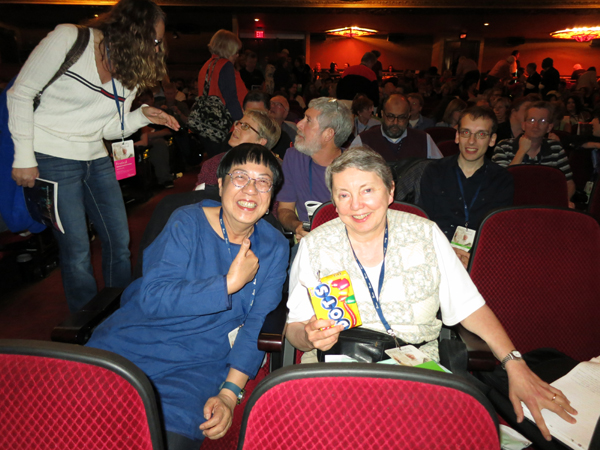
Ann Hui, with Kristin, gets into the spirit of Ebertfest. David is represented in absentia by the Dots.
Genre ≠ Generic

The Shape of Night (Nakamuro Noboru, 1964).
DB here:
I didn’t plan it that way, but it turns out that a great many films I saw at this year’s Hong Kong International Film Festival would have to be categorized as genre pictures. Not, admittedly, Shu Kei’s episode of Beautiful 2014, which interweaves flashbacks and erotic reveries in a purely poetic fashion. And not Tsai Ming-liang’s “sequel” to Walker (2012, made for HKIFF), called, whimsically, Journey to the West. Here again, Lee Kang-sheng, robed as a Buddhist monk, steps slowly through landscapes, some so vast or opaque that you must play a sort of Where’s-Waldo game to find him. (You have plenty of time: there are only 14 shots in 53 minutes.)
But there were plenty of other films that counted as genre exercises. Yet they mixed their familiar features with local flavors and fresh treatment, reminding me that conventions can always be quickened by imaginative film artists.
Keeping the peace, in pieces
Black Coal, Thin Ice (2014).
Take, for instance, The Shape of Night, a 1966 street-crime movie from Shochiku, directed by Nakamura Noburo. Nakamura was the subject of a small retrospective at Tokyo’s FilmEx last year, and this item certainly makes one want to see more of his work. A more or less innocent girl falls in love with a yakuza, who forces her to become a prostitute. In abrupt, sometimes very brief flashbacks, she tells her life to a client who wants to rescue her. The film makes characteristically Japanese use of bold widescreen compositions, disjointed close-ups, and mixed voice-overs from her and the men in her life. In retrospect, everything we’ve seen has been seen in other movies, but Nakamura’s handling kept me continually gripped and often surprised.
Or take That Demon Within, a Hong Kong cop film that premiered at the festival’s close. Dante Lam has made several solid urban action pictures, especially Jiang Hu: The Triad Zone (2000), Beast Stalker (2008), Fire of Conscience (2010), and The Stool Pigeon (2010). They’re characterized by wild visuals and exceptionally brutal violence, and That Demon Within fits smoothly into his style. The new wrinkle is that a boy traumatized by the sight of police violence himself becomes a cop. He’s then haunted by the image of the cop from his past, while he’s also caught up in a search for a take-no-prisoners robber.
His hallucinations and disorientation are rendered through nearly every damn trick in the book, from upside-down shots and blurry color and focus to voices bouncing around the multichannel mix.
There are dreams, too (seems like almost every new film I saw had a dream sequence), and scenes under hypnosis, and men bursting into flame, and action sequences that are visceral in their shock value. I thought the movie careened out of control pretty early, and its nihilism wasn’t redeemed by an epilogue that assured us that this possessed policeman was, at moments, friendly and helpful. In this case, the storytelling innovations generated some confusion about exactly how the hero’s breakdown infused what was happening around him.
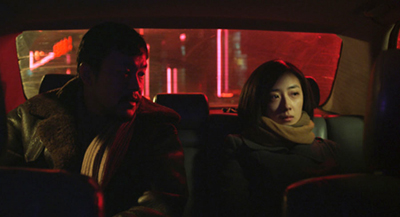
More consistent, largely because it didn’t try for the subjectivity of Lam’s film, was the Chinese cop movie Black Coal, Thin Ice. My friend Mike Walsh of Australia pointed out that the mainland cinema’s bleak realism seems to be starting to blend with traditional genre material. Director Diao Yinan explained, “My aim was not only to investigate a mystery and find out the truth about the people involved, but also to create a true representation of our new reality.” The opening crosscuts the grubby detail of bloody parcels churning through coal conveyors with a couple entwined in a final copulation before breaking off their relationship.
The mystery revolves around body parts that are showing up in coal shipments around one region. After a startling shootout in a hairdressing salon, the case remains unsolved for several years. The surviving detective, a shabby drunk, returns to track down the culprit, but in the meantime he runs into a frosty femme fatale. “He killed,” she says, “every man who loved me.” Needless to say, the detective falls for her too, especially after ice-skating with her. Diao’s film reminds us that you can create a neo-noir in two ways: By taking a mystery and dirtying it up, or taking concrete reality and probing the mysteries lurking in it.
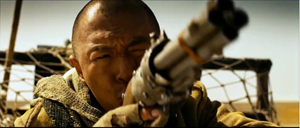
There were even two Westerns. Another mainland movie, No Man’s Land, was unexpectedly savage coming from the director of the super-slick satires Crazy Stone (2006) and Crazy Racer (2009). Now Ning Hao has given us a bleakly farcical, Road-Warrior account of life on the Chinese prairie.
A wealthy lawyer brought out to the wasteland to negotiate a criminal case becomes embroiled in primal passions involving men with very large guns, very large trucks, impassive faces, and almost no sense of humor. It’s a black comedy of escalating payback (involving spitting and pissing), and it exudes sheer masculine nastiness. Completed four years ago, it found release only after extensive reshoots demanded by censors. Yet even in its milder state it remains true to the spirit of Sergio Leone’s jaunty grimness, bleached in umber sand and light.
Itching to see a Kurdish feminist political Western? You’ll find Hiner Saleem’s My Sweet Pepperland welcome. A tough policeman (= sheriff) is dispatched to a remote village in Kurdistan to keep order (= clean up the town). A young teacher (= schoolmarm) leaves her oppressive family to teach there as well. A warlord (= town boss) and his minions (= paid killers) have terrorized the locals, while marauding female guerillas (= outlaws) bring their fight into town.
These time-honored conventions shape a story of stubborn courage taking on complacent viciousness. In key scenes, our sheriff faces down big, hairy, scary killers.
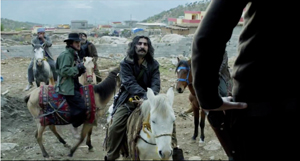
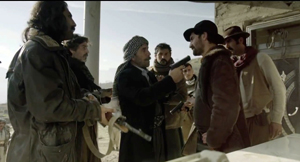
USA frontier conventions, it turns out, work pretty well in a Muslim society too. The Hollywood Western’s continued embodiment of American values transfers easily to the former Iraq. “Our weapons are our honor,” the chief thug says, in a line that resonates through our history right up to now. Yet things we take for granted bring modern change to the wasteland. The sheriff assigns himself to the village in order to escape an arranged marriage, as the woman he finds there has done. She is vilified by both the locals and her male relatives, who would prefer death (hers) to dishonor (theirs). In the process, both he and she become heroic in a righteous, old-fashioned way.
A killer proposes a compromise while sneakily drawing his pistol. The cop shoots him and remarks: “I don’t do compromise.” Neither does My Sweet Pepperland.
Gangs of New York, and elsewhere
The Dreadnaught (1966).
From March to May, the Hong Kong Film Archive has been running a series, “Ways of the Underworld: Hong Kong Gangster Film as Genre.” It’s packed with classics (The Teahouse, To Be No. 1, City on Fire, Infernal Affairs) as well as several rarities (Absolute Monarch, Bald-Headed Betty, Lonely 15). I managed to catch three titles, all previously unknown to me.
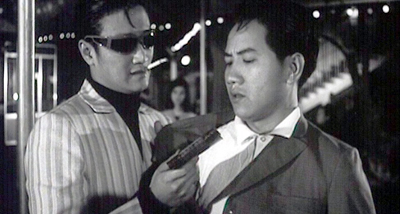
The Dreadnaught (1966) has a familiar premise. Two orphan boys indulge in petty theft after the war. One, Chow, is caught but gets adopted by a policeman. He turns out a solid young citizen. Lee, the boy who escapes, grows up to be a triad. When the two re-meet, Lee is attracted to Chow’s stepsister. Some years later, Chow is now a cop and vows to smash Lee’s gang. After a struggle with his conscience, Lee agrees to help.
The film’s main attraction is the shamelessly flashy performance of Patrick Tse Yin. Tse would make his fame in the following year in Lung Kong’s Story of a Discharged Prisoner, famous as a primary source for A Better Tomorrow. With his sidelong smile, his endlessly waving cigarette, and the dark glasses he wears at all times, Tse in The Dreadnaught looks forward to Chow Yun-fat’s charismatic role as Mark in Woo’s masterpiece.
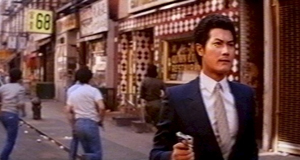
Another icon of the period is Alan Tang Kwong-wing. He played in over 100 films, mostly romances and triad dramas made in Taiwan. Westerners probably know him best as the producer of Wong Kar-wai’s first two features, As Tears Go By and Days of Being Wild. Wong had worked as a screenwriter for Tang. Onscreen, Tang had a suave, polished presence marked by his perfect coiffure; he was known as the Alain Delon of Hong Kong. His company, Wing-Scope, specialized in mob films during the late 1970s and early 1980s.
New York Chinatown (1982) shows Tang as a young hood whose ambitions to dominate the neighborhood are blocked by a rival gang. Eventually the police decide to let the two gangs decimate each other. This leads to an enjoyable, all-out showdown involving surprisingly heavy armaments. Shot quickly on location (passersby sometimes glance into the lens), the movie gives a rawer sense of street life than you get from most Hollywood films. There’s also a scene in which Tang, apparently attending Columbia part time, corrects a history professor lecturing on Western imperialism in China. Although the film circulates on cheap DVD in 1.33 format, it’s a widescreen production, and it was a pleasure to watch a fine 35mm print at the Archive.
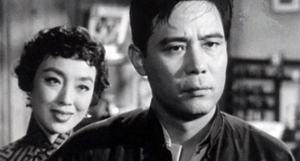
The biggest revelation of the series for me was Tradition (1955), a Mandarin release. This is considered one of the earliest pure gangster films in local cinema. It’s a fascinating plot about a boy raised by a triad kingpin in the 1930s. When the godfather dies, the young Xiang is given power over the gang and the master’s household. Trying to be faithful to the old man’s principles, Xiang finds himself unable to control his master’s widow and daughter, who are led astray by the widow’s worldly, greedy sister. At the same time, Xiang must ally with other triads to smuggle aid to the forces fighting the invading Japanese. He is torn between devotion to tradition and the need to adapt to modern materialism and the impending world war.
 Tradition is redolent of film noir, not only in the sister-in-law’s fatal ways (she seduces the old master’s weak son) but also in the film’s flashback construction. Tracking back from a ticking clock, the movie begins with Xiang meeting the master’s daughter after his gang has been decimated in a shootout. The film skips back to Xiang’s childhood and takes us up through the main action before a final bloody confrontation with police and the corrupt family members. At the end, the camera tracks up to the clock, closing off the whole action.
Even more tightly buckled up are director Tang Huang’s obsessive hooks between scenes. A final line of dialogue is answered or echoed by the first line of the next scene; a closing door or character gesture links sequences in the manner of Lang’s M. Most daringly, when sister San starts to light a cigarette in one scene, we cut to her puffing on it in a tight close-up—a gesture that takes place in a new scene hours later. This and other admittedly gimmicky links look forward to Resnais’s elliptical matches on action in Muriel.
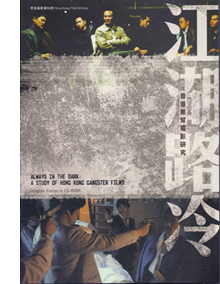
Fortunately for us, the Archive has published Always in the Dark: A Study of Hong Kong Gangster Films. Edited and partly written by Po Fung, it is an excellent collection of essays and interviews. It is in Chinese, but it includes a CD-ROM version in English. It’s available from the Archive’s Publications office.
Behind the scenes at Milkyway
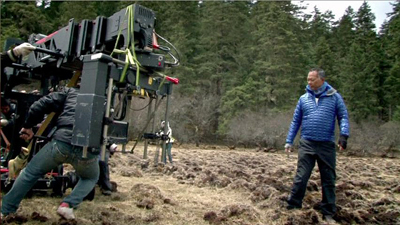
Johnnie To and a recalcitrant crane during the shooting of Romancing in Thin Air.
Sometimes a genre film becomes a prestige picture. This happened, in spades, with The Grandmaster. If awards matter, Wong Kar-wai’s film has become the official best Asian film of 2013. I missed the Asian Film Awards in Macau (was watching early Farhadi films), but the event was a virtual sweep: seven top awards for The Grandmaster, including Best Picture and Best Director. After I got back home, the Hong Kong Film Awards gave the picture a staggering twelve prizes, everything from Best Picture to Best Sound.
Unhappily, nothing in either contest went to the other outstanding Hong Kong film I saw last year, Johnnie To Kei-fung’s Drug War. It lacked the obvious ambitions and surface sheen of Wong’s film. Many probably took it as merely a solid, efficient genre picture. I believe it’s an innovative and subtle piece of storytelling, as I tried to show here.
Mr. To presses on, as prolific as usual. He has finished shooting a sequel to Don’t Go Breaking My Heart, a rom-com that found success in the Mainland, and he’s currently filming a more unusual project in Canton. More on that shortly.
During the festival only one recent To/Milkway film was screened, The Blind Detective (I wrote about that here). But Ferris Lin, a young director from the Academy for Performing Arts, presented a very informative documentary feature on To and his Milkyway company. Boundless takes us behind the scenes on several productions, particularly Life without Principle, Romancing in Thin Air, and Drug War. It also incorporates interviews with To, his collaborators, and critics like Shu Kei.
Sitting at the monitor with his cigar, To may seem distant, but actually he is wholly engaged. We see him help push a crane out of the mud and shout commands to his staff. To confesses that he may scold too much, but the dedicated cooperation he gets confirms his demands. The team gives its all, as we learn when they explain the tension ruling the three days of rehearsal for the sequence-shot at the start of Breaking News. For The Mission, made at the time of Milkyway’s biggest slump, the actors supplied their own cars and costumes.
To remains a complete professional who has perfected his craft, albeit in the Hong Kong tradition of “just do it.” He doesn’t rely on storyboards or even shot-lists, only outlines of the action, and he adjusts to the demands of the locations. The Mission had no script, but the entire story and shot layout were in his head. For Exiled, he didn’t even have that much and simply began thinking when he stepped onto the set each day. It’s hard to believe that precise shot design and sly dramatic undercurrents can emerge from such an apparently unplanned approach. In its recording of To’s unique creative process, Boundless provides a vivid portrait of one of the world’s finest contemporary directors.
To continues to challenge himself. He is currently trying something else again, shooting a musical wholly in the studio. Its source, the 2009 play Design for Living, was written by and for the timeless Sylvia Chang Ai-chia. It won success in Hong Kong, Taiwan, and the Mainland. In the film Sylvia is joined by Chow Yun-fat, thus reuniting the stars of To’s 1989 breakout film All About Ah-Long. The project also indulges the director’s long-felt admiration for Jacques Demy. There is no 2014 film I’m looking forward to more keenly.
Special thanks to Shu Kei and Ferris Lin of the Hong Kong Academy for Performing Arts. Thanks as well to Li Cheuk-to, Roger Garcia, and Crystal Yau, as well as all the staff and interns of HKIFF, and to Winnie Fu of the Hong Kong Film Archive.
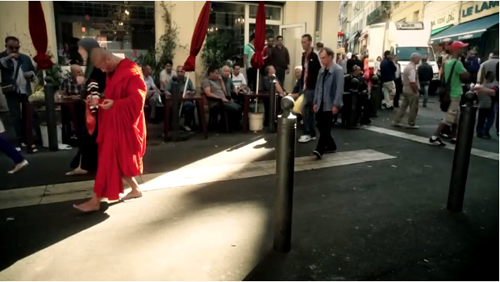
Journey to the West (Tsai Ming-liang, 2014).
Reintroducing MASTER OF THE HOUSE
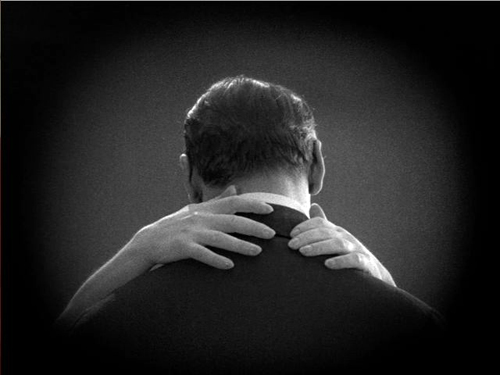
Master of the House (1925).
DB here:
We’re busy! I’m trying finish a final Hong Kong blog entry and a wrapup on my 1940s critics. Meanwhile, Kristin is writing an entry on Alexander Payne’s rewarding visit to our campus this week. But we pause to signal a major new DVD release.
Criterion is now offering Dreyer’s classic Master of the House (1925) as either a DVD or dual DVD/B-r edition. Apart from a sparkling presentation of the film and newly translated intertitles, the package includes a sensitive essay by critic Mark Le Fanu, an illustrated interview with outstanding film historian Casper Tybjerg, and a visual essay I prepared.
 Casper (right) offers a lot of new information. He remarks that the film, though hailed in the 1970s as a feminist picture, was conceived as a straightforward comedy. From today’s perspective, Casper points out, the film gains importance by dramatizing the drudgery of women’s work, showing all the daily household chores that three generations of women must perform. Casper also traces how the film transforms the source play and bears the influence of Victor Sjöström. And he explains one of the ellipses in the film’s final version: What does the tyrannical husband Viktor do all day outside the home?
My visual essay develops ideas about Dreyer’s innovative uses of framing and cutting. I emphasize the film’s unusual “wraparound” space, which immerses us in the apartment that is the center of the drama. I try as well to connect Master of the House to stylistic trends in Danish cinema and the German Kammerspielfilm, as well as to Dreyer’s later films. My comments develop further some ideas I set out in my (now, very old) book on Dreyer, my blog entry “Dreyer Re-reconsidered” and in the web essays “Nordisk and the Tableau Aesthetic” and “The Dreyer Generation.”
Criterion Producer Abbey Lustgarten and her staff have done a fine job in assembling images and clips to support my points. Thanks also to our local creative technician Erik Gunneson for recording my voice-over.
Master of the House is available on the Criterion Collection website and elsewhere.
P.S. 27 April: A sample of my commentary on the film is on the Criterion site.



