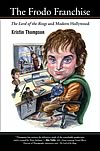
by Kristin Thompson. Berkeley: University of California
Press, 2007.
400 pages, 6 × 9 inches, 12 color illustrations;
36 b/w illustrations.
[go
to Amazon | go to The Frodo Franchise blog]
When you consider what a scene needs to express, ask: How can the actor act it?
When you’re writing a scene, try to act it out yourself.
Rather than letting dialogue explain the action, let the action explain the dialogue.
It will always be possible to make films. Don’t forget to make cinema.
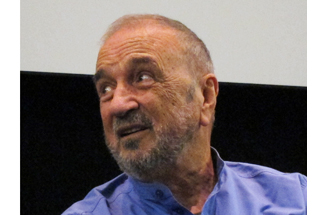
These and other epigrammatic insights flowed easily from Jean-Claude Carrière during his visit to the Cinematek of Belgium and the annual conference of the Screenwriting Research Network. I hope to devote a later blog to other attractions of this stimulating get-together. For now, a brief tribute to the volcanic charm of the legend known as JCC.
JCC entered cinema under the aegis of Jacques Tati. Tati wanted someone to turn M. Hulot’s Holiday and Mon Oncle into novels, and the very young writer seemed the right candidate. But Tati quickly learned that JCC didn’t know how a film was made. So he assigned Pierre Etaix and the editor Suzan Baron to tutor the lad in the ways of cinema. First lesson: Go through M. Hulot on a flatbed viewer, examining the script line by line while watching shot by shot. As a result, JCC says, he began to understand “the film that you don’t see.”
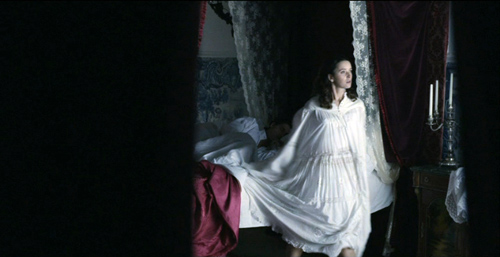
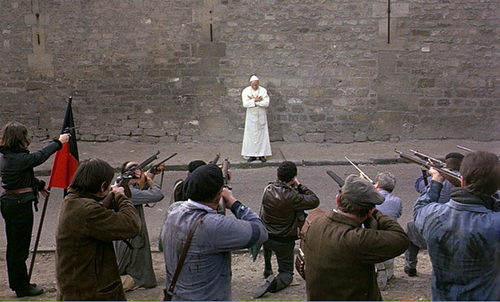
In the course of his career, JCC has written novels, plays, essays, screenplays, even a scenario for a graphic novel. In the process he became one of the most distinguished and respected screenwriters of the last fifty years. His most famous collaborations were probably with Buñuel, from Belle de Jour (1967) to the master’s last film, That Obscure Object of Desire (1977). He worked with Etaix (The Suitor, 1962), Forman (Taking Off, 1971), Schlöndorff (The Tin Drum, 1979), Godard (Every Man for Himself, 1980), Wajda (Danton, 1983), Oshima (Max mon amour, 1986), Kaufman (The Unbearable Lightness of Being, 1988), Peter Brook (The Mahabarata, 1989), Malle (Milou en Mai, 1990), and Haneke (The White Ribbon, 2007). He has also become known for his work on major French costume pictures and adaptations, such as Cyrano de Bergerac (1990) and The Horseman on the Roof (1995), as well as work with younger directors, including Wayne Wang (Chinese Box, 1997) and Jonathan Glazer (Birth, 2005). His TV scripts are numberless.
Directors both young and old come to him for the unique forms of collaboration that he offers. Instead of going off to write the screenplay, JCC meets frequently with the director. (Sometimes the director stays in his house.) He might ask the director to write the script for him, and they go over the result. Through these methods, JCC tries to help the director “find the film that he wants to make.” But his methods are flexible, tailored to the director’s temperament. When he was working with Buñuel, the men met daily to tell each other their dreams, some of which wound up in The Discreet Charm of the Bourgeoisie (1972). Similarly, JCC prefers to meet with the actors before production, letting them try out the parts so that he can revise things for each one’s habits of speaking. For Cyrano, Depardieu read the entire play aloud, taking all the parts, and then listened to it over and over on cassettes to refine his interpretation.
Brussels gave JCC a busy twenty-four hours. In conversation with the critic Louis Danvers he introduced a Cinematek screening of The Milky Way. He gave a keynote address for the Screenplay Network conference, and he participated in a panel discussion with members of the Flemish Screenwriters Guild at the film school RITS. These sessions ranged freely over his career and his conceptions of filmmaking. He believes that there is a language of film that sets it apart from other arts. That language is grounded in the play of meaning and emotion that comes from putting one shot after another.
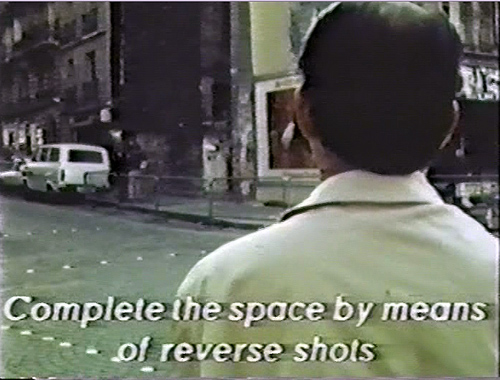
He explained the point through an example that seems at first to be a restatement of the classic Kuleshov effect. In Shot 1, a man in his apartment looks out the window. Shot 2: The street. A woman is walking with another man. We’ll assume that our man is seeing them. Shot 3: Our man reacts.
But contrary to Kuleshov’s dictum, his facial expression should not be neutral. In fact, his expression tells us how to understand the scene. If the man looks upset, we surmise that he’s jealous. If he’s benevolent, we assume that the woman is a friend, his daughter—or a flirt. The filmmaker needs not only techniques like framing and cutting, but also the performances of actors.
Now cut to the woman in her bedroom brushing her hair. We need to make sure the audience understands that it’s the same woman, so maybe we have to go back and add a shot to the earlier scene, a closer view of her in the street. This constant flow and readjustment of images is based on guiding the spectator discreetly but firmly through the action. The audience isn’t aware of this “secret film,” but it governs everything the viewer thinks and feels.
For this reason, the young screenwriter needs to learn everything about how a film is made. When JCC was acting in The Wedding Ring (1971), a film starring Anna Karina, he learned that simply getting up from a couch can be a complicated matter. When he stood up spontaneously, dipping forward to lift his body, the cinematographer had to correct him: It looked awkward on film. JCC learned that he had to stand up in an unnatural way, with his feet spaced and his back rigid, so that it looked smooth on film. The screenwriter must know that even the smallest moment of action, easy to write in the comfort of a study or a café, is subject to the contingencies of production.
Where to get ideas for films? From the classics, of course. (“Balzac is the greatest screenwriter—every character is vivid.”) But above all you must observe reality. Tati taught JCC to sit vigilantly in a café. Study everyone who passes. Notice details. Imagine the person as a character in a story. Give him or her some motivations. What you must do is “find the fiction in the reality.” When JCC presided over the French film school La FEMIS, he promoted an exercise that required students to move out into a public space, like a market, and come back with stories about the people they saw. JCC praised Tati’s genius for spinning gags and situations out of passing life—“as if God had created the world so that it could furnish a film by Jacques Tati.”
JCC must be one of the few screenwriters who doesn’t gripe about his work being changed in its final incarnation onscreen. He sees the screenplay as ephemeral, the chrysalis for the butterfly. Once you accept the fact that your text must be sloughed off on its way to becoming cinema, you can take joy in your work. For young people, JCC advised the same relaxed, exploratory attitude. Conceive of yourself as a writer, able to move across media. The venues for your writing are constantly changing, so be prepared to write for television as well as film, to write comics and documentaries and plays. Above all, “Don’t despair of the future of cinema. It’s wide open.”
Jean-Claude Carrière turns eighty next week.
The best introduction to Carrière’s career and ideas that I know is his book The Secret Language of Film(Faber, 1995). Some of this text overlaps with Exercice du scénario (FEMIS, 1990), coauthored with Pascal Bonitzer. That book is worth reading too, but it hasn’t to my knowledge found English translation. An illuminating interview is here.
P.S. 11 September 2011: Thanks to Jonathan Rosenbaum for correcting an error in JCC’s filmography, which I’ve rectified above. Jonathan also remarks:
I assume that you know, by the way, that Carrière appears in a scene of Certified Copy, playing something similar to the “wise old guru” role played by the Turkish taxidermist in Taste of Cherry and the doctor in The Wind Will Carry Us.
I did know and should have worked it in!
P.P.S 22 September 2011: A panel discussion with Jean-Claude Carrière held during the conference is available here. Although the site is in Dutch, the discussion is in English. Thanks to Ronald Geerts for the information.
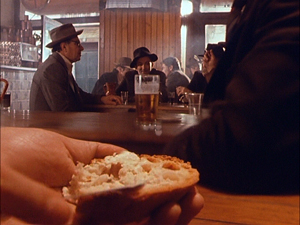
Mon Oncle (1958). “I followed Tati more or less everywhere, usually with Etaix, attending projections followed by long anxious discussions. (‘Can we clearly see the dog’s tail go past the electric eye that shuts the garage door? Yes? Clearly? You’re sure people will see it?’)
On April 21 a young Spanish film student uploaded his remarkable little film, Variation: The Sunbeam, David W. Griffith, 1912 onto Vimeo. There it languished, like so many contributions to the internet, good and bad. In the first four months of its presence on the site, it attracted 17 views.
Then, on August 17, Variation was viewed twice and earned its first “Like.” (One has to be a member of Vimeo to Like a film, so one cannot assume that none of its viewers to that point had enjoyed it.) That first Like, and perhaps both views were by Kevin B. Lee, best known for his many video essays on classic films. (See here for an index; I contributed the commentary for the La roue entry.) Over the next week and a half there were five additional views, four on August 28. I suspect some or all of these last ones were repeat visits by Kevin, since on August 31 he was the first to post an essay on Variation: The Sunbeam, David W. Griffith, 1912 (hereafter Variation), along with some information on its maker, Aitor Gametxo.
The immediate result was a flurry though not a stampede of views: 33 on August 31, along with a second Like; and 15 on September 1, with a third Like. One of those views and the third Like were mine. On September 2, there were 12 views, dwindling to 2 on September 3 and 1 on September 4.
(Among the viewers after the Fandor entry was Evan Davis, University of Wisconsin-Madison film-studies alumnus, who read Lee’s blog, watched the film, and passed the links along to us. Thanks, Evan!)
It’s a pity that more attention has not been paid to this charming, clever, and informative film. Not only would people enjoy it, but it could easily be used as a tool for those teaching, or indeed researching silent cinema. So here’s my bid to help it go viral.
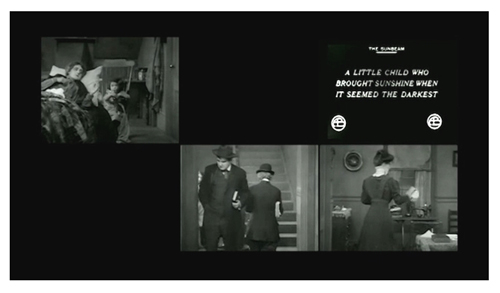
Variation is a found-footage film based on Griffith’s American Biograph one-reeler The Sunbeam, made in December, 1911, and released on March 18, 1912. It is not among the most famous of the nearly 500 one- and two-reelers Griffith directed at AB between 1908 and 1913, but it’s better known than most. In the opening, a sick mother dies, and her little girl, thinking her mother is asleep, goes out into the hallways of their working-class apartment building. She tries to find someone to play with, but everyone rebuffs her until she manages to charm two lonely people, a bachelor and spinster, who live opposite each other on the floor below the child’s home.
Aitor noticed three key things about the film. First, the action takes place in a very limited space, with the three apartments and hallway all close to each other. Second, the doorways through which the characters pass between these rooms are on the edges of the screen, so that when they exit through the doorway in one shot and after the cut enter the space on the other side of the doorway, there is often a sort of elusive match on action formed (what I termed a “frame cut” in The Classical Hollywood Cinema, p. 205 and figures 16.36 and 37). Third, and perhaps most importantly, Griffith was intercutting actions that were happening simultaneously, so that at many of the cuts, he jumped from the end of an action in one space back in time to catch up with what had been happening in another space. At times he would jump back twice if simultaneous actions were happening in three spaces.
Aitor has taken the individual shots and redone them, putting them into a grid of six small frames, three on the bottom and three at the top. Scenes in the child’s upstairs apartment are shown only in the upper left, the top of the stairway in the upper center, and the two apartments on the ground floor at the sides, with the hallway and bottom of the stairs between them. (See above.) These are roughly the actual positions these spaces occupy in relation to each other in the building represented in the film. The shots run in their true temporal relations, so that there is no jumping back.
I suggest that before reading further, you watch The Sunbeam, especially if you have never seen it before. It would be impossible, I think, to entirely follow the story just from seeing Variation. The shots are so reduced in size to fit into the grid that small but important gestures and details get lost. Here is the original film, from YouTube.
With Aitor’s kind permission, we present his take on Griffith’s one-reeler. (The Sunbeam runs about 15 minutes, but due to the simultaneous presentation of many shots, Variation is only about 10 minutes.) Click on the “Vimeo” logo in the lower right corner for a larger image:
A fascinating film, isn’t it? I think many viewers would reach the end of Variation and wish that the same sort of presentation could be created for other films–at least, early ones that are short enough to make such rearrangement viable. Kevin Lee is enthusiastic about the idea: “Imagine this multi-dimensional, real-time approach being applied to footage from other films, as a way of not just mapping out scenes in a movie, but also gaining insight into filmmaking technique.” It might be possible, but the six-rectangle grid used here would not work for very many films. Aitor has chosen the ideal film for such an approach. Not only are there a limited number of significant characters, but they also live in the same building, with three rooms and a hallway, all viewed from the same direction, making them fit perfectly into a “doll-house” style scene.
Had Griffith not routinely shot directly toward the back wall in all his sets, placing the shots directly side by side across the grid would not work, at least not so neatly. Many other directors of this era were exploring shooting into corners and having doorways for entrances and exits centered at the rear. Perhaps filmmakers like Aitor could still place different shots side by side, but the actors’ movements from one space to another would not be so smooth. One of the attractions of Variation is that those movements are smooth, and as a result the action plays as if it were part of a continuous, “real” film.
Even other Griffith films shot in the style of The Sunbeam would be far more difficult to lay out on a similar grid. Longer rows of more rectangles would need to be added, or the upper row would have to represent actions taking place at a distance and the lower one actions taking place within a building. (I’m thinking here of something like The Lonely Villa, where action in a series of contiguous rooms is intercut with the husband’s race from a distant locale back to his house.) The placement of the bachelor’s room opposite the spinster’s, on either side of the hallway through which all of the minor characters pass, is crucial to Aitor’s project. A complex film with many characters and locales might create a grid with rectangles too small to be grasped by the viewers. Ways of indicating techniques like flashbacks would have to be devised. And of course, not all films contain simultaneous action.
Variation has some technical disadvantages. The titles appear in the upper right corner of the screen, since no locale opposite the child’s apartment is ever shown. The titles are small and difficult to read, and since they pop up simultaneously with the action, it’s almost impossible to read them anyway. One cannot tell where the titles originally came in the flow of shots, though one can always check the original film. Another problem is the cropping of the images on all four sides. The DVD copies are somewhat cropped, and more of the image is eliminated in the Variation frames; the action of the little heroine hiding a hairpiece in the spinster’s home, an important motivation for later action, can barely be grasped because it is so small a detail and happens at the very bottom of the frame; in the DVDs it can be clearly seen.
The Griffith Project and our knowledge of his techniques
I do not intend by any means to diminish what Aitor has accomplished when I say that the three main techniques he works from have been known to Griffith scholars for years. Variation offers a new way of examining and explaining those techniques.
Griffith has, of course, been one of the most closely studied filmmakers in history. A vast summary of and contribution to the research on Griffith was recently compiled by “Il Giornate del Cinema Muto” film festival in Pordenone, Italy. From 1997 to 2008, the festival mounted a nearly complete retrospective of Griffith’s work, hampered only by those films which still exist only as negatives or in other forms that could not be projected. A team of experts divided up the work and wrote extensive program notes for every single film Griffith made, whether it was shown at the festival or not. The notes, some more general essays, and Griffith’s writings were edited into twelve volumes jointly published by the festival and the British Film Institute (1999-2008). I had the privilege of contributing notes to most of the volumes, and although I cannot claim to know Griffith’s entire œuvre intimately, I got to know the films assigned to me quite well and learned a great deal about his methods.
The program notes for The Sunbeam were written by Griffith specialist Russell Merritt (Volume 5, 2001). As these excerpts from his description of the film’s setting indicate, the doll-house arrangement of the sets in The Sunbeam were distinctive, but not atypical of Griffith’s approach:
This was the second of Griffith’s three December tenement films (falling between The Transformation of Mike and The String of Pearls); spatially it is his simplest. Griffith uses only five setups (fewer than half what he works with in The Transformation of Mike and The String of Pearls.), but far from feeling cramped or monotonous, the three rooms and two hallways spaces seem perfectly designed for the playful romps, the practical jokes, and the unfolding of the gentle love story.
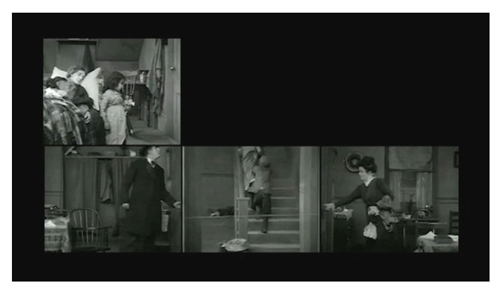
By 1911, the Griffith apartment set had developed a personality of its own, or more precisely, had become both distinctive and flexible enough to accommodate a broad range of narratives. Griffith’s planimetric style, with the camera always aimed straight on into the back wall with at least one side of the room aligned to the margin of the frame, had become as much a Biograph signature as the last-minute rescue, the fade-out, parallel editing, and the stock company of actors [….] In The Sunbeam, the familiar hallway and one-room apartments turn into something resembling a row of a child’s wooden blocks or the rooms in a child’s dollhouse, albeit with a dead mother in the garret. In each space, whether the hallway, the spinster’s apartment or the bachelor’s one-room across the hall, there is something to play with or play upon. The prank with the string stretched across the hallway literally links the two apartments and provides the perfect center of a the film–a gag that depends upon the mirror symmetries of the rooms and the tug-of-war actions of the two incipient sweethearts. (p. 196)
For the prank with the stretched string made symmetrical spatially as well as temporally, see below.
Ben Brewster and Lea Jacobs’ book Theatre to Film (1997) points out that cutting among multiple adjacent interior rooms was typical of Griffith’s work in this period: “By early [1911] a film like Three Sisters has a climactic sequence of 28 shots alternating between three set-ups–long-shot views of three rooms, a kitchen, a hall, and a bedroom, which movements from room to room that coincide with cuts establish as side by side.” (p. 189) My own notes for The Griffith Project volumes discuss adjacent sets and room-to-room movements using frame cuts. (See the end of this entry for a list.)
Griffith’s use of editing to convey simultaneous events, as well as to portray thoughts and flashbacks has been extensively discussed in the literature on the director.
What is remarkable is that a 22-year-old film student has noticed these devices and found a simple, elegant method to demonstrate what we already knew, but with greater precision and vividness than could be done with prose analysis. To experts, that is what should make Aitor’s film so appealing.
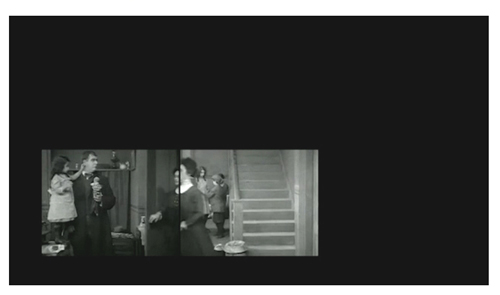
For example, the precision of Griffith’s matches on action at the frame cuts is illustrated time and again in Variation:
Were it not for the fact that Griffith’s camera is closer to the action in the smaller hallway set than it is in the two outer rooms, the spinster’s move through the door would almost appear to be a single smooth glide. Unless one freezes the frame, as I have done here, some of these movements look uncannily continuous.
For those teaching or reading Film Art: An Introduction, Variation also provides a clear example of story time versus plot time. Griffith’s The Sunbeam presents us plot time, with its jumps backward to cover all the action in multiple locales. Aitor’s film presents story action as we ordinarily would reconstruct it only in our minds. Usually we describe story action with synopses or outlines. To see it played out in real time is a rare treat.
The filmmaker
Aitor has a blog, which contains primarily many lovely still photographs taken in Spain, Ireland, and the United Kingdom. It offers, however, minimal information about him. Kevin Lee wrote to ask him for information, which is included in the Fandor entry linked above. I also emailed Aitor with some questions to further contextualize Variation, and he provided a short summary of his background and his interest in Griffith.
My name is Aitor Gametxo. I was born in Bilbao in 1989 and have been living in Lekeitio. I started the Communication and Film degree in the University of the Basque Country, but I moved to the University of Barcelona to finish it this year. I’m currently living and working in Barcelona, and I’m going to do a “Creative Documentary” masters degree this upcoming year. I really enjoy taking pictures of everyday things and places, as a way of reporting reality. I also love film, specially documentaries, found footage films and cinema-essay pieces. I honestly believe in the power films have to make us think about things. Not only because of the topic the film is about, but also about the way in which the film is made (a kind of dialectics between Bill Nichols’ expository and reflexive modes). I love watching old (and odd) films and thinking about things that are different from the purpose they were created for. (As I told Kevin) we are able to take some footage which is temporally and geographically unconnected to us and remodel, or refix, or remix… it, giving birth to another work. This is the way I see the found-footage praxis.
About this particular film, The Sunbeam, I watched it for the first time just before doing the variation. I knew other works made by Griffith, such as “Intolerance” (quoted in several film history books). But this was unknown for me, so that the first watching was crucial. While I was enjoying it, I was wondering what the place where it was shot looked like. I suddenly imagined it as a two-floor house, where the characters cross in some moments. Also the doors were essential to fix one part with another. This was the main idea where I worked on. It was great fun doing it.
The result is this variation in real-time action of the classic work where we can see how Griffith worked on. It’s like returning back to Griffith’s mind, to the first idea, as he imagined one hundred years ago (!) how The Sunbeam would look like. This is the magic of cinema.
My contributions to The Griffith Project‘s program notes for the Biograph years are these. In Volume 2, January-June 1909: Those Boys; The Fascinating Mrs. Francis; Those Awful Hats; The Cord of Life; The Brahma Diamond; Politician’s Love Story; Jones and the Lady Book Agent; His Wife’s Mother; The Golden Louis; and His Ward’s Love. In Volume 3, July-December 1909: Lines of White on a Sullen Sea; In the Watches of the Night; What’s Your Hurry?; Nursing a Viper; The Light That Came; The Restoration. In Volume 4, 1910: A Child’s Faith; The Italian Barber; His Trust; His Trust Fulfilled; The Two Paths; and Three Sisters. In Volume 5, 1911: The Lonedale Operator; The Spanish Gypsy; The Broken Cross; The Chief’s Daughter; A Knight of the Road; and Madame Rex. In Volume 6, 1912: The Unwelcome Guest; The New York Hat; My Hero; and The Burglar’s Dilemma. In Volume 7, 1913: The Hero of Little Italy; The Perfidy of Mary; and A Misunderstood Boy.
Like the other contributors, I found myself dealing with a few famous films (e.g., the wonderful Lines of White on a Sullen Sea) and others that were largely unknown. Each little cluster of titles assigned to us consisted of films that had been made sequentially, so that each of us could get an intensive look into Griffith’s work over the course of a few weeks. It proved to be a rewarding way of approaching the study of the director. The general editor for the series was Paulo Cherchi Usai, assisted by Cindi Rowell.
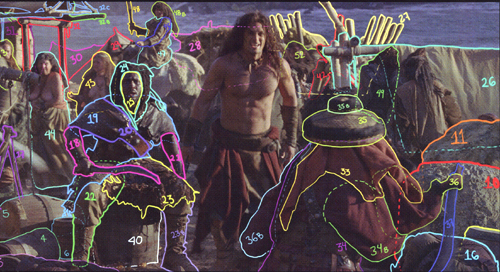
Something to do with 2D to 3D conversion for Conan the Barbarian. (See 3DLiveFlix)
Kristin here:
Just over a month ago I posted “Do not forget to return your 3D glasses,” an entry suggesting that on average theatres were making less money from 3D versions of films than 2D versions. I made two basic points. First, claims that films were making, say, 60% or 45% of their box-office gross from 3D showings were inaccurate. Only the extra fee charged at 3D screenings was for 3D; the rest was for the film as such. By that logic, something closer to around 10% was actually being earned by 3D (assuming people who went to see a film in 3D would probably see it in 2D if necessary.)
Second, my point was that if a film’s box-office percentage from 3D screenings was lower than the percentage of theaters in which it was being shown in 3D, then the exhibitors in those theaters were making less money than exhibitors showing the film in 2D. For most films that have come out this summer, starting in May, the percentage has been distinctly lower.
Wasn’t this supposed to be the summer of 3D?
With the summer movie season drawing to a close, I thought I would summarize some recent developments. These tend to suggest that the decline in the popularity of 3D in the U.S. market has continued. Indeed, a recognition of that decline has started to have an impact on the effort within the industry to pressure theaters into showing films in 3D.
During August I noticed for the first time that trade-paper and online sources are becoming more explicit about saying that 3D is no longer as big a draw as it used to be. Reporting on August 13, the day after the release of Final Destination 5, Variety stated, “Though roughly 89% of its screens are in 3D, and 217 are in Imax, ‘Destination’ isn’t expected to see much of a boost from the format given waning interest in 3D. Optimistic B.O. pundits have the film topping out at $21 million through Sunday.”
In fact, Final Destination 5 grossed over $24 million. That was, however, the lowest opening-weekend gross of the franchise. It made about 75% of its gross from 3D screenings, which occupied 80% of locations. That’s better than most 3D films of the summer in proportion of income to screens, but still not great. Its comparatively good performance in 3D suggests that genres like horror still tend to draw the spectators most interested in 3D. Final Destination 5 came in third after two non-3D films, Rise of the Planet of the Apes and The Help, both of which did much better than expected.
The weekend’s other 3D film, Glee the 3D Concert Movie, did so badly that the trades didn’t bother to report its percentages of 3D screens in proportion to income. Its box-office gross put it at #11 on the chart, earning less than $3000 per screen.
The following weekend, August 19-21, saw Rise of the Planet of the Apes and The Help switch slots on the chart, with The Help becoming the first film since January to rise from a #2 opening to the #1 rank—a position it held this past weekend as well, experiencing a low 28% drop despite East Coast theatre closings due to the hurricane.
That same weekend saw three 3D films do lackluster business. Of those, Spy Kids: All the Time in the World did the best, coming in at number 3. About 44% of its income came from 3D, which fits into the 45% level typical of 3D films this summer. Interestingly, though, only 41% of the locations where the film was shown had it in 3D. Variety’s report on Saturday remarked, “The summer’s new norm is to make about 45% of grosses off 3D screens, though that figure could be even lower this weekend with so many pics vying for 3D play and so many of ‘Spy Kids’ engagements opting for 2D.”
There are two implications here. First, if fewer theaters show a film in 3D, the ones that do will make more money, since those moviegoers interested in seeing a film in 3D will converge on that smaller number of theaters. There apparently are not enough such moviegoers to justify having 60% or more of theaters showing 3D. Second, given that four 3D films were debuting that same weekend, theater owners opted to show the film aimed at young children in 2D. We know that there have been complaints that children don’t like wearing the glasses and that parents don’t like shelling out extra fees to take a whole family to a 3D screening. The strategy worked, which again suggests that genres aimed at teenagers might provide the home for 3D, if it survives long-term.
Don’t worry, that includes the whole family. (Just kidding! It’s actually a ticket to last year’s “OnHollywood” trade summit, where 3D was discussed.)
But the teenage-targeting assumption didn’t work out well for the two other 3D debuts of that weekend. Conan the Barbarian showed in 3D in 71% of its locations, but only 61% of its gross came from those locations. The figures were almost identical for Fright Night. Perhaps the two films split the teenage audience, to the detriment of both. Glee fell off 69.4% in its second weekend, to an average of less than $1000 per screen.
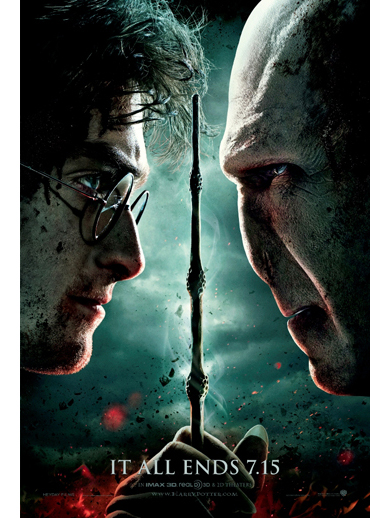
"If only I had a nose," Voldemort thought, "I, too, could wear 3D glasses."
The weekend of August 19-21 saw six 3D films in the top 11. (I list 11 rather than 10 because the 11th was the summer’s most successful film and a 3D item, Harry Potter and the Deathly Hallows Part 2.) The 11 were, in order (3D films in bold): The Help; The Rise of the Planet of the Apes; Spy Kids: All the Time in the World; Conan the Barbarian; The Smurfs; Fright Night; Final Destination 5; 30 Minutes or Less; One Day; Crazy, Stupid, Love; and Harry Potter. Of those six films, only two, Harry Potter and The Smurfs, made it to number one—for only one week each, remarkably.
Still doing well abroad
The big Hollywood studios continue to defend 3D as a financial strategy, since films made with the process continue to clean up in most foreign territories. Even though the percentage of 3D box-office income has fallen to a fairly consistent 45% (apart from the occasional genre film), it still provides about 60-70% of the international gross. (Unfortunately percentages of theaters showing 3D films aren’t given in such reports.)
Variety’s Andrew Stewart helps explain how some foreign markets encourage 3D viewing:
To some degree, the divergence can be chalked up to a matter of preference — some cultures just like 3D more than others for reasons that can’t be quantified, and big-budget f/x spectacles continue to draw big auds overseas — but there are also some subtle differences in local pricing models that provide insight to studios and exhibitors eager to see 3D pay off on its promise of enhanced B.O. takings.
Some notable factors: Many international markets temper 3D upcharges with discount play periods. China has half-price Tuesdays. In Germany, “Cinema Day” brings a steep midweek price drop to matinees. And some territories even charge less for 3D pics that have shorter running times. In many countries, premium ticket prices for 3D are further mitigated because moviegoers are encouraged to buy their own reusable glasses.
[…]
Some Japanese exhibs ease 3D ticket prices by charging less to those who bring their own glasses. Dolby controls most of the Japanese 3D market, and in March, the company started offering reusable 3D glasses for $12 per pair. In Europe, RealD sells its reusable glasses at concession stands or the ticket window for about E1, saving auds the repeated expense.
But if theaters attract customers by giving discounts or waiving fees for those who bring their own glasses, how long can the high proportionate income from 3D hold up? Sales of glasses benefit the technology companies, not the theater or studios, and eventually the market will be largely saturated.
So far 3D is holding up well in most foreign markets, but there is one exception. In Spain, where the 3D premium averages a whopping 37%, Transformers earned 49% of its national gross from 3D, Pirates of the Caribbean 41%, and The Smurfs 39%. Variety blames the sag on 22% unemployment and “rampant piracy.” But unemployment and piracy aren’t unique to Spain by any means.
And foreign markets got into 3D exhibition a bit later than North America did. There’s nothing to say that ticket premiums and the decline in the novelty value of 3D won’t start affecting international exhibition eventually.
A certain lack of confidence
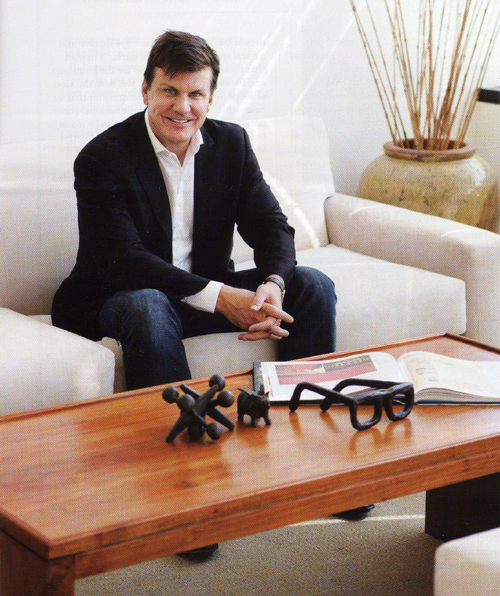
The August 12 edition of The Hollywood Reporter revealed that RealD’s “stock has plunged 60 percent since reaching a 52-week high in June as U.S. audiences seem to tire of the format.” Now that’s serious. Two weeks later, in the August 26 edition, a smiling Michael Lewis, the firm’s CEO (below), was given a two-page spread with an interview where he explained why he thought Wall Street was overreacting. (These references are to the print edition; online they’re behind a pay wall.)
Clearly, it was an overreaction. We had record earnings. We’re a relatively new company, and as time goes on we’ll prove the model. It doesn’t really matter if a film does 40 percent or 50 percent; we just believe this is a transformative event like the Internet and the personal computer. All visual displays are going to get better, and we’re really well positioned. Over time, Wall Street will figure that out.
That’s a remarkable claim. Many of us might say, “I don’t know how I got along before computers” or “before the Internet.” How many people would really say “I can’t imagine what we did before 3D came along”? This is hardly a transformative event on a scale even vaguely close to those two technologies. I can easily get along without seeing a film in 3D, but I would never go back to an era when endnotes didn’t rearrange themselves automatically when you moved or added a reference in your text. Think, too, how profoundly computers and Internet have affected the world financially, and then compare that with the impact of 3D.
Lewis also seems disingenuous when he claims that whether a film does 40% or 50% of its business in 3D “doesn’t really matter.” It certainly matters to the local multiplex owner who sees more people going into an auditorium showing a movie in 2D than another auditorium showing it in 3D. It matters to the distributor who gets a cut of the take and to the studio that gets the remainder–and had to pay extra to begin with to make the film in 3D.
He may be right, though, that Wall Street overreacted. The interview includes some impressive figures. RealD controls roughly 85% market share of the domestic 3D box office. (Apart from selling its projection systems, special screens, and glasses to theaters, RealD gets a licensing fee averaging fifty cents for every ticket sold.) Within the U.S., it has 10,300 screens in 2,500 locations; abroad, the number is 7,200 screens in 2,300 locations. The firm’s 2011 fiscal-year revenue was $246.1 million, up 64% from the previous year. Its fiscal-year 2011 gross profit was $67.7 million, up 633%. This is flashy–though such growth came during the post-Avatar era when theaters which had missed out on the film’s bonanza were buying 3D equipment at a good clip, and more 3D films were in the pipeline. (Lewis says 2011 will see forty 3D films released.) If theater conversion is nearing saturation point and 2D screenings are outdrawing 3D ones, though, this summer may mark the end of the expansion for companies like RealD.
Lewis doesn’t exactly win me over either with his notions of what to do with 3D. He’d like to convert Singin’ in the Rain into 3D. That and The Love Bug. You know, the great classics. Plus he has a rather peculiar idea of Avatar‘s place in film history. Asked what Cameron’s film did for the business of 3D, Lewis responded: “It legitimized it. It was the Citizen Kane of our medium. After Avatar, I finally didn’t have to go into a meeting and explain why this was going to be important for our industry. The numbers spoke for themselves.” No doubt Avatar‘s phenomenal box-office success made exhibitors who had not yet installed 3D equipment keen to do so. But Kane was in fact not a financially successful film. No one could say of it, “After Kane, I didn’t have to go into a meeting and explain why deep focus was going to be important for our industry. The numbers spoke for themselves.” Both films are undoubtedly historically important, but there’s really very little comparable about them.
Auteurs to the rescue?
Speaking of legitimacy, Lewis is looking forward to the releases of Martin Scorsese’s Hugo in November and Ridley Scott’s Prometheus next year. On August 12, the Wall Street Journal ran a long story by Michelle Kung on how a trio of Movie Brats are about to reveal their first 3D films. Hugo is scheduled for November 23, Steven Spielberg’s The Adventures of Tintin for December 23, and Francis Ford Coppola’s Twixt premieres in September at the Toronto Film Festival.
Spielberg’s popularity among a broad range of audiences remains intact, though whether Belgian import Tintin can win American spectators’ hearts remains to be seen. Whether Scorsese and Coppola, beloved of audiences of my generation, will prove the final boost that 3D needs is up for grabs. Coppola seems a particularly unlikely auteur to pin one’s hopes on. Twixt, a low-budget horror film, has only five minutes of 3D footage, and it has yet to find an American distributor. According to Anne Thompson’s blog, the director “first showed the film to distributors in Los Angeles Wednesday night [i.e., August 24]. Unless he gets a rich offer, Coppola will likely four-wall the film himself; he’s looking to sell video rights.” Today’s Variety reports that Pathé has picked up Twixt for “international sales and distribution in France.” That doesn’t seem to settle the question of a U.S. release.
A more likely shot in the arm for 3D would seem to be Peter Jackson’s Hobbit film, being shot even as I type. It should appeal to teenage 3D buffs and just about everyone else. But the first part is not due out until December, 2012. I suspect that the degree to which 3D will penetrate the theatrical market will be known by then.
The article quotes Jeffrey Katzenberg, who years ago claimed that every screen would eventually be converted to 3D, as saying “You now have some of the greatest filmmakers in the world stepping into the format to tell their stories.” Scorsese has gamely stepped up to the plate, commenting that if 3D had been around when he made Mean Streets or Taxi Driver or Raging Bull, “those stories would have fit in perfectly in 3-D.” It’s a bizarre thought, but maybe he’s serious.
Kung provides some interesting figures. It’s difficult to get a sense of how many people are opting to see 3D films in their 2D versions. Usually the comparison is made in terms of box-office gross rather than number of tickets. But the author says that 57% of people who saw the final Harry Potter film this summer opted for 2D, which seems a pretty significant figure. She also notes the falling stocks of RealD and other 3D firms:
“Consumers are pushing back,” says Richard Greenfield, an analyst at brokerage firm BTIG. “They’re tired of 3-D, both from a price perspective and from a physical-comfort perspective.” He adds that consumers have come to a key realization: A bad film in 3-D is still a bad film.”
Kung says that about 30 new 3D films are due for release next year. If Lewis’ figure of 40 for 2011 is accurate, that means a notable drop in planned 3D productions for the short term. Possibly it’s a temporary one, but perhaps studios are beginning to think that the extra returns from their share of those ticket premiums aren’t worth the cost and effort. If 57% of Harry Potter‘s audience opted for 2D, then perhaps an increasing number of theater owners are refusing to book 3D films from the distributors.
That figure of 30 releases doesn’t include the announced 3D conversions of Titanic and the Star Wars series, which may or may not be ready for release next year. The rumors of such conversions for these and other popular items like the Lord of the Rings film have been circulating, but precious little information on how, when, and where these will eventually reach theaters has been forthcoming.
As I’ve said in my previous posts on 3D, I don’t see any reason why the format would necessarily disappear. Once the match of number of 3D screens and number of moviegoers who want to see 3D movies reaches a reasonable balance–which at this point seems to mean a significant number of current 3D screens reverting to 2D–both formats will make money and 3D will continue, especially for blockbusters and teenage-oriented genre films. But the idea that studio and company executives can simply dictate that the entire public should embrace what is, after all, a relatively superficial technology added onto an already stable and successful product seems overweening and implausible. This summer’s movies have seemingly reflected the public’s more realistic attitude.
And now, enough of 3D. Unless something dramatic happens between now and when Hugo comes out, I shall hold off writing on the subject until we see what happens during the holiday season, when the format faces its next big test.
P.S. August 31: The Fandor blog has a post by Alejandro Adams, a filmmaker who manages a multiplex in northern California. He reports that until recently, studios demanded that all 3D films be shown only in 3D, no matter how many screens were available. Adams reports that this summer: “We’d just opened Captain America ‘over/under,’ meaning that we were offering two 2D shows and three 3D shows in a single auditorium. This was the first time any studio had allowed us to restrict the number of 3D shows. When I checked the grosses after opening day, I was alarmed. We sold twice as many tickets for 2D as 3D. As we’d never booked a 2D engagement of any film available in 3D, I’d never seen this disparity up close. The fact that we were permitted to over/under Captain America in 3D and 2D is itself a distressing development—are the studios suddenly willing to admit they didn’t hit the jackpot with the 3D craze? Are they going to start phasing out 3D so soon after we went to the trouble and expense of making our projectors and screens compliant with their demands?”
Adams calls this a “distressing development,” being a fan of 3D, both for his own and his children’s enjoyment. If my hunch turns out to be correct, they will still have the 3D option, but others will have access to 2D screenings.
RealD’s Michael Lewis. Hmm, those glasses do look a bit clunky. (Photo by Peden + Munk)
Last week, Raúl Ruiz died. His death is an enormous loss to world film culture, not least because his penultimate work, Mysteries of Lisbon, brought him a prominence he had been denied throughout his forty-year career. More important, we lost a modest, kindly, and zestful man.
From the mid-1960s through 1975, it seems to me, there emerged an interesting in-between group of filmmakers. By then film festivals had canonized an official art cinema typified by Fellini, Bergman, Wajda, and the New Wave. Now there appeared a more capricious clutch of directors, of varying ages, who pushed in a more avant-garde direction. Many made outstanding short films, like Wenders’ Same Player Shoots Again, or the Straub/ Huillet Not Reconciled, or Akerman’s Hotel Monterey, or the peculiar early efforts of Peter Greenaway.
When they turned to features, this group of directors produced films like October à Madrid (Marcel Hanoun), The Chronicle of Anna Magdalena Bach (Straub/ Huillet), Fata Morgana (Herzog), Katzelmacher (Fassbinder), and Jeanne Dielmann (Chantal Akerman)—more rigorous and forbidding than anything attempted by the older generation. In later years some of these talents moved comfortably into the festival niches vacated by senior directors, but for many years most were little known outside a small circle.
If they were marginal to most moviegoers, Ruiz was marginal to them. Exiled from Chile, where he made his first features in his twenties, he moved to France in 1973. There he proceeded to direct over a hundred films, often financed by television, while staging plays and running the Maison de la Culture in Le Havre.
His films’ repute was in inverse proportion to their availability. He was celebrated by critics in France (Cahiers du cinéma took up his cause) and England (particularly by London’s Afterimage group). Ruiz had his fans in North America too, notably Jim Hoberman and David Ehrenstein. But the films were chiefly seen at festivals, and none of his productions of this period, so far as I can tell, found stable distribution, theatrical or nontheatrical, in the United States. In 1989-1990, while Ruiz was teaching at Harvard, a batch of his films was circulated here by the quixotic International Film Circuit.
What set him apart from the other marginals was a devotion to esoterica (philosophical, literary, ecclesiastical), pursued with a sly humor. He remarked that during one screening, he was the only person laughing at his movie. Although like most of his contemporaries his sympathies lay on the left, he didn’t seem to take himself seriously, and this put him at a disadvantage in 1970s-1980s world film culture. True, Herzog had a comic side, and in The Falls Greenaway offered whimsy, though of a relentless, almost oppressive variety. Most other directors, though, were somber as well as severe. But Ruiz enjoyed intellectual lampoon, pastiche, clever cross-references, and straight-faced absurdity; the Chris Marker of Letter from Siberia (1957) is perhaps a predecessor, though Marker himself didn’t escape Ruizian parody.
Ruses
Of Great Events and Ordinary People.
Having seen about ten percent of the Ruiz oeuvre, and a lot of it quite long ago, I can’t offer a comprehensive appraisal. (Visit the bottom of the page for some more assured threads through the maze.) For reasons that will be understandable to regular readers of this page, however, I feel obliged to write something in his memory. I merely offer some observations on aspects of his work.
Ruiz often based a film on a striking formal premise, what Henry James might call a donnée. Socialist Realism (Considered as One of the Fine Arts) (1973) began, Ruiz tells us, from the idea of
having two stories that would never meet (like in Faulkner’s Wild Palms), separated by a poem. The link would be made through this lyrical element placed at the centre – the element I eventually decided to throw out. These two stories would touch each other for a single moment, accidentally, and this moment would be secondary in relation to the totality of the film.
Imagine another sort of intersection: two films in one, not a film-within-a-film but two distinct movies, one incomplete, the other filling the gaps but revising and correcting the first (The Suspended Vocation, 1977). Or imagine making an art-history documentary that speculates on the possibility of a missing link in the output of an imaginary, mediocre artist (The Hypothesis of the Stolen Painting, 1979). How about dismantling the conventions of TV election coverage, to the point where one can no longer discern what candidate won (Of Great Events and Ordinary People, 1979)? Or what if a man assigned to memorize the names of 15,000 political resisters becomes absorbed in recalling visiting a movie house as a child (Life Is a Dream, 1986)? Or perhaps a single actor could play different characters (Three Lives and Only One Death, 1996)?
In their working out, however, these givens often fret and fall away. They are overtaken, or nowadays we might say overwritten, by digressions, anecdotes, accidents, interruptions, abstruse commentary, coincidences, free associations, labyrinthine plot twists (often driven by conspiracies and secret pacts), and Surrealist juxtapositions. The movie house of Life Is a Dream has a toy train running through it. Ruiz’s affinities with Borges and Góngora and Chesterton point to an almost academic fascination with schematic systems, as well as the desire to push them toward absurdity. It’s telling that the poem that was to knot the two strands of Socialist Realism was clipped from the movie.
Narrative binds, but narrative also loosens. It can be a robust oak, but it can also be kudzu. Ruiz understood that what keeps us listening, reading, watching is the promise of a surprise that in retrospect will seem inevitable. The best tragic plot, Aristotle says, is one that makes unexpected things happen within a cogent chain of causality. Ruiz knew our inclinations, but what he gave us were plots of the sort that Aristotle calls episodic–perhaps we should say fragmentary. His plots exfoliate, in both senses of the word: they spread out from a kernel, and they peel off in flakes.
In this respect he turns out to be the realist, and Aristotle the fabulist. Ruiz understood that real-world stories breed like rabbits. Listen to yourself and a friend in conversation, and you’ll find one story calling up another, with yet a third crowding from at a tangent before the first one is finished. In plotting our fictions, we can multiply tales neatly, staking them out in parallel lines or coiling them inside Chinese boxes. But if we take the pressure off, the stories can burst out of control, intertwining or doubling back or sprawling out or just dying off. Feuillade and his contemporaries understood this: A serial could go on forever, because we could plop in a fresh character and create a further adventure. The same thing happens with news on the Internet, spreading and splintering, each version of a story torn apart but also expanded by rehash and critique.
Perhaps we can take some of Ruiz’s abrupt deep-focus shots, blowing up an action or a bit of the set that would otherwise be minor background detail, as a pictorial reminder of the centrifugal impulse of narrative. Anything looming in the foreground hints at the possibility of a new character with a new story. In Three Crowns of the Sailor, while the sailor listens to a tale told by the Blind Man, we are distracted by grotesque glimpses of what unseen others are up to in the bar.
Stories have to end, but nothing at the end can match the arousal of a beginning. Endings usually disappoint. The explanation of an puzzling situation–say, footprints on the ceiling–will inevitably be more prosaic than the premise that sets our imaginations on a wanton chase. (Hence the perfunctory, even arbitrary, resolutions of detective stories.) By contrast, openings refresh us and, as the name implies, “open” things up to crazy possibilities. So why not use the prospect of endless beginnings, perpetual change of situation, to sustain the magic?
What becomes inevitable isn’t a logical resolution, which has to be more or less imposed by tradition. What’s inevitable is a perpetual spawning of characters, plots, and situations. So an apparently stable, albeit fantastic, narrative situation posited at the start may be undermined. Again and again the film seems to start over; the rules keep changing. Ruiz made shaggy-dog stories for cinephiles. He was a formalist who liked unraveling forms.
On the whole I was more an admirer than an enthusiast. I thought Ruiz’s films were imaginative and risky in ways that opened up new horizons. I tried to do justice to his importance in the survey of film history that Kristin and I composed.
Yet here we confront the difference between critical judgment and personal taste. I tended to find each Ruiz film intriguing on an intellectual level, but dry and scattershot as well. For all the prodigious invention, and given his bias toward free-range story breeding, I sometimes thought that the données were underdeveloped. He had wondrous ideas, but I wasn’t sure that he did enough with them. And of course some stretches of his yarns were downright opaque to me.
Still, artists have a way of teaching us how to watch, and rewatch, their work. Maybe now, after having been absorbed by Mysteries of Lisbonfor reasons sketched here, I’m better prepared to appreciate the legacy of a unique sensibility–one that has already given us the adjective Ruizian. It is a term of praise.
No filmmaker had more zealous proselytizers. His admirers have shown how to blend analytical precision with brio. They make you want to see the films pronto. The Ruiz initiate can start with Adrian Martin’s homage at girish’s site. You won’t read a more sensitive piece of film criticism this year. Next savor James Schamus’ memoir at Filmmaker, where he recalls working with Ruiz on his first US film. Proceed to Jonathan Rosenbaum’s posting of one of his classic studies of Ruiz, which includes links to other essays.
Now you’re ready for the heady experience of the annotated filmography (complete up to 2004) in the journal Rouge. Both Adrian and Jonathan participated. My quotation about Socialist Realism comes from there. By now you should be on to the films, and perhaps the writings collected in volumes one andtwo of Ruiz’s Poetics of Cinema.
By chance I commented on Ruiz just a little while ago. And thanks to B. Kite for the note about Ruiz and Harry Stephen Keeler, obviously kindred spirits. Mr. Kite sent Ruiz some Keeleriana, which may have influenced what Ruiz says here.
Apologies for my tongue-twisting title, which is offered in the spirit of Tres Tristes Tigres.











 For this reason, the young screenwriter needs to learn everything about how a film is made. When JCC was acting in The Wedding Ring (1971), a film starring Anna Karina, he learned that simply getting up from a couch can be a complicated matter. When he stood up spontaneously, dipping forward to lift his body, the cinematographer had to correct him: It looked awkward on film. JCC learned that he had to stand up in an unnatural way, with his feet spaced and his back rigid, so that it looked smooth on film. The screenwriter must know that even the smallest moment of action, easy to write in the comfort of a study or a café, is subject to the contingencies of production.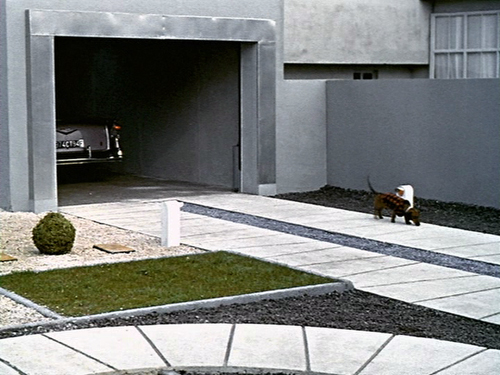
 open printable version
| No Comments »
open printable version
| No Comments »