Monday | August 22, 2011
Kristin here:
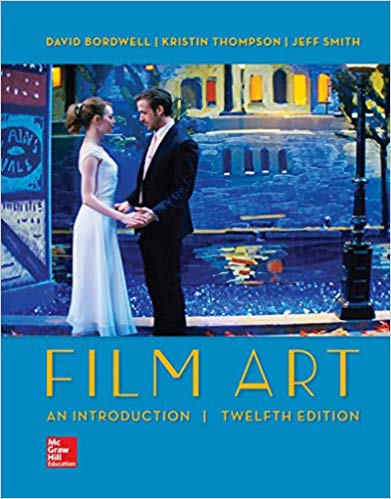
The 2011/12 school year is staring us in the face, and that means it’s time for another summary of which recent blog entries might be useful for teachers who assign Film Art: An Introduction in their classes. We’ve amassed 443 posts since we launched Observations on Film Art in late September, 2006, so browsing through them might seem a daunting prospect. You can also consult previous entries in this annual series for 2007, 2008, 2009, and 2010.
Chapter by chapter
Chapter 3 Narrative as a Formal System
Launching from an anecdote about a three-year-old watching Snow White and the Seven Dwarfs, we speculate about the conventions of narrative closure and how we learn them in “Molly wanted more.”
 In discussing narration, we describe one of its characteristics as the “range of knowledge” the spectator is given. Often we’re limited largely to finding out what one character knows, as with Philip Marlowe in The Big Sleep. We examine this idea in more detail in “Alignment, allegiance, and murder.” In discussing narration, we describe one of its characteristics as the “range of knowledge” the spectator is given. Often we’re limited largely to finding out what one character knows, as with Philip Marlowe in The Big Sleep. We examine this idea in more detail in “Alignment, allegiance, and murder.”
Chapter 3 has a “Closer Look” box that talks about the recent vogue for narratives that play games with time and causality, including the forking-path story. We examine another example in “Forking tracks: Source Code.”
We also discuss parallel plots, which in some cases involve protagonists who never meet. “Julie, Julia, & the house that talked” offers two examples, Julie & Julia and Enchantment.
Our main example in this chapter is Citizen Kane, which helped popularize flashback-based narratives in the 1940s. Some less familiar but equally baroque examples feature in “Chinese boxes, Russian dolls, and Hollywood movies.”
And for more on flashbacks in movies new and old, see “Puppetry and ventriloquism.”
Chapter 4 The Shot: Mise-en-Scene
Louis Feuillade’s silent French serials of the mid-1910s are masterpieces of subtle staging in depth. David analyses the wonderful serial Fantômas in “How to watch Fantômas and why.”
Students are especially keen to talk about acting, but it’s one of the hardest aspects of film to pin down and discuss. The chapter deals with it alongside the three other aspects of mise-en-scene, make-up/costumes, lighting, and setting. For those who want to teach it in more detail, we provide a discussion of the acting in The Social Network, concentrating (as filmmakers tend to) on the eyes and eyebrows of the two main actors. See “The Social Network: Faces behind Facebook.”
Chapter 5 The Shot: Cinematography
We discuss the most common screen ratios (the height of an image compared to its width) in this chapter. Some films have been released in two different ratios, widescreen and Academy. We demonstrate how important  small differences in framing can be in Fritz Lang’s films in “Ratio-cination.” By contrast, “A Matter of ‘Scope” considers how Japanese and Chinese filmmakers use the 2.35 ratio. small differences in framing can be in Fritz Lang’s films in “Ratio-cination.” By contrast, “A Matter of ‘Scope” considers how Japanese and Chinese filmmakers use the 2.35 ratio.
The use of 3D has expanded considerably since we revised Film Art for its current edition, the ninth. Whether the technique will continue to expand or will simply be used for blockbusters and inexpensive genre films is still a subject for debate. We have followed the debates and the box-office fortunes of 3D in three entries this year: “Has 3D already failed? The sequel, part 1: RealDlighted,” “Has 3D already failed? The sequel, part 2: RealDsgusted,” and “Do not forget to return your 3D glasses.”
Chapter 6 The Relation of Shot to Shot: Editing
After noticing some incorrect definitions of “graphic match” appearing in print and on the internet (including Wikipedia), we decided to clarify the matter. We devised the term “graphic match” back in the mid-1970s, so we try to explain it in “Graphic content ahead.”
Chapter 8 Style as a Formal System
In “Bond vs. Chan: Jackie shows how it’s done,” we talk about how staging, framing, and editing can be used to make a clear, understandable fight scene (Jackie Chan) or a clumsy one where half the action isn’t there on the screen (Tomorrow Never Dies).
For more on clarity in staging, framing, and editing, see our comparison of Shanghai and Tampopo, “Direction: come in and sit down.”
Wouldn’t you know it? Our most popular entry ever was written by a guest blogger! Tim Smith, who researches how our eyes and minds perceive films, contributed “Watching you watching There Will Be Blood.” He was following up on an earlier entry by David, “Hands and faces across the table,” which analyzed a lengthy take in There Will Be Blood, suggesting how the staging and gestures direct our attention from one point on the screen to another. Tim followed up by using eye-tracking devices to show precisely where eleven viewers were looking from instant to instant. The entry included a video clip of the scene with the eye movements shown with moving circles.
This entry was posted in February and has racked up hundreds of thousands of views, on our site and others. About a hundred people still click on our entry every day. It even helped inspire a story in the New York Times by Manohla Dargis.
 Tim’s post was less directly a follow-up to one we wrote on how eyes move across paintings: “The eye’s mind.” Tim’s post was less directly a follow-up to one we wrote on how eyes move across paintings: “The eye’s mind.”
The rediscovery of the great early silent French director Albert Capellani doesn’t exactly fit into Film Art, but we think everyone should be aware of this important figure. “Capellani trionfante” outlines the basics of his distinctive style. Greater than Griffith? For the pre-World War I period, at least, we think he may be.
Mainstream movies are more fast-paced than ever these days. We celebrate the merits of films with a slower rhythm in “Good and good for you.” Perhaps adventurous students will be intrigued.
Chapter 10 Documentary, Experimental, and Animated Films
Documentarist Errol Morris is an alumnus of the University of Wisconsin-Madison, and this past year he visited for a few days, bringing his new film Tabloid with him. We profile him in “Errol Morris, boy detective.” This entry could be assigned along with the analysis of The Thin Blue Line in Chapter 11.
We were blogging from New York in February, when Christian Marclay’s The Clock was creating a sensation at a downtown gallery. It’s a 24-hour compilation video made up of shots from a huge variety of existing films, all showing clocks that register the time at which the viewer is seeing those shots. We discuss it in “Time piece.”
Animation sometimes turns up in unexpected places. The makers of Harry Potter and the Deathly Hallows Part 1 decided to render the story Hermione Granger reads from The Tales of Beadle the Bard as a short animated film. We discuss this imaginative segment and its director in “Three minutes of ‘Three Brothers.’”
Chapter 12 Film Art and Film History
Film history is a living presence on our blog: We talk about cinema from the silent era onward. So great is our commitment to early film that we don’t post a list of the ten best films of the year. Instead we decided to promote old films by discussing the ten best films of exactly ninety years ago. This time it was “The ten best films of … 1920.” If you teach a unit on film history, this entry and its predecessors might give you some ideas about what to show in class. The most recent one contains links to all the earlier entries. Some titles will be familiar, some less so, and some, alas, are still awaiting release on DVD.
One section of Chapter 12 deals with the development of Hollywood continuity style in the 1910s. We go into more detail concerning editing and staging during this period in “Looking different today?”
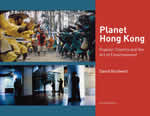
Anyone interested in going beyond Chapter 12’s section on Hong Kong film history will find plenty more information in this year’s entries. To celebrate the second edition of David’s Planet Hong Kong: Popular Cinema and the Art of Entertainment, available here, there is a seven-day blogathon about stars, stories, and styles in Hong Kong cinema. That week starts here, with a list of 25 essential movies. There’s also David’s annual report from the Hong Kong International Film Festival, launching, appropriately enough, with an entry called “Bullets from the East.”
The last section of the chapter deals with modern Hollywood cinema. Our review of Sidney Lumet’s career deals with changes in mainstream moviemaking that occurred from the 1950s on, in “Endurance: Survival lessons from Lumet.”
More generally
About once a year we post an entry in our series, “Beyond praise: DVD supplements that really tell you something.” These offer suggestions for supplements that offer substantive information on filmmaking. Our fourth “Beyond praise” post, with links to the first three, is here.
We attend a small number of film festivals regularly and blog about the movies we see there. We’re not linking to every one of our festival reports, but they do contain brief commentaries on recent films and restorations of older ones. Teachers who happen to be screening one of these films might find what we say useful. There are links for festivals in general and specific festivals in the Categories list in the right margin, or try typing specific titles into the search box. We also have added a lot of new categories, including individual filmmakers and festivals.
When we started our blog, we didn’t expect that it would provide the contents for a book. Still, when the University of Chicago Press suggested that we propose a collection bringing together some of our popular entries, we thought it worth a try. The result was published this year as Minding Movies: Observations on the Art, Craft, and Business of Filmmaking. Naturally, in a case of circular synergy, we blogged about it in “A new book, more or less accidental.”
 
Real products (I think).
Posted in FILM ART (the book) |  open printable version
| No Comments » open printable version
| No Comments »
Monday | August 15, 2011
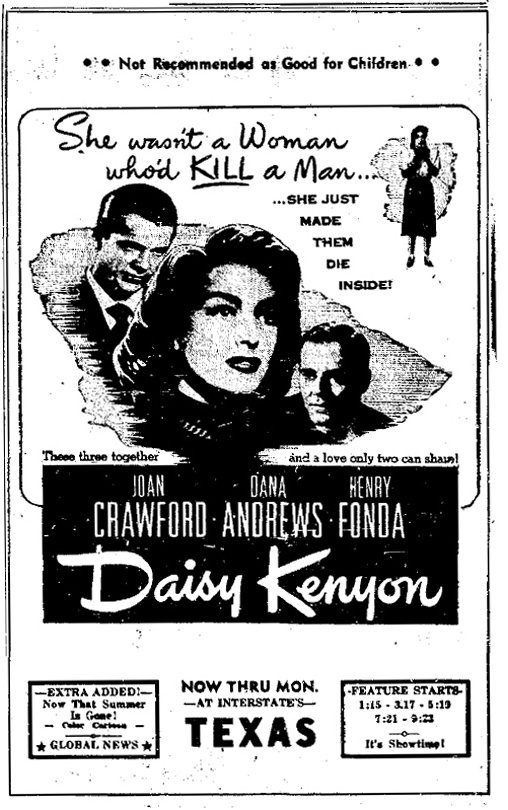
The Denton Record-Chronicle (28 December 1947).
DB here:
The last line of Otto Preminger’s Daisy Kenyon is “When it comes to modern combat tactics, you’re both babies compared to me.” If you haven’t seen the film, does knowing that ruin it for you? Suppose I went further and identified the character who spoke the line, or the immediate circumstances, or the action leading up to it? Would knowing these things ruin your pleasure? Or would it give you a different sort of pleasure?
Who doesn’t come to Casablanca knowing about “Here’s looking at you, kid,” or “Play it, Sam,” or “Round up the usual suspects”? You likely saw the ending of King Kong in compilation films before you saw the whole movie, yet you probably still watch it with enjoyment. I saw Potemkin’s Odessa Steps sequence many times, on an 8mm reel I bought as a kid, before I saw the whole movie. I still enjoy Potemkin, possibly more than many who see it for the first time. Yet people complain about trailers that tell too much, and critics who give plot twists away. Accordingly, it’s been a convention of fan and Net writing that if you’re going to give away major story information, you alert readers with the word “spoiler.”
Surely people want to know something about a film’s story. Viewers clamored for the most basic information about Super 8. And evidently many moviegoers would feel less disgruntled about The Tree of Life if they had known in advance a little bit more about what they would encounter. It seems we want to know about the story’s basic situation, but not too much about how things develop. Say: bits from the first half-hour or so, up to the beginning of the Second Act (or what Kristin calls the Complicating Action). Beyond that, we want things kept quiet. Above all: Don’t tell the how things turn out in the end.
I’ve been driven to think again about spoilers after Jonah Lehrer reported on an experiment with literary texts. On the whole, readers in the study reported enjoying a short story somewhat more if they knew the ending in advance. Jim Emerson has provided his characteristically stimulating commentary on this finding, and his readers, surely among the most reflective in the online film community, have supplemented his thoughts.
This discussion overlaps with a question I raised a while back on this site. How can we feel suspense if we know a story’s outcome? One standard answer, which would apply to spoilers too, is that even with foreknowledge, we’re interested in how that turn of events comes about. This possibility is invoked by some of Jim’s readers, and it seems plausible, especially if one is a connoisseur of storytelling. How, we ask, does the narrative engineer this or that twist?
My further proposal in the blog entry was that our mind’s intake of narratives is modular in some respects. Part of us reacts as if we were encountering the events fresh, without knowledge of what is coming up. The analogy was to standing on a balcony overhanging a precipice. You know that you cannot fall, but when you imagine yourself falling, you feel a twinge of fear all the same.
The same might be true of consuming a narrative. One of our mental systems, fast but fairly dumb, reacts to things as they come, while secure knowledge hovers more distantly in the background. I suggested as well that the way that something is presented–say, with fast cutting or sweeping music–can override our knowledge and kindle a basic, more visceral response.
Today’s entry tackles the matter of foreknowledge from a different angle. It’s worth remembering that many people who went to the movies in the 1920s through the 1950s willingly subjected themselves to spoilers.
This is where we came in?
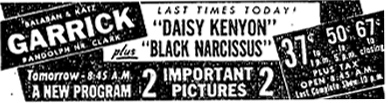
Chicago Daily Tribune (4 January 1948).
While the American studios developed their storytelling strategies in the 1920s and 1930s, movie exhibition became a big business. In 1935, eighty million Americans went to the movies every week. The historical high point was 1946-1948, when annual attendance hit 4.7 billion. But how did all those people see the movies? More specifically, did they watch them from start to finish?
We’re so used to showing up at a definite time for a screening that it’s hard to imagine a period when many viewers would simply drop in to what were called “continuous admissions” or “continuous performances.” In major cities, the film programs, complete with newsreels, cartoons, trailers, other shorts, and even a second feature, would run steadily with only brief intermissions. You could drop in any time.
When the houses filled up, prospective viewers would have to wait in line outside or in the lobby until someone left. Then an usher would show the next patron to the empty seat. Meyer Levin’s novel The Old Bunch describes a group of friends waiting forty-five minutes before just getting into the lobby of a Chicago theatre in the 1920s.
Some of the viewers would depart during the main or second feature. Naturally, the patrons admitted in medias res would see the end of a movie before they caught up with the beginning, perhaps some hours later. Hence the phrase, “This is where we came in,” meaning, “Now we’ve seen the whole picture and can leave.”
After Kristin, Janet Staiger, and I wrote The Classical Hollywood Cinema, a few readers asked why we hadn’t talked about continuous admissions. The practice would seem to explain a lot about the redundancy of Hollywood storytelling. Hyperexplicit exposition, the Rule of Three (say everything important thrice), and the habit characters have of reminding us of their relations to each other (“Gee! You’re the swellest sister a guy ever had!”)—all this would seem to be aimed at a viewer who might well have come in halfway through and need orienting to basic plot premises.
We knew about continuous performances, of course, but we didn’t discuss them because we could find no evidence that filmmakers took these conditions into account when designing their stories. In reading Hollywood screenplay manuals, technical journals, and the like, I didn’t find anyone commenting on the exhibition practice. My colleague Lea Jacobs, who has scanned Variety very comprehensively for the 1920s and 1930s, can recall no mentions of it affecting production policies.
When you think about it, screenwriters and directors couldn’t really do much to bring a latecomer up to date. You can’t keep reiterating story premises and recapitulating all that went before, and still move the plot forward. Better to tell the story straightforwardly and assume, as a default, that under ideal circumstances people would see the whole film from scene one onward. The same assumption governs TV writing, despite viewers’ channel surfing and foreplay with the remote.
Still, during the Golden Age of Hollywood a significant population consumed movies knowing how the story turned out before they saw the beginning. Ask people of my generation or older, and you’ll usually hear: “Oh, we went whenever we wanted. We never tried to find the showtimes.” My childhood moviegoing memories are dim, but I recall being dropped off at the Elmwood Theatre by my parents when they went to town. I’d go in during the movie (I do recall The Sad Sack, 1957) and watch until my mother or father fetched me out. It’s very likely that adults drifted in at odd times as well.
There’s harder evidence that some people preferred convenience to coherence. In 1950 Twentieth Century-Fox announced that All About Eve (1950) would be screened only in “scheduled performances.” No one would be seated after the film began. Premiering at Manhattan’s Roxy Theatre, Eve ran for a week under the new policy. It failed. People hadn’t heard about the new rules, showed up late, and weren’t admitted. The results were angry lines outside and empty seats within. The practice was halted and Eve screened in continuous performance. The Hollywood Reporter attributed the failure to “the public’s deeply ingrained habit of going to a movie show at any desired hour, when most convenient or on impulse.”
In other words, many people were encountering what we call spoilers all the time, and it didn’t seem to bother them. So you wonder: Is watching a movie straight through, as we mostly do today, a newer, more “disciplined” mode of consumption?
It’s showtime
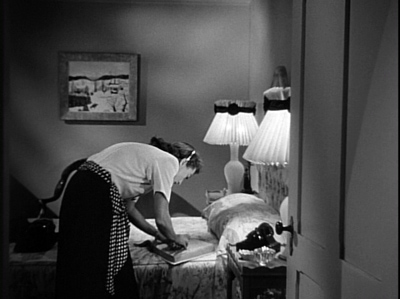
Daisy Kenyon.
It’s obvious that the custom of just dropping in didn’t guarantee a nonlinear movie experience. With a double-bill house, even if you dropped in arbitrarily, you would see one feature or the other in a single gulp. And assuming a three-hour program and a 90- or 95-minute A picture, your odds of walking in during the shorts or the B film were about fifty-fifty.
But were people obliged to drop in willy-nilly? Could they have seen the movie straight through if they wanted to?
There’s considerable evidence that parts of the audience did want to see the movies in linear fashion.Consider the early attenders. And many cinemas filled up quickly just before the show started. Coming in when the theatre opened seems a fairly clear indication of wanting a linear experience. True, early attenders would probably have to sit through a newsreel, trailers, and other shorts, but many people enjoyed those too. Further, since double-bill houses screened the A picture first, knowing that custom could guide your decision about when to come in.
Could patrons have gained specific information about when the movies were screening? There’s a widespread belief that theatres didn’t publicize showtimes. But that’s not the case.
First, the box office almost always posted a schedule breaking down the program. Sometimes cardboard clocks with movable hands indicated showtimes. Patrons might see the schedule when they arrived, or while passing the theatre during the day. Knowing the schedule, you didn’t have to go straight in. If you bought your ticket while the feature was running, you could linger in the lobby. Probably some viewers were reluctant to enter if the feature they wanted to see was just ending.
Second, there were newspaper advertisements. This evidence is varied and intriguing, full of unexpected quirks. First, I took a look at late 1940s ads for the Elmwood, my hometown venue. These ads are mostly bare-bones. They list the movies, all double features, with three changes a week (films played Friday-Saturday, Sunday-Monday, and Tuesday-Thursday). The theatre doesn’t supply its phone number, probably because many families in our area didn’t have phones until the late 1950s. Showtimes are seldom mentioned. Doubtless townfolks knew by local custom what the showtimes were, and there was no need to advertise it in newspapers or handbills (which were still around in the 1950s). One September 1949 item specifies opening and closing hours:
Matinees Daily 2:00
Evenings 7:00 to 11:30
Sundays and Holidays Continuous 2:00 to 11:30
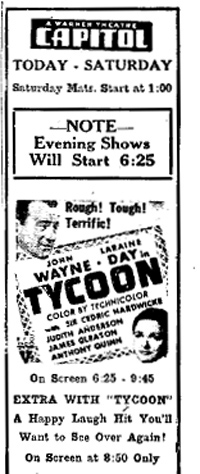 Knowing these hours of operation, people who wanted to see the movies straight through could show up at 2:00 or 7:00. Knowing these hours of operation, people who wanted to see the movies straight through could show up at 2:00 or 7:00.
But some ads in other towns get a little more specific. “2 COMPLETE SHOWS 9:30 & 12 MIDNITE,” blares the Colonia of Norwich, New York in 1947. This indicates the starting times for the newsreel, cartoon, and ads, which all preceded the main feature. But since many theatres began their screening at 6:00, the accompanying ad from the Capitol, of Dunkirk, New York in 1948 seems to be saying that after all the shorts and ads, Tycoon hits the screen at 6:25. That movie ran a little over two hours, so there was time for filler leading up to the Happy Laugh Hit (presumably a revival). More unequivocal is the ad for Daisy Kenyon at the very top of this entry, which specifies when the feature starts. Again, the theatre probably opened at 1:00 and brought in the evening crowd at 7:00. That left fifteen minutes or so for pre-show material, including the color cartoon and “Global News”.
In short, some newspaper ads tell us only the theatre’s operating hours, while others specify showtimes. This sort of variation goes far back. The Olean (New York) Evening Herald advertised the Strand Theatre as “showing continuously 1 to 11 daily,” with no showtimes mentioned. On the same page we find specific starting times listed for a rival theatre’s showings of Fairbanks’Mark of Zorro (1921).
For special occasions, the scheduling could be quite exact. If you happened to be in Middletown, New York, on New Year’s Eve of 1947, you could welcome in “Kid 1948” at a gala show starting at 7:00 and ending “some time in 1948.” But not just “some time”: The State’s plan has a military precision.
Daisy Kenyon at 7:00 – 9:29 – 12:01
Comedy “Skooper Dooper” at 8:38 – 11:08
Terrytoon Cartoon “Silver Streak” at 9:12 – 11:42
Community Sing at 9:19 – 11:49
Latest Pathe News at 8:56 – 11:26
The ad goes on:
No seats reserved – No waiting in line. Come any time from 6:30 until 11:20 and see a complete show—Stay as long as you like! Come in one year—Leave the next!
The rival Goshen Theatre likewise provided a detailed schedule of its New Year’s Eve attractions, an astonishing four features plus cartoons. The show, broken into 9 “units,” started at 7:00 and ended at 1:00 in the morning, concluding with an “Exit March.” Why don’t movie theatres have exit marches any more?
Apart from ads specifying showtimes, we can glean other hints that at least some viewers preferred to know when to arrive to catch a film from the beginning. Some newspapers published lists of starting times. The New York Evening Post printed an extensive “Movie Clock” covering over eighty theatres. A Schenectady paper did the same thing under the rubric “Showing Today. What the Theatres Are Advertising.” You can find a similar feature in papers from Portland and Council Bluffs. Movie houses were often a small-town newspaper’s biggest and most reliable advertising source, so many editors were ready to oblige theatre managers.
Movie ads also sometimes included the theatre’s phone number, so people could call to check showtimes. Access to telephones was still spotty then; recall that the infamous Gallup Poll of 1948 misjudged Dewey’s chance for victory, partly by relying on phone surveys. But by 1945 there were about 16 million residential phones for a population of 140 million, so the middle-class people sought by exhibitors, then as now, might well be able to call up the movie house.
That is, in fact, what Daisy Kenyon does at one point in her movie. Having decided to go out with her girlfriend, she checks the phone number of the theatre she wants to visit and starts to call to check on showtimes. (She’s interrupted by a call from the mysterious Peter Lapham.) The scene seems to model one set of urban filmgoing habits.
Historian Douglas Gomery reminds us that there were many different sorts of theatres–first-run and subsequent-run, big downtown houses and neighborhood venues, rural ones, art houses, and so on. I’ve tried to capture some of this variety in my exploratory sample, but there are many fine-grained differences. Moreover, roadshow pictures often played to strict schedules, selling tickets for specific performances, and people adjusted their schedules to that regime for Gone with the Wind and other blockbusters. Perhaps the All About Eve fiasco came from people thinking this new film, in black-and-white and offered at regular admission prices, was not an event film like the usual roadshow attraction.
In all, it’s hard to generalize about viewing patterns. But it seems fair to say that in many circumstances viewers could, if they wanted, avoid seeing a movie’s ending before the beginning.
Which means that, then as now, we find different viewing styles. Today we have the Planners, who Tivo their cable television offerings, and the Grazers, who hop from channel to channel and watch in medias res. (We also have the Gleaners, who sample items at their leisure via the net. But there doesn’t seem to be an equivalent option in classic theatrical film viewing.) Several of Jim Emerson’s cinephile readers point out that they appreciate spoiler alerts in a web review because they want the choice between knowing and not knowing. It seems that in many circumstances movie houses offered 1940s viewers that same option.
Exhibition history is far from my specialty, so I’d welcome information from researchers who’ve studied this question more systematically. In the meantime, I’m grateful to Kristin, Ben Brewster, Lea Jacobs, Vance Kepley, Betty Kepley, John Huntington, and Virginia Wright Wexman for discussion with me. A special thanks to Douglas Gomery, who shared detailed information in emails and phone conversations.
For a comprehensive history, see Douglas Gomery, Shared Pleasures: A History of Movie Presentation in the United States (University of Wisconsin Press, 1992). See also Gregory A. Waller, Moviegoing in America: A Sourcebook in the History of Film Exhibition (Wiley-Blackwell, 2001) and Going to the Movies: Hollywood and the Social Experience of Cinema (University of Exeter Press, 2007), ed. Richard Maltby, Melvyn Stokes, and Robert C. Allen. Allen has mounted a beautiful online archive devoted to moviegoing in North Carolina.
A useful older source, though not focused on the 1940s, is Frank H. Ricketson, Jr., The Management of Motion Picture Theatres (McGraw-Hill, 1938). Ricketson advocates three hours as a maximum program time.
The motion picture theatre has a constant drop-in trade, and the patron who catches the feature after it has started does not want to sit through a seemingly endless program to see the part that he has missed. The tendency today is to present shows that are too long (p. 121).
It’s possible that as an employee of Fox Theatres, Ricketson was pushing the then-common industry view that double features were undesirable. Fewer films on the bill allowed more turnover during the day and favored the higher-profit A pictures.
Information about All About Eve‘s “scheduled performance” policy comes from the American Film Institute Catalog. See also “Business on ‘Eve’ at Roxy Jumps After Scheduled Showings Cut,” Boxoffice (28 October 1950), 50, available here. Linda Williams argues that Psycho‘s exhibition policy helped create the custom of consuming a movie straight through. See her “Discipline and Distraction: Psycho, Visual Culture, and Postmodern Cinema,” in “Culture” and the Problem of Disciplines, ed. John Carlos Rowe (Columbia University Press, 1998).
My analogy to standing on a precipice comes from Noël Carroll’s The Philosophy of Horror.
Two final points I couldn’t squeeze in elsewhere. First, to a large extent, spoilers are a function of different sorts of movie talk. In daily conversation, we’re reluctant to tell too much to friends who haven’t yet seen the film. Journalistic film reviewers seek not to reveal the ending, of course, but they’re also obliged to write about many scenes in an oblique way. (“After a string of preposterous coincidences…”) Net writers seem to model their comments on conversation and professional reviews, although some rascals delight in telling innocent readers everything that happens. We might call them spoilersports.
By contrast, academic writing assumes that the reader has seen the film, or is willing to let details be divulged for the sake of some larger point. Occasionally bloggers adhere to this standard. Readers of J. J. Murphy’s blog know that he doesn’t refrain from synposizing a plot to give depth to an analysis. I’ve done the same thing here on many occasions, but sometimes I feel the need to signal spoilers, particularly for current releases or films that depend on big twists. For some reason, I think that older films are fair game for full-blown discussion, even though many of our readers are less likely to have seen Enchantment than Source Code.
Second point, pure digression: In 1947, Richard Hull published Last First, a mystery novel dedicated “to those who habitually read the last chapter first.” The opening chapter does provide the story’s ending, but as you’d expect there’s a trick. The chapter is written so obliquely that you can’t really tell who is doing what to whom. At least I can’t.
P. S. 18 May 2012: Two more items that I’ve run across relevant to the this-is-where-we-came-in problem. First, this dialogue exchange from Ellery Queen’s serial-killer novel of 1949, Cat of Many Tails. The murder victim, one investigator says, “left for a neighborhood movie. Around nine o’clock.” The other asks, “Pretty late?” The reply: “She went just for the main feature.” This suggests that in Manhattan, it wouldn’t be impossible to know when the main feature played for the last time–either from the newspaper, from a phone call, or just from custom.
It seems that indeed late shows of the A picture were common. A 1939 Variety article, “‘Bad’ Scheduling Squawk” (27 December 1939, 5, 47) indicates that often the “No. 1 film” was put on at awkward hours, and viewers objected. “Too often, it is declared, a customer will call the theatre, only to learn the film he or she wants to see goes on at a time that interferes with dinner, or it’s on the last show, so late that getting out would be around midnight or thereabouts. Result, under theory, is that the customer doesn’t go at all.” Again, we find some evidence that the public could find out when a movie played by phoning, and that at least some patrons cared enough to see the picture through from the start. This piece from 1939 suggests that these options were available at least in some towns throughout the 1940s. Presumably, this practice was prominent in theatres not controlled by the studios, since the B picture was a flat-rate rental but the No. 1 feature was a percentage booking. The more tickets you could sell for the B, the bigger the exhibitor’s share of receipts.
P.S. 21 May 2012: The Wisconsin Project never sleeps. Alert Ph. D. researcher Andrea Comiskey sends me 1939 ads from the Olympia in Portsmouth, New Hampshire and the Fox in Billings, Montana. Both lists start times for both features, A and B, with the Fox including the start times for cartoons and newsreels too. The heading is, bluntly, “When to Come Today.” As per the above addendum, the Fox runs the A picture last, and quite late (around 10 PM).
P.P.S. 1 February 2021: Ran across this in John O’Hara’s novel Butterfield 8 (1935):
“What are we up to this afternoon?”
“Oh, whatever you like,” she said.
“I want to see ‘The Public Enemy.'”
“Oh, divine. James Cagney.”
“Oh, you like James Cagney?”
“Adore him.”
“Why?” he said.
“Oh, he’s so attractive. So tough. Why–I just thought of something.”
“What?”
“He’s–I hope you don’t mind this–but he’s a little like you.”
“Uh. Well, I’ll phone and see what time the main picture goes on.”
“Why?”
“Well, I’ve seen it and you haven’t, and I don’t want you to see the ending first.”
“Oh, I don’t mind.”
“I’ll remind you of that after you’ve seen the picture.”
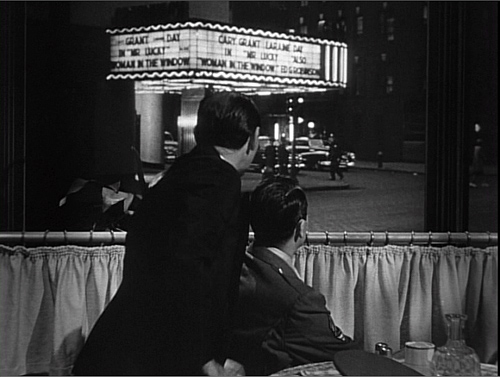
Daisy Kenyon. Daisy and her friend, tracked by Peter and watched by a waiter, have apparently gone to a revival house–and one not playing pictures from Fox, the studio behind Daisy.
Posted in 1940s Hollywood, Actors: Fairbanks, Film theory: Cognitivism, Hollywood: Artistic traditions, Hollywood: The business, Movie theatres | open printable version
| No Comments »
Sunday | August 7, 2011
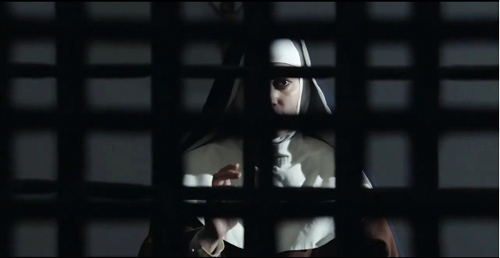
Mysteries of Lisbon (2010).
DB here:
Once Fassbinder said something to this effect: “One is always misunderstood. If you spend time clearing up misunderstandings, you’re dead.” Usually I think this is good advice. Now, though, a filmmaker whom I admire has, in publicity for a film that I admire, misunderstood me. So I’m squawking, mildly.
I met Raúl Ruiz only once, many years ago during his visit to our university here in Madison. We’d programmed At the Top of the Whale and Life Is a Dream. One afternoon we were sitting in the Student Union looking out over majestic Lake Mendota, and he started to muse. “I see a boat on the lake. Three men are in the boat. One is planning to kill the other two, but we don’t know which one it is.”
This was only one of many forking paths our conversation took. Over dinner that night Ruiz was at pains to explain that there was nothing new in Postmodernism that we couldn’t already find in the Spanish Baroque. That was pretty persuasive. He talked as well about his two production courses at Harvard. “In one, we shoot a drama as if it were a TV quiz show. In the other, we shoot a quiz show as if it were a drama.” In sum, typical Ruiz ebullience and passion for rethinking forms.
Earlier this year my name got linked to his in an unexpected way. In an interview, Ruiz mentioned that a Swiss magazine had claimed that Mysteries of Lisbon didn’t conform to “Bordwell’s Paradigm,” and he agreed. Alerted to this interview by Adrian Martin, I shook my head and thought, I don’t know what Bordwell’s Paradigm is, so how can anybody else? I suspect the label has to do with my characterization of classical Hollywood cinema, but who knows?
Since then Ruiz has signed a discussion of Mysteries of Lisbon that expands on the same theme. You can read it here. It starts off with a bang:
The American professor David Bordwell considered that all narrative strategies that can be applied to modern films are based on a certain notion of verisimilitude (or narrative evidence).
Thanks to them, the most unbridled fictions are acceptable and accepted. And this very verisimilitude, it is said, is averse to any straying from a guiding line (what is commonly called the action’s guiding arrow), with its variations in intensity and its turbulent twists and turns.
This theory, which depends on a certain number of rules often abusively attributed to Aristotle, finally became what purists hastened to naively call “Bordwell’s paradigm”–the whole of narrative strategies that stem from impulse, from the presumption of verisimilitude.
What is called “modern drama” or “bourgeois drama,” or even “the Ibsen Shaw postulate” has given rise to this superstition. In modern drama, structure and construction dominate, even beyond the poetic incoherence or the irrelevant facts it supposes. The author is an architect who builds shelters for fictions, various events which, and only because they are protected from the rain of the improbable, become credible and relevant.
Each of these fictions, of these mobile structures, is guided by a narrative arrow. But beware, only one per fiction: William Tell is a well-told story because only one arrow cuts in two only one apple, but the battle of Azincourt is not because Robin Hood and his people’s swarm of arrows does not enable one to read the time on the narrative clock, veiled as it is by clouds of arrows, each guided by its independent little intrigue. “Clouds and not clocks” would say Karl Popper.
In modern drama, the proliferation of truncated facts is not acceptable because it makes us stray from the notion of causality which is inherent to that of verisimilitude, and without which there would be no story.
Promoting a film by citing an American professor may not be the height of shrewd marketing, but put that aside. Peering through the haze of this rather awkward translation, I’m inclined to say that Ruiz mistakes my claims. I’ve said in several places that narrative, prototypically, requires causality. But that isn’t the same thing as claiming that such causality is realistic in nature, or that causality is the main attraction of narrative. Mainstream cinema, including Hollywood, often uses certain kinds of verisimilitude as an alibi for formal experimentation. And I’ve celebrated filmmakers like Eisenstein and Ozu who break away from narrative causality.
It’s ironic that on the same day I post a blog entry arguing that realism gets short shrift in studio cinema of the 1940s, I find Ruiz claiming that realism is my guiding light. If I disapproved of the “disparate, truncated, labyrinthine and baroque” aspects of narrative, I wouldn’t have said this about Mysteries of Lisbon:
This being a Ruiz film, there is as well a tangible pleasure in the artifice of storytelling. The film acknowledges that all the handy coincidences, buried pasts, multiple identities, and revelations of kinship are there for our delectation. . . .
This recounted history is only the first of a cascade of flashbacks, issuing from several characters, and these gradually show deep connections among persons tied to Pedro’s past. Secondary characters in one story become protagonists of another. The young hero is gradually displaced as the center of the action by war, secret romances, rivalries, duels, and infidelities. Like Pasolini in his Trilogy of Life, Ruiz is happiest when opening up a plot detour that will eventually become a new main road.
You can read my whole account, from last year’s Vancouver International Film Festival, here.
I think that Ruiz and I might disagree about how much Mysteries owes to psychological causation, and about whether labyrinthine trails can converge, let alone become highways. Both of us use metaphors of linearity, so maybe our disagreements are basically about whether the detours and paths are truly dead ends. Maybe I think his plotting is tighter than he does. Still, I expect that we’d agree that much of the pleasure of the film is its delight in apparently capricious digression.
Anyhow, my squawk is mild because it’s a pleasure to be misunderstood by a grand filmmaker. What Fassbinder didn’t say was that artists’ misunderstandings can be productive, leading to the creation of new artworks, and perhaps ideas about them.
If my remarks on Mysteries of Lisbon don’t make you thirst to see it, Manohla Dargis’ review surely will.
Posted in Directors: Ruiz, Film criticism, Narrative strategies | open printable version
| No Comments »
Sunday | August 7, 2011
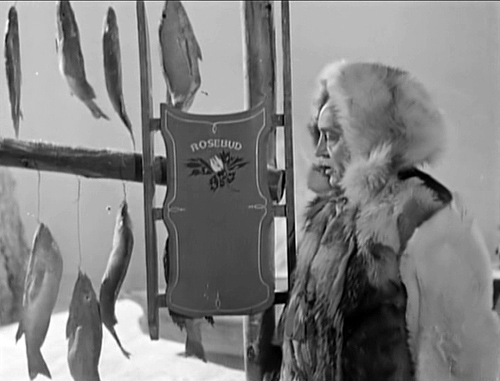
“I thought they burned that.” Hellzapoppin (1941).
DB here:
Coming back from my five-week stay in Europe (known in the Midwest as Yurrrp), I watched two releases I’d missed in the spring. Neither one was of outstanding quality, to put it mildly, and both were limited by “having been formatted to fit” the 4 x 3 airplane screen. Still, I was struck by how much both were like the 1940s movies I’d just been talking about with eighty participants in the Antwerp Zomerfilmcollege.
Of course the films’ look and feel were quite different, with Bouncycam and fast cutting instead of the rock-steady compositions and more sedate pace of the 40s films. But since I’d been concentrating on narrative matters, both of the recent releases chimed with my concerns in the course.
For one thing, both relied on flashbacks. Battle: Los Angeles used the technique casually. After a brief prologue showing our squad in a helicopter heading into a firefight, we get a title, “Enemy contact minus 24 hours.” This takes us back to the previous day, when the aliens’ attack seemed merely a meteor shower. We get to meet the Marines’ team in the usual vignettes of guys buddying around, planning their futures (one grunt is getting married soon), and nursing their woes (ageing, or mourning a slain brother). Why couldn’t these twenty minutes of exposition be given at the outset? Do the makers think we’re too impatient to wait for the first alien onslaught? Do they think we don’t know that the whole premise of the movie is an interplanetary assault on LA? In any case, the flashback is over by the sacred 25-minute mark, and we’re plunged into the ongoing action, starting with the team’s effort to save some civilians trapped in the combat zone.
Limitless used a more extended flashback. It follows what I called in Antwerp the “crisis” architecture, whereby the plot begins at or near the action’s climax and then moves back to the point at which the main story action begins. A prototype of the structure is The Big Clock (1948). Accordingly, Limitless opens with the protagonist about to leap off a high-rise terrace while his enemies pound at the door of his apartment. Then we return to his origins as a grungy wannabe writer, and the bulk of the film moves toward the critical point shown in the opening.
Limitless also reminded me of the 1940s’ penchant for rendering character psychology through subjective film techniques. After Eddie Morra takes the mind-enhancing drug, his world becomes distorted and we get unusual angles on him.
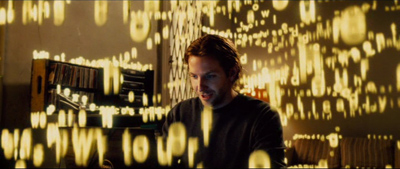
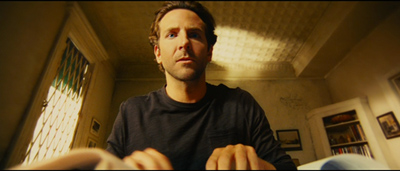
But Eddie’s head trips have precedents in the frenzied dream sequence of an early film noir like The Stranger on the Third Floor (1940). A frantic rehearsal montage in Blues in the Night(1941), with its shots from the “viewpoint” of a piano keyboard, pushes the pictorial envelope further than the comparable shot in Limitless.
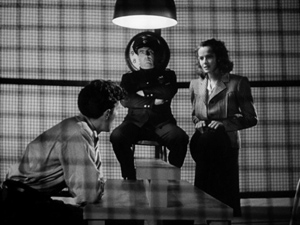 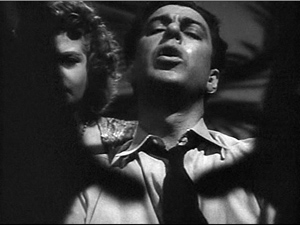
Today’s digital technologies make it easier to go for extreme effects, but wild imagery is nothing new, especially when it’s motivated as representing extreme subjective states.
Of course flashy storytelling, including time-juggling and subjective images and sounds, can be found in cinema before the 1940s. But in that era they became more prevalent, in effect a “new normal.” And very quickly filmmakers sought to push them further, with results that linger today. In The Way Hollywood Tells It, I try to argue that the flagrant artifice of 1940s films was revived in the 1990s and 2000s. Citizen Kane is in a way the ultimate “puzzle film,” with one clue to the meaning of Rosebud tucked away in a minor set. The narrative gymnastics of The Hudsucker Proxy, Pulp Fiction, Memento, The Matrix, Inception, Shutter Island, and many other movies hark back to the revisions of storytelling traditions that crystallized fifty years earlier.
Unelected affinities
It’s not just that the two airborne movies chimed with what I’d been screening. Anyone who teaches art or literature is familiar with what we might call the cluster-surprise effect. When you assemble a batch of books or plays or films to make up a semester course, you start to notice affinities you wouldn’t have spotted if the artworks hadn’t been set side by side.
To a greater degree than usual, cluster surprises arose within the movies I screened for the Belgian Zomerfilmcollege. I’ve participated in these summer movie camps before, but seldom have I had such a sense of interconnections among the films we watched. It’s as if the makers were talking to each other, or at least looking over their shoulders at what their compadres were up to.
To some extent, convergence was to be expected. The films were picked to illustrate storytelling innovations in 1940s Hollywood films, so that guaranteed some overlap. Moreover, I’ve elsewhere suggested that filmmakers are making movies as much for each other as they are for the general public. My most recent instance was in a peculiarly recurring ad for ale.
So I probably shouldn’t have been as surprised as I was. Still, I was initially ready to notice changes within individual directors’ outputs, such as Welles’ development from the quietly controlled pressure of The Magnificent Ambersons to the narrative fireworks of The Lady from Shanghai. What I didn’t expect was the crosstalk among Ford, Mankiewicz, and Siodmak in their handling of flashbacks, or the way that the elegant methods of characterization found in A Letter to Three Wives set off the opacity and contradictory behaviors of the love triangle in Daisy Kenyon.
I need to think more about how the films we screened, plus the hundred or so others I’ve been watching in the spring and summer, can illuminate our understanding of creative choices facing filmmakers then (and today). Some of this thinking will eventually surface in more extended writing, I hope. For now, here are three ideas about 1940s storytelling, sparked by the sheer juxtaposition of interesting movies.
Of course there are spoilers. The films most vulnerable to spoilage are Laura, The Killers, All About Eve, and Sunset Blvd. Maybe you can use your parafoveal abilities to skip the passages that deal with ones you haven’t seen.
Art as artifice
The Magnificent Ambersons (1942).
The 1940s highlight a basic feature of Hollywood cinema, and indeed most popular traditions I know. Artifice, often self-conscious artifice, usually rules. It’s most evident in crazy comedy (see way up top), but even dramas seldom yield what people usually think of as realism.
Imagine a continuum between surveillance-camera video at one extreme and ballet or commedia dell’arte at the other. Hollywood lies much closer to the stylized side than to the documentary-recording side. This tradition is heir to a host of conventions derived from painting, drama, vaudeville, opera and operetta, prose fiction, and, by the 1940s, radio. All of the resources of these arts are brought together for the sake of telling a compelling, moving story, and anything that works is fair game.
Take one technique that became robust in the 1940s, the voice-over narrator. Some theorists claim that every narrative must have not only a narrator but a “narratee,” somebody who is listening to the story being told. Yet in most situations we haven’t the foggiest idea who the narratee would be.
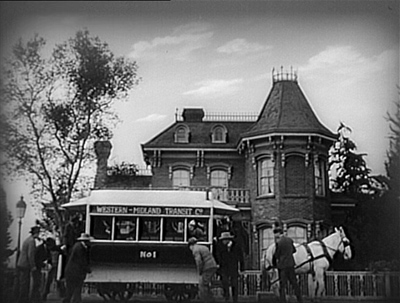
At the start of The Magnificent Ambersons, Welles’ ripe baritone tells us things about the town, the family, and long-gone fashions. At the start of All About Eve (1950), the urbane Addison DeWitt promises to give us the dirt on the young woman’s rise to stardom. The cases are significantly different. Welles creates what we might call an external narrator, one who isn’t participating in the events we witness. Addison is a character narrator, one who exists within the story and plays a role in the action. In either case, though, we can ask: To whom is the narrator speaking?
Addison isn’t addressing other characters, even in retrospect; we never see anyone listening to his tale. Welles’ voice-over narrator can’t be addressing the characters because he isn’t in the story world at all. So who’s listening? Before you say, “Well, they’re addressing us, the audience,” remember that both these narrators are fictional beings. They don’t exist in our world and we don’t exist in theirs. In daily life, if you said your nonexistent friend told you of his adventures, we’d tend to wonder about you, and we’d certainly place little credence in the events reported.
In art, though, no problem. It’s simply a convention—a piece of artifice—that lets us accept the voice-over as a mimicry of a conversational situation (a person speaking to another) and delete the part that assumes a tangible listener. So the commonsense answer is right. These narrators are speaking to us. In fact, everything in a fiction film is addressed to us. If you want an ontologically tidy answer: The actual filmmakers are the storytellers, the actual viewers are the audience, and everything else is smoke and mirrors, or puppetry and ventriloquism.
You can put it more generally. As often happens, the movie summons up a familiar schema from ordinary life, the conversation, but revises it for artistic purposes. The film draws on certain features of reality but deletes others, retaining just enough salient bits to prompt our understanding. Filmmakers can assemble, in the manner of collage, pieces of standard social interactions for particular effects. Our response depends on the patterns that are formed, not on the reality status of the bits or of what is left out. We concentrate on the effect, not the means used to trigger it.
The same thing goes for the narrator’s range of knowledge. In literature, the “I” narrator typically cannot report things she doesn’t know about. If something happens that she couldn’t witness at the time, she’s obliged to explain how she learned about it subsequently. But internal filmic narrators often lead us into moments, or entire sequences, that they weren’t present to witness. In The Killers (1946), Nick Adams tells the insurance investigator Riordan that Ole the Swede encountered a mysterious man from his past, but given Nick’s position at the rear of the car, paying no attention to the encounter, he couldn’t have observed the way Ole intently avoids meeting the driver’s eyes.
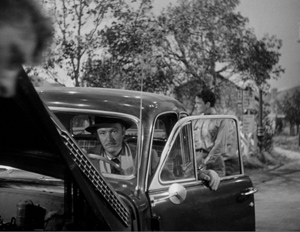 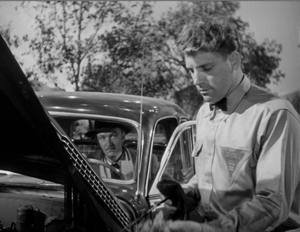
Huw, the narrator of How Green Was My Valley (1941), didn’t see, and may not have known about, his sister Angharad’s visit to Reverend Gruffyd.
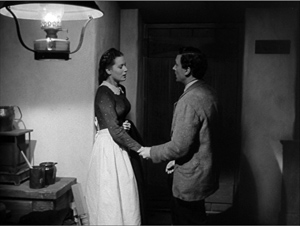
Yet the scene, played out between the two near-lovers, is given to us within the narration established as Huw’s.
By convention, then, filmic narration allows a lot of leeway to a character narrator. Again, a realistic situation, someone reporting on what they know, is treated in a partial, stylized fashion for the sake of sharpening the effect. We’re more curious after noticing the driver’s frowning look at Ole, whether or not Nick could have strictly seen it. We’re more intensely involved with the emotion of the Angharad/ Gruffyd romance than if we simply saw Huw learning about her visit later.
Proteus in Hollywood
Once a convention is put in place, somebody is bound to play with it. A one-off example occurs in Ambersons, when we get this exchange on the soundtrack:
Gossip: They’ll have the worst spoiled lot of children this town will ever see.
. . . .
Narrator: The prophetess proved to be mistaken in a single detail merely. Wilbur and Isabel did not have children. They had only one.
Gossip: Only one! But I’d like to know if he isn’t spoiled enough for a whole carload.
(Interestingly, Welles doesn’t present this exchange in his 1938 radio version of the novel.) Likewise, the opening of Eve is trickier than I indicated, partly because Addison’s narration is accompanied by a freeze-frame at the moment the award is presented.
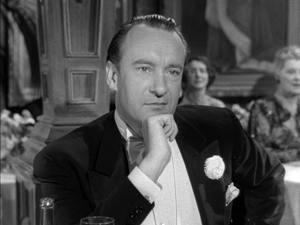 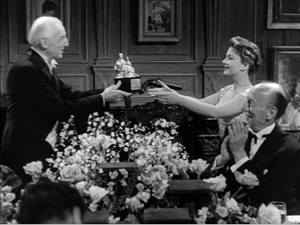
Since a few years before this, It’s a Wonderful Life (1947) showed angels freezing time and commenting on George Bailey’s dreams, you have to wonder if Mankiewicz isn’t endowing Addison with a supernatural power.
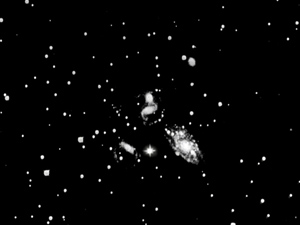 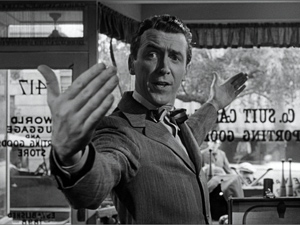
Addison will, by the end of the film, be utterly in control of Eve.
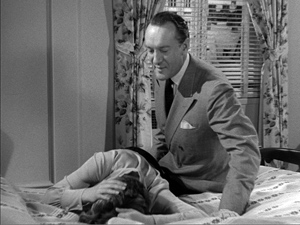
The 1940s and early 1950s see an immense amount of experimentation with narrators. Narrators can lie about what they report. They can be dead (Scared to Death, 1947; Sunset Blvd, 1950), otherworldly (the angels in It’s a Wonderful Life), non-human (the house in Enchantment, 1948), or of uncertain status (Woman in Hiding, 1950).
A good example of the high artifice of the period comes in Laura (1944). The film is introduced by Waldo Lydecker’s voice-over, remembering “the weekend Laura died,” and remarking on the detective Mark McPherson, wandering through Waldo’s art collection. Waldo’s voice-over, describing events in the past, might seem to assure us that he survives the ensuing story.
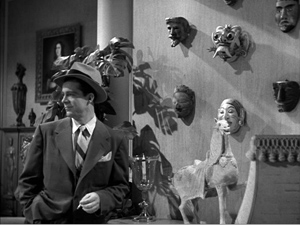
Fairly soon Waldo’s voice-over reappears, but it doesn’t frame the overall fiction. As he explains his relationship with Laura to McPherson, we get episodic flashbacks showing Laura’s rise (and, true to form, including events Waldo couldn’t have known about). At the end of their evening together, the film’s narrational weight shifts visibly to Mark, showing him in an uncharacteristically tight close-up watching Waldo depart.
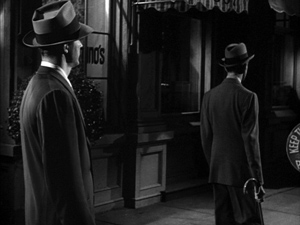 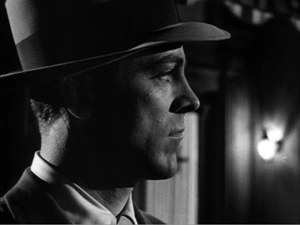
The absorption of Waldo’s voice into the overall texture of Mark’s investigation invites us to forget that Waldo initiated the film, and that he in fact fed us false information. (Laura didn’t die that weekend.) So the ending, in which Waldo falls before policemen’s pistol blasts, comes as a new surprise. The camera tracks away from him murmuring, “Goodbye, Laura”, past Laura and Mark, to the shattered clock face that recalls what Waldo’s shotgun did to Laura’s surrogate.
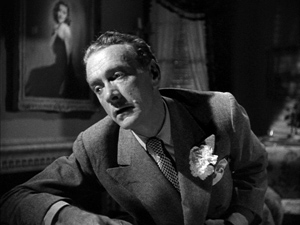 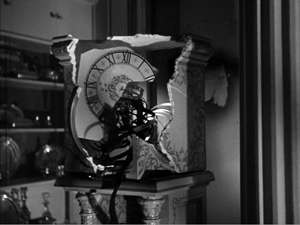
Over this image we hear Waldo’s voice: “Good night, my love.” From one angle, the line could be considered Waldo’s offscreen dying words, continuing his murmured farewell to Laura. Yet the last line is closely miked in the manner of the opening voice-over, suggesting a voice from beyond the grave. Was Waldo narrating the first scene from the same place? Is this a tale told by a corpse? The ending is equivocal, hovering between the two possibilities.
Again and again, the films we saw fractured tidy patterning. Addison’s voice-over narration in All About Eve gives way to that of another character, Karen Richards. After he glances at her, a cut presents her voice-over taking up the burden of introducing us to the young Eve in a flashback.
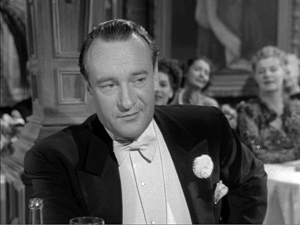 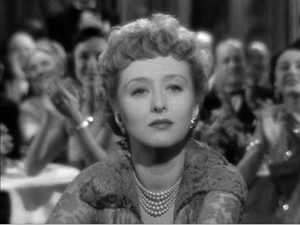
How to explain this tag-teaming, except as pure artifice, a new wrinkle in a convention that by 1950 had become second nature to filmmakers and viewers?
In The Killers, the dying crook Blinky is questioned by two investigators. No problem about narratees here; he speaks to them. But the film makes a new problem for itself. Blinky is too far gone to respond to questions. All he can do is mutter phrases from the past. Yet the film’s narration dramatizes his ravings, presenting the scene he invokes as fully as any other.
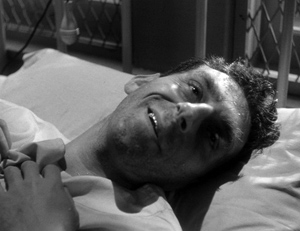 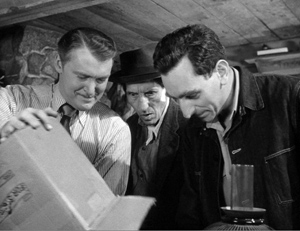
Is this what his listeners are imagining? No; it’s just a stretching of the conventions surrounding the character narrator. After several orthodox voice-overs earlier in the movie, we can assume that Blinky’s babble will be translated into solid scenes, as more articulate talk has been earlier. Again, plausibility is flagrantly violated; who could construct a coherent set of actions, let alone a legal case, out of fragmentary phrases? But who cares? Blinky is a device to get us into the past, and the filmmakers assume that we’ll follow the most slender lead they offer.
Meir Sternberg has articulated a powerful case that there are no “package deals” in verbal art. Any narrative or stylistic device can fulfill a wide range of functions, and any functions can (with sufficient motivation) find expression in many different techniques. To take a filmic example, a dissolve can indicate a passage of time, but sometimes a dissolve (say from a long-shot to a closer view of a character) suggests continuous duration. And a cut may indicate continuous time, but it can also indicate that a stretch of time has been skipped over, as throughout Resnais’ Muriel. Sternberg calls this the Proteus Principle, “the endless interplay between form and function.”
Along these lines, conventions within a tradition can be seen as the most probable fit between form and function, the ones we expect because we’ve seen them in other films. In studio-era Hollywood film, dissolves usually signal a passage of time, and cuts within scenes usually indicate continuity. But those functions are local and subject to revision. Likewise, a voice-over narrator is unlikely to talk with the characters, except in the case of comedy. For Welles to try it in a drama was a bit daring, but it simply shows that there is room, if the filmmaker proceeds carefully, to stretch the convention. (It had already been stretched in both the play and film versions of Our Town.)
Collaborative competition
How to explain these fractures of form? Invoking a Zeitgeist explanation—wartime trauma, postwar dislocation—seems to me a desperate measure, for reasons I’ve outlined elsewhere. In the Antwerp sessions, I suggested some other explanations, which I hope to justify at greater length another time. For now, let me propose just one factor that seems to me to have contributed to the wilder side of 1940s storytelling.
The famous opening of E. H. Gombrich’s Story of Art—“There really is no such thing as Art. There are only artists”—is open to many interpretations. One is that art history is driven by the human dispositions of the image-makers. Those dispositions include rivalry. In his 1974 essay “The Logic of Vanity Fair,” Gombrich further explores the role of competition among artists. In many traditions, they may try to raise the stakes, seeking to outdo others in virtuosity. I’d add that such artists either try to beat their predecessors and contemporaries at their own game, or to invent a game in which a newcomer can excel. Later in his career Gombrich suggested an analogy to ecology: some artists fight for the same niches, others adapt themselves to unexploited ones.
From this standpoint, I’d suggest that a close-knit world like Hollywood encouraged competition among its creators. In the period I’m concerned with, some ambitious Hollywood filmmakers (not only screenwriters but also directors, cinematographers, and their colleagues) saw voice-over narration as an opportunity to innovate. The technique may have arisen partly because people were used to it from radio, and it offered advantages in efficiency and low cost. Detour (1945) shows that a fairly static, cheaply shot scene can be energized by extensive voice-over. Ambitious filmmakers could make this still-emerging technique more forceful, more mysterious, more evocative. The cost of this effort was some violation of realism and an occasional violation of tidy form.
In just a few years, we go from Welles’ external narrator being sassed by a gossip to Mankiewicz’s character narrator passing the expository ball to another character. We see a community of creators pushing each other to revise a schema they inherited, to test its limits and find new effects it could create. I think that this “collaborative competition” operates in other innovations of the period, such as the long take, the flashback, deep-focus cinematography, and sound manipulations.
Something like this creative community still exists. Urges to compete through innovation (or to revive older conventions) seem to drive some of our filmmakers. The impulses assume a feeble form in Limitless and Battle: Los Angeles, but at least these program pictures remind us that competition isn’t only financial; it’s also artistic. The pressure to come up with a fresh revision of a familiar schema is, if anything, keener today than in the 1940s. Insidious has to top Paranormal Activity, which itself revised a traditional formula in fresh ways.
The snag is to do something that we haven’t seen before. That’s tough when you come at the end of the line that includes filmmakers like Ford, Hitchcock, and so many others. This is the problem of belatedness, and some day it will get a whole entry of its own.
Two especially strong books on Hollywood cinema of the 1940s are Thomas Schatz’s Boom and Bust: American Cinema in the 1940s (University of California Press, 1997) and Dana Polan’s Power and Paranoia: History, Narrative, and the American Cinema, 1940-1950 (Columbia University Press, 1986). By presenting a detailed overview of industrial developments, Schatz supplies a vivid context for studying artistic trends. Polan, focusing on an immense range of films, aims to explain their formal and thematic qualities from a broadly Foucauldian perspective. Here “discourse” assumes an immense power over the way the films look and sound, and the motive force behind the discourse is largely, though sometimes obliquely, World War II.
In addition, I should pay tribute to Sarah Kozloff’s fine Invisible Storytellers: Voice-Over Narration in American Fiction Film (University of California Press, 1988). Kozloff includes concise, sensitive analyses of How Green Was My Valley and the opening of All About Eve. For the latter film, she traces Addison’s narrational power in some detail. Needless to say, my thinking has also been influenced by Kristin’s essays on Laura and Stage Fright, to be found in her collection Breaking the Glass Armor: Neoformalist Film Analysis (Princeton University Press, 1988).
For more information about Mankiewicz’s plans for All About Eve, including a scene replaying earlier action with different significance, see Gary Carey, More about All About Eve (Random House, 1972), 56-58. According to Carey, Mankiewicz shot this and other material that was excised in the editing stage. The version of the screenplay printed in Carey’s book clearly isn’t the shooting script (it seems to be close to a transcript of the finished film), and it does contain the passages I’ve considered: the freeze-frame (p. 127) and the moment in which the narrational voice slips from Addison to Karen (p. 128). This published version is widely available online in various formats; the typescript copy available here carries the tag “Shooting Draft” and doesn’t contain the scenes that Carey claims were dropped in postproduction.
My quotation from Meir Sternberg comes from “Narrativity: From Objectivist to Functional Paradigm,” Poetics Today 31, 2 (Fall 2010), 594. Gombrich’s essay, “The Logic of Vanity Fair: Alternatives to Historicism in the Study of Fashions, Style and Taste,” appears in his collection Ideals and Idols: Essays on Values in History and in Art (Phaidon, 1979), 60-92.
In my Antwerp talks I approached questions of form and style in the 1940s by trying to reconstruct the creative problems and solutions arising within the filmmaking community. For me, filmmakers working within institutions are the most proximate agents of stability and change. For examples of this approach, see my chapters of The Classical Hollywood Cinema, The Way Hollywood Tells It (which considers the problem of belatedness), and my analysis of Mildred Pierce in Poetics of Cinema. My critique of Zeitgeist or mood-of-the-moment explanations can be found in Poetics of Cinema, 30-32.
You can sample how I’ve tried this approach out in pieces on this site. For instance, this entry examines artistic competition through the example of high-school lipdubs, this one talks about our appetite for artifice, and this one discusses how Cloverfield solves the problem of point of view in a monster movie. This essay on actors’ eye behavior develops the idea that filmic conventions often remake, in streamlined form, familiar aspects of social interaction. I hope to develop my case for the 1940s more thoroughly at some future point.
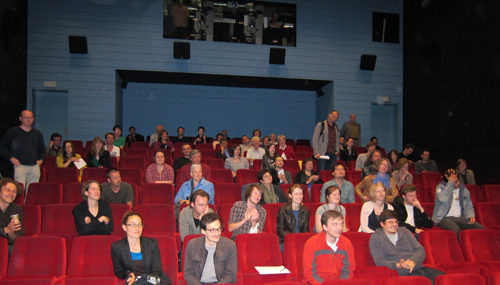
Zomerfilmcollege, Antwerp (July 2011). For more on this event, see earlier entries here and here.
Posted in 1940s Hollywood, Hollywood: Artistic traditions, Narrative strategies, Poetics of cinema | open printable version
| No Comments »
|