by Kristin Thompson. Berkeley: University of California
Press, 2007.
400 pages, 6 × 9 inches, 12 color illustrations;
36 b/w illustrations.
[go
to Amazon | go to The Frodo Franchise blog]
We don’t write our entries for this blog with with the thought that they will necessarily be used in teaching. Still, some of them might be might prove helpful in preparing lectures or assigning readings in courses assigning Film Art: An Introduction. Or indeed, other courses. As usual, at a time of year when teachers are preparing their syllabi, we offer a run-down on what we’ve posted over the past year.
Entries for previous years are available here: 2007, 2008, 2009, 2010, 2011, 2012, 2013, and 2014. These and the current one don’t include all the 701 (!) entries on this blog, but quite a few are listed here. For those new to Observations on Film Art, they might provide a handy way of exploring the site.
Here are some suggestions, chapter by chapter. Sometimes one entry will be relevant to several chapters, so we’ve noted such overlaps.
Chapter 1 Film as Art: Creativity, Technology, and Business
At the end of Chapter 1, we have long included a section warning students against watching widescreen films shown on television in pan-and-scan formats. Widescreen televisions, as well as letterboxing and windowboxing on home video, may seem to have solved that problem. Yet alterations in film images, often eliminating key parts of shots, persist. We discuss how in Filling the box: The Never-Ending Pan & Scan Story.
Throughout Film Art, we emphasize that filmmaking involves many decisions and much problem-solving. We examine some specific examples from the works of William Wyler and others, in Problems, problems: Wyler’s workaround.
Chapter 1 discusses the various roles in filmmaking. An important contemporary screenwriter, David Koepp (Jurassic Park, The Da Vinci Code, War of the Worlds) and director (Ghost Town, Premium Rush) visited our department this year. We pass along some of what we learned in The compleat screenwriter: David Koepp gives notes.
Bill Forsyth, director of the admirable Local Hero, shares his experiences working on both experimental and mainstream films in Watch those hands.
We also refer to the auteur theory, suggesting that the director is often the major artist who organizes a film. François Truffaut’s book of interviews with Alfred Hitchcock has been a huge factor in making Hollywood genre directors more respected. It has also influenced many directors and critics. Our friend Kent Jones has made a revealing film about the background of the interviews and the books. We discuss both the book and Kent’s film in TRUFFAUT/HITCHCOCK, HITCHCOCK/TRUFFAUT, and the big reveal.
Chapter 2 The Significance of Film Form
Here we lay out the various types of meaning in films, including symptomatic meaning. Looking at how films supposedly reflect social trends, however, has become an easy way of generating journalistic prose. We point out the problems with this approach in Zip, zero, Zeitgeist.
The narrative of Gone Girl plays with the spectator’s expectations. We discuss how it links to Hollywood’s historical treatment of the thriller genre in Gone Grrrl.
Chapter 3 has a “Closer Look” box, “Playing Games with Story Time,” which examines the recent popularity of “what if” films that employ forking-path premises. We discuss a much earlier example of this technique from 1934 in What-if movies: Forking paths in the drawing-room.
Another intriguing way of structuring stories is the “network-narrative” technique, which weaves together the lives of several seemingly unconnected characters. As a storytelling choice it persists in films like The Best Exotic Marigold Hotel. The format was popularized in the 1930s with the “Grand Hotel” cycle of films. We survey this narrative option in 1932: MGM invents the future (Part 2). For Part 1, see below under Chapter 7.
If you’re teaching Citizen Kane or any other film by Orson Welles (right, very young), your students might be interested in learning some background on the director. See our Local Boy Makes Very, Very Good: Welles comes home.
Chapter 4 The Shot: Mise-en-Scene
The Taiwanese director Hou Hsiao-hsien is a great master of staging, setting, and lighting. Hou Hsiao-hsien: A new video lecture! links you to a presentation that David posted on Vimeo. See also our guest entry, Jim Udden’s first impressions of Hou’s latest, The Assassin.
In 2014, Richard Linklater’s Boyhood focused much attention on acting and casting by dealing with twelve years in a boy’s life. The shooting was done across twelve years using the same actor as he grew up. Despite the acclaim for the film, something similar has been done in other films. We compare the effects of actors growing up before our eyes with a comparison to the Harry Potter series in Harry Potter and the Twelve-Year Boyhood.
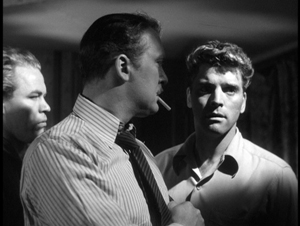
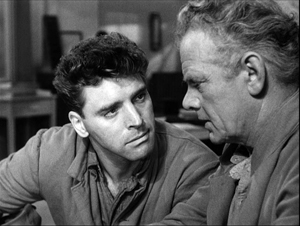
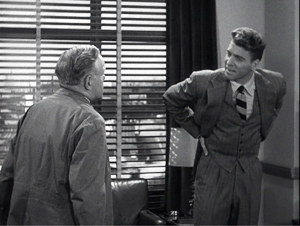
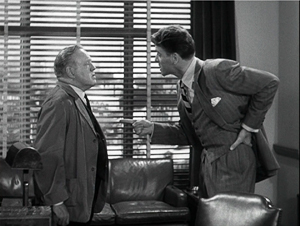
Like other aspects of mise-en-scene, actors’ performances can be analyzed. Watch Those Hands considers Burt Lancaster’s performance style in The Killers, Brute Force, and other film noir classics. Two clips illustrate Burt’s control of eyes and hands.
Chapter 5 The Shot: Cinematography
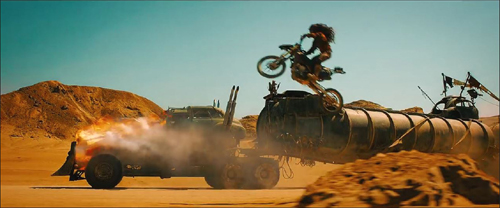
Some students may be convinced that CGI (computer-generated imagery) is the best way to make a big action movie. We look at Mad Max: Fury Road (above) and The Lord of the Rings as films that are more original and entertaining because they emphasize practical effects and resort to CGI only when necessary. See The waning thrills of CGI.
Jean-Luc Godard’s late films offer fascinating examples of unusual framings. Sometimes his camera positions block our easy understanding of the story action. We consider an example in Watch those hands.
Chapter 6 The Relation of Shot to Shot
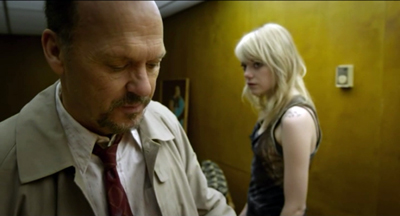
In BIRDMAN: Following Riggan’s Orders, we argue that although much of the film is presented as a single shot, we can see changes of camera angle and distance that fit the patterns of traditional editing. The film in effect absorbs the principles of continuity editing into its long-take approach.
Chapter 7 Sound in Cinema
The origins of cinematic voice-over in the 1930s can be traced with surprising precision, as we indicate in 1932: MGM invents the future (Part 1). The entry includes several video clips from rare films of the period.
Guest blogger Jeff Smith applies his expertise in music to analyzing the songs and scores from 2014 nominated for Oscars in The sirens’ song for Oscar.
Film Art occasionally uses telephone calls to show the range of choices filmmakers have with respect to sound. In Little things mean a lot: Micro-stylistics, phone calls illustrate the interplay of editing, dialogue, and music to build suspense. Our biggest example, which includes a video clip, comes from Humoresque (below).
Chapter 8 Summary: Style and Film Form
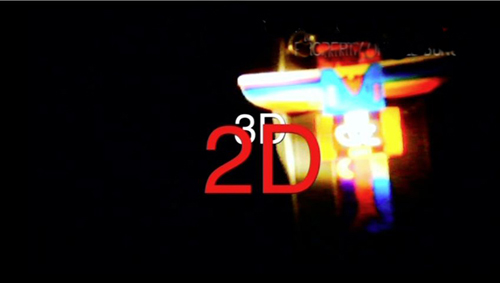
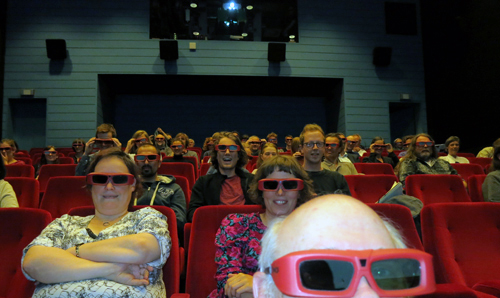
Current 3D cinemag has become quite ambitious, and no film exemplifies this better than the provocative, sometimes abrasive, often beautiful Adieu au langage (Goodbye to Language) of Jean-Luc Godard. We devoted two entries on this extraordinary film. Adieu au langage: 2 + 2 x 3D analyzes the relation between the film’s 3D design and its overall form. The other, Say hello to Goodbye to Language, proposes some follow-up ideas.
Film Art tends to use fairly straightforward examples of film technique and style, aimed at students new to the subject. But less noticeable examples can be fascinating, as we suggest in the Micro-stylistics entry.
Film is self-evidently a primarily visual art. Yet the flow of images depends on sound, genre conventions, and other elements. See our Visual storytelling: Is that all?
Chapter 9 Film Genres
Gone Grrrl, as mentioned above, is a good example of the thriller. The Hitchcock/Truffaut entry compares how each director uses conventions of the same genre.
Chapter 10 Documentary, Experimental, and Animated
The conference of the Society for Cognitive Studies of the Moving Image was the occasion for meeting experimental filmmakers John Smith. His films are described in An evening with Mr. Smith.
Chapter 11 Film Criticism: Sample Analyses
Our entry on Birdman, mentioned above, constitutes a fairly detailed analysis of the film as a whole. In addition, David’s website hosts several additional analyses cut from earlier editions of Film Art. Feel free to mix and match.
Chapter 12 Historical Changes in Film Art Conventions and Choices, Tradition and Trends
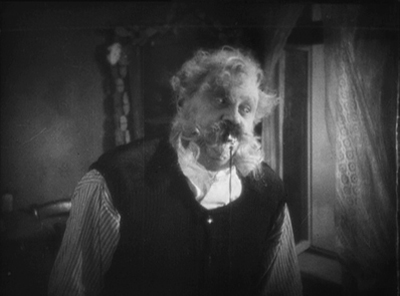
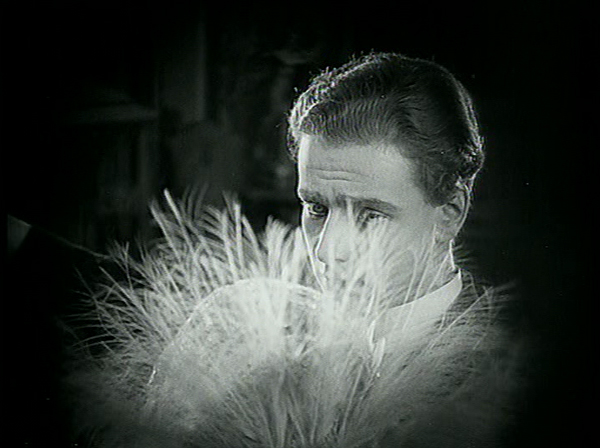
The Last Laugh.
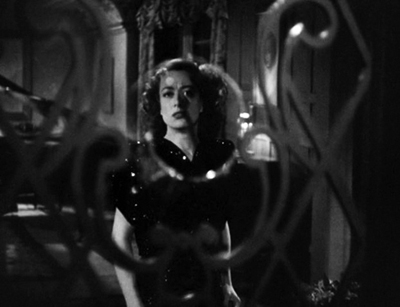
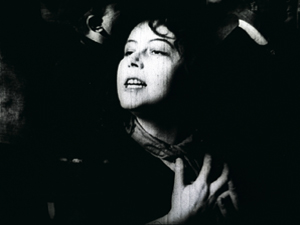
At the end of each year, we offer our own version of a ten-best list, going back 90 years in order to call attention to both classics and little-known gems of the day. This past year it was The ten best films of … 1924. (See directly above and top of this entry for two of our choices.)
Both Michael and The Last Laugh are among the many classics of the German silent cinema. But a trip to an archive can reveal lesser-known films of interest. See Homunculus and his friends for some examples.
Resources
Every now and then we write about new book, DVD, and Blu-ray releases. Find out about little-known films and recent restorations in DVDs and Blu-rays for your letter to Santa.
Our colleague Lea Jacobs has recently published a major study of how the ways in which music, voice, and effects created rhythm in combination with images in the first decades of sound cinema: Film Rhythm after Sound: Technology, Music, and Performance. See The getting of rhythm: Room at the bottom.
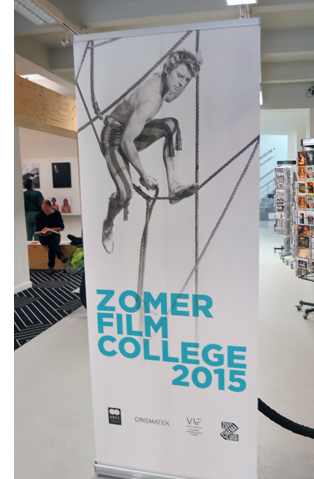
At this year’s Summer Film College in Antwerp, Peter Bosma pointed out that the event seems to be a unique mixture.
Films are screened from morn to midnight: this time, 38 films across 6 days and two half-days. But it’s not exactly a film festival, as there are no new releases.
So is it like Bologna’s Cinema Ritrovato? Not exactly. While the shows included some restored titles (notably the Belgian Cinematek’s pretty makeover of Pollyanna, 1920), the films were mostly original prints with an occasional DCP.
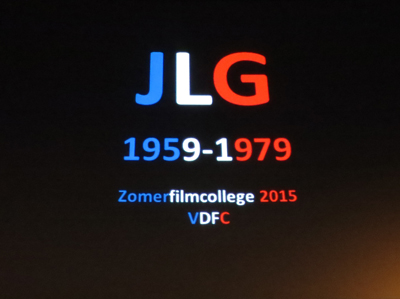
Moreover, the films cluster around two or three major themes. This year we had Late Godard (fourteen titles, counting episodes of Histoire(s) du cinema) and the career of Burt Lancaster (eleven). In addition, there were nightly showcases called “Masterworks in Context,” which included one surprise film, title undisclosed. But unike most movie marathons, the Summer Film College introduces screenings with lectures and discussions. This year there were fourteen sessions, each running about ninety minutes. These are serious, intensely informative talks—very far from the usual brief introductions one gets at festivals or in art house warm-ups.
So is it an educational enterprise? Definitely, but without assignments, tests, or grades. It’s designed to serve Flemish-speaking professors and students, but also civilians who are just interested in a weeklong package of film and film talk. The event helps forge a community of film appreciation.
Finally, there’s often a guest filmmaker on hand, usually related to the main threads. This time it was Bill Forsyth, who directed Burt in Local Hero. That film was screened, along with Bill’s wonderful Housekeeping.
So what would you call the College? I once called it Cinephile Summer Camp, and that still seems accurate in evoking the sense of fun and camaraderie that pervade the place. We don’t all get mosquito bites, but after a week you come to enjoy seeing familiar faces and talking with them about what they’re seeing. Just as when you go to summer camp, you get to stay up late. But at no summer camp I ever attended did we drink so much beer.
JLG/SJ/DB
The principal speakers were Tom Paulus and Anke Brouwers, who covered Burt, and Steven Jacobs on Late Godard. The Masterworks in Context shows were introduced by several guest speakers, including Lisa Colpaert (excellent on I Walked with a Zombie) and Vito Adriaensens (covering both Murder! and Vampyr). For Pollyanna, Bruno Mestdagh of the Cinematek staff explained the process of restoration. I played utility infielder, offering one talk on Burt and three on JLG.
How often do you get to see 35mm prints of Une femme mariée, Passion, Je vous salue Marie, Détective, JLG/JLG, Eloge de l’amour, and Nouvelle Vague? The Godard series, which ended with a 3D show of Adieu au langage, was a high point of my summer viewing. Back home I had prepared by rewatching all Godard’s features from Sauve qui peut (la vie) onward, but my video homework didn’t prepare me for the way the big screen amps up their prickly, seductive power.
I don’t speak or read Dutch, so I missed many subtleties in Steven Jacobs’ talks, but thanks to Power Point I could figure out the main points. Few lecturers can pack so much information and ideas into ninety minutes.
We had no way of knowing how familiar the audience was with Godard, early or middle or late, so Steven started with an orienting talk on JLG’s pre-1980 work (above). He swiftly reviewed key aspects of Godard’s New Wave period, traced his shift toward “a critical cinema” between 1967-1969, and explored the move into his Marxist phase. Along the way, he stressed the way cultural developments like auteur theory, Pop Art, Maoism, Brechtian theatre, and semiotics shaped Godard’s films. Particularly acute was his discussion of the “one image after another” sequence in Ici et ailleurs (1975). In all, the talk was an ideal prelude to Une femme mariée, which pointed up so many motifs of the later work: the focus on the couple, the emphasis on media-based images, and the persisting shadow of the Holocaust.
Steven is an art historian at University of Ghent; he earlier appeared on this blog as co-author of the imaginative book The Dark Galleries. After tracing Godard’s return to mainstream cinema and his move to Rolle, Switzerland, Steven focused on that splendid example of JLG the painter, Passion. Steven has written eloquently on the film in his Framing Pictures, and here he widened his focus to discuss its relation to other films centered on the tableau vivant, like Pasolini’s La Ricotta and Ruiz’s Hypothesis of the Stolen Painting.
You’d expect that Steven would have a field day with Histoire(s) du cinema, and he did. Unlike most Godardophiles, I’m not wild about this series of video essays. I can’t take them as serious studies in film history, and too often I sense he’s just playing around. (Enough with the stroboscopic flashes, okay?) But Steven obliged me to rethink them by showing how they fit into the Postmodern art scene, especially the video art movement after the 1970s. He pointed out the central importance of the Hitchcock episode and the series’ constant concern with the Holocaust, often in dialogue with Shoah. Citing Godard’s claim that video taught him to see cinema in a new way, Steven suggests that the format also created a tenor of paradoxical melancholy. It’s as if JLG’s experiments with this new technology drove him to celebrate the death of the cinema he knew.
My three talks on Late Godard tried to ask something that I didn’t find many traces of in the literature. What are these films doing with (or against) narrative? I think that the focus on JLG as “film essayist” has sometimes obscured the fact that he has long insisted that he needs stories. Yet he seems to have no interest in the craft of storytelling as we understand it. He avoids dense exposition, careful foreshadowing, well-timed revelations, and cumulative climaxes. He tends to spoil the narrative expectations he sets up.
As a result, his plots—for his films have them—are distressingly opaque. Exactly what happens in a Late JLG film is often difficult to determine. I’m always surprised when discussions of these late films provide capsule plot summaries, for the very difficulty of arriving at these should claim our attention. As just one instance, many critics seeing Adieu au langage for the first time thought the film centered on one couple. It centers on two. But the fact of that mistake ought to interest us enormously: What in the film’s presentation made it difficult to follow the basic situation? Are there strategies Godard follows in creating his apparently willful obscurity?
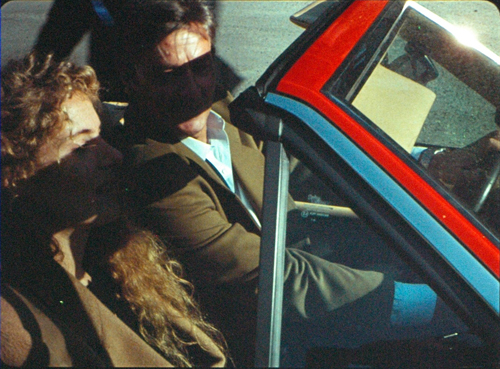
Godard’s unique strategies of storytelling are carried down into felicities of visual and verbal style. Again, I think that critics haven’t sufficiently acknowledged just how strange and opaque the surfaces of these movies are. For one thing, characters are unidentifiable from scene to scene, thanks to camera setups that cut off their faces, wrap them in shadow, or leave them offscreen altogether.
I’ve touched on these matters earlier (here and here), but just as a quick example, consider this shot from the opening of Nouvelle Vague. It has to be one of the most oblique introductions to a protagonist we can find in cinema.
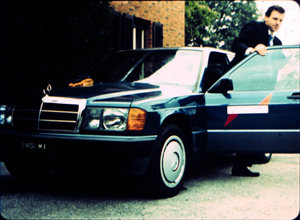
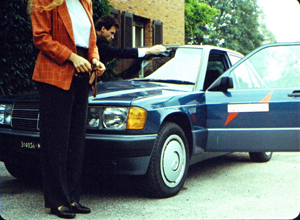
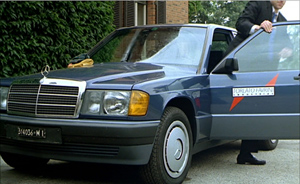
Corporate owner Elena Torlato Favrini strides out of her mansion past her chauffeur while taking a transatlantic call. Any other director would favor us with a close view of her, perhaps tracking as she cuts a swath through her entourage. Instead we get a shot framing her chauffeur climbing out of their Mercedes.
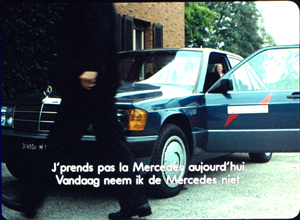
As he crosses in front of the car, we hear her on her cellphone. She can be glimpsed fleetingly in the background, through the car window.
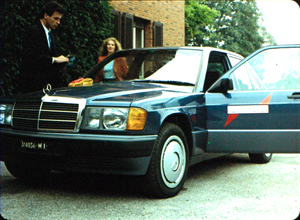
She approaches us, becoming briefly visible as she passes the car, but when she stops, she’s decapitated. We don’t get anything like a good look at her, and the locked-down camera refuses to reframe her. Instead, the framing emphasizes her slipping on her gloves.
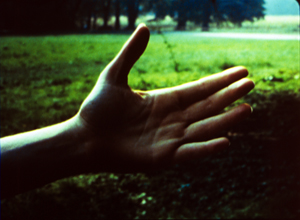
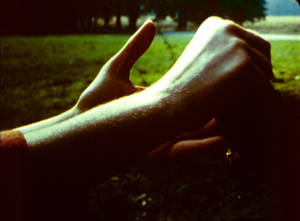
The gesture ties into other imagery in the film. A little before this shot, there’s an isolated shot that establishes hands as a major motif in the film. But we should also notice that this fairly abstract shot also presents the gesture of Elena slipping on a glove. Or rather, it almost presents it, as the shot is abruptly chopped off just as the gesture begins.
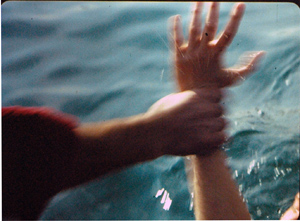
So slipping on the glove, started in an earlier shot, is finished at the Mercedes. But just as important, the visual idea of a hand gesture broken by a cut resurfaces at the climax. When Richard Lennox helps Elena out of the water, the action is also incomplete. Only five frames show him grabbing her arm before a cut interrupts the action.
Another filmmaker would have held the image on that triumphant grip, but Godard denies us this little burst of satisfaction. Of the five frames in this bit of the shot, there is just one frame showing Richard’s hand seizing her. Godard again spoils a solid narrative effect. But he does narrative in his own way, with the broken-off gestures counterpointed by the hands that do meet at other points in the film.
Every scene in Nouvelle Vague, and most scenes in Late JLG, seem to me to be built on one or more fine-grained pictorial and auditory ideas like these. Those ideas can seem perverse, as in the chauffeur scene: why let us see his face but play down Elena’s? He’s not a major character; we don’t even learn his name until the film’s final moments. Unhappily, this peculiar instant of comparison is lessened in the 1.66 version of the film available on DVD. That image suppresses the driver’s face no less than Elena’s, losing Godard’s peculiar version of “gradation of emphasis.”
All the more reason to try to see these films in their full-frame glory, as I’ve argued before.
BL (Beautiful Loser)/AB/TP
Criss Cross (1949).
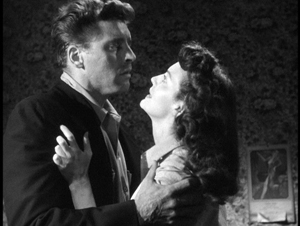
With big tousled hair, unadulterated sinew, and teeth gleaming like a Pontiac grille, Burt Lancaster came to fame in the late 1940s. He belonged to a new cohort of actors quite different from the 1930s Debonairs (William Powell, Melvyn Douglas, Cary Grant) and the Bashful Boys (Cooper, Fonda, Stewart). Yet the new lads were also at variance with the rugged Ordinary Joes (Cagney, Bogart, Tracy, Gable).
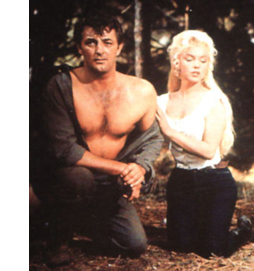
For one thing, Lancaster, Victor Mature, Robert Ryan, Robert Mitchum, Kirk Douglas, and Charlton Heston were brawny—monsters, in a way. They often took off their shirts. One publicity still for River of No Return shows Mitchum more unclothed than Monroe. Three of them played prizefighters, and Mitchum, himself a boxer, had the broken nose of a brawler.
Of the group, Burt had probably the strongest A-list career overall. He fostered a great variety of projects. Who else of his generation appeared in films by Visconti and Malle? What other unflinching liberal was prepared to play a US general bent on a coup (Seven Days in May) or a conspirator behind the Kennedy assassination (Executive Action) or an obstinate officer fighting in Vietnam (Go Tell the Spartans)? He portrayed a renegade officer demanding the revelation of the brutal policy behind the Vietnam War (Twilight’s Last Gleaming). His closest rival and frequent costar Kirk Douglas didn’t enjoy such a vigorous and prestigious twilight. Only Brando kept beating him to the prize: Burt wanted to play the lead in Streetcar Named Desire and The Godfather. Unpredictably, he wanted as well to play the gay prisoner in Kiss of the Spider Woman.
I had had only slight interest in Burt as a star before this edition of the Summer School. But listening to the talks, seeing the films, and preparing my contribution made me realize how extraordinary an actor he was, and how important in Hollywood postwar history. Burt was well-served by the fine lectures offered by Tom Paulus and Anke Brouwers.
Anke provided an in-depth survey of how Burt and the Brawny Gang brought to a new level the culture of male athleticism—on display in Fairbanks and Valentino, developed further in the body-building craze of the 1930s, and culminating in what one 1954 magazine article called Hollywood’s “Age of the Chest.” She brought in forgotten pin-up boys like Guy Madison and pointed out how Burt and his peers paved the way for Rock Hudson and Tony Curtis. Anke went on to specify Burt’s beefcake persona, established in The Flame and the Arrow (1950) and locked into place in The Crimson Pirate (1952), which we saw. In her followup talk next day, she surveyed Burt’s place in the industry. He was one of the few stars to supervise a successful independent production company, Hecht Hill Lancaster (earlier, Norma Productions and Hecht Lancaster).
Tom moved on to consider Burt’s star charisma. He traced how Burt adjusted his authoritative image to different roles—the con man, the confident leader, the embittered idealist. Tom was especially good at analyzing Burt’s acting technique, tying it to particular trends in theatre and film of the time and pointing up the physicality of his performance of specific, precise tasks. Given the standard situation of rigging a bomb, he contrasted Burt’s meticulous finger work in The Train (1964) with that of Kirk going through the motions in The Heroes of Telemark. Tom even spared some time for Burt’s diction—a quality that really popped out when we watched Elmer Gantry (1960).
In a later lecture, Tom surveyed “Late Burt,” and his relation to political cinema of the 1960s and 1970s. He followed that with a revealing account of Burt’s relation to the trend of “Mexican Westerns” launched in the 1950s. Another arc in Burt’s career: from Vera Cruz (1954) to Ulzana’s Raid (1972), with The Professionals (1966) in between. That we saw in another gorgeous print.
I could go on a lot more about Tom and Anke’s lectures, but I don’t want to give away too much. The talks contained so much original research and discerning analysis of both the films and trends within film history that I’m hoping Tom and Anke will lay these ideas out at book length. Part “star study,” part film criticism, part industry history, their lectures were exhilarating.
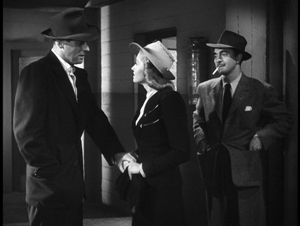
My own contribution was minimal, a talk on First-Phase Burt. The Brawny guys were well-suited to the trend toward hard-boiled movies, those crime pictures we later decided to call “noirs.” Those weren’t usually suitable for older players (though there were some makeovers, such as Dick Powell and Fred MacMurray). To fill these roles came Alan Ladd, Glenn Ford, Dana Andrews, and Richard Widmark, along with the beefcakes. At the same time, “independent” producers within the studios began contracting their own new talent and loaning it out. Burt was signed by Hal Wallis at Paramount, who also had Kirk Douglas, Wendell Corey, and Lizabeth Scott in his stable. Films like Desert Fury (1947) and Sorry, Wrong Number (1948) were Wallis package projects.
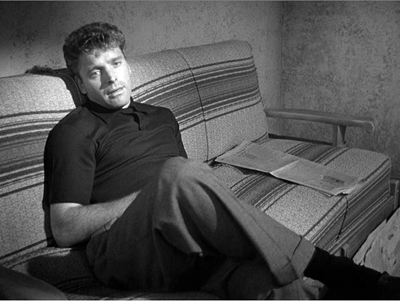
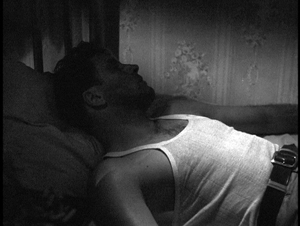
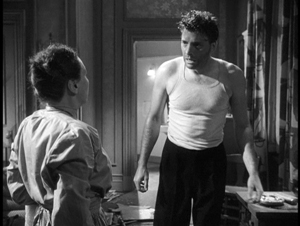
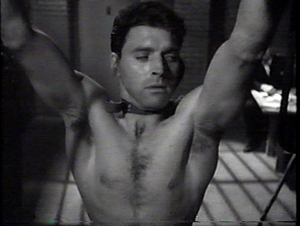
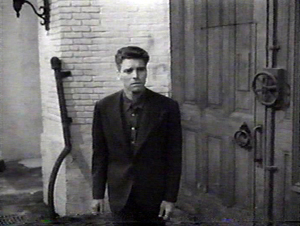
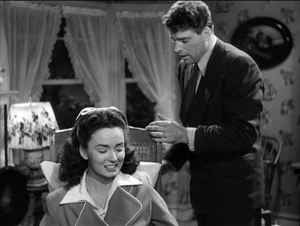
Hired straight from the stage with no film experience, Burt debuted as the Swede in The Killers (1946), on loanout to Mark Hellinger at Universal International. Burt benefited from a galvanizing entrance. Lying on a bed in the dark, refusing to flee the hitmen on his trail, Burt is a shadowed, curiously languid torso in a tight undershirt.
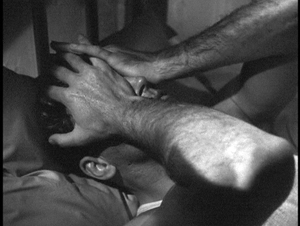
Only after a beat do we see something else: massive hands rubbing a weary head. Soon that head is revealed.
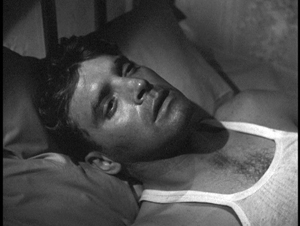
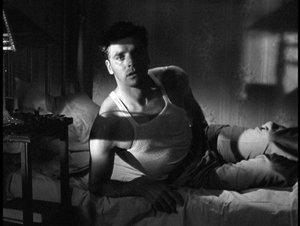
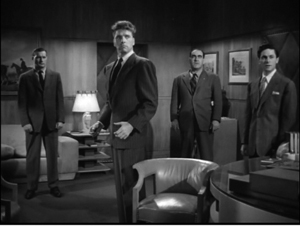
As the killers burst in, the whole image comes together.
Has a Hollywood beginner ever been given such a gift as this opening?
With this onscreen wattage, it’s all the more striking that this young discovery is curiously absent from his early films. He’s onscreen for only a third of The Killers’ running time, and not even half of Brute Force (1947) and Sorry, Wrong Number. The film Wallis wanted to be his debut, Desert Fury (1947), gives him only twenty-three minutes out of ninety, and in the second male lead at that. All My Sons (1948) puts him in an ensemble drama. I Walk Alone (1948), the Norma production Kiss the Blood Off My Hands (1948), and another Universal project, Criss Cross (1949) start to make him a proper, central protagonist. By then, he is ready to become the star attraction of the swashbuckling films.
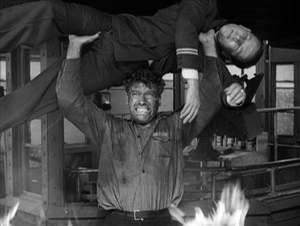
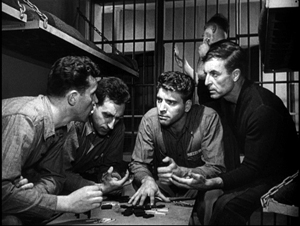
Moreover, in his early phase, he mostly plays losers. Not the brightest guy in the room, he’s easily suckered by a femme fatale in The Killers and Criss Cross. He makes amateurish mistakes at crime (Sorry, Wrong Number) and, coming out of prison, he is the last to realize the rackets have gone corporate (I Walk Alone). At the start of Kiss the Blood he punches a man too hard and kills him. He’s caught and whipped and imprisoned, and when he comes out he stumbles back into crime again. He’s shrewd enough to set up a prison break in Brute Force, but so doggedly determined is he to reunite with his girl on the outside that he launches a suicidal bloodbath.
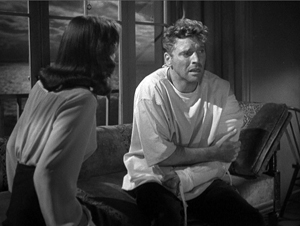
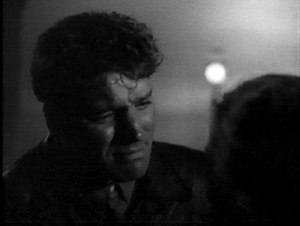
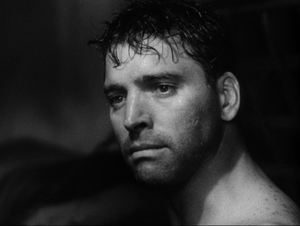
When he finally catches on to his fate, we get expressions ranging from stupefaction to anguish (The Killers, Criss Cross).
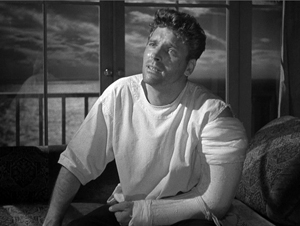
He even cries (All My Sons, Kiss the Blood).
Loser or winner, when he is onscreen, he has the outlandish physical presence of the born star. Most obvious is a physique (Kiss the Blood, Brute Force).
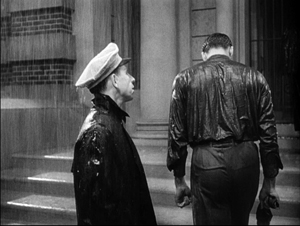
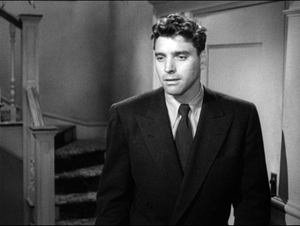
Even his back, featured with a prominence we get with few other actors, is straining against a drenched prison uniform (Brute Force) or a tailored suit (Criss Cross).
The face was a cameraman’s dream; it could be craggy or somber, thoughtful or tormented (The Killers, Brute Force x2, Criss Cross).
He can be stiff-armed and zombielike coming out of prison in Kiss the Blood, but he can also gamely cock his elbows, ready to spring, like Cagney and Cary Grant (I Walk Alone).
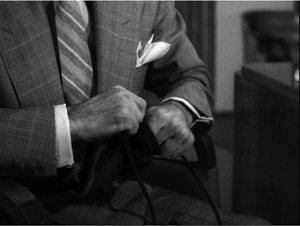
The enormous hands, which look likely to crush a skull (Criss Cross) or rip apart a phone cord (Sorry, Wrong Number), could be surprisingly delicate, tentatively touching his girlfriend’s wheelchair or laying down plans like playing cards (Brute Force).
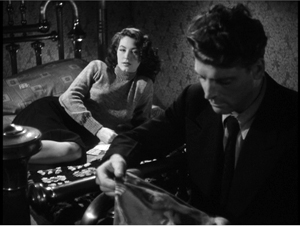
In The Killers he makes skillful use of those hands, pocketing his busted one or spreading out the scarf given him by the treacherous Kitty.
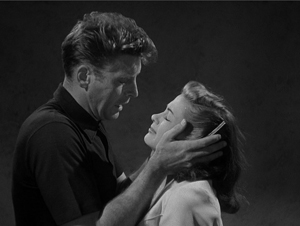
Easily taken in by Kitty’s plan, he seems to have a qualm when his gripping embrace relaxes and the fingers splay in hesitation.
This sort of handwork would become crucial, as Tom pointed out, to Burt’s performance style, particularly in The Birdman of Alcatraz.
“I’d never looked in eyes as chilling as Lancaster’s,” Norman Mailer once said. You can see what he meant.
Again, though, the actor is in control. Some years back I wrote that eyes by themselves aren’t very expressive: the eyelids, eyebrows, and mouth tell us more. I still think that’s right, but Burt manages to convey the sense of the beast at bay with remarkable control of just the eyeballs. He seems to be looking for an escape hatch without moving his head an inch.
While Burt was playing losers, his counterpart Kirk Douglas was often playing heels—cynical manipulators who stomp on everybody else, as in I Walk Alone. Sometimes Kirk learns his errors (Young Man with a Horn, 1950) but several roles of the period, in Out of the Past, Champion, and Ace in the Hole, make him a glib villain or tawdry antihero. Somewhat later Burt explored this characterization too, notably in Vera Cruz, Elmer Gantry, and The Rainmaker (1956). How did he shift from the beautiful loser to the fast-talking con artist?
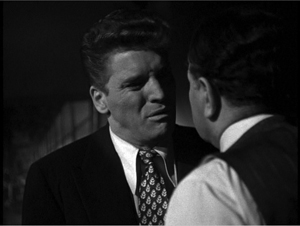
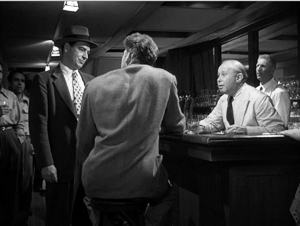
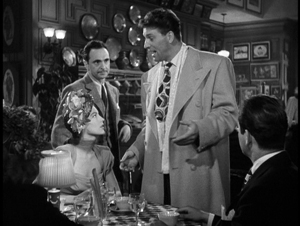
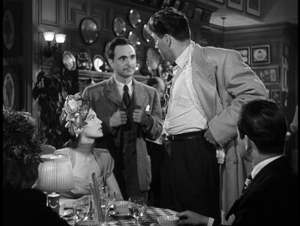
I think there are hints from the start. In The Killers, after he’s washed up as a fighter, the Swede goes in for street crime. When he confronts his old friend the cop, Lancaster brings those arms and hands into play. In his enormous unstructured topcoat, he lifts his fists up to his waist. It’s both the businessman’s getting-down-to-brass-tacks sweep, but also a kind of puffing up, exposing that massive frontal expanse. Little Sam Levene can grasp his lapels, but he doesn’t stand a chance against this.
Burt uses the same imperious gesture when, in Sorry, Wrong Number, he’s trying to bully a company employee into joining a crooked deal.
In these noir movies, his intimidation of others won’t put him ahead of the game. But perhaps these arm movements begin to sketch a more flamboyant loser like Gantry. By striking what actors used to call an “attitude,” Burt could start to build an entire character: a hell-for-leather charlatan.
Seeing the films, listening to Tom and Anke, and studying Lancaster’s work on my own brought home to me again the importance of the details of performance and the presence of a star. These movies would be utterly different if Mitchum or William Holden played the Burt parts. Our actors don’t wear masks or Hazmat suits. We’re powerfully affected by what they bring to the character in voice, body, face, and gesture—the expressive dimensions of cinematic presence.
BL/JLG/BF
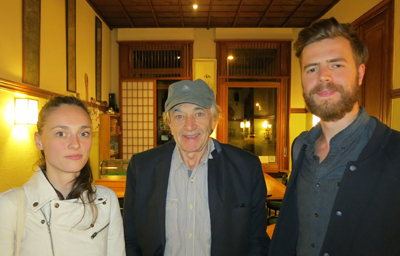
College coordinators Lisa Colpaert and Bart Versteirt, flanking Bill Forsyth.
What do Burt and JLG have in common? For one thing, some images from Criss Cross in Histoire(s) du cinema 1a (see above). For another, Bill Forsyth.
With the success of Gregory’s Girl (1981), Bill was invited by David Puttnam, then at Columbia, to make a Scottish movie with a couple of American actors. The result, Bill says, now looks to be a “soft-core environmental movie.” Local Hero (1983) remains much loved, and for good reason. It makes nearly all of today’s multiplex raunch look adolescent. It has a tone of civility, an embrace of eccentricity, and a genuine interest in people reminiscent of Ealing comedies. For me it’s a masterpiece of sweet, light-hearted art.
Local Hero feels loose and leisurely, but it’s actually a very economical movie. The first few minutes should be studied by screenwriters interested in tight exposition and fast attachment to a protagonist. It’s peppered with sidelights on its central drama, such as the Russian’s song about how “even the Lone Star State gets lonesome.” That neatly sums up the situation of the yuppie sad sack MacIntyre (“I’m more of a Telex man”) learning about village life. As usual, I was moved by Mark Knopfler’s plangent score, the electronic overtones meshing with the pulsations of the Northern Lights.
Burt’s role is that of CEO deus ex machina. Having assigned Mac to buy a Scottish seacoast town for an oil refinery, Mr. Happer eventually descends in his chopper and decides to establish a laboratory there instead. Burt’s crisp delivery and tight fingerwork are still on display at age seventy. The other actors don’t use their hands as much as he does–partly so they’re not distracting us from him, I suspect, but also because newer-style Hollywood acting doesn’t encourage it. In any case, as usual Burt uses his acrobat’s sense of physicality to intensify his performance. Even clasping his hands behind his back tells about the character’s authoritative dignity.
Bill learned that Burt regretted not doing more comedy, so he wrote the mogul’s part with him in mind. Burt signed on eagerly. He showed up on the set with a full beard, hoping Bill would let him keep it; they compromised on a mustache.
Bill had worked mainly with teenage actors on That Sinking Feeling (1979) and Gregory’s Girl, so Burt was really the first adult performer he ever directed. Across their three weeks together, Burt demanded nothing, except that he wanted to loop his dialogue. Bill preferred not to loop, and as it turned out only one scene needed to be rerecorded.
Burt and Bill skipped lunch in order to prepare the next scene, becoming “lunch bums.” Bill remembers Burt hanging out with the other actors and chatting with extras. He freely made fun of Bill’s accent: “”He speaks no known language.” He told Bill: “I don’t know what you’re saying, but I know what you mean.”
Bill talked as well about his own career. Starting out in the days before home video, he learned dialogue and pacing by audio taping classic films. (Sounds like a good idea to me.) He became a performer’s director. “The only thing I’ve ever said to a cameraman is: ‘Accommodate the actors.” He quoted Burt approvingly: “The space in front of the camera is the actor’s space.”
What’s the connection to JLG? It turns out that Godard was the director Bill most admired in his salad days. During the 60s he sated himself on art cinema, especially New Wave imports. When he saw Pierrot le fou, he left the theatre stunned. Godard became “the master. He still is, for me.”
Accordingly, Bill’s earliest cinema efforts were in an avant-garde vein. One piece, puckishly called Film Language, started with ten minutes of black leader while a text by Beckett was read out. Another, Waterloo, included a vast ten-minute shot in which the camera left one household, climbed into a car, rode a great distance, and ended up in another home. The film played at the Edinburgh film festival to an audience of 200. By the end three viewers were left. “I’d moved my first audience.”
Bill remarked that he sometimes regrets not sticking with experimental media. Today, he says, he might be a video-installation artist. A teasing idea. But we should be grateful that we got his features. I don’t know if Jean-Luc would agree, but I bet Burt would.
Thanks to Bart Versteirt, Lisa Colpaert, and their colleagues for a great week. Thanks as well to the participants, whose willingness to take on anything we threw at them was very encouraging. And a farewell to two friends who have projected films at every Summer Film College I’ve attended over the last sixteen years: Esther Dijkstra and Joost De Keijser. They have helped make the event the splendid enterprise it is.
Peter Bosma’s informative book Film Programming: Curating for Cinemas, Festivals, Archives is available here.
Of the big-ass explosion movies, only two items in this summer’s spate of them have intrigued me. I liked Mad Max: Fury Road well enough, but not as much as MM2 and 3. I look forward to Mission: Impossible—Rogue Nation, in a series for which I have much affection. As for the arthouse releases, the ones I’ve already seen are A Pigeon Sat… (good but not as sardonically bizarre as earlier Andersson, methinks) and About Elly. That one is a masterpiece.
I have stronger reasons than indifference for missing so much, and for tardy blogging besides. I’ve been on my annual trip to Belgium for research and lecturing in the Summer Film College. As a result, your recent movie experiences and mine have been divergent, perhaps even insurgent.
Apart from two screenings in the Brussels Cinematek’s Hou series (their restoration of Green, Green Grass of Home, gorgeous vintage print of City of Sadness), I spent the last four weeks watching 35mm prints of movies by Godard, movies starring Burt Lancaster, and assorted silent films from the 1910s and 1920s. I also re-met one of the most charming directors I know of, and in general had a hell of a time.
Today’s entry focuses on my archive work. Next up, a report on the Summer Film College.
Conrad’s many moods, mostly unhappy
Landstrasse und Grosstadt.
The archive stuff was recherché. I’ve been trying to see as many 1910s and early 1920s features as I could, but this time around I didn’t catch anything as mind-bending as Jasset’s Au pays de ténébres (1911) or Doktor Satansohn (1916) or Fabiola(1919) or I.N.R.I(1920), encountered on earlier visits to the Cinematek. I did get further confirmation that in Germany the “tableau style” exploited so vigorously in Europe and somewhat in America in the 1910s, was pretty much replaced by Hollywood-style editing by 1920. And I got some welcome doses of Conrad Veidt, another favorite in this vicinity.
In Die Liebschaften des Hektor Dalmore (“The Liaisons of Hektor Dalmore,” 1921), Veidt plays a callous playboy who keeps on retainer a man who looks very much like him. It’s a lifestyle choice. When a compromised woman’s father demands that Hektor do the right thing, he sends out his double to marry her. Surprisingly, the double isn’t rendered through trick photography. Richard Oswald, always a fast man with a gimmick, found a pretty good Veidt lookalike, which can’t be easy to do.
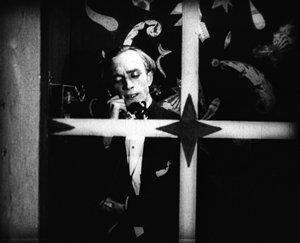
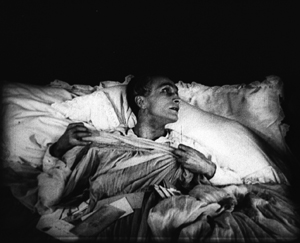
The hero’s Casanova complex carries him from dalliance to dalliance, and as you’d expect in a twins situation, there are confusions between the real and the fake Hektor. Fights and abductions liven things up. The climax is a duel in which the real Hektor, overconfident, learns to his grief that an outraged husband is a better marksman. The scene is handled through brisk shot and reverse-shot, garnished with an over-the-shoulder shot as Hektor aims his pistol. And there are dashes of mildly Expressionist set design (furnished by Hans Dreier). Veidt in a phone booth does the décor proud. But he doesn’t need fancy sets to project a feeling: on his deathbed, his expression and his clutching fingers show a man bereft of erotic illusions.
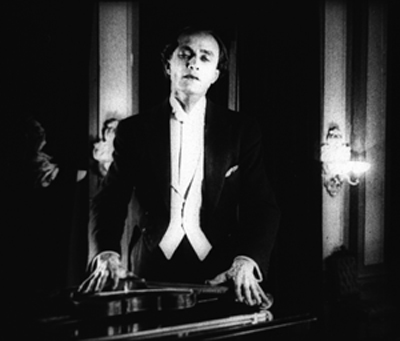
The other Veidt vehicle lacked doubles but not ambition. Landstrasse und Grosstadt (“Village and City,” 1921) casts him as Raphael, a wandering violinist who teams up with Migal, an organ grinder. They become a popular act in the big city, and as Raphael’s playing improves, Migal becomes his manager. Nadia, a woman who joins them, falls for Raphael and shares his success. But in an accident he suffers a hand wound and his career slumps. Migal sees his chance to move in on Nadia. Perhaps this shot gives you a hint of his designs.
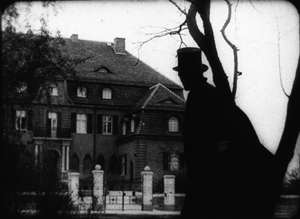
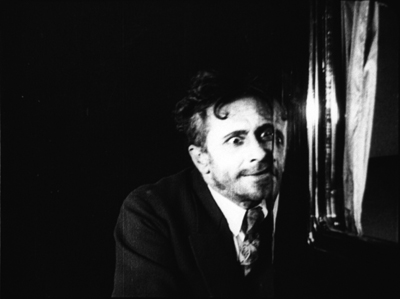
Actually, most of Landstrasse and Grosstadt isn’t as hammy as this. A very nice shot shows Raphael in silhouette approaching a mansion to hear his rival Cerlutti give a salon concert. And of course Conrad gives the blind violinist a delicate, spectral pathos, as shown above.
Artificial man lurks in the shadows, destroys humanity
Sappho.
All the films I saw broke down scenes into many close shots, reminding us that Caligari (released 1920) probably wasn’t typical of German staging or cutting of that moment. It now seems to me almost consciously anachronistic, rejecting the reverse angles and precise scene breakdown that were becoming common. In Die Ehe der Fürstin Demidoff (“The Marriage of Fürstin Demidoff,” 1921), when a governess drags a recalcitrant girl back to her bedroom, the action is split up into four shots, all of different scales from close-up to long-shot.
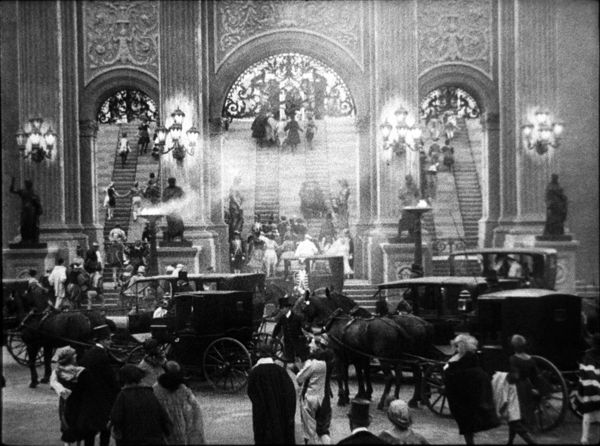
Although I saw a fragmentary print of Sappho (1921), it’s clear that in parts it has the audacious monumentality of a Joe May production. The most staggering shot is that of the Opera surmounting today’s entry, but there’s no shortage of striking images. Above I include a shot of a madman that, thanks to window reflections, suggests his split-up psyche.
Sappho also doesn’t shirk editing effects either. During a frantic automobile ride, there are glimpses of hands on a steering wheel, a foot on brakes, panicked passengers, and POV shots through the windshield. Forty-nine shots rush by in a flurry, anticipating similar sequences in French Impressionist films like L’Inhumaine (1924). Feuillade was experimenting with rapid cutting of action at about the same time.
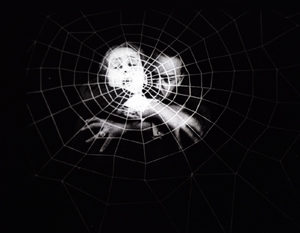
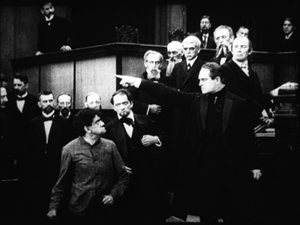
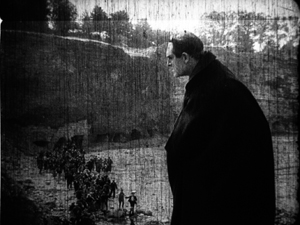
The most impressive, and nutty, film in this batch came from Homunculus, the largely lost German serial released through 1916 and into early 1917. The script was written by one of the blog’s favorite peculiar directors, Robert Reinert. The plot involves an artifical man created in the lab, à la Frankenstein’s monster. He’s a superman, in both strength and ambitions. The only surviving episode of the serial is Die Rache des Homunculus (“The Revenge of Homunculus,” 1916). (But see the codicil.) In this installment, posing as Professor Ortmann, Homunculus decides to drive humanity to destroy itself. He assumes a disguise to rouse the rabble, even inducing them to turn against himself in his Ortmann guise.
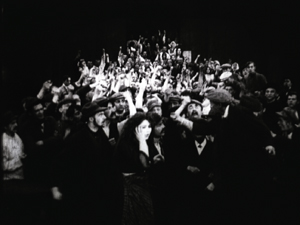
As in Expressionist drama, this overachiever is pitted against a crowd that, in the end, pursues him maniacally.
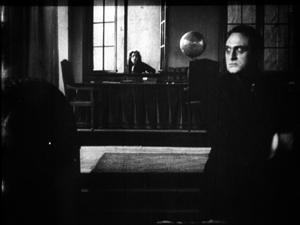
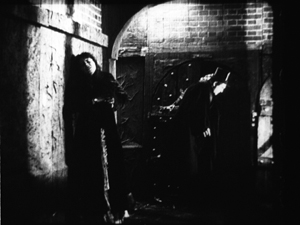
Director Otto Rippert gives us splendid mass effects in a quarry and along a beach, but there are also deep tableau images and sustained chiaroscuro, particularly in a showing the heroine Margot shrinking from Homunculus as he locks his rival in a dungeon.
Fans of Metropolis will notice that Rippert anticipates Lang’s unison choreography of crowds, as well suggesting that mob frenzy can create a sort of ecstasy in the woman who’s swept along.
In her book The Haunted Screen Lotte Eisner traces the films’ mass spectacle back to the stage work of Max Reinhardt and other theatre directors of the era. On the basis of this episode alone, Homunculus ranks with Algol and May’s Herrin der Welt as an example of big-scale fantasy in German silent cinema. Who needs Ant-Man when we have Homunculus?
Next time: Burt and Jean-Luc, together again for almost the first time.
Thanks to Nicola Mazzanti, Francis Malfliet, Bruno Mestdagh, and Vico de Vocht for their assistance during my visit to the Cinematek.
Kristin analyzes stylistic conventions of German cinema of this period in her Herr Lubitsch Goes to Hollywood (available for download here). She’s written on Caligarihere and here.
On Homunculus, Leonardo Querisima offers a wide-ranging discussion in “Homunculus: A Project for a Modern Cinema,” in A Second Life: German Cinema’s First Decades, ed. Thomas Elsaesser and Michael Weidel, pp. 160-167. Substantial excerpts can be found here.
Munich archivist Stefan Drössler has recovered a mass of Homunculus footage and has assembled a version of the serial, which premiered last year in Bonn. Nitrateville has the story.
The Brussels Cinematek will release its Hou restorations on DVD early next year: Cute Girl, The Boys from Fengkui, and Green, Green Grass of Home. As a reminder, my video lecture on Hou is here.
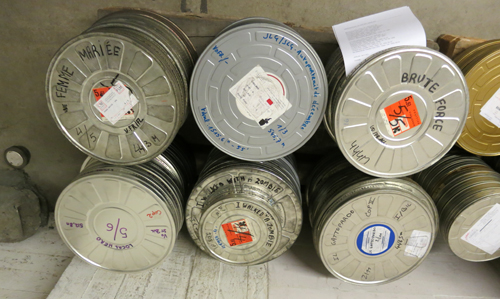
The still below, taken as the prints were readied for the Summer Film College, points ahead to our next entry–number 701, as it turns out.
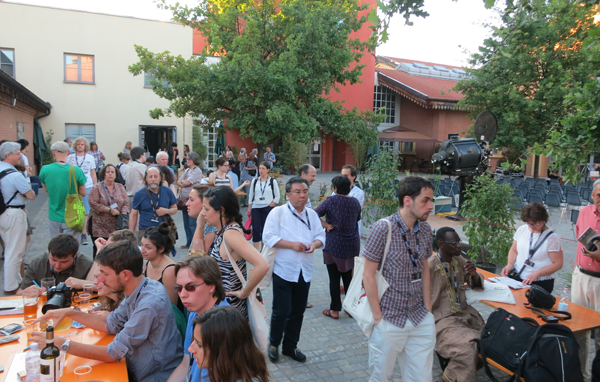
The courtyard outside the Cineteca di Bologna, during Il Cinema Ritrovato.
DB here:
Some initial figures are in, and they’re fairly stupendous.
There were about 85,000 admissions to all screenings of this year’s Cinema Ritrovato, which ended ten days ago. That figure includes the big public shows on the Piazza Maggiore, but the day-in, day-out screenings were heavily attended as well. There were 2500 or so festival passes sold. Assuming that those people stayed for four of the festival’s eight days and attended four shows a day, we can surmise that at a minimum 40,000 of overall admissions came from dedicated cinephiles surging from venue to venue. And of course many passholders stayed seven or eight days and squeezed in more than four viewings on each one.
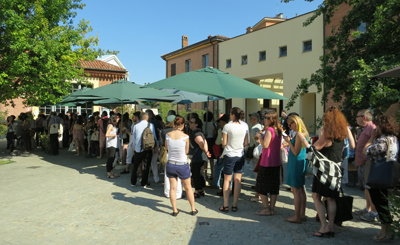
Broiling heat—one day approached 100 degrees Fahrenheit—didn’t seem to keep many away from the films, panels, book talks, and other events that crowded the schedule. Between 9 AM and 1 PM, each two-hour block offered six to eight choices, and the afternoon blocks, running from 2:30 to about 8 PM offered even more. Now that the festival has another space, a nearby university auditorium fitted for DCP projection, a whole new column of events was slotted in. Below, a bit of the queue for the Isabella Rossellini interview in the auditorium.
Next year, planners are hoping to add screenings at a renovated 100-year-old theatre on the Maggiore. There seems no doubt that the Cannes of Classic Cinema will get even bigger.
For the first time, I felt the pace was a bit rushed. Getting together with old friends was somewhat harder than before, unless you came a day or so early. (Even then, there were tempting Maggiore evening shows.) But the atmosphere was still easygoing. The courtyard of the Cineteca was an island of steamy relaxation, boasting more tables than in past years. The tent cafe provided snacks and drinks for those who simply decided not to be obsessive. Even I stopped and sat down, twice.
Word is out. A new wave of young film lovers has discovered Ritrovato. What had been dominated by hip (or hip-replaced) baby boomers was now teeming with students. The festival has added a Kids section and another devoted to older teens, and it was a pleasure to see them winding through the corridors of the Cineteca. The World Press has finally woken up too. The Guardian ran a rapturous encomium. Loyal blog sites such as Photogénie provided extensive coverage.
Just speaking for us, this was the first year Kristin and I had almost no time to blog during the event. Hence this, the last of our catch-up entries. (Click back for the earlier ones.) And I will leave out a lot.
All in favor of film, raise your hands
Has everything been said about digital cinema and its differences from photochemical cinema? Maybe so. Nonetheless, the two panels I visited on the subject raised a lot of intriguing points, in quite different formats.
The first session compared 35mm prints with digital restorations. Through clever maneuvering, the Ritrovato boffins were able to switch back and forth between versions as both were running, and the results were pretty compelling. Schawn Belston of Twentieth Century Fox provided a sample of Warlock, a twenty-year old print. It was contrasty but had saturated color; this was the sort of image I remember seeing in theatres. The digital restoration, a work in progress, was paler, with sharper edges, more solid-black shadows, and a more pastel color design. Pretty Poison was a much newer print, on Vision stock, and looked fine, as did the DCP.
Grover Crisp of Sony brought a Kubrick-approved print of Dr. Strangelove, considered best-quality in 1990s. He ran it in tandem with the recent 4K restoration managed by Cineric. The difference was very striking. For black-and-white, at least, the DCP seemed to me to have all the better of it. Kubrick, a major otaku on matters photographic, would I think have approved.
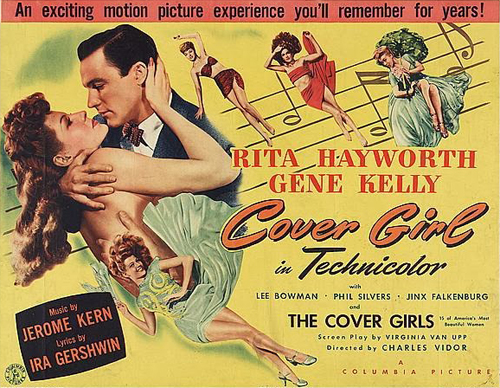
Further proof of the Crisp-Sony finesse was available in the utterly dazzling DCP we saw of Cover Girl (1944) on the big Arlecchino screen. I was surprised to find some of my circle disdaining this movie, but I think it’s wonderful. It seems to me a rough draft for many of Gene Kelly’s MGM pictures, from the trio boy-girl-stooge we get in Singin’ in the Rain (with Phil Silvers as Donald O’Connor) to the mind-bending doppelganger dance that looks forward to Anchors Aweigh and Jerry the Mouse. I also like the clever motifs of feet and faces, and the flashbacks, and …well, I must stop, because I expect to use Cover Girl as a major example in my still-unfinished book on Hollywood in the 1940s. Suffice it to say that I have never seen a better DCP rendering of Technicolor than was on display in Grover’s new edition.
Davide Pozzi rounded out the session with a pairwise comparison of different versions of Rocco and His Brothers. A vintage print from the camera negative had been vinegared, so the shots had rippling focus; the DCP restoration was fairly sharp and bright. This was a real work of reclamation.
The panelists agreed on a lot. Don’t try to banish grain; film is grainy. Don’t expect to match everything. No two prints ever looked alike anyhow, and variations among screens, lamps, and other exhibition factors don’t let us capture a pristine original experience. Because of the advances of digital restoration, there are new frustrations. Archivists are aware that older restorations may not look good today, while cinephiles who forgive scratches on “vintage” 35mm copies howl if a restoration doesn’t look smooth as silk.
Film has many futures. Pick one.
Serge Bromberg introducing the Lobster Films anniversary program, which included several “faux Lumières.”
Another panel, “The Future of Film” (let’s ban this as a title, shall we?), was less focused but more provocative. No fewer than fifteen critics, archivists, manufacturers, and filmmakers gathered before a standing-room crowd to discuss the prospects for the photochemical medium formerly known as film.
The panel’s speakers worked in shifts, three at a time. Everybody was lucid and brief. Some general points:
On the manufacturing front, Kodak and Orwo are committed to producing motion-picture stock. Christian Richter of Kodak noted that in 2006 his firm produced 11.8 billion feet of motion-picture film, while last year it produced only 450 million feet. The demand may be plateauing, but it’s too soon to be sure. The crucial problem may be the absence of labs, although boutique labs are starting to appear.
Some filmmakers, such as Gabe Klinger, consider film an essential part of their aesthetic. Alexander Payne prefers to shoot on film, but more important is film projection. He restated his view that “flicker will always be superior to glow.” By contrast, archivist Grover Crisp proposed that the standard of film projection had sunk so low that he prefers to see digital presentations, although those too can be substandard.
Some archives are preserving on film recent movies, including those shot digitally. Sony does, as does the CNC. Eric Le Roy reported that all French films receiving subsidy must deposit a print and the negative there, even if the project originated digitally. Mike Pogorzelski of the Academy archive spoke of the ongoing “Film to Film” effort, begun in 2012.
More generally, two archivists argued that the future of film lay in museums. José Manuel Costa of the Portuguese film archive argued that the basic principle had to be a respect for the nature of the medium. Cinema has changed, but it has existed in a specific technological environment since the nineteenth century, and it’s the mission of a film museum to retain that technology as long as possible. Accordingly, a film should be shown in the format in which it was made.
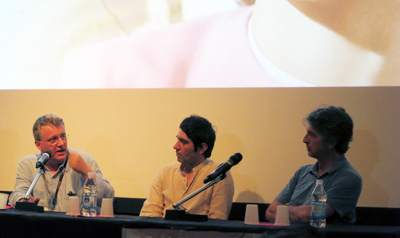
Belgian film archivist Nicola Mazzanti (on left above, with Pietro Marcello and Alexander Payne) seemed in accord. He remarked, in the wake of the earlier session, that digital treatment, or film restoration generally, can’t duplicate tinting, toning, stencil color, Technicolor, and other older processes. The originals are what they are—imperfect—but that imperfection is inherent in their material history. More acutely, the world outside the archive is entirely digital, so it will be a big task to keep analog alive. It will take money. And no European archive’s budget equals the cost of a single season of La Scala.
Scott Foundas, who chaired the sessions with easy good humor, indicated that perhaps the state of play was this. Digital capture and storage would not wholly replace film. By now film is recognized as distinct and worth its own attention. It’s going to exist alongside digital media for some time to come, although in niches and in more rarefied forms than before; like vinyl records.
Bologna, it became clear, is one of those places where film will continue to flourish. Fifty percent of screenings this year were analog, and the programmers included showings of Vertigo, The Heroes of Telemark, All That Heaven Allows, and other titles on “vintage” prints from earlier eras. Audiences packed in to see them and cheered.
What they saw, we must see
With all the talk of film’s enduring powers, two screenings reminded me of the power of photochemical recording as a record of history, both en masse and individual.
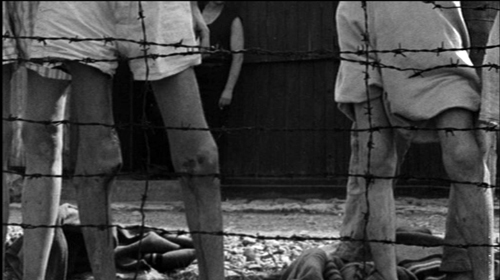
German Concentration Camps Factual Survey was overseen by Sidney Bernstein and involved several skilled filmmakers, including Hitchcock. It was designed to be shown to the German people as a record of what they had ignored over the last dozen years. But it remained unfinished when it was shelved in 1945.
In recent years the surviving reels have been shown occasionally under the title Memory of the Camps. In 2008 several staff at London’s Imperial War Museum began to restore the original and fill out the final reel. The filmmakers added a new recording of the original commentary, previously not attached to the footage.
Friends of Andy Warhol often commented that he used his ever-present Polaroid to keep his distance from his surroundings. You wonder if a similar strategy didn’t insulate, to some minimal degree, the American, British, and Russian cameramen who filmed the liberation of the camps. Their images show shriveled corpses covering the ground, flung into pits, shoveled into heaps. Spindly survivors move like ghostly marionettes. When I saw the first images of the bland camp officials smoking and chatting under guard, I immediately wondered: What self-control it must have taken not to have killed these men on sight.
The film is structured as a sort of anti-Grand Tour, starting in Bergen-Belsen, where SS officers seem genuinely annoyed at being forced to clear out the dead. The film moves eastward, guiding us by maps, to end in the abandoned Nazi extermination camps built in German-occupied Poland. Here shoe brushes, spectacles, and children’s toys fill warehouses. The names of German companies proudly adorn ovens.
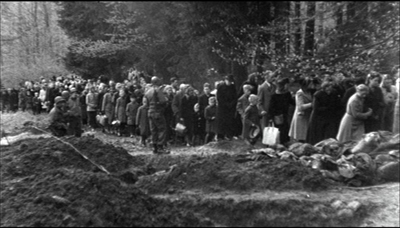
One of the film’s main points, apparently suggested by Hitchcock, is the fact that the camps existed very close to population centers. Did the people celebrating Oktoberfest in Munich ever think of Dachau, half an hour away by train? Did the people breathing the mountain air of Ebensee spare a thought for the camp nearby? Arriving Allies insisted that people from surrounding towns be brought to witness what they had ignored. In the footage, men, women, and children file by the carnage.
Some seem moved, but eerie shots show town elders standing stiff and impassive before heaps of bodies.
Toby Haggith, one of the film’s restorers, was on hand for a follow-up session, something really demanded by the intensity of the experience. He answered questions with great seriousness and eloquence. He explained that the restoration team had decided to leave in the film’s original errors, based on contemporary reports of the size or uses of certain camps, as well as the film’s avoidance of focusing on Jewish victims. The film stresses the Nazis’ crimes against humanity at large, an emphasis, as Haggith pointed out, in tune with the United Nations initiative of the moment. “The very historicity of the film is what seizes us.”
Godard has suggested that there must be footage of the day-to-day running of the camps. Would the society that devised Agfa film and Arriflex cameras have failed to document the industrial-scale slaughter of which the Reich was so proud? Were there no amateur cineastes among the SS-men leading comfortable lives in their cottages? Was there no Leni Riefenstahl to cheerfully lend credibility to these charnel houses? Even if such footage exists, German Concentration Camps Factual Survey will serve as an unforgettable reminder that humans have a terrifying gift for brutality, and for ignoring horrors enacted right beside them.
Many doubts, much faith
Visita ou Memórias e Confissões.
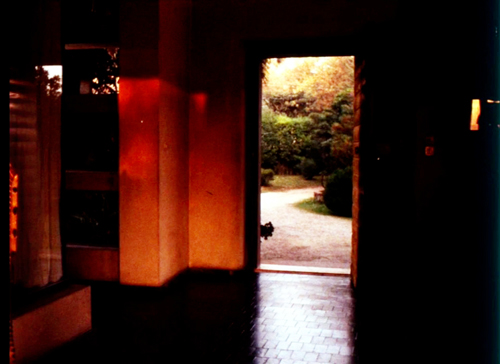
In 1982, financial setbacks forced the Portuguese director Manoel de Oliveira to sell the house he had lived in for forty years. Before leaving, he decided to record his affection for the place. The result, Visita ou Memórias e Confissões was the quietest film I saw at Ritrovato. It was also one of the best.
We start at the gateway, coming in as if guests. But who owns the voices we hear? The murmuring man and woman who seem to be our surrogates passing along the path? We never see them as they enter the magnificently curvilinear house. But is it right to say they? Although we hear two voices, we hear only one person’s footsteps. The somewhat whimsical uncertainty that haunts so many Oliveira films is summoned up here by the simplest of means.
Eventually Oliveira greets us, standing in his study before his typewriter, and he explains some of the house’s history. He also runs some footage on a 16mm projector that coaxes him into discussing death, women, virginity, and sanctity. “I’m a man of many doubts and much faith.” Occasionally we hear the couple whispering as we coast past art objects and family pictures.
Oliveira tells us of his 1963 arrest while making Rite of Spring and his 1974 conflict with workers in his family’s factory—a tumultuous event that, we learn rather late, is the cause of his financial distress. These revelations come in the midst of a fascinating account of his family, accompanied by a tribute to his wife, to whom the film is dedicated. Individual history and social history blend in his recollections and the flow of visual memorabilia.
The spectral visitors glide out with us, and the film that Oliveira has been showing halts, leaving us a blaring white frame. According to his wishes, Visita wasn’t shown until after his death. Perhaps in 1982 he expected that event to come rather soon; he was seventy-three, after all.
He couldn’t have known, surely, that he would live another thirty-three years and make twenty-four more films. As José Manuel Costa pointed out, the great director wanted the film to be shown posthumously not as a final boast, but rather a wry, modest memoir of an exceptionally full life. By turns ironic and confessional, Oliveira’s testament demonstrates that we can be moved by a soft-spoken, patient peeling back of layers of the past.
Of course it was shown on film.
Kristin and I thank the many staff members who make Ritrovato such a wonderful experience. Special thanks to Gian Luca Farinelli, Guy Borlée, and Cecilia Cenciarelli. We are particularly grateful to Marcella Natale for her many moments of assistance, including giving us preliminary attendance figures.
German Concentration Camps Factual Survey will play several film festivals and public venues during the rest of the year and will eventually be distributed on DVD. Night Will Fall (2014), André Singer’s documentary on the making and restoration of the original film, is already available.
P.S. 31 July: Danny Kasman has an illuminating interview with Toby Haggith on the Factual Survey, along with important background information, at Cineaste.







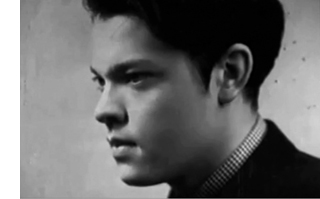 If you’re teaching Citizen Kane or any other film by Orson Welles (right, very young), your students might be interested in learning some background on the director. See our Local Boy Makes Very, Very Good: Welles comes home.