by Kristin Thompson. Berkeley: University of California
Press, 2007.
400 pages, 6 × 9 inches, 12 color illustrations;
36 b/w illustrations.
[go
to Amazon | go to The Frodo Franchise blog]
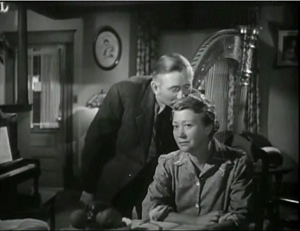
“It can only be fully recommended to those who have a deep and morbid interest in crime.” Snooty judgments like this made Bosley Crowther the critical joke of generations. Today film lovers wear their deep and morbid interest in crime as a badge of honor. Especially when the crime is covered by Anthony Mann.
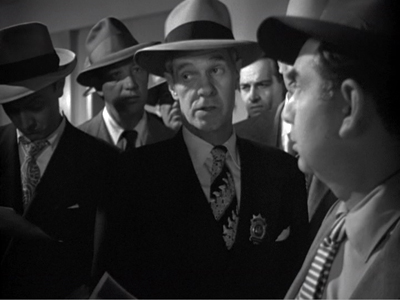
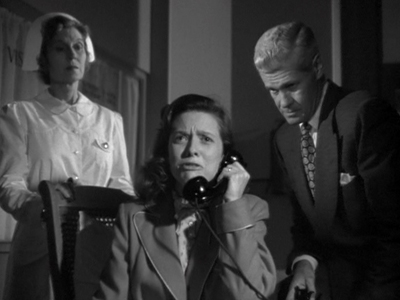
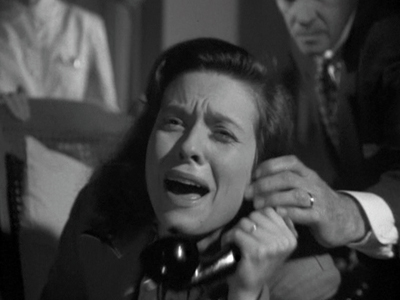
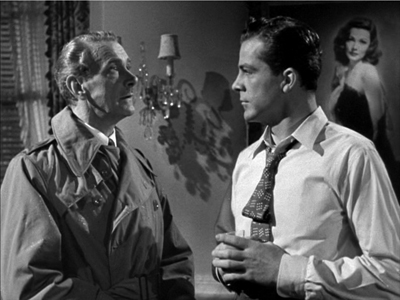
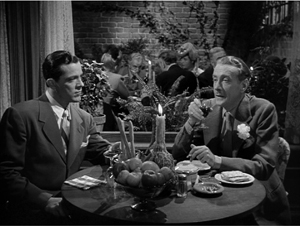
In Side Street (1949), Joe Norson has lost his business and works part-time as a postman while he and his wife await their first child. Having come back from war and wanting to give Ellen a good life, Joe is tempted to steal money he’s seen lying around the office of a crooked attorney. He grabs a folder containing what he thinks is a couple of hundred dollars; instead, it holds $30,000 of blackmail money. The woman who chiseled the money out of a businessman turns up dead, and the police are investigating. When Joe naively loses the money and sets out to recover it, he’s drawn into the murder, tracked by the gang, and targeted as a prime suspect by the police.
Variety and Crowther chided the screenwriters for a sketchy plot, and the complaint is somewhat fair. Joe is an unusually weak protagonist. He botches both his theft and his cover-up, leaving a trail that’s easy for the killer and the cops to trace. Because Joe is fairly passive and on the run, and he has to follow his clues in a fairly linear manner, and his schemes to fight back come to almost nothing, the action is filled out by scenes of the gang and the police tracking him.
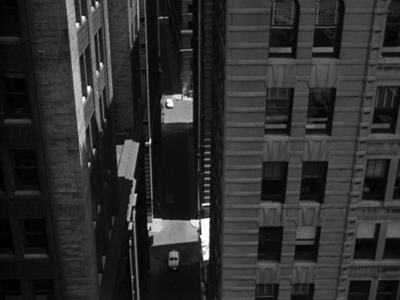
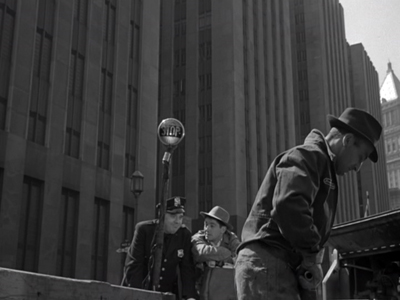
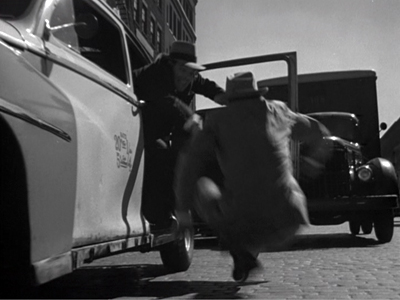
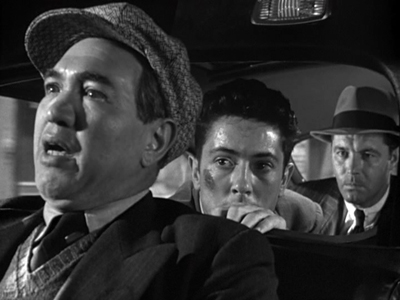
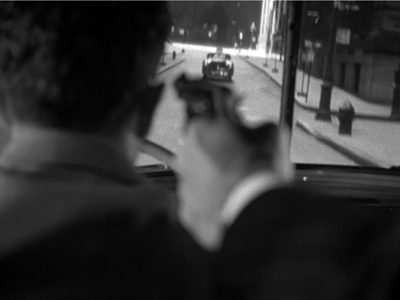
What partly compensates for the plot’s problems is the bold location shooting. As part of the semi-documentary trend of the period (the film opens and closes with worldly-wise voice-over narration from the Homicide Captain), Side Street presents itself as a story rooted in urban reality. And indeed it is a triumph of location shooting. The characters visit a bank, Greenwich Village, Bellevue Hospital, and many neighborhoods. The final chase, with Joe trapped in a taxi with the killer and pursued by three cop cars, is a tour de force of geometrical shot designs that make city canyons part of the drama.
Mann has long been praised for integrating the forces of nature into the action of his Westerns, but this film shows his flair for cityscapes too.
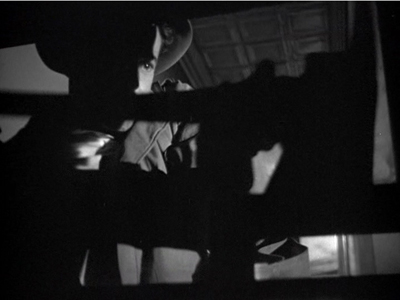
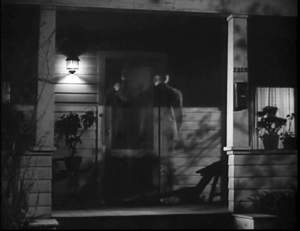
Given the constraints of location filming, the freedom of Mann’s camera is all the more arresting. This time he’s not working with John Alton, the cinematographer most in tune with his baroque sense of light and framing. But Mann still gets punchy results from ace DP Joseph Ruttenberg. There is nothing quite so staggering as Alton’s framing of Claire Trevor and the cabin clock in Raw Deal, let alone the Grand Guignol imagery of Reign of Terror, but Ruttenberg does give us plenty of nicely dense compositions, exploiting the verticals and apertures available on location. There’s also a neatly discreet shot of a revolver peeking out from behind a door in distant long-shot; the shadow supplies the telltale shape.
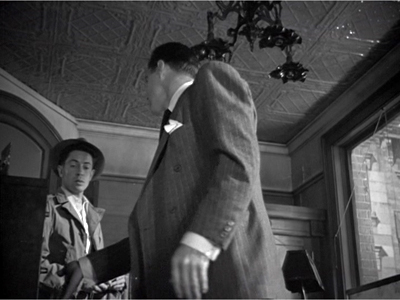
Mann is a post-Kane filmmaker. Like nearly every Forties director of dramas, he learned from Toland and Welles that it’s fun to shove the action into the viewer’s face. The high angles of the city are counterbalanced by steep, low setups both inside and outside. Mann never met a “Russian angle,” or a ceiling, he didn’t like.
When the lens is more or less straight on, the frame can be tight and actors’ heads are packed into the frame like cantaloupes in a supermarket display.
In motion, the camera isn’t safe. Actors rush past the lens or thrust themselves straight at it.
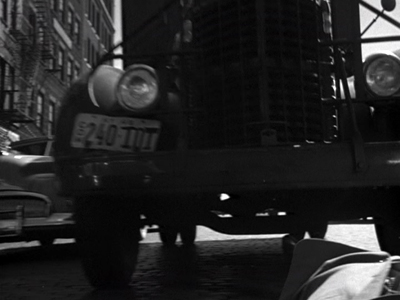
When Joe flings himself out of a car, prepare to find yourself in the middle of traffic, with a truck rushing at you (a stunt done in real space, not against a back-projection).
Yet even studio-shot back-projections retain vigorous, immersive depth.
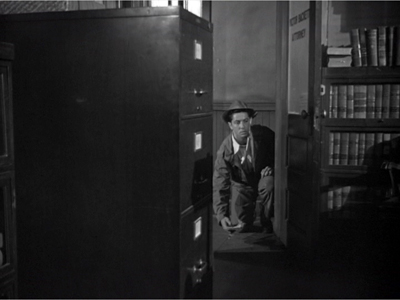
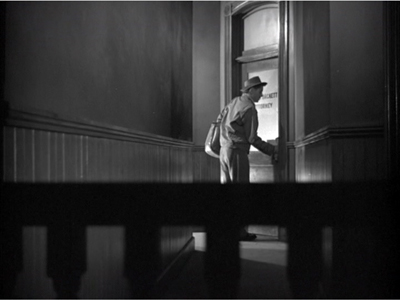
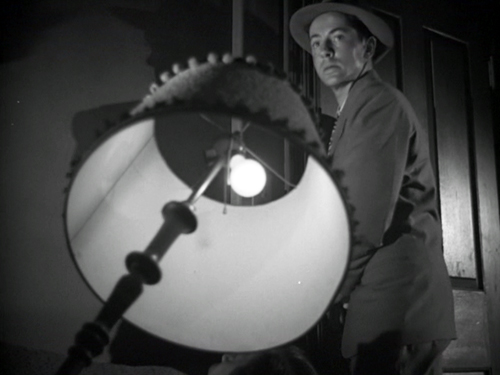
Mann’s visual dynamism, complete with aggressive foreground and distant depth, hits a high point in the dialogue-free scene that’s the topic of today’s sermonette. Joe hasn’t planned to steal the money, but circumstances lure him on. The lawyer’s out of his office, and the door has been left ajar. Joe earlier saw the money put into a file drawer, and as Joe prepares to slide the mail under the door, the cabinet stands temptingly in the foreground.
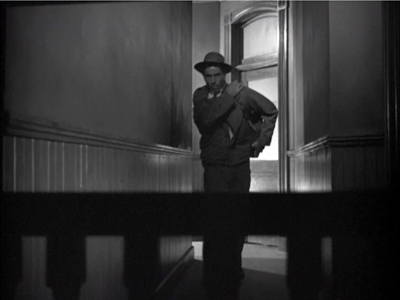
He impulsively heads for the cabinet, pauses before it, and then—thanks to an abrasive cut—grabs the handle violently. The drawer is locked. He recovers himself, almost grateful that he’s blocked, and he lurches out the door. No theft today, apparently.
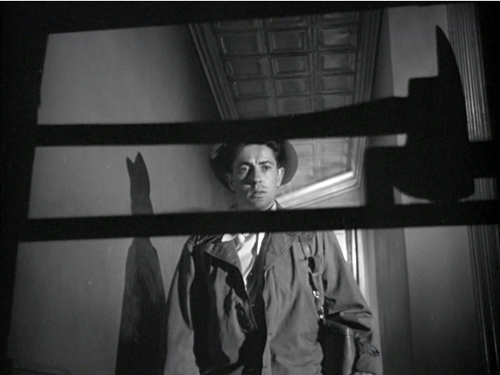
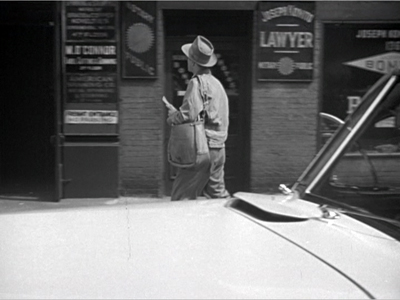
Outside, Joe seems to be going on his way, but the long shot shows a barrier, like a railing in the foreground. It seems about as innocuous as the car hood we saw when Joe went in the building.
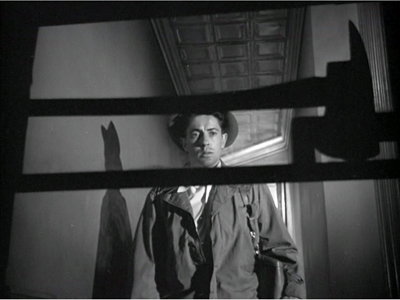
As Joe approaches, the camera tilts up to follow him and he stops, staring. He’s framed before what’s now revealed as a fire axe.
Another director—Hitchcock, perhaps—would have handled this with a medium-shot of Joe leaving and looking off, followed by an optical POV shot of the axe. Or you could show him leaving in the foreground, with the axe mounted in the distance; he glances back, sees it, and decides to go fetch it.
By contrast, Mann’s approach yields a sharp one-two snap: Joe approaches/ he stops. We see the axe, but almost by accident; the reframing is just following Joe’s movement. And we don’t need to see any more of the thing but its distinctive shape—its pure axe-ness given in silhouette. Rudolf Arnheim, who always advocated pictorial simplicity, would be pleased.
After a beat, in an abrupt cut, Joe grabs the thing.
He lunges down the corridor back to the office and starts to break into the cabinet. Now his violent adventure begins.
Crime I’m not so sure of, but with bodacious filmmaking like this, who wouldn’t acquire a deep and morbid interest in cinema?
Bosley Crowther’s review of Side Street is “The Screen: New Crime Story,” New York Times (24 March 1950), p. 29.The Variety reviews, more or less identical, are in Daily Variety (22 December 1949), p. 3, and Variety (28 December 1949), p. 6. The Times covers the shooting of the climactic chase in “Taxi Acrobatics in Wall Street” (8 May 1949), X5.
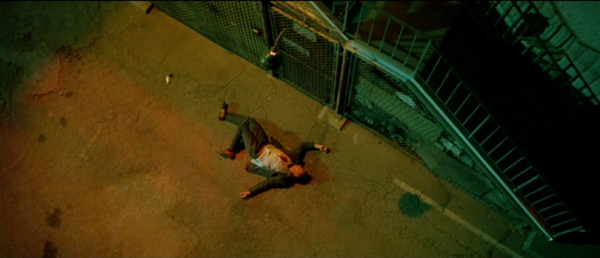
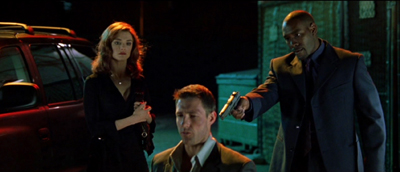
At the start of Confidence we hear Jake Vig’s voice as we see him lying bloodied on a pavement. As the protagonist of a neo-noir, Jake recalls the classic start of Billy Wilder’s Sunset Boulevard (1950). There Joe Gillis (an echo of gigolo?), floating face-down in a swimming pool, begins to recount his stay as a kept man of faded film star Norma Desmond. That opening has become a touchstone for the grim fatalism of film noir, as well as a mark of daring screenwriting. The guy telling the story is dead! How cool is that?
Anybody interested in how films tell stories has to be interested in narrators, those figures—either mere voices or tangible characters—who recount, recall, or replay the story action. And anybody interested in Hollywood film knows that such narrators are hallmarks of a giddy period of cinematic innovation, as recognizably “1940s” as flashbacks, moody subjective sequences, and twisty plots. In that era we find narrators well outside that terrain known as noir. Romantic dramas, family sagas, comedies, Gothics, musicals, and other genres made ample use of voice-over commentary, and it didn’t always suggest a doom-laden atmosphere.
Still, dead narrators seem to be pushing things. They flout realism (How can a dead person tell anything?) and they raise problems of logic (To whom is this person speaking?). Is it a chatty corpse (Wilder originally wanted a morgue opening introducing Gillis) or an ethereal spirit divorced from the dead body?
Dead narrators turn up surprisingly often in the 1940s. During this period, as I’ve argued on this site and in the book I’m working on, many storytelling techniques we take for granted coalesced. There emerged a rough menu for handling them, and ambitious filmmakers played with several possibilities. That play didn’t stop in the Forties; we still have new versions of flashbacks, subjectivity, and the like. So let’s look at posthumous narrators in the Forties, with some glances at a trio of more recent efforts.
As a non-dead and highly reliable narrator, I must warn you of spoilers ahead.
Guiding spirits
The Human Comedy (1943).
Most simply, posthumous narration can be motivated as letters (Letter from an Unknown Woman) or diary entries (Thatcher’s journal in Citizen Kane). Similarly, Heaven Can Wait (1943) gives us a dead man explaining episodes from his life to an inquisitive official in the afterlife. The more flagrant cases, however, involve dead narrators who recount the entire film we see in voice-over, as in our prototype Sunset Boulevard. Knowing that the protagonist is dead at the start shifts our attention to how he or she will die.
Posthumous narrators go back a fair bit. In literature, Edgar Lee Masters’ Spoon River Anthology (1915) presents the ruminations of the town dead, in the manner of the cemetery climax of Our Town (1938 play, 1940 film). Wilfred Owen’s poetic monologue “Strange Meeting” (1918) presents soldiers reuniting in Hell, ending with the poignant line, “Let us sleep now….” Addie Bundren, the dead mother of Faulkner’s As I Lay Dying (1930), narrates portions of the novel from her coffin. In a pulpish pastiche of Faulkner, Kenneth Fearing’s mystery novel Dagger of the Mind (1941) includes a chapter narrated by a man who’s been murdered. Radio drama also included voices from the beyond. Examples include “Ghost Ship” (1940), with a victim recounting his own murder, and Norman Corwin’s “Untitled” (1944), which reveals the narrator to be a dead soldier.
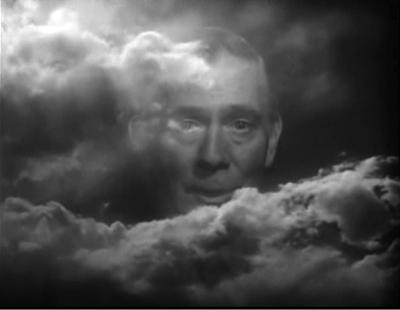
In film, World War II brings forth the prospect of dead servicemen returning to tell their tales. “I am Matthew Macauley,” says a face superimposed over imagery of radiant clouds. “I have been dead for two years. But so much of me is still living that I know now that the end is only the beginning.” This is indeed a beginning, of The Human Comedy (1943). Having died in the war, Matthew will guide us back to his hometown and his household’s daily routines.
Matthew’s voice-over goes on to introduce his family members, including son Marcus on duty in the army. After a scene in which a spectral Matthew joins his wife at her work, his voice discreetly retires. It recurs only twice before he and his now-dead soldier son faintly enter to watch the family welcome their new member, Marcus’s pal Toby.
“You see, Marcus, the ending is only the beginning.” Matthew’s address to us has become piece of fatherly advice.
The dead narrator of The Human Comedy never intervenes in the action on earth, but an all-seeing intelligence exercises more authority in The Seventh Cross (1944). Seven prisoners escape from a concentration camp, and Ernst Wallau’s narration launches the film. During the escape sequence he rapidly introduces each of his comrades.
Fairly soon all but one are captured and executed on crosses planted in the prison yard. The first man to be crucified is Wallau, our narrator. After he is killed, his voice-over continues: “I was dead. I could see.”
Wallau’s commentary chiefly follows his friend George Heisler, who manages to elude the Gestapo while the other escapees are found and killed. Wallau’s narration continues through the film, chronicling not only the fates of the other men but probing Heisler’s state of mind. Wallau tells us what Heisler is thinking, guides us into his memory, notes things that Heisler has forgotten, and even informs us what other characters will do in the future. Confronted with this numb, almost mute character, we need the continual commentary of Wallau to give access to his inner life.
Wallau is that rare voice-over narrator who flaunts his omniscience. Being dead, he has total access to our world and can witness anything happening there. Despite Wallau’s godlike power, in good Hollywood tradition his narration attaches itself chiefly to Heisler. But here that restriction reflects simply Wallau’s foreknowledge, signaled at the start, that only Heisler will survive. The question becomes: How?
The answer comes through Wallau’s goading Heisler to find faith in others. At the start, Heisler is close to despair, and his flight stems from sheer instinctual survival. At the film’s midpoint, all his comrades have been killed, and Wallau’s long-term escape plan has failed. Heisler can’t any longer mechanically follow his mentor’s instructions. He must forge a new goal, seize the initiative, and learn to trust people. He must learn what Wallau told him from the start: there remain traces of humanity in Germany.
As Heisler’s hopes grow and his network of allies expands, Wallau’s prodding voice-over subsides. It reappears near the end, at the moment Heisler realizes how much he owes others. Heisler speaks of his debts, and Wallau murmurs in antiphony the names of those who have helped him, including some Heisler has never met.
Now that Heisler has joined the struggle with full commitment, Wallau can vanish. “Goodbye, George Heisler. I can leave you now.”
Ghostly narrators like Wallau and Matthew Macauley call to mind the nosy angels and spooks of so many 40s films. Those have their counterparts in radio dramas like “Good Ghost” (1948) and the parodic mystery novel Dead to the World (1947), with a dead detective narrating his efforts to solve a case.
As usual, a lot depends on timing of information. If we learn that the narrator is dead at the start, as in the films just mentioned and in Scared to Death (1947), a certain amount of the action can seem foreordained. Alternatively, there can be a surprise. Radio plays, it seems, tended to reveal their dead narrators as a twist ending. With less fanfare, a film can simply seem to forget the opening commentary. The Gangster (1947) is initially narrated, without a frame situation, by the crooked protagonist. As a result, we expect him to survive. Yet he dies in the course of the action. The filmmakers faced a problem: To return to the narration at the end or not? To revive his voice-over might suggest that he endures in some supernatural realm. Instead, an impersonal external voice takes over to balance the opening.
With the convention of the dead narrator in place, a film could flirt with the possibility that the initial voice we hear has no living source. The opening credits of Woman in Hiding (1950) strongly suggest that a betrayed wife, racing down a hillside at night before crashing over an embankment into a river, has been killed. Her commentary rises up during a scene of the police dragging the river, and she seems to be mocking her husband from beyond the grave.
Is this a female variant of Joe Gillis’ voice-over? Watch the whole movie to find out.
In the same year as Woman in Hiding, Sunset Boulevard gave us another voice from the Beyond. If the film’s technique seems less original coming after a string of dead narrators, at least it can be credited with making the narrator the protagonist (unlike The Human Comedy and The Seventh Cross) and for using the device in a full-blown A picture (unlike Scared to Death and The Gangster).
In sum, the dead-narrator technique became a schema, a pattern which filmmakers could simply copy, as in Scared to Death, or tweak, as in the apparently dead narrator of Woman in Hiding. Wilder offered his own variant on the schema. We tend to remember his as the prime example, maybe even as the first one. But it often happens in the 1940s that the originality of a noteworthy film stems from a revision of a schema that was already in circulation, not only in film but in other media.
The weekend Laura died
Occasionally, the variety of options at the period sets up more dissonant relations. Laura (1944) is probably the most famous example.
Vera Caspary’s original book is divided principally into first-person blocks recounted by bon vivant Waldo Lydecker, detective Mark McPherson, and magazine editor Laura Hunt. Early versions of the screenplay attempted to capture multiple-viewpoint narration through flashbacks and voice-overs. What happened to this structure, however, reveals a process we’ll encounter elsewhere: fiddling with the film in post-production yielded some startling, perhaps unintended novelties.
Laura Hunt has apparently been murdered by a shotgun blast to the face. When the film starts, McPherson is calling on her mentor Waldo Lydecker, an effete columnist and radio commentator. McPherson lets Waldo accompany him on his inquiries before the two retire for a dinner at the restaurant Laura loved. There, via flashbacks and voice-overs, Lydecker recounts Laura’s rise to prominence. (In a scene cut from the final film, there’s an indication that Waldo’s tale is partly false—an early instance of a lying flashback.) The other characters’ flashbacks and voice-overs were abandoned in production, so the rest of the film is rendered objectively.
We later learn that the original victim was not Laura, which makes Laura either a new suspect or a target for the killer’s second try. At the climax, it’s revealed that Waldo is the culprit; he concealed the gun in an antique clock that he had given Laura. While his pre-recorded program is broadcast, he returns to her apartment and tries to kill her. Laura eludes him and as he wildly fires his gun, he is shot by McPherson’s team.
What makes the finale curious is the film’s framing device. The first scene starts with Waldo’s voice-over: “I shall never forget the weekend Laura died.”
This appears to cast the entire film as a flashback, starting with McPherson’s visit to Waldo. Within that flashback to the weekend, we have further flashbacks–that is, Waldo’s dinner-table explanations to McPherson. Such Russian-doll embedding is found elsewhere during the 1940s. At the end of the evening, when Waldo leaves, the camera lingers on McPherson and we become attached to him for nearly all that follows.
In screenplay drafts, this last shot would have initiated Mark’s voice-over narration, which would constitute a chunk parallel to Waldo’s. This is further evidence that Waldo’s string of flashbacks, including his opening voice-over, functions to write finis to “his” section of the film. But in the finished film, without McPherson’s voice-over block, Waldo’s initial voice-over hangs there, apparently framing the whole film. It would have been easy simply to cut that commentary and retain the opening camera movement revealing McPherson browsing among Waldo’s treasures, perhaps with some more nondiegetic music. Then Waldo’s offscreen admonition would bring in his voice for the first time. After this, Waldo’s later flashbacks and his voice-over narration would become neatly nested and perfectly conventional.
Clearly, decision-makers wanted to retain Waldo’s ripe commentary to open the film; it has expository value, and it introduces a very intriguing character. But we don’t hear that enveloping voice again, so for the rest of the film we might take Waldo’s remarks as akin to those that open Rebecca (1940) or Flamingo Road (1949). In these films and many others, a reminiscing character voice introduces the story action from an unspecified point in time and space. And the plot’s shift to McPherson’s activities seems to suggest that the whole opening stretch, including Waldo’s initial recounting, should be taken as a unit, “his” section of the film. So when Waldo is shot down and starts to die, we might have a situation like that of The Gangster, where the narrator is killed in the course of the action he introduced, and the film forgets what started it all.
Instead, Laura takes the option that The Gangster avoided: it brings back the dead man’s voice. After Waldo collapses, there’s a cut to McPherson and Laura leaving the frame. As the camera moves in on the shattered clock face, we hear, “Goodbye, Laura. Goodbye, my love.”
The line might be taken as Waldo’s dying words spoken offscreen, except that the line is miked far more closely than his speech earlier in the scene, when he’s actually closer to he camera. In its acoustic texture, this unsituated sign-off formally balances the unsituated opening. But it also raises the possibility that the dead Waldo has launched the whole story and now bids Laura farewell from that realm wherein defunct narrators dwell.
The opening does hint that something otherworldly is going on. A tart, suave voice wells up from sheer darkness, perhaps a noir equivalent to the sunny eternity from which Matthew Macauley speaks in The Human Comedy. Yet for a dead narrator, Waldo is either ill-informed or misleading. He speaks of “the weekend Laura died.” But if he lived through the events of the film, he knows that she did not die. Of course, his fib helps the film mislead us; the first half presupposes that Laura was the victim. If we remember that an unused scene was going to reveal that his flashback tales to McPherson contained lies, we may conclude that Waldo is as unreliable in death as he was in life.
Some of these inconsistencies apparently spring from late decisions in production. The original ending, as scripted and shot, lets Waldo survive. As he’s led off, he says, “Thank you for everything, my dear. . . You’re all I’ll be thinking of—till Time stands still—for me. Goodbye, Laura.” The speech is heard offscreen as the camera pans and holds on the clock.
Fox production head Darryl F. Zanuck was dissatisfied with many aspects of this conclusion and so a new version was filmed. In that version, Waldo is shot and dying. We see him speak the same lines, and only then does the camera pan to the clock. The release version, with Waldo’s simpler, closely miked farewell over the shot of the clock, was evidently decided on still later.
For what it’s worth, both the original shooting script and the revision distinguish between lines marked as “WALDO (narrating)” and “WALDO’s voice” for offscreen delivery. In neither version are Waldo’s dying lines marked as “narrating.” And in neither do we get an indication of the final camera movement that lets Laura and McPherson leave the shot in order to target the shattered clock face. Yet we do have a sonic texture in the last lines that is closer to a narrator’s voice.
In sum, while presenting a haunting conclusion—the clock was Waldo’s gift to Laura, and the shattered face recalls his first victim—the soundtrack firmly reminds us of the opening. Do we have a dead narrator? Some cues are there, but they’re sketchier than those in other films of the era. (For one thing, in those films, the narrator tells us he or she is dead.)
The unexplained return of Waldo’s voice, now gentle, has a surprising poignancy. Because of its loose ends, the final moments become more evocative, and more poetically enticing, than the tidy, explicit wrapup of Sunset Boulevard. In such ways, Laura’s final moments provide an eccentric revision of the dead-narrator schema. The result may have encouraged filmmakers who followed to risk inconsistency for the sake of powerful immediate effects.
In an earlier entry, I traced how studio pressures made the narration of Preston Sturges’ The Great Moment oddly off-balance. Evidently something like this happened with Laura. In the pressure to get a film finished and out the door, to retain striking bits that may ultimately not make sense when put together, Hollywood filmmakers can innovate by accident.
Dead men tell no tales
Auto Focus (2002).
Once the dead-narrator schema was available, Forties filmmakers were able to tweak it in various ways. And the changes didn’t end then. To see how the same process of schema and revision has continued, consider three much more recent examples.
Paul Schrader’s Auto Focus is a straightforward case. Bob Crane’s voice-over appears early in the film, though not at the very start, and recurs six times before the final scene. The brief comments punctuate Crane’s career decline and his descent into sex addiction. As happens with The Seventh Cross and other films using voice-over narrators, the second half employs the device less intensively than does the first. It’s as if in a film’s Development section we’re expected to be absorbed enough in the action not to need explanation, and we’re sufficiently primed to know what the important issues are.
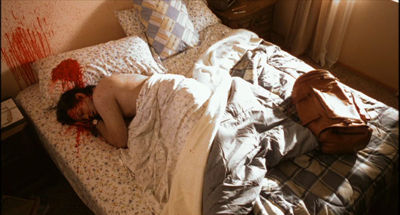
When Crane’s head is bashed in by his companion in sexual buccaneering, we have a case comparable to The Gangster: the narrator doesn’t survive. Crane’s voice has been silent for 28 minutes, so we might assume that we’ve lost his voice-over. But it returns over his bloody body, recounting in an offhand way the aftermath of his death. His voice remains as perky as it has been early in the film, in both his commentary and his explanations to his wives. “I’m a normal guy,” he has insisted, and his bland wrapup shows him insouciantly unaware of the implications of living and dying as he did. He can’t condemn his killer. “He was a cool guy in his way. . . . Men gotta have fun.”
Martin Scorsese’s Casino (1995) reworks the dead-narrator schema in more complicated ways, in the process borrowing other 40s conventions. During that period, multiple-narrator films became quite common. Again we have a prototype—Citizen Kane (1941)—but again it wasn’t alone. Trial films featuring flashbacks that dramatize testimony had become fairly common in the 1930s, and a couple of detective films (e.g., Affairs of a Gentleman, 1934; Thru Different Eyes, 1942) used flashbacks to present different witnesses’ versions of events. It would become a staple of crime films like The Killers (1946). Julien Duvivier’s Lydia (1941) transposed the multiple-narrator technique to the melodrama, while The Affairs of Susan (1945) applied it to romantic comedy. Mankiewicz, who seems quite obsessed with the strategy, deployed it in A Letter to Three Wives (1949), All about Eve (1950), and The Barefoot Contessa (1954).
A less common 1940s convention is the replay—the passage that repeats a scene, usually in flashback and usually including information not shown in the first pass. The most famous example is Mildred Pierce (1945), which I’ve fretted at for years (in this entry and this video). We can find less crucial replays in, again, Kane (Susan’s opera debut) and in more obscure films like Beyond Glory (1948).
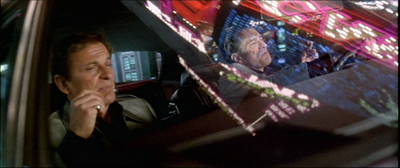
Casino draws on the replay and the multiple-narrator format and blends them with the dead-narrator one. The film innovates in a couple of striking ways. First, in 1940s multiple-narrator films, the individual narrations are presented in blocks; a solid chunk from one voice, another from another. True, we see some leakage in All about Eve, but basically the narrators’ tales are kept distinct. Scorsese and Nicholas Pileggi’s script for Casino hops between two principal narrators, Ace Rothstein (Robert de Niro) and Nicky Santoro (Joe Pesci).
Ace and Nicky’s voice-overs are mostly very brief, tagging a cascade of episodes tracing each man’s rise in Vegas, with equally fleeting flashbacks to their origins. The first twenty minutes toggles ten times between the two men’s clipped commentaries. This stretch constitutes a sort of training session, preparing us for the rapid switches in viewpoint that will dominate the film. Again, though, the voice-overs will subside for stretches in the middle, when the scenes become more fully developed. As a momentary, almost twitchy variant we get one extra voice-over—that of a go-between who, in a freeze frame, decides not to tell the mob boss about Nicky’s betrayal of Ace. Significantly, the film’s third major character, Ginger McKenna (Sharon Stone), is allotted no voice-overs.
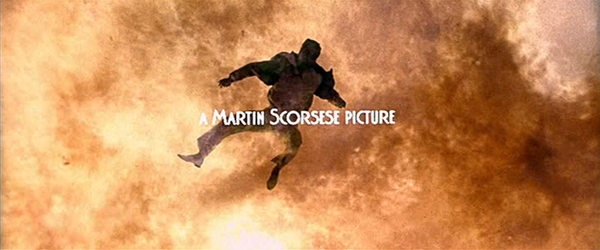
So Scorsese and Pileggi have fractured the 1940s voice-over schema. But the to-and-fro commentaries I’ve mentioned come after an opening sequence that seems to announce that one of these wise guys is already dead. The first scene shows Ace being blasted out of his car by a bomb. A sprawling body, as if ejected from the explosion, floats through the opening credits. And Ace’s next voice-over launches the film’s cascade of flashbacks by saying they come from the period “before I got myself blown up.” We seem to be in the full-fledged presence of a dead narrator.
We are, but it’s not Ace. At the film’s climax, it will be Nicky who dies at the hands of his own crew. In replays of the car explosion, it’s revealed that Ace actually survived the blast. By 1995 Scorsese and Pileggi could revise the 1940s schema by splitting the narrators and misdirecting our expectations: the apparently living narrator is the one who will die.
What, finally, of Confidence? Jake’s admission that he’s dead fits snugly into the tradition we’re considering, especially since it’s a voice-over initiating a flashback. That flashback takes us to the moments before his execution at the hand of the triggerman Travis.
In those moments Jake explains how his team of grifters accidentally took money belonging to a gang boss and how they proposed to repay him with an even bigger con job. That central story action, itself peppered with backstory exposition, is interrupted by returns to the opening execution situation. Jake’s first voice-over, apparently addressed to us, is differentiated by sonic texture from his explanations to Travis, but when his voice leads us to the past, it has the same degree of auditory presence. In effect, it’s the same confusion of narrating levels that’s promoted in the first long stretch of Laura.
At the climax of Confidence, we see Jake shot not by Travis but by the moll Lily. Travis flees, and so does she. Now we’re back to the opening situation, and a replay of Jake’s opening line, “So, I’m dead.” He seems to sign off. But now more flashbacks reveal that Jake and Lily have staged her gunplay and that the whole scheme has been a very long con. The team reunites and goes off with their millions. Confidence has appealed to our knowledge of the dead-narrator convention to fake us out: the story action won’t end with his death because he’s stage-managed it.
Jake lied about being dead. But so did Ace when he referred to being “blown up.” So did Waldo, maybe. And so do those films that don’t signal that the protagonist has fallen into a dream or a reverie. Actually, narratives are incorrigibly deceptive and full of secrets. You can’t even trust dead guys.
As ever, we’re reminded that modern filmmakers inherit a vast tradition of narrative schemas. Those can be reiterated or revised in unpredictable ways. The tradition is kept alive and engaging, as long as novelty is balanced with familiarity, innovation with redundancy. (Let the narrators explain, throw in some replays,) The way Hollywoood tells it is always indebted to the ways Hollywood told it.
For more examples of dead narrators see the Wikipedia entry and TV Tropes. Long as they are, these lists tilt heavily toward contemporary examples, where posthumous narration seems very common. One reason I posted this entry was to acknowledge older instances of this convention.
Ray Collins was a well-known radio voice as well as a Welles Mercury player. As both Matthew Macauley and Wallau, he seems to have been the go-to man for reliable supernatural voice-over. He had a long Hollywood career, but most baby boomers remember him best as Lieutenant Tragg in the Perry Mason TV show.
I’m indebted to Neil Verma for information about the posthumous narrator in radio plays. Neil also mentions “The Hitch-Hiker” (1942), and these episodes of Quiet, Please: “Inquest” (1947), “In Memory of Bernadine” (1947), “Anonymous” (1948), and “I Always Marry Juliet” (1948). (Listen to any of these here.) Filmgoers probably encountered more dead narrators on radio than on film. Neil’s book, Theater of the Mind, is an excellent account of 1930s and 1940s radio narrative.
The shooting script of Laura is available here. The revised ending is included as well. See also the detailed comparison of the two endings by Despina Veneti at Preminger Noir. The first analysis of the different versions was, I believe, carried out by Jacques Lourcelles in “Laura: Scénario d’un scenario,” L’Avant-scène du cinéma no 211/212 (July-September 1978), 5-11. This publication includes a French-language transcript of the film as we have it, along with cut portions. A detailed account of Laura’s production is provided by Chris Fujiwara in The World and Its Double: The Life and Work of Otto Preminger (Faber and Faber, 2008), pp. 36-48. I’m grateful to Jeff Smith for his advice about the sonic texture of Waldo’s voice-over.
The narrational issues raised by Laura go beyond the deceased Waldo’s voice. In the film’s most famous scene, McPherson is becoming obsessed with the dead Laura and, after drinking heavily, he falls asleep in her apartment. The camera tracks slowly in on him as he drops off. There’s the noise of a door from offscreen, and Laura walks in. McPherson is astonished. Laura, released the same week as The Woman in the Window, might seem to be hinting that Laura has been revived in McPherson’s dream.
Kristin has traced the numerous dialogue motifs that reinforce this possibility. Yet most films of the 1940s mark a dream sequence very explicitly (e.g., wavy superimposed lines, dissonant music) or at the least with a dissolve and a close-up or track-in reinforcing the shift to subjectivity. Laura provides only two cues, the sleeping character and the track-in. But as Kristin indicates, these and other factors keep the dream option a possibility for a first-time viewer. See “Closure within a Dream? Point of View in Laura,” Breaking the Glass Armor: Neoformalist Film Analysis (Princeton University Press, 1988), 162-194. Kristin’s essay also offers a comprehensive discussion of the shifts in Waldo’s narration.
The presence of dead narrators would seem to pose a problem for those scholars who believe that in a movie every narrator must have a narratee on the same logical level. For these theorists, film narrators are part of a symmetrical system of communication among personified entities. Those entities are either embodied in the text (McPherson is Waldo’s narratee in the restaurant) or implicit in the very logic of narrative itself. No narrator without a narratee! According to this line of argument, there must be a narratee as dead as Waldo listening to his opening voice-over, but being very, very quiet.
In contrast, I’ve argued that films, and possibly all narratives, are freewheeling and illogical in their use of markers of communication. Films may mimic only parts of a communicative circuit in order to achieve specific effects. In provoking experiences in readers, films seem to me to rely on psychology, not ontology. I float this argument in this chapter of Poetics of Cinema. See also this blog entry.
Earlier entries have touches on the schema-and-revision dynamic of style and story in Hollywood. See for examples my discussion of 1913 films, a consideration of 1940s style, some remarks on walk and talk, a piece on high-school lipdubs, a discussion of replays, and the entry on Gone Girl. Searching “schema” will bring up more. A roundup of entries on peculiar 1940s narratives is here. I analyze narration in All about Evehere. For more on the debt of modern film to 1940s innovations, see The Way Hollywood Tells It.
Matthew H. Bernstein is a long-time friend and a superb scholar. His biography of Walter Wanger has become a classic of Hollywood business history, and his many books and articles have refined our sense of American cinema. When we learned of his research into Sturges (a favorite of this blog), we were happy to propose that he do a guest entry. Here’s the lively, trailblazing result.
How should films portray sex and marriage? Hollywood’s Production Code, established in 1930, set forth some definite ideas.
Sex
The sanctity of the institution of marriage and the home shall be upheld. Pictures shall not infer that low forms of sex relationship are the accepted or common thing. . . .
Scenes of Passion
They should not be introduced when not essential to the plot.
Excessive and lustful kissing, lustful embraces, suggestive postures and gestures, are not to be shown . . .
Seduction or Rape
They should never be more than suggested, and only when essential for the plot, and even then never shown by explicit method.
They are never the proper subject for comedy.
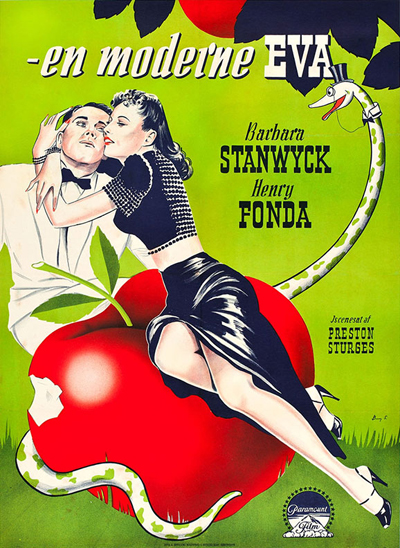
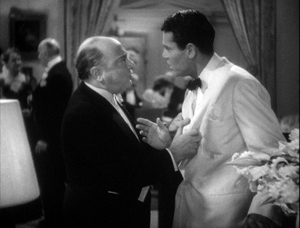
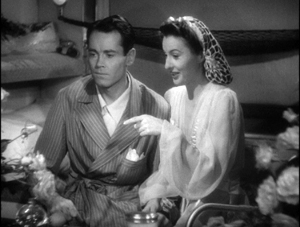
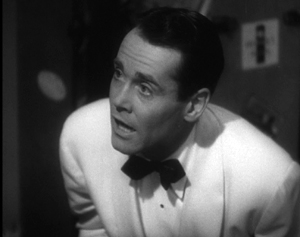
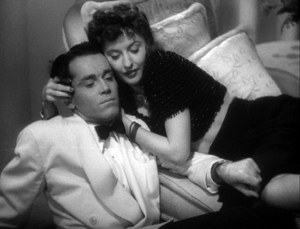
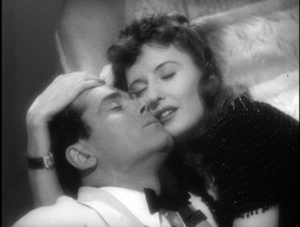
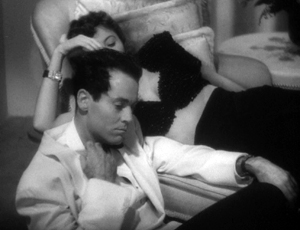
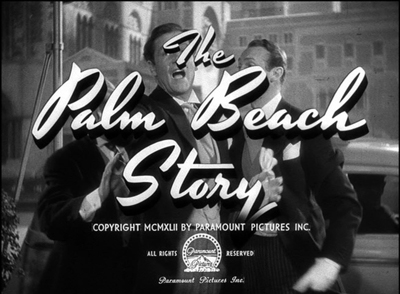
Those of us who savor Preston Sturges’s great romantic comedies of the 1940s—The Lady Eve (1940), The Palm Beach Story (1942) and The Miracle of Morgan’s Creek (1944)—admire them in part for their violation of just about all these tenets. They are full of “suggestive postures” like the lengthy chaise longue scene in The Lady Eve. Their central topic is often the seduction of men by women (The Lady Eve, The Palm Beach Story and arguably Miracle). References to extra-marital sex, contemplated or accomplished, abound. And all three films ridicule “the sanctity of the institution of marriage” into the ground. Film critic Elliot Rubinstein once observed, “If Sturges’s scenarios don’t quite invade the province of the flatly censorable, they surely assault the border outposts, and some of the lines escalate the assault into bombardment.”
The Production Code Administration, on paper and in practice, was particularly obsessed with regulating the depiction of female sexuality on screen. Yet Sturges’ attacks on conventional morality are launched by heroines: con artist/card sharp Jean/Eve (Barbara Stanwyck) in The Lady Eve, the hard-headed Gerry Jeffers (Claudette Colbert) in The Palm Beach Story and the naïve man-bait Trudy Kockenlocker (Betty Hutton) in The Miracle of Morgan’s Creek. They are all variants of what Kathleen Rowe has called the “unruly woman,” characters who create “disorder by dominating, or trying to dominate, men,” and being “unable or unwilling” to stay in a woman’s traditional place. Mary Astor’s much-married Princess Centimilia/Maude in The Palm Beach Story deserves an honorable mention here too.
True, by each film’s conclusion, the Sturges heroine agrees to get or stay married. She fulfills the conventions of romantic comedy and the stipulations of the PCA. Yet in each film the path to a proper end looks so much like a roller-coaster ride that the significance and sanctity of marriage come to seem ridiculous.
How did Sturges get away with so much? A look behind the scenes at the negotiations around The Lady Eve can help us understand his strategies. It also shows that the Code was more flexible and fallible than we often realize.
Convolutions in the Code
Sturges had one advantage at the outset. He worked in a genre that was already testing the limits of the Code. Granted, the PCA in 1934 aimed to regulate film content in every genre. None, however, flaunted, even parodied, the strictures of the Code more thoroughly than screwball comedy did. Rubinstein puts it well: “The very style of screwball, the complexity and inventiveness and wit of its detours around certain facts of certain lives, the force of its attack on the very pieties it is pledged to sustain, cannot be explained without recognition of the censors. Screwball comedy is censored comedy.“
By the end of the 1930s, filmmakers were pushing hard against censorship. Romantic comedies were growing more risqué by the month, as shown by 1940 releases like My Little Chickadee, The Philadelphia Story, The Road to Singapore, Too Many Husbands, The Primrose Path, Strange Cargo, and most especially, This Thing Called Love. A sort of arms race took place, and Sturges, emerging as a writer-director in 1940, benefited from this escalation.
Just as important is a fact that many fans of Hollywood still don’t realize. We like to think that daring filmmakers were charging boldly against an iron wall, with chief censor Joseph Breen and his associates setting forth implacable demands. But the administration of the Code was not a mechanical, totalitarian affair. It was most often a matter of negotiation.
Releasing Hollywood’s product, even risqué films, benefited all parties involved. If the Code were enforced with absolute rigidity, the industry would suffer. Some films would have to be abandoned. Then urban audiences would have found the safely released product pallid, and critics would have complained about bland output. Then as now, edginess sold, and at least some audiences were eager for it.
Accordingly, Breen and co. recognized that the Code could not be applied ruthlessly. Indeed, historians Lea Jacobs, Richard Maltby and Ruth Vasey have shown that the PCA, like its forerunner the Studio Relations Committee, often helped filmmakers find ways around the most stringent policy demands. Through a give-and-take, censors and filmmakers could settle on scenes and lines of dialogue that could avoid public outcry. No one flaunted and taunted the PCA as well as Sturges, yet Breen and co. often helped him find ways of rendering suggestive situations without baldly transgressing the Code.
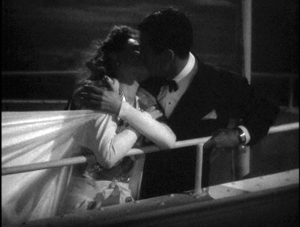
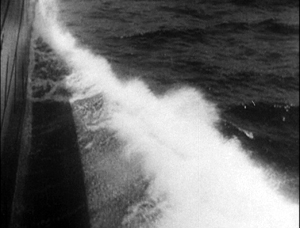
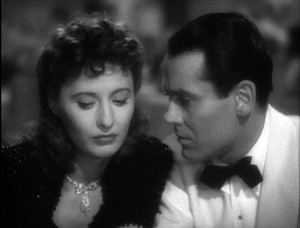
One typical filmmaker/PCA tactic that favored Sturges was an appeal to ambiguity. Far from being inflexible, the staff recognized that not every viewer picked up on a lewd line or suggestive situation. Some viewers would find no innuendo in a sexually-charged scene. (The 1940s critic Parker Tyler referred to this as “the Morality of the Single Instance.”) For example, in The Lady Eve, there’s a fade-out from Charles’s and Jean’s passionate embrace in the bow of the ship at night to the fade in of the ship’s prow slicing through the ocean the next morning.
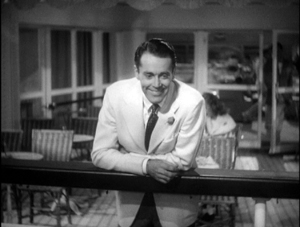
That passage would suggest to the naïve viewer that they kissed for a while and went to their cabins separately. After all, in the morning we find Jean getting dressed in her stateroom and talking with her father. Then we see Charles on deck alone, waiting for Jean.
But the sophisticated viewer would understand that the earlier fade-out indicated what Joseph Breen routinely called “a sex affair.” (The ocean spray on the fade-in could be seen as a very subtle extra touch.) Crucially, Jean’s later statement to Hopsy after she is unmasked as a cardsharp sustains both readings. “I’m glad you got the picture this morning instead of last night, if that means anything to you . . . it should.” When self-regulation was well-calibrated—and this was a moment-to- moment, scene-by-sceene, film-by-film achievement—there was wiggle-room that would let innocent viewers remain innocent while letting sophisticated viewers feel sophisticated.
Apart from the increasing eroticism in screwball comedy and the willingness of the PCA to work with filmmakers to allow double layers of meaning, Sturges benefited from good timing. During this period, Breen grew more permissive in his application of the Code. He never explained why, but the late-1930s bombardment of questionable material was probably one cause. Breen was pretty exhausted after seven years of trying to accommodate the filmmakers’ increasingly outré ideas. He was so tired that he temporarily resigned in Spring 1941.
Sturges’ circumvention of the Code also depended on his personal qualities. Clearly he was a persuasive negotiator. The PCA correspondence shows Breen and his successor, Geoffrey Shurlock, rescinding countless directives they initially gave him to eliminate dialogue lines or bits of action. It’s likely that the PCA admired Sturges’ comic gifts and thus gave him greater room to maneuver than other directors enjoyed. (Much the same thing happened when the Studio Relations Committee had given leeway to Ernst Lubitsch prior to 1934.) Sturges also employed a tactic of overkill. In his scripts and in the scenes as finally staged and shot, he created so many potential infractions of the Code that to challenge each one would reduce the film to rubble, or reduce Breen and co. to stress-induced madness.
Still, Sturges played the PCA game. His convoluted plots stuck to the letter of the Code, always finally coming down on the side of pure romance and happy marriage. But they wreaked havoc with its spirit—often with the PCA’s sanction. By the premiere of The Miracle of Morgan’s Creek, Sturges was relentlessly mocking the PCA’s regulations. It’s likely, I think, that the PCA was for the most part in on the joke.
After negotiations, which grew more elaborate with each title, each Sturges romantic comedy received a seal. The films made it through partly because of the PCA’s quixotic mandate, partly because the Code’s requirements had been loosened, and partly because of Sturges’ extraordinary skill in exploiting the Code. These are the crucial reasons Sturges got away with it. Along with his prolific comedic imagination, he was often aided by the very body that was supposed to be censoring him.
Once the Sturges film was released, the PCA staffers could wearily pat themselves on the back for a job well done. Yet critics’ reviews, complaints from state censor boards, and letters of protest from ordinary viewers indicate that the agency often badly misjudged how the films’ moral tone would be received. The PCA’s dual mandate—to try to give filmmakers the maximum freedom to create risqué situations but at the same time to uphold the Code–was a tightrope walk. With Sturges and other filmmakers, the agency lost its balance. Sometimes the PCA didn’t diminish the sexual dimensions enough, and sometimes the agency did not even notice elements that could give offense.
There were signs already, in the reaction to the 1940 burst of sexier films like The Primrose Path and This Thing Called Love. Local informants had asked MPPDA attorney Charles C. Pettijohn, “Doesn’t Mr. Hays have any influence with the producers any more, and has that fellow Breen out there killed himself or has he just been compelled to walk the gangplank?” Unlike the PCA staff, who had worked day by day to tone down an audacious script and had faced the charms of a persuasive filmmaker, local censorship boards reacted solely to a finished Sturges film. They merely saw what was on the screen. Many did not like what they saw.
Up the Amazon for a year
The PCA correspondence concerning The Lady Eve is surprisingly brief. Before the film was completed and a seal was granted, Breen sent only two letters to Luigi Luraschi, Paramount’s liaison on censorship. They strikingly illustrate how cooperative Breen could be when it came to scenes regarding illicit sex.
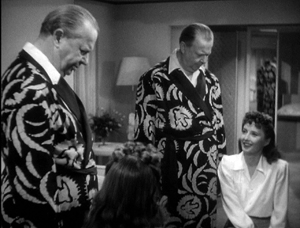
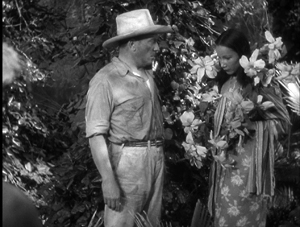
When he read Sturges’s first complete script of 7 October 1940, Breen had objections to many “questionable lines of dialogue.” Breen warned Sturges and Luraschi against anything “suggestive” in the scene between Muggsy and Lulu as they say their farewells before departing the expedition. In this brief exchange, Mugsy stiffly tells her “So long, Lulu…I’ll send you a post card” as she demurely (looking down) places a lei over his neck. This brief exchange directly undercuts Hopsy’s just-spoken, high-minded farewell to the Professor: “This is the way I’d like to spend all my time…in the company of men like yourselves…in the pursuit of knowledge.”
While it’s difficult to imagine Muggsy as a sexual partner to anyone, the woman’s downcast face and her gift of a lei could be seen to suggest her heartbreak.
Jean’s later, rapid-fire description of Hopsy’s many female admirers in the Main Dining Room of the S.S. Southern Queen originally contained comments about women who were “a little flat in the front” or “a little flat behind. ” These were cut because they were too physiologically specific about the female form. We hardly miss them, as Jean was permitted to deliver plenty of color commentary, as she detailed the women’s futile attempts to attract Hopsy’s attention.
However, Breen wrote the word “in” alongside certain demands he had made for eliminations in his 9 October letter, indicating that Sturges and Luraschi had persuaded him to relent. For example, Breen eventually accepted this exchange from Jean and Charles’s first evening together. Charles has suggested they go dancing:
Jean: Don’t you think we ought to go to bed?
Charles (after a pause): You’re certainly a funny girl for anyone to meet who’s just been up the Amazon for a year.
Jean: (after a pause): Good thing you weren’t up there two years.
Breen’s next letter (21 October) on Sturges’s revised script expressed satisfaction with all the changes made, noting that Jean’s line about heading to bed “will be delivered without any suggestive inference, or reaction.”
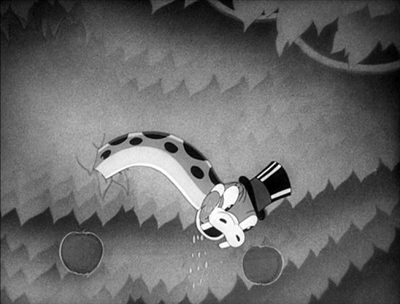
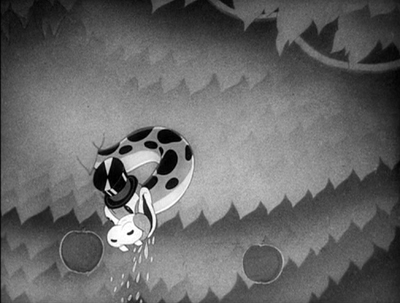
In the finished film, there is nothing arch about Stanwyck’s thoughtful, almost parental delivery of the first line, spoken as she looks straight ahead and then looks down to stub out her cigarette before she turns to face Charles. Likewise, her delivery of the second line is wry and mildly mocking yet almost compassionate. Still, the connotation remains that Jean is suggesting they sleep together. Instead, the couple proceeds to Charles’s cabin to meet his snake Emma.
Breen was particularly concerned about other allusive dialogue. At the Pikes’ party, Sir Alfred (Eric Blore) explains to Charles a fictionalized version of Jean’s family history which resulted in the existence of two sisters, one a lady, one a cardsharp. (Sir Alfred will later describe this as “Cecilia or the Coachman’s daughter, a gaslight melodrama.”) Breen insisted that Sir Alfred’s tale include a line indicating that Jean’s mother divorced her elderly earl before taking up with the groom “Handsome Harry” and giving birth to Jean. That way Jean’s birth would not seem illegitimate. Sturges obliged. Yet he somehow persuaded Breen to retain this later portion of the Alfred-Charles exchange, also alluding to an adulterous affair.
Charles: They [Jean and Eve] look exactly alike!
Sir Alfred: We must close our minds to that fact…as it brings up the dreadful and thoroughly unfounded suspicion that we must carry to our tombs, you understand…as it is absolutely untenable…that the coachman, in both instances…need I say more?
Why did Breen let Sturges keep in this suggestion that Handsome Harry was the biological father of both sisters, perhaps as the result of adulterous affairs? It is hard to say. True, the offending line concerns a “suspicion” voiced by Sir Alfred, rather than a fact. But Charles immediately affirms its likelihood: “But he did, I mean, he was, I mean…” before being shushed for the nth time by Sir Alfred. Here again, Breen consented to Sturges’s use of questionable material.
Breen’s greatest objection in his initial letter concerned pp. 70-74 of the first submitted script, which suggested “a sex affair.” “Inasmuch as this is treated without the proper compensating moral values, it is in violation of the Production Code, and will have to be eliminated entirely from your finished picture.”
The offending pages outlined a scene between Charles and Jean set on the deck of Jean’s cabin at the end of their first evening together. Just previously, Jean has caught Charles and her father the Colonel (Charles Coburn) playing double or nothing. Charles would then be called away to receive from the ship’s purser the incriminating photo of Jean, the Colonel and Gerald. Charles would then return to the gaming room table and the dialogue exchange with Jean about all women being adventuresses. Then Charles would ask Jean if they can go down to her cabin. There, Charles lights Jean’s cigarette; he “struggles to say something” but Jean tells him, “Kiss me,” and he obeys. (“He crushes her in his arms” as she “sinks back against the chaise longue.”) The film would then cut to a shot of the rail of Jean’s deck and of “the moonlit water beyond. A lighted cigarette arcs over the rail and down into the water. FADE OUT.”
This version presents Charles sleeping with Jean even though he knows from the purser’s photograph that she’s a cardsharp. As Brian Henderson notes, this arrangement of events would make Charles a cad, far worse than the hypocritical prig that he is in the finished film. Sturges eventually solved the problem by having Charles learn of Jean’s duplicity on the morning of their third day together at sea. But before Sturges made this change, Breen’s October 9 letter directed that Charles could not speak the line about going down to her cabin; that the scene could not play out on Jean’s private deck; and that “it would be better to have the embrace with the couple standing up.” The shot of the cigarette thrown over the railing also “should be omitted, on account of its connotations.”
In response, Sturges watered down the offending scene of passion and relocated it to the bow of the ship, where (in a reworking of a scene he had always envisioned) Charles recites his “I’ve always loved you” speech and they eventually embrace as the scene fades out. This created the PCA-approved ambiguity about what transpired sexually between them.
Here, Sturges’s solution to a problem of plot and characterization went hand in hand with the double-meaning practices of the Production Code. Sturges must have written the passionate private deck scene knowing full well that Breen would demand its elimination or transposition. His immediate agreement to revise it was likely a bargaining ploy to earn Breen’s goodwill to bank against other PCA objections.
When Sturges cut the cabin deck setting and the prone postures of pp. 70-74 from the first submitted script, he also saved a crucial part of Jean and Charles’s penultimate exchange as they enter Jean’s cabin.
Charles: Will you forgive me?
Jean: For what? Oh, you mean…on the boat…the question is, will you forgive me?
Although Breen accurately predicted that this bit of dialogue would “probably be acceptable” if the earlier scene “is cleaned up,” for now, Breen stated that their exchange had to be cut “by reason of its reference to the aforementioned sex affair.” In other words, Breen, not unreasonably, read Jean and Charles’s dialogue as referring only to their sleeping together, rather than to everything that transpired between them on the S.S. Southern Queen, including Jean’s duplicity and Charles’s narrow-mindedness. Forgiveness is of course a key issue in the drama of The Lady Eve.
Hix Nix Sexy Pix
The MPPDA issued its seal on 26 December 1940. Released in mid-March 1941, The Lady Eve passed the censors without cuts in Chicago and the states of Massachusetts, New York and Virginia. However, Kansas, Maryland, Ohio and Pennsylvania were a completely different story.
Some local censors demanded deletions of elements Breen had highlighted. Ohio and other localities objected to Sir Alfred’s dialogue about the fantasy fatherhood of Jean and Eve (“as it is utterly untenable that the coachman in both instances. . . .”). But most of the eliminations concerned elements Breen and his team had not commented upon. Among these were (again for Ohio, initially) Sir Alfred’s summary recap of the tale to Jean the next morning: “So I filled him full of handsome coachmen, elderly Earls, — young wives, and the two little girls who looked exactly alike.”
Other targets were Jean’s wisecracks. When Jean and Charles return from her stateroom after changing her shoes, the Colonel archly comments, “Well, you certainly took long enough to come back in the same outfit.” Jean’s reply–“I’m lucky to have this on. Mr. Pike has been up a river for a year”—offended Pennsylvania. Ohio objected to Jean’s comment, “That’s a new one, isn’t it?”, when Charles invites her into his cabin to see Emma.
Yet another instance concerned Charles’s exchange with Eve during their wedding night train ride. He is asking about her previous marriage to Angus.
Charles: When they brought you back, it was before nightfall, I trust.
Jean: Oh, no.
Charles: You were out all night?
Jean: Oh, my dear, it took them weeks to find us. You see, we’d make up different names at the different inns we stayed at.
Though Jean and Angus were married, the implication of using false names at a hotel (which Sturges would recycle for Trudy and her unknown husband in The Miracle of Morgan’s Creek) was the deal-breaker for Ohio. Of course, one possible connotation of Eve’s many pre-Charles couplings is that not all of them were marriages. (If they were, this imaginary Eve is an early version of the Princess in The Palm Beach Story, another figure who satirizes conventional marriage.) Yet Breen’s only comments on this scene concerned Eve’s nightgown and particularly the scene’s blocking—that Eve’s revelations of her previous marriages occur away from the bed and that the bed be deemphasized throughout the scene.
Sturges must have made the case that there was no room to have the actors sit elsewhere. Meanwhile, Breen was distracted from what Jean was saying by where she was when she said it.
Local censors were most keenly opposed to two other scenes that Breen had ignored. Both take place in Jean’s stateroom.
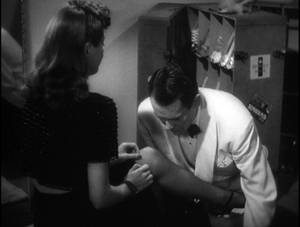
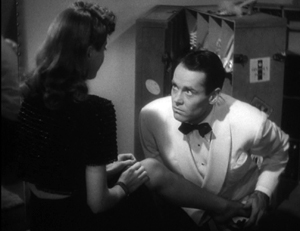
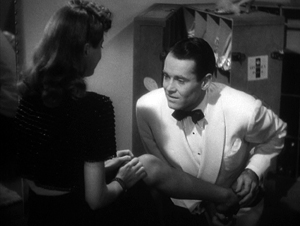
In the first, Charles replaces Jean’s broken shoe. In one twenty-second two-shot, he kneels down to slip the shoe on her foot; looks over her foot and slowly looks up her leg all the way to her face; expresses his hope that he didn’t hurt her when she tripped him in the dining room; and then on his way to looking down at her leg and foot again, pauses momentarily but very definitely, on her décolletage. Then he looks back up at her again. There is no dialogue to distract the viewer from what Charles is looking at.
Oddly, no censors objected to this very suggestive shot; instead they focused on what ensued. Ohio, Kansas, and Maryland joined Pennsylvania in demanding the elimination of what the last described as the “semi close-up view where [Charles] allows his eyes to pass up and down over her.” This was a quick POV series of shots in which (1) Charles struggles to look at Jean; (2) Jean appears blurry and asks Charles if he’s all right; and (3) Charles, after swallowing, struggles to reply in the affirmative.
Charles is so “cockeyed” from Jean’s perfume that when they eventually stand up, he can make only the weakest attempt to kiss her, which Jean easily repulses. To the censors, however, the combination of close shot scale, physical intimacy, and intoxication (even from perfume) was intolerable–too expressive of Charles’ rising desire. I suspect they actually conflated the lengthy take and the medium close-ups (no “looking over” occurs in the point of view sequence). In any case, censors had seldom seen such “looking over” shots since the early 1930s.
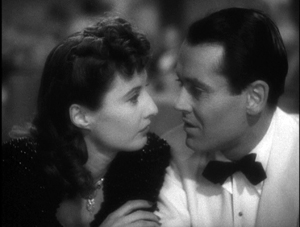
In addition, all four offended states were roused by the famous chaise longue scene. As Charles tries to apologize for scaring Jean with his snake Emma, she holds him close, runs her hands through his hair, tickles his ear, and breathes heavily in his face. Taking the key elements of the shoe-replacement business to another level, the erotic hilarity of this scene arises from the complete power of Jean’s spell over Charles and their sheer proximity, in two long takes (one lasting 36 seconds, and then a closer, three-minute and fourteen-second shot). During all this time, Jean won’t let Charles kiss her, but their faces are close together and their lips are never far apart. For some censors, the most provocative elements of the scene resided in the dialogue that begins with Charles’s fall to the ground ands run through his “accompanying indecent action” (Pennsylvania again) of pulling down Jean’s skirt.
Pennsylvania also cut Jean’s sigh of anticipatory orgasmic release after describing her first encounter with her future husband: “And the night will be heavy with perfume and I’ll hear a step behind me and somebody breathing heavily and then – Ohhhhh!”
Ohio originally wanted the entire scene deleted, starting with Jean’s command “Oh, come over here and sit down beside me” through their final exchange:
Jean: Oh, you’d better go to bed, Hopsy. I think I can sleep peacefully now.
Charles (adjusting his bow tie): Well, I wish I could say the same.
Jean: Why, Hopsy!
Industry representatives negotiated with the Ohio and Pennsylvania boards to try to reduce their demands; Pennsylvania was unmoved, but Ohio was persuaded to let all but their final exchange remain in the film. An outraged San Antonio Amusement Inspector articulated the boards’ thinking when she cut what she called the film’s two “prolonged scenes of passion” in Jean’s stateroom. These, she pointed out to Breen, violated Section 2 of the Code, about “suggestive postures and gestures” and seduction being used for comedy. So in San Antonio, as in Pennsylvania and Kansas, viewers missed the bulk of two of the most celebrated comic scenes in American film history.
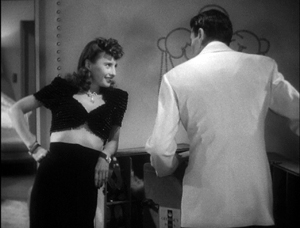
With The Lady Eve, Breen’s instincts were generally astute. He had advised against Sir Alfred’s sketch of the Handsome Harry plot. He had eliminated the overt sex affair scene in Jean’s cabin. Yet he missed many elements as well. Besides those stateroom scenes cut by state and city censors, there were ostensibly innocent lines. As Charles searched for a new pair of shoes, Jean says, “See anything you like?” and leans back with a bare midriff.
The constantly repeated phrase “been up the Amazon for a year” references Charles’s extended sexual privation and naivete, which make him susceptible to Jean’s wiles. But the phrase can also be taken as evoking female anatomy itself. The neglect of these details resulted from Breen’s increasing tolerance and his equally increasing tiredness. We’re lucky he left them in.
Upping the ante
The negotiations over The Palm Beach Story and The Miracle of Morgan’s Creek followed the pattern set by The Lady Eve. The writer-director proposed increasingly outlandish scenarios; Geoffrey Shurlock and Breen again demanded an increasinglyu longer list of changes across a longer series of letters. Sturges alternately made cuts or assured them he could handle the material.
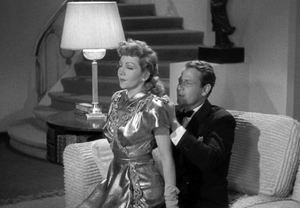
Once more, certain moments wound up offending local censors. For The Palm Beach Story, released in late 1942, only New York and Kansas passed the film without eliminations. Elsewhere, many of the suggestive elements that Shurlock had criticized were cut. One was Gerry’s line—describing how Tom sees her after many years of marriage–as “just something to snuggle up to and keep you warm at night, like a blanket” (Pennsylvania). Another was the first vertebrae-kissing scene in which a very drunk Tom breaks down a very drunk Gerry’s resistance to having sex.
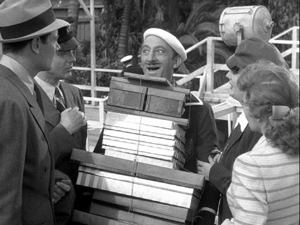
Other deletions concerned details that had escaped Shurlock’s notice: Pennsylvania removed the underlined portion of Gerry’s explanation to Tom, after the Wienie King’s visit and munificence, of “the look” women get from men: “From the time you’re about so big, and wondering why your girl friends’ fathers are getting so arch all of a sudden – nothing wrong – just an overture to the opera that’s coming.” Even after many changes to her dialogue, scenes with Princess Centimilia could have provoked bans or major cuts. After all, she is followed around by her gigolo Toto (Sig Arno) and (in an ironic adherence to the Code’s demands) marries purely to legitimize her sexual impulses. Yet in part because of Mary Astor’s frantic line delivery, her scenes were retained. Overall, relative to its many potential offenses, The Palm Beach Story faced surprisingly minimal objections.
The entire premise of Miracle and the ensuing action mock the notion of marriage’s sanctity from multiple angles. Breen, the American military, and the Legion of Decency examined the film minutely before it was issued a seal, and many changes were made. For this reason, only one state board (Kansas) cut one line of dialogue: Trudy’s comment that “Some sort of fun lasts longer than others.”
Still, there was much to offend audiences and censors in the completed film. For example, the MPPDA and Sturges received numerous letters of complaint linking the film to the growing problem of juvenile delinquency. One viewer in Minneapolis wrote that the film showed it to be “a subject for slapstick and high comedy, especially if the delinquent is unusually fruitful. . . . My boy thought she must have passed the night with 6 soldiers or sailors. . . . In Hollywood I understand you can get away with despoiling young girls and morals don’t exist except for yokels. Do you have to spread that poison?” Given the growing panic over what was seen as a national JD epidemic, Paramount’s delay in distributing Miracle—it was completed in Spring 1943 but released in January 1944—exacerbated the controversy.
Upon reviewing The Miracle of Morgan’s Creek, James Agee famously stated that “the Hays office has been either hypnotized …or raped in its sleep.” The same might seem to be true of The Lady Eve and The Palm Beach Story, but this was manifestly not the case. There were elements that the PCA didn’t catch–suggestive postures and dialogue, scenes of seduction–because Sturges created so many and whisked them by so swiftly. But he got away with it for other reasons as well. The PCA helped steer Sturges to finding ways of modifying the most brazenly unacceptable material. The standards of acceptability were expanding, controversially, and they would continue to do so. Meanwhile, the response of local censor boards and individual audience members provides crucial evidence of how at times the PCA succeeded and at other times it failed to suppress material that might offend. Knowing this history can only deepen our appreciation of what the Sturges comedies achieved.
This entry is a revised version of a portion of an article that appears as “The edge of unacceptability: Preston Sturges and the PCA” in Refocus: The Films of Preston Sturges, editors Jeff Jaeckle and Sarah Kozloff, forthcoming from Edinburgh University Press. Primary sources include Sturges’ correspondence and the PCA files housed at the Margaret Herrick Library of the Academy of Motion Picture Arts and Sciences in Beverly Hills. The Lady Eve and The Miracle of Morgan’s Creek files are available on microfilm in MLA, History of Cinema: Selected Files from the Motion Picture Association of America Production Code Administration Collection (Woodbridge, CT: Primary Source Microfilm, 2006).
Two magicians shall appear in England. The first shall fear me; the second shall long to behold me; The first shall be governed by thieves and murderers; the second shall conspire at his own destruction; The first shall bury his heart in a dark wood beneath the snow, yet still feel its ache; The second shall see his dearest possession in his enemy’s hand; The first shall pass his life alone; he shall be his own gaoler; The second shall tread lonely roads, the storm above his head, seeking a dark tower upon a high hill . . . (John Uskglass, The Raven King, via Vinculus)
A word of explanation about why I am writing about a television series is in order. I write almost entirely about films (and occasionally literature), but in 2001 I succumbed to the temptation of an invitation from Oxford University. I was to become a visiting professor and deliver a lecture series on “broadcast media.” The closest I could come to talking about broadcast media was a series comparing film and television narrative structure. The lectures were subsequently published as Storytelling in Film and Television (Harvard University Press, 2003).
This book has given me a lingering reputation for knowing something about television, even though I had not researched or published on television since. Within the past year I have declined two invitations of speak at television conferences, one of them a keynote address. But until now my small dip in the television-studies pool has remained an aberration.
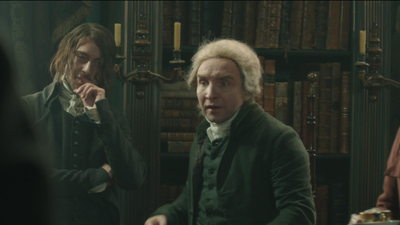
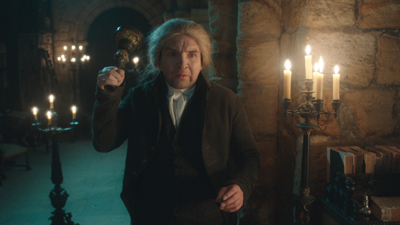
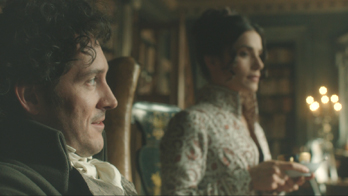
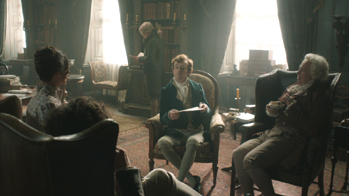
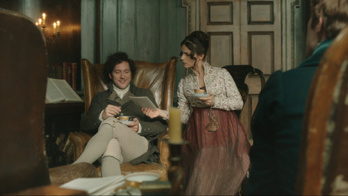
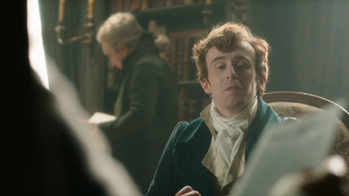
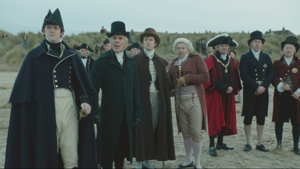
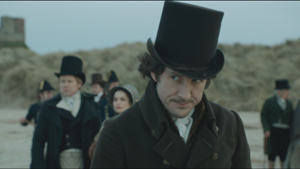
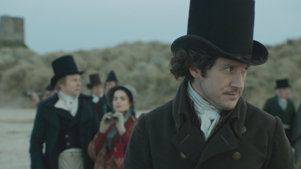
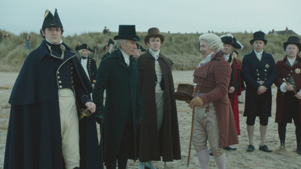
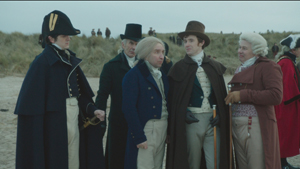
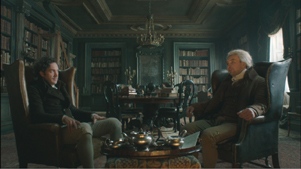
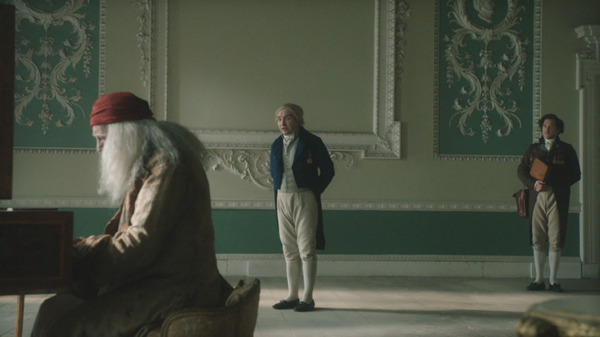
I happen to be a devoted fan of Susanna Clarke’s 2004 bestselling tale of two magicians in Regency England, Jonathan Strange & Mr. Norrell. I also, despite some reservations, much enjoyed the recent BBC/BBC America seven-episode adaptation of it. The DVD/Blu-ray is being released in the USA today, and I herewith offer some comments on the series.
My main objections to the adaptation relate to changes in the relationship between the two main characters. I think the reasons for this particular problem can shed a little light on how mainstream film and television narratives are conceived and sold to the public. I’ll deal with that subject first before pointing to some of the things I admire about the series.
Many SPOILERS for both book and series from this point on.
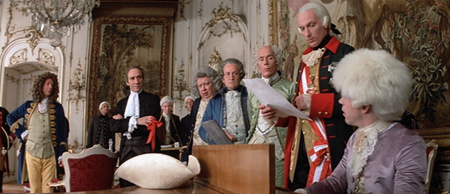
Hanging it on the Amadeus hook
The opening of Robert Altman’s The Player is famous for its pitch phrases heard through studio office windows, with variants of the familiar, it’s X Title meets Y Title (“It’s Out of Africa meets Pretty Woman.” “Not unlike Ghost meets Manchurian Candidate.”) The scene is funny, but it’s not far from the sort of thing that happens in reality.
According to series director Toby Haynes, speaking of the BBC, “I pitched it in my first meeting as Amadeus meets Lord of the Rings. They really responded to that.”
Clearly The Lord of the Rings has nothing in common with JS&MN apart from being a long fantasy tale, and I assume it was included to evoke the idea of a big, really successful example of that genre.
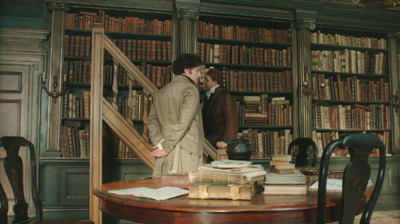
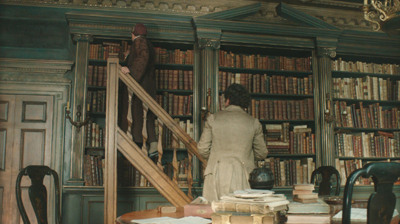
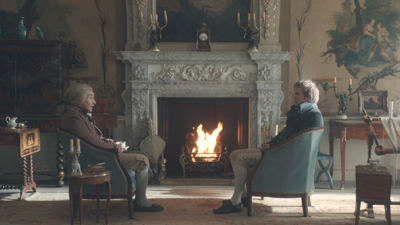
As for Amadeus, at first glance one might consider the book’s Norrell-Strange dynamic as being similar to that of Salieri and Mozart, but upon closer inspection there is virtually no resemblance. Salieri’s prime motivation is intense, heartrending jealousy of Mozart’s seemingly effortless genius. Norrell comes into conflict with Strange, but he’s not jealous of the other magician. The barrier between them is a profound theoretical disagreement over the type of magic they should be doing, and it tears the pair apart after their initial delight in discovering each other. There’s no easy comparison for that sort of conflict, no X meets Y. But anyone can grasp the idea of jealousy.
Once the Amadeus idea was in place, it seems to have guided the filmmakers, at least Haynes and presumably screenwriter Peter Harness, to turn Norrell into Salieri and Strange into Mozart. The effort was not entirely successful, partly because thoroughly changing them would gut the premises of the novel’s plot. Staying at all faithful to the book, as many of the scenes do to a remarkable extent, meant that the motivations for the two main characters’ actions, particularly Norrell’s, became inconsistent.
The Amadeus idea proved useful in publicizing the series. Haynes, Harness, and actors Eddie Marsan (Mr. Norrell) and Bertie Carvel (Jonathan Strange) were probably instructed to try and mention it during interviews. Haynes referred to the “Amadeus meets Lord of the Rings” idea frequently (e.g., here). It’s a catchy phrase, and reviewers and entertainment reporters dutifully spiced up their writings with it. In the Wall Street Journal, John Anderson commented, “The two are, in fact, like Salieri and Mozart in ‘Amadeus,’ had Salieri been a little more talented and a little less poisonous.” Rolling Stone‘s David Fear refers to Haynes’s formula, and fan blogs picked up on it. Google “Amadeus” and “Norrell” to find many more examples.
Although Marsan frequently invoked the Amadeus idea, when interviewed on the BBC’s The One Show, he mentioned another comparison suggested to him by Clarke when she visited the set: “She said they represent the two sides of the brain. The right side of the brain, Norrell, is the analytical side, he’s like the librarian, but Jonathan Strange is the spontaneous, confident, creative side, and it’s the juxtaposition between the two.”
This seems to me a better image for the title characters’ relationship than the Amadeus one: two halves of the same entity, ideally working together in balance. It’s a pity it wasn’t used, but Clarke didn’t mention it until the series was into principal photography.
Norrell is not Salieri
In Clarke’s book, Norrell is far and away the better magician, at least until fairly late in the plot. He certainly has no reason to be professionally jealous of Strange when he appears on the scene, and he doesn’t seem much to care that Strange is more flamboyant and socially adept.
The series often suggests, however, that Norrell is the inferior magician. The second episode’s opening depicts his ship illusions at the port of Brest during the first Napoleonic war. Seemingly the French are fooled for only the time it takes some officers to row out and investigate them. Norrell’s illusion seems ineffectual, and one might wonder why in the next scene Parliament is so enthusiastically applauding him and promising all sorts of cooperation in exchange for his help. This, I would suggest, is one of several plot holes resulting from the makers’ devotion to the Amadeus model.
In the book, the ship illusion is highly effective. Not only Brest but “Rochefort, Toulon, Marseilles, Genoa, Venice, Flushing, Lorient, Antwerp and a hundred other towns of lesser importance” are blockaded by Norrell’s ships.
Everyone, it seemed, was delighted with what Mr Norrell had done. A large part of the French Navy had been tricked into remaining in its ports for eleven days and during that time the British had been at liberty to sail about the the Bay of Biscay, the English Channel and the German Sea, just as it pleased and a great many things had been accomplished. (p. 108)
This triumph leads to a successful ten-year career. Although Strange is the one who aids Wellington at the front lines using magic, Norrell contributes in other ways. After the victory at Waterloo, “Mr. Norrell had the satisfaction of hearing from everyone that magic–his magic and Mr Strange’s–had been of vital importance in achieving this.” (p. 337) He then goes into the respectable business of dealing with commissions such as flood control for the Admiralty.
The TV series also presents Norrell’s system for protecting England’s southern coast as a failure, never completed and ineffectual where it did exist. Directly after he installs the system, its faults are apparently revealed when a ship goes aground on a shoal near the same beach, a situation solved by Strange with his flashy creation of giant sand horses. In the book, Strange collaborates on the coastal protection project alongside Norrell. It is installed nearly a decade after the “Horse Sands” episode and works very well. Indeed, the Admiralty finds Norrell so useful that he cannot deal with all the projects they propose to him, especially since he refuses to take on students after Strange leaves him.
Thus unlike Salieri, Norrell’s problem is not inferior talent but an inability to excite others about his magic. He is, as Clarke makes clear over and over, boring. An odd trait in a book’s protagonist, or co-protagonist in this case, but one that she manages to make entertaining. The novel describes Norrell’s first visit to Sir Walter Pole and his attempt to explain his feat of having brought the statues of York Minster to life: “Curiously, though Mr Norrell was able to work feats of the most breath-taking wonder, he was only able to describe them in his usual dry manner, so that Sir Walter was left with the impression that the spectacle of half a thousand stone figures in York Cathedral all speaking together had been rather a dull affair and that he had been fortunate in being elsewhere at the time.” (p. 68)
Even at the end of the ten years, Norrell remains clueless about public relations. Late in the book he and Lascelles go to Brighton to check the new coastal protection system:
“It is invisible,” said Lascelles.
“Invisible, yes!” agreed Mr Norrell, eagerly, “But no less efficacious for that! It will protect the cliffs from erosion, people’s houses from storm, livestock from being swept away and it will capsize any enemies of Britain who attempt to land.”
“But could you not have placed beacons at regular intervals to remind people that the magic wall is there? Burning flames hovering mysteriously over the face of the waters? Pillars shaped out of sea-water? Something of that sort?”
“Oh!” said Mr Norrell. “To be sure! I could create the magical illusions you mention. They are not at all difficult to do, but you must understand that they would be purely ornamental. They would not strengthen the magic in any way whatsoever. They would have no practical effect.”
“Their effect,” said Lascelles, severely, “would be to stand as a constant reminder to every onlooker of the works of the great Mr Norrell. They would let the British people know that you are still the Defender of the Nation, eternally vigilant, watching over them while they go about their business. It would be worth ten, twenty articles in the Reviews.”
“Indeed?” said Mr Norrell. He promised that in future he would always bear in mind the necessity of doing magic to excite the public imagination. (p. 688)
The fact that many of Norrell’s commissions are designed to prevent things from happening also means that the public forgets about them. This scene demonstrates well how Clarke manages to generate amusement out of a character who is so intrinsically dull.
The Norrell we see in the first two episodes of the series is fairly similar to the one in the book–naive, petty, anti-social, and arrogant. His first act in both versions is to twit aspiring magician John Segundus about having read his article on magician Martin Pale’s fairy servants and noticed that he had left one out. He then lets it sink in that he himself owns the only copy of the only book that mentions that servant and thus Segundus could not possibly have read about him.
Despite his faults, however, Norrell is frequently amusing, something the series captures well, especially in the opening episodes. He also arouses our pity when he visits Sir Walter Pole to volunteer his help in the war with Napoleon and is summarily dismissed.
Unfortunately, starting with the third episode the makers abruptly change Norrell’s character, making him more devious and villainous. One reviewer commented on this change:
It’s ridiculously difficult to make you feel a sense of loathing for an actor like Eddie Marsan, but Strange and Norrell went a long way in making you feel like that this week. It’s kind of amazing in such a short space of time how the show has managed to make you feel for Norrell’s plight to restore magic to England, to suddenly very much wondering if that was a good idea.
The reviewer hints that the series has accomplished this change well, but the inconsistency of Norrell’s character continues in later episodes. As he also suggests, it is really Marsan’s splendid performance that manages to make all this hang together.
In the book Norrell does some nasty things, though not nearly so many or so bad as what we see him do in the series. In the novel he neither tries to intimidate Lady Pole into silence nor threatens Drawlight with torture to make him go to Venice to find Strange. He does not accompany Strange to see George III, because he is genuinely convinced from the start that magic cannot cure his madness. When he makes Strange’s book disappear, he offers to pay the publisher’s costs for the entire edition. (He also leaves Strange’s own copy untouched.) He does not berate Childermass for being unconscious for four days after taking a bullet for him. Lady Pole does not create a tapestry in an effort to reveal her situation to Arabella, and hence Norrell doesn’t order it stolen. He never threatens to destroy the other magician, as he is shown doing at the end of episode 4.
His primary mistake, in both versions, is that through shame and fear he hides the fact that he had violated his own principles by summoning the gentleman with the thistle-down hair to resurrect Lady Pole. (The fairy is referred to as the gentleman with the thistle-down hair throughout the book and simply as the Gentleman in the series.) Had he found the courage to tell at least Strange the truth, it might have made him less eager to try contacting a fairy to help him with his own magic.
Norrell does none of these things through jealousy.
Strange is not Mozart
Strange is portrayed as the Mozart to Norrell’s Salieri. He does magic spontaneously rather than learning spells out of books. In the scene where he first demonstrates his magic for Norrell, he says, “One has a sensation like music playing at the back of one’s head–one simply knows what the next note will be,” (p. 233) a line changed slightly for the series. The obvious similarity of this statement to Mozart’s effortless ability to write heavenly music probably sparked the initial link in the makers’ minds between JS&MN and Amadeus. It no doubt influenced Harness to portray Strange simply as a natural genius. Yet the book makes it clear that Strange’s moments of inspiration often either turn out wrong or he simply cannot replicate or reverse them.
For example, the “Horse Sands” episode, so crucial for the series’ creation of the idea of Norrell’s inferiority and jealousy, turns out quite differently in the book. Strange’s sand horses do free the ship from the shoal, but “These did not just disappear when their work was done, as Strange had said they would; instead they swam about Spithead for a day and a half, after which they lay down and became sandbanks in new and entirely unexpected places. The masters and pilots of Portsmouth complained to the port-admiral that Strange had permanently altered the channels and shoals in Spithead so that they Navy would now have all the expense and trouble of taking soundings and surveying the anchorage again.” (p. 278)
The feat impresses the Ministers in London, however, leading them to dispatch Strange to Portugal to help with the war. There Strange’s first successful piece of magic, building a road, is managed through a spell derived from one of Norrell’s books. It’s the same sort of respectable task with which Norrell continues his own success. Later, though, Strange performs ancient, black magic to bring to life some Neapolitan corpses to supply vital intelligence information to Wellington. Norrell refuses to bring rotted bodies to life, but Strange tackles decaying, maggot-ridden ones. The series’ scenes of this episode (above) well convey the horror Strange feels after he succeeds. One of the most effective shots in the series is the long view of the troops, including Strange, moving out of the camp toward victory with the burning windmill in which Wellington has had the zombies locked appearing prominently in the composition (see top).
This parallel to Norrell’s raising of Lady Pole is usually not remarked upon, but it suggests that both have compromised their principles in somewhat similar ways to gain respect and aid the war effort.
Undoubtedly more important, in the book Strange never becomes obsessed with bringing Arabella back to life after the Gentleman tricks him with the moss-oak double of her. Instead he goes immediately to Venice to grieve and to try and summon a fairy to teach him magic and become his servant. He does this solely because he thinks that fairy magic, long gone from England, is an exciting alternative to Norrell’s stodgy, respectable magic. Clearly the plot additions of Strange desperately seeking to revivify his wife and Norrell’s cold refusal to answer his letters or explain how he resurrected Lady Pole were added to heighten the dramatic conflict between the two.
Friendly Enemies
Yet that conflict is for the most part a half-hearted one and fated to end. It is quite different from what happens in Amadeus. Salieri hates Mozart and vows early on to destroy him, while Mozart is largely indifferent to Salieri. In contrast, Norrell and Strange have an immediate affinity that never completely disappears, and they grow more and more like each other in the course of the book. The abrupt change in Norrell’s initial skeptical, fearful attitude toward the second magician comes during their second meeting (their first meeting in the series), when Strange performs magic for him. “Mr. Norrell, who had lived all his life in fear of one day discovering a rival, had finally seen another man’s magic, and far from being crushed by the sight, found himself elated by it.” (p. 233) This elation is wonderfully conveyed by Marsan in one of the series’ best scenes (above).
Contrast this moment with the scene of Mozart’s meeting Salieri, where Mozart humiliates Salieri by playing his little welcoming march and improvising a far better piece from it. This leads directly to Salieri’s vow to God that he will destroy Mozart, ultimately leading to the latter’s death (see first section above).
In the series’ next scene, Norrell’s delight continues as he meets with Strange to plan their studies. He even manages, with some difficulty, to hand over a book that he wishes his pupil to read. Thereafter, unfortunately, we get very little of the two interacting, and the viewer might get the impression that their break occurs a short time later. After seeing only two episodes, Anibundel, a blogger and fan of the book pinpointed the problem:
Though Bertie Carvel and Eddie Marsan are magic together, there was no getting around it–they weren’t together for nearly long enough. The complex nature of their relationship–being pulled towards each other while at the same time repelled by their philosophical differences–is the heart of the novel, and by the show deciding to spend their energies focused elsewhere makes it feel like they’re missing the nut of the story in order to let us indulge in the trimmings. Strange barely became Norrell’s pupil, and barely had time to note how much his teacher held back from him. We barely got any of Norrell’s excitement and joy at discovering someone who he can really talk to and connect with most emotionally and intellectually, before the show already separated them again, putting Strange on his way to Portugal.
Part of the problem is that the adaptation conveys little indication of how much time passes. In the novel, Clarke simply dates every chapter. We know that the precipitating action of John Segundus and Mr. Honeyfoot visiting Mr. Norrell happens in the autumn of 1806 and the final scene in Padua in the spring of 1817. The adapters would have done well to employ superimposed titles for the same purpose. As it is, even non-readers who know the era of the Napoleonic wars and Regency England pretty well would be hard put to estimate that the action covers that long a span.
In the book Strange becomes Norrell’s pupil in September, 1809 and parts ways with him in February, 1815. His first wartime stint lasts for a little over three years, from approximately March, 1811 to May, 1814. The second begins in June of 1815, after the two split. Thus he studies with Norrell for a little under two and a half years.
During that period, Strange temporarily takes the place of the devious Drawlight and Lascelles in assisting his teacher:
In the past year Mr Norrell had grown to reply a great deal upon his pupil. He consulted Strange upon all those matters which in bygone days had been referred to Drawlight and Lascelles. Mr. Norrell talked of nothing but Mr Strange when Strange was away, and talked to no one but Strange when Strange was present. His feelings of attachment seemed all the stronger for being entirely new; he had never felt truly comfortable in any one’s society before. (p. 279)
Nevertheless, the one issue that drives the pair apart is their stark disagreement concerning the desirability of using modern, respectable magic or calling upon the 300-year-old, wild magic of the Raven King and fairies. Their disagreement comes to a head when Strange writes his lacerating review of the book about Norrell and arrives to announce that he will no longer be his pupil. In the book, far from arguing with Strange or berating him over the review as in the series, Norrell is entirely conciliatory and emphasizes their affinity in a conversation which is perhaps the most important summary of their relationship.
“You think that I am angry,” said Mr Norrell, “but I am not. You think I do not know why you have done what you have done, but I do. You think you have put all your heart into that writing and that every one in England now understands you. What do they understand? Nothing. I understood you before you wrote a word.” He paused and his face worked as if he were struggling to say something that lay very deep inside him. “What you wrote, you wrote for me. For me alone.”
Strange opened his mouth to protest at this surprising conclusion. But upon consideration he realized it was probably true. He was silent. (p. 417)
Norrell then makes a revelatory confession that as a young man he, too, had been obsessed with the Raven King and spent ten years trying to contact him. His failure led to a traumatic disillusionment and a rejection of old magic. This, of course, explains a great deal about his character, and it is odd that the screenwriter avoided it so entirely. In the series, Strange simply insists that that they are too different in their views to continue together. Much of the emotional dialogue spoken beside the fireplace comes only from the last section of this important conversation in the book, leaving out the parts quoted above.
“Oh,” cried Mr Norrell, “I know that in character . . .” He made a gesture of dismissal. “But what does that matter? We are magicians. That is the beginning and end of me and the beginning and end of you. It is all that either of us cares about. If you leave this house today and pursue you own course, who will you talk to? –as we are talking now?–there is no one. You will be quite alone.” In a tone almost of pleading, he whispered, “Do not do this!” (p. 421)
He also offers Strange the things he offers in the TV scene, including an equal partnership and the key to the library at Hurtfew, and he says he will not demand that the review be retracted. Strange nevertheless insists on ending their relationship.
Even so, in the novel he somewhat regrets his decision the next day: “As a consequence of what Mr Norrell had said he had developed a great many new ideas about John Uskglass, and now he was suffering all the misery of having no one to tell them to.” (p. 423) This misery, however, is not sufficient to make him return to Norrell.
From this point the two are separated, but in the novel there are indications that they are destined to reunite. Much later, Strange, with a mad expression, sends Drawlight to tell Norrell “I am coming!” As in the series, Norrell rushes from London to Hurtfew Abbey to defend his main library from attack. At this point, the narration describes a slightly eerie discovery recently made by Norrell.
Ever since he and Strange had parted he had been in the habit of summoning up visions to try and discover what Strange was doing. But he had never succeeded. One night, about four weeks ago, he had not been able to sleep. He had got up and performed the magic. The vision had not been very distinct, but he had seen a magician in the darkness, doing magic. He had congratulated himself on penetrating Strange’s counterspells at last; until it occurred to him that he was looking at a vision of himself in his own library. He had tried again. He had varied the spells. He named Strange in different ways. It did not matter. He was forced to conclude that English magic could no longer tell the difference between himself and Strange. (p. 713)
In the book Norrell later surmises that he and Strange are both trapped in the Darkness, a curse designed for Strange alone, because the Gentleman had been so imprecise as to direct the curse at “the English magician.” (p. 749) That same imprecision occurs in the spell devised by the two and intended to summon the Raven King. They address the spell to the “nameless slave,” allowing Stephen, rather than the Raven King to gain the power necessary for him the kill the Gentleman and take his place.
Mr Norrell with the candlestick in the library?
I’m not sure what viewers unfamiliar with the book would expect to happen when in the final episode Norrell solves Strange’s labyrinth and reaches the library. Given how badly Norrell has acted at times and also given Strange’s madness, they could reasonably expect a big fight in which Strange might kill Norrell or at least triumph over him. Indeed, in the book this is what the servants and Lascelles, locked out of the labyrinth, imagine might happen: “Images of magical battles flitted through the minds of everyone present: Mr Norrell hurling mystical cannonballs at strange; Strange calling up devils to come and carry Mr Norrell away. They listened for sounds of a struggle. There were none.” (p. 721)
In the book there is no fight at all. Norrell, terrified of what Strange intends to do to him, finds the other magician reading historical accounts of fairies kidnapping humans. Strange’s first comment to his former teacher is a compliment.
“I like your labyrinth,” he said conversationally. “Did you use Hickman?”
“What? No. De Chepe.”
“De Chepe! Really?” For the first time Strange looked directly at his master. “I had always supposed him to be a very minor scholar without an original thought in his head.”
Relieved that Strange is not going to attack him, Norrell gives him a mini-lecture on De Chepe, and they quickly slip back to their old relationship. Norrell returns Strange’s compliment.
“You own labyrinth was quite remarkable,” said Mr Norrell. “I have been half the night trying to escape it.”
“Oh, I did what I usually do in such circumstances,” said Strange carelessly. “I copied you and added some refinements. (p. 741)
Later in the scene, the roles are reversed. Strange requires a summoning spell, and Norrell fetches a sheet of paper from a drawer and gives it to him, saying it is the best such spell he knows. It is written in Norrell’s hand and labeled “Mr Strange’s spell of summoning.” Norrell pedantically points out three changes he has made, including “I have omitted the florilegium which you copied word for word from Ormskirk. I have as you know, no opinion of florilegia in general and this one seems particularly nonsensical.”
“It is as much your work as mine now,” observed Strange. There was no trace of rivalry or resentment in his voice.
“No, no,” said Norrell. “All the fabric of it is yours. I have merely neatened the edges.”
The two are at last capable of adapting each others’ work as equals. Far from having a physical fight, they don’t even argue. Instead, they work together to devise and implement the spells that create the climactic resolution.
Again, contrast this with the climactic scene of Amadeus, where Salieri takes dictation from Mozart. He not only cannot keep up, but he is also baffled by some of the choices Mozart makes in composing the Requiem. There remains no affinity between the two.
The two magicians’ reunion in the library is where the series’ final episode goes thoroughly off the rails, in my opinion, departing from the book and introducing all sorts of new premises and actions that make little coherent sense. The departure begins at 16:30, to be precise, when Norrell throws something (the candlestick, I think) at Strange and their brief struggle ensues. David, being my test case of a non-reader viewing this part, said he had followed the story reasonably well to then but after that point he suddenly didn’t understand the rules. Quite.
I will not attempt to list all the peculiar premises suddenly introduced into the story. In brief, how does Strange know that the Gentleman has closed the King’s Roads to him? How does Norrell know that the rule doesn’t apply to him as well? Norrell’s speech about the Gentleman’s “alliances with the forces of nature within the Christian world, our world, not his–ergo, his curse will not affect us here” baffles me. Why does the darkness not follow the pair into Faerie? As far as I can tell from the book, it is itself a part of Faerie. And why has the series added the premise that Strange is dying under the continued influence of being in the Darkness? (Screenwriters seem to love such ideas. It reminds me of the absurd premise in The Return of the King that Arwen is dying because her fate is linked to the Ring. Aren’t all of their fates?) The Gentleman’s taste in revenge is not for death but for perpetual misery.
Certainly by this point the Amadeus comparison has been abandoned. But why were the makers so determined to pursue that idea in the first place? Once they had used the analogy in order to get a greenlight for the project, why did they not simply drop it and take the book as their guide? Perhaps in part because once they had posited that the Salieri-Mozart conflict is similar to the Norrell-Strange one in Clarke’s book, they had fixed that in their minds and couldn’t see it any other way. But we return to the fact that the Amadeus premise is simply easier to understand than the very complex dynamic between the two magicians in Clarke’s book. Once the hook of the Amadeus comparison got out into the public through reviews and interviews, the audience could have a simple interpretive key even before watching the premiere. A bitter conflict is more dramatic than a complex competition/cooperation dynamic between two protagonists, a dynamic based on a fundamental theoretical disagreement.
And why not, after all? What difference does it make that the series’ makers battened onto Amadeus and went with it? Might it not make it easier for viewers to cope with a very complicated story?
Perhaps. Still, a considerable price is paid in the loss of originality. Clarke’s book is very good, possibly great, in part because the shifting relations between its title characters are so slippery, with both of them having many faults and vastly different views of magic but nevertheless by the end belonging together as partners. The TV series ultimately settles instead for a well-known formula from a classic, familiar film. For lovers of the book, the core fan-base for the series, disappointment in at least some aspects of the series was likely.
Perhaps more important, however, is the loss of unity. The sudden changes in Norrell’s character that I’ve pointed out are among these. I would think that, after Norrell’s more villainous moments, the viewer might reasonably be puzzled by the cheery, cuddly reunion between the two, with Strange buttoning up Norrell’s cloak (see the “Norrell is not Salieri” section above) and promising to come to breakfast. Similarly, the sudden deep emotion of the scene where Strange breaks with Norrell might seem odd. I expect that Norrell’s misdeeds caused some non-readers to mistake him for the villain, though the Gentleman clearly should centrally occupy that role. The messiness of the final episode comes in part because the two must reconcile and work together so abruptly, despite all of Norrell’s misdeeds. Finally, I think the emotional appeal of the main relationship between the two magicians, which is the core of the novel, is vitiated to some extent.
Two super-magicians and their flying library
There may also be one more reason why Norrell is made villainous in the central section of the story and then comic at the very end. The makers possibly wanted to avoid using the original, highly unconventional ending of the book, perhaps feeling felt that spectators would not accept it.
The novel sets us up for the idea that the Darkness may not be such a bad thing. Immediately after Norrell discovers that Lady Pole and Mrs Strange are no longer in Faerie, he also realizes that the curse of Darkness has not lifted. Naturally he considers this in a rational fashion.
This then was his destiny!–a destiny full of fear, horror and desolation! He sat patiently for a few moments in expectation of falling prey to some or all of these terrible emotions, but was forced to conclude that he felt none of them. Indeed, what seemed remarkable to him now were the long years he had spent in London, away from his library, at the beck and call of the Ministers and the Admirals. He wondered how he had borne it. (p. 770)
The book’s final scene occurs about two or three months after the climactic events. Strange and Norrell travel to Italy together, in Hurtfew Abbey and conveyed by the Darkness. How they do this is not explained, but clearly they have quickly learned to live with and even to control the conditions of the Gentleman’s curse. Arabella is living in Padua with Flora Greysteel and her father, friends Strange had made during his time in Venice. She meets Strange for the first time since their brief reunion in Lost-hope. Naturally she asks him, “Have you found any thing yet to dispel the Darkness?”
His insouciant response is miles away from what we might expect: “No, not yet. Though, to own the truth, we have been so busy recently–some new conjectures concerning naiads–that we have scarcely had time to apply ourselves to the problem. But there are one or two things in Goubert’s Gatekeeper of Apollo which look promising. We are optimistic.” He goes on to describe the pair traveling around the world in the Darkness: “Who is to say that the Darkness may not be an advantage. We intend to go out of England and are likely to meet with all sorts of tricksy persons. An English magician is an impressive thing. Two English magicians are, I suppose, twice as impressive–but when those two English magician are shrouded in an Impenetrable Darkness–ah, well! That, I should think, is enough to strike terror into the heart of any one short of a demi-god!”
Although Strange does reassure Arabella that he and Norrell will keep trying to end the Darkness curse, he seems more enthusiastic about traveling with Norrell and having unspecified kinds of adventures. Indeed, the two magicians are still tethered together invisibly, with Norrell of necessity waiting nearby during the conversation, no doubt reading a book. Norrell, poor traveler though he is, can do all this quite comfortably because, as Strange explains, “He need never leave the house if he does not wish it. The world–all worlds–will come to us.” (pp. 781-82)
Lest we worry that Strange is caddishly deserting a weeping Arabella, Clarke sets up for the final scene by making it clear that Mrs Strange has grown tired of the stresses of life with a magician. When Flora remarks that it is “very odd that he should have gone back to his old master at last,” Arabella replies, “Is it? There seems nothing very extraordinary in it to me. I never thought the quarrel would last as long as it did. I thought they would have been friends again by the end of the first month.”
Flora objects that Norrell had attacked Strange in the magical journals. Arabella gives a reply that echoes Norrell’s speech to Strange in the parting scene.
“Oh, I dare say!” said Arabella, entirely unimpressed. “But that was just their nonsense! They are both as stubborn as Old Scratch. I have no cause to love Mr Norrell–far from it. But I know this about him: he is a magician first and everything else second–and Jonathan is the same. Books and magic are all either of them really cares about. No one else understands the subject as they do–and so, you see, it is only natural that they should like to be together.”
She has gradually settled into a pleasant social and domestic life in Padua with Flora and her father: “Of her absent husband she thought very little, except to be grateful for his consideration in placing her with the Greysteels.” (pp. 779-80) No wonder she takes Strange’s startling news about his and Norrell’s plans so calmly.
Strange and Norrell’s final design for living is not the conventional romantic ending that we surely expect, with husband and wife reunited, living happily in Shropshire and occasionally visiting Norrell. Intellectual debate and the lure of further adventures, for once, carry the day. Whether audiences would have been seriously upset at such an outcome is unclear. It would have been worth a try, I think. The series’ scene of Strange appearing to Arabella as a reflection in a well and telling her he loves her is schmaltzy and, to me at least, unsatisfactory as closure.
The series ends with Childermass and Vinculus visiting the newly re-instituted Learned Society of York Magicians (a scene which in the book precedes the Strange-Arabella conversation). The Society now consists mainly of Strangites and Norrellites. Childermass suggests to the group that Strange and Norrell are caught in some unknown place “Behind the sky. On the other side of the rain.” (p. 778) He hints that the new writings on Vinculus, if they can be deciphered, might affect the two magicians’ fates–perhaps implying that they could be rescued from the mysterious limbo in the sky into which the Darkness sucks them. Given how few rules we have been given about the Darkness, this is more vague than pleasantly ambiguous.
All the books in the world
I mentioned at the beginning that I have very much enjoyed the series, having now watched it straight through twice and gone through again making notes and taking frames for this entry. Putting aside my complaints, I would like to mention some things that I particularly like about it.
In order to inveigle David into watching the series with me, I told him that it was basically about books. Seeing it again, I realized that I did not really exaggerate. Both the causal action and the characterizations depend heavily on books, and there is also just the sheer sensuous pleasure of the beautiful rare books and the libraries they reside in. Both Clarke’s book and the series are beloved of bibliophiles. The novel is famous for its many footnotes, many of which refer to obscure (and fictitious) books of magic, most importantly Jacques Belasis’ Instructions (date unknown), a frequent reference for both Norrell and Strange, and Thomas Lanchester’s Treatise concerning the Language of Birds (16th Century). One scene in the series, the book auction, is loosely derived from a footnote (#5, pp. 283-84)
Most of the important male characters in both book and series are characterized by their relations to books. Norrell’s manipulative power and selfishness comes through books, though he clearly loves them in and of themselves. They have essentially replaced human interaction for him. A poignant little moment comes after Norrell agrees to send forty books with Strange on his wartime journey. He does not make an angry speech to Childermass about regretting having come to London, as happens in the series; that speech is actually derived from a description of Norrell’s sad thoughts over dinner.
He wished he had never come to London. He wished he had never undertaken to revive English magic. He wished he had stayed at Hurtfew Abbey, reading and doing magic for his own pleasure. None of it, he thought was worth the loss of forty books.
After Lord Liverpool and Strange had gone he went to the library to look at the forty books and hold them and treasure them while he could. (p. 287)
In the novel, the forty books get quite battered, but they are not destroyed, there being no such scene as the battle in the forest. Indeed, Jeremy Johns, Strange’s servant and book porter, also survives the war. I couldn’t find a mention of Strange returning Norrell’s books, but presumably he does.
The other characters are also defined to a considerable extent by their relationship to books and other publications. Although Strange is often taken to be a “natural” magician needing no training, he greatly desires to have access to Mr. Norrell’s library, knowing full well that he often cannot replicate or reverse his own spells. Lascelles in effect controls Norrell’s PR by managing the authorized publications. Childermass is a frustrated aspiring magician held back by his working-class status in Norrell’s household, and he surreptitiously reads the books in the library. Segundus and Honeyfoot’s sincere desire to learn magic, or at least read about it, marks them as the humble helper figures. Although Stephen is not directly associated with books, he has had an excellent education that has gained him no respect because he is black. The Gentleman, on the other hand, has nothing but scorn for learning magic through books. When Norrell tells him that he has taught himself magic, his response is a contemptuous “Books!” Being a fairy, he assumes that magical abilities can only be taught by a master. He twice presses his services as a teacher upon Norrell, who has such a hatred for fairy magic that he indignantly declines and thus gains the enmity of the Gentleman.
The street magician Vinculus is the embodiment of fairy-derived magic, carrying the book of the Raven King written in tattoo-fashion upon his body. Although he cannot read himself as a book, he has in his memory the prophesies of the Raven King, and he delivers them to predict and presumably guide the fates of Norrell, Strange, and Stephen.
Books are central to the causal anatomy of the plot. They permit such things as the relatively inexperienced Strange’s successes in his wartime service, including the magical construction of the road, which convinces the skeptical Duke of Wellington that magic might have military advantages after all. Norrell’s suppression of Strange’s book leads to suspense over whether Strange will take a violent revenge on him. The two successive texts written on Vinculus have a function that is difficult to pin down, but perhaps we are to assume that it consists of the magic that governs all the rest of the action. As Vinculus tells Childermass, in both novel and series, Norrell and Strange “are the spell John Uskglass is doing. That is all they have ever been. And he is doing it now!” (p. 758).
The series keeps books in the forefront as a general motif. Most obviously, Norrell’s bibliophilia is used to counter the more villainous aspects of his character added by the adapters. He remains a charming character in part through little bits of book-related business and dialogue. Norrell’s attempt to escape the crowd at Lady Godesdone’s party leads him to discover some books in a side room; he appreciatively, even lovingly, sniffs the book before he starts reading, a detail not in Clarke’s novel.
There is a similar moment more difficult to notice. In the first teaching session, Norrell emphasizes respectable magic and moves to fetch a book. He gives a large rolling staircase a push and steps onto it while it is moving; it stops exactly by the book on the top shelf that he is after (above).
There are other such moments. When Norrell hears Lucas, his footman, handling some books, he detects carelessness and calls out, “Mind the spines, Lucas! The spines!” His desire to acquire a specific volume at auction is emphasized by his petulant remark, “I’ve been looking for that book for years.” How many of us could not sympathize with that? Finally, there is Norrell’s exclamation during his ecstatic reaction to Strange’s spell: “It is not in Sutton-Grove!” Francis Sutton-Grove’s De Generibus Artium Magicarum Anglorum, 1741, classifies 38,945 areas of magic. It is “reputed to be the dreariest book in the canon of England Magic.” Mr Norrell is “Sutton-Grove’s greatest (and indeed only) admirer.” (Footnote 6, p. 59).
All this is why I think the adapters made a serious mistake in having Strange demand that Norrell sacrifice his entire library to provide the handsel for their final spell. Nothing of the sort happens in the novels. At one stage in the proceedings, all of the books briefly turn into ravens and swirl around the room, but they all turn back. There is no logic to having Norrell’s books offered to the Raven King. Why offer “all of English magic” to him? He embodies English magic, and he surely has no use for books. I suspect that this peculiar idea was added to allow the cheap humor of Norrell’s trying to bargain Strange into to taking only half of his library, or at most two-thirds. I can’t see a necessary function for it. The idea of the library being lost like this surely sent chills through fans and bibliophiles everywhere.
Like a film
I often read about a television series that has been made in the style of a film. Again, I don’t see much television, but I had to this point not seen one that does look like a film. But JS&MN does, much of the time. Given its comparatively limited budget compared to a typical historical epic of this type, it’s very impressive in its design (see bottom, for example) and cinematography (as in the top image, with its suggestion of a Turner landscape). The digital matte shots in the special effects are usually obvious as such, but they give the images an old-fashioned look that somehow seems appropriate.
At times Toby Haynes’s direction reminded me a bit of Spielberg’s, in that he has a similar habit of varying his setups within scenes. Clearly each separate framing is chosen for a specific action, as with Spielberg. These six framings open the scene in which Strange visits Norrell for the first time, and the sequence as a whole continues in this way throughout, with few repeated setups. The choice of framings manages to focus on the conversation between Stange and Lascelles while keeping us aware that Norrell is nearby, torn between suspecting that Strange is a fake and fearing that he is a rival.
To keep with the Amadeus theme, the series frequently contains too many shots. Do we really need four separate images of Vinculus reading the titles of the spells he has stolen from Childermass? Still, Haynes has the good sense to keep his camera on a tripod most of the time, though he is overly fond of push-ins.
One device that particularly impresses me is the systematic use of planimetric shots to characterize Norrell. This begins in the scene where he tries to interest the politician Sir Walter Pole in using his magic in the war effort and Pole humiliatingly rejects him (top of this section). It becomes more complex, though, in the beach scene where Norrell underwhelms the onlookers by silently installing his invisible beacons. This episode is presumably inspired by the scene in the book, quoted above, where Lascelles chides Norrell for not adding impressive visual elements to his coastal protections.
It begins with a crane down from the distant onlookers to Norrell inaudibly muttering his spell. For a time, variant shots of him against the empty seascape alternate with framings of Strange looking on with increasing doubt and Sir Walter chatting to Arabella about the dire situation of the war. Arabella holds her binoculars ready, expecting to see something appear.
Norrell has clearly been prepared for the occasion by Drawlight and Lascelles. He wears a new, expensive-looking outfit, and he seems to remember being told to gesture impressively. He raises his hands for a lackluster flourish, looking none too confident, and turns to the crowd, announcing, “It is done.” Arabella and Pole look surprised, as Norrell continues, off, “The sea defenses are now in place.”
In a shot of the onlookers, Lord Liverpool calls out, “I cannot see anything!” In medium close-up, Strange reacts, and Norrell, off, says “You will not see anything. They are invisible.” In long shot, Norrell looks out to sea and insists, “It is done.”
As Drawlight tries to arouse some enthusiasm by cheering for Norrell, there is a transition to a new section of the scene. An oblique view shows Norrell rejoining the group. Strange moves toward the sea and Sir Walter follows him. A planimetric shot of the pair, taken in profile rather than straight onto or away from the sea, contrasts with the earlier part of the sequence. As Norrell and the others watch them chatting, Sir Walter and Strange are shown in two variant framings from behind. While the horizon line had hovered just above Norrell’s head, the hats of these two reach the horizon in one view and slight break through it in the second. They do not look as small and ineffectual as Norrell had against the seascape.
Finally, after declaring that he dislikes Portsmouth intensely, Norrell trudges away toward screen right while Strange and Sir Walter remain looking leftward out to sea on the other. The visual style conveys both the humor and pathos underlying the shifting fortunes of the two magicians.
Other scenes use planimetric shots less extensively, including Norrell’s escape from the crowd at the party and several framings in the two magicians’ visit to George III, in some of which Norrell’s figure is again overwhelmed by his surroundings. (See also the bottom image.)
Others include his visit to Lady Pole, the magicians’ reunion after the war (see Friendly Enemies section), and their final parting.
After the latter scene, the planimetric framings disappear. I suppose this is because once the two part, there is less necessity to play create contrasts between the magicians.
Too challenging for BBC Sundays?
Why was the series relatively unsuccessful? Apparently viewership in England started off high but dropped precipitously thereafter. I don’t think the quality of the production can be blamed. Gerald O’Donovan praised the series in the Telegraph and wrote that it did not deserve such a fate. He suggests that it “was just too odd and convoluted to appear to the Sunday night mainstream. It should be interesting to see whether it lives on and wins further fans via the more cult-friendly media of boxed sets and online streaming.”
O’Donovan’s diagnosis is probably correct. Even considerably compressed, the thing was just too complicated for people to follow. The episodes move at a relentless pace. Episode 2, though perhaps the best in the series, in particular crams a surprising amount of the book’s narrative material into its approximately 50-minute running time. There is little time for redundancy in the presentation of causal material.
For example, everyone can grasp the scene in which Strange reveals to Arabella that he has become a magician and proves it by doing a spell with a mirror that allows him to see a different room, occupied by a man he doesn’t know but whom we recognize as Norrell. Most will understand that this is one of the two spells Strange bought from Vinculus after the latter recited the prophecy about two magicians (see top). But where did Vinculus get the spells, and who wrote them originally?
They were written by Norrell in an earlier scene, where he gave them to Childermass as an aid to getting Vinculus to leave London. He orders Childermass not to use them unless necessary, and Childermass never gets the chance, since Vinculus steals them out of his pocket.
It’s not absolutely necessary that we grasp this connection between the two magicians, who do not yet know each other’s identities. But it is helpful at least to understand that Norrell writes simple spells because he has only allowed Childermass to learn a limited amount of magic, and thus even Strange, who has never done magic before, can successfully use “One Spell to Discover what My Enemy is doing Presently.”
There are many connections that I failed to notice on the first time through and picked up on the second viewing. I can only imagine how people who have not read the book can follow much of the action. (After one viewing, David had no idea that Norrell had written Strange’s spell, and I think it is safe to say that he is pretty good on narrative.)
Another possible puzzler is the frequent reference to “Christians.” Clarke explains that this is what fairies call all mortal creatures; the series doesn’t. It’s a subtle point, but it explains why the tales that Lady Pole tells when she tries explain her enchantment all refer to characters and even animals as Christians. As Mr. Honeyfoot points out, these stories are told from the points of view of fairies.
As O’Donovan says, another probable obstacle has been that the series, however much it has conventionalized some aspects of the story, still tells a very odd tale indeed. People expecting a cross between Harry Potter and Jane Austen (another frequent reference made in entertainment coverage) will be caught off-guard.
I ordered the British Blu-ray, which came out on June 29 in the UK. It has excellent visual quality and a few mildly interesting extras, the most helpful dealing with the special effects. The American Blu-ray/DVD has a dreadful cover, nothing like the amusing portrait of the two title characters that graces the British version.
All page numbers are from the American first edition, Bloomsbury, 2004.
Chapter Four of my The Frodo Franchise deals with the way that studios control what reporters write through giving cast and crew certain talking points that get repeated over and over in the hundreds of promotional interviews that they will undergo at press junkets, on talk shows, and during public appearances.
One might ask why Norrell, having so little dramatic flair in his magic, puts on such an impressive show in York Minster. I wondered for a while whether this was an inconsistency in Clarke’s book but concluded that Norrell simply doesn’t see the difference. Magic is magic, and it should always impress people.
I am atypical in finding the last episode disappointing. Most reviews of it were positive. See again Anibundel for an intelligent and more enthusiastic view of it. The TV series was extensively covered on this site, and other entries are worth reading as well.
[August 20: Den of Geek has an interesting piece taking to task reviewers who compared the series to Harry Potter and generally gave the idea that it is for children. (Hardly. The British Blu-ray has a 15 rating.) I doubt that was the reason for the fall-off in viewership as the series continued, but it might have caused some people not to watch the show altogether.]