




Archive for the 'Film comments' Category
A matter of ‘Scope
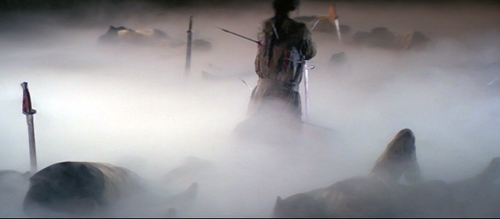
Killer Constable.
DB here:
Like most cinephiles of my vintage, I love anamorphic widescreen, especially in its early years. Even though CinemaScope as a trademarked format is long gone, its aspect ratio of 2.35 or 2.40 to 1 became the standard, and we tend to call any widescreen film of those proportions a “‘Scope” production.
Nowadays many films are in ‘Scope; it’s sensed as a cool ratio. Too cool, actually: I’m not sure that Cop Out and The Hangover needed to be in ‘Scope. Things were quite different in Asian cinema during the 1960s and 1970s, where directors had to learn how to master and exploit the new acreage available to them. I was reminded of their problems, and some of their dazzling solutions, when I visited films that were part of two big retrospectives at the Hong Kong Film Festival this year.
The Shochiku touch
Festival goers tend to ignore their cities’ round-the-year programming. We’ve shown films at our Cinematheque that would have drawn more strongly if they had been presented under the umbrella of a festival. A festival is a big, ballyhooed event, and people set aside time to plunge into it. They take it as an occasion to explore cinema. But that impulse isn’t as strong, I think, in other seasons.
Accordingly, the HKIFF has developed a smart strategy. It often launches a retrospective during the festival period but then continues it after the festival is finished. This enables the festival to spotlight the series more vividly and to engage viewers to return in the weeks to come. The drawback is that the strategy tantalizes us visitors, who wish we could stay on to get a full dose of Shimizu Hiroshi (subject of a 2004 roundup) or Kinoshita Keisuke (2005) or Nakagawa Nobuo (2006). This year’s hors d’oeuvres were even more scanty: only two of the films of Shibuya Minoru played during the festival, which ended Tuesday. The rest come later in April.
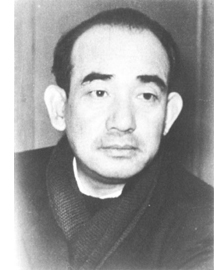 At the venerable Shochiku studio, after assisting Naruse Mikio and Gosho Heinosuke, Shibuya worked with Ozu on What Did the Lady Forget? (1937) before launching his own directing career. He made over forty films, the last one released in 1966. My own awareness of Shibuya before my visit was limited to the family dramas A New Family (Atarashiki Kazoku, 1939) and Cherry Country (Sakura no kuni, 1941), both in a mildly, though not rigorously, Ozuian vein.
The earlier film in the partial Shibuya retrospective was Righteousness (1957), an ensemble piece about a neighborhood still laboring under postwar hardships. The young Seitaro is in love with Michiko, but her mother offers her in marriage to her more prosperous roomer. Seitaro works as a mechanic for a bus company, where Fujita is a driver. Fujita has just married a young woman against his father’s wishes. The characters are introduced through the peripatetic Okyo, Seitaro’s mother, who peddles black-market goods to her neighbors. Fujita’s troubles mount up when his bus hits a child, and Seitaro must decide whether to reveal what he knows about the accident. The film builds well to two climaxes, the consequences suffered by Seitaro after he makes his painful decision and then Okyo’s denunciation of her neighbors. On the other side of the ledger, Fujita’s domestic troubles are resolved rather abruptly and implausibly. Still, Righteousness exemplifies the classic Shochiku formula of smiles mixed with tears, capped by a more-or-less upbeat resolution.
Shibuya was shadowed by Ozu even after the master’s death, for he was assigned to make a memorial film based on the last project planned by Ozu and screenwriter Noda Kogo. This was the film now circulating as Mr. Radish and Mr. Carrot (1965).
Chris Fujiwara has provided us an enlightening account of how Shibuya turned what would probably have been another subtle Ozu meditation on generational strife, in the manner of An Autumn Afternoon, into a more raucous comic melodrama. Yamaki is an executive who lives by strict routine, but he’s also pestered by his four daughters and his lothario brother. When a friend comes down with cancer and the brother reveals himself as an embezzler, Yamaki flees without warning. As his family fret about him, and quarrel among themselves, he settles in among working people, notably some prostitutes and a swindler selling Chinese medicine.
No one in the family displays much virtue, and even Yamaki is seen as cranky and oblivious to the needs of his wife and children. Radish and Carrot’s cynicism seemed to me too easy, and the physical comedy, such as Ryu Chishu’s bodily contortions, struck me as forced and overplayed. Stylistically, the film is eclectic and almost casual. It begins with a zoom and a whip pan. Thereafter, we get flash cuts, canted setups, and a fashion show. Unlike Righteousness, this film justifies Fujiwara’s claim, in a HKIFF catalogue essay not available online, that Shibuya sometimes embraced “visual excess.”
Ozu refused widescreen filming; he compared the ‘Scope frame to a roll of toilet paper. He may have realized that it would pose problems for his graphically matched cuts, deep and subtly imbalanced compositions, and other techniques he had refined over decades. Similarly, Radish and Carrot made me wonder if Shibuya was comfortable working in ‘Scope. He drops in some Ozuian corridor images, but at other times he mounts the sort of packed wide-angle shots common in 1960s Japanese anamorphic films.
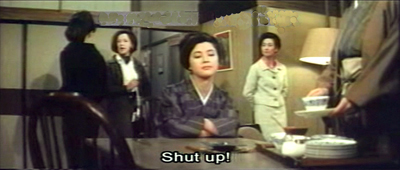
When Ozu fills up his 4×3 frames, he gives us more to look at, along with more daring placement of figures. This is not your typical establishing shot.
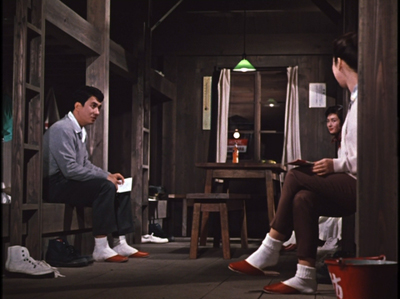
Ozu’s signature shot is at a low height but seldom at a low angle. Shibuya’s compositions remind you what a real low-angle image looks like, with the camera tipped up considerably.
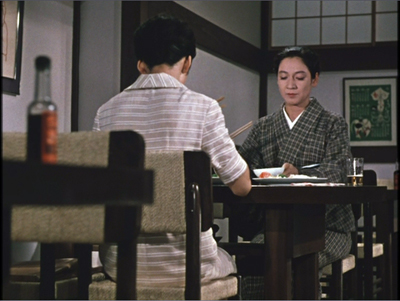
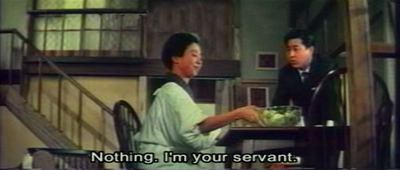
I know, it’s unfair to judge Shibuya’s film by the exalted standards of Late Autumn (1960), and we risk saddling him with purposes he didn’t have. He probably didn’t set out to make an Ozu pastiche. Yet we can, I think, fault Radish and Carrot sheerly on craft grounds. Two party scenes, one gathering men and one among wives, seemed to me almost haphazard in their spatial development. This cut, for instance, is more careless than anything I noticed in Righteousness.
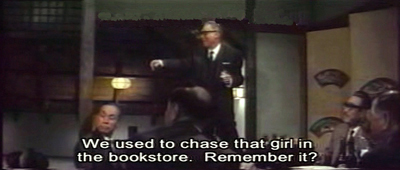
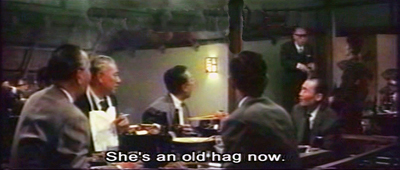
In the second shot, on the far right side, a waitress is now in the frame next to the old man, and he has already turned and is talking to her instead of his classmates at the other table. When this film was made, younger directors, like Suzuki Seijun and Oshima Nagisa, were already handling ‘Scope with much more assurance. I look forward to seeing more Shibuya widescreen entries to learn if they made more polished use of the format.
Elegance and vulgarity
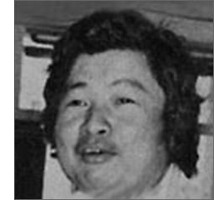 The other retrospective in question was devoted to Kuei Chih-hung (in Cantonese, Gwei Chi-hung), a Shaws director who has been overshadowed by the more famous Chang Cheh and Li Han-hsiang (here and here on this site). Kuei worked in several genres, including the sex movie and the horror film, and he was able to supply cheap items in quantity. But he stands out partly because he moved outside the opulent Shaw studio to shoot on locations. Working with an efficient crew and a lightweight camera, Kuei produced some films, like The Delinquent (1973) and The Teahouse (1974), that look forward to the social realism of the New Wave that followed. Like some New Wavers as well, Kuei highlighted the cruelty of class warfare in Hong Kong both past and present. Ironically, he ceased directing when he felt that the young generation had pushed things further than he could go.
The crime-centered plots of The Delinquent, The Teahouse, and Big Brother Cheng (1975) manage a fair amount of outrage at policing and justice in Hong Kong, as do Kuei’s contributions to a series of omnibus films called The Criminals. His excursions into exploitation fare with Bamboo House of Dolls (1973), Killer Snakes (1974), and the Hex cycle (1980 and after) show, if nothing else, how anxious Shaws was to retain market share in the face of the thrusting popularity of Golden Harvest releases. Obliged to go gross, the man didn’t flinch. The Boxer’s Omen (1983), a supernatural kickboxing yarn, features one rite that demands that celebrants chew food, spit it out, and pass it along to be eaten by others. (No fakery, everything done in one shot.) My tastes run more to something like Killer Constable (1980).
It’s a shooting-gallery plot. Constable Leng and his team are sent to recover gold stolen from the Empress’s palace, and one by one the fighters are eliminated in skirmishes with the thieves. Kuei pointed proudly to the social criticism in the film: “I simply wanted to depict how insignificant commoners are and how, under totalitarian rule, they turn out to be the victims.” Leng, preferring to kill lawbreakers rather than bring them to trial, pursues the bandits with unblinking ferocity. When he finds a miller who helped the gang, he decapitates the man in front of his wife and squalling baby. But Leng’s brutality meets its match in the bandits, who devise comparably sadistic ways to decimate his posse.
Killer Constable comes near the tail end of the Shaws output, just a few years before the company largely abandoned theatrical film production in favor of television. Kuei is thus able to absorb and advance some of the studio’s signature techniques. His film starts out in the splendor of high-key lighting and saturated color typical of Shaws court epics, but soon enough, sword battles play out by torchlight or in semidarkness.
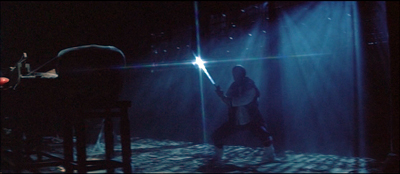
As for ‘Scope, Kuei had the benefit of a strong tradition. In action films, both Japanese and Hong Kong directors cultivated a “precisionist” use of the ratio that made parts of the composition–sometimes widely distant parts–click into place one by one, at a staccato pace. Here are phases of an early fight in Killer Constable.
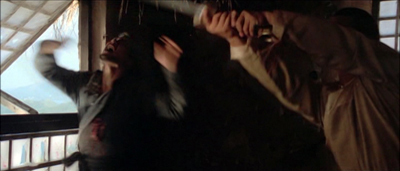
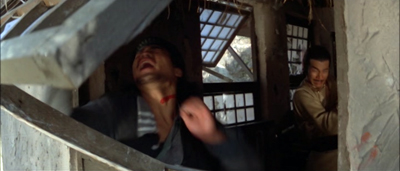
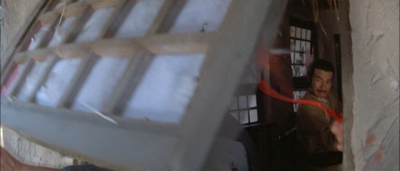
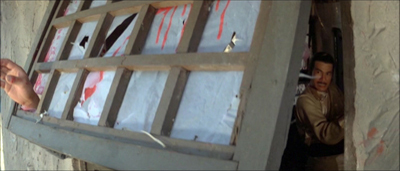
The rhythm builds, from the cut to the new angle, then the peekaboo flip of the window, then the spotlighting of Leng in the lower right, and finally the thrusting hand of his victim in the extreme left, at which point the shot comes to rest.
‘Scope felicities like this may stem as much from the power of the tradition as from Kuei’s individual talent. In any case, his retrospective, like the Shibuya one, shows that we haven’t fully charted the range of expressive possibilities opened by popular Asian cinema in their early encounters with widescreen.
Chris Fujiwara’s survey essay, “Irony, Disenchantment, and Visual Excess: The Style of Shibuya Minoru,” appears in the HKIFF catalogue, available here. In Chapter 12 of Poetics of Cinema, I illustrate Japanese filmmakers’ relative laxity about the 180-degree matching system with a couple of shots from Shibuya’s A New Family. The passage in question may be one-off borrowing from Ozu.
The Hong Kong Film Archive book devoted to Kuei Chih-hung provides precious information not only on the director but also on the Shaws studio system. For more on widescreen style at Shaws see my online essay, “Another Shaw Production: Anamorphic Adventures in Hong Kong.” I discuss the rhythmic resources of Hong Kong combat in Chapter 8 of Planet Hong Kong.
Other continuing retrospectives at this year’s HKIFF are devoted to Abbas Kiarostami and Vietnamese cinema from 1962-1989. If you’re passing through town, you could do worse than check them out.
Thanks to Li Cheuk-to for correcting some information.
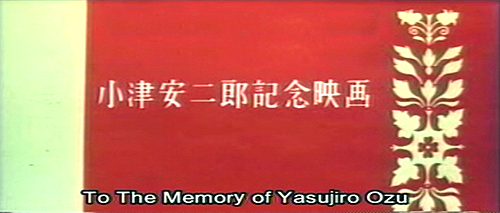
Opening title for Mr. Radish and Mr. Carrot.
The smoking section
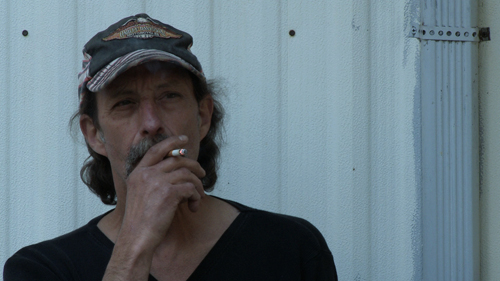
Twenty Cigarettes.
DB here:
Reflect for a moment on the powerful role played by the cigarette in twentieth-century photographic portraiture. Before our recent worries about lung cancer, why were artists, movie stars, and other celebrities so often artfully posed with a tobacco product? Sometimes the imagery seems to evoke sophistication, presenting the subject as a man or woman of the world.
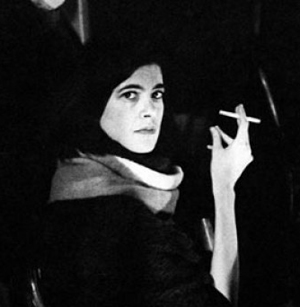
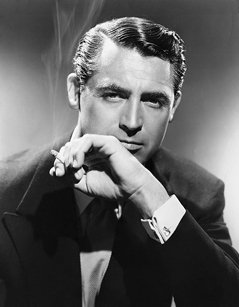
Or the portrait can suggest a relaxed, informal moment, a cigarette break.
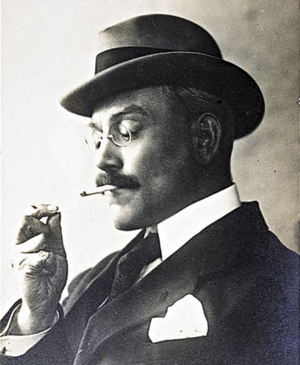
That moment of relaxation can be extended to suggest contemplation or meditation, with the eyes gazing off into the middle distance. Despite the pretty face, this person is deep.
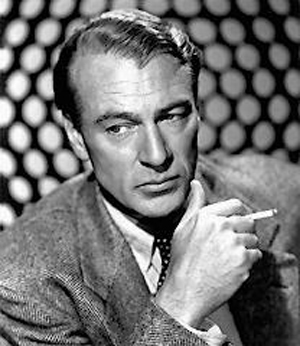
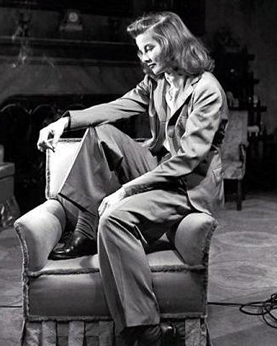
Alternatively, the cigarette can also suggest that painting or writing is a pretty casual affair. Smoking while working, the artist becomes an artisan. Maybe creating masterpieces is no more highfalutin than laying pipe.
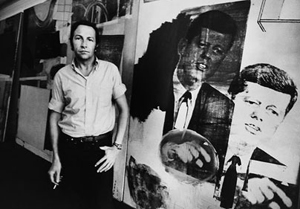
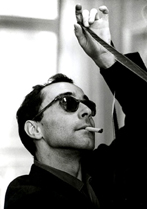
And of course there’s the erotic side. A cigarette can make you look attractively dangerous.
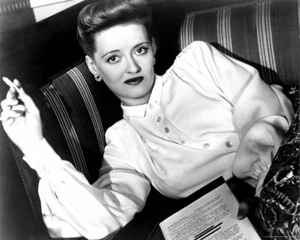
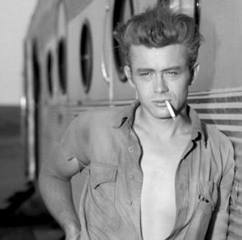
In Golden Age studio portraiture, the smoke can become a compositional arabesque.
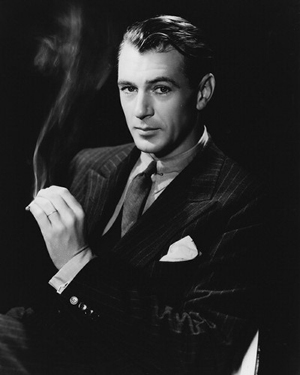
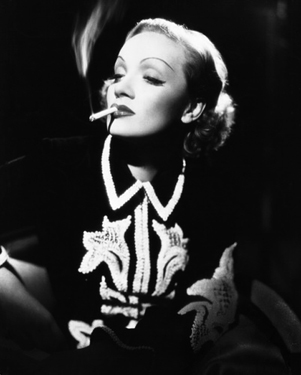
I’m not suggesting that James Benning set out to subvert this glamourous, stylized tradition in Twenty Cigarettes, which I caught at the Hong Kong Film Festival. But I think his film presents smoking as never seen before–defamiliarizing it, the Russian Formalist literary critics might say. And the movie’s not solely concerned with smoking. It resonates a bit with something I looked into in an earlier entry, on facial expressions in The Social Network. But here the film asks a different question: How expressionless can a face be?
Studied neutrality
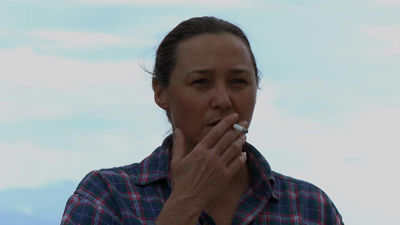
A person in a medium shot smokes a cigarette. Repeat nineteen more times, showing smokers who suggest different ethnic and social identities. They are framed against outer walls, gardens, skies, or rooms. As in the Structural Film tradition, we witness an activity whose end is more or less known, and this forces us to study the minutiae of the process. But how much time the shot takes isn’t completely determined. Some smokers smoke faster than others, some shots run longer, and occasionally Benning halts the shot before the cigarette is quite finished.
In each shot, the smoker doesn’t talk and seldom looks at the camera. No one else is visible or audible (except, in one take, a voice distantly shouting, “Fuck you!”) Benning put himself out of sight during the filming of each take. By cutting the smokers off from all social intercourse, the film reminds us that it’s probably more usual for to people smoke while doing something else, like reading or watching TV or talking with friends. Benning forces us to watch the act of smoking in an almost artificially pure state. The film quickly becomes a study in smoking styles—quick non-inhalant puffs, luxuriant drags, little exhalations, slow streams curling out of nostrils. The ciggie is held tipped up in a dainty salute, or jammed between fingers. Solitary smoking becomes a sort of social-science experiment: If you can’t walk around, talk to others, window-shop, or whatever after you’ve lit up, how will you behave?
You’ll behave, Benning’s film suggests, by putting on the most blank expression possible. The portraits of artists and movie stars above use the cigarette to enhance the subject’s attitude–frankness, cool regard, disdain, pensiveness, intellectual seriousness. The cigarette, even the smoke, signifies. Nothing in the cigarette-portrait tradition prepares us for the almost frightening neutrality we see on the faces of Benning’s people. What are they thinking? Are they feeling anything?
It’s rather hard to maintain a poker face in a social interaction. Engaging with others, we spontaneously send signals of interest or mutual understanding, if only through raised eyebrows or a quick smile. But Benning’s lone smokers are eerily blank. Even what might seem to be an expression is often simply the person’s face at rest. (Some resting faces are read as non-neutral, as when an elderly person seems perpetually frowning or hangdog.) In the film, when the person’s expression changes, that’s usually because of the smoking; the twenty people squint or frown or tighten their jaw as they suck or exhale. For once facial movement is divorced from emotional signaling, and the result is a kind of anti-Shirin, Kiarostami’s portrait gallery of people caught up (apparently) in spontaneous bursts of emotion.
Benning’s film brings to mind the Warhol Screen Tests, and he has acknowledged the influence. Yet unlike Warhol, Benning gave his people the same specific task to execute. He’s like Hou Hsiao-hsien, who has explained that he got performances from his nonactors by letting them occupy themselves with eating and smoking. Warhol, as I recall, left things up to his performers, and so they might fiddle with props, run through a range of expressions, or simply stare innocently or challengingly at the camera. (To avoid reproduction rights problems, let me just send you here to sample some possibilities. On this page Nico the superstar seems herself to recreate the mystique of the classic studio portrait.)
Twenty Cigarettes yields something different from the Screen Tests I’ve seen. Using the cigarette as a constant feature, pulling smoking out of its usual place in our habits and social exchange, denying the tradition that shows smoking as connoting attitudes and emotions in people onscreen, Benning enables us to watch, across some ninety minutes, faces that aren’t dramatizing themselves or sending signals. No stars, these folks, let alone superstars. No narcissism either.
Yes, through dress and hair and demeanor we quickly characterize these men and women by type (housewife, hipster, working man). And each face carries marks of experience we can’t help but wonder about. At times I found myself looking for wrinkles and the other signs of smoking’s skin damage. And yes, the subjects know the camera is there, so to some extent they are posing themselves. Even granting all this, it seems to me that Twenty Cigarettes gives us a disconcertingly pure example of what happens when people make a tremendous effort to show as little of themselves as possible. We get to study what lived-in faces look like when they aren’t participating in social life but are aware that the camera is watching them.
Cigarette pictures, as if you didn’t know: Susan Sontag, Cary Grant, Louis Feuillade, Gary Cooper, Katharine Hepburn, Robert Rauschenberg, Jean-Luc Godard, Bette Davis, James Dean, Gary Cooper again, and Marlene Dietrich.
The website Celebrities with cigarettes includes many studio portraits. For examples from the Warhol Screen Tests, go here. On this page Nico the superstar seems herself to recreate the mystique of the classic studio portrait. Background on the making of Benning’s film can be found in this interview at Cinema Scope. On MUBI Neil Young provides a stimulating and painstaking analysis of Twenty Cigarettes.
Thanks to J. J. Murphy for discussions about Warhol, the subject of his forthcoming book, and of course to James Benning for his assistance.
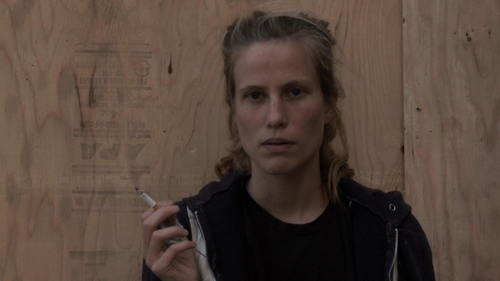
Twenty Cigarettes.
Splashy and spare, vengeance and regrets
DB here at the Hong Kong Film Festival:
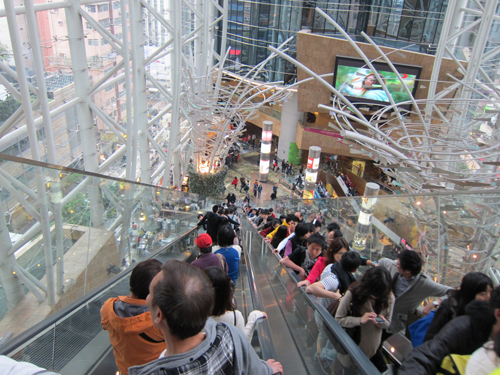
Above, a tourist pic, the view from one of several escalators in the towering mall in Langham Place. Its flamboyance makes a sharp contrast with the movie I saw in the mall’s cinema, the minimalist Turin Horse. (See below.) The very end of this entry presents another view from the heights of Langham.
Righting wrongs, with new wrongs
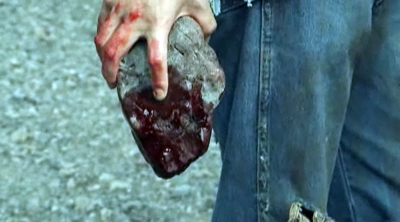
Heaven’s Story.
Most Hong Kong thrillers and action pictures use revenge as their mainspring. It’s fairly uncommon, however, for a film to try to convey the cost that vengeance exacts on the avenger. Punished, directed by Law Wing-chong and produced by Johnnie To, makes an effort in this direction. A mogul’s spoiled daughter is kidnapped, and his refusal to bend to the captors’ will leads one, in a moment of pique, to kill her. After learning of her death, the mogul contracts with his chauffeur, a man who knows the underworld, to track down the gang.
The tycoon, played by Anthony Wong, goes through some agonizing as he must hide his daughter’s death from the girl’s stepmother. In turn, the chauffeur, Richie Jen (whose skilful performance dominates the movie), must abandon his son after executing the boss’s revenge. The men’s lives dissolve in their quest for payback, and the fact that the daughter, a brattish cocaine addict, is completely unsympathetic only makes the whole thing bleaker. An obvious parallel is the Eurothriller Taken, which presents a rash but innocent daughter rescued by a father who remorselessly cuts down everything in his path. Well-mounted, with perhaps too many flashbacks, Punished is that unusual Hong Kong film that insists that every effort to assuage male pride takes a toll in male pain as well.
But for a film that really investigates the cost of settling accounts you have to turn to Heaven’s Story. Here Zeze Takahisa, known mostly for erotic films, traces out the consequences of three killings. The cop Kaijima impulsively shoots a suspect. The locksmith Tomoki’s wife and child are brutally murdered by a teenager, Mitsuo. And elsewhere the little girl Sato is the only survivor of another family homicide.
The stories link up. Sato, in numb grief, sees Tomoki on television vowing to kill Mitsuo when he leaves prison. Because the man who killed her family has committed suicide, Sato embraces Tomoki’s reckless vendetta. She grows up hoping to help him kill Mitsuo. At the same time, Kaijima’s son develops a sidelong relation with her….
I really haven’t given away much, because the film traces these characters and several more across the space of—yes!—four and a half hours. As in a novel, the motives and connections among characters emerge slowly. Zeze’s plot maintains a balance between suspense about what comes next and curiosity about the past. And as in most network narratives, part of the pleasure is wondering how the new characters we meet will tie into the ramifying web of relationships.
Zeze splits the film into two “acts,” with intermission, at a bold spot: ending the first part on a pitch of suspense and starting the second with a new set of characters, making us wait for the developments set up at the end of act one. Working on a broad canvas allows the film to shift majestically, in large blocks, from one person to another. The same goes for the ending: After the main drama is resolved, Zeze allows a long epilogue in which many of the film’s motifs are gently set to rest.
That drama and those motifs, unsurprisingly, bear on the power of unspeakable acts to ignite our desire for revenge. Every character, even those unaware of the savage deaths in the past, is altered by the central killings. An amateur rock singer, a young woman almost defiantly self-centered, becomes a devoted mother, which seems to yield some hope; but her family is eventually shattered by echoes of Mitsuo’s crime.
Those more directly affected by the killings face more severe tests. Kaijima, for instance, tries to compensate for his impulsive shooting by giving monthly money to the victim’s wife and daughter. (The irony is that the money comes from his sideline, moonlighting as a paid killer.) The daughter grows up expecting Kaijima’s payments as her due and tries to extract more money from him, as if he were her surrogate father. This daughter, along with Mitsuo the teen murderer and the older woman who takes him in, come to unexpected prominence as the film unwinds a tale of sorry lives and compromised choices.
Mostly shot in rough-edged, somewhat bumpy shots, Heaven’s Story at first made me fret: 278 minutes of this? I needn’t have worried. The pace is steady, even relentless, but I didn’t find it monotonous, and a more polished presentation might have lacked the distressed urgency of what we get. Incidentally, the framing bits, showing a sinister puppet play with Shinto overtones, are filmed with smooth care. The contrasts in technique suggest that a more serene supernatural domain exists alongside the anxious sphere of human desires, where people persist in trying to redress old sins by committing new ones.
The obscurity of the everyday
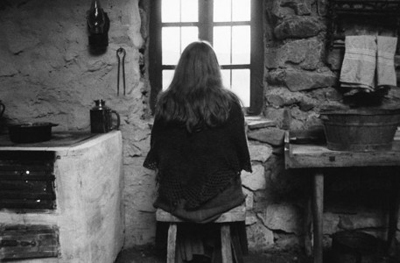
A horse is feverishly hauling a cart, the camera riding low underneath the beast’s plunging head. The wheezing repetitive score rises to a scraping whine, then it’s replaced by the sound of fiercely whipping wind. The old driver pulls the cart up at a farmhouse, where he’s met wordlessly by a younger woman. As the wind tears at them, they take the horse to the barn, the cracked leather harness left on the cart. Inside the cottage, the woman helps the man change his clothes. The woman boils a pair of potatoes. She says: “It’s ready.” It’s the first line of dialogue, and it comes nineteen minutes into the film.
Thus begins the festival film that has exhilarated me most so far, The Turin Horse. With this movie, Béla Tarr, a favorite of mine (especially here, but also here and here), has given us his most spare entry yet. Almost nothing dramatic happens during its 140 minutes, and what does take place is opaque and enigmatic. The film refuses traditional exposition, forcing us to observe bits of behavior and speculate on why things unfold this way.
At one level, it’s the heritage of Neorealism paying off. In Umberto D’s scene of the housemaid preparing breakfast, we had an early example of sheer dailiness used to characterize a person and a milieu, as well as to absorb us in what we might call mundane beauty. But something different, more abstract and disturbing, happens when a film is nearly all routine. In the farmhouse, the old man and his daughter eat their steaming potatoes barehanded, squeezing and mushing them. He wraps himself in a blanket and stares out the window while she does household chores. Next day they arise, dress, and hurl themselves again into the blasting wind. (The wind ripping along the wet streets in Sátántangó is nothing compared to this gale.) In all, cramped settings observed with Tarr’s usual tactile detail, rendered gorgeous in black and white, become as obscurely allegorical as the magical tabletop in Tarkovsky’s Stalker.
Other characters show up eventually. An hour in, a talkative friend arrives and provides a monologue cursing the ignoble forces that have driven intelligence from the world. Later some travelers appear outside at the well, with malevolent results. And the horse refuses to be fed. Perhaps at bottom the “story arc” is that light simply goes out of this world. Having dwelt on gestures (hands pouring out alcohol or struggling to harness the horse) and textures (the ripples of woodgrain on the stable door), the film slides into darkness. The motif is announced in the cryptic trailer for the movie.
From Tarr’s comments we learn that the man is a carter and the woman is his daughter. The film’s voice-over prologue invokes an episode from the life of Nietzsche, who once tried to stop a driver from mercilessly whipping his horse. The incident purportedly led to Nietzsche’s descent into insanity. Tarr has said that the film, based on a short story by László Krasznahorkai (who also wrote the novel Sátántangó), tries to imagine what happened to the horse after the incident.
Yet the horse is less important in the film than the carter and his daughter. It’s not hard to see them living a post-Nietzschean world, and the visitor’s rant about universal debasement may offer support for this interpretation. It’s another exercise in what an earlier entry called Tarr’s “postlude” vein, presenting what remains of life after history has more or less ended. Yet these are no stick figures in a metaphysical meditation. Virtually without psychology, father and daughter are defined through their sheer physical weight and movements. They confront the blasted landscape when they pass outside and the wind tears at them, but once inside they shift to the window to watch. The image of an observer trying to understand a harsh, senseless world beyond the walls is one we’ve seen in the opening of Perdition, and in the scene in which the obese doctor in Sátántangó planted at his desk tries to write down everything he sees happening outside.
Not that the cottage is any more welcoming. Splendidly filmed from a constrained variety of angles, the cottage seems bare of love, meaning, and what we normally consider drama. Tarr’s camera movements and the solemn rhythms of his shots (I counted only 37, including intertitles) are coordinated with the pace of the characters. Perhaps not since Dreyer’s Ordet has the lumbering pace of country life, the trudging gaits and reluctant effort to rise after sleeping, been rendered so expressively. Here, however, nothing is touched by grace
Tarr makes his inhospitable world spellbinding. I’m ready to watch the The Turin Horse again, even, or especially, if it proves to be Tarr’s last film.
For a detailed, less sympathetic review of Heaven’s Story, see Peter Debruge’s piece in Variety. Suggesting that The Turin Horse will be his final film, Béla Tarr discusses it here. At The MUBI Notebook, David Hudson has provided very informative coverage of the controversy around Tarr’s place in Hungarian cultural politics. For an interview with Tarr’s cinematographer, as well as a sensitive appreciation of the film, see Robert Koehler’s piece in the new Cinema Scope.
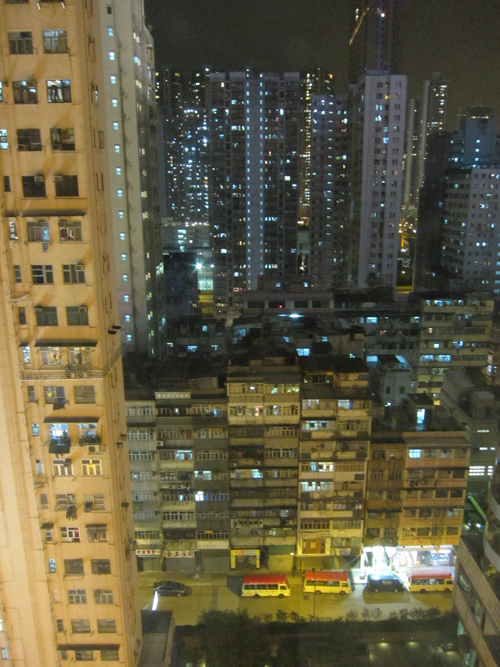
A view from Langham Place shopping mall, Mongkok.
A new book, more or less accidental

DB here:
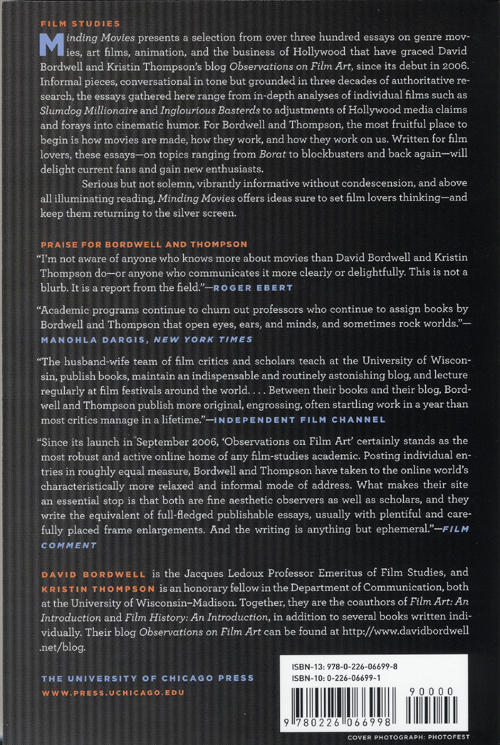
It’s a pleasure to announce that our book, Minding Movies: Observations on the Art, Craft, and Business of Film, has just been published by the University of Chicago Press. In some ways, it’s a conventional academic item, since it collects revised versions of published essays with postscripts updating the contents. But it’s also unusual, because those essays were published not in journals or magazines, but on the internet, on this very site. And they remain available online even as the book comes out.
Why do this? After consultation with our editor at Chicago, Rodney Powell, we thought it would be worth trying. Rodney and John Tryneski were kind enough to suggest the possibility of such a book, and the Press has been something of a pioneer in this new genre. For one thing, a collection allows us to single out and recast pieces that typify what we try to do—to explore films and filmmaking in more depth and breadth than most websites do. Moreover, the site has become vast; at the end of February we posted our 400th entry. We surmise that many readers would prefer a selection of pieces that give the flavor of our ways of thinking. Just as important, publishing a batch of web essays in book form is an experiment we agreed was worth trying. Perhaps this way our sallies would find a new audience.
Minding Movies is one more step in our exploration of the ramifications of web publishing. In less than five years, two net novices have published at least half a million words online. To my surprise, this experience has changed how I think about research, publishing, and intellectual work in general.
From the beginning, this site was something of an experiment. I wondered certain things. Was our research of interest to people outside the realm of college film studies? Could we attract that wraith, the Intelligent General Reader? Could we adapt our methods of working and writing to the medium of the Internet? Do you write differently for scrolling rather than page-flipping? Can you master an informal style after forty years of academic harrumphs?
Back at the turn of the millennium, I started a modest website consisting simply of my vitae and a programmatic statement about studying film. Later I mounted essays that supplemented my books as they were being published. The site expanded slowly, adding two or three online essays a year. In late September of 2006, in response to a suggestion by an anonymous user of our textbook, Film Art: An Introduction, we launched a blog, which we added to my original website. At first we posted every few days, but in later years we typically have written one entry every week. When we visit film festivals, the pace picks up.
We haven’t neglected the website, though. There we have republished published essays and items from out-of-print editions of Film Art. Eventually we put up the entirety of Kristin’s 1985, long-out-of-print book Exporting Entertainment. The combination of the original site and the blog gradually became a fairly monumental thing.
In part, the blog was an effort to amplify and extend the work of our textbooks, particularly Film Art. Hence the site was originally called “Observations on film art and Film Art.” But rather quickly the blog took on a life of its own. For me, as a recent retiree, it has become something of a substitute for my teaching, a way for me to try to communicate my ideas, old and new, to a receptive audience. The site, blog plus essays, functions rather like a self-published magazine, in which we can write about whatever we find curious or compelling in the world of cinema.
We found that our research has proven of interest to a surprisingly large audience. Last week, the site’s total lifetime pageloads surpassed three million. We have had nearly two million unique visitors and almost half a million returning visitors. So far this year, we’ve been very encouraged by the attention given to Kristin’s two entries on the prospects for 3-D (here and here), my entry on eye behavior in The Social Network, and above all Tim Smith’s guest blog on his eye-scanning experiments. Tim’s striking videos were downloaded, from our site and others that picked them up, over 720,000 times in ten days.
What about our working and writing methods? Could we adjust to the constraints and opportunities of the Net? Here the main arena was the blog. It began with festival communiqués from our ever-popular destination, Vancouver, but shortly it turned into something else. The occasion of a screening or lecture spiraled into a consideration of more general issues. A philosophers’ conference teased me into trying to explain some aesthetic questions that had relevance to film. The release of The Departed led me to reflect on some broader aspects of Scorsese’s career, with results that some readers took issue with.
Rather soon, however, we no longer needed the nudge of an occasion to provoke an entry. Kristin took the initiative by writing an essay about how to understand box-office figures—something that students should know but that would also be of interest to any filmgoer. Shortly occasion-based entries mingled with long-form essays on topics as varied as contemporary Danish films and first shots in movies. Sometimes the essays developed ideas we’d argued for in published work (such as my endless invocations of the idea of “intensified continuity” style), but no less often the blog encouraged me to try out new ideas. The format now seemed to me a perfectly reasonable outlet for fresh research, as with my studies of William S. Hart and a long piece on flashbacks.
The experiments continued. Most of our books rely on arguments developed through frame enlargements from particular scenes. So we learned how to illustrate our online essays with frame grabs, which yielded the bonus of color. The next step was obvious: books. The University of Michigan had already made my Ozu and the Poetics of Cinema available as a pdf. After Planet Hong Kong went out of print, I had the chance to create a wholly digital second edition. I look forward to publishing my next books as electronic editions.
In 2006 I could never have predicted the complementary developments in our online work this year. A book originally printed gets new life in digital form. Essays originally online are now available in book form. Where it all leads, we don’t know. But it looks like more fun is ahead.
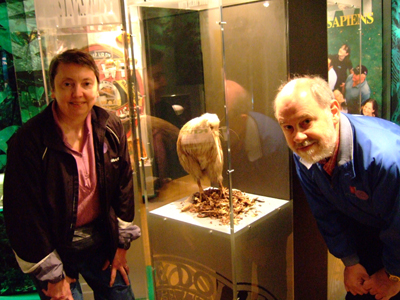
KT and DB learn about kiwis in Rotorua, New Zealand, 2007.
Kristin here:
We had never created a book so quickly. Our neighbor Jim Cortada, a professional writer, calls Minding Movies a “free book” because it consists of material already published.
Of course, we had taken a lot of trouble over the entries during the preceding few years, but not with the intention of ever seeing them printed. Some we turned out quickly in response to something intriguing or silly or downright wrong that we saw on the internet. Those usually involved little more than looking up a few dates or names and coming to some conclusions about the issues involved. Others required days of research, with stacks of clippings and print-outs and piles of books with Post-its sticking out of their pages. Some entries involved the kind of intensive research that we would formerly have put into an article destined for an academic journal or anthology.
We wound up writing many entries that we didn’t think of as being as ephemeral as most web publications. The effort involved in keeping the blog going, though it happens in short bursts, does add up to a lot after four and a half years. (Collecting the many illustrations needed for some entries takes more time than the writing.)
David wants to explore the possibilities of online publishing, and I must say that having Exporting Entertainment, which was in print for a very short time, available again is satisfying. Still, if I believe something will be worth reading in years to come, I prefer hard print. So the opportunity offered by the University of Chicago Press to publish a selection from the blog was most welcome.
Choosing the entries to include wasn’t easy. Some of our most popular and substantive essays were the close film analyses. Yet those were precisely the ones which, as David says, web publication enabled us to use many illustrations. For print publication, we were more constrained, and for the most part we avoided those essays rather than publish them with only a few of their images. We selected a small number of the more heavily illustrated items: “Grandmaster Flashback,” “Unsteadicam Chronicles,” “Pausing and Chortling: A Tribute to Bob Clampett,” “Slumdogged by the Past,” and “A Welcome Basterdization.” To make up for such profligacy, we balanced those with entries that needed one or two or no illustrations.
We hope the result reflects some of the variety and range that the blog as a whole contains. One thing we discovered is that when you’re blogging, the kinds of things you’re inspired to write about far outrun the academic topics one chooses for formal articles in print. There’s also the chance to be topical in a way that the slow process of academic publishing doesn’t permit. And quite often writing for the blog can indeed be fun.
In a way we are following in the model of our friend Roger Ebert, who took to internet writing like the proverbial fish to water. Especially after the loss of his voice, he has reached an even greater and more devoted audience with his reviews and his reflective, often moving essays posted as Roger Ebert’s Journal. Roger has supported our blog enormously by linking to and/or tweeting about some of our entries. He now has supported the book by providing a more than kind blurb for the cover. The book is dedicated to him and his wife Chaz. A month from now, we look forward to blogging from the thirteenth annual Ebertfest.
For the blog goes on. Even if Minding Movies attracts favorable notice and sequels become possible, we’ll never catch up in print to what we’ve done on the internet. After all, no book is really free.