






Archive for the 'Film comments' Category
Time for a quick one: A miscellany from friends
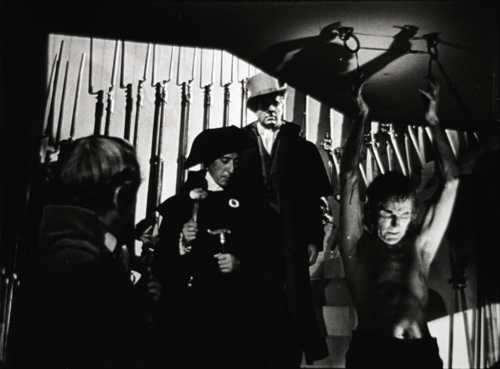
The Black Book (aka Reign of Terror).
DB here, catching up with books, videos, and events:
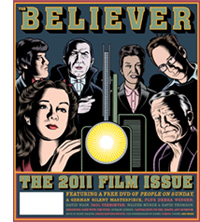 David Cairns has written a lively appreciation of William Cameron Menzies for the March/ April issue of The Believer. The essay bristles with rapid-fire aperçus, such as the suggestion that the great, demented Kings Row is something like the Twin Peaks of its day. David is particularly good at plotting the extent to which Menzies dominated the work of his directors. Directors without a visual style of their own, he points out, were easy for Menzies to overwhelm, but those with an already-developed signature could assimilate his contributions, as Hitchcock did in Foreign Correspondent.
In The Black Book (aka Reign of Terror) Menzies found soul mates in two other aggressive pictorialists, Anthony Mann and John Alton, the team becoming “a crazy triangle,” eager to indulge in “thrusting gargoyle faces in fish-eye distortion, clutching shadows, and funky, teetering compositons.” Bob Cummings never looked so bizarre, before or since. I didn’t talk about this wild movie in my online Menzies material here and here because I had such poor illustrations from it. Now things have changed, and a decent, or perhaps rather indecent, sample of the film’s delirium (above) can serve to back David’s point.
David’s “Dreams of a Creative Begetter” is one of several film-related pieces in this issue of The Believer. The issue includes a DVD of the seminal People on Sunday (Menschen am Sonntag, 1930), which gathered the talents of Billy Wilder, Curt Siodmak, Robert Siodmak, Edgar G. Ulmer, Fred Zinnemann, and Rochus Gliese. A helpful introductory essay is at the Believer site.
Speaking of David’s writing, don’t miss his superb shot-by-shot analysis of a key scene in Gilda at his Shadowplay site, an obligatory stop for all cinephiles.
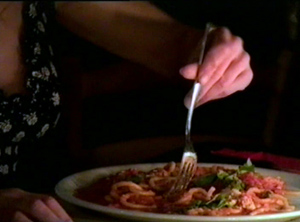
Seldom does a monograph on a single film probe so deeply as Mette Hjort’s new book on Lone Scherfig’s Italian for Beginners. It’s easy to take this movie as Dogme Lite, since compared to the earliest, rather harrowing Dogme efforts, it’s an ingratiating romantic comedy-drama. Mette does justice to this side of Scherfig’s film, but she also shows that it’s an exercise in moral seriousness. Reconstructing the production process, she conducts in-depth analysis of performance and technique. She is sensitive to actors’ moments, such as simply laying down a knife and fork; aware that these gestures are developed through improvisation, she is able to trace how each character is built up through details.
In her books and articles on the Dogme school Mette has shown that its innovations go beyond the vaunted technical “rules.” She always addresses them, of course; here she provides an illuminating typology of ways the rules have been followed or dodged. But she also stresses, as most writers don’t, that Dogme films engage with matters of political importance. For example, she has shown that The Idiots’ controversial display of “spazzing” triggered an important debate about Danish attitudes toward the disabled. In her new book Mette indicates that Scherfig’s efforts to endow her characters with the dignity to be found in everyday life offers viewers a chance “to re-connect with one of their culture’s most powerful moral commitments.” Mette talks about the project in this video.
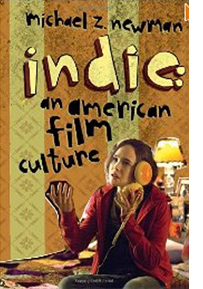 David Gordon Green directs Your Highness; Justin Lin signs his third Fast & Furious movie. With indie filmmakers eagerly joining the tentpole and franchise business, the whole phenomenon seems due for a rethink. This makes Michael Z. Newman’s Indie: An American Film Culture all the more necessary. Although I can’t be unbiased, because I served as Michael’s advisor on the dissertation that became the book, I think that any reader would find the result a fresh and vigorous exploration of the achievements of the Sundance/ Miramax generation.
Michael starts by looking closely at the audiences and marketing. He suggests that viewers engage with the films through particular viewing habits (e.g., “Characters are emblems”). He then shows how these habits were nourished and refined by distributors, promotion, and film festivals. The next two sections of the book consider what we might take to be the two poles of indie difference from Hollywood: greater realism, and more self-conscious artifice. The central chapters analyze realism in relation to “character-centered” filmmaking in the Indie trend. Michael turns a critical eye on characterization in films as different as Walking and Talking, Lost in Translation, and Welcome to the Dollhouse. The third batch of chapters considers the trend’s other major appeal, the sort of play with style and form we get in the Coens, Tarantino, Nolan, and others.
Michael shows how character-driven realism and gamelike artifice mesh well with the mandates of distribution and reception—how, in effect, “originality” becomes something that can be calculated and branded. The book concludes with thoughts on the evolution of the trend, comparing Happiness with Juno and raising the inevitable question: How artistically independent is independent film? Newman leaves us pondering: “Indie cinema has become Hollywood’s most prominent alternative to itself.”
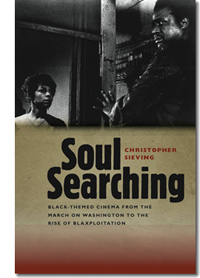 One of the hallmarks of the Wisconsin program in film studies is its nuanced refusal of the art/ commerce duality that supposedly rules filmmaking. From many angles, researchers here have shown that creative impulses and business mandates mix in complicated ways, and the results are often fascinating. Indie is one example of this sort of research project, and so is another dissertation-become-book, Christopher Sieving’s Soul Searching: Black-Themed Cinema from the March on Washington to the Rise of Blaxploitation. (Again, I was involved, serving on the committee chaired by Tino Balio.)
Chris concentrates on 1960s black-themed films from A Raisin in the Sun onward, because he wants to trace how filmmakers tried out a variety of ways to represent and comment on black life. It was a transitional era, but as he puts it “because of the insights they reveal about the periods that bracket them, transitional periods are among the most fascinating and significant in all of film history.”
For Chris, Gone Are the Days (1963), The Cool World (1964), Uptight (1968), The Landlord (1970), and the unproduced Confessions of Nat Turner provide case studies of alternatives to what became the crime-and-comedy product of blaxploitation. Why did decision-makers believe that black-themed films would sell broadly enough to repay investment? What choices and compromises were necessary to “universalize” material (for white viewers) while also retaining “authentic” blackness? Or was it better simply aim the films at white liberals?
Chris tackles such questions through a painstaking study of the film industry’s efforts to find, or create, an audience for films that took great risks. Written with verve (on the screen handling of the Black Panthers, Chris talks about Hollywood’s “Black Power outage”), Soul Searching revives films that are all but forgotten and shows how their efforts to create one variety of independent cinema failed for particular social and industrial reasons.
Someone I’ve been meaning to spotlight for a while: Frédéric Ambroisine is a multitalented critic, filmmaker, stuntman, and collector based in Paris. One of his careers is making supplements for French DVD releases of Hong Kong films, both classic and current. If you have even a smattering of French, you can follow his supplements with ease. He gets precious interviews with screen legends like Kara Hui Ying-hung and Ku Feng (below), master villain of the great New One-Armed Swordsman.
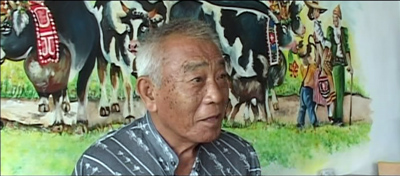
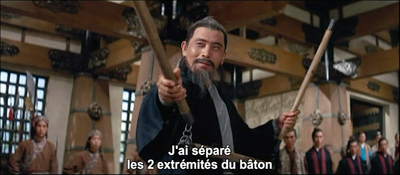
The videos from Wild Side often include Fred’s featurettes. You can follow Fred’s activities at actionqueens.com and alivenotdead. Much of the material in both places is in English.
Finally, if you’re in Los Angeles this week, why not visit the celebration of Orphan Films playing at UCLA 13 and 14 May? While I was in New York in February, I met NYU’s Dan Streible, moving spirit of the Orphan Films movement. Dan and his colleagues work with archives, collectors, and filmmakers to save films that fall through the cracks, digging up everything from home movies to news clips and experimental cinema. Dan curated a program of orphans at our local festival earlier this spring. At UCLA he will be a guest for screenings and discussions of many orphan titles, including the mysterious Madison Newsreel (Madison, Maine alas, not Wisconsin). Go here for Sean Savage’s discussion of the orphan oddity that has become a cult movie, and here for background on Northeast Historic Film, which found the footage.
PS: Speaking of friends, I should thank the solicitous people who wrote me during my recent illness. I appreciate your get-well notes, and I’m happy to report that I’m on the mend.
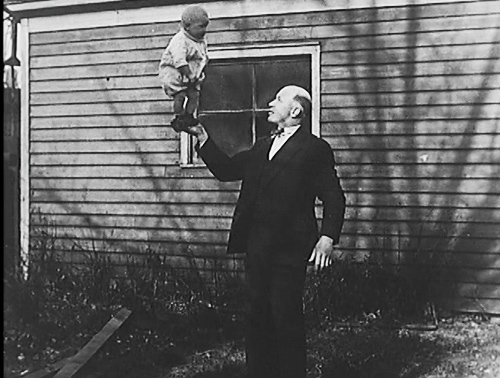
“World’s Youngest Acrobat” (Hearst Metrotone/ Fox Movietone 1929). From Orphans 7: A Film Symposium.
An all-too-short visit to Ebertfest 13
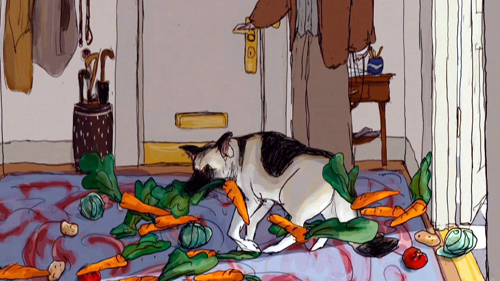
Tulip’s unique way of expressing delight at the prospect of walkies.
Kristin here–
With David still recovering from pneumonia, I drove down to Champaign-Urbana by myself for a truncated Ebertfest visit. As always, 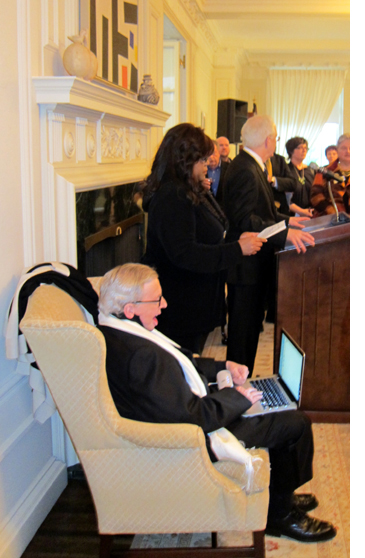 the event began with a reception at the president’s home, where Roger delivered a speech via his talking computer (left).
This year, rather than kicking off the festival with a Wednesday-night screening of a 70mm print, the opening program was a screening of the restored version of Metropolis, incorporating footage found in Argentina. (David has already blogged about the new version, having seen it last year at the Hong Kong Film Festival.) I had the privilege of introducing the screening.
Roger’s program notes gave a good summary of the film and its latest restoration, so I talked a little about why it’s not all the odd that a nearly complete print should be found in Argentina. First there’s the matter of what happened to prints at the end of their theatrical circulation in the silent era. Films didn’t open around the world day and date the way they do now. Prints might be exhibited in one country, then move onto another with new intertitles in a different language cut in. They might be shown for years, until their useful life was over. By that point they might have reached places far away from their place of origin. They were also usually covered with scratches and lines, and they weren’t worth the cost of shipping them back to their makers. They might be buried, as was the case with the 1978 Dawson City find in Alaska, or stored in the attic of a theater, or rescued by a projectionist who tucked them away in a garage. In some cases, collectors acquired them, as happened with the Argentinian Metropolis print. Occasionally these treasures come to light, as recently happened when the Film Archive of New Zealand located several American titles, such as John Ford’s lost silent film Upstream. So far-flung places that long ago were the end of the line for prints are where we might expect them to resurface. Indeed, New Zealand’s archive also held a print of Metropolis that contained some shots not found in earlier restorations or in the Argentinian print, and these appear in this latest version.
A second reason why Argentina is not a surprising place to find a long print of Metropolis has to do with the German film industry’s strength after World War I. Despite having been defeated, the country built up its production until it was second only to Hollywood. European companies found it difficult to sell their films in the U.S.; then, as now, American films dominated their domestic market. German companies sought other areas where they could compete on a more equal footing. They were quite successful in South America, and Fritz Lang’s films were among the most popular there. Small wonder, than, that a well-worn, largely complete print should survive there.
The original score has been reconstructed, but as has become customary at Ebertfest, the Alloy Orchestra supplied their own original accompaniment. (See below.)
Dog-lovers’ delight
The thing that sets Ebertfest apart from other festivals is that it reflects the taste of one person. Roger chooses the films, and his reviews are reprinted in the program as notes. When Roger saw the acclaimed animated film My Dog Tulip, based on J. R. Ackerley’s memoir about life with his Alsatian, he was reminded of another man whose only love was his dog, Umberto D. So, having the ability to program of double feature of the two films, Roger did. Apart from the annual silent film, Ebertfest seldom shows older classics, so this was something of a departure. I had only seen a 16mm copy of Umberto D, way back in my graduate-school days, so it was great to see a 35mm print on the big Virginia Theater screen.
The juxtaposition of the two films worked well, with the grim image of old age and despair of Umberto D followed by the nostalgic but fairly upbeat My Dog Tulip. Judging by the questions and comments afterward, the latter struck a particular chord with dog lovers in the audience, and during the remainder of my stay I heard many pet anecdotes exchanged among people around me.
The film was created by a husband-wife team, with Paul Fierlinger drawing on a digital tablet and Sandra Fierlinger painting in the colors with a computer program. As I pointed out during the panel discussion after Nina Paley’s Sita Sings the Blues was shown at Ebertfest in 2009, computer animation doesn’t mean that the computer does all the work. Far from it. A computer has to have a lot of material fed into it before it can aid in the filmmaking process. Each frame of My Dog Tulip was done by hand, and it has the look of traditional cel animation. (As with traditional cel animation, the Fierlingers use each image twice in a row, so that only twelve drawings suffice for a second of film.) There’s a deliberately rough, slightly jittery look to the outlines of the figures in the shots, helping give that impression of drawn animation.
Ordinarily I would have preferred to see the film in 35mm, but Paul and Sandra told me that the 35mm prints actually washed out some of the vibrancy of the intended colors. The digital print projected at Ebertfest definitely did the colors justice.
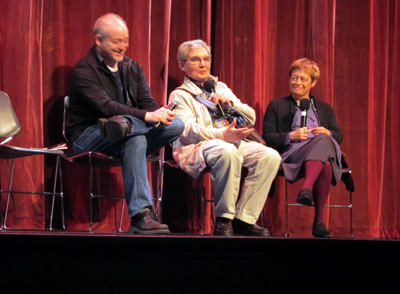
Matt Soller Zeitz with Paul and Sandra Fierlinger onstage after the screening
Filling the big screen
On Friday, two very well-known directors presented beautiful, color, widescreen 35mm prints that looked terrific–and huge–on the big screen. (I was sitting in the second row for one, the first row for the other, so the effect was particularly overwhelming.) I had missed Richard Linklater’s most recent release, Me and Orson Welles, in first run, so it was a pleasure to catch up with it. As all the reviewers remarked, Christian McKay uncannily impersonates the real Orson Welles. As Linklater pointed out, McKay was in his  mid-30s at the time of filming, while Welles was a mere 22 during the time depicted–and yet the portrayal works, since Welles didn’t really look young, even at the beginning of his career.
The film pulls a great deal of humor out of rehearsals for Welles’s famous 1937 staging of Julius Caesar, with the director’s whims and ego dominating the proceedings, and Zac Efron’s stagestruck high-school kid providing a naive point of view of the backstage politicking. Given all the antics in the lead-up to the premiere, it’s impressive that Linklater manages to switch gears abruptly and present snippets from the production itself that genuinely suggest the impact of Welles’s revolutionary staging. It wowed New York and pioneered the way for modern-dress versions of the Bard’s works.
The on-stage discussion after the film revealed that the production, which manages to convey 1930s New York so convincingly, was mostly shot on the Isle of Man. The British island not only offered favorable production incentives, but it boasted a well-preserved local playhouse that could double for the long-since-destroyed Mercury Theater.
That evening veteran director Norman Jewison presented one of his less well-known films, Only You (1994). It’s a screwball, absurdly romantic comedy starring Marisa Tomei and Robert Downey Jr., both looking very young and very gorgeous.

After Jewison moved from television into feature films in the 1960s, his early projects included two Doris Day and Rock Hudson comedies (The Thrill of It All and Send Me No Flowers), and he returned to the genre with Moonstruck.
Only You has a slender plot in which the heroine, convinced that a Ouija board has given her the name of the man she will marry, abandons her fiancé to follow a man she thinks is her destined true love across Italy. Cinematography by Sven Nykvist and location shooting in Venice, Rome, and Positano give the film considerable charm.
David has been recovering well, but I didn’t want to leave him alone too long. I returned home today rather than staying through the entire festival. But it was a wonderful few days, and I enjoyed talking with Michael Barker, Paul and Sandra Fierlinger, Kevin Lee, Michael Phillips, David Poland (when he wasn’t busy chasing his lively 15-month-old son), some of Roger’s “Far-flung Correspondents,” and many of the devoted audience members who return year after year to this unique event. With luck, both David and I will be there for the whole event next year.
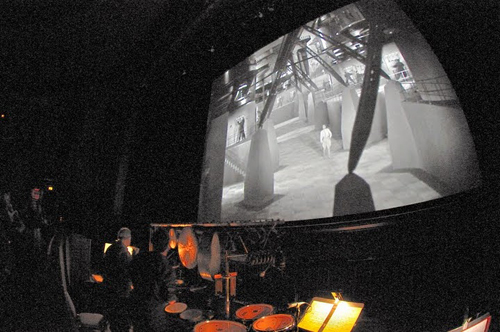
(From the Ebertfest website)
Note: For a second year, the introductions, post-film discussions, and morning panels were streamed live, and they’re also archived online.
Molly wanted more

The Crime of M. Lange.
DB here:
I was watching Snow White and the Seven Dwarfs some years ago with a friend’s three-year-old daughter. Molly hadn’t seen the movie before, and she watched it in a fascinated silence. At the end, Snow White and the prince leave the dwarfs and ride off into the distance.
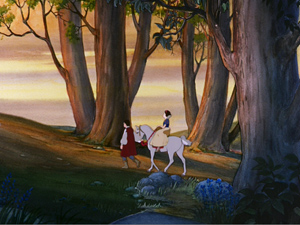
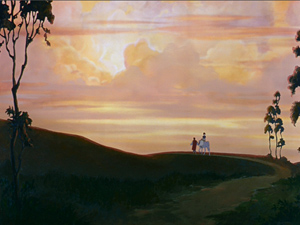
At this point Molly cried, “More!”
This surprised me. How could she know, on her first pass, that the story was ending?
In and out
It has no name that I’m aware of, but it’s one of the most common conventions of movie storytelling. At the end of the film, the story world closes itself off from us. The characters turn away, perhaps walking into the distance. We may get a distant long shot of the scene. In some cases the camera accentuates this withdrawal by craning or tracking away from the action.
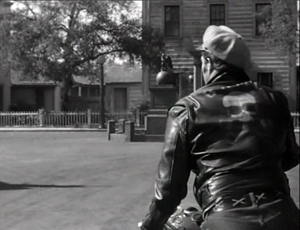
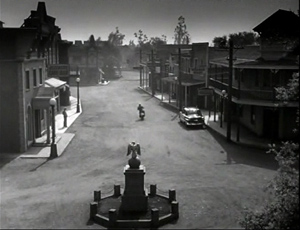
At the end of The Wild One, the biker hero smiles at the woman he’s met and goes out into the street. After exchanging a glance with the ineffectual sheriff, he swings his motorcycle around, his back to us. Cut to an extreme long shot as he rides off.
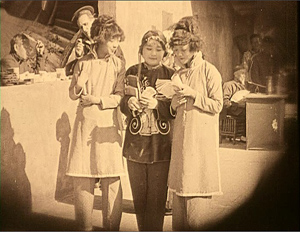
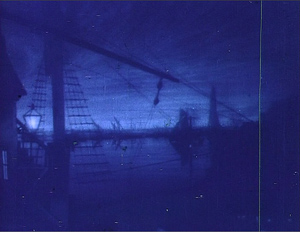
Once you notice this sort of ending, you’re likely to think about beginnings. Sure enough, we find some symmetry. A movie often visually brings us into the story world. Most common is an inward progression, moving from a large view to the central space of action. As far back as 1919, Griffith started Broken Blossoms with an overall view of the harbor and an explanatory title.
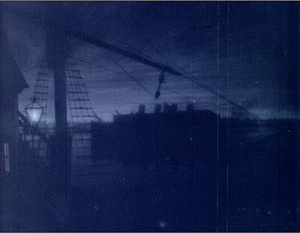
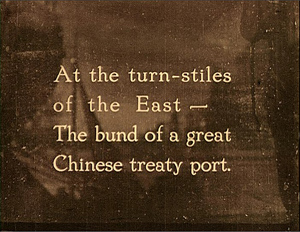
Then we have a gradual entry into the Chinese neighborhood, moving steadily from long shots to closer views. The young ladies we encounter aren’t major characters in the plot, but we’re still slowly drawn into the story world.
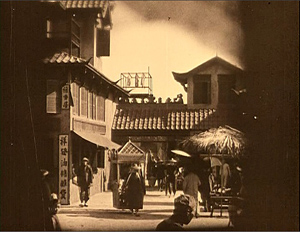
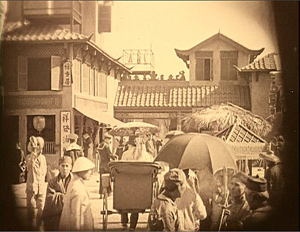
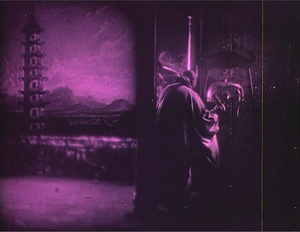
At the film’s end, Griffith’s cutting will manage a parallel withdrawal, from the lovers to the temple and back to the waterfront view.
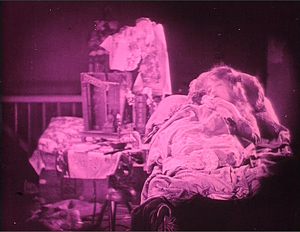
In fact, Snow White starts with a comparable, if somewhat smoother shift inward, from the exterior of the Queen’s castle then, via camera movement and dissolves, to the Queen at her mirror.
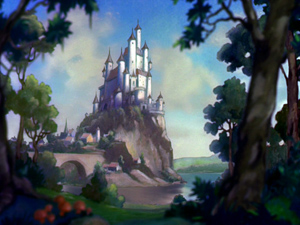
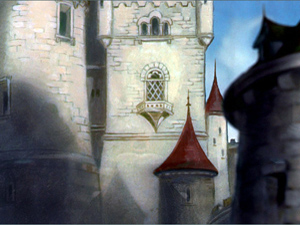
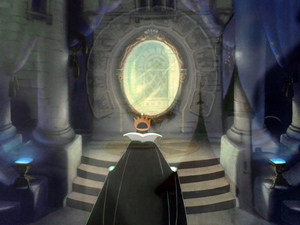
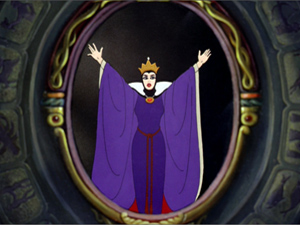
This last shot reminds us that alternatively, a film can start with the characters coming forward, as if to meet us. This is the way The Wild One begins.
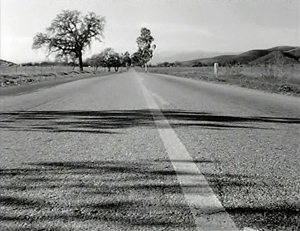
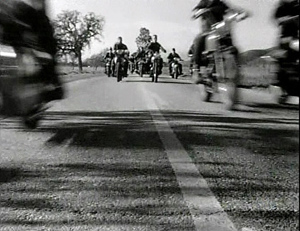
Any sort of combination is possible. The Silence of the Lambs starts with Clarice Starling climbing up a hill toward us and pausing long enough for us to register her as a protagonist.
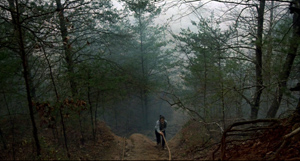
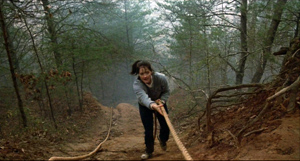
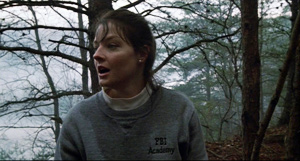
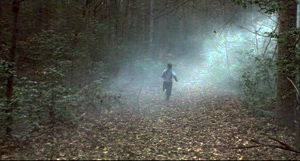
She then turns and runs off into the forest. If this were an ending, we might see her go off further and further into the distance. But this is an opening, so we follow her with a tracking shot forward, letting her lead us into the story action. Soon we’re back to the frontality and intimacy of an opening passage, like the shot of the Queen.
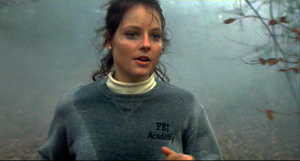
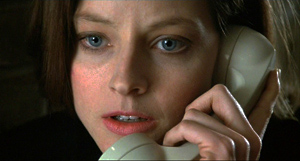
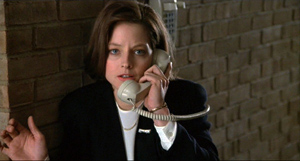
At the end, Jonathan Demme gives us a pair of “farewell” shots. The first occurs when Clarice, who’s been talking to Dr. Lecter on the phone, hears the line go dead. We pull away from her.
The second farewell shot takes place on Lecter’s end in a Caribbean island. It shows him rising to follow Chilson and walking away from us, to be swallowed up into the crowd.
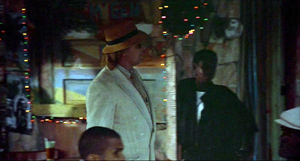
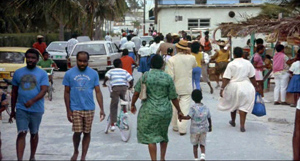
The Silence of the Lambs takes leave of its protagonists in two alternative ways: If the camera doesn’t move away from our characters, it seems, then the characters move away from the camera. They may even seal themselves off, as when a flight attendant pinches shut the curtain at the end of The Hunt for Red October.
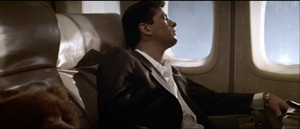
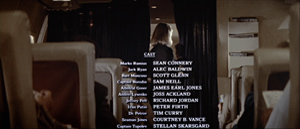
So when we speak of films’ “openings” or “closings,” it seems that we are often talking about a world that initially invites us in but will finally expell us, however slowly and politely.
See it here!
Researchers play Jeopardy! Their answers always take the form of a question. Most film critics work in the declarative mode (“The performances are gripping”), but ideally the academic film researcher works in the interrogative mode. What is this pattern of beginnings and endings doing in movies? How does it work? How did it become common? And how do we learn it?
Take the first question, about the purposes and functions of the device. At one level its neat symmetry mimics the sort of frame that we find in other sorts of narrative, particularly oral storytelling. Fictional stories need to be set off from the surrounding flow of discourse. When we hear “Once upon a time,” we all know a fairy tale is starting. There are equivalents in other oral traditions, as in “Here is a tale . . . .” (Yoruba) and “See it here!” (Hause).
Likewise, oral storytelling traditions use formulaic final lines. In our fairy tales, it’s often “And they lived happily ever after.” Native American folk tales may finish with the storyteller simply saying, “The end” or “Tied up.” African oral epics sometimes use the formula “That is what I know” or “Let us leave the words right here.”
In fact, I cheated a little with my examples from Snow White. The film actually is bracketed by a literal opening and closing.
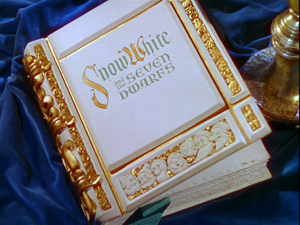
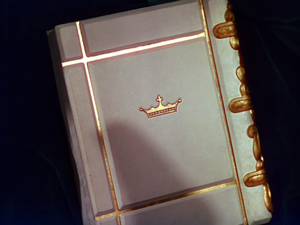
In film, however, the symmetrical structure is only part of the answer. While a film can copy the literary idea of opening and closing a written text, the medium as a whole offers something more. Thanks to the visual nature of movies, the widening or closing-off of the story world can mimic the act of our entering or backing out of a tangible situation. That’s what we see in Snow White and my other examples. In a sense we greet the characters, and after spending some time with them we bid them farewell. The sense of entering and leaving their world is harder to capture so concretely in literature or theatre.
So we need a more specific account of the convention. Surely you’ve thought about the most obvious candidate. The entry/ leave-taking pattern mimics our activities as perceiving, socially inclined people. For creatures like us, to encounter a new situation or setting simply involves approaching it or letting it approach us, then becoming part of it and fixing our attention on its details. At a party, we amble closer to a knot of people we want to talk with, or someone comes up to us. Sooner or later that encounter ends or trails off, and we withdraw or turn away or watch when others depart. More poignantly, the extreme long-shot option can recall moments when a car or bus or train carried us away from our loved ones. In any case, thanks to moving images the salient features of this very common experience can be made tangible for viewers.
This convention, we might say, is just natural. Molly, who had already logged three years of social experience, could plausibly make the analogy with ease. She recognized that her encounter with the world of Snow White was coming to an end–the characters were leaving her–and could express her regret.
This common-sense answer is, I think, basically right. But it needs to be fortified against some objections.
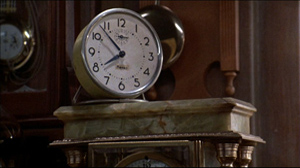
For one thing, not all films use this convention. Lots of films start with close-ups of particular items in an environment, plunging us into details without a gradual entry (below, Back to the Future; Muriel; ou le temps d’un retour).
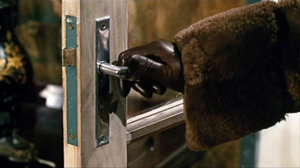
And lots of films don’t end with marks of withdrawal or closure. They end on close views, often of the characters or a significant object (below, Le Silence de la mer; Sorry, Wrong Number).
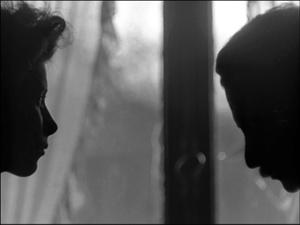
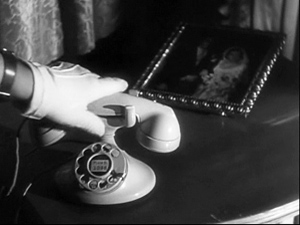
If this pattern were biased by our natural proclivities, wouldn’t it be more common than it is? And if it comes so naturally, why wasn’t it present at the start of cinema, as soon as people started telling stories? Most of the storytelling techniques we now consider very user-friendly, like cutting and camera movement, emerged after many years of moviemaking. It’s akin to a problem in the history of painting: Why did painters need centuries to learn to imitate the way things look?
Moreover, the naturalness can look pretty unnatural. Nobody lies down in the middle of the road to let a horde of bikers sweep by, as in the beginning of The Wild One. The high angle at the end of the movie doesn’t imitate anybody’s likely point of view; it mimics, if anything, a godlike perspective we almost never get. Similarly, the cuts and dissolves that link the views in Broken Blossoms and Snow White don’t have any parallel in our real experience. Tied to our bodies, we can only move toward or away from situations in real time, step by step. The time-compression and freedom of position we get on film are far from natural. In sum, the concrete ways in which this immersion/ withdrawal pattern shows up in actual movies suggest that the films aren’t imitating the literal vantage points we might assume in the real world. There is a lot of contrivance going on.
Real life, amped up
So the convention has some roots in our perceptual and social experience, but filmmakers have streamlined and sharpened it for our uptake. Another example of this process, which I discuss here, involves actors’ eye behavior. Film actors start with normal patterns of looking and blinking, but they modify them in order to signal emotional states and to concentrate our attention on the drama. Similarly, the schema of entering/ leaving a milieu derives from our common experience, but it can be simplified and stylized through cinematic techniques that have no correspondence in our normal experience. All that matters is that the result preserves the core of that schema.
As filmmakers simplify our perceptual and social experiences, they amplify them as well. Movie characters stare at each other more intently than we do in normal life. The actors are stripping off everyday noise (blinks, averted looks) in order to create cleaner, exaggerated signals of mutual attention to the dramatic situation. Likewise, a steep high angle like that ending The Wild One or the pointedly closed curtains of The Hunt for Red October exaggerates the sense of departure and conclusion, giving the action a weight it wouldn’t have in ordinary life.
Why don’t all films use the entry/ retreat convention? I think we should consider such conventions to be tools. They arise in particular filmmaking traditions, perhaps through trial and error, and get refined for different purposes. Some filmmakers might never use them, or knowingly refuse them to create different reactions, or play games with them (as Resnais does at the start of Muriel). But when filmmakers want certain effects, these tools are ready to hand. If you want to ease your audience into the story world, a slow entry pattern works very well. It’s so familiar that the viewer can overlook its contrivance and concentrate on the story information.
So Jeopardy!-style, we have new questions. Has the opening/ closing device spread because it is a very accessible, spontaneously understood convention? Or is it because filmmakers in other cultures have mechanically copied Hollywood? Perhaps it’s like a tool that originates in particular cultural circumstances but which can be useful all over the world. The Phillips-head screw was devised for the US automotive industry but is now a universal gadget. Over time, such tools become more widespread, perhaps dominant. But a tool can always be refused if the task changes.
There’s still a mystery, though. Assuming that viewers understand these image-clusters as signaling beginnings and endings, how did that understanding come about? How, and when, do people learn the conventions? If they are quickly learned, is that because they play into inclinations of our minds?
My best guess for now is this. We tend to think that all artistic conventions are equally hard to learn, but that’s probably not the case. The conventions of Cubist painting demand more effort and knowledge than the conventions of perspective drawing, and that’s probably not just because we’ve seen more perspective pictures across our lives. Likewise, mastering the conventions of Structural Film demands more time and trouble than mastering those of popular genre filmmaking. It seems likely that some conventions rise to dominance because they fit most viewers’ prior inclinations rather well. For example, we are creatures who interact socially in face-to-face manner. Shot/ reverse-shot editing is unfaithful to our ordinary experience in many ways; cuts provide instant changes of viewpoint we can’t achieve in real time and space. But shot/ reverse-shot cutting preserves the familiar social pattern of turn-taking and conversational flow, so it’s comparatively easy to learn.
Still, I don’t have a full answer. My questions bring us back to Molly. If she had seen Snow White before, we might say that she remembered that the film ended at this point. But she hadn’t seen the film before. So does her demand for more indicate that she generalized from her experience of other films? Did she have already a degree of “narrative competence,” allowing her to recognize certain types of cues? Is her competence full or spotty? (Maybe she gets endings, but not characters’ intentions, or goal orientation.) And how did she acquire that competence? Quickly or slowly?
Maybe some researchers have already explored how children master narrative framing of this sort. (I’d welcome correspondence on the matter.) My hunch is that Molly grasped the cinematic convention, perhaps on limited exposure, because she recognized the core perceptual and social experiences it preserves. Leveraging this insight, perhaps, was some understanding of narrative architecture generally. More basically, it may be that as social animals we’re tuned by evolution to detect fairly quickly some constant features of interactions with our peers.
In any case, I’m betting that Molly wasn’t simply mastering a convention cut off from everyday life, like algebraic equations. To learn anything, you already need to know a lot. Cinematic storytelling isn’t, as some semiologists once thought, a highly arbitrary sign system. It piggybacks on our experience of the world–our knowledge, certainly, but also our most routine ways of sensing and thinking. Not least, understanding movies taps skills associated with our social intelligence. More on this in a future entry, I hope.
This is only an anecdote, but I hope it provokes readers to think about the broader issues I raise. I floated these ideas in my closing address for the convention of the Society for Cognitive Studies of the Moving Image, on 5 June 2010. I thank the members of the audience for their contributions to that discussion. Incidentally, this year’s meeting is coming up, in Budapest this June. For more on SCSMI and the sort of issues broached in this entry, go to this category on this site.
My basic argument for a “moderate constructivism” in understanding film conventions is developed in the 1996 essay “Convention, Construction, and Cinematic Vision,” reprinted in Poetics of Cinema (2008), 57-82. I discuss the entry/ withdrawal pattern as a holistic strategy in a later essay in that collection, “Three Dimensions of Film Narrative”, 94-95. An earlier, more fancily titled piece puts the pattern in the context of a different argument: “Neo-Structuralist Narratology and the Functions of Filmic Storytelling” in Marie-Laure Ryan, ed., Narrative across Media: The Languages of Storytelling (2004), 209.
It’s worth mentioning that, like Snow White, the images at the start and conclusion of Le Silence de la mer are enframed by a book–in this case, shots of the original book by Vercors. This iconography is of course common when a film wants to emphasize the literary origins, though in some films, like Dreyer’s, the device of the film as a replay of an already-written text plays a more complicated narrative role. I talk about that in my book The Films of Carl Theodor Dreyer (1981).
The research on children’s understanding of stories is vast and detailed. Alison Gopnik briskly summarizes the evidence that even very young children have surprising narrative competence in The Philosophical Baby (2009), chapters 1 and 2. The pioneering source here, at least for an amateur like me, was Katherine Nelson, ed., Narratives from the Crib (1989).
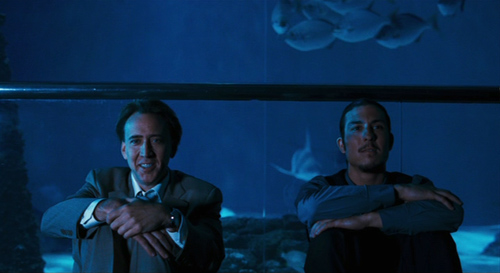
The Bad Lieutenant: Port of Call New Orleans. As in many films, the final shot addresses the viewer in a comparatively overt way.
Arthouse suspense, in big and small doses
Le Quattro Volte.
DB here:
As happened last year, I had to flee Hong Kong for medical reasons. Beset by a wracking cough, I took off three days early and upon returning to Madison wound up in hospital. Current diagnosis: pneumonia. Duration of stay: six nights and counting. A drag. But I’m lucky: no disorderly orderlies, no homicidal doctors injecting me with mind-control drugs (“You will watch only Brett Ratner films for the rest of your life. Sleep, sleep…”). I’m taken care of by expert, calm, and good-natured people. Expect no less from the best city for men’s health and care.
So I’ve been tardy in writing this final HK blog. I just wanted to talk about two extraordinary films I saw in my final days and bring up a scrap of news for followers of Chinese film.
 First, the news. Liu Jiayin, of Oxhide fame, was in Hong Kong briefly to accept an Asian Film Financing Forum award for her screenplay Clean and Bright. The other winner was Li Ruijun, for his project Where Is My Home? Liu was about to visit the US for screenings at Redcat, under the sponsorship of the tireless Bérénice Reynaud, and at Cinema Pacific in Portland. I had a chance to talk briefly with her just before she departed.
Regular readers of this blog know my admiration for Liu’s two Oxhide films. The good news is that she is at work on Oxhide III. She wouldn’t say much about it, except that she is still reworking the script, but it sounded quite far along. In addition, she hopes to shoot Clean and Bright, a more orthodox film about a family, fairly soon as well. Oxhide IV is also planned, with the series running up to perhaps eight installments.
For more on Oxhide, including purchase information for the DVD, check Kevin Lee’s dGenerate Films website.
Leaving us hanging
Too often we think of suspense as specific to certain genres, but it’s actually a fundamental resource of all storytelling. Creating expectations about an upcoming event, sharpening them, and delaying their fulfillment–all these strategies are basic, I think, to narrative experience in general. Although some plots emphasize suspense more than others, even most “character-centered” tales wouldn’t engage us without a dose of it.
True, sometimes there’s a sort of bait-and-switch, as when suspense is conjured up but eventually dissolved. Sooner or later we realize Godot isn’t going to show up, or that Anna in L’Avventura is likely not to be found. In those cases, suspense has led us to another terrain, usually thematic, in which we’re invited to consider something more significant than learning the outcome of events. (Sometimes, though, snuffing out suspense is just a sign of slack, or Slacker, storytelling.)
Suspense is usually associated with popular plotting, so many people expect Serious Films to be lacking in suspense. Which makes it all the more interesting that Iran, one of the most-favored nations on the festival circuit, has made something of a specialty of suspenseful art movies.
We don’t recognize often enough that Kiarostami’s early films are often structured as suspenseful quests, from the boy’s attempt to return his schoolmate’s notebook in Where Is the Friend’s Home? to the final shot of Through the Olive Trees. His scripts for other directors convey this quality even more clearly. The Key is almost Griffithian in showing how a four-year-old boy struggles to rescue his younger brother when they’re locked in a kitchen with a gas leak. The Journey (Safar) is positively Ruth Rendellian: A headstrong middle-class father leaving Tehran with his family forces another car off the road and flees the scene. Instead of resting at a summer retreat, he returns obsessively to the place of the accident to check the progress of the investigation: Will he give himself away? And it isn’t just Kiarostami. Look at the suspense structure in Makhmalbaf’s Moment of Innocence, or Reza Mir-Karimi’s The Child and the Soldier, or Panahi’s The Circle.
What gives Iranian suspense films their weight is partly the fact that they don’t rely so much on the old standbys (chases, stalkings, cliffhanging rescues) but rather on psychological maneuvers, carried out largely through dialogue. Characters in these movies tend to talk a lot, pushing their concerns forward with a stubbornness that we seldom see in other national cinemas. People stick up for themselves, and the suspense comes from a clash of testimonies, pleas, and self-justifications. But it also comes from a moral dimension. My earlier examples depend on our assessing what we ought to happen (the hero of the Journey should be punished) versus what we might want to happen (he should escape). Add a dash of mystery, as we have in Through the Olive Trees (what is Tehereh thinking?) and A Taste of Cherry (what is the job Mr. Badi is hiring for?), and you have artistically ambitious filmmaking that exploits some very traditional resources of the art form.
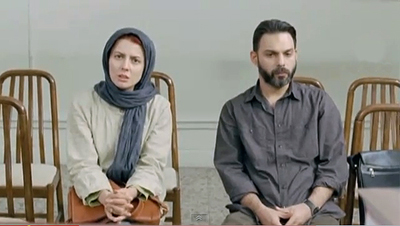
These resources were on display in Asgar Farhadi’s earlier About Elly, which I praised in these pages two years ago. Nader and Simin, A Separation has a comparable power to seize and hold our interest. A wife fails to get a divorce and leaves the household, which includes not only her husband Nader but his Alzheimer’s-addled father and their daughter Termeh. Without Simin to care for his father, Nader hires Razieh, a working-class woman who must bring her little girl with her. Soon the job overwhelms Razieh and, for reasons not disclosed till later, she goes missing. Nader and Termeh find the old man tied to the bed, unconscious.
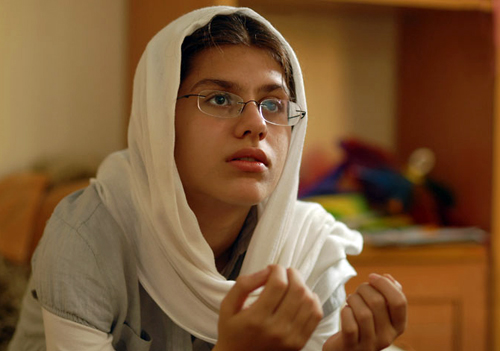
For this early stretch of the film, the helper Razieh trembles on the verge of hysteria, and only later do we learn why. When she returns to the apartment, she confronts Nader’s wrath, which leads to yet another turning point, but one whose significance we realize only later. To complicate matters, Razieh’s hot-headed husband becomes furious with everyone. As in About Elly, a great deal turns on what characters know at one precise moment, and our memory of when they learned something can be as elusive as theirs. And as in Henry James’ novels, much of the action is registered through the reactions of onlookers, notably the pensive daughter Termeh (below), who turns out in the final scene to be as important as any other figure in the film.
The suspense builds on many levels: the progress of the divorce, the decline of the old man, the court case that involves Razieh’s place in the household (did she steal money?), and above all the responsibility for a death. Some of these lines of action are shown resolved; a crucial one remains suspended. And that does, as often happens, oblige us to think more broadly about the film’s treatment of parent/ child relationships. We are left with an exceptionally rich film, one reflecting on class differences, religious ones, and the effects of adult problems on the children around them. Suspense not only feeds our hunger for story; it can also tease us to moral reflection, and Nader and Simin does just that.
No suspense?
How much can you purge suspense from a movie? And if you play it down, what do you put in its place to hold our interest?
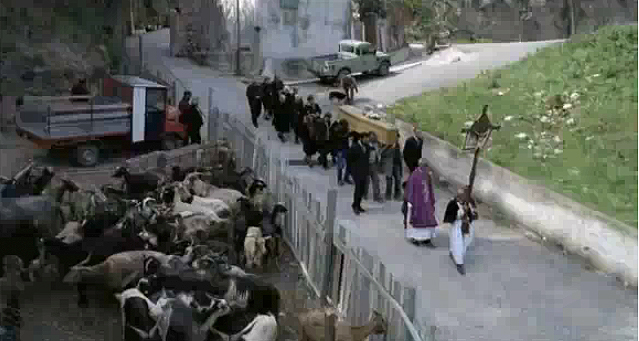
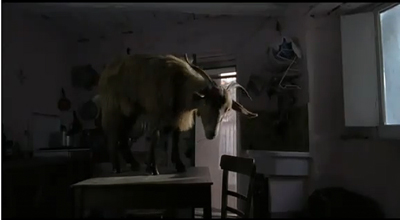
One answer to these questions comes in Michelangelo Frammartino’s Le Quattro Volte. It is one of those sedate observational pieces that covers a year in the life of a village, with not much discernible dialogue but lots of lovely landscape shots. It has a cyclical rather than linear structure, beginning and ending with smoldering wood turned into charcoal–itself a metaphor for the inevitable transmutations that govern plants, animals, and men. We follow an old goatherd who eventually dies; his goats pay homage by climbing precariously to his tiny home and occupying it. A young goat is born soon after the old man’s death. The townsfolk erect an enormous Christmas tree, which at the end of the holiday is chopped down into bits, which will in turn becomes charcoal. If Nader and Simin exists largely in medium-shot, here the extreme long-shot dominates. There are no psychological interactions or dramatic issues of the sort we find in Fahradi’s films. In the rustic spirit of Rouquier’s Farrebique, we get the sheer successiveness of things, the fact that life is one damned, or placid, moment after another.
So suspense can be replaced by sheer consecutiveness, but the task then becomes to make things interesting. Frammartino does so through careful framing, evocative sound, and crisp storytelling technique. The goats pick their way up to the old man’s hillside apartment; they jostle around inside; cut to a shot of the old man’s head as he lies dead; cut to the church, with people filing out as the bell tolls. In addition , you can find suspense at more micro-levels, working not at the level of plot action as a whole but rather within and across particular scenes. After the goatherd’s death, we see another kid born: this is familiar, even clichéd, the rhythm of nature. We follow the kid’s efforts to assimilate to the herd. But as winter comes, the kid strays off, becomes isolated, and ends up lost and shivering. We must assume that he dies. So much for the great cycle of life.
At a still more microscopic level comes the shot that everyone remembers from Le Quattro Volte. It’s so salient that critics who seldom notice imagery can’t help but mention it. I won’t describe it in detail, so as not spoil the surprises, but suffice it to say that it involves a church procession, some intransigent goats, a pickup truck, and a resourceful dog. Reminiscent of Tati or Suleiman, this long shot depends on ratcheting up our expectations about how several converging events might develop, onscreen or off, and then fulfilling those expectations in startling ways. We might call the result spatial suspense: How will this composition-in-time finally resolve itself?
We should, then, never underestimate the power of suspense, even in those films which might seem to forswear it. Melodrama or pastoral, any genre can find a way to excite us by asking what can come next.
Catching up: By leaving Hong Kong early I missed the second screening of The Turin Horse; my first impressions are here. Since I wrote that, I learned that Cinema Scope has published Robert Koehler’s sensitive appreciation of the film and his enlightening interview with the cinematographer Fred Kelemen.
Nader and Sinin, A Separation.