





Archive for the 'Film comments' Category
Milkyway’s fine romance
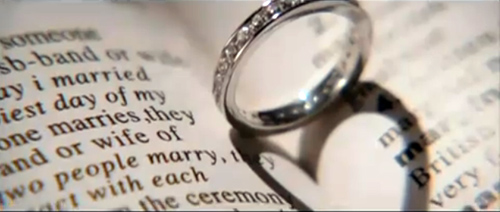
Don’t Go Breaking My Heart.
DB here, from the Hong Kong Film Festival:
First, news. The Asian Film Awards, presented in a glitzy ceremony Monday, held some surprises. Confessions from Japan and Let the Bullets Fly from the Mainland (discussed in my previous entry), each had six nominations going in. But Confessions nabbed no prizes and Bullets won only for Best Costume Design, the award going to William Chang Suk-ping, probably best known as a versatile collaborator with Wong Kar-wai.
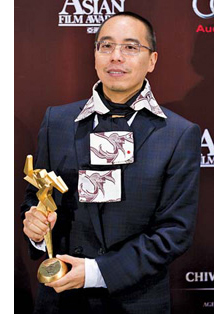 Best Picture winner was festival favorite Uncle Boonmee Who Can Recall His Past Lives, by Apichatpang Weerasethakul (right, in remarkable suit). The Best Director and Best Screenplay awards went to Lee Chang-dong for Poetry (which Kristin and I had liked very much at Vancouver). The winners are picked not by a mass of voters, as with the Oscars, but by a jury drawn from industry figures, critics, and festival executives. The first year’s awards in 2007 was dominated by the crowd-pleasing monster film The Host, which garnered four prizes, but this time two top honors went to arthouse/ festival titles. Still, it was very nice that local industry mainstay Sammo Hung got the Best Supporting Actor kudo for Ip Man 2.
As ever, there were special awards too: one to veteran Busan director Kim Dong-ho, one for Lifetime Achievement to Raymond Chow of Golden Harvest, one to Fortissimo Films for promotion of Asian cinema, and a prize to the top-grossing Asian film. That last was one of the three that went to Feng Xiaogang’s Aftershock (which we wrote about here). For a full listing go here. At Filmbiz Asia Patrick Frater suggests that the catastrophe in Japan gave the ceremony a sombre cast.
Milkyway on the move
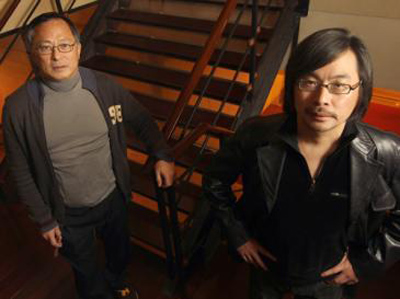
Source: South China Morning Post.
When I arrived last week, I was greeted by a long story in the South China Morning Post announcing that Johnnie To Kei-fung and Wai Ka-fai (above), the movers behind Milkyway films, were embarking on a new production strategy.
Although Milkyway movies had cracked the mainland Chinese market in the past, notably with Breaking News (2004), To had made several films that could not be exported. His most personal films, crime stories like The Mission and PTU, violated the PRC’s demands that movies treat the police with respect. Worse, his Election films, which surveyed the treacherous power plays at work in Triad societies, was unthinkable as an export item–especially since the second entry extended its vision to the role played by PRC forces in controlling the Hong Kong crime scene.
Today, however, everyone acknowledges that the primary market for any Hong Kong film with a substantial budget is the mainland. In the SCMP story To and Wai announce their plans to craft a cycle of films for that audience. Romantic comedies and dramas have shown strong legs there, and true to their prolific energies, To and Wai have committed to making three romances this year. The first, Don’t Go Breaking My Heart, opened the festival on Sunday night. To is currently shooting the next one on the Mainland, and the third is set up to follow quickly.
Don’t Go Breaking My Heart, which is better than the Kiki Dee/ Elton John song, is an office romance like Milkyway’s 2000 hit , Needing You. . . . But the creators have deliberately updated the milieu, which includes not only a mainland émigrée as the heroine but also many scenes shot in China, as required by the financing.
The action starts just before the 2008 financial crisis. Cheng Zixin (a charming Gao Yuanyuan) is a lowly staffer at an investment company, while Cheung Sun-yin (Louis Koo) is an executive at a rival firm who first spies her from his sportscar. Noticing that Zixin occupies a cubicle by the window in a building adjacent to his, the ingratiating rascal begins flirting with her through pantomime. The third corner of the triangle is Fong Kai-wang (Daniel Wu), an architect turned alcoholic bum. The affair between Zixin and Sun-yin falls apart because of his attraction to other women, and she develops a platonic affection for Kai-wang, whom she urges to return to his profession. Three years later, as the financial sector is recovering, the three meet on more equal terms and Kai-wang and Sun-yin begin a serious competition for the young woman.
The financial crisis is no more than a pretext for the meet-cutes, handy coincidences, running gags, and emotional ups and downs characteristic of this genre. (One hopes that the recession gets more sober treatment in To’s long-gestating bank suspense drama, currently known as Life without Principle.) We get the common tension between the world of selfish business operations and that of nobler artistic expression, seen in Kai-wang’s love-inspired architectural designs. There’s also the convention, common to Asian romances, that these grown-up lovers are actually childlike, enjoying pets and stuffed animals. (You find it even in Chungking Express.) Don’t Go Breaking My Heart handles these conventions adroitly, but adds the To/ Wai flavor in its plot geometry and its strict but surprising ways with visual technique.
An American movie would have added subsidiary romances, usually involving the friends of the main characters. Instead, as in many Milkyway films, Wai’s plot is built out of rhyming situations. Sun-yin twice glimpses Zixin on a bus, both suitors use Post-Its and magic acts to attract her attention, characters’ zones of knowledge shift symmetrically, and an engagement ring pops up unexpectedly. Most remarkably, much of the courtship is carried on through skyscraper windows, as the men communicate with Zixin across adjacent buildings.
This last strategy allows To to build wordless sequences that rely on precise point-of-view cutting. At key moments, reverse-shot breakdown yields to striking compositions of the anamorphic frame. First we get two characters framed in different windows, but eventually, when Kai-wang tries to win Zixin away from Sun-yin, the love triangle finds diagrammatic expression in a spread-out three-shot.
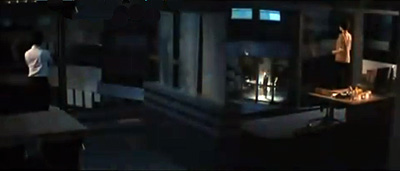
Were shots like these accomplished through CGI? I wouldn’t put it past To to set up a location-based shot like this.
While subjecting its love story to a playful rigor that few Hollywood directors could summon up, Don’t Go Breaking My Heart never dissipates its inherent appeal to our emotions. Those emotions are all the stronger because Wai’s script shrewdly puts the outcome in doubt. The movie is a second-tier Milkyway product, I guess, and I could do with one less twist in its rather long running time. But it’s still a treat. It shows that in a popular cinema, creative minds can turn market demands to their own ends. And once the trio of romances is finished, the SCMP story hints, To and Wai may well turn to another crime saga, this time with the blessing of the PRC. We can only hope.
Wai Ka-fai, writer/ producer/ director of many Milkyway projects, is the subject of this year’s HKIFF Filmmaker in Focus cycle. Several of his older films, including the engaging parallel-worlds yarn Too Many Ways to Be No. 1, are in the program. There is, as usual, an informative book about Wai and To; a pdf sampler is here.
For much more on Milkyway on this site, go here. Ad insert: Films from the company, particularly those directed by To, are discussed in my new edition of Planet Hong Kong, available here.
PS 23 March: Thanks to Sean Axmaker for correcting my aging memory. The original entry attributed the song Don’t Go Breaking My Heart to the Captain and Tennille. Maybe I was subliminally wanting to see them again. No, wait, that can’t be it.
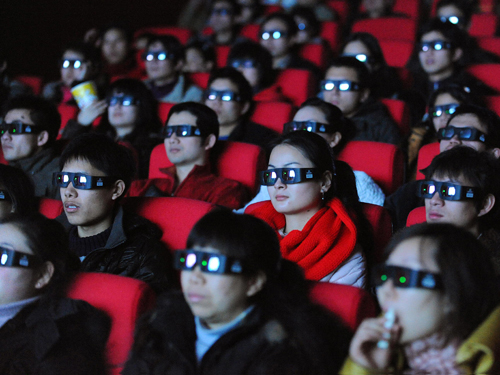
The target: Young mainland viewers of Avatar, China’s biggest box-office hit of 2010.
Pleased to meet you. What’s the greatest movie ever made?
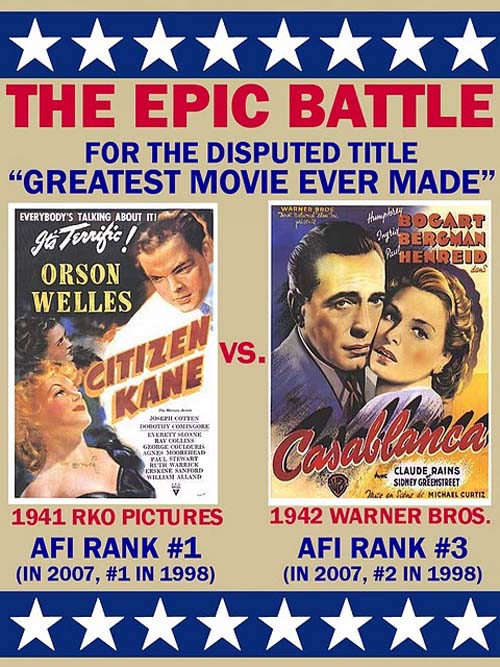
(From the Seth Saith blog)
Kristin here:
Way back in January Jim Emerson participated in the “Movie Tree House” conversation on Sergio Leone and the Infield Fly Rule. On January 14, his blog recounted his discussion of the differences between “average viewers” and those of us who are more intensely involved in films in one way or another:
I met a very nice, intelligent woman (maybe ten years older than me) at a New Year’s Eve party and she told me “The King’s Speech” was the best movie she’d ever seen. I responded politely by showing (genuine) enthusiasm for Geoffrey Rush’s performance. But I don’t know what to say to something like that. I mean, I had no reason or desire to dismiss her, but it wasn’t the kind of statement that calls for critical analysis, either. It was just social small talk. But I believe she was quite moved by the film. And, yes, there’s nothing at all wrong with that.
He added:
I thought of saying, “Wow. My favorite movie is ‘Nashville.’ Or maybe ‘Chinatown.’ Or ‘Only Angels Have Wings.'” But I didn’t think the conversation would have much opportunity to go anywhere from there, so I didn’t.
I suspect Jim’s experience is common among people whose main vocation is writing about films. When I meet someone who isn’t a film buff or scholar, he or she almost inevitably asks one of two questions: “What is your favorite film?” or “What do you think is the greatest film ever made?” From the looks on their faces, I suspect they really want to know the answer and think that it will be interesting, even gratifying. After all, meeting a film critic or historian is less common and more potentially interesting than meeting a mathematician.
Up to now, I have generally answered honestly that I think the greatest film ever made is Jacques Tati’s Play Time and that it’s probably my favorite as well. Or I say that it’s hard to choose, but some candidates would be  Ozu Yasujiro’s Late Spring, Jean Renoir’s The Rules of the Game, Sergei Eisenstein’s Ivan the Terrible, and Play Time. Almost invariably the smile on my interlocutor’s face fades into disappointment as he or she admits to never having heard of any of these films, let alone having seen them. Awkward pause, with conversation turning to other matters or my making a feeble attempt to say sometime to encourage the person to give these films a try.
I think I’ve come up with a better way to answer these questions. I’ll say something like, “Well, lately I’ve really enjoyed True Grit and Toy Story 3.” This dodges the question, but the person is bound to have heard of these, likely to have seen one or both, and may well have something to say about them—though I hope it isn’t “Yes, that’s the best film I’ve ever seen.”
Maybe that tactic will work. After all, most movie-goers work on what in cognitive psychology is called “the recency effect.” Our memories of things we’ve just experienced are more vivid in our minds than those from longer ago, even though those older experiences may have seemed equally intense or pleasurable at the time.
I ran across a good example of this effect in an Amazon review of True Grit posted by Harold Greene. Giving the film five stars, he enthuses, “I am reluctant to declare it THE best movie I have ever seen in my life but in five weeks watching it every Saturday night I can recall none to surpass it.” As a fan of True Grit and the Coen Brothers, I would believe that possibly it is the best film Mr. Greene has ever seen. But it could equally be that the intense repetition of viewings may have solidified the recency effect and diminished his memory of other films that he esteemed equally at the time.
More generally, the recency effect tends to be borne out when one of my colleagues in film studies here at the University of Wisconsin-Madison surveys their students at the beginning of a course. The goal is to find out something about their knowledge of film going into the class. One question, “What is your favorite film?” almost invariably elicits a title released in the past year or so.
So I suspect that the party-goer asking about my favorite film would be satisfied with my talking about recent movies I’ve enjoyed. The real puzzle, though, is why such people would ask such questions to begin with.
One possibility is that most people have very little sense that there is a vast body of movies out there, from over a century and from many significant filmmaking countries. Their impression of film history, as reflected in the popular media, could reasonably be that the film I might name as the greatest is probably one they’ve heard of, maybe Casablanca or Citizen Kane or The Godfather or La Dolce Vita or even Avatar.
Could it be that my questioner is hoping, probably without realizing it, that I will name his or her own favorite film? Or at least a title that he or she has seen and enjoyed? Or at least heard of? In the latter case, the person can hold up his or her side of the conversation by responding, “Oh, I’ve heard of that and have been meaning to watch it. I must put it in my Netflix queue.” A satisfactory conclusion to that little stretch of social interaction, and it does happen, albeit rarely.
I try to imagine whether scholars of opera or poetry get such questions at parties. Does someone who has just been introduced to them ask what their favorite opera or poem is? Maybe. I wouldn’t. My typical response on learning that a perfect stranger standing in front of me is a professor of something is to ask what his or her area of specialization is, hoping that it’s something I know a bit about (Vivaldi operas as opposed to Verdi, nineteenth-century Victorian novels as opposed to Renaissance poetry).
I have to admit, some people I meet at parties do launch in by asking me what areas of film I study, which makes the subsequent conversation less likely to end in mutual embarrassment. That is, with me looking like a pointy-headed, ivory-tower intellectual who wouldn’t be caught dead watching Cedar Rapids (which I’m actually looking forward to seeing) and my new acquaintance looking like an ignorant clod who doesn’t look beyond this year’s Oscar nominees (even though he or she has probably in reality seen quite a lot of excellent movies).
This entry on Jim’s blog led to a touchy exchange in his comments section about whether he and the other participants in the dialogue were being condescending to “average viewers.” This sort of disagreement seems inevitable, since people who know a great deal about any subject are likely to seem condescending to people who don’t, even if that is not their intention. But the question I’m asking is not whether “average viewers” have good taste. Some do, some don’t. So far I’ve just been trying to figure out why many of them seem determined to ask experts questions that will very likely expose their own lack of knowledge.
Beyond that issue, though, is the symptomatic implication of these two nearly universal cocktail-party questions. I think people are more apt to ask “What do you think the greatest film is?” than “What do you think the greatest opera is?” because film is still taken less seriously as an art-form than are the “high” arts. Most people think they know more about film than they do about opera because almost anyone you and I are likely to meet goes to movies more than to operas. The fact that a steady diet of well-reviewed, even Oscar-nominated Hollywood films remains only a tiny slice of the entire range of surviving movies made so far doesn’t occur to them. The same is true even for those who see the occasional indie or foreign-language film.
It used to be that a good liberal-arts education gave a young person a solid foundation in fields like music and art. I took two four-credit semesters of classical-music appreciation as a freshman and have benefited ever since. I took literature courses, and although I took only one semester of art appreciation, I have filled in by visiting museums all over the world. Even so, I would be cautious in trying to make conversation about topics like ballet, which I realize I know very little about.
Yet, the “What’s your favorite film?” question doesn’t just come from neighbors I see only at the annual block-party potluck or over bed-and-breakfast buffets. It comes from college professors who themselves are often specialists in one of the arts. They probably would feel, as well-rounded intellectuals, required to know at least something about the other arts—except film.
David was once talking with a distinguished literary scholar who would have been appalled if someone in a university had never heard of Faulkner or Thomas Mann. But when David said he admired many Japanese films, the scholar asked incredulously, “All those Godzilla movies?”
That’s really the crux of what bothers me about the awkward great-film/favorite-film question. If it’s a non-academic who asks it, it tends to be a conversation-stopper, which is unfortunate. But anyone is entitled to love the movies they want to love and to believe, if they wish, that Avatar is the greatest film ever made.
But when academics who would claim to be well-educated in the arts look blank when I mention The Rules of the Game or one of the other likely masterpieces of world cinema, I do mentally pass judgment. Is it more important to be aware of Monteverdi’s Orfeo or Velasquez’s Las Meninas than of Renoir’s film? Obviously I would say no. Yet I don’t think that these academics feel particularly embarrassed at not recognizing the title of a mere film.
This is not to say that all liberal-arts academics in other fields are ignorant of film and its history. On the contrary, we have friends who certainly know as much about the subject as we do about any other art form. But on the whole, in-depth knowledge of film is fairly uncommon across the campus. There are physicists who play piano sonatas and biologists who love painting, but those typically aren’t the people showing up for our Cinematheque screenings. The question isn’t merely one of taste either. In universities, people in the other arts vote on funding for film programs. If they deep down consider film a lesser art form and hence an inconsequential subject of study, we can expect less support, or perhaps the sort of condescending support that says, in effect, “Well, I suppose that since it’s popular with students we should go ahead . . .”
A final note. If anything I have said here sounds “elitist,” you might consider the vast movement we see occurring in this country’s politics, especially on the far right, where any learning at all is equated with elitism and any experience in public office is equated with being tainted. When our educational system is being systematically downgraded, expecting people to learn things is simple common sense.
Rebooked
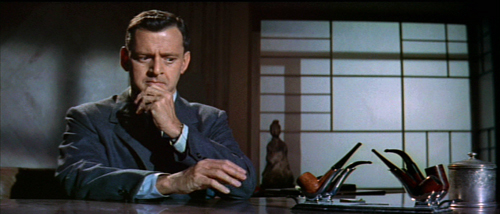
Will Success Spoil Rock Hunter? (Frank Tashlin, CinemaScope).
DB here:
Are blog readers book readers, let alone book buyers? I asked once before, but in a different tone of voice. Books are still being published, thick and fast, and everybody who cares about cinema should take a look at these.
In the frame
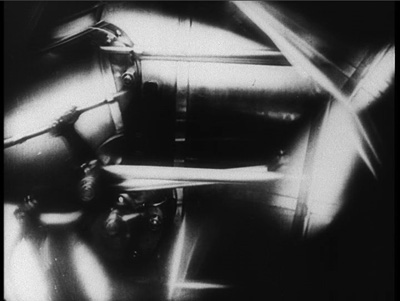
Ballet mécanique.
When the talk turns to the great film theorists of the heroic era, you hear a lot about Bazin and Eisenstein, less about Rudolf Arnheim. But the prodigiously learned Arnheim pioneered the study of art from the perspective of Gestalt psychology. Although he’s probably best known for his studies of painting in Art and Visual Perception, as a young man he was a film critic and in 1930 published a major theoretical book on cinema. First known in English as Film, then in its 1957 revision as Film as Art, this has long been considered a milestone. But Arnheim was famously skeptical of color and sound movies, and he had comparatively little to say about the many cinematic trends after 1930. (He died in 2007, aged 102.) While psychologists grew wary of Gestalt ideas, cinephiles embraced Bazin and academics moved toward semiotics and other large-scale theories. For some time Arnheim has seemed a graceful, erudite relic.
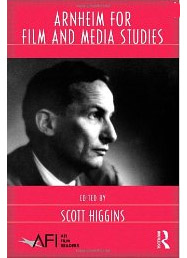 A new anthology seems likely to change that view. Arnheim for Film and Media Studies, edited by Scott Higgins, reveals one of the earliest and most energetic and pluralistic thinkers about modern media. The fourteen authors probe Arnheim’s ideas about film, of course–showing unexpected connections to the Frankfurt School and to avant-gardists like Maya Deren. But there are as well essays on Arnheim’s thinking on photography, television, and radio, along with studies that examine how his ideas would apply to comic books and digital media. Other contributors provide conceptual reconstructions, analyzing his ideas on composition and stylistic history.
This is no esoteric exercise. The essays present probing arguments with patient lucidity. Encouragingly, most of the contributors are early in their careers. (I have a piece in the collection as well, an expanded version of a blog entry.) The anthology proves that a seminal thinker can always be reappraised. There’s always more to be understood.
In the Higgins collection Malcolm Turvey furnishes an essay on Arnheim’s relation to various strands of modernism. That vast movement is treated at greater length in Turvey’s new book, The Filming of Modern Life: European Avant-Garde Film of the 1920s. At the book’s core are close analyses of five exemplary films encapsulating various trends. Turvey studies Richter’s Rhythm 21 and abstract film, Léger and Murphy’s Ballet mécanique and cinéma pur, Clair’s Paris Qui Dort and Dada, Dalí and Buñuel’s Chien Andalou and Surrealism, and Vertov’s Man with a Movie Camera and the “city symphony” format. For each film Turvey provides informative historical background and, often, some controversial arguments. For example, he finds Léger to be surprisingly concerned with preserving classical standards of beauty. Indeed, one overall thrust of the book is to suggest that modernism was less a rejection of all that went before than a selective assimilation of valuable bits of tradition. (This applies as well to Eisenstein, I think, as I try to show in my book on his work.)
No less controversial is Turvey’s careful dissection of what has come to be known as “the modernity thesis.” This is the idea that urbanization, technological change, and other forces have fundamentally changed the way we perceive the world, perhaps even altered our basic sensory processes. Specifically, some argue, because the modern environment triggers a fragmentary, distracted experience, that experience is mimicked by certain types of film, or indeed by all films. Step by step Turvey argues that this is an implausible conclusion. This last chapter is sure to stir debate among the many scholars who argue for film’s essential tie to a modern mode of perception.
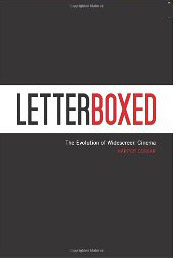 Harper Cosssar’s Letterboxed: The Evolution of Widescreen Cinema begins in the heyday of Arnheim and the silent avant-garde. Indeed, some of the early uses of widescreen, as in Gance’s Napoleon, are indebted to experimental film. But Cossar’s genealogy of widescreen also mentions horizontal masking in Griffith films like Broken Blossoms and lateral or stacked sets in Keaton comedies like The High Sign. More fundamentally, Cossar develops Charles Barr’s suggestion that the sort of viewing skills demanded by widescreen (at least in its most ambitious forms) were anticipated by directors who coaxed viewers to scan the 4:3 frame for a variety of information. The “widescreen aesthetic” was implicit in the old format, and technology eventually caught up to allow it full expression.
Cossar advances to more familiar ground, studying early widescreen practice in The Big Trail and moving to analyses of films by masters like Preminger, Ray, Sirk, and Tashlin. Although most chroniclers of the tradition stop in the early 1960s, Cossar presses on to consider the changes wrought by split-screen films like The Boston Strangler and The Thomas Crown Affair. The survey concludes with discussions of cropping techniques in digital animation (e.g., Pixar) and web videos, which often employ letterboxing as a compositional device. In all, Letterbox traces recurring technological problems and aesthetic solutions across a wide swath of film history.
Critics’ corner
Two of America’s senior film writers have revisited their earlier writings, with lively results. Dave Kehr’s collection When Movies Mattered samples his Chicago Reader period, from 1974 to 1986. Disguised as weekly reviews, Kehr’s pieces were nuanced essays on films both contemporary and classic.
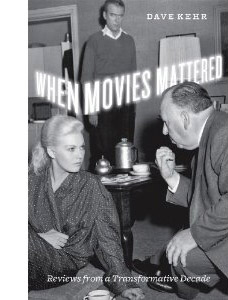 Turn to any of them and you will find a relaxed intelligence and a deep familiarity with film history. By chance I open to his essay on Billy Wilder’s Fedora:
It resurrects the flashback structure of his 1950 Sunset Boulevard, but it goes further, placing flashbacks with flashbacks and complicating the time scheme in a manner reminiscent of such demented 40s films noirs as Michael Curtiz’s Passage to Marseille and John Brahm’s The Locket. . . But the jumble of tenses also clarifies the film’s design as a subjective stream of consciousness. The images come floating up, appearing in the order of memory.
How many of those reviewers whose flash-fried opinions count for so much on Rotten Tomatoes can summon up information about the construction of Passage to Marseille or The Locket? And how many could make the case that Wilder, in returning to the forms fashionable in his early career, would repurpose them for the sake of a reflection on death, resulting in “a film as deeply flawed as it is deeply felt”? Kehr’s work from this period is appreciative criticism at its best, and he never lets his knowledge block his immediate response. “I admire Fedora, but it also frightens me.” It’s time we admitted that Dave Kehr, working far from both LA and Manhattan, was writing some of the most intellectually substantial film criticism we have ever had.
Also hailing from the Midwest is Joseph McBride, a professor, critic, and biographer. Apart from his rumination on Welles, his books have focused on popular, even populist, directors like Capra (The Catastrophe of Success), Ford (Searching for John Ford), and Spielberg (Steven Spielberg: A Biography). The University Press of Mississippi and bringing first two volumes of this trilogy back into print, and it has just reissued the third in an updated edition.
Here Spielberg emerges as far more than a purveyor of popcorn movies. McBride sees him as a restless, wide-ranging artist, and the additions to the original book have enhanced his case. McBride offers persuasive accounts of Amistad and A.I., which he regards as major achievements. He goes on to argue that Spielberg’s unique power in the industry allowed him to face up to central political issues of the 2000s.
He made a series of films in various genres reflecting and examining the traumatic effects of the September 11, 2001, attacks and the repression of civil liberties in the United States during the George W. Bush/ Dick Cheney regime. . . . No other major American artist confronted the key events of the first decade of the century with such sustained and ambitious treatment (450).
McBride is no cheerleader. He can be as severe on Spielberg’s conduct as on his films, criticizing much of the DreamWorks product as dross and suggesting that Spielberg sometimes trims his sails in interviews. I’d contend that McBride underrates some of Spielberg’s work, notably Catch Me If You Can and The War of the Worlds. But McBride has perfected his own brand of critical biography, blending personal information (he reads the films as autobiographical), tendencies within the film industry and the broader culture, and critical assessment. All studies of Spielberg’s work must start with McBride’s monumental book. Ten years from now we can look forward to another update; surely his subject will have made a few more movies by then.
Foreign accents
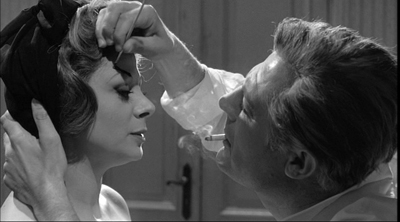
8 1/2.
Today we regard Citizen Kane as a classic, if not the classic. But for several years after its 1941 release it wasn’t considered that great. It missed a place on the Sight and Sound ten-best critics’ polls for 1952; not until 1962 did it earn a spot (though at the top). Its rise in esteem was due to changes in film culture and, some have speculated, the fact that Kane was a regular on TV during the 1960s. Something similar happened with His Girl Friday, another stealth classic. I’ve traced what I know about its entry into the canon in an earlier blog entry.
What about the postwar classics like Open City and Bicycle Thieves and the works of Bergman and Fellini and Antonioni and Kurosawa and the New Wave? Surely some of the films’ fame comes from their intrinsic quality—many are remarkable movies—but would we regard them the same way if their reputation hadn’t spread so widely abroad, especially in America? Questions like this lead us to what film scholars have come to call canon formation: the ways artworks come to wide notice, receive critical acclaim, and eventually become taken for granted as classics.
 Consider this. The Toronto International Film Festival’s recent list of 100 essential films includes thirty non-Hollywood titles from the 1946-1973 period, more than from any comparable span. Of the TIFF top twenty-five, twelve are from that era. You can argue that these years, during which several generations of viewers overlapped, set in place a system of taste that persists to this day.
Tino Balio’s Foreign Film Renaissance on American Screens, 1946-1973 reveals a side of canon formation that’s too often overlooked. Balio is less concerned with analyzing films than Turvey, Cossar, Kehr, and McBride are. He is asking a business question: What led the U. S. film industry to accept and eventually embrace films so fundamentally different from the Hollywood product?
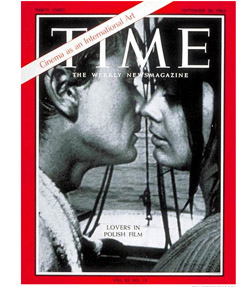
Several researchers have pointed to the roles played by influential critics, film festivals, and new periodicals like Film Comment and Film Culture. Intellectual and middlebrow magazines promoted the cosmopolitan appeal of the foreign imports. By 1963 Time could run a feverish cover story on “The Religion of Film” to coincide with the first New York Film Festival.
Balio duly notes the importance of such gatekeepers and agenda setters. But he goes back to the beginnings, with the small import market of the 1930s. Turning to the prime postwar phase, he broadens the cast of players to include the business people who risked buying, distributing, and publicizing movies that might seem hopelessly out of step with US audiences. He shows how small importers brought in Italian films at the end of the 1940s, and these attracted New York tastemakers, notably Times critic Bosley Crowther, who were keen on social realism. Within a few years ambitious entrepreneurs were marketing British comedies, Swedish psychodramas, Brigitte Bardot vehicles, and eventually the New Waves and Young Cinemas of the 1960s. As distributors fought censors and slipped films into East Side Manhattan venues, an audience came forward. The “foreign films”—often recut, sometimes dubbed, usually promoted for shock, sentiment, and sex—were positioned for the emerging tastes of young people in cities and college towns.
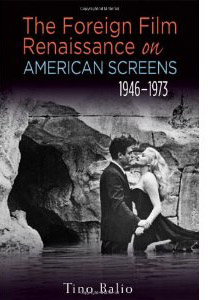 Balio offers fascinating case studies of how the films were handled well or badly. Kurosawa, he notes, had no consistent distributor in the US, and so his films gained comparatively little traction. By contrast there was what one chapter calls “Ingmar Bergman: The Brand.”
Bryant Haliday and Cy Harvey of Janus Films. . . devised a successful campaign to craft an image of Bergman as auteur and to carefully control the timing of each release. . . . Janus released the films in an orderly fashion to prevent a glut on the market and to milk every last dollar out of the box office. No other auteur received such treatment.
The work paid off: Bergman made the cover of Time in 1960, and soon The Virgin Spring and Through a Glass Darkly won back-to-back Oscars for Best Foreign Language Film. Eventually, Bergman and other foreign auteurs attracted the big studios. Now that small distributors had shown that there was money in coterie movies, the major companies (having problems of their own) embraced imported cinema—first through distribution and eventually through financing. If you admire Godard’s The Married Woman, Band of Outsiders, and Masculine Feminine you owe a debt to Columbia Pictures, which underwrote them.
Work like Balio’s does more than bring the name Cy Harvey into film history. It reminds us to follow the money. If we do, we’ll see that not every “foreign film” stands radically apart from big bad Hollywood. More generally, The Foreign Film Renaissance on American Screens reminds us that even high-art cinema is produced, packaged, and circulated in an economic system. The distinction between commercial films and personal films, business versus art, is a wobbly one. Rembrandt painted on commission and Mozart was hired to write The Magic Flute. Sometimes good art is good business.
I couldn’t work this in anywhere else: The bulk of the essays in Arnheim for Film and Media Studies are by people associated with our department at Wisconsin. They do us proud, naturally. Incidentally, Joe McBride went to school at UW too, and Tino and I taught together here for over thirty years.
Dave Kehr maintains a blog and teeming forum here.
Hart Perez has made a documentary, Behind the Curtain: Joseph McBride on Writing Film History. An excerpt is here. McBride’s website has information about his many projects.
James E. Cutting provides an unusually precise account of canon creation in his 2006 book Impressionism and Its Canon, available for free download here. I’ve written an earlier blog entry discussing Jim’s research into film.
My mention of American generations is based on Elwood Carlson’s study The Lucky Few: Between the Greatest Generation and the Baby Boom. Carlson examines the varying experiences and life chances of people who fought in World War II; people who came of age during the 1960s; and the less populated cohort that fell in between. Doing some pop sociology, I’d hypothesize that the art-film market’s growth relied on a convergence of all three, which were more disposed to art film than cohorts in earlier periods. For example, veterans who had served overseas and gone to college on the GI Bill were more familiar with non-US cultures than their parents and, I surmise, weren’t entirely put off by foreign films. When I first met Kristin’s mother, Jean Thompson, she already knew the work of Carl Dreyer, having seen Day of Wrath at an art cinema in Iowa City. She was in graduate school after World War II, on the G.I. Bill, as was her new husband, Roger, also in school on the G.I. Bill and managing that art cinema. They saw Children of Paradise and other wartime foreign films just getting their releases in the U.S., as well as post-war films like Bicycle Thieves.
The Lucky Few, also known as the Good Times generation, were born between the late twenties and the early 1940s. They were well placed to enjoy postwar prosperity and the period’s explosion of artistic expression. The Lucky Few cohort includes powerful film critics like John Simon (born 1925), Andrew Sarris (1928), Richard Roud (1929), Eugene Archer (1931), Susan Sontag and Richard Schickel (1933), and Molly Haskell (1939). Aged between twenty and thirty when the foreign-film wave struck, they were mighty susceptible to it. (Pauline Kael, though born in 1919, had a delayed career start, entering film journalism in the 1950s along with Sarris et al.) You might slip in David Thomson (born 1941), Jonathan Rosenbaum (1943), and Richard Corliss (1944).
The Baby Boomers jumped on the carousel in the 1960s, with results that are all too apparent. Dave Kehr and Joe McBride are Boomers, as are Kristin and I. Tino, for the record, is ageless.
Minority Report.
Venues and visions
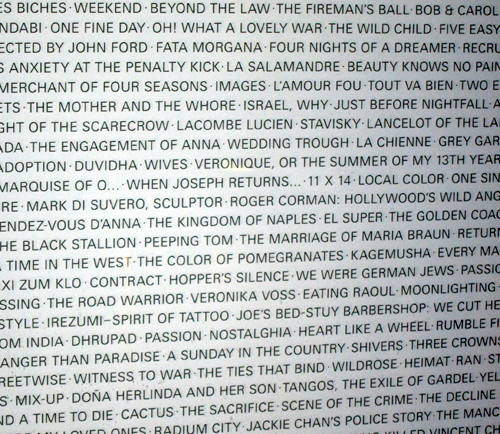
Vitrine outside future quarters of the Film Society of Lincoln Center (detail).
DB here:
During our month in NYC, we didn’t visit only art museums (although KT was at the Met a great deal). We also, no surprise, hit some of the city’s premiere movie spots. The places were often as impressive as the films, and all deserve the support of cinephiles both local and visiting. Herewith, a recap of our visits.
Fun things happen on your way through the Forum
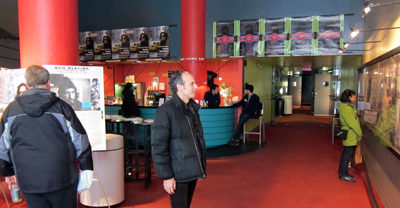
Mike Maggiore, in the lobby of Film Forum.
Film Forum, running since 1970, has established itself as an outstanding venue for new releases and classics. It has done heroic work over the years. I stopped by to see my old Wisconsin friend Mike Maggiore, one of FF’s programmers, and met his colleagues, including Karen Cooper, a legend in US film culture. They had just recently had a remarkable triple-night string of visitors: Scorsese introducing his new documentary Public Speaking, Jerry Schatzberg with Scarecrow, and Paul Schrader with a fresh print of Diary of a Country Priest. The current FF program, running on three screens, is here and it’s very rich.
Uncle Boonmee will have hit FF by the time you read this. Chris Ware’s gorgeous poster decorates the Forum lobby.
The gem of Astoria

Under MoMI projection, Rachael Rakes (Assistant Film Curator), David Schwartz (Chief Curator), KT, Ethan de Seife (Professor, Hofstra).
The refurbished Museum of the Moving Image in Astoria is a thing of great beauty. Family-friendly, with lots of hands-on kid activities, it also offers a bounty to the cinephile.
For one thing, it has a superb screening theatre. We sampled it when MoMI screened a pretty print of King Hu’s The Valiant Ones (1975). Kristin and I were happy to see our old favorite again.
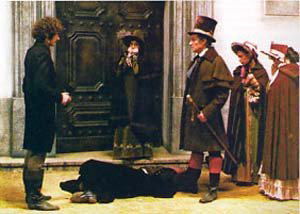
The same hall gave us a restoration of Manoel de Oliveira’s Doomed Love (1978). The movie, 4 ½ hours long, was shot in 16mm for television. It frankly acknowledges its novelistic source by including stretches of letters and florid declamation (“I will be dead to all men, except you, Father!”), as well as a plot turning on forbidden love and oppressive social relations. This is a world of parlors, convents, trusty servants, candlelit rooms, barred windows, and lovers who actually waste away. The title could apply to virtually every character, down to the maidservant who adores our protagonist and vows, “When I see I am not needed, I will end my life.” The affair draws others into its downward spiral, leaving the hero plenty of time to reflect on his misery and the pain he has inflicted on others.
The plot is quite engrossing in the manner of a triple-decker novel. That makes it all the more surprising that we get no Viscontian spectacle or even the plush upholstery of a Masterpiece Theatre episode. The presentation is rather dry and detached. I wondered if Ruiz’s recent Mysteries of Lisbon, drawn from another novel by Camilo Castelo Branco, was in effect a reply to Oliveira’s film. By comparison with Ruiz’s sparkling compositions and glissando flashbacks, Doomed Love looks reticent and austere.

The austerity is heightened by a self-conscious stylization. The music is aggressively modern, and the lengthy takes (the average shot runs about a minute) are often shot with the low, straight-on camera reminiscent of early cinema.The film begins with a partial view of a door opening, inviting us into the story world, but obliquely. The film closes with a hand lifting a bundle of love letters from the sea and a voice-over (Oliveira’s) explaining how the novel came to be written. The images provide as overt a marking of a narrative’s beginning and its end as you could ask for, and one completely in keeping with the film’s balance between respect for artifice and its concern to let compromised passions leak through.
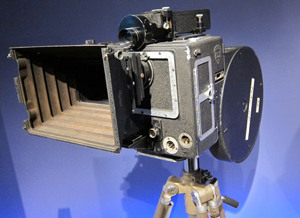
MoMI also hosts a splendid exhibition of media technology. One floor is a wonderland of cameras, sound rigs, printers, and projectors of all sorts, from film to TV and beyond. One favorite among many: A Mitchell VistaVision camera from 1954. It’s a funny-looking thing, but it took very crisp pictures. The horizontal film transport allowed larger and sharper images than the vertically-run formats that were normal for 35mm.
There are also displays devoted to screenplays, make-up, hairdressing, and special effects. I was especially taken with the finely detailed miniature for the Tyrell corporation building in Blade Runner.

In all, MoMI deserves all the praise it has gotten after its reopening. Rochelle Slovin, the founding director of the museum, started in 1981 and is retiring this week. She can be proud of what she and her colleagues have accomplished.
Jaywalking down Broadway
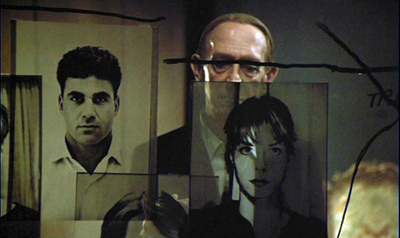
Wundkanal (Thomas Harlan, 1984).
Then there’s Lincoln Center, another long-time shrine of cinephilia. Like MoMI, the Film Society is in the process of building. The new complex will house theatres, a café, and a flexible lobby space. It’s scheduled to open in late spring.
The Film Society’s František Vlácil retrospective early in our stay brought this little-known filmmaker to my attention. I had seen only his best-known item, Marketa Lazarova (1967), and that quite a while back. So I was happy to catch his charming early short, Glass Skies (1958), and three features.
Vlácil mastered both filmic poetry and prose. The White Dove (1960) is a simple, lyrical story of two young people who never meet: a girl living in a beachside town and a wheelchair-bound boy in the city. Alternating sequences show them brought together by the homing pigeon that the girl sends out. The boy in a moment of thoughtless cruelty shoots the pigeon with his air rifle. Soon, with the help of an artist living in the same apartment house, he nurses the bird back to health. The film is richly shot in crisp, wide-angle black-and-white, and Vlácil exploits eyeballish imagery to create links between the girl’s seaside milieu and the artist’s Chagall-like paintings.
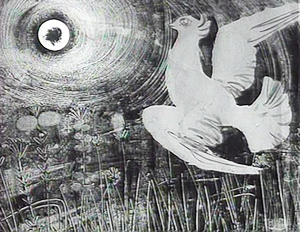
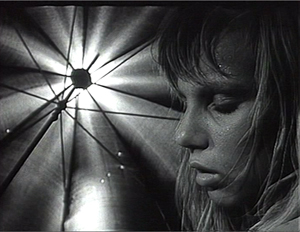
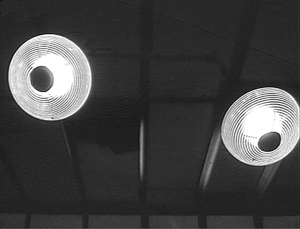
Like most filmmakers moving from the 1960s to the 1970s and from black and white to color, Vlácil recalibrated his visual design. Smoke in the Potato Fields (1976) gets your attention from the start with its disconcerting cutting during an airport departure. Laconic and elliptical, shot with long lenses and long takes, it tells an understated story of a middle-aged doctor moving to a small-town clinic. We get a cross-section of the townsfolk, from ambulance driver and gravedigger to censorious nurse and an unhappy married couple. The central drama concerns the doctor’s care for a tomboyish girl who gets pregnant and considers an abortion.
Shadows of a Hot Summer (1977), set in 1947 and shortly before the Communist takeover of the Ukraine, is more conventionally gripping. A farm family is held prisoner by rapacious resistance fighters. The taciturn father has no allies among the locals, who seem to resent his prosperity, and he dares not call attention to his plight. As in a Boetticher film, the hero plays his hand judiciously, mostly passive but carefully picking the battles he can win. The final sequence, precipitated when the marauders find him hoarding shotgun shells, is a taut, suspenseful exercise in action cinema. Shadows of a Hot Summer has daring stretches of silence and an unsettling score, along with discreet zoom shots typical of the period worldwide. These installments in the Vlácil retrospective show that we nonspecialists still probably underestimate the range of artistry that could be achieved in the apparently inhospitable atmosphere of Communist Eastern Europe.
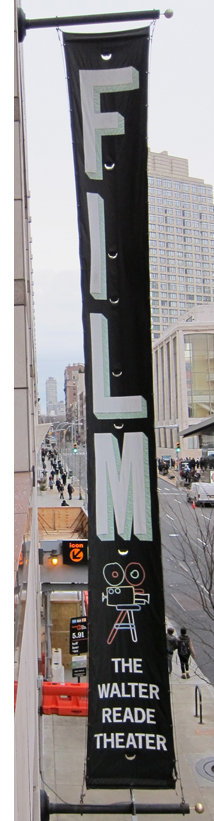 Film Comment Selects brought us a host of strong items, of which I caught four. I had missed Jia Zhangke’s I Wish I Knew (2010) at Vancouver, so I was happy to catch up with it. It seems to me a moving but minor effort in his career, lacking the bolder organization of the comparable Useless (2007; the latter in our blog here) and 24 City (2008). I didn’t think that the figure of the wandering woman Zhao Tao, punctuating people’s recollections of life in Shanghai, developed very much. Still, I was struck by how much Jia’s interviewees were able to say about the effects of the Cultural Revolution on their lives, and there is an unforgettable account by a woman of her father’s execution at the hands of the KMT.
I’m a big fan (at a distance) of the Chauvet caves and their Ice Age imagery, so Herzog’s Cave of Forgotten Dreams (2010), a 3D tour of the site, was right up my alley. The film turned out to be a strong argument for 3D (as Kristin anticipated), since it lacked that sense of cardboard-cutout planes you usually get and really brought out volumes. The tigers, bison, and other wondrous creatures seemed to bulge and ripple across the walls.
The biggest revelation the Film Comment program held for me was the double bill of Thomas Harlan’s Wundkanal (Gunwound, 1984) and Robert Kramer’s Notre Nazii (Our Nazi, 1984). Wundkanal was made by Thomas Harlan as part of his crusade to expose the bad faith of postwar Germany, where many former Nazis held positions of power. Harlan’s father was the Nazi filmmaker Veit Harlan, and as Kent Jones pointed out in his illuminating introduction, the son seems to have taken upon himself the burden of guilt that his father should have felt.
Wundkanal proposes that a terrorist gang has kidnapped the respectable citizen Dr. Seibert, interrogated him about his murderous past, recorded the sessions on videotape, and eventually staged some of their own suicides as part of the exercise. Dr. S. is played by Alfred Filbert–himself a Nazi let out of prison for medical reasons. The whole production, then, becomes both a vision of Germany’s blindness to history and a trap for a man whom Thomas Harlan suggests has gotten off far too easily. “A new idea: to use the real criminal, to deceive him and convince him it was a film about him.”
Filmed by the great Henri Alekan, it is a phantasmagoria. We are in a sunless bunker jammed with old photos, thermos jugs, automatic pistols, video clips from a Harlan film, and other detritus: a sort of chamber-play version of a Syberberg no-man’s land. Questioned by offscreen interrogators, Dr. S. admits to his crimes plaintively. The hallucinatory quality of the exercise is enhanced by sound cuts that split a sentence into bits (sometimes clear and close, sometimes filtered through speakers) and a drifting camera that may start on Dr. S. but then wanders across the litter to end on a video image of Dr. S. testifying in another session, at which point the sound of that session may take over. In one passage, the camera tours the room and picks up several bits of Dr. S.’s testimony, in the real space and in several video monitors crowding the area.
Kramer’s Our Nazi is in a way a making-of for Wundkanal, but it’s also a powerful film in its own right. Acting as his own cameraman for the first time, Kramer (director of the classic militant films The Edge, Ice, and Milestones) takes us behind the scenes to show Thomas Harlan’s obsessions and to expose Filbert more directly than Wundkanal does. Harlan talks of the fatal love he had for his father, reflecting that the old man’s charm finally withered in the face of his inhuman complicity with the Reich. Intercut with this soliloquy are shots of Filbert being made up for his video scenes, as he talks of his dueling scars and his youth: “All the ambitious men became Nazis.”
Our Nazi gives us two disturbing confrontations, one with Kramer sitting Filbert down and charging him with crimes against humanity, the other more prolonged and painful. Harlan and the crew encircle their star and hurl accusations at him. This scene, glimpsed and abstracted in Wundkanal, pulls the viewer in different directions as the feeble old man tries to escape Harlan’s relentless recitation of Filbert’s war crimes. In the discussion with Kent Jones after the screenings, Paul McIsaac rightly called the Kramer film a demonstration of the concreteness that direct cinema can yield. Shot in Hi-8, Our Nazi counterbalances the abstract, somewhat detached artifice on display in Wundkanal. Kramer dwells on unexpected details, such as Alekan hesitating to autograph a souvenir production photo for old Filbert. The two movies need to be seen together because they engage in a crosstalk that yields provocatively different information, emotions, and cinematic resources.
Our month in New York went by all too fast. We seldom visit the city these days; I’m in Hong Kong more often than Manhattan. Our trip brought back memories of my undergrad visits from Albany in the 1960s (packing four films into a day-trip) and, during the 1970s, doing dissertation research and visiting friends and teaching for a semester at NYU. It also allowed me to get back in touch with some of my oldest friends, like Rich Acceta-Evans from junior-high days. And the trip reminded me of what a cosmopolitan film culture is like, with institutions like these and still others (Anthology Film Archives, MoMA, etc.) braving tough times to bring the right movies to lucky audiences.
Apart from those named above, I want to thank the friends we met with during our stay. Scott Foundas was particularly helpful on this entry. I gave talks at various venues, so I’m grateful to Malcolm Turvey of Sarah Lawrence College, to the NYU Film Studies faculty, and to Patrick Hogan at the University of Connecticut–Storrs. Special thanks to Ken Smith and Joanna Lee for arranging a visit to the Museum of Chinese in America for a discussion of Planet Hong Kong.
Speaking of Planet Hong Kong, I discuss The Valiant Ones in Chapter 8 there, as well as in the essay “Richness through Imperfection: King Hu and the Glimpse,” in Poetics of Cinema. For a sensitive examination of Doomed Love, go to Tativille.
Some films in the Film Society’s Vlácil retrospective are available on DVD from Facets Multimedia. Wundkanal and Our Nazi have been issued on a single DVD edition with English subtitles, and it can be found on the Edition Filmmuseum site. Every film studies and filmmaking department should order it, I believe. See also “Truth or Consequences,” Kent Jones’ essay in Film Comment 46, 2 (May/ June 2010), 48-53, from which I’ve taken the Harlan quotation. Jones discusses other films, including Christoph Hübner’s 2007 study of Thomas Harlan, Wandersplitter, which is also available on a Filmmuseum disc. Thomas Harlan is one of the main interviewees in the documentary Kristin recently wrote about, Harlan: Im Schatten von Jud Süss.
For more coverage of the “Film Comment Selects” series, see R. Emmett Sweeney’s review on the Movie Morlocks site, with particularly discerning remarks on I Wish I Knew. Jesse Cataldo provides sharp commentary on Wundkanal at The House Next Door.
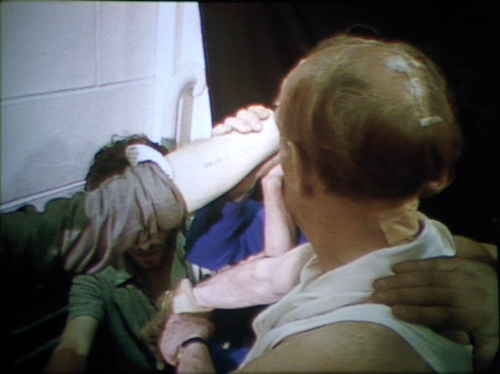
Alfred Filbert, confronted with the tattooed arm of an Auschwitz survivor (Our Nazi).