







Archive for the 'Film comments' Category
GRAVITY, Part 1: Two characters adrift in an experimental film
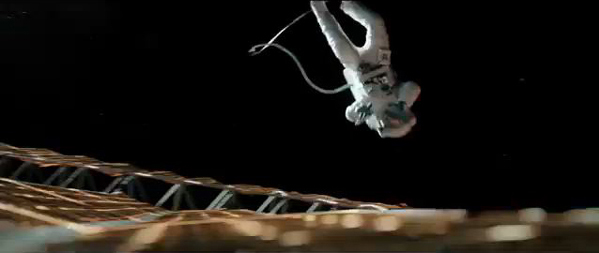
There was no way to rely on anything we knew before this film. No character was like Stone, no film set was ever like these sets, not one member of this crew had ever done this before. We all were doing something that had never been done before.
Kristin here:
Back in mid-September, on the verge of leaving Madison to attend the Vancouver International Film Festival, I mentioned that I had watched one of the trailers for Gravity and thought it looked like “the most exciting new piece of filmmaking this year.” I added that the trailer “called ‘Drifting’ reminded me of Michael Snow’s brilliant Central Region, but with narrative, with the earth and stars spinning past a close-up of Sandra Bullock as the marooned, panicky astronaut protagonist.”
At that point, I wondered whether the film as a whole could keep up that experimental feeling, with vertiginously wheeling actors combined with an untethered camera swooping around them. Or would the narrative gradually lead us into a more conventional style later in the film? It turns out that, to a remarkable extent, the highly unconventional treatment of unanchored space, where up, down, and sideways characters and background change with a breathless rapidity, extends through much of Gravity‘s length. For brief intervals Ryan enters space capsules and sits, right-side up, and the action calms down briefly. Yet these lead to further scenes in space with the same swooping camera. In short, the film turned out to be as remarkable a formal and stylistic achievement as I had hoped.
SPOILER ALERT. This is not a review but an analysis of the film. Gravity does depend crucially upon suspense and surprise, and I would suggest not reading further without having seen the film.
An experimental blockbuster
I am not the only one who was struck by Gravity‘s resemblance to an experimental film. After the film’s opening weekend in the USA, Variety‘s Scott Foundas published an article on the subject: “Why ‘Gravity’ Could Be the World’s Biggest Avant-Garde Movie.” He references the influence of Jordan Belson’s work on 2001: A Space Odyssey and speculates that the final shot of The Shining echoes the ending of Michael Snow’s Wavelength. More specifically he links Gravity to Central Region, shot in 1971 at in a Canadian mountain range; Foundas describes the robotic arm used to shoot the film and how it was controlled by instructions on magnetic tape. (I’ll have an illustration of the robotic arm in Part 2.) To Foundas, the avant-garde aspects of Gravity outweigh its narrative: “‘Gravity’ has more of a plot than ‘La Region Centrale,’ but only barely, and surely no one is telling their friends to see Cuaron’s film because of its great story. Rather, it’s the very absence of a dense narrative line that gives ‘Gravity’ its majesty.”
I think that to say Gravity has “only barely” more narrative than Snow’s purely abstract film is a considerable exaggeration. The film’s story is certainly simpler and more unconventional than other mainstream Hollywood films, but as we shall see, it contains goals, motifs, character traits, careful setups of upcoming action, and other traits of classical narratives.
In an October 11 blog entry, J. Hoberman also stresses the film’s modernism:
Depth and volume are illusory. Mass has no weight. In this 3-D spectacle, best seen on the outsized IMAX screen, Cuarón promotes sensory disorientation–or better, reorientation. […] Gravity is something quite rare–a truly popular big-budget Hollywood movie with a rich aesthetic pay-off. Genuinely experimental, blatantly predicated on the formal possibilities of film, Gravity is a movie in a tradition that includes D. W. Griffith’s Intolerance, Abel Gance’s Napoleon, Leni Riefenstahl’s Olympia, and Alfred Hitchcock’s The Birds, as well as its most obvious precursor, Stanley Kubrick’s 2001. Call it blockbuster modernism.
(Actually I’d say Gravity is better than some of these, notably Napoléon and 2001.)
Hoberman sees more of a balance between style and narrative than does Foundas. In fact, he considers that the film contains “a distracting surplus of backstory.” Presumably he would prefer to do without the references to the death of Stone’s daughter and her subsequent aimless car rides after work, listening to the radio. The space voyage does become an overly obvious extension of that drifting and listening, coming close to turning the film into a maternal melodrama. Presumably the filmmakers felt that simply sending Stone on a mission and having her struggle to return to earth was not enough. In interviews, the co-scriptwriters, Alfonso and his son Jonás Cuarón, emphasized that their basic idea was to create a character arc of her “rebirth” after despair. To some, this arc, with its religious overtones, will seem a bit, as Hoberman says, distracting and even contrived. To others it may be inspiring. At least it is not allowed to come forward very often.
Hoberman stresses the balance of plot and radical style. The film, “premised on the absence of up or down, is naturally abstract although it also has a streamlined and suspenseful narrative that, save for one or two ellipses, might almost be happening in real time.” In Variety, Justin Chang’s review highlights the same balance: “at once a nervy experiment in blockbuster minimalism and a film of robust movie-movie thrills, restoring a sense of wonder, terror and possibility to the bigscreen that should inspire awe among critics and audiences worldwide.”
David and I have often claimed that Hollywood cinema has a certain tolerance for novelty, innovation, and even experiment, but that such departures from convention are usually accompanied by a strong classical story to motivate the strangeness for popular audiences. (This assumption is central to our e-book on Christopher Nolan.) Gravity has such a story, though Cuarón is remarkably successful at minimizing its prominence. The film’s construction privileges excitement, suspense, rapid action, and the universally remarked-upon sense of immersion alongside the character in a situation of disorienting weightlessness and constant change.
That construction derives partly from techniques unique to this project. The weightless dance of characters and camera almost entirely does away with such widely applied spatial premises as the axis of action, eyeline directions, and the establishing of stable spatial relationships. And, as Cuarón pointed out in an interview for Wired, “After all, you learn how to draw based on two main elements: horizons and weight.” Those two factors are virtually gone as well.
The weightlessness and the long takes in the film have been given much attention in the press. Reports refer less often to the “Light Box, one of the film’s most extraordinary innovations. It is a giant inside-out LED monitor that allows the film’s own previs special effects to light the faces and bodies of the actors inside the box, making it possible for those shots to be integrated seamless into the effects shots. Basically, apart from the scenes inside space vehicles, traditional three-point lighting is jettisoned along with spatial relations.
Other technical aspects of the film are innovative. A bold new camera mount, the Isis, was devised to allow the camera to twist and whirl around the actors. The silence of space was respected by the filmmaker, leading them to substitute a eerie musical score to replace sound effects and convey emotions. The blocking and acting, of course, had to be vastly different from methods used in conventional films where the actors have the luxury of walking on a ground plane.
In short, it is hard to think of another mass-audience film in recent years that has so thoroughly departed from the current technological and stylistic conventions of mainstream filmmaking. Jurassic Park and The Lord of the Rings, to be sure; perhaps Avatar. Publications devoted to the techniques of cinema have recognized this. The Cinefex issue dealing with Gravity is not yet out, but on the journal’s blog, Don Shay’s remark is quoted: “Every once in a while, a film comes along that is a game-changer. This is one of those films.” Debra Kaufman, writing about the film’s 3D for Creative Cow, agrees: “Anyone who’s seen Gravity 3D will agree that the 3D was a game changer.” And unlike those earlier game-changers, Gravity has a strong experimental component to it that audiences gladly accept, since it is so well motivated by the story and situation.
In the next blog entry, I’ll survey the innovative aspects of Gravity‘s style and technique. Today, though, I’ll concentrate on the plot–in some ways conventional and in some ways quite strange–that holds it all together.
Who needs psychological depth in a crisis?
Arguably Cuarón had constructed nearly the most sparse narrative that can sustain the experimental style and motivate that style enough to hold the attention of a popular audience. Three characters, then two, then one, all with minimal backstories and simple goals.
Most Hollywood films have two parallel plotlines, usually one involving a romance. Here there is only one, and it primarily concerns an immediate situation, a cycle of deadly threats alternating with stages of Ryan’s progress toward safety. On balance, the focus is more on the suspense and terror of the situation than on the characters. Although there is a little mild flirtation between Stone and Kowalski, it’s more to generate humor and defuse the tension than to suggest any real possibility of mutual attraction.
One indication of the film’s minimal characterization is that fact that we never learn the nature of Stone’s experiment. That would be a logical initial goal for her character. Why has she set herself this particular task, which obviously involved not only scientific expertise in a complex field but also elaborate training to become an astronaut? Where does she work? What might her test achieve? Some reviews have referred to her as a medical expert. As far as I can tell, this is based on one line when she and Kowalski are working together to activate the communications device that is her focus of attention in the opening scene. During the calm before the debris collision, she remarks, “I’m used to a basement lab in a hospital where trays fall to the floor.” She also says that “It’s designed for hospital use.” That’s it. Normally a Hollywood film would redundantly give us information about her job. Here we don’t even get a sketch of it. And why is a medical experiment attached to the Hubble Space Telescope?
Incidentally, the Hubble is detached from the shuttle just before the debris cluster reaches it. We never learn whether it, too, is destroyed in the disaster. Might it have survived, with Stone’s experiment, perhaps activated during her brief delay before obeying the mission-abort command? Might she return to earth to find her experiment a success, with her initial goal miraculously achieved despite the tragic events in space. So little is the narrative concerned with the experiment as a significant goal that such questions are unlikely to occur to a spectator. They came to me only after three viewings.
Stone’s casual reference to working in a hospital lab typifies the limited sort of backstory we’ll get for the most part. Aside from Stone’s recollections of her daughter’s death and her aimless evenings of driving as her form of mourning, the moments of backstory are mere hints. In the opening we learn that Matt’s wife left him when he was in space on a mission. Might he be so obsessed with the beauties of space travel because he, too, is seeking to escape loneliness? We can’t know, since he treats the mention humorously, as if he has managed to shrug off his wife’s betrayal. Of the third character present on the spacewalk, Shariff, we learn that he has a wife and son, something revealed by a photo only after his death. This knowledge serves less to characterize him than to contrast this cheerful fellow with the wifeless Kowalski and childless, unattached Stone.
Stone’s mention of her home in Lake Zurich, Illinois and of her daughter’s death is the last piece of backstory that we get, and it comes slightly under half an hour into the film, during the calm interlude when she and Kowalski are slowly traveling toward the International Space Station (ISS). After this, I believe the only scrap of information from her past that we get is that Stone’s daughter had worried about a lost red shoe.
This lack of information about the characters is probably what led Foundas to say that the film has “barely” more of a plot than Central Region. In the same piece, he speculates, did the executives at Warner Bros. “wonder if they’d just gambled away $100 million on the most expensive avant-garde art movie ever made?”
Kevin Jagernauth reports on indiewire that the studio pushed for a more conventionally constructed film. Cuarón told him about some of the feedback he got from WB:
But at first, the studio suggested that [the Mission Control] team in Houston should get more face time. “…there area lot of ideas. People start suggesting other stuff. ‘You need to cut to House and see how the rescue mission goes.'”
And that’s not all. Part of the emotional journey of “Gravity” rests on Stone’s backstory, which includes a daughter she lost, but this is all effectively communicated without breaking the single location concept. However, Cuarón was advised to perhaps include some flashbacks in the film and even more. “A whole thing with … a romantic relationship with the Mission Control Commander, who is in love with her. All that kind of stuff. What else? To finish with a whole rescue helicopter, that would come and rescue her. Stuff like that,” he explained of some of the ideas that were floated his way.
There’s that conventional second romantic plotline, which in the wake of the film’s success seems such a ludicrous suggestion. The studio’s attitude demonstrates how very much Cuarón was able to get away with and how much of a struggle it must have been. Audience and critical enthusiasm suggests that he and his team managed to include just enough classical storytelling to make spectators identify with the characters even while knowing very little about them.
Why would a film need to establish psychological depth for characters when most of what they’re going to be doing is struggling frantically for their lives, cast adrift in space and bombarded by hurtling space debris? They must summon what skills and psychological strength they have and get on with it. Thoughtful conversations and subtle complexities are irrelevant for the most part. We need to care about these people to be engaged by the film, but that is part of the point of having Sandra Bullock and George Clooney as the leads, playing to the likeable personal qualities that we already associate with these stars.
Challenges and goals
There’s no question that the characters do have goals, but these are largely based on circumstances thrust upon them rather than on character traits. Before disaster strikes, the characters have short-term goals: Stone to solve the glitch with her equipment (and to avoid allowing nausea to cut short her attempt) and Kowalski to enjoy his final space walk and ideally break the record for duration of space walks. Both goals are cut short by the news of approaching debris and the mission-abort order. As we’ve seen, whether Stone achieves her original goal concerning her experiment is never revealed, nor are we encouraged to wonder even briefly as to whether the Hubble might carry it away from the destruction of the shuttle. Kowalski achieves his goal of breaking the record, in a sense, as he comments ironically while detached and drifting in space and awaiting his death. His space walk will last forever, but records are hardly intended to include corpses.
Once Stone spins off into space, alone, her goal is to re-establish contact with Mission Control and Kowalski. His is to rescue her. Once he finds her and tethers them together, their mutual goal is to get to the shuttle, with Kowalski adding the goal of retrieving Shariff’s body. Very quickly these goals are shattered, since the shuttle has been extensively damaged and its other crew members killed. A new short-term goal arises: reaching the relatively nearby ISS.
Kowalski fails to achieve this goal, since the fuel in his jetpack and his inability to grab anything on the ISS’s exterior send him floating off into space. Stone’s goal is now to get inside before she passes out from lack of oxygen. Once inside, her goal is to detach the remaining semi-functional Suyuz landing vehicle and use it to get as far as the Chinese space station, in turn using its landing pod to return to earth.
Discovering that the deployed parachute has become tangled in the ISS, she takes another space walk to detach it from the Soyuz. Another short-term goal that is soon accomplished. As she starts to remove the bolts anchoring the parachute, she states the short-term and long-term goals: “OK, we detach this, and we go home.”
Her purpose, however, seems to be thwarted when the fuel tank of the Soyuz vehicle proves to be empty. Here Stone loses hope, drifting into despair. She decides to turn off the oxygen supply and allow herself to die. Suddenly Kowalski appears and enters the pod, giving her a pep talk and telling her to use the soft-landing function of the Soyuz rather than its take-off capabilities. He disappears, and Stone, reinvigorated and determined, follows the instructions for landing the craft.
In traditional classical films, shifting goals often mark the turning point between large-scale sections of the plot, generally referred to as acts. Despite its unconventional aspects, Gravity’s plot does stick fairly closely to the well-balanced four-part structure that I have claimed is typical of Hollywood narrative conventions. Not counting titles or credits, the story runs approximately 83 minutes. Thus on average the acts would run about twenty-one minutes each.
At about 22 minutes in, Stone and Kowalski achieve their goal by reaching the shuttle, only to discover that it has been destroyed. At 23 minutes, Kowalski declares them the last survivors of the mission. I take this to be the first turning point, ending the setup and beginning the complicating action. Essential premises are reversed as the pair realize that they are stranded in space and they shift their goal, striving next to reach the ISS. Stone’s failed attempt to contact Kowalski by radio once she enters the ISS–she initially hopes to rescue him–and declaration of herself as the mission’s sole survivor happens at roughly 43 minutes. The third act, the development, begins, with Stone meeting numerous obstacles that threaten her new goal of getting back to earth in the Chinese landing vehicle. The last turning point, launching the climax, comes when Stone awakens from her dream about Kowalski and turns the oxygen flow back on, signaling her return to hope and determination to reach earth. That happens at about 66 minutes in, leaving seventeen minutes for her landing, including the brief epilogue of her floating, swimming ashore, and shakily standing up.
Motifs and causal motivation
As I mentioned, strongly innovative films in the Hollywood tradition need the support of classical conventions to keep the narrative clear and appealing. Two of Gravity‘s most traditional techniques are its motifs and its motivations. Motifs can quickly make the characters more vivid, even if they are not particularly rounded or complex. Motivations often involve planting an object or event in advance. In this film, several motifs trace the relationship between Stone and Kowalski.
In the opening, the motif of Kowalski’s wanting to break the space-walking record is introduced early on, stressing that this is his last mission and hinting that he loves his time in space. Similarly, his anecdotes, introduced with the “I’ve got a bad feeling about this mission” running gag, create irony but also suggest how Kowalski inspires Stone. Before setting out on her re-entry flight in the Chinese landing pod, she repeats this line with the same good humor that Kowalski had displayed. Another parallel is set up between the two when Stone detaches the clasp tethering her to the wildly spinning support in the opening scene, and later Kowalski does the same to separate himself from Stone when they are precariously suspended from the ISS (below). She comes back; he doesn’t.
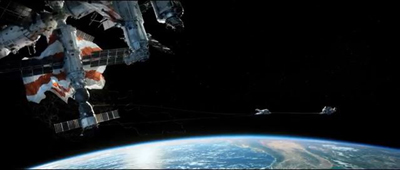
In the early scene where the pair work to activate Stone’s equipment, he refers to her “beautiful blue eyes,” though she points out that hers are brown. Later, when Kowalski has set himself adrift in space, their radio conversation mentions his “beautiful blue eyes,” which are also brown. Though we see nothing of their earlier relationship, such motifs lend it depth, because we sense that the two have already developed a customary way of bantering with each other.
Similarly, in the opening scene, Kowalski tells an anecdote about how, during a previous mission, he had imagined his wife looking up into space and thinking about him, when in fact she had run off with another man. Later, as Kowalski moves toward the ISS dragging Stone tethered behind him, he asks her if anyone is looking up and thinking about her. This elicits her most intimate revelation, that she had had a daughter who died in a freak accident. There is also no Mr. Stone waiting at home for her. Thus although the two characters have different personalities, both are escaping loneliness by a retreat to the beauty and peace of space.
Finally, there is the last shot, with Stone seen from behind against the sky, covered by light clouds. It reverses the opening, when we were in the opposite position, looking down at the earth from space, with the clouds of a huge hurricane prominently visible. There Stone drifted in space, held in place by a large mechanical arm; here she struggles to regain her sense of balance after prolonged weightlessness and succeeds in walking a few steps, thanks to gravity.
Like motifs, careful motivation of action helps us navigate through the plot. Given the rapidity with which new information is thrown at us as the narrative progresses, the screenwriters are careful to set up major premises in advance so that we will quickly understand them when they arrive. In the opening scene, as Kowalski swoops cheerfully around the shuttle, Houston asks about the supply of fuel in his jetpack. He reports that it’s 30% down. Not a lot, but enough that we are prepared for the moment after the disaster when he says he’s running “on the fumes.”
During the opening, the messages from Mission Control thoroughly forewarn us of the rapidly approaching hail of space debris. After it passes, Kowalski has Stone set her watch for 90 minutes, since that is when they can expect the same debris to return–as it does at regular intervals to destroy the ISS and the Chinese station. Stone reminds us of this danger when she exits the Soyuz vehicle to detach its parachute, muttering, “Clear skies with a chance of satellite debris.” The presence of the deployed parachute also sets up the moment when the chutes of the Chinese pod deploy as it nears its splashdown in the final sequence.
As Stone struggles to get aboard the ISS, Kowalski converses with her via radio. They mention her training with landing vehicles. Her only experience has been with simulators, and in every case she crashed them. Still, as Kowalski points out, she knows something about them–a point which proves vital in the dream scene discussed above, where Stone’s mind summons up a memory about how launching and landing space vehicles are not all that different.
Apart from creating a brief scene of suspense, the fire in the ISS introduces the fire extinguisher and demonstrates how, in a situation of weightlessness, the extinguisher propels Stone through space. This prepares us for the crucial scene in which she uses it as Kowalski had used the jetpack, allowing her to reach the Chinese station despite being untethered in space.
Character motivation, fortuitous events, and religion
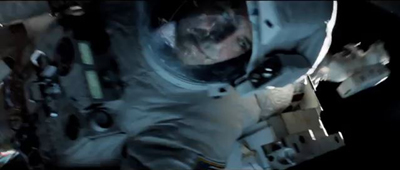
Throughout the film the cause-effect chain remains fairly straightforward, with one major exception that I’ll get to shortly. But because the characters are reacting to rapidly changing circumstances almost entirely beyond their control, the outcomes are often fortuitous rather than the result of character traits. This is not to say the film uses numerous coincidences. It is not coincidence that Stone manages time and again at the last possible moment to grab a pipe or handle on the outside of a space vehicle. She’s aiming to do that, so she manages it not by coincidence but by luck.
Some of the most crucial events in the film are partly a matter of character motivation, but the outcomes of Stone’s and Kowalski’s actions are fortuitous. Stone apologizes to Kowalski for not having immediately obeyed his order to stop trying to repair her equipment and head for the space shuttle. She presumably continued with the rebooting because she is a dedicated researcher, reluctant to abandon her important work even when in physical danger. Yet as it turns out, reaching the space shuttle interior would have been fatal. When Kowalski and Stone do reach the shuttle, they find it split open, its crew dead–just as the pair would be had they retreated inside immediately. Stone’s delay actually saved the pair, though neither character could know this at the time.
Less obviously, Kowalski accidentally dooms himself. We see him in the opening minutes, cheerfully circling the shuttle and Hubble, playing music, telling anecdotes, and apparently hoping to stay outside the shuttle long enough to set a record. Presumably he has already accomplished his task in the space walk, or perhaps as the most experienced member of the team, he is watching over the other two. He is also, however, wasting fuel–fuel that he doesn’t realize he may need. Later, when forced to travel through space to rescue Stone and then to make it from the shuttle to the ISS, his tank becomes empty just before they reach it. His inability to maneuver without endangering Stone leads to him detaching his tether and stranding himself in space forever.
There are other fortuitous events. Stone is lucky that her Chinese pod lands in a body of water but close enough to shore that she can survive the impact and get onto land easily. It is probably by chance that in entering the Soyuz craft, the weightless fire extinguisher blocks the door and that she pulls it into the craft rather than pushing it out. Later the extinguisher enables her to propel herself to the Chinese station. There are also obstacles fortuitously created, as when Stone discovers that the Soyuz vehicle has no fuel–presumably because its supply tank has been ruptured by flying debris.
There may be one major exception to this dependence on accidental causes and effects: the religious motif. This is a strange motif, since it doesn’t become significant to the plot until fairly late. Early in the complicating action, as Kowalski and Stone journey toward the ISS and he asks her about her life on earth, he’s playing a country song, “Angels Are Hard to Find.” It’s playing when Stone mentions her daughter’s death; Kowalski soon turns it off to pay more serious attention to her story. At the time, the song doesn’t seem relevant. About seventy-two minutes in, the religious motif returns and becomes more prominent. Stone discovers that the Soyuz fuel tank is empty. The vehicle drifts as sunset settles on the earth below. We see vast snow fields and fjords below, and frost forms on the window. (The cut to the frosty window is one of the film’s few apparent ellipses.) There is a brief shot of a Russian icon inside the Soyuz (Christ as a child carried by John the Baptist, I think).
Immediately after this, Stone makes contact with someone on earth. She tries to communicate her mayday call. Gradually she loses hope and begins woofing in echo of dogs she hears on the radio. She says she’s going to die. During this scene she talks of how there is no one on earth who will mourn or pray for her soul. She asks the man to “Say a prayer for me.” She adds, “I’ve never prayed in my life. Nobody ever taught me how. Nobody ever taught me how.” A baby is heard on the radio, and the man apparently sings a lullaby to it. Stone sadly comments, “I used to sing to my baby. I hope I see her soon.” At that point she dials down the oxygen inflow and says, “Sing me to sleep, and I’ll sleep.”
As she falls asleep, a knock on the door is heard off, and Kowalski enters the Soyuz. He drinks some of the hidden vodka, chats, and tells her to use the soft-landing device. Although he sympathizes with her desire to surrender to the eternal peace of space, he encourages her to save herself rather than giving up: “Ryan, it’s time to go home.” After his disappearance, Stone once again strives to save herself.
Once she has reached the Chinese landing pod, she struggles to cope with its instrument control-panel. As the countdown clock starts running, there is a tilt up to a little Budda figure, roughly in the spot where the icon had been on the Soyuz. As Stone works, she talks to Kowalski, asking him to find her daughter: “Tell her that she is my angel.”
Finally, back on earth, in the final shot Stone struggles to rise, muttering “Thank you,” before walking away from the camera, which tilts up to a low angle of her against the sky.
Though this motif appears late in the film, the narrative stresses it. Something is going on here, but what?
Most obviously, Stone seems to become somewhat religious, despite never having prayed before. Perhaps this is simply an emotional change that allows her to reconcile somewhat to her daughter’s death, to feel hope and enthusiasm for carrying on with her attempts to reach earth, and to accept her survival as a gift to her from some sort of deity.
Given that the startling visit of Kowalski, whom we assume to be dead, to the Soyuz and also his providing Stone with the one bit of information she needs in order to carry on, we might assume that this scene presents a sort of miracle. Kowalski’s visit makes him a quasi-angelic figure bringing divine intervention to Stone, perhaps, or simply a vision inspired by a divine power.
Yet his return is cued as a dream, with Stone falling into a sleep that she assumes will end in death. We all have had some sort of experience with a dream providing inspiration or the solution to a nagging problem. As Kowalski points out, Stone should know that taking off and landing are essentially the same thing; it was part of her training. The dream does not give her the knowledge but rather reminds her of it. Indeed, after she wakes up, she still has to struggle to remember what she learned about soft landings and also consults the manual.
Everything in the dream reflects things we already know about the two characters. Kowalski mentioned knowing where the vodka is kept. Earlier he had reminded her of things she knows about landing from her training with simulators. His words to her about the sorrow of losing her daughter and the temptation to surrender to the eternal peace of space recall her own line from the beginning when he asked her what she likes about space: “The silence. I could get used to it.” (Cuarón, in an interview with Anne Thompson, refers to Kowalski’s return as “a projection of herself in a dream.”)
Seemingly Stone gains some sort of religious belief or spiritual consolation. While working on the Chinese pod’s controls, she talks animatedly to the absent Kowalski, whom she apparently envisions meeting her daughter in an unspecified afterlife. The “Thank you” at the end I take to be the conclusion of this monologue in the pod, thanking Kowalski. In a truly classical film, a character mentioning never having learned to pray would surely say a prayer later in the film. Stone never does. I interpret the religious motif as signaling a transformation of her attitudes rather than implying some sort of divine intervention to rescue her. Either way, some viewers might take this motif to be heavy-handed or saccharine, but its ambiguities could prevent others from having such reactions.
It all worked
The combination of narrative techniques that I have just analyzed obviously appealed to many of the the people who have seen the film.
On November 1, Box Office Mojo summed up the film’s career since its October 4 release:
Through four weeks in theaters, Gravity earned $206.1 million, which accounted for just under a third of total domestic box office earnings in October. It’s already the highest-grossing movie ever to be released during the Fall (September or October) and will earn at least another $50 million before the end of its run.
Gravity‘s remarkable success can be attributed in part to Warner Bros.’s great marketing campaign, which helped the movie set an October opening weekend record ($55.8 million). From there, the movie had an unprecedented second weekend hold thanks to world-of-mouth that asserted the movie needed to be seen on the biggest screen possible (and preferably in 3D). Speaking of 3D–Gravity‘s box office has been pumped up by the fact that most people (around 80 percent) are choosing to pay an extra few bucks to see the movie in that premium-priced format.
According to Variety, “Imax contributed 21% of the opening-weekend domestic cume for the film.”
(Even I, no fan of 3D, have seen it in that format at two of my three viewings so far and would do so again.)
Abroad, the film has also done well. As of November 6, its foreign box-office gross is about $207 million, with the film still to open in several major markets, and its domestic take has risen to almost $220 million, expected to top out at $260 million.
[Nov. 10: Box Office Mojo is now estimating that Gravity will ultimately gross about $660 million worldwide. It opened this weekend in the United Kingdom, where 89% of its ticket sales were for 3D screenings.]
This is also one of those rare films people see in theaters repeatedly within a short period. By the end of its opening weekend, three percent of audience members said they had already seen it more than once. On October 21, the film’s official FaceBook page asked fans, “How many times have you seen the film in theaters?” One, two, or three times were common, but even by that date, two and a half weeks into its run, there were a few who had seen it four or five times. Many single and repeat viewers mentioned plans to see it again. Quite a few also specified which formats they saw it in at the different screenings. Dan Fellman, head of Warner Bros.’s domestic distribution, remarked, “This is a phenomenon where people are asking friends and family not only if they’ve seen the film, but where.”
Some moviegoers (and critics) have found the film boring. But those who love it really love it.
Our next entry will deal with the film’s style and how it was achieved.
Coincidences can play many roles in a film’s plot, as we discuss in this entry. You could take Gravity’s ambivalent gestures toward Stone’s spiritual redemption as another example of Hollywood’s strategic ambiguity about controversial themes.
Jason Mittell has written an essay, “Gravity and the Power of Narrative Limits,” which nicely complements my analysis. He concentrates on the film’s relation to traditional genres, discussing how it departs from familiar conventions of science-fiction and survival narratives.
P. S. 9 November: After I linked to this entry on my Facebook page, Meraj Dhir commented that the song Shariff sings as he does his little weightless dance is from a famous number in Raj Kapoor’s 1955 musical Shree 420. Not exactly relevant to my analysis, but fun to know, so thanks, Meraj! You can see the number here.
NOTE: On November 8, after watching the film a fourth time, I revised this post, correcting a few errors and quoting some brief passages of dialogue that I was able to record on this go-through. I have not noted the changes with the usual strike-through lines, since it seemed too complicated and distracting to do so in this case.
GRANDMASTER followup: Harvey’s eloquent defense of his US cut
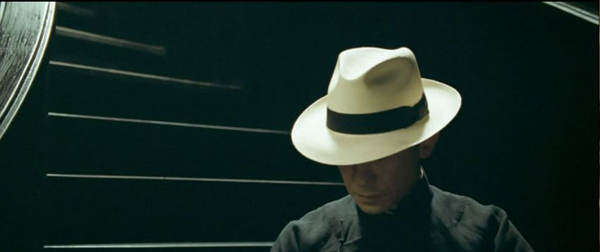
“At the end of the day, who gives a shit?”
For more, go to Screen International. Our entry on the film is here.
Familiar Middle-Eastern filmmakers return to VIFF
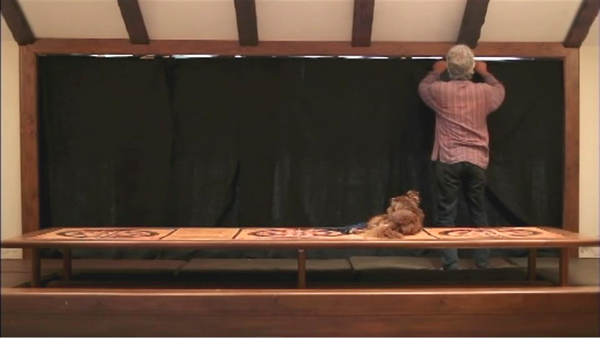
Closed Curtain (2013).
Kristin here:
Two years ago David and I wrote about a group of Iranian and Israeli films that featured prominently in the 2011 VIFF program. This year’s program boasted several more, many of them by the same directors.
Closed Curtain (Jafar Panahi and Kambuzia Partovi, 2013)
Despite still being banned from filmmaking and forbidden to leave Iran, Panahi has followed This is Not a Film with another fascinating feature that has made its way abroad. This time he co-directs with Kambuzia Partovi, who also plays one of the main characters, a screenwriter.
The writer flees to a seaside house (apparently Panahi’s) to hide his dog from a roundup of animals deemed “unclean” under Islam. Once ensconced, the writer tries to conceal his pet by sealing the many large windows with opaque curtains. Eventually their privacy is invaded by another refugee, a young woman sought by local police for participating in a nearby party.
This first section of the film seems to be a straightforward allegory for Panahi’s own situation, but well after the midpoint, Panahi himself appears and takes over as the main character. With the curtains removed, he stares at the pond behind the house, seemingly having a vision of himself amid the beauties of nature. He also gazes at the sea in front of the house, envisioning himself walking into it to commit suicide.
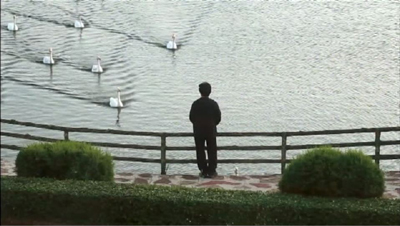
The opening stretches emphasize suspense, when the writer hears voices and sirens outside, and unseen officials hammer against the door. The result is an image of the creative artist forced to conceal himself from forces of authority. With Panahi’s appearance, the film becomes more subjective than allegorical, and the abrupt juxtaposition of the two parts of the film create a puzzling whole. But that whole is rigorously filmed and arouses interest throughout.
Manuscripts Don’t Burn (Mohammad Rasoulof, 2013)
In 2010, I posted about Rasoulof’s beautiful film, The White Meadows (2009), an overtly allegorical film about the sufferings of various sectors of Iranian society. At that point I wrote, “He was arrested alongside Jafar Panahi (who edited The White Meadows) and about a dozen others on March 2. Fortunately he was released fairly soon, on March 17. What his future as a director in Iran is remains to be seen.” Most immediately, he was given a prison sentence and banned from filmmaking. Neither condition evidently kept him from finishing the impressive Goodbye (2011), which I discussed here. More recently, upon returning to Iran from Europe, Rasoulof has had his passport seized and is unable to travel or to reunite with his family. Most observers believe that this treatment is a response to his harshly critical new film, Manuscripts Don’t Burn, which has attracted attention at several festivals.
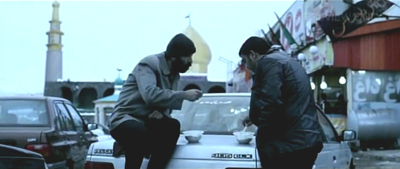
Manuscripts Don’t Burn differs considerably from The White Meadows. There is no hint of allegory here as Rasoulof examines the state surveillance system.The plot centers around two dissident authors and their strategies for hiding their manuscripts and evading the authorities. While a ruthless, educated young official decides on two authors’ fates, two working-class men carry out the kidnapping, torture, and murders that he orders. The hitmenare seen as victims themselves, as one of them, trying to pay medical bills for a sick child, continually finds that his last job’s payment has not yet been transferred to his bank account. They endure stakeouts in chilly weather and grab takeout food on the fly. The whole film is shot in muted tones (in both Tehran and Hamburg) and conveys a sense of unrelenting grimness.
The plot is drawn from unspecified real-life events, and the film cautiously carries no credits for cast or crew. (For more information on the film’s background, see Stephen Dalton’s informative review from the film’s premiere at Cannes.)
The Past (Asghar Farhadi, 2013)

Since A Separation (2012; see our entry here) became the first Iranian film to win an Oscar for best foreign-language film, Farhadi has become the most prominent director working in that country. This is witnessed by the fact that his new film, The Past, has been put forth as Iran’s candidate for this year’s Academy nomination.
The plot of the new film draws upon familiar strategies that created a strong, moving situation in A Separation. Again a husband and wife are on the brink of divorce. In this case, the husband, Ahmad, is Iranian, and the wife, Marie is French. Clearly they had lived together for a time in France, since when Ahmad arrives from Tehran, he knows how to get around Paris. Marie has two daughters from a previous marriage and plans to marry the small-businessman Samir, by whom she is pregnant. Samir has a morose young son who resists the idea of having Marie as a mother.
With this larger cast of characters, disagreements and obstacles pile up. Marie is extremely strict and strong-willed. Her older daughter is rebellious and stays out late. Ahmad tries to mediate between Samir’s miserable son and Marie’s scolding, while Samir tries to please Marie and still help his son adjust to the upcoming marriage.
As in A Separation, The Past builds up a mystery about an unhappy event. Samir’s wife has attempted suicide. What led her to this desperate measure? Her chronic depression? An embarrassing argument with one of Samir’s customers? Or did she know of Samir’s affair with Marie? Ahmad’s attempts to solve this mystery provide a strong, intriguing subplot alongside the shifting conflicts among the main adult characters.
With so many characters involved, the accumulation of problems and unhappiness eventually threatens to tip over into an exasperating melodrama. But I think Farhadi juggles all these motivations and events so well that we never feel that he has gone too far.
There has been some controversy over the fact that the film was shot entirely in France and therefore has little Iranian about it. Indeed, the Farsi-speaking emigrés who attended the VIFF screening to hear their native language spoken were perhaps disappointed that it was all in French. Yet in an ensemble cast, Ahmad remains the central character, helping to reconcile the others and comfort the three children (as in a rare cheerful moment when he helps the younger ones get a toy out of a tree).
If not quite as satisfying a film overall as A Separation, The Past confirms Farhadi as an Iranian director who can make appealing films for an international audience.
Trapped (Parviz Shahbazi, 2012)
Trapped is probably closer than most Iranian films shown at festivals to the sort of thing seen by popular audiences in its home country. The program notes describe it as a “moral thriller.” It revolves around Nazanin, a studious first-year medical student (see image at bottom) forced through lack of dormitory space to share a flat with party-loving Sahar, who is trying to leave Iran. Sahar has borrowed money to pay for her exit visa and, unable to pay it back, is imprisoned. Nazanin struggles selflessly to help her out, including foolishly signing a promissory note taking on Sahar’s debt and even sharing the threat of imprisonment.
The plot reminded me of the “child quest” tales that were prominent in the golden age of the Iranian cinema of the 1980s and 1990s, such as The Mirror and Where Is My Friend’s Home. (Shahbazi was the assistant director of Panahi’s The White Balloon, as well as conceiving its basic premise.) Here the heroine is distinctly older than the protagonists of those films, but she retains a naivete that makes her seem more childlike than the other characters, who manipulate and ultimately threaten her.
While Trapped doesn’t have the simplicity and charm of those earlier films, it offers an absorbing story. It paints a grim picture of Tehran and gives some insight into the realities of life there. Like many Iranian films, it raises the prospect of emigration, though in this case Nazanin’s strong desire to stay in the country and become a doctor is held up as the better choice.
A Place in Heaven (Yossi Madmony, 2013)
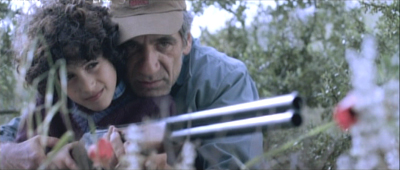
Two years ago I also reported on Madmony’s Restoration. A Place in Heaven is a considerably more ambitious film. It traces the life of a military hero, known only by his wildly inappropriate nickname Bambi, across much of Israeli history. The title derives from a flashback scene early on, when a cook at a military camp praises Bambi’s brave deeds and remarks that he has already earned a place in heaven. A secular Jew, Bambi scoffs at the notion and signs an impromptu contract trading that place to the cook in exchange for a daily spicy omelet.
Although Bambi dotes on his son Nimrod, the boy grows up to become a strictly religious Jew who disapproves of much that his father does. Still, when Bambi is on his deathbed, Nimrod goes in search of the cook to get back the place in heaven. As with Restoration, the plot is largely based around the father-son relationship, though there is also a touching and tragically short relationship between Bambi and his beautiful wife.
Unlike the largely urban Restoration, this film shows off the bleakly beautiful landscapes of Israel’s desert.
There were many other striking and moving films on display at VIFF this year. David and I really can’t do justice to all of them, but in a final post he will consider Koreeda’s Like Father, Like Son, Jia’s A Touch of Sin, Johnnie To’s The Blind Detective, the Godard segment of 3x3D, and Oliveira’s Gebo and the Thief. Like the items I’ve invoked here, each deserves an entry to itself, but time limits and further travels force us to be quick. Still, we hope that you can tell from our entries, VIFF 2013 yielded an extraordinarily high level of quality. As usual!
P.S. 17 October 2013: Thanks to Hamidreza Nassiri for correcting the original entry: Panahi is not, as we had said, under house arrest.
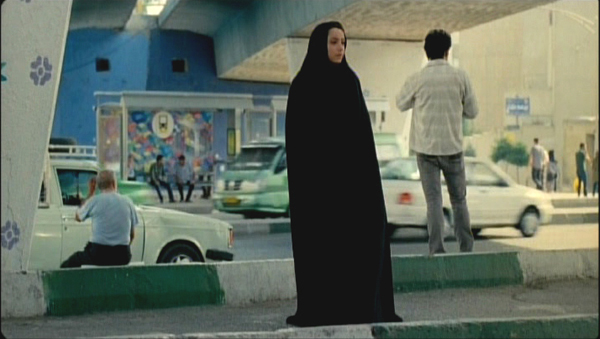
Trapped (2013).
VIFF: Maps, math, madness, and more
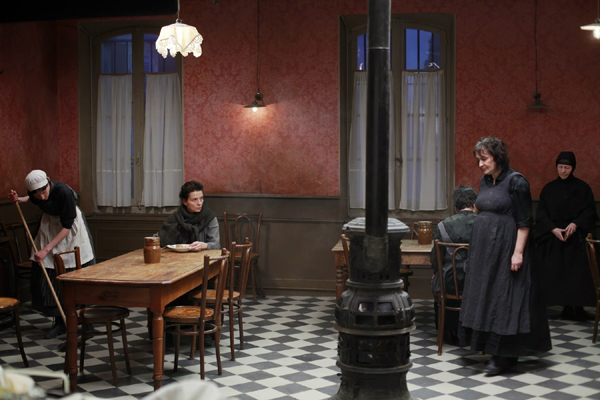
Camille Claudel, 1915.
Kristin here:
We’re halfway through the Vancouver International Film Festival, as we continue to catch up on world cinema in one dizzying ten-day swoop. Here’s a handful of worthwhile films I’ve seen so far.
Another “brave” performance
Critics speak of “brave” performances as those in which the role calls for an actress (seldom, for some reason, an actor) to allow herself to look ugly and awkward or to participate in explicit set scenes. The word got tossed around a lot this year in regard to the two young actresses in Blue Is the Warmest Color, this year’s Palm d’Or winner at Cannes. David and I saw it here and found it disappointingly conventional.
Juliette Binoche’s performance in Bruno Dumont’s Camille Claudel, 1915 (2013) has her eschewing makeup and playing the haggard, aging inmate of an insane asylum. Historically, Claudel was a sculptress and Augut Rodin’s lover before being placed in the asylum by her family. As the title suggests, we see only a small slice of her life, after she has already spent a good deal of time in the asylum, a laudably humane one set in a Catholic nunnery in the mountains.
For much of the film, we stay with her, registering both her annoyance at the antics of her fellow inmates and her compassion for them. She seems to suffer from a persecution complex, cooking all her own food and eating apart from the others (above) through a fear of being poisoned. She attributes her incarceration to Rodin’s and his colleagues’ schemes to steal her studio and sculptures. We have no way of knowing how much of this is true, and hence no way of knowing whether she is really unbalanced enough to be in an institution with incurable cases. Her occasional visits to the complex’s church and her communing with nature help to sustain her.
Well into the film, there is an abrupt point-of-view switch to her brother, the author Paul Claudel, as he pauses en route to the asylum in order to pray. We soon realize that he is a religious zealot, utterly devoted to his own view of Catholicism. The contrast between his dogmatism and Camille’s simple religious sincerity bodes ill for her hopes that he will arrange for her release.
Camille Claudel, 1915 is currently available only on unsubtitled French DVD and Blu-ray.
Math and maps
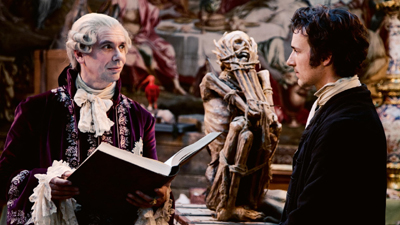
I am a fan of maps and of scientific exploration of exotic places, and Detlev Buck’s Measuring the World (2012) promised to deal with both in 3D. It weaves together fictionalized accounts of the exploits of two contemporaneous geniuses of the early 19th century: world explorer Alexander von Humboldt and mathematical genius Carl Friedrich Gauss.
I had high hopes for the 3D, imagining scenes a bit like the scene where Michael Fassbender plays with dazzling holograms of space maps in Prometheus–toned down a bit and more scientifically grounded, of course. Unfortunately there was nothing of the sort, with the 3D being used more conventionally for creating depth in the playing space, with branches in the foreground of shots in the Amazonian jungle and that sort of thing.
The film turned out to be a rather rollicking depiction of the two careers. The conceit is set up that Karl Wilhelm Ferdinand, Herzog von Braunschweig provided financing for both Gauss and Humboldt. He is caricatured (above) as a frivolous, silly man who reacts in utter incomprehension when handed Gauss’s first book on mathematics–as who would not at the time, given that it introduced startling new insights that revolutionized the field? Ferdinand was in fact a highly educated military man, and he never supported von Humboldt’s work.
Still, the eccentricities of the two seekers of knowledge are entertaining, the scenes of von Humboldt seeking specimens in the Amazon and on into the Andes are exotic, and the whole thing conveys something of the enthusiasm lingering as the Age of Enlightenment was coming to its end.
Measuring the World is available as a region-coded import with English subtitles under its original title Die Vermessung der Welt on DVD, Blu-ray, and Blu-ray 3D.
An African Charmer
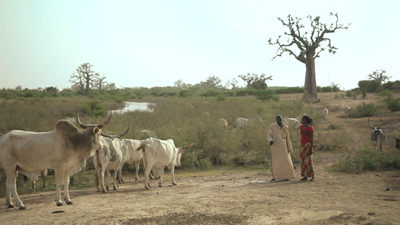
The Senegalese film, Tall as the Baobab Tree (2012), is the first feature of a young white filmmaker, Jeremy Teicher, who first visited the village in which the film is set when he was 19 and making a documentary about it. Based on stories of village life he was told at that time by young students, he made Tall as the Baobab Tree at age 22. The local people helped with the script and acted in the film.
As with many African films, the subject relates to a traditional custom which has come in modern times to be viewed as a problem. It reminds me of Ousmane Sembene’s last feature, Mooladé (2004), which dealt with how a village’s women began to resist the practice of genital mutilation. Tall as the Baobab Tree concerns the practice of selling young daughters into marriage.
The story centers around Coumba, a teenager who has just passed her school exams. Her older brother falls from a baobab tree (the one seen looming above the scene above), and to pay for his medical costs, the father decides to sell Debo, the younger sister, into marriage. Coumba secretly works as a maid in a nearby resort to pay the costs, but although she succeeds in raising most of the money, the local village elder insists that custom dictates that the promised marriage must go through.
Although the father and village elder are clearly seen as in the wrong, they are not made into villains but are seen as stuck in the patterns of outdated traditions. Much emphasis is put on the education that Coumba has benefited from and that Debo will never experience. A touching scene near the film’s beginning shows Coumba among the students waiting in a group as the names of those who have passed their exams are read out. Clearly this was an actual event captured by the filmmaker, and the joy of the successful students effectively emphasizes education as the means to defeat the more oppressive remnants of tribal traditions.
Teicher describes his experiences and approach in collaborating with the villagers on the film in an interview on the BFI website.
Beyond Ghibli
The films of Miyazaki Hayao (Kiki’s Delivery Service, Spirited Away) and his colleagues at the Ghibli animation studio are the heights of Japanese animation. Beyond them, we in the west tend to know of other Japanese animated films as more simply made anime, with lots of violent action. But, as the program notes state, “it’s time to expand your horizons.” Hosoda Mamoru’s Wolf Children (2012) somewhat resembles the Ghibli films in genre, being a fairy-tale-like fantasy set in the present day.
Hana, a student, is attracted to a young man, Ookami, who decides to sit in on one of her classes. She offers to share her textbook, and as a romance develops, she discovers that Ookami is a shape-shifter, able to change into a wolf. After they have two children, Ookami is killed while in his wolf form. His children have inherited his ability, and Hana moves to a house in the countryside to hide their peculiarities from prying eyes.
The story follows the daughter, Yuki, as she decides to go to school and follow the human half of her nature, and the son, Ame, as he prowls the surrounding forests and mountains, communing with wolves he discovers there. The result has an environmental theme similar to that underlying some of Miyazaki’s films, with particular sympathy for the perpetually hunted wolves.
While the figure animation here is not as subtle as that of the Ghibli films, the settings are beautiful and detailed, with highly textured portrayals of the roiling movements of large cumulus clouds and the rustling of countless leaves in a forest.
Wolf Children looks great on the big screen, but if you can’t catch it in a theater, it’s due out in the USA on November 26, available on DVD or a combination Blu-ray/DVD set.
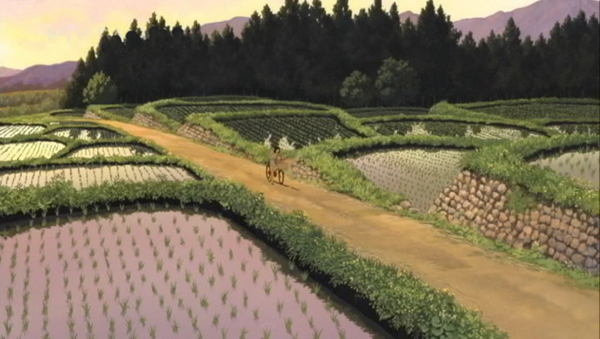
Wolf Children.



