





Archive for the 'Film comments' Category
Oscar’s siren song 2: Jeff Smith on the music nominations
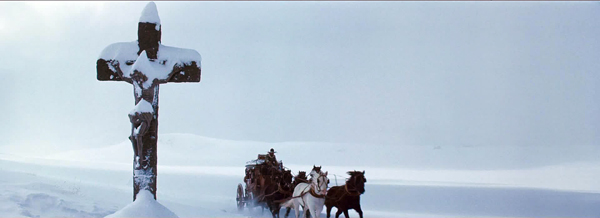
The Hateful Eight (2015).
DB here: Jeff Smith, our collaborator on the new edition of Film Art, is an expert on film sound. He has written earlier entries on Atmos and Trumbo.
The Academy Awards ceremony is upon us. Once again this year, I offer an overview of the two music categories: Best Original Song and Best Original Score. For the songs and some score cues I’ve provided links, so you can listen as you read.
This year’s nominees showcase music written in an array of musical styles for a wide range of narrative contexts. The composers and songwriters recognized for their work include some newcomers, some savvy veterans, and a pair of legends who have helped to define the modern film score.
As always, this preview is offered for non-sporting purposes. Anyone seeking insights for wagers or even the office Oscar pool is duly cautioned that they assume their own financial risks for any information they use. And since I was only half-right with last year’s prognostications, you might seek predictions from insiders at Variety and Entertainment Weekly.
Diversity in numbers: Best Original Song
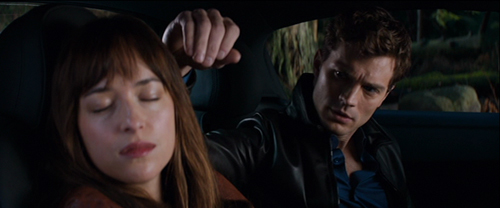
Fifty Shades of Grey (2015).
When the Oscars were announced a few weeks ago, they made headlines for all the wrong reasons. Noting the lack of racial diversity among the acting nominees, social media exploded, creating #OscarsSoWhite as a popular Twitter handle to draw attention to the situation. After a cacophony of tweets and retweets, several celebrities weighed in. Will Smith and others suggested that they planned to boycott the ceremonies.
The nominees for Best Original Song, though, are a pretty significant exception to the OscarsSoWhite meme. Both the performers of these five songs and the topics they address reveal that Oscar voters haven’t entirely ignored the fact that films can be a force for social change.
The Weeknd’s breakout year on the pop charts has continued with an Oscar nomination for “Earned It” from Universal’s hit of last spring, Fifty Shades of Grey. The Weeknd’s “Can’t Feel My Face” has enlivened playlists all year long, but “Earned It” is a slow-burn soul ballad that accompanies Christian and Anastasia’s ride home after his mother interrupts their morning tryst. The song was co-written by the Weeknd, Belly, Jason “Daheala” Quenneville, and Stephan Moccio, and features a simple two-chord pattern on the piano that eventually builds toward a more harmonically adventurous string passage. According to Moccio, the song was intended to reflect a male perspective, hinting at the darkness lurking underneath Christian’s sexual peccadillos.
The Weeknd, Quenneville, and Belly are all Canadian. But considering that the Weeknd and Quenneville are of African descent and that Belly is of Palestinian heritage, their nomination offers a modest riposte to the criticism leveled at the Oscars for their lack of racial diversity. However, since their song appears in one of the more critically reviled films to receive a nomination, it seems unlikely that “Earned It” will take home the prize next Sunday.
Tuning up nonfiction films: Nominated songs from docs

Racing Extinction (2015).
Two other nominations come from recent documentary films, continuing a trend begun with last year’s nod to Glen Campbell: I’ll Be Me. The first is for J. Ralph and Antony Hegarty’s “Manta Ray” from Racing Extinction, which examines the threat man poses to the survival of several bird species, amphibians, and marine animals.
Hegarty is only the second openly transgender person to receive a nomination, a quite pleasant surprise for fans of her work as a singer and songwriter. Hegarty initially made a splash in 2000 with the release of her band’s debut album, Antony and the Johnsons. Her breakthrough, though, came with the 2005 release I Am a Bird Now, which topped several critics’ year-end lists and won Britain’s prestigious Mercury Prize.
“Manta Ray” is a delicate waltz based upon a central theme from J. Ralph’s score for Racing Extinction. Although the song itself appears only over the closing credits, Ralph’s theme threads through the film, introduced during a key scene when a member of the filmmaking team removes a hook and fishing line from a manta ray’s dorsal fin. After the SARS outbreak in the early 2000s, commercial fishermen increasingly targeted manta rays since their gills were thought to have curative powers among practitioners of Chinese folk medicine.
Anchored by her soft, tremulous voice, Hegarty’s music has always exuded sensitivity and melancholy in almost equal measure. With Hegarty’s ethereal tones floating over Ralph’s simple piano accompaniment, “Manta Ray” not only captures the animal’s grace and beauty, but also hints at the tragedy of their steady decline.
Racing Extinction is not Hegarty’s first brush with Hollywood. Previously, her music was featured in James McTeigue’s V for Vendetta and in Todd Haynes’s I’m Not There. But given all the media attention to the Oscars, Sunday night will offer Hegarty a much bigger stage and a chance for the world to see her extraordinary gifts.

The other nominated song from a documentary is “Til It Happens to You,” which was written for Kirby Dick’s searing documentary on campus rape, The Hunting Ground. The film not only exposes college administrators’ efforts to cover up incidents of sexual assault, but also shows how two University of North Carolina rape survivors used Title IX legislation to draw attention to the problem.
“Til It Happens to You” brought Lady Gaga her first nomination and Diane Warren her eighth. Beyond the sheer star power brought by the pair, Gaga and Warren both have discussed their own experience as rape victims.
According to Variety, Gaga worried that the gravity of the film’s subject matter might not square with her outlandish diva persona: “I was very concerned that people would not take me seriously or that I would somehow add a stigma to it.” But her concerns appear to be unfounded. Warren reports that other survivors have reached out to her saying that the song and film is “making people feel less alone.”
Some of this reaction undoubtedly derives from the emotional gut punch delivered by the song’s lyrics. They not only describe the feelings of devastation felt by rape victims. They also express the difficulty of dealing with unfeeling bureaucrats and callous peers. The refrain of “Til It Happens to You” conveys the sense of isolation created by others’ inability to fully know what it’s like to walk in the victim’s shoes.
Licensed to Trill: The Spectre of Youth
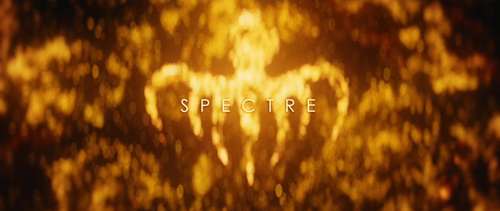
Spectre (2015).
Jimmy Napes and Sam Smith’s “Writing’s On the Wall” from Spectre adds another notch to James Bond’s gunbelt. Four previous Bond films have received nominations for Best Original Song. And in 2013, British chanteuse Adele took home a golden statuette for the title track of Skyfall.
For me, the piece is well crafted, but falls somewhere in the middle of the Bond music pantheon. Not quite the peaks of Shirley Bassey’s “Goldfinger” or Paul McCartney’s “Live and Let Die.” But also not the dregs of Rita Coolidge’s “All-Time High” or A-ha’s “The Living Daylights.” “Writing’s On the Wall” is vaguely Bond-ish in much the same way that Smith’s smash hit, “Stay With Me,” contained strong echoes of Tom Petty’s “I Won’t Back Down.”
The last nominee is “Simple Song #3” from Youth. Of all the nominees, David Lang’s piece is the one most firmly integrated into the film’s narrative. “Simple Song #3” is featured at the end of Youth, performed onscreen by singer Sumi Jo, violinist Viktoria Mullova, and the BBC Concert Orchestra.
The song is a classic “Adagio” structured around a repeated descending string figure. Gradually, other instruments are added, creating patterns of shifting harmony that surge beneath Jo’s vocal line.
Although “Simple Song #3” doesn’t appear till the end, the song is mentioned at several earlier moments as the work of the film’s protagonist, Fred Ballinger (Michael Caine). Ballinger is a retired composer and conductor lured back to the stage by an invitation from the Queen to perform for Prince Philip’s birthday. According to Lang, the piece offers a window into Ballinger’s psychology. It balances both the aspirations of his youth with the melancholy of a life lived apart from the woman he loved.
Placed in the film’s climax, Ballinger’s work provides an emotional capstone that operates at several levels. Given the complexity of its narrative function, “Simple Song #3” is not so simple.
Prediction: As a longtime Antony and the Johnsons fan, I would be delighted to see Hegarty and Ralph making their acceptance speech on Sunday night. But it seems to be Lady Gaga’s year so far. After winning a Golden Globe for her work on American Horror Story: Hotel, singing the national anthem at the Super Bowl, and performing a tribute to David Bowie at the Grammys, Gaga will cap off a stellar start to the new year by walking home with Oscar on her arm. It will also provide career recognition to Diane Warren, whose music has graced more than 200 different films and television shows. After last year’s disappointment, Warren finally will get the opportunity to be forever “Grateful.”
Old White Men and Even Older White Men: Best Original Score
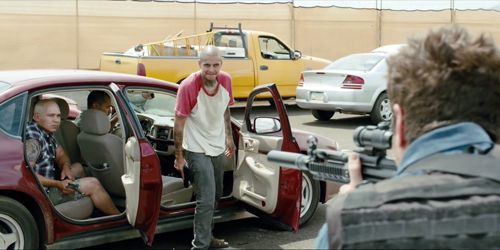
Sicario (2015).
The nominees for Best Original Score are a group of seasoned craftsmen who collectively have received more than seventy Oscar nominations and have written music for more than seven hundred feature films. At age 46, Jóhann Jóhannsson is the youngster of the group. Carter Burwell and Thomas Newman both turned sixty late last year. And John Williams and Ennio Morricone are both octogenarians.
Jóhannsson is nominated for his score for Denis Villeneuve’s drug war thriller Sicario. The Icelandic composer received a nod last year for The Theory of Everying, but lost out to Alexandre Desplat’s charming Euro-pudding score for The Grand Budapest Hotel.
The score for Sicario, though, couldn’t be more different than that for The Theory of Everything. Where Everything’s music was lilting and lyrical, Sicario’s is tense and ominous, emphasizing rhythm, timbre, and texture over more conventional structures of melody and harmony. Several cues are organized around pounding drum patterns punctuated by sustained, dissonant blasts of strings and low brass. In an interview, Jóhannsson recalled, “I think the the percussion came first, and then I started to weave the orchestra into it. Very early on I decided to focus on the low end of the spectrum—focus on basses, contrabasses, low woodwinds, contrabassoon, contrabass clarinets and contrabass saxophone.”
Other cues also emphasize percussive textures, but with the instrument sounds processed so that they sound driven to the point of distortion. Even a more restrained cue like “Melancholia” still maintains a quiet intensity, structured around a cyclic harmonic pattern played on acoustic guitar in a vaguely flamenco style. The score is brutally effective in capturing the mood of Sicario’s taut action scenes. In fact, for me, Jóhannsson’s score was, without question, the best thing in the film.
The Old Hands: Carter Burwell and Thomas Newman
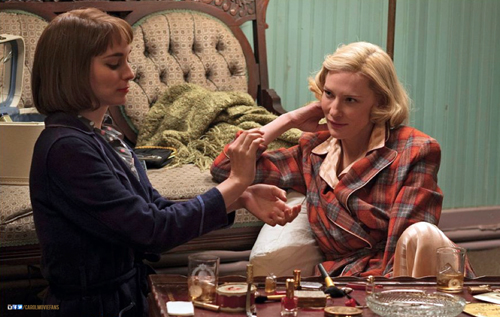
Carol (2015).
Carter Burwell received his first Oscar nomination this January for his score for Todd Haynes’ Carol. Burwell got his start on the Coen brothers’ debut, Blood Simple (1984), and has been a regular collaborator ever since. He has also worked regularly with a number of other filmmakers, such as Charlie Kaufman, Spike Jonze, and Bill Condon. Given the rather quirky and absurdist tone found in many of their projects, Burwell’s great gift is to provide music that emotionally grounds the characters, finding notes of lyricism, melancholy, and pathos in the strange stories of lovelorn puppeteers, sex researchers, and bumbling kidnappers.
For Carol, Burwell tried to capture the peculiar mixture of passion and distance that characterizes Therèse’s initial attraction to Carol. Because Carol comes across as both elegant and a bit aloof, Burwell not only utilized ambiguous harmonies, but also “cool” instruments, such as piano, clarinet, and vibes.
On his website, Burwell identifies three main musical themes in his score for Carol. The first is a love theme introduced in the film’s opening city scene. It presages the relationship even before we’ve been introduced to the characters. The second theme underscores Therèse’s fascination with Carol. Says Burwell, “This is basically a cloud of piano notes, not unlike the clouded glass through which Todd Haynes and Ed Lachman occasionally shoot the characters.” The third theme captures the characters’ sense of loss when they are separated. Knowing that Cate Blanchett and Rooney Mara would convey the characters’ pain in their performances, Burwell opted instead to use open harmonies (fourths, fifths, and ninths) to communicate their sense of emptiness.
Burwell orchestrated the music for chamber-size ensembles to maintain the sense of intimacy between the characters. Some cues feature as few as four instruments while others were performed by as many as 17 musicians.
Burwell’s spare, modest score is a departure from the style Haynes explored in his previous foray into this territory: his Douglas Sirk homage, Far From Heaven (2002). Elmer Bernstein’s score for that film was lush and emotionally expansive, aping Frank Skinner’s musical stylings in films like Magnificent Obsession (1954) and All That Heaven Allows (1955). Burwell wrote only 38 minutes of music. Yet it all is beautifully attuned to the film’s mood of quiet desperation.
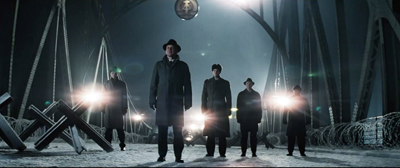
Thomas Newman earned his thirteenth nomination for Bridge of Spies. (Insert Susan Lucci joke here.) Newman, of course, descends from film composing royalty as the son of the renowned classical Hollywood tuner, Alfred Newman. Yet, despite Newman the Younger’s distinguished career in Tinseltown, Newman the Younger has a long way to go to catch his pops. Alfred won nine Oscars and accrued more than forty nominations.
Newman’s music has graced some of the most beloved American films of the past three decades, such as The Shawshank Redemption, American Beauty, Finding Nemo, and Wall-E. Although he is known for his versatility, an NPR story on his score for Bridge of Spies notes that Newman has become known for passages that incorporate “quirky, layered piano writing and jagged string motifs.”
Newman and Spielberg save the score’s biggest moments for the film’s climax and epilogue. Indeed, more than half of the film’s score is backloaded into its last three cues, which together account for about 25 minutes of music. Displaying Newman’s full emotional range, “Glienicke Bridge” anxiously underscores the tense prisoner exchange that delivers Rudolf Abel back into Soviet hands. “Homecoming” features solo trumpet and oboe to convey James B. Donovan’s sense of validation now that his fellow commuters’ scowls of disapproval have turned to smiles of patriotic pride.
Newman’s score for Bridge of Spies is a very solid piece of work evincing the craft and refinement displayed by earlier masters like Jerry Goldsmith and John Barry. Yet the music’s modesty and conventionality make it the kind of score all too easy to overlook.
The Legends: John Williams and Ennio Morricone
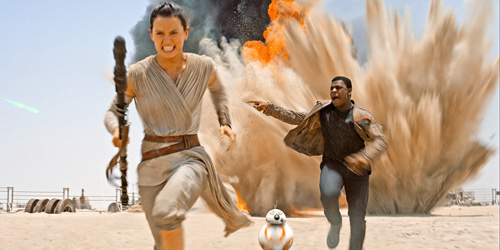
Star Wars: The Force Awakens (2015).
Oddsmakers have tabbed our final two nominees, John Williams and Ennio Morricone, as the most likely to take home the big prize. The former is nominated for Star Wars: The Force Awakens, the seventh film in George Lucas’s series and the seventh scored by Williams. Coming 48 years after the composer’s Oscar win for the first Star Wars film, Williams’s music updates the neo-Romantic style he helped to revive in the 1970s. It also adds new themes for key new characters, such as Rey and Kylo Ren.
Williams wrote a massive amount of music for The Force Awakens. (Indeed, the 102-minute score is more than double that of Newman’s score for Bridge of Spies.) But very little of it simply replicates materials from the previous films. By Williams’s own count, only seven minutes of the score function as “obligatory” references to his own immediately recognizable themes.
As in his previous work, Williams shows enormous skill in juggling the various leitmotifs that are attached to the film’s dramatic personae, often moving a motif through different instrument combinations in order to vary the color and timbre of each cue. And Williams’s sure touch with this material undoubtedly enhances J.J. Abrams’ everything-old-is-new-again approach to The Force Awakens, a strategy that seems to have satisfied long-time fans, many of whom probably have dusty old compact discs of the composer’s earlier Star Wars scores.
The score for The Force Awakens earned Williams’s his fiftieth nomination and it is a fine addition to his already considerable oeuvre. Still, considering that Williams has won Oscars on five previous occasions and the been-there- done-that aspect of the enterprise, it is hard to believe that this score will bring the composer his sixth statuette. Thankfully for him, Williams’s reputation as one of the greatest composers to work in the film medium is already firmly secured.
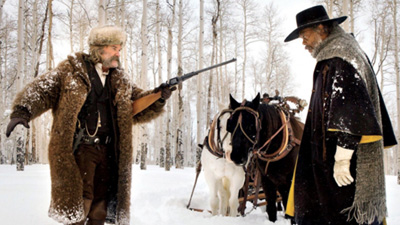
That leaves just Ennio Morricone, the equally legendary Italian composer whose collaborations with Sergio Leone redefined the sound of the Western. Nearly fifty years after Morricone’s theme from The Good, the Bad, and the Ugly topped U.S. record charts, Morricone garnered his sixth Best Original Score nomination for Quentin Tarantino’s The Hateful Eight.
The film marked Morricone’s return to the genre after several decades of avoiding it. According to the composer, most directors who approached him simply wanted him to replicate the sound of his great Spaghetti Western scores. Morricone preferred to pursue projects that let him stretch in other directions.
Tarantino gave the Maestro a free hand in developing the score of The Hateful Eight, and Morricone responded with one of his best scores in decades. Aside from his characteristic use of vocal chants as rhythmic accents, the score for The Hateful Eight largely avoids the sort of psychedelic touches and extravagant tone colors found in his Spaghetti Western scores. Gone are the electric guitar, ocarina, whistles, and coyote yelps that established Morricone as a kind of musical meme. Substituted instead are much more conventional orchestral colors with the strings and wind sections taking prominent roles in The Hateful Eight.
Perhaps one reason for this move back to classical Hollywood convention is due to the hybrid qualities of Tarantino’s story. As Peter Debruge noted in his Variety review, The Hateful Eight is “a salty hothouse whodunit that owes as much to Agatha Christie as it does to Anthony Mann.” Morricone himself seems to concur. In an interview with Rolling Stone, the composer added, “Quentin Tarantino considers this film a Western; for me, this is not a Western. I wanted to do something that was totally different from any Western music I had composed in the past.”
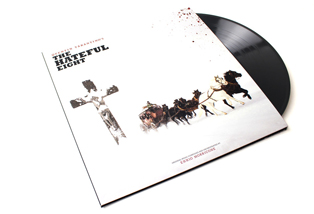
Morricone’s score has a “theme and variations” structure that shows him adeptly changing his tempo, texture, and instrumentation to adapt his main theme to new dramatic contexts. His Overture provides the basic template for the score. The low strings and winds play a sustained minor chord that sneaks into the soundtrack. After a few seconds, the upper voices enter playing chords on the first and third beats of each measure to outline the basic harmonic progression of the main theme. Eventually an oboe will enter playing a repeated interval as a counterrhythm over the top of this pattern.
This gives way to the strings, which intone a serpentine diatonic melody that provides the spine for the rest of the cue. Gradually, Morricone introduces more instruments, such as vibes and brass, to vary the tone color and even adds a simple bridge section that consists of a series of soft, chromatically descending chords. After a brief restatement of the main melody, the cue finishes with a series of long sustained chords marked by shifting harmonies in the inner voices. The clarinet plays a fragment of the main theme before it eventually fades out. The cue never comes to the kind of climax that a traditional cadential structure would provide. Instead it simply unwinds itself.
The central theme is probably given its most elaborate treatment in the main title, “L’Ultima Diligenza di Red Rock – Version Integrale.” A steady timpani pulse and a sustained pitch in the strings provide a pedal tone against which a new melody is introduced in the contrabassoon’s low register. This musical figure has a serpentine quality like the other, and it has been written to function as counterpoint to its predecessor at later moments when the two will be interleaved. Morricone gradually introduces more instruments to thicken the texture and even adds brass and pizzicato accents as embroidery atop the main theme. A hi-hat cymbal adds some rhythmic variety to the basic pulse of the timpani.
After a brief detour into some transitional material, the main melody returns, but now played by strings, xylophone, and muted brass instruments. The main musical figure continues to be restated with new ideas simply piled on top. As the music grows in both volume and intensity, Morricone adds trills and furious agitato string runs to create a cacophonous, but organized musical chaos. The cue climaxes with the melody played fortissimo in octaves by the violin section, soaring toward a sudden and abrupt stop. After a short pause, the contrabassoon quietly returns to play a brief musical coda that eventually fades to silence.
Morricone has long been a master of this type of musical structure. He’ll start with a simple musical idea, but then adds different countermelodies or obbligatos to vary its mood and tone. The ongoing accretion of elements creates the effect of a long crescendo that eventually finds release in silence. (For an earlier example of this kind of technique, see his cue for “The Desert” on The Good, the Bad, and the Ugly soundtrack.)
Beyond its purely musical effectiveness, though, “L’Ultima Diligenza di Red Rock” exudes a roiling tumult that fittingly captures the sense of deception and distrust that will pervade Minnie’s Haberdashery. The musical mood remains mostly dark and ominous throughout, leavened only by the bright solo trumpet fanfare that underscores Sheriff Chris Mannix’s reading of Major Warren’s Lincoln letter.
Tarantino’s trust in the Maestro was amply rewarded. This is a score that no one but Morricone could produce. As was the case with Jóhann Jóhannsson’s score for Sicario, it seems to be the best thing about The Hateful Eight. Tarantino wanted a soundtrack album for one of his own films that he could proudly place alongside other Morricone albums in his collection. He got it and then some.
Prediction: The Maestro finally gets his due! Although Morricone received an honorary Oscar in 2007 for his “magnificent and multifaceted contributions to the art of film music,” none of his individual scores have received awards from the Academy. I expect that to change next Sunday night. In fact, betting odds put Morricone’s chances of winning an Oscar for Best Original Score at 1 to 5. That means that a five dollar bet will net you one dollar profit if you win. That is about as close to a sure thing as you are likely to find in the gambling world. And even I’m not dumb enough to buck that trend.
In truth, I would be happy to see any of these composers take home the Oscar. I’ve enjoyed their contributions to the art of film music for much of my adult life. But, for me, the only real question is this: How long will the standing ovation be as Ennio Morricone prepares to give his acceptance speech? I put the over/under at 65 seconds.
Variety offers overviews of the nominees for Best Original Song here and Best Original Score here. Both pieces include comments from the composers and songwriters competing for this year’s awards.
You can find interviews with nearly all of the nominees for Best Original Score: Morricone, Williams (here and here), Newman, and Johannsson. Carter Burwell’s notes on Carol can be found on his website.
Emilio Audissino’s book on John Williams offers a terrific overview of the composer’s career. For a study of Morricone’s compositional techniques and style, see Charles Leinberger’s monograph on The Good, the Bad, and the Ugly in Scarecrow Press’s series of Film Score Guides. My book The Sounds of Commerce includes a chapter on Morricone’s spaghetti western scores.
More on Morricone: The Maestro weighs in on the film scoring process in Composing for the Cinema: Theory and Practice of Music in Film, which is coauthored with Sergio Miceli. You can listen to the opening cue of the score for The Hateful Eight here.
P.S. 25 February 2016: Thanks to Peter Brandon for a correction concerning the Canadian identity of The Weeknd, Quenneville, and Belly.
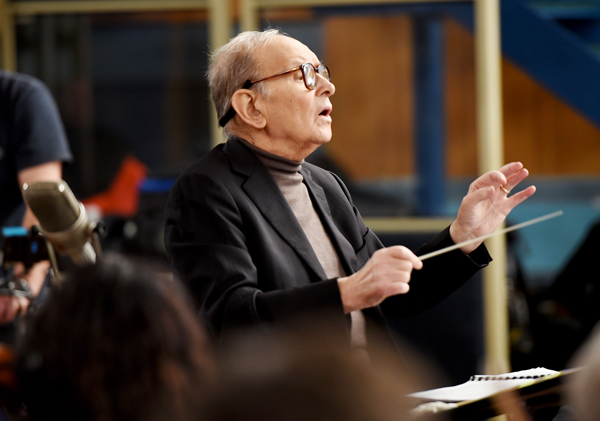
LONDON, ENGLAND – DECEMBER 08: Composer Ennio Morricone is seen during a Live Recording for the H8ful Eight Soundtrack at Abbey Road Studios on December 8, 2015 in London, England. (Photo by Kevin Mazur/Getty Images for Universal Music)
Off-center: MAD MAX’s headroom
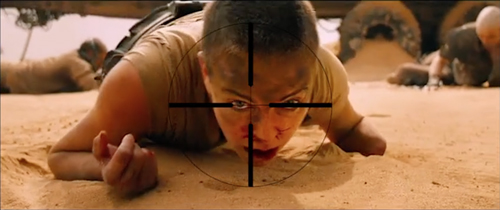
From Mad Max: Center Framed, by Vashi Nedomansky.
DB here:
If you’re a filmmaker, how do you frame the action you’re shooting? Put aside documentary shooting, which doesn’t allow you as many options as staged filming does. A lot of your compositional decisions depend on the aspect ratio of the image.
After the mid-1910s, filmmakers relied heavily on close views—framing typically two or three people, or even just one. These “portrait” framings were well-suited to the 4:3 format that was standardized in the silent era. But what happens when filmmakers must compose in wider frames, especially the 2.35:1 format that became common with CinemaScope?
Too much scope in ‘Scope?
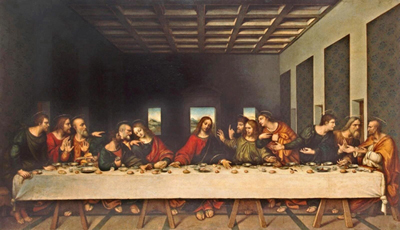
In classic Western painting and other traditions as well, a horizontal format is associated with fairly distant views of groups or landscapes.
Early ‘Scope filmmakers did sometimes favor distant, spread-out ensemble staging, with greater or less depth. (Below: Island in the Sun; Bad Day at Black Rock.)
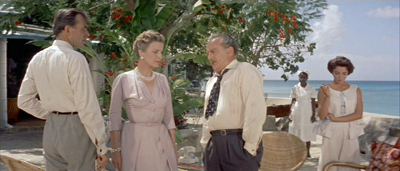
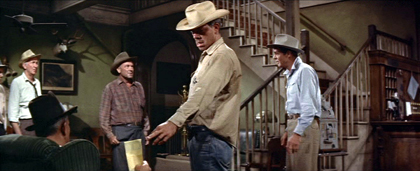
I try to track some of those early options in this online lecture.
But as technology improved, filmmakers managed to shoot medium- and close shots in the wide format. They “tamed” ‘Scope to a more traditional continuity. And as there were pressures toward “intensified continuity,” filmmakers adapted those tenets to ‘Scope. They gave us close-ups, fast cutting, and roaming camera movements within the widescreen array.
Like all solutions, this involved trade-offs. The 4:3 format was well-suited to the human body, and even a tight facial close-up could fill it fairly well. But a single or even a two-shot, in anamorphic widescreen, can leave a lot of the frame vacant or relatively unimportant.
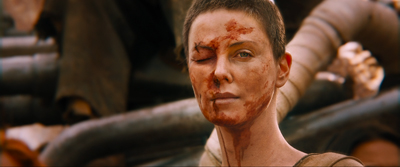

Cinematographer Boris Kaufman objected to the extra real estate. In traditional arts, the design should fit snugly into the format, with all areas contributing to the image’s effect:
The space within the frame should be entirely used up in composition.
But close views in widescreen typically leave a lot of dead space. If you put the figure in the center, that dead space can be on the sides.
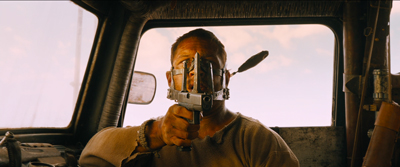
The bilateral symmetry of Wes Anderson’s frames is achieved on the premise that the figure is facing straight out at the viewer, so Anderson has the problem of filling up the flanking areas.
Or the dead space can be bigger on one side of the frame than the other. In that case, the figure, even a close one, is placed off-center in the 2.35/2.40 frame. This can suggest that the object of attention is somewhere beyond the empty zone.
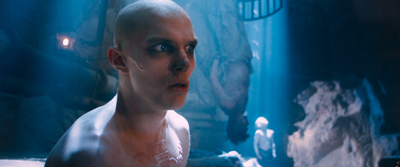
To avoid sheer dead space, you can try to settle something in the background. If it’s dramatically important, you can generate some nice compositional tension, in the manner of the wide-angle, deep-focus look of the 1940s.
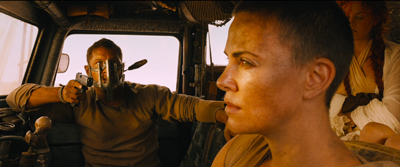
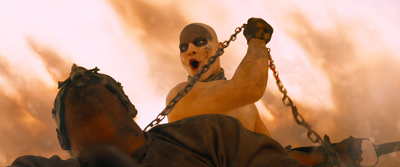
So as with most creative options, making a choice involves (a) tradeoffs and (b) further choices, some of them fairly forced. Go with widescreen, and you have to fill the frame somehow. Make one choice, and you have some dead areas, but you can control the viewer’s attention. If you fill the areas with significant action, you need to find some dynamic compositions. But you divide the viewer’s attention. You now have to make people look where you want and when you want.
Cuts for composition
Now add in cutting. How do you cut widescreen shots together, say in a conversation scene?
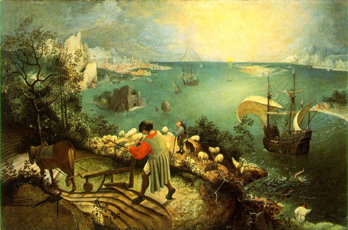
Go back to painting. Sometimes the most important item sits in the geometrical center of the picture format. Rudolf Arnheim points out that often the exact center is vacant and items are grouped around it. The result is a pictorial tension, with elements balanced, either symmetrically or in more complex patterns. In Bruegel’s Fall of Icarus, the major action is split–a dramatic splashdown, a world that doesn’t notice. The fall takes place somewhat off right of center, in a bright but far-offf area. It’s still almost indiscernible. The indifference of the peasants is given in the very composition of the image.
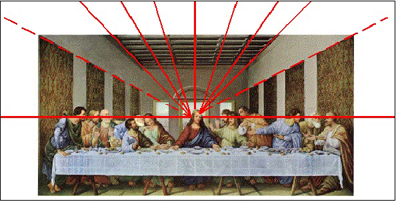
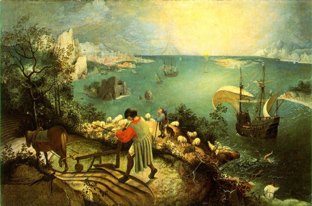
So too with cinema. In a single image, when the main point of interest isn’t dead center, there can be either symmetry, or important items grouped around the center.

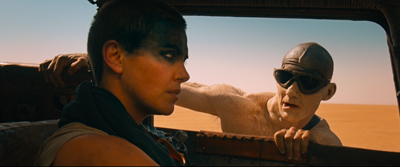
Going beyond the single image, we find that editing can create a fairly gentle seesawing around the central area. A common tactic is shot/ reverse-shot, with over-the-shoulder framings. In widescreen, that option tends to make the center fairly empty.
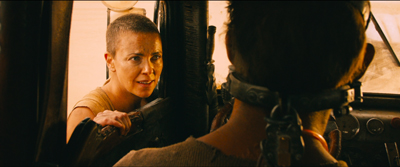
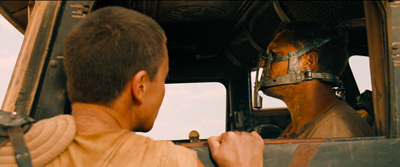
Or you can try “compensatory” shot/ reverse-shot cutting, so that the empty area of the first shot is filled by the corresponding figure or action in the next shot.
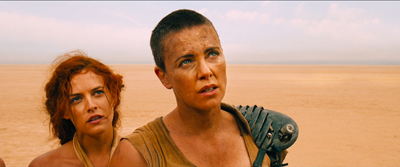
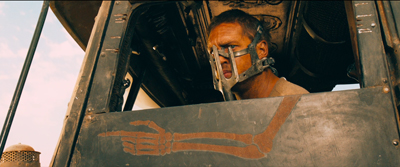
This second isn’t a bad solution, since the two shots together satisfy Kaufman’s dictum in a roundabout way. They become a “cinematic” way of filling the horizontal format, but in time rather than purely in space. And in this instance the main characters’ angled eye levels fit together snugly, in the upper center.
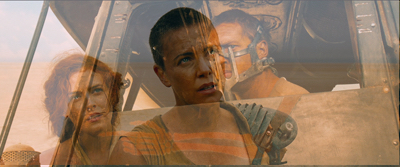
There can be a certain suspense added, as the second frame slowly fills up to reveal the item. When Furiosa looks off right, we cut to a shot of what’s caught her attention–an attack vehicle drawing into the frame on the right.
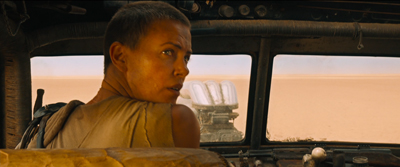

Assume, as most people do, that our attention fastens on certain aspects of the frame—typically those that attract us perceptually (brightness, movement, color, sound source, etc.) and that provide ongoing story information. So now you have to consider: How closely do you want your second shot to pick up on the crucial area of the first shot? That is, is the smoothest cut the one that starts the next shot with the viewer’s eye in the same part of the frame?
Some editors argue for this sort of continuity. “If the eye is led to one side of the screen,” notes one primer, “the action of character in the next shot might be located on that side also. Again, the purpose of the cut is to allow the eye to follow the movement.”
We’re back with our old friend the guided saccades, the fast, jerky eye movements that sample our environment. We’ve seen saccades at work in a single shot, thanks to staging that guides our attention. (Go here for a first-pass analysis, here for the eye-tracking evidence.) What about the cuts? The research of psychologist Tim Smith suggests that many editors intuitively try to match the point of interest across cuts. This is especially evident in the default zone, the geometrical center.
Keeping the viewer’s attention fastened on one area of the screen across the cut could be of great value in fast-cut action scenes. That way the viewer couldn’t miss the most important thing—a face, a gesture, a prop. This was the aim of George Miller in certain scenes of Mad Max: Fury Road. According to cinematographer John Seale, the centered compositions make it easier for the viewer to follow the action.
Your eye won’t have to shift…to find the next subject when you’ve only got 1.8 seconds of time to do that.
Vashi Nedomansky has created a striking video, complete with centered crosshairs, that shows the strictness of framing and composition during one action scene. Both long shots and fairly close ones are center-framed.
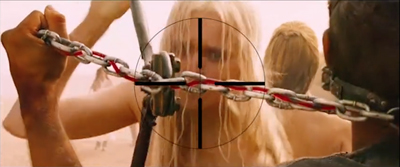
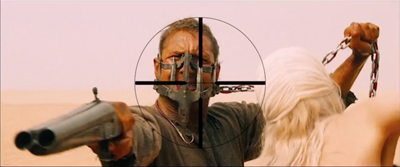
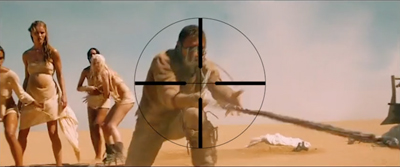
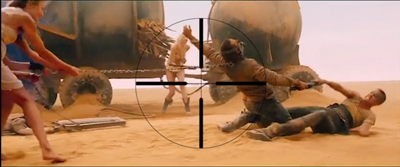
Vashi notes that Michael Bay and other directors seem to rely on fast cutting without due concern for where the viewer’s eye lands at the end of each shot. Combined with very short shots, compositional confusion can flummox us. We don’t know where we should be looking.
Miller uses a greater variety of compositions in other stretches of the film, as my illustrations above indicate. At times he applies his “matching zone system” to more off-center layouts. Furiosa is shown waiting for the biker gang to complete the deal, and she’s center framed.
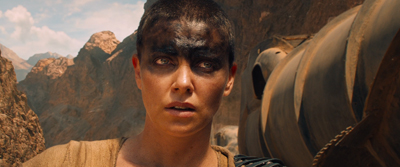
We cut to one biker surveying the scene. He (she?) is positioned off-center, so that we get a certain foreground/background dynamic between him (her?) and the truck far in the background. Now cut to Furiosa, who’s now in the same area of her frame; the empty space on the left seems to confirm what her eyeline suggested about the biker’s position above the canyon. (Interestingly, Miller slightly breaks the axis of action to get this smooth graphic cut.)

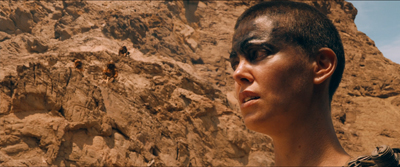
Still, you can argue that for fast-cut scenes it’s better to adopt a brute-force simplicity of composition, favoring the center. (While of course assuming that ordinary continuity principles, such as matching of movement, screen direction, eyelines, and so on, are obeyed.) Tim Smith’s experiments have shown that all other things being equal, our eyes drift to the center of the format from shot to shot–a point that Arnheim also makes about “the power of the center” in all images. This visual habit is challenged by so-called empty-center painting of the 1960s and 1970s, as seen in Kenneth Noland’s Shadow on the Earth and Larry Zox’s Decorah.


Mad Max: Fury Road seems to me a superbly directed film in its chosen style, but we can find alternatives. What about fast cutting that tries, as a part of an action scene’s kinetic drive, to shuttle or bounce the viewer’s attention more widely across the frame? This option wouldn’t be helter-skelter in the Bay manner; it’s calculated, and engenders its own pictorial excitement.
Not exactly a picture scroll, but kind of
We can find many examples in the Asian action tradition. Take for example one of the extended pursuits in Benny Chan’s New Police Story, a 2004 Jackie Chan vehicle. Jackie is clambering up along an angled beam of the Hong Kong Convention Center, and the framing puts him far to the right, emphasizing the distance and steepness of the climb.
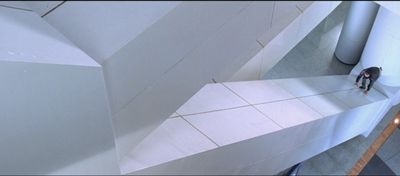
As he scrambles up, he seems not to notice that his pistol falls out of his pocket. But we do, because it stands out against the pale cladding as it slides down to the bottom of the slope. Miller would have given us a separate, centered shot of this crucial action, but here it becomes an instance of that “gradation of emphasis” that widescreen encourages.
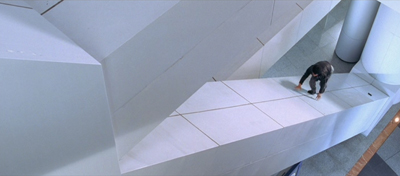
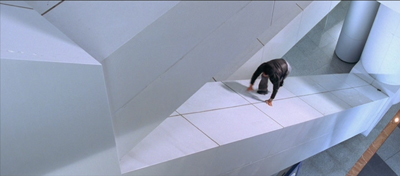
Before Jackie can hit frame center, there’s a cut that reverses the design of the first shot. A low angle puts him at the far left corner of the frame as he reaches the top. We never really see Jackie in the center of the frame in either shot.
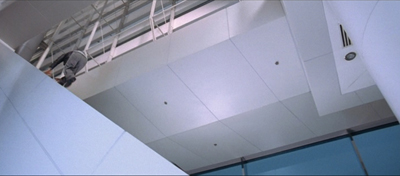
The two shots are cut fast (about 3 seconds each), but there’s no problem grasping the action. Hong Kong filmmakers realized that you could cut long shots quickly if the composition and lines of movement were very clear. There is, it turns out, enough time for the eye to catch up to the main point of the composition, but it does ask us to exercise.
A more percussive cut comes when Frank, also unarmed, searches out Joe, the gang leader, in a toy department. A snap-movement of the kind HK filmmakers love shows an off-center empty slot; Frank pops in from screen right.
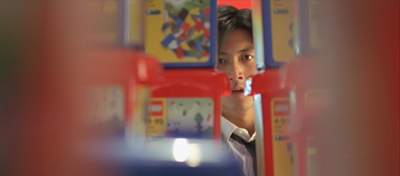
Cut to Joe stalking Frank, seen in another slot. It’s an optical POV shot, but it’s also off-center, balancing the composition of the first shot. A cut back to Frank closes the POV pattern. Perhaps the oscillation around the frame center can prime us for the next shot.
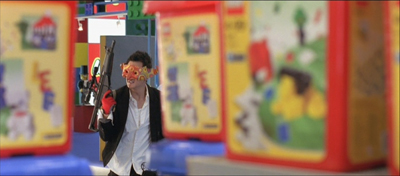
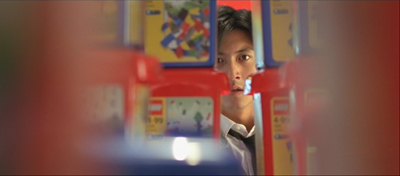
To get a sense of this “all-over” frame composition, have a look at this sequence from Yuen Kwai’s Ninja in the Dragon’s Den (1982). The combat swiftly passes from the center to the sides or to a corner. Thanks partly to the architecture of the cabin and the mill wheel, and partly to the judicious framing, there’s a sense that Kaufman might be satisfied that the space in the frame is “entirely used up”–not in a single shot, but in the totality of shots. (I’ve left in the English dubbing so subtitles don’t distract your eye.)
Hong Kong filmmakers mastered dynamic compositions during fights, but they were seldom as eccentric as their Japanese colleagues. Once anamorphic widescreen became common in Japan, directors pushed points of interest to frame edges and exploited unusual framing.
Consider the shootout at the climax of Suzuki Seijin’s Underworld Beauty (1958). A gang has trapped the protagonist Miyamoto and a young woman in a boiler room and is subjecting them to some heavy ordnance. In one series of shots, we see a gunman fire to the right, and as a result of his strafing, one boiler starts to blow.
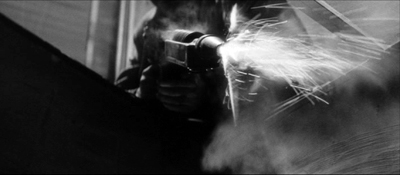
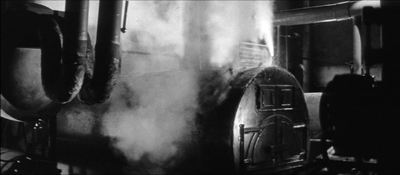
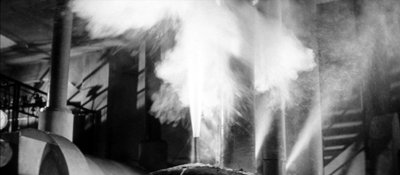
The progression of boiler shots shifts us more or less rightward across the basement, and the empty area on the far left of shot 3 suggests that the gunman remains offscreen in the upper left. Now we get a sort of establishing shot showing the two boilers of shot 2 more fully.
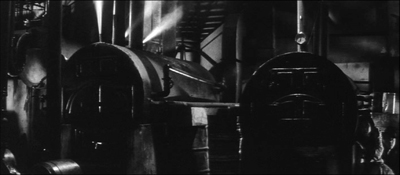
I think we’re inclined to place the offscreen gunman still in the upper left. The spraying boiler we’ve seen is now on frame left. What’s surprising is that Miyamoto and the woman are crouching way down in the lower right corner. As you watch the shot, you might not notice them at first, but Suzuki has them change position after a moment so their movement attracts our eye. In addition, the shot is fairly prolonged as the boss calls out to his prey, so viewers have time to discover them. This is, I think you’ll agree, a pretty bold use of the anamorphic frame.
Once we’ve noticed them, how does Suzuki cut closer to the couple? Unpredictably.
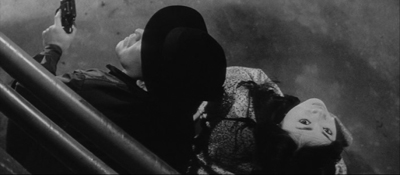
I feel a bump here every time I see it, because it’s hard to read the facial expressions from this angle. Instead, we get an almost abstract composition spread in a diagonal across the frame. Again, the geometrical center is less important than the shapes, edges, and tones that cross it.
At last we get something like an orthodox framing of the couple, eased by a match on action as the woman tips her head.
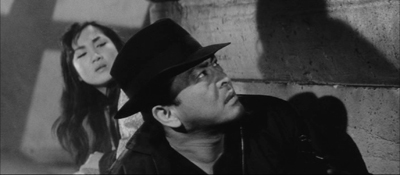
So the passage ends with a center-framed image. As often happens, decentering registers as an accent, a transitory departure from the baseline, the centered image. Not only will most action pass through the center, but we can be yanked to other regions in confidence that we’ll eventually return to it.
The shots in Underworld Beauty aren’t especially fast-cut, but I’ll close with another extract that is. This is the opening of Baby Cart at the River Styx (in the Lone Wolf and Cub series; dir. Misumi Kenji, 1972). Again, I’ve disabled the subtitles. (NB: Probably not best for children to see this.)
In a burst of shots, we get centered images, off-center ones, and radically off-center ones.
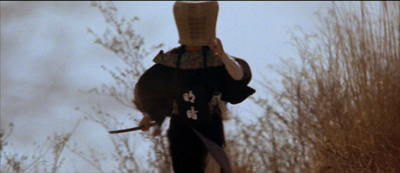
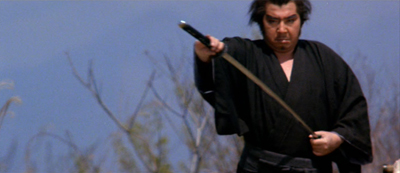
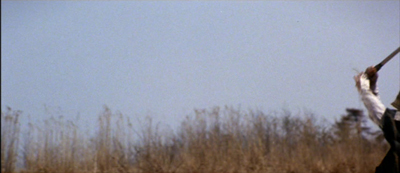
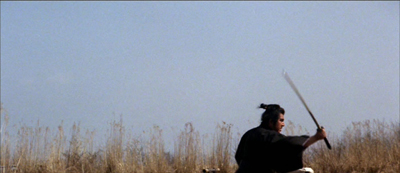
Continuity rules are respected and the camera is angled properly; but the compositions bounce from perfectly readable to perversely indiscernible. Some shots keep us in suspense about what’s about to happen, yet at no point is the action unclear. Again, the impact comes partly from simply composed, but highly varied, images.
George Miller’s strict target-framing is very powerful, but there are other options, even in fast-cut sequences. The idea of leading our attention across areas of the screen goes back to Eisenstein, the theorist-director who enjoyed zigzag graphic designs and the pictorial clatter created by a cut. One lesson: Every bit of the frame can be used, if only to jolt the viewer’s eye. All the action on the screen isn’t just in the story.
My quotation from Boris Kaufman is taken from Edward L. de Laurot and Jonas Mekas, “An Interview With Boris Kaufman,” Film Culture 1, no. 4 (Summer 1955): 5. The quotation about matching screen zones comes from Steven E. Browne, Video Editing: A Postproduction Primer, 3d ed. (Focal Press, 1997), 147. Bruce Block discusses “affinity continuums” from shot to shot in Chapter 7 of The Visual Story: Seeing the Structure of Film, TV and New Media, 2d ed. (Focal Press, 2013).
The Rudolf Arnheim book I’ve mentioned is The Power of the Center: A Study of Composition in the Visual Arts: The New Version (University of California Press, 1988). “Empty-center” painting is discussed by Thomas B. Hess in the essay of that title in New York (2 April 1973), 64-65 and in “Olitsky without Flattery,” New York (1 October 1973), 76-77. Hess describes paintings in which “the picture plane is stretched like a trampoline, with lots of spring action at its quivering edges.”
Tim Smith’s eye-tracking research is relevant to the framing principles I’ve been considering. Although he has yet to consider the more complicated cases of dispersed points of attention, he has found strong evidence that the default area remains the geometrical center of the screen. See his “Watching You Watch Movies: Using Eye Tracking to Inform Cognitive Film Theory,” in Psychocinematics: Exploring Cognition at the Movies, ed. Arthur P. Shimamura (Oxford, 22013), 170-171; the relevant video, with a heatmap of viewers’ attention, is here. Tim’s website is full of other examples from his research. Thanks to Tim for correspondence on this point.
Thanks also to Patrick Keating for email discussion of some of these matters.
I discuss principles of early widescreen shooting and staging in the online chapter “CinemaScope: The Modern Miracle You See Without Glasses.” See also the video lecture of the same name. For another example of radical decentering during a fast-cut combat, though put to different uses than in the Japanese examples here, see my entry on a King Hu jump cut.
Incidentally, we might wonder whether the centered compositions in Mad Max: Fury Road aren’t also acknowledging that on some displays (cable, streaming, airlines) these images will be cropped. To put important material too close to the frame edge risks losing it on downstream platforms. See “Filling the Box: The Never-Ending Pan-and-Scan Story.”
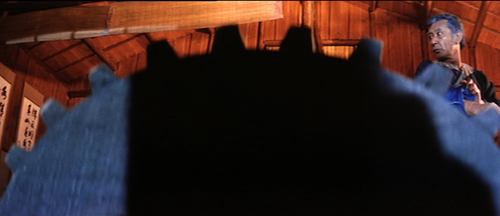
Ninja in the Dragon’s Den.
P.S. 1 March 2016: There’s a sequel to this entry here.
Living in the spotlight and the shadows: Jeff Smith on TRUMBO
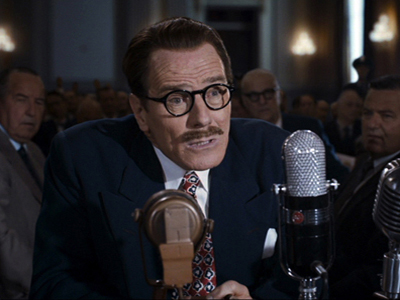
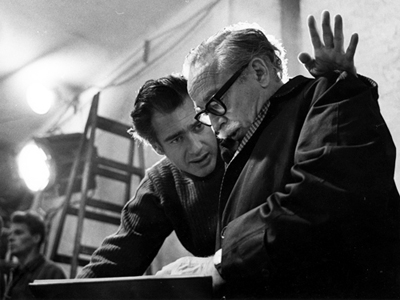
Bryan Cranston as Dalton Trumbo; John Frankenheimer and Dalton Trumbo.
DB here:
Who better to comment on the historical implications of Jay Roach’s Trumbo than our friend and collaborator on Film Art, Jeff Smith? He’s not only an expert on film sound, as he showed in his guest post on Brave, but he has written a book on the Hollywood blacklist. Jeff offers these observations on the film.
Last week, I was delighted to see that Bryan Cranston received an Oscar nomination as the star of Trumbo. Throughout the month of November, I was “johnny-on-the-spot” for local media interested in covering the new biopic about Dalton Trumbo. The story had a local angle. In 1962, Trumbo donated a large collection of scripts, notes, contracts, photos, and business correspondence to the Wisconsin Center for Film and Theater Research. Since then, scholars interested in the Hollywood blacklist have been making pilgrimages to Madison to probe Trumbo’s collection as well as the papers of five other members of the Hollywood Ten (Albert Maltz, Ring Lardner Jr., Herbert Biberman, Samuel Ornitz, and Alvah Bessie.)
I had done a lot of work with the collection, so I could do interviews with WMTV, WISC, The Wisconsin State Journal, and University Publications. Unfortunately I had not yet seen Trumbo, the Jay Roach film based upon Bruce Cook’s 1977 biography. I could talk about Trumbo’s life and career and the buzz I’d heard about the movie, but until it played Madison, I had to stay mum about the movie itself.
After a couple of weeks in distribution in limited release, Trumbo went wide just before Thanksgiving. Now that I’ve seen it, I am delighted to report that Trumbo merits every bit of the hype that surrounded it. To my mind, it is the best fictional film about the blacklist that Hollywood has yet produced.
Buoyed by a standout performance by Cranston, Trumbo is fast-paced and funny, and rather nimbly summarizes many of the political and industrial issues that led to the institution of the blacklist in 1947. It also showcases the effect that “unemployable” writers working on the black market had in undermining the rhetoric of the blacklist throughout the Cold War period. It became hard to say with a straight face that you were protecting American screens from the taint of Red propaganda when films secretly written by Communists were winning awards and topping the box office.
I was struck by some of the choices made by Roach and screenwriter John McNamara in bringing Trumbo’s story to the big screen. Although Trumbo’s career has been well documented by film scholars, Roach and McNamara faced the same challenges in adapting Cook’s biography that any filmmaker does in transforming a literary property into a classical narrative structure. How do you make Trumbo an active, goal-oriented protagonist despite the fact that he was the victim of historical circumstance? How do you deal with the welter of historical actors and subplots that populate Cook’s biography? How do you boil down a complex historical situation into a clear, transmissible narrative?
Witnesses, friendly and otherwise
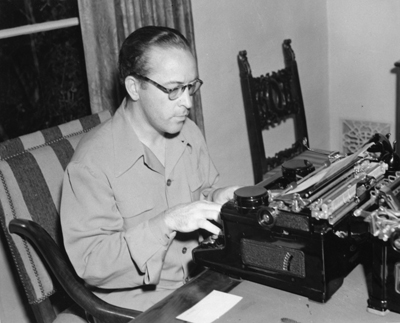
Dalton Trumbo at work.
Like many contemporary Hollywood biopics, Trumbo doesn’t try to convey the full sweep of its subject’s quite colorful life. It omits reference to young Dalton’s Christian Scientist upbringing, his early toils in the Davis Perfection Bakery, or even the publication of his first story in 1933. Indeed, the film also makes only offhand references to Trumbo’s early achievements as a novelist and screenwriter. These are briefly acknowledged near the film’s start through a series of shots in Trumbo’s office at the Lazy-T Ranch that reveal his award for Johnny Got His Gun and his Oscar nomination for Kitty Foyle.
Instead the film focuses on the period of Trumbo’s career during which the screenwriter became one of Hollywood’s sacrificial lambs at the altar of HUAC’s anti-Communism. When the film begins in the mid-forties, Trumbo was the most highly paid screenwriter in Hollywood, earning $75,000 per script. In today’s currency, that amounts to about $800,000 per picture, a remarkable sum for someone under studio contract.
Just a few years later, Trumbo would appear as an “unfriendly witness” during hearings conducted by the House Committee on Un-American Activities (HUAC) in October of 1947. As a result, he’d eventually be convicted of Contempt of Congress charges and sent to federal prison in Ashland, Kentucky.
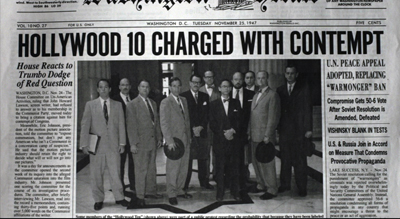
Although HUAC was concerned about the potential subversion of American screen content, it was not, in fact, illegal to be a member of the Communist Party. It was, however, a criminal offense to advocate for the overthrow of the American government according to the provisions of the Alien Registration Act (aka the Smith Act) passed in 1940.
About six months after HUAC concluded their hearings on Hollywood, a dozen Communist Party leaders were indicted for Smith Act violations. Defendants insisted that political change in America could be accomplished through democratic process and constitutional principle. But prosecutors claimed these statements couldn’t be trusted since Communists employed “Aesopian language” and therefore did not really mean what they said. The attack proved successful and effectively criminalized membership in the Communist Party as a result. Since any individual’s denial of revolutionary rhetoric would be viewed with suspicion, you were likely seen as guilty of the Smith Act if you simply owned a copy of Marx and Engels’ The Communist Manifesto.
Even before the Foley Square trials, as they came to be known, many of the Communist Party’s rank and file, including the Hollywood Ten, also feared that they would be prosecuted on similar grounds if they admitted their membership. This proved to be one factor that favored the Ten’s failed “first amendment” defense. True, they risked getting cited for Contempt of Congress. But that had the prospect of looking more dignified than simply being hauled off in cuffs on Smith Act charges.
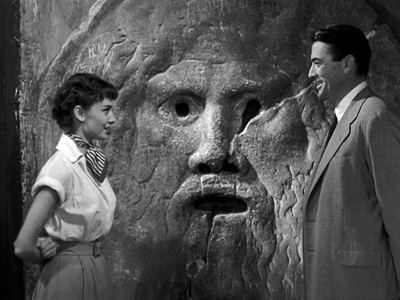
When he returned from prison, Trumbo encountered an industry that wanted him, but not his name on the credits. Producers recognized his talent, and he continued to write through the circuitous network of fronts and pseudonyms. Trumbo would win two Oscars for his work as a black market screenwriter: one for the Gregory Peck/Audrey Hepburn classic, Roman Holiday (below) and another for a Disneyesque “boy and bull” story, The Brave One.
By the end of 1960, Trumbo’s name would once again grace movie screens as the credited screenwriter on Kirk Douglas’ Spartacus and on Otto Preminger’s Exodus. This moment essentially ended what remained of the Hollywood blacklist. In moving from the limelight to the shadows and back again, Trumbo’s life had the kind of plot arc that Hollywood loves. It’s a story of redemption in which the hero overcomes overwhelming odds to regain the professional respect and recognition he’d been denied.
Although all of this suggests that Trumbo is a pretty conventional biopic, it’s quite unconventional in its treatment of the blacklist. As the late Jeanne Hall noted years ago, Hollywood’s representation of this dark chapter of its past was surprisingly evasive, getting on the right side of history but for all the wrong reasons.
Bad Faith in Appleton
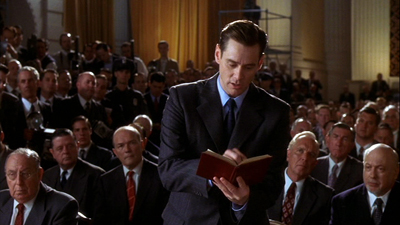
The Majestic (1999).
In titles like The Way We Were, The Front, and Guilty by Suspicion, filmmakers pulled a “bait and switch.” They substituted obvious cases of injustice for the much messier questions posed about HUAC’s abrogation of basic civil rights protections. The Hollywood Ten tried to defend themselves on First Amendment grounds, questioning whether HUAC itself had the right to invade their privacy or to limit their freedom of assembly. But in most of these earlier films about the blacklist, HUAC’s inquiry eventually entangles someone who was never a member of the Communist Party. In The Way We Were, the WASP-y Hubbell comes under suspicion for his relationship with the Jewish radical, Katie. In The Front, Howard comes under suspicion after selling black market scripts by Communist writers under his own name. Both of these instances present obvious cases of individuals wrongfully accused. They recruit our sympathies for characters that suffer as a result of HUAC’s tactics, but gloss over more fundamental questions about whether someone should be denied employment on the basis of their political beliefs.
No film, however, displays the equivocation evident in previous representations of the blacklist as vividly as Frank Darabont’s The Majestic. The protagonist, Peter Appleton, is a Hollywood screenwriter who has just been named by the committee. Distraught, he takes a drive out of Hollywood, but has an accident en route. Suffering from amnesia, Appleton finds himself in the small town of Lawson, California where is mistaken for Luke Trimble, a soldier killed in action some nine years earlier. Appleton becomes immersed in the Lawson community, helping his “father,” Harry, restore the small town theater that gives the film its title. Prompted by a combat film shown in the Majestic, Appleton regains his memory, and confides the truth of his situation to his new girlfriend. After his car is discovered, federal agents give Appleton a summons to testify about his Communist affiliations.
During the climax, Appleton appears before HUAC with the aim of clearing himself. Congressman Elvin Clyde confronts Appleton with evidence that he attended a meeting of the “Bread Instead of Bullets” club. Appleton pleads innocence, saying he only went because he was a “horny, young man” seeking to impress his date, Lucille Angstrom. Just as he is about to deliver his prepared statement purging himself of Communist associations, Appleton changes his mind. Instead he gives an impassioned speech that cites his First Amendment rights and denounces the investigation as a betrayal of America’s real ideals. Appleton saunters out of the hearing to the loud applause of onlookers. Yet Appleton’s lawyer later tells him that Angstrom is currently a CBS producer on Studio One, and his reference to her as a member of the Communist front organization is viewed as cooperation with the Committee.
In The Majestic’s civic fantasy, the committee hearing revives the “wrongly accused” trope seen in earlier blacklist films. Worse, it shows its hero successfully using the First Amendment legal defense that had spectacularly failed when the Hollywood Ten used it during the 1947 hearings. Moreover, because Appleton is a political naïf, his inadvertent naming of names redounds to his benefit. Given the film’s hopelessly confused politics, perhaps there is unintentional irony in the fact that Appleton is also the name of the Wisconsin hometown of Senator Joseph McCarthy (below), the man synonymous with the Cold War’s anti-Communist campaign.
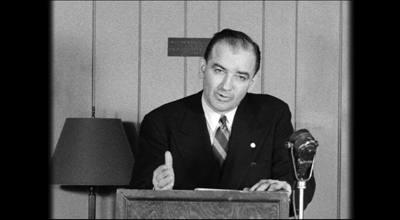
Trumbo, in contrast, doesn’t pull any punches. The film condemns HUAC’s activities not because it was prone to wild, unproven accusations like those of McCarthy, but rather because the very nature and essence of its inquiry was itself an abuse of power. The movie does nothing to deny Trumbo’s guilt. Indeed, the real-life Trumbo freely admitted it. In the 1976 documentary Hollywood on Trial, Trumbo described his reaction to his trial thusly: “As far as I was concerned, it was a completely just verdict. I had contempt for that Congress and have had contempt for several since.”
Yet, while not excusing Trumbo’s actions, the film dramatizes the debilitating effects of being blacklisted, both in his professional and personal life. The burden of Trumbo’s black market work put a strain on his marriage and his family, all of whom were enlisted to perform services he himself could not do publicly.
The blacklist: More than Red-baiting
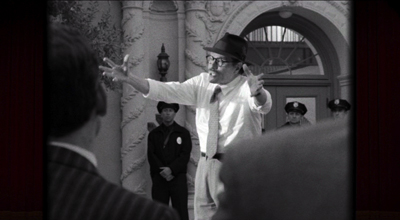
Besides providing a more accurate picture of Red-baiting and its effects, Trumbo also proves remarkable in making passing reference to some of the important secondary causes that eventually led to the blacklist. An early scene, for example, shows Trumbo (above) on a picket line during the vituperative Congress of Studio Union strikes that took place in 1945. Film historian Jon Lewis argues that one reason for the studio’s cooperation with HUAC’s investigation was that it served their interests in their long-term relationship with Hollywood’s craft guilds. Once Communists within the film industry’s labor unions became targets of government scrutiny, only the more moderate factions remained. Whether or not HUAC’s investigation was a direct cause, Hollywood did not experience another strike until more than four decades later.
Trumbo refers to another cause of the blacklist: anti-Semitism. Although it was something of a stereotype, Communists were popularly associated with European Jews. In fact, when Warner Bros. released I Was a Communist for the FBI in 1951, several moviegoers wrote studio head Jack Warner complaining that the film repeated the lie that all Jews were Communists. Said one Julius Newman of Roxbury, Massachusetts: “I demand that this dangerous, rotten, and libelous bit of propaganda be withdrawn immediately before some Jewish mother somewhere, gets her son’s skull cracked for Mother’s Day.”
The perception that anti-Semitism was an underlying cause of the blacklist was aided by the fact that three of the Committee were members of the Ku Klux Klan at the time of the 1947 hearings, including the Chair, J. Parnell Thomas. Moreover, in a speech before the House of Representatives, another HUAC member, Mississippi Democrat John Rankin, attacked members of the Committee for the First Amendment, who had lobbied on behalf of the Hollywood Ten. Rankin claimed that certain performers were suspect because their Anglicized names hid their actual Jewish origins:
One of the names is June Havoc. We found that her real name is June Hovick… Another one is Eddie Cantor, whose real name is Edward Iskowitz. There is one who calls himself Edward Robinson. His real name is Emanuel Goldenberg. There is another here who calls himself Melvyn Douglas, whose real name is Melvyn Hesselberg.
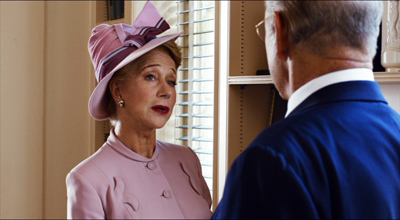
Screenwriter John McNamara wrote a similar speech for Trumbo, but placed it in the mouth of gossip columnist Hedda Hopper. When MGM boss Louis B. Mayer reminds Hopper that the legal situation was complicated by the fact that several of the Hollywood Ten had contracts, she responds:
Then how about I make crystal clear to my thirty-five million readers who runs Hollywood and won’t fire these traitors? How about I name names, real names? Like yours, Lazar Meir; or Jack Warner, Jacob Varner; Sam Goldwyn, Schmuel Gelbfisz.
The presence of Hedda Hopper in Trumbo hints at a third underlying cause of the blacklist: the role of the trade press and gossip columnists, who prosecuted and enforced it. Hopper was not alone in this endeavor. Publishers like Billy Wilkerson of The Hollywood Reporter and columnists like Walter Winchell and Ed Sullivan “cheered” HUAC’s efforts from the sidelines. They also helped the enforcement of the blacklist once it was instituted, calling public attention to the surreptitious presence of banned writers on the black market.
All of these elements in Trumbo’s script make it a richer, more sophisticated depiction of the Hollywood blacklist than that offered by its predecessors. They also remind us that its operations were about more than just politics. Once the blacklist was established, studio bosses gained the upper hand in their dealings with labor, gossipmongers used rumor and accusation to fill column inches and sell papers, and anti-Semites exploited the common association of Communism and Jewish intellectuals to thwart activism among progressives, including those in the Civil Rights movement.
In sum, Trumbo offers a more nuanced sense of the various factors at play at the time of the blacklist than virtually all of its cinematic predecessors. This makes it all the more surprising then that the film nonetheless rewrites history in other ways. In an effort to both streamline and personalize its protagonist’s story, Trumbo invents new characters, revises the order of historical events, and shorts the achievements of other black market screenwriters who also contributed to the blacklist’s ultimate demise.
The eleventh member of the Hollywood ten
Although most film audiences expect that movies will generally portray historical events with some degree of accuracy, Hollywood cinema rewrites history all the time. Despite the fact that this is common practice, some films that take such liberties are hurt by negative publicity, especially around awards time. Recall the controversy surrounding Selma’s depiction of President Lyndon Johnson as an opponent of Martin Luther King’s famous march rather than as a “behind the scenes” ally. Some believe that the loud complaints coming from the LBJ camp cost director Ava DuVernay an Oscar nod.
Trumbo is no exception to this principle, even though it has been unusually forthright about the changes made to the historical record. My spidey senses were alerted to this during the movie when they introduced Louis CK’s character as “Arlen Hird.” I’d never heard of Arlen Hird.
Both in interviews and in an article in the New York Times, screenwriter John McNamara has acknowledged that Hird is a composite character, whose traits and experiences are based on five other members of the Hollywood Ten. Louis CK, for example, physically resembles the real-life Alvah Bessie, who, like the character, was a member of the Abraham Lincoln Brigade in the Spanish civil war.
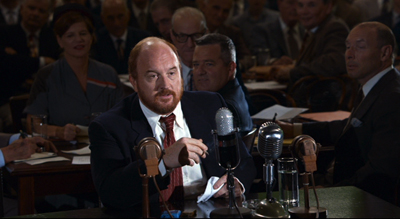
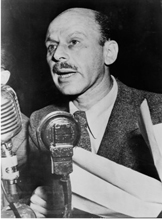
Moreover, when Hird is in prison, he hears a radio broadcast of Edward G. Robinson’s “friendly” testimony. Robinson calls him “the top fellow who they say is the, uh, commissar out there,” a swipe that blacklist historians would immediately associate with John Howard Lawson. And sadly, like Samuel Ornitz, Hird dies after battling cancer, having never seen the blacklist come to its ignoble end.
As Nicolas Rapold observes in the Times, Hird is meant to stand in for other Communist screenwriters whose attitudes were more doctrinaire than Trumbo’s. Yet I believe the real purpose of using a composite character is to simplify the historical record to make it more digestible for the viewer. Rather than tracing out Trumbo’s relation to all of the eighteen other “unfriendly witnesses” subpoenaed by HUAC, McNamara opts to consolidate them into a single character. Such a decision makes some intuitive sense, since viewers would be hard pressed to keep tabs on a parade of many characters. By creating Hird as a composite, Trumbo’s interactions with him gain vividness and salience.
Still, McNamara’s narrative technique is merely one approach among a larger menu of options, each of which has its own strengths and weaknesses. He could have treated the Hollywood Ten as a group protagonist, who all share the same goal in legally challenging HUAC’s authority. Such a gambit, though, would have displaced Trumbo from the center of the story early on. That decision would have weakened the causal motivation behind his later emergence as a black market crusader.
Alternatively, McNamara could have dramatized Trumbo’s individual interactions with Bessie, Lawson, and Ornitz, et.al., using a superimposed title to identify each one. The gain in accuracy, though, would likely mean a loss of dramatic clarity and a mildly more self-conscious style of narration. More important perhaps, it also would make for a less emotionally engaging story. The film shows Hird confiding in Trumbo at the Lazy-T ranch, participating in the Ten’s legal strategy, serving his prison term, and undergoing surgery for lung cancer. The accumulation of these details provide for a more fully fleshed out character. There’s also the opportunity to feel empathy for Hird’s children at his funeral, an effect that couldn’t have been as focused if Hird’s problems were scattered among separate individuals.
None of this is meant to suggest that McNamara absolutely made the right choice in deciding to treat so many members of the Ten as a composite. Rather, it is simply the recognition that such a technique is the result of a deliberate choice and further that one creative decision can lead to a cascade of others. Had McNamara stayed doggedly faithful to the historical record, Trumbo would have been a different film, but perhaps not a better one.
Perhaps we should recognize that screenwriters often must adapt historical narratives in the same way that they adapt literature. And the same sorts of questions about fidelity will bedevil us as when films change details of our favorite novels and stories. Rather than being dogmatic in expecting that historical films stick close to the facts, maybe we simply should ask whether the film is faithful to the spirit of the historical record, especially when its creators are so open and honest about the changes they made. Such a stance would at least recognize the difficulties faced by screenwriters in balancing the weight of classical narrative conventions against the strict measure of historical accuracy. If, as many screenwriters argue, films differ from literature in their emphasis on conflict and action, then the decision in Selma to treat LBJ as an obstacle to Martin Luther King’s goal makes a certain dramatic sense. Here again, one can debate the merits of that creative choice. But at least we do so with a fuller understanding of why such choices are made in the first place.
Get me rewrite!
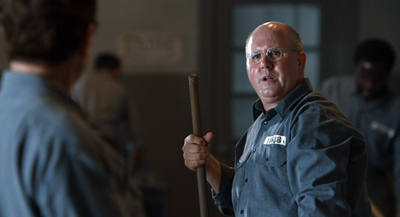
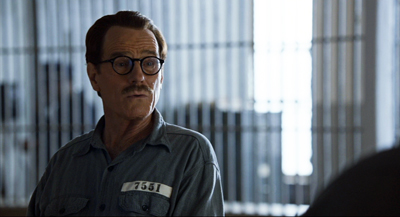
Besides creating composite characters, McNamara rewrites history in other ways. Perhaps the most obvious is when he creates a scene in prison between Trumbo and HUAC chair, J. Parnell Thomas, which never actually happened. True, Thomas was convicted on corruption charges and was sent to federal prison. But he served his term in Danbury, Connecticut rather than Ashland, Kentucky where Trumbo was incarcerated.
In this case, the real-life story proves more entertaining than what appears in the film. While at Danbury, Thomas encountered two other members of the Hollywood Ten – Lester Cole and Ring Lardner, Jr. — serving their time on Contempt of Congress charges. Upon seeing Thomas working in the prison yard, Cole made a wisecrack that led the former HUAC chair to respond, “I see that you are still spouting radical nonsense.” Cole’s sharp retort: “And I see you are still shoveling chicken shit.”
In other cases, McNamara revises the chronology of events. In the film, Trumbo first meets with the King Brothers, Frank and Hymie, just after he is released from prison. In reality, Trumbo started working for the King Brothers just weeks after his HUAC testimony. Almost immediately after being suspended by MGM, Trumbo did black market work on the screenplay for the King Brothers’ cult classic, Gun Crazy, using fellow writer Millard Kaufman as a front. With Kaufman serving as intermediary, the Kings likely did not know of Trumbo’s involvement. But the brothers began working directly with Trumbo shortly thereafter. In fact, Frank King personally visited the Lazy-T ranch just prior to the Trumbo’s departure for prison, offering to pay him $8,000 to write the script for Carnival Story.
Trumbo coyly acknowledges the screenwriter’s contribution to Gun Crazy by featuring posters of the film in several shots. But by revising the historical circumstances of Trumbo’s first involvement with the Kings, the film more or less denies him actual credit attribution, ironically engaging in the same sort of opportunism displayed by the producers who surreptitiously hired him.
McNamara’s most significant changes to blacklist history, though, involve omissions. Trumbo’s Oscar victory for The Brave One is well documented and the episode – both in the film and in real-life – neatly captures his role as industry gadfly. But the same year that the mysterious “Robert Rich” won the Academy Award for Best Original Story, Michael Wilson also was nominated for a project for which he was publicly denied screen credit.
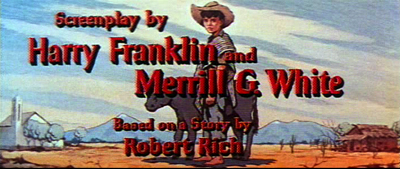
Wilson had completed a first draft of Friendly Persuasion for director Frank Capra in 1946, but no film was made from the script until producer/director William Wyler took over the project in 1955. When it came time to determine the screenwriter credit, Wyler suggested that it go to Robert Wyler and Jessamyn West for their extensive revisions, including many rewrites completed on set during shooting. When Wilson became aware of this, he immediately protested Wyler’s decision and forced arbitration by the Screen Writers Guild. The Guild ruled in Wilson’s favor, but also reminded the film’s distributor, Allied Artists, that they could legally deny credit to any screenwriter who had failed to clear himself before HUAC. When Friendly Persuasion was released in 1956, its only writing credits read “From the Book by Jessamyn West.”
Despite a good deal of press coverage of the dispute, the incident might have been a mere blip on the cultural radar if not for the 1957 Oscar nominations. When they were announced, a film with no credited screenwriter unexpectedly received a nomination for a screenwriting award. And with public acknowledgement of Wilson’s contribution to Friendly Persuasion more or less verboten, the text of the nomination simply said the writer was ineligible under Academy rules.
Worried that a public victory by a blacklisted writer would give the industry a big ol’ black eye, the Academy reportedly instructed Price Waterhouse to excise the nomination from the Oscar ballots that were sent to voters. Yet, even though the Academy essentially rigged the vote against Wilson, Groucho Marx offered an incisive quip about Wilson’s situation at the Writer’s Guild Awards banquet held about two weeks before the Oscars. Said Groucho, “The Ten Commandments. Original story by Moses. The producers were forced to keep Moses’s name off the credits because they found out he had once crossed the Red Sea.” Given all the effort that went into preventing Wilson from receiving the award, Trumbo’s Oscar win as “Robert Rich” must have tasted even sweeter. The award was given in absentia by Deborah Kerr, and Jesse Lasky, Jr. accepted it.
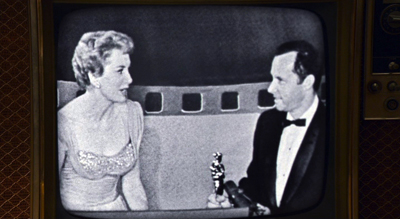
Moreover, the Rich incident was hardly the last humiliation that the Academy would suffer. The very next year novelist Pierre Boulle received a Best Adapted Screenplay nomination for The Bridge on the River Kwai, which was based on his book. But Boulle had been a front for Carl Foreman and Michael Wilson, who had taken the assignment as black market work for producer Sam Spiegel. When Boulle’s name was announced as the winner, the novelist was nowhere to be found. Instead, Kim Novak accepted the award on his behalf. But insiders knew exactly why Boulle was absent. As someone who wrote and spoke in French rather than English, his stumbling acceptance speech would have exposed the hypocrisy by which Foreman and Wilson were denied an award that they merited. (Sadly, neither Foreman nor Wilson would live to see their work duly recognized. In 1984, the Academy posthumously recognized them as the true authors of Kwai’s screenplay.)
Nathan E. Douglas = ?
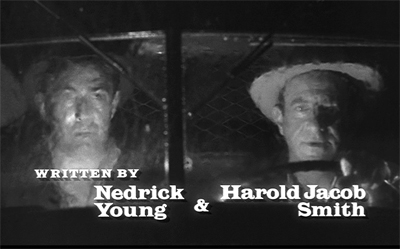
The original credits sequence of The Defiant Ones (1958) listed Nedrick Young as a coauthor under his pseudonym Nathan E. Douglas. He appeared in a bit part coinciding with his credit listing, along with coauthor Smith, in the cab of the truck. Video versions such as this have restored his name.
Things didn’t end there. The Oscar nominations in 1959 saw yet another brewing controversy regarding eligibility of a black market scribe. The writing team of Harold Jacob Smith and Nathan E. Douglas earned a nod for Best Original Screenplay for The Defiant Ones, even though the latter was a pseudonym for blacklisted writer Nedrick Young. If anything, Young’s participation in the making of The Defiant Ones was signaled by producer-director Stanley Kramer’s giving him a notable cameo in the film. During the opening credits, Young and Smith are both seen as prison guards riding in the front seat of a truck used to transport convicts. In a rather coy gesture, when the film’s writing credits are shown, Young’s pseudonym “Nathan E. Douglas” is superimposed over the man himself. Even though the general public didn’t know Young from Adam, his cameo made his participation an open secret in Hollywood.
During awards season, Young as “Nathan Douglas” collected a lot of hardware, including awards from the New York Film Critics Circle and the Writer’s Guild of America. With the nominations imminent, leadership within the Academy recognized that a third straight public relations disaster was in the offing. Just before Christmas in 1958, former Academy president George Seaton approached Young and Smith seeking assistance in overturning the Academy bylaw prohibiting blacklisted personnel from eligibility for awards. For his part, Trumbo himself stayed abreast of the situation and even rescheduled a media interview order to avoid fanning any flames of opposition from within the Academy.
On January 15, 1959, Seaton, Young, and Trumbo all got their wish as the hated bylaw was officially rescinded, passed by the Academy’s Board of Governors with near unanimous support. Two days later, Trumbo confirmed to newsman Bill Stout that he was, indeed, Robert Rich. On Oscar night a few months later, Young enjoyed the spotlight in a way that had been denied his predecessors. And when The Defiant Ones won the Oscar for the Best Story and Screenplay Written Directly for the Screen, Young strode to the podium along with Smith and offered a humble thank you. Ward Bond, one of John Wayne’s allies in the Motion Picture Alliance for American Ideals, observed: “They’re all working now, all these Fifth-Amendment Communists. We’ve just lost the fight. It’s as simple as that.”
Where does all of this backstory fit into the story told in Trumbo? As it turns out, nowhere. In choosing to concentrate on Trumbo’s story, the movie keeps all of this rich contextual material offscreen. As is often the case, the historical realities surrounding the end of the Hollywood blacklist were much denser, messier, and more complex than what can easily fit into a standard two-hour film. Classical Hollywood narrative, with its emphasis on goal-orientation and clearly motivated, causally linked events, tends to nudge screenwriters away from the sprawl more often found in novels or television miniseries. In the case of Trumbo, screenwriter John McNamara likely opted for the virtues of clarity and concision. He concentrated only on those incidents that directly involved the titular character, eliminating or minimizing anything that would detract from that narrative focus.
That being said, the creative choices of McNamara and director Jay Roach are, above all, choices. The screenplay for Bridge of Spies, for example, manages to convey something of the complex bilateral negotiations that linked the downing of U2 pilot Francis Gary Powers with the seemingly unrelated espionage case of KGB officer Rudolf Abel. One could imagine Roach and McNamara devising very brief scenes of Wilson, Foreman, and Young in their Academy imbroglios. Or alternatively, the film might have included Trumbo’s voiceover reading the text of his actual letters to Wilson, many of which commented on the perpetually changing conditions of the black market. As before, the inclusion of such material wouldn’t necessarily make Trumbo a better film. But it would make it a different one.
Although Dalton Trumbo led the fight against the blacklist, often using the industry’s greed, hypocrisy, and mendacity against itself in the process, my brief synopses of these other screenwriters’ Academy Award travails show that he was not alone. Many individuals taking small incremental actions led to the blacklist’s end. It wasn’t smashed; it crumbled through erosion. The fact that one of Hollywood’s “untouchables” was able to openly accept a major industry award made open screen credit a logical next step. Dalton Trumbo happened to be the lucky individual to regain his name without having to bow and scrape before HUAC. But even he knew it could just as easily have been Nedrick Young. Or Michael Wilson. Or Albert Maltz.
Come Oscar night on February 28th, if Bryan Cranston is lucky enough to hoist the Best Actor prize above his head, it will be a fitting tribute to a man whose struggles with this same institution helped to define him and his era. Yet an Oscar victory would also pay tribute to all those whose stories have not reached the screen, but whose grit and determination made Trumbo’s triumph possible. And Mr. Cranston, if you get to deliver that acceptance speech, be sure to remember all those unsung heroes that joined Trumbo in the fight.
Trumbo is based on Bruce Cook’s biography, which was first published in 1977. Readers should also check out Larry Ceplair and Christopher Trumbo’s massive, exhaustively researched new biography, Dalton Trumbo: Blacklisted Hollywood Radical. Ceplair is also the co-author, with Steven Englund, of the standard work on the Hollywood blacklist itself, The Inquisition in Hollywood: Politics and the Film Community, 1930-1960. My book, Film Criticism, the Cold War, and the Blacklist: Reading the Hollywood Reds, also considers Trumbo’s contribution to Spartacus.
Trumbo’s collection of correspondence, speeches, business papers, scripts, and photographs is held at the Wisconsin Center for Film and Theater Research. A rich sampling of material from it is available here. Several of the photos in this entry come from the WCFTR collection. Go here to listen to excerpts from his HUAC testimony.
Excerpts from John Rankin’s infamous speech about Jewish actors in Hollywood can be found in Gordon Kahn’s Hollywood on Trial: The Story of the Ten Who Were Indicted. Trumbo himself commented on the role of anti-Semitism in HUAC’S investigations in The Time of the Toad: A Study in Inquisition in America.
Franklin Leonard interviewed John McNamara last November about his work on Trumbo for his Black List Table Reads podcast. Nicolas Rapold offers a useful guide to the individuals profiled in Trumbo, including its composite characters. If you’re interested, you can see actual footage of the announcements of various screenwriting awards at the Oscar ceremonies of 1957, 1958, and 1959.
For more on how adaptation works, see the thirteenth chapter of the new edition of Film Art: An Introduction, forthcoming next week. That chapter is available for courses as an add-on to both the printed edition and the McGraw-Hill electronic edition.
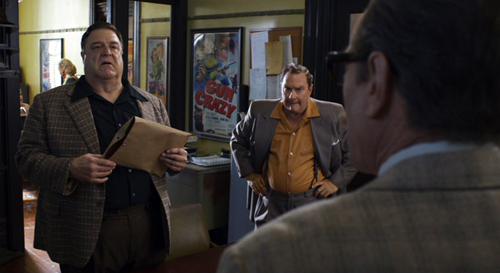
Trumbo.
Pick your protagonist(s)
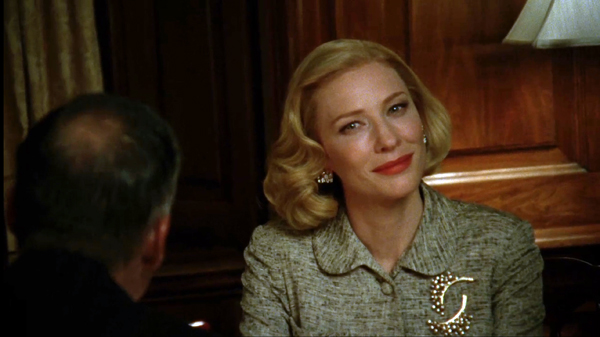
Carol (Todd Haynes, 2015).
DB here:
We’re used to sorting movies by periods, genres, and the individuals associated with them (stars and directors especially). But we can also distinguish films by their styles and narrative forms. So there’s not only a “film noir” style but other group styles, like the tableau approach seen in the silent cinema, or the deep-focus one of Hollywood in the 1940s-1950s. Similarly, we can think about types of storytelling strategies.
Someone might object that at least genre and other categories are in filmmakers’ minds, whereas it’s unlikely that any American in the 1940s set out to make a film noir as we understand it. (That term, and category, came from France, and somewhat after the fact.) Similarly, Ford probably didn’t think he was making a “classically constructed” Western in My Darling Clementine; he was just making a Western.
One reason we might construct these categories is to bring out the principles that filmmakers seem to follow intuitively. Perhaps no screenwriter ever thought explicitly about scene hooks, but the device is common enough to suggest that they believed the device was a useful tool.
Besides bringing out the regularities of filmmakers’ craft in certain times and places, constructing categories allows us to understand the creative choices they face. Maybe you handle a scene in a two-shot or in several reverse-angled singles. Both are permitted, each has certain advantages, and filmmakers spontaneously choose among these alternatives.
In effect, we’re reconstructing the menu of options available to filmmakers in certain times and places. If we do it carefully, we gain understanding of what each option can yield, and what certain filmmakers can achieve if they try something new.
Kristin and I have been in this game for decades, and our work on norms of film form and style has surfaced in our books, lectures, and blog entries. One set of analytical categories we’ve proposed is based on how movies use their protagonists. I was struck by how many films at end of 2015 and the start of 2016 illustrate a range of options currently available.
It turns out that these options are of long standing; they’re another example of how even recent movies owe a lot to the classical Hollywood tradition. That’s not to say, though, that they might not revise or tweak that tradition. Some filmmakers are innovative by temperament, and besides, there are career rewards when innovations come off. (Just ask the maker of Pulp Fiction.)
The categories depend on determining which character(s) can function as protagonist(s). That depends on the goals, the obstacles to the goals, and the relationship between the goal-striving character and other characters and story lines. Traditionally, in a two-hour Hollywood feature, a principal goal is articulated in the first half-hour or so. Kristin has argued that after this “Setup” portion comes others: a “Complicating Action” (also lasting about half an hour) that changes the goal and in effect creates a new setup; a “Development” which consists of delays, backstory, and fresh obstacles to the goal; a climax that resolves the issue; and an epilogue (screenwriters called it a “tag”) that confirms a certain stability in the situation. The major parts roughly divide the film into quarters, contrary to three-act accounts.
So today I look over the protagonist menu, based on some current offerings. Of course there are spoilers.
One, with benefits
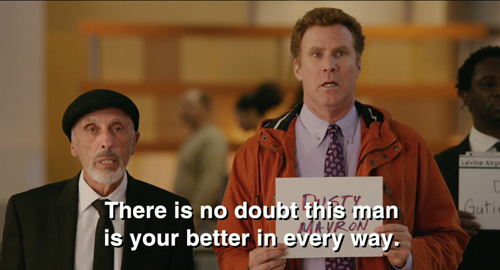
Daddy’s Home.
Take as a baseline the movie organized around one protagonist. A clear example from this holiday season is Daddy’s Home. Stepdad Brad (Will Ferrell) has read all the touchy-feely parenting books and applies their lessons to raising the kids he has inherited by marrying Sara. But Dusty (Mark Wahlberg), Sara’s charming and macho ex, returns from his mysterious life in espionage and rapidly takes over the household. In an escalating series of mishaps, Brad proves unable to live up to the hip and edgy things that Dusty dreams up for the kids.

The climax comes when Brad, after showering Megan and Dylan with presents, gets drunk at a basketball game and humiliates them all with a public confession of inadequacy and a pair of unguided free throws. Eventually the battle of the two parenting styles—comforting versus edgy—is resolved when at a father/daughter dance Ward’s nonviolent, somewhat goofy, approach to conflict tamps down an explosive confrontation with a father spoiling for a fight.
The classic situation is established: our protagonist has an antagonist. Dusty is an infighter who seizes control of every situation. As you’d expect, Dusty is winning the race for the kids’ affection during most of the film; even Sara seems to be feeling some of her old attraction to him. As the antagonist, Dusty makes his intentions clear about two-thirds through the film: He will not give in. This precipitates Brad’s suicidally expensive efforts to shower his kids with presents. Deeply shamed, he moves out. Dusty seems to have won.
But Dusty has a weakness. He can’t manage the drab daily responsibilities of parenting—making the kids’ lunches, driving them to school—that Brad enjoys shouldering. At the climax, Dusty has gained respect for Brad and soon remarries, becoming the devoted father of a stepchild. In a traditional comic reversal, he must confront the kid’s birth father, who is a bigger thug than he ever was.
Daddy’s Home reinforces our alignment with the protagonist Ward through his voice-over narration, though at the end the integration of the two families is given by letting Dusty and Sara chime in too. The emphasis on Ward, his confrontations with Dusty and his kids, and the hilariously bad advice offered by Ward’s boss (a classic sidekick role) fulfill a common template for one kind of classical plotting. The protagonist comes to the plot with his goal already decided on, and he has to defend it against a tangible threat.
There’s another option: letting the protagonist discover the goal in the setup. And there’s the possibility of presenting not a single powerful antagonist like Dusty but several. These forces in various ways take on the task of blocking the protagonist’s goal.
Some critics have thought David O. Russell’s Joy somewhat messy, but I think that’s partly because the film spreads the antagonist function across many vivid secondary characters. In my view, as Bernie Sanders might say, the plot remains pretty classical.
The Setup establishes Joy’s life as a disaster. Her childhood dreams of creativity have been forgotten after years with her dysfunctional family and the demands of her children and job. Around the half-hour mark, Joy’s wounds from cleaning up a broken wine glass send her into a dream in which she rebukes herself for her passive life. She wakes up and starts designing a miraculous mop. If her initial goal was simply muddling through, her new goal revolves around transforming her life by creating and marketing this product. This new goal sets the key for the Complicating Action.
At the film’s midpoint, Joy convinces the producer overseeing the Quality Value Channel to add her mop to the offerings. The Development section consists of more obstacles and some triumphs, so that eventually sales take off. But her family butts into her business and plunges her into bankruptcy. This, her darkest moment, is overcome when she confronts her Texan partner and threatens to take him to court for the fraud she has discovered. She pays off her debts. In the epilogue, we see her as a successful businesswoman helping other struggling inventors.
This, of course, is just the film’s spine. In the course of this plot, Joy discovers she has reserves of courage, determination, and a sense of her own worth. Weaving through it all is the voice-over narration of her grandmother who not only fills in information for us (even from beyond the grave) but also serves as a prod for Joy to persist in her desire to make things of value. There’s also a clever opening showing a soap-opera performance in the manner of Straub/Huillet; it’s later replayed in normal TV terms.
Joy has allies—her ex-husband and a loyal friend—but she faces many antagonists, an array of family and predatory business people. Where Joy most alters the traditional plot layout, I think, is in its refusal to include a story line involving romance.
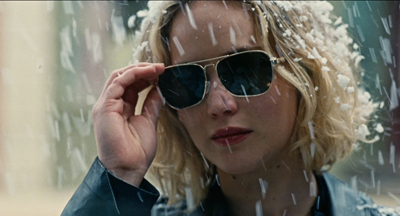
Most Hollywood plots are double-stranded: a line of action about romantic love, and another line, usually about work. Joy doesn’t revive her marriage and instead concentrates on her fulfillment of her dream. Having seen Silver Linings Playbook and American Hustle, we might expect Joy (played by Jennifer Lawrence) to hook up with the QVC producer played by Bradley Cooper, but it doesn’t happen. Still, Joy remains a nice example of the plot focused on one protagonist who struggles against a range of antagonists, each contributing particular obstacles. A comparable example from recent releases would be Bridge of Spies.
It takes two
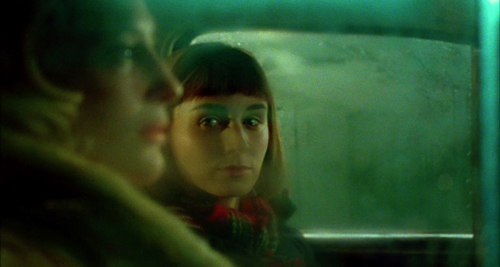
Carol.
Alternatively, there’s the dual-protagonist plot. Two characters share a goal, or have complementary ones, and they work together. They may also come into conflict about it or about other matters. Often they’re a male/female romantic pair, as in the classic His Girl Friday, but they may also be male/male (The Other Guys) or female/female (The Heat). I’m told that Star Wars: The Force Awakens eventually settles into a dual-protagonist plot, but one example I’ve seen is Sisters.
At the start our protagonists are characterized as unhappy and incomplete. Maura (Amy Poehler), a divorcée, is oversolicitous and lonely; Kate (Tina Fey), a single mother, is irresponsible and frequently jobless. Neither sets out deliberately to improve her life, but they are put out on that path after learning that their parents have sold the family home. Screenplay manuals call this the “inciting incident.”
An encounter with the house’s snobbish purchasers convince the sisters to relive their wild high school days by inviting their old classmates to a wide-open party. They switch roles: Maura vows to become the wild girl she always hoped to be, and Kate agrees to become, for that night, the prudent one keeping an eye on things. At first the party is a boring affair, as their Gen-Xer friends have become staid parents, but at the midpoint, with the arrival of some serious drugs and a tattooed side of beef named Pazuzu, things explode.
The Development section is woven out of running gags, including a would-be party animal, a mean-girl rival crashing the event, a hunk attracted to Maura, and Kate’s efforts to keep in cellphone communication with her daughter Haley, who has nothing but disdain for her scatterbrained mom. The climax is precipitated when, having utterly trashed the house, Kate learns that actually she was to get the money from the sale. More seriously, Maura has secretly acted as a surrogate parent for the elusive Haley. The denouement presents a series of resolutions whereby the parents forgive their daughters, the house is rehabbed, and the sisters accept the need to sell the place and grow up. A tag shows the family united at—when else?—Christmas.
In Sisters, the intertwined lines of action yield goals around one the house-based line of action (preserving the house, trashing it, rehabbing it), but other goals emerge around love. Maura gets a boyfriend, Kate wins her daughter’s love, and both reconcile with their parents.
Sisters exemplifies how dual-protagonist films can show characters sharing a goal and still clashing with one another. Here, as in most such films, one of the pair may help the other, work against the other, or keep the other in the dark. Accordingly, so that we can appreciate all the schemes, misunderstandings, and screw-ups, dual-protagonist films tend to supply a wide range of knowledge. In Sisters, for instance, we know, as Maura and Haley and the parents do not, that Kate has lied about getting a new job.
By contrast, a single-protagonist film can restrict our knowledge to the hero or heroine, so that we share the suspense and surprise coming their way. Daddy’s Home restricts us almost completely to what Ward knows; Dusty is constantly surprising him with new subterfuges to win the kids’ love. Similarly, Joy is the center of consciousness in her film. True, we have the Grandmother’s voice-over supplying information, but it doesn’t really break with Joy’s range of knowledge. Grandma could have tipped us off early that about the Texan’s scam, but we learn of it only when Joy does.
In this way, plot structure interacts with what in literature is called point of view, or narration in the broad sense. Carol provides a striking example.
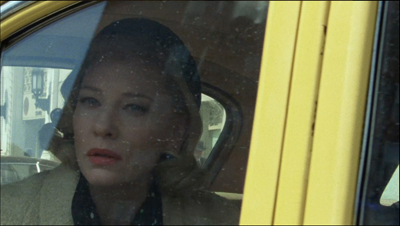
Patricia Highsmith’s original novel presents a single-protagonist plot. Therese, vaguely dissatisfied with the men in her down-at-heel bohemian milieu, falls abruptly in love with a wealthy wife and mother. Highsmith rigorously retains our attachment to Therese, so that we never know more than she does. She gets glimpses of Carol’s unhappy life with her husband Harge, her love for her daughter Riddy, and her struggle to obtain a divorce that will let her share custody of the girl. After Therese and Carol’s compromising road trip to Middle America, Carol returns to New York and the legal proceedings Harge is conducting. He has proof of Carol’s lesbian affair and intends to use it against her. But Therese learns of the progress of the case through letters and phone calls. Several chapters showing Therese simply waiting in Sioux Falls for news furnish some of the dread-filled suspense that Highsmith would generate in her crime novels.
The film displays the traditional four-part structure. The drive west is launched at the midpoint, just when Therese’s boyfriend Richard denounces her as infatuated with Carol. The couple’s trip, trailed by a detective tape-recording their lovemaking, serves as the Development. Interestingly, the book has a similar array of incidents, with the same plot point serving as the pivot to the second half. As I’ve argued before, popular fiction sometimes displays the same plot architecture we find in cinema.
But just following the four-part template doesn’t mean that the film and the novel are congruent. Carol shows how choices about narration can reshape plot structure. Apart from some changes in the original situation (e.g., Therese is now an amateur photographer rather than a set designer for stage productions), screenwriters Phyllis Nagy and Todd Haynes have made a crucial decision. They have expanding our access to Carol’s story line.
Events that are “off-page” in the novel are fully dramatized in the film, and we witness action that Therese never learns of. Harge, a vaguely pathetic presence in the book, is more fully characterized, and as an angry patriarch at that. We get scenes of Carol with Riddy, with her former lover Abby, with her in-laws, and particularly with her lawyer, who’s helping her fight for custody. Crucially, the screenplay supplies a climactic scene not in the book, when Carol yields to Harge’s demands and refuses to condemn her affair with Therese. Something like this must have occurred in the book too, but it’s presented sketchily and at a remove, recounted to Therese by Carol and Abby.
By creating a wider-ranging narration, Carol turns a single-protagonist book into a dual-protagonist film. The two women share the same goal, romantic union, and the narrational patterns balance their individual efforts to achieve it.
But wait, someone might say. Nagy and Haynes have added a flashback structure to the book, triggered by the early scene showing Therese leaving Carol after their meeting at tea. We watch Therese go to a party in a cab, and her morose face behind the rain-streaked window suggests that she’s recalling how she met Carol. Doesn’t this device respect the restricted narration of the book?
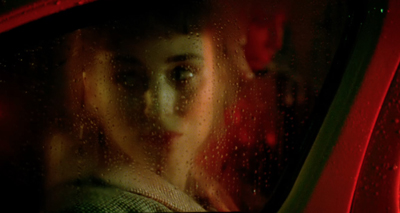
Actually, no. In classically constructed films, extended flashback passages are seldom restricted to the character doing the remembering. Against all realism, flashbacks include material that the recollecting character doesn’t or couldn’t witness. In line with this convention, Therese’s flashback includes a lot of scenes she doesn’t know about. The memory-flashback’s main purpose in a Hollywood film isn’t to represent character memory but to justify shifting the order of events. There’s more discussion here.
Perhaps one aim in showing rather than telling Carol’s story was to give Cate Blanchett a bigger part, but it has an important function for us as viewers. It avoids a climax portion that would show, almost Bresson-style, Therese simply killing time and waiting. Instead, by being transported to Manhattan and seeing what Carol is struggling against, we can appreciate Carol’s profound sacrifice for Therese. Carol is a somewhat remote and mysterious character in the book, but she’s delineated far more precisely in the film, largely because of these scenes.
Because Carol’s story line is fleshed out, we have a stronger sense of Therese’s mistake when, returning to New York, she declines Carol’s offer to resume their affair. (In the book, other factors shape Therese’s choice, including an ominous portrait that she seems to recognize from her childhood.) We know Carol to be more courageous than Therese believes she is, which makes the young woman’s decision not to reignite their affair more regrettable. This choice doesn’t block the screenplay from offering, when the flashback has ended and looped back to the present, a modified form of the book’s somewhat hopeful conclusion.
Multiple choices: Men (and women) on a mission
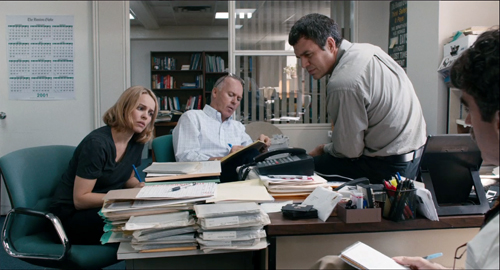
Spotlight.
There can be more than two protagonists, of course, so it’s convenient to have the general category of multiple-protagonist films too. Two common sorts show up in our year-end Hollywood releases.
One is what we might call the mission-team movie. Again, goals define the options. A group of characters, all more or less equal in importance, devote themselves to achieving a single goal. This is a common feature of combat films, though we find it in peacetime too. Classic examples are heist films like The Asphalt Jungle, sports films like A League of Their Own, crime films like Johnnie To’s The Mission, and numberless road-trip films.
Spotlight exemplifies the mission-team plot. As in a combat film, there’s a hierarchy: the chain of command runs from publisher to editor in chief to managing editor to section editor, and then to the grunts. The Boston Globe’s new editor Marty Baron puts an investigative team, called Spotlight, on a story about pedophile priests. Three reporters under Robby Robinson (Michael Keaton) unravel a story that ultimately implicates nearly a hundred priests and reveals many more victims.
As in a heist film, each reporter is given a specialty. Mike Rezendes (Mark Ruffalo) concentrates on getting information from the no-nonsense lawyer who is suing the Church on behalf of dozens of victims. Matt Carroll (Brian d’Arcy) scans the record and discovers a telltale pattern of priests’ assignment to parishes. Sacha Pfeiffer (Rachel McAdams) focuses on finding and interviewing victims. Robby runs interference with their superior Ben Bradlee Jr. and pursues his own hunches, including the role played by a retired attorney who’s one of his golfing buddies.
Through our old friend crosscutting, each protagonist is given separate scenes in which their skills are revealed and new information emerges. What’s common to the team members is tenacity and dedication to work (they put in long days and weekends). In addition, all were raised Catholic and feel with greater force the ways in which lawyers and the Church have covered up these crimes. In particular, the interpersonal style of Sacha, warm and empathetic, is contrasted with that of Mike, who tends to be more truculent and easily provoked.
The progress of the investigation falls neatly into the four-part structure, bracketed by a prologue (a 1976 incident in which a priest’s crime is covered up) and an epilogue that celebrates the success of the project and reminds the audience of the ongoing problem with priestly pedophilia. In the Setup, the reporters believe that the story is fairly limited until the spokesman for a victims’ organization provides them some evidence of wider criminality.
The Complicating Action consists of the discovery of over a dozen pedophiles, which raises the prospect of many more. Robby also senses a deep story here, based on the conspiracy of silence he’s confronting in the Church’s social circle. A complicating action often resets the initial goal, and this one does just that. Now Baron tasks the team with not merely exposing individual priests, but showing that the Church officials knew of the crimes, covered them up, and created a mechanism for perpetuating them.
The Development uses the paper trail discovered by Matt to pinpoint likely offenders, so now the team seeks out priests rather than victims. More obstacles pile up, including the unwillingness of victims to testify and the 9/11 attack, which slows the release of the story. All the while, the Spotlight team has been waiting for a court decision to unseal crucial documents that would prove the Church’s full knowledge of events. Mike learns that the lawyer Garabedian has used a counter-suit to bring some of those documents to light, but they are mysteriously missing from the court archives.
Delay, a common feature of Development sections, stretches things out. Finally Mike finds the court documents and they support the story. The climax consists of the team deciding on when to reveal the story so as to maintain their scoop and, to seal the deal, Robby getting his attorney friend to confirm their list of names. As in All the President’s Men, the press has to be characterized as taking every opportunity to back up its exposé with an abundance of evidence. The epilogue shows the Spotlight team, back at work on a Sunday, fielding phone calls from yet other victims—and Robby feeling contrite because back in 1993, he could have followed up a lead and did not. Again, the effort is to portray the press as both idealistic and fallible.
I said that the characters in a mission-team plot are “more or less equal in importance” because we often find that some are more prominent than others—they become “first among equals.” You could argue that the Ocean’s Double-Digit films, though dependent on teamwork, give primary emphasis to Danny, Rusty, and Linus. Still, there’s considerable time spent on the secondary members of the team, and often they turn out to be more central to the main action than they might appear. In Spotlight, the characters Robby, Mike, and Sacha are the most prominent (given the stars, no surprise), with Matt getting slightly less screen time and featuring in fewer dramatic confrontations. As we’d expect, though, Matt plays a crucial role in advancing the mission. The editor Baron, also downplayed compared to the others, not only launches the investigation but also serves as the wise leader who guides their strategy.
Again, the double line of action is less visible here. Mission-team plots often eliminate romance (combat films again) or introduce some love interest when a spouse or lover finds a protagonist too dedicated to the mission, or when the romance is part of the mission (as in Ocean’s Eleven and Twelve). Here there’s a hint that Mike’s dedication to investigative reporting has led to separation from his wife, but those circumstances aren’t worked out to create a love-related story line. It’s as if the journalistic crusade is proceeding on enough fronts not to need distracting subplots.
It’s the end of capitalism
The Big Short.
If the mission-team movie is characterized by a rigorous focus on the group’s common goal, another sort of multiple-protagonist movie is more diffuse and tangled. I’ve called it a network narrative. It features several more or less equal protagonists pursuing different goals, but connected through kinship, friendship, employment, or coincidence in ways that affect their individual fates. The film aims to trace out the links and nodes in the network, all the while pushing forward to create new connections.
Nashville, Pulp Fiction, and TV series like The Wire exemplify this method of construction, but these sprawling networks are only one option. The groups linked can be more limited. Consider The Big Short (based on a book that’s itself a network narrative).
When the film starts, you might think that the awkward hedge-fund manager Michael Burry (Christian Bale) is the protagonist. In the first ten minutes he cryptically outlines his hypothesis that the US mortgage system is fundamentally flawed, and he formulates a plan to exploit it. But then the narration switches to Mark Baum, a hedge-fund manager deeply critical of the banking system.
For several minutes, the narration alternates scenes of each man’s activities, with an emphasis on Burry’s plan to bet against housing bonds and Baum’s inability to come to terms with his brother’s suicide. At the 25-minute mark, Baum’s team gets a misdirected call from stock trader Jared Vennett (Ryan Gosling) and they learn from him that Vennett’s bank is selling collateralized debt obligations.
Through a vivid demonstration with building blocks, Vennett illustrates how the rating agencies have overvalued poor housing risks.
The Complicating Action starts by introducing two more protagonists, Charlie Geller (John Magaro) and Jamie Shipley (Finn Wittrock), who run a small investment company. By chance they find Jared’s presentation and decide to check out its strategy of shorting the housing market. Aided by the retired banker Ben Rickert (Brad Pitt), they get the credentials to buy in.
Their efforts are intercut with Burry’s tracking the market and with Baum’s team visiting Florida, where they discover that indeed house values are under water and mortgage brokers are snapping up unqualified buyers en masse. And the men learn that the rating agencies are routinely lying about the quality of the packages on the market. In the meantime, as mortgage defaults grow, mortgage bonds puzzlingly rise in assigned value.
The next turning point, launching the Development, is triggered by the decision of several protagonists to visit a Los Vegas forum on securitization. Baum’s team is instructed by Vennett to simply watch, and they learn about CDOs, though Baum can’t resist challenging the complacency of the banksters he meets. Meanwhile, guided by Rickert, the inexperienced Geller and Shipley hit on a new angle: to bet upon not just the low-rated packages but the A and AA ones. The men leave Vegas convinced that the market will collapse. Soon, though, we get the ups and downs characteristic of a Development, as it seems that our protagonists are all going to lose their shirts.
But their efforts to bet against the US economy pay off when mortgage companies start failing. This initiates the climax. The banks and investment houses struggle to contain the damage, chiefly by shifting the losses to their customers, and soon everyone wants the default swaps our protagonists have bought so cheaply. All wind up rich but disillusioned with the system. As in Spotlight, The Big Short’s epilogue concludes with texts indicating what happened to the protagonists afterward, and hinting that the system could topple once more.
You could imagine The Big Short as a different film, focused around one protagonist and making the others helpers, rivals, or walk-ons. But as a network narrative, it suggests the sheer sweep of financial corruption, as well as a range of response to it, from cynical acceptance (Vennett) to boiling outrage (Baum).
What enlivens the film, and makes it look and feel quite different from Spotlight, is its narrational texture. First, it’s recounted in voice-over by the least emphasized character, Vennett. Second, the film allows characters to address the camera occasionally, like Jordan Belfort in The Wolf of Wall Street, and they sometimes explain that what we’re seeing in the film wasn’t exactly what happened in real life (below left). Third, there are capsule sequences in which unlikely experts like Margot Robbie and Anthony Bourdain explain esoteric financial concepts.

One insert comes from Selena Gomez and economist Richard Thaler. (Get his fine book Misbehaving!)
Throughout, the dramatic scenes are interrupted by flash montages of musical numbers, TV commercials, and glimpses of cheerleaders, overpriced houses, and people living under bridges. This gonzo style, reminiscent of the fragmentary montages of Oliver Stone’s JFK and Harmony Korine’s Spring Breakers, matches the “glum exuberance” of the heroes. They’re simultaneously pumped and appalled. Like the reporters in Spotlight, they keep thinking they’ve hit the bottom of the cesspool only to learn that it’s muck all the way down. This style extends the cross-sectional aspect of the protagonists’ network by suggesting the ripple effects of the subprime crisis.
There are other classical narrative models on display in recent releases. Steve Jobs is a single-protagonist film, but one rendered through block construction. The Hateful Eight seems to me a network narrative in the Grand Hotel mold: several major characters, with initially unrelated goals, converge on a limited space. There conflicts and alliances develop. In addition, more nodes and links in the network are revealed through a flashback. One pattern I haven’t seen this season is what Kristin calls the parallel-protagonist plot, as in The Hunt for Red October and Amadeus. Here two characters with different goals come to learn of one another, chiefly because one becomes fascinated with the counterpart.
I offer these sketches in a descriptive, analytical spirit. Nothing in what I’ve said indicates whether the movies are good or bad. This is like analyzing a fugue or a sonnet: the form is more or less fixed, but each work will handle it somewhat differently. Some will handle it skillfully, some not. And a fuller analysis of even the weakest of these films would show how the classical format encourages filmmakers to devise parallel scenes to show character change (such as the tea-time meeting in Carol), find motifs that develop and pay off (like Mike Burry’s increasingly maniacal drumming), and create call-backs to details that seemed unimportant earlier but that take on bigger roles in the action later (like the dance-fight in Daddy’s Home). It’s also pretty remarkable that the four-part format can be adapted to different roles for protagonists.
What advantages flow from sorting films by narrative strategy instead of by genre or director or period? We can see unexpected continuities between current filmmaking and older traditions. We can show how different principles of plot architecture allow different opportunities for characterization and thematic implication. We can trace how commitment to one sort of plot can open up further choices about point of view and other narrational matters. And once we’ve detected the basic similarity between certain storytelling strategies, we can go on to appreciate the differences film by film.
This is a project in what I’ve called the poetics of cinema. You can learn more about it in the book of that title. A chapter from the book, on the theory of film narrative I propose, is on this site, and there’s a blog entry introducing it. In each of these I consider three major dimensions of cinematic storytelling: narration, plot structure, and the story world. Today’s entry suggests that one feature of the story world, the protagonist, can be shaped by a tradition of plot structure and some features of narration.
For more on the four-part model of plot structure, see Kristin’s entry “Time Goes by turns” and her book, Storytelling in the New Hollywood. I’ve offered some analyses along these lines as well, in for instance “Anatomy of the Action Picture,” “Gone Grrrl,” and “Birdman: Following Riggan’s orders.” I discuss network narratives briefly in this entry and at length (no surprise) in Chapter 7 of Poetics of Cinema.
Naturally, thinking about protagonists and plot structure isn’t the only way we can analyze movie storytelling. For other tools, see the category Narrative strategies.
Daddy’s Home (Sean Anders, 2015).