




Archive for the 'Film comments' Category
The ten best films of … 1925
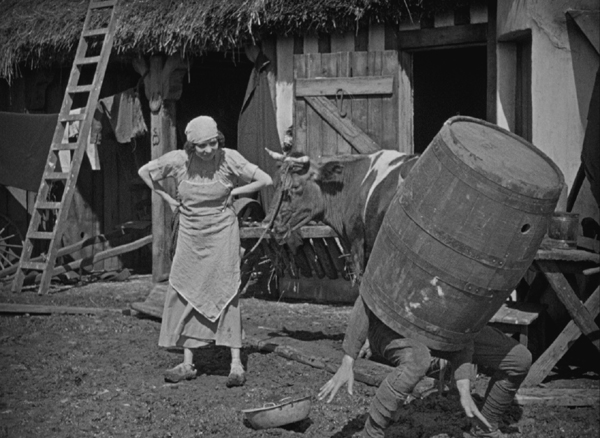
The Big Parade (1925).
Kristin here:
As all about us in the blogosphere are listing their top ten films for 2015, we do the same for ninety years ago. Our eighth edition of this surprisingly popular series reaches 1925, when some of the major classics of world cinema appeared. Soviet Montage cinema got its real start with not one but two releases by one of the greatest of all directors, Sergei Eisenstein. Ernst Lubitsch made what is arguably his finest silent film. Charles Chaplin created his most beloved feature. Scandinavian cinema was in decline, having lost its most important directors to Hollywood, but Carl Dreyer made one of his most powerful silents.
For previous entries, see here: 1917, 1918, 1919, 1920, 1921, 1922, 1923, and 1924.
The lingering traces of Expressionism vs the New Objectivity
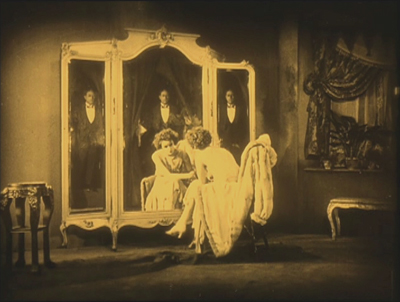
The Joyless Street (1925).
Last year I suggested that German Expressionism was winding down in 1924. It continued to do so in 1925. Indeed, no Expressionist films as such came out that year. What I would consider to be the last films in the movement, Murnau’s Faust and Lang’s Metropolis, both went over budget and over schedule, with Faust appearing in 1926 and Metropolis at the beginning of 1927.
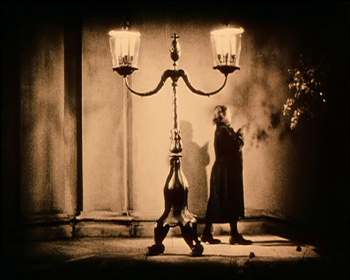
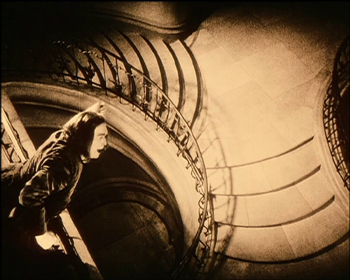
Murnau made a more modest film that premiered in Vienna in late 1925, Tartuffe, a loose adaptation of the Molière play. The script adds a frame story in which an old man’s housekeeper plots to swindle and murder him. The man’s grandson disguises himself as a traveling film exhibitor and shows the pair a simplified version of the play, emphasizing the parallels between the hypocritical Tartuffe and the scheming housekeeper.
The film has some touches of Expressionism but cannot really be considered a full-fledged member of that movement. The lingering Expressionism is not surprising, considering that some of the talent involved had worked on Robert Wiene’s Das Cabinet des Dr.Caligari: screenwriter Carl Mayer, designers Walter Röhrig and Robert Herlth, and actors Werner Krauss and Lil Dagover.
The visuals include characteristically Expressionist moments when the actors and settings are juxtaposed to create strongly pictorial compositions. These might be comic, as when the pompous Tartuffe strides past a squat lamp that seems to mock him, or beautifully abstract, as when Orgon is seen in a high angle against a stairway that swirls around him:
A restored version is available in the USA from Kino and in the UK in Eureka!‘s Masters of Cinema series. (DVD Beaver compares the two versions.) The restoration was prepared from the only surviving print, the American release version; it runs about one hour.
The other German film on this year’s list, G. W. Pabst’s The Joyless Street, contrasts considerably with Tartuffe. It was arguably the first major film of the Neue Sachlichkeit or New Objectivity trends in German cinema. I have already dealt with it in a DVD review entry shortly after its 2012 release. The restoration incorporated a good deal more footage than had been seen in previous modern prints, but it remains incomplete.
Once more the comic greats
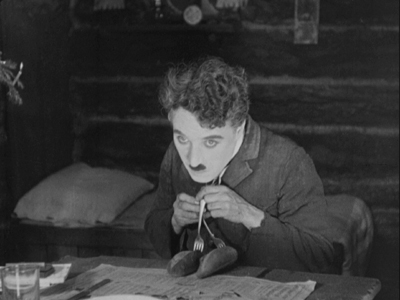
The Gold Rush (1925).
For several years now these year-end lists have mentioned Charles Chaplin, Buster Keaton, and Harold Lloyd, in various combinations. Early on it would was Chaplin alone (Easy Street and The Immigrant for 1917) or Lloyd and Keaton alone (High and Dizzy and Neighbors for 1920). In a way most of these films were placeholders, signalling that these three were working up to the silent features that were among the most glorious products of the Hollywood studios in the 1920s. In our 1923 list, each found a place with a masterpiece: Chaplin’s A Woman of Paris, Keaton’s Our Hospitality, and Lloyd’s Safety Last.
This year we may surprise some by giving Lloyd a miss. For years The Freshman was thought of as his main claim to fame, perhaps alongside Safety Last. I think this was largely because The Freshman was the one of the few Lloyd films that was relatively easy to see. (Perhaps also because Preston Sturges dubbed it an official classic by making a sequel to it (The Sin of Harold Diddlebock, aka Mad Wednesday, 1947.) Now that we have the full set of Lloyd’s silent features available, it emerges as a rather tame entry compared to Safety Last, Girl Shy, or our already-determined entries for 1926, For Heaven’s Sake, and 1927, The Kid Brother. Let’s just call The Freshman a runner up.
Keaton’s Seven Chances takes one of the most familiar of melodramatic premises and literally runs with it. James Shannon discovers from his lawyer than he stands to inherit a great deal of money if he is married by 7 pm on his 27th birthday–which happens to be the day when he receives this news. A misunderstanding with the woman he loves leads to a split, and in order to save himself and his partner from bankruptcy, Shannon determines to marry any woman who will volunteer in time. Hundreds turn up.
The result is another of the extended, intricate chase sequences that tend to grace Lloyd’s and Keaton’s features, and to a lesser extent Chaplin’s. In fact Seven Chances has a double chase. The first and longer part involves a huge crowd of women gradually assembling behind Shannon as he unwittingly walks along the street. This accelerates and keeps building, exploiting various situations and locales, as when the chase passes through a rail yard and Shannon escapes by dangling from a rolling crane above the women’s heads. Eventually the action moves into the countryside, where the brides temporarily disappear, taking a short cut to cut Shannon off, and he ends up in the middle of a gradually growing avalanche.
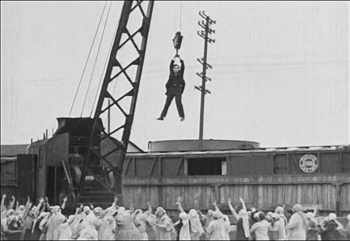
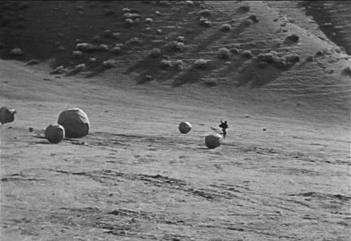
Seven Chances is available on Blu-ray and DVD from Kino.
Of all the films on this year’s list, Chaplin’s The Gold Rush is probably the most widely familiar. The Little Tramp character, here known only as a “Lone Prospector,” blends hilarity with pathos in a fashion that is actually typical of relatively few of the director/performer’s films overall. It is, however, how many people think of him.
The Gold Rush looks rather old-fashioned compared with Seven Chances. Although the opening extreme long shots of an endless line of prospectors struggling up over a mountain pass are impressive, much of the action takes place in studio sets, sometimes standing in for alpine locations. Both the cabins, Black Larsen’s and Hank Curtis’, are like little proscenium stages, with the action captured from the front. Yet the film depends on its brilliant succession of gags and on the Prospector’s status as the underdog who is also the resilient and eternal optimist.
The best bits of humor arise from Chaplin’s ability to create funny but lyrical moments by transforming objects metaphorically. Given the plot, some of the best-known gags arise from meals. One is the dance of the rolls, part of a fantasy sequence in which the Prospector dreams of entertaining a group of beautiful women at dinner (above), when in fact the women stand him up. Trapped by a storm in a remote cabin, the Prospector and his partner cook one of his shoes. He serves it on a platter and carefully “carves it, with the leather becoming the meat, the nails bones, and the laces spaghetti.
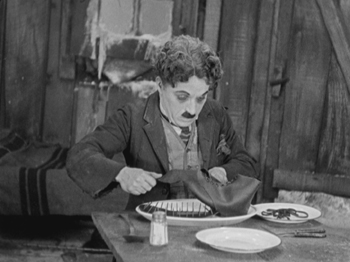
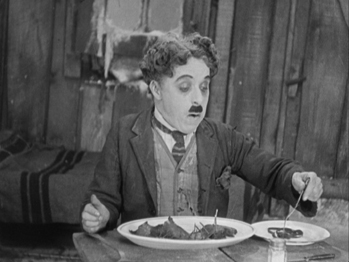
Many home-video versions of The Gold Rush have been released, but the definitive restoration of the 1925 version is available from the Criterion Collection.
The Golden Age in full swing
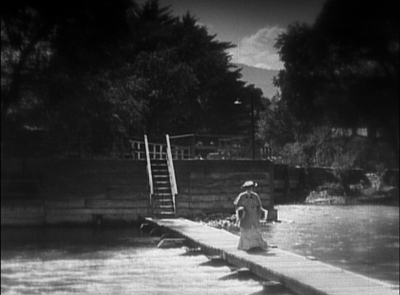
Lazybones (1925).
When people speak of the “Golden Age” of the Hollywood studio system, they usually seem to mean the 1930s and 1940s (and the lingering effects of the system in the 1950s). A look at Hollywood films of the 1920s shows that it was already functioning at full steam. Three features of 1925 display the utter mastery of continuity storytelling and style and a sophistication that matches films of subsequent decades.
Lady Windermere’s Fan may be the best silent made by Ernst Lubitsch, who has appeared on these lists before. It arguably ranks alongside Trouble in Paradise and The Shop around the Corner as one of the best films of his entire career. It’s a loose adaptation of the Oscar Wilde play, but it’s pure Lubitsch throughout.
Anyone who thinks that the classical Hollywood system was merely a set of conventions that allowed films to be cranked out with minimal originality could learn a lot from Lady Windermere’s Fan. Its completely correct use of continuity editing, three-point lighting, and the like does not preclude imaginative touches and methods of handling whole scenes. There’s the sequence when Lord Windermere visits the mysteriously shady lady Mrs. Erlynne in her drawing-room. The camera is planted in the center of the action, with frequents cuts as the two characters move in and out of the frame and even cross behind the camera. There’s not a hint of a mismatched glance or entrance across this complex and unusual series of shots. There’s the racetrack scene, as everyone present watches and gossips about Mrs Erlynne in a virtuoso string of point-of-view shots.
The racetrack scene ends with a wealthy bachelor following Mrs Erlynne out of the track. The camera moves left to follow her, keeping her in the same spot in the frame. As the man gradually catches up, Lubitsch uses a moving matte to hint at their meeting without showing it or cutting in toward the action.
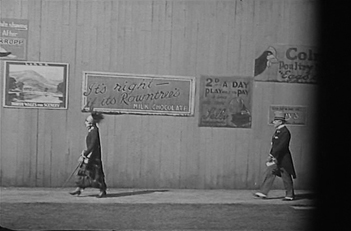
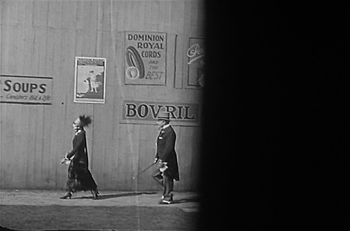
A good-quality transfer of Lady Windermere’s Fan is only available on DVD as part of the More Treasures from American Film Archives 1894-1931. (Beware the copy offered by Synergy, which according to comments on Amazon.com is from a poor-quality, incomplete print.)
The one title on this list whose inclusion might surprise readers is Frank Borzage’s Lazybones. I remember being bowled over by this film during the 1992 Le Gionate del Cinema Muto festival in Pordenone, which included a Borzage retrospective. I found the more famous Humoresque (1920) a disappointment, but Lazybones was a revelation. This is another case of a film that was simply unknown when film historians started writing about the Hollywood studio era. It was not discovered until 1970, when it was found in the 20th Century-Fox archives. As a result, Lazybones was, as Swiss film historian Hervé Dumont put it in his magisterial book on the director, “revealed as the most poignant–and the most accomplished–of Borzage’s works before Seventh Heaven.”
Year by year since we started this annual list, I looked forward to recommending Lazybones, and now we arrive there. I rewatched it for the first time to see if it really deserved to make one of the top ten. The answer is yes. For me, this is as good as 7th Heaven, or as near as makes no difference.
It’s difficult to describe the plot of Lazybones, since it doesn’t have much of one. Steve (played by the amiable Buck Jones) is a very lazy young man living in a rural village. He has a girlfriend, Agnes, whose mother scorns him. The girlfriend has a sister, Ruth, who returns home with a baby in tow. In despair, Ruth leaves the baby on a riverbank and tries to drown herself (image at top of section). Steve rescues her, and she explains that unknown to her family, while she was away she married a sailor who subsequently went down with his ship. She has no proof of this and knows her tyrannical mother will assume that the baby is illegitimate. Steve decides to keep her secret and adopt the apparent foundling himself.
All this happens during the initial setup. Then the little girl, Kit, grows up into a young lady. Along the way, not all that much happens. Steve, lacking any goals, stays lazy, which sets him apart from the energetic, ambitious protagonists of most Hollywood films. Kit is shunned by her classmates and the townspeople, and Steve tries to shelter her from all this. He loves Agnes but quickly loses her to a richer, more respectable man. He goes off to fight in World War I, becomes an accidental hero, and returns home after perhaps the shortest battlefront scene in any feature of the period. Kit finds a boyfriend.
What makes all this riveting viewing is its mixture of quiet comedy and poignancy. Steve is so amiably and unrepentantly loath to work that he is scorned by nearly everyone, and yet he commits an act of great kindness for which he gets no credit at all, except from his devoted mother. It is clear that these snobbish townspeople would scorn him even if they knew how he has kept Kit out of the orphanage and made a happy life for her.
The film is beautifully shot, and Borzage displays such an easy mastery of constructing a scene, particularly in depth, that it is easy to miss the underlying sophistication. Early on, Agnes and her mother arrive at Steve’s house. As Agnes waits outside the fence in the foreground, Steve tips his hat to her, in the foreground with his back to the camera. The mother passes by him toward the house, her mouth fixed in a sneer. We may think that Steve is oblivious to this, but once she passes out of the frame in the foreground, he puts his hat back on and slips it down over his face rather cheekily as he glances at her, his gesture suggesting his indifference to her opinion of him. (Note also the subtle touch of his lazily fastened suspenders.)
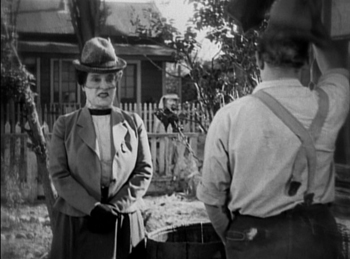
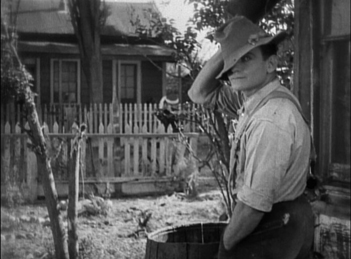
Borzage has mastered the use of motifs that are so characteristic of Hollywood cinema. There’s a running gag about the dilapidated gate of the picket fence around Steve’s and his mother’s house, with each person remarking “Darn that gate!” as they struggle through it. The repetition becomes cumulatively funnier because about two decades pass in the course of the film without the thing being fixed. The acting, particularly of Buck Jones and Zasu Pitts (as Ruth), is affecting.
It’s difficult to convey the charms of such an unconventional film, but give it a try and you may be bowled over, too.
A superb DVD transfer of Lazybones was included in the lavish Murnau, Borzage and Fox box (2008). The 20th Century-Fox Cinema Archives series offers it separately as a print-on-demand DVD-R. I’ve not seen it but suspect that there would be some loss of quality in this format. Besides, every serious lover of cinema should have that big black box sitting on their shelves next to the Ford at Fox one.
Returning to the more familiar classics, my final Hollywood film of the year is King Vidor’s The Big Parade.
Apart from its success and influence, however, The Big Parade remains an entertaining, funny, and moving film. Vidor’s scenes often run a remarkably long time, suggesting the rhythms of everyday life. One such action involves James fetching a barrel back to where he and his mates are staying so that he can turn it into an outdoor shower. When nearly back, he encounters Melisande, whom he initially can’t see. His stumbling about and her increasing laughter at his antics are played out at length (see top), as is a supposedly improvised scene shortly thereafter where James tries to teach Melisande how to chew gum.
A very different sort of prolonged scene is the long march of James and his comrades through a forest full of German snipers in trees and machine-gunners in nests. They begin by walking through an idyllic-looking forest, then increasingly encounter fallen comrades, and finally reach the Germans.
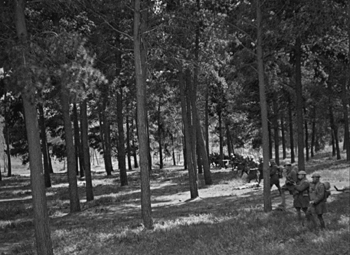
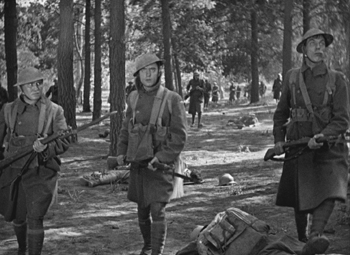
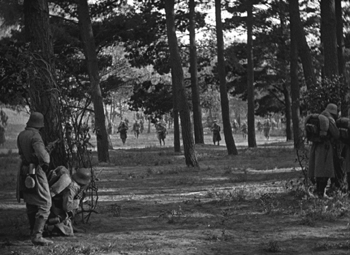
For years the prints of The Big Parade available were less than optimum, with some based on the 1931 re-release version, where the left side of the image had to be cropped to make room for the soundtrack. A 35mm negative was discovered relatively recently, however, and is the basis for the superb DVD and Blu-ray versions released in 2013.
Finally, I turn you over to David for some comments on films that fall within his specialties.
Eisenstein, action director
Watch this. Maybe a few times.
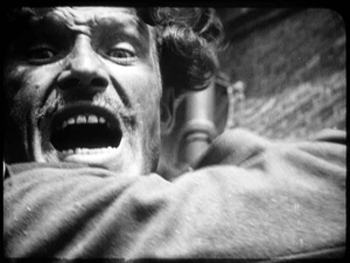
These two seconds, violent in both what they show and the way they show it, seem to me a turning point in film history. Here extreme action meets extreme technique. The spasms of the woman’s head, given in brief jump cuts (7 frames/5/8/10), create a sort of pictorial fusillade before we get the real thing: a line of riflemen robotically advancing into a crowd.
It’s not usually recognized how often changes in film art are driven by showing violence. Griffith’s last-minute rescues usually take place in scenes of massive bloodshed; not only The Birth of a Nation but the equally inventive Battle at Elderbush Gulch use rapid crosscutting to treat a boiling burst of action. The Friendless One’s pistol attack in Intolerance is rendered in flash frames that Sam Fuller might approve of. Later, the Hollywood Western, the Japanese swordplay film, the 1940s crime melodrama, the Hong Kong action picture, and many other genres pushed the stylistic envelope in scenes of violence. Hitchcock’s vaunted technical polish often depended on shock and bloodletting, from a bullet to the face (Foreign Correspondent) to stabbing in the shower (Psycho). The free-fire zone of Bonnie and Clyde and Peckinpah’s Westerns took up the slow-motion choreography of death pioneered by Kurosawa. Extreme action seems to call for aggressive technique, and intense action scenes can become clipbait and film-school models.
Sergei Eisenstein is celebrated as the theorist and practitioner of montage, whatever that is; but he insisted that what he called expressive movement was no less important. Just as montage for him came to mean the forceful juxtaposition of virtually any two stimuli (frames, shots, elements inside shots, musical motifs), so he thought that expressive movement ranged from a haughty tsar stretching his stork neck (Ivan the Terrible) to peons buried up to their shoulders, squirming to avoid horses’ hooves (Que viva Mexico!). In Eisenstein, psychology is always externalized, crowds move as gigantic organisms, and any action can turn brutal. (I fight the temptation to call him S & M Eisenstein.) We can trace influences—Constructivist theatre, the chase comedies coming from America, his interest in kabuki performance—but when he moved into cinema from the stage, Eisenstein became an action director, in a wholly modern sense.
Eisenstein’s first two features bracket the year 1925. Strike was premiered in January, The Battleship Potemkin in December. The first was apparently not widely seen outside Russia until the 1970s, but the second quickly won praise around the world. Potemkin’s centerpiece, the Odessa Steps sequence, became an instant critical chestnut, proof that cinema had achieved maturity as an art. Owing nothing to theatre, this massive spectacle was as pure a piece of filmmaking as a Fairbanks stunt or a Hart shootout. But of course Eisenstein went farther.
The Steps sequence was probably the most violent thing that anybody had ever seen in a movie. A line of soldiers stalks down the crowded staircase. A little boy is shot; after he falls, skull bloodied, his body is trampled by people fleeing the troops. Another man falls, caught in a handheld shot. A mother is blasted in the gut, and her baby carriage, jouncing down the steps, falls under a cossack’s sword. A schoolmistress who has been watching in horror gets a bullet in the eye–or is it a saber slash? The sequence ends as abstractly as it began, if “abstractly” can sum up the horrific punch of these images.
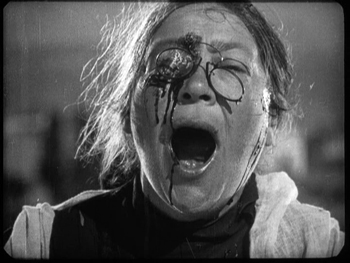
The film is much more than this sequence, of course, but every one of its five sections arcs toward violence, and each payoff is shot and cut with punitive force. The mutiny itself is a pulsating rush of stunts, unexpected angles, and cuts that are at once harsh and smooth. The whole thing starts with a rebellious sailor smashing a plate (in inconsistently matched shots) and ends with the ship confronting the fleet, a challenge rendered by percussive treatment of the men and their machines.
In Strike, Eisenstein rehearsed his poetry of massacre, along with a lot of other things. Instead of rendering an actual incident, as in Potemkin, here he portrays the typical phases any strike can go through. The plot starts with injustices on the shop floor, escalates to a walkout, and then—of course—turns violent, as provocateurs make a peaceful demonstration into a pretext for harsh reprisals. Throughout, Eisenstein experiments with grotesque satire and caricature. The workers are down-to-earth heroic; the capitalists are straight out of propaganda cartoons; the spies are beastly, the provocateurs are clowns. Every sequence tries something new and bold, and weird.
The most famous passage, well-known from his writings if not from actual viewing, is the climax. Here a raid upon workers in their tenements is intercut with the slaughter of a bull. Montage again, of course, but what isn’t usually noticed is the remarkable staging of that police riot, with horsemen riding along catwalks and fastidiously dropping children over the railings. For my money, more impressive than this finale is the earlier episode in which firemen turn their hoses on the workers’ demonstration. The workers scatter, pursued by the blasts of water, until they are scrambling over one another and pounded against alley walls. This is Strike’s Odessa Steps sequence, and for throbbing dynamism and pictorial expressiveness–you can feel the soaking thrust of the water–it has few equals in silent film.
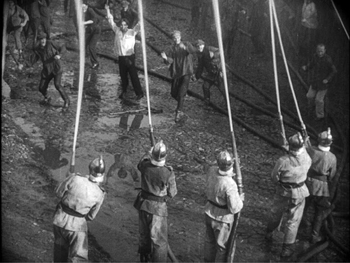
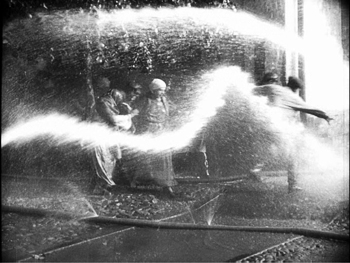
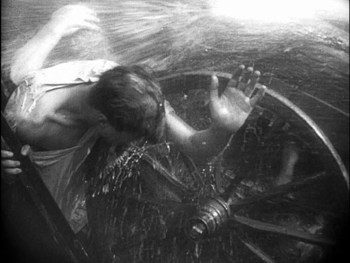
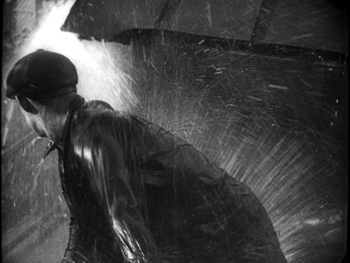
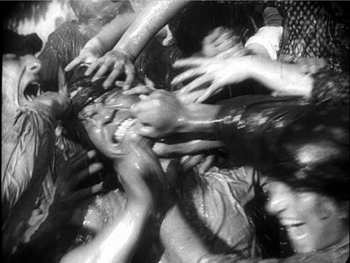
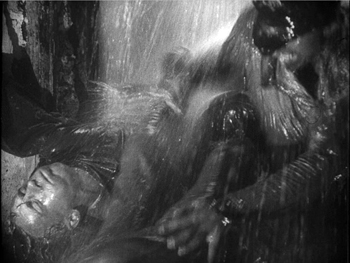
For Eisenstein, the bobbing, screaming head in my clip was the “blasting cap” that launched the Odessa massacre. Is the woman the first victim of the troops, or is her rag-doll convulsion a kind of abstract prophecy of the brutality to come? Yanked out of the actual space of the action, it hits us with a perceptual force that goes beyond straightforward storytelling. Kinetic aggression, making you feel the blow, is one legitimate function of cinema. Eisenstein is our first master of in-your-face filmmaking.
After many tries, archives have given us superb video editions of Potemkin and Strike, both available from Kino Lorber. Potemkin’s original score captures the film’s combustible restlessness. Strike seems to have been shot at so many different frame rates that it’s hard to smooth out, but the new disc makes a very good try, and it’s far superior to the draggy Soviet step-printed version that plagued us for decades.
Chamber cinema
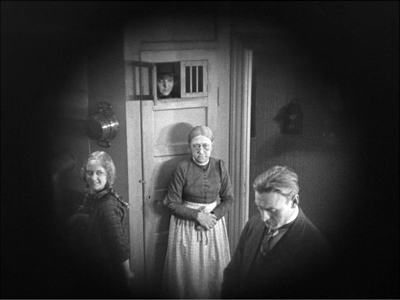
Every so often a filmmaker decides to accept severe spatial constraints, creating what David Koepp calls “bottle” plots. Make a movie in a lifeboat (Lifeboat) or around a phone booth (Phone Booth) or in a motel room (Tape) or in a Manhattan house (Panic Room) or in a remote cabin plagued by horrors (name your favorite). In the 1940s several filmmakers were trying out a “theatrical” approach that welcomed confinement like this; Cocteau’s Les Parents terribles, H. C. Potter’s The Time of Your Life, and of course Rope are examples. Today’s filmmakers are still exploring “chamber cinema.” The Hateful Eight is the most recent instance, with most of its chapters set in Minnie’s Haberdashery.
Typically, the chamber films in any period aren’t “canned theatre” like the PBS or English National Theatre broadcasts. Chamber films push the camera into the space, often showing all four walls and letting us get familiar with the rooms the characters inhabit. But this requires not only a carefully planned setting but also a good deal of cinematic skill in smoothly taking us to the primary zones of action.
Carl Dreyer was one of the earliest exponents of chamber cinema. He had seen initial examples in German Kammerspiel (chamber-play) films like Sylvester (1924) and had made a mild version himself in Michael (1924). Dreyer took the aesthetic to new heights in The Master of the House (1925).
Long before Akerman’s Jeanne Dielmann, Dreyer gave us a film about housework. Ida’s husband Victor is unemployed, so while he loafs and drifts around town, she struggles to keep things going. He pays her back with scorn and abuse. The plot is structured around two days, which yield a before-and-after pattern. At the end of the first, Ida leaves Victor, and a month later, his realization of his mistakes is revealed by his behavior in the household. The drama comes not only from the characters’ conflicts but from the way they handle everyday things like butter knives and laundry lines.
Rendering the household in all its specificity obliges Dreyer to rethink continuity filmmaking. He lays out the geography of the home by shooting “in the round” and cutting on the basis of eyelines and frame entrances. (He displays the same confidence in the “immersive camera” that Lubitsch displays in Lady Windermere’s Fan.) He trains us to notice landmarks, to associate bits of action with particular areas of the apartment, and to sense the characters’ changing emotions in relation to small adjustments in composition. The film is an exceptionally fluid, assured one, and it prepares for more daring Dreyer experiments to come: the fragmented interior spaces of La Passion de Jeanne d’Arc, the creeping camera of Vampyr, and the intensely theatricalized late films Day of Wrath, Ordet, and Gertrud. Little-known at the time, The Master of the House has come to be regarded as one of the most quietly perfect of silent films.
The most lustrous edition of The Master of the House is the Criterion release. It contains an in-depth interview with Danish film historian Casper Tybjerg and a visual essay that Abbey Lustgarten and I prepared. Criterion has posted an extract from the essay. More about this release is here.
In connection with the eleventh edition of Film Art: An Introduction, to be published in mid-January, we have added ten new online Connect video examples. These include one based on clips from the Blu-ray of The Gold Rush, which the Criterion Collection has kindly allowed us to use. We discuss two contrasting styles of staging used for comedy effects in the isolated cabin set.
The Dumont quotation is from his Frank Borzage: Sarastro à Hollywood (Cinémathèque française, 1993), p. 108.
Lea Jacobs and Andrea Comiskey have examined the complicated early distribution of The Big Parade in their “Hollywood’s Conception of Its Audience in the 1920s,” The Classical Hollywood Reader, Steve Neale, ed. (Routledge, 2012), p. 97.
Eisenstein’s aesthetic of expressive movement, and its relation to montage, is discussed in David’s The Cinema of Eisenstein. On Dreyer’s “theatricalized” cinema see his The Films of Carl Theodor Dreyer, and this essay on its sources in 1910s tableau filmmaking. Eisenstein’s exactitude in matching gesture to sound and cutting is demonstrated in Lea Jacobs’ Film Rhythm after Sound, reviewed here.
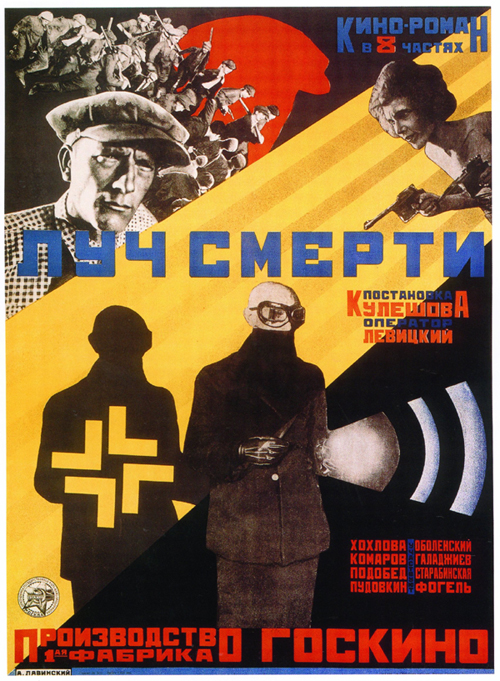
Lev Kuleshov’s second feature, The Death Ray, doesn’t make our top-ten list for 1925, but as a bonus we include its poster (by Anton Lavinsky), which must rank among the most beautiful of that year.
The first Sherlock and other video releases for the holidays
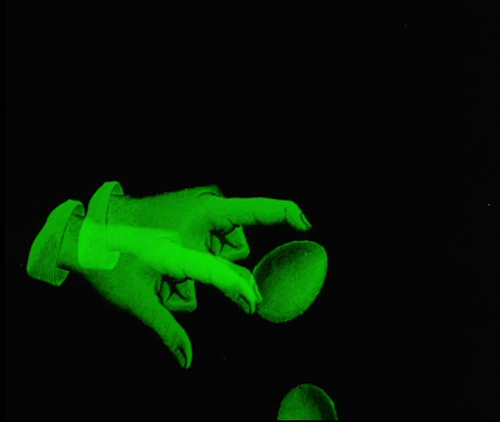
Our Lady of the Sphere (Lawrence Jordan, 1969)
Kristin here–
Our friends at Flicker Alley have offered three major releases since early October: Masterworks of American Avant-garde Experimental Film 1920-1970 (October 6), Sherlock Holmes (November 10), and Chaplin’s Essanay Films 1915 (November 17). This may seem ridiculously fast-paced, but it is partly explained by a delay in the release of Sherlock Holmes. All three editions package Blu-ray and DVD versions together.
In the move from 16mm to digital, avant-garde cinema was initially left behind. Eventually big boxes and series of DVD releases made a huge number of experimental short films available to audiences who may 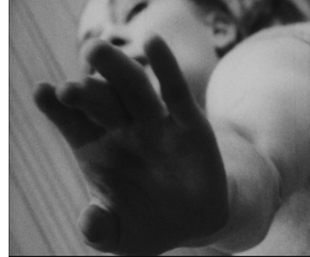 have had little access to such fare before. In quick succession, Unseen Cinema: Early American Avant-Garde Film 1894-1941 (2005), Kino’s three-volume series Avant-Garde: Experimental Cinema 1920s and ’30s (2005), Experimental Cinema 1928-1954 (2007), and Experimental Cinema 1922-1954 (2009), and the forth volume of the “American Treasures” series, Avant-Garde Film 1947-1986 (2009) were released.
Now we have another ambitious set, Masterworks of American Avant-Garde Experimental Film 1920-1907. Fans of experimental cinema who have purchased all of the earlier sets might wonder if there is room for yet another extensive collection of American films. Won’t there be a lot of overlap? The answer is a definite no. The body of work by important avant-garde filmmakers is extensive enough to support many boxed-sets.
I can find not a single film in the seven DVDs in Unseen Cinema (which takes a rather broad view of what counts as avant-garde) that is duplicated here. The same is true of the Avant-Garde Film 1947-1986 set. The Kino boxed sets (two discs each) are heavily slanted toward international films, and there is a slight overlap. Flicker Alley’s website has a list of all 37 titles included in Masterworks.
It’s impossible to deal with all the films included in the set here. (The film illustrated at the top is one of them.) I’ll just say that I was happy to see Hilary Harris’ 9 Variations on a Dance Theme (1966/67, right). We used to show it in the introductory film course we taught back in the mid-1970s, when Film Art had not yet been dreamt of. It’s a lovely film in itself, but it also might possibly be the clearest way to get across the ideas of form and style that one could find. Starting with a long shot of the dancer in a segment that simply records her movements, documentary style, the film repeats the same music and choreography eight times, with the cinematography and editing rendering a progressively abstract set of images.
Flicker Alley has put together an essential collection of films that will be new and exciting to many fans. The extras include, generously, three other experimental films. A a helpful booklet contains an introduction by Bruce Posner and brief program notes and filmmaker bios.
The Return of Sherlock Holmes
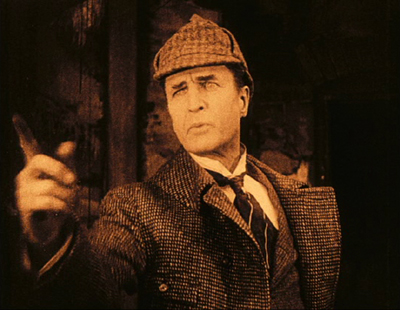
Until recently the 1916 version of Sherlock Holmes, based on the play by William Gillette, was lost. That seemed exceptionally unfortunate, not only for legions of Holmes fans but for anyone interested in late Victorian stage practices. Gillette’s performance as Holmes was considered the defining one, influencing subsequent portrayals. The play, which was produced in the US in 1899, had the cooperation of Arthur Conan Doyle, whom Gillette consulted during the period when he was writing it. The film version was a precious record from the time when the Holmes series was still being written.
In fact, Conan Doyle had killed Holmes off in 1893 in “The Final Problem,” and at the time when he authorized the play, he still had not resurrected his popular character. Gillette’s play influenced the later stories with such additions the character of the young servant Billy, a character invented by Gillette and later used by Conan Doyle.
In one of those happy endings that occasionally happen with lost films, a copy was discovered in the Cinémathèque française. Not just any old copy but the original nitrate negative of the French release version, which was shown as a serial in four parts in 1919. Apparently no footage was lost, and the main difference between the restored version that we have now and the original American feature film is that the new intertitles have been translated from those of the French release.
The original play has four acts, and the film has compromised between maintaining the interior setting of each act for a long stretch of the film and opening it out with brief exterior scenes and cutaways to other locales. One very lengthy section of the film takes place in the isolated house used by the villains to imprison the heroine, Alice. The sets are somewhat reminiscent of the stage, and yet they have been extended forward, and at times we see at least three walls and perhaps part of a fourth. In many cases, the stage-style set is made more cinematic through the simple device of adding some furniture in the foreground (left). In others, the characters are strung out in a line across the playing space, as in the final “act,” which takes place in Dr. Watson’s office (right).
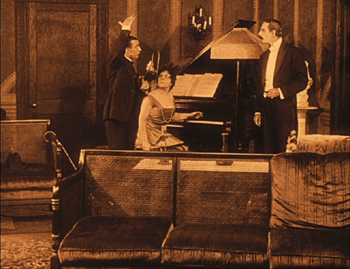
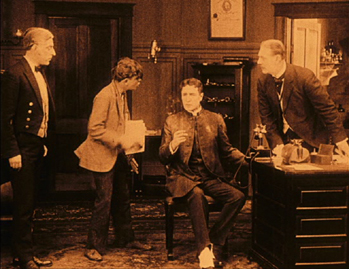
Physically, Gillette makes a convincing Holmes in terms of the way Conan Doyle describes him, and his performance is restrained and usually lacking in expressivity–which works for a character noted for not exhibiting emotion. Unfortunately Gillette added a love interest for Holmes. Doyle, who apparently didn’t care what others did with Holmes now that he was rid of him, gave his permission. This would be bad enough in itself, but Alice is quite young looking, and Holmes is much older than she. Gillette had originated the role seventeen years earlier, when he was 46. By the time the film was made, he was 63, and though he doesn’t look that old in the film, the age difference between Holmes and Alice is obvious.
Given the survival of the negative, the Blu-ray/DVD transfer is impressive. Serpia toning is used in most scenes, while dark blue tinting represents night exteriors, many of which are nicely filmed (see bottom). The music is by Neil Brand, one of the best accompanists in the business.
There are generous bonuses, including some earlier comic shorts based around the character, Conan Doyle’s Fox Movietone interview, and a typescript of Gillette’s play. The set comes with a booklet with short essays on Gillette and his play, the film adaptation, the restoration, and the music.
The Little Tramp takes shape
Jeffrey Vance begins his essay on Chaplin in the booklet accompanying Chaplin’s Essanay Comedies 1915 with this observation:
If the early slapstick comedy of the Keystone Film Company represents Charles Chaplin’s cinematic infancy, the films he made for the Essanay Film Manufacturing Company are his adolescence. The Essanays find Chaplin in transition, taking greater time and care with each film, experimenting with new ideas, and adding textue to the Little Tramp character that would become his legacy. Chaplin’s Essanay Comedies would become his legacy. Chaplin’s Essanay comedies reveal an artist experimenting with his palette and finding his craft.
The unstated conclusion to the series of companies where Chaplin worked during the 1910s is that the Mutual period saw Chaplin’s maturity as an artist. Flicker Alley has now completed its epic survey of all three periods, with copies restored by the Cineteca Bologna and Lobster Films in cooperation with Blackhawk Films and the Chaplin Mutual and Essanay Project. Many archives provided material. For those who first saw Chaplin in worn 8mm and 16mm copies, these prints are a revelation.
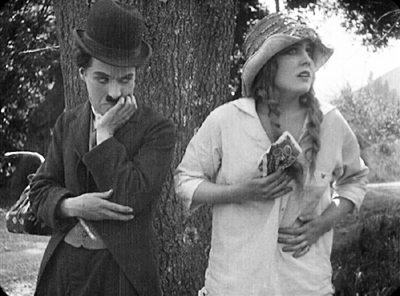
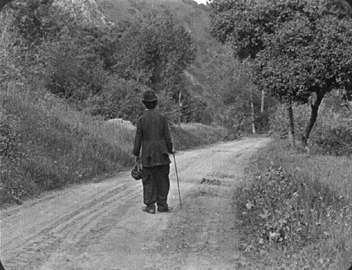
Chaplin’s tinkering with his Tramp character is evident in the most famous short in the set, The Tramp. It begins and ends with the character on the road, going nowhere in particular. In between are sandwiched broad slapstick scenes, quieter comic moments, and a big of the pathos that would become increasingly central to the Tramp.
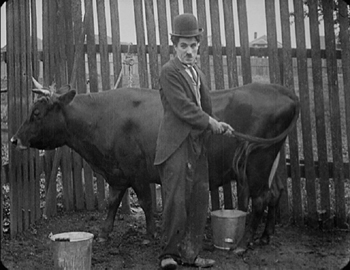
Early in the film he is capable of saving an innocent farm girl with a wad of money from a trio of thieving hobos, then stealing the money himself (above), and then relenting and giving it back. His comic pacing is sometimes off–way off in an overlong scene of the Tramp, who gets a job at the heroine’s farm, repeatedly poking a fellow farmhand with a pitchfork (a pretty cliched gag to begin with). The Tramp’s clueless attempts at milking a cow work distinctly better, as he tries everything, including turning the cow’s tail into a pump handle. That’s the sort of visual punning that would become one of Chaplin’s comic strengths. There are some funnier scenes, as when the Tramp is forced to bunk in with the farmhand and suffers agonies from his roommate’s smelly socks.
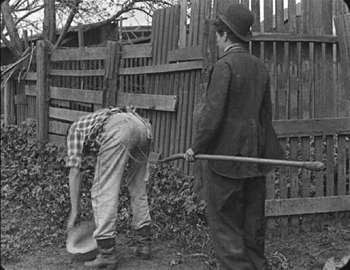
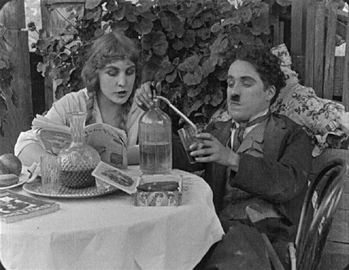
Some quietly funny moments are better, though, as when the Tramp, having been wounded in the leg while trying to foil a burglary attempt, sits complacently enjoying his leisure and assuming that the heroine is in love with him. The absent boyfriend, well-dressed and handsome, soon shows up and, recognizing the inevitable, the Tramp removes himself from the triangle and takes to the road once more. Perhaps more than any other image, this one summarizes how Chaplin’s Tramp was thought of for many years and by millions of people.
Bonuses include some films using discarded footage or cutting together scenes from already-released shorts, as Essanay tried to capitalize as much as possible on Chaplin’s extraordinary international popularity. There is also a booklet with Vance’s essay and a set of program notes. Each of these has a brief description of the restoration process, which is a nice thing to see in a supplement.
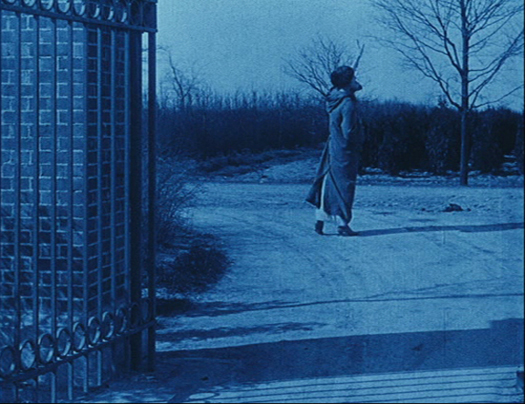
Sherlock Holmes (1916)
Mark Rylance, man of mystery
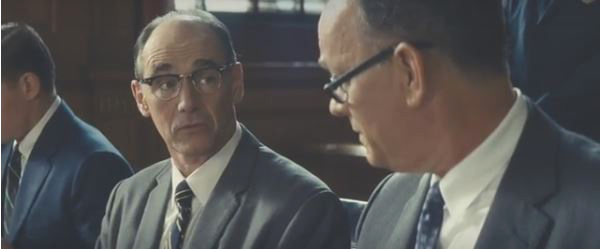
Kristin here:
I asked Rylance, a most certain Best Supporting Actor nominee, if success would spoil him now. He had a good retort: “I thought I was successful already!” Indeed, he sure is. But Hollywood will embrace him.
Will it? Well, it can try. It should try.
SPOILERS for Bridge of Spies ahead.
Another great veteran actor who came out of “nowhere”
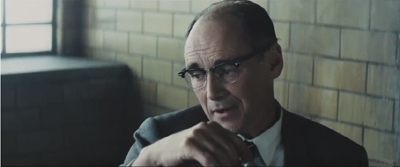
Upon reading the reviews of Steven Spielberg’s Bridge of Spies published over the past few weeks, many American moviegoers may have been puzzled by the fact that one of the most highly praised elements of the film was the supporting performance of Mark Rylance. Indeed, the praise was often unusually enthusiastic, with Rylance already considered a favorite for a supporting actor Oscar nomination or even win. I suspect that the vast majority of Americans have never heard of Mark Rylance, three-time Tony winner, two-time Olivier-award winner, Emmy nominee, etc. He fits the cliché of the “overnight success” who has been around for a long time and was, as he says, “successful already.”
In Bridge of Spies, Tom Hanks plays the lead, real-life lawyer James Donovan. In the late 1950s, Donovan accepted the unpopular job of defending a Russian spy, Rudolph Abel (played by Rylance), when he came to trial. Later he agreed to negotiate with the Soviet government to swap Abel for downed American pilot and spy Francis Gary Powers. Bridge of Spies is not one of Spielberg’s most exciting or endearing films, but it’s very well made and as classical in its traits as a film can be. It sits nicely beside his other historical dramas, Lincoln and the excellent Munich. On the whole the film has been well-reviewed, with a 92% favorable rating from all critics on Rotten Tomatoes, increasing to 98% among top critics. Rylance is clearly a major reason for the excitement.
It’s Rylance who keeps Bridge of Spies standing. He gives a teeny, witty, fabulously non-emotive performance, every line musical and slightly ironic — the irony being his forthright refusal to deceive in a world founded on lies. (David Edelstein)
Because this is Hanks we’re dealing with, audiences know what to expect, though the revelation here is Rylance (an actor Spielberg also cast as his forthcoming BFG), who appears utterly transformed — to the few who recognize his typically charismatic screen presence — into a balding, Eeyore-like gray moth of a man. (Peter Debruge; the reference is to Spielberg’s The BFG, with Rylance in the lead as the Big Friendly Giant, based on the Roald Dahl children’s novel and now in post-production)
Rylance, one of the greatest of contemporary stage actors, has to date had only an intermittent screen career, but Bridge of Spies suggests that could be about to change. He brings fascination and very, very subtle comic touches to a man who has made every effort to appear as bland, even invisible, as possible. (Todd McCarthy)
Brilliantly played by British theater legend Mark Rylance — who nearly steals the show. (Lou Lumenick)
Meanwhile, Rylance, who’s still probably best known for his brilliant work on stage, is the film’s real breakout discovery. With his musical Northern English accent and bemused, ironic demeanor, he turns a story that could feel as musty as a yellowed stack of old newspapers snap to exuberant life. (Chris Nashawaty)
Mark Rylance, the great English actor, director, and playwright who for a decade was the artistic director of Shakespeare’s Globe theater, performs some mysterious act of alchemy in his role as the ineffable and unflappable Soviet spy. Almost without speaking a word, he communicates this character’s rich inner life, in which a near-Buddhist resignation to the whims of fate alternates with a feisty instinct for self-preservation. (Dana Stevens)
Part of the reason why the Germany sequences sag is that they don’t feature Abel, who is played by British actor Mark Rylance in what, with luck, will be a career-making performance. Many viewers may not have heard of Rylance, who recently played Thomas Cromwell in “Wolf Hall” on PBS. But his work in “Bridge of Spies” deserves to be widely recognized as an example of screen acting at its most subtle, poignant and exquisitely calibrated. (Ann Hornaday, who, like Friedman, does not acknowledge that Rylance already had made quite a career for himself)
I could go on, but for more see the reviews by Manohla Dargis, Richard Roeper, Kenneth Turan, and Michael Phillips.
I don’t, in fact, think that the German sequences sag. Basically the first half of the film covers the trial and sentencing of Abel, with brief scenes of Powers’ training for his spying missions flying over Soviet territory. Once Powers is shot down, Donovan goes to East Berlin for the negotiations, leaving Abel behind in prison.
The German sequences involve a marvelously authentic post-war East Berlin, designed by Adam Stockhausen, who won an Oscar for the production design of The Grand Budapest Hotel. (I wasn’t there in the early 1960s, of course, but I did visit East Berlin in 1992, when part of the wall was still up and the place had a very Soviet look, complete with giant busts of Marx and Engels.)
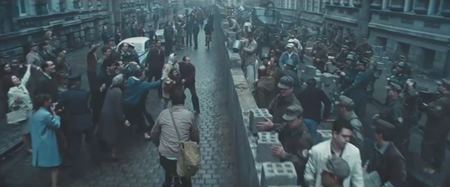
No, these scenes don’t sag, but there is definitely a niggling question in the back of one’s mind: When are we going to see Abel again? Rylance somehow makes this very ordinary-looking, quiet man the heart of some of the film’s best scenes.
Treading the boards
As Rylance pointed out in the quotation at the top of this entry, he already had an illustrious career going long before Wolf Hall and Bridge of Spies hit American screens. (The Wikipedia entry on Rylance  gives helpful biographical information as well as separate lists of his stage, film, and television performances and the nominations and awards resulting from each.) From 1995 to 2005, he was the first Artistic Director of the Globe Theatre, the replica of the original Elizabethan-period theatre in which many of Shakespeare’s plays premiered. He starred in a number of its Shakespeare productions, including some with authentic all-male casts and period costumes and staging.
Rylance also won awards playing a variety of very different characters. In 1993 he won his first Olivier award (the top British acting honor) for playing Benedick in Much Ado about Nothing, and followed that up with a British Academy Television award for the TV film The Government Inspector (directed by Peter Kominsky, who later directed him in Wolf Hall, for which he was nominated for an Emmy). He did a comic star turn in a 2007 staging of Boeing-Boeing and was nominated for another Olivier; he won his first Tony when the production moved to Broadway. His second Olivier and second Tony came for his performance as Johnny Byron in Jerusalem, first in London and then on Broadway.
Perhaps Rylance’s greatest success, however, came with a pair of Shakespeare plays done in repertory, Twelfth Night, in which he played Olivia, and Richard III, with him in the title role. Rylance had played Olivia at the Globe in 2002, but from November, 2012 to February, 2013, both plays ran in alternation in the West End. Later they transferred to Broadway, where Rylance was nominated for a Tony as best actor as Richard III and won for best featured actor as Olivia. The plays were done as authentically as possible, with men playing all the roles and wearing costumes true to Shakespeare’s era.
Ben Brantley conveys some of the excitement of these productions and Rylance’s performances in his New York Times review:
In this imported production from Shakespeare’s Globe of London, deception is a source of radiant illumination for the audience, while the bewilderment of the characters onstage floods us with pure, tickling joy. I can’t remember being so ridiculously happy for the entirety of a Shakespeare performance since — let me think — August 2002.
That was the last time I saw the Globe’s “Twelfth Night” (in London), directed by Tim Carroll and starring the astonishing Mark Rylance, in a bar-raising performance as the Countess Olivia. And how thrilled I am that our wandering paths have crossed once more, rather like those of the separated twins at the play’s center.
This “Twelfth Night” — which opened on Sunday in repertory with a vibrant and shivery “Richard III” that allows Mr. Rylance to show he’s as brilliant in trousers as he is in a dress — makes you think, “This is how Shakespeare was meant to be done.”
Walter Kaiser makes similar remarks in The New York Review of Books (available to subscribers only; in print in the February 6, 2014 issue):
The production of Shakespeare’s Twelfth Night by the English theatrical company Shakespeare’s Globe, currently at the Belasco Theatre, brings this play to life in a way I have only very rarely seen equaled in a Shakespearean production. The performances are so uniformly skillful, the interpretation of the play so intelligent and imaginative, and the costumes and stage set so accurate and evocative that the entire experience is exhilarating. Audiences at the performances I’ve attended have been overcome with delight, clearly somewhat surprised by the affecting immediacy of the theatrical experience they have undergone, unaccustomed to a Shakespeare so readily comprehensible and so vividly alive. You may, if you’re lucky, see another Shakespearean production that’s as good as this one, but it’s unlikely you will ever see one that’s better. […]
Mark Rylance, who over the past decade or so has made the part his own, is undoubtedly one of the greatest Olivias of all time. Frequently, this part is played with a grave, graceful maturity that tends to mask, or at least minimize, the intensity of the emotional quandary Olivia finds herself in when, not wishing to receive any further expressions of love from Orsino, she discovers that she has fallen in love with the messenger who delivers them. Rylance, instead, beautifully exposes her perfervid confusion: overcome with emotion, he stammers (in confirmation of Viola’s observation that “she did speak in starts”), acts with impetuosity, and manifests, at times, an engaging exasperation with his inability to control his passion. His hands alone, in the informative subtlety of their gestures, betray the emotions Olivia wishes to conceal.
I was lucky enough to encounter this Twelfth Night, as well as Richard III, in late 2012 when I was in London for a few days. I’m partial to authentic performance styles in theatre and music, so the chance to see two Shakespeare productions with all-male casts was appealing. Little did I realize that I would be seeing two brilliant turns by an actor I had never seen before–or so I thought. In fact, he plays Ferdinand in Prospero’s Books, but nobody, especially in such a small, bland role, can get much attention when playing alongside John Gielgud as Prospero.
Spielberg discovered Rylance in the same way that I did. In a very informative article based on interviews with Rylance and Spielberg, Jack Cole reveals:
Spielberg was urged to see Rylance in “Twelfth Night” by Daniel Day-Lewis. He calls him “a shape-shifter, a man of a thousand faces and voices who can play any part.”
“Seldom has an actor been around for so many distinguished years on the stage and yet had not been fully discovered for the screen,” said Spielberg by email. “Mark understands that the camera records stillness better than in any other media. His transition from the stage to ‘Bridge of Spies’ was graceful and invisible.”
Cromwell and Abel and beyond
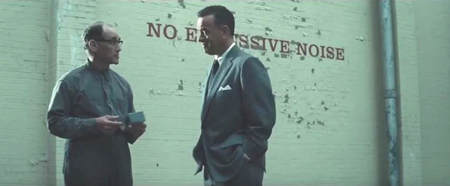
Those members of the American public who did know Rylance before Bridge of Spies had probably encountered him as Thomas Cromwell in the BBC series Wolf Hall, a Tudor-era costume drama which aired in six parts on PBS starting April 6, 2015. (David and I streamed it more recently, mainly to see Rylance.) It seems unfortunate that the two breakout roles that have brought the actor to such prominence this year both involve notably restrained performances.
Anthony Lane compared these performances in his New Yorker review of Bridge of Spies:
So what’s it all about? It’s not about the U-2 missions, and certainly not about Powers, who comes across as a lunk. Nor, despite the set pieces in court, is it about the majesty of the law. No, the core of this movie is a standoff every bit as keyed up, and as gripping, as anything on the muffled streets of Berlin. What we thrill to is Rylance versus Hanks: the British actor, lauded for his stage appearances, but barely known to cinema audiences, up against the consummate Hollywood pro. You can see them prowling, probing, and wondering what the next move will be—or, in Hanks’s case, wondering whether Rylance will move at all. Admirers of “Wolf Hall,” on PBS, will have noted him as Thomas Cromwell, standing like a statue in the shadows, and realized, to their discomfort, that they could not look away. He does the same thing here, as Abel; we watch him watching everybody else, as if life were an infinity of spies. “You don’t seem alarmed,” Donovan says when they first meet, and Abel replies with a gentle question: “Would it help?” The Coens turn that into a refrain that beats through the movie, growing wryer and funnier each time—right up to the fidgety finale, where Abel is the calmest man in sight.
Of course, Cromwell does move in Wolf Hall. He moves a lot. Few television series can have shown their protagonists walking from place to place so often and at such length. Rylance modeled his gait on that of a Hollywood star, according to the Cole piece cited above: “He’s explaining how Mitchum, whom he adores, inspired his steady, rigid gait in the international hit series ‘Wolf Hall.'”
More Rylance on Mitchum, from another interview:
I’ve watched lots of films preparing for this, and I was particularly struck by one of my favourite actors, Robert Mitchum, how his performances haven’t dated in the way that even perhaps more versatile actors, Brando and Dean and people of that era, have. I noticed how well he listens, how still he is, how present he seems. You’re drawn towards the screen – wondering what’s he thinking, what’s he going to do next. That’s always the best way to tell a story.
Kominsky describes adjusting his filming style for Wolf Hall to catch Rylance’s subtleties:
The one thing you might not be expecting is that he’s the most minute of film performers. Nothing is overblown. Nothing is writ too large. It’s very, very simple, very understated, his performance, and then you look into his eyes, and it’s all happening. Everything is going on in there, and of course, you’re drawn into closer and closer shots, just to try and capture the emotion that’s going on very slight below the surface, and that’s what I loved to film. (From George Pollen documentary, Sky’s Arts program, 19:00-19:47)
As David has pointed out, however, the eyes as such are not always particularly expressive. It’s the area of the face that contains the eyes that does the job. The eyebrows and forehead usually give the context that tells us what the eyes are expressing.
If we concentrate on the upper half of Rylance’s face, the considerable differences between his Cromwell and his Abel become apparent.
As Abel, he consistently does something rather remarkable: he raises his eyebrows, creating furrows in his forehead, without widening his eyes. That’s not an easy thing to do. The result is a perpetually curious or surprised expression, a sort of mask that Abel wears to suggest that he is naive, innocent, a little slow. In fact, as we discover whenever he speaks with Donovan, he’s well aware of everything going on around him and has considerable insight into it. But it’s the naivete that allows him to dupe the agents who search his hotel room into letting him clean the paint off his palette, thus allowing him to conceal a key bit of evidence.
The key moment during which Rylance drops this tactic happens during his “standing man” anecdote, about a man he knew who survived a severe beating by Soviet agents by simply getting up again each time he was struck to the ground; Donovan reminds him of that man, he says.
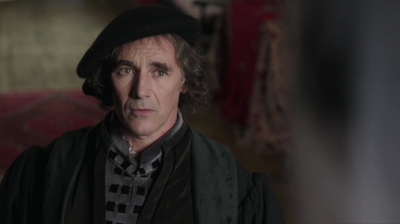
As Cromwell, Rylance’s main tactic using his face is to glance away at nothing in the course of a scene where he is conversing with someone or observing interactions among other characters. So much classical editing depends on our understanding of whom or what a character is looking at, but not here. In one scene, Ann Boleyn shows him a drawing she has found hidden in her bed, depicting her decapitated. She asks him to find out who put it there.
Apart from his eyes, Rylance remains uttlerly motionless through the shot in which she holds the drawing out to him. Initially he is looking at her face (that’s the side of her head out of focus in the foreground) and then glances down at the drawing as she holds it up from below the frame.
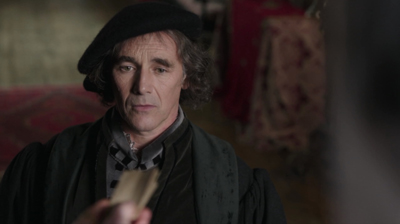
He then glances down briefly to a point just outside frame right–clearly not at Boleyn’s face or anything else relevant to the action.
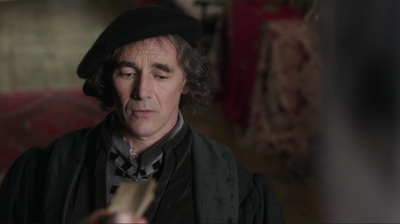
He looks at her face again and finally at the drawing.
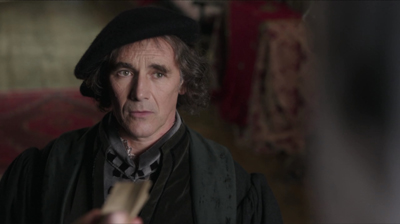
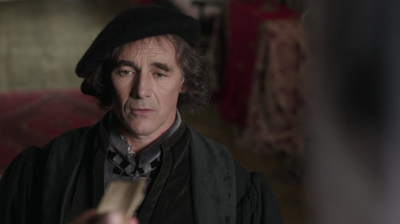
Nothing here betrays Cromwell’s emotions, since he is a man who has to keep his thoughts hidden from most of the people at court. But that extra shifting of the eyes momentarily to an inconsequential space shows us that he’s thinking. Maybe he has an idea as to who would have left the letter. Maybe he’s thinking of Ann’s sister’s warning to him in an earlier scene, telling him not to help Ann. We don’t know here, as we don’t in many other scenes where Rylance uses this same sort of eye movement.
Both Abel and Cromwell need to conceal their thoughts, but Abel does so through deception and Cromwell through concealment, both conveyed by subtle acting.
In the Pollen documentary, Rylance describes how he avoids putting too much into a performance (in this case referring to lecturing on stage acting to students):
If I was only allowed three words, I could distill all my complicated notes, and you can see how wordy I get if I get talking, to three words, which would be “You are enough.” What’s happening to you is you don’t feel you’re enough, and you’re putting more effort into it than you should. You’ll be in the center of yourself, your voice will be centered, your movements will be centered, and the audience will also believe you more, because they’ll also believe that you’re enough. (8:35-9:08)
In Bridge of Spies, the little gestures and bits of business that Rylance uses to draw our attention to Abel are minimal. He wipes his nose occasionally, apparently the victim of a persistent cold or allergy.
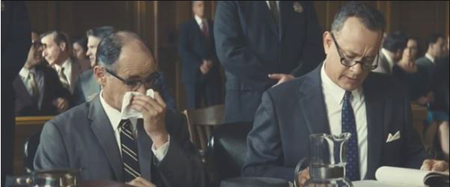
As Michael Phillips points out in his review, this cold creates a parallel to Donovan, who has his overcoat stolen in East Berlin and soon develops a cold of his own:
It’s brilliant, really. What’s the quickest way to establish the humanity of two leading characters in a Cold War drama? Give them both the sniffles. […]
Because he’s relatively new to multiplex audiences, Mark Rylance will likely walk off with the acting honors for “Bridge of Spies.” He looks nothing like the real Abel, but in a largely nonverbal, supremely poker-faced performance — even his stuffy nose is subtle — Rylance suggests a forlorn practitioner of deception who recognizes a lucky break when he sees it.
(Agent Hoffman has also caught a cold by the epilogue; an occupational hazard, apparently, and a subtle comic motif.)
There are other gestures: lengthy tapping of a cigarette on an ashtray and little sucking movements of the lips, suggesting ill-fitting dentures. (A bit more subtle scene-stealing than that practiced by Steve McQueen in The Magnificent Seven, as described by David.)
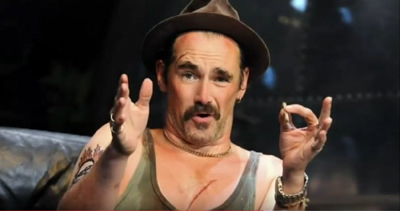
Yet Rylance is perfectly capable of comic, broad performances as well. His Olivier-and-Tony-winning turn in Jerusalem was as a raucous, drunken rascal.
He made Richard III a grotesquely deceitful clown.
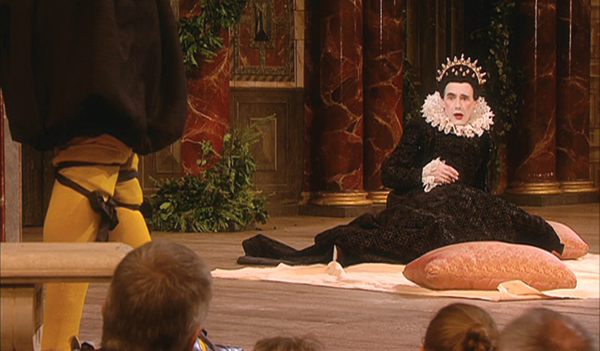
His Olivia, though more restrained, can do a broad comic take, as when she first notices Malvolio sporting the detested cross-gartered yellow stockings (see bottom).
We can assume that his acting as the BFG will be miles away from his performance in Bridge of Spies.
Will Hollywood be able to embrace him?
Roger Friedman claims that Hollywood wants Rylance. Possibly, but Rylance is ambivalent about filmmaking and generally prefers the stage. Indeed, I wish I had a reason to be in London right now, since he is back in the theater, receiving more rave reviews as the depressed King Philippe in a limited run of Farinelli and the King, the much-praised first play by Rylance’s wife, Claire van Kampen.
The Cole piece sums up Rylance’s on-and-off relationship to film acting, which involves Rylance being willing to embrace it rather than it embracing him:
For Rylance, embracing movie acting has been a circuitous journey. As a young actor, he watched as his theater contemporaries — Daniel Day-Lewis, Gary Oldman, Kenneth Branagh — became famous on the big screen. Agents urged Rylance into TV and film so that he would be “a complete actor.”
“I just, time and again, was attracted by the theater where I was offered better opportunities,” says Rylance. “I auditioned for films and didn’t get them. I think I had some stuff to learn about film acting. I don’t think I was personally really ready for it. But I did come to resent it. I did eventually think: Why, why? You wouldn’t tell the great Tamasaburo or Ganjiro-san it’s not enough to be a Kabuki actor, you need to be a film actor.”
He rattles off some film experiences he’s enjoyed: the Quay brothers’ “Institute Benjamenta,” a A.S. Bryatt adaptation “Angels and Insects” and a handful of British TV films, like “The Government Inspector.”
“But I’ve made some bad films, too, that have not been enjoyable,” Rylance said on a recent New York afternoon on a day off from starring in van Kampen’s “Farinelli and the King” in London. “At a certain point after one of them I did a few years back, I said, ‘That’s it. I’m not interested in this anymore.’
“I thought: I need to be happy with who I am, where I am. That can be the kind of miners’ dust of being an actor,” he says. “For an actor, being dissatisfied with who you are can be the reason for becoming an actor, but it can become an illness.”
But once Rylance let go of being a movie star, film directors started calling.
“As I did that, wonderful film things started being offered to me,” he says. “Maybe that was partly the problem — that I was giving it too much forced value. Because I grew up in America, so I grew up with some theater. But mostly I saw three films a weekend in Milwaukee, Wisconsin.”
Yes, Rylance was a Wisconsin boy, in a sense. He was born in Kent in 1960, and his parents, both English teachers, moved to Connecticut in 1962 and then to Milwaukee in 1969. There his father taught at the University School of Milwaukee, where Rylance first studied acting. “He starred in most of the school’s plays,” as the Wikipedia entry cited above puts it. Returning to England, he studied at the Royal Academy of Dramatic Arts from 1978 to 1980. His time in the States suggests why his accent is not quite the normal English one that we expect from the great British actors. It is nice to think that Rylance was avidly attending films in Milwaukee during the same period when David and I were doing the same here in Madison.
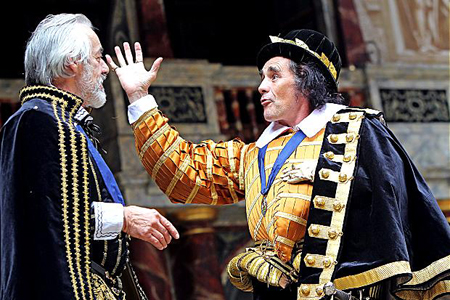
Clips of some of Rylance’s stage roles are included in the George Pollen documentary linked above; others can be found by searching on YouTube. Fortunately the wondrous Twelfth Night was recorded and is available on DVD (here in the US and here in the UK). The rest of the cast is excellent, particularly Steven Fry as Malvolio and Paul Chahidi as Maria. The many cameras used in the filming capture the most salient action at every point and alternate details and long shots to give a sense of where the action is occurring. As the image below shows, it was filmed in the Globe, with the audience right up against the stage and quite obvious (in a good way) in many of the camera setups. In the scene below, a spectator gives a wolf-whistle as Malvolio struts about his his yellow stockings, which strikes me as a very groundling sort of thing to do. Having seen the performance from the front-row center of the balcony, I am glad to have a closer perspective.
[December 2: Rylance has won the New York Film Critics Circle award for Best Supporting Actor.]
[January 3, 2016: Rylance has won the National Society of Film Critics award for Best Supporting Actor.]
[February 15, 2016: Rylance has won the British Academy Film Award for Best Supporting Actor.]
[February 28, 2016: Rylance has won the Academy Award for Best Supporting Actor. The story linked to here considered this an upset, as Sylvester Stallone had been widely predicted to win. But as I’ve shown here, a lot of us back in October knew better.]
[February 29, 2016: Rylance has been nominated for an Olivier Award for Farinelli and the King.]
[March 6, 2016: Pete Hammond of Deadline Hollywood has pointed out that Rylance won his Oscar without ever having participated in a single campaign event in the awards season. (He was given a day off from his current stage show in Brooklyn, Nice Fish, to go to Los Angeles to attend the Oscars ceremony.)]
[December 31, 2016: The Queen’s New Year’s Honours for 2017 include a knighthood for Rylance.]
Talking THE WALK
Kristin here–
David and I saw Robert Zemeckis’ The Walk the day after it opened. The screening was 3-D Imax, since the film originally opened only in Imax theaters and went wider on October 9, already with the odor of box-office failure wafting over it. We enjoyed it. It’s not an undying masterpiece, but it’s certainly better than many of the reviewers seem to think. In particular, they largely ignore the first portions of the film and imply (or outright state) that you should sit through them because the climactic sequence, protagonist Philippe Petit’s very high-wire walk between the Twin Towers in New York is worth it. David Rooney’s review for The Hollywood Reporter boils down the dismissive attitude toward the early portions: “The film’s payoff more than compensates for a lumbering setup, laden with cloying voiceover narration and strained whimsy.” Peter Debruge’s Variety review is an exception, dealing with the earlier scenes insightfully.
The view from Lady Liberty
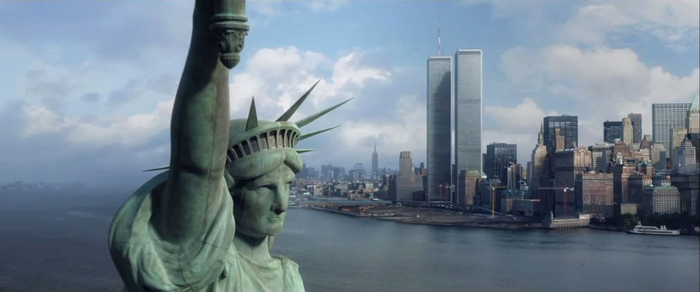
I was surprised to see that Matt Zoller Seitz, one of our best reviewers, gave The Walk a mere two and a half stars. Starting to read his review, I was expecting that he might dismiss the early part of the film as too lightweight and comic to balance the spectacular set-piece of Petit’s performance or something of that sort. Instead, his primary objection to the film is the voiceover and sometimes to-camera narration delivered by Petit, who is shown as standing atop the torch of the Statue of Liberty. More specifically, the film opens with a tight close-up of Joseph Gordon-Levitt as Petit staring directly into the camera against a pale-blue background and saying “Why?” What follows, he says, is to explain why he made his famous walk. The camera then pans to an extreme-long shot of the World Trade Center, pulls abruptly back to reveal the Statue of Liberty (above), and cranes up to Petit standing on the torch.
The rest of the film consists of a series of flashbacks told from this imaginary space, for surely we are not to imagine that Petit ever really climbed the torch. Like it or not, a certain whimsical tone is set up concerning the process of his telling his tale. The film returns to this narrating situation at intervals, usually only for a single shot and usually for a transition into a new scene, with what Petit says in the fantastical present bleeding over into that scene to set it up.
Seitz’s objections to the narration are two. First, he sees it as an attempt to, in a sense, “sell” us The Walk through the enthusiastic tone of the narration. Second, he considers the narration to be redundant, adding almost nothing to the visuals. His prime example of the latter is the scene in which a seagull briefly hovers over Petit and his voiceover comments on its sudden appearance.
The idea that the narration was annoying or redundant never occurred to me when I watched the film for the first time. After reading Seitz’s review, I considered writing this entry and went back to see the film again. I still didn’t find the narration problematic. I think that it contributes to The Walk in a variety of ways. Possibly some of it could be cut, but most of it functions in ways that go beyond what is conveyed through images and dialogue.
Take the seagull scene. Without narration, it could create suspense. Just before it appears, Petit has lain down on the wire, and the voiceover speaks of the serenity of the sky and clouds. Suddenly the bird is hovering right above our hero. The logical reaction would be to worry that it’s going to strike him, break his concentration, somehow threaten him. The voice continues: “Then, something appears. An apparition! A bird. This bird is looking at me! I feel this silent threat.” (The bright-red rims of the bird’s eyes may be a subjective rendition of Petit’s reaction.) The threat he feels, however, is not that the bird will harm him. Instead, he is “invaded by doubt” and decides that it is time for him to end his walk. His narration is not telling us simply that a bird has appeared, but that he takes it to be some sort of symbol of threat. It marks a turning point in the Walk, one which we can only grasp because he tells us that it does. If he had not spoken, what would we have? Presumably Petit seeing the bird, getting up, and continuing his walk. Perhaps he would have a look of doubt on his face, and the music might go into a minor key. Still, we would not know specifically that the bird has caused him to decided to end his walk, because he does not do so for some time after that point. The narration is not simply redundant.
More generally, I think the narrating situation and the treatment of the story as a series of flashbacks with occasional voiceover have two major functions. First, the narration clearly establishes that Petit survives the Walk. Sure, a lot of people walking into the theater know that the historical Petit did survive it and is still alive. Some of us are old enough to have seen or heard news coverage at the time, while others may have read his memoir To Reach the Clouds, upon which the film is based, or seen James Marsh’s 2008 documentary, Man on Wire. Younger moviegoers may have read infotainment coverage of Zemeckis’ film. But there are undoubtedly also people entering the theater knowing nothing about Petit. For them, the film needs to establish his survival if they are not to watch the Walk sequence in constant suspense over whether the protagonist will survive it. The very first word he speaks, “Why?” deflects us from anticipation of the Walk as a spectacular stunt to a curiosity about its significance.
Second, Petit-as-narrator sets the tone for the film, a tone which would perhaps be sufficiently conveyed by the visuals, the action, and the music in some scenes, but not, I think, in others. The tone is light and comic and enthusiastic in the first half of the film, though it shifts later, for reasons I’ll get to in a minute.
Third, the narration helps to break the parts of the film into three separate genres: a romantic comedy (the first half hour), a suspense film (from roughly 30 minutes to 86 minutes), and a lyrical, psychological character study thereafter. The narrational tone changes with each, from ebullience to simple reportage to reflective inner monologue.
David and others have suggested that overall The Walk is structured somewhat like a heist film. In heist films there is emphasis on planning and preparing, with everything explained ahead of time and in intricate detail. The long process of the lead-up is as much the point, or more so, than the actual moment of the theft. (In the review linked above, Debruge points out that “Much of what made ‘Man on Wire’ so thrilling was the fact that Marsh had approached Petit’s story like a caper film.”)
Even though Petit’s goal is not to steal some fabulous treasure from a seemingly impregnable location, his Walk is technically a crime. Still, it is a crime that he cannot conceal, and unlike the masterminds in heist films, he presumably is resigned to the fact that he will certainly be arrested. And unlike in the heist film, there is no planning for an escape and no escape scene. Petit will triumph as long as he completes the Walk before the arrest.
Yet some critics, whether or not they like the film, have ignored or dismissed the rest of the film and focused on the climactic walk as if it is (or should be) the whole film. Some of them, at least, want to treat The Walk as a suspense-filled action film. Yet this is not simply an action film with a boffo climax. Why, though, separate a film into acts in three genres? I think it is because the film wants to clear away the more obvious conventions of a Hollywood films of this type during the early portions of the film. These then drop away in order to allow the Walk sequence to be pared down, without romance and with muted suspense, to a lyrical focus on the peace and beauty of Petit’s perambulations back and forth above the city.
The rom-com
During the first half of the film Petit courts Annie, charms Rudy into helping him, and finds two other “accomplices” to help him fulfill his dream. It’s all a bit like Amélie in tone, with a hint of Jules and Jim in the music. We have to be won over by Petit to some extent if we are to take an interest in anything about the Walk except the facts that the man made it from one Tower to the other and back a few times and that it sure looks great in 3-D Imax.
Some critics clearly weren’t won over. Others were. Debruge points out, “Say what you will about the accent, but Zemeckis and co-writer Christopher Browne have captured Petit’s voice — the real, honest-to-God way he expresses himself — and by channeling that, the actor successfully wins us over from the outset, hanging out in the Statue of Liberty’s torch.” If my own reaction is any indication, one can find Petit a bit hard to take at times and still consider his narration, Lady Liberty’s torch and all, an asset to the tale.
In describing classical Hollywood cinema, David and I have repeatedly pointed out that films in this tradition usually have two plotlines, one a romance and the other to do with work or danger or some sort of project. These two plotlines tend to be connected, with the romance somehow linked to whatever else is happening in the protagonist’s life.
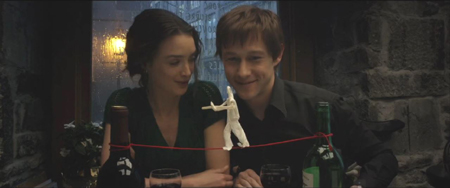
In The Walk, the romance is there, but it is minimized. The development of the attraction between Petit and Annie is squeezed largely into the first quarter of the film. It moves very quickly once we get past the meet-cute antagonism between them over Petit’s stealing the audience listening to Annie’s street singing. Almost immediately they are in a cafe, sipping wine and discussing his dream over a little improvised model (above left), and then in his apartment, with more wine by candlelight and discussion of the dream over a photo of the Twin Towers. The two seem already to be a couple. It’s as if the romance progresses offscreen, in scenes that we don’t witness–the first kiss, the moving in together.
Annie raises no objections to Petit’s crazy goal, as one might expect her to. There is little sense of how much time has passed. All we know is that Annie urges Petit to fulfill his dream, and she becomes his first accomplice. For the rest of the film, she will be little more than first among the accomplices and an onlooker to the preparations and the Walk. Apart from a quick kiss and her loyal overnight vigil outside the Towers as Petit and the other accomplices invade the buildings and set up for the Walk, Annie has almost nothing to do during the preparations for the Walk and the Walk itself. She does, however, get to characterize the lyrical part of Petit’s achievement. Later, when Barry remarks now New Yorkers love the Trade Towers, Annie adds that Petit has brought them to life for people and given them a soul. The romantic plotline is further undercut almost immediately, however, when Annie unexpectedly leaves Petit to return to France and find her own dream.
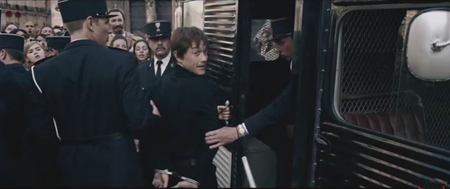
During the first half of the film, Petit’s narration is humorous, bumptious, perhaps a little too ingratiating, depending on your taste. He might seem a bit annoying and capricious, as young men often are in rom-coms. The implication may be that the quirks of his personality are part and parcel of the genius and drive that allow him to perform the feats he does, as his cocky little smile upon being arrested for walking between the towers of Notre Dame suggests. (Note that Barry, who eventually becomes the “insider” accomplice once the team arrives in New York, says he had witnessed Petit’s Notre Dame walk, and sure enough, there he is in the back of this shot and visible in another view of the crowd watching.)
If Petit is selling anything, it’s not the film but himself, and we do not need to like him to admire him.
The suspense film
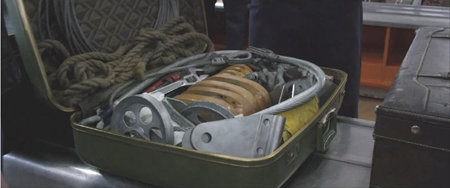
Petit and his accomplices to go New York at roughly the midway point of the film, and The Walk segues temporarily into a suspense film. Where one might expect the Walk itself to be the section designed to ramp up suspense in the audience (as many critics did), the more conventional suspense-generating actions are more prominent in the preparation for it, which constitutes the third quarter of the film. This takes place from 55 to 86 minutes. It begins at the airport, with a comic scene of a customs official reeling off the contents of Petit’s equipment containers (above). When he asks what the equipment is for, Petit cheekily replies that he’s planning to use it to walk between the Twin Towers. The official unconcernedly allows him through.
Soon the tone becomes more serious, as Petit visits the Towers and is overawed and intimidated to the point of feeling that his plan must be abandoned. Standing in the lobby of the South Tower, he speaks of feeling that there is no way to get to the top. Immediately a service door behind him swings open, a worker appears and greets them, and the man departs, leaving Petit to investigate the room beyond, discovering a stairway to the top.
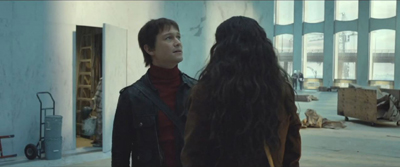
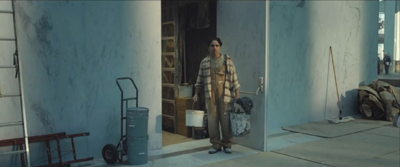
Soon he emerges on the top of the building, tries teetering over the void on a projecting metal girder, and is clearly ready to take up his dream again.
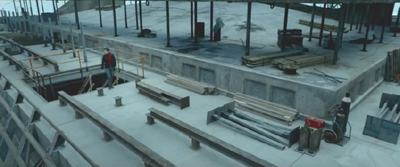
Eventually the tone of the Development turns more tense, as Petit obsessively goes over the plan with his accomplices and the day of the “Coup” approaches. Late on the night before the group invades the Towers, Petit awakens and nails shut the “coffin,” a crate containing the equipment, and expresses his doubts to Annie. Ebullience has become dead seriousness, though Petit determinedly avoids referring to death.
Once the actual invasion of the Towers begins, the tone ratchets up the tension and the delays typical of a Development portion occur. Although the team’s fake delivery truck is admitted to the loading docks, a lack of access to the elevators nearly scuttles the plan. Once Jeff and Petit are on the unfinished upper stories of the South Tower, a guard interrupts them as they unload their equipment in the unfinished upper stories of the South Tower. They end up hiding for fours astride a metal girder above an unfinished elevator shaft extending down so far that we can’t see the bottom. Jeff, who suffers from a terror of heights, becomes our identification figure briefly, as he suffers through this ordeal. Later, once they are on the roof in the dark of night, a guard comes up with a flashlight and nearly bumps into Jeff before being lured away to a lower floor by a colleague offering to share a pizza.
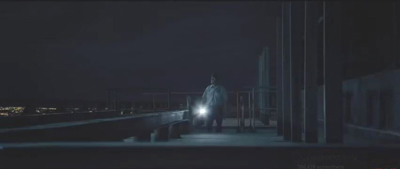
As dawn approaches, the threats to the success of the Walk continue. An arrow is shot from one Tower to the other to begin the process of hauling the wire across teeters on the corner of the building. The bracing wires are loose, and Petit must drag a terrified Jeff onto the side of the roof to help tighten them. At dawn, a mysterious man in a suit visits the roof, apparently just for the view, and sees them. After a nerve-wracking face-off, he ultimately leaves without challenging them.
Interestingly, during this face-off, Petit picks up a length of pipe. After the man leaves, Petit seems shocked to find that he has been holding it in a potentially threatening fashion. This is the only hint we ever get of the lengths to which he might go to make his dream succeed.
There is also a good deal of exposition in this section of the film, part of it accomplished by the narrating voice, setting up for what will happen during the Walk. As a result, we don’t need to be told about the technical details during the Walk itself. There is, however, a fairly long stretch with no voiceover leading up to the silent confrontation with the mysterious man. After he leaves, Petit’s narration notes, “And that was the moment in my adventure that I call ‘the mysterious visitor.'”
This last incident works in with the many other bits of good luck that have allowed Petit to accomplish his dream, including the fortuitous opening of the stairwell door mentioned above. It adds a touch of suspense, as well as realism. Such things do occur–and in this case, really did occur.
The lyrical walk
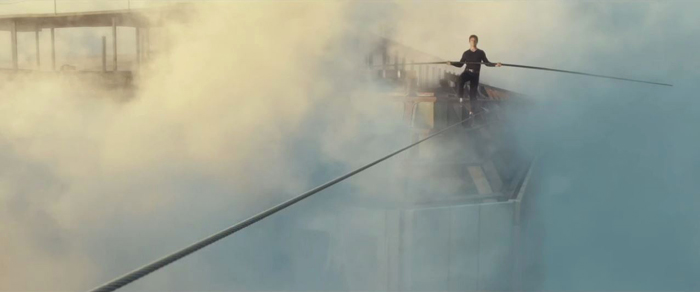
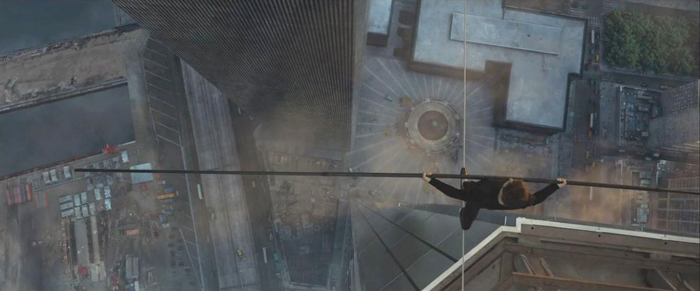
Romance and suspense having been presented and set aside, the film defies convention by switching into lyrical mode. In a conventional film, the grandeur of the mise-en-scene would become a terrifying void (especially in 3-D) into which we constantly fear Petit will fall. Instead, to a large extent because of the narrating voice and the music, we instead follow Petit’s exhilarated reaction and his every shift of mood. For instance, when he stands with one foot on the wire and pauses before beginning his Walk, subjective mist gathers (see bottom). It conveys his sense of the rest of the world disappearing and his attention focusing entirely on the wire. His voiceover describes all this. Would we otherwise perhaps take this mist to be an actual passing cloud?
Similarly, when he finishes the first crossing and starts back, would we understand why if we had only the image and music? Or when he kneels during the return trip to the South Tower, would we grasp that he is saluting the wire, the Towers, and so on, if his narrating voiceover did not tell us?
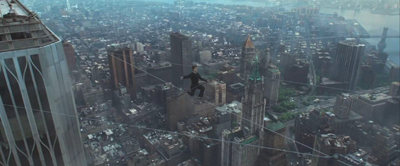
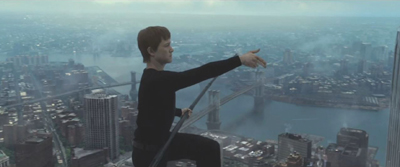
There are details that set up some suspense but are at the same time tied to Petit’s emotional reactions. He remarks that one of the the cavaletti holding the bracing lines onto the wire being upside down. This seems initially to be used as an occasion for Petit to mention his gratitude to Rudy, though it also sets up for the later moment when the plate threatens to buckle under the strain–a moment which ultimately comes to nothing.The detail shot of Petit’s shoe during this scene sets up some suspense, in that a small, wet patch of blood suggests that he may later be endangered by the wound from stepping on a nail. Later we see more blood on the shoe, but the wound in fact never causes him to falter. In this close shot, the shoe also conveys a visceral sense of the moment of the walk and reminds us of the practice that has gone into it, imprinting a channel where the wire has pressed into his foot.
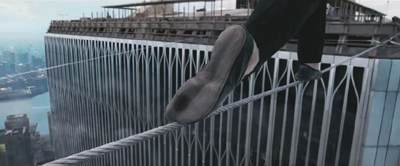
Of course, we are unable entirely to view the scene without suspense, as our bodies naturally react to the strong illusion of height created by the extraordinary CGI imagery and the 3-D. The word “suspense,” after all, derives from the notion of dangling in space. Yet the film constantly backs us away from such jitters in part through the soothing voiceover.
Suspense also returns to some extent just after the salutes, when the police appear, initially on the South Tower end of the wire. An even greater threat, a police helicopter, eventually appears.
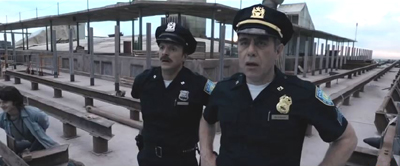
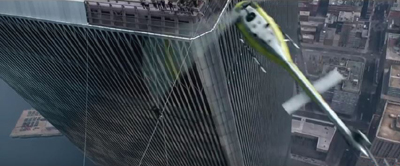
These authorities offer or threaten to help Petit off the wire, endangering him in the process. His evasive maneuvers and defiance create humor that somewhat dispels the suspense. Ultimately, by tossing his balance pole at the outstretched hands of the startled police, Petit manages to clear the way for a triumphant exit from his Walk. This conclusion assures that he controls the entirety of his feat, despite the fact that he is immediately arrested. The applause of the workmen on the lower levels as he is escorted out confirms his triumph, as does the praise offered by one of the arresting officers (seen at the left below). The voiceover description of his later minor “punishment” of performing a lower-wire act for children in Central Park confirms that he has successfully defied even the law.
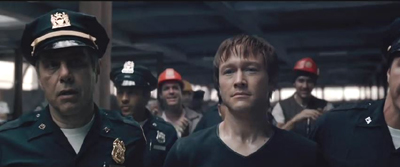
Zemeckis, classical director
While Zemeckis has a reputation as a master of the action set-piece, he can also construct a tight classical narrative. Seeing The Walk a second time for the purpose of writing this entry, I realized that the script is very carefully put together to set up for everything that will happen, both causally and in terms of information.The arrest in Paris makes it clear to us that Petit will face a similar punishment after his Trade Towers Walk. Petit’s fall from the wire in the circus tent and Rudy’s emphatic advice that the last three or four steps are the most dangerous foreshadows the similar moment at the end of the Walk where Petit momentarily looses control and his trembling makes the wire itself shake. In many cases, the voiceover plays a vital role in setting up things to come.
Perhaps it’s not as perfectly put together as Back to the Future, but then, few films of the past decades in Hollywood are.
As David noted during our first viewing, the film also has a good, old-fashioned Hollywood visual motif. Round shapes are contrasted with straight lines, the round ones being associated with Petit’s early ground-based entertainment career and the lines with his high-wire acts. The lines may be obvious to viewers, as when Petit draws a line between the Towers in an image, or less so, as in the scene where an arrow is tested as a means for starting the process of sending the wire from on Tower to the other.
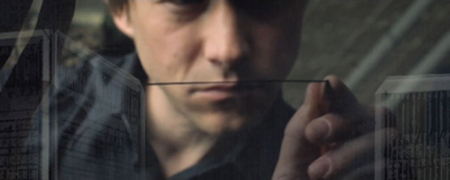
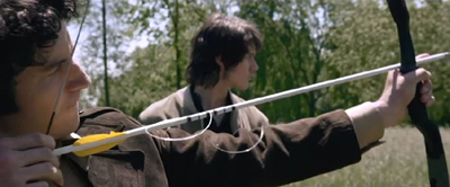
Unfortunately none of the video material currently online shows portions of the street-entertainment scene of the film’s early section, so I can provide no images of the round items. These include the perfect chalk circle that Petiti draws to delineate his performance space, the top hat in which he collects coins, the red-and-white candy mint, his unicycle’s wheel, the ring under the White Devils’ tightrope in the circus tent, the arch in the same ring that frames Petit when he juggles to impress Rudy, and the umbrella he uses to shelter Annie in a sudden rain shower.
Such imagery disappears in the second half, apart from repeated overhead shots of the circular fountain on the ground between the Towers, often with the lines of the wire and the balance bar juxtaposed with it (see top). It recalls Petit’s initial performance space on the ground and subtly reminds us of how far, and high, he has come since then. (During their first meeting, Annie remarked of Petit’s tightrope, “That was the lowest high-wire I’ve ever seen.”)
In the end, the answer to the original question, “Why?” is that “There is no why.” When Petit sees a beautiful place in which to place his wire, he feels compelled to do so. His motive is not to show off his derring-do or to spice up his life with risk-taking. His is an aesthetic compulsion, and the Walk is referred to a number of times as an artwork. The form of the film reflects that compulsion.
The last lines of the film return to the Towers themselves. Petit narrates over a shot of himself returning to visit the top of the Towers, telling us that an official gave him a pass to visit it. We return to the torch atop the Statue of Liberty, where he looks at the card and says, “He wrote on it ‘Forever.'” This could have been told visually, I suppose, but it would have meant close-ups of the card, probably a second person on the roof to whom Petit could explain his card–something, at least, more elaborate and less effective than simply having him tell us this information. A pan moves us toward the Towers, gleaming in the sunshine until the slow fade-out that conveys the fact that for the Towers, forever was cut brutally short. That final salute, at least, seems to have pleased everyone.
As I said at the outset, The Walk is not necessarily a masterpiece, but it is far better than some of the reviews would claim. Seeing the film a second time, I enjoyed it more and found new things to notice, which is always a good sign. I did not find the voiceover narration annoying during either viewing, and it isn’t really dispensable. The film is worth seeing, and its extraordinary climactic scene will suffer greatly from being seen on a video screen.
The Wire provides another example of a phenomenon which David discussed in relation to Paul Greengrass’ United 93: our inability to wholly suppress a feeling of suspense even when we know the outcome of an event. Simply seeing Petit on the wire high above the ground to some extent creates an involuntary state of tension.