






Archive for the 'Film comments' Category
It’s all over, until the next time

Our Little Sister (Kore-eda Hirokazu, 2015).
DB here:
The perennial Silly Season topic, The Death of Film, is back.
In June, Huffington Post‘s Matthew Jacobs announced “The death of Movies As We Know Them.” He laments the loss of “solid storytelling and bankable stars.” In August, Brian Raftery asked: “Could this be the year that movies stopped mattering?” The author argues that now movies are “Something to Do When the Wi-Fi’s Down.” Echoing the virality theme, Ty Burr announced that two albums, Beyoncé’s “Lemonade” and Frank Ocean’s “Blonde,” “came packaged with better movies than anything in theatres.” For Burr, the summer season confirmed that audiences are more interested in grazing among YouTube clips and luxuriating in eight-hour video serials than watching a feature film. “The two-hour movie, especially in its larger and more commercial form, is becoming a relic.”
Richard Brody eloquently replied to Raftery, noting Beyoncé’s debt to Julie Dash and Khalik Allah’s films. Brody has been around this block before, as I noted in a 2012 blog entry.
The cinema-is-dead complaint, Richard Brody helpfully points out, is now an established genre of movie journalism. In the last few weeks David Denby, David Thomson, Andrew O’Hehir, and Jason Bailey have in different registers sought to revive this quintessentially empty polemic. I’ve gone on about the tired conventions of film reviewing about once every year on this soapbox. (Try here and here and here and here; Kristin got in some licks too). For now I’ll just say that I’m convinced that the Death of Cinema (or Hollywood, or the Intelligent Foreign Film, or Popular Movie Culture, or Elite Film Culture) is simply a journalistic trope, like Sequels Betray a Lack of Imagination or This Movie Reflects Our Anxieties. In short: an easy way to fill column inches.
But after four years, maybe things really have deteriorated. So let’s get specific. What’s really going down the tubes? The theatrical side of the industry? Quality? Cultural cachet?
Movies, your best entertainment value

Bar area of Orange Cinema Club, Beijing.
Let’s look at some current evidence about the industry, thanks to the redoubtable Cinema research division of IHS Media Technology.
The newest symptom of cinema’s demise, according to many, is the rise of Netflix and other streaming platforms. Serial TV is attracting a lot of attention, true, but streaming has long relied on licensing feature films from studios, independents, and overseas companies. TCM and Criterion are launching FilmStruck as a new channel chock-full of classic films from Hollywood and elsewhere. Amazon and Netflix have also begun acquiring and financing features to guarantee a supply of those two-hour films that for some reason people still want to watch.
But what about movies in theatres? Actually, things are pretty robust. Despite everybody viewing at home and on the go, for many years theatre growth has been phenomenal. In 2015 the world added about 12,000 screens, hitting a new high: 153,163. Not counting all our “second screens” (and third), there are more movie screens now than ever before.
By the way, those of us, me included, who worried that the rise of digital exhibition would cause a drop in screens were wrong. Digital was a shot in the arm to theatrical exhibition, and it made 3D a viable platform. That format shows signs of growth, chiefly because of China, and now 16-20% of box-office grosses come from 3D screenings.
In keeping with the expansion of exhibition, for the last decade, the global box office has risen steadily. Almost every year sets a record. The new height is $37.7 billion for 2015, and it seems likely that 2016 will beat that.
As for number of admissions, 2015 also set a record: 7.4 billion, a jump of 13% over 2014. This is a bit more than one ticket for every man, woman, and child on earth. The first half of 2016 is ahead of the same period last year.
Of course revenues don’t equal profits. Jacobs is especially concerned that some big films have been losing money in their domestic theatrical run. But most films lose money in that run. For a long time, ancillary markets (DVD, overseas cable, merchandising, etc.) made up for the deficits. More and more, overseas theatrical is helping in a big way. In a recent rundown, of the summer’s top twenty hits, a print story in The Hollywood Reporter indicates that foreign grosses outweigh US/Canadian ones in most cases, and sometimes by a lot.
For example, big as Captain America: Civil War was in the US, 65% of its $1.1 billion haul was due to the offshore market. X-Men: Apocalypse got half a billion theatrical, 71% of which came from the international audience. Ancillaries will still need to kick in, given the mammoth budgets of films like these, but those ancillaries piggyback on theatrical visibility. As ever, the big pictures pay for a lot of lesser films.
Moreover, so many costs are buried or dispersed in overhead, debt service, tax incentives, deferred payments, far-fetched studio expenses, and the like that it seems hard to know what final profits really are. Nor will we know what, if any, profits are yielded by films from countries with subsidized film industries.
There are many things to worry about in the exhibition business, but it doesn’t seem on the verge of collapse. Let’s keep a sense of proportion. Here is what the death of “our cinema” might really look like.
Theatre admissions fall 45% over six years. Studio profits fall 80% over the same period. One-sixth of theatres close. Major overseas markets refuse to remit the earnings of Hollywood films. Audiences turn increasingly to other leisure activities.
This was the state of the American film industry in 1953. The prosperous war years, culminating in the all-time admissions high of 1946, were over and the studios went into sharp decline. Thanks to the 1948 Supreme Court “Divorcement Decree,” the studios lost control of their theatres, relinquishing not only valuable showcases for their product but also millions of dollars of prime real estate.
Yet as we know, 1953 didn’t end cinema, not even American cinema. As the old studio system waned, a new one eventually replaced it. In the process, Hollywood continued to make major films. Filmmaking abroad—in Asia, Europe, and South America especially—flourished. Film festivals sprang up, and a new young public proved eager to watch movies from a variety of cultures. Avant-garde and documentary movements gained traction, partly because of the widespread dissemination of 16mm.
No one, so far as I can tell, predicted the end of cinema, or Hollywood, because of the 1947-1953 crisis. That person would have looked very foolish. Things today aren’t nearly so severe.
Long, hot summers
 What about quality? A. O. Scott points out that the way to quell fears for the End of Good Cinema is to go to a film festival. It’s good advice that we’ve given as well. Richard Brody, who has I think seen everything, responds to Raftery by reminding us of many valuable films that the naysayers ignore. Another way to remain calm is to look at a little history.
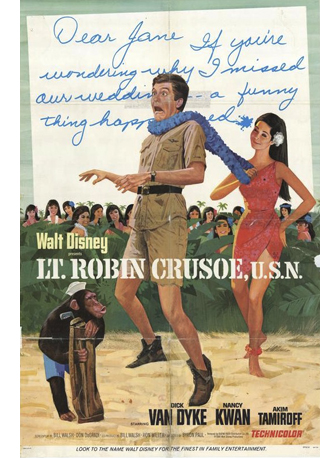
Things often seem grim at summer’s end. Let’s go back fifty years, to the summer of 1966. In those days, the blockbusters and prestige pictures were saved for fall and winter. Indeed, the blockbusters were largely the prestige pictures, the adaptations of novels and plays. The big grosser of the year was Hawaii, released in October. Two others were The Bible: In the Beginning (September) and A Man for All Seasons (December). But two of the top-grossers hit the jackpot in the summer: Who’s Afraid of Virginia Woolf? (July) and Lt. Robin Crusoe, USN (June).
Pause on this last title. Lt. Robin Crusoe, USN was an indisputably lowbrow hit, a Disney comedy starring Dick Van Dyke. The fact that it earned $10.1 million (about $75 million today) might well have set critics worrying about American tastes. Worse, they might have concluded there was no hope, because from 1950 to 1970, twenty Disney films appeared in the annual top five. That record includes not only animated classics but In Search of the Castaways, That Darn Cat, and Darby O’Gill and the Little People–enough to make intellectuals despair of American moviegoers. Robin Crusoe‘s summer success might have seemed another sign of End Times.
Summer 1966 also saw The Ghost and Mr. Chicken, Fantastic Voyage, the remake of Stagecoach, a Bob Hope comedy, the low camp of Batman, and the high camp of Modesty Blaise. The 1966 counterpart to our spate of superhero sagas was a cycle of spy movies, somber or spoofy. The summer yielded Blindfold, Arabesque, and even The Man Called Flintstone. Along with these came Nevada Smith, Khartoum, What Did You Do in the War, Daddy?, This Property Is Condemned, and Wild Angels.
Some of these are well-remembered, mostly by viewers exposed at an impressionable age. For prestige there was and remains Virginia Woolf. For auteurists, there was Three on a Couch and Torn Curtain, and perhaps Modesty Blaise. As for the rest, most were and are still decried as junk.
Things were not looking good for American cinema. The Sound of Music had just won the Best Picture Oscar, a middlebrow shot across critics’ bow, and Pauline Kael was turning angry firepower on the massive threat posed by The Singing Nun. In the summer, the Times lambasted Hitchcock and Jerry Lewis. As far as I can tell, the follow-ups to the Bond boom pleased hardly anybody.
In sum, we forget just how godawful summer movies can be, year in and year out. The few we remember after Labor Day bob up from a river of sludge. We should be grateful for Indignation, Finding Dory, Lights Out, The Shallows, Hell or High Water, Don’t Breathe, The BFG, Kubo and the Two Strings, and probably half a dozen others I haven’t seen. (But not Jason Bourne, which I have.) Ben-Hur wasn’t as terrible as I’d been led to believe.
And of course, everybody’s pumped for the fall, for Snowden and The Arrival and The Birth of a Nation and La La Land and Manchester by the Sea and all the rest. 1966 critics were looking forward as well, but to what? Not only Hawaii, The Bible, and A Man for All Seasons but also Is Paris Burning?, Grand Prix, Any Wednesday, The Sand Pebbles and more spy movies (Gambit, The Quiller Memorandum). Not so exciting by our standards; Big Pictures were more square then.
True, also coming up in the fall of ’66 were The Fortune Cookie, Seconds, A Funny Thing Happened on the Way to the Forum, Fahrenheit 451, The Professionals, Loves of a Blonde, and Blow-Up. But even then some critics stayed unhappy. Kael denounced Blow-Up, and Vernon Young intoned: “The party’s over. . . . Another phase of film history, in many ways the most creative, is drawing to a close.” Sound familiar?
Conversation starters and stoppers



End-of-movie writers argue that pop music and Quality Television are usurping the cultural place of film. But I’m skeptical, because I don’t think film is playing in the same arena.
Odd as it sounds, film has never been popular on the scale of other mass media. Before TV, radio listeners far outnumbered film audiences. Via radio and records, a hit tune reached more people than nearly any movie. Even today, radio audiences are surprisingly big. Nielsen reported in 2014 that just in the 18-35 age group, 65 million people listen to radio broadcasts each week. That’s nearly three times the average number of all viewers who attend movie theatres in a week.
Once TV came along, it became another truly mass medium. 73 million people, over a third of the US population, watched the Beatles on Ed Sullivan in 1964. TV is still the big game. More than 20 million people watch The Big Bang Theory each week. It’s reported that 8.9 million people watched the season finale of Game of Thrones in original cablecast, and 23 million in all its iterations. Yet, again, about 23 million people see all the movies playing in a given week.
The plain fact is that visiting a theatre to see a movie has been, throughout most of American history, a middle-class pastime. It’s relatively expensive, and getting more so. It’s not quite niche, not as rarefied as theatre or concert music or novels, but still not on the scale of other media. We ought to expect that memes will spread faster and more pervasively in pop music and television platforms.
Our critics are concerned that films aren’t part of what Raftery calls “the pop-cultural conversation.” “What in popular culture got people excited or even interested over the last few months?” asks Burr, going on to worry that movies didn’t do so. This is a strange criterion for judging films. Hula hoops, Rubik cubes, Chia pets, and Donald Trump’s coiffure have all been part of the cultural conversation. Some good films excite lots of people, and some don’t (partly because those people don’t know of them). And of course many people got excited by films Burr and Raftery considered bad, like Suicide Squad. Excitement may not be a great standard for excellence.
The cultural-conversation gambit suggests that mere popularity needs to be accompanied by a special jolt, the hum of nowness, the throb of hipness. Financially successful films like The Jungle Book or Finding Dory don’t give off much buzz. Where does that special ingredient come from? Apparently, now, the Netizens. It’s natural that critics, who are assigned to surf the waves of mass tastes, would identify important art with what’s trending on Facebook. It’s their job to hop on what’s hot.
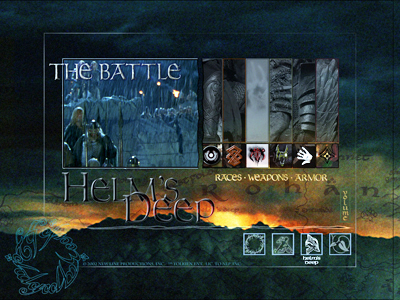
Or in truth, help make it hot. When critics treat what’s buzzy as valuable, they agree with marketers, and cooperate with them. How many critics who loved The Dark Knight had been prompted by the campaign that played up “Why So Serious?” and other memes that publicists thought would stick? Kristin has documented how The Lord of the Rings marketers set the agenda for journalists by means of junkets and Electronic Press Kits (above), while wooing fans with carefully judged opportunities to participate online (a “pop-cultural conversation,” for sure). The typical big film is positioned by the marketing campaign, and even unanticipated responses, especially if the film is strategically ambiguous, can feed ticket sales.
The People don’t start the cultural conversation; they react to what they’re given. The conversation is started by the studios, and they try to channel it. They generate the “controversies” about making the protagonists of Star Wars Episode VII: The Force Awakens a woman and an African American man. The critics pick up the story. (Remember: column inches.) Viewers dutifully enter their opinions on blogs, tweets, and comments columns–which the critics then re-spin. As Brody points out of Quality TV, it’s all about expanding discourse, indefinitely. Criticism begets “comments” which beget chitchat. This is less a conversation than a perpetually chattering flashmob.
A side note: I wonder if making cultural buzz a criterion of worthwhile cinema doesn’t owe something to the influence of Pauline Kael. She sent contradictory signals on this score, worrying that audiences were too easily bought off; the industry jollied them into accepting junk as fun. But she thought that one reason to like, say, Bonnie and Clyde was the fact that it was “contemporary in feeling.” It brought into movies “things that people have been feeling and saying and writing about.”
For a moment let’s accept the assumption that worthy movies have some broader cultural impact. How could we measure that? I suggest the Tagline Test. A movie enters the culture when a line becomes instantly recognizable. At its best, the tagline applies to an immediate situation. You step into a startling new setting and tell your friend you don’t think you’re in Kansas any more. You talk about your boss making you an offer you can’t refuse. You’re bargaining and you say, “Show me the money.” TV gives us plenty of catchphrases, of course. (“You rang?” “Not that there’s anything wrong with that.” “Don’t have a cow, man.” “That’s what she said.”) This is one symptom of a show’s buzziness.
When I came up with the Tagline Test, I thought it supported the doomsayers’ diagnosis. I couldn’t think of many memorable lines from films after the 1980s. Had TV taken over the traffic in catchphrases? Crowdsourcing among two fairly diverse populations came up with a big set. Here’s a sample:
Hasta la vista, baby. Houston, we have a problem. That’ll do, pig; that’ll do. I drink your milkshake. The Precious (enunciated in a high voice). With great power comes great responsibility. Stop trying to make fetch happen. She doesn’t even go here. Stay classy. That escalated quickly. The first Rule of Fight Club… 60% of the time, it works every time. Little golden-haired baby Jesus in the crib. Schwing! Coffee is for closers. King of the World! Stay alive; I will find you.
The Big Lebowski is a virtual encyclopedia of them: The Dude abides. Obviously you’re not a golfer. That rug really tied the room together. Nobody fucks with the Jesus. So too Napoleon Dynamite: Whatever I feel like I wanna do GOSH! I’m pretty much the best in the world at it.
Maybe you don’t agree that these are all equally common; I didn’t know about the Mean Girls and Napoleon Dynamite ones. But all I need to show is that recent movies have entered the “cultural conversation” quite literally. Maybe it just takes months or years for movie taglines to replicate in everyday life. Anyhow, those who want movies to get all buzzy don’t have to worry. With Oscar season upon us, the frenzy will begin. In fact it already has, with Nate Parker’s The Birth of a Nation.
Who’s we?
 In talking about “our” cinema, I’ve been too glib, though this angle fits with an assumption of the death-knoll critics (“Movies as We Know Them”). Of course, Jacobs, Raftery, and Burr all acknowledge that Hollywood isn’t making movies just for us; it’s a world industry. People elsewhere (many recently arrived in the local equivalent of the middle class) seem keen to participate in American popular culture, with fashion, music, TV, and websites. Hollywood entertainment, lame as it often is, is part of being cosmopolitan.
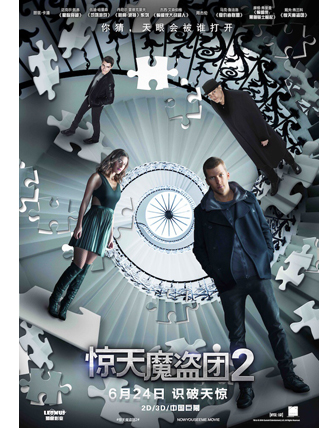
Still, maybe it’s time to admit that we don’t own Hollywood. Maybe we never did, but it seems clear that with globalization “our” popular cinema is becoming something else–not exactly “theirs,” but not wholly ours either. Now You See Me 2 may have attracted only mild interest here: little cultural chitchat, except maybe among magicians, and $65 million box office (less than Lt. Robin Crusoe, USN). But it garnered $266 million internationally. Nearly a hundred million of that came from China, perhaps partly owing to long stretches set in Macau and short stretches featuring Jay Chou Kit-lun. And the director was Asian-American Jon M. Chu.
Now Lionsgate announces a Now You See Me spinoff, a feature co-production with China that will use local stars. So who owns this franchise? “Us” or “them”? If it disappoints us and pleases them, how does that mean that movies are so over? Maybe other countries’ cultural conversations are pulsing with talk of the Four Horsemen (one of whom is a woman).
It’s long been obvious that other film industries create their own versions of Hollywood. Europe, India, and Hong Kong have done it for decades. Current Chinese hits borrow from “our” rom-coms, action pictures, and comedies. In Stephen Chow Sing-chi’s The Mermaid, you can watch a blockbuster premise coming unglued. It’s a mixture of sentiment, message, slapstick, and bad taste; Hollywood twisted up in Chow’s characteristic funhouse mirror.
This won’t stop. One of the most astonishing and puzzling facts of contemporary cinema gets almost no press, maybe because it contravenes the death-of-film narrative. Over the last ten years, there has been a huge rise in the number of feature films.
In 2001, the world produced about 3800 features annually. The number passed 4000 in 2002, passed 5000 in 2007, and passed 6000 in 2011. In 2014, IHS estimates, over 7300 feature films were made in the world. There are now fifteen countries that produce over 100 features a year. As a result, only 18% of the world’s features come from North America. The boom took place despite the rise of home video, cable, satellite, DVD, Blu-ray, VOD, and streaming. And it happened despite the fact that American blockbusters rule nearly every national market. This may be a bubble, or it may be genuine growth. In any case, we ought to investigate the reasons that a great many people around the world stubbornly persist in making two-hour films. They don’t appear to care if We sense a summer slump.
While I was preparing this entry, Kristin and I went to Our Little Sister, Kore-eda Hirokazu’s 2015 film about three sisters abandoned, first by the father, then by their mother, and raised by the moderately stern oldest sister. The plot follows what happens when the trio takes in their half-sister after her mother dies. This is a movie that’s bereft of villains and almost totally lacking in conflict. The sisters’ misjudgments and flaws cause them problems, and sometimes they quarrel, but mostly we see decent people trying to lead happy lives, and largely succeeding. Compared to Kore-eda’s debut, Maboroshi (1995), it’s pictorially rather conventional. (That damn sidling camera.) But its episodic, open-textured plot, its quiet depiction of changes across seasons and years, and its casually serene vision of family and community make it one of the most enjoyable and moving films I’ve seen this year.
Based on the graphic novel Umimachi Diary, the film participated in Japan’s “cultural conversation.” It’s certainly a mainstream commercial movie, of a sort that Japanese studios have turned out for decades. It won solid attention on the festival circuit too. It earned a 92% rating on Rotten Tomatoes, up there with Kubo and Hell or High Water. But such a reserved, sentimental film will never get the edgy buzz that our doomsayers want. Sentiment, after all, is anathema to our dominant mode of consuming pop culture, that of cool, ironic knowingness.
I don’t want to oversell Our Little Sister: Kore-eda is no Ozu. But this film and many others remind us that worthwhile films are still made, and released, and available outside the circus tent of Entertainment Weekly cover stories. (In this case, Americans’ thanks should go to Sony Pictures Classics, now celebrating its 25th anniversary.)
In short: Forget the zeitgeist; it likely doesn’t exist, apart from marketers’ dreams and journalists’ deadlines. Forget the cultural conversation; there’s not only one. Seek out the films that matter to you, and not “to us.” Stay classy!
Thanks to correspondents on two listserves, that of Communication Arts film folk and that of the Art House Convergence. A great many people made many suggestions, with the inevitable duplication, so thanking everyone by name would be protracted. But you know who you are.
My information on worldwide production and exhibition comes from issues of IHS Media & Technology Digest and Cinema Intelligence Report. Special thanks to David Hancock, Director of IHS Cinema division. Pamela McClintock’s “Summer Anxiety Despite Near-Record Numbers” in the 16 September Hollywood Reporter print edition contains the top-twenty film list I mention; that chart isn’t included in the online version.
On the summer 1966 US releases, see The Film Daily Yearbook of Motion Pictures 1967 (Film Daily, 1967), 144-168. I charted the year’s top-grossers from Susan Sackett, The Hollywood Reporter Book of Box Office Hits (Billboard, 1996).
My quotations from Pauline Kael come from her Bonnie and Clyde review reprinted in Kiss Kiss Bang Bang (Atlantic Monthly Press, 1968), 47. My quotation from Vernon Young is the opening of his “The Verge and After: Film by 1966,” in On Film: Unpopular Essays on a Popular Art (Quadrangle, 1972), 273.
It’s probably irrelevant to mention that both Scorpio Rising and The Brig were released, in some sense, in summer 1966.
P. S. 18 September 2016: And see the practically real-time followup. Remember when blogs were like Twitter is now?
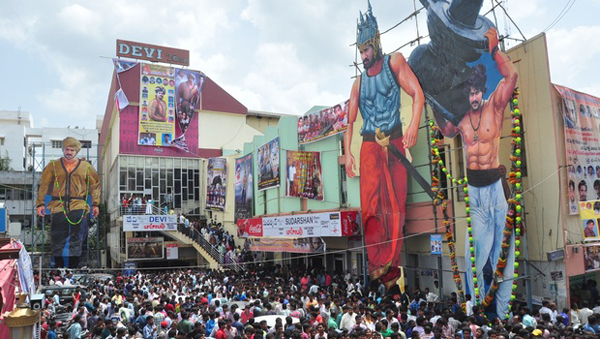
12,000 tickets are sold for premiere screenings of Baahubali (2015) in Hyderabad, India.
Oof! Out!
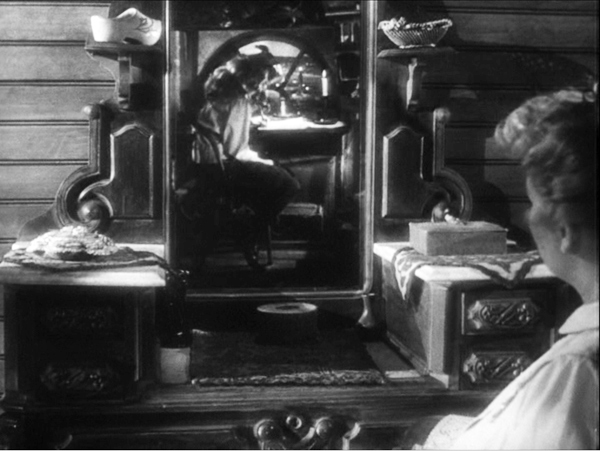
I Remember Mama (1948).
DB here:
Jim Naremore calls 1940s American studio cinema “the beating heart of Hollywood.” I think he’s right. For about five years I’ve been working on a book taking EKGs of that beating heart. The book tries to understand some factors that made Forties Hollywood so dynamic and continually captivating.
Doing this called my attention to so many things: the fresh subject matter, the variations in genres, the stylistic experiments, the superb performances, the quality of line-by-line writing. But I focused on something that’s still pretty big: new, or newly revived, storytelling methods. Those methods made that period exciting–not just in film noir, where we tend to think that narrative got pretty wild, but also in melodramas, rom-coms, musicals, and the rest.
It’s the only study I know of how narrative techniques emerged and developed in a single era. No wonder it took five years. I watched over 600 films. I trawled through books and trade papers for hints about what the producers, directors, and writers thought they were doing. And because a lot of techniques weren’t unique to film (e.g., flashbacks, first-person voice-over, etc.), I wound up reading forgotten plays and neglected novels, while listening to hours of old-time radio.
The project started when I was asked to do a series of lectures, “Dark Passages,” for Belgium’s Summer Film College in 2011. Just before that, I tried out some ideas in some spring blog entries. Things crystallized in 2013, when I firmed the project up. In this entry, I promised, falsely, that the book would be short.
Since then, I’ve been immersed in fun, except for the Red Skelton movies. I loved having Mercury Theatre playing in my car during drive-time, and digging out 1930s and 1940s books from the oldest section of our university library.
I think the book says some new things about films of the period, and about the development of American popular entertainment more generally. For one thing, I think I have a better understanding of how High Modernist techniques (out of Joyce, Woolf, etc.) made their way into mass art. (Not directly, I’m convinced.) For another, I have a new respect for those filmmakers who tried something daring, even if–see my last post on The Chase (1946)–they somewhat botched it. And it develops some ideas I floated in The Way Hollywood Tells It: ideas about how modern filmmakers like Tarantino and Nolan are continuing a Forties tradition of somewhat experimental narrative.
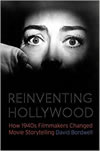
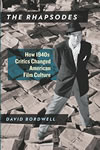
Reinventing Hollywood: How 1940s Filmmakers Changed Movie Storytelling went off to the publisher this afternoon. Said publisher is the University of Chicago Press, who did a fine job with our Minding Movies and my recent little book The Rhapsodes, to which this is sort of a bigger, thuggier brother.
In the meantime, just to give you an idea of how one writer makes a book, I append some images from the workbench, before I pack up the paperwork. Here are the file folders and note cards I worked from. Hard to get those long note-card boxes nowadays; I needed 8 1/2 for this project.

Yes, I’m still a pen-and-paper nerd. All that’s changed since my 60s student years is the worsening of my handwriting.


Like you, I have hundreds of digital files too.

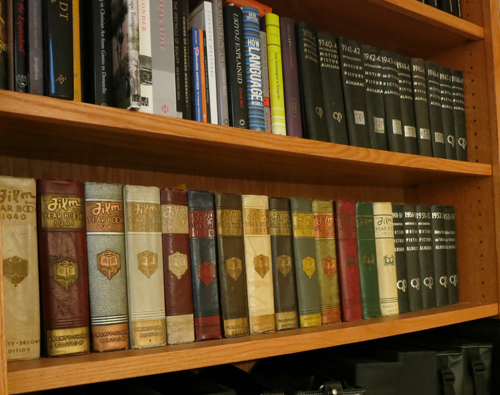
I was reliant on my old friends, The Motion Picture Almanac and The Film Daily Yearbook.
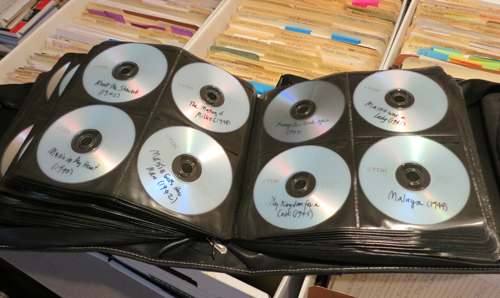
I amassed many albums of DVDs, as you’d expect–thanks chiefly to Turner Classic Movies.
Of course there are scores of books about films and figures of the period. I depended a lot on two key surveys: Douglas Gomery’s Hollywood Studio System (both editions) and Tom Schatz’s Boom and Bust: American Cinema of the 1940s. I didn’t rely much on all those books of a reflectionist, Zeitgeisty flavor–for reasons I’ve indicated here as well as in the book.
Reinventing Hollywood should be out this time next year. It should run to around 550 pages, with 180 illustrations. In addition, I’ll be putting up a dozen or so clips online to supplement some of my analyses. Hereabouts, from time to time I’ll preview arguments in the book.
I want to thank my editor, Rodney Powell, and his colleagues at the University of Chicago for supporting the book. I also owe a debt to Jim Naremore, Jeff Smith, and Malcolm Turvey for their close reading of the thing in draft form, and of course to Kristin for help in matters big and small. The couple dozen of friends and colleagues who helped me, too many to list here, are gratefully acknowledged in the text.
To give you a sense of what the book is up to, I’ve gathered most of my Forties blog entries into a separate category. Some of these are grist for the book, and some, like the ones on The Magnificent Ambersons and on The Chase, expand the book’s analysis.
In all it reminds me of what the Duke of Gloucester said to Gibbon: ““Another damn’d thick, square book! Always, scribble, scribble, scribble! Eh! Mr. Gibbon?” I’ve used this before, but after writing or rewriting seven books since I retired in 2004, it seems even more grimly appropriate. The reader is warned.

Photo by Kristin Thompson.
INDIGNATION: Novel into film, novelistic film
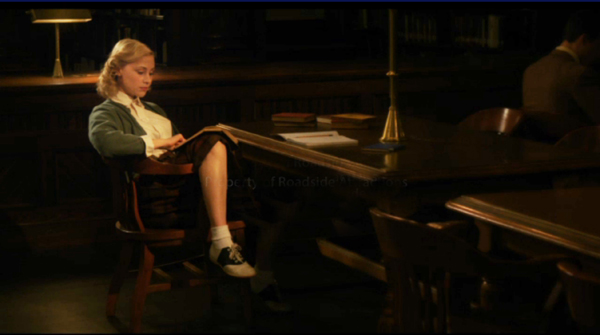
Indignation (2016).
DB here:
As I finish my book on 1940s Hollywood storytelling, I see that period’s influence all over the place. (Actually, that’s part of the book’s point.) One thing that filmmakers did back then, I think, is make cinema more “novelistic.” It’s not just that they took stories from novels, though they certainly did. They also made much greater use of storytelling devices that had become common in literature both high and low.
Many of these techniques I’ve talked about in other entries. There were, of course, flashbacks—not new to the Forties, but now much more frequent than in the Thirties. There was also the rise of voice-over commentary, like the narrating voice of fiction. It might be the voice of an objective narrator, as in Naked City (1947). Or it might be the voice of a character, either telling the tale to another character, or recalling events purely in his or her mind.
Other types of subjectivity came forward too, such as dreams, daydreams, and hallucinations. Filmmakers of the 1930s were inclined to tell their stories objectively, through concrete behavior. But thanks to imported and revised literary strategies, many Forties films gain a greater density and interiority. Compare, for example, the 1931 Waterloo Bridge with the 1940 one.
One thesis of my book is that filmmakers of the Forties consolidated these strategies in a way that became central to modern movie storytelling. That seemed to me to be confirmed when I saw James Schamus’s directorial debut, Indignation, now or soon playing at a theatre near you. Because of his skill as a screenwriter, I expected an intelligent adaptation of Philip Roth’s novel, but I also hoped to learn more about the expressive resources of contemporary cinema. I wasn’t disappointed.
Indignation’s core story involves Marcus Messner, studious son of a New Jersey butcher who goes off to a Midwestern college. Stuffed with ideas and ambitions, Marcus is intellectually worldly but socially and sexually naïve. If he weren’t in college, he’d be drafted to fight in the Korean War. Instead of fitting smoothly into academic life, he finds himself confused by Olivia Hutton’s calculated sexuality. In addition he struggles with an overprotective father and the puritanical, hamfistedly Christian, regimen of 1951 campus life.
To talk about what I find exciting and instructive in the film, I have to presume you’ve seen it. So what follows is filled with spoilers.
Sticking to one causal line
Like the book, the film is an exercise in restricted point of view. That involves not simply the voice-over commentary that weaves in and out. (In a film, that technique doesn’t guarantee restriction the way first-person narration would in a novel. Movies can be more promiscuous in breaking with what one character thinks and knows.) And the restriction isn’t wholly a matter of a subjective plunge either, though we do get Marcus’s dreams and fantasies and some fragmentary flashbacks.
No, what makes Indignation intriguingly “novelistic” is a matter of attachment. We’re simply with Marcus through almost the entirety of the movie. We know only as much as he knows. This means that we learn about certain things when he does. His father’s breakdown back home is conveyed through phone calls. At the climax, his mother’s visit to him in the hospital reveals that she’s considering divorce. An alternative narrative strategy would be to shift from scenes with Marcus to scenes elsewhere, say back home in New Jersey or in Olivia’s dorm. This “omniscient” option is more common throughout American film history; we see it in the crosscutting between CIA malefactors and poor David Webb in Jason Bourne.
Restricted narration isn’t the only way to generate mystery, but it’s a reliable one. By attaching us to Marcus’ range of knowledge, Indignation creates mysteries, chiefly around Olivia. What has made her behave as she does? She never offers a full explanation, but in some scenes she tells more about her parents and in a crucial confession she confesses her alcoholism, a suicide attempt, and a period in treatment.
During this confession, Schamus finesses the showing/ telling problem in an intriguing way. There are good reasons, I’ve suggested before, to let such monologues play out in the space and time of the scene. Telling is sometimes more vivid than showing. But Schamus has chosen to show as well as tell, by providing quick flashback illustrations of what Olivia recounts to Marcus.
What interests me is that these images from the past have an in-between status. They’re neither straightforward and neutral, nor Olivia’s own viewpoint, nor exactly Marcus’s imagined version of what she’s telling him. For instance, the straight-down, somewhat diagrammatic and clinical framing of some of them calls to mind the film’s first shot, also associated with Olivia’s health: the pill case in the care facility.
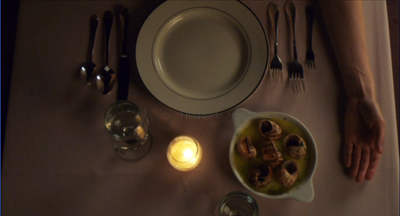
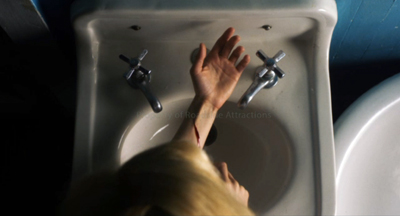

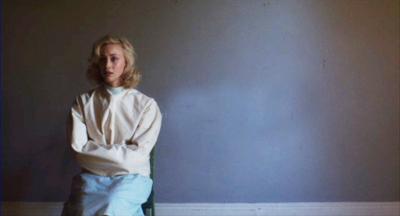
Likewise, the shot of Olivia in a straitjacket, framed off-center in a way few other isolated long shots in the film are, has an abstract quality that suggests an image lying somewhere between her memory and Marcus’s imagining of her situation—without making it wholly subjective. (In the early 1950s, it’s plausible she was indeed treated this way.)
At the climax, we get even less information about Olivia’s situation. Before Marcus can break off with her, she simply vanishes. Marcus will never find out what became of her. For him, if not for us, the mystery is permanent.
Not that he doesn’t try to communicate. This is one role of the voice-over in which he muses on his past and, more ambitiously, on the role of cause and effect in life. As a follower of Bertrand Russell, he’s evidently pondering Russell’s idea of “causal lines.” Ironically, though, Russell’s inferential model of causality doesn’t help Marcus figure out what happened to Olivia.
But from where is Marcus speaking? Quite likely, from the Afterlife.
Dead narrators drift through 1940s cinema. Philip Roth was ten when The Human Comedy (1943) featured a deceased father returning to his small-town family, and eleven when The Seventh Cross (1944) gave us an executed prison-camp escapee who shadows one of his mates. So Indignation, set in the year after Sunset Boulevard (1950), seems perfectly in keeping with this trend. But these other films announce the voice-over’s posthumous status right away. Schamus does something a bit different.
In the source novel, Roth lets Marcus suggest that he’s dead about a quarter of the way through. Schamus’s screenplay drops hints that are, I think, fully noticeable only in retrospect. He creates a surprise that in turn motivates one of the two frames that surround the 1951 story action.
The front end of the inner frame is a brief combat skirmish in South Korea. A GI is pursued into a dark, nondescript building by a North Korean soldier. The action is difficult to discern, but we can see that the Korean is shot. Did the GI escape? The combat scene will be partially replayed near the film’s end, closing the frame the first one opened. The GI will be revealed as Marcus, who is dying from a bayonet thrust.
This isn’t merely a trick. In the 1940s filmmakers realized that some stories, if told chronologically, begin in rather slow and uninvolving fashion. But starting at a crisis late in the story’s causal chain, and then flashing back to what led up to it, can arrest our attention. Think of what The Big Clock (1948) would be like if we started not with the hero dodging around corridors trying to elude the police, but with his mundane office routine earlier that morning. So instead of starting with Greenberg’s funeral, Indignation grabs us with a brief and enigmatic piece of life-or-death action.
1940s frames are more explicit about the framing situation than the combat incident in Indignation. Yet Schamus evidently didn’t want to show Marcus lying there dying and reflecting on his life and leading into the film as a whole: too on-the-nose, and perhaps too obviously fatalistic. The shift to the Jonah Greenberg funeral frees the story action from what Henry James once called “weak specificity.”
There’s also the possibility that Marcus survives; we don’t see him die, even in the finale of the skirmish. The fact that the film can equivocate about whether our narrator is alive or dead emerges as a fresh treatment of the Afterlifer convention.
By raising the possibility of a dead narrator early on, Roth may make us view Marcus’s actions with more detachment, sub specie aeternitatis. The film version, I think, gets us more emotionally invested in Marcus, and this makes the eventual possibility (for me, the likelihood) that he has died more wrenching.
More than Marcus
Even in the enframed 1951 story action, our attachment to Marcus’s range of knowledge isn’t complete. For one thing, there are ellipses—most notably, the crucial scene in which he asks Olivia on their first date. There are also moments in which we run ahead of his awareness. When his mother meets Olivia, Schamus has controlled his actors’ eyelines so that even in a two-shot we’re not looking at the hero but rather at Mrs. Messner, who spots the girl’s wrist scar.
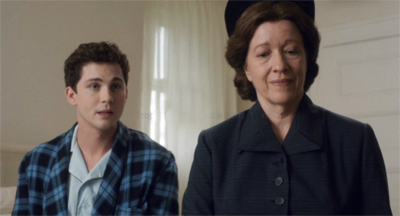
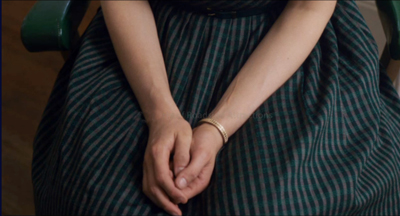
This is sharp visual storytelling. Marcus is unaware of his mother’s observation, but we’re prepared for her later admonition that he’s getting involved with a woman who will bring him misery. (Marcus: “She slit one wrist.” Mrs. M.: “One is enough. We have only two, and one is too much.”)
We’re also a beat ahead of Marcus in one neat shot that shows him stepping onto the quad as he’s facing expulsion. We see his future before he does; the marching ROTC students in the background catch our notice before a rack-focus brings him up to speed.
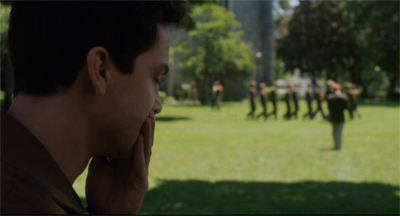
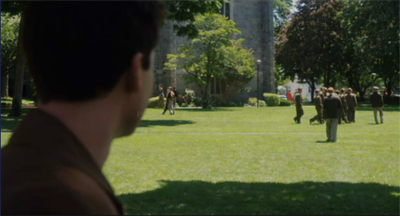
We’re also invited to see parallels that pry us a bit away from Marcus’s immediate experience. At two crucial moments, the adults trying to intimidate him—Dean Caudwell and his mother—come around behind him to keep wheedling.
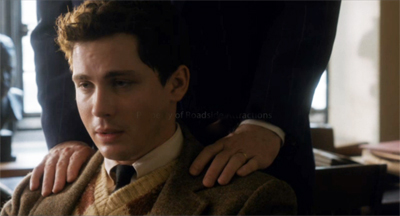
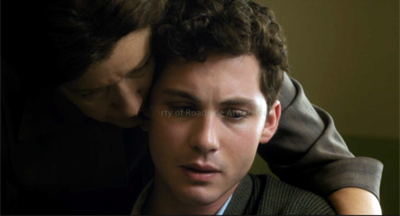
The know-it-all debater has a chance when fighting face to face, but he crumbles when authority steers from behind.
Above all, our attachment to Marcus is qualified by a second frame, the one that wraps the whole fiction. This is wholly Schamus’s invention—a nested structure of the sort characteristic of 1940s films. At the very beginning and end of Indignation, we see an elderly Olivia in a care facility staring at the wallpaper dotted with a pattern of flowers in a water carafe. The image (also on a skirt she wears in the college portion) harks back to her impromptu bouquet for Marcus in the hospital.
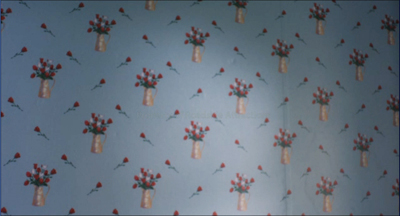

But of course we’re inclined to ask: How likely is it that such a pattern would be used on wallpaper, and would it so neatly coincide with an item in Olivia’s past? We could then ask whether the pattern is in her imagination. (There is a sort of blurring and refocusing on the pattern, suggesting her optical viewpoint.) And since her scenes in the facility bookend the entire film—the Korean War frame, which in turn encloses the Winesburg College days—we might ask whether everything we’ve seen isn’t a product of her fantasy.
I’m not inclined to say that she has made up the whole movie. Indeed, if the wallpaper pattern is her projection, it would have to be so not just in her optical POV but also in the wider shot of her, the first image we get of her as an old woman.
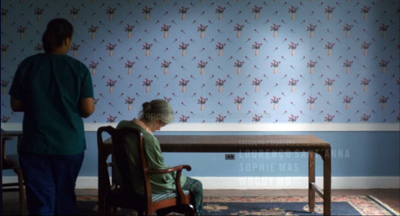
Maybe this room, Caligari-like, is a total projection of her memory? More likely, it’s objectively there but triggers her recollection of Marcus. I’m still uncertain, but it does seem that giving Olivia the ultimate framing for the tale via their shared moment with the flowers suggests that Marcus, who at the end of his last monologue is calling out to her, has somehow finally made contact.
In any event, a purely formal cadence, completing the ABCBA structure and revisiting an ambivalent motif in the film, can balance, in aesthetic terms, the absence of answers to questions posed in the story world. This appeal to geometrical architecture and symmetrical construction is, since Henry James, another novelistic convention: art’s order can frame, if not completely account for, the disorder of life as it’s lived.
Goliath wins
The sequence that has everybody talking is the sixteen-minute two-hander between Marcus and Dean Caudwell. It’s in the book, but Schamus and his players have brought to life the clash between idealism and suave, well-practiced bullying.
Straddling the film’s midpoint, this scene enacts the old proverb. “Old age and treachery trumps youth and skill.” It starts with a simple bureaucratic issue: Marcus’s transfer out of the dorm to a shabby, solitary room. This incident leads Dean Caudwell to charge him with stubbornness, lack of compromise, secrecy about his Jewish identity, friction with his family, intellectual arrogance, and cowardice. The whole cascade is punctuated by the Dean’s intermittent requests to stop calling him “sir.” It’s a verbal boxing match with Marcus gamely fighting on after quite a few low blows. Nobody who read Why I Am Not a Christian in their youth (as I did) can fail to be roused to self-righteous fury by Caudwell’s calm, close-minded innuendo.
Still, in such duels dialogue and performance need to be orchestrated with framing and cutting. Steve McQueen’s solution in Hunger (2008) is the use of a sixteen-minute profile long-shot, followed by a cut in to Bobby Sands’ hand picking up his cigarettes, and then a very tight close-up of his face as he continues speaking.
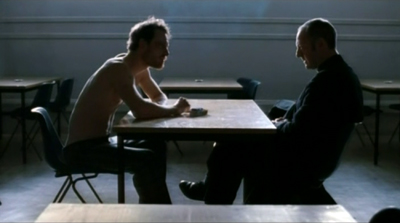
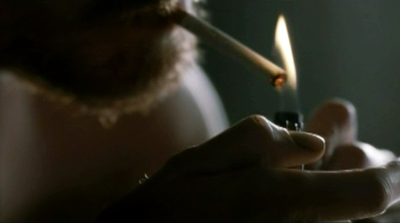
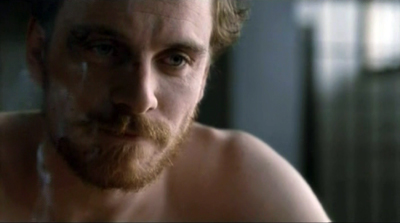
The interruption of the long take gives special prominence to a shift in the conversation, when Sands recalls his childhood. Later shots revert to shorter shot/ reverse-shot exchanges.
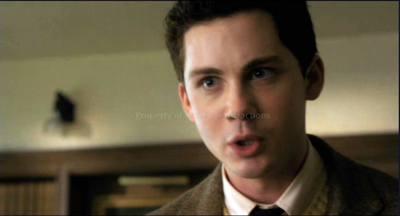
So framing and cutting can articulate phases of the drama. This Schamus does very carefully in the Indignation scene. To abbreviate:
Phase 1: More or less businesslike and polite: Why couldn’t Marcus compromise with his roommate? 180-degree cuts, with framing favoring Dean Caudwell–centered and dominating Marcus.
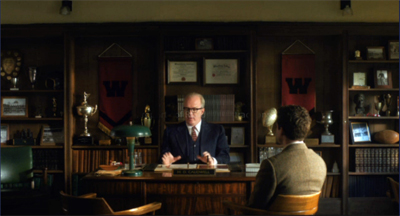
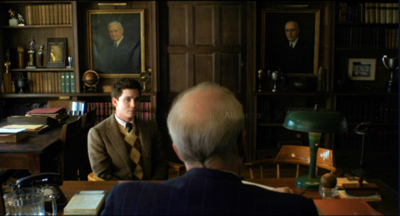
Phase 2: Caudwell gets personal. Why didn’t Marcus identify his father as a kosher butcher? Eventually he’ll accuse Marcus of intolerance. Here a fairly lengthy profile shot reminiscent of Hunger gives way to shot/ reverse-shot.
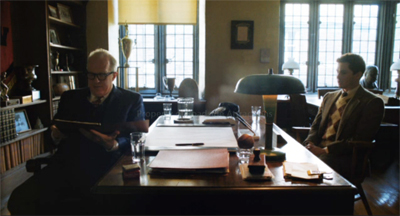
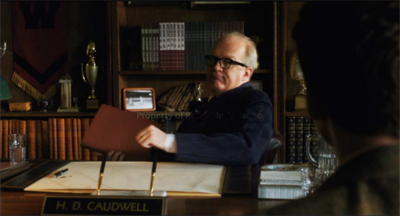
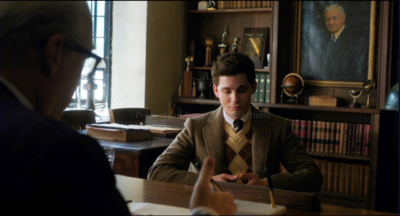
Phase 3: More personal probing: How does Marcus get along with his family? What about his sex life? And religion? After more shot/reverse shot, Marcus, sweating and feeling sick, rises to defend himself in close-up. That calls forth the closest shot yet of Caudwell.
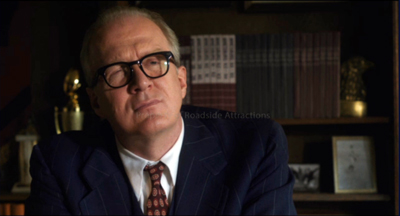
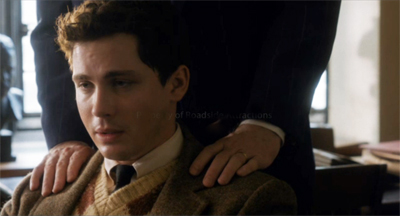
Phase 5: Caudwell says Marcus’ sophistry will make him a fine lawyer. He comes to stand behind Marcus, putting his hands on his shoulders. Then he sits beside him, to drill in still more. Marcus, shaky, asks to leave.
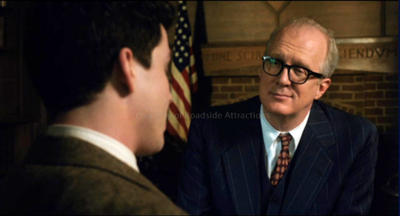
Phase 6: At the door: Marcus is feeling sick. The dean asks if he’d like to play baseball. Finally Markus collapses and starts vomiting.
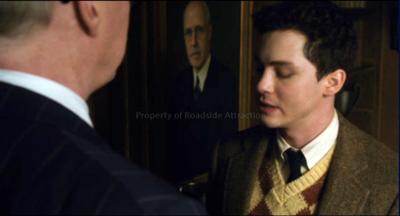
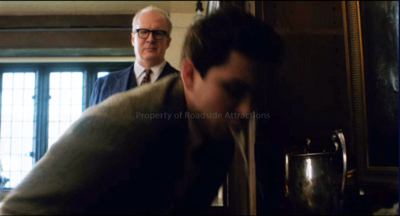
Schamus has saved shot/ reverse shot for when the scene heats up, and saved his close-ups for when things reach a pitch. This reminds us, as the Hunger scene does, that if you’re going to use a standard technique, hold off until it will do the most good. Ditto for the low angle on Marcus throwing up; that comes with more force if we haven’t already had low angles before. Schamus has let his cutting and shot scales amp up the drama without the crushing emphasis supplied by so many directors. Yes, I’m thinking of the barrage of close-ups in every dialogue scene of Jason Bourne. (Thanks to Paul Greengrass, Tommy Lee Jones’s facial contours qualify for Federal Drought Relief funds.)
I think that Indignation will be studied for years as an intelligent adaptation of Roth’s novel, but it ought also to be admired as a well-crafted work in its own right. It finds fresh ways of molding fiction techniques to the demands of cinema in general and Hollywood tradition in particular. And the film reminds us—or me, at least—how much contemporary filmmaking owes to the consolidation of “novelistic cinema” seventy years ago.
Thanks to James Schamus, Gustavo Rosa, and Lauren Hynnek for information and assistance, . For more on James’s career, see our entry.
Students of literature might find another novelistic analogy in Olivia’s explanation of her suicide attempt. It somewhat resembles the technique of free indirect discourse, when the third-person authorial voice adopts the language and syntax of the character’s thought. Roth employs this in the third-person tailpiece of his novel. Instead of “If only I hadn’t let Cottler hire Ziegler to proxy for me at chapel!” we get “If only he hadn’t let Cottler hire Ziegler to proxy for him at chapel!” Is it possible to have a cinematic equivalent: an objective vision that is pervaded by the character’s state of mind? Pasolini thought so, and suggested Red Desert, Before the Revolution, and Godard’s films as examples of it. Perhaps this flashback sequence counts as a case of Pasolini’s “free indirect subjective.”
In The Way Hollywood Tells It I briefly discuss the resurgence of 1940s storytelling strategies in recent studio cinema (pp. 72, 83). A general discussion of my interest in 1940s narrative is here. Elsewhere I make the case for Tarantino reviving 40s formats; for the importance of Afterlifers in the Forties; for nested narratives like that of Indignation; for replays that provide new information; and for the blurring of subjective and objective in Nightmare Alley.
For more on novelistic strategies in film, see “Watching a movie, page by page” and Kristin’s entries on the Hobbit films, all linked here.

Indignation.
Hail, again, to the King
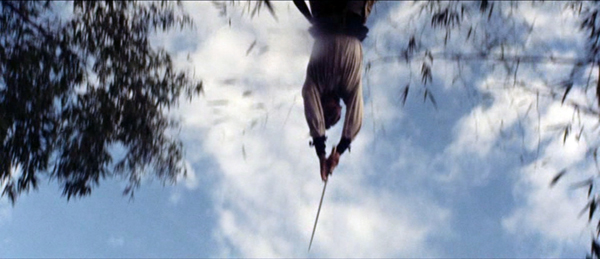
A Touch of Zen (1970).
DB here:
Criterion has just put out its DVD/Blu-ray of King Hu’s A Touch of Zen. I wrote liner notes for it, which are available on the Criterion site. I haven’t gotten my copy of the edition yet, but the reviews I’ve seen are praising Tony Rayns’ interview (no surprise) and the other features.
For more on one of my favorite cuts in A Touch of Zen, you can visit this blog entry (complete with splice marks). There’s also a discussion of the goldenrod combat here. In Poetics of Cinema, there’s a longer essay called “Richness through Imperfection: King Hu and the Glimpse,” and a chapter of Planet Hong Kong is devoted to comparing his work to Chang Cheh’s and Lau Kar-leung’s.
With A Brighter Summer Day, this is another Criterion triumph and a must for every cinephile. And why am I never around when a swordswoman flies by?