Sunday | January 12, 2014
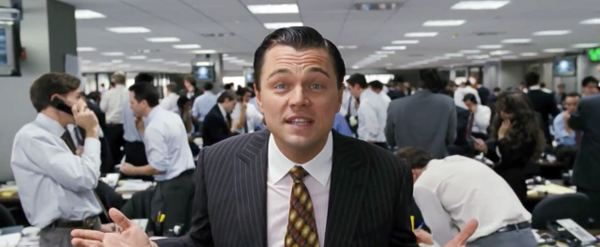
The Wolf of Wall Street.
DB here:
At many points in The Wolf of Wall Street, we hear the voice of Jordan Belfort chronicling his exploits in building up a rapacious investment company. A few times he even addresses the camera.
What’s he doing? Well, he’s telling us a story, obviously. Stories are what many (not all) films present to us. But how, exactly, can we understand the storytelling process in film? What do the filmmakers do, and what do we do?
For my book Poetics of Cinema, I wrote a chapter called “Three Dimensions of Film Narrative.” This 2007 essay tries to come to grips with several questions. Some are pretty general. What makes a film a narrative? How does a narrative film shape our response? What roles do visual and auditory techniques play? What are the roles of emotional responses and broad cultural factors? How does characterization work in a movie?
Other questions are narrower. How revelatory is Hollywood’s three-act model of plot? How do we pick out a story’s protagonist? Do literary concepts like “narrator” and “implied author” apply to films?
Since the chapter is part of a larger book, some of these matters are dealt with at greater length in other chapters. Some are developed in other books, notably Narration in the Fiction Film, and elsewhere on this site. This essay was my attempt to boil down my thinking about filmic storytelling into one convenient, if sometimes sketchy, form.
Today I’m posting a corrected, slightly revised version of that chapter as a downloadable pdf file. Thanks to our web tsarina Meg Hamel, it has links as well. Students, teachers, researchers, and casual or ardent cinephiles: Make use of this as you like.
The essay is here.
This blog entry is a guide to the essay, or maybe just a trailer. As with a trailer, my use of The Wolf of Wall Street is illustrative; I’m not offering anything like a full analysis or even a review. And like most trailers, mine has spoilers.
The three dimensions I explore in the essay are narration, plot structure, and story world.
Dimension 1: Pushy narration
A film’s narration I take to be unfolding and organization of story information as the viewer encounters it, moment by moment. . (This is distinct from the term “voice-over narration,” like Jordan’s in The Wolf of Wall Street, though voice-over commentary is part of the overall narration.) Narration is designed to shape our itinerary through the film. It’s a complex array of cues that guide us in building up the story.
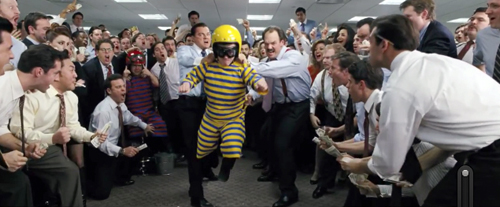
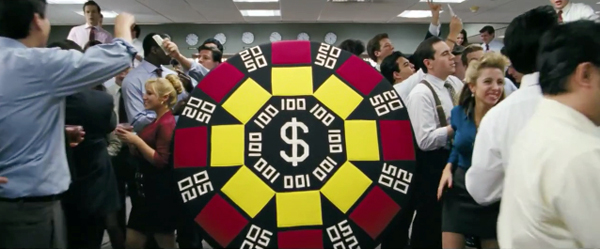
In The Wolf of Wall Street, the first dose of information we get is a TV commercial for the Stratton Oakmont investment company. We see busy, efficient brokers bent over their desks in a vast office as a lion paces the aisles. But then we get another view of the office, as partying staff prepare to launch a little man in a Velcro suit toward a target. The man is hurled, and one of the men who tosses him identifies himself as Jordan Belfort. We’re then launched into a sequence laying out Jordan’s lifestyle.
One thing this portion of the narration does is to peel back the staid, solid image of the brokering house and show the orgiastic self-indulgence behind it. What if Scorsese and his screenwriter Terrence Winter hadn’t included the commercial? Our sense of the contrast between public image and internal debauchery wouldn’t be so strong.
The quick scenes of Jordan’s lifestyle, driven by drugs, sex, and high living constitute a block of concentrated exposition. The narration could have introduced Jordan’s debauchery gradually through hints, but instead we’re told of it bluntly and swiftly. Jordan boasts that at age 26 he made nearly fifty million dollars a year. We’re coaxed to ask: How did he get so far?
This is, we might say, a curiosity question—a question about what in the past led up to the present. A film’s narration is often prodding us to ask just this question. A piece of narration may also provoke effects of surprise, as when the Velcro-target episode undercuts the corporate image. Surprise is central to narrative because knowledge is distributed unequally among characters and spectators; any character may have a secret.
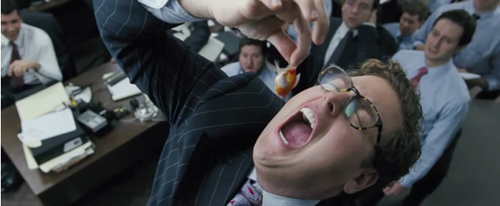
There’s also suspense, which we can consider broadly as a sharpened anticipation of what might happen next. In The Wolf, I’d argue that there’s some suspense when Jordan, zonked on Quaaludes, must save Donnie from choking on a piece of ham. Curiosity, surprise, and suspense aren’t of course the only effects of storytelling, but they function as “master-effects,” in Meir Sternberg’s phrase. They are central to our comprehension of the story.
Style as narration
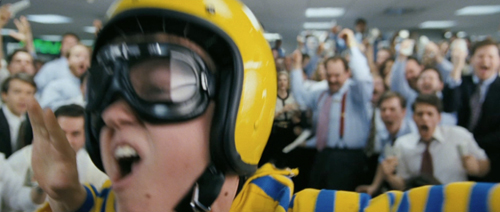
At the same time, narration is shaping our experience through film style. The staid tracking shot along the desks in the commercial, with the firm’s trademark lion prowling the aisles, clashes with the abrupt editing and freeze-frame that introduces Jordan. The actors’ performances, centrally the swaggering performance of DiCaprio, are part of narration as well. The soundtrack’s stylistic texture contributes a lot too, with Jordan’s voice-over and the music and effects creating a rousing, exhilarating effect. The narration’s use of film technique, I think, aims to summon up a shocked but fascinated and amused awareness of the decadent world that Jordan rules.
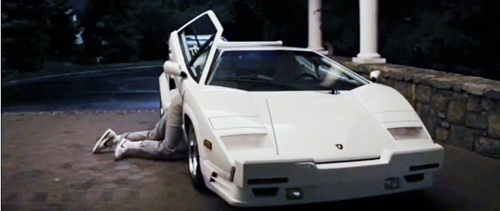
Throughout Wolf, Scorese’s stylistic choices serve narrational purposes. There are rapid montage sequences, commenting musical tunes, and dialogue hooks (“I won’t call him”/shot of Denham, called, approaching Jordan’s yacht). Scorsese’s fondness for rendering psychological states—here, druggy ones—is presented through classic “impressionist” techniques. As the film goes on, he starts to take us into characters’ minds through inner monologues and misperceptions (the smashed Ferarri). Stylistic patterning also contributes to the film’s tone of grotesque comedy, not just through the dialogue, delivery, and music but through editing. The potentially dramatic moment of Jordan rescuing Donnie with CPR is intercut with a Popeye cartoon: Jordan’s miraculous spinach is coke.
By shaping our knowledge, the narration also throttles the film’s emotional appeal up or down. For example, in one scene Jordan punches his second wife Naomi. Scorsese presents the action in a distant shot, in which a doorway allows us merely to glimpse the violence.
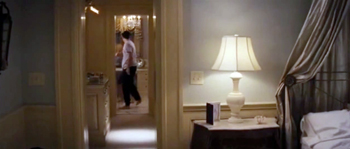 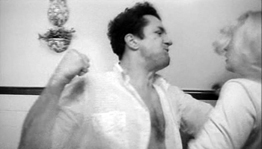
This choice lessens the impact of Jordan’s aggression. It gives us important information about the story action, but not nearly as forcefully as the tight close-ups of sexual and drug-fueled escapades in other scenes do. You could argue that closer and more visceral views (of the sort we get during Raging Bull’s domestic violence, as above) would make it harder to treat Jordan’s bad-boy high-jinks as entertaining.
A more detailed analysis would trace the overall development of the film’s narration. We’d consider, for instance, how it restricts our information at key points. Although the narration breaks with its attachment to Jordan to show Denham’s investigation, it doesn’t reveal Naomi’s scheme to divorce him. We learn of that only when he does. As we indicate in Film Art: An Introduction, “Who knows what when?” is a central question for understanding film narration.
Narration as inference-making
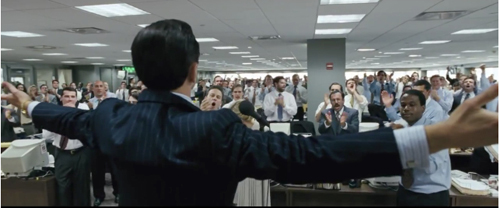
More generally, the essay develops in some detail a notion that’s central to understanding narration. I offer a mentalistic account of narrative understanding.
I think that a storytelling movie, through its narration, impels us to draw inferences. To follow a movie story is to turn the images and sounds into characters, actions, events, causes, and the like. This happens partly through fast, automatic inferences of the kind we make constantly in perceiving the world, and partly and more evidently through the inferences we make in building up that construct we call the movie’s story.
Everything I’ve been describing so far asks us to fill in, extrapolate, and draw conclusions at the level of comprehension. We take the Stratton Oakmont commercial as indicating trustworthiness. We’re encouraged to see the little-person-tossing scene as outrageous and boisterous but cruel, the amusement of people charged with a reckless energy. Jordan’s bragging montage sequence invites us see him as powerful, arrogant, and materialistic.
By saying that narration pushes us to make inferences I’m not suggesting that the inferences are models of deep thinking. They are, we say, commonsensical. In the multiplex, we’re not logicians. Understanding and responding to a story are processes based largely on folk psychology. In that respect, the chapter argues a point I’ve made elsewhere on the site.
Of course not all our inferences will be correct. It would be possible to knock down our first impressions of Jordan with information suggesting that beneath the sharkskin is a likable idealist. (That happens in Jerry Maguire.) Here, other sorts of moments steer our inferences astray. We’re led to think that Jordan drives his Lamborghini home safely, but that impression gets recalibrated the next morning. Earlier, when Denham visits Jordan on his yacht, the rather long, tense scene leads us to consider the possibility that the FBI agent is susceptible to bribery. His questions and facial expressions suggest that he’s weighing Jordan’s offer to help him with some investments. This interchange is conveyed in fairly tight shot/ reverse shots.
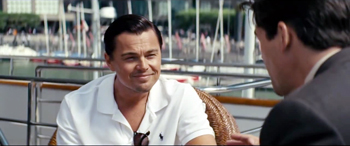 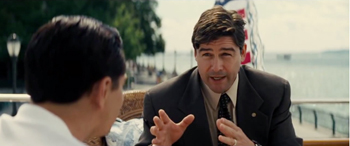
Only when Denham asks Jordan to repeat his offer does Scorsese cut to an angle showing that Denham’s colleague has, offscreen, quietly stepped close enough to bear witness to the bribe Jordan might offer.
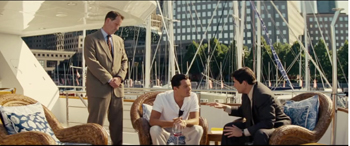
Scorsese has choked off some information about the scene in order to yield a surprise, one that corrects the impression we were building up. One of cinema’s great pleasures is catching up with a narration that has been designed to lead us astray. Hitchcock fans, take note.
Dimension 2: Plot as pattern
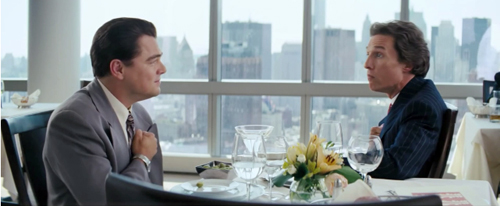
You can also think about the narrative as having a more abstract, geometrical structure: that’s given to us as the plot. Narration creates on-line, moment-by-moment pickup; as viewers we go with the flow. The plot is more architectural, a sort of static anatomy of the film as a whole. We can think of it in a couple of ways.
As a map of a particular film, the plot consists of the overall arrangement of incidents. It lays out the story actions in time. It can proceed chronologically, as plots do most of the time, or it can rearrange incidents out of linear order. The Wolf of Wall Street follows the Stratton Oakmont commercial with the Velcro-target scene, and then presents Jordan at the height of his powers. But after the quick exposition of his lifestyle, the plot flashes back to his first day on Wall Street in 1987.
Now the film presents a mostly chronological layout. Jordan gets his broker’s license, loses his job, picks up a low-end one, and then rises to the spot running his company. This trajectory is sometimes interrupted by quick flashbacks filling in background on a character or a situation; we even get flashbacks within flashbacks. The overall time scheme is hazy, since we’re never shown exactly what point in time is “now.” There’s the suggestion that the initial flashback is rounded off when Jordan’s cohorts meet to plan the Velcro-tossing stunt, but that opening scene isn’t replayed, so we can’t be sure exactly when the opening flashback ends. The flashback must be finished at some indeterminate time late in the film, when Jordan’s fortunes decline and Naomi is alienated from him. But the narration whisks us along without establishing the firm framing devices of traditional flashback plotting.
From this perspective, every film establishes its own plot structure, based on the overall “geometry” of its scenes and sequences. There’d be a lot to say about this in The Wolf, such as the introduction of Denham (and the brief alternating scenes of his investigation) and the various lines of action that fill out the plot: Jordan’s addictions, his plan for an IPO, his two marriages, the SEC inquiry, his Swiss money-laundering schemes, and the like. The craft of screenwriting consists in large part of developing and braiding lines of action in this way. Several entries on this site, as well as many chapters of Narration in the Fiction Film and Poetics of Cinema, analyze how such plot patterns work in tandem with the narration’s unfolding.
Caught in the act(s)
Another way to think about plot structure is to consider how the particular film obeys broader principles of construction. Tragedy, comedy, melodrama, mystery stories, and other genres have distinct, widely-known conventions of plot geometry. There are as well traditions of plotting that cross genres.
In modern commercial cinema, the most famous structural convention is the three-act pattern. Kristin has proposed that Hollywood feature filmmaking is better thought of as adhering to a multiple-part principle based on characters’ goals. The film might have two, three, four, or more parts, depending on its running time and the ways it shows character goals created, reformulated, blocked, delayed, and fulfilled (or not). We’ve tested Kristin’s proposal in books (Storytelling in the New Hollywood, The Way Hollywood Tells it) and on this site (here and here and here and here).
The essay considers the matter more theoretically, but just to illustrate, I’ll hazard a layout of The Wolf of Wall Street’s plot structure. It’s nothing but spoilers, so I’ve flagged it all in olive green if you want to skip it.
Since Wolf runs about 173 minutes without credits, I think it can be usefully laid out in five large-scale parts. These are framed by a brief prologue (the commercial and the Velcro-target scene) and an epilogue summing up Jordan’s court sentence, his stay in a country-club prison, and his new career as “the World’s Greatest Sales Trainer.”
The Setup shifts from Jordan’s life at the pinnacle to his beginnings in the business and his rise as an entrepreneur. In the course of this portion he meets Donnie and the two assemble their team of eccentric, grotesque staff. After establishing Stratton Oakmont, Jordan demonstrates his sales technique and the script his salespeople will follow. This section consumes the first thirty-five minutes of the film.
What Kristin calls the Complicating Action, which resets the protagonist’s goals, centers on Jordan’s plan for an IPO and his affair with Naomi. Around the hour mark, Jordan is divorced and free to pursue the IPO, but now Denham of the FBI is following the company and the SEC is getting curious.
The Development section, which typically expands and delays the fulfillment of the goals set earlier, shows Jordan marrying Naomi, the firm’s frenzied launch of the IPO, and Jordan’s botched effort to bribe Denham. By about 96 minutes into the film, the two antagonists, Jordan and Denham, have faced off in a preliminary conflict. What remains is to see how Jordan will evade capture.
I’m inclined to see the fourth part as a second Complicating Action, because Jordan recalibrates his goal. Stratton Oakmont is making so much money he needs to find an offshore place for it. He decides on Switzerland, and the bulk of this section of Wolf focuses on whether he’ll be successful. But the SEC is breathing down his neck, and he momentarily considers quitting his firm. During a pep talk to his staff, his resolve weakens (he’s sold by his own rhetoric), and he decides to fight the regulatory battle. This is a turning point: now both the SEC and the FBI are on his tail with renewed vigor.
This section, a bit longer than the others, runs about forty minutes. I attribute that mostly to a wedged-in scene that’s almost pure delay: Jordan’s and Donnie’s wild night on Quaaludes, which ends with Jordan crawling toward his car, smashing it up, and saving Donnie from choking. Nearly all of this has no effect on the plot’s forward movement; Donnie survives and Jordan isn’t charged for the road mishaps. The only plot causality here is the fact that a wacked-out Donnie makes an incriminating call on Jordan’s home phone, which is tapped. This bit of action could have been handled much more briefly, but the Quaalude gluttony is so inherently funny, and forms such a plausible topper to the ‘lude motif throughout the film, that it’s expanded to a remarkable twelve minutes. This sort of delay is usually seen in Development sections, but because Jordan resets his goals in this section I’m considering it a Complicating Action.
The Climax (25 minutes) arrives when Jordan, hiding in Italy with Donnie and their wives, learns that Aunt Emma, his front for the Swiss money-laundering, has died. He must race back to Zurich to shift the money to a new account, and in the process the yacht is wrecked in a storm. He’s arrested and agrees to rat on his friends. Naomi divorces him. He tries to protect Donnie but fails and is sent to jail. In the epilogue he’s shown bouncing back, playing to an audience of suckers who share his dream of getting very rich.
Winter’s screenplay, with its parallelled and intertwined lines of goal-driven action and its reiteration of one large-scale component, a second Complicating Action, shows how the classical pattern can be expanded to fill out a longer-than-average running time.
Dimension 3: The story and its world
There’s a tendency to think of the story action as existing virtually before it becomes a plot and is presented through narration. It’s as if the story was already there, waiting to be turned into a film. To some extent, this can happen with documentary narratives and adaptations of novels, plays, and comic books. Nonetheless, as viewers we access a movie’s world only through narration and plot structures. In fact, “access” isn’t quite right. As I’ve indicated, I think that we construct the story inferentially, on the basis of the cues given by those other dimensions.
If every viewer has to build up the story herself, shouldn’t we have widely different senses of what happens? To some extent we do. People might fill in certain gaps differently, or draw divergent conclusions about what made something happen. Certain films, not typically Hollywood ones, do encourage more open explorations of the story situations. Here plot construction and narration may follow other conventions, such as those I’ve tried to chart in Narration in the Fiction Film and elsewhere.
Mostly, though, even in “independent films,” there’s a great deal of convergence among viewers’ inference-making. Sooner or later, we arrive at a common understanding of most of what happened and why. As we leave the shared realms of perception and comprehension, of course, viewers’ construals can diverge a lot. Once we get to abstract interpretations—such as whether The Wolf of Wall Street celebrates or condemns the anything-for-a-buck culture—we should expect a lot of variations. (I try to explain why this happens elsewhere in the book, in the essay “Poetics of Cinema.”)
“Three Dimensions of Film Narrative” considers the story and its world broadly, in terms of cues for causation and characterization. It focuses particularly on characters and how we understand them. Again I argue for an inferential model. This means that, as in real life, we’re practicing “mind-reading”—trying to figure out characters’ traits and temperaments on the basis of their behavior, trying to grasp their motives and goals. We build them up as persons on the basis of cues, and we ascribe to them many of the qualities we expect persons in the real world to exhibit. Again, folk psychology provides the ground: the film is likely to streamline and simplify the complexities of real-world personhood.
As viewers we don’t understand a character in isolation. Characters interact, and the narration and plot structure prompt us to compare them, rank them, sort them in different ways. In The Wolf, Jordan is handsome, brazen, and suave; Donnie, a classic weak friend, is awkward and homely, but he has a primal energy that matches Jordan’s slick élan.
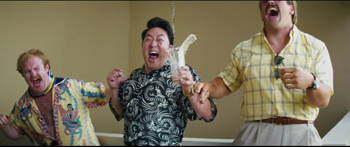
Jordan’s father and most of his elders are more prudent and cautious than his crew, who are uninhibited. The guys are a bevy of misfits, distinguished from one another by looks and one or two tricks of demeanor.
Jordan’s first wife is a brunette hair stylist who voices doubts about his schemes; his second wife is a gorgeous blonde party girl who happily plunges into his lifestyle. In each case, the narration and the plot structure give us the necessary cues, usually redundantly. Jordan’s voice-over commentary reinforces the character information we get from the actors’ appearance and performance.
The essay also considers how films present character change. Sometimes characters come to learn more; they may not vary their distinguishing traits but they realize they have made a mistake. More deeply, characters may decide to get in touch with a suppressed side of themselves. That’s what happens, I think, in Jerry Maguire; he becomes the man his wife thinks he could be.
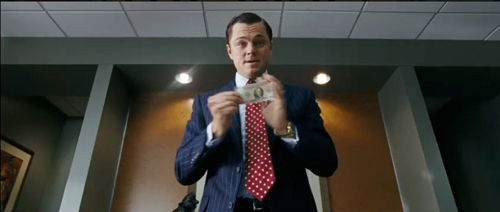
But very often characters don’t change. Jordan, in The Wolf of Wall Street, has an opportunity to confess, return the money he fleeced from his clients, and take his punishment. Instead, he insists that everything he’s done has been for his friends—the staff of the firm—and they deserve to succeed as he has. (Even though he is deceiving them too; he buys shares in his own IPO and orders the salespeople to push that stock.) What shocks many viewers about the film, I suspect, is that Jordan doesn’t become a better person in the course of his adventures. His punishment is light, he learns nothing, and by the end of the film he’s as amoral as he was when he started the company. (“Sell me this pen.”) As sometimes happens, the interest of the plot comes from watching a gifted, resourceful scoundrel adapt his techniques to changing situations.
But wait, there’s more
Okay, you may be asking impatiently. But why? Why offer these categories, carve things up, make supersubtle distinctions, concoct new terminology? Why not just do film criticism?
Well, partly because I want to articulate more than my response to a particular movie. I want to understand the more general ways in which films work and work upon us. I think we can usefully look for explanations of movies’ functions and effects, and these are things that ordinary film criticism doesn’t typically offer. For example, noticing how a film’s elements function with respect to narration, plot, style, and story world can do more than sensitize us to this or that movie. This sort of analysis can make us aware of broad norms of moviemaking and how particular films relate to those norms, currently and historically.
At the same time, the line of thinking I’m proposing casts light on the skills we deploy, mostly unawares, in experiencing films. No matter how simple-minded the movie, I think that we do things in following it; we exercise our narrative competence. On the other side, sorting things out this way can explain the range of choice and control open to the filmmaker. I think that the poetics of cinema I propose can help filmmakers become aware of the tools they are using–and perhaps encourage them to try other ones. My categories are derived from filmmaking craft, and perhaps they can in turn illuminate the practical tasks facing filmmakers.
A couple of final points. In the chapter I draw examples from a variety of films, many American (Cellular, Boyz N the Hood, You’ve Got Mail, etc.). Despite my consideration of Ashes of Time, Claire Dolan, Memento, and other films, some readers will ask why I don’t consider more non-Hollywood examples. The choice was strategic: Hollywood films throw the areas I’m charting into sharp relief. They provide clear-cut (not necessarily simple) examples of my points. And historically, the dominance of Hollywood film in the world’s theatrical market have given them a lot of influence. Much of what we think of as non-Hollywood is based on attempts to revise or reject those norms.
At the same time, I’m counting on readers cutting me some slack because I’ve written a lot about alternatives to Hollywood. My books on Eisenstein, Ozu, Dreyer, and Hong Kong cinema try to analyze diverse storytelling options. Elsewhere in Poetics of Cinema I discuss various narrative traditions, including varieties of network narratives and forking-path plots. Narration in the Fiction Film explores still other storytelling modes. And on this site I’ve had a lot to say about non-Hollywood constructive principles (for example, here and here).
The last section of the essay considers what is probably inside-baseball for many readers. Yet the underlying question is important. How adequately can film narrative can be understood on a model of literary narrative? Some theorists think that the basic principles of narrative are to be found in verbal storytelling, and narratives in other media must find equivalents for them. My own view is that narrative as a phenomenon gets mapped onto different media in varying ways. There may not be a single model that will be valid for plays, novels, dance, comic strips, radio drama, film, digital fiction, and so on.
For example, if Jordan Belfort were a character in a novel, certain weird things wouldn’t be happening onscreen. A first-person narrator in the novel can tell us only things that she or he knows about. But “inside” Jordan’s tale we get all kinds of scenes that he didn’t witness. True, he knew that FBI agent Denham was on his trail, but he couldn’t know the color of Denham’s office, or what Denham said to his colleagues. Nor could Jordan know exactly how the quarrel between his partner Donnie Azoff and his ally Brad Bodnik went down, even though we see the entire scene embedded in “his” telling.
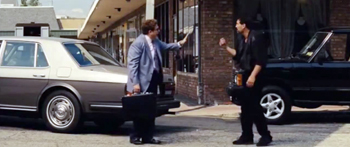
Of course we can say that these scenes are just movie conventions. We accept that in film, first-person voice-over often includes scenes that the speaker didn’t witness, or maybe didn’t even know about. But that convention points to the limits of importing models of storytelling from literature to the study of cinema. A novel can’t wedge those things in without raising the question of how the narrator knows this. We just don’t ask such a question about Jordan.
By a path too winding to summarize here, these and other observations lead me to a counterintuitive conclusion: Narrative, at least in film, isn’t best understood as an act of communication from an author-like entity to a reader-like one. Why do I say that? How can film not be communication? Answer, too brief: What most people call communication I call converging inferences.
And to end my trailer, I suggest that we think of narrative in all media, most especially film, as inherently promiscuous. It will pull in anything that gets the immediate job done. That includes grabbing one element of ordinary conversation–a guy telling a story–without keeping the other bits of the communicative chain, such as feedback from a listener. Jordan is talking to us, but he doesn’t know we’re here, and we can’t interrupt him.
One more time: You can get the essay here. Thanks for reading!
In a way this post is a sequel to the previous entry; background on Meir Sternberg’s account of curiosity, suspense, and surprise can be found there. For more on the subject, see our category “Narrative strategies” and the essay “Common Sense + Film Theory = Common-Sense Film Theory?”
Many of the everyday terms we apply to stories are ambiguous or vague, so sometimes we need to define our terms or invent new ones. Take “narration.” In ordinary talk, can mean “voice-over commentary,” such as Jordan Belfort’s in The Wolf of Wall Street. But if we restrict our usage to just this form of sound, we don’t have a good term for the general flow of narrative presentation in the film, let alone films that don’t have voice-overs. So it’s useful to reserve “narration” for that general process and use “voice-over” in some form to describe the soundtrack’s role in that.
The same problem comes up with the term “point of view,” which has many different meanings. It might refer to first-person reportage, or what a character thinks and feels, or what she believes. (Obama is a good president from her point of view.) If we want to be precise in talking about these qualities of storytelling, we need to explain the terms we’re using.
And sometimes it’s just easier to introduce new terms. In the essay, I’ll sometimes call the plot the syuzhet and the story the fabula. Why the fancy terminology? Won’t “plot” and “story” do? Well, yes, up to a point. In this entry I did use those terms, and our textbook Film Art: An Introduction has done that ever since its first edition of 1979. Still, when we’re working within a research community, it helps to have terms, even unusual ones, which say exactly what we mean. The original readership for the “Three Dimensions” chapter knows that “plot” and “story” have different meanings in our culture, and so I tried to use terms that were less ambiguous. Not incidentally, I wanted as well to signal my debt to the Russian Formalist literary critics, perhaps our first modern narratologists.
Other chapters of Poetics of Cinema are posted online here.
P.S. 14 January 2014: Thanks to Steve Hilby for correcting me: I originally mis-identified Jordan’s car as a Ferrari.
P.S.S. 14 January 2014: My old friend Brian Rose signals his Academy interview with the filmmakers, in which Scorsese and Schoonmaker declare a lack of interest in “plot.” Pfui, says I.
Posted in Directors: Scorsese, Film comments, Film theory: Cognitivism, Hollywood: Artistic traditions, Narrative strategies, Readers' Favorite Entries |  open printable version
| No Comments » open printable version
| No Comments »
Sunday | January 5, 2014
DB here:
It is 1935. Mr. George Boxley is a prominent writer who has been brought to Hollywood. He is working with two other screenwriters on a story, but he feels angry and dissatisfied. His collaborators ruin his contributions, and when he writes solo he produces “interesting talk but nothing more.” He has come to the head of production to complain, and beneath his annoyance lies a mild contempt for the movie craft.
He has tried to adjust his standards to movies, he explains, by having his dialogue delivered while his characters are dueling. At the end of the scene one falls into a well and has to be hauled up again.
The studio chief, Monroe Stahr, asks if Mr. Boxley would include such a scene in a book of his own.
“Naturally not.”
“You’d consider it too cheap.”
Boxley replies: “Movie standards are different.”
“Do you ever go to them?” Stahr asks.
“No,” confesses the parvenu screenwriter. “Almost never.” He explains, defensively, that movies are full of things like duels and falling down wells “and wearing strained facial expressions and talking incredible and unnatural dialogue.”
“Skip the dialogue for a minute,” said Stahr. “Granted your dialogue is more graceful than what these hacks can write—that’s why we brought you out here. But let’s imagine something that isn’t either bad dialogue or jumping down a well. Has your office got a stove in it that lights with a match?”
“I think it has,” said Boxley stiffly, “—but I never use it.”
Mr. Boxley is about to get a tutorial in how to tell a movie story.
Behind the glitter
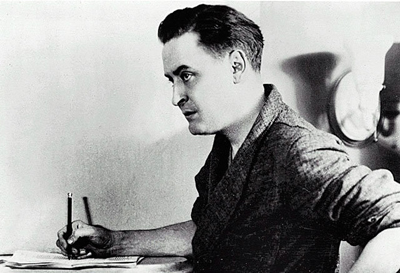
F. Scott Fitzgerald
There have been novels about Hollywood as long as the movie industry has been there. Most have been either straightforward wish-fulfillment (girl/boy from the sticks makes it big) or cautionary tales (boy/girl fails or becomes depraved). The more ambitious “Hollywood novel” has been more sour and sweeping. It presents itself as a harsh exposé that makes a broad social comment on picture-makers, their public, and the society that spawns both.
This serious Hollywood novel is largely a creature of the late 1930s. Wedding hard-boiled style to Depression-era realism, Nathanael West’s Day of the Locust (1938) and Horace McCoy’s I Should Have Stayed Home (1938) present stark, aggressively despairing accounts. In these books, Hollywood is America, only more so.
Both West’s and McCoy’s books fared poorly in the market. The triumph was Budd Schulberg’s What Makes Sammy Run? (1941), which found in the rapacious Sammy Glick a prototype of the modern entertainment entrepreneur. Schulberg daringly emphasized the fact that Sammy was a Jew, creating a controversy that lasted for quite a while.
The booming movie market of the war years, along with the fact that more novelists found themselves involved with the studios, made the 1940s something of a golden age of the Hollywood novel. The movie kingdom became the setting for dozens of murder mysteries, veiled memoirs, and satires—some written by practicing screenwriters. (Among the most notable: Ben Hecht’s offhand but heartfelt I Hate Actors!, 1944). At a higher level of literary prestige, there were two 1948 titles from Englishmen, Evelyn Waugh’s caustic The Loved One and Aldous Huxley’s Ape and Essence, a novel written as a pseudo-screenplay. But none of these finished works won the enduring fame of an incomplete story published in the same year that Schulberg introduced Sammy Glick.
Built on the grand scale
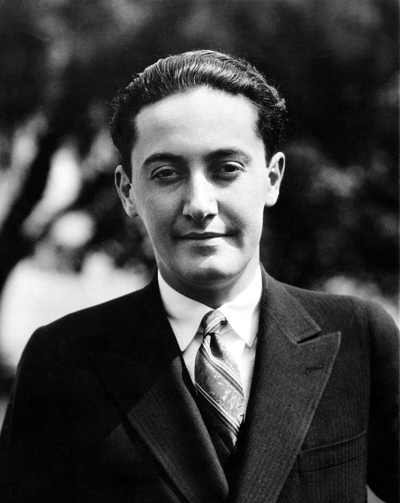
Irving Thalberg.
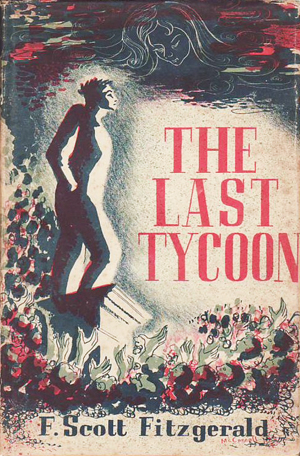
In 1939 F. Scott Fitzgerald had begun The Last Tycoon (perhaps intending to call it The Love of the Last Tycoon: A Western). By then his brief screenwriting career was over, but he was fascinated by MGM’s boy wonder Irving Thalberg, “one of the half-dozen men I have known who were built on the grand scale.” Fitzgerald decided to center his plot on Monroe Stahr, a Thalberg-like producer.
Stahr is a shrewd, intellectually gifted workaholic who is an expert in manipulating what is coming to be a new system of moviemaking. Brisk and efficient in the office, Stahr is occasionally cold and arrogant, but his primary trait is a remarkable sensitivity to the emotional temperature of each situation. He gains our sympathy because in private Stahr is sunk in melancholy, longing for his dead wife and hoping to find another woman to love.
When Fitzgerald died in 1940, he had completed less than half of The Last Tycoon. His long-time friend, the critic Edmund Wilson, assembled an edition that was issued in 1941, with the finished portions supplemented by notes and a five-act outline. The book had a great impact. The New York Times reviewer commented:
Uncompleted though it is, one would be blind indeed not to see that it would have been Fitzgerald’s best novel and a very fine one. Even in this truncated form it not only makes absorbing reading; it is the best piece of creative writing that we have about one phase of American life—Hollywood and the movies.
Matthew J. Bruccoli, who has brought out the authoritative edition, remarks:
Even in its preliminary and incomplete condition, The Love of the Last Tycoon is regarded as the best novel written about the movies.
Reading the book for my research on the 1940s, I became fascinated by its understanding of what we might call the Hollywood aesthetic.
That understanding begins with a recognition of the production process. Most Hollywood novels mention actual stars and directors, but The Last Tycoon goes beyond name-dropping. It takes us into the offices, the editing rooms, and onto the set when Stahr must fire a director. These scenes have an authority that most novels lack, assisted by Fitzgerald’s effort to present his mogul not as a monster but as a man of genuine, if sometimes dictatorial, charm, tact, and taste.
Setting his novel in 1935, Fitzgerald also registers how studio organization shifted toward a central-producer system. Stahr deliberately avoids learning the details of camerawork, editing, and sound.
He could have understood easily enough—often he preferred not to, to preserve a sensual acceptance when he saw the scene unfold in the rushes. . . . His function was different from that of Griffith in the early days, who had been all things to every finished frame of film.
One of Fitzgerald’s most cryptic notes indicates his recognition of different studio styles.
The Warner Brothers narrative writing and the Metro dramatic, packed—cut back and forth writing from Stahr.
This might be a reference to Warners’ vivacious montage sequences, which were sometimes considered “narrative,” while fully enacted scenes were called “dramatic.” The use of “cut back and forth” here exemplifies Fitzgerald’s occasional use of movie slang in his notes, as when he gets his characters on the Super Chief passenger train:
In a very short transition or montage, I bring the whole party West on the chief.
Like many intellectuals of his time, Fitzgerald was fascinated by the movies as an artistic medium. The standard version of film history was articulated in many books of the period, most notably Lewis Jacobs’ Rise of the American Film (1938). Fitzgerald dots his novel with commonplaces about the history of cinema.
She was reputed to have been on the set the day Griffith invented the close-up!
[Stahr] prepared for the meeting [with the Writers Guild] by running off the Russian Revolutionary Films that he had in his film library at home. He also ran off “Doctor Caligari” and Salvador Dali’s “Un Chien Andalou,” possibly suspecting that they had a bearing on the matter.
Astonishingly, Fitzgerald even considered calling his novel The Lumière Man.
Most original, I think, is the episode I’ve started to present to you. It’s an exemplary scene, showing how good Stahr is at his job. He subtly steers Mr. Boxley, the East Coast littérateur, toward returning to the screenplay. But he also tutors Mr. Boxley, and us, in a deeper awareness of how classical Hollywood aimed to tell its stories.
Just making pictures
Imagine, Stahr tells Boxley, you’re sitting in your office, tired out.
A pretty stenographer that you’ve seen before comes into the room and you watch her—idly. She doesn’t see you although you’re very close to her. She takes off her gloves, opens her purse, and dumps it out on the table.
Stahr continues. From her change, the young woman picks out a nickel and puts it on the desk. She picks up a matchbox and then takes her black gloves to the stove. She puts them inside the stove and starts to light it, when the phone suddenly rings.
The girl picks it up, says hello—listens—and says deliberately into the phone, “I’ve never owned a pair of black gloves in my life.”
The stenographer hangs up and kneels by the stove again.
Just as she lights the match you glance around very suddenly and see that there’s another man in the office, watching every move the girl makes.
Stahr pauses.
“Go on,” said Boxley smiling. “What happens?”
“I don’t know,” said Stahr. “I was just making pictures.”
Boxley feels he’s been wrong-footed.
“It’s just melodrama,” he said.
“Not necessarily,” said Stahr. “In any case nobody has moved violently or talked cheap dialogue or had any facial expression at all. There was only one bad line, and a writer like you could improve it. But you were interested.”
Question time
Throughout the 1930s, critics like Otis Ferguson praised American studio pictures for their clean, straight storytelling. The primary concern of Fritz Lang, for instance, “is with the rightness and immediacy of each fragment as it appears to you, makes its impression, leads you along with each incident of the story, and projects the imagination beyond into things to come.” I think that Stahr’s tutorial helps us understand how that blend of immediacy and flow, vivid moments and keen anticipation, works.
For one thing, the gloves scene doesn’t fit certain clichés about Hollywood. It isn’t spectacular; it’s not a chase or a fight or a seduction or a slapstick episode. As Stahr points out, nobody is dueling or falling down a well.
We often say that Hollywood movies emphasize plot (lots of action) over character (stereotyped, at that). But this scene doesn’t have much action, and we don’t know anything about the character. (We can’t even be sure she’s lying; maybe these gloves aren’t hers.) What we have is plot and character fused in a situation. The scene creates, out of mundane materials, a crisis.
We say that Hollywood films grab us through emotion. Do we feel strong passions here? Well, not so much. We say that Hollywood films make us identify with the characters. Are we identifying with the young woman, or the magically unseen Boxley, or the man suddenly revealed watching the whole thing? Not really. The paramount emotion, as Stahr points out, is that diffuse, low-level one we call interest.
What does grab us, I think you’ll agree, are the questions that are implicit in the action. Why does the woman leave a nickel on the desk? Why does she start to burn the gloves? Why does she deny owning black gloves? Why is the man watching her? And what will happen next?
Noël Carroll has developed a theory of narrative he calls “erotetic.” Telling a story, he suggests, creates a controlled cascade of questions. Sometimes they pile up, as here; sometimes a question is answered but the answer raises another question. Stahr’s lesson supports Carroll’s idea that in any art, narration is a matter of asking, postponing, and answering questions. Erotetic principles, Stahr suggests, are more central to Hollywood storytelling than obvious appeals like spectacle and gags.
Another narrative theorist, Meir Sternberg, has proposed that the “master effects” aroused by stories are curiosity, surprise, and suspense. Curiosity is a matter of wondering about what led up to the actions we’re seeing now. What has impelled our stenographer to burn these gloves? Surprise comes from revealing a gap in the telling’s continuity. This occurs when Stahr’s “pan shot” (“you glance around very suddenly”) reveals a man in the office watching her efforts. If curiosity involves the past, and surprise punctuates the present, suspense points us forward: What will happen next? Stahr’s anecdote breaks off just as we learn that the man is watching. Will he prevent her from burning the gloves? More generally, how will he figure in the plot to come? Sternberg’s three cognitive attitudes, which he considers fundamental to narrative engagement, are neatly wrapped up in Stahr’s toy example.
Every writer knows that coming up with a grabby scene is easy. The problem is paying everything off. So admittedly, Stahr has dodged the work of figuring out the whole plot. Nonetheless, his example should clarify one notion of Hollywood storytelling. Relatively easy to shoot (Mr. Boxley, close to the woman but mysteriously unseen, is obviously the camera), but demanding skill in pacing and performance, the scene shows, I think, the unpretentious power of that clean storytelling that Ferguson and his peers celebrated.
The intellectuals who throughout the 1930s and 1940s derided Hollywood as simple-minded and uncreative didn’t really drill down into the specifics of how the storytelling system worked. Fitzgerald did, perhaps because as a novelist he could observe and appreciate the craft of it—even if he couldn’t actually succeed at it himself. The Last Tycoon is a nuanced tribute to Hollywood as an aggressive business that need not necessarily suffocate richness of personality. It’s also a modest tribute to the power of a storytelling model that is only apparently obvious.
“What was the nickel for?” asked Boxley evasively.
“I don’t know,” said Stahr. Suddenly he laughed. “Oh yes—the nickel was for the movies.”
I’ve drawn my quotations of Fitzgerald’s working drafts from both Edmund Wilson’s 1941 edition of The Last Tycoon and from Matthew J. Bruccoli’s 1993 edition of The Love of the Last Tycoon: The Authorized Text. Each version contains many intriguing jottings that aren’t included in the other one. Quotations from the main text come from Bruccoli’s edition, except that I’ve corrected Fitzgerald’s misspelling of “nickel.”
I’ve been guided by Anthony Slide’s excellent bibliographical survey, The Hollywood Novel: A Critical Guide to Over 1200 Works (McFarland, 1995). See also Budd Wilson Schuberg’s portmanteau review, “Literature of the Film: The Hollywood Novel,” Films 1, 2 (Spring 1940), 68-78.
Janet Staiger explains how Thalberg, a prototype of the central-producer system during the 1920s, was gradually embracing the newer division of labor, that of the producer-unit system, in the early 1930s. See her chapter 25 in the book she wrote with Kristin and me, The Classical Hollywood System: Film Style and Mode of Production to 1960.
Noël Carroll’s theory of erotetic narration is explained in several of his publications; a convenient one is The Philosophy of Horror, chapter 3. For Meir Sternberg’s account of curiosity, suspense, and surprise, see his “Telling in Time” series in Poetics Today (Winter 1990, Fall 1992, and Spring 2006).
J. Donald Adams’ review of The Last Tycoon is in The New York Times (9 November 1941). My quotation from Otis Ferguson comes from “Fritz Lang and Company,” The Film Criticism of Otis Ferguson, ed. Robert Wilson (Temple University Press, 1971), 372.
An earlier entry on Ferguson further develops his ideas about the clean contours of Hollywood storytelling.
Elia Kazan’s film of The Last Tycoon includes the Boxley scene. Apart from adding unnecessary lines, it’s an exercise in ham, with other characters watching Boxley’s discomfiture and a smug Stahr (Robert De Niro) dashing about the room and pantomiming the action. Kazan’s Stahr burlesques the story situation he invokes, whereas I take the novel’s scene as a playful but sincere object lesson.
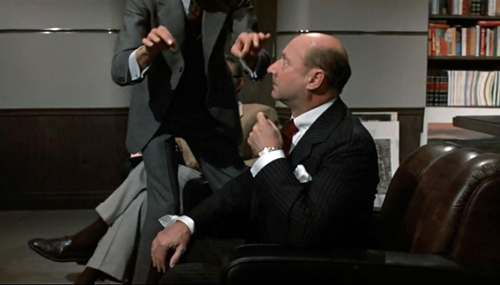
Stahr shows Boxley the black gloves in Kazan’s Last Tycoon.
Posted in Hollywood: Artistic traditions, Hollywood: The business, Narrative strategies | open printable version
| No Comments »
Sunday | December 29, 2013
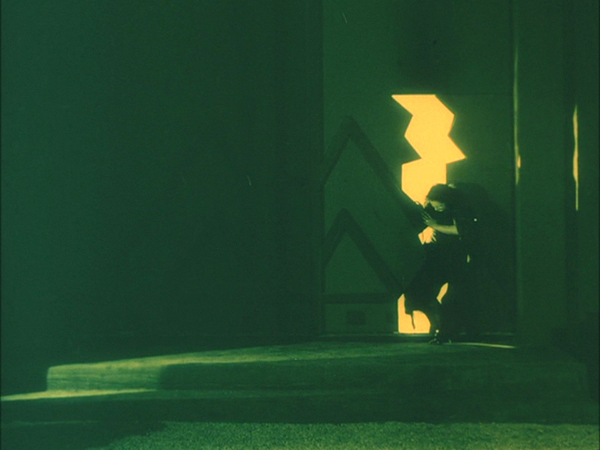
Le brasier ardent.
Kristin here:
Six years ago David and I celebrated the 90th birthday of the classical Hollywood cinema with a post that included a list of what we considered the ten greatest (surviving) films of 1917. Choosing the ten best films of 90 years ago has become a custom, one which helps us avoid doing a ten-best list for the current year. It’s a way of drawing attention to some wonderful but often little-known films, for those who are interested in exploring the treasures of silent cinema.
For previous entries, click here: 1917, 1918, 1919, 1920, 1921, and 1922.
For some reason, that 1917 list was pretty easy to put together. In recent years, I’ve had more trouble. As I wrote last year, “For the past two years, I’ve noted that it was difficult to fill out the list of ten masterpieces. I keep thinking that I’ll get to a year where I won’t have to say that, but 1922 turns out not to be that year. Some titles were obvious, but the last one or two took some hunting.” Well, 1923 still isn’t that year. I’ve again had some trouble filling out the top ten.
Why? 1923 should be packed with worthy candidates. But oddly, some of the most significant directors of the era didn’t make films that year. This seems to have been partly because success brought greater ambitions. In 1923 Fritz Lang was preparing his epic two-part Die Nibelungen, guaranteed to show up in next year’s list. Abel Gance had embarked the long road to the release of Napoléon, four years later.
Carl Dreyer, who had made three films in 1919 and two each in 1920 and 1921, was bouncing around among companies and countries in the mid-1920s, and didn’t again release anything until his 1924 German-produced film, Michael.
Others made relatively unremarkable films. F. W. Murnau’s surviving film from 1923, Die Finanzen des Grossherzogs, serves mainly to prove that comedy was not his strong suit. Victor Sjöström’s Eld ombord (The Hell Ship) doesn’t match the masterpieces we find elsewhere in his career. Louis Feuillade’s 1923 feature Le Gamin de Paris is likewise unexceptional, though it’s of interest for showing his abandonment of complex staging and his conversion to American-style cutting, including angled shot/reverse-shots. (Of Feuillade’s 1923 installment film Vindicta, we can’t speak; we haven’t been able to see it.)
Other films are lost. John Ford made four films that year, only one of which survives: an incomplete, beat-up version of Cameo Kirby that doesn’t make it look like anything special. Murnau’s first 1923 film, Die Austreibung, seems to be gone. Mauritz Stiller’s The Blizzard is lost, and he, too, was probably already involved in his own 1924 two-part epic, The Saga of Gösta Berling.
[December 29: Brian Darr tweets that The Blizzard is not lost, which I am glad to learn. Its Wikipedia entry confirms that it is only partially lost, with about two-thirds of the film known to be preserved.]
Finally, the Soviet cinema, which was to make such major contributions to 1920s cinema, had not yet gotten off the ground.
Still, with some help from David, I’ve concocted a list with some great films and some near-great ones. The place to start was obvious.
From the ridiculous to the sublime
Some years now we’ve been watching the careers of Charles Chaplin, Harold Lloyd, and Buster Keaton delivering wonderful short films and inching toward even greater things. This was the year they blossomed.
Chaplin made a charming short feature, The Pilgrim, this year, but he also surprised everyone by making a sophisticated sex comedy (appearing only in an unrecognizable cameo as a porter). The title role of A Woman of Paris features Chaplin’s regular leading lady, Edna Purviance, as a village girl, Marie, who loses her young boyfriend Jean through a misunderstanding. She runs off to the city to become a rich man’s mistress and realizes too late what she has lost.
The plot centers largely around this romantic triangle and Marie’s indecision about whether to return to her boyfriend, who has become an impoverished artist in Paris, or to stay in the luxurious life that Pierre provides her. The affair between Marie and Pierre is handled in a sophisticated and yet subtle way. There are no love scenes, but at one point Pierre finds himself without a handkerchief and goes into the bedroom to pluck one casually out of drawer. Clearly he spends a lot of time in their love nest.
 At the same time, the film deals more generally with the gulf between the very wealthy and the working-class people who who serve them. In one well-known scene, a woman gives Marie a massage, and the camera stays mainly on the masseuse as she tries to maintain a neutral expression while obviously being shocked by the lurid gossip between Marie and a friend. In another, a kitchen assistant in a swanky restaurant cannot bear the odor of the aging game bird he has to fetch for the chef, but the chef and Pierre consider it a prime delicacy. At the same time, the film deals more generally with the gulf between the very wealthy and the working-class people who who serve them. In one well-known scene, a woman gives Marie a massage, and the camera stays mainly on the masseuse as she tries to maintain a neutral expression while obviously being shocked by the lurid gossip between Marie and a friend. In another, a kitchen assistant in a swanky restaurant cannot bear the odor of the aging game bird he has to fetch for the chef, but the chef and Pierre consider it a prime delicacy.
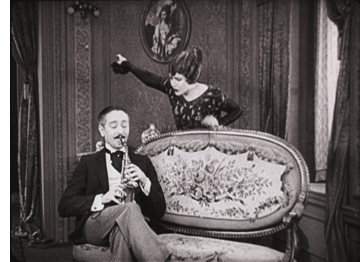
One of the strengths of the film is that it does not take the obvious approach of making Pierre into a fat, obnoxious oaf. On the contrary, Adolphe Menjou plays him as a witty, unflappable figure. He thinks nothing of arranging a marriage with a rich woman while planning to carry on his affair with Marie, but he puts up with her shifting moods and does genuinely seem to love her. The touch of having him play his saxophone while Marie has a tantrum and orders him out (right) typifies the light touch Chaplin applies to what is ultimately a tragic story.
A Woman of Paris was not well received upon its release, at least by the ticket-buying public, who expected a Chaplin film to star the Little Tramp and to be straightforwardly funny. The title at the beginning, where Chaplin explains that he does not appear in the film undoubtedly did little to appease them. Many critics were respectful, however, and other filmmakers recognized the new type of sophisticated comedy that he had introduced. Lubitsch, who was working on Rosita at the same studio, United Artists, was definitely influenced by it–as we shall see next year when his The Marriage Circle figures in the top ten of 1924. That film includes Menjou, playing a similar role, and in fact after playing minor roles for nearly ten years, he became a star with Chaplin’s film.
[February 10, 2014: Paul Duncan, Film Book Editor for Taschen, has kindly supplied figures showing that A Woman of Paris was profitable, if not as much as Chaplin’s other films: “It earned United Artists $634,000, of which $608,868.91 went to Regent Film (the company Chaplin formed to produce films for Edna Purviance). So with a production cost of $351,853.03, A Woman of Paris made a healthy profit, though, as you write, obviously it would have been more if it had been a comedy starring Chaplin.” Paul also informs me that Taschen’s The Charlie Chaplin Archives, which he is editing, will be published later this year.]
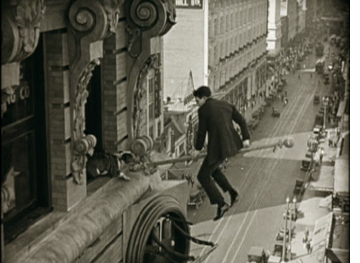 By 1923, Harold Lloyd had already done some shorts featuring nail-biting but hilarious comedy high up on skyscrapers. (See High and Dizzy in our 1920 entry.) In 1923 he took the same sort of premise into the feature-length Safety Last and created an indelible image: a brash young man hanging from a tilting clock. The gags go on story by story. After surviving the clock, Harold manages to get to the next level, only to be chased out a flagpole by a dog (left). Looking back, people tend to remember the vertiginous climb as the whole film, though remarkably, it takes place only over the last third. Earlier scenes involve a romance and misunderstandings that arise from the hero’s job at a department store. By 1923, Harold Lloyd had already done some shorts featuring nail-biting but hilarious comedy high up on skyscrapers. (See High and Dizzy in our 1920 entry.) In 1923 he took the same sort of premise into the feature-length Safety Last and created an indelible image: a brash young man hanging from a tilting clock. The gags go on story by story. After surviving the clock, Harold manages to get to the next level, only to be chased out a flagpole by a dog (left). Looking back, people tend to remember the vertiginous climb as the whole film, though remarkably, it takes place only over the last third. Earlier scenes involve a romance and misunderstandings that arise from the hero’s job at a department store.
Safety Last wasn’t Lloyd’s greatest film, but it launched the greatest period of his career. He’ll probably be joining us for these nostalgic lists every year now until 1927. The film is still available as part of New Line’s big box set of Lloyd’s films on DVD. (Buy that one, and you’ll be a step ahead of those future lists.) This summer the Criterion Collection brought Safety Last out on DVD and Blu-ray. There’s only that one feature on the disc, but it includes several supplements, including three newly restored Lloyd shorts and Kevin Brownlow’s 104-minute documentary, The Third Genius.
Keaton, too, entered a hugely creative streak in 1923. He made an amusing satire on Intolerance, the feature-length The Three Ages, in which Buster traces love through the stone age, the Roman era, and the Roaring Twenties. As Keaton himself acknowledged, “Cut the film apart and then splice up the three periods, and you will have three complete two-reel films.” He followed it up, however, with a masterpiece that displayed a complete command of story structure in the classical Hollywood mold: Our Hospitality. It’s arguably as fine as anything he ever made, except The General, which just edges it out.
Interestingly, Our Hospitality and The General are Keaton’s only two period pieces. (that is, if one excepts The Three Ages, which is far more farcical and does not attempt to recreate a realistic period atmosphere.) Both also take place in the South, and outdoors to a considerable extent. The milieu seems to have inspired him. Dealing with old-fashioned trains and other technology generated a lot of clever gags, and the fields, forests, and rivers helped give these two films a pictorial beauty that separates them from the Keaton’s other films.
Way back in 1978, when David and I were working on the first edition of Film Art: An Introduction, we wanted to include an extended analysis of a single film in each of the chapters on film technique. For mise-en-scene we chose Our Hospitality, which contains numerous uses of setting, costume, acting, and lighting brilliant enough to inspire a teacher and straightforward enough for students to notice and understand. Plus what better way to win over students who think that old black-and-white silent movies aren’t worth watching?
The story is simple. Willie McKay, the hero, travels from New York to the deep South, under the impression that he has inherited a mansion. The trip south on a very old-fashioned train supplies a long string of marvelous sight gags. There Willie meets the heroine, who shares his coach. Upon arrival, Willie discovers that his “mansion” is really a decaying house. Since the heroine has invited Willie to dinner, he wanders around to pass the time, unaware that he has inherited something else: a feud. The heroine’s family has a longstanding grudge against the McKays, and the father and two brothers are determined to shoot Willie. The only catch is that Southern hospitality dictates that they cannot kill him while he’s in their home.
In our analysis in Film Art, we pointed to the many motifs Keaton uses in service of the narrative, such as the moment of the hero’s rescue of the heroine as an echo of the earlier fishing pole/waterfall gag. One stylistic motif of staging comes back several times: Keaton using foreground doors or walls to create depth staging of moments when people spy or eavesdrop on others. In the frame on the left below, one of the brothers waits to ambush Willie, who is unaware of his presence (or indeed of the feud itself). In the one on the right, Willie eavesdrops on the brothers in their house, learning that they intend to kill him but that he is safe inside the house. Now Willie learns what’s going on, while the brothers don’t realize that he’s overhearing their plan. Such compositions are a motif in the film, forming a way of manipulating the narration–usually giving us more information than the characters onscreen have.
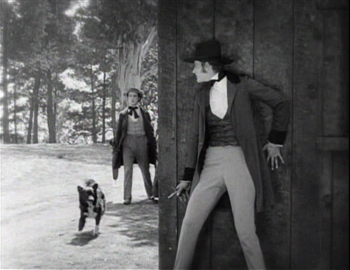 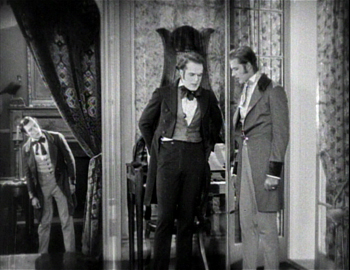
Like Safety Last, Our Hospitality ushered in the prime of the comedian’s career. Keaton made a string of marvelous features that lasted until The Cameraman in 1928. He didn’t always sign the films as director (he’s listed as co-director of Our Hospitality, along with John Blystone), but his unerring sense of how to compose images for the entire frame, both its surface composition and in depth, suffuses all his films of this period.
I’ve mentioned that Lubitsch was working at United Artists in 1923. Rosita was his first American film, starring Mary Pickford. It’s certainly not a masterpiece on the level of The Marriage Circle or Lady Windermere’s Fan, but Rosita is a charming and impressive film, certainly at least as good as Lubitsch’s other lesser films of the decade, Forbidden Paradise and Three Women.
As I discuss in my book, Herr Lubitsch Goes to Hollywood, the director had already been tentatively using classical Hollywood style in his last two German films, Das Weib des Pharao and Die Flamme. In Rosita, he managed to balance a typical historical epic from his German period (Madame Dubarry, Anna Boleyn) with the light, vivacious appeal of his star. She plays the title character, a cheerful street musician who is in love with Don Diego, an impoverished nobleman and military officer. Rosita catches the eye of the lecherous king. Don Diego ends up condemned to death, and Rosita plots to save him.
The sets were built on the enormous backlot of United Artists, where Douglas Fairbanks’ castle for Robin Hood had stood. The day after Rosita wrapped, the construction of the sets for The Thief of Bagdad began on the same lot. Indeed, one can detect a distinct similarity between Rosita’s big sets–city streets and a large prison–and those of the two Fairbanks films. This frame is a shot of the prison interior emphasizing a gallows in the background:
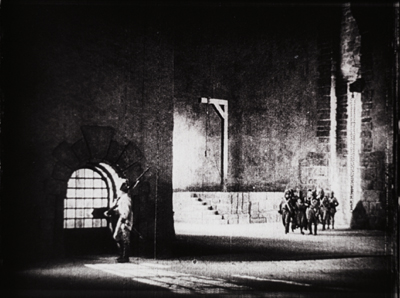
Given that this giant set was built in the open air, Lubitsch must have filmed this and other scenes at night, using the giant arc spotlights that had recently become a standard tool of Hollywood filmmaking to throw great swathes of illumination across the scene. In general, Rosita‘s style demonstrates that by 1923, Lubitsch had come fully to understand the American approach.
As a vehicle for Pickford, the film also is skillfully done, permitting her numerous intimate scenes that show off her charm. Given her star persona, the dramatic situation is leavened with humor in the interior scenes. Rosita’s poor family, a large, rowdy bunch, provides much of this, as when Rosita brings home a perfumed handkerchief and the impressed parents and children in turn bury their noses in it and sniff deeply. Rosita’s reactions to the King’s attempts to seduce her are also somewhat comic, though there is definitely a threat hanging over the situation.
Unfortunately, like all too many of the films on this year’s list, Rosita is difficult to see. It seems to have survived only in a Russian print, and a rather contrasty, worn one at that, as the frame above demonstrates. As long as that is the sole available material, a restoration might be too daunting. Still, in this day of digital manipulation, perhaps something could be done to improve the image quality. I hope at some point it will become available on home video. That also goes for Lubitsch’s other somewhat lesser films of the mid-1920s, Forbidden Paradise and Three Women.
Rosita’s reputation has suffered from strange statements Pickford much later made to Kevin Brownlow and which he published in The Parade’s Gone By. There she claims she and Lubitsch did not get along and that the resulting film was bad and a commercial failure. With the film itself unavailable for viewing, Pickford’s condemnation was accepted at face value. In fact, documents in the United Artists archive at the Wisconsin Center for Film and Theater Research overturn Pickford’s supposed dislike for Lubitsch. For years she tried to find financing to make another film with him, and in 1926 she called upon him for help in editing Sparrows. With the discovery of the Soviet print, it becomes apparent that Rosita was far from the disaster Pickford later claimed. Why her memories of her work with Lubitsch became so distorted late in her life we shall probably never know.
Overshadowed masters of French Impressionism
Abel Gance’s flashy La roue (on last year’s list) gets a lot of attention these days. He’s the high-profile representative of Impressionism. Yet 1923 saw the first fiction films from the director who was the movement’s modest heart: Jean Epstein. The very first, L’auberge rouge (“The Red Inn”) is a lovely film, but Cœur fidèle (“Faithful Heart”) epitomizes the quiet side of Impressionism. It’s story is as simple as they get: Marie is a barmaid whose foster parents try to force her to marry a thug, Petit Paul, while she is in love with the sensitive dock-worker Jean. The scenes around the waterside and the famous sequence in a carnival are all done with a realism blended with the subjective camera techniques that convey the characters’ thoughts, perceptions, and feelings in a way that was fresh at the time.
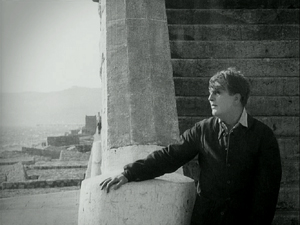
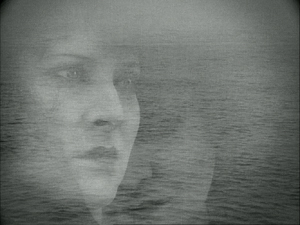
The exteriors were shot around the docks of Marseille, and Epstein uses superimpositions of the ocean to convey the lovers’ longing. Waves are sometimes superimposed over their figures, or one will look into the water and see the other’s face there, as when Jean envisions multiple images of Marie:
Shooting into a distorting mirror, Epstein uses the conventional Impressionist indicator of drunkenness as Petit Paul looks at a woman next to him in a bar:
 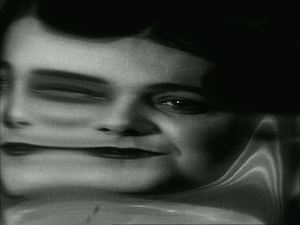
Coeur fidèle has been released in the UK (Region 2) as a DVD/Blu-ray combo in Eureka!’s Masters of Cinema series. (This includes a helpful little booklet with excerpt from Epstein’s writings and a review of Cœur fidèle by René Clair.) It is also available as a Region 2 French DVD without English subtitles. As these frames indicate, the film survives in beautiful condition.
Along with La roue, Cœur fidèle proved hugely influential. It used the “unfastened camera” that later was credited to Murnau in The Last Laugh. Like Murnau, Hitchcock picked up Impressionist style, as reflected most obviously in his 1927 boxing film, The Ring. Hitchcock’s penchant for moving camera and subjectivity never went away. Hollywood, too, picked up the subjective techniques of Impressionism, especially in the 1940s films that David is studying now.
Unlike Cœur fidèle, Le brasier ardent (“The Burning Crucible”) was sophisticated, convoluted, and perplexing. It was one of two films directed in France by the Russian actor Ivan Mosjoukine for the émigré film company Albatros. (The earlier one is L’Enfant du carnaval, 1921; as far as I know, no print survives.) Earlier this year, upon the release of Flicker Alley’s box set of five Albatros films, I described Le brasier ardent:
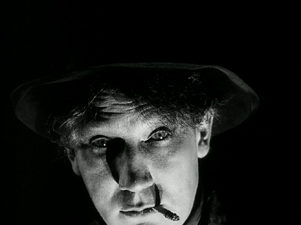
It has a reputation as an audacious, surrealist, and almost incomprehensible film. This may be due to the fact that prints available in archives during the 1970s and 1980s lacked intertitles. The opening nightmare sequence is indeed disturbing, but at least with intertitles, we understand that it is only a dream. It begins with a wild-eyed man tied to a stake where he is about to be burned. The heroine stands looking on, resisting as the man pulls on her long hair, apparently intent on dragging her into the fatal flames to accompany him in death. Subsequent scenes of the nightmare show the heroine encountering different men, all played by Mosjoukine, culminating in a man in evening dress stalking her along a vaguely Expressionist street until she escapes and wakes up in bed.
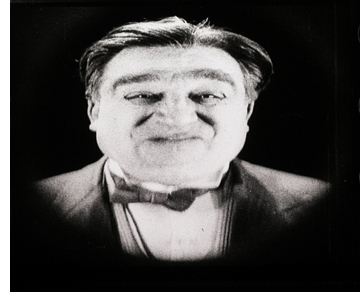
This nightmarish opening must have established vivid expectations in the spectators of 1923 as to what sort of film they were in for. After the heroine wakes up, however, what follows is quite different. The main plot is a stylized but quite amusing comedy. The heroine is a pampered wife, married to a rich man whom she does not love. She is faithful, but he is unreasonably jealous. He goes to a distinctly odd detective agency, one department of which is “Recovery of Lost Wives” (above), with “Success guaranteed!” and “Nothing to pay in advance!” Juxtaposed with the bizarre opening, this quirky humor might have eluded puzzled audiences of the day. Certainly the film itself was a failure, and Mosjoukine stuck to acting thereafter.
Unfortunately for the husband, Detective Z, whom he picks from the eccentric group pictured above, is the very man, again played by Mosjoukine, whom his wife has dreamed about. What follows is an odd tale with the detective and wife gradually falling love. Mosjoukine, known for his tragic, intense characters in the Russian cinema, plays such figures in the fantasy sequences–but in the main story he is allowed to play for laughs, gamboling and rolling on the floor like a puppy when the wife finally appears at his mother’s apartment and declares her love for him.
Mosjoukine should not, however, be allowed to overshadow his co-stars, Ermolieff actors who were also were to make their way into the wider French production of the day, including Impressionism. The wife is played by Nathalie Lissenko, one of the stars of the pre-Revolutionary cinema, who had acted opposite Mosjoukine in Russia. Among her 1920s roles was the protagonist of one of Epstein’s finest films, the largely unknown L’Affiche (1924). The husband is Nicolas Koline, who started his career with Ermolieff only after the company had left the Soviet Union. He will be familiar to silent-film fans from his performance as Tristan Fleury in Gance’s Napoléon.
By this point, stylistic influences were beginning to pass back and forth between France and Germany. Le brasier ardent shows distinct touches of Expressionism in its decor, as when the heroine flees through a distorted door. (See top.)
 I have to admit that the third Impressionist film on our top-ten list, Germaine Dulac’s La souriante Madame Beudet (The Smiling Madame Beudet) is not one of my favorites. It hasn’t got much of a plot. A sensitive woman in a provincial town finds her husband crass and unpleasant until a final crisis brings them–at least temporarily–together. It’s not so much the simplicity of the story, however, as the rather heavy-handed use of subjective camera tricks to convey Mme. Beudet’s thoughts about her husband, as when a distorting mirror conveys her grotesque view of him (at right). I have to admit that the third Impressionist film on our top-ten list, Germaine Dulac’s La souriante Madame Beudet (The Smiling Madame Beudet) is not one of my favorites. It hasn’t got much of a plot. A sensitive woman in a provincial town finds her husband crass and unpleasant until a final crisis brings them–at least temporarily–together. It’s not so much the simplicity of the story, however, as the rather heavy-handed use of subjective camera tricks to convey Mme. Beudet’s thoughts about her husband, as when a distorting mirror conveys her grotesque view of him (at right).
We’ve just seen a similar distortion in Cœur fidèle, above, to show a drunkard’s point of view. In Marcel L’Herbier’s El Dorado, from 1921, another distorted-mirror close-up suggests drunkenness without using a character’s point of view (see Film History: An Introduction, 3rd edition, p. 79).
The film has decided virtues, such as the lovely shots of the small provincial town in which the film’s exteriors were made, as well as the genuinely surprising and touching ending, which pulls back somewhat from the simplistic characterization of M. Beudet.
As with some of our choices from previous years, The Smiling Madame Beudet goes on the list partly because of its historical importance. Dulac was one of the early women directors to make a career in the cinema. Back in the days of 16mm, prints of this film were among the few Impressionist classics available for film club and classroom use, and the film became a staple in feminist-film courses.
Ironically, nowadays teaching the film is more difficult. Oddly enough, none of the mainstream labels has brought out a DVD with English subtitles. A German DVD, which includes two other short Dulac films, Invitation au voyage (1927) and the surrealist classic La coquille et le clergyman (1928), is available. The copy on this DVD is probably the same as the fairly good-quality Swiss archive print on YouTube, with bilingual French and German intertitles. For anyone with even an elementary knowledge of either language, the titles are not very challenging.
Caligarisme spreads
Caligarisme was the French word for cinematic Expressionism, which, as the example from Le brasier ardent shows, fascinating many French filmmakers.
Despite the lack of major contributions from Murnau and Lang, in 1923 the country’s cinema was going strong. Several films that fall slightly short of being masterpieces appeared. By this point the Expressionist film movement was well established, having begun in 1920 with Das Cabinet des Dr. Caligari. Some of its greatest films–Der müde Tod, Nosferatu and Dr. Mabuse der Spieler–had already appeared.
Three very good Expressionist films came out in 1923: Erdgeist (“Earth Spirit,” directed by Leopold Jessner), Schatten (“Shadows,” released abroad as Warning Shadows; Arthur Robison), and Raskolnikow (adapted from Crime and Punishment; Robert Wiene).
It’s really a toss-up as to which film should represent Expressionism on this year’s list. I give the edge to Erdgeist, largely because it and Von Morgens bis Mitternachts (“From Morn to Midnight”) are the two films from the movement that push the style the furthest. They come the closest to Expressionism as it existed in drama and the other arts. Most Expressionist cinema “tamed” the style a bit by applying it to genre tales: horror (Caligari, Nosferatu), fantasy (Der müde Tod), historical myth (Die Nibelungen), and science fiction (Algol, Metropolis). These two films, in contrast, depended on dramas where elemental human passions are released and taken to extremes, with the costumes, decor, makeup, and acting reflecting the characters’ inner states.
The film was based on the first of the two “Lulu” plays by Frank Wedekind: Erdgeist (1895) and its sequel Die Büchse der Pandora (Pandora’s Box, 1904). G. W. Pabst’s much better-known Pandora’s Box (1929) combines the two plays, which tell a continuous story about an amoral young woman who lives by exploiting wealthy men but drives them to extreme jealousy by flirting with other men.
In Pabst’s film, Louise Brooks plays Lulu as a vivacious young woman, seemingly unaware of her disastrous effect on the men around her. Asta Nielsen plays the character in Jessner’s film as a ruthless, mature woman. The plot concerns Dr. Schön, a rich man who found Lulu on the streets when she was a child and has raised her with the intent of having her become his mistress. At the beginning, she is married to Dr. Goll but immediately begins seducing Schwartz, an artist hired to paint her portrait. In the image below, Goll bursts in on them in Schwartz’s studio and Lulu collapses at the right. The distorted stairway, the streaks of light painted on the set, and the jagged shadows all create the Expressionist look–as does the eerie blank glow of Goll’s glasses.
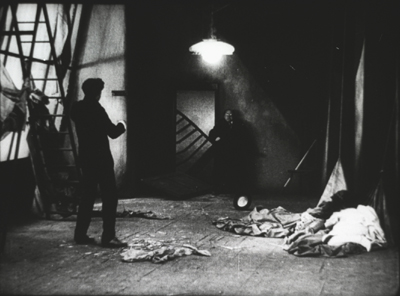
The acting is exaggerated and unnatural. Nielsen, foregoing all glamor, frequently holds a grimace on her face to the point where she almost looks like she is wearing a mask. In an early scene Goll moves his cane about, and she dances like a marionette attached to it by strings. (Puppet-like acting was a convention of Expressionist drama.)
Overall, the style is so grotesque and the characters so unpleasant as to make it clear why Erdgeist is one of the least remembered of the major Expressionist films. It is not available on home video. The print I saw about 16 years ago had Dutch intertitles and was somewhat dark. Perhaps, like Von Morgens bis Mitternachts, it will eventually be restored and released on DVD.
Two Expressionist films deserve brief mention as well.
Robert Wiene, the director of The Cabinet of Dr. Caligari, launched the Expressionist movement in cinema but never made another film that gained nearly as much attention. That’s a pity, because Raskolnikow is quite a good film–of all the Wiene films I’ve seen, probably his second best (though The Hands of Orlac, 1924, has its virtues). I found it difficult to decide between it and Erdgeist.
Crime and Punishment turns out to be, not surprisingly, a good fit for the style, with the hero’s increasingly bizarre view of the world literalized in the settings. The film seems to have had a higher budget than Caligari, and the sets are sturdier looking and more three-dimensional. (See bottom.) Wiene also had the good fortune to work with a group of Russian emigré theatrical actors who had trained under Stanislawski and worked at the Moscow Art Theater. Clearly they had to adapt their approach distinctly to achieve Expressionist performances, but they managed well. The lead, Gregori Chmara, makes a haggard and mercurial Raskolnikow.
Back in the 1970s, when I became intrigued by German Expressionist cinema, Schatten was considered one of the main classics. That was no doubt partly due to the limited number of Expressionist titles available for viewing at the time. It’s a good film, but its prominence in film history has declined a bit in the intervening decades, especially as the full surviving work of Murnau and Lang has been discovered and restored.
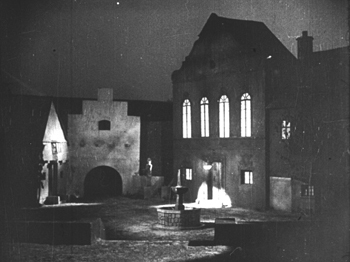
Schatten is an atypical Expressionist film. Not that many of its sets are distorted or simplified in the usual ways. (This is also true to some extent of designer Albin Grau’s other notable Expressionist film, Nosferatu.) Its few exterior shots, including the opening, show the most strongly Expressionist decor (below left). Part of the action consists of a shadow-puppet show put on by a wandering entertainer (below right). Its plot seems to magically unleash the passions of the onlookers, who begin to behave in odd ways. The male guests (and a servant) try to seduce their hostess, driving the master of the house into a jealous rage.
 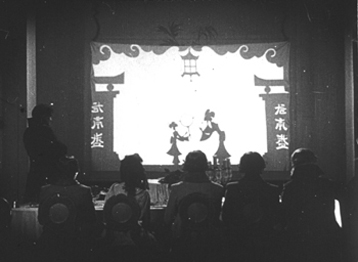
The shadow play creates its own distortions and stark, black and white imagery. Once the show is over, Robison often frames the distorted shadows of the characters more prominently than their actual bodies (again echoing some of the scene with the vampire in Nosferatu). In this corridor scene one of the servants slyly creates cuckold’s horns on another man’s head:
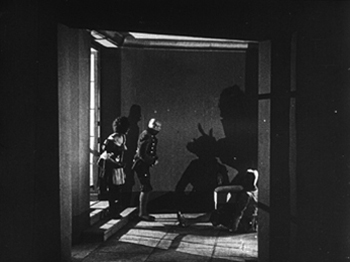
Shadows, with their natural capacity for distortion, not surprisingly appeared in many Expressionist films, though never so pervasively as in this one.
Raskolnikow is unfortunately not available on home video, at least in an acceptable copy. (The reviews for the Alpha release on Amazon deem it “unwatchable.”) Warning Shadows is available on DVD from Kino or to stream on Amazon (free to Prime customers).
Returning to our top-ten list, I yield the floor briefly to David, who has been studying Sylvester for another project.
German silent cinema is more varied than a litany of the official classics, from Caligari to Metropolis, would suggest. One of the most intriguing trends of the period involved what was called the Kammerspiel, or chamber-play, film. Kammerspiel films were far more naturalistic than Expressionist films. They concentrate on a very few characters in a drastically limited number of locales. Performance is often slow and understated, though action may freeze into somewhat contorted poses. The action typically takes place in a short time span, and it is built up out of everyday activities in working-class households—chores, job routines, the habits of family life. Eventually, however, the mundane milieu is likely to explode into violence.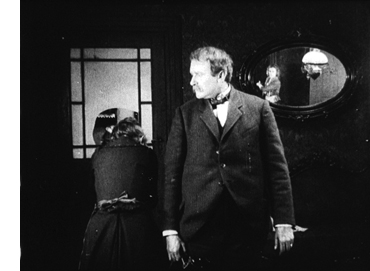
The versatile Carl Mayer (who worked on the script of Caligari) conceived of the early Kammerspiel film Scherben (Shattered, 1921), which defined the trend. In the same year the stage director Leopold Jessner released the remarkable Hintertreppe (Backstairs), which Kristin mentioned as a runner-up in her Best of 1921 list. Mayer also wrote the script for Sylvester (1923). Named for the feast day of St. Sylvester, 31 December, it’s known in English as New Year’s Eve. It’s not available on home video, but it’s worth seeking out in screenings. It remains a striking study in tabloid tragedy.
A café owner and his wife are busily serving crowds on New Year’s Eve. After a big meal and too many drinks, the wife and the mother-in-law fall to quarreling. The tensions around the table are constantly crosscut with the increasingly wild revelry in the café and the upper-class nightclub across the street. As midnight draws near, the women struggle for the husband’s loyalty. This petty quarrel will end in death.
Director Lupu Pick explores the limited space of the action by shooting the parlor from many angles, including ones that make daring use of a mirror (right). The street shots feature extravagant camera movements that look forward to the “unchained camera” made famous in Der letzte Mann (The Last Laugh, 1925), directed by F. W. Murnau and scripted by Mayer. With its strict limitation to a single night and its focus on domestic space, along with suggestions of the husband’s Freudian dependence on his mother, Sylvester showed how a fait divers could yield psychological drama.
The Kammerspiel film wasn’t a dead end. After Carl Dreyer’s borderline contribution to the trend, the Ufa production Michael (1924), back in Denmark he created probably the best of the lot: The Master of the House (Du Skal Aere Din Hustru, 1925). He later returned to the aesthetic in Two People (1945), and he continued to exploit its possibilities in his last features. Over the years after World War II, other directors were rediscovering Kammerspiel principles. We see fresh applications of the approach in Les Parents Terribles (Cocteau, 1948), Les Enfants Terribles (Melville, 1949), and of course Hitchcock’s Rope (1948) and Dial M for Murder (1954). As often happens, ambitious films of the sound cinema owe a good deal to innovative impulses of the silent era.
Welcome, experimental cinema!
One of the most remarkable films of 1923 is a mere three minutes long. Man Ray, an American painter and photographer who moved to Paris in 1921 and became involved in the Dadaist and Surrealist movements. He soon acquired a film  camera and later described how he shot bits of footage with it: camera and later described how he shot bits of footage with it:
a few sporadic shots, unrelated to each other, as a field of daisies, a nude torso moving in front of a striped curtain with the sunlight coming through, one of [his] paper spirals hanging in the studio, a carton from an egg crate revolving on a string–mobiles before the invention of the word, but without any aesthetic implications nor as a preparation for future development: the true Dada spirit.
In 1923 Tristan Tzara advertised a Dadaist program in a Parisian theatre to be held the following evening, including a film by Man Ray as part of the entertainment. Ray had only a very small amount of footage ready. Faced with an overnight deadline, he supplemented it by using a technique he had already employed in still photography (the “rayograph”): placing small objects on a sheet of photographic paper in the dark, turning on the light briefly, and developing the image. The result was a series of sharply focused silhouette images of the objects against a plain background. This time Ray unrolled some raw negative film in a dark room, scattered nails, tacks, and other objects on it, exposed it to light, and developed the negative (right). Combined with the shots Ray had previously made, the result was a perfect Dada film, with randomly juxtaposed imagery that defied the audience to make any sense of what they were seeing. He titled it in ironic Dada fashion: Le retour à la raison (“The Return to Reason”).
Despite being cobbled together overnight, Ray’s film offers a broad exploration of the possibilities of abstract filmmaking. The opening, a rapidly shifting stippled screen, resembles the later flicker films of the 1960s avant-garde. The rayograph shots introduce an alien, high-contrast look–not surprising, given that these may have been the first cinema images produced without using a camera.
Ray also shifted between positive and negative imagery. This was not entirely new. Murnau had used short stretches of negative footage in Nosferatu the year before. But Murnau’s negative shots had a narrative function, to convey the eeriness of the environs of the vampire’s castle. In Le retour à la raison, Ray used negative imagery in an abstract way, to create startling juxtapositions of imagery that looked both similar and yet strikingly different. The tacks, nails, and springs in the rayograph stretches could be either stark white against black, as in the image to the right above, or the same shot repeated, but this time in black against white. The film ends with another positive/negative passage. The “nude torso moving in front of a striped curtain” is initially shown in a positive image, then in the same image flipped and shown in negative:
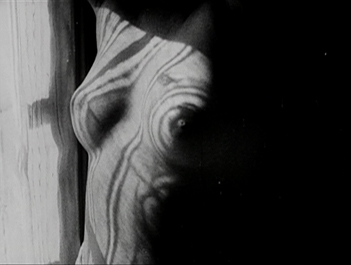 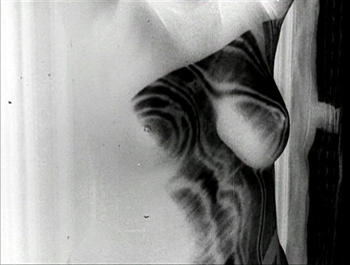
Ray was not the first to create an abstract film. In 1921 German filmmaker Walter Ruttmann probably made that conceptual leap in 1921 with Opus 1, a one-reeler with painted shapes moving around against a dark background. He followed this up with three further films, Opus 2 (1923), Opus 3 (1924), and Opus 4 (1925). (Good-quality prints with toning and appropriate musical accompaniment are available on YouTube: Opus 1 here, Opus 2 here, Opus 3 here, and Opus 4 here.)
I must confess that I probably should have at least mentioned Opus 1 in my entry on the best films of 1921. Still, Ruttmann’s films are far less daring than Le retour à la raison. It and its successors are basically efforts to do what so many filmmakers have tried since: to create the equivalent of a painting, but with motion. Ray’s film went much further, pushing the limits of the young art form in ways that had little precedent in the other arts, apart from Ray’s own highly experimental approach to still photography. There are even two fleeting stretches of film leader with illegible writing on them–a tactic one thinks of more in relation to, say, Bruce Conner’s A Movie (1958) than to the silent era. Much of the experimental cinema to come decades later was briefly probed here.
There are several copies of Le retour à la raison on YouTube. The best was posted by Dimitri Shubin, who also provides a piano score. The film is also available on disc 3 of the Unseen Cinema set of American experimental cinema. Unfortunately this copy has a considerable amount of breakup, particularly in the early flicker portions. (An HD version would perhaps help.) The version on Kino’s “Avant-Garde: Experimental Cinema of the 1920s and ’30s” set has the same problem and is distinctly shorter, apparently because it is running at sound speed. The copy provided by Shubin has the clearest, steadiest video image of the film I have seen. Ideally, of course, Ray’s film should be viewed on 35mm.
I regret that so many of our choices for this year’s list are not available on home video or even, except in very rare circumstances, for viewing on 35mm in archive screenings. Still, part of the purpose of this ongoing series is to call attention to obscure but worthy and important films. Perhaps an archivist or an enterprising DVD publisher will be inspired to restore some of the ones described here.
The quotation concerning The Three Ages comes from p. 217 of Rudi Blesh’s biography, Keaton (New York: Collier, 1966).
Mary Pickford’s strangely distorted claims about Rosita and her relationship with Lubitsch are expressed on pp. 129-34 of Brownlow’s The Parade’s Gone By (New York: Knopf, 1968). I go into more detail about the continuing Pickford-Lubitsch collegiality in the 1920s in Herr Lubitsch Goes to Hollywood, pp. 24-26.
For more examples of unusual German silent films, go elsewhere on this site here and here and here and here and here and here and here and here. Criterion has a new, authentic version of Dreyer’s Kammerspiel-influenced Master of the House forthcoming.
The Man Ray quotation comes from a detailed study of Le retour à la raison by Deke Dusinberre in the collection Unseen Cinema: Early American Avant-Garde Film 1893-1941 (New York: Anthology Film Archives, 2001), published to coincide with the release of the DVD set mentioned above.
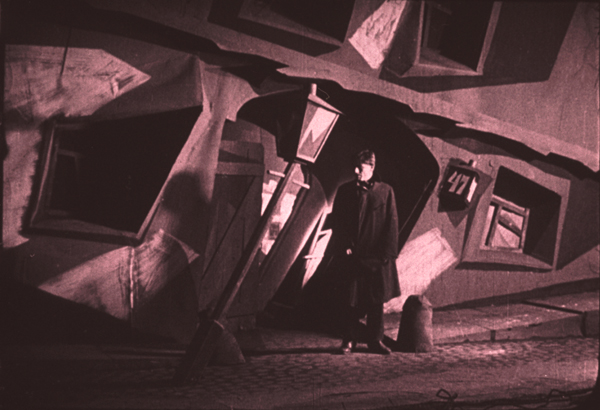
Raskolnikow.
Posted in Directors: Lloyd, Harold, Experimental film, Film comments, Film history, Hollywood: Artistic traditions, National cinemas: France, National cinemas: Germany, Silent film, The Ten Best Films of... | open printable version
| No Comments »
Tuesday | December 17, 2013
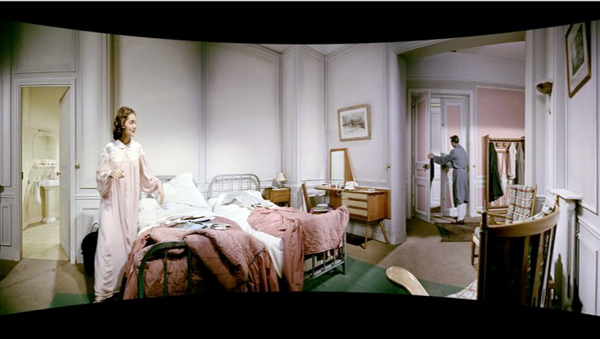
A not-so-intimate bedroom scene from Cinerama Holiday (1955).
DB here:
Many of our blog entries are written in response to current events–a new movie, a film festival in progress, a development in film culture. Later we sometimes add a postscript (as here) bringing an entry up to date. Today, though, enough has happened in a lot of areas to push me to post the updates in a single stretch. It’s a sort of aggregate of chatty tailpieces to certain entries over the last year or so. Should the impulse seize you, you can return to an original entry, and there are other peekaboo links to keep you busy.
Out and about
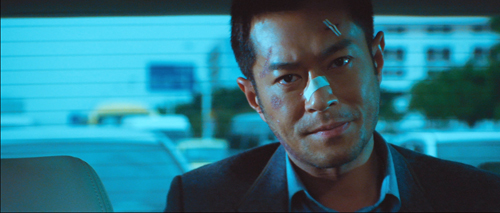
Drug War.
Kristin wrote in praise of Neighbouring Sounds when she saw it at the Vancouver International Film Festival in 2012. Roger Ebert gave it a five-star rating, and A. O. Scott placed it on his annual Ten Best list. This network narrative is Brazil’s official entry for the Academy Awards. Sample Neighbouring Sounds here; the DVD is coming in May.
The annual Golden Horse Awards at Taipei have finished, and the Best Picture winner was the Singaporean Ilo Ilo, which neither Kristin nor I have seen. It would have to be exceptionally good to match the other films nominated, all of which we’ve discussed: Tsai Ming-liang’s Stray Dogs, Wong Kar-wai’s The Grandmaster, Jia Zhang-ke’s A Touch of Sin, and (probably my favorite film of the year so far) Drug War, by Johnnie To Kei-fung. Stray Dogs did bring Tsai the Best Director award and his actor Lee Kang-sheng a trophy for best lead. Wong’s Grandmaster picked up six trophies, including top female lead and Best Cinematography. Jackie Chan won an award for Best Action Choreography. Although his CZ12 struck me as pretty dismal as a whole, its closing montage of Jackie stunts from across his career was more enjoyable than most feature-length films. In all, this has been a splendid year for Chinese-language cinema.
Back in the fall of 2012, I celebrated Flicker Alley‘s admirable release of This Is Cinerama, a very important film for those of us studying the history of film technology. Now Jeff Masino and his colleagues have taken the next step by releasing combo DVD-Blu-ray sets of two more big pictures, Cinerama Holiday (1955), the sequel to the first release, and South Seas Adventure (1958), the fifth and last of the cycle. Both are in the Smilebox format, which compensates for the distortions that appear when the curved Cinerama image is projected as a rectangle. Fortunately, Smilebox retains the outlandish optics to a great extent. The image surmounting today’s entry would give Expressionist set designers a run for their money, and it recalls the Ames Room Experiments. Cinerama wrinkles the world in fabulous ways.
Filled out with facsimiles of the original souvenir books and supplemented with a host of extras putting the films in historical context, these discs are fine contributions to our understanding of widescreen cinema. Because film archives don’t have the facilities to screen Cinerama titles (if they even hold copies), we have never been able to study, or even see, films that now look gloriously peculiar. Dare we hope that, from The Alley or others, we’ll get The Wonderful World of the Brothers Grimm (1962), a strange, clunky, likeable movie?
Bookish sorts
Spyros Skouras and Henri Chrétien.
2013 saw the first of our online video lectures, one on early film history and the other on CinemaScope. The response to them has been encouraging, but as usual nothing stands still. If I were preparing the ‘Scope one now, I would draw from the newly published CinemaScope: Selected Documents from the Spyros P. Skouras Archive. Skouras was President of 20th Century-Fox, and he kept close tabs on the hardware he acquired from Chrétien in 1953. This collection of documents, edited by Ilias Chrissochoidis, shows that Skouras saw ‘Scope as a way to follow Cinerama’s path and boost the studio’s profits. “I would hate to think what would have happened to us if we had not created CINEMASCOPE. . . . Certainly we could not have continued much longer with the terrific losses we have taken on so many of our pictures.” ‘
Scope didn’t rescue the industry, or even Fox, from the postwar doldrums, but some of the behind-the-scenes tactics of the format’s first years are revealed here. For example, Skouras hoped that filmmakers would put important information on the surround channels deployed by the format, in the hope that theatre owners would make more use of them. “Such scenes would have to be unusual ones, but even with my limited imagination I can visualize many scenes in which dialogue would be heard from only the rear or the sides of the theatre.” This seems fairly extreme even today.
Jeff Smith is a swell colleague here at UW–Madison. (He and I are teaching a seminar that’s just winding down. More about that, I hope, in a later entry.) In his May guest entry for us, Jeff wrote about the new immersive sound system Atmos. But he’s been busy filling hard covers too. Research articles by him have appeared in three new books on film sound.
 To Arved Ashby’s Popular Music and the New Auteur: Visionary Filmmakers after MTV Jeff contributed “O Brother, Where Chart Thou?: Pop Music and the Coen Brothers”–surely required reading in the light of Inside Llewyn Davis. He’s also a contributor to two monumental volumes that will set the course of future sound research. David Neumeyer has in The Oxford Handbook of Film Music Studies gathered a remarkable group of foundational chapters reviewing the state of the art. Jeff’s piece charts the changing relations between the film industry and the music industry, from The Jazz Singer to Napster and file-sharing. For another doorstop volume, The Oxford Handbook of New Audiovisual Aesthetics, edited by John Richardson, Claudia Gorbman, and Carol Vernallis (three more top experts), includes a powerful essay in which Jeff shows how techniques of intensified continuity editing have their counterparts in scoring, recording, and sound mixing. Not to mention his forthcoming book on an altogether different subject, Film Criticism, the Cold War, and the Blacklist: Reading the Hollywood Reds. All in all, a busy man–the kind we like. To Arved Ashby’s Popular Music and the New Auteur: Visionary Filmmakers after MTV Jeff contributed “O Brother, Where Chart Thou?: Pop Music and the Coen Brothers”–surely required reading in the light of Inside Llewyn Davis. He’s also a contributor to two monumental volumes that will set the course of future sound research. David Neumeyer has in The Oxford Handbook of Film Music Studies gathered a remarkable group of foundational chapters reviewing the state of the art. Jeff’s piece charts the changing relations between the film industry and the music industry, from The Jazz Singer to Napster and file-sharing. For another doorstop volume, The Oxford Handbook of New Audiovisual Aesthetics, edited by John Richardson, Claudia Gorbman, and Carol Vernallis (three more top experts), includes a powerful essay in which Jeff shows how techniques of intensified continuity editing have their counterparts in scoring, recording, and sound mixing. Not to mention his forthcoming book on an altogether different subject, Film Criticism, the Cold War, and the Blacklist: Reading the Hollywood Reds. All in all, a busy man–the kind we like.
My March essay, “Murder Culture,” devoted some time to the women writers of the 1930s and 1940s who created the domestic suspense thriller–a genre I believe has been slighted in orthodox histories of crime and mystery fiction. The piece brought friendly correspondence from Sarah Weinman, editor of a new anthology from Penguin: Troubled Daughters, Twisted Wives. She has assembled a fine collection, boasting pieces by Vera Caspary, Dorothy B. Hughes, Charlotte Armstrong, Dorothy Salisbury Davis, Margaret Millar, Patricia Highsmith, and Elisabeth Sanxay Holding (whom Raymond Chandler considered the best suspense writer in the business). These stories will whet your appetite for the excellent novels written by these still under-appreciated authors. Sarah’s wide-ranging introduction to the volume and her headnotes for each story will guide you all the way.
Finally, not quite a book but worth one: “The Watergate Theory of Screenwriting” by Larry Gross has been published in Filmmaker for Fall 2013. (It’s available online here to subscribers.) The essay is based on the keynote talk that Larry gave at the Screenwriting Research Network conference here in Madison.
Digital is so pushy

From Doddle.
Back in May, I provided an update on the progress of the digital conversion of motion-picture exhibition. Today, 90% of US and Canadian screens are digital, and over 80% worldwide are. (Thanks to David Hancock of IHS for these data.) I wish I could say the Great Big Digital Conversion was at last over and done with, but we know that we live in an age of ephemera, in which every technology is transitional. As I was finishing Pandora’s Digital Box in 2012, the chatter hovered around two costly tweaks.
The first involved higher frame rates. One rationale for going beyond the standard 24 fps was the prospect of greater brightness to compensate for the dimming resulting from 3D. Peter Jackson presented the first installment of his Hobbit film in 48 fps in some venues, and James Cameron claimed that Avatar 2 and its successor would utilize either 48 fps or 60 fps. And in January of this year some studio executives predicted that 48 fps would become standard.
Not soon, though. The Hobbit: The Desolation of Smaug will play in 48 fps on fewer than a thousand screens. Bryan Singer, who praised the process, has pulled back from handling the next X-Men movie at that frame rate. The problem is partly cost, with 48fps demanding more rendering and vast amounts of data storage. As far as I can tell, no one but Jackson and Cameron are planning big releases in the format.
The other innovation I mentioned in Pandora was laser projection. It too will brighten the screen, and according to its proponents it will also lower costs. Manufacturers are racing to build the machines. Christie has presented GI Joe: Retaliation in laser projection at AMC Theatres’ Burbank complex, and the firm expects to start installing the machines in early 2014. Seattle’s Cinerama Theatre is scheduled to be the first. NEC, the Japanese company, premiered its laser system at CineEurope in May. A basic NEC model designed for small screens (right) will cost about $38,000—an attractive price compared to the Xenon-lamp-driven digital projectors currently available. But the high-end NEC runs $170,000!
How to justify the costs? One Christie exec suggests branding: “Laser is a cool term that audiences immediately identify with.”
Perhaps the most important innovation since last spring’s entry involves an electronic delivery system. In October, the Digital Cinema Distribution Coalition, a consortium of the top three theatre chains along with Warners and Universal, launched a satellite and terrestrial network for delivering movie files to theatres. Theatres are equipped with satellite dishes, fiberoptic cable, and other hardware. The new practice will render the current system of shipping out hard drives obsolete, although the drives will probably continue for a time as backups. The DCDC has scheduled over thirty films to be sent out this way by the end of the year, and 17,000 screens in the Big Three’s chains are said to be hooked up. For more information, see David Hancock‘s IHS Analyst Commentary.
In the 1990s, satellite transmission was touted as the best way to send out digital films, and it was tried with Star Wars Episode II: Attack of the Clones in 2001. Sometimes things move in spirals, not straight lines.
Speaking of the Conversion, an earlier entry pointed out the creative strategy used by the Lyric Theatre in Faulkton, South Dakota to finance its digital changeover. A gun raffle was announced on the Lyric’s Facebook page. Top prize was planned to be a set of three weapons: an AR-15 rifle, a shotgun, and a 1911 pistol.
The theatre’s screening season concluded, but the raffle is going forward, on New Year’s Eve, no less.
Television in public, movies in private

Dr. Who: Day of the Doctor (2013).
I can’t stand all this digital stuff. This is not what I signed up for. Even the fact that digital presentation is the way it is right now–I mean, it’s television in public, it’s just television in public. That’s how I feel about it. I came into this for film. —Quentin Tarantino
Spirals again. When attendance began to slump after 1947, Hollywood tried a lot of strategies–color, widescreen processes like Cinerama and ‘Scope, stereo sound, and not least “theatre television.” Prizefights, wrestling matches, and even operas were transmitted closed-circuit. Now theatre television is back, made possible by The Great Big Digital Convergence.
Godfrey Cheshire predicted some fourteen years ago that as theatres became “TV outside the home,” what we now call “alternative content” would become more common.
Pondering digital’s effects, most people base their expectations on the outgoing technology. They have a hard time grasping that, after film, the “moviegoing” experience will be completely reshaped by–and in the image of–television. To illustrate why, ponder this: if you were the executive in charge of exploiting Seinfeld’s last episode and you had the chance to beam it into thousands of theaters and charge, say, 25 dollars a seat, why in the hell would you not do that? Prior to digital theaters, you wouldn’t do it because the technology wouldn’t permit it. After digital, such transpositions will be inevitable because they’ll be enormously lucrative.
Godfrey’s prophecy has been fulfilled by all the plays, operas, and other attractions that run in multiplexes during the midweek or Sunday afternoon doldrums. His Seinfeld analogy was reactivated by last month’s screenings of Dr. Who: The Day of the Doctor in 3D. It was shown on 800 screens in seventy-five countries, from Angola to Zimbabwe, while also being broadcast on BBC TV (both flat and stereoscopic). The Beeb boasted that the per-screen average for the 23 November show beat that of The Hunger Games: Catching Fire. Globally, it took in $10 million, despite being available for free on TV and the Net. In the US, the event was coordinated by Fathom, a branch of National Cinemedia, a joint venture of the Big Three chains.
While some complained about dodgy 3D in the show, a surprisingly fannish piece in The Economist declared that “this landmark episode was buoyed up with fun, silliness, and hope.” The larger prospect is that other TV shows will take the hint and host season premieres or end-of-season cliffhangers in theatres. Many art house programmers would kill to show episodes of Game of Thrones or Mad Men, or even marathon runs of House of Cards. If it happens at all, I’d bet on Fathom getting there first.
I’ve had little to say, in this arena or in Pandora, about streaming and VOD, but these are becoming important corollaries of the Great Big Digital Convergence. Netflix in particular is expanding its reach, growing its subscriber base, creating original series, and enhancing its stock value, despite some ups and downs. At the same time, it’s pressing studios and exhibitors for the reduction in “windows,” the periods in which films are available on different platforms.
 The theatrical window was traditionally the first, followed by second-run theatrical, airline and hotel viewings, pay cable, and so on down the line. Now that households have fast web connections, streaming disrupts that tidy business model. In October Ted Sarandos, Chief Content Officer for Netflix (right, with Ricky Gervais), suggested that even big pictures should go day-and-date on Netflix. The theatrical window was traditionally the first, followed by second-run theatrical, airline and hotel viewings, pay cable, and so on down the line. Now that households have fast web connections, streaming disrupts that tidy business model. In October Ted Sarandos, Chief Content Officer for Netflix (right, with Ricky Gervais), suggested that even big pictures should go day-and-date on Netflix.
“Why not follow with the consumer’s desire to watch things when they want, instead of spending tens of millions of dollars to advertise to people who may not live near a theater, and then make them wait for four or five months before they can even see it?” he added. “They’re probably going to forget.”
Exhibitors howled. Sarandos quickly recanted, saying only that he wanted people to rethink the current intervals between theatrical and ancillary release.
Some observers speculated that his October remarks were staking out an extreme position he intended to moderate in negotiations down the line–possibly to suggest that mid-budgeted pictures would be good ones to experiment with on day-and-date. Perhaps too Netflix was emboldened by the much-publicized remarks of Spielberg and Lucas in a panel last June, when they indicated that the future for most movies was VOD, with multiplexes furnishing more costly entertainments for the few. (In the same session, Lucas predicted that brain implants would allow people to enjoy private movies, like dreams.)
In any event, windows are already shrinking. In 2000, the average theatrical run was 170 days; now it’s about 120 days. With about 40,000 screens in the US, films play off faster than ever before. Video piracy, which makes new pictures available well before legal DVD and VOD release, puts pressure on studios to shorten windows. It seems likely that the windows and the intervals between them will shrink, perhaps allowing films to go to all video formats as quickly as 30-45 days after the theatrical release ends.
Studios have incentives to shorten the windows, if only because a single promotional campaign can be kept going long enough for both theatrical and home release. In addition, buying or renting a movie with a couple of clicks encourages impulse purchasing, and the cost feels invisible until the credit-card bill comes. Nonetheless, commitment to day-and-date home delivery would be risky for the studios.
Hollywood is more than ever before playing to the global audience. Even with the VOD boom, digital purchase and rental constitute a small portion of the world’s movie transactions. According to IHS Media and Technology Digest, theatrical ticket sales, purchase and rental of physical media (DVD, Blu-ray) add up to nearly 12 billion transactions, while Pay Per View, streaming, and downloads come to only about a billion or so. (These categories omit subscription services like cable television and basic VOD on Netflix, Hulu, Amazon, and the like.) Moreover, customers in 2012 spent about 61 billion dollars buying tickets to movies, buying DVDs, and renting DVDs. Tania Loeffler of the IHS Digest writes of North America, the most developed market for digital sales and rental:
Movie purchases made online in North America increased year-on-year by 36.6 per cent to reach 29.2m transactions. The rental of movies online also increased, to 112m transactions, an increase of 57.3 per cent over 2011. Despite this strong growth, movies purchased or rented via over-the-top (OTT) online movie services still only accounted for a combined $836m, or 3.3 per cent of total consumer spending on movies in North America.
By contrast, worldwide consumer spending on theatrical movies actually grew in 2012, to a whopping $33.4 billion–over 50 % of all movie transactions. (Thank you, Russia and China.) And despite the decline of disc purchases and rentals, Loeffler estimates that physical media will still comprise about thirty per cent of worldwide movie transactions through to 2016.
Theatrical releases continue to offer studios the best deal. Because the prices of streaming and downloaded films are low, there is less to be gained from them. True, if windows shrink, the studios will demand that Netflix and its confrères price VOD at high levels, say $25-50 for an opening-weekend rental. But consumers used to cheap movies on demand could balk at premium pricing.
At present, digital delivery of movies to the home provides solid ancillary income to the distributors, even if it doesn’t yet offset the decline in physical media. Add in Imax and 3D upcharges, and things are proceeding well for the moment. Like the rest of us, moguls pay their mortgages in dollars, not percentages or transactions. As long as some hits keep coming, we should expect that studios will maintain an exclusive multiplex run for major releases, as the most currently reliable return on investment.
Orpheum metamorphosis
The New Orpheum Theatre, 216 State Street, 1927.
Another note on exhibition relates to the last commercial picture palace in downtown Madison, Wisconsin. My July 2012 entry related the conspiratorial tale of how the grand old Orpheum Theatre on State Street fell on hard times. In fall of 2012 the building seemed slated for foreclosure, but then maybe not. Last month Gus Paras, a hero of my initial post, stepped forward and bought the old place. According to Joe Tarr in our politics and culture weekly Isthmus, there’s a lot of work to do.
Plaster is crumbling off sections of the ceiling, the result of years of water damage from a leaky roof. The walls are littered with scratches and marks, in bad need of a paint job. A plastic garbage can sits in the theater, collecting water leaking from an upstairs urinal. Paras even found dried-up vomit in two spots on the carpet.
Making matters worse, Monona State Bank, which controlled the property while it was in foreclosure, filled in the “vaults” behind the theater, which means replacing the building’s frail boilers and air conditioning will be much more complicated and expensive.
“I don’t have any idea how I’ll get the boiler in and out,” Paras says. “The stairs are not strong enough.”
Yet Paras, who has created restaurants, comedy clubs, and affordable apartment complexes in the center of Madison, is an incurable optimist. He ponied up $1.7 million for the Orpheum. With former owner Henry Doane, Paras is determined to revive the venue with music, food, comedy, weddings, parties, and films. Kristin and I hope that they manage to buff up this urban gem and keep it alive for all of us. “Nothing is going to stop me with the Orpheum,” says this Greek immigrant who loves our city.
Steve Elbow, local chronicler of the Orpheum chaos, follows up with this entertaining interview with Paras. “You have 2000 people, you better have the bathrooms work.” Envoi
Have any of you worked on a film, say, 10 years ago, and it comes out on Blu-ray and you look at it and think, “This isn’t the film I’ve shot”?
Bruno Delbonnel (DP, Inside Llewyn Davis): Always. Always.
Barry Ackroyd (DP, Captain Phillips): I’ll be watching and it’s in the wrong format.
So what is it like to devote your lives and careers to creating images that you know exist only momentarily in their absolute best state, that may never be seen by most people the way you would like them to be seen?
Sean Bobbitt (DP, Twelve Years a Slave): At least you get a chance to see it once. All you can do is hope that people will see an approximation of that. I’ve been to screenings where I’ve had to get up and walk out because I just couldn’t bear to watch the film in the state it was in. But at the end of the screening, people say, “That was fantastic. That was beautiful. Well done!” and you’re thinking, “If only they had seen the real thing.” We would drive ourselves mad if we worried too much about it.
On shrinking windows, see Andrew Wallenstein and Ramin Setoodeh, “Exhibitors Explode over Netflix Bomb,” Variety (5 November 2013), 16. The chart on this page doesn’t appear in Variety‘s online edition of the story. Tania Loeffer’s report, “Transactional Movies: The Big Picture,” appeared in IHS Screen Digest (now IHS Media and Technology Digest) for April 2013, 123-126. Douglas Gomery discusses the theatre television plans of the 1940s-early 1950s in his Shared Pleasures: A History of Movie Presentation in the United States, pp. 231-234. My envoi comes from a revealing conversation among cinematographers at The Hollywood Reporter.
A 2012 catchup blog chronicling earlier phases of these developments is here.
P.S. 23 December 2013: David Strohmaier, the creative force behind the Cinerama restorations, has put online the stirring original trailers for Search for Paradise (low resolution and high-definition) . David attended the U of Iowa when Kristin and I did, though alas we didn’t meet him. He deserves a big thank-you for all his work in making these extraordinary films available to us.
The Grandmaster.
Posted in Digital cinema, Directors: Jia Zhang-ke, Directors: Johnnie To Kei-fung, Directors: Tsai Ming-liang, Directors: Wong Kar-wai, Film technique: Sound, Film technique: Widescreen, National cinemas: China, National cinemas: Hong Kong, National cinemas: South America, National cinemas: Taiwan, PANDORA'S DIGITAL BOX: The Blog Series | open printable version
| No Comments »
|