





Archive for the 'People we like' Category
A many-splendored thing 2: Awards aplenty
Short version:
This year the Hong Kong Entertainment Expo has launched the Asian Film Awards, a celebration of outstanding films and filmmakers created by the HK International Film Festival. Over 700 films were sifted by a jury and a handful of finalists were chosen in several categories. At the ceremony on Tuesday night, Bong Joon-ho’s The Host, which I wrote about at Vancouver’s film festival, won several: best film, best actor (Song Kang-ho, the put-upon father of the family), best cinematographer (Kim Hyung-goo), and best visual effects (The Orphanage). Best director honors went to Jia Zhang-ke for Still Life. Other winners:
Best actress: Miki Nakatani (Memories of Matsuko)
Best screenply: Mani Hagighi (Men at Work)
Best production design: Tim Yip (The Banquet)
Best musical score: Rahayu Supanggah (Opera Jawa)
Best editing: Lee Chatametikool (Syndromes and a Century)
A special award for Outstanding Contribution to Asian Cinema went to the great actress Josephine Siao Fong-Fong, presented by Luc Besson in an eloquent tribute.
I was fortunate enough to be given an award for Excellence in Asian Film Scholarship.
Long version follows.
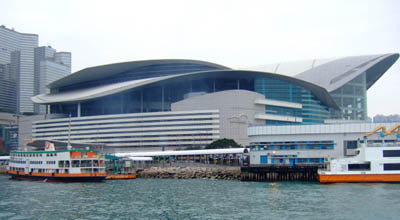
Tuesday morning-early afternoon: The film market, Filmart, is held in the overwhelming Convention Center on the harbor: at least seven floors of steel and glass, shaped like a wingspread gull and full of gigantic auditoria and meeting rooms. Sellers have set up booths to showcase films, TV shows, and the like. There’s also a film financing forum, where directors come to pitch projects to likely funders.
After getting my credentials, I shmoozed with old friend Shelley Kraicer, a Chinese film expert who’s a consultant for several festivals. I also spent time with Ho Yuhang, whose Rain Dogs I’d seen at Vancouver. Ho is a great fan of film noir, and I brought him some DVDs that seemed up his alley. He’s planning a psychological crime drama for his next project, and don’t be surprised if touches of David Goodis and Jim Thompson show up in it.
Late afternoon: After climbing into a suit, back to the Convention Center. At the preshow reception, met Fred Milstein, who works as a completion guarantor at Cine Finance; Fred went to film school, so we had several friends in common.
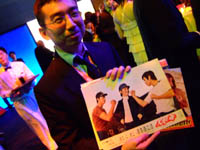
Also reunited with King Wei-chu, a programmer for Montreal’s wonderful Fantasia film fest, and Frédéric Amboisine, passionate adherent of Asian cinema and writer for the lush French magazine Kumite. (King and Frédéric awed me with the memorabilia they tote around, rare posters and books they’ll whip out to show you.)
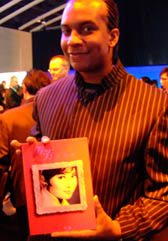
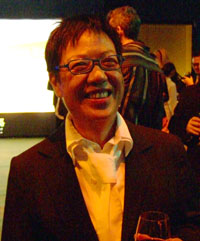
Also ran into director Ann Hui, looking happy and relaxed as usual. Ann, who’s one of Hong Kong’s best filmmakers, visited UW-Madison to show Summer Snow back in the 1990s.
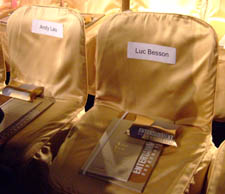
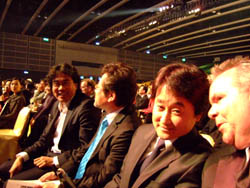
Evening: The ceremony approached. We spilled into the auditorium, with assigned seats. Mine was in the front row, and as I passed the center section I saw plenty of indications of star power.
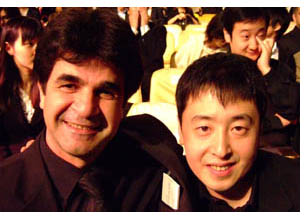
I was lucky enough to be seated beside the remarkable Iranian director Jafar Panahi (The Circle, Offside) and next to him was Jia Zhang-ke, who remembered me from a panel we’d been on together in Shanghai. You can see that they were in good spirits. On my other side sat Vicki Zhou Wei and Song Kang-ho.
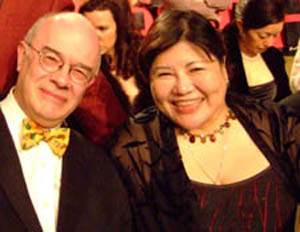
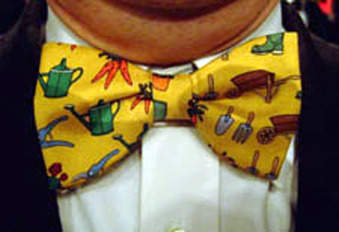
Before the curtain rose, I caught up with Tony Rayns, wearing an amazingly horticultural bow tie, and Peggy Chiao, the godmother of the New Taiwanese Cinema.
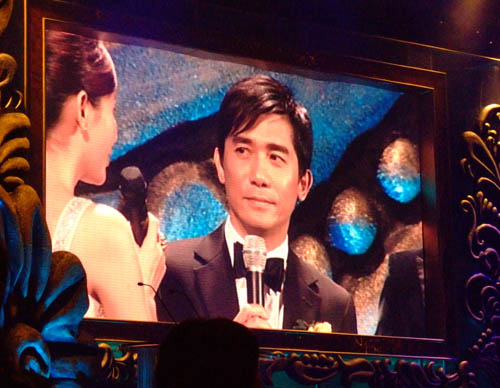
The big noise of the night was the presence of Korean pop star Rain, who brought shrieks from the crowd whenever he turned his head. Still, there was no shortage of fan response for Andy Lau and Tony Leung, the spokesman for Entertainment Expo.
The ceremony was principally in English, from a clever script written by the resourceful Grady Hendrix. Karen Mok started things off in her plummy English accent, but then David Wu showed up with his rapid-fire patter, eventually joined by Fiona Sit.
I missed some stretches because I had to go backstage before my award, but here are some pictures before and after. First, Mani Haghighi gets his screenplay award.
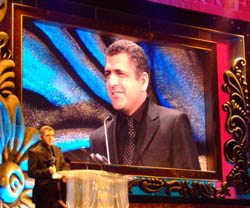
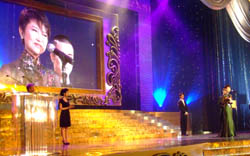
Here’s Siao Fong-Fong getting her special award:
And here’s the Korean contingent as they realize they’re on a roll:
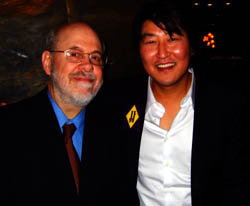
Late evening: At the afterparty, in a bar called JJ’s, I met with Grady, Stuart Levy of Tokyo Pop (who grasped the importance of Asian pop culture before nearly anybody else), his Japanese associate Matsuhashi Masashi, and several other folks—not least the indispensable Athena Tsui, who had worked very hard to make the Awards show a success. On the way out, got my picture taken with the charming Song Kang-ho.
Later evening: Quiet dinner at a great fish restaurant with pals Yuhang and Michele, including Tony Rayns sans bowtie. We had some fine dishes, including pissing prawn (don’t ask).
Finally: Say hello to my lee’l fren’. The awards statuettes were designed by Wong Kar-wai art director William Chang.
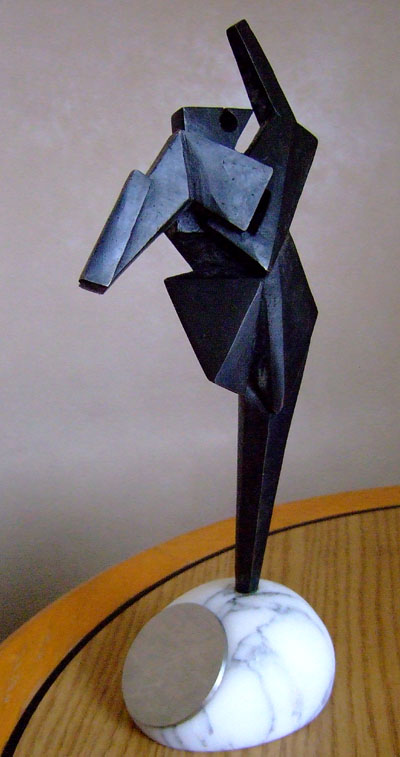
In the spirit of awards ceremonies: Thanks to everyone who’s helped me work on Asian film over the years, especially Tony Rayns, Donald Richie, Komatsu Hiroshi, Li Cheuk-to, Athena Tsui, Shu Kei, Sam Ho, Ding Yuin Shan, Stephen Teo, Doug Gomery, and Gabrielle Claes, along with several archives, festivals, and film distributors. Thanks also to Mr. Johnnie To, who kindly presented me with the award.
Weather Bird flies again
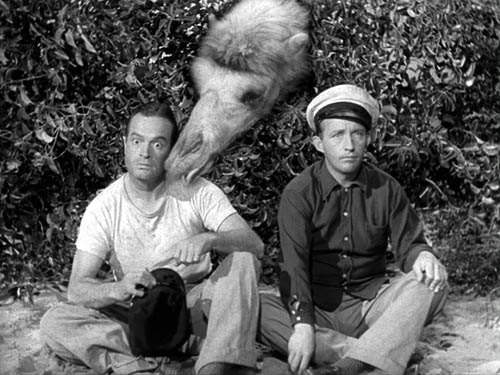
Road to Morocco.
From DB:
On one shelf, close to my desk, I keep books of essays that have satisfied me across the years. Lined up across about four feet, these remind me of the virtues of critical prose. Shaw, appropriately I suppose, sits on the far left, followed by Dwight Macdonald, Jacques Barzun, Gore Vidal, Robert Hughes, Christopher Hitchens, Frederick Crews, Kenneth Tynan, Susan Sontag, and a few others. Picking up any of these and rereading an essay pushes me to try to write more pungently and think more clearly.
I know nothing about jazz, but decades ago I enjoyed reading Gary Giddins’ Weather Bird column in the Village Voice. Then I picked up his 1992 essay collection, Faces in the Crowd and immediately he won a place on my shelf. His buoyant essays are compulsive reading. His piece on Jack Benny, “This Guy Wouldn’t Give You the Parsley Off His Fish,” kicks off the volume, and I think it’s a masterpiece. After reading it, you want to watch a string of Benny TV shows. It’s followed by another triumph, Giddins’ dynamic case arguing that Irving Berlin more or less invented American entertainment. This brace of pieces is just the start. As you’d expect, Giddins spends time on musical greats, from Billie Holliday to Larry Adler, but he shows a fine range, discussing Spike Lee, Robert Altman, Myrna Loy (in an essay titled “Perfect”), and writers from Faulkner to Elmore Leonard.
In an era when journalistic criticism is identified with either puffery or deflation, Giddins is the master of unabashed, admiring appreciation. His judgments are balanced, but he almost never resorts to the swordthrust beloved by his mentor Macdonald, who wrote some of the funniest and most insulting passages in all of American film criticism. You sense that if Giddins dislikes something, he’d rather not write about it. The French call it “the criticism of enthusiasm.”
When he likes something, he can merge dissective intelligence, subtle distinctions, and unfussy prose as very few writers about the popular arts can. Not for him the turbocharged syntax and hyphenated adjectives of fanboys. One word or phrase does the job. Watch how he brings Jack Benny before us, linking him to a tradition of comic types that is even echoed in the turns of the sentences:
The character he created and developed with inspired tenacity all those years–certainly one of the longest runs ever by an actor in the same role–was that of a mean, vainglorious skinflint; a pompous ass at best, a tiresome bore at near best. To find his equal, you have to leave the realm of monologists and delve into the novel for a recipe that combines Micawber and Scrooge, with perhaps a dash of Lady Catherine De Bourgh and a soupçon of Chichikhov; or better still, a serial character like Sherlock Holmes, who proved so resilient that not even Conan Doyle could knock him off.
Benny as Micawber plus Scrooge: perfect. At near best: perfect. And if you worry that “a soupçon of Chichikhov” teeters on pretentiousness, the “knock him off” at the end makes the sentence snap shut, reassuring you that Giddins writes in that American demotic which is our birthright.
 The Benny essay is reprinted, justly, in Giddins’ 2006 collection Natural Selection: On Comedy, Film, Music, and Books. This book is twice as long as Faces in the Crowd, and it’s a feast. We get fine pieces on Chaplin, Keaton, Lloyd, and the Marx Brothers, and sensitive celebrations of Antonioni, Lang, Doris Day (he loves her), and Harold Lloyd, along with in-depth studies of many classic films. “Cowardly Custard,” a sketch of Bob Hope, rises to the level of the Benny apologia. If you don’t rush immediately to see a Hope film after reading it, you’re not the man or woman I think you are. I turned to The Ghost Breakers and was rewarded with the moment when Hope peers around a pillar at Paulette Goddard and asks with a hesitant leer, “Am I protruding?”
Lucky for us that The Perfect Vision, The New York Sun, and other venues have opened their doors to Giddins’ film writing. (For a sample, along with lots of other material, visit his site.) Although he occasionally scolds, it’s the criticism of enthusiasm that reigns. When he started to write about jazz clubs, “I could focus on what I admired–on what I wanted you to admire or at least know it existed.”
In his music criticism and biography (the wonderful Bing Crosby life Pocketful of Dreams), Giddins interweaves technical details, anecdotes, and thoughtful commentary. In writing about films he does much the same, blending observations about form and craft with insinuating evocations of how a movie plays on the screen. Not many film critics today would notice how the first shot of Lloyd’s masterful Girl Shy unobtrusively sets up its climax. He writes of The Letter:
From the opening nighttime pan of a rubber plantation, interrupted by a gunshot and fluttering cockatoo, and finished with an inexorable closing in on Better Davis, who has followed her victim on to the verandah and pumped five more bullets into him, you know you are in the hands of ardent filmmakers and can only hope that they sustain the inspiration for another 90 minutes. They do.
Or this:
Eyes without a Face begins with a lengthy traveling shot, as Alida Valli races through the night with a crumpled corpse in the backseat, enclosed by an endless line of skeletal trees and accompanied by Maurice Jarre’s funhouse score–imagine Philip Glass programming a carousel.
Giddins has an unapologetic respect for African American performers in studio movies. Of Ivie Anderson’s “All God’s Chillun Got Rhythm” in A Day at the Races, he notes:
This scene was cut from TV for years and decried as racist by sensitive white liberals. They are free to skip it; the rest of us can head straight for DVD chapter 22 to see Anderson in clover. Racism manifested itself less in Catfish Row stereotypes than in the failure to cast her in other movies.
On Sammy Davis Jr. Giddins mixes sober praise with sorrow:
Davis had once been renowned as a performer of spectacular gifts who could do everything. Sadly, “everything” usually proves to be the most evanescent of talents. His early appearances were virtuoso displays of dancing, singing, and mimicry that defied indifference; he would stop at nothing until he brought the audience into his fold. . . . Davis’ besetting sin was not extravagance, philandering, imbibing, or reckless optimism concerning a president. It was trying to live life as if color did not matter. He was a naïf savant.
For Giddins fans who are cinephiles too, there’s a quiet satisfaction in learning from the autobiographical sketch that launches Natural Selection that he started as a film critic for The Hollywood Reporter. Of course he continues to write about music and literature, and his essay on Classics Illustrated comic books will tingle every baby boomer’s spine. Still, by circling back to movies, Giddins shows himself one of the great contemporary American film critics. In his hands criticism finds its justification as subtle, eloquent admiration.
P. S.
The Good German finally made its way to Madison, and so I’ve posted a quick postscript to my earlier blog on the film’s attempt to recapture 1940s film technique. Nice try, but….
From Hollywood to Atlanta to us
DB here:
Some day Ph. D. students will be writing dissertations on the contribution of Turner Classic Movies to US culture. I’d argue that Ted’s baby is as important to our collective sense of cinema history as the establishment of the Museum of Modern Art Film Department was.
As a movie fan, I’m overwhelmed by the chance to see so many of my favorites for the cost of monthly cable. As a film researcher, I find myself feeling as if a film archive dumped a dozen movies on my front lawn every morning. In 1990, my colleagues and I would’ve killed for the opportunity to see this stuff, and now it’s whizzed to us at home. “Seven Brides for Seven Brothers again?” some of us sigh. We are so spoiled.
 To refresh his core MGM-RKO-WB titles, Turner showcases items from Columbia, Paramount, Goldwyn, and other studios. The channel has become an eternal college course in cinema, with no exams or papers and all viewers happy to earn a perpetual Incomplete.
Why mention TCM now? Because I’m especially wrought up by what’s on offer over the waning days of January. Every day boasts many classics, so I’ll mostly skip mentioning all the fine standbys that they’re running. Here are more offbeat things I’m up for, most of which I haven’t seen.
Overturning centuries of Western tradition, TCM defines a new day as starting at 6:00 AM. Sounds reasonable to me. But check for local playing times.
Jan 21: Stolen Moments (1920): I don’t get Rudolph Valentino’s appeal, but any film from this era demands a look.
Munchhausen (1943) A textbook classic from the Nazi cinema.
Jan. 22: The Legend of Lylah Clare (1968): Trashy premise + Kim Novak + Robert Aldrich = must-see.
Jan. 23: A cornucopia. I’ll just keep the recorder going all day for:
The Black Book (1949): As oddball a film as Anthony Mann ever made, with John Alton’s pitch-black scenes turning the French Revolution into a noir nightmare. Forget the commercial DVD, evidently ripped from a 16mm print; the TCM version should look better.
Gangster Story (1959): Walter Matthau starred and directed this NYC low-budgeter.
The Guilty Generation (1931): From Rowland V. Lee, endless supplier of B’s.
The Criminal Code (1931): Excellent Hawks with Karloff. Bogdanovich paid tribute to this in Targets.
A string of Boston Blackie films, from 1941-1942: I remember this popular B series from TV syndication in my childhood. Fast-paced and punchy, with direction by Robert Florey, Edward Dmytryk, Michael Gordon, and the prolific Lew Landers.
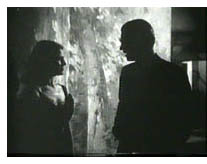 Angels over Broadway (1940; on right): Mostly shot in one nightclub set (in the Astoria studio?), a murky drama signed by Ben Hecht and Lee Garmes. Douglas Fairbanks Jr., Thomas Mitchell, and a young Rita Hayworth fill out sober long takes.
The King Steps Out (1936): Hard-to-see von Sternberg.
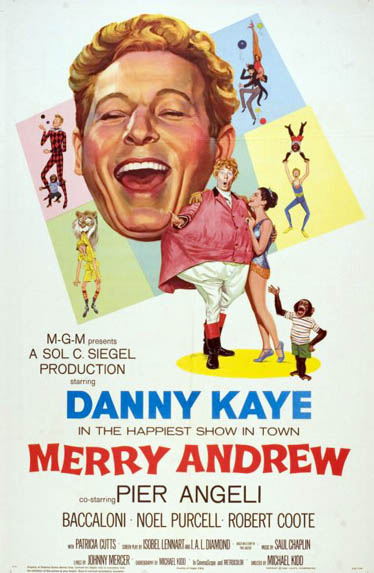
Jan. 24: Of course you’ll watch La Strada, Detective Story, The Big Carnival, etc. if you haven’t seen them. Me, I’m poised to record Merry Andrew (1958), a CinemaScope vehicle featuring Danny Kaye as an Oxbridge archaeologist. The film contains another unexorcizable ghost from my childhood, the song “Everything is Tickety-Boo.” What’s tickety-boo? Canadians know.
Jan. 25: Lots of prime stuff, including Experiment in Terror, Anatomy of a Murder, Dead Heat on a Merry-Go-Round, The Caddy, and several classic MGM musicals.
Jan. 26: A day devoted mostly Paul Newman and Paris, but there’s also:
The Killer Is Loose (1956): Boetticher. Say no more.
To Paris with Love (1955): Robert Hamer, director of the Ealing classic Kind Hearts and Coronets, gave us this, starring Alec Guinness, one of cinema’s finest and most modest actors.
A drive-in horror double bill courtesy William Beaudine: Billy the Kid vs. Dracula (1966) and Jesse James Meets Frankenstein’s Daughter (1966).
Jan. 27: Of course you’ll see, if you haven’t, Gunga Din, The Yearling, The Naked Spur, The Manchurian Candidate (kinda overrated, methinks), The Spy Who Came in from the Cold (kinda underrated), The Quiet American, etc. But there’s also:
The Last of the Mohicans (1935): This, rather close to Michael Mann’s later version, I remember as being pretty solid.
A Bullet for Joey (1955): Edward G and George Raft in their sunset years; can it be bad? Okay, it can, but I’m still going to check it out.
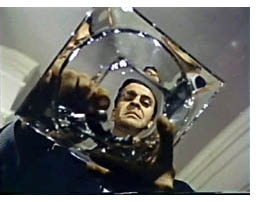 Jan. 28: Among much good stuff, including the still poignant Umbrellas of Cherbourg, I’ll be targeting Dragnet (1954), a nifty, seldom seen feature by that unique genius Jack Webb. How often do we get an ashtray’s-eye-view of a scene? Does this cablecast portend a DVD release?
Jan. 29: It’s teen dance music till prime time: Bop Girl, Rock around the Clock, Don’t Knock the Rock, Don’t Knock the Twist, Don’t Rock the Twist, Don’t Twist My Rock, etc. Might just as well keep the recorder rolling… and rocking!
Today’s outstanding piece of esoterica is The Show (1927). Every year or so I’ve been writing TCM to ask them to play this strange item from the agreeably warped Tod Browning. Let’s just say that John Gilbert plays Cock Robin and Renee Adoree plays Salome, with Lionel Barrymore chewing the scenery as the villain. Other attractions include cuckoldry, decapitation, and murderous iguanas. With a new score from TCM’s highly laudable Young Composers competition.
Jan. 30: Of course you’ve seen Ford’s stunning Arrowsmith, Pressburger’s Life and Death of Colonel Blimp, This Happy Breed, Shane, His Girl Friday, etc. But don’t forget:
The Clairvoyant (1935): the relentlessly prolific Maurice Elvey, doyen of Brit good taste, directs Claude Rains (ditto) and Fay Wray.
Strike Me Pink (1936): Eddie Cantor isn’t for all tastes, but I want to give this one a chance.
Raffles (1939): I’m a sucker for gentleman-thief stories, and with Gregg Toland as cinematographer, Sam Wood may indulge his Gothic streak, so memorable in Our Town and Kings Row.
Jan. 31: Not as strong a day as yesterday, but I’ll be checking on This Could Be the Night (1957), helmed, as they say, by Robert Wise and starring the radiant Jean Simmons (another adolescent fascination of mine), and Mitchell Liesen’s The Mating Season (1950), written by Charles Brackett and starring the fascinatingly blank Gene Tierney.
February, devoted to Oscar pictures, doesn’t contain so many marginal items, but still it’s a cornucopia of outstanding movies.
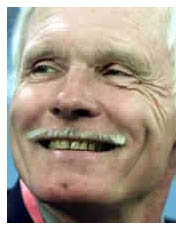
Controversial as he is, Ted Turner has proven a generous mogul, both politically and cinematically. Forget colorization! That was a bogus issue, and anyhow, for every colorized title a spanking fine-grain positive was made for archival preservation. Turner has done more than any single person to sustain and publicize the American film heritage, and he’s made it available to everyone within reach of cable. You can read more about Ted in Ken Auletta’s brisk and chatty biography.
Dorothy’s rainbow comes to earth at TCM. Watch regularly. Check the website for extra stuff, and browse the 150,000 film database. Buy the monthly program guide; it’s only twelve bucks. While you soak up the pleasure, pause to pity the cinephiles overseas. Their version of TCM, hedged by rights holder restrictions, offers mere crumbs from our bursting banquet table.
PS: Since I first posted this, film historian Doug Gomery has pointed out that Turner hasn’t controlled TCM in 12 years, but both Time-Warner bosses Gerry Levin and Dick Parsons have kept it going. We owe them thanks for refusing to ‘AMC’ it with commercial breaks and dopey gimmicks. Fortunately it makes money for TW. Long may TCM prosper.
PPS as of 23 Jan.: Lee Tsiantis of the Turner Entertainment Group adds that credit also belongs to Jeff Bewkes, who among other duties oversees the channel. So a big thanks to him as well.
Mad City’s movie mania
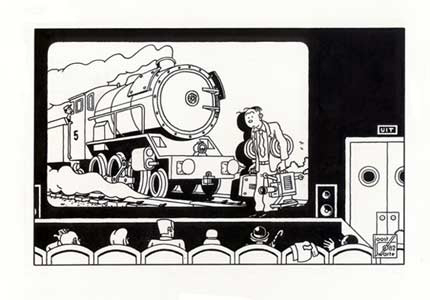
The Hilldale Theatre of Madison, Wisconsin opened its doors in spring of 1966 roadshowing The Sound of Music, and last weekend the theatre closed. To celebrate its passing, the management held a Sound of Music Sing Along, complete with subtitles to help with the lyrics. (No, not “How do you hold a moonbeam in your hand?” but the really tough ones.)
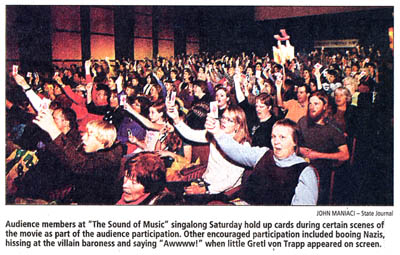
People came dressed as Maria, nuns, and the frog that was slipped into Maria’s pocket. There were cues for audience interaction, including saying “Awwww!” when Gretl appears on screen. This brought back memories of The Rocky Horror Picture Show, which ran at midnight shows at the now departed Majestic Theatre from 1976 through the mid-1990s. For a report on that, and the connubial bliss it brought, have a look here.
Kristin and I came to Madison in fall of 1973, prime time. The campus boasted 22 film societies: Wisconsin Film Society, Fertile Valley, Green Lantern, Hal-9000, and all the rest. Members of the Union Film Committee, overseeing the only campus 35mm venue, were passionately debating whether to show Godard, or Jancso, or a John Ford retrospective. I convinced them to show The Young Girls of Rochefort, which hurt my reputation,and Play Time, which I think helped it.
The Wisconsin Center for Film and Theater Research had just acquired several thousand Warners and RKO films. The Majestic Theatre ran double and triple bills (kung-fu, Leone’s Dollars trilogy). The Velvet Light Trap magazine was going strong, run wholly by students and semi-students.
In those days, before home video, it was glorious to be in Mad City. We had 6-10 movies to see every night, apart from course screenings. We didn’t even own a TV. Who needed one?
 Not to mention the cast of characters, all colorful. In the late 1960s-early 1970s the film community included:
The late Mark Bergman, premiere projectionist, fan of Phil Karlson, and gentle soul.
Joe McBride, critic (Variety), screenwriter (Rock and Roll High School), actor (The Other Side of the Wind), and excellent biographer (Spielberg, Capra, Ford, now Welles; What Ever Happened to OW? is very engaging).
Mike Wilmington, one of America’s top film critics, a mainstay of the Chicago Tribune.
Tim Onosko, author of Wasn’t the Future Wonderful?, industry consultant, and documentary filmmaker.
Gerry Peary, enterprising critic, screenwriter, and film professor.
Danny Peary, most famous for his series of Cult Movies books.
John Davis, co-founder of the Light Trap and creator of Capital City Comics.
Susan Dalton, another co-founder of the Light Trap and archivist at the American Film Institute.
Pat McGilligan, prolific critic, interviewer, and biographer.
Tom Flinn, the other co-founder of the Light Trap, pop-culture encyclopedist, and expert on Germans in Hollywood.
Bill Banning, founder of Roxie Releasing and operator of San Francisco’s Roxie Cinema.
Reid Rosefelt, publicist, producer’s rep, and filmmaker.
Many of these worthies ran film societies, so their ideas and passions showed through the films they screened. For more on the Madison Movie Mafia, go here.
Also present and active in late 1960s-early 1970s:
Filmmakers Erroll Morris, Stewart Gordon, Jim Benning, Bette Gordon, Michelle Citron, Karyn Kay.
Scholars-in-training James Naremore, Doug Gomery, Maureen Turim, Fina Bathrick, Marilyn Campbell, Diane Waldman, Ed Branigan, Vance Kepley, Peter Lehman, Brian Rose, Peter Brunette, Frank Scheide, and many more.
Great days, and nights…Mike Wilmington has written a fond appreciation of the whole scene here.
But this isn’t just an exercise in baby-boomer nostalgia. The Madison Cinema Juggernaut rolls on. The Light Trap just published its 58th issue. The Onion, founded by Madison students, continues to be America’s finest news source. Dan Fuller makes silent films with his students, using cameras from the 1920s, and the results have played at Pordenone. And not least, the Cinematheque, founded by faculty and students in the Communication Arts Department, carries on the spirit of the old film societies.
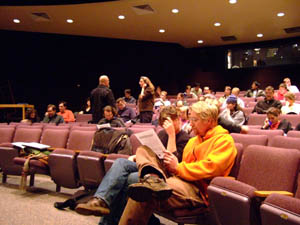
In sync with the closing of Hilldale, our Cinematheque ended the semester last weekend. (Crowd starting to gather above.) An outstanding schedule (S. Ray, Tarr, Godard, Sjostrom.) wound up with Lau Kar-leung’s Dirty Ho, the last of our string of Shaw Brothers classics. It was, of course, a delight, full of flamboyant, good-humored, and downright weird kung-fu.
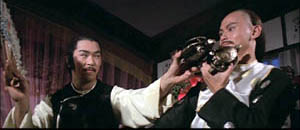
A lot of it was close-quarter work, as warriors examining pottery or sampling wine disguise their deadly thrusts as elaborate courtesy. Lau is arguably Hong Kong’s top martial arts choreographer, but he’s a fine moviemaker as well, and Dirty Ho is one of his best. Even the shabby state of the print, an original from 1979 complete with curious purple splotches, seemed to pay tribute to three decades of campus film fanaticism. It could have played the Majestic.
Even with the loss of the two Hilldale screens, Madison has five commercial screens dedicated to foreign and independent films, not counting the Cinematheque and the Play Circle in the Student Union. Come spring with Sundance, we’ll get six more. And our Wisconsin Film Festival (April 12-15) comes hard on the heels of the Sundance complex. Wisconsin Movie Madness lives on.
DB
PS: Thanks to Ivo Blom for the Swarte illustration up top.
PPS 21 December: Today’s Isthmus has a nice story on Dan Fuller and the Wisconsin Bioscope company. I played a small role in their last film of the semester, and despite the need to wear eye shadow, this gave me an even greater appreciation of their efforts. They’ll have a screening of recent work some time next term.



