





Archive for the 'People we like' Category
Two talks
For over twenty years, our Film Studies program here at the University of Wisconsin–Madison has held weekly colloquia. Faculty, grad students, and anyone else who’s interested gather on Thursday afternoon to hear lectures or participate in panel discussions or sometimes just watch a film together.
The colloquium speakers are often guests. They might be scholars from other campuses; Rick Altman from Iowa kicked off this semester with a fine talk on sound in the silent era. Sometimes we get visiting filmmakers with new work, or archivists showing a restoration. Mike Pogorzelski of the Academy and Schawn Belston of Fox are frequent visitors, bringing some of their wonderful discoveries. Often as well grad students present a talk based on a seminar paper or their dissertation work, and sometimes faculty try out a new paper. My ‘transitions’ talk last week was a colloq presentation.
This week our colleague Jeff Smith gave a very intriguing paper on new ways of thinking about movie soundtracks. Jeff is the author of a major study of film music in the 1960s, and how it relates to the record industry of the time.
Jeff talked about how film theorists of the 1910s and 1920s had tried to draw analogies between a film and a musical piece. For these thinkers, cinema was less tied to theatre and literature than to music. This allowed them to repudiate the photographic realism that seemed to limit the camera to reproducing what was put before it. Theorists like Germaine Dulac, Jean Epstein, and Dziga Vertov wanted to push film beyond realism and so looked to the abstract art of music.
Jeff suggested that this analogy failed because the theorists’ conception of music was too limited to art music and nineteenth-century models. He proposed that a better analogy would be the more expansive conception of music that many musicologists hold now. Music now commonly includes spoken language, sound effects, electronically generated material, and purely ambient passages….all of which are much closer to the sort of mixtures we get in a film soundtrack.
He played examples from Brian Eno, Stevie Wonder, and other artists to back up the idea, and he also suggested that now a lot of musical composition was becoming more and more like a movie track. (John Zorn and Steve Reich come to mind.) It was a provocative idea and stimulated a good discussion, including comments from PhD students in music theory. Then we went to our bar, the Red Shed, for more fun.
Following a quick dinner, Jeff and I attended a packed lecture given by Philip Kitcher, the distinguished philosopher of science. The talk was called “Science, Religion, and the Difficulties of Democracy.” It was a thorough and careful treatment of larger issues behind the evolution vs. creationism conflict.
Kitcher distinguished three sorts of religious belief (providentialism, supernaturalism, and spiritualism) and traced out the extent to which scientific inquiry challenged each one. He argued that if scientific inquiry was to become the gold standard for reasoning–a belief he holds–then democracies are faced with the possibility of narrowing the freedom that they traditionally grant to unscientific systems of belief. That is, if the theory of evolution meets the highest standards of scientific accuracy, as it does, then a local community doesn’t really have full power to curtail its teaching in the classroom.
It was a compelling lecture, but the question period was even more riveting. Kitcher is a master of thinking on his feet, and he gave courteous, clear, and subtle responses to objections from the floor.
Days like this make me glad, and proud, to be part of a university. Eloquent and smart speakers addressing alert audiences are an irreplaceable part of higher education. Now that I spend more time in front of a computer monitor, it’s good to be reminded that colloquia and public lectures yield a unique pleasure: People meeting face to face to think together.
Vancouver envoi
A late night Thursday, and a snoozy day of traveling on Friday, kept me from posting ASAP. And now on Saturday morning—I can’t get on to my own blogsite! Apparently others can. So while our web czarina Meg fixes things, I try to wrap things up on my visit to the Vancouver International Film Festival.
Le Petit Lieutenant: A policeman’s lot is never a happy one. From Ed McBain’s 87th Precinct to Ian Rankin’s Rebus series, modern crime novels give an emotional resonance to police procedure by showing the psychological costs of being exposed to cruelty, chicanery, and death. American cop movies have gradually let more of this quality come through (Prince of the City, Heat, Dark Blue), and of course TV, from Hill Street Blues to The Wire, has turned the police procedural into urban melodrama. But the French got here first. For decades, their cop movies have been world-weary psychological dramas shot through with bitter realism. Think of Corneau’s Police Python 357, Pialat’s Police, Tavernier’s L.627, or any of Melville’s policiers.
Le Petit Lieutenant, which I saw on my last day, falls into that sturdy tradition. The premise—a string of attempted murders of bums and passersby—is played out with the usual clue-by-clue plotting, but we also witness the strained lives cops lead. Our two protagonists are the overeager recruit Antoine (Jalil Lespert) and his recovering alcoholic supervisor Carolina (Nathalie Baye in an utterly deglamorized performance). Xavier Beauvoi’s narration shuttles skillfully between their points of view, leading to a good deal of sympathy and suspense and a grim but plausible climax. One of several nice touches: the cops keep movie posters over their desks, and if I’m not mistaken, in some cases the posters serve as hints to the cops’ personalities. The ending leaves you as bereft of certainty as the protagonist.
Do Over (Taiwan): For a finale, I caught this extraordinarily ambitious movie by the twenty-eight-year-old Cheng Yu-chieh. Shot in anamorphic widescreen (very rare in Taiwan over the last twenty years), it belongs to the trend I’ve called “network narratives.” Across New Year’s Eve and New Year’s Day, the lives of several people converge and diverge in the fashion of Short Cuts and Magnolia. Each character’s strand evokes a different genre: gangster movie, romantic drama, twentysomething “relationship” comedy, and the movie about moviemaking. Each strand is also set off by a distinctive photographic style, from misty blue to grainy, blown-out noir.
A network plot often exhibits an interesting mix of realism (in life, strangers’ lives do become tangled) and artifice (chaptering, repeated scenes, and other overt narrational devices). The artifice becomes flagrant at the film’s end, when Do Over‘s title gets literalized and the plot lines are revised to yield alternative endings. The cleverness doesn’t get the upper hand, however, and this remarkable debut leaves you both satisfied and looking forward to Cheng’s next film.
After two trips to Vancouver’s festival, I have yet to go to any tourist destination. I’ve lived within a few square blocks, dashing among hotel, DVD stores, and the Granville Multiplex, with forays to the Pacific Cinematheque and the Vancity Theatre and sushi restaurants and crepe cafes. I’ve lived a film-wonk holiday across eight days and dozens of movies. Thanks to Alan Franey, the Festival Director, for inviting me and extending me so much courtesy. I’m grateful to all the help of his colleagues PoChu Au-yeung, Mark Peranson, Eunhee Cha, Steve Martindale, and Jack Vermee. I wish we’d had more time to talk! Over the last two visits, I’ve made new friends from all over the world, and I’ve enjoyed just sitting among exuberant audiences.
Tony Rayns has been programming Asian films at Vancouver since 1988, and I have to note the melancholy news that he’s stepping down as coordinator of the Dragons and Tigers competition. I’m unhappy as well that I can’t be at Vancouver tonight (Saturday) to see the results of the competition and participate in what will surely be a string of tributes to Tony. So here’s a weak substitute—my own appreciation online.
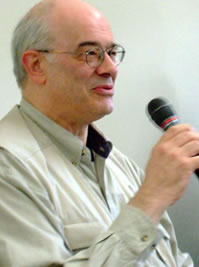
Tony Rayns at VIFF, 2006
In Tony Rayns deep expertise is joined to an unmatched passion and curiosity. His Vancouver programming was crucial in introducing directors like Kitano and Hou to West. He has also made films happen: Without the acclaim of Vancouver audiences and the prestige of the Dragons and Tigers prize, how many distributors would have backed later work by young directors over the last twenty years?Most critics prefer to stroll into screenings to watch films that miraculously appear, thanks to the work of dozens laboring behind the scenes. From the start Tony got his hands dirty. Apart from writing discerning and literate film criticism, he worked for film festivals, wrote presskits and program notes, translated subtitles, and pushed for offbeat films to be available on video and cable. Above all, he programmed films, backing his tastes with an expanding network of allies in the film industry. He helped create a climate of opinion that welcomed the burst of creative accomplishment that Asian film has offered over the last three decades.
Tony’s been a friend since the mid-1970s, and his influence on my tastes and thinking has been immense. I wouldn’t know a lot of what I know without his tireless proselytizing for once-obscure films and filmmakers. He’s sensitive to all a film’s dimensions—its social and artistic implications, its relation to the director’s personality and life experience. A late-night conversation with him, preferably over Asian food, is like being in the liveliest seminar you ever took.
Many of Tony’s contemporaries—I know plenty—have given up on contemporary cinema. Who can blame them, after a trip to a multiplex? Too often, cinema seems over. But this has only made Tony dig deeper, watch more widely, and remind us that this art form is still frisky, unpredictable, and occasionally rapturous. The French have a word for it: animateur, the person who sends a jolt of energy into a culture. Like André Bazin and Henri Langlois, Tony is one of the animateurs of world cinema, and everyone who loves film is in his debt.