















Archive for the 'People we like' Category
Simplicity, clarity, balance: A tribute to Rudolf Arnheim
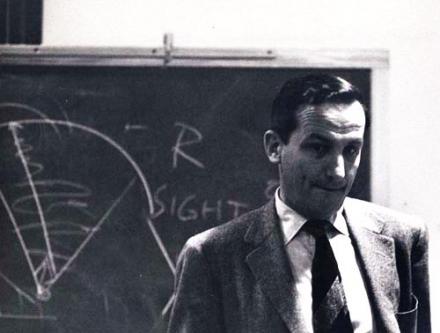
DB here:
On Monday, at age 102, Rudolf Arnheim died. You can read his obituary here, and this is a lovely website devoted to his work. He was one of the most important theorists of the visual arts of the last century, and he had enormous impact on how people, including Kristin and me, think about film.
A good Gestalt
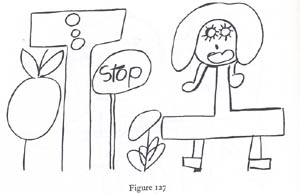
In parallel with E. H. Gombrich, who died in 2001, Arnheim brought modern psychological concepts into the study of visual art. His most famous work, Art and Visual Perception (1954, new version 1974) has the sort of magisterial presence that very few books in any era achieve. Arnheim delighted in the fact when, visiting a painter’s studio, he would find a spattered copy on the workbench. Of the revised edition, entirely rewritten, he noted:
All in all, I can only hope that the blue book with Arp’s black eye on the cover will continue to lie dog-eared, annotated, and stained with pigment and plaster on the tables and desks of those actively concerned with the theory and practice of the arts, and that even in its tidier garb it will continue to be admitted to the kind of shoptalk the visual arts need in order to do their silent work (new ed., x).
He aimed at theory that actively participates in the way artists do their job. The chapter titles of Art and Visual Perception deal with the nuts and bolts of picture-making: Balance, Shape, Form, Growth, Space, Light, Color, Movement, Dynamics, and Expression. No puns, slashes, dashes, or parentheses. What academic theorist today would so boldly announce their concern with the craft of creating images?
The book is subtitled, A Psychology of the Creative Eye, and the chapters’ subsection titles explain why. The hidden structure of a square . . . Vision as active exploration . . . Perceptual concepts . . . What good does overlapping do? . . . Why do children draw that way? . . . Gradients create depth . . . Visible motor forces . . . The priority of expression. Arnheim’s principal achievement in art theory was to integrate the Gestalt theory of perception with the traditional concerns of picture-making. He sought to show how perceptual laws discovered in the psychological laboratories of Berlin were intuitively applied by classic and modern artists.
As he put it, he was at the university at around age twenty:
My teachers Max Wertheimer and Wolfgang Köhler were laying the theoretical and practical foundations of gestalt theory at the Psychological Institute of the University of Berlin, and I found myself fastening on to what may be called a Kantian turn of the new doctrine, according to which even the most elementary processes of vision do not produce mechanical recordings of the outer world but organize the sensory raw material according to principles of simplicity, regularity, and balance, which govern the receptor mechanism.
This discovery of the gestalt school fitted the notion that the work of art, too, is not simply an imitation or selective duplication of reality but a translation of observed characteristics into the forms of a given medium (Film as Art, 3).
The Gestalters thought that these principles–figure/ground, completeness, good continuation, and the like–were fundamental to all human perception, across times and cultures. Art and Visual Perception makes a powerful case for this view. Today this position is so unfashionable that Arnheim’s calm confidence in it is quite stunning. For many scholars today, all that matters is what divides and differentiates us. But for eighty-plus years Arnheim emphasized ways in which we share a common experience of the world and of art.
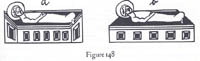 It’s often said that Arnheim favored modernist styles, like Cubism and expressionism, and that his emphasis on art as going beyond mere copying reflects modern artists’ will to distorted form. But he saw a deep continuity between classic art and modern art. Both traditions explored the perceptual force of form. Amazingly, he argues that the cockeyed creche in Fig. a conveys a stronger sense of three-dimensionality than the correct perspective presented in b. The “inverted” perspective encloses baby Jesus’ head fully, just a hollow cradle would.
Arnheim saw the same form-giving activity at work in “primitive” art, the art of children, and even the art of the mentally ill. It turns out that the “universalism” of Gestalt theory underwrites diversity no less vigorously than the most ardent postmodernism.
Flexible striving
Arnheim made another contribution to our thinking about art, one that I think is rarely recognized. In a bold stroke, he extended the Gestalt conception of form beyond its concern with geometrical qualities and argued that form was inherently expressive. A triangle resting on its base wasn’t just balanced; it was weighty. We see the weeping willow as not just curved but sad; a skyscraper isn’t just tall, it’s aggressively thrusting upward. Every shape or movement we apprehend has a distinctive flavor and feeling. Indeed, he writes, “expression can be described as the primary content of vision”!
We have been trained to think of perception as the recording of shapes, distances, hues, motions. The awareness of these measurable characteristics is really a fairly late accomplishment of the human mind. Even in the Western man of the twentieth century it presupposes special conditions. It is the attitude of the scientist and the engineer or of the salesman who estimates the size of a customer’s waist, the shade of a lipstick, the weight of a suitcase. But if I sit in front of a fireplace and watch the flames, I do not normally register certain shades of red, various degrees of brightness, geometrically defined shapes moving at such and such a speed. I see the graceful play of aggressive tongues, flexible striving, lively color. The face of a person is more readily perceived and remembered as being alert, tense, concentrated rather than being triangularly shaped, having slanted eyebrows, straight lips, and so on (Art and Visual Perception, first ed., 430).
Arnheim found feeling in his forms.
Moving pictures
Arnheim wrote about many artforms, including mass media in his 1936 monograph on radio. His book on cinema, Film als Kunst (1932), was quickly translated into English as Film (1933). Always in search of greater clarity and point, Arnheim rewrote it in 1957. Oddly, he didn’t update it: You’ll search in vain for examples from the 1930s, 1940s, or 1950s. The touchstones remain Chaplin, Keaton, von Sternberg, and the Soviets. Arnheim held that cinema was essentially a pictorial art (see my earlier blog on this question) and that synchronized sound added very little; in fact, it might even inhibit visual experimentation. It was so easy to convey a story point with dialogue that lazy filmmakers would simply create photographed stage plays.
As a result, Arnheim is usually taken to be the summation of a certain strain of 1920s film theory. Like many earlier thinkers, Arnheim emphasized how film technique reshapes what is filmed. Close-ups, shot design, camera angles, and cutting make cinema no simple medium of reproduction. Film form transforms the world that is photographed. This position, commonplace today, was a real advance in the silent era and gave cinema artistic respectability, a subject that Arnheim reflected on thoughtfully in the 1933 edition of Film.
Again, Arnheim did more than synthesize current ideas. Theorists’ hunches that film stylized reality could now be grounded in Gestalt ideas about medium and form. In effect, Arnheim rewrote Film in the light of Art and Visual Perception, and the result was Film as Art. Here is the most famous passage:
Not until film began to become an art was the interest moved from mere subject matter to aspects of form. What had hitherto been merely the urge to record certain actual events, now became the aim to represent objects by special means exclusive to film. These means obtrude themselves, show themselves able to do more than simple reproduce the required object; they sharpen it, impose a style upon it, point out special features, make it vivid and decorative. Art begins where mechanical reproduction leaves off, where the conditions of reproduction serve in some way to mold the object (Film as Art, 57).
This, you might say, is Arnheim’s reply to Walter Benjamin’s theory of cinema as mechanical reproduction: no less than other artists, filmmakers use their medium, a photographic one, to create perceptually vivid effects akin to those in other arts.
Still, Arnheim held that film, like photography, has more limits than other arts. Tied to recording, film and photography can never achieve the range of expressive form we find in painting. I don’t believe this for a moment, but Arnheim clung to this opinion, I suspect, because of his deep love for creative freedom he found in other visual arts. And I sometimes think that for him, a painting harbored enough pushes, pulls, twists and torques. Movies just made explicit what was tactfully implied in still images.
Envoi
Kristin and I first saw Arnheim when we were graduate students at the University of Iowa, March 1972. He gave a lecture that stuck to his principles of 1933:
*Every art medium has a ceiling, beyond which it cannot effectively pass. The ceiling is somewhat low for the reproductive arts. Photography is more limited in what it can do than painting, and so is film.
*Films should be in black and white, the better to stylize reality. Are there no worthwhile color films? Pause. Red Desert, perhaps.
*Do you see many contemporary films? No.
Around 1980, I lined him up for a visiting lecture at UW. But he had to cancel; he had slipped on ice and broken his hip. He was then about seventy-five.
Later in the 1980s I visited Ann Arbor and had lunch with him. It was wonderful. By then I had read enough to ask him about Gombrich–an old friend and courtly opponent of his. (Read one of his reviews of Gombrich’s books to see what genuinely respectful disagreement looks like.) He saw pretty quickly that I was a Gombrichian and he gave a shrewd analysis of the dividing line: Gestalt psychology vs. ‘New Look’ cognitivism, illusions vs. expressive percepts, brain fields vs. schemas. He asked me to send me copies of my publications, which I did on and off during the decade. I never heard what he thought about my favorite fancy-pants sentence in Narration in the Fiction Film, when I contrasted J. J. Gibson’s theory of optical realism with Arnheim’s idea of expressiveness: “Gibson likes likeness, Arnheim loves liveliness.”
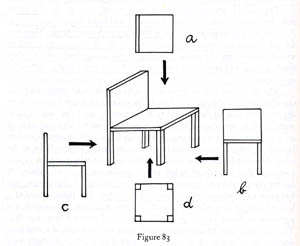
I thought of him often as I read more perceptual psychology. Gestalt work had once seemed to me a dead-end, but with David Marr’s theory of visual perception, a prototype of computational perceptual psychology, Gestaltism came roaring back. The “3D model representation” that Marr claimed operated in early vision uncannily echoes Arnheim’s discussion of our perception’s reliance on “characteristic aspects.” (Arnheim illustrates the idea with the various views of the chair, above. Which one is instantly recognizable as a chair?) And with contemporary interest in the relation between emotion and cognition, Arnheim’s theory of the expressive side of perception is creeping back too. Nothing worthwhile is forgotten, nothing goes away.
When we ran a book series at the University of Wisconsin Press, we were eager to publish an anthology of Arnheim’s film criticism, a collection originally published in German in 1977. Brenda Benthien, a close friend of Arnheim and his wife Mary, executed a lively translation and Arnheim supplied a touching introduction. A refugee of the Hitler years, an émigré across Europe and America, Arnheim summoned up the failure of the Weimar republic:
Even now I keep as a sort of talisman a bullet which in the days of the 1918 revolution, when I was fourteen, flew over the neighboring houses, bored a little hole through the windowpane, and fell inert on the carpet before my bed. Thus it began (Film Essays and Criticism, 3).
In the same introduction, Arnheim deplores the current state of cinema (“my basic objection to the talking film as a mongrel seems to me just as valid today as then”) and he warns against the cheapening of our vision:
Without the flourishing of visual expression no culture can function productively (5).
Aspiring film critics, and especially bloggers, should go back and read Arnheim on Keaton, Eisenstein, Gance, Pudovkin, Chaplin, von Sternberg, and other greats, as well as the essays “Style and monotony in film,” “Epic and dramatic film,” and especially “The Film Critic of Tomorrow.”
Scarcely a month goes by when I don’t have some idea that can be traced, however circuitously, to my reading of Arnheim. For instance, my blog on funny framings, posted a couple months ago, starts with his discussion of Chaplin’s The Immigrant. Arnheim’s theory of expression goes a long way toward explaining how composition can trigger laughter. I doubt that I’d be so alert to the possibilities of two-dimensional design in film shots if I hadn’t been tutored by Film as Art, Art and Visual Perception, The Power of the Center (1982, rev. 1988), his 1962 monograph on Picasso’s creative process in painting Guernica, and the essays in Toward a Psychology of Art (1966)–one of which is a skeptical review of Gombrich’s Art and Illusion. In preparing this entry, I found that my pleas that we probe the norms that guide filmmakers’ craft practices is just a clumsier restatement of this, which I discovered marked in Art and Visual Perception, the New Version:
Good art theory must smell of the studio, although its language should differ from the household talk of painters and sculptors (4).
Three years ago, after the Society for Cognitive Studies of the Moving Image convention in Grand Rapids, several of us from Madison–Ben Singer, Jen Chung, and Jonathan Frome–detoured back by way of Ann Arbor in order to call on Arnheim. He had just turned 100. He resided in an assisted-living facility, and his room was bright and clean, packed with books, remarkable drawings and paintings (Feininger, Köllwitz), a microfilm reader, and a worktable with a gigantic magnifying lens on an articulated arm. Conversation was difficult for him, but he seemed to understand everything we were saying. His smile was quick and his eyes were bright. When I showed him the first German edition of Film als Kunst I’d brought along, he turned it over in his hands as if he hadn’t seen one in years. He signed it, then shook his head apologetically at the shaky writing.
Now that Benjamin and Kracauer have become the prototypical Weimar intellectuals, it’s a pity that so many media students and professors are unaware of the importance of Arnheim’s work. His Leonardo-like interest in merging art and science is discouraged in a climate that posits the cultural construction of everything. He also writes with a grace and clarity that’s all too rare. In an unfashionable way, he exemplifies the passion, rigor, and dignity that interwar German intellectuals brought to the study of the arts. A lot of what he believed remains–what’s the word I want? Oh, yes–true.
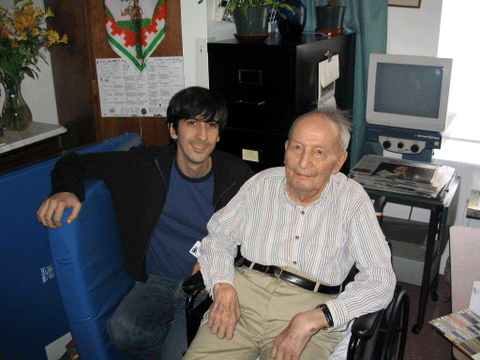
Rudolf Arnheim, with Jonathan Frome, July 2004.
Line illustrations come from Art and Visual Perception.
The latest updates
KT here:
On May 29 we posted an entry responding to the inevitable badmouthing of sequels that journalistic movie critics tend to indulge in when the summer season starts. “Live with it! There’ll always be movie sequels. Good thing, too.” gathered comments from current and present “filmies” of the University of Wisconsin-Madison. They defended sequels for a wide variety of reasons.
Now another ex-Madisonian, Henry Jenkins, has weighed in with “The Pleasures of Pirates and What It Tells Us about World Building in Branded Entertainment.” Despite its somewhat formidable title, this essay jumps into the fray, taking critics to task for their knee-jerk tendency to lump virtually all sequels together into a category fraught with prior expectations and to dismiss the latest entries as mindless, inept films.
Henry takes Pirates of the Caribbean: At World’s End as his point of defense. Somehow critics seem by telepathy to agree to take the same stance on a particular blockbuster. Here they claimed that AWE is far too complicated and gets bogged down in exposition at the expense of action. (So much for claims that blockbusters are all CGI pyrotechnics and no plot!) They also kvetched that there is too little of Jack Sparrow’s character, apparently their main focus of interest in the film.
Henry takes AWE to be, alongside The Matrix, an example of elaborate world-building, a trait of the best of the big film series. In the age of DVDs and cross-media franchises, such films, he argues, are meant to be watched more than once. They also place a lot of faith in the viewer to be able to follow a complicated plot. Henry, like Steve Johnson in his Everything Bad Is Good for You, credits modern media as challenging viewers/readers with dense works that require a lot of figuring out.
Critics assume the opposite, that summer movies are supposed to be mindless entertainment, and they treat them as such. Complexity, which they would hail in an art-house release, becomes a fundamental flaw. Henry has some cogent remarks on the circumstances of reviewers’ screenings and how they handicap the writers’ approach to pop summer movies.
Whether or not one admires AWE, Henry mounts a strong defense of the film and in the process shows how much most reviewers are out of touch with audiences’ tastes and miss the various ways in which summer blockbusters work.
In other news, David’s The Way Hollywood Tells It has just been slated for translation into simplified-form Chinese. He’s now preparing a blog entry paying tribute to the great art theorist Rudolf Arnheim, who died on Monday at the age of 104. The family’s obituary is here.
The Cinema Ritrovato, which we’ll be attending in July, has posted a provisional schedule here. David will go on from Bologna to Brussels for research and the annual Cinedecouvertes and L’age d’or festival; films and other info available here.
1525 big thumbs up
Kristin here—
 David and I just got back from Roger Ebert’s Overlooked Film Festival. It’s been held under the auspices of the University of Illinois, Roger’s alma mater, in late April for nine years now. This year the event was front-page news because our irrepressible host attended the event while recovering from surgery for salivary-gland cancer and complications last summer.
Roger’s features have changed somewhat and he faces further surgery and rehabilitation. Yet the man’s enthusiasm for movies and movie people has not waned. Most of the audience for Ebertfest (as it will officially be called starting next year) are regulars, and the standing ovations that greeted Roger and his wife Chaz show that the enthusiasm and affection are mutual. For more coverage, go here and here. For the official photoblog, with lots of neat pictures, go here.
If anything, Ebertfest audiences seemed even more cheerful and energetic than usual, happy that Roger has been so determined to avoid canceling this year’s event.
David and I have fond memories of Roger’s last visit to the Wisconsin Film Festival in 2006. There he introduced a restored print of Laura, held a signing at a local bookstore, and appeared at other screenings. People passing him on the street called out, “Hi, Roger,” as if he were an old friend. He graciously allowed me to interview him on the subject of press junkets for my chapter on marketing in The Frodo Franchise. There’s no way just to look up the history of junkets. No one has written one. But Roger is a primary document, having been attending them on and off since the 1960s. I learned a lot from our talk.
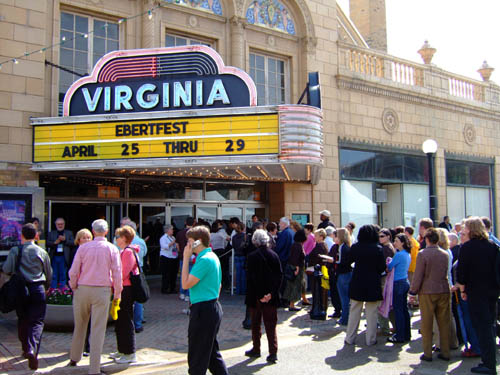
We drove down from Madison to Urbana-Champaign on Wednesday, David attending for the fourth year and I for the third. The opening film that evening was Gattaca (1997). With tepid reviews and box-office on its original release, Gattaca definitely counts as an overlooked film. Shown in an excellent print on the giant screen of the vintage Virginia movie palace, the cinematography was stunning and the story absorbing. Not an utter masterpiece, perhaps, but a very good film that deserved revival. As usual, people came from all over America to pack into the restored 1525-seat venue.
Now we’re back…and doing a summary blog. We had little time at the festival, and during our last day the web service at our lodgings conked out, so this stands as a fill-in.
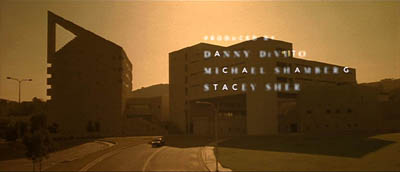
Gattaca.
David’s two bits:
I saw ten films across three days and four nights.
The Virginia theatre did special justice to Gattaca. Writer-director Andrew Niccol used the anamorphic format imaginatively, a bit in the chilly manner of THX-1138, and the framings appeared to full effect on the 56-by-23-foot screen. This time I noticed how much the credit sequence, with only the G-A-T-C letters appearing first, owes to Godard. Like Alphaville, Gattaca uses not artificial sets but actual buildings to evoke the near future.
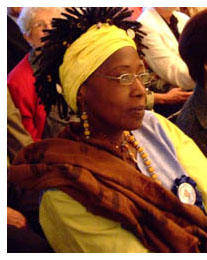 I thought that Moolade held up well on my second viewing, and the post-film discussion with the main performer Fatoumata Coulibaly (right) and Professor Samba Gadjigo was informative. The film’s call for an end to female genital mutilation is typical of Osmane Sembene’s use of controversial material; Professor Gadjigo recalled that Sembene calls his cinema a “night school” for Africa. Ms. Coulibaly said that in production “Papa Sembene” wouldn’t make eye contact with her, but before filming a painful sex scene he told her that she was “doing the scene for future generations.”
Sadie Thompson was still fine, I thought, with Walsh’s skill in cutting and staging exemplifying what Hollywood could do so easily in 1928. Swanson of course is tremendous in the role, using her whole body to tell the story of a woman who’s not as hard-edged as she makes out. The score by Joseph Turrin, conducted by Steve Larsen, was discreet and compelling.
La Dolce Vita seemed to me not to wear so well. I hadn’t seen it in at least twenty years, and its pacing and dramatic point-making appearing at once heavy and unfocused. Still, the film has that patented Fellini verve, and its daring fresco-like structure makes it a remarkable experiment in panoramic storytelling. It’s historically an enormously important film, and Jackie Reich illuminated it in our onstage discussion afterward. She has just published a book on Mastroianni’s career, Beyond the Latin Lover.
Of the items that were new to me:
The Weather Man took me by surprise, not only for its glum tone and antiheroic protagonist but also for its refusal of a tidy happy ending. Of Steve Conrad’s screenplay, Gil Bellows remarked that “one of the things that he can do is make you cringe for a character.” To his credit, Gore Verbinski, of Pirates of the Caribbean fame, found this uneasy domestic drama/ comedy a congenial project.
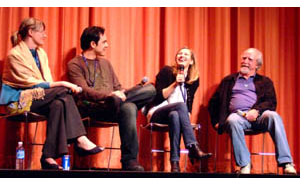 Come Early Morning by Joey Lauren Adams was a clear-eyed character study of an intelligent, flawed woman. Lacking villains and almost lacking heroes, it captures the rhythms of life in a small Arkansas town. Our protagonist, quietly efficient in her job, is caught in family and romance problems as she moves from man to man in a beery stupor. It was tactfully directed by Adams and graced by the underappreciated Ashley Judd. The Weather Man concludes with our hero facing us in close-up, but Come Early Morning ends with the protagonist turned away; in each case, the image feels right. On the left, Lisa Rosman, Eric Byler (Charlotte Sometimes), Joey Lauren Adams, and Scott Wilson (who plays the protagonist’s father).
I must be the last person in North America to see Holes. Its tight plot, clever humor, and easygoing handling of racial matters endeared it to me. As in old Disney fare, familiar actors (Jon Voigt, Sigourney Weaver, Robin Wright Penn, Tim Blake Nelson) are willing to ham it up for the kids, with enjoyable results. And I was startled by the intricate flashback structure on offer; are kids now being trained to follow movies like 21 Grams? Given the interracial love story at the movie’s center, I had a new angle on what Walden Media might be contributing to modern Hollywood, something valuable that escapes cliches about “family-friendly” and “faith-based” entertainment.
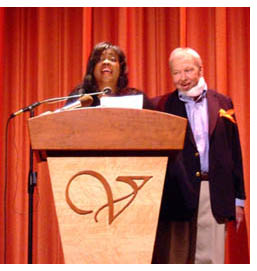
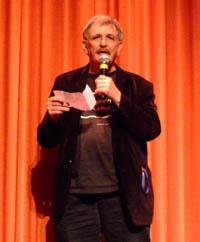
Man of Flowers was a crowd-pleaser. I admired Paul Cox’s visuals, though the grainy print probably didn’t do justice to the range of dark tones in the original. An exercise in portraying a wealthy man’s obsessions and their sources in childhood, it moved toward Buñuel’s Archibaldo del Cruz, but it wasn’t prepared to be as lurid or delirious. A bit too dry and tasteful, perhaps. Still, I admire patient, unshowy long takes, and Man of Flowers is full of them. The photo above shows Paul reading a heartfelt tribute to Roger.
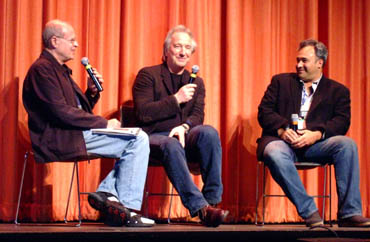
Perfume: The Story of a Murderer was much liked by the audience, and the presence of Alan Rickman made it all the more pungent. I wanted to like it more than I did. Despite my admiration for Tom Tykwer’s other films, particularly Winter Sleepers, The Princess and the Warrior, and Heaven, this one struck me as an overproduced Euro effort at a Big Movie. I thought it overdid the camera tricks (slow-mo, ramping) and the insistence on stuffing every shot with details (e.g., fish, cobwebbed glassware, glistening golden liquids). Above, you see the great actor with Festival Director Nate Kohn and entertainment analyst David Poland.
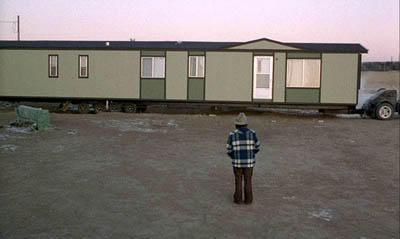
The simple and modest Stroszek was, for me, better at evoking smells—for instance, the stale smoke of the Himmel bar that our hero frequents. The print was faded and weatherbeaten, but the mysterious simplicity of this modern classic came through. The Wisconsin scenes, shot in Plainfield thirty years ago, wouldn’t need much changing today. As usual, I enjoyed the porous, unpredictable plot and Herzog’s willingness to dwell on unfathomable moments like a premature baby with powerful fingers (sleeping, he looks like a wrinkled alien) and the warped imagery of people passing a prison, seen through a hanging water bottle. The dancing chicken became one of the top screen icons of the 1970s.
Now for some quotes I like.
*Gattaca producer Michael Shamberg: “In the pilot scenes of Top Gun, Tom Cruise doesn’t wear his oxygen mask.” Ebertfest blogger Lisa Rosman: “It’s Scientology.”
*“None of the people I write about have friends.” Steven Conrad, screenwriter.
*“The US and Europe are my market. Africa is my public.” Osmane Sembene, quoted by Samba Gadjigo.
*Werner Herzog gave Roger Ebert an early alert about the importance of Anna Nicole Smith in American culture: “The poet must not avert his eyes.”
*“When I pray, I pray to Jesus.” Joey Lauren Adams.
*“Ambiguity in everyday life isn’t exactly celebrated in most movies. . . . It’s great when a big movie celebrates unnameable things.” Alan Rickman on Perfume.
*“Alan, be more subtle—do more.” Ang Lee to Alan Rickman, directing Sense and Sensibility.
*Why did Michael Wiese move to Penzance? “I was in a Witness Protec—oops.”
*“I’ve learned more about directing by working with bad directors than with good ones. And I’ve worked with a lot of bad directors.” Joey Lauren Adams.
*“Sometimes I think I’d like to join another species. . . . They seem to live a more sensible life.” Paul Cox.
*“Our technological civilization is not sustainable on this planet. Nature is going to regulate us very quickly. . . .We’ll be the next ones [to go extinct]. But that’s okay. Let’s enjoy movies and friendship and beer.” Werner Herzog.
*“I saw perhaps three or four films last year. I love cinema, but I’m not a cinephile.” Werner Herzog.
And some portraits of Ebertfest regulars:
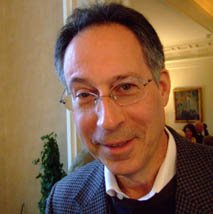
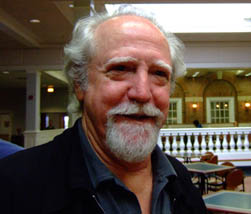
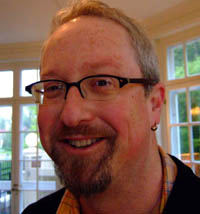
First: Michael Wiese, filmmaker (Hardware Wars, The Sacred Sites of the Dalai Lamas) and publisher of outstanding books on the art and craft of film. Next, actor Scott Wilson (In Cold Blood, Junebug, The Host, and many more). Finally, Jim Emerson, who runs Roger’s website and writes fine film criticism at Scanners.
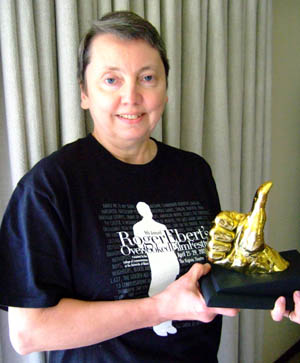
Each year, several guests receive an Ebert Thumb. This year, Kristin was one of the lucky ones.
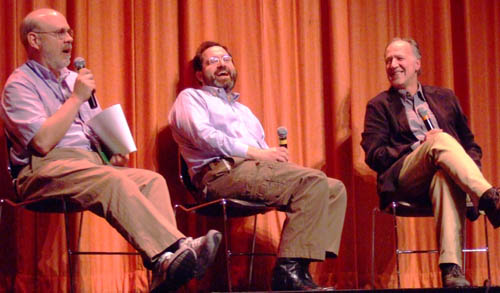
Finally, here I am with Michael Barker, co-president of Sony Pictures Classics, and Werner Herzog. All I said was that I was from Wisconsin….
I plan to blog again soon about Roger and his contributions to filmmaking and film culture. For now, let me just echo Kristin’s opening point that his passion for film is exceeded only by his enjoyment of other people. This weekend’s gathering of top-rank filmmakers, young and old, and the enthusiastic audiences showed that he is probably the most deeply loved film critic whom we have ever had.
A many-splendored thing 11: Portraits
DB here:
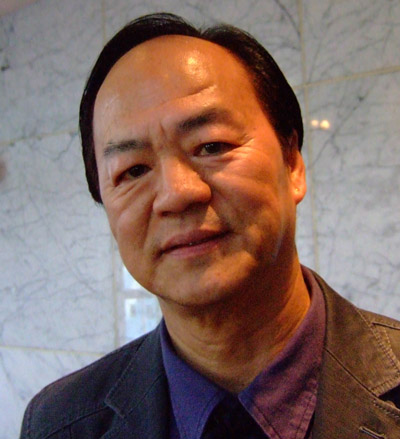
Some miscellaneous glimpses of people I’ve run into at the Hong Kong International Film Festival. If the notion of six degrees of separation holds good, chances are you know some of them, or someone you know does.
Up top, the great actor Ti Lung, remembered from Chang Cheh films and perhaps most famous for his role as the honor-bound brother in John Woo’s A Better Tomorrow.
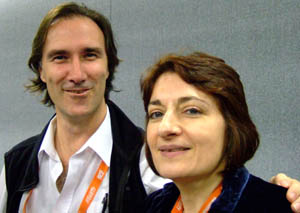
Below, Russell Edwards, Variety critic and reporter, with Bérénice Reynaud, programmer (San Sebastian festival, RedCat), professor (Cal Arts), and critic (author of books on Chinese film and on Hou’s City of Sadness).
Li Cheuk-to, one of Hong Kong’s most distinguished film critics and Artistic Director of the festival. Ah-to is at the center of HK film culture, having founded the Critics Society and played a central role in the festival for decades. This shot on the Star Ferry catches him in an unusual moment of calm; normally he’s doing nine things at once.
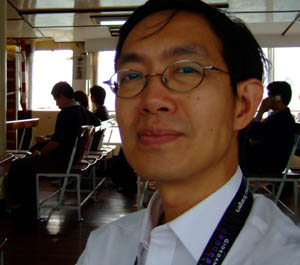
Ivy Shiau, Operations Manager of the festival, starting to set up the room for press and guests.

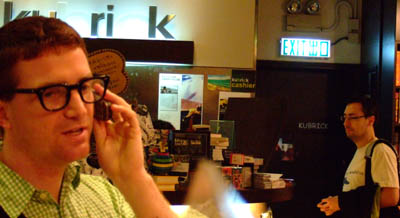
Subway Cinema boys on the go: at Kubrick, Grady Hendrix deals while Goran Topalovic buys books.
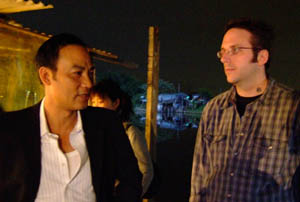
On the set of Triangle: Simon Yam chats with Twitchfilm‘s correspondent Todd Brown.
Also on the Triangle shoot: Kelly Lin and Antoine Thirion (Cahiers).

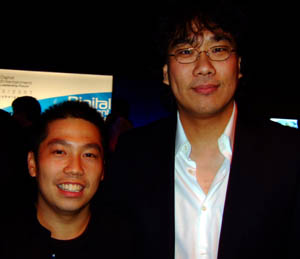
At the reception for the Asian Film Awards: Ho Yuhang (Rain Dogs) and Bong Joon-ho, who would win big with The Host.
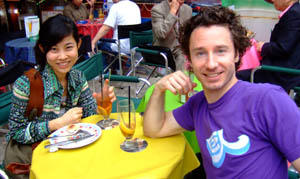
Killing time between screenings at an outdoor cafe: Grace Mak, Hong Kong critic doing graduate work at the University of Singapore, and Nat Olsen, film and music maestro. A graduate of UW, he’s dj-ing all over Asia and hosting the site Hong Kong Hustle.
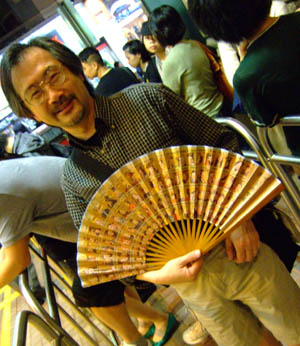
Here’s Sam Ho, Head Programmer at the Hong Kong Film Archive, keeping cool as we wait in line for a screening.
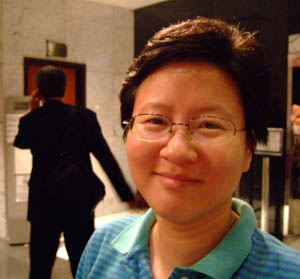
Here’s Yvonne Teh of Penang, huge fan of Asian film and proprietor of the Webs of Significance blog.
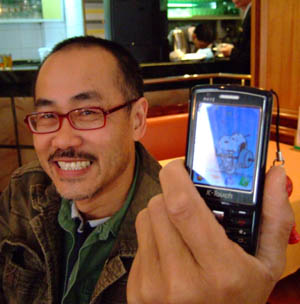
Note how my background skilfully keeps the cellphone motif going. Actually, if you photograph anything here but marine life, somebody with a mobile will be in the shot.
Jupiter Wong is the HK film industry’s top still photographer and the wildest man I’ve ever met. Upon meeting me this year, he said, “Why do you look so old?” He has gotten a haircut, but otherwise there’s no sign of domestication.
I met Athena Tsui when I first came to Hong Kong twelve years ago. A graduate of U Toronto, she has worked in many phases of film production, distribution, and exhibition. She routinely helps out the festivals with translation, guest wrangling, and planning. She’s been my supreme guide to HK film insiders’ gossip and to Mongkok shopping.

I couldn’t attend the talk given by Jean-Michel Frodon, editor of Cahiers du cinema, but I did see him outside another event. We first met in Shanghai and keep running into each other at various festivals.
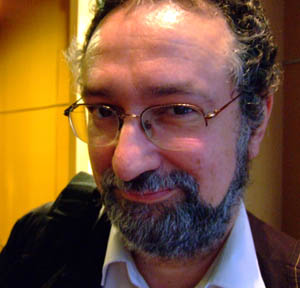
Another old friend, Virginia Wright Wexman of Chicago, was leading a group of visitors to the festival. The smile is doubtless the result of her recent retirement from the University of Illinois–Chicago.
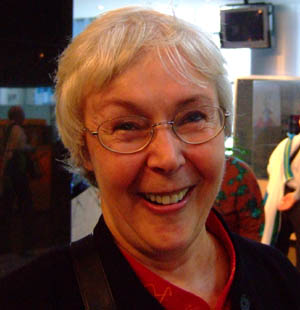
Peter Tsi is the boss of it all, the Executive Director of the Festival. You can usually find him multitasking.
Shu Kei, another friend from my first visit, is head of Film at the Academy for the Performing Arts. He has done everything–made films (see especially A Queer Story), distributed them, programmed the festival, and taught film aesthetics and production. His knowledge of cinema is encyclopedic.
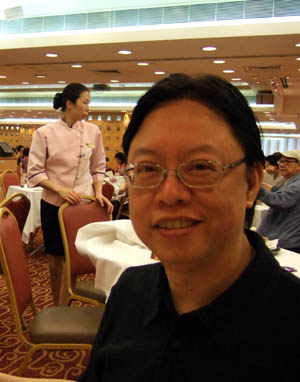
Akiko Tetsuya is a perennial HKIFF presence. She has done a wonderful book on Brigitte Lin.

Shelly Kraicer founded one of the first Chinese cinema websites. He’s a prolific writer and an active consultant on Chinese film for Venice, Vancouver, and other festivals.
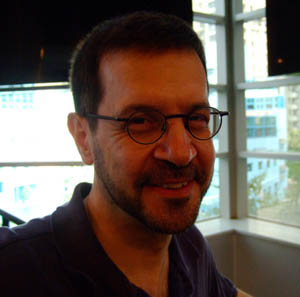
The very first person I came to know when visiting the festival in ’95 was the warm and generous Michael Campi. Michael is a pharmacist by trade and a devoted cinephile and festival consultant in his native Australia.
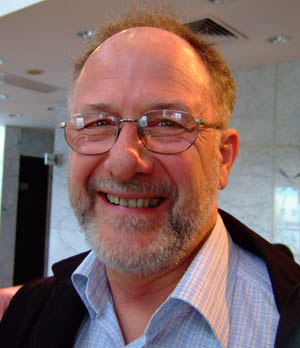
Frederic Ambroisine is an editor of the Paris magazine Kumite and is a busy producer of documentaries on Chinese cinema. If you own French editions of the Shaolin Monastery or One-Armed Swordsman series, you have bonus materials prepared by Fred. Below he’s rejoicing in his purchase of Cutie Honey action figures.
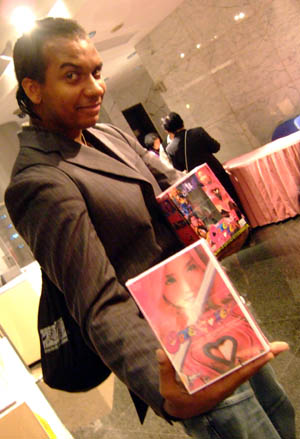
Other folks’ pix can be found if you trawl back through my previous entries. To all those whom I failed to snap, or whose shots didn’t come out well, I apologize. But all the more reason for you to return next year. Fame awaits you!
Speaking of other years….Two regular guests and old friends couldn’t attend this spring, so I can’t resist slipping in shots of them from the 2006 festival. First, Mike Walsh of Flinders University, Australia (and a UW grad).
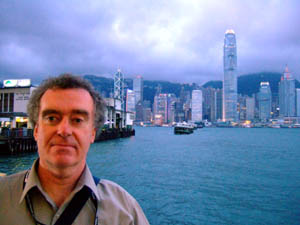
And here’s Peter Rist of Montreal’s Concordia University, at last year’s launch of the book on Milkyway Image.
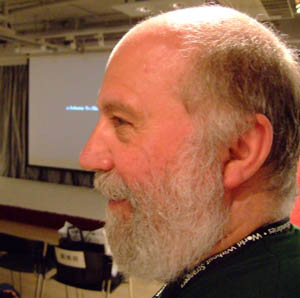
Finally, a shot of the wonderful Lisa Lu, star of many Shaws productions and other major pictures, such as Bertolucci’s Last Emperor. You can see her in a Li Han-hsiang frame I posted earlier.

I can hardly believe that the festival is coming to an end. I leave for home on Thursday, but I hope to tack on one more entry before I go.



