




Archive for the 'Film comments' Category
Unquiet silents
DB here:
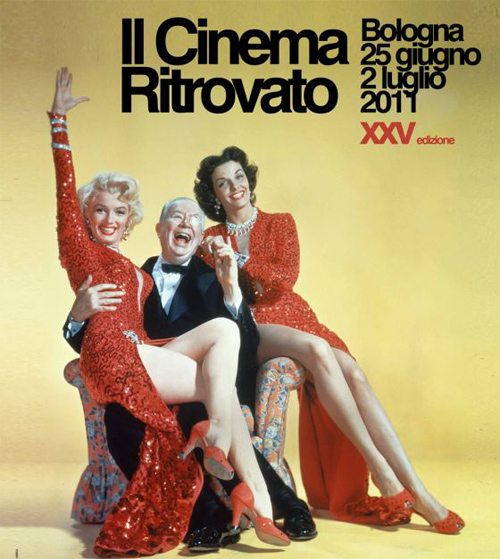
It happens every year: the Cinema Ritrovato festival in Bologna is offering something for everyone. It’s officially dedicated to film history, but its organizers understand that history includes today. This year you can watch films from 1898 (Gaumont shorts) to 2011 (The Actor, hot from Cannes). Silent cinema is given its due, but so are films from the 1930s-1950s, with glimpses of the 1960s (Petri’s The Assassin, the new La Dolce Vita) and 1970s (Kevin Brownlow’s little-seen Winstanley).
The director retrospectives alone are overwhelming. We have a chance to watch great swatches of films by the celebrated Alice Guy, the underappreciated Luigi Zampa, the effortlessly lyrical Boris Barnet, and the still-being-discovered master of the 1910s, Albert Capellani. Oh yeah, then there’s a guy called Hawks, with a complete set of all his surviving silents filled out with little items like Twentieth Century, Tiger Shark, and thanks to Grover Crisp a lab-fresh restoration of Only Angels Have Wings that had even hard-core Ritrovato veterans gaping.
Not to mention sidebars dedicated to images of socialism and utopia, the development of color cinema, and the annual “100 Years Ago” series curated by Mariann Lewinsky, who brought a stunning array of 1911 films into our ken. With Ayn Rand’s gospel of egoism and selfishness finding ever more adherents these days, a screening of the original Italian version of We the Living (Noi Vivi) reminds us that, contrary to the evidence of this year’s Atlas Shrugged, you can make a pretty good movie from one of her books. (Of course the great Rand adaptation is the out-sized Fountainhead.) In the evenings, on the Piazza Maggiore, items like The Thief of Bagdad and Taxi Driver regale a thousand people or more.
In short, a feeding frenzy for the cinephile. We’ve been here before; you can read reports from the last four years in the category Festivals: Cinema Ritrovato. But this time things are even more intense. A fourth venue has been added, the ample and modern Cinema Jolly, so the decisions about what to see are even more pressing.
Kristin has concentrated her viewing on the 1910s, although so far she’s found time for Wind Across the Everglades and an episode of Barnet’s charming Miss Mend. (She wrote about the Flicker Alley DVD of this here). Her upcoming blog entry will concentrate on Capellani. For now, I find that a mere two films give me something to chew on.
From talky silents to talking movies
Upstream.
Ford and Hawks are very different directors, but two 1927 films, both made at Fox, allow us to see their work blending into a broad trend.
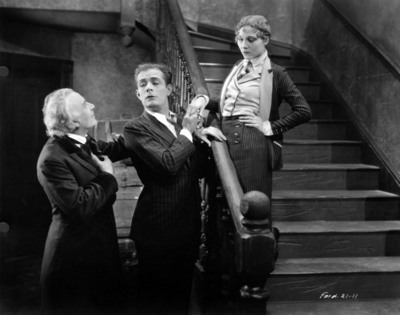
Upstream, recently rediscovered and shown to admiring audiences around the world, takes place largely in a boarding house for struggling vaudevillians. A knife-thrower is in love with his assistant, who is in love with a self-centered ham hired to play Shakespeare. Among the roomers are a declining classical actor and the song-and-dance brothers Callahan and Callahan, one of whom is Jewish. The ham accidentally becomes a star, in the process forgetting the girl he once wooed. But her marriage to the knife-thrower is threatened when the ham returns to the boarding house.
The film has the drawling, anecdotal quality of many Ford comedies. The plot is simple, but it’s decorated with character bits and an overall tone of self-aware corn. The latter was enhanced in the Ritrovato screening by the brash musical accompaniment designed by Donald Sosin, with him on piano and Guenter A. Buchwald on violin. Sosin, like Ford, knows hokum when he sees it, and both know that you must revel in it.
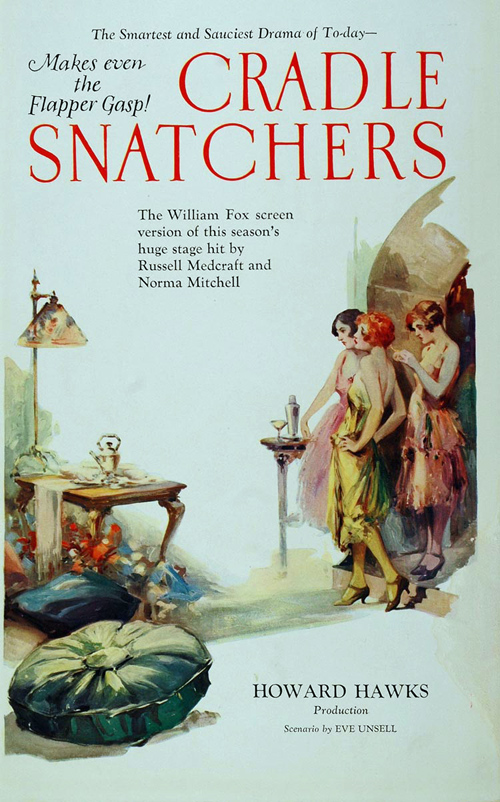
Cradle Snatchers, Hawks’ third film, shows a trio of cheated wives exacting revenge on their philandering husbands. The women arrange for three penniless college boys to pretend to court them so that their husbands can become jealous. Even though some portions are missing, the first reel is intact, and it’s instructive. Instead of opening with the women’s plight, as the source play does, the film starts with the fraternity brothers and mostly anchors our viewpoint to theirs. Variety noticed.
Probably the most remarkable angle of transplanting this “smash” comedy to celluloid lies in the manner in which the three college youths have been duplicated. As a screen threesome they overshadow the women who play the neglected wives. . . Each of the male youngsters does exceptionally well and Hawks has directed them splendidly.
Once Hawks turned it into a male-centered plot, he could indulge in the gay-play that would crop up in his later work. A title points out that “When a roommate takes a girlfriend, he becomes only half a roommate.” One of the boys hangs up on his girlfriend in order to chat up a sexy dame strolling by, but she turns out to be a frat brother in drag (the same Sammy Cohen playing Callahan frère in Upstream). Still, the gags provide equal-opportunity innuendo, as when Louise Fazenda flounces in from a massage and is asked “What have you been doing?” She replies: “I’m not doing, I’ve been done.”
Visually the films are remarkably similar. Removed from Monument Valley, Ford doesn’t give us vistas, deep focus, or even scenes organized around doorways. At home in sparky comedy, Hawks doesn’t provide the graceful, pell-mell staging we get in Twentieth Century and His Girl Friday. Instead, we have classical American silent technique, already by the early 1920s quite polished (as can be seen in the 1922 Ritrovato entry from another master, The Real Adventure by King Vidor).
This silent technique turns out rather talky. Dialogue titles constitute seventeen percent of the shots in Upstream and sixteen percent of the shots in Cradle Snatchers. This isn’t a late 1920s development, since The Real Adventure contains nearly twenty percent dialogue titles. Why are these figures interesting?
The 1920s, the era of the “mature silent cinema,” led many filmmakers and critics to expect that filmmakers would shift toward purely visual methods of storytelling. Keaton’s Our Hospitality (1923), Lloyd’s Girl Shy (1924), and Lubitsch’s Lady Windermere’s Fan (1925) remain dazzling exercises in getting maximum impact from the flow of images, with dialogue titles adding another layer of dramatic interest.
Ideally, the aesthetes thought, one could make a film entirely without titles. German films like Der letzte Mann (1924) are the most famous examples, but there were American experiments along these lines too, such as The Old Swimmin’ Hole (1921). The arrival of sound threatened this trend toward “purely cinematic” narration. Now, critics fretted, filmmakers would be forced to rely on language to make dramatic points. The visual side of cinema would be secondary to “theatrical” methods.
Actually, however, alongside the consummate pictorial storytelling of Keaton, Lloyd, Lubitsch, and others, something else was happening. During the 1920s, quite a lot of American cinema became dependent on language. This happened, paradoxically, because of what critics then and since called the increasingly “cinematic” qualities of movie storytelling.
Not having either Cradle Snatchers or Upstream available for illustration, here’s an example from a film not playing here. In Henry King’s Winning of Barbara Worth (1926), Holmes the engineer is calling on Barbara before he sets out on a mission. He tells her that he plans to go back east, and he’d like her to join him. He’ll be back in a week for her decision.
At the purely imagistic level, the scene is presented in standard continuity, with a long shot establishing the kitchen, then a series of reverse-angle medium-close shots of Holmes and Barbara as they talk flirtatiously.
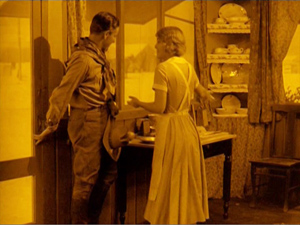
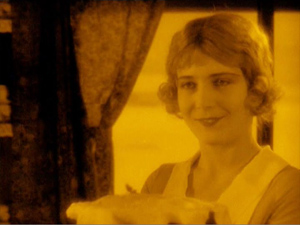
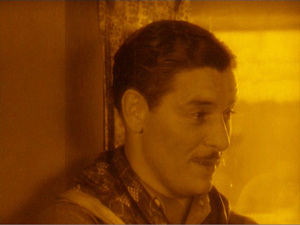
The conversation is interrupted by a cutaway to Abe outside, coming in the gate, which serves as a transition to a two-shot of Holmes and Barbara.
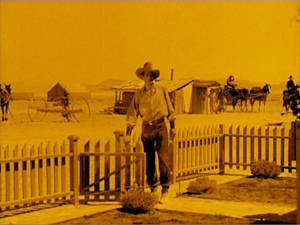
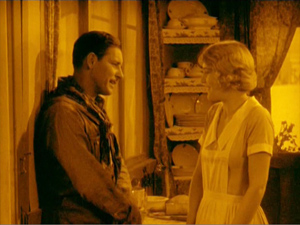
It’s from that framing that Holmes leaves, and she lingers at the doorway.
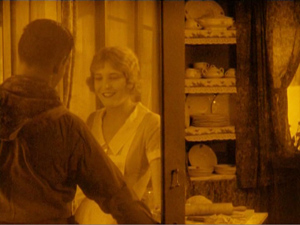
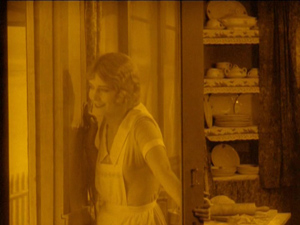
But the scene is even more broken down than this. Of its twenty-eight shots only eighteen are images; the other ten are dialogue titles. They are sandwiched in between the tight singles of Holmes and Barbara, as here:
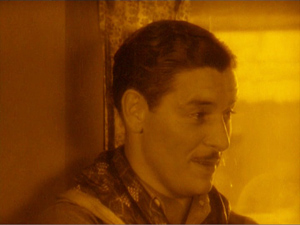
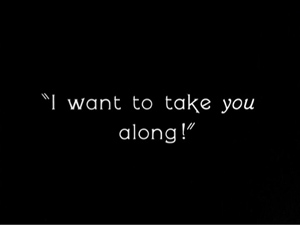
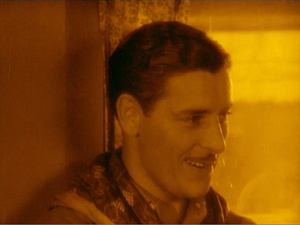
In effect, breaking the scene down “cinematically” into close views of each character may seem to pull cinema away from theatre. Yet it works to frame and underscore each line of dialogue. The pattern is speaker/ title/ speaker. Even the more distant shots, like the opening establishing shot and the final two-shot framing, are broken up by inserted titles.
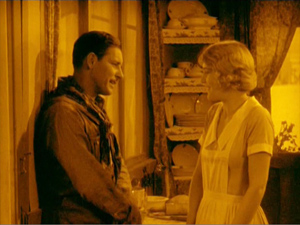
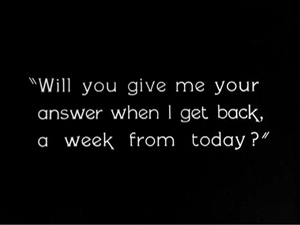
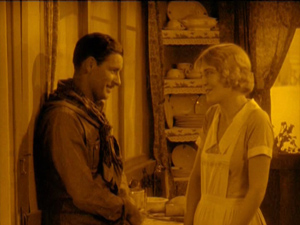
Across the 116 seconds of the passage, nearly 36% of the shots consist of dialogue. Of course this proportion wouldn’t be sustained across the whole film, since many sequences are filled with physical action and have no conversation. But in this and many other films American directors were creating a silent-film dramaturgy that incorporated dialogue into the texture of the cutting. Dialogue titles became editing units that could maintain a rapid pace and, combined with legible singles and two-shots, made for cogent storytelling.
This is what happens in Upstream and Cradle Snatchers. They are dialogue-driven vehicles (one a short-story adaptation, the other taken from a play), and both Ford and Hawks, idiosyncratic stylists in other genres and at other times, accept the dominant norms of their moment for these projects. These films employ speaker/ title/ speaker cutting, the singles and firm two-shots, and the careful eyeline matching. In fact, Ford uses a clever “impossible” eyeline match when the ham star looks up from the dinner table and the answering shot shows the distraught Gertie in her room upstairs, looking down, as if at him.
So were films like Upstream, Cradle Snatchers, The Real Adventure, and The Winning of Barbara Worth “preparing” for sound? In the sense of underscoring dialogue, yes. But the detailed breakdown into singles was not the most common option in most talkie scenes, at least in US cinema. (Japan is another story; cf. Ozu’s 1930s films.) The default for most scenes was the two-shot framing, with characters conversing within a sustained shot. This strategy is present at the end of our Barbara Worth scene, and it can be found throughout 1920s cinema. In other words, given the choices already established during the 1920s, sound-era filmmakers usually preferred the two-shot over singles. Accordingly, the cutting rate slowed down in most sound cinema. (The over-the-shoulder shot, a sort of single-plus, was another fairly rare option in the 1920s, but that too came into its own in the talking film.)
As often happens, Hollywood style offers a menu, with some options becoming more common at different periods. For sound filming, directors relied upon what had been an alternative option in the silent era, the two-shot. They saved singles for key moments. Today, with the dominance of what I’ve called intensified continuity, we seem to be back in the late 1920s. Filmmakers are inclined to present a line of dialogue with a tight single of the speaker, as happens in the Ford, Hawks, Vidor, and King films–but this time, of course, sync sound does duty for the intertitles.
This is one of the things that Ritrovato does best—provoke you into seeing new connections and trying out fresh ideas. Of course, it shows you a wonderful time in the process.
Kristin’s 2010 blog entry on Capellani is here. She will update it and write a new one after she’s assimilated the Ritrovato experience. The Variety review of Cradle Snatchers is from 1 June 1927, p. 16. We discuss dialogue intertitles in American cinema throughout The Classical Hollywood Cinema (1985), particularly in the chapters written by Kristin.
Triple play
The Disciple of Hong Kong.
First, if you haven’t yet visited Jim Emerson’s Scanners blog entry on “Geriatric Noir,” you must do it pronto. It confirms once more the spontaneous genius of the American people. We are the world’s very best at smart-alec, disrespectful, shameless humor.
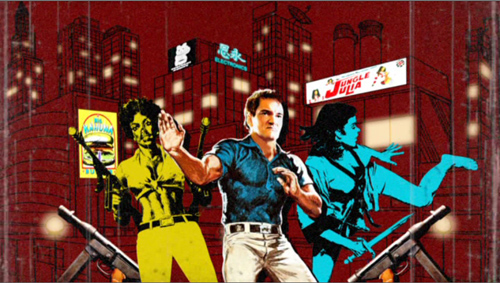
Second, I’ve just received an advance copy of Jac and Johan’s film The Disciple of Hong Kong. It’s an essay on Tarantino’s debt to Hong Kong film. Twitch announced it here, and you can watch the trailer here.
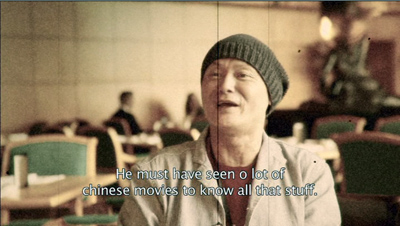
This is a fan’s fever dream. It features interviews with many HK film experts like Roger Garcia and Bey Logan, along with local legends Raymond Chow, Ringo Lam, Simon Yam, and Gordon Liu, below. The movie is a load of fun, with many clever retro touches, and I learned a lot from it.
I wander in from time to time, with probably my most significant line being “Excuse me, do you have any syrup?”
It’s coming up on 26 June on a French channel dedicated to action films. I don’t know exactly when it will be available otherwise. For some clues to the identity of directors Jac and Johan, go here. Frederic Ambroisine, another HK film expert, was involved with the project as well. His site is a remarkable video resource, and he currently writes at actionqueens.com and alivenotdead.com.
Third and finally, Kristin and I are soon off to Bologna’s Cinema Ritrovato. We will be blogging.
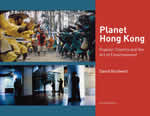
Speaking of shameless: To get more of my take on HK cinema, visit the Hong Kong national cinema category below. If you’re really devoted, or just at a loss for how to spend $15, pick up a copy of my e-book Planet Hong Kong.
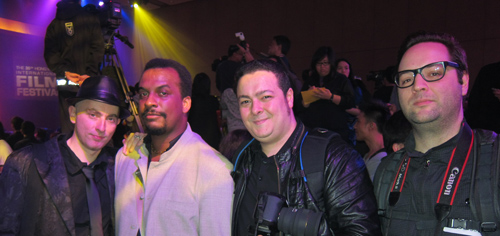
Rukik Sallé (Mad Movies), Fred Ambroisine, Jac, and Johan. Hong Kong, 2011.
Cognitive scientists 1, screenplay gurus 0

Kristin here:
The annual meeting of the Society for the Cognitive Study of the Moving Image is currently taking place at Elte University in Budapest. It runs from June 8 to 11. It must have started off very well. Barbara Flueckiger posted this comment on the opening keynote address on Facebook: “Just attended an absolutely fascinating and inspiring talk by Talma Hendler, a professor of psychiatry and neuroscience: ‘Brain Shows Where the Drama Is. A Call for an Empirical Neurocinematic Agenda.'”
Last week David posted a new web essay on “common-sense film theory” as a way of participating from afar in the work going on in Budapest. Now it’s my turn to post a SCSMI-related item.
The mirage of the second-act desert
Twelve years ago I published Storytelling in the New Hollywood (Harvard University Press). It included a claim that most classical Hollywood feature films have four acts, lasting roughly 25-30 minutes each, adding up to a film of from 100 minutes to two hours. This claim ran counter to the old notion, popularized by Syd (Screenplay) Field, that Hollywood movies (and, according to Field, all feature narrative films) have three acts of 30, 60, and 30 minutes respectively.
My book analyses ten films in detail, dividing them into their four parts: Setup, Complicating Action, Development, and Climax (usually including an epilogue). I also have an appendix listing ninety additional films that I timed by large-scale part, ten for each decade from the 1910s to the 1990s. My conclusion was that most of these films stuck to the four-part structure with each part within five minutes either way of lasting a half-hour. Some of the exceptions were actual three-act films (e.g., Adam’s Rib) and others were longer films. Amadeus, one of my ten main examples, is 160 minutes long and has five large-scale parts. (“Large-scale part” was the rather cumbersome term I employed in the book, trying to avoid the misleading word “act.” I have to admit though, that there’s little chance of people discontinuing “act” and switching to “large-scale part.”)
I also defined the “turning point” that Field says divides acts more concretely than he does, specifying that it usually results from moments when the main characters formulate or modify the goals that drive the narrative forward. (I expand upon the relationship of goal shifts and turning points in a previous entry.)
Unlike Field and other screenwriting “gurus,” I allow for exceptions to my four-part schema. The Pink Panther doesn’t have a turning point until over 52 minutes in; the lengthy early part of the film consists of a bedroom-farce situation of male sexual frustration that makes absolutely no progress toward the putative subject of the film, the theft of a valuable jewel. As far as I can tell, It’s a Mad, Mad, Mad, Mad World has no turning points at all. I remember thinking it was quite funny when I saw it as a child.
Some screenwriters have read the book, and some who teach screenwriting courses assign it as a textbook. At least it’s still in print, which is something to be grateful for at my age.
Since the book was published, it certainly hasn’t knocked out the conventional view that films have three acts. Not infrequently I read a review in Variety or another specialist journal that refers to the last quarter of the film as the “third act.” The idea that films fall into chunks lasting 30 minutes, 60 minutes, and 30 minutes, no matter how counterintuitive or inaccurate, is too entrenched to be dislodged, apparently.
Still, I have the consolation that I’m apparently right. Other people have tried out my claim and found it to work. Creative Screenwriting gave a very kind review to my book (in its March/April 2002 edition, not online). D. K. Holm, the reviewer, was inspired to test out my system on the next three films he saw in theaters. He declared that it worked as predicted for The Shipping News, In the Bedroom, and even Ali, a five-act film. (My claim is that longer films don’t stretch their four acts. They add more, roughly 30 minutes long, for every half hour beyond the standard two-hour feature. Roughly half an hour apparently seems to create a pleasing balance as far as Hollywood practitioners are concerned—whether they’re aware of it or not.)
Real scientists at work
Now James E. Cutting, whom we enjoyed meeting and talking with at last year’s SCSMI conference (David devoted part of his report on the conference to James’s work), has collaborated with two of his graduate students, Kaitlin L. Brunick and Jordan E. DeLong, on a quantitative study related to Storytelling. They set out to test the whether the four large-scale parts of a classical film are reflected on the stylistic level. Specifically, do shot lengths and the use of non-cut shot transitions (fades, dissolves, and the like) vary in a patterned way across or among the parts?
It’s exciting to see cognitive scientists study claims that I’ve made on the basis of close film analysis. David has had his claims about staging and attention in There Will Be Blood confirmed by Tim Smith’s eye-tracking research on the same sequence. Now the results of Cutting, Brunick, and DeLong’s work relating to the four-part structure have been published in Projections (Vol. 5, issue 1, Summer 2011), subscriptions of which are included in SCSMI membership. Luckily I didn’t know this article was on the way, or I might have been in some suspense to find out whether my model worked. (This and other articles on film are also available online, linked from this page that lists the work on film published by James and his colleagues.)
As the authors’ starting point, they accepted my four-part structure. Or as they put it:
We find Thompson’s argument persuasive and her data remarkably clean. Nonetheless, the division into acts is built on a detailed analysis of the narrative, and we work from the physical properties of film. Many observers might agree on act divisions, but these divisions would not necessarily be reflected in any physical measure of a film’s shots and transitions. Thus, without prejudice as to what we might find, we sought data in shot lengths and in shot transitions that might corroborate Thompson’s analysis. (p. 4)
The team used 150 films they had previously studied in their work on editing patterns and their possible correlations to human attention. Of these, some were eliminated because they were too long, so that the statistical work could concentrate on films with four parts. I cannot claim to be able to follow all the statistical manipulations the data from these films were put through—though I can tell from the information in the footnotes that the degree of probability for some of their results indicated an amazingly small chance of error.
The figure at the top is a “scatter plot” of shot lengths for 143 Hollywood films from the period 1935 to 2005. These figures have been statistically adjusted in ways that allow the films to be compared despite their differing lengths. (I have no idea how this sort of thing is done. You’ll have to see the explanation in the article.)
One striking revelation of this chart is that the lengthiest shots in the films occur at the beginning, end, and at the one-quarter, two-quarter, and three-quarter points. Moreover, the “scallop” pattern of rising and falling average shot lengths shows a “tendency toward intensification of films near the middles of acts, where shot lengths become slightly shorter.” The ASLs were found to be as much as 1.1 seconds shorter than in the early and later portions of the acts.
Luckily I was right about the four parts. But beyond that the authors came up with results supporting my claims about the functions of the plot’s third part, the Development. Here’s how.
As part of the study, the authors tackled the question of where non-cut shot changes fall in relation to the quarters of films. Non-cut changes are fades, dissolves, and the like. It turns out, not surprisingly, that quite a few of them come early on, since the exposition may move among time and places setting up the basic premises of the narrative. But the rest tend to come in the third quarter, the Development. That makes sense to me. By my definition, the Development is essentially the stretch of action where most of the major premises, goals, and obstacles have been established. Before the climax can begin, the protagonist usually struggles against obstacles, usually provided by the antagonist. Often relatively little happens in the Development to forward the action, at least in comparison with the other three parts. At the Development’s end, some vital last premise is introduced that allows the action to move into the climax portion, where the plot moves forward relatively quickly and no more major premises are introduced.
The Development might contain extra fades and dissolves for two reasons. First, a surprising number of films have a montage sequence shortly after the middle turning point. The one depicting Michael Dorsey’s rise to fame as Dorothy Michaels in Tootsie is one such. Second, since the Development often is the section where time passes until the point where the climax can begin, one would expect fades or dissolves to cover temporal gaps. I’d have to go back and watch a bunch of films to confirm those hunches, but they seem logical.
My main purpose in writing Storytelling in the New Hollywood was to show that the principles of classical narrative construction formulated in the 1910s and used throughout the studio era are still operative today. Despite film reviewers’ complaints that action and special effects have come to substitute for story appeal in modern mainstream films, the kinds of films they find so shapeless do usually stick to the same four-part structure, contain goals and conflict and the rest of the principles that have been in effect for decades. Cutting, Brunick, and DeLong’s work bolsters this claim about classical narrative’s stability over time. They find that “there are no obvious differences in these patterns for films of different eras.” (p. 8.)
This issue of Projections has other articles applying a cognitive-science approach, and with luck future issues may contain some of the papers we have been unable to attend at this year’s conference.
James, Kaitlin, and Bradford have set up an online overview of their research in progress, “Shot Structure and Visual Activity: The Evolution of Hollywood Film.” The graphics and type are quite small, but right-click on the page and click “Marquee Zoom,” which brings up the little magnifying glass that allows you to enlarge it multiple times.
For online applications of the idea of four-part structure, see David’s essay on Mission: Impossible III and his blog entry on Source Code.
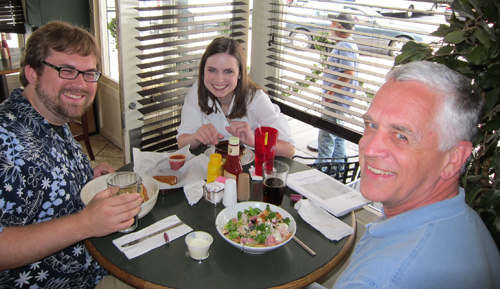
Jordan DeLong, Kaitlin Brunick, and James Cutting at annual convention of SCSMI, Roanoke 2011.
Madison calling Budapest: Can you read me?
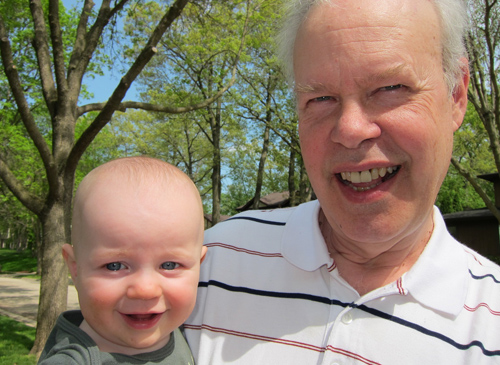
Can you look at this picture without smiling? I think it’s hard, for reasons that relate to one thread of the essay here. Thanks to Levi Buchhuber, age eight months, and Jim Cortada, grandpa.
DB here:
Next week several dozen bright, energetic researchers will be crowding into conference rooms at Elte University in Budapest for the annual meeting of the Society for Cognitive Studies of the Moving Image. Full details on the event are here. As usual, I expect that a hell of a time will be had by all.
I’ve discussed the purposes and projects of the members of this dynamic bunch on earlier occasions. If you want a rundown, I’d suggest reading the items in chronological order:
*I sketch out the SCSMI project in this entry. There are more ruminations in two run-ups to the 2008 Madison SCSMI get-together (here and here), and one a year later summing up that event.
*For a report on the wonderful 2009 Copenhagen convention, go here.
*I try to sum up the wide-ranging 2010 Roanoke powwow here, while a recent blog, “Molly Wanted More,” can be considered an echo of that event.
*For an utterly fun introduction to some of the research on display at SCSMI, head to one of our most popular entries, the guest blog by Tim Smith called “Watching you watch THERE WILL BE BLOOD.”
This year’s paper line-up is especially enticing, and the prospect of seeing so many old friends is even more thrilling. Alas, for reasons beyond our control, Kristin and I aren’t able to attend. As the date draws near, my need to stay home saddens me more than I had expected it would. I must content myself with directing you, with all the fervor I can muster, to the event. Many of our members have told me that their first visit was life-changing, providing them a whole new social network that would encourage their research. Moreover, I notice that every year several participants tell me that they think this one was the best session yet. We’re just getting better, and we’re not going away! I should also alert you to the likelihood that many of the papers will be published in the SCSMI-affiliated journal Projections.
I thought, though, that I might participate a little at long range. So I’ve posted a web essay that sets out, in less technical terms, what my proposed paper for the convention would have tried to say. The essay, “Common Sense + Film Theory = Common-Sense Film Theory?,” reflects an effort to rethink ideas about filmic comprehension that I set out in Narration in the Fiction Film in 1985. This book was one of the first efforts to explore how findings in cognitive science might help us make progress in understanding cinematic storytelling.
I’d stand by much of what I argued there, but in the light of further thinking and later research (much of it conducted by SCSMI members), I wanted to float some ideas that recast and correct my arguments in the book. (Yes, I hope I’ve learned something in twenty-five years.) Some of my more recent notions are available in Poetics of Cinema and under the Film theory: Cognitivism category on this blogsite, but the conference provided a good occasion to submit to the sort of friendly but pointed critique at which my SCSMI colleagues excel.
Of course, give me another twenty-five years and I’ll probably find fault with what I say now. Others won’t need so much time.
Start with this question, which I think is one of the most fascinating we can ask:
What enables us to understand films?
Continue reading here.
To my SCSMI cohort: I wish you a superb gathering. See you next year, at Sarah Lawrence!
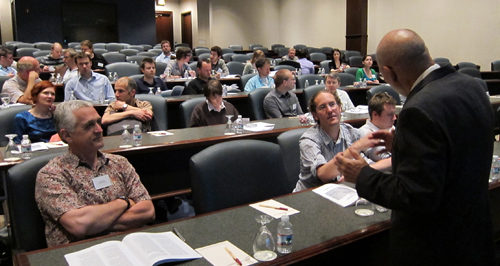
Joe Anderson, co-founder of the Society for Cognitive Studies of the Moving Image, opens the 2010 session at Roanoke.