





Archive for the 'Film comments' Category
Reasons for cinephile optimism
Hollywood may have largely let us down this year, but after the first few days at the Vancouver International Film Festival, we’ve seen several excellent films and a lot of originality. Here are two of the highlights so far.
Kristin here:
Every year, when festival posts its list of films, I look through it for titles I’d heard about from other festivals or seen enthusiastically reviewed or had recommended to me. One title I was delighted to see on this year’s program was Lech Majewski’s The Mill & the Cross. It’s not nearly as famous as some of the other films showing here, like The Skin I Live In or Once Upon a Time in Anatolia, but I keenly anticipated seeing it.
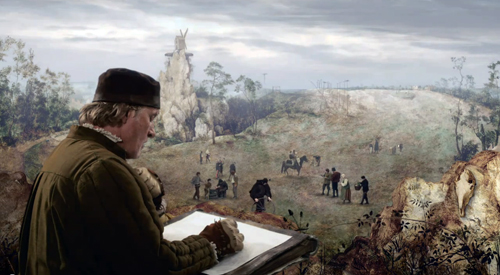
I learned about The Mill & the Cross through an article in American Cinematographer (posted on the film’s rich website). Majewski collaborated with art historian Michael Francis Gibson to explore Pieter Bruegel’s 1564 masterpiece, “The Way to Calvary.” In the painting, the figure of Christ carrying his cross to calvary is set in the midst of a vast landscape full of fields, cliffs, a distant town, trees, and hundreds of people, all surmounted by a windmill atop one of the rocky formations and silhouetted against a windy, cloudy sky. Majewski sought, as he said, “to enter Bruegel’s world”—to enter into the painting itself and bring it to life.
His goal reminded me of Godard’s 1982 film, Passion, where one of the main characters films actors in a studio. He appears to be trying to replicate classic paintings, with models posed in costumes and miniatures representing a cityscape. I’ve never been able to picture what the result might have looked like. I’m not sure I would have enjoyed watching it, which may be part of Godard’s point. But Majewski had the tremendous advantage of modern computer technology to create an almost seamless blend between digital elements derived from the original painting and those derived from live-action filmmaking on location and in front of blue screens. For those who complain about “effects-heavy” blockbusters, The Mill & and Cross is a powerful counter-example, a film utterly dependent on CGI yet meditative and even profound. It certainly succeeds in Majewski’s goal, creating an uncanny sense of being inside the painting (see above.)
For the film seeks to explore the qualities that Bruegel himself did, to push the crucifixion to a minor place in the composition of the whole and to explore the sacred in the everyday. The film’s story is dense. On one level, we watch Bruegel sketching his models as he explains the concept of the painting to his patron. But we also see him departing home in the morning, and we follow the everyday doings of his family. We see several other minor characters who will figure in the painting waking up and beginning to work, including the miller in his mill atop the cliff. The filmmaking team found a surviving mill of the period, and for an astonishing scene early on, the ancient works in the vast interior were set in motion for the first time in centuries.
We see details of the characters’ lives, such as a man hitching up a horse to a wagon, an innocent-appearing detail until we realize much later in the film that this cart will deliver the wood for making the crosses and will carry the two thieves condemned to die alongside Jesus to Golgotha. Finally, we are invited to contemplate the contradiction, so familiar from thousands of paintings, that an event from antiquity is seen taking place in a contemporary landscape. The result is a comment on the Spanish occupation of Flanders as well as on the Biblical story.
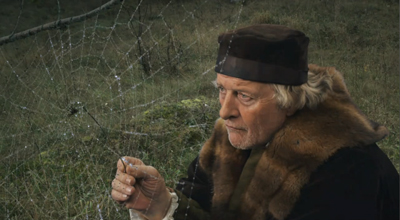
In an all-too-brief scene, Bruegel explains the composition of the painting to his patron, showing how the small group around Jesus forms the center, with the lines between the other main elements around the periphery intersect with it. The implicit comparison is to a charming moment in the film when the painter admires an intricate spiderweb. Apart from all the thematic material, we do learn something about Bruegel’s painting–a point that is emphasized at the end of the film, which tracks back from the actual painting in the Kunsthistorisches Museum in Vienna, as if inviting us to go and contemplate it in the light of what we have just seen.
Part of what makes The Mill & the Cross so exciting is that it achieves that rarest of things, making us feel that we are seeing something very worthwhile that has never been done before.
The film has a very limited release in the U.S. Anyone who has a chance to see it on the big screen should snatch it. The images, shot on the Red One camera and projected (here, at least) on 35mm, are spectacular.
Once upon a time, and time again
DB here:
Cesare Zavattini, central screenwriter of Italian Neorealism, liked to tell this story. A Hollywood producer once told him:
“This is how we would imagine a scene with an aeroplane. The plane passes by. . . a machine gun fires . . . the plane crashes. And this is how you would imagine it. The plane passes by. . . The plane passes by again… The plane passes by once more…”
He was right. But we have still not gone far enough. It is not enough to make the aeroplane pass by three times; we must make it pass by twenty times.
And, Zavattini seems to suggest, the machine gun should never fire.
Neorealism was one of the most important influences on what we’ve come to call the postwar European “art cinema,” and particularly on filmmakers’ treatment of time. I thought of the Zavattini passage while watching the opening scenes of Nuri Bilge Ceylan’s Once Upon a Time in Anatolia, a film which proves that you can always ring fresh changes on a well-established tradition.
Actually, “opening scenes” isn’t quite right. The very first thing we see, a sort of prologue, presents in two shots the lead-up to a crime. Then come a couple of minutes of credits. Then we get nearly fifty minutes of nighttime shots of police cars driving through the countryside, headlights appearing tiny in the landscape. Again and again the cars halt as the police ask their murder suspect if this is the place where he and his brother buried the body of the man they killed. The suspect says he was drunk and can’t remember exactly. The investigators pick over the area looking for clues before driving on.
But the sequences aren’t quite as spare as I’ve indicated. Scenes inside the car and poking around the areas that might harbor the body pick out two main characters: a brooding doctor and a careful prosecutor overseeing the operation. The secondary cops and assistants are sketched in too. So we have a sort of balancing act between daringly distant “empty” shots and more standard expository scenes. The conversations in the car and in the landscape balance moments that dwell on atmospheric detail. So the relaxed pacing spares time for what will surely be one of the film’s most famous shots, a view of an apple shaken from a tree and bouncing downhill into a stream, where it continues to roll and bob in the dark. It presages the importance of melons, and in the final shots, a yellow soccer ball.
We frequently find that an art film flaunts some arresting narrational devices at the start before taming it as things move along. (Think of 8 ½’s bold opening, initiating us into Guido’s fantasy world, in effect teaching us how to watch the film.) Similarly, Once Upon a Time in Anatolia gets more linear and psychological as it goes along. It shifts from the more unfamiliar uncertainties of the futile stops and explorations to the better-defined questions we expect in a mystery. Is the suspect really guilty, or did his brother commit the murder? What triggered the killing? What effect has the crime had on the dead man’s wife and son?
The gradual shift seems to me to match a certain rigor in Ceylan’s stylistic handling. (Warning: Stylistic spoilers ahead.) In the nighttime search, long shots and extreme long shots dominate—if not by their number, at least by their prominence and vividness.
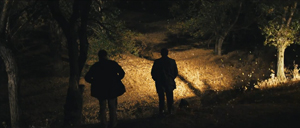
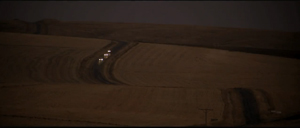
But having given us plenty of lengthy establishing shots in the first long section, Ceylan denies them in the next two portions.Later in the evening, the search party takes refuge in the house of a village leader and shares a meal with him. Here the action is broken up into close shots, with no long shots (I think) establishing where the characters are sitting. Everything, including the arrival of their host’s beautiful daughter, is given in tight shots of each character.
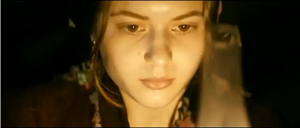
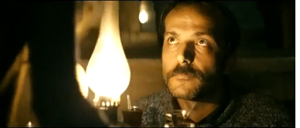
When the searchers return to town the next morning, they’re greeted by an angry mob. Again, the action isn’t shown fully. Now very long telephoto shots let us glimpse the police and the wife and son of the murdered man, with the crowd visible only as surging, out-of-focus heads and shoulders blocking the foreground.
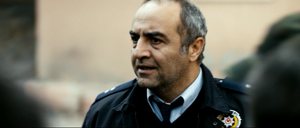
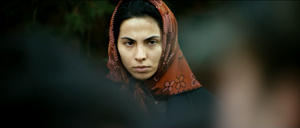
The last forty minutes or so are centered on the doctor. Attached to him, we watch some interactions that trace out his responses to what he’s witnessed. These are handled in a traditional way, with shot/ reverse-shots, some of them head-on optical point of view, and lingering shots of the doctor brooding.
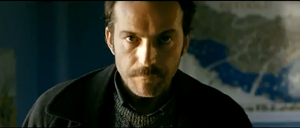
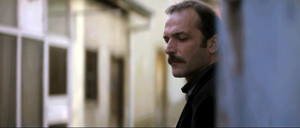
To the end, Ceylan doesn’t become completely predictable. There’s a nifty bit of elliptical editing during a conversation with the prosecutor. The offscreen sounds of an autopsy, layered by the sound of children’s play, recall passages of shrewdly timed offscreen dialogue that we heard during the long night’s search. And the final few shots play with optical point-of-view in a misleading fashion that has become something of a tradition in the art cinema.
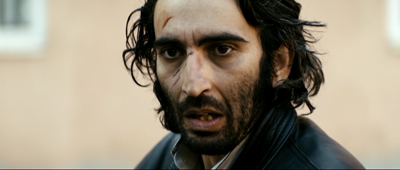
So if the plotting gradually settles down into something less disconcerting, so does the visual style. But that shouldn’t take away from the delicacy and deliberation of a film that gains real gravity through hints and elisions. Above all, certain faces, particularly the despairing one of the prisoner who has a painful secret (surmounting this section), exercise a powerful hold on us. The conclusion of Once Upon a Time in Anatolia pulses with genuine emotion, coolly contained in a mode of cinematic expression that after sixty years or so continues to harbor great power.
The Zavattini passage on flying planes is available here.
PS 9 October: Thanks to Miklós Kiss for correcting an embarrassing spelling error.
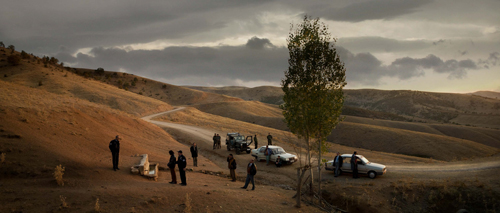
Once Upon a Time in Anatolia.
PS October 8: Jim Emerson has also written on The Mill & the Cross, linking to an interview with Majewski on BOMblog.
Looking different today?
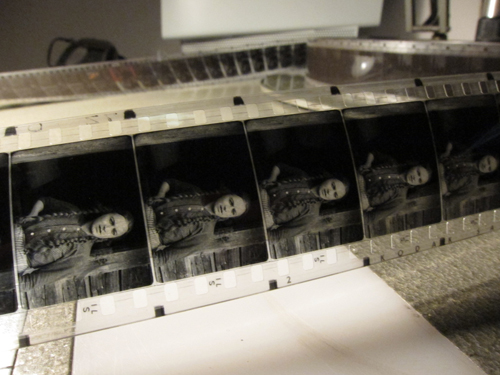
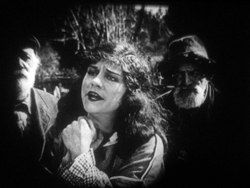
Johan (1921).
DB here:
Earlier this month Manohla Dargis wrote a New York Times article on how we watch, or should watch, films that some audiences consider slow and boring. She suggested that appreciating such films requires us to cultivate fresh ways of seeing. Her article and my interests coincide on this matter, so I wrote an entry developing some ideas about viewing strategies and skills. This piece also, happily, brought new readers to Tim Smith’s experiment in tracking viewers’ scanning of a scene in There Will Be Blood.
Today I explore another angle on the problem of how to watch movies that aren’t the normal fare. But this time what’s abnormal for us was once normal for everybody. I look at the pictorial possibilities that emerged in the 1910s. Those possibilities are of interest if we want to fully understand film history, but they offer some mysteries as well. If viewing movies involves skills, did people a century ago have the ones we have? Or did they employ different viewing habits, ones that we have to learn?
Editing, your imaginary friend
I write from my annual research trip to the Royal Film Archive of Belgium, now known as the Cinematek. For some years, I’ve been looking into feature filmmaking of the 1910s. On every visit I’ve found rich material, movies off the beaten path that give me a sense of the immense creativity of that early period. (See the bottom of this post for links.) The official classics of these years, by Chaplin and Griffith and Fairbanks and Bauer and Gance and Sjõström and Feuillade, remain remarkable, and Kristin’s latest entry makes a case that Alberto Capellani belongs among this heroic company. But you can also find extraordinary moments in ordinary movies. Even the most banal film has something to teach me about what choices faced the era’s filmmakers.
One of those teachable elements involves the ways in which directors guide our attention. We know that editing serves to shift our attention from one part of a scene to another, but so does judicious staging. This is one of the great lessons of the cinema of the 1910s. Watching films from that period convinced me that the craftsmanship of Anderson in There Will Be Blood, and of other directors reliant on long-take ensemble staging, has deep roots in filmmaking tradition. But the golden age of cinematic staging was relatively brief, and it was eclipsed by an approach based largely on editing. That approach is, essentially, still with us.
Let’s start by appreciating the technique that became most prominent. By the late 1910s, Hollywood filmmakers had more or less perfected what we’ve come to call the classic continuity editing system. The camera could penetrate the most intimate exchange, breaking it up into intelligible bits. Here, in a minor Metro film called False Evidence (1919), Madelon tries to persuade her father that she, not her boyfriend, is responsible for a crime.
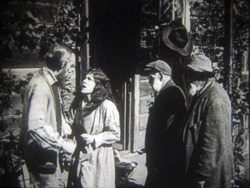
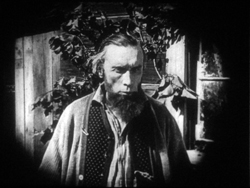
After giving us father and daughter close together in profile, the camera has somehow squirmed in between them, showing each one in a tight 3/4 view. Or rather, the cutting has forced the staging to pull the characters a bit apart so that each one can have a frame to him- or herself. Spatial plausibility gives way to dramatic urgency; what we care about are clear views of their emotional responses. As long as the spatial relations remain clear, they can be just approximately consistent.
For a little more finesse, we can look–as usual–to Rio Jim. William S. Hart’s films are among the most visually elegant and ambitious of this period, and even his less-known items seldom disappoint. John Petticoats (1919) gives us “Hardwood” John Haynes, a rough-edged logger who finds he has inherited a New Orleans dressmaking shop. His comic introduction to the place, in the company of a new friend he’s made, uses editing to tease us. The two gents come in, with John bewildered by a feminine world he’s never known. They pause before a model sashaying on the stage, and when she pauses, she’s blocked by the Judge’s body.
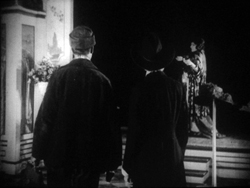
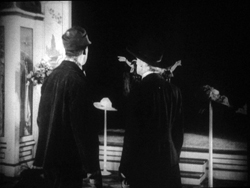
We’re left without the revelation of her appearance, but when her dresser comes forward to peel off her wrap, we cut, in effect, “through” the Judge to get a clear view of the disrobing. The blocked shot teased us, but the cut pays us off.
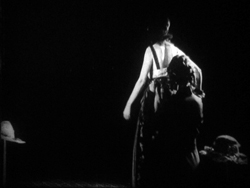
Now that the model bares a lot more than before, the biggest tease begins. How will John react? The answer is given in the next shot, a nearly 180-degree shift from the earlier framing of the men that incorporates a mirror in the background to keep the model onscreen.
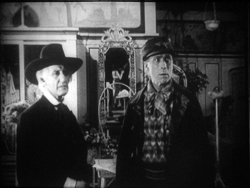
Thanks to a cut, action and reaction are given in the same shot–in fact in the same zone of the frame, the center.
A pass, a pat, a squeeze
Fabiola (1918).
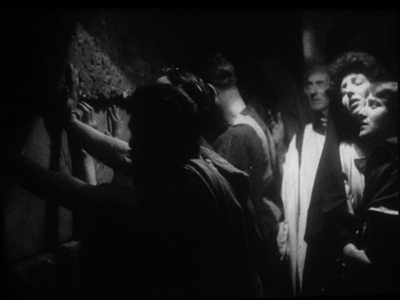
Many European directors were moving in the same direction as Lambert Hillyer in John Petticoats. Although they might not use as many shots or as many different angles as their American counterparts, they were confidently breaking their scenes up into closer views, often through axial cuts that take us straight into or out of the action, along the lens axis.
Take Enrico Guazzoni’s Fabiola (1918), henceforth known to me as Fabulosa. Normally I consider the Roman oppression of Christianity one of the least fertile topics for a good movie, but Fabiola proves me wrong. For one thing, the title names a rather unpleasant woman who barely figures in the action until the climax. For another, Guazzoni proves an adept filmmaker. I was struck by those immense sets that distinguish the Italian costume drama, the dazzling lighting (see above), and the skilful editing.
Our introduction to Fabiola comes as she sits disdainfully in her household, attended by servants. After a long shot showing off the set, an axial cut takes us closer to her.
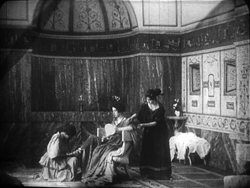
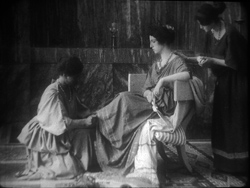
She turns as her tardy servant Sira comes in. Having stretched her elegant neck, Fabiola tips her head forward slightly, in a bob of disdain.
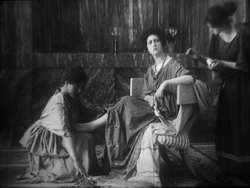
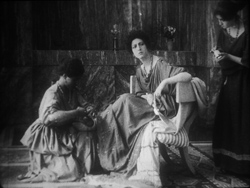
Another axial cut takes us still closer to her. And in a few frames her gesture, at once haughty and angry, is repeated. (The streak across the first image below is the splice, so this is the very first frame of the next shot.)
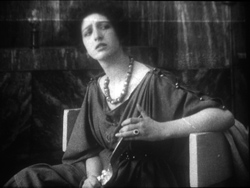
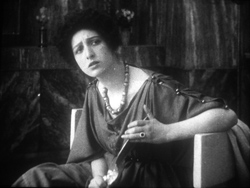
This, I think, is no mistake. The matches on action elsewhere in the film are quite precise, and indeed earlier Italian films have shown that directors used this device skilfully. Guazzoni wanted to stress Fabiola’s head movement, and he used the same tactic, the overlapped action match, that some Americans would use and that many Soviet directors drew on later. This slight accentuation of Fabiola’s gesture is a vivid way to introduce the character, caught in a characteristically scowling moment. Very soon, in a fit of pique she’ll jab Sira with a hatpin.
On the whole, keeping the setups close to the camera axis is the default value in Fabiola. For the Americans, though, cutting made the camera almost ubiquitous. A year after John Petticoats, O’Malley of the Mounted (1920), lets Lambert Hillyer again resort to intelligible shifts of setups. O’Malley, played by Hart, has gone undercover to track a killer. Posing as a robber, he has joined an outlaw gang, but they’ve discovered he’s betrayed them and plan to hang him at sunup. He’s lashed to a tree and guarded by his enemy, the brutal Big Judson. But Rose Lanier, who has drifted along with the gang, is going to help O’Malley escape. The cutting will show us exactly how she does it, and why.
Rose interposes herself between Big and O’Malley, chatting up the thug. A cut of about 180 degrees takes us to the opposite side of the tree and shows her slipping a knife toward O’Malley’s hand. We’re so familiar with this sort of insert that we’re likely to forget that once it was fresh.
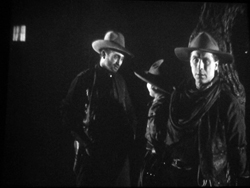
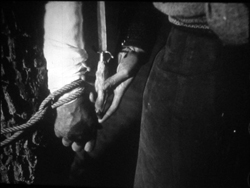
O’Malley starts, then shifts his gaze toward Big.
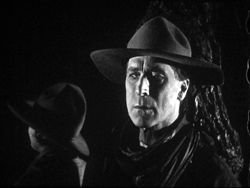
Then comes a simple, remarkable shot. Rose slips the knife to O’Malley. Then she pats his hand. Then she gives it a squeeze.
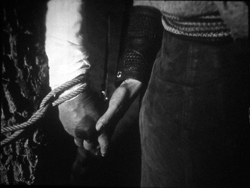
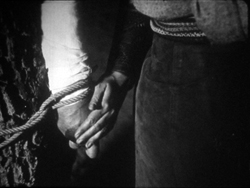
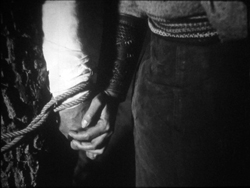
Mystery and charm of the American cinema, as Godard would say: a single cut-in of hands can give us a lot. First there’s the narrative information (I’m passing you the knife), then Rose’s expression of support (Good luck!), capped by a burst of affection (I love you). The whole thing takes less time than I’ve used to tell it. Surely this ability to invest plot-driven detail shots with heartfelt emotion helped American cinema conquer the world. I’m tempted to say that we could sum up of the power of Hollywood, in its laconic prime, with that formula: the pass, the pat, the squeeze.
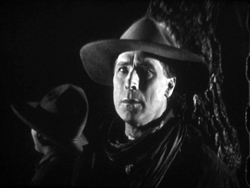
This shot is as compact in its expression as the previous one. It’s impossible to capture here all the emotions that flit across O’Malley’s face: hope of eluding death, realization that Rose loves him, anxiety that surviving will make him choose between love and duty. Rose’s brother is the killer he’s been tracking, and in a perversely honorable way O’Malley had looked forward to being hanged. That would have spared him arresting the boy. Now he must live, enforce the law, and lose the woman who has saved him.
I saw some European films that absorbed such continuity tactics quite deeply. Above all, Mauritz Stiller’s Song of the Scarlet Flower (Sangen om den Eldroda Blomman, 1919) and Johan (1921) relied heavily on analytical editing in the American fashion, including angled shot/ reverse shot. As in Fabiola, some of the discontinuous cuts have their own logic. I wish I had time to explore those Stiller films in more detail–particularly their use of turbulent rivers as dynamic plot elements, not mere landscapes. Maybe in some future entry….
Four-quadrant style
Before they adopted the analytical editing characteristic of American cinema, directors were still able to guide our attention. The so-called “tableau” style, about which I’ve waxed enthusiastic on this site before, became a rich tradition in the 1910s. Editing within the scene is minimized. (Apparently most European directors didn’t consider it a creative option in its own right until later in the decade.) The drama is carried by performance and ensemble staging. Relying on movement, acting, and composition, the director controls where we look and when we look at it
To take a straightforward example, consider the rather ordinary melodrama Le Calvaire de Mignon (Mignon’s Calvary, 1917). The scheming and dissolute Dénis de Kerouan wants to wreak misery on his brother Robert. While Robert is out of the country, Dénis hires a forger to fabricate a letter indicating that Robert has a mistress. Dénis leaves the letter on the desk for Robert’s wife to find.
Dénis has exited through the central entryway, and into the empty study comes Robert’s wife. She discovers the letter.
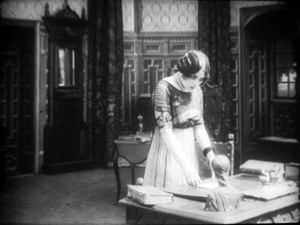
She moves to the left foreground and starts examining it. At this point Dénis’ face peeps out from behind the central curtain. The director makes it easy for us to notice him because nothing else is happening in the set, and Denis’ face is rather close to the wife’s. It’s almost as if he’s looking over her shoulder.
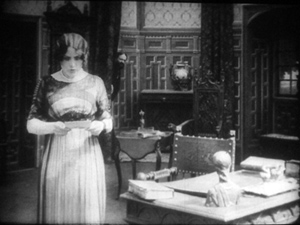
Once we register Dénis’ presence, the director can proceed to balance the shot. All that empty real estate on the right of the frame asks to be filled, and that’s what happens.
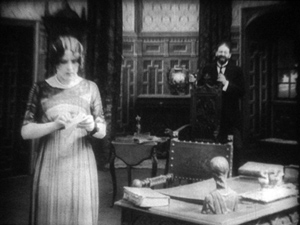
When the wife reads the damning letter, she collapses rightward into the chair, just as Dénis rushes forward to take charge of the situation.
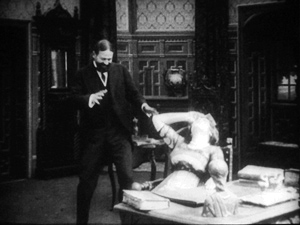
This move exemplifies the staging technique known as the Cross, which motivates the switching of characters’ positions in the frame.
Simple as it is, this portion of the prologue of Le Calvaire de Mignon shows how, without cutting, a director can steer us to one or another zone of the shot through such cues as faces, centering, proximity to points of emphasis, and movement. Something similar happens in one, more striking moment of another fairly unexceptional movie from the period.
Nobody will claim Der Stoltz der Firma (The Boss of the Firm, 1914) is a masterpiece, or its director Carl Wilhelm is a master. It’s one of the many comedies in which Ernst Lubitsch starred before becoming a director. Here he’s Siegismund, a bumbling young provincial with more aspirations than abilities, who simply lucks into marrying the boss’s daughter. On the way to the happy ending, he wins the patronage of a fashion designer, Lilly, whose husband finds her flirtation with the young parvenu none too innocent.
Wilhelm’s use of the tableau approach isn’t especially dynamic in most of the film, but there’s one flashy scene. Wilhelm gets us to watch a very small, tight area of the frame and then gently swings our attention to a wider swath of action. As usual, everything depends on a sort of task-commitment on our part: Watch what’s likely to forward or enrich the ongoing narrative.
Lilly lures Siegismund into a changing room, with the composition showing him reflected in a mirror behind her. This sets up an item of setting that will be central to the scene.
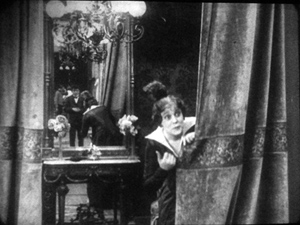
Once inside, he coyly presents her with a flower and they draw close together. Since we tend to concentrate on faces, the small area encompassing their two profiles is likely to draw our attention. Nonetheless, the shot is notably unbalanced, as if anticipating something coming in from the right side.
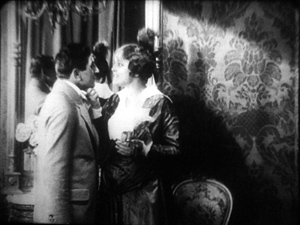
Abruptly Siegismund and Lilly draw apart, and the space between them, in the mirror, is filled by the face of Lilly’s husband, coming through the curtain.
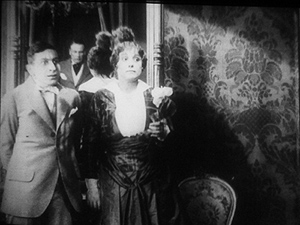
I’d bet that a Tim Smith experiment would find that nearly every spectator is already watching this small zone in the upper left quadrant of the shot. Faces, especially frontally positioned ones, command our notice, and thanks to the mirror we here have three of them. Moreover, movement is an attention-getter too, and all three faces are in motion. Mr. Maas’s face, in fact, gets notably bigger and clearer. His wrathful expression is another reason to watch him.
The husband’s body enters to fill the frame, then presses into the center of the shot, blotting out Lilly as he faces down Siegismund.
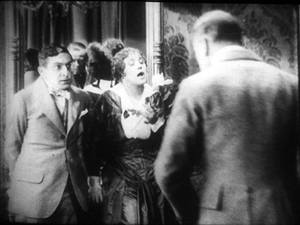
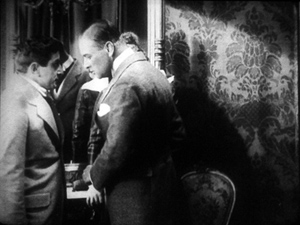
Now the director controls the speed of our gaze quite precisely. Maas slowly rotates, forcing Siegismund to swing from left to right, as if he were attached to the bigger man by a rod. This yields, again, that nice sense of refreshing the frame that we always get from a Cross.
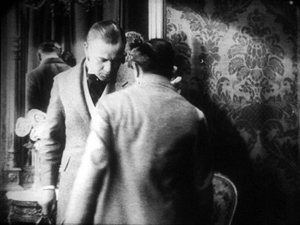
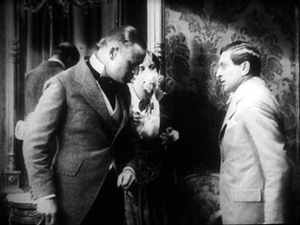
Siegismund collapses into the lower right of the frame, flinching from the fight that’s about to start. Lilly soon shoves aside her husband’s chastisement and melodramatically tells him to leave. “We’re divorcing!” the following intertitle says.
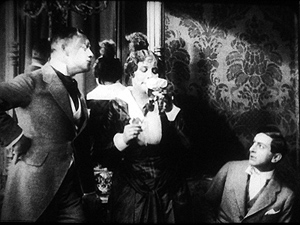
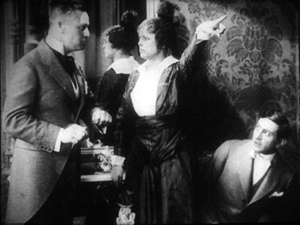
Mr. Maas takes it in stride, shrugging and spreading his arms. He leaves, and thanks to the helpful mirror we can see him chortling as he glances back and passes through the curtain.
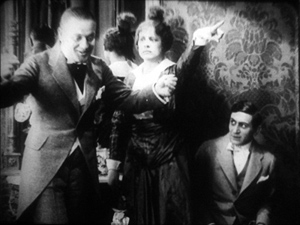
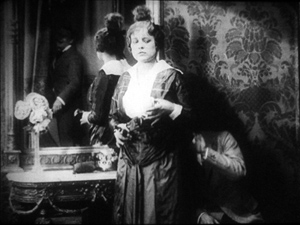
If we hadn’t already noticed Siegismund cowering behind Lilly in the lower right quadrant, we will now. Lilly angrily flounces to our left (the Cross again). Siegismund rises to explain he hadn’t meant to cause a rift in the marriage.
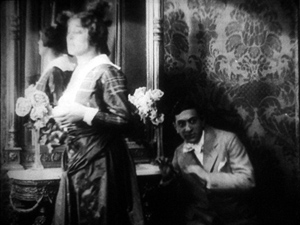
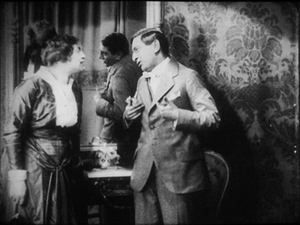
We’re back to something like the initial setup, but now with Siegismund centered, the couple further apart, and a less unbalanced frame. The drama, which now consists of Lilly inviting him to tea tomorrow, can proceed from here.
A different way of seeing?
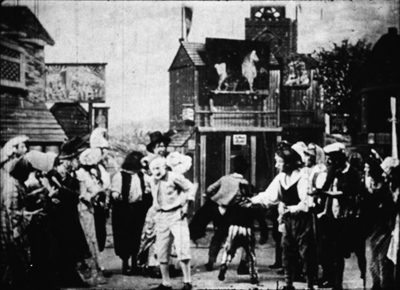
Tom Tom the Piper’s Son (1905).
We’ve become used to editing-driven storytelling, and I’m convinced that we can learn to notice the staging niceties of the tableau alternative. But what if early filmmakers explored some other ways of looking that are far more unfamiliar to us today?
Noël Burch, in his 1990 book Life to Those Shadows, argued that in the first dozen years or so of cinema, movies solicited viewing skills that we lack today. He suggested that early filmmakers often refused to center figures and crammed their frames with so much activity that to our eyes the shots look confused and disorganized. In Tom, Tom, the Piper’s Son (1905), Burch notes, the bustle of the fair, the reliance on an extreme long shot, and the absence of any cutting make the central event, Tom’s swiping of the pig, difficult to catch. In the frame surmounting this section, Tom is making off with the pig in an area just right of center, but the antics of the clown and the response of the crowd may well distract us from the main action.
The result, says Burch, is a mode of filmmaking that demanded
a topographical reading by the spectator, a reading that could gather signs from all corners of the screen in their quasi-simultaneity, often without very clear or distinctive indices immediately appearing to hierarchise them, to bring to the fore “what counts,” to relegate to the background “what doesn’t count” (p. 154).
Later developments linearized this field of competing attractions, creating a smooth narrative flow “harnessing the spectator’s eye.” Among these developments were the presence of a lecturer at many screenings (telling people what to watch) and, of course, the growth of the continuity editing system. But Burch suggests that the “primitive mode” hung on until about 1914.
A famous example is a shot from Griffith’s Musketeers of Pig Alley (1912). The gangster has lured the Little Lady (Lillian Gish) into a back room and distracts her with a photograph while he tries to dope her drink, in a precursor of date-rape drugging. But the Snapper Kid, another gangster, has been keeping an eye on her and follows. As the gangster starts to pour the drug out, the Kid’s entry is presaged by a whiff of cigarette smoke.
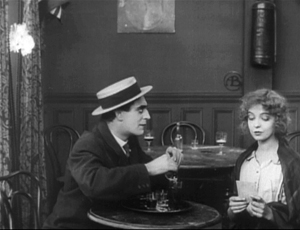
At the crucial moment, we have three things to notice: the Little Lady’s obliviousness, the gangster’s pouring the drug, and the full entrance of the Snapper Kid.
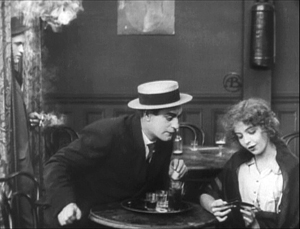
Today’s director would likely resort to editing that shows the doping, then the Kid arriving, then the doping again, and leaving us to infer a vague sense that they’re happening at the same time. Griffith’s choice gives us genuine simultaneity, but at a cost. Two cues compete for our attention: central composition for the drink, major motion on the edge for the Kid’s entry. In my experience, viewers tend to notice the appearance of the Kid, but to miss the business with the drink. (Another passage for Tim Smith to test!) By today’s standards, Griffith has failed as a director, but Burch’s view suggests that 1912 viewers, more sensitive to “all-over” composition, could have registered both actions, perhaps by rapidly scanning back and forth.
During my trip I found a fascinating example of this issue, as well as an apt counterexample. Both involve daggers.
In Maman Poupée (1919), a remarkable Italian film directed by Carmine Gallone, a devoted, somewhat infantile wife learns of her husband’s affair with a society woman. Susetta confronts the mistress and begs her to break off the affair. The woman laughs in her face. What happens next is given in several shots, mostly through axial cuts.
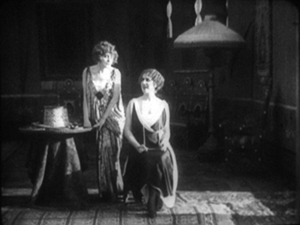
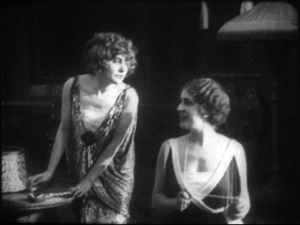
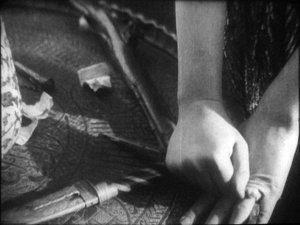
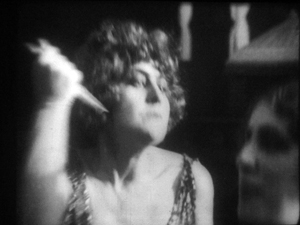
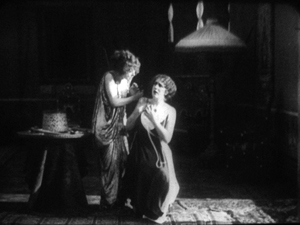
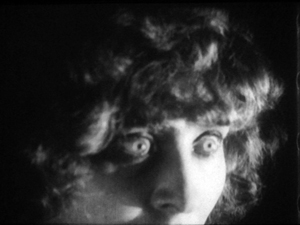
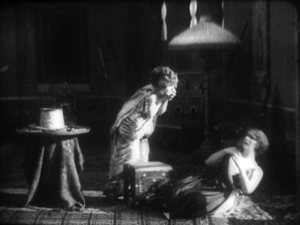
The linear editing, as Burch indicates, lays everything out for us step by step. The close-ups accentuate what is important at each moment: Susetta seizing the dagger, stabbing her rival, and–in a remarkably modern-looking extreme close-up–registering her horror at what she has done.
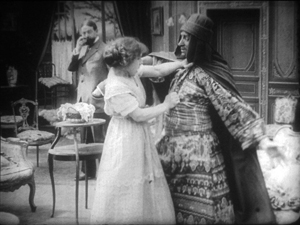
Two years before, Marcel Simon, the (Belgian!) director of Calvaire de Mignon, handled a similar situation rather differently. The diabolical Dénis, whom we met earlier, has succeeded in destroying his brother’s life. It remains only for him to force Robert’s niece Mignon to marry the Algerian Emir Kalid. Kalid is at first humble, beseeching Mignon to become his bride, but then he gets rough. We might note already that Mignon, while fairly near the camera, hovers close to the left frame edge.
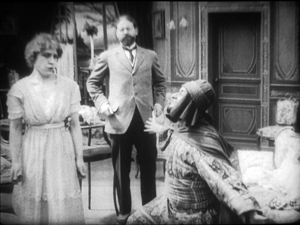
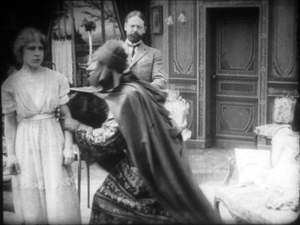
In their tussle, Mignon snatches something from Kalid’s waistband and flings him far away to the right.
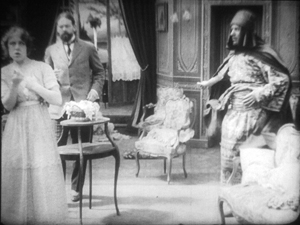
What’s up? Mignon has grabbed the Emir’s dagger and stands poised with it pressed to her heart. But we haven’t been able to see that dagger very clearly (no cut-in close-up here, as in Maman Poupée) and she’s returned to her position far off-center. It’s likely that a viewer today wouldn’t understand that she’s holding the men at bay by threatening suicide. Would a 1917 viewer be as uncertain? Would the situation, plus her posture and the men’s hesitation, be enough to get the point across?
Moreover, this moment goes by very quickly. Scarcely has Mignon struck her pose when her true love, René, bursts in behind her–frontal, fairly centered, and moving fast. Meanwhile, Dénis is sneaking up on her, hugging the left frame. Mignon makes a break for René, dropping the still almost indiscernible dagger.
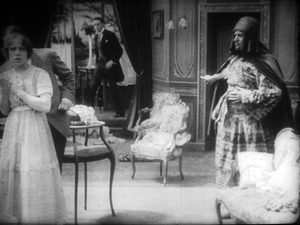
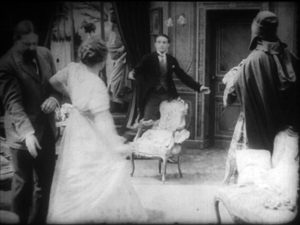
While Mignon and Rene embrace in the right rear doorway, blocked from our view by Kalid, Dénis stoops over. It’s a timely adjustment, giving us full view of the benevolent Le Maire sweeping into the room.
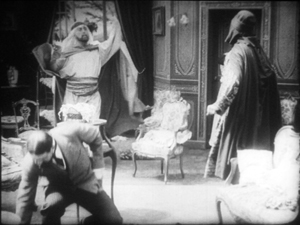
As the two men confront one another–the climax of the scene–director Simon has the effrontery to let Dénis steal the show. He picks up the dagger, which now can be seen more or less plainly, weighs it in his hand, and looks out for a brief, pondering moment.
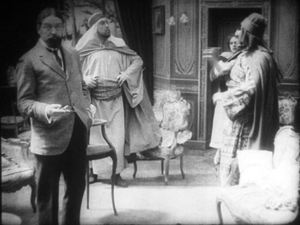
We seem to have a late example of the Snapper Kid Effect, in which important actions compete for our attention. Is it clumsy direction to perch Mignon on the frame edge as René rushes in, and to let Dénis recover the dagger while we’re supposed to concentrate on the face-off between the two powerful men? Or would audiences have tracked all the strands of action and enjoyed their simultaneity?
On this site and elsewhere, I’ve assumed that directors in the 1910s structured their compositions for what Charles Barr calls “gradation of emphasis,” a fluid pattern of primary and secondary points of attention. I’ve argued as well that Burch exaggerates the decentered, nonlinear compositions of even the earliest years. Many of the films staged by Lumière cameramen are designed cogently, and so are many films from the 1900s. (Tom, Tom might be the exception rather than the norm.) Yet every so often, you get a later case, like Musketeers of Pig Alley or Le Calvaire de Mignon, that suggests that some viewers might have been more adept at tracking simultaneous events than we are.
A still broader question remains. Let’s assume that people were able to follow and enjoy films in the tableau style, even when that style pushed toward illegibility. What enabled people to adapt, and so quickly, to continuity-based movies? Some scholars and filmmakers argue that continuity editing achieved its power and worldwide acceptance because it mimics our natural mode of perception. At any moment, we’re concentrating on just a small portion of our surroundings, and this is like what editing does for us in a scene. On the other side, Burch and others would argue that continuity filmmaking is only one style among others, with no special purchase on our normal proclivities. On this view, classical continuity’s apparent naturalness hides all the artifice that goes into it, and this concealment makes its work somewhat insidious. I’ve offered some thoughts on this problem elsewhere, but I bet I tackle it again on this site some time.
In any case, we need to study films that seem odd or difficult, whether they’re recent or from the distant past. We’re guaranteed to find some striking and unpredictable things that provoke us into thinking. That’s one of the pleasures of exploring the history of film as an art.
For earlier studies of the tableau style on this site, see this entry on Bauer, this one on 1913 films, this one on Feuillade, and this one on Danish classics. This entry discusses the emergence of Hollywood-style continuity, and this one explores the exemplary editing in William S. Hart films. I go into more detail in two books, On the History of Film Style (chapters four and six) and Figures Traced in Light (chapter two) and in the essay, “Convention, Construction, and Cinematic Vision” in Poetics of Cinema. The last-named piece tries to stake out a middle position on the “naturalness” of continuity editing. Kristin has analyzed Alberto Capellani’s films as instances of the tableau trend, last year here and just last week here. She also weighs in on the debate about whether viewers of his time were better prepared to grasp the action than we are. More generally, Capellani’s career exemplifies the major and swift stylistic changes of the 1910s. When he went to America, he became pretty adept at the emerging continuity style, as the Nazimova vehicle The Red Lantern (1919) indicates. Of course that’s got some striking single images too.
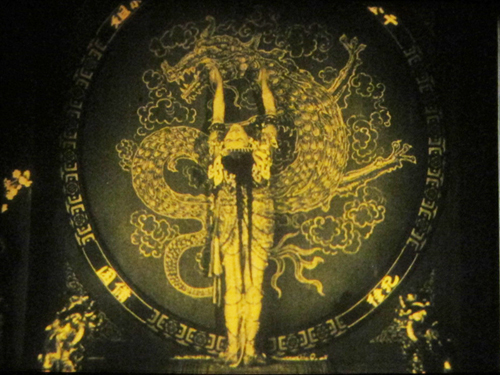
The Red Lantern (1919).
Good and good for you
Late Autumn (Ozu Yasujiro, 1960).
DB here:
Manohla Dargis of the New York Times has just written a piece that refers to some ideas that have appeared on this site. If you see the article online, you’ll find the links to appropriate entries, but if you’ve come here after reading the paper edition of the Times, you can find the Tim Smith essay she cites here. It is a remarkable piece of work, and it’s gratifying that Dargis has called attention to it. (Tim’s video experiments have received many hundreds of thousands of downloads already.) My table-setting entry, on task-driven looking, is here.
The backstory is simple. On this site in 2008, I took a slow, unemphatic scene from There Will Be Blood as an example of how a director can subtly guide our attention without cutting, camera movement, or auditory underlining. My analysis was guided by recognition of my own responses and some knowledge of traditions of cinematic staging. Tim, in his turn, used the tools of modern perceptual research to show that we can gain firmer knowledge of directorial craft. By tracking viewers’ eye-scanning, Tim demonstrates vividly that filmmakers can shape our experience of the action on a second-by-second basis. This not only helps us understand how we grasp images. It shows that humanistic inquiry and psychological research can collaborate.
Why so unserious?
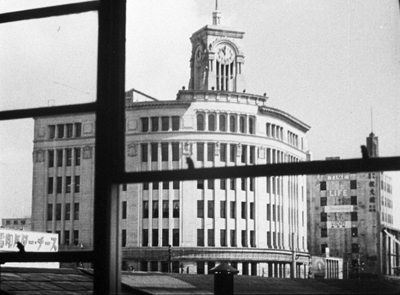
Late Spring (Ozu Yasujiro, 1949).
Those who navigate Internet eddies and flows know that dozens of responses have swirled around Dan Kois’ “Eating Your Cultural Vegetables.” Kois wants to like long, slow movies, but after trying for years, he has found that he just can’t enjoy many of them. He can mimic, even anticipate, the judgments of those who do, but in his heart he finds most of the celebrated films boring. He’s now decided to give in to his impulse and declare that he needn’t pretend to enjoy Tarkovsky or Hou Hsiao-hsien:
As I get older, I find I’m suffering from a kind of culture fatigue and have less interest in eating my cultural vegetables, no matter how good they may be for me.
As one man’s confession of guilt and fatigue, this is doubtless sincere, although its sideswiping putdowns of viewers who praise such movies suggest more calculation than humility. Still, this cry from the heart has broader implications, as many Net writers have discussed. Kois’ complaint elicited not one but two responses from the New York Times film critics A. O. Scott and Manohla Dargis. For one thing, Kois’ essay seems to offer aid and comfort to people who are afraid to try something different. Indeed, it lets them feel superior to the phonies who claim to like such films. Moreover, Kois justifies the most superficial response a moviegoer can make. Simply shrugging off a film by saying, “It’s boring!” is about as uninformative a response as saying, “It’s interesting!” And one should always be suspicious of somebody, in the name of debunkery, telling us that we shouldn’t bother to know something.
Kois’ piece exploits the special status that film enjoys in today’s culture. High and low mingle. Because movies are so accessible, and Hollywood movies are so eager to give us what somebody has decided that we want, coterie tastes are dismissed as snobbism. Things seem different in other arts. Would the Times publish a piece in which someone confessed to finding Tarkovsky’s contemporary, the Soviet composer Sofia Gubaidulina, boring? No, because to talk about her is already to enter a restricted and high-level conversation. It goes without saying that a great many listeners would be bored by her music, but who cares what non-experts think about a modern composer? Film, however, is a free-fire zone; anybody’s opinion is worth a public hearing.
I’ve kept out of the fracas because I thought Kois’ piece was silly-season fluff. Of course I wrote my own replies in my head, such as We used to have a name for this: Philistinism. I also thought that the essay operated in bad faith. Kois wasn’t as apologetic as he tried to seem. He claims humility (he “yearns…to experience culture at a more elevated level”) when really disdaining this area of cinema and considering the people who claim to enjoy it mere poseurs. The exaggerations show, I think, that this is not a serious piece:
Surely there are die-hard Hou Hsiao-hsien fans out there who grit their teeth every time a new Pixar movie comes out.
Surely not.
Still, Kois’ complaint touches on something important about film history. We have a polarized film culture: fast, aggressive cinema for the mass market and slow, more austere cinema for festivals and arthouses. That’s not to say that every foreign film is the seven-and-a-half hour Sátántangó, only that demanding works like Tarr’s find their homes in museums, cinematheques, and other specialized venues. Interestingly for Kois’ case, many of the most valuable movies in this vein don’t get any commercial distribution. The major works of Hou, Tarr, and others didn’t play the US theatre market. Sátántangó is just coming out on DVD here, nearly twenty years after its original appearance. Most of us can’t get access to the most vitamin-rich cultural vegetables, and they’re in no danger of overrunning our diet.
The race is to the slowest
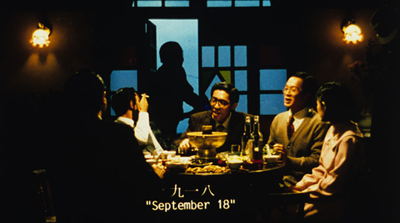
City of Sadness (Hou Hsiao-hsien, 1989).
For the historian, the polarization between fast pop movies and slow festival films asks to be explained. My take goes roughly this way.
From the 1940s through the 1960s, certain directors developed a new approach to telling stories. Antonioni, Dreyer, Bergman, and a few others opted for a style that relied on slower pacing and even “dead moments” that seemed to halt the narrative altogether. “Dedramatization,” it was sometimes called, and many rightly considered it a powerful innovation in the history of film as an art. But these films did get a purchase on the international movie market, often for other reasons (sex in Antonioni and Bergman, religiosity in Dreyer). They also came along at a time when there was a niche audience eager to have new cinematic experiences. (On this period see Tino Balio’s Foreign Film Renaissance on American Screens.)
But artists being artists, competition grew up. The long take, for instance, got longer and more virtuosic. Miklós Jancsó, shamefully ignored today, made a series of pageants of Hungarian history in superbly sustained, intricate camera movements; some of his films have only twelve shots. But his films are sumptuous compared to what we found elsewhere. From the late 1960s through the 1970s, it seems, a new generation of filmmakers competed to make ever more austere films. They often kept the camera fixed, framed the action at a distance, and sustained the shot for many minutes. The works of Jean-Marie Straub and Danièle Huillet are the high-water marks of this trend, but there were also Chantal Akerman, Theo Angelopoulos, and even Rainer Werner Fassbinder (Katzelmacher) and Wim Wenders (Kings of the Road). Werner Herzog’s successful career as a documentarist has perhaps let people forget that he once made very slow and demanding films like Fata Morgana; his Heart of Glass, screened in US arthouses in the 1970s, would surely not find a distributor today.
From a marketing standpoint, the avant-garde overplayed its hand. The new austerity came along just when Spielberg and Lucas were reinventing Hollywood. As movies got faster and louder, long-take minimalism looked perversely ascetic. Some of the directors, like Straub and Huillet, remained loyal to their project; others crossed over. It is quite a shift from Akerman’s Jeanne Dielman, 23 quai du Commerce, 1080 Bruxelles (1975), a 201-minute film mostly about housework, to the musical The Golden Eighties (1986) and A Couch in New York (1996). Likewise with Wenders’ Summer in the City (1970) and Wings of Desire (1987). I happen to admire both strains in these directors’ works, but there’s no doubt which is the more audience-friendly.
Today, directors who persist in long-take, slowly-paced storytelling are aiming chiefly at the festival market, which means that most of their films will be shown theatrically only, to be blunt, in France. But some of the greatest directors of our time, notably Hou Hsiao-hsien, Edward Yang, and Abbas Kiarostami, have done their best work in this mode. The US arthouse market has taken decades to discover them, through more accessible works like Flight of the Red Balloon, Yi Yi, and Certified Copy. Kois confesses to loving Yi Yi, so I’d urge him to look at Yang’s Terrorizers and A Brighter Summer Day, more rigorous but no less gripping films, though they lack the traditional arthouse bait of a charming child. Hou’s Red Balloon also has a cute kid and refers back to an arthouse classic, while Kiarostami, not normally given to couples and romances, offers us in Certified Copy a pleasantly teasing take on Antonioni and Resnais.
Minimalism of the 1970s variety got revived by 1980s American indies, notably Jim Jarmusch, but with more entertainment value. In later years he too crossed over stylistically; however unpredictable the plot maneuvers of Ghost Dog and Broken Flowers, they lack the long takes and open-ended unfolding of time we find in Stranger than Paradise. Even Kelly Reichardt, one of Kois’ targets, doesn’t give us anything like the severity of the 1970s generation. That makes the “purer” films from overseas that persist in this tradition even more off-putting. If Kois can’t take Meek’s Cutoff, as he claims, he’d find Hong Sangsoo (Oki’s Movie) or Liu Jiayin (Oxhide and Oxhide II) cinematic chloroform.
So Kois may assume that “boring” films have persisted in today’s film culture because of snobbism, but there are deeper reasons. The competition among filmmakers to push an aesthetic horizon further, the narrowing of audience tastes, the search for a budget-appropriate niche that could stand in opposition to the visual spectacle of the New Hollywood–these seem to me important factors in making slow movies a ghetto for cinephiles.
Why shouldn’t people follow Kois in giving up their vegetables? No reason, except that they’re missing some worthwhile cinematic experiences. Not all austere movies are good, but viewers who want to expand their cinematic horizons should consider the possibility of learning to look at certain movies differently. Kois can’t see that; he thinks that people who like the movies that bore him are usually phonies. But I believe that some of those admirers have developed a repertory of viewing habits that adjust to different cinematic traditions. If you can like both Stravinsky and rock and roll, why can’t you like Hou and Spielberg?
Look again, closer
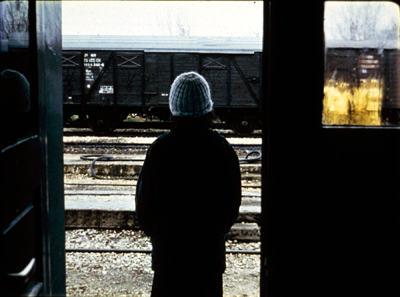
Voyage to Cythera (Theo Angelopoulos, 1984).
This is the prospect opened up by Dargis’ latest article. She suggests that Kois’ response isn’t wholly based on taste. It may stem from literally not knowing how to look at certain kinds of movies.
Kois’ article treats most defenses of slow films as a matter of hand-waving and you-see-it-or-you-don’t attitudinizing. Again, he has a point: Those reactions are common, I think. The fact that cinephiles must face is that this sort of film is very difficult to talk about. We can point out the creative choices in Hollywood because narrative in some degree drives everything we see and hear. But when narrative relaxes, most viewers don’t know what to look or listen for.
The problem has haunted me for decades, ever since the 1970s when I took an interest in Ozu, Bresson, Dreyer, and Mizoguchi–all filmmakers felt, at the time, to be slow. I failed to come to grips with the problem in my 1981 book on Dreyer; I even anticipated Kois in calling Gertrud (another item that would never grace theatre screens today) boring–but I took that to be a good thing, as a challenge to conventional viewing habits.
What can I say? I was young. Since then, I think I’ve come up with better ways of talking about the other directors I mentioned, as well as some in their camp, such as Angelopoulos and Hou and Tarr. A lot of my answer comes down to the way, pace Dargis and Smith, they structure our attention.
My arguments are set out in the places I mention in the tailpiece of this entry. In brief, these filmmakers become engaging, even entertaining, when we realize that they are to some extent shifting our involvement from characters and situations to the manner of presentation. Not narrative but narration is what engages us. And we need, as Dargis points out, some schemas for grasping these alternative patterns. We have robust and refined schemas for following a story, but grasping the dynamics of narration, the how as well as the what, takes more practice, and perhaps some instruction from critics.
The process is like taking in an opera on two levels: following the stage action but also registering the patterns, the emotional highs and lows, of the music that accompanies–and sometimes overwhelms–it. Let Papagena and Papageno stammer each one’s name again and again. The repetition isn’t needed for the drama, but it’s thrilling on sheerly musical grounds.
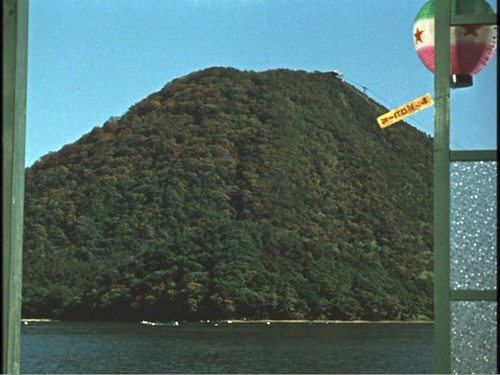
Now imagine that sort of development transposed to cinema, in which we can appreciate, at one and the same time, not only the story’s unfolding but the patterns that present it. The supreme master of this possibility, I think, is Ozu, perhaps cinema’s Mozart. But you can find the same qualities in more somber key elsewhere. For example, in watching Angelpoulos’ Voyage to Cythera, I think that you have to be prepared to see the arrival of track workers in yellow slickers, visible through the speckled window pane in the shot above, as a kind of visual epiphany, the quiet equivalent of a stunt in a summer tentpole picture.
Given a narrative mandate, we’re on the lookout for pictorial factors that affect the dramatic situation. But when narrative slows, other things, maybe not of narrative moment, pop out, like the yellow-garbed train workers on their handcar. At such moments, it’s not that our eyes roam around aimlessly; it’s that the director guides us in a different way, toward a visual search that isn’t wholly driven by plot considerations. Here’s a shot from Ozu’s End of Summer (1961).
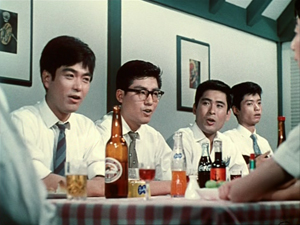
The principal action is a party of young people singing. But the faces are no more important than the gleaming drinks on the table, a little suite of colors and shapes that become fascinating in themselves. (For instance, several of the liquids and bottle labels sit along the same horizon line, regardless of how far the drinks are from us.) You don’t discover this half-gag, half-still-life by groping: Ozu has lit it and composed it so that you’re invited to discover it. He has found a way to activate what in most movies would be filler material. And if you think that noticing colors and shapes on the tabletop is just trivial, consider that we enjoy staring at the same sorts of patterns in an abstract Kandinsky. Or is he cultural roughage too?
In an Ozu film, even though he cuts rather fast, we’re given time to see everything. But this isn’t random rummaging. It’s visual exploration guided by Ozu’s decisions about composition, lighting, and color. Something similar, I think, is going on with Tarr, although there it’s more a matter of texture and tactile qualities. His people shamble through mud, oily puddles, dusty corners, and tearing winds. In one shot of Damnation, a rain-soaked wall shrivels to match a wrinkled topcoat.
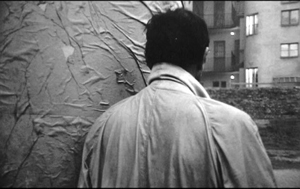
The story is still going forward, but by turning his protagonist from us and aligning him with the wall, Tarr has given his shot an extra layer of sensuous appeal. Try to remember the way any wall looked in Transformers 3, before it got blasted to rubble.
Slow movies let us look around, and good slow-movie makers give us something to see when we do. But what do we do when these accessory appeals don’t just accompany the narrative but swamp it? What if we lose track of the characters? The film may steer us to pictorial or auditory qualities that take over our perception.
The authorities are looking for a man in the family in Hou’s City of Sadness, but you have to rely almost solely on dialogue to identify what’s going on and who’s speaking.
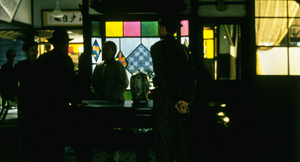
The sheer pictorial beauty of the shot becomes a sort of anti-narrative pretext. But if you’re alert, you won’t take the plot off the table, because at one crucial moment a figure flashes through the far left background, more or less fully lit, who may be the suspect the cops are seeking.
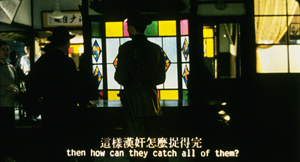
Sometimes you have to destroy narrative in order to save it.
Hou asks that we engage with his distant, fixed images in a complex way, being patient but vigilant, enjoying abstract geometry while also sustaining old-fashioned suspense. It’s this dynamic between story and style, fastening on plot elements but also discovering accessory pleasures and patterns, that I think constitutes one delight of the sort of films that Kois finds boring.
Add Bresson, Mizoguchi, Dreyer, Tarkovsky, and others to my list of directors whose very different styles invite us to explore what the rapid pace of most narrative cinema refuses to dwell upon. These filmmakers invite us to grasp the space and time of a scene in a fresh way. The details and dimensions of a world surge forward, not simply as a backdrop for characters hurtling toward a goal, but as something valuable in their own right. For some viewers, me included, they do more. They also ask you to transfer those viewing skills to life outside the theatre. They encourage you to find a new way to look at our world.
Not all slow, minimalist movies are good. That’s why I think critics are obliged to rebut Kois with careful analysis, not the gaseous generalities about sublimity and eternal mystery to which we too often resort. Digging deeper, we can not only answer skeptics but expand our understanding of how cinema works. These films have opened windows for many of us. Why should we keep them to ourselves?
First, thanks to Manohla Dargis for enjoyable correspondence about these issues.
Tim Smith’s blog, Continuity Boy, is a good way to keep up with his energetic and expanding research program.
Dargis mentions the invisible gorilla experiments of Chabris and Simons. I talk about their relevance to film here and here.
Kristin has written on comparable matters in Tati; she even wrote an essay on M. Hulot’s Holiday called “Boredom on the Beach.” (It and an essay on Play Time are in her book Breaking the Glass Armor.) Tati’s films, in their spasmodic pauses and shamelessly repeated or sustained gags, could also count as part of the postwar dedramatization trend.
My initial arguments about different registers of viewer perception and cognition were made in Narration in the Fiction Film (1985). My case for Ozu is in Ozu and the Poetics of Cinema, available online. More recently, I’ve become interested in cinematic staging and have concentrated on challenging directors like Mizoguchi, Angelopoulos, and Hou; see On the History of Film Style (1998) and Figures Traced in Light (2005). All of these “slow” filmmakers ask us to be sensitive to unusual sorts of narrative patterning, and some purely non-narrative patterning. More thoughts on these matters can be found in The Way Hollywood Tells It (20006) and Poetics of Cinema (20007).
On this site, you can find similar lines of argument, especially about Béla Tarr, Mizoguchi Kenji, and silent directors like Louis Feuillade, Victor Sjöström and some Danish creators. See director entries for Hong Sangsoo, Liu Jiayin, and others mentioned above. Later this month I hope to post a bit more about how directors guide our attention without recourse to fast-paced editing–before editing was really invented.
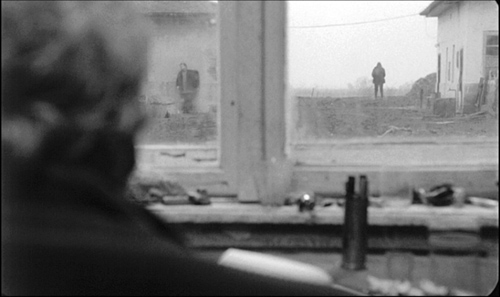
Sátántangó (Béla Tarr, 1994).
Written on the rewind
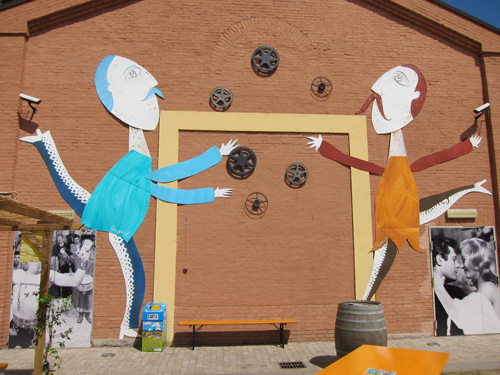
The High and the Mighty: The view from the café at the Cineteca of Bologna.
DB here:
Bologna’s Cinema Ritrovato has just ended, and while Kristin and I hustle to write some final entries about films we’ve seen, here are a few images, or maybe lobby cards, from the biggest Ritrovato yet. If we’ve so far posted fewer dispatches than in previous years…that’s largely because the expanded screening list (a fourth venue was added) kept us busy!
If you’re unfamiliar with the Ritrovato, our 2007 orientation is here. For a complete account, check our category Festivals: Cinema Ritrovato. And for many more images from the festival, see the Ritrovato page here, which includes shots of Bertolucci and Charlotte Rampling, as well as a video of a Piazza Maggiore mini-concert.
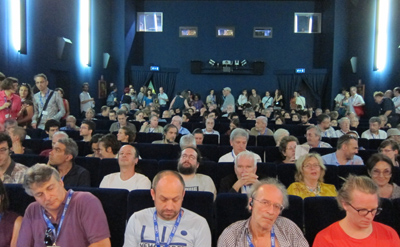
The Crowd: A full house for Murnau’s Der Gang in die Nacht.
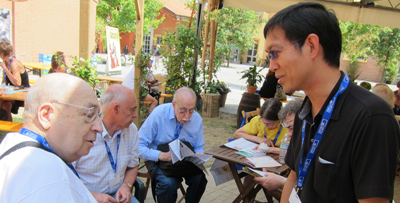
Café Lumière: Pierre Rissient, man of the cinema, and Li Cheuk-to of the Hong Kong International Film Festival.
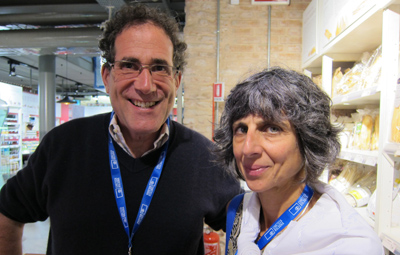
Le silence est d’or: Silent-film impresarios Jon Gartenberg of Gartenberg Media and Kim Tomadjoglou, curator of the Alice Guy Blaché retrospective.
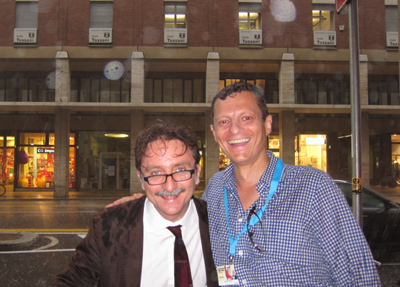
Summer Storm: Gian Luca Farinelli of the Cineteca and Peter Becker of Criterion take shelter in a portico.
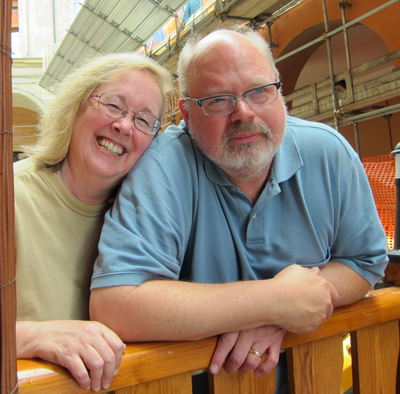
In the Mood for Love: Susan Ohmer and Don Crafton of Notre Dame University.
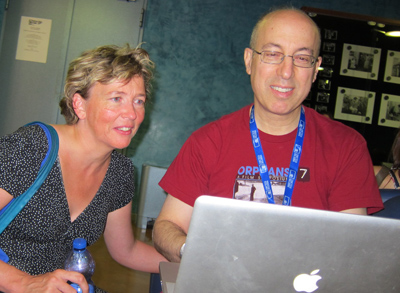
Make Mine Music: Maud Nelissen and Donald Sosin, virtuoso accompanists for Bologna screenings.
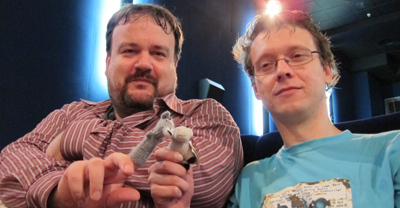
Le Doulos (x 2): Olaf Möller and Christoph Huber of the Ferroni Brigade pioneering a new form of digital cinema.
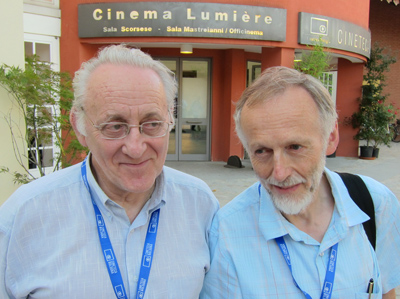
The History Boys: Naum Kleiman of the Moscow Central Cinema Museum, and Ian Christie of Birkbeck College, University of London.
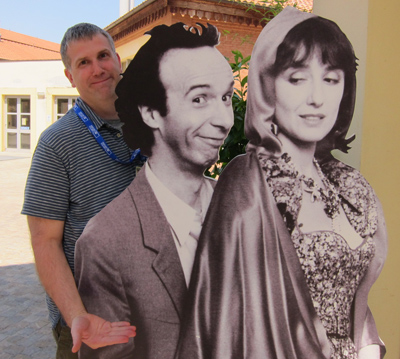
Gentleman Jim: Jim Healy of the University of Wisconsin–Madison Cinematheque.
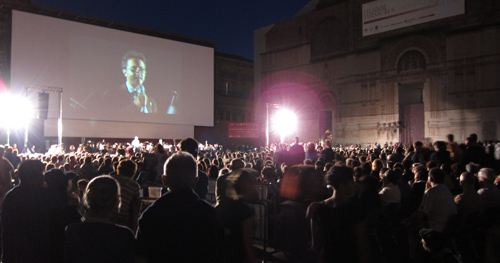
Cinema Paradiso: Introduction to one of the nightly screenings on the Piazza Maggiore.