








Archive for the 'Film comments' Category
HUGO: Scorsese’s birthday present to Georges Méliès
Kristin here:
This is the 150th anniversary of the birth of Georges Méliès (1861-1938). I doubt that the release of Hugo was timed to coincide with the occasion. If it were, no doubt the press kits issued by Paramount would have stressed the fact. Still, it’s a happy coincidence.
Hugo is receiving a lot of press attention, not surprisingly. If you’ve read more than one or two of the reviews and articles about Martin Scorsese and his film, you already know the two main hooks that journalists have hung them on. (Whether these originate from the pressbook or are just so darned obvious that everyone can figure them out, I don’t know.)
One, Scorsese is passionate about film history and preservation, so Brian Selznick’s best-seller quasi-graphic novel for children, The Invention of Hugo Cabret, based on the old age of early director George Méliès, would be a natural source for him to adapt. Especially so, since Selznick designed the illustration-heavy book to imitate a film, with series of drawings suggesting camera movements.
Two, the subject of Méliès’ pioneering special effects in the service of fantasy would be the perfect vehicle for Scorsese’s first venture into 3D.
True, no doubt, both of those points, and necessary to ease viewers with no knowledge of film history into this fairly sophisticated film. Not that the critics provide much help with the film’s many allusions to Parisian culture of the first decades of the twentieth century. There are real popular songs and posters for many silent films. I didn’t see any reviews pointing out that James Joyce and Salvador Dalí can be glimpsed fleetingly in Madame Emile’s café. (I spotted Joyce but not Dalí, only learning of the latter’s presence from the credits.)
Apart from signalling such references, however, there is a great deal more that one can say about the film. Some aspects of it are obvious, as befits a movie made in part for children. Others are more subtle, as befits a movie made in part for adults. I’ll offer a few observations here.
By the way, reviewers have made much of the idea that Hugo is not really for children, who would be bored and perhaps frightened by it. I suspect that children under about the age of 10 would be, but older children and teenagers, especially those who read books, should be intrigued by and enjoy it. Like Pixar films or The Simpsons, it’s the sort of thing that can be enjoyed by adults as well as children.
Movies within movies
Hugo is centered around Méliès’ work and tries to recreate something of the magic of the making and viewing of these films. Yet beyond this, it is steeped in the forms and subjects of pre-World War I cinema in general, to the point where the plotlines of Hugo subtly imitate early films.
A turning point in Hugo‘s story comes when Hugo and Isabelle invite fictitious film historian René Tabard (whose name is borrowed from the popular, Chaplin-impersonating teacher young student in Zero for 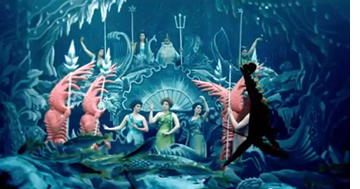 Conduct who starts the revolt) to screen A Trip to the Moon in Méliès’ apartment. At first the director happily describes his film career, but when he reveals its unhappy decline, he concludes despairingly, “Happy endings only happen in the movies.” Scorsese proves and yet contradicts this claim by providing happy endings in the subplots of the film. These subplots are presented as if they were short, early films, but divided up and played out as running vignettes that add up to simple stories.
In the book, the station’s Inspector, played by Sacha Baron Cohen, is a minor figure, glimpsed once from a distance by Hugo and finally coming to threaten him with arrest on page 412. His war wound and early life as an orphan are not part of his character. The Inspector is abetted by the café owner Madame Emile and the newsstand proprietor Monsieur Frick, sinister figures who appear only in this single late scene. They exist primarily to reveal the news of the discovery of the corpse of Hugo’s drunken uncle and to bear witness to Hugo’s thefts of croissants and milk from the café. The flower-shop girl, Lisette, whom the Inspector clumsily courts in the film, is not in the book at all.
What Scorsese very cleverly does is to expand these characters and have them play out what are in effect two brief narratives that could easily be imagined as early silent shorts. Madame Emile (Frances de la Tour) and Monsieur Frick (Richard Griffiths) are transformed from nasty busybodies into a charmingly comic elderly couple whose tentative flirtation is thwarted by Emile’s aggressive dachshund. In two scenes, the dog bites Frick, once on the finger and once on the ankle. In the third scene, Frick solves the problem by providing a lady dachshund to divert the pesky pooch’s attention. One could easily imagine this as a short film from around 1906, making these two the leads and concentrating on their courtship. The dog could thwart the news-vendor’s approaches a few times before the happy ending is achieved with the introduction of the second dog.
The overbearing Inspector’s romance with Lisette is developed at greater length, and one could imagine it as a one- or even a two-reeler of the early 1910s. The Inspector’s attempts to court the young lady could be contrasted with his chivvying of the pathetic young orphan, actions that make her reject his advances. At the end, she might witness him relenting and treating the boy kindly, as indeed happens in Hugo, leading to another happy romantic conclusion.
In general, the situations and characters that we encounter in Hugo are common in early cinema. How many films, especially French ones, involve gendarmerie with their round, flat-topped caps, chasing mischievous little boys? How many melodramas revolve around poor children made homeless by their parents’ or guardians’ drunkenness? How many gags involve men stepping on musical instruments and smashing them? While the most explicit cinematic reference is to the Harold Lloyd feature Safety 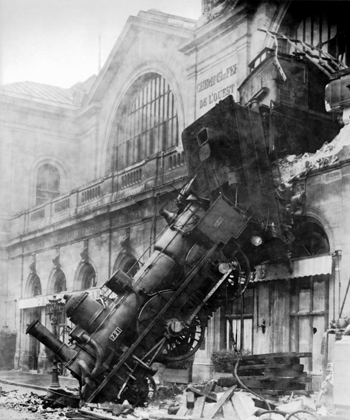 Last, the world which Hugo and Isabelle and Papa Georges inhabit is like an early program of silent shorts, but one in which the actions blend in counterpoint.
In a sense there are little topical and instructional films as well, with the reference to the dramatic historic accident at the Gare du Montparnasse on October 22, 1895, when a train crashed through its buffers and out the front wall of the station. (In reality, one death occurred: the wife of a news vendor who was minding the shop for her husband. Perhaps the Emile-Frick romance creates a happy ending of the cinematic variety to make up for that tragedy.) We also have the lesson in cinema history provided by Tabard. At one point in the flashback narrated by Méliès, apparent newsreel footage of World War I troops, touched up with hand-coloring, appears.
The film-like subplots all end happily, yet they are represented as being reality within Hugo. Perhaps for that reason, none of these brief narratives is the sort that Méliès would have used in his own films. They’re more like the non-fantastical comedies and chases made by Louis Feuillade and other directors.
The happy ending for Méliès occurs in Scorsese’s film, and yet it also happened in reality, if not quite the way it is shown here.
Cruelty, kindness, and the shape of the story
The structure of the narrative reflects the simplicity of each short film. It conforms well to the four-part narrative structure that I have claimed to be conventional practice in classical storytelling. Yet it also breaks neatly into two halves, the first about cruelty and the second about the sort of kindness that makes possible the happy endings. One can picture it as a V shape, with Hugo descending into greater loneliness and danger up to the mid-point and then climbing back toward happiness with the help of others.
Early on, both fate and other people are cruel. A museum fire has killed Hugo’s father, and his mother had earlier died of unspecified causes. Hugo’s drunken uncle wrests him from his home and school to live a fugitive life in the station. “Papa Georges,” whose full identity we do not learn until well into the film, seems unnecessarily harsh with the young Hugo. The Inspector obsessively hunts down stray children to send off to the orphanage. The bookseller Labisse, though generous in loaning books to Hugo’s friend Isabelle, looks upon Hugo with disdain. Even the two dogs, Madame Emile’s comic dachshund and the Inspector’s doberman are growling, threatening beasts.
The automaton, of course, is the key to all. Once it provides the necessary clue by drawing the 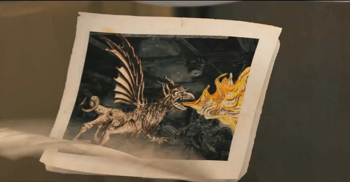 famous image of the rocket stuck in the Man in the Moon’s eye, Hugo and Isabelle go to the Méliès apartment and discover the box full of the master’s designs. This incident forms the central turning point, coming almost exactly midway through the film (61 minutes into a film that runs roughly two hours, not counting its credits).
Ordinarily at this point in a Hollywood film, there would come a section where the protagonist struggles against obstacles to achieve his goal. In Hugo, however, the crisis at the center leads immediately to a series of kind actions. Upon returning to the station after the drawings discovery, Hugo runs into M. Labisse, who unexpectedly gives him a book that the boy and his father had read together. Then Madame Emile urges the Inspector to speak to Lisette, whom he has admired from afar, and coaches him in how to smile pleasantly. His smile, plus his halting success in his first conversation with Lisette, motivate his eventual ability to take pity on Hugo.
This scene leads directly to the scene at the “Film Academy Library” (a giant fictitious room full, apparently, of books on cinema) where the film historian and Méliès fan, René Tabard, appears. He will provide the screening of A Trip to the Moon which finally draws Méliès out of his depression to some degree. Yet the filmmaker still despairs as he thinks of the disappearance of his studio, the rest of his prints, and his beloved automaton. Hugo rushes off to fetch the latter, and after an extended chase sequence returns it to Méliès with the help of the Inspector, who saves the machine and the boy from an oncoming train. Recognizing something of his own youth in the distraught boy, the Inspector turns him over to Méliès for the happy ending.
The exception to the cruelty/kindess division of the film is Isabelle. In the original book she is not such a pleasant character, often arguing with Hugo. She does not have the joyous desire for adventure that the Isabelle of the film displays. The change is an improvement. In part this is because Hugo is such a very grim and forlorn character through much of the book. Portraying him that way in the visual medium of film might make his plight too pathetic to be entertaining. Isabelle’s early sympathy for him and fascination with the mystery of the automaton carries a strong thread of hope across both halves of the narrative.
In the lengthy epilogue there is a gala screening of some recovered Méliès prints, and a party is held. All the significant characters are present, with their satisfactory futures assured. Hugo will seemingly become a magician (as he does in the book). Isabelle has apparently found her hoped-for purpose in life, for she starts writing down the story that we have just witnessed. (In the novel, Hugo himself writes The Invention of Hugo Cabret, though he attributes it to the automaton.)
A machine-made ending
The film ends with a tracking shot, independent of the characters’ points-of-view, into a nearby room where the automaton sits, still and alone. As we approach its enigmatic face, the image fades out. The moment ends the imagery that has continued through the film, of humans as machines and 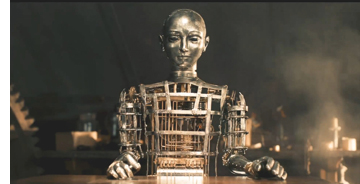 machines as humans. Hugo’s one hope as an orphan is to fix the automaton, his only link with his dead father. The moment that it is fixed leads to the drawings and Méliès’ breakdown, the first clues as to why he is so embittered. Hugo and Isabelle discuss how machines have purposes, and therefore people do, too. Papa Georges has lost his purpose and hence needs fixing. Once that is accomplished, with the help of the automaton, Hugo finds a new father figure and his happy ending.
The machine imagery goes further. The opening of the film dissolves from a set of moving clock gears to merge them graphically into a high view of the boulevards of Paris, which momentarily appears as a giant glowing, whirling machine with the Eifel Tower, symbol of the modern machine aesthetic, at its center. The repair of a wind-up mouse becomes the first small point of emotional contact between Méliès and Hugo. The Cinématographe camera/projector that fascinates Méliès even more than the moving images on the screen becomes the central machine, one which produces what one normally thinks of as the most private and mental of events, dreams.
All this machine imagery is fairly obvious, but it seems completely appropriate if we remember that this is, after all, a film partly for children. What I’ve been describing are things that a smart child could grasp, but the imagery and story aren’t done in anything like a condescending way.
The automaton, by the way, really did the drawing in the film itself, without CGI or other sorts of animation being used. For a three-minute film that ends with a fast-motion demonstration of its drawing capabilities, see here. For a demonstration of the restored Maillardet automaton in the Franklin Institute in Philadelphia, which Selznick used as his inspiration, see here, where it creates a drawing as complex as the one in the film. This automaton also revealed its origins when, after being restored, it signed its maker’s name.
[Dec 9: My claim that the automaton did the drawing without special effects was based on some statements by the company that made it (or more specifically, 15 versions of it). A recent article here interviews the film’s visual-effects supervisor Rob Legato reveals that the drawing scene was accomplished using magnets below the table: “The robot or automaton was not CG, although there were some CG doubles for some complex shots such as the train line fall. Prop builder Dick George constructed 15 automaton versions and some that actually could draw on paper. The VFX and special effects team solved the complex task by using magnets. Below the paper was a motion controlled magnetic system that traced the hand encoded drawing. The arm then moved to match the magnets and draw the famous picture. In a couple of shots if you could pause and really study the frame you might see that the pen nib, at those points, ‘is a ball point and not an ink well pen,’ comments Legato.” So the automaton did do the drawings, but not based on its complex system of gears and other clockwork visible inside it.]
How accurate is it?
Naturally the events of history are messier than the neat scenario of a mainstream film could encapsulate. Still, given the constraints involved, Hugo‘s modifications of the facts seem quite reasonable, and on the whole the general public will exit the theatre with a decent impression of Méliès’ career.
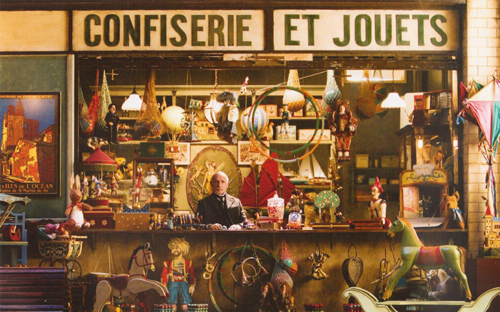
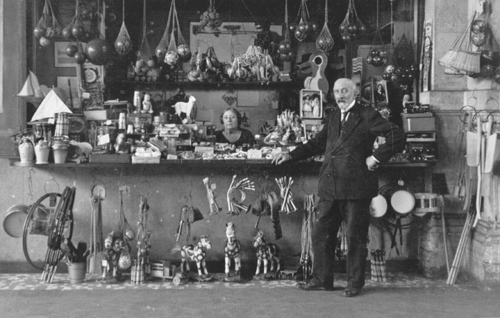
In fact he was married twice. Jehanne d’Alcy had been Méliès’ mistress well before they married in late 1925. They had both worked at the Théâtre Robert-Houdin before the cinema was invented, and d’Alcy appeared in many of Méliès’ films. (His first wife, Eugénie, died in 1913.) D’Alcy brought with her the ownership of a little candy-and-toy shop outside the Gare Montparnasse, which the couple transferred inside the station and ran together (see bottom). World War I did not cause the demise of Star Films. Méliès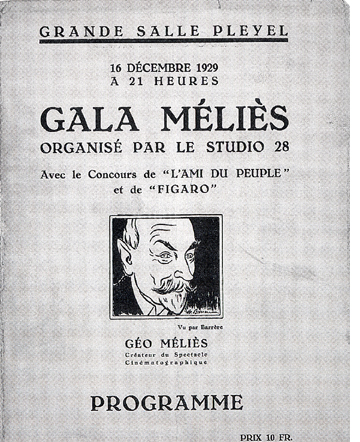 had made his last films in 1912, and in 1913, owing money to Pathé Frères, he nearly had to give up his Montreuil studio to the larger company. Ironically, the war led to a freeze on such payments, and Méliès was able to hold onto the property until 1923.
As biographer Paul Hammond describes his decline, “Georges Méliès had become an anachronism, an artist left behind by economic and aesthetic developments.” In looking at Méliès’ late films, we might keep in mind that 1912 was the year of Albert Capellani’s remarkable serial adaptation of Les misérables. Max Linder was at the height of his popularity, and D. W. Griffith was making some of his finest one-reelers. The three great Swedish silent-era directors, Mauritz Stiller, Viktor Sjöström, and Georg af Klercker, all made their first films in 1912. The year 1913 would see a burst of cinematic inventiveness around the world, and Méliès would have seemed all the more old-fashioned by comparison had he continued to make movies. Nevertheless, he remains perhaps the only one of the very earliest generation of filmmakers whose work we return to not simply out of historical interest but for the fun and wonder of the films.
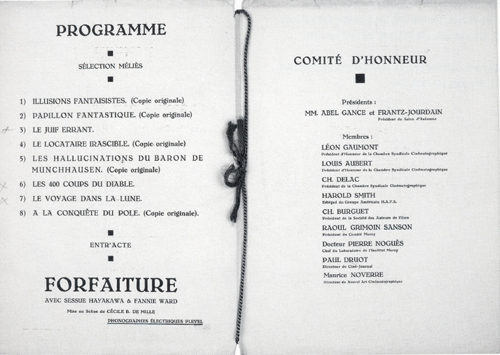
The rediscovery of Méliès began earlier than it does in Hugo, and it was more gradual. The mid-1920s were the nadir of his career. He and d’Alcy were living in a tiny flat in impoverished circumstances. In 1926, Méliès was notified that he had been made the first honorary member of the Chambre Syndicale Française de la Cinématographie–a trade organization, not an academic one like the fictitious “Film Academy” in Hugo. In 1929, J.-P. Mauclaire, director of the early art cinema Studio 28, found a batch of twelve tinted copies of Méliès films. New prints of the most damaged ones were made, and a screening of eight of them was held in a “Gala Méliès” that also included a revival of Cecil B. De Mille’s The Cheat:
In 1930 another program of Méliès films was shown, and in 1931 he received the Cross of the Legion of Honor. A benefactor provided Méliès and his wife with a larger apartment, and in 1934 he was made the honorary president of the Chambre Syndicale de la Prestidigitation. Ill health prevented him from pursuing some tentative filmmaking projects originated by admirers within the film industry, and he died of cancer in 1938. His granddaughter Madeleine ultimately became a champion in the revival of his memory. (For more on Méliès’ later life, see Paul Hammond’s Marvellous Méliès, pp. 80-85.)
Given all this, I think Scorsese and scriptwriter John Logan have done a reasonable job of condensing and tweaking the facts of Méliès’ story. The filmmakers also deserve considerable credit for showing the filmmaker cutting and splicing a strip of film involving a stop-motion effect. Méliès was long dismissed as not being much of an editor, having supposedly just stopped his camera and started it again to allow for the substitution of different items of mise-en-scene. We now know, however, that his amazingly well-matched transformations depended on eliminating just the right number of frames to create the magical illusion. He was a skillful editor indeed, and the filmmakers display that fact.
3D and Autochrome
Commentators naturally have stressed the fact that Scorsese has made his first 3D film. Up to now major filmmakers have embraced the technology, but most, like James Cameron, have worked in action genres. Could one of the “movie brat” generation redeem what has come to be seen as a technology that is rapidly losing its novelty value and perhaps its economic viability? The BBC even ran a story bluntly entitled “Can Martin Scorsese’s Hugo save 3D?” It and Steven Spielberg’s first 3D film, The Adventures of Tintin, have widely been seen as the crucial test of whether the use of 3D will continue to expand.
No doubt Hugo represents the best that can be done with current 3D technology. For once, every shot was filmed in 3D. Most 3D films, even Avatar, have at least a few images done with 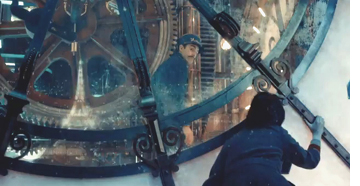 post-production conversion. (See the December, 2011 American Cinematographer article on Hugo, p. 56.) The filmmaking team went to extraordinary lengths to shoot as they wished to. They settled on using Arri’s new digital camera, the Alexa. The production required four cameras at a point when Arri was just beginning production, but the company managed to provide all four.
Cinematographer Robert Richardson has remarked on the idea of avoiding conversion: “If, as a film team, you’re not all working to best enhance in-camera the three dimensions then I would ask why have you committed to constructing a labour of love that someone else will eventually deliver to you via post conversion and say, ‘Here is your film.’ That might work for some projects and directors … but for me that choice felt insanely wrong. Commitment is required.”
Editor Thelma Schoonmaker has said of the 3D style “It’s not so much about stuff in your face—though there are a few wonderful shots like that. But more it’s about pulling the characters forward and feeling you’re in the room with them.” (Both quotations from Screen International [25 November 2011], p. 19.)
David and I went to see Hugo in 3D last week. Recently I have only seen a few 3D films: Herzog’s Cave of Forgotten Dreams, Wenders’ Pina, and Miike Takeshi’s Harakiri. Art-house films all, and apart from the Herzog film, where 3D serves educational rather than aesthetic functions, I didn’t think the 3D added much. James Cameron has said that Hugo is the best use of 3D he’s seen, and he should know.
I’ll admit that there are some terrific effects. The decision to have the Inspector’s doberman’s pointed muzzle coming out at us as it chases Hugo is clever and funny. But there’s still the blur and juddering of objects in the foreground, something that isn’t helped by the breakneck pace at which Scorsese “tracks the camera” through huge spaces or long tunnels. (Most of these shots involved as many special effects as actual camera movements.) I frequently wished in the course of the screening that I was seeing the film in 2D.
Apart from everything else, 3D pretty much necessitated that David and I move out of our habitual and preferred “front zone” of the theatre. Not only do 3D effects not work as well if you’re up close, but the edges of the screen are outside the frames of the glasses’ lenses. Turning your head when you’re sitting close and watching a 2D film is one thing; it’s quite another with those glasses on. So we sat further back. We also raised and lowered our glasses at intervals, checking out the amount of light being filtered out by those RealD glasses. It was quite a lot.
A few days later I went to see Hugo again, this time in 2D. The movie looked beautiful, with brighter images and more vivid colors. There was less blur in the fast camera movements. The depth cues in the images were strong enough to make such shots as the high-angle views down the vast clock tower impressive. And I was able to sit closer.
The brighter colors were important, since the filmmakers made an attempt to imitate a 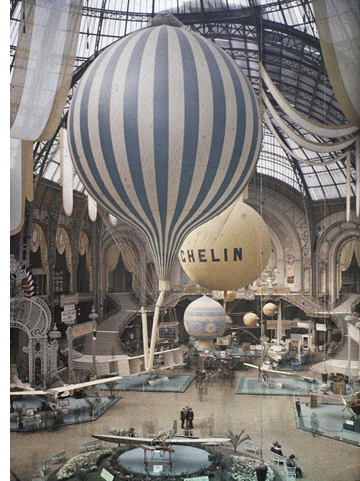 photographic color system of the early-cinema era. Specifically, Scorsese and Richardson aimed for the look of the Lumière brothers’ Autochrome system; this was the principal color system used in still photography until the 1930s. The digital grading used for Hugo played a big role in the attempt to achieve this look of early color. The American Cinematographer article mentioned above contains three sets of images demonstrating the stages of achieving the final look of Autochrome. A scan of one such set of images is available online. Just how authentic-looking the results are, I can’t say. (At right, a 1909 photo of an air show in the Grand Palais, Paris, by Léon Gimpel; for an extensive set of Autochrome photographs, see here.) Still, it’s a more interesting technique to those of us who aren’t fond of 3D, and I found that it gave the movie a color scheme that’s much more interesting than the standard look of films these days.
[Dec 9: A new interview with Robert Richardson by Bill Desowitz has just been posted here. It deals with 3D and Autochrome.]
Scorsese, journalists, and the legacy of Méliès
The reviews and coverage of Hugo in the trade and popular press have rightly emphasized Scorsese’s love of cinema history and his devotion to film preservation. He has collected high-quality 35mm prints of classic films, many of which are on deposit at the George Eastman House archive. Scorsese also helped found the Film Foundation in 1990 and the World Cinema Foundation in 2007. The latter organization has provided preservation work for films made in countries where either there is no national archive or where the archive lacks the funds and facilities for major restoration/preservation projects. Having first seen the Egyptian film The Night of Counting the Years (Al-mummia, 1969) in a battered 16mm copy, I was delighted to watch a beautifully restored 35mm widescreen copy at the Il Cinema Ritrovato festival in 2009. There is no doubt that Scorsese’s contribution to the film-restoration effort has been immense.
That said, I think some of the press coverage of Hugo has pushed Scorsese’s interest in preservation a bit too far in the case of Méliès, giving the impression that somehow the director has led a rediscovery of the early film pioneer as thorough as the one accomplished by Hugo and his friends in the fictional account. In The Hollywood Reporter’s story, “The Dreams of Martin Scorsese,” Jay A. Fernandez writes, “Over the years, Méliès has become a mystery himself, and even film buffs often don’t have a grasp of just how profound his contributions to cinema were, despite their efforts to piece together the scraps of his legacy. In this, he could not have better cultural archaeologists than Selznick and Scorsese.”
One might overlook a journalist (albeit one who specializes in entertainment news) believing that Méliès really was virtually forgotten among all but a few film historians before Hugo came along. But he goes on to quote Selznick, whose words might carry more weight, as saying of Scorsese, “Of course, Scorsese has been responsible for restoring the lost legacies of groundbreaking filmmakers. He is in the position of pointing the way for the public, showing us who has been forgotten and overlooked.”
That’s going a bit far. Admirable and important though Scorsese’s preservation efforts have been, and valuable as his video histories of topics like Italian cinema have been in bringing film history to a broader public, he cannot be said to have been responsible for rediscovering major filmmakers who have been forgotten. I doubt he would claim to have done so.
The work of Méliès has been covered in the basic histories of world cinema for at least the past fifty or sixty years. Indeed, the rediscovery of Méliès that began in the 1920s has continued ever since. Unfortunately, most of the coverage of Hugo passes over the diligent and successful work of archivists who have been the mainstay of that rediscovery.
The friends of Méliès
Méliès played a small but important role in my own early discovery of cinema history. During the spring of 1970, I was taking my first film course, a one-semester survey history, at the University of Iowa. As I recall, it was during that time that a representative of the Library of Congress came to campus and gave a talk on film preservation. He showed two hand-painted shorts, one of which was Méliès ’ Le Raid Paris-Monte Carlo en deux heures. The color was crude, to say the least. In 1905, without the benefit of a stencil, someone had daubed a dot of red paint onto the race-car in each frame, leaving the rest of the image in black and white. The result looked like a flickering, burning car was driving through magical landscapes. I found it quite fascinating, and that, along with Das Cabinet des Dr. Caligari, were the films that really lured me into film studies and a career. I regret that the prints of Le Raid used for the DVD releases of Méliès ’ work have not included this clumsy but charming hand-coloring.
During my years in graduate school, the general claim was that something like a hundred of Méliès ’ output of around 500 shorts survived. By now, the number is more like slightly over two hundred. Occasional discoveries continue to be made.
In 2008, when Flicker Alley put out its monumental five-disc set, “Georges Méliès : First Wizard of Cinema (1896-1913),” it contained 173 films—not quite all of those that were known at the time to survive. In 2010, the same company released “Georges Méliès : Encore” appeared, a single disc with 26 newly discovered prints. (I note that both are temporarily out of stock at Amazon, suggesting that Hugo has generated new interest in Méliès.) For our comments on the “Encore” disc, see here.
This flow of rediscoveries has been due to archivists like Paolo Cherchi Usai at Eastman House and Serge Bromberg at Lobster Films (two of the many archives contributing to the set released by Flicker Alley in the U.S.). David and I played a modest role in one such discovery. We spotted an ad in a film-collectors’ publication, offering for sale a nitrate original of a hand-colored Méliès film. We alerted our friend Paolo, who obtained the film; it turned out to be a lost Méliès title from 1899, in excellent condition.
Lobster Films appears in Hugo’s credits as the supplier of many of its clips from Méliès films. I wish more journalists would have made mention of Lobster. So far the only reference I have found is in Susan King’s story for the Los Angeles Times, “‛Hugo’ revives interest in Georges Méliès.” She includes a brief overview of Lobster, as well as a list of Serge’s suggestions of six Méliès films “that are must-sees.” (For our coverage of an encounter with Serge in Paris last year, including a 3D projection of part of a Méliès film, see here.) This article also contains the happy news that next year will see the release of a DVD containing the recently restored hand-colored version of A Trip to the Moon (bits of which are glimpsed in Hugo) and a documentary concerning the restoration, The Extraordinary Voyage.
Méliès has also been known to the public, at least in France and the U.S., though some lavish exhibitions and publications. Fortunately many of his designs and drawings have survived. Copies of them are tucked away in the armoire in Hugo. There are also numerous photographs and objects from the era. A 1991 exhibition at George Eastman House, “A Trip to the Movies: Georges Méliès Filmmaker and Magician (1861-1938),” was accompanied by an anthology of essays of the same name. In 2002, the Parisian show “Méliès, magie et cinema” resulted in a coffee-table book of the same title. In 2003, the Cinémathèque français held another exhibition, “Georges Méliès, magicien du cinéma”; it occasioned the publication of a large volume, L’oeuvre de Georges Méliès, which catalogued the archive’s holdings in gorgeous reproductions.
Historical reference books have not been lacking. In 1975, Paul Hammond published his Marvellous Méliès, a thorough and still useful book. It was followed by John Frazer’s excellent Artifically Arranged Scenes: The Films of George Méliès. There are other books on Méliès, too numerous to list in full here.
Since 1961, “Les amis de Georges Méliès,” a group founded by the filmmakers’ descendents (who are acknowledged in Hugo’s credits), have fostered the rediscovery and preservation of his legacy.
Now, go and watch Le Déshabillage impossible (1900, disc 1 of the Flicker Alley set), a two-minute film that remains as astonishing as it is hilarious. If you’re not a friend of Méliès now, you will be after seeing it.
[Dec 7: Thanks to Mark McElhatten for pointing out the mistake concerning the character Tabard in Zero for Conduct, a mistake which has apparently appeared in some reviews of Hugo.]
[Dec 8: Thanks to Paolo Polesello for reminding me that the rediscovery of Méliès included Georges Franju’s short film, Le Grand Méliès, 1952; it’s included in the five-disc Flicker Alley set.]
[Dec. 12: Today Variety posted a story about modern designers and special-effects experts who have been inspired by Méliès, in particular those who have eschewed CGI and opted for prosthetics, animatronics, and miniatures.]
Catching up 99%
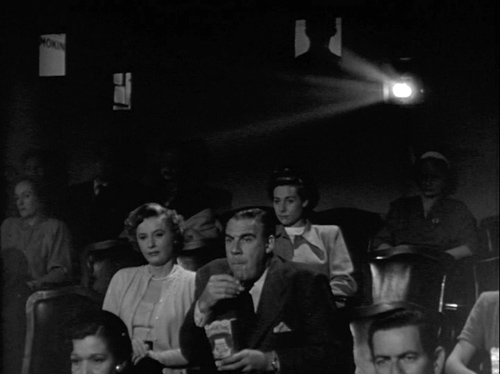
Clash by Night.
DB here:
Amplifications, corrections, and updates have been piling up over the last couple of months, and we began to realize that simply appending postscripts to older entries probably didn’t register with many readers. Judging by our stats, revisiting older entries isn’t a priority for most of the souls whom fate throws our way. So here’s some new information about older posts.
*I wrote about Jafar Panahi‘s This Is Not a Film at the Vancouver International Film Festival. Today Variety reported that an appeals court has upheld Panahi’s sentence of six years in prison and a twenty-year ban on travel and filmmaking. His colleague Mohammad Rasoulof’s jail sentence was reduced to a year. Panahi’s attorney says that she will appeal the decision to Iran’s Supreme Court. Be sure to read the Variety story for some background on the despicable treatment of other filmmakers, notably a performer who, merely for acting in a movie, was sentenced to a year in jail and ninety lashes.
 *My trip to the Hong Kong festival last spring was to have included a visit to Japan. But the earthquake and the tsunami decided otherwise. Here are two remarkable items about the country’s catastrophe and the people’s resilience. First, a camera captures what it’s like to be in a car that’s swept away. Then we have photographs of the remarkable recovery that some areas have made–a real tribute to Japanese resilience. (For the links, thanks to Darlene Bordwell and Shu Kei.)
*At Fandor, in response to Once Upon a Time in Anatolia, Ali Arikan wrote a penetrating and personal essay that I wish I’d had available when I wrote my review at VIFF.
*Tim Smith‘s guest entry for us, “Watching you watch THERE WILL BE BLOOD,” was a huge hit and went madly viral. At his site, Continuity Boy, he has posted a new, no less stimulating entry on eye-scanning. It shows that we can track motion even when the moving object isn’t visible!

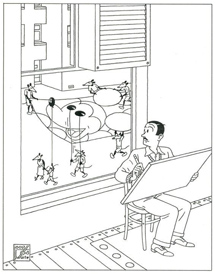
*During my trip to Brussels in early September for the conference of the Screenplay Research Network, I stole time to visit the superb Galerie Champaka for the opening of its show dedicated to Joost Swarte (above). Longtime readers of this blog know our admiration for this brilliant artist, so you won’t be surprised to learn that I had to get his autograph. The show, consisting of work both old and new, was also quite fine; it’s worth your time to explore the pictures, such as the one revealing how Disney was inspired to create Mickey (above). Thanks to Kelley Conway for taking the shot, and to Yves for taking this one. And special thanks to Nick Nguyen (co-translator of two fine books, here and here) for alerting me to the show.
*An update for all researchers: Now that we have online versions of the Variety Archives and the Box Office Vault, we’re happy as clams. (But what makes clams happy? They don’t show it in their expressions, and their destiny shouldn’t make them smile.) Anyway, to add to our leering delight, we now have the splendidly altruistic Media History Digital Library, which makes a host of American journals, magazines, yearbooks, and other sources available in page-by-page format, ads and all. You’ll find International Photographer (too often overshadowed by American Cinematographer), The Film Daily, Photoplay, and many more. Get going on that project!
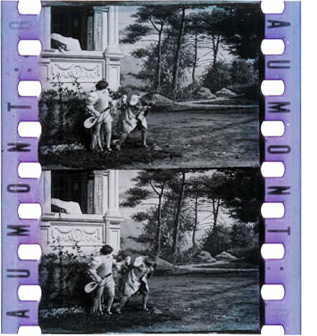 *This just in, for silent-cinema mavens: The Davide Turconi Project is now online, thanks to a decade of work by the Cineteca di Friuli. Turconi was a much-loved Italian film historian who, among other accomplishments, collected clips of frames from little-known or lost films. The archive of 23,491 clips, usually consisting of two frames, is free and searchable. On the left we see a snip from Louis Feuillade’s Pâques florentines (Gaumont, 1910). Paolo Cherchi Usai and Joshua Yumibe coordinated this project, with support from Pordenone’s Giornate del cinema muto, George Eastman House, and the Selznick School of Film Preservation. (Thanks to Lea Jacobs for supplying the link.) For more on Josh’s research, see our entry here.
And while we’re on silent cinema, Albert Capellani is in the news again. Kristin wrote about this newly discovered early master after Il Cinema Ritrovato in July. A recent Variety story discusses some recent restorations and gives credit to the Cineteca di Bologna and Mariann Lewinsky.
*My entry on continuous showings in the 1930s and 1940s attracted an email from Andrea Comiskey, who points out that when Barbara Stanwyck and Paul Douglas go to the movies in Clash by Night (above), she prods him to leave by pointing out, “This is where we came in.” Thanks to Andrea for this, since it counterbalances my example from Daisy Kenyon, which shows Daisy about to call the theatre for showtimes. And since posting that entry, I rewatched Manhandled (1949). There insurance investigator Sterling Hayden hurries Dorothy Lamour through their meal so that they’ll catch the show. He apparently knows when the movie starts. So again we have evidence that people could have seen a film straight through if they wanted to. It’s just that many, like channel-surfers today, didn’t care.
*Finally, way back in July, expressing my usual skepticism about Zeitgeist explanations, I wrote:
I’m still working on the talks [for the Summer Movie College], but what’s emerging is one unorthodox premise. As an experiment in counterfactual history, let’s pretend that World War II hadn’t happened. Would the storytelling choices (as opposed to the subjects, themes, and iconography) be that much different? In other words, if Pearl Harbor hadn’t been attacked, would we not have Double Indemnity (1944) or The Strange Affair of Uncle Harry (1945)? Only after playing with this outrageous possibility do I find that, as often happens, Sarris got there first: “The most interesting films of the forties were completely unrelated to the War and the Peace that followed.” Sheer overstatement, but back-pedal a little, and I think you find something intriguing.
David Cairns, whose excellent and gorgeously designed Shadowplay site is currently rehabbing Fred Zinnemann, responded by email:
Firstly, I find the start of WWII being equated with Pearl Harbor a little American-centric. Much of the world was already at war when that happened. Secondly, it could certainly be suggested that the two films you cite WOULD have been different without a world war. Billy Wilder and Robert Siodmak were comfortably making films in France before Hitler’s invasion drove them to a new adopted homeland. Those movies might well have happened without WWII, but they would probably have had different directors.
Thanks for this. Your points are well-taken. Not only was I America-centric, but I neglected to point out that before Pearl Harbor America was more or less directly involved in the war. Even though America wasn’t yet in the war in late 1941, a lot of the economy was on a war footing and the industry was already benefiting from the rise in affluence among audiences.
Your point about the particular directors is reasonable too. I think I chose bad examples. All I wanted to indicate was that the Hollywood system continued to function as usual, particularly with respect to narrative strategies. For instance, Chandler wrote the screenplay for DOUBLE INDEMNITY (and apparently was responsible for the flashback construction), and as you say, had another director handled it, at the level of narration it might well have been the same. UNCLE HARRY is a harder case for me, I admit! Maybe I should have chosen THE BIG SLEEP and MURDER, MY SWEET!
David replied with his usual generosity:
That’s OK! BIG SLEEP and MURDER MY SWEET definitely work! Plus any number of non-flag-waving musicals, westerns, swashbucklers (though there’s a little propaganda message in THE SEA WOLF at the end) and certainly comedies and horror. . . .
And then there’s KANE and AMBERSONS.
Better late than never–something you can say about all these updates.

More VIFF vitality, fancy and plain

I Wish.
DB here:
Back from Vancouver Internatonal Film Festival, we’re still assimilating. We just learned of the winners, but here are some more movies that won my admiration.
Three lives, four-plus hours

Art cinema has been attracted to mystery and intrigue plots since at least The Cabinet of Dr. Caligari. Antonioni needed an enigmatic disappearance to get L’Avventura going. Before and after there were Cronaca di un amore, La Commare Secca, Blow-Up, La Guerre est finie, and the works of Robbe-Grillet. Not to mention Vagabond and Toto les héros and, venturing to Asia, Chungking Express and Fallen Angels.
True to this tradition, in Dreileben (Three Lives, 2011), conventions of festival cinema—elliptical transitions, ambiguous dream sequences, retrospectively identified point-of-view shots, anecdotal realism, de-dramatization, open endings—punctuate, and puncture, a killer-on-the-loose scenario. The genre is respected to the extent of supplying teasing clues, some conveniently recorded on video and in an old photograph. (Shades of The Girl with the Dragon Tattoo.)
The murder-mystery element is, I think, part of the reason that this TV installment-story has been making the festival rounds. Yes, there’s also its pedigree (three accomplished directors) and its use of the now-common strategy of network narrative. Each of the three episodes focuses on different characters whose paths cross. We get pieces of the whole story; scenes glimpsed in one episode are fleshed out in another.
The tryptych format recalls the Belgian Trilogy (Lucas Belvaux, 2002). But that exercise retold its story by centering on a core of characters, replaying events and switching point of view (and genre) from film to film. Dreileben’s first two episodes focus on characters at some remove from the crime and the criminal, a strategy that redefines what counts as the central situation. Moreover, and unlike most network narratives, these plots show few points of contact. Characters connect very rarely across episodes, so that each tale gains a weight of its own. The mad-killer element comes to seem secondary for quite a while.
The first episode, Beats Being Dead, directed by Christian Petzold, is largely organized around the perspective of Johannes, a young medical student about to embark on a prestigious fellowship. He becomes attached to a moody immigrant woman working in a nearby hotel. Over the romance hovers not only a brutish biker club but also a mental patient, accused of murdering a girl, who escapes from Johannes’ hospital and lurks around the forest. This episode is presented in a clean, almost enameled visual style sharpened by the abrupt scene shifts characteristic of modern cinema.
The second part, Don’t Follow Me Around (Dominik Graf), seemed to me the strongest. Johanna, a female police psychologist, is brought to the town, apparently to profile the criminal, but actually to conduct a rather different investigation. She stays with an old friend and her husband, and Johanna’s visit opens up a new psychodrama all its own. The rather narrow focus of the first, on a romantic triangle, here widens to consider frayed friendships, marital suspicions, and old passions. The character relationships get more complicated as things move along. The somewhat informal framings and jerky cutting (nearly three times as many shots as in the Petzold, in about the same running time) accentuate Johanna’s discomfort and her eventual moments of confronting her past.
After two films hovering around the fringes of the crime, the third installment, One Minute of Darkness, signed by Christoph Hochhausler, seems to go to the heart of things. Now we follow the escaped lunatic Molesch pursued by Markus, a cop so flagrantly unhealthy that he seems to risk a coronary every time he rises from his sagging armchair. Yet this detective story turns out to be not quite as cut-and-dried as we expect. That’s partly because of Molesch’s encounter with a little girl and partly because the first episode is revealed in retrospect to unfold in a more indeterminate time frame than we might have thought. The film doesn’t plug every gap, I think; I left thinking we needed a fourth or fifth installment. But that’s probably part of the point.
Genre conventions permeate all three episodes, which seriatim present twentysomething romance, simmering melodrama, and classic sleuthing and pursuit, all spiced by stalker-in-the-shadows atmospherics. Dennis Lim’s illuminating essay indicates that this trio of films is the product of a German debate about how filmmakers committed to “auteur cinema” can deal with matters of genre.
More broadly, works like Dreileben characterize much of today’s festival moviemaking: an effort to graft modernist narrative strategies onto a genre-driven plot premise. (We see it in The Skin I Live in too.) A cynic could argue that a serial-killer investigation serves to attract audiences who might be put off by purely formal gymnastics. But actually mystery plots, based on hiding information and misdirecting our attention, mesh well with the narrational maneuvers of international art cinema. If crossover films like this bring in more viewers, that’s a side benefit of merging two robust traditions—a storytelling mode that hides and then reveals secrets, and one that believes that even when revealed, secrets remain secretive.
POV = Perplexities of Vision
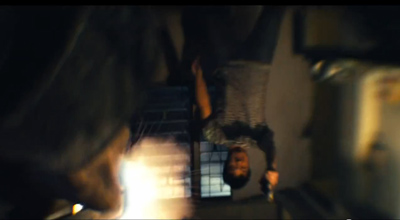
Headshot.
The barely-converging fates of Dreileben reminded me of the network knitting of Johnnie To’s Life without Principle. In a similar way, two exercises in optical point-of-view echoed the last sequence of Panahi’s This is Not a Film. In that non-film, the camera abandoned by a cameraman seems to be picked up by Panahi himself and carried beyond what we normally think of as “house arrest.” But one of the resources of the POV shot is that it can coax us to ask who’s seeing what we see. If we aren’t given an identifying shot of the looker, we can start to wonder. Played upon in countless horror movies to hint at the eyes of the stalking monster/ killer, the unspecified POV in Panahi’s hands (or perhaps not in his hands) becomes charged with political consequence.
Optical POV isn’t as fully exploited as you might expect in Pan-ek Ratanaruang’s Headshot. One of its premises is that Tul, a contract killer, is wounded in the cranium and as a result sees the world upside down. But the trauma takes place in the first few scenes, and what follows until the midpoint is a set of flashbacks explaining how he became a gun for hire. Present-time episodes showing him getting adjusted to his affliction alternate with past-tense scenes that supply him with motives for revenge.
So far, so noirish. Indeed, the iconography (crooked lawyers, not one but two femmes fatales, chiaroscuro scenes) and the plot (flashbacks, voice-overs, double- and triple-crosses) put us in familiar, quite enjoyable territory. Needless to say, like nearly all film noir heroes Tul has never seen a film noir, so he can’t sense the walls closing in as quickly as we can. He remains idealistic—“I may kill people, but I’m not a crook”—and trusting to a fault.
The upside-down POV works okay as a general pointer to the film’s Buddhist thematics, but the inverted shots are fairly few, introduced to defamiliarize a bit of action. They aren’t exploited as a thoroughgoing formal device. For a while vision scientists believed, mistakenly, that when people wore inverting spectacles, they eventually learned to see the world rightside up. Is Ratanaruang suggesting that Tul adapted in this way?Early in the film the hero pins pictures on his wall upside down, but near the film’s end I thought I saw a shot ostensibly through Tul’s eyes showing us the inverted pictures on the wall, rather than the way they’d look if he saw upside down. In real life, as if it were relevant, it seems that wearing inverted spectacles doesn’t make you see things right way round eventually. The world always looks flipped. But you can adapt to this upside-down array fairly quickly and execute normal activities like riding a bicycle and even reading. Presumably this explains why Tul’s marksmanship remains lethally good in the gunplay finale.
Far more consistent–obsessive, actually–is the play with optical POV in the Romanian film Best Intentions by Adrian Sitaru. When Alex’s mother has a stroke, he leaves Bucharest to visit her. She’s recovering reasonably well, but Alex becomes so anxious about her care that he makes life miserable for her, his father, his girlfriend Lia, and the doctor, an old family friend. After the first scene, when Alex gets the call about her stroke, a drastically totalizing POV system kicks in. Whenever Alex is in the presence of anyone else—major character, minor character, onlooker—we see him through that person’s eyes. If he’s alone, usually on the phone, the shots of him are unassigned and objective, but when he’s in public, he’s only shown subjectively. Moreover, we never get a POV shot from his perspective.
A narrational game emerges. When Alex is interacting with only one other person, we quickly grasp who the Unseen Seer is. For instance, we understand that he’s met at the train by his father, identified by his offscreen voice.
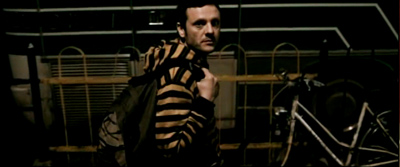
When Alex first visits his mother in the hospital, however, the POV floats momentarily. At first it might seem we’re seeing Alex’s entry through his mother’s eyes,when he briefly acknowledges the camera’s field of view.
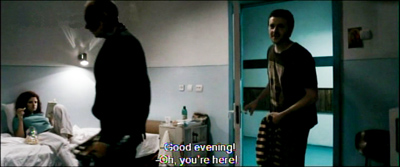
But when he moves past, we realize we’re seeing him from the viewpoint of the woman in the bed beside his mother’s.
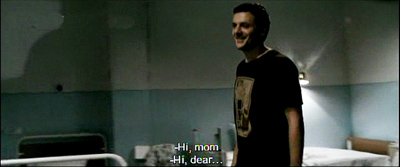
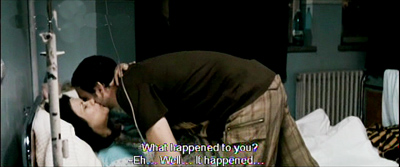
When he’s with only one other character, the scene plays out without cuts. When cuts come within a scene, they’re motivated as shifts from one character’s POV to another’s. Here we first see Alex and his mother through the eyes of the patient across the room, whom we glimpse in the background during his entrance above. When the mother’s neighbor looks at them, that motivates a closer view of them.
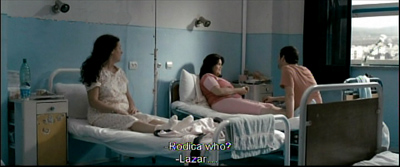
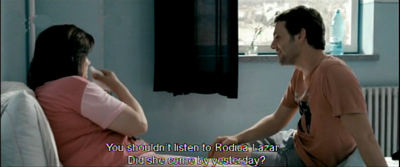
This tag-team POV becomes quite engaging when several characters are present. In a dazzling scene of three couples drinking around a tavern table, the dialogue is fast-moving and the cuts come quickly. I found myself trying to chart exactly whose view we’re getting. Sometimes the POV gets anchored retroactively: one of several characters we see in shot A becomes the POV vessel in shot B. For more fun, the system develops in unexpected ways as the movie proceeds.
The experiment is worthwhile, and not just as a formal game. Recall Erving Goffman’s notion that social life is a stage in which we enact the roles that put us in a good light. Best Intentions shows Alex as not only a caring son but a guy earnestly playing a caring son. In the Theatre of Everyday Life, he’s something of a drama queen. Of course he’s partly right to be concerned about the health-care system (he’s probably seen The Death of Mr. Lazarescu), but that concern also handily motivates his incessant performance of his part.
As a result of Sitaru’s rigorous formal constraints, Alex is onscreen for nearly every instant of this 101-minute movie. (The very brief exception is itself of interest.) His narcissism, his urge to control others, and his inability to really listen to his family and friends—all are perfectly captured by a stylistic strategy that constantly gives him center stage. I haven’t seen Sitaru’s previous film Hooked (2007), but that too used an enveloping POV strategy. Interestingly, there he assigned all three major characters optical POV shots. In Best Intentions, denying Alex his own POV underscores his fretful obliviousness to what anyone else thinks. He makes a scene in every scene, becoming an object of fascination and frustration, for others and for us.
Calming down
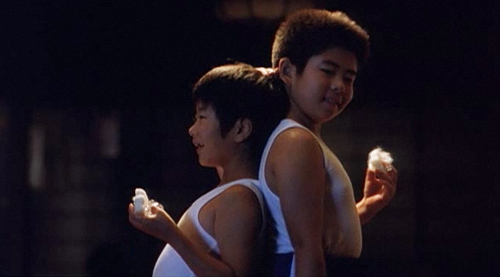
All these films, as well as others we’ve discussed in this year’s VIFF, might seem to support the idea that Form Is the New Content. It takes a film like Hirokazu Kore-eda’s I Wish to remind you of the power of less convoluted storytelling. Like Still Walking, it’s a family drama-comedy, but a little more somber and a little more comic. Devastatingly simple, too.
A family has split up. One brother, Koichi, stays with his mother and grandparents in Kagoshima, where the volcano splutters ashes into the air. The younger brother, toothily grinning Ryu, has gone off to Fukuoka with father, a scruffy rock guitarist. The boys communicate by phone, hoping to reunite the family.
They hatch a plan. They’ve convinced themselves that if they make a wish at the precise moment that two bullet trains pass one another, that wish will be granted. So Koichi and Ryu plan a pilgrimage that eventually encompasses their pals and that becomes a confrontation with the mundane realities of death and solitude, mitigated by comradeship and the hospitality of strangers.
The boys’ situation ripples outward to encompass the grandparents’ friends and the sons’ schoolmates and their parents, all of whom earn quietly incisive vignettes. Routines—classroom encounters, swimming sessions, Koichi’s run-ins with teachers, Ryu’s nights out with dad’s band—are recycled without fuss, building up a textured sense of each boy’s world. Kore-eda presents everything so unemphatically that he makes film direction look very easy.
Despite lacking the fanciness of the modern network narrative and its disjunctive time schemes and viewpoint switches, Kore-eda’s plot, like that of Ozu’s Early Summer, effortlessly creates a ramifying world in which our boys feel at once comfortable and apprehensive. Come to think of it, some of the kid comedy recalls the two brothers’ antics of I Was Born But, and the surprisingly sympathetic young teachers, reminiscent of the adults in Ohayo, become co-conspirators and, a little bit, surrogate parents. I Wish is a modest movie; it almost lowers its eyes in front of you. It’s also the closest thing to perfection that I saw in Vancouver.
For a lively roundup of ideas on Dreileben, see David Hudson’s Daily MUBI entry. An informative presskit is here. Headshot has been bought for US release by Kino Lorber. An informative interview with Adrian Sitaru is here. I discuss arthouse genre crossovers in an earlier year’s entry from VIFF. For a more thorough study of network narratives, see “Mutual Friends and Chronologies of Chance” in my Poetics of Cinema.
23 October 2011: Thanks to Christoph Huber for correcting an error in the initial post. Although there is a town called Dreileben, the film doesn’t take place there, as I had said.
I Wish.
Son of seduced by structure
The Skin I Live In.
DB here:
Contemporary Hollywood films can play prettily with time, parallels, and point-of-view, at least within certain boundaries. (We’ve talked about this with Source Code, Inception here and here, and other titles further back.) But if you want to see filmmakers coloring outside the lines, a film festival provides a wider sampling of ingenious storytelling strategies.
Last year, in “Seduced by structure,” I wrote about films that worked ingratiatingly with flashbacks, stories within stories, and the like. I’m still a sucker for these things, and several of the offerings at the Vancouver International Film Festival have enticed me. Since these are rather new films, I’ll try to avoid spoilers.
Flashbackhand
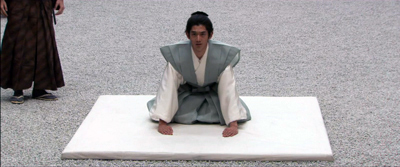
Harakiri.
Perhaps the simplest case I’ve encountered so far is Miike Takeshi’s 3-D Harakiri: Death of a Samurai. It’s seventeenth-century Japan, and penniless samurai are eking out survival through the “suicide bluff.” They arrive at a noble house and ask to commit seppuku on the premises. Because the family won’t risky sullying the family name, the ronin are paid to go away. But the head retainer of the house of Ii is done with the game. The suicide bluff, he maintains, dishonors the samurai code.
A severe-looking ronin appears and asks to die in the Ii compound. The retainer explains to him that recently they had a similar request.
Thus begins the first of two flashbacks. It’s confined to the visit of a very young samurai making the suicide petition, with harsh and grisly results. We return to the narrating frame, and we find that the original petitioner isn’t dissuaded. Why not? And why are the three swordsmen most implicated in the young man’s visit missing today?
A second flashback, more or less from the standpoint of the older petitioner, goes far back in time to fill in the youth’s identity and background. This structural choice shows several worthy things that a flashback can do. It can flesh out things that were merely hinted at earlier, in both the present-time sequences and the first flashback. The flashback can create mysteries by virtue of its placement, as indicated earlier. It can build its own narrative momentum: Even though we know vaguely how things are likely to go, we get to see the gaps filled in with unexpected details.
The flashback pattern also creates two layers of response. We know the young man’s fate, so everything in the leadup gains an extra pathos. Meanwhile, as we recall the present-time situation, the older petitioner’s action remains suspended and we want to return to it to see how it develops. A bonus is that arranging the film in flashbacks allows an intense, arresting scene to appear at the film’s beginning, with the young ronin’s petition, and then assign a cluster of swordplay fights at the end. Arranged in linear story order, the scenes would have created a slow-burning opening and a crowded conclusion, with several violent scenes close together.
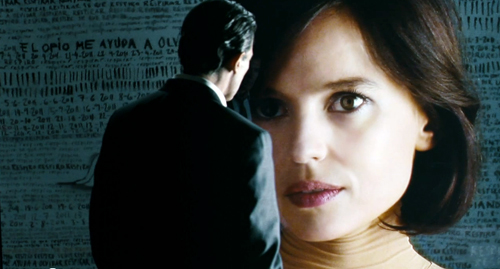
A more audacious play with flashbacks is found in Pedro Amodóvar’s elegant, decadent The Skin I Live In. As with Harakiri, we begin far along the story’s development. A beautiful young woman is imprisoned in a postmodern equivalent of the mad scientist’s lair, a designer house filled with sumptuous furniture and high-tech gadgetry, including a close-circuit video system that lets the doctor keep an eye on his prey. Already there are plenty of questions, particularly when the young woman, Vera, asks to stay with Robert forever.
We quickly asume that she is the object of the doctor’s experiment in creating unblemished, fire-resistant, and snugly fitted human skin. (Almodóvar used a digital intermediate chiefly for the purpose of making the actress’s skin perfect) But more questions arise when a horrendous jewel robber named Zeca, dressed in a tiger skin (it’s the carnival season), breaks into Vera’s sanctuary.
Melodramatic twists come thick and fast, and the first flashback, sponsored by the maid Marilia, tells us of how Robert’s first wife was burned in a car crash. His daughter Norma saw her mother commit suicide and became deeply disturbed thereafter.
The family history gets even more tangled with two later flashbacks. One, initiated by Robert as he sleeps (though it seems more “objective” than a dream) takes us back six years and fills in more of Norma’s sad history. The second, more peculiar, return to the past is obliquely introduced by Vera. The narration seems pretty reliable, and it replays some of the events presented in Robert’s flashback. The curious thing is Vera doesn’t appear in any of the scenes. Shouldn’t she be present for at least some of the action she is “recalling”?
The question is answered with the sort of shocking finesse that Almodovar summons up effortlessly. The flashbacks in Harakiri fill in and flesh out what we’ve seen, while the flashbacks in The Skin I Live In reveal layers of shocking discoveries about what’s really going on in the present-time situation. The flashback structure doesn’t fulfill the film’s opening so much as yank the bottom out from it. Perverted story action summons up perverse narration.
I wish I could say more about these formal arabesques, but secrets must be respected. Suffice it say that Miike provides us a sober, dignified jidai-geki making modest use of 3D and lacking the outlandish gore that he’s come to be identified with. It’s not even as action-oriented as last year’s 13 Assassins. Harakiri ‘s most striking moments are quiet ones. A woman picks splinters out of her dead husband’s bloody hand. Earlier the same poverty-stricken man, having dropped a pair of eggs on the pavement, stoops and licks up their contents.
As for The Skin I Live in: Almodovar’s eye for fashion is still teasing; the credits list is a pageant of brand names like Gucci and Prada. He can also plant nifty little motifs, as when the tidy graffiti with which Vera has filled her cell are echoed by the window display in a dress shop.
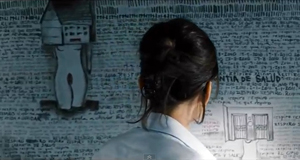
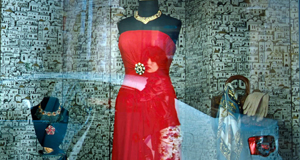
As usual, the story of revenge and unspeakable desire, or rather revenge as unspeakable desire, is wrapped in smooth technique, wondrous music, and eye-gratifying palettes. The flashbacks help too.
She said, he said
Split plot structures have become more common in recent years. Hong Sang-soo provided one of the most striking versions in The Power of Kangwon Province (1998); a recent instance is Apichatpang Weerasethakul’s Syndromes and a Century (2006). In the most common case, the film is split into two long sections, with each line of action following a different character or presenting alternative possibilities. Sometimes the lines present successive lines of action, as in Chungking Express. Sometimes the lines are more or less simultaneous, suggesting different viewpoints on the same events. Often the two lines intersect, so we get scenes replayed from different viewpoints or suggesting alternative versions of events–even parallel universes.
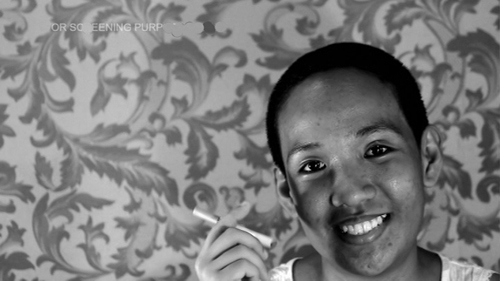
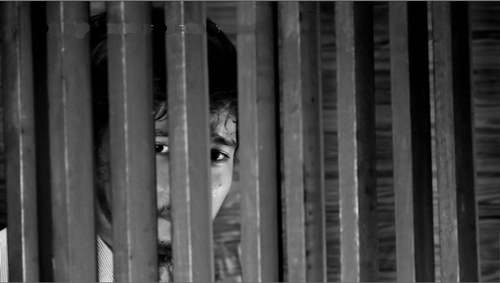
This sort of cleft plot patterning is exploited engagingly in The Natural Phenomenon of Madness, a Filipino film by Charliebebs Gohetia. A brief prologue sets up the situation. A man and a woman, friends since childhood, are having sex, and suddenly it turns rough. Both will later think of his action as a rape. He leaves in the morning, she chops off most of her hair, and they proceed to live their lives separately, sometimes converging, usually not.
The first long chapter, called She, follows her days wandering the city, signing up for a medical study, visiting a grave, inducing a miscarriage, and pursuing Him, whom she loves more than anyone. The second section, “He,” traces his efforts to induce another woman to marry him, to assuage his guilt about the rape, and to get Her to help him with his bone-marrow transplant. Both lines are taking place at roughly the same time and pace. The woman’s autobiographical monologues addressed to offscreen medical personnel are paralleled by the man’s increasingly sorrowful confessions to a priest. She’s a Bohemian artist, He’s a store owner wracked by Catholic guilt. At times, we see them doing things alone that suggest a sort of spiritual synchronization: She stands at a bridge and shouts, and later we see Him doing the same thing.
He and She meet occasionally, and then we get the same scene twice. Or do we? Every repetition is played out in symmetrically varied ways. For instance, early in the She chapter, He is already seated by a wall playing with an origami (of the sort my grade school used to call a Cootie Catcher). She joins him.
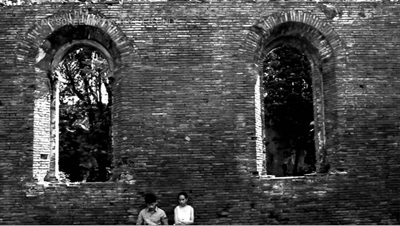
In His story’s version, she’s already there, playing with the origami, and He comes to join her.
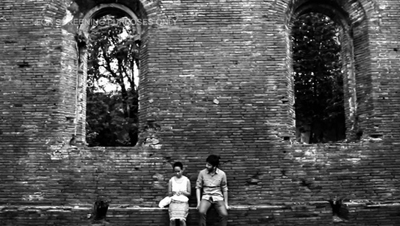
Moreover, the conversation isn’t the same each time. So are the apparently iterated scenes completely different meetings, taking place in the same locale and filmed in similar fashion? Some cues suggest that the tandem sequences represent only one occasion. For instance, both of these wall scenes purportedly show their first meeting since She cut her hair. As we’re watching, we might be forgiven if we’re not sure of the variations: The repetition comes about 67 minutes later than the original scene. We’re left with meetings that are partly repetitions, partly variations: alternative universes embedded in one, perhaps.
One effect of the parallel plotting is to heighten the differences between the two protagonists. As Gohetia suggested in the Q & A after the VIFF screening, She actively chooses ways of living her life, while He clings passively to his situation, hoping that the other woman will marry him, that somebody will donate bone marrow, and that the Church may offer help. Both have unrequited love: She wants him, He wants another girl. There are plenty of abstract parallels, such as that between the medical establishment and the clerisy, but the precise, locked-down shots help us notice physical differences too, such as the walk through Manila streets with distinct gaits. And the final convergence of the couple nicely echoes the prologue. The Natural Phenomenon of Madness shows that once a new narrative strategy enters the public domain, filmmakers can play with its components, twisting them like facets of a Rubik’s cube to engage us in fresh ways.
The Skin I Live In will be released in the US by Sony Pictures Classics on 14 October. The American Cinematographer story on the making of the film may be read here.
P.S. 6 October 2011: Thanks to Philippe Mathieu for correcting an erroneous film title!
P. S. 14 August 2012: Thanks to Marvin Ortiz for correcting two characters’ names in my account of The Skin I Live In.
The Natural Phenomenon of Madness.