















Archive for the 'Film comments' Category
Il Cinema Ritrovato, number 9 and counting
Kristin here:
For a second year running I unexpectedly ended up attending Il Cinema Ritrovato in Bologna alone. (For the 2012 report, see here.) Last year David’s back went out shortly before we were due to leave. This year an exceptionally long stretch of days with heavy thunderstorms resulted in flooding in our basement (where many of our books reside). I had already been in London for nearly three weeks and was planning to meet David in Bologna. Instead, he valiantly stayed home to deal with the unwanted water, and I went on to the expanding smorgasbord of films presented by the festival.
The programmers are limited to their existing venues: the relatively small Mastroianni and Scorsese auditoriums in the Cineteca’s building, the larger Arlecchino and Jolly commercial cinemas, and the vast space of the Piazza Maggiore for the nightly open-air screenings starting at 10 pm. This year for the first time, to accommodate the many films, post-dinner screenings, starting at 9:30, 9:45, or 10 pm, were scheduled in the Scorsese and Mastroianni.
Faced with so many options, one could only focus on a few of the bounteous threads of programming. I opted to see as many of the early Japanese sound films as possible, the early (pre-mid-1960s) Chris Marker works, and the annual Cento Anni Fa series, this year presenting a sampling of films from 1913, the year when worldwide the cinema seemed to take an extraordinary leap forward in complexity and inventiveness. Whenever there was a gap, I could fit in items from the other threads: European widescreen movies; cinema of the 1930s that presaged the coming war; a retrospective of the work of Soviet director Olga Preobrezhenskaja, another devoted to Vittorio de Sica, primarily as an actor, more Chaplin restorations from the Cineteca’s ongoing project, the newly restored Hitchcock silents, and of course various other newly restored films. A tradition of highlighting the work of a Hollywood director has become a centerpiece of Il Cinema Ritrovato, with the subject this year being Allan Dwan.
Japanese Talkies, Part 2
Last year I caught only a few of the films in the retrospective of early Japanese sound films. I regretted not being able to see more, but the Ivan Pyriev and Jean Grémillon threads lured me away. This year the rival was Chris Marker, but I determined that by careful planning, I could fit almost everything in both retrospectives into my schedule. These became my top priorities.
The Japanese series is ongoing and organized not by auteurs but by film companies. The programmers were again Alexander Jacoby and Johan Nordström, whose encyclopedic knowledge of the history of Japanese studios of the 1930s made 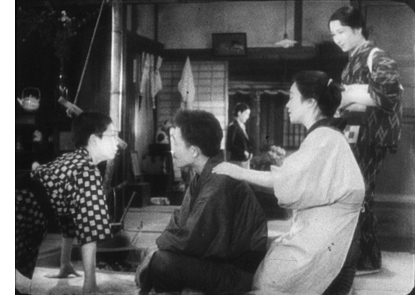 for fascinating introductions. This year it was PCL and the very obscure company JO, both of which made American-style musicals in the early and mid-1930s. These were not the best films in the season, but they were highly entertaining. This series also had the advantage of being presented entirely in 35mm and with English subtitles devised years ago for traveling retrospectives.
I had seen only one of the films in the series, Mikio Naruse’s 1935 masterpiece, Wife, Be like a Rose. I didn’t remember much about it, except that it was marvelous, and it proved so on second viewing. Naruse often has been compared with Ozu, both during his active career and since. Overall, he seems to me not as great a filmmaker, but Wife, Be like a Rose must be among his best films and would undoubtedly rank alongside some of Ozu’s work of this period. A moga (modern girl) is upset that her father has deserted his family in Tokyo and established another family in the countryside. Determined to drag him back to his familial responsibilities, the daughter confronts the possibility that he was right in leaving her mother. The film is shot in a somewhat Ozu-like style, with low camera heights and across-the-line shot/reverse shots. Still, there is no slavish imitation (the climax is filled with camera movements), and Naruse’s film is both moving and stylistically engaging.
Naruse was the only director with two films in the retrospective. His Five Men in the Circus, also released in 1935, was a less ambitious work than Wife, Be like a Rose, but it was an entertaining story of musicians on the road earning a living during the Depression, encountering disappointments in work and love.
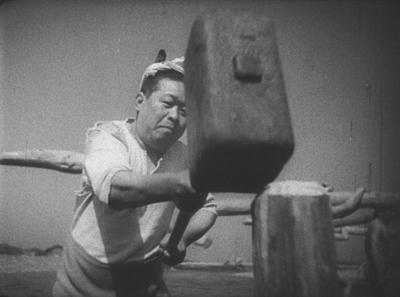 Naruse has already gained a modern reputation in the West, but for some the discovery of the season was Sotoji Kimura, whose Ino and Mon was well received. As with so many of this thread’s films, its subject was a modern girl struggling with tradition. Mon, who has become pregnant and doesn’t want to marry her child’s father, returns to her country home and faces sullen opposition from her much beloved but fiercely traditional brother Ino. Aside from its realistic depiction of the countryside, the film is notable for its Soviet-style scenes of work on a nearby construction project supervised by the siblings’ father (left).
The Japanese musicals were all charming films. Romantic and Crazy (1934) starred the popular comic performer Kenichi Enomoto, better known as Enoken. (In the West, he is most familiar from his comic role in Akira Kurosawa’s third feature, The Men Who Tread on the Tiger’s Tail [1945].) Romantic and Crazy is basically a college musical imitating the early 1930s films of Eddie Cantor–and at 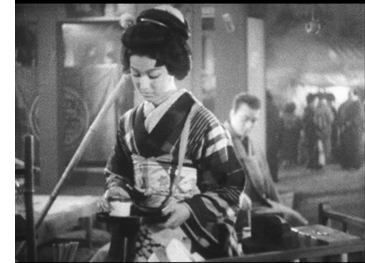 moments I wished I were watching an Eddie Cantor musical. The other two musicals–Tipsy Life (Sotoji Kimura, 1933) and Chorus of One Million Voices (Atsuo Tomioka, 1935)–were quite entertaining. Clearly the filmmakers felt no compunction about stealing recent American songs and setting the tunes to new Japanese lyrics. The most popular seemed to be “Yes, Yes, My Honey said Yes, Yes!” as sung by Cantor in the 1931 musical Palmy Days; the tune was heard in at least two of the films.
Another notable film was Sadao Yamanaka’s Kôchiyama Sôshun (1936), one of his three surviving feature films. (These and fragments of others are available on a new set from Eureka! in its “Masters of Cinema” series.) It’s a strange film, partly comic but mostly a crime story. An attractive woman, played by a very young Setsuko Hara, keeps a shop owned by a local gangster, and tries to prevent her thuggish younger brother from becoming a criminal. The title character, Kôchiyama Sôshun, appears to be an idler getting by on the income from his wife’s gambling house, but he apparently has unlimited sources of money. Despite his shady background, Kôchiyama tries to help save the heroine when, after her brother has gambled away the house and shop, she is forced to sell herself into prostitution.
The seasons of early Japanese sound films will continue during the 2014 Il Cinema Ritrovato, with a focus on Shochiku.
Chris Marker’s youth returns
It has been difficult to see any of Chris Marker’s early films lately. By early I don’t mean early 1950s, but essentially anything made before La jetée (1962). As Florence Dauman of Argos Films explained in an introduction to one of the programs, Marker thought of the films made during his first decade as a director as mere trials and didn’t want them seen again. Fortunately Dauman and others made the decision not to honor his wishes. Perhaps Marker thought that his later films, more complex and philosophical (Sans soleil comes to mind), were how he wanted to be remembered. But the playful, emotional, politically committed film essays of the 1950s and early 1960s are precious and not to be abandoned. We were treated to excellent restored prints of them during the festival.
The only film that made me understand Marker’s reluctance to show his early work was Olympia 52 (1952), a documentary on the Olympic Games in Helsinki. It was Marker’s first professional feature, and it is barely competent. The coverage sticks almost entirely to the track and field events, with endless 100-meter dashes, shot-puts, hurdles, high jumps, pole-vaults, and so on. The several cameras filming the events rendered very different footage, ranging from excellent to dark gray. Cut together, these shifting images look amateurish. A brief series of shots of yacht-racing, equine-jumping, and other sports leads back to more shot-puts, hurdles, pole-vaults, and so on. Valuable practice for Marker, no doubt, but a film which bears no hint of the talent soon to burst forth.
It was wonderful to see Letter from Siberia (1958) again after so many years. David and I had taught it in an introductory class in the mid-1970s. Its repeated series of shots of a bus on a street and some men doing construction work has been an example of the powers of the sound track from the very first edition of Film Art in 1979 to the present one.
There were no subtitles on the prints, and the headphone translation could never keep up with the rapid, contemplative voice that accompanied these images, so I missed much of the point of Dimanche à Pékin (1956) and Description d’un Combat (1960). Marker’s written contribution to Joris Ivens’ documentary …À Valparaiso (1963) presaged much of his later work. His 16mm documentation of American hippies’ gently protesting assault on the Pentagon in La sixiéme face du Pentagone (1968) made me proud to be an American (something not too easy in the light of recent events).
Dwan at his peak? The 1920s
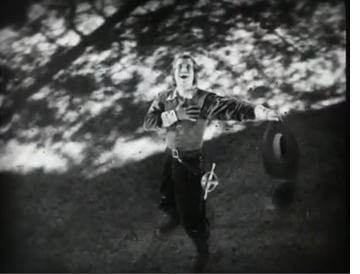
I missed most of the Dwan films, but I managed to fit in three of the four from the 1920s. These did not include the 1923 Gloria Swanson vehicle Zaza, alas, though I heard good things about it from friends who saw it. The three I caught seemed to represent Dwan at the height of his career.
I had seen the other Swanson film, Manhandled (1924) before, but it was a treat to see it again. It’s a strange mixture of realism–most notably in the famous early scene of the working-class heroine’s commute home on a crowded subway–and an absurdly melodramatic plot in which she manages to attain the pampered stature of a kept woman while maintaining her virtue. Swanson is a delight, and the fact that the film is incomplete, missing a scene in which she demonstrates her talent for mimicry by imitating various characters, including Charlie Chaplin, is a true pity. We can only hope that a complete version will someday surface.
 Dwan’s 1927 melodrama, East Side, West Side, was a considerable surprise. For a director who has a reputation for making B picture in the sound era, this high-budget production seemed remarkable. The production design and cinematography were excellent, and a ship accident scene done with models was unusually convincing. The print was a fine restoration by the Museum of Modern Art. The Iron Mask (1929, above) was introduced by Kevin Brownlow (right), who had helped supervise the restoration.
As always it was a treat to hear anecdotes from the man who had the inspired idea of interviewing stars and filmmakers from the silent era before it was too late. The Iron Mask was another impressive print, dated 1999 and bearing a Carl Davis score. I much prefer Douglas Fairbanks in his early comedies to his more famous swashbuckler films, and the story and staging in this one seemed very by-the-numbers, especially in comparison to the more imaginative East Side, West Side. Its main interest, and that was considerable, lay in the impressive sets designed by Ben Carré and William Cameron Menzies and its glowing cinematography by Henry Sharp.
By the end of the week, I was happy to have caught these particular Dwan films. From conversations with people who followed his thread more closely, I gathered that they thought the 1920s titles were the best of those shown in Bologna.
Glimpses of 1913
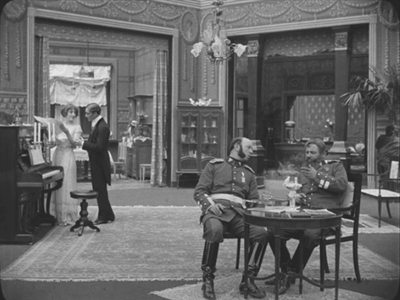
There was a time when the Cento Anni Fa series, programmed by Mariann Lewinsky, was a must-see for me. With the proliferation of screenings, however, seeing all of the sessions has become difficult, and I found myself ducking in and out to catch a few items now and then. I wanted to see the new restoration of Mario Caserini’s remarkable feature, Ma l’amor mio non muore!, but there was something else I wanted to see playing opposite both screenings. Luckily the Cineteca has put the film out on DVD. The catalog claims that it’s the first diva film. It stars Lyda Borelli in a spectacular performance, plus it has many complex examples of what David calls tableau staging (see here), especially in the amazing set in the frame above. One of the must-see films of 1913.
I am not a great fan of Italian (or any other) spectacles set in ancient times, and there were quite a few included in the series. They also tend to be rather long, which makes it more difficult to fit them into a packed schedule. Still, I did like Spartaco ovvero il gladiatore della Tracia (Giovani Enrico Vidali). Its minor actors and extras avoided giving the usual impression of people milling around in sets; they actually behaved as if they were living in real places in antiquity. The actress playing Emilia (not listed in the catalog) gave an engaging performance, quite the opposite of the diva approach, though Mario Guaita as Spartaco depended largely on rolling his eyes upward at frequent intervals to convey suffering. As Ivo Blom points out in his program notes, however, Guaita turns out to be the the first strongman figure, bending iron bars with his hands a year before Bartolomeo Pagano supposedly innovated this iconic gesture as Maciste in Cabiria.
More than that film, though, I was impressed by Luigi Maggi’s La lampada della nonna. It begins with an old woman knitting beside an oil lamp. When her grandchildren try to present her with a new electric one, she objects. The bulk of the film is an extended flashback set in the era of the Risorgimento, with the heroine in her youth helping to shelter a wounded officer and falling in love with them. The lamp, seen unobtrusively in the background of several shots, comes to play a key role as a signal in the climactic scene. Again there is an unusual degree of naturalness in the acting, with the extras in the military campground scene, for example, all given bits of plausible action to collectively present the impression of an actual campground. The flashback structure, framing, staging, and acting all reminded me strongly of Griffith at the same period.
There were slight but charming films like Léonce et Toto, a very funny Léonce Perret comedy (director unknown, but probably Perret). Léonce’s wife receives a tiny chihuahua as a gift and immediately dotes on it, to the point of putting it on the table at meals. The hero is disgusted and tries increasingly devious and extreme ways of getting rid of the little pest. Another was an American documentary with the irresistible title Aquatic Elephants. Who would not delight in five minutes of elephants rolling cheerfully in a pond while silly men try to stand on them and invariably fall into the water?
DVDs and Blu-ray
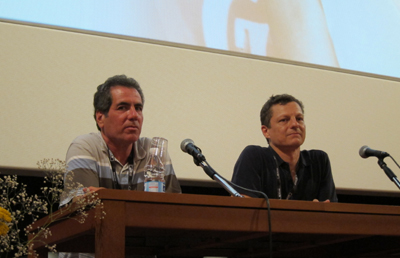
Just about every film scholar and buff in the world probably knows the Criterion Collection. As a brand, it’s sort of the Pixar of high-end home-video. We all have at least some of its releases on our shelves, whether lined up alphabetically or by director or by number. This year a session was devoted to the background of the company, with guests Jonathan Turell and Peter Becker (left and right, above). The history of Criterion is a bit complicated. Briefly, it was founded in 1984 to release laserdiscs and eventually, after the introduction of DVDs in 1997, switched to that format, eventually adding Blu-ray discs. Becker joined the company in 1993.
Criterion is closely linked to the historically important Janus Films, founded in 1956 and responsible for distributing many of the most famous art films of subsequent decades. In 1966 it was acquired by Saul J. Turell and William Becker, the fathers of the two speakers. Their sons are now co-owners of the Criterion Collection, of which Peter is the president; Jonathan is director of Janus.
To David’s and my generation of film students, Janus was a key player in our discovery of art cinema. How many of us, I wonder, first watched many of the classics that now grace Criterion DVDs through the landmark PBS series, “Film Odyssey,” in 1972? I first saw and was bowled over by Ivan the Terrible in that series. Three years later, when I was working on my dissertation on the film, I called Janus and got through to Saul Turell. Could I possibly borrow 35mm prints of the two parts of the film, I asked, explaining that I needed and to take frames from good copies. He gave me the name and phone number of a person in the company’s storage facility to call, and she arranged to ship the prints to me. I was able to spend weeks in front of a Steenbeck in the Wisconsin Center for Film and Theater Research, wallowing in strange, beautiful images and sounds. Nearly all the illustrations in my book, Eisenstein’s Ivan the Terrible, were taken from those prints.
That same spirit of cooperation with academic film studies has lived on. David and I are grateful for our friendly relationship with the Criterion team, who have cooperated in our creation of video-based online examples tied to Film Art: An Introduction. (The examples all come from Janus films; a sample analysis of a clip from Vagabond is available on YouTube.)
The pair’s presentation included a video, The Criterion Collection in 2.5 Minutes. It features over 600 clips from the collection as of September 1, 2012, chosen and edited by Jonathan Keogh, clearly one of the company’s most devoted fans. Although cut too fast too allow the viewer to identify every title (and I must admit, I don’t think I could recognize every single one, even with longer excerpts), it’s an exhilarating paean to great cinema.
The plaudits in the festival’s annual DVD contest were spread, deliberately or not, among many DVD/Blu-ray companies, with none winning more than one award. A number of items that we’ve covered here took home awards: Flicker Alley’s collection of films by the Russian firm in Paris, Albatros, was deemed the best boxed-set of silent films; and Edition Filmmuseum’s set of four Asta Nielsen films shared the award for best rediscovery. Our friends at the Belgian Cinematek won best Blu-ray boxed set for the “Henri Storck Collection.” Criterion took home best Blu-ray for its edition of Paul Fejos’s Lonesome. For these and the other winners of this year’s DVD awards, see Jonathan Rosenbaum’s website. (As one of the jurors, he explains the changes in the award categories this year.)
The Return of Carbon Arcs
 I’m old enough to remember when carbon-arc projectors were the norm. Gradually xenon lamps replaced them, starting in 1956. This year, the festival put on two outdoor screenings in the courtyard of the Cineteca’s building. These started at 10 pm, so they competed with the bigger shows in the Piazza Maggiore. I usually don’t go to the Piazza screenings, since they tend to end late, and I don’t want to fall asleep during the 9 am screenings the next day. But the two programs, billed as “Il Cinema ambulante Ritrovato. Tesori dal Fondo Morieux,” were considerably shorter, so I attended the first one. As the name suggests, the idea was to simulate a traveling cinema of the early era. The first screenings included one Pathé film from 1904 and five others from 1906, some with hand-stenciled color. All six were rediscovered titles.
They came from the remarkable 2006 find of a wealth of films, equipment, posters, and even sets and puppets, in a warehouse in Belgium. The collection all originated from the stock of the traveling Théâtre Morieux, which had started with puppet and magic-lantern programs, adding films in 1906. All this material had been in the warehouse for a century and was in good condition.
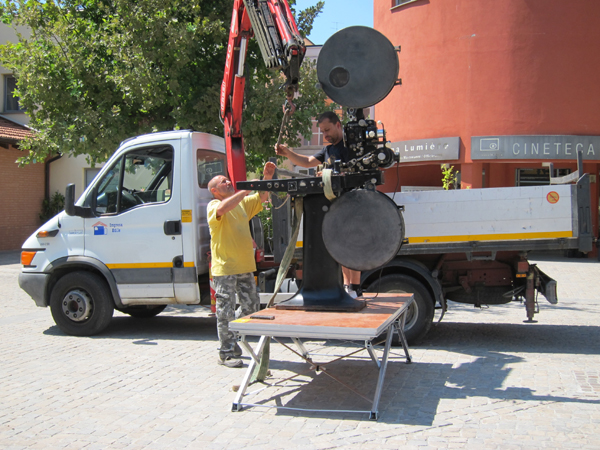
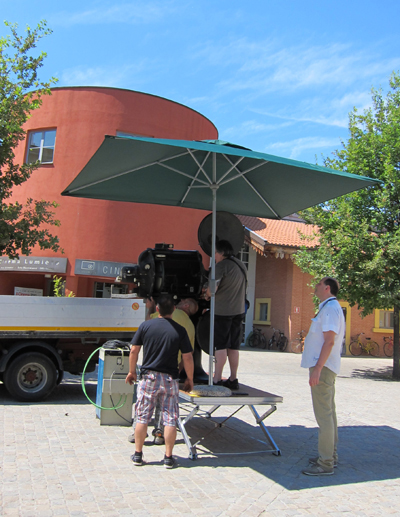
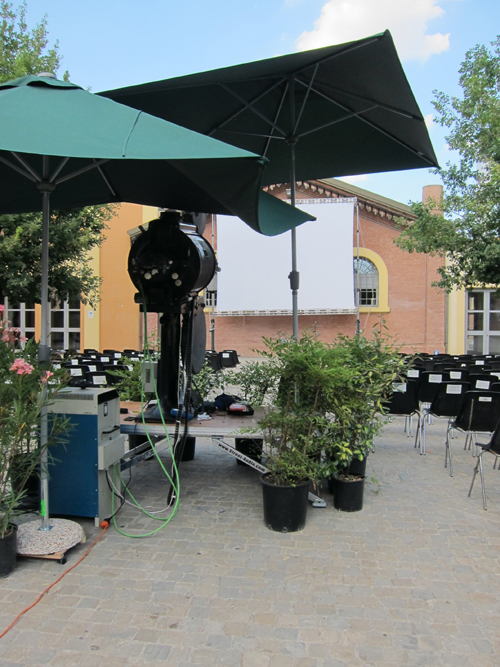
The projector used for the program was not from 1906, but it was old, and very heavy. I happened to be between films when a truck with a crane delivered the projector and a generator and a team set up the equipment facing a small screen on one side of the courtyard. (At the very top of today’s entry, the crane lowers the projector body onto its platform. Above, festival coordinator Guy Borlée watches as the lamp housing is attached. Bottom, all ready to go and waiting for the sun to set.) The projector was a Prevost, of French manufacture, I would guess from the 1940s.
When 10 pm arrived, it became apparent that the light from buildings near the Cineteca could not be entirely controlled. Shadows of the trees in the courtyard were cast on the screen, with light patches between them. But traveling cinemas no doubt frequently set up in venues where nearby sounds and other distractions abounded, so we all accepted the light pollution as part of the experience.
Perhaps the most memorable of the films was Cambrioleurs modernes (“Modern Burglars,” director unknown, 1904). In some ways it was rather crude, with the set consisting of two large painted house façades facing each other, angled from the front, and a wall beyond them. The acrobatic burglars arrived over the wall to rob one house, propping a long board against an upper window to use as a chute for sliding furniture and other large objects down.
The action becomes faster and more impressively choreographed as police arrive, also over the wall, and give chase. Soon burglars and comic cops are diving through windows and doors in the two buildings, as well as performing comic acrobatics on the chute. The whole thing, as far as I could tell, was done in a single take, though there might have been some invisible cuts. If it was indeed one shot, it was a most impressive piece of staging and performance.
This ‘n’ that
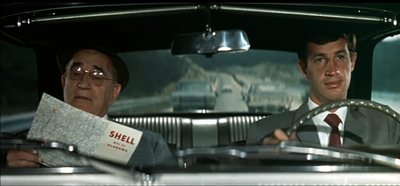
Jean-Pierre Melville’s 1963 crime/road movie L’Aîné des Ferchaux (based on a minor Georges Simenon novel) is almost impossible to see on the big screen, apparently due to some sort of rights problem that keeps the French distributor from circulating it. (It is available on a region 2 French DVD without subtitles.) The festival managed to show it in the European widescreen thread by borrowing a print from Svenska Filminstitutet, complete with Swedish subtitles. Translations in Italian and English were projected on small screens below the image. I quickly got accustomed to skipping down to the read the third set of subtitles. It’s certainly not one of Melville’s masterpieces, but it’s definitely worth seeing.
The basic premise is that an unscrupulous banker, Dieudonné Ferchaux (veteran French star Charles Vanel), flees arrest by flying from Paris to New York and then setting out toward the South via car. Michel Maudet, an unsuccessful young boxer (Jean-Paul Belmondo), also unscrupulous but so far with no apparent serious crimes to his name, goes along as his secretary. Although the two seem to like each other, Michel becomes increasingly tempted to steal the suitcase stuffed with cash that Ferchaux has picked up in New York, while Ferchaux seems to lose interest in visiting various other places where he has stashed away large sums. The gradual switch in their power relationship furnishes one main line of interest.
The film is also remarkable in that the two stars did not go to the U.S.A. to appear in the considerable amount of landscape footage shot there by a second unit. Instead, they worked in interior sets in France, as well as exteriors that pass for America. Melville managed to stitch these two kinds of footage into a reasonably convincing depiction of an American road trip.
Another film that has long been hard to see outside Italy, at least in its original form, is Rossellini’s L’Amore (1948), two contrasting short tales displaying the acting talent of Anna Magnani. The first, Une voca umana, is based on Jean Cocteau’s 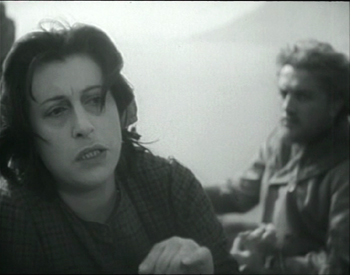 much-adapted short play, La voix humaine. Confined to an apartment, it concentrates on a woman talking on the phone with the lover who has recently left her, trying to convince him that she has adjusted to the break-up while demonstrating through her behavior that she is devastated. Rossellini never places the camera much further back than a plan-américain position, and most of the time the framing displays Magnani’s face in close-up. Short though it is, it becomes repetitive, and it is too evidently a display of virtuoso acting.
The longer second part, Il Miracolo, is more engaging and original. It is based on an idea by Fellini and a script by Tullio Pinelli and Rossellini. A feeble-minded homeless woman, Nannina, who is tending a herd of goats near a small Italian village, meets a traveler (played by Fellini, left) whom she, being very pious, assumes to be St. Joseph. He offers her wine and, when she falls asleep, rapes her. Learning that she is pregnant, and not realizing what the traveler did, Nannina becomes convinced that she is carrying the baby Jesus. She is teased and hounded by the townspeople. This part of the film led to censorship problems, not because of the sexual content (the rape is simply skipped over and merely implied) but because of the apparent parody of the Immaculate Conception. (This, too, has been available in a mediocre copy without subtitles on an Italian DVD.)
Apart from its innate interest, L’Amore is historically important for the “Miracle Decision” in the U.S., where it was banned for sacrilege. The Supreme Court decision in the case led to the extension of first-amendment protection to cinema.
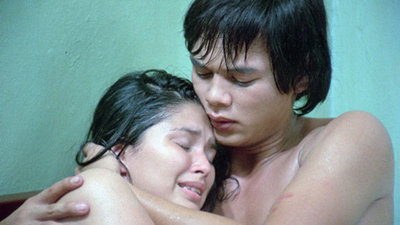
Il Cinema Ritrovato has become a venue for the exhibition of the latest restorations by Martin Scorsese’s World Cinema Foundation. This organization restores films from countries whose archives do not have the means to do such work. Since 2007, the foundation has preserved on average three films a year. This year the items on show at Bologna included Filipino director Lino Brocka’s Manila in the Claws of Light (1975, also known as Manila in the Claws of Neon). I had never seen a Brocka film (it’s discussed in a passage of Film History: An Introduction, for which David was responsible), but I was impressed by this one, widely considered to be his best.
It follows a naive young man from the countryside whose girlfriend has become the victim of sex-trafficking; he seeks her in Manila and experiences unfair wage practices and other forms of corruption. Brocka managed to blend seamlessly an absorbing narrative with sympathetic characters and an undercurrent of bitter social critique. Remarkably, Brocka also shot a 22-minute making-of documentary, quite similar to modern DVD supplements, that explains how he created realistic scenes of construction work with a small budget and shooting on location with non-professionals.
Another World Cinema Foundation restoration shown this year is the 1971 classic, Ragbar (Downfall, directed by Bahram Bayzaie). Given the extraordinary burst of creativity that has occurred in Iranian filmmaking since the 1980s, I had high hopes for this. In some ways it resembles more recent classics, most notably in its setting in a school.
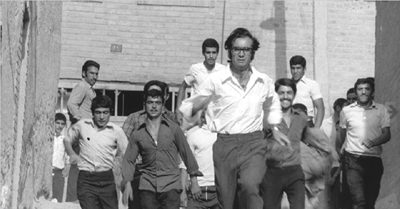
The hero is a misfit who has come to teach at the school and becomes the victim of pranks and taunts by his unruly students. A rumor gets started that he is in love with the older sister of one of the students, and in attempting to scotch the rumor, he falls in love with her. Gradually he comes to understand his students and gain their respect. The film is entertaining, though the slim plot seems dragged out too long. The approach is more like commercial mainstream art cinema than like more recent Iranian films. Culturally it is quite interesting, showing some of the customs of the era shortly before the overthrow of the Shah. Most notably the women wear western-style clothes, and some are unveiled.
Unfortunately I had to miss a third Foundation restoration, Ousmene Sembène’s early short Borom Sarret (1969).
The World Cinema Foundation screenings are among the high points of Ritrovato, and I look forward to seeing more of them in years to come. Among all the festival’s restorations of well-known classics (this year Hiroshima mon amour, Richard III, and so on), it was a pleasure to see as well some well-known but hitherto difficult to see films. I hope all three, plus Brocka’s making-of, are included in a future WCF DVD set. (The first set was issued last year and is available from amazon.fr.)
Finally, I managed to see a few of the films in the “War Is Near: 1938-1939” thread. One was a program of three of Humphrey Jennings’ less familiar documentaries, all from 1939: Spare Time, about how working-class people spend their leisure time; The First Days, on the preparations for war in England after its declaration; and S. S. Ionian, on a cargo ship paying visits to ports of call in the Mediterranean. The first two had the true Jennings touch, looking at everyday events with a fresh, unpretentiously poetic viewpoint. The third was more conventional, aimed at presenting information about the importance of non-military shipping for the war effort. All three films, along with a dozen others, are available on the first volume in the BFI’s region-free DVD edition of Jennings’ complete films.
I also saw Edmond T. Gréville’s Menaces (1940). Its story of impending war is what David would call a network narrative, set among the residents of a cheap Parisian hotel–a sort of low-rent version of Grand Hotel. Although most of the stories are not directly about the war, its threat hovers over them all. Perhaps the stand-out is Prof. Hoffman, a disfigured emigré German war veteran (Erich von Stroheim) who gradually realizes that once war breaks out, he will be an enemy alien in the country he considers home. (The film is available on a region 2, unsubtitled French DVD.)
Menaces was the last film I saw at this year’s festival, and now I look forward to being able to report in tandem with David at next year’s!
Once more we thank the Ritrovato team (especially Marcella Natale), led by Peter von Bagh, Guy Borlée,and Gian Luca Farinelli, for their visionary achievements. They have changed our conception of what a film festival can be, and they have led us to a deeper and wider appreciation of the glories of cinema.
[July 19: Thanks to Antti Alanen for pointing out that Saul and Jonathan Turell’s name has only one r. It’s spelled indiscriminately all over the internet with one r or two, so thanks also to Brian Carmody of Criterion for confirming that Turell is correct.]
[July 29: Guy Borlée has kindly sent me links for some of the festival events that have gone online at Vimeo since I posted this entry. There’s a set of all the lectures given during the week, including the Peter Becker and Jonathan Turell presentation on the Criterion Collection that I describe above (direct link to the Criterion session here). I mentioned Kevin Brownlow’s introduction to The Iron Mask, but he did a whole presentation on Allan Dwan as well. You can also watch the DVD awards ceremony.]
Industrial strength
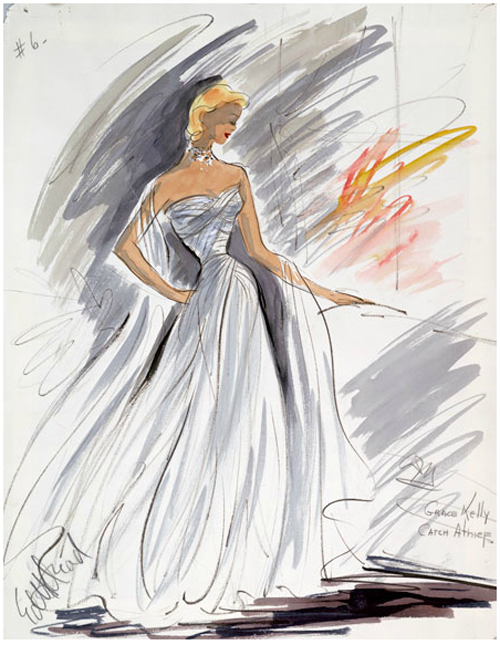
Edith Head costume sketch for To Catch a Thief. From Edith & Oscar: A Costume Exhibit, WCFTR website.
DB here:
Until the 1970s, academics interested in film seldom paid close attention to Hollywood as an industry. Some economists and historians of law were beguiled by the sight of an oligopoly eventually dismantled by Supreme Court decree. But these scholars weren’t particularly interested in the products of the studio system.
People interested in the movies took three positions. The most dogmatic, voiced by one of my grad-school professors, ran this way: “Money doesn’t matter.” That is, art will always triumph over business. If a movie is good, the circumstances of its making are irrelevant. And we study only good movies, so we needn’t consider the business.
Another view acknowledged the importance of the industry but saw it as a vague, overarching force. Creative artists were seduced by it or struggled against it. A powerful director like Chaplin or Hitchcock could control his work to a considerable degree. For the less powerful, the studios (along with censorship agencies) were barriers to creative work. They forced directors to bow to the demands of moguls or a debased public.
The third view was largely celebratory. The studios represented a wondrous confluence of talent at every level, from script to music, and the System mysteriously spun out marvels of drama, comedy, and spectacle: Hollywood as Gollywood. Researchers in this tradition ferreted out as much information as they could about the old days, infusing encyclopedic ambitions with fan enthusiasm.
What came to be called “Wisconsin revisionism” or “the Wisconsin Project” proposed some alternatives.
Auteurist in the archive
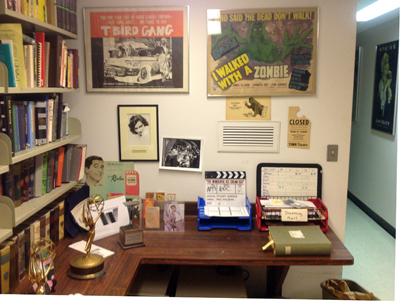
Corner of WCFTR office area. Photo: Mary Huelsbeck.
When I came to UW–Madison to teach in 1973, I was an auteurist with a taste both for Hollywood and foreign cinema. I knew relatively little about how the studio system functioned. Its machinations were simply factored out of my consideration. Directors, from Hitchcock and Hawks to Dreyer and Mizoguchi, were what loomed in my consciousness, and I wanted to spend my life studying what they had accomplished.
But contact with students, faculty, and campus personalities at Madison changed my thinking. There was The Velvet Light Trap, a defiantly unofficial magazine that ran special issues on all manner of non-auteur subjects, especially studios, periods, and genres. There were ambitious film societies like Fertile Valley and the Green Lantern, showing offbeat items. There were smart, well-informed grad students. There was the Wisconsin Center for Film and Theater Research, which housed thousands of prints, the center of my lustful thoughts both day and night. The WCFTR also housed vast archives of papers, scripts, photos, and other documents of Hollywood’s golden era.
Then there were Professor Tino Balio and Dissertator Douglas Gomery. My conversations with them, both in and out of the office, showed me that there were fruitful questions to be asked about the nature and conduct of the studio system. These two scholars, I think, more or less invented the rigorous historical study of Hollywood as a business enterprise.
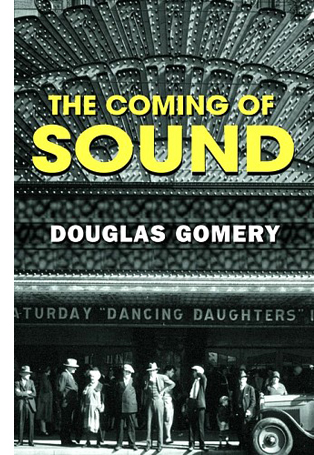 Take Doug’s dissertation (and subsequent book). How did Warner Bros. innovate sound? Was Warners, as most accounts claimed, a threatened company, desperately driven to try a new technology to stave off bankruptcy? Doug answered the question in a revelatory way: The evidence pointed to Warners’ innovation of sound as a carefully calculated business decision made by a company that had already explored the technology and the market. In fact, WB was not going bankrupt, it was actually expanding into other domains, including radio. By using a traditional historical model of technological diffusion, Doug made the Warners’ decision intelligible. He served as a TA in my first course at Wisconsin, and our friendship proved to be a case of the student teaching the teacher.
Tino, who was presiding over the WCFTR, became another premiere scholar of filmmaking as a business. His books, anthologies, and book series brought immense attention to our collection of material on United Artists, Warner Bros., and RKO. He taught courses in the history of the industry, both survey courses and in-depth seminars. I think I learned more sitting on examination committees with him than I had in many of my grad-school lectures.
Many of the research questions asked by Tino, Doug, and their peers didn’t concern the movies themselves. Some did, though. I remember Cathy Root’s study of stars as strategies of “product differentiation.” More broadly, in the 1970s and early 1980s, some of us suspected that the Hollywood system of production, distribution, and exhibition could affect what then was called “the film text.”
As a result, Kristin, Janet Staiger, and I tried to show how Hollywood’s mode of production did more than simply limit gifted artists or yield pop-culture diversions. In The Classical Hollywood Cinema (1985), we tried to understand how the organization of production shaped work routines, technology, adjacent institutions, conceptions of quality, and other factors that did impinge on how the films looked and sounded. Over the years these aspects of filmmaking practice took off on their own, becoming somewhat detached from the industrial conditions that created them. When the studio system faded away in its classic form, the community’s notions of narrative construction, stylistic expression, professional practices, and other factors hung on. The economics changed, but the aesthetics persisted.
Now there are many people working to show how industrial factors interact with filmmakers’ creative choices. Kristin and I have continued these explorations in books and blog entries, extending them to other periods (e.g., the 1910s, the New Hollywood, the 1940s). I like to think that much of our work over the last decades has tried to blend the careful empirical and explanatory work of Tino, Doug, and others with the analysis of art and craft typical of film criticism. We can ask some questions that cut across the over-simple Art/Industry split.
Let a thousand projects bloom (motto, People’s Republic of Madison)

This exercise in autobiography was triggered by some recent events. One is the spiffy new website for the Wisconsin Center for Film and Theater Research. Under its recent director Michele Hilmes and current director Vance Kepley, the Center has gotten a new jolt of energy. It’s promoting its vast collections in an attractive way and is starting to spotlight some that weren’t well-known. The selections are bolstered by informative program notes by Maria Belodubrovskaya, Booth Wilson, and others.
Certainly the Center’s heart, for historians of Hollywood, is the United Artists collection. This assembles United Artists business records from 1919-1965, scripts and stills from Warner Bros. and RKO, and several thousand film features, shorts, and cartoons, mostly from 1928 to 1948. Then there are the hundreds of named collections, provided by individual donors. The refurbished website calls attention to several of them: the personal and business correspondence of Kirk Douglas (some items now digitized), the Blacklist collection (six of the Hollywood Ten represented), the dazzling array of Edith Head’s costume designs (okay, I’m going a bit Gollywood). There are records for Otto Preminger, Walter Wanger (the basis of Matthew Bernstein’s biography), and Shirley Clarke. The restored Portrait of Jason was discovered in her collection.
Lately, needing information on Guest in the House (1944), I turned to the WCFTR screenplay by Ketti Frings. Her name looks like a Scrabble hand, but she turns out to be a fairly significant screenwriter, contributor to The Bells of St. Mary’s (1945), Dark City (1951), and By Love Possessed (1961). Some other day I must get around to prowling in the papers of Vera Caspary, an extraordinary person who is far more than the author of Laura (though I’d be happy just being that).
Beyond Hollywood, the Center holds major collections of Russian cinema and, more recently Taiwanese cinema. And if you must leave cinema behind for theatre, you can investigate Eugene O’Neill, George S. Kaufman, and many other luminaries. In sum, a resource to make you happy for decades.
A career and a conference
The expansion of the Center owes everything to Tino Balio, who served as director in its crucial years. It was he who acquired the UA treasures and many of the named collections. Access to the UA papers enabled him to write the definitive history of the company, but it also created a huge spillover effect: dozens of research projects were nourished by his pursuit of this collection—which came to us at a time when virtually no universities, not even those in LA, were seeking Hollywood corporate records.
So it’s fitting that, as the WCFTR redesigns its public profile, we see the publication of Tino’s Hollywood in the New Millennium.
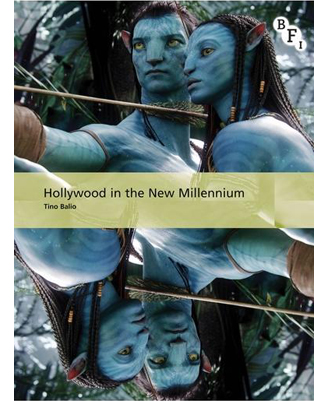 In a sense it’s a sequel to his earlier books, The American Film Industry (1976, 1985) and Hollywood in the Age of Television (1990). But these were anthologies, whereas this is through-composed. It’s most like his magisterial survey of the business strategies behind the art-film explosion, The Foreign Film Renaissance on American Screens, 1946-1973 (2010): a careful study of a remarkable period in US film history.
Hollywood in the New Millennium charts the trends that characterize the last fifteen or so years of the American film industry. It surveys financing, production, distribution, exhibition, ancillary markets, and the independent realm. Tino analyzes the ways in which new technologies have changed all these areas, mostly to the benefit of the bottom line, but he also recognizes that technology can undermine the business, especially in the hands of what he calls “the I-want-it-for-free consumer.”
He surveys studio policies, attempts at synergy, and viral marketing. He traces the rise and fall of executives and is especially strong on the emergence of the overriding strategy of the tentpole picture aimed at teenagers and families. Since all studios belonged to entertainment conglomerates, the constant demand was for large-scale profits. For all its financial excesses, the tentpole strategy, Tino argues counterintuively, was an austerity measure.
By the decade’s end, every studio was in the tentpole business. Although the costs of producing and marketing such pictures were enormous, they were the only types that could perform on a global scale and generate significant returns. . . . The sure thing was a good hedge against a dying DVD business, the fragmentation of the audience, and the unknown impact of the internet and social media on Hollywood marketing practices.
In short, you could not ask for a more concise, reliable map of where Hollywood is today. The bibliography is expansive enough to inspire other researchers to dig into both printed and online sources.
Tino has exercised a remarkable influence on two generations of film scholars, but in an almost surreptitious way. Now every film student learns about the structure and conduct of the film industry, but few know that Tino played a pivotal role in making this sort of knowledge central to academic film study. Now in his mid-seventies, Tino has left a peerless legacy of research.
Speaking of research, our campus will be hosting a major conference that includes the WCFTR as a key component. The Screenwriting Research Network International is holding its annual gathering here on 20-22 August. I attended the Brussels SRNI conference two years ago and wrote about it here and here. I think it’s fair to say that a hell of a time was had by all. This is a stimulating bunch, and anyone interested in filmmaking would benefit from attending.
 Keynote speakers this year are Larry Gross (48 Hrs, True Crime, We Don’t Live Here Anymore, Veronika Decides to Die), Jon Raymond (Old Joy, Wendy and Lucy, Meeks Cutoff , and several novels), and. . . Kristin!
The scholars are no less stellar and include Kathryn Millard, Richard Neupert, Jill Nelmes, Steven Maras, Riikka Pelo, Eva Novrup Redvall, Nate Kohn, Ronald Geerts, Andy Horton, Ian Macdonald, and a great many more. Go here for a complete program. You will be impressed.
Needless to say, among the guests are many UW alumni: Patrick Keating, Colin Burnett, Maria Belodubrovskaya (currently a faculty member too), Brad Schauer, Mark Minett, Mary Beth Haralovich, and David Resha. All of them have been steeped in archival research, centrally at WCFTR. Also home-grown are the conference organizers, J. J. Murphy (who blogs here) and Kelley Conway, who is finishing her book on Agnès Varda after immersion in that great lady’s personal archive. Another faculty member, Eric Hoyt, is curator of the remarkably full and free Media History Digital Library; expect him to divulge newer-than-new research sources and methods. I’ll crowd into the act with a paper tied to my 1940s book.
All in all, I see a pleasing continuity from my salad days, through forty years of teaching and viewing and writing, to this moment: a new Balio book, a sparkling shop window for the Center, and new generations of researchers eager to show that The Industry and The Art of Cinema aren’t always that far apart.
Earlier memoirs of Mad City culture in the 1970s-80s are here and here.
For more on the origins of Wisconsin revisionism, see my introduction to Douglas Gomery, Shared Pleasures: A History of Movie Presentation in the United States (University of Wisconsin Press, 1992) and this entry. We have a blog entry on Tino’s Foreign Film Renaissance on American Screens here.
On the remarkable Vera Caspary (Wisconsin’s own) see not only her fine thrillers Laura and Bedelia but also her Bohemian autobiography The Secrets of Grown-Ups (McGraw-Hill, 1979).
Thanks to Steve Jarchow, CEO of Here Media and Regent Entertainment, for his many years of support of the WCFTR’s activities.

Kelley Conway, Tino Balio, and Lea Jacobs; Madison, WI September 2011.
Scoping things out: A new video lecture
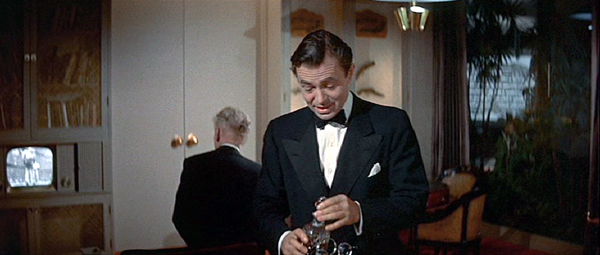
A Star Is Born (1954).
DB here:
Cripes! It’s video-lecture fever!
Well, maybe that’s an exaggeration. Still, we do have something new for you.
A video analysis of constructive editing showed up last fall, and a rather long one called “How Motion Pictures Became the Movies” was posted earlier this year. Now comes one on the aesthetics of early CinemaScope in the US.
It’s a new version of a talk now retired from the lecture circuit and snugly cached on the web. I’m hoping both viewers and filmmakers will be interested in this, particularly in its analyses of staging and composition. The piece makes a more general argument about how new technologies offer both advantages and constraints.
“CinemaScope: The Modern Miracle You See without Glasses!” runs about fifty minutes. It’s our first one in HD, so it looks pretty nice on many displays. It could be shown in classes, and I’d be happy if teachers wanted to use it. As with our earlier entries, it’s also available on Vimeo here, where you can leave feedback if you want.
I’m also providing the chapter on Scope from Poetics of Cinema. Think of the lecture as the DVD and the chapter as the accompanying booklet. You can go to the essay if you want to dig deeper into the subject, see other examples of what I’m talking about, or learn the sources for my arguments.
By the way, if you’re interested in the art and craft of widescreen cinema, I’ve posted a web essay on Hong Kong anamorphic here.
As usual, I’m very grateful to my creative tech wranglers Erik Gunneson, who produced the video, and Peter Sengstock. Thanks as well to our web tsarina Meg Hamel.
I’ll have to suspend production of these video lectures for a while, but Kristin and I are hoping to float another novelty soon, perhaps in the next couple of months.
Thanks for everyone who has supported our work through Tweeting, Facebooking, linking, or just telling their friends.
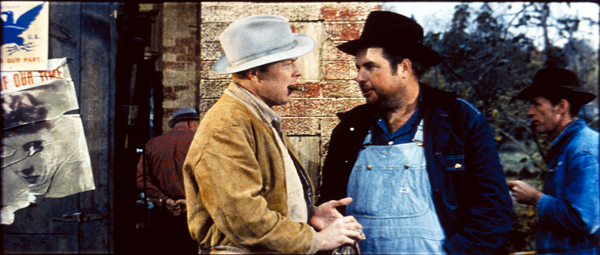
Wild River (1960). From 35mm frame.
Silent films, old and new
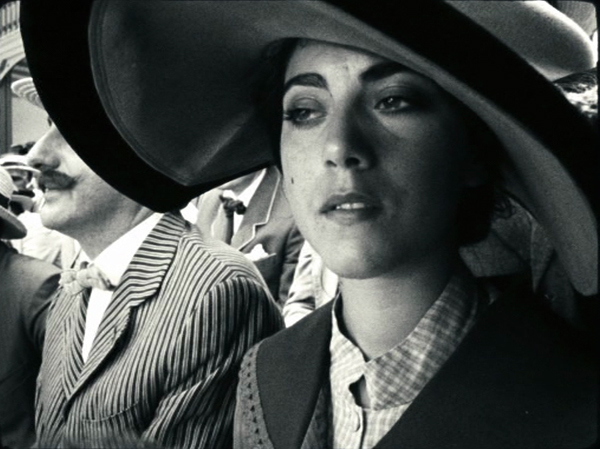
Blancanieves
Kristin here:
February and March have been good to silent cinema. Time for a round-up of some highlights as we impatiently anticipate Il Cinema Ritrovato, coming up in a little over two months.
Publications on Albert Capellani
In reporting on the 2010 and 2011 programs of Il Cinema Ritrovato, I highlighted one of the festival’s major revelations, that of the silent films of Albert Capellani. These generous doses of Capellani’s splendid films were put together by Mariann Lewinsky, who realized his importance after she included some of his shorts in her annual “Cento Anni Fa” programs. In my entries I argued that Capellani was revealed as one of the early cinema’s great masters. (The 2010 entry is here, and the 2011 one here.)
Not surprisingly, during the intervening years, scholars have been busy researching Capellani’s films and career. March 6 to 24 saw a major retrospective at the Cinémathèque Française. (Information on the program is still available online, as is a detailed press release.) Shortly before it began, the first biography appeared: Christine Leteux’s Albert Capellani: Cineaste du Romanesque, with a foreword by Kevin Brownlow.
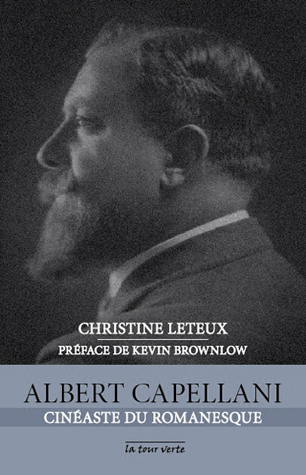
Leteux discovered Capellani in May of 2012, thanks to seeing Notre-Dame de Paris and Les Misérables at the Forum des Images in Paris. Setting out to learn more about the filmmaker, she realized how thoroughly his memory had nearly vanished from film history. She sought out and received the cooperation of his grandson, Bernard Basset-Capellani, whom she describes as “intarissable” (inexhaustible) on the subject.
The result is a solid, traditional biography, with chapters mostly organized around the companies for which Capellani worked (Pathe, SCAGL, World, Mutual, and so on) and some of his key films (Les Misérables, The Red Lantern). The prose style is easily readable French, at least to someone like me with an average knowledge of the language. For an interview with Leteux concerning the book, see here.
The book is on sale at the Cinémathèque’s shop, which unfortunately does not sell online. It was supposed to be available on Amazon.fr, but so far is not. The easiest way for those outside France to order it is through three third-party book-sellers on amazon.fr, all offering it at the cover price of 14.90 €. Leteux’s book is a vital source for anyone interested in early cinema.
I was pleased to see that the last chapter ends with some quotations from my second entry on Capellani, ending with “With the end of the main retrospective, however, it is safe to say that from now on anyone who claims to know early film history will need to be familiar with Capellani’s work.”
The book includes a filmography and list of films available on DVD. These include a new one, a restoration of The Red Lantern by our friends at the Cinematek in Brussels, available on Amazon.fr or directly from the Cinematek’s shop.
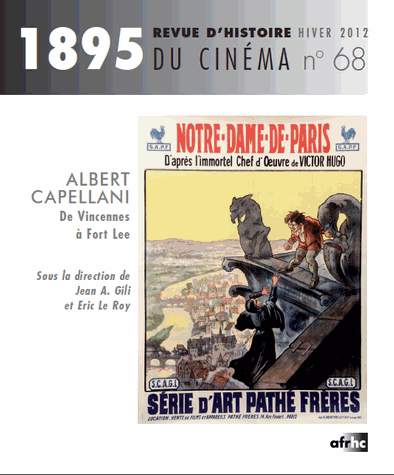
The French-language historical journal on cinema, 1895, timed its March, 2013 issue to coincide with the Cinémathèque’s retrospective. It is entirely devoted to Capellani. I have not had a chance to see it yet, but the table of contents is available here. The only online purchasing source for individual issues I have found is here; the page gives a lengthy summary of the contents.
Mariann continues to search for more surviving prints for restoration and eventual inclusion in future editions of Il Cinema Ritrovato. She has sent me some tantalizing news about recent discoveries and restorations. There will be a third Capellani season in 2014. This will probably include some of the director’s American films: Social Hypocrites (now restored), Flash of the Emerald (the one surviving reel), Inside of the Cup (surviving but so far with no projection print), Eye for Eye (two surviving reals), Sisters, and the French film Le Nabab. Other possible restorations include House of Mirth, La belle limonadiere, and Oh Boy!
A description of the 2013 Ritrovato festival is available here.
Nanook and friends
Early this year we posted our annual list of the ten best films of ninety years ago. It featured the classic early documentary, Robert Flaherty’s Nanook of the North. In March our friends at Flicker Alley released a two-disc Blu-ray edition of Nanook paired with the 1934 Danish feature, The Wedding of Palo (Palos Brudefærd). The latter is one of those titles that one occasionally encounters on the fringes of older historical surveys, but it has been difficult indeed to see. This new print is a 2012 restoration from a George Eastman House original 35mm nitrate copy.
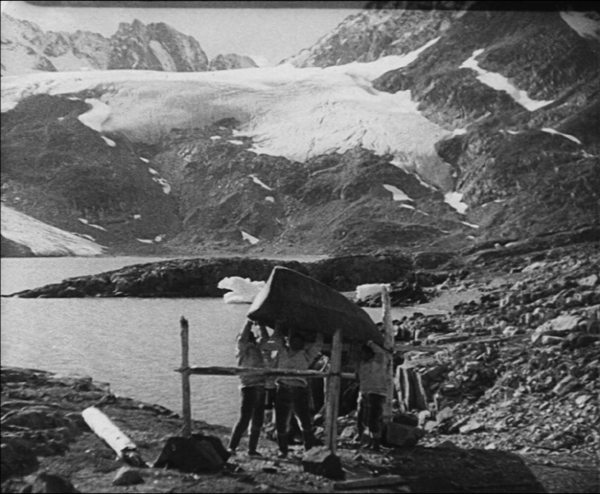
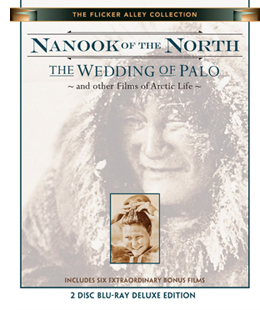 Nanook is familiar enough, but The Wedding of Palo is not. It was made by the Danish explorer and anthropologist Knud Rasmussen, who appears in a brief introductory passage. Clearly he was influenced by Flaherty’s work. He combines a simple fictional narrative with documentary scenes of traditional Inuit life in eastern Greenland. The basic story involves the heroine Navarona, whose brothers are reluctant to lose their housekeeper by allowing her to marry. Two men of the tribe court her and come into violent jealous conflict. Interjected are sequences of a salmon hunt, a festival, a traditional song duel between the two rivals, and a polar-bear hunt. The staged dialogue scenes involve sound recording, with no subtitles but the occasional brief intertitle to translate.
As in Nanook, the non-professional actors are remarkably natural, especially the “actress” portraying the heroine. There is a cute young boy brought in at intervals for comic appeal, and the members of the village seem always to be laughing and enjoying a suspiciously carefree life. The film has the advantage of more spectacular scenery than that in Flaherty’s film, with huge mountains and glaciers in place of the vast ice-covered vistas (see bottom image).
As usual, the Flicker Alley team has gone beyond the call of duty with this release. It includes not only the two features, but six bonus films, as described in the press release:
Nanook Revisited (Saumialuk) by Claude Massot was made in the same locations used by Flaherty. It shows how Inuit life changed in the intervening decades, how Flaherty consciously depicted a culture which was then already vanishing, and how Nanook is used today to teach the Inuit their heritage. Nanook Revisited was produced in 1988 on standard definition video for French television. Dwellings of the Far North (1928) is the igloo-building sequence of Nanook re-edited and re-titled as an educational film; Arctic Hunt (1913) and extended excerpts from Primitive Love (1927) are by Arctic explorer Frank E. Kleinschmidt; Eskimo Hunters of Northwest Alaska (1949) by Louis deRochemont shows many activities seen in Nanook thirty years after, and Face of the High Arctic (1959) depicts the ecology of the region, produced by the National Film Board of Canada.
Altogether, the films run an impressive 281 minutes. There’s also a booklet with excerpts from Flaherty’s book, My Eskimo Friends, an essay by Lawrence Millman, “Knud Rasmussen and The Wedding of Palo,” and notes on the films.
Snow White and the Seven (?) Bullfighting Dwarves
In 2011, a French film, The Artist, gained huge attention in the infotainment media as a modern version of silent cinema, winning yet another Best Picture Oscar for the Weinstein brothers. It was a reasonably successful imitation of mid- to late 1920s cinema during the transition to sound. Now a much better modern silent film has arrived, Pablo Berger’s Blancanieves, a loose version of the Snow White story transposed to 1920s Spain. A famous bullfighter is paralyzed after being gored in the ring. His wife dies in childbirth and his scheming nurse marries him. She keeps his daughter, Carmen, away from her father by setting her to work as a downtrodden servant in his country estate. Upon her father’s death, the evil wife schemes to have her killed, and she escapes to the protection of a troupe of six bullfighting dwarves who, possessing uncertain arithmetic skills, bill themselves as seven bullfighting dwarves.
While The Artist was a fairly good imitation of 1920s Hollywood filmmaking, Blancanieves is a pastiche of the 1928-29 era of European silent cinema. It draws on what I have termed the International Style of filmmaking, a late 1920s blend of influences from the French Impressionism, German Expressionism, and Soviet Montage movements. One could almost pass it off as a genuine film of the era.
At times there are subjective effects à la Impressionism. A superimposition conveys Carmen’s memories of her father’s crucial instructions to her, and superimposed images of hands waving handkerchiefs present the enthusiam of the crowd’s plea for the bull to be pardoned.
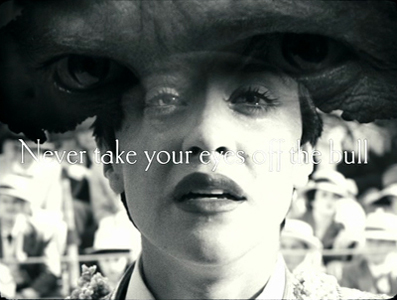
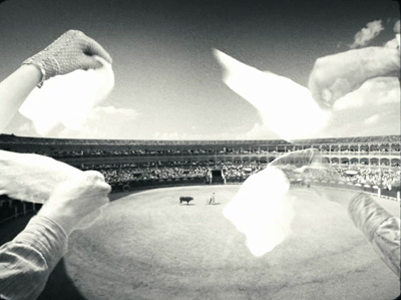
This was also the period in which the power of the wide angle lens, particularly in close-ups and in low-angle shots, was exploited, initially in Soviet cinema and then all over Europe. Blancanieves is full of such shots, as in the frame at the top of this entry and in these two shots from the opening scene:
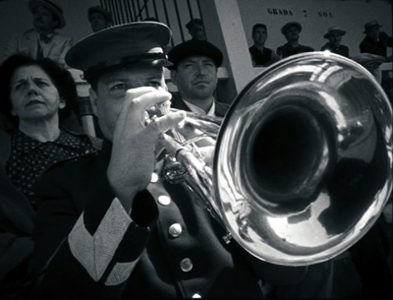
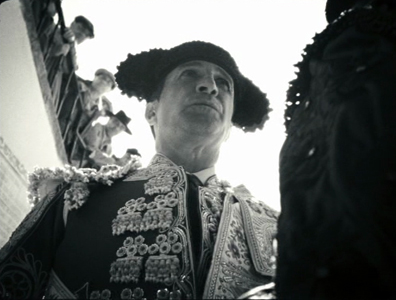
There are also montage sequences, building up to flurries of very short shots. This accelerated-editing technique is typical of both Soviet and French filmmaking of the era.
The too-frequent use of handheld camera in Blancanieves detracts somewhat from the feeling of authenticity. In the late 1920s, cameras were too heavy to be handheld. They could be strapped to the body of the cinematographer with harnesses, but that creates a subtly different look. And during the late 1920s, shots with the camera holding on a character while the background spins around behind him or her would have been achieved by placing both camera and actor on a large turntable. (This effect apparently was pioneered in Germany in the mid-1920s). But the occasional dramatic lighting effects, particularly in the climactic scene, are distinctly reminiscent of German cinema.
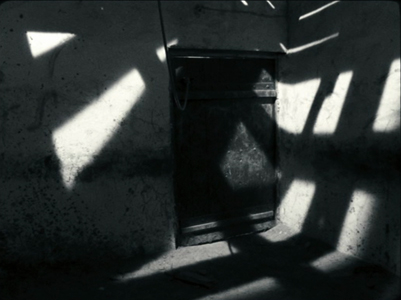
In general, the narrative is charming and amusing. The heroine’s pet rooster provides exactly the sort of comic relief that is common in films of the 1920s, and the story has an effective fairy-tale quality. I found the ending a bit disappointing and certainly not typical of the films of the 1920s. Still, Berger has clearly watched an enormous number of 1920s European films and absorbed their styles. He can imitate the International Style remarkably well, telling a tale that is appropriate to the 1920s and yet has a touch of humor that doesn’t belittle the silent era.
Blancanieves was released in the US on March 29 and is currently making the rounds of art-houses and festivals.
Other entries discussing the International Style and wide-angle filming at the end of the silent era can be found here and here.
The Wedding of Palo



