





Archive for the 'Film comments' Category
All play and no work? ROOM 237
Room 237 (2012).
DB here:
Rodney Ascher’s Room 237 gathers the thoughts of five people concerning the deeper, or wider, or just awesomer meanings evoked by Stanley Kubrick’s The Shining. Those thoughts will strike many viewers as fairly far out there. Me, not so much.
Over the top
Room 237 adroitly blends several documentary genres. It recalls Cinemania and Ringers in its investigation of fan cultures. But instead of focusing on the personalities and lifestyles of the fans, Ascher concentrates on their readings of the movie. We never see the commentators. In this respect, it evokes the newly emerged genre of video essays as practiced by Kevin B. Lee and Matt Zoller Seitz. Yet it doesn’t offer itself as an earnest contribution to the critical conversation because Ascher freely intercuts stills and shots from other films, often to ironic effect.
In all, his film has the quizzical, gonzo flavor of an Errol Morris movie, minus the talking heads. But Morris is as interested in people as he is in their ideas. Ascher is interested in the ideas, and the way they swarm over and burrow into a film we thought we knew.
So he performs the sort of surgery more appropriate to the Zapruder footage. In the boldest test of cinematic Fair Use I’ve ever seen, a great many clips from the Warner Bros. release are run, slowed, halted, backed up, blown up, and overwritten as support for the interviewees’ claims. Ascher never tries to counter their arguments; at times he supplements them with extra evidence.
The results seem, to many, at best far-fetched and at worst (or best, from an entertainment standpoint), wacko. One of Ascher’s interviewees believes that The Shining is a denunciation of the genocidal destruction of Native Americans. Another takes the film as an exploration of the Theseus myth. Another believes that the film makes references to the Holocaust. Another finds a welter of subliminal imagery pointing to “a dark sexual fantasy.” Another sees the film as Kubrick’s apologia for staging the faked footage of the Apollo 11 moon landing.
Are these interpretations silly? Having spent forty-some years teaching film in a university, I found much of them pretty familiar. Some of the specifics were startling, but I’ve encountered interpretations in student papers, scholarly journals, and conference panels that had a lot of similarities.
If you think that this just proves that all film interpretation is ridiculous, you can stop reading now.
Because most film enthusiasts think that at least some movies need interpreting. We assume that like artists in other media, some writers and directors are using their medium to transmit or suggest meanings. And if a movie doesn’t express its makers’ ideas, perhaps it can still bear the traces of ideas out there in the culture. This “reflectionist” idea, tremendously popular among both journalists and academics, allows us to interpret even escapist fare.
Our interpretive itch has been around for a long time. Centuries of commentary have accrued around the Bible, the Torah, the Koran, and other texts deemed sacred. Secular texts, from Homeric epics to last month’s bestseller, have been scoured for hidden meanings too. The search hasn’t just been confined to literature, of course. An entire school of art history, called iconology, has devoted itself to deciphering objects, compositions, and other features of paintings. Even musical pieces without verbal texts have been “read.”
If at least some movies need interpreting, The Shining would seem to be a prime candidate. The film creates many questions about the reality of what we see and hear, and it seems to point toward regions larger than its central tale of terror. The director was one of the most ambitious filmmakers of the twentieth century, a film artist who could use a genre-based project like the famously puzzling 2001: A Space Odyssey (1968) to convey ideas about the place of human history in the cosmos. Why couldn’t he do the same thing with a Stephen King horror novel?
What’s wrong, then, with the five critics’ readings? Why do many viewers find them strained and forced, even loopy? One of the many virtues of Room 237 is that it forces us to ask: What do we do when we interpret movies? What makes one film interpretation plausible and another not? Who gets to say? What historical factors lead ordinary viewers to launch this sort of scrutiny?
All in the family
We all grant that movies have conventions. In an action picture, the bad guys have extraordinarily bad aim, except when it comes to winging the hero or plugging his best friend. Similarly, film criticism relies on a batch of conventions about what things to look for and how they should be talked about. No quickie film review, for instance, is complete without discussing acting.
Interpretation, a central activity of film criticism, has its conventions as well, and the Room 237 interviewees make some moves that are common to interpretation in academe and elsewhere. For one thing, they assume that The Shining is more than a standard-issue horror movie. Most cinephile and academic critics would agree that we have to go beyond this movie’s literal level.
Some of the Room 237ers’ conclusions echo critically respectable interpretations already out there. One idea held by other critics is that the film is to some degree a parody or critique of horror conventions. Another is the conviction that the film says something about the repression of the Native American population. The Overlook Hotel is built on tribal burial grounds, a history that hints an earlier, oppressed America returning to avenge a great wrong.
Other Room 237 interpretations don’t show up in the mainstream critical literature, but they aren’t unknown in wider traditions of interpretation. Take numerology. Some interpreters of Biblical scripture find multiples of seven to be of divine significance, and so does the Holocaust advocate in Ascher’s film. According to him, the novel Lolita, which Kubrick adapted, makes 42 a symbol of fate. In The Shining, it becomes a symbol of “danger and malevolence and disaster.” Why? Multiply 2 x 3 x7 and you get 42. Danny wears a jersey with the number 42, there are at one point 42 vehicles in the hotel parking lot, and 1942 is the year in which Hitler launched the Final Solution.
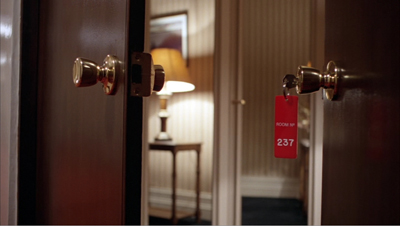
Similarly, anagrams aren’t unknown in some interpretive traditions. Scholars have claimed to find in Shakespeare’s plays encoded references to the real author (Marlowe or Francis Bacon or the Earl of Oxford). Ferdinand de Saussure, one of the founders of modern linguistics, whiled away his later years with detecting anagrams in Latin poetry. Joining up with this method, the interviewee who sees The Shining as an apology for faking the Apollo landing rearranges the letters on the room key to spell out MOON ROOM. And the moon, says the critic, is 237,000 miles from our earth.
I grant you that such cabalistic maneuvers aren’t common in film criticism. But plenty of others on display in Room 237 use the same reasoning routines that we find in consensus critical writing.
What do I mean by reasoning routines? When we interpret a movie, we’re making inferences based on discrete cues we detect in the film. What cues we pick out and what inferences we draw vary a lot, but the process of inference making tends to follow certain conventions.
Consider the claim that Kubrick is warning that we shouldn’t expect a conventional horror film. A more mainstream critic would point to the flamboyant performance of Jack Nicholson, at once grotesque, comic, and ominous. This would seem to be a strong ensemble of cues asking us not to take the film straight, and perhaps implying that it’s a send-up, in a grim register, of its genre. But none of our 237ers mention this cue as a basis for their interpretation.
Instead, they scan the setting for disparities. The hotel’s architectural features sometimes differ from one shot to another. A chair is present in one reverse shot of Jack, but in the next reverse shot, it’s gone. The hotel geography can’t be plotted consistently. Moreover, one of Wendy’s visions during her desperate flight through the corridors at the climax invokes the clichés of ordinary shockers: dust, cobwebs, and skeletons—all the paraphernalia that the film has studiously avoided up to this point. These anomalies encourage the interpreter to see the film as parodying typical horror movies. The 237 critics are picking out cues less obvious, they would say, than Nicholson’s over-the-top acting.
Making meaning, or making up meanings?
Ascher’s interviewees don’t always go for minute cues. They focus as well on many items that conventionally invite symbolic interpretation. Mirrors signal any sort of reversal, such as Danny’s backward steps through the maze or the film’s symmetrical beginning and ending. Something open—a door, a character’s eyes—suggests knowledge and acceptance; something closed, like elevator doors, suggests repression. If a character enters a space, that space can be taken as a projection of the character’s mental state, as when Danny nears his parents’ bedroom and gets into “his parents’ headspace,” as one 237 critic puts it. Another commentator suggests that Jack’s job interview at the beginning of the film might be entirely his hallucination, a question raised by academic critics as well. Such speculations on the border between the subjective and objective are commonplace in discussions of horror, fantasy, and that in-between register known as the fantastic.
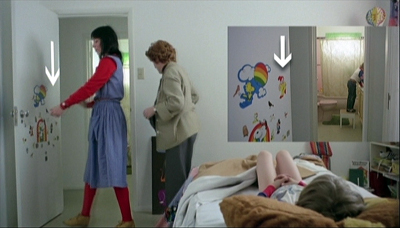
Puns are another time-tested inferential move. You can find a cue in the mise-en-scene and then “read” it with a verbal analogy. Snow White’s Dopey on Danny’s door suggests that the boy doesn’t yet realize what’s going on; but when the dwarf disappears, Danny is no longer “dopey”. A crushed Volkswagen stands for Kubrick’s telling King that his artistic “vehicle” has obliterated the novelist’s original “vehicle.” Abstract patterns in carpeting become Rorschach tests: Are those shapes mazes? Phalluses? Wombs? NASA launching pads? Mainstream critics might not fasten on these particular cues, but many wouldn’t resist the urge to find puns. After all, even Freud interpreted a dream in which his patient got kissed in a car as exhibiting “auto-eroticism.”
The Room 237 critics, following tradition, let the cues and inferences lead them to what I call both referential and implicit meanings. Referential meanings involve concrete people, places, things, or events. Spielberg’s Lincoln refers to a specific historical context and people and events in it. Implicit meaning is more abstract and is something we might expect to be intended by the filmmaker. So, for instance, Lincoln could be interpreted as about the necessary mixture of principle and expediency in politics; to achieve virtuous policies, you may need to cut moral corners.
The 237ers make use of different degrees of referential meaning. The Shining makes clear references to the Native American motif, not only in the hotel’s décor but the manager’s line of dialogue indicating that the building rests on burial grounds. That line is a rather explicit cue, and one that many non-237 critics have taken up. In a similar vein are the mythological references; both Juli Kearns in the film and several academic critics have discussed the the maze/ labyrinth imagery as citing the legend of the Minotaur.
There are more roundabout cues to inferences about the Holocaust. Kubrick might have included a photo of Nazis or Prussian generals in the Overlook’s Gold Room salon, but he didn’t. So the critic defending the Holocaust reading has to look for what we might call “hidden references”—the numerology we’ve already seen, along with the German-made typewriter on Jack’s desk, which is an Adler (“eagle,” symbol of Nazism). There’s also a dissolve that, according to another critic, gives Jack a Hitler mustache.
The Room 237 critics gesture toward implicit meanings too. The Playgirl magazine that Jack is reading when he waits in the lobby suggests that troubled sexuality is at the center of this maze—a suggestion made more explicit in the fateful Room 237, where a beautiful woman, upon embracing Jack, turns into a haggard zombie. The references to both the North American and German genocides suggest the film induces us to reflect on the cruelty of those events. More broadly, one critic believes that the film has far-reaching thematic import: The Shining is about “pastness” itself, about coming to terms with history.
To be convincing, though, an interpretation can’t merely take a one-off cue to make references or evoke themes. What really matters are patterns.
Patterns of associations
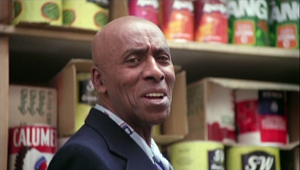
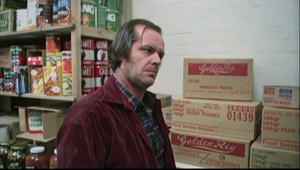
Interpreters typically gather cues into patterns and then use them to bear thematic meanings. One instance of this maneuver comes early on in Room 237, when Bill Blakemore, proponent of the Native American genocide hypothesis, is attracted to a lone Calumet baking-powder tin, turned toward us on a shelf. Not only does the label show a tribal chief, but the plainness of presentation emphasizes the original meaning of calumet, the tobacco pipe used in Amerindian peace brokering. But that might be a one-off occurrence. Later, however, other Calumet tins are massed on another shelf–but turned from us. It’s not enough that the can has now been repeated. The change, Blakemore proposes, indicates that the original, straight-on image has turned into something hidden and dishonest—the destruction of the tribal population. The spatial opposition frontal/oblique has been made to bear a thematic difference between honesty and betrayal.
A similar duality, with a punning tint, is raised when Kearns traces how she came up with the Minotaur hypothesis. She points out that a skier poster (to her eyes, resembling a Minotaur’s silhouette) stands opposite a rodeo poster (“Bull-man versus cow-boy”). The poster led her to realize that the Minotaur sits at the center of a cluster of images that recur in the film. He presides over the labyrinth that is the hotel, which, Kearns argues, has an impossible geography, while the intertwined logo of the Gold Room recalls Theseus’s thread. In his alternate identity Asterios, the Minotaur suggests stars, which in turn suggest movie stars (who, we’re told, have stayed at the Overlook). The ski poster reads “Monarch,” which in a sense the Minotaur is, and we learn that royalty have visited the hotel too.
Or take the Holocaust reading. Apart from the fateful 42 motif, the Adler typewriter does other work. Its name (“eagle”) evokes the emblem of the Reich, but an eagle is also a prominent American icon. So the critic adds that Kubrick always uses an eagle to symbolize state power. How then to link it to Germany? The typewriter, as a machine, evokes the bureaucratic efficiency of Hitler’s mass deportations and executions. To back this up, the critic recalls Schindler’s List, in which typewriters figure extensively.
Such expanding clusters are common in interpretive activity because artworks often ask us to tease out associations. Early in The Shining, the Torrance family talks about the Donner party. We’re invited to see the reference as conjuring up slaughter, isolation in a snowbound environment, and the collapse of civilized restraints—just what the film will give us. Critics of all stripes track the dynamic of the artwork by creating associative patterns out of repeated elements. When Wendy and Danny watch the film Summer of ’42 on TV, it’s not the 42 that attracts the distinguished academic critic James Naremore. He links the embedded film about the sexual attraction between an older woman and a younger man to the moment when Danny runs out of the maze and kisses Wendy on the lips. These moments are part of a constellation of images and events marking the film as “flagrantly Oedipal,” in that it presents the son’s struggle against the hostile father. Naremore is able to build on this cluster to suggest that the film is unusual in rehearsing different, non-Freudian aspects of the Oedipus myth.
You might object that, unlike Naremore and other professionals, the critics in Room 237 build up associations from their personal experiences rather than what’s objectively on the screen. Blakemore says that he noticed the Calumet label because he grew up in Chicago near the Calumet River and as a child he gathered Indian pottery. Yet the conventions of mainstream movie reviewing allow critics to look inward too. Jonathan Rosenbaum opens his piece on James Benning’s El Valley Centro:
About halfway through I found myself, to my surprise, thinking about Joseph Cornell’s boxes, those surrealist constructions teeming with fantasy and magic—dreamlike enclosures that make it seem appropriate that Cornell lived most of his life on a street in Queens called Utopia Parkway.
The only difference between Rosenbaum’s associational links and Blakemore’s would seem to be the cultural level of the references. Why should the amateur not be allowed to import less arcane personal associations into an interpretation?
Finally, you might object that the Room 237 critics are too focused on trying to infer Kubrick’s intentions. Kubrick had wanted to make a film on the Holocaust at some point; he read Raul Hilberg’s Destruction of the European Jews and corresponded with the author. Kubrick also read Bruno Bettelheim’s Uses of Enchantment, a Freudian explanation of fairy tales; hence the Hansel and Gretel and Big Bad Wolf references in the film. One Room 237 critic says that Kubrick was bored after making Barry Lyndon and wanted to make a movie that reinvented cinema. Yet, again, journalistic critics commonly make assumptions about what the filmmaker is up to. Even academics, trained to believe in “the intentional fallacy” and to “never trust the teller, trust the tale,” can indulge in hypotheses about directorial purpose. In explaining the eccentricities of the lead performance, Naremore notes that in interviews, Nicholson reported that Kubrick told him that “real” performances aren’t always interesting.
Tie me up! Tie me down!
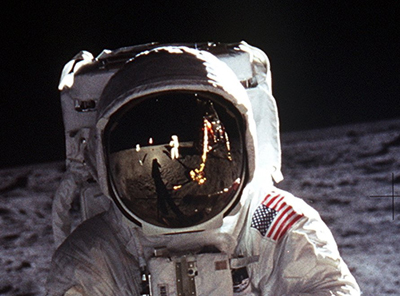
Apollo 11 moon landing, July 1969.
For mainstream film criticism, however, the patterns and the significance-laden associations they trigger have to be constrained somehow. Not everything is relevant to the implicit meanings of the film. This condition, I think, shows the real gap between the 237ers and the pros. One interviewee’s enthusiasm marks this difference: Kubrick, he says, is “thinking about the implications of everything that exists.” No mainstream critic would dare make this move.
What are the constraints on interpretation within the community of publishing critics, either journalistic or academic? Here are some common ones.
Salience: The patterns and associations are more plausible if they’re readily detectable– if not at first, then on subsequent viewings. The case gets stronger if the motif is reiterated along many channels—image, dialogue, music, sound effects, written language. The Native-American genocide association is moderately salient, present in both items of décor and in Ullman’s line about the burial grounds. Accordingly, many viewers have picked up on it. On the other hand, even repeated viewings don’t help us (me, at least) to identify the magazine as Playgirl.
Coherence: The patterns and associations are more plausible if they’re related functionally to the narrative—not just to single moments but to its overall development. Most critics writing about The Shining assume that it’s centrally about the disintegration of the family. They have gone on to relate this to the way that the delusions of patriarchy subject women and children to its control. (That common academic trope of “the crisis of masculinity” hovers nearby.) This thematic thrust can be traced scene by scene, and the motifs of fairy tales, American history, and the Minotaur can blend with specific plot twists and character presentation. Some of the Room 237 critics’ readings mesh with the arc of the narrative, but many, such as certain overlays during dissolves, seem unmotivated by narrative factors.
Congruence with other relevant artworks: The patterns and associations gain plausibility if they can seem congruent with other works by the same artist or in the same genre. For example, the uncertainty about whether Jack is imagining the Gold Room or whether it’s a genuine supernatural entity is characteristic of horror/ fantasy films. Here the 237ers are more in line with their mainstream colleagues. The unresolved ending, leaving us with a puzzle about whether Jack himself is a reincarnation of someone from the past, isn’t out of keeping with the ending of 2001. The room 237 itself, one of Ascher’s critics suggests, is a bit like the old man’s bedroom and the space pod in the earlier film.
Appeal to authorial intention: The critic’s case gains plausibility if people having significant input into the work claim the patterns and associations were deliberately put there. While rewatching The Shining, Nicole Kidman remarked of Kubrick:
“He always said that you had to make sure the audience understood key pieces of information to follow the story, and that to do that you had to repeat it several times, but without being too obvious about it,” Ms. Kidman said. “Here, in this scene, look at how there is this rack of knives hanging in the background over the boy’s head. It’s very ominous, all of these knives poised over his head. And it’s important because it not only shows that the boy is in danger, but one of those very knives is used later in the story when Wendy takes it to protect herself from her husband.”
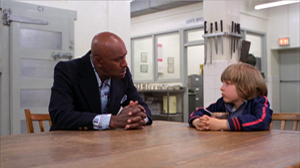
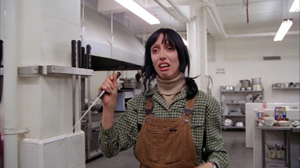
Most mainstream critics would, I think, find that Kidman’s inference rings true. It picks up a fairly salient cue, it invokes a pattern involving the knives, and it squares with the unfolding of the narrative. She reports that Kubrick understood the need for patterns to have salience, and it seems quite likely that he was the sort of artist to use pictorial prefigurations like this. Note, though, that this shot exemplifies function-driven dramaturgy—foreshadowing—not thematic interpretation.
By contrast, consider the Room 237 critic who takes The Shining to be Kubrick’s apology to his wife for staging the fake Apollo 11 moon landing. As Ascher presents the case, it involves a long chain of causation. It starts from the claim that, whether or not NASA actually sent a crew to the moon, the landing that the public saw was staged. The project needed front-screen projection. Kubrick was the master of those special effects. He agreed to help film the fake landing. Later he felt guilt for it. So by making a film about a husband/wife conflict, Kubrick confesses to his mistake. This backstory would gain a lot of plausibility if a NASA staffer or one of Kubrick’s crew came forward to support any part of it, in the way Kidman offers testimony about Kubrick’s working methods. It would be even better if the Apollo tale could be tied to the specifics of the unfolding narrative. And it would be best if the interpretation of this film didn’t depend on a (questionable) interpretation of another film–the Apollo 11 footage.
The Apollo 11 argument illustrates the risk of appeals to intention: they tend to substitute causal explanations for functional ones. That is, they tend to look for how something got into the film rather than what it’s doing in the film. But that’s a risk that professional critics run as well when they appeal to intention. The problem is just more apparent when the causal story that’s put forward seems tenuous.
I’ve argued that the cue-inference method and the use of association to create patterns aiming at referential and implicit meanings are involved in all interpretations, staid or unorthodox. But the constraints I’ve just sketched aren’t so fundamental to interpretation as such. They typify the established critical institution, which includes journalism high and low, belles-lettres (e.g., The New York Review of Books), specialized cinephilia (eg., Cinema Scope), and academic writing.
Not everybody belongs to that institution. There are other arenas of film criticism, and there’s no mandate that discussion in those realms adhere to the constraints urged by professional criticism. Some readers prefer to muse on barely perceptible patterns, incoherence, unlimited association, and relatively unrestrained speculations about Kubrick’s mental processes. Fans like to think and talk about their love, and anything that gives them the occasion is welcome, no matter what any establishment thinks. To a considerable extent, Ascher’s film documents the habits of folk interpretation.
Some precedents
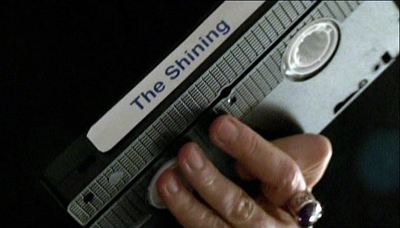
But why now? Why do amateur critics today launch these ambitious expeditions? The short answer, as so often, would be: Because they can. As Juli Kearns points out, it was thanks to VHS, then DVD, that she was able to scrutinize The Shining. Home video has allowed us, including all the obsessed among us, to halt and replay a movie ad infinitum—a process that Ascher’s own film freely indulges in. I think, though, that there are other historical factors that impel fans to dig ever deeper into the movies they love.
Most obviously, there’s the rise of the puzzle film, the movie that litters its landscape with hints of half-buried meanings. The vogue for this began, I suppose, in the late 1990s with films like Memento, Magnolia, and Primer. Even then, though, there were different constructive options. Primer called out for re-watching because much of its plot was obscure on a single pass; you had to examine it closely to figure out its basic architecture. By contrast, Memento’s principle of reverse chronology was evident on first viewing. I suspect that most viewers, like me, studied the film to pick up the finer points of its form and to try to disambiguate the Sammy Jankis plotline. Still different was Magnolia, with a perfectly comprehensible plot that planted a Biblical citation in its mise-en-scene. In this case, the extra stuff suggested a thematic level that might not be apparent otherwise.
Some critics have objected that the Room 237 critics turn Kubrick’s film into a mere puzzle movie, the implication being that puzzle movies are inferior forms of cinema. Yet I don’t see a good reason to scorn them. Assuming that films often solicit our cognitive capacities, I don’t see why artists shouldn’t ask us to exercise them. Cinema takes many shapes, and one critic’s puzzle (“Rosebud,” “Keyser Söze”) is another critic’s mystery. Some artworks throb with passion; some are more intellectual and austere. There is Mahler, and there is Webern. Even artworks with a lyrical or emotional dimension ask for decipherment and meditation too. Dante explained to his patron Can Grande della Scala that he had laid layers of non-literal meanings into The Divine Comedy. The poem, he explains, is “polysemous.” Its meanings are to be grasped and pondered upon in the manner of Scripture.
Long before puzzle movies came into fashion, literary modernism had assigned readers this sort of homework. The idea of loading every rift with ore was taken quite seriously by T. S. Eliot, who supplied footnotes to The Waste Land. Could you really hope to understand it without reading Jesse Weston’s From Ritual to Romance? James Joyce built so many layers into Ulysses that he had to take a critic aside and explain them to him, so the critic could then publish a guidebook to the novel. Finnegans Wake is supersaturated with references, puns, and esoteric meanings. If ever an artwork needed decoding, this is it. One of the earliest scholarly studies is called A Skeleton Key to Finnegans Wake.
In cinema, Peter Greenaway’s Tulse Luper series seems to be his bid for Joycean stature. More successful has been Godard, who in his mid-1960s films created an aesthetics of dispersal, a display of citational pyrotechnics that reaches its apogee in the Histoire(s) du cinéma. Surely this suite of films has engaged many critics in a process akin to puzzle-solving. More to our point today, we might see Kubrick’s films, especially 2001, as bringing aspects of high modernism into mainstream cinematic genres. We can hardly be surprised that after courting many interpretations of 2001 (whose subtitle cites a classic literary text), this director might be posing us similar tasks in a horror film.
Something else besides the rise of the puzzle film and high-modernist polysemy is probably responsible for the rise of this sort of fan dissection. Throughout history storytellers have experimented with creating what we might call richly realized worlds. Naturalist literature describes fine details of the writers’ society at the time, while Gulliver’s Travels and Looking Backward take us into alternative realms. The rise of fantasy and science-fiction literature has led readers to demand to know the history, lore, and furnishings of the imaginary places they visit. The Lord of the Rings saga, part of what Tolkien called his legendarium, is the obvious prototype, but the tendency to fill every niche of imaginary worlds is there in the Star Wars and Marvel universes too.
Once fans have become accustomed to raking every frame for clues about the plumbing system of the Millennium Falcon, they are going to expect an equal density in ambitious works in other genres. But not all films, or even all genres. I suspect that we won’t get the equivalent of Room 237 for My Fair Lady or Dinner at Eight. Combined with the intrinsic fascination of The Shining, Kubrick’s well-publicized concern for detail in the futuristic 2001 and A Clockwork Orange leads us to expect that a film centered on the enclosed world of the Overlook would yield bounty when scrutinized.
Finally, I should note that the seeming capriciousness of the Room 237 readers has a counterpart in one strain of academic interpretation. Borrowing from both Surrealism and a post-Structuralist concern for a “free play of the signifier,” Tom Conley and Robert B. Ray have practiced a criticism that yields results strikingly similar to the work of Ascher’s interviewees. Ray cultivates free association, as when he puns on characters’ names, and Conley has been known to find, as one Room 237 critic does, significant images in cloud formations.
The only major difference is that these academics typically discount an appeal to the filmmakers’ intentions: that move would inhibit the critic’s free-ranging imagination. Once in a while, the Room 237 critics follow suit on this front. They withdraw from attempts to anchor their readings in Kubrick’s life, thought, and personality. One who appealed to intentions early in the film has abandoned them by the end, and another frankly admits: “One can always argue that Kubrick had only some or even none of these [interpretations] in mind, but we all know from postmodern film criticism that author intent is only part of the story of any work of art.”
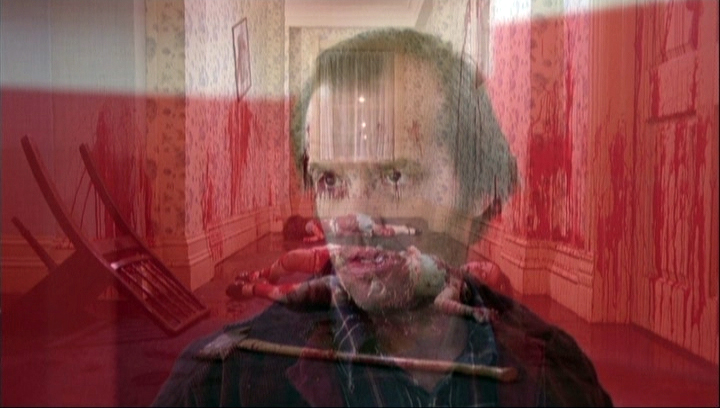
One of Ascher’s most engrossing final sequences shows John Fell Ryan’s effort to run The Shining forward and backward at the same time, superimposing them to create startling new images like the one that surmounts today’s entry. Folding the film over onto itself is in the spirit of Conley and Ray’s work, I think. The gesture hearkens back to that “irrational enlargement” of films that the Surrealists sought when they dropped in on the middle of one movie, stayed a little while, and then hurried out to slip into another. (They would have loved multiplexes.) Again, the apparently far-fetched meaning-making strategies of our amateur critics turn out to have some kin in the academic establishment and in the history of artistic culture.
I’ve made Room 237 more solemn than it is. It’s a pleasurable and provocative piece of work. It too would be worth interpreting, but I haven’t tried that here. I’ve used it as a kind of AV demonstration. It handily illustrates how interpreting a movie involves certain informal reasoning routines shared by “amateur” and “professional” critics. The differences between the two camps depend largely on what cues the critic fastens on in the film, what associational patterns the critic builds up, and how strongly the critic subscribes to the professional constraints on inferences.
Whether the cues, the patterns, and the inferences based on them seem plausible depends on what particular critical institutions have deemed worthwhile. Claims that won’t fly in mainstream or specialized cinephile publications can flourish in fandom. The purposes and commitments of these institutions may sometimes overlap, but we shouldn’t expect them to.
My account of these critics’ interpretations is drawn wholly from Ascher’s film. All of the interviewees have published more detailed arguments for their views. Bill Blakemore’s thesis about the film’s portrayal of Amerindian genocide is here. Go here for Juli Kearns’ writings on various aspects of Kubrick’s film. Jay Weidner’s thoughts are here. Geoffrey Cocks’ thesis is laid out in his book The Wolf at the Door: Stanley Kubrick, History, and the Holocaust (2004). Jay Fell Ryan discusses and updates his observations in this tumblr site. See also Ryan’s reflections after seeing Room 237.
There seems little doubt that musical texts featuring a verbal text or carrying a program that the composer has sanctioned (like Tyl Eulenspiegel’s Merry Pranks) can be interpreted in the manner of a novel or painting. Even non-programmatic works without texts have been subjected to interpretation. A still controversial example is Ian MacDonald’s 1990 The New Shostakovich, which launches detailed interpretations of hidden meanings in the composer’s work. For critiques, see Richard Taruskin’s articles in Shostakovich in Context, ed. Rosamund Bartlett, and Shostakovich Studies, ed. David Fanning.
The standard book on secret codes in the Bard is William F. Friedman and Elizabeth S. Friedman, The Shakespearian Ciphers Examined. On Saussure’s search for Latin epigrams, see Jean Starobinski, Words upon Words, trans. Olivia Emmet and “The Two Saussures,” Semiotexte 1, 2 (Fall 1974).
James Naremore’s wide-ranging interpretation of The Shining is in On Kubrick. Dennis Bingham provides a detailed history of journalistic and academic interpretations of Kubrick’s film in “The Displaced Auteur: A Reception History of The Shining,” in Perspectives on Stanley Kubrick, ed. Mario Falsetto, 284-306.
Shane Carruth explains that the puzzle aspect of Primer involves only making chronological sense of the plot, which avoids redundancy to an unusual degree.
It’s just that the way the narrative is constructed, I can see how when the story asks you to pull the threads together that’s probably going to happen where threads are pulled together wrong. I definitely didn’t set up this narrative to be open to interpretation. I mean, except for a few things. For the most part, the information is in there to have a very concrete answer as to what is happening in the narrative.
Some critics have worried that Ascher’s film gives viewers an impoverished view of what film criticism is. See for instance Girish Shambu’s comments here. For my part, I doubt that viewers come away believing that the views of these interviewees are typical of criticism as practiced in the mainstream. Nor do I see why Ascher’s movie needs the bigger dose of Theory that Girish prescribes. For my take on Theory (as opposed to theories and theorizing), see the book I edited with Noël Carroll, Post-Theory:Reconstructing Film Studies.
There’s another issue. Like Girish, Jonathan Rosenbaum reprimands the 237 critics for turning The Shining into a puzzle movie.
One way of removing the threat and challenge of art is reducing it to a form of problem-solving that believes in single, Eureka-style solutions. If works of art are perceived as safes to be cracked or as locks that open only to skeleton keys, their expressive powers are virtually limited to banal pronouncements of overt or covert meanings.
I’ve already proposed that a problem-solving approach need not reduce the artwork to a bloodless abstraction. (By the way, I don’t see puzzle-solving and problem-solving as quite the same; I’d say that a puzzle is a particular kind of problem.) But perhaps we should read Jonathan’s first sentence as objecting only to problem-solving approaches that posit “single, Eureka-style solutions.” That would rescue Eliot and Joyce, perhaps, although realizing that Ulysses is a remapping of The Odyssey is something close to a Big Solution to the novel.
In any case, it’s not clear that the 237ers are absolute in their arguments, at least not all the time. The last section of the film chronicles them backing away from their own machinery, confessing that there are dimensions to the film that they haven’t yet grasped, acknowledging that it remains elusive, mysterious, confusing, and, as Dante or a modern theorist might say, polysemous. Moreover, it seems clear that these critics all acknowledge the “expressive powers” of The Shining. They all testify to having been deeply shaken by it; that’s what fuels their urge to probe it. They just claim, like many critics, that the film’s significance extends beyond the visceral and emotional arousal it creates.
On richly realized worlds: J. R. R. Tolkien chose the Latin term legendarium to characterize the entire body of his writings set on the fictional planet Arda, (primarily on the continent of Middle-earth) and the universe in which it exists. The legendarium includes works published during his lifetime, The Hobbit, The Lord of the Rings, and The Adventures of Tom Bombadil, as well as posthumous publications edited by his son Christopher, The Silmarillion, “The Quest of Erebor,” and The Children of Hurin. Not strictly speaking part of the legendarium but closely related to it are the numerous drafts published as Unfinished Tales and the twelve-volume “The History of Middle-earth” series, as well as previously unpublished drawings and maps collected by Wayne Hammond and Christina Scull in J. R. R. Tolkien: Artist & Illustrator and The Art of The Hobbit. (Kristin wrote this paragraph, as you can probably tell.)
For samples of the post-Structuralist interpretative modes I mention, see Robert B. Ray, The Avant-Garde Finds Andy Hardy, and Tom Conley, Film Hieroglyphs.
In another entry I suggest that interpretation is only one critical activity we might pursue. On contemporary Hollywood cinema’s penchant for puzzle films and richly realized worlds, see my book The Way Hollywood Tells It. In Making Meaning: Inference and Rhetoric in the Interpretation of Cinema I try to show that just as we can analyze the conventions of a genre or mode of filmmaking, we can analyze the conventions of film talk. It’s one thing that I think a poetics of cinema brings to the table: an effort to disclose what principles shape a critical argument. As for my own tastes, I value consistency, coherence, constrained ascriptions of intention, and historical plausibility in interpretations. But in my own research, I favor analyzing films’ functional dynamics over hunting down hidden meanings.
P.S. 7 April: Thanks to David Kilmer for a corrected quotation!

The Simpsons: Tree House of Horror V: The Shinning (1994).
Roger Ebert
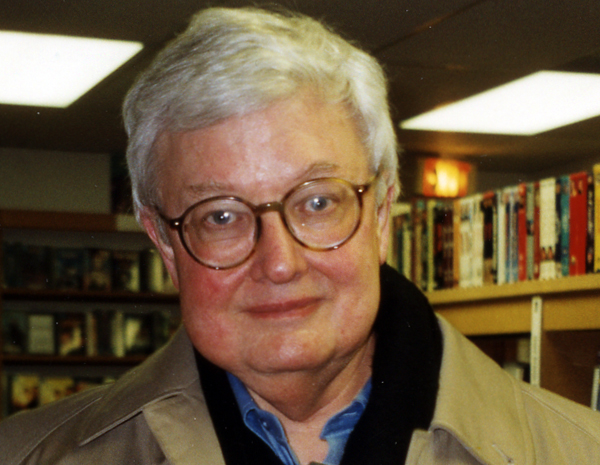
Roger Ebert at 4 Star Video Heaven, Madison, Wisconsin, 2003.
Kristin and David:
Roger died today. We can’t do him justice in such short compass, but we do want to acknowledge him and his life. He was an unstinting friend to us, and a great and good force in American film culture.
The Sun-Times obituary is here.
Later 4 April: Jim Emerson’s personal tribute is here.
5 April: Chaz Ebert’s statement is here.
6 April: Jim Emerson has gathered a constantly expanding collection of tributes here.
7 April: Rodney Powell of the University of Chicago Press offers recollections here.

Roger and Chaz Ebert, Ebertfest, Urbana, Illinois, 2010.
SIDE EFFECTS and SAFE HAVEN: Out of the past

Safe Haven; Side Effects.
DB here:
Occasionally someone will ask me how I watch a movie. Here’s a stab at an answer. If the film presents a story, fictional or nonfictional, I try to get engaged by it, as most viewers do. I also try to watch for how the filmmaker shapes sounds and images. Such things are hard to analyze on the fly, but we can at least be shot-conscious. I suppose as well there’s a small part of me asking whether what I’m watching is good or bad. Another part takes notice of what many viewers spot today: the sorts of story roles allotted to women and members of minorities.
At the same time, one module in my head seems to be looking for historical precedents and parallels to what I’m seeing. The purpose isn’t to dismiss current movies with “Aw, this has been done long ago.” Instead, I think I’m looking for ways in which earlier forms and styles are accepted, recast, or rejected by the creative choices being made today.
For instance, as I was watching Safe Haven and Side Effects, I was thinking of the 1940s.
Not that other periods haven’t left their traces. Both movies depend on crosscutting, something that goes back to the 1910s, as does the goal-oriented protagonist. Both rely as well on analytical editing, with Soderbergh in his usual spare way minimizing establishing shots in favor of compact constructive editing. The wobbly handheld shots cropping up in both films hark back to the 1960s and filmmakers’ periodic revival of them. Four-part structure: check. Rule of three: check. And so on.
But what popped out at me was something that I’ve noticed before. Films of the last twenty years or so borrow a lot of storytelling strategies that originated in the 1940s and carried through into the early 1950s.
In The Way Hollywood Tells It, I argued that 1990s Hollywood drew upon this heritage and in some ways pushed it farther. It isn’t just neo-noirs like Reservoir Dogs and Memento that owe a debt to the earlier period. Lots of films in many genres now casually use flashbacks, voice-overs, restricted points of view, multiple protagonists, network narratives, and replays of scenes from different perspectives—all strategies pioneered or consolidated in the 1940s. These techniques have become so accepted a part of mainstream moviemaking that we may forget that a comedy like The Hangover or a prestige drama like The Iron Lady presents fairly elaborate time schemes or tricks of character subjectivity.
We also tend to ignore the sheer eccentricity of the period. The 1940s introduced movies letting a house tell the story or embedding flashbacks within flashbacks within flashbacks. Characters dreamed things that came true, or realized that they were actually dead. Sometimes dead people narrated the story. All in all, things got pretty strange.
Part of that era’s legacy is the suspense thriller as we know it. I’ll be putting up a web essay on the development of the genre soon, but for now consider these two recent releases as heirs of that tradition. Of course there are big spoilers ahead.
Spooked
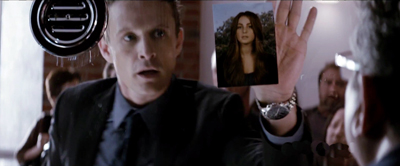
Like many 1940s thrillers, Safe Haven centers on a woman in peril. Most often the heroine is trapped in a house, and an unseen force or a ruthless husband is trying to kill or incapacitate her. The prototype is Gaslight (1944), where as often happens, the wife is rescued by a “helper male,” a romantic alternative to the husband. Variants of this plot include The Spiral Staircase (1946) and The Two Mrs. Carrolls (1947). This sort of domestic thriller, sometimes called a Gothic, tends to fill household spaces and everyday routines with vague threats.
Instead of confining its protagonist, Safe Haven builds its plot around a woman who has left home behind. Fleeing an abusive marriage, Erin arrives in a North Carolina town and slowly enters a love affair with Alex, a widower who runs a convenience store. Meanwhile her husband Kevin tries to track her down. The fairly conventional budding romance, as Erin joins Alex and his kids in forming a new family, is threatened by the prospect of Kevin finding her and dragging her back home. As a policeman, Kevin has unusual forces at his disposal: a crucial turning point is his putting out an unauthorized wanted poster. Not only does this endanger Erin’s new identity, but when Alex sees the poster, he breaks off their affair.
On-the-run plots are usually the province of male-centered thrillers like The 39 Steps and North by Northwest. It isn’t unknown, though, to make the woman a moving target. One of my favorites is Double Jeopardy (1999), in which Ashley Judd plays a wife convicted of her husband’s murder. When she learns that he faked his death, she realizes that she can’t be tried again for killing him. Released on parole, she pursues him, while her tenacious parole officer pursues her. An older example is Woman in Hiding (1949), in which Ida Lupino plays a wife who is supposedly murdered by her husband. Actually, she eludes death and tries to flee him, but he, discovering she’s still alive, catches up with her on a hotel staircase.
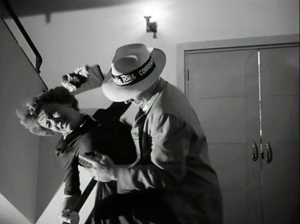
In such thrillers, there are two common ways you can generate suspense. Both depend on range of knowledge, as Alfred Hitchcock pointed out in 1947.
The author may let both reader and character share the knowledge of the nature of the dangers which threaten. . . . Sometimes, however, the reader alone may realize that peril is in the offing, and watch the characters moving to meet it in blissful ignorance and disquieting unconcern.
That is, the narration can attach us to a character and limit our knowledge to what she knows. Examples of this are Hitchcock’s Rebecca (1940) and Suspicion (1941), which quite strictly confine us to the heroine’s range of knowledge.
Safe Haven, like Woman in Hiding, takes the alternative option: omniscience, or what Hitchcock calls “sharing the knowledge of the dangers.” Crosscut scenes show Erin in Southport while Kevin follows her trail. Other crosscut scenes introduce us to Alex’s problems of raising his kids and grieving for his wife.
As Erin gradually settles into the community, we know that Kevin is closing in. He arrives during a town celebration, and the crosscutting becomes tighter. Thanks to Kevin, the store catches fire and endangers Alex’s daughter, while Kevin drunkenly wrestles with Erin at gunpoint.
Suspense and mystery go hand in hand, and suspense films have a habit of suppressing information about past events. Woman in Hiding begins with the wife’s car plunging into the river; later we get a flashback explaining what led up to the accident. Safe Haven begins with a black-haired woman hysterically running out of a house and taking refuge with a neighbor. What has led to this? The woman, now a blonde, then boards a bus, while we see a man with police credentials questioning witnesses and stopping other buses.
The plot is organized so that we don’t know for quite some time why Erin is being pursued by this exceptionally zealous detective. And some fragmentary flashbacks, mostly in the form of dreams (a favorite 40s device), hint that she has killed a man. Gradually, however, there are hints that this cop isn’t what he seems. Not until the end of the third part (circa 80:00) do we learn from a full flashback that the cop is her husband. Kevin is a crazed alcoholic who began to strangle Erin one evening; she stabbed him and fled her home. The teasing flashbacks, along with the suggestion that Kevin’s pursuit is an official inquiry rather than a private vendetta, misled us. What we saw at the start was Erin escaping from an abusive marriage.
A lower-key form of delayed and distributed exposition involves Alex and his kids. Instead of filling us in immediately on Alex’s life with his wife, we learn of their married life gradually. After Alex has fallen in love with Erin, he retreats to a room kept in memory of his dead wife. He riffles through letters she left behind, to be given to Josh and Lexie when they grow up. Later, Alex abandons Erin because of the wanted poster, and he retreats to his wife’s room, where he has a change of heart and goes to bring her into the home.
Why the change of heart? An unusual aspect of Safe House is the injection of, ah, otherworldly intervention. While living in her cabin, Erin meets a neighbor, Jo, who encourages her to get to know Alex. In the epilogue, Alex gives Erin one of the letters from his wife’s desk, labeled simply, “To Her.” It’s a sympathetic message expressing the wife’s support for the next woman to be wife and mother to her family. The picture inside is of Jo. Earlier, in the sacred space of Jo’s room, Alex seems to grasp that he has to reunite with Erin. At the climax, Erin, dreams that Jo is warning her that Kevin has caught up with her. As angel, ghost, or spirit—you choose—Jo has brought everyone together.
Reviewers, in this cynical age, scoffed at this device. I didn’t mind it because I liked its tie to tradition. Ghosts and angels have haunted American cinema from the start, but in the 1940s they played very prominent roles—not just in comedies like Topper Returns (1941) but in dramas. Beyond Tomorrow (1940), Our Town (1940), Happy Land (1943), A Guy Named Joe (1943), The Uninvited (1944), It’s a Wonderful Life (1947), and many other films unashamedly introduced supernatural beings as moral guides to the living. True, those films build their spooks into the premises of the plot early on, while Safe Haven saves its for a Big Reveal. But after The Sixth Sense (1999), this sort of twist shouldn’t seem too upsetting. (A second viewing reveals that Jo is unnaturally disturbed when it looks like Erin won’t bond with the family, and a few lines of dialogue take on new meanings when you know that Jo is dead.) Perhaps the gimmick seems wimpier when it’s invoked in a romantic thriller than in a masculine investigation plot.
Recommended dosage
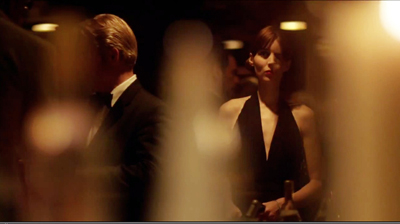
Steven Soderbergh is one of our most exploratory directors, a filmmaker who tries different things without making a big deal about it. He’s also a cinephile who, like Cameron Crowe, admires and quietly adapts classic studio traditions. He turns out lots of movies, a habit reminiscent of the contract director of yore.
I was skeptical of his pastiche The Good German (2006), but I do admire his compact, unfussy direction, as I mentioned here. I’m a big fan of Out of Sight (1998), and I think his last batch of films, from Contagion (2011) through Haywire (2012) and Magic Mike (2012), shows him to be a director whose every project is solid and intriguing. It’s a pity he’s announced his retirement after the upcoming Liberace project.
I doubt that in Safe Haven Lasse Hallström was consciously channeling 1940s suspense thrillers, but it seems likely that Soderbergh was trying his hand at something deliberately Hitchcockian. (Reviewers needed no nudging to make the comparison.) Beyond comparisons with the Master of Suspense, Side Effects’s debt extends to two plot patterns of the 1940-early 1950s that Scott Z. Burns’s script ingeniously combines.
The first is what I call the Crazy Lady plot. The Snake Pit (1948) is probably the clearest example, but there are many others, including Bewitched (1945), Dark Mirror (1946), The Locket (1946), Shock (1946), Possessed (1947), and Whirlpool (1950). The plot pattern can be found in literary thrillers too, such as Margaret Millar’s The Iron Gates (1945) and John Franklin Bardin’s fine Devil Take the Blue-Tail Fly (1948). Hitchcock didn’t tackle a Crazy Lady plot until Marnie (1964), but in the 1940s he tried a Crazy Gentleman variation in Spellbound (1945).
In such films, the woman is the mystery. What is wrong with her? Why do her problems have such horrible consequences for her and others? Often the woman displays an abnormal division in her mind: the prospect of a split personality is never far off. The key factor is that her behavior is inconsistent. A rich woman shoplifts (Whirlpool), a sweet girl fatally stabs her fiancé (Bewitched). Accordingly, only a psychoanalyst can probe the sick woman’s behavior and track down the founding trauma, typically something that happened in childhood. A crucial convention is the scene in which the woman breaks through and realizes what ails her, as in this moment from Whirlpool. It’s typical of this plot that therapeutic dialogue is often paralleled by police questioning.
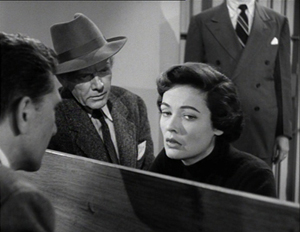
Side Effects gives the Crazy Lady’s mental problems a modern spin. Emily is suffering from depression, and her husband Martin’s recent release from prison hasn’t helped her recover. After ramming her car into a parking-garage wall, she’s cared for by Jonathan, a hospital psychiatrist also in private practice. He starts her on antidepressants, eventually giving her one recommended by Emily’s previous psychiatrist, Victoria. This seems to help, although it induces Emily to sleepwalk. While she’s apparently sleepwalking, she stabs Martin to death.
Now Jonathan is in a bind. If the drug Ablixa has been misprescribed, Jonathan is responsible for Martin’s death and Emily’s fate. Jonathan defends Emily and his testimony helps win a verdict of not guilty by reason of insanity. He continues to supervise her recovery while his career collapses. His patients abandon him, his partners cast him out of their business, and he’s dropped from a lucrative experiment. He’s also being investigated by his professional association.
In other words, Jonathan is now fulfilling a second 1940s plot pattern: The innocent man trapped by circumstance. He might be a murder suspect (Stranger on the Third Floor, 1940; Phantom Lady, 1944; The Big Clock, 1948) or an ordinary guy dropped into international intrigue (Journey into Fear, 1943; The Ministry of Fear, 1944). Side Effects combines this noirish convention with the Crazy Lady plot. It turns out that Emily and Victoria have conspired to set up Martin’s death. Emily actually hates her husband, and she’s learned enough from his insider-trading schemes to understand that a scandal could drive down Ablixa’s stock price. She and Victoria, who have become lovers, can make millions as a result of the murder.
Yet suspecting all this doesn’t help Jonathan. Emily can’t be tried again, and as Jonathan begins to grasp their scheme, Victoria draws the net tighter around him. She sends his wife faked photos suggesting that he and Emily have had an affair.
In 1947, novelist Mitchell Wilson pointed out an important convention of the thriller. He claimed that the defining feature of the genre was a fear felt by the protagonist that is communicated to the reader: the protagonist is in continual danger. But when the threat reaches its peak, the worm must turn.
The framework of the suspense story is the continual struggle of the frightened protagonist to fight back and save himself in spite of his pervading anxiety, and in this respect he is truly heroic. The action of the story does not consist in mere activity, but in the hero’s change of mood in response to changing circumstances.
Jonathan’s desperation leads him to concoct a scam of his own. Since Emily is in prison and can’t communicate with Victoria, he is able to play them off against one another. Holding a physician’s control over Emily, he can convince her to double-cross Victoria and unmask her. Then he double-crosses Emily and consigns her to the asylum while returning to his family.
Again, I’ve ironed out the ups and downs of the film in order to lay out the plot’s design. In the actual telling, we’re attached first to Emily and then more closely to Jonathan. The overall pattern resembles that of Whirlpool, which concentrates first on the way the wife’s kleptomania draws her to the sinister therapist Korvo, and then shifts to the investigation undertaken by the police and her husband, a psychoanalyst. (Whirlpool, like Side Effects, centers on dueling shrinks.)
Here the Crazy Lady premise is a masquerade, and Soderbergh “plays fair” with us about it. The 1940s films rely on mental subjectivity—voice-over inner monologues, exaggerated sound effects, hallucinations, dream imagery—in order to show that the protagonist is truly wacko. Side Effects presents Emily objectively, relying on somber color schemes, top lighting, and Rooney Mara’s morose demeanor to suggest a young woman struggling against depression.

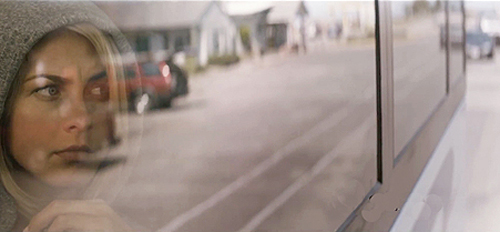
From the outside we watch Emily’s glum visits to Martin in prison, their frustrated sex when he gets out, her impassive crashing of her car, her confiding in her boss, and her breakdown at a cocktail party. There are a few optical POV shots, but those are justified as Emily’s numb stare–although Soderbergh does sneak past us a POV shot that, because of distorting glass, might seem to be projecting Emily’s state of mind expressionistically. (See above.) Virtually everything we see suggests a woman losing control, so that when Emily perks up after going on Ablixa, we, like Jonathan and Martin, think she’s recovering.
Safe Haven leads us to jump to a conclusion—that the cop pursuing Erin is doing so legitimately—only to rescind that by filling out the teasing fragmentary flashbacks. Side Effects does something similar, but through simple ellipsis. The plot lets us think that Emily is genuinely depressed by skipping over things it could have shown, such as her fake vomiting or her dumping the prescription pills down the toilet. Only at the climax, when Jonathan wrings the truth from Emily, do we get subjective imagery. There are artificially sun-sprayed flashbacks of her days with Martin just before his arrest, as well as glimpses of her therapy with Victoria, followed by replays of the suicide attempts, now revealed as faked.
The 1940s popularized this sort of filling-in flashback, in which a replay shows items that were left out of an earlier presentation. The most famous example is the return to the opening of Mildred Pierce (1945). Now as then, we can’t completely trust a thriller’s narration. There are mysteries in the story, but there are also mysteries in the storytelling. No matter how much a thriller seems to tell us, key information is usually held back, and the suppression won’t always be signaled. To get Rumsfeldian: there are always known unknowns, but thrillers trade in unknown unknowns, data we didn’t realize were there.
There’s a lot more to say about these movies. For example, both trade on a premise common to the 1940s and American movies thereafter. Call it the Margaritaville Rule: There’s a woman to blame. Erin brings calamity to Southport and trauma to her would-be family, and Jonathan’s travails are the result of two scheming women, seconded by a hard-edged wife who won’t hear out his explanations.
Moreover, I hope it’s clear that I don’t think these two recent releases are merely cloning 1940s conventions. They incorporate subjects and themes of our time, like spousal abuse and the insidious power of Big Pharma. They exhibit some innovative plotting, such as the revelation of a guiding spirit in Safe Haven and the combination of Crazy Lady premises with the Cornered Innocent in Side Effects. And Soderbergh’s offers an exercise in crisp direction, from its conventional opening shot to its grimly symmetrical closing one.
My point is simple: However new our films may seem, whether they’re accomplished (Side Effects) or banal (Safe Haven), in important respects they’re continuing traditions that go back decades.
Why then, you may ask, do so many academics and journalists insist that classical cinematic storytelling is dead? Why do they so resolutely ignore the evidence of continuity between today’s films and those that went before? That’s a mystery I can’t solve.
Hitchcock’s remark about the range of knowledge and suspense comes from “Introduction: The Quality of Suspense,” Alfred Hitchcock’s Fireside Book of Suspense (New York: Simon and Schuster, 1947), viii. Mitchell Wilson’s remarks on fighting back are in “The Suspense Story,” The Writer 60, 1(January 1947), 16. His novel None So Blind (1945) became the Renoir film Woman on the Beach (1947).
The idea of the “helper male” in the Gothic is developed by Diane Waldman in “’At last I can tell it to someone!’: Feminine Point of View and Subjectivity in the Gothic Romance Film of the 1940s,” Cinema Journal 23,2 (Winter 1984), 29-40.
For more background on the 1940s thriller, see the web essay, “Murder Culture: Adventures in 1940s Suspense” and this blog entry. Another blog entry discusses replays in 1940s and 1950s American film. For more arguments about the debts of today’s films to studio Hollywood, see The Way Hollywood Tells It and other entries on this site. I analyze the duplicitous opening of Mildred Pierce, along with its revelatory replay, in this entry and its accompanying video.
Today’s entry neglects another important component of Side Effects: the music. For that, see Roger Ebert’s acute review. Expressive scores are, needless to say, central to 40s thrillers too.
Mike Grost’s encyclopedic website supplies a great deal of information about the mystery genre.
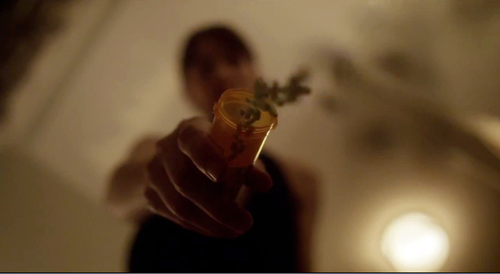
Side Effects.
P. S. 24 March 2013: Thanks to Gabe Klinger for correcting a dumb date mistake!
Sir Alfred simply must have his set pieces: THE MAN WHO KNEW TOO MUCH (1934)
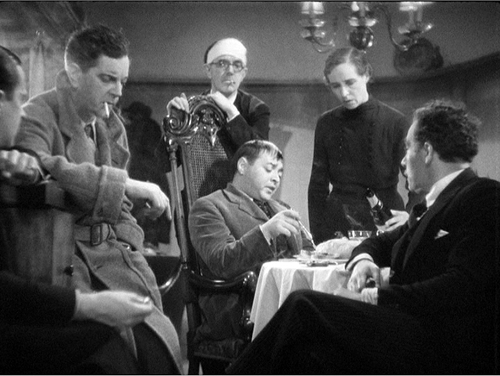
The Man Who Knew Too Much (1934).
DB here:
Hitchcock made six remarkable thrillers from 1934 through 1938, and I have long believed that the first one was the best. I think very well of Sabotage, and both The Lady Vanishes and The 39 Steps are strong contenders. But for me, The Man Who Knew Too Much has got damn near everything going for it.
I came to it a little late. It wasn’t the first Hitchcock I wrote about; that was Notorious, in a 1969 piece that nakedly reveals the limitations of a college senior’s knowledge. Nor was it the first Hitchcock I saw; that was Vertigo, when I was about ten. Inauspiciously for me, when Vertigo was revived for national television broadcast in 1972, I was flying to a job interview in Madison, Wisconsin.
I got that job, though, and soon The Man Who Knew Too Much became very important for me. Seeing it at a film society screening, I was bowled over. Then I discovered that it was available for purchase in a cheap 16mm print. I bought a print and began teaching the film as a model of narrative construction. It worked its way into the first edition of Film Art, in 1979 and hung around there for several editions.
That sample analysis has been available as a pdf on our site, but check it out at the Criterion site, where it’s enhanced with nice frame enlargements and a major extract. The essay makes my case for the movie as an extremely well-constructed piece in the classical storytelling tradition.
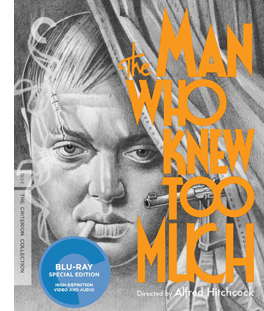 So I was the ideal consumer for a spruced-up DVD/ Blu-ray release, and as usual Criterion doesn’t disappoint. It’s a handsome version, with some fine supplements. We get two rare interviews with Sir Alfred from CBS’s arts program Camera Three (featuring Pia Lindstrom and William K. Everson) and a perceptive discussion with Guillermo del Toro, who makes a vigorous case for the film. So does Philip Kemp in his commentary, which is strong on production background. Kemp offers valuable information on script versions and on Hitchcock’s niche in the English industry. The accompanying booklet includes a lively appreciation by The Self-Styled Siren, aka Farran Smith Nehme.
Interest in Hitchcock seems to be the one constant in the whirligig of tastes in film culture. He is a mainstay of home video and cable television; apparently the films can be re-released in perpetuity. Professors love to teach his films. The techniques are obvious and vivid, and the films offer a manageable complexity that encourages interpretation. Class, gender, power, the law—whatever your favorite themes, they’re all on the surface, yet enticingly ambivalent. Not to mention how much fun these movies are to watch. I’ve always enjoyed introducing “lesser Hitchcock” like Stage Fright and Dial M for Murder and then watching the audience fall under their spell.
Critics navigate by Hitchcock as a fixed pole star. Reviewers compare every new thriller to the classics of The Master of Suspense. Just look at what people write about Soderbergh’s Side Effects. And for those who promoted the auteur approach to Hollywood cinema, Hitchcock was a beachhead. Who could doubt that this man turned out personal projects within the impersonal machine known as Hollywood? And if he could do it, why not Ford, Hawks, Sternberg, Ray, and all the rest? Hitchcock nudged skeptics down the slippery slope toward auteurism.
Even if Hitchcock isn’t to your taste, you can’t avoid his influence. That became obvious around the 1970s, when directors began borrowing from him more or less overtly: Spielberg’s Vertigo track-and-zoom in Jaws (now itself a convention), De Palma’s homages/pastiches, Polanski’s use of point-of-view in Repulsion and Rosemary’s Baby, the endless Psycho sequels and the van Sant remake, and the rest. But Hitch was no less influential in his own day; I’d argue that filmmakers of the 1940s had to raise their game if they wanted to meet the challenge of Rebecca, Foreign Correspondent, Suspicion, Shadow of a Doubt, Spellbound, and Notorious. Billy Wilder told a reporter that Double Indemnity was his effort to “out-Hitch Hitch.”
What was so special? Obviously, the throwaway humor—sometimes airy, sometimes slapstick, sometimes sardonic. And obviously a gift for switching situations around, playing them against cliché, setting us up for a jolt. But I think there’s something else afoot. Part of the Master’s repute rests on virtuosity of film technique. Hitchcock makes movie movies, even when, like Rope or Dial M, they seem “theatrical.” And this movieness is best seen, I think, by considering a term that always comes up with Lord Alfred: the set piece.
Maintaining a tradition
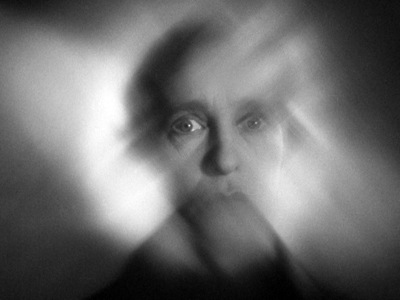
Hitchcock held onto the flamboyant expressive devices of silent and early sound cinema far longer than any other director. For decades he kept alive techniques that many directors thought were old hat: abrupt cuts to details of gestures and objects; blurry point-of-view images to suggest distraught or befuddled states of mind (as above); very brief insert shots to accentuate violence. Compare Battleship Potemkin with Foreign Correspondent’s assassination scene.
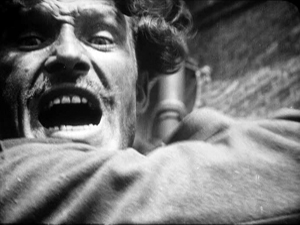
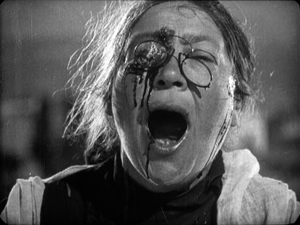
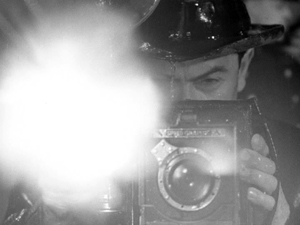
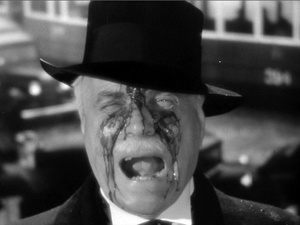
Hitchcock built entire films around classic silent techniques. The Kuleshov effect governs Rear Window; the German “entfesselte” or “unchained” camera dominates Rope and Under Capricorn. Rope and Dial M revive the aesthetics of the German kammerspielfilm, or “chamber play.” The Germanic look was alive and well in the spiderweb shadow-work of Suspicion, while both French Impressionism and German Expressionism inform the dream sequences of Spellbound and Vertigo. He also preserved the “creative use of sound” that was the hallmark of directors like Clair and Milestone. While others had pretty much given up the expressionistic use of music and effects, Hitchcock was always ready to draw on them. The hallucinatory Merry Widow Waltz haunts Shadow of a Doubt, while Hitchcock’s penchant for giving us two pieces of information simultaneously, one in the image and another on the soundtrack, let him design scenes visually and push a lot of dialogue offscreen.
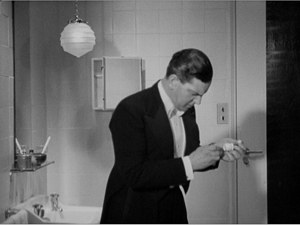
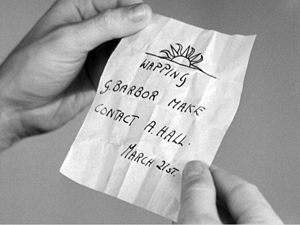
This flexibility of technique modulates from scene to scene. In The Man Who Knew Too Much, note-reading is presented in three ways, in rapid succession. First, Bob finds Louis’ note in the hairbrush.
Soon Bob gets a message from the front desk. What does it say? Hitchcock hides that by, for once, not supplying subjective point of view.
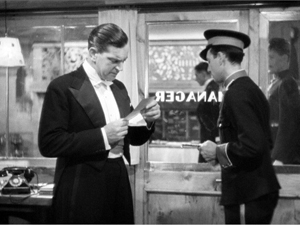
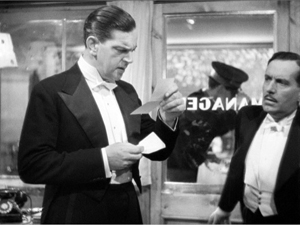
Only when the note is passed to Jill do we get to see it, but with a twist. Nobody but Hitchcock would add an extra shot that cuts to the note in her hand without revealing what it says.
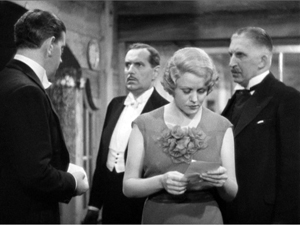
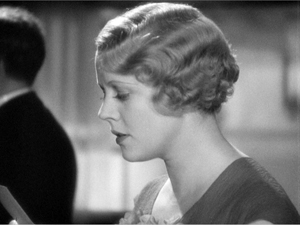
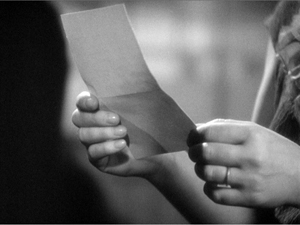
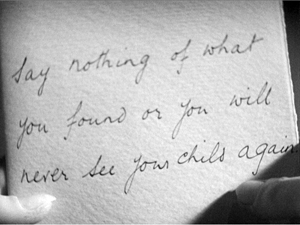
That extra shot is what Eisenstein called a primer; as with dynamite, you need a little charge to trigger the blast.
We often forget that classic silent directors used their pictorial techniques for suspense. Lang’s Mabuse films and Spione furnish plenty of instances, but so do the Soviet montage films. The scene in which the police wait for the worker to return to his wife in The End of St. Petersburg now looks like pure Hitchcock, and of course the Odessa Steps sequence was the Psycho shower of its day. So it isn’t surprising that Hitchcock would turn his silent-film virtuosity toward creating scenes of high tension and threatened violence. Nor is it surprising that his skills would crystallize in “set pieces.”
Everybody talks about Hitchcock’s fondness for set pieces. It’s part of his brand. We have the Statue of Liberty climax in Saboteur, the milk carried up the staircase in Suspicion, the milk-and-razor scene and the final suicide in Spellbound, the spectacular rescue of Alicia at the end of Notorious, and the efforts of Bruno to retrieve the lighter in Strangers on a Train.
But, come to think of it, what makes something a set piece?
Game, set piece, match
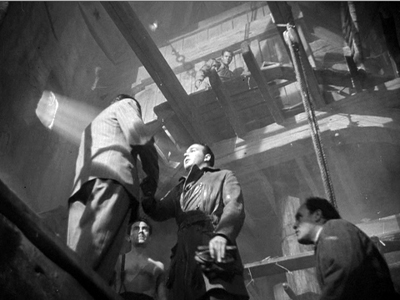
Foreign Correspondent (1940).
As commonly understood in the arts, a set piece is a fairly self-contained portion of a larger work. It has a distinct beginning and end, and it’s understandable and impressive if extracted from its original. It’s designed to be a bravura display of concentrated virtuosity. In music, an example would be an operatic aria like the Queen of the Night’s in The Magic Flute: it is so flashy and complete in itself that it can enjoyed on its own, in a concert setting.
Two early uses of the term shed light on its implications. In stage parlance, a “set piece” is an item of the set that can stand alone, like a gate or fake tree. In pyrotechnics, a “set piece” is a carefully patterned arrangement of fireworks; here again, it implies a display that dazzles the audience.
In the silent era, I’d suggest, the clearest exponent of set pieces is Eisenstein, who became known as “the master of the episode.” Many of his big scenes, like the Odessa Steps massacre, are developed at such length that they function as mini-films. But you can consider passages in Chaplin and Keaton as set pieces—the dance of the breadrolls in The Gold Rush perhaps, or the windstorm in Steambout Bill, Jr. The musical would seem to be a natural home of the set piece, with numbers standing out against more mundane scenes. In modern cinema, again under the aegis of Hitchcock: De Palma offers plenty, and perhaps the prize fights in Raging Bull constitute a string of them. Today the home of the set piece is the action picture; the chases and fights are the main attraction, and the genre challenges directors and crew to find new ways to intoxicate us.
The aesthetic of the set piece implies that some scenes function as filler while others get the whipped-up treatment. If that’s right, many great directors don’t favor mounting set pieces. Ozu, Mizoguchi, Dreyer, Hawks, and others present what we might call “through-composed” films. Just as Wagnerian opera and its successors minimized set pieces, these filmmakers create a surface texture that doesn’t create self-contained high points. (I grant you that the immolation of Herlofs Marthe in Dreyer’s Day of Wrath might count.)
Given the detachable quality of set pieces, it’s true that some of Hitchcock’s can seem implausible or gratuitous. How essential is Guy’s lighter to any plausible scheme of Bruno’s? If you want to kill Roger Thornhill, why send him to a crossroads in Midwest corn country? (A knife in the back on the Greyhound is more reliable.) It was this tendency to sacrifice story logic for stunning anthology bits that Raymond Chandler deplored:
The thing that amuses me about Hitchcock is the way he directs a film in his head before he knows what the story is. You find yourself trying to rationalize the shots he wants to make rather than the story. Every time you get set he jabs you off balance by wanting to do a love scene on top of the Jefferson Memorial or something like that.
Chandler has a point. How do you integrate a set piece into a whole movie? (I’ll make some suggestions shortly.) But first, give Hitch his due. For him, I think a set piece was a compact repository of inherently cinematic ideas carried to a limit within a sequence. A set piece is a challenge: How much can you squeeze out of a situation?
Go back to Foreign Correspondent. Setting an assassination in Amsterdam allowed Hitchcock to integrate the idea of a clue based on a waywardly turning windmill. So far, Chandler’s objection seems tenable: The windmill is just a gimmick. But once Hitchcock sets his hero exploring the lair, he can create a set piece that answers a question that no one ever thought to ask before: How do you eavesdrop in a windmill?
Johnny Jones has to evade the killers by crawling up alongside the giant gears, then down, then up again. At each step he barely escapes being spotted. When he seems safe, his topcoat gets snagged in the grinding gears, so he has to slip his arm out of it—just in time to avoid being crushed.
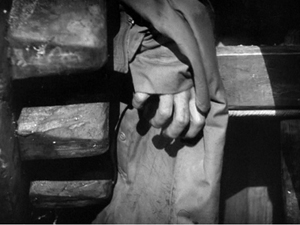
Yet once Jones is freed from the coat, it’s carried around the gearwork and might be spotted by the gang. And the old diplomat upstairs, mind hazed by drugs, is likely to reveal Jones’ presence. Hitchcock squeezes seven minutes of suspense out of all this, with a casual air that suggests: Of course, dear chap, any director worth his salary can see that a windmill harbors all kinds of excruciating menace. All in a day’s work, you know.
A whispered terror on the breeze
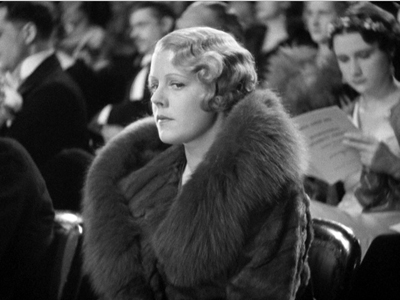
If anything is a set piece, the Albert Hall sequence in The Man Who Knew Too Much is. Philip Kemp’s commentary for the Criterion DVD considers it Hitch’s first, although aficionados would probably consider the “knife” sound montage of Blackmail at the very least a rough sketch for what would come. Lucky you: The entire Albert Hall sequence is excerpted on the Criterion site.
A set piece benefits from a simple premise. Here, Jill’s child is being held hostage, which keeps her from informing the police of what little she knows about the plot. We know that during the concert an assassin will try to shoot a diplomat.
You can imagine Chandler asking: Why plug Ropa during a concert, with all those witnesses? Why not when the target is on the sidewalk, shot from a rooftop for easy escape? You can hear that bland replying murmur: Raaaymond, it’s only a moovie…
So we have some conditions for a set piece: a compact piece of action limited in time and space. But there’s also a strong time marker. Ramon the assassin is to wait for a dramatic pause in the score; it’s followed by a shattering choral outburst that will muffle the pistol shot. We’ve been given a rehearsal of the passage in a gramophone record, but since we don’t hear the whole piece then, we can’t predict exactly when the chorus will hit its peak.
Hitchcock magnifies this uncertainty by letting the piece, Arthur Benjamin’s Storm Clouds Cantata, play out in its entirety. Its combination of lyrical and dramatic passages blend into a stream of music that coincides with the emotional action onscreen. I suspect that the piece, composed specifically for the film, glances at the most celebrated new choral piece of the era, William Walton’s Belshazzar’s Feast (1931). It too has a charged dramatic pause followed by a tremendous choral blast: “Slain!” You can listen to it here, and you can hear some of the musical affinities at 27:11 and after.
So the self-contained quality of the sequence is enhanced by the unfolding soundtrack, as well as its “bookend” structure: Jill arrives at the Albert Hall/ Jill leaves. (Hitchcock was very fond of this coming-and-going bracketing; many scenes of The Birds are built out of this.) But to be a set piece we need virtuosity too, right?
As our Film Art essay indicates, Hitchcock structures the scene using nearly every technique in the silent-cinema playbook. We get dynamically accentuated compositions, crisp point-of-view editing, subjective vision (even blurring as Jill drifts into a panicky reverie), and suspenseful crosscutting back to the gang holding Bob and Betty prisoner. The techniques build to their own crescendo, with more and shorter shots of Jill, the orchestra players, and the curtain concealing Ramon. As the climax approaches, details of the players’ performance pass in a flash. As another layer, though, all these visual techniques are synchronized with the musical structure of the piece. Most obvious is the slow tracking shot back from Jill as the female soloist launches in:
There came a whispered terror on the breeze./ And the dark forest shook.
The text has always teased me, because in my early years of studying the film I couldn’t hear everything there. Now that the Storm Clouds Cantata has become a minor concert piece, we have a full version of the text. It’s the description of an especially ominous storm, one that drives birds away and makes trees tremble in fear. The only creature left, vulnerable to the gale, is a child:
Around whose head screaming/ The night-birds wheeled and shot away.
The orchestral and choral forces mount on the line that has always come through the sound mix:
All save the child—all save the child.
The line is ambiguous. Its literal sense is that all the creatures have fled the oncoming storm except the child (“all save the child”). But Hitchcock’s cutting and the film’s overall context leave it as an imperative: the child must be rescued. Thus the musical dynamics and the text stress, for us and presumably for Jill, that Betty’s safety depends on what she does.
Soon the cantata’s text finds another analog in the concert hall. The choir sings of the storm clouds finally breaking and “finding release.” That phrase, repeated with rising intensity, yields the dramatic pause and then the final outburst that is to cover Ramon’s pistol shot. But now we have to see this phrase as prophecy and comment: Jill’s scream during the pause is the release of her tightened anxiety. And of course the line slyly signals the release of the suspense built up through the whole sequence.
With Hitchcock, you always get more.
In all, the sequence becomes exactly what a set piece ought to be: compact, with sharp boundaries and a strongly profiled arc of interest, elaborated with a great variety of technical resources and a thrusting emotional impact. But is it too much of an independent sequence? One can imagine Chandler worrying that Hitch doesn’t care much about how to hook it up with everything else. Let’s see.
This scepter’d isle
There’s no doubt that a plot driven by set pieces can seem episodic, just a matter of pretty clothes clipped to a slender line. In action movies it’s a classic problem, which, say, Speed doesn’t fully solve but Die Hard does.
You can mask an episodic plot, though, through some stratagems. First, make your filler material charming. The Man Who Knew Too Much gives us comedy in the dentist office and in the Tabernacle, with Bob and Clive mumbling messages through hymnody. You can also whisk the audience from scene to scene so quickly that the viewer has to concentrate on local connections. This is one purpose of what I’ve called the hook, the transition that smoothly links the end of one scene with the beginning of the next. If you’ve got some plot holes, strengthen your hooks–especially those that hide your gaps.
The Man Who Knew Too Much has some nifty hooks. I especially like the way the fingers pointing to the bullet hole are followed by a shot of Ramon’s head: effect and cause neatly given by a straight cut. Then there’s the contrast of the fire in the fireplace dissolving to the skier pin, a sort of thermal hook. But probably the most memorable one is Betty’s line about Ramon’s brilliantined hair.
This hook is a motif as well, and recurring images or sounds like this can help knit together your movie. In Foreign Correspondent, we get hats and birds in various scenes. Here, as our Film Art essay indicates, teeth, the skier pin, sharpshooting, the cantata’s main theme, and other motifs weave through the overall structure of the film.
You can as well knit your big scenes together through certain narrative patterns, such as a trip or a search, both strategies that Hitchcock employs in many movies. In The Man Who Knew Too Much, Bob’s investigation of the gang follows the menu set out in Louis’ note: the sun emblem, Wapping, G. Barbour, and A. Hall. This serves as a sort of map for the middle act of the film. Once Bob has cracked the message, though, the film shifts into a new register. Jill, who has been waiting passively at home, takes over the role of protagonist. And her actions will fulfill another motif: that of interruption and distraction.
The film begins with Betty’s dog disrupting Louis’ ski jump. That’s an innocent accident, as is the moment when Jill nearly spoils Roman’s skeet shooting. But soon afterward Abbott’s chiming watch deliberately breaks Jill’s concentration, making her lose the shooting match. In effect the Albert Hall sequence offers payback: With her scream Jill not only disrupts the performance but spoils Ramon’s aim as Abbott had spoiled hers.
The Albert Hall sequence fits into the film in a less obvious way, one that plays along the thematic dualities that marble the movie. Throughout the film contrasts “Englishness” with “foreignness,” the latter split between allies (Louis, Ropa) and enemies. The Storm Cloud Cantata and what follows represent a sort of triumph of England over her adversaries.
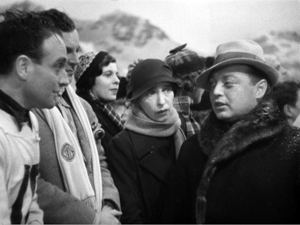
At the St. Moritz resort, the Lawrence family is set off from Louis, their French friend, and two men: Abbott the German and Ramon the Latin. (He’s handily fudged; he has a Spanish name but calls the English “extraordinaire.” And his hair is greasy.) “Sworn enemies, eh?” Jill says half-humorously to Ramon before losing the skeet shoot. After Louis’ death Bob is at a loss in the hotel, unable to speak German or Italian, and distracted while Betty is kidnapped. The English aren’t at home in this world.
Once Bob and Jill have returned to London, they join the family friend Clive, a Wodehousian upper-class twit but gifted with loyalty and tenacity. Bob and Clive have learned from Gibson of the Foreign Office that the gang intends to assassinate the diplomat Ropa. They must tell what they know; the killing could prove as catastrophic as the assassination that triggered the war of 1914-1918. Yet Bob keeps mum. He might be enacting E. M. Forster’s dictum: “If I had to choose between betraying my friend and betraying my country, I hope I would have the guts to betray my country.”
The conflict between family love and civic duty is played out in the rest of the second act, when the men’s investigation takes them to a working-class neighborhood of Wapping. There, we learn that behind respectable English institutions—a dentist, eccentric religion—foreign elements lurk. Bob has solved Louis’ riddle, but at the cost of becoming another hostage. Bob and Betty re-meet, in a characteristically subdued stiff-upper-lip encounter that denies Abbott the tearful scene he expected. The dignity with which Bob conducts himself, asking about Betty’s dressing gown and her school grades while staring defiantly at the gang, leaves the others abashed.
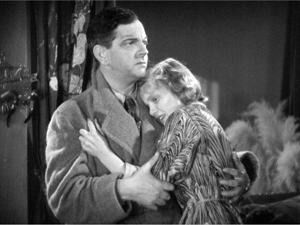
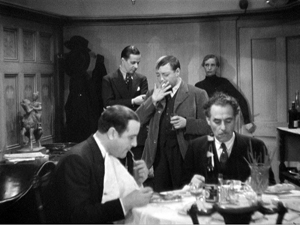
Clive has escaped, though, and has managed to send Jill to the Albert Hall. That musical set piece initiates the film’s climax dramatically but also thematically. For one thing, Benjamin’s cantata reaffirms another bit of Englishness. A national choral tradition runs back to Purcell and Handel, was sharpened in Mendelssohn’s Elijah, and was revived in the early twentieth century by Elgar’s Dream of Gerontius and Vaughan Williams’ Sea Symphony. Hitchcock and screenwriter Charles Bennett could have used Bach or Beethoven, but the choice of this brooding, mildly modernistic piece reminiscent of Walton is a nice bit of propaganda for British musical culture of the interwar years.
More importantly, the concert sequence solves the film’s ideological problem: How to save the world without destroying your family? Jill’s impulsive scream doesn’t divulge what she and Bob know about the gang, but it does serve to derail the gang’s plan and save Ropa. And by leading the police to follow Ramon to the hideout, she in effect chooses to risk Betty and Bob for the capture of the gang. Here, perhaps, the sheer drive of the action muffles the significance of her choice; Chandler complains that Hitchcock tended to take refuge from plot problems in “wild chases.”
What follows, in the middle of some violence that remains shocking today, is a vigorous reassertion of Englishness. The vignettes during the siege display stalwart national virtues. A postman insists on making his rounds during the gunplay. An inspector swipes sweets and pauses for a cup of tea. The police reluctantly take up arms, only after several of their unarmed number are mowed down. Slipping into adjacent buildings, snipers move a piano while its fussy owner rescues his potted plant. And a cop who was slated to go off duty finds a warm mattress to die on. This unassuming valor, so different from Ramon’s petulant swagger and Abbott’s self-congratulatory sadism, will win out. The victory is announced by the pent-up crowd rushing jubilantly forward as the siege ends.
In any other movie the mother would have been huddling with the child and the man would grab a rifle to pick off his enemy on the roof. But making Jill the crack shot reasserts another quintessentially English image: the hunting, shooting, riding mistress of the estate. She gets her second chance to fire, bringing down Ramon when even the police sniper hesitates. It’s also a bit of guilty revenge for the death of Louis, whom Jill danced into the line of fire. Hitchcock, as usual, renders it elliptically: we see Jill grab the gun but not fire it. As she and Bob and Betty are reunited, the movie that began with the line, “Are you all right, sir?” ends with a mother reassuring her weeping daughter, “It’s all right.”
This, we might say, is how you integrate set pieces into your movie—narratively, stylistically, and thematically. Others would disagree with me, but nearly forty years of living with this film hasn’t made me change my mind. The Man Who Knew Too Much is Hitchcock’s first thoroughgoing masterpiece.
Thanks to Abbey Lustgarten, UW-Madison alum, for her excellent production job on the Criterion disc. Thanks also to Peter Becker and Casey Moore for coordinating the posting of our Film Art piece with this blog entry.
For more on Chandler and Hitchcock, see William Luhr, Raymond Chandler and Film (New York: Unger, 1982), 81-93. My quotation comes from Raymond Chandler Speaking, ed. by Dorothy Gardiner and Kathrine Sorley Walker (Books for Libraries Press, 1971), 132.
Hitchcock probably doesn’t deserve 100% of the credit for the Foreign Correspondent windmill scene; it was designed by the great William Cameron Menzies.
When I wrote the Film Art analysis back in the 1970s, Kristin hadn’t elaborated her ideas about how large-scale parts, or acts, can shape a film. Yet I think that the three parts that the analysis mentions constitute pretty well-articulated acts. The first part has as its turning point Bob’s realization that when Gibson traces Betty’s call, police will converge on Wapping and endanger her. So Bob and Clive set out to save her. That decision comes about twenty-six minutes into the movie. I’d mark the end of the second act with Abbott’s sending Ramon on his mission after playing the cantata recording; that comes at about fifty-three minutes into the film. At this point we know everything we need to know, so the premises can play out. The last act is shorter, as climaxes tend to be. The Albert Hall sequence and the final shootout and rescue take up the final twenty-three minutes, capped by a very brief epilogue of the reunited family. For more on act structure, see Kristin’s entry here, mine here, and my essay on action movies, as well as Kristin’s Storytelling in the New Hollywood and my The Way Hollywood Tells It.
A final note: Frank Vosper, who plays Ramon, was a well-known stage actor and playwright. His most famous play is Love from a Stranger (1936); the film version was released in 1937. Another successful Vosper play was the fantasy comedy Murder on the Second Floor (1929), in which a writer devises a play consisting of all the clichés of sensational mystery fiction. But the Vosper play that piques my curiosity most is his 1927 drama called—I’m not kidding—Spellbound.
See? With Hitchcock you always get more.
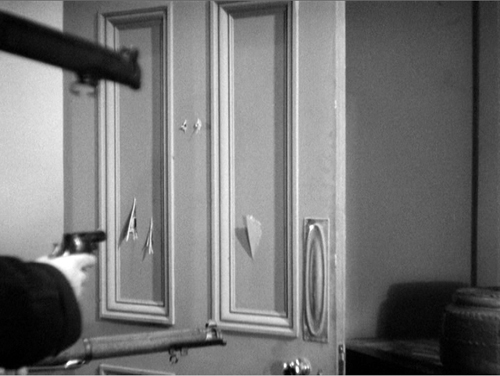
The Man Who Knew Too Much.