




Archive for the 'Film comments' Category
VIFF extremes
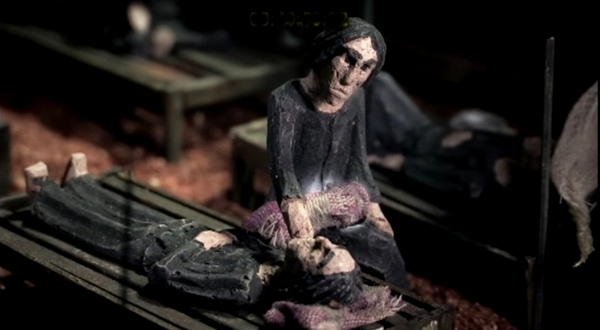
The Missing Picture (2013).
DB here:
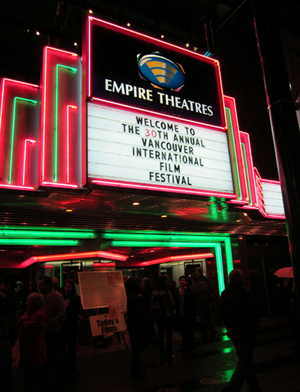
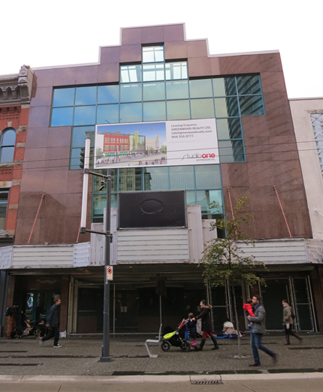
The Vancouver International Film Festival, known to all as VIFF, has been undergoing some big changes. It lost its primary venue, an ageing but cozy multiplex surrounded by pubs, creperies, music clubs, and other marks of downtown culture. Alas, the Empire Granville 7 is now shuttered, to be renovated as a retail space. VIFF must spread its bounty more widely.
As before, films are shown at the Cinematheque and the Vancity media center. The new venues include the Vancouver Playhouse, the Rio Theatre, three screens at the Cineplex Odeon International Village, the Vancouver Centre for the Performing Arts, and the Goldcorp Centre for the Arts at Simon Frazer University. All the ones we’ve visited have been excellent screening spaces.
Everything we’ve seen has been on some form of video—excuse me, “digital cinema.” Apart from the occasional 35mm or HDCam show, DCP projection, after a couple of years of teething pains, is the norm. Not that this guarantees uniformity. Albert Serra’s Story of My Death, a peculiar portrait of the elderly Casanova, still looked (probably intentionally) like it was shot on VHS. The furor about festivals’ conversion to digital formats, discussed in this 2012 blog entry and extended in my little e-book, belongs firmly to history. Henceforth film festivals will be file festivals.
Genres plain and fancy
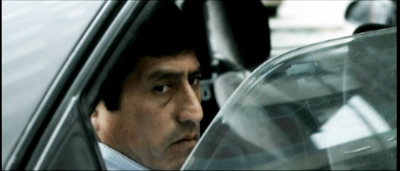
El Mudo.
As usual at VIFF, the range is wide. At one end of the scale is a feel-good dramedy like The Great Passage, Japan’s Academy Award entry. The central character is Majime, a shy and unworldly young linguist who is drafted to help create a dictionary of Japanese as a living language. An otaku when it comes to words, he soon devotes his life to fulfilling the mission. Over the years he manages to find a girlfriend and earn the respect of the elders steering the project and the friendship of a ne’er-do-well colleague who prefers alcohol to etymologies. The dweeb Majime, despite his sweater-vests and sleeve protectors, becomes moderately sociable, while his pal acknowledges that his own commitment to a geeky endeavor shows he’s not as cool as he thought.
The English title is misleading; a better one might be Crossing the Sea of Language, since the central metaphor is that of charting the ebb and flow of usage. The process is dramatized by setting the start of the project in 1995, before Internet 2.0. The professor overseeing the project points out that the arrival of the Web speeds up language change. The Net works its way into the plot, as card-based research gets replaced by algorithms and word searches. A lot of the film’s humor arises when sequestered scholars, like those in Ball of Fire, have to figure out what this younger generation means when it calls something bad (i.e., good).
Ishii Yuya, who brought to VIFF Sawako Decides (2010) and Mitsuko Delivers (2011), tells his heart-warming story in a trim, efficient manner. His composure could teach our Hollywood directors a thing or two. I didn’t see a wasted shot or gratuitous camera movement, and you might miss Ishii’s virtuoso handling of a crowded office space as volunteers pack in to beat the deadline.
You can often spot a director’s skill in delicate touches. Here, I admired a gentle hook between two scenes. Majime has written a florid, anachronistic letter to Kaguya declaring his fondness for her. At the end of one scene he walks away from the camera clutching the note, which the framing centers on. Cut to a distant shot of him with Kaguya, the letter a small detail alongside his left leg.
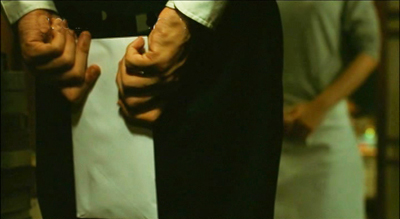
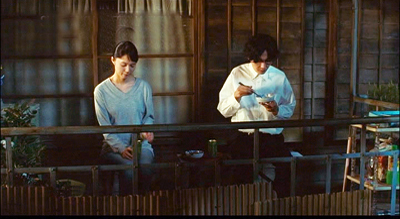
Most viewers, I’m convinced, scan to find the letter and then wait with an amused tension for Majime to awkwardly offer it. It’s a good example of gradation of emphasis: No need for a close-up at the start of the second scene. This sort of unforced, easygoing presentation of a plot with a serious point—the quiet heroism of committing yourself to something of value to your community—makes The Great Passage as much worth exporting to North America as Departures and Shall We Dance? have proved in years past.
A more offbeat genre film is El Mudo, a Peruvian quasi-thriller, quasi-comedy from Daniel Vega and Diego Vega. After a day of dreary complaints and insults, the magistrate Constantino finds his car window smashed. What else is new? Soon after, he’s driving through traffic and is apparently wounded by a sniper. He loses his voice but becomes doggedly determined to uncover what he thinks is a conspiracy.
Constantino is not your raging rogue investigator. His muteness only increases a fixed, slightly scowling demeanor that suggests stoicism, boredom, or emotional vacuity. He refuses to perform the exercises that might strengthen his voice, as if he welcomes the loss of one more channel of expression. Everyone else seems normal, but Constantino (played superbly by Fernando Bacilio) might have walked out of an Aki Kaurismaki movie. The filming is in tune with the protagonist–static and prolonged shots, shrewd but unemphatic angles that simply wait for something to happen.
The result is an anti-action film. The assassination attempt, if that’s indeed what it is, is merely a bump in what is otherwise a drab long take filmed from the back seat of Constantino’s car. After waiting for a traffic light to change, he proceeds and suddenly slumps sideways as we hear four faint cracking sounds and watch the car drift onto the curb.
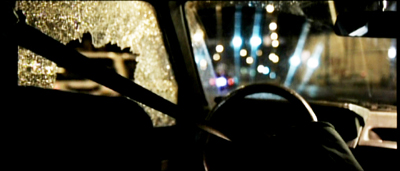
When the case is solved (perhaps) during a police raid, poor Constantino waits outside and so merely glimpses the stunt that would get visceral treatment in another movie. By the end, he finally smiles with pleasure, revealing himself as at a memory of maternal affection; he’s a mama’s boy after all. Il Mudo is a continuous pleasure throughout and is to be recommended to any fan of deadpan grotesque.
Many missing images
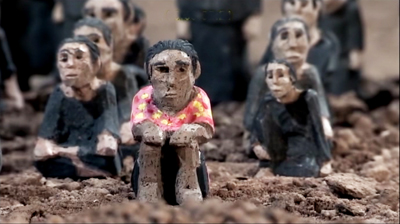
We’ve suggested, in both Film Art and elsewhere on this site, that a documentary film can be highly artificial. As long as it purports to make claims about the nonfictional world, the film can stage scenes and even use animation to support its points. A new test of this idea has come along in the form of Rithy Panh’s muted but powerful memoir of Khmer Rouge atrocities, The Missing Picture.
It employs some documentary conventions, like newsreel footage and voice-over commentary, but it seeks to present what was never put on film at the time. Panh’s family is shipped out of Phnom Penh, sent to forced labor and starvation in the countryside. Medical experiments are conducted with humans. Children are forced to pound out fertilizer and haul bodies to burial pits. The Party cadres, of course, eat well. Western intellectuals may have praised the Khmer Rouge as disciplined Communist idealists, but “the revolution they promised exists only on film.” How do you show what was never shown, not even widely known?
To provide a counter-film, Panh fills tabletop tableaus with carved clay figures. By the hundreds, these little effigies populate toy settings of work camps, hospitals that are merely storehouses for the dying, and landscapes that call forth children’s fantasies of escape and memories of happy family life. The figures themselves, squat and chunky, wear emblematic clothes–most often, gray work pajamas–and bear hollow-eyed expressions hinting at sullen fear or merely numbness. Panh’s childhood self is clothed, against all orders, in a pink shirt with yellow dots, which not only lets us identify him but suggests his yearning for the world of color that the Khmer stamped out.
As The Missing Picture proceeds, it becomes more reflexive. The Khmer officials show their propaganda films to the camp audiences, and Panh takes the opportunity to show his figures gathered and obediently watching. At the end, he reminds us that those who resisted are still wandering among us, like ghosts. Some things, he grants, should not be seen or known. “But should any of us see or know them, then he must live to tell of them.”
VIFF may be living in many new houses, but it’s definitely living, and as splendidly as ever.
The Empire Granville 7 was the last remaining movie house on Vancouver’s Theatre Row, which at one time had over twenty theatres. On the Granville 7’s future as retail space, a story is here. This article mentions that the Granville 7 originally absorbed a theatre called the Coronet. Cinema Treasures supplies more details of Granville 7 history. Images of the interior demolition of the house are here.
Harry Potter treated with gravity
Kristin here:
Going into the summer movie season this year, I wasn’t particularly excited about most of the upcoming films. I was looking forward to Monsters University, which I thoroughly enjoyed, though it didn’t return to the dazzling levels of Pixar’s films before Cars 2. Right now I’m assembling my viewing list from the impressive array of offerings at the Vancouver International Film Festival. (The new Oliveira! Godard in 3D! Mohsen Makhmalbaf’s long-awaited return to filmmaking!)
But I’m also aware that during the festival, another film that I’m really excited to see will be released in North America: Alfonso Cuarón’s Gravity. I didn’t see the 17-minute opening shot shown at Comic-Con, but I watched one of the trailers, and it was the most exciting new piece of filmmaking I’ve seen this year. If you haven’t seen one of the four trailers, you can watch them on Warner Bros.’s site, or on any number of video and infotainment sites. The one called “Drifting” reminded me of Michael Snow’s brilliant Central Region, but with narrative, with the earth and stars spinning past a close-up of Sandra Bullock as the marooned, panicky astronaut protagonist.
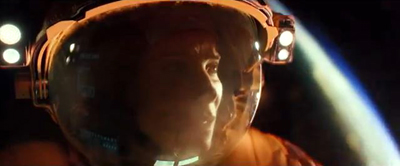
Unfortunately a still frame conveys almost nothing of the dazzling effect of this image. You’ll just have to follow the link above and look for yourself.
Judging by the ecstatic reviews and descriptions of audience responses that came out after Gravity was screened as the opening-night gala at the Venice Film Festival, the movie lives up to the expectations generated by the clip and trailers. One of the most insightful reviews is by Todd McCarthy, who combines giddy enthusiasm (mentioning twice that people will want to see the film repeatedly) with some solid analytical comments on the soundtrack, camerawork, and special effects. After Cuarón screened the film for James Cameron, the latter enthused: “I was stunned, absolutely floored. I think it’s the best space photography ever done, I think it’s the best space film ever done, and it’s the movie I’ve been hungry to see for an awful long time.” Indiewire’s Steve Greene has compiled a selections of excerpts from reviews from the Venice opening.
Cuarón’s previous film had been Children of Men, released way back in 2006. After such a gap, authors of articles and reviews have felt the need to summarize his career briefly. Most frequently they mention Children of Men and the 2001 Mexican comedy Y tu mamá también, which was a breakthrough film for the director. Less frequently there is a reference to Harry Potter and the Prisoner of Azkaban (2004) and A Little Princess (1995).
Harry Potter and the Prisoner of Azkaban in Cuarón’s career
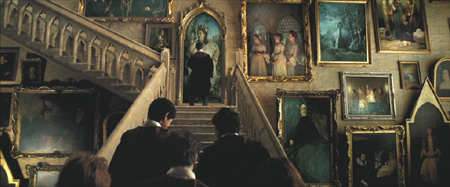
Living paintings in Harry Potter and the Prisoner of Azakaban
As that line-up of titles suggests, Cuarón has had a career that makes him difficult to characterize. Although he is perceived as a Mexican director, he has done relatively little work there. Apart from shorts and TV projects, his Mexican features consist only of Love in the Time of Hysteria (Sólo con tu pareja, 1991) and Y tu mamá también. He’s also perceived as an art-film director. Variety′s cover story on Gravity was entitled “An Auteur’s Re-entry” in the September 3 print edition (though it was “Alfonso Cuaron Returns to the Bigscreen after Seven Years with ‘Gravity’ online). This impression obviously arose from the success of Y tu mamá también (distributed in the USA by Good Machine, now Focus Features) but also from the fact that the grim Children of Men was a financial flop and succès d’estime. Yet Children was produced and distributed within the Hollywood mainstream by Universal.
Instead of pursuing his career in Mexico, Cuarón headed for Hollywood immediately after his first feature. He described this career move in a 2006 interview:
After coming up the ranks as a cable operator on a movie set and an assistant director, he made his first feature, “Sólo con tu pareja,” in 1991, and it won several awards at the Toronto Film Festival. However, the Mexican Film Commission, which had subsidized it, wasn’t happy with the movie.
“I basically burned my bridges with the commission,” says Cuarón, who moved to Los Angeles with no contract to do another film. Director-producer Sydney Pollack gave him a chance to shoot an episode on the cable TV series, “Fallen Angels.”
“Tom Cruise had directed one episode and Tom Hanks another. But mine was the one that won a cable award,” Cuarón says. “It was one of those things that led to the next.”
That turned out to be the sublime children’s movie “A Little Princess.”
“I never watch my movies after I’m done with them, but in my memory that’s the one I love the most,” he says.
Cuarón’s next experience directing a modern-day version of “Great Expectations” [1998] starring Gwyneth Paltrow and Ethan Hawke, wasn’t so great.
“My instinct always told me not to do it, and I ended up doing it anyway,” he says. “So I learned to trust my instinct.”
Also in this interview, Cuarón describes himself as lucky in his Hollywood work:
That a major studio (Universal) was willing to underwrite such a downbeat story [as Children of Men] is a credit to Cuarón’s reputation. Unlike many foreign directors used to having enormous latitude in their native countries, Cuarón has learned to work within the Hollywood system.
“There is a tendency to see Hollywood like Darth Vader trying to destroy filmmakers,” he says. “And I’m sure that’s sometimes true. I have been very lucky to be able to create my own stuff without studio interference.”
The perception of Cuarón as an art-film director has perhaps led to a tendency to dismiss his one venture into the Harry Potter series as an aberration. In his excellent analysis of the long takes in Children of Men (which focuses on the fact that they were created by digitally blending multiple takes), James Udden remarks on how, after first using long takes in Y tu mamá también, “Next, Cuaron takes a ‘step back’ in a sense with Prisoner of Azkaban, paying yet more ‘dues’ to the system.” Justin Chang’s brief but informative survey of long takes in Cuarón’s work does mention that the technique “even reared its head in 2004’s ‘Harry Potter and the Prisoner of Azkaban,’ in which the director boldly imprinted his personality onto one of Hollywood’s most successfull–and most risk-averse–franchises,” though he does not mention how the technique “reared its head.”
Yet Cuarón evidently loved his experience working on Prisoner of Azkaban. The interview just quoted was one of several in 2006 where he expressed keen interest in making another film in the series: “If I’m invited, I would be very tempted to direct it. The idea of revisiting that beautiful universe is irresistible [….] Everything that happens around a J. K. Rowling creation is enveloped in this beautiful, beneficial energy.” Maybe he will have a chance to work on a Rowling film again, given the recent announcement that she will write the script for a franchise-starter for a new film series based in her wizarding world.
Setting aside Cuarón’s feelings about his experience making the film, we should not dismiss it as a minor part of his career, something he supposedly made so that he would be able to make other, more personal projects. For a start, it does have a style distinctly different from the other Harry Potter films. It’s not always recognizable as a Cuarón style, but then, Cuarón’s films are so different from each other that that is hardly surprising. Udden points out that while Children of Men has an average shot length of slightly over sixteen seconds, Prisoner of Azkaban′s ASL is about 5.5 seconds. Still, it contains three long takes, each of considerable interest. Moreover, the introduction to cutting-edge CGI would leave Cuarón with valuable experience that he could apply to his two subsequent features.
Prisoner of Azkaban has a reputation as one of the best, if not the best, of the Harry Potter films. Its quality is not solely due to Cuarón’s direction. The book is arguably also the best of Rowling’s series. While the first two books (Harry Potter and the Sorcerer’s Stone and Harry Potter and the Chamber of Secrets) are pleasant, entertaining children’s stories, Prisoner of Azkaban marks a leap in the complexity and depth of the plotting. It adds two major new characters, the sympathetic professor (and werewolf) Remius Lupin and the apparently threatening Sirius Black, who turns out to be Harry’s parents’ best friend and his godfather. It also adds a third character, the dotty Prof. Trelawney, who seems just to offer a source of comedy but will eventually prove to have affected Harry’s life in unsuspected ways.
New villains also appear, notably the soul-sucking Dementors and the literal and figurative rat, Peter Pettigrew, another old friend turned traitor who has become Voldemort’s main helper. Lupin introduces the technique of casting a “patronus,” a protective figure of light that repels the Dementors–something that will continue to be crucial for the rest of the series. Finally, there is the ingenious episode of the time-turner, a device Hermione has been employing to take multiple classes at once but which she ultimately uses to allow her and Harry to go back in time and manipulate a series of tragic events and make them end happily. This lengthy scene, one of the high points of Rowling’s series, is even better in the film, where we can see the doubled characters on the screen.
Apart from drawing on the book’s strengths, the film also has the advantage of being the one that replaced Richard Harris with Michael Gambon as Dumbledore. Apparently some viewers were fond of Harris’ portrayal, but the casting seems to me a real mistake and no kindness to an actor clearly in failing health. I found him disturbingly feeble, stiff in his movements and expressions, and barely able to get a whole line out without gasping for breath. How the producers thought he could last through the series is a mystery, and Gambon’s livelier and funnier performance came as a relief.
Prisoner of Azkaban also quickly gained a reputation as being much darker in tone than the two films that preceded it. I doubt there was a single reviewer who failed to make this claim. The Washington Post’s critic called it “everything the first two films were not: complex, frightening, nuanced.” For Roger Ebert, “Harry’s world has grown a little darker and more menacing.” In a later survey of the first four Harry Potter directors, Manohla Dargis and A. O. Scott wrote of Prisoner of Azkaban, “the tone and color palette have shifted, the bright, flat lighting giving way to a somber and dangerous feel, evocative of horror films.”
Perhaps such comments had something to do with the fact that Prisoner of Azkaban earned less at the box office than any other film in the series: a mere $797 million. (The second lowest earner, Chamber of Secrets, made $879 million; the highest, Death Hallows Part 2, $1.3 billion.) It’s hard to believe that fewer people would go to the film based on a change of directors. How many, after all, would be likely to know who Cuarón was? More likely parents kept younger children away for fear that the action would be too intense.
The book version of Prisoner of Azkaban also takes a much darker turn. If that was the reason for the downturn, it didn’t last long. The trend toward darker, scarier content continued through the later books, with the return of Voldemort in the fourth and the deaths of major characters in each subsequent book. Similarly, the later films are distinctly more grisly and frightening than Prisoner of Azkaban. None of this kept people from buying books and movie tickets.
One might assume that studio executives decided on Cuarón as an appropriate director for a darker entry in the series, but he had not yet gained a reputation for grim subject matter. That came with Children of Men. In fact, Cuarón was not the first or even second choice as the film’s director. A retrospective article on Den of Geek! gives this account:
The studio’s choices included Guillermo del Toro, who baulked at how the film was “so bright and happy and full of light”, and Marc Forster, who didn’t want to direct children again so soon after making Finding Neverland.
It came down to a final short-list of Kenneth Branagh (who had co-starred in the previous instalment as Gilderoy Lockhart), Alfonso Cuarón (A Little Princess) and Callie Khouri (Divine Secrets Of The Ya-Ya Sisterhood and screenwriter of Thelma And Louise). Eventually, Cuarón was appointed, and the director is largely credited with energising the series.
Let’s examine some of what Cuarón brought to Harry Potter by looking at his signature device, long takes.
Three long takes and some flashy effects
Unlike in Children of Men, the long takes in Prisoner of Azkaban are not used primarily for action scenes. Unlike in more conventional Hollywood films, they are not used at the opening as a flashy way of presenting exposition. Rather, they function to emphasize transitional points in the plot and to create motivic parallels. Not surprisingly for Cuarón, all involve camera movements. Two of the three involve conversations, one with an impressive but not flashy tracking movement to follow the characters, the other with a more subtle, slow push-in and out.
The first and lengthiest of the long takes comes in the Leaky Cauldron inn when Harry encounters the Weasley family and Mr. Weasley takes him aside to warn him about Sirius Black’s escape from Azkaban prison. It lasts for one minute and 53 seconds.
The setting is bustling, and the camera movement serves in part to gradually pull attention away from the crowded dining room and to focus on the conversation. The shot opens on the busy table, with a large tea kettle floating on its own through the air. (In Prisoner of Azkaban, Cuarón frequently uses this tactic of having objects floating in the foreground to suggest a magical environment; he will repeat the device in Gravity to depict weightlessness in space). Mrs. Weasley effusively greets Harry:
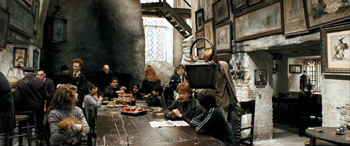
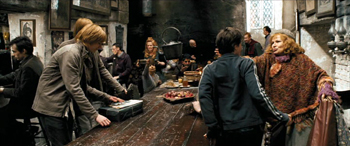
Mr. Weasley asks to have a word with the boy, and they move toward a squared-off opening near the back of the set. A wanted poster for Black, visible to the right of center from the opening of the shot, becomes more prominent at the frame edge. Since photographs in this magical world move, we cannot help but notice it:
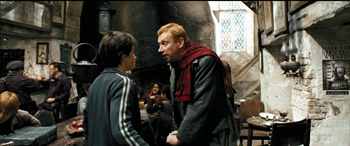
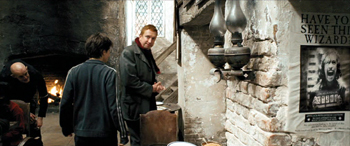
The camera tracks past the poster through a second opening closer to the camera and stops once the characters are centered. Mr. Weasley tells Harry about Black, and the camera moves back to accommodate them when they come forward to look at the poster:
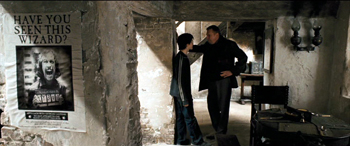
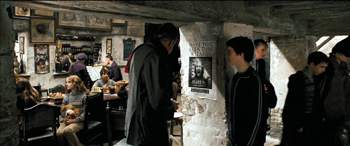
As they continue to talk, the camera again moves backward as Mr. Weasley steers Harry to a third opening into the main dining room. They pause beside a second poster of Black, and Mr. Weasley explains that Black had betrayed Harry’s parents to Voldemort, who had killed them and tried to kill him. As a man in a bowler sits at the table near them, Mr. Weasley again guides Harry into a more private area:
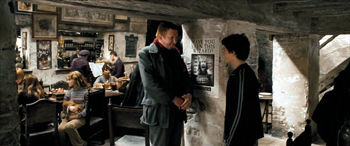
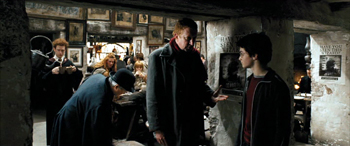
He says Black is going to try and kill Harry and urges Harry not to go looking for him. The shot ends on a push in toward Harry, who replies, “Mr. Weasley, why would I go looking for someone who wants to kill me?” and the scene ends.
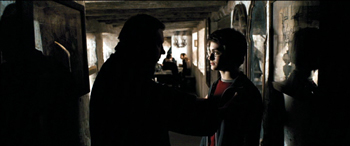
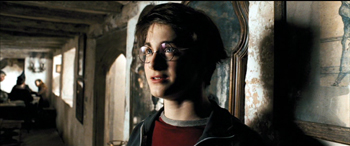
This moment marks a crucial change in the narrative tone. The film started with two comic scenes: Harry’s use of magic to inflate his obnoxious Aunt Marge into a human blimp and then the antics of the fantastical Knight Bus that rescues Harry and transports him to the Leaky Cauldron. Now for the first time the theme of grave danger is introduced, with the insane-looking Black screaming silently in the wanted poster. A darker storyline takes over, though there are many moments of humor to come. This conversation leads into the scene on the train to Hogwarts, which, for the first time in the series, has a heavy rainfall occurring throughout. During this scene the first Dementor appears, and Lupin explains what Dementors are.
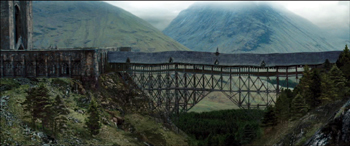
The second long take (one minute and thirty seconds) comes in a much quieter scene at Hogwarts. Harry has been unable to accompany the other students on a day’s outing to Hogsmeade, the local village, and he is depressed and lonely. He has a conversation with Lupin, set on a long elevated bridge that was added to the Hogwarts setting for this film. The scene begins with an extreme long shot tracking slowly toward the bridge as Harry discusses his fear of Dementors with Lupin, followed by a cut-in to them:
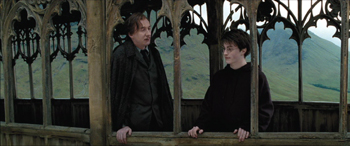
The camera moves in slowly as Lupin turns away and recalls his friendship with Harry’s mother. As he says, “Well, your father James, on the other hand, he … he had a certain, shall we say, talent for trouble,” Harry smiles:
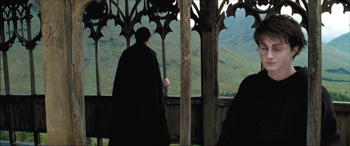
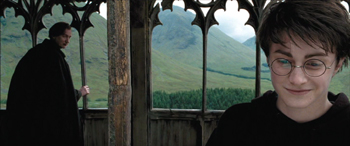
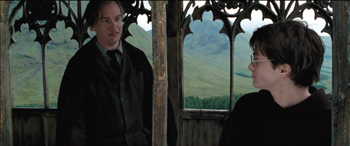
Lupin walks back to Harry, concluding, “A talent, rumor has it, he passed on to you. You’re more like them than you know, Harry. In time you’ll come to see just how much”:
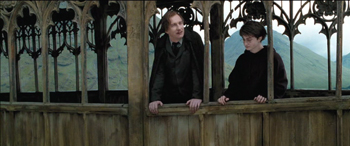
The scene ends with a cut to a shot of the bridge from the original distant framing:
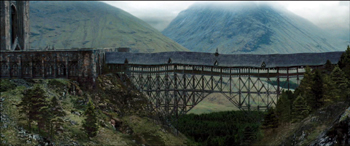
The two scenes are parallel but contrasting, as Harry receives information from two father figures. Initially he speaks to Mr. Weasley, the head of a large, boisterous family that has semi-adopted Harry; we are reminded of them (including Ginny, whom Harry will eventually marry) at intervals in the background of the Leaky Cauldron long take. The two rooms are divided by a series of square openings in a thick wall, which the pair move through as Mr. Weasley prepares to deliver threatening news. The melancholy Lupin, on the other hand, has no family, and here he comforts Harry in a setting with airy, intricate archways framing a vast, empty mountain vista beyond. The quiet atmosphere is appropriate, since Lupin is the first of three classmates and close friends of his dead parents that Harry meets in this film.
The film’s third long take is the only one that could be said to involve an action scene, though it is really just the prelude to a lengthy segment of the film stringing together several brief action scenes. (It is the shortest of the three long takes, at one minute and eight seconds.) This shot marks another transition, introducing the film’s climax. Everything has just gone wrong. Gamekeeper Hagrid’s pet hippogriff Buckbeak has been executed as too dangerous to be around the students. Sirius, whom the children now know to be innocent of the crime for which he was imprisoned, has been captured and is about to be turned over to the Dementors. Pettigrew, having been revealed as the true traitor to Harry’s parents, has escaped in rat form. In the hospital dormitory where Ron has ended up, Dumbledore hints that Hermione should use the time-turner so that she and Harry can return to the beginning of these events and try to reverse them.
The camera circles around Hermione as she turns away from Ron’s bed and pulls the time-turner on its chain from inside her jacket. She lifts it and places the chain around Harry’s neck, so that they are both wearing it:
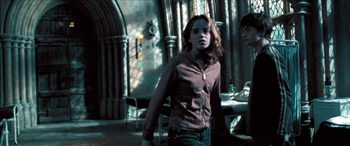
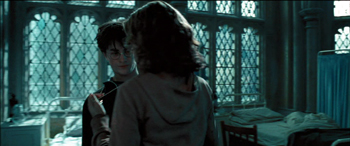
He looks on uncomprehendingly as she twirls the time-turner to send them back to a point shortly before the scheduled execution of Buckbeak:
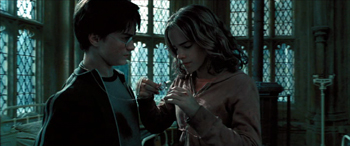
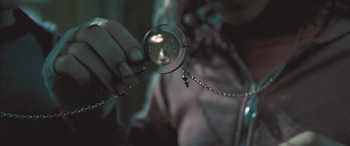
Startled, Harry watches rapid changes in lighting and blurred figures moving backward in fast motion as Hermione keeps track of how far they have traveled. During all this, Ron disappears from the bed at the right rear:
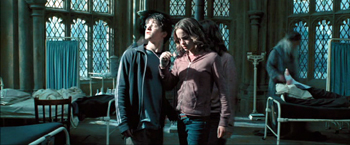
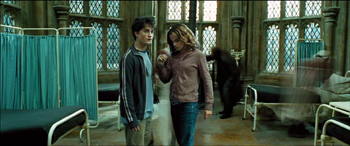
The camera moves in as she hides the time-turner and circles as they run out of the room:
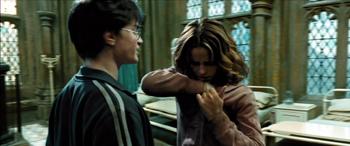
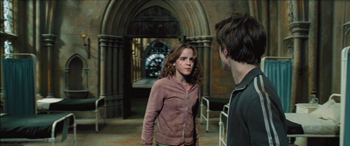
They run along a corridor, the camera following until they turn and exit left:
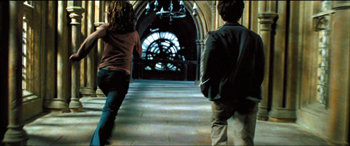
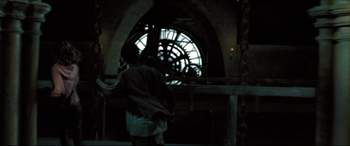
The camera continues straight ahead, through the large clock wheels, and reveals the school grounds far below:
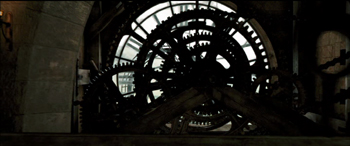
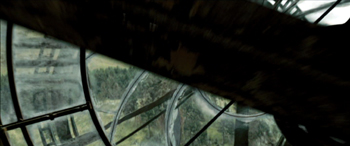
The camera moves through the glass of the clock window and tilts down to the courtyard, where Hermione and Harry emerge and run out through the doorway at the top of the screen:
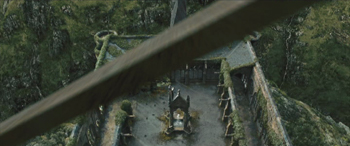
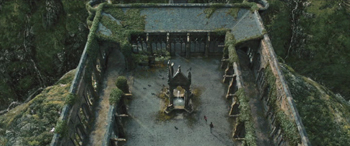
Later, after the pair has accomplished their goals, a somewhat similar shot moves with them through this same courtyard and cranes up and through the clock again, joining them at the same point as they run in and away down the corridor to the hospital wing.
On a more modest scale, there is a somewhat similar technique used in Y tu mamá también. The heroine, Luisa, waits in her apartment for Tenoch and Julio to pick her up for a trip to the beach. Once they call to let her know they have arrived, she exits through the front door; the camera tracks rightward to a window and tilts down to reveal the car waiting below and pulling away from the curb as the three depart. Although not a particularly lengthy shot, it functions, as in the third one from Prisoner of Azkaban, to mark a narrative transition, in this case the end of the film’s first portion and move into the long car trip that will occupy most of the rest of the film:
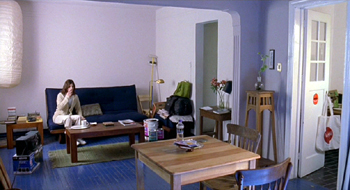
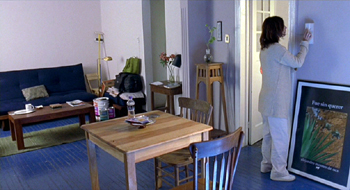
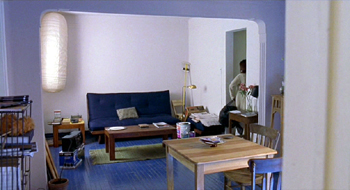
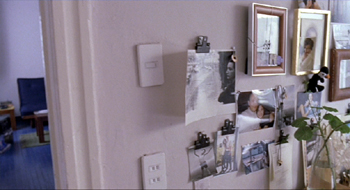
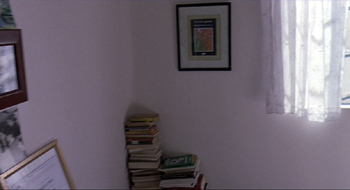
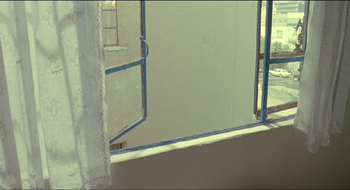
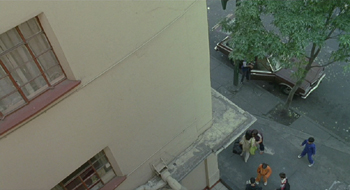
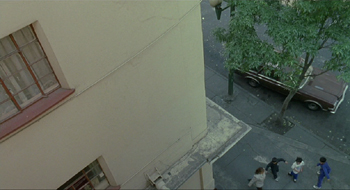
This is a far simpler shot and was accomplished by moving the handheld camera through the room to an open window, sticking it through, and tilting down. The Prisoner of Azkaban “shot” was in fact an elaborate manipulation of images, with the segment where time runs in reverse around Harry and Hermione shot against a green screen; the portion going through the clock’s works and its window was done with CGI elements. (See American Cinematographer‘s article on the film for an explication of the technology involved.)
Admirers of the elaborate “camera movements” in Children of Men and Gravity, some of which were done by stitching together several elements into apparently continuous shots, might take note that Cuarón’s experiences on Prisoner of Azkaban made them possible. A 2006 interview on SFGate describes the director’s progress:
One benefit was a crash course in computer-generated visual effects. Cuarón used “maybe a shot or two in “Y Tu Mamá También”–the 2001 Mexican indie that got him an Oscar nomination for best original screenplay–and in his earlier Hollywood movies, “A Little Princess” and “Great Expectations.”
On the Harry Potter sequel, working with computer effects was “like speaking Russian,” he says. The hardest part was figuring out how to shoot an object such as a plate, knowing that later it would be substituted by some wild effect.
“The important thing was not to be shackled by these effects, to shoot as you would your normal scene. There’s a tendency I witness in movies and completely dislike in which the narrative is kind of forced because of the visual effects. You have to try to keep your character and the visual-effect character as separate as possible.”
By the time he started “Children of Men,” all of this was “like second nature.”
In a more recent (undated) interview given at the time when Gravity‘s principal photography was beginning, Cuarón stressed its connection to the things he had learned about special effects on Prisoner of Azkaban: “Well, Potter was my kindergarten and grammar school and high school and college education of visual effects. It is coming in handy with Gravity which is so, so visual-effects savvy [that] we’re inventing new technologies. Now it’s just second nature.” He also mentions that his work with David Heyman, who produced all the Harry Potter films, was what led him to invite Heyman to produce Gravity.
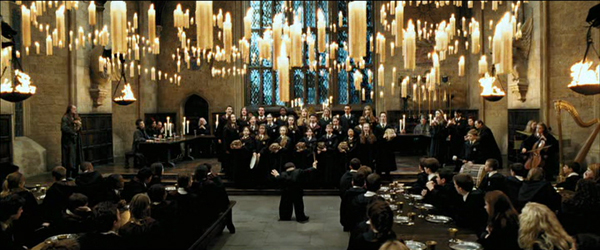
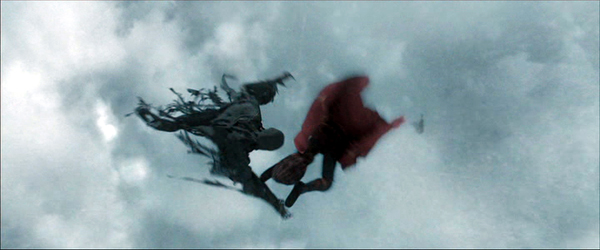
Apart from the CG-compiled long takes, there were effects like the hundreds of candles floating in the air above the great dining hall of Hogwarts (see top) and the living paintings crowding the walls (above left). It seems remarkable that Cuarón’s third film after his modest Mexican sex comedy could draw such high praise from James Cameron, one of the top directors of effects-heavy films, but working on a Harry Potter movie for a couple of years made that possible. And, as the frame below demonstrates, directing Quidditch matches is a good preparation for showing people drifting weightlessly in space.
The quotation from James Udden comes from his article, “Child of the Long Take: Alfonso Cuaron’s film Aesthetics in the Shadow of Globilization,” Style 43, 1 [Spring 2009]: 40. For those with access to a research library, this issue is available on ProQuest and other online archives.
Screenplaying
Design by Christina King.
DB and Kristin here:
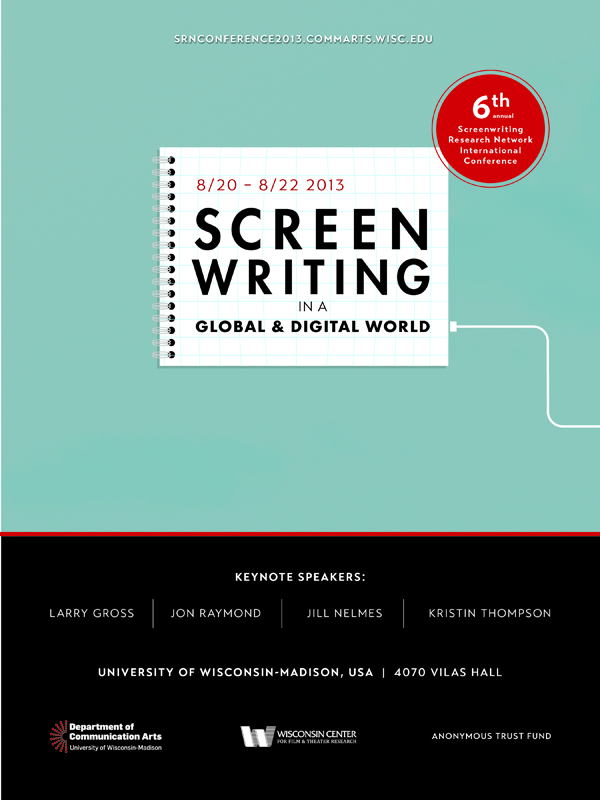
Two years ago DB reported on the gathering in Brussels of the Screenwriting Research Network (here and here). This year, thanks to our colleagues J. J. Murphy and Kelley Conway, our department hosted the conference. Again, it was chock-a-block with stimulating papers. We also introduced our visitors to the Wisconsin Center for Film and Theater Research, which houses thousands of screenplays. It wasn’t all work, either. Participants were spotted lingering at our lakeside terrace or making their way through the cafes and saloons lining State Street. We believe it’s fair to say that a hell of a time was had by all.
Since there were simultaneous sessions, nobody could attend everything, and we can’t run through all the papers we heard. (So do consult the program for more information.) Herewith, some highlights that set us thinking.
In the key of keynote
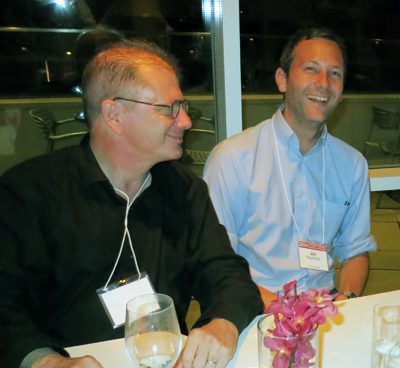
Larry Gross and Jon Raymond.
The four keynoters encapsulated the conference’s very wide range. In a workshop keynote Jill Nelmes, Editor of the Journal of Screenwriting, offered a historical survey of screenwriting research in all media, with special emphasis on television. The Big Hollywood Movie was covered by Kristin, whose paper, “Extended How?” examined the ways in which directors’ cuts and extended editions handle the multi-part structure she posits as a foundation of contemporary Hollywood. We won’t say more here, since she may turn it into a blog for this site.
Larry Gross had already started off the conference with a bang by taking us to Japan. Larry has written 48 HRS, Streets of Fire, Geronimo, True Crime, and other mainstream studio pictures, as well as television episodes, TV mini-series, and independent films like Prozac Nation and We Don’t Live Here Anymore. He also writes outstanding film criticism for Sight and Sound, Film Comment, and other journals, and he teaches screenwriting at New York University. Scott Macauley’s informative March interview with Larry is at Filmmaker Magazine.
 Larry’s keynote, “The Watergate Theory of Screenwriting,” tackled the question of how filmmakers decide to share story information with the audience. What do the characters know and when do they know it? What does the audience know, and when? Storytelling, Larry suggested, develops out of the interplay of these two sets of questions. He added, perhaps hoping to provoke purists who consider film to be sheer self-expression: “Thinking about the audience is not always reactionary.”
He illustrated his ideas with an in-depth examination of Kurosawa’s Ikiru. He had long thought the film “an official liberal-humanist classic,” until a course with Annette Michelson at NYU showed him that there was a lot to ponder there. Specifically, Kurosawa starts by telling the audience the end of the story: Watanabe will die of cancer. But he doesn’t know that, and neither do all the people he encounters. The strategy denies us a lot of suspense, so to hold our interest Kurosawa must engross us by delineating his relations with his colleagues, with the mothers petitioning for the neighborhood sump to be drained, and with the stray people he meets casually on his night out.
Larry showed how carefully Kurosawa played off the characters’ indifference, misunderstanding, and lack of awareness. In particular, the neighborhood wives display to Watanabe what Maurice Blanchot called “the ignorance and spontaneity of true affection.” Ikiru’s refusal to explain what it means typifies a kind of cinema that asks the audience to share the burden of understanding. “Ikiru understands how a screenplay can be composed with the audience.”
Jon Raymond’s keynote carried things to independent US film. Jon has become famous for a novel (The Half-Life) and short stories (Livability), as well as for his screenplays for Kelly Reichardt’s features. The most recent, the forthcoming Night Moves, is currently in competition at Venice. The teaser title of Jon’s address, “Screenwriting as Earth Art,” turned out to be a reference to the fact that most of his stories take place in the vicinity of his home. He has found satisfaction by composing on familiar ground.
In younger days Jon tried painting and filmmaking; a Public Access feature based on the comic strip Crock turned out to be “a movie best experienced in fast forward.” But he found that writing offered the most creative satisfaction. At the same time, while assisting Todd Haynes on Far from Heaven, he met Kelly Reichardt, who was looking for a property to adapt on a small budget. The result was Old Joy, “a New Age western,” in which two men display the violence latent in the new passive-aggressive masculinity flourishing on the Coast. Jon believes that Reichardt’s handling created a cinematic parallel to the dense intricacy of a short story.
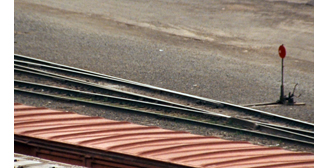
In later collaborations, Jon mapped his patch of Portland in other ways. Seeing the annual migration of workers to Alaskan canneries, and hearing the train whistles wafting through his neighborhood, he created the story that became Reichardt’s Wendy and Lucy (above). Reichardt began adapting the story to film before he had finished writing it. Similarly, Jon merged the booming housing market of the 2000s and the history of the Oregon Trail into a project that paralleled today’s gentrification with nineteenth-century colonization. Reichardt turned his screenplay into Meek’s Cutoff, a “desert poem” that completed what some have called their Oregon Trilogy. For Jon, the trilogy constitutes an alternative regional history, one that traces the process of “sowing the land with failure, betrayal, and humiliation.”
Plots and no plots
The Adventures of André and Wally B (1984).
More than most areas of filmmaking, screenwriting reminds us of the institutional framework surrounding most creative work cinema. Scholars studying the screenplay are naturally often pursuing the endless revisions, refusals, and rethinks that a film goes through in the preparation phase. It’s easy to see this as a one-versus-one struggle, but in many cases the process takes place within a social environment possessing its own roles and rules.
Ian MacDonald offered an excellent example in his study of the work processes behind the UK television soap opera Emmerdale. He proposed that we replace model of industrial film production as an auto factory with that of a carpet factory. Instead of the TV episode being seen as a discrete unit, like a car, it should be conceived as an ongoing fabric woven of many threads. In Emmerdale and other series, the unit of production isn’t the episode but rather the story line. Each episode is sliced out of a much bigger stretch of ongoing patterns. Ian illustrated this with the writers’ planning chart that was mounted on the wall.
The vertical column represents scenes, marked off as episodes. The characters are color-coded cards connected by solid liness that weave their way through the scenes. These waves are the melodies; the scenes are the bar-lines. In each episode, two or three characters are given prominence, while the subordinate ones contribute their harmonies. Ian’s discussion reminded me of how Hong Kong filmmakers did much the same thing in the 1980s: plotting films reel by reel and color-coding certain elements—gags, fights, and chases—to make sure that each reel had its share of attractions. This is the sort of insight into structure that institutional research can yield: Structure is these people’s business.
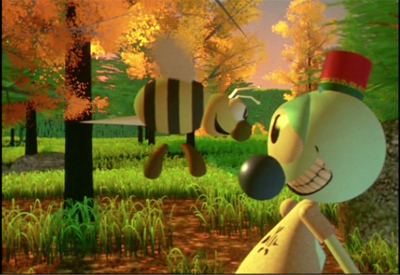
Other Hollywood studios envy Pixar for to its appealing, carefully structured stories. Richard Neupert showed how that tradition goes back to the earliest years at Pixar. Even in demo films which were made to show off technological innovations, the makers tried to reveal how computer animation, even in its early, simple form, could create engaging tales. At a period when computer animation could only render smooth, simple shapes, the Pixar team found appropriate subject matter, with highly stylized characters in The Adventures of André and Wally B and Luxo, Jr.
Remarkably, these tiny films have balanced “acts.” Each is 80 seconds long and has a key action at exactly 40 seconds in: the entrance of Wally B and the moment when the little Luxo lamp jumps on a ball. Similarly, Red’s Dream‘s parts run 50-100-50 seconds. This care in timing continued with the features: Toy Story’s midpoint comes when Woody finally shifts strategies, realizing he has to work with Buzz. And what about Pixar’s perceived slump in recent years? someone asked during the question session. Neupert pointed out that Pixar’s founders have aged, and there may no longer be quite the sense of excitement and discovery pushing the team to surpass others and themselves.
Sometimes institutional traditions come into conflict. Petr Szczepanik’s talk traced in meticulous detail how screenplay development in Czechoslovakia was altered in the years from 1930 to the 1950s. Czech filmmakers developed their own system of moving from theme and story germ to final screenplay. But with the Communist takeover there came the demand to add the Soviet model of the “literary screenplay,” a detailed specification of scenes, dialogue, and the like. Filmmakers resisted this, preferring the customary and more flexible “technical screenplay” that was largely the province of the director. Petr mentioned new screenwriting trends pioneered by Frank Daniel that gave directors the authority to modify the literary format. By the late 1950s, filmmakers had found ways to make the literary screenplay a less rigid blueprint for filming.
Back in the USSR, the screenwriting institution found even the literary screenplay a difficult basis for mass output. Maria Belodubrovskaya’s talk focused on “plotlessness” as a rallying cry and term of abuse in the 1930s-1940s Soviet film. There were long debates about whether “themes” sufficed to make a film or whether you needed strong plots in the Hollywood vein. Film-policy supervisor Boris Shumyatsky urged the latter course, and the popular success of Chapayev (1934) seemed to support his case. By the late 1930s, though, Shumyatsky was purged and the tide turned against strong plots. Film executives found a concern with plot too “Western” and “cosmopolitan,” and annual film production became based on themes rather than stories. Most provocatively, Masha suggested a lingering influence of Soviet Montage storytelling, which based films on vivid but loosely linked episodes. She illustrated her case with an analysis of Pudovkin’s In the Name of the Motherland (1943), with its diffuse lines of action and sudden reversals and omissions.
Back we go
Scarface (1932).
Naturally, Madison wouldn’t be Madison without strong papers on the history of cinema, and many conference presentations suited the tenor of the joint.
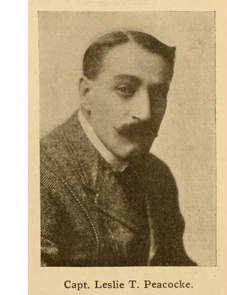 Stephen Curran offered an enlightening study of one of the least-known but most colorful figures in early American screenwriting, a man with the dashing name of Captain Leslie T. Peacocke. He was credited with over 300 screenplays, including Neptune’s Daughter (1914). He acted, directed, and wrote novels too. He was one of the first script gurus, writing magazine columns on the craft and eventually the early manual Hints on Photoplay Writing (1916).
Stephen surveyed Peacocke’s contribution to the emerging scenario market. Peacocke believed that successful screenwriting couldn’t be taught, but he could give hints about developing original stories, thinking in visual terms, and practical craft maneuvers like snappy names for characters. During the Q & A, Stephen added that a great deal of Peacocke’s rhetoric was aiming to raise his own profile in the industry. In conversation afterward, Stephen praised the Media History Digital Library and Lantern (flagged in an earlier blog) for immensely helping research into early film. Here, for example, is Peacocke’s 216-item dossier on Lantern.
Andrea Comiskey argued that for the same period, we can study scripts and extrapolate craft practices that otherwise go undocumented. Her focus was the disparity between what manuals like Peacocke’s said and what actually got jotted down in working scenarios. Studying several screenplays from the American Film Company of Santa Barbara, she found that the manuals’ recommended stylistic approach was revised in the course of shooting.
The manuals proposed that each scene would be built out of a lengthy single shot (called, confusingly, a “scene”) which could at judicious moments be interrupted by an “insert.” An insert was usually a letter or piece of printed matter read by the characters, but it might also be a detail shot of a prop, hands, or an actor’s face.
In preparing scenarios, the writers assigned numbers to each “scene,” as the manuals recommended. But Andrea found that in the filming, the director and cameraman added shots, breaking down the action into more bits. This was, in effect, a move away from the strict scene/insert method and a shift toward what would become the classical continuity system. To maintain a paper record for the editor, the interpolated shots would be recorded and labeled in fractions. Instead of a straight cut from 6 to 7, the filmmakers might wedge in 6 ½, 6 ¾, and so on. Here’s an extract from Armed Intervention (1913), courtesy Andrea.
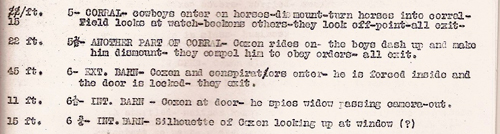
Strange as this sounds to us today, it was preferable to renumbering the shots, which could cause confusion. (Is shot 17 the original 17 or the later one?) The fractions kept the footage consistent with the scenario across the production process. So it turns out that (as usual?) filmmakers were a bit ahead of the screenplay gurus, even back in the 1910s.
Lea Jacobs asked a question about the transition from silent to sound film: How did filmmakers manage the pacing of dialogue? Silent movies had great freedom of pacing, while the shift to talkies seemed to many filmmakers to slow things down. Lea’s research indicated that two strategies for speeding things up emerged: creating shorter scenes and shortening dialogue passages within them. She reviewed how these ideas emerged in Hollywood’s own discourse in the 1930s and in certain films. In the first years of sound, scenes were rather long (often because they were derived from stage plays) and speeches were similarly extended. But in the 1931-1932 season, she argued, short scenes and quicker repartee became more common.
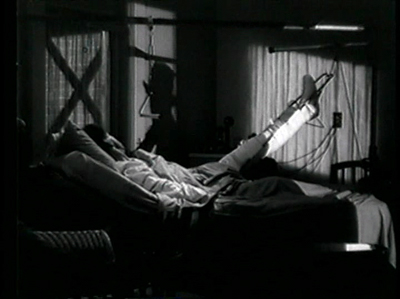
She traced the process in three films of Howard Hawks, from the stagy Dawn Patrol (1930) through The Criminal Code (1931), which opens in the new style but then turns to longer sequences, and then to Scarface (1932). The gangster film shifted toward shorter scenes and more laconic dialogue than did other genres, and Scarface displays this in full flower. Tony Camonte’s takeover of the South Side beer trade is presented in six harsh, violent scenes that add up to little more than three minutes. Workers in the sound cinema, it seems, were soon pushing toward that rapid tempo we identify with the 1930s.
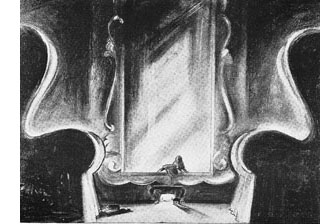 Storyboards have now entered academic studies. Chris Pallant and Steven Price offered some historical insights by comparing some early storyboards by William Cameron Menzie with those of early Spielberg films. When Menzies was storyboarding Gone with the Wind, he called it “a complete script in sketch form” and “a pre-cut picture.” Selznick’s publicity director characterized it: “The process might be called the ‘blue-printing’ in advance of a motion picture.” The striking revelation was that the storyboarding was not done after the script was finished. Menzies worked from the book, and the storyboard and script were created in parallel. Menzies’ storyboard for the 1933 Alice in Wonderland revealed a similarly elaborate process. It was 624 pages long, with one page per intended shot. Each page contained a sketch at the top, a paragraph describing the planned technological traits of the shot (such as lens length), and the traditional screenplay dialogue at the bottom. It’s hard to imagine many people other than a genius like Menzies being able to provide such a comprehensive plan for a film. (A sketch for Alice is on the right here. DB has written about Menzies here and here.)
Spielberg used sketches in addition to a screenplay from the start. Duel, surprisingly enough, was supposed to be shot in a studio, but the director insisted on working on location. The sketches he made for it do not resemble a traditional storyboard but instead are like pictorial maps framed from an extremely high angle. He also plotted out the paths of the vehicles with overhead views of the roads. The storyboards for Jaws were done from the novel at the same time that the script was being written, just as Menzies had done with Gone with the Wind. (The same thing happened with Jurassic Park.) Storyboards were vital, among other things, for telling the crew which of the four versions of the shark would be used. One fake shark had only a right side, another a left, and which one was needed depended on the direction the shark was crossing the screen. The speakers distinguished between the “working” storyboard and the “public” one. The public one is what sometimes get published, but it usually has each image cropped to remove the information about the shot (e.g., who will work on it) noted underneath.
Brad Schauer contributed to a roundtable on the American B film back when The Blog was in its infancy. He has been researching the role of B’s in the industry for many years, and he brought to our event some new ideas about them in the postwar period. His paper, “First-Run and Cut-Rate” showed that there were still plenty of theatres showing double bills in the 1950s and 1960s (DB can confirm it), and the market needed solid, 70-90 minute fillers. One answer was the “programmer,” or the “shaky A” that featured somewhat well-known talent, color, location shooting, and familiar genres (Westerns, swashbucklers, horror, crime, comedy, and science fiction). Shot in half the time of an A, with budgets in the $500,000-$750,000 range, programmers fleshed out double bills and sometimes broke into the A market.
What does this have to do with screenwriting? Brad decided to test whether Kristin’s ideas about four-part structure (here and here) held good with programmers. Looking at several, he came up with a plausible account that films like Battle at Apache Pass and Against All Flags simply compressed the four parts into short chunks, typically running fifteen to twenty minutes. In The Golden Blade, Rock Hudson formulates his goal (revenge) two and a half minutes into the movie.
Too few things happen?
La Pointe Courte (1955).
In most films, Agnes Varda said, “I find that too many things happen.” How can screenplay studies move beyond Hollywood’s jammed dramaturgy to consider the more spacious sort of storytelling we find in “art cinema”?
Colin Burnett offered a general overview of art-cinema norms that is somewhat parallel to our and Janet Staiger’s The Classical Hollywood Cinema. To a great extent, of course, “art films” differ from classically constructed films. They can be more ambiguous, more reflexive, more stylized and at the same time more naturalistic. They often replace a tight causal chain with episodic construction and nuances of characterization. The protagonists may have complex mental states; they may have inconsistent goals, or no goals at all; they may be passive; they may have shifting identities.
Yet Colin argued against claims that art films lack narrative altogether. “Art films offer reduced scene dramaturgy, rarely its complete absence.” They possess structuring devices comparable to Hollywood acts. A film’s large-scale parts may be based on a character’s development, on changes in space or time, or on variations of action and/or reaction. A question was raised as to whether such a broad category as art cinema could be characterized in such ways. Given the enormous range of types of films made in the Hollywood tradition, however, it seems possible that the art cinema could be described in a similar fashion. (For our thoughts on the matter, go here and here.)
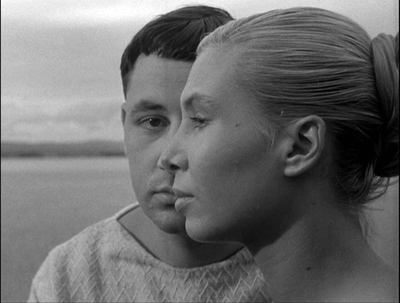
A great many art-film strategies can be seen as stemming from modernism in literature and the other arts. As if offering a case study illustrating Colin’s argument, Kelley Conway focused on La Pointe Courte. Varda’s first film is now coming to be considered the earliest New Wave feature. But Varda wasn’t the prototypical New Waver. She wasn’t a man, she wasn’t a cinephile, and she took her inspiration from high art, not popular culture. A professional photographer who loved painting and literature, she brought to this film (made at age 26) a bold awareness of twentieth-century modernism. The result was a striking juxtaposition of stylization and realism, personal drama and community routine. In La Pointe Courte, we might say, neorealism meets the second half of Hiroshima mon amour.
Inspired by Faulkner’s Wild Palms, Varda braided together two stories. While families in a fishing village live their everyday lives, an educated couple work through their marriage problems in a long walk. Remarkably, Varda had not seen Rossellini’s Voyage to Italy. After supplying background on the production process, Kelley focused on matters of performance. She explained how Varda, well aware of Brechtian “distanciation,” made the couple’s dialogue deliberately flat. By contrast, the villagers’ lines, through scripted, were treated more naturalistically. La Pointe Courte emerges as an anomie-drenched demonstration of how little you need to make an engrossing movie.
To script or not to script (or to pretend not to script)
Maidstone (1970).
The SRN embraces research into the absence of a script as well. At one limit is the work of avant-gardists like Stan Brakhage. John Powers’ “A Pony, Not to Be Ridden” discussed how non-narrative filmmakers used paper and pencil to organize their work, much as a poet might make notes on a draft. John’s examples were three films by Brakhage, each developed out of sketches and jottings assembled after shooting but before editing. Unconstrained by any script format, Brakhage had to invent his own version of storyboarding and screenplay notes.
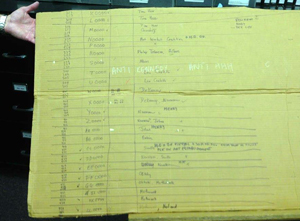
Compilation filmmakers also discover their structure in the process of collecting and sifting material. Documentarist Emile de Antonio, whose collection resides in our WCFTR, had to build his screenplay up after he had assembled some material. “A script won’t be ready,” he remarked, “until the film is finished.” Vance Kepley’s paper showed that In the Year of the Pig was the result of a massive effort of “information management.” De Antonio sought out press clippings, sound recordings, and news footage and then had to create an archive with its own system of labeling, cross-references, and easy access.
De Antonio started with the soundtrack, which was itself a montage of found material, and then created a “paper film,” cutting and pasting vocal passages and descriptions of images. At the limit, he charted his film’s structure with magic-marker notations on large strips of corrugated cardboard, as Vance illustrated.
One panel session took a close look at improvisation in fiction features. Line Langebek and Spencer Parsons gave a lively paper with the innocuous title “Cassavetes’ Screenwriting Practice.” Explaining that Cassavetes did use scripts (“sometimes overwritten”), and he relied on actors to help create them in workshop sessions, they proposed thinking of his work as exemplifying the “spacious screenplay.” Their ten principles characterizing this sort of construction include:
Write with specific actors in mind. Use a “situational” dramaturgy rather than a rise-and-fall one. The work is modeled on free jazz, with moments set aside for specific actors. Even minor actors get their solos. Shoot in sequence, so that emotional development can be modulated across the performances.
Line and Spencer’s precise discussions cast a lot of light on the specific nature of Cassavetes’ creative process and pointed paths for other directors. They added that the spacious screenplay is really for the actors and the director; the financiers should be given something more traditional.
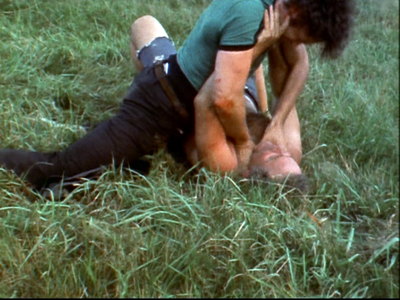
Norman Mailer called Cassavetes’ films “semi-improvised.” He tried to go further, J. J. Murphy explained in “Cinema as Provocation.” Mailer wanted his three films Wild 90, Beyond the Law, and Maidstone to be completely improvised, utterly in the moment. “The moment,” he proclaimed, “is a mystery.” Mailer opposed the “femininity” he claimed to find in Warhol’s films, so he encouraged his male players to indulge their machismo playing gangsters, cops, and aggressive entrepreneurs. J. J., whose book on Warhol stressed the psychodrama component of the films, finds Mailer no less devoted to having his players work out their problems through unrestrained behavior. The climax of Maidstone, in which an enraged Rip Torn begins to strangle Mailer, becomes the logical outcome of Mailer’s needling provocation of his actors. How ya like the mystery of this moment, Norman?
Within the Hollywood industry, improvisation is identified strongly with Robert Altman’s films, but Mark Minnett‘s “Altman Unscripted?” shows another side to his work. Focusing on The Long Goodbye, Mark finds that the film doesn’t vary wildly from the script. The principle plot arcs aren’t changed, although Altman decorates them by letting minor characters inject some novelty. He encouraged the guard who does impressions of Hollywood stars, and he gave latitude to Elliott Gould, whose improvisation elaborates on the issues of trust and bonding that are embedded in the script. Some scenes are condensed or altered, as often happens on any production, but the Altman mystique of freewheeling, anything-goes creativity isn’t borne out by the film. Altman’s characteristic touches are built around what’s “narratively essential,” as laid out in the screenplay.
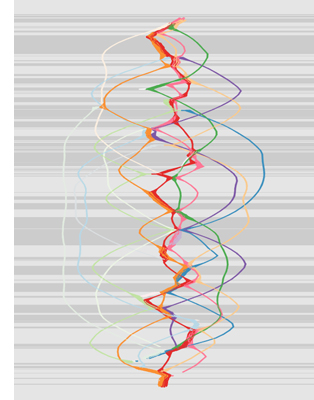
We learned a lot more at the conference than we can cover here. For example, Jule Selbo brought to our attention Sakane Tazuko, a woman screenwriter-director in 1930s Japan. Rosamund Davies explored the ways in which transmedia storytelling could enhance historical dramas. Carmen Sofia Brenes traced out how different senses of verisimilitude in Aristotle’s Poetics might apply to screenwriting. We learned of a planned encyclopedia of screenwriting edited by Paolo Russo and a book on the history of American screenwriting edited by Andy Horton. Not least, there was Eric Hoyt, whose “From Narrative to Nodes” showed how digitized screenplays could be used to graph character action and interaction over time. (A nice moment: When asked if his analytic could be rendered in real time, he clicked a button, and the thing moved.) Once more we’re in the x-y axes of Emmerdale and In the Year of the Pig, but now in cyberspace. Eric’s results on Kasdan’s Grand Canyon appears here on the right, but only as an enigmatic tease; he will be contributing a guest blog here later this fall.
In other words, you should have been here. Next time: October in Potsdam, under the auspices of Kerstin Stutterheim at the Hochshule für Film und Fernsehen “Konrad Wolf.” DB was at this magnificent facility last year for another event, and we’re sure–to coin a phrase–a hell of a time will be had by all.
Thanks very much to J. J. and Kelley, as well as to Vance Kepley, Mary Huelsbeck, and Maxine Fleckner Ducey of the WCFTR. Special thanks to Erik Gunneson, Mike King, Linda Lucey, Jason Quist, Janice Richard, Peter Sengstock, Michael Trevis, and all the other departmental staff that helped make this conference a big success.
Thanks also to Noah Ollendick, age 12, who asked a smart question.
P.S. 4 Sept: Thanks to Ben Brewster for a correction!
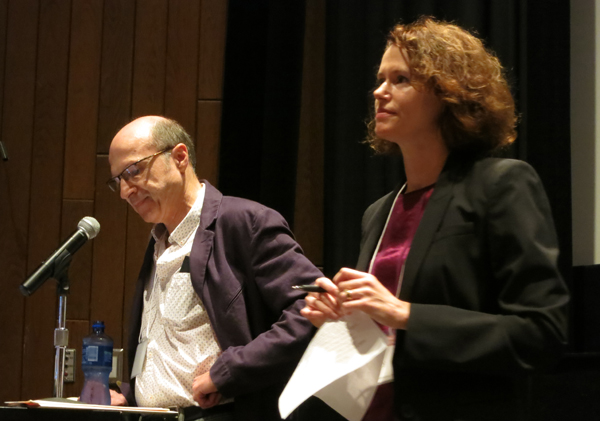
J.J. Murphy and Kelley Conway, conference coordinators.
Magic, this Lantern
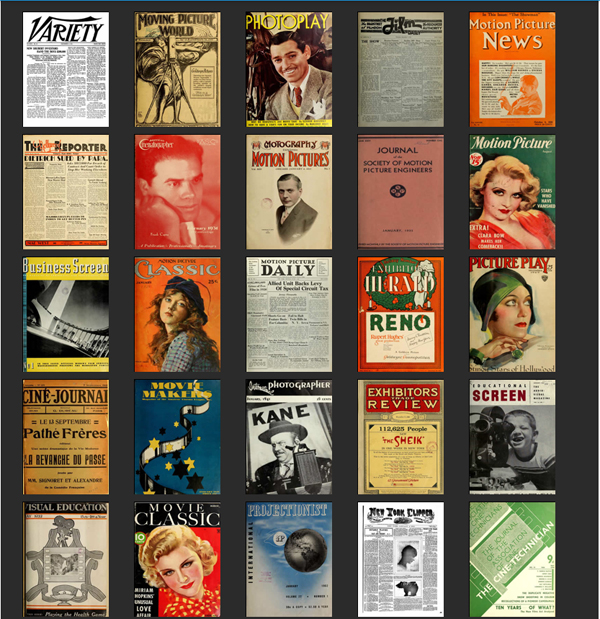
Home page of Lantern (top half).
DB here:
In earlier entries (here and here) we’ve reminded you of the immense and growing resource that is the Media History Digital Library. It was founded and is directed by David Pierce, world-renowned moving-image archivist, and it’s co-directed by UW-Madison Communication Arts professor Eric Hoyt. If you haven’t wandered, or rushed, or hop-skipped, through this wondrous library devoted to images and sounds, you owe it to yourself to start.
Of course it’s a remarkable resource for historians of film, television, and radio. It gathers a huge number of periodicals that can be searched, read, and downloaded–gratis. Thanks to its hookup with the Internet Archive, you can access and own entire books. The tireless Catherine Grant gives us Film Studies for Free. David and Eric give us Film History for Free.
But it isn’t just professional and amateur researchers who benefit. Anyone even mildly curious about media in the nineteenth and twentieth centuries should take the time to browse through the fan’s paradise that is Photoplay, the show-biz churn of Variety, the techie wonderland that is Journal of the Society of Motion Picture Engineers and International Projectionist and many other publications. I guarantee you will be surprised and delighted by what you find: Big pages, beautifully displayed, that can hold you, we might say, spellbound; or at least make you girl crazy.
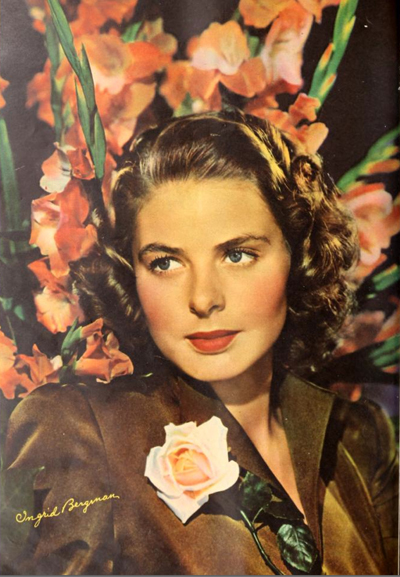
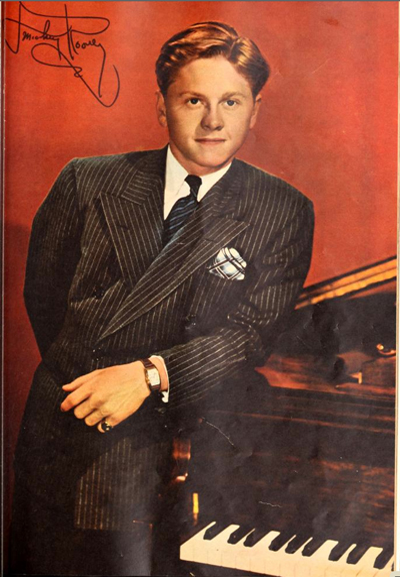
Why have you held back? Perhaps the sheer number of collections was daunting. And previously you had to search each journal separately, year by year.
Now Eric and his team, many here at UW, have made things even easier for historians and civilians alike. Today the MHDL crew have unveiled their new super-search engine, Lantern. Lantern allows you to search all of the MHDL publications at one go. Apart from the massive efficiency, you discover sources you wouldn’t have thought to check.
If you’re bold and type in Chaplin, for instance, you get 1446 hits. Many of them are from books, thanks to the generosity of Niles Essanay Silent Film Museum, Jeff Joseph, and many contributors to the Internet Archive. I struck minor gold with my first hit, a page from Charlie’s 1922 travel memoir My Visit:
Dear Mr. Chaplin: You are a leader in your line and I am a leader in mine. Your specialty is moving pictures and custard pies. My specialty is windmills. I know more about windmills than any man in the world. . . . You have only to furnish the money. I have the brains, and in a few years I will make you rich and famous.
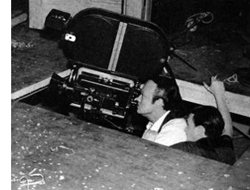 A search for Gregg Toland brings you not only his much-reprinted 1941 American Cinematographer article, “Realism for Citizen Kane,” but also many AC articles featuring professional discussion of his contributions–not all of them complimentary. “Pan-focus…,” notes one, “may be a flash in the pan.” An anonymous review of The Little Foxes complains that in some shots “The eye hardly knows where to look.” But go beyond AC and you find lesser-known treasures: articles by Kane’s on-set still photographer, a different piece by Toland (opposite a full-page topless young lady), and 52 more. That’s just in 1941.
Yes, while the default search digs for everything, you can limit your search by year and along other parameters.
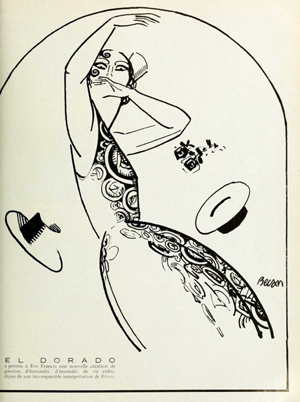
Lest you think that this bounty is of interest only for followers of Hollywood, please note that the Global Cinema collection (1904-1957) includes books and periodicals from France, Germany, Italy, Mexico, Spain, and the United Kingdom. In 1921, for instance, Louis Delluc’s magazine Cinéa, while badmouthing Feuillade fairly constantly, gives unflagging support to L’Herbier’s El Dorado and adds in this sprightly caricature of Eve Francis.
Not all the collections are complete. There are of course copyright constraints on recent publications, and some journals are so rare that the runs must be filled in as copies are found. But the MHDL, like the universe, is constantly expanding, and possibly faster. Soon to be added are Quigley’s Exhibitors Herald, Cine-mundial, and more years of Variety. This spectacular enterprise is in the hands of people who are utter and dedicated completists.
I hate to pull a Grandpa Simpson, but when I think of all the time and money and gasoline and air tickets I ran through over several decades to visit libraries holding a few issues of this or that journal . . . and then think about the hours I spent paging through them looking for certain names, terms, film titles . . . and then think about how I painstakingly copied what I wanted onto 3 x 5 cards (photocopy not permitted) . . . I think–Well, what do you think I think?! I think how damn lucky you (and I) are to have all this material so accessible now. For work and play.
Same thing, come to think of it.
Thanks to Eric Hoyt for giving me a quick preview of Lantern, and to all my colleagues at UW-Madison who are supporting this remarkable undertaking. You can too: donations gratefully accepted.
P. S. 15 August 2013: Eric provides some helpful tips for using Lantern at the UW-Communication Arts blogsite Antenna.
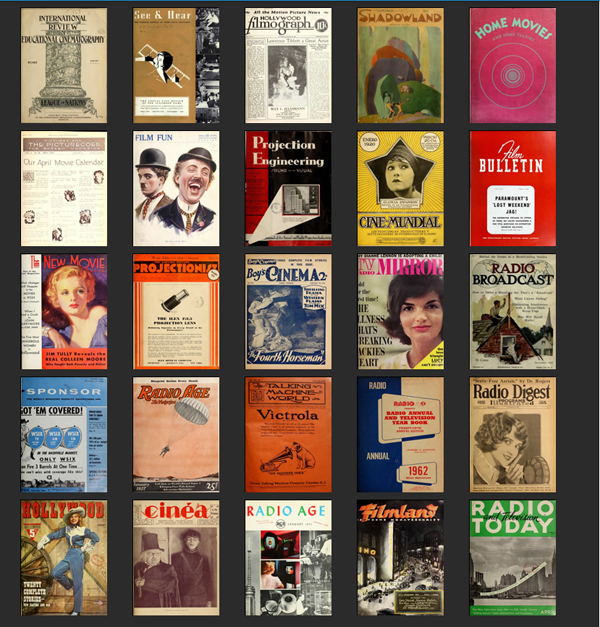
Home page of Lantern (bottom half).