





Archive for the 'Film comments' Category
Time-shifting: THE PHANTOM CARRIAGE on the Criterion Channel
DB here:
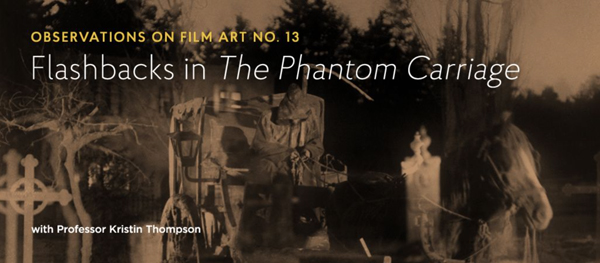
Today our comrades at the Criterion Channel on FilmStruck have posted Kristin’s new installment of our series, “Observations on Film Art.” It’s devoted to one of the most complex and intriguing of all silent films, Victor Sjöström’s Phantom Carriage (1921).
Sjöström was one of the greatest directors of the silent cinema. Although many of his films haven’t survived, we’re lucky to have several of his masterpieces, including Ingeborg Holm (1913), Terje Vigen (A Man There Was, 1917), The Girl from Marshy Croft (1917), The Outlaw and His Wife (1918), The Sons of Ingmar (1919), The Scarlet Letter (1926), and The Wind (1928). He mastered tableau staging in the early 1910s, then quickly learned the nuances of continuity editing, all the while drawing splendid, subtle performances from his actors.
The Phantom Carriage is a sort of horror fantasy. The premise is that the last person to die in a year becomes the escort for the dead of the following year. To this striking idea, taken from a novel by Selma Lagerlöf, the film adds an exceptionally intricate flashback structure.
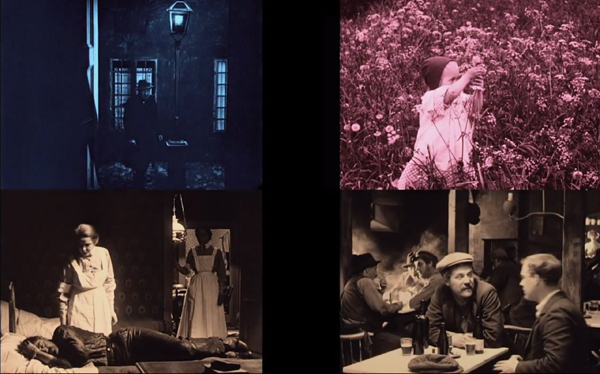
Silent films made frequent use of flashbacks, usually brief ones to remind the audience of things seen earlier in the film, or longer ones that supplied backstory for the current situation. (In this respect, our films today are rather similar to silent movies.) The Phantom Carriage pushes farther, building its plot out of blocks of flashbacks that are presented out of chronological order, and not all representing memories. It was as daring in its time as The Power and the Glory (1933) and Citizen Kane (1941) were in theirs.
Because of its complexity, The Phantom Carriage long circulated in versions that were cut and rearranged. Once it was restored, we could appreciate just how ambitious a movie it was. Kristin traces the film’s various time schemes and shows that the shifts of chronology and point of view powerfully enrich a story of a man’s hard-won redemption. Her comments are enhanced by some excellent graphics from the keyboard wizards at Criterion.
As ever, we thank our Criterion collaborators: Kim Hendrickson, Peter Becker, Grant Delin, and their team.
A complete listing of our thirteen “Observations” entries is here. For more on Sjöström’s films, see our director tag.
THE LOST WORLD refound, piece by piece
Kristin here:
Like just about all kids, I was fascinated by dinosaurs for a while. That’s probably why my mother bought a copy of Sir Arthur Conan Doyle’s 1912 fantasy-adventure novel, The Lost World, at a yard sale and gave it to me to read while I was sick in bed. I must have been about nine. It was a battered photoplay edition, complete with photos of scenes from the 1925 movie. I read other Victorian-Edwardian fantasy-adventure books, mostly Verne and Haggard, at around the same time. I suppose they prepared me for reading The Hobbit and The Lord of the Rings at age 15 and developing a life-long attachment to them. This doesn’t mean that I consider The Lost World a masterpiece, but having come to it so young, I retain a fondness for it. I was interested to find out what the new Flicker Alley release of a new restoration of the film is like.
Doyle’s novel deals with a scholar and explorer, Professor Challenger, who has recently visited a remote site in South America and is ridiculed by all for his claims that dinosaurs survive on an inaccessible plateau there. The hero, Edward Malone, a lovelorn reporter courting a woman who insists she wants a daring, heroic husband, enlists on an expedition to test Challenger’s stories. So does a skeptical rival of Challenger’s, Professor Summerlee, and a hunter-adventurer, Sir John Roxton, who wants to add a stuffed dinosaur to his other trophies. Many adventures follow, including vengeful Spanish guides marooning the expedition atop the plateau, where they encounter dinosaurs, ape-men, and Indians. The team escapes and manages to take a pterodactyl back to London. Challenger’s reputation is restored.
Following on the novel, I saw the 1960 Irwin Allen version of The Lost World. At the age of perhaps ten or eleven I enjoyed it, though I did recognize that Jill St. John’s character was a total and unnecessary fabrication and the “dinosaurs” were lizards with prostheses.
The 1925 version
Naturally when I was a grad student in film studies, I took my first opportunity to see the 1925 version. It was produced by the important studio and distributor First National Pictures three years before it was absorbed by the upstart Warner Bros. In those days the only version available was a 50-minute abridgement made by Kodascope, and it was not, to say the least, impressive.
I cannot say that I paid much attention to the subsequent restorations: the 1998 George Eastman House version, which, while still incomplete, was a distinct improvement, and the the 2000 David Shepard version, which was basically the same but with digital improvements to sound and image.
The 2016 restoration by Serge Bromberg’s Lobster Films as presented now on Blu-ray by Flicker Alley, has added considerable footage. This extends the film to 103 minutes, close to its original running time. The main thing missing is a scene of cannibals attacking the expedition members as they travel upriver to the controversial plateau, as well as a few other brief moments.
As an adaptation, it’s a distinct improvement on the 1960 version. After all, the novel was only 13 years old when it was made. Doyle was still alive; he would not publish his final Sherlock Holmes story until 1927 and his final works of fiction until 1929. Conventions and tastes in popular fiction, whether filmic or literary, had not changed nearly as much as they had by Irwin Allen’s day.
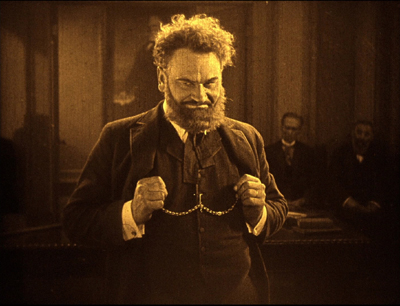
The main casting was impeccable, with Wallace Beery the perfect choice for the powerful, pugnacious Challenger (above) and Lewis Stone for the epitome of British stalwart rectitude. The film even managed to do a good job of concocting a love interest by introducing Paula White (Bessie Love), the daughter of the original discoverer of the lost-in-time plateau and eager to participate in an expedition to rescue her marooned father. Then it gave her little to do. Bessie Love just has to look terrified at intervals, in a series of close-ups surrounded by an iris and with a blank background–clearly shot later with someone telling Love just to glance in all directions and register fear. These moments add up to something a realization of a Kuleshov experiment.
Her presence does, however, allow Stone to give perhaps the most subtle and sympathetic performance in the film. He’s in love with White but nobly gives her up to Malone. As Malone, Lloyd Hughes manages to look suitably handsome and impetuous. Arthur Hoyt, older brother of director Harry O. Hoyt), plays Professor Summerlee. His many “little man” roles later included the hotel owner in It Happened One Night, and he was one of Preston Sturges’ regular actors. (“Looking perpetually befuddled was Hoyt’s stock-in-trade,” as I. S. Mowis puts it in his IMDb biography of Hoyt.) Unfortunately the film exaggerates Summerlee’s somewhat amusing traits, thereby making him a strictly comic character. (One wonders how Claude Rains, so very dissimilar from Beery, could be chosen for the same role in the 1960 version. Casting against type, presumably.)
By the way, although the film seems basically to be set in the Edwardian era of the novel’s original publication, the introduction to the final London portion of the story shows Piccadilly Circus at night, including a movie palace show The Sea Hawk (1924), another First National release that included Wallace Beery and Lloyd Hughes (Malone) its cast.
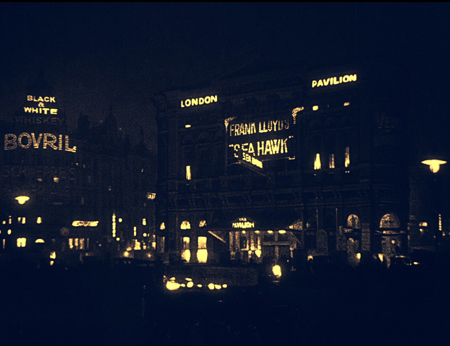
A little synergy that brings the story up to date.
Puppets and people
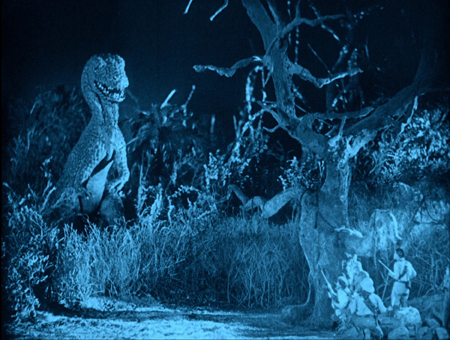
The main attraction of the film, of course, is its technology. Some of it was quite innovative. It is thought to be the first time when the special effects of a feature film were largely accomplished through puppet animation.
There had been earlier puppet films, including Ladislas Starevich‘s realistic creation of artificial insects apparently acting out conventional melodramas. Accomplished though they were, these did not mix live-action with real actors in the same shots, as do the miniature landscapes with the moving dinosaurs.
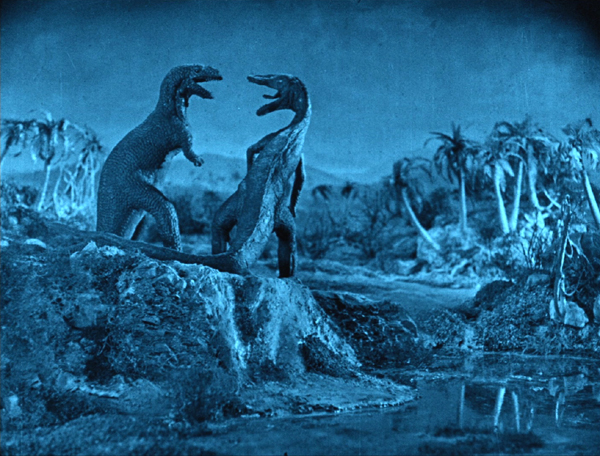
In The Lost World, combinations usually involve the actors placed in the lower foreground, observing the dinosaurs from varying distances. Atop this section, for example, in a very skillfully done shot, an allosaurus approaches the campsite of the expedition members. The place where the live-action at the lower right joins the miniature set at the upper left is difficult to discern, and the careful lighting of both areas aids in the illusion.
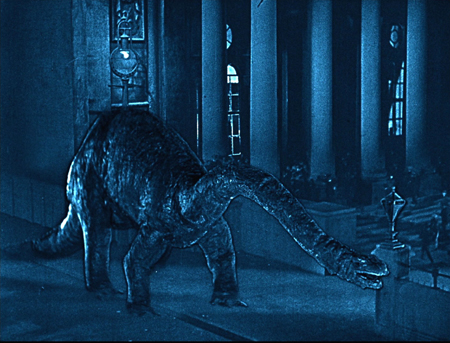
The late scenes of the film, where a brontosaurus escapes into London’s streets and causes panic resorted to a new and complex technology, moving mattes. This device involved using stencils cut for each frame and doubly exposing prints from two negatives. Moving mattes allowed figures filmed separately to be inserted into scenes without the use of superimpositions. The result usually was fairly obvious, betrayed by an evident join line around the added figure. Differences in texture and lighting also caused problems. Still, given the technical limitations of the day, the results are impressive. (The most famous use of moving mattes in this era was probably the reunited couple’s oblivious stroll through traffic in Sunrise.)
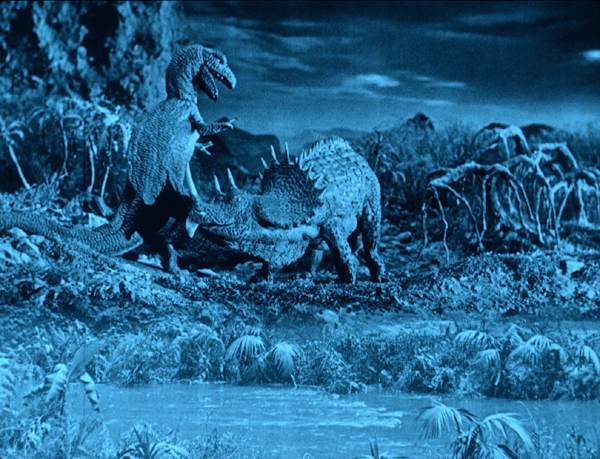
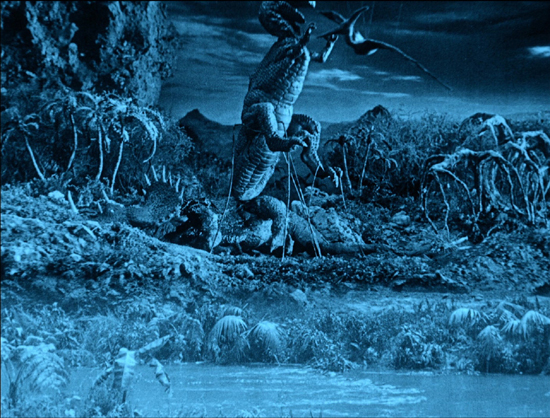
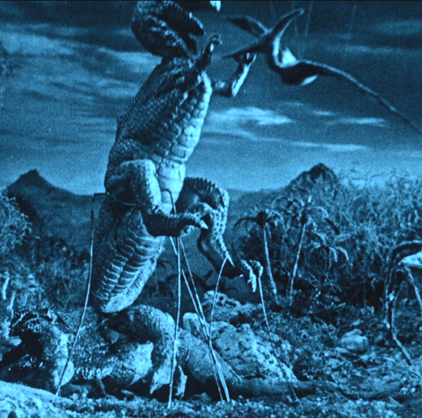
The Lost World drew more heavily on stationary mattes, and for the most part, the technology is pretty convincing. The scene of the allosaurus-triceratops-pterodactyl fight (at the top) contains a stationery matte. The lower part of the frame is a river with plants on the banks swaying in the breeze. About a third of the way up the composition, there is a join to the miniature set in which the action was animated. There the plants are completely stationery, but the movement of the real plants in the lower area gives a degree of verisimilitude to the whole scene. The shot of the team confronting the allosaurus at the top of this section also uses this technique.
Digital copies let us pause and figure out some of O’Brien’s secrets. After the allosaurus has dispatched the unfortunate triceratops seen in the image at the top of this entry, a dramatic moment occurs in a blink-and-you’ll-miss-it flurry of motion as it suddenly snatches a pterodactyl in mid-flight and kills it. Pausing on the action, we can see that O’Brien used wires to support the allosaurus during its leap, as well as nearly invisible wires along which to slide the pterodactyl. I didn’t notice any other scenes in which O’Brien had to resort to visible props.
And at least the dinosaurs, unlike King Kong, didn’t have fur that ruffles almost continually, betraying the movements of the animators’ fingers in between exposures of the frames. As a result, the animation in The Lost World almost looks more sophisticated than that of Kong.
Moreover, O’Brien’s puppets, constructions of rubber and foam over metal skeletons, included balloons inside that could have air pumped in and out to simulate breathing. It’s a measure of the man’s inspiration that he realized how much this technique would contribute to the lifelike quality of the dinosaurs.
One of the supplements gives another insight. It is listed as “Deleted scenes,” or outtakes, but occasionally O’Brien or perhaps one of his assistants (the footage is too indistinct to tell which) pops into the image for a few frames, incongruously appearing submerged to his waist in a primordial landscape.
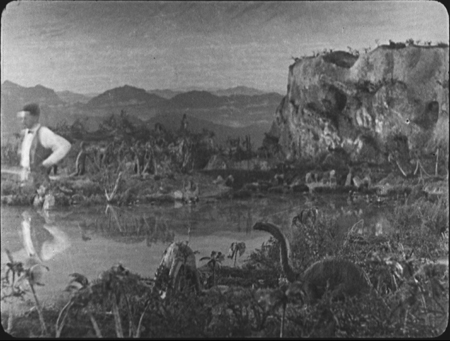
Such images give a sense of the considerable scale of the miniature landscapes and the puppets, as well as the labor involved in this novel endeavor.
The new print
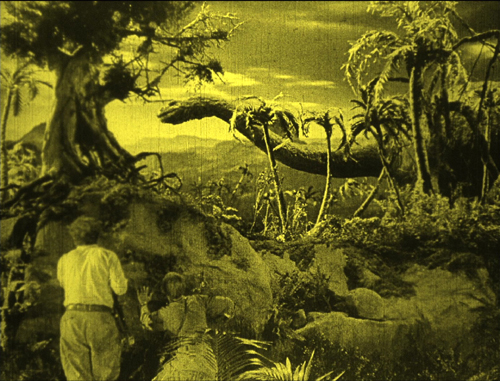
This newest restoration, having been cobbled together from many disparate elements, inevitably is variable in its visual quality. Much of it is splendid, as indicated in most of the images reproduced in this entry, especially the one at the top. Others are clearly worn, with light lines, as in the shot above of Challenger and Summerlee watching a brontosaurus pass in the background. Again a matte shot has been used, its joint probably running along the top of the little sandy ridge behind which the men hide.
The rather poignant scene of the dinosaurs fleeing from a volcanic eruption is unfortunately worn as well. Such stretches, however, are in the minority.
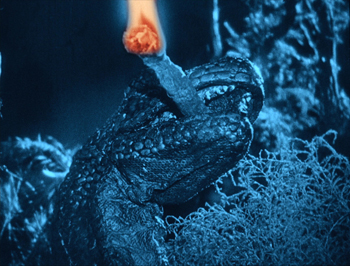
The new version also includes tinting and toning based on recently discovered footage, as well as a brief scene combining red and blue colors when Malone throws a torch into the mouth of an allosaurus to drive it away.
The disc comes with a booklet by Bromberg outlining the extensive restoration work on the versions of The Lost World, as well as the disc’s two musical-track options, one by Robert Israel and one by the Alloy Orchestra. Supplements include a commentary track by Nicolas Ciccone and some short films and clips by O’Brien. The Silent Era website offers a detailed rundown on the many video releases of The Lost World. Once more Lobster Films and Flicker Alley are to be congratulated on another contribution to the retrieval of cinema’s history.
Venice 2017: Crimes, no misdemeanors
Outrage Coda (2017).
DB here:
The period from 1985-1995 was a sterling era for world cinema. Whatever you think of Hollywood of that time (it wasn’t as bad as they say), American independent film was flourishing then. On the global stage, things were even better, as witness the rising careers of Hou Hsiao-hsien, Edward Yang Dechang, Jackie Chan, Tsui Hark, Abbas Kiarostami, and Wong Kar-wai. It was exhilarating to watch these and other directors turn out splendid work like City of Sadness, A Brighter Summer Day, Police Story, Project A Part II, Peking Opera Blues, Once Upon a Time in China, The Blade, Where Is the Friend’s Home?, Through the Olive Trees, Days of Being Wild, Chungking Express, and more.
That’s not all. In Hong Kong, John Woo was redefining the urban action film with the flamboyant, romantic A Better Tomorrow (1986), The Killer (1989), and Hard-Boiled (1992). In Japan, a standup comedian known as “Beat” Takeshi Kitano took over the helming of a crime thriller, Violent Cop (1989), and decided to continue directing, turning out not only the bored-hitman saga Sonatine (1993) but also the lyrical A Scene at the Sea (1991). Another Japanese filmmaker, Kore-eda Hirokazu, launched his career with the meditative, Hou-ish Maborosi (1995).
I loved these films, and still do. Woo and Kitano belong to an older generation (mine, actually), while Kore-eda is younger. None has gone away. All came to Venice 74 with murder on their minds.
Confessed, but to what?
The Third Murder (2017).
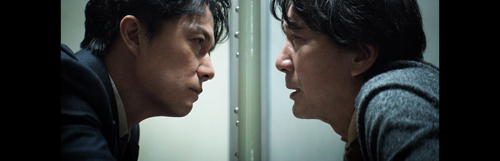
The Third Murder (Sandome no satsujin) is Kore-eda’s first venture into the crime genre, and he brings to it the same steady humanism we find in all his work. I’ve elsewhere recorded my uneasiness with his current visual style. Unlike the grave, long-take Maborosi, his films of the last decade or so are pictorially conventional, even academic, with their big close-ups, needlessly sidling camera moves, and other features of intensified continuity. But he continues to take narrative risks, and his almost Renoirian willingness to see many moral and psychological points of view make every film fairly gripping.
The Third Murder begins abruptly. An unseen victim is bludgeoned and the body is burned. The killer is the man we’ll come to know as Misumi. He’s captured. Like 99% of people charged with crimes in Japan, he readily confesses. His lawyers face only the question of sentencing: Should they try to get him life imprisonment rather than execution? When one attorney, Shigemori, decides to investigate more closely, he peels back layers of uncertainty about the circumstances, the victim, and the motive(s). Like many a victim in crime fiction, this businessman needed killing.
Following conventions of the investigative procedural, the plot relies on secrets, viewpoint shifts that drop hints, twists that frustrate simple understanding, and flashbacks that make us question what we thought we knew. Shooting in anamorphic widescreen, Kore-eda produces some extreme framings reminiscent of Kurosawa’s High and Low, one of the films he studied while preparing the project. Despite occasionally flashy moments, it’s a soberly told tale, emphasizing characterization and social critique. By the end, Misumi acquires a weary, radiant dignity, while entrepreneurial capitalism and the justice system are revealed as compromised. (In this respect it recalls I Just Didn’t Do It, 2007, by another 80s-90s director, Suo Masayuki.) In moving to the sordid terrain of the crime story, The Third Murder shows that Kore-eda hasn’t given up his sympathetic probing of human nature and his praise for un-grandiose self-sacrifice.
Bullets to the head and elsewhere
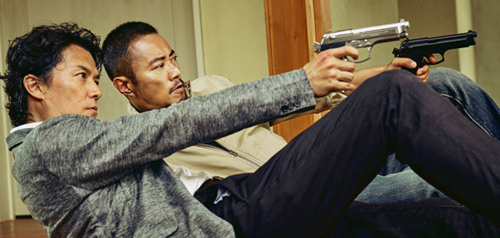
Manhunt (2017).
Sober and un-grandiose don’t apply to Manhunt (Zhuibu), John Woo’s return to bloody brotherhood and outsize ordnance. After prestige Hollywood efforts like Windtalkers (2002), the nationalistic costume picture Red Cliff (2008-2009), and the ensemble-disaster movie The Crossing (2014-2015), Woo is back with what he does best: showing many people firing many guns, dodging bullets (bad guys have bad aim), diving for cover in slow-motion, floating through hazes of cordite, and instantly recovering from wounds that would finish off you and me. These characters also run endlessly, hop into the path of trains, overturn vehicles, and set loose unconscionable numbers of pigeons.
1990s Hong Kong directors could make cheap pictures look expensive; given bigger budgets, they made expensive pictures look cheap. Here that cheapness shows most in some video-generated shots that recall the bad old days of edge enhancement. But who has time to study such problems when you’re smacked by a fusillade of 3000-plus shots in 105 minutes? Resistance is futile, and the pace doesn’t relent. When the fights and pursuits pause, the dialogue scenes flash by in a flurry of cuts and unfortunate lapses into English. (Much of the soundtrack recalls the eerily dubbed voices on US videos of The Killer.)
You’ve got no time to worry much about all this after an opening that drops us straight into an ambush. Ultra-cool Du Qiu drifts into a bar and quotes yakuza movies before leaving the hostesses to slaughter the gangsters dining there. It does get your attention, and it encourages you to sit through the exposition showing Du as the trusted lawyer for a corrupt pharmaceutical company. He proceeds to be framed for murder and goes on the run. Meanwhile stalwart detective Yamura, charged with bringing Du in, begins to suspect that there’s a bigger scheme afoot. Of course he is right.
This is all completely preposterous and continually enjoyable, with constantly startling action choreography and an overheated soundtrack that at one point breaks into Turandot. Here those damn pigeons don’t just soar into the sky; thanks to CGI, they flap annoyingly into the middle of fight scenes, spoiling a punch or a gunman’s aim. We have, besides our twinned heroes, one corrupt cop, one psychopathic son, one fairly mad scientist, two expert hitwomen (one played by Woo’s daughter), a fleet of black-suited motorcycle assassins, and two docile women who acquire some non-negligible lethality. In the press conference, Woo emphasized his eagerness to create women warriors, and he hasn’t stinted. There are hallucinatory images of a bloody wedding dress to enhance the feminine mystique.
Manhunt is a kind of palimpsest of Asian action movies. It’s a remake of a 1978 Takakura Ken movie released to great popularity in China during the 1980s. Woo, in Hong Kong, had already succumbed to that actor’s spell. What Alain Delon was to The Killer, Takakura is to this, and the steelly self-possession of Zhang Hanyu gives the film a solemnity amid all the flamboyance.
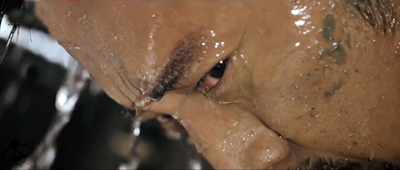
Woo has turned the Japanese original into a real Hong Kong movie, vintage 1992. It lacks the mournful homoeroticism of his prime-period work; these two men don’t gaze moistly at each other, but fire quips and complaints in the Lethal Weapon manner. (The bonding is strongest between the duo of female killers.) Still, it’s very welcome, with its proudly retro air and fanboy in-jokes. It earns the right to begin with a reference to a Japanese classic and conclude with a wink to A Better Tomorrow, as if that movie were the next link in a grand tradition. “Old movies always end this way,” says one of the survivors of the carnage. I wish more new movies did the same.
Hitmen in cars getting shot
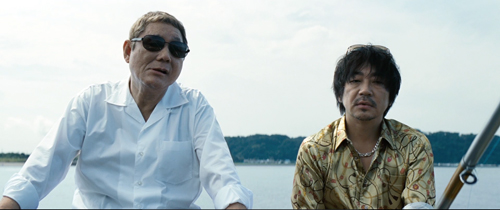
Outrage Coda (2017).
Compared to Woo, Kitano is brutally laconic. In Outrage Coda, except for one Wooish slow-mo massacre, violence is brusque, shocking, and over fast. In a film full of bland pans following yakuza cars here and there, the end of one panning movement bursts into shooting before you realize it’s happening, and it ends just as suddenly. Kitano likes his confrontations, for sure, and sometimes there’s a buildup, but mostly the blood just erupts, punctuating long scenes of gangster intrigue.
Here that intrigue involves three rival gangs, each with bosses capable of remarkable lip contortions: the Hanabishi yakuza family, its once-powerful subsidiary the Sanno group, and a gang of fixers operating in Japan and Korea under the auspices of boss Chang. Add in two cops, one ready to knuckle to corrupt superiors, the other raging against them, and you have the world through which Otomo (Kitano) and his sidekick Ichikawa move. Normal life, as it’s commonly known, has no place here.
The action bristles with schemes, shifting alliances, double-crosses, faked deaths, and power grabs.”Your methods,” remarks one boss to a co-conspirator, “are increasingly more intricate.” Remarkably, after an introduction humiliating the not-so-bright Hanaba during a sexcapade, Otomo isn’t seen that much. Two-thirds of the running time are devoted to the machinations of the gangs and the cops. Otomo and Ichikawa swing into action rather late, their task being to chop through the knots of plot and counterplot.
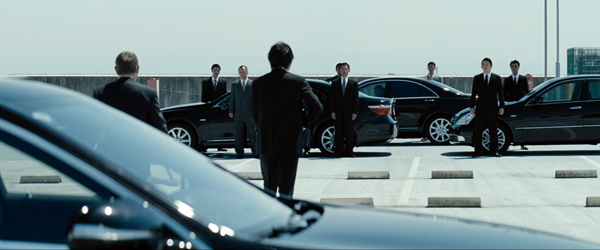
The opening few minutes spread out the key motifs. A fishing scene displaying Kitano’s characteristic love for boyish pastimes is interrupted by the discovery of a pistol. The credits sequence announces the importance of cars with gorgeous shots of Otomo being driven through neon-lit streets, his ride seen from straight down as lights play over it. Throughout, deals are struck or broken in cars, and one memorable execution makes creative use of a Toyota. Even that banal filler, shots of cars pulling up and disgorging their riders, gets played for variations: distant thunder when bosses arrive for a conference, abstract configurations when rival forces meet on a rooftop.
During the 1990s Kitano was one of those directors working with what I’ve called planimetric staging and compass-point editing. (Wes Anderson, Terence Davies, and others worked the same territory.) Characters face the camera in medium shot, and shots change along the lens axis or at 90 degrees to it. It’s as if we were in between the characters. When I asked Kitano about the technique back then, he claimed that it was his effort at realism, capturing how people faced one another in conversation. He added that he didn’t know how to direct a scene, and this was the easiest way.
I thought that his images’ paper-doll simplicity suggested a naivete suited to Kitano’s childish hitmen. Moreover, this rigorous, geometrical technique takes on special impact when presenting mobster shootouts. Instead of ducking for cover as Woo’s heroes do, Kitano’s stand up and keep blasting, firing straight out at the viewer in tit-for-tate exchanges. His unflinching framing, refusing Woo’s camera arabesques, gives these encounters a ceremonial gravity, turning them into rituals of professional righteousness. Last man standing, indeed.
The face-to-face shootouts in Outrage Coda adhere to this style, and early in the film so do the conversations. Here is Otomo discovering Hanada in his masochistic rig.
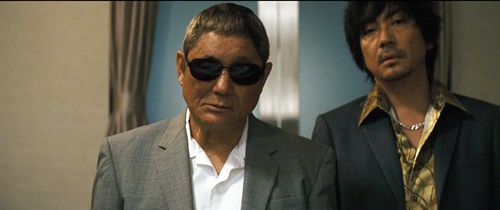
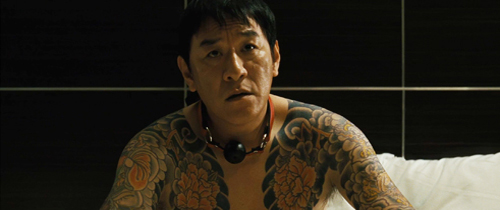
But for many dialogue scenes Kitano has gone with more orthodox staging and shooting. We get over-the-shoulder shots for conversation, tight close-ups to emphasize character reactions, and even that commonplace of modern cinematography, the arcing movement around a speaker to pick up a listener in the background. These choices allow Kitano to expose the ripe performances of the two conspiratorial dons Nishino (Nishida Toshiyuki) and Nakata (Shiomi Sansei); their leathery skin, slip-sliding jaws, and shouted outbursts gain a lot from this treatment. Not that I’m really complaining. In a slightly longer film than Manhunt, Kitano gives us around 700 shots, less than a quarter of Woo’s outlay. Each image carries a lot of weight.
Outrage Coda concludes a trilogy, and at the press conference Kitano said that he conceived this and Outrage Beyond (2012) as one continuous phase of the story. He wanted the series to finish. The ending of this installment will fuel much speculation about his next move, and he hinted that he might adapt a forthcoming novel, one that’s a love story. He’s done one before in A Scene at the Sea, and arguably in Kikujiro (1999). His fans, who mobbed him at the panel, are certainly ready for whatever he comes up with.
Thanks as ever to all those at the Venice Film Festival who made our stay so enjoyable. Special thanks to Peter Cowie, Alberto Barbera, Michela Nazzarin, Jasna Zoranovich, and our colleagues at the Biennale College Cinema endeavor.
For more on John Woo’s style of action cinema, see my book Planet Hong Kong. I discuss planimetric staging and compass-point editing in On the History of Film Style and several blog entries, notably the persistently popular Shot-consciousness (which has side notes on Kitano) as well as entries on Wes Anderson.

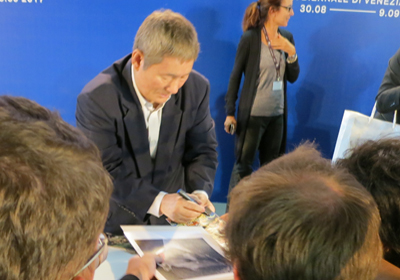
John Woo and Kitano Takeshi satisfy their fans.
Venice 2017: Martel’s drama of expectations
Kristin here:
Lucrecia Martel’s Zama (pronounced “sama”) happened to be only the third film we saw at the Venice International Film Festival, on the evening of its first day. As the credits faded, David asked, “Have we just seen a masterpiece?” Neither of us doubted that we had, and we suspected that we had also watched the best film we would see during the entire festival. Of course, we haven’t seen every title on offer here, but having just come back from my twenty-fourth and final film, I don’t doubt that it is.
It is also a challenging film, which we watched a second time to try and grasp the basics of what plot there is. Those of us who admired Martel’s earlier work, particularly The Headless Woman (which we also felt compelled to watch twice, this time at the Vancouver International Film Festival in 2009 and wrote about here), had looked forward to her follow-up film. It was eight years in coming, and it is quite different from her earlier films in several ways.
First, while the three earlier features are set set in modern middle-class milieus, Zama is a period piece. The others had original screenplays, written or co-written by Martel, but Zama is based on a 1956 novel by Antonio Di Benedetto (translated into English in 2016). Martel was also working with a higher budget here, one which required patching together many sources of financing. The result is a co-production involving, Argentina, Spain, France, the Netherlands, the USA, Brazil, Mexico, Portugal, Lebanon, and Switzerland and a patchwork of sixteen companies. At the press conference (below) Martel said that the long gap between films was not occupied with making all these arrangements and with shooting the film, which was actually a reasonably short process. She did make a few short films during this time and was ill enough to cease working for a while.
The result of the film’s elaborate production situation is not a typical historical epic. There are impressive landscape shots in some scenes, but no uniformed crowds and grand buildings. No vast battles take place; instead there are a few small skirmishes. The bulk of the action takes place in a ramshackle group of buildings thrown up to house the Spanish colonial government of the provincial town of Asunción, already in decline by the 1790s. The money clearly was spent on creating authentic costumes and furnishings, as well as transporting the cast and crew to locations in Paraguay.
Frustrations of a colonial bureaucrat
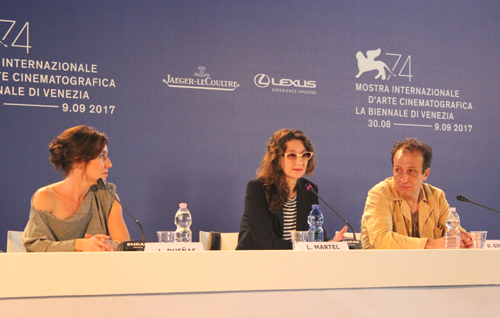
Lola Dueñas (Luciana), Lucretia Martel, and Daniel Giménez Cacho (Zama).
We quickly learn the story’s basic premise, that Don Diego de Zama is an official stationed in this backwater town and that he fervently longs to be transferred to a more important city–ideally where his wife and children live. He is not in charge of this outpost but serves under a governor whose request to the Spanish crown is necessary for such a transfer.
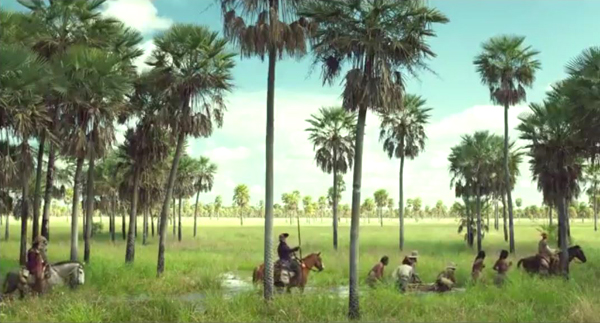
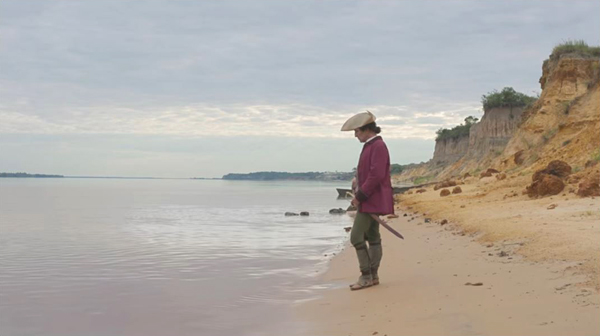
We are certainly not invited to like Zama when we first meet him. The first shot shows him standing and looking down the river (see top). We later learn that he was probably watching for the boat carrying mail, which he hopes will include a letter from his wife or some official news concerning his situation. He spies on some naked indigenous women smearing themselves with mud, and when they taunt and chase him, he turns on one and slaps her viciously. In the second scene he presides over the torture of a young man who refuses to divulge some unspecified information the governor needs.
As the action proceeds, however, we witness the countless little frustrations, embarrassments, bafflements, slights, and misfortunes that Zama seems to experience constantly. A brandy merchant who arrives with his wares, seemingly one of Zama’s few friends (below), dies suddenly of the plague. Luciana, a wealthy local beauty, teases him with suggestive conversation but ultimately takes a younger man as a lover. A new governor’s arrival hints that Zama is back to square one as far as his hopes for a transfer are concerned. The man takes over Zama’s modest home and office, leaving him to haul his sparse furnishings to a barely habitable inn. When no letter from his wife arrives, Zama imagines a conversation with her in which they lament the long delay in their reunion, though we must suspect that her failure to correspond means that she has given up on him. Through all this we come to sympathize with him. We never learn how long he has been in this posting, but when someone asks he replies glumly, “a long time,” and we believe him.
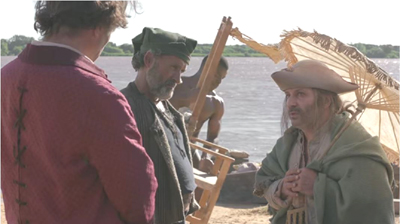
Zama might seem at first to be the epitome of a goal-oriented protagonist, but he is hardly the striving, active Hollywood-style hero. There is nothing he can do to better his current situation or to further his desire for escape. Instead, the action consists of one new, often bizarre challenge after another, creating situations that simply play out, usually to no conclusion. None of these situations furthers Zama’s cause. Gradually we become aware that he is actually losing ground, as when the new governor reveals that he must write not one but two letters to the king, a process that could take a year or two. The final portion of the film takes him in a radically new direction as he tries one desperate bid to gain stature and perhaps his long-delayed transfer, a bid that only leads to worse troubles for him.
There is little sense of how much times passes in the course of this accretion of frustrating incidents. During the press conference (above), the cinematographer Rui Poças and Martel said that they sought a visual way to convey a sense of Zama’s agonizing wait, a way to give “the sensation of time that has stopped,” as Martel put it. They deliberately avoided some of the conventions of historical films. One of these was to eliminate fires and candles. Martel added, “In order to be able to think, you must be deprived of things.” This rule was strictly obeyed, with one shot that turned out to contain a candle flame in the background being eliminated. When one thinks about it, lamps, candles, and fireplaces tend to figure quite prominently in suggesting the past in films, which became particularly evident, for example, when a great deal of fuss was made about the new ability to shoot dark scenes only by candlelight in Kubrick’s Barry Lyndon (1975).
Thinking, being deprived of things
As Martel also pointed out, the original novel was told in the first person by Zama, with few descriptions of locales or nature. The film opens the tale out with the occasional landscape views in the early portions and a move into a savanna setting for its last stretch of action (see bottom). For much of the film, however, Martel uses the style I described in The Headless Woman, ” shooting largely in tight shots filmed with highly selective focus.” We stay almost exclusively with Diego, scanning his face for his reactions, so that the film becomes a psychological study, though the title character is a man who manages to carry on by keeping his thoughts and emotions well hidden.
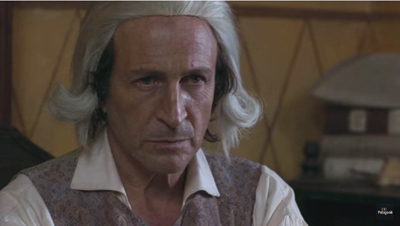
Mexican actor Daniel Giménez Cacho gives a remarkable performance as Zama. We soon realize that the character has very little understanding of the bizarre things that happen around him and of the attitudes that other people have toward him. At times he adopts the faintest of smiles, ready in case what is being said to him is supposed to be amusing. More often he looks mildly worried, as if expecting another mocking remark or revelation of some new indignity to be offered. In his court his face could be taken to convey an appropriate dignity and wisdom (below), but it might just as well be puzzlement over the case before him. With Luciana he seems passive, but his face conveys hints of lust, hope, and an anticipation of ultimate rejection. In a meeting with a superior official, he struggles to ignore the ludicrous presence of a llama (which we had seen outside when he arrived) wandering around the office behind him as he pleads his case.
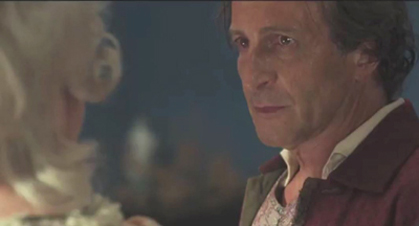
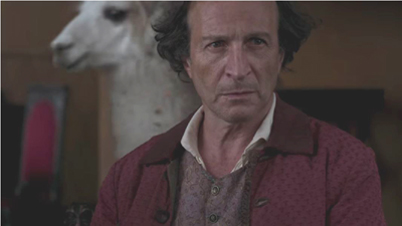
All in all, despite the fact that Cacho’s craggy, earnest face seems to suggest competence, we emerge from the film with no real sense of whether Zama is in fact competent and unfairly treated or simply a man out of his depth who deservedly remains stuck where he is.
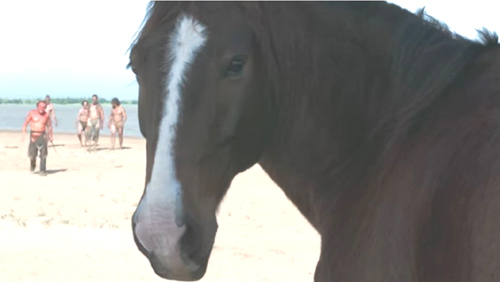
One extraordinary moment which I cannot resist mentioning comes late in the film when a horse in the foreground of a scene turns and looks directly into the lens (top of this section). Its stare is even more enigmatic than Zama’s face, just another little mystery that Martel provides.
It is not surprising that Zama was the first in a series of three novels that have come to be called Di Benedetto’s “Trilogy of Expectations.” The second, El silenciero (1964), and third, Los suidicas (1969), share no plot elements with Zama but are thematically linked to it. It is also not surprising to learn that the novelist first read Kafka in 1954, just before writing Zama.
Guy Lodge, in his enthusiastic review for Variety, refers to Zama‘s “unjust placement in a non-competition slot at Venice.” It has garnered quite a few reviews as laudatory as Lodge’s, as well as a few which dismissed it as cryptic and not engaging. A good summary of the coverage, regularly updated, is provided by David Hudson. The film deserves to gain a higher profile in its upcoming screenings at the Toronto and New York festivals. Perhaps it will also pick up a North American distributor. Somehow it should be made available on home video (Criterion, perhaps?), since this is going to be considered a classic.
The most detailed account of Di Benedetto’s life and work available online is an essay by the translator of the English-language version, Esther Allen.
Again, we are grateful to the Mostra and those who serve it, particularly Alberto Barbera and Michela Nazzarin. Thanks as well to Peter Cowie and David’s colleagues on the Biennale College Cinema panel, who have all been good company.
[October 1, 2017: Argentina has chosen Zama as its nomination for best-foreign-language Oscar. I doubt it will make it into the final five, given how challenging it is. Still, maybe it will, and in any case, it’s good to see Martel getting respect in her home country.]
[October 16, 2017: Strand Releasing picked up the North American distribution rights for Zama last month, shortly before its American premiere at the New York Film Festival. It plans a theatrical release in early 2018.]