Wednesday | April 27, 2011

The Crime of M. Lange.
DB here:
I was watching Snow White and the Seven Dwarfs some years ago with a friend’s three-year-old daughter. Molly hadn’t seen the movie before, and she watched it in a fascinated silence. At the end, Snow White and the prince leave the dwarfs and ride off into the distance.
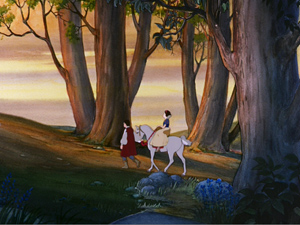 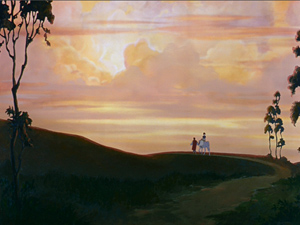
At this point Molly cried, “More!”
This surprised me. How could she know, on her first pass, that the story was ending?
In and out
It has no name that I’m aware of, but it’s one of the most common conventions of movie storytelling. At the end of the film, the story world closes itself off from us. The characters turn away, perhaps walking into the distance. We may get a distant long shot of the scene. In some cases the camera accentuates this withdrawal by craning or tracking away from the action.
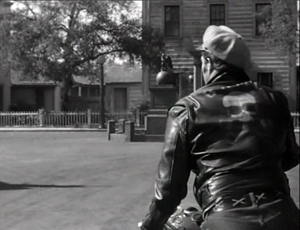
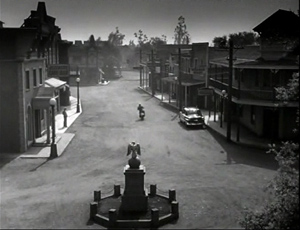
At the end of The Wild One, the biker hero smiles at the woman he’s met and goes out into the street. After exchanging a glance with the ineffectual sheriff, he swings his motorcycle around, his back to us. Cut to an extreme long shot as he rides off.
Once you notice this sort of ending, you’re likely to think about beginnings. Sure enough, we find some symmetry. A movie often visually brings us into the story world. Most common is an inward progression, moving from a large view to the central space of action. As far back as 1919, Griffith started Broken Blossoms with an overall view of the harbor and an explanatory title.
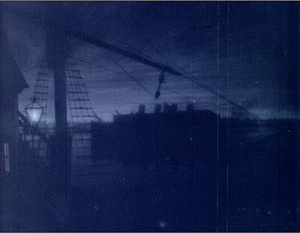 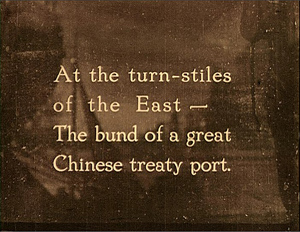
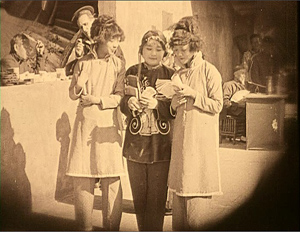
Then we have a gradual entry into the Chinese neighborhood, moving steadily from long shots to closer views. The young ladies we encounter aren’t major characters in the plot, but we’re still slowly drawn into the story world.
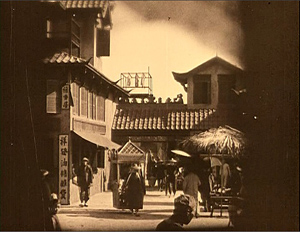 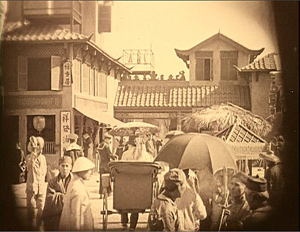 
At the film’s end, Griffith’s cutting will manage a parallel withdrawal, from the lovers to the temple and back to the waterfront view.
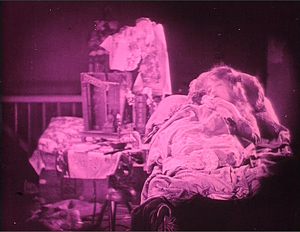 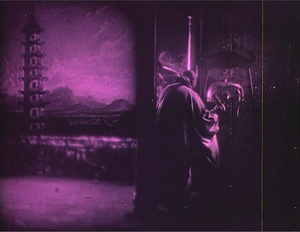 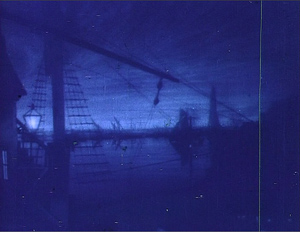
In fact, Snow White starts with a comparable, if somewhat smoother shift inward, from the exterior of the Queen’s castle then, via camera movement and dissolves, to the Queen at her mirror.
 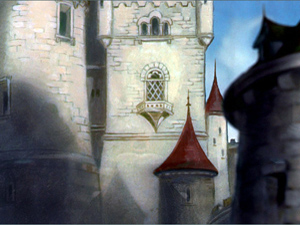
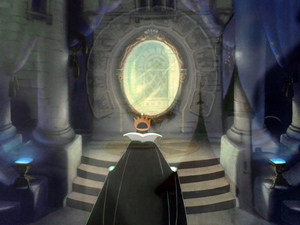 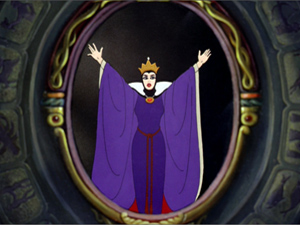
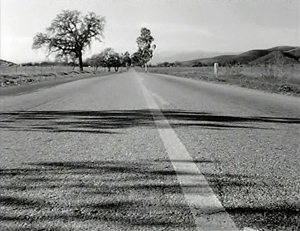
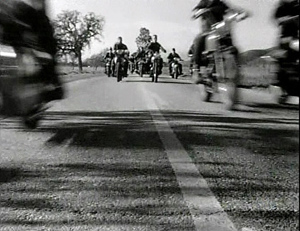
This last shot reminds us that alternatively, a film can start with the characters coming forward, as if to meet us. This is the way The Wild One begins.
Any sort of combination is possible. The Silence of the Lambs starts with Clarice Starling climbing up a hill toward us and pausing long enough for us to register her as a protagonist.
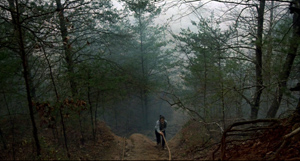 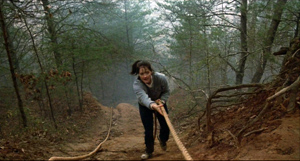 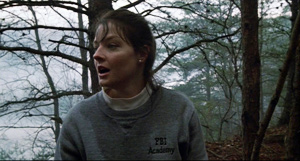
She then turns and runs off into the forest. If this were an ending, we might see her go off further and further into the distance. But this is an opening, so we follow her with a tracking shot forward, letting her lead us into the story action. Soon we’re back to the frontality and intimacy of an opening passage, like the shot of the Queen.
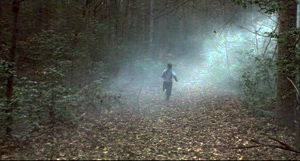 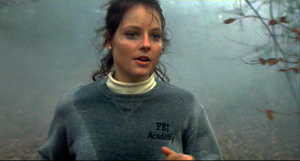
At the end, Jonathan Demme gives us a pair of “farewell” shots. The first occurs when Clarice, who’s been talking to Dr. Lecter on the phone, hears the line go dead. We pull away from her.
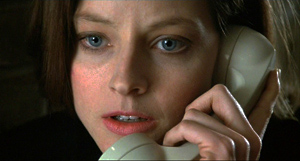 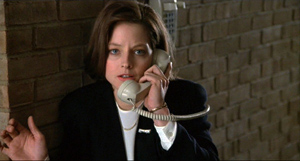
The second farewell shot takes place on Lecter’s end in a Caribbean island. It shows him rising to follow Chilson and walking away from us, to be swallowed up into the crowd.
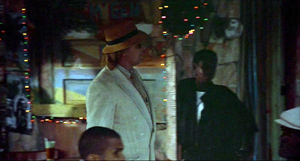 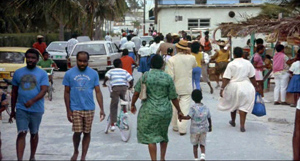
The Silence of the Lambs takes leave of its protagonists in two alternative ways: If the camera doesn’t move away from our characters, it seems, then the characters move away from the camera. They may even seal themselves off, as when a flight attendant pinches shut the curtain at the end of The Hunt for Red October.
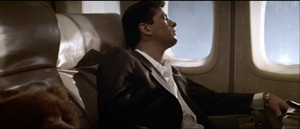 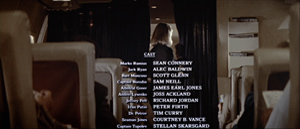
So when we speak of films’ “openings” or “closings,” it seems that we are often talking about a world that initially invites us in but will finally expell us, however slowly and politely.
See it here!
Researchers play Jeopardy! Their answers always take the form of a question. Most film critics work in the declarative mode (“The performances are gripping”), but ideally the academic film researcher works in the interrogative mode. What is this pattern of beginnings and endings doing in movies? How does it work? How did it become common? And how do we learn it?
Take the first question, about the purposes and functions of the device. At one level its neat symmetry mimics the sort of frame that we find in other sorts of narrative, particularly oral storytelling. Fictional stories need to be set off from the surrounding flow of discourse. When we hear “Once upon a time,” we all know a fairy tale is starting. There are equivalents in other oral traditions, as in “Here is a tale . . . .” (Yoruba) and “See it here!” (Hause).
Likewise, oral storytelling traditions use formulaic final lines. In our fairy tales, it’s often “And they lived happily ever after.” Native American folk tales may finish with the storyteller simply saying, “The end” or “Tied up.” African oral epics sometimes use the formula “That is what I know” or “Let us leave the words right here.”
In fact, I cheated a little with my examples from Snow White. The film actually is bracketed by a literal opening and closing.
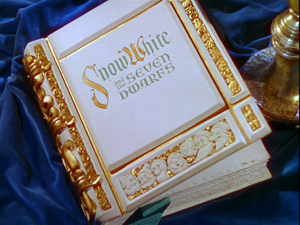 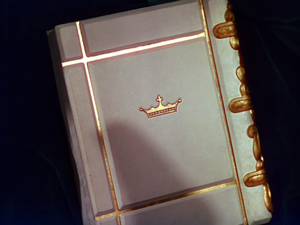
In film, however, the symmetrical structure is only part of the answer. While a film can copy the literary idea of opening and closing a written text, the medium as a whole offers something more. Thanks to the visual nature of movies, the widening or closing-off of the story world can mimic the act of our entering or backing out of a tangible situation. That’s what we see in Snow White and my other examples. In a sense we greet the characters, and after spending some time with them we bid them farewell. The sense of entering and leaving their world is harder to capture so concretely in literature or theatre.
So we need a more specific account of the convention. Surely you’ve thought about the most obvious candidate. The entry/ leave-taking pattern mimics our activities as perceiving, socially inclined people. For creatures like us, to encounter a new situation or setting simply involves approaching it or letting it approach us, then becoming part of it and fixing our attention on its details. At a party, we amble closer to a knot of people we want to talk with, or someone comes up to us. Sooner or later that encounter ends or trails off, and we withdraw or turn away or watch when others depart. More poignantly, the extreme long-shot option can recall moments when a car or bus or train carried us away from our loved ones. In any case, thanks to moving images the salient features of this very common experience can be made tangible for viewers.
This convention, we might say, is just natural. Molly, who had already logged three years of social experience, could plausibly make the analogy with ease. She recognized that her encounter with the world of Snow White was coming to an end–the characters were leaving her–and could express her regret.
This common-sense answer is, I think, basically right. But it needs to be fortified against some objections.
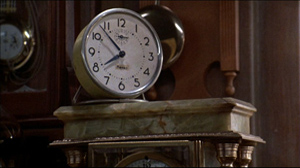
For one thing, not all films use this convention. Lots of films start with close-ups of particular items in an environment, plunging us into details without a gradual entry (below, Back to the Future; Muriel; ou le temps d’un retour).
 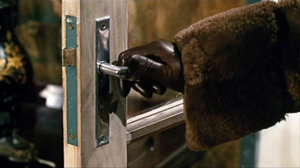
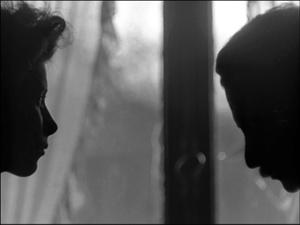
And lots of films don’t end with marks of withdrawal or closure. They end on close views, often of the characters or a significant object (below, Le Silence de la mer; Sorry, Wrong Number).
 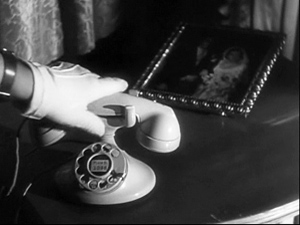
If this pattern were biased by our natural proclivities, wouldn’t it be more common than it is? And if it comes so naturally, why wasn’t it present at the start of cinema, as soon as people started telling stories? Most of the storytelling techniques we now consider very user-friendly, like cutting and camera movement, emerged after many years of moviemaking. It’s akin to a problem in the history of painting: Why did painters need centuries to learn to imitate the way things look?
Moreover, the naturalness can look pretty unnatural. Nobody lies down in the middle of the road to let a horde of bikers sweep by, as in the beginning of The Wild One. The high angle at the end of the movie doesn’t imitate anybody’s likely point of view; it mimics, if anything, a godlike perspective we almost never get. Similarly, the cuts and dissolves that link the views in Broken Blossoms and Snow White don’t have any parallel in our real experience. Tied to our bodies, we can only move toward or away from situations in real time, step by step. The time-compression and freedom of position we get on film are far from natural. In sum, the concrete ways in which this immersion/ withdrawal pattern shows up in actual movies suggest that the films aren’t imitating the literal vantage points we might assume in the real world. There is a lot of contrivance going on.
Real life, amped up
So the convention has some roots in our perceptual and social experience, but filmmakers have streamlined and sharpened it for our uptake. Another example of this process, which I discuss here, involves actors’ eye behavior. Film actors start with normal patterns of looking and blinking, but they modify them in order to signal emotional states and to concentrate our attention on the drama. Similarly, the schema of entering/ leaving a milieu derives from our common experience, but it can be simplified and stylized through cinematic techniques that have no correspondence in our normal experience. All that matters is that the result preserves the core of that schema.
As filmmakers simplify our perceptual and social experiences, they amplify them as well. Movie characters stare at each other more intently than we do in normal life. The actors are stripping off everyday noise (blinks, averted looks) in order to create cleaner, exaggerated signals of mutual attention to the dramatic situation. Likewise, a steep high angle like that ending The Wild One or the pointedly closed curtains of The Hunt for Red October exaggerates the sense of departure and conclusion, giving the action a weight it wouldn’t have in ordinary life.
Why don’t all films use the entry/ retreat convention? I think we should consider such conventions to be tools. They arise in particular filmmaking traditions, perhaps through trial and error, and get refined for different purposes. Some filmmakers might never use them, or knowingly refuse them to create different reactions, or play games with them (as Resnais does at the start of Muriel). But when filmmakers want certain effects, these tools are ready to hand. If you want to ease your audience into the story world, a slow entry pattern works very well. It’s so familiar that the viewer can overlook its contrivance and concentrate on the story information.
So Jeopardy!-style, we have new questions. Has the opening/ closing device spread because it is a very accessible, spontaneously understood convention? Or is it because filmmakers in other cultures have mechanically copied Hollywood? Perhaps it’s like a tool that originates in particular cultural circumstances but which can be useful all over the world. The Phillips-head screw was devised for the US automotive industry but is now a universal gadget. Over time, such tools become more widespread, perhaps dominant. But a tool can always be refused if the task changes.
There’s still a mystery, though. Assuming that viewers understand these image-clusters as signaling beginnings and endings, how did that understanding come about? How, and when, do people learn the conventions? If they are quickly learned, is that because they play into inclinations of our minds?
My best guess for now is this. We tend to think that all artistic conventions are equally hard to learn, but that’s probably not the case. The conventions of Cubist painting demand more effort and knowledge than the conventions of perspective drawing, and that’s probably not just because we’ve seen more perspective pictures across our lives. Likewise, mastering the conventions of Structural Film demands more time and trouble than mastering those of popular genre filmmaking. It seems likely that some conventions rise to dominance because they fit most viewers’ prior inclinations rather well. For example, we are creatures who interact socially in face-to-face manner. Shot/ reverse-shot editing is unfaithful to our ordinary experience in many ways; cuts provide instant changes of viewpoint we can’t achieve in real time and space. But shot/ reverse-shot cutting preserves the familiar social pattern of turn-taking and conversational flow, so it’s comparatively easy to learn.
Still, I don’t have a full answer. My questions bring us back to Molly. If she had seen Snow White before, we might say that she remembered that the film ended at this point. But she hadn’t seen the film before. So does her demand for more indicate that she generalized from her experience of other films? Did she have already a degree of “narrative competence,” allowing her to recognize certain types of cues? Is her competence full or spotty? (Maybe she gets endings, but not characters’ intentions, or goal orientation.) And how did she acquire that competence? Quickly or slowly?
Maybe some researchers have already explored how children master narrative framing of this sort. (I’d welcome correspondence on the matter.) My hunch is that Molly grasped the cinematic convention, perhaps on limited exposure, because she recognized the core perceptual and social experiences it preserves. Leveraging this insight, perhaps, was some understanding of narrative architecture generally. More basically, it may be that as social animals we’re tuned by evolution to detect fairly quickly some constant features of interactions with our peers.
In any case, I’m betting that Molly wasn’t simply mastering a convention cut off from everyday life, like algebraic equations. To learn anything, you already need to know a lot. Cinematic storytelling isn’t, as some semiologists once thought, a highly arbitrary sign system. It piggybacks on our experience of the world–our knowledge, certainly, but also our most routine ways of sensing and thinking. Not least, understanding movies taps skills associated with our social intelligence. More on this in a future entry, I hope.
This is only an anecdote, but I hope it provokes readers to think about the broader issues I raise. I floated these ideas in my closing address for the convention of the Society for Cognitive Studies of the Moving Image, on 5 June 2010. I thank the members of the audience for their contributions to that discussion. Incidentally, this year’s meeting is coming up, in Budapest this June. For more on SCSMI and the sort of issues broached in this entry, go to this category on this site.
My basic argument for a “moderate constructivism” in understanding film conventions is developed in the 1996 essay “Convention, Construction, and Cinematic Vision,” reprinted in Poetics of Cinema (2008), 57-82. I discuss the entry/ withdrawal pattern as a holistic strategy in a later essay in that collection, “Three Dimensions of Film Narrative”, 94-95. An earlier, more fancily titled piece puts the pattern in the context of a different argument: “Neo-Structuralist Narratology and the Functions of Filmic Storytelling” in Marie-Laure Ryan, ed., Narrative across Media: The Languages of Storytelling (2004), 209.
It’s worth mentioning that, like Snow White, the images at the start and conclusion of Le Silence de la mer are enframed by a book–in this case, shots of the original book by Vercors. This iconography is of course common when a film wants to emphasize the literary origins, though in some films, like Dreyer’s, the device of the film as a replay of an already-written text plays a more complicated narrative role. I talk about that in my book The Films of Carl Theodor Dreyer (1981).
The research on children’s understanding of stories is vast and detailed. Alison Gopnik briskly summarizes the evidence that even very young children have surprising narrative competence in The Philosophical Baby (2009), chapters 1 and 2. The pioneering source here, at least for an amateur like me, was Katherine Nelson, ed., Narratives from the Crib (1989).
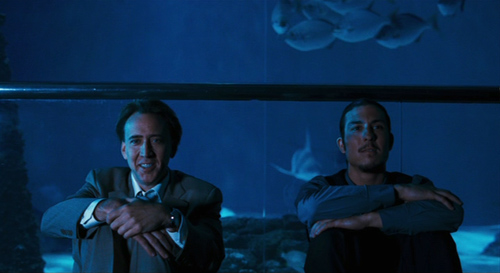
The Bad Lieutenant: Port of Call New Orleans. As in many films, the final shot addresses the viewer in a comparatively overt way.
Posted in Film comments, Film theory, Film theory: Cognitivism, Narrative strategies, Readers' Favorite Entries, Society for Cognitive Studies of the Moving Image |  open printable version
| No Comments » open printable version
| No Comments »
Thursday | April 21, 2011
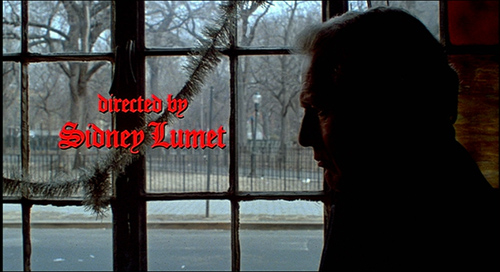
I don’t believe in waiting for the masterpiece. Masterful subject matter comes up only rarely. The point is, there’s something to advance your technique in every movie you do.
DB here:
Across half a century he outpaced his contemporaries. He was the last survivor of the vaunted 1950s generation of East-Coast TV-trained directors, men who went over to theatrical films just as the studio system was in decline. John Frankenheimer, Martin Ritt, Richard Lester, and Franklin J. Schaffner won big projects early on, but they also faded faster. As they were moving out of the game in the 1970s and 1980s, Lumet was getting his second wind. He ground movies out–good, so-so, or wretched–like a contract director of the studio days. Sometimes he had a strong stretch, as in the early 1980s, and sometimes not. He started in his early thirties with Jean Vigo’s cameraman Boris Kaufman, shooting crystalline black and white. At the end he was making a feature in high-definition video.
When Lumet died on 9 April, journalists were generous in their praise. But most of the eulogies seemed to me constraining. They overlooked his complicated role in postwar American film, and they neglected to supply the sort of historical context that make even his negligible films of interest. Concentrating on his official masterpieces (Dog Day Afternoon, Network), the obituaries cast him as a hard-nosed urban realist. That’s part of the story, but if we want a fuller picture of this long-distance runner, we need to trace his path in more detail. That in turn can teach us something about shifting generational opportunities in American cinema.
We can start by noting what the recent accolades seem to have forgotten: at the start of his career Lumet faced brutal hostility from the critical intelligentsia that ruled his home town.
Danger man
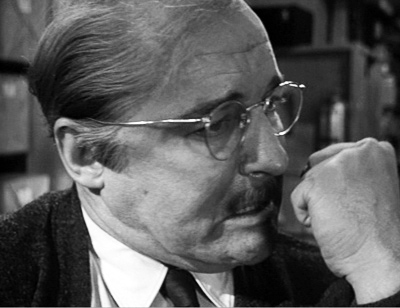
The Pawnbroker.
Reading 1960s film criticism, you might think that Sidney Lumet was the biggest threat to film art since the Hays Code. Young cinephiles today may be unaware of the vituperation that New York’s highbrow critics showered on him at the start of his career.
John Simon: “What is Lumet good at? Intentions, underlining, and casting.”
Manny Farber: “Giganticism is, of course, the main Lumet contribution [to The Group]. . . . Miss [Shirley] Knight, in a concentrated post-coitus scene atop [Hal] Holbrook’s chest, has a head the size of a watermelon.”
Andrew Sarris: “The Pawnbroker is a pretentious parable that manages to shrivel into drivel.”
Most tireless was Pauline Kael, who throughout the decades picked off nearly every Lumet movie with the casual contempt of Annie Oakley shooting skeet. From the backhanded compliment (“The Pawnbroker is a terrible movie and yet I’m glad I saw it”) to the eviscerating dismissal (Deathtrap is “an ugly play and what appears to be a vile vision of life”), Kael did not relent. She found Lumet’s staging “slovenly,” his color schemes inept; in Serpico “scene after ragged scene cried out for retakes.”
The hunt was in full cry in Kael’s 1968 essay, “The Making of The Group,” one of those behind-the-scenes journalistic forays that always end in tears for the production. Every such think-piece mysteriously assures the film’s commercial failure, while guaranteeing that posterity will remember each participant as a knave or a fool. Yet for sheer bloodthirstiness, Kael’s reportage easily surpasses that of her predecessor Lillian Ross in Picture.
Kael is out to show that the conditions of acquiring, producing, and marketing films have become almost utterly corrupt. No artist can survive the system. So she starts by establishing Lumet as merely a journeyman, shooting the script as a straightforward job of work.
But then things get rough. He is, for one thing, a poor craftsman.
He cannot use crowds or details to convey the illusion of life. His backgrounds are always just an empty space; he doesn’t even know how to make the principals stand out of a crowd . . . . Lumet is prodigal with bad ideas . . . . He will take the easiest way to get a powerful effect; in some conventional, terribly obvious way he will be “daring” . . . The emphasis on immediate results may explain the almost total absence of nuance, subtlety, and even rhythmic and structural development in his work. . . . I was torn between detesting his fundamental tastelessness and opportunism and recognizing that at some level it all works. . . . Because Lumet can believe in coarse effects he can bring them off.
He is also a severely deficient human specimen.
[He was] the driving little guy who talked himself into jobs . . . He seems to have no intellectual curiosity of a more generalized or objective nature . . . For Lumet, a woman shouldn’t have any problems a real man can’t take care of . . . . He’ll go on faking it, I think, using the abilities he has to cover up what he doesn’t know.
Kael has her generous moments, praising Long Day’s Journey into Night (1962), chiefly because of the performers, and in later years she would admire scenes in Dog Day Afternoon (1975). But usually her admiration boomerangs into a complaint (Lumet yields a fast pace, but that makes him slapdash). On the whole she and her Manhattan peers, who seldom agreed on anything, conceived Lumet as dangerous.
Why? Partly because they mostly set themselves against the middlebrow culture of the newspapers and newsweeklies. Many of Lumet’s early films were admired by staid critics. Praise from these quarters was anathema to the sophisticates. Somebody had to tell the Times’ Bosley Crowther that The Pawnbroker (1965) was not “a powerful and stinging exposition of the need for man to continue his commitment to society.”
Another strike against Lumet was his pedigree. He was said to have brought TV technique, simultaneously bland and aggressive, to theatrical cinema. Early live TV drama, confined by the home screen’s 21-inch format and weak resolution and hamstrung by punishing shooting schedules, pushed directors to rely on flatly staged mid-range shots, goosed up with close-ups, fast cutting, and meaningless camera movements.
Kael suggests that Frankenheimer, a common foil to Lumet at the period, managed in films like The Manchurian Candidate (1962) to convert the TV look into “a new kind of movie style,” though she never explains what that consists of. By contrast, Lumet simply followed the line of least resistance, emptying out his shots and “hammering some simple points home.”
There’s nothing on the screen for your eye to linger on, no distance, no action in the background, no sense of life or landscape mingling with the foreground action. It’s all there in the foreground, put there for you to grasp at once.
The TV style threatened to suffocate the glories of cinema: the full view, a more leisurely unfolding of action, a sense of life flickering on the edges of the plot. For Kael the TV-trained Lumet exemplifies the loss of the great tradition of artistic moviemaking personified in Jean Renoir.
Lumet was dangerous in another way. He seemed part of a trend toward heavy-handed showoffishness. Partly the trend was seen in the sweaty strain of Method acting, typified in Kazan’s work. Manny Farber proposed that the Method was at the center of the “New York film,” a fake realist package predicated on psychodrama, arty compositions, and liberal pieties. 12 Angry Men was “counterfeit moviemaking,” filled with “schmaltzy anger and soft-center ‘liberalism.’” Hard-sell cinema, Farber called it. Dwight Macdonald saw the same bludgeoning in The Fugitive Kind.
Lumet’s direction is meaninglessly over-intense; lights and shadow play over the close-up faces underlining lines that are themselves in bold capitals; every situation is given end-of-the-world treatment.
The new tendency toward self-conscious artifice didn’t just have New York roots. The French New Wave’s somewhat disjunctive cutting, unexpected camera movements, freeze-frames, and other flagrant techniques made audiences and filmmakers aware of film style to a new degree. Tony Richardson, John Schlesinger, and other directors scavenged these devices to give their films an up-to-date panache. Once more a critic needed to invent a new label for Lumet: Macdonald claimed that he was an exponent of the Bad Good Movie, “the movie that is directed up to the hilt, avant-garde wise,” in the vein of Mickey One, The Servant, The Trial, and the work of Godard. The Pawnbroker’s fragmentary flashbacks led Sarris to call it Harlem mon amour.
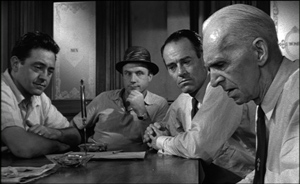
Harsh as they are, these comments do have a point. The early films shout and scream a lot, both dramatically and pictorially. Lumet admitted his love of melodrama, conceiving it not simply as overplaying but rather as conflict at the highest pitch of arousal: extreme personalities in extreme situations. So a silence is usually prelude to an outburst, and a bellow or a slap is never far off. The jury deliberations in 12 Angry Men (1957) become a group therapy session (or an Actors Studio class?) in which bigots must confess their traumas.
Stage Struck (1958) and The Group (1966) are pictorially innocuous, perhaps partly because they were shot in color, but The Fugitive Kind (1960) is a banquet of elaborate lighting effects whipped up by Kaufman. Macdonald wasn’t fair in his dismissal; the film is dominated by medium and long shots, with close-ups held in reserve for big moments, and the line readings don’t seem to me as overbearing as he suggests. Still, there is a sense of pressure, with very precise reframings and sets densely packed (mirrors, curtains, staircase railings) in a way that accords well with Williams’ overripe dialogue. There is an upside-down shot, and at some moments, as Macdonald notes, the illumination lifts or drops in magical ways—a surprise gift, Lumet claims, from Kaufman.
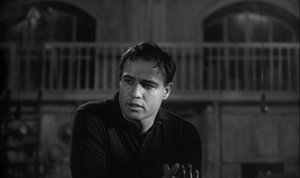 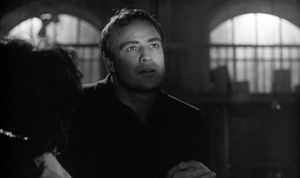
As a pluralist, Lumet would stage some scenes in full shots and long takes, sometimes at a surprising distance from the camera. But it was hard not to notice the other extreme. His most famous black-and-white films mixed in tight close-ups, oppressive sets, wide-angle distortions, and chiaroscuro. 12 Angry Men is relatively subdued in this regard, building toward more looming images at the climax, with some powerfully jammed ensemble frames.
 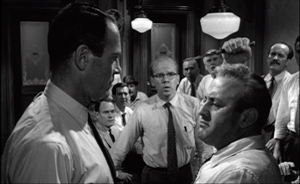
Fail-Safe (1964) surrenders itself to flamboyant shot design once we get into the war room and then into the President’s sealed chamber. Contra Kael, as in 12 Angry Men, many of these shots have busy backgrounds, albeit not of the Renoirian sort.
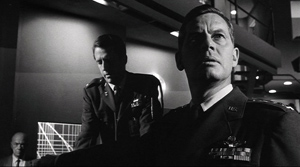 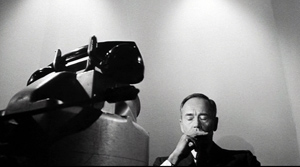
The Pawnbroker (1965) is Lumet’s most famous orgy of strident technique, with Sol Nazerman nearly as caged at his counter window as he was in the camps. Even more overwrought is The Hill (1965) in which short lenses pump officers’ raging faces into gargoyle shapes, with pores and welts and gobs of sweat thrust under our noses.
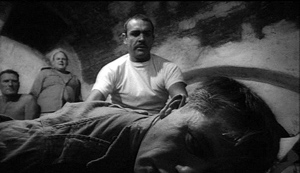 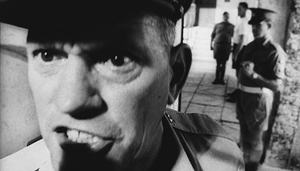
In sum, this is not the director eulogized in Entertainment Weekly: “He never tried to dazzle audiences with flash and style.”
What critics didn’t note, however, was that the more outré look cultivated by Lumet, Frankenheimer, Ritt, and company fitted fairly snugly into 1950s Hollywood black-and-white dramatic style. The blaring deep-focus and violent close-ups exploited by the TV-born directors were already visible in the work of Mann (The Tall Target, 1951, below), Aldrich (Attack! 1956, below), Fuller, and many other directors.
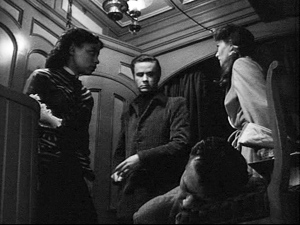 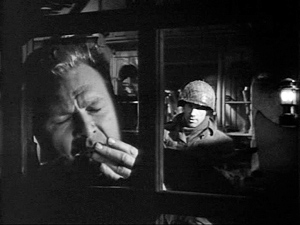
During the 1950s what we might call roughly the “post-Welles” look was well-established for serious subjects and genre pictures alike. The Hill pushes things a bit, as Frankenheimer did in Seconds (1966), but the cramped, low-angle style on display in Lumet’s early work is part of a tradition that goes back years (and which had its echoes in many overseas directors, such as Bergman and Fellini). The wilder reaches of that style, it now seems clear, belonged to Fuller and company, not to mention the Kubrick of Strangelove and the Welles of Touch of Evil. Like Richardson, Schlesinger, and others, the TV émigrés may have gotten their wrists slapped for trying to map onto prestigious social-message movies the visual pyrotechnics already acceptable for program pictures.
Not incidentally, some directors had already found the wide-angle deep-focus look useful in their TV productions. Below are frames from Requiem for a Heavyweight (directed by Ralph Nelson, Playhouse 90, 1956); The Defender (directed by Robert Mulligan, Westinghouse Studio One, 1957); and Lumet’s own omnibus program Three Plays by Tennessee Williams (Kraft Television Theatre, 1958).
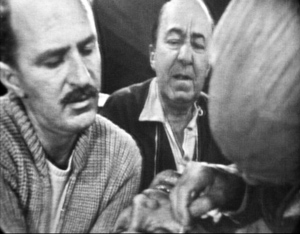 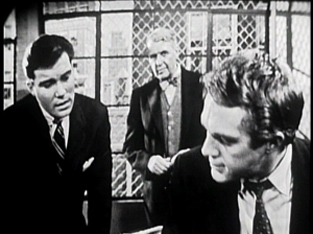 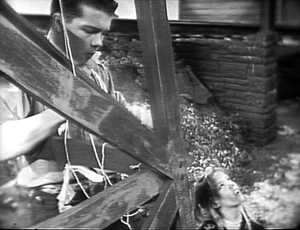
You can argue that their move to cinema actually smoothed out the directors’ style. The less square frame and bigger scale of the theatre screen made films like Frankenheimer’s debut The Young Stranger (1957) more spacious and relaxed than what could be seen on the box. 12 Angry Men was a polished effort, starting with an elaborately staged six-minute crane shot assembling the cast in the jury room, and using the width of the screen to enclose several faces. Looking back, we can see that Lumet offered something quite close to then-current Hollywood norms, and it looked less crude than what would be found on live TV of the period.
Still, The Pawnbroker and other films can be credited (or blamed) with helping spread the in-your-face style that would come to dominate American cinema of the next fifty years: disjunctive editing, slow motion, the arcing tracking shot (The Group), handheld shooting for moments of violence or anguish, glum color schemes (preflashing for The Deadly Affair), the teasing flashbacks that will be gradually filled in. Lumet’s early films are anthologies of most of today’s tics and tricks.
Yet by the time of his death, the director who was once feared as the vanguard of something new and awful had come to embody something old and trustworthy. Somehow the unambitious journeyman and pretentious copycat became a “classicist.”
How did that happen?
A prince of the city
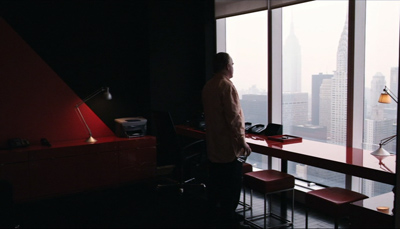
Before the Devil Know You’re Dead.
Instead of indicating that he was joining or extending a tradition, Lumet reacted to the hailstorm of criticisms with surprising equanimity, at least in the interviews he gave so abundantly throughout his career. He was modest, acknowledging that many of his films turned out to be feeble, and he declared himself a learner. He tried different projects, he said, to improve himself. He wanted to learn to manage color, to work in different genres (e.g., the dark comedy Bye Bye Braverman, 1968), eventually to fall in love with digital video capture. To some extent Lumet changed because he really wanted to learn more and explore various sides of moviemaking.
Lumet always claimed that he didn’t apply a personal style to his projects; he tried to find the best way to handle the script. He thereby confessed himself to be what auteur critics of the 1960s were calling a “metteur-en-scène,” the director who judiciously enhances the material rather than transforming it to suit his personality. This was probably a good survival strategy in the new churn of the 1970s.
The mid-1970s was the Great Barrier Reef of American cinema. Virtually no members of Hollywood’s accumulated older generations, from Hitchcock and Hawks through the 1940s debutantes (Wilder, Dmytryk, Fuller, Siegel) and the 1950s tough guys (Aldrich, Brooks) to the TV émigrés, made it through to 1980. Many careers just petered out. The future belonged to the youngsters, the so-called Movie Brats. In this unfriendly milieu, Lumet fared better than most. He tried a semifarcical heist film (The Anderson Tapes, 1971) that mocked the rise of the surveillance society, with everybody wiretapping and taping and videoing everybody else. He mounted a classic mystery (Murder on the Orient Express, 1974), a musical (The Wiz, 1978), and a free-love romance (Lovin’ Molly, 1974). Of the items I’ve seen from these years, the most daring is The Offence (1972). This study of a sadistic British police inspector’s vendetta against a child molester offers a sort of seedy expressionism. In another gesture toward psychodrama, long conversations with the perpetrator reveal that the copper is a bit of a perv himself.
Lumet’s most successful rebranding took place in a sidelong return to the Pawnbroker milieu: low-end, location-shot, crime-tinged social commentary using New York theatre talent. Filming in color and casting off the baroque precision of the earlier work, he made his compositions more casual and his shot changes less precise. His cutting pace picked up: six seconds on average for Serpico (1973), five for Dog Day Afternoon (1975), both courtesy of the high priestess of the quick cut, Dede Allen. The driving tempo of these movies gave them an urgency that critics could tie to the ticking-clock plots, the atmosphere of urban pressure, and of course the extroverted acting of Al Pacino.
With the two crime films, and the satiric Chayefsky talkfest Network, Lumet remade his image. He was a New York filmmaker, offering raucous, hard-nosed, semi-cynical takes on corruption in the police, the justice system, politics, and the media. His protagonists tended to be Jews, Italians, and Irish, all working stiffs or bare-knuckle power brokers; and the enemy, again and again, turned out to be the Ivy elite. A tailor-suited WASP, male or female, was likely to sell you out. Only ethnic minorities knew the real score. The line could come from almost any mid-career Lumet film: “I know the law. The law doesn’t know the streets.”
The crowning achievement in this vein, for critics if not for audiences, was Prince of the City, a sprawling study of a cop’s patient years of taping and informing on his corrupt colleagues. More slowly paced than the earlier urban dramas, the film also marked Lumet’s move toward something else again. The style was drier and more sober, almost passive, emphasizing static and somewhat distant setups; the cutting slowed down to nearly nine seconds on average. As mid-period Lumet had blotted out the early years, now something more calm, even comparatively austere, came into view.
Whatever the project, however, by the later 1980s he was offering his own alternative to the fast-cut, whirlicam style that was bewitching young filmmakers. While directors in all genres were building scenes out of endless choker close-ups and cutting every four or five seconds, Lumet applied the brakes, lingering on two-shots, letting whole scenes play out in full frame, moving his actors around and ordaining a cutting pace close to ten seconds on average. The first eight minutes of The Verdict (1982) consist almost entirely of long shots and extreme long shots. The protracted takes and antic bodily contortions of Deathtrap might have come from a French boulevard farce; the first tight single of Christopher Reeves is delayed for half an hour. In an age in which critics decried the choppy confusion of tentpole action, the plainness on display in movies like Running on Empty (1988) and Night Falls on Manhattan (1997) looked anachronistic. Right to the end, Before the Devil Knows You’re Dead (2007) could spare a lengthy and distant shot to register a high-end drug boutique and shooting gallery. We had come from the Hysterical Lumet by way of the Gritty Lumet to the Restrained Lumet.
Acting in the frame
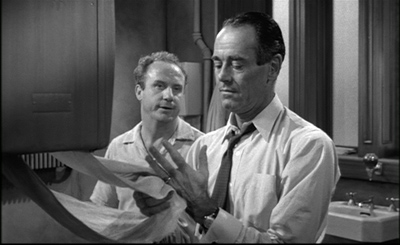
Yet he did not milk the urban crime vein dry. He continued to try a wide range of projects, even probing the Red Scare in Daniel (1983). The rationale was chiefly performance. Lumet was an “actor’s director.” He demanded at least two weeks of rehearsals, which included not only table readings but eventually full blocking of scenes, including fights and chases. Derived from his TV and theatre days, the method suited his belief that actors needed a firm structure in order to invent their characters. Interestingly, this actors-first rationale can be adjusted to any phase of the rough stylistic development I’ve plotted. The high-pressure facial shots of the early films can highlight the minutiae of the performances. But so can mid-shots that let actors build in bits of business.
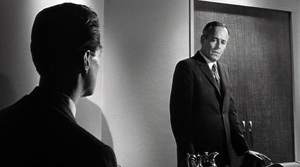
Manny Farber praised the moment when Fonda in 12 Angry Men dries his fingers at length, one by one. It shows, Farber says, “the jury’s one sensitive, thoughtful figure to be unusually prissy” and provides a “mild debunking of the hero.” But it’s not the unintegrated detail Farber claims; Fonda’s coldness is set up early in the film, when he stands remotely from his peers and shows no interest in them as men. And Fonda was always a master of finger-work, which Lumet could exploit in fastidious framings. In Fail-Safe as the President tries to halt the bombers rushing toward the USSR, Fonda projects the man’s minutely controlled apprehensions by pausing to rub his fingertips together, off in the corner of the shot.
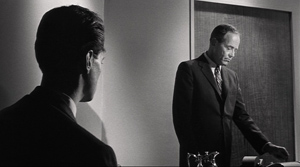 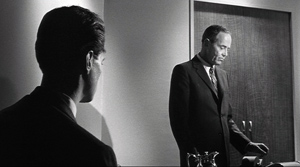
This micro-gesture suddenly leaps, as Eisenstein might say, into a new quality: a worried facial expression.
More explicit is the characterizing moment in The Verdict when Frank Galvin (Paul Newman) starts his day with a sugar donut and a full glass of whiskey. The setup is concise: He has crossed off the wakes he’s visited, and his palsied hand can’t pick up the glass without spilling some.
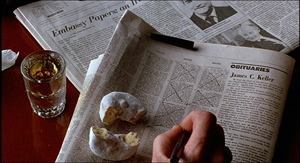
So Frank checks to see if anyone is looking before, like a dog, he bends his head to slurp off a little.
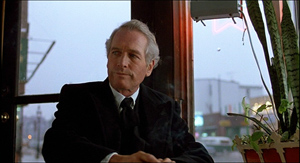 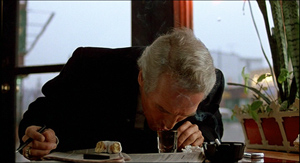
It’s a simple but powerful image of degradation, far removed from the trembling mouth and bulging brows of Steiger in The Pawnbroker.
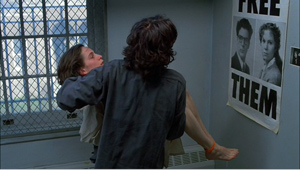
Lumet cared as much for camera technique as for acting maneuvers. His book Making Movies provides a virtual manual of movie style as draftboard engineering. His gearhead side was probably another legacy of the buccaneering days of live TV and the New-Wave inspired awareness of artifice. He took inordinate pride in his “lens plots” and lighting arcs, charting purely technical changes that would weave their way through the film. (In this he was ahead of his time; now most filmmakers develop these technique arcs, or at least they say they do.) Despite this almost mechanical conception of technique, though, late Lumet rediscovered a bare-bones simplicity of performance and framing that was willing to risk looking flat. In Daniel, he lets the angry young man whose sister has wasted away into madness confront the poster agitating for their dead parents. No tracking in, no circumnambulating camera, no heightened cuts or nudging score. And no need to see Daniel’s face. Susan merely lifts her head.
It’s as if the visual rodomontade of the Movie Brats drove Lumet toward a new sobriety. When Galvin is preparing to try the case of the girl left in a coma through medical malpractice, he visits the hospital and takes Polaroids of her inert body. The slowly developing images not only give us the fullest view of the girl we’ve had so far. They also come to suggest his dawning realization that this is more than just a chance for big money.
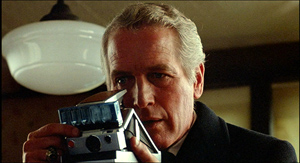 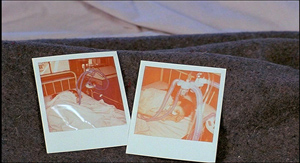 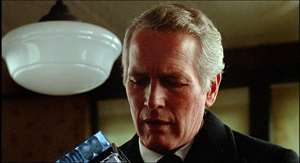
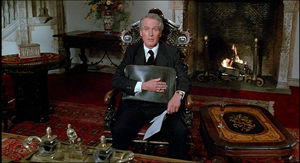
Galvin starts to grasp that letting the hospital settle out of court will allow the officials to write off their mistake. There is a human cost to simply getting the check. If he does it, he will now be a better-paid ambulance chaser. Yet he doesn’t stand valiant for truth; the drunk is scared, drained of dignity, and he clutches his portfolio as a sad, ineffectual shield.
Offered the money, Frank takes out the photos and weighs them against the check. Then with a sigh of exhaustion, contemplating the fool’s crusade he’s launching, he returns the check and drops the pictures into his bag.
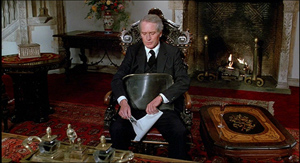 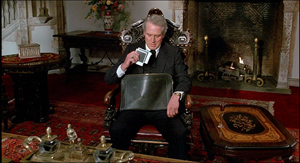
Very simple visual storytelling; it might have come from a 1930s movie. But this stark presentation of moral decision, given as a straightforward framing of a man’s body, achieves a measure of artistic nobility in a year that gave us Porky’s and Rocky III.
Telling it all, holding some back
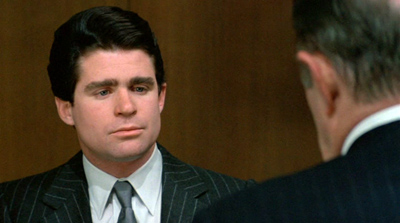
Prince of the City.
It’s good to remember such moments of pictorial storytelling because Lumet’s films, especially the early ones, tend to be gabfests. If Eugene O’Neill, Tennessee Williams, and Paddy Chayefsky, along with the Method acting tradition, are your coordinates, you will be drawn to chatterboxes and blowhards. Lumet loved the spoken word, which was after all the mainstay of live TV (“illustrated radio,” it was sometimes called). It’s not clear that he ever shook the habit. His characters usually step onstage leaking exposition, announcing their pasts, their personalities, their plans, and their deepest feelings. This has the advantage of making plot premises clear, but it reduces the figures’ mystery and their ability to surprise us, or to complicate our feelings about them.
Sometimes Lumet did let story construction do heavier lifting. It happens in The Pawnbroker, because the nearly catatonic Nazerman speaks so little that the fusillade of flashbacks provides his backstory. More daringly, the large-scale back-and-fill of The Offence, peppered with small memories but also looping around the central incident in the interrogation room, seeks to reveal Sergeant Johnson’s affinities with the suspected child murderer. We need to remember Lumet’s early fondness for time-shifting plots before we declare Before the Devil Knows You’re Dead an old guy’s effort to catch up with Pulp Fiction.
Even without benefit of broken timelines, Lumet could occasionally hold back information to reshape our first impressions. Take the central revelation of Dog Day Afternoon, when cuddly Al Pacino reveals that his “wife” is not the woman he’s married to (a nice plot feint here) but the man whom he loves. This apparently sensationalistic twist comes early enough to modulate into pathos when Pacino’s character dictates his two wills.
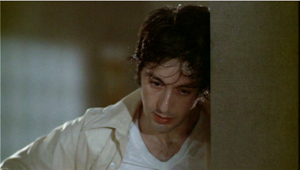
Prince of the City realigns our sympathies in a more intricate way. At the start, Danny is presented as a tormented soul. We’re led to think that he turns snitch because of things we see: the invitation to go undercover, his brother’s and father’s angry concern that his pals are crooked, and above all the shameful efforts he makes to get drugs for his informant. Once he turns, however, he can’t limit the investigation, and at nearly the end his treachery has broken the most important ties in his life.
But “nearly the end” is the operative term, because Prince of the City boldly appends a ten-minute epilogue showing Danny being investigated himself. The Danny we saw at the film’s beginning may have been steeped in corruption; the drug bust we saw included, behind the scenes, a major ripoff of money; he has lied more than we realized; and it seems likely that he cheated on his wife with the prostitutes whom he supplied with drugs.
A modern filmmaker, or Lumet in his bodacious early mode, might have spiced these flat testimony scenes with lurid flashbacks. But sticking simply to Danny’s feeble, evasive stonewalling raises questions of his own vulnerability. Having watched him break down over years and having heroicized his suffering to a considerable degree, we have to judge him anew. Is he simply too weary to fight the charges, or has he been caught out? The ending might seem to allow for cynicism, but we can’t cast off our respect for what Danny has risked.
Further, Lumet intercuts the court scenes with government meetings about whether to prosecute Danny. In the manner of a Shavian problem play, this tactic obliges our sympathies to be clear-eyed. If The Verdict lays all its cards on the table and invites straightforward sympathy for Galvin, Prince of the City, by hiding major aspects of Danny’s character and circumstance, leads us to a more nuanced experience. The narrational dynamic of the film invites us to rethink our protagonist’s actions and decide whether to grant him mercy.
In the vanguard of a new style in the 1960s, Lumet remade himself as part of the 70s renaissance. That freed him to cover nearly every bet on the board, and some paid off. As hotshot younger directors sped past him into tentpole territory, he put the independent sector to use–financing through presales, working with stars on the way down and on the way up, releasing the films through boutique distributors, trying many options with a stubborn pragmatism. He handled failure, ignoral, and disdain better than probably any of us could. “Though his films are invariably flawed,” wrote Sarris in 1968, “the very variety of the challenges constitutes a sort of entertainment.” This zigzag career trajectory provides a unique, even heartening EKG of success and survival in the modern American film industry.
At the same time, he helped make audiences and critics more conscious of film technique, in ways both salutary and damaging. He was part of my film school: The very first movie I saw in a theatre during my freshman year of college was The Pawnbroker, and I revisited it several times. Here was a modern instance of “pure cinema,” worth comparing with A Hard Day’s Night and 8 1/2. (Yes, I hadn’t seen much.) Prince of the City has drawn me since I first saw it in a moldy two-screener in Florida and thought: “Can Hollywood have made a Brechtian film?” I leave for another time the tale of watching Prince in a nearly empty screening sponsored by Nick Cave.
You can probably tell that Lumet is not my favorite filmmaker. Several of his movies I earnestly hope never to see again, and even the ones I admire contain moments I would wish otherwise. But he has given me unique pleasures and prodded me to ask some questions that intrigue me. More broadly, I can’t understand the failures and accomplishments of modern American film without taking into account this marathon man.
For this entry, I haven’t managed to see or re-see as much of the Lumet output as I’d hoped, but the twenty-three films I revisited include his most famous titles (except for The Wiz, which might better be called infamous). My comments here supplement those I make about Lumet and his generation in The Way Hollywood Tells It, 145-147.
I’ve drawn my critics’ quotations from anthologies of their writings. The one I should probably signal explicitly is Pauline Kael’s “The Making of The Group,” in Kiss Kiss Bang Bang (Little, Brown, 1968). The piece is dated 1966, but I can’t prove that it was actually published then. I find it endlessly interesting, not least because it may help us trace some origins of critical clichés. I’m thinking not only of the art/ business dyad but also the appeal to Renoir as the prototype of the spontaneous film creator. Ironically, for at least some projects we have evidence that Renoir rehearsed his actors quite a bit and retook scenes until he was satisfied. Double irony: Somewhat before Kael was celebrating the careless grace of Renoirian spontaneity, he had in Testament of Dr. Cordelier (1959) turned to a multicamera technique for his own television project. Renoir and Lumet intersect in unexpected ways!
On live TV shooting methods, a succinct overview can be found in Erik Barnouw, Tube of Plenty (Oxford, 1975), 160-166, and of course Gilbert Seldes’ Writing for Television (Doubleday, 1952), which I’ve praised elsewhere on this site. Seldes scatters some intriguing comments on live TV drama through his The Public Arts (Simon and Schuster, 1956). Just as important, Criterion continues to serve film studies by releasing precious documents from early television. Watch the items included in The Golden Age of Television and the three Lumet/ Williams playlets folded into Criterion’s Fugitive Kind box to see what these directors were up against, and with what relief they must have greeted the wider choices available on film.
The indispensable sources on Lumet are the fine collection Sidney Lumet Interviews, ed. Joanna E. Rapf. It’s here that Gavin Smith can be found sketching a case for Lumet as continuing classic Hollywood while also pressing into “80’s modernism” (132). And of course everyone must read Lumet’s own Making Movies. On editing The Pawnbroker, see Ralph Rosenblum and Robert Karen, When the Shooting Stops… The Cutting Begins: A Film Editor’s Story (Penguin, 1975), 145-166. Glenn Kenny has an excellent 2007 interview with Lumet on digital techniques in the DGA Quarterly.
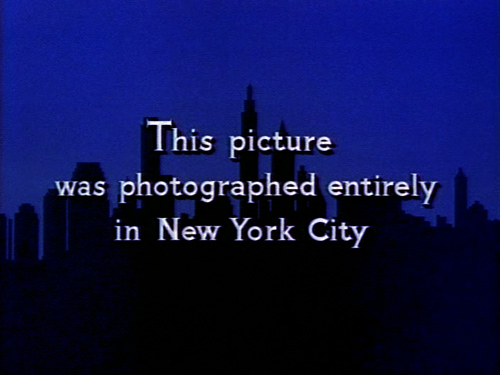
Credits: Stage Struck; Night Falls on Manhattan.
Posted in Directors: Lumet, Film criticism, Film technique: Cinematography, Film technique: Editing, Film technique: Performance, Readers' Favorite Entries | open printable version
| No Comments »
Thursday | April 14, 2011
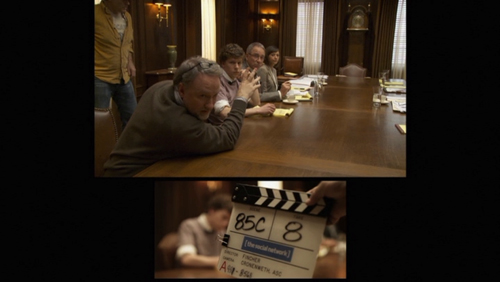
David Fincher, foreground left, lays out a scene for The Social Network
Kristin here:
Every year or so I write an entry on useful DVD supplements. These aren’t necessarily very recent ones, but items I’ve come across that actually reveal something interesting about the filmmaking process—as opposed to the litanies of mutual praise that making-ofs too often spend time on. For the three earlier entries, see here, here, and here.
These posts are aimed partly at fans, of course, but also offer suggestions to teachers who use Film Art concerning useful teaching tools to be found among the supplements.
Often the most elaborate DVD extras are those for big fantasy and science-fiction films. There’s certainly no shortage of clips and examples if you’re teaching special effects! The trouble is to find good supplements about the basic techniques of pre-production and filming. I’ve included some effects-heavy films in past entries, but I’m happy this time to have two dramas whose supplements don’t even mention special effects.
The Social Network (“Two-disc Collector’s Edition,” Sony Pictures Home Entertainment)
As with many DVDs, the long, chronologically organized account of how the film was made is the least interesting of the supplements. But hang on, because the short, specialized ones that follow are terrific.
The feature-length documentary, “How Did They Ever Make a Movie of Facebook?” starts with pre-production, a section which is mildly interesting but basically uninformative. It then continues with four parts: “Boston,” “Andover,” and “Los Angeles,” and “The Lot.” The “Los Angeles” scene includes an excellent scene showing the camera on a dolly, rapidly tracking back in front of Eduardo (Andrew Garfield) as he hurries to confront Mark Zuckerberg (Jesse Eisenberg). This 92-minute making-of skips post-production and ends with a montage of self- and mutual congratulations.
I should add that there are moments during this film where the rehearsals and the exchanges between the actors and Fincher on set do reveal something about how performances are crafted. Someone who wanted to teach a unit on acting might find it helpful to pull out clips of these interesting moments and have students read David’s entry on the performances in the film.
Otherwise, save your 92 minutes and go straight to the “Additional Special Features.”
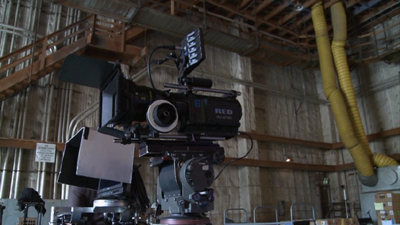
First is “Jeff Cronenweth and David Fincher on the Visuals.” At only 7 1/2 minutes, this is packed with good stuff. Cronenweth discusses why he and Fincher decided to go with Red HD cameras (below left) rather than the Vipers used for Zodiac and The Curious Case of Benjamin Button. It well illustrates of what we talk about in Chapter 1 of the ninth edition of Film Art: technical decisions being made for aesthetic purposes. According to Cronenweth, digital cameras innately have greater depth of field than 35mm ones do, and the featurette explains how to manipulate depth of field in digital filmmaking in order to guide the attention of the viewer. Finally, there’s an enlightening example of how three cameras fastened together can take separate images that can be tiled into a long, panoramic space. The filmmakers can than create camera movements within that panorama, add lights, and otherwise manipulate the image in ways that will be imperceptible to the viewer.
“Angus Wall, Kirk Baxter, Ren Klyce on Post” is just as good if not better. It’s mostly about editing. About a minute in, Baxter, the editor, talks about how Fincher wanted him to conform to traditional rules of continuity editing, never crossing the axis of action. As he puts it, “We’re always doing basic film law, but it can just be done extremely rapidly.” In other words, the average shot length may be lower than in older Hollywood films, but the methods of handling space for clarity are still observed. One passage of this supplement shows the difficulty of keeping eyelines straight when shooting a group at a table (a topic we deal in Film Art using a simpler example from Bringing up Baby). Klyce, the sound designer, discusses being able to edit individual words from different takes to create exactly the dialogue the director wanted. He also points out that Fincher insisted that background noises be as loud as the dialogue being spoken by the principal characters present. That’s a pretty unconventional approach, as we mention in our sound chapter.
At several points in this supplement, the juxtaposition of two or more images in a black background helps illustrate the point, as in the frame at the top of this entry.
The innovative music in The Social Network has rightly drawn a great deal of attention, including an Oscar and other awards. It’s covered in “Trent Razor, Atticus Ross, David Fincher on the Score.” Again some of the concepts we lay out in Film Art show up here. The composers and director talk about how music affects the spectator’s expectations. They point out that variants of a key musical theme are used to connect three scenes (i.e., a musical motif links parts together to create a formal whole). That musical motif involves a slow, wistful piano tune played over a faintly ominous undercurrent of electronic tones. To indicate the progression across the film, the piano was recorded with the microphone at a different distance from the instrument each time, affecting its timbre.
“Swarmatron” is really an extension of the music supplement, this time focusing on a particular and eccentric musical instrument.
Finally, there’s a segment on the big night-club scene, “Ruby Skye VIP Room: Multi-angle Scene Breakdown,” which is about four minutes long. Multi-angle layouts of scenes juxtaposing the different camera angles within the frame have become fairly common on DVDs. Here, though, Kirk Baxter and Ren Klyce return to offer more insights into the post-production and how these disparate images and sounds were combined. This supplement is interactive, and one can choose which versions of the shots and sound to use. I didn’t try all possible combinations. Choosing “1) Composite view” and “2) Interviews” worked well, I thought.
Another Fincher film, Zodiac, has been discussed in our “Beyond praise” series. Evidently Fincher understands what makes for a useful supplement–at least when it comes to the ones that deal with specific aspect of filmmaking.
District 9 (“2-disc Edition,” Sony Pictures Home Entertainment)
To begin with, don’t bother with the three short “The Alien Agenda: A Filmmaker’s Log” films on the same disc as the feature. They’re perfunctory and uninformative, probably something produced for cable channels to run as publicity.
The good stuff is on the supplements disc. Which has previews on it. I expect previews before the film, but in front of the supplements?! Maybe I just haven’t noticed this before, but this is the first time I was actively annoyed by it. At least one can skip through them by pressing the “next” button three times.
The individual documentaries are pretty good of their type. “Metamorphosis: The Transformation of Wikus” focuses on the make-up designed for the main character, Wikus Van Der Merwe, in the portion of the film after he is infected by something that turns him into one of the aliens he has been trying to control. This is as straightforward and dramatic a demonstration of make-up as you’re likely to see.
A lot of the film’s acting involved improvising on camera, and “Innovation: The Acting and Improvisation of District 9” is an unusually interesting little supplement on acting. Again, teachers who want to teach an extensive unit on acting might want to use this. It creates a considerable contrast with the main Social Network making-of, where Aaron Sorkin states quite emphatically that there was no improvisation at all on his film.
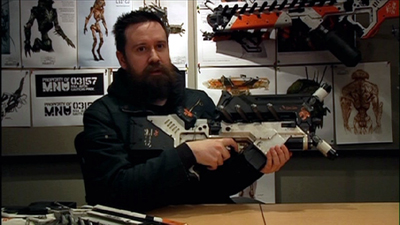
“Conception and Design: Creating the World of District 9” goes into such topics as the design of the aliens’ weapons (below, top). It’s fairly typical of these sorts of supplements, but there is a discussion of how the space-ship design was consciously imitating the style of sci-fi films of the 1970s and 1980s. That is, Alien (1979) introduced the notion that space craft could be corroded and dingy(below, bottom)–as opposed to the squeaky-clean interiors of the ships in 2001: A Space Odyssey (1968). Thus the idea of styles and genres having their own histories, which we bring up in Film Art, is exemplified.

“Alien Generation : The Visual Effects of District 9” has some interesting footage exemplifying the challenges of trying to shoot improvised acting with a hand-held camera while having a motion-capture camera filming the same action simultaneously. With both cameras, complete with separate small crews, move in unpredictable ways, they tend to get in each other’s way. There’s also a nice moment at the end when a technician shows off a rotating still camera on a tripod. It’s used to record the light coming from all directions, so that the digital effects can add in light that’s consistent with that on set.
The New World (New Line Home Entertainment)
Note: Both the theatrical version DVD and the “Extended Cut” one (which restores 35 minutes cut by Malick for the theatrical release and is also available in on Blu-ray) have the same supplements.
With all the anticipation building up around Terence Malick’s upcoming The Tree of Life, I wondered what a making-of for a Malick film would look like. Would the elusive Mr. Malick take part, or would he allow little or no behind-the-scenes footage?
Turns out he did not take part, but the makers of “Making The New World,” a one-hour supplement, took an imaginative approach by attaching themselves to the second unit. That’s the unit that typically films the action and landscape shots, scenes where the main actors are not delivering dialogue. In this case the unit had plenty of work to do. We see the filming of a fire at the fort, footage of the three ships sailing up the river in the marvelous opening scene, and a long battle between the Native Americans and colonists.
The documentary camera operators were allowed to tag along right behind or even in the midst of the cinematographer’s team, who clearly cooperated extensively. A lot of what we witness is actual filming, often glimpsed over the shoulders of assistants, still photographers, the second-unit assistant director, the fight choreographer, and others. (See below.)
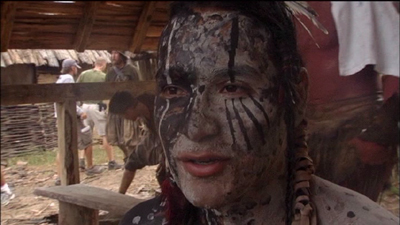
I doubt very much of the coverage was planned in advance. The camera dodges around people who intrude unexpectedly into the foreground, and in a few cases the microphone is too far from what’s going on, and the filmmakers insert subtitles to let us know what was said. The interview footage clearly included anyone the documentarists could corral between takes, including various bit players, make-up people, the assistant director, just whoever was available. It comes as a shock when about half-way through Colin Farrell appears briefly to make a few remarks. In this brief interview with one of the Indian actors, people pass close by in the background, making noise that competes with what he says:
The result is a greater immersion in the filmmaking process than I’ve seen in any making-of. There’s no real attempt to explain any aspect of filmmaking–no voiceover narration, no superimposed titles apart from the ones identifying the people speaking.
Overall, this caught-on-the-fly footage gives the impression that any aspect of filmmaking can be interesting. So often the directors of supplements foreground the stars and try to inject drama into what is already a fascinating subject. Here there might be a plastic tarp being put over a camera during the rain or a camera assistant instructing extras on a ship to make sure that their water bottles aren’t in frame, and the supplement makers include it.
We do, of course, learn something about how Malick works. Experienced camera operators remark on how he doesn’t use artificial lighting, and we see shots of men ripping openings in thatched roofs to allow sunlight into a scene:
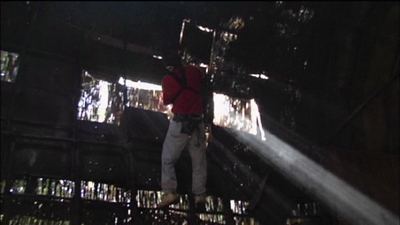
Christian Bale notes that Malick shoots 360 degrees around the space, so that crew members must be prepared to duck out of sight if he turns the camera their way. Others express surprise at the complete lack of storyboarding.
Being attached to the second unit also allowed the making-of team to show how the filmmakers cooperated with and included many Native Americans in the planning and execution of the film. It’s great to see American Indians not only pleased with the way their ancestors are being portrayed, but excited by being able to experience something of their ancestors’ way of life.
There’s a touching moment when Buck Woodard, a Native American advisor on the film, is being shown around the frame of an Indian dwelling by the production designer, Jack Fisk. Woodard looks around with a smile, and as Fisk moves off to the left, Woodard turns away from the camera and whispers almost inaudibly, “It’s just wonderful!”—clearly speaking to himself and not to Fisk or the microphone.
In short, this is a thoroughly ingratiating making-of—and how often do you see one of those?
One final note. Is it just me that’s getting annoyed by the time-lapse photography in supplements that are used to show lengthy actions like set-building or light-shifting really fast? That was kind of impressive for a while, but it’s a cliché by now. In The Social Network supplements the fast-motion is so fast that one can’t really see what’s going on. That sort of thing is cutesy, and it condescends to the viewer. (Even The New World supplements, which are much more casual, use this device once or twice.) I would like to see a set-building scene that actually shows something about how sets are built, not about how cool the supplement producers can make the process look.
The factors considered in these supplements tend to support David’s arguments in The Way Hollywood Tells It that there are basic continuities of style between traditional studio filmmaking and what some scholars have characterized as “post-classical” Hollywood.
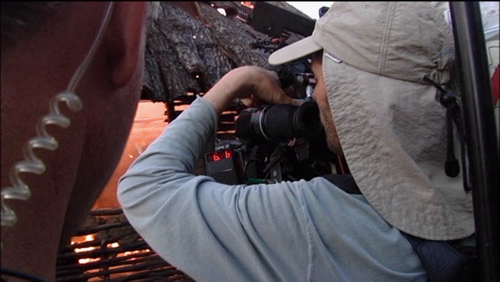
The New World.
Posted in DVDs, Hollywood: Artistic traditions, National cinemas: New Zealand | open printable version
| No Comments »
Monday | April 11, 2011
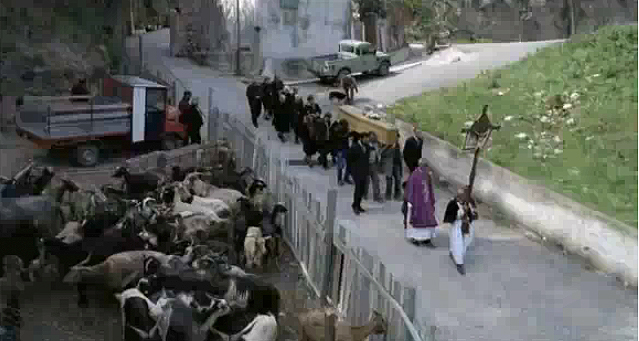
Le Quattro Volte.
DB here:
As happened last year, I had to flee Hong Kong for medical reasons. Beset by a wracking cough, I took off three days early and upon returning to Madison wound up in hospital. Current diagnosis: pneumonia. Duration of stay: six nights and counting. A drag. But I’m lucky: no disorderly orderlies, no homicidal doctors injecting me with mind-control drugs (“You will watch only Brett Ratner films for the rest of your life. Sleep, sleep…”). I’m taken care of by expert, calm, and good-natured people. Expect no less from the best city for men’s health and care.
So I’ve been tardy in writing this final HK blog. I just wanted to talk about two extraordinary films I saw in my final days and bring up a scrap of news for followers of Chinese film.
 First, the news. Liu Jiayin, of Oxhide fame, was in Hong Kong briefly to accept an Asian Film Financing Forum award for her screenplay Clean and Bright. The other winner was Li Ruijun, for his project Where Is My Home? Liu was about to visit the US for screenings at Redcat, under the sponsorship of the tireless Bérénice Reynaud, and at Cinema Pacific in Portland. I had a chance to talk briefly with her just before she departed. First, the news. Liu Jiayin, of Oxhide fame, was in Hong Kong briefly to accept an Asian Film Financing Forum award for her screenplay Clean and Bright. The other winner was Li Ruijun, for his project Where Is My Home? Liu was about to visit the US for screenings at Redcat, under the sponsorship of the tireless Bérénice Reynaud, and at Cinema Pacific in Portland. I had a chance to talk briefly with her just before she departed.
Regular readers of this blog know my admiration for Liu’s two Oxhide films. The good news is that she is at work on Oxhide III. She wouldn’t say much about it, except that she is still reworking the script, but it sounded quite far along. In addition, she hopes to shoot Clean and Bright, a more orthodox film about a family, fairly soon as well. Oxhide IV is also planned, with the series running up to perhaps eight installments.
For more on Oxhide, including purchase information for the DVD, check Kevin Lee’s dGenerate Films website.
Leaving us hanging
Too often we think of suspense as specific to certain genres, but it’s actually a fundamental resource of all storytelling. Creating expectations about an upcoming event, sharpening them, and delaying their fulfillment–all these strategies are basic, I think, to narrative experience in general. Although some plots emphasize suspense more than others, even most “character-centered” tales wouldn’t engage us without a dose of it.
True, sometimes there’s a sort of bait-and-switch, as when suspense is conjured up but eventually dissolved. Sooner or later we realize Godot isn’t going to show up, or that Anna in L’Avventura is likely not to be found. In those cases, suspense has led us to another terrain, usually thematic, in which we’re invited to consider something more significant than learning the outcome of events. (Sometimes, though, snuffing out suspense is just a sign of slack, or Slacker, storytelling.)
Suspense is usually associated with popular plotting, so many people expect Serious Films to be lacking in suspense. Which makes it all the more interesting that Iran, one of the most-favored nations on the festival circuit, has made something of a specialty of suspenseful art movies.
We don’t recognize often enough that Kiarostami’s early films are often structured as suspenseful quests, from the boy’s attempt to return his schoolmate’s notebook in Where Is the Friend’s Home? to the final shot of Through the Olive Trees. His scripts for other directors convey this quality even more clearly. The Key is almost Griffithian in showing how a four-year-old boy struggles to rescue his younger brother when they’re locked in a kitchen with a gas leak. The Journey (Safar) is positively Ruth Rendellian: A headstrong middle-class father leaving Tehran with his family forces another car off the road and flees the scene. Instead of resting at a summer retreat, he returns obsessively to the place of the accident to check the progress of the investigation: Will he give himself away? And it isn’t just Kiarostami. Look at the suspense structure in Makhmalbaf’s Moment of Innocence, or Reza Mir-Karimi’s The Child and the Soldier, or Panahi’s The Circle.
What gives Iranian suspense films their weight is partly the fact that they don’t rely so much on the old standbys (chases, stalkings, cliffhanging rescues) but rather on psychological maneuvers, carried out largely through dialogue. Characters in these movies tend to talk a lot, pushing their concerns forward with a stubbornness that we seldom see in other national cinemas. People stick up for themselves, and the suspense comes from a clash of testimonies, pleas, and self-justifications. But it also comes from a moral dimension. My earlier examples depend on our assessing what we ought to happen (the hero of the Journey should be punished) versus what we might want to happen (he should escape). Add a dash of mystery, as we have in Through the Olive Trees (what is Tehereh thinking?) and A Taste of Cherry (what is the job Mr. Badi is hiring for?), and you have artistically ambitious filmmaking that exploits some very traditional resources of the art form.
These resources were on display in Asgar Farhadi’s earlier About Elly, which I praised in these pages two years ago. Nader and Simin, A Separation has a comparable power to seize and hold our interest. A wife fails to get a divorce and leaves the household, which includes not only her husband Nader but his Alzheimer’s-addled father and their daughter Termeh. Without Simin to care for his father, Nader hires Razieh, a working-class woman who must bring her little girl with her. Soon the job overwhelms Razieh and, for reasons not disclosed till later, she goes missing. Nader and Termeh find the old man tied to the bed, unconscious.
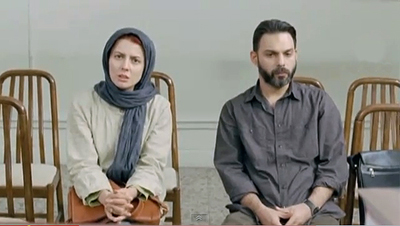
For this early stretch of the film, the helper Razieh trembles on the verge of hysteria, and only later do we learn why. When she returns to the apartment, she confronts Nader’s wrath, which leads to yet another turning point, but one whose significance we realize only later. To complicate matters, Razieh’s hot-headed husband becomes furious with everyone. As in About Elly, a great deal turns on what characters know at one precise moment, and our memory of when they learned something can be as elusive as theirs. And as in Henry James’ novels, much of the action is registered through the reactions of onlookers, notably the pensive daughter Termeh (below), who turns out in the final scene to be as important as any other figure in the film.
The suspense builds on many levels: the progress of the divorce, the decline of the old man, the court case that involves Razieh’s place in the household (did she steal money?), and above all the responsibility for a death. Some of these lines of action are shown resolved; a crucial one remains suspended. And that does, as often happens, oblige us to think more broadly about the film’s treatment of parent/ child relationships. We are left with an exceptionally rich film, one reflecting on class differences, religious ones, and the effects of adult problems on the children around them. Suspense not only feeds our hunger for story; it can also tease us to moral reflection, and Nader and Simin does just that.
No suspense?
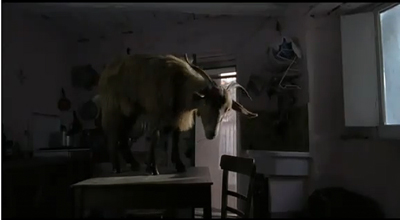
How much can you purge suspense from a movie? And if you play it down, what do you put in its place to hold our interest?
One answer to these questions comes in Michelangelo Frammartino’s Le Quattro Volte. It is one of those sedate observational pieces that covers a year in the life of a village, with not much discernible dialogue but lots of lovely landscape shots. It has a cyclical rather than linear structure, beginning and ending with smoldering wood turned into charcoal–itself a metaphor for the inevitable transmutations that govern plants, animals, and men. We follow an old goatherd who eventually dies; his goats pay homage by climbing precariously to his tiny home and occupying it. A young goat is born soon after the old man’s death. The townsfolk erect an enormous Christmas tree, which at the end of the holiday is chopped down into bits, which will in turn becomes charcoal. If Nader and Simin exists largely in medium-shot, here the extreme long-shot dominates. There are no psychological interactions or dramatic issues of the sort we find in Fahradi’s films. In the rustic spirit of Rouquier’s Farrebique, we get the sheer successiveness of things, the fact that life is one damned, or placid, moment after another.
So suspense can be replaced by sheer consecutiveness, but the task then becomes to make things interesting. Frammartino does so through careful framing, evocative sound, and crisp storytelling technique. The goats pick their way up to the old man’s hillside apartment; they jostle around inside; cut to a shot of the old man’s head as he lies dead; cut to the church, with people filing out as the bell tolls. In addition , you can find suspense at more micro-levels, working not at the level of plot action as a whole but rather within and across particular scenes. After the goatherd’s death, we see another kid born: this is familiar, even clichéd, the rhythm of nature. We follow the kid’s efforts to assimilate to the herd. But as winter comes, the kid strays off, becomes isolated, and ends up lost and shivering. We must assume that he dies. So much for the great cycle of life.
At a still more microscopic level comes the shot that everyone remembers from Le Quattro Volte. It’s so salient that critics who seldom notice imagery can’t help but mention it. I won’t describe it in detail, so as not spoil the surprises, but suffice it to say that it involves a church procession, some intransigent goats, a pickup truck, and a resourceful dog. Reminiscent of Tati or Suleiman, this long shot depends on ratcheting up our expectations about how several converging events might develop, onscreen or off, and then fulfilling those expectations in startling ways. We might call the result spatial suspense: How will this composition-in-time finally resolve itself?
We should, then, never underestimate the power of suspense, even in those films which might seem to forswear it. Melodrama or pastoral, any genre can find a way to excite us by asking what can come next.
Catching up: By leaving Hong Kong early I missed the second screening of The Turin Horse; my first impressions are here. Since I wrote that, I learned that Cinema Scope has published Robert Koehler’s sensitive appreciation of the film and his enlightening interview with the cinematographer Fred Kelemen.

Nader and Sinin, A Separation.
Posted in Directors: Liu Jiayin, Festivals: Hong Kong, Film comments, National cinemas: China, National cinemas: Iran | open printable version
| Comments Off on Arthouse suspense, in big and small doses
|