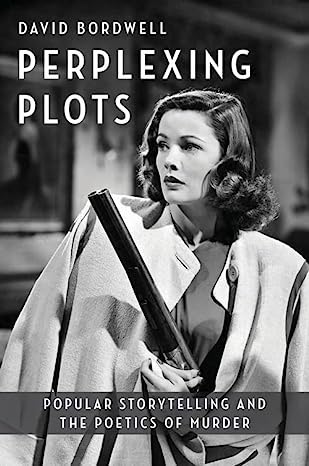
by Kristin Thompson. Berkeley: University of California
Press, 2007.
400 pages, 6 × 9 inches, 12 color illustrations;
36 b/w illustrations.
[go
to Amazon | go to The Frodo Franchise blog]
Rian Johnson’s enthusiasm for classic mysteries made it inevitable that I’d get interested in writing about Knives Out. Although I merely allude to the film in Perplexing Plots, I devoted a blog entry to it. While thinking about a follow-up on Glass Onion, I began a rewarding correspondence with Jason Mittell, adroit blogger and author of Complex TV: The Poetics of Contemporary Television Storytelling. Today’s entry reflects my thoughts after this exchange of ideas.
Despite the near-universal acclaim received by Glass Onion, it didn’t whet my interest as much as its predecessor. It’s a little too campy and overproduced for my taste. But Johnson’s ingenuity in manipulating conventions of the Golden Age detective stories by Christie, Sayers et al. makes it ripe for the sort of analysis I try out in the book. So here we go.
Needless to say, there are spoilers for Glass Onion and Knives Out. But I bet you’ve seen both films.
Tools of the trade
Knives Out.
Plotting a story is a craft, and it has some essential tools. There is, for instance, the ordering of events. Will you present events in linear story sequence, or will you arrange them in a nonchronological pattern? You can’t avoid choosing one or the other or some combination of the two.
There’s also the matter of viewpoint. Will you attach the audience to what a single character experiences, or will you roam among several characters?
And there’s segmentation: How will you break your plot up into chunks? In literature, we have sentences, paragraphs, and chapters. In theatre, scenes and acts. In film, scenes and sequences (and sometimes reels or chapters). Even one-shot movies have moments of pause or shifts of viewpoint that mark off phases of the action.
These are forced choices that every storyteller must face. It’s these three–linearity, viewpoint, and segmentation–that Perplexing Plots relies on in order to analyze both mainstream storytelling and mystery fiction.
In addition, the craft requires the audience to be engaged–at least interested, at most emotionally moved. You must choose whether to get your audience to empathize with certain characters or to keep the characters remote and unknowable. Do you want to arouse anger, approval, or some other emotion? You must decide how the choices of linearity, viewpoint, and segmentation can trigger these responses.
For example, your plot can usually build empathy for a character by showing incidents in which that person is treated unfairly. Those actions will be more intense if they’re rendered from the character’s viewpoint. This is what Rian Johnson does in Knives Out when he shows Marta persecuted by the vindictive Thrombey family, and then exploited by Hugh. The disparity in power (David vs Goliath) heightens our sense of indignation and makes the finale seem to be poetic justice (My house/my rules).
Some emotions depend directly on choices about chronological sequence. If your plot signals that some past events are significant but then doesn’t reveal them, you’re using linearity to create curiosity. If the plot summons up anticipations about particular future story events, you create a degree of suspense. If your plot introduces an event that momentarily seems out of keeping with the linear story, you can summon up surprise.
Each of these “cognitive emotions” (“cognitive” because they rely on knowledge and belief) is shaped by perspective and segmentation. Creating curiosity, suspense, and surprise depends on viewpoint: each character will have different states of knowledge about the course of events. In Knives Out, Hugh Drysdale is not suffering curiosity about whodunit: he knows he did it. But because we’re attached to Marta and detective Benoît Blanc, we share their state of uncertainty–and suspense about what may come.
Similarly, decisions about segmentation will often be made based on the cognitive emotions in play. You might end a book chapter or a play’s act or a film’s scene on a note of curiosity (“Then whose body is in that grave?”), suspense (the stalker draws near the prey), or surprise (“I’m your father!”).
As my examples from Knives Out suggest, the three tools I’ve picked out have special purposes in a mystery story. Perhaps one reason for the enduring popularity of mystery as a narrative device is its ingenious use of linearity, viewpoint, and segmentation to build cognitive emotions, especially curiosity. But a perennial problem of the genre is to build up other emotions. So we need sympathetic detectives and victims along with unsympathetic suspects, cops, and gangsters to engage us. Some writers also vamp up the suspense factor by putting the investigator in danger, a hallmark of hardboiled stories and domestic psychological thrillers (Rinehart, Eberhart, and their modern counterparts). Perplexing Plots traces some of these creative options through the history of mystery fiction.
Hidden stories
Evil Under the Sun (1982).
The mystery plot centered on an investigation tells two partial and overlapping stories. The investigation is presented as an effort to disclose what happened in the past, an incomplete and puzzling chain of events. Writers in the 1920s started to call this “the hidden story.”
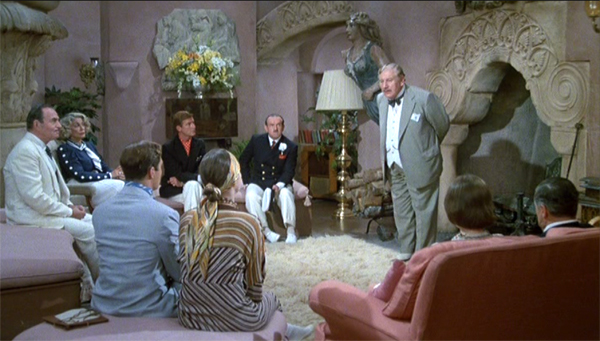
In the standard case, the detective reveals those events and makes a single continuous story out of everything. The revelation is typically saved for the climax of the present-time story line, with the detective explaining the missing events in a summing-up. Often all the suspects are gathered and the detective reviews the evidence before presenting the solution to the puzzle. In other instances, the detective may confide the results to a friend or an official.
The summing-up is often a verbal performance, with the detective recounting the hidden story. A classic example is the Christie novel Evil Under the Sun (1941), in which Hercule Poirot explains to the assembled suspects how the crime was committed. To make this scene less monotonous onscreen, filmmakers often illustrate the hidden story by brief flashbacks, as in the 1982 film adaptation of the Christie novel. Johnson employs this strategy in Knives Out, supplying quick shots of how Hugh’s scheme was enacted.
The detective’s explanation often rests on yet another hidden story line: parts of the investigation we didn’t see. Very often the detective operates backstage, pursuing clues we didn’t notice. Sherlock Holmes absents himself for a good stretch of The Hound of the Baskervilles, leaving Watson to explore the mystery of the Moors. Only later do we learn what Holmes was up to. Rex Stout’s Nero Wolfe likes to keep his assistant Archie, our narrator, ignorant of information that he asks other operatives to dig up for him.
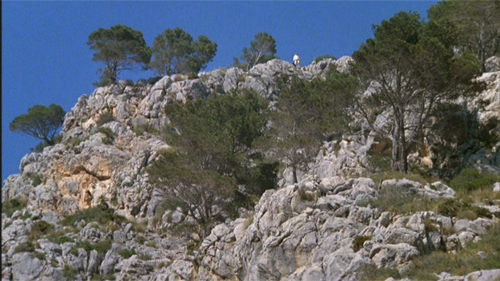
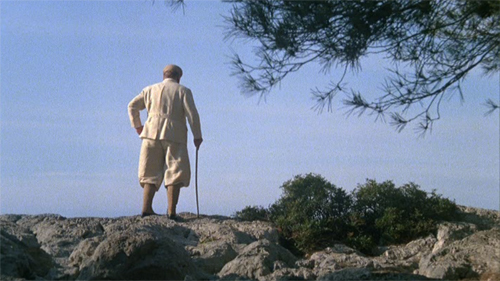
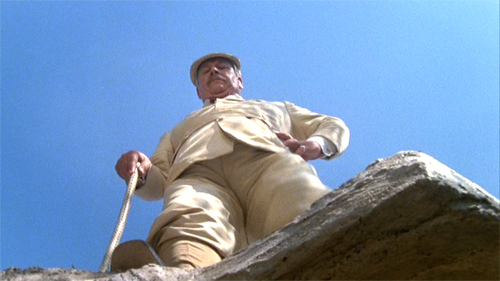
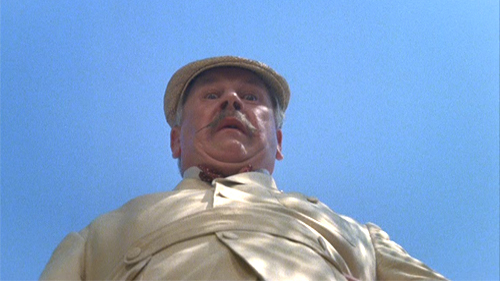
As a result, in the final summing-up, the detective’s filling in of the plot may include telling us of his offstage busywork. Again, that may be rendered on film as flashbacks to make sure the audience appreciates the sleuth’s cunning. These might include flashbacks that replay parts of the inquiry, but from a new viewpoint. In the film version of Evil Under the Sun, we see Poirot’s first visit to the cliff’s edge.
But the replay during his summing up expands this by dwelling on the vertiginous effects he feels.
In Glass Onion, Johnson finds a fresh way to treat the detective’s offstage machinations, and that depends, as you’d expect, on exploiting the three basic tools.
A package of puzzles
The most obvious innovation involves segmentation. Johnson splits his plot into two almost exactly equal halves. The first, running about seventy minutes, is a more or less complete classic puzzle.
Tech magnate Miles Bron invites his old friends for a weekend party on his private island. Their affinities go back to their days hanging out together in a pub, the Glass Onion. A fifth friend, Cassandra “Andi” Brand, co-founded Alpha with Miles, but he cheated her out of her share when she refused to expand into questionable paths. Andi shows up at the island to join what Miles calls the Disruptors. There’s Claire, an ambitious politician; Lionel, a scientist working for Miles on a new energy source; Birdie, a scatty fashionista; and Duke, an aggrieved online spokesman for patriarchy. Famous detective Benoît Blanc joins the party, even though it’s unclear who invited him.
These characters are introduced in a rapid opening sequence that shuttles us from one to the other as each gets a puzzle box. Crosscutting and split-screen imagery yield an omniscient narration; we seem to know everything. Johnson points out the expositional advantages: “The box gave it an element of fun, a spine, and a way for all the characters to be on speaker phone solving the mystery of how to open it together, so you see the dynamics between them in real time.”
Then we see a so-far unnamed woman receive a box and break it open. Finally we find Blanc himself, stewing in boredom in his bathtub. In all, a shifting spotlight has introduced us to all but one of the major characters.
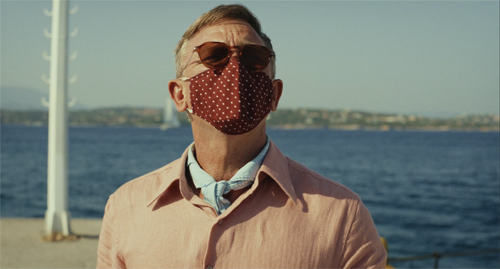
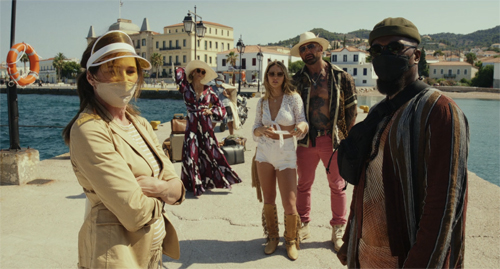
Once the group assembles on the pier to board the ship that will take them to Miles’s island, the narration narrows its range and concentrates mostly on Blanc’s reactions.
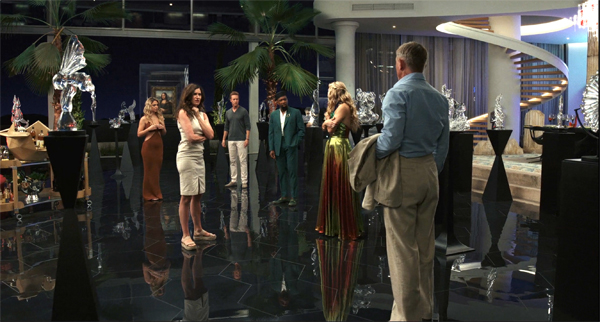
In what follows, Blanc observes the others, occasionally trailing them, and asks questions about their pasts. By and large, this half of the film will be attached to him, though sometimes the narration will stray briefly to others (chiefly to give each a motive for killing Miles). The first half assigns Blanc the conventional role of curious investigator.
Miles has planned a murder game in which he’s the victim, but that puzzle collapses the first evening when Blanc solves it instantly. A new crime emerges: Duke abruptly dies of poisoning. And soon someone shoots Andi. Blanc gathers the suspects and announces he nearly has a solution. “It’s time I finished this. . . . Only one person can tell us who killed Cassandra Brand.”
In the spirit of Golden Age whodunits, Johnson has poured out a cascade of mysteries, big and small. Who sent Blanc the extra box? Why did Andi, still smarting from her courtroom loss to Miles, show up at his party? When Duke died, he drank from Miles’s glass, so who was trying to kill Miles? Duke’s pistol mysteriously disappears; who took it? The same person who killed Andi?
Johnson’s narration can be both reliable and unreliable. During the drinking session a quick long shot reveals that Miles forced Duke to take the poisoned glass. This is a daring gesture toward Fair Play (that some of us noticed), but Johnson will try to cancel our impression. He will soon offer a lying replay to blot this out.
To further swerve suspicion from Miles, Johnson uses viewpoint. We see Miles reacting in shock to a POV image of the fallen glass with his name on it, as if he were just realizing he, not Duke, was the target.
Of course he’s faking, but by privileging his viewpoint in order to underscore his reaction Johnson suggests he’s innocent. Cheating? Not really, just misleading. Johnson gives with one hand, takes away with the other–as his mentor Agatha Christie does in prose (as I try to show in the book).
Fugue states
So Blanc has a lot to explain. But instead of continuing the traditional summing-up denouement, Johnson pauses and in effect replays the first half of the film by concentrating on the detective’s offstage activities.
Turns out, Blanc has been much busier and less naive than he seemed in the first part. A conventional assembly-of-the-suspects climax would have included explanations of his scheming, but Johnson daringly fleshes these out to forty minutes that annotate scenes that we’ve already witnessed. In this play with linearity, gaps are filled, and new information is provided.
The second part starts with a young woman delivering the wrecked puzzle box to Blanc. She is not Andi but her twin sister Helen. (Yes, Johnson unblushingly taps the convention of false identity, with twins no less.) Andi is dead, killed by carbon-dioxide fumes in her garage. Helen suspects not suicide but murder and gives Blanc an account of Andi’s career through flashbacks. These bursts of nonlinearity skip freely from the gang’s youthful days to Miles’s cheating of Andi.
Moved, Blanc coaxes Helen to impersonate Andi and go to the party, as if accepting Miles’s invitation. (Blanc will convince the authorities to suppress news of Andi’s death for a time.) The two of them form a team to investigate Miles’s posse and find Andi’s killer. So now two puzzles–who sent Blanc the box? why did Andi, or rather “Andi,” show up at the island?–are set to rest. Just as important, as Knives Out focused our empathy on Marta, this second half gives us Helen as a sympathetic figure, so the puzzle element is enhanced by emotion.
Blanc’s saunters around the compound are now replayed as more purposeful, while “Andi” stands revealed not simply as an intruder but a snoop. Some scenes are only sampled, while others are fleshed out through viewpoint shifts. In addition, the narration offers hypothetical flashbacks when Helen and Blanc play with the possibilities of who might have killed Andi.
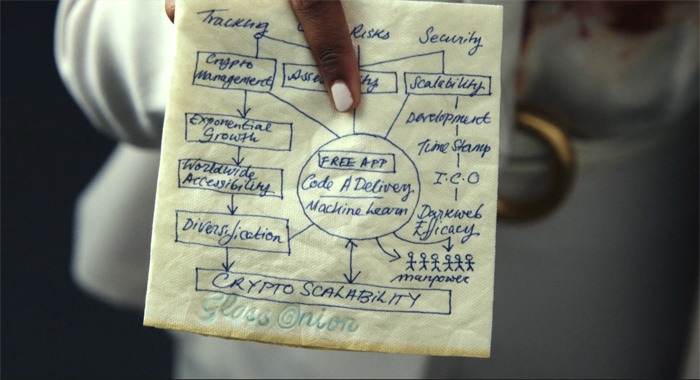
Driving the second part is the search for a crucial piece of evidence that would have won Andi the court case: the Glass Onion napkin on which she jotted down a plan for the company. After the trial she found it and told Miles’s circle; her murder was triggered by the killer’s plan to recover the napkin. When Helen finds it, she can confront Miles. In a final twist, it’s revealed that the bullet that apparently killed Helen was blocked by Andi’s diary. At her return to the group, Blanc can launch a proper summing-up and denunciation of the guilty.
The annotated replays run about 37 minutes. These incidents could have been much more concisely presented as part of Blanc’s explanation, but as Jason Mittell pointed out to me, this new plot structure gives the second part a dynamic we associate with another genre: a film tracing a big con, like The Sting. There’s a pleasure in seeing how scenes we interpreted one way now stand out as manipulated by Blanc and Helen.
Blanc’s explanations, and Miles’s efforts to block it, take another sixteen minutes. Eventually the Disruptors unite to support Andi, and Miles is facing murder charges. The film ends not with a shot of the complacent Blanc but of the righteous Helen/Andi, the co-protagonist of the second part, a figure of vengeance and vindication.
Replays that amplify and contextualize scenes we’ve already seen are common in mysteries and other genres. Johnson’s originality comes in building one long segment out of such replays. To make it work he relies on our memory of the chronological order of previous scenes to create a double-entry plot structure in which the detective’s backstage scheming revises and corrects our perception of the core action. You could lay out the action on a table of the sort I occasionally resort to in Perplexing Plots.
Johnson’s pride in folding the second half of the film back over the first part is teased when a guest at Birdie’s party explains the fugue that Miles has embedded in the puzzle box. “A fugue is a beautiful musical puzzle based on just one tune. If you layer this tune on top of itself, it starts to change and turns into a beautiful new structure.”
Johnson’s virtuoso play with segmentation has a place in the mystery story tradition; Perplexing Plots reviews several Golden Age examples. (One somewhat similar novel is Richard Hull’s Excellent Intentions of 1938.) You can imagine a version of Glass Onion that attaches its viewpoint to Blanc and Andi from the start, with the “infiltration” strategy of something like Notorious (1946) or Mission: Impossible II (2000). But that wouldn’t engage us through its gamelike, self-consciously artificiality. No film I can recall has so thoroughly routed the offstage activities of the detective onto a track parallel to that of the unfolding crime. Creating a double-column plot like this shows not only the cleverness of design demanded by mystery stories but something I stress throughout the book: the eager drive of popular storytelling toward innovation and novelty–within familiar boundaries.
Thanks to Jason Mittell for a stimulating correspondence and to Erik Gunneson and Peter Sengstock for further suggestions.
Johnson discusses how he shaped the guest assembly on the pier around Blanc’s viewpoint in “Notes on a Scene” in Vanity Fair. A lengthy piece in Vultureexplains some of the citations and in-jokes in the film.
P.S. 13 January: Thanks to Antti Alanen and Fiona Pleasance for correction of two names!
The year draws to a close, and the internet abounds with lists by professional critics, educated fans, and clueless people proffering opinions on the ten best films of 2022. David and I avoid this custom, but fifteen years ago I stumbled into a habit of listing the ten best films of ninety years ago. Such films have by now stood the test of time, and they have one enormous advantage: no one is speculating about many Oscar nominations each will get.
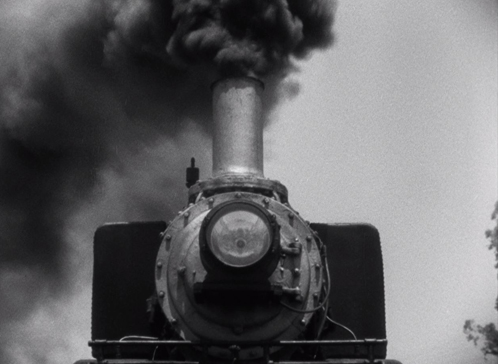
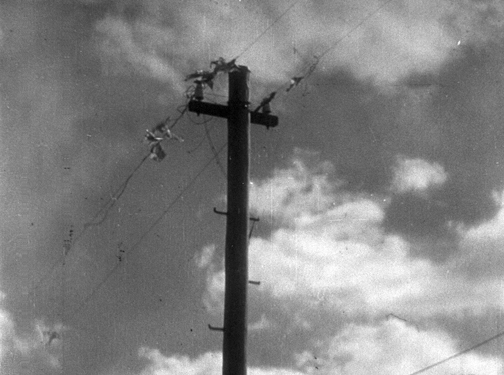
Back in the day, only two of the films on my list got nominated at all, and those two collected a total of three Oscars. (For a hint at one winner, see the image at the top. He will feature prominently in this year’s list.)
These ten films are of course my own choices, and for those who disagree, they are quite welcome to make their own lists.
As usual, my list is a mix of very familiar titles and some not so familiar ones. My hope is to call attention to unfamiliar films that are well worth a look. Actually this year nine of the films should be familiar to any serious film student or fan, but the tenth is a masterpiece that deserves to be rescued from obscurity.
Most historians seem to agree that 1932 was the year when Hollywood emerged from the difficult transition to sound and made polished movies that regained the fluidity of cinematography, staging, and editing that had been lost to some extent. In The Classical Hollywood Cinema, Janet Staiger, David, and I proposed that the transitional period lasted from 1928 to 1931.
The same was not internationally true, however. My list contains one silent film, since the Japanese industry went through a considerably longer transition. No wonder that half of this year’s list atypically consists of Hollywood movies.
As usual, I’ll try to point readers toward the best available Blu-rays or DVDs. Those who prefer streaming should be able to find these titles for themselves. David and I prefer discs, at least for important films. With the decline of access t0 35mm and 16mm prints, studying films closely has become more dependent on discs (which also still have better quality images than streaming). Eventually, with streaming the only option obtaining frame grabs of the sort that illustrate these entries, close film analysis will become extremely difficult.
Hooray for Hollywood!
Trouble in Paradise
Ernst Lubitsch is one of the best-loved of film directors, both within the film industry and among cinephiles. I was lucky enough to be invited to teach a one-month summer course at the University of Stockholm on any topic related to silent cinema. I jumped at the chance to follow up on a vaguely planned project on Lubitsch, specifically a comparison of his German and American silent films. The course became a book, Herr Lubitsch Goes to Hollywood, now out of print but available through open access.
Trouble in Paradise is widely considered his best film, though I would say that at least Lady Windermere’s Fan and The Shop around the Corner are equal to it and others are not far behind.
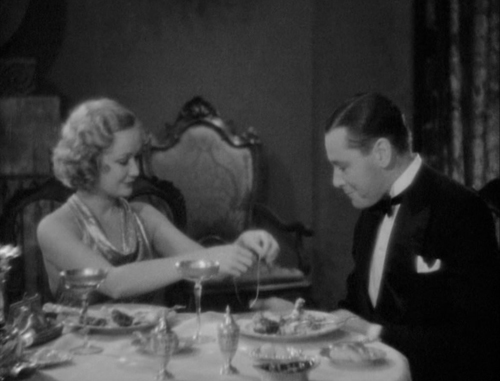
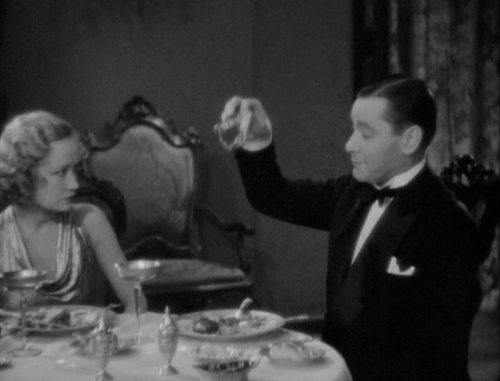
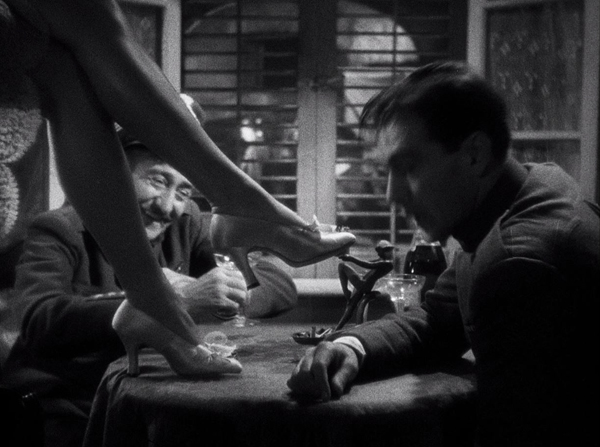
The witty script is a model of sophisticated humor, and the casting is perfect. Herbert Marshall for a change got to play the suave hero, a dazzlingly expert crook who teams up romantically with Miriam Hopkins, his match as a wily pickpocket. In this 82-minute film, their hilarious courtship in a Venice hotel runs for a remarkable 17 minutes as they top each other in stealing things from each other, with her returning his watch and his flaunting her garter:
It doesn’t seem a minute too long. Essence of Lubitsch.
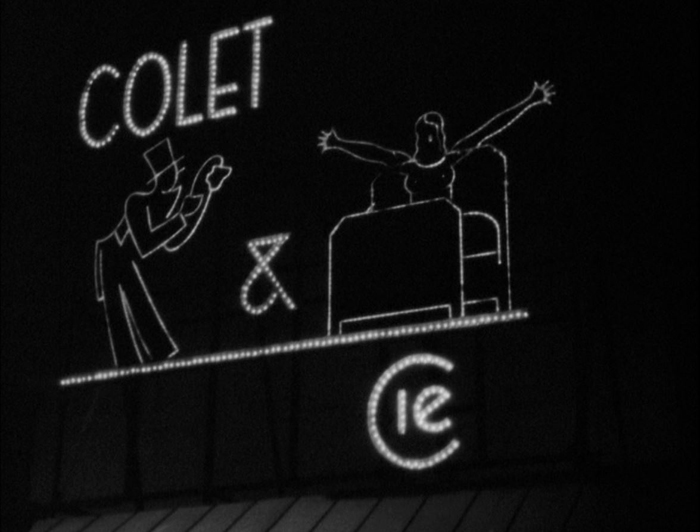
Kay Francis provides the potential trouble that threatens their idyllic life of thievery; she’s a beyond-wealthy owner of perfumery Colet & Cie. (see bottom)–so wealthy that she doesn’t really mind that her “secretary” may be a famous criminal worming his way into her confidence. Charles Ruggles and especially Edward Everett Horton provide hilarity as hopeless suitors wooing Madame Colet.
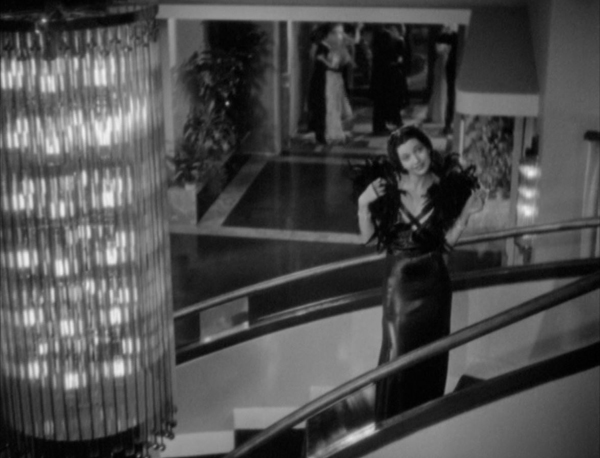
The comedy is played out in shining art-deco sets (above), lit with perfect three-point Hollywood lighting. As I demonstrate in my book, Lubitsch moved effortlessly from being the master of German silent film style to being the master of Hollywood style. It shows in every aspect of Trouble in Paradise.
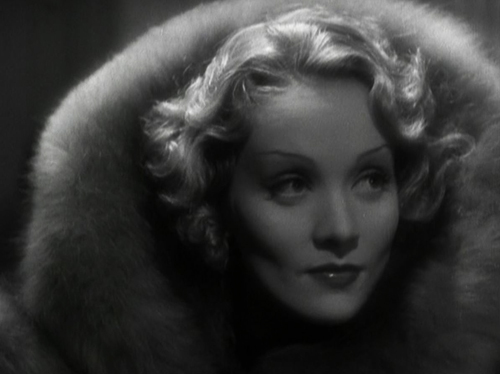
The Josef von Sternberg/Marlene Dietrich teaming. The Blue Angel, featured on my list in 1930. The pair famously made a series of Hollywood films together, all built around the glamor of Dietrich. For me, the best of the bunch is Shanghai Express. It has a stronger script than the others, being set on a train traveling from Beijing to Shanghai during the Chinese Civil War (which had started in 1927). The device of a group on a journey lends the film both unity and suspense. It’s basically a thriller with a romance included. There are more characters than in some of the other Dietrich films, the typical bunch of eccentrics for such journey-plots lending interest, humor, and pathos along the way. Dietrich’s character is strong and likeable. She pursues the man she loves, but on her own terms while he stands around cluelessly keeping his upper lip stiff.
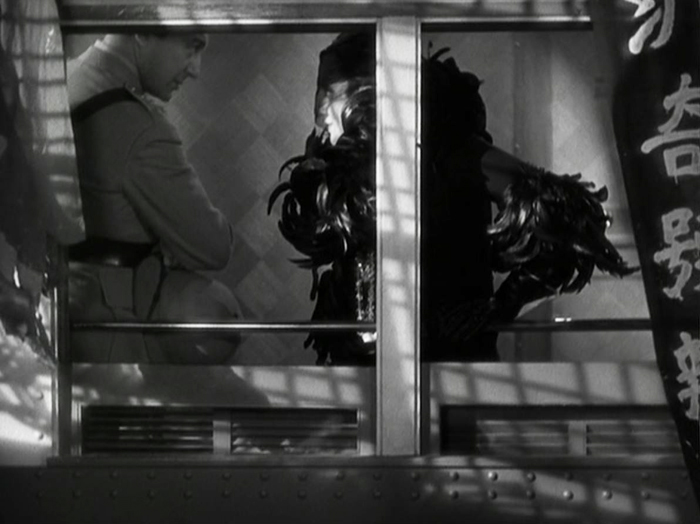
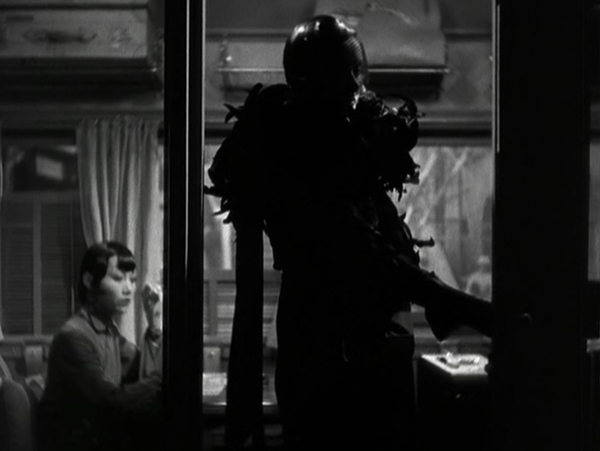
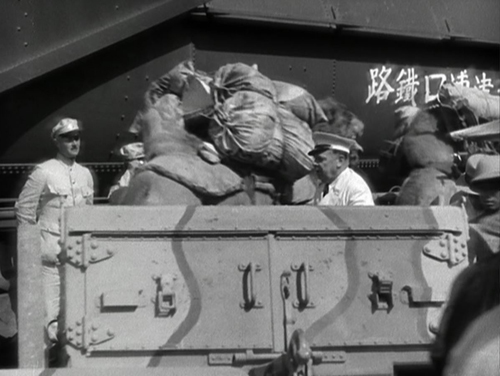
Then there are the incredible visuals. The set design is even more dense than usual for a von Sternberg film. The train windows, both exterior (top) and interior (above) are used brilliantly, and the rebel headquarters where the group is trapped for much of the second half has hanging gauze and stairways that create a complete contrast with the train scenes.
And the Oscar mentioned above went to … Lee Garmes, whose five films in 1932 also included Scarface (see below). Apart from his photography of the settings, he shows off with with other dazzling moments, including an extraordinary tracking shot following an official along the crowded platform for nearly the entire length of the train.
Needless to say, the glamor shots of Dietrich are among the most beautiful ever (Garmes also shot Morocco and Dishonored).
In general, the train station scenes are spectacular and give a remarkable sense of authenticity. Speaking of which, all the extras and minor characters seem to be played by Chinese, or at least Asian people. Anna May Wong has a prominent role as Hui Fei. Whether casting Warner Oland as the rebel leader Henry Chang would count today as “whitewashing” is up for debate. He was born in Sweden but claimed some Mongolian ancestry (so far unproven).
The Criterion Collection has the set of six Dietrich/von Sternberg films on Blu-ray and DVD. (My frames were pulled from an old TCM DVD pairing the film with Dishonored. TCM now offers Shanghai Express by itself on DVD or Blu-ray.)
A Farewell to Arms
The second Oscar-winner of the three mentioned above was Charles Lang, for his cinematography of A Farewell to Arms. (The film also won the third Oscar, for sound recording.)
Frank Borzage has been a staple of these ten-best lists, with Lazybones (1925), 7th Heaven (1927), and Lucky Star (1929). This may be his final appearance in these year-end lists, with growing competition internationally.
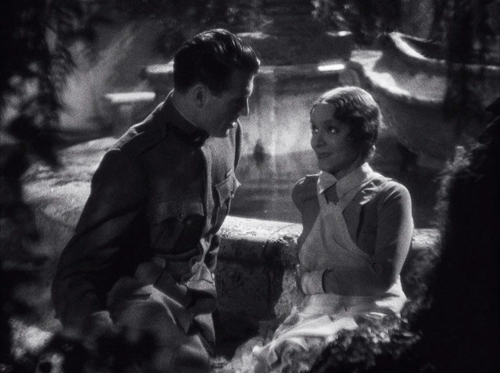
A Farewell to Arms adapts Hemingway’s novel of World War I. Gary Cooper plays Frederic, an ambulance medic who spends his spare time drinking and visiting brothels with his friend, Italian Dr. Rinaldi (Adophe Menjou). He meets Catherine, a nurse, at a party, and they fall immediately in love, succumbing to passion under the assumption that war’s uncertainties may not give them another chance. Becoming pregnant, Catherine departs for Switzerland to have the baby, but her letters to Frederic and his to her, are returned to sender. Frederic risks a firing squad by deserting and desperately trying to find her.
Like Trouble in Paradise and other 1932 films, A Farewell to Arms benefited from the fact that the self-censorship Hollywood studios instituted under the Production Code (aka the “Hays code”) in 1933 was not yet in force. The result is a grittier and more honest look at life in wartime than would be possible in later years. Apart from the quite restrained brothel scene (above), there is considerable emphasis on the forbidden unwed motherhood rife among the nurses Catherine works with.
The two stars make a convincing romantic couple of the kind Borzage had become famous for, and the cinematography is lovely. Lang, too, was an expert at creating glamorous images.
Amazon would very much like you to watch the film for free with ads or with a subscription to Paramount+ or with a free Fandor trial or by paying $2.99. Once you scroll past those enticements, you can find Kino Classics release of a Blu-ray or DVD in a remastered version by George Eastman House. It seems a bit overly dark to me, but maybe the original nitrate copy was, too.
Scarface
I have to admit that gangster films are not my favorites. Still, there are outstanding films in the genre, as the presence of von Sternberg’s Underworld on my 1927 list indicates. The early 1930s established the genre solidly, and Scarface stands out among the other classics examples of the time. I have not seen the two other such classics still commonly watched, Public Enemy or Little Caesar, for a very long time, but I recall not being very impressed.
Scarface marks Howard Hawks’s first appearance on one of my lists. It’s not up to his greatest films of the 1930s, Twentieth Century and Only Angels Have Wings (and some would say Bringing Up Baby).
One thing that makes Scarface stand out for me is its considerable use of humor, which seems unusual for a gangster film. Paul Muni, so dignified in his prestigious bio-pics of this same period, lets go and struts with aggressive arrogance, lets go in fits of rage, and makes Tony Camonte a figure of fun with his accent (“That’s putty nice”) and flaunted ignorance. When the woman he’s trying to impress and seduce remarks sarcastically that his clothes are gaudy, he delightedly takes it as a compliment.
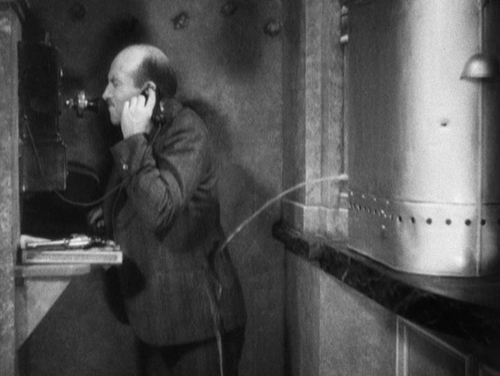
The comic relief flirts with slapstick in the figure of Camonte’s “secretary,” who is illiterate, inept, and downright stupid. According to the AFI Catalog, his character name is Angelo, though Camonte addresses him as Dope. There’s a running gag of him being unable to get basic information from callers. At one point during a raging gunfight in a restaurant, he struggles to hear a caller’s name, unaware that a tank behind him has been pierced and is dousing him.
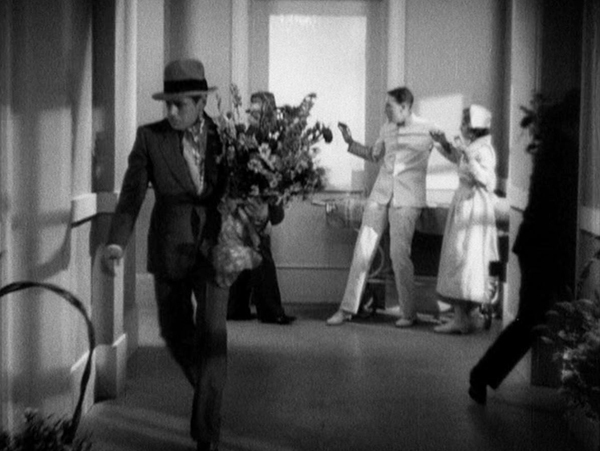
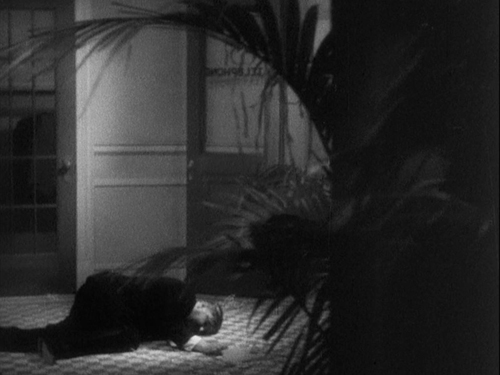
The film also has its visual pleasures. It was one of five films, along with Shanghai Express, that Lee Garmes lensed in 1932. The cinematography is appropriately less glamorous than in Shanghai Express, but it’s dark and occasionally beautiful, as in the hospital-invasion scene at the top of this section.
Many films of the early 1930s start off with an impressive moving-camera shot, presumably to show off before settling down into scenes with standard continuity cutting. Scarface has quite an impressive opening, with a plan sequence leading up to the first act of violence.
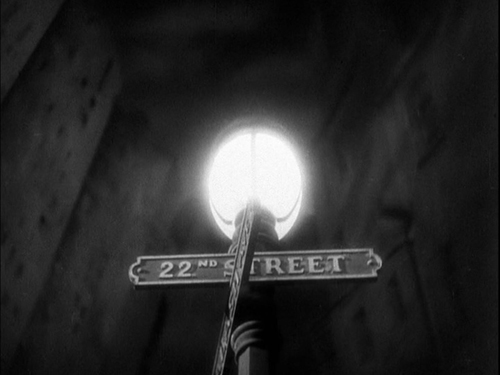
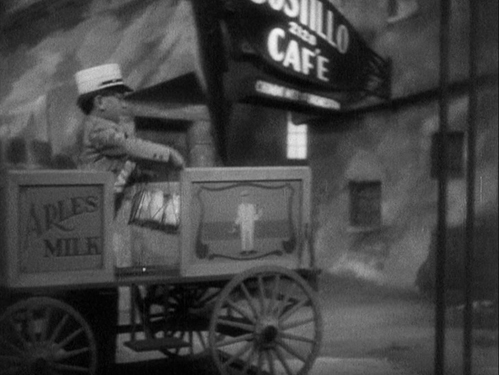
It begins with a low angle of a streetlight going out, and then tilts down and tracks rightward past a milk delivery cart and a sign that establishes the locale.
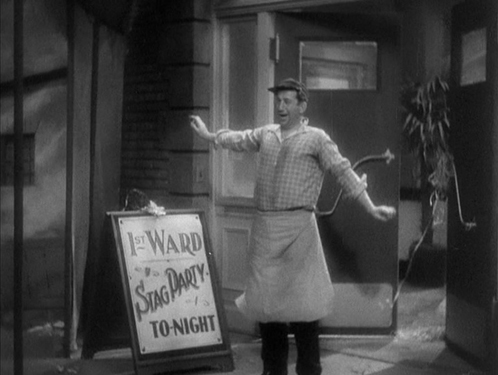
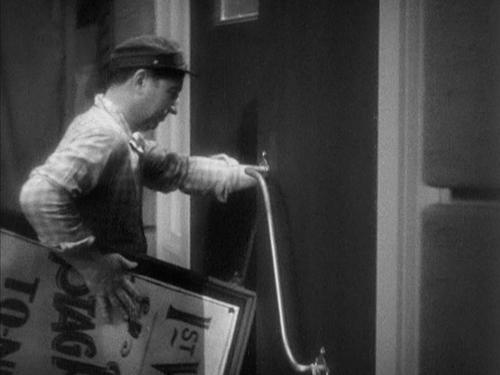
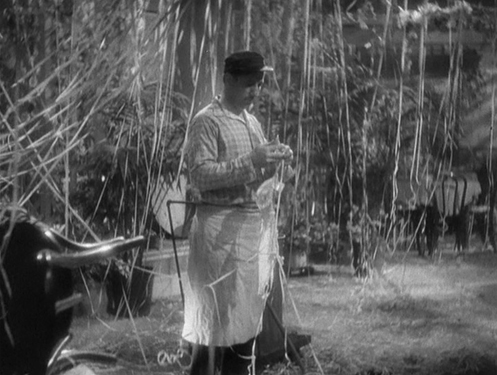
Continuing rightward, it reaches a tired janitor who removes a sign informing us that a stag party had been held there the night before. The camera tracks rights as he starts to clean up.
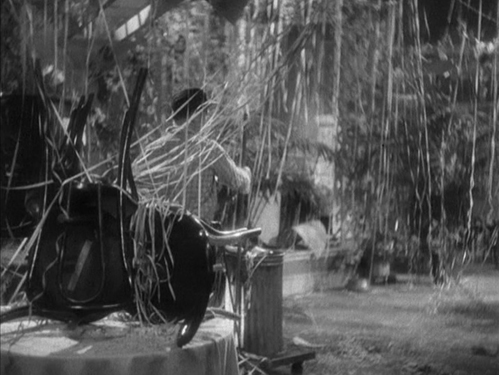
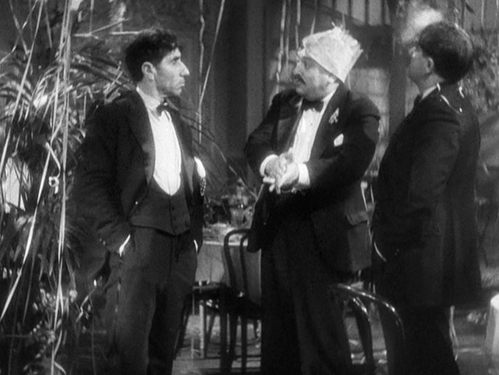
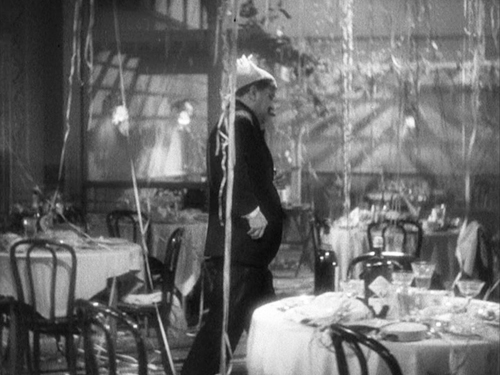
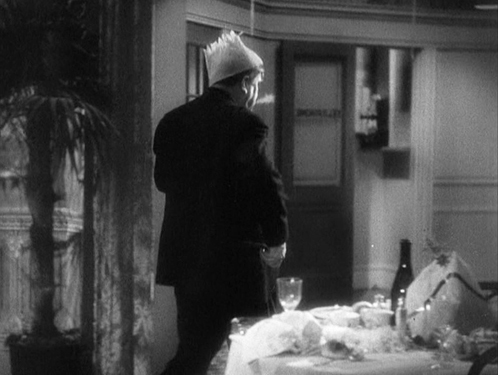
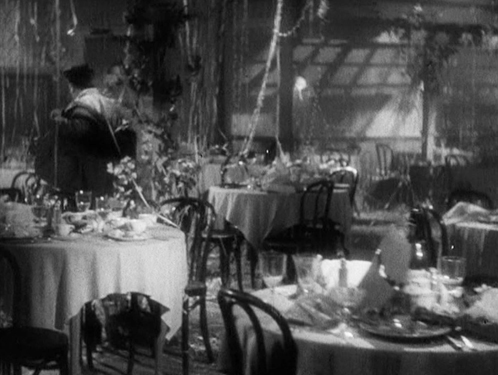
The camera follows through the wall and continues as he tackles the job in a room festooned with streamers–possibly an homage to the big party scene in Underworld. One artifact of the party that he finds is a brassiere that has lost its owner.
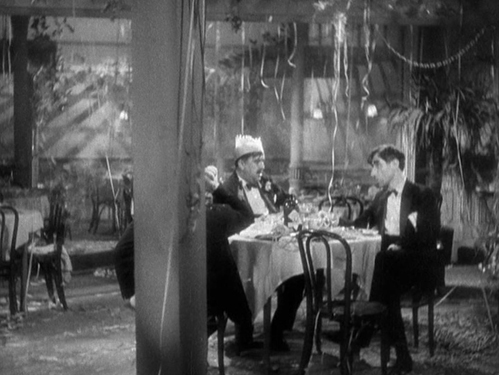
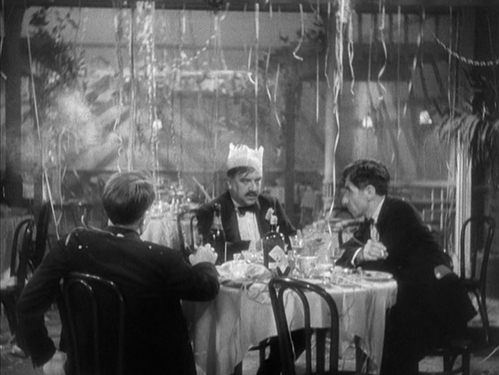
As he pauses, the camera leaves him to pan right and track in on a gang boss and two of his men talking about a potential danger from a rival gangster. He declares that he doesn’t want war and is satisfied with the money he’s making.
The men stand, and the boss promises an even bigger party in a week. Thus for a gangster, he seems a decent sort, not willing to stir up violence against those seeking to invade his territory.
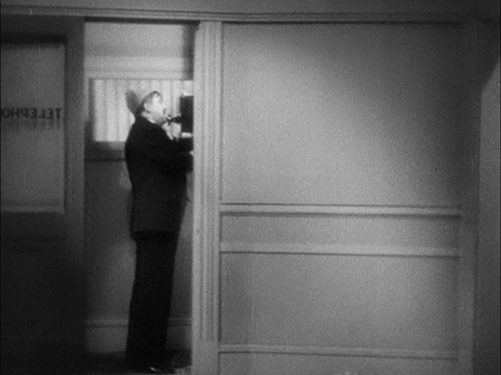
The men leave, and the camera follows the boss across the room and into a phone booth. He starts to make a call.
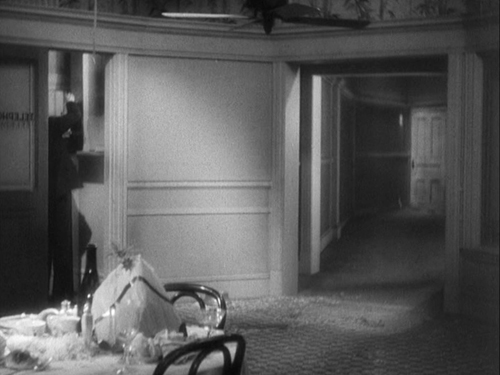
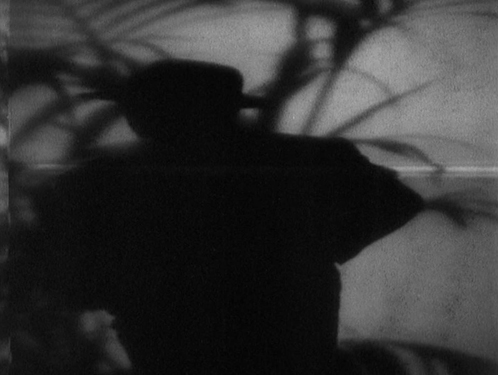
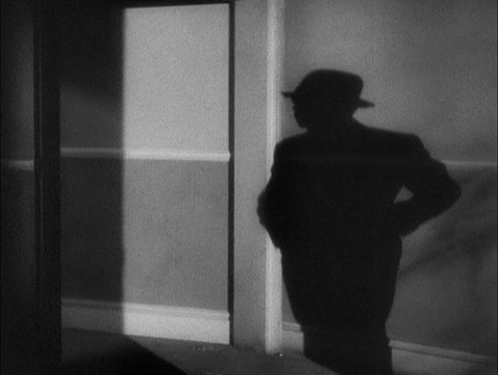
The camera glides past him and away off to the right, where it picks up a menacing shadow in the next room.
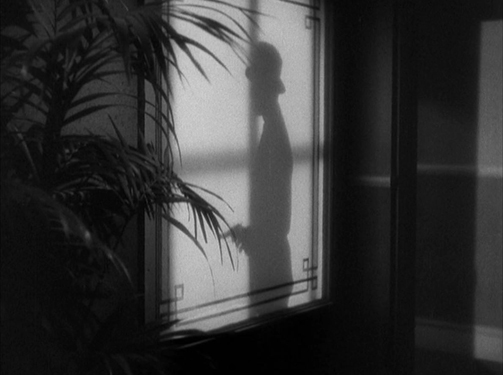
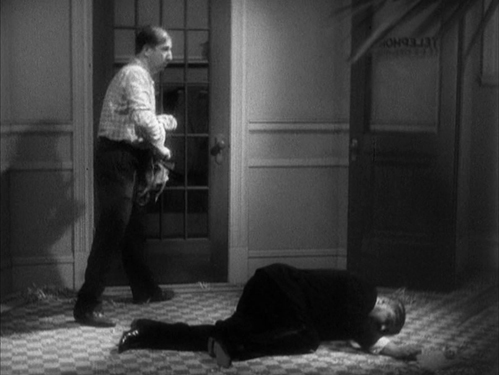
It follows the silhouette as the unknown man walks toward the corridor where the phone booth is. Silhouetted against a translucent window, he pulls a gun, fires it, polishes it with a handkerchief, and throws it on the floor. (This sort of offscreen or partially offscreen treatment allows the violence to be less explicit, a ploy that continues throughout the film.)
As the killer disappears, the camera tracks back to the left, revealing the boss’s body. The janitor enters, sees it, takes off his work clothes, and tosses them in the phone booth.
The scene ends with a pan left to follow the janitor as he hurriedly moves through the mess and leaves.
My frames were pulled from the Universal Cinema Classics DVD, a release which has since come out on Blu-ray. (Amazon still has the same edition on VHS!)
Love Me Tonight
So many of the early 1930s musicals were stagey. The review musicals were series of numbers without a connective narrative (convenient because they could be popular abroad without dubbing or subtitling) or backstage musicals where a “put on a show” premise also led to numbers on a stage. But with the growing freedom of the camera and editing, the musical could become something more.
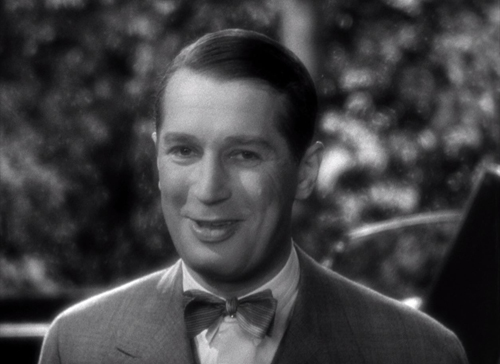
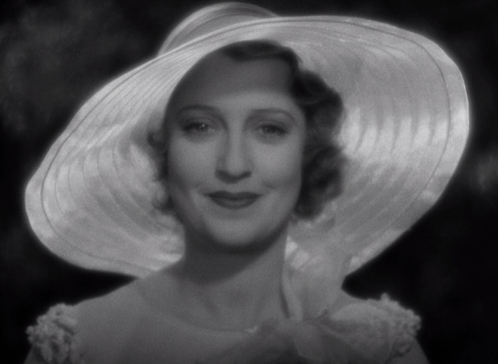
Love Me Tonight feels like a wildly enthusiastic celebration of that new freedom. The story is a modern Ruritanian romance. A Parisian tailor, played by Maurice Chevalier, travels to a country chateau to collect money owed him by a client, who is a member of the aristocracy. While on his way, Maurice bumps into the debtor’s sister, Princess Jeanette, and falls in love with her without realizing who she is. Once at the chateau, he is mistaken for a Baron and proceeds to charm the Princess’ entire family and gain her love–until his lowly birth is discovered. Throughout, the dialogue is witty and the music and songs, by Richard Rodgers and Lorenz Hart.
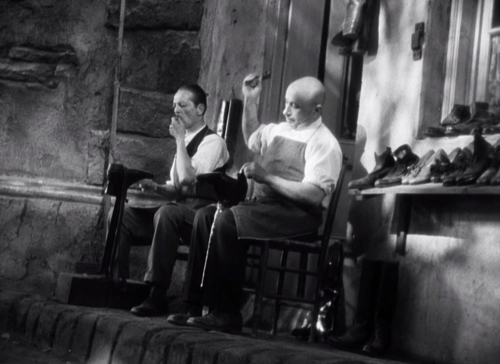
Much of the high spirits of the film arise from the fact that the songs are not sung by one or two people in a single locale. Instead, the music starts out in this limited way but passes along to other characters, spreading infectiously through a household or across a countryside. The process begins on a morning in Paris, as the city wakes up and goes to work. Gradually the rhythmic sounds of various activities build up to a symphony made of sound effects: a woman’s broom against a pavement or two cobblers’ hammers striking in counterpoint.
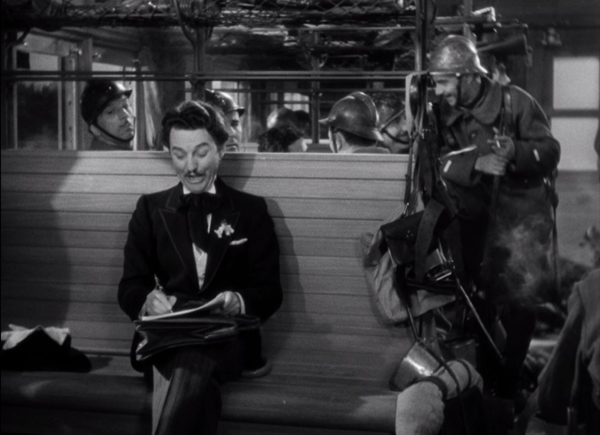
The first actual music when a man getting married that day picks up his formal outfit and Maurice sings about his work in “Isn’t It Romantic?” The groom goes out singing it, and it passes to a taxi-driver and then his fare–who happens to be a composer. Cut to a train, where he hums the music and writes it down (top of section), overheard by a group of soldiers; cut to a field where they march along singing it, and so on, until we reach the chateau and are introduced to the Princess, also bursting into “Isn’t It Romantic?”
Upon meeting Jeanette, Maurice woos her by singing “Mimi” to her. Here it’s a straightforward solo, though one that is filmed in an unusual fashion with Maurice singing and Jeanette reacting in shot/reverse shot directly into the camera.
Once at the chateau, Maurice apparently sings the infectious “Mimi” for the family and guests since there is a montage moving among them as they all cheerfully warble the song in their respective rooms. The same thing happens still later, when Maurice’s low birth is discovered; the song “The Son of a Gun Is Nothing but a Tailor,” similarly spreads throughout the building, including to the servants, who show a snobbery equal to that of their masters. Who can resist lyrics like those sung by a washerwoman?
Down upon my hand and knees/Washing out his BVDs/Is a job that hardly please me./If I had known I would have tore/The buttons off his panties for/The son of a gun is nothing but a tailor!
Overall one gets a sense that music and singing are irrepressible and ripple outward from the soloists to infect everyone within hearing distance.
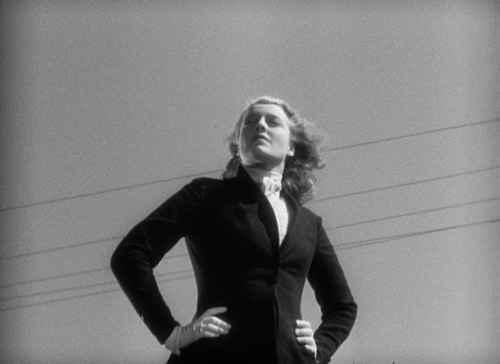
Of course once Maurice has been thrown out, Jeanette decides to defy her family and races after his train on horseback. Mamoulian throws in some Soviet-style compositions as she heroically stands on the tracks and forces the train to stop.
Apart from its infectious style and music, Love Me Tonight has a wonderful cast, with Charles Butterworth as Jeanette’s wimpy but titled suitor, Charles Ruggles as the debtor son, Myna Loy as the man-hungry younger sister, and C. Aubrey Smith as the curmudgeonly father who becomes downright jolly under Maurice’s influence. Sheer entertainment.
Love Me Tonight is available from Kino Lorber on DVD or Blu-ray.
Hooray for the Rest of the World!
Vampyr
Two masters of cinema made vampire films a decade apart. I dealt with Murnau’s Nosferatu in the 1922 entry.
The two films could hardly be more different from each other. Murnau’s film was a plagiarized version of Bram Stoker’s 1897 novel, Dracula. He followed the original very loosely, cutting out most of the characters, including Van Helsing and hence the entire lengthy investigation process. Dreyer may well have known Murnau’s film, but it is hard to detect any influence or inspiration apart from the use of a book as exposition. The Universal version starring Bela Legosi was still in production when Dreyer finished shooting Vampyr. Instead, Dreyer drew even more loosely from the collection of horror-fantasy series short stories by Sheridan Le Fanu, published as In a Glass Darkly (1872).
Dreyer seems to have taken a few ideas from the stories, but does not use the narratives associated with those ideas. The notion of a female vampire is probably derived from one of the stories, “Carmilla,” though Le Fanu’s vampire is young and beautiful, while Dreyer’s is an elderly woman, Marguerite Chopin. The collection of stories is presented as having been case studies collected by a Dr. Hesselius, a researcher of the arcane. Allan Gray may be inspired by Hesselius, though he does no evident research and reacts in fear in most cases where he encounters anything strange and grotesque. Gray’s dream of being trapped in a coffin and carried off to be buried comes from “The Room in the Dragon Volant.”
On the whole, though, one of the most striking things about Vampyr is how little it adheres to the conventions of the vampire tale. It is not told as a collection of documents, as are Le Fanu’s stories (“Carmilla”is told in first person by Laura, the heroine and victim of the vampire) and Dracula (a collection of documentation by gathered by several characters). As in Nosferatu, a book is included to help present the “rules” of vampire stories, but the book is not written by Gray. It is given to him by the old Chatelain. The premises that vampires must travel in coffins full of dirt or will be killed if exposed to sunlight, so important in Nosferatu, are ignored here. Actually, the intention seems to be that Chopin is active mainly at night, but since the entire film was shot in murky daylight, it’s difficult to to tell night from day. Vampires also tend to be of noble birth, and we usually find out something about their family history. Chopin seems to be a local woman who somehow became a vampire.
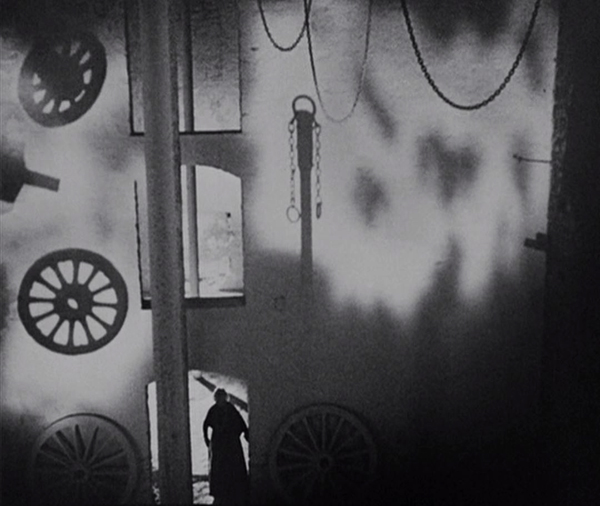
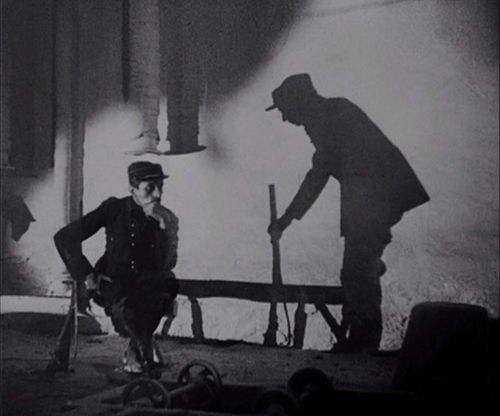
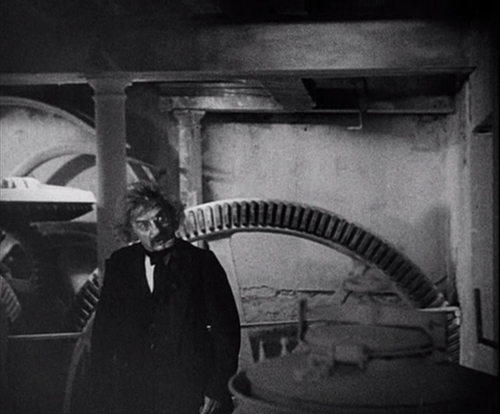
To create a creepy atmosphere, Dreyer has Gray wander about observing menacing, unnatural, or unexplained phenomena in the neighborhood of the village of Courtempierre. These are not phenomena conventional to vampire stories, so they seem as mysterious to us as to Gray. Much of what Gray observes is never explains. Gray sees numerous shadows and reflections of beings who are not visible. He follows the shadow of a peg-leg man until it finally rejoins the soldier who should be casting it. Most vampires live in crumbling Gothic castles, but Chopin seems to have made her headquarters in a dilapidated factory of some sort. (Dreyer chose a deserted plaster factory whose white walls would show off the shadows cast on them.) Her main minions, a sinister doctor and the one-legged military man apparently do whatever they do there, waiting to do her bidding. As the images above and on the right below show, Dreyer creates a mysterious air to the building through the circles and curves of large gears, wheels, and hanging chains.
Beyond such motifs, there are the actors’ unpredictable exits and entrances into the frame during camera movement and the eerie offscreen sounds that hint at something disturbing happening nearby. David has analyzed all this in detail in his book, The Films of Carl-Theodor Dreyer (out of print but available from second-hand book dealers).
For the ending, Dreyer draws upon the convention of a stake through the heart as the way to kill a vampire. It isn’t Gray that figures this out. A remarkably passive protagonist, he sits dreaming of being buried alive while the old servant, initially a minor character, reads the Chatelain’s book, gathers the needed equipment, and initiates the task of the staking of the vampire in her grave.
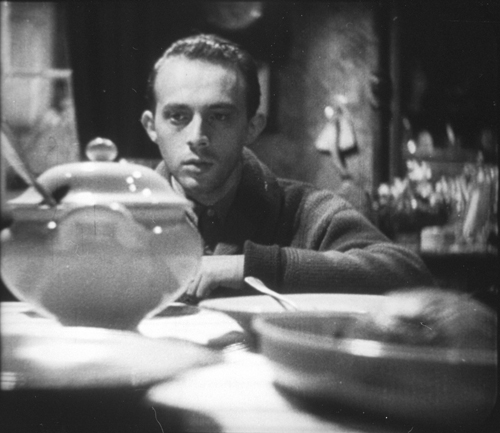
Jean Renoir entered this list in 1931 with La Chienne. Although a grim melodrama for the most part, the film provides put-upon accountant Maurice Legrand with a happy ending as he leaves home and becomes a jovial tramp.
Boudu, the self-centered, careless tramp at the center of this film, is presumably not Legrand, despite being played by the same actor, Michael Simon, and Boudu Saved from Drowning is not a sequel. It almost could be, but this time the genre is comedy.
The opening sets Boudu up as an unusual tramp. He is not begging, and when a little girl offers him a small bill, he asks what it is for. “To buy bread,” she replies. Soon Boudu does beg by opening a car door for a rich man, and when the man can’t find any money in his pockets to tip him, Boudu hands him the small bill “To buy bread” and walks away.
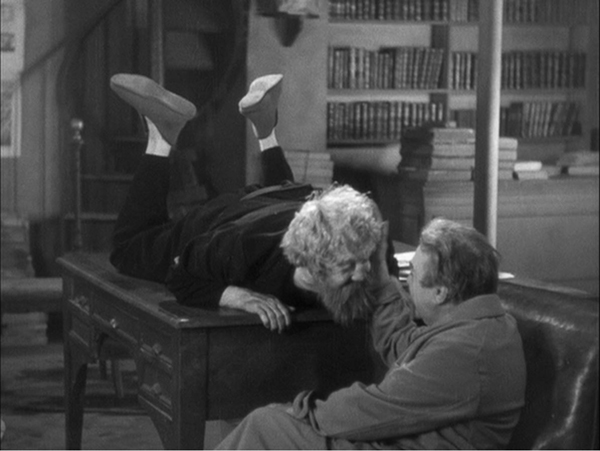
Unexpectedly, Boudu jumps into the river in a suicide attempt. Lestingois, a prosperous bookseller whose shop and apartment are across the street, witnesses this and rushes out to dive in and save Boudu. He succeeds, receiving praise from the onlookers as a bourgeois who would take this trouble for a mere tramp. Lestingois is fascinated and amused by this “perfect tramp” and takes him in, offering him dry clothes, food, and a sofa to sleep on for the night, much to the disgust of his wife.
Boudu’s antics delight Lestingois, who treats him somewhat like a pet dog (top of section). He also gives Boudu a lottery ticket, which predictably will become a vital plot device later on. The tramp, however, disrupts the routine of the household–in particular sleeping in a spot that prevents Lestingois from making his nightly visits to the maid Anne-Marie.
Boudu lingers on, seeing this cushy home as a good setup; he tries to fit in by shaving his bushy beard and trying to dress respectably. He is utterly uncouth, however, shining his shoes on the wife’s bedspread, and knocking things off shelves, and causing a flood by leaving water running in the kitchen. Lestingois ultimately gets fed up with him–but in the nick of time Boudu wins the lottery and the attitude of the household changes. Anne-Marie, who supposedly loves Lestingois, suddenly becomes engaged to him.
On the wedding day, however, as the happy couple are in a rowboat on the river, Boudu upsets the boat and floats away to resume his old life as a tramp.
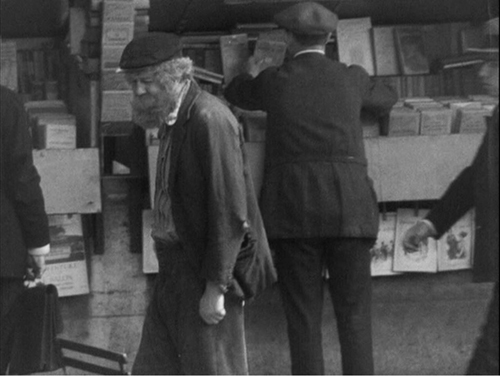
Stylistically the film is distinctly Renoirian. He shot his exteriors in Paris streets and parks, seemingly concealing the camera in some cases. A telephoto lens captures Boudu wandering along the bookstalls on the banks of the Seine, with the other people presumably ignoring him as a real tramp.
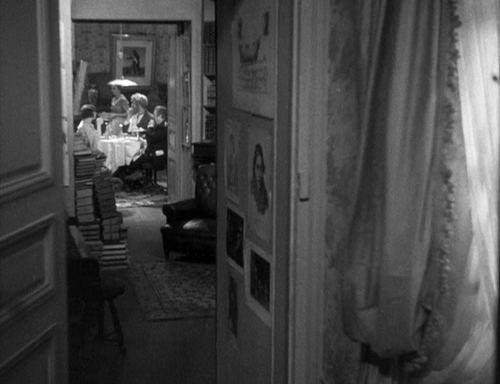
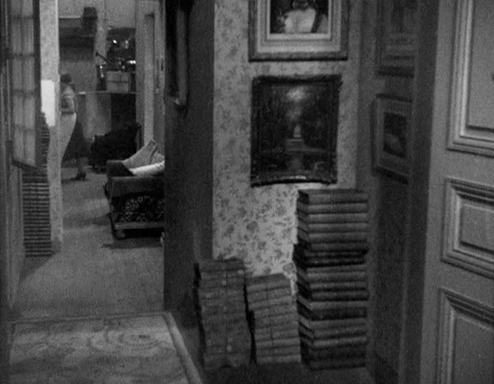
In a modest way, Renoir used the sort of roving camera movement that he would later develop into a major feature his late-1930s masterpieces. One scene starts with Lestingois and his wife eating a meal along with Boudu, seen from a distance down a hallway. As Anne Marie finishes serving, she exits left, and the camera moves left into the next room, where she is glimpsed walking toward the kitchen. It continues moving and stops briefly as Anna Marie enters the kitchen and puts down her tray. As she comes forward to the kitchen window, the camera tracks closer to the foreground window and stops, still at a distance as she talks with an unseen neighbor.
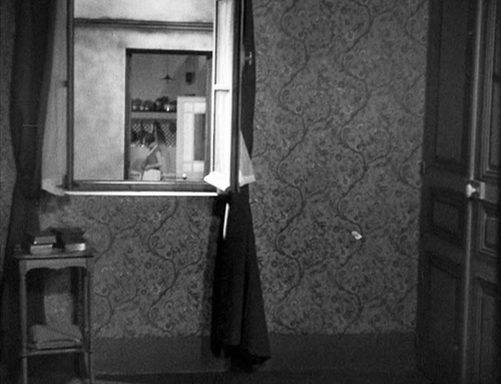
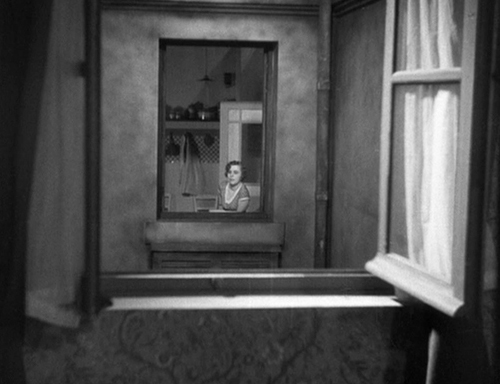
Raymond Bernard’s Wooden Crosses is this year’s masterpiece unknown to most modern viewers, and I cannot recommend it highly enough. I discovered the film through The Criterion Channel. David and I were relatively early in our “Observations on Film Art” series of supplements–early enough that the service was still called Filmstruck. In picking a film for a video essay, I thought it would be helpful to choose titles that were obscure but very much worth calling attention to.
One such film on the Criteron list was Wooden Crosses. I was dubious about it, since my only association with Bernard’s work was the 1924 historical epic, The Miracle of the Wolves, which I had seen back in my post-graduate days and found pretty turgid. Nevertheless, I gave Wooden Crosses a try and was bowled over by it. My video essay, “The Darkness of War in Wooden Crosses,” became number 16 and is available to subscribers.
In some ways Wooden Crosses is France’s great anti-war film of the early 1930s, following Hollywood’s All Quiet on the Western Front and Germany’s Westfront 1918, both of which were in my top ten for 1930. For me, it’s the best of the three.
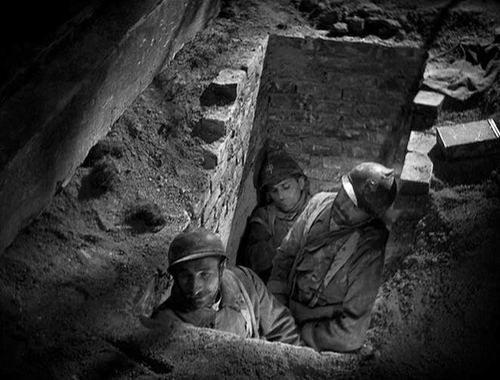
The film begins with stock footage of Parisian crowds cheering the young men signing up to fight and marching off to war. Like The Big Parade, it introduces the war from well behind the lines, as new recruits arrive at a farmyard where the more experienced troops are billeted. The action takes place shortly after the Battle of the Marne in autumn of 1914; it was won by the French, but did not succeed in achieving ultimate victory. In Wooden Crosses, the experienced men scoff at the recruits for having arrived too late to experience any fighting.
Their optimistic assessment proves wrong, and the group is ordered to march to the front-line trenches. The result is an impressive sequence shot at night as the group goes through open areas, woods, and finally ends neck-deep in the trenches looking out across no man’s land in the darkness. As my video-essay title suggests, there is a considerable amount of night footage in the film. One point I make in that essay is that the epic footage in the film made an impression in Hollywood:
In 1935, the head of the newly merged 20th Century-Fox studio, Darryl Zanuck, bought the North American rights for Bernard’s film. He didn’t intend to release it theatrically. Instead, he realized that the spectacular battle footage was beyond anything that the studio could afford, and he wanted to reuse it.
The film it was to be used in was Howard Hawks’s The Road to Glory, released in 1936. Hawks, however, wasn’t just keen to use the battle footage. Like me, he seems to have admired the many night scenes. He said of Wooden Crosses that it had “Some fabulous film in it, marvelous scenes of great masses of people moving up to the front and through trenches—wonderful night stuff.”
The group of soldiers are quickly and marvelously characterized, notably by Charles Vanel as the group’s quiet, sensible Corporal and Gabriel Gabrio (Javert in Bernard’s Les Misérables) as the sarcastic, boastful Sulphart–a key source of comic relief in the film. Graduallynew volunteer Gilbert Demachy emerges as our main point-of-view character, though the others are kept prominent. There is a suspenseful series of scenes as they hear the sounds of German sappers tunneling below their dugout to lay mines. They are ordered to stay put, as there is plenty of time before the explosions, but as we discover, this is an example of a common motif in these films: the incompetence of the leadership.
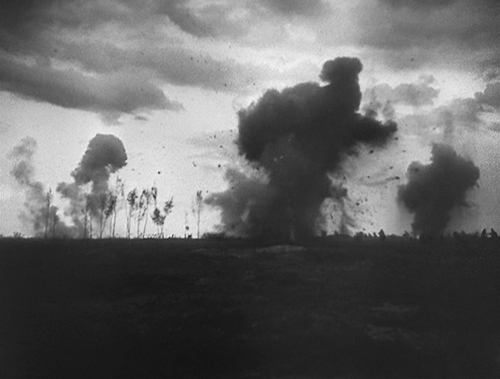
One of the film’s most impressive aspects is the epic recreation of battle scenes. There’s no stock footage here, and there are shots over vast areas of no man’s land with explosions going off among the actors.
The climactic battle goes on and on–ten days, as repeated superimposed titles inform us–and conveys the relentlessness of the struggle that the group undergoes.
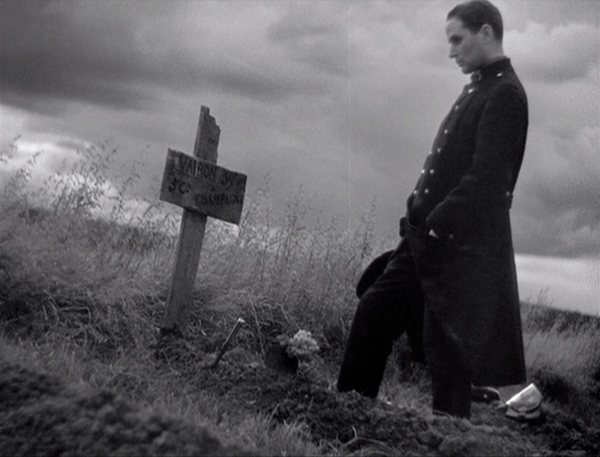
The battle ends in a long, tense scene, ironically set in a cemetery where many of the graves have been blasted open. These substitute for trenches as the men hunker down under German attack.
As with some of the other films on this year’s list, the cinematography of Wooden Crosses is extraordinary. It was shot by Jules Kruger, who had worked with major French Impressionist directors, notably Marcel L’Herbier on L’Argent and Abel Gance’s Napoléon, the latter of which no doubt gave him considerable experience with epic battle scenes. His most famous films after Wooden Crosses were La belle équipe and Pépé le Moko.
The Criterion Collection did a great service by releasing Wooden Crosses paired with Bernard’s Les Misérables in their Eclipse series. It also streams permanently on The Criterion Channel along with my video essay linked above. (New Year’s resolution: watch more Bernard films. I should give The Miracle of the Wolves another chance and set aside plenty of time to watch Les Misérables, a three-feature serial adaptation of the novel that clocks in at 281 minutes.)
I Was Born, But …
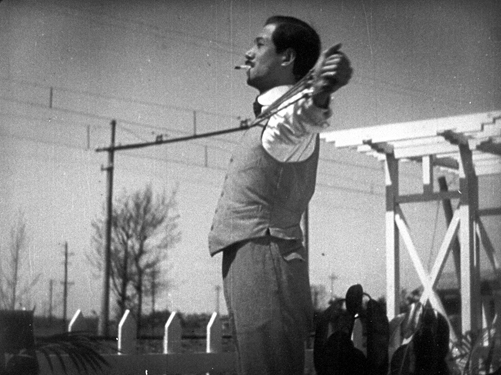
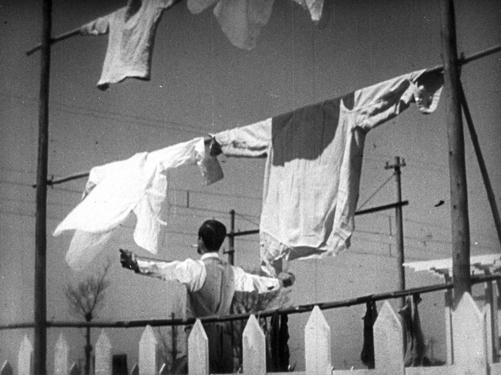
Yasujiro Ozu makes his third appearance in a row on these lists (see here and here for the first two). If I were to live to 102 and if I were still posting these lists, his last film would be on the 2052 list. That’s unlikely, but even so, he will probably be the director most represented on these lists as long as this series continues. I am still pondering whether to give him three spots on the 2023 list or just group his three masterpieces from that year as tied for a single spot.
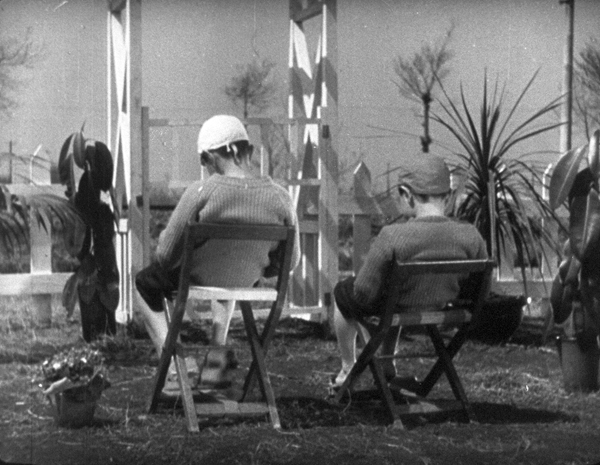
I Was Born, But … was the first of Ozu’s silent films to become available in the West, and it is still probably the best known. So many of his early films are lost, but this may be the one where he achieved the perfect balance of humor and poignancy that characterizes so many of his best films.
Ozu is known for creating stories centered around the stages of life, often expressed as seasons in their titles, such as LateSpring‘s focusing on a daughter pushing the limits of marriageable age to care for her elderly father. His surviving early films often dealt with students or recent graduates struggling as “salarymen” in the job market of the Depression. In this film for the first time he shows the woes of the salaryman largely from the viewpoint of his children. Many of Ozu’s films are based on relations between parents and children young or grown. Those that dealt with young children were among his masterpieces: Passing Fancy, The Only Son, There Was a Father, Record of a Tenement Gentleman, and Ohayu.
The salaryman films deal with the difficulties of getting jobs, competing with colleagues, and surviving on meager wages. I Was Born, But … adds the problem of the subservience and even humiliation a salaryman sometimes undergoes and how it affects his family.
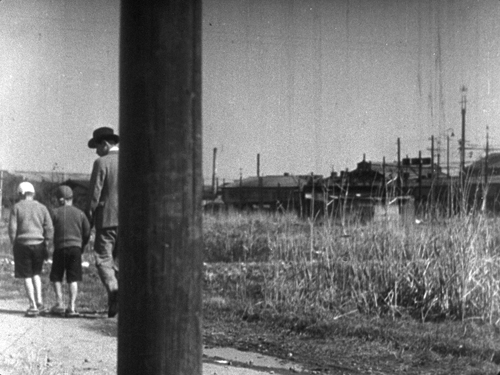
The story unfolds in parts that to some extent echo each other. Early in the film the two sons are bullied at school by the son of their father’s boss. They manage to defeat the bully and in a show of bravado boast that their father is the best in the world.
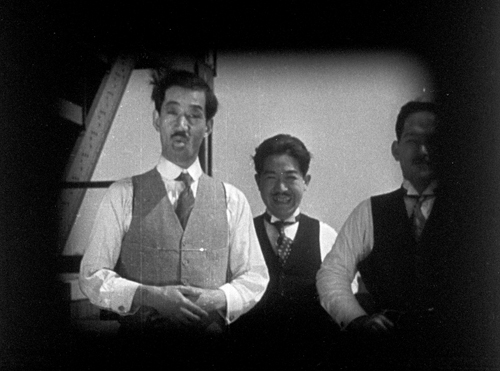
Later the family is invited to a gathering at the home of Yoshii’s boss, who shows some home movies of his employees showing off for the camera. These include Yoshii making faces and playing the fool, obviously at his boss’s insistence. The sons’ delight in seeing their father on the screen fades as they realize that their father has been humiliated and is not the great man they boasted about. Implicitly, Yoshii is being bullied as well but must submit in order to please his boss.
In an angry confrontation with their father, the sons accuse him of having proved himself not to be the man they had looked up to. The confrontation ends in their refusal to eat or speak to their parents. The parents admit to each other that their life is disappointing and not one they would wish for their children. The quarrel soon ends, with the boys accepting that their father is not the greatest.
As with That Night’s Wife (1930), Ozu is already using some of the techniques that would be part of his style for his entire career. For example, there is a transition between scenes that uses graphic values and objects in a series of images that do not behave like ordinary establishing shots.
I Was Born, But … is available in another DVD set in The Criterion Collection’s Eclipse series, “Silent Ozu: Three Family Comedies.” The other two are the charming Tokyo Chorus and the wonderful Passing Fancy (which will definitely appear on next year’s top ten). Along with a slew of other Ozu films, it also streams on The Channel. Many of you know David’s book, Ozu and the Poetics of Cinema; it’s long out of print but available through open access on the Center for Japanese Studies Publications site (with the frames from the color films in color!).
Kuhle Wampe or Who Owns the World?
Slatan Dudow’s Kuhle Wampe, scripted by Bertolt Brecht, was a bold pro-Communist film made in the year before the Nazis swept into power.
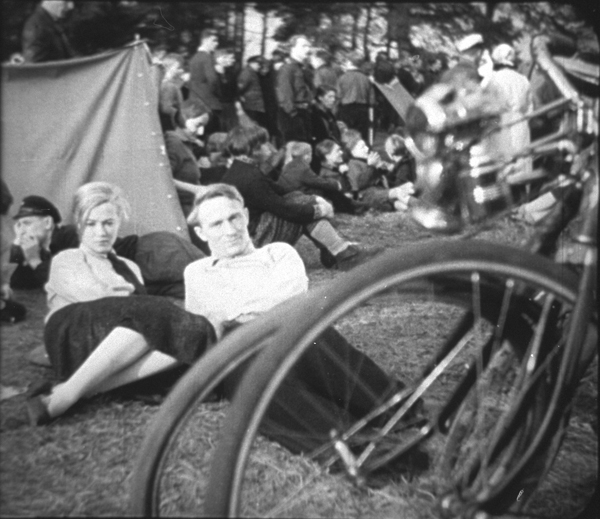
Kuhle Wampe, named for the workers’ camp in which much of it is set, starts with the dire situation for the working class in Depression Germany. A typical family is singled out, with the son returning home after one of many fruitless searches for work (below). His parents blame him for his failure to find work in a society where unemployment is rampant. Their anger drives him to suicide. A neighbor woman remarks resignedly to the camera, “One fewer unemployed.”
The boy’s sister Anni becomes one of the main characters. Another is Fritz, her boyfriend, a leader in the labor protests in a local factory. When Anni becomes pregnant, the pair split up but eventually reunite when her family is evicted and moves into the tent city of the title, run by a Communist group (above). Communism is portrayed as a solution to the problems presented earlier. A lengthy sequence at a Communist youth sports festival emphasizes the happy life on offer by the Party. In the final scene, directed by Brecht himself, Anni and Fritz have an argument about the world’s financial dilemma with some middle-class passengers.
In 1933, Brecht fled the country, eventually ending up in Hollywood, and Dudow was expelled from Germany, only returning after the war to help found the Communist-run East German film industry.
As far as I can tell, the only DVDs or Blu-ray discs available in the US are imports and may not play on encoded machines. (It’s not even on YouTube!) For those with region-free players, the BFI’s release in either format seems to be best source.
My new book, Perplexing Plots: Popular Storytelling and the Poetics of Murder, offers many critical discussions of classic mystery writers. But I couldn’t include every writer or work that interested me. So occasionally I’ll post blog entries that will fill in areas I skipped over. Some portions of the book analyzed work by Ellery Queen, but here I want to fill in some gaps–and remind contemporary readers of two writers who deserve more attention than they currently attract.
Many best-selling novels of the 1930s and 1940s in America remain familiar to us, if only because movies were made from them: Gone with the Wind, The Good Earth, Lost Horizon, The Grapes of Wrath, Mrs. Miniver, The Robe, A Tree Grows in Brooklyn, Forever Amber, The Razor’s Edge, The Naked and the Dead, and others. Maybe you’ve even read some of the books. But many best-sellers don’t endure. What about Singing Guns (Max Brand), Fast Company (Marco Page), Earth and High Heaven (Gwethalyn Graham), and The Forest and the Fort (Hervey Allen)?
In particular, what about The Dutch Shoe Mystery, The Egyptian Cross Mystery, The Chinese Orange Mystery, and The New Adventures of Ellery Queen? Each of these had sold over 1.2 million copies by 1945. Scarcely anyone today remembers them, or recognizes their author’s name.
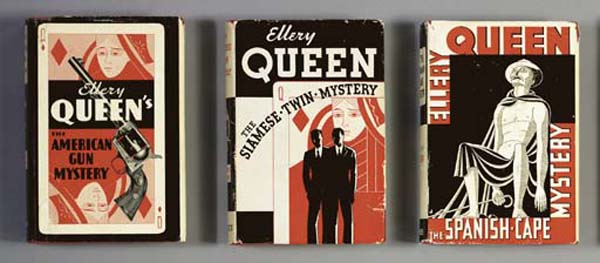
Yet eighty years ago they were part of a multimedia franchise. The books bearing the “Ellery Queen” byline were said to have sold over ten million copies by the end of World War II. There was a spinoff juvenile series by “Ellery Queen, Jr.” and some comic books. There were nine Ellery Queen films and a weekly radio series that ran sporadically from 1939 to 1948, along with “Ellery Queen’s Minute Mysteries.” The Queen name adorned countless anthologies of mystery short stories, and Ellery Queen’s Mystery Magazine, still the most prestigious venue for short mystery fiction, was founded in 1941. You couldn’t visit a newsstand or bookstore without seeing the Queen name.
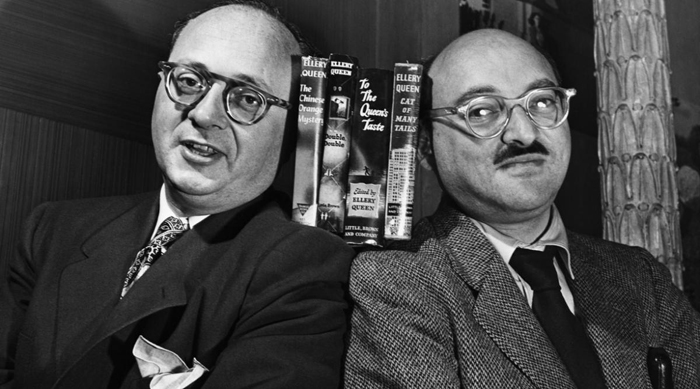
“Ellery Queen” was the pseudonym of two Brooklyn cousins, Frederic Dannay (né Daniel Nathan) and Manfred B. Lee (né Emanuel Benjamin Lepofsky), both born in 1905. While working in advertising, they collaborated on a mystery novel they submitted for a magazine prize. It won, but the magazine went out of business, so The Roman Hat Mystery was brought out as a book in 1929. Dannay and Lee took up detective fiction in earnest, turning out at least one book a year during the 1930s.
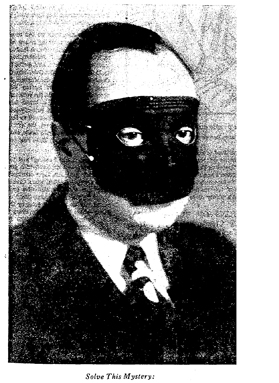
Sensitive to the power of PR, they built up the enigma of the author’s identity, with one or the other sometimes giving a lecture in a mask. When they started another series as by “Barnaby Ross,” the two would appear masked and debate one another. (Shamelessly, Queen wrote a newspaper article praising a Ross novel.) By 1939, they embraced radio and films as major vehicles for their brand, and so their pace of book publishing slackened while they churned out screenplays and radio scripts.
Construed most narrowly, the Queen reign lasted from 1929 to 1958, with The Finishing Stroke taking us back to the days of the first novel. The cousins’ biggest bestsellers were 1930s titles reissued during the 1940s boom in paperbacks. Thereafter they were beset by money troubles and poor health, and so were forced to keep turning out product.
After 1958 the result was a bewildering array of books of varying authorship. Lee had a spell of writer’s block, while publishers pressed them for less detection and more straight crime. Ghost writers produced non-Ellery mysteries under the Queen name and historical novels under the Ross pseudonym. Dannay plotted one novel written by a ghost, while Lee was able to rejoin him for other novels such as Face to Face (1967) and their last joint effort A Fine and Private Place (1971). After Lee died in 1971 and Dannay’s wife died a year later, Dannay brought the series to a close.
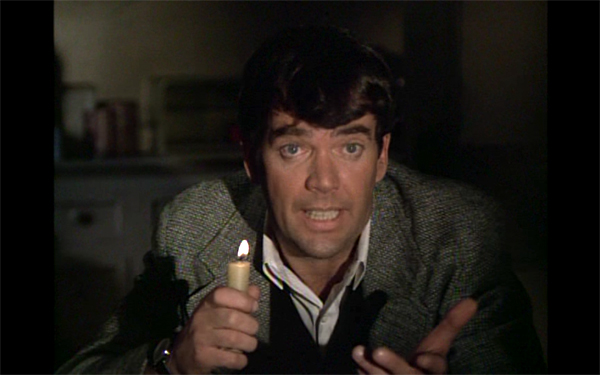
For many years the books were out of print, but Otto Penzler, always vigilant for ways to keep the great traditions alive, began bringing out uniform editions (including the ghost-written books) in 2018. Before that, probably the most vivid reminder of the saga was the NBC television series of 1975-1976, starring Jim Hutton and David Wayne. I’ve been surprised by the number of people who remember it fondly. But the books? Not so much. Which is a pity.
From cold logic to social comment
In his definitive Ellery Queen: The Art of Detection, Francis M. Nevins has argued that the saga develops in four phases. First, there are the pure puzzles–complex crimes demanding elaborate solutions. (Hence the titles flaunting the “mystery” of this or that.) The stories abide strictly by the fair-play principles articulated in Golden Age precept: a careful reader should have all the information necessary to solve the case. The novels flaunted this premise with the famous “Challenge to the Reader” inserted before each climax.
As befits puzzle plots, Phase 1 presents Ellery as a drawling, bloodless intellectual, flaunting his erudition in the manner of the then-popular and more insufferable Philo Vance of S. S. Van Dine. At the same time Lee and Dannay establish some of the devices they’ll use again and again. We encounter cryptic dying messages, missing clues (the dog that doesn’t bark in the nighttime), tempting false solutions, and murderers with a penchant for elaborate crimes. Dannay’s plotting is intricate, but the clarity of Lee’s prose (and his willingness to repeat information) helps the whole contraption work.
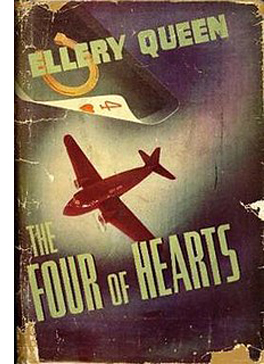
As the early books go along, Ellery becomes somewhat less priggish, but he gets quite down to earth in Phase 2, at the end of the 1930s. The plots loosen up, Ellery gains a (mild) sex life, and the romantic escapades of secondary couples occupy more space. Why? Mystery writers were discovering that serializing or condensing their novels in slick-paper magazines could yield big financial rewards. This market, aimed chiefly at women and families, discouraged the pure puzzle and urged more emphasis on characterization. The cousins managed to sell The Devil to Pay (1938) and The Four of Hearts (1938), intrigues set in Hollywood, as condensations to Cosmopolitan.
Phase 3 Queen, throughout the 1940s and early 1950s, is generally considered the pinnacle of the series. Endowed with literary ambitions and a range of cultural references, the books showed a new depth of psychological, political, and social sensitivity. In the space I have today, I pick out my favorites, each of which has been considered by one critic or another as Queen’s best. Among their distinctions, they show Dannay experimenting with what we would call “worldmaking” and Lee exploring new stylistic resources. All make invigorating reading today.
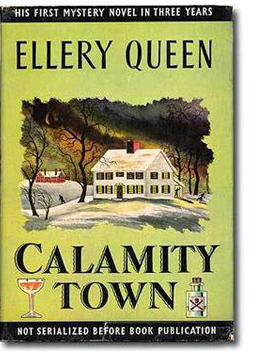
“Mr. Queen Discovers America” is the title of the opening chapter of Calamity Town (1942). Ellery gets off the train in Wrightsville, a small New England town. He has come to find a quiet place to write his next novel, and Wrightsville’s apple-pie ordinariness makes it the ideal sanctuary. It’s apparently as pure as the Grover’s Corners of Wilder’s play Our Town (1938) and the idealized Carville of the Andy Hardy movies; the same folksy milieu would figure in William Saroyan’s Human Comedy (book and film, 1943). Ellery manages to rent a house next to the town’s first family, the Wrights, and he’s taken into their social circle.
Quickly the novel activates another motif of American popular culture: the sinister forces that seethe underneath a small town’s cheery surface. This runs back to Edgar Lee Masters’ Spoon River Anthology (1915) and Sherwood Anderson’s Winesburg, Ohio (1919) right up to Blue Velvet (1986) and TV shows like Twin Peaks and Fargo. In Calamity Town, the Wrights’ household is disrupted by the return of one daughter’s runaway fiancé and the couple’s sudden marriage. But soon murder intervenes and vicious gossip swallows up the family in scandal. At the end of the book, Ellery reflects, “There are no secrets or delicacies, and there is much cruelty, in the Wrightsvilles of this world.” The Wright family is shattered, and the shocking solution forces Ellery to realize he could have prevented a murder consummated before his eyes.
In plotting the book, Dannay provided Lee a panorama wider than they had used before. Calamity Town has dozens of named characters, mostly serving as local color but many playing important roles. The mystery itself is less complex than those in Phase 1, but the book is filled out with a cross-section of life in Wrightsville. Low Village is populated by:
people named variously O’Halleran, Zimbruski, Johnson, Dowling, Goldberer, Venuti, Jacquard, Wladislaus, and Broadbeck–journeyman machinists, toolers, assembly-line men, farmers, retailers, hired hands, white and black and brown, with children of unduplicated sizes and degrees of cleanliness. . . . Mr. Queen’s notebook was rich with funny lingos, dinner-pail details, Saturday-night brawls down on Route 16, square dances and hep-cat contests, noon whistles whistling, lots of smoke and laughing and pushing, and the color of America, Wrightsville edition.
This Capraesque vision of vibrant Americana, coming early in the book, is questioned immediately by Lola, the renegade Wright daughter, who calls her town “wormy and damp, a breeding place of nastiness.” Lee’s task is to show both sides of Wrightsville through incidents tracing the town’s reaction to the murder. Ellery is always captivated by the calendar-image look of the place, as when in winter it resembles a Grant Wood painting.
But in town there were people, and sloppy slush, and a meanness in the air; the shops looked pinched and stale, everybody was hurrying through the cold; no one smiled. In the Square they had to stop for traffic; a shopgirl recognized Pat and pointed her out with a lacquered fingernail to a pimpled youth in a leather storm-breaker.
Lee rose to the challenge of portraying the fragility of a social network that can’t respond to a shock to placid lives.
The result is the most wide-ranging and emotionally complex book in the Queen franchise so far. The cousins were unable to sell it for serialization, and from then on, no slick magazines bought a Queen novel for many years.
Class relations and inner turmoil
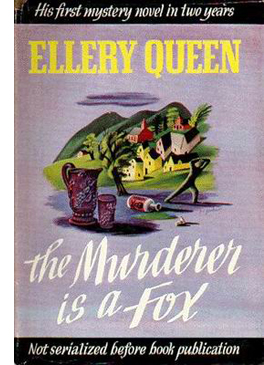
The Murderer is a Fox (1945) takes Ellery back to Wrightsville, but under very different circumstances. Pilot Davy Fox is welcomed back home for his outstanding record in killing the enemy and rescuing his comrades. But like many a returning vet he has PTSD, which emerges as an urge to strangle his wife Linda. The couple consult Ellery, who speculates that Davy is haunted not just by his combat experiences but by the fact that his father Bayard was imprisoned for poisoning his mother.
In order to investigate the case, Ellery persuades the authorities to release Bayard under supervision. He must answer the question: Who poisoned the grape juice that Jessica Fox drank–and shared with others–on the fateful day? Suspects include Bayard’s brother Talbot, his wife Emily, a duplicitous pharmacist, an overbearing cop, and a few others. Dannay’s plotting is intensely focused on a middle-class family quite different from the patrician Wrights, and Lee’s problem is to fill out a fairly minimal situation to novel length.
Lee’s solution is to recast his narrational approach, turning the book’s first section into a suspense thriller. For once our viewpoint isn’t initially attached to Ellery. The opening chapters alternate the Fox family awaiting Davy’s train with scenes of Davy on board. All the scenes are deeply subjective, with flashbacks plunging us into the family background and, more harrowingly, Davy’s war experiences. The seamy side of Wrightsville is exposed again and again. Against the bunting and chattering crowd of the train-station homecoming welcome, with the American Legion band “tossing the sun from their silver helmets,” Lee replays Davy’s memories of his father’s shame.
How Davy loathed them, the jeering kids. Because they had known, the whole town knew. The kids and the shopkeepers in High Village and the Country Club crowd and the scrubskinned farmers who drove in on Saturdays to load up–even the hunks and canucks who worked in the Low Village mills. Especially the shop hands of Bayard & Talbot Fox Company, Machinists’ Tools, who merely jeered the more after the Bayard & one day vanished from the side of the factory, leaving a whitewashed gap, like a bandage over a fresh wound.
Asked on the train about the thrills of battle, Davy conjures up:
Being caught on the ground with Zeros twisting and tumbling all over the sky and falling flat on your face in the stinky guck of a Chinese rice field, or pulling Myers out of his cockpit with his stomach lying on his knees after he brought his old P-40 down only God knows how. . . . Having your coffee grinder conk in the middle of a swarm of bandits and belly-landing in scrub on the knife-edged hills–seeing Lew Binks’s coffin drop like lead aflame, and Binks hitting the silk, trustful guy, and then the hornet Japs zapping around him with their spiteful traces hemstitching the sky.
Obliged to evoke the war, Lee summons up a muscular, sometimes lyrical prose unknown in the books of Phases 1 and 2.
Davy’s trauma turns the early chapters into an account of a man driven to murder. Like other novels and films of the 1940s, The Murderer is a Fox shares his nightmares and dissects his compulsion. While a loving, confused Linda tries to lure Davy into an embrace, he struggles to keep away from her.”The game was to stay in his bed. To stay in his bed so that he would not go over to the other bed and obey the prickling of his thumbs. . . . “
The viewpoint shifts to Ellery once he starts to reconstruct how Jessica might have died. In the course of this, family indiscretions are exposed and characterization deepens. In particular, Bayard is revealed as a man of severe principle, who stoically accepts a life sentence of murder. Revealing the true cause of Jessica’s death leads Ellery to a conclusion that could become another Wrightsville scandal. The book ends with Ellery smiling grimly at the prospect of one secret that the town gossip will never exhume.
In Phase 3, Dannay indulged his penchant for elaborate “pattern mysteries,” crimes based on cultural givens like the alphabet, dates of the year, nursery rhymes, and the like. But this ploy demands either a madman (driven by obsession with the pattern) or a super-schemer. Knowing that the pattern would attract the hyperintellectual Ellery, the schemer could then frame someone else as being enslaved to it. Ellery will then confidently call out the wrong suspect, with sometimes dire consequences.
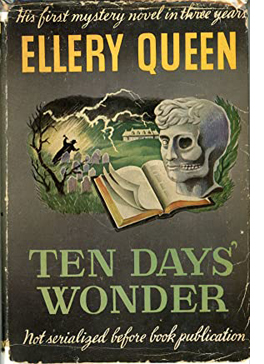
This tendency toward a master-mind, an omniscient “player on the other side,” is at the center of Ten Days’ Wonder (1948). Now a new layer of Wrightsville society is peeled back. Plutocrat Diedrich Van Horn is an industrialist who has indulged his son Howard in every way. But Howard is plagued by bouts of amnesia and tendencies toward suicide. Worse, he has fallen in love with Diedrich’s young wife Sally, and they have committed adultery. A blackmailer has discovered their affair and they are terrified that their love letters will be exposed. Into this Oedipal scenario steps Ellery, whom the couple beg to help them. Against his better judgment, he agrees.
Now the social landscape of Wrightsville matters less than the labyrinth of psychosexual tensions that Ellery confronts. He has to play double agent. For Diedrich, he is an innocent guest writing his new novel in lavish seclusion. For others, he becomes a go-between to save the couple. Inevitably, the blackmail plot deepens and Ellery is obliged to lie to the police and the townsfolk. The whole situation spirals into an orgy of betrayal and murder that leads Ellery to a false solution based on a monstrously blasphemous pattern of crimes. He eventually realizes that his ingenuity makes him profoundly predictable, and manipulable. Ellery confesses to the player on the other side:
“You’ve destroyed me. . . . You’ve destroyed my belief in myself. How can I ever again play little tin god? . . . It’s not in me . . . to gamble with the lives of human beings.”
Dannay planned this bleak book as the last in the Queen saga.
Appropriately, Lee’s prose texture matches the introspective bent of the plot. The subjective narration applied to Davy Fox is now given to Ellery, in a moment-by-moment italicized inner monologue that heightens his reaction to Howard’s and Sally’s situation. Howard says he was the seducer:
“I was the one who made the love, who kissed her eyes, stopped her mouth, carried her into the bedroom.” Now we show the wound, now we pour salt on it.
Lee’s technique builds up the suspense when Ellery responds mentally to new plot twists.
“Last night there was another robbery.” Last night there was another robbery. “There was? But this morning no one said–“ “I didn’t mention it to anyone, Mr. Queen.” Refocus, but slowly. . . . “The cash is missing.” Cash. . .
The inner monologue also passes bitter judgment.
“I could tell him and say I wanted him to divorce Sally and that I’d marry her, and if he hit me I could pick myself up from the floor and say it again.” I believe you could, Howard. And even get a sort of pleasure from it.
Italicized inner monologues and streams of consciousness became common in popular fiction from the 1920s on, as Perplexing Plots explains. Lee came late to this technique, but he fitted it perfectly to a story that, more deeply than any other, traces the agonizing tensions that confront Ellery as someone meddling in human affairs he doesn’t fully grasp. Dannay said that he designed Ten Days’ Wonder as “an exposure of detective novels and of fictional detectives.”
Cat on the prowl
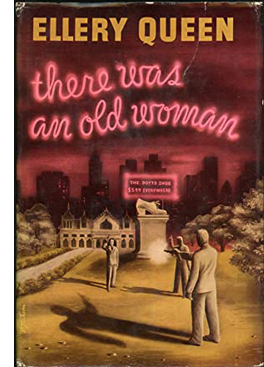
Between The Murderer is a Fox and Ten Days’ Wonder came a smaller-scale exercise in worldmaking, There Was an Old Woman (1943). Shoe magnate Cornelia Potts rules as eccentric matriarch over a family of ill-assorted children and others. Their estate consists of a gigantic bronze shoe on a pedestal, a tower in which daughter Louella concocts her mad experiments, and a cottage enclosing Horatio, a man who has decided to live in perpetual boyhood. The eldest son Thurlow occupies his time fruitlessly suing outsiders who appear to disrespect him. More normal are the three youngest children Bob, Mac, and Sheila, all despised by old Cornelia.
With its pattern based on the nursery rhyme, the novel offers another version of the devious master-mind trapping Ellery. But it remains somewhat awkward in its uneasy mix of zany comedy and serious murder. (Nevins plausibly suggests that Dannay was trying something akin to the screwball mysteries of Craig Rice.) A tacked-on ending shows Ellery gaining his secretary-girlfriend Nikki Porter, already a mainstay of the films and radio plays. But the effort to create an enclosed milieu of domestic fantasy, which Dannay sometimes called “Ellery in Wonderland,” fits Dannay’s urge, seen more earnestly in the Wrightsville tales, to expose the vulnerability of the supersleuth who must confront the occasional illogicality of the world.
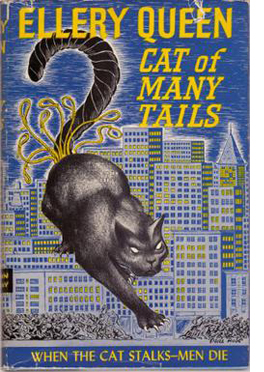
That urge finds its fullest expression in Cat of Many Tails (1949). Bearing the traces of police procedural films like Naked City (1948), this presents a serial killer stalking apparently random victims through Manhattan. Men and women, white and Black, are found strangled with cords of tussah silk. Although he withdrew from criminal affairs after his failure in Ten Days’ Wonder, Ellery is pressed to serve as the public face of the investigation. Facing several million suspects, he is baffled, forced to wander the streets, revisiting the crime scenes obsessively, imagining the victims meeting their fate.
Ellery eventually discloses the pattern behind the killings, but the novel’s development is dominated by a vision of a city under siege and citizens responding in panic. Lee responds with a narrative panorama far exceeding what we saw in his treatment of Wrightsville. He surveys Manhattan neighborhoods high and low. The victims are given detailed lives and routines and backstories; their friends and family are characterized as well. Here is a potential victim’s father:
Frank Pellman Soames was a skinny, squeezed-dry-looking man with the softest, burriest voice. He was a senior clerk at the main post office on Eighth Avenue at 33rd Street and he took his postal responsibilities as solemnly as if he had been called to office by the President himself. Otherwise he was inclined to make little jokes. He invariably brought something home with him after work–a candy bar, a bag of salted peanuts, a few sticks of bubble gum–to be divided among the three younger children with Rhadamanthine exactitude. Sometimes he brought Marilyn a single rosebud done up in green tissue paper. One night he showed up with a giant charlotte russe, enshrined in a cardboard box, for his wife.
The shifts in public response are charted through vivid, often frightening incidents. People stay home or avoid dark streets. Vigilante groups form. The press goes wild, keeping readers in tension with cartoons of a cat stalking the city and brandishing tails like nooses. All of this comes to smash in a virtuoso chapter describing a town meeting at which, when a woman screams, and the crowd becomes a stampeding mob.
“HE’S HERE!” Like a stone, it smashed against the great mirror of the audience and the audience shivered and broke. Little cracks widened magically. Where masses had sat or stood, gaps appeared, grew rapidly, splintered in crazy directions. Men began climbing over seats, using their fists. People went down. The police vanished. Trickles of shrieks ran together. Metropol Hall became a great cataract obliterating human sound. On the platform the Mayor, Frankburner, the Commissioner, were shouting into the public address microphones, jostling one another. Their voices mingled, a faint blend, lost in the uproar. The aisles were logjammed, people punching, twisting, falling toward the exits. Overhead a balcony rail snapped; a man fell into the orchestra. People were carried down balcony staircases. Some slipped, disappeared. At the upstairs fire exits hordes struggled over a living, shrieking carpet. Suddenly the whole contained mass found vents and shot out into the streets, into the frozen thousands, in a moment boiling them to frenzy. . . .
Dannay gave Lee the chance to compose scenes of cinematic excitement. No wonder the cousins thought that this novel might sell to the movies.
This extroverted narration is counterweighted by Ellery’s deepest plunge into self-analysis. Once more his proposed solution fails and leads to more deaths, and he is left feeling only a sense of waste. He consults an old psychoanalyst to confirm his conclusion and confess his inadequacy. “I’m too late again. . . . All right, I’m really through this time. I’ll turn my bitchery into less lethal channels. I’m finished, Herr Seligmann.” After consoling him that his efforts were not in vain, Seligmann says: “You have failed before, you will fail again. This is the nature and the role of man.” And he reminds Ellery of humility and mortality: “There is one God; and there is none other but he.” After this, as subsequent novels show, Ellery is able to go on–fallible but still holding to an ideal of truth.
For many critics, Cat of Many Tails is the cousins’ supreme accomplishment, a tour de force of mystery, suspense, and social and psychological observation. Their correspondence shows them at the absolute nadir of their relationship, exchanging long, hurtful letters about their disagreements. Yet their rancorous disputes yielded a novel that holds up better than much crime fiction of the 1940s. It’s a remarkable instance of how the “pure puzzle” story could, over the years, mutate into something rivaling the best of “prestige fiction”–an entertainment that is also an ambitious, moving literary achievement. Many mysteries are forgettable. This one is not.
Other Queen novels of Phase 3 are well worth reading. I’m a particular fan of The Scarlet Letters (1953), where Ellery intuits the solution watching a workman paint the G of “logical” in the sign for the New York Zoological Garden. Nevins considers Phase 4, which includes the more strained and fantastic puzzles of the late years, as of interest but not on a par with 3, and I’d agree. Still, the overall career of two Brooklyn cousins across four decades remains a major achievement of the American detective story, and a powerful lesson in how flexible and engaging popular storytelling can be.
Thanks to members of the UW Filmies for answering questions about their familiarity with Ellery Queen.
My photo of a masked Lee (or is it Dannay?) comes from the very curious article by Ellery Queen, “To the Queen’s Taste; or, Judge by Formula,” New York Herald Tribune (16 July 1933), F3. Here Queen proposes a 10-point chart for deciding on how good a mystery is. Barnaby Ross beats Agatha Christie.
To Nevins’ definitive Ellery Queen: The Art of Detection should be added the excellent resource Ellery Queen: A Website on Deduction. Another valiant defender of the Queen canon is Jon L. Breen, who wrote a spirited inquiry into why the books have been neglected by contemporary readers. See “The Ellery Queen Mystery” in the Weekly Standard, reprinted in Breen’s lively collection A Shot Rang Out: Selected Mystery Criticism.
A note on names: Dannay and Lee admitted that in their youthful ignorance they didn’t know the slang term queen could refer to a gay man. Ellery, the name of a childhood friend of Dannay’s, evokes New England blue blood. Through the early books, Ellery comes off as a straight WASP. But during Phase 3, Dannay wrote to Lee: “After all, even though we would be subtle about it, the authors of the books are Jews, and in all the deepest senses, so is Ellery Queen the character” (Blood Relations, 93).
A recent example of a film using “Golden Age” principles of fair play is Knives Out, discussed here. I think Lee and Dannay would have approved.
Ellery (Jim Huttton) breaks the fourth wall to extend his “Challenge to the Viewer” in the last episode of the NBC series Ellery Queen Mysteries, “The Adventure of the Disappearing Dagger” (29 February 1976), directed by Jack Arnold.
Critics who are carried away by a film want to share their excitement. Thus is born what the Cahiers du cinéma writers called a criticism of enthusiasm. The magazine’s editors suggested that the critic who most admired the film should write about it, on the premise that he (almost always a he) would make the best case for it.
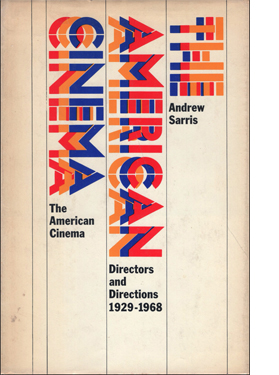
Quentin Tarantino’s new book Cinema Speculation (HarperCollins) is a stirring instance of this mode. Fueled by the motormouth intensity of his interviews and the monologues in his movies, the sentences crackle with nerd exuberance.
The eagle-claws-through-the-chest initiation rite in A Man Called Horse blew my fucking mind. As did Barnabas Collins’ blood-squirting slow-motion wooden-stake evisceration in House of Dark Shadows. I remember, during both moments, staring at the screen with my mouth wide open, not quite believing a movie could do that.
Significantly, he took in these and other splendors as a child. Tarantino frames his essays on particular films within a memoir of moviegoing. Now approaching 60, he starts by explaining he started watching films at age 4, accompanying his parents and later the men his mother was dating as a single woman. Seeing the “adult” fare of the 1970s as a small boy gave him a lifelong love of exploitation, crime movies, and Black cinema. For him the Adolescent Window opened early.
The opening chapter culminates in a life-changing visit to Black Gunn, escorted by his mother’s boyfriend Reggie.
To one degree or another I’ve spent my entire life since both attending movies and making them, trying to re-create the experience of watching a brand-new Jim Brown film, on a Saturday night, in a black cinema in 1972. . . . [At a climactic scene of violence] the massive theatre full of black males cheered in a way the nine-year-old little me had never experienced in a movie theatre before. At the time–living with a single mother–it was probably the most masculine experience I’d ever been a part of.
At the end of the book he pays homage to another Black movie mentor, Floyd Ray Wilson. Living with Tarantino and his mother, Floyd dated the mother’s friend and became Tarantino’s teenage tutor on rock and roll and Blaxploitation. Floyd taught Tarantino the virtues of Willie Best, Stepin Fetchit, and Don Knotts. Floyd also wanted to be a screenwriter, and he inspired Tarantino to try his hand too. Django Unchained, our author says, springs from his tenuous friendship with Floyd, who wrote a Black western.
Knowing full well how a range of readers will respond to these accounts of interracial male bonding, with his usual insouciace Tarantino plows on through a series of critical essays on films that shaped his tastes, all rendered in a pitch of high enthusiasm.
Old School enthusiam
You can argue that the most epic display of the criticism of enthusiasm appeared in the spring 1963 Film Culture magazine. There Andrew Sarris published a roster of Hollywood directors under the rubric “The American Cinema.” Each director was given a filmography and critical commentary. Most important, they were grouped into snappy categories: Pantheon Directors, Third Line, Esoterica, Beyond the Fringe, and so on. In 1968, Sarris published the material as a book, expanded by a long prefatory essay, considering more filmmakers, and using other labels. “Esoterica” became “Expressive Esoterica,” for example, and “Third Line” became “The Far Side of Paradise.” Some directors were also re-sorted; Anthony Mann moved up from Esoterica to the Far Side. The category “Fallen Idols,” which included many of the most revered directors (Wyler, Huston, Kazan, Lean, Wilder, Zinneman), was now the snarkier “Less Than Meets the Eye.”
The 1963 original and the 1968 book created a revolution in film taste. Sarris had been polemicizing in favor of “the auteur theory” for some time, but with his encyclopedic survey he created a canon. He claimed that he wanted only to launch a systematic history of American cinema, but the result was hardly historical in a strong sense. What mattered was critical evaluation. Writing a history of Hollywood would amount to appraising its directors.
Directors hadn’t wholly been ignored by earlier writers. Griffith, Chaplin, Lubitsch, Flaherty, Stroheim, and Welles had been considered significant creative forces for some time. What Sarris sought to do was to map out the whole terrain of Hollywood to reveal a network of strong creators with distinctive “directorial personalities.” They were not merely craftsmen; they had artistic visions.
Sarris’s strategy was triumphantly successful. He included in his Pantheon not only the noteworthy figures I just mentioned but those revered by the Cahers du cinéma critics: Ford, Hawks, Hitchcock, Keaton, Lang, Ophuls, Murnau, Renoir, and von Sternberg. At least as important were his arguments in favor of second-tier figures like Aldrich, Borzage, Cukor, Minnelli, McCarey, Sturges, and Walsh. And so on down the line as he weighed the virtues of Gerd Oswald, Richard Quine, and dozens of others.
Sarris’s legacy remains. To this day books and articles continue to be devoted to the works of these directors, famous and lesser-known. They are staples of Hollywood history. At the same time, researchers have expanded Sarris’s purview by elevating some of his choices (e.g., Curtiz) and discovering major films by minor figures (e.g., Ulmer). Martin Scorsese’s Personal Journey through American Movies (1996) is very much in the Sarris spirit, offering some different categories but still committed to the auteurist canon.
Film scholars today may question the tenets of the auteur theory, preferring to find involuntary cultural pressures in classic works, but to a surprising extent the big names remain central. And researchers discovering unexpected value in forgotten figures like Hugo Fregonese (subject of a retrospective at Bologna’s Cinema Ritrovato this year) are fulfilling Sarris’s edict that every film and filmmaker deserve serious scrutiny. (One critic has suggested that Fregonese would fit comfortably into Expressive Esoterica.)
The book version of The American Cinema: Directors and Directions popularized Sarris’ aesthetic of classic Hollywood. Just as important, it was a tribute to enthusiasm-fueled cinephilia. Sarris might talk about research, but this was mostly about enjoyment, seeking out little-noticed pleasures in a vast flowering landscape. “If you received The American Cinema at the right moment in your life,” notes Kent Jones, “and many people including myself did, it came with the force of a divination, a cinematic Great Awakening.”
But films continue to be made, and how are we to appraise them? Some directors in Sarris’s survey continued their careers into the 1970s and beyond, but others emerged. Many of those became labeled the “New Hollywood.” From this perspective, Tarantino’s Cinema Speculation proposes a counter-canon, a cluster of filmmakers and films that demand to be appraised on terms that differ somewhat from those laid down by Sarris. Yes, they are solid artisans. Yes, they have “personal visions.” But their auteur artistry has its own commitments.
Sources of enthusiasm
Bullitt.
Central to those commitments is the idea of genre. In one of the richest essays in the book, Tarantino suggests that what follows Sarris’s period survey is a new Hollywood, which has two phases. In the first, Penn, Altman, and other filmmakers commit to criticize classic genres, pointing out their political and racial biases. The second phase consists of directors like Spielberg, Lucas, and De Palma who love genres and want to update and strengthen them, or to invent new ones, like the “Revengeamatic.” Tarantino appreciates both trends, but his sympathy lies with the second one. He praises some older genre directors like Don Siegel and is especially sensitive to New Hollywood filmmakers who either worked to update genres (Tobe Hooper) or balanced indulgence in the genre with some critique of it (Taxi Driver, Hardcore).
Tarantino’s favored 1970s genres are centered on violence: crime stories, westerns, urban adventures. In this, he follows audience tastes. Most people aren’t auteurists, least of all Tarantino’s 70s male mentors. He also focuses his attention on scripts, often providing backstory on how some of his favorites were revised in the production process.
More specifically, he’s interested in character and dialogue–again, mirroring what most moviegoers notice and enjoy. He analyzes character action and sometimes interprets it as reflecting public attitudes or the director’s temperament. He savors memorable lines of dialogue and reenacts the joy of audiences responding to them. In Taxi Driver:
Then the moment happened that made the whole theatre burst into hysterics. That one guy walking down the street, ranting and raving that he’s going to kill his woman (“I’ll kill ‘er! I’ll kill that bitch!”). We laughed so hard at that guy, we were a little disconnected from the movie for the next twenty minutes.
Travis Bickle’s Mohawk haircut triggers the same response. “The whole theatre burst out laughing. I’m talking hysterically laughing. I’m talking rolling in the aisles laughing–Get a load of that goddamn crazy fool!”
The concern for characters emerges further in Tarantino’s unabashed admiration for acting. Sarris’ American Cinema treated stars as plastic material for the director’s vision. For John Ford, John Wayne develops as a darkening version of western heroism. James Stewart is radically different in films by Capra, Preminger, and Anthony Mann. But Tarantino treats stars as bringing their own valences, which the director can fulfill more or less well. Steve McQueen is the privileged example.
The man embodies 1960s cool, and the films that respect that become singularly satisfying. Bullitt becomes a perfect vehicle for this paradigm of hip detachment.
This is the role he deserves to be remembered by. Because in this role he demonstrates what he could do that Newman and Beatty couldn’t. Which is just be. Just fill the frame with him.
There was craft at work here. Tarantino reveals that McQueen often trimmed his own dialogue, giving lines to others, because he knew the audience would be watching him. He could steal a scene with his pinky finger, as I tried to show here. But in Bullitt, he does so little that we watch him warily.
Tarantino doesn’t bother with description of how this minimalism works facially–the fixed blue-eyed stare, the enigmatic pinched lips, the flat brows. He goes straight to psychology: Bullitt doesn’t engage with anyone, so his mental states are opaque to us. His girlfriend admonishes him for his refusal to open up about his feelings. “Bullitt,” Tarantino says, “doesn’t explain to the audience or other characters what he’s doing or thinking. He just does them and we watch.” Here cool turns cold.
With performance as a central concern, Tarantino naturally reflects a lot on casting and performance. His vast knowledge of the genre and Hollywood actors, from stars to sidekicks, allows him to probe the actor’s development of the character, as he does with Burt Reynolds in Deliverance and Sylvester Stallone in Paradise Alley. He often speculates on what the film would be like if this role were filled by someone else. What if Lee Marvin replaced Burt Reynolds in Deliverance? What if The Getaway was recast making Stella Stevens McQueen’s wife, Richard Boone his major adversary, and Stuart Whitman the master mind? These “cinema speculations” are sometimes derived from actual casting choices, sometimes from Tarantino’s huge knowledge of Hollywood players.
Add in music, to which Tarantino is very sensitive, and you have an aesthetic tailored to audience pickup. He has almost no specific comments about imagery or camera technique, the sorts of things that audiences tend not to comment on. Above all, you know when you have a memorable movie moment if a line or character reaction or actions scene induces the audience to shriek in pleasure. From age 4, he claims, for him the thrill of cinema has been bound up with a crowd response. (I found this reassuring, as Perplexing Plots begins with an audience’s reaction to the climax of Pulp Fiction.)
Genre, character portrayal, memorable dialogue, performance filigree, the charisma of stars, and the immediate surge of audience appreciation–who else does this sound like? Pauline Kael.
Tarantino has called her the most influential person on his filmmaking; he pored over her collected reviews and channeled her voice. If Sarris was the impresario of classical studio production, Kael became the demanding guide to the New Hollywood. As Tarantino was absorbing the films, growing up with the flood of 70s features, he was tuning himself to the body of work that inspired her lyrical and indignant reviews. Sarris, who reviewed films for the Village Voice at the period, was always seeing the present in the terms of the past, but Kael’s New Yorker readers were happy for her electrifying assurance that some filmmakers were living in the moment. (Always the contrarian, she insisted that her readers inclined toward art films and ignored her recommendations about Hollywood’s output.) When she loved a film, her review was an orgy of enthusiasm–most notoriously, her piece on Last Tango in Paris (1972).
The only time I saw Kael in person, in fall of 1965, she shared a panel with Sarris at my college. Armed with a cigarette holder, she glittered by comparison with the rumpled, insomniac-looking man alongside her. He wanted to talk about Ophuls’ Lola Montès. She wanted to talk about The Cincinnati Kid and especially about its star, Steve McQueen. I usually resist symbolism, but it’s hard not to see this as part of a big change in tastes.
A fan’s notes
The Outfit (1973).
To get a sense of the strength of Tarantino’s criticism, consider his treatment of two genre masters. One is an old-timer who started in the 40s and had a vigorous career into the 1970s. The other is presented as a largely unappreciated director who helmed some of Tarantino’s favorites. Both illustrate the power of Tarantino’s enthusiasm and wide-ranging knowledge.
Across the 1950s and 1960s, Don Siegel developed a reputation for taut and violent action pictures, notably Riot in Cell Block 11, Invasion of the Body Snatchers, Baby Face Nelson, The Line-Up, The Killers, and Madigan. Sarris ranked Siegel with Budd Boetticher, Alan Dwan, Phil Karlson, and Joseph H. Lewis as “Expressive Esoterica.” But after Madigan (1968), starring Richard Widmark, Siegel became something of an A-list director. His status was reinforced by an alliance with Clint Eastwood for Coogan’s Bluff (1968), Two Mules for Sister Sara (1969), Dirty Harry (1971), and Escape from Alcatraz (1979). He worked with other top stars like Walter Matthau (Charley Varrick, 1973), John Wayne (The Shootist, 1976), and Charles Bronson (Telefon, 1977). For a time he had box-office success alongside the New Hollywood prodigies.
Tarantino pays lengthy homage to Siegel throughout Cinema Speculation. He sees him as a virtuoso not simply of action cinema but of screen violence, a pioneer of what would emerge in impact-based films of the 1970s like The French Connection and Straw Dogs. (The editing of Madigan‘s final shootout still looks daring today.) Tarantino declares that the rogue law-enforcement officer who pursues his “own self-determined version of justice. . . is practically the quintessential Siegel protagonist.” This quality sets the hero apart from his family, his peers, and society at large. Hence not only the bursts of brutality but also the curious lack of sympathy his cold, aloof men engender.
Tarantino celebrates several Siegel films but he focuses on Dirty Harry as a prototype and the director’s best. He traces the mutations of the script as the project moved from Universal to Warners, with John Milius adding the famous “I know what you’re thinking” line. In execution, the use of location shooting and many “movie moments” (Harry chewing his hot dog while firing at his prey, Harry’s foot pinning down the screaming Scorpio on a football field) show a master at work. Siegel excels in chase sequences, and Dirty Harry has plenty. Above all, the film aroused audiences. They were shocked by the violence and thrilled by “crowd-pleasing action set pieces.”
Tarantino answers criticisms of the film with some care. Dirty Harry isn’t, he claims a fascist film because it was responding to genuine anxieties of its audience. The film was tailored for older Americans unable to adjust to youth culture, civil rights, drugs, and other signs of apparent decay. Harry mostly doesn’t exceed reasonable behavior for an officer bent on justice. The exception is Harry’s torture of Scorpio; but that’s when the kidnapped girl might still be alive and the clock is ticking. Tarantino asks: “Would Billy Jack do any less?” Or, we might add, would Jack Bauer of 24?
More positively, Dirty Harry is the first significant serial-killer film, and it asks for a reconsideration of policing practices that are becoming outmoded after the Manson family and Zodiac. Scorpio is a new kind of villain who will flout the constraints of civil society. He seemed implausibly evil in 1971, but we hadn’t yet accustomed ourselves to the monstrous depravity of the obsessed killers out there. The film is a plea for “New Laws for New Crimes.”
Still, Tarantino calls the film “aggressively reactionary” in its reassurance that the audience’s fear of change is justified. He points out that the bank robbery has to be conducted by Blacks to fulfill its function of scaring the audience with the spectre of Black Power. Is it then a racist film? Siegel called Harry “a racist son of a bitch.” Tarantino modifies his case by calling Harry “both a troubled and a troubling character.” He doesn’t elaborate, but concludes that the ambivalence of the plot and its protagonist is overridden, Tarantino says, by the sheer professionalism of Siegel’s filmmaking. Today’s audiences, far from fascist or racist in their sensibilities, continue to enjoy the movie. As ever, the visceral response in the theatre is Tarantino’s touchstone.
John Flynn doesn’t feature in Sarris’s compendium, since his career directing features began in 1968. Mentored by Robert Wise, he had been assistant director on comedies and The Great Escape (1963) before his first feature, the repressed-gay drama The Sergeant (1968). His most famous film is the cult favorite Rolling Thunder (1977), a bloody revenge saga that makes highly inadvisable use of a kitchen garbage disposal. Seeing it at age 14, Tarantino reports that it “blew my fucking mind.” He followed its screenings across Los Angeles, and the book lovingly details all the venues he visited.
Over the years Rolling Thunder taught him that a film can criticize its own genre. He offers a comparative anatomy of the original script by Paul Schrader and the thorough rewrite by Heywood Gould. He finds that Gould’s screenplay improves the original, not least in an exchange between the two buddy heroes.
RANE: I’ve found the men who killed my son. JOHNNY: I’ll just get my gear.
“That scene and those lines never fail to drive audiences wild wherever and whenever it’s projected. And trust me, I’ve seem Rolling Thunder with every type of audience imaginable.”
John Flynn’s other major work is The Outfit (1973), a story of a professional thief, Macklin, who avenges the murder of his brother by a series of assaults on businesses run by the syndicate. Ultimately the two launch an attack on the fortified mansion of the big boss. Tarantino praises the playing of Robert Duvall and especially Joe Don Baker’s swaggering performance as Cody, his wisecracking sidekick. “The hearty macho audience scattered around the little cinema made it even more fun. They laughed at everything Joe Don Baker said.”
It’s striking that Tarantino doesn’t mention the radical changes that Flynn, acting as screenwriter with assistance of Walter Hill, made to the original book. The Outfit (1963) is third in a long-running series of novels by Richard Stark (Donald E. Westlake) centering on the professional thief Parker. Tarantino professes himself a fan of the character, though he admits to not having read most of the books. In the novel, Parker is aiming to force the Outfit to pay the money it owes him from a double-cross. His strategy is to encourage several other thieves to hit Outfit enterprises on their own. The second half of the book is taken up with those robberies, each with a new gang targeting a business in different cities: a casino, a numbers operation, a heroin-smuggling enterprise, and a racetrack bookie scheme.
Parker drops out of these chapters, and Stark treats us to semidocumentary analyses of how each racket works. It’s a bold and fascinating approach, but the film avoids it, simply assigning some of the raids to Macklin and Cody. The result is a buddy movie. True, in the book Parker picks up a sidekick, Handy McKay, but their relationship is purely professional. Parker is a forbiddingly cold character, and no one can imagine him chortling, as Macklin does, at Cody’s final quip, “The good guys always win.”
Why did Tarantino ignore the book’s original plot structure? In Perplexing Plots, I devote a chapter to Westlake’s Stark novels because of their unique play with time. Every Parker novel but one is divided into four parts, and scenes are time-shifted within and between parts. Typically, one part leaves Parker’s viewpoint and whisks us from character to character within a fluid nonlinear chronology. In The Outfit, that section is the one tracing the gang’s guerrilla attacks on the syndicate, those in turn framed by the syndicate boss learning of them.
Most Stark adaptations drastically linearize the original plots. The most salient exception is Point Blank (1967), which pulverizes the action of The Hunter (1962) far more than Stark does. (Tarantino mostly scoffs at Boorman’s film, and I’m inclined to agree.) You’d think that Tarantino would notice how Flynn made the novel a more standard outlaw picture, whatever benefits it yielded.
The puzzle persists. Perplexing Plots has a chapter on Tarantino too, where I suggest that Stark’s structure has a deep affinity to the back-and-forth time schemes in Reservoir Dogs and Pulp Fiction. This notion stems from from Tarantino’s claim that The Hunter and other Stark novels “were very influential on” Reservoir Dogs. Perhaps Cinema Speculation‘s ignoring of the structural changes in Flynn’s version of The Outfit better captures Tarantino’s youthful response, in which masculine bonding and high-intensity violence play the central part. (He saw it at age 11, well before he read any Stark novels.) In any case, I hope my argument for his films’ affinity for the looped patterning of the Parker books seems plausible.
Tarantino’s focus on the 1970s shouldn’t make us forget his connoisseurship in other realms, such as Hong Kong cinema and the spaghetti Western. Still, he’s a model of the post-Kael downmarket cinephile, rummaging through every quickie release and even TV movies to find moments of arousing filmmaking in “the greatest movie-making era in the history of Hollywood.” Accordingly, he betrays little interest in Hollywood classicism; he can’t imagine working in the old studio system, in which a director might have to shoot a script he doesn’t like. Moreover, I think he finds the elegance of classical film too fastidious compared to the rough antics on display in his favorites.
My own tastes overlap his, though I doubt I’ll ever admire some of his prize filmmakers as much as he does. I’m principally a Sarrisite, insofar as my top Hollywood filmmakers coincide with his, though I find more to admire in Wyler and others than he does. And we all live on our own timelines. While that kid Tarantino was being transported by exploitation pics in the 1970s, I was stunned by the revelations of classic Japanese films by Ozu, Mizoguchi, and others. I think highly of Jaws (1975), but it’s not sublime in the manner of Early Summer (1951) or Sansho the Bailiff (1954).
No news: Tastes differ. Critics owe it to us to whip up enthusiasm for the films that give them goosebumps of rapture. But they also owe us reasoned arguments for how and why that happens. Cinema Speculation is, for me, at its best when Tarantino supports his appraisals with analysis. But even when he doesn’t, it’s still a fucking blast.
Thanks to Jim Healy for assistance in preparing this entry.
The Sarris/Kael split isn’t as drastic as I’m making it. Kael loved classic Hollywood too, especially in its frothier moments and in films that featured strong heroines. But she was generally opposed to treating the directors as having unified artistic visions; they seldom achieved much beyond engaging kitsch. She wanted to preserve the immediacy of contemporary cinema for current life and for its public. Sarris in turn was always ready to celebrate studio actors of the Golden Age, and he was eager to interpret current releases in light of politics–as was Kael, with her complicated but fervent feminism.
Kael’s use of audience response as a touchstone surfaces throughout her reviews. She tells of audience applause in Gance’s Napoléon, hisses and walkouts in a Mel Brooks screening, viewers’ empathy for Teri Garr in Tootsie, and the roars of laughter greeting 48 Hrs. (All these are in Taking It All In [Holt, Rinehart, Winston, 1983], pp. 144, 216, 432, and 440.) I wondered about these real-time reports, because she saw most films she reviewed in pre-release press screenings. Often, she says, she saw the film on Monday and turned in the New Yorker review the next day. She discusses her reliance on press screenings in George Malko’s 1972 profile, “Pauline Kael Wants People to Go to the Movies,” in Conversations with Pauline Kael, ed. Will Brantley (University of Mississippi Press, 1996), 15-30.
Stephanie Zacharek, film critic for Time, tells me that Kael often attended screenings with paying audiences, sometimes before filing her pieces, if the New Yorker‘s deadlines were flexible enough. “In addition, during the 1980s, she was often shut out of screenings by studios that didn’t want her to see their movies. In those cases, she would go to an early public showing.” Thanks to Stephanie for this background.
Tarantino’s other major literary effort, his quasi-novelization of Once Upon a Time . . . in Hollywood, is considered in this entry. It has fascinating resonance with many ideas in Cinema Speculation.