





Archive for the 'Narrative strategies' Category
When worlds collide: Mixing the show-biz tale with true crime in ONCE UPON A TIME . . . IN HOLLYWOOD
Once Upon a Time . . . in Hollywood.
Jeff Smith here:
Once Upon a Time…in Hollywood might turn out to be the buzziest film of 2019. Some of this water-cooler talk is due to its unusual status within an ever-enlarging field of true crime stories. (Call it a “not quite true” crime story.) Indeed, the genre is hotter than ever thanks to a bevy of new podcasts, telefilms, and miniseries.
Industry analysts, though, are also keen to interpret Once Upon a Time…in Hollywood’s box office fortunes. As that rare big summer release that is neither a sequel nor a franchise title, it can be seen as a test of whether original content can survive amidst heavily marketed, presold tentpoles.
The lesson so far? To quote William Goldman, “Nobody knows anything.” In The Washington Post, one unnamed studio executive warned, “I don’t see any blue-sky meaning here.” The executive added, “This movie has assets that almost no other film has. That’s what drove it.” At least one of those assets is Tarantino himself, who is a brand, if not a franchise. Fans know what to expect in a Tarantino film, which is why the film is sui generis when it comes to this summer’s slate. Due to its unique IP, it can’t really be compared with films like Men in Black International or Spider-man: Far from Home. Yet thanks to Tarantino’s larger than life presence, it also isn’t Long Shot or Booksmart or Stuber.
Once Upon a Time…in Hollywood is catnip to Tarantino nerds like me. It has the usual surfeit of references to obscure films and television shows. Some of these are deftly interwoven into the story itself. It boasts a carefully curated soundtrack that unearths “some-hits” wonders. It also contains scenes depicting nasty yet comical violence, a hallmark of Tarantino’s work ever since Reservoir Dogs.
At first blush, Once Upon a Time…in Hollywood would seem to be Tarantino’s most linear film. Yet it still displays certain continuities with his oeuvre in terms of story structure and technique. Although the film eschews the chapters and title cards found in Pulp Fiction and Kill Bill, it still contains elements of what David calls “block construction.” In the case of Once Upon a Time…in Hollywood, it is all about threes. The plot is structured around three days in the winter and summer of 1969: February 8th, February 9th, and August 9th. Each “chapter” is introduced showing the date via superimposed text. And all three chunks of narrative crosscut among the activities of three actors – Sharon Tate, Rick Dalton, and Cliff Booth – as they try to adapt to changes in the film and television industries.
If all of this assures that you’d never mistake Once Upon a Time…in Hollywood as the work of another director, other elements show Tarantino striking out in new directions. Chief among these is his mash-up of two normally distinct story types: the show-biz tale and the true crime yarn. Think of it as Singin’ in the Rain meets In Cold Blood. In what follows I outline some of the ways that Tarantino adapts his signature style to two well-established storytelling options: the multiple draft narrative and the network narrative. I also consider the effects Tarantino’s counterfactual history has on the conventions of the show-biz tale and the celebrity biopic.
My analysis contains major spoilers. If you haven’t seen Once Upon a Time…in Hollywood, stop reading now!
My world and welcome to it
Quick trivia question: what actor was on the cover of TV Guide during the week that Sharon Tate was murdered by the Manson family? Sharp viewers of Once Upon a Time…in Hollywood should know the answer. We see Tate’s housemate, Woychiech Frykowski, reading that issue of the magazine as he watches Teenage Monster on late night television.
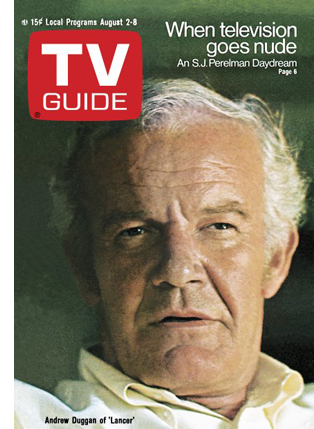 Give up? It was character actor Andrew Duggan, who played the cattle baron Murdoch Lancer on the TV show of the same name. Yes, that Lancer! The same one that featured Rick in a guest spot some six months earlier.
Tarantino’s film treats this little bit of pop culture ephemera as an uncanny coincidence. It simply becomes yet another way that he can intertwine the destinies of his three protagonists. But that brief shot got me thinking: did Tarantino start with the idea that he’d recreate whatever series was featured on TV Guide the week Tate was killed?
If so, Rick might have appeared just as easily as an aspiring cartoonist next to William Windom on the NBC sitcom, My World and Welcome to It. The show debuted just six weeks after Tate’s death. It is not unthinkable that NBC would have pushed for a cover on TV Guide in an effort to promote the premiere. Yet Tarantino’s counterfactual history in Once Upon a Time…in Hollywood would have been vastly different if that had been the case.
Did Tarantino really base his screenplay on this conceit? I doubt it. Lancer fits so snugly into the world that the director captures onscreen that it is not be so easily replaced. Tarantino seems to have a nostalgic fondness for the show, much as I did in my wasted youth. (I recall having a Lancer lunchbox at age six.) Production designer Barbara Ling describes the steps she took to recreate Lancer’s mix of Spanish/Western design. This involved adding adobe storefronts to the wooden ones, and substituting iron coils for wooden pegs on the saloon’s staircase. Ling added, “This was a [rich] cattle town and the buildings are two and three stories. It’s not Deadwood.”
Many critics have characterized Once Upon a Time…in Hollywood as another hangout movie. This is Tarantino’s designation for a film that is leisurely paced, fairly light on plot, and mostly gives the audience a chance to spend time with the characters. Indeed, because of these qualities, reviewers often compare Once Upon a Time…in Hollywood to Jackie Brown, a film that Tarantino himself compared to Rio Bravo, which was Howard Hawks’ hangout movie.
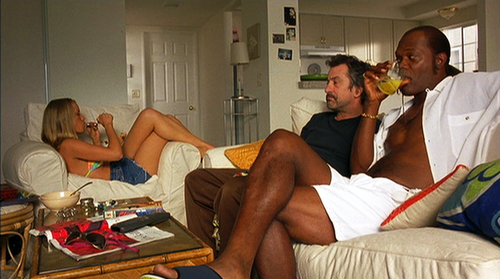
The resemblances don’t stop there. Once Upon a Time…in Hollywood’s three-headed protagonist bears certain similarities to Jackie Brown’s Jackie, Ordell, and Max.
Yet while watching Once Upon a Time…in Hollywood, I felt this film, more than any of Tarantino’s others, was an exercise in world-building. Normally we associate that term with sci-fi, fantasy, and comic book movies. It is especially important for transmedia properties where the fictional universe depicted exceeds the bounds of any individual film, television series, book, or video game.
Once Upon a Time…in Hollywood is also an alternate history, a type of speculative fiction also common in sci-fi and comic book stories. The Avengers: End Game and Spider-man: Into the Spiderverse are both relatively recent examples. This suggests a loose affiliation between Once Upon a Time…in Hollywood and other blockbusters even as Tarantino tweaks that formula by situating his speculative fiction within the generic framework of true crime.
Tarantino largely avoids the industrial motivations behind these two narrative techniques commonly seen in tentpoles. Instead, he simply recreates the pop culture world of his youth. In doing so, the director’s real world, his “realer than real” universe, and his “movie movie” universe all collide.
Keepin’ it real (and realer)
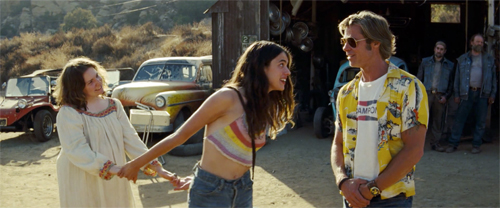
As Tarantino has explained in interviews, the “realer than real” universe is an alternate reality close to our own where his fictional characters can intermingle with real people. The “movie movie” universe, on the other hand, is a more overtly fantastic world closer in spirit to comic books or exploitation films. The characters have unusual abilities or even supernatural powers. The “movie movie” thus downplays the realistic motivations usually found in the “realer than real.” In Tarantino’s oeuvre, Reservoir Dogs and True Romance exemplify the “realer than real.” Kill Bill and From Dusk to Dawn are instances of the “movie movie.”
Each universe features a web of connections that can link particular tales together. For example, Kill Bill’s Sheriff Earl McGraw and his son Edgar pop up in Death Proof. Similarly, Lee Donowitz, the cocaine-sniffing movie producer in True Romance, is purportedly the son of Sgt. Donny Donowitz, the “bear Jew” in Inglourious Basterds.
In Once Upon a Time…in Hollywood, the most obvious references to these two Tarantino universes are the fictional brands he has created. During the end credits, we see Rick in a TV ad for Red Apple cigarettes. According to a Tarantino wiki, “ads or packs of these flavorful smokes” can be seen in The Hateful Eight, Inglourious Basterds, Planet Terror, Kill Bill, Pulp Fiction, From Dusk till Dawn, Four Rooms and Romy and Michele’s High School Reunion. (The latter is an obvious outlier. Yet the Red Apple nod was likely an in-joke related to Tarantino’s offscreen romance with Mira Sorvino, who played Romy.)
Similarly, Tarantino’s fictional fast food chain, Big Kahuna Burger, appears on a bus billboard in Once Upon a Time…in Hollywood. It previously was featured in a memorable scene in Pulp Fiction. (“That’s a tasty burger!”) But it had already debuted as a delicious snack devoured by Mr. Blonde in Reservoir Dogs. Big Kahuna later comes back in two other Tarantino films, From Dusk Till Dawn and Four Rooms, as well as Romy and Michele’s High School Reunion.
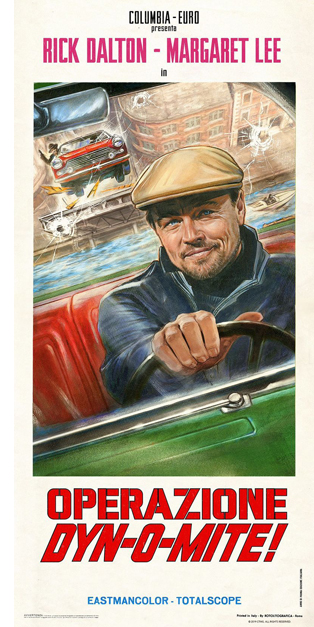 Other references to the “realer than real” are more arcane. In a montage sequence where Randy the Stuntman summarizes Rick’s experience starring in Italian films, we see a poster for Operazione Dy-no-mite, a James Bond knockoff directed by Antonio Margheriti. Fans of Inglourious Basterds will recognize “Antonio Margheriti” as the alias Donny Donowitz uses for the premiere of Nation’s Pride.
Much of the fun of Once Upon a Time…in Hollywood comes from the way Tarantino overlays these three universes to create a singular fictional world. For example, at one point we learn that Rick was considered for the role of Captain Virgil Hilts, the part played by Steve McQueen in John Sturges’ The Great Escape. Tarantino even inserts digitally altered footage of The Great Escape to show us a scene of Rick as Hilts. Since Rick claims he never met Sturges, this moment appears to represent an imagined version of the film that could exist in some type of alternate history. It invites us to consider how different Rick’s career might have been had fortune smiled upon him instead of McQueen.
To disentangle this knot, one must surmise that The Great Escape and Steve McQueen belong to both the real world and the “realer than real” world. Yet the scene of McQueen at the Playboy mansion and Rick describing his missed opportunity can only belong to the “realer than real.” And the character of Hilts himself exists only in the “movie movie” world. Hilts shares this status along with other characters Rick plays onscreen, such as Bounty Law’s Jake Cahill and The FBI’s Michael Murtaugh. After all, movie magic enables Cliff Booth to stand-in for Rick for scenes involving physical action. That two actors can play the same character within the same scene suggests that fictional personae in cinema have a unique ontological status quite different from the real world.
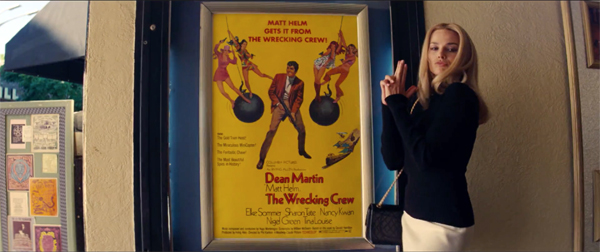
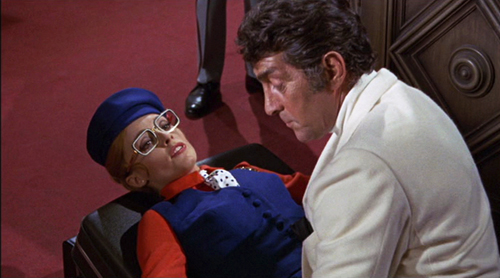
Arguably, the scene where Sharon Tate watches herself in The Wrecking Crew raises even more vexing issues about what is real and what is fictional. Unlike the clip from The Great Escape, the theatre screening shows the real Sharon Tate playing the character Freya in The Wrecking Crew. The fictional Sharon Tate watches the real Sharon Tate, along with the rest of the Bruin Theater’s audience. Yet, because Margot Robbie only pretends to be Sharon Tate for Tarantino’s camera, she doesn’t really watch herself playing the role. Obviously, Robbie belongs only to the real world. Yet Sharon Tate, as both an actual person and a fictional character, inhabits both the real world and the “realer than real world.”
Here the film indulges the Bazinian conceit that cinema has indexical properties. While making The Wrecking Crew, the film camera captured an imprint of the real Sharon Tate that preserved her being beyond the reaches of time and even death. In Once Upon a Time…in Hollywood, this moment is both joyful and sad. The viewer imagines the thrill that Tate feels in watching herself on the big screen, basking in the glow of incipient stardom. Yet the delight we experience is colored by our knowledge of what happened to the Sharon Tate seen falling on Dean Martin’s camera case. Unlike Robbie’s character, that Tate is doomed to a grisly death at the hands of psychopaths.
By film’s end, however, we are forced to reevaluate where Sharon Tate fits into Tarantino’s universe. When Cliff and Rick thwart the attack of Tex Watson, Susan “Sadie” Atkins, and Patricia “Katie” Krenwinkel, both Sharon Tates appear to move solely to the realm of the “realer than real.” Like the fictional Sharon Tate played by Robbie, the actress who appeared in The Wrecking Crew also lives on in a parallel universe created by the forking of time. And the fate of that character remains completely undetermined. Now fully a part of the “realer than real,” Tarantino’s Sharon Tate might eventually snort cocaine with movie producer Lee Donowitz or bum a Red Apple cigarette from Pulp Fiction’s Mia Wallace.
Once she joins the “realer than real,” almost any fate you could imagine for Sharon Tate seems possible. And it is that sense of the actress’ unlimited horizons that gives the ending of Once Upon a Time…in Hollywood its resonance. Sergio Leone’s Once Upon a Time films always situated viewers in the realm of myth. Once Upon a Time…in Hollywood, on the other hand, evokes the fairy tale.
Tarantino is known for his experimentation with narrative, and the simplicity of Once Upon a Time…in Hollywood’s “what-if” scenario could seem like a retreat from the formal play seen in his earlier films. Yet I’d argue that Tarantino’s merging of fact and fiction is even more audacious in certain respects. It strikes me as an unconventional example of what David calls “multiple draft narratives,” like Krzystof Kieslowski’s Blind Chance or Peter Howitt’s Sliding Doors. Once Upon a Time…in Hollywood gives us a second draft of history, albeit one where the key decision point is saved almost until the end of the film. And unlike Blind Chance or Sliding Doors, Tarantino doesn’t need to tell us what the different outcomes are for each of these tales. The first draft of history is one we already know.
In fact, the notion of multiple drafts offers a useful lens for all three films in Tarantino’s “counterfactual” trilogy. (The other two are Inglourious Basterds and Django Unchained.) In Groundhog Day, Source Code, and Edge of Tomorrow, each iteration of the basic situation shows the protagonist inching toward his goals. They gradually progress to the point where they are able to alter destiny, either theirs or the world’s or both.
Inglourious Basterds, Django Unchained, and Once Upon a Time…in Hollywood all present images of history not as it was, but as it should have been. Such counterfactual histories run counter to the norms of speculative fictions that often present us with dystopian worlds we were lucky to avoid. (Think Philip K. Dick’s The Man in the High Castle, Robert Harris’ Fatherland, or Kevin Willmott’s “mockumentary” C.S.A.: The Confederate States of America.) All of these stories depend upon our knowledge of the first draft of history. Yet Tarantino gives us second drafts that right particular historical wrongs in either small or large measure. In doing so, Tarantino gives us versions of history that are closer in spirit to his favorite movies. All three films in the “counterfactual” trilogy feature tidy resolutions. Once Upon a Time…in Hollywood, however, is even more self-conscious about the way Tarantino’s second draft of history takes the form of a “movie movie” climax. The realer-than-real version is the one we ought to prefer.
Paging Mr. Melcher, Mr. Terry Melcher…
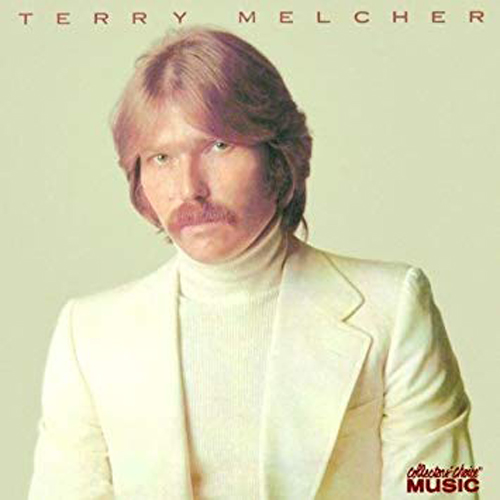
If Tarantino’s conflation of fact and fiction evokes certain traits of the multiple-draft narrative, his vivid recreation of Hollywood circa 1969 illustrates another type of story popularized in American independent films and various art cinemas: the network narrative.
Tarantino has broached this form before in Inglourious Basterds. There he moves back and forth between three mostly independent storylines: 1) the Basterds’ guerrilla campaign against German soldiers, 2) Archie Hicox and Bridget von Hammersmarck’s initiation of Operation Kino, and 3) Shosanna’s plan to avenge her family’s deaths during the premiere of Nation’s Pride. SS officer Colonel Hans Landa threads through all three storylines. He orders the killing of Shosanna’s family in the opening scene. Later he shares apple streudel with Shosanna in a Paris café. Landa also investigates the scene where Hicox has been killed. In the climax, he interrogates Bridget in a scene that contains a grim allusion to Cinderella’s lost slipper.

Finally, Landa negotiates a deal with Aldo Raine’s superiors that guarantees his immunity from prosecution for war crimes.
Once Upon a Time…in Hollywood is obviously much less plot-driven than Inglourious Basterds. Yet, as noted above, it shares a similarity in the way it interweaves the stories of three characters: Rick, Cliff, and Sharon.
It’s frequently said that Hollywood is a company town. By situating all three characters within the film and television industries, Tarantino tacitly stays faithful to that truism. The protagonists’ shared profession also facilitates the kinds of attenuated links between stories commonly found in network narratives.
Part of the fun of Once Upon a Time…in Hollywood comes in recognizing the “six degrees of separation” that join all of these people, both real and fictional, in the same entertainment ecosphere. Take, for instance, one decidedly minor character: actress and singer Connie Stevens, played by Dreama Walker. At the Playboy Mansion party, Stevens listens to Steve McQueen explain the romantic triangle that has Sharon living with her current husband, Roman Polanski, and her ex-boyfriend, Jay Sebring. Stevens, though, is the ex-wife of actor James Stacy, who played Johnny Madrid in Lancer. Stacy (played in our film by Timothy Olyphant) is Rick Dalton’s scene partner for the episode of Lancer that Dalton hopes can spur his comeback. Dalton is Sharon Tate’s neighbor on Cielo Drive, the same house that Charles Manson targets as the site of the “family’s” first murder. This circuit even loops back on itself. When Stacy and Dalton first meet on set, Stacy asks Rick whether it was true that he almost got a part in The Great Escape, the same part played by McQueen.
Two characters in Once Upon a Time…in Hollywood serve as nodes that connect all three storylines together. The first is Cliff, Rick’s stunt man and gofer. Although not a resident at Cielo Drive, he spends a lot of time in Rick’s home and thus is privy to what happens in Sharon’s abode. This is especially evident when Cliff repairs Rick’s fallen TV antenna. The camera is aligned with him as he overhears Sharon playing a Paul Revere and the Raiders album. He also notices Charles Manson approaching the Polanski residence. Tarantino’s casting of Damon Herriman as Manson is likely an allusion to the television show, Justified. Herriman played Dewey Crowe alongside Olyphant.
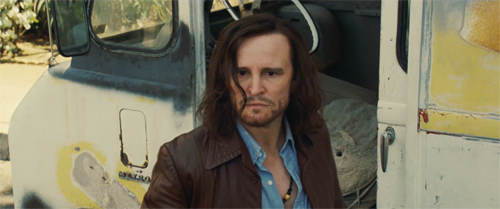
Justified was also an adaptation of Elmore Leonard’s “Raylan Givens” books. Tarantino has long admired Leonard’s work as a writer of both westerns and crime novels.
Employing a redundancy that befits Hollywood storytelling, Cliff gets linked to Sharon’s storyline in other ways. While working as Rick’s stunt man for an episode of The Green Hornet, he gets involved in a dust-up with Bruce Lee. Lee gave Sharon Tate some pointers on fighting as she prepared for her role in The Wrecking Crew. And in real life, the martial arts legend was recommended for the role of Kato on television’s The Green Hornet by Sebring, Tate’s former boyfriend.
Perhaps Cliff’s most important role in the film’s network involves his dalliance with Pussycat, one of the many young women who viewed Manson as a kind of guru. Cliff picks up Pussycat as a hitchhiker and gives her a ride back to the Spahn ranch. Having worked on the ranch back when it was an active production site, Cliff grows concerned for the safety of its owner, George Spahn. Cliff notices how the Manson clan has taken over and is troubled by its weird vibe. Determined to see George for himself, Cliff forces his way into George’s house over the objections of the Manson girls, especially Squeaky. George seems careworn, but Cliff finds that there is little he can do for him.
When Cliff sees a pocketknife sticking out of his front tire, he confronts Clem, one of Manson’s followers. The conflict becomes physical. Cliff breaks Clem’s nose with one punch and then proceeds to beat him to a bloody pulp.
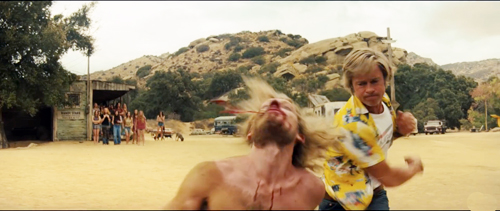
This proves to be a dangling cause that gets resolved in the film’s climax when Cliff recognizes Tex, Sadie, and Katie as people he met at the Spahn ranch.
The other character who links the storylines together is one we never see: record producer Terry Melcher. Melcher is the “Terry” that Manson mentions when he visits Cielo Drive in the scene described above. Later, Tex reminds Sadie, Katie, and Linda that Charlie directed them to go to the place where Terry Melcher lived and kill everyone inside.
Although these are the only explicit references to Melcher, he is indirectly represented in several other aspects of the film. Here it helps to know a little about Melcher’s career and Manson lore. Even if Melcher’s name draws a blank, you likely know many of the bands he worked with: the Byrds, the Mamas and the Papas, and Paul Revere and the Raiders.
All these musicians crop up in one way or another in Once Upon a Time…in Hollywood. Melcher’s last major credit of the 1960s was as producer of the Byrds’ Ballad of Easy Rider. When Rick berates Tex for parking his car on Cielo Drive, he yells, “Hey, Dennis Hopper! Move this fucking piece of shit!” Rick’s insult fits with his general disdain for hippies. But it also alludes to Easy Rider by comparing Tex’s look to that of Hopper’s character, Billy.
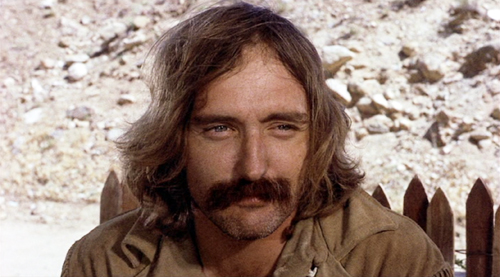
Two of the Mamas and the Papas – Michelle Phillips and Cass Elliot – both appear in the party scene at the Playboy mansion.
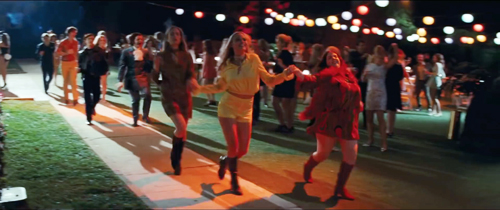
We also hear the Mama and the Papas’ big hit, “California Dreaming” in a cover version by Puerto Rican singer José Feliciano. And when the car driven by Tex crawls up Cielo Drive, the music issuing from the Polanski residence is the Mamas and the Papas’ “12:30: Young Girls are Coming to the Canyon.” Even before Tex’s directive to the Manson girls, Tarantino has given us a subtle reminder that Melcher was Charlie’s intended, if indirect, target.
Finally, Sharon plays Paul Revere and the Raiders’ “Good Thing” and “Hungry” on a hi-fi in her bedroom.
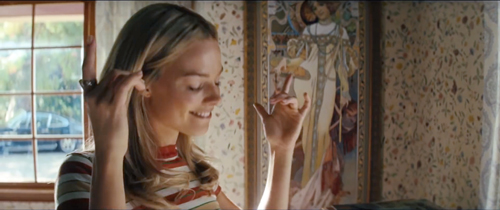
The choice of music is especially fitting since the band’s lead singer, Mark Lindsay, lived in the same house on Cielo Drive with Melcher and his then girlfriend, Candice Bergen.
Beyond these musical references, Melcher’s history with Manson informs Once Upon a Time…in Hollywood in another way. Melcher recorded some demos of Manson’s songs, and even discussed making a documentary about Manson’s commune at the Spahn Ranch. In testimony at trial, Melcher said that any possibility of a record contract with Manson was sundered when Charlie asserted that he’d never join a musicians’ union. Manson’s staunch refusal was rooted in his desire to avoid entanglements with the establishment. Yet union membership was a condition for any contract with Melcher’s label, Columbia records. Another factor in Melcher’s decision was his assessment of Manson’s talent. Charlie couldn’t sing.
Although Melcher publicly stated that he only considered Manson’s musicianship, he privately expressed concerns about Charlie’s mental stability. These were heightened when he visited the Spahn Ranch and witnessed Manson in a physical altercation with a drunken stunt man. Tarantino more or less recreates this episode in his film, substituting Cliff for the unnamed stunt man and the hapless Clem for Charles Manson.
More importantly, Melcher is the son of screen legend Doris Day and stepson of agent/manager/producer Martin Melcher. In Once Upon a Time…in Hollywood, he becomes the ideal, if absent, symbol of the combined worlds of music, television, and film that Tarantino so lovingly details.
How the West was lost
Los Angeles circa 1969 is presented as the epicenter of the American entertainment industries. It’s a place where a hairdresser like Jay Sebring rubs shoulders with action stars, TV cowboys, ingénues, film directors, and pop stars –and make $1000 a day to boot! The constant stream of hits from KHJ radio is as ubiquitous as the many movie posters, billboards, and theater marquees that feature Hollywood’s latest and greatest.
Tarantino’s press kit for Once Upon a Time…in Hollywood makes reference to Joan Didion’s famous observation in “The White Album” that “the Sixties ended abruptly on August 9, 1969, at the exact moment when word of the murders on Cielo Drive traveled like brushfire through the community.” Most critics take Didion’s reference to the Sixties as shorthand for the end of the “peace and love generation.” Yet Tarantino’s slightly revisionist take suggests it’s not only the youthquake that died, but also a certain strain of Hollywood filmmaking that passed with it.
Although I don’t doubt their historical accuracy, the litany of titles that appear throughout Once Upon a Time…in Hollywood feels as curated as any of Tarantino’s music soundtracks. Some, like 2001: A Space Odyssey, are films that entered the canon of great sixties cinema. Others, like The Night They Raided Minsky’s, are early films by directors who’d later achieve greatness. (In this case, William Friedkin, who won an Oscar in 1972 for The French Connection.)
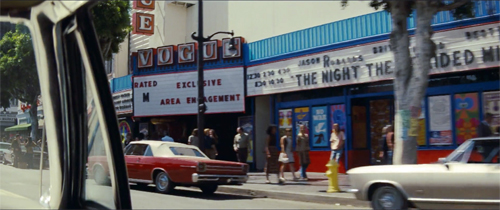
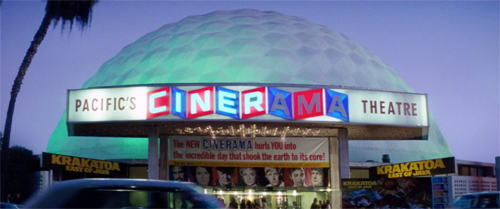
But many, like Lady in Cement, Tora, Tora, Tora!, Krakatoa: East of Java, Mackenna’s Gold, C.C.& Company, and even The Wrecking Crew, are largely forgettable movies.
Tarantino clearly has affection for all of the drive-in theaters and Hollywood picture palaces where these titles played. But the titles themselves are evidence of the industry’s struggle to adapt to new tastes and a rapidly changing media landscape. Old-school show biz types, like Dean Martin and Frank Sinatra, continued their success as singers and television personalities. But their careers as actors had functionally ended by 1969. And the efforts to keep them relevant often seemed either strikingly anachronistic or just plain weird.
In the opening scene of Lady in Cement, Frank Sinatra fights off a small school of sharks while he is examining the body of a nude woman who, like Luca Brazzi, sleeps with the fishes. And yes, the scene is as ludicrous as it sounds. If this is what became of Hollywood’s once great tradition, it is hard not to think we should just let it pass.
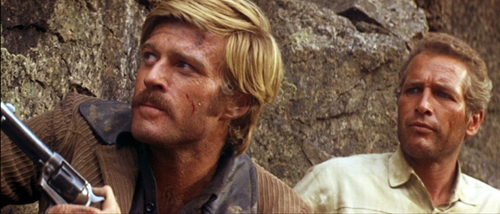
Yet, the fear of obsolescence also explains the oversize role that Tarantino gives to the Western as part of this changing landscape. True Grit and The Wild Bunch were among the summer of 1969’s biggest hits. Butch Cassidy and the Sundance Kid would eventually become the year’s top-grossing film. All three Westerns feature cowboy heroes that are either aging, outmoded, or both. They reminded contemporary viewers that horse riders would soon yield to horseless carriages, the lone bounty hunter would soon be supplanted by paramilitary detective agencies, and the humble six-shooter can’t match the lethal power of a Mexican army machine gun.
In retrospect, though, the popularity of the Western in 1969 represents the genre’s last gasp. Studios continued to make Westerns during the 1970s, but only three – Jeremiah Johnson, The Outlaw Josey Wales, and The Electric Horseman – would surpass $10 million in rentals in the entire decade.
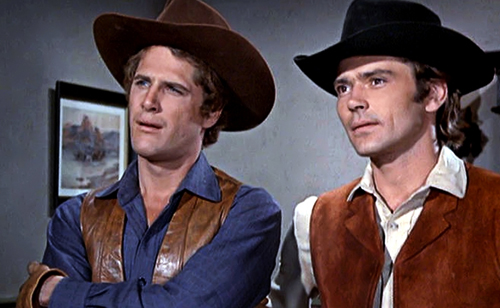
On television, such long-running series as Gunsmoke, Bonanza, and The Virginian had their last round-ups. The networks tried their hands at new Westerns, like Alias Smith and Jones (below), Hec Ramsey, Dirty Sally, and Lancer, but they were all short-lived. At the start of the 1980s, the genre was completely moribund. Subsequent efforts to recapture the Western’s former glory were mostly the equivalent of flogging a dead pony.
As a total cinephile, Tarantino is entirely aware of this aspect of the genre’s history. This is signaled quite explicitly in the decrepit condition of the Spahn Movie Ranch. Yet Tarantino also uses Rick’s career arc to signify its downward trajectory.
No character in Once Upon a Time…in Hollywood is as strongly associated with the Western as Rick. His home is filled with collectibles like his Hopalong Cassidy coffee mugs. His walls are decorated with posters for The Golden Stallion and A Time for Killing. On set, he reads pulp oaters like Ride a Wild Bronc to relax between takes.
By using Rick to dramatize the twin declines of both Old Hollywood and its “bread and butter” genre, the narrative arc of Tarantino’s drugstore cowboy is one suffused with nostalgic melancholy. The key moment in Once Upon a Time…in Hollywood occurs when Rick breaks down telling the story of Easy Breezy to Trudi Fraser, his Lancer co-star. He describes Easy “coming to terms with what it’s like to feel slightly more useless each day.”
The various threads of Once Upon a Time…in Hollywood’s network finally knot together in the Manson family’s attack on Cielo Drive. At the moment of truth, it is telling that Rick reaches not for a firearm, but for the prop flamethrower he wielded in The 14 Fists of McCluskey. By recalling the moment when Rick shouts, “Anyone here order fried sauerkraut?”, Tarantino reminds us that violent spectacle and snappy quips will eventually replace the Western’s ritualistic showdowns.
Still, it is a musical allusion to the Western that gives Once Upon a Time…in Hollywood its final grace note. Cliff and Rick have thwarted the Manson family’s attack. The ambulance takes Cliff to the hospital. Rick offers an explanation of what just happened to his neighbors. Jay recognizes Rick as television’s Jake Cahill. Via the intercom, Sharon invites him to come up for a drink. As Rick walks to the house, we hear the start of Maurice Jarre’s “Lily Langtry” [sic] from his score for The Life and Times of Judge Roy Bean.
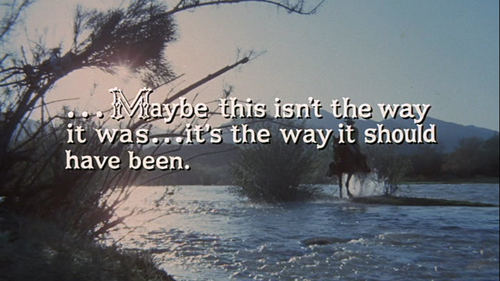
John Huston’s film begins with an expository title shown below that highlights the western’s tendency toward self-mythology. It is especially apt for Once Upon a Time…in Hollywood’s counterfactual history.
Jarre’s cue, though, appears in a scene where the renowned actress Lillie Langtry finally visits Judge Bean’s Texas town. Langtry is given a tour of the Bean’s house, now converted into a museum that also acts as a shrine to her. Bean worshipped Langtry, but tragically dies before he gets to meet her. Tarantino inverts both Huston’s sad ending and its dramatization of missed opportunity. By altering the course of history, the cowboy in Once Upon a Time…in Hollywood gets to be the real-life hero rather than the TV heavy. Rick also gets to meet the actress he’s admired from afar. Rick and Sharon are still both married to other people. But their chance meeting in the film’s epilogue feels more than anything like a dream fulfilled.
A star is unborn
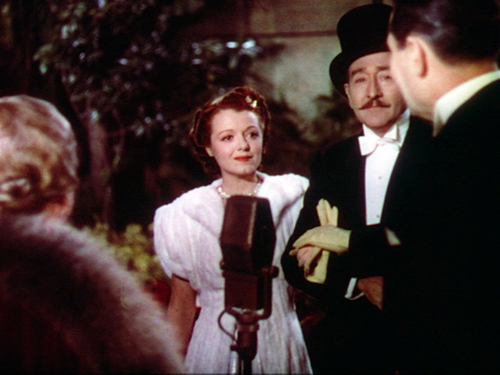
In the previous section, I dwelt on the role of the Western in Once Upon a Time in Hollywood because of its symbolic significance in capturing a particular historical moment. But Tarantino borrows quite freely from another narrative prototype: the show-biz tale. In fact, while walking out of Once Upon a Time…in Hollywood, I wondered aloud if it was Tarantino’s twisted take on A Star is Born.
Like A Star is Born, Once Upon a Time…in Hollywood centers on a male performer whose career has started to decline and a female newcomer whose star is on the rise. Moreover, Rick’s drinking problems create an obstacle to his comeback in much the same way that alcohol contributes to the downfall of the male protagonists in all four versions of A Star is Born.
Tarantino, though, subtly alters this template in two ways. First, he depicts his two stars as neighbors rather than as a romantic couple. Secondly, he cleverly depicts Rick’s career arc as an inverse mirror of Sharon’s.
Tate was an Army brat who grew up in Europe. Her earliest work was as an extra in Italian films. She moved to Hollywood in 1962 and got her break playing Jethro Bodine’s girlfriend on The Beverly Hillbillies. In the mid-sixties, Tate made the move to films, appearing in Eye of the Devil and The Fearless Vampire Killers.
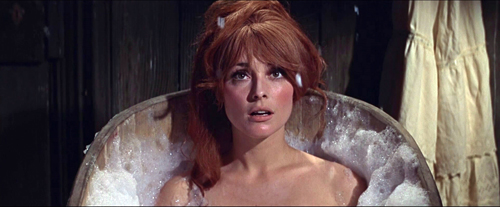
It was during production of the latter that Tate met her future husband, Roman Polanski. Tate’s role in Valley of the Dolls further enhanced her status as an “up and comer.” In 1968, Tate earned a Golden Globe nomination in the category of “Most Promising Newcomer — Female.”
In direct contrast, Rick’s career begins in Hollywood and ends in Italy. Rick enjoys early success with Bounty Law and The 14 Fists of McCluskey. But soon finds himself reduced to guest star roles on television. Against his better judgment, Rick agrees to star in four Italian quickies. Two of these are spaghetti westerns directed by Sergio Corbucci, a Tarantino fave who created the popular “Django” character. Rick returns to Hollywood but his future is uncertain. He could be the next Clint Eastwood, star of A Fistful of Dollars and The Good, the Bad, and the Ugly. Or he could be the next Richard Harrison, star of $100,000 Dollars for Ringo and Secret Agent Fireball.
If this were all there was to the comparison, it would hardly be worth mentioning. But Tarantino hints at other parallels through a much more obscure and convoluted cinematic reference. An auteur as shrewd as Tarantino would undoubtedly remember that the Rolling Stones’ “Out of Time” –used in Once Upon a Time…in Hollywood under shots of Rick’s return from Rome – was previously featured in the opening sequence of Hal Ashby’s Coming Home.
The connection to Ashby’s film is strengthened by the casting of Bruce Dern as George Spahn, a role originally intended for Burt Reynolds. Early in his career Dern played Jane Fonda’s uptight, martinet husband in Coming Home. More importantly, during Coming Home’s climax, Dern’s character commits suicide by wading into the ocean to drown himself, just as James Mason does at the conclusion of George Cukor’s version of A Star is Born.
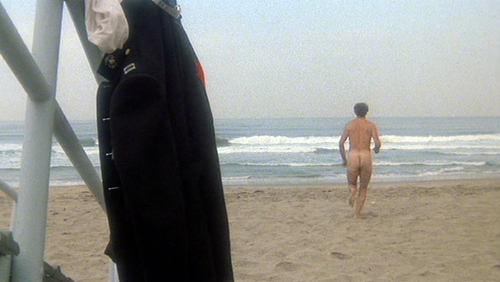
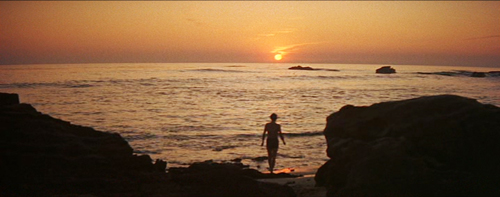
Which brings us back to Once Upon a Time…in Hollywood’s controversial ending. Earlier I discussed the resemblance between its counterfactual history and multiple draft narratives. Here I want to discuss it as an illustration of the caprice of fame.
Much more than the endings of Inglourious Basterds and Django Unchained, the climax of Once Upon a Time…in Hollywood feels both resolved and unresolved. Hitler’s violent death in Inglourious Basterds surprised audiences who first saw it in theaters. Yet the historical record indicates that the Basterds simply saved Hitler the trouble of later killing himself and his wife, Eva Braun. At the conclusion of Django Unchained, the protagonist’s revolt clearly hasn’t ended slavery as a “peculiar institution.” But its story of personal revenge remains deeply satisfying.
The ending of Once Upon a Time…in Hollywood left me with more questions than answers. I get it. Sharon Tate lives instead dying at the hands of the Manson family. Tarantino gives us the Hollywood happy ending that this story lacked in reality. But what’s next?
Do the deaths of Tex, Sadie, and Katie mean that Leno and Rosemary LaBianca also survive? Maybe. Perhaps the loss of three members of the cult might cause the others to reevaluate their loyalty to Manson. Perhaps Manson himself would reevaluate his plan to trigger a race war.
But maybe not. If Manson were the hero of Tarantino’s grindhouse climax rather than its villain, one could easily imagine the film running another twenty minutes with Manson vowing to get even. You might imagine it as something like the surprising “second climax” of Django Unchained. After mourning the loss of his compatriots, Charlie would proclaim. “The fires of Hell will descend upon the Hollywood hills. This time it’s personal.”
Perhaps the bigger question is whether Sharon continues to be the “It” girl during the next phase of her career. The allusions to A Star is Born suggest a steady upward trajectory. But the reality is that success depends upon a certain amount of luck. It is never assured. A few box office bombs and Sharon Tate might be reduced to the same sort of TV guest spots that Rick is doing.
In this way, the ending of Once Upon a Time…in Hollywood asks us to consider a potential paradox. Did Sharon Tate become more famous in death than she ever would have been in life?
The theme of talent tragically cut down in the prime of life is a hoary cliché of the celebrity biopic. Tarantino is smart to steer clear of it. Yet whenever we watch a film like Prefontaine, Beyond the Sea, or Lenny, one starts to wonder, “Would anyone bother to make this film if its subject had lived?”
To be sure, the totality of Once Upon a Time…in Hollywood shuns any pat answer. Cass Elliot of the Mamas and the Papas died at age 32. Initial reports said she choked on a ham sandwich in the midst of having a heart attack. I remember the media reports when Mama Cass passed in 1974. But does anyone who didn’t live through that moment?
James Stacy, star of Lancer, nearly died in a deadly motorcycle accident. (Tarantino hints at this fate by showing Stacy, sans helmet, riding his steel horse away from his trailer.) Stacy survived, but lost an arm and a leg as a result of his near fatal injuries. He eventually made a comeback in 1977 and even earned an Emmy nomination for his work on Cagney and Lacey.
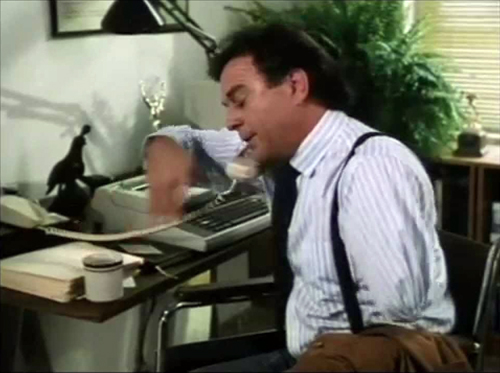
Yet, if you mention James Stacy during dinner conversation tonight, I suspect your companion will ask, “Who?”
And then there is the scene where Pussycat and the other Manson girls walk past a large mural of James Dean in his iconic pose from Giant. Dean was certainly famous during his lifetime. But he became a legend at age 24 after his Porsche Spyder collided with another car, snapping his neck.
Would Sharon Tate have achieved stardom had she lived? God only knows. I certainly don’t. I do know one thing, though. Being a victim of the “crime of the century” preserved Tate’s image in popular memory with a vividness that very few human beings on this earth ever achieve.
Margot Robbie’s performance as Tate is extraordinary. She reminds modern viewers of the verve, spirit, and sensuality that Sharon brought to the screen. Yet it is the image of Tate as a tragically murdered heroine that Tarantino, like Mark Macpherson in Laura, appears to have fallen in love with. And it is this image that continues to haunt me some fifty years after Tate’s death.
Thank you to David and Kristin for their comments onf an earlier draft of this post. Thanks also to JJ Bersch and Maureen Rogers for letting me bounce some of ideas off them.
Vincent Bugliosi’s Helter Skelter: The True Story of the Manson Murders remains the most comprehensive account of the Tate-LaBianca murders. Tom O’Neill, though, has spent the last 20 years investigating Manson’s crimes. His new book, Chaos: Charles Manson, the C.I.A., and the Secret History of the Sixties, claims that Bugliosi’s investigation was deeply flawed. Instead, his research suggests that Manson was a drug trafficker and C.I.A. operative. For O’Neill, the notion that Bugiliosi saved Los Angeles from a hippie death cult is wrong. The motive for the crimes was both simpler and more quotidian. All of Manson’s murders were the result of drug deals gone wrong. An interview with O’Neill can be found here.
The story that Terry Melcher witnessed a fight at the Span Movie Ranch between Charles Manson and a drunken stunt man sounds apocryphal. Yet it appeared in The Telegraph’s obituary for Melcher, which was first published in 2004. I haven’t been able to independently corroborate that story with another source. However, even if it isn’t true, it is part of Manson lore. I saw the same story repeated on at least three other websites. Doris Day’s death in May spawned the publication of a handful of articles about her relationship with Terry. They can be found here, here, and here. An brief overview of Melcher’s career as a record producer can be found in Rolling Stone’s obituary.
For those interested in learning more about Sharon Tate’s life, I recommend Sharon Tate: Recollection. It was written by Tate’s mother Debra. It also features a foreword by her husband, Roman Polanski.
Mark Harris’s Pictures at a Revolution: Five Movies and the Birth of the New Hollywood and Peter Biskind’s Easy Riders, Raging Bulls survey the momentous changes taking place in the film industry during the late 1960s.
Bruce Fretts provides a fairly thorough overview of Once Upon a Time…in Hollywood’s voluminous pop culture references.
Several articles have also appeared that address different aspects of the film’s production. An interview with choreographer can be found here. Cinematographer Robert Richardson and production designer Barbara Ling detail their efforts to recreate the sets of the TV show Lancer here. Richardson also discussed Once Upon a Time…in Hollywood’s visual influences in a Hollywood Reporter podcast.
An interview with Mary Ramos, Once Upon a Time…in Hollywood’s music coordinator, can be found here. Guides to Once Upon a Time…in Hollywood’s music soundtrack can be found here, here, and here.
An analysis of Once Upon a Time…in Hollywood’s box office implications is found here.
Finally, the release of Once Upon a Time…in Hollywood has occasioned a number of think pieces that address aspect of the film’s counterfactual history and its identity politics. Here philosopher David Bentley Hart discusses the moral implications embedded in Tarantino’s counterfactual trilogy.
Once Upon a Time…in Hollywood’s gender politics is addressed here. The author, Aisha Harris, compares Tarantino’s depiction of Sharon Tate to other female characters in his filmography. Finally, zeitgeist readings of Once Upon a Time…in Hollywood in relation to the current political landscape can be found here and here.
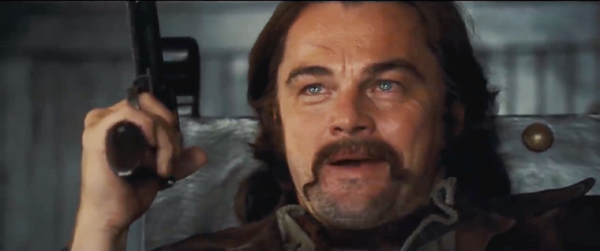
Once Upon a Time . . . in Hollywood.
The Mona mysteries: Varda’s VAGABOND on the Criterion Channel
DB here:
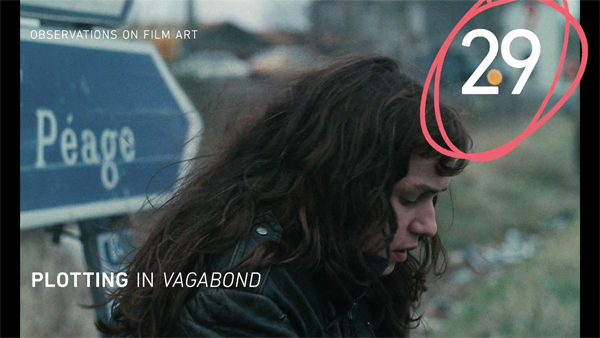
The Criterion Channel has just posted the latest in our Observations on Film Art series. In this installment I try to analyze Vagabond‘s shrewd and unsettling use of some traditional plot patterns: the road movie, the mystery investigation, and the network narrative. I argue that the orchestration of these patterns encourages us to think about our life choices.
You can watch the film here, and watch the video essay here.
Vagabond is a film I’ve admired since it came out in 1985, and by now it’s something of a classic. Its the original title, Sans toit ni loi (roughly, “Homeless and Lawless”) follows Varda’s habit of rhyming or punning titles: L’Opéra-mouffe, Daguerreotypes, Mur murs , Les Glaneurs et la glaneuse, Visages et villages. The mixture of playfulness and serious themes (homelessness, women’s rights, the struggles of the poor, the importance of ordinary people) makes her work unique. She respects both the problems of our lives and the possibility of finding something to affirm–if only our efforts to help one another. I was reminded of all these qualities by her last film, Varda par Agnès; seeing Vagabond again reminds me how much we miss her.
Several of our entries have been devoted to Varda; see the set here. In my view, Vagabond is her masterpiece, but she’s made many fine films, and a lot of them are available for streaming from Criterion.
Our entire Observations series is here. Thanks as ever to the Criterion team, especially Peter Becker, Kim Hendrickson, Grant Delin, and John Magary, who did a bang-up editing job. Thanks as well to Erik Gunneson here at UW–Madison. And thanks to colleague Kelley Conway for help with my scenario for this installment.
I discuss Vagabond as an example of ambivalent narration in the Afterword to “The Art Cinema as a Mode of Film Practice,” in Poetics of Cinema, 166-169.

Vagabond (1985).
Is there a blog in this class? 2019
Kristin here:
David and I started this blog way back in 2006 largely as a way to offer teachers who use Film Art: An Introduction supplementary material that might tie in with the book. It immediately became something more informal, as we wrote about topics that interested us and events in our lives, like campus visits by filmmakers and festivals we attended. Few of the entries cite Film Art, but most of them are relevant.
Every year shortly before the autumn semester begins, we offer this list of suggestions of posts that might be useful in classes, either as assignments or recommendations. Readers who aren’t teaching or being taught might find the following round-up a handy way of catching up with entries they might have missed. After all, we have posted well over 900 entries, and despite our excellent search engine and many categories of tags, a little guidance through this flood of texts and images might be useful.
This list starts after last August’s post. For past lists, see 2007, 2008, 2009, 2010, 2011, 2012, 2013, 2014, 2015, 2016, 2017 and 2018.
Last year for the first time I included recommendations for potentially useful videos in our series “Observations on Film Art” (a sort of extension of this blog) on the FilmStruck streaming service. Every month Jeff Smith (also our collaborator on Film Art), David, and I had contributed a visual essay that applied concepts from Film Art: An Introduction to a film (or films) streaming on FilmStruck, which began in November of 2016 and ended in November of 2018.
Fortunately in April, 2019, that platform was replaced by The Criterion Channel, which had been a major attraction as part of FilmStruck. The essays that we had contributed to FilmStruck have all been reposted on the new service, and we have continued to contribute monthly essays. As of now there are 29 essays online. See last year’s “Is there a blog in this class? 2018” for the earlier videos. (For information on the changeover of services, see here.)
Chapter 1 Film as Art: Creativity, Technology, and Business

I’ve written an occasional series on the progress of 3D in modern cinema. In an entry concentrating on exhibition rather than the technology or the movies, I talk about the decline in the number of 3D screenings as they lose popularity: “3D in 2019: RealDivided?”
In Chapter 1 we briefly deal with the concept of the author or auteur of a film. David provides an example of how one characterizes an auteur’s work in “Terence Davies: sunset songs.” Is Michael Curtiz as clearly an auteur as Orson Welles is? This entry considers some evidence.
No year on the blog is complete, it seems, without something on Hitchcock. This time David considered Notorious, preparing the way for a video essay for the Criterion release of this masterpiece.
At greater length, our updated e-book on Christopher Nolan is a study of him as an auteur with a “formal project.” David discusses the changes in “Christopher Nolan: Back into the Labyrinth.” A later entry considers (unconvincing) critical attacks on Nolan’s work.
Chapter 3 Narrative Form
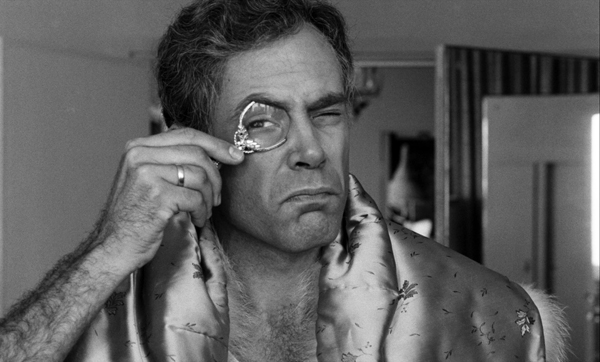
In The Criterion Channel video essay, #25, “Lydia and the power of flashbacks,” David discusses the somewhat experimental ways in which flashbacks are used in Julien Duvivier’s 1941 romance. He extends his analysis in “Lovelorn LYDIA: A new installment on The Criterion Channel.”
I analyze one aspect of narrative form in The Favourite: “Balancing three protagonists in THE FAVOURITE.”
Narrative options both old (the 1940s) and new (Happy Death Day 2U) are considered in an entry on how incidents can be repeated and varied, within a film and from film to film.
This chapter of Film Art discusses narration in terms of depth, how much of characters’ knowledge and thoughts are revealed to us. In “Observations on Film Art” #26 on The Criterion Channel, Jeff examines technique that allow us access to the protagonist’s mind in “Memories of Underdevelopment.” He expands on that analysis in “Politics and Subjectivity: MEMORIES OF UNDERDEVELOPMENT on The Criterion Channel.”
Can the tools of narrative analysis shed light on The Narrative of contemporary US politics? David tries in the entry “Reliable narrators? Telling tales on Trump.”
Chapter 4 The Shot: Mise-en-scene
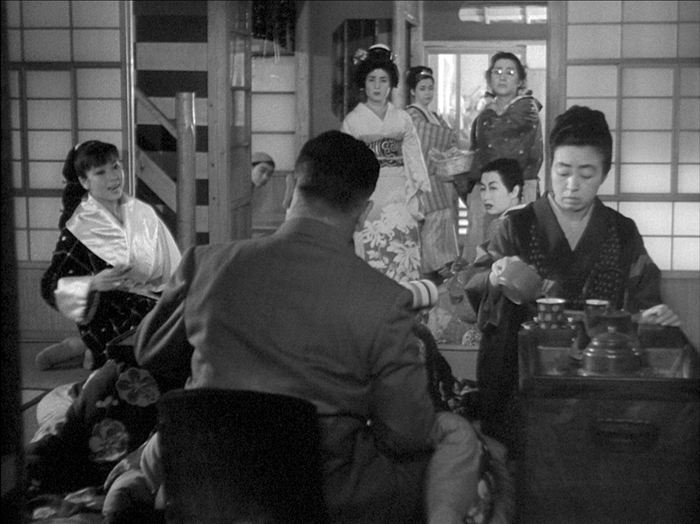
#27 in our “Observations on Film Art” on The Criterion Channel, David examines the intricate mise-en-scene of Kenji Mizoguchi: “Games of Vision in STREET OF SHAME.” He elaborates on the blog with “How to hypnotize the viewer: Mizoguchi’s STREET OF SHAME on The Criterion Channel.”
David analyzes the staging of a scene in Augusto Genina’s Il Maschera e il Voto (The Mask and the Face, 1919) in “Sometimes an actor’s back …” Those of you teaching Film History: An Introduction might find this entry useful in relation to the discussion of tableau staging in Chapter 2.
Chapter 5 The Shot: Cinemagraphy
In The Criterion Channel’s #24 in the “Observations on Film Art” series, Jeff Smith analyzes “Widescreen Composition in Shoot the Piano Player.” He offers additional commentary on the subject in a blog entry, “On The Criterion Channel: Jeff Smith on SHOOT THE PIANO PLAYER.”
Chapter 6 The Relationship of Shot to Shot: Editing
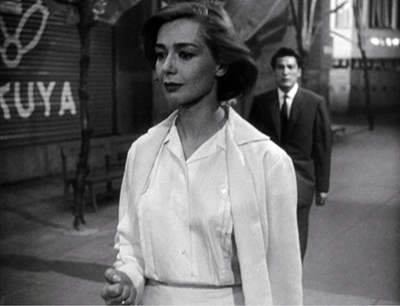
In The Criterion Channel’s #23 video, “Mutations of Memory–Editing in Hiroshima Mon Amour,” David discusses the film’s complex, innovative use of editing to create flashbacks. He expands on that analysis in the blog entry, “On The Criterion Channel: Five reasons why HIROSHIMA MON AMOUR still matters.”
Dissolves provide a way to join shot to shot. They’re usually used sparingly and in conventional ways (flashbacks, ellipses). In “Observations on Film Art” #22 on The Criterion Channel, “Dissolves in The Long Days Closes,” I discuss how dissolves become a prominent formal device in Terence Davies’ film.
Chapter 7 Sound in the Cinema
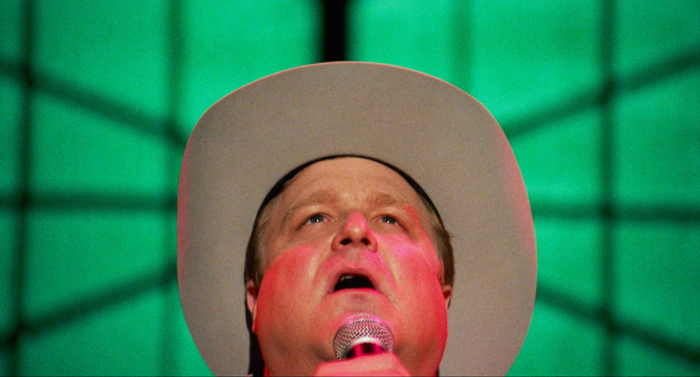
Guest blogger Jeff Smith analyzes the music in True Stories: “From transistors to transmedia: Talking Heads tell TRUE STORIES.”
Jeff takes an informative look at the five songs from 2018 films nominated for Oscars in “Oscar’s siren song: The return: a guest post by Jeff Smith.”
Chapter 8 Summary: Style and Film Form
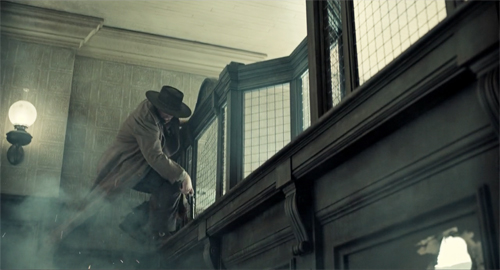
David analyzes cutting and framing in one scene in the Coen Brothers’ The Ballad of Buster Scruggs in “The spectacle of skill: BUSTER SCRUGGS as master-class.”
The great critic André Bazin decisively shaped our sense of how to understand film form and style. David explores some of his ideas in “André Bazin, man of the cinema” and an essay, “Lessons with Bazin.”
Chapter 9 Film Genres
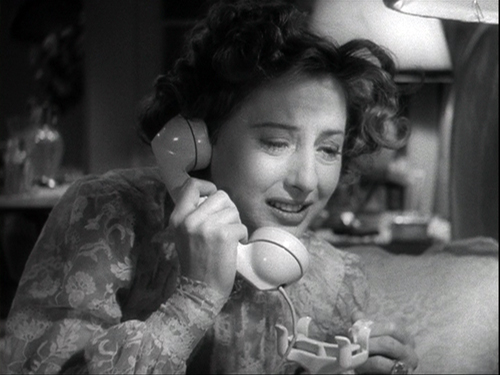
David on film noir: “REINVENTING HOLLYWOOD in paperback: much ado about noir things.”
Chapter 10 Documentary, Experimental, and Animated Films
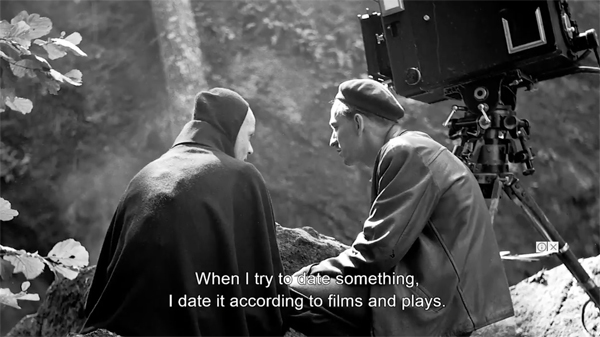
Reporting from the Vancouver festival, David discusses two documentaries that might be useful to show if you program films by either of these directors for your class: The Eyes of Orson Welles and Bergman: A Year in the Life. See his “Vancouver 2018: Two takes on two directors.”
David on three documentaries shown at our hometown film festival this year, in “Wisconsin Film Festival: Not docudramas but docus as dramas.”
Chapter 11 Film Criticism: Sample Analyses
We were lucky enough to return to the Venice International Film Festival last year, again offering analyses of some of the films we saw. These are much shorter than the ones in Chapter 11, but they show how even a brief report (of the type students might be assigned to write) can go beyond description and quick evaluation.
The first entry deals with the world premiere of Damien Chazelle’s First Man and is based on a single viewing. The second discussed Alfonso Cuarón’s Roma and Mike Leigh’s Peterloo.The third offered David’s thoughts on the posthumous release version of Orson Welles’s The Other Side of the Wind. In a fourth, I dealt with five films from the Middle East, including Amos Gitai’s A Tramway in Jerusalem. David considers variants of wrong-doing in films from around the world, including Zhang Yimou’s Shadow and Erroll Morris’ American Dharma. Sixth and last was my longer analysis of László Nemes’s brilliant but challenging second feature, Sunset. We plan to carry on this tradition of comments on new films when we attend the Venice International Film Festival next month.
Our annual visit to the Vancouver International Film Festival yielded more brief analyses of new films. In “Vancouver 2018: Landscapes, real and imagined,” David looks at some recent Asian films, including Kore-edge Hirozaku’s Shoplifters. In “Vancouver 2018: A panorama of the rest of the world,” I comment on three films by important international directors: Nuri Bilge Ceylon’s Turkish The Wild Pear Tree, Benedikt Erlingsson’s Icelandic Woman at War, and Pavel Pavlikowski’s Polish Cold War.
I followed up with more international films in “Vancouver 2018: Panorama of the rest of the world, the sequel“: Matteo Garrone’s Italian Dogman, Nina Paley’s American Sedar-Masochism, Wolfgang Fischer’s Austrian Styx, and Christian Petzold’s German Transit. David wrote about crime films (and a TV show) in “Vancouver 2018: Crime waves.” These notably included Lee Chang-dong’s Burning. Our wrap-up, “Vancouver 2018: A few final films,” again had an international flavor, commenting on Jafar Panahi’s Iranian 3 Faces (his defiant fourth feature since the government banned him from filmmaking for twenty years), Nadine Labaki’s Lebanese Capernaum, and Ciro Guerra and Cristina Gallego’s Colombian Birds of Passage.
Looking back on these two festivals makes it clear that 2018 was an extraordinary year for the cinema!
David analyzes True Stories on the occasion of its release on Blu-ray: “Pockets of Utopia: TRUE STORIES.”
Chapter 12 Historical Changes in Film Art: Conventions and Choices, Tradition and Trends
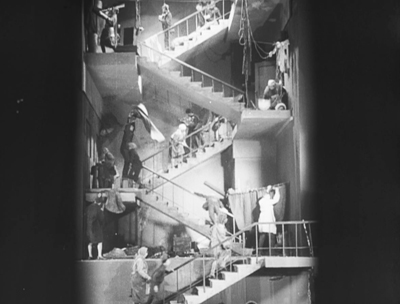
Teaching film history? My annual choice of the ten best films from 90 years ago offers some familiar and not-so-familiar titles: “The ten best films of … 1928.” I also consider two releases of major German silent films.
Many of our entries from Il Cinema Ritrovato in Bologna consider older films, especially those from 1919 in “German and Scandinavian classics.” I discuss some major African films in “Who put the pan in Pan-African cinema?”
I discussed a Blu-ray release of two rare films by Mary Pickford in “Pickford times two.”
A more recent trend in film history, that of the improvised independent American film, is considered in our review of J. J. Murphy’s book Rewriting Indie Cinema.
Finally, for Film Art: An Introduction users, an account of how Jeff Smith, David, and I revised our textbook for its twelfth edition.
After forty years, we’re still grateful to teachers and students who have found Film Art: An Introduction useful in their study of cinema.
Cognitive film studies: The Hamburg Variations
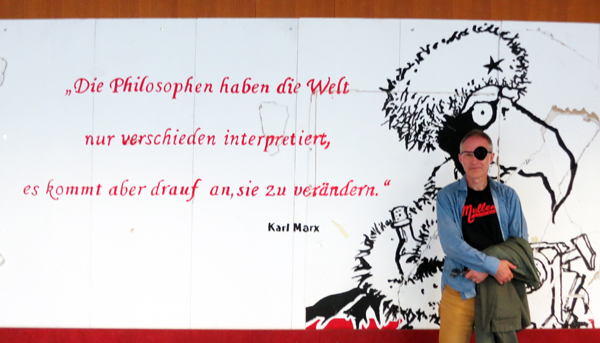
Lobby, Von-Melle-Park 9, Universität Hamburg, with Murray Smith.
DB here:
How many universities in the US would post a big quotation from Karl Marx in the lobby of a classroom building? (Answer: None.) But a cartoonish rendition of Marx’s killer app–the task of philosophy being not only to understand the world but also to change it–greeted the one hundred or so scholars attending the latest conference of the Society for Cognitive Studies of the Moving Image last week at the Universität Hamburg.
How much we’ll change the world remains to be seen. What is clear now is that thanks to the superb organization of Kathrin Fahlenbach, Maike S. Reinerth, and their team, the SCSMI had a lively four days of papers, discussions, and excursions–as well as a screening of a strong film by a skillful director previously unknown to me. In all, every good reason to go to a conference.
Big questions, candidate answers

Carl Plantinga, Dirk Eitzen, and Kathrin Fahlenbach on the Hamburg Harbor cruise.
The range was huge, as usual, because this is a very diverse group. Our community, as I’ve mentioned in earlier reports, hosts film scholars, scholars of other media (television, games, internet), psychologists, and philosophers. Recurring questions include: How do viewers comprehend media presentations? What is the role of morality in film and television? How do practitioners conceive their craft? How do media present and trigger emotions? What appeals are specific to certain genres or historical periods? Not least: How may we construct good theories to answer such questions?
Three sessions ran simultaneously at each time slot, so I missed many good presentations. Kristin and I occasionally doubled up. Many of the talks will eventually become published papers, several in the Society’s journal Projections, so let me just highlight a few strands.
For those of us interested in how style interacts with narrative, there were several significant presentations. James Cutting, who has pioneered the use of Big Data techniques in scanning large batches of films, provided a compact account of how “sequences” (as opposed to scenes) displayed patterns of coherence and grouping. Karen Pearlman discussed her films, and James examined them to reveal fractal patterns in their rhythms–patterns that match the dynamics of footsteps, heartbeats, and breathing.
Two papers added to our understanding of the Kuleshov effect, much discussed on this site. Marta Calbi and her collaborators conducted EEG testing on spectators exposed to a Kuleshovian film scene, while Anna Kolesnikov, another member of the team, traced the contradictory versions of the “experiments” that Kuleshov and his students purportedly constructed. Both were exciting contributions to our understanding of Kuleshov’s legacy, which as the years go by looks more complex than we had thought.
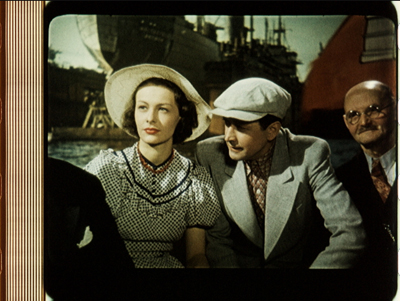
Other papers on visual style included Barbara Flückiger’s tour of the staggering resource she and her colleagues have devoted to the history of color in film–a database of images from 400 films illustrating a range of technologies, periods, and genres. She has also mounted a magnificent array of tools for detailed analysis of color. (Significantly, she has taken the images from film prints, not video copies.) Here’s one of several stunning images she has taken from Helmut Käutner’s Grosse Freiheit Nr. 7 (1944, Agfa nitrate).
Stephen Prince, whose book Digital Cinema has just been published, surveyed the emergence of “deep fakes,” manipulated images that have no basis in reality but which are indiscernible from an accurate image. Steve was once skeptical that digital images would ever cut us off entirely from photographic reality, but now machine learning has managed to do it. Sped up by social media, the rise of unverifiable “records” creates what he called “an attack on an information system we call society.”
Hitchcock, everybody’s idea of a shrewd filmmaker (when will cognitivists discover Lang?), came in for his usual close treatment. Todd Berliner proposed five ways in which story information can be set up and paid off in a narrative, and he used Psycho as an instance of at least four of those methods. Maria Belodubrovskaya countered Hitchcock’s constant claim that he relied on suspense and not surprise. She showed that both single sequences and overall plots (e.g., Suspicion, Psycho) were heavily dependent on surprise effects.
In the first day, the range of the “humanistic” side of SCSMI was on vivid display. Malcolm Turvey asked whether the give and take of philosophers’ arguments converged on a consensus about truth, the way that much of science progresses. To illustrate the process, he considered the return of an “illusion” theory of images put forth by Robert Hopkins. Later that day, Jeff Smith used the cognitive theory of confirmation bias to show how characters in Spike Lee’s Clockers systematically misunderstand the story situation. The result, enhanced by genre conventions and a violation of some traditions of the detective story, enmeshes the viewer in the same error.
On the other end of the spectrum, there were papers mobilizing empirical research. Timothy Justus drew upon Lisa Feldman’s work in How Emotions Are Made to suggest that a biocultural account of facial expression should not rely too strongly on Paul Ekman’s classic argument about universal, basic expressions. More room, Justus proposed, should be given to cultural forces that build “emotion concepts” that filmmakers and viewers draw on.
A more hands-on empirical project was that coming from a team at Aarhus university. Jens Kjeldgaard-Christiansen posed the question: What if sympathy for a film’s villain varies with the personality of the spectator? As he put it, “If you are like a villain, will you like a villain?” So via Amazon’s Mechanical Turk the team ran questionnaires testing how personality types matched tastes in villains. Not to spoil their public announcement, I’ll just say that the results seem to confirm the belief that the most dangerous creatures on earth are young human males.
There was a lot more here than I can report, including provocative keynote addresses from Professors Anne Bartsch and Cornelia Müller (presenting work done with Hermann Kappelhoff). There was also a moving tribute to Torben Grodal, a central force in SCSMI and a leading-edge theorist applying evolutionary psychology and embodiment theory to traditional genre studies.
And, since SCSMI wants to understand how creators create, there was a film and its maker.
Without bullshit
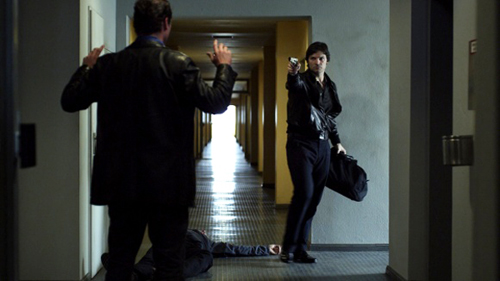
In the past, our conferences have featured Lars von Trier and Béla Tarr, talking with us about their work. This time the guest was Thomas Arslan, a prominent “Berlin-school” director, who brought his 2010 film In the Shadows (Im Schatten) to the lovely Cinema Metropolis.
The film is a dry, hard-edged crime exercise. Trojan, fresh out of prison, comes to his boss to claim his share of the loot. In a tense confrontation he manages to get some of what he’s owed, but he’s now a target for elimination. He searches for a new robbery scheme and settles on the heist of an armored car. As usual, things don’t go as planned, particularly due to the intervention of a crooked cop.
Shot in a laconic style, In the Shadows took advantage of the Red One camera to produce remarkable depth in dark surroundings. (We saw it as a print because in 2010 theatres weren’t quite ready to show digital files. The print looked fine.) The drab locations complemented the anti-psychological impact of the story. Characters barely speak, the music is spare and almost subliminal, and the framing doesn’t accentuate the action expressively. In his post-film discussion, Arslan explained that the style grew out of the small budget and the rapid schedule. The result was a sort of modern B-film, avoiding the excess of CinemaScope and explosive chase sequences.
Arslan refuses to glamorize his gangsters, but he summons up sympathy for Trojan by minimal means. The protagonist is a solid, efficient professional, and he’s loyal to his boss until he realizes he’ll be betrayed. And as Hollywood screenwriters would remind us, you can sympathize with someone who’s been treated unfairly. I liked the unfussy handling of the story; it was a bit reminiscent of Rudolf Thome’s bare-bones Detective (1968). Arslan would be a good director to shoot a Richard Stark noir. “He does it without bullshit,” Arslan said of his thieving protagonist. It’s a good description of Arslan’s own technique.
SCSMI continues its tradition of merging humanistic inquiry with findings from empirical science. We can fruitfully ask questions that cut across traditional boundaries if we ground those questions in clear concepts and solid evidence. Our gathering next year moves back to the States–Grand Rapids, no less. More fun on the way.
Go here for earlier years’ coverage of SCSMI conferences.
On Richard Stark noir novels, see here and here. In the Shadows would fit nicely into my discussion of conventions of the heist film.
My own SCSMI contributions were two: a tribute to Torben Grodal and a little talk on contemporary women’s domestic thrillers (Gone Girl, The Girl on the Train, etc.). I may post the latter as a video lecture later this summer.
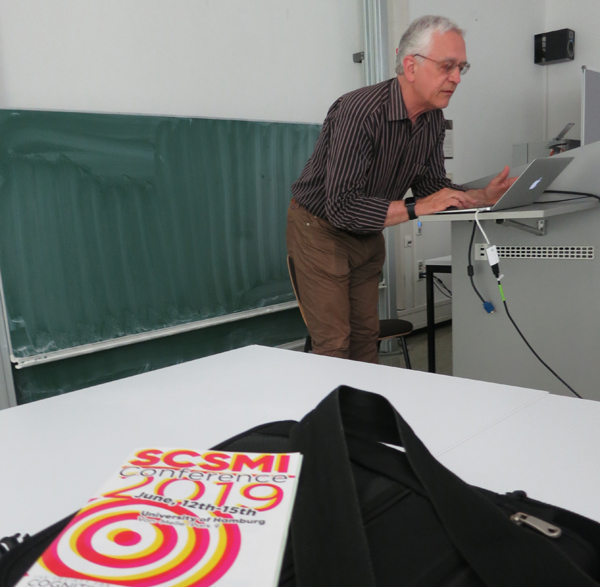
James Cutting lecturing at the SCSMI conference.