




Archive for the 'Narrative strategies' Category
Open secrets of classical storytelling: Narrative analysis 101
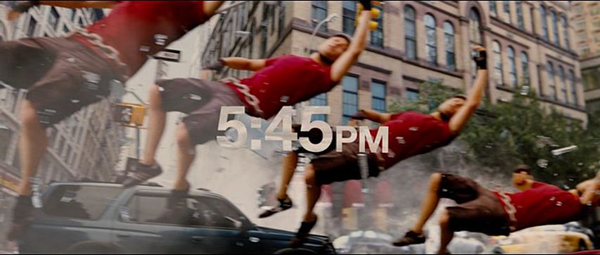
Premium Rush (David Koepp, 2012).
DB here:
After nine years, over 700 entries, and many essays and other stuff, this contraption of a website has started to intimidate us.
If we’re intimidated, you might be flabbergasted. Although a set of categories sits on the right to guide your exploration of this tangled databank, those too loom large and discouraging. So we’ve decided to tidy up by–how else?–adding another entry.
We’ll occasionally offer a stripped-down guide to our writing on certain topics. We’ll steer you to entries that we think represent the core of our thinking on a problem, and then add some that probe more deeply, for those who want to go beyond the basics. Since one of our areas is narrative theory and analysis, a good first effort, we thought, would be to produce a sort of DIY syllabus that systematically surveys the topic as we’ve explored it. And since we’ve often written about classical Hollywood storytelling, and since many of our readers are interested in that…well, the syllabus sort of wrote itself.
We call these ideas open secrets of storytelling because by and large they aren’t acknowledged in the screenplay manuals that aspiring writers read. In most cases, we’ve had to devise our own concepts and terms, based on watching hundreds of movies. Yet these observations are wide open, available in our books and on this site.
Now comes our chance to pull them together. The result isn’t an utterly comprehensive theory of classical Hollywood narrative, but it does give a fair sampling of the range of questions we’ve tried to answer about it. The topics, linked to essays and blog entries, are arranged in three layers.
The most basic layer is an array of key ideas about story worlds, plot structures, and strategies of narration. These ideas are introduced in the first entry, “Understanding film narrative: The trailer.” Discussions of other basic concepts follow. Just reading the entries pegged to those topics, you could get a solid sense of what we’re aiming at. For most of those, we also propose a film you might view to test how the ideas work.
At a second level, for some topics we include some entries that dig deeper. They’re either more complex and advanced, or they provide some historical background.
Finally, after we’ve reviewed the key topics, we add a batch of case studies that use several of the tools we’ve laid out. These are usually very deep dives into particular films. They aim to show how the analytical ideas can bring out distinctive features of particular movies. The case studies are pretty wide-ranging, but they tend to hover around specific problems, such as adaptation or the creation of fantasy worlds.
How could you use this resource? A teacher in high school or college could draw on it as a partial syllabus or just a thumbnail list of supplementary material for a course. Teachers using Film Art: An Introduction could treat it as a supplement to our section of Chapter 3 on classical narrative. Or a student might find an idea for a paper in this vicinity.
Since we’ve always tried to link film studies and filmmaking, we hope that practitioners might be interested too. For example, an aspiring screenwriter could take this as a weekly reading/viewing agenda, treating it as a free course in story analysis. General readers who simply want to know more about the mechanics of cinematic storytelling should find something provocative here too. For everybody: Feel free to use it as Narrative Analysis 101.
We thank our many loyal readers of this blog, as well as the many more who have just dropped by once or twice. Your continued interest has helped us keep going.
Open Secrets of Hollywood Storytelling
The basics
Understanding film narrative: The trailer. Suggested viewing: The Wolf of Wall Street.
Advanced: Three Dimensions of Film Narrative: Narration, plot structure, and story worlds. Suggested viewings: The Godfather, Jezebel.
Advanced: Stories beget stories. Suggested viewing: American Hustle.
Actions and agents
Introduction to classical plot structure. Suggested viewing: Many possibilities listed.
Historical background: Is there a 3-act structure?
Action films: Did spectacle kill classical plotting? Suggested viewing: Mission: Impossible 3.
Advanced: Block construction. Suggested viewing: Kill Bill, Pulp Fiction.
How many protagonists? Suggested viewing: The Big Short.
The importance of coincidence. Suggested viewing: Serendipity.
Narrative parallels among characters and periods. Suggested viewing: Julie and Julia, Enchantment.
Advanced: Fine-grained parallels between scenes. Suggested viewing: The Prestige.
Time shifts: How flashbacks work. Suggested viewing: The Power and the Glory.
Advanced: Time shifts without flashbacks. Suggested viewing: Exodus.
Advanced: Nested flashbacks. Suggested viewing: Passage to Marseille, The Locket.
Historical background: Flashbacks and plot problems. Suggested viewing: The Great Moment, All about Eve.
Replays. Suggested viewing: Mildred Pierce.
Advanced: The auditory replay. Suggested viewing: Sudden Fear.
Network narratives. Suggested viewing: Grand Hotel.
Forking-path plotting. Suggested viewing: Source Code.
Advanced: Film Futures. Suggested viewing: Sliding Doors.
Historical background: What-if narratives. Suggested viewing: Dangerous Corner
Beginnings and endings: Molly Wanted More. Suggested viewing: Snow White and the Seven Dwarfs, The Silence of the Lambs.
Telling more or less
Visual storytelling. Suggested viewing: Mission: Impossible.
The hook between scenes. Suggested viewing: Dr. Mabuse, The Gambler; National Treasure.
Narration: omniscient versus restricted. Suggested viewing: Cloverfield.
Historical background: Hitchcock, suspense, and surprise.
Alignment and allegiance. Suggested viewing: House by the River.
Character subjectivity, optical and mental. Suggested viewing: The Silence of the Lambs.
Historical background: Subjectivity and sound. Suggested viewing: Nightmare Alley, The Fallen Sparrow.
Voice-over narration. Suggested viewing: All about Eve.
Advanced: Dead narrators. Suggested viewing: Laura, Confidence.
Historical background: Inner monologue. Suggested viewing: Strange Interlude.
Case studies in narrative analysis
These are exercises in film criticism that utilize several of the tools laid out above.
Boyhood and Harry Potter: The actors’ lives as part of the narrative.
Eastern Promises: Thematic echoes in an auteur’s narratives.
Gone Girl: Suspense and thriller conventions in fiction and film.
Gravity: Narrative innovation within mainstream cinema.
Inception: Goals and parallel construction; managing multiple plotlines.
Moonrise Kingdom: How to make a modern fairy tale (with some help from merchandising); furnishing alternative worlds.
Premium Rush: How goals and deadlines create tight construction.
Side Effects and Safe Haven: Fragmentary flashbacks and patterns of suspense.
Slumdog Millionaire: Adapting a novel to classical norms.
The Bourne Ultimatum: Plotting across franchise installments.
The Girl with the Dragon Tattoo and The Ghost Writer: Classical structure in genre fiction.
The Hobbit: Adaptation and length; adaptation and change.
The Magnificent Ambersons: How to manipulate time without flashbacks.
The Prestige: Using sound to enrich flashback construction.
The Walk: Each act a different genre.
Tinker Tailor Soldier Spy: Elliptical narration: The viewer’s responsibility.
As we write more entries relevant to narrative, we’ll revisit this DIY syllabus.
Needless to say, we consider these matters more closely in several of our books. See The Classical Hollywood Cinema: Film Style and Mode of Production to 1960, by Kristin, Janet Staiger, and me, and Kristin’s Storytelling in the New Hollywood and Storytelling in Film and Television. For my part, there’s Narration in the Fiction Film and The Way Hollywood Tells It: Story and Style in Modern Movies. I’m at work on a book on narrative innovations in 1940s Hollywood, the central source of much that we encounter in today’s films.
Pick your protagonist(s)
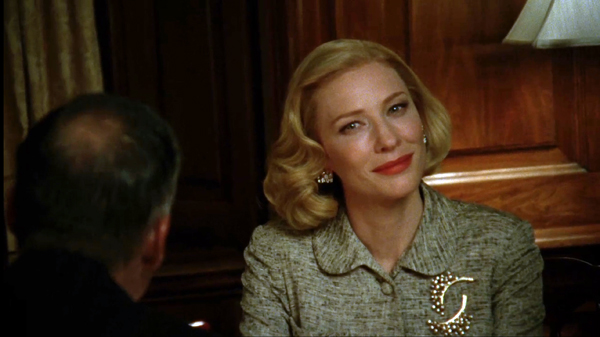
Carol (Todd Haynes, 2015).
DB here:
We’re used to sorting movies by periods, genres, and the individuals associated with them (stars and directors especially). But we can also distinguish films by their styles and narrative forms. So there’s not only a “film noir” style but other group styles, like the tableau approach seen in the silent cinema, or the deep-focus one of Hollywood in the 1940s-1950s. Similarly, we can think about types of storytelling strategies.
Someone might object that at least genre and other categories are in filmmakers’ minds, whereas it’s unlikely that any American in the 1940s set out to make a film noir as we understand it. (That term, and category, came from France, and somewhat after the fact.) Similarly, Ford probably didn’t think he was making a “classically constructed” Western in My Darling Clementine; he was just making a Western.
One reason we might construct these categories is to bring out the principles that filmmakers seem to follow intuitively. Perhaps no screenwriter ever thought explicitly about scene hooks, but the device is common enough to suggest that they believed the device was a useful tool.
Besides bringing out the regularities of filmmakers’ craft in certain times and places, constructing categories allows us to understand the creative choices they face. Maybe you handle a scene in a two-shot or in several reverse-angled singles. Both are permitted, each has certain advantages, and filmmakers spontaneously choose among these alternatives.
In effect, we’re reconstructing the menu of options available to filmmakers in certain times and places. If we do it carefully, we gain understanding of what each option can yield, and what certain filmmakers can achieve if they try something new.
Kristin and I have been in this game for decades, and our work on norms of film form and style has surfaced in our books, lectures, and blog entries. One set of analytical categories we’ve proposed is based on how movies use their protagonists. I was struck by how many films at end of 2015 and the start of 2016 illustrate a range of options currently available.
It turns out that these options are of long standing; they’re another example of how even recent movies owe a lot to the classical Hollywood tradition. That’s not to say, though, that they might not revise or tweak that tradition. Some filmmakers are innovative by temperament, and besides, there are career rewards when innovations come off. (Just ask the maker of Pulp Fiction.)
The categories depend on determining which character(s) can function as protagonist(s). That depends on the goals, the obstacles to the goals, and the relationship between the goal-striving character and other characters and story lines. Traditionally, in a two-hour Hollywood feature, a principal goal is articulated in the first half-hour or so. Kristin has argued that after this “Setup” portion comes others: a “Complicating Action” (also lasting about half an hour) that changes the goal and in effect creates a new setup; a “Development” which consists of delays, backstory, and fresh obstacles to the goal; a climax that resolves the issue; and an epilogue (screenwriters called it a “tag”) that confirms a certain stability in the situation. The major parts roughly divide the film into quarters, contrary to three-act accounts.
So today I look over the protagonist menu, based on some current offerings. Of course there are spoilers.
One, with benefits
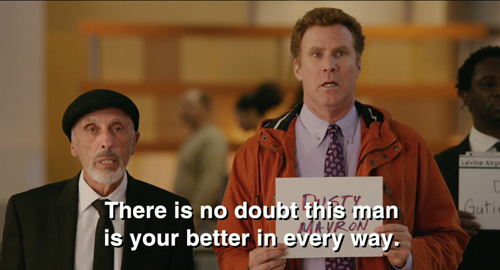
Daddy’s Home.
Take as a baseline the movie organized around one protagonist. A clear example from this holiday season is Daddy’s Home. Stepdad Brad (Will Ferrell) has read all the touchy-feely parenting books and applies their lessons to raising the kids he has inherited by marrying Sara. But Dusty (Mark Wahlberg), Sara’s charming and macho ex, returns from his mysterious life in espionage and rapidly takes over the household. In an escalating series of mishaps, Brad proves unable to live up to the hip and edgy things that Dusty dreams up for the kids.

The climax comes when Brad, after showering Megan and Dylan with presents, gets drunk at a basketball game and humiliates them all with a public confession of inadequacy and a pair of unguided free throws. Eventually the battle of the two parenting styles—comforting versus edgy—is resolved when at a father/daughter dance Ward’s nonviolent, somewhat goofy, approach to conflict tamps down an explosive confrontation with a father spoiling for a fight.
The classic situation is established: our protagonist has an antagonist. Dusty is an infighter who seizes control of every situation. As you’d expect, Dusty is winning the race for the kids’ affection during most of the film; even Sara seems to be feeling some of her old attraction to him. As the antagonist, Dusty makes his intentions clear about two-thirds through the film: He will not give in. This precipitates Brad’s suicidally expensive efforts to shower his kids with presents. Deeply shamed, he moves out. Dusty seems to have won.
But Dusty has a weakness. He can’t manage the drab daily responsibilities of parenting—making the kids’ lunches, driving them to school—that Brad enjoys shouldering. At the climax, Dusty has gained respect for Brad and soon remarries, becoming the devoted father of a stepchild. In a traditional comic reversal, he must confront the kid’s birth father, who is a bigger thug than he ever was.
Daddy’s Home reinforces our alignment with the protagonist Ward through his voice-over narration, though at the end the integration of the two families is given by letting Dusty and Sara chime in too. The emphasis on Ward, his confrontations with Dusty and his kids, and the hilariously bad advice offered by Ward’s boss (a classic sidekick role) fulfill a common template for one kind of classical plotting. The protagonist comes to the plot with his goal already decided on, and he has to defend it against a tangible threat.
There’s another option: letting the protagonist discover the goal in the setup. And there’s the possibility of presenting not a single powerful antagonist like Dusty but several. These forces in various ways take on the task of blocking the protagonist’s goal.
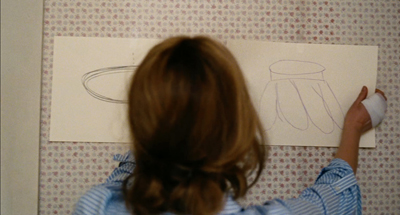
Some critics have thought David O. Russell’s Joy somewhat messy, but I think that’s partly because the film spreads the antagonist function across many vivid secondary characters. In my view, as Bernie Sanders might say, the plot remains pretty classical.
The Setup establishes Joy’s life as a disaster. Her childhood dreams of creativity have been forgotten after years with her dysfunctional family and the demands of her children and job. Around the half-hour mark, Joy’s wounds from cleaning up a broken wine glass send her into a dream in which she rebukes herself for her passive life. She wakes up and starts designing a miraculous mop. If her initial goal was simply muddling through, her new goal revolves around transforming her life by creating and marketing this product. This new goal sets the key for the Complicating Action.
At the film’s midpoint, Joy convinces the producer overseeing the Quality Value Channel to add her mop to the offerings. The Development section consists of more obstacles and some triumphs, so that eventually sales take off. But her family butts into her business and plunges her into bankruptcy. This, her darkest moment, is overcome when she confronts her Texan partner and threatens to take him to court for the fraud she has discovered. She pays off her debts. In the epilogue, we see her as a successful businesswoman helping other struggling inventors.
This, of course, is just the film’s spine. In the course of this plot, Joy discovers she has reserves of courage, determination, and a sense of her own worth. Weaving through it all is the voice-over narration of her grandmother who not only fills in information for us (even from beyond the grave) but also serves as a prod for Joy to persist in her desire to make things of value. There’s also a clever opening showing a soap-opera performance in the manner of Straub/Huillet; it’s later replayed in normal TV terms.
Joy has allies—her ex-husband and a loyal friend—but she faces many antagonists, an array of family and predatory business people. Where Joy most alters the traditional plot layout, I think, is in its refusal to include a story line involving romance.

Most Hollywood plots are double-stranded: a line of action about romantic love, and another line, usually about work. Joy doesn’t revive her marriage and instead concentrates on her fulfillment of her dream. Having seen Silver Linings Playbook and American Hustle, we might expect Joy (played by Jennifer Lawrence) to hook up with the QVC producer played by Bradley Cooper, but it doesn’t happen. Still, Joy remains a nice example of the plot focused on one protagonist who struggles against a range of antagonists, each contributing particular obstacles. A comparable example from recent releases would be Bridge of Spies.
It takes two
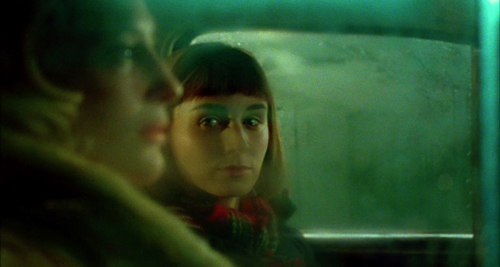
Carol.
Alternatively, there’s the dual-protagonist plot. Two characters share a goal, or have complementary ones, and they work together. They may also come into conflict about it or about other matters. Often they’re a male/female romantic pair, as in the classic His Girl Friday, but they may also be male/male (The Other Guys) or female/female (The Heat). I’m told that Star Wars: The Force Awakens eventually settles into a dual-protagonist plot, but one example I’ve seen is Sisters.

At the start our protagonists are characterized as unhappy and incomplete. Maura (Amy Poehler), a divorcée, is oversolicitous and lonely; Kate (Tina Fey), a single mother, is irresponsible and frequently jobless. Neither sets out deliberately to improve her life, but they are put out on that path after learning that their parents have sold the family home. Screenplay manuals call this the “inciting incident.”
An encounter with the house’s snobbish purchasers convince the sisters to relive their wild high school days by inviting their old classmates to a wide-open party. They switch roles: Maura vows to become the wild girl she always hoped to be, and Kate agrees to become, for that night, the prudent one keeping an eye on things. At first the party is a boring affair, as their Gen-Xer friends have become staid parents, but at the midpoint, with the arrival of some serious drugs and a tattooed side of beef named Pazuzu, things explode.
The Development section is woven out of running gags, including a would-be party animal, a mean-girl rival crashing the event, a hunk attracted to Maura, and Kate’s efforts to keep in cellphone communication with her daughter Haley, who has nothing but disdain for her scatterbrained mom. The climax is precipitated when, having utterly trashed the house, Kate learns that actually she was to get the money from the sale. More seriously, Maura has secretly acted as a surrogate parent for the elusive Haley. The denouement presents a series of resolutions whereby the parents forgive their daughters, the house is rehabbed, and the sisters accept the need to sell the place and grow up. A tag shows the family united at—when else?—Christmas.
In Sisters, the intertwined lines of action yield goals around one the house-based line of action (preserving the house, trashing it, rehabbing it), but other goals emerge around love. Maura gets a boyfriend, Kate wins her daughter’s love, and both reconcile with their parents.
Sisters exemplifies how dual-protagonist films can show characters sharing a goal and still clashing with one another. Here, as in most such films, one of the pair may help the other, work against the other, or keep the other in the dark. Accordingly, so that we can appreciate all the schemes, misunderstandings, and screw-ups, dual-protagonist films tend to supply a wide range of knowledge. In Sisters, for instance, we know, as Maura and Haley and the parents do not, that Kate has lied about getting a new job.
By contrast, a single-protagonist film can restrict our knowledge to the hero or heroine, so that we share the suspense and surprise coming their way. Daddy’s Home restricts us almost completely to what Ward knows; Dusty is constantly surprising him with new subterfuges to win the kids’ love. Similarly, Joy is the center of consciousness in her film. True, we have the Grandmother’s voice-over supplying information, but it doesn’t really break with Joy’s range of knowledge. Grandma could have tipped us off early that about the Texan’s scam, but we learn of it only when Joy does.
In this way, plot structure interacts with what in literature is called point of view, or narration in the broad sense. Carol provides a striking example.
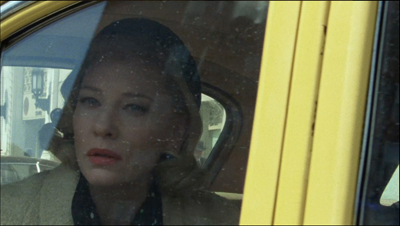
Patricia Highsmith’s original novel presents a single-protagonist plot. Therese, vaguely dissatisfied with the men in her down-at-heel bohemian milieu, falls abruptly in love with a wealthy wife and mother. Highsmith rigorously retains our attachment to Therese, so that we never know more than she does. She gets glimpses of Carol’s unhappy life with her husband Harge, her love for her daughter Riddy, and her struggle to obtain a divorce that will let her share custody of the girl. After Therese and Carol’s compromising road trip to Middle America, Carol returns to New York and the legal proceedings Harge is conducting. He has proof of Carol’s lesbian affair and intends to use it against her. But Therese learns of the progress of the case through letters and phone calls. Several chapters showing Therese simply waiting in Sioux Falls for news furnish some of the dread-filled suspense that Highsmith would generate in her crime novels.
The film displays the traditional four-part structure. The drive west is launched at the midpoint, just when Therese’s boyfriend Richard denounces her as infatuated with Carol. The couple’s trip, trailed by a detective tape-recording their lovemaking, serves as the Development. Interestingly, the book has a similar array of incidents, with the same plot point serving as the pivot to the second half. As I’ve argued before, popular fiction sometimes displays the same plot architecture we find in cinema.
But just following the four-part template doesn’t mean that the film and the novel are congruent. Carol shows how choices about narration can reshape plot structure. Apart from some changes in the original situation (e.g., Therese is now an amateur photographer rather than a set designer for stage productions), screenwriters Phyllis Nagy and Todd Haynes have made a crucial decision. They have expanding our access to Carol’s story line.
Events that are “off-page” in the novel are fully dramatized in the film, and we witness action that Therese never learns of. Harge, a vaguely pathetic presence in the book, is more fully characterized, and as an angry patriarch at that. We get scenes of Carol with Riddy, with her former lover Abby, with her in-laws, and particularly with her lawyer, who’s helping her fight for custody. Crucially, the screenplay supplies a climactic scene not in the book, when Carol yields to Harge’s demands and refuses to condemn her affair with Therese. Something like this must have occurred in the book too, but it’s presented sketchily and at a remove, recounted to Therese by Carol and Abby.
By creating a wider-ranging narration, Carol turns a single-protagonist book into a dual-protagonist film. The two women share the same goal, romantic union, and the narrational patterns balance their individual efforts to achieve it.
But wait, someone might say. Nagy and Haynes have added a flashback structure to the book, triggered by the early scene showing Therese leaving Carol after their meeting at tea. We watch Therese go to a party in a cab, and her morose face behind the rain-streaked window suggests that she’s recalling how she met Carol. Doesn’t this device respect the restricted narration of the book?
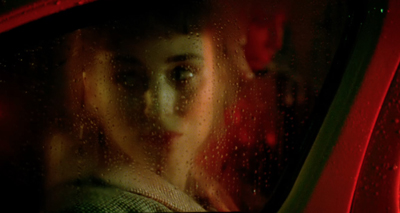
Actually, no. In classically constructed films, extended flashback passages are seldom restricted to the character doing the remembering. Against all realism, flashbacks include material that the recollecting character doesn’t or couldn’t witness. In line with this convention, Therese’s flashback includes a lot of scenes she doesn’t know about. The memory-flashback’s main purpose in a Hollywood film isn’t to represent character memory but to justify shifting the order of events. There’s more discussion here.
Perhaps one aim in showing rather than telling Carol’s story was to give Cate Blanchett a bigger part, but it has an important function for us as viewers. It avoids a climax portion that would show, almost Bresson-style, Therese simply killing time and waiting. Instead, by being transported to Manhattan and seeing what Carol is struggling against, we can appreciate Carol’s profound sacrifice for Therese. Carol is a somewhat remote and mysterious character in the book, but she’s delineated far more precisely in the film, largely because of these scenes.
Because Carol’s story line is fleshed out, we have a stronger sense of Therese’s mistake when, returning to New York, she declines Carol’s offer to resume their affair. (In the book, other factors shape Therese’s choice, including an ominous portrait that she seems to recognize from her childhood.) We know Carol to be more courageous than Therese believes she is, which makes the young woman’s decision not to reignite their affair more regrettable. This choice doesn’t block the screenplay from offering, when the flashback has ended and looped back to the present, a modified form of the book’s somewhat hopeful conclusion.
Multiple choices: Men (and women) on a mission
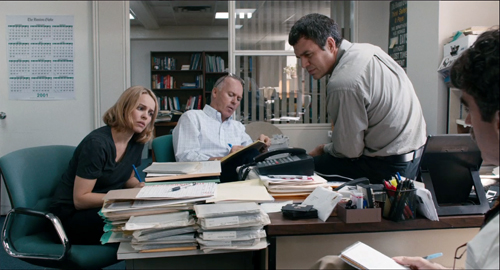
Spotlight.
There can be more than two protagonists, of course, so it’s convenient to have the general category of multiple-protagonist films too. Two common sorts show up in our year-end Hollywood releases.
One is what we might call the mission-team movie. Again, goals define the options. A group of characters, all more or less equal in importance, devote themselves to achieving a single goal. This is a common feature of combat films, though we find it in peacetime too. Classic examples are heist films like The Asphalt Jungle, sports films like A League of Their Own, crime films like Johnnie To’s The Mission, and numberless road-trip films.
Spotlight exemplifies the mission-team plot. As in a combat film, there’s a hierarchy: the chain of command runs from publisher to editor in chief to managing editor to section editor, and then to the grunts. The Boston Globe’s new editor Marty Baron puts an investigative team, called Spotlight, on a story about pedophile priests. Three reporters under Robby Robinson (Michael Keaton) unravel a story that ultimately implicates nearly a hundred priests and reveals many more victims.
As in a heist film, each reporter is given a specialty. Mike Rezendes (Mark Ruffalo) concentrates on getting information from the no-nonsense lawyer who is suing the Church on behalf of dozens of victims. Matt Carroll (Brian d’Arcy) scans the record and discovers a telltale pattern of priests’ assignment to parishes. Sacha Pfeiffer (Rachel McAdams) focuses on finding and interviewing victims. Robby runs interference with their superior Ben Bradlee Jr. and pursues his own hunches, including the role played by a retired attorney who’s one of his golfing buddies.
Through our old friend crosscutting, each protagonist is given separate scenes in which their skills are revealed and new information emerges. What’s common to the team members is tenacity and dedication to work (they put in long days and weekends). In addition, all were raised Catholic and feel with greater force the ways in which lawyers and the Church have covered up these crimes. In particular, the interpersonal style of Sacha, warm and empathetic, is contrasted with that of Mike, who tends to be more truculent and easily provoked.

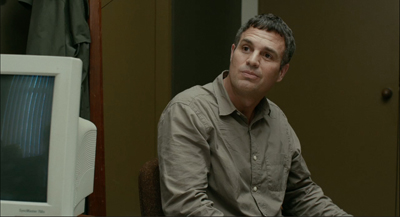
The progress of the investigation falls neatly into the four-part structure, bracketed by a prologue (a 1976 incident in which a priest’s crime is covered up) and an epilogue that celebrates the success of the project and reminds the audience of the ongoing problem with priestly pedophilia. In the Setup, the reporters believe that the story is fairly limited until the spokesman for a victims’ organization provides them some evidence of wider criminality.
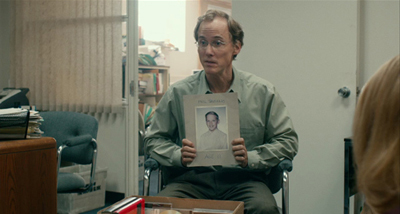
The Complicating Action consists of the discovery of over a dozen pedophiles, which raises the prospect of many more. Robby also senses a deep story here, based on the conspiracy of silence he’s confronting in the Church’s social circle. A complicating action often resets the initial goal, and this one does just that. Now Baron tasks the team with not merely exposing individual priests, but showing that the Church officials knew of the crimes, covered them up, and created a mechanism for perpetuating them.
The Development uses the paper trail discovered by Matt to pinpoint likely offenders, so now the team seeks out priests rather than victims. More obstacles pile up, including the unwillingness of victims to testify and the 9/11 attack, which slows the release of the story. All the while, the Spotlight team has been waiting for a court decision to unseal crucial documents that would prove the Church’s full knowledge of events. Mike learns that the lawyer Garabedian has used a counter-suit to bring some of those documents to light, but they are mysteriously missing from the court archives.
Delay, a common feature of Development sections, stretches things out. Finally Mike finds the court documents and they support the story. The climax consists of the team deciding on when to reveal the story so as to maintain their scoop and, to seal the deal, Robby getting his attorney friend to confirm their list of names. As in All the President’s Men, the press has to be characterized as taking every opportunity to back up its exposé with an abundance of evidence. The epilogue shows the Spotlight team, back at work on a Sunday, fielding phone calls from yet other victims—and Robby feeling contrite because back in 1993, he could have followed up a lead and did not. Again, the effort is to portray the press as both idealistic and fallible.
I said that the characters in a mission-team plot are “more or less equal in importance” because we often find that some are more prominent than others—they become “first among equals.” You could argue that the Ocean’s Double-Digit films, though dependent on teamwork, give primary emphasis to Danny, Rusty, and Linus. Still, there’s considerable time spent on the secondary members of the team, and often they turn out to be more central to the main action than they might appear. In Spotlight, the characters Robby, Mike, and Sacha are the most prominent (given the stars, no surprise), with Matt getting slightly less screen time and featuring in fewer dramatic confrontations. As we’d expect, though, Matt plays a crucial role in advancing the mission. The editor Baron, also downplayed compared to the others, not only launches the investigation but also serves as the wise leader who guides their strategy.
Again, the double line of action is less visible here. Mission-team plots often eliminate romance (combat films again) or introduce some love interest when a spouse or lover finds a protagonist too dedicated to the mission, or when the romance is part of the mission (as in Ocean’s Eleven and Twelve). Here there’s a hint that Mike’s dedication to investigative reporting has led to separation from his wife, but those circumstances aren’t worked out to create a love-related story line. It’s as if the journalistic crusade is proceeding on enough fronts not to need distracting subplots.
It’s the end of capitalism
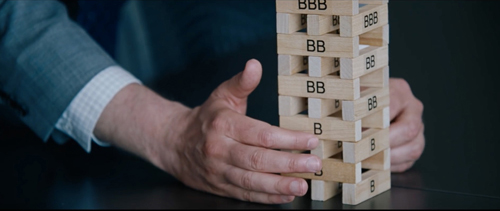
The Big Short.
If the mission-team movie is characterized by a rigorous focus on the group’s common goal, another sort of multiple-protagonist movie is more diffuse and tangled. I’ve called it a network narrative. It features several more or less equal protagonists pursuing different goals, but connected through kinship, friendship, employment, or coincidence in ways that affect their individual fates. The film aims to trace out the links and nodes in the network, all the while pushing forward to create new connections.
Nashville, Pulp Fiction, and TV series like The Wire exemplify this method of construction, but these sprawling networks are only one option. The groups linked can be more limited. Consider The Big Short (based on a book that’s itself a network narrative).
When the film starts, you might think that the awkward hedge-fund manager Michael Burry (Christian Bale) is the protagonist. In the first ten minutes he cryptically outlines his hypothesis that the US mortgage system is fundamentally flawed, and he formulates a plan to exploit it. But then the narration switches to Mark Baum, a hedge-fund manager deeply critical of the banking system.
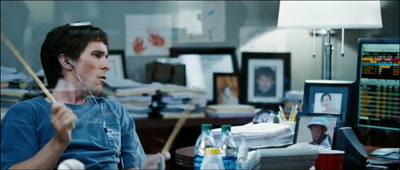
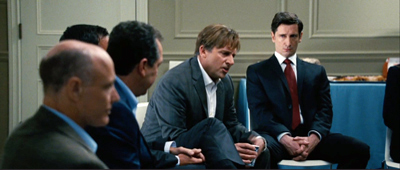
For several minutes, the narration alternates scenes of each man’s activities, with an emphasis on Burry’s plan to bet against housing bonds and Baum’s inability to come to terms with his brother’s suicide. At the 25-minute mark, Baum’s team gets a misdirected call from stock trader Jared Vennett (Ryan Gosling) and they learn from him that Vennett’s bank is selling collateralized debt obligations.
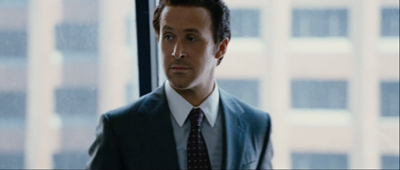
Through a vivid demonstration with building blocks, Vennett illustrates how the rating agencies have overvalued poor housing risks.
The Complicating Action starts by introducing two more protagonists, Charlie Geller (John Magaro) and Jamie Shipley (Finn Wittrock), who run a small investment company. By chance they find Jared’s presentation and decide to check out its strategy of shorting the housing market. Aided by the retired banker Ben Rickert (Brad Pitt), they get the credentials to buy in.
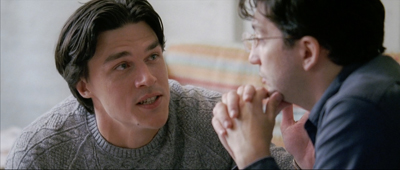
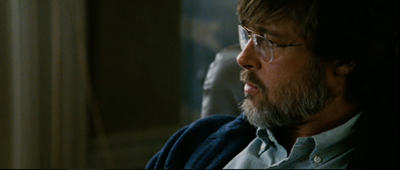
Their efforts are intercut with Burry’s tracking the market and with Baum’s team visiting Florida, where they discover that indeed house values are under water and mortgage brokers are snapping up unqualified buyers en masse. And the men learn that the rating agencies are routinely lying about the quality of the packages on the market. In the meantime, as mortgage defaults grow, mortgage bonds puzzlingly rise in assigned value.
The next turning point, launching the Development, is triggered by the decision of several protagonists to visit a Los Vegas forum on securitization. Baum’s team is instructed by Vennett to simply watch, and they learn about CDOs, though Baum can’t resist challenging the complacency of the banksters he meets. Meanwhile, guided by Rickert, the inexperienced Geller and Shipley hit on a new angle: to bet upon not just the low-rated packages but the A and AA ones. The men leave Vegas convinced that the market will collapse. Soon, though, we get the ups and downs characteristic of a Development, as it seems that our protagonists are all going to lose their shirts.
But their efforts to bet against the US economy pay off when mortgage companies start failing. This initiates the climax. The banks and investment houses struggle to contain the damage, chiefly by shifting the losses to their customers, and soon everyone wants the default swaps our protagonists have bought so cheaply. All wind up rich but disillusioned with the system. As in Spotlight, The Big Short’s epilogue concludes with texts indicating what happened to the protagonists afterward, and hinting that the system could topple once more.
You could imagine The Big Short as a different film, focused around one protagonist and making the others helpers, rivals, or walk-ons. But as a network narrative, it suggests the sheer sweep of financial corruption, as well as a range of response to it, from cynical acceptance (Vennett) to boiling outrage (Baum).
What enlivens the film, and makes it look and feel quite different from Spotlight, is its narrational texture. First, it’s recounted in voice-over by the least emphasized character, Vennett. Second, the film allows characters to address the camera occasionally, like Jordan Belfort in The Wolf of Wall Street, and they sometimes explain that what we’re seeing in the film wasn’t exactly what happened in real life (below left). Third, there are capsule sequences in which unlikely experts like Margot Robbie and Anthony Bourdain explain esoteric financial concepts.


One insert comes from Selena Gomez and economist Richard Thaler. (Get his fine book Misbehaving!)
Throughout, the dramatic scenes are interrupted by flash montages of musical numbers, TV commercials, and glimpses of cheerleaders, overpriced houses, and people living under bridges. This gonzo style, reminiscent of the fragmentary montages of Oliver Stone’s JFK and Harmony Korine’s Spring Breakers, matches the “glum exuberance” of the heroes. They’re simultaneously pumped and appalled. Like the reporters in Spotlight, they keep thinking they’ve hit the bottom of the cesspool only to learn that it’s muck all the way down. This style extends the cross-sectional aspect of the protagonists’ network by suggesting the ripple effects of the subprime crisis.
There are other classical narrative models on display in recent releases. Steve Jobs is a single-protagonist film, but one rendered through block construction. The Hateful Eight seems to me a network narrative in the Grand Hotel mold: several major characters, with initially unrelated goals, converge on a limited space. There conflicts and alliances develop. In addition, more nodes and links in the network are revealed through a flashback. One pattern I haven’t seen this season is what Kristin calls the parallel-protagonist plot, as in The Hunt for Red October and Amadeus. Here two characters with different goals come to learn of one another, chiefly because one becomes fascinated with the counterpart.
I offer these sketches in a descriptive, analytical spirit. Nothing in what I’ve said indicates whether the movies are good or bad. This is like analyzing a fugue or a sonnet: the form is more or less fixed, but each work will handle it somewhat differently. Some will handle it skillfully, some not. And a fuller analysis of even the weakest of these films would show how the classical format encourages filmmakers to devise parallel scenes to show character change (such as the tea-time meeting in Carol), find motifs that develop and pay off (like Mike Burry’s increasingly maniacal drumming), and create call-backs to details that seemed unimportant earlier but that take on bigger roles in the action later (like the dance-fight in Daddy’s Home). It’s also pretty remarkable that the four-part format can be adapted to different roles for protagonists.
What advantages flow from sorting films by narrative strategy instead of by genre or director or period? We can see unexpected continuities between current filmmaking and older traditions. We can show how different principles of plot architecture allow different opportunities for characterization and thematic implication. We can trace how commitment to one sort of plot can open up further choices about point of view and other narrational matters. And once we’ve detected the basic similarity between certain storytelling strategies, we can go on to appreciate the differences film by film.
This is a project in what I’ve called the poetics of cinema. You can learn more about it in the book of that title. A chapter from the book, on the theory of film narrative I propose, is on this site, and there’s a blog entry introducing it. In each of these I consider three major dimensions of cinematic storytelling: narration, plot structure, and the story world. Today’s entry suggests that one feature of the story world, the protagonist, can be shaped by a tradition of plot structure and some features of narration.
For more on the four-part model of plot structure, see Kristin’s entry “Time Goes by turns” and her book, Storytelling in the New Hollywood. I’ve offered some analyses along these lines as well, in for instance “Anatomy of the Action Picture,” “Gone Grrrl,” and “Birdman: Following Riggan’s orders.” I discuss network narratives briefly in this entry and at length (no surprise) in Chapter 7 of Poetics of Cinema.
Naturally, thinking about protagonists and plot structure isn’t the only way we can analyze movie storytelling. For other tools, see the category Narrative strategies.
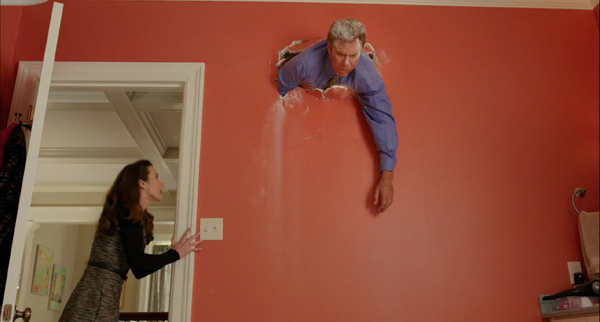
Daddy’s Home (Sean Anders, 2015).
Deadlier than the male (novelist)
DB here:
It’s about time! Sarah Weinman, editor of Troubled Daughters, Twisted Wives (already praised in these precincts) has brought out a two-volume set devoted to women crime writers of the 1940s and 1950s.
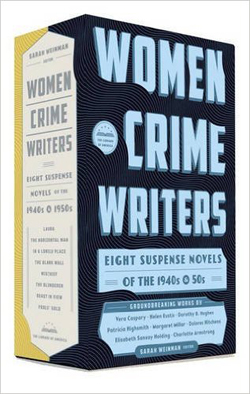
It’s not that these authors are utterly unknown. Popular in their day, some retained a following for a few decades, and Patricia Highsmith has become an enduring figure. Yet the never-ending frenzy for male-oriented noir in books and movies has led us to neglect what these writers and their peers accomplished. In the online essay “Murder Culture” I argued that we’ve probably overemphasized the hardboiled detectives and brutalized losers, and we’ve not paid enough attention to the accomplishments of other writers. The rise of the psychological thriller was central to 1940s popular culture.
Granted, it wasn’t only gynocentric. The thriller assumed exciting shapes in the hands of talented men like Patrick Hamilton, Cornell Woolrich and John Franklin Bardin. But the 1940s saw the emergence of a powerful cadre of women writers, many of whom started writing “pure” stories of detection but decided that suspense would be their forte. Surely they were encouraged by the success of Daphne du Maurier’s Rebecca, the best-selling mystery novel before Mickey Spillane came on the scene. But these suspense-mongers avoided mimicking Mignon Eberhart and other predecessors in the innocent-girl-in-a-spooky-house tradition. These new talents saw menace crouching behind the windows of drab houses and apartment blocks. Out of several tendencies I tried to sketch in that essay, they forged a tradition of what Weinman calls “domestic suspense.”
The Library of America volumes give us a fine occasion for appreciating what they accomplished.
Artisans of suspense
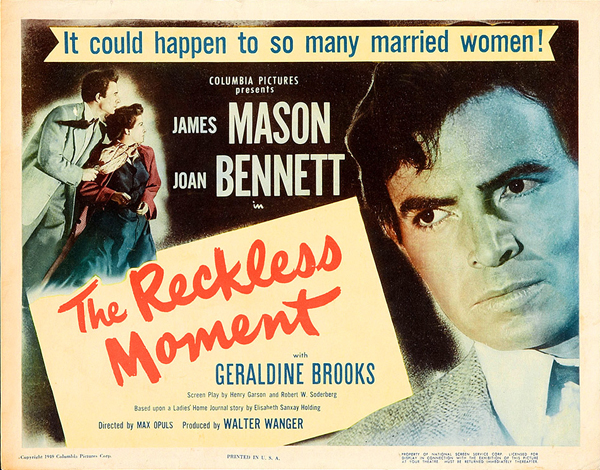
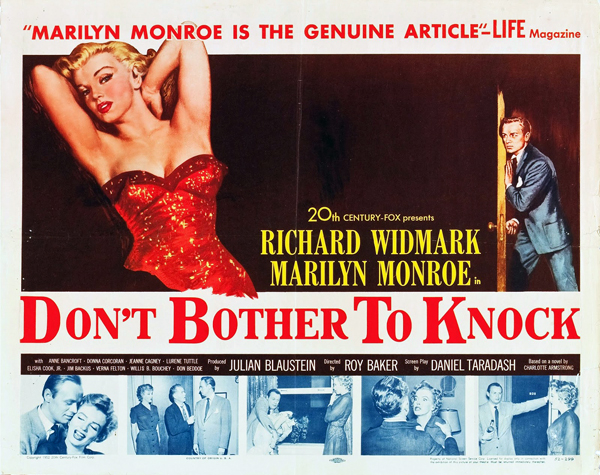
You might say that Double Indemnity and Out of the Past are quintessentially 1940s-1950s films, and I’d agree. But other important films were derived from works by women writers. The list of Highsmith adaptations, starting with Strangers on a Train (1951), is too long to recite here, but let’s remember that Charlotte Armstrong provided source novels for The Unsuspected (1947) and Don’t Bother to Knock (1952, from Mischief), as well as for Chabrol’s La Rupture (1970) and Merci pour le Chocolat (2000). Filmmakers produced now-classic versions of the Dorothy B. Hughes novels The Fallen Sparrow (1942), Ride the Pink Horse (1946), and In a Lonely Place (1950). The prolific but less famous Elizabeth Sanxay Holding gave us The Blank Wall (1947), adapted twice (The Reckless Moment, 1949, and The Deep End, 2001). Dolores Hitchens’ Fools’ Gold (1958) yielded the implausible basis for Godard’s Band à part (1964). Helen Eustis’s The Fool Killer (1954) became a 1965 film. And of course Vera Caspary’s Laura (1943) became a monument of studio moviemaking.
The thriller, you could argue, makes more engaging cinema than the straight detective story. Much as I admire cinematic sleuths like Sherlock Holmes, Nick Charles, Sam Spade, Philip Marlowe, and particularly Charlie Chan and Mr. Moto, pure mystery plots need a lot of bells and whistles to keep from being simply a matter of following the detective as he moves from place to place asking questions and dodging blows on the head. The 1940s tales of espionage, women in peril, serial killings, household anxieties, warped husbands and crazy wives and guileless governesses and all the rest have left a stronger legacy today. We live in the Age of the Thriller, as a glance at any bestseller list will indicate. The recent death of Ruth Rendell, arguably Highsmith’s only top-flight competitor, can only remind us of how the genre has flourished for decades.
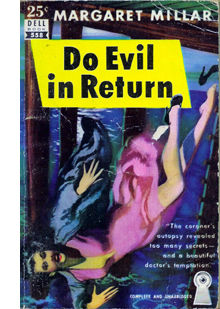 As for the Library of America collection: You couldn’t much improve on Weinman’s selection, I think. All eight novels were appreciated in their day, and some won awards. A reader coming fresh to them will be surprised, I think, by the variety of treatment and the vigor of the writing. It’s to be hoped that encountering these will encourage readers to go on to other works by the same authors. In particular, I’d recommend Sanxay Holding’s The Death Wish (1934), a prefiguration of Highsmith’s dissection of male vulnerability; Margaret Millar’s Do Evil in Return (1950), which centers on a female doctor regretting not helping a woman obtain an abortion; Millar’s chilling The Fiend (1964); and of course almost anything by Dorothy B. Hughes, not least The Expendable Man (1963).
The Library of America collection has rounded up several contemporary purveyors of suspense to write brief online appreciations of the titles in the collection. These are well worth reading. On each page further links take you to fresh material. There’s also a succinct introduction by Weinman. The print editions include her judicious career summaries, as well as notes on allusions and citations in each novel.
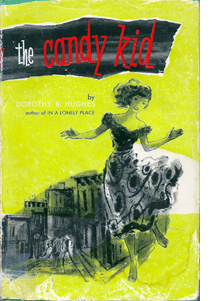
For readers interested in how women’s cultural roles are represented in fiction, these books provide a field day. Several of the professional commentaries suggest that the authors injected social criticism into their works. These writers are far more willing to get inside men’s heads than the hard-boiled boys are to think like a woman, so you can see the macho attitude in a new light. Here’s how Dorothy B. Hughes in The Candy Kid (1950, not in this collection) describes her hero:
Just as he was thinking that he’d better go in and buy a pack, wait for Beach in the air-cooled coffee shop, the girl came around the corner. She was tall, almost as tall as he, but he took a quick look at the pavement and saw that she was propped on heels. That made him feel more male.
Very often these writers take certain stereotypes, both male and female, and submit them to pressure through their craft. Others seem to accept those stereotypes and employ them for their own storytelling ends. Those ends are very much worth our attention.
We know that several of these writers were self-conscious artisans. Hughes and Armstrong wrote articles reflecting on mystery and suspense, while Hughes also wrote a sharp biography of Erle Stanley Gardner. Hughes also conducted a course on mystery writing at UCLA in the 1960s; she invited Vera Caspary in for a guest lecture, and Caspary’s advice makes for fascinating reading. Highsmith’s notebooks, preserved at the Archives littéraires in Switzerland, are filled with meditations on story problems, and she wrote as well a book-length manual, Plotting and Writing Suspense Fiction (1966, 1981). I don’t think that any hard-boiled writers of the era have left such systematic reflections on the nuts and bolts of their work.
Once we pay attention to technique, we can see how these writers rework topics and concerns of the day. For example, we could talk a long time about how social roles induce women to assume a split identity: one face for friends and family, another that resists the masquerade. But these, after all, are mysteries, so that divided identity has to be dramatized—or better yet, played with and teased out for the sake of suspense and surprise. It’s remarkable that two of the books in the collection exploit the syndrome of Multiple Personality Disorder, which becomes part of the final surprise. Another, Laura, makes an enigma of the woman’s inner life by virtue of dispersed viewpoints.
If we want to learn about storytelling, we can usefully look at how writers manage traditional demands of craft. These books “say what they say” in and through technique—narrative form, literary style. The experience that results can be an enduring achievement.
Pronoun trouble
No use asking if the crime writer has anything of the criminal in him. He perpetuates little hoaxes, lies and crimes every time he writes a book.
Patricia Highsmith
Start with style—important in all storytelling, but posing some fascinating issues in the domestic thriller.
One problem faced by all these writers was: How to avoid the sentimental style of romantic suspense writers? Here’s a typical passage from Mignon G. Eberhart’s Another Woman’s House (1946).
She said, blindly choosing trite and inadequate words, “You cannot change your own sense of loyalty, of your own creed and code. It’s bred in your bone; it’s part of your body.”
He understood all the argument below it. He understood too that it was a fundamental argument in his own heart. His eyes deepened, searching her own. He said suddenly, “Myra, you must see this sensibly; you must be realistic and . . .”
“Oh, Richard, Richard!” She cried despairing, and put her head against his shoulder.
There’s some of this novelettishness in Armstrong, as in this bit from Mischief:
When a fresh scream rose up, out there in the other room in another world, Ruth’s fingertips did not leave off stroking into shape the little mouth that the wicked gag had left so queer and crooked.
Hughes and Hitchens, I think, leaned toward the hardboiled laconicism of Hammett and Cain, though without the slanginess. In The Horizontal Man, Eustis tries for a brittle, satiric tenor and some Hollywoodish banter between a reporter and a college woman. Highsmith was adamant in refusing what she called a “pulp” style. Hence her flat, spare simplicity. (Funny, though, since she started out writing comic books for the company that would become Marvel.)
Stylistic options can lie very far down. For years I’ve been curious about what fiction writers call their characters on first entrance. It’s a fundamental creative choice, and it’s absolutely forced: you have to call them something. And what you call them matters.
Here’s the beginning of Armstrong’s Mischief:
A Mr. Peter O. Jones, the editor and publisher of the Brennerton Star-Gazette, was standing in a bathroom in a hotel in New York City, scrubbing his nails. Through the open door, his wife, Ruth, saw his naked neck stiffen….
Cozy, our relation to this Mr. and Mrs. Jones: Mischief gives their first and last names. So far, no reason to be apprehensive. But here’s the start of Hitchens’ Fools’ Gold:
The first time they drove by the house Eddie was so scared he ducked his head down. Skip laughed at him.
Here a relationship is defined through laconic action: we’re on a first-name basis with the pair. It’s as if we’re riding in the back seat. 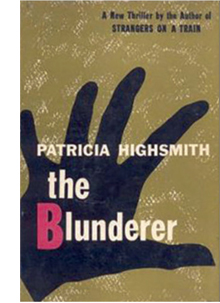 Compare the opening of Highsmith’s The Blunderer.
The man in the dark blue slacks and a forest green sportshirt waited impatiently in the line.
The girl in the ticket booth was stupid, he thought, never had been able to make change fast.
Highsmith is more ominous: No names, just a man as if seen from across the sidewalk. Yet we can’t say the presentation is “objective” because we’re given his annoyed thoughts about the ticket girl. So we are forced to ask: If I’m in his head, why don’t I know who he is? And why is he in a hurry?
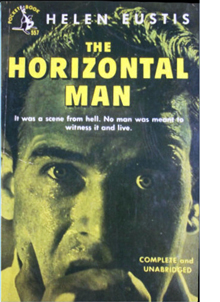
And finally, the opening lines of Eustis’ The Horizontal Man:
The firelight played over all the decent, familiar objects of his everyday life; he viewed them desperately, looking for some symbol of succor. The firelight played on his rolling eyeballs, the careless tendrils of his black hair. “Oh now,” he said, “Oh now, I say, look here…” trying to summon a tone of commonplace to breast the tide of nightmare that was rising in that room.
Eustis dispenses with everything but he in describing something terrible going on. Not only do we not know who’s suffering, but we won’t know for some time. This, like the Highsmith, might be called “pronominal mystery”: not knowing anything about who’s in danger, we sense the danger as a pure force swallowing up trivialities of identity.
Most manuals of fiction-writing start by reviewing the bigger choices, like first- or third-person narration, but note that even within third-person storytelling, these passages bristle with different implications. Each of these openings puts us in a different relation to the characters picked out.
The storyteller makes a choice about how to name the actors in the scene, and that choice leads to others: the scene is built out the premises of what have launched it. Ruth, who studies her husband Peter at the mirror, will become one conduit of information within Mischief. Skip, who laughs at Eddie as they size up the home they’ll invade, will bully his partner throughout Fools’ Gold. The man in the slacks and sportshirt will drop out of The Blunderer for several chapters. So no need to name him yet; magnify the mystery. And the opening scene of The Horizontal Man will continue with personal but untagged pronouns—a she will be picked out too—as the full awfulness of the action emerges.
 I suspect that the development of the suspense thriller in the 1940s sensitized writers to fine-grained choices like this. The verbal fabric became part of the suspense: not just what will happen next? but why is the action being presented in this way? This second layer of intrigue seldom occurs in the hardboiled detective novels. While Hammett, Chandler, and Ross Macdonald (married to Margaret Millar) slipped easily into first person and easygoing openings, these women writers were willing to try more oblique, tantalizing, and formally adventurous options. (Though we find them in Goodis, Woolrich et al. as well.) Without this newly cultivated sensitivity to names and non-names, proper nouns and pronouns, I doubt we would have the tour de force of Ira Levin’s A Kiss Before Dying (1953) and the shock of Hughes’ Expendable Man, or the brilliant opening of Ruth Rendell’s Wolf to the Slaughter (1967).
Fussy as these details are, they’re what I mean by craft. The verbal texture of any piece of fiction depends on dozens of such minute judgments. Just as in film every cut, camera movement, and actor’s glance matters, so does every word in a prose narrative. These writers understood that what we learn, syllable by syllable, can be a potent source of uncertainty and suspense.
Who sees and who knows?
The whole intricate question of method, in the craft of fiction, I take to be governed by the question of the point of view—the question of the relation in which the narrator stands to the story.
Percy Lubbock, The Craft of Fiction
In mystery fiction, management of point of view is critical. Not only will it weave the moment-by-moment verbal tissue, but it provides the large-scale parts that present the overall action. Where the Had-I-But-Known romance tends to be restricted to a single character, often through first-person narration, domestic suspense employs other options. It’s significant that of these eight novels, only one, Laura, employs first-person narration, and that in a distinctive way I’ll consider further along.
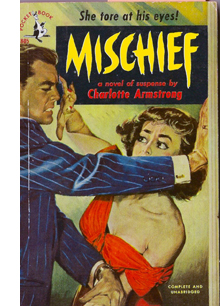 Unrestricted narration is a good strategy for maximizing suspense, as we see in Armstrong’s Mischief. A husband and wife leave their little girl with a babysitter in their hotel while they go off to an awards dinner. But the babysitter is one of those Crazy Ladies that the 40s produce in great profusion and the child is endangered.
How to complicate this basic situation? Armstrong recruits a device—call it a narrative meme if you want—that emerges at the period: the eyewitness, typically in an urban setting, who glimpses possibly criminal doings and gets involved. This device finds its supreme filmic expression in Rear Window (1954), but it’s established in earlier films like Lady on a Train (1945), Shock (1946), and The Window (1949), and in the radio drama The Thing in the Window (1945), by Lucille Fletcher (another thriller queen, but of the airwaves). In Mischief, people in a building across the street from the hotel intervene in the doings of the babysitter, and the plot “intercuts” all their trajectories in order to create tension.
Hitchens’ Fools’ Gold similarly jumps from character to character, even within a single scene. This tale of a heist that is way above the skill sets of the thieves—a sort of humorless anticipation of an Elmore Leonard or Donald Westlake situation—uses unrestricted narration to build sympathy for the characters who are gulled into participating.
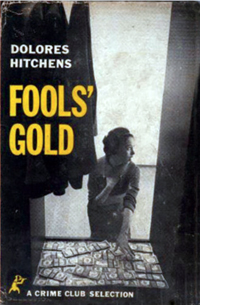 Central among these is Karen, pathetically happy that Skip is paying attention to her. One chapter starts with her meeting him after class, snuggling warmly into his arms (“Here was someone to whom she could confide the disaster with the coat”), before the narration switches brusquely to him:
Skip listened, at first with indifference. He’d heard already from Eddie of Karen’s reaction to the money, her frightened excitement about it. It took a moment to realize that this wasn’t more of the same, the reaction of an inexperienced girl, but that a bad break had really occurred.
Throughout the chapter, this rather nineteenth-century version of omniscience will toggle between Karen and Skip, heightening the disparity between her lack of awareness and his harshness. “He was just having fun though she didn’t know it.” Arguably, a heist plot needs a certain wide-ranging narration (see The Asphalt Jungle), but Hitchens uses it to take us into the minds of all the characters, major and minor, and suggest both vulnerability and menace.
In a classic detective story, the identity of the culprit is concealed until the end. One Golden Age “rule” is that in the course of the action we must never be given the viewpoint of the killer. The rule was broken on occasion, notably in a certain novel by Agatha Christie, but it remained rather firm. In the thriller, by contrast, we can be in the killer’s mind, knowing full well that he or she is indeed the killer. A prototype is Patrick Hamilton’s Hangover Square (1941). Two books in this collection walk a line between detective story and thriller in this respect.
In Eustis’ The Horizontal Man, a popular professor has been murdered. The effects of his death ripple out across the campus, and the narration shifts among his colleagues, some students, and a reporter investigating the crime. In the midst of a corrosive satire of the academic life, we suspect that someone whose mind we have entered will turn out to be the culprit. So we have to probe the inner lives of the characters we encounter for psychological clues, not physical ones. The author must conceal the killer’s identity and “play fair,” in that what we learn at the end unexpectedly fits the characters’ stream-of-consciousness musings.
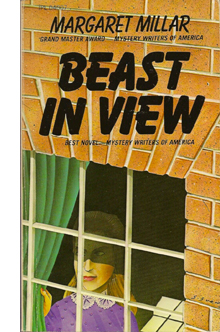 A similar problem confronts Margaret Millar in Beast in View. At the start the viewpoints aren’t quite so dispersed: initially, we shift between a woman plagued by threatening phone calls and an amateur investigator looking into the matter. As the mystery deepens, however, the range of knowledge spreads and we get “lateral” viewpoints on the central situation. This is partly to deflect us from the grim revelation that we have been quite thoroughly misled.
It is a pity that this edition didn’t include Millar’s 1983 Introduction and Afterward. The latter explains the origin of the book’s device, while the Introduction reports the effects the book had:
I was threatened with a libel suit, informed by a patient in a mental institution that at last she had found someone who really understood her, invited to join a coven of witches, asked to address a meeting of psychiatric social workers, and presented with the Mystery Writers of America Edgar Allan Poe award for best mystery of the year.
At the other extreme, two of these novels focus on extremely restricted viewpoints. Hughes’ In a Lonely Place is wholly locked within the mind of a hypermasculine ex-Air Force pilot who trails and murders women. Hughes gives us the pronominal tease: it’s he for the first five pages until, when he places a phone call, we learn he’s called Dix Steele. In a cat-and-mouse game reminiscent of films like Woman in the Window and Where the Sidewalk Ends, the killer gets close to the murder investigation. Dix’s army buddy is the chief cop on the case, so Dix can monitor things and even drop in on crime scenes. Strikingly, Hughes puts the killings “off-page.” This admirably eliminates any Spillane-ish sensationalism while keeping the focus wholly on the way Dix loses control of his masquerade. He’s worn away in a series of confrontations with two women who see, as no man can, something deeply wrong in him.
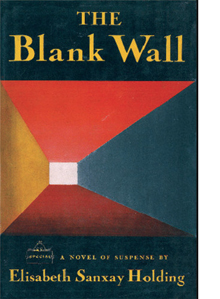 Closest to the traditional woman-in-peril plot is Sanxay Holding’s The Blank Wall. While her husband is away in the service, a middle-class housewife learns that her daughter has been seduced by a sleazy opportunist. The wife soon becomes the target of two blackmailers, one of whom grows to love her. Gifted with a pair of obnoxious and ungrateful children and an amiably oblivious father, the heroine is doubly trapped—within a confining household and a crime cover-up. We’re limited to her range of knowledge, so every encounter is charged with uncertainty about the motives of others. She can’t confide in her husband and so must write bland letters to him reporting that everything is just fine.
As you’d expect, Highsmith tries something more intricate in The Blunderer. Here we have two protagonists, each man given his own viewpoint. But after an opening introducing us to one man’s crime (in a scene that spares no violent detail), he drops out of the action for a hundred pages. We concentrate instead on the polished professional lawyer whose life unravels when his domestic skirmishes—nearly all petty and drab—come to a head. As with most Highsmith men, he is tempted to do something very trivial and very stupid, almost out of intellectual curiosity. Highsmith policemen take a dim view of such enacted thought experiments.
As the two protagonists’ worlds converge, we get the characteristic Highsmith themes of self-possessed men losing their nerve, the traps of respectable life, the risk of impulsive action, the ways in which friends turn away from you when they suspect you of lying. The lawyer is called by his first name, Walter, while his counterpart is known to us by his last name, Kimmel. In such subtle ways does an author align us a little more closely with one character than another. Both, though, are blunderers.
I should add that all the markers of 1940s fiction and film—dreams, hallucinations, false fronts, unstable families, untrustworthy lovers, socially adroit psychopaths—are woven into these novels with great skill. What more could you ask?
A frenzy of recapitulation
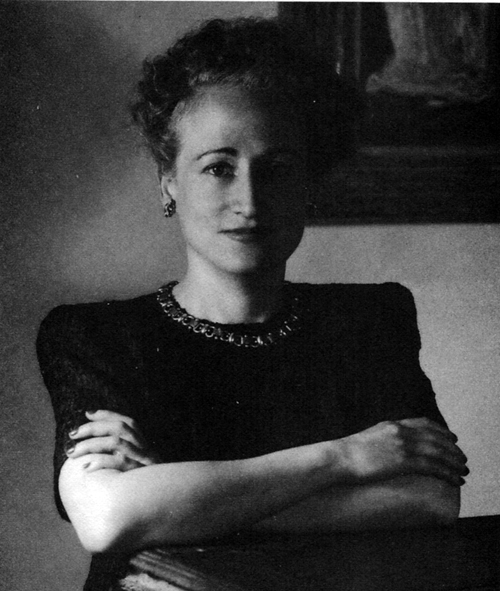
Vera Caspary, 1946.
The earliest novel in Weinman’s collection is also one of the most remarkable of the period. Vera Caspary was a woman to be reckoned with—Greenwich Village free-love practitioner, Communist party member, occasional screenwriter, boundlessly energetic purveyor of suspense fiction, passionate paramour of a married man, and advocate for women in prison. Our State Historical Society holds her personal collection, which includes fascinating notes on projects both realized and unrealized. Turning the pages of her files, you meet a crisp, professional artisan.
So let’s look at Laura the novel. If you know the film, as you probably do, nothing I say will spoil the book for you.
In 1942 Collier’s (“The National Weekly”) offered Caspary $10,000 for the serial rights to Ring Twice for Laura. That sum, equal to $150,000 today, didn’t include book publishing rights, movie rights, and any other ancillaries. The price tag tells us quite a bit about the robust slick-magazine market of the period and about Vera Caspary’s standing. After writing novels, plays, short stories, and screenplays, she was no novice, but her new manuscript set her on a path toward fame. Published as Laura in 1943, it found acclaim as “something quite different from the run-of-the-mill detective story.” The publisher called it a “psychothriller.”
Laura is both a mystery story and a romance. A woman is found murdered in her apartment. Although a shotgun blast has disfigured her face, she’s initially identified as ad executive Laura Hunt. After the funeral, while detective Lieutenant Mark McPherson is poking around her apartment, Laura returns from a trip and it’s revealed that the victim was actually Diane Redfern, a model to whom Laura had loaned the apartment.
The misidentified-victim convention triggers an investigation into the usual sort of suppressed backstory: How did Diane wind up in Laura’s place? Was she alone? Was she the target all along, or was she mistaken by the killer for Laura? Along the way, the cop—already half in love with Laura dead—begins to both woo and browbeat her.
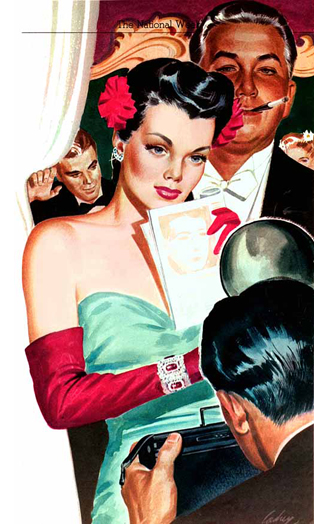 At the same time, a cluster of suspects needs questioning: Laura’s flighty Aunt Susie, her fiancé Shelby Carpenter, and her lordly patron, the columnist Waldo Lydecker. Laura isn’t exonerated either, because she has reason to hate Diane. The usual array of clues—the murder weapon, a bottle of cheap bourbon, and a cigarette case—tugs McPherson this way and that, although his final discovery of the killer depends as much on intuition about personality as about physical traces. The plot hole in the film (why isn’t the artist Jacoby, who painted Laura’s portrait, an obvious suspect?) is there in the original novel as well, but few readers or viewers seem to notice it.
What was striking about the book was its point-of-view structure. “Four persons tell this story and play the leading parts in it,” noted the New York Times reviewer. “McPherson questions all three, and all three tell him lies.” In presentation Caspary revived what has been called the casebook method of composition: a series of testimonies, written or transcribed from speech, that recount the mystery. Sometimes those are accompanied by police reports, newspaper coverage, and other documents.
The method is identified with Wilkie Collins’ two great novels The Woman in White (1860) and The Moonstone (1868), and was taken up occasionally by others, particularly within a trial situation (e.g., The Bellamy Trial, 1929). Before Laura, probably the most famous instance of a mystery collation is Dorothy Sayers and Robert Eustace’s Documents in the Case (1930). The technique also has affinities with multiple-viewpoint assembly in “straight” fiction influenced by Dos Passos; Kenneth Fearing had tried it in his experimental novels The Hospital (1939) and Clark Gifford’s Body (1942) as well as in his crime stories Dagger of the Mind (1941) and The Big Clock (1946).
To take us through the eight days of the investigation, Caspary’s casebook assigns each character a block of narration. Each block, told in first person, has its own distinctive tenor, representing a particular subgenre of mystery fiction.
If you didn’t know the Laura mystique already, you might suspect that the opening chunk, told from Waldo’s perspective, would announce him as the brilliant amateur detective who will solve the case and surpass the plodding McPherson. Waldo is a celebrity columnist, a connoisseur of murder and lethal banter. Like 1920s detective Philo Vance, he collects art and lords it over others through aggressive erudition. Waldo writes in periodic sentences of eloquent self-congratulation:
My grief in her sudden and violent death found consolation in the thought that my friend, had she lived to a ripe old age, would have passed into oblivion, whereas the violence of her passing and the genius of her admirer gave her a fair chance at immortality.
There are even the sort of fake footnotes that we find in S. S. Van Dine and Ellery Queen novels of the 1930s, attesting to the scholarly bona fides of this dilettante sleuth.
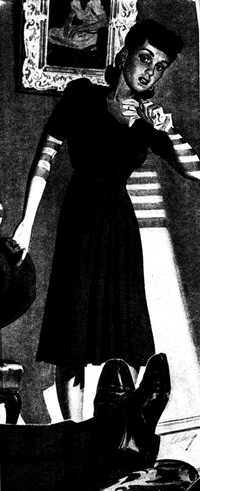 Waldo’s power over Laura, as her patron and guru, gets expanded to a remarkable authority over the narrative in this first part. He tells us things he did not witness, chiefly the early “offstage” phases of McPherson’s investigation, and his explanation is that of the artist as god.
That is my omniscient role. As narrator and interpreter, I shall describe scenes which I never saw and record dialogues which I did not hear. For this impudence I offer no excuse. I am an artist, and it is my business to re-create movement precisely as I create mood. I know these people, their voices ring in my ears, and I need only close my eyes and see characteristic gestures. My written dialogue will have more clarity, compactness, and essence of character than their spoken lines, for I am able to edit while I write, whereas they carried on their conversation in a loose and pointless fashion with no sense of form or crisis in the building of their scenes.
This is an extraordinary passage. It opens the very-‘40s possibility that what follows may be Waldo’s fantasy. Only near the end of his text does Waldo assert that his knowledge of McPherson’s investigation is derived from what Mark later told him one night at dinner. We will soon learn that Waldo’s opening section was written directly after that dinner, but he actually didn’t know one key fact. His omniscience is an illusion.
McPherson takes up the tale in the second part. He has read Waldo’s account and treats it as a separate piece of evidence. As we follow McPherson’s investigation, we’re in the realm of the police procedural. The register shifts too. If Waldo’s style is showoffish, McPherson’s is laconic. Whereas Waldo celebrates how his prose will immortalize Laura, McPherson admits that his version of things “won’t have the smooth professional touch.”
Actually, though, it does. It reads hard-boiled.
As we stepped out of the restaurant, the heat hit us like a blast from a furnace. The air was dead. Not a shirt-tail moved on the washlines of McDougal Street. The town smelled like rotten eggs. A thunderstorm was rolling in.
Caspary gives us the voice of the tough but vulnerable cop, the voice we would later learn to call noir. There’s an echo of James M. Cain when McPherson signals that in retrospect he was wrong to trust this femme fatale: he sourly describes himself in the third person.
She offered her hand.
The sucker took it and believed her.
McPherson’s eventual victory over Waldo is prefigured in the cop’s reflections on writing up crime. When Waldo learned Laura was still alive, McPherson says, “The prose style was knocked right out of him.” So much for Wimseyish fops set down in a Manhattan murder.
Shelby gets his voice in as well. A brief third section consists of a police transcript of McPherson’s questioning. Aided by his attorney, Shelby withdraws some lies, dodges uncomfortable areas, and generally remains the most obvious suspect—as well as Mark’s rival for Laura. At this point in the book Caspary begins to play an intricate game of knowledge, in which we get, piecemeal, information that tests the string of deceptions and evasions confronting McPherson.
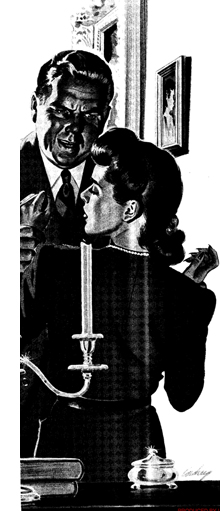 In the fourth section, Laura writes her testimony. Once more the circumstance of composition is explained to us. Laura confesses that she can’t understand what she thinks and feels unless she sets it down. She has burned her old diaries, but now she has to start over.
It’s always when I start on a long journey or meet an exciting man or take a new job that I must sit for hours in a frenzy of recapitulation.
Now the action is that of the woman in peril, the figure familiar from Eberhart and Rinehart and Sanxay Holding. And so the stylistic register is “feminine,” tracking fluctuations of feeling and noting costume details and shades of color. Laura’s narration is also suspenseful and contemplative, dwelling on moments that seem to radiate danger—McPherson’s trick questions, Waldo’s sinister manipulations, and Shelby’s pretense that he’s protecting her rather than himself.
The emphasis is less on external behavior than Laura’s growing realization of why she has clung to two failed men. She will gradually realize that McPherson, despite his coldness, is the best match for her. Waldo is “an old lady” and Shelby is an overgrown baby. Caspary the left-winger gives these portraits the taint of class corruption. Waldo and Shelby are ghoulish creatures of the high life, while Aunt Susie is the faded, self-indulgent beauty Laura might become.
Laura’s recognition of her entrapment is rendered in a choppy, spasmodic fashion. Waldo’s, McPherson’s, and Shelby’s accounts have all been linear. Laura’s is not. It skips around in time, replays scenes we’ve seen from other viewpoints, and incorporates dreams that seem as well to be flashbacks.
This is no way to write the story. I should be simple and coherent, fact after fact, giving order to the chaos of my mind. . . . But tonight writing thickens the dust. Now that Shelby has turned against me and Mark shown the nature of his trickery, I am afraid of facts in orderly sequence.
In a narrative dynamic we find throughout 1940s fiction and film, the strong career woman is thrown off balance and succumbs to confusion. The most notorious example is of course Lady in the Dark, the 1941 play that appeared on film in 1944, the same year as the film version of Laura.
The lady returned from the dead will need a real man to rescue her. That rescue is enacted, again, in prose when McPherson reassumes control of the narrative. The book’s fifth part consists of two sections: the classic summing up and denunciation of the culprit (Waldo) and the rescue of Laura from Waldo’s second attempt to kill her. McPherson’s hard-boiled diction has won out. As Waldo is taken away in the ambulance, however, he earns a degree of purely verbal revenge. McPherson’s narration quotes Waldo’s mumbled phrases as, dying, he fills in plot points. In the process, his style gets inserted, like an alien bacterium, into McPherson’s curt passages.
McPherson, who can afford to be gallant, gives Waldo the last convoluted word. It comes in a quotation from the manuscript found by McPherson at the climax, a passage that confirmed Waldo’s guilt. In Waldo’s unfinished account, Laura is an essence of womanhood, a modern Eve; but one who continually reminded him that he could never be Adam.
During production of the film version of Laura, the makers considered mimicking the novel’s block construction. Citizen Kane had made multiple-viewpoint narration more thinkable in the 1940s. In the end, though, only Waldo’s voice-over was retained, with results that have provoked several critical comments.
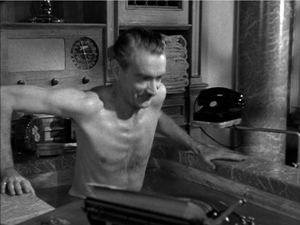
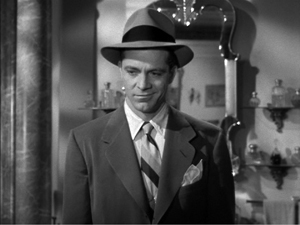
The film made many other changes, large and small, but during this reading of the novel two improvements stood out for me. Making Waldo a radio commentator as well as a columnist allows a rich play of sound that comes to a climax at the film’s dénouement. Secondly, Waldo drops out of the book for many stretches, largely because Caspary is concerned to throw suspicion on Shelby and Laura. But the film keeps Waldo onscreen a lot, even permitting him (against all plausibility) to tag along with McPherson on the investigation. His waspish interjections, delivered by a suave Clifton Webb, add a nice tang, while sustaining Caspary’s theme of class snobbery. The film adds several kinks, such as introducing Waldo writing in his bathtub. The situation includes one of those how-did-they-get-away-with-it? moments when, as Waldo climbs out of the water, Mark glances scornfully offscreen at Waldo’s privates.
Caspary would go on to other successes, notably the screenplays for A Letter to Three Wives (1948) and Les Girls (1957) and several other novels that play with block construction and shifting viewpoints. But Laura would remain her prime achievement. It’s a striking novel that became a landmark film and an enduring example of how female crime novelists could stretch and deepen the conventions of popular literature.
A useful and spoiler-free biographical survey of many of these writers is Jeffrey Marks’ Atomic Renaissance: Women Mystery Writers of the 1940s and 1950s (Delphi, 2003). See Mike Grost’s inevitably encyclopedic coverage as well.
Highsmith’s disdain for pulpish style is discussed in Andrew Wilson, Beautiful Shadow: A Life of Patricia Highsmith (Bloomsbury, 2003), p. 124; my quotation above comes from p. 256. I’m grateful to Ms. Stéphanie Cudré-Mauroux of the Archives littéraires suisses for other information about Highsmith.
Some craft advice from these authors can be found in Dorothy B. Hughes, “The Challenge of Mystery Fiction,” The Writer 60, 5 (May 1947), 177-179; Charlotte Armstrong, “Razzle Dazzle,” The Writer 66, 1 (January 1953), 3-5; and Patricia Highsmith, “Suspense in Fiction,” The Writer 67, 12 (December 1954), 403-406. Millar’s discussion of Beast in View is in the International Polygonics edition of the novel, 1983, pp. 1-2, 249.
Vera Caspary’s autobiography, The Secrets of Grown-Ups (New York: McGraw-Hill, 1979), is a captivating read that introduces us to a fascinating personality. (“Under the ready smiles were witches’ grimaces, beneath the padded bra a calcified heart.”) In Wilkie Collins, Vera Caspary and the Evolution of the Casebook Novel (McFarland, 2011) A. B. Emrys offers an excellent study of Caspary’s work in relation to mystery traditions. Caspary’s “official” response to Preminger’s film comes in “My Laura and Otto’s,” Saturday Review (26 June 1971), 36-37.
Hammett was no slouch at juggling proper names and pronouns either. I marvel that he could call Ned Beaumont “Ned Beaumont” all the way through The Glass Key. All the other characters are tagged with their first or last name, but this option maintains an unsettling middle distance on his psychologically opaque protagonist.
I discuss Waldo’s narration in the film version of Laura in more detail in this entry.
Wesworld
DB here:
Wes Anderson is back on our blog.
I composed a 2007 entry that tried to trace the stylistic tradition he belongs to (sloganized as “planimetric” staging and “compass-point editing”?). In 2014 the multiple aspect ratios of The Grand Budapest Hotel grabbed my attention. That essay, revised, was included in Matt Zoller Seitz’s anthology on the film, duly teased and announced here. At greatest length, another 2014 entry offered some thoughts on Anderson’s standing as an auteur through an analysis of Moonrise Kingdom (2012).
The film has worked its way into the eleventh edition of Film Art: An Introduction, forthcoming in January. In Chapter 11 an analysis of Moonrise Kingdom joins discussions of films by Ozu, Hawks, Hitchcock, Vertov, Scorsese, and other major directors. Moonrise Kingdom, I think, a film that will have lasting interest for young viewers and filmmakers, and it’s a fine vehicle for teaching principles of narrative and style.
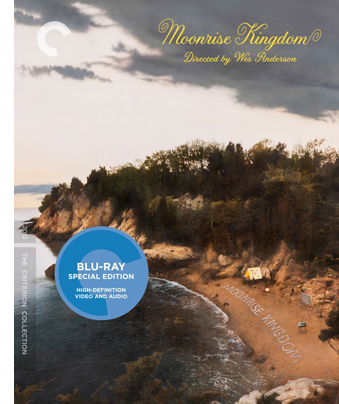 Since then I’ve learned more, thought more, and seen more. Specifically, I’ve seen Moonrise Kingdom in the gorgeous new Criterion Blu-ray release.
That release bundles in the sort of auteur artifacts my blog entry talked about. The purchaser gets a map of New Penzance, an invitation to the 1964 Noye’s Fludde performance at St. Jack’s, rather unflattering snapshots of the characters, and a postcard of the island ensemble (minus Social Services and the phone operator). On the disc we get Edward Norton home movies (as casual as anybody else’s, but showing some ingratiating behind-the-scenes stuff), some Bill Murray riffs, a brief making-of, and other snippets. The booklet, modeled on the Scouts’ magazine Indian Corn, includes a brief, sympathetic essay by Geoffrey O’Brien and reviews by kids.
A kid also conducts, if that’s the word, the extremely free-form commentary track on the disc. Young actor Jake Ryan, who plays one of Suzy Bishop’s brothers, sort of oversees chat among Anderson, Criterion leader Peter Becker, and participants in the production. Those last are brought in via phone calls. There are bathroom breaks, discussions of San Francisco Chinese restaurants, a Mozart piano performance by Jake, and a moment in which one discussant is accused, doubtless unjustly, of falling asleep. The whole enterprise, cut down from a five-hour marathon, will probably enchant Anderson devotees while giving new ammunition to those who find those admirers nuts, or worse. For my part, I found that Edward Norton and Bill Murray shared some worthwhile bits of acting craft, and Anderson gave some interesting information about the production.
Anderson adepts don’t need me to urge them toward this disc and its accessories. Today I want to think some more about this movie, which after two more viewings hasn’t lost any of its fascination for me. I’ll be concentrating on what it shows about worldmaking on the screen.
Departures, minimal and more

If you stripped off all the enticing elements like the toy lighthouse and the Khaki Scout badges, the gnomelike narrator and the interjected postcards and the implausibly perched treehouse, what do we have? In its bare bones, a pretty simple plot anatomy.
A couple in love, blocked by parental opposition, runs away. After an idyllic day and night, they are captured and separated. Then it all starts again, thanks to the miraculous conversion of some of the boy’s enemies, who decide to help him and the girl escape.
Again the couple flees, this time to be unofficially married. Pursued by parents and the authorities, the couple is trapped in a massive storm and is rescued by the kindly sheriff. They are united to live in a more-or-less tolerated love affair.
Although these are primal patterns of engagement, Moonrise Kingdom wouldn’t claim much interest if this were all it offered, folktale-fashion. As usual in modern narrative, the real interest involves finer-grained plot developments, characterizations, and narrational maneuvers. So the basic anatomy gets flesh, nerves, muscles, and circulating blood. Anderson and co-screenwriter Roman Coppola give us well-defined characters, dramatic situations, and secrets and mysteries and suspense. They play with time and viewpoint, build suspense, trigger surprises, and wrap things up with unexpected neatness. Several of these tactics I tried to chart in the 2014 entry.
Anderson and Coppola could have stopped there, but they didn’t. They went on to invent a world.
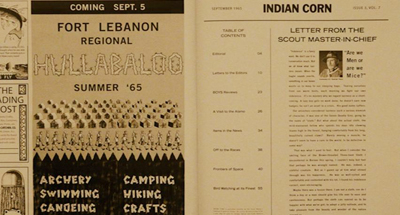
You can argue that this world’s main purpose is to distract us from the simple flight/pursuit/capture/rescue dynamic of the basic story action. But I’d argue that the final film benefits from fleshing the core action out in a way that situates it in a unique milieu. There’s also the point that worldmaking is no small achievement. Your task as a storyteller, George Lucas once noted, will change when you have to figure out what your character’s fork looks like.
Take the three dimensions of narrative I sketched out here and here—story world, plot structure, and narration. For some of us (I include myself) genre-based narrative has creative, even experimental possibilities along all those dimensions. Crime fiction, including mystery and suspense tales, can become a laboratory for experiments with plot structure and narration. Connoisseurs of thrillers and detective stories know that they must read warily, for the author is often trying to deceive and mislead. My entries on Side Effects and Gone Girl afford some examples of the process.
Fantasy and science-fiction can experiment with plot and narration, as do Blade Runner and Source Code, but those genres are more typically straightforward along those dimensions. Historically, their core appeal has relied mostly on creating unique story worlds. A prime attraction of Star Wars and The Lord of the Rings is the sense of an alternative realm teeming with unique creatures moving among unknown territories. But creating a distinctive story world puts demands on the storyteller.
We have an indefinite number of default values that are in place as we encounter any narrative. For one thing, we assume that the world we encounter there will be almost entirely like our own. Unless we’re told otherwise, we’ll assume that Sherlock Holmes can bleed.
Narrative theorist Marie Laure-Ryan calls this the principle of minimal departure. With secondary world tales, we move toward maximal departure. When a narrative world diverges drastically from ours, as those in fantasy and science-fiction do, we need a lot more extra information—about how these robots are related to their masters, about why the dragon has been sleeping for so long, about why it always seems to be raining in Blade Runner’s Los Angeles. The storyteller, in his or her own voice or via character dialogue, must spell out these minutiae.
But not all of them. Inevitably there are some unfilled spaces. Something always is left untold. As a storyteller, you know that every character comes trailing a backstory that can be expanded or revised (maybe in a sequel). In addition, your world gains solidity if you hint about tales yet to be told, as Dr. Watson alludes to the still-unwritten case of the Giant Rat of Sumatra.
What the author leaves blank others can fill in. As the internet has shown dramatically, fans can take up the job of adding to secondary worlds. They can offer their own versions of adventures in the realms of Star Trek, LotR, and other fictions. True, nothing stops you or me from writing new adventures of Sam Spade or a sequel to Rebecca, but you probably won’t be enriching the characters’ milieus with fanciful creatures or gadgets or foliage, let alone entire planets.
Several big Hollywood franchises have embraced the idea of secondary worlds, but independent cinema largely has not. Indie films tend to be modest, realist exercises that tell their stories and stop there. Part of their raison d’etre is to be different from the fantasy and science-fiction epics blasted at us by the studios. So melodramas and thrillers, biopics and anecdotal character studies, don’t by and large traffic in parallel worlds. The sequel, a standard narrative unit for worldmaking fiction, is rare in indie cinema, and even then it tends to be of a realist tenor, such as Linklater’s Before/After series. When fantasy enters an indie film, as in Being John Malkovich or Beasts of the Southern Wild, it tends to consist of one adjustment of the principle of minimal departure, not a drastic overhaul of the story world.
Now we can get a better sense of the originality of Anderson. Moonrise Kingdom, like The Life Aquatic with Steve Zissou, Fantastic Mr. Fox, and The Grand Budapest Hotel, presents itself as a richly realized parallel world. The classic comedy plot of lovers opposed by parental authority plays out in a densely furnished alternative realm derived from our own, but with its own peculiar features.
The uses of reenchantment
My 2014 blog entry took this parallel-world project as a valid one and defended Moonrise Kingdom against charges of preciosity and twee. I suggested that the film had affinities with a tradition of fantasy going back to Lewis Carroll, James M. Barrie, and G. K. Chesterton. In the back of my mind I had longer-term influences as well, such as stories of Atlantis and of course Gulliver’s Travels.
 Since then, I’ve read Michael Saler’s excellent 2012 book As If: Modern Enchantment and the Literary Prehistory of Virtual Reality. Saler argues that the impulse toward fictional worlds in contemporary mass media and video games back to various strands of literary culture in the nineteenth century. He traces the development of a new kind of fiction: fantasy worlds rendered with the detail pioneered by emerging realist schools of writing. Poe and Verne were early sources, but the “New Romance” launched by Stevenson with Treasure Island (1883) and H. Rider Haggard with She (1887) crystallized the idea of imaginary lands that could be filled out in unprecedented detail. Stevenson’s and Haggard’s successors realized that maps, footnotes, news stories, eyewitness correspondence, and illustrations of artifacts could give pure fantasy a sense of solid reality.
Admirers of these romances, Saler suggests, cultivated a complex frame of mind. They knew at bottom that it was all fiction, but they also enjoyed the imaginative freedom of a new game. They conceived a world that was as tangible as ours but still harbored the power of magic.
The imaginative exercise might vary. For extreme fans of the Sherlock Holmes saga, the task was to pretend that Arthur Conan Doyle was simply Dr. Watson’s literary agent, and that Holmes, Watson, Moriarity, and all the rest were living humans. Watson’s records of Holmes’ achievements became a sort of documentary scripture that had to be scrutinized for what it hinted at or left out. For admirers of Tolkien, engagement involved acquainting oneself with the encyclopedic variety of cultures, creatures, folklore, languages, and landscapes of a truly parallel world. What Tolkien called the legendarium presented as daunting a mythology as any discovered by a real-world ethnographer.
The broad social function of this trend, Saler argues, was to reenchant modern life. From geology to biology, from astronomy to psychology, turn-of-the-century science had blown away many dogmas. The spirit world was shrinking. The modern task of turning mysteries into puzzles for the rational intellect had begun. The “as if” invitation of virtual worlds gave both creators and consumers a way to exercise their minds in freer ways. Writers and readers could cultivate what Saler calls “animistic reason,” a rational scrutiny of what was there, but one fueled by imagination. As he notes, even that paragon of logic, Sherlock Holmes, relies on intuition and insight.
From this standpoint, Moonrise Kingdom reveals itself as part of a richer tradition than I’d realized. Its parallel world still seems to me to radiate the fairy-tale qualities of Carroll, Chesterton, and company, given some absurd twists; but now I see the emphasis on documentation, all the maps and letters and lists, as owing something to the New Romance. The film is something like a scrap-album version of a story. At the same time, the wondrous qualities of Anderson’s tale—not least, Sam’s survival of a lightning bolt and the miraculous rescue of the couple by Captain Sharp—carry, at least for me, some of that reenchanting of the everyday world that Saler finds in this tradition. Above all, we learn, as always, that things we think are very modern turn out to be new variants on something that went before. In Moonrise Kingdom, Anderson updates a nineteenth-century version of magical realism.
How to make a world
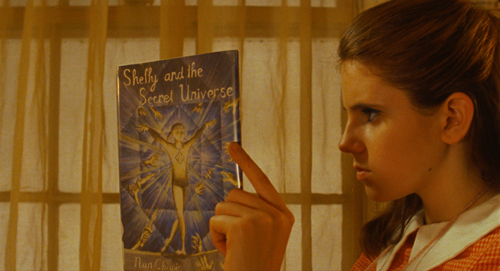
In my earlier entry I talked about how the worldbuilding enterprise fits snugly into modern cinema’s demands for both authors and brands. Anderson’s typical strategies of style and storytelling set him apart from his peers artistically, but they also offer entry points for merchandising and fan appropriation. What’s especially likable is Anderson’s embrace of the DIY aesthetic, as both he and his fans practice it. Unlike Lucas, who polices amateur Star Wars tchotchkes, Anderson encourages his admirers to spin their own riffs on his work.
Yet worldmaking is more than franchise branding. Saler’s As If, a work of cultural history, doesn’t try to analyze the literary strategies of the individual works very much. I want to ask: What does this creative option commit storytellers to? And how does Moonrise handle the challenges?
Most basically, the storyteller has to teach us the rules, big or small, that govern the world. Is it a kingdom, a post-apocalypse wasteland, or a world at war? This process goes easier if the imaginary world is a model world, a sort of schema we can fill out because it fits into a general concept we already have. If this is a kingdom, as Alice’s Wonderland partly is, then we can grasp the presence of Kings, Queens, aristocrats, soldiers, and beheadings. If it’s a wasteland, we expect something more like a world of nomadic tribes, with the absence of law producing scavenging bands and violent clashes. If an alternate world embodies one or more conceptual schemes we already know, we can learn our way around this new one faster.
The source schemas needn’t of course be absolutely real, just conceptually familiar. So the kingdom of Alice’s Wonderland is partly defined by the iconography of chess and playing cards. Likewise, our knowledge may not be wholly historical. Blade Runner’s LA is 80s Tokyo gone grubbily high-tech, but it’s also derived from the iconography of film noir. An idea of civil war informs Game of Thrones, with its borrowings from various phases of European history, but it seems likely that viewers’ familiarity with board games and role-playing games also clarify the forces in contention. The showrunner David Benioff tagged Game of Thrones “The Sopranos in Middle-Earth,” and this suggests how different schemas, real or fictional, can cooperate to distinguish a model world.
In Moonrise Kingdom, several schemas blend nicely to help us grasp the outlines and let the tweaks stand out. There’s the social situation of early adolescence, defined by family (or foster care, as in Sam’s case), schooling, and summer vacation. There’s the girl’s love of books with active heroines, a world counterposed against that of the boy scouts, with their ritualized adventures. Geographically, there’s the upper-coastal island that might be off Rhode Island, subject to tides and storms and inhabited by mostly upscale white folks. All these schemas and more are blended through the schema of “summer vacation,” a period where kids want to have adventures. Given our familiarity with these schemas, we can hook into a world of nerdish scout badges for Leaf Inspector and H2O Purifier, of slightly underscaled lighthouses, and a social worker named, by metonymy, Social Services.
An alterative world, by exaggerating a schema we already possess, can comment on the target world. Alice’s Wonderland satirizes the bloated capriciousness of the English aristocracy, and the Mad Max films suggest that increasing reliance on technology (i.e. oil-dependent machines) will paradoxically drive us backward to barbarism. In Moonrise Kingdom, probably most viewers would say that the summer in New Penzance provides a microcosm of the frustrations and disappointments of twelve-year-olds misunderstood by parents, teachers, guardians, peace officers, and other kids. By showing Sam bullied by other foster boys, as well as by the Khakis, I was reminded of my own stay in the Scouts. When the Scoutmaster’s back was turned, it all seemed merely a rehearsal for high-school thuggery.
 Here’s another advantage. By mapping a schema we already know onto this new territory, we can appreciate not only the similarities but the novelties, the items that the storyteller has created to make this realm unique. In some cases, these novelties can be fairly narrowly focused. The Holmes saga emphasizes recurring characters and the furnishings and routines of the Baker Street household (keeping shag tobacco in a slipper, summoning the Irregulars). Beyond this perimeter, we are in more or less realistic 1890s London. Alternatively the infilling can be much greater, as with the imaginary landscapes and folkways of Middle-Earth. Here the creator earns esteem not only as a storyteller but as a sort of secular demiurge able, as the Romantics said, to echo the power of the Almighty. It’s easier to destroy a world than to make one.
Accordingly, much of the admiration fans feel for Anderson comes from the fact that it’s idiosyncrasy all the way down, from geography and architecture to books, games, toys, indicia, and the like. Other films give us fake locations, but he interpolates fake maps and a fake guide.
The pleasure is one of unnecessary abundance that suggests new stories. The detail that isn’t dwelt on—the kitty casually carried in a fishing creel or the needlepoint landscapes that preview the film’s locations—suggest that we could turn a corner and simply find more unpredictable stuff filling this world. What’s the story about One-Eye’s bandage? Anderson talks of wanting to suggest that the Bishop attic should entice us toward other narrativess:
I also had the idea that maybe the house could have the atmosphere of a rickety old place in some book where the kids go up into the attic and reach through a broken board and find a fragment of a forgotten map and set off on an adventure—that it could have that sort of feeling.
As with Doyle’s Giant Rat of Sumatra, there would always be more to find if we could probe this world more fully. The best Almighty is one that leaves some corners of creation to be imagined.
Imaginary gardens with imaginary toads in them
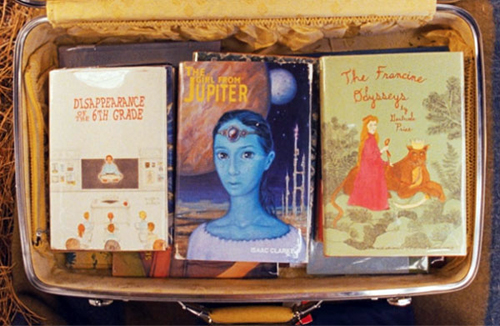
The overabundance of detail is open to the charge of fussiness and self-indulgence. Isn’t packing so much in just a matter of being cute? The infilling is particularly vulnerable because it often seems merely decorative. Details that affect the story action hardly count as details any more: the Ring in The Lord of the Rings is central to the action, while the Evermind flowers aren’t. Once we get beyond purely narrative functions, I think that the details of richly appointed worlds can fulfill at least five other purposes.
First, there’s realism. The doings on New Penzance and environs aren’t wholly cut off from the real world. The action is set in 1965, and the clothes, furniture, portable record player, and other furnishings match the period. To take one detail: the Françoise Hardy tune “Le temps de l’amour” anchors Suzy in a particular taste culture, that of American girls and women who took up yé-yé, Sylvie Vartan, and Salut les copains music rather than the Beatles or the Stones. American cinephiles are probably most familiar with this taste culture from Godard’s Masculin-feminin (1966).
It seems that an urge toward realism drives Anderson to build his micro-world. He speaks of creating all the props: “All these things just take forever, but I feel like even if they don’t get that much time [on screen], you kind of feel whether or not they’ve got the layers of the real thing in them.” It’s striking that he uses the same word that Ridley Scott did in calling Blade Runner‘s milieu a “seven-hundred-layer cake.”
Then there’s allusion. Details that are only minimally realistic can instead point outside the film. We’re familiar with more or less public movie allusions, as when a TV playing in a bar is running a film that comments on this one. Anderson seems not to have intended the title to be an allusion in this sense, it functions as one. It brings to mind Borzage’s Moonrise (1948), a hallucinatory noir centering on a backwoods manhunt for a less-than-guilty young man and the woman who loves him.
The name of Sam’s chief Scout tormentor, Redford, is more straightforward, as is the island called Penzance, which evokes the Gilbert and Sullivan operatic fantasy of blocked romance and also comic policemen.
One task for critics is to expose to our view the more hidden allusions, like the fact that the church on St. Jack Wood Island isn’t only a play on St. John’s Wood but refers to a favorite film of Anderson’s, Peter Bogdanovich’s Saint Jack (1979). Even if a viewer doesn’t know the allusion, she can suspect that any highlighted detail might like an Advent calendar window be hiding a citation.
 The real mark of a richly realized world, as I’ve suggested, is a plethora of details that proliferate beyond the needs of realism and the temptations of allusion. So sheer density is another function. Moonrise Kingdom has to obey the principle of minimal departure, so perhaps the narrator is needed to explain the island’s geography. But in all the badges, books, and place names, the film supplies far more than the action requires. And such materials have been extended outside the film’s limits through the video extracts from Suzy’s books, the carefully printed collections of the Khaki buttons, and ephemera like those items collected in the Criterion package. Even the disc itself, with its little raccoon, is adapted to the story world. From this perspective, The Wes Anderson Collection, though a book, is exactly that: a gallery assembling items from the films’ distinct realms.
Density for its own sake is part of the worldmaking project, but it accomplishes more. The effusion of such minutiae becomes an occasion for the filmmaker to display virtuosity, a zest for creating a consistent but unpredictable wash of detritus rivaling that in our world. Prodigality of invention, even when it gets a little obsessive, can be one mark of artistic quality. Joyce, Pynchon, Zola, Balzac, and other straining appetites invite us to appreciate how they’ve stuffed a wide canvas with minutiae.
For a narrative to create a secondary world, then, we need a fair amount of sheer stuff. In Moonrise Kingdom Anderson highlights the stuff through unusual film techniques. Not content to let us simply register props in the distance or on the margins, he gives them prominence. In other films, the notes and maps and book passages that characters examine would be presented in a naturalistic way, clutched in hands or seen through optical POV. Instead Anderson simply thrusts these things at us, perfectly framed and lit, like items in a gallery display.
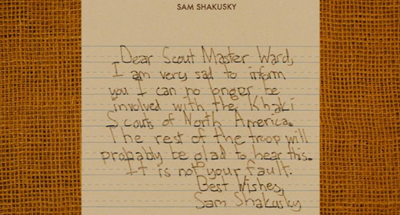
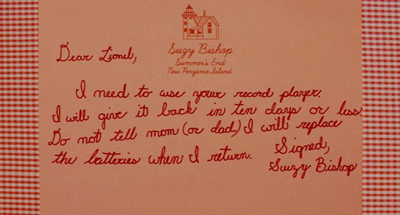
We shouldn’t forget a fourth function of all this detailing and infilling. Details need not point outward—toward a real world, or to other narratives, or to a New Penzance of the collective fan mind. Details can work very traditionally to bind the tale together. They can function as motifs.
My 2014 entry points out many of these, but this time I noticed the glimpse we get of Mrs. Bishop washing her hair during one of the gliding surveys of the house in the opening credits. That angling of her torso over the tub anticipates one of Sam’s drawings of Suzy we see after Mrs. Bishop finds the lovers’ correspondence.
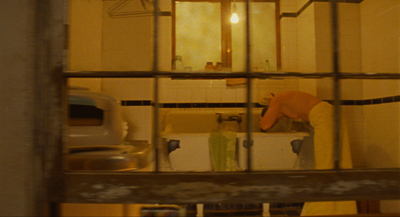
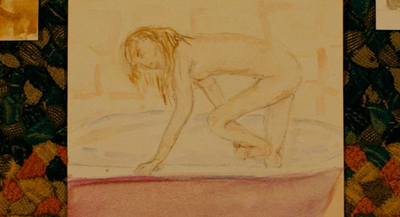
Again, the picture isn’t in Mrs. Bishop’s hand as she shows it to the men; it’s mounted on the wall along its mates, ready for a DIY gallery show.
When I first noticed the flaming motif on the Khaki unit’s motorcycle and helmet, I thought it was associated with Redford’s petty meanness. It is, but it’s also part of the Khaki Scouts’ insignia, as we glimpse early on when a scout irons his kerchief, here in the lower left.
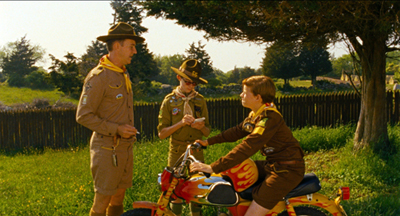
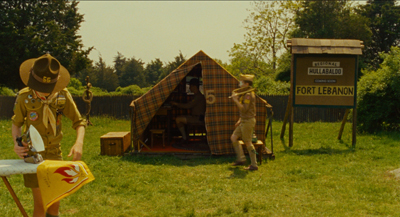
When Redford’s patrol attacks Sam and Suzy, Anderson cuts to one of those vitrine-display images but very abstract and flashed in alternate colors. The flash-frames conceal the action. The promise of a fight given in the symmetrical-flame logo is fulfilled, but it’s amplified by inclusion of Suzy’s weapon, the forbidding scissors. She turns the Scouts’ logo and the scissors’ brand (Lefty™) into her escutcheon.
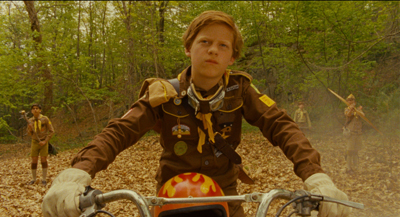
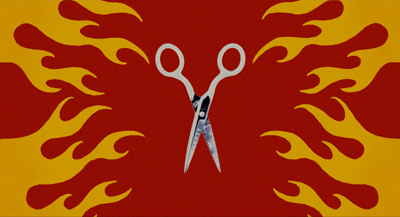
Motifs can help the other functions. The Khaki Scouts’ branded images suggest a parallel to Boy Scouts regalia, but they also make the Penzance story world cohere as its own place. At the same time, the fiery iconography suggests the aggression that several of the boys are ready to let out at any time, and Anderson stresses that as a thematic motif through his nondiegetic inserts during the skirmish.
The fifth function, recidivism, is in a way the simplest of all. Just as we might rewatch a mystery film to see how we were misled, people can rewatch Moonrise Kingdom to seek out the sorts of felicitous touches we’ve been considering. A world saturated with details invites us to revisit it. That’s what happened with me.
Britten for boyhood

All these functions come together in one of Anderson’s most ingenious strokes, the use of the music of Benjamin Britten.
It’s an unexpected gesture of period realism from somebody of Anderson’s generation. In the 1960s classical concert music was central to intellectual culture in a way we can scarcely imagine today. Ives, Mahler, Satie, Shostakovich, and other masters were rediscovered, and avant-gardists like Varèse and Ligeti became familiar to a broad public. Imagine a time when filmmakers drew soundtracks from Penderecki (Kubrick) and Orff (Malick).
 In this period, Britten achieved fame with LP recordings of his major operas, and he produced some indelible masterpieces. His War Requiem (1962, recorded 1963) became a best-selling album. The Young Person’s Guide to the Orchestra, often paired with Prokofiev’s Peter and the Wolf, was recorded over a dozen times in the 1960s. The children’s pageant Noye’s Fludde (1958, recorded 1961) was designed for church performances of the sort we see in the movie (although probably few were as elaborate).
The Britten details amount to allusions too, both private and public. As a boy Anderson owned The Young Person’s Guide and with his brother sang in a performance of Noye’s Fludde. Just as important, if you had to pick a classical composer of the period who was centered on youth, it would have been Britten. Not only did he write a fair amount of music for young performers, but his later work drew ideas from pieces he wrote as a boy. The film includes a portion of one of these later recastings, the Simple Symphony of 1934. Set to Anderson’s images, the music evokes the brisk innocence of Sam and Suzy. So the allusions fit the subject and theme of the movie.
What about density? According to Anderson, Britten’s music permeates the movie. “The movie’s sort of set to it. . . . It is the color of the movie in a way.” Britten’s music isn’t incessant, but it is vividly presented in the story world during the big scene of Noye’s Fludde. Britten pieces are excerpted throughout the score as well. At the very end, the movie goes Britten-mad, first by playing the final fugue from The Young Person’s Guide (fulfilling the tease of the opening with Suzy’s brothers) and then, in the second part of the credits, applying Britten’s dissection of parts and choirs to Alexandre Desplat’s score.
The motivic uses of the Britten details are pretty evident. The Biblical flood in the church pageant predicts the film’s climax, and like the animals rescued two by two, Sam and Suzy will be saved. Less obvious is the motivic use of a lovely melancholy song from “Friday Afternoons,” one of several Britten pieces Anderson discovered while making the film.
In “Cuckoo,” a boy soloist and choir sings of the cuckoo’s waning stay: he comes in spring and flies away at summer’s end. We first hear the song during the low point of Sam’s fortunes. He has just been yanked away from Suzy and, as he is ferried back to camp, he’s told by Scoutmaster Ward that his foster parents have given him up.
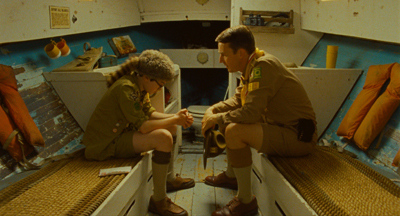
The song’s text and plaintive melody evoke the end of the idyll and a bleak future for Sam.
But as we’ve seen, Sam and Suzy get reunited after the second cycle of escape/ chase/ capture. The song recurs in the epilogue as Sam, touching up his landscape painting, slips out of Suzy’s house to join Captain Sharp in the driveway.
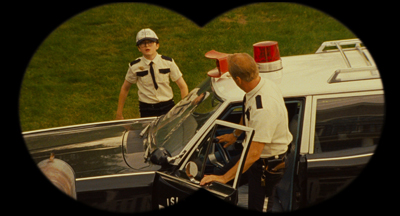
At one point Sam has nothing; at the other he has everything. Now the song seems less a lament for a final fate than something less harsh: a lyrical envoi to a charmed summer that changed Sam’s life. The ineffectual father-figure Ward is replaced by the somewhat more competent Sharp, and Sam now has a future, with his mother’s pin worn discreetly alongside his Khaki honors. The cuckoo song gently enhances a scene that is at once an end and a beginning.
As for recidivism: Well, why not rewatch the movie listening for Britten’s music?
Henry Jenkins, a pioneering scholar of “participatory culture,” once pointed out a developing trend in recent popular media. Our creators seemed to have migrated from emphasis on the story (a singular chain of events, over and done with) to the character (a protagonist like Superman who can get involved in many stories), and now to the world (a realm in which many protagonists can interact, as in the Marvel Universe). Many fans want worlds they can redesign to suit their imaginations. But maybe we should sometimes leave those worlds intact.
I’m completely happy with tales that don’t proliferate across other platforms. I like characters who don’t carry the burden of multimedia backstories. But of course I’m open to worldmaking too. I’m especially open to it when an idea so identified with corporate branding and mass-production culture gets revamped by a temperament as unpredictable as Wes Anderson’s.
I’m as pleased as anybody when a swaggering space warrior lip-syncs “Come and Get Your Love” while using an alien lizard as a hand mike in Guardians of the Galaxy. Yet I’m even more appreciative when somebody finds a way to weave yé-yé and Benjamin Britten into an enclosed world I could never have imagined, and cannot improve. In place of the big worlds of Narnia, Middle-earth, the Marvel Universe and other macrocosms, New Penzance seems the right size for shades of ironic, tender feeling. Why should I want to rewrite this world? It’s enough to discover it, and explore it.
Thanks to Kristin and Brendan Colvin for good advice.
In the small-world spirit, Criterion offers close looks at some Khaki gear.
What do we call these relatively self-contained realms? I’ve used several terms. Tolkien may have helped the idea coalesce by coining the label “secondary world” in his essay “On Fairy-Stories”:
What really happens is that the story-maker proves a successful “sub-creator”. He makes a Secondary World which your mind can enter. Inside it, what he relates is “true”: it accords with the laws of that world. You therefore believe it, while you are, as it were, inside. The moment disbelief arises, the spell is broken; the magic, or rather art, has failed. You are then out in the Primary World again, looking at the little abortive Secondary World from outside.
Most of my information about Anderson’s creative process, including his interest in Britten, comes from Matt Zoller Seitz’s book-length interview The Wes Anderson Collection, particularly pp. 313-317. Anderson’s remark about the Bishop attic is on p. 300.
Marie-Laure Ryan discusses the principle of minimal departure in several publications, most fully in Chapter 3 of Possible Worlds, Artificial Intelligence, and Narrative Theory (Indiana University Press, 1991). An earlier and less technical version appeared in 1980.
Derek Jarman was inspired by Benjamin Britten’s music too; Jarman’s War Requiem (1985) is a sort of Wagnerian music video accompanying the original recording. It’s available for streaming, rental, and purchase here.
See Henry Jenkins’ Convergence Culture:Where Old and New Media Collide for more on popular-culture worldmaking. Henry blogs, indefatigably, at Confessions of an Aca-Fan.
George Lucas’s remarks about details and Ridley Scott’s about layers come from The Way Hollywood Tells It, pp. 58-60. Those pages discuss the trend toward worldmaking in mainstream Hollywood.
P. S. 5 November 2015: We have had some inquiries about whether the eleventh edition will be available for course use during the spring 2016 semester. McGraw-Hill’s intention was to introduce the new edition during the spring semester, for adoption for the fall, 2016 semester. Our editor, however, tells us that there are options for teachers who want to be early adopters and use the book in the spring.
Use of the print version for spring would be a tight squeeze unless your semester starts late in January. McGraw-Hills aims to have the SmartBook (i.e., the online ebook version) live on January 15th, the same date as the books should be on their way from the printer to the warehouse. It might take some time for books to ship once they get to the warehouse, so our editor recommends the SmartBook as the safest option for spring use. Early adoption assumes that instructors do not have lots of lecture PowerPoints and tests to update.
Usually, if the instructor works with the local MHE sales representative, the publisher can figure something out. If you are interested in being an early adopter, you should get in touch with your rep. If you don’t know who that is, you can find contact information here.]