







Archive for the 'Film comments' Category
TINKER TAILOR once more: Tradecraft
DB here:
Tinker Tailor Soldier Spy has to be counted a success ($64 million worldwide so far), and it may have brought new attention to John le Carré’s writing. The fact that some websites and Twitter feeds lured readers to my entry on the film (and thanks to all) suggests that people can enjoy a film even though major aspects of the plot escape them. Everybody loves a mystery, right?
Regular readers won’t be surprised to learn that I had originally written something longer about le Carré’s narrative strategies generally. Out of common human decency I cut the entry in half and focused on the film. But seeing the interest in what I’d posted, I thought that there might be enough hard-core readers who’d want to go down the rabbit hole again.
So one more post, which reflects a little more on the film, while arguing that le Carré’s development as a novelist offers a fascinating example of a writer trying out various methods of storytelling. Ideally, you should read this after reading my first post. The next three sections don’t spill any secrets, but if you want to avoid spoilers, stop at the section called “Burrowing.”
Going to ground
During the 1970s le Carré seems to me to have reinvented the dense, almost digressive plotting we associate with the nineteenth century British novel. A little narrative theory helps us understand his ongoing exploration of storytelling technique.
We’re used to thinking that a plot presents one or two major characters moving through the world. That movement yields adventures in the broadest sense: encounters with others, experiences that illuminate some aspect of life, conflicts both inner and outer. Our mental prototype of a plot, certainly in mainstream films, features a protagonist (or a couple) accompanied by lesser figures who become allies, helpers, lovers, rivals, and enemies.
Le Carré’s first novels accord with our prototype, with the addition of those old standbys Mystery And Intrigue. Call for the Dead (1961) and A Murder of Quality (1962) are mostly straightforward detective stories. Although George Smiley is a secret agent, he’s forced to investigate crimes. Accordingly, he goes from place to place, suspect to suspect, and hears out their explanations and alibis. With The Spy Who Came in from the Cold (1963), le Carré moves closer to an adventure plot, as we follow a protagonist in a linear succession of encounters. As is common in the genre, concealed information is sprung on us at various points, forcing us to recast what we thought we knew.
It takes a mind as odd as that of Viktor Shklovsky, the great literary theorist, to point out that we can think of any longish narrative as the intersection among many stories. He believed that as a form the novel developed out of assemblies of shorter tales. He pointed to The 1001 Arabian Nights and The Decameron as examples of this sort of compilation—long works built out of collected stories, enclosed within a bigger storytelling situation.
When the novel became a distinct genre, Shklovsky thought, it continued this tradition. In essence, each novel makes a long story out of several shorter stories. But unlike what happens in the compilation format, the stories become connected to one another. Character A figures not only in her own plot, but in Character B’s. This tends to hide the fact that separate stories are nestled within the overall architecture.
Besides connecting all the sub-stories, the ordinary novel makes some of them very minor. Our simpler prototype relies on suppressing or compressing all the other story lines except the one involving the protagonist. Our protagonist meets lots of people, but some are given no background, others a bit, and still others a fair amount, but nobody’s story can override the hero’s.
Shklovsky asks us to rethink our idea of the standard novel. It becomes not a straight-line path but a tangle of virtual tales that has been radically chopped down and ironed out. All the latent stories might be intriguing enough to sustain a plot in themselves, but for immediate purposes they must be subordinated to the fate of those creatures we call protagonists. In effect, Shklovsky suggests that every narrative can be thought of as an undernourished network narrative.
In a tale of mystery and detection of course, hidden backstories of some of the characters come to light gradually. But severe selectivity still reigns, because the backstories bear on the protagonist’s main goal: solving the mystery. When Smiley cracks a murder case or agent Leamas realizes that he has been deceived by his superiors, we understand other characters’ lives in a new way, but they don’t steal the stage from our hero.
Still, Shklovsky notes, some storytellers have realized that secondary characters can claim the spotlight as well. At the limit, they can furnish new narratives, as in Wicked and Rosencrantz and Guildenstern Are Dead. Henry Jenkins’ idea of transmedia storytelling exemplifies this idea: the ally in one tale can become the hero of another, perhaps on another media platform. But of course nineteenth-century novelists aimed to do the same thing within a single tale, building elaborate plots that would give us an ample sense of how the lives of many characters converge through chance or common purpose. Our Mutual Friend, Pot-Bouille, and War and Peace try to accommodate a great many stories within their wide compass.
I think that with the novel Tinker, Tailor le Carré decided to try this option, to give the spy novel—typically the province of the teasing linear plot exemplified in The Spy Who Came in from the Cold—the sense of a panorama surveying many characters’ lives and perspectives and, still more broadly, the institutions that they serve.
Backchanneling
But there’s a problem here: How to expand your plot to do justice to many characters’ backstories and sidestories? Again Shklovsky provides useful hints, and le Carré tried many of the options he proposes.
Shklovsky suggests that stories can be integrated in two basic ways. One is through framing. You the writer set a self-contained tale, or several tales, inside a bigger one. This is exemplified by The Decameron and The Canterbury Tales, as in the films that Pasolini made from these classic works. We can see this option at work in a movie like Dead of Night (1945), in which guests at a country house party swap stories of the morbid and bizarre. Actually, le Carré tried this. The Secret Pilgrim (1990), is virtually a collection of short stories framed by an aged spy listening to Smiley lecture at MI6’s training school.
Another option is what Shklovsky calls “threading,” the principle that traces the consecutive adventures of a protagonist. This is the prototype I’ve already mentioned. But Shklovsky suggests that by keeping the protagonist thread you can still expand the framed tales. In Don Quixote, the adventures of the Knight and Sancho Panza hold their own interest, but they surround a string of embedded tales told by the people they meet. And sometimes those embedded tales are pretty long.
It seems to me that le Carré sought ways in which he could expand his embedded tales without losing the main thread. For example, his novel following The Spy…, The Looking Glass War (1965), splits the protagonist function up into three characters, their parallelism stressed by the section titles: “Taylor’s Run,” “Avery’s Run,” and “Leiser’s Run.” There is an overarching rhythm to the action, but we have three distinct protagonists. It’s as if the author is rehearsing, on a smaller scale, the shifting viewpoints that he will exploit in his longer fictions. The tripled protagonist also allows le Carré to present different standpoints on that center of spying operations MI 6, known as the Circus.
The following book, A Small Town in Germany (1968), is a return to a single protagonist and a straight detective plot, but now the mystery focuses on the bureaucracy behind espionage. Alan Turner, an embittered spy in the Leamas mold, is searching not only for a staff member missing from the British embassy in Bonn but also for some damaging files that have vanished. The drab routines of sorting, checking, and managing information become the object of scrutiny, and Her Majesty’s civil servants are prime suspects. Le Carré had found a way to put burrowing at the center of his plot.
After these efforts, in which Smiley barely appears, le Carré might well have felt ready to test his talents on a broader canvas. First came The Naïve and Sentimental Lover (1971), a satiric psychological novel about a businessman who becomes entranced by a novelist and his wife. The book, which runs over 400 pages, shows le Carré’s eagerness to stretch out. Just as important, I suspect, is its value as a laboratory for narrative experiments. Descriptions swell, and inner states are reported in detail. Instead of a roaming point of view, there are deep plunges into the main character’s mind and senses through stream of consciousness, free indirect discourse, and a curiously omniscient voice, sometimes pitying and sometimes jocular. Compare the driving scenes in the opening lines of two books.
“Why don’t you get out and walk? I would if I were your age. Quicker than sitting with this scum.”
“I’ll be all right,” said Cork, the Albino coding clerk, and looked anxiously at the older man in the driving seat beside him.
(A Small Town in Germany)
Cassidy drove contentedly through the evening sunlight, his face as close to the windshield as the safety belt allowed, his foot alternating diffidently between accelerator and brake as he scanned the narrow lane for unseen hazards. Beside him on the passenger seat, carefully folded into a plastic envelope, lay an Ordnance Survey map of central Somerset. . . . For the attention of Mr. Aldo Cassidy ran the deferential inscription; for Aldo was his first name. He drove, as always, with the greatest concentration, and now and then he hummed to himself with that furtive sincerity common to the tone-deaf.
(The Naïve and Sentimental Lover)
The style seems to me unsure, but clearly the writer is moving beyond terseness toward something more enveloping and commentative.
Returning to the espionage genre, le Carré hit upon another way to fill a big canvas. He resurrected that old formula, the supreme master-mind criminal pitted against our beleagured hero. The master spy isn’t Mabuse or Fu Manchu but the Russian Karla, snug in Kremlin Centre, and George Smiley’s efforts to flush him out are chronicled in Tinker, Tailor, Soldier, Spy (1974), The Honourable Schoolboy (1977), and Smiley’s People (1979). The mass-market omnibus edition of these runs to nearly a thousand densely packed pages. How did our author manage plots on this new scale?
Wrangling
Chekhov says that if a story tells us that there is a gun on the wall, then subsequently that gun ought to shoot. . . In a mystery novel, however, the gun that hangs on the wall does not fire. Another gun shoots instead.
Viktor Shklovsky
Some expansions are pretty evident. The Quest for Karla trilogy introduces many new characters, mostly people who staff the Circus or who are involved with the institution of espionage: from secretaries and “scalphunters,” the lonely and low-down agents assigned to menial bits of spying, to the very top, such as the Minister who oversees MI6 and Lacon the pliant civil servant overseeing the Circus. Some of these characters are in turn given private lives, with friends and lovers. The connections ramify.
In addition, there are the civilians whose lives are touched by the Cold War chessgame. In The Spy Who Came in from the Cold, that demographic was represented by Liz Gold, Leamas’ lover. But in the Karla trilogy we get a panoply of more or less innocent figures who are pulled into webs of plot and counterplot. And here le Carré does something quite shrewd.
He tends to start the novel with these characters, people at the very edge of the web. Smiley’s People opens with an unassuming Russian émigrée living in Paris. She’s confronted by a Soviet agent telling her she might be permitted to see her long-lost daughter. What does that have to do with Smiley’s cleaning the Circus stables after the mole scandal, or Smiley’s loss of power after the Jerry Westerby misadventure? Positing enigmas at two or three degrees of separation, working inward across the web, le Carré lets the reader gradually sense the lines of force that lead inexorably to the principals.
So le Carré grows his book not merely by expanding his cast. He finds a new balance between thread structure and framed stories. In Smiley’s People, perhaps the most orthodox entry in the trilogy, Smiley investigates the death of an émigré Soviet general, and this entails a fairly standard detective plot. The novelty comes in the fact that the participants Smiley questions are former agents whom he ran, or colleagues retired from the Circus—his people. And what they tell him isn’t rendered in compressed dialogue or summary. Their recollections spread out luxuriantly, claiming considerable interest in their own right, sometimes with only slight points of contact with the main plot, sometimes burying clues that Smiley must dig out.
More intricate is The Honourable Schoolboy, the longest entry in the Karla trilogy. It has two main threads: Jerry Westerby’s efforts to trace money flowing from Moscow to Hong Kong, and Smiley’s struggle to rebuild the Circus. The plot encapsulates the two main types of spy fiction—indeed, the two types that le Carré had already mastered in his earlier books. While Jerry’s plot is suspenseful adventure stuff, Smiley’s plot is inquiry-oriented, like that in Ambler’s classic Mask of Dimitrios (1939). To stretch the canvas on a still bigger frame, le Carré makes Smiley pass investigative assignments to other Circus personnel, like Connie Sachs and Doc di Salis (who get characterized in detail). Indeed, both main lines of action are filled out with rich and lengthy sub-stories. We can study the tradecraft of old Craw, majestic spy-journalist; the puzzling past of Lizzie Worthington, Drake Ko’s mistress; and the enigmas around her lover Ricardo, either dead or flying heedlessly through an Asia in flames.
The Honourable Schoolboy also has a more layered narration than its predecessors. It switches point of view constantly, in the process virtually promoting Peter Guillam to the rank of Smiley’s Watson. Most striking is the plot’s ultimate narrating framework, a sort of institutional memory serving as recording angel. Instead of the all-knowing, somewhat condescending voice of The Naïve and Sentimental Lover, this narration is brisk and brusque. It defends Smiley against those in the intelligence community who, through shortsightedness or malice, misjudged his decisions.
It has been laid at Smiley’s door more than once since the curtain was rung down on the Dolphin case that now was the moment when George should have gone back to Sam Collins and hit him hard and straight just where it hurt. George could have cut a lot of corners that way, say the knowing; he could have saved vital time.
They are talking simplistic nonsense.
This opinionated, godlike narrating agency is never identified. It’s one of the many signs that in the Karla books le Carré is reviving conventions of the triple-decker novel. And so he did; he bid to become our Dickens. (The larger-than-life father-son duo of A Perfect Spy is perhaps his most extravagant exercise in this vein.)
He echoes Wilkie Collins too. For mystery, never far from Dickens’ concern, is central to Collins and le Carré. Sustaining the reader’s interest through mystery seems not as important for our highbrow novelists now; it’s the province of “genre fiction.” But many of the canonical works of fiction and drama turn on secrets that are hinted at, then dramatically exposed (not only Oedipus and Hamlet but works by Henry James, Ibsen, Conrad, O’Neill, Faulkner). On the first page of Crime and Punishment, Raskolnikov thinks, “Why am I going there now? Am I capable of that? Is that serious?” The question of that that keeps us reading. You can argue that the modernist novel, with its fascination with time-juggling and stream of consciousness, found a sort of equivalent for the secrets, deceptions, and puzzles that drive classic tales. In any event, during the first decade of le Carré’s career, he began to explore the ways in which embedded stories can blossom into mysteries.
Burrowing
In my original entry, I didn’t straighten out the plot of Tinker Tailor, but now, as the film nears the end of its theatrical run, I’ll tell the novel’s tale straight. Skip if you don’t want it all ironed out.
Bill Haydon, working for British intelligence, is in the pay of Moscow Centre and its head, Karla. He has been passing information to the Russians for years, but Control, the head of the Circus, is starting to get suspicious. He believes that one of his five top men is a mole. Karla entices Control into sending an agent, Jim Prideaux, to meet a Czech general supposedly going to defect. This leads to a spectacular failure—Prideaux is shot and captured—and allows Karla to install an ambitious dunce, Percy Alleline, in Control’s position.
Haydon is the best and the brightest, the flower of English manhood. Suave, easygoing, with an Oxbridge artistic flair, he is as debonair as Smiley is brooding and inscrutable. Haydon has strained his friendship with Smiley by conducting a brief affair with Smiley’s wife Ann, but that episode was initiated by Karla to make Smiley reluctant to suspect Bill of bigger crimes. Haydon has already tempted Percy with the promise of a double agent, a cultural attaché in London called Polyakov. Through Polyakov Karla feeds the Circus trivia, mixed with bits of good information, to the gratification of Alleline’s inner circle—Haydon, Roy Bland, and Toby Esterhase—as well as Oliver Lacon and the Minister overseeing the bureaucracy. And the Americans approve.
Upon Control’s forced retirement, his team is abandoned and he dies a short time later. A permanently damaged Jim Prideaux is brought back to a new life as French teacher at a minor boy’s school. Smiley retires, while his wife Ann leaves to take up a string of love affairs.
But when a raffish field agent, Ricki Tarr, reports on good authority that there is a mole at the very top of the Circus, Lacon asks Smiley to investigate sub rosa. Smiley installs himself in a shabby hotel and with the help of a youngish colleague, Peter Guillam, and an old friend, Inspector Mendel, he starts patiently scouring the records. Following in Control’s footsteps, Smiley discovers disparities, missing documents, and incompatible testimony. Eventually he is able to pressure Toby into revealing the location of the safe house where Alleline’s cadre meets Polyakov.
By inducing Tarr to send a message galvanizing the Circus’ top brass, Smiley forces the traitor to hurry to meet Polyakov at their usual place. There Smiley, Guillam, and Mendel record Bill Haydon’s incriminating conversation and play it back to the embarrassment of the inner circle. There remains a long epilogue, in which Bill, in detention, confides in Smiley and seems to have no regrets about sending his closest friend Jim Prideaux into a trap and months of torture. Jim has discovered the treachery of his dearest friend and, sneaking into the compound, kills Haydon. While Smiley, now occupying Control’s seat of power, goes to the countryside for a possible reunion with Ann, Jim returns to his school, the object of the boys’ adoration but also a morose, haunted man.
I’ve tried to synopsize the action as a thread, in Shklovsky’s sense, but I can’t do justice to the novel’s exfoliating plotlines. We’ve seen that a detective story basically presents the sleuth going from person to person, asking questions and getting information. Since Smiley is the protagonist, much of what I’ve traced has to be discovered through testimony or flashbacks. As Shklovsky remarks, any mystery in a plot involves some play with time, either ellipsis (what happens in the gap?) or rearranged order (hiding crucial causes) or a late point of attack (so that we must go back to reconstruct why things are as they are).
But your straight-line Q & A investigation can be pretty plodding. Check for yourself by trying to read one of the “classic” detective stories by S. S. Van Dine. Forced to present official reports and characters’ recollections, le Carré skillfully expands those into robust, extensive stories of their own, filled out with characterization, detail, and atmosphere. The recording-angel narrator moves easily from reporting the interrogations to summarizing past action and then to full-blown scenes rendered from the viewpoint of the witnesses.
As in the later books of the trilogy, le Carré’s point of entry is oblique. Instead of starting with Smiley, principal investigator, it starts with Jim Prideaux’s enigmatic arrival at the boys’ school, and even that is presented at one remove, through the vantage point of Bill Roach, aka Jumbo, a hapless “new boy” at the school. Only after that do we meet Smiley, hailed by the obnoxious gossip Roddy Martindale (a convenient expository device) who chats about the usurpation at the Circus. Soon Smiley is summoned to Lacon’s home, where he and Peter learn Ricki Tarr’s story of spying in Hong Kong and falling in love with Irina, the wife of a KGB spy. It’s she that tells him of the mole in the Circus.
Tarr’s tale is the first embedded story, running four chapters. Once Smiley takes the assignment, relatively little happens in the present. His investigation carries him to his old Russia expert, Connie Sachs, and she recounts another block of information, about how her suspicions of Polyakov led her to be sacked from the Circus. Once Smiley is back at his hotel, he starts his reading, and for five chapters we get a big chunk of the past, including Smiley’s discovery of Bill’s affair with Ann. Smiley’s homework is interrupted by a suspenseful string of scenes involving Peter’s smuggling crucial files out of the Circus.
Another embedded story soon follows: Over dinner Smiley tells Peter of his only meeting with Karla, many years before. Then, pursuing yet another clue, Smiley questions Sam Collins, the man on Circus duty the night Jim was ambushed. As in any good detective story, Bill Haydon seems to have an alibi (he heard the news at his club) and acts resolutely un-guilty, bursting into the Circus to take command and demand the return of his old pal Jim. Sam’s embedded story to Smiley is followed by others, from the man who drove Jim into Czechoslovakia and from Jerry Westerby, who heard rumors that the military were waiting for Prideaux. Getting ever closer to the fateful incident that set the whole shuddering machine into motion, Smiley finally hears Jim’s own version of what happened to him that night and in the months afterward.
After so many extended stories—recounted by witnesses, filtered through hearsay, written up in bureaucratic files, commented upon by the recording angel—the plot launches into forward motion. Smiley and his colleagues set their trap, and there’s a suspenseful set-piece spanning two chapters. Le Carré alternates among Tarr in Paris, Mendel watching affairs at the Circus, and Smiley waiting in the safe house to trap the traitor. There follows an equally crosscut epilogue, with Bill and Smiley’s confrontations alternating with vignettes of other characters—including a young woman, introduced for the first time, who seems to have borne a child by Bill. The book concludes with Smiley, waiting to meet Ann and meditating on what drove Bill.
Scalphunter
In adapting a novel for the screen there is a natural temptation to dramatize the information supplied by narrative description in the original text by turning it into dialogue, but this is generally to be resisted. Where possible it should be translated into action, gesture, imagery. Much of it can be dispensed with altogether.
David Lodge
Imagine trying to adapt this monster! Respecting the novel’s construction would demand a cascade of flashbacks, long tales framed by Smiley’s investigation. The seven-installment BBC series, scripted by Arthur Hopwood, took the simpler option of starting with a scene that is presented very late in the novel, in Jim’s embedded story told to Smiley. The series opens with Control summoning Jim and sending him off to Czechoslovakia; Jim is shot and Control is cast out. Clarifying the string of events this way, and giving us a decent action scene early on, has its cost: Smiley doesn’t enter the plot for nearly 23 minutes. Yet this construction does obliquely retain the portmanteau quality of the novel’s concept, in which sustained blocks of action are allowed to stretch and breathe.
Soon, as in the novel, the TV series gives us Ricki Tarr’s story of his affair with Irina, presented as a discrete flashback. Then Smiley’s trawl through the files is supplemented by his visits to Connie and others. Sometimes their recollections are dramatized in flashbacks, other times we simply watch them tell Smiley of them. Fortunately for the viewer, there are also scenes of Smiley bringing Peter up to date, and briefing Lacon on current discoveries. Because the BBC series was broadcast in weekly episodes, this sort of backtracking was necessary. And since Hopcraft had several hours to fill, the plotting could be somewhat spacious. Nonetheless, the book’s oscillating time scheme was somewhat flattened out, and the block construction—main thread interrupted by inset stories—was compressed. The inset tales didn’t expand to their novelistic dimensions.
The Tinker Tailor film, of course, had to be much more squeezed down. I mentioned in the earlier entry that the screenwriters compared their structure to a mosaic, and I followed this out in my discussion of how the narration was elliptical and fragmentary, leaving out redundancies that are usually required in popular film. Many scenes are both spacious and laconic. The rhythm is slow, and we’re given time to see and hear everything; but that “everything” might be only a voice dimly overheard, or a doorbell, or an image that gives one piece of information.
Take an instance I didn’t pick out in the original post. In order to steal a file, Peter Guillam has arranged for Mendel to call him, pretending to be a garage mechanic.
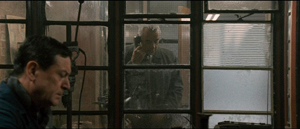
The call provides a pretext for Guillam’s retrieving his bag from the security officer, so he can slip the file inside.
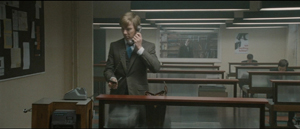
George Formby’s music-hall tune “Mr. Wu’s a Window Cleaner Now” is playing on the garage radio. It’s carried down the phone line to the call-screener at the Circus, who murmurs along with it as the call is recorded.
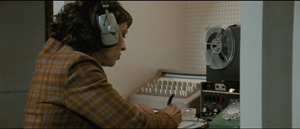
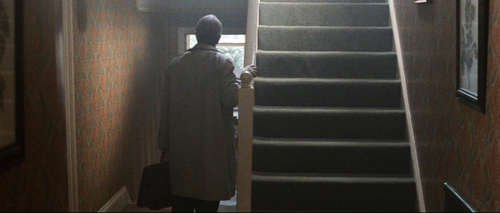
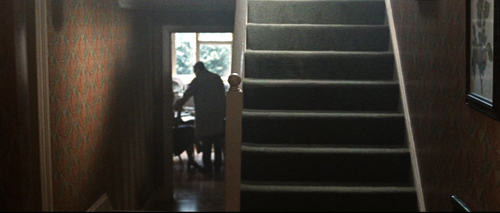
After the tense meeting with the Circus cadre, Guillam has apparently sneaked the file out. But on the staircase an offscreen voice softly sings “Mr. Wu” before we see the source, not Guillam but Roy Bland. He descends slightly ahead of Guillam.
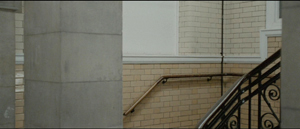
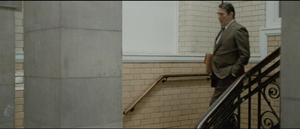
Guillam follows right behind, pausing and looking off nervously as Bland passes through the foreground.
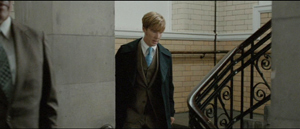
The empty stretch of the staircase shot allows us to think that it’s Guillam offscreen, humming the tune he heard on the line, so it’s a surprise when Bland appears. We realize that he must have heard the call, or the recording.
Another film would have cut away during Guillam’s maneuver to show Bland and his colleagues listening to Peter’s fake conversation. That would have dialed up the suspense: Will they detect the trick? Instead, showing the lady on the phone lets us know that the call is being recorded. Only retrospectively—and by a single piece of information that slips by—do we realize that Bland has heard the conversation. Guillam is being watched closely. There’s a meta-message here too: By humming the tune, Bland lets Guillam know he’s overheard the call. Bland’s casual feint fits with the intimidation of Guillam that began when he was called into Percy’s meeting.
In all, the moment’s oblique, ricocheting transmission of story information could easily be missed. (In the book, it’s Bill who waylays Guillam and asks if he’s seeing Smiley. “Guillam’s world, which was showing signs till then of steadying to a sensible pace, plunged violently.”) The film’s script and direction have followed David Lodge’s suggestion of translating Peter’s sudden panic into images and sounds, but more laconic ones than we usually find.
More broadly, the film’s stinginess about supplying information extends to its protagonist. As I suggested in the first post, Smiley doesn’t just solve mysteries—he is one. What does he want? Oldman’s dry, impassive performance bottles the shrewdness, sternness, and pain that Guinness let leak out in the series. It still seems to me that the film’s Smiley is playing a waiting game; even the “Aha!” moment near the climax, when he seems to have hit upon something, proves to be obscure.
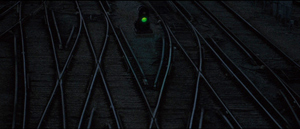
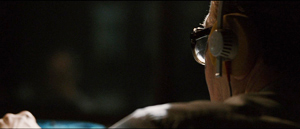
After the montage parades the suspects and shows the shifting train tracks outside Smiley’s dingy hotel, the narration doesn’t present the classic giveaway clue or blinding insight. Immediately we see Smiley, by force of will, bullying his superiors and Toby into giving him the information he needs to trap the mole . . . whose identity isn’t pinned down until the ambush. Smiley’s emotion bursts forth only once more, in his confrontation in Haydon’s cell. After a slight confirmatory smile (Prideaux, Smiley surmises, “knew deep down it was you all along”), Smiley asks if Karla ever considered letting Bill take over Control’s post.
Bill, angry: “I’m not his bloody office boy!”
Smiley, almost roaring, but with expression unchanged: “What are you then, Bill?”
Bill, after a pause, in a subdued, strangled voice: “I’m someone who has made his mark.”
Smiley exhales, the burst of energy gone, and turns slightly aside.
Smiley’s outburst here is his most vehement utterance in the movie. By the epilogue, Smiley, still unsmiling, has assumed his place as Control’s successor.
Mole-hunters
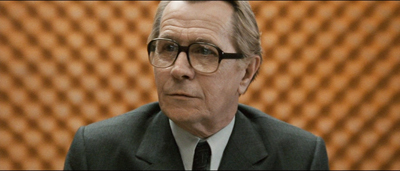
You have to let go of the idea of explaining it all to the audience. You have to make it so complex that the audience understands that they can’t understand all of it. . . . We had to make it trustworthy and credible but also so complex that you couldn’t penetrate it. . . but not so incomprehensible that it put people off.
Dino Jonsäter, editor, Tinker Tailor Soldier Spy
More than most plot types, I think, a mystery story lures us into analysis. Think of the endless fan probes into Memento, Primer, Donnie Darko, and the like. The secrets in the action, and the roundabout tactics of recounting it, invite us to think about narrative technique more abstractly than we usually do. We’re encouraged to study how we’ve been misled. Analysis is a bit like detective work, but also like academic research. The analyst has a lot in common with Smiley and his patient burrowing into the files. He is, in the books, an amateur philologist and a scholar of German poetry.
For many, the mysteries of Tinker Tailor have aroused an urge to analyze. Jim Emerson has compiled a handy roundup of exceptional probes into the film. Some of my readers have filed perceptive reports as well. Filmmaker and teacher Stew Fyfe offers this:
I agree that what they’ve done with the film is subtract most of the redundancy, with bits of information offered up only once. If you missed it, you missed it. I was surprised when Smiley actually told Ricki Tarr that he missed the chip in the door; that seemed like the movie was taking it uncharacteristically easy on the audience for a moment. It was kind of thrilling to see a film that trusts its audience to keep up with it the way this one does. I wonder if they might have initially stripped more info out and then put some back in during the editing process. . . .
The other thing that has struck me is how very legible the film is when you see it a second time. Most everything does indeed seem to be there, in frame, but the audience isn’t cued to be looking for certain things. Ann does have some slight reaction to Bill Haydon when he sits down at the party, if I remember correctly (something cues Smiley to turn and look at him). And it’s clear why Bland offers to accompany Guillam to lunch.
Or performances take on a different meaning based on the information we have by the end of the film. It’s clear by the end that some sort of relationship was going on between Haydon and Prideaux, which makes Haydon’s conversation on the phone the night Prideaux was captured play differently the second time around. (The Haydon-Prideaux relationship was actually one thing that didn’t work for me the first time watching the film. The nature of their relationship hadn’t registered, so Prideaux’s act of shooting Haydon didn’t have the same emotional heft. The scene played much more strongly the second time I saw the film.)
I guess Smiley’s eureka moment is a little bit of a leap, but otherwise, it’s all there.
And here’s Ben Slater, a long-time le Carré admirer.
I read the screenplay, officially online as part of Focus’s awards campaign (http://focusawards2011.com/workspace/ttss-screenplay.pdf) , and it’s fascinating how much of the adaptation was reworked and restructured in production.
The film was intended to open ‘cold’ with Prideaux’s mission. His meeting with Control – now the opening sequence – wasn’t till much later. The abortive mission and the Christmas party were intended to only be returned to once each, and yielded most of their secrets (Karla’s presence/Bill and Ann) on the first go-round.
There are myriad tiny and fairly dramatic changes – in the script Ricki Tarr’s first appearance is much more impactful, the killing of Bill is very different, etc. Some of these are changes Alfredson must have made during filming, others suggest a great deal of time spent re-arranging and re-sculpting the fragments of the plot in editing – trying to make the story flow as elegantly as possible. I imagine this was tough!
Interestingly, the bold decision to make Smiley silent for so long in the opening scenes seems to have been made in post. They simply cut all his first lines of dialogue. And Smiley’s closing line of the film was also shot and cut – “Shall we begin?”
It’s impossible to watch the film without running the novel and the TV series alongside it, and it struggles to compete in terms of narrative and character, but the real triumph is arguably the ambience of broken England it evokes – cigarettes, whiskey, bad burgers, bad skin and failed lives.
So mystery stories tease us into analysis. But they also flaunt some common characteristics of all storytelling. Encountering any tale, we always want to know what comes next, but we’re also curious about what was left out, or lied about, or presented in passing, or hidden in plain sight. The writer is the mole, and we’re the mole-hunters. As novelist Jane Smiley puts it:
The most basic conviction of every novelist from Lady Murasaki on . . . is that things are not as they appear.
My arguments from Victor Shklovsky come from various essays in Theory of Prose, trans. Benjamin Sher (Dalkey Archive, 1991); the epigraph is from the essay “Sherlock Holmes and the Mystery Story,” 110-111. The David Lodge epigraph is from his “Novel, Screenplay, Stage Play: Three Ways of Telling a Story,” in Lodge, The Practice of Writing (Penguin, 1997), 215. The Jane Smalley quotation is in her 13 Ways of Looking at the Novel (Anchor, 2006), 49. For more thoughts from editor Dino Jonsäter, go to “Cutting Tinker Tailor Soldier Spy” on Creative Cow.
I’ve signaled before the marvelous two-part interview with le Carré for the CBC, but why not do it again? Since writing the last piece I also discovered a helpful interview with Tomas Alfredson and Gary Oldman at Film School Rejects. I have other notes on the Hong Kong atmosphere of The Honourable Schoolboy here.
The Ship of Statements sails on

Kristin here:
I’m glad I held off seeing Jean-Luc Godard’s Film Socialisme (2010) until I could watch it on the big screen. Last September, thanks to the UW Cinematheque I was finally able to do that. I thoroughly enjoyed it, was baffled by parts, thought I understood other parts, and wallowed in the gorgeous imagery that is late Godard. I certainly didn’t understand it well enough to blog about it and point out to the nay-sayers that just because a film is well-nigh impossible to understand doesn’t mean it’s bad. Besides, Andréa Picard has already written an intelligent and spirited defense of the film on CinemaScope where she, among other things, rightly dismisses critics’ claims that Godard is irrelevant and “out of touch with the world.”
A floating metaphor with thirteen decks
I was intrigued last month to learn that the cruise ship the Costa Concordia, which ran aground on January 13 with at least 17 people killed and many others injured, was the ship Godard had used as the setting for the first section of Film Socialisme. A number of websites pointed this out and tried to make some connection, logical or otherwise, between Godard’s choice of his setting and the fact that the ship subsequently crashed. IBTraveler noted:
On Friday, Jan. 13, the Costa Concordia cruise ship crashed into rocks off Italy’s west coast. Just three days earlier on Jan. 10, Jean Luc Goddard’s [sic] hotly debated 2010 “Film Socialisme” was released on DVD. What do the two seemingly unrelated events have in common? The first of the film’s three movements, “Des choses comme ça” (“Such things”), was shot on and prominently featured the doomed ship.
The purely coincidental fact that the DVD had just come out proved mildly newsworthy and undoubtedly garnered Godard a little extra publicity.
The Guardian, in a widely quoted editorial posted two days after the disaster, described Godard’s use of the ship:
Anyone who sat through Film Socialisme may have suspected that the Costa Concordia was heading for trouble. The cruise liner was the setting for the first ‘movement’ of Jean-Luc Godard‘s ambitious, infuriating 2010 picture, serving as a self-conscious metaphor for western capital ploughing through choppy waters. In Godard’s film, the Concordia plays the role of a decadent limbo where the tourists drift listlessly amid the ritzy interiors.
The ship of state is a well-worn metaphor, but critics assumed that Godard had taken it one step further, using the multi-lingual, multi-national group of tourists singled out from among the thousands on the ship as an image of the new Europe and its growing problems. The first movement of the film ends with the title, “QUO VADIS EUROPA.”
Yet Godard did not choose the Costa Concordia and turn it into his central “self-conscious” metaphor. The ship’s makers had created it as a giant floating metaphor well before Godard shot aboard it. The Carnival Corporation ordered it in 2004 and received it in 2006. The ship and its five sister ships are operated by the Costa Crociere company in Italy, which is owned by the Carnival Corporation, also the parent company of Carnival Cruise Lines. According to the owners, the “Concordia” fleet’s name “expresses the wish for continuing harmony, unity and peace between European nations.”
Presumably as a way of expressing that wish, the Costa Concordia, the first of the ships in the fleet to be built, was designed with thirteen decks, each named for a European nation (using the Italian version of each name, since that is where the vessel is registered): Deck 1, Olanda; Deck 2, Svezia; Deck 3, Belgio; Deck 4, Grecia; Deck 5, Italia; Deck 6, Gran Bretagna; Deck 6, Irlanda; Deck 8, Portogallo; Deck 9, Francia; Deck 10, Germania; Deck 11, Spagna; Deck 12, Austria; and Deck 13 (sometimes referred to as 14), Polonia.
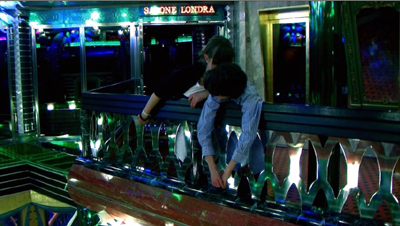
An ordinary director, stumbling upon such a perfect ready-made setting encapsulating one main theme of the film, would use these country names. There must be a directory somewhere, or name plates inside and outside the elevators. Yet despite all Godard’s stairway and elevator shots, he never includes a sign that would reveal these names to us. I learned about them not from the film but from the helpful Wikipedia entry on the ship. The only time in the film where I spotted a sign related to the country names was the “Salone Londra” in the background of one shot, presumably on Deck 6. The ship owners might have been heavy-handed, but Godard is not. Even the most unsympathetic critics were able to spot this central metaphor without his having to nudge them.
A floating Tower of Babel
Some commentators implied that in making his film about tourist behavior abroad the ship, Godard had somehow foretold that the Costa Concordia was doomed. The Guardian passage quoted above says a viewing of the film would tell one that the ship “was heading for trouble.” Such a statement spices up a journalistic comment, but I’m sure Godard never dreamed that the Costa Concordia would end up where it has. Certainly many, many other cruise ships are continuing to operate around the world, many of them with the same sorts of multiple restaurants, swimming pools, casinos, bars, and exercise classes that we see in Film Socialisme, and they don’t run aground and cause fatalities. The proportion of people who drive cars and are killed or injured is vastly higher than those who take cruises (or airplanes) and suffer the same fate. When a younger Godard critiqued European society in Weekend (1967), he chose a vast car crash to symbolize it.
All this in itself would not be reason to blog about the link between Godard’s film and the ship’s disaster. Yet recently Newsweek ran an intriguing editorial (also online on the magazine’s sister publication, The Daily Beast) about some possible underlying causes for the disaster, causes related to multiple languages and incomprehensible safety lectures. According to author Eve Conant:
Former crew of numerous other lines say workers were often too exhausted to pay attention during safety-training sessions, and many didn’t speak enough English to even understand what was being said. Reshma Harilal says that during her eight years as a stateroom attendant with Carnival Cruise Lines, parent company of the ill-fated Concordia, boat-safety drills varied in regularity, and she never once had a native English speaker conduct training. “We all got safety training, but even I had difficulty understanding the English of the officers who trained us, who were always Italian with strong accents.” Carnival referred questions to the Cruise Lines International Association, which responded that “training must be conducted in a language that will be understood by the particular crew members.”
[…]
Those who’ve spent their lives in the industry say some answers are floating right on the surface. One is crew-to-passenger ratios, which have widened over the past few decades from an average of one crew member for every two passengers to one for every three, according to the International Transport Workers’ Federation. Crew members work 12-to-14-hour days, seven days a week, for months at a stretch, with minimal time off. “Half the ship is working in a state of fatigue,” says James Walker, a former cruise-industry lawyer who now represents aggrieved crew. “All types of safety studies have shown if you’re really exhausted you can be impaired to the point of intoxication.” The mostly Asian crew of the Costa Concordia had been on an eight-month shift when the ship capsized after running ashore off the Tuscan island of Giglio. Accommodations were like the Titanic’s steerage section. Only managers had shared cabins, and the others slept in dormitory bunks.
This description recalled something that struck me upon seeing Film Socialisme for the first time. It was obvious that Godard was depicting the decadence, wastefulness, and conformism of the people well off enough to take such cruises. But if the film is a microcosm of the European Union, it presents that society as having seen the development a social divide between the prosperous Europeans and a new working class who have come from outside the continent, primarily from Africa, southeast Asia, and the Pacific Rim. They face not only the traditional problems of the working class but also racism and language barriers.
Godard doesn’t make this point overtly. There are relatively few shots of the ship’s crew members. The five frames below are from the only images that focus on crew members, but it’s notable that none is a sailor. Most are waiters; one is a maid. They are the ones most likely to come in direct contact with the passengers and have to obey orders from them. We don’t see anyone order them about in a peremptory fashion or scold them. Usually they are just going about their business, and almost none of them ever speaks. There’s a cook who I suspect is the man invariably present at cruise and hotel buffets making omelets fresh to order. There’s a maid dusting a room, and the inevitable waiters in the bars. The last one, with the yellow vest, is the one who speaks, saying something as she presents the bill.
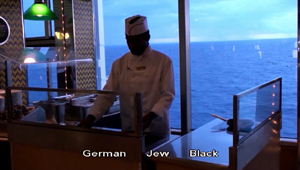
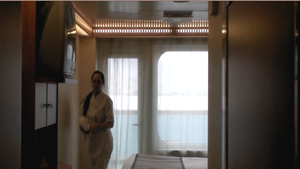
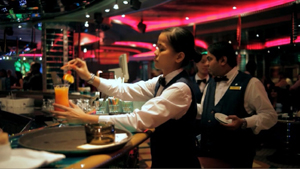

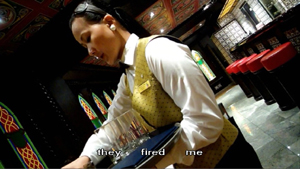
These shots are so understated and appear so seldom that it is easy to overlook them. Still, their presence can’t be arbitrary. I may have noticed this motif because, even though I’ve never traveled on a huge ship like the Costa Concordia, I’ve been on enough much smaller Nile cruise ships and in enough hotels in Egypt to have seen how some European and American tourists treat the bartenders, waiters, and maids. These servant figures have, I think, an important link to the baffling use of language and the “Navajo” subtitles.
These subtitles baffled a lot of critics. Samuel Bréan has written a fascinating essay about them (and is at work on a book on translation and subtitling in Godard’s films) on senses of cinema. He points out that characters at various points speak Latin, Russian, German, Italian, Spanish, Hebrew, Arabic, Bambara, English, and Greek. In a seemingly perverse, arbitrary gesture, Godard chose not to subtitle these stretches of dialogue in any way that could render them intelligible to someone who doesn’t understand the respective languages of the characters. Rather, he included what he termed “Navajo” subtitles, small series of words that don’t add up to even the barest summary of what the characters are saying. At times they seem almost random. The film was distributed in France without these subtitles, though the French DVD lists “Navajo” in the little box concerning subtitles on the back of the box. The default setting is for them to play, though the viewer has the option to switch them off.
Some critics have assumed that the term “Navajo” refers to real American Indians and thus is in some way offensive. But as Bréan points out, a newspaper story published shortly before the film was shown at Cannes declared that the subtitles would be “as in old Westerns where the Native Americans spoke in choppy phrases.” Not real Navajo, but Hollywood’s clichéd version.
Bréan finds patterns in the subtitles: they are all written as one line, mostly with two or three words, but occasionally with as few as one and as many as five. The words have wide spaces between them, with no punctuation. The verbs are seldom conjugated; there are few pronouns or articles; and separate words are often mashed together, as with “civilwar.”
As Bréan points out, some critics found the subtitles poetic or experimental. He thinks “that if Godard took the principle of reduction inherent to subtitling to an extreme (and added other peculiarities of his own), it is, among other things, to show how relative it is to try and assess a film without acknowledging the inevitable changes in perception caused by subtitling.”
True, no doubt, and yet there is something more going on. Some of the brief strings of words are actual translations of some of the words spoken by the characters. Others are mistakes. In the opening, when the young man with the camera says “une chose,” the subtitle renders it as “nochoice,” as if some invisible non-French-speaker has heard the phrase as something like “unchoice.”

During the introduction of one of the significant characters, Mr. Goldberg, the subtitles render his name as if it were a phrase:
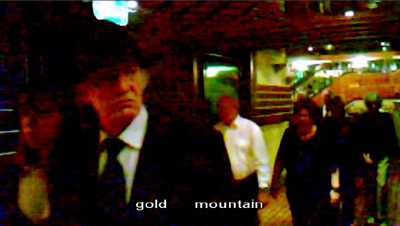
Even when the words are accurate, they tell so little that they actually become a distraction in the struggle to interpret what little one can from the characters’ dialogue.
Given Godard’s concern with the situation in the Arab world, and in particular the injustices done to Palestine, it is telling that the one character whose dialogue is not given any subtitling is a woman speaking Arabic.
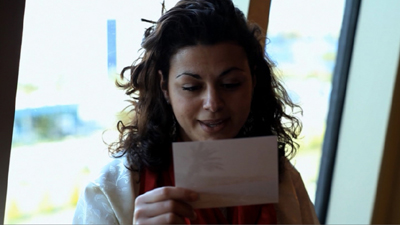
Overall my impression of the subtitles on first seeing the film was that they place the spectator in somewhat the same position as someone who is listening to a language he or she does not really understand. When I hear someone speaking Italian or German, I can pick out individual words (no doubt being mistaken about some of them), but they don’t add up to an understanding of what is said. Whether or not we make the connection, we are in somewhat the same situation as those waiters and maids, though for them their jobs may depend upon figuring out what all these tourists speaking their various languages want from them. Europe is full of such people. We more privileged, educated people can have little sense of how they cope, but for me, Godard has found a way to sort of put us in their positions for a little while.
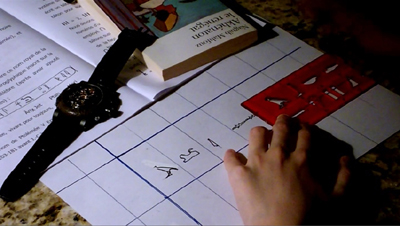
Apart from making this serious point, the focus on language also occasionally creates humor. One character lies on her bed watching a well-known YouTube video of two cats “conversing” in what sounds remarkably like human speech. The woman, however, starts meowing and declares, correctly, that the ancient Egyptian word for cat was Meow (or Miu, as the conventional transliteration of the hieroglyphs has it). She is probably the same person seen earlier writing her name, Alissa, in hieroglyphs, with an elementary introduction to hieroglyphs and a copy of Nagib Mafouz’s novel about the pharaoh Akhenaten. She is the only character presented as having enough interest in the countries where the ship will dock to study them in advance, if only superficially.

A world unto itself
Not that Alissa will get much chance to use her knowledge while ashore in Egypt. Godard does not show the brief excursions that the passengers will be taken on at the various ports of call. There is one single shot of them out on deck looking at a nearby city.
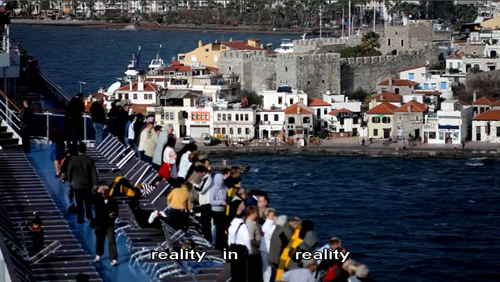
It would be doubly ironic if this city were on the Isola del Giglio, where the Costa Concordia met its fate, but that doesn’t seem to be the case. I don’t know what city this is, but it has managed to draw at least some of the passengers out onto the deck. Otherwise most of them don’t even venture outside to contemplate the sea. Most of the deck shots show immense stretches, empty apart from a few people, including a young man with a camera, and a contemplative young woman (seen in a knit cap in the “nochoice” frame above) who seems to be the closest thing we get to a point-of-view figure.
What Godard doesn’t show is that the occasional excursions are likely to be superficial. I remember on one occasion I was on a tour of Egypt. The group I was with, most of whom knew quite a bit about ancient Egypt, was spending most of the day on the Giza Plateau, hiking around the Great Pyramids and visiting the Sphinx but also viewing some of the quarries, subsidiary pyramids, ruined temples, and private tombs that cover the plateau around and between the pyramids. We went back to our bus to have lunch. While we were there, we were treated to the spectacle of 24 identical buses arriving and disgorging their full loads of tourists. Clearly they had come from one of these giant cruise ships. (Tours within Egypt seldom require more than one bus.) They had a look at the pyramids from the parking lot and walked down the hill to see the Sphinx. Reloading the buses took a while, and the entire group departed twenty minutes after they arrived. They might have gone to the Egyptian Museum, though the ticket and security lines might take too long for such a large group. Maybe they just had lunch instead and headed back for Alexandria, where their ship was docked.
The drive from Alexandria to Giza is about three hours each way, during which passengers are treated to a desert landscape empty apart from billboards for Pepsi, Coke, KFC, and other familiar products, as shown in this photo I took in 1995. (For a charming, illustrated account written by an upbeat couple who took what seems like an pretty good version of such a whirlwind tour in Egypt, see here and here. They did get a quick look-in at the museum and had lunch at the wonderful Mena House at the foot of the Giza Plateau.)
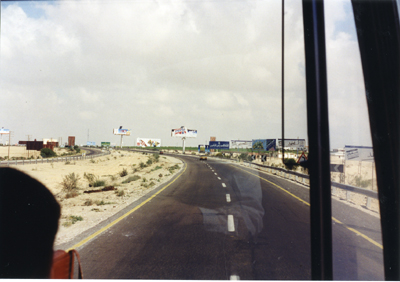
I assume the same sort of thing happens at each stop along the cruise-ship’s itinerary.
Godard’s point, presumably, is that for the vast majority of the people on the trip, the entertainment and sustenance offered within the Costa Concordia itself, along with the duty-free shops ashore (we see some of the passengers visit a gallery displaying remarkably bland art unrelated to the local culture) are the main attractions. A chance to get a photograph taken in front of the Sphinx or the Parthenon is a little bonus.
If you don’t understand Godard
Then there is the visual side of things. How could anyone dismiss a film that has images like these?

TINKER TAILOR: A guide for the perplexed
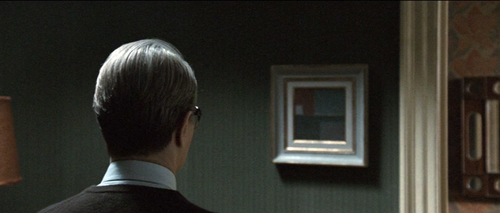
Tinker Tailor Soldier Spy.
DB here:
As the final credits rolled, a man behind me blurted out, “I don’t get it.” He’s not alone. Kristin and some acquaintances have told me that they found parts of Tinker Tailor Soldier Spy hard to follow. Several critics, while praising the film (and doubtless getting more of it than that guy), have warned viewers to pay close attention. Roger Ebert said:
I enjoyed the film’s look and feel, the perfectly modulated performances, and the whole tawdry world of spy and counterspy, which must be among the world’s most dispiriting occupations. But I became increasingly aware that I didn’t always follow all the allusions and connections.
Some of the film’s admirers advise us not to worry much about the intricate storyline. Michael Phillips remarks:
This is one of the finest achievements of the year, and while it’s easy to lose your way in the labyrinth, I don’t think “Tinker, Tailor, Soldier, Spy” is most interesting for its narrative pretzels. Rather, it’s about what this sort of life does to the average human soul.
Even if I weren’t a le Carré fan, I’d be fascinated by a film that can succeed both critically and financially and still leave its audience puzzled about its plot.
Critics of popular filmmaking claim that our movies cater to simple minds, but we actually find a lot of successful films, from Groundhog Day and Pulp Fiction to Inception, that are complex in intriguing ways. I argued in The Way Hollywood Tells It that since the 1960s one current of filmmaking has explored narrative strategies that were minor, even unheard-of, options in earlier times.
I’m not ready to join Steven Johnson in suggesting that audiences have become smarter. In certain respects older films are more demanding than contemporary ones. I’d rather say that new conventions are in force, aimed at certain sectors of the audience who are willing to put forth the effort. Ambitious filmmakers may find new ways to fulfill these conventions, balancing novelty with intelligibility. This is the path, I think, that the makers of Tinker Tailor took, and it didn’t prevent the film from earning $17 million at the US box office.
The film’s ’70s patina isn’t off-putting. The filmmakers offer deliberately grainy imagery, enveloped in hazes of rain and cigarette smoke. The palette, except for Ricki Tarr’s idyll with Irina, is grey, brown, and beige. Scenes are shot with long lenses, rack-focus, and drifting tracking shots. Zooms and push-ins are interrupted by cutaways. The result is an Altmanesque look, but more disciplined. It’s not the visual style, then, but those the narrative pretzels—another reminder of late ‘60s and early ‘70s storytelling—that attract my notice today.
So I persist: What makes the movie hard to grasp? If we can get a sense of this, we might get to know Tinker Tailor more intimately, while also producing some ideas about how mainstream films work generally. To attempt an answer, I have to go into detail. I won’t be supplying a plot synopsis, but the Wikipedia entry is reasonably comprehensive. I’ll be looking less at the story and more at the storytelling. Still, don’t read further if you haven’t seen the film. In the tradecraft jargon of blogging: There are spoilers ahead.
Breaking up the blocks
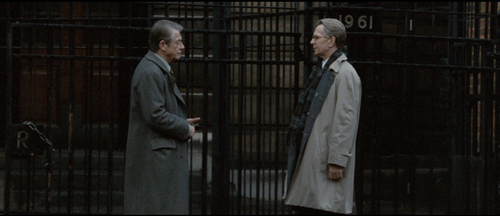
One factor contributing to the film’s difficulties, as many reviewers have pointed out, is that it’s adapted from a big and complex book. But it isn’t just the size of the original novel that poses problems. It’s the way the plot is constructed and the story is narrated.
The plot of the novel Tinker, Tailor, Soldier, Spy (published 1974; the commas aren’t in the adaptations) consists mostly of blocks of flashbacks. The action starts long after Control has died and his old staff, including George Smiley, has retired. The novel’s first scenes show Jim Prideaux’s arrival at the boy’s school, seen from the perspective of Bill Roach, his shy confidant. We don’t yet know how Jim connects to Smiley, who after a dinner with a gossipy acquaintance, is summoned to investigate the prospect of a mole in the Circus’s top echelon.
Smiley’s investigation involves questioning witnesses like Connie Sachs, but more often it involves “burrowing,” working patiently through the files that Control had studied. Le Carré presents what Smiley gleans from the files as flashbacks, and interwoven with those are Smiley’s reflections on the key personnel and their power struggles. Institutional memory and Smiley’s rueful recollections tie together the ambush of Jim Prideaux and the vein of top-secret information code-named Witchcraft.
Respecting the novel’s construction would demand a cascade of long tales framed by Smiley’s step-by-step pursuit. Arthur Hopcraft’s screenplay for the seven-installment 1979 BBC series took the simpler option of starting with a scene that is presented very late in the novel, during Jim’s revelatory confession to Smiley. The TV series opens with Control summoning Jim and sending him off to Czechoslovakia. Jim is shot and Control is cast out. Clarifying the string of events this way, and giving us a decent action scene early on, has its cost: Smiley doesn’t enter the series for twenty-three minutes.
Since Hopcraft and director John Irwin had hours at their disposal, the scenes could stretch and breathe, and they retain the somewhat chunky, modular quality of the novel. But a two-hour film couldn’t handle the book’s plot so spaciously. What did the team of Bridget O’Connor and Peter Straughan do? Straughan explains:
The adaptation process differs from book to book, but in the case of “Tinker Tailor,” it involved a kind of mosaic work. The structure of the novel was broken into pieces. Some long sequences would remain intact – Peter Guillam stealing the files from the Circus, for example – but in other cases we would take a line or event from one place in the narrative and move it elsewhere, shifting the fragments around endlessly until it felt right. The goal was to create a new version of the narrative which would bear a close family resemblance to the source material, but have its own cinematic personality. The really difficult part was not fitting the plot into two hours but doing it without losing the tone; to give the film the same autumnal, melancholy pace, and to give the script air and silence.
The most obvious instance of this fragmentation is the repetition of the ambush of Bill Prideaux in the Budapest café. In keeping with current norms of storytelling, this scene is replayed at crucial points, each time giving us a bit more information relevant to the scenes of testimony around it.
Repetition is a luxury that can’t be overindulged in adapting a hefty novel. To spare time for the pace, the air, and the silences the filmmakers want to include, they had to be more concise in their presentation of plot. They had to chop le Carré’s big narrative blocks into bits.
When we view a mosaic we can step back to see how the composition blends all the fragments. But we have to experience a movie bit by bit. A film, we might say, is a moving mosaic, and we are usually standing very close to it. Just as important, a mosaic, made out of gaps, leaves it to us to grasp how the parts fit together—to make our mind jump the gaps.
Unconventionally conventional
How does Tinker Tailor fit the pieces together? In general, the film adheres to common conventions of modern storytelling but then subtracts one or two layers of redundancy. The little gaps created make the film seem roundabout today, when rather linear and explicit narration is the norm.
Start with a simple case. Like many modern spy films, Tinker Tailor initiates a shift to another locale by a long-shot framing, often from on high. Here’s an example from The Bourne Ultimatum.
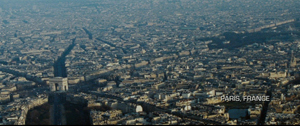
It’s triply redundant: We see a city landscape including the Arc de Triomphe; we’re told it’s Paris; and we’re told it’s Paris, France (not Paris, Maine). Compare the parallel shot from Tinker Tailor.
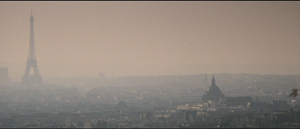
Not exactly a difficult leap—who doesn’t know that the Eiffel Tower is in Paris (France)?—but it’s a little less explicit. Earlier instances are more laconic. When we’re taken to Budapest and Istanbul, probably not as immediately recognizable to many in the audience as Paris, we get a cityscape with only one mention in the dialogue to tag the setting, and no captions. Least explicit of all are the shots picking out the Circus in London.
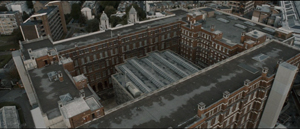
Another film would have typed out, “MI6 HQ,” but we’re left to infer that behind this façade the Secret Intelligence Service does its work. So the convention of the exterior establishing shot is respected but made a little less redundant.
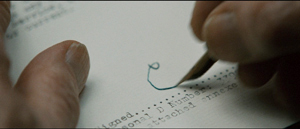
Consider as well the introduction of the Circus’s decision makers. Another film might have started with Smiley and followed him from his office into the briefing room. Instead, he’s introduced as one of several men, then as an out-of-focus figure alongside Control. And even Control could have been more clearly identified. He signs his resignation with what could become an emblem of the film’s stingy approach to storytelling.
Just as truculent is the process by which Lacon is led to summon Smiley. First Lacon gets a warning call from the field agent Ricki Tarr. So far, so conventional. But Tomas Alfredson has staged things so that Tarr is seen at a distance, turned from us, and blocked by a phone booth. Who is this guy? We must get all our information solely from his voice, not his facial expression.
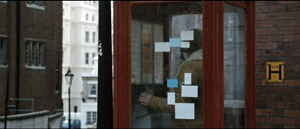
Soon after Peter Guillam has entered the Circus, he gets a call. Most directors would have cut away to the caller, or at least let us hear what Peter is hearing. But we’re denied that information. On the soundtrack, we hear only a muffled, “It’s Oliver…ringing…” It’s Lacon, but you know that only if you know his first name is Oliver, and we’re teased by hearing almost nothing of what he’s saying. We know even less than Guillam, and this suppressive narration is characteristic of Alfredson’s handling of genre conventions.
Next we see Smiley at home, watching television. There’s a knock at the door. Cut to a car driving, Peter at the wheel and Smiley in the back seat. Smiley is silent, and Peter offers his regrets: “I was sorry to hear about Control, Mr. Smiley.” Earlier we’ve been given one shot of the dead Control in the hospital. So much for his backstory.
Finally, as the car pulls up at Lacon’s house, the fragments combine into an intelligible sequence when Peter says, “He said Tarr called him from a phone box.” Retrospectively, we can buckle the sequence up as a familiar genre action: The hero is called back to the battle by his chief.
Another convention, one that goes far back, is the dialogue hook. This is a bit of speech that ends one scene and links directly to the next one. Tarr calls Lacon and names Guillam as his supervisor. Cut to Guillam crossing the street and entering the Circus. Later, Smiley suggests that he and Guillam investigate Control’s flat. Cut to them entering it.
Dialogue hooks, as I’ve traced out here, are enormously helpful in guiding us through the plot. But sometimes Tinker Tailor works more obliquely. In one scene Peter reads of the staff who were sacked following Control’s fall. One is Jerry Westerby, whom we’ll meet a long while later, and the other is Connie Sachs. Cut to a train station, with Smiley buying a ticket to Oxford. It’s a hidden hook: most films would include in the earlier scene a line such as, “Connie Sachs, who’s now in Oxford.” Again, a conventional device is roughened a bit, made slightly more difficult. And sometimes the hook is visual and disruptive, as when a shot of Jim, bleeding in the Budapest arcade, is followed by a shot of the boy Bill Roach looking out a window at Jim’s arrival, as if he’s also looking down at his future teacher.

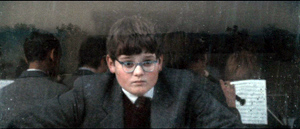
The BBC series was broadcast in weekly episodes, so recapping and backtracking in each installment helped viewers remember. At intervals we see Smiley bringing Peter up to date and briefing Lacon on current discoveries. The film flagrantly refuses to provide this conventional help. As Ebert notes:
More ordinary spy movies provide helpful scenes in which characters brief each other as a device to keep the audience oriented. I have every confidence that in this film, every piece of information is there and flawlessly meshes, but I can’t say so for sure. . . .
What replaces the standard briefing scenes? Some rather elliptical passages. There are the nodes in which Smiley reflects on the evidence. We get a shot of him staring, followed by a cascade of imagery as his mind plays with possible suspects.
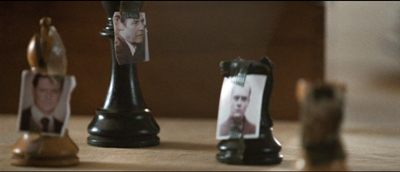
Linked to the briefing scene is another convention, the board or wall on which all the suspects are diagrammatically arranged. In our visit to Control’s apartment we might have seen pictures of Bill Haydon, Roy Bland, Toby Esterhase, and Percy Alleline laid out in a rectangle, with the sinister silhouette of Karla up top, and dotted lines connecting them. Yet Control, the bedraggled chainsmoker, could hardly be so tidy. Instead, the film gives us something more in character and more oblique: a litter of chessmen, each with a picture taped awkwardly on. Eventually Karla is revealed as another piece (the powerful white Queen). On his own, Smiley joins in Control’s conceit and tapes a picture of the new suspect Polyakov to a bishop.
Le Carré’s novel tied the suspects together with a verbal emblem, based on the child’s nursery rhyme. It linked the boy’s school to the Circus. But the film doesn’t introduce the tinker-tailor motif until very late. Instead the chess pieces visualize the multiple-choice problem, but in a ragged, haphazard way that suggests that perhaps Control really was, as Jim Prideaux suspects, going mad. More broadly, the imagery (with the briefing room as a gridded checkerboard) reminds us that spying, known for decades as The Great Game, is now a global chess match. It pits Karla against Smiley—whom Control has identified as the black Queen.
George the Obscure
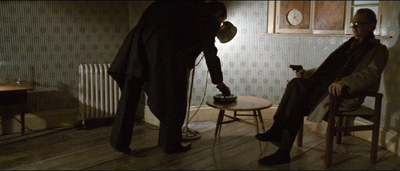
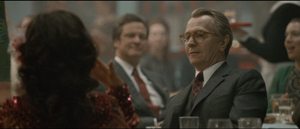
Again and again, the script and Alfredson’s direction invoke a convention only to make it more difficult to grasp. The central examples involve Ann, the faithless wife. She isn’t just treated elliptically; she’s suppressed. Instead of showing her flirting with Bill at the Christmas party, we see only the back of her head and Bill looking past Smiley’s shoulder.
In a later flashback to the party, Smiley looks out the window and sees Ann in the garden. Another film would have shown us who’s clutching her in the foliage, but this film leaves it to us.
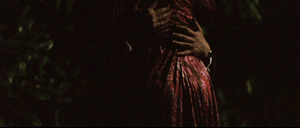
Of course many viewers will know Ann’s partner is Bill, but another film would have confirmed this more explicitly. Instead another standard scene is handled in a glancing way. More generally, Ann’s phantom presence not only makes her seem remote, like a princess in a tower, but sets her off against the blonde Irina, the maiden to be rescued in Ricki Tarr’s story. Thanks to the camera and a compact mirror, Irina’s face gets the caresses another film would devote to Ann.
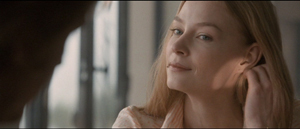
Irina, beautiful and sincere, holds the film’s major secret, the one that initiates Smiley’s investigation. She harks back to the blonde mother who is in the line of fire in the Budapest arcade, and that shooting prefigures Irina’s fate.
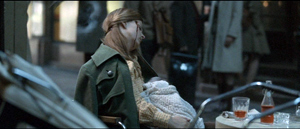
The crowning achievement in the film’s laconic way with conventions is the climax in the safe house. Smiley has arranged for Ricki to send a message that will force Karla’s mole to make an emergency appointment with his connection Polyakov. There Smiley, Guillam, and Mandel will record the meeting and capture the double agent. In the BBC series, this climax runs over eight minutes, built out of crosscutting and suspenseful waiting. Smiley and Guillam burst in together and a quick pan shot reveals Bill as the culprit.
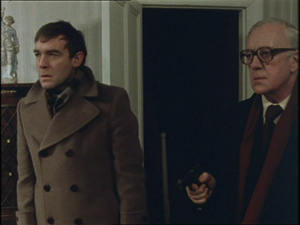
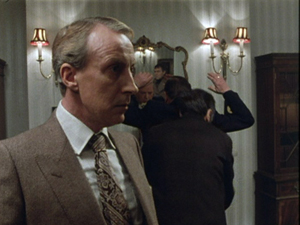
The film uses suspense and crosscutting as well, but the sequence consumes only six minutes. More important, by switching our attachment away from Smiley at the crucial moment, it conceals his entry to Bill and Polyakov. Instead we follow Guillam separately into the house, up the stairs, and to the parlor. There he confronts the aftermath of what might have been a heroic confrontation. Climax is treated as anticlimax.
Jim Emerson, in a nicely honed piece, suggests that we think of such passages as not so much elliptical as economical. I want to have it both ways. The scenes are economical because they fulfill familiar narrative and genre-based functions: We know how to fill them in. Yet they’re also elliptical because they hold back information, sometimes a little and sometimes a lot. A mosaic can show us familiar people and things, but it also asks us to make extra effort to see the pattern emerge. The tesserae fit, but the bumps and grooves between them are palpable.
It may be that art films have always tended to be self-consciously wrought genre films. L’Avventura: A mystery-melodrama. Blow-Up: A detective story. Drive: the thinking person’s action film. If so, then Tinker Tailor is the smart Bourne movie. Creative novelty needs a familiar base to play off. Movies come from other movies, and originality can take a tradition, even a popular one, as a point of departure for innovation.
Best watcher in the unit
Once plot gaps have alerted us, we should expect things to proceed through hints. Granted, there are hints that can’t be picked up unless you know the novel. For instance, the film doesn’t stress the fact, emphasized in the novel, that Bill is an amateur painter and the canvas he brings Ann on the fateful night is one of his own works. It’s the picture that Smiley is studying at the end of the credits sequence, as if the film’s two primary antagonists are already squaring off.
But, sticking just to the hints we can pick up without the novel, the film is fairly rich. It invites multiple viewings, as many movies do nowadays, in order to catch the undercurrents or the things that flash by too quickly on the first pass. (If we want to find more, we can buy the DVD.) I can’t pretend to exhaust the possibilities, but here are some that strike me.
Go back to those chessmen. As we’ve seen, the two antagonists, Karla and Smiley, are made parallel as the rival Queens. Three suspects are assigned to innocuous pieces: Percy as the white Rook, Toby as the black Knight, and Roy as the black King (although that assignment might be a narrative feint, hinting that Roy’s the traitor). But Bill is the white Bishop, and in retrospect we can see the fact that Smiley makes the Moscow agent Polyakov a black Bishop is a pointer to Bill’s guilt—and maybe a suggestion that, as Bill will say, George knew all along.
Or take the homosexual element. One question that comes up in conversation after the movie is whether Bill and Jim were lovers. It’s treated as a possibility in the original novel and becomes stronger as the film proceeds, especially after Bill—in a moment of privileged information for the audience—pockets a picture of the two friends embracing and laughing. By the end, in the final flashback of the Christmas party, Bill rouses the loner Jim and flashes him a smile; but the brandy glass he floats away with seems intended for Ann. Bill’s bisexuality is explicit in the epilogue when, in the compound, he asks Smiley to pay off both a girl and a boy. More than a hint, as well, is the tear that dribbles down Jim’s cheek as he executes his friend. (Bill’s wound, rhyming with Jim’s perforated back in Budapest, again recalls the slain mother in the arcade.)
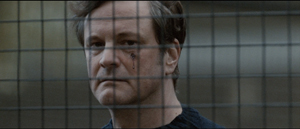
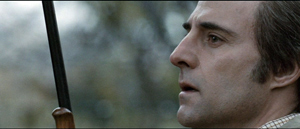
Similarly ambivalent is the presentation of the dapper Peter Guillam. He’s introduced turning his head to watch a cute young lady pass. Later he’s revealed to be gay: for security reasons, he has to break up with his partner. In retrospect, we can see the shot when Bill and Peter eye the new clerk Belinda as presenting two double agents, each one passing as a lady-killer.
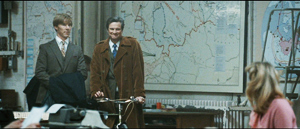
More minor touches hint at the sexual undercurrent. Bill on the phone: “And I said you may fuck me but you still have to call me sir in the morning.” It takes a quick eye to spot another manifestation of the motif. Polyakov, posing as a cultural attaché, writes articles for a bilingual magazine. After Connie has told her tale, there’s an insert—an excerpt from Connie’s memorabilia, or perhaps only a memory of Smiley’s—of an article signed by Polyakov, which says of the Russian Ballet corps:
To see them only in a narrative ballet would be to know them incompletely. The programme shows a perfect cross section of their accomplishments.
They can dazzle us with a technique that seems to defy the laws of gravity but that is not merely acrobatic because it is truly gay in expression.
Like the dancers, Bill and Jim are both athletes and acrobats, powerful and graceful. I can’t prove this implication was intended by filmmakers, but by chance or design, it’s a fragment that fits.
Or take the Christmas party. There the tune, “The Second-Best Secret Agent in the World” ramifies outward to several second-besters: that night Jim is Bill’s second-best lover, Smiley is Ann’s second-best lover, and Smiley is the agent outwitted, at that point, by Bill. Another hint: At the height of the evening, the USSR anthem is sung ironically by the Circus staff, while Bill, an undercover Soviet, is off in the garden. Not to mention that as Control signs his retirement papers, he asserts: “A man should know when to leave the party.”
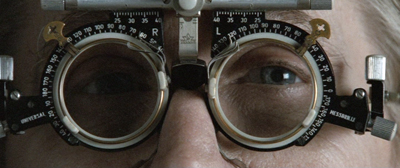
Above all are the eyeglasses. Promoted in the film’s publicity (when Oldman found them, he found the character), they become associated with seeing things as they are. The old hornrims seem to be something of a shield; Smiley pushes them back into place after he sees Bill with Ann. But once Smiley has gotten his new, more powerful pair after leaving the Circus, he uses them as an instrument of scrutiny. They enlarge his vision eerily; often they’re lit and in focus when his eyes aren’t. And they hide his eyes from others.
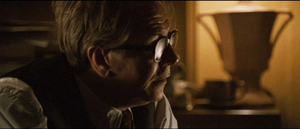
Although he bears Bill’s name, the podgy boy Roach is a closer parallel to Smiley. For him and for George, spectacles are a sign of wary vigilance. Jim praises Roach: “Best watcher in the unit, I’ll bet. As long’s he’s got his specs on, aye?” The motif may come from a passage in the novel that is recast for the film. Bill tells Smiley that Karla had worried that Smiley would catch him.
Karla said you were good—the one we had to worry about. But you do have a blind spot. And if I was known to be Ann’s lover, you wouldn’t be able to see me straight. And he was right—up to a point.
But those were the old glasses, and Smiley was a more vulnerable man then.
Saint George?
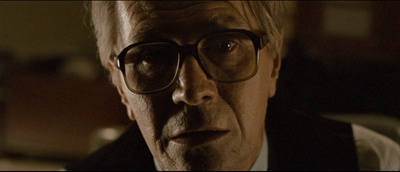
The novel is based, as most people know, on the revelation back in 1963 that a cadre at the center of the British Secret Intelligence Service was in the pay of Moscow. Kim Philby was the central figure, surrounded by Donald Maclean, Guy Burgess, and “the fourth man” identified later as art historian Anthony Blunt. In a scathing introduction to a 1981 book on the conspiracy, le Carré diagnoses the scandal as symptomatic of an endemic weakness in Britain’s ruling class. (Yes, he uses that phrase, which no American politician dares to utter.)
Was he not born and trained into the Establishment? Effortlessly he copied its attitudes, caught its diffident stammer, its hesitant arrogance; effortlessly he took his place in its nameless hegemony. . . . The SIS quite clearly identified class with loyalty.
He might be describing Bill Haydon:
Philby, an aggressive, upper-class enemy, was of our blood and hunted with our pack; to the very end he expected and received the indulgence owing to his moderation, good breeding, and boyish, flirtatious charm.
Worse, the agency that was pledged to protect Britain had insulated itself from reality, somehow seeing in an American-promoted anti-Communism a small rebirth of the Raj.
Whatever went on the big world outside, England’s flower would be cherished. “The Empire may be crumbling; but within our secret elite, the clean-limbed tradition of English power would survive.”
Le Carré’s lacerating remarks remind us that he might be our only major popular novelist who has held uncompromisingly critical positions on international affairs, including the Iraq war and the growth of American militarism and corporate power.
But the polemicist isn’t identical with the novelist. Tinker, Tailor provides a far more ambivalent picture of betrayal. Le Carré the polemicist has created in Haydon a perfect embodiment of what he despised about British Intelligence and the class system that feeds it. The parallel world of the boys’ school evokes the origins of the corrosive ethic that led to Bill’s treachery.
Yet the novelist spares his traitor the worst. For one thing, Peter Guillam, who idolized Haydon, can’t summon up condemnation.
Despite his banked-up anger at the moment of breaking into the room, it required an act of will on his own part—and quite a violent one, at that—to regard Bill Haydon with much other than affection. Perhaps, as Bill would say, he had finally grown up.
Smiley, who has every reason to hate Bill, is at a loss. He mulls over how he should judge the man who has done such monstrous things. As a friend worthy of respect who stood by his convictions? As a committed thirties intellectual? As a romantic elitist clouded by ideology? As an esthete who elevated his distaste for Philistinism to a political principle? As a superficial man in the grip of a compulsion to betray?
Smiley shrugged it all aside, distrustful as ever of the standard shapes of human motive. He settled instead for a picture of one of those wooden Russian dolls that open up, revealing one person inside the other, and another inside him. Of all men living, only Karla had seen the last little doll inside Bill Haydon.
In the book, Smiley’s uncertainty about Bill leads him to hope for a reconciliation with Ann. For him, unlike Bill and Karla, love isn’t an illusion or cover story. In the TV series, for all his triumph over the Alleline cadre and Karla’s mole, he returns to Ann and her chiding: “Poor George, life’s such a puzzle to you, isn’t it?” But the film gives us a different Smiley, and it interprets his reward quite differently.
We can approach the problem through performance. The TV series makes Smiley a stern schoolmaster, keeping his own counsel but voluble, thanks to the fluting of that Guinness voice. His facial expressions work a narrow range, but are very nuanced within that compass. Here is Guinness shifting, minutely, from polite approval to a steely comprehension while his oblivious informant chatters on.
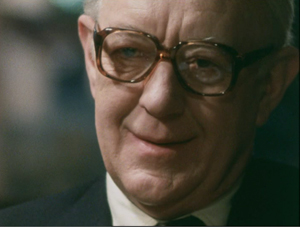
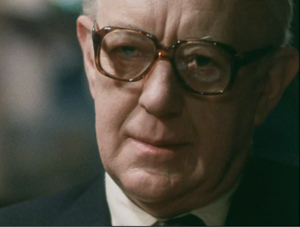
By contrast, as every critic has noted, Oldman’s Smiley is virtually blank for most of the film. His frog-mouth, half-open or clamped shut, remains impassive. Guinness lets us into Smiley’s mind as he interrogates his targets, but Oldman’s most marked reactions are brow-wrinkling concentration and puzzlement. The high point, George’s discovery of Ann’s disloyalty, elicits only a gasp and a gape (and a pushing up of the glasses). As usual, even that reaction is muffled a bit, this time by the profile angle.
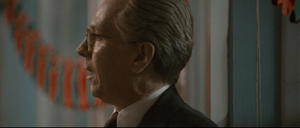
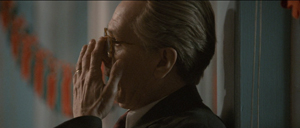
Similarly, everything conspires to make George obscure. Framing, setting, and lighting put him far from us, wrap him in shadows, let reflections on his spectacles block his eyes.

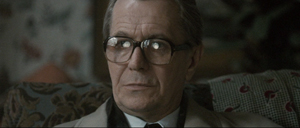
Guinness’s Smiley isn’t hard to read, once you tune to his high, narrow frequency, but Oldman’s Smiley is a sphinx. And it seems to me that this poker face works toward a new conception of Smiley’s role. The elliptical narration conspires with Oldman’s performance to create a conclusion that is far more harsh than what we find in the book or the series.
Early on, the film shows us George shamed. Control, forced to resign, announces that Smiley will leave with him. It evidently comes as a surprise to Smiley, who—in a moment that many critics have rightly praised—turns his head slightly and after a beat and a blink accepts with a tiny nod. For the rest of the film, George’s head-turns will be his principal signal of surprise, uncertainty, or sudden realization. (It’s even contagious: his adversaries execute the same gesture, and even Guillam catches the habit.) Smiley and Control stalk out of the Circus as exiles and part on the sidewalk without a word and Smiley comes home to an empty house.
Summoned back into service, he launches his investigation. In a key scene in the novel, the series, and the film, he confides to Peter his meeting with Karla long ago, when he tried to persuade the Russian to switch sides. The meeting disclosed a faultline in Karla’s character (“He’s a fanatic, and the fanatic is always concealing a secret doubt”), but it revealed Smiley’s weak spot too. Asking Karla to think of his wife, Smiley betrayed his worries about Ann. Karla retained the cigarette lighter that Ann had given Smiley, a token of Smiley’s fear of losing her. Years later, cuckolded by Bill at Karla’s behest, Smiley adds sexual shame to professional disgrace.
There’s a certain mystery about how the movie Smiley cracks the case. In the book and the series, there’s a lot more evidence about the mole than we get in the film. In the turning-point sequence, subjective montages lead to a burst of images and recurrent lines from Ricki: “Everything the Circus thinks is gold is shit.” Smiley is convinced there really is a mole, chiefly because of Jim Prideaux’s testimony, but we have to reason on trust: the reappearance of Karla and the murder of Irina before Jim’s eyes connect the mission to Budapest with the Witchcraft files.
The TV Smiley reveals his reasoning in a very lengthy interrogation of Toby Esterhase. Over fifteen minutes, Smiley builds a plausible case and forces Toby, to avoid suspicion that he’s the mole, to reveal the location of the safe house. Lacon is briefed offscreen, and George is given permission to set the trap.
But the film Smiley acts very differently. He confronts Lacon and the Minister and bluntly announces that there’s a mole, that Karla controls him, and that SIS has been feeding the Americans trivia and lies. He offers no evidence. The officials are shaken solely by Smiley’s uncharacteristic vehemence. His mocking conviction smashes their resistance and they give him permission to go after Toby.
With Toby, Smiley again uses brute force. No reasoning, no evidence, just the bald threat of throwing Toby onto the plane and shipping him back over the Curtain. Cringing and whining, Toby gives up the safe house’s address, and George can proceed to set the trap. And this comes after the moment when Smiley, knowing full well that Irina is dead, promises Ricki to do “his utmost” to retrieve her. Guinness’s Smiley makes the same promise, but in his gentleness we sense a man pained by his bad faith. Oldman’s Smiley is as guarded as ever.
I submit that the Smiley of the film, once he has overpowered his superiors, can’t spare a moment to brood over Haydon’s personality. He proceeds largely from a vindictive, controlled aggression. Lacon fired him, Alleline despised him, Toby insulted him, and Bill betrayed his marriage. Behind that severe blankness, I think, burns a desire to avenge Control, and to get a bit of his own back. When that mask slips, in talking with Lacon and the Minister, he’s nearly gloating.
The film, in sum, seems to me to offer a legitimate reinterpretation of the Smiley character. His fierce anger is rather close to le Carré’s attitude toward Kim Philby: The man may have been an enigma, but he was still despicable. The difference is that while le Carré can castigate the man in print, George can pay his traitor back. In this dirty game, he can finally checkmate Karla.
Was it worth it? The novel leaves you wondering. In its final pages, Smiley moves toward uncertain reconciliation with Ann. Jim’s future is more hopeful: after killing Haydon, he returns to the school and rebuilds his relation with young Bill, the other “new boy.” The only hope, it seems, lies in human relationships, not in a frigid bureaucracy.
But in the film, Jim harshly breaks off with the boy, and Smiley triumphs. To the music of “Beyond the Sea,” the losers—Ricki, Connie, Bill—are glimpsed. But Smiley, having kept his own counsel throughout, is a winner. There’s little sense here of le Carré’s distaste for the institution that nourished Bill and his breed. Smiley reenters the Circus, in a smart new suit and topcoat, striding to the top floor and taking Control’s seat, to offscreen applause. (I grant you there’s a bit of irony in that sound effect.) And how else to explain the vignette before that when, after the death of Bill Haydon, Smiley comes home to find Ann there? The sailor of the song has returned to the woman who has been waiting for him. Beggarman has gotten what Ricki saw in Irina: Treasure.
In preparing this entry, I was much helped by James Schamus and Khaliah Neal of Focus Films. Thanks also to Jeff Smith and Kristin for conversations about the movie.
For more on the film’s artistic approach, see Jean Oppenheimer, “A Mole in the Ministry,” American Cinematographer 92, 12 (December 2011), 28-34 (apparently not available online). After explaining that DP Hoyte van Hoytema and Alfredson sought “a grainy, somewhat colorless look,” the article reports van Hoytema saying that the zoom shots were modeled on 1970s ones: “When I look at films from the ‘70s, I like the fact that the zooms are so functional and solid. They have a beginning and an end.”
Le Carré’s introduction may be found in Bruce Page, David Leitch, and Phillip Knightley’s The Philby Conspiracy (Ballantine, 1981). Valuable studies of le Carré’s work include Peter Lewis, John le Carré (Ungar, 1985) and Michael Denning, Cover Stories: Narrative and Ideology in the British Spy Thriller (Routledge and Kegan Paul, 1987). In an earlier entry I offer an appreciation of the second book in the Karla trilogy, The Honourable Schoolboy.
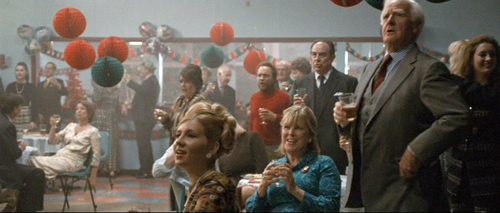
Tinker Tailor Soldier Spy: John le Carré in right foreground.
PS 1 March: In a followup entry, I explore other aspects of Tinker Tailor.
Home for the holidays
Pina. Photo Laurent Philippe.
DB here:
Kristin and I sometimes write about a film at a festival long before it reaches commercial distribution. As the year ends, we thought some readers might be interested in catching up with what we wrote about items now making the rounds of art theatres and film festivals. These are notes, not really analyses, but we try to introduce some ideas along with our judgments. All of these are films we admire considerably.
On Pina. Academy Award nominee for best documentary.
On Once Upon a Time in Anatolia. Turkey’s Foreign-Language Academy Award submission.
On Mysteries of Lisbon. Coming to DVD and Blu-ray in January. DB’s tribute to Raúl Ruiz is here.
On A Separation. Iran’s Foreign-Language Academy Award submission. DB also wrote on About Elly, an earlier film by Asgar Farhadi that deserves distribution, if only on DVD.
On This Is Not a Film. We wrote about Panahi’s perilous situation exactly a year ago here.
On The Turin Horse (above). Hungary’s Foreign-Language Academy Award submission. For more on Tarr, check the links on the right.
Coming up next week: Our annual year-end review of the ten best films of ninety years ago.
After the New Year starts, we’ll continue the series of entries about how digital cinema is changing film culture, with pieces on arthouse and repertory exhibition, film festivals, and home consumption of films. Plus observations on actors’ hands, film directing as problem-solving, some peculiarities of film reviewers, and other matters of weighty and not-so-weighty consequence.
In the meantime, we wish our readers the best for the holidays!
Meet Me in St. Louis.