








Archive for the 'Film comments' Category
Madalena, Rosalind, and Suzanna: More Rotterdam revelations
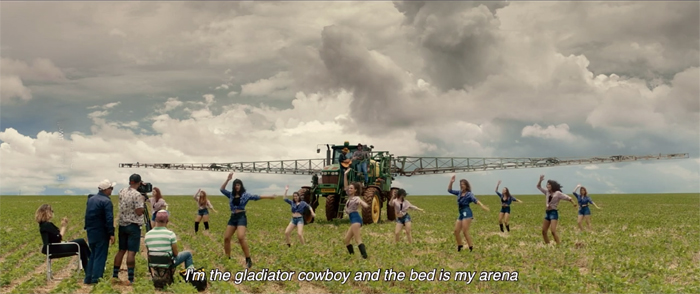
Madalena (2021).
DB here:
A mixure of moods and tones for our final communiqué from the International Film Festival Rotterdam. Its fiftieth year has been a lively one.
The Madalena mystery
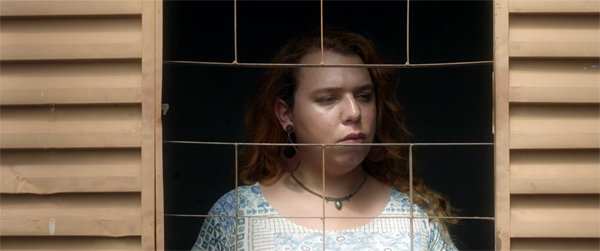
Madalena (2021).
In earlier entries (especially here) I’ve noted that the thriller genre is well-adapted to festival circulation. It doesn’t require the budget of a blockbuster. It can attract major actors who want tricky parts to play. It can be shot on contemporary locations. And the appeal to suspense and surprise fits comfortably with edgy narrative strategies favored by art cinema. At the limit, a filmmaker can arouse our thriller appetites and then try a bait-and-switch that not only warps the genre’s conventions but sets us thinking.
The Brazilian film Madalena, by Madiano Marcheti, starts as a classic mystery. In a vast field of soy, reas stalk gracefully as a monstrous pesticide-sprayer grinds toward them. But among the rows lies a corpse.
What follows is more fractured and prismatic. A first section attaches us to Luci, a friend of Madalena’s who works as manager of a club. She also picks up work dancing for TV commercials, one set in that very acreage. Then we follow Cristiano, whose father owns the land and demands he hustle to harvest. A third section takes us with trans woman Bianca and her girlfriends, who sort through Madalena’s belongings before setting out for a day of driving, swimming, gossiping, and teasing one another, the memory of Madalena never far from their thoughts.
Marcheti skips some of the standard scenes. We never see the police investigation, or even the discovery of the body. The crime plot has been a pretext to reveal a cross-section of life in the community, from the wealthy farmers to the cottages where the staff live. The resolution shifts the question of who did it to the broader impact of the death, and how it stands for a horrifying statistic: Brazil has the world’s biggest murder rate of transgendered people.
Throughout, sexualization of bodies is a central motif. Luci and her posse hang out at curbside, Bianca and her posse turn tricks and find boyfriends, and Cristiano, after sizing up the crowd at Luci’s bar, winds up dancing with himself in mirror reflection.
To say much more would spoil things, so I’ll just note that this story is filmed with a pictorial intelligence that one seldom sees these days. The imagery of the soy fields is at once magnificent and ominous. Drones hover over it like birds of prey, and its horizon haunts the people’s lives.
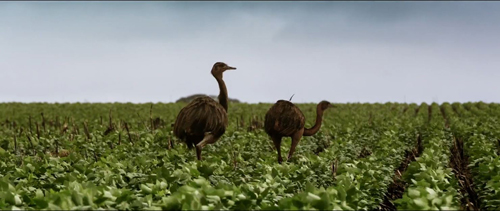
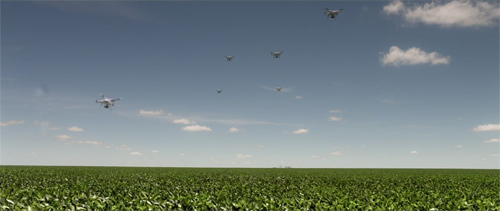
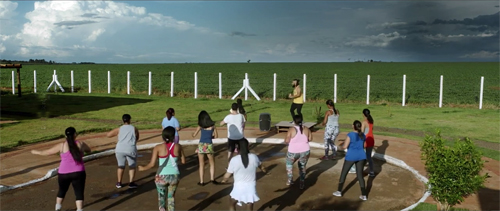
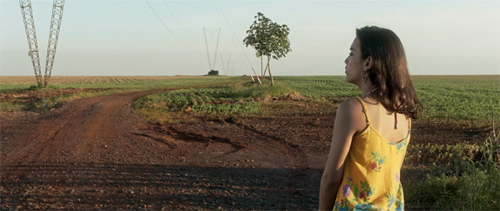
Overwhelming as the landscape is, it doesn’t blot out the characters’ routines and the crises that disrupt them. Moving from Luci’s aimless days and nights to Cristiano’s panic to Nadia’s quiet tribute to Madalena, a locket set adrift in the stream that runs along the field, the film pauses for intimate moments. It reminded me a bit of Varda’s great Vagabond (Sans toit ni loi), in which an enigmatic figure’s fate charts the range of human indifference, but also affords glimpses of sympathy.
An informative discussion of the film with Marcheti is provided by IFFR here.
As we too like it

As We Like It (2021).
This movie saw me coming a mile away. It does for As You Like It what Lurhmann did for Romeo and Juliet, but to an Asia-pop beat. Four romantic couples lose and rediscover one another in a magical milieu–not the Forest of Arden (currently under corporate development) but a district of Taipei with no Web connections. In Heaven, a sign informs us, there is no Internet.
Accordingly, people must deliver messages in person, seek out each other by dint of shoe leather and motorbikes, and actually meet face to face. So Rosalind’s quest to find her father the Duke (a genial tycoon) intertwines with Orlando’s search for her. But of course she’s disguised as a boy and aided by Celia, a fortune-teller who’s the dream girl of Orlando’s sidekick Dope.
The film’s world is maximum kawai, pushing beyond camp to a fangirl fantasy of irresponsible sweetness. This candy-colored city, with its pink blimps and anime posters, spills over with tweens, teens, and twentysomethings shopping in malls, flirting at stalls, and sipping bubble tea.
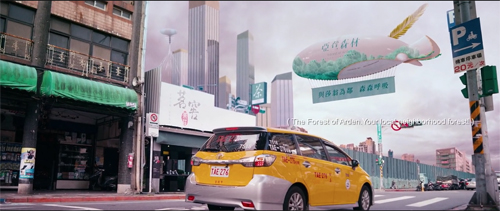

In the process, old stuff becomes cool. Tradition, in the form of calligraphy and handmade paper, is a retro decorator choice, while letting your date clean your ears old-style makes him a friend with benefits.
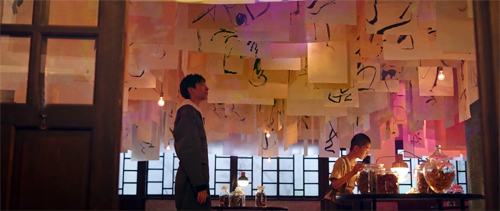
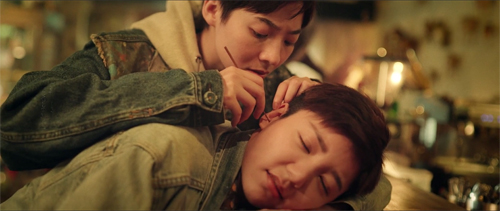
It might all seem sappy, but like Tati’s Play Time and Wong Kar-wai’s Chungking Express, the film seeks to distill authentic poignancy out of kitsch, schlock, consumer clichés, lethal cuteness, and the detritus of urban lives. Frivolity must be good for something; why else would God give us giggles? Comic form, as Shakespeare acknowledged, redeems a lot of silliness, especially if the gags are hurled at us with the ruthless conviction that anything goes.
Did I mention that all the roles are played by female performers?
In a switcheroo on Elizabethan theatre, globalization inverts the Globe. The film, a final title tells us, is dedicated to Shakespeare “but also to the patriarchy who would not allow female actors upon the stage.” The frisson is akin to that of Tsui Hark’s Peking Opera Blues and The East Is Red, where gender-blurring yields both humor and genuine feeling. From instant to instant, you see a character go male or female or something in between; a painted-on mustache and a swaggering gait become cosplay, not deep definitions of you. Unless you want it to be.

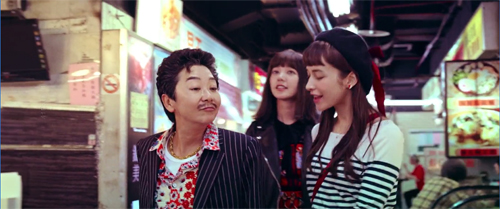
Identities are fluid. Okay, says Orlando, so he falls in love with Rosalind, then Roosevelt, and refinds him/her as Rose. What’s in a name? You get to call yourself, and be, what you wish, and love whoever.

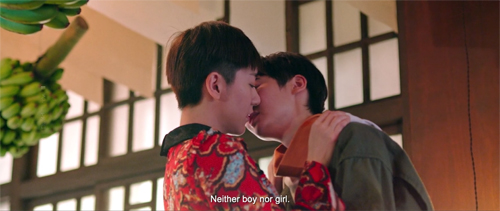
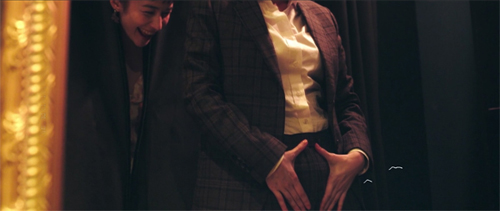
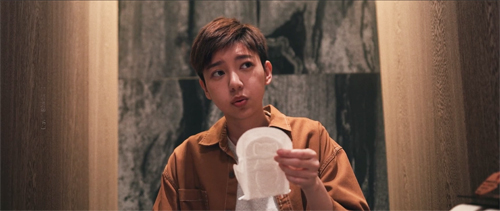
Not a fresh-minted message these days, but the sparkle comes with how it’s all carried off. Every scene finds a clever way to amuse or bemuse. When Rosalind as Roosevelt slips into a trim suit, she pads out the crotch with a towel, and teeny gull-like waves waft out. That’s soft power, the equivalent of a mystic ring. Eventually she has to go along when Orlando visits the men’s room. While he stands at the pissoir, she ducks into a toilet pretending to take a dump, her groans covering the sound of peeling open a maxi-pad.
The project was co-directed. Wei Ying-chuan, a graduate of NYU’s Educational Theatre division, is a founder of Shakespeare’s Wild Sisters Group in Taiwan. Chen Hung-yi’s feature The Last Painting was chosen for IFFR in 2017 and won a best feature award at Cines del Sur. The pair bring an unflagging energy to the task of creating a paradise of easy living and loving–bereft of villains, open to any piece of harmless fun and heartbreak. As We Like It is a must for every LBGTQ film event, but its hella dirty fun for any festival whatsoever. Couples welcome.
Again, the IFFR provides a fine discussion of the film with the directors, moderated by our old friend Shelly Kraicer.
St. Tropez, mon amour

Suzanna Andler (2020).
Eric Bentley once described great serious literature as “soap opera plus.” Anna Karenina, Othello, and the rest offer us tormented love affairs, sexual jealousy, hidden schemes, and forced confessions of betrayal, but it’s all endowed with wider significance through characterization, implication, style. But can we have soap opera minus?
In Daisy Kenyon, Anatomy of a Murder, and other films, Preminger moves in this direction, banking the fires of conflicts drawn from lurid bestsellers, but other filmmakers have gone further in de-dramatizing melodrama. Dreyer’s Gertrud and some of Oliveira’s adaptations offer examples. Here we have the classic fraught situations, but muffled and fragmented and punctured through long pauses and wayward, looping, maddeningly banal conversations.
Marguerite Duras made this artistic strategy peculiarly her own, notably in her masterpiece India Song (1974) and its counterpart Son nom de Venise en Calcutta désert (1976). In a curious reversal, she often prepared the film first and then published the text as a quasi-play, as if scraping away the luscious imagery and ripe sound would create something even purer, soap opera distilled to Racinian starkness.
Suzanna Andler, a Duras theatre piece from 1968, has now been adapted to film featuring Charlotte Gainsbourg and three other players. The result isn’t as severe as the play reads, since director Benoît Jacquot has filmed it in a gorgeous villa overlooking the Mediterranean. It remains, however, in the tradition of kammerspiel. The bulk of the action takes place in a salon and the terrace outside, with one sequence, also in the play, set on a rocky beach.
The situation is sheer bourgeois melodrama. Suzanna is in a loveless marriage with the philandering Jean. She has apparently stayed with him for the sake of their children and the wealthy life they lead. Now Michel, a young journalist, has tempted her into a love affair, and she has for the first time cheated on Jean–who seems okay with it. Today’s crisis, if this counts as one, is her need to decide: Will she lease this villa for the summer with the kids? Or will she accept Michel’s invitation to go to Cannes? In the course of about four hours, she may make up her mind.
If some of my synopsis seems hazy, it’s partly because the exposition comes out in bits as Suzanna and others chat about her past, and partly because what she says may not be wholly truthful. She sometimes admits to lying. And what was her relation to the never-seen Bernard Fontaine, who has just been killed in a car crash? The blurry backstory is one strategy Duras uses to tamp down the melodrama, which usually gives its plots clear-cut contours and definite revelations.
In filming the play, Jacquot has taken an approach that approximates the rigor of Duras’s aesthetic. He has shot the blocks of action using slightly different techniques. Not for him obvious alternatives like color/ black-and-white or a range of tonalities. The differences are made harder to spot because Jacquot has not given us separate chapters corresponding to the act divisions; the scenes blend, punctuated only by long shots. So there are stylistic spoilers coming up.
At the start, Suzanna is shown the house by the real estate agent de Rivière. This segment is filmed in distant shots that emphasize the landscape and straight-on views of the sitting room opening out onto the terrace and the sea. The agent is seen from behind or at a distance, while the few close views we get concentrate on Susanna.
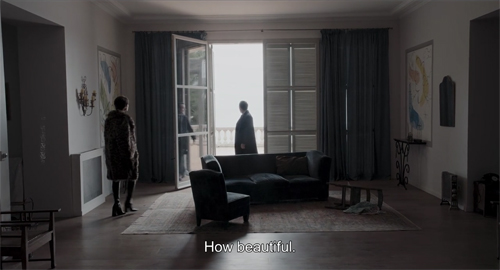
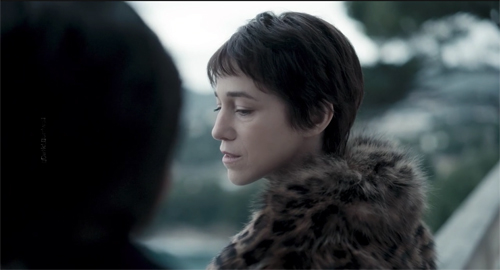
Staying behind alone, she falls asleep and awakes when Michel enters. This is a second phase of the play’s first act, and now Jacquot’s camera setups take a more oblique view of the room. The full-length windows dominate again, but now at an angle that recalls the magic mirror of India Song (on which Jacquot was an assistant).
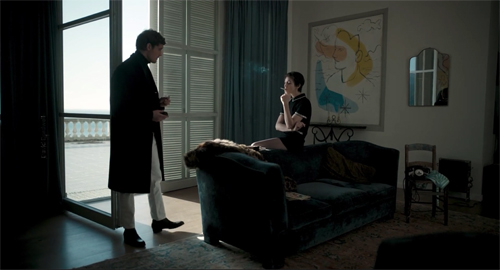
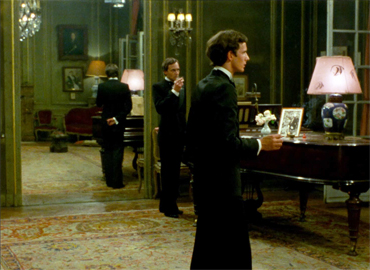
The couple is often seen at a distance, but now closer views of Suzanna emphasize the mirror motif.
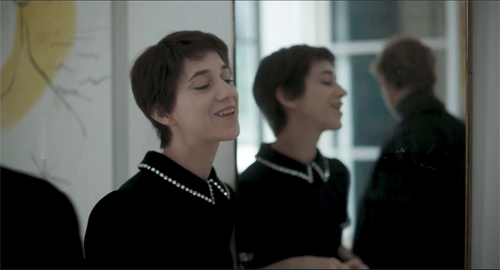
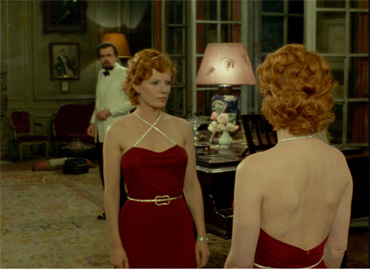
At a high point, the camera celebrates a momentary reconciliation with a track in to their embrace (the first such florid move in the film, I think).
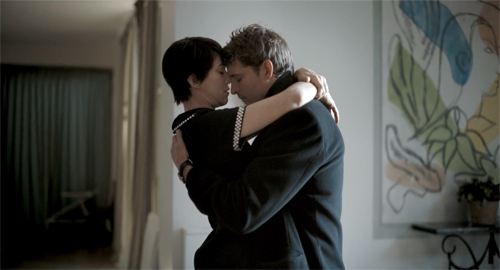
In the sequence corresponding to the second act, Suzanna meets her friend (and Jean’s ex-lover) Monique. On the beach they talk of their pasts. Now the conversation is rendered in many rapid, tight shots of the two women. The orthodox shot/ reverse shot setups are sometimes given a strange emphasis when instead of A/B alternation we get two (but only two) variants of a view of each one as she speaks (A1/A2, then B1/B2). So a cut like this::
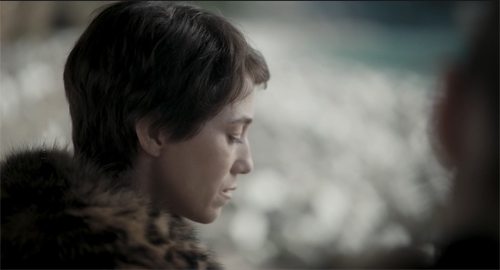
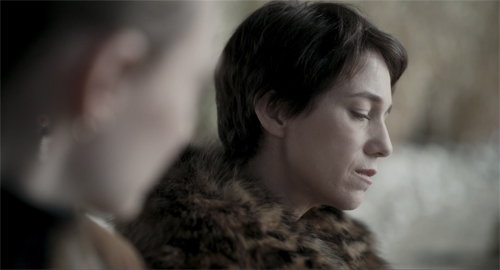
. . . is followed by ones like these:
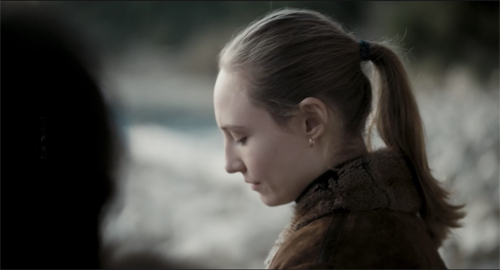
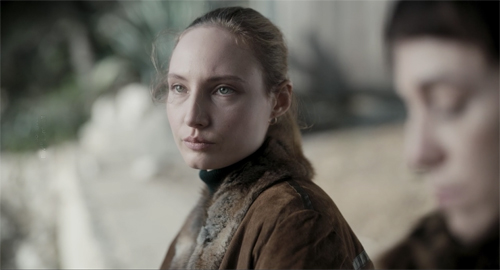
Back at the villa, Suzanna answers a phone call from Jean, and they discuss their plans, with the uncertainty typical of all the film’s conversations. This scene is handled in circular tracking shots around Suzanna, from a moderately close distance.
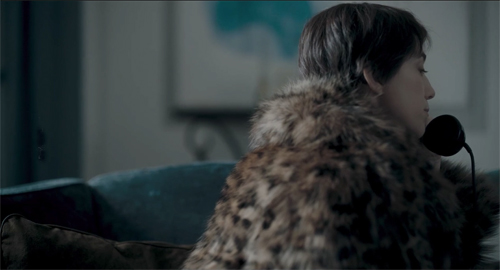
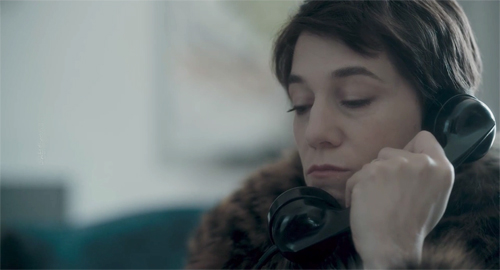
As the conversation ends, Michel returns. After he reveals some key information about his relation to Jean, he stretches out on the sofa. In a long take running several minutes, the camera swings around them in a half-circle, clockwise and counterclockwise, often adjusting to her shifts in position.
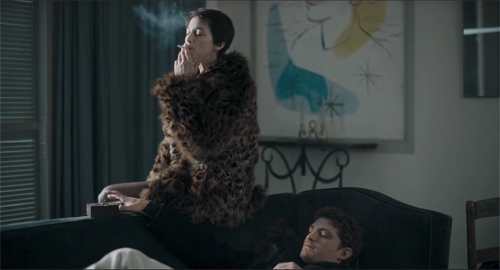
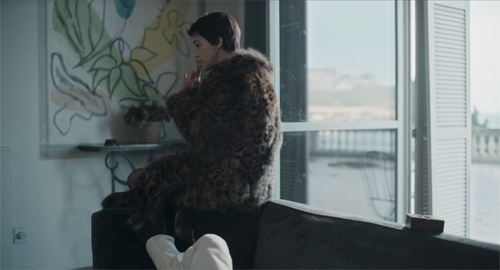
The changing angle also captures Suzanna perched against a painting of very 60s boomerang shapes that echo the camera’s trajectory.
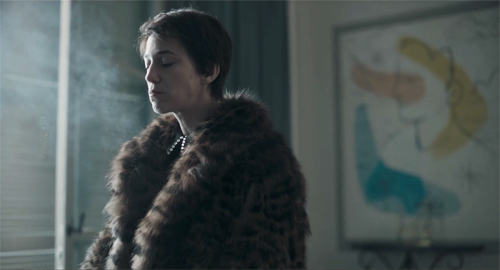
As the action approaches what might be a climax, Michel drifts out to the terrace and sits on the balustrade above the sea. Suzanna approaches.
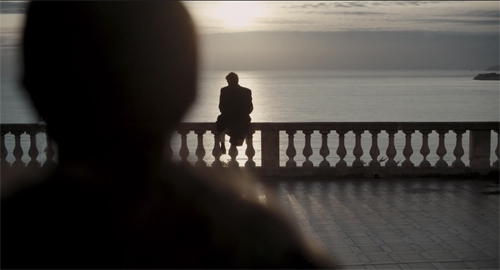
Telling you what happens next would truly be a spoiler. On seeing it, I thought it was something that Jacquot added to the play, but nope . . . it’s there in the text, and he’s perfectly faithful to it.
As if all this patterning doesn’t look finicky enough, the scene on the beach is punctuated by a single shot of the Quai de Passy with a Métro train rumbling by.
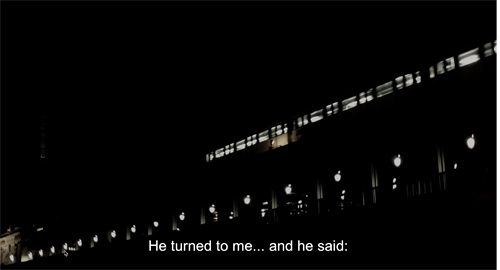
This bump comes exactly halfway through the film, at the moment Suzanna mentions the surge of attraction she felt when Michel looked at her on their first encounter. Believe it or not, the line in the play also comes midway through the text. This alien shot functions expressively, I think. It underscores the epiphany Susanna felt upon learning she might be loved. Another filmmaker might have stressed the moment with music under her monologue, but Jacquot goes for a formal bonus: breaking the visual texture just here further articulates the design of his film.
The rigorous geometry Jacquot has clamped down on the play is interesting in itself, and the abstract array of options adds, I think, to the hieratic quality Duras is after. Yet each style matches the tenor of the action it carries and doesn’t conceal the subdued feelings rippling through the scenes. This dimension depends on Gainsbourg–her slim silhouette, her microdress, and especially her face, with her alert chin and hard mouth. Her vacillations have nothing of the diva about them, but still she stands forth as a new avatar of The Confused Woman so beloved of art cinema (Voyage to Italy, L’Avventura, The Headless Woman). Without those closer shots, the film might fall flat.
Once asked what would be his ideal final shot, Jacquot replied: “A distinctive glance [un certain regard] in close-up.” His ending delivers that.
Duras is doing something similar to what Wei and Chen do in As We Like It. She is seeking genuine emotion in clichés (unfaithful husband, wrung-out wife, surly rescuer). But she hasn’t exempted her characters from social critique. Hiroshima, mon amour renders the meeting of two lovers as an intertwining of two national histories. The colonialists of India Song, drifting through their sparsely attended embassy parties, trying to replicate salon society in the tropics, cannot hear the voices offscreen of the people they subjugate. Likewise, Suzanna’s anxiety may or may not register some distant tremors. In summer of 1968 her world is sliding into something she isn’t prepared for. Far away from St. Tropez, in Paris students are hoping to find their own beach, but they’re doing it by tearing up the pavement.
Again, thanks to Gerwin Tamsma, Monika Hyatt, Frédérique Nijman, and their colleagues at the International Film Festival Rotterdam for allowing us to visit their event virtually. Here’s to another fifty years of ambitious programming!
A very helpful edition of Suzanna Andler has been published in conjunction with the film’s release. It contains a lot of stimulating background information and critical commentary. Bentley’s comment about “soap opera plus” comes from The Life of the Drama (Applause, 1991), 14. Thanks to Kelley Conway for sharing with me the Jacquot interview in “Réponses à tout,” Libération (14 May 2004), 1.
Jacqout’s rendition of Duras’s play exemplifies what I called in Narration in the Fiction Film “parametric narration.” This rare approach consists of playing out a range of expressive possibilities, scene by scene, in ways that both shape the ongoing plot and “anthologize” sharply contrasting cinematic techniques. Noël Burch first proposed this idea in his enduring Theory of Film Practice (1973), although Eisenstein and Bazin envisioned it. But then they envisioned everything.
P. S. later: The Rotterdam prize winners have been announced (per Variety).

As We Like It (2021).
Rotterdam surprises
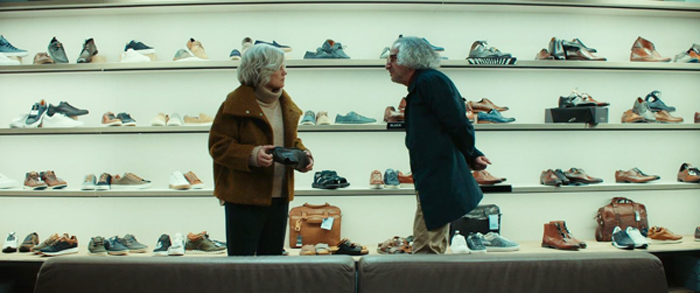
Mitra (2021)
Kristin here:
On Saturday morning (8:30 am our time), the International Film Festival Rotterdam will be screening its annual Surprise Film. We’re naturally curious to learn what it is. But Rotterdam comes so early in the year that often we go into its other offerings knowing almost nothing about them. Here are two of the very pleasant surprises from recent days.
Iranian cinema from the Netherlands
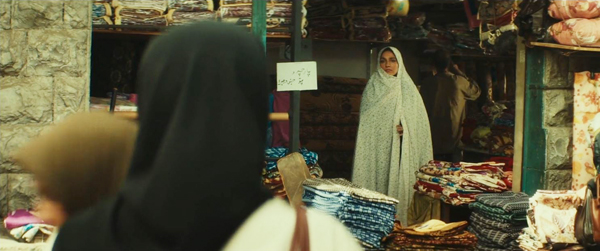
Kaweh Modiri, the director of Mitra, was born in Iran but has lived in the Netherlands since he was six years old. Still, he remains concerned with Iranian issues and clearly has been influenced by the flourishing Iranian art cinema of recent decades.
Asghar Farhadi’s success in international festivals and territories has been the most influential instance recently, at least outside of Iran. His plots are often built around conflicts, not between good and bad people, but behind people who clash because of cross-purposes. Late revelations and tortured discussions lead to reconciliations that are not the happy endings of Hollywood films but instead are resigned agreements to admit mistakes and make compromises.
Mitra is such a film, but it is based around more politically based conflicts than Farhadi has used–ones that have life and death consequences for those involved.
The film moves between two settings and eras: Tehran in 1981-82, the years shortly after the ouster of the Shah, and the Netherlands in 2019, the fortieth anniversary of that revolution. The opening is set in 1982, when the heroine, Haleh, receives an abrupt, unexpected telephone calls announcing that her daughter Mitra has been executed. We move then to 2019, when Haleh, now an academic in the Netherlands, addresses a conference on “The Islamic Revolution at Forty.” Soon she is visited by members of “The Organization,” a group aimed at bringing down the current government of Iran. They tell Haleh that Leyla, whose betrayal of Mitra caused her death, has arrived with her daughter in the Netherlands. She goes under the name Sale, having appealed for refuge status. The Organization wants Haleh’s confirmation that Sale is indeed Leyla.
The rest of the plot centers around a shifting relationship, as Haleh vows revenge on Leyla. Her goal is complicated by the fact that she has never actually seen Leyla, having only heard her voice. Nevertheless, she calls Sale and is convinced that she recognizes the woman’s voice, even after nearly forty years. Once they meet, however, Haleh seemingly bonds with Sale and her endearing daughter Nilu. Indeed, Haleh’s attraction to Nilu hints at her possible acceptance of Sale as a substitute daughter and Nilu as a granddaughter.
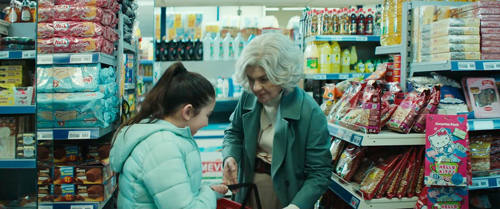
Interspersed with this story are flashbacks to the younger Haleh’s 1981 experiences, when Mitra, who has joined the resistance in Iran, is still alive. Scenes like a clandestine meeting with Mitra at a crowded market emphasize Haleh’s love for her daughter (top of section).
Modiri expertly lures us into sympathizing with all the characters involved. To the end we remain uncertain as to whether Sale, who after some doubts accepts Haleh as a friend and even as a substitute mother in a new land, is actually the treacherous Leyla. Even if she is, is it worth ruining young Nilu’s life to turn Sale in to the ruthless Organization?
Supporting all this is Haleh’s relationship with her brother Mohsen, who at first seems a somewhat comic, eccentric sidekick but is later revealed to be suffering the effects of torture and lengthy imprisonment in Iran. His exchanges with Haleh initially seem like sibling bickering, but he becomes the moral compass that holds her together as she pursues revenge (see top).
Mitra starts out seeming to be a conventional revenge story, but its moral and personal shifts and surprises lead to a moving and not-quite-resolved ending.
The film has had its world premiere at the IFFR and is due for a May 20 release in the Netherlands. I hope it plays other festivals and travels further, because it is a definite contribution to the continuation of world interest in Iranian cinema. Like other such Iranian films, it had to be made elsewhere (the scenes set in Iran were shot in Jordan), but it carries forward what we have loved about Iranian films.
An Australian surveillance-cam thriller
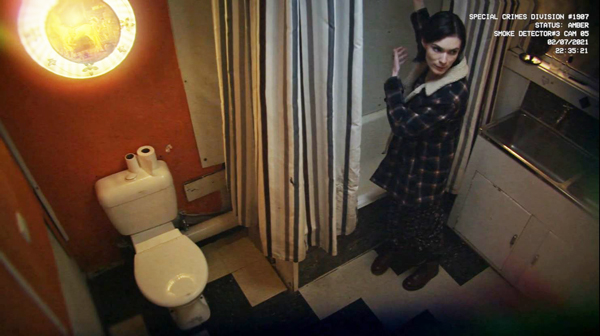
Jonathan Ogilvie’s Lone Wolf (2021) adopts the new convention of creating a story based largely on surveillance and cell-phone footage. In a frame story Kylie, a Special Crimes Sergeant, bursts into the office of an unnamed Police Commissioner and demands that he watch a video she has secretly compiled from a mass of such footage.
The inner story is seemingly set more-or-less in the present day, but it’s a slightly alternative world in which surveillance has become even more pervasive than it already is. The read-outs in the images reveal that cameras are spying on the characters from such household devices as TVs and smoke detectors. One of these is, ironically, in a bathroom where Winnie sneaks the occasional cigarette by an open window (above). How Kylie gets access to all of these is never explained, and the premise is implausible–especially in scenes built around extensive, undamaged footage which she has somehow managed to extract from a phone that has been through a bomb explosion.
If one stifles such doubts, however, the tale Kylie’s film tells is an absorbing one, full of twists and turns. It centers on Conrad and Winnie, a couple who run a book/video-rental/sex shop and do occasional jobs for underground political groups. They are not the most appealing characters, but they gain our sympathy through their devotion to Winnie’s charming little brother Stevie, who has Down’s Syndrome and an insatiable curiosity about the world.
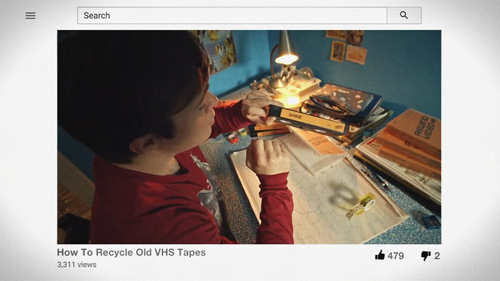
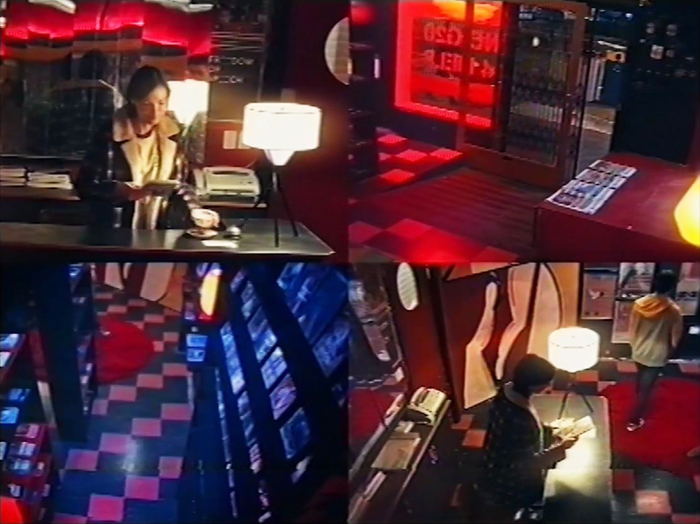
Australia is soon to host a G20 meeting, and a man from a radical group asks Conrad to set up a “victimless atrocity” in the form of a bomb explosion in a deserted area. At first Conrad refuses, but when offered a large sum, he gives in. Despite the grimness of this plot thread, there is quite a bit of humor in the film, provided by Stevie and by a group of Conrad’s misfit friends who gather to play cards above the shop. The combination of found footage also creates occasionally amusing moments, as when the film-within-a-film includes an instructional YouTube-style video that Stevie has posted or poor-quality footage from an old security camera in the shop that Winnie and Conrad think has been turned off (bottom).
The consequences of the bomb plot introduce a grim twist, but the return to the frame story creates a more gratifying one as Kylie reveals why she has pressed her video upon the Commissioner.
While Rotterdam provided Lone Wolf‘s world premiere, it has a distributor in Australia, though its August, 2020 release was postponed by the pandemic. Ogilvie hopes it will have wide theatrical play after a possible in-person premiere at the Melbourne International Film Festival this coming August.
Again, thanks to Gerwin Tamsma, Monika Hyatt, Frédérique Nijman, and their colleagues at the International Film Festival Rotterdam for allowing us to discover these surprises!
Lone Wolf (2021)
Rotterdam starts strong
Dear Comrades! (2020)
DB here:
Thanks to Gerwin Tamsma, Monika Hyatt, Frédérique Nijman, and their colleagues at the International Film Festival Rotterdam, we’re able to visit this venerable event, celebrating its fiftieth year! As with Venice and Vancouver, we’re happy to get online access to some outstanding films. We pass along the news to you here and in upcoming entries.
A dish best served cold?
Riders of Justice (2020).
Why is revenge so common as a driving force in film, fiction, and drama? Well, it sets up story action we like: search, mysteries, discovery, pursuit, confrontation. And it’s an impulse we find easy to understand. If you wrong me or mine, I’m likely to want payback.
As a high-school teacher once said to me, when I protested that the punishment wasn’t fair: “I don’t want to be fair. I want to be just.” In real life, Trump whines about unfairness, but he wouldn’t recognize justice if it met him head-on. Which it just might. Anyhow, in movies justice becomes our noblest excuse for the pleasures of vengeance.
Once our sympathy for the avenger is aroused, the storyteller has to decide how to treat the plot. Revenge shouldn’t be easy. It comes with a price. In Hong Kong films, revenge is usually the righteous settling of accounts.The price it demands is usually physical (wounds, maybe death) and social (the loss of friends cut down in the assault).
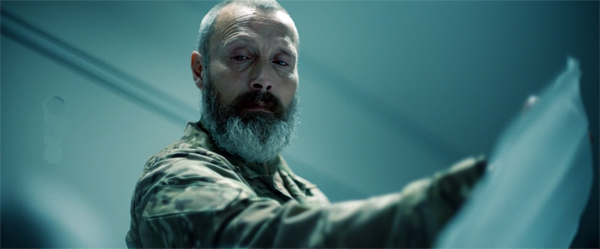
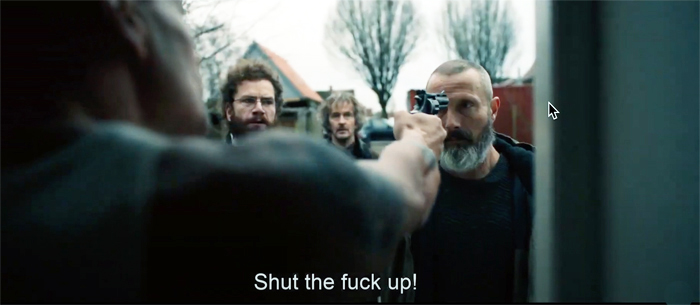
There’s another tradition of revenge drama that emphasizes the moral costs of revenge, the sense that it taints the avenger. You turn implacable, self-righteous, prone to error. Maybe the target isn’t really guilty? And can’t you forgive? And aren’t you turning obsessive? Can you sacrifice the other parts of your life to this mission? All of these questions haunt Anders Thomas Jensen’s seriocomic thriller Riders of Justice.
Markus, a stolid soldier, returns home when his wife is killed in a subway accident. His daughter Mathilde is traumatized. Markus’s stoic grief changes to rage when he is told by the statistician Otto, who survived the accident, that the crash was engineered by a gangster killing a rival. Markus’s icy pledge to vengeance sweeps up Otto, his two hacker friends, Mathilde, her boyfriend, and others.
In early days of this blog I wrote a lot about Danish films, which I’ve always admired. Many years ago Anders Thomas Jensen, director of Riders of Destiny, brought to our Wisconsin Film Festival The Green Butchers (2003). His scripts, for his own films and those directed by others, find a unique, tightly designed blend of drama and humor, with a penchant for showing the dumb side of male bonding (In China They Eat Dogs, 1999; Flickering Lights, 2000; Adam’s Apples, 2005)
Riders of Justice is in this vein, but it plays with larger ideas too. It starts and ends with a network-narrative premise (again, very Danish) emphasizing remote human connections. In between the characters come to grips with the role of chance in their lives. Scenes both serious and comic show them trying to reckon the reason behind their impulses. Even the numbermumbler Otto, who calculates probabilities of everything, admits to Mathilde that even the simplest event is impossible to explain through cause and effect.
You know that comfortable feeling you get at the start of a movie, when the story has hooked you, the characters command your sympathy (even when they make mistakes), and you realize that you’re in good hands for the next couple of hours? That was my response to Riders of Justice. Not least, it brings together for the umpteenth time two of the finest actors in world cinema, Mads Mikkelson (scary, in a trim Pentateuch beard) and Nikolaj Lie Kaas (sensitive, blinking behind wire-rims).
Riders of Justice has been purchased by Magnolia and is planned for a spring release.
Bolshevik nostalgia in 1.33
Dear Comrades! (2020)
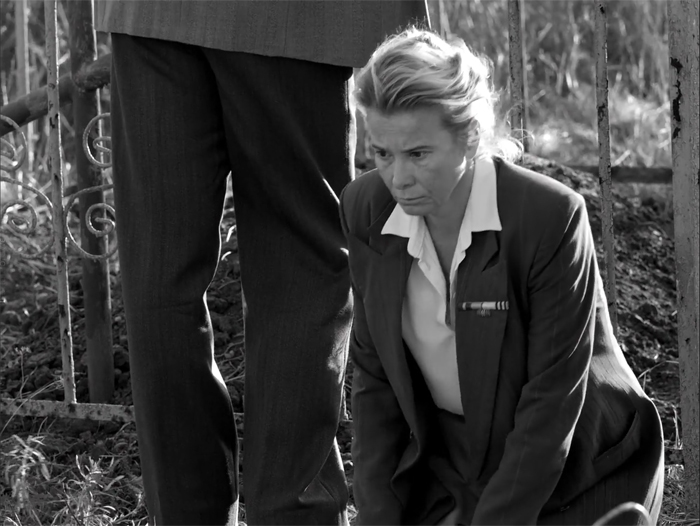
“Dear Comrades!” is the salutation of a letter never sent. At a meeting of officials trying to handle a sudden strike, Lyudmila Syomina voiced a need for harsh reprisals for these traitors to the Soviet state. But after being called to write a letter and read it at a forum, she flees. She is torn by fear that her daughter has been captured or killed during the very violence she advocated.
Dear Comrades!, the latest and perhaps best film from the distinguished, pleasantly erratic director Andrei Konchalovsky, is set in Novocherkassk, 1962. The strike and the massacre were revealed in 1975 by Alexandr Solzhenitsyn and confirmed by an inquiry in 1992. Konchalovsky has undertaken a historical recreation, an examination of his parents’ postwar generation, and, I think, an oblique critique of authoritarianism. He seems equivocal about Putin’s “managed democracy” (though he’s not as big a booster as his brother Nikita Mikhalkov). In any case, we can’t help seeing the film as echoing the tyranny on display in Russia’s recent years, i.e., yesterday. Unlike the current demonstrators supporting Navalny, though, Konchalovsky’s characters yearn for well-run autocracy. After all, under Stalin, prices went down.
Classic Soviet fiction and film featured what’s come to be called a “conversion narrative.” In order to build any plot, you need drama. But you also have to conform to Bolshevik ideology. Some conflict can be supplied by villains (“traitors,” “wreckers”) seeking to undermine the Great Soviet Experiment. You can also create drama with characters who are ignorant of the true way, or uncertain about abandoning personal commitments and embracing the Party. So the plot can trace the gradual conversion of a character to sturdy Communist principles. This functions, in classic Socialist Realist storytelling, as psychology.
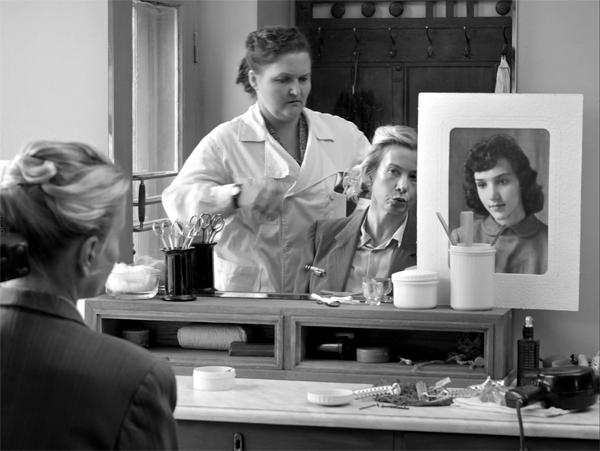
But Lyudmila is a hard-core Party loyalist. She benefits from the perks of office: a love affair with her superior in a nice apartment, the ability to jump the queue scrambling for food and matches, a paycheck that pays for a European-style coiffure. In exchange she mouths, with unblinking cobra severity, a strict adherence to policy. Yet her daughter Svetka has joined the strike and goes missing during the melée.Lyudmila’s search doesn’t easily dissolve her ideological tenacity. Like Mother Courage, Lyudmila stubbornly refuses to see what’s in front of her. She can’t believe that the KGB, not the Army, would plan a massacre that mowed down citizens.
Eventually we get glimpses of a de-conversion narrative. Lyudmila starts to sense that the current system is corrupt. “What am I supposed to believe in if not communism? Blow it all up and start again.” Yet what should replace it? The only alternative she knows. “I wish Stalin would come back.”
Konchalovsky has shot the film in lustrous, drypoint black and white, and in a silent-era ratio of 1.33:1. It’s one of the most elegantly composed and staged films I’ve seen in recent years; it could be studied just for its use of axial cuts. I’d almost call it “Straubian-Huilletian,” were it not so defiantly committed to the melodrama of a family crisis within social turmoil. But Dear Comrades! is far from your standard historical pageant. It’s at once austere and inventive.
Konchalovsky activates a great many motifs from classic Soviet film, treating them both for sly comedy and sharp drama. Satire on bureaucracy, another traditional source of plot developments, pervades the first half. Like Eisenstein in October, Konchalovsky can spare a shot mocking an empty conference table after the staff has fled.
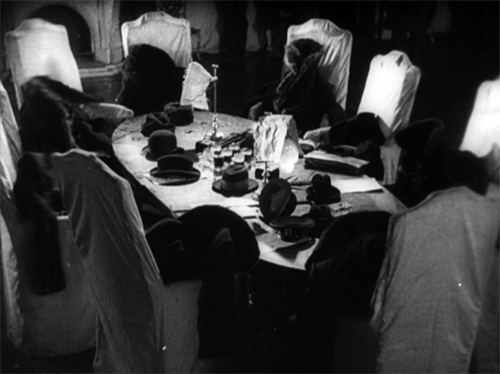
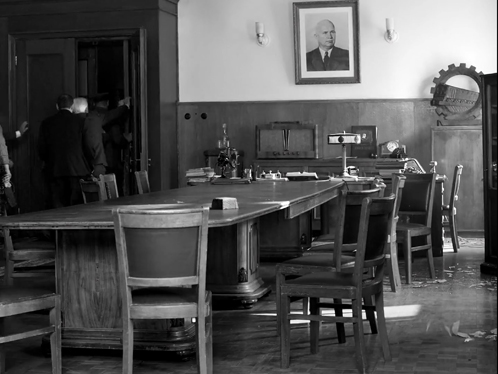
Eisenstein is of course more grotesque: the panicked Mensheviks have leaped out of their furs, or been Raptured. The portrait of Khrushchev stands in for the Stalin picture hanging in every Socialist Realist office, parlor, bivouac, and meeting hall.
Konchalovsky stages the massacre of the strikers mostly through the heroine’s viewpoint. In place of the vast views supplied by Eisenstein in October (1928), the camera is tied down to a beauty shop.
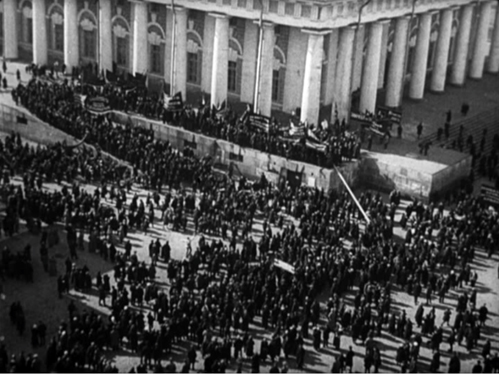
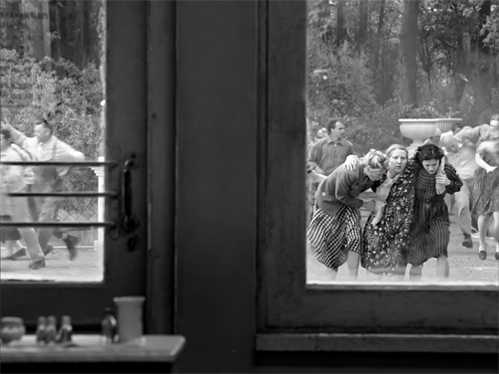
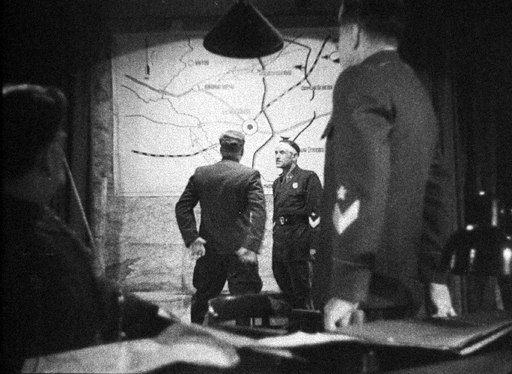
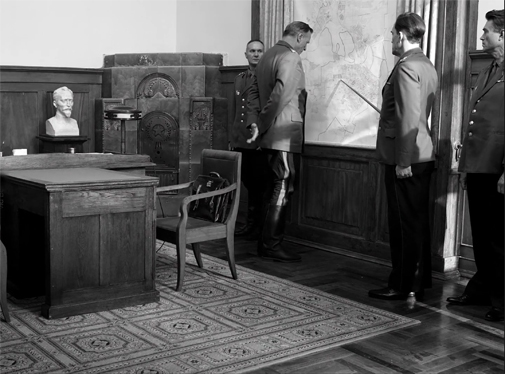
In Soviet World War II films, the officials plan strategy in monumental headquarters (Front, 1943). The shabby offices of Konchalovsky’s provincials seem both cramped and hollow.
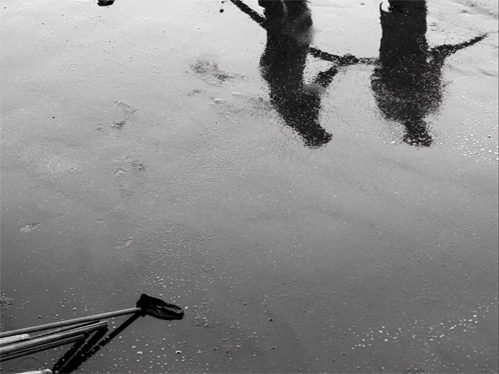
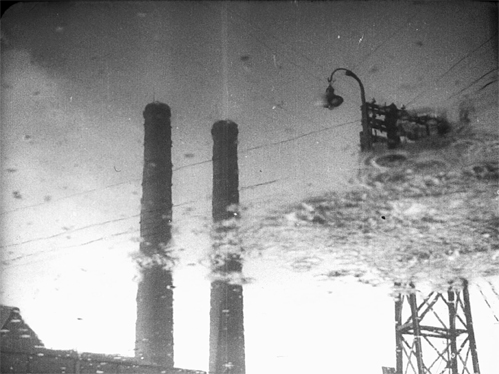
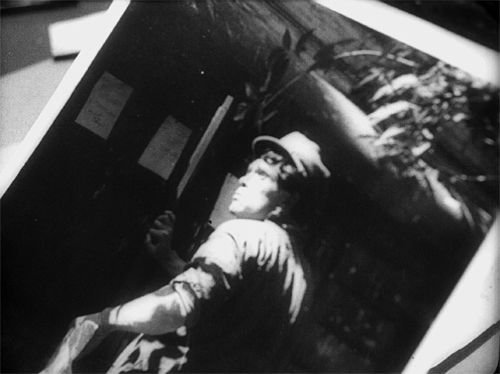
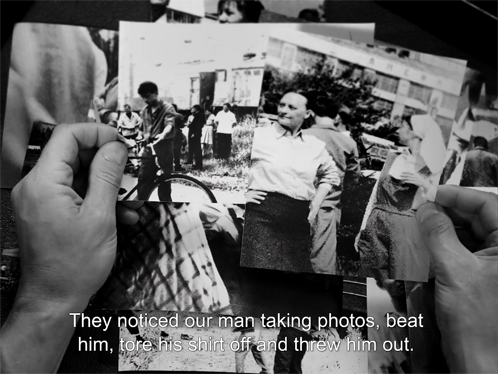
During the agitation and cleanup, Konchalovsky seems to me to rework specific images from Eisenstein’s Strike (1925). The hosing of blood from the streets seen in reflection echoes a shot of the factory in Strike. And in both, the police study the spies’ snapshots of strikers.
Dear Comrades! deserves all the attention it’s getting. Winner of this year’s Special Jury Prize at Venice, it has been picked up by Neon for US release. It’s also Russia’s submission for the Best International Feature Film Academy Award. It’s being streamed by several film festivals, notably Seattle’s, which offers it at a very reasonable price. But how I long to see it on the big screen.
I discuss some Danish network narratives in Chapter 7 of Poetics of Cinema and other examples in some entries. Katerina Clark has an excellent discussion of the conversion narrative in The Soviet Novel: History as Ritual (Indiana University Press, 2000). For a discussion of Socialist Realist film style, see this entry.
P.S. 4 Feburary 2021: Anders Thomas Jensen gives a very informative interview about Riders of Justice in Variety.
Riders of Justice (2020).
Repost: Our daily barbarisms: Leo Hurwitz’s STRANGE VICTORY (1948)
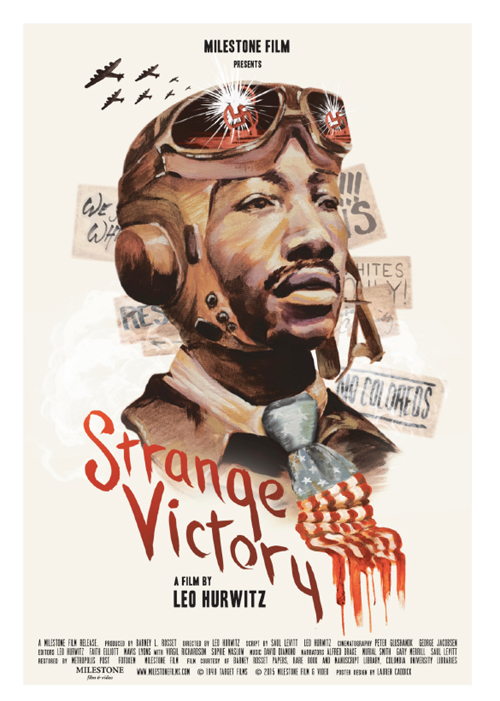
We have never reposted an entry before, but given recent events in US history, and the celebration of Martin Luther King’s legacy yesterday, and the impending inauguration of a new president tomorrow, we are re-running this entry, unrevised, from nearly four years ago.
It’s not just that it remains timely. (The interpolations remind us that Trump has been inciting violence from the start.) We wanted also to note that thanks to Milestone Films you can stream Strange Victory here. I plan to write more about the end of the Trump era in the days to come, but for now we can acknowledge the struggles ahead of us. We can be strengthened by recognizing that in 1948 people who had sacrificed far more than we have still sustained an urge to fight for decency and justice. –DB
DB here:
Leo Hurwitz is perhaps best known for Native Land (1942), the documentary codirected with Paul Strand and narrated by Paul Robeson. Strange Victory (1948) has been less easy to see. It was scarcely distributed and, though some reviews praised it, it was accused of Communistic sympathies. Now, restored and recirculated by the enterprising Milestone Films, Strange Victory has lost none of its compassion and righteous anger. Thanks to the energy of the Milestone team, led by A my Heller and Dennis Doros, every citizen has a chance, say rather a duty, to see a film whose force is undiminished today.
In a period of postwar optimism, Hurwitz and his colleagues dared to point out that the prejudices exploited by the Nazis remained powerfully present in the United States. The winners, it seemed, hadn’t repudiated the bigotry of the losers. American racism persisted and even intensified. The Nazis lost, but a form of Nazism won.
Dec. 14, 2015, in Las Vegas. Individuals at a Trump rally yelled “Sieg Heil” and “Light the motherfucker on fire” toward a black protester who was being physically removed by security staffers.
News of the world

Like The Plow That Broke the Plains (1936), on which Hurwitz was cameraman, and the Why We Fight series, Strange Victory is largely a compilation documentary. Guided by voice-over narration, it ranges across newsreels of Hitler’s rise, chilling combat shots, and footage from the liberated death camps.
But Hurwitz and his team shot a lot of new material as well, with an eye to bringing out the postwar significance of their theme. Newborn babies eye the camera, and kids play on sidewalks and in backlots (some shots recall Helen Levitt’s evocative street photos). Meanwhile, anxious adults approach a newsstand. “If we won, why are we unhappy?” the narrator asks at the beginning. The question is answered at the end: “There was not enough victory to go around.”
Thanks to a hidden camera, that newsstand becomes a sort of gathering spot, a place where people might encounter uncomfortable truths. Intercut with people buying newspapers are images of battles, as if the hunger for news aroused by the war didn’t dissipate. But what is that news? Hurwitz introduces it quickly: the rise of nativist bigotry. In an eye-blink, racist decals are slapped on fences, synagogues are smashed, and vicious pamphlets swarm through the frame. Race-baiting politicians, radio hate-mongers, and fascist sympathizers–the 1940s equivalents of our celebrity demagogues–are pictured and named. This is just one of many passages that guaranteed that Strange Victory could never be circulated on mainstream theatre circuits.
Hurwitz mixes found footage, stills, posed images, and fully staged scenes, such as the episode in which a Tuskegee Airman tries to find a job with an airline. In this mixed strategy he follows not only the precedent of the March of Time series but also, and more self-consciously, the Soviet documentarist Dziga Vertov.
In a 1934 article, Hurwitz called The Man with a Movie Camera “the textbook of technical possibilities,” and he isn’t shy about mimicking the master. Early in the film, portraying the Allies’ victory, a shot shows a swastika-emblazoned building blown to bits in slow motion. Later, to convey the return of Hitlerism, the same shot is run backward, reinstating the swastika on the building’s roof. A graphically matched dissolve equates a Klan wizard with Southern senator John Elliott Rankin.
Later, via constructive editing à la Kuleshov, parental pride is made color-blind, as both a white mother and a black one return a father’s glance.
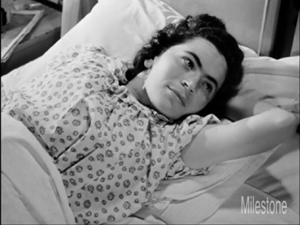
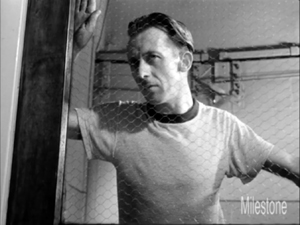
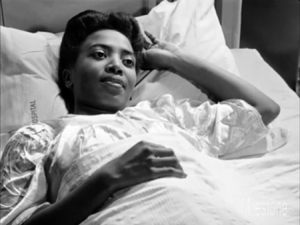
The film hasn’t aged a bit. The print is gorgeously subtle black and white, and the score by the underrated David Diamond is warm in a chamber-music way. The film’s vigorous voice-over and its ricocheting images (some returning as refrains, bearing new implications) look forward to the hallucinatory, expanding associations created by our most biting contemporary documentarist, Adam Curtis.
 Shiya Nwanguma, a young African-American student at the University of Louisville, was shoved and verbally abused when she attempted to protest at the Trump event. “I was called a nigger and a cunt, and got kicked out,” Nwanguma said after the incident. “They were pushing and shoving at me, cursing at me, yelling at me, called me every name in the book. They’re disgusting and dangerous.”
One of the individuals involved in the confrontation with Nwanguma was Joseph Pryor, a native of Corydon, Indiana, who graduated from high school last year. After the rally, Corydon posted a photo on his Facebook page that showed him shouting at Nwanguma. The post went viral and eventually attracted the attention of the Marine Corps, which Pryor had just joined.
The Marine Corps recruiting station in Louisville told military publication Stars and Stripes that Pryor had recently enlisted and was about to head off for boot camp. Captain Oliver David, a spokesman for the Marine Corps command, said Pryor had not yet undergone Marine Corps ethics training. . . . He added: “Hatred toward any group of individuals is not tolerated in the Marine Corps and he is being discharged from our delayed entry program effective [Wednesday].”
The tyranny of facts

As ever, the ordering of parts matters greatly. How best to convey the idea that after a struggle to cleanse Europe of violent prejudice, the same attitude is flourishing in America? You might think of couching your argument as a narrative. In chronological order, that would be: The rise of Hitler; the war defeating Hitler; the celebration of victory; the return of American bigotry in the postwar period. Clear and straightforward.
Hurwitz is more canny. Many films embracing rhetorical form, like the problem/solution structure of Pare Lorentz’s The River (1938), will embed brief narratives into their overarching argument. This is Hurwitz’s approach, but his stories aren’t chronologically sequenced. Instead, we start with the America of today before flashing back to the high price of defeating the Axis. “Everybody paid,” says the male narrator. “Everybody.” With a pause to register Roosevelt’s death, jubilation surges up as the Nazis fall. “For a day or two, the plain people owned the world.” But then we’re back to the newsstand and a montage of race-baiters and graffiti scrawlers.
Then, as we see a pregnant woman on a bench, we hear a woman’s voice. Her poetic musings reassure the newborn babies that they have a place here; she welcomes them to earthly love. Following the montage of haters with images of innocence casts a melancholy pall over these fresh-begun lives. They know nothing of the American brownshirts, but we know that they must learn our world.
This foreboding is confirmed by a chorus of name-calling over shots of newborns, the woman’s song of innocence is undercut by a song of bitter experience. A new male narrator (Gary Merrill) raps out the facts of “our daily barbarisms.” Get ready, he warns the babies: You will be tagged and vilified by how you look and where you live. “Separation of people is a living fact,” and they are future “casualties of war.” Throughout the rest of the film, the shots of children carry a terrible aura; they have no idea of what they’re facing.
Now, after a long delay, we flash back to Hitler’s rise. The Führer’s strategy, funded by the rich, is seen as a deliberate mobilization of just these tribal “facts” for the sole end of acquiring power. And where that process ends is the death camp. In a chilling visual refrain, the happy American toddlers are compared to troops of children marched along barbed wire.
The narrative spirals back to the beginning. Again we see Hitler defeated, again ecstatic celebrations–but not, as before, among civilians in cities. Instead, we see Russian and American soldiers fraternizing, and included in this mix is the black pilot, smiling serenely in his cockpit. His presence was foreshadowed by swooping aerial shots of the beginning. Now we’re back to the present, and he’s looking for work. No luck; maybe he can be a porter? A new montage generalizes his plight: American society refuses to assimilate African Americans. A savage cut takes us from a room full of white secretaries to a cotton field–the only work available for people who participated as fully in the war effort as anyone.
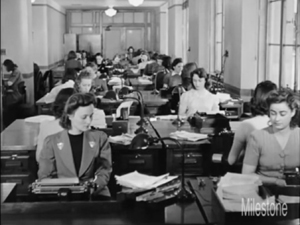
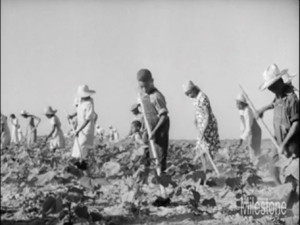
Now the early montage of Jim Crow images is recalled in a poetic string of associations on the word word, from Hitler’s control of The Word to signs barring blacks from entry, ending with inscriptions etched on forearms.
The final images of passersby, filmed unawares, replace the newsstand of the opening with shop windows as they peer inside. The sequence uncannily predicts the explosive consumer society that would follow in the war’s wake. Again, though, a shadow falls over the postwar world. Hurwitz daringly intercuts the intent window-shoppers with the plunder of the camps–hair, jewelry–and the numbers on inmate uniforms, as if these were commodities on display.
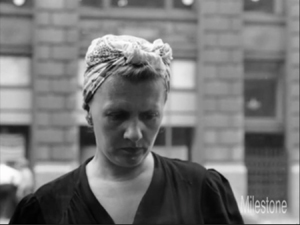
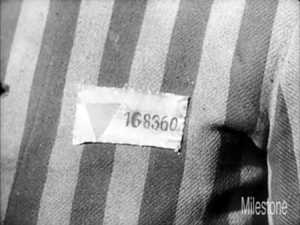
The war against inhumanity is far from over. Americans will need to be more than curious consumers if they are to face the struggle that lies ahead.
 16 March 2016. UW-Madison police are investigating an act of racist vandalism that was committed earlier this week on campus, officials confirmed Wednesday. The drawing, which was found in a men’s bathroom in the Wisconsin Institute for Discovery, shows a stick figure hanging from a noose in a tree with the word “nigger” written next to it. UW police spokesman Marc Lovicott says the vandalism was reported at about 7:20 p.m. on Monday and is believed to have occurred some time between 3:30 and 7 p.m. that same day. (Photo by Marla DG on Twitter.)
Strange Victory is, it seems to me, the essential documentary of our moment. A nearly seventy-year-old film can remind us that, as the narration puts it, “hopelessness is next door to hysteria.” The frustrations, despair, and hatreds that surfaced during Obama’s tenure have crystallized in an American fascist movement of unprecedented breadth. The film reminds us that scapegoating is eternal, sometimes summoned quietly (they’re not like us, she’s a traitor, he knows exactly what he’s doing), sometimes conjured up in full fury. At a moment when America is one IS attack away from a Trump or Cruz presidency, it’s good to be reminded how the well-funded Hitler exploited Us vs. Them. Temporizing pundits give every sufficiently funded lunatic the benefit of straight-faced interviews, or even tongue-baths. Right-wing politicians and agitators, keen on power and uncommitted to principle, are ready to fall in line behind a leader if he might win. Forget Godwin’s Law. Facing today’s assault on peace and justice, Strange Victory can rekindle our energies, without a moment to lose.
The crematorium is no longer in use. The devices of the Nazis are out of date. Nine million dead haunt this landscape. Who is on the lookout from this strange tower to warn us of the coming of new executioners? Are their faces really different from our own? Somewhere among us, there are lucky Kapos, reinstated officers, and unknown informers. There are those who refused to believe this, or believed it only from time to time. And there are those of us who sincerely look upon the ruins today, as if the old concentration camp monster were dead and buried beneath them. Those who pretend to take hope again as the image fades, as though there were a cure for the plague of these camps. Those of us who pretend to believe that all this happened only once, at a certain time and in a certain place, and those who refuse to see, who do not hear the cry to the end of time.
Milestone, who gave us the restored Portrait of Jason, has provided a very full presskit for Strange Victory here. My final quotation comes from Jean Cayrol’s text for Night and Fog (1955).
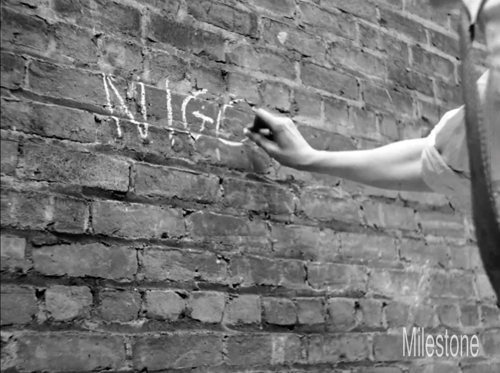
Strange Victory (1948).