

Archive for the 'Film comments' Category
Getting real

Art is not reality; one of the damned things is enough.
Attributed to Virginia Woolf, Gertrude Stein, and others.
DB here, with another followup to Ebertfest:
Ebertfest, once known as the Overlooked Film Festival, has always been keen to support American independent filmmaking. In previous incarnations, Roger spotlighted Junebug, Tarnation, and other movies that flew below the multiplex radar. This year’s crop was especially ripe. Besides The Fall and Sita Sings the Blues, there were important documentaries like Begging Naked and Trouble the Water. In particular, two fiction features set me thinking about types of independent storytelling and how they might be considered realistic.
The river is wide

Roger noted that when he first saw Frozen River, he wanted to bring it to his festival, but then it became the very opposite of an overlooked movie. It has grossed $4.3 million worldwide, a very healthy amount for a small-budget film without big stars. It won eleven national awards and was nominated for fourteen others, including a Best Original Screenplay Oscar. By now, you’ve probably seen it. I had been away during its Madison run, so I was happy to catch up with it.
“You have five minutes to show the audience you’re in charge,” commented director Courtney Hunt in the Q & A, and her film follows that advice. Seconds into Frozen River, we hit a crisis. Ray finds that her no-good husband has grabbed their savings and taken off to gamble, even as she waits for the delivery of their new prefab home. What begins as a drama of pursuit, with Ray trying to track down her husband, turns into a blocked situation. He’s gone and she has to not only pay off their mortgage but also keep her two sons going, counting on their school lunches to offset their domestic meals of popcorn and Tang.
Drama is about choices, and good drama is about bad choices. Ray has clearly made her share of mistakes—addictive mate, kids she can’t support, a bigscreen TV she can’t afford—and the plot shows her making the biggest of all. To scrape together money she agrees to transport illegal immigrants from Canada to upstate New York, driving across the frozen St. Lawrence. She casts her lot with Lila Littlewolf, a Native American with her own bad choices, and their common fate creates a series of parallels about motherhood that are resolved through Ray’s final sacrifice. The film also activates some current concerns about immigration, racism, and the problems shared by poor whites and ethnic minorities.
Resolutely unHollywood in its setting, theme, and characters—deglamorized women, especially—Frozen River still adheres to classical script structure. We have characters with goals, encountering obstacles and entering into conflicts, and the turning points come at the standard junctures. The ending is a resolution, although not an entirely happy one. In the course of the plot, suspense is built up at many points. Will Ray and Lila be caught by the state troopers who grimly monitor their comings and goings? What will become of that abandoned baby? The film is a sturdy example of how classic principles of construction can be applied to subject matter that is worlds away from our prototype of Hollywood filmmaking.
Neo-neo and all that
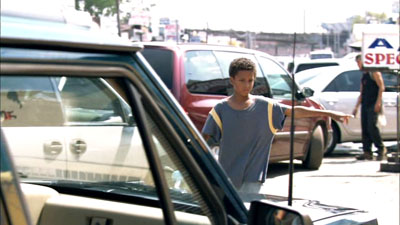
Ramin Bahrani’s Chop Shop, which I was also just catching up with, offers another flavor of independent dramaturgy. Roger has been a staunch supporter of Ramin’s films since Man Push Cart, and he has declared him “the new great American director.”
Bahrani has mastered a somewhat different narrative tradition than the crisis-driven plotting of Frozen River. “Neo-neorealism,” A. O. Scott has called it, linking Goodbye Solo to Wendy and Lucy, Treeless Mountain, Old Joy, and other films that offer us an “escape from escapism.” Now, Scott suggests, American cinema is having its delayed Neorealist moment. Richard Brody offers some useful, sometimes scornful, qualifications of Scott’s conjecture, reminding us of the urban dramas of the 1940s and the rise of Method acting. Scott has replied, claiming that their dispute essentially depends on their differing tastes in movies.
Here’s my $.02. “Neorealism” isn’t a cinematic essence floating from place to place and settling in when times demand it. The term, like the films it labels, emerged under particular circumstances, and it’s hard to transfer the label to other conditions. Moreover, there are many problems just with applying the term to Italian cinema, since it tends to cover not only the purest cases, like Bicycle Thieves, but also more mixed ones like the historical drama The Mill on the Po.
Still, because postwar Italian cinema had a big influence on other national cinemas, we have a prototype of The Italian Neorealist Movie. The filmmaker focuses on the lives of working people. He emphasizes their daily routines and travails. The film will be shot on location (at least in the exteriors) and may use nonactors in some or all roles. Bazin pointed out that we’re likely to find an elliptical or unresolved plot. It’s also very likely that we’ll see washlines and women in slips.
Why not just call this an Italian variant of that broad tradition of naturalism or verismo or “working-class realism” that we find in many national cinemas? In France there was the work of Andre Antoine (e.g., La Terre, 1921) and Jean Epstein’s Coeur fidele (1923) and his lyrical barge romance La Belle Nivernaise (1923). More famous are Renoir’s Toni (1935) and The Lower Depths (1936). (Recall that Visconti was Renoir’s assistant on A Day in the Country, 1936.) In Italy, there were harbingers too, not only the famous ones like Four Steps in the Clouds (1942) but also the charming Treno Popolare (1933). And Japan gave us many instances in the 1930s, notably Ozu’s Inn in Tokyo (1935) and The Only Son (1936).
Realer than real
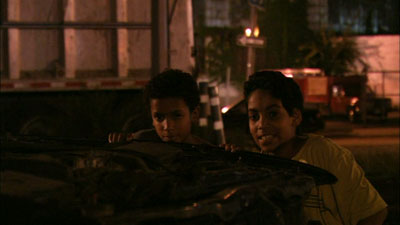
On an Ebertfest panel Ramin Bahrani argued for a realist aesthetic. “Most people in movies never seem to pay rent or keep track of how often they can eat out . . . [Ordinary people] have day-to-day struggles; they ask how to survive.” That’s to say that a realistic work is distinguished primarily by its subject matter, the social milieu it presents. Bahrani also mentioned that some plot devices are unrealistic. Criticizing Slumdog Millionaire, he remarked: “My world doesn’t end in a Hollywood fantasy.” He didn’t deny the need for a dramatic structure, but he did insist on avoiding “obvious plot points like ‘He crossed the door and can’t go back.’”
This leads me to another $.02 contribution. I’m reluctant to contrast realism with something like artifice or formula. To me, realism comes in many varieties, but none escapes artifice. All realisms I know rely on conventions shaped by tradition.
For example, Chop Shop shows us a slice of life that most of us don’t know, the world of garages and salvage yards clustered around Shea Stadium. Such a low-end milieu is a convention of literary naturalism (Zola, Gorki). In this tradition, an artwork acknowledging the lives of the poor gains a dose of realism that, say, a novel by P. G. Wodehouse or a play by Noël Coward will lack. Some critics complained that when Rossellini’s Europa 51 and Voyage to Italy presented upper-class life, he left Neorealism behind.
There seem to me other conventions at work in Chop Shop. In one garage we find a boy, Alejandro, who has two goals. He wants to set up a food van that will sell meals to the men working in the neighborhood, and he wants to keep his sister Isamar safe from bad companions. Goal-driven plotting is central to Hollywood dramaturgy, as it is to much literary realism (e.g., An American Tragedy). It’s true that in real life people often form goals, but many do not, and those who do seldom come to a state of heightened awareness in the time frame typical of a movie’s plot. Alejandro fails to achieve one goal but partially achieves another, so we have an open, somewhat ambivalent ending—another convention of realist storytelling and modern cinema (especially after Neorealism). Life goes on, as we, and many movies, often say.
Instead of following a crisis structure, as Frozen River does, Chop Shop presents what we might call “threads of routine.” Most scenes consist of ordinary activities: the work of the garage, Alejandro’s sales of candy and DVDs, opening and closing the shop, Alejandro watching from the window of his room. But these vignettes aren’t sheer repetitions. They vary as Alejandro encounters progress or setbacks with respect to his goals. Most of the routines establish a backdrop against which moments of change and conflict will stand out.
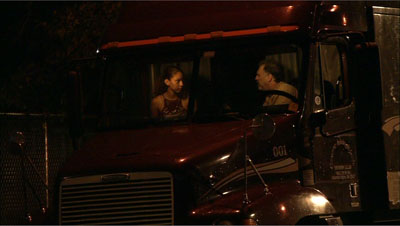
Building a movie out of routines can also make convenient coincidences seem plausible. For instance, dramas have always relied on accidental discoveries of key information—the overheard conversation, the token that betrays what’s really happening. In Chop Shop, Ale and his pal Carlos discover that Isamar has become one of the hookers who service men in the cab of a tractor-trailer. They might have discovered this, as in life, by simply wandering by the spot on a single occasion. Instead, Bahrani’s script motivates their discovery by explaining that they habitually spy on the truck assignations. “Let’s go to the truck stop and see some whores.” Planting information in scenes of everyday activities seems more natural than giving it special emphasis at a moment of crisis. In two later scenes, the truck-stop becomes an arena for conflict, so Ale’s initial discovery motivates his later actions.
As for plot points, Chop Shop has them. (At about 15 minutes, the zone of the Inciting Incident, Ale declares his intention to buy the van. At about 30 minutes he discovers that Isamar is turning to prostitution.) Likewise, the threaded routines yield poetic motifs, such as the pigeons that are carefully established early in the film. Bahrani’s plotting is meticulous, and it highlights the paradox of realism: It takes effort and calculation to “capture reality.” De Sica was said to have endlessly rehearsed the boy in Bicycle Thieves.
What gives the film a more episodic organization than Frozen River, I think, and what gives it a greater sense of “dailiness,” is that it lacks deadlines. There’s relatively little time pressure on the action, except for Ale’s sense that he’s getting close to having enough money for the van. Chop Shop’s refusal of Hollywood’s ticking clock seems to me to confirm the observation, made by Geoff Andrew and J. J. Murphy, that in some respects American indie film is located midway between classical narrative cinema and “art cinema.”
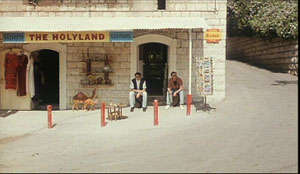
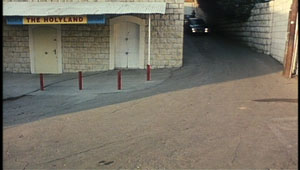
The threads-of-routine pattern can be harnessed to character-driven drama, as in Chop Shop, but it can also be more opaque or minimalist. During at least half of Elia Suleiman’s Chronicle of a Disappearance, we watch anonymous characters go through routines, but instead of revealing their psychological drives, the scenes show the people overwhelmed by their surroundings. Narrative development is charted through changes in the spaces that the figures inhabit and vacate. The result is a “surreal realism” that evokes the anxieties of Magritte or de Chirico.
To say that realist traditions rely on conventions doesn’t make them less worthwhile. Chop Shops seems to me quite a good film. Nor would I deny that realist conventions do capture some aspects of real life. Both the crisis structure and the threads-of-routines structure can be taken as realistic. Sometimes our lives are in crisis, and at other times we do just plod along. But more stylized narrative forms can capture important aspects of reality too. The Searchers, a work of high artifice, renders a portrait of a self-destructive racist that many of us recognize in the world outside the movie house. Has any film better caught the adolescent yearning for romantic love and family stability than Meet Me in St. Louis?
The problem comes when we think that only one variant of realism can lay claim to validity, let alone beauty. Sometimes fidelity takes a back seat to vivacity. In Roy Andersson’s films, everyday nuisances like checking in to a plane flight or waiting in a clinic are inflated to grotesque, gargantuan proportions, becoming torments in a vision of hell. Like all caricatures, the exaggeration captures something true.
Comparing Wilkie Collins and Dickens, T. S. Eliot notes that both writers give us vivid characters. Collins’ characters are “painstakingly coherent and life-like,” terms of praise that we could assign to Bahrani’s films as well. But, Eliot adds, “Dickens’ characters are real because there is no one like them.”
What was Neorealism? Some of André Bazin’s invaluable essays on the subject can be found in What Is Cinema? vol. 2 (Berkeley: University of California Press, 1971). Kristin and I offer a survey of some historical factors in Chapter 16 of Film History: An Introduction. (Go here for a little bibliography.) For more on art cinema and its commitments to realism and open endings, see my essay, “The Art Cinema as a Mode of Film Practice,” in Poetics of Cinema, 151-169. On American indies’ borrowing of art-cinema conventions, see Geoff King, American Independent Cinema (Bloomington: Indiana University Press, 2005) and J. J. Murphy, Me and You and Memento and Fargo (New York: Continuum, 2007). J.J. also has a blog entry on Chop Shop here. The quotations from T. S. Eliot come from “Wilkie Collins and Dickens,” Selected Essays (New York: Harcourt, Brace, 1950), 410-411.
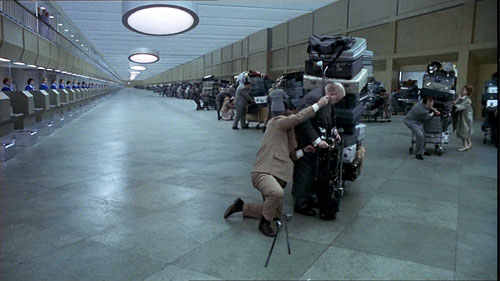
Songs from the Second Floor (Roy Andersson, 2000).
Virginia Theatre on our minds
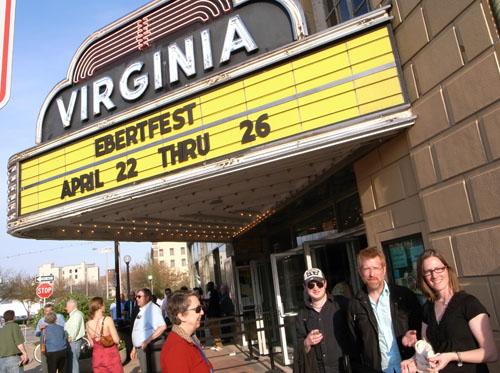
Left to right: Kristin, unidentified ardent moviegoer, Erik Gunneson, and Meg Hamel.
Kristin here–
A year ago, those of us attending Roger Ebert‘s Film Festival were forced to do without the presence of the moving force at the center of this lively annual event. Still in therapy from his health crisis of 2005, Roger fell and broke his hip. Characteristically, he struggled to convince his doctors that he could take an ambulance to Champaign/Urbana, but their caution prevailed.
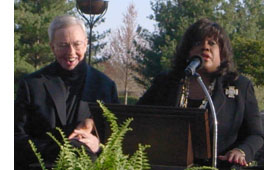 Since then, Roger has become ambulatory again, and this year he looked very happy to be back (an impression confirmed by his wrapup blog here). He still can’t talk, but he was a benign presence at the opening reception at the university president’s residence. There his wife Chaz took over the speaking duties, introducing the filmmakers and the critics who are this year’s guests.
Roger went onstage at intervals during the festival, and he made his first appearance to introduce the opening night’s film, the director’s cut of Woodstock: 3 Days of Peace and Music (1970). Thanks to dedicated software, Roger tapped out messages on a laptop and pushed a button. A voice with a British accent conveyed his words of welcome to us and to director Michael Wadleigh. Then Roger retired to the back of the theater, where a comfy chair is reserved throughout the festival for him.
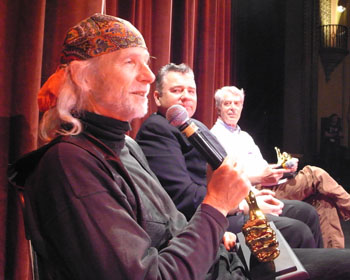
Michael Wadleigh, Jocko Marcellino, and Dale Bell discuss Woodstock.
From the perspective of nearly forty years, Woodstock has become both a record of remarkable musicians in their prime and a valuable document of the youth culture of the late 1960s. I was a junior at the University of Iowa at the time of the concert, only about five months away from taking my first film course and changing the direction of my education from tech theater to cinema studies. Working on props and make-up for productions every night, I was only dimly aware of the concert or the film that followed.
I also admit I don’t know much about pop music. I kept asking David “Who’s that?” Jefferson Airplane, The Who, Joe Cocker, and others were just names to me, not people whose appearance or music I recognized. But I could appreciate the remarkable way in which the filmmakers were able to capture live performances: the fluidity of multiple, 16mm cameras filming onstage only feet from the performers, the maintenance of focus even when events were recorded at night in less than ideal lighting conditions, and the excellent sound recording.
The screening heralds the release of the new version on DVD on June 9. Amazon has it on pre-order in 3-disc Blu-ray and DVD boxes, as well as a 2-disc set. The third disc has some making-of featurettes and about two hours of additional concert footage left out of even this extended version. I can’t imagine anyone who wants a compilation of performances by this remarkable group of musical talent settling for the smaller set.
Von Sternberg and Jannings, round one
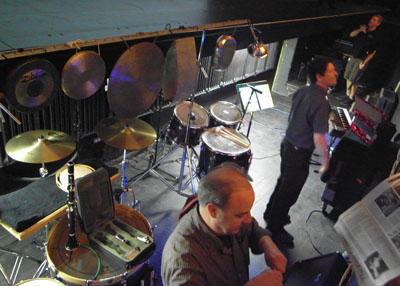
The Alloy Orchestra has become a fixture at Ebertfest. This year’s silent film was Josef von Sternberg’s The Last Command. I hadn’t seen it in thirty years or more, and it’s better than I remembered it being. Of course, seeing a gorgeous print on the big Virginia screen with an excellent musical accompaniment does it more justice than an old 16mm copy. Von Sternberg’s images were luminous, and his depiction of silent filmmaking as accurate as anything you’ll see on the screen.
In von Sternberg’s autobiography, Fun in a Chinese Laundry, he spends most of the six pages devoted to The Last Command badmouthing star Emil Jannings, with a brief sidetrack to badmouth William Powell. Presumably he’s talking about their behavior on the set, since their performances are both impressive, with Jannings emoting away and Powell as stone-faced as Buster Keaton. Von Sternberg reports that he and Jannings vowed never to work together again. Maybe winning the first Academy Award as best actor changed Jannings’ mind, for a few years later he invited von Sternberg to direct him and Marlene Dietrich in The Blue Angel. The rest, as they say, is history.
Drawing on their usual range of odd percussive objects, including a bedpan, the Alloy group provided a lively score. With Chicago Tribune critic Michael Phillips as moderator, Guy Maddin and I joined the orchestra members for a discussion afterwards. One of them hinted to me backstage that a score for Docks of New York might be in the offing, which would round off the von Sternberg series perfectly.
Saturday matinee
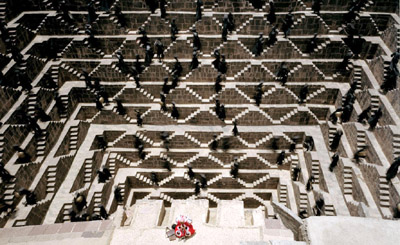
Last year the festival presented Tarsem Singh’s The Cell, with its delirious production design by Eiko. Tarsem’s 2008 follow-up, The Fall, got less attention in theatres, not having a star like Jennifer Lopez to carry it with audiences. It’s a complex fantasy set in a hospital during the silent-cinema era. There a suicidal, injured stuntman telling the tale of a band of mythical heroes bent on revenge to a seven-year-old girl with an arm cast. Her visions of the narrated events, set in spectacular landscapes and exotic buildings, mutate as she insists on changes in the story. The Fall was distinctly a crowd-pleaser, at least for the indefatigably enthusiastic audience in the Virginia Theater. Its Romanian child star, Catinca Untaru, is now twelve, and she proved an articulate charmer as she answered questions after the screening.
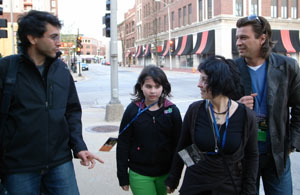
Ramin Bahrani with Catinca Untaru and her family.
The next film was Sita Sings the Blues, a marvelously imaginative animated feature by Nina Paley. I had seen the film two weeks earlier at the Wisconsin Film Festival, and it was a treat to see it on the big screen again. It’s available for download in various formats here. I had the pleasure of moderating the discussion afterward, and I like the film so much that I’ll be blogging on it separately, including a transcript of the Q&A.
Tattling and bullying
DB here:
A Belgian friend, the late Michel Apers, admired American films above all others. One of the reasons, he explained, was that our films analyzed our political system with uncommon clarity. No other national cinema, he claimed, focused so insistently on the mechanisms and purposes of government, on the duties of citizenship, and on the dilemmas of public life. Not wanting to seem too chauvinistic, I said that we often failed to fulfill our nation’s ideals. “Of course,” he said. “But at least you have ideals. And your films show that it is not easy to live up to them.”
Michel’s remarks reminded me that we do have a tradition of politically critical films: 1930s films opposing lynching and hate groups, 1940s films about political corruption, still later movies like Twelve Angry Men and The Best Man and The Manchurian Candidate. Directors who contributed to this tradition include John Ford (Young Mr. Lincoln, The Last Hurrah), Otto Preminger (Advise and Consent especially), and Alan J. Pakula (All the President’s Men, The Parallax View, Rollover, The Pelican Brief).
Rod Lurie’s favorite film is All the President’s Men, which ought to tell you where his heart is. He made The Contender (2000), a subtle drama about a woman nominated for Vice-President. It has the trappings of a political thriller (the conspiracy at its heart echoes Chappaquiddock, as well as Blow-Out), but that’s just the bait for its serious questions. Graced by a warm but steely performance by Joan Allen, The Contender asks whether a woman in politics is held to a higher standard of sexual conduct than a man would be.
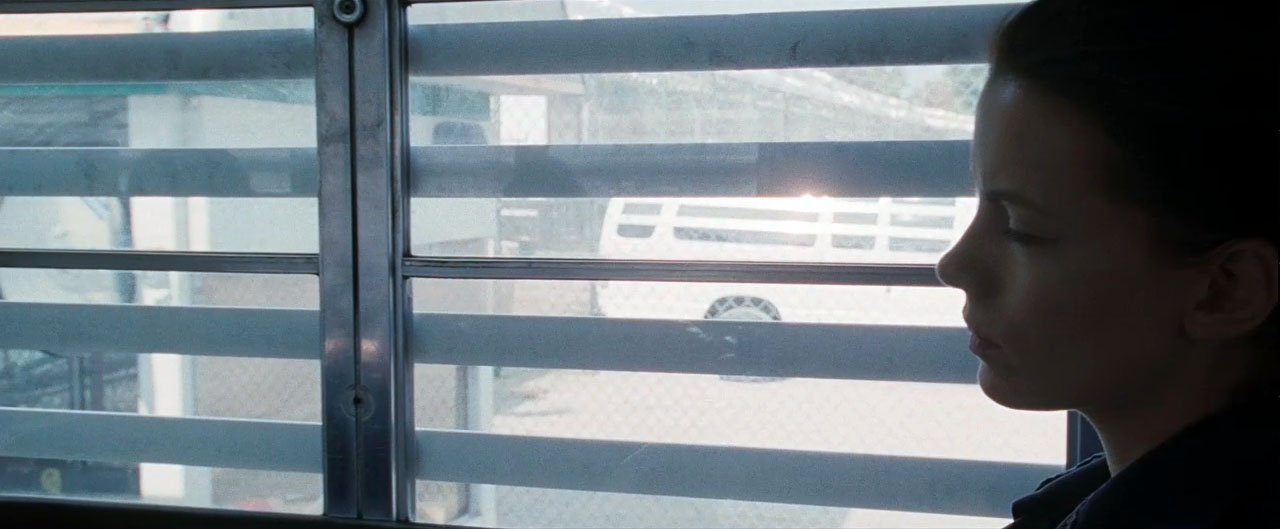
I thought of Michel Apers’ remarks when I watched Lurie’s Nothing But the Truth (2008) at this year’s Ebertfest. The plot revolves around a reporter, Rachel Armstrong (Kate Beckinsale), who outs covert CIA agent Eric van Doren (Vera Farmiga, her of the admirably crooked smile). Rachel refuses to divulge her source and goes to jail. Again, there’s a mystery to draw us through the plot: Who is the source? But more important is the problem of whether a reporter should be forced to name sources in a case that breaches national security. It’s the sort of issue that Preminger or Pakula would have loved to tackle.
 Lurie’s film is as close to a Shavian drama of ideas as I’ve seen in recent American movies. Patton Dubois (Matt Dillon), the prosecutor trying to worm the truth out of Rachel, has plenty of reasonable arguments on his side. During the post-film discussion, Dillon suggested that he leaned toward Dubois’ position: No one should have the power to destroy a person’s career in a sensitive job and go unpunished. In the film, Rachel’s lawyer Alan Burnside (Alan Alda) responds to Dubois with principled refutations, as well as a few pragmatic ones. After all, if Rachel is forced to talk, no whistle-blowers will be likely to step forward. See Roger’s recent review for more thoughts on the political implications.
While the debate plays out, Rachel languishes in jail, her family and career dissolving. The case has some analogies to the Valerie Plame incident, but Lurie stressed that the film takes on a similar situation but not comparable characters. He was inspired as much by Susan McDougal’s tenacious loyalty to Bill Clinton.
The film’s secret about Rachel’s source is no mere Macguffin. It provides a powerful supplementary reason for Rachel’s silence, yet it doesn’t wholly excuse it. The film’s last scene leaves you wondering whether Rachel exploited her source. The film’s last shot suggests that she’s wondering too. That shot also wraps up a visual motif that hangs Rachel’s face on one extreme edge of the 2.40 frame, making her look precarious and vulnerable.
All in all, Nothing But the Truth is a sober, unsensational, gripping film about the press’s rights and obligations. It’s not surprising that Lurie was a professional journalist. During the Q & A, the questions were probing and he responded with rapid-fire, well-shaped sentences. There was good humor as well. After Lurie promised to tell us who slept with whom on the shoot, he paused and said: “All I’ll say is that Alan Alda was a complete slut.”
The opportunity for ordinary moviegoers to talk with such gifted and committed filmmakers makes Ebertfest one of the great film festivals on this continent. Roger’s urge to communicate with as many people as possible naturally inclines him toward creating communities, and the folks who gather annually in the Virginia Theatre form one of the most genial and generous group of movie lovers I’ve ever encountered.
Books, an essential part of any stimulus plan
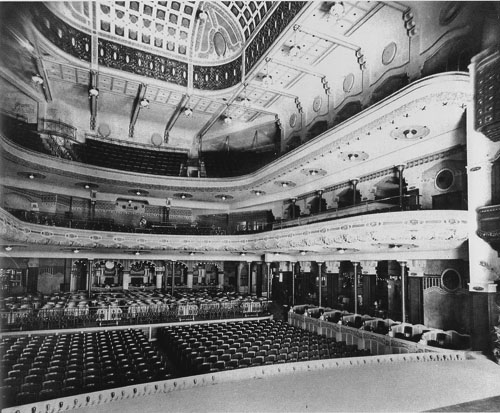
The Pathé Palace theatre, Brussels, designed by Paul Hamesse.
DB here:
Some shamefully brief notes on new publications. Disclaimer: All are by friends. Modified disclaimer: I have excellent taste in friends.
You call me reductive like that’s a bad thing
It’s easy to see why we might tell each other factual stories. We have an appetite for information, and knowing more stuff helps us cope with the social and natural world. We can also imagine why people tell fictitious stories that we think are true. Liars want to gain power by creating false beliefs in others. But now comes the puzzle. Why do we spend so much of our time telling one another stories that neither side believes?
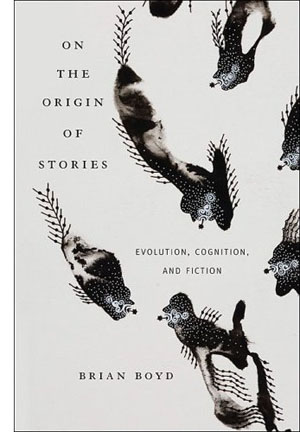 Brian Boyd’s On the Origin of Stories: Evolution, Cognition, and Fiction (Harvard University Press) is the first comprehensive study of how the evolution of humans as a social, adaptively flexible species has shaped our propensity for fictional narrative. The book is a real blockbuster, making use of a huge range of findings in the social and biological sciences. Brian paints a plausible picture, I believe, of the sources of storytelling. Along the way he shows how two specimens of fiction, The Odyssey and Horton Hears a Who, exemplify the richness and value of make-believe stories.
The standard objection to an evolutionary approach to art is that it’s reductive. It supposedly robs an individual artwork of its unique flavor, or it boils art-making down to something it isn’t, something blindly biological. Art is supposed to be really, really special. We want it to be far removed from primate hierarchies, mating behavior, or gossip. For a typical criticism along these lines, see this review of Denis Dutton’s The Art Instinct. Brian has already adroitly responded to this sort of complaint here. See also Joseph Carroll’s examination of reductivism on his site.
It seems to me that all worthwhile explanations are reductive in some way. They simplify and idealize the phenomenon (usually known as “messy reality”) by highlighting certain causes and functions. This doesn’t make such explanations inherently wrong, since some questions can be plausibly answered in such terms. For example, often the literary theorist is asking questions about regularities, those patterns that emerge across a variety of texts. That question already indicates that the researcher isn’t trying to capture reality in all its cacophony. (For me, it’s all about the questions.)
Literary humanists sometimes talk as if they want explanations to be as complex as the thing being explained. But that would be like asking for the map to be as detailed as the territory. In fact, however, humanists tacitly recognize that explanations can’t capture every twitch and bump of the phenomenon. Consider some types of explanations that are common in the humanities: Culture made this happen. Race/ class/ gender / all the above caused that. Whatever the usefulness of these constructs, it’s hard to claim that they’re not “reductive”—that is to say, selective, idealized, and more abstract than the movie or novel being examined. Likewise, when people decry evolutionary aesthetics for its “universalist” impulse, I want to ask: Don’t many academics take culture or the social construction of gender to be universals?
I want to write more about Brian’s remarkable book when I talk about our annual convention of the Society for Cognitive Studies of the Moving Image. For now, I’ll just quote Steven Pinker’s praise for On the Origin of Stories: “This is an insightful, erudite, and thoroughly original work. Aside from illuminating the human love of fiction, it proves that consilience between the humanities and sciences can enrich both fields of knowledge.”
Faded beauties of Belgium
In its day, Brussels played host to some fabulous picture palaces. Now after years of research Isabel Biver has given us a deluxe book, Cinémas de Bruxelles: Portraits et destins. It’s the most comprehensive volume I know on any city’s cinemas.
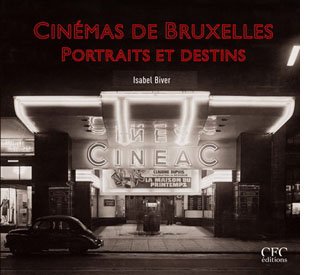 Isabel glides backward from contemporary multiplexes and tiny repertory houses to the grandeur of the picture palaces. The Eldorado was a blend of Art Deco style and quasi-African motifs sculpted in stucco. King Albert graced the opening in 1933. There was the Variétés, a multi-purpose house built in 1937. It had rotating stages, air conditioning, and space for nearly 2000 souls (cut back to a thousand when Cinerama was installed). It was, Isabel claims, the first movie house in the world to be lit entirely by neon.
Then there was the Pathé Palace, shown at the top of this entry. Dating back to 1913, it boasted 2500 places and included cafes and even a garden. This imposing Art Nouveau building was designed by Paul Hamesse, probably the city’s most inspired theatre architect. Hamesse also created the Agora Palace, which opened in 1922. Huge (nearly 3000 seats), the Agora was one of the most luxurious film theatres in Europe.
And we can’t forget the Métropole, the very incarnation of the modern style. Sinuous in its Art Deco lines, it packed in 3000 viewers. When it opened in 1932, it attracted nearly 53,000 spectators during its first week. The neon on the Métropole’s façade lit up the night, and its two-tiered glassed-in mezzanine became as much a spectacle as the films inside. See the still at the bottom of this earlier entry of mine. A ghost of its former self still sits on the Rue Neuve. Local historians consider the failure to preserve the Métropole a scandal in the city’s architectural history.
Cinémas de Bruxelles is a model presentation of local theatres. Not only does it trace the history of the major houses, but it includes a glossary of terms, a large bibliography, and an index of all theatres, both central and suburban. Needless to say, it is gorgeously illustrated. Whether or not you read French, I think you would enjoy this book, for it evokes an age we’re all nostalgic for, even if we didn’t live through it.
A TV interview with Isabel in French is here, with glimpses of what remains of the Métropole. She also gives guided tours of the remaining cinemas in the city center and in the neighborhoods. More information here.
A guy named Joe
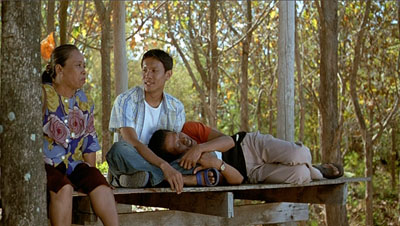
Tropical Malady.
It’s seldom that a young filmmaker gets a hefty book devoted to him. Apichatpong Weerasethakul (aka Joe) will turn forty next year. He comes from Thailand, not a country adept at negotiating world film culture, and he is known chiefly for only four features. Yet he has become one of the most admired filmmakers on the festival circuit. His films are apparently very simple, usually built on parallel narratives. They have a relaxed tempo, exploiting long takes, often shot from a fixed vantage point, and scenes whose story points emerge very gradually. Joe’s movies tease your imagination while captivating your eyes. Each one could earn the title of his first feature: Mysterious Object at Noon.
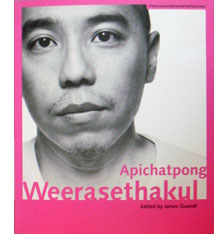 It’s appropriate, then, that the tireless Austrian Film Museum has published a lavish collection of critical studies. Edited by James Quandt, the anthology arrives along with a massive retrospective of the director’s work, which includes many short documentaries and occasional pieces.
James’ introductory essay, as evocative and eloquent as usual, is virtually a monograph, discussing all the features in depth. Alongside it are discerning essays by other old hands. Tony Rayns offers his usual incisive observations, focusing largely on Joe’s short films and the recurring imagery of hospitals, while Benedict Anderson surveys the Thai reception of Tropical Malady. Karen Newman offers precious information and judgments about Joe’s installations. The director himself signs several essays and participates in interviews and exchanges. Even Tilda Swinton has something to say.
I remember when Mysterious Object at Noon played the Brussels festival Cinédécouvertes in 2000. I was baffled. Joe’s movies taught me to watch them, and finally with Syndromes and a Century I got in sync. Its austere lyricism, off-center humor, and patiently unfolding echoes win me over every time I see it. (You can search this blogsite for several mentions, but JJ Murphy has a fuller appreciation of Syndromes here.) Thanks to Alexander Horwath and his colleagues for making this wonderful anthology, decked out with color stills and rich bibliography and filmography, available to us—and in English.
Zap goes the Chazen
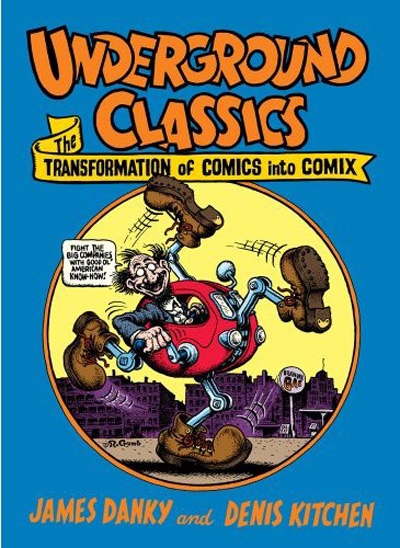
Zap, Snarf, Subvert, Young Lust, Tits & Clits, Air Pirates Funnies, Slow Death Funnies, Feds ‘n’ Heads, Corn Fed Comics, Dope Comix, Cocaine Comix, Corporate Crime Comics: The names define the era. The sixties didn’t end until the mid-1970s, and these outrageous cartoon books really came into their own after the election of Nixon in 1968.
On 2 May, the Chazen Museum on our campus launches its exhibition, Underground Classics: The Transformation of Comics into Comix, 1963-1990. A whirlwind of events, including films and lectures, will revolve around galleries full of imagery from the demented pens of Kim Deitch, Aline Kominsky Crumb, Trina Robbins, Gilbert Shelton, Robert Crumb, Bill Griffith, and many other cartoonists.
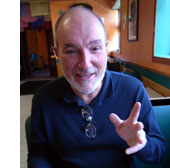 The show was originated by Jim Danky, a scholar of public media from our State Historical Society, and Denis Kitchen, comic artist and the publisher of Kitchen Sink Press here in Wisconsin. Jim has long argued for the archival value of minority and subcultural publications. He started our Center for Print Culture and has been an advocate for gathering print materials by and for children, women, and ethnic minorities. He virtually created the area of “alternative library journalism”—collecting obscure publications from all zones of the political spectrum. I recall his satisfaction in telling me that he had managed to acquire a collection of The War Is Now!, the radical Catholic newsletter published by Hutton Gibson, father of Mel.
For some years Jim has been telling me about his efforts to mount the comix show. It’s no small matter to collect this elusive material and then persuade a museum to show it. Not too many galleries feature talking penises, Jesus visiting a faculty party, or Mickey and Minnie robbed at gunpoint by a dope dealer. Maybe we forget, in the age of the Web and The Onion, just how scabrous these things looked forty years ago. Actually, they still look scabrous. They also look pretty funny, and they’re often well-drawn. As a historical codicil, the exhibition includes 1980s images from artists extending the tradition, such as Drew Friedman and Charles Burns.
The show runs until 12 July 2009. If you can’t get to town, there’s the splendid catalogue. It includes essays by Jim and Denis, Jay Lynch, Patrick Rosenkranz, Trina Robbins, and Paul Buhle. There are free screenings of Fritz the Cat and Crumb at our Cinematheque. And you can read an interview with Jim about the show here.
Remember our motto: Lotsa pictures, lotsa fun.
Up next: Days and nights at Ebertfest.
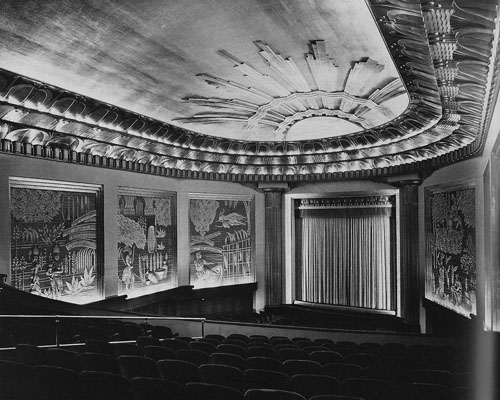
The Eldorado Cinema, Brussels, designed by Marcel Chabot.
Hong Kong wrapup: Places and faces
DB here, just back:
The numbers are pretty staggering. The Hong Kong International Film Festival ran 22 days (the first four incorporating Filmart, the Asian market). In 510 screenings, 279 films from 50 countries were shown. There were 19 world premieres, 17 international premieres, and 33 Asian premieres. Attendance figures are yet to be determined, but so far things look to match the nearly 600,000 tickets sold last year. (*Correction 1 May 2009: The figure of 600,000 refers to an estimate of total attendance at all events, including free screenings, panels, seminars, etc. Total tickets are currently estimated at 100,000. Thanks to Li Cheuk-to for the correction.)
Having stayed for the whole event, I felt some festival fatigue. But the final days of the fest were full of fine movies. I left feeling that all my time was well-spent—not least in seeing old friends and visiting some of the outstanding spots in this adrenaline-fueled city.

Ken Smith and Joanna Lee are forces of nature in the cultural life of Asia. Working mostly in musical performance, they arrange for performers’ tours, consult with cultural agencies, translate, write, and do damn near everything else as well. Call them global impresarios. They helped coordinate the YouTube Symphony Orchestra, and they played central roles in the creation of the opera The Bonesetter’s Daughter, a collaboration between Amy Tan and Stewart Wallace. This resulted in a 2008 production by the San Francisco Opera. The September premiere was broadcast in Hong Kong last Easter Sunday, and will be available at the RTHK website for playback for the following 365 days. Give it a listen here.
Ken’s engrossing book, Fate! Luck! Chance!, documents the making of the opera and includes a libretto. You can read background on Ken’s book here.
Above, Ken and Joanna take in pudding at a historic hole-in-the-wall eatery. The pudding comes in two varieties, milk and eggyolk-based. Mighty sweet, and as if by chance (or fate, or luck), the stools mimic the main attractions.


Old friends Linda Lai Chiu-han and Hector Rodriguez teach in the digital media and arts program at the City University of Hong Kong.
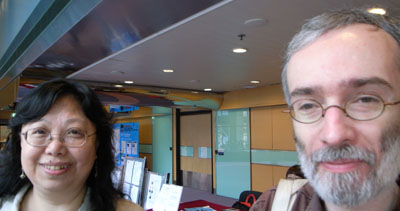
Linda has just had a film accepted for Oberhausen. She’s on a roll: It’s her second screening in this, the major festival for short films.
The W Hotel, where the Festival was headquartered, was posh to the max. Every time I went in, I expected someone to figure out that I wasn’t well-dressed enough to be there. If you ever wondered what George Segal’s ghostly sculptures would read, you could check out these pale volumes fastened to the shelves along the elevators.

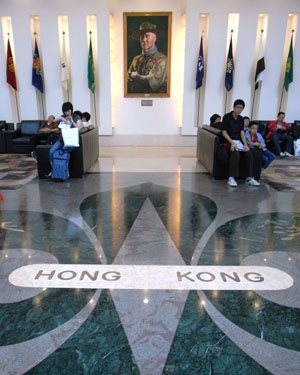
My own hotel was somewhat different. The B. P. in B. P. International House stands for Baden-Powell, and the place was teeming with Boy and Girl Scouts nearly every day. In the modern atrium hangs a reverent portrait of the man himself.
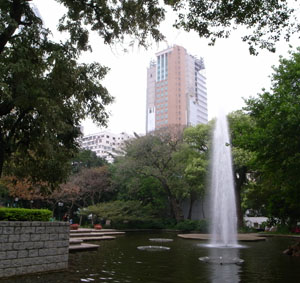
It was pleasant to stay beside Kowloon Park. Headed for the Cultural Centre or the ferry, I could avoid the crowds on Nathan Road by ambling through the park.
While I was in town, developers put the finishing touches on a neo-retro-colonialist complex at the south end of Canton Road.
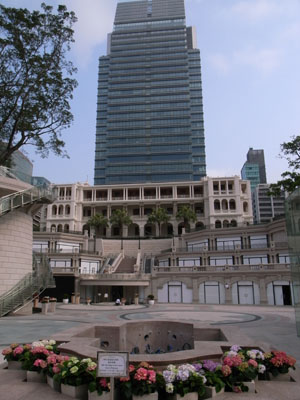
You must admit that Hong Kong sorely needs another shopping mall.
Back to the faces: Gary Bettinson (University of Lancaster), Emilie Yeh (Hong Kong Baptist University), and Darrell William Davis (Lingnan University).
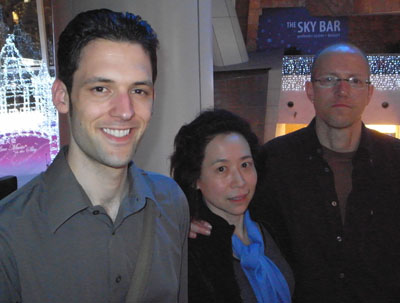
Gary writes on contemporary Hong Kong cinema, particularly Wong Kar-wai; most recently, he has an essay on 2046 in Warren Buckland’s anthology on puzzle films. Emilie researches Chinese film, as does her husband Darrell, who started his career working on Japan. I’ve already mentioned their book on Asian media industries in an earlier blog, but also have a look at their fine Taiwanese Film Directors: A Treasure Island. I gave a talk for Emilie and Darrell at HK Baptist, and we had a good discussion among their students and colleagues.
More intellect: This year the festival paid tribute to Ingmar Bergman. A friend of his, Marie Nyreröd, brought her enlightening documentary, Bergman’s Island. Here she’s seen with another Bergman expert, my amigo Paisley Livingston, philosopher and film critic-theorist teaching at Lingnan University.
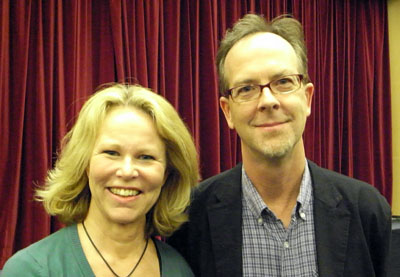
For over forty years, Erika and Ulrich Gregor have been colossal figures in world film culture–as critics, archivists, and festival programmers. They served on two juries during their stay here.
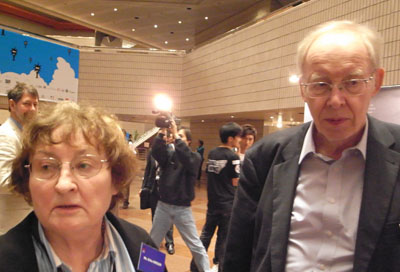
Scan earlier years of my Hong Kong visits and you’ll find these three regulars: King Wei-Chu (FantAsia programmer), Peter Rist (Film prof at Concordia of Montreal), and Yvonne Teh, Hong Kong journalist. After a screening at the Science Museum, it’s wonderful to sit out in a cafe.

Here are Johnnie To and his right-hand man Shan Ding at To’s magnificent office in Milkyway Headquarters.
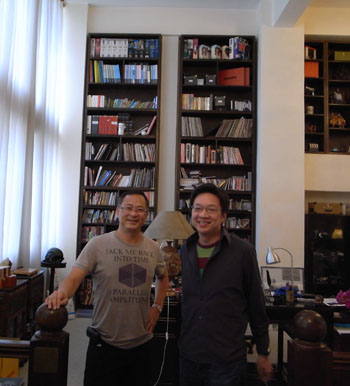
The Milkyway team is busy. To’s Vengeance, starring Johnny Hallyday, will open in Paris on 20 May. Mr. To and Shan continue to work with their collaborators on a remake of Melville’s The Red Circle, and they’re preparing a New Year’s comedy as well. Here’s Cheang Soi, one of the most ambitious of the younger HK directors (Love Battlefield, Dog Bite Dog). Soi is finishing Accident, which looks to premiere at the end of the summer.
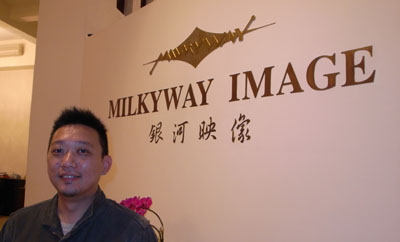
John Shum (aka Sham) is a legendary figure–a comedian since the 1980s, a producer, and an energetic advocate for local democracy.

Wong Ain-ling has been a critic and festival administrator. Currently she works as Senior Researcher at the Hong Kong Film Archive. She played a crucial role in the restoration of Fei Mu’s Confucius.

Derek Kwok (director of The Pye-Dog) is again collaborating with legendary actor-singer Teddy Robin Kwan.
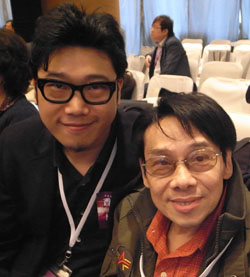
In all, another wonderful year of food (and food for thought), talk, and above all movies. You won’t find a festival anywhere more dedicated to the power of film in all its variety. So once more my tagline: See you here next year?
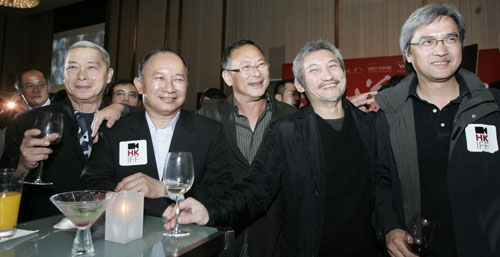
At the Film Workshop party: Lau Siuming, John Woo, Johnnie To, Tsui Hark, and Benny Chan. Thanks to Alvin Tse for the photo.