





Archive for the 'Film comments' Category
Back in Bologna
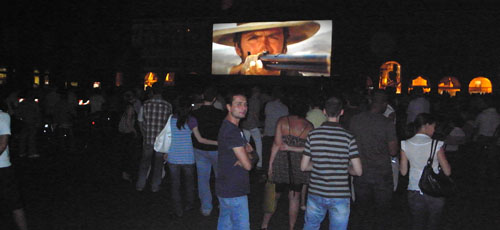
The newly restored version of The Good, the Bad, and the Ugly on the Piazza Maggiore.
Kristin here-
This year, the main complaint about Il Cinema Ritrovato, the annual festival held by the Cineteca Bologna, is that there’s too much to see. With three venues playing films against each other, plus the 10 pm screenings each evening in the Piazza Maggiore, there’s no way to see everything. Some people complain that the conflicts are becoming worse-but I remember these same complaints about the over-abundance of films coming in previous years as well. Yes, it’s frustrating at times, but being offered more films than one can watch is a problem a lot of people would love to have. Basically one either chooses a couple of threads to follow through or just goes to whatever appeals in any given time slot.
According to the 2009 festival’s newsletter, there were 810 attendees, including 557 from outside Italy.
This year there have been several main focuses: a retrospective of Frank Capra’s silent and early sound films; a portion of the Cinémathèque de Toulouse’s program of Jewish-themed Russian and Soviet cinema from the 1910s to the late 1940s; a selection of color films from the early years of the twentieth century to the 1960s; a survey of the work of Vittorio Cottafavi; the annual “100 years” program, this time from 1909; the sea films of Jean Epstein; the silent Maciste films; and many other items.
Even between the two of us, we could not take in nearly all of the riches on offer, so here’s some of what I managed to see, with David’s report to follow.
An annual hundredth birthday
Each year the festival has a thread of programs of films from one hundred years earlier. This tradition started in 2003, when Tom Gunning was asked to put together groups of films from 1903. Thereafter Mariann Lewinsky took over as programmer for these threads. In recent years, her choices have been supplemented by small groups of films chosen by individual national film archives. This year Tom programmed the 1909 Griffiths and a group of other U. S. titles.
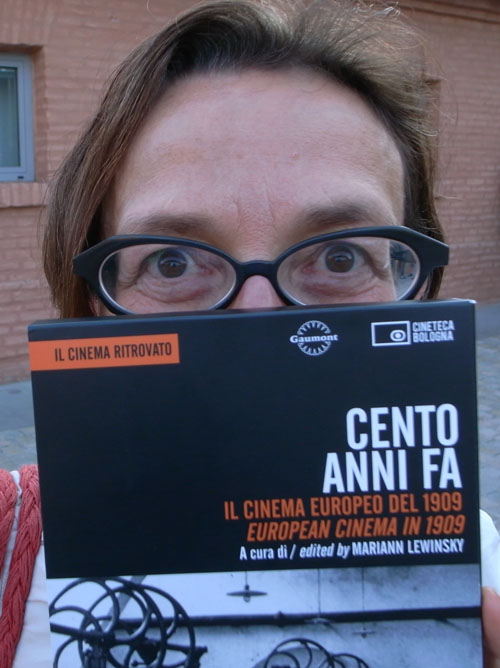
Maybe it’s just my impression, but the hundred-year packages seem to gain in prominence and popularity each year. Presumably in response to such popularity, the festival has just released a DVD with a selection of 22 shorts from this year’s 1909 program: Cento anni fa: Il cinema Europeo del 1909/European cinema in 1909 (running two hours and twenty minutes and presented below by Mariann). It contains only about a fifth of the roughly 100 films screened, but many of the others are available in online archives. DVDs of previous years’ programs are in the works, with 1907 soon to come. The DVD and other publications of the festival are available here.
I managed to see most of the 1909 programs but obviously can mention only a sampling. Undoubtedly the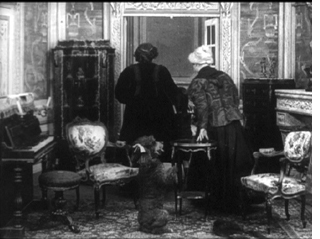 highlight for me and others I talked to was Albert Capellani’s L’Assommoir, notable for its skillful and intricate staging and splendid performances. It looked more like a film from 1912 or 1913. During the comedy, Un chien jaloux (a Gaumont one-reeler by an unknown director, left), pianist Donald Sosin had the audience in stitches by providing barks, whines, and growls as appropriate. (It’s included on the DVD, alas, without the sound effects.)
French director Alfred Machin contributed two excellent dramatic films, both involving windmills: Le Moulin maudit (also on the DVD) and, in the program of early color films, L’Ame des moulins. Comedy stars were represented by two Cretinetti films and a strange Max Linder film in which he becomes Amoreux de la femme à barbe (“Infatuated with the Bearded Lady”).
There were a great many documentaries giving glimpses into the world of 1909. Airplanes were much in 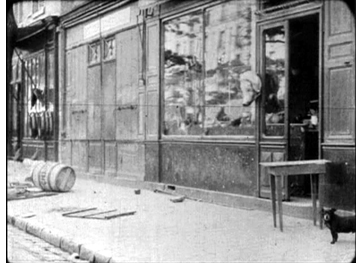 evidence, as were detailed depictions of industries in colonized countries. Mariann confessed herself to be fascinated by the random, unplanned events that intrude into both non-fiction and fiction films of this early period-particularly those shot in the street. As usual with early films, passers-by frequently come to a standstill and gawk at the camera. As she pointed out, the frequent intrusion of dogs into the frame reflected the reality of the time, when numerous homeless animals inhabited cities. We all became very aware of these animals, which David dubbed “Lewinsky dogs.” At the right, a little one that half-enters the end of one shot of a typical chase film, Les tribulations d’un charcutier (director unknown; also on the DVD).
Mariann watched a great number of 1909 films in order to make her selection. Her experience convinced her of what many of us feel, that this was a turning point for the development of film art, though perhaps not as dramatic a one as 1913. Apart from L’Assommoir, Griffith’s The Country Doctor could be pointed to as evidence that the year saw films of a greater complexity and beauty than had previously been released. Griffith may no longer be quite the lone giant of the pre-1920 era that film historians have portrayed. Still, there are touches in The Country Doctor that no other director could have conceived, such as the early shot of the central family strolling through a field of tall grass that hides everything except the doctor’s top hat floating above the stalks.
Reaching 1909 raises the question as to how long these 100-year anniversary programs can continue and what form they should take. With fiction films getting longer in years to come, particularly in Europe, there emerges a problem of including enough of them to give a sense of a single year without having the programs expand even more. Perhaps non-fiction films will figure as an increasing proportion of this thread-with more Lewinsky dogs inadvertently captured for posterity.
A garland of color films
Two programs of early color films demonstrated the various processes: hand-coloring with stencils, tinting, toning, and attempts at photographic color. The only really successful of the latter were two 1912 shorts using the Gaumont system, which provided images in sharp, reasonably true color.
I caught only a few of the features in the color thread. Victor Schertzinger’s Redskin (1929), in two-strip Technicolor, was a beautiful print. Despite its implausibly happy ending, this story was a sophisticated look not only at racial tensions between whites and Indians but also at equally divisive tensions among Indian tribes. Like the other occasional films of the early decades that show the action from the Indians’ standpoint (Griffith’s The Red Man’s View figured in the 1909 program) are remarkably sympathetic to their culture. The color portrays not only the beautiful desert landscapes of the American Southwest but also Navaho blankets and Pueblo sand paintings.
Toward the end of the week, when people asked me what my favorites had been so far, I forgot to mention Pandora and the Flying Dutchman, which had played way back on the opening Saturday. It has a reputation as a bizarre film, and I wasn’t expecting much beyond some glowing color images of two beautiful stars, Ava Gardner and James Mason. But I was pleasantly surprised by its well-handled fantasy tale of the Flying Dutchman visiting a contemporary Spanish seaside resort and finding his true love. In particular a lengthy flashback to the Dutchman’s original crime has a degree of stylization and intensity that allow it to avoid seeming absurd. The tale has an other-worldly quality that recalls some of Powell and Pressburger’s films-enhanced by the presence of cinematographer Jack Cardiff handling the Technicolor.
Unfortunately Track of the Cat (William A. Wellman, 1954) failed to similarly avoid a sense of the absurd in its overheated Tennessee William pastiche set on an isolated farm in the West. Lumbering dialogue lays out explicitly all the tensions among the members of the central family, exacerbated by the depredations of an elusive puma and a visit by the younger brother’s potential fiancée. The reason for its presence in the festival, though, was its color scheme. Wellman set out to make a “black and white film in color,” as the program describes it. Both the snowy landscapes and the interiors are dominated by white, black, and flesh tones, with the sole exception-the Robert Mitchum character’s bright red coat-disappearing from the action partway through.
Not only silents need restoring
Martin Scorsese’s influence hovers over the festival and the Cineteca Bologna. One of the two screening rooms in the Cineteca’s building is the Scorsese (the other being the Mastroianni). In recent years, films from the institution that Scorsese founded, the World Film Foundation, have been screened here. The WFF is dedicated to restoring and preserving films from countries whose archives might lack the resources to handle such major projects. This year’s presentations were Fred Zinnemann and Emilio Gómez Muriel’s Redes (The Wave, 1936), Shadi Abdel Salam’s Al Momia (known in English as The Night of Counting the Years, 1969), and Edward Yang’s A Brighter Summer Day (1991). The foundation also aided in the editing of Ingmar Bergman’s home movies into Images from the Playground (Stig Borkman, 2009).
I had seen The Night of Counting the Years in one of the faded 16mm copies that have long been the only form in which this Egyptian classic was available. The new copy is a vast improvement, finally revealing why this is considered perhaps the great Egyptian film. It is based around a true story from 1881, when a powerful tribe on the west bank at Luxor discovered a cave containing a huge cache of royal mummies and funerary goods that had been hidden away by ancient priests to preserve them after the extensive robbing of their original tombs. The tribe started selling items gradually on the illicit antiquities market, but one of its members revealed the location of the cache to the authorities, allowing them to salvage most of the mummies and their grave goods. The film was beautifully shot on location in the desert and temples of the west bank and provides a meditation on why the young man might have acted against the apparent best interests of himself and his family.
A 1991 Edward Yang film might not seem an obvious candidate for restoration, yet the complete version of A Brighter Summer Day was barely rescued from oblivion. The original negative does not exist, and the print materials on the shorter version were discovered to be moldy. Rescuing these and combining footage from both versions has resulted in a pristine new print of Yang’s greatest achievement. An in-depth look at Taiwanese society a decade after Chiang Kai-chek took over the island, it follows a middle-class boy drawn gradually into gang violence. The new version, which premiered at Cannes earlier this year, looked great on the big screen in the Arlecchino.
This and that
A brief tribute to Harry d’Abbadie d’Arrast included Laughter, the director’s first sound film. A romantic comedy, it stars Frederick March as a witty young composer aspiring to marry a wealthy society woman against her father’s wishes. The film has touches of Holiday and Design for Living, both films yet to be made. Laughter confirms d’Abbadie Arrast’s reputation as a good but lesser filmmaker in the Lubitsch mold.
 We all have reason to celebrate the fact that Georges Méliès’ films went into the European public domain this year. (The films have long been in the public domain in the U.S.) With obstacles to programming out of the way, the festival presented a program in homage, featuring twenty shorts presented by Serge Bromberg, who helped put together the extensive Méliès collection that came out in the U.S. and won the 2008 award for best DVD set here at the Cinema Ritrovato. (It came out in France earlier this year.) While all the films shown are on the DVDs, it was a treat to see them on the big screen. Bromberg provided a lively, if not entirely authentic, running commentary to “explain” the action of the final film, La Fée Carabosse.
Demonstrating that history repeats itself, Belgian film scholar Eric De Kuyper programmed a selection of titles dealing with financial speculation and crisis. These included perhaps the best of several items from Louis Feuillade shown during the week, Le Trust ou les batailles de l’argent (1911). It stars René Navarre, who would soon play Fantômas, as an unscrupulous detective, and the action is more in the thriller mode than a serious depiction of French finances. Also included was a 1916 German feature, Die Börsenkönigin (“The Queen of the Stock Exchange”), with a fine performance by Asta Nielsen as a woman more successful in finance than in love.
More to come from David, on Capra, DVD awards, and personalities glimpsed by a roving camera.
For our previous Cinema Ritrovato entries, see here for 2008 and here, here, and here for 2007. For a thorough discussion of dogs in early film, with comments by Mariann Lewinsky, see Luke McKernan‘s authoritative entry here. On the occasion of Edward Yang’s death in 2007, David offered an homage to him and A Brighter Summer Day here.
Cinema in the world’s happiest place
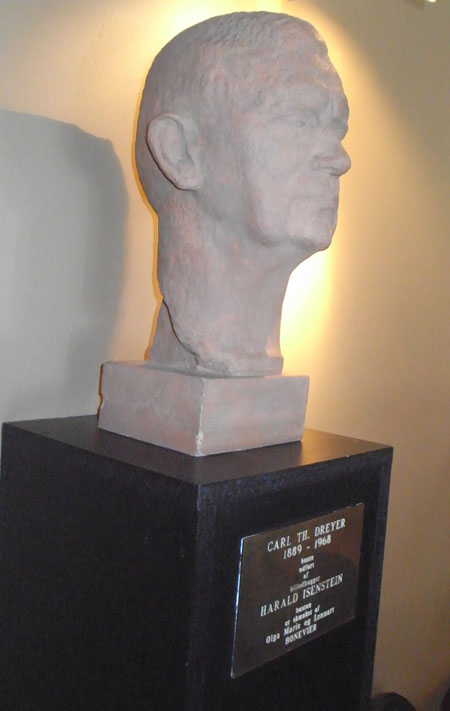
Bust of Carl Theodor Dreyer in the Dagmar Bio, the film theatre he once managed.
DB here:
Denmark was the first foreign country I ever visited. Having never been to Canada or Mexico, I took off in the early summer of 1970. Technically, I touched down in Reykjavik first because I was flying Icelandic Airlines, the Ryanair of its day. You flew Icelandic to get to Europe as cheaply as possible. Although a few people got off at Reykjavik, most of us sat patiently on the tarmac before heading off to Copenhagen.
Ever since that summer, when blinding light invaded my basement room at 4:00 AM, I’ve had a soft spot for Denmark. Ib Monty, then head of the Danish Film Archive, kindly screened for me all the Dreyers I hadn’t seen, and in spare moments I learned the joys of Copenhagen’s canals and restaurants. Six years later I would spend nearly another whole summer there watching the same Dreyer films on a flatbed viewer in the archive vaults, a somewhat renovated army fort. Many visits later, including a couple to the charming city of Aarhus, I’m still a fan of the Danes. They manage to be modest yet accomplished, hard-working yet hard-partying. They put cultural figures like composer Carl Nielsen on their currency. We’re told that they are the happiest people in the world. I don’t doubt it.
So it was with special pleasure that I returned to Copenhagen for two weeks in June. The second week was consumed by a day of talks and seminars at the University of Copenhagen and then by the convention of the Society for Cognitive Studies of the Moving Image. I’ve given two long-winded previews of the latter event, and I hope to have more coverage of it in a later entry. Today, a smorgasbord of other things Danish–without, alas, mention of H. C. Andersen, Vilhelm Hammershøi, or Victor Borge.
Chaos reigns, more or less
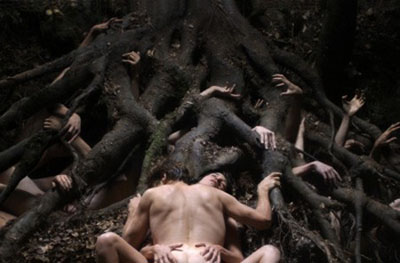
The organizers of our SCSMI event pulled off a coup: Not only were we shown Antichrist in Asta, one of the Danish Film Institute‘s fine theatres, but along came Lars von Trier to spend an hour talking about it afterward.
The film struck me as mid-level von Trier, not as good as The Idiots, The Kingdom, Dancer in the Dark, and The Boss of It All (though others would call me out for admiring this last). It lacks the element of game-playing that I enjoy in what von Trier calls his “mathematical” works, most famously The Five Obstructions. Instead, Antichrist provides perhaps the most unadulterated surge of emotion and mystical/ mythical implication to be found in all his work. It tries to be an intellectual horror film somewhat in the David Lynch mode, with a plaintive, roiling soundtrack and unearthly visions, including a fox snarling, “Chaos reigns!”
I was surprised that the elements so sensationalized by the press are pretty brief; snip out four brief shots and you’d have a ferocious but much less controversial movie. It starts as your basic two-handed psychodrama, with a couple tearing at each other. As in those other duologues Strindberg’s The Stronger and Bergman’s Persona, the film presents a fluctuating power struggle–the man trying to rule through cool rationality, the woman tapping depths of grief and repressed anger.
Yet the film goes beyond psychodrama into realms of history and myth. The grieving mother rises into demonic fury by getting in touch with witchcraft, the subject of her unfinished university thesis. Antichrist could thus be read as an exercise in misogyny or as a celebration of woman’s primal energies. (For what it’s worth, several women in our audience said they liked the film a lot.) Of course the whole thing looks very fine, with a stylized black-and-white prologue (some shots taken at 1000 frames per second), and the rest rendered in that dodging, wandering camera style von Trier and the brilliant cinematographer Antony Dod Mantle have made their own.
The entire Q & A with von Trier, moderated by Peter Schepelern, is available as an audio file on the SCSMI conference website, perhaps to be followed by a video record. Some excerpts:
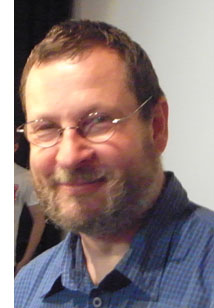 Von Trier explained that the film came out of a period of prolonged depression. “I used this project to get out of bed [every day].” Yet it’s less personal than his other works, he thinks, because it lacks his usual interest in rules, obstacles, and formal play–“a little more messy.” And he feels that by not operating the camera, he lost some intimacy with actors.
The Antichrist project seems to have brought out a mystical side of von Trier that hasn’t been so prominent in his public image. Years ago he conceived a film in which Satan created the earth, but that dissolved. Certain elements of the film, especially the emblematic forest creatures–blackbird, deer, and fox–come from his interest in shamanism. He has, he claims, traveled in alternative worlds with animal guides. “Never trust the first fox you meet.”
Is it a horror film? At least it has sources in the genre. Uncharacteristically, von Trier prepared for the project by revisiting not only classic horror films he admired, The Exorcist, The Shining, and Carrie, but also The Ring and Dark Water. He was particularly influenced in his youth by Altered States, another venture into “fantasy travels.”
He commented on how his free-camera technique imposed certain constraints in sound work. If you execute a “time cut”–that is, cutting directly to a new scene starting on a shot of a character–you must alter the sound somehow; otherwise the audience is likely to think that the action is continuous. This got me thinking about how The Boss of It All violated that convention, when each continuity cut actually yields a different sound ambience because each of the many cameras is miked separately.
Why is the film dedicated to Tarkovsky? “It was a way of getting rid of psychology.”
“I do not work with the audience in mind. I make films I would like to see myself.”
The Last is not least
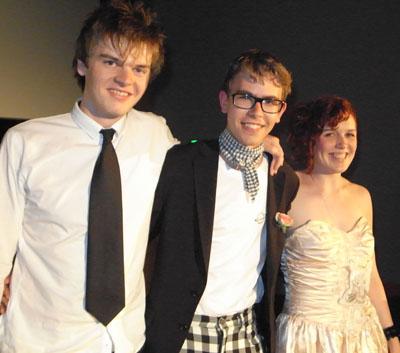
Last Friday night the filmmaking program at the University of Copenhagen gave out its student film awards. The crowd was large and boisterous, the atmosphere festive and tipsy. I was honored to present the prize for the best fiction film, which went to desidst (punning on De sidst, “The Last”). The three winning filmmakers, pictured above, were Sissel Marie tonn-Petersen, Niels Holst-Jensen, and Toke Westmark Steensen.
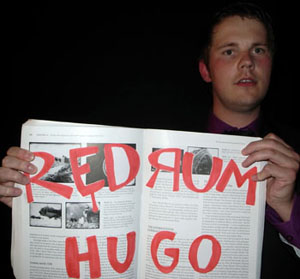
Before I read the result, though, I was confronted with some damaging evidence in a copy of Film History: An Introduction.
Peaking in the 1910s
During my first week in Copenhagen, I was viewing Danish films from 1911 to 1915. As long-time readers of this blog know, I’m fascinated by the films of the 1910s, and Denmark boasts some of the most sophisticated works of the time. Thomas Christensen and Mikael Brae of the Danish Film Archive kindly let me watch several films, mostly from the once-mighty Nordisk film company.
The most remarkable films I saw were Ekspeditricen (1911), Dyrekøbt Aere (“Hard-Won Honor,” 1911), and Under Blinkfyrets Straaler (“Under the Beam of the Lighthouse,” 1913). All three of these offer sophisticated examples of the dominant storytelling technique of that period, what has been called the tableau style.
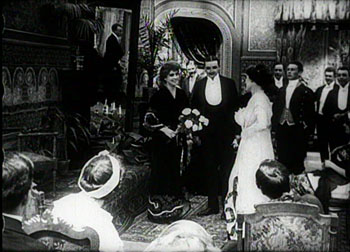
I can’t offer any visual analyses here, as I don’t have frame stills available in digital form, but here’s an example of the kind of thing I’m studying, taken from August Blom’s The Ballet Dancer (1911). Camilla (Asta Nielsen) has been seduced by Jean, a man-about-town, and she has come to sing for a society soirée at which Jean is present. But Jean is also carrying on an affair with the host’s wife.
The scene starts with the host Simon walking with his wife to the middle of the salon. Note the mirror in the upper area of the frame, just left of center.
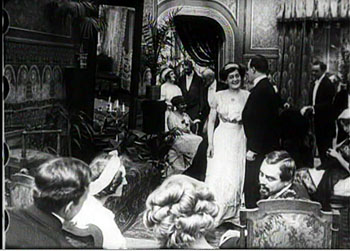
She goes out frame right, and the host welcomes Camilla, bringing her to the central zone of the shot.
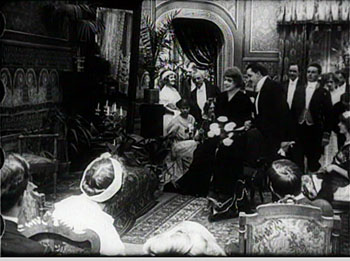
The hostess returns from off right to greet Camilla. Now we can see Camilla’s lover Jean in the mirror.
The hostess leaves the frame again, her husband settles into a chair, and Camilla starts to sing. But in the mirror we can see Jean bending over to kiss the hostess.
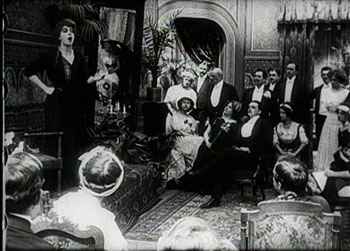
Soon Camilla notices Jean’s flirtation, and he straightens up.
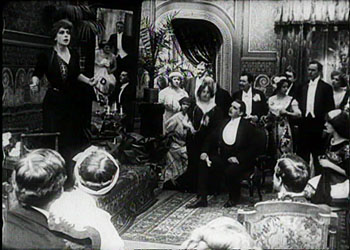
Camilla interrupts her song, shouting and thrusting an accusing finger at the couple across the room.
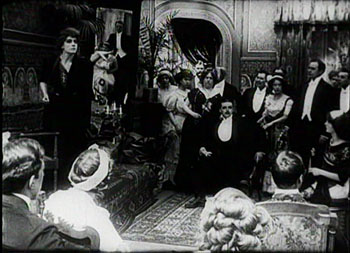
I especially like the way in which Camilla’s finger points both at the offscreen couple and directly at her guilty lover’s reflection. If we haven’t noticed Jean’s infidelity yet, we certainly should now.
Today the same scene would be handled with lots of cutting and point-of-view framings, but the mirror allows Blom to pack a single long shot with simultaneous actions. (Mirrors were something of a signature device in Danish films of the period.) It’s a nice example of Charles Barr’s notion of gradation of emphasis, a principle that was at the heart of the intricate, sometimes exquisite ensemble staging we find so often in the 1910s.
Far from being a static, “theatrical” rendering of the action, the tableau technique looks forward to the deep-space stagings we associate with Welles and Wyler, as well as the distant long-take style of Theo Angelopoulos and Hou Hsiao-hsien. Studying film history is often our best way to understand the cinema of our moment, and perhaps of our future. At a more primal level, a week of prime examples of the tableau tradition gave me a fine dose of Danish happiness.
For background on the Society for Cognitive Studies of the Moving Image conference this year, try here and here. Earlier blog entries on this site have dealt with other aspects of 1910s cinema: director Yevgenii Bauer, tight staging in De Mille’s Kindling (1915), the emergence of classical film style around 1917, editing in William S. Hart movies, the years 1913 and 1918, and the triumph of Doug Fairbanks. I’ve proposed more complete accounts of 1910s staging strategies, and their impact on film history, in On the History of Film Style and Figures Traced in Light: On Cinematic Staging.
An excellent introduction to Danish cinema of this period is Ron Mottram’s 1988 Danish Cinema before Dreyer, a book which deserves to be reissued or put online. You can sample Danish 1910s films at the DFI archive database, where several clips are posted. Try these fragments: København ved nat (1910), Den frelsende Film (1916), and Kaerlighedsvalsen (1920). DVD versions of some 1910s classics, including The Ballet Dancer, can be ordered from the DFI Cinemateket shop; in the US, the titles are available for institutional purchase from Gartenberg Media. Everyone interested in silent cinema should own the Dreyer, Christensen, Psilander, and Asta Nielsen discs.

Rights to revert to author
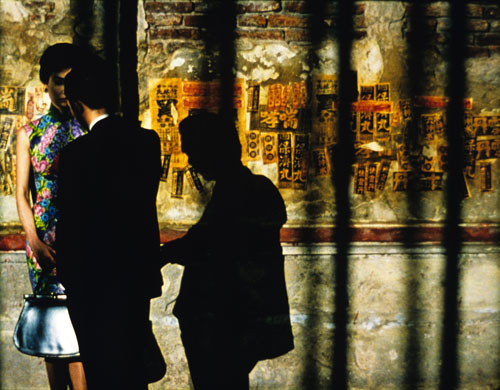
In the Mood for Love.
DB here:
“They never tell you that.”
My neighbor Jim Cortada is a polymath. He joined IBM in the 1970s, when history Ph.D.s faced bleak prospects for academic jobs. Since then Jim has done everything from selling mainframes to leading seminars on quality management. As a business guru, he writes books on management strategy and tactics. He also writes both popular and academic books on the history of information technology. He finds time as well to write books on his grad-school specialty, Spanish diplomatic history.
Jim’s Amazon listing consists of fifty titles. He has worked with publishers as small as Lulu and as big as Oxford. So when he talks about the nuts and bolts of publishing, I listen. His reaction to what happened to me recently is as succinct as it as accurate: They never tell you that. Put into proper context, it’s good for young academics to keep in the back of their minds.
The Syndics speak, after prodding
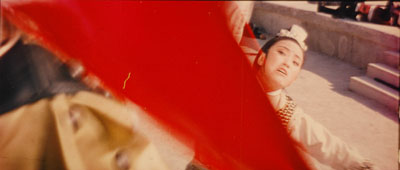
14 Amazons.
Early this spring, when my royalty statement from Harvard University Press arrived, I noticed an anomaly. From early 2000 through the end of 2007, Planet Hong Kong had sold about 7000 copies. The average, about 800-900 copies a year, isn’t much for trade books, but fairly solid for an academic title. Perhaps courses on Hong Kong film were using it as a text.
But the newest royalty statement brought me up short. In calendar 2008, the sales dropped off the cliff. Harvard shifted only 85 paperback copies and virtually no hardcovers.
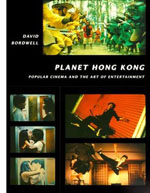 Naturally, I blamed myself. People were losing interest, or the book wasn’t good enough to sustain an audience. But then I noticed that Amazon was offering the book only from third-party sellers. I checked Barnes & Noble and Harvard’s own website; both claimed to offer new copies. So I assumed that some long-term glitch at Amazon was leading to declining sales.
So about six weeks ago I tried contacting my editor at Harvard. Getting no email replies, I left phone messages. No response.
Mossbacks among you will recognize this as a danger sign. When an editor doesn’t reply, it’s not good news. So a call to Harvard’s editorial offices brought the promise of a prompt response. An email from a good-natured staff member there gave me the lowdown: Planet Hong Kong was being taken out of print. There were too many pictures to make a reprint edition worthwhile, someone had decided. Exactly when was that decision made? That matter was left vague, but I was told that the process of transferring rights to me had already begun.
Actually, I was a little surprised at that. Transferring rights back to the author is an old-media custom, but today, when “multiple platforms” are the new business model, there’s no reason for a book to go out of print. Publishers can keep selling a book through print-on-demand or in digital copies. Why Harvard’s decision-makers chose to revert the rights to me remains a bit of a mystery.
In any event, now the 2008 sales slump made sense. Only 85 copies of PHK were sold that year because in all likelihood Harvard, having decided not to reprint, was simply exhausting its stock of copies. On the basis of past performance, those sad 85 copies probably sold fairly early in the year, so there’s reason to think that the decision not to reprint was taken at some point in 2008, perhaps quite early. Yet I wasn’t informed of the decision until I inquired in 2009.
Nor am I complaining that I wasn’t consulted about the decision. Editors and press directors never tip their hand, for the very good reason that the author has no contractual say in the matter. And telling can only cause trouble, because authors have an annoying desire to keep their books in print.
In particular, academics relish prolonged disputation. If you’re told that your book might be headed for landfill, wouldn’t you launch an ambitious plea for reconsideration, complete with references to all the people you know who love the book and reminders that generations yet unborn will be eager to absorb your ideas? (Quotes from favorable reviews optional.) If tension rises, you can always murmur about feeble marketing efforts and a risibly high cover price. It could all get nasty, and the conclusion is foregone anyhow.
So when the publisher is mulling whether to drop your book, don’t expect to have a vote. But once the press has decided to drop it, why the reluctance to tell you?
I’m the one who’s supposed to kill my darlings
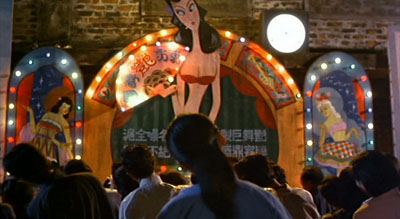
Shanghai Blues.
I’ve now had six books go out of print. Correspondence with regard to two of those, back in the 1970s, is lost in the mists of time. Of the four most recent instances, I was told many months after the decision was made, and by the most impersonal of letters—not from my acquisitions editor but from somebody in the cloisters of marketing or production. In the current Planet Hong Kong case, and in an earlier instance, I learned of the book’s fate only because I inquired. Who knows when I would have been told?
Nobody likes to give bad news, and university press staff members are unlikely to be flint-hearted business people. Editors are affable and solicitous; I’ve found them good company. They work long and hard on often fruitless projects: proposals that never turn into manuscripts; manuscripts that can’t get through the vetting process; manuscripts that fall hors de combat in editorial meetings.
And academic writers are almost sadistically inconsiderate. Once professors get their book contract, they behave like their students, trotting out excuses that they laugh about in the faculty pub. They ignore deadlines, word counts, permissions—in sum, everything they signed the contract to honor. Yet these antics are tolerated with remarkably good humor. If university book editors had a taste for blood, they’d be trade book editors. Or agents.
More broadly, it seems to me, university presses are under unique pressures. The good side is that they are a business that can’t go out of business. Even in hard times like these, a university press is unlikely to be shuttered. The blow in prestige and faculty morale would be severe. So most presses limp along. Since most of their costs are bound up in salaries, wages, and benefits, the only area that can feasibly be trimmed is marketing.
Furthermore, and too few young scholars realize this, every press plays a crucial role in the tenuring process. A humanities professor teaching in most universities and many colleges typically needs to publish at least one through-written book to support a case for tenure. There is thus a vast demand that some entity publish said books. The problem is that an academic can deftly write a book that virtually no one wants to read, let alone buy. So university presses are, in effect, subsidizing the tenure process.
Seen from this angle, university publishing is a system of reciprocal altruism. The University of West Overshoe Press publishes Professor Smith’s book on cultural resistance in Girl Scout parade floats. Professor Smith is thereby on his way to tenure at his school, the University of Rising Damp. At the same time, the URD Press publishes Professor Jones’ book on sexual transgression in Futurama. Professor Jones resides at Shattered Tibia State, whose press has just accepted a manuscript (on Wittgenstein’s use of prepositions in the Tractatus) from Professor Johnson. . . who teaches at the University of West Overshoe. I’ve abbreviated the cycle, but you can see that eventually, like the spirochete in Professor Pangloss’s song in Bernstein’s Candide, everything circles around. Any one university press is supporting employment at other universities.
So I’m entirely in sympathy with university presses. And the process, eccentric though it sometimes seems, can produce good books. But presses need to deal more straightforwardly and promptly with writers when a book’s fate has been decided. Jim Cortada is right. They never tell you that. But they should, and pronto. For then you can make plans.
Planet Hong Kong 2.0
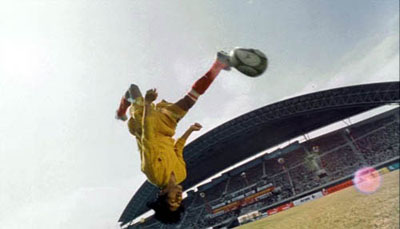
Shaolin Soccer.
The lesson for young scholars is simple. Expect that your book will go out of print. Some books will pass over to print-on-demand or digital versions, but it doesn’t hurt to expect the worst. And a book can go out of print surprisingly fast. (The original British edition of my book on Ozu lasted only about two years.) You may learn of your work’s passing by accident, as I did, or through more direct notification, but you should think about your options.
You can simply let it go, accepting the press’s rationale that your book will remain available in libraries around the world for decades. Or you can wait for Google or Amazon to get around to digitizing your work.
Yet an out-of-print book is like a child limping home after a few rough encounters with the world. You might feel duty-bound to take care of it somehow. How?
First step in salvage is to make sure pre-print materials have not been destroyed. Most contracts require that these be returned to you if you regain the rights, but publishers, speedy in so little else, can dump physical production materials in the blink of an eye. In the old days, those materials usually consisted of rolls of thick celluloid, three or four feet wide and very long, on which the pages were printed like panels on a vast comic strip. (Several of these monsters lie pod-like in my basement.) But now most books are stored on computer files, often as PDFs. Copies of those should be returned to you.
Until recently, resuscitating your book came down to trying to find another publisher. I’ve had luck with this tactic only once, with The Cinema of Eisenstein—first published by The Syndics in 1994, yanked out of print in the early 2000s, brought back by Routledge in 2005. Republishing was always rare and is now nearly nonexistent; presses can’t afford to bring out a book that may have saturated its market.
Now, though, there’s another way to revive your sickly child.
For some years I’ve argued that most “tenure books” should be published only in digital form. But university presses have been reluctant to try such an idea, since an online book might not satisfy tenure committees. The best plan would be for some well-respected university press to lock in a vetting process for online publication as rigorous as any for print books. It seems that the University of Michigan Press has begun to do this. Once the model proves its value, and once problems of piracy are solved, the practice could catch on fast. For many books I own, I’d be happy to have PDF files on my computer. There should be big cost savings and, we hope, lower purchase prices—maybe even through selling separate chapters. Like music CDs, many books have only a few chapters you want. We can look forward to the iTune-izing of academic writing.
Yet if university presses need to be cautious about online publishing, the individual scholar doesn’t. The tactic is simple: Plan to put your out-of-print books on the Web.
Some authors may prefer to take existing PDF files or make new ones from the book’s pages, and add a fresh introduction. That’s essentially what Marcus Nornes and his colleagues helped me do with Ozu and the Poetics of Cinema. We also tipped in new color images.
The alternative is to revise your book and post a second edition online. It’s a lot of work, but then you could probably charge something for it.
As for Planet Hong Kong, I’m still mulling my next step. Perhaps a publisher will be interested in a new edition, revised, corrected, and updated. Alternatively, I might prepare Planet Hong Kong for downloading on this site. Unlike the original, it could have color illustrations. I have to say that I find this option intriguing.
If you want a used copy of the old edition of PHK, about a dozen are available here. Once dealers learn it’s out of print, they may raise their prices. In any event, I hope to bring the book back in some form. Don’t say I didn’t tell you.
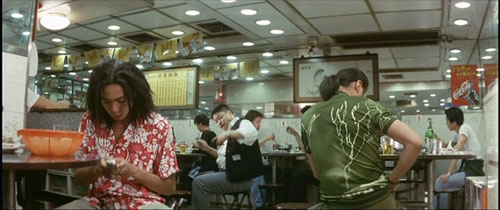
PTU.
The postman has rung more than twice
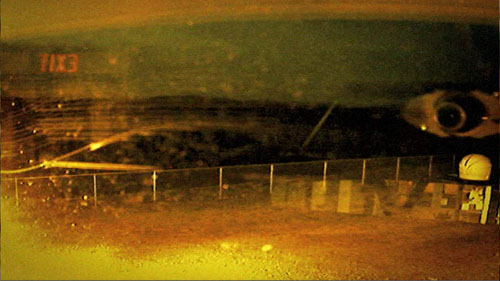
Optical Vacuum.
DB here:
While I try to whip up seven lectures for the Bruges Summer Film College and a couple more for the University of Copenhagen and our June Society for Cognitive Studies of the Moving Image confab, I offer some quick notes on notable DVDs and books lugged to our door by our mailman.
When machines film better than they know
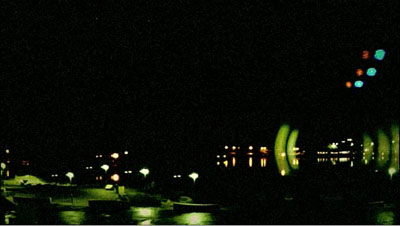
Snow blankets a terrace and the furniture on it. A bottle jerks back and forth on a pavement. Christmas lights blink on and off. Everything looks desolate. What people we see scuttle across washed-out landscapes, play mahjongg in stammering gestures, and toil in computer labs under glaring fluorescent lights. What planet are we on?
These images are available to any of us. For two years Dariusz Kowalski trawled through sites like www.opentopia.com for surveillance-camera footage. He chose only material from hidden cameras. He added nothing except some slow motion (“otherwise it would be too fast”) and a voice-over commentary from artist Stephen Mathewson reading passages from a year’s diary. The result was a fifty-five minute assemblage film called Optical Vacuum (2008), which I saw and admired in Hong Kong back in April.
Sometimes the diary account intersects with what we see: Mathewson talks of washing his laundry/ shots of a Laundromat. More often, the voice drifts off on its own. Optical Vacuum isn’t an effort to make a film essay or to create a complex audiovisual dynamic. Mathewson’s diary provides an intimacy that the footage lacks, but I think the film would stand up strongly without it.
As a flow of impersonal views, usually from a distant perch, the footage creates a bleak beauty.
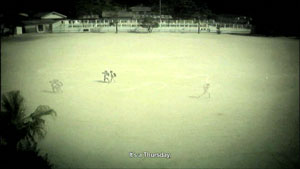
Occasionally a human operator has commanded the camera to focus on something, usually a woman.

But most often the camera is just mindlessly recording.
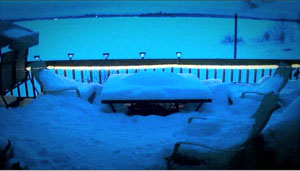
In the process, the surveillance camera reinvents avant-garde film—not just the barely inflected fields of Structural cinema, but also the time compression and melting glimpses, the reflections and superimpositions, the transient ghosts and brutal geometry we find in silent experimental work by Richter, Vertov, and others. These stupid cameras can’t help turning reality into something else. They don’t know any better.
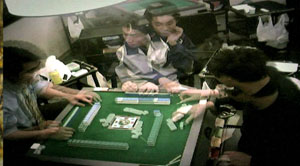
Optical Vacuum, along with other pieces by Kowalski, can be found on a PAL uncoded DVD from the extraordinary Austrian collective sixpack. The handsomely mounted Index release is available here, and elsewhere on the Net.
Dragons and tigers in the Udine sun
 Italian festivals of specialized cinema are mounted with incomparable flair–lots of screenings, panels, interviews, book sales, and of course outstanding food. Most famous are Pordenone’s festival of silent cinema and Bologna’s Cinema Ritrovato. But for admirers of Asian cinema, just as important is the Udine Far East Film event, which completed its eleventh installment on 2 May.
Alas, I’ve never been. In its earliest years it overlapped with the Hong Kong film festival; more recently, my commitments elsewhere, such as Ebertfest, have kept me away. But I have followed this celebration of Asian cinema at a distance through its remarkable publications.
The Udine event concentrates on popular cinema, mostly recent releases that are unlikely to come to US theatres or video stores. You can see films from Japan, Korea, and China but also from Thailand, Malaysia, and the Philippines. This year’s highlights include regional hits like Cape no. 7, Beast Stalker, Departures, and Ip Man as well as obscure and delirious items like Love Exposure and The Forbidden Legend: Sex and Chopsticks. Many screenings are European premieres.
The programmers also mount adventurous retrospectives of rare items. One year it was a survey of the work of Patrick Tam, still too little known among Asian aficionados. This year the retrospective was devoted to Ann Hui’s TV films, which are among her best work. These films, shot in 16mm and broadcast in the 1970s, were strong meat for a culture unused to social criticism in its popular media. Hui’s dramas showed police corruption, the sex trade, abandoned children, and drug addiction. The episodes were researched and scripted under great time pressure, and Hui was allotted two weeks for shooting and post-production. “We were experts at shooting in the streets on the sly.” The stories’ concern for ordinary people and their problems has resurfaced again in The Way We Are (2008) and Night and Fog (2009).
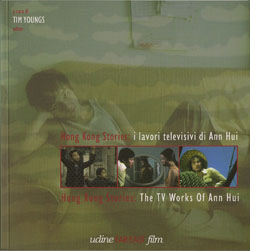 The Hui volume is a model of the profuse documentation the Far East festival provides. Several concise essays, all in both English and Italian, enhance appreciation of the films. Contributors Law Kar, Shu Kei, and editor Tim Youngs do a fine job of situating Hui’s TV work in its context, and a lengthy interview with the director explores her working methods and intentions. There’s also valuable filmographic information about the episodes (four of them available on DVD).
As if this weren’t enough, the Udine event publishes a mammoth catalogue called Nickelodeon. Each year it’s a treasure chest of enthusiastically presented information. This time around, surveys of 2008 developments in all the major countries are accompanied by Roger Garcia‘s special section on the history of Thai action cinema. A vast section of reviews of the films to be shown rounds out this gift to the Asian cinephile. (A little of this material is available at the Udine site.) There is no coordinated effort to sell the books to the public, but if you want to purchase them, try writing to the festival directors at cec@cecudine.org.
So a tip of the hat to the dedicated Udine team, headed by Sabrina Baracetti, and a signal to you that if you have the time and the money to go, you would surely have a hell of a week. (Note that professors and students are offered lodging for some nights.) Who knows? A director might show up to put the audience in a movie, as Johnnie To once did. Even if you can’t make the trip, the quality of the publications makes them indispensible for research and enjoyable reading.
Rabbits from a hat
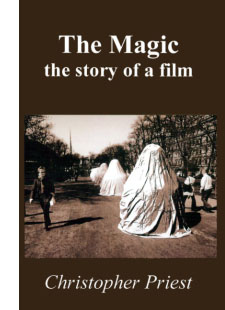 It’s tiresome to hear novelists kvetching that film adaptations mangle their work. So it’s a pleasure to read Christopher Priest’s brisk account of how his novel The Prestige became a film. In The Magic: The Story of a Film Priest takes us through the whole process, but this isn’t the usual behind-the-scenes tour. He never visited the set or met the principals. Instead we get the viewpoint of a writer living in East Sussex, following the production through agents’ correspondence and the gossip frothing up on Google Alerts.
Priest is a lively writer, and he is frank about the ups and downs of the process. Initially he is happy that Nolan acquired the rights because the novel, a cunningly designed piece of misdirection, seems ideal for the director of Memento. But he confesses disappointment when the Prestige project is sidetracked by Batman Begins (“overlong, simplistic, and dull”). When the production gets under way, there are more swerves in the road. Given an early script, Priest admires the craftsmanship of Jonathan Nolan. But then he’s baffled that Christopher Nolan is saying two inconsistent things: that the film is completely different from the book, and that reading the book will spoil the film. Then again, during a press preview in Leicester Square, Priest succumbs to the film’s intricacies. “It has one of the most complicated and sophisticated narrative structures ever seen in an entertainment film.”
The story of the production ends here, but Priest goes on for about fifty pages to analyze the film in considerable detail. He dwells on the opening, which has no equivalent in his novel, and praises it for its fluent shifts among different points in story time. He appraises various aspects of the film, and he doesn’t stint criticisms. He notes that the Nolans stripped off his contemporary story, crucially altered the roles of the women, and turned his elusive mysteries into plot-driven secrets. Yet he concludes:
There is hardly a line of dialogue or moment of action in the film that can be traced back word-for-word, yet the whole thing is faithful to the novel in spirit, in story and in effect. I have differences with the screenplay in places, but none of those detracts from my general impression that it is a classic film adaptation of an existing novel, one which intending screenwriters would do well to study alongside the novel. (157).
Priest is a former movie critic (for the sturdy old British Film Institute publication Film) and an astute observer of what happens in a shot and on a soundtrack. He contacted me after my March blog entry discussing micro-repetitions in The Prestige and told me of The Magic. I ordered a copy pronto, and I’m glad I did. If you want to give your mail carrier a bit more job security, go to this page and click on GrimGrin Studio.