




Archive for the 'Film comments' Category
Hong Kong wrapup: Places and faces
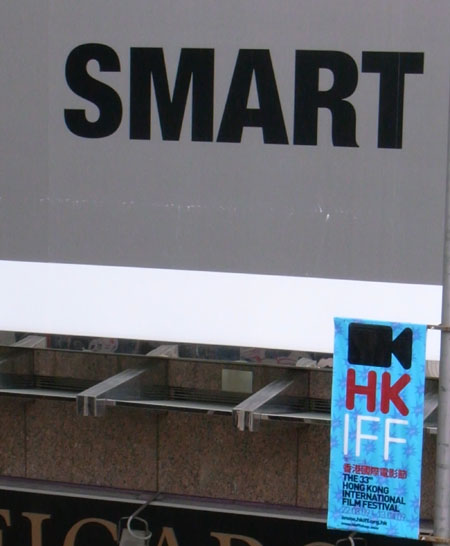
DB here, just back:
The numbers are pretty staggering. The Hong Kong International Film Festival ran 22 days (the first four incorporating Filmart, the Asian market). In 510 screenings, 279 films from 50 countries were shown. There were 19 world premieres, 17 international premieres, and 33 Asian premieres. Attendance figures are yet to be determined, but so far things look to match the nearly 600,000 tickets sold last year. (*Correction 1 May 2009: The figure of 600,000 refers to an estimate of total attendance at all events, including free screenings, panels, seminars, etc. Total tickets are currently estimated at 100,000. Thanks to Li Cheuk-to for the correction.)
Having stayed for the whole event, I felt some festival fatigue. But the final days of the fest were full of fine movies. I left feeling that all my time was well-spent—not least in seeing old friends and visiting some of the outstanding spots in this adrenaline-fueled city.
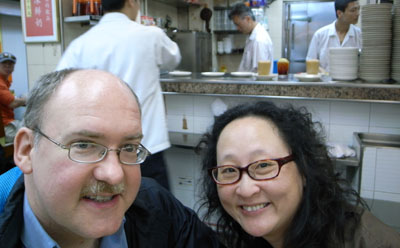
Ken Smith and Joanna Lee are forces of nature in the cultural life of Asia. Working mostly in musical performance, they arrange for performers’ tours, consult with cultural agencies, translate, write, and do damn near everything else as well. Call them global impresarios. They helped coordinate the YouTube Symphony Orchestra, and they played central roles in the creation of the opera The Bonesetter’s Daughter, a collaboration between Amy Tan and Stewart Wallace. This resulted in a 2008 production by the San Francisco Opera. The September premiere was broadcast in Hong Kong last Easter Sunday, and will be available at the RTHK website for playback for the following 365 days. Give it a listen here.
Ken’s engrossing book, Fate! Luck! Chance!, documents the making of the opera and includes a libretto. You can read background on Ken’s book here.
Above, Ken and Joanna take in pudding at a historic hole-in-the-wall eatery. The pudding comes in two varieties, milk and eggyolk-based. Mighty sweet, and as if by chance (or fate, or luck), the stools mimic the main attractions.


Old friends Linda Lai Chiu-han and Hector Rodriguez teach in the digital media and arts program at the City University of Hong Kong.
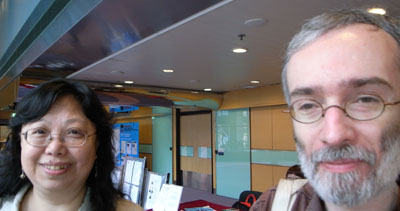
Linda has just had a film accepted for Oberhausen. She’s on a roll: It’s her second screening in this, the major festival for short films.
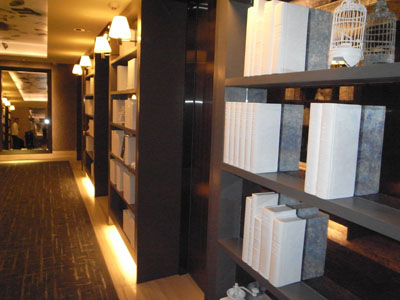
The W Hotel, where the Festival was headquartered, was posh to the max. Every time I went in, I expected someone to figure out that I wasn’t well-dressed enough to be there. If you ever wondered what George Segal’s ghostly sculptures would read, you could check out these pale volumes fastened to the shelves along the elevators.
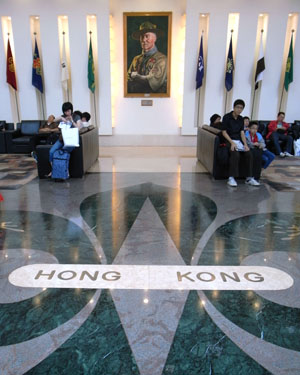
My own hotel was somewhat different. The B. P. in B. P. International House stands for Baden-Powell, and the place was teeming with Boy and Girl Scouts nearly every day. In the modern atrium hangs a reverent portrait of the man himself.
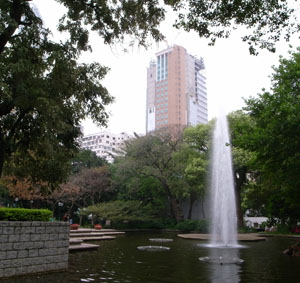
It was pleasant to stay beside Kowloon Park. Headed for the Cultural Centre or the ferry, I could avoid the crowds on Nathan Road by ambling through the park.
While I was in town, developers put the finishing touches on a neo-retro-colonialist complex at the south end of Canton Road.
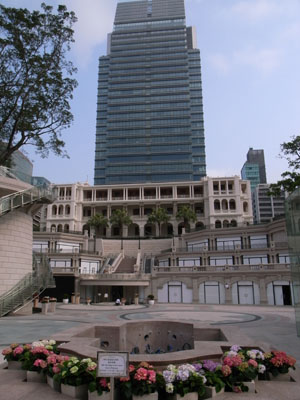
You must admit that Hong Kong sorely needs another shopping mall.
Back to the faces: Gary Bettinson (University of Lancaster), Emilie Yeh (Hong Kong Baptist University), and Darrell William Davis (Lingnan University).
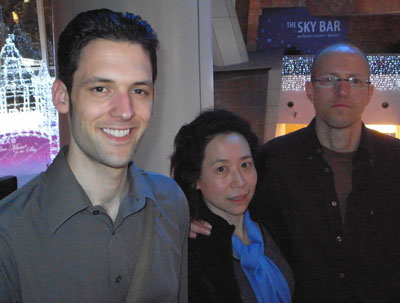
Gary writes on contemporary Hong Kong cinema, particularly Wong Kar-wai; most recently, he has an essay on 2046 in Warren Buckland’s anthology on puzzle films. Emilie researches Chinese film, as does her husband Darrell, who started his career working on Japan. I’ve already mentioned their book on Asian media industries in an earlier blog, but also have a look at their fine Taiwanese Film Directors: A Treasure Island. I gave a talk for Emilie and Darrell at HK Baptist, and we had a good discussion among their students and colleagues.
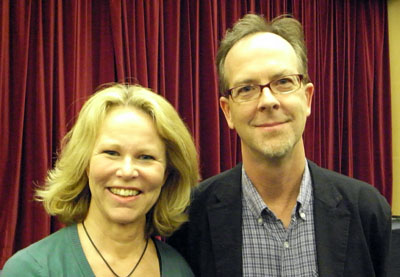
More intellect: This year the festival paid tribute to Ingmar Bergman. A friend of his, Marie Nyreröd, brought her enlightening documentary, Bergman’s Island. Here she’s seen with another Bergman expert, my amigo Paisley Livingston, philosopher and film critic-theorist teaching at Lingnan University.
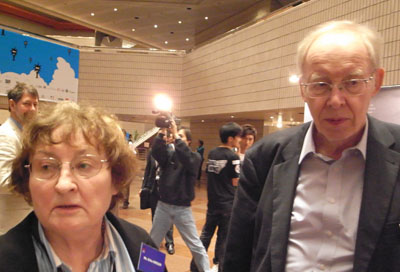
For over forty years, Erika and Ulrich Gregor have been colossal figures in world film culture–as critics, archivists, and festival programmers. They served on two juries during their stay here.
Scan earlier years of my Hong Kong visits and you’ll find these three regulars: King Wei-Chu (FantAsia programmer), Peter Rist (Film prof at Concordia of Montreal), and Yvonne Teh, Hong Kong journalist. After a screening at the Science Museum, it’s wonderful to sit out in a cafe.

Here are Johnnie To and his right-hand man Shan Ding at To’s magnificent office in Milkyway Headquarters.
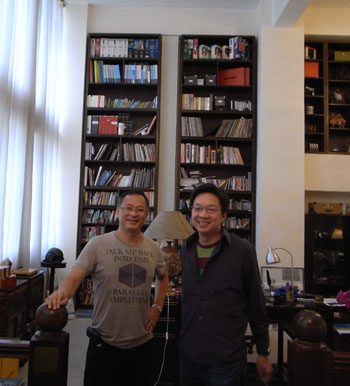
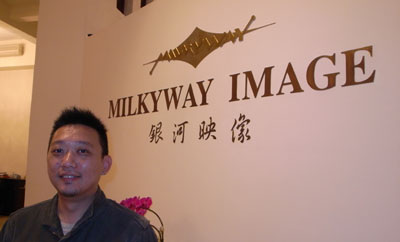
The Milkyway team is busy. To’s Vengeance, starring Johnny Hallyday, will open in Paris on 20 May. Mr. To and Shan continue to work with their collaborators on a remake of Melville’s The Red Circle, and they’re preparing a New Year’s comedy as well. Here’s Cheang Soi, one of the most ambitious of the younger HK directors (Love Battlefield, Dog Bite Dog). Soi is finishing Accident, which looks to premiere at the end of the summer.
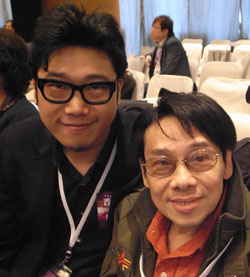
John Shum (aka Sham) is a legendary figure–a comedian since the 1980s, a producer, and an energetic advocate for local democracy.
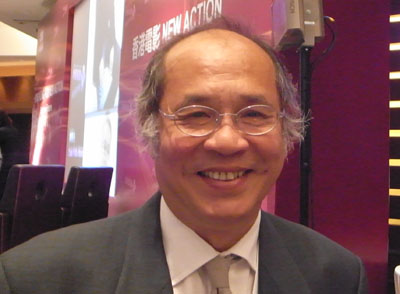
Wong Ain-ling has been a critic and festival administrator. Currently she works as Senior Researcher at the Hong Kong Film Archive. She played a crucial role in the restoration of Fei Mu’s Confucius.
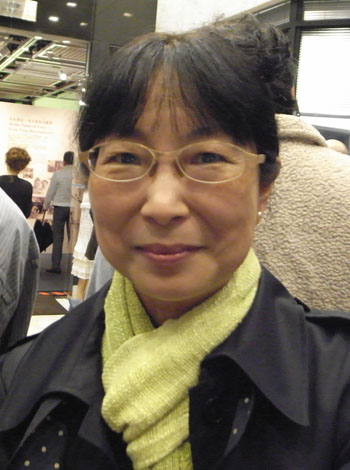
Derek Kwok (director of The Pye-Dog) is again collaborating with legendary actor-singer Teddy Robin Kwan.
In all, another wonderful year of food (and food for thought), talk, and above all movies. You won’t find a festival anywhere more dedicated to the power of film in all its variety. So once more my tagline: See you here next year?
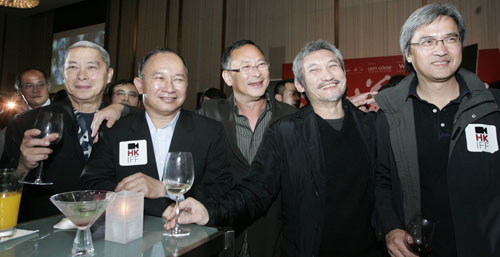
At the Film Workshop party: Lau Siuming, John Woo, Johnnie To, Tsui Hark, and Benny Chan. Thanks to Alvin Tse for the photo.
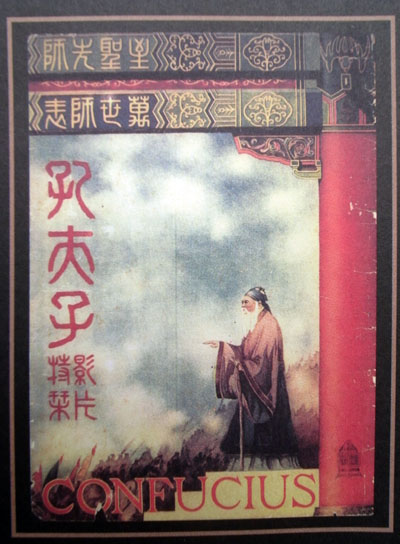
Confucius reborn
DB, in Hong Kong:
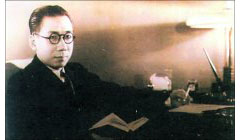 Fei Mu is a little-known name in the West, but on the evidence of even a few films, it’s clear that this mainland Chinese filmmaker was one of the finest working anywhere during the 1930s and 1940s. His best-known film, Spring in a Small Town (1948), was considered in the Maoist era an overliterary piece of sympathy for the bourgeoisie. Now things have changed. Many specialists today consider Spring in a Small Town the best Chinese film of all time. It’s an extraordinary work, anticipating Antonioni in its slow unfolding of an erotic situation, treated with a mixture of sympathy and austerity. It’s a great pity that the film isn’t available on good and subtitled DVD copies, though a digitally restored print was made in 2005.
Two other Fei Mu films I’ve seen show the variety and flexibility of his craft. Onstage, Backstage (1936) is a drama of theatre life, and its fluid figure movement in depth recalls Renoir. Very different is the expressionistic allegory Nightmares in Spring Chamber (1937), an episode in the portmanteau film called Lianhua Symphony. Fei presents the Japanese invasion of China as the pursuit of an innocent girl through dark sets by a leering, frock-coated Japanese. Other surviving Fei works, such as Blood on Wolf Mountain (1936), are also held in high regard. After Mao’s revolution, Fei Mu moved to Hong Kong, where he died at the age of 45. He directed no films in the Crown Colony.
All this makes the discovery of a print of Confucius (1940) an event of capital importance. An anonymous individual donated a print to the Hong Kong Film Archive, which spent years restoring it in collaboration with L’Immagine Ritrovata of Bologna. In the donated print of Confucius, some portions of the soundtrack had liquefied, so some stretches are silent, and there are about nine minutes of fragments that have yet to be integrated.
At the premiere, a very useful booklet on the film’s restoration was given out, and moving introductory speeches were presented by Barbara Fei Ming-yee, the director’s daughter, and Serena Jin, daughter of the producer Jin Xinmin. The screening added electronic subtitles that not only translated the dialogue but identified each speaker—a helpful gesture for a film with many characters and a tangled intrigue.
I can’t comment on it as a representation of Confucius’ thought and life, although experts tell us that it is quite different from the elevated, almost sanctified portrayals that were known before. The plot dramatizes the ineffectuality of the sage’s ideals of civic virtue by showing how power players of his era ignored or undercut his teachings. Scenes from Confucius’ life alternate with scenes of political and military strategy, as warlords and statesmen debate tactics and, not incidentally, calculate how to eliminate Confucius. As Confucius migrates across China, he is unable to halt the continuous warfare among various factions. His disciples leave or die. Just before his death he has only his grandson to care for him. “A great educator, thinker, and philosopher,” Fei Mu writes in an essay, “Confucius was doomed a victim of the politics of his time.”
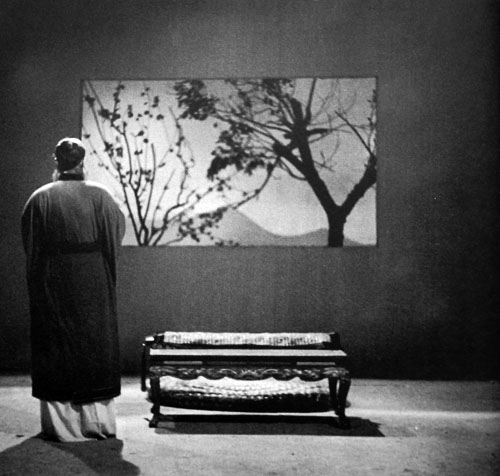
The film is slow-moving and hieratic. Some of the fragments show bits of violence, but the film as a whole relies on dialogue. Although some scenes unfold in natural exteriors, Fei Mu often employs theatrical tableaus, complete with painted landscapes; occasionally the actors cast shadows on the backdrops. The cutting is often axial, simply enlarging a chunk of space as actors declaim their dialogue. The nearly square Movietone frame enhances the symmetry of the compositions, which often feature a window or some other aperture.
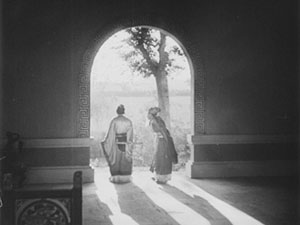
Knowing the fluid style of Fei’s 1930s films, we can only regard this rigid, rather ceremonial look as a deliberate artistic choice. In this respect, the film recalls Eisenstein’s Alexander Nevsky and Mizoguchi’s Genroku Chushingura, films of that era aiming to treat a weighty historical subject with solemnity. In Confucius, Fei seems to have been rethinking the relation of cinema to theatre, a quest that preoccupied other directors of the period and that remains important today. Wong Ain-ling’s essay in the booklet aptly notes Rohmer’s Perceval le Gallois as a more recent parallel, and the film likewise has some of the feel of the Straub/ Huillet version of Von heute auf morgen (1997). As often happens, Fei Mu feels like a modern filmmaker.
Confucius was shown across China in 1940 and 1941, and a reedited version was released in 1948. Fei Mu was so upset by the new cut that he took out a newspaper ad denouncing it. Wong Ain-ling, who prepared the documentation for the festival presentation, and Sam Ho, the Archive Programmer, have concluded that this print is likely to have been the re-release version. Sam told me that the archive staff would be spending the next year researching how to integrate the fragments and supply a sense of the original’s design. The Archive is planning to screen that restoration at next year’s festival. Whatever the experts come up with, surely this is a discovery that will be discussed and enjoyed for many years.
Spring songs
DB here, still in HK:
One director is about as conservative, artistically speaking, as you can get. The other is the long-established wild man of Hong Kong cinema. Both are showcased in retrospectives at this year’s Hong Kong International Film Festival. In a later post, I’ll talk about the outlier; today it’s the Organization Man.
The Hong Kong Film Archive is running a series of works of Evan Yang (Yang Yi Wen). He wrote novels, scripts, song lyrics, and passionate letters to his wife and mistresses, but he’s mostly remembered as a director. Laboring for M. P. & G. I., the Hong Kong studio owned by the Cathay company, Yang established his reputation as a reliable craftsman.
 Yang is best remembered for a string of 1950s Mandarin-language movies set in modern Hong Kong; many sequences offer a virtual travelogue of the energetic, sun-drenched colony. Probably Yang’s most famous film is Mambo Girl (1957), starring the effervescent Grace Chang Ge Lan, but local audiences have a fierce sentimental attachment to his two-part historical romance Sun, Moon, and Star (1961). I’ve seen some of these in other thematic retrospectives, but this series is quite thorough. It includes films Yang wrote as well as ones he directed, and it will run through mid-May.
It’s hard to disagree with the severity of the program notes. “His films often suffer from loose structure and sloppy direction. . . Always professional but never a perfectionist. . . . Evan Yang is not a master, nor is he a great film artist. . . .” The impression, not wrongheaded, is of a Hong Kong Charles Walters. But Yang worked hard. In the Archive’s exhibition of his personal papers, you can see his tidy, artisanal dedication. The script pages on display include elaborate notations of shots (ls, cu, diss to…) and markings for repeated setups. It’s evident that Yang took pains to create his smooth, barely noticeable style.
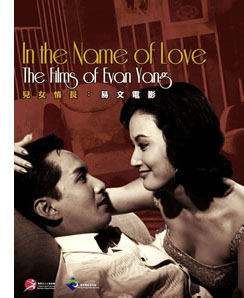 His effort shows on screen. His staging is clean and functional, though he is probably too fond of lining people up in rows. There’s seldom a self-consciously flashy shot or unstable composition. The emphasis is always on straightforward rendering of the melodramatic situations that drive his plots. A doctor falls in love with a patient who’s married (A Little Girl Named Cabbage, 1955). A clerk’s daughter is beautiful but mute, and the family needs money for her operation (The Beauty and the Dumb, 1954). A cat burglar trying to go straight runs afoul of his mercenary wife, who abandons their daughter and then returns to blackmail the family raising her (Blood Will Tell, 1954). Despite the all the adversity, however, things usually turn out well. In Madame Butterfly (1955), Yang updates the opera, making Pinkerton a Hong Kong businessman, and the string of pathetic coincidences swerves into a happy ending.
The musicals and comedies, although more light-hearted, still bear streaks of melodrama. What I had remembered about Mambo Girl is its fascination with that dance craze, but the plot actually has a serious basis: Grace learns that she’s adopted and sets out to find her birth mother, who turns out to be a nightclub singer. The breezier college romance Spring Song (1959) takes itself not at all seriously, but there is a persistent class antagonism between Grace and her rich rival.
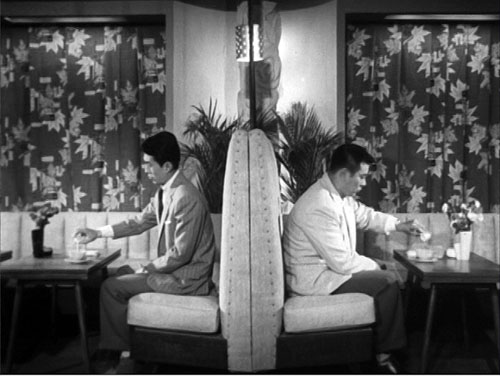
Stylistically, Spring Song shows us Yang in a playful mood. There’s a visual gag during a scene in a coffee shop when our two male leads, Peter Chen Ho and Roy Chiao, wait for their girlfriends. Yang makes them mirror images, even timing the waiters’ arrival to create a funny framing.
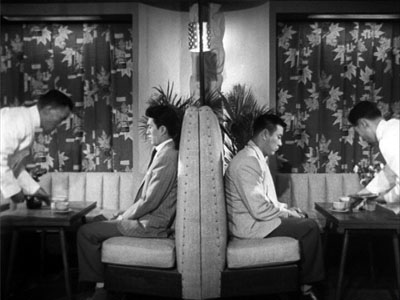
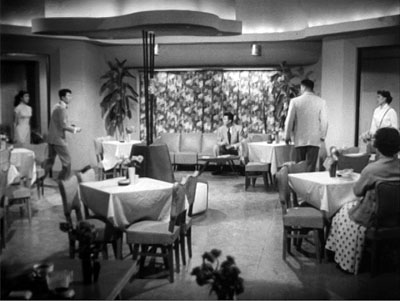
Of course when the women arrive and see each other, comic misunderstandings ensue, also played out symmetrically.
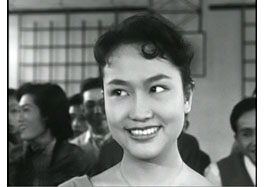
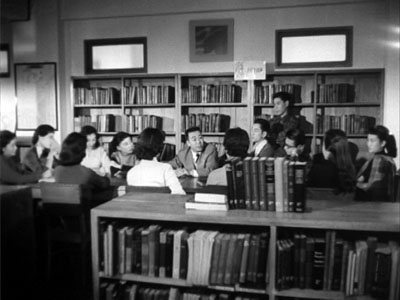
Somewhat more subtly, Yang stages the opposition between Grace and Jeanette Lin Tsui during a meeting of classmates by putting the antagonists at extreme ends of a crowded frame.
The archive has produced a handsome book of Yang’s memoirs, in Chinese only, as well as an informative bilingual pamphlet on the retrospective. I hope to sample other items in the series before I leave next week; you know I won’t miss Yang’s take on spaghetti Westerns, Magnificent Gunfighter (1970).
Even if he weren’t such a solid craftsman, I’d respect his films’ sheer documentary value. When Hong Kong movies of the 1950s venture outside their rather creaky interior sets, they often yield up radiant images of a city on the rise. The scene in The Beauty and the Dumb showing Peter Chen Ho crossing the harbor, sitting happily in his sportscar on the Star Ferry, is enough to brighten your evening.
Spring Song, Mambo Girl, Sun, Moon, and Star, and other Yang films are available on DVD and VCD in English-subtitled, not-so-great transfers from Cathay.
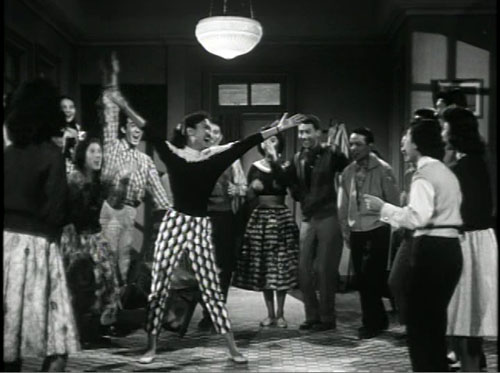
Mambo Girl.
Stalking a roast duck
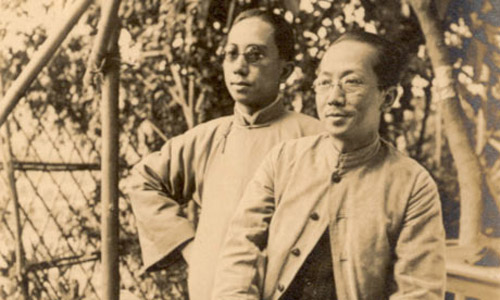
Lai Man-wai and Lai Buk-hoi. Photo from Hong Kong Film Archive Collection.
DB, still in HK:
The Hong Kong Film Awards will be celebrating 2009 as the centenary of Chinese film. Why this year? It’s long been said that the first local film was Stealing a Roast Duck, shot by a Chinese director and produced by an American film entrepreneur in 1909. Following received opinion, my book Planet Hong Kong claimed it as the first as well.
Which only illustrates the maxim that history will not repeat itself, but historians will repeat each other. The Hong Kong International Film Festival mounted a panel around several questions. Is it justified to claim 1909 as the start of Hong Kong cinema? Is Stealing a Roast Duck truly the first film? More ominously, did Duck exist at all? What follows are my interpretations of what the panel, moderated by Li Cheuk-to, came up with.
Law Kar, senior historian of Hong Kong cinema, and Frank Bren, an Australian actor/writer, have diligently pursued the Roast Duck question as part of a larger inquiry into the career of Benjamin Brodsky (erroneously called Brasky or Polasky) who later Americanized his surname to Borden. You can read earlier results of their research in their 2004 book Hong Kong Cinema: A Cross-Cultural View. There they review Brodsky’s filmmaking in China and Japan, but they’re cautious about the claims about his 1909 films. Stealing a Roast Duck “has been recorded as the first commercially made ‘Hong Kong film’ by a Chinese director. . . . Unfortunately, due to the non-discovery of any reports about filmmaking in China in any contemporary newspapers from Hong Kong or Shanghai, [Brodsky’s] story remains partly ‘mythic’ . . . .’ (pp. 37, 43).
At Sunday’s panel, Law and Bren reviewed their most recent research. Law noted that Roast Duck enters film historians’ writings quite a bit after the fact. The crucial mention comes in an article in Cinema Almanac of China 1927, published in Shanghai. Even that article did not specify that Roast Duck was filmed in 1909, only that it was one of four films made by Brodsky’s company, which was founded that year. Law went on to trace how later print sources, mostly books and survey articles, elaborated on these points. By 1936, Roast Duck was said to be one of two 1909 films produced by Brodsky in Hong Kong. Later historians recast the claims again, promoting Roast Duck to the status of Hong Kong’s first story film.
The problem is that there appear to be no contemporaneous sources that can resolve the matter. Law, Bren, and other scholars have found no advertisements, announcements, catalogue listings, or other print documents in 1909 mentioning Roast Duck. Moreover, a 1916 interview with Brodsky, conducted by no less a figure than George S. Kaufman, makes no mention of the film. Brodsky mentions The Empress of Dowers (probably The Empress Dowager) and The Unfortunate Boy , two films he made in China, but gives no specific year of production. Since the piece was written to promote Brodsky’s most recent efforts, it would have been in his interest to play up any pioneering role in Chinese cinema he might have had.
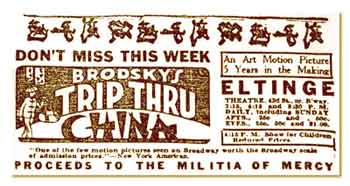
Frank Bren’s presentation was a fascinating detective story. Bren has chased Brodsky through the Internet, Social Security records, city directories, and many other data sources. The efforts yielded the outlines of the remarkable story of a Russian-born American who went to Asia in hopes of setting up film businesses there. Brodsky evidently did produce a Hong Kong film, Chuang Tzu Tests His Wife (1913 or 1914), which involved local filmmakers Lai Buk-hoi, Lai Man-wai, and Lo Wing-Cheung. Chuang Tzu is sometimes considered the earliest true Hong Kong fiction film.
Brodsky was also a documentarist, making two feature-length travelogues, A Trip through China (1916) and Beautiful Japan (1917). He died in 1960 in California. Bren continues to research this colorful figure, being especially fascinated by Brodsky’s unpublished autobiography.
The upshot of this research? There is no positive or direct evidence that Stealing a Roast Duck was made in 1909 or was the first Hong Kong film.
Perhaps it was not made at all? Wong Ain-ling, Research Officer at the Hong Kong Film Archive, is not willing to go so far. She is quite convinced of the existence of the film for several reasons. Apart from the references Cinema Almanac of China 1927, she notes an article published in HK in a 1924 New Bijou Theatre Newsletter, often overlooked for some reason or other. The latter reports: “A Russian [Brodsky?] arrived in Hong Kong in 1912 and cast Mr. Leung Siu-po in Stealing a Roast Duck, one of several slapstick films. Shortly after, Lai Man-wai was cast in Chuang Tzu Tests His Wife and The Ghost of the Pot Returns.”
Wong Ain-ling also cited the testimony of veteran filmmaker Moon Kwan, in both his 1976 book Unofficial History of the Chinese Cinema and his oral records with film historian Yu Mo-wan (as recorded in Yu’s Historical Account of HK Cinema, vol 1). Moon Kwan indicated that he watched the Roast Duck alongside Chuang Tzu Tests His Wife in Hollywood in 1917 (or perhaps 1915). In some detail, he recalled the story of the film and the cast, with Leung Siu-po in the role of the thief, Wong Chong-man as the hawker of roast ducks, and Lai Buk-hoi as the policeman.
As for the year of production, Wong finds 1909 quite shaky; 1912 as cited in the New Bijou Theatre article seems a bit closer. That date is also more consistent with the biography of Brodsky. She concluded her remarks by asking whether it is so important to have a celebration or centenary.
I was asked to sit on the panel as well. All I suggested was that there are problems with determining “first films” in any national cinema tradition. There are empirical difficulties—matters of fact, we might say. Most silent films are lost, and paper records are incomplete or destroyed, so it’s quite likely that any country’s earliest productions could be undocumented. Hence we often have to rely on memories, oral history, word of mouth, and collective opinion. Such seems to have been the case with Stealing a Roast Duck.
There are conceptual difficulties about firsts too. What will count as a film? There were many documentaries and newsreel films made in Hong Kong before 1909, some by Hong Kongers. Why are these not candidates for first films? Because, I suggested, we tend to think of “real films” as telling fictional stories by staging the events. Stealing a Roast Duck would fulfill that condition.
The first volume of the Hong Kong Film Archive filmography has taken care to specify what conditions make something a first film in some respect. Chuang Tzu is called Hong Kong’s first “two-reel” film and its first “fiction” film. The Calamity of Money (1924) is described as the first Hong Kong film to be publicly shown in the colony. Rouge (1925) is labeled “Hong Kong’s first feature-length fiction film.” All of these films are, of course, currently lost.
I added that we select firsts on the basis of our assumptions and purposes. We assume that fiction films are more central instances of cinema than newsreels, or that films directed by Hong Kong people are more central instances than those directed by visitors or residents. And sometimes we want to celebrate cinema, so we create a pivotal anniversary: an example is the one hundredth anniversary of cinema (held in 1995, when we could also have done it in 1994). The effort to create a centenary, which in turn generates public interest in Hong Kong film, has settled on a story that suits that purpose.
It’s fun to imagine what a 1909 Stealing a Roast Duck might have been like. A one-reeler, maybe, built around a string of gags. Perhaps the thief makes many efforts to hitch the duck off the rack, before finally succeeding and being chased through the streets of Hong Kong by the cop. The duck becomes a football tossed from one party to another. . . .
More seriously, you have to be impressed with the care with which my fellow panelists exhumed and dissected their evidence. As usual, the closer you look, the more complicated any issue becomes. One of the pleasures of studying film history is that it can surprise us.
An excerpt from Brodsky’s Beautiful Japan is included on volume 1 of the DVD collection Treasures from American Film Archives. A Guardian interview with Law Kar about Stealing a Roast Duck is here. Thanks to Frank Bren for help with access to illustrations.
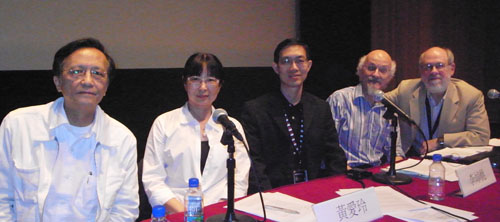
Law Kar, Wong Ain-ling, Li Cheuk-to, Frank Bren, DB.