







Archive for 2015
So these two English magicians walk into a library …
Kristin here:
Two magicians shall appear in England.
The first shall fear me; the second shall long to behold me;
The first shall be governed by thieves and murderers; the second shall conspire at his own destruction;
The first shall bury his heart in a dark wood beneath the snow, yet still feel its ache;
The second shall see his dearest possession in his enemy’s hand;
The first shall pass his life alone; he shall be his own gaoler;
The second shall tread lonely roads, the storm above his head, seeking a dark tower upon a high hill . . . (John Uskglass, The Raven King, via Vinculus)
A word of explanation about why I am writing about a television series is in order. I write almost entirely about films (and occasionally literature), but in 2001 I succumbed to the temptation of an invitation from Oxford University. I was to become a visiting professor and deliver a lecture series on “broadcast media.” The closest I could come to talking about broadcast media was a series comparing film and television narrative structure. The lectures were subsequently published as Storytelling in Film and Television (Harvard University Press, 2003).
This book has given me a lingering reputation for knowing something about television, even though I had not researched or published on television since. Within the past year I have declined two invitations of speak at television conferences, one of them a keynote address. But until now my small dip in the television-studies pool has remained an aberration.
I happen to be a devoted fan of Susanna Clarke’s 2004 bestselling tale of two magicians in Regency England, Jonathan Strange & Mr. Norrell. I also, despite some reservations, much enjoyed the recent BBC/BBC America seven-episode adaptation of it. The DVD/Blu-ray is being released in the USA today, and I herewith offer some comments on the series.
My main objections to the adaptation relate to changes in the relationship between the two main characters. I think the reasons for this particular problem can shed a little light on how mainstream film and television narratives are conceived and sold to the public. I’ll deal with that subject first before pointing to some of the things I admire about the series.
Many SPOILERS for both book and series from this point on.
Hanging it on the Amadeus hook
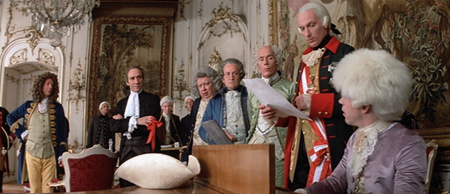
The opening of Robert Altman’s The Player is famous for its pitch phrases heard through studio office windows, with variants of the familiar, it’s X Title meets Y Title (“It’s Out of Africa meets Pretty Woman.” “Not unlike Ghost meets Manchurian Candidate.”) The scene is funny, but it’s not far from the sort of thing that happens in reality.
According to series director Toby Haynes, speaking of the BBC, “I pitched it in my first meeting as Amadeus meets Lord of the Rings. They really responded to that.”
Clearly The Lord of the Rings has nothing in common with JS&MN apart from being a long fantasy tale, and I assume it was included to evoke the idea of a big, really successful example of that genre.
As for Amadeus, at first glance one might consider the book’s Norrell-Strange dynamic as being similar to that of Salieri and Mozart, but upon closer inspection there is virtually no resemblance. Salieri’s prime motivation is intense, heartrending jealousy of Mozart’s seemingly effortless genius. Norrell comes into conflict with Strange, but he’s not jealous of the other magician. The barrier between them is a profound theoretical disagreement over the type of magic they should be doing, and it tears the pair apart after their initial delight in discovering each other. There’s no easy comparison for that sort of conflict, no X meets Y. But anyone can grasp the idea of jealousy.
Once the Amadeus idea was in place, it seems to have guided the filmmakers, at least Haynes and presumably screenwriter Peter Harness, to turn Norrell into Salieri and Strange into Mozart. The effort was not entirely successful, partly because thoroughly changing them would gut the premises of the novel’s plot. Staying at all faithful to the book, as many of the scenes do to a remarkable extent, meant that the motivations for the two main characters’ actions, particularly Norrell’s, became inconsistent.
The Amadeus idea proved useful in publicizing the series. Haynes, Harness, and actors Eddie Marsan (Mr. Norrell) and Bertie Carvel (Jonathan Strange) were probably instructed to try and mention it during interviews. Haynes referred to the “Amadeus meets Lord of the Rings” idea frequently (e.g., here). It’s a catchy phrase, and reviewers and entertainment reporters dutifully spiced up their writings with it. In the Wall Street Journal, John Anderson commented, “The two are, in fact, like Salieri and Mozart in ‘Amadeus,’ had Salieri been a little more talented and a little less poisonous.” Rolling Stone‘s David Fear refers to Haynes’s formula, and fan blogs picked up on it. Google “Amadeus” and “Norrell” to find many more examples.
Although Marsan frequently invoked the Amadeus idea, when interviewed on the BBC’s The One Show, he mentioned another comparison suggested to him by Clarke when she visited the set: “She said they represent the two sides of the brain. The right side of the brain, Norrell, is the analytical side, he’s like the librarian, but Jonathan Strange is the spontaneous, confident, creative side, and it’s the juxtaposition between the two.”
This seems to me a better image for the title characters’ relationship than the Amadeus one: two halves of the same entity, ideally working together in balance. It’s a pity it wasn’t used, but Clarke didn’t mention it until the series was into principal photography.
Norrell is not Salieri

In Clarke’s book, Norrell is far and away the better magician, at least until fairly late in the plot. He certainly has no reason to be professionally jealous of Strange when he appears on the scene, and he doesn’t seem much to care that Strange is more flamboyant and socially adept.
The series often suggests, however, that Norrell is the inferior magician. The second episode’s opening depicts his ship illusions at the port of Brest during the first Napoleonic war. Seemingly the French are fooled for only the time it takes some officers to row out and investigate them. Norrell’s illusion seems ineffectual, and one might wonder why in the next scene Parliament is so enthusiastically applauding him and promising all sorts of cooperation in exchange for his help. This, I would suggest, is one of several plot holes resulting from the makers’ devotion to the Amadeus model.
In the book, the ship illusion is highly effective. Not only Brest but “Rochefort, Toulon, Marseilles, Genoa, Venice, Flushing, Lorient, Antwerp and a hundred other towns of lesser importance” are blockaded by Norrell’s ships.
Everyone, it seemed, was delighted with what Mr Norrell had done. A large part of the French Navy had been tricked into remaining in its ports for eleven days and during that time the British had been at liberty to sail about the the Bay of Biscay, the English Channel and the German Sea, just as it pleased and a great many things had been accomplished. (p. 108)
This triumph leads to a successful ten-year career. Although Strange is the one who aids Wellington at the front lines using magic, Norrell contributes in other ways. After the victory at Waterloo, “Mr. Norrell had the satisfaction of hearing from everyone that magic–his magic and Mr Strange’s–had been of vital importance in achieving this.” (p. 337) He then goes into the respectable business of dealing with commissions such as flood control for the Admiralty.
The TV series also presents Norrell’s system for protecting England’s southern coast as a failure, never completed and ineffectual where it did exist. Directly after he installs the system, its faults are apparently revealed when a ship goes aground on a shoal near the same beach, a situation solved by Strange with his flashy creation of giant sand horses. In the book, Strange collaborates on the coastal protection project alongside Norrell. It is installed nearly a decade after the “Horse Sands” episode and works very well. Indeed, the Admiralty finds Norrell so useful that he cannot deal with all the projects they propose to him, especially since he refuses to take on students after Strange leaves him.
Thus unlike Salieri, Norrell’s problem is not inferior talent but an inability to excite others about his magic. He is, as Clarke makes clear over and over, boring. An odd trait in a book’s protagonist, or co-protagonist in this case, but one that she manages to make entertaining. The novel describes Norrell’s first visit to Sir Walter Pole and his attempt to explain his feat of having brought the statues of York Minster to life: “Curiously, though Mr Norrell was able to work feats of the most breath-taking wonder, he was only able to describe them in his usual dry manner, so that Sir Walter was left with the impression that the spectacle of half a thousand stone figures in York Cathedral all speaking together had been rather a dull affair and that he had been fortunate in being elsewhere at the time.” (p. 68)
Even at the end of the ten years, Norrell remains clueless about public relations. Late in the book he and Lascelles go to Brighton to check the new coastal protection system:
“It is invisible,” said Lascelles.
“Invisible, yes!” agreed Mr Norrell, eagerly, “But no less efficacious for that! It will protect the cliffs from erosion, people’s houses from storm, livestock from being swept away and it will capsize any enemies of Britain who attempt to land.”
“But could you not have placed beacons at regular intervals to remind people that the magic wall is there? Burning flames hovering mysteriously over the face of the waters? Pillars shaped out of sea-water? Something of that sort?”
“Oh!” said Mr Norrell. “To be sure! I could create the magical illusions you mention. They are not at all difficult to do, but you must understand that they would be purely ornamental. They would not strengthen the magic in any way whatsoever. They would have no practical effect.”
“Their effect,” said Lascelles, severely, “would be to stand as a constant reminder to every onlooker of the works of the great Mr Norrell. They would let the British people know that you are still the Defender of the Nation, eternally vigilant, watching over them while they go about their business. It would be worth ten, twenty articles in the Reviews.”
“Indeed?” said Mr Norrell. He promised that in future he would always bear in mind the necessity of doing magic to excite the public imagination. (p. 688)
The fact that many of Norrell’s commissions are designed to prevent things from happening also means that the public forgets about them. This scene demonstrates well how Clarke manages to generate amusement out of a character who is so intrinsically dull.
The Norrell we see in the first two episodes of the series is fairly similar to the one in the book–naive, petty, anti-social, and arrogant. His first act in both versions is to twit aspiring magician John Segundus about having read his article on magician Martin Pale’s fairy servants and noticed that he had left one out. He then lets it sink in that he himself owns the only copy of the only book that mentions that servant and thus Segundus could not possibly have read about him.
Despite his faults, however, Norrell is frequently amusing, something the series captures well, especially in the opening episodes. He also arouses our pity when he visits Sir Walter Pole to volunteer his help in the war with Napoleon and is summarily dismissed.
Unfortunately, starting with the third episode the makers abruptly change Norrell’s character, making him more devious and villainous. One reviewer commented on this change:
It’s ridiculously difficult to make you feel a sense of loathing for an actor like Eddie Marsan, but Strange and Norrell went a long way in making you feel like that this week. It’s kind of amazing in such a short space of time how the show has managed to make you feel for Norrell’s plight to restore magic to England, to suddenly very much wondering if that was a good idea.
The reviewer hints that the series has accomplished this change well, but the inconsistency of Norrell’s character continues in later episodes. As he also suggests, it is really Marsan’s splendid performance that manages to make all this hang together.
In the book Norrell does some nasty things, though not nearly so many or so bad as what we see him do in the series. In the novel he neither tries to intimidate Lady Pole into silence nor threatens Drawlight with torture to make him go to Venice to find Strange. He does not accompany Strange to see George III, because he is genuinely convinced from the start that magic cannot cure his madness. When he makes Strange’s book disappear, he offers to pay the publisher’s costs for the entire edition. (He also leaves Strange’s own copy untouched.) He does not berate Childermass for being unconscious for four days after taking a bullet for him. Lady Pole does not create a tapestry in an effort to reveal her situation to Arabella, and hence Norrell doesn’t order it stolen. He never threatens to destroy the other magician, as he is shown doing at the end of episode 4.
His primary mistake, in both versions, is that through shame and fear he hides the fact that he had violated his own principles by summoning the gentleman with the thistle-down hair to resurrect Lady Pole. (The fairy is referred to as the gentleman with the thistle-down hair throughout the book and simply as the Gentleman in the series.) Had he found the courage to tell at least Strange the truth, it might have made him less eager to try contacting a fairy to help him with his own magic.
Norrell does none of these things through jealousy.
Strange is not Mozart
Strange is portrayed as the Mozart to Norrell’s Salieri. He does magic spontaneously rather than learning spells out of books. In the scene where he first demonstrates his magic for Norrell, he says, “One has a sensation like music playing at the back of one’s head–one simply knows what the next note will be,” (p. 233) a line changed slightly for the series. The obvious similarity of this statement to Mozart’s effortless ability to write heavenly music probably sparked the initial link in the makers’ minds between JS&MN and Amadeus. It no doubt influenced Harness to portray Strange simply as a natural genius. Yet the book makes it clear that Strange’s moments of inspiration often either turn out wrong or he simply cannot replicate or reverse them.
For example, the “Horse Sands” episode, so crucial for the series’ creation of the idea of Norrell’s inferiority and jealousy, turns out quite differently in the book. Strange’s sand horses do free the ship from the shoal, but “These did not just disappear when their work was done, as Strange had said they would; instead they swam about Spithead for a day and a half, after which they lay down and became sandbanks in new and entirely unexpected places. The masters and pilots of Portsmouth complained to the port-admiral that Strange had permanently altered the channels and shoals in Spithead so that they Navy would now have all the expense and trouble of taking soundings and surveying the anchorage again.” (p. 278)
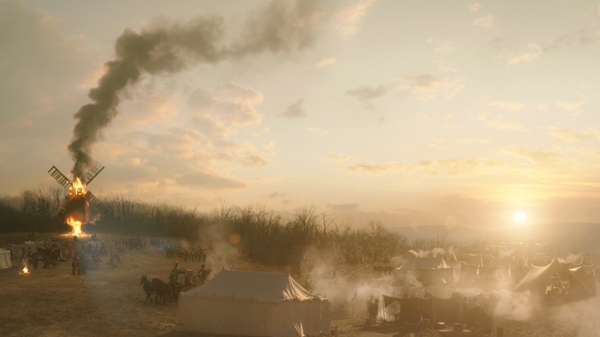
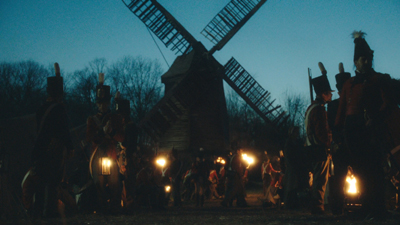
The feat impresses the Ministers in London, however, leading them to dispatch Strange to Portugal to help with the war. There Strange’s first successful piece of magic, building a road, is managed through a spell derived from one of Norrell’s books. It’s the same sort of respectable task with which Norrell continues his own success. Later, though, Strange performs ancient, black magic to bring to life some Neapolitan corpses to supply vital intelligence information to Wellington. Norrell refuses to bring rotted bodies to life, but Strange tackles decaying, maggot-ridden ones. The series’ scenes of this episode (above) well convey the horror Strange feels after he succeeds. One of the most effective shots in the series is the long view of the troops, including Strange, moving out of the camp toward victory with the burning windmill in which Wellington has had the zombies locked appearing prominently in the composition (see top).
This parallel to Norrell’s raising of Lady Pole is usually not remarked upon, but it suggests that both have compromised their principles in somewhat similar ways to gain respect and aid the war effort.
Undoubtedly more important, in the book Strange never becomes obsessed with bringing Arabella back to life after the Gentleman tricks him with the moss-oak double of her. Instead he goes immediately to Venice to grieve and to try and summon a fairy to teach him magic and become his servant. He does this solely because he thinks that fairy magic, long gone from England, is an exciting alternative to Norrell’s stodgy, respectable magic. Clearly the plot additions of Strange desperately seeking to revivify his wife and Norrell’s cold refusal to answer his letters or explain how he resurrected Lady Pole were added to heighten the dramatic conflict between the two.
Friendly Enemies
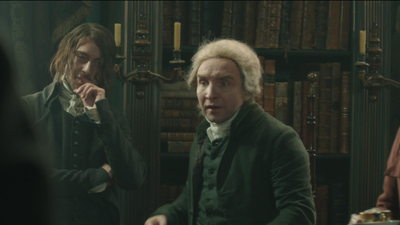
Yet that conflict is for the most part a half-hearted one and fated to end. It is quite different from what happens in Amadeus. Salieri hates Mozart and vows early on to destroy him, while Mozart is largely indifferent to Salieri. In contrast, Norrell and Strange have an immediate affinity that never completely disappears, and they grow more and more like each other in the course of the book. The abrupt change in Norrell’s initial skeptical, fearful attitude toward the second magician comes during their second meeting (their first meeting in the series), when Strange performs magic for him. “Mr. Norrell, who had lived all his life in fear of one day discovering a rival, had finally seen another man’s magic, and far from being crushed by the sight, found himself elated by it.” (p. 233) This elation is wonderfully conveyed by Marsan in one of the series’ best scenes (above).
Contrast this moment with the scene of Mozart’s meeting Salieri, where Mozart humiliates Salieri by playing his little welcoming march and improvising a far better piece from it. This leads directly to Salieri’s vow to God that he will destroy Mozart, ultimately leading to the latter’s death (see first section above).
In the series’ next scene, Norrell’s delight continues as he meets with Strange to plan their studies. He even manages, with some difficulty, to hand over a book that he wishes his pupil to read. Thereafter, unfortunately, we get very little of the two interacting, and the viewer might get the impression that their break occurs a short time later. After seeing only two episodes, Anibundel, a blogger and fan of the book pinpointed the problem:
Though Bertie Carvel and Eddie Marsan are magic together, there was no getting around it–they weren’t together for nearly long enough. The complex nature of their relationship–being pulled towards each other while at the same time repelled by their philosophical differences–is the heart of the novel, and by the show deciding to spend their energies focused elsewhere makes it feel like they’re missing the nut of the story in order to let us indulge in the trimmings. Strange barely became Norrell’s pupil, and barely had time to note how much his teacher held back from him. We barely got any of Norrell’s excitement and joy at discovering someone who he can really talk to and connect with most emotionally and intellectually, before the show already separated them again, putting Strange on his way to Portugal.
Part of the problem is that the adaptation conveys little indication of how much time passes. In the novel, Clarke simply dates every chapter. We know that the precipitating action of John Segundus and Mr. Honeyfoot visiting Mr. Norrell happens in the autumn of 1806 and the final scene in Padua in the spring of 1817. The adapters would have done well to employ superimposed titles for the same purpose. As it is, even non-readers who know the era of the Napoleonic wars and Regency England pretty well would be hard put to estimate that the action covers that long a span.
In the book Strange becomes Norrell’s pupil in September, 1809 and parts ways with him in February, 1815. His first wartime stint lasts for a little over three years, from approximately March, 1811 to May, 1814. The second begins in June of 1815, after the two split. Thus he studies with Norrell for a little under two and a half years.
During that period, Strange temporarily takes the place of the devious Drawlight and Lascelles in assisting his teacher:
In the past year Mr Norrell had grown to reply a great deal upon his pupil. He consulted Strange upon all those matters which in bygone days had been referred to Drawlight and Lascelles. Mr. Norrell talked of nothing but Mr Strange when Strange was away, and talked to no one but Strange when Strange was present. His feelings of attachment seemed all the stronger for being entirely new; he had never felt truly comfortable in any one’s society before. (p. 279)
Nevertheless, the one issue that drives the pair apart is their stark disagreement concerning the desirability of using modern, respectable magic or calling upon the 300-year-old, wild magic of the Raven King and fairies. Their disagreement comes to a head when Strange writes his lacerating review of the book about Norrell and arrives to announce that he will no longer be his pupil. In the book, far from arguing with Strange or berating him over the review as in the series, Norrell is entirely conciliatory and emphasizes their affinity in a conversation which is perhaps the most important summary of their relationship.
“You think that I am angry,” said Mr Norrell, “but I am not. You think I do not know why you have done what you have done, but I do. You think you have put all your heart into that writing and that every one in England now understands you. What do they understand? Nothing. I understood you before you wrote a word.” He paused and his face worked as if he were struggling to say something that lay very deep inside him. “What you wrote, you wrote for me. For me alone.”
Strange opened his mouth to protest at this surprising conclusion. But upon consideration he realized it was probably true. He was silent. (p. 417)
Norrell then makes a revelatory confession that as a young man he, too, had been obsessed with the Raven King and spent ten years trying to contact him. His failure led to a traumatic disillusionment and a rejection of old magic. This, of course, explains a great deal about his character, and it is odd that the screenwriter avoided it so entirely. In the series, Strange simply insists that that they are too different in their views to continue together. Much of the emotional dialogue spoken beside the fireplace comes only from the last section of this important conversation in the book, leaving out the parts quoted above.
“Oh,” cried Mr Norrell, “I know that in character . . .” He made a gesture of dismissal. “But what does that matter? We are magicians. That is the beginning and end of me and the beginning and end of you. It is all that either of us cares about. If you leave this house today and pursue you own course, who will you talk to? –as we are talking now?–there is no one. You will be quite alone.” In a tone almost of pleading, he whispered, “Do not do this!” (p. 421)
He also offers Strange the things he offers in the TV scene, including an equal partnership and the key to the library at Hurtfew, and he says he will not demand that the review be retracted. Strange nevertheless insists on ending their relationship.
Even so, in the novel he somewhat regrets his decision the next day: “As a consequence of what Mr Norrell had said he had developed a great many new ideas about John Uskglass, and now he was suffering all the misery of having no one to tell them to.” (p. 423) This misery, however, is not sufficient to make him return to Norrell.
From this point the two are separated, but in the novel there are indications that they are destined to reunite. Much later, Strange, with a mad expression, sends Drawlight to tell Norrell “I am coming!” As in the series, Norrell rushes from London to Hurtfew Abbey to defend his main library from attack. At this point, the narration describes a slightly eerie discovery recently made by Norrell.
Ever since he and Strange had parted he had been in the habit of summoning up visions to try and discover what Strange was doing. But he had never succeeded. One night, about four weeks ago, he had not been able to sleep. He had got up and performed the magic. The vision had not been very distinct, but he had seen a magician in the darkness, doing magic. He had congratulated himself on penetrating Strange’s counterspells at last; until it occurred to him that he was looking at a vision of himself in his own library. He had tried again. He had varied the spells. He named Strange in different ways. It did not matter. He was forced to conclude that English magic could no longer tell the difference between himself and Strange. (p. 713)
In the book Norrell later surmises that he and Strange are both trapped in the Darkness, a curse designed for Strange alone, because the Gentleman had been so imprecise as to direct the curse at “the English magician.” (p. 749) That same imprecision occurs in the spell devised by the two and intended to summon the Raven King. They address the spell to the “nameless slave,” allowing Stephen, rather than the Raven King to gain the power necessary for him the kill the Gentleman and take his place.
Mr Norrell with the candlestick in the library?
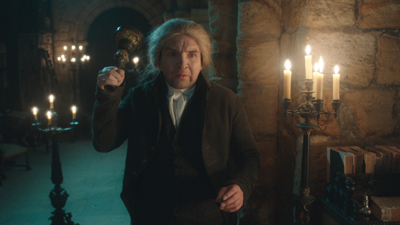
I’m not sure what viewers unfamiliar with the book would expect to happen when in the final episode Norrell solves Strange’s labyrinth and reaches the library. Given how badly Norrell has acted at times and also given Strange’s madness, they could reasonably expect a big fight in which Strange might kill Norrell or at least triumph over him. Indeed, in the book this is what the servants and Lascelles, locked out of the labyrinth, imagine might happen: “Images of magical battles flitted through the minds of everyone present: Mr Norrell hurling mystical cannonballs at strange; Strange calling up devils to come and carry Mr Norrell away. They listened for sounds of a struggle. There were none.” (p. 721)
In the book there is no fight at all. Norrell, terrified of what Strange intends to do to him, finds the other magician reading historical accounts of fairies kidnapping humans. Strange’s first comment to his former teacher is a compliment.
“I like your labyrinth,” he said conversationally. “Did you use Hickman?”
“What? No. De Chepe.”
“De Chepe! Really?” For the first time Strange looked directly at his master. “I had always supposed him to be a very minor scholar without an original thought in his head.”
Relieved that Strange is not going to attack him, Norrell gives him a mini-lecture on De Chepe, and they quickly slip back to their old relationship. Norrell returns Strange’s compliment.
“You own labyrinth was quite remarkable,” said Mr Norrell. “I have been half the night trying to escape it.”
“Oh, I did what I usually do in such circumstances,” said Strange carelessly. “I copied you and added some refinements. (p. 741)
Later in the scene, the roles are reversed. Strange requires a summoning spell, and Norrell fetches a sheet of paper from a drawer and gives it to him, saying it is the best such spell he knows. It is written in Norrell’s hand and labeled “Mr Strange’s spell of summoning.” Norrell pedantically points out three changes he has made, including “I have omitted the florilegium which you copied word for word from Ormskirk. I have as you know, no opinion of florilegia in general and this one seems particularly nonsensical.”
“It is as much your work as mine now,” observed Strange. There was no trace of rivalry or resentment in his voice.
“No, no,” said Norrell. “All the fabric of it is yours. I have merely neatened the edges.”
The two are at last capable of adapting each others’ work as equals. Far from having a physical fight, they don’t even argue. Instead, they work together to devise and implement the spells that create the climactic resolution.
Again, contrast this with the climactic scene of Amadeus, where Salieri takes dictation from Mozart. He not only cannot keep up, but he is also baffled by some of the choices Mozart makes in composing the Requiem. There remains no affinity between the two.
The two magicians’ reunion in the library is where the series’ final episode goes thoroughly off the rails, in my opinion, departing from the book and introducing all sorts of new premises and actions that make little coherent sense. The departure begins at 16:30, to be precise, when Norrell throws something (the candlestick, I think) at Strange and their brief struggle ensues. David, being my test case of a non-reader viewing this part, said he had followed the story reasonably well to then but after that point he suddenly didn’t understand the rules. Quite.
I will not attempt to list all the peculiar premises suddenly introduced into the story. In brief, how does Strange know that the Gentleman has closed the King’s Roads to him? How does Norrell know that the rule doesn’t apply to him as well? Norrell’s speech about the Gentleman’s “alliances with the forces of nature within the Christian world, our world, not his–ergo, his curse will not affect us here” baffles me. Why does the darkness not follow the pair into Faerie? As far as I can tell from the book, it is itself a part of Faerie. And why has the series added the premise that Strange is dying under the continued influence of being in the Darkness? (Screenwriters seem to love such ideas. It reminds me of the absurd premise in The Return of the King that Arwen is dying because her fate is linked to the Ring. Aren’t all of their fates?) The Gentleman’s taste in revenge is not for death but for perpetual misery.
Certainly by this point the Amadeus comparison has been abandoned. But why were the makers so determined to pursue that idea in the first place? Once they had used the analogy in order to get a greenlight for the project, why did they not simply drop it and take the book as their guide? Perhaps in part because once they had posited that the Salieri-Mozart conflict is similar to the Norrell-Strange one in Clarke’s book, they had fixed that in their minds and couldn’t see it any other way. But we return to the fact that the Amadeus premise is simply easier to understand than the very complex dynamic between the two magicians in Clarke’s book. Once the hook of the Amadeus comparison got out into the public through reviews and interviews, the audience could have a simple interpretive key even before watching the premiere. A bitter conflict is more dramatic than a complex competition/cooperation dynamic between two protagonists, a dynamic based on a fundamental theoretical disagreement.
And why not, after all? What difference does it make that the series’ makers battened onto Amadeus and went with it? Might it not make it easier for viewers to cope with a very complicated story?
Perhaps. Still, a considerable price is paid in the loss of originality. Clarke’s book is very good, possibly great, in part because the shifting relations between its title characters are so slippery, with both of them having many faults and vastly different views of magic but nevertheless by the end belonging together as partners. The TV series ultimately settles instead for a well-known formula from a classic, familiar film. For lovers of the book, the core fan-base for the series, disappointment in at least some aspects of the series was likely.
Perhaps more important, however, is the loss of unity. The sudden changes in Norrell’s character that I’ve pointed out are among these. I would think that, after Norrell’s more villainous moments, the viewer might reasonably be puzzled by the cheery, cuddly reunion between the two, with Strange buttoning up Norrell’s cloak (see the “Norrell is not Salieri” section above) and promising to come to breakfast. Similarly, the sudden deep emotion of the scene where Strange breaks with Norrell might seem odd. I expect that Norrell’s misdeeds caused some non-readers to mistake him for the villain, though the Gentleman clearly should centrally occupy that role. The messiness of the final episode comes in part because the two must reconcile and work together so abruptly, despite all of Norrell’s misdeeds. Finally, I think the emotional appeal of the main relationship between the two magicians, which is the core of the novel, is vitiated to some extent.
Two super-magicians and their flying library
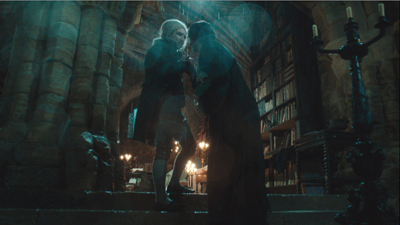
There may also be one more reason why Norrell is made villainous in the central section of the story and then comic at the very end. The makers possibly wanted to avoid using the original, highly unconventional ending of the book, perhaps feeling felt that spectators would not accept it.
The novel sets us up for the idea that the Darkness may not be such a bad thing. Immediately after Norrell discovers that Lady Pole and Mrs Strange are no longer in Faerie, he also realizes that the curse of Darkness has not lifted. Naturally he considers this in a rational fashion.
This then was his destiny!–a destiny full of fear, horror and desolation! He sat patiently for a few moments in expectation of falling prey to some or all of these terrible emotions, but was forced to conclude that he felt none of them. Indeed, what seemed remarkable to him now were the long years he had spent in London, away from his library, at the beck and call of the Ministers and the Admirals. He wondered how he had borne it. (p. 770)
The book’s final scene occurs about two or three months after the climactic events. Strange and Norrell travel to Italy together, in Hurtfew Abbey and conveyed by the Darkness. How they do this is not explained, but clearly they have quickly learned to live with and even to control the conditions of the Gentleman’s curse. Arabella is living in Padua with Flora Greysteel and her father, friends Strange had made during his time in Venice. She meets Strange for the first time since their brief reunion in Lost-hope. Naturally she asks him, “Have you found any thing yet to dispel the Darkness?”
His insouciant response is miles away from what we might expect: “No, not yet. Though, to own the truth, we have been so busy recently–some new conjectures concerning naiads–that we have scarcely had time to apply ourselves to the problem. But there are one or two things in Goubert’s Gatekeeper of Apollo which look promising. We are optimistic.” He goes on to describe the pair traveling around the world in the Darkness: “Who is to say that the Darkness may not be an advantage. We intend to go out of England and are likely to meet with all sorts of tricksy persons. An English magician is an impressive thing. Two English magicians are, I suppose, twice as impressive–but when those two English magician are shrouded in an Impenetrable Darkness–ah, well! That, I should think, is enough to strike terror into the heart of any one short of a demi-god!”
Although Strange does reassure Arabella that he and Norrell will keep trying to end the Darkness curse, he seems more enthusiastic about traveling with Norrell and having unspecified kinds of adventures. Indeed, the two magicians are still tethered together invisibly, with Norrell of necessity waiting nearby during the conversation, no doubt reading a book. Norrell, poor traveler though he is, can do all this quite comfortably because, as Strange explains, “He need never leave the house if he does not wish it. The world–all worlds–will come to us.” (pp. 781-82)
Lest we worry that Strange is caddishly deserting a weeping Arabella, Clarke sets up for the final scene by making it clear that Mrs Strange has grown tired of the stresses of life with a magician. When Flora remarks that it is “very odd that he should have gone back to his old master at last,” Arabella replies, “Is it? There seems nothing very extraordinary in it to me. I never thought the quarrel would last as long as it did. I thought they would have been friends again by the end of the first month.”
Flora objects that Norrell had attacked Strange in the magical journals. Arabella gives a reply that echoes Norrell’s speech to Strange in the parting scene.
“Oh, I dare say!” said Arabella, entirely unimpressed. “But that was just their nonsense! They are both as stubborn as Old Scratch. I have no cause to love Mr Norrell–far from it. But I know this about him: he is a magician first and everything else second–and Jonathan is the same. Books and magic are all either of them really cares about. No one else understands the subject as they do–and so, you see, it is only natural that they should like to be together.”
She has gradually settled into a pleasant social and domestic life in Padua with Flora and her father: “Of her absent husband she thought very little, except to be grateful for his consideration in placing her with the Greysteels.” (pp. 779-80) No wonder she takes Strange’s startling news about his and Norrell’s plans so calmly.
Strange and Norrell’s final design for living is not the conventional romantic ending that we surely expect, with husband and wife reunited, living happily in Shropshire and occasionally visiting Norrell. Intellectual debate and the lure of further adventures, for once, carry the day. Whether audiences would have been seriously upset at such an outcome is unclear. It would have been worth a try, I think. The series’ scene of Strange appearing to Arabella as a reflection in a well and telling her he loves her is schmaltzy and, to me at least, unsatisfactory as closure.
The series ends with Childermass and Vinculus visiting the newly re-instituted Learned Society of York Magicians (a scene which in the book precedes the Strange-Arabella conversation). The Society now consists mainly of Strangites and Norrellites. Childermass suggests to the group that Strange and Norrell are caught in some unknown place “Behind the sky. On the other side of the rain.” (p. 778) He hints that the new writings on Vinculus, if they can be deciphered, might affect the two magicians’ fates–perhaps implying that they could be rescued from the mysterious limbo in the sky into which the Darkness sucks them. Given how few rules we have been given about the Darkness, this is more vague than pleasantly ambiguous.
All the books in the world
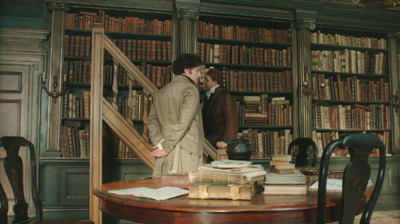
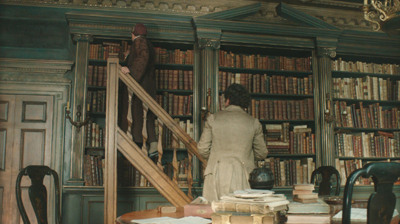
I mentioned at the beginning that I have very much enjoyed the series, having now watched it straight through twice and gone through again making notes and taking frames for this entry. Putting aside my complaints, I would like to mention some things that I particularly like about it.
In order to inveigle David into watching the series with me, I told him that it was basically about books. Seeing it again, I realized that I did not really exaggerate. Both the causal action and the characterizations depend heavily on books, and there is also just the sheer sensuous pleasure of the beautiful rare books and the libraries they reside in. Both Clarke’s book and the series are beloved of bibliophiles. The novel is famous for its many footnotes, many of which refer to obscure (and fictitious) books of magic, most importantly Jacques Belasis’ Instructions (date unknown), a frequent reference for both Norrell and Strange, and Thomas Lanchester’s Treatise concerning the Language of Birds (16th Century). One scene in the series, the book auction, is loosely derived from a footnote (#5, pp. 283-84)
Most of the important male characters in both book and series are characterized by their relations to books. Norrell’s manipulative power and selfishness comes through books, though he clearly loves them in and of themselves. They have essentially replaced human interaction for him. A poignant little moment comes after Norrell agrees to send forty books with Strange on his wartime journey. He does not make an angry speech to Childermass about regretting having come to London, as happens in the series; that speech is actually derived from a description of Norrell’s sad thoughts over dinner.
He wished he had never come to London. He wished he had never undertaken to revive English magic. He wished he had stayed at Hurtfew Abbey, reading and doing magic for his own pleasure. None of it, he thought was worth the loss of forty books.
After Lord Liverpool and Strange had gone he went to the library to look at the forty books and hold them and treasure them while he could. (p. 287)
In the novel, the forty books get quite battered, but they are not destroyed, there being no such scene as the battle in the forest. Indeed, Jeremy Johns, Strange’s servant and book porter, also survives the war. I couldn’t find a mention of Strange returning Norrell’s books, but presumably he does.
The other characters are also defined to a considerable extent by their relationship to books and other publications. Although Strange is often taken to be a “natural” magician needing no training, he greatly desires to have access to Mr. Norrell’s library, knowing full well that he often cannot replicate or reverse his own spells. Lascelles in effect controls Norrell’s PR by managing the authorized publications. Childermass is a frustrated aspiring magician held back by his working-class status in Norrell’s household, and he surreptitiously reads the books in the library. Segundus and Honeyfoot’s sincere desire to learn magic, or at least read about it, marks them as the humble helper figures. Although Stephen is not directly associated with books, he has had an excellent education that has gained him no respect because he is black. The Gentleman, on the other hand, has nothing but scorn for learning magic through books. When Norrell tells him that he has taught himself magic, his response is a contemptuous “Books!” Being a fairy, he assumes that magical abilities can only be taught by a master. He twice presses his services as a teacher upon Norrell, who has such a hatred for fairy magic that he indignantly declines and thus gains the enmity of the Gentleman.
The street magician Vinculus is the embodiment of fairy-derived magic, carrying the book of the Raven King written in tattoo-fashion upon his body. Although he cannot read himself as a book, he has in his memory the prophesies of the Raven King, and he delivers them to predict and presumably guide the fates of Norrell, Strange, and Stephen.
Books are central to the causal anatomy of the plot. They permit such things as the relatively inexperienced Strange’s successes in his wartime service, including the magical construction of the road, which convinces the skeptical Duke of Wellington that magic might have military advantages after all. Norrell’s suppression of Strange’s book leads to suspense over whether Strange will take a violent revenge on him. The two successive texts written on Vinculus have a function that is difficult to pin down, but perhaps we are to assume that it consists of the magic that governs all the rest of the action. As Vinculus tells Childermass, in both novel and series, Norrell and Strange “are the spell John Uskglass is doing. That is all they have ever been. And he is doing it now!” (p. 758).
The series keeps books in the forefront as a general motif. Most obviously, Norrell’s bibliophilia is used to counter the more villainous aspects of his character added by the adapters. He remains a charming character in part through little bits of book-related business and dialogue. Norrell’s attempt to escape the crowd at Lady Godesdone’s party leads him to discover some books in a side room; he appreciatively, even lovingly, sniffs the book before he starts reading, a detail not in Clarke’s novel.
There is a similar moment more difficult to notice. In the first teaching session, Norrell emphasizes respectable magic and moves to fetch a book. He gives a large rolling staircase a push and steps onto it while it is moving; it stops exactly by the book on the top shelf that he is after (above).
There are other such moments. When Norrell hears Lucas, his footman, handling some books, he detects carelessness and calls out, “Mind the spines, Lucas! The spines!” His desire to acquire a specific volume at auction is emphasized by his petulant remark, “I’ve been looking for that book for years.” How many of us could not sympathize with that? Finally, there is Norrell’s exclamation during his ecstatic reaction to Strange’s spell: “It is not in Sutton-Grove!” Francis Sutton-Grove’s De Generibus Artium Magicarum Anglorum, 1741, classifies 38,945 areas of magic. It is “reputed to be the dreariest book in the canon of England Magic.” Mr Norrell is “Sutton-Grove’s greatest (and indeed only) admirer.” (Footnote 6, p. 59).
All this is why I think the adapters made a serious mistake in having Strange demand that Norrell sacrifice his entire library to provide the handsel for their final spell. Nothing of the sort happens in the novels. At one stage in the proceedings, all of the books briefly turn into ravens and swirl around the room, but they all turn back. There is no logic to having Norrell’s books offered to the Raven King. Why offer “all of English magic” to him? He embodies English magic, and he surely has no use for books. I suspect that this peculiar idea was added to allow the cheap humor of Norrell’s trying to bargain Strange into to taking only half of his library, or at most two-thirds. I can’t see a necessary function for it. The idea of the library being lost like this surely sent chills through fans and bibliophiles everywhere.
Like a film
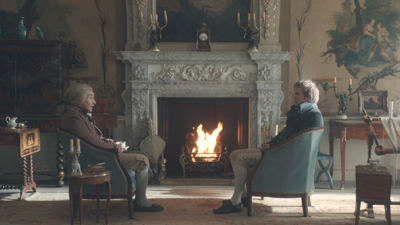
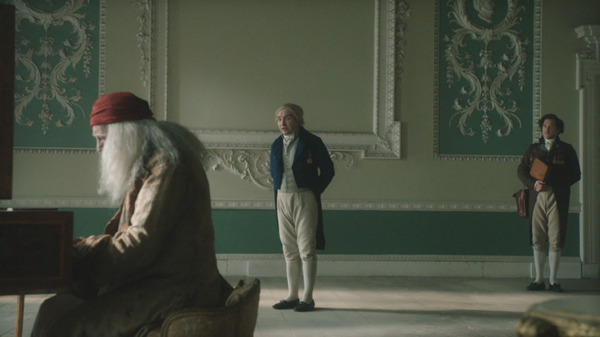
I often read about a television series that has been made in the style of a film. Again, I don’t see much television, but I had to this point not seen one that does look like a film. But JS&MN does, much of the time. Given its comparatively limited budget compared to a typical historical epic of this type, it’s very impressive in its design (see bottom, for example) and cinematography (as in the top image, with its suggestion of a Turner landscape). The digital matte shots in the special effects are usually obvious as such, but they give the images an old-fashioned look that somehow seems appropriate.
At times Toby Haynes’s direction reminded me a bit of Spielberg’s, in that he has a similar habit of varying his setups within scenes. Clearly each separate framing is chosen for a specific action, as with Spielberg. These six framings open the scene in which Strange visits Norrell for the first time, and the sequence as a whole continues in this way throughout, with few repeated setups. The choice of framings manages to focus on the conversation between Stange and Lascelles while keeping us aware that Norrell is nearby, torn between suspecting that Strange is a fake and fearing that he is a rival.
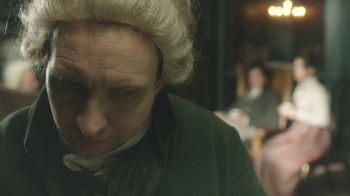
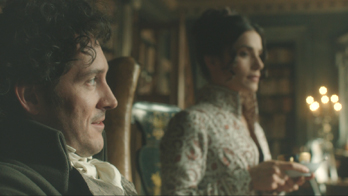
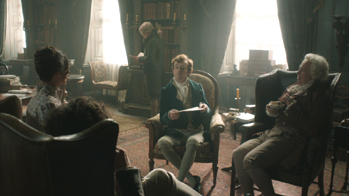
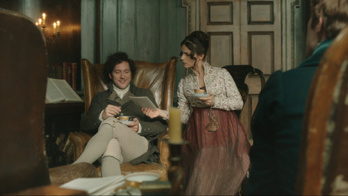
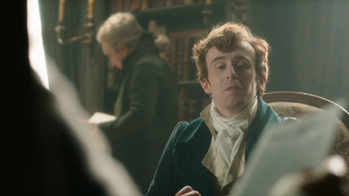
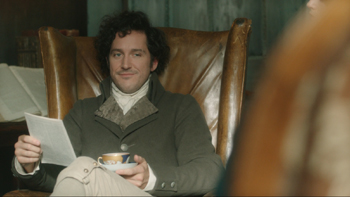
To keep with the Amadeus theme, the series frequently contains too many shots. Do we really need four separate images of Vinculus reading the titles of the spells he has stolen from Childermass? Still, Haynes has the good sense to keep his camera on a tripod most of the time, though he is overly fond of push-ins.
One device that particularly impresses me is the systematic use of planimetric shots to characterize Norrell. This begins in the scene where he tries to interest the politician Sir Walter Pole in using his magic in the war effort and Pole humiliatingly rejects him (top of this section). It becomes more complex, though, in the beach scene where Norrell underwhelms the onlookers by silently installing his invisible beacons. This episode is presumably inspired by the scene in the book, quoted above, where Lascelles chides Norrell for not adding impressive visual elements to his coastal protections.
It begins with a crane down from the distant onlookers to Norrell inaudibly muttering his spell. For a time, variant shots of him against the empty seascape alternate with framings of Strange looking on with increasing doubt and Sir Walter chatting to Arabella about the dire situation of the war. Arabella holds her binoculars ready, expecting to see something appear.
Norrell has clearly been prepared for the occasion by Drawlight and Lascelles. He wears a new, expensive-looking outfit, and he seems to remember being told to gesture impressively. He raises his hands for a lackluster flourish, looking none too confident, and turns to the crowd, announcing, “It is done.” Arabella and Pole look surprised, as Norrell continues, off, “The sea defenses are now in place.”
In a shot of the onlookers, Lord Liverpool calls out, “I cannot see anything!” In medium close-up, Strange reacts, and Norrell, off, says “You will not see anything. They are invisible.” In long shot, Norrell looks out to sea and insists, “It is done.”
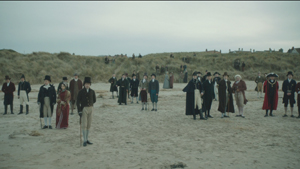

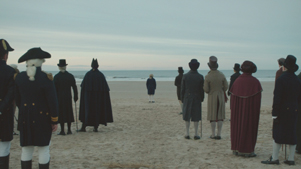
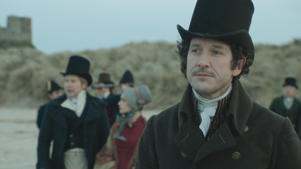
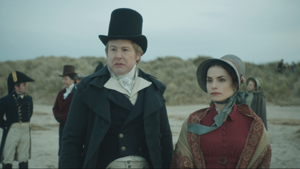

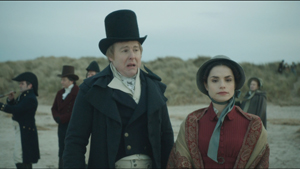



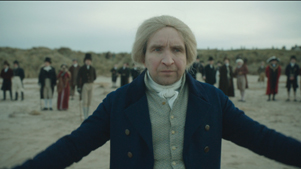


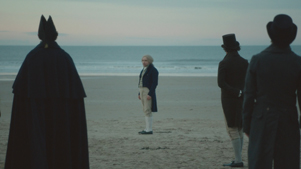

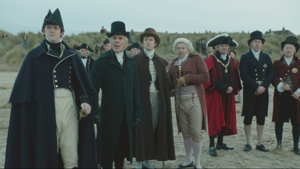
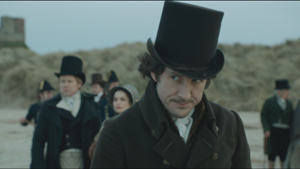

As Drawlight tries to arouse some enthusiasm by cheering for Norrell, there is a transition to a new section of the scene. An oblique view shows Norrell rejoining the group. Strange moves toward the sea and Sir Walter follows him. A planimetric shot of the pair, taken in profile rather than straight onto or away from the sea, contrasts with the earlier part of the sequence. As Norrell and the others watch them chatting, Sir Walter and Strange are shown in two variant framings from behind. While the horizon line had hovered just above Norrell’s head, the hats of these two reach the horizon in one view and slight break through it in the second. They do not look as small and ineffectual as Norrell had against the seascape.
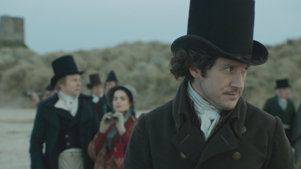
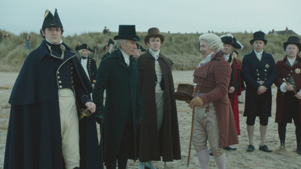

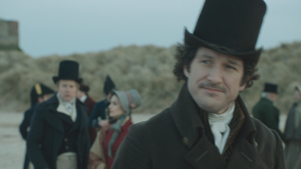

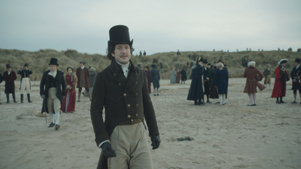
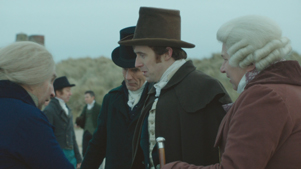
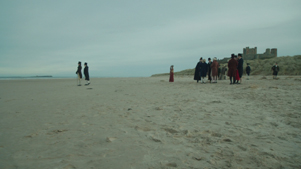
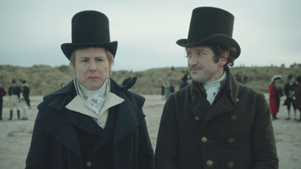
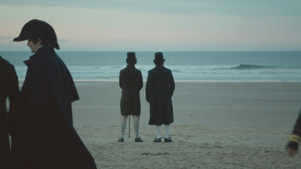
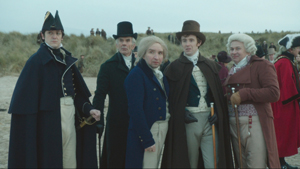
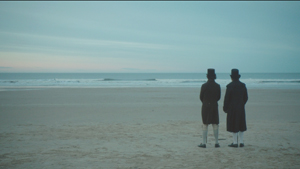
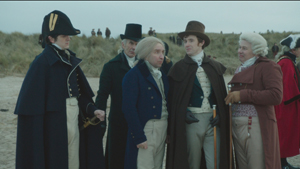
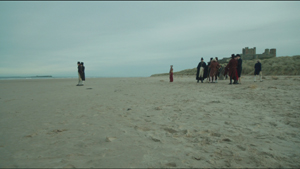
Finally, after declaring that he dislikes Portsmouth intensely, Norrell trudges away toward screen right while Strange and Sir Walter remain looking leftward out to sea on the other. The visual style conveys both the humor and pathos underlying the shifting fortunes of the two magicians.
Other scenes use planimetric shots less extensively, including Norrell’s escape from the crowd at the party and several framings in the two magicians’ visit to George III, in some of which Norrell’s figure is again overwhelmed by his surroundings. (See also the bottom image.)
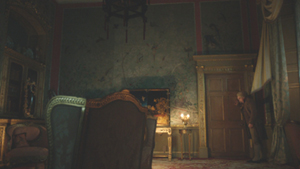

Others include his visit to Lady Pole, the magicians’ reunion after the war (see Friendly Enemies section), and their final parting.
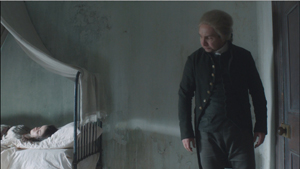
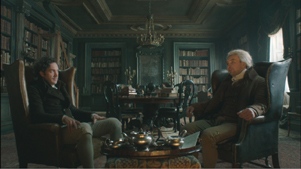
After the latter scene, the planimetric framings disappear. I suppose this is because once the two part, there is less necessity to play create contrasts between the magicians.
Too challenging for BBC Sundays?
Why was the series relatively unsuccessful? Apparently viewership in England started off high but dropped precipitously thereafter. I don’t think the quality of the production can be blamed. Gerald O’Donovan praised the series in the Telegraph and wrote that it did not deserve such a fate. He suggests that it “was just too odd and convoluted to appear to the Sunday night mainstream. It should be interesting to see whether it lives on and wins further fans via the more cult-friendly media of boxed sets and online streaming.”
O’Donovan’s diagnosis is probably correct. Even considerably compressed, the thing was just too complicated for people to follow. The episodes move at a relentless pace. Episode 2, though perhaps the best in the series, in particular crams a surprising amount of the book’s narrative material into its approximately 50-minute running time. There is little time for redundancy in the presentation of causal material.
For example, everyone can grasp the scene in which Strange reveals to Arabella that he has become a magician and proves it by doing a spell with a mirror that allows him to see a different room, occupied by a man he doesn’t know but whom we recognize as Norrell. Most will understand that this is one of the two spells Strange bought from Vinculus after the latter recited the prophecy about two magicians (see top). But where did Vinculus get the spells, and who wrote them originally?
They were written by Norrell in an earlier scene, where he gave them to Childermass as an aid to getting Vinculus to leave London. He orders Childermass not to use them unless necessary, and Childermass never gets the chance, since Vinculus steals them out of his pocket.
It’s not absolutely necessary that we grasp this connection between the two magicians, who do not yet know each other’s identities. But it is helpful at least to understand that Norrell writes simple spells because he has only allowed Childermass to learn a limited amount of magic, and thus even Strange, who has never done magic before, can successfully use “One Spell to Discover what My Enemy is doing Presently.”
There are many connections that I failed to notice on the first time through and picked up on the second viewing. I can only imagine how people who have not read the book can follow much of the action. (After one viewing, David had no idea that Norrell had written Strange’s spell, and I think it is safe to say that he is pretty good on narrative.)
Another possible puzzler is the frequent reference to “Christians.” Clarke explains that this is what fairies call all mortal creatures; the series doesn’t. It’s a subtle point, but it explains why the tales that Lady Pole tells when she tries explain her enchantment all refer to characters and even animals as Christians. As Mr. Honeyfoot points out, these stories are told from the points of view of fairies.
As O’Donovan says, another probable obstacle has been that the series, however much it has conventionalized some aspects of the story, still tells a very odd tale indeed. People expecting a cross between Harry Potter and Jane Austen (another frequent reference made in entertainment coverage) will be caught off-guard.
I ordered the British Blu-ray, which came out on June 29 in the UK. It has excellent visual quality and a few mildly interesting extras, the most helpful dealing with the special effects. The American Blu-ray/DVD has a dreadful cover, nothing like the amusing portrait of the two title characters that graces the British version.
All page numbers are from the American first edition, Bloomsbury, 2004.
Chapter Four of my The Frodo Franchise deals with the way that studios control what reporters write through giving cast and crew certain talking points that get repeated over and over in the hundreds of promotional interviews that they will undergo at press junkets, on talk shows, and during public appearances.
One might ask why Norrell, having so little dramatic flair in his magic, puts on such an impressive show in York Minster. I wondered for a while whether this was an inconsistency in Clarke’s book but concluded that Norrell simply doesn’t see the difference. Magic is magic, and it should always impress people.
I am atypical in finding the last episode disappointing. Most reviews of it were positive. See again Anibundel for an intelligent and more enthusiastic view of it. The TV series was extensively covered on this site, and other entries are worth reading as well.
[August 20: Den of Geek has an interesting piece taking to task reviewers who compared the series to Harry Potter and generally gave the idea that it is for children. (Hardly. The British Blu-ray has a 15 rating.) I doubt that was the reason for the fall-off in viewership as the series continued, but it might have caused some people not to watch the show altogether.]
Is there a blog in this class? 2015
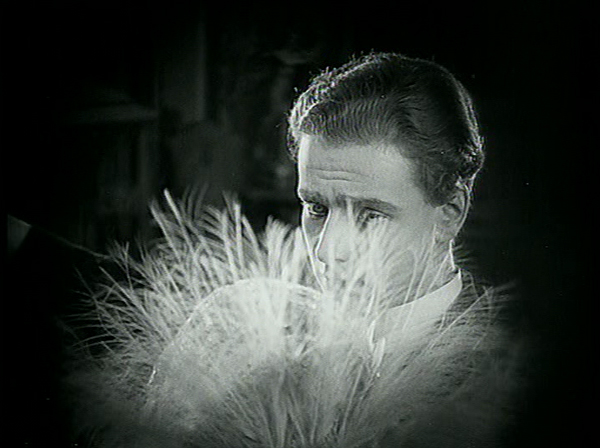
Michael (Carl Dreyer, 1924)
Kristin here:
We don’t write our entries for this blog with with the thought that they will necessarily be used in teaching. Still, some of them might be might prove helpful in preparing lectures or assigning readings in courses assigning Film Art: An Introduction. Or indeed, other courses. As usual, at a time of year when teachers are preparing their syllabi, we offer a run-down on what we’ve posted over the past year.
Entries for previous years are available here: 2007, 2008, 2009, 2010, 2011, 2012, 2013, and 2014. These and the current one don’t include all the 701 (!) entries on this blog, but quite a few are listed here. For those new to Observations on Film Art, they might provide a handy way of exploring the site.
Here are some suggestions, chapter by chapter. Sometimes one entry will be relevant to several chapters, so we’ve noted such overlaps.
Chapter 1 Film as Art: Creativity, Technology, and Business
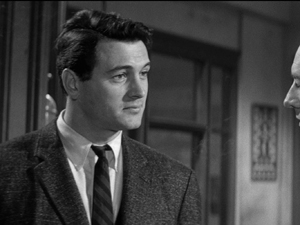
At the end of Chapter 1, we have long included a section warning students against watching widescreen films shown on television in pan-and-scan formats. Widescreen televisions, as well as letterboxing and windowboxing on home video, may seem to have solved that problem. Yet alterations in film images, often eliminating key parts of shots, persist. We discuss how in Filling the box: The Never-Ending Pan & Scan Story.
Throughout Film Art, we emphasize that filmmaking involves many decisions and much problem-solving. We examine some specific examples from the works of William Wyler and others, in Problems, problems: Wyler’s workaround.
Chapter 1 discusses the various roles in filmmaking. An important contemporary screenwriter, David Koepp (Jurassic Park, The Da Vinci Code, War of the Worlds) and director (Ghost Town, Premium Rush) visited our department this year. We pass along some of what we learned in The compleat screenwriter: David Koepp gives notes.
Bill Forsyth, director of the admirable Local Hero, shares his experiences working on both experimental and mainstream films in Watch those hands.
We also refer to the auteur theory, suggesting that the director is often the major artist who organizes a film. François Truffaut’s book of interviews with Alfred Hitchcock has been a huge factor in making Hollywood genre directors more respected. It has also influenced many directors and critics. Our friend Kent Jones has made a revealing film about the background of the interviews and the books. We discuss both the book and Kent’s film in TRUFFAUT/HITCHCOCK, HITCHCOCK/TRUFFAUT, and the big reveal.
Chapter 2 The Significance of Film Form
Here we lay out the various types of meaning in films, including symptomatic meaning. Looking at how films supposedly reflect social trends, however, has become an easy way of generating journalistic prose. We point out the problems with this approach in Zip, zero, Zeitgeist.
Chapter 3 Narrative Form
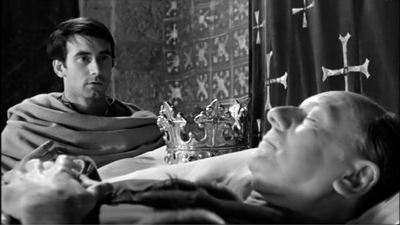
Chimes at Midnight.
Michael Neelsen, a filmmaker and consultant based here in Madison. has a site called ReelFanatics. In our entry Cinematic storytelling: A podcast on narrative, we preview Michael’s interview with David about his ideas on filmic storytelling.
The narrative of Gone Girl plays with the spectator’s expectations. We discuss how it links to Hollywood’s historical treatment of the thriller genre in Gone Grrrl.
Chapter 3 has a “Closer Look” box, “Playing Games with Story Time,” which examines the recent popularity of “what if” films that employ forking-path premises. We discuss a much earlier example of this technique from 1934 in What-if movies: Forking paths in the drawing-room.
Another intriguing way of structuring stories is the “network-narrative” technique, which weaves together the lives of several seemingly unconnected characters. As a storytelling choice it persists in films like The Best Exotic Marigold Hotel. The format was popularized in the 1930s with the “Grand Hotel” cycle of films. We survey this narrative option in 1932: MGM invents the future (Part 2). For Part 1, see below under Chapter 7.
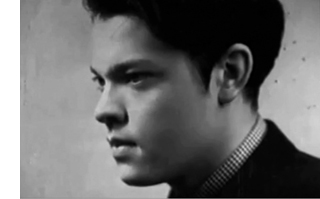 If you’re teaching Citizen Kane or any other film by Orson Welles (right, very young), your students might be interested in learning some background on the director. See our Local Boy Makes Very, Very Good: Welles comes home.
Chapter 4 The Shot: Mise-en-Scene
The Taiwanese director Hou Hsiao-hsien is a great master of staging, setting, and lighting. Hou Hsiao-hsien: A new video lecture! links you to a presentation that David posted on Vimeo. See also our guest entry, Jim Udden’s first impressions of Hou’s latest, The Assassin.
In 2014, Richard Linklater’s Boyhood focused much attention on acting and casting by dealing with twelve years in a boy’s life. The shooting was done across twelve years using the same actor as he grew up. Despite the acclaim for the film, something similar has been done in other films. We compare the effects of actors growing up before our eyes with a comparison to the Harry Potter series in Harry Potter and the Twelve-Year Boyhood.
Like other aspects of mise-en-scene, actors’ performances can be analyzed. Watch Those Hands considers Burt Lancaster’s performance style in The Killers, Brute Force, and other film noir classics. Two clips illustrate Burt’s control of eyes and hands.
Chapter 5 The Shot: Cinematography

Some students may be convinced that CGI (computer-generated imagery) is the best way to make a big action movie. We look at Mad Max: Fury Road (above) and The Lord of the Rings as films that are more original and entertaining because they emphasize practical effects and resort to CGI only when necessary. See The waning thrills of CGI.
Jean-Luc Godard’s late films offer fascinating examples of unusual framings. Sometimes his camera positions block our easy understanding of the story action. We consider an example in Watch those hands.
Chapter 6 The Relation of Shot to Shot
In BIRDMAN: Following Riggan’s Orders, we argue that although much of the film is presented as a single shot, we can see changes of camera angle and distance that fit the patterns of traditional editing. The film in effect absorbs the principles of continuity editing into its long-take approach.
Chapter 7 Sound in Cinema
The origins of cinematic voice-over in the 1930s can be traced with surprising precision, as we indicate in 1932: MGM invents the future (Part 1). The entry includes several video clips from rare films of the period.
Guest blogger Jeff Smith applies his expertise in music to analyzing the songs and scores from 2014 nominated for Oscars in The sirens’ song for Oscar.
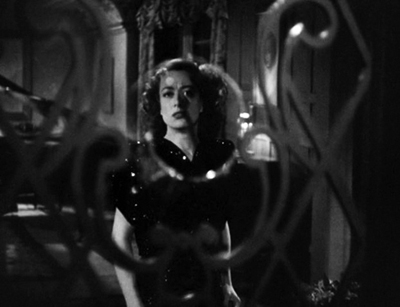
Film Art occasionally uses telephone calls to show the range of choices filmmakers have with respect to sound. In Little things mean a lot: Micro-stylistics, phone calls illustrate the interplay of editing, dialogue, and music to build suspense. Our biggest example, which includes a video clip, comes from Humoresque (below).
Chapter 8 Summary: Style and Film Form
Current 3D cinemag has become quite ambitious, and no film exemplifies this better than the provocative, sometimes abrasive, often beautiful Adieu au langage (Goodbye to Language) of Jean-Luc Godard. We devoted two entries on this extraordinary film. Adieu au langage: 2 + 2 x 3D analyzes the relation between the film’s 3D design and its overall form. The other, Say hello to Goodbye to Language, proposes some follow-up ideas.
Film Art tends to use fairly straightforward examples of film technique and style, aimed at students new to the subject. But less noticeable examples can be fascinating, as we suggest in the Micro-stylistics entry.
Film is self-evidently a primarily visual art. Yet the flow of images depends on sound, genre conventions, and other elements. See our Visual storytelling: Is that all?
Chapter 9 Film Genres
Gone Grrrl, as mentioned above, is a good example of the thriller. The Hitchcock/Truffaut entry compares how each director uses conventions of the same genre.
Chapter 10 Documentary, Experimental, and Animated
The conference of the Society for Cognitive Studies of the Moving Image was the occasion for meeting experimental filmmakers John Smith. His films are described in An evening with Mr. Smith.
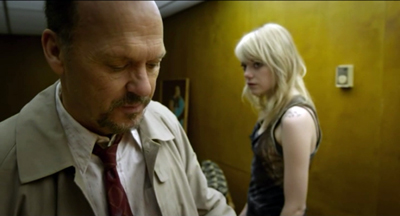
Chapter 11 Film Criticism: Sample Analyses
Our entry on Birdman, mentioned above, constitutes a fairly detailed analysis of the film as a whole. In addition, David’s website hosts several additional analyses cut from earlier editions of Film Art. Feel free to mix and match.
Chapter 12 Historical Changes in Film Art Conventions and Choices, Tradition and Trends
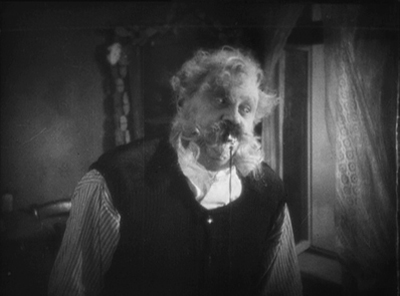
The Last Laugh.
At the end of each year, we offer our own version of a ten-best list, going back 90 years in order to call attention to both classics and little-known gems of the day. This past year it was The ten best films of … 1924. (See directly above and top of this entry for two of our choices.)
Both Michael and The Last Laugh are among the many classics of the German silent cinema. But a trip to an archive can reveal lesser-known films of interest. See Homunculus and his friends for some examples.
Resources
Every now and then we write about new book, DVD, and Blu-ray releases. Find out about little-known films and recent restorations in DVDs and Blu-rays for your letter to Santa.
Our colleague Lea Jacobs has recently published a major study of how the ways in which music, voice, and effects created rhythm in combination with images in the first decades of sound cinema: Film Rhythm after Sound: Technology, Music, and Performance. See The getting of rhythm: Room at the bottom.
Adieu au langage.
Watch those hands; or, Burt, Jean-Luc, and Bill come to Cinephile Summer Camp
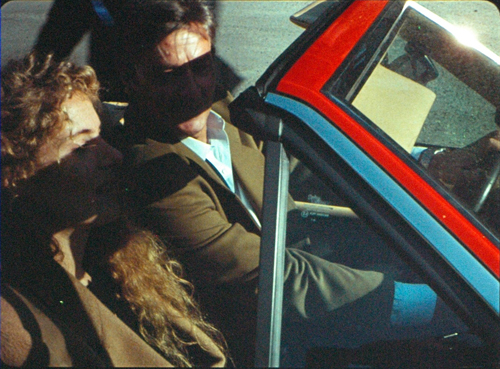
Nouvelle Vague (1990).
DB here:
At this year’s Summer Film College in Antwerp, Peter Bosma pointed out that the event seems to be a unique mixture.
Films are screened from morn to midnight: this time, 38 films across 6 days and two half-days. But it’s not exactly a film festival, as there are no new releases.
 So is it like Bologna’s Cinema Ritrovato? Not exactly. While the shows included some restored titles (notably the Belgian Cinematek’s pretty makeover of Pollyanna, 1920), the films were mostly original prints with an occasional DCP.
Moreover, the films cluster around two or three major themes. This year we had Late Godard (fourteen titles, counting episodes of Histoire(s) du cinema) and the career of Burt Lancaster (eleven). In addition, there were nightly showcases called “Masterworks in Context,” which included one surprise film, title undisclosed. But unike most movie marathons, the Summer Film College introduces screenings with lectures and discussions. This year there were fourteen sessions, each running about ninety minutes. These are serious, intensely informative talks—very far from the usual brief introductions one gets at festivals or in art house warm-ups.
So is it an educational enterprise? Definitely, but without assignments, tests, or grades. It’s designed to serve Flemish-speaking professors and students, but also civilians who are just interested in a weeklong package of film and film talk. The event helps forge a community of film appreciation.
Finally, there’s often a guest filmmaker on hand, usually related to the main threads. This time it was Bill Forsyth, who directed Burt in Local Hero. That film was screened, along with Bill’s wonderful Housekeeping.
So what would you call the College? I once called it Cinephile Summer Camp, and that still seems accurate in evoking the sense of fun and camaraderie that pervade the place. We don’t all get mosquito bites, but after a week you come to enjoy seeing familiar faces and talking with them about what they’re seeing. Just as when you go to summer camp, you get to stay up late. But at no summer camp I ever attended did we drink so much beer.
JLG/SJ/DB
The principal speakers were Tom Paulus and Anke Brouwers, who covered Burt, and Steven Jacobs on Late Godard. The Masterworks in Context shows were introduced by several guest speakers, including Lisa Colpaert (excellent on I Walked with a Zombie) and Vito Adriaensens (covering both Murder! and Vampyr). For Pollyanna, Bruno Mestdagh of the Cinematek staff explained the process of restoration. I played utility infielder, offering one talk on Burt and three on JLG.
How often do you get to see 35mm prints of Une femme mariée, Passion, Je vous salue Marie, Détective, JLG/JLG, Eloge de l’amour, and Nouvelle Vague? The Godard series, which ended with a 3D show of Adieu au langage, was a high point of my summer viewing. Back home I had prepared by rewatching all Godard’s features from Sauve qui peut (la vie) onward, but my video homework didn’t prepare me for the way the big screen amps up their prickly, seductive power.
I don’t speak or read Dutch, so I missed many subtleties in Steven Jacobs’ talks, but thanks to Power Point I could figure out the main points. Few lecturers can pack so much information and ideas into ninety minutes.
We had no way of knowing how familiar the audience was with Godard, early or middle or late, so Steven started with an orienting talk on JLG’s pre-1980 work (above). He swiftly reviewed key aspects of Godard’s New Wave period, traced his shift toward “a critical cinema” between 1967-1969, and explored the move into his Marxist phase. Along the way, he stressed the way cultural developments like auteur theory, Pop Art, Maoism, Brechtian theatre, and semiotics shaped Godard’s films. Particularly acute was his discussion of the “one image after another” sequence in Ici et ailleurs (1975). In all, the talk was an ideal prelude to Une femme mariée, which pointed up so many motifs of the later work: the focus on the couple, the emphasis on media-based images, and the persisting shadow of the Holocaust.
Steven is an art historian at University of Ghent; he earlier appeared on this blog as co-author of the imaginative book The Dark Galleries. After tracing Godard’s return to mainstream cinema and his move to Rolle, Switzerland, Steven focused on that splendid example of JLG the painter, Passion. Steven has written eloquently on the film in his Framing Pictures, and here he widened his focus to discuss its relation to other films centered on the tableau vivant, like Pasolini’s La Ricotta and Ruiz’s Hypothesis of the Stolen Painting.
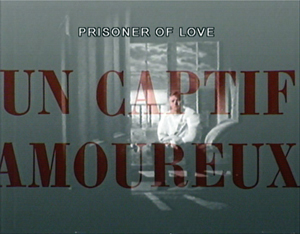
You’d expect that Steven would have a field day with Histoire(s) du cinema, and he did. Unlike most Godardophiles, I’m not wild about this series of video essays. I can’t take them as serious studies in film history, and too often I sense he’s just playing around. (Enough with the stroboscopic flashes, okay?) But Steven obliged me to rethink them by showing how they fit into the Postmodern art scene, especially the video art movement after the 1970s. He pointed out the central importance of the Hitchcock episode and the series’ constant concern with the Holocaust, often in dialogue with Shoah. Citing Godard’s claim that video taught him to see cinema in a new way, Steven suggests that the format also created a tenor of paradoxical melancholy. It’s as if JLG’s experiments with this new technology drove him to celebrate the death of the cinema he knew.
My three talks on Late Godard tried to ask something that I didn’t find many traces of in the literature. What are these films doing with (or against) narrative? I think that the focus on JLG as “film essayist” has sometimes obscured the fact that he has long insisted that he needs stories. Yet he seems to have no interest in the craft of storytelling as we understand it. He avoids dense exposition, careful foreshadowing, well-timed revelations, and cumulative climaxes. He tends to spoil the narrative expectations he sets up.
As a result, his plots—for his films have them—are distressingly opaque. Exactly what happens in a Late JLG film is often difficult to determine. I’m always surprised when discussions of these late films provide capsule plot summaries, for the very difficulty of arriving at these should claim our attention. As just one instance, many critics seeing Adieu au langage for the first time thought the film centered on one couple. It centers on two. But the fact of that mistake ought to interest us enormously: What in the film’s presentation made it difficult to follow the basic situation? Are there strategies Godard follows in creating his apparently willful obscurity?
Godard’s unique strategies of storytelling are carried down into felicities of visual and verbal style. Again, I think that critics haven’t sufficiently acknowledged just how strange and opaque the surfaces of these movies are. For one thing, characters are unidentifiable from scene to scene, thanks to camera setups that cut off their faces, wrap them in shadow, or leave them offscreen altogether.
I’ve touched on these matters earlier (here and here), but just as a quick example, consider this shot from the opening of Nouvelle Vague. It has to be one of the most oblique introductions to a protagonist we can find in cinema.
Corporate owner Elena Torlato Favrini strides out of her mansion past her chauffeur while taking a transatlantic call. Any other director would favor us with a close view of her, perhaps tracking as she cuts a swath through her entourage. Instead we get a shot framing her chauffeur climbing out of their Mercedes.

As he crosses in front of the car, we hear her on her cellphone. She can be glimpsed fleetingly in the background, through the car window.
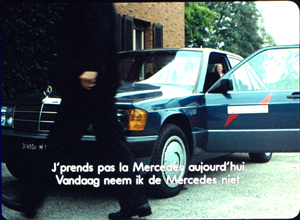
She approaches us, becoming briefly visible as she passes the car, but when she stops, she’s decapitated. We don’t get anything like a good look at her, and the locked-down camera refuses to reframe her. Instead, the framing emphasizes her slipping on her gloves.

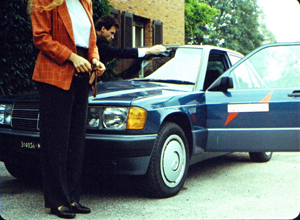
The gesture ties into other imagery in the film. A little before this shot, there’s an isolated shot that establishes hands as a major motif in the film. But we should also notice that this fairly abstract shot also presents the gesture of Elena slipping on a glove. Or rather, it almost presents it, as the shot is abruptly chopped off just as the gesture begins.


So slipping on the glove, started in an earlier shot, is finished at the Mercedes. But just as important, the visual idea of a hand gesture broken by a cut resurfaces at the climax. When Richard Lennox helps Elena out of the water, the action is also incomplete. Only five frames show him grabbing her arm before a cut interrupts the action.

Another filmmaker would have held the image on that triumphant grip, but Godard denies us this little burst of satisfaction. Of the five frames in this bit of the shot, there is just one frame showing Richard’s hand seizing her. Godard again spoils a solid narrative effect. But he does narrative in his own way, with the broken-off gestures counterpointed by the hands that do meet at other points in the film.
Every scene in Nouvelle Vague, and most scenes in Late JLG, seem to me to be built on one or more fine-grained pictorial and auditory ideas like these. Those ideas can seem perverse, as in the chauffeur scene: why let us see his face but play down Elena’s? He’s not a major character; we don’t even learn his name until the film’s final moments. Unhappily, this peculiar instant of comparison is lessened in the 1.66 version of the film available on DVD. That image suppresses the driver’s face no less than Elena’s, losing Godard’s peculiar version of “gradation of emphasis.”

All the more reason to try to see these films in their full-frame glory, as I’ve argued before.
BL (Beautiful Loser)/AB/TP
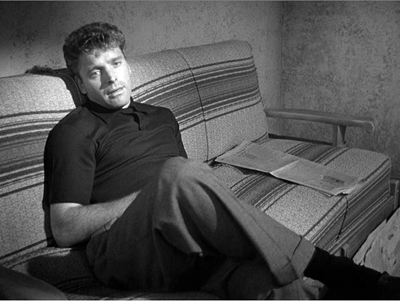
Criss Cross (1949).
With big tousled hair, unadulterated sinew, and teeth gleaming like a Pontiac grille, Burt Lancaster came to fame in the late 1940s. He belonged to a new cohort of actors quite different from the 1930s Debonairs (William Powell, Melvyn Douglas, Cary Grant) and the Bashful Boys (Cooper, Fonda, Stewart). Yet the new lads were also at variance with the rugged Ordinary Joes (Cagney, Bogart, Tracy, Gable).
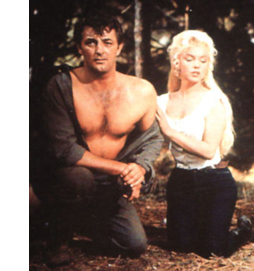 For one thing, Lancaster, Victor Mature, Robert Ryan, Robert Mitchum, Kirk Douglas, and Charlton Heston were brawny—monsters, in a way. They often took off their shirts. One publicity still for River of No Return shows Mitchum more unclothed than Monroe. Three of them played prizefighters, and Mitchum, himself a boxer, had the broken nose of a brawler.
Of the group, Burt had probably the strongest A-list career overall. He fostered a great variety of projects. Who else of his generation appeared in films by Visconti and Malle? What other unflinching liberal was prepared to play a US general bent on a coup (Seven Days in May) or a conspirator behind the Kennedy assassination (Executive Action) or an obstinate officer fighting in Vietnam (Go Tell the Spartans)? He portrayed a renegade officer demanding the revelation of the brutal policy behind the Vietnam War (Twilight’s Last Gleaming). His closest rival and frequent costar Kirk Douglas didn’t enjoy such a vigorous and prestigious twilight. Only Brando kept beating him to the prize: Burt wanted to play the lead in Streetcar Named Desire and The Godfather. Unpredictably, he wanted as well to play the gay prisoner in Kiss of the Spider Woman.
I had had only slight interest in Burt as a star before this edition of the Summer School. But listening to the talks, seeing the films, and preparing my contribution made me realize how extraordinary an actor he was, and how important in Hollywood postwar history. Burt was well-served by the fine lectures offered by Tom Paulus and Anke Brouwers.
Anke provided an in-depth survey of how Burt and the Brawny Gang brought to a new level the culture of male athleticism—on display in Fairbanks and Valentino, developed further in the body-building craze of the 1930s, and culminating in what one 1954 magazine article called Hollywood’s “Age of the Chest.” She brought in forgotten pin-up boys like Guy Madison and pointed out how Burt and his peers paved the way for Rock Hudson and Tony Curtis. Anke went on to specify Burt’s beefcake persona, established in The Flame and the Arrow (1950) and locked into place in The Crimson Pirate (1952), which we saw. In her followup talk next day, she surveyed Burt’s place in the industry. He was one of the few stars to supervise a successful independent production company, Hecht Hill Lancaster (earlier, Norma Productions and Hecht Lancaster).
Tom moved on to consider Burt’s star charisma. He traced how Burt adjusted his authoritative image to different roles—the con man, the confident leader, the embittered idealist. Tom was especially good at analyzing Burt’s acting technique, tying it to particular trends in theatre and film of the time and pointing up the physicality of his performance of specific, precise tasks. Given the standard situation of rigging a bomb, he contrasted Burt’s meticulous finger work in The Train (1964) with that of Kirk going through the motions in The Heroes of Telemark. Tom even spared some time for Burt’s diction—a quality that really popped out when we watched Elmer Gantry (1960).
In a later lecture, Tom surveyed “Late Burt,” and his relation to political cinema of the 1960s and 1970s. He followed that with a revealing account of Burt’s relation to the trend of “Mexican Westerns” launched in the 1950s. Another arc in Burt’s career: from Vera Cruz (1954) to Ulzana’s Raid (1972), with The Professionals (1966) in between. That we saw in another gorgeous print.
I could go on a lot more about Tom and Anke’s lectures, but I don’t want to give away too much. The talks contained so much original research and discerning analysis of both the films and trends within film history that I’m hoping Tom and Anke will lay these ideas out at book length. Part “star study,” part film criticism, part industry history, their lectures were exhilarating.
My own contribution was minimal, a talk on First-Phase Burt. The Brawny guys were well-suited to the trend toward hard-boiled movies, those crime pictures we later decided to call “noirs.” Those weren’t usually suitable for older players (though there were some makeovers, such as Dick Powell and Fred MacMurray). To fill these roles came Alan Ladd, Glenn Ford, Dana Andrews, and Richard Widmark, along with the beefcakes. At the same time, “independent” producers within the studios began contracting their own new talent and loaning it out. Burt was signed by Hal Wallis at Paramount, who also had Kirk Douglas, Wendell Corey, and Lizabeth Scott in his stable. Films like Desert Fury (1947) and Sorry, Wrong Number (1948) were Wallis package projects.
Hired straight from the stage with no film experience, Burt debuted as the Swede in The Killers (1946), on loanout to Mark Hellinger at Universal International. Burt benefited from a galvanizing entrance. Lying on a bed in the dark, refusing to flee the hitmen on his trail, Burt is a shadowed, curiously languid torso in a tight undershirt.
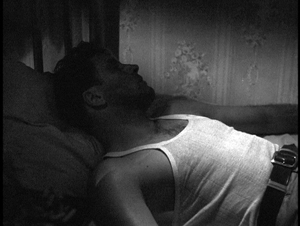
Only after a beat do we see something else: massive hands rubbing a weary head. Soon that head is revealed.
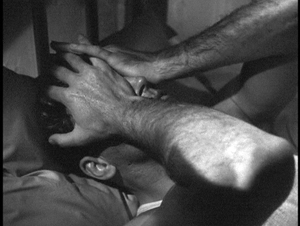
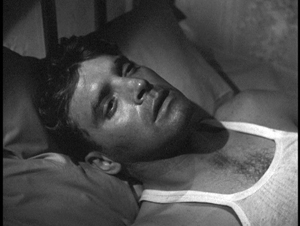
As the killers burst in, the whole image comes together.
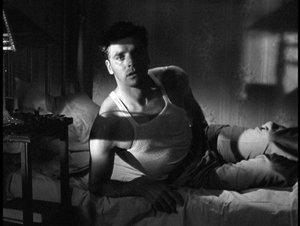
Has a Hollywood beginner ever been given such a gift as this opening?
With this onscreen wattage, it’s all the more striking that this young discovery is curiously absent from his early films. He’s onscreen for only a third of The Killers’ running time, and not even half of Brute Force (1947) and Sorry, Wrong Number. The film Wallis wanted to be his debut, Desert Fury (1947), gives him only twenty-three minutes out of ninety, and in the second male lead at that. All My Sons (1948) puts him in an ensemble drama. I Walk Alone (1948), the Norma production Kiss the Blood Off My Hands (1948), and another Universal project, Criss Cross (1949) start to make him a proper, central protagonist. By then, he is ready to become the star attraction of the swashbuckling films.
Moreover, in his early phase, he mostly plays losers. Not the brightest guy in the room, he’s easily suckered by a femme fatale in The Killers and Criss Cross. He makes amateurish mistakes at crime (Sorry, Wrong Number) and, coming out of prison, he is the last to realize the rackets have gone corporate (I Walk Alone). At the start of Kiss the Blood he punches a man too hard and kills him. He’s caught and whipped and imprisoned, and when he comes out he stumbles back into crime again. He’s shrewd enough to set up a prison break in Brute Force, but so doggedly determined is he to reunite with his girl on the outside that he launches a suicidal bloodbath.
When he finally catches on to his fate, we get expressions ranging from stupefaction to anguish (The Killers, Criss Cross).
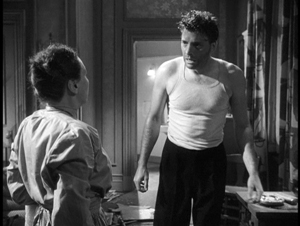
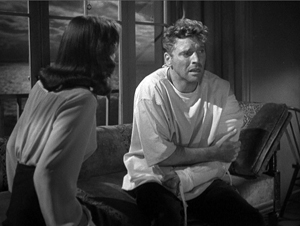
He even cries (All My Sons, Kiss the Blood).
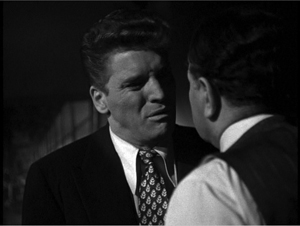
Loser or winner, when he is onscreen, he has the outlandish physical presence of the born star. Most obvious is a physique (Kiss the Blood, Brute Force).
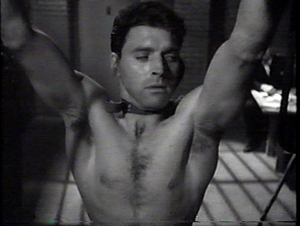
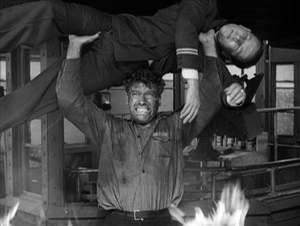
Even his back, featured with a prominence we get with few other actors, is straining against a drenched prison uniform (Brute Force) or a tailored suit (Criss Cross).
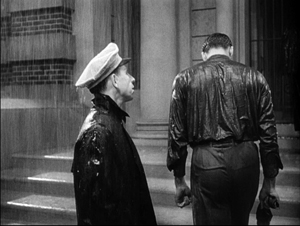
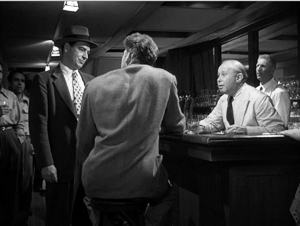
The face was a cameraman’s dream; it could be craggy or somber, thoughtful or tormented (The Killers, Brute Force x2, Criss Cross).
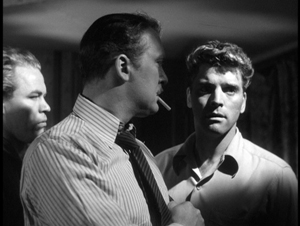
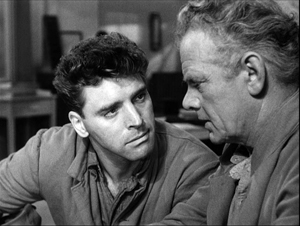
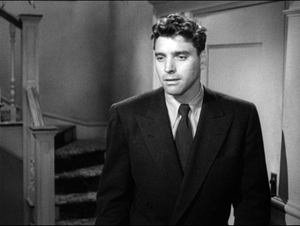
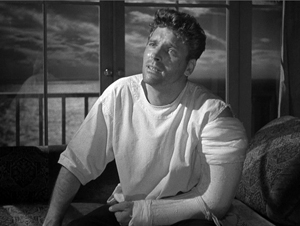
He can be stiff-armed and zombielike coming out of prison in Kiss the Blood, but he can also gamely cock his elbows, ready to spring, like Cagney and Cary Grant (I Walk Alone).
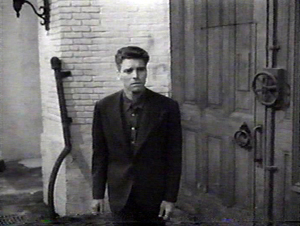
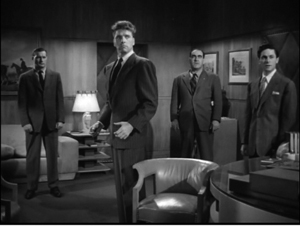
The enormous hands, which look likely to crush a skull (Criss Cross) or rip apart a phone cord (Sorry, Wrong Number), could be surprisingly delicate, tentatively touching his girlfriend’s wheelchair or laying down plans like playing cards (Brute Force).
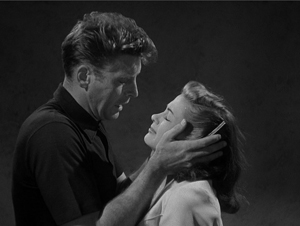
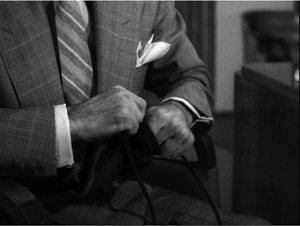
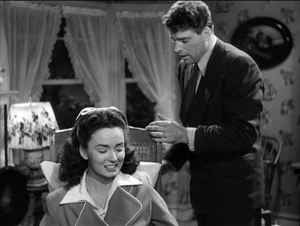
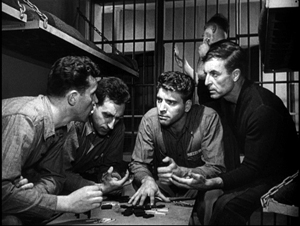
In The Killers he makes skillful use of those hands, pocketing his busted one or spreading out the scarf given him by the treacherous Kitty.
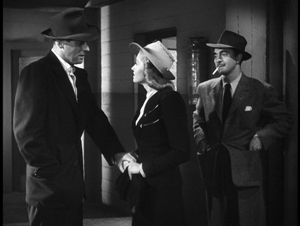
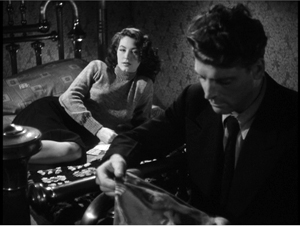
Easily taken in by Kitty’s plan, he seems to have a qualm when his gripping embrace relaxes and the fingers splay in hesitation.
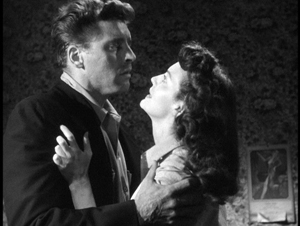

This sort of handwork would become crucial, as Tom pointed out, to Burt’s performance style, particularly in The Birdman of Alcatraz.
“I’d never looked in eyes as chilling as Lancaster’s,” Norman Mailer once said. You can see what he meant.
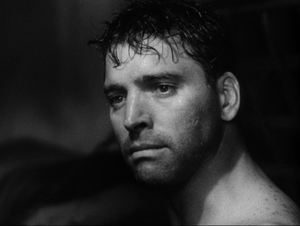
Again, though, the actor is in control. Some years back I wrote that eyes by themselves aren’t very expressive: the eyelids, eyebrows, and mouth tell us more. I still think that’s right, but Burt manages to convey the sense of the beast at bay with remarkable control of just the eyeballs. He seems to be looking for an escape hatch without moving his head an inch.
While Burt was playing losers, his counterpart Kirk Douglas was often playing heels—cynical manipulators who stomp on everybody else, as in I Walk Alone. Sometimes Kirk learns his errors (Young Man with a Horn, 1950) but several roles of the period, in Out of the Past, Champion, and Ace in the Hole, make him a glib villain or tawdry antihero. Somewhat later Burt explored this characterization too, notably in Vera Cruz, Elmer Gantry, and The Rainmaker (1956). How did he shift from the beautiful loser to the fast-talking con artist?
I think there are hints from the start. In The Killers, after he’s washed up as a fighter, the Swede goes in for street crime. When he confronts his old friend the cop, Lancaster brings those arms and hands into play. In his enormous unstructured topcoat, he lifts his fists up to his waist. It’s both the businessman’s getting-down-to-brass-tacks sweep, but also a kind of puffing up, exposing that massive frontal expanse. Little Sam Levene can grasp his lapels, but he doesn’t stand a chance against this.
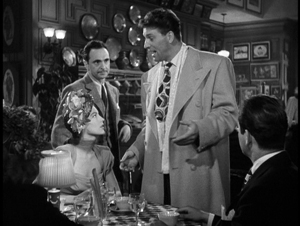
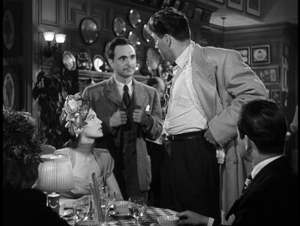
Burt uses the same imperious gesture when, in Sorry, Wrong Number, he’s trying to bully a company employee into joining a crooked deal.
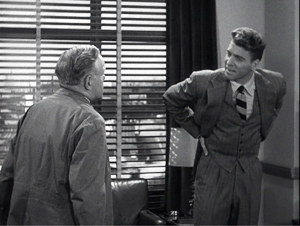
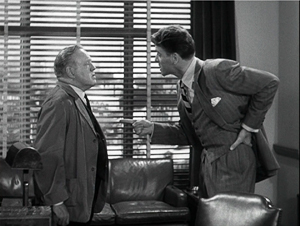
In these noir movies, his intimidation of others won’t put him ahead of the game. But perhaps these arm movements begin to sketch a more flamboyant loser like Gantry. By striking what actors used to call an “attitude,” Burt could start to build an entire character: a hell-for-leather charlatan.
Seeing the films, listening to Tom and Anke, and studying Lancaster’s work on my own brought home to me again the importance of the details of performance and the presence of a star. These movies would be utterly different if Mitchum or William Holden played the Burt parts. Our actors don’t wear masks or Hazmat suits. We’re powerfully affected by what they bring to the character in voice, body, face, and gesture—the expressive dimensions of cinematic presence.
BL/JLG/BF
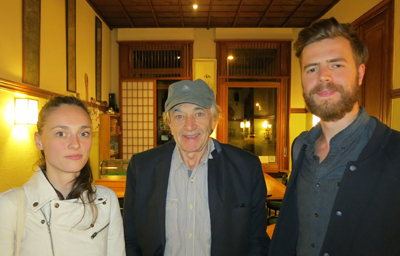
College coordinators Lisa Colpaert and Bart Versteirt, flanking Bill Forsyth.
What do Burt and JLG have in common? For one thing, some images from Criss Cross in Histoire(s) du cinema 1a (see above). For another, Bill Forsyth.
With the success of Gregory’s Girl (1981), Bill was invited by David Puttnam, then at Columbia, to make a Scottish movie with a couple of American actors. The result, Bill says, now looks to be a “soft-core environmental movie.” Local Hero (1983) remains much loved, and for good reason. It makes nearly all of today’s multiplex raunch look adolescent. It has a tone of civility, an embrace of eccentricity, and a genuine interest in people reminiscent of Ealing comedies. For me it’s a masterpiece of sweet, light-hearted art.
Local Hero feels loose and leisurely, but it’s actually a very economical movie. The first few minutes should be studied by screenwriters interested in tight exposition and fast attachment to a protagonist. It’s peppered with sidelights on its central drama, such as the Russian’s song about how “even the Lone Star State gets lonesome.” That neatly sums up the situation of the yuppie sad sack MacIntyre (“I’m more of a Telex man”) learning about village life. As usual, I was moved by Mark Knopfler’s plangent score, the electronic overtones meshing with the pulsations of the Northern Lights.
Burt’s role is that of CEO deus ex machina. Having assigned Mac to buy a Scottish seacoast town for an oil refinery, Mr. Happer eventually descends in his chopper and decides to establish a laboratory there instead. Burt’s crisp delivery and tight fingerwork are still on display at age seventy. The other actors don’t use their hands as much as he does–partly so they’re not distracting us from him, I suspect, but also because newer-style Hollywood acting doesn’t encourage it. In any case, as usual Burt uses his acrobat’s sense of physicality to intensify his performance. Even clasping his hands behind his back tells about the character’s authoritative dignity.
Bill learned that Burt regretted not doing more comedy, so he wrote the mogul’s part with him in mind. Burt signed on eagerly. He showed up on the set with a full beard, hoping Bill would let him keep it; they compromised on a mustache.
Bill had worked mainly with teenage actors on That Sinking Feeling (1979) and Gregory’s Girl, so Burt was really the first adult performer he ever directed. Across their three weeks together, Burt demanded nothing, except that he wanted to loop his dialogue. Bill preferred not to loop, and as it turned out only one scene needed to be rerecorded.
Burt and Bill skipped lunch in order to prepare the next scene, becoming “lunch bums.” Bill remembers Burt hanging out with the other actors and chatting with extras. He freely made fun of Bill’s accent: “”He speaks no known language.” He told Bill: “I don’t know what you’re saying, but I know what you mean.”
Bill talked as well about his own career. Starting out in the days before home video, he learned dialogue and pacing by audio taping classic films. (Sounds like a good idea to me.) He became a performer’s director. “The only thing I’ve ever said to a cameraman is: ‘Accommodate the actors.” He quoted Burt approvingly: “The space in front of the camera is the actor’s space.”
What’s the connection to JLG? It turns out that Godard was the director Bill most admired in his salad days. During the 60s he sated himself on art cinema, especially New Wave imports. When he saw Pierrot le fou, he left the theatre stunned. Godard became “the master. He still is, for me.”
Accordingly, Bill’s earliest cinema efforts were in an avant-garde vein. One piece, puckishly called Film Language, started with ten minutes of black leader while a text by Beckett was read out. Another, Waterloo, included a vast ten-minute shot in which the camera left one household, climbed into a car, rode a great distance, and ended up in another home. The film played at the Edinburgh film festival to an audience of 200. By the end three viewers were left. “I’d moved my first audience.”
Bill remarked that he sometimes regrets not sticking with experimental media. Today, he says, he might be a video-installation artist. A teasing idea. But we should be grateful that we got his features. I don’t know if Jean-Luc would agree, but I bet Burt would.
Thanks to Bart Versteirt, Lisa Colpaert, and their colleagues for a great week. Thanks as well to the participants, whose willingness to take on anything we threw at them was very encouraging. And a farewell to two friends who have projected films at every Summer Film College I’ve attended over the last sixteen years: Esther Dijkstra and Joost De Keijser. They have helped make the event the splendid enterprise it is.
Peter Bosma’s informative book Film Programming: Curating for Cinemas, Festivals, Archives is available here.
A detailed “index of references” for Histoire(s) du cinema is provided by Céline Scemama.
Our first encounter with Bill Forsyth was at Ebertfest. For more on actors’ handiwork, try this entry.
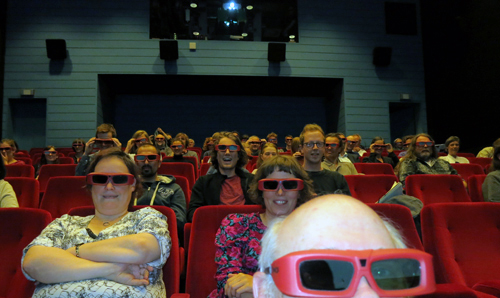
An eager crowd of campers awaits Adieu au langage.
Homunculus and his friends
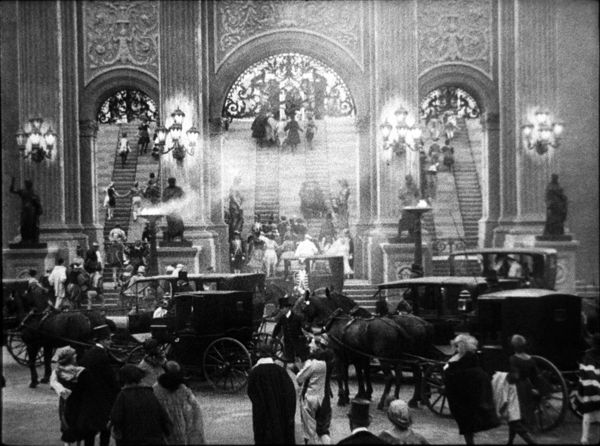
Sappho (1921).
DB here:
Of the big-ass explosion movies, only two items in this summer’s spate of them have intrigued me. I liked Mad Max: Fury Road well enough, but not as much as MM2 and 3. I look forward to Mission: Impossible—Rogue Nation, in a series for which I have much affection. As for the arthouse releases, the ones I’ve already seen are A Pigeon Sat… (good but not as sardonically bizarre as earlier Andersson, methinks) and About Elly. That one is a masterpiece.
I have stronger reasons than indifference for missing so much, and for tardy blogging besides. I’ve been on my annual trip to Belgium for research and lecturing in the Summer Film College. As a result, your recent movie experiences and mine have been divergent, perhaps even insurgent.
Apart from two screenings in the Brussels Cinematek’s Hou series (their restoration of Green, Green Grass of Home, gorgeous vintage print of City of Sadness), I spent the last four weeks watching 35mm prints of movies by Godard, movies starring Burt Lancaster, and assorted silent films from the 1910s and 1920s. I also re-met one of the most charming directors I know of, and in general had a hell of a time.
Today’s entry focuses on my archive work. Next up, a report on the Summer Film College.
Conrad’s many moods, mostly unhappy
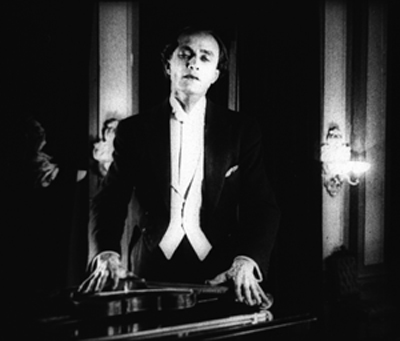
Landstrasse und Grosstadt.
The archive stuff was recherché. I’ve been trying to see as many 1910s and early 1920s features as I could, but this time around I didn’t catch anything as mind-bending as Jasset’s Au pays de ténébres (1911) or Doktor Satansohn (1916) or Fabiola (1919) or I.N.R.I (1920), encountered on earlier visits to the Cinematek. I did get further confirmation that in Germany the “tableau style” exploited so vigorously in Europe and somewhat in America in the 1910s, was pretty much replaced by Hollywood-style editing by 1920. And I got some welcome doses of Conrad Veidt, another favorite in this vicinity.
In Die Liebschaften des Hektor Dalmore (“The Liaisons of Hektor Dalmore,” 1921), Veidt plays a callous playboy who keeps on retainer a man who looks very much like him. It’s a lifestyle choice. When a compromised woman’s father demands that Hektor do the right thing, he sends out his double to marry her. Surprisingly, the double isn’t rendered through trick photography. Richard Oswald, always a fast man with a gimmick, found a pretty good Veidt lookalike, which can’t be easy to do.
The hero’s Casanova complex carries him from dalliance to dalliance, and as you’d expect in a twins situation, there are confusions between the real and the fake Hektor. Fights and abductions liven things up. The climax is a duel in which the real Hektor, overconfident, learns to his grief that an outraged husband is a better marksman. The scene is handled through brisk shot and reverse-shot, garnished with an over-the-shoulder shot as Hektor aims his pistol. And there are dashes of mildly Expressionist set design (furnished by Hans Dreier). Veidt in a phone booth does the décor proud. But he doesn’t need fancy sets to project a feeling: on his deathbed, his expression and his clutching fingers show a man bereft of erotic illusions.
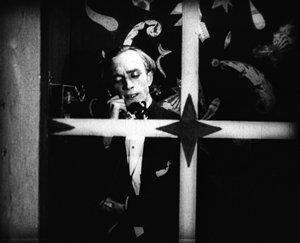
The other Veidt vehicle lacked doubles but not ambition. Landstrasse und Grosstadt (“Village and City,” 1921) casts him as Raphael, a wandering violinist who teams up with Migal, an organ grinder. They become a popular act in the big city, and as Raphael’s playing improves, Migal becomes his manager. Nadia, a woman who joins them, falls for Raphael and shares his success. But in an accident he suffers a hand wound and his career slumps. Migal sees his chance to move in on Nadia. Perhaps this shot gives you a hint of his designs.
Actually, most of Landstrasse and Grosstadt isn’t as hammy as this. A very nice shot shows Raphael in silhouette approaching a mansion to hear his rival Cerlutti give a salon concert. And of course Conrad gives the blind violinist a delicate, spectral pathos, as shown above.
Artificial man lurks in the shadows, destroys humanity
Sappho.
All the films I saw broke down scenes into many close shots, reminding us that Caligari (released 1920) probably wasn’t typical of German staging or cutting of that moment. It now seems to me almost consciously anachronistic, rejecting the reverse angles and precise scene breakdown that were becoming common. In Die Ehe der Fürstin Demidoff (“The Marriage of Fürstin Demidoff,” 1921), when a governess drags a recalcitrant girl back to her bedroom, the action is split up into four shots, all of different scales from close-up to long-shot.
Although I saw a fragmentary print of Sappho (1921), it’s clear that in parts it has the audacious monumentality of a Joe May production. The most staggering shot is that of the Opera surmounting today’s entry, but there’s no shortage of striking images. Above I include a shot of a madman that, thanks to window reflections, suggests his split-up psyche.
Sappho also doesn’t shirk editing effects either. During a frantic automobile ride, there are glimpses of hands on a steering wheel, a foot on brakes, panicked passengers, and POV shots through the windshield. Forty-nine shots rush by in a flurry, anticipating similar sequences in French Impressionist films like L’Inhumaine (1924). Feuillade was experimenting with rapid cutting of action at about the same time.
The most impressive, and nutty, film in this batch came from Homunculus, the largely lost German serial released through 1916 and into early 1917. The script was written by one of the blog’s favorite peculiar directors, Robert Reinert. The plot involves an artifical man created in the lab, à la Frankenstein’s monster. He’s a superman, in both strength and ambitions. The only surviving episode of the serial is Die Rache des Homunculus (“The Revenge of Homunculus,” 1916). (But see the codicil.) In this installment, posing as Professor Ortmann, Homunculus decides to drive humanity to destroy itself. He assumes a disguise to rouse the rabble, even inducing them to turn against himself in his Ortmann guise.
As in Expressionist drama, this overachiever is pitted against a crowd that, in the end, pursues him maniacally.
Director Otto Rippert gives us splendid mass effects in a quarry and along a beach, but there are also deep tableau images and sustained chiaroscuro, particularly in a showing the heroine Margot shrinking from Homunculus as he locks his rival in a dungeon.
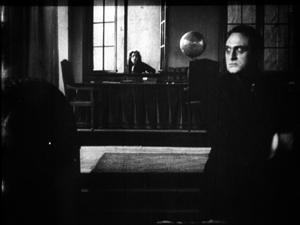
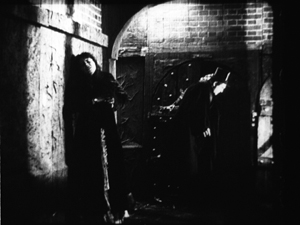
Fans of Metropolis will notice that Rippert anticipates Lang’s unison choreography of crowds, as well suggesting that mob frenzy can create a sort of ecstasy in the woman who’s swept along.
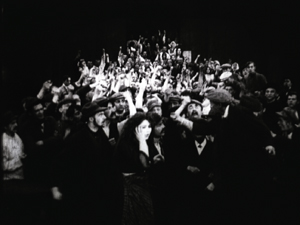

In her book The Haunted Screen Lotte Eisner traces the films’ mass spectacle back to the stage work of Max Reinhardt and other theatre directors of the era. On the basis of this episode alone, Homunculus ranks with Algol and May’s Herrin der Welt as an example of big-scale fantasy in German silent cinema. Who needs Ant-Man when we have Homunculus?
Next time: Burt and Jean-Luc, together again for almost the first time.
Thanks to Nicola Mazzanti, Francis Malfliet, Bruno Mestdagh, and Vico de Vocht for their assistance during my visit to the Cinematek.
Kristin analyzes stylistic conventions of German cinema of this period in her Herr Lubitsch Goes to Hollywood (available for download here). She’s written on Caligari here and here.
A so-so copy of Sappho is on YouTube.
On Homunculus, Leonardo Querisima offers a wide-ranging discussion in “Homunculus: A Project for a Modern Cinema,” in A Second Life: German Cinema’s First Decades, ed. Thomas Elsaesser and Michael Weidel, pp. 160-167. Substantial excerpts can be found here.
Munich archivist Stefan Drössler has recovered a mass of Homunculus footage and has assembled a version of the serial, which premiered last year in Bonn. Nitrateville has the story.
The Brussels Cinematek will release its Hou restorations on DVD early next year: Cute Girl, The Boys from Fengkui, and Green, Green Grass of Home. As a reminder, my video lecture on Hou is here.
The still below, taken as the prints were readied for the Summer Film College, points ahead to our next entry–number 701, as it turns out.