




Archive for the 'Readers’ Favorite Entries' Category
Is there a blog in this class?
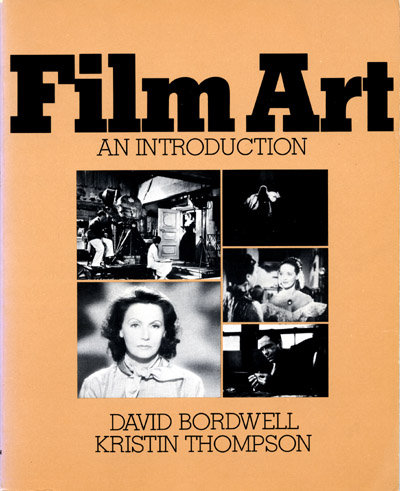
First edition, Addison-Wesley, 1979
Kristin here–
As our blog’s name suggests, we started it partly so we could write about subjects that would be of interest to lovers of cinema. It’s also a resource upon which teachers, students, and general readers using our textbook, Film Art: An Introduction, can draw. For that matter, many entries contain material that is pertinent to Film History: An Introduction as well. The entries are written in a more informal fashion than are the textbooks, but they often extend or elaborate points made in the books.
Now that universities here in the U.S. and in many other countries are beginning their autumn semesters, it seemed a good time for us to suggest some possibilities for using specific blog entries to cast light on topics in our text.
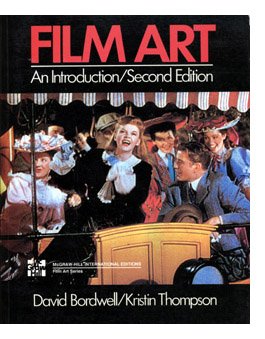
Second edition, Random House, 1986
 First, there are some general entries that might aid the teacher as courses begin. For those who show excerpts from DVDs in classes and are nervous about copyright issues, my piece, “Film educators no longer criminals” will be reassuring. It explains how last year fair-use exemptions covering just that situation were put into effect last year. Create that Powerpoint lecture or bring a DVD into class to analyze with impunity.
Teachers often confront the problem of overcoming students’ resistance to subtitled, black-and-white, and/or silent films. My entry “Subtitles 101” might be of some help in persuading them to be more open to viewing unfamiliar kinds of films. David’s “From Hollywood to Atlanta to us,” on the huge variety of films to be found on Turner Classic Movies, suggests the delights of having access to such a wide range of cinema history. (Also check out Jim Emerson’s recent “Gimme them old-time furrin pictures” on his Scanners blog.)
For students who don’t see a difference between watching films on an iPod and a cinema screen, David ruminates on some of the advantages and disadvantages of the tiny digital image in “Area man lives in fear that attractive woman will ask what’s on his iPod.” Similarly, for those who confidently expect to be able to find anything they need for viewing or researching term papers online, my “The Celestial Multiplex” might prove an eye-opener.
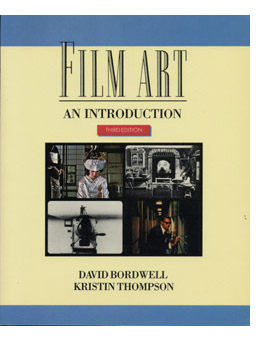
Third edition, McGraw-Hill, 1990
 Chapter 1 begins by briefly introducing film as an art form. David’s entry, “But what kind of art?” could be used to fill out that section, though it is most appropriate for film majors and advanced classes.
The chapter also differentiated between studio and independent filmmaking. David’s “Independent film: how different?” is relevant here. For a discussion of the auteur theory as contested by one prominent Hollywood writer, Joe Eszterhas, see David’s “Who the devil wrote it? (apologies to Peter Bogdanovich).”
These days news sources cover the weekend box-office figures and rank the highest grossing films. The raw figures don’t tell the whole story, though, since they don’t specify how many theaters each title is showing in or how big each film’s production budget was. A film playing in only a few theaters might be low on a list, but if it is making thousands of dollars more per theater, it might ultimately be more successful. A low-budget film doesn’t need to gross as much to become profitable as a costly epic does. My “What won the weekend, or, How to understand box-office figures” adds some nuances to the simple lists reporters give us each Monday.
Chapter 2 includes a section on “Formal Expectations.” One of the effects of creating expectations can be suspense. In “This is your brain on movies, maybe,” David explores why viewers enjoy watching films where they know the outcome, either through having seen the film before or because the story is based on real events—in this case United 93.
Chapter 3 is devoted to cinematic storytelling. A sample analysis of narrative organization can be found outside the blog, in David’s online essay on Mission: Impossible III. On our very first blog entry, back in September 2006, we quoted the director of One Hour Photo explaining how he rethought the film’s original plot structure so as to maximize curiosity. In the same chapter, we include “Openings, Closings, and Patterns of Development” as one of the principles of narrative construction. David’s blog entry “First shots” discusses some of the ways filmmakers have historically used first shots to plant narrative information, introduce motifs, establish tone, and, in recent decades, to lead off with a dense, virtuoso moment to be savored as such.
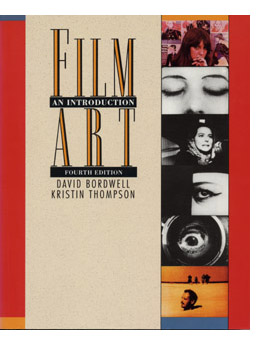
Fourth edition, McGraw-Hill, 1993
 Recent years have seen sequels, prequels, series, and other forms of extended narratives being used more pervasively in Hollywood cinema. My “Originality and origin stories” discusses the phenomenon of the film that jumps back to an early stage in the life of a character in a previous film. David explores two other current trends, toward narratives involving networks of criss-crossing characters and those that play self-consciously with plot, in “An appetite for artifice.”
Does the increasing consumption of films on DVDs rather than in theaters change the way we watch and understand narratives? Does the remote control encourage us to manipulate what we’re seeing in ways unexpected by the filmmakers? David tackles that question in “New media and old storytelling.”
One of the most popular topics covered in Chapter 4, on Mise en scene, is acting. In “Good actors spell good acting,” I consider how a focus on an impressive performance can sometimes lead a critic to downplay other aspect of a films. An older tradition of ensemble performance in relation to camera position gets some analysis in “Watching movies very, very slowly.”
David’s fascination with modern styles of cinematography (Chapter 5) and editing (Chapter 6) is evident in several entries, most illustrated with many frame enlargements. In “Can they make ‘em like they used to? continued,” he deals with foreground objects and depth of focus. His essay on “Shot-consciousness” examines a specific type of framing that places the characters against a flat background and frontally facing the camera—a technique he terms “planimetric framing.”
In another entry on cinematography, “Funny framings,” David explores how the manner in which the camera frames its subject can create humor. This has been one of our most popular entries, as is evidenced by the number of people who wrote to David with their favorite examples. In “Walk the talk,” David discusses the specific sort of tracking shot that follows characters talking with each other.
Occasionally our blog gets caught up in a topic that has generated controversy among critics. One of these is the use of fast cutting and abnormally fast, out-of-focus camera movements in The Bourne Ultimatum. Nausea-inducing excess or deliberately disorienting style? In two entries, David argues that the hyperactive camera is largely unmotivated and distracting: “Unsteadicam chronicles” and “[insert your favorite Bourne pun here].”
One of our first entries to gain widespread attention was David’s discussion of story structure and editing in “The Departed: no departure.” He discussed the increasing rapidity of Scorsese’s cutting and linked it to a broader trend of intensified continuity in American cinema. That trend is explained further in “Intensified continuity revisited.” In the case of The Good German, a film that claimed to mimic classical Hollywood films of the 1940s and 1950s, David discussed the concept of “coverage” in traditional filming. See his “Cutting remarks on THE GOOD GERMAN, classical style, and the Police Tactical Unit.”
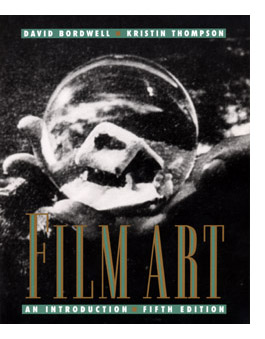
Fifth edition, McGraw-Hill, 1997
 In teaching non-classical approaches to film editing, David’s “Another pebble in your shoe” might be useful. There David discusses how Lars von Trier used multiple cameras to film scenes and a computer to dictate seemingly random cutting in The Boss of It All.
Chapter 6 includes a section on “Rhythmic Relations Between Shot A and Shot B.” There we discuss the number of frames in each shot as a measure of screen duration. David talks about counting frames in film vs. various video formats in “My name is David and I’m a frame-counter.”
In our extended analysis of continuity editing in the opening scene of The Maltese Falcon, we discuss the technique of shot/reverse shot—the basic editing pattern used in conversation scenes in classical films. “Angles and perceptions” discusses this technique and what happens when a scene holds on a shot of one speaker without cutting to the reverse shot. Late in “Walk the Talk,” there’s an analysis of how continuity editing can be coordinated with staging and framing.
When watching a film, we seldom perceive the sound tracks as a blend of many separate recordings. It comes across as a seamless sonic accompaniment to the images. David had the opportunity to sit in on a sound-mixing session for the new film 3:10 to Yuma, directed by James Mangold. He describes that experience in “Christian Bale picks up a rail.” (This could provide an additional example for the section of Chapter 7 entitled, “Selection, Alteration, and Combination,” pp. 268-272.)
In Chapter 8 of Film Art we use Citizen Kane as our summary instance of film style. Some blog entries that deal with style in specific films include: “TANGO marathon” (on Béla Tarr’s epic Sátántangó); “Not back to the future, but ahead to the past” (on Steven Soderbergh’s attempt to mimic 1940s Hollywood style in The Good German); and “Classical cinema lives! New evidence for old norms” (on computer-generated special effects and their narrative functions).
Sixth edition, McGraw-Hill, 2001
 In Chapter 9, we deal with film genres. In “Swords vs. lightsabers,” I talk about the cyclical nature of genres, suggesting that science-fiction films are waning in popularity just as fantasy films are becoming popular.
Chapter 10 examines documentary, experimental, and animated films. Pixar is currently at the forefront of Hollywood animation. I’ve written on Cars in “Reflections on cars,” and David and I have a dialogue on Ratatouille in “Rat rapture.” In “By Annie standards,” I discuss why recent animated films are often better than live-action ones. David offers an appreciation of Disney’s classic features in “Uncle Walt the artist.”
We dicuss experimental filmmakers in “Lewis Klahr, X 3, X 4” (David), “3 notions about CREMASTER 2” (David on Matthew Barney’s cycle of films), and “Len Lye, renaissance Kiwi” (me on New Zealand’s great creator of experimental animation).
Chapter 11 ends with a section on “Writing a Critical Analysis of a Film.” David’s entry, “Watching movies very, very slowly,” gives a vivid demonstration of how we go about the research that goes into a detailed film analysis.
Some of our blog entries could be read in relation to more than one chapter. David’s “Charlie, meet Kentaro,” on the Charlie Chan and Mr. Moto B-film series, deals with film history, style, and ideology.
Seventh edition, McGraw-Hill, 2004
 For musings on the relationship of early cinema to Victorian painting, see David’s “Professor sees more parallels between things, other things.”
David’s book, Ozu and the Poetics of Cinema, is now available online. For details, see his “I wrote a book, but …; or, what did the professor forget?”
Some teachers dealing with the classical Hollywood cinema of the 1930s to 1950s may wish to cover the B movie. Grad students and alumni of the University of Wisconsin film-studies program contribute to a dialogue on the subject in “Bs in their bonnets: A three-day conversation well worth the reading.”
We deal with the important institution of film festivals. I review a book on one of the most important of these festivals in “Cannes: Beyond the art, hype, and politics.”
When the second edition of Film History came out, two of the auteurs whose careers we examine in Chapter 19 were still alive. Now Ingmar Bergman and Michelangelo Antonioni have both died, and on the same day. David’s “Bergman, Antonioni, and the stubborn style” could make a coda for our chapter sections on those directors.
For updated information on Asian cinema, check the tags on the right. For recent Danish cinema, see David’s, “My Danish December.”
At intervals we report from film festivals we attend. So far such reports have come from the 2006 Vancouver Film Festival, the 2007 Hong Kong Film Festival, Roger Ebert’s Overlooked Film Festival (aka “Ebertfest,” 2007), and Il Cinema Ritrovato (“Rediscovered cinema,” in Bologna, Italy, 2007). These reports deal with the people we meet there, the films we see, and the institutions that run the festivals. We’ll continue to write such dispatches during our travels. Most of these reports have multiple parts, so be sure to follow the links.
As I said at the outset, our blog can serve as a supplement to our textbooks. We usually don’t, however, write new entries with that in mind. As we see recent films, revisit old ones, read books, and see information posted on the internet, we find inspiration to engage with the cinema in fresh ways. We find ourselves making contact with people we had never met and reconnecting with colleagues we have not heard from in decades. We hope that we are learning as we go along and passing along some of that learning to readers of Film Art and Film History.
Note: Elsewhere on this website there is a section on Film Art. Here you can find a list of corrections for errata in the 8th edition. We also include all of the sample analyses that have been cut from various editions: The Man Who Knew Too Much, Stagecoach, Hannah and Her Sisters, Desperately Seeking Susan, Day of Wrath, Last Year at Marienbad, Innocence Unprotected, Clock Clearners, Tout va bien, High School.
[November 15, 2009: See also the 2008 and 2009 updates on more recent blog entries.]
Eighth edition, McGraw-Hill, 2008
Unsteadicam chronicles
DB again:
A spectre is haunting contemporary cinema: the shaky shot.
Viewers have been protesting for some years now. I recall friends asking me why the images were so bumpy in Woody Allen’s Husbands and Wives and Lars von Trier’s Dancer in the Dark. The Bourne Ultimatum, this summer’s wildest excursion into Unsteadicam, has put the matter back on the agenda.
If you drop in at Roger Ebert’s website, you’ll find many annoyed comments from readers about what one calls the Queasicam. The writers make shrewd points about the purpose and effects of director Paul Greengrass’s technique. I’ll try to add some historical perspective and a little analysis.
From whose Bourne no traveling shot returneth
First, what exactly are we talking about? Some viewers and critics think the jarring quality of the movie proceeds from rapid editing. The cutting in Bourne Ultimatum is indeed very fast; there are about 3200 shots in 105 minutes, yielding an average of about 2 seconds per shot. But there are other fast-cut films that don’t yield the same dizzy effects, such as Sky Captain and the World of Tomorrow (1.6 seconds average), Batman Begins (1.9 seconds), Idiocracy (1.9 seconds), and the Transporter movies (less than 2 seconds).
As for the series itself, The Bourne Identity, directed by Doug Liman, was edited a tad slower, averaging 3 seconds per shot. The second entry, The Bourne Supremacy, also signed by Greengrass, was as fast-cut as this, coming in at 1.9 seconds. People noticed the rough texture of the second one, but it didn’t arouse the protests that this last installment does. Something else is up.
Partly, it’s not the pace of the editing but the spasmodic quality of it. Cuts here seem abrasive because they interrupt actions and camera movements. Pans, zooms, and movements of the actors are seldom allowed to come to rest before the shot changes. This creates a strong sense of jerkiness and visual imbalance.
Still, a lot of the film’s effect has to be laid at the handheld camera. The technique in itself, however, shouldn’t shock us. The handheld aesthetic has been with us a long time. There were silent-era experiments with the technique by E. A. Dupont (Variety, 1925) and Abel Gance (Napoleon, 1927). It recurred sporadically after that, but in mainstream cinema handheld shooting became common in 1960s films as different as The Miracle Worker, Seven Days in May, Dr. Strangelove, and the dramas of John Cassavetes. Today, many films from Asia and Europe as well as the US rely on the device all the way through. The Danes call it the “free camera,” and I write about it here. The trend is so widespread that it’s been satirized: In the Danish comedy Clash of Egos (2006), when an ordinary workman gets a chance to direct a movie, he insists that the camera be put on a tripod, and the cinematographer complains that he hasn’t done this since film school. Directors nowadays tell us that they are in search of energy, a moment-by-moment spiking of audience interest. You can get it through fast cutting, arcing camera movements, sudden frame entrances, the nervousness of the handheld shot, or all of the above.
Roughhouse
I think the upsetting qualities of the visuals in The Bourne Ultimatum derive principally from the particular way the handheld camera is used. Several of Ebert’s writers complain that the camerawork made them nauseated, and there seems little doubt that the shots are bouncier and jerkier than in much handheld work. Adding to the effect is the fact that Greengrass often doesn’t try to center or contain the main action. Sometimes, as in a fight scene, the camera is just too close to the action to show everything, so it tries to grab what it can. At other times Greengrass pans away from the subject, or shoves it to the edge of the 2.40:1 frame. In the standard technique of over-the-shoulder reverse angles, we see one character’s shoulders in the foreground and the primary character’s face clearly. Greengrass likes to let a neck or shoulder overwhelm the composition as a dark mass, so that only a bit of the face, perhaps even just a single eye, is tucked into a corner of the shot. This visual idea was already on offer in The Bourne Supremacy.

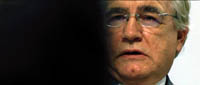
In The Way Hollywood Tells It, I described contemporary films as employing “intensified continuity,” an amplification and exaggeration of tradition methods of staging, shooting, and cutting. (I explain a little about it in this blog entry.) What Greengrass has done is to roughen up intensified continuity, making its conventions a little less easy to take in. Normally, for instance, rack-focus smoothly guides our attention from one plane to another. But in The Bourne Ultimatum, when Jason bursts into a corridor close to the camera, the camera tries but fails to rack focus on his pursuer darting off in the distance. The man never comes into sharp focus. Likewise, most directors fill their scenes with close-ups, and so does Greengrass, but he lets the main figure bounce around the frame or go blurry or slip briefly out of view.
Essentially, intensified continuity is about using brief shots to maintain the audience’s interest but also making each shot yield a single point, a bit of information. Got it? On to the next shot. Greengrass’s camera technique makes the shot’s point a little harder to get at first sight. Instead of a glance, he gives us a glimpse.
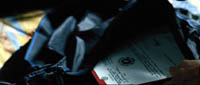
Although this strategy is more aggressive in this third Bourne installment, we can find it as well in Supremacy. An agent pulls a document out of a carryon bag, and for an instant we can see the government seal. In the next shot the agent bobs in and out of the frame, as if the camera can’t anticipate his next move.
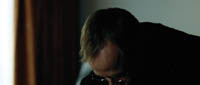
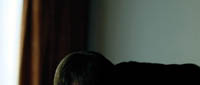
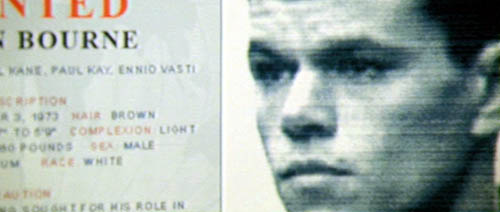
Later in Supremacy, the camera jerks across a computer display and suddenly focuses itself, evoking the jumpy saccadic flicks with which we scan our world.


Greengrass claims that his creative choices were influenced by the cinema-vérité documentary school and cites as well The Battle of Algiers, which helped popularize the handheld look in the 1960s. At other times he says that the style is subjective: “Your p.o.v. is limited to the eye of the character, instead of the camera being a godlike instrument choreographed to be in the right place at the right time.” But our point of view isn’t confined to what Bourne or anybody else sees and knows. The whole movie relies on crosscutting to create an omniscient awareness of various CIA maneuvers to trap him. And if Bourne saw his enemies in the flashes we get, he couldn’t wreck them so thoroughly.
The Bourne Ultimatum belongs to a trend of rough-edged stylization sometimes called run-and-gun. The film has been described as bare-bones but it’s actually quite flashy. All the crashing zooms (accompanied by whams on the soundtrack), jittery shots, drifting framings, uncompleted pans, freeze-frame flashbacks, and other extroverted devices call attention to themselves. You can find earlier instances in Oliver Stone’s Natural Born Killers and U-Turn, along with stretches in Michael Mann’s latest films. In milder form you find the style on display in TV crime shows, as well as in the notorious docudrama The Road to 9/11.
The most extreme practitioner of this style is probably Tony Scott. From Spy Game through Man on Fire, Domino, and Déjà vu, he has taken this aesthetic in delirious directions. His framing is often restless, as if groping for the right composition. In this shot from Domino, the camera starts a bit too far to the right, shifts left to frame Frances a little better, zooms back hesitantly, then finally stabilizes itself as he grins at the Motor Vehicles worker.

A single shot may give us not only changes of focus but jumps in exposure, lighting, and color; sometimes it’s hard to say whether we have one shot or several. The result is a series of visual jolts, as in Man on Fire.
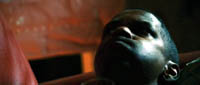



Scott, trained as a painter, pushes toward a mannered, decorative abstraction, aided by long-lens compositions and a burning, high-contrast palette. For Supremacy, Greengrass adopted a toned-down version of Scott’s approach, while in Ultimatum, he favors drab surroundings and steely colors. Still, both men’s approaches to run-and-gun are frankly artificial, and both remain within the premises of intensified continuity. Of the Waterloo Station sequence Greengrass says: “It has got a sense of energy.”
The Bourne coverup
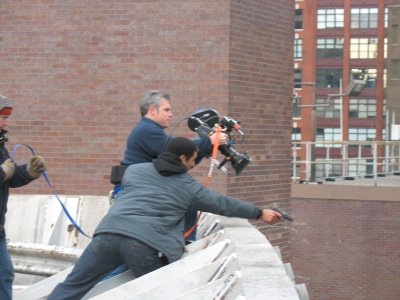
There’s one more function of Bourne’s style I want to consider. In an earlier post, I quoted Hong Kong cinematographers’ saying about the shaky camera. The handheld camera covers three mistakes: Bad acting, bad set design, and bad directing. It’s worth considering, as some of Ebert’s correspondents do, what Greengrass’s style may serve to camouflage. One suggests that because the cutting doesn’t let the viewer reconstruct the fights blow by blow, anybody can seem to be a superhero if the filming is flurried enough.
Just as important, the director who is just (apparently) snatching shots doesn’t have to worry about building up performances slowly; s/he can simply give us the most minimal, stereotyped signals in facial close-ups. Lengthier shots let the actor develop the character’s reactions in detail, and force us to follow them. Classic studio cinema, with its more distant framings and longer takes, lets you follow the evolution of a feeling or idea through the actor’s blocking and behavior. The villain in the average Charlie Chan movie displays more psychological continuity than the nasty agents in Bourne Ultimatum.
Moreover, run-and-gun technique doesn’t demand that you develop an ongoing sense of the figures within a spatial whole. The bodies, fragmented and smeared across the frame, don’t dwell within these locales. They exist in an architectural vacuum. In United 93, the technique could work because we’re all minimally familiar with the geography of a passenger jet. But in The Bourne Ultimatum, could anybody reconstruct any of these stations, streets, or apartment blocks on the strength of what we see? Of course, some will say, that’s the point. Jason himself is dizzyingly preoccupied by the immediacy of the action, and so are we. Yet Jason must know the layout in detail, if he’s able to pursue others and escape so efficiently. Moreover, we can justify any fuzziness in any piece of storytelling as reflecting a confused protagonist. This rationale puts us close to Poe’s suggestion that we shouldn’t confuse obscurity of expression with the expression of obscurity.
The run-and-gun style is indeed visceral, but let’s be aware of how it achieves its impact. I’ve argued in Planet Hong Kong that the clean, hard-edged technique of classic Hong Kong films allows extravagant action to affect us viscerally; by following the action effortlessly, we can feel its bodily impact. We’re shown bodies in sleek, efficient movement that gets amplified by cogent framing and smooth matches on action. But in the fancy run-and-gun style, cinematography and sound do most of the work. Instead of arousing us through kinetic figures, the film makes bouncy and blurry movement do the job. Rather than exciting us by what we see, Greengrass tries to arouse us by how he shows it. The resulting visual texture is so of a piece, so persistently hammering, that to give it flow and high points, Greengrass must rely on sound effects and music. As a friend points out, we understand that Bourne is wielding a razor at one point chiefly because we hear its whoosh.
What else does the handheld style conceal? Since the 1980s, in many action pictures the cutting has become so fast, and often capricious, that we can’t clearly see the physical action that’s being executed. That complaint is justified in Bourne Ultimatum, certainly, but here the style also seeks to make the stunts seem less preposterous. Instead of showing cars crashing and flipping balletically, Greengrass barely lets us see the crash. All the conventions of the action film are smudged in Bourne Identity, as if a sketchy rendering made them seem less outlandish. In a Hong Kong film, Bourne in striding flight, grabbing objects to use as weapons without missing a beat, would be presented crisply, showing him executing feats of resourceful grace. But many viewers seem to find this sort of choreography outlandish or cartoony. So when Bourne plucks up pieces of laundry and wraps them around his hands to protect them when he vaults a glass-strewn wall, Greengrass’s shot-snatching conceals the flamboyance of the stunt.
Finally, I’d argue that the style camouflages something else: plot problems. I’m not talking about the hero’s indestructibility, which is a given in this genre. John McClane in Die Hard 4.0 survives about as much mayhem as does Jason Bourne. But there are some howlers here that, because of the rapid pace and the just-barely-visible action, are somewhat muffled. By whisking the action past us and forcing us to keep up, the film doesn’t allow us to dwell on its holes and thin patches.
The plot, praised by so many, is actually a very simple one: Find Guy A, but when he’s killed, locate the clues that will lead you to Guy B, etc. until you get to Mr. Big. The mechanics of how the clues are pursued remain obscure. (Skip ahead to the next paragraph if you haven’t seen the movie.) Why would an all-powerful CIA operation house its key players in offices that can easily be watched from a neighboring building? How does Bourne get into Noah Vosen’s office, past all the security? Is the revelation of Bourne’s identity and his training regimen really much of a surprise? The wrapup, showing the bad guys exposed by the press and punished by government investigation, seemed risible, not only because of the current inability of either press or congress to right any wrongs, but because I had no idea to whom Pamela Landy has faxed the incriminating documents. “You can’t make stuff like this up,” remarks one sinister agency boss, but many, many films have done so.
I’m not against handheld styles as such, and even Late Tony Scott Rococo can have its virtues. Yet I find the style as practiced by Greengrass to be pretty incoherent and nowhere near as engaging as most critics claim. It just seems too easy. But then, I think that certain standards of filmmaking craftsmanship have pretty much vanished, and the run-and-gun trend is one more symptom of that. Given the praise heaped on The Bourne Ultimatum, however, things are unlikely to change. Next time you head to the movies, you might want to bring your Dramamine.
Thanks to Vance Kepley and Jeff Smith for engaging discussion about The Bourne Ultimatum.
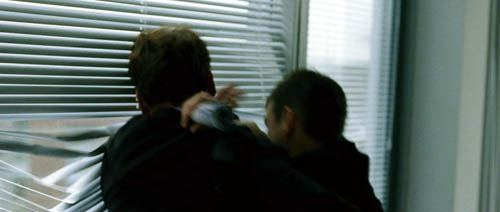
The Bourne Supremacy.
PS: I’ve done a followup entry on the Bourne series, elaborating on these points and adding some new ones.
PPS: One more, I hope final, cluster of comments on Ultimatum, this time on the plotting.
PPPS 5 January 2008: Spielberg weighs in on the Bourne style; thanks to Fred Holliday and Brad Schauer for calling my attention to this.
PPPPS 22 September 2008: This blog post and its mates have stimulated critical discussion in Spain. Manuel Garin has a lengthy piece on the Unsteadicam style in Contrapicado.
Bergman, Antonioni, and the stubborn stylists
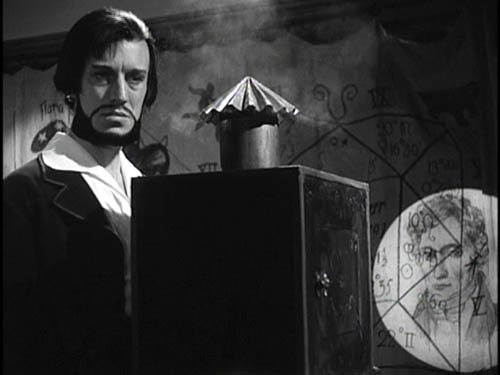
DB here:
Jonathan Rosenbaum has created quite a stir. His New York Times Op-Ed piece, “Scenes from an Overrated Career,” offers a fairly harsh judgment on the films of Ingmar Bergman. In one sense the timing was awkward; the poor man had just died. But the article wouldn’t have attracted much attention if Rosenbaum had waited a few months, so if creating a cause célèbre was his goal, he chose the right moment.
Timing aside, there wasn’t much in the piece that hasn’t been said by certain cadres of cinephiles for decades. Back in the 1960s, people called Bergman “theatrical,” “uncinematic,” pretentious, and intellectually shallow. He was even accused of hypocrisy. His spiritual, philosophical films always seemed to depend on a surprising number of couplings, killings, rapes, and gorgeous ladies, often naked. Rosenbaum contrasts Bergman with Bresson and Dreyer, more austere religious filmmakers as well as great formal innovators, and this gambit too is familiar from late-night film-society disputes. Jonathan’s case is news in the good, grey Times, but it’s an old story among his (my) generation.
I think that this generational antipathy has many sources. While Bergman had considerable academic cachet, this may have hurt him with smart-alecks like us. Cinephile priests and professors told us that Bergman was a great mind, but we suspected them of snobbery, for they often disdained even foreign filmmakers who dabbled in popular genres. Kurosawa was admired for Rashomon and I Live in Fear rather than for Seven Samurai and Yojimbo. And many of Bergman’s intellectual fans despised the classic tradition of American studio film. Hitchcock had not yet convinced literature profs of his excellence, and Ford was a gnarled geezer who made Westerns. Bergman and his acolytes seemed just too square. Our money was on Godard, especially after Susan Sontag’s magisterial essay on him.
Furthermore, some critics were on our side. Pauline Kael, with her nose for elitism, mocked ambitious European experiments like Marienbad. Andrew Sarris, who had a huge influence on our generation, initially registered respect for the arthouse kings. They proved that an artist could put a personal vision on film, thus buttressing the auteur approach to criticism. But Sarris retreated fairly fast. He was more unflaggingly enthusiastic about American popular cinema, and by contrast he often characterized the new Europeans as gloomy, middlebrow, and narcissistic. (He did, after all, coin the phrase “Antonionennui.”) Sarris made it possible for us to argue that, say, Meet Me in St. Louis was a better film than L’Eclisse or Winter Light. (1)
Of course I’m generalizing; no Boomer’s experience was identical with any other’s. Speaking just for myself, I didn’t have a deep love for Bergman, and I still don’t. I was drawn to his early idylls (Monika, Summer Interlude) and impressed but chilled by the official classics (Smiles of a Summer Night, The Seventh Seal, The Virgin Spring). Persona, I admit, was a punch in the face. Seeing it in its New York opening, I felt that all of modern cinema was condensed into a mere eighty minutes. But no Bergman film afterward measured up to that for me, and after The Serpent’s Egg I just lost interest, catching up with Cries and Whispers, Scenes from a Marriage, Fanny and Alexander, and a very few others over the later decades.
We can talk tastes forever. Maybe you think Bergman is great, or the greatest, or obscenely overrated. I think that there’s something more general and intriguing going on beyond our tastes. What makes this hard to see is that the venues of popular journalism don’t allow us to explore some of the ideas and questions raised by our value judgments.
Critical semaphore
Take some of Rosenbaum’s criticisms, which Roger Ebert has persuasively answered. I’d add that Jonathan is sometimes applying criteria to Bergman that he wouldn’t apply to directors he admires. Bergman isn’t taught frequently in film courses? So what? Neither is Straub/Huillet or Rivette or Bela Tarr. Bergman is theatrical? So too are Rivette and Dreyer, both of whom Rosenbaum has written about sympathetically.
More importantly, Jonathan’s critique is so glancing and elliptical that we can scarcely judge it as right or wrong. A few instances:
*Bergman’s movies aren’t “filmic expressions.” There’s no opportunity in an Op-Ed piece for Jonathan to explain what his conception of filmic expression is. Is he reviving the old idea of cinematic specificity—a kind of essence of cinema that good movies manifest? As opposed to theatrical cinema? I’ve argued elsewhere on this site that we should probably be pluralistic about all the possibilities of the medium.
*Bergman was reluctant to challenge “conventional film-going habits.” Why is that bad? Why is challenging them good? No time to explain, must move on….
*Bergman didn’t follow Dreyer in experimenting with space, or Bresson in experimenting with performance. Not more than .0001 % of Times readers have the faintest idea what Jonathan is talking about here. He would need to explain what he takes to be Dreyer’s experiments with space and Bresson’s experiments with performance.
In his reply to Roger Ebert, Jonathan has kindly referenced a book of mine, where I make the case that Dreyer experimented with cinematic space (and time). Right: I wrote a book. It takes a book to make such a case. It would take a book to explain and back up in an intellectually satisfying way the charges that Jonathan makes.
Popular journalism doesn’t allow you to cite sources, counterpose arguments, develop subtle cases. No time! No space! No room for specialized explanations that might mystify ordinary readers! So when the critic proposes a controversial idea, he has to be brief, blunt, and absolute. If pressed, and still under the pressure of time and column inches, he will wave us toward other writers, appeal to intuition and authority, say that a broadside is really just aimed to get us thinking and talking. But what have we gained by sprays of soundbites? Provocations are always welcome, but if they really aim to change our thinking, somebody has to work them through.
I’ve suggested elsewhere that too much film writing, on paper and on the Net, favors opinion over information and ideas. Opinions, which can be stated in a clever turn of phrase, suit the constraints of publication. Amassing facts and exploring ideas in a responsible way—making distinctions, checking counterexamples, anticipating objections, nuancing broad statements—takes more time. Academics are sometimes mocked for their show-all-your-work tendencies, and I grant that this can be tedious. But we’re just trying to get it right, and that can’t be done quickly.
Now you know why our blog entries are so damn long.
This one is no exception.
Too often film talk slides from being film comment to film chat to film chatter. Even our best critics, among whom Rosenbaum must be counted, make use of a kind of rapid semaphore, signaling to the already converted. Evidently his ideal reader agrees that good cinema is challenging and experimental, directing actresses is a minor talent, and being admired by upscale Manhattanites is a sign of a sellout. Readers will self-select; those who have congruent tastes will pick up the signals. But these beliefs aren’t really knowledge. They’re just, when you get right down to it, attitudes.
I’ll try to explore just one of the issues Jonathan raises but can’t pursue: the question of how stylistically innovative Bergman was. Of course, I can’t write a book here either. I offer what follows as simply the start of what could be an interesting research project.
One stylistic arc
The rise of European arthouse auteurs in film culture of the 1950s and 1960s put the question of personal style on the agenda, but back then we didn’t have many tools for analyzing stylistic differences among directors. We didn’t know much about the local histories of those imported films; as Sarris recently pointed out, L’Avventura was Antonioni’s sixth feature but was his first film released in the US. Moreover, we didn’t know much about the norms of ordinary commercial filmmaking, in the US or elsewhere. (2) Today we’re in a better position to characterize what went on. (3)
In most countries, quality cinema of the late 1940s relied on variations of the Hollywood approach to staging, shooting, and cutting that had emerged in the silent era. Directors moved their performers around the set fairly fluidly and used editing to enlarge and stress aspects of the action. You can see a straightforward example of this approach on an earlier entry on this blogsite.
Many directors of the period built upon this default by creating deep space in staging and framing. Using wide-angle lenses, directors could allow actors to come quite close to the camera, sometimes with their heads looming in the foreground, while other figures could be placed far in the distance. Several planes of action could be more or less in focus. Here’s a straightforward example from William Wyler’s The Little Foxes.
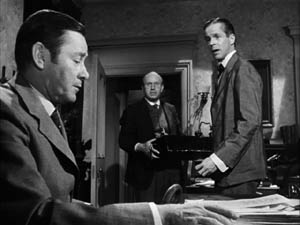
We find directors exploiting this approach not only in the United States but in Eastern and Western Europe, Scandinavia, the Soviet Union, Japan, Mexico, and South America. Here’s an instance from the French film Justice est faite (1950).
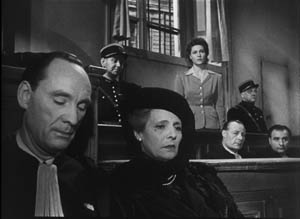
Why did this approach emerge in so many countries at the same time? We don’t really know. It wasn’t simply the influence of Citizen Kane, as we might think. The Stalinist cinema had developed deep-space shooting in the 1930s, and we can find it elsewhere. Probably Hollywood’s 1940s films helped spread the style, but there are likely to be local causes in various countries too.
In any event, during the 1950s two technological changes posed problems for this style. One was the greater use of color filming, which renders depth of field much more difficult. The other innovation was anamorphic widescreen, a technology seen in CinemaScope and Panavision. These systems also had trouble maintaining focus in many planes when the foreground was close to the camera. The flagrant depth compositions we find in black-and-white ‘flat’ films were quite difficult to replicate in color and anamorphic widescreen.
Through the 1960s, the deep-focus style became a minor option and directors found other alternatives to presenting character interactions. The most basic one was simply to station the camera at a middle distance and create a more porous and open staging, with fewer planes of action and simple panning movements to follow characters.
One new approach relied not on wide-angle lenses but on lenses of long focal length. Instead of staging scenes in depth, putting the camera close to a foreground figure, filmmakers began keeping the camera back a fair distance and using long lenses to enlarge the action. This accompanied a trend toward greater location shooting; it’s easier to follow actors on a street or highway if the camera shoots with a telephoto lens. The long lens also reduces the volumes of each plane, so that figures tend to look like cutouts (4). This lens facilitated the development of those perpendicular images I’ve called, in some writing and on this blog, planimetric shots.
What fascinates me about this general pattern of stylistic change in the US is how many of the Euro auteurs go along with it. Take Fellini, who shifts from the bold depth compositions of I Vitelloni to the fresco-like flatness of Satyricon.
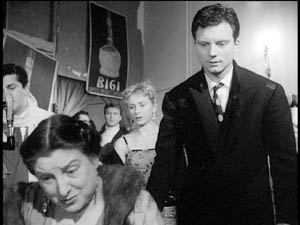
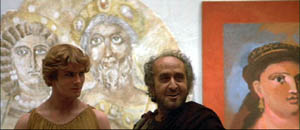
Likewise, Luchino Visconti’s early black-and-white work affords textbook examples of deep-focus cinematography, but in the 1960s he embraced the telephoto look, heightened by what we can call the pan-and-zoom tactic. In Death in Venice, the camera often scans a scene, searching out one player to follow then zooming back to reframe the figure in relation to others. One shot starts with the boy Tadzio, pans right across the hotel salon, to end on von Aschenbach, staring at the boy, and then zooming back to take in the larger scene.
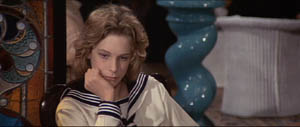
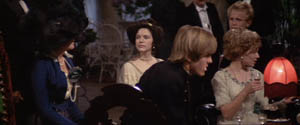
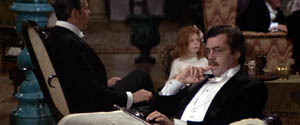
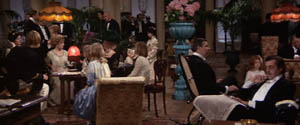
Probably Rossellini’s 1960s films, such as Viva l’Italia! and Rise to Power of Louis XIV, were key influences on this look.
Leaving Europe, there’s Kurosawa, who was the first major director I know of to build zoom and telephoto lenses into his style. Satayajit Ray followed much the same trajectory from the Apu trilogy’s flamboyant depth to the pan-and-zoom close-ups of The Home and the World. Not every filmmaker took the long-lens option, but as it became commonplace in the 1960s, many major directors tried it.
What about Bergman? It seems that in most respects he went along with the general trends. We find deeply piled-up bodies early in his career (e.g., Port of Call, below) and through the 1950s and early 1960s (The Face, below).
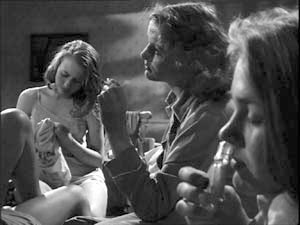
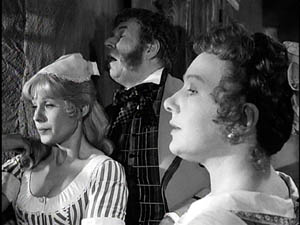
Like his peers, with color and widescreen he shifted toward more open staging, long lenses, and zooms. For example, one telephoto shot of Cries and Whispers zooms back as the little girl emerges, zig-zagging, from behind the lace curtain.
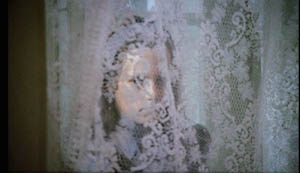
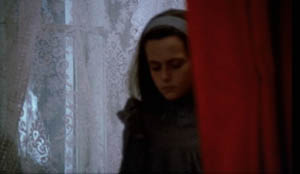
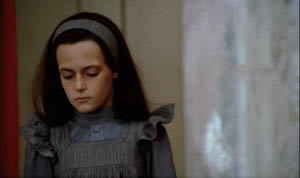
We might conclude that Bergman mostly worked with the received forms of his day. At the level of shot design, The Face might have been shot by the Sidney Lumet of Fail-Safe. But Bergman did innovate somewhat, I think. Most obviously, he sometimes had recourse to the suffocating frontal close-up, as in a childbirth scene from Brink of Life.
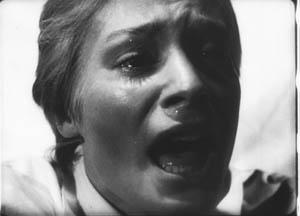
He develops this visual idea by creating heads floating unanchored in both foreground and background. Here’s a famous image from Persona.
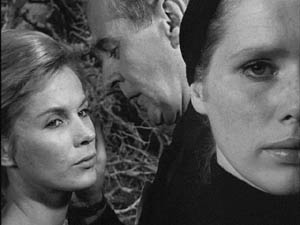
Pace Rosenbaum, I’d say that this sequence, with Elisabeth Vogler apparently quite oblivious to her husband’s mating with Alma, definitely “challenges conventional film-going habits”—or at least conventional ways we read a scene. It seems to combine the deep-space, big-foreground scheme of the 1940s with the tight close-ups of Bergman’s early work, and instead of specifying space it undermines it. We have to ask if what happens in the background is Elisabeth’s hallucination.
My case is very schematic, and we would need to study Bergman film by film and scene by scene to confirm that he stuck to the broad norms of his time. The norms themselves also deserve deeper probing than I’ve given them. (5)
But let’s push a bit further and examine Antonioni, that perpetual foil to Bergman. Broadly speaking, he passed through the same arc, from deep-focus compositions in the 1950s and early 1960s to telephoto flatness in his color work. Yet there are some important differences.
In the 1950s, unlike Bergman, Antonioni employed quite intricate staging, sustained by long takes. He usually didn’t opt for big foregrounds, favoring more distant framings and sidelong camera movements. The most famous instance is the startling 360-degree long take on the bridge in his first feature, Story of a Love Affair, but Le Amiche is also full of intricate staging in mid-ground depth. One scene shows fashion models bustling around after a successful show, congratulating the shop’s owner Clelia. She opens a card from her lover, is distracted by the arrival of her friends coming to congratulate her, and goes off with them. One model darts diagonally forward to investigate the message. All of this is handled in a single graceful take.
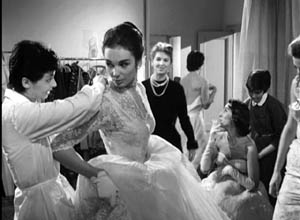
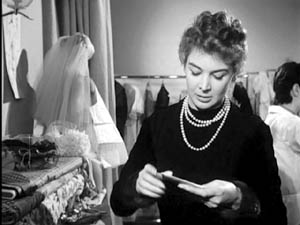
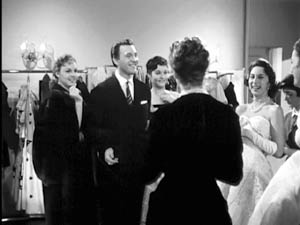
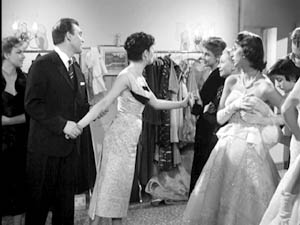
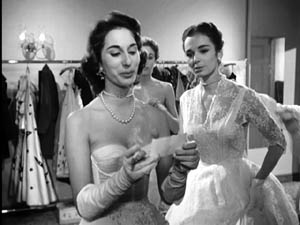
Antonioni relies on the fluid staging techniques developed in the early sound era and taken in diverse directions by Renoir, Ophuls, Preminger, Mizoguchi, and other directors of the 1930s and 1940s. Often, however, Antonioni’s characters move rather slowly and hold themselves in place, and as a result the overall spatial dynamic unfolds in marked phases. (6)
In the trilogy starting with L’Avventura, Antonioni relies on shorter takes and less florid camera movement. Now he emphasizes landscape and architecture so as to diminish the characters. If the expressionist side of Bergman plays up the psychological implications of the drama, the more austere Antonioni plays things down, “dedramatizing” his scenes by keeping the camera back, turning the figures away from us, and reminding us of the milieu. (You see the Antonioni influence on similar strategies in the work of Edward Yang, as I discussed recently on this blog.)
Once color came along, Antonioni changed his style, moving toward less dense staging and at times almost casual framing (as in The Passenger). He also had recourse to the telephoto technique, but I’d argue he brought something new to it. With Red Desert he accepted the abstraction inherent in the long lens and combined that with color design to create a pure pictorialism.
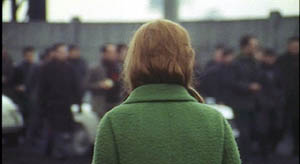
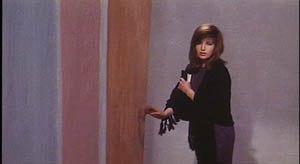
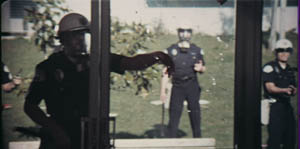
Ironically, Red Desert may have made Antonioni another sort of ‘expressionist’ than Bergman. The stylized palette of the film encourages us to ask if the industrial landscape is really so smeared and bleached out, or if we’re seeing it as Giuliana does. The same sort of painterly abstraction can be found in Zabriskie Point. In one scene, a pan over the travel decals on a family’s car window treats the boy inside as no more than another thin slice of space. Other scenes turn campus policemen into figures in grids.
You might even argue that the pan-and-zoom style gets a kind of meta-treatment in the climactic shot of The Passenger. There in a grandiose technical gesture Antonioni’s concern for architecture, his refusal to underscore a melodramatic plot twist, and his love of camera movement blend with the technology of the zoom. At the time, several of us (maybe Jonathan too) saw this shot as a response to Michael Snow’s Wavelength, relayed through the sensibility of Passenger screenwriter and avant-garde filmmaker Peter Wollen. Now it looks to me like a natural response of a very self-conscious artist to a stylistic trend of the moment.
A bestiary of stylists
To get crude and peremptory: Let’s say that once a director has reached maturity and become a confident artisan, several choices offer themselves. The filmmaker can be a flexible stylist, a stubborn stylist, or a polystylist (sorry for the awkward term).
A flexible stylist adapts to reigning norms. Bergman could be an aggressive-deep-focus director, then a pan-and-zoom director. Both approaches to staging and shooting preserved the expressive dimensions that mattered most to him: performance (chiefly face and voice), Ibsenesque bourgeois tragedy, Strindbergian play with dream and dissolution of the ego, and other elements.
Most of the major 1960s arthouse directors, from Truffaut and Wajda to Pasolini and Demy, were flexible stylists in this sense. So were a great many Hollywood and Japanese directors, such as Lubitsch and Kinoshita. Perhaps Ousmane Sembene, who also died recently, would be another instance. Buñuel becomes a fascinating case: He adopts the blandest, calmest version of each trend, creating a neutral technique, the better to shock us with what he shows.
A stubborn stylist pursues a signature style across the vagaries of fashion and technology. Dreyer from Vampyr onward does this; I argue in the book Jonathan cites that he seeks to “theatricalize” cinema in a way that goes beyond the norms of his moment. Perhaps Hitchcock and von Sternberg (at least in the 1920s and 1930s) fit in here as well. Bresson, Tati, and supremely Ozu were stubborn stylists. Give them a western or a porno to shoot, and they’d handle each the same way. (7)
This isn’t to argue that stubborn stylists never change or always do the same thing. Mizoguchi has a signature style and yet remains fairly pluralistic, at least at a scene-by-scene level. I think that the test comes in seeing how stubborn stylists persistently explore the constrained conditions they’ve set for themselves.
Signature styles help a filmmaker in the festival market, so we don’t lack for current examples of stubborn creators: Godard, Theo Angelopoulos, Hou Hsiao-hsien, Kitano Takeshi, Tsai Ming-liang, and Jia Zhang-ke. Granted, some of these may be rethinking their commitment to their stylistic premises.
A polystylist tries out different styles without much concern for what the reigning norms demand. Polystylistics holds a high place in modernist aesthetics. After the great triumvirate of Picasso, Joyce, and Stravinsky, with their bewildering arrays of periods and pastiches, the idea of the modernist as a virtuoso steeped in several styles became a powerful option. What’s been called postmodernism is no less favorable to polystylism; if you mix styles, you’ve presumably mastered them.
In cinema, some polystylists are just eclectic. Steven Soderbergh can give us the portentous pictorialism of The Underneath or Solaris, the grab-and-go look of Traffic, and the trim polish of Ocean’s 11. More deeply, there are directors like R. W. Fassbinder, Raoul Ruiz, and Oshima Nagisa who seem to pursue polystylistics on principle. It’s as if, rejecting the very idea of a signature style, they set themselves fresh, severe conditions for each project.
After The Boss of It All, we may want to count von Trier as a polystylist, not merely a director who changed his style from one phase of his career to another. Perhaps the best current example is Aleksandr Sokurov; who would dare predict what his next film will look like?
This whole entry is pretty sketchy, I grant you. The categories need further refining. I’ve ignored sound, which is very important. I’ve emphasized visual style, and just shooting and staging within that. (Nothing about lighting, cutting, etc.) So this is tentative—notes perhaps for a book-length argument. But I’ve made my point if you see that some ideas and some historical information can put intuitions about originality into a firmer framework.
And I’ve left the value judgments suspended. If you think originality trumps other criteria, then Bergman doesn’t probably come up as strong as Antonioni, let alone Bresson or Ozu or Dreyer. But if you can entertain the possibility that a great filmmaker can accept certain norms of his time, making those serve other channels of expression, then Bergman can’t automatically be faulted. At least thinking about him and his peers in the context of the history of film art gives us some data to ground our arguments. The world is more interesting and unpredictable than our opinions, especially those we formulated forty years ago.
(1) I actually hold this opinion.
(2) I assume that the arthouse auteurs were no less commercial filmmakers than their Hollywood counterparts. They were sustained by national film industries and supported by the international film trade. Eventually many were funded by Hollywood companies.
My friend and colleague Tino Balio is at work on a book tracing the role of overseas imports in the American film market of the 1940s-1960s, and it should be a real eye-opener to those who persist in counterposing art cinema and commercial production.
(3) Some of what follows is discussed in Part Four of Film History: An Introduction.
(4) I talk about both the deep-focus and long-lens tendencies in Chapter 6 of On the History of Film Style and Chapter 5 of Figures Traced in Light.
(5) For a wide-ranging account of art-cinema norms, see András Bálint Kovács’ forthcoming book, Screening Modernism: European Art Cinema, 1950-1980.
(6) I analyze this tendency, using other scenes from Le Amiche, in On the History of Film Style (pp. 235-236) and Figures Traced in Light (pp. 151-152).
(7) Suo Masayuki’s My Brother’s Wife: The Crazy Family is a softcore film made in a pastiche of Ozu’s style.
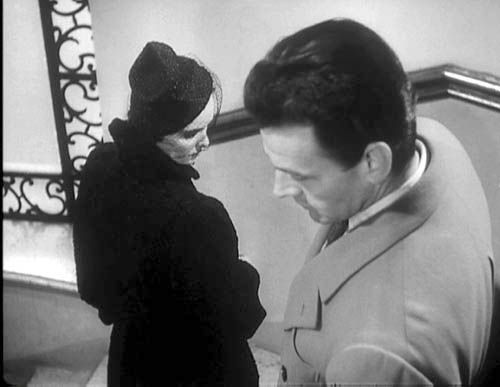
Story of a Love Affair (Cronaca di un amore).
PS, Sunday 12 August: Only a day later, new thoughts about something else I should have said about generational tastes. In the light of the Woody Allen eulogy that appears in the New York Times today, I think there’s more of a sub-generational split than I’d initially suspected. So here’s another gesture toward the sort of history of taste that Jonathan mentions.
Allen is in his seventies, a decade older than Jonathan Rosenbaum and me. He came of age in the affluent decade after the war. Allen saw Bergman films in the mid- to late 1950s, probably against the backdrop of Neorealism, British comedy, and French Cinema of Quality. In that context, Bergman’s movies looked pretty revolutionary.
But Jonathan and I came to maturity, if that’s the right word, in the mid-1960s. When I got to college in 1965, French directors (notably Resnais, Godard, Truffaut) and the Czechs, Hungarians, and others were getting established in US film culture. Bergman, Fellini, and Antonioni were already senior directors and soon they were starting to make what many of us perceived as career mistakes (Juliet of the Spirits, The Passion of Anna, even Blow-Up). Also, of course, concerns about their political alignments came more to the fore as the decade wore on. Many of my friends thought that The Battle of Algiers left all other films in the shade. These factors may have made the Boomers suspicious of “arty” foreign imports, of which Bergman’s work was a central instance. Interestingly, The Dove, a parody of The Seventh Seal and a film-society staple, came out in 1968, when Bergman may have been wearing out his welcome.
[Speaking of parodies, the SCTV skit, “Scenes from an Idiot’s Marriage”, in which Jerry Lewis (Martin Short) suffers the indignities of a cuckolded Bergman hero, is well worth checking out. The SCTV Fellini/ Antonioni parody, “Rome Italian Style,” is also pretty good, especially for its excellently awkward dubbing.]
Interestingly, Scorsese in age falls midway between Allen and us Boomers, and he contributes a Times tribute to Antonioni today. Maybe I have to split the generations even more: Bergman for 1955-1960, Antonioni for 1961-1965, Godard for 1965-1970? (Just kidding.) What strikes me are the differences in the essays. While Allen ranges widely, reports conversations, and praises Bergman in general terms, Scorsese’s piece evokes the texture of L’Avventura, suggesting how disturbing and demanding it was to watch. Maybe he inadvertently backs Jonathan’s claim that Bergman didn’t challenge his audience as much as he might have?
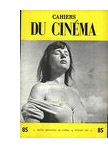 I’m grateful as well to readers responding to my arguments. Michael Kerpan kindly spread the word about my post on imdb and the Criterion Forum. Kent Jones wrote to point out that any argument about Bergman’s influence has to take into account the high regard in which he’s been held in France, among both critics and filmmakers. Kent itemizes not only Godard, Truffaut, and Rivette but Assayas, Téchiné, and Desplechin. It’s a fair point. Antoine de Baecque anchors much of his magisterial history of Cahiers du Cinéma around the mesmerizing power of that busty still of Harriet Anderson, flaunted on a 1958 Cahiers cover and swiped by Antoine in The 400 Blows. In 2003, my old friend Jacques Aumont published a large critical study on Bergman. Cahiers’ next issue will be devoted to the director.
Speaking of French critics and directors, on imdb above Bertrand Tavernier points out that my memory failed. I did see Scenes from a Marriage and Cries and Whispers before The Serpent’s Egg, not after, as my post suggests.
My late Bergman viewing remains gappy. I still haven’t seen the long version of Fanny and Alexander, which everyone assures me is a masterpiece. Last spring, my friend and Bergman scholar Paisley Livingston showed me portions of the TV film The Last Gasp (1995). It’s about Georg af Klercker, the fine Swedish director of the 1910s. It was intriguing, but I was put off by Bergman’s inadequate pastiches of af Klercker’s remarkably poised and complex shots. Now that’s fussy taste, I admit.
Watching movies very, very slowly
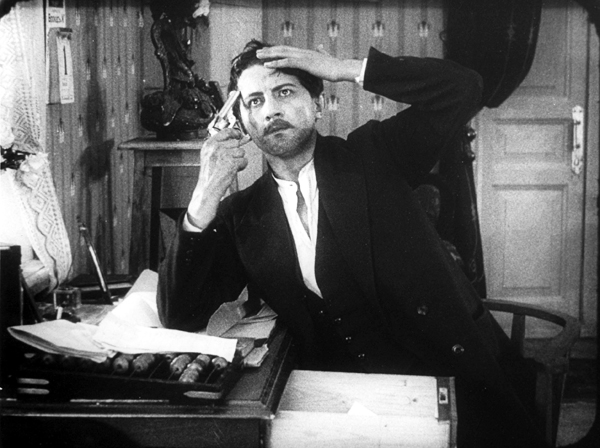
Children of the Age (1915).
DB here:
Before DVD and consumer videotape, how could you study films closely? If you had money, you could buy 8mm or 16mm prints of the few titles available in those formats. If you belonged to a library or ran a film club, you could book 16mm prints and screen them over and over. Or you could ask to view the films at a film archive.
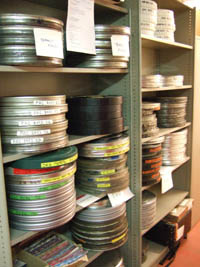 I started going to film archives in the late 1960s, when they were generally more concerned with preserving and showing films than with letting researchers have access. Over the 1970s and 1980s this situation changed, partly because several archivists grew hospitable to the growing field of academic film studies.
At first archives found it easier to screen films for researchers in projection rooms, but eventually many let visitors watch the films on stand-alone viewers. That way the researcher could stop, go forward and back, and take notes. In researching my dissertation in the summer of 1973, I watched films at George Eastman House in 16mm projection, but a few weeks later in Paris, Henri Langlois of the Cinémathèque Francaise allowed me time on Marie Epstein’s visionneuse (a term I’ve admired ever since).
Over the years Kristin and I have visited archives in various countries. We’ve become particularly close to the Royal Film Archive of Brussels, partly because back in the 1980s the head, Jacques Ledoux, believed that Kristin’s research was worthwhile and allowed us to visit regularly. Without the cooperation of Ledoux and his successor Gabrielle Claes, we couldn’t have done a great deal of our research. No wonder it helped us so much: the Belgian Cinémathèque is arguably the most diverse archive in the world.
Case in point: My current visit. I came with two goals. First, I had to prepare for my lectures in Bruges later in the month. These consist of eight talks on anamorphic widescreen. So I planned to watch four early CinemaScope films, plus Oshima’s The Catch (1961) and the SuperScope version of While the City Sleeps.
I also wanted to fill in a big gap in my knowledge about a major silent filmmaker. More on him shortly.
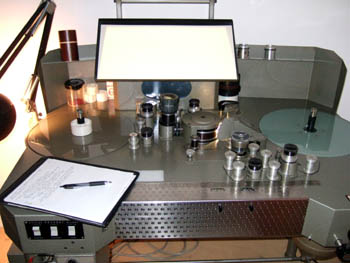
Viewing on a visionneuse
If you’ve never watched a film on a viewer, let me explain. The classic viewer is a flatbed, or viewing table. It’s the size of an executive desk. Two platters or spindles hold a feed reel and a take-up reel. Motors drive the film through a series of sprocketed gates, past a projection device (usually a prism) and across a sound head. The film appears on a smallish screen. There’s usually a little surface space to set a notepad, along with a lamp on an articulated arm.
Before digital editing came along, such machines offered the only way filmmakers could cut sound and picture. (Now most phases of editing are done on computer, with physical editing reserved for late stages of postproduction.) Eventually flatbeds were offered in simpler versions for playback rather than editing.
The most common American-made viewer was the Moviola, which was initially not a flatbed but an upright machine. Eventually the German Steenbeck and KEM became the high-end standards for editing picture and sound. The Brussels archive relies on the Prévost, an Italian machine that is very easy to maintain. The Prévost, seen above, beams the image from the prism onto a mirror hanging over the machine, which bounces the picture onto the screen.
35mm films are mounted on 1000- or 2000-foot reels, the latter yielding about twenty minutes of film at sound speed. A feature film will consist of four or more 2000-foot reels. Even if you watch a film straight through, without stopping to make notes, it takes time to change the reels, so a two-hour movie will probably consume nearly three hours on a 35mm flatbed. And of course researchers stop a lot to take notes and move to and fro across a scene. If I’m studying a film intensively, I probably consume about an hour per 2000-foot reel. Across my life, I wouldn’t dare calculate how many months I’ve spent in visionneuse viewing.
Viewing on an individual viewer has both costs and benefits. Sometimes details you’d notice on the big screen are hard to spot on a flatbed. But with your nose fairly close to the film, you can make discoveries you might miss in projection. (Ideally, you would see the film you’re studying on both the big screen and the small one.) In addition, of course, you can stop, go back, and replay stretches. Above all, you get to touch the film. This is a wonderful experience, handling 35mm film. Hold it up to the light and you see the pictures. You can’t do that with videotape or DVD.
The scary part of any flatbed viewing, at least for me, is watching the film whiz along under your nose at ninety feet per minute. If you haven’t threaded the thing properly, or if the print has a weak splice or torn sprocket hole, you can rip the film. For this reason, archives typically don’t allow a researcher to handle films they hold in only one copy.
The average film you watch on a flatbed has an optical soundtrack, that squiggly line that is read by an optical valve. But early CinemaScope films had magnetic tracks so that they could provide stereophonic sound. In the picture below you can see that strips of magnetic tape, like those in tape cassette players, run along both edges of the film strip. For my Scope films, I was obliged to use a Prévost that could handle mag sound–and of course one that could be fitted with an anamorphic lens to unsqueeze the image to the proper proportions.
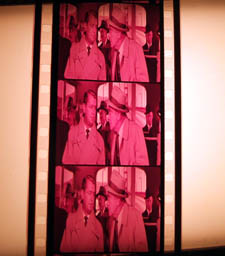
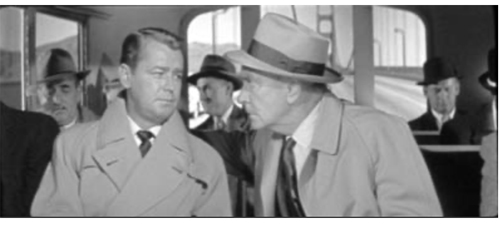
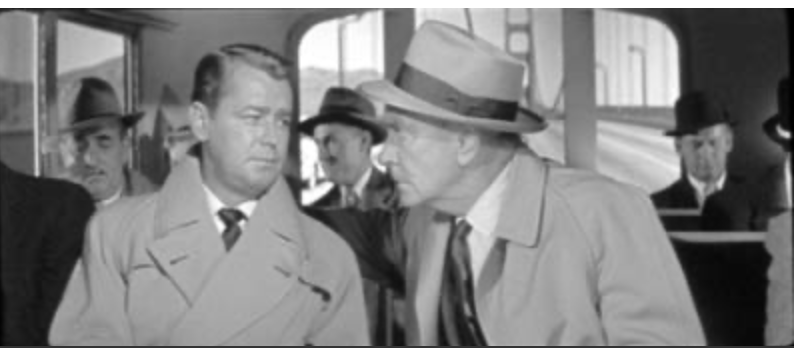
Hell on Frisco Bay (1954) was a color movie, but this print, like many from the period, has faded to bright pink. The Eastman color stock of the period was unstable, and many prints were processed carelessly. (In unsqueezing the frame, I’ve eliminated the color cast for better clarity.) Restoring color to films of this period is one of the major tasks facing film archivists. Cinema is a fragile art form.
Hours and hours of Bauers and Bauers
At the Giornate del Cinema Muto in Pordenone in 1989, Yuri Tsivian’s retrospective on Russian Tsarist cinema convinced a lot of us that good filmmaking in that country didn’t start with the Bolshevik revolution. Along with that retrospective came a wonderful book, Silent Witnesses, edited by Yuri and Paolo Cherchi Usai. Unfortunately hard to find now, it’s filled with information about pre-Soviet filmmaking.
Although I enjoyed the Tsarist films, I didn’t know exactly what to watch for. It took me some years to appreciate their artistry, and some of my ideas about them showed up in On the History of Film Style (1997) and Figures Traced in Light (2005). In those places I studied 1910s “tableau” staging and used some examples from Yevgenii Bauer, by common consent the most pictorially ambitious Russian director of the period. Kristin and I also used Bauer as an example of tightly choreographed mise-en-scene in Film Art (p. 143). I thought it was time I examined his work more systematically, and I knew that the Royal Film Archive held some Bauer prints, which they acquired from Gosfilmofond of Moscow.
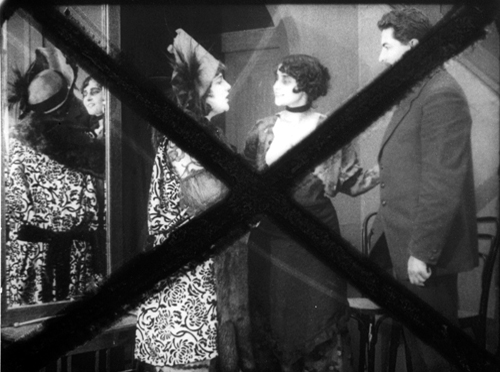
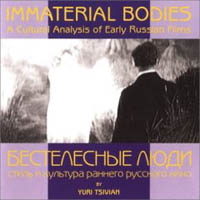 Bauer had a brief but prolific career. He started directing in 1912 and completed eighty-two films before his death in 1917. Unhappily, only twenty-six of his works survive. Just as bad, most of those lack their original intertitles, so we don’t have the expository and dialogue titles we expect in silent films. The placement of the titles is sometimes signaled by two Xs marked on two successive frames. Without titles, the storylines can get obscure. Yuri, Ben Brewster, and other scholars have sought to reconstruct something approximating the original titles by studying the plays and novels that Bauer adapted. Three of the reconstructed films are available on a DVD called Mad Love, and Yuri has also created an innovative CD-ROM (right) that takes us through works of Bauer and his contemporaries.
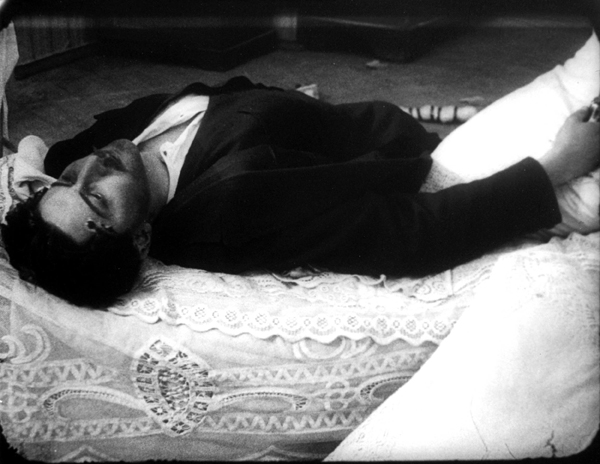
Although he made comedies, Bauer is most famous for his somber psychological melodramas, often centering on class exploitation. A woman becomes a rich man’s mistress; when she abandons her husband and takes their baby, he commits suicide (Children of the Age). A serving maid is seduced by her master and callously tossed aside when he marries a flirt (Silent Witnesses). Things can get pretty dark. This is the director who made films entitled After Death (1915) and Happiness of Eternal Night (1915). In Daydreams (1915), a widower sees a woman who strikingly resembles his dead wife. Like Scottie in Vertigo, he follows her and becomes increasingly obsessed. Did I mention that he keeps a ropy braid of his dead wife’s hair in a glass box?
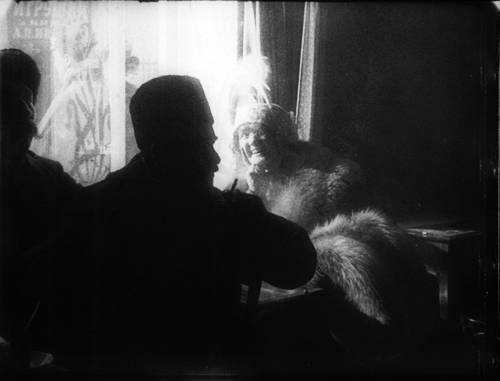
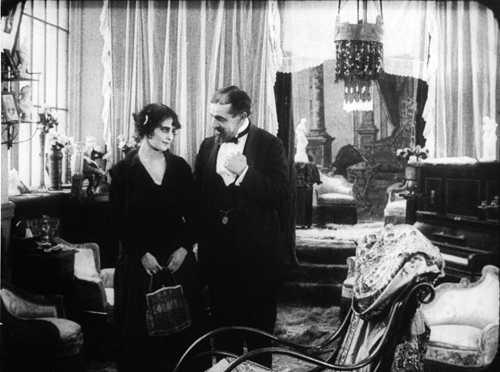
Seeing several films again confirmed my view that Bauer knew better than most directors how to organize a shot. His contemporary Louis Feuillade favored a quiet, sober virtuosity, but Bauer developed a flashy visual style. He’s most known for his ambitious use of light (Frigid Souls, below) and big, textured sets packed with columns, trellises, drapes, brocades, embroidered pillowcases, and other elements that add abstract patterns to a scene (Children of the Age, below).
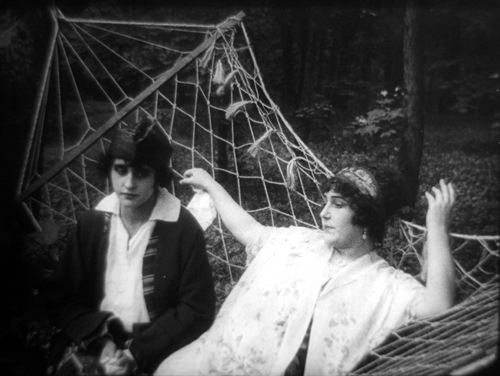
Even a hammock can be stretched and framed to create a swooping web around the innocent heroine of Children of the Age, ensnared by the demimondaine.
In particular, I admire Bauer’s constant inventiveness in moving his actors around the set in smooth ways that always direct our attention to what’s happening at the right moment. European directors of this period seldom cut up a scene into several shots of individual actors; the frame typically shows us the entire playing space. Directors were obliged to shift their actors across the frame and arrange them in depth, like chesspieces.
This master-shot, single setup approach might seem hoplelessly restrictive. Today we expect films to have lots of cutting and camera movement. How does the filmmaker sculpt the action, moment by moment within a static frame?
Blocking, as in blocking the view
I trace some principles of this approach in the books I already mentioned. I’ll mention two strategies here, and if you want to know more you can follow up in On the History of Film Style and Figures Traced in Light.
Filmmakers of the 1910s created intricate choreography by moving actors left or right, up to or away from the camera. Often they set up unbalanced compositions and then rebalanced them, creating a kind of spatial tension that parallels the drama. In the course of the action, actors close to the camera might conceal those that are farther away. The blocking of the actors, in other words, also sometimes blocks our view.
In Leon Drey (1915), Bauer tells the story of a cynical womanizer. In one scene, he’s dallying with his latest conquest when another of his lovers bursts into his apartment. The first phase of the shot is very unbalanced; most directors would have put the mistress at the door on one side of the frame and Leon and the woman in his arms at the opposite side. Immediately, though, the woman flees to the bed in the back of the shot and activates the right area of the frame.
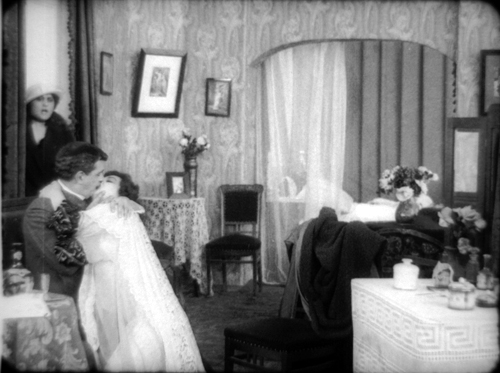
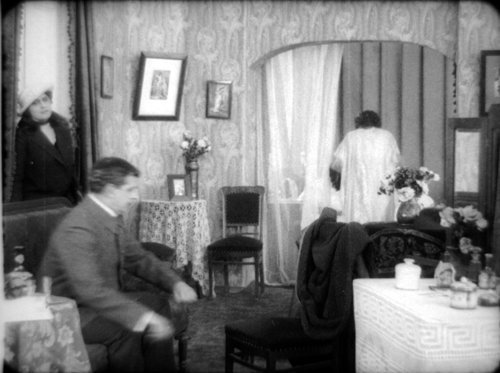
As the mistress rushes to the woman in the rear, Leon strides to the foreground and his burly body blots out the drama between the two women. We’re forced to concentrate on his cold indifference to both of his lovers. Eventually his mistress comes to the foreground to remonstrate with him. Now, at the high point of the scene, we have a balanced frame. Note that Leon continues to conceal the first woman; the scene’s not yet about her.
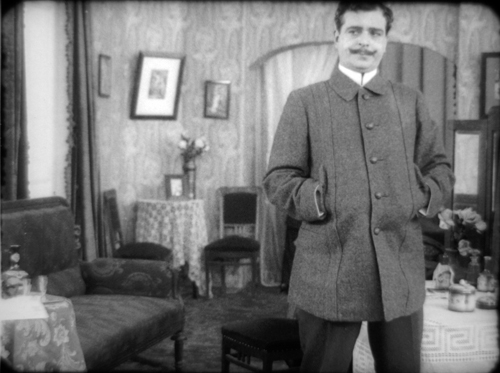
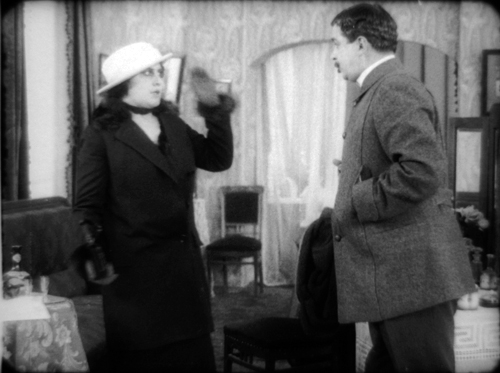
The mistress leaves, angry and desperate, and Leon placidly pays her no mind. As the door closes, he hurries to lock it and summons the first woman, now visible, back from his bed. He will have little trouble convincing her to return to his arms.
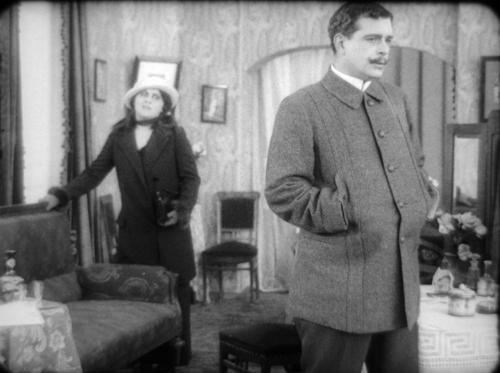
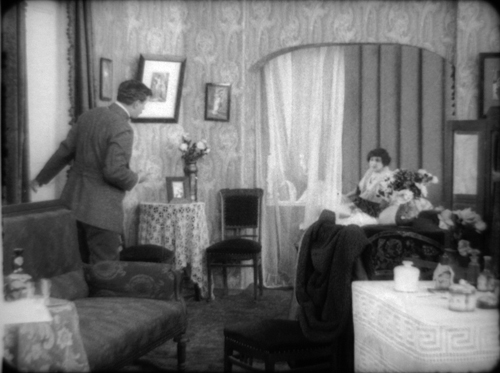
The dramatic curve of the scene has been expressed in compositional asymmetry and symmetry, concealing space and then opening it up.
Most directors of the period used principles like these to turn dramatic conflict into vivid choreography. Bauer also tried more unusual tactics. He was especially good at shifting actors’ heads very slightly to open or close off channels of action behind them. Here’s an instance from Her Heroic Feat (1914).
The butler informs Lina and her mother that the scandalous ballerina Klorinda is calling on them. At first Lina’s head is solidly blocking the doorway in the rear. As the butler goes to the rear door, Lina pivots a little to clear our view of that doorway.
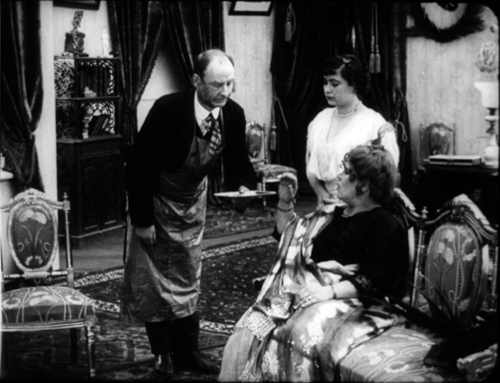
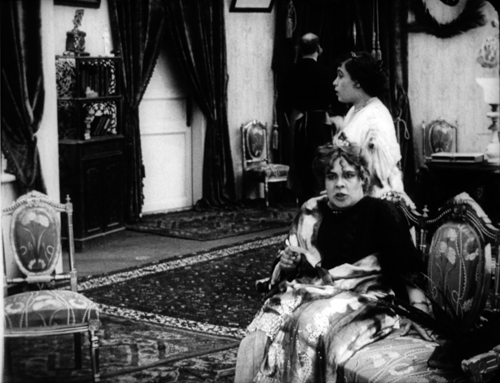
Klorinda sashays in, and who could miss it? She’s wearing a bright dress, she’s centrally positioned, and she’s moving toward us. The other women refuse to look at her, but their immobility assures that we keep our eye on Klorinda. When she stops to greet them, then they move, pivoting away; Lina’s head goes back to blocking the doorway. Imagine how things would have gone if her head had been there when Klorinda appeared in the background.
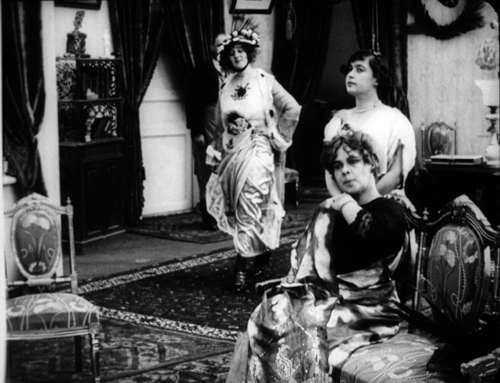
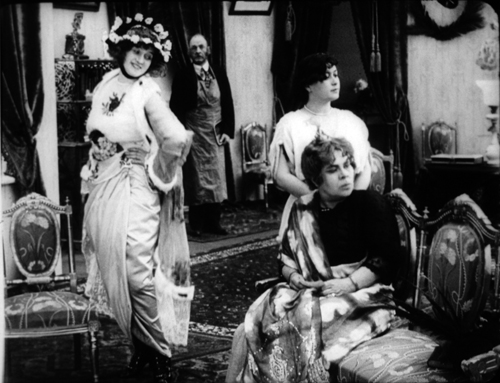
Of course, we should also study the performance techniques of Bauer’s actors–a subject examined in a fine book by Ben Brewster and Lea Jacobs, Theatre to Cinema. The compositional tactics employed here work to draw our attention to the actors’ expressions and body language.
Still, not everything in 1910s ensemble staging owes a debt to the theatre. The changes in Lina’s head position, or Leon Brey’s calculated blockage of the women behind him, wouldn’t work on the stage; most of the audience wouldn’t see the exact alignment we get onscreen. Live theatre depends on varying sightlines, but in cinema, we all see the action from one position, that of the camera. Bauer, Feuillade, and their contemporaries realized that they could organize the action, down to the smallest detail, around what the camera could and could not take in.
The fluent choreography developed by 1910s directors is almost unnoticeable when you’re watching in real time. You’re supposed to register the what–the point of interest in the frame–rather than the how, the slight shifting of actors that highlights this face, then that gesture. By the time you realize that something has happened, the first stages of the process have slipped away, inaccessible to memory.
So there’s a need for slow viewing. Filmmakers have thousands of secrets, many that they don’t know they know. Sometimes we have to stop the movie, go back, and trace precisely how directors achieve their effects. Really slow viewing can help us discover how deep film artistry can be. All hail the visionneuse and the archives that allow scholars to use her.
For background on Bauer, see William M. Drew’s excellent career survey. I discuss Bauer’s relation to narrative painting in another blog entry.
In production and distribution of the period, the titles and inserts (close-ups of newspapers or messages) were sometimes stored on separate reels. In many cases, only the image reels have survived.
Several other Bauer films are available on Milestone’s invaluable DVD set Early Russian Cinema.