














Archive for the 'New media: Technology' Category
When media become manageable: Streaming, film research, and the Celestial Multiplex
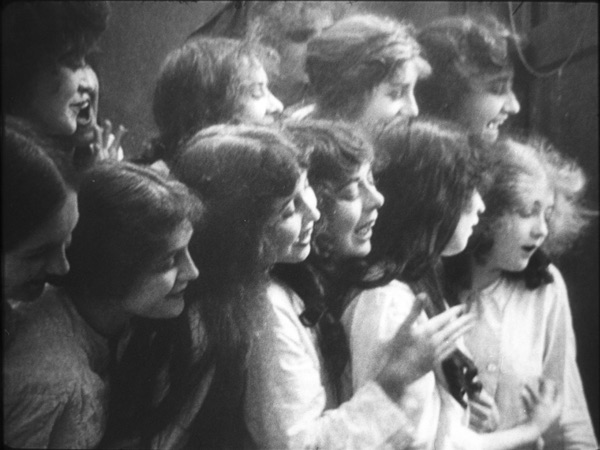
Never coming to the Celestial Multiplex: Liberty Belles (Del Henderson, 1916).
DB here:
A directors’ roundtable in The Hollywood Reporter says a lot in a little.
Fernando Meirelles: This June, The Two Popes was in 35 festivals. Then we were going to have two or three weeks of theaters. And then the [Netflix] platform. I mean, it couldn’t be better.
Martin Scorsese: We are in more than an evolution. We are in a revolution of communication and cinema or movies or whatever you want to call it.
Meirelles casually omits DVDs, at one point the most rapidly adopted format of consumer media. Yeah, what ever happened to discs? And in what follows, I’ll take issue with Scorsese’s claim that streaming has triggered a revolution. It’s more a case of evolution that issued in a sweeping change, like Engels’ transformation of quantity into quality, or Hemingway’s claim that he went broke slowly, then quickly.
More important, I’ll try to assess the impact streaming has had on what Kristin and I and other researchers and teachers try to do–study film as an art form in its historical dimensions.
Managing your time, and your movies
If we’re looking for a revolutionary turning point, I’d suggest the moment that movies no longer became appointment viewing. When they played theaters you had limited access. The film was there for only a while (even The Sound of Music eventually left) and you had to watch it at specified times. On broadcast TV and cable, the same conditions applied. But with the arrival of consumer home videotape in the 1970s, the viewer was given greater control.
Akio Morita of Sony called it “time-shifting.” The phrase, shrewdly positioned as a defense of off-air copying, captures a fundamental appeal of physical media. You could watch a film at home, and whenever you wanted to. Yes, VHS and even Beta yielded shabby images and even worse sound, but (a) theatres were often not much better, and (b) a video rental was cheaper than a movie ticket. Most important was a general rule of media technology: For the mass market, convenience trumps quality.
Videotape swept the world in the 1980s and gave films an aftermarket. Many an indie filmmaker could get financing for a project on anticipated tape sales. The laserdisc gained some attention in the 1990s, becoming a sort of transitional format. It improved quality (better analog picture, digital sound) but had drawbacks too. A movie wouldn’t fit on a single disc side, and a laserdisc was pricier than tape. LD remained a niche format, chiefly for educators and home-theatre enthusiasts.
The laserdisc was superseded by the DVD, introduced in 1996. Journalists claimed that it enjoyed the fastest consumer takeup in electronics history. Discs were more convenient than tapes, and proof of concept had been provided by the success of CDs for music. To compete, cable companies introduced “video on demand,” a time-shifting compromise between scheduled cable delivery and rental of tape or disc. People still use cable VOD, and for some purposes it’s a cheaper alternative to committing to subscription services.
Reviewing The Irishman, a critic suggested that most people will skip seeing it in theatres and watch it on Netflix, where it’s “more manageable.” With tape and disc, either analog or digital, consumers became accustomed to a huge degree of manageability. They could pause, skip ahead or skip back, race fast-forward or –back, play slowly, and above all play the movie over and over. DVDs made all these options quicker and more convenient than tape had. The market boomed. Video stores made discs available for rental, as tapes had been, and retail stores offered them for sale, at increasingly low prices.
But there were problems. In the 2000s there was a glut of DVDs, and consumers began to realize that a few weeks after release many titles would end up in the bargain racks. A brisk secondary market developed thanks to the US “first sale” doctrine, most virtuosically exploited by Redbox. Worse, there was piracy. Pirating analog tapes degraded quality across generations, but with digital discs you could rip perfect clones. Any teenager could hack past region coding and anticopying software.
The Blu-ray disc was an improvement on the first-generation DVDs, and it came along as more people were buying widescreen and high-definition home monitors. Properly mastered, Blu-ray discs looked good, and they had bigger storage capacity. Some consumers got excited, but the improved format couldn’t arrest the headlong decline of disc sales. In addition, the industry’s rationale for Blu-ray was its resistance to rippng, but hackers breached the codes with ludicrous speed.
From this angle, streaming is parallel to digital theatre projection : a new phase in the war against piracy. Likewise, as in theatrical screenings, you’re paying for an experience, not an item. You’re not buying an object you can copy or resell. If a movie is available only on streaming, you’re renting something, not owning it legally. One aspect of manageability—personally possessing a movie—is traded away for convenience and, ultimately, for limited access, as I’ll try to show.
Not so gently down the stream
With streaming, the age of appointment viewing seems more or less over. And the infinite vista of the Internet has encouraged tech-heads to imagine something like the Celestial Jukebox, a vast virtual multiplex in which all movies will be available. If iTunes and Spotify did something like this for music, why not cinema?
Let’s consider the pluses and minuses of streaming for ordinary consumers and for filmmakers.
Obviously, there’s convenience. After the monstrous tape cassettes, DVDs looked adorably slim. Now, gathering in slippery stacks, they have their own sinister aura. With streaming, there’s no need to run out to the video store or to buy new shelving to support a bulging library of discs.
There’s also price, compared to either theater tickets or cable fees. From $6.99 per month (Disney+) to $12.99 (Netflix), streaming services promise to provide TV and movies quite cheaply. And there’s the range of choice, which even on second-tier streamers exceeds the capacity of most towns’ video stores back in the day. Finally, there are many obscure films lurking in the corners of most streamers, so the joy of discovery is still there to a degree.
On the minus side, there’s one that gets the most press—the further erosion of “the theatrical experience.” Critics emphasize the pleasures that come from being in an audience, but this always seems to me overrated. More valuable to me are the scale of image and sound you get in a theatre. I like my movies to loom.
Above all, there’s a virtue in the lack of manageability. In the theatre you can’t pause the movie or run back or skip ahead. You can close your eyes, look away, or leave, but at bottom you’re there to turn your sensorium over to the filmmaker, to go through an experience you don’t control. This unshakeable grip on your attention yields some of cinema’s most powerful effects.

The condition of privatized viewing isn’t unique to streaming, of course. Nor is another drawback, that of the cyclical expiration and refreshing of “content” on streaming platforms. Admittedly, we’re warned. Newspapers and websites run alerts notifying us when a title is leaving a service—perhaps for a little while, perhaps longer, perhaps forever. And this situation is a bit like DVDs’ going out of print. But at least some disc copies exist to be sold second-hand or cloned as files. In working on my book on the 1940s, I was pleasantly surprised to learn that I could track down arcane titles on out-of-print discs, and at fair prices. When something not on disc leaves streaming, how do you access it?
I think there will be some pushback when subscribers learn about the costs that more and more services are tacking on. Yes, with Amazon Prime for $119 per year you get access to many films, along with other services. But for a great many films Amazon demands an extra rental fee and very short-term access. Within Amazon, there are channels (Britbox, HBO Now, Starz, Cinemax et al.), all of which demand further subscription payments. As people start to realize that streamers will have exclusive licenses for titles, they’ll feel pressure to subscribe to many services. Here, as elsewhere, the total streaming price tag starts to look like cable fees. Even the New York Times has noticed.
Another problem won’t bother most consumers, but it does matter. A streamed title will occasionally be in an incorrect aspect ratio. Most commonly, a Scope (2.39 or so) image will be cropped to 1.85. I noted this some years back, relying on a website showing faulty Netflix transfers, but that site seems to have been taken over by … Netflix itself.
Netflix will say, with all “content providers,” that they get the best material they can from their licensors. I don’t watch streaming enough to know how common wrong aspect ratios are, but if you know of examples, I’d like to hear.
Finally, even streaming companies can collapse. Unless Apple buys a studio (Lionsgate? MGM? Columbia?), it must rely on original content, and it could well flop. On the day I’m writing this, one hedge fund manager predicts we have reached peak Netflix. Given greater competition, slower growth, and accelerating cancellations, he maintains that Netflix is on the wane. If it scales back or fails (it currently carries $12.43 billion in debt), what will happen to its licensed material and its original content?
What about creators? Filmmakers, especially screenwriters, have enjoyed boom times. It may be a bubble, with over 500 scripted series available on broadcast, cable, and streaming. Still, it has given everyone a lot of opportunities. Documentary filmmaking in particular has enjoyed a shot in the arm.
And features are still doing quite well, at least on Netflix. Of the streamer’s top 10 releases in 2019, seven were features. But those proportions may change. Aside from big theatrical movies licensed from the studios, the impact of proprietary “event” programming (War Machine, Bird Box) has been fairly ephemeral. (Obviously Roma and The Irishman are exceptions.) The strength of streaming, it seems to me, is the same thing that sustained broadcast TV: serial narratives. Hence the popularity of Friends and The Office, as well as House of Cards and Orange Is the New Black.
Like network TV, a streamer needs a reliable, constant flow of content—not only many shows, but many episodes. The model of the series, if only in six or eight parts, secures the loyalty of the viewer for the long term. Even if all episodes are dumped at once, the promise of continuation after an interval of a year or several months keeps the viewer willing to hang on till the next season.
The pressure on the creators is predictable. Since form follows format, writers and producers will be pushed to come up with series ideas. A friend of mine pitched a feature-length movie to a streaming service. The suits loved the idea but wanted it as a series and were already scanning the script outline for a plot point that could launch a second season. Some of the streaming series I’ve seen, notably Errol Morris’s Wormwood, seemed to me stretched.
If a filmmaker lands a feature film on a streaming platform, other problems could follow. We’re well aware that independent filmmakers gain few royalties from streaming; their big check tends to be the initial acquisition. At the same time, they can’t be sure that people are watching their entire movie. My barber couldn’t stick with The Irishman, even with pee breaks.
Streamers seem to have accepted grazing as basic to the viewing experience. For purposes of measuring total viewership, Netflix counts a “viewing” of a film or program as a minimum of two minutes. In the light of the two-minute rule, we might expect filmmakers to crowd their opening scenes with plenty to grab us. That goes back to TV and TV-influenced films, of course, which tried to have a strong teaser even before the credits. Now, it turns out, streaming pop songs are being crafted with shorter intros and earlier choruses “to get to the good stuff sooner.” Maybe filmmakers will be trying the same thing. Maybe they already are.
Streaming and film research
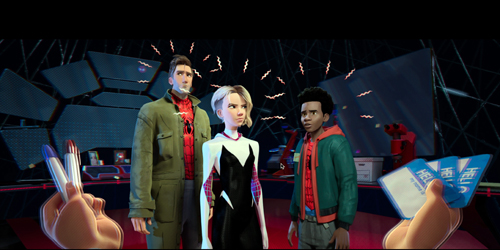
Spider-Man: Into the Spider-Verse (2018).
Finally, what are some consequences of streaming for researchers, educators, and your all-around obsessive cinephile?
I think it’s fair to say that home video, in the form of tape, laserdisc, and digital disc, democratized film study. From the late 1960s on, I traveled to archives and film distributors to watch films for my research. It was troublesome, time-consuming, and costly. As a grad student I took a bus from Iowa City to Chicago to watch 16mm prints of Dreyer and Sontag films. I drove to Eastman House to see films in projection. I stayed in Paris a couple of months to work at the Cinémathèque Française on Marie Epstein’s visionneuse.
As a prof here at Madison I spent hundreds of hours watching prints in our Center for Film and Theater Research. Over the decades I trekked to Denmark for Dreyer and 1910s films, to Japan for silent films, to Paris and Munich and the BFI and MoMA and UCLA and Eastman House and the Library of Congress, and above all Brussels for many, many projects. Collectors, from Manhattan, Tokyo, and Milwaukee helped as well. Kristin and I owe archivists everything.
The terrible quality of films on tape didn’t help me study visual style, but laserdiscs were a big improvement. (Hong Kong films tended not to be in Scope on tape but were on LD.) And one LD format, CAV, was frame-accurate; you could study a shot frame by frame, something not possible with many DVDs. There’s always a trade-off with any technology.
Even after even after DVDs arrived I kept up my travels. I could use discs for bulk background viewing, but often I still had to rely on prints. Sometimes I wanted to count frames (handy in looking at Soviet montage and Hong Kong action). Moreover, looking at film prints revealed that the color palettes on DVDs could be quite different, and soundtracks were often cleaned up for the home market. And of course thousands of films, especially from outside Hollywood or in the first decades of cinema, were never going to be available on consumer video. My most recent extended archive stay, in Washington in 2017 thanks to a Kluge Professorship, showed me the glories of the 1910s in prints that are mostly accessible only to researchers.
What do scholars of an analytical bent need? Entire films that can be paused. Frame stills, made photographically or through software. Clips as evidence for our claims. Stills and clips are our equivalents to quotation for literary scholars and illustrations for art historians.
Apart from convenience and cost savings, the disc revolution yielded something I couldn’t get otherwise. In an archive, it’s impossible to study film-based 3D cinema. But thanks to Blu-ray, I can stop on a 3D frame. (. . . And, for instance, spot the way Hitchcock makes the clock quietly pop out in Dial M for Murder, below). This is a unique benefit—but a waning one, as 3D discs are increasingly hard to find and 3D monitors scarcely exist any more. As I said, trade-offs.
From this standpoint, Netflix and its counterparts offer a step down from DVD and Blu-ray. In terms of choice, many films aren’t currently available on streaming, and many more never will be. You can pull a DVD off a shelf whether you’re online or not, but for streaming you need a good connection. The controls of a streaming view aren’t as precise as those on a DVD player; slow forward and back to study cuts and gestures aren’t feasible, it seems.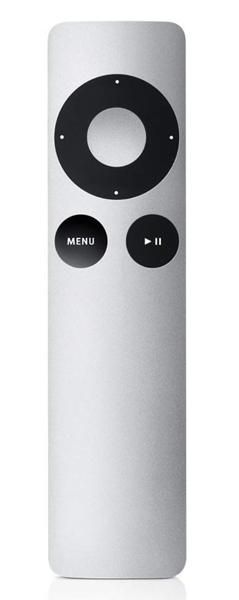
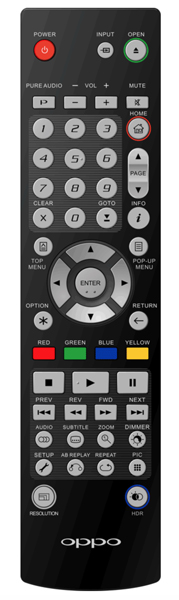
When cable cropped films, as it frequently did, you had recourse to DVDs, perhaps even from foreign sources. But as exclusive licensing increases, only one service will have a title. Frame grabs are possible with some software, but clips are more difficult.
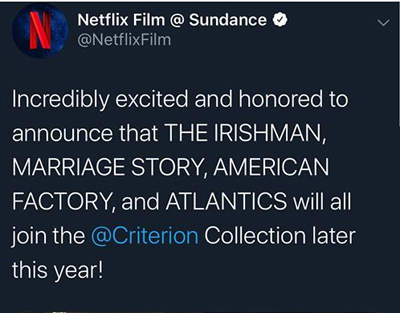
Worst of all, many worthwhile films will apparently never find their way to disc. I first noticed this in 2017 when I wanted to buy a copy of I Don’t Feel at Home in This World Anymore, a Netflix release of a Sundance title. As far as I can tell, it’s not available on DVD. The same fate has befallen one of my favorite films of 2018, The Ballad of Buster Scruggs. Only a few years ago it would be unthinkable for a Coen Brothers film not to find DVD release. Even Roma has had to wait for a Criterion deal to make it to disc. Clearly Netflix, and perhaps other streamers, believe that putting films on disc damages the business plan. So Meirelles doesn’t include DVDs in the lifespan of The Two Popes.
Without DVDs, some cinephiliac consumers are lamenting, rightly, the loss of bonus materials. The Criterion Channel has been exceptionally generous in shifting over its supplements to the streaming platform, but other companies haven’t been. Scholars and teachers rely on the best bonus items, including filmmaker commentaries, to give students behind-the scenes information on the creative process. There are, I understand, rights issues around supplements, and bandwidth is at a premium, but there’s no point in pretending that the loss of disc versions hasn’t been important.
In 2013 Spielberg and Lucas declared that “Internet TV is the future of entertainment.” They predicted that theatrical moviegoing would become something like the Broadway stage or a football game. The multiplexes would host spectacular productions at big ticket prices, while all other films would be sent to homes. Lucas put forth the question debated in the directors’ roundtable I mentioned: “The question will be: ‘Do you want people to see it, or do you want people to see it on a big screen?’”
Still, the big changeover hasn’t happened quite yet. Every year has its failed blockbusters, and films big and middling and little (Blumhouse, for instance) still continue. Arthouse theatres, which rely on midrange items, indie production, and foreign fare, are putting up a vigorous fight, emphasizing live events and community engagement.
Meanwhile, streaming makes film festivals and film archives more important. Festivals may host the few plays that a movie gets (as in the 35 fests which ran The Two Popes), and filmmakers, as Kent Jones remarks, are eager for their films to play on the big screen in those venues. Archives will need not only to preserve films but also make classics and current movies available in theatrical circumstances. Smart film clubs like the Chicago Film Society and our Cinematheque keep film-based screenings alive.
Before home video, few film scholars undertook the scrutiny of form and style. Those who did had to use editing machines like these. (One scholar called my study of Dreyer, not admiringly, the first Steenbeck book.) Ironically, just as an avalanche of films became available for academic study, and as tools for studying them closely became available for everyone, most researchers turned away from cinema’s aesthetic history and a film’s specific design in order to interpret their cultural contexts. There were exceptions, like Yuri Tsivian’s efforts to systematically study patterns of shot length, but they were rare.
Whatever the value of cultural critique, one result was to leave aesthetic film analysis largely to cinephiles and fans. Thankfully, the emergence of the visual essay, in the hands of tech-savvy filmmakers like kogonada and Tony Zhao and Taylor Ramos, eventually attracted academic attention. Film analysis has returned in the vehicle of the video essay, which is a stimulating, teaching-friendly format. Kristin, Jeff Smith, and I have participated in this trend through our work with Criterion and occasional video lectures linked to this site.
All this was made possible through the digital revolution, or evolution, and we should be grateful. Still, streaming filters out a lot of what we want to study. It’s clear that, for all their shortcomings, physical media were our best compromise for keeping alive the heritage of critical and historical analysis of cinema. We’ve largely lost physical motion pictures as a contemporary medium. (How many young scholars, or filmmakers for that matter, have handled a 35mm print?) Now, to lose DVDs and Blu-rays is to lose precious opportunities to understand how films work and work on us.
Thanks to all the archivists, collectors, and fellow researchers who made our research so fruitful and enjoyable in the pre-digital age.
A good overview of the streaming business at this point is “The future of entertainment,” in The Economist.
Kristin discusses the fantasy of the Celestial Multiplex with archivists Schawn Belston and Mike Pogorzelski. For examples of how to watch a film on film slowly, go here. Samples of editing-table discoveries are here and especially in the Library of Congress series that starts here. In another entry, I discuss the use of 3D in Dial M for Murder.
P.S. 24 January 2020: Then there’s this, from Facebook.

Dial M for Murder (1954).
Pandora’s digital box: End times
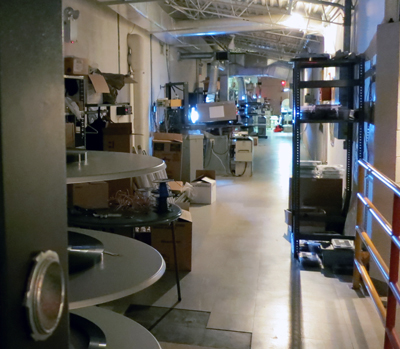
35mm projection booth at Market Square Cinema, Madison, Wisconsin; 10 May 2013.
DB here:
When exactly did film end? According to the mass-market press, here are some terminal dates.
July 2011: Technicolor closes its Los Angeles laboratory.
October 2011: Panavision, Aaton, and Arri all announce that they will stop manufacturing film cameras.
November 2011: Twentieth Century Fox sends out a letter asserting that it will cease supplying theatres with 35mm prints “within the next year or two.”
January 2012: Eastman Kodak files for bankruptcy protection.
March 2013: Fuji stops selling negative and positive film stock for 35mm photography.
Each of these events looked like turning points, but now they seem merely phases within a gradual shift. After all, the digital conversion of cinema has been in the works for about fifteen years. The key events–the formation of a studio consortium to set standards, the cooperation of technical agencies and professional associations, the lobbying for 3D by top-money directors–didn’t get as much coverage. Because so many maneuvers took place behind the scenes and unfolded slowly, digital cinema seemed very distant to me. To understand the whole process, I had to do some research. Only in hindsight did the quiet buildups and sudden jolts form a pattern.
On the production end, it seems likely that filmmakers will continue to migrate to digital formats at a moderate pace. Proponents of 35mm are fond of pointing out that six of 2012’s Oscar-nominated pictures were shot wholly or partly on film. (To which you might well respond, Who cares about Oscar nominations? I would agree with you.) Yet even 35mm adherent Wally Pfister, DP for Christopher Nolan, admits that within ten years he will probably be shooting digital.
What about the other wings of the film industry, distribution and exhibition? Put aside distribution for a moment. Digital exhibition was the central focus of the blog series that became my e-book Pandora’s Digital Box. There I try to trace the historical process that led up to the big changes of 2009-early 2012.
Today, a year after Pandora’s publication, everybody knows that 35mm exhibition of recent releases is almost completely finished. But let’s explore things in a little more detail, including poking at some nuts and bolts. As we go, I’ll link to the original blog entries.
Top of the world!
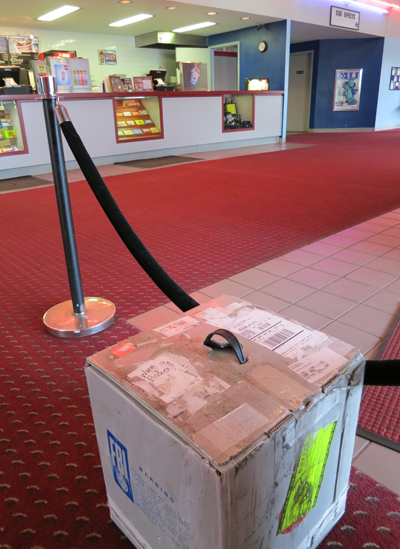
35mm print of Warm Bodies about to be shipped out from Market Square Cinemas, Madison, Wisconsin; 10 May 2013.
The overall situation couldn’t be plainer. At the end of 2012, reports David Hancock of IHS Screen Digest, there were nearly 130,000 screens in the world. Of these, over two-thirds were digital, and a little over half of those were 3D-capable.
Northern European countries have committed heavily to the new format. The Netherlands, Denmark, and Norway are fully digital, while the UK is at 93% saturation and France is at 92%. Both national and EU funds have helped fund the switchover. Hancock reports that in Asia, Japanese screens are 88% digital, and South Korean ones are 100%. China is the growth engine. Rising living standards and swelling attendance have triggered a building frenzy. Over 85%, or 21,407 screens are already digital, and on average, each day adds at least eight new screens.
In the US and Canada, there were at end 2012 still over 6400 commercial analog screens, or about 15% of the nearly 43,000 total. My home town, Madison, Wisconsin, has a surprising number of these anachronisms. One multiplex retains at least two first-run 35mm screens. Five second-run screens at our Market Square multiplex have no digital equipment. That venue ran excellent 2D prints of Life of Pi (held over for seven weeks) and The Hobbit: An Unexpected Journey. It’s currently screening many recent releases, including the incessantly and mysteriously popular Argo. In addition, our campus has several active 35mm venues (Cinematheque, Chazen Museum, Marquee). Our department shows a fair amount of 35mm for our courses as well; the last screening I dropped in on was The Quiet Man in the very nice UCLA restoration.
Unquestionably, however, 35mm is doomed as a commercial format. Formerly, a tentpole release might have required 3000-5000 film prints; now a few hundred are shipped. Our Market Square house sometimes gets prints bearing single-digit ID numbers. Jack Foley of Focus Features estimates that only about 5 % of the copies of a wide US release will be in 35mm. A narrower release might go somewhat higher, since art houses have been slower to transition to digital. Focus Features’ The Place Beyond the Pines was released on 1442 screens, only 105 (7%) of which employed 35mm.
In light of the rapid takeup of digital projection, Foley expects that most studios will stop supplying 35mm copies by the end of this year. David Hancock has suggested that by the end of 2015, there won’t be any new theatrical releases on 35mm.
Correspondingly, projectionists are vanishing. In Madison, Hal Theisen, my guide to digital operation in Chapter 4 of Pandora, has been dismissed. The films in that theatre are now set up by an assistant manager. Hal was the last full-time projectionist in town.
The wholesale conversion was initiated by the studios under the aegis of their Digital Cinema Initiatives corporation (DCI). The plan was helped along, after some negotiation, by the National Association of Theatre Owners. Smaller theatre chains and independent owners had to go along or risk closing down eventually. The Majors pursued the changeover aggressively, combining a stick—go digital or die!—with several carrots: lower shipping costs, higher ticket prices for 3D shows, no need for expensive unionized projectionists, and the prospect of “alternative content.”
The conversion to DCI standards was costly, running up to $100,000 per screen. Many exhibitors took advantage of the Virtual Print Fee, a subsidy from the distributors that paid into a third-party account every time the venue booked a film from the Majors. There were strings attached to the VPF. The deals are still protected by nondisclosure agreements, but terms have included demands that exhibitors remove all 35mm machines from the venue, show a certain number of the Majors’ films, equip some houses for 3D, and/or sign up for Network Operations Centers that would monitor the shows.

The biggest North American chains are Regal, AMC, and Cinemark. They control about 16,500 screens and own fifty-three of the sixty top-grossing US venues. The Big Three benefited considerably from the conversion. By forming the consortium Digital Cinema Solutions, they were able to negotiate Wall Street financing for their chains’ digital upgrade. They also formed National Cinemedia, a company that supplied FirstLook, a preshow assembly of promos for TV shows and music. Under the new name of NCM Network, the parent company now links 19,000 screens for advertising purposes. NCM also supplies alternative content to over 700 screens under the Fathom brand: sports, musical acts, the Metropolitan Opera, London’s National Theatre, and other items that try to perk up multiplex business in the middle of the week.
The digital conversion has coincided with—some would say, led to—a greater consolidation of US theatre chains. Last year the Texas-based Rave circuit was dissolved, and 483 of its screens, all digital, were picked up by Cinemark. More recently, the Regal chain gained over 500 screens by acquiring Hollywood Theatres. The biggest move took place in May 2012 when the AMC circuit was bought for $2.6 billion by Dalian Wanda Group, a Chinese real estate firm. Combined with Wanda’s 750 mainland screens, this acquisition created what may be the biggest cinema chain in the world. Wanda has declared its intent to invest half a billion dollars in upgrading AMC houses.
Meanwhile, vertical integration is emerging. In 2011, Regal and AMC founded Open Road Films, a distribution company. It has handled such high-profile titles as The Grey, Killer Elite, End of Watch, Side Effects, and The Host. Cinedigm, which began life as a third-party aggregator to handle VPFs, has moved into distribution too, billing itself as a company merging theatrical and home release strategies tailored to each project.
It has become evident that the digital revolution in exhibition permits American studio cinema a new level of conquest and control. Distribution, we’ve long known, is the seat of power in nearly all types of cinema. Whatever the virtues of YouTube, Vimeo, and other personal-movie exhibition platforms, film’s long-standing public dimension, the gathering of people who surrender their attention to a shared experience in real time, is still largely governed by what Hollywood studios put into their pipeline.
On the margins and off-center
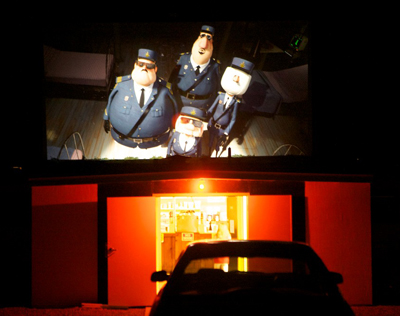
View of Madagascar from the Sky-Vu Drive-In, 2012. Photo by Duke Goetz.
While the Big Three grew stronger, what became of smaller fry? John Fithian of NATO suggested that any cinema with fewer than ten screens could probably not afford the changeover, and David Hancock suggested that up to 2000 screens might be lost. Recent speculation is that drive-ins will be especially hard hit. Pandora’s Digital Box, as blog and then book, surveyed those most at risk: the small local cinemas and the art houses.
I fretted about the loss of small-town theatres, not least because I grew up with them. Data on such local venues are hard to get, so for the blog and the book I went reportorial and visited two Midwestern towns. The blogs related to them are here and here.
The long-lived Goetz theatres in Monroe, Wisconsin, consist of a downtown triplex and the Sky-Vu drive-in. They’re run by Robert “Duke” Goetz, whose grandfather built the movie house back in 1931. Duke is a confirmed techie and showman. He designs and cuts ads and music videos to fill out his show, and he personally converted all his screens to 7.1 sound. So it’s no surprise that he’s a fan of digital cinema. But back in December his digital upgrade took place during the worst box-office weekend since 2008–a bad omen, if you believe in omens.
Seventeen months later, Duke reports more cheerful news. Everything has gone according to plan and budget. The company that installed the equipment, Bright Star Systems of Minneapolis, has proven reliable and excellent in answering questions. Duke especially likes the fact that digital projection allows him to “play musical chairs with the click of a mouse.”
I can move movies from screen to screen in short order or download from the Theatre Management System to any and all theatres at one time, so when the weather is damn cold, for Monday -Thursday screening I’ll play the shorter movies in the biggest house. . . . I am now able to start the movies from the box office with software that accesses the TMS, so it’s just like being at the projector. It saves my guys time and keeps them where the action is.
Duke programs his offerings to suit the tastes of the town, and for the most part, he can get the films he wants. Attendance at the three-screener has increased, partly, he thinks, because of digital. Even marginal product gets a bit more attention when people find the image appealing. Duke says that Skyfall played so long and robustly partly because it was a strong movie, but also because the presentation was compelling. Thanks to his subwoofer, viewers could feel onscreen shotgun blasts in their backsides. Immersion goes only so far, however. Duke remains leery of 3D: “People are tired of paying the extra charge, and with the economy in my area I’ll still wait.”
Contrary to trends elsewhere, the Sky-Vu has benefited strongly from digital display. Duke’s was the first North American drive-in to sign up for the NEC digital system. People comment on how the bright, sharp image has improved their experience. The drive-in had “a tremendous summer,” with the first Saturday night of Brave, coupled with Avengers, proving to be the best night of the year. Measured by both box office returns and number of admissions, that show did better than Transformers the summer before. Last fall, when the Sky-Vu was the only area drive-in still open, some patrons traveled 2 1/2 hours from Illinois. The only problem with digital under the stars was that Duke couldn’t get a satisfactory VPF deal for an outdoor cinema because he doesn’t run it year-round.
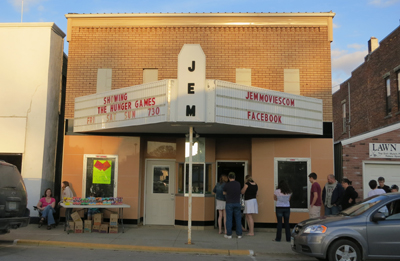
While Duke runs the Goetz theatres as a family business, the JEM Theatre in Harmony, Minnesota is more of a sideline for its owner-operator Michelle Haugerud. A single screen running only at 7:30 on weekend nights, the JEM plays a unifying role in the life of the town. But it’s a small market. Harmony consists of only 1020 people (many of them Amish), and the median household income is about $30,000. Michelle had to finance the conversion through donations and bank assistance. The task was complicated by the unexpected death of her husband Paul, who ran the JEM with her.
Michelle reports that the digital conversion hasn’t increased business. Box office was about the same in 2012 as in 2011, and so far this year ticket sales have been down. It has been a slow winter and spring throughout the industry, and people are hoping the summer blockbusters will lift revenues. But the JEM faces particular problems that the Goetz doesn’t.
Michelle wants to show films in first run, as Duke does. But the distributors typically demand that she play a new movie for three weeks. That’s not feasible in her small town, so Michelle winds up missing out on films she knows would draw well. In addition, she’d be willing to screen two shows a day, the first a kid movie and the second an adult picture, but the companies don’t allow this double-billing. Moreover, she thinks that the shrinking windows–the speed with which films come out on Pay Per View, VOD, and DVD–are eroding her audience. “Many people are willing to wait for these releases since they now realize they will be out shortly after they hit the theatres anyway.”
Michelle and her family run the JEM as much for the community as for themselves. She is hoping for better times.
Converting to digital has made showing movies easier, and I have had no issues with the new equipment. However, it has not helped with ticket sales at all. I am holding on and committed to this year, but if I get to the point where it is costing me personally to stay open, I don’t think I will continue. I love having the movie theatre and would love to keep it going. I do feel if I had a say on what movies I showed and when, I would do so much better.
Kickstarting the arthouse

Robert Redford addresses the Art House Convergence, January 2013.
Several managers and programmers of arthouse cinemas around the country have formed an informal association, the Art House Convergence. It meets once a year just before the Sundance Film Festival, which many members attend. When I visited the conference in 2012, the digital transition was the central topic. It aroused curiosity, bewilderment, frustration, and some annoyance. This year, things were different.
Participants were calmly reconciled to the inevitable, and some looked forward to it. On one of the few panels that took up the subject, moderator Jan Klingelhofer of Pacific Film Resources began by asking: “How many of you are still on the fence about digital?” Just one hand was raised.
On the panel, technology experts from major companies showed how new projection systems could be installed even in offbeat venues. The New Parkway in Oakland was once a garage, and the Mary D. Fisher Theatre in Sedona is a converted bank. Panelists also gave information on choices of technology, from lamps and servers to the best screen materials for 3D. The teeth-gnashing is over, and now art-house leaders are focusing on practicalities: the best strategies suited for their business models.
A private, for-profit art house faces many of the problems faced by Duke Goetz and Michelle Haugerud, except that the art-house is screening films of narrower appeal. Because the audience is smaller and more select, many art houses have become not-for-profit entities created by community cultural organizations. They are dependent on donations, private or public patronage, and miscellaneous income from many activities, not only screenings but filmmaking classes, special events, and other activities. A good example of the diversity of outreach an arthouse can have is the Bryn Mawr Film Institute, whose director, the estimable Juliet Goodfriend, also coordinates the annual AHC survey. So the coordinators of the not-for-profit theatre must persuade boards of directors and generous patrons that the digital upgrade is necessary.
Small venues, whether private or not-for-profit, can’t benefit much from economies of scale. A multiplex can amortize its costs across many screens, but a big proportion of art houses boasts only one or two. Add to this the fact that multiplexes are encroaching on the art-house turf with crossover films like Moonrise Kingdom and upscale entertainment like opera and plays from Fathom. Even museums are starting to install digital equipment and play arts-related programming.
The chief task, of course, is paying for the upgrade. Last year’s AHC session was often about the money. Small local cinemas like the Goetz could benefit from VPF deals, but for many art houses such deals weren’t a good option. These houses don’t run enough films from the Majors to repay the subsidy. While they’re often eager to take something from Fox Searchlight, Focus Features, and the Weinstein company, they book a lot from IFC, Magnolia, and other independent distributors.
A common solution was to launch fundraising campaigns from the community, much as Michelle did in Harmony. One of the biggest initiatives was that conducted by the boundlessly energetic John Toner and Chris Collier of Renew Theaters in Pennsylvania. Without going for a VPF, they raised $367,000 to pay for converting three screens (one in 3D). John and Chris are vigorous advocates for the new format, and their “This Is Digital Cinema” series treats restorations of classics like Gilda and The Ten Commandments as showcases for the DCP. At AHC 2013, John and Chris provided an entertaining PowerPoint presentation on how they managed the switchover; for a prose version, you can read John’s account here.
Likewise, the Tampa Theatre raised $89,000 from its community. But what if your community can’t sustain such a big campaign? I hadn’t predicted in Pandora how powerful Kickstarter would be in the film domain, and the results are initially encouraging. Donations to the Cable Car Cinema and Cafe of Providence surpassed the goal by six thousand dollars, and the theatre is already preparing for the new equipment. The final 35mm program will be, what else?, The Last Picture Show, complete with pulled-pork sandwiches. The Crescent Theatre of Mobile won nine thousand more than it asked for, and Martin McCaffrey, venerable moving spirit of Montgomery’s Capri Theatre, followed suit and came out ahead by about the same amount.
Currently the Kickstarter site lists dozens of conversion projects, and many have met their goals–with Boston’s Brattle and LA’s Cinefamily hitting over a hundred thousand dollars. The pitches are pretty creative (“The Cinefamily is a non-profit movie theater with awesome programming, but crappy everything else”) and so are the giveaways (the Skyline drive-in of Everett, Washington offers a vintage speaker box that’s “clean and suitable for presentation”).
So maybe predictions were too pessimistic. Will we lose so many theatres to the switchover? Maybe not. But raising money for the initial conversion isn’t the whole story.
Technology: Running in place to keep up?
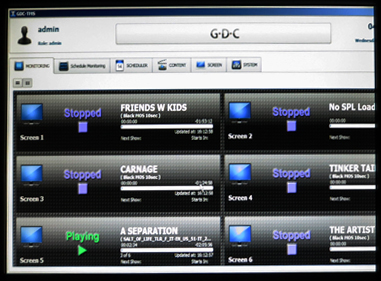
In the shift to digital projection, some would say the pivotal moment came with the success of Avatar and other 2009 3D releases (Monsters vs. Aliens, Ice Age: Dawn of the Dinosaurs, and Up). In 2009 there were about 7400 digital screens; a year later there were nearly 15,000. Then the acceleration began. Ten thousand screens converted in 2011 and eight thousand more the following year.
But I see 2005 as another major marker. In 2004, there were only 80 digital screens in the US. By the end of 2005, there were over 1500. The early adopters were pushed by the emergence of 3D, heavily touted by several major directors at NATO’s annual convention and the strong 3D releases of The Polar Express (2004) and Chicken Little (2005). So there were two bursts of digital adoption, both driven by 3D.
With 3D as a Trojan horse, digital entered exhibition. The format eventually settled on was the Digital Cinema Package, an ensemble of files gathered on a hard drive. The movie, with subtitles and alternate soundtracks, is wrapped in a thick swath of security files. The studios, petrified of piracy, had delayed the completion of digital cinema for some years until an ironclad system was protecting the movie. The DCP can be opened only with a customized key, delivered to the theatre separately from the hard drive. Typically the key is sent on a flash drive, so that the staff member need not retype the tediously long string of alphanumeric characters that make it up. Copying that key into the theatre’s server, its theatre management system, or the projector’s media block allows the film to be played on a certified projector.
A digital projector suitable for multiplex use relies on one of two available technologies. Sony’s proprietary system works only on its own projectors. Texas Instruments’ Digital Light Processing (DLP) technology was licensed to three manufacturers: Christie, Barco, and NEC. By fall 2010, all four companies had produced high-level, and quite expensive, machines capable of producing 4K displays. The rush to convert led to thousands of units being bought over a few months. This was great for business in the short term, but how could the manufacturers count on selling the product in the years and decades ahead? Michael Karagosian sketches the problem: “The big challenge today for technology companies is the massive downturn in sales that is destined to take place the last half of this decade as the digital installation boom ends.”
One way to expand the market was offered by cheaper machines. In fall of 2012, all the manufacturers introduced DCI-compliant projectors suitable for screens around thirty feet wide. The machines were still quite expensive, but they were marginally more affordable for the smaller or independent exhibitors who had been reluctant to convert or who had missed the deadlines for VPF financing. To maintain a quality difference from high-end machines, the cheaper versions typically lacked some features. They might be capable of only 2K, or they might not permit a wide range of frame rates, or they offered less brilliant illumination.
Another answer to a saturated market was continuous research and development. No sooner had exhibitors installed the “Series 2” projectors introduced in late 2009-early 2010 than speculation began about enhancements. How soon, for instance, might we expect 6K or even 8K resolution? Two other innovations were responding to problems with the dimness of digital 3D images.
One possibility was laser projection, which would be expected to brighten the image considerably. Laser projectors may start appearing in Imax cinemas later this year, but for most venues the current costs are prohibitive, running about half a million dollars per installation.
3D light levels could also be boosted by shooting and showing at higher frame rates than the standard 24. Peter Jackson famously experimented with 48-frame production on The Hobbit: An Unexpected Journey, and some theatres screened it that way. Response was mostly skeptical, with critics complaining of the hypersharp, “soap-opera” effect onscreen. The frame-rate issue has mostly quieted down, but it did trigger academic studies of the perceptual psychology involved in frame rates. In addition, James Cameron has insisted that his sequels to Avatar will be shot at an even higher frame rate. Most projectors require new software in order to increase frame rates.
Alongside developments in the projection market have come new devices for sound. As Jeff Smith pointed out in an earlier entry, innovative sound systems have been enabled by the switchover to digital presentation. 35mm film stock constrained the amount of physical space on the film strip that auditory information could occupy. Now that sound is a matter of digital files, sound designers can add many tracks for greater immersive effects—so-called “3D audio” platforms. Barco’s Auro 11.1 system and Dolby Atmos position several more speakers around the auditorium, including ones high above the audience. Costs of installation for these systems run from $40,000 to $90,000.
Still, projector and sound-system manufacturers can assume that business will continue because of the pressures for change inherent in digital technology. Experienced equipment installers suggest that a digital projector’s life is between five and ten years. Already the Series 1 projectors introduced in 2005 are becoming obsolete. Chapin Cutler, of Boston Light & Sound, notes:
A digital projector is a computer that puts out light. How many computers will you go through in the next ten years?
How many Series 1 projectors are still in use and supported by the manufacturers? Try buying parts for them. I know of one that was purchased four years ago that has been pushed into a corner. It has sat there for about two months so far, with no end in sight. (Thank heavens they still have their 35 mm gear!) It is broken and the manufacturer cannot supply parts; their customer service department doesn’t know about the machines, as they have only had to deal with the newer models; and the parts are not listed in their own internal parts book. Yes, four years old.
When replacement parts are available, they can be exceptionally pricey. A projector’s light engine, central to the image display, can run $22,000. And if an exhibitor buys a brand-new projector some years from now, the studios aren’t likely to launch a new round of VPF financing.
So even if a theatre can afford the expense of conversion today, upgrades and maintenance will demand big commitments of money in the years ahead. John Vanco, Senior VP and manager of New York City’s IFC Center, has put it well:
Many, many small, independent theatres, which are vital to the survival of non-studio films, will end up being fatally hobbled by the transition. They may be able to raise funds to cover the initial conversion, but what will crush many of them in the long term is the ongoing capital resources that will be necessary to continue to have DCI-compliant equipment in the next ten and twenty years. . . .
In the same way the current inexorable pattern of planned obsolescence forces consumers to continually repurchase computers, phones, etc., cinemas too are going to find that they have to spend much more for cinema equipment over the next twenty years than they did, say, from 1980 to 2000. . . . So these technological progressions will make it harder for those small theatres to survive.
Dylan Skolnick of Huntington, New York’s Cinema Arts Centre adds to Vanco’s point. “We have great supporters, but I can’t go back to them every five-to-ten years with a ‘Digital Upgrade or Die’ campaign.”
The problem is acute for small and art-house venues, but it isn’t minor for the Big Three either. Unless film attendance jumps spectacularly (it has been more or less flat for several years), exhibitors may need to raise ticket prices and the costs of concessions. This strategy may work in urban areas but won’t be popular elsewhere. Moreover, part of the boom in box-office revenues during recent years has been due to the upcharge for 3D features. But in the US, 3D revenues are currently leveling off at about $1.8 billion, a drop from the format’s 2010 peak of $2.14 billion. In 2012, 3D’s market share slipped as well. It isn’t clear that people would flock to 3D if the images were brighter. And if 3D television takes off, stereoscopic cinema will seem less compelling as a novelty.
Some observers hold out hope for glasses-free 3D technology in theatres, a change that would probably boost business. But the difficulties of creating 3D of this sort for multiplex venues are immense. The glasses-free platforms proposed by Dolby are aimed at small displays, like TVs, smartphones, and tablets. Of course, if 3D without glasses were devised for big screens, it would almost certainly demand yet another projector redesign.
No more silver bricks
When it comes to distribution, digital isn’t there yet. The UPS and Fed Ex corps still bring movies to multiplexes the old-fashioned way. The little briefcases are a lot lighter than hulking metal shipping cases, but we’re still dealing with physical artifacts.
At least for the moment. Festival submissions are already being placed in Cloud-based lockers like Withoutabox in an effort to replace DVD screeners. Online delivery is already being used for many of those operas, ballets, and other forms of “alternative content” flowing onto screens from various suppliers. A Norwegian distributor sent a 100 gigabyte local film, fully encrypted, to forty cinemas in the spring of 2012. This and experiments in other countries employ fiber-based networks, but the Digital Cinema Distribution Coalition, a joint venture among Hollywood studios and the Big Three exhibition chains, is exploring satellite systems.
So much for the impassive silver bricks in their cute pink beds on the cover of Pandora’s Digital Box. They may become as quaint as film reels and changeover cue-marks. For a time, the hard drives may survive as backup systems that will reassure exhibitors, but eventually no physical site may serve as the movie’s home. An exhibitor will download the film to the server, apply a decryption key sensitive to time, venue, and machine, and the movie will be, as they say, “ingested.”
In the Pandora book, I included chapters on other exhibition domains I haven’t revisited here. Take archives. More and more studios refuse to rent prints, will not prepare DCPs of most classic titles, and won’t let theatres screen Blu-ray discs commercially. So repertory cinemas turn to archives, seeking to rent 35mm copies that may be irreplaceable. In addition, archivists, laboring under tight budget constraints, are racing to preserve and restore their material on film, which remains the most stable support medium. At the same time, archives are expected to get involved in preparing high-quality digital versions of popular classics. Henceforth most restorations that you see will be circulated on 2K or 4K, as Metropolis, La Grande Illusion, and Les Enfants du Paradis have been in recent years.
Film festivals, as Mike King, one of our Wisconsin Film Festival programmers observes, are now file festivals. Cameron Bailey reported that of the 362 titles screened at TIFF last year, only fifty-one were on film. Last month, our annual event ran twenty-one new films on film; most were 16mm experimental items. The remaining 132 were on DCP, HDCam, Quicktime files, or DVD/Blu-ray. On the plus side, independent filmmakers are learning to encode their films in the DCI-compliant format, often without layers of security, so at least in this respect technology may not be a severe barrier to entry.
As for me, I’m still in the midst of churn. I watch movies on film, on DCP, on DVD and Blu-ray and VOD, even on laserdisc, and sometimes on my iPad. But my research will miss 16mm and 35mm. Some of the questions I like to ask can be answered only by handling film. Last weekend I sat down at a Steenbeck flatbed and counted frames in passages of Notorious and King Hu’s Dragon Inn. This sort of scrutiny is virtually impossible on DVDs and Blu-rays, which don’t preserve original film frames.
What I’ve lost as a specialist is offset by many gains. Since the arrival of Betamax and VHS, nontheatrical cinema has expanded to limits we couldn’t have imagined in the 1970s. Thanks to consumer digital formats, more people have more access to more movies of all sorts than at any point in history. Although some aspects of film-originated movies are hard to recover on digital playback, we can study cinema craft to an extent that wasn’t possible before. Digitization has allowed sophisticated visual and sonic analysis to bloom on websites around the world. See, among many examples, Jim Emerson’s Scanners and A. D. Jameson’s work on Big Other.
With the rise of nontheatrical consumption, though, what’s most at risk is theatrical cinema: film viewing as a public forum. Exhibition outside film festivals is already starting to narrow to recent releases and a few approved classics. We will be able to watch The Suspended Step of the Stork and Leviathan on our home screens for a long time to come, but very seldom on the scale that benefits them most.
As ever, the problem of technology isn’t only a matter of hardware. Technology develops within institutions. Hollywood has standardized a new technology favoring its goals. The institutions of minority film culture–festivals, art houses, archives, local cinemas, schools–need to be robust and resourceful to maintain all the types of cinema we have known, and the types we might yet discover.
Since Pandora was published, a very comprehensive guide to the mechanics of digital projection has appeared: Torkell Saætervadet’s FIAF Digital Projection Guide, and it’s a must. One rich treatise I didn’t cite in Pandora is Hans Keining’s 2008 report 4K+ Systems: Theory Basics for Motion Picture Imaging. Michael Karagosian’s website is an excellent general source on digital exhibition in the late 2000s.
Screen Daily provides a good overview of the new technology on display at CinemaCon 2013. For general background on industry trends after the changeover, see the Variety article “Filmmakers Lament Extinction of Film Prints.” As for archives, Nicola Mazzanti edited a very useful European Commission study, Challenges of the Digital Era for Film Heritage Institutions (Berlin/ UK, 2012). May Haduong surveys current problems of print access and film archives in “Out of Print: The Changing Landscape of Print Accessibility for Repertory Programming,” The Moving Image (Fall 2012), 148-161. The piece requires online library access, but a summary is here.
Much of the industry information in this entry came from proprietary reports published in IHS Screen Digest. Thanks to David Hancock for his assistance with other data, and to Patrick Corcoran of NATO for updated information on theatre conversion. Thanks as well to Chapin Cutler, Duke Goetz, Michelle Haugerud, and Dylan Skolnick for permission to quote them. I’m also grateful to Jack Foley of Focus Features and Joshua Hittesdorf of Market Square Cinemas. Finally, I want to thank Russ Collins and his colleagues at the Art House Convergence for mounting another splendid event and for inviting me back last January. I continue to learn from the discussions on the AHC listserv, and I’m particularly grateful to John Toner for his reports on independent cinemas’ funding efforts.
Other entries on this site offer material on the digital transition. There’s “It’s good to be the King of the World,” on James Cameron’s push for 3D TV; “ADD = Analog, digital, dreaming,” about the powers of photochemical cinema on display at the Toronto International Film Festival 2012; “Digital projection, there and here,” some notes on the situation in Western Europe; and “Side by side: Quick catchups,” includes notes on sources for studying digital cinema. In “16, still super,” veteran programmers talk about how they continue to rely on this format; in the process they convey their commitment to providing unusual fare.
P. S. 15 May 2013: Rebecca Hall of the extraordinary Northwest Chicago Film Society has posted a continually updated list of theatres that are dedicated to showing films in 16mm and 35mm.
P.P.S. 12 June: David Hancock has just presented a very full report entitled “Digital Cinema Worldwide: 35mm phased out in many countries, though some lag behind.” It is published in the June IHS Screen Digest. One of my remarks above has been corrected in light of some information in the report: I claimed that Belgium has fully converted, but David’s figures indicate 96.5% conversion.
David predicts that by end 2013, 90 % of world screens will be digital. Even India is making the move, as circuits relying on DVD or other low-resolution sources are converting to DCI-compatible equipment. Those regions slowest to convert include Italy, Greece, and Spain (not surprisingly, given recent austerity policies), as well as areas of South America and the Pacific (e.g., Thailand, the Philippines). Thanks to David and his team at IHS Screen Digest for their comprehensive coverage of this process.

Dragon Inn (King Hu, 1967). 35mm frame enlargement, taken on Fujichrome 64.
Has 3D already failed? The sequel, part 2: RealDsgusted

Kristin here–
For part 1, see here.
Darn those quickie conversions!
In past years, 3D proselytizer Jeffrey Katzenberg, head of Dreamworks Animation, has complained about the slow progress of the conversation of theaters to digital and 3D projection. By September, 2010, faced with a growing backlash against the technology, he was more concerned about the conversion of films shot in 2D to 3D. The 3D Hollywood in Hi Def site reported:
Jeffrey Katzenberg opened the 3D Entertainment Summit with his usual provocative verbal flare [sic], defending 3D successes against the recent growing tide of critics claiming it is already dying — “It seems there are some in Hollywood who are determined to seize defeat from the jaws of victory. Six of the top 10 movies this year are 3D; I guess we have to have 10 of 10.” — and lambasting filmmakers and studios who convert movies to 3D after they are produced in 2D, calling them “downright ugly” and claiming they are endangering the technology that is single-handedly responsible for the industry’s growth in the past year.
On the whole the media were hardly sympathetic, perhaps because Katzenberg has been largely responsible for making 3D–including those 3D-ized films–so profitable. Patrick Goldstein of the Los Angeles Times called his speech a “desperation plea” and gleefully linked to several anti-3D articles, including some of the ones I’ve linked to in this and last week’s entries.
What Katzenberg didn’t point out was that some of the six films in the top ten were the same retrofitted ones that he was attacking: Clash of the Titans and The Last Airbender. Alice in Wonderland was shot in 2D, but planned with the knowledge that it would be converted to 3D. (Gulliver’s Travels had not yet demonstrated that retrofitted 3D doesn’t always make for big domestic BO.)
Yet about a month later, in an interview with the New York Times, the other most influential figure in the push toward 3D, James Cameron, was discussing converting a film released in 1997 and not planned with 3D in mind: Titanic. (He plans to release it for the 100th anniversary of the ship’s 1912 sinking.) For Cameron, conversion is a problem when it is done hastily and carelessly. Of the retrofitting of Clash of the Titans he remarked, “It was just being applied like a layer, purely for profit motive.”
One problem with converting a 2D film to 3D comes from the fact that the process is far from an exact science (or art). Cameron commented on his search for a company to handle Titanic:
These conversions are so painstaking to complete correctly, Mr. Cameron said, because “there’s no magic-wand software solution for this.”
He added: “It really boils down to a human, in the loop, sitting and watching a screen, saying, ‘O.K., this guy is closer than that guy, this table is in front of that chair.’ ”
For his 3-D “Titanic” rerelease, Mr. Cameron said he had approached seven companies about working on the film, testing each by asking it to convert about a minute of movie footage before he chose the best two or three efforts.
“All seven of the vendors came back with a different idea of where they thought things were, spatially,” he said. “So it’s very subjective.”
He also points out that studios will inevitably search their vaults for films to convert.
How does 3D conversion work? An invaluable issue of Screen International, “European 3D Special 2010,” explains in terms reasonably comprehensible to the lay person:
While each company goes about it slightly differently, the requirements are broadly the same: the creation of a second identical version (to obtain a second eye view) and the isolation of foreground from background elements by rotoscoping, adding depth and then painting or animating in the gaps. “When you move an image in this way to create two views, the biggest problem is filling in and cleaning up the area left behind,” says Vision3 post-production supervisor Angus Cameron. (From “Conversion: 2D to 3D,” p. 9)
(This issue, by the way, shows that studios doing conversion are popping up in Europe as well as in the U.S.)
As Cameron’s statements and this description suggest, the process is a painstaking, lengthy one. Many in the industry praised Warner Bros.’ decision not to release Harry Potter and the Deathly Hallows Part l in a 3D conversion. The studio cited insufficient time before the release date as its reason. Cameron remarked, “You can’t do conversion as part of a postproduction process on a big movie, because no one is willing to insert the two or three or four months necessary to do it well.” (Of course, some foes of 3D may have suspected that the real reason for Deathly Hallows I being released only in 2D may have been that WB saw the declining share of the box office going to 3D and decided it just wasn’t worth it.)
Graham Clark, the head of stereography for the Stereo D company, claims that the conversion process can be done well as long as enough time is allotted for it:
“The main thing is this is an artistic process,” he said of conversion. “Composing things in 3D space is every bit as artistic as composing things in 2D space.” […]
“Because there are so many factors that go into deciding how to compose a shot, you need interaction with the producer, director, cinematographer—so you are not, at the eleventh hour changing things,” he said. “Also, visual effects studios are used to handing off [VFX elements] at the eleventh hour. Conversion is new in the film pipeline, and people aren’t used to having to hand stuff off earlier.”
Clark points out some of the ways that conversion could be used to enhance a film. If a 3D camera can’t be fitted into a certain space, a shot can be done in 2D and converted. If after a scene is shot the filmmakers want to shift the spatial relations of elements within it, they can do so—eventually, at any rate, since the techniques for doing that are still being developed. As Clark points out, films shot in 3D usually have some shots that are converted. Even Avatar included some. (See Carolyn Giardina’s “The art of the 3D conversion,” The Hollywood Reporter, October 29, 2010, pp. 6, 87. The same article, retitled “Expert: The Biggest Challenge in 3D Conversion,” is available here for subscribers.)
Given that most effects-heavy films these days face a major crunch to make their release dates and have to employ multiple effects houses to do the job, a quality 3D conversion can only add to the headache. Not to mention more work for the conscientious director and cinematographer who have to sit in on the decision-making to prevent the quality of their work from being diminished.
All in all, it looks as though 3D will not die out completely. But will there come a time when every screen in the world’s major markets will have the capacity to show 3D films? That was Katzenberg and Cameron’s original ideal, or so they said. Others had the same vision. Katzenberg has committed Dreamworks Animation to making only 3D films. Does he plan eventually to eliminate 2D prints altogether? Cameron claimed he would do that with Avatar, but he had to give in on that one.
Maybe Katzenberg and Cameron would object that they didn’t mean that literally every screen would be 3D. Yet advocates for 3D often compare it to sound or color or widescreen, all processes which did fully penetrate theatrical exhibition. In major markets sound took about three years (though places like Japan and Russia still made a few silent films into the mid-1930s). Widescreen took about six years. The most apt comparison is perhaps color, which didn’t become really viable until the mid-1930s; it remained somewhat rare into the 1940s and didn’t really become dominant until the late 1960s. But in our era of fast-moving technology, perhaps three decades from now 3D, at least in its current form, requiring glasses, will be a dead technology.
In my first entry on 3D, I mentioned that not very many producers or directors have been proselytizing for the process nearly as much as Katzenberg and Cameron have. Lucas is converting the Star Wars series, but he doesn’t promote the process with the fervor he once devoted to digital cinematography and projection and Dolby sound. Spielberg’s first 3D film, The Adventures of Tintin: The Secret of the Unicorn, is coming out in December, but he’s not making the round of the trade fairs singing the praises of the process. The same is true of Scorsese and his 3D debut, Hugo Cabret, also coming in December.
Peter Jackson and Guillermo del Toro had originally stated that The Hobbit would be 2D, so as to keep a unified look alongside the Lord of the Rings trilogy. But when Warner Bros. finally greenlit the film in October of last year, the press release included the news that the two parts will be shot in 3D. Peter Jackson is a big booster of the Red brand digital cameras (used on The Lovely Bones and District 9), and he enthused briefly in the Red press release about using the new Epic 3D model for The Hobbit. His Weta Digital facility did most of the effects for Avatar. Still, he’s not out on the stump, urging theaters to convert and warning filmmakers not to retrofit their films, and many fans wonder whether Warner Bros. left him any choice in the matter of using 3D. (Vague statements have been made about the trilogy being released in 3D eventually, but there’s no firm news about that.)
Of course, assuming 3D is here to stay, there will always be bad conversions because there are bad instances of anything. There are shoddy-looking 2D movies and always have been. Still, the studios didn’t charge extra for them. There are and will be movies originally shot in 3D that are bad. People will have to pay extra for them, too, at least in the near future. Somehow, paying that premium 3D price seems to make people more indignant about bad movies than paying the regular price does. Studios are not likely to heed Katzenberg’s plea that they not crank out cheap 3D-izations. If such sloppy jobs as Clash of the Titans continue to come out and sour people on paying premiums, the studios may have to lower those premiums until they just cover the extra costs of production and of the glasses. If 3D ceases to generate any significant extra profit, will the studios bother with it?
Or will they take the more sensible approach that I mentioned at the beginning of the first part of this entry, settling for multiplexes converting two or three screens for 3D capacity and showing either special-event films like Avatar or cheap genre films like Piranha 3D? Part of that approach would include continuing to make 2D prints of films. There are quite a few viewers who would prefer that option.
At least one studio chief agrees. Last summer Home Media Magazine‘s article on Toy Story 3 reported: “Disney CEO Bob Iger, in a recent financial call, cautioned flooding the market in 3D releases, opting instead that earmarked titles in the format should be done strategically, and not as an afterthought.”
Before moving on to vociferous 3D opponents, I’ll mention a couple of intriguing, possibly significant things that I’ve noticed that may indicate a short life (or possibly a marginalized long life) for 3D.
First, on January 10, the Academy of Motion Picture Arts and Sciences announced its scientific and technical awards. (Those are the ones that are given out at a separate ceremony and are given a blink-and-you’ll-miss-it acknowledgment during the Oscar ceremony.) These awards are often given for developments that occurred years earlier. On the other hand, major innovations tend to get honored fairly soon. The two technical awards given for special-effects programs for The Lord of the Rings were given in 2004, the same year that The Return of the King swept the Oscars.
This year’s awards include none relating to 3D. (For Variety subscribers, the complete list is here; so far they don’t seem to be listed on the Academy’s website.) Instead, they relate to such inventions as a new winch for flying heavy props like cars, a new suspended-camera mount, systems for queuing special effects for rendering, a method for facial-expression capture, and an innovative way of using bounce lighting in computer animation. Maybe it’s not significant, but it may give a clue as to the professional motion-picture technicians’ view of 3D.
Second, this past summer David and I were able to attend a trade demonstration at a local theater. The Technicolor firm had innovated a 3D add-on lens for 35mm projectors. Technicolor had seven Hollywood studios signed on, agreeing to provide analog 3D prints formatted in the system. (13 of the 19 films released in 3D in 2010, beginning with How to Train Your Dragon, were available on 35mm 3D prints.) The main appeal of the system was that distributors don’t buy it; they rent it by the year. The special silver screen needed for the technology would cost around $4000 to $6000 to install (and could be used for some digital 3D systems, including RealD), and the lens would be rented at $2000 per 3D film exhibited, with a maximum of $12,000 per year. In contrast, a digital 3D conversion costs at least $75,000 per house.
Some small-town exhibitors from the surrounding area were obviously intrigued. They couldn’t afford to convert to digital/3D, but this offered a cheaper option. Nobody mentioned it during the demo, but the other obvious implication seemed to be, if you just rent your equipment, you won’t lose out if the 3D craze fizzles out. The firm anticipated having over 500 systems installed in the U.S. by the end of 2010. (For a case of a theater in Decatur, Illinois that canceled its deal with Technicolor, see here; the management failed to understand that one has to charge higher admission for 3D tickets because the print rental fees and 3D system cost more, and the projectionist keeps referring to the 3D lens as a “camera.” On the whole, one can’t feel that in this case the Technicolor system itself was to blame. The 25 equipped screens out of the 150 in the Bow Tie Cinemas chain in California presumably have fared better.)
[Added later the same day: Skip Huston, who run Huston’s Avon Theater 3 in Decatur, tells me that the reporter was the one who called the lens a “camera.” (Knowing what it is to be misquoted by a reporter, I can well believe it.) The owners tried to avoid raising ticket prices for their customers, but that just doesn’t work with 3D. Mr. Huston’s theater is a mom-and-pop establishment competing with two Carmike multiplexes. Those wishing to avoid 3D have the option of 100% 2D at the Avon.]
Naysayers galore
The more I see of the process, the more I think of it as a way to charge extra for a dim picture.
Roger’s remark sums up the two beefs people have with 3D. Not surprisingly, when 3D was a novelty and only major films had it, people were willing to pay extra. Now that any multiplex will be likely to have one or two screens devoted to 3D movies at any given time, the premium has begun to seem onerous. And yes, the glasses do cut out a noticeable part of the light coming from the screen.
According to a report by PricewaterhouseCoopers (quoted in The Hollywood Reporter), “a $5 premium per ticket is too much to expect audiences to pay for 3D. That survey indicated that 77% of Americans will not pay a premium of more than $4.” In terms of the industry’s attitude, the report adds, “Many people are over-excited by it. The danger is that industry players risk killing a golden goose by overselling and, in some cases, 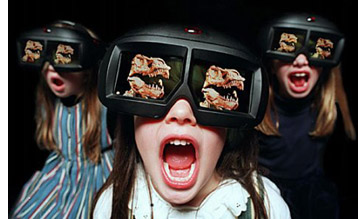 overpricing the 3D experience—and by providing too much mediocre content that doesn’t do justice to the technology.”
Putting aside the high price, there are those who actively dislike the process. Others admit that there are a few films that justify the use of 3D but that most films using the process released so far have been attempts on the parts of the studio to jack up the ticket prices. If these people are entertainment journalists, they use the forum of their reviews or columns to air their complaints. If they are ticket-buying audience members, they search out the 2D screens or stay home. Some of them blog about their complaints, others write letters to the editor, and others carp about 3D around the water cooler.
Roger Ebert probably has the highest profile of the anti-3D naysayers, as least among the general public. In an article in Newsweek (May 10), he laid out his objections:
3-D is a waste of a perfectly good dimension. Hollywood’s current crazy stampede toward it is suicidal. It adds nothing essential to the moviegoing experience. For some, it is an annoying distraction. For others, it creates nausea and headaches. It is driven largely to sell expensive projection equipment and add a $5 to $7.50 surcharge on already expensive movie tickets. Its image is noticeably darker than standard 2-D. It is unsuitable for grown-up films of any seriousness. It limits the freedom of directors to make films as they choose. For moviegoers in the PG-13 and R ranges, it only rarely provides an experience worth paying a premium for.
Roger goes through each of these reasons in more detail. He writes with conviction, and the studios would be wrong to think that he stands alone. I wonder how many other websites have linked to the online version of the essay. I see it quoted and linked a lot, even eight months after it appeared.
Movie City News critic David Poland, also far from being a fan of 3-D, recently posted an entry called “Will 2011 Be A 3D Car Wreck?” He assesses many of the roughly 30 3D films announced for this year. As he points out, similar films will be competing with each other during the key release seasons, as with Scorsese’s Hugo Cabret, the third in the “Chipmunks” franchise, and Spielberg’s Tintin movie, which are coming out within a short period. He concludes:
But the problem remains… 3D is a tool, not an answer. The problem that I expect next December, for instance, will be a parade of high quality films of a similar tone all piled up in on month. Same with the load of animation in November. And whichever films pay the price – and some films will – it won’t be 3D’s fault, but rather, overloading the marketplace. The franchises are franchises and the product that isn’t franchise will need to be sold smartly and heavily… just as in a world without any 3D at all.
This is an interesting variant on the view of 3D as a symptom of the film industry’s problems. Often popular commentaries link 3D mainly to the loss of audiences to TV, video games, and other new media sources of entertainment. But Poland sees the problem as more related to the increasing dependence on franchises and big event films. When other methods of luring patrons into theaters fails (Johnny Depp and Angelina Jolie together for the first time!), 3D remains a lure–except when it doesn’t, as with Gulliver’s Travels.
These days Entertainment Weekly seems to be mounting a campaign against 3D. Lisa Schwarzbaum makes no bones about her increasing disenchantment with the format. About a quarter of the prose in her December 15 review of The Chronicles of Narnia:Voyage of the Dawn Treader (C rating) is devoted to it:
And that includes the option of watching The Voyage of the Dawn Treader in undistinguished, unnecessary 3-D. I’m more and more frustrated these days by movies that sell the 3-D movie experience as a kind of turbo-charged event, yet the greatest extra we see through plastic movie-theater goggles is the ”dimensionality” of a sword or a boot or the imaginary fur on a CGI 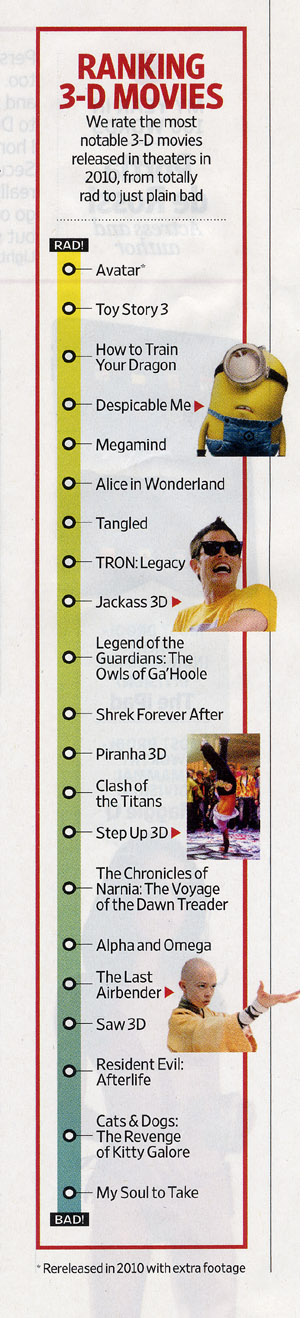 mouse. I’m confounded by the fact that, aside from the Pevensie siblings and their nicely obnoxious cousin, absolutely everything and everyone aboard the Dawn Treader looks one-dimensional, no matter how closely I peer through special specs.
It’s not just that one film, either. Schwarzbaum called Tangled (B rating) “Disney’s new (yet not quite novel), musical (yet not quite memorable), 3-D (yet so what) animated retelling of the Grimm brothers’ Rapunzel.” Of The Green Hornet (C-), she remarked, “In a last-minute tweak, the production has also been meaninglessly 3-d-ified–never mind that there’s nothing whatsoever 3-D-ish going on. Maybe those clumsy 3-D glasses are meant to let moviegoers mimic the superhero mask-wearing experience? At any rate, they let moviegoers pay more for a ticket.”
OK, she’s one critic. But note EW‘s back-page “Bullseye,” which shows what one or more people on the staff think of as recent hits and misses in the sphere of popular culture. For the week of November 11, , there was an arrow fairly close to the center with the caption: “Good news for 2012: Batman gets a title (The Dark Knight Rises). Better news for 2012: He won’t be rising in 3-D.” For the year-end Bullseye from the undated last issue of 2010, an arrow on the outer rim had a distinctly unsympathetic caption (see above). The January 21 issue places an arrow near the outer ring, labeled “All that talk of making The Great Gatsby in 3-D.”
Lest anyone think that EW has some hidden agenda in knocking 3D, we should note that the magazine belongs to Time Warner, whose Warner Bros. studio is deeply invested in the success of the format.
There’s also a great deal of anecdotal material about how parents are tired of paying multiple 3D surcharges when taking a whole family—and tired of finding that the kids won’t wear the glasses through the whole show. Dorothy Pomerantz is one parent with a soapbox from which to state her case, in the form of her “The Biz Blog” for Forbes. On July 13 she wrote:
We went to an 11 a.m. showing (for matinee prices) of Despicable Me and it cost us $41 for a family of four. If we had decided to see the film in 3-D, it would have cost us $55 for tickets alone. In my mind, that’s too much money.
For one thing, my kids are scared of the 3-D effects and wiggle so much in their seats it’s hard to tell if they’re seeing the image clearly at all (and my daughter has a very hard time wearing the glasses over her normal glasses for 90 minutes at a time). I find the glasses sit very uncomfortably on my face and that the movie image is often dim. For some reason my husband doesn’t see the 3-D well and ends up with a horrible headache.
People seem to think that children’s animation is ideal for 3D—but if a lot of young children don’t like the glasses or can’t keep them on, maybe that’s not true. (The image above right is not a warning against such problems but a promotional item for watching 3D Blu-ray on PlayStation 3. Apparently children will be seen and be heard.)
Apart from journalists, ticket-buyers are complaining. Back to EW, where the January 14 edition’s letters page (p. 10) had this from Courtney Holcomb of Grand Prairie, Texas:
I’ve read many articles discussing the trend that Avatar started … yet most of them miss a simple point. The film was available in both 3-D and standard formats. The customer had to decide “Do I want to see it in 3-D or not?” More recent 3-D movies have changed the question to “Is it worth it to see the movie in 3-D?” Many of the ones on the “Bad!” end of your “Ranking 3-D Movies” chart might have done better if the standard version had been available as well.
Actually the chart (see left) was by quality, not income, but Ms Holcomb’s point could apply to box-office hits and disasters alike. People who had no access to 2D versions of any film on the list might have decided to go. A friend of mine told me he didn’t see The Voyage of the Dawn Treader, despite wanting to, because it was only showing in 3D.
On the same letters page, Stephen Wohlleb of Sayville, New York, wrote:
While studio execs scurry to push out any film they can in 3-D, they must keep in mind that 3-D should be used to enhance the story, not replace it. The “other Avatar,” The Last Airbender, was so poorly received because story still comes first; 3-D does not a film make.
I have not ventured too far into the depths of chat rooms and comments on the internet for the purpose of writing this blog, but of course, there one can find vociferous pro and con statements on 3D.
I have a friend with vision problems and frequent headaches, and she actually finds the 3D glasses improve her viewing of films. That doesn’t seem to be common, though. Mostly the headaches and the kids-having-trouble-with-glasses complaints seem to be shared by many.
Industry commentators don’t seem to mention the novelty effect of 3D much any more. Surely they never really thought that audiences will be dazzled forever. I think we reached the ho-hum point some time last year. I’ve mentioned that people began to resent the $3+ price hikes and to pick and choose more carefully among 3D releases, wanting the movie to be good enough to warrant paying more. But others perhaps decided 3D in general wasn’t worth it and that they would rather see a film the old fashioned way, seeing a flat image undimmed by glasses.
For me it was Toy Story 3. In 2009, David and I saw Up in 3D and enjoyed it. But we enjoyed it because it was another great Pixar film. As I said in my 2009 entry, I have remembered the film in 2D. We went to Toy Story 3 in 2D and enjoyed it. I have yet to see a film in both 3D and 2D to make a comparison, but my suspicion is that I would usually prefer the 2D version. I suppose the basic problem is that if the 3D is used for flashy depth effects with things flying out at the audience, it becomes too distracting and obtrusive. But if it’s used simply to make, say, jungle plants look closer to the viewer than Carl and Russell, then it’s unobtrusive—and hence not very interesting. Given that we have other mental tools besides binocular vision for grasping the spatial relations in an image, the jungle plants look closer in 2D as well.
A final thought on disaffected audiences. Currently there is a sector of the moviegoing public that loves 3D, will pay extra to see almost anything in 3D, and hopes the process expands. That part of the public is probably as big as it’s going to get. (Yes, new kids will grow up, but others will mature out of their adolescent obsessions with such things.) In the U.S. at any rate, right now there aren’t a lot of people suddenly discovering the joys of this wonderful new format. (It’s really just getting going in the major Asian markets.) But the proportion of the getting fed up by the process’ drawbacks—its higher cost, the growing numbers of mediocre and bad films in 3D, the glasses—is probably growing.
Just in time for inclusion in this entry, Roger has posted a new article, “Why 3D doesn’t work and never will. Case closed.” It includes a letter from Walter Murch, who is about as well-respected an expert on film technology as you could find. The letter explains how 3D systems work in ways that are contrary to the ways that our eyes and brains actually function. He deals with strobing, the convergence/focus issue (“So 3D films require us to focus at one distance and converge at another.” That’s where people’s headaches come from in watching 3D movies.) Murch concludes: “So: dark, small, stroby, headache inducing, alienating. And expensive. The question is: how long will it take people to realize and get fed up?”
Perhaps not very long. I was expecting that in the wake of last week’s post I would receive indignant email and get flamed on message boards. So far I have seen no indignation. One thread on imdb that linked to the entry led to about ten comments, all expressing dislike of or indifference to 3D. Of course, that entry was on the “advantages of 3D” (such as they are) for the industry. Maybe this one will rouse more ire.
A 3D film even a naysayer can love
There’s one 3D film that even 3D disparagers eagerly want to see: Werner Herzog’s Cave of Forgotten Dreams. It’s the one where Herzog got exclusive access to film in the Chauvet cave, which contains one of the largest and oldest sets of prehistoric paintings. I would love to see the cave, but it isn’t open to the public. So naturally I would love to see Herzog’s film. (He’s not exactly a bad filmmaker, either, whatever the topic). It seems the perfect use for 3D: showing people exciting places they will never get to see on their own. I could imagine a similar film being made in the tomb of Sety I in the Valley of the Kings, a very deep tomb full of paintings considered among the best that survive from ancient Egypt. It will almost certainly never be open to the public either.
IFC acquired the film at the Toronto International Film Festival in September. They don’t seem to be trying to publicize it very much. No announcement on their site of when it’s going to be released, and the Google link to the official trailer comes up with a “Page not found.” I had to go to The Documentary Blog to find out that the release date is March 25, but the author had no information about how many theaters would get it in 3D. I should think IFC would make more of a big deal about this film as a real “event” movie. Maybe they will, closer to the release date. With operas and sporting events playing in multiplexes, I would think that there’s a considerable audience for 3D films that bring special events to a far-flung audience. Every kid whose imagine was kindled by learning about prehistoric cave paintings in school, every art lover, plus every cinephile, would attend Cave of Forgotten Dreams if it came to a theater near them.

Has 3D Already Failed? The sequel, part one: RealDlighted
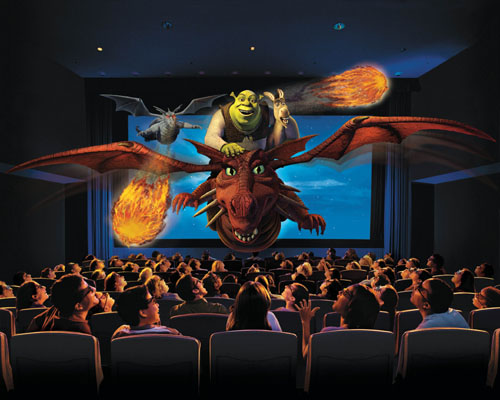
Kristin here–
On August 28, 2009, I posted an entry called “Has 3-D Already Failed?” As I wrote then, my title was deliberately provocative. It depended on which of two yardsticks you measured success by:
1. If you’re Jeffrey Katzenberg and want every theater in the world now showing 35mm films to convert to digital 3-D, then the answer is probably yes. That goal is unlikely to be met within the next few decades, by which time the equipment now being installed will almost certainly have been replaced by something else.
2. It also seems possible that the powers that be will decide that 3-D has reached a saturation point, or nearly so. 3-D films are now a regular but very minority product in Hollywood. They justify their existence by bringing in more at the box-office than do 2-D versions of the same films. Maybe the films that wouldn’t really benefit from 3-D, like Julie & Julia, will continue to be made in 2-D. 3-D is an add-on to a digital projector, so theaters can remove it to show 2-D films. Or a multiplex might reserve two or three of its theaters for 3-D and use the rest for traditional screenings.
If the second, more modest goal is the one many Hollywood studios are aiming at, then no, 3-D hasn’t failed. But as for 3-D being the one technology that will “save” the movies from competition from games, iTunes, and TV, I remain skeptical.
So, nearly 17 months later, where do we stand? There has been a considerable increase in the number of screens with 3D projection systems, from 4,400 in May 2010 to 8,770 in early December. That’s out of roughly 38,000. This growth presumably came in response to the huge success of Avatar and Alice in Wonderland. Anne Thompson’s “Year-End Box Office Wrap 2010” quotes Don Harris, Paramount’s executive vice-president of distribution: “There are more screens, so a theater can now handle anywhere from two to three 3-D films at one time.” By year’s end, there were roughly 13,000 3D-equipped screens outside the North American market. The number of 3D films per year has grown from 2 in 2008 to 11 in 2009 to 22 in 2010 to an announced 30+ for this year.
Thompson also points out two other important strengths of 3D films: they sell a lot of tickets abroad, often earning three times as much as in the North American market, and they have led to theatrical income is “again the leading film revenue stream.” Of course, that’s partly due to the drop in DVD sales.
Yet for some the bloom seems to be off the rose. Low-budget exploitation films in 3D, films shot in 2D and converted for 3D release, filmgoer impatience with ticket surcharges and clunky glasses, and a general decline in the novelty value of 3D have all combined to leave its future still in doubt.
Before going more deeply into those problems, though, let’s look at the box-office successes, or apparent successes, of 3D films in 2010.
3D props up the box office
This week’s print version of The Hollywood Reporter heralds 2010 as “The year that was saved by 3D.” (For subscribers, the article is online, though it lacks the charts.) As Pamela McClintock, author of this excellent article, points out, “Of the top 20 films at the domestic box office, 11 were 3D titles (out of a total of 22 major 3D releases). Why the fat grosses? On average, a 3D title can expect to make 30 percent more because of the 30 percent upcharge for a 3D ticket.” (The accompanying chart, below, covers only the top 11 titles.)
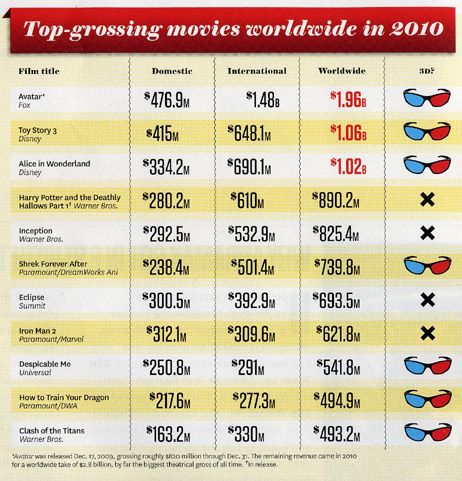
(I will step in here and point out something that never seems to get mentioned in coverage of 3D, which is that part of that fee goes to pay for the glasses.)
Moreover, overseas markets, which have been making up an increasing portion of most big films’ worldwide grosses, are adding 3D screens like crazy. “The U.K., China, Russia, Japan, France, Germany, China and Russia in particular have seen a surge in digital-theater installations.” Given that the U.S. is still making more 3D films than most of these countries, Hollywood is getting a generous slice of that box-office income. Some films thought to be disappointments in the States did well worldwide, such as Clash of the Titans, with $493.2 million, and The Last Airbender, with $318.9 million.
Of course, there have been underperformers: Cats and Dogs: the Revenge of Kitty Galore, The Voyage of the Dawn Treader, and Gulliver’s Travels, most notably. McClintock points out, “It’s almost certain that Deathly Hallows would have jumped the $1 billion mark worldwide had it been released in 3D, but Warners didn’t want to tarnish the franchise.” As it is, Harry Potter and the Deathly Hallows Part 1 has grossed $937,257,461 worldwide and is still in distribution.
Another thing that McClintock points out that most commentators ignore is that making a film in 3D adds to its budget, on average about $20 million for a two-hour feature. The alternative practice of shooting a film in 2D and then converting it to 3D is common. That costs about $100,000 or more a minute, or about $12 million for a two-hour film. (James Cameron, who ought to know, says a quality job would be $15 million or more.) For a movie that grosses in the hundreds of millions, that’s pretty small, but it’s not insignificant for a more modest film.
Let’s think about that for a moment. Jeffrey Katzenberg and James Cameron may still expect that all films will someday be made in 3D. But, to take one example I’ve seen people use in recent months, do we really think The Kids Are All Right would be enhanced by 3D? Even if some people do, the film cost only around $4 million to make and grossed a little under $30 million worldwide. Would $20 million spent on 3D cause it to gross over $50 million to make up the difference?*
Or does it?
Despite the fact that 3D brought in higher grosses for the more successful films in that format last year, some experts are pointing to a decline in revenues over the year. In July of last year, Daniel Frankel published a widely cited chart called “The Rise & Fall of 3D” on The Wrap showing that since the release of Avatar the previous December, the proportion of the opening weekend box-office for major films coming from 3D screenings had declined:
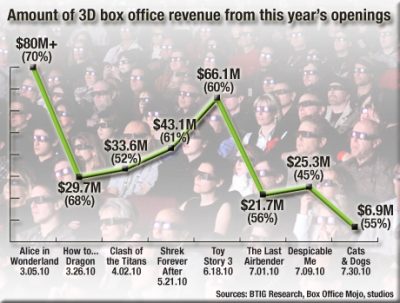
Then in August Slate posted a more detailed study by Daniel Engber bluntly entitled “Is 3-D Dead in the Water?” Engber took issue with Frankel’s chart saying that it did not reflect problems with a shortage of 3D screens available during the release of these films. But Engber didn’t disagree that 3D’s share of a film’s income has been falling. Quite the contrary, he thought it the decline was even greater. Taking a different approach that basically compares per-screen averages for 3D and 2D screening of the same film, he came up with a new chart:
The chart below—created with enormous help from Slate designer Holly Allen—shows the ratio of 3-D revenue to 2-D revenue, on a per-screen basis, for almost every major three-dimensional release going back to the beginning of the current revival.
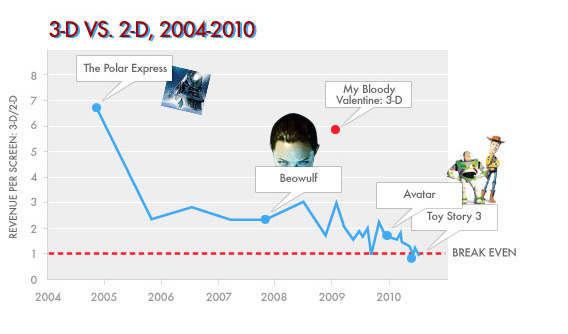
Here’s the simplest way to interpret this graph: 3-D has been getting less and less profitable, relative to 2-D, over the past five years. It’s an ominous, downward trend that started long before Avatar and Alice in Wonderland and continued after. (The red dotted line represents a break-even point, where screenings in 3-D and 2-D theaters make exactly the same amount of money.)
(I can’t go into the details here, but Engber presents additional charts and information; it’s a must-read for anyone interested in 3D, pro or con.)
Last year the big complaint from Katzenberg and other 3D purveyors was that there weren’t enough theaters to screen all the films that were coming out in that format. Katzenberg is still not satisfied with the rate at which theaters are converting screens to 3D, but maybe exhibitors have realized that there is not as much future in it as they had been led to believe. Given that most multiplexes have two, three, or even four screens capable of showing 3D films, the rate of conversion is likely to slow, if it hasn’t already.
Toy Story 3‘s release seems to have marked the point where some industry analysts began to notice the downward trend in 3D revenues in comparison to 2D. Its opening offers an insight into whether the drop is real or just an apparent effect of too many 3D films vying for too few screens, as is so often claimed. Media financial analyst Richard Greenfield pointed out that the film’s percentage of revenue from 3D screens was 1% less than with Shrek Forever After (released May 21). Toy Story 3 had made 60% of its opening weekend box office on 3D screens, while Shrek Forever After (released May 21) had made 61% and Alice in Wonderland (March 5) had made 70%.
1% may not sound like a lot, but Toy Story 3 was released on the largest number of 3D screens of any film to that date. In that case, it could not be claimed that the drop resulted from too many 3D films jostling for screens. On the contrary, one would expect a rise.
Not only that, but Engber points out that the 2D versions of Toy Story 3 actually outperformed the 3D ones:
Then we come to the weekend of June 18, 2010, when Toy Story 3 opened in more than 4,000 theaters around the country. It was a huge weekend for the Pixar film—one of the biggest of all time, in fact, with more than $110 million in total revenue, and $66 million from 3-D. Yet a close look at the numbers shows something else: On average, Toy Story 3 pulled in $27,000 for every theater showing the movie in 3-D, and $28,000 for every one that showed it flat. In other words, the net effect of showing Woody, Buzz, and friends in full stereo depth was negative 5 percent. The format was losing money.
One could posit, of course, that the 2D screenings simply benefited from the overflow from sold-out 3D screenings. People who wanted to see the film in 3D had to settle. But that still doesn’t explain the drop in comparison to earlier films given the fact that Toy Story 3 opened on the largest number of 3D screens. At least two tickets to the film in 2D were sold to people who had the option of going to a 3D screening: David and me.
Engber goes on to consider some explanations for the decline, some of the same basic ones I’ll discuss here. He concludes that the situation is dire for 3D: “For mainstream movies that can be viewed in either format, the added benefit of screening in three dimensions is trending toward zero.”
Is 3D TV competing with theatrical or hurting it?
There seems to be an assumption that pop culture is headed toward a time when new media in general are delivered in 3D. The assumption is that 3D television will help boost sales of movies on DVD and Blu-ray. Maybe, but the sales of 3D TVs have been reported as lower than expected. According to a revealing article in Variety, Samsung projected that it would sell 3 million units in 2010 and sold less than 2 million: “According to several electronics makers, the biz will be concerned if the negativity continues six months from now.” Screen Digest’s year-end summary of 3D TV’s prospects (“After one year of 3D in the home,” December 2010 issue) points out that not only do 3D sets cost half again as much as 2D ones, but they are also mostly 44” or over, larger than most people can afford even in 2D sets.
That’s not the only cost holding back sales of sets. According to Variety: “The main reasons for holding out have been the pricey pairs of active-shutter glasses (sold for around $150 or more) that can be cumbersome to wear, easy to break and require batteries that run out. At the same time, there hasn’t been much 3D content to watch on the new sets.”
Sets with these active-shutter glasses come with one pair included. The things are bulky and require batteries. New 3D TV models are in the pipeline, some that work with lighter polarized glasses costing more like $20, with 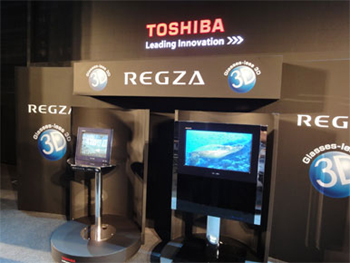 four pairs included. As Bob Mayson president of consumer electronics for RealD (a major 3D theatrical supplier) told Variety, “You won’t have a Super Bowl party with active eyewear. With passive eyewear [i.e, those polarized glasses] you can buy a bag of glasses from Costco and be in business.”
Maybe guys who sit around drinking beer and watching the Super Bowl will get used to seeing each other wearing plastic glasses. Still, I have long been of the opinion that until 3D technology reaches a point where the glasses are unnecessary, the format can’t be universally viable. Toshiba and Sony have prototypes of such sets at technology fairs, but they reportedly won’t reach consumers for three to five years. I’m curious to know what the 3D effect will look like if you’re not sitting at exactly the right spot in front of the screen. From what I’ve read, you have to be positioned not only in front but also close. An excellent article in Wired summing up the obstacles to watching 3D on TV says the depth effect is limited to about four feet. In fact, there already are monitors for 3D without glasses (mainly available in Japan); they’re used mainly to display ads in stores. But in October Toshiba showed off two models intended for the home (left). The monitors are 12″ and 20″ and the optimum viewing distance is 90 cm for the larger monitor; that’s about three feet. They can project 3D to nine points in the room, but it sounds downright impossible for that many people to perch at precise points, all about a yard from the screen. Bigger versions will no doubt follow.
More content is coming for 3D TV, but again according to Variety, many content-providers are
focused on high-profile fare like sports and concerts, because as long as 3D TV requires glasses, it will only be used for event programming, not casual viewing. It may be tough to broadcast the Super Bowl in full 3D, outside of relying on a conversion, however, given that too many seats in the stadium would have to be removed for the 3D cameras. Networks could use robotic and remote-controlled 3D cameras but those are still too new of technologies to rely on yet.
Screen Digest ‘s year-end summary of 3D TV focuses on other obstacles, primarily the lack of content:
As recently as early September 2010 two thirds of the 21 3D BD [Blu-ray Disc] titles confirmed for US release in 2010 were tired to exclusive bundling deals with 3D hardware, leaving only seven available for purchase in store. By November, the total 3D BD slate had increased to 37 titles, 25 of which had been confirmed for retail sale by the year end. Furthermore, many of the biggest titles (including Avatar, the Shrek franchise, Monsters v Aliens, Ice Age 3) were still tied into exclusive bundles. By comparison, at the end of Blu-ray’s first year of availability (2006) 135 titles had been released on the format in the U.S.
I’m sure the brand partnerships between the TV makers and the studios have saved a lot in advertising, but it’s hard to imagine investing in a new technology when every time you want a popular film title, you have to buy a TV set to go with it. No doubt the availability of films to buy will increase, but the introductory approach seems a strange way to go about fostering interest in 3D movies on TV.
The Screen Digest article makes another interesting point. Initially, “3D in the home was conceived first and foremost as an attempt to mirror the revenues proven in the cinema—a 20 per cent premium over 2D features.” But much 3D TV content is also surprisingly like 2D TV content: “Ten percent of the cinema features have been dance or music, with a further four per cent including live sports and opera. This suggests an appetite for content that has traditionally been better suited to live television transmission than physical or cinematic tradition.” That further suggests that in the long run, people may be keener on 3D TV than on theatrical films in 3D—just the opposite of the studios’ hopes as they went in for 3D.
Beyond film and TV content, there is also the likelihood that 3D video-game playing through the large monitor will take up some of the time spent in front of the appliance. There’s also the fact that streaming or downloading 3D films requires far more bandwidth than 2D movies, though methods of compression are being developed.
The Screen Digest author predicts that by the end of 2014, 25% of American homes will have 3D TV. The question remains: What will people be watching?
Next week: Part two: RealDsgusted
*No doubt some cost-cutting is possible. Still, Tsui Hark’s Flying Swords of Dragon Inn (announced for a 2011 release), shot with the relatively inexpensive Red 3D digital camera, is budgeted at approximately $35 million. The difference between that and his usual cost per film could easily include $15-20 million for 3D. See Filmsmash for information and numerous photos derived from Chinese sites; the latter include images of the camera and of shooting in front of a green screen.

By Sam Spratt at Gizmodo