by Kristin Thompson. Berkeley: University of California
Press, 2007.
400 pages, 6 × 9 inches, 12 color illustrations;
36 b/w illustrations.
[go
to Amazon | go to The Frodo Franchise blog]
Us on Easter Island, 2006, soon after starting Observations on Film Art.
DB here:
This blog began on 26 September 2006. Today’s entry is number 450. I reckon that we’ve dumped at least 600,000 words into the maw of the Net. Add in many web essays and two full-length books (one a reprint, the other a revision), and you get an object lesson in something, probably obsession. Scribble, scribble, scribble….
The figures that make us proud, however, have to do with you. Since it launched, the site has attracted over 3.5 million visits from nearly 2.5 million readers (or computers; or IP addresses; or cookies; or some such virtual entities). Nearly half a million of those readers/ avatars have visited more than once. These numbers are, we suspect, fairly modest ones compared with other film websites. But for writers whose books have print runs of 2500, they’re cause for surprise and gratitude.
Looking back, we see we’ve learned a lot. Our first entries lacked pictures because I didn’t know how to enter them. Some of the earliest entries with pictures aren’t very well laid-out; chalk that up to my apprentice fumblings with Photoshop. Gradually, we got better at integrating texts and images, and this year we’ve started to add video clips, sparingly. In the beginning we wrote several times a week, but now we aim at only four to six a month. As readers haven’t been shy to point out, our entries have gotten rather long. It’s just to make up for less frequent posting, I tell myself and anyone who’ll listen.
There are continuities as well. The very first entry talks about how flashbacks make a difference in cinematic storytelling–a topic that continues to preoccupy me. Soon enough I was off to the Vancouver International Film Festival, an event that Kristin and I will be attending again this week. Our first month on the job led to entries on mobile cinema, an academic conference, an important film and director (Sátántangó by Tarr, earning two entries), a recent US hit (The Departed), and current trends in the American film industry. All of these matters have woven through our last five years.
An enterprise undertaken by two mild-mannered academics (okay, at least Kristin is mild-mannered) has brought us closer to old friends and introduced us to new ones. We’re thankful that so many people have kindly linked our entries and brought us readers. We’re even more grateful for getting to know Jim Emerson, Matt Zoller Seitz, Catherine Grant, Kevin Lee, Grady Hendrix, David Poland, Susan Doll, Daniel Kasman, and many of the other writers who have shown, in a wide variety of styles, what serious film thought can be in this new medium. We also thank Manohla Dargis, who introduced our blog to the New York Times readership, and Tim Smith, guest author of an entry that still draws intense interest. Roger Ebert, pioneer of Web criticism, has been a stalwart supporter, generously steering his loyal readers to our site.
The Web’s churn sometimes grinds up ideas and pulverizes thought. These people and their peers preserve the ideal of lively, acute conversation about movies. They also exemplify an openness to ideas that many academics would do well to imitate.
We’re happy as well that the blog has enabled us to call attention to DVD publishers like the Criterion Collection, Masters of Cinema, Flicker Alley, and Kino Lorber. These firms play irreplaceable roles in film culture, trusting that some viewers want to have their horizons expanded. We admire the pluck of the people behind these enterprises and we’ll continue to help get the word out about their collections.
Speaking of film culture, we’re lucky to live in a milieu rich in movie lore and movie love. Our department and our immediate colleagues keep us alert and teach us all manner of things. Our archive, run by the indefatigible Maxine Fleckner-Ducey, puts thousands of films and hundreds of thousands of documents within easy reach. Our tech support is unparalleled, thanks to Erik Gunneson and Mike King and Peter Sengstock, who has recently taken our website under his wing. This morning, with no hesitation Pete righteously smote Bangladeshi hackers who had infected our site.
We can stay reasonably plugged in to the international film scene thanks to our venues on campus, such as the Cinematheque run by the dazzling Jim Healy and the new Union South cinema, the Marquee, programmed by students and Tom Yoshikami. We benefit as well from good sites off campus, such as our Sundance miniplex and our Museum of Contemporary Art. Guests come through too; just last week we had lunch with the estimable and hilarious Second City alum Betty Thomas. Our blog tsarina Meg Hamel has as her day job directing the Wisconsin Film Festival. Meg, now the mother of a seven-week-old charmer named Hazel, has been with us from the start. Every entry we compose is in debt to her.
For some people the Web is an endless dorm-room conversation. For others it’s a speed-dating session. For us, children of the postwar print age, it’s a great big magazine rack. A blog lets us be our own editors and publishers, freeing us of length limits and giving us as many stills as we want. (And in color.) We don’t include comments because we don’t the time to monitor them. Maybe we’re just stuck in Web 1.5. But we do answer nearly everybody who writes to us, and we sometimes tack those responses onto our entries. Call it our version of letters to the editor. And these correspondents almost always make corrections and suggest nuances that are worth considering.
We have no intention of stopping. Illness, travel, and other writing projects have slowed us in the last few months, and a looming deadline will limit our output a little up to December. But there are two entries on the shelf, one coming soon, the other, a windy one, later this week. After those we’ll be reporting as usual from Vancouver. Unlike Bob and Doug McKenzie, we’re not at a loss for topics. For at least five more years, we’ll try to interest you in what we’re thinking.
Some vintage items
Kristin and I have compiled a handful of early entries that never became readers’ favorites and didn’t make their way into the Minding Movies collection but that we harbor warm feelings toward.
One entry that was originally supposed to go into Minding Movies but which had to be cut for reasons of length is “Cavalcanti + Ealing = a little-known gem.” It discusses Cavalcanti’s 1942 classic Went the Day Well? When we posted this entry in May of 2008, it was hard to obtain a DVD of this moving tale depicting an imaginary Nazi invasion of a bucolic English village. Now you can order a manufactured-on-demand DVD-R version from Amazon, but if you have a multi-standard player, you’re probably better off getting the brand new Optimum restoration from Amazon.uk, on DVD and Blu-ray (KT).
In this very early entry, some readers didn’t like my criticizing George Stevens’ direction in Giant, and I admit it wasn’t very deft. And the stills are too small. But I think my analysis of the shootout in PTU stands up. This sequence should be studied by young filmmakers, as well as by those critics still talking about the decline of craft in Hollywood action cinema. More generally, I’ve written a lot on Hong Kong film that I couldn’t fit into Planet Hong Kong 2.0. (Copies still available; a great holiday gift.) I’m unreasonably vain about writing seven longish entries in the week of its release; the one-man blogathon starts here (DB)
“Happy birthday, classical cinema!” was posted in December of 2007, to mark the 90th anniversary of the year when, as most historians agree, the classical Hollywood model of creating movies gelled. We don’t follow the bloggy tradition of posting ten-best lists each year, but we thought instead we might as well post the ten best of 1917. Of course, many silent films do not survive, but we thought such a list might be a handy guide for those seeking to explore the early era of filmmaking. The 90-year-old ten-best lists became an annual tradition on “Observations.” Watch for the 1921 entry in December (KT).
Some entries use so many stills that book publication would be onerous. One of my favorites is my appreciation of Shimizu Hiroshi. Our discussions of Japanese cinema don’t attract as many readers as they should. After all, we are talking about one of the three greatest national cinemas.(I leave it to you to imagine the other two.) Modest Shimizu can break your heart. Since I wrote this, the admirable Criterion has brought out a fine sampler (DB).
With Steven Spielberg’s The Adventures of Tintin coming out in a few months, it might be interesting to look at “Reflections in a crystal eye,” a joint entry on Indiana Jones and the Kingdom of the Crystal Skull (or IJatKotCS, as we like to think of it). We weren’t terribly keen on the film, but there are other Spielberg movies we like a lot better. We point to some characteristic tropes (KT).
In these days of worry about piracy, it’s nice to recall an era BD (Before Digital), when piracy was simpler, and even more nourishing to film culture (DB).
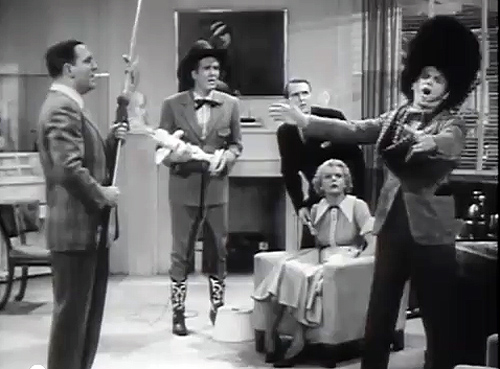
Hollywood screenwriters at work, according to Boy Meets Girl (1938).
It’s not every conference that opens a morning session by asking the men in the audience to take off their underwear.
But I anticipate.
Last weekend I was a guest of the Screenwriting Resource Network’s fourth annual Screenwriting Research Conference in Brussels. I think that a hell of a time was had by all, and I learned quite a bit, including some reasons why people are interested in screenplays.
In my youth, there seemed to be a solemn pact among my peers that we would never study certain areas: censorship, audiences, adaptation (novels into film, particularly), and screenwriting. An earlier generation had, through patient labor, shown decisively that these subjects were dead boring. We, on the other hand, were fired by notions of the director as auteur, and indifferent to what were called “literary” and “sociological” approaches to film. So we triumphantly turned toward The Text—that is, the finished movie.
Things have changed since then. Yet there are still tempting reasons to consider the study of screenwriting a nonstarter if you’re interested in cinema as an art. If you think of the finished film as the achieved artwork, then study of screenplay drafts risks seeming irrelevant. Whatever the screenwriter(s) intended seems irrelevant to the result. So what if six or more screenwriters labored over Tootsie? The movie stands or falls by what we see onscreen.
This was the view presented in Jean-Claude Carrière’s three talks to our group. He suggested that the screenplay is destined to become landfill, and rightly so. It’s like the caterpillar that becomes a butterfly. Once the film has been made, the script has no intrinsic value.
Someone might say, “Wait! We study a painter’s sketches, a novelist’s drafts, or a composer’s early scores. These materials can contribute to understanding the finished work, and sometimes they have an artistic value of their own.” The problem is that in these arts, the preparatory materials are in the same medium as the result. But a script can’t count as a version of the film because prose can’t adequately specify the audiovisual texture of a movie. It’s commonly thought, plausibly, that giving the same script to two directors would result in significantly different films. So the script is at best a series of suggestions for filming, not a sketchy version of the movie. Why not discard it when the film is done?
The study of screenwriting has probably also lain in the shadows because of the proliferation of screenwriting gurus and how-to manuals. Every American over the age of eighteen seems to be writing a screenplay; the Cable Guy who visited me last week was working on two. So all the seminars and advice books have arguably put thinking about screenplays rather close to the amateur-script racket.
Moreover, screenplay studies seem to be part of a broader, paradoxical development in academic film studies. Today scholars have more access to films than ever before, thanks to video, festivals, archives, and the internet. Yet many researchers prefer to talk about everything but the film. More and more scholars want to study just those subjects that my cohort considered dull or irrelevant: censorship and regulation, audiences (composition, demographics, critical reception, fandom), and preproduction factors (storyboards, scripts). In addition, many academics have turned to bigger thematic ideas like film and architecture, film and the city, film and modernity. These trends of research usually make only glancing reference to actual movies, mostly mining them for quick illustrative examples.
In sum, many academics have abandoned the study of film as an artistic medium that finds its embodiment in important works. To get to know particular films more intimately, you increasingly have to go to the Net, to writers like Jim Emerson, Adrian Martin, and other sensitive analytical critics. Talking about screenwriting can seem to be another way of avoiding coming to grips with the intrinsic power of movies.
You can probably tell that one side of me shares some of the biases I’ve listed. But when I remind myself that what people should study aren’t topics but questions, I cheer up quite a bit. For there are, I think, worthwhile questions to be asked about all these areas, screenwriting included. The Brussels event gave some good instances of resourceful, occasionally exciting research into them.
Based on my short acquaintance, most of the research questions seem trained on one of two broad areas: Screenwriting and The Screenplay.
In the trenches
Kinky & Cosy
Screenwriting can be thought of as a practice, a creative activity with both personal and social aspects. How, we might ask, do screenwriters or directors express themselves in the script? How does a media industry recruit, sustain, and reward screenwriters? What are the conventions and constraints at work in a particular screenwriting community?
Questions like this are somewhat familiar to me. When I wrote my first book, on Carl Dreyer, I had to examine his scripts (notably the unproduced Jesus of Nazareth), and that helped me understand his characteristic methods of researching and planning his films. Later, when I collaborated with Kristin and Janet Staiger on The Classical Hollywood Cinema, I recognized a more institutional side of things. We can see from the films of the 1910s that filmmakers were cutting up the space in fresh ways. But this wasn’t a matter of directors simply winging it on the set. Kristin used published manuals and Janet used original screenplays to show that shot breakdowns were planned to a considerable degree before shooting. This habit made production more efficient and controllable.
At the Brussels get-together, Steven Price offered further evidence of this sort, which displayed some of his research on early scenarios for Mack Sennett movies like Crooked to the End (1915). Interestingly, Steven found that sometimes the later version of a continuity script was more laconic than the initial one. Perhaps the gags, once spelled out in the first draft, could be left up to the actors. This is the sort of thing he identified as a “trace” of production practices.
A parallel of sorts emerged in Maria Belodubrovskaya’s paper on screenwriting under Stalin. The Soviets, admiring Hollywood efficiency, tried to come up with a similar system. But their efforts to produce films in bulk were blocked by a censorship apparatus bent on ideological correctness. No surprise there, I guess. But Masha showed convincingly that the very efforts to mimic Hollywood’s “assembly-line” system also discouraged authors from submitting scripts. The writers thought (like many of their LA counterparts) that such a setup denied them creative freedom. In addition, the prospect of story departments providing a stream of screenplays ran afoul of the tradition that gave the director control of the final draft. And the role of producer, as one who could steer the whole process, didn’t exist! So much for the Soviet Hollywood.
What about other media? Sara Zanatta traced out the process of creating Italian TV series. She reviewed some major formats (miniseries, original series, adaptations of foreign series) and then took us through the process of creating individual episodes. Interestingly, it seems that the Italian system, unlike US television, makes the director the boss of it all. Frédéric Zeimat explained how he gained entry to the local screenwriting community through his university education, including work in Luc Dardennes’ workshop at the Free University of Brussels. Eventually he came up with a script that won prizes. He is about to become a showrunner for a sitcom.
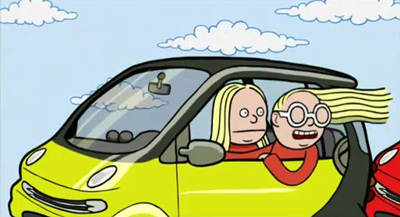
One of the most stimulating panels I heard considered the writing of graphic novels and animation. Richard Neupert explored how recent French animation sustained the tradition of individual authorship while still acceding to some international norms of moviemaking. The cartoonist Nix discussed how he faced new problems in transferring his three-panel comic strip Kinky & Cosy from print to television. TV demanded less written text, especially signs, so that the clips could be exported outside Belgium. More deeply, Nix had to rethink how to pace the action and leave a beat (say, two seconds) after the punchline.
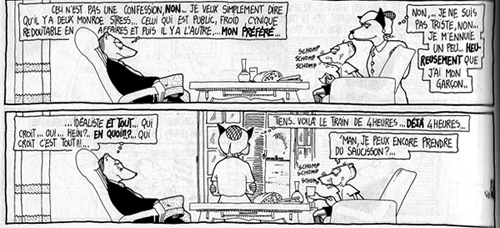
Pascal Lefèvre, one of Europe’s leading experts on comic art, provided a brisk, packed account of the history and practices of scriptwriting for Eurocomics. He described patterns of collaboration, format, and creative choice, placing special emphasis on comics as a spatial art different from cinema. His example was a page from Regis Franc’s ulta-widescreen album Le Café de la plage. Here’s a portion in which two periods of Monroe Stress’s life coexist in a single space. He muses as an adult while his childish self gobbles up food under the guidance of Mom.
Comics space can also change abruptly, as when a window appears in second panel.
Other papers presented less institutionally fixed, more personal versions of screenwriting as a practice. Kelley Conway’s lecture on Agnes Varda exploited unique access to the filmmaker’s notebooks, scrapbooks, and databases. Kelley showed how Varda conceived three of her documentaries by means of strict categorical structures that were then frayed by digressions born out of the material she shot.
Anna Sofia Rossholm provided something similar for Bergman. Out of the vast Bergman archive she quarried sixty “workbooks,” typically one for each film. Whereas Varda’s books were filled with cutouts and images, Bergman was a word man, treating the books as diaries that recorded “this secret I.” Anna Sofia proposed that in his jottings and planning, Bergman not only communed with himself (calling himself an idiot on occasion) but also explored patterns of doubling akin to those we find in the films. The workbooks evidently held a special place for him: he included their pages in films like Hour of the Wolf and Saraband.
David Lean might be thought of as working in between the Hollywood system and the more personal European milieu. Ian Macdonald suggested that one of Lean’s unfilmed projects sheds light on what he calls screenplay poetics. Macdonald seeks, I think, a principled method for studying the creative process. He does this by tracing how a screen idea is transformed in a series of documents generated by the creative team. The process, he points out, is governed by the participants’ various conceptual frameworks. For Nostromo, Lean solicited two screenwriters and oversaw their rather different versions of the novel. Ian showed that Lean seems to have found solutions to adapting the book by fitting it to the three-act structure advocated by Hollywood artisans, a concrete case of a filmmaker accepting a fresh “poetics” or set of creative constraints.
All of these inquiries could lead to more general thoughts about the creative process in cinema. For some filmmakers, it’s a professional task, undertaken with full knowledge that problems and constraints will have to be dealt with. For others, such as Bergman and Varda, it’s obviously deeply personal, even autobiographical. Perhaps most intimate was the film discussed by Hester Joyce. New Zealand filmmaker Gaylene Preston based Home by Christmas (2010; above) partly on audiotape interviews with her father as he recalled his World War II experiences. Her script reconstructed her interviews with actors, then filled in scenes with documentary footage and scenes she imagined. It’s a family memoir on several levels: Preston’s daughter portrays her own grandmother.
The Screenplay: What is it?
Several of these probes into the creative process raise a more theoretical question. How should we best conceive of the screenplay? As a blueprint? A recipe? An outline? These labels all suggest something disposable preliminary to the real thing, the movie. But why can’t we think of the screenplay as a freestanding object? After all, there are films without screenplays, but there are also screenplays—some written by distinguished authors—that were never made into films. And some of these, like Pinter’s Proust screenplay, are read for their own sake.
In cases like this, should we consider the screenplay a literary genre? And if the screenplay for an unproduced film can be considered a discrete object, what stops us from treating a filmed script in exactly the same way? Moreover, why even speak of a single screenplay, when we know that most commercial films at least go through several drafts? Can’t we consider each one an independent literary text? We’re now far from Carrière’s idea that the script finds its consummation in the finished film and as a piece of writing it should wind up in the ashcan.
And not all screenplays are literary texts. The scrapbooks and databases that Varda accumulates are works of visual art, collages or mixed-media assemblages. Are these merely drafts of the film, or do they have an independent existence or value? We seem to be asking the sort of question that Ted Nannicelli poses in his Ph. D. dissertation. Is there an ontology of the screenplay?
Take a concrete example. Ann Igelstrom’s paper, “Narration in the Screenplay Text,” asked how literary techniques are deployed in the screenplay. When a passage in the script for Before Sunset begins, “We see…,” who exactly is this we? Ann argued that traditional narrative concepts involving the source of the narration, the implied author and implied reader, and the rhetoric of telling can illuminate conventions of screenwriting. Here the screenplay seems definitely a literary text.
In his keynote address, “The Screenplay: An Accelerated Critical History,” Steven Price (above) declared a more abstract interest in the ontology of the screenplay but proposed that there was no clear-cut way of defining it. Historically, the screenplay takes many forms. Steven pointed out that even in Hollywood, there were many alternative formats, ranging from detailed breakdowns to the “master-scene” method (the option that didn’t specify shots or camera positions). And conceptually, the screenplay carried traces of its original production purposes, as well as other constellations of meaning. (Mack Sennett scripts seem to him part of a Sadean tradition of dehumanized, repetitive recombination.) So if there is a distinctive mode of being of the screenplay, outside of its role in production, it will turn out to be a messy one.
Envoi
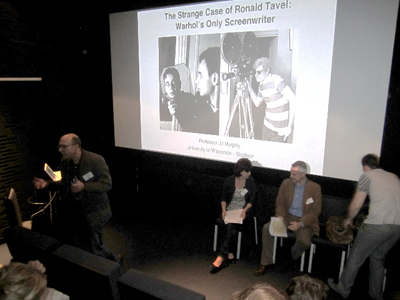
J. J. Murphy presents a paper on Ronald Tavel. Photo courtesy Richard Neupert.
If we conceive studies of screenplay and screenwriting as revolving around specific research questions, those of us interested in film as art can learn a lot. If our interests are in film history, researchers can show how organizations of production and individual choices by screenwriters/directors can shape the final product. For those of us interested in more theoretical explorations, asking about the nature and “mode of being” of the screenplay can’t help but make us think more about the ontology of cinema itself.
And if we want to know films more intimately, being aware of the creative choices that were made by the filmmakers throws a spotlight on aspects of the film we might otherwise not notice. It’s all very well to say we’ll examine the film “in itself,” but our attention is invariably selective. Knowledge of behind-the-scenes decisions can sharpen our awareness of artistic matters. Anna Sofia’s research on Bergman, like Marja-Riitta Koivumäki’s paper on Tarkovsky’s screenplay for My Name Is Ivan, activates parts of the film for special notice.
Because there were split sessions at the conference, and because I was plagued by jet lag, I couldn’t attend every panel and talk. I regret missing papers I later heard were very fine, and I haven’t written up everything I heard. I haven’t sufficiently talked about screenwriting pedagogy, represented in papers like Lucien Georgescu’s dramatic appeal to rethink whether screenwriting should be taught in film schools, or Debbie Danielpour’s stimulating survey of her methods of teaching genre scripting. So this is just a small sample of what these folks are up to. But you can tell, I think, that they’re posing questions at a level of sophistication that my 1960s cohort couldn’t have envisioned. Despite what the cynics say, there is progress in academic work.
I’m grateful to conference organizers Ronald Geerts and Hugo Vercauteren for inviting me to speak at the gathering. I must also thank conference organizer and old friend Muriel Andrin, along with Dominique Nasta and their colleagues and students from the Arts du Spectacle Department at the Université Libre de Bruxelles. My friends at the Cinematek, Stef and Bart and Hilde, helped me with my PowerPoint. Thanks as well to the Universitaire Associatie Brussel (Vrije Universiteit Brussel / Rits-Erasmushogeschool Brussel) and Associatie KULeuven (MAD-Faculty / Sint Lukas Brussel). A high point of the event was the visit to La Fleur en Papier Doré. Special thanks to Gabrielle Claes for her heartfelt introduction to my talk, not to mention a delicious bucket of moules.
For more information on the Screenwriting Research Network, go here. (Thanks to Ian Macdonald for the link.) The next conference will be held in Sydney, and the 2013 one will take place in Madison, Wisconsin.
P.S. 22 Sept 2011: A panel discussion with Jean-Claude Carrière held during the conference is available here. Although the site is in Dutch, the discussion is in English. Thanks to Ronald Geerts for the information.
P.P.S. Thanks to Joonas Linkola for a spelling correction!
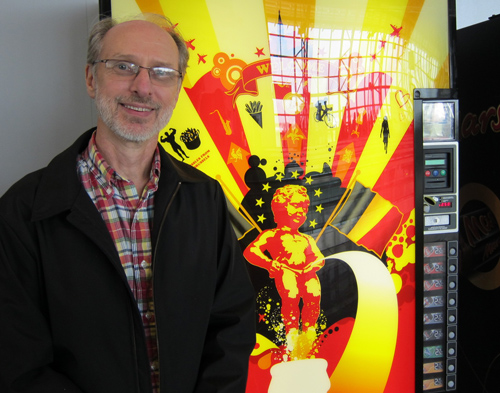
Coke does go through you pretty fast. Richard Neupert at a Coca-Cola machine that exploits a Brussels landmark.
When you consider what a scene needs to express, ask: How can the actor act it?
When you’re writing a scene, try to act it out yourself.
Rather than letting dialogue explain the action, let the action explain the dialogue.
It will always be possible to make films. Don’t forget to make cinema.
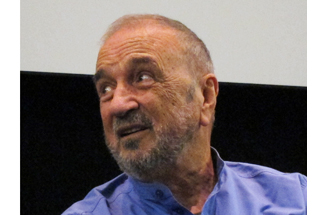
These and other epigrammatic insights flowed easily from Jean-Claude Carrière during his visit to the Cinematek of Belgium and the annual conference of the Screenwriting Research Network. I hope to devote a later blog to other attractions of this stimulating get-together. For now, a brief tribute to the volcanic charm of the legend known as JCC.
JCC entered cinema under the aegis of Jacques Tati. Tati wanted someone to turn M. Hulot’s Holiday and Mon Oncle into novels, and the very young writer seemed the right candidate. But Tati quickly learned that JCC didn’t know how a film was made. So he assigned Pierre Etaix and the editor Suzan Baron to tutor the lad in the ways of cinema. First lesson: Go through M. Hulot on a flatbed viewer, examining the script line by line while watching shot by shot. As a result, JCC says, he began to understand “the film that you don’t see.”
In the course of his career, JCC has written novels, plays, essays, screenplays, even a scenario for a graphic novel. In the process he became one of the most distinguished and respected screenwriters of the last fifty years. His most famous collaborations were probably with Buñuel, from Belle de Jour (1967) to the master’s last film, That Obscure Object of Desire (1977). He worked with Etaix (The Suitor, 1962), Forman (Taking Off, 1971), Schlöndorff (The Tin Drum, 1979), Godard (Every Man for Himself, 1980), Wajda (Danton, 1983), Oshima (Max mon amour, 1986), Kaufman (The Unbearable Lightness of Being, 1988), Peter Brook (The Mahabarata, 1989), Malle (Milou en Mai, 1990), and Haneke (The White Ribbon, 2007). He has also become known for his work on major French costume pictures and adaptations, such as Cyrano de Bergerac (1990) and The Horseman on the Roof (1995), as well as work with younger directors, including Wayne Wang (Chinese Box, 1997) and Jonathan Glazer (Birth, 2005). His TV scripts are numberless.
Directors both young and old come to him for the unique forms of collaboration that he offers. Instead of going off to write the screenplay, JCC meets frequently with the director. (Sometimes the director stays in his house.) He might ask the director to write the script for him, and they go over the result. Through these methods, JCC tries to help the director “find the film that he wants to make.” But his methods are flexible, tailored to the director’s temperament. When he was working with Buñuel, the men met daily to tell each other their dreams, some of which wound up in The Discreet Charm of the Bourgeoisie (1972). Similarly, JCC prefers to meet with the actors before production, letting them try out the parts so that he can revise things for each one’s habits of speaking. For Cyrano, Depardieu read the entire play aloud, taking all the parts, and then listened to it over and over on cassettes to refine his interpretation.
Brussels gave JCC a busy twenty-four hours. In conversation with the critic Louis Danvers he introduced a Cinematek screening of The Milky Way. He gave a keynote address for the Screenplay Network conference, and he participated in a panel discussion with members of the Flemish Screenwriters Guild at the film school RITS. These sessions ranged freely over his career and his conceptions of filmmaking. He believes that there is a language of film that sets it apart from other arts. That language is grounded in the play of meaning and emotion that comes from putting one shot after another.
He explained the point through an example that seems at first to be a restatement of the classic Kuleshov effect. In Shot 1, a man in his apartment looks out the window. Shot 2: The street. A woman is walking with another man. We’ll assume that our man is seeing them. Shot 3: Our man reacts.
But contrary to Kuleshov’s dictum, his facial expression should not be neutral. In fact, his expression tells us how to understand the scene. If the man looks upset, we surmise that he’s jealous. If he’s benevolent, we assume that the woman is a friend, his daughter—or a flirt. The filmmaker needs not only techniques like framing and cutting, but also the performances of actors.
Now cut to the woman in her bedroom brushing her hair. We need to make sure the audience understands that it’s the same woman, so maybe we have to go back and add a shot to the earlier scene, a closer view of her in the street. This constant flow and readjustment of images is based on guiding the spectator discreetly but firmly through the action. The audience isn’t aware of this “secret film,” but it governs everything the viewer thinks and feels.
For this reason, the young screenwriter needs to learn everything about how a film is made. When JCC was acting in The Wedding Ring (1971), a film starring Anna Karina, he learned that simply getting up from a couch can be a complicated matter. When he stood up spontaneously, dipping forward to lift his body, the cinematographer had to correct him: It looked awkward on film. JCC learned that he had to stand up in an unnatural way, with his feet spaced and his back rigid, so that it looked smooth on film. The screenwriter must know that even the smallest moment of action, easy to write in the comfort of a study or a café, is subject to the contingencies of production.
Where to get ideas for films? From the classics, of course. (“Balzac is the greatest screenwriter—every character is vivid.”) But above all you must observe reality. Tati taught JCC to sit vigilantly in a café. Study everyone who passes. Notice details. Imagine the person as a character in a story. Give him or her some motivations. What you must do is “find the fiction in the reality.” When JCC presided over the French film school La FEMIS, he promoted an exercise that required students to move out into a public space, like a market, and come back with stories about the people they saw. JCC praised Tati’s genius for spinning gags and situations out of passing life—“as if God had created the world so that it could furnish a film by Jacques Tati.”
JCC must be one of the few screenwriters who doesn’t gripe about his work being changed in its final incarnation onscreen. He sees the screenplay as ephemeral, the chrysalis for the butterfly. Once you accept the fact that your text must be sloughed off on its way to becoming cinema, you can take joy in your work. For young people, JCC advised the same relaxed, exploratory attitude. Conceive of yourself as a writer, able to move across media. The venues for your writing are constantly changing, so be prepared to write for television as well as film, to write comics and documentaries and plays. Above all, “Don’t despair of the future of cinema. It’s wide open.”
Jean-Claude Carrière turns eighty next week.
The best introduction to Carrière’s career and ideas that I know is his book The Secret Language of Film(Faber, 1995). Some of this text overlaps with Exercice du scénario (FEMIS, 1990), coauthored with Pascal Bonitzer. That book is worth reading too, but it hasn’t to my knowledge found English translation. An illuminating interview is here.
P.S. 11 September 2011: Thanks to Jonathan Rosenbaum for correcting an error in JCC’s filmography, which I’ve rectified above. Jonathan also remarks:
I assume that you know, by the way, that Carrière appears in a scene of Certified Copy, playing something similar to the “wise old guru” role played by the Turkish taxidermist in Taste of Cherry and the doctor in The Wind Will Carry Us.
I did know and should have worked it in!
P.P.S 22 September 2011: A panel discussion with Jean-Claude Carrière held during the conference is available here. Although the site is in Dutch, the discussion is in English. Thanks to Ronald Geerts for the information.
Mon Oncle (1958). “I followed Tati more or less everywhere, usually with Etaix, attending projections followed by long anxious discussions. (‘Can we clearly see the dog’s tail go past the electric eye that shuts the garage door? Yes? Clearly? You’re sure people will see it?’)
On April 21 a young Spanish film student uploaded his remarkable little film, Variation: The Sunbeam, David W. Griffith, 1912 onto Vimeo. There it languished, like so many contributions to the internet, good and bad. In the first four months of its presence on the site, it attracted 17 views.
Then, on August 17, Variation was viewed twice and earned its first “Like.” (One has to be a member of Vimeo to Like a film, so one cannot assume that none of its viewers to that point had enjoyed it.) That first Like, and perhaps both views were by Kevin B. Lee, best known for his many video essays on classic films. (See here for an index; I contributed the commentary for the La roue entry.) Over the next week and a half there were five additional views, four on August 28. I suspect some or all of these last ones were repeat visits by Kevin, since on August 31 he was the first to post an essay on Variation: The Sunbeam, David W. Griffith, 1912 (hereafter Variation), along with some information on its maker, Aitor Gametxo.
The immediate result was a flurry though not a stampede of views: 33 on August 31, along with a second Like; and 15 on September 1, with a third Like. One of those views and the third Like were mine. On September 2, there were 12 views, dwindling to 2 on September 3 and 1 on September 4.
(Among the viewers after the Fandor entry was Evan Davis, University of Wisconsin-Madison film-studies alumnus, who read Lee’s blog, watched the film, and passed the links along to us. Thanks, Evan!)
It’s a pity that more attention has not been paid to this charming, clever, and informative film. Not only would people enjoy it, but it could easily be used as a tool for those teaching, or indeed researching silent cinema. So here’s my bid to help it go viral.
Variation is a found-footage film based on Griffith’s American Biograph one-reeler The Sunbeam, made in December, 1911, and released on March 18, 1912. It is not among the most famous of the nearly 500 one- and two-reelers Griffith directed at AB between 1908 and 1913, but it’s better known than most. In the opening, a sick mother dies, and her little girl, thinking her mother is asleep, goes out into the hallways of their working-class apartment building. She tries to find someone to play with, but everyone rebuffs her until she manages to charm two lonely people, a bachelor and spinster, who live opposite each other on the floor below the child’s home.
Aitor noticed three key things about the film. First, the action takes place in a very limited space, with the three apartments and hallway all close to each other. Second, the doorways through which the characters pass between these rooms are on the edges of the screen, so that when they exit through the doorway in one shot and after the cut enter the space on the other side of the doorway, there is often a sort of elusive match on action formed (what I termed a “frame cut” in The Classical Hollywood Cinema, p. 205 and figures 16.36 and 37). Third, and perhaps most importantly, Griffith was intercutting actions that were happening simultaneously, so that at many of the cuts, he jumped from the end of an action in one space back in time to catch up with what had been happening in another space. At times he would jump back twice if simultaneous actions were happening in three spaces.
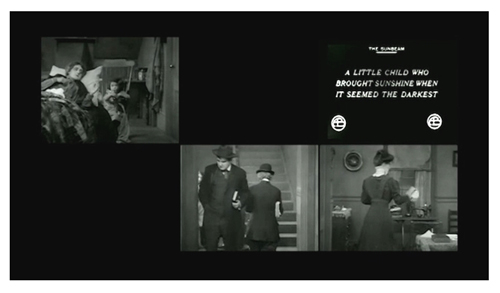
Aitor has taken the individual shots and redone them, putting them into a grid of six small frames, three on the bottom and three at the top. Scenes in the child’s upstairs apartment are shown only in the upper left, the top of the stairway in the upper center, and the two apartments on the ground floor at the sides, with the hallway and bottom of the stairs between them. (See above.) These are roughly the actual positions these spaces occupy in relation to each other in the building represented in the film. The shots run in their true temporal relations, so that there is no jumping back.
I suggest that before reading further, you watch The Sunbeam, especially if you have never seen it before. It would be impossible, I think, to entirely follow the story just from seeing Variation. The shots are so reduced in size to fit into the grid that small but important gestures and details get lost. Here is the original film, from YouTube.
With Aitor’s kind permission, we present his take on Griffith’s one-reeler. (The Sunbeam runs about 15 minutes, but due to the simultaneous presentation of many shots, Variation is only about 10 minutes.) Click on the “Vimeo” logo in the lower right corner for a larger image:
A fascinating film, isn’t it? I think many viewers would reach the end of Variation and wish that the same sort of presentation could be created for other films–at least, early ones that are short enough to make such rearrangement viable. Kevin Lee is enthusiastic about the idea: “Imagine this multi-dimensional, real-time approach being applied to footage from other films, as a way of not just mapping out scenes in a movie, but also gaining insight into filmmaking technique.” It might be possible, but the six-rectangle grid used here would not work for very many films. Aitor has chosen the ideal film for such an approach. Not only are there a limited number of significant characters, but they also live in the same building, with three rooms and a hallway, all viewed from the same direction, making them fit perfectly into a “doll-house” style scene.
Had Griffith not routinely shot directly toward the back wall in all his sets, placing the shots directly side by side across the grid would not work, at least not so neatly. Many other directors of this era were exploring shooting into corners and having doorways for entrances and exits centered at the rear. Perhaps filmmakers like Aitor could still place different shots side by side, but the actors’ movements from one space to another would not be so smooth. One of the attractions of Variation is that those movements are smooth, and as a result the action plays as if it were part of a continuous, “real” film.
Even other Griffith films shot in the style of The Sunbeam would be far more difficult to lay out on a similar grid. Longer rows of more rectangles would need to be added, or the upper row would have to represent actions taking place at a distance and the lower one actions taking place within a building. (I’m thinking here of something like The Lonely Villa, where action in a series of contiguous rooms is intercut with the husband’s race from a distant locale back to his house.) The placement of the bachelor’s room opposite the spinster’s, on either side of the hallway through which all of the minor characters pass, is crucial to Aitor’s project. A complex film with many characters and locales might create a grid with rectangles too small to be grasped by the viewers. Ways of indicating techniques like flashbacks would have to be devised. And of course, not all films contain simultaneous action.
Variation has some technical disadvantages. The titles appear in the upper right corner of the screen, since no locale opposite the child’s apartment is ever shown. The titles are small and difficult to read, and since they pop up simultaneously with the action, it’s almost impossible to read them anyway. One cannot tell where the titles originally came in the flow of shots, though one can always check the original film. Another problem is the cropping of the images on all four sides. The DVD copies are somewhat cropped, and more of the image is eliminated in the Variation frames; the action of the little heroine hiding a hairpiece in the spinster’s home, an important motivation for later action, can barely be grasped because it is so small a detail and happens at the very bottom of the frame; in the DVDs it can be clearly seen.
The Griffith Project and our knowledge of his techniques
I do not intend by any means to diminish what Aitor has accomplished when I say that the three main techniques he works from have been known to Griffith scholars for years. Variation offers a new way of examining and explaining those techniques.
Griffith has, of course, been one of the most closely studied filmmakers in history. A vast summary of and contribution to the research on Griffith was recently compiled by “Il Giornate del Cinema Muto” film festival in Pordenone, Italy. From 1997 to 2008, the festival mounted a nearly complete retrospective of Griffith’s work, hampered only by those films which still exist only as negatives or in other forms that could not be projected. A team of experts divided up the work and wrote extensive program notes for every single film Griffith made, whether it was shown at the festival or not. The notes, some more general essays, and Griffith’s writings were edited into twelve volumes jointly published by the festival and the British Film Institute (1999-2008). I had the privilege of contributing notes to most of the volumes, and although I cannot claim to know Griffith’s entire œuvre intimately, I got to know the films assigned to me quite well and learned a great deal about his methods.
The program notes for The Sunbeam were written by Griffith specialist Russell Merritt (Volume 5, 2001). As these excerpts from his description of the film’s setting indicate, the doll-house arrangement of the sets in The Sunbeam were distinctive, but not atypical of Griffith’s approach:
This was the second of Griffith’s three December tenement films (falling between The Transformation of Mike and The String of Pearls); spatially it is his simplest. Griffith uses only five setups (fewer than half what he works with in The Transformation of Mike and The String of Pearls.), but far from feeling cramped or monotonous, the three rooms and two hallways spaces seem perfectly designed for the playful romps, the practical jokes, and the unfolding of the gentle love story.
By 1911, the Griffith apartment set had developed a personality of its own, or more precisely, had become both distinctive and flexible enough to accommodate a broad range of narratives. Griffith’s planimetric style, with the camera always aimed straight on into the back wall with at least one side of the room aligned to the margin of the frame, had become as much a Biograph signature as the last-minute rescue, the fade-out, parallel editing, and the stock company of actors [….] In The Sunbeam, the familiar hallway and one-room apartments turn into something resembling a row of a child’s wooden blocks or the rooms in a child’s dollhouse, albeit with a dead mother in the garret. In each space, whether the hallway, the spinster’s apartment or the bachelor’s one-room across the hall, there is something to play with or play upon. The prank with the string stretched across the hallway literally links the two apartments and provides the perfect center of a the film–a gag that depends upon the mirror symmetries of the rooms and the tug-of-war actions of the two incipient sweethearts. (p. 196)
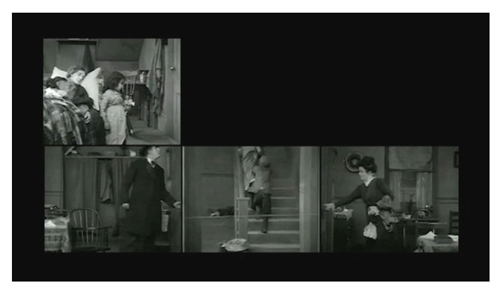
For the prank with the stretched string made symmetrical spatially as well as temporally, see below.
Ben Brewster and Lea Jacobs’ book Theatre to Film (1997) points out that cutting among multiple adjacent interior rooms was typical of Griffith’s work in this period: “By early [1911] a film like Three Sisters has a climactic sequence of 28 shots alternating between three set-ups–long-shot views of three rooms, a kitchen, a hall, and a bedroom, which movements from room to room that coincide with cuts establish as side by side.” (p. 189) My own notes for The Griffith Project volumes discuss adjacent sets and room-to-room movements using frame cuts. (See the end of this entry for a list.)
Griffith’s use of editing to convey simultaneous events, as well as to portray thoughts and flashbacks has been extensively discussed in the literature on the director.
What is remarkable is that a 22-year-old film student has noticed these devices and found a simple, elegant method to demonstrate what we already knew, but with greater precision and vividness than could be done with prose analysis. To experts, that is what should make Aitor’s film so appealing.
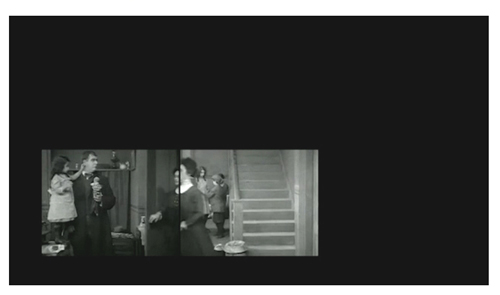
For example, the precision of Griffith’s matches on action at the frame cuts is illustrated time and again in Variation:
Were it not for the fact that Griffith’s camera is closer to the action in the smaller hallway set than it is in the two outer rooms, the spinster’s move through the door would almost appear to be a single smooth glide. Unless one freezes the frame, as I have done here, some of these movements look uncannily continuous.
For those teaching or reading Film Art: An Introduction, Variation also provides a clear example of story time versus plot time. Griffith’s The Sunbeam presents us plot time, with its jumps backward to cover all the action in multiple locales. Aitor’s film presents story action as we ordinarily would reconstruct it only in our minds. Usually we describe story action with synopses or outlines. To see it played out in real time is a rare treat.
The filmmaker
Aitor has a blog, which contains primarily many lovely still photographs taken in Spain, Ireland, and the United Kingdom. It offers, however, minimal information about him. Kevin Lee wrote to ask him for information, which is included in the Fandor entry linked above. I also emailed Aitor with some questions to further contextualize Variation, and he provided a short summary of his background and his interest in Griffith.
My name is Aitor Gametxo. I was born in Bilbao in 1989 and have been living in Lekeitio. I started the Communication and Film degree in the University of the Basque Country, but I moved to the University of Barcelona to finish it this year. I’m currently living and working in Barcelona, and I’m going to do a “Creative Documentary” masters degree this upcoming year. I really enjoy taking pictures of everyday things and places, as a way of reporting reality. I also love film, specially documentaries, found footage films and cinema-essay pieces. I honestly believe in the power films have to make us think about things. Not only because of the topic the film is about, but also about the way in which the film is made (a kind of dialectics between Bill Nichols’ expository and reflexive modes). I love watching old (and odd) films and thinking about things that are different from the purpose they were created for. (As I told Kevin) we are able to take some footage which is temporally and geographically unconnected to us and remodel, or refix, or remix… it, giving birth to another work. This is the way I see the found-footage praxis.
About this particular film, The Sunbeam, I watched it for the first time just before doing the variation. I knew other works made by Griffith, such as “Intolerance” (quoted in several film history books). But this was unknown for me, so that the first watching was crucial. While I was enjoying it, I was wondering what the place where it was shot looked like. I suddenly imagined it as a two-floor house, where the characters cross in some moments. Also the doors were essential to fix one part with another. This was the main idea where I worked on. It was great fun doing it.
The result is this variation in real-time action of the classic work where we can see how Griffith worked on. It’s like returning back to Griffith’s mind, to the first idea, as he imagined one hundred years ago (!) how The Sunbeam would look like. This is the magic of cinema.
My contributions to The Griffith Project‘s program notes for the Biograph years are these. In Volume 2, January-June 1909: Those Boys; The Fascinating Mrs. Francis; Those Awful Hats; The Cord of Life; The Brahma Diamond; Politician’s Love Story; Jones and the Lady Book Agent; His Wife’s Mother; The Golden Louis; and His Ward’s Love. In Volume 3, July-December 1909: Lines of White on a Sullen Sea; In the Watches of the Night; What’s Your Hurry?; Nursing a Viper; The Light That Came; The Restoration. In Volume 4, 1910: A Child’s Faith; The Italian Barber; His Trust; His Trust Fulfilled; The Two Paths; and Three Sisters. In Volume 5, 1911: The Lonedale Operator; The Spanish Gypsy; The Broken Cross; The Chief’s Daughter; A Knight of the Road; and Madame Rex. In Volume 6, 1912: The Unwelcome Guest; The New York Hat; My Hero; and The Burglar’s Dilemma. In Volume 7, 1913: The Hero of Little Italy; The Perfidy of Mary; and A Misunderstood Boy.
Like the other contributors, I found myself dealing with a few famous films (e.g., the wonderful Lines of White on a Sullen Sea) and others that were largely unknown. Each little cluster of titles assigned to us consisted of films that had been made sequentially, so that each of us could get an intensive look into Griffith’s work over the course of a few weeks. It proved to be a rewarding way of approaching the study of the director. The general editor for the series was Paulo Cherchi Usai, assisted by Cindi Rowell.