by Kristin Thompson. Berkeley: University of California
Press, 2007.
400 pages, 6 × 9 inches, 12 color illustrations;
36 b/w illustrations.
[go
to Amazon | go to The Frodo Franchise blog]
Entertainment and arts journalists seem to have some telepathic way of agreeing upon what will be the big hooks upon which to hang their stories. This year one such hook is the notion that auteurs are finally working in 3D, and this will somehow help determine whether the technique continues to spread. In Hollywood, those auteurs primarily include Spielberg, with The Adventures of Tintin due out in December, and Scorsese with Hugo, the adaptation of a bestseller based on the last years of Georges Méliès.
Two major directors have already brought 3D into film festivals and arthouses. Herzog contributed the one film that even people who dislike 3D (including me) admit uses the technique justifiably: The Cave of Forgotten Dreams. His countryman Wim Wenders’ Pina 3D (Pina–Ein Tanzfilm in 3D) is also a documentary. It creates a portrait of the late Pina Bausch primarily through a collection of scenes where dancers from the current Tanztheater Wuppertal troupe perform excerpts from several of her choreographed pieces.
As usual, the 3D seems superfluous. The opening shot of the theater, with its surrounding stretches of paved surfaces and its rows of trees, looks almost like a model. This is partly due to the almost complete lack of movement. Only some tiny figures on a bench shifted slightly and proved that this was a real space. Within the dance scenes, the 3D effect is more pronounced, but I suspect I would have found the dancing equally dramatic and original had the print been in 2D. One thing I will say for it was that the scenes are bright enough to look good in 3D. The 3D print of Miike Takashi’s Harakiri: Death of a Samurai, which we saw immediately after Pina, displays the notorious loss of light filtered through the glasses. Lowering the glasses a few times during the screening, I got the impression that the print was actually about twice as bright as it was seen through the glasses.
I heard some complaints that Pina offers little information about the choreographer herself. Another objection was that none of the dances are shown complete. Even the lengthiest excerpts, from Bausch’s well-known staging of The Rite of Spring, present only a small portion of the whole ballet. My own reaction was that the variety of shorter scenes gives someone unacquainted with Bausch’s style a good overview of her work.
Rather than go through archival material to present a biographical portrait of Bausch, Wenders chose to highlight each of the members of her troupe with a portrait in medium close-up and a short statement by each about their relationship to the choreographer. I found this helped in keeping track of the performers, who reappear in various combinations throughout the dance scenes, sometimes in solos or pairs, sometimes as a group. Their words about Bausch, though brief, collectively suggest their devotion to her, a devotion that pushed them to collaborate with her in inventing avant-garde moves suited to themselves and yet contributing to a recognizable overall style.
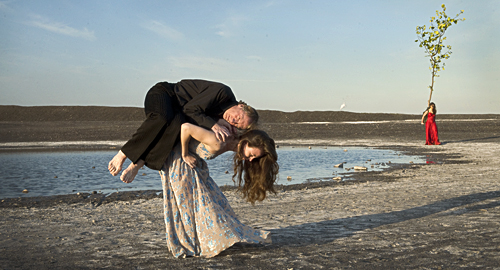
Wenders begins with the dancers on the theater stage, but what differentiates Pina from standard records of dance performances is the filmmaker’s decision to stage some of the short scenes out of doors, in landscapes, city streets, and large empty buildings. One shot looks out over a vast quarry, with a young man bursting up over the edge of it and dancing wildly on the sandy space beside it. Another has a woman performing simple steps on point against the backdrop of a large, rusty factory. A pond in the midst of barren fields forms the stage for a composition juxtaposing a woman carrying a man in the foreground with one carrying a tree at the rear (see above). A few brief scenes have the dancers performing on the corners of busy city streets.
The result gives more an impression of Bausch’s approach to choreography than an overview of her life, but it surely will lure many viewers to seek to learn more about her.
Two Years at Sea
Ben Rivers’ Two Years at Sea neatly straddles the boundary between documentary and experimental film. It appears to be a portrait of an eccentric middle-aged man, Jake, living by himself in a sprawling house in a Scottish forest. The title is never explained, nor is the subject’s name ever given. This film’s natural venues are festivals and perhaps galleries, where notes can supply the information that as a young man Jake spent two years as a sailor, saving up money to live his dream of getting away from urban environments and living close to the land.
Jake makes an excellent subject, almost never glancing at the camera but simply performing his chores, relaxing, or hiking in an unself-conscious way. In the final lengthy shot, he falls asleep on camera. Yet in fact, as we can know only through the program notes or during the filmmaker’s Q&A, Jake plays a somewhat fictionalized version of himself. (The real Jake is more gregarious and welcomes guests.) Rivers suggested some things that his subject might do, and Jake agreed: taking a shower, building a raft from which to fish on a local pond, and mostly notably, raising a small trailer into a pine tree to form a sort of tree house. The framing of the shots showing the trailer rising through the branches hides just how this was accomplished, resulting in a touch of magic realism.
Jake’s home is not a small shack but a rambling building in need of some repair. It is crammed with stuff, empty cans, tools, ancient mattresses, and worn-out objects that the owner can salvage for other uses. Similarly, the yard is overrun by old vehicles, heaps of firewood, and spare parts of unknown machines. Amongst all this apparent junk, Jake has rigged a shower, a stove, an aged washing machine, and a place to sleep. His only company is a cat, although photos glimpsed at intervals—a woman’s face, some children, Jake as a young man building a wall—hint at a past that is never made explicit. Surprisingly, he has a fairly modern car, presumably his means of supplying his needs from an unseen nearby town. He also apparently has a generator, running the lights, washing machine, and a few lamps.
The irony seems to be that Jake has escaped to nature and yet seems almost overwhelmed by the sheer volume of manufactured objects around him. The placement of the trailer atop a tree suggests that now Jake is fleeing the crowded environment he has himself created. Once the trailer is secured, he drags up a small mattress to sit on, cleans the window with his sleeve and, sits contemplating the trees outside.
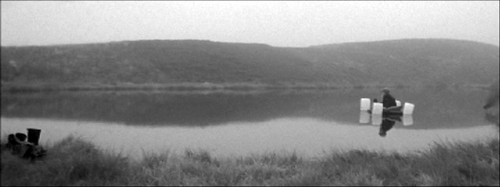
The techniques with which Jake’s routines are recorded are as Spartan as Jake’s chosen life. Rivers has avoided digital filmmaking, choosing to shoot on black-and-white anamorphic 16mm. He hand-processed the footage at home, creating a grainy, occasionally blotchy image. There are many lengthy takes of actions with slow rhythms. Most is one in which Jake, having built a raft out of a frame covered with an inflated mattress and held afloat by four empty plastic bottles that look like giant marshmallows, launches it, he clumsily paddles a short distance out on the pond, and we watch him fish and drift slowly across the wide screen (see below), ending up near the shore and again paddling further out. He never tells us what he is doing or why, and the filmmaker provides no voiceover. We are left with the impression of a man who does exactly what he wants to do when he wants to do it, whether the practical act of chopping wood or the simple contemplation of something in the landscape because he finds it interesting.
Ultimately, as with any film about someone who has fled to a simpler life, we are lured to contemplate our own occasional fantasies of giving up society’s complex challenges and joys and living somewhere isolated and peaceful. It’s a rare person who would ultimately decide to do so, but here the filmmaker builds a portrait of someone who has.
Two Years at Sea.
PS, October 18: Ben Rivers takes part in a conversation about artists and funding in the UK on Frieze Magazine.
Contemporary Hollywood films can play prettily with time, parallels, and point-of-view, at least within certain boundaries. (We’ve talked about this with Source Code, Inceptionhere and here, and other titles further back.) But if you want to see filmmakers coloring outside the lines, a film festival provides a wider sampling of ingenious storytelling strategies.
Last year, in “Seduced by structure,” I wrote about films that worked ingratiatingly with flashbacks, stories within stories, and the like. I’m still a sucker for these things, and several of the offerings at the Vancouver International Film Festival have enticed me. Since these are rather new films, I’ll try to avoid spoilers.
Flashbackhand
Harakiri.
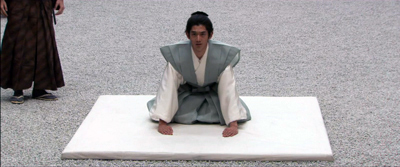
Perhaps the simplest case I’ve encountered so far is Miike Takeshi’s 3-D Harakiri: Death of a Samurai. It’s seventeenth-century Japan, and penniless samurai are eking out survival through the “suicide bluff.” They arrive at a noble house and ask to commit seppuku on the premises. Because the family won’t risky sullying the family name, the ronin are paid to go away. But the head retainer of the house of Ii is done with the game. The suicide bluff, he maintains, dishonors the samurai code.
A severe-looking ronin appears and asks to die in the Ii compound. The retainer explains to him that recently they had a similar request.
Thus begins the first of two flashbacks. It’s confined to the visit of a very young samurai making the suicide petition, with harsh and grisly results. We return to the narrating frame, and we find that the original petitioner isn’t dissuaded. Why not? And why are the three swordsmen most implicated in the young man’s visit missing today?
A second flashback, more or less from the standpoint of the older petitioner, goes far back in time to fill in the youth’s identity and background. This structural choice shows several worthy things that a flashback can do. It can flesh out things that were merely hinted at earlier, in both the present-time sequences and the first flashback. The flashback can create mysteries by virtue of its placement, as indicated earlier. It can build its own narrative momentum: Even though we know vaguely how things are likely to go, we get to see the gaps filled in with unexpected details.
The flashback pattern also creates two layers of response. We know the young man’s fate, so everything in the leadup gains an extra pathos. Meanwhile, as we recall the present-time situation, the older petitioner’s action remains suspended and we want to return to it to see how it develops. A bonus is that arranging the film in flashbacks allows an intense, arresting scene to appear at the film’s beginning, with the young ronin’s petition, and then assign a cluster of swordplay fights at the end. Arranged in linear story order, the scenes would have created a slow-burning opening and a crowded conclusion, with several violent scenes close together.
A more audacious play with flashbacks is found in Pedro Amodóvar’s elegant, decadent The Skin I Live In. As with Harakiri, we begin far along the story’s development. A beautiful young woman is imprisoned in a postmodern equivalent of the mad scientist’s lair, a designer house filled with sumptuous furniture and high-tech gadgetry, including a close-circuit video system that lets the doctor keep an eye on his prey. Already there are plenty of questions, particularly when the young woman, Vera, asks to stay with Robert forever.
We quickly asume that she is the object of the doctor’s experiment in creating unblemished, fire-resistant, and snugly fitted human skin. (Almodóvar used a digital intermediate chiefly for the purpose of making the actress’s skin perfect) But more questions arise when a horrendous jewel robber named Zeca, dressed in a tiger skin (it’s the carnival season), breaks into Vera’s sanctuary.
Melodramatic twists come thick and fast, and the first flashback, sponsored by the maid Marilia, tells us of how Robert’s first wife was burned in a car crash. His daughter Norma saw her mother commit suicide and became deeply disturbed thereafter.
The family history gets even more tangled with two later flashbacks. One, initiated by Robert as he sleeps (though it seems more “objective” than a dream) takes us back six years and fills in more of Norma’s sad history. The second, more peculiar, return to the past is obliquely introduced by Vera. The narration seems pretty reliable, and it replays some of the events presented in Robert’s flashback. The curious thing is Vera doesn’t appear in any of the scenes. Shouldn’t she be present for at least some of the action she is “recalling”?
The question is answered with the sort of shocking finesse that Almodovar summons up effortlessly. The flashbacks in Harakiri fill in and flesh out what we’ve seen, while the flashbacks in The Skin I Live In reveal layers of shocking discoveries about what’s really going on in the present-time situation. The flashback structure doesn’t fulfill the film’s opening so much as yank the bottom out from it. Perverted story action summons up perverse narration.
I wish I could say more about these formal arabesques, but secrets must be respected. Suffice it say that Miike provides us a sober, dignified jidai-geki making modest use of 3D and lacking the outlandish gore that he’s come to be identified with. It’s not even as action-oriented as last year’s 13 Assassins. Harakiri ‘s most striking moments are quiet ones. A woman picks splinters out of her dead husband’s bloody hand. Earlier the same poverty-stricken man, having dropped a pair of eggs on the pavement, stoops and licks up their contents.
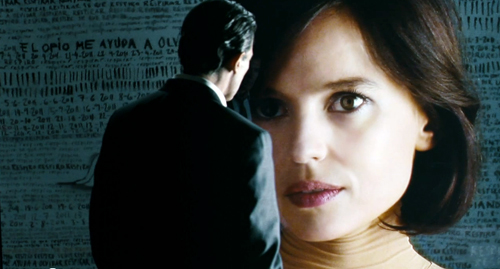
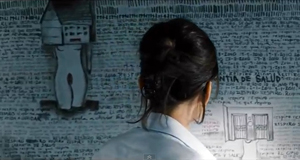
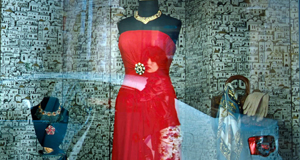
As for The Skin I Live in: Almodovar’s eye for fashion is still teasing; the credits list is a pageant of brand names like Gucci and Prada. He can also plant nifty little motifs, as when the tidy graffiti with which Vera has filled her cell are echoed by the window display in a dress shop.
As usual, the story of revenge and unspeakable desire, or rather revenge as unspeakable desire, is wrapped in smooth technique, wondrous music, and eye-gratifying palettes. The flashbacks help too.
She said, he said
Split plot structures have become more common in recent years. Hong Sang-soo provided one of the most striking versions in The Power of Kangwon Province (1998); a recent instance is Apichatpang Weerasethakul’s Syndromes and a Century (2006). In the most common case, the film is split into two long sections, with each line of action following a different character or presenting alternative possibilities. Sometimes the lines present successive lines of action, as in Chungking Express. Sometimes the lines are more or less simultaneous, suggesting different viewpoints on the same events. Often the two lines intersect, so we get scenes replayed from different viewpoints or suggesting alternative versions of events–even parallel universes.
This sort of cleft plot patterning is exploited engagingly in The Natural Phenomenon of Madness, a Filipino film by Charliebebs Gohetia. A brief prologue sets up the situation. A man and a woman, friends since childhood, are having sex, and suddenly it turns rough. Both will later think of his action as a rape. He leaves in the morning, she chops off most of her hair, and they proceed to live their lives separately, sometimes converging, usually not.
The first long chapter, called She, follows her days wandering the city, signing up for a medical study, visiting a grave, inducing a miscarriage, and pursuing Him, whom she loves more than anyone. The second section, “He,” traces his efforts to induce another woman to marry him, to assuage his guilt about the rape, and to get Her to help him with his bone-marrow transplant. Both lines are taking place at roughly the same time and pace. The woman’s autobiographical monologues addressed to offscreen medical personnel are paralleled by the man’s increasingly sorrowful confessions to a priest. She’s a Bohemian artist, He’s a store owner wracked by Catholic guilt. At times, we see them doing things alone that suggest a sort of spiritual synchronization: She stands at a bridge and shouts, and later we see Him doing the same thing.
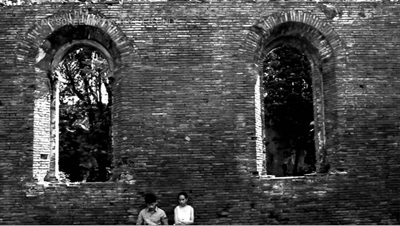
He and She meet occasionally, and then we get the same scene twice. Or do we? Every repetition is played out in symmetrically varied ways. For instance, early in the She chapter, He is already seated by a wall playing with an origami (of the sort my grade school used to call a Cootie Catcher). She joins him.
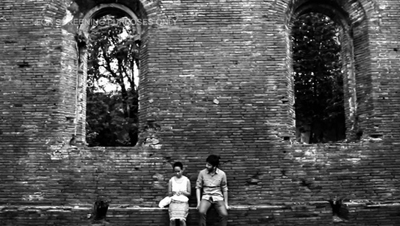
In His story’s version, she’s already there, playing with the origami, and He comes to join her.
Moreover, the conversation isn’t the same each time. So are the apparently iterated scenes completely different meetings, taking place in the same locale and filmed in similar fashion? Some cues suggest that the tandem sequences represent only one occasion. For instance, both of these wall scenes purportedly show their first meeting since She cut her hair. As we’re watching, we might be forgiven if we’re not sure of the variations: The repetition comes about 67 minutes later than the original scene. We’re left with meetings that are partly repetitions, partly variations: alternative universes embedded in one, perhaps.
One effect of the parallel plotting is to heighten the differences between the two protagonists. As Gohetia suggested in the Q & A after the VIFF screening, She actively chooses ways of living her life, while He clings passively to his situation, hoping that the other woman will marry him, that somebody will donate bone marrow, and that the Church may offer help. Both have unrequited love: She wants him, He wants another girl. There are plenty of abstract parallels, such as that between the medical establishment and the clerisy, but the precise, locked-down shots help us notice physical differences too, such as the walk through Manila streets with distinct gaits. And the final convergence of the couple nicely echoes the prologue. The Natural Phenomenon of Madness shows that once a new narrative strategy enters the public domain, filmmakers can play with its components, twisting them like facets of a Rubik’s cube to engage us in fresh ways.
The Skin I Live In will be released in the US by Sony Pictures Classics on 14 October. The American Cinematographer story on the making of the film may be read here.
P.S. 6 October 2011: Thanks to Philippe Mathieu for correcting an erroneous film title!
P. S. 14 August 2012: Thanks to Marvin Ortiz for correcting two characters’ names in my account of The Skin I Live In.
Hollywood may have largely let us down this year, but after the first few days at the Vancouver International Film Festival, we’ve seen several excellent films and a lot of originality. Here are two of the highlights so far.
Kristin here:
Every year, when festival posts its list of films, I look through it for titles I’d heard about from other festivals or seen enthusiastically reviewed or had recommended to me. One title I was delighted to see on this year’s program was Lech Majewski’s The Mill & the Cross. It’s not nearly as famous as some of the other films showing here, like The Skin I Live In or Once Upon a Time in Anatolia, but I keenly anticipated seeing it.
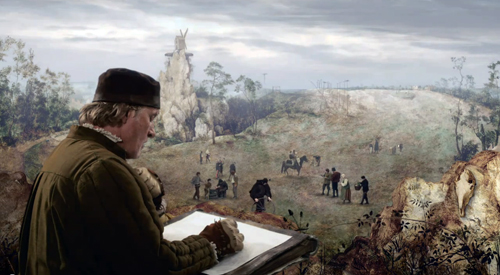
I learned about The Mill & the Cross through an article in American Cinematographer(posted on the film’s rich website). Majewski collaborated with art historian Michael Francis Gibson to explore Pieter Bruegel’s 1564 masterpiece, “The Way to Calvary.” In the painting, the figure of Christ carrying his cross to calvary is set in the midst of a vast landscape full of fields, cliffs, a distant town, trees, and hundreds of people, all surmounted by a windmill atop one of the rocky formations and silhouetted against a windy, cloudy sky. Majewski sought, as he said, “to enter Bruegel’s world”—to enter into the painting itself and bring it to life.
His goal reminded me of Godard’s 1982 film, Passion, where one of the main characters films actors in a studio. He appears to be trying to replicate classic paintings, with models posed in costumes and miniatures representing a cityscape. I’ve never been able to picture what the result might have looked like. I’m not sure I would have enjoyed watching it, which may be part of Godard’s point. But Majewski had the tremendous advantage of modern computer technology to create an almost seamless blend between digital elements derived from the original painting and those derived from live-action filmmaking on location and in front of blue screens. For those who complain about “effects-heavy” blockbusters, The Mill & and Cross is a powerful counter-example, a film utterly dependent on CGI yet meditative and even profound. It certainly succeeds in Majewski’s goal, creating an uncanny sense of being inside the painting (see above.)
For the film seeks to explore the qualities that Bruegel himself did, to push the crucifixion to a minor place in the composition of the whole and to explore the sacred in the everyday. The film’s story is dense. On one level, we watch Bruegel sketching his models as he explains the concept of the painting to his patron. But we also see him departing home in the morning, and we follow the everyday doings of his family. We see several other minor characters who will figure in the painting waking up and beginning to work, including the miller in his mill atop the cliff. The filmmaking team found a surviving mill of the period, and for an astonishing scene early on, the ancient works in the vast interior were set in motion for the first time in centuries.
We see details of the characters’ lives, such as a man hitching up a horse to a wagon, an innocent-appearing detail until we realize much later in the film that this cart will deliver the wood for making the crosses and will carry the two thieves condemned to die alongside Jesus to Golgotha. Finally, we are invited to contemplate the contradiction, so familiar from thousands of paintings, that an event from antiquity is seen taking place in a contemporary landscape. The result is a comment on the Spanish occupation of Flanders as well as on the Biblical story.
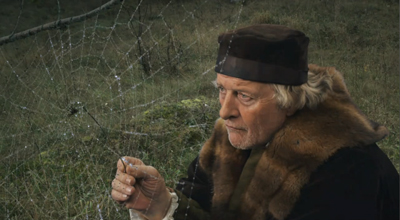
In an all-too-brief scene, Bruegel explains the composition of the painting to his patron, showing how the small group around Jesus forms the center, with the lines between the other main elements around the periphery intersect with it. The implicit comparison is to a charming moment in the film when the painter admires an intricate spiderweb. Apart from all the thematic material, we do learn something about Bruegel’s painting–a point that is emphasized at the end of the film, which tracks back from the actual painting in the Kunsthistorisches Museum in Vienna, as if inviting us to go and contemplate it in the light of what we have just seen.
Part of what makes The Mill & the Cross so exciting is that it achieves that rarest of things, making us feel that we are seeing something very worthwhile that has never been done before.
The film has a very limited release in the U.S. Anyone who has a chance to see it on the big screen should snatch it. The images, shot on the Red One camera and projected (here, at least) on 35mm, are spectacular.
Once upon a time, and time again
DB here:
Cesare Zavattini, central screenwriter of Italian Neorealism, liked to tell this story. A Hollywood producer once told him:
“This is how we would imagine a scene with an aeroplane. The plane passes by. . . a machine gun fires . . . the plane crashes. And this is how you would imagine it. The plane passes by. . . The plane passes by again… The plane passes by once more…”
He was right. But we have still not gone far enough. It is not enough to make the aeroplane pass by three times; we must make it pass by twenty times.
And, Zavattini seems to suggest, the machine gun should never fire.
Neorealism was one of the most important influences on what we’ve come to call the postwar European “art cinema,” and particularly on filmmakers’ treatment of time. I thought of the Zavattini passage while watching the opening scenes of Nuri Bilge Ceylan’s Once Upon a Time in Anatolia, a film which proves that you can always ring fresh changes on a well-established tradition.
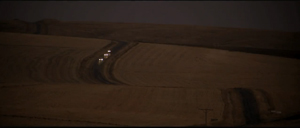
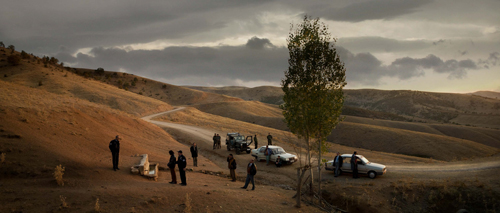
Actually, “opening scenes” isn’t quite right. The very first thing we see, a sort of prologue, presents in two shots the lead-up to a crime. Then come a couple of minutes of credits. Then we get nearly fifty minutes of nighttime shots of police cars driving through the countryside, headlights appearing tiny in the landscape. Again and again the cars halt as the police ask their murder suspect if this is the place where he and his brother buried the body of the man they killed. The suspect says he was drunk and can’t remember exactly. The investigators pick over the area looking for clues before driving on.
But the sequences aren’t quite as spare as I’ve indicated. Scenes inside the car and poking around the areas that might harbor the body pick out two main characters: a brooding doctor and a careful prosecutor overseeing the operation. The secondary cops and assistants are sketched in too. So we have a sort of balancing act between daringly distant “empty” shots and more standard expository scenes. The conversations in the car and in the landscape balance moments that dwell on atmospheric detail. So the relaxed pacing spares time for what will surely be one of the film’s most famous shots, a view of an apple shaken from a tree and bouncing downhill into a stream, where it continues to roll and bob in the dark. It presages the importance of melons, and in the final shots, a yellow soccer ball.
We frequently find that an art film flaunts some arresting narrational devices at the start before taming it as things move along. (Think of 8 ½’s bold opening, initiating us into Guido’s fantasy world, in effect teaching us how to watch the film.) Similarly, Once Upon a Time in Anatolia gets more linear and psychological as it goes along. It shifts from the more unfamiliar uncertainties of the futile stops and explorations to the better-defined questions we expect in a mystery. Is the suspect really guilty, or did his brother commit the murder? What triggered the killing? What effect has the crime had on the dead man’s wife and son?
The gradual shift seems to me to match a certain rigor in Ceylan’s stylistic handling. (Warning: Stylistic spoilers ahead.) In the nighttime search, long shots and extreme long shots dominate—if not by their number, at least by their prominence and vividness.
But having given us plenty of lengthy establishing shots in the first long section, Ceylan denies them in the next two portions.Later in the evening, the search party takes refuge in the house of a village leader and shares a meal with him. Here the action is broken up into close shots, with no long shots (I think) establishing where the characters are sitting. Everything, including the arrival of their host’s beautiful daughter, is given in tight shots of each character.
When the searchers return to town the next morning, they’re greeted by an angry mob. Again, the action isn’t shown fully. Now very long telephoto shots let us glimpse the police and the wife and son of the murdered man, with the crowd visible only as surging, out-of-focus heads and shoulders blocking the foreground.
The last forty minutes or so are centered on the doctor. Attached to him, we watch some interactions that trace out his responses to what he’s witnessed. These are handled in a traditional way, with shot/ reverse-shots, some of them head-on optical point of view, and lingering shots of the doctor brooding.
To the end, Ceylan doesn’t become completely predictable. There’s a nifty bit of elliptical editing during a conversation with the prosecutor. The offscreen sounds of an autopsy, layered by the sound of children’s play, recall passages of shrewdly timed offscreen dialogue that we heard during the long night’s search. And the final few shots play with optical point-of-view in a misleading fashion that has become something of a tradition in the art cinema.
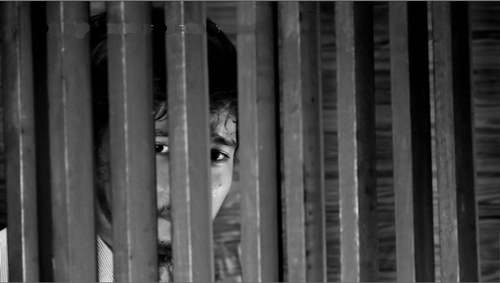
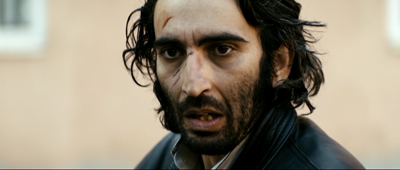
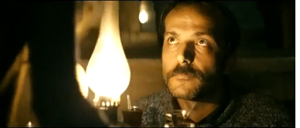
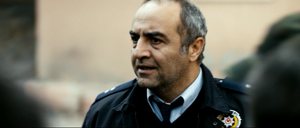
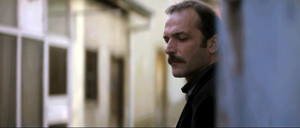
So if the plotting gradually settles down into something less disconcerting, so does the visual style. But that shouldn’t take away from the delicacy and deliberation of a film that gains real gravity through hints and elisions. Above all, certain faces, particularly the despairing one of the prisoner who has a painful secret (surmounting this section), exercise a powerful hold on us. The conclusion of Once Upon a Time in Anatolia pulses with genuine emotion, coolly contained in a mode of cinematic expression that after sixty years or so continues to harbor great power.
The Zavattini passage on flying planes is available here.
PS 9 October: Thanks to Miklós Kiss for correcting an embarrassing spelling error.
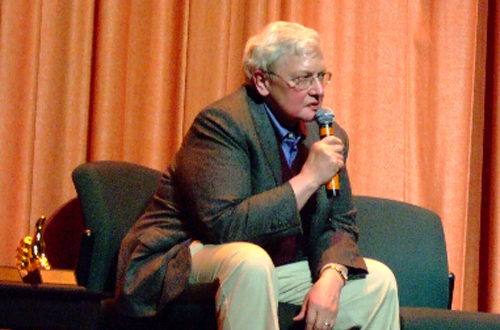
Roger Ebert in a moment of seriousness at Ebertfest 2006.
DB here:
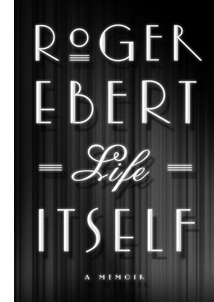
Life Itself is not an ordinary memoir. True, it’s roughly chronological, taking you from Roger’s childhood through college to journalist days and then to the career we all more or less know. But from the start, we may find several moments, decades apart, squeezed into a single paragraph, even a single line. An incident in the past triggers a flashforward, an account of what became of this person, why this place became one to revisit. Later in the book, layers of flashbacks stack up. And usually the passage slips still further outward to the enveloping narrative, recounted by a man who now finds pleasure in the very act of recollection.
A trip to London in the mid-1960s, during which Roger and his old friend Dan Curley discover The Perfect London Walk, summons up an episode, years later, in which their guidebook of the same name is clutched in the hands of tourists whose paths cross with Roger and Chaz’s. Then we’re with Roger in a hospital bed years later as he revisits London in his mind, with details rising unbidden. He sees a nursery school and the shadow of a wooden palm tree in a window. And then we glide outward to another frame, the very moment of writing that conjures up all the others. “I believe that I could pause right now and remember something I saw on a walk that I have never thought of again since that time.” That moment yields another cascade of memories, ending in the 1970s with Roger crawling through a hotel window in order to look down on Pembridge Square.
Gifted with a preternatural memory, Roger shames most memoirists. Not for him the procession of big names and picturesque places that makes the usual autobiography little more than a prosed-up agenda book. The book crackles with sensory impressions: the taste of a ploughman’s lunch in a pub, the whiff of a Steak and Shake cheeseburger. The world is there to be known, in all its teeming variety. I remember talking with him after George W. Bush got elected, and he was appalled that our new President had not held a passport before being elected governor. “Can you imagine a young man being that incurious?”
Above all, Roger’s curiosity turns toward people. Vast though his appetites and energies are, and frank as he is about his faults and failures, the writer is most fascinated by a picaresque procession of extraordinary individuals, most not famous. Yes, there are portraits of Mitchum and Scorsese and Royko and other larger-than-life celebs, but they’re brought down to earth. He favors the unknowns. He has, like his beloved Dickens, a genuine interest in everybody. After telling a bit about Letterman and Leno, he really gets going on the civilians whom he and Siskel met doing man-on-the-street gags. Studs Terkel becomes a fatherly exemplar of this worldly curiosity about the absolute uniqueness of everybody. “Two people meeting with Studs standing between them would hear from him how extraordinary they both were.”
Roger’s cast consists of everyone who has provided him laughter, sober self-analysis, affection, passion, and a long-running, tuition-free course in being a good person. For Sartre’s character, Hell is other people. Ebert, I’d say, thinks that other people are a decent, secular definition of Heaven. Life Itself radiates respect for the stubborn, sometimes maddening uniqueness of human beings.
“I was born inside the movie of my life,” the book begins. Okay, but what kind of movie? As a bona fide film brat, Roger has given us the autobiographical equivalent of a 1960s off-Hollywood art picture. It recalls those exercises in broken chronology like Petulia, but it’s gentler: not grating cuts, but quick dissolves. The time frames keep shifting and flipping over. Far along, at something like the climax of the book, love affairs and alcoholism set off a spiral of associations around his mother. And each era is quickened by the observer’s awareness of the preciousness of the sensuous moment. Roger is writing and watching teenage Roger dancing with Marty McCloy to the Everly Brothers in the Tigers’ Den:
Under our armpits, sweat formed dark circles, and our cheeks were moist as they touched.
Cinematic though it is, Life Itself is a literary exercise too. Roger, perhaps our most bookish living film critic, provides a montage of styles and genres. The childhood scenes, echoing Portrait of the Artist and A Death in the Family and perhaps The Sound and the Fury, are bursts of bright, disconnected impressions. Things coalesce into anecdotes as the boy’s mind matures. (Is it just me who hears echoes of another Midwestern yarn-spinner, Jean Shepherd?) In the young man who yearns to travel, to explore every city, to read every book he can lay his hands on, to shyly move toward girls, we see Thomas Wolfe, teenage Roger’s guiding star. Soon enough, though, we’re in a Ben Hecht Chicago newsroom:
Once Paul was talking on a telephone headset, tilted back in his chair, and fell to the floor and kept on talking. Eppie [Ann Landers] reached in a file drawer and handed down her pamphlet Drinking Problem? Take This Test of Twenty Questions.
(Aspiring writers: Compose a 50-word paragraph explaining why “handed down” is a better choice than “handed him.”)
Every memoir needs a credo, and this we get in concluding chapters entitled, “How I Believe in God” and “Go Gently.” They give you much to chew over, including laconic bon mots like “I was perfectly content before I was born, and I think of death as the same state.” The lesson of this life? Expect no spoilers from a fellow critic, but I can provide a teaser. It has to do with joy.