Tuesday | March 6, 2012
Kristin here:
A few days ago I was reading the February 24 issue of Entertainment Weekly. I started subscribing to EW during the days when I was working on The Frodo Franchise. Being a Time Warner publication, it tended to feature The Lord of the Rings a lot (Time Warner also owns New Line Cinema). I was trying to keep track of the popular-press coverage of the film, and EW was a helpful source. It also used to be a bit more substantive in those days. In recent years it has become more fluffy. Still, it’s handy for reading over lunch or when brushing one’s teeth.
Turning to page 66, I found Chris Nashawaty’s “The Most Overrated Best Picture Winners.” The double-page spread was slathered with photos of My Fair Lady, Out of Africa, Gandhi, The King’s Speech, and Shakespeare in Love. (The piece is online, but as a gallery rather than an article, lacking the introduction.)
I like putdowns of overrated and/or over-rewarded films as much as anyone, so I settled in to read. I was shocked, however, to find that the first film on the list was How Green Was My Valley.
I happen to think the How Green is one of the very greatest American films. Probably no Best Picture winner in the history of the Oscars has been a more fitting recipient of that award. Why lump it in with Shakespeare in Love?! (I think you know what’s coming.)
Nashawaty gives his reasons. He admits that How Green has three pluses going for it: “It’s got beautiful cinematography, John Ford as a director, and a three-hankie plot about a Welsh mining village.” He goes on: “The minuses: mismatched accents and the still-outrageous fact that it beat Citizen Kane.”
Mismatched accents as a reason not to win Best Picture? The notion belittles the brilliant ensemble acting in Ford’s film, with Donald Crisp, Sarah Allgood, Barry Fitzgerald, Maureen O’Hara, Walter Pigeon, and many others giving fabulous performances, career bests in some cases. It is a joy to watch them interact. Of course most of these people sound more Irish than Welsh, but frankly, who cares?
By the way, I’m assuming Nashawaty means the mismatch of Irish accents to a Welsh setting, not a miscellany of accents among the cast, which is common in Hollywood films. Besides, isn’t accuracy of accents—think Meryl Streep—one of the criteria used to judge the very Oscar-winners that Nashawaty is decrying? I’ve never seen Gandhi, but I’ll bet Ben Kingsley did a heck of an authentic accent. Accents are one of the easiest aspects of performances to notice, so it’s not surprising that they are so often a factor in Oscar-nominated and -winning roles.
But it’s not really the accents that bother people about How Green. No, it’s really the “beat Citizen Kane” part that grates on film fans. Quite possibly it has led them to dismiss or undervalue one of Ford’s greatest films.
I’m going to be heretical and say that How Green deserved to win over Kane.
For years Kane has been sitting atop many lists of the greatest films of all times, including polls of professional film critics. The notion that Kane really is the greatest film of all time has become so engrained that people seem seldom to question it. Back when that idea arose, critics were unaware of the films of Yasujiro Ozu, probably the world’s greatest film director to date. Play Time was for years ignored and only recently has begun to be recognized for the masterpiece it is. With the rise of film restoration in the 1970s and the spread of film festivals and retrospectives, we now know vastly more about world cinema than we did before. Yet Kane has settled into its top slot for many people, including entertainment journalists. I can think of many films I would rank above Kane.
No doubt it’s a great film, with a marvelously tricky plot, another great ensemble of actors, splendidly distinctive cinematography, and innovative special effects masquerading as cinematography. It was hugely influential at the time and remains so to this day. Of course, Welles has declared time and again that he learned filmmaking by watching Stagecoach over and over, so Kane would probably not be as good as it is without Ford’s influence. Not that such influence proves that How Green is better than Kane, but it shows Welles’s respect for Ford. More on that below.
Middlebrow and proud of it
I think another reason why How Green tends to be dismissed as merely the film that cheated Kane out of its best-picture Oscar is that it is resolutely middlebrow. Indeed, in that way it fits in with all the other films Nashawaty writes about. They’re all resolutely middlebrow, too. Middlebrow films are for those people who look down upon popular genres and want to feel they’re seeing something worthwhile.
Despite this attitude, most of the great American films fit into popular genres: Keaton’s The General (or substitute your favorite Keaton film), Kelly and Donen’s Singin’ in the Rain, and Hitchcock’s Rear Window (or, if you will, Shadow of a Doubt or Notorious or Psycho). This is one thing that the auteur theory, somewhat indirectly, taught us. Howard Hawks’s modern reputation rests partly on his ability to waltz into any American genre and make one of its best entries. The Godfather is technically a gangster film, but one could argue that by taking it from a bestseller and making it into a glossy A picture, Coppola pushed his film into the middlebrow range far enough for the Academy to dub it Best Picture—twice. The one Best-Picture winner of recent decades that arguably did thoroughly deserve the prize was a serial-killer thriller, The Silence of the Lambs. I think a lot of people were surprised that the strait-laced Academy members could accept such subject matter in a nominee, let alone a winner.
Like Hawks, Ford moved easily among genres and excelled at least once in every one he touched. He made arguably the greatest war film ever, the underrated They Were Expendable, and the greatest Western, The Man Who Shot Liberty Valance (or Stagecoach or My Darling Clementine). He also pulled the turgid middlebrow genre of the 1930s biopic into greatness with Young Mister Lincoln. There’s no doubt that Ford was an uneven director, and arguably his worst films arose from his attempts to go for middlebrow respectability. The Fugitive is almost unwatchable in its pretentiousness, and the mid-1930s brought forth such items as Mary of Scotland and The Informer. But starting in 1939, he produced an almost unbroken string of masterpieces and near masterpieces, culminating in They Were Expendable and My Darling Clementine.
We should recall also that Welles himself adapted a middlebrow bestseller for the film he made directly after Kane: The Magnificent Ambersons. Had the studio not meddled so extensively with it, it probably would have been one of the American cinema’s great middlebrow classics, fit to sit alongside How Green.
Earned sentimentality
Welles himself probably would have felt honored by that comparison. In a 1967 interview he described his taste in films:
Old masters—by which I mean John Ford, John Ford, and John Ford. With Ford at his best, you feel that the movie has lived and breathed in a real world—even though it may have been written by Mother Machree.
In other words, Welles recognized that sentiment did not take away from the brilliance of Ford’s best work, and How Green is definitely in that category. Welles was too big an egotist not to have been annoyed at losing the Best Picture award to Ford, but he probably understood why How Green won better than most people do today. Today, apart from groups of women who go to see heartwarming female-oriented fare, audiences tend to shy away from sentimentality.
To his credit, Nashawaty lists sentimentality as a plus for How Green. (“Three-hankie plot” has a dismissive ring to it, but I’ll chalk that up to the requirements of infotainment journalese.) But I’m sure that many people who underrate How Green do so because it’s essentially a family melodrama where everything starts out in an Edenic state and the situation slowly goes downhill to a distinctly unhappy ending for all concerned. A lot of people simply dismiss sentimentality in all its manifestations, presumably as too naive, hitting us below the belt for an easy emotional appeal. In this day and age, it is much easier to admire cynicism than unembarrassed emotion. Despite its subject matter of environmental depredation by greedy companies, How Green is resolutely focused on the joys and sorrows of the family. Kane is cynical in a very modern way. Yet I cannot believe that we care nearly as much about the characters in Kane, even Susan, as we do in How Green.
Sentimentality is not a bad thing in itself. Sure, it’s an easy thing to evoke. Easy sentimentality is banal and cloying because there’s so little underpinning it except conventional romance and cute babies and long-suffering mothers and the like. Then there is what I call earned sentimentality. (A similar distinction is often made between sentiment and sentimentality.) Films with this quality are rich with original characters and situations that might make even a viewer who dismisses easy sentimentality pull out a hankie. The sentimentality in Chaplin’s films sometimes achieves this, and his Little Tramp character has been widely praised over the decades for his mastery of this emotion. Even those who dismiss sentimentality can forgive Chaplin, since humor usually undercuts the cloying quality just a bit. In a less obvious way, Harold Lloyd sometimes proves himself a master of sentimentality, as in The Kid Brother. And earned sentiment is not dead. It pervades Big Fish, another film that has been underrated or at least largely forgotten, perhaps in part due to its sentimentality. It has eccentrics galore and an original plot idea, but it doesn’t have that edgy, weird quality that sophisticated viewers treasure in Tim Burton’s work. There’s even sentimentality in the Wallace & Gromit films, though again humor makes the emotion palatable. Art cinema has its own sentimental masterpieces: Bicycle Thieves, Jules et Jim, Tokyo Story, Sansho the Bailiff, Distant Voices, Still Lives, and the list could go on and on. True, all these films are grimmer in part or in whole than the average Hollywood film, but so is How Green.
By the way, Welles himself delivers one of the sublime sentimental passages of world literature in the heartbreakingly nostalgic “chimes at midnight” speech in Falstaff, which has other passages of the same emotion. The Magnificent Ambersons is a sentimental film of a different sort.
For my money, How Green earns its sentimentality as well as any film ever made.
On everyone’s syllabus
You may be asking at this point, if How Green is so fantastic, why didn’t Bordwell and Thompson use it as their central example of a narrative film in Film Art? Why is Kane in that spot? There’s a simple answer to that: Kane is a very teachable film, and How Green, to say the least, is not. Our challenge was to find a film that most teachers used, or would happily start to use, and that demonstrated many concepts about film narrative and style that we wanted to describe.
Some films are just more teachable than others. They use a lot of different techniques, both stylistic and formal, in a way that students can notice. Hitchcock is probably the most teachable director overall, and I would bet that his films show up on introductory-film-class syllabi more often than any other director’s. It’s just that with Hitchcock, there’s no one film that’s self-evidently more useful for teachers than others. I sometimes think that one could almost write an entire introductory textbook using nothing but examples from Lang’s M. There are other classics like that. But Kane beats them all: a complex but clear flashback structure, obvious and varied technique, a complex soundtrack born of Welles’s radio experience, and examples of many things teachers want their students to learn about. It’s a classical Hollywood film, but it has touches of art-cinema ambiguity about it. It’s entertaining, at least to motivated students, so they’re likely to pay attention rather than dismissing it. They may come into the class knowing that it’s a revered classic and hence be interested in seeing it. It may even reconcile them to watching black-and-white films.
How Green, however, is difficult to teach. David has found this to be true. Our colleague Lea Jacobs occasionally offers a seminar on Ford, and How Green is among the most challenging films by a director whom students tend to be slow to warm up to. She attributes this partly to changing tastes and partly to the subtlety of the style of its cinematography. It’s very hard to make students, and indeed almost anyone who isn’t already a believer, see why How Green is a masterpiece.
Kane is not only teachable, but it’s highly conducive to analysis, and no doubt these two traits are closely related. David’s first widely seen article was a study of Kane, and I wrote the sections of chapters in Film Art dealing with it. I don’t mean that it’s simple; Kane is a complex film that has provided material for many different essays and books. But How Green has so many ineffable qualities that it resists cold, precise analysis. It has been one of my favorite films for over three decades, and occasionally I have contemplated writing something in-depth about it. I can’t, however, think what one could possibly write. One would just have to throw up one’s hands and say, “You either get it or you don’t.”
It reminds me of when I was nearing the end of my undergraduate career. I didn’t “get” Godard. I found his work pretentious and boring. But given how many people whose opinions I respected admired Godard, I persisted. I think I suffered through seven features, and at about number eight (Weekend), I got Godard. Maybe Ford, at least for his non-Western films, is somewhat the same sort of challenge. I’ve written analyses of two of Godard’s more difficult films, Tout va bien and Sauve qui peut (la vie). I’m still scared to try to deal with How Green.
(Stagecoach is much easier. For several editions of Film Art we included an analysis of it, which I wrote. Eventually it got replaced, but it’s still available here.)
A few hints
Since I doubt I will ever thoroughly analyze How Green, here I’ll offer just a few hints as to why it deserved to take home Best Picture and leave Kane an also-ran.
Nashawaty mentions the beautiful cinematography. Arthur C. Miller was 20th Century-Fox’s A-list cinematographer, having shot some of the Shirley Temple films in the 1930s, films that kept the studio afloat during the Depression. He teamed with Ford only on Tobacco Road and How Green, though he apparently helped with Young Mr. Lincoln uncredited. Miller won his first Oscar for How Green, his second for Henry King’s The Song of Bernadette (the main virtue of which is it looks a lot like How Green), and his third for Anna and the King of Siam. Few of Miller’s non-Ford films like The Ox-Bow Incident and Gentlemen’s Agreement are watched much today. He did lens somewhat minor films by major directors (Hitchcock’s Lifeboat, Preminger’s Whirlpool), but he is less famous than he deserves.
Just a few examples. How Green contains some of the same techniques that are so admired in Kane, but in a less flamboyant fashion. Deep focus, for example:
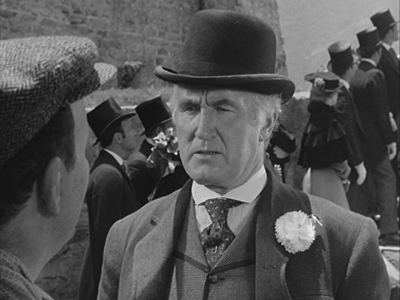
Admittedly, the people at the right rear are slightly out of focus, but the shot was done in-camera. No special effects.
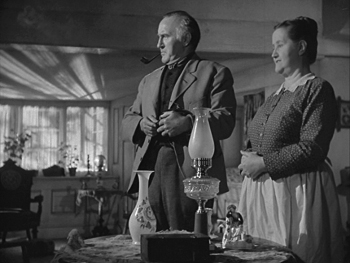
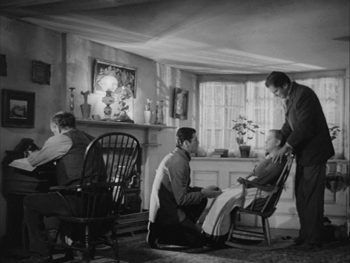
The interiors of How Green have a distinctive touch: patches of light on the ceilings. Implausible, when you start to think about where the light must be coming from, but beautiful nonetheless. Miller (or at least Fox) almost had a patent on this way of lighting a room. With Kane getting so much credit for adding ceilings to sets, we should remember that Ford has done so in Stagecoach and does it here as well. It’s not as in-your-face as Kane’s ceilings, but it’s an example of the subtlety that pervades How Green. The first shot (below) is part of the series of scenes at the beginning setting up the happy home life of the large and relatively prosperous Morgan family; the father is about to dole out allowances to his sons on payday. The second comes much later, as the last two grown sons prepare to depart abroad in search of work after the mine has declined.
Kane is admired for both its long takes and its dynamic editing. Ford seldom used either. He held a shot long enough to be effective but not long enough to turn into showing-off. Take the scene after Angharad’s marriage to the wealthy mine-owner’s son. Mr. Gruffydd, the minister whom she actually loves, has performed the ceremony. As has been pointed out many times, Ford filmed the final shot without doing any close views to be cut in later. (Indeed, most of How Green was edited in the camera by Ford, so that most of the footage he shot ended up on the final version. It was his way of keeping control over his film.) By happy accident, a breeze caught Angharad’s veil, sending it soaring and twisting through the shot. Perhaps it was a reflex gesture on the part of the actor playing the mine-owner’s son, but he reaches out and holds the veil down as his bride climbs into the coach; it perfectly captures his cold, proper nature. For a split second before the coach pulls away out right, Angharad glances back toward the church, where Gruffydd remains inside. Once the coach is gone, Ford holds, and Gruffydd appears on the hillside at the rear, watching and then turning to go inside. No cut-in mars the perfection of the shot.
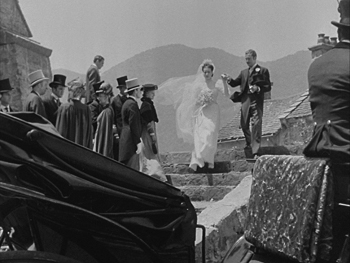 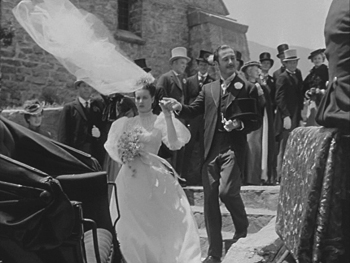
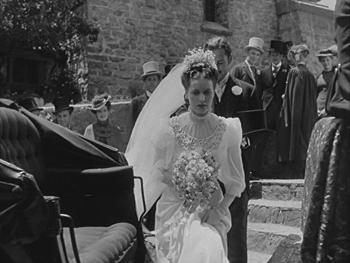 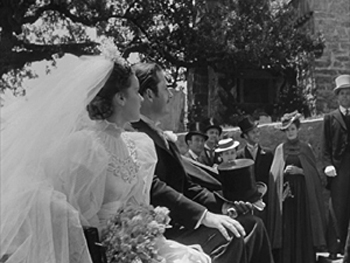
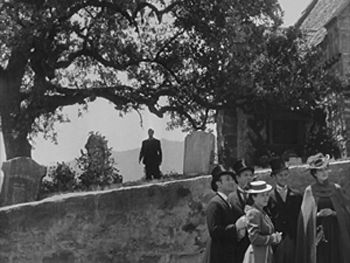
There’s one of the hankie moments. I get tears in my eyes during this scene, partly out of sympathy of the sundered couple and partly from aesthetic pleasure. If ever there was a single shot that exemplifies Ford’s combination of sentiment and discretion, this is it.
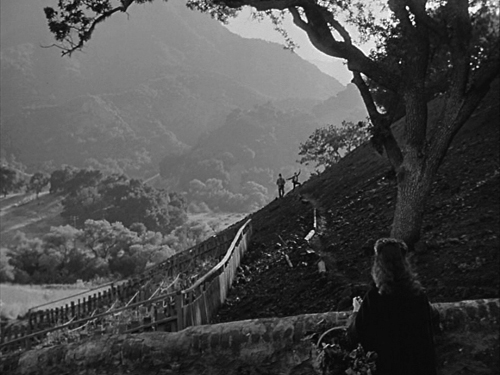
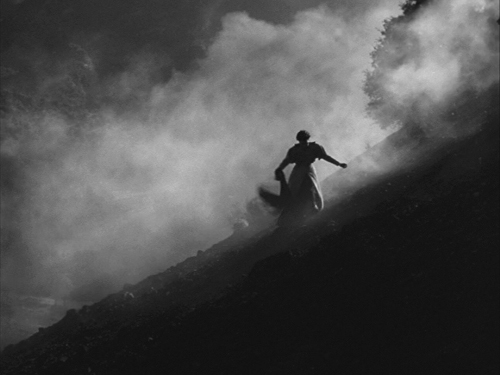
The last of these five frames belongs to the visual motif that appears in the opening sequence, as Angharad waves to her father and Huw on the beautiful distant hillside (see above), as well as in the final scene, where Angharad struggles in her fine clothes across a similar hillside, swathed in smoke, to reach the mine after the disaster that traps her father (see below). Such moments create a quiet measure of the gradual degradation of the valley and the dwindling of the family’s happiness.
Did Ford realize how brilliant this shot was? We can be confident that Welles was well aware of how daring and wonderful his techniques in Kane were. It shows in the film. With Ford, one can only suspect that he knew exactly what he had accomplished here and elsewhere.
Another thing How Green shares with Kane is a flashback structure. It largely consists of one big flashback told by the protagonist, not a series of embedded stories by witnesses. Nevertheless it’s unusual, since we never come out of the flashback. The tale opens with the valley in severe decline, the village nearly deserted, and the hero about to depart for a better life. We witness the decline of his family as he grows, gets educated, and opts to follow his father and brothers into a job in the mine. By the end his elder brothers have scattered all over the world, his father is dead, and we don’t know what has become of his mother and sister. (One plausible assumption is that his mother has recently died, prompting his departure in the opening scene.) Yet the ending gives us a series of shots of the family as they had been in their prime, with the protagonist-narrator declaring, “Men like my father can never die.” Like Kane, it is a film about the power of memory, but in this case the power to comfort rather than to baffle.
One thing that makes How Green stand apart from some of Ford’s other films is that it for once controls the director’s penchant for mixing in broad humor. His stable of supporting actors playing minor characters who love to drink and fight can be trying. There is a particularly ill-advised moment in The Searchers when, after the epiphanic moment when Ethan has lifted Debbie as if to kill her and then embraced her, Ford cuts to the Ward Bond character having a wound on his posterior dressed, to the derision of his comrades. That Ford should undercut such a scene with a vulgar moment of comedy combines with another flaw or two in the film keep if off my list of Ford’s very best films. And much though I love the first three-quarters of The Quiet Man, that climactic brawl just goes on and on.
In How Green, the characters Dai Bando and Cyfartha provide humor, but they are held in check. They play reasonably significant roles in the action, helping Huw deal with the school bullies and his sadistic teacher. Many of the family scenes involve amusing moments as well, moments that arise naturally from the situations and have no air of mere comic relief. In screenwriter Philip Dunne’s introduction to the published version of his screenplay, he finds fault with several scenes and actors. Maybe he’s right that the scene when the mine owner visits the Morgan family is played for broad comedy, but it’s not as broad as elsewhere in Ford’s work. Luckily Ford’s brother Francis does not return for yet another of his bit parts as a drunk.
In 1972, when Ford was dying of cancer, the Directors Guild held an evening gathering to honor him. He was asked to choose one of his films to be projected, and he named How Green. He had consistently said he considered it his finest film.
There’s no budging Kane
I doubt that the notion of Citizen Kane as the Greatest Film of All Time will go away anytime soon. Changing (and unchanging) tastes are reflected in the decadal Sight & Sound poll of critics concerning the ten greatest films of all times. They started in 1952 and have continued to 2002, with another due this year. The lists reflect the fact that apparently critics can somewhat agree on the greatest older classic, though fashions in these come and go, but they cannot agree on much of anything that has been made since 1970:
1952
- 1. Bicycle Thieves (De Sica)
- 2. City Lights (Chaplin)
- 2. The Gold Rush (Chaplin)
- 4. Battleship Potemkin (Eisenstein)
- 5. Intolerance (Griffith)
- 5. Louisiana Story (Flaherty)
- 7. Greed (von Stroheim)
- 7. Le Jour se lève (Carné)
- 7. The Passion of Joan of Arc (Dreyer)
- 10. Brief Encounter (Lean)
- 10. La Règle du jeu (Renoir)
1962
- 1. Citizen Kane (Welles)
- 2. L’avventura (Antonioni)
- 3. La Règle du jeu (Renoir)
- 4. Greed (von Stroheim)
- 4. Ugetsu Monogatari (Mizoguchi)
- 6. Battleship Potemkin (Eisenstein)
- 7. Bicycle Thieves (De Sica)
- 7. Ivan the Terrible (Eisenstein)
- 9. La terra trema (Visconti)
- 10. L’Atalante (Vigo)
1972
- 1. Citizen Kane (Welles)
- 2. La Règle du jeu (Renoir)
- 3. Battleship Potemkin (Eisenstein)
- 4. 8½ (Fellini)
- 5. L’avventura (Antonioni)
- 5. Persona (Bergman)
- 7. The Passion of Joan of Arc (Dreyer)
- 8. The General (Keaton)
- 8. The Magnificent Ambersons (Welles)
- 10. Ugetsu Monogatari (Mizoguchi)
- 10. Wild Strawberries (Bergman)
1982
- 1. Citizen Kane (Welles)
- 2. La Règle du jeu (Renoir)
- 3. Seven Samurai (Kurosawa)
- 3. Singin’ in the Rain (Kelly, Donen)
- 5. 8½ (Fellini)
- 6. Battleship Potemkin (Eisenstein)
- 7. L’avventura (Antonioni)
- 7. The Magnificent Ambersons (Welles)
- 7. Vertigo (Hitchcock)
- 10. The General (Keaton)
- 10. The Searchers (Ford)
1992
- 1. Citizen Kane (Welles)
- 2. La Regle du Jeu (Renoir)
- 3. Tokyo Story (Ozu)
- 4. Vertigo (Hitchcock)
- 5. The Searchers (Ford)
- 6. L’Atalante (Vigo)
- 6. The Passion of Joan of Arc (Dreyer)
- 6. Pather Panchali (Ray)
- 6. Battleship Potemkin (Eisenstein)
- 10. 2001: A Space Odyssey (Kubrick)
2002
- 1. Citizen Kane (Welles)
- 2. Vertigo (Hitchcock)
- 3. La Regle du Jeu (Renoir)
- 4. The Godfather, parts I and II (Coppola)
- 5. Tokyo Story (Ozu)
- 6. 2001: A Space Odyssey (Kubrick)
- 7. Battleship Potemkin (Eisenstein)
- 7. Sunrise (Murnau)
- 9. 8 ½ (Fellini)
- 10. Singin’ in the Rain (Kelly and Donen)
There is much that could be said about these lists. Most readers will probably be astonished to see Bicycle Thieves at the head of the first list, with Kane not even present. Brief Encounter above La Regle du jeu. Louisiana Story, of all things, and Le Jour se léve. By 1962, tastes had changed. Italians won the day, with three films, while Eisenstein, whose Ivan the Terrible, Part 2 had finally been released in 1957, had two films chosen. Two French films and two American. But it was in this year that Kane appeared, immediately bouncing to number one, a position from which it has never budged. I suspect it will sit atop the 2012 list, simply because now so many critics assume it’s the best film ever–and even if they don’t assume that, they won’t be able to agree on an alternative.
Ford has had only one film on the lists, The Searchers, in 1982 and 1992. For a time it was the Ford film du jour, until in 1992 Hitchcock zipped past it with Vertigo, which settled into the second spot after Kane in 2002. Mizoguchi has been on only one list, in 1972 with Ugetsu Monogatari. Ozu’s first film to became well known in the west didn’t make the list until decades later, in 1992, and yet despite the discovery of Late Spring and Early Summer and An Autumn Afternoon, Tokyo Story remains the Ozu film. Tati has never appeared on the list. Neither has Bresson. I’ll buy the idea that critics are out there voting for Bresson like mad, but all for different films. But Play Time, surely one of the very greatest films ever made, should be easy to converge around. Finally, the only post-1970 film on here (and not by much) is the Godfather pair. I was still working on my master’s degree when the first one came out.
I suppose by now, with so many smaller countries starting to make movies and so many festivals making them widely available, it becomes impossible to anoint new classics in the way critics used to. Kiarostami’s Koker Trilogy, in whole or in part, would seem to be such a classic, but there are so many great competing films. Does one have enough perspective to choose more recent films when others, like Sunrise, have stood the test of time? Play Time is 45 years old now, and I think it’s a greater film than most of those on the 2002 list–certainly including the number one. Possibly it will make the list this year.
Why is Kane so fixed at the top, when other films move up and down and ladder, and some appear and disappear? Perhaps the simple assumption that if it has been up there so long, it must really be the greatest film ever made.
I think this business of polls and lists for the greatest films of all times would be much more interesting if each film could only appear once. Having gained the honor of being on the list, each title could be retired, and a whole new set concocted ten years later. The point of such lists, if there is one, is presumably to introduce people who are interested in good films to new ones they may not have seen or even known about.
Such an approach is not wholly unthinkable. Each year the National Film Registry maintained by the Library of Congress chooses 25 films deemed to be national treasures worthy of special priority in preservation. There’s probably some assumption that the best films were on the early lists and that each new 25, especially coming annually rather than at longer intervals, must be of less interest than its predecessors. But on the whole it’s a pretty egalitarian exercise, one that treats all kinds of films as fair game, not just fiction features, and it really does draw attention to obscure films that deserve to be better known. Given how many films have been made in the USA, it will be a long time before the Registry is scraping the bottom of the cinematic barrel. The entire world could supply so many more.
At any rate, I don’t insist that justice will not be done until How Green or some comparable Ford masterpiece appears on Sight & Sound‘s poll, any more than I would say that it’s having won the Best Picture Oscar proves that it’s a great film. I think we all know that the whims of the Academy members are hard to fathom, then and perhaps even more so now. But why call it overrated just because it beat Kane for that dubious honor? If anything, How Green is underrated for that very reason. Had it been made in a different year and won the Oscar against some other films that weren’t Kane, would it be any better or worse?
If you have never seen How Green and are not wholly opposed to earned sentimentality, give it a try. Just make sure you have at least three hankies handy.
PS March 8, 2012. Our friend Antti Alanen points out that Maureen O’Hara said the shot with the veil was carefully planned. She disagrees with Philip Dunne’s claim that the wind catching it was a happy accident, as Joseph McBride recounts in Searching for John Ford:
Dunne thought Ford had “one of the greatest strokes of luck a director ever had” when the wedding veil suddenly caught a gust of wind and billowed behind Mareen O’Hara as she walked down the steps from the church. O’Hara recalled, “Everybody said, ‘Oh, that Ford luck! How wonderful that was! What an effect it has!’ Rubbish! It wasn’t ‘Ford luck.’ It was three wind machines placed by John Ford, and I had to walk up and down those steps many times while he worked out that the wind machine would do exactly that.” As she climbs into the carriage, the ator playing her husband, Marten Lamont, reaches out to catch her veil. Dunne thought, “The man shouldn’t have touched it when the veil spiraled up. My God, what a shot! Luckily, Joe LaShelle, who was the operator, just gave it a little tilt with the camera.” I told Dunne I thought the gesture of restraining the veil (probably planned by Ford, like the rest of this meticulously composed shot) is an eloquent metaphor for the repressiveness of Angharad’s loveless marriage. “Well, I guess so,” the screenwriter responded. “I didn’t think beyond that. I said, ‘My God, you get a break like that, you leave it alone.'” (p. 332)
PPS March 11, 2012. Thanks to Przemek Kantyka for pointing out that Ugetsu actually figured on the 1962 and 1972 lists.
Posted in Directors: Ford, Directors: Welles, Film comments, Film history, Film industry, Hollywood: Artistic traditions |  open printable version
| No Comments » open printable version
| No Comments »
Sunday | March 4, 2012
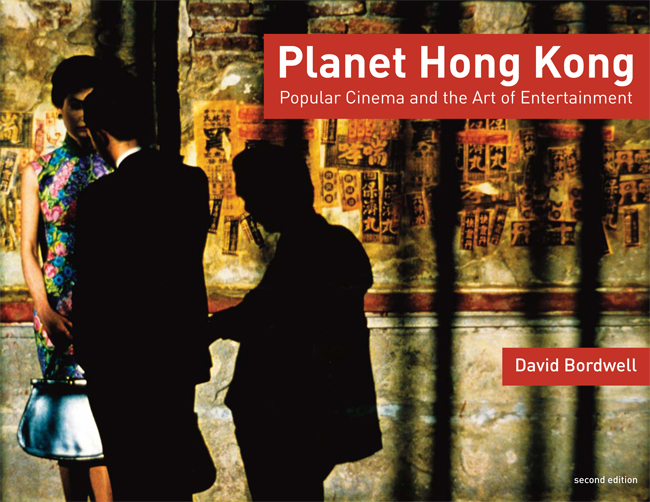
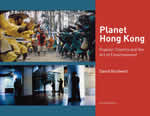
Alternative cover for Planet Hong Kong 2.0. Not used. Sigh.
DB here:
The revised edition of Planet Hong Kong: Popular Cinema and the Art of Entertainment became available as an e-book on this site a year or so back. A couple of months ago, I announced that some print copies of the book are now available for sale. The response has been very gratifying—so much so that I’m moved to say that our supply is running out. So if you’re contemplating getting one, you should probably act soon. As indicated in the right-hand column of this page, you can get information about the book here, and you can order it from either Amazon or Biblio.
In particular, I wanted to reach out to college faculty who might not be interested in Hong Kong film but who might consider asking their campus libraries to order the book. My distributor, Twentieth Century Books of Madison, is well-versed in handling institutional orders and can fulfill them quickly. The e-book will continue to be available, but as someone who grew up using libraries a lot, I love the idea of libraries keeping print copies of the book for long-term preservation.
Thanks to everyone who has purchased a copy, digital or analog. The sales are enabling me to pay the costs of production, with a little left over to buy more Jackie Chan and Johnnie To DVDs.
For extra stuff that’s not in the second edition, start here. Our most popular entry on Jackie Chan is here.
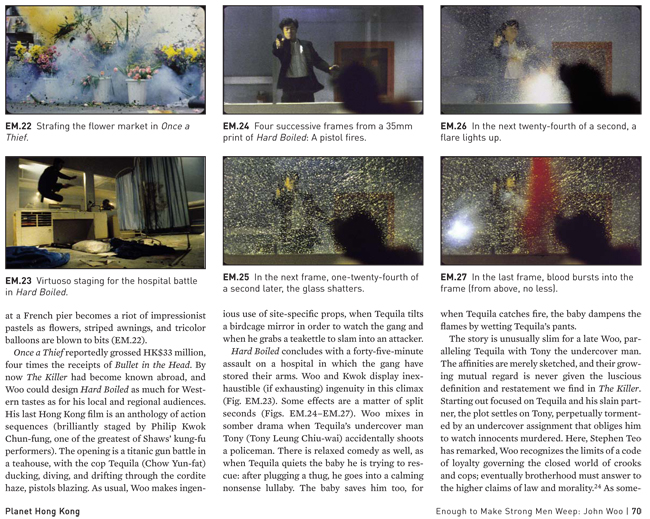
A sample page from Planet Hong Kong, second edition. As usual, thanks to Meg Hamel for making it happen.
Posted in National cinemas: Hong Kong, PLANET HONG KONG: backstories and sidestories | open printable version
| No Comments »
Tuesday | February 28, 2012

“Up ahead was Pandora. You grew up hearing about it, but I never figured I’d be going there.”
DB here:
Actually it wasn’t originally a box but a jug. And it might not have been filled with all the world’s misfortunes; it might have housed all the virtues. In Greek mythology, the gods create her as the first woman, sort of the ancient Eve. We get our standard idea of her story not from the ancient world, however, but from Erasmus. In 1508 he wrote of her as the most favored maiden, granted beauty, intelligence, and eloquence. Hence one interpretation of her name: “all-gifted.” But to Prometheus she brought a box carrying, Erasmus said, “every kind of calamity.” Prometheus’ brother Epimetheus accepted the box, and either he or Pandora opened it, “so that all the evils flew out.” All that remained inside was Hope. (Don’t think there isn’t a lot of dispute about why hope was cooped up with all those evils.)
The idea of Pandora’s box spread throughout Western culture to denote any imprudent unleashing of a multitude of unhappy consequences. It’s long been associated with an image of an attractive but destructive woman, and we don’t lack examples in films from Pabst to Lewin. But there’s another interpretation of the maiden’s name: not “all-gifted” but “all-giver.” According to this line, Pandora is a kind of earth goddess. In one Greek text she is called “the earth, because she bestows all things necessary for life.”
The less-known interpretation seems to dominate in Avatar. Pandora, a moon of the huge planet Polyphemus, is a lush ecosystem in which the humanoid Na’vi live in harmony with the vegetation and the lower animals they tame or hunt. Nourished by a massive tree (they are the ultimate tree-huggers), they have a balanced tribal-clan economy. Their spiritual harmony is encapsulated in the beautiful huntress Neytiri. As the mate for the first Sky-Person-turned-Na’vi, Avatar Jake, she’s also an interplanetary Eve. And by joining the Na’vi on Pandora, Jake does find hope.
The irony of a super-sophisticated technology carrying a modern man to a primal state goes back at least as far as Wells’ Time Machine. But the motif has a special punch in the context of the Great Digital Changeover. Digital projection promises to carry the essence of cinema to us: the movie freed from its material confines. Dirty, scratched, and faded film coiled onto warped reels, varying unpredictably from show to show (new dust, new splices) is now shucked off like a husk. Now images and sounds supposedly bloom in all their purity. The movie emerges butterfly-like, leaving the marks of dirty machines and human toil behind. As Jake returns to Eden, so does cinema.
Avatar or atavism?
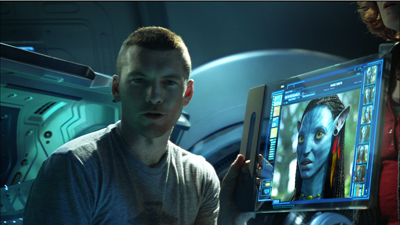
Kristin suggested the title for this series of blog entries, and I liked its punning side. For one thing, Avatar was a turning point in digital projection. 3D, as we now know, was the Trojan Horse that gave exhibitors a rationale to convert to digital. Avatar, an overwhelming merger of digital filmmaking (halfway between cartoon and live-action) and 3D digital projection, fulfilled the promise of the mid-2000s hits that had hinted at the rewards of this format.
With its record $2.7 billion worldwide box office, Avatar convinced exhibitors that digital and 3D could be huge moneymakers. In 2009, about 16,000 theatres worldwide were digital; in 2010, after Avatar, the number jumped to 36,000. True, theatre chains also benefited from JP Morgan’s timely infusion of about half a billion dollars in financing in November 2009, a month before the film’s release. Still, this movie that criticized technology’s war on nature accelerated the appearance of a new technology.
Throughout this series, I’ve tried to bring historical analysis to bear on the nature of the change. I’ve also tried not to prejudge what I found, and I’ve presented things as neutrally as I could. But I find it hard to deny that the digital changeover has hurt many things I care about.
The more obvious side of my title’s pun was to suggest that digital projection released a lot of problems, which I’ve traced in earlier entries. From multiplexes to art houses, from festivals to archives, the new technical standards and business policies threaten film culture as we’ve known it. Hollywood distribution companies have gained more power, local exhibitors have lost some control, and the range of films that find theatrical screening is likely to shrink. Movies, whether made on film or digital platforms, have fewer chances of surviving for future viewers. In our transition from packaged-media technology to pay-for-service technology, parts of our film heritage that are already peripheral—current foreign-language films, experimental cinema, topical and personal documentaries, classic cinema that can’t be packaged as an Event—may move even further to the margins.
Moreover, as many as eight thousand of America’s forty thousand screens may close. Their owners will not be able to afford the conversion to digital. Creative destruction, some will call it, playing down the intangible assets that community cinemas offer. But there’s also the obsolescence issue. Equipment installed today and paid for tomorrow may well turn moribund the day after tomorrow. Only the permanently well-funded can keep up with the digital churn. Perhaps unit prices will fall, or satellite and internet transmission will streamline things, but those too will cost money. In any event, there’s no reason to think that the major distributors and the internet service providers will be feeling generous to small venues.
Did this Pandora’s box leave any reason to be optimistic? I haven’t any tidy conclusions to offer. Some criticisms of digital projection seem to me mistaken, just as some praise of it seems to me hype or wishful thinking. In surrendering argument to scattered observations, this final entry in our series is just a series of notes on my thinking right now.
What you mean, celluloid?
First, let’s go fussbudget. It’s not digital projection vs. celluloid projection. 35mm motion picture release prints haven’t had a celluloid base for about fifteen years. Release prints are on mylar, a polyester-based medium.
Mylar was originally used for audio tape and other plastic products. For release prints of movies, it’s thinner than acetate but it’s a lot tougher. If it gets jammed up in a projector, it’s more likely to break the equipment than be torn up. It’s also more heat-resistant, and so able to take the intensity of the Xenon lamps that became common in multiplexes. (Many changes in projection technology were driven by the rise of multiplexes, which demanded that one operator, or even unskilled staff, could handle several screens.)
Projectionists sometimes complain that mylar images aren’t as good as acetate ones. In the 1940s and 1950s, they complained about acetate too, saying that nitrate was sharper and easier to focus. In the 2000s they complained about digital intermediates too. Mostly, I tend to trust projectionists’ complaints.
But acetate-based film stock is still used in shooting films, so I suppose digital vs. celluloid captures the difference if you’re talking about production. Even then, though, there’s a more radical difference. A strip of film stock creates a tangible thing, which exists like other objects in our world. “Digital,” at first referring to another sort of thing (images and sounds on tape or disk), now refers to a non-thing, an abstract configuration of ones and zeroes existing in that intangible entity we call, for simple analogy, a file.
George Dyson: “A Pixar movie is just a very large number, sitting idle on a disc.”
Big and gregarious
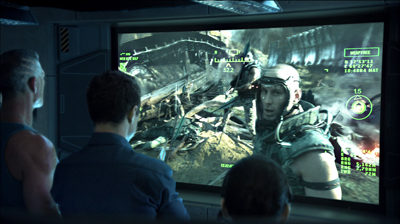
Sometimes discussion of the digital revolution gets entangled in irrelevant worries.
First pseudo-worry: “Movies should be seen BIG.” True, scale matters a lot. But (a) many people sit too far back to enjoy the big picture; and (b) in many theatres, 35mm film is projected on a very small screen. Conversely, nothing prevents digital projection from being big, especially once 4K becomes common. Indeed, one thing that delayed the finalizing of a standard was the insistence that so-called 1.3K wasn’t good enough for big-screen theatrical presentation. (At least in Europe and North America: 1.3K took hold in China, India, and elsewhere, as well as on smaller or more specialized screens here.)
Second pseudo-worry: “Movies are a social experience.” For some (not me), the communal experience is valuable. But nothing prevents digital screenings from being rapturous spiritual transfigurations or frenzied bacchanals. More likely, they will be just the sort of communal experiences they are now, with the usual chatting, texting, horseplay, etc.
Of course, image quality and the historical sources and consequences of digital projection are something else again.
Irresolution
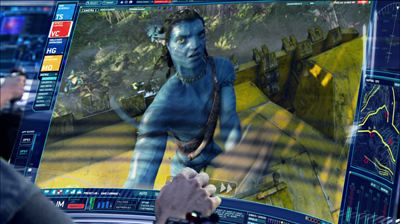
It’s a good thing the pros kept pushing. Had filmmakers and cinephiles welcomed the earliest digital systems, we might have something worse. Here’s George Lucas in 2005, talking less about photographic quality than the idea of the sanitary image.
The quality [of digital projection] is so much better. . . . You don’t get weave, you don’t get scratchy prints, you don’t get faded prints, you don’t get tears. . . The technology is definitely there and we projected it. I think it is very hard to tell a film that is projected digitally from a film that is projected on film.
And he’s referring to the 1280-line format in which Star Wars Episode I was projected in 1999.
Probably the widespread skepticism from directors and cinematographers helped push the standard to 2K. (So did the adoption of the Digital Intermediate.) Optimistic observers in the mid-2000s expected the major studios to make 4K the standard right away. Given the constraints of storage at that time, the 2K decision might be justified. But like the 24 frames-per-second frame rate of sound cinema, it was a concession to the just-good-enough camp.
At the same time, George seems to grant that progress will be needed in the area of resolution.
You’ve got to think of this [our current situation] as the movie business in 1901. Go back and look at the films made in 1901, and say, “Gee, they had a long way to go in terms of resolution. . . .”
Actually, in films preserved in good state from 1901, the resolution looks just fine—better than most of what we see at the multiplex today, on film or on digital.
The invisible revolution
Speaking of sound cinema: Is the changeover to talkies the best analogy for what we’re seeing now? Mostly yes, because of the sweeping nature of the transformation. No technological development since 1930 has demanded such a top-to-bottom overhaul of theatres. Assuming a modest $75,000 cost for upgrading a single auditorium, the digital conversion of US screens has cost $1.5 billion.
In an important respect, though, the analogy to sound doesn’t hold good. When people went to talkies, they knew that something new had been added. The same thing happened with color and widescreen. And surely many customers noticed multi-track sound systems. But what moviegoers notice that a theatre is digital rather than analog? Many probably assume that movies come on DVDs or, as one ordinary viewer put it to me, “film tapes.” Anyhow, why should they care?
There was a debate during the 2000s that audiences would pay more for a ticket to a digital screen. But that notion was abandoned. People aren’t that easy to sucker. So we’re back with 3D as the killer app, the justification for an upcharge. Whether 3D survives, dominates, or vanishes isn’t really the point. It’s served its purpose as the wedge into digital installation.
By the way, according to one industry leader, 2D ticket prices are likely to go up this year while 3D prices drop. Is this flattening of the price differential a strategy to get more people to support a fading format?
Mommy, when a pixel dies, does it go to heaven?
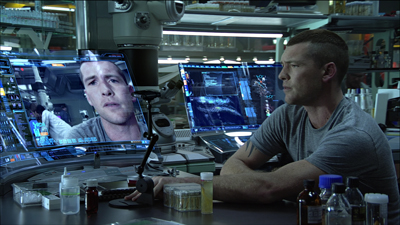
Digital was sold to the creative community in part by claiming that at last the filmmaker’s vision would be respected. Every screening would present the film in all its purity, just as the director, cinematographer et al. wanted it to be seen.
Last week I went to see Chronicle with my pal Jim Healy. The projector wasn’t perpendicular to the screen, so there was noticeable keystoning. The masking was set wrong, blocking off about a seventh of the picture area. And two little pink pixels were glowing in the middle of the northwest quadrant throughout the movie. I’m assuming that Chronicle’s director didn’t mandate these variants on his “vision.”
Jim went out to notify the staff, and two cadets came down to fiddle with the masking. The movie had already been playing in that house for several days. Maybe the masking hadn’t been changed for months? And of course the projector couldn’t be realigned on the fly. As for those pixels: There’s nothing to be done except buy a new piece of gear. Chapin Cutler of Boston Light & Sound tells me that replacing the projector’s light engine runs around $12,000. At that price, there may be a lot of dead pixels hanging around a theatre near you.
Video to the max

Not so long ago, the difference was pitched as film versus video. That was the era of movies like The Celebration and Chuck and Buck. Then came high-definition video, which was still video but looking somewhat better (though not like film). But somehow, as if by magic, very-high-definition video, with some ability to mimic photochemical imagery, became digital cinema, or simply digital.
We have to follow that usage if we want to pinpoint what we’re talking about at this point in history. But damn it, let’s remember: We are still talking about video.
The Film Look
Ever since the days of “film vs. video,” we’ve been talking about the “film look.” What is it?
I’m far from offering a good definition. There are many film looks. You have orthochromatic and panchromatic black-and-white, nitrate vs. acetate vs. mylar, two-color and three-color Technicolor, Eastman vs. Fuji, and so on. But let’s stick just with projection. Is there a general quality of film projection that differentiates it from digital displays?
Some argue that flicker and the slight weaving of film in the projector are characteristic of the medium. Others point to qualities specific to photochemistry. Film has a greater color range than digital: billions of color shades rather than millions. Resolution is also different, although there’s a lot of disagreement about how different. A 35mm color negative film is said to approximate about 7000 lines of resolution, but by the time a color print is made, the display yields about 5000 lines—still a bit ahead of 4K digital. But each format has some blind spots. There’s a story that the 70mm camera negative of The Sound of Music recorded a wayward hair sticking straight out on the top of Julie Andrew’s head. It wasn’t visible in release prints of the day, but a 4K scan of the negative revealed it.
Film fans point to the characteristic film shimmer, the sense that even static objects have a little bit of life to them. Roger Ebert writes:
Film carries more color and tone gradations than the eye can perceive. It has characteristics such as a nearly imperceptible jiggle that I suspect makes deep areas of my brain more active in interpreting it. Those characteristics somehow make the movie seem to be going on instead of simply existing.
Watch fluffy clouds or a distant forest in a digital display, and you’ll see them hang there, dead as a postcard vista. In a film, clouds and trees pulsate and shift a little. Partly the film is capturing very slight movements of them in air, or the movement of light and air around them. In addition, the film itself endows them with that “nearly imperceptible jiggle” that our visual system detects.
How? Brian McKernan points out that the fixed array of pixels in a digital camera or projector creates a stable grid of image sites. But the image sites on a film frame are the sub-microscopic crystals embedded in the emulsion and activated by exposure to light. Those crystals are scattered densely throughout the film strip at random, and their arrangement varies from frame to frame. So the finest patterns of light registration tremble ever so slightly in the course of time, creating a soft pictorial vibrato.
Another source of the film look was suggested to me by Jeff Roth, Senior Vice-President of Post-Production at Focus Features. Jeff notes that a video chip is a flat surface, with the pixels activated by light patterns across the grid. (We forget that in the earliest stages, “digital” image capture is “analog”—that is, photographic—before it gets quantized and then digitized.) But a film strip has volume. It seems very thin to us, but light waves find a lot to explore in there. Light penetrates different layers of the emulsion: blue on top, then a yellow filter, then green, then red. The light rays leave traces of their passage through the layers. Joao S. de Oliveira puts it more laconically:
There is a certain aura in film that cannot exist in a digital image. . . . From the capture of a latent image, the micro-imperfections created by light on a perfect crystalline structure—a very three-dimensional process—to its conversion into a visible and permanent artefact, the latitude and resolution of film are incomparable to any other process available today to register moving images.
For example, shadows and highlights are captured “deeply.” Bright areas move into shadow gracefully. Similarly, film is far more tolerant of overexposure than digital recording is; even blown-out areas of the negative can be recovered. (In still photography, darkroom technique allows you to “burn in” an overexposed area.) The blown-out elements are still there, but in digital they’re gone forever.
Film shown on a projector maintains the film look captured on the stock: You’re just shining a light through it. We’ve all heard stories, however, of those DVD transfers that buff the image to enamel brightness and then use a software program to add grain. One archivist tells me of an early digital transfer of Sunset Blvd. that looked like it had been shot for HDTV.
But today carefully done digital transfers can preserve some of the film look. When my local theatres were transitioning, I saw Tinker Tailor Soldier Spy first on film, then on digital, and then again on film. Although the digital looked a little harder, I was surprised how much graininess it preserved. So it seems to me that some qualities of the film look can be retained in digital transfers.
Marching orders
George Lucas, at the 2005 annual convention and trade show of the National Association of Theatre Owners: “I’m sort of the digital penny that shows up every year to say, ‘Why haven’t you got these digital theatres yet?'” (Variety 17 March 2005).
“His point to theater owners was that 3D, which can bring in new audiences and justify higher ticket prices, is only possible after they make the switch to digital projection” (Hollywood Reporter 10 February 2012).
Premonitions

In summer of 1999, Godfrey Cheshire published a two-part article, “The Death of Film/ The Decay of Cinema.” It’s proven remarkably far-sighted.
He predicted that within a decade your multiplex theatre would contain “a glorified version of a home video projection system.” He predicted that the rate of adoption would be held back by costs. He predicted that the changeover would mostly benefit the major distributors, and that exhibitors would have to raise ticket and concession prices to cover investments. He predicted what is now called “alternative content”—sports, concerts, highbrow drama, live events—and correctly identified it as television outside the home. He predicted the preshow attractions that advertise not only products but TV shows and pop music. He predicted what is being seriously discussed in industry circles now: letting viewers snap open their “second screen” and call, text, check email, and surf the net during the show. And he predicted that distractions and bad manners in movie theatres would drive away viewers who want to pay attention.
People who want to watch serious movies that require concentration will do so at home, or perhaps in small, specialty theatres. People who want to hoot, holler, flip the bird and otherwise have a fun communal experience . . . will head down to the local enormoplex.
Godfrey goes on to make provocative points about the effects of digital technology on how movies are made as well. His essay should be prime reading for everyone involved in film culture—e.g., you.
WYSIWYG
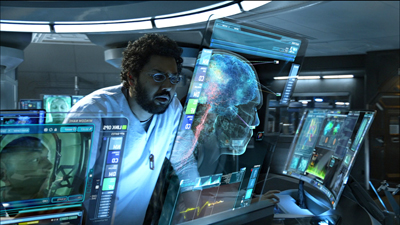
I’ve mentioned the postcard effect that makes static objects just hang there. In less-than-2K digital displays, I see other artifacts, most of which I don’t know the terms for. Film has artifacts too, notably graininess, but I find the digital ones more off-putting. There’s a waterfall effect, when ripples rush down uniform surfaces. Sometimes I see diagonal striping from one corner to its opposite, an effect common on home and bar monitors. (I’m told it comes from interference from phones and the like.) On cheap DVDs, or commercial ones played on region-free machines, you can detect a weird pop-out effect, where the surfaces of different planes, usually marked by dark edge contours, detach themselves. The surfaces float up, wobbling out of alignment with their surroundings.
I am not hallucinating these things. When I point them out, others see them, and then, like me, they can’t ignore them. So I’ve stopped pointing them out, especially when a friend wants to show me his (always his) fancy home theatre. Why spoil their pleasure?
Same difference
Various positions on the split between film and digital (for want of a better term): I’ve held nearly all of them at various points, and sometimes simultaneously. I’ll confine myself, as usual, just to film-based projection and digital projection, and assuming minimal competence of staff in each domain. (Just because something’s shown in 35mm, that doesn’t mean it’s shown well.)
1. They’re not the same, just two different media. They’re like oil painting and etching. Both can coexist as vehicles for artists’ work.
2. They’re not the same, and digital is significantly worse than film. This was common in the pre-DCI era.
3. They’re not the same, and digital is significantly better than film. Expressed most vehemently by Robert Rodriguez and with some insistence by Michael Mann.
4. They’re not the same, and digital is mostly worse, but it’s good enough for certain purposes. Espoused by low-budget filmmakers the world over. Also embraced by exhibitors in developing countries, where even 1.3K is considered an improvement over what people have been getting.
5. They’re the same. This is the view held by most audiences. But just because viewers can’t detect differences doesn’t mean that the two platforms are equally good. Digital boosters maintain that we now have very savvy moviegoers who appreciate quality in image and sound. In my experience, people don’t notice when the picture is out of focus, when the lamp is too dim, when the surround channels aren’t turned on, when speakers are broken, and when spill light from EXIT signs washes out edges of the picture. (See Chronicle anecdote above.) As long as they can hear the dialogue and can make out the image, I believe, most viewers are happy.
‘Plex operators are notoriously indifferent to such niceties. In most houses, good enough is good enough. Teenage labor can maintain only so much.
Film/video
“The picture was nice and crisp.” “So much better than film.” “We showed a Blu-ray and it looked fine.”
I don’t trust people’s responses to such things unless the judgment is comparative. Show film and the digital program side by side and then judge. Or even show rival manufacturers’ DCI-compliant projectors side by side. I think you will see differences.
As they develop, new reproductive media improve in some dimensions but degrade on others. As the engineers tell us, there’s always a trade-off.
CD is more convenient than vinyl, but its clean, dry sound isn’t as “warm.” Mp3, even more convenient and portable, packs a sonic punch but is inferior in dynamics and detail to CDs. Similarly, back in the 1990s, laserdiscs had to be handled more carefully than tape cassettes, and in playback they required interruptions as sides were flipped. But aficionados accepted these drawbacks because we believed that our optical discs looked and sounded much better than VHS. One well-known professor urged that classroom screenings could now dispense with film.
Now those laserdisc images would be laughed out of the room. Have a look at an image from the 1995 restoration of Disney’s Pinocchio. It’s taken from a transfer of the laserdisc to DVD-R. (You can’t grab a frame directly from a laserdisc.) In this and the others, I haven’t adjusted the raw image.
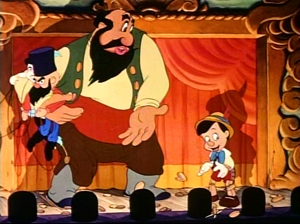
Actually, on a decent monitor, it looks better than this. Since you can’t grab a frame directly from a laserdisc, LD couldn’t stand up to home theatre projection today. The 2009 DVD and Blu-ray (below) are sharper.
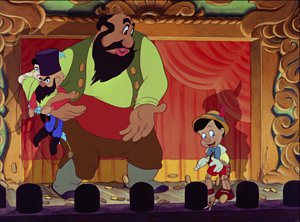
Now compare the DVD with a dye-transfer Technicolor image from a 1950s 35mm print. There have been some gains and some losses in color range, shadow, and detail. For example, Stromboli’s trousers and the footlight area go very black, presumably because of the silver “key image” used for greater definition in the dye-transfer process. IB Tech restorations routinely bring out “hidden” color in such areas.
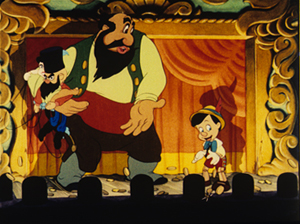
Which is best? You can take your pick, but you’re better able to choose when you’re not seeing one image in isolation.
Live/ Memorex
Of course side-by-side comparisons can fail when most viewers don’t notice even gross differences. In a course, I once showed a 16mm print of Night of the Living Dead, and a faculty friend came to the screening. (Yes, history profs can be horror fans.) In my followup lecture, I showed clips on VHS, dubbed from a VHS master. My friend came to the class for my talk. Afterward he swore that he couldn’t tell any difference between the film and the second-generation VHS tape.
This raises the fascinating question of changing perceptual frames of reference. My friend knew the film very well, and he’d watched it many times on VHS. Did he somehow see the 16 screening as just a bigger tape replay? Did none of its superiority register? Maybe not.
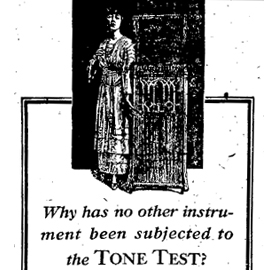 From 1915 to 1925, Thomas Edison demonstrated his Diamond Disc Phonograph by inviting audiences to compare live performances with recordings. His publicists came up with the celebrated Tone Tests. A singer on stage would stand by while the disc began to play. Abruptly the disc would be turned down and the singer would continue without missing a note. Then the singer would stop and the disc, now turned up, would pick up the thread of melody. Greg Milner writes of the first demonstration: From 1915 to 1925, Thomas Edison demonstrated his Diamond Disc Phonograph by inviting audiences to compare live performances with recordings. His publicists came up with the celebrated Tone Tests. A singer on stage would stand by while the disc began to play. Abruptly the disc would be turned down and the singer would continue without missing a note. Then the singer would stop and the disc, now turned up, would pick up the thread of melody. Greg Milner writes of the first demonstration:
The record continued playing, with [the contralto Christine] Miller onstage dipping in and out of it like a DJ. The audience cheered every time she stopped moving her lips and let the record sing for her.
At one point the lights went out, but the music continued. The audience could not tell when Miller stopped and the playback started.
The Tone Tests toured the world. According the publicity machine run by the Wizard of Menlo Park, millions of people witnessed them and no one could unerringly distinguish the performers from their recording.
Edison’s sound recording was acoustic, not electrical, and so it sounds hopelessly unrealistic to us today. (You can sample some tunes here.) And there’s some evidence, as Milner points out, that singers learned to imitate the squeezed quality of the recordings. But if the audiences were fairly regularly fooled, it suggests that our sense of what sounds, or looks, right, is both untrustworthy and changeable over history.
To some extent, what’s registered in such instances aren’t perceptions but preferences. Wholly inferior recording mechanisms can be favored because of taste. How else to explain the fact that young people prefer mp3 recordings to CDs, let alone vinyl records? It’s not just the convenience; the researcher, Jonathan Berger of Stanford University, hypothesizes that they like the “sizzle” of mp3.
To some extent, we should expect that people who’ve watched DVDs from babyhood onward take the scrubbed, hard-edge imagery of video as the way that movies are supposed to look. Or perhaps still younger people prefer the rawer images they see on Web videos. Do they then see an Imax 70mm screening as just blown-up YouTube?
The epiphanic frame
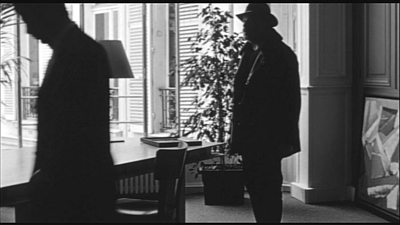
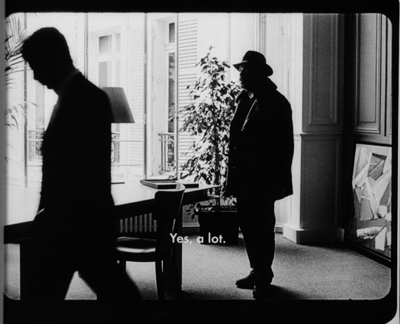
Godard’s Éloge de l’amour: DVD framing vs. original 35mm framing.
Digital projection is already making distributors reluctant to rent films from their libraries, and film archives are likely to restrict circulation of their prints. When 35mm prints are unavailable, it will be difficult for us to perform certain kinds of film analysis. In order to discover things about staging, lighting, color, and cutting in films that originated on film, scholars have in the past worked directly with prints.
For example, I count frames to determine editing rhythms, and working from a digital copy isn’t reliable for such matters. True, fewer than a dozen people in the world probably care about counting frames, so this seems like a trivial problem. But analysts also need to freeze a scene on an exact frame. For live-action film, that’s a record of an actual instant during shooting, a slice of time that really existed and serves to encapsulate something about a character, the situation, or the spatial dynamics of the scene. (Many examples here.) This is why my books, including the recent edition of Planet Hong Kong, rely almost entirely on frame grabs from 35mm prints.
Paolo Cherchi Usai suggests that for every shot there is an “epiphanic frame,” an instant that encapsulates the expressive force of that shot. Working with a film print, you can find it. On video, not necessarily.
Just as important, for films originating in 35mm, we can’t assume that a video copy will respect the color values or aspect ratio of the original. Often the only version available for study will be a DVD with adjusted color (see Pinocchio above) and in a different ratio. I’ve written enough about variations in aspect ratios in Godard and Lang (here and here) to suggest that we need to be able to go back to 35mm for study purposes, at least for photographically-generated films. For digitally-originated films, researchers ought to be able to go back to the DCP as released, but that will be nearly impossible.
The analog cocoon

I began this series after realizing that in Madison I was living in a hothouse. As of this fall, apart from festival projections on DigiBeta or HDCam, I hadn’t seen more than a dozen digital commercial screenings in my life, and I think nearly all were 3D. Between film festivals, our Cinematheque, and screenings in our local movie houses, I was watching 35mm throughout 2011, the year of the big shift.
There are six noncommercial 35mm film venues within walking distance of my office at the corner of University Avenue and Park Street. And two of those venues still use carbon-arc lamps! Go here for a fuller identification of these houses. Moreover, in my office sit two Steenbeck viewing machines, poised to be threaded up with 16mm or 35mm film. (“Ingestion” is not an option.)
But now I’ve woken up. We all conduct our educations in public, I suppose, but preparing this series has taught me a lot. I still don’t know as much as I’d like to, but at least, I now appreciate the riches around me.
I’m very lucky. It’s not over, either. The good news is that the future can’t really be predicted. Like everybody else, I need to adjust to what our digital Pandora has turned loose. But we can still hold on to hope.
This is the final entry in a series on digital film distribution and exhibition.
On the Pandora perplex, see Dora and Erwin Panofsky, Pandora’s Box: The Changing Aspects of a Mythical Symbol (Princeton University Press, 1956). The Wikipedia article on the lady is also admirably detailed.
Godfrey Cheshire’s prophetic essay is apparently lost in the digital labyrinths of the New York Press. Godfrey tells me that he’s exploring ways to post it, so do continue to search for it. Another must-read assessment is on the TCM site. Pablo Kjolseth, Director of the International Film Series at the University of Colorado—Boulder, writes on “The End.” See also Matt Zoller Seitz’s sensible take on the announcement that Panavision has ceased manufacturing cameras. Some wide-ranging reflections are offered in Gerda Cammaer’s “Film: Another Death, Another Life.”
Brian McKernan’s Digital Cinema: The Revolution in Cinematography, Postproduction, and Distribution (MGraw-Hill, 2005) is the source of two of my quotations from George Lucas (pp. 31, 33) and some ideas about the film look (p. 67). My quotation from Greg Milner on the Tone Test comes from his Perfecting Sound Forever: An Aural History of Recorded Music (Faber, 2009), 5.
NPR recently broadcast a discussion of the differences, both acoustic and perceptual, among consumer audio formats. The show includes A/B comparisons. Thanks to Jeff Smith for the tip.
Thanks to Chapin Cutler, Jeff Roth, and Andrea Comiskey, who prepared the projector map of downtown Madison and the east end of the campus.
6 February 2012: This series has aroused some valuable commentary around the Net, just as more journalists are picking up on the broad story of how the conversion is working. Leah Churner has published a useful piece in the Village Voice on digital projection, and Lincoln Spector has posted three essays at his blogsite, the last entry offering some suggestions about how to preserve both film-based and digital-originated material.
“You get soft, Pandora will shit you out dead, with zero warning.”
Posted in 3D, Digital cinema, DVDs, Film archives, Film history, Film industry, Film scholarship, PANDORA'S DIGITAL BOX: The Blog Series | open printable version
| No Comments »
Monday | February 20, 2012
DB here:
Tinker Tailor Soldier Spy has to be counted a success ($64 million worldwide so far), and it may have brought new attention to John le Carré’s writing. The fact that some websites and Twitter feeds lured readers to my entry on the film (and thanks to all) suggests that people can enjoy a film even though major aspects of the plot escape them. Everybody loves a mystery, right?
Regular readers won’t be surprised to learn that I had originally written something longer about le Carré’s narrative strategies generally. Out of common human decency I cut the entry in half and focused on the film. But seeing the interest in what I’d posted, I thought that there might be enough hard-core readers who’d want to go down the rabbit hole again.
So one more post, which reflects a little more on the film, while arguing that le Carré’s development as a novelist offers a fascinating example of a writer trying out various methods of storytelling. Ideally, you should read this after reading my first post. The next three sections don’t spill any secrets, but if you want to avoid spoilers, stop at the section called “Burrowing.”
Going to ground
During the 1970s le Carré seems to me to have reinvented the dense, almost digressive plotting we associate with the nineteenth century British novel. A little narrative theory helps us understand his ongoing exploration of storytelling technique.
We’re used to thinking that a plot presents one or two major characters moving through the world. That movement yields adventures in the broadest sense: encounters with others, experiences that illuminate some aspect of life, conflicts both inner and outer. Our mental prototype of a plot, certainly in mainstream films, features a protagonist (or a couple) accompanied by lesser figures who become allies, helpers, lovers, rivals, and enemies.
Le Carré’s first novels accord with our prototype, with the addition of those old standbys Mystery And Intrigue. Call for the Dead (1961) and A Murder of Quality (1962) are mostly straightforward detective stories. Although George Smiley is a secret agent, he’s forced to investigate crimes. Accordingly, he goes from place to place, suspect to suspect, and hears out their explanations and alibis. With The Spy Who Came in from the Cold (1963), le Carré moves closer to an adventure plot, as we follow a protagonist in a linear succession of encounters. As is common in the genre, concealed information is sprung on us at various points, forcing us to recast what we thought we knew.
It takes a mind as odd as that of Viktor Shklovsky, the great literary theorist, to point out that we can think of any longish narrative as the intersection among many stories. He believed that as a form the novel developed out of assemblies of shorter tales. He pointed to The 1001 Arabian Nights and The Decameron as examples of this sort of compilation—long works built out of collected stories, enclosed within a bigger storytelling situation.
When the novel became a distinct genre, Shklovsky thought, it continued this tradition. In essence, each novel makes a long story out of several shorter stories. But unlike what happens in the compilation format, the stories become connected to one another. Character A figures not only in her own plot, but in Character B’s. This tends to hide the fact that separate stories are nestled within the overall architecture.
Besides connecting all the sub-stories, the ordinary novel makes some of them very minor. Our simpler prototype relies on suppressing or compressing all the other story lines except the one involving the protagonist. Our protagonist meets lots of people, but some are given no background, others a bit, and still others a fair amount, but nobody’s story can override the hero’s.
Shklovsky asks us to rethink our idea of the standard novel. It becomes not a straight-line path but a tangle of virtual tales that has been radically chopped down and ironed out. All the latent stories might be intriguing enough to sustain a plot in themselves, but for immediate purposes they must be subordinated to the fate of those creatures we call protagonists. In effect, Shklovsky suggests that every narrative can be thought of as an undernourished network narrative.
In a tale of mystery and detection of course, hidden backstories of some of the characters come to light gradually. But severe selectivity still reigns, because the backstories bear on the protagonist’s main goal: solving the mystery. When Smiley cracks a murder case or agent Leamas realizes that he has been deceived by his superiors, we understand other characters’ lives in a new way, but they don’t steal the stage from our hero.
Still, Shklovsky notes, some storytellers have realized that secondary characters can claim the spotlight as well. At the limit, they can furnish new narratives, as in Wicked and Rosencrantz and Guildenstern Are Dead. Henry Jenkins’ idea of transmedia storytelling exemplifies this idea: the ally in one tale can become the hero of another, perhaps on another media platform. But of course nineteenth-century novelists aimed to do the same thing within a single tale, building elaborate plots that would give us an ample sense of how the lives of many characters converge through chance or common purpose. Our Mutual Friend, Pot-Bouille, and War and Peace try to accommodate a great many stories within their wide compass.
I think that with the novel Tinker, Tailor le Carré decided to try this option, to give the spy novel—typically the province of the teasing linear plot exemplified in The Spy Who Came in from the Cold—the sense of a panorama surveying many characters’ lives and perspectives and, still more broadly, the institutions that they serve.
Backchanneling
But there’s a problem here: How to expand your plot to do justice to many characters’ backstories and sidestories? Again Shklovsky provides useful hints, and le Carré tried many of the options he proposes.
Shklovsky suggests that stories can be integrated in two basic ways. One is through framing. You the writer set a self-contained tale, or several tales, inside a bigger one. This is exemplified by The Decameron and The Canterbury Tales, as in the films that Pasolini made from these classic works. We can see this option at work in a movie like Dead of Night (1945), in which guests at a country house party swap stories of the morbid and bizarre. Actually, le Carré tried this. The Secret Pilgrim (1990), is virtually a collection of short stories framed by an aged spy listening to Smiley lecture at MI6’s training school.
Another option is what Shklovsky calls “threading,” the principle that traces the consecutive adventures of a protagonist. This is the prototype I’ve already mentioned. But Shklovsky suggests that by keeping the protagonist thread you can still expand the framed tales. In Don Quixote, the adventures of the Knight and Sancho Panza hold their own interest, but they surround a string of embedded tales told by the people they meet. And sometimes those embedded tales are pretty long.
It seems to me that le Carré sought ways in which he could expand his embedded tales without losing the main thread. For example, his novel following The Spy…, The Looking Glass War (1965), splits the protagonist function up into three characters, their parallelism stressed by the section titles: “Taylor’s Run,” “Avery’s Run,” and “Leiser’s Run.” There is an overarching rhythm to the action, but we have three distinct protagonists. It’s as if the author is rehearsing, on a smaller scale, the shifting viewpoints that he will exploit in his longer fictions. The tripled protagonist also allows le Carré to present different standpoints on that center of spying operations MI 6, known as the Circus.
The following book, A Small Town in Germany (1968), is a return to a single protagonist and a straight detective plot, but now the mystery focuses on the bureaucracy behind espionage. Alan Turner, an embittered spy in the Leamas mold, is searching not only for a staff member missing from the British embassy in Bonn but also for some damaging files that have vanished. The drab routines of sorting, checking, and managing information become the object of scrutiny, and Her Majesty’s civil servants are prime suspects. Le Carré had found a way to put burrowing at the center of his plot.
After these efforts, in which Smiley barely appears, le Carré might well have felt ready to test his talents on a broader canvas. First came The Naïve and Sentimental Lover (1971), a satiric psychological novel about a businessman who becomes entranced by a novelist and his wife. The book, which runs over 400 pages, shows le Carré’s eagerness to stretch out. Just as important, I suspect, is its value as a laboratory for narrative experiments. Descriptions swell, and inner states are reported in detail. Instead of a roaming point of view, there are deep plunges into the main character’s mind and senses through stream of consciousness, free indirect discourse, and a curiously omniscient voice, sometimes pitying and sometimes jocular. Compare the driving scenes in the opening lines of two books.
“Why don’t you get out and walk? I would if I were your age. Quicker than sitting with this scum.”
“I’ll be all right,” said Cork, the Albino coding clerk, and looked anxiously at the older man in the driving seat beside him.
(A Small Town in Germany)
Cassidy drove contentedly through the evening sunlight, his face as close to the windshield as the safety belt allowed, his foot alternating diffidently between accelerator and brake as he scanned the narrow lane for unseen hazards. Beside him on the passenger seat, carefully folded into a plastic envelope, lay an Ordnance Survey map of central Somerset. . . . For the attention of Mr. Aldo Cassidy ran the deferential inscription; for Aldo was his first name. He drove, as always, with the greatest concentration, and now and then he hummed to himself with that furtive sincerity common to the tone-deaf.
(The Naïve and Sentimental Lover)
The style seems to me unsure, but clearly the writer is moving beyond terseness toward something more enveloping and commentative.
Returning to the espionage genre, le Carré hit upon another way to fill a big canvas. He resurrected that old formula, the supreme master-mind criminal pitted against our beleagured hero. The master spy isn’t Mabuse or Fu Manchu but the Russian Karla, snug in Kremlin Centre, and George Smiley’s efforts to flush him out are chronicled in Tinker, Tailor, Soldier, Spy (1974), The Honourable Schoolboy (1977), and Smiley’s People (1979). The mass-market omnibus edition of these runs to nearly a thousand densely packed pages. How did our author manage plots on this new scale?
Wrangling
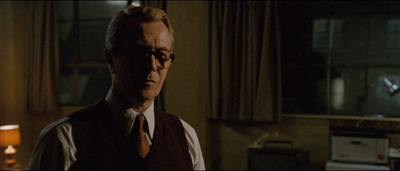
Chekhov says that if a story tells us that there is a gun on the wall, then subsequently that gun ought to shoot. . . In a mystery novel, however, the gun that hangs on the wall does not fire. Another gun shoots instead.
Viktor Shklovsky
Some expansions are pretty evident. The Quest for Karla trilogy introduces many new characters, mostly people who staff the Circus or who are involved with the institution of espionage: from secretaries and “scalphunters,” the lonely and low-down agents assigned to menial bits of spying, to the very top, such as the Minister who oversees MI6 and Lacon the pliant civil servant overseeing the Circus. Some of these characters are in turn given private lives, with friends and lovers. The connections ramify.
In addition, there are the civilians whose lives are touched by the Cold War chessgame. In The Spy Who Came in from the Cold, that demographic was represented by Liz Gold, Leamas’ lover. But in the Karla trilogy we get a panoply of more or less innocent figures who are pulled into webs of plot and counterplot. And here le Carré does something quite shrewd.
He tends to start the novel with these characters, people at the very edge of the web. Smiley’s People opens with an unassuming Russian émigrée living in Paris. She’s confronted by a Soviet agent telling her she might be permitted to see her long-lost daughter. What does that have to do with Smiley’s cleaning the Circus stables after the mole scandal, or Smiley’s loss of power after the Jerry Westerby misadventure? Positing enigmas at two or three degrees of separation, working inward across the web, le Carré lets the reader gradually sense the lines of force that lead inexorably to the principals.
So le Carré grows his book not merely by expanding his cast. He finds a new balance between thread structure and framed stories. In Smiley’s People, perhaps the most orthodox entry in the trilogy, Smiley investigates the death of an émigré Soviet general, and this entails a fairly standard detective plot. The novelty comes in the fact that the participants Smiley questions are former agents whom he ran, or colleagues retired from the Circus—his people. And what they tell him isn’t rendered in compressed dialogue or summary. Their recollections spread out luxuriantly, claiming considerable interest in their own right, sometimes with only slight points of contact with the main plot, sometimes burying clues that Smiley must dig out.
More intricate is The Honourable Schoolboy, the longest entry in the Karla trilogy. It has two main threads: Jerry Westerby’s efforts to trace money flowing from Moscow to Hong Kong, and Smiley’s struggle to rebuild the Circus. The plot encapsulates the two main types of spy fiction—indeed, the two types that le Carré had already mastered in his earlier books. While Jerry’s plot is suspenseful adventure stuff, Smiley’s plot is inquiry-oriented, like that in Ambler’s classic Mask of Dimitrios (1939). To stretch the canvas on a still bigger frame, le Carré makes Smiley pass investigative assignments to other Circus personnel, like Connie Sachs and Doc di Salis (who get characterized in detail). Indeed, both main lines of action are filled out with rich and lengthy sub-stories. We can study the tradecraft of old Craw, majestic spy-journalist; the puzzling past of Lizzie Worthington, Drake Ko’s mistress; and the enigmas around her lover Ricardo, either dead or flying heedlessly through an Asia in flames.
The Honourable Schoolboy also has a more layered narration than its predecessors. It switches point of view constantly, in the process virtually promoting Peter Guillam to the rank of Smiley’s Watson. Most striking is the plot’s ultimate narrating framework, a sort of institutional memory serving as recording angel. Instead of the all-knowing, somewhat condescending voice of The Naïve and Sentimental Lover, this narration is brisk and brusque. It defends Smiley against those in the intelligence community who, through shortsightedness or malice, misjudged his decisions.
It has been laid at Smiley’s door more than once since the curtain was rung down on the Dolphin case that now was the moment when George should have gone back to Sam Collins and hit him hard and straight just where it hurt. George could have cut a lot of corners that way, say the knowing; he could have saved vital time.
They are talking simplistic nonsense.
This opinionated, godlike narrating agency is never identified. It’s one of the many signs that in the Karla books le Carré is reviving conventions of the triple-decker novel. And so he did; he bid to become our Dickens. (The larger-than-life father-son duo of A Perfect Spy is perhaps his most extravagant exercise in this vein.)
He echoes Wilkie Collins too. For mystery, never far from Dickens’ concern, is central to Collins and le Carré. Sustaining the reader’s interest through mystery seems not as important for our highbrow novelists now; it’s the province of “genre fiction.” But many of the canonical works of fiction and drama turn on secrets that are hinted at, then dramatically exposed (not only Oedipus and Hamlet but works by Henry James, Ibsen, Conrad, O’Neill, Faulkner). On the first page of Crime and Punishment, Raskolnikov thinks, “Why am I going there now? Am I capable of that? Is that serious?” The question of that that keeps us reading. You can argue that the modernist novel, with its fascination with time-juggling and stream of consciousness, found a sort of equivalent for the secrets, deceptions, and puzzles that drive classic tales. In any event, during the first decade of le Carré’s career, he began to explore the ways in which embedded stories can blossom into mysteries.
Burrowing
In my original entry, I didn’t straighten out the plot of Tinker Tailor, but now, as the film nears the end of its theatrical run, I’ll tell the novel’s tale straight. Skip if you don’t want it all ironed out.
Bill Haydon, working for British intelligence, is in the pay of Moscow Centre and its head, Karla. He has been passing information to the Russians for years, but Control, the head of the Circus, is starting to get suspicious. He believes that one of his five top men is a mole. Karla entices Control into sending an agent, Jim Prideaux, to meet a Czech general supposedly going to defect. This leads to a spectacular failure—Prideaux is shot and captured—and allows Karla to install an ambitious dunce, Percy Alleline, in Control’s position.
Haydon is the best and the brightest, the flower of English manhood. Suave, easygoing, with an Oxbridge artistic flair, he is as debonair as Smiley is brooding and inscrutable. Haydon has strained his friendship with Smiley by conducting a brief affair with Smiley’s wife Ann, but that episode was initiated by Karla to make Smiley reluctant to suspect Bill of bigger crimes. Haydon has already tempted Percy with the promise of a double agent, a cultural attaché in London called Polyakov. Through Polyakov Karla feeds the Circus trivia, mixed with bits of good information, to the gratification of Alleline’s inner circle—Haydon, Roy Bland, and Toby Esterhase—as well as Oliver Lacon and the Minister overseeing the bureaucracy. And the Americans approve.
Upon Control’s forced retirement, his team is abandoned and he dies a short time later. A permanently damaged Jim Prideaux is brought back to a new life as French teacher at a minor boy’s school. Smiley retires, while his wife Ann leaves to take up a string of love affairs.
But when a raffish field agent, Ricki Tarr, reports on good authority that there is a mole at the very top of the Circus, Lacon asks Smiley to investigate sub rosa. Smiley installs himself in a shabby hotel and with the help of a youngish colleague, Peter Guillam, and an old friend, Inspector Mendel, he starts patiently scouring the records. Following in Control’s footsteps, Smiley discovers disparities, missing documents, and incompatible testimony. Eventually he is able to pressure Toby into revealing the location of the safe house where Alleline’s cadre meets Polyakov.
By inducing Tarr to send a message galvanizing the Circus’ top brass, Smiley forces the traitor to hurry to meet Polyakov at their usual place. There Smiley, Guillam, and Mendel record Bill Haydon’s incriminating conversation and play it back to the embarrassment of the inner circle. There remains a long epilogue, in which Bill, in detention, confides in Smiley and seems to have no regrets about sending his closest friend Jim Prideaux into a trap and months of torture. Jim has discovered the treachery of his dearest friend and, sneaking into the compound, kills Haydon. While Smiley, now occupying Control’s seat of power, goes to the countryside for a possible reunion with Ann, Jim returns to his school, the object of the boys’ adoration but also a morose, haunted man.
I’ve tried to synopsize the action as a thread, in Shklovsky’s sense, but I can’t do justice to the novel’s exfoliating plotlines. We’ve seen that a detective story basically presents the sleuth going from person to person, asking questions and getting information. Since Smiley is the protagonist, much of what I’ve traced has to be discovered through testimony or flashbacks. As Shklovsky remarks, any mystery in a plot involves some play with time, either ellipsis (what happens in the gap?) or rearranged order (hiding crucial causes) or a late point of attack (so that we must go back to reconstruct why things are as they are).
But your straight-line Q & A investigation can be pretty plodding. Check for yourself by trying to read one of the “classic” detective stories by S. S. Van Dine. Forced to present official reports and characters’ recollections, le Carré skillfully expands those into robust, extensive stories of their own, filled out with characterization, detail, and atmosphere. The recording-angel narrator moves easily from reporting the interrogations to summarizing past action and then to full-blown scenes rendered from the viewpoint of the witnesses.
As in the later books of the trilogy, le Carré’s point of entry is oblique. Instead of starting with Smiley, principal investigator, it starts with Jim Prideaux’s enigmatic arrival at the boys’ school, and even that is presented at one remove, through the vantage point of Bill Roach, aka Jumbo, a hapless “new boy” at the school. Only after that do we meet Smiley, hailed by the obnoxious gossip Roddy Martindale (a convenient expository device) who chats about the usurpation at the Circus. Soon Smiley is summoned to Lacon’s home, where he and Peter learn Ricki Tarr’s story of spying in Hong Kong and falling in love with Irina, the wife of a KGB spy. It’s she that tells him of the mole in the Circus.
Tarr’s tale is the first embedded story, running four chapters. Once Smiley takes the assignment, relatively little happens in the present. His investigation carries him to his old Russia expert, Connie Sachs, and she recounts another block of information, about how her suspicions of Polyakov led her to be sacked from the Circus. Once Smiley is back at his hotel, he starts his reading, and for five chapters we get a big chunk of the past, including Smiley’s discovery of Bill’s affair with Ann. Smiley’s homework is interrupted by a suspenseful string of scenes involving Peter’s smuggling crucial files out of the Circus.
Another embedded story soon follows: Over dinner Smiley tells Peter of his only meeting with Karla, many years before. Then, pursuing yet another clue, Smiley questions Sam Collins, the man on Circus duty the night Jim was ambushed. As in any good detective story, Bill Haydon seems to have an alibi (he heard the news at his club) and acts resolutely un-guilty, bursting into the Circus to take command and demand the return of his old pal Jim. Sam’s embedded story to Smiley is followed by others, from the man who drove Jim into Czechoslovakia and from Jerry Westerby, who heard rumors that the military were waiting for Prideaux. Getting ever closer to the fateful incident that set the whole shuddering machine into motion, Smiley finally hears Jim’s own version of what happened to him that night and in the months afterward.
After so many extended stories—recounted by witnesses, filtered through hearsay, written up in bureaucratic files, commented upon by the recording angel—the plot launches into forward motion. Smiley and his colleagues set their trap, and there’s a suspenseful set-piece spanning two chapters. Le Carré alternates among Tarr in Paris, Mendel watching affairs at the Circus, and Smiley waiting in the safe house to trap the traitor. There follows an equally crosscut epilogue, with Bill and Smiley’s confrontations alternating with vignettes of other characters—including a young woman, introduced for the first time, who seems to have borne a child by Bill. The book concludes with Smiley, waiting to meet Ann and meditating on what drove Bill.
Scalphunter
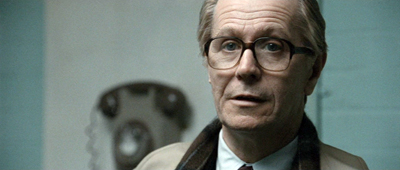
In adapting a novel for the screen there is a natural temptation to dramatize the information supplied by narrative description in the original text by turning it into dialogue, but this is generally to be resisted. Where possible it should be translated into action, gesture, imagery. Much of it can be dispensed with altogether.
David Lodge
Imagine trying to adapt this monster! Respecting the novel’s construction would demand a cascade of flashbacks, long tales framed by Smiley’s investigation. The seven-installment BBC series, scripted by Arthur Hopwood, took the simpler option of starting with a scene that is presented very late in the novel, in Jim’s embedded story told to Smiley. The series opens with Control summoning Jim and sending him off to Czechoslovakia; Jim is shot and Control is cast out. Clarifying the string of events this way, and giving us a decent action scene early on, has its cost: Smiley doesn’t enter the plot for nearly 23 minutes. Yet this construction does obliquely retain the portmanteau quality of the novel’s concept, in which sustained blocks of action are allowed to stretch and breathe.
Soon, as in the novel, the TV series gives us Ricki Tarr’s story of his affair with Irina, presented as a discrete flashback. Then Smiley’s trawl through the files is supplemented by his visits to Connie and others. Sometimes their recollections are dramatized in flashbacks, other times we simply watch them tell Smiley of them. Fortunately for the viewer, there are also scenes of Smiley bringing Peter up to date, and briefing Lacon on current discoveries. Because the BBC series was broadcast in weekly episodes, this sort of backtracking was necessary. And since Hopcraft had several hours to fill, the plotting could be somewhat spacious. Nonetheless, the book’s oscillating time scheme was somewhat flattened out, and the block construction—main thread interrupted by inset stories—was compressed. The inset tales didn’t expand to their novelistic dimensions.
The Tinker Tailor film, of course, had to be much more squeezed down. I mentioned in the earlier entry that the screenwriters compared their structure to a mosaic, and I followed this out in my discussion of how the narration was elliptical and fragmentary, leaving out redundancies that are usually required in popular film. Many scenes are both spacious and laconic. The rhythm is slow, and we’re given time to see and hear everything; but that “everything” might be only a voice dimly overheard, or a doorbell, or an image that gives one piece of information.
Take an instance I didn’t pick out in the original post. In order to steal a file, Peter Guillam has arranged for Mendel to call him, pretending to be a garage mechanic.
The call provides a pretext for Guillam’s retrieving his bag from the security officer, so he can slip the file inside.
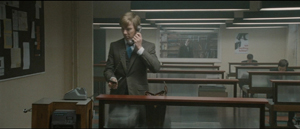
George Formby’s music-hall tune “Mr. Wu’s a Window Cleaner Now” is playing on the garage radio. It’s carried down the phone line to the call-screener at the Circus, who murmurs along with it as the call is recorded.
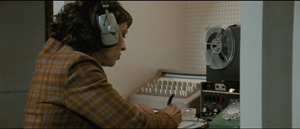
After the tense meeting with the Circus cadre, Guillam has apparently sneaked the file out. But on the staircase an offscreen voice softly sings “Mr. Wu” before we see the source, not Guillam but Roy Bland. He descends slightly ahead of Guillam.
 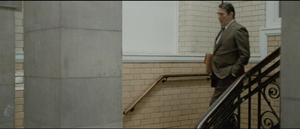
Guillam follows right behind, pausing and looking off nervously as Bland passes through the foreground.
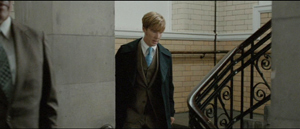
The empty stretch of the staircase shot allows us to think that it’s Guillam offscreen, humming the tune he heard on the line, so it’s a surprise when Bland appears. We realize that he must have heard the call, or the recording.
Another film would have cut away during Guillam’s maneuver to show Bland and his colleagues listening to Peter’s fake conversation. That would have dialed up the suspense: Will they detect the trick? Instead, showing the lady on the phone lets us know that the call is being recorded. Only retrospectively—and by a single piece of information that slips by—do we realize that Bland has heard the conversation. Guillam is being watched closely. There’s a meta-message here too: By humming the tune, Bland lets Guillam know he’s overheard the call. Bland’s casual feint fits with the intimidation of Guillam that began when he was called into Percy’s meeting.
In all, the moment’s oblique, ricocheting transmission of story information could easily be missed. (In the book, it’s Bill who waylays Guillam and asks if he’s seeing Smiley. “Guillam’s world, which was showing signs till then of steadying to a sensible pace, plunged violently.”) The film’s script and direction have followed David Lodge’s suggestion of translating Peter’s sudden panic into images and sounds, but more laconic ones than we usually find.
More broadly, the film’s stinginess about supplying information extends to its protagonist. As I suggested in the first post, Smiley doesn’t just solve mysteries—he is one. What does he want? Oldman’s dry, impassive performance bottles the shrewdness, sternness, and pain that Guinness let leak out in the series. It still seems to me that the film’s Smiley is playing a waiting game; even the “Aha!” moment near the climax, when he seems to have hit upon something, proves to be obscure.
After the montage parades the suspects and shows the shifting train tracks outside Smiley’s dingy hotel, the narration doesn’t present the classic giveaway clue or blinding insight. Immediately we see Smiley, by force of will, bullying his superiors and Toby into giving him the information he needs to trap the mole . . . whose identity isn’t pinned down until the ambush. Smiley’s emotion bursts forth only once more, in his confrontation in Haydon’s cell. After a slight confirmatory smile (Prideaux, Smiley surmises, “knew deep down it was you all along”), Smiley asks if Karla ever considered letting Bill take over Control’s post.
Bill, angry: “I’m not his bloody office boy!”
Smiley, almost roaring, but with expression unchanged: “What are you then, Bill?”
Bill, after a pause, in a subdued, strangled voice: “I’m someone who has made his mark.”
Smiley exhales, the burst of energy gone, and turns slightly aside.
Smiley’s outburst here is his most vehement utterance in the movie. By the epilogue, Smiley, still unsmiling, has assumed his place as Control’s successor.
Mole-hunters
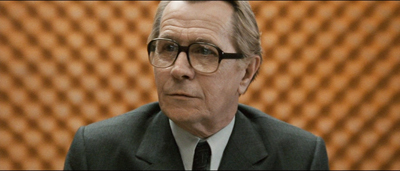
You have to let go of the idea of explaining it all to the audience. You have to make it so complex that the audience understands that they can’t understand all of it. . . . We had to make it trustworthy and credible but also so complex that you couldn’t penetrate it. . . but not so incomprehensible that it put people off.
Dino Jonsäter, editor, Tinker Tailor Soldier Spy
More than most plot types, I think, a mystery story lures us into analysis. Think of the endless fan probes into Memento, Primer, Donnie Darko, and the like. The secrets in the action, and the roundabout tactics of recounting it, invite us to think about narrative technique more abstractly than we usually do. We’re encouraged to study how we’ve been misled. Analysis is a bit like detective work, but also like academic research. The analyst has a lot in common with Smiley and his patient burrowing into the files. He is, in the books, an amateur philologist and a scholar of German poetry.
For many, the mysteries of Tinker Tailor have aroused an urge to analyze. Jim Emerson has compiled a handy roundup of exceptional probes into the film. Some of my readers have filed perceptive reports as well. Filmmaker and teacher Stew Fyfe offers this:
I agree that what they’ve done with the film is subtract most of the redundancy, with bits of information offered up only once. If you missed it, you missed it. I was surprised when Smiley actually told Ricki Tarr that he missed the chip in the door; that seemed like the movie was taking it uncharacteristically easy on the audience for a moment. It was kind of thrilling to see a film that trusts its audience to keep up with it the way this one does. I wonder if they might have initially stripped more info out and then put some back in during the editing process. . . .
The other thing that has struck me is how very legible the film is when you see it a second time. Most everything does indeed seem to be there, in frame, but the audience isn’t cued to be looking for certain things. Ann does have some slight reaction to Bill Haydon when he sits down at the party, if I remember correctly (something cues Smiley to turn and look at him). And it’s clear why Bland offers to accompany Guillam to lunch.
Or performances take on a different meaning based on the information we have by the end of the film. It’s clear by the end that some sort of relationship was going on between Haydon and Prideaux, which makes Haydon’s conversation on the phone the night Prideaux was captured play differently the second time around. (The Haydon-Prideaux relationship was actually one thing that didn’t work for me the first time watching the film. The nature of their relationship hadn’t registered, so Prideaux’s act of shooting Haydon didn’t have the same emotional heft. The scene played much more strongly the second time I saw the film.)
I guess Smiley’s eureka moment is a little bit of a leap, but otherwise, it’s all there.
And here’s Ben Slater, a long-time le Carré admirer.
I read the screenplay, officially online as part of Focus’s awards campaign (http://focusawards2011.com/workspace/ttss-screenplay.pdf) , and it’s fascinating how much of the adaptation was reworked and restructured in production.
The film was intended to open ‘cold’ with Prideaux’s mission. His meeting with Control – now the opening sequence – wasn’t till much later. The abortive mission and the Christmas party were intended to only be returned to once each, and yielded most of their secrets (Karla’s presence/Bill and Ann) on the first go-round.
There are myriad tiny and fairly dramatic changes – in the script Ricki Tarr’s first appearance is much more impactful, the killing of Bill is very different, etc. Some of these are changes Alfredson must have made during filming, others suggest a great deal of time spent re-arranging and re-sculpting the fragments of the plot in editing – trying to make the story flow as elegantly as possible. I imagine this was tough!
Interestingly, the bold decision to make Smiley silent for so long in the opening scenes seems to have been made in post. They simply cut all his first lines of dialogue. And Smiley’s closing line of the film was also shot and cut – “Shall we begin?”
It’s impossible to watch the film without running the novel and the TV series alongside it, and it struggles to compete in terms of narrative and character, but the real triumph is arguably the ambience of broken England it evokes – cigarettes, whiskey, bad burgers, bad skin and failed lives.
So mystery stories tease us into analysis. But they also flaunt some common characteristics of all storytelling. Encountering any tale, we always want to know what comes next, but we’re also curious about what was left out, or lied about, or presented in passing, or hidden in plain sight. The writer is the mole, and we’re the mole-hunters. As novelist Jane Smiley puts it:
The most basic conviction of every novelist from Lady Murasaki on . . . is that things are not as they appear.
My arguments from Victor Shklovsky come from various essays in Theory of Prose, trans. Benjamin Sher (Dalkey Archive, 1991); the epigraph is from the essay “Sherlock Holmes and the Mystery Story,” 110-111. The David Lodge epigraph is from his “Novel, Screenplay, Stage Play: Three Ways of Telling a Story,” in Lodge, The Practice of Writing (Penguin, 1997), 215. The Jane Smalley quotation is in her 13 Ways of Looking at the Novel (Anchor, 2006), 49. For more thoughts from editor Dino Jonsäter, go to “Cutting Tinker Tailor Soldier Spy” on Creative Cow.
I’ve signaled before the marvelous two-part interview with le Carré for the CBC, but why not do it again? Since writing the last piece I also discovered a helpful interview with Tomas Alfredson and Gary Oldman at Film School Rejects. I have other notes on the Hong Kong atmosphere of The Honourable Schoolboy here.
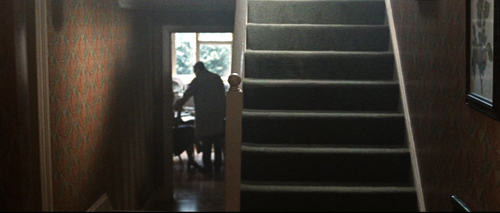
Posted in Film and other media, Film comments, Narrative strategies, National cinemas: UK | open printable version
| No Comments »
|